


Over 1000 students participated in Concordia’s annual hackathon.
By Megan Mills Devoe and Aidan Raynor Campus News Editor Editor-in-Chief
@meganmillsdevoe
@aidanraynor
At 2:41 p.m. on Jan. 24 Maya Ahammamouche, an international student from Algeria, and her teammates were about three hours into a 24 hour hacking challenge. Their goal was to make it easier for international students like them to navigate the various portals and databases they need to jump through to continue their studies.
“We wanted to create a tool which helps students to know when to renew their visas.”
— Ahammamouche.
She and her team were just a few of the approximately 1,000 students competing in ConUHacks, one of Canada’s largest hackathons.
“It’s somewhat of a coding competition, students have to build [a] project in the 24 hours from start to finish,” said co-president of the event, Elizabeth Wong. Ahammamouche and her team worked throughout the night to develop a software that would compile visa information from government databases into a single user interface. Margot-Loane Salmon-Cottreau,
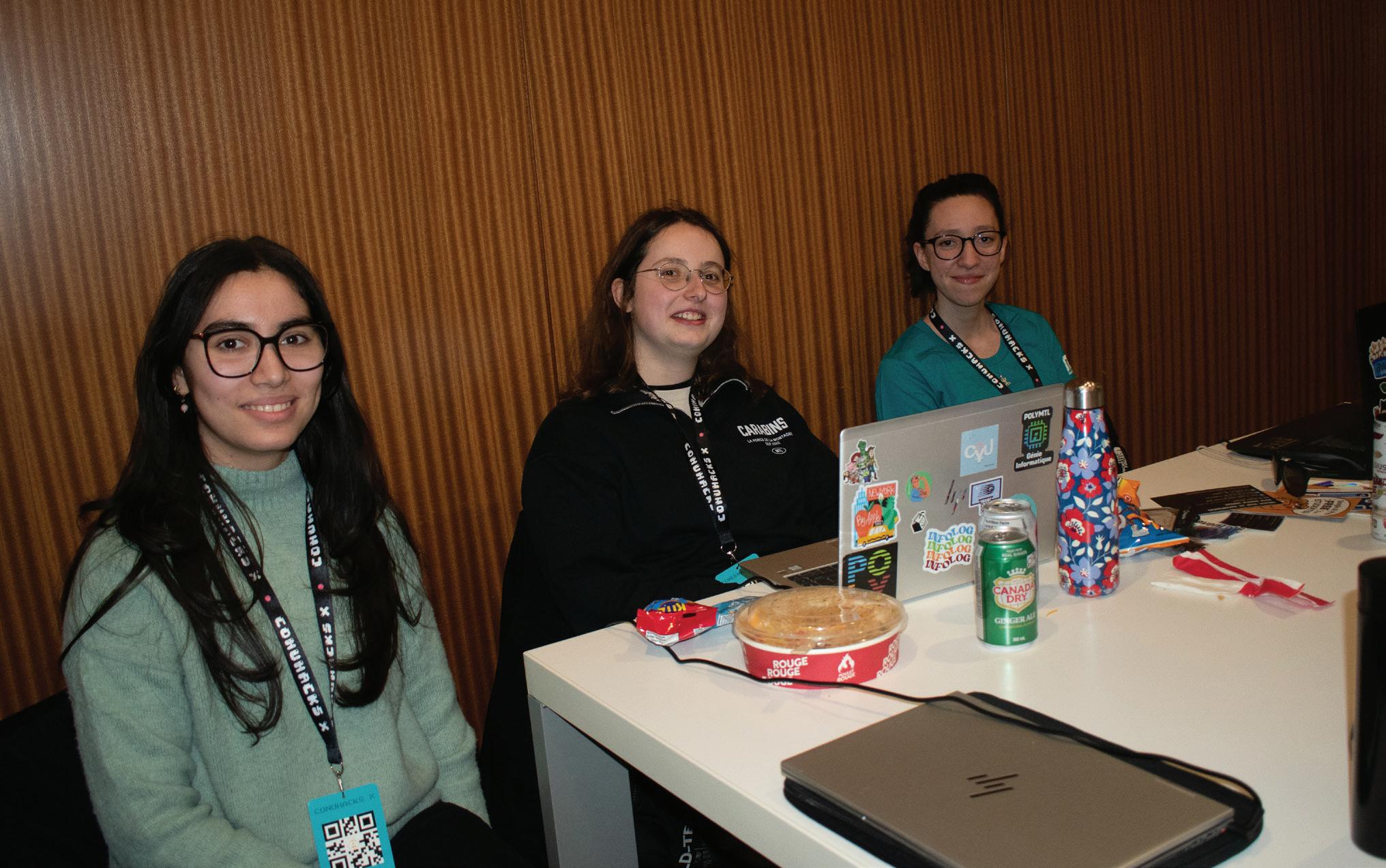
another team member, explained that their software would allow students to search by precise criteria to get an understanding of any anticipated delays to their visa applications.
The event reached halls far beyond JMSB with the student talent demonstrated.
“As our nation navigate[s] a new era increasingly defined by artificial intelligence and rapidly evolving digital technologies, your work is more important than ever.”
— Prime Minister Mark Carney in a letter to the executive team in recognition of the event.

Projects varied from immigration tools, elder care support to the beyond practical like an AI powered perfume generator.
“Why would you settle on a perfume that is created for the masses?” said project lead, Ayad Abouker.
Beyond the draw of awards, many students were competing to receive exposure for their talents.
“If you participate in the challenge, oftentimes [sponsors] hire or interview the winners. It’s a great way to get directly into an internship or full-time [work],” said Wong.
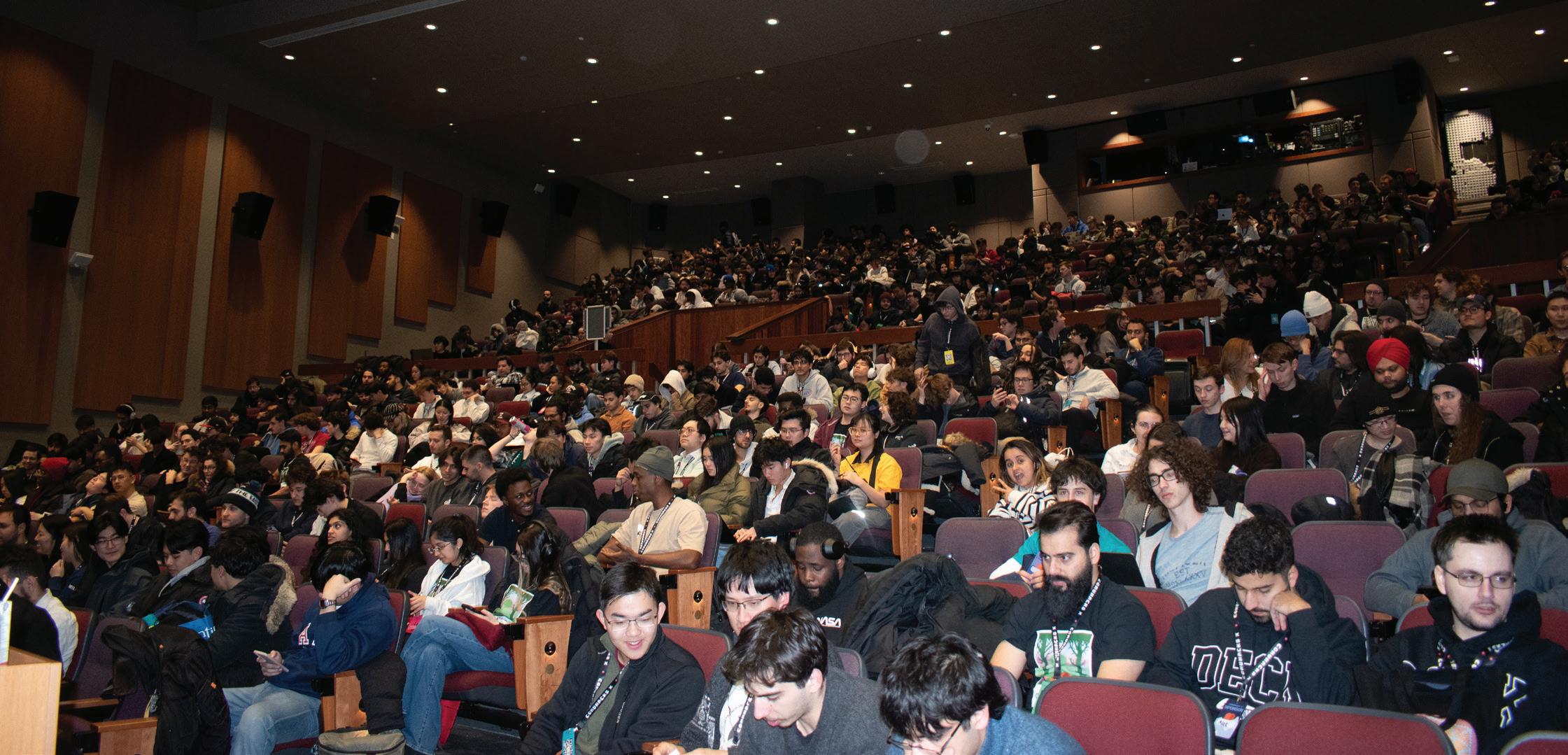
Thirty-one hours after the competition started, students gathered in the Hall building auditorium to see who would come out victorious after their night of battling code. Concordia software engineering students Thomas Mahout, Vinisha Manek, Ambrose McLaughlin and Christopher Mezzacappa took home first prize overall for their project, Vini Clip.
For Mahout and Manek, this is the second year in row winning first prize overall, and fourth consecutive year competing together. McLaughlin and Mezzacappa, their classmates and longtime collaborators, were unable to attend the closing ceremony due to exhaustion following the all-night work session.
“Vini Clip was an automatic on the fly, video editor, for professionals and academics. The average person might have to record themselves speaking for something, but it's very hard to expect them to be able to edit the video together, cut out pauses, cut out mistakes,” said Mahout.
First, second, and third place overall winners were awarded Macbooks, Steamdecks, and Sony headphones, respectively.
The Concordia communityrun Health-food co-op is moving to a larger, more accessible location with lower rent and expanded programming potential.
By Jia Marguerite Schofer Campus News Assistant
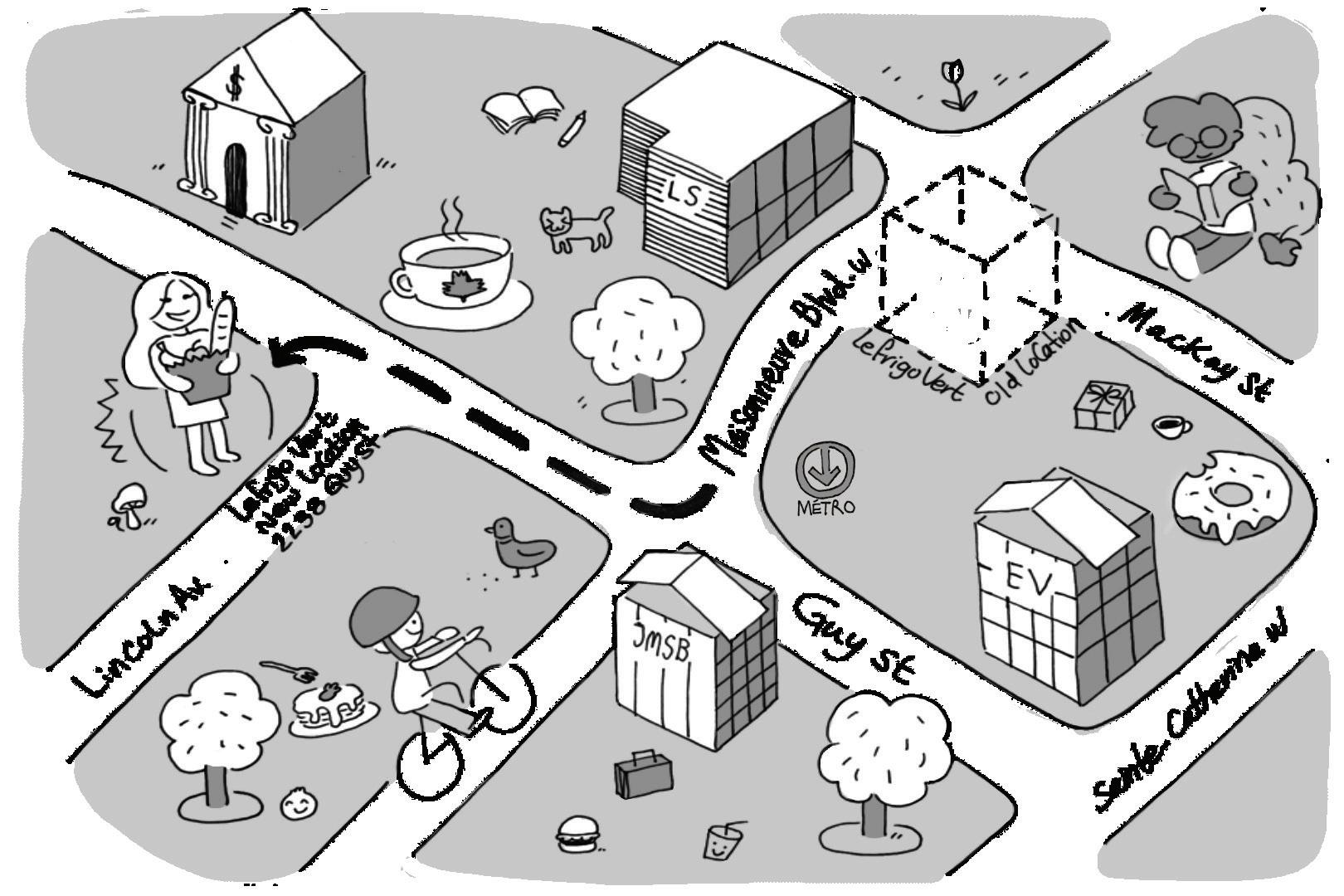
The relocation of Le Frigo Vert to 2238 Guy St. at the end of February marks a long-awaited transformation for the collective.
Over the years, the space has hosted a community that has outgrown its current walls. The space is supported by a 5¢ per credit fee-levy and a membership program available on a sliding scale of $0–$100 per year. According to their website, the space runs an anti-capitalist, anti-colonial, and anti-oppression food and alternative health community center.
“I think it is an absolutely indispensable space,” said Adam Semergian, Academic Coordinator at Arts and Science Federation of Associations (ASFA).
“Aside from People’s Potato, it definitely sells the cheapest food around campus.”
The workers’ collective’s new location, situated around the corner from its current site near Concordia University’s ER Building, comes with significantly lower rent, according to staff.
“We’re going to be able to put a lot more money into programming because currently, rent is our biggest cost, and it’s eating up so much of our money.”
Hunter Cubitt-Cooke, a staff member at the Frigo Vert, described the current location as “like a long hallway,” adding that the layout has long limited how the
space could be used for gatherings. This new location expands the organization’s ability to host larger events, with a larger lounging area and an outdoor patio.
Cubitt-Cooke said the collective plans to secure grants for upgraded equipment, including a modern dishwasher and a new oven, to support food programming.
Cubitt-Cooke said the café faced a long-standing dispute with its previous landlord, Hazelview (formerly Timber Creek), over signage. They said they submitted multiple signage requests for approval, but never received a response.
Cubitt-Cooke said staff eventually installed their own sign, after which the landlord charged the café more than $20,000 to remove it.
“They would just scream at us, too,” Cubitt-Cooke said. “They told us, ‘you can’t have anti-colonial words on the sidewalk.’”
Hazelview did not respond in time for publication.
With support from the Concordia Legal Clinic, which spent approximately 15 hours negotiating on the café’s behalf, the Frigo Vert secured a 10-year lease at its new location.
Semergian said the Frigo Vert has hosted many events; the last one was a mutual aid social therapy session on Jan. 20 for the student association and any other community members needing the space, regardless of whether they are Concordia students or not.
Event bookings typically cost around $100, or are available on a pay-whatyou-can basis, making it one of the few accessible venues available to students.
The new location is being designed using accessibility audits conducted with organizations such as RAMP, with staff prioritizing the installation of an automatic door opener.
The current location will close on Feb. 12 with a “goodbye party slash help-usstart-packing party,” to celebrate the move and enjoy the space before they are able to open their doors again sometime around the end of March, according to Cubitt-Cooke.
Students and faculty confront substantial cuts on the VCR’s services, which have disrupted access to essential resources and programming that supplement academic activities within the Faculty of Fine Arts.
By Julia Imee Silva Staff Writer @liaa.imee
Concordia’s Visual Collection Repository (VCR) has faced significant budget cuts from the Faculty of Fine Arts, making it difficult for the repository to sustainably provide access to its resources.
The repository is the custodian of diverse archival moving image collections — housed in conjunction with the Concordia library — that support extensive research and publishing. Legacy collections and equipment, which previously dissolved departments have donated or left behind, are kept under the VCR’s care.
Since September 2025, the VCR’s opening hours have been cut down to three days a week, from its five-day schedule in the previous academic year. These changes have resulted in the VCR’s spaces becoming overbooked and equally understaffed. Students and faculty have reported disrupted schedules and scheduling conflicts when trying to access the space.
In response to the budget cuts, over 300 students, faculty and alumni have signed a petition calling to restore the VCR’s full service levels and reinstate the recently cut coordinator position and the Curator-in-Residence program, which is responsible for curating a diversified collection of moving images archives.
“The VCR and all these arts and cultural spaces — they support the early careers of scholars, filmmakers and artists.”
—
Aylin Gökmen, the president of the Film Doctoral Students Association (FDSA).
According to Rebekah Walker, a recent graduate from the BFA Art History program, the digital image repository helped her to study Montreal architecture and Canadian textile history.
“The digital collection is super helpful, especially because images of exhibitions weren’t often published in the 1970s to the 1990s,” said Walker, highlighting that the VCR’s Canadian Women Artists History Initiative was particularly valuable on her research thesis on Canadian textile artists.
The VCR’s collections consist of over 41,000 titles: about 13,000 reels of celluloid film, 21,000 titles on DVD and 3,100 on Blu-ray. There are also thousands more in VHS tapes and other rare formats, such as laserdisc and 9.5mm film.
In addition, the repository supports the preservation and digitization efforts of archival film. The petition also outlined that the VCR should retain its biannual film handling and preservation workshop, which often receives a high volume of applicants.
The VCR is one of the remaining places that offer non-digitized, film-onfilm screenings alongside Concordia’s DeSève Cinema. The mini-cinema is the VCR’s most in-demand space for student programming.
The FDSA is among student groups that regularly host film screenings at the VCR. Yet, on several occasions, groups have been turned away from their scheduled
screenings because of staff’s unavailability, said Gökmen.
“We are a small community, and [the VCR] is supposed to be our space,” she said. “But we feel like it has been taken from us.”
In a statement, Concordia deputy spokesperson Julie Fortier said that decisions responding to budget deficits are never taken lightly.
“By implementing smaller changes in more areas across a faculty or across the university, the objective is to hopefully avoid having to cut some services entirely,” Fortier said.
Alternatively, the FDSA had screened films at Visual Arts labs. But according to Gökmen, it is incomparable to the VCR’s ideal screening conditions — a wide screen, quality sound system, and an in-house projectionist — that is essential for a proper viewing experience among film students.
“People in film studies have been particularly aware of [the VCR] because of how it extends our ability to teach classes and how it impacts our ability to use certain resources for research,” said Tyisha Murphy, a graduate student in the Film and Moving Image Studies program.
“We are also trying to emphasize that this isn’t something that just impacts us — it’s something that impacts the university very broadly,” said Murphy.
A growing body of research shows mixed results oin the effectiveness of body cameras in curbing police violence and increasing accountability
By Chloe Rose Stuart-Ulin Assistant City News Editor chloerosewrites.com
Pending provincial approval, the $40 million would be spread over the next 10 years to outfit all frontline SPVM officers with body cameras.
This isn’t the first time the city has attempted to integrate these devices into the police force, though it’s their biggest investment yet.

The SPVM estimated body cameras would cost $24 million a year in 2019
Ten years ago, during a trial that ran from May 2016 to April 2017, 78 Service de police de la Ville de Montréal (SPVM) officers wore body cameras while performing their normal duties. The results were lukewarm.
In a 215-page report on the trial published in 2019, the SPVM concluded that the cameras “did not result in a significant decrease in the number of use-of-force incidents” and that the “fragmented footage” would likely harm any perception of transparency.
year — to catalogue all the footage, extract evidence as needed, manage its storage, and care for the equipment.
Citing the enormous cost and the contradictory evidence, Montreal’s then-Mayor, Valérie Plante, decided not to go ahead with the city’s plan to invest in body cameras.
Then, a year later, Mamadi III Fara Camara was arrested. Camara, a Black man and a trained engineer working at École Polytechnique de Montréal, spent six nights in jail under charges of attempted murder, assaulting a police officer and disarming a police officer. All of those charges were dropped two days later, and he received a settlement from the city in 2022.
Camara’s wrongful arrest drew a firestorm of attention, including widespread accusations of police misconduct and racial profiling in the SPVM. There were renewed calls for the police to begin wearing body cameras as an accountability measure.
“This became a huge scandal,” said Ted Rutland, an associate professor at Concordia University with a research focus on policing in Canada. “So Ensemble Montréal, who was in the opposition at the time, brought a motion to city council to introduce body cameras.”
The motion passed, and both Ensemble Montréal and Projet Montréal have been campaigning on the promise of police body cameras in every election since.
In 2024, Projet Montréal announced a $18.3 million plan to equip 3,000 police officers with body cameras and create a video recording processing centre. This month, Ensemble Montréal increased that amount to $40 million over the next 10 years, which now includes vehicle cameras.
Few details on how the $40 million would be spent
When pressed to explain how the city plans to pay for this project with just $40 million — when the SPVM’s 2019
We can’t say yet, because there are other steps needed first,” he said.
SPVM’s Chief of Police, Fady Dagher, was also light on details. “I don’t have a timeline,” he said at a public review of the SPVM’s 2026 budget on Jan 20.
He pointed out that there is no way for the SPVM to move forward with any plan to use body cameras without approval from Quebec’s Ministry of Public Security, which is currently reviewing another body camera pilot project with provincial Sûreté du Québec officers.
However, while Dagher said that the SPVM is generally favourable to the idea of using body cameras, he warned that it’s not a catch-all solution.
“It is a tool that has positive sides, but it is not the only tool that will bring cultural changes,” he said. “But it could help, for example, the relationship between police and citizens, just in terms of trust.”
Research is inconclusive on body cameras’ effectiveness
Meanwhile, a growing body of scientific research into the effectiveness of body cameras in curbing police violence and increasing accountability shows mixed results.
The majority of both large and smallscale studies in the United States and Canada have reported only mild changes in police behaviour in the presence of body cameras.
In a 2019 review of 70 empirical studies, researchers at George Mason University found that “although officers and citizens are generally supportive of BWC [body-worn camera] use, BWCs have not had statistically significant or consistent effects on most measures of officer and citizen behaviour or citizens’ views of police.”
Still, some advocates for increased police accountability remain optimistic about their overall effect.
“Statistically, academically, body cameras have not been shown and proven to be haviour on the part of police officers,” said Alain Babineau, Director of Racial Profiling
Body cameras are becoming more common in Canada
Elsewhere in Canada, some police departments have already fully embraced body cameras, including in Ottawa, Toronto, Delta, Vancouver, Surrey, Calgary, Edmonton and more.
On Jan. 20, the Manitoba First Nations Police Service — which operates in 12 First Nations communities — announced that all of its police officers had been equipped with Axon-branded body cameras.
Axon, formerly TASER, is an American company that specializes in military and law enforcement technology. Their namesake product, the Taser, is also used by many Canadian police forces, including the SPVM.
The RCMP is also investing heavily in Axon body cameras. The federal police force plans to equip all of its frontline officers with body cameras by May 2026.
As of June 2025, over 63 per cent of those cameras were in operation across the country with the RCMP.
The RCMP does not have the cleanest track record when it comes to using surveillance technology judiciously, especially in recent years.
In 2021, the Office of the Privacy Commissioner of Canada (OPC) found that the RCMP violated the Privacy Act when it used facial recognition to conduct hundreds of searches of an illegal database compiled by Clearview AI — another American company that caters to law enforcement.
Video evidence does not guarantee accountability
“There’s a lot of misinformation circulating about body cameras, from what they actually achieve in practice to how much they cost,” said Rutland. He asserts that body cameras are primarily used as a tool for police to increase surveillance and oppression, not accountability to the public.
Rutland cites instances in which footage documenting excessive force by police has had little to no impact on cases against them.
“But when the rubber hits the road,” he argues, “if you’re a victim of such behaviour,
From a practical standpoint, Babineau teractions between law enforcement and the public has been revealing, not only in courts

In particular, no SPVM officers were charged in the 2017 and 2018 fatal shootings of Pierre Coriolan and Nicholas Gibbs, despite there being clear footage of both events.
In a video, Pierre Coriolan can be seen lying prone on the floor when he was shot and killed by Montreal police, while footage of Nicholas Gibbs’ confrontation with the SPVM shows officers shooting towards him five times at a distance, twice in the back. Both men were Black.
“When people say this is going to hold the police accountable, I’m like, in what world?” said Rutland. “We have footage, and it doesn’t hold police accountable. What’s more footage going to do?”
In addition to the $40 million allocated in the 2025-2036 budget for body and vehicle cameras, the city of Montreal has also set aside $1.7 million to install new urban security cameras and $125,000 for SPVM drones.
The university filed an injunction against a former employee over a $105 million Canadian Department of National Defence contest.
By Felix-Antoine Beauchemin & Aidan Raynor City News Editor & Editor-in-Chief @fa.beauchemin.journalisme & @aidanjraynor
Space Concordia’s Starsailor was the first Canadian-built and launched rocket to reach outer space in this century. Now the project has devolved into a legal battle between Concordia and a former employee.
Concordia University has obtained an injunction against a former employee over his application for a $105 million aerospace contest with Canada’s Department of National Defence.
The university obtained an injunction in the Quebec Superior Court against former employee Oleg Khalimonov and his company, Polaris Aerospace, forcing them to withdraw their bid from the Department of Defence’s “Launch the North” contest. Concordia alleged Khalimonov used confidential and proprietary information, as well as intellectual property from his role as Program Leader for Space Concordia.
Concordia proved that Khalimonov and Polaris were “using, benefiting from, or relying upon intellectual

property and confidential information proprietary to the university.”
Space Concordia and Canada’s national defence
Canada is the only G7 country with no capacity to launch satellites into orbit, relying solely on the generosity of allies like the United States. As the Carney government seeks to bolster Canada’s sovereignty and decrease its reliance on the US, increased military spending also extends to its space race through the “Launch the North” contest.
The contest’s goal is to advance “Canadian-designed space launch vehicles and supporting technologies, enabling the launch of Canadian payloads from Canadian soil,” according to its website. It is currently focused on lightlift rockets, such as Space Concordia’s Starsailor rocket, and will grant selected participants a total of $105 million over three years.
Concordia’s case against Polaris Aerospace Quebec Superior Court Judge Luc Morin wrote in his judgment that Khalimonov and Polaris Aerospace’s proposal to the “Launch the North” contest used intellectual property and confidential information from Space Concordia’s Starsailor program, which violated “Concordia’s IP Policy, Mr. Khalimonov’s employment agreement, and the University’s Conflict of Interest Policy.”
According to the judgment, Concordia was notified in December that “Polaris was representing in the market that it had acquired Space Concordia’s intellectual property.” Afterwards, the university met with Khalimonov, formally advising him that his positions at both Polaris and as Program Leader for Space Concordia were a breach of his employee agreement.
Khalimonov resigned from his position at Concordia on Dec. 18, 2025. Polaris Aerospace submitted its bid to the contest on Dec. 29, 2025.
Concordia University submitted its “Launch the North” bid on Jan. 9, 2026, after obtaining the injunction against Khalimonov and Polaris Aerospace.
Judge Morin also wrote that Khalimonov “misappropriated Concordia’s confidential and proprietary information, including intellectual property developed through Space Concordia’s rocketry projects” and used information he gathered working for Concordia to benefit Polaris Aerospace.
Among the proofs highlighted in the judgment was a PowerPoint presentation from Polaris Aerospace presented to potential business partners and the Canadian Department of National Defence.
“A cursory review of this presentation reveals a degree of ambiguity that is, at best, misleading,” Judge Morin wrote in his judgment. “While some level of promotional exaggeration is not uncommon in the context of commercial solicitations, there remains a clear line that must not be crossed, namely, the making of representations that are false or misleading and capable of causing harm to others. In the Court’s view, that line was crossed in this instance.”
“We do not feel it is ok for one person to call as their own the collective work of hundreds of students over several years and want to ensure that other students can build and benefit from what their peers have accomplished with the support of the university.”
— Concordia University spokesperson Vannina Maestracci in a statement to The Concordian
More than 700 Concordia students have been involved in Space Concordia and the launch of the Starsailor project since 2018.
Oleg Khalimonov is currently still a Concordia student. He and Polaris Aerospace did not respond to The Concordian’s request for comment.
Not a solution for Concordia’s deficit
Concordia is currently facing a major structural deficit. In its November budget update, the university said that if it did not cut spending, it projected an $84 million deficit for the 2025-26 fiscal year. However, through wide-ranging budget cuts, Concordia said that, as of November, it was on track to hit its target deficit of $31.1 million.
However, should Concordia win the contest and be awarded the $105 million in grants over the next three years, it could not use part of that money to reduce its debt or roll back some of the budget cuts.
“Funds we get from federal agencies for research go to that research,” wrote Maestracci in a statement. “We can’t move it to the operational budget, which is separate and where we have our deficit.”

National recognition follows dominant stretches from Concordia’s hockey teams.
By Anthony Maruca Sports Editor @_maruca27
Outlining an impressive run of success for Concordia hockey, the men’s varsity team has been ranked first, and the women’s varsity team second in the entire country in U Sports’ most recent power rankings.
The women’s team, sporting an im pressive 15–1–0 record, is at the top of the RSEQ’s (Réseau du sport étudiant du Qué bec) standings as they hope to avenge last year’s disappointing loss to Bishop’s for the conference title.
On the other hand, the men’s team re mains scorching hot with a 14–8–0 record, as they have successfully fended off an un expected slow start to their season, which has them ranked second in the OUA East standings, trailing only the Patriotes of l’Uni versité du Québec à Trois-Rivières (UQTR).
Despite the national recognition for their efforts thus far, members of both programs shared similar feelings with regard to the importance of these rankings. Their focus is commonly placed on finishing their sea son strong to ensure they reach their shared goal of being crowned national champions.
Another step in the right direc tion, but far from a distraction for the women’s team.
The success of Concordia’s women’s hockey program over the last decade has cultivated a winning culture, which breeds high expectations every year.

Since Julie Chu took over for legendary former head coach Les Lawton back in 2016, Concordia has won two out of three U Sports national championship appearances. In addition, her tenure as coach includes a “perfect” record in the 2023–24 season, where the team did not lose a single game for the entire season.
Despite an unfortunate end to the 2024–25 season, outlined by a loss to Waterloo University in the U Sports semifinal and losing the RSEQ conference title to Bishop’s, Concordia was still recognized as a top-five program coming into the season.
Being ranked first nationally has only fueled an already scorching men’s team, but the focus remains on growth beyond the accolade.
“Not a lot, for me it’s just a number. It doesn’t matter where you are. [We] just got to prove it every game, every night that you want to be [one of the] top teams in the country,” said head coach Marc-An dré Élément when asked about the level of importance a high ranking holds in the locker room.
After a season filled with success in 2024–25, including an OUA Queen’s cup conference championship and an appear ance in the national championship game, expectations were high for Élément’s squad
new year, on a seven-game winning streak and has won nine of its last 10 games. Their most recent win came against the confer ence-leading Patriotes of UQTR, as the Stingers stunned their rivals on Jan. 24 with a dominant 5–1 victory on home ice.
This resurgence has catapulted Concor dia to second place in the OUA East con




As the federal sports budget has not seen an increase in 20 years, many Olympians are left doubling their workload to be able to represent their country at the world stage.
By Mathilde Colls Assistant Sports Editor
The 2026 Winter Olympics are just around the corner, and viewers are gearing up for a celebration of athleticism and national pride. However, for many athletes, the behind-the-scenes reality is far less glamorous, as the budget for the federal sports fund, which helps fund athletes competing in the Olympics, has failed to see an increase since 2005.
When it comes to the Olympics, different state-associated organizations provide funding for Canadian athletes, such as the Athlete Assistance Program (AAP), also known as carding. Administered by Sport Canada, it is the main federal
funding program and has a budget of $40 million to support more than 1,900 eligible athletes.
To qualify for the AAP, athletes must meet multiple requirements, such as being named to their national team by their sport’s national sports organization (NSO), competing in a sport on the Olympic or Paralympic program, meeting performance standards, which are based on international rankings or competition results, and demonstrating podiumpotential abilities.
The program has different carding levels: senior (SR1/SR2) for established competitors and development (D) for young prospects. Carding provides monthly payments of about $2,175, an amount that often does not cover full training or travel costs, especially for more expensive sports such as bobsleigh or freestyle skiing.
Another program, Own the Podium (OTP), focuses more on established athletes who have already demonstrated podium potential. Athletes qualify indirectly if their sport is identified as having strong medal potential or if they are ranked among the top international competitors. Its funding typically goes toward coaching, training camps, equipment, and travel. Not all sports receive equal OTP support, and developmental athletes usually benefit less.
Canada has 64 NSOs, each representing a different sport; these decide who makes national teams and who receives
internal funding or subsidies. The governing bodies remain state-funded, but their budgets have been severely cut for years as they rely on core funding, which represents the money NSOs use to fund operations, athletes, coaches, travel, equipment, and more.
To put things into perspective, the last increase in core federal funding for NSOs was in 2005, nearly two decades ago, showing no government increase since, despite inflation and rising costs of living.
Prime Minister Mark Carney’s first budget, announced in November 2025, also included no new increase in core funding for Canadian athletes, therefore shutting down hope for many NSOs.
When athletes fall short of the requirements to qualify for these state funding programs, they must rely on smaller or more unstable revenue sources, such as provincial sports programs, club support when applicable, or even crowdfunding. Athletes can secure sponsorships in certain cases, but for winter sports with less visibility, this is uncommon.
It is estimated that three in five athletes have a “negative net income” because of their lifestyle. Winter sports athletes are even more affected, as 40 per cent of the world’s top 20 athletes in their respective sport are in debt, according to CAN Fund statistics. Fifty-three per cent of winter athletes relying on CAN Fund also work throughout the year, despite most Olym pians training four hours a day, six days a
week, such as bobsledder Tobi Ade, who works full-time as an engineer.

“I’ve relied a bit on my family as well, and kind of just saving up money as well. I’ve had to dip into my own funds, but that’s just how it goes. You’ll find that all athletes have different ways of raising money,” Ade said in a 2025 interview with The Calgary Journal.
No athlete is immune to federal budget cuts, not even gold medallists. Last year, speed skater Isabelle Weidemann, a multiple Olympic medallist from Ottawa, revealed she was in debt, as funding costs increasingly fell on athletes because of federal budget cuts.
“To think we struggle to buy groceries, struggle to maintain equipment or purchase training necessities, all these expenses just to be able to compete with the rest of the world — there’s such a discrepancy there,” Weidemann said in a 2025 interview with CBC.
One of the highest fees athletes must pay is the team registration fee. While it varies from sport to sport, it can reach up to $45,000 annually, adding to other expenses such as travel, private coaching, equipment, and proper nutrition,
When preparation falters, and doubt takes over, even years of experience can unravel in minutes on the mat.
By Connor Patrick Rooney Wrestling Correspondent
Connor Patrick Rooney is a second year journalism student and Stingers wrestler. This is written from his perspective.
A loss in wrestling is unlike one in any other sport, as loss is not a matter of failing to put a ball in a net enough times; it’s actually getting manhandled in a most demeaning fashion.
On Jan. 18, 2026, I competed at the Western University Open and ended with a record of 1–2, marking it as one of the most disappointing results of my varsity career.
I simply could not get my engine revving, feeling very much like trying to start a lawnmower with no gas. My wrestling
techniques were not working the way I wanted them to and I kept running out of steam. However, the worst part of it all was this nagging voice in my mind that grew louder and louder:
“You cannot beat this guy. You will lose. He is better. Your moves will not work on him”
You do not need to be a sports psychologist to know this kind of thinking is performance suicide, and the results that followed illustrated that.
I have not yet shaken off all the turkey from the Christmas holiday where I took 10 days off from training. In the sport of wrestling, a 10-day hiatus is detrimental to one’s execution of technique and cardio, and not so coincidentally, these were the two areas that plagued me throughout the Western Open.
I was also thrown off by my performance results during practice in the week leading up to my tournament. I recall face planting after being taken down as I managed to forget to stick out my arms.

I had been making errors all week that were below my caliber, enough to raise serious concerns from my coach. To add insult to injury, one of these errors led to elbow bursitis, which kept me from training full blast in my final sessions. Unfortunately, this led me to keep the insecurity of my training not being sufficient at the forefront of my mind heading into competition.
Additionally, other projects have been diverting my attention away from wrestling. While they may be dear to my heart, there is an old adage that pertains to being pulled in all directions.
“How do you kill a man’s dream? You give him two.”
By the time I hit the mat I was far from tip top shape. Both of my losses at the tournament played out the same despite one being a blowout loss and the other being a nail biter.
In both losses, I lacked confidence in my techniques which resulted in a half hearted execution. My impaired cardio quickly drained me and my non
committal leg attacks were dodged. By the second round, I had all but resigned from the match.
In the blowout, I gave up a 10 point technical superiority, ending the match. I started stumbling into every trap my opponent set and he made sure to capitalize on it every single time.
In the nail biter, my opponent shot a desperate double leg in the dying seconds of the match and managed to score, an attack that should have been defended, but ended my tournament.
A rough day at the office is an understatement. However, I am determined to turn things around at the University of New Brunswick Open on Jan. 31.
Retour sur le livre de Mohamed Choukri.
Par Imane Annemer Collaboratrice
Avertissement : Cet article mentionne des violences sexuelles
Avant même de se plonger dans l’univers glauque de Mohamed Choukri, le titre Le pain nu s’impose comme une première violence. Rien n’y a été laissé au hasard. Dans sa langue d'écriture originale «
», il évoque un pain sec, brut dénué de douceur et de saveur. Ce n’est pas un pain nourricier : c’est un pain de survie. Juste du pain. Nu. À l’image de la
vie que Choukri s’apprête à nous livrer, dépouillée de toute illusion. Ce récit est une autobiographie de Choukri, alors jeune garçon, prisonnier de son existence et condamné dès la naissance à la précarité. Plus encore, il grandit bercé par une violence inouïe; celle d’un père alcoolique, violent et meurtrier. La maison, censée être un lieu de refuge, fait place à la terreur. À l’âge de 11 ans, Choukri fuit cette brutalité paternelle et rencontre de la vie crue, celle de la rue. Dehors, il ne vit pas : il survit. Il découvre alors le Maroc des années 1940, sous protectorat français. Un pays fracturé, marqué par la misère, la domination coloniale et de profondes inégalités sociales. Dépourvu de toute aide, livré à lui-même, il tombe dans la délinquance, non par choix, mais par nécessité. Les journées de Mohamed finissent par se confondre, répétitives et rythmées par la faim, la
violence, le froid et l’errance. Choukri est témoin de violences sexuelles, et parfois en inflige lui-même.
Puis, un jour, il ressent quelque chose, il commence à découvrir sa sexualité, il commence à se découvrir. Il explique de façon méthodique les différents traumatismes sexuels qu’il a vu, subi et ceux qu’il a fait subir aux autres. L’une des forces majeures de ce récit réside dans son honnêteté brutale. Choukri se livre sans détour sur sa sexualité naissante, sa première fois, sa sollicitation fréquente de prostituées, ses pulsions et ses contradictions. Cette sincérité dérange, choque souvent mais demeure nécessaire, empêchant toute idéalisation de la misère.
Choukri nous entraîne dans un monde sombre, du côté oublié du Maroc. Dans les ruelles de Tanger où ni les touristes ni les colons ne s'aventurent. Il décrit les horreurs de son quotidien avec une précision
chirurgicale, refusant toute complaisance. Le titre ne pouvait pas être plus juste : sa vie est mise à nue, son récit est cru et ses journées s'enchaînent, chacune plus sombre que la précédente. Pourtant, au cœur de cette obscurité, un renversement s'opère. Analphabète jusqu'à l'âge adulte, Mohamed Choukri apprend à lire et à écrire tardivement; de cet apprentissage éclot une renaissance. L'écriture devient un moyen de survie nouveau, une manière de reprendre possession de son histoire. Celui qui n’avait que le pain nu finit par manier les mots.
À travers son récit, Choukri ne raconte pas seulement son parcours individuel: il livre une véritable analyse sociale, exposant un système qui broie les plus vulnérables et transforme l’enfance en lutte quotidienne. Le pain nu n’est alors plus seulement une autobiographie : c’est le cri d’une société oubliée, mise à nu.
La limite de 17 jours pour les films à l’affiche est le premier pas vers une dystopie pour les cinéphiles.
Par Alexandra Montenegro Nodarse Collaboratrice
Le 5 décembre 2025, un accord a été conclu entre Netflix et Warner Bros. Ainsi, Netflix acquiert Warner Bros. et limite les films à l’affiche dans les salles de cinéma pour 17 jours seulement. Pour une modique somme de 83 milliards de dollars américains, cette transaction risque de transformer la nature du contenu cinématographique ainsi que les manières de le visionner et d’y accéder. Après avoir réalisé des entretiens informels avec trois étudiants à Concordia, je suis d’avis que la décision suivant cette acquisition aura principalement des conséquences négatives sur l’industrie du cinéma au Québec.
Une étudiante de 3e année à l’École de gestion John-Molson vante les retombées économiques de cette nouvelle stratégie commerciale. Elle dit que les adeptes de Netflix auront accès à une gamme variée de films Warner Bros.
«Depuis le confort de leur divan, ils ou elles pourront visionner un éventail de classiques du cinéma », affirme-t-elle avec conviction.
Elle est d’avis que cette liberté de sélection diversifie l’offre d’un marché en transition pour satisfaire une clientèle émergente. Toutefois, elle ne se concentre que sur les avantages du marché. Si les profits
de Netflix suivent les fluctuations de la bourse, les cinéphiles sont mécontents.
Il faut dire que l’accès aux films avec un simple clic sur une télécommande ne plaît pas à tous. Un étudiant de 2e année en film et animation à Concordia préfère notamment l’expérience de fréquenter un lieu physique plutôt que de rester à la maison. Il dit qu’avec la nouvelle restriction de 17 jours, aller au cinéma se transforme peu à peu en un devoir, en une tâche de plus à accomplir. « Elle devient une activité à programmer dans le calendrier, une source de pression », ajoute-t-il.
Je m’inquiète des répercussions potentielles de cette limite sur l’accès aux films Warner Bros. Le développement économique et la diversification de l’offre apportée par cette acquisition causeront des dégâts. Mettre l’accent sur les profits plutôt que sur les personnes améliore rarement la qualité de vie des citoyens.
Une autre étudiante de 3e année à la JMSB acquiesce. Elle ajoute que le laissez-faire du marché et le libre arbitre commercial posent parfois des inconvénients, dit-elle. Elle ne voit pas d’un très bon œil cette tendance néolibérale qu’est l’influence de Netflix sur une industrie si puissante.
Selon elle, il est possible qu’à l’avenir, il y ait une hausse des prix pour regarder des films à l’affiche dans des salles de cinéma combles. Il y a un risque que cette inflation restreigne les Montréalais à leur salon.
Selon ses prédictions : « Les prix des abonnements de Netflix pourraient augmenter pour cette clientèle captive jouissant supposément d’une plus grande liberté de sélection et pouvant choisir parmi une plus grande variété de films de qualité. »
Si les analystes financiers en herbe voient la transaction comme une simple évolution du marché, une nécessité
entrepreneuriale d’ac croître l’offre et d’agrandir sa cli entèle. Ce développe ment économique en constante expansion in quiète les cinéphiles. Ces derniers ont exprimé de vives appréhensions face à la possibilité que Netflix privilégie les films sur sa plateforme plutôt que dans les salles de cinéma.
Les revenus des travail leurs du milieu du cinéma sont menacés, mais aussi sont les espaces voués à la cul ture et au divertissement, fréquentés par toutes les générations, qui risquent de disparaître. Comme si, du jour au lende main, les spectacles et les salles de théâtre de la ville se verraient transportés dans les maisons à la suite d’une transaction réglée par un grand acheteur.

La culture a toujours été un véhicule de changement, une réflexion des messag es et des mythes de la conscience citoy enne. Le contrôle grandissant de Netflix sur le commerce de la culture pose aussi des enjeux éthiques sur le contenu au quel nous avons accès, sur celui que l’on est autorisé à regarder, à y réfléchir, y penser, y croire.
Enfant, je me rappelle de mes sorties au cinéma avec ma mère. Au cinéma Starci té, nous allions voir d’innombrables films pour enfants qui m’ont fait éclater de rire à tous les coups. J’aimerais que les générations futures puissent avoir accès à ces belles expériences auxquelles j’ai eu droit.

contrecœur les restrictions commerciales et la hausse des prix arbitraires, avant que n’explose la bombe à retardement 17 jours plus tard.

Une appréciation critique de trois ouvrages littéraires québécois.
Par Alexandra Montenegro Nodarse Collaboratrice
Fille-mère, par Ingrid Falaise, raconte l’histoire de Marie, âgée de 14 ans, contrainte d’accoucher de son enfant dans un couvent, dans la honte, cachée de tout et de tous pour ne pas souiller le nom de sa famille.
« Fille-mère, c’est une bombe qui a éclaté dans notre famille », affirme Falaise dans une entrevue à l’émission QUB radio animée par Isabelle Maréchal, soucieuse de mettre en lumière le secret bien gardé de la plupart des familles québécoises.
fond, qu’est-ce qui relie ces trois livres ?
Ginette Leduc, bibliophile et bénévole au Salon du livre de 2025, pourrait penser que c’est le pouvoir d’histoires vécues, du vraisemblable dans la fiction.
« J’aime lire les histoires vraies, inspirées de faits vécus », explique Leduc en parlant de ses interprétations desdits romans.
Bien que Kukum et Fille-mère soient des récits d’autofiction, témoignant de la vie de deux êtres proches des auteurs respectifs, cela n’est pas le cas dans L’obsession du rouge, un roman purement fictif mêlant parfois des éléments d’art contemporain pour souligner que la réalité artistique est universelle, transcendant les époques..
L’innu-aimun, la langue sacrée des ancêtres, est notamment reléguée au passé. Cette partie intégrante de la culture innue et de la transmission d’une tradition orale ne s’apprend que sur la terre, en vivant sur le territoire. La sédentarisation forcée est donc bien plus qu’une perte du territoire, elle constitue une perte d’identité.

C’est très répandu. Tout le monde dans mon entourage en connaît au moinsferrière, illustre la compétition entre Izo, un tueur et chef de gang voulant devenirtre prodigieux. Même si Izo assassine Nix par jalousie envers le talent de ce dernier, le jeune peintre vit à travers la postérité
», précise Laferrière à Radio-Canada, ayant voulule bleu de la -
toire d’amour entre Almanda, son arrière-grand-mère, une Canadienneas, son arrière-grand-père, un Innu est une lettre d’amour que Jean écrit à la terre de ses ancêtres. C’est aussi-
Lorsque Michel Jean est invité à parler de son livre dans un entretien avec Radio-Canada,clare à propos du progrès quant à l’écoute des récits qui, comme le sien,eur les réalités-

science se poursuit. On ne reviendra » Mais, au
L’identité est le thème qui connecte véritablement ces trois romans. Ce sont les réflexions identitaires et culturelles, véhiculées à travers le traumatisme commun de la société, l’expression artistique ou le territoire et les manières de l’habiter, qui priment dans chacun des ouvrages.
Dans Fille-mère, Marie, le personnage principal, traverse une crise existentielle. Elle peine à trouver sa place et à s’exprimer dans un contexte sociohistorique rigide et conservateur. La religion l’opprime plutôt que de lui donner la foi et les mœurs du patriarcat ne la laissent pas savoir qui elle est réellement. Pour devenir elle-même, elle doit rejeter les traditions et les idées préconçues avec lesquelles elle a grandi. Elle doit aussi, pour se retrouver, retourner vers le passé et guérir le traumatisme en renouant le lien avec son fils perdu, également à la recherche de ses racines autrefois sevrées avec douleur.
Dans L’obsession du rouge, Nix définit son identité à travers ses actions. Adepte de la création artistique, il peint à longueur de journée. Le choix de ses couleurs, de ses inspirations et de ses formes en dit beaucoup sur lui. On apprend à le connaître en profondeur à travers ses réflexions et la postérité de son œuvre, même après sa mort.
Ses homologues artistes et les membres de sa famille nous donnent aussi des renseignements sur le jeune homme réservé, acharné, énigmatique et rêveur qu’il était. Une légende se construit autour de Nix, de son langage plastique, dont les messages artistiques et la personnalité culte fluctuent selon les nombreux mythes et intérêts des reporters et collecteurs d’arts.
Quant à Izo, il souffre de son identité, constamment associée à la violence et au meurtre. Lui qui rêve de devenir musicien, son nom est entaché de sang.
Dans Kukum, le territoire arctique est continuellement personnifié. Il agit en entité que l’humain se doit de respecter et qui nous guide à travers les vagues ou la tempête. L’identité et la liberté d’Almanda et de Thomas sont intrinsèquement reliées à la terre qu’ils habitent et à la relation de réciprocité qu’ils entretiennent avec le territoire. Pour Almanda, qui a soif de liberté et d’aventures, la vie nomade de Thomas lui force à redéfinir ses valeurs. Elle doit adopter un autre mode de vie et cultiver son existence en symbiose avec la nature qui l’entoure. Pour les Innus, la nature est synonyme de liberté, d’identité, de culture et de communauté.

Ces trois œuvres offrent aussi des pistes de réflexion sur le pouvoir salvateur de l’art et de l’écriture. Dans Fille-mère, Marie tient un journal qui l’aide à traverser la douleur de la perte de son enfant. Ses mots portent le lourd secret de son enfance. Ils lui permettent de garder le silence, jusqu’à ce que la honte soit exprimée par les mots du dialogue et par l’écriture plus tard dans le roman.
La prémisse de L’obsession du rouge est de montrer que l’art l’emporte toujours sur la violence, que sa beauté émouvante est capable de sauver des vies et d’adoucir les âmes. Izo exprime notamment la perte de son désir de violence pendant deux mois après être entré en contact avec la beauté de l’art. La peinture de Nix survit à son geste de violence, et les connaissances de Matisse du défunt peintre transcendent les pays, les époques et les classes sociales.
Dans Kukum, Almanda entretient une relation importante avec la lecture et l’écriture. Son histoire et l’histoire de tout un peuple sont racontées par les mots de son arrière-petit-fils, et elle utilise, à son tour, les romans pour transmettre la tradition écrite et orale à ses enfants, espérant que ce goût des mots se cultive de génération en génération, comme les fruits d’un arbre duquel on prend soin toute une vie.
Bref, les réflexions identitaires et le pouvoir salvateur de l’art et de l’écriture sont des thèmes principaux, constituant les fils qui connectent ces trois romans clés de la littérature et de la culture québécoise. Bien qu’ils puissent paraître simples à la surface ou complètement éloignés les uns des autres, ces trois récits abordent des sujets complexes et interagissent entre eux pour contribuer au discours universel de l’art, dont le but est de mettre la culture en danger pour provoquer un changement.



Ahead of the 68th Grammy Awards and before the next timeline meltdown, here’s what actually governs nominations and wins at “music’s biggest night”
By: Sofia Dawson
Attribution:
Music Editor
@sofiajdawson // @somewhereordinary
Dating back to the 60s, folks would curl up in the comfort of their living room, bowl of popcorn in hand, eager to watch the angels and demons of Hollywood’s music scene strut, or in some cases stumble, their way onto The Grammys stage. Whether viewers tuned in to applaud, judge, or scream their grievances at the television screen, televised award shows have delivered decades of riveting, unpredictable live entertainment.
On Feb. 1, 2026, the 68th Grammy Awards will roll out at the Crypto.com Arena in Los Angeles, broadcast globally on the CBS Television Network and will stream live to Paramount+. With nominees from the “Best New Artist Category” set to take the stage and notable alumni including Pharrell Williams and Sabrina Carpenter scheduled to return, the night promises no shortage of performances.
Yet, for all the excitement that surrounds the red carpet, the looks, the drama and the flashy live-performances, the mechanics of the awards themselves have become largely opaque to many viewers at home. It’s as if we’re watching the superbowl for the half-time show, or better yet — the commercials.
In its heyday of 2012, the Grammys garnered a viewership of nearly 40 million but has since sat back and watched those
numbers drop by roughly 61 per cent as of 2025. While shifting media habits and an oversaturated content landscape play a significant role, the decline has coincided with growing public skepticism surrounding the awards themselves.
Critics and viewers alike have continuously questioned the transparency of the award distinctions, how voting works, whether a genre bias exists, to who “Best New Artist” really credits. These debates have become familiar fixtures in awards-season discourse.
The Concordian surveyed 50 individuals, 92 per cent of which claimed that while they were planning on tuning into this season’s Grammy Awards, “No,” they did not understand how Grammy voting actually worked.
Such lack of clarity may contribute to the sense of detachment from the ceremony, particularly when the spectacle of the broadcast outweighs the understanding of what is being awarded. So how do the Grammys actually work?
Submissions: Timeline and Eligibility
Months before nominations are announced entries are put forward by eligible rights holders — record labels, dis-
The Voting Body: New Voices in the Mix Approaching his fourth year as Recording Academy CEO, Harvey Mason Jr. has spearheaded a series of reforms aimed at increasing transparency and representation within the Academy’s voting body.
Unlike fan-voted award shows, Grammy voting is restricted to members of The Recording Academy across twelve regional chapters. From songwriters and producers, to creative industry suits, the individuals who review eligible entries are well attuned to the nuances of artistic merit, craft and the importance of credibility.
Since 2019, a stark 66 per cent of the voting body consists of new members and 100 per cent of which have been “requalified” based on credibility and current activity in the industry. This allows the Academy to ensure proper reflection of an evolving musical landscape.
The Mechanics of Voting: Hits don’t equate to hardware
Submitting puts an artist at the starting line, not the podium. Members weigh in during two rounds of voting, first shaping the nominee field and then selecting the award recipients, ensuring that each
around willy-nilly. Members may vote in a maximum of 10 categories applicable to their credentials in addition to the four general-field awards.
Everything Else
Much of the Grammy process also unfolds beyond the broadcast itself. Of 95 categories awarded each year, the three-and-ahalf hour telecast features between nine and twelve awards, with the majority presented earlier at the Premiere Ceremony — and this could explain why viewers perceive some artists or genres to be overlooked.
“Best New Artist”, a hot topic of discussion over the recent years, is similarly nuanced. While the careers of some nominees will be hot off the press, others will have paid their dues and qualify once a defined breakthrough occurs. This year’s prime examples: The Marias and Leon Thomas — two established acts whose recent projects have pushed them to the industry’s forefront.
On paper, the Grammys operate a tight ship — One that is peer-driven and designed to prioritize expertise over popularity. On screen, the mechanics go unseen, leaving viewers primarily engaged with click-bait moments. The disconnect isn’t necessari-

Racing Mount Pleasant brings reflective chamberrock to Petit Campus
By Phoenix, Torck Contributor @ phoenixtrk
After opening for every plateau-dwelling archivist's new favourite band, Geese, Racing Mount Pleasant’s momentum continues in Montreal, performing their self-titled album at Petit Campus on January 22. The recital of an atmospheric breakup album, was a perfect escape from the harsh winter in this venue’s intimate
setting. The engaging opener and performer-manned merch tables were very welcoming, and brought the audience of strange haircuts and graphic tees into the space with open arms.
The show began abruptly, in lowlight, and without an introduction from the band. Jumping straight into the album’s title track, the band displayed just how insanely prepared they were for the gig. With its roots in Ann Arbor, Michigan, Racing Mount Pleasant is often compared to the likes of the group Black Country, New Road due to their crescendo-heavy arrangements and clear jazz influence — but the group isn't to be put in a box. The lead singer, Sam DuBose, jumps between delivery that sounds like he’s nervously testing the microphone, and passionate belting, reminiscent of Conor Oberst’s earlier works.
The band is no stranger to multi-instrumentalists, either. Their violinist, Kaysen
Chown, switched effortlessly between violin, electric guitar, and acoustic all within the same song. Alongside Chown, Connor Hoyt, moved from a mind-melting alto sax solo to quick adjustments on the keys.
Surprisingly as a seven-piece ensemble, they were just as tight as the recordings, with the drummer, Casey Cheathem, nailing every single stop and start to the 32nd note. The band had consistent, seamless transitions between complicated jazz-rock anthems like “Your New Place” and stripped back love ballads like “You”. They humbly killed, while keeping the room engaged with earnest quips and thank you’s, telling the audience how grateful they were for being able to show them their art.
Fortunately, their gratitude was reciprocated in spades during the performance of “Emily". Pizzicato from Chown rose gradually with accompaniment, stopping just short of the heartbreaking line,
“We only danced behind closed doors,” vented not only by the lead singer but also many members of an emotionally invested audience. The song’s refrain continued, and was eventually resolved with the elegant crash of percussion and an exasperated sax outro.
The group ended their show with a timely encore of “Do you think I’m pretty,” a standout track from their 2023 Album, Grip Your Fist, I’m Heavenbound. The slow and dreamy lilt of Callum Roberts’ trumpet and the DIY harmony of audience participation closed the night. The show’s energy can be summed up by the heartfelt, “You guys are very nice,” from the lead singer being met with an anonymous “You guys are very good.”, from the sea of soon-to-be superfans — A telling sign that points to Racing Mount Pleasant’s inevitable summit of indie stardom, and live performance proficiency.
What the settlement between Warner Music Group and AI Developer Suno
By: Aidan Flanagan Staff Writer @__flanny__
On November 25, 2025, a settlement was reached in a lawsuit between Warner Music Group (WMG) and Suno, a prevalent AI music startup. WMG initially filed a lawsuit against Suno, alleging the company was using copyrighted WMGowned music in order to train its AI models. While the suit began as an instance of accusatory legal action against Suno on the part of WMG, litigation has now ceased in favour of a partnership between the two companies. Under the terms of this new partnership, Suno will begin allowing its users to access and replicate the voices of any WMG artists opted into the project for the purpose of generating their own AI-created music.
This historic agreement between a
major record label and one of the leading AI startups spells increased profits for the former and increased freedom of operation for the latter. A question that many have neglected to ask, however, is that of what this landmark deal truly means for the future of music.
Under the terms of the deal, WMG will be able to retain a share of profits incurred by the release of AI-generated music based on the likenesses of any of their signed artists posted to the Suno platform. WMG represents a significant number of today’s major chart-topping artists across a variety of genres, including Cardi B, Alex Warren, and The Marías, among others. Any one of these artists’ likenesses will be able to make up the model training for songs generated by Suno users. With a cut of the profits going to the label representing these artists, their incentive to protect the likenesses of their artists is effectively rendered nonexistent.
The lines of distinction between music created by human beings and being generated through AI language models, like Suno, will become increasingly blurred by this settlement. Such an effect is already being exemplified by Xania Monet, the first-ever charting AI artist. The model was generated by 31-year-old Telisha Jones, who writes all of the R&B lyrics sung by the Xania Monet model, through Suno. AI is also used for all of Jones’ instrumental production and mixing. The AI artist has already been publicly criticized by R&B stars such as Victoria

Monet, who has even gone so far as to accuse Jones of completely basing the AI model’s persona on her likeness.
The Xania Monet model has remained on Billboard’s gospel charts since the summer of 2025, and Suno’s deal with WMG has opened the door for more creations like Xania Monet to be made in a much easier and accessible fashion for users. A similar deal is also being made between another AI music developer, Udio, and Universal Music Group, one of the other “Big Three” record labels, though no settlement has been reached yet. With these deals seeming to become more common, the future of human-created music
remaining prevalent on streaming and social media platforms appears to be bleak.
In a statement made shortly after the settlement was reached in November 2025, Robert Kyncl, WMG’s current CEO, said: “This landmark pact with Suno is a victory for the creative community that benefits everyone.” Only time will tell if Kyncl’s words hold true or if this settlement only benefits those who already reap the greatest perks from the artistic endeavours of those creating music.
The South London band are romping their way through North America and treated the crowd to a tour exclusive.
By: Luca Jarman Assistant Music Editor @luca_jarman
Montreal produces its fair share of exciting bands. So for some post-punk rockers from a faraway land to come to town and make their mark, they must be special. Shame fits that bill as they graced the city on Jan. 21.
The London-bred band have been touring since the release of their fourth album Cutthroat. Tightly knit and highly in tune with each other, the group’s ability to make each of their shows feel standalone is a result of their pure passion.
Montreal’s very own Ribbon Skirt are supporting Shame on the North America leg of The Cutthroat Tour. Returning to their home base, Ribbon Skirt was the perfect band to open the show, revving the audience’s rising energy. Lead singer Tashiina Buswa’s vocals cut through the crowd effortlessly — full of grit yet soft and elegant.
The band are as eclectic and powerful as they are engaging in their performance. Pumped up by the show’s homecoming nature, the band’s chemistry was palpable. Whilst they played their instruments with an intense vigour, they had smiles on their faces throughout. They released their fascinating debut album Bite Down in April last year and have continued to release more music since. Their performance of “PENSACOLA”, the title track from their new EP, was a standout moment of the evening. The music was a real driving force that made it feel ethereal and significant. Keep your finger on the pulse of Ribbon Skirt; these products of Montreal are looking to go far.
Then it was time for Shame. Without skipping a beat, frontman Charlie Steen stood at the crest of the stage, thrashed his arms and hypnotized the crowd into raptures. Each person knew what was coming: an onslaught of true rock music.
Steen was emphatic and vicious yet playful in his vocal delivery, whilst the drumbeat and basslines thumped through your chest.
It only took two tracks for the first mosh pits to form, ones that wouldn’t let up until the stage had emptied. If throwing your body weight around in vague rhythm isn’t your thing, perhaps it would be best to catch the performance from the side.
Other chaos later ensued, as a fan was lifted onto the stage only to front flip off. The antics weren’t restricted to
crowd; bass player Josh Finerty could have been mistaken for an Olympic hurdler the way he leapt across the stage, whilst Steen crowd surfed during one of the final numbers.
Their performance of “Cowards Around” summed up the atmosphere of the night well. It’s a heavy, intense song with tongue-in-cheek lyrics that point the finger at those at the top of the economic food chain. It helped to intensify a rebellious feeling in the air that is so prominent at smaller shows like this.
Whilst “Lampião” brought a groovier vibe that encouraged dancing rather than headbanging. Both of these songs come from the band’s most recent album, showing how far they’ve advanced in their making and how varied and interesting their catalogue of songs has become.
The band brought their South London grit and swagger to Montreal as well as their French pocket dictionaries with them on tour. They graciously thanked their audi ence in French be tween songs.
“Cutthroat”, the title track from the band’s most recent album, was the highlight of the night, inspiring a glorious sing-along and

a mosh pit that covered most of the venue floor. It is a song with real ferocity and feels like an emerging anthem. This would have been its ending song if not for the built-in episode of the modern gig — The encore. Known to most concert-goers, acts will often walk off stage, strangely not having played a few of their most popular songs. Most are quick to reemerge, whether the audience was enthusiastic about the prospect or not. Shame are known not to entertain encores, but the Club Soda crowd were relentless as they voiced their defiance. Chants of “one more song!” rose through the venue. The band members poked their heads round the curtain, shrugged and shockingly answered the crowd’s call for the first time on this tour. They rounded off the show with one of the slower and sweeter songs of the evening, “Angie” — the calm
Shame have a discography that runs deep and rich for a band whose career is still so new. They’re established, but still hungry — a hunger that only deepens as they excel live. Shame are truly a must-see.
Fans of the popular Canadian TV series have speculated about the actors’ personal lives raising questions about celebrity boundaries.
By Kasi Peri Assistant Arts and Culture Editor
@k_a_s_i_p_e_r_i
Since the release of the popular show Heated Rivalry, fans’ obsession with the personal lives of the leading actors raises questions about one-sided, parasocial attachments to the characters.
The show, based on the book series Game Changers by Rachel Reid, follows young hockey players Shane Hollander and Ilya Rozanov, portrayed by Hudson Williams and Connor Storrie.
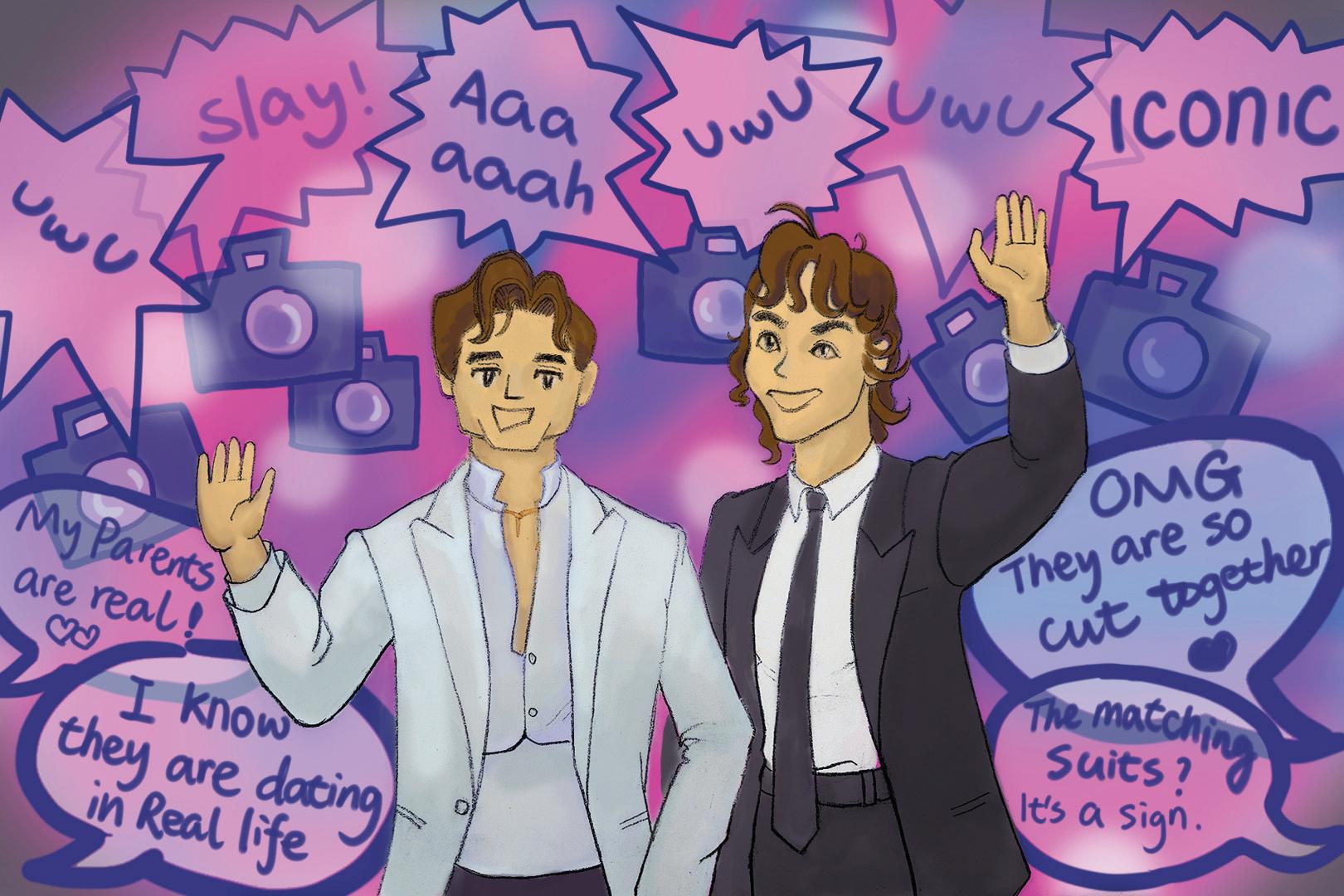
Online discussion of the Heated Rivalry actors’ personal romantic lives mirrors debates over casting straight actors in queer roles, despite the show platforming queer relationships. Dunja Nešović, a PhD candidate in communications at Concordia, describes that while this might not reflect how queer relationships are in real-life, it directly contributes to online fan behaviour and the actors’ decisions to maintain their privacy.
Nešović explained that “These practices prove to be all the more attractive to viewers and fans that get to consume and further produce this fantasy beyond the narrative space of the show.”
Actors Connor Storrie and Hudson Williams have faced speculation from fans regarding their personal romantic relationships to which both have expressed their desires to maintain that aspect private.
“You see people who infer or assume, and you kind of have to let that go,” said Williams.
As a fandom and queer media studies expert, Nešović states that the intense
fan reaction to the show is rooted in the show’s marketing.
“The actors play into their characters’ chemistry […], all the while remaining ambiguous about their ‘real-life’ sexuality,” she said.
Canadian actor François Arnaud, Heated Rivalry’s Scott Hunter, received death threats from fans after being at the airport in New York City with co-star Connor Storrie.This incident prompted Arnaud to unfollow multiple members of his cast because of fans wanting to know who he is dating.
“I think it’s hard for the actors, not only to be able to deal with this newfound fame, but then you have a lot of people prying into your personal life,” said Emma Facchino, a Film Production student at Concordia.
As a film production student, Facchino said fans can learn to distinguish reality from fiction by understanding the role of intimacy coordinators.
“I think a lot of rehearsal, choreography, lots of conversations beforehand about your boundaries, and then you gotta make it as realistic and magical as you can,” said Facchino. “That’s the downside of making something so strong and so believable is that people will [...] think that that’s you, that’s a representation of who you are, but it’s not at all.”
Nešović said media companies and fans alike should be held accountable to ensure that actors’ boundaries are not being crossed when promoting their films and TV shows, stating “This blurring of the boundaries is further incentivized by media industries to propel fan interest, engagement and production leading to more popularity and profit.”
“These are actors,” said Facchino. “This is for entertainment purposes[...] if we can all have the mind of an intimacy coordinator, [...] to treat these actors with the respect that they deserve, I think that would probably make them so grateful and so happy.”
From fan speculation to parasocial relationships with celebrities, the need to separate reality from fiction serves as a way for audiences to enjoy the media that they consume in a healthy way.
Veronica Rebuli | Contributor | Letterboxd: @rebuli
Peter Weir’s Dead Poets Society is hopeless cinema in its most restrained and devastating form. Set within the bleak walls of Welton Academy, the film uses muted lighting and autumnal colours to emphasize quiet suffocation. Every character is introduced to the viewer with patience, allowed to exist in themself before their personal conflicts fully surface, making it alarmingly simple to feel acquainted with these boys. The pacing neither rushes nor lingers, but unfolds the way adolescence does, slowly, until realization dawns on you. The performance of the actors anchors the film. The boys are truly teenage, with profound curiosity about poetry and selfhood, yet still
distracted by other antics. Robin Williams’ Mr. Keating is magnetic, serving as a mentor opening doors for his students, without walking through them. Ethan Hawke’s Todd embodies quiet fear and self-doubt with aching restraint, while leading actor Robert Sean Leonard’s Neil Perry captures the essence of optimism and vulnerability, making his conflict with his father devastatingly inevitable. By the final act, the film not only breaks your heart but also reminds you how dangerous it can be to ask young people to silence their true selves. That truth is what makes the film so inspiring and poetic, yet tragic.
4.5/5
Camelia Idinarene | Contributor Through the tormented lives of working-class Scots in the late 80s, Danny Boyle’s Trainspotting dissects the hardships of drug use. Every specific path taken by the characters propels them into further despair. We witness every person’s life around them that is affected by their nihilistic outlook and decision-making. The nauseating camera work spirals alongside the characters’ descent into misery, enabled by their worldview and the surrounding
poverty. From the characters’ dilapidated apartments to the ghost streets of Edinburgh, every setting evokes feelings of existential doom and so, not without style. Boyle makes use of vibrant lighting and costumes to highlight how detached from their condition the protagonists yearn to be. Overall, Trainspotting’s crude portrayal of human suffering and drug addiction leaves much to think about, long after the credits roll.
4/5
Nicole
Rose Celso | Contributor | Letterboxd: @makislap
The doomed journey of two orphans, Seita (Tsutomu Tatsumi) and Setsuko (Ayano Shiraishi), is what makes Isao Takahata’s Grave of the Fireflies a tragic and hopeless animated film with the haunting narration of how their lives ended.
“September 21, 1945… that was the night I died.” Grave of the Fireflies opens with a gut-punching line that lets viewers know how the movie ends. The film encapsulates the loss of innocence as Seita tries to shield his little sister from the brutal reality of living in a war. Following the loss of their
mother, the two siblings are forced to fend for themselves as they face various obstacles that lead them to their isolation from society. There is no sugarcoating what Seita and Setsuko go through, as viewers are forced to face the harsh reality that nothing could ever save the two main characters. With knowledge of the characters’ doomed destinies, Grave of the Fireflies is a film that will leave viewers hopeless and wallowing in sadness while staring into a black screen.
4.5/5
Fashion is turning back time to an era when fashion was unapologetically expressive.
By Veronica Rebuli Staff Writer @veronicaareb
On Concordia’s campus in 2026, outfits once exiled to our Instagram archives are now reappearing with a new edge. The return of 2016 fashion may seem unexpected, but it reflects a larger trend within the fashion cycle. The renewed presence of decade-old fashion trends reflects this pattern, highlighting both the industry’s ten-year nostalgia cycle and a broader cultural shift away from minimalist fashion norms.
“I’m a firm believer that history always repeats itself, so I believe it’s a human quirk that makes us reminisce on different times and yearn to experience them anew by wearing familiar clothes,” says Paula Estévez-Pérez, an international business student.
The resurgence of these trends signals an alignment with the increasing influence of Gen-Z consumers, for whom 2016 represents an early period of social and stylistic formation. Within this context,
nostalgia functions not as a tool for replication, but rather reinterpretation.
“Nostalgia plays a major role in trends resurfacing after a decade,” explains Aggeliki Moschopoulos, a Concordia student in economics. “People often associate past styles with memories from simpler times in their lives, and seeing these trends return allows them to reconnect with those feelings.”
Not only does the 2016 fashion revival indicate a reaction against the aesthetic confinement which emerged in the early 2020s, but it also reflects a broader need to evolve beyond minimalism and conformity, moving towards visibility, experimentation and self-expression. Though the simple styles like blazers, knits, trousers and capsule wardrobes have heavily defined the first half of the 2020s, their dominance in the fashion industry over the last five years has prompted an aesthetic fatigue.
“After being exposed to neutral colours and bleak patterns for so long, people are looking for something more. There’s a growing demand for self-expression and fashion that gives more visually,” said Moschopoulos.
Although minimalistic trends tend to emphasize neutral colour palettes, simple silhouettes and curated “clean” visuals, they fail to leave room for experimentation. After several years of muted fashion, 2026 is embracing the idea of dressing to be seen and growing hungry to revive clothing that is expressive, imperfect and personal.
“The revival is bringing personality back into fashion. Consumers are moving away from polished, timeless pieces and toward styles that feel nostalgic, expressive, and fun,” says Moschopoulos.
The mid-2010s fashion offers a framework that is well-suited for the transition from minimalist to maximalist fashion. Its emphasis on trendy streetwear, conspicuous branding and layered styling allows for self-expression without having to sacrifice practicality.
“Everyone recalls a specific moment where they felt like the best version of themselves and want to relive that, which is the trigger that persuades you to buy a familiar clothing item. We tend to ignore the externalities of these clothing items because all we care about overall
is that we’ve worn them before and loved them, so we’ll repurchase them,” adds Estévez-Pérez.
This dual influence of both cyclical nostalgia combined with resistance to minimalist conventions helps explain why 2016 fashion resonates anew in 2026. Rather than functioning as a purely retro movement, the trend reflects how fashion responds to the cultural mood, rather than consumer sentiment. The resurgence of these once-banished styles reflects how fashion constantly negotiates between memory and innovation, drawing from the archives to help present desires come to life.
Collage by Hannah Bell // Creative Director // @hannahnevebell

An intimate exhibition at FOFA explores loss and resilience, showing how mourning can be a transformative experience.
By Kira Storch Contributor @kiramadinasart
The FOFA Gallery opens its new season with Grieving Reveries, the annual Undergraduate Student Exhibition (USE). The exhibit offers an intimate and emotionally resonant exploration of loss.
Curated by María Andreína Escalona De Abreu, now in her third year leading the exhibition, the show brings together 12 undergraduate artists of Concordia University. Collectively, the artists challenge conventional understandings of grief as a kind of absence, and instead frame
mourning as something active, lived, and transformative.
This curatorial approach is shown in the exhibition statement, where Escalona De Abreu writes, “more than considering loss as void, this grieving space becomes a vessel for renewed love.”
Throughout the exhibition, grief is positioned not as an ending, but as an ongoing process that allows love to persist, shift and take on new forms.
Escalona De Abreu further emphasizes the importance of “honouring loved ones and honouring their path to growth,” framing grief as a process shaped by transformation and personal hardships.
The exhibition portrays personal loss within a broader climate of ongoing crisis, where grief is shaped by constant exposure to global violence and the instability of our collective futures.
In this sense, Grieving Reveries becomes “a reflection of the Fine Arts student community,” said Escalona De Abreu, foregrounding student voices at a moment when collective uncertainty and vulnerability shape daily life.
Material transformation plays a central role in communicating this theme. Upon entering the gallery, visitors encounter a cyanotype-coated curtain at the
reception bearing the exhibition’s title. The curtain’s fabric, which develops over the course of the show, emphasizes the passage of time as something to be embraced rather than resisted.
Beyond this entry point, the gallery unfolds into a dispersed landscape of sculptural works. Ceramic, textile, print, painting, drawing, and found object installations are scattered across the floor and walls, while other works are housed in vitrines lining the exterior of the gallery on all sides. This layout allows grief to be encountered in fragments rather than as a linear narrative, echoed by the diversity of media.
Several works stand out in translating these ideas into material experience.
Kelly Halseth’s sculptural installation At the Altar of Resentment, combines oversized cast bronze grooming tools, a stained bra, and a weathered sewing table.
As stated on Concordia University’s website, Halseth explores “the emotional and physical weight of gendered rituals tied to Western, White, colonial definitions of womanhood,” reflecting how their loss of power can be experienced as a form of grief.
Gabrielle Larouche’s Déraciné series takes a relational approach, pairing four
“We need to talk to other people to feel more understood,” she explains. “If you want to connect with a work sometimes it’s also nice to be able to touch it,” emphasizing grief as a shared and tangible experience.
Negar Sahebalzamani introduces a diasporic dimension with her Double Consciousness painting series, where domestic intimacy is overlaid with imagery of war violence, as in Sar-e Sofreh, a staged dinner scene, that draws from her Iranian heritage and lived experience in the West.
“These pieces become a quiet act of mourning, reckoning, and resistance,” she writes in her project description on the exhibition's website. “Reclaiming agency amidst attempts of erasure,” showing how cultural rituals and connections endure even in fragmented circumstances.
The show offers more than an exploration of loss, it becomes a lived encounter with care, resilience and renewal. The art shows that in the quiet presence of these works, grief never truly ends; it only evolves.
Grieving Reveries is on view at the FOFA gallery until Feb. 20.

A meditation on the passing of time and what is yet to come.
By Chloé Aiglin Contributor
Is change on the way like spring in May? Is your heart still heavy from yesterday? Is the sky even blue today? Every matter and being changes; a minute passed, and I grew older, while he grew richer. Change is palpable. Can you touch it? Look at the lost hair on your bathroom floor, the dust on your kitchen table. Can you see it?
As you read these lines, feel your stomach growling, your heart pumping and your eyes blinking. The line of time is curved; we move forward while heading behind. Each artform, political regime or belief system, reinvents itself — cyclical as nature is the human design.
Facing the shadows, we turn ourselves towards the comfort of what has been, because we know how it ends. There is a resistance to an im- posed change, a

By Maggie McLean Contributor @_maggie.mclean
Watching Friends and Seinfeld as a young teen, I was intrigued by the dating lives these shows portrayed. The characters encountered potential romantic interests seemingly non-stop, either on the metro, at a restaurant or standing in line at the movies. Some interactions were picture-perfect, leading to something more serious, while others became a funny story to tell their friends. No matter the outcome, boyfriends and girlfriends were a regular part of the characters’ lives; a part of the real world.

I’ve come to realize, as a twenty-something myself, that dating is nothing like it used to be. The constant use of phones in society has hin-
willing disruption of an evolution which benefits institutions rather than people. There is this common desire to reject ephemerality and dematerialization, to regain our senses, to touch what we own.
This is your sign to explore the shelves of your local library, to dust off your DVD player and dig out your Walkman. Reinvent the way you engage with the world to bring old habits into the realm of modernity. Perhaps the intention is not to replicate what has been done, but to seek inspiration from the past to forge new avenues of possibility.
We are in an era where we have finally acknowledged that not all transformations are positive and can be detrimental to our humanity. One does not know what is to be gained, but one knows for certain what is to be lost. Whether we like it or not, renewal is inherently imminent: the inhabitants of this earth are transient, the light is not shone on the same persons, issues, and voices. Through different mediums we can be spectators to the change of a stranger’s life, the collapse of a glacier, the dismantling of one regime and the rise of another. Change is in the hands of the bearer of emotions, layers of hopes and dreams reaching their peak. We can only
hope that these promises do not lose sight of human interests in favour of the desire for control.
The present is the measure of what has passed — face to face with it, change is frightening. Unknown is the outcome of ourselves, but we have to keep moving forward, even on a bended line. Expect the unexpected as there is no calendar for a revolution; after all, an idea must take root in winter to blossom in summer.
Change requires patience and in the daily haste of our existence, it reminds us to appreciate the wait as much as the result. Change does not need to be loud or seen in order to exist. Look up — change is already here.
Photo by Chloé Aiglin // Contributor

dered communication skills and confidence, causing fewer people to meet in person. Instead, they depend on social media and dating apps to form meaningful relationships.
Technology has integrated itself into every aspect of society, for better or worse, and dating has become more complicated than ever and totally unfamiliar. Gen Z and younger generations have grown up using Instagram, Pinterest, Youtube and Snapchat to communicate, connecting with people through a screen, and not face-to-face.
The basic in-person conversation skills needed to show someone you’re interested in them have not been developed to the same degree as the generations who grew up without technology. Our generation’s knowledge of relationships has instead been built off social media slang and concepts like “ghosting,” “situationships,” “catfishing” and “shipping.” We may be able to scout someone online and message them with
confidence, but we cannot confidently go up and ask someone for their number.
The lack of foundational knowledge on dating in person, combined with easy access to relationships through dating apps, has created an environment where screens are used as a mask. Phones protect us from embarrassing ourselves and eliminate the fear of being rejected in person. Not to mention, the careful curation of profiles on dating apps increases the opportunity for deception and encourages superficiality that isn’t present in-person.
In general, friendly, impromptu interactions in public have decreased since the mass implementation of technology and the isolation from the pandemic, further alienating people from one another. Sociability and the skill to connect with others is not only crucial to being happy, but also in broadening our understanding of each other. A limitation in our relationships is a limitation in our knowledge of humanity and personal growth. A decrease in real person connection is a loss in all aspects, in -



cluding love and intimacy. With AI on the rise, I feel genuine human connection and authenticity are gaining more value. Our uniqueness alongside our ability to feel and connect is special and should be understood as such and used to its full advantage. Whether it be asking someone out or complimenting a stranger's shoes, I think we would all benefit from friendly, in-person interactions rather than sliding into someone’s DM’s.
If it were up to me, we’d go back to flip phones, get rid of the screens and practice our conversational skills. There would be plenty of embarrassment and awkwardness, but at least it’d be real.


The economy is a reasonable price to pay for the next cultural revolution.
By Danylo Perkov Assistant Opinions Editor
DISCLAIMER: This article is farcical, nonsensical and potentially made up. Reader discretion is advised.
Last Saturday, Parti Québécois (PQ) supporters gathered in Lafontaine Park to show their support towards Quebec separatism. We spoke with Phoebus Laroche, the party’s representative for the riding where the protest was happening and who attempted to attend the gathering. Mr. Laroche has said that he was shocked beyond belief by the separatist message ringing out during the rally.
“I just didn’t expect such extreme messages on self-governance! How will all this be coordinated? I thought Quebec would be more united,” said Mr. Laroche. “I have no idea where this ‘middle-age collection of duchies’ ideas came from.”
The protesters were heard chanting slogans such as “In favour of self-determination, but without all the anglos, immigrants, Indigenous people and those from Gatineau.” While the message was very vague, three participants brought posters depicting an independent country stretching from downtown Montreal to East Montreal and from Rosemont to Saint-Hyacinthe.
“I don’t care, this is a matter of principle. Some other independent country can have the immigrants or the anglos. We want to be proud of our curated culture, heritage and possible greatness,” stated Guy Guillaume, a rally participant who drove all the way from Saint-Hyacinthe to partake in the event.
When speaking with the organizers of the gathering, we discovered that this is not an isolated case. A wave of smaller separatist groups have been springing up across the province, claiming that they would be much better off self-governing in smaller territories to better express their own culture.
Talking to a Concordia professor specializing in the issue at hand, The Concordian uncovered that such an endeavour is not only possible, but also closer than most think.

“This is a fascinating push towards independence on a level we’ve never seen before,” said Canned Hormel, the Concordia professor studying the issue and its genius. “It’s one of the best political ideas there is, if you ignore basic economic principles,” added Hormel.
When asked about the economic partnerships with the rest of Canada, all rally participants we spoke to agreed that they
would all keep their Canadian citizenship in addition to their gained identity as independent peoples, inhabiting the land of their ancestors, without the federal oppression of a country with such a colonial past.
“I have a feeling that I will have to travel to Gatineau to buy affordable things once we separate, so this is just for the convenience of travel,” added Guillaume on the subject of dual citizenship.
This would be a once-in-a-lifetime opportunity for a cultural revolution in Quebec, though at the cost of everything else. Separating the province into a couple of dozen small kingdoms would ignite the spark of life in the eyes of those living in the province and would greatly simplify and streamline the anti-immigration field in Quebec, which has been found lacking in recent years.
How public policy affects young people, and where I believe the inadequacies lie.
By Gabriel Jean Contributor @gabe_does_stuffmtl
Gabe Jean is the VP of political policy at the Jeunes néodémocrates du Québec. Why do we attend university? Like previous generations, we’re driven by a hope for a future worth investing in. A future where both hard work and capability can allow us to live in comfort, and hopefully, without unnecessary stresses being placed upon us. It’s an investment built on those very expectations and hopes. Yet, when I speak to countless friends, colleagues, and fellow Concordians, I have come to discover a prevailing absence of that hope.
In truth, the future is not being built for us.
Choose whatever topic you want, from the climate to the socio-economic conditions of Canada, and you’ll find plenty of ways in which those conditions are not conducive to an exciting outcome. University students, most of all, are being let down by governments who wield the ability to better our standards of living, from our housing minister all the way up to the prime minister.
Take a look at the job market. Statistics Canada has found that the unemployment rate for all young people (especially for new graduates) has risen significantly over the last few years. Entry-level positions are becoming scarcer and stories of companies phasing out positions in favour of AI are common across almost all industries. Opportunities remain, yet we continue to weather an unpredictable economy.
On top of this, our government has continued to prove time and time again that it has little to no interest in bettering present conditions for young people. Rather than fund the public positions necessary to have any hope of improving
our public services, Prime Minister Mark Carney has chosen instead to cut 40,000 of those positions.
For the sake of this article’s brevity, I encourage you all to read about how these cuts are disproportionately affecting women and minority groups, as well as targeting our critical environmental efforts.
Another area of increasing disillusionment lies in the disappointing state of the national Canadian housing policy. Neither my friends nor I expect to be able to buy a home within the foreseeable future, especially without help from family. Home prices have long outpaced the growth of salaries, while wealthy property management firms continue to collude to maintain high rental prices nationwide.
Build Canada Homes has been the Liberal government’s answer to this crisis (and it is indeed a crisis). Yet it doesn’t provide sufficient funding or the safeguards needed to ensure that new units go to individuals rather than private companies. My frustrations lie at the feet of several sources.
We have a new municipal government in Montreal who is unafraid to put its
efforts into emboldening the business class, a provincial government fighting to weaken our healthcare system, and a federal government that has seemingly chosen to abandon climate policy in favour of pipelines and big business interests. All three branches of government have also found themselves embroiled in unnecessary conflicts with unions and their workers throughout 2025, instead of providing them with the necessary salaries to meet their needs.
As young people, we are failing to use the power available to us through democracy as seen in our low voter turnout, by neglecting the unique opportunities that lie before us and by getting involved in ground-floor politics.
No matter what section of the political spectrum you may fall within, get involved! Join a riding association, write to your elected officials, and step away from the online spaces that vie for your anger and disillusionment. Do not accept the lacklustre and the substandard. Better alternatives do indeed exist, and it is by rekindling our hope that we may yet begin to lay the groundwork necessary to achieve them.
1. Yearns (for)
2. _____ Vista Social Club
3. Bullock costar in “Miss Congeniality”
4. Speech
5. ___ Kosh B’Gosh
6. Yorke of Radiohead
7. 1983 Streisand title role
8. “Grazie” reply
9. Painter’s stand?
10. Shape up
11. Coffee cup safety
12. Approved
13. H.S. proficiency tests
18. Banana residue
24. Station for the Orange Julep
26. Worldwide abbr.
28. Judge’s seat
30. High time?
31. Pond organism
32. Filmmaker Johnson
33. Continent that constitutes a third of earth’s land
34. Many a shape in a bowl of Lucky Charms
36. Frustrated cry
37. Christmas, in Paris
38. Vienna iron
41. Fable
45. Require
47. Largest of fifty
49. Word before baby
51. Eye shade?
52. Prefix with “centric”
53. Tide types
55. Decline
56. Oklahoma natives
57. “We’ve tried everything”
58. “I could ____ horse!”
59. It’s capital is Vientiane
61. Movie rating org.
65. Hosp. areas Across
17. Walkmans, for example 19. “_____ like
Between: fr 21. Pmt. for a homeowner 22. Many profs. 23. Smooth fabric
27. Chunk, as
29. Grandmother, in Napoli
32. Stadium chants
35. It can be attractive
39. 100 cts.
40. Digital camera brightener
41. Canned fish liquid
42. Record
43. ___ Jordan
44. McDonalds’ are golden
45. You can’t see him
46. Relating to the nose
48. Dunham of “Girls”
50. Ally for Mike, Will, Dustin and Lucas
54. Nobel laureate Mandela
58. Disney role for Idina Menzel
60. Couple
62. Student of Socrates
63. Accompaniments to “oohs”
64. Ed Sheeran chart topper, or a hint to 17-, 35-, and 44-Across, and 11-and 34-Down.
66. Accepted
67. Comparable (with)
68. Loonies
69. Out on the water
70. Parks and others
71. Gift for a Valentine

Dario Martínez Mulet Follow @chessatconcordia to learn more about Concordia Chess
Saskia Wodarczak
Hannah Bell
Félix-Antoine Beauchemin
Chloe Stuart-Ulin
Megan Mills Devoe
Jia Marguerite Schofer
Kailee Krentz
Danylo Perkov
Anthony Maruca
Mathilde Colls
Ginane Deslauriers
Kasi Peri
Victoria Psiharis
Zaineb Karkachi
Kira Minall
Chelsea Nadarajah-Chinniah
Simaiya
Matthieu Chatelain

Tamara Mae Galinato
Christelle Meghri Ghazarian
Hadassah Alencar
James Fay
Sakib Hossain
Marieke Glorieux-Stryckman
Aidan Raynor