

SPORTS NEWS



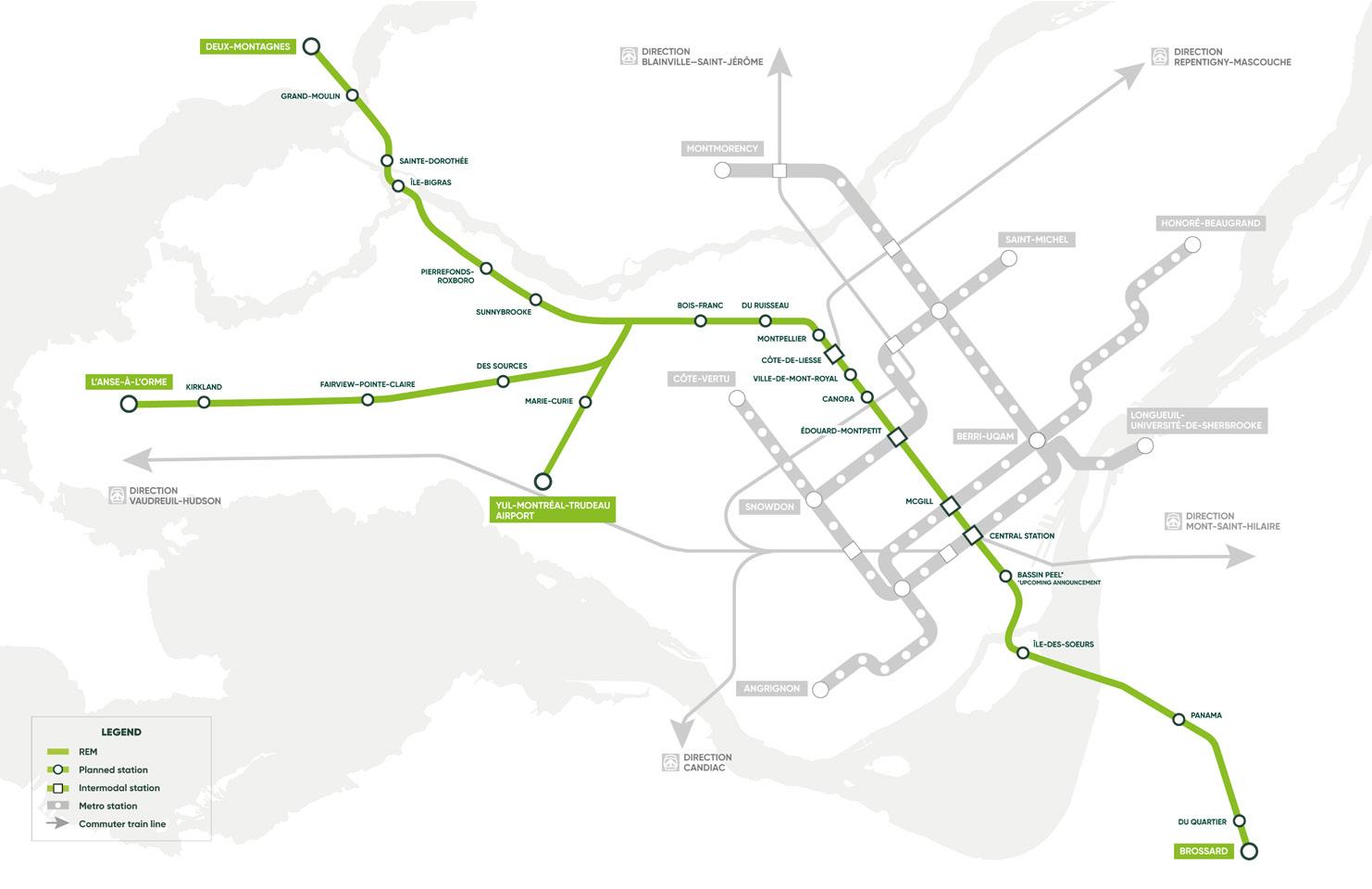
The 14 new stations will connect the North Shore to Brossard through downtown.
By Meghri Ghazarian Podcast Editor @meghrighazarian
The Réseau Express Métropolitain's (REM) new Deux-Montagnes branch is now ready to use. The initial EXO commuter rail line stopped its service in 2020 after CDPQ Infra acquired it to transform it into the REM.
To celebrate its opening, riders were able to use the network for free this weekend.
During Friday’s press conference to inaugurate the REM, Quebec Premier François Legault highlighted the provincial government’s ability to undertake
such major projects, despite the many challenges that came up.
“Sometimes we find that it takes a long time and there are all kinds of obstacles, but look at us today, we can do it,” he said.
The new branch contains 14 stations. It will intersect with the metro’s orange, green and blue line, as well as the Repentigny-Mascouche EXO commuter train.
The REM also adds additional stations compared to the initial EXO train line.
The new Édouard-Montpetit station is 72 metres underground, the depth required for the train to pass through the Mount Royal tunnel. This makes it the deepest rail station in Canada and the second-deepest in North America.
Montreal Mayor Soraya Martinez Ferrada was also present. She said this project is important not only for the economic development of regions, but also for the mobility of workers and students.
“It provides accessibility and equity in the opportunities we offer our populations,” she said during Friday’s press conference.
Canadian Prime Minister Mark
Carney used the inauguration of the REM to highlight another major transportation project; a high-speed train connecting Québec City and Toronto. He said this would include new non-stop trains between Montreal and Toronto, which are expected to reach speeds of up to

300km/h, according to Carney.
“We’re fast-tracking high-speed rail spanning 1,000 kilometres from Toronto to Montreal and Québec City,” he said. “This will create 50,000 jobs, injecting $35 billion into our economy.”
The REM will run on a restricted schedule for the first few months in anticipation of the Anse-à-l’Orme branch that is scheduled to open next spring. CDPQ Infra says this will allow its team to conduct more tests to ensure its integration is as smooth as possible.
On Saturday, REM employees held a protest to highlight workplace safety concerns and denounce their employer’s inflexible positions in their negotiations for a collective agreement.
The trains will run from Brossard to Côte-de-Liesse from 5:30 a.m. to 1:30 a.m. and from Côte-de-Liesse to Deux-Montagnes between 5:30 a.m. to 9:30 p.m. Bus service will be provided for those travelling between Côte-de-Liesse and Deux-Montagnes after 9:30 p.m. Commuters can travel from Deux-Montagnes to Brossard in about 55 minutes and vice versa.
The union and the STM reached a tentative agreement on Sunday evening.
By Félix-Antoine Beauchemin City News Editor @fa.beauchemin.journalisme
A third STM union, this one for administrative, technical and professional staff, planned to go on strike on Nov. 19 for the first time in its 40-year history. The union (CUPE 2850) represents approximately 1,300 employees of the Société de transport de Montréal (STM). It had been without a collective agreement since Jan. 4, 2025. Members of the union still have to vote on the tentative agreement to ratify it. The union published a statement on the website of the Quebec branch of the Canadian
Union of Public Employees, to which it is affiliated. CUPE 2850 President Stéphane Lamont expressed his satisfaction with the end of the negotiations.
“We are delighted to have reached a negotiated agreement,” he wrote in the statement. “We will not be making any further comments until our members have had a chance to review the details of the agreement.”
The STM also published a statement on its website concerning the tentative agreement. It also stated that it would not
disclose details of the deal until both the union members and its board of directors have ratified the agreement.
“Once again, we have reached a tentative agreement that relies on compromises by both parties and respects the established financial framework,” wrote Marie-Claude Léonard, the executive director of the STM, in the statement. “I would like to thank all the teams whose work made this agreement possible and helped avoid the November 19 strike.”
Québec solidaire
MNA Alexandre
Leduc tabled a bill proposing a new mixed electoral system with regional compensation.
By Félix-Antoine Beauchemin City News Editor @fa.beauchemin.journalisme
In an unusual alliance, Leduc was joined by Éric Duhaime, leader of the Conservative Party of Quebec, for a press conference presenting the bill.
“If you had told me a few years ago that I would find myself at a press conference organized by Québec solidaire to support one of their bills, I would have asked you what you were smoking,” said Duhaime during the press conference, highlighting the need for cross-partisanship to advocate for electoral reform.
During the 2018 provincial electoral campaign, François Legault promised to reform the electoral system if the Coalition Avenir Québec (CAQ) was elected. However, the CAQ abandoned the idea in 2021. It also scrapped the promise for
the 2022 campaign, with Legault saying electoral reform was “not a priority for Quebecers.”
In addition to Leduc and Duhaime, the now independent MNA Maïté Blanchette Vézina joined the two in support. Last week, she opened the door to collaborating with Duhaime on specific issues, notably those related to Quebec’s regions. She did not close the door to run for the Conservatives in the 2026 elections, although she plans to stay on as an independent MNA until then.
She was the CAQ’s minister of natural resources and forests between 2022 and 2025. She left the party in September to sit as an independent MNA after being excluded from the cabinet.
Blanchette Vézina was questioned on whether there was interest from CAQ MNAs for electoral reform.
“I am one of those who arrived when the commitment had been made not to carry out this reform, but it is a subject that is being discussed, that is being considered, and that, for some, is of interest,” she said.
She also added that such a reform may even be electorally advantageous for the CAQ. While the party significantly benefited from the current system in 2018 and 2022, it now risks not electing a single MNA in next year’s elections.
In 2022, the CAQ won 72 per cent of seats in the National Assembly with only 41 per cent of the vote. At the same time, the Conservatives won zero seats despite earning nearly 13 per cent of the vote.
Poll aggregator website Qc125.com
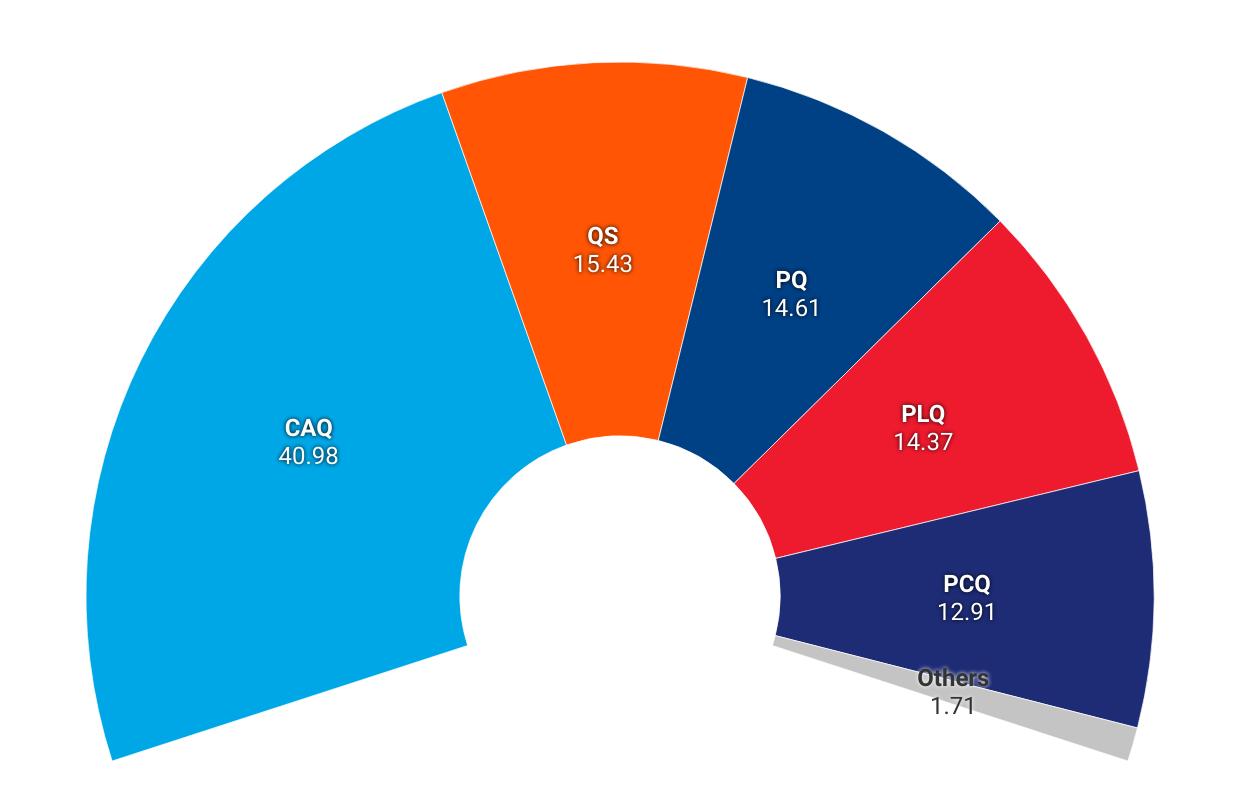
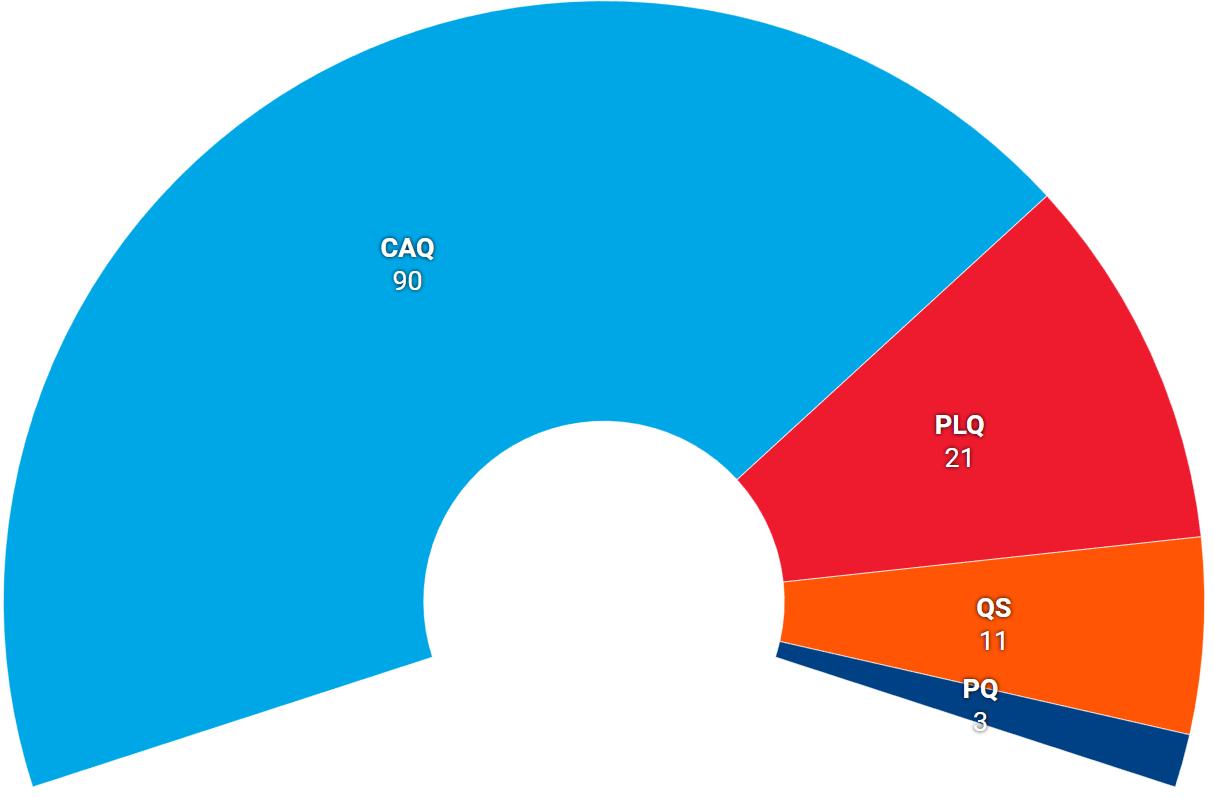

projects the CAQ would obtain 17 per cent of the vote if an election were held today. It would, however, elect only three MNAs, down from its current 81. November marks the first time since May that the site predicts the CAQ to even win a seat.
Duhaime, whose Conservatives were the victim of electoral distortion in 2022, urged Legault to reconsider his position on electoral reform, even if it was strictly for partisan reasons.
“I think that now the CAQ has every reason, even partisan reasons, to change its stance and come back to its original position,” said Duhaime.
François Legault’s office did not respond to The Concordian’s request for comment.
Jean-Pierre Charbonneau was also at the press conference. A former Parti Québécois (PQ) MNA for nearly 25 years, he is now the president of Mouvement démocratie nouvelle (MDN), an organization advocating for electoral reform in Quebec. It was founded following the 1998 Quebec general election, when the PQ formed a majority government despite receiving fewer votes than the Liberal Party of Quebec.
“The Parti Québécois sent me, as president of the MDN and spokesperson for the coalition, a letter confirming their commitment and willingness, like the others, to ensure that the next election will be the last one using the current voting system,” he said during the press conference.
The PQ is currently in the lead in terms of voting intentions, although it could form a majority government with only 33 per cent of the vote, according to Qc125. Duhaime expressed skepticism that PQ leader Paul St-Pierre Plamondon would fulfill his promise of electoral reform if elected, given that the party did not participate in the press conference.
“Given the absence of the Parti
Québécois here today, I just hope that Paul St-Pierre Plamondon is not turning into François Legault, because we know that Mr. Legault, like Paul St-Pierre Plamondon in the past, was in favour of electoral reform,” said the Conservative leader.
How would Bill 199 work?
Bill 199 would establish a new “mixed electoral system with regional compensation.” During the press conference, Charbonneau emphasized that this system is already in use elsewhere in the world, specifying that he would like to have it in place in time for the 2030 elections.
“[It was] the model proposed by René Lévesque’s Parti Québécois in 1969, by Jean Charest’s Liberal Party, and by François Legault’s CAQ,” said Charbonneau during the press conference. “So, it’s not a model that has never been discussed. It’s not a model that hasn’t been tried around the world; it’s the German model adapted by the Scots and also, in a way, by the people of New Zealand.”
Quebec, like the rest of Canada, currently uses a “first-past-the-post” system, under which the candidate obtaining the most votes in each of the 125 electoral divisions is elected. This system can lead to significant distortions between the number of votes and the number of seats won by a party.
Under Bill 199, the National Assembly would be divided into 80 division seats and 49 regional seats. Each of Quebec’s 17 administrative regions would get at least one regional seat based on its population. Electors would now vote for a candidate for their division seat and either a regional party list or an independent candidate for their regional seats.
The 80 division seats would still be won by the candidates obtaining the most votes. The regional seats would then be allocated to the parties with the greatest distortion between the number of votes for their regional list and the number of seats won in that region.
To be eligible for regional seats, a party must obtain at least four per cent of the vote across Quebec. An independent candidate can also win a regional seat. Candidates can run for division and regional seats simultaneously, but they cannot win a regional seat if they have already been elected to occupy a division seat.
Faculty members losing jobs brings uncertainty and fear for the future of small university programs.
By Nicolas Tremblay Staff Writer
Most senate meetings go without fanfare, but on Friday, Nov. 7, students and professors crowded the second floor of the EV Building, spilling into an overflow room as university president Graham Carr delivered a dire outlook on Concordia’s financial future.
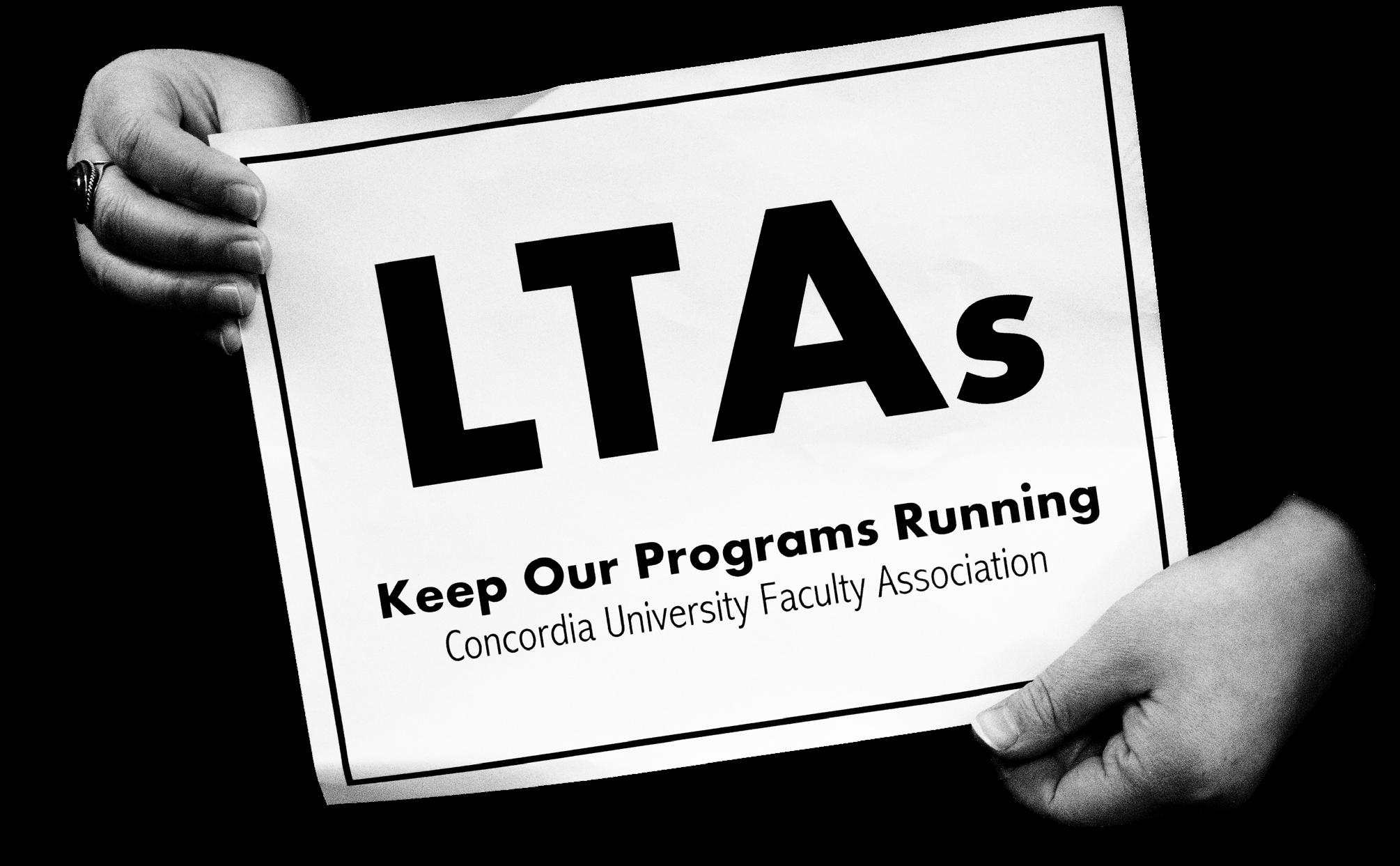
The gallery was filled with faculty raising signs in support of the limited-term appointment (LTA) faculty members who had been notified that their positions would not be renewed the following year. LTAs, including Canadian and Indigenous literature professor Katherine McLeod, were listening in hopes for details about the non-renewal of jobs announced the day before.
“I got the news on Thursday, [...] that my position would be cut next year,” McLeod said. “This cut is a shock and just so devastating because there was a hope that our positions would actually become permanent, and instead they're being cut altogether.”
LTA faculty members at Concordia University are experiencing the effects of university-wide budget cuts. The university has implemented a hiring freeze and plans to eliminate an additional 100 staff positions, bringing the total number of positions eliminated over two years to 200.
A “limited-term appointment” (LTA) is a contract limited to a term without guarantee of reappointment or tenure, whereas an “extended-term appointment” (ETA) is guaranteed for renewal for a fixed term.
LTA contracts not renewed
Ciprian Alecsandru, president of Concordia University Faculty Associ ation (CUFA), said 58 LTA contracts are expiring next year and Concordia will not advertise these positions again for 2026-2027.
Concordia spokesperson Julie Fortier said 63 faculty members are on LTAs. Most LTAs have one-year contracts end ing in June 2026, while a minority have two-year contracts ending in 2027. “All existing contracts will be honoured,” For tier stated to The Concordian “The academic departments were in formed at the end of October that there would not be a call for new LTA hiring for 2026-27. The contracts are not being ‘cut’,” added Fortier.
“We are outraged that the employer would choose to go this route before exhausting all other possibilities, including cutting their own salaries,” said Alecsandru.
According to the CUFA Collective Agreement of 2023-26, when the provost gives a four-year LTA appointment to address specific teaching needs, it can be converted to an ETA in the fourth year.
McLeod has been employed at the university for 10 years, now in the fourth year of her current LTA position, and looked forward to the security of an ETA position, as detailed in the CUFA Collective Agreement.
“The first conversion was slated to occur in the academic year 2027-2028. The suspension of new LTA contracts for 2026-2027 interrupts that cycle,” Alecsandru stated.
The university said it is facing a projected $84-million deficit for the 202526 fiscal year if no additional actions are taken.
“We're facing the most serious challenge in Concordia's recent history, and we need to recognize that all sectors across the university [...] are being asked to do things that we have not done before, and frankly that we don't want to do,” said Carr at the senate meeting.
He said if Concordia does not meet its budget targets, the university’s future will be at risk. Carr outlined the options the provincial government has to address the deficit, including appointing administrators or taking over the university's administration.
“Not only would this eliminate our autonomy as a university operating at arms’ length from the state, but it also would mean that we would have no control over the financial operation of the university,” said Carr.
“LTAs are full-time faculty, and I think it's important for students to understand that we're hired for teaching,” said Jonathan Wald, a second-year Concordia lecturer with an LTA contract ending at
Wald is a full-time lecturer at the Centre for Engineering in Society at Gina Cody School of Engineering and Computer Science. His contract will not be renewed after it ends this academic year.
Wald oversees about 950 students and said he does his best to ensure their experience is positive.
“As per the CUFA collective agreement, my position has been taught by LTAs for at least the last five years, which means that it would be eligible for conversion to an ETA.”
Wald believes students misunderstand the relationship between faculty salaries and workload. The lecturer said LTAs typically teach seven courses a year, a number Wald said is larger than most other faculty.
Effective since June 1, 2025, LTA lecturer salaries range from $70,034 to $90,126, and LTA librarian salaries range from $71,865 to $83,963, according to the CUFA Collective Agreement.
However, LTA lecturer salaries on the Concordia salary scales webpage range from $78,928 to $91,158, and LTA librarians' salaries range from $72,688 to $84,924, as of June 1, 2025.
The LTA associate professor position is not mentioned in the CUFA Collective Agreement, which states, “limited-term appointments shall be made only at the rank of lecturer.”
McLeod said, “many of the positions have been in place for over 20 years [...] across the university.”
“They're not just filling a temporary need,” added McLeod.
“I was disappointed at the senate meeting to hear how little this had been considered, frankly,” said Wald.
Wald said enrollment had to grow if ETAs would take over LTA courses, and the non-renewal of LTA contracts would increase professors' course load.
Wald believes classes will be larger, resulting in less instructor support, affecting registration and limiting the ability to add people to courses at the Center for Engineering Society.
“For smaller departments […] like Classics, it
could just mean outright classes being canceled, particularly required classes, which might mean jeopardizing students' ability to do that major,” added Wald.
Concerns and potential consequences
According to Audrey Skovsbo, a thirdyear part-time linguistics student, four faculty members won't be returning to the Classics, Modern Languages and Linguistics (CMLL) department.
To Skovsbo’s understanding, the announcement was “kind of like a bomb that had been dropped on” teachers.
Skovsbo said the cuts are stressful for students planning to pursue graduate studies who require advanced courses that may no longer be offered.
Skovsbo said that her program is already strained, with few instructors and fewer opportunities than larger faculties such as the John Molson School of Business (JMSB).
“Now we're about to lose somebody who's genuinely, I think, one of the best teachers in the department,” said Skovsbo, who attended the Nov. 7 senate meeting.
The linguistics student said that finding faculty members is hard for the university and that the non-renewal of contracts do not instill trust within people who will be hired by the university.
“They're not proving themselves to be a very trustworthy institution. So it's very, very, very concerning for us,” said Skovsbo.
Wald will now apply for teaching positions and hopes to stay close to home with family.
“It would not be the first time that I've had to go into a long-distance relationship with my partner just to stay employed,” Wald said, expressing that frustrations from faculty should be listened to and taken seriously by the administration.
“We believe in the mission of Concordia. We believe in public education. We believe in the value of what we're doing. We believe in serving students to the best of our abilities.”
With files from Aidan Raynor, Jia Marguerite Schofer and Emily Pasquarelli
University and CEGEP students protest against governmental budget cuts that take away from their education.
By Saima Mazumder Staff Writer
@saima_maz
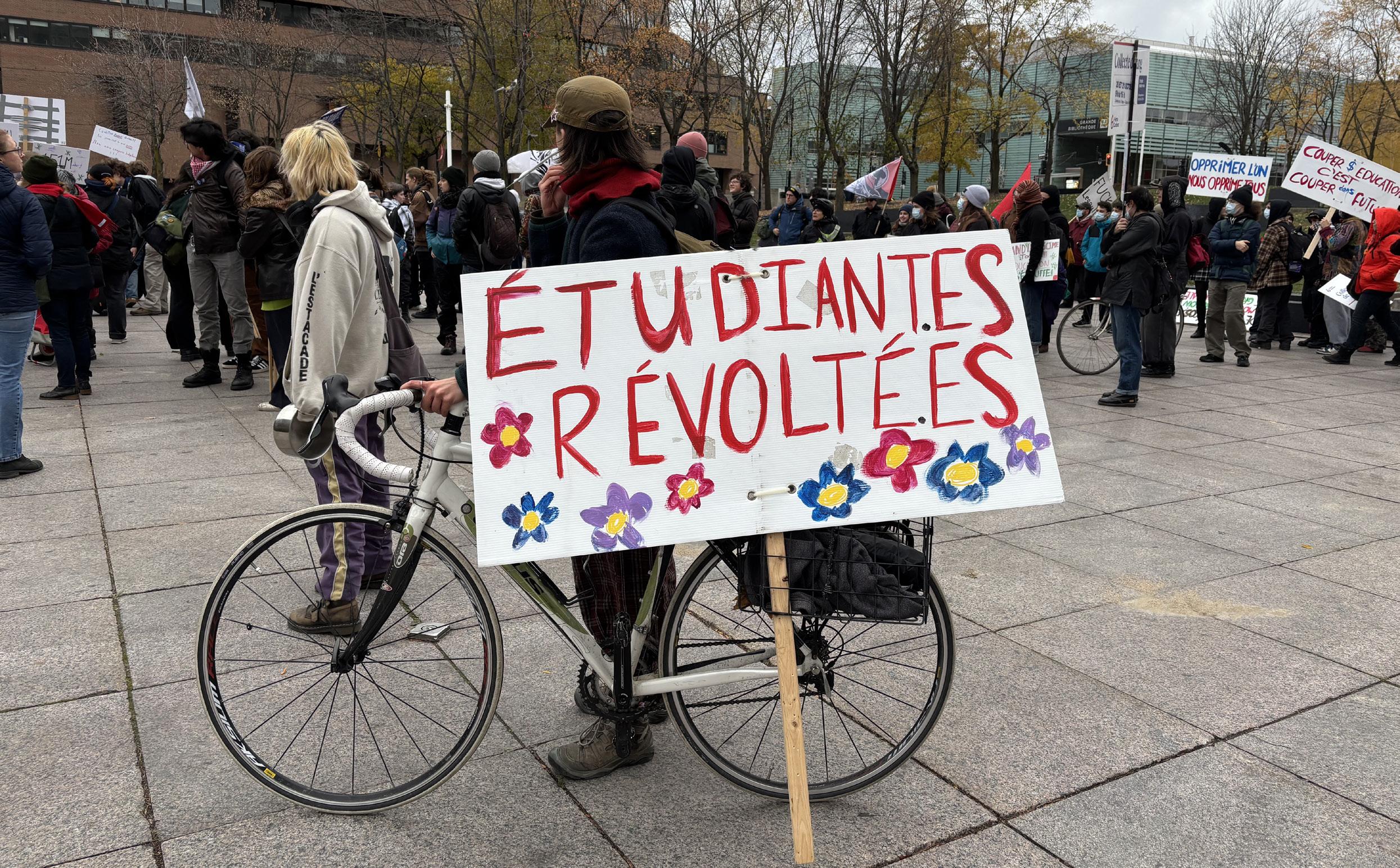
On Nov. 7, 2025, higher education students from across Montreal protested at Place Émilie-Gamelin against austerity measures within their schools.
The protest, organized by the Coalition de Résistance pour l'Unité Etudiante Syndicale (CRUES), called on students across the city to join a strike against these cuts. CRUES reported that student associations representing around 50,000 students participated in the strike. An estimated 200 people attended on the day.
“The goal of the protest is to start a wider student resistance to the repeated attacks that we've seen from the government on public services,” said Arthur Van Neste, member of the mobilization committee at CRUES.
Student associations across Montreal echoed this concern. Concordia’s Arts and Science Federation of Association (ASFA) shared on their social media a post calling students to join the protest. The association stated to The Concordian that they “stand in solidarity with the students who went on strike on November 7, 2025, demanding Legault's repeal of his harmful austerity policies.” They also added, “will continue to support our students in their mobilization towards a university that works for the community.”
This is in reference to the millions of dollars in budget cuts the province has made from higher education.
According to Union Etudiante du Quebec, in July 2024, the government cut the investigation into sexual violence, worth $1.2 million. That fall, outof-province university students studying in Quebec faced a 33-per-cent increase in their tuition.
This year was no better.
In spite of growing expenses, Concordia’s Budget Updates for 2025-2026 explain that there will be a two-year freeze on university operating funds. To avoid the $84-million deficit this freeze can cause, the university is cutting costs in other areas, such as reduced shuttle hours, a hiring freeze and much more. However, it is not only university students suffering from budget cuts.
In June 2025, the Quebec Government
announced a $151 million budget cut at the CEGEP level. With 194,000 students, CEGEPs are struggling to provide adequate student services and maintain infrastructure.
Cégep du Vieux-Montréal student Camélia Nydegger mentions seeing signs of maintenance and infrastructure issues on campus.
In a 2024 report by the Verificateur General du Quebec (VGQ), two-thirds of CEGEP buildings are not in good condition.
To fight against these growing problems, students took their voices to the streets.
Hundreds gathered at Place Emilie-Gamelin with posters and high energy.
CRUES called for the elimination of tuition fees, reform of government financial support, and investment in school infrastructure.
“Education is a priority, not just with words,” said Clara Bernard, a student from Cégep du Vieux Montréal.
According to the March 2025 Budget press release, the Quebec Government has stated that they are “fully committed to the education and development of young people.” In the 2025-2026 provincial budget, $1.1 billion was allocated for education over the next five years.
Yet, the effects of the budget cuts are still felt on a daily basis.
Angel Desmarais, an executive for the Association Générale étudiante du Cégep Édouard-Montpetit, expressed, “We have one of the highest rates of students who don't eat.”
A 2023 food-insecurity report by Concordia explains that 67 per cent of students at the university face some degree of food insecurity.
Regardless, students hold hope that these protests will have an impact.
“If we unite, we will be able to make real changes,” says Desmarais.
During the four day polling period Nov 11. to 14 students had the opportunity to make their voices heard. However, turnout was low, with only 3,566 (11.2 per cent) of 31,730 electors casting a vote.
Queer Concordia and Concordia Recreation & Athletics (CRA) did not get the increases they requested. Queer Concordia requested a 29-cent-percredit fee-levy increase. The organization currently has the lowest fee-levy at two cents per credit and has never received an increase. CRA requested a 99cent fee increase, raising their fee to $3.91 per credit.
Clubs Concordia Food Coalition, CSU Daycare, CSU Clubs received the fee levy increase they requested.
Ryan Michon and Micheal Eshayek were appointed seats at the Council.


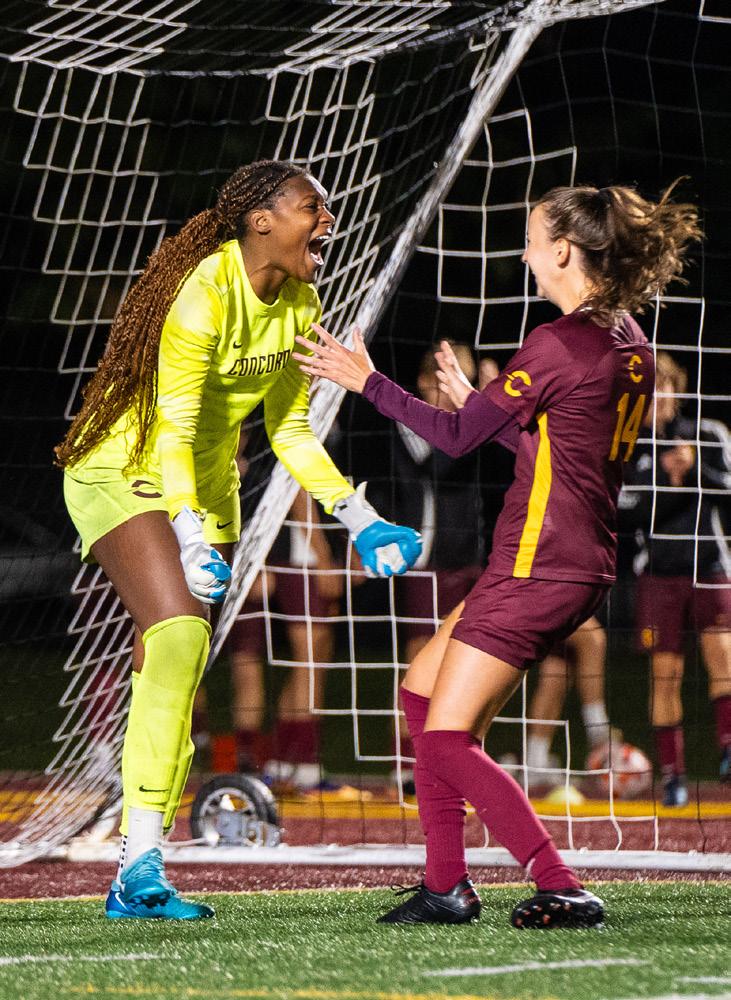
The goalkeeper received this award after an impressive first campaign as a Stinger.
By Anthony Tapia Ancinez Soccer Correspondent @_anthonytapia
On Nov. 5, U Sports held their soccer award ceremony in Hamilton, Ontario. Out of the 11 players included in the women’s all-rookie team, one of them was Stingers goalkeeper Naïla Louissant.
“My coach called and told me to go to Hamilton because I had received an award; I had been included in the U Sports’ All rookie team,” said Louissant.
The 20-year-old goalkeeper is in her first year as a biology student at Concordia University. She debuted this season as the starting goalkeeper for the Stingers.
“I’m honestly pretty happy with how my year went. I was the starting goalie as a rookie and that really never happens [...] I’m glad that I got play time,” she said.
She played 11 games in the regular season, claiming three clean-sheets, meaning that she did not concede a single goal in those three games.
Unfortunately, an injury suffered during a win against Laval on Oct. 17 put her out for two weeks, causing her to miss the final games of the season, including their playoff loss to Laval on Oct. 24.
Louissant has been playing soccer since she was five-years-old. During the summer she played for Blainville in League One, one of the highest ranked non-pro soccer leagues in Quebec.
“If I get contacted to be on a certain team I’d take the opportunity, but if it doesn’t, I’m still fine with the career path that I’m taking,” said Louissant about playing for a professional team.
Louissant has multiple role models. Her mother, for guiding her in the right path in soccer and her studies, and the English Football Women’s Super League goalkeepers Khiara Keating and Hannah Hampton for their accomplishments at a young age.
Louissant’s campaign was outlined by several highlight worthy moments, both on an individual, and collective level.
The game against Sherbrooke was special, as she was able to stop a penalty in the last minutes of the match. “By the end



of the game we conceded a penalty but I was able to focus and stop the penalty. That game ended and we were able to get out of it with one point,” said Louissant.
As a collective, the away game against UQAM was Louissant’s favorite. Concordia had previously suffered a sour defeat at home against them, making this game an opportunity for redemption.
During the match, one of the Stingers players had received a red card and it took a lot of effort to bring the points

home and change the course of the tournament. “At that point we hadn’t scored in three games, and we were able to score and win,” said Louissant. The Stingers ended up winning the game 2-1.
The team has performed well this season and brought up the standards of the game. Louissant views next season as promising. “I’m very optimistic about the future, we have a few new recruits that I know are going to bring the level up [....] I’m looking forward to building chemistry with my teammates,” said Louissant.
“I would like to keep up the recognition that I got this year [...] I hope to get it again, but I’ll have to work even harder.”
A Concordia athletes’ personal account of the action at the York Open.
Connor Patrick Rooney
By Wrestling Correspondent
On Nov. 8, I wrestled at the York Open in Toronto, finishing fourth out of 23 wrestlers in the 72-kg weight class.
That being my first out-of-province tournament of the season, I was eager for the opportunity to get matches with unfamiliar, higher level opponents. I ended up getting what I wished for, wrestling seven matches throughout the day, finishing with a 5-2 record.
My first two matches went smoothly,
as I faced opponents from Lakehead and Toronto Metropolitan Universities respectively. I finished both matches in the first round without conceding a single point.
I was flying high going into the quarterfinals against a wrestler from the University of New Brunswick. I took an early lead and was feeling confident I would finish the match in the second round. However, something very unexpected happened, I gassed out.
I quickly began conceding points I should have prevented. We wrestled a full six-minute match and despite my two point takedown in the dying seconds, I fell short in a losing effort.
Following the match I was devastated, feeling as though I should’ve won, knowing in fact that I could have very well won. Having lost I was moved over to the losers side of the bracket where a loss means the end of one’s day.
I am thankful for my teammates that came over to me and got my head back in the game. I needed to be reminded that the day was not over yet and could still climb
my way into the bronze medal match.
“I’m not dead yet,” became my motto for the remainder of the day.
My next match would be a difficult one as my opponent had already knocked out a teammate of mine.
The Central Toronto wrestler had a funky style and had perhaps the most grip strength I’ve ever encountered. So I used my range to keep him from getting that grip anywhere near my leg. I edged out a 4-1 win that went the distance.
I rode the momentum by following up with two back-to-back dominant performances against Hamilton and Central Toronto Wrestling Clubs.
I had made it out of the trenches all the way to the bronze medal match. I was facing an American wrestler, which is always intimidating as they take wrestling very seriously there.
A heated match ensued and it was clear early on that we did not get along. He had a habit of clubbing which I responded to with an open palm slap. We both got a warning from the referee, and
not long after, I tanked a headbutt that I heard from inside my head.
The match ended up going the distance, I lost 8-0. Though I will argue the score does not reflect how close the match was, as on several occasions I nearly had his leg, just barely losing my grip.
After seven fights my day was done and I was appropriately very sore. Especially since the loser side of the bracket had me wrestling matches roughly half an hour apart.
All in all, there are some adjustments to be made before the next tournament, but I was happy with my performance, being able to come back from an upsetting loss and continue to perform.
There is nothing like competition — it’s an entirely different sport compared with practice. The mental side is everything and I had to go to a dark sadistic place in my mind to perform. You’ve gotta be ready for a six-minute war that is going to hurt, I love that. I’ve gotta tell you, I cannot wait for the next tournament.
With a frozen budget since 2009, Concordia Recreation and Athletics hoped for an increase to develop facilities and programs with the most recent CSU fee-levy ballot.
By Mathilde Colls Assistant Sports Editor @mathcolls
From Nov. 11 to 14, five organizations were on the ballot for a potential fee levy increase, as the Concordia Student Union (CSU) finalized the application process on
Oct. 29, including Concordia Recreation and Athletics (CRA).
The CRA’s ballot did not receive enough votes to receive their proposed increase.
The department oversees multiple athletic facilities at Concordia, including Le Gym, the Athletics Complex at the Loyola campus, and several intramural leagues. Its fee has remained at $2.92 per credit since 2009.
The proposed increase of $0.99 would have brought it to $3.91 per credit starting in 2026, marking the first adjustment in 16 years.
According to D’Arcy Ryan, director of recreation and athletics, this budget stagnation has stalled improvements to both activities and facilities.
“With the cost increases that we’ve all been experiencing over the past several years, for us sixteen years now, we are struggling to provide a top-level service that our students deserve,” said Ryan.
“If we look at Le Gym, we haven’t had a significant injection of funds to upgrade the equipment there since its inception. We’ve done some minor modifications here and there, but I think the gym really needs some love injected into it with a
refresh of equipment.”
Students also share similar concerns. Intramural soccer league player and Concordia student Saef Housami has been frequenting the gym six days a week for the past three years, and believes it is time for improvements.
“First of all, there are two bench presses for the entire gym, which is really not good. Like, there’s at least a hundred students in there at peak hours, for example,” said Housami.
“A lot of the machinery is very old and breaks down very often, like the cable machines. Those could really use some improvements.”
According to Ryan, a tight budget doesn’t only affect students looking to partake in recreational activities, but campus employment as well.
“We’re one of the biggest student employers on campus. So the more our activities grow, the more student jobs we’re able to offer. So in shrinking, it’s the reverse effect,”added Ryan.
Ryan added that the fee levy increase would have also allowed CRA to expand its programming, meaning new intramurals such as dodgeball, pickleball, ice
skating, as well as external activities, were being considered.
“We want to be able to support outdoor activities like hiking, canoeing, kayaking, maybe rafting, biking, climbing,” said Ryan.
“Some of the bigger ideas that we have, that we would like to explore, is an outdoor beach volleyball setup.”
He emphasized a focus on diversity and inclusivity, with new less athletic-oriented programs designed for the entire student body, such as gaming, chess or table tennis.
While the fee levy increase would have meant additional costs, some students argue that it is for the greater good. Omar Krimly, an aerospace engineering student who has been using Le Gym for two years playing in intramural basketball leagues, believes the increase is justified.
“The fee levy increase would be good because I know that the budget is short on a lot of ends at Concordia and I think adding a few extra dollars to your tuition just for a little improvement to these facilities would be good,” Krimly said. Ultimately, CRA did not receive enough votes.
A new roster but the same goal; Concordia looks to win the RSEQ conference finals after failing to win outright for two consecutive seasons.
By Blake Saraga Basketball Correspondent @blake_saraga
Although they haven’t struck gold in six years, the Stingers have been a force to be reckoned with over the last four seasons.
Concordia’s men’s basketball team has experienced success in the RSEQ for years now, coming off consecutive conference finals appearances, and a trip to the U Sports national tournament just this past season.
A big part of such success has been
their backcourt duo of all-star guards: Sami Jahan and Alec Phaneuf.
The star guards played off each other for three years, both earning RSEQ allstar nods and eclipsing the 1500-point mark during their Stingers tenure.
At the end of the 2023-24 season, Jahan went down with a torn ACL in the playoffs, forcing him to miss the rest of the season — sitting out for the entirety of the 2024-25 campaign.
Thanks to the depth of their roster, Concordia was still able to continue their dominance last year, finishing with a 14-2 record. They ended up losing in the RSEQ finals to the Bishop’s University Gaiters, but got their revenge in the national tournament, finishing fifth in the country.
This year, the roster has undergone many changes. Losing two players who had tremendous success last season in Alec Phaneuf and Junior Mercy during the off-season.
The Stingers have gotten off to a slow start this year with three straight losses, while Jahan is continuing to find his stride as an integral player on the team.
After missing a full season, Jahan is working to overcome one of the most devastating injuries for an athlete.
“A strong mental is important in sports and in life,” said Jahan. “Even when you’re healthy and you’re playing there’s still a lot of mental battles you
have to go through. With an injury like that it’s all in your head.”
Jahan said that his family was his greatest support system while he rehabbed his injury, along with his teammates and close friends.

He explained that you can’t outwork the process and patience was key while waiting for his turn to bounce back from injury.
“You realize it’s a privilege to play,” said Jahan.
“At any moment it could get taken away, and that makes you realize the value in it.”
Coach Buckley and Jahan have a longstanding relationship dating back to Jahan’s recruitment to the Stingers program. Buckley reiterated that coming back from a serious injury like Jahan’s takes time and he knows the former first team allstar will come back to form.
“Sami’s a great player, moving forward he’ll get his timing back. He looks good, his energy is good,” said coach Buckley. Jahan and the Stingers have a clear goal this year: to win a championship.
“You build all these skills and habits and chemistry for those two nights (at the end of the season). When you’ve been here for so long, no one wants to leave after five years and not win a championship,” explained Jahan.
The point guard said that when it

comes time to seize the moment, his team must simply be ready. For veterans like Jahan, Jaheem Joseph and potentially Tyrell Williams, this could be their final shot at striking gold.
In the words of Sami Jahan, a RSEQ championship would be the “cherry on top” to his terrific career as a Stinger.
En partenariat avec et financé par L'Organe
Un Québec indépendant serait bénéfique pour l’économie québécoise, selon le Parti Québécois.
Par Louis Simmonds Collaborateur
La question de la souveraineté québécoise ressurgit et ne semble pas près de quitter les débats publics et les discussions privées.
Le Parti Québécois (PQ) tente à nouveau de démontrer que l'indépendance du Québec serait non seulement viable, mais même avantageuse pour l’économie de la belle province.
Dans un document publié en 2023 intitulé « Un Québec libre de ses choix », le PQ renoue avec un exercice initié par Jacques Parizeau en 1973. Il consiste à présenter un « budget de l’an un » d’un Québec indépendant.
Selon le PQ, un Québec-pays afficherait un déficit moins élevé que s’il
demeurait une province, une différence estimée à 12 milliards de dollars entre 2021-2022 et 2027-2028.
Le PQ estime que 8,8 milliards de dollars pourraient être économisés uniquement par l’élimination des ministères et programmes fédéraux qui recoupent ceux du gouvernement québécois. Ces économies viendraient presque entièrement compenser la fin de la péréquation, dont la valeur est de 9,6 milliards de dollars nets pour le Québec.
Le chef péquiste Paul St-Pierre Plamondon affirme que ces projections sont « conservatrices » et que l’indépendance propulsera l’économie québécoise sur le plan international. Le Québec, ainsi, pourra se débrouiller tout seul.
L’étude avance également qu’un Québec souverain hériterait d’une dette brute de 397 milliards de dollars, dont 185 milliards provenant de la dette fédérale et 212 milliards de la dette québécoise.
Malgré ce montant imposant, le PQ déclare que le Québec se situerait en « très bonne position face aux autres pays du G7 », avec un ratio dette/PIB de 72 %.
La moyenne des pays du G7 se situe à 128 % et seule l’Allemagne ferait mieux.
Le Québec serait donc un exemple mondial à cet égard.
Lors de la présentation de son budget de l’an un d’un Québec indépendant,
La souveraineté paraît noble en théorie, mais dans les faits, elle affaiblit le Québec économiquement, socialement et politiquement.
Par Matthew Vazquez Collaborateur
Depuis plus de 50 ans, la question de l’indépendance du Québec revient dans le débat public, portée par un désir sincère de reconnaissance et d’autonomie. C’est un rêve profondément ancré dans l’histoire, un symbole d’affirmation identitaire.
Mais en 2025, alors que le monde n’a jamais été aussi interconnecté, ce rêve
d’un Québec souverain semble de plus en plus déconnecté de la réalité. Derrière les discours et la fierté nationale, une vérité s’impose : quitter le Canada fragiliserait le Québec économiquement, socialement et politiquement.
Le Québec n’est pas un État dépendant, loin de là. Il possède déjà un immense pouvoir politique. Son Assemblée nationale contrôle, entre autres, la santé, l’éducation, la justice civile, la culture et une partie de la fiscalité. Peu de fédérations dans le monde accordent autant d’autonomie à une seule province.
Les défenseurs de l’indépendance promettent la liberté économique. Mais les chiffres racontent une tout autre histoire. Selon des données du ministère des finances du Canada, le Québec reçoit plus de 29 milliards en transferts fédéraux, dont plus de 13,5 milliards en péréquation. Cela représente 18,76 % du budget provincial total de 156 milliards.
Cet argent sert à financer les hôpitaux, les garderies, les routes et les programmes sociaux. Sans ces transferts, le Québec serait obligé d’augmenter ses impôts ou de réduire les services publics.
Sur le plan commercial, l’enjeu est tout
St-Pierre Plamondon avait soutenu que la transition pourrait être menée de façon stable et ordonnée. Il évoquait en exemple la séparation pacifique entre la République tchèque et la Slovaquie dans les années 1990, comme le rapportait Radio-Canada en 2023.
Le PQ estime qu’un Québec indépendant pourrait ainsi récupérer 82 milliards de dollars de revenus fédéraux dès la première année. Ces sommes seraient réinvesties dans les secteurs jugés essentiels, tels que la santé, l’éducation et les programmes sociaux.
omies additionnelles variant de 280 à 650 millions dans cinq ministères fédéraux : Santé Canada; Immigra tion, Réfugiés et Citoyenneté Can ada; Patrimoine canadien; Emploi et Développement social Canada; et Revenu Canada.
ces ministères seraient appelés à disparaître com plètement, notamment Revenu Canada,
puisque la perception de l’impôt serait entièrement rapatriée à Québec. Cependant, le chef du PQ reconnaissait en 2023 qu’il ne pouvait pas garantir que tous les employés fédéraux seraient transférés au sein de l’appareil public québécois, rapportait Radio-Canada.
Ce budget vise à « donner l’heure juste » aux Québécois en vue d’un éventuel troisième référendum, que St-Pierre Plamondon promet de tenir dès un premier mandat si son parti est élu en 2026.

Plus de 60 % des exportations québécoises se diri gent vers le reste du Cana da, un marché totalement intégré, sans barrières ni frontières. Cette dépendance commerciale place le Québec dans une situation où toute rupture entraînerait des frictions immédiates : droits de douane, contrôles frontaliers, délais administratifs et coûts supplémentaires.
En cas de séparation, ces échanges deviendraient internationaux et seraient soumis à une nouvelle couche de bureaucratie. Même avec un accord de libre-échange, les coûts demeurent importants. Pour les PME québécoises, qui dépendent directement de la fluidité de ce marché, ce serait un coup dur.
L’indépendance est souvent présentée comme une question de dignité. En revanche, l’identité québécoise ne se résume pas à des frontières. Elle s’exprime déjà pleinement à travers la langue, la culture et les institutions.
Le Québec rayonne à l’international : il est membre de plein droit de l’Organisation internationale de la Francophonie,
villes à travers le monde et participe activement aux forums climatiques de l’ONU, tout cela sans être un État souverain. C’est précisément cette dualité entre être à la fois distinct et intégré qui rend le Québec fort.
En réalité, sortir du Canada ne rendrait pas le Québec plus libre, mais plus vulnérable. Les grands défis du XXIe siècle, tels que les changements climatiques, la cybersécurité, la migration ou l’inflation, nécessitent de la coopération, pas de l’isolement.
Rester dans le Canada n’est donc pas un renoncement, mais une preuve de maturité politique. La souveraineté, aujourd’hui, ne se mesure plus à l’isolement, mais à la capacité d’influence.
Le débat sur l’indépendance ne doit pas opposer la fierté à la raison. On peut être profondément québécois tout en reconnaissant la valeur du projet canadien.
Qualifiant leur action de « dechoukaj » (trad. « dessouchage »), des militants martiniquais ont commencé à déboulonner des statues en 2020, peu avant la série de retraits de statues du Black .

Par Daphnée Béchard Collaboratrice et coordonnatrice aux volontaires de L’Organe
Les 5, 6 et 7 novembre derniers, onze militants et militantes anticoloniaux ont dû comparaître devant le tribunal correctionnel de Fort-de-France, en Martinique, pour « dégradations de biens
Leur procès avait pour objet le déboulonnement et la destruction de quatre statues représentant différentes figures de l’époque coloniale de l’île caribéenne, aujourd’hui un département d’outre-mer français. Le verdict, paru le 17 novembre, relaxe la plupart des militants et dispense de peine ceux reconnus coupables. Les deux premiers déboulonnements ont eu lieu le 22 mai 2020, jour férié en Martinique pour la commémoration de l’abolition de l’esclavage. Ces actes, précédant de trois jours le meurtre de George Floyd et l’enclenchement d’une multitude de déboulonnements de statues jugées racistes, s’inscrivaient dans le cadre d’une série de manifestations dénonçant l’empoisonnement au chlordécone de l’île. Touchant plus de 90 % de la population, cette crise est une source de fortes tensions avec le gouvernement français.
« Il y a eu la crise du chlordécone, il y a aussi la COVID, il y a un peu ce sentiment d’abandon par rapport au gouvernement français [aux Antilles] », a témoigné Annouck Bonnetblanc, étudiante guadeloupéenne en environnement à Concordia, dans une entrevue avec The Concordian
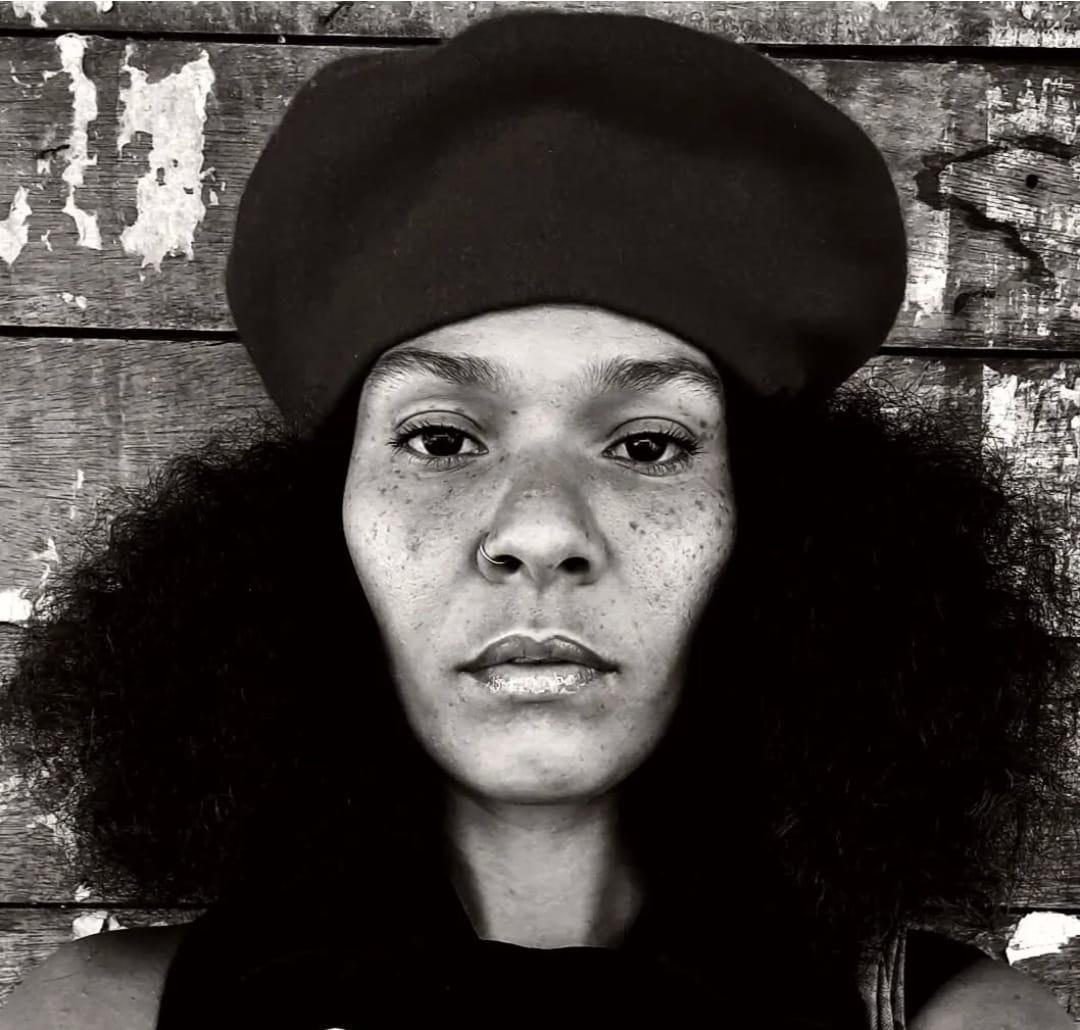
Dans une entrevue avec The Concordian , l’artiste et activiste martiniquaise Mouna se présente comme « la petite-fille » de « toutes ces personnes dont la mémoire a été occultée », telles que Romain, Lumina Sophie et Rosalie-Soleil. Elle fait partie de la majorité des coaccusés relaxés par le tribunal correctionnel de Fort-de-France.
Mobilisée pour « le boycott des enseignes de Carrefour [possédées par la famille Hayot] », elle ferait partie, selon le média France Guyane, d’un collectif nommé « Rouge-Vert-Noir », qui serait responsable des déboulonnages. Refusant cette étiquette, Mouna affirme que ce collectif n’existerait simplement pas.
« En 2019, il y a des actions qui sont menées par des jeunes Martiniquaises et Martiniquais qui consistent à bloquer les enseignes de GBH – le Groupe Bernard Hayot – afin de mettre en lumière la culpabilité de ce dernier [dans la crise d’empoisonnement au chlordécone] », explique-t-elle, détaillant ensuite le monopole d’une poignée de groupes familiaux sur les conglomérats locaux.
« Les békés [classe nantie constituée des descendants blancs des esclavagistes] ont vraiment cette domination-là sur l’économie. En Martinique et à ce moment-là, [...] on dénonce tout ça. Sauf que, comme on ne se nomme pas, la presse va s’emparer du mouvement et va décider que nous serons les militants anti-chlordécone, alors que nous on parle plutôt d’une lutte anti-coloniale. »
Le procès, décrit comme étant « marqu[é] de vives tensions » par Libération , a débuté par une tentative de la procuration, refusée par la cour, d’interdire la présence d’un interprète en langue créole afin d’imposer le français comme unique langue d’expression. Depuis novembre 2023, le français est la seule langue officielle reconnue de la Martinique, le créole martiniquais ayant été, pendant quelques mois, une langue co-officielle, avant que le tribunal administratif de Fort-de-France ne lui enlève ce statut.
« C’est vraiment absurde de se retrouver en Martinique et d’avoir besoin d’une ou d’un interprète, qui traduira notre langue [...] à des gens, étrangers ou pas », s’est insurgée Mouna.
Elle affirme que le geste de la procureure s’inscrit dans un contexte d’« oppression du gouvernement français qui refuse l’identité martiniquaise ».
Parmi les statues déboulonnées se trouvaient celles de Joséphine de Beauharnais et Pierre Belain d’Esnambuc, « directement impliqués dans la colonisation et l’esclavage », selon Dr Louis-Georges Tin, professeur d’histoire à l’Université d’Orléans, dans une entrevue
avec The Concordian. Il souligne néanmoins une nuance importante concernant la première figure à voir deux de ses statues déboulonnées, Victor Schœlcher. « Victor Schœlcher, on le sait, a été membre du gouvernement provisoire de la Seconde République et a signé le décret d’abolition [de l’esclavage] en 1848 », a expliqué le Dr Tin.
Dans une déclaration écrite au Concordian , Dr David Geggus, professeur émérite d’histoire de l’Université de Floride, affirme qu’il lui paraît « évident » que « Schœlcher a aboli l’esclavage, mais que le moment exact de son implémentation a été déterminée par l’action directe en Martinique. »
« Pour moi, même si cet acte [de déboulonnement] paraît difficilement lisible pour la plupart des gens, il a le mérite de poser la question, non pas de Victor Schœlcher, qui est un homme important, positif, mais du “schœlcherisme” », a déclaré Dr Tin.
« Ce que j’appelle “schœlcherisme”, c’est la tendance aux Antilles de faire l’éloge de Victor Schœlcher et des abolitionnistes blancs au détriment des combattants noirs de la liberté », explique le Dr Tin.
« En Martinique, il faut savoir qu’une révolte a eu lieu et a abouti le 22 mai 1848 à un décret qui a été signé par le préfet, le gouverneur de l’île à l’époque, sous la pression populaire », ajoute-t-il. Mouna, cependant, cherche également à remettre en question la place de l’individu dans la mémoire collective martiniquaise, s’appuyant sur certaines des citations de Victor Schœlcher, qu’elle estime racistes et paternalistes. Elle souligne, de plus, les conséquences sociétales actuelles de l’indemnisation des békés et de « la négation […] extrêmement violente » de l’identité des esclaves, une majorité s’étant fait imposer des noms de famille après leur affranchissement.
« On ne peut pas être abolitionniste en voulant conserver le mode
économique de la plantation », a-t-elle aussi soutenu, soulignant que beaucoup d’affranchis ont dû continuer le travail agricole, dans des conditions extrêmement difficiles et exploitateuses et sur les anciennes plantations esclavagistes.
« On est en carence de nos mémoires martiniquaises, et Victor Schœlcher, lorsqu’il tombe en 2020, [...] c’est une réappropriation de l’histoire martiniquaise qui se fait. Ce sont les ancêtres [...] qui reviennent en force et qui disent, “On est où?” », ajoute Mouna.
Le Dr Tin ne partage pas la perspective de Mouna, qui affirme qu’il faut « bousculer » la violence du « système » par des actions plus radicales comme le déboulonnage. Il souhaiterait toutefois, comme elle, voir davantage de statues commémorant les très nombreuses résistances à l’esclavage.
Mentionnant « un culte un peu aveugle et aveuglant de Victor Schœlcher », Dr Tin dénombre de multiples hommages toponymiques au personnage, en plus de ses différentes statues. « Moi, ça ne me dérangerait pas si on avait aussi autant et sinon plus de statues d’hommes et de femmes ayant lutté contre l’esclavage », dit-il. « Or, on ne les a pas. Or, ce ne sont pas les héros qui manquent, ce sont les statues des héros qui font défaut. »
« Je comprends les manifestants dans le fait où c’est vrai que Macron et certaines personnes vont mettre en avant le rôle de la France, qui pour eux a aussi permis l’abolition de l’esclavage », a pour sa part émis Anouck. « Et, du coup, je comprends que [c]es Martiniquais soient un peu outrés de ce fait, parce que même si la France est normalement mise en faute, ils ont quand même trouvé un moyen d’expliquer que c’était un Français qui avait permis d’abolir l’esclavage. »
« Dans mon sens, je pense qu’effectivement, s’ils veulent faire des statues [...] avec des esclaves qui se sont révoltés, je suis complètement d’accord pour ça », a-t-elle ajouté, faisant généralement écho à la prise de position du Dr Tin.
R&B artist Myles
Lloyd releases his new album I’m Still Thinking on Nov. 21.
By Luca Jarman Staff Writer @luca_jarman
Montreal-based singer Myles Lloyd has grown significantly since his early work, his upcoming fourth album will send him into a new era. “It started with watching a lot of Michael Jackson films, just singing and dancing around the house at six or seven years old,” said Lloyd. “Music is a subconscious thing. You hear it every day, you can't escape it.”
“One day I stopped being a person who was just listening. I was asking questions. How was it made? What's behind the scenes of what I'm listening to?”
“And as years went by, I just thought I need to try this. I said one day to my friend who made music, ‘give me one of them beats, let me see if I can do some
stuff with it.’ I did my first song, it was called “Long distance.” No one can find that one, I took it down right away!” he joked. “But I loved the process.”
The MJ influence in Lloyd’s work is clear, with catchy, infectious rhythms and hooks; he also incorporates his own vulnerability. His songs feel like late-night confessions when one is left alone and pondering on his own thoughts.
“Previously I struggled with putting my feelings into words, but that makes no sense to me now. Now I can just say it. I’ve developed in a way that now I can shamelessly say what I have to say,” he said.
“It sounds kind of bad, but I don't have a therapist, so I just talk to myself and make music from it. I think talking to myself and the beat first makes it feel real […] I feel like right now, everything feels more natural. Previously I would say, ‘let's make a song.’ But now, when I feel like I have to say something, that’s when a song comes.”
Lloyd is on the rise and people are taking notice. His 2024 single “Drive Me Crazy” blew up, reaching over 20 million streams on Spotify. The track’s soothing beat feels hypnotic—a meaningful
dream. It inspired a more energetic remix “Crazy” — a collaboration with German artist BUNT
“He [BUNT.] heard “Drive Me Crazy” and he’s a very hungry guy. He just hit me up on Instagram and I said, ‘let’s do it.’ It was really fun. I sent him the vocals and said, ‘do you what got to do’.” Lloyd said.
His latest single “Grapevine” came out on Nov. 9, and Lloyd feels like it is a good representation of a different side of his music.
“I felt like coming off “Drive Me Crazy” I just wanted to put out more stuff like that. But right before the album comes out, I wanted to shake things up a little bit. I want to show people that it's not just stuff like my other singles, I have more. It’s less about yearning, and more just showing people what I’ve got.”
Lloyd teamed up with director and long-term collaborator Dan Lemoyne in the making of the music video for “Grapevine.” He feels that their working relationship inspires synergy and that they have grown artistically together.
“We make our best work when I give him a song and what I meant behind it and ask him ‘what do you see?’ I don’t
want someone to sit me down in the studio and tell me what I should make […] In our videos I want to create a world where people can get lost for two minutes.”
Lloyd’s excitement for the album’s release was palpable, and his love and pride for his creation was apparent. He’s most excited about “Cold.”
“That song is really special to me. I wrote it about seven and a half years ago. I had to rerecord it because my voice sounded a little young. I made it with an amazing writer who always messages me about the song, bugging me to release it. But I knew it had to come out and the right time. We couldn’t waste this song. It’s finally coming out now, and I just hope I was right.”
Lloyd is proud to have come out of the Montreal music scene and spoke of his love for its diversity.
“In Toronto, they can hold certain people on a pedestal, and they get the attention. But over here, we embrace everyone. We don’t say that one act is trash and another is the best. Everyone gets the same love.”
“I love Montreal, I will always call it home. If I didn't have this, I wouldn't be me.”
The powerhouse group led by Karly Hartzman gives Montreal’s showcase, alt-rock scene a run for its money.
By Sofia Dawson Music Editor @sofiajdawson
Shoulder-to-shoulder, head-bangining chaos — that is the main descriptor for what rattled the floors of Club Soda last Friday. It comes as no surprise that Wednesday , an American alt-rock shoegaze group, sold out their show downtown. The band’s music feels right at home in Montreal’s sonic landscape — their sound an inclusive blueprint for the alternative. Southern-rock and shoegaze communities scattered throughout the city.
In the chaos of the pit, people shouted overtop of one another — drinks toppling over, song lyrics flying, their chaotic energy was unmatched. Scattered on their periphery, millennials chuckled at these excited teens, reminded of their heyday. Such eagerness did not falter as opener
Daffo entered the stage alongside their accompanying band. Philadelphia-born Gabi Gamberg (aka Daffo), revved the engine of wide-eyed fans with tracks from their newest work and debut album, Where the Earth Bends . “Sideways” brought listeners into an ethereal space as the singer floated under a deep blue light. The tracks’ melancholy state sat perfectly in-between the more hard-hitting grooves where the crowd forcefully nodded along to the jive of their rock choruses.
High and dry — eager for more — the audience patiently waited for their main meal of the evening.
As “Reality TV Argument Bleeds” vibrated through the speakers, it was off to the races. Wednesday had strutted on stage met by roaring screams and a dense pack of wolves that hungrily clung together.
Here, one thing became starkly evident: Karly Hartzman is a force to be reckoned with.
In the recent weeks, incredible rockalt and indie artists like Blood Moon, Bar Italia, and Good Neighbours have stunned large crowds of this venue — but Hartzman rewrote what it was like to be a passenger on this trip, along for the ride in the back of a raggedy 1970s Dodge pickup.

The frontwoman’s giddy
charm was completely counterintuitive to her gut-wrenching screams and darkblack lipstick. Her vocals morphed from rough-cut diamonds to quaint lullabies — flawlessly ensuring she weren’t to slice through the skin too deeply. It felt nearly unimaginable how her voice filled the space.
As “Quarry” began, Hartzman swapped her silver-glitter electric guitar for a model bedazzled with buttons and jewels. Fans screamed back the lyrics, “Somebody called the cops on Mandy and her boyfriend” louder than the singer herself. The crowd truly got in their spirit ed hang-banging and jumping around for this track — so much so much so that the pit became a swirling mosh as the army of fans rammed into each other.

Hartzman took a short pause following the song to say: “The energy levels are crazy — What day is it?” to which the crowd screamed “FRIDAY!!!!”
The singer chuckled back before carrying on jokingly, “The two people that really don’t want to jump [...] Good luck to ya.”
Midway through their set, Hartzman welcomed Daffo back to the stage for a joint, country-bumpkin, lively rendition of “Phish Pepsi” — a collaboration the audience didn’t know they needed until it was sitting in the palm of their hands. Throughout the evening, Hartzman was accompanied by Jake Pugh on guitar, Xandy Chelmis who rocked the pedal steel guitar, Ethan Baechtold on keys and bass and drummer Alan Miller. The group
, who acted as contributor to their latest release and the prior works from their discography. However, Letterman’s absence made no difference to the gritful harmony exuding from the band as they moved into tracks from their latest album, Bleeds
“Wound Up Here (By Holding On)” and “Elderberry Wine” attracted by far the most praise from listeners who sung back nearly every word flawlessly. Hartzman effortlessly moved from low to high vocal registers which beautifully complemented the rough vibrations of electric guitar in “Wound up Here (By Holding On).”
“Elderberry Wine” truly slowed things down as the crowd became entranced by the group and hung onto their every motion as if they were required to be worshiped to the highest degree during this moment.
Alicia Moffet and Dominique Way turned Théâtre Beanfield into one warm, connected crowd.
By Loulwa Hamaoui Contributor @loulwaslens
There’s a particular kind of energy that fills a room when everyone shows up ready to feel something. At Théâtre Beanfield, that energy didn't just build, it settled in like the crowd and artists were on the same wavelength from the start.
Dominique Way opened the show with a calm presence that made the room pay attention. Her voice had a steady, unforced quality that pulled people in and set up the night in a way that felt natural.
When Alicia Moffet stepped out, the shift was immediate. The crowd didn't just cheer; they reacted loudly and immediately, in a way that felt collective. Younger fans, older fans and everyone in between — the crowd responded with the same intensity. You could tell the music carried personal meaning for many.
From behind the camera, what stood out the most was how naturally connected the room felt. No one was just watching; people were actively responding to Moffet. Certain lines hit, and whole sections of the crowd shouted them back without hesitation. It was chaotic in the best way — collective, and somehow comforting.
The night ultimately felt like a group of people letting themselves be open for a few hours, and Moffet meeting that openness with the same level of honesty.








The AI-based Tilly Norwood exposes how the film industry is increasingly comfortable designing women rather than listening to them.
By Veronica Rebuli Contributor
As studios begin to experiment with AI-generated stars, many fear this new wave of “digital perfection” could dissolve decades of progress for real actresses fighting for representation.
“I’ll say it again: a screen persona is a mysterious thing,” said Michael Yaroshevsky, a professor in cinema and film production at Concordia University and multi-disciplined filmmaker.
Developed by London-based AI production studio Particle6, Tilly Norwood has sparked a fierce debate. Roy Cross, a film production professor and filmmaker, dismissed the idea that AI-generated actors pose a real threat or even a creative challenge, describing the practice as “a lazy art practice.”
Two decades after S1M0NE (2002) hit

the movie theatres, its satirical premise transformed itself into reality. The movie conveyed a simple message to audiences about fame, technology and the disposability of women in Hollywood. Unlike with Simone, the creators of Tilly Norwood are not pretending she is a human, but rather proudly marketing her as Hollywood’s very first AI Actress.
During a panel at the Zurich Summit, a segment of the Zurich Film Festival, Eline Van de Velden, the founder of Particle6 Group, explained that there would be an upcoming announcement about a traditional acting agency wanting to represent Norwood; and that various film and television companies were beginning to embrace AI with great interest.
“Hollywood is a corporation. Purely business. Some art gets made along the way, but it’s all about ‘show me the money’,” said Cross.
Although the creators of the AI actress claim she was created to explore storytelling through innovation, Tilly Norwood caused uproar among Hollywood stars who were upset by the industry’s approach to replace real women with computer-generated ones.
“AI has the potential for being a powerful tool,” said Yaroshevsky. “From what I’ve seen, there’s something truly rebarbative about AI actors. I suppose it comes down to one’s predilection for rubber dolls or plastic flowers — some people don’t mind.”
Norwood’s lack of soul, despite her near-human resemblance, is what many find unsettling about these synthetic performers. Immediately after the AI actress’ formal introduction to the world, the backlash was swift.
Professor Yaroshevsky further elaborated on the uniqueness of human artistry: “Human artistry in performance is precisely that, drawing from the magnificence of the human face beheld by another human, both of whom were born, cried, crawled and climbed into life day by day, year by year.”
The dangers Tilly Norwood poses are not solely derived from her existence, but from her symbolism. She represents an increasing trend in technology and media in which women’s images, voices, traits and labour are digitized, monetized and controlled by corporations.
If audiences continue to grow accustomed to this phenomenon of synthetic women” — who never stand up for their rights, never age and never demand better conditions — the industry can regress decades in the way it treats its real actresses.
Despite all the progress the industry has made over the years, Hollywood remains rooted in the illusion of trying to keep everything perfect. Tilly Norwood only pushes this norm to its extremity by being the culmination of decades of technological advancement and female commodification. This reflects Hollywood’s disappointing dream that aims to celebrate the same women it consistently excludes.
The Montreal Museum of Contemporary Art invited artists from around the world to display images that rethink history.
By Kasi Peri Assistant Arts and Culture Editor
The 19th edition of the Biennale d’art contemporain invited Montreal’s Museum of Contemporary Art (MAC) to install its exhibition In Praise of the Missing Image in collaboration with the MOMENTA Biennale contemporary art museum, running from Sept. 11 to March 8, 2026. The exhibit was installed by curator
Marie-Ann Yemsi and includes visual media, such as films and photographs, that showcases themes of melting permafrost, clay and archival videos depicting colonial power through soccer.
Dominique Sirois-Rouleau, executive director of MOMENTA, said the exhibit’s goal is for visitors to acknowledge what it means to view history through images.
“It’s thinking about histories, narratives that we didn’t see,” said Sirois-Rouleau. “The missing image is what we left from the history written by the main current.”
Maureen Gruben, a featured artist, showcased a piece entitled “Nuna Aliannaituq,” a work made from 5,000 clay beads tied into necklaces by members of their community in Tuktoyaktuk, an Inuvialuit hamlet in the Northwest Territories. Placed on top of each other as though melding into each other, the beads illustrate how nature is valued by their community and Gruben’s personal connection to it.
A nature video displaying close-ups of mud, branches and sheets of ice melting
off branches accompanies the necklaces. Together, the work demonstrates the deterioration of the town’s permafrost showing audiences a changing town and climate.
“[Maureen] really thinks about this perspective of the territories getting taken by the oil extraction and global warming that destroyed the land,” said Sirois-Rouleau.
Joyce Joumaa, another featured artist, made a video titled “Bêtise Humaine,” which translates to “Human Foolishness,” which examines soccer through the use of artificial green turf and a silver bench mimicking a real soccer field. Joumaa’s inspiration was taken from Gillo Pontecorvo’s 1966 film The Battle of Algiers and from the 2001 soccer match between France and Algeria.
“Joyce Joumaa rethought the relationship between the colonialist and the colonized country around the football match making it clear that every sport, every proposition is still political,” said Sirois-Rouleau.
Joumaa included animations that trace
the outlines of the spectators in white, exaggerating those who had interrupted the match. She included the history between France and Algeria to showcase lingering colonial powers and sentiments still existing after Alegria’s independence from France.
John Baker, an attendee at the exhibit, enjoyed Joumaa’s display because he learned more about France and Algeria’s colonial history.
“I really like the France and Algeria soccer match,” said Baker. “It was a bit of history that I have never seen before and the way that it was presented was thought provoking.”
In Praise of the Missing Image confronts themes of colonialism and climate change, inviting visitors to recognize that there is always another side to each story.
“I hope that they will remember that there is always more than one side to history,” said Sirois-Rouleau. “We are used to reading history from the winners’ side, the colonizers’ side and it’s a great way to remember that history is always from different perspectives.”
The used book fair raises $35,472 for student funding for scholarships, emergency and food fund.
By Jennelle Jagdeo Contributor
On Nov. 11 and 12, Concordia hosted another one of their Epic Used Book Fairs, bringing students, faculty and community members together in support of continuing student access to education and financial security.
With an entry fee of $2 and books costing $3, Montrealers looking for guilt-free book buying finally got their chance, as all proceeds go toward student scholarships and the Student Emergency and Food Fund. Having to sort through thousands of books in preparation, organizers and volunteers certainly have their work cut out for them. Co-leads of the book sale Jeanne
Bisson and Luke Quin discuss how preparation looks year-round with volunteers.
“We have a bin that people can deposit used books in the Hall building that we collect once a week,” Bisson said. “We have volunteers that come from 12 p.m. to 2 p.m. on scheduled Wednesdays.”
The book fair runs on the collective effort of the Concordia community and a team of regular volunteers, including retiring faculty looking to offload their collections, students finishing courses and community members who donate used books. Volunteers sort the donations into boxes throughout the year.
Compared to previous years, the fair’s contributions continue to expand. For this event, a total of 24,000 books were up for sale.
“I joined in 2016; there were less book donations but it has grown a lot since then,” said Quin.
Despite the cold weather and the STM strike, the fair raised $35,472 in book sales.
The collaboration of organizers and volunteers, who love books and love supporting the Concordia student community, is at the heart of this annual event.
"It's the value of finding new homes for these books that are used; students rejoice when they discover something they wanted and that’s really priceless,” he said.
“I think it's great. I love physical books still and it's nice to see that people want [physical] books,” said Tania Paparis, a firsttime volunteer and Concordia alumni. “I’d love to volunteer again next year. I’m retired and I wanna do more stuff with alumni.”
Both Bisson and Quin highlighted the foundational work of long-time volunteer Susanne Dragffy, who passed away in May 2025.
“She volunteered for over 20 years for the book fair, and when she retired 10 years ago she just continued, she was really the driving force of the book fair,” Bisson said.
Dragffy’s dedication is honoured through a student bursary in her memory, reflecting her commitment to books and to helping students.
Bisson also shared why she continues to volunteer: “I worked for Concordia for 17 years and it's my way of giving back. I love my job, I love Concordia and I love doing something with the students, and this is for the students, so it's really important to me.”
Concordia’s Epic Used Book Fair is made possible by the thousands of book donations by the Concordia community each year. Its success helps sustain future access to education and financial security for students.
Award-winning documentary Parade: Queer Acts of Love & Resistance projected at the SGW campus.
By Helena Reyes Teruel Contributor
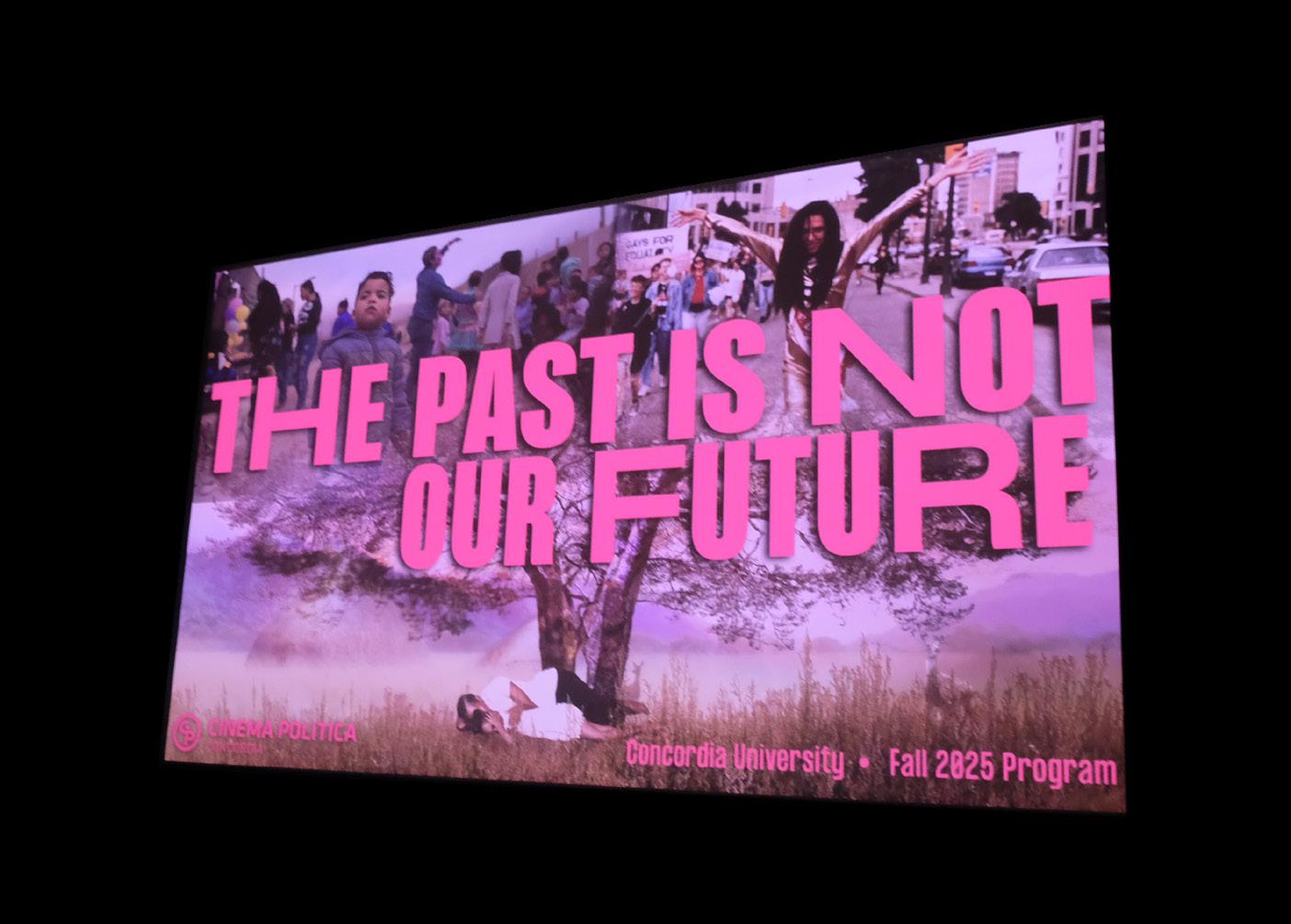
On Nov. 10, Cinema Politica alongside Metonymy Press, Queer McGill, Action Santé Travesti(e)s & Transsexuel du Quebec and the Social Justice Centre of Concordia screened the documentary Parade: Queer Acts of Love & Resistance in the Henry F. Hall Building. The screening was followed by a discussion with director Noam Gonick and mediated by local drag performer, Jordan Arsenault.
Parade: Queer Acts of Love & Resistance was released this year by Gonick and producer Justine Pimlott. It has been screened at film festivals, such as the Canadian International
Documentary Festival in Toronto, and has won three awards from two festivals so far.
The documentary is produced with an archival style that mixes footage and photographs of the early queer liberation movement, alongside the voices of 40 interviewees that lived through these historical moments.
Gonick decided to have an open-ended conclusion of the film because of the current political atmosphere.
“As we were mixing the film here in Montreal last January, [Donald Trump] had just started his first wave of anti-trans speech,” said Gonick.
This development also expanded the scope of the documentary beyond the his tory of queerness in Canada.
“The world kind of changed and gave the film so much more importance and I re alized that actually what it is is like a manual or a tool that needs to go into effect im mediately to help the new generation in reminding them what was done in the past,” he said. “Because it seems that some of these rights were about to get taken away, maybe not in Canada right away but elsewhere.”
The film’s message has strongly resonated with audiences.
Mediator Jordan Arsenault shared: “My friends that were on the active scene much longer than me were delighted and moved going to the screening in August. We have unanimity amongst homosexuals over the age of fifty-nine that this is groundbreaking!”
Volunteer coordinator from Cinema Politica, Emily McQueen expressed a similar sentiment.
“I liked that the ending made itself relevant with some of the issues we have today that are attacking queer rights,” said Mc-

By Ginane Deslauriers Arts and Culture Editor
½ cup Egyptian rice, washed 1 litre milk
1 grain mastic
½ cup sugar
1 tbsp cornstarch
Water
Optional: Balooza
2 cups fresh orange juice

1 cup sugar
Cornstarch
1. In a large pot of water, cook the rice for about 45 minutes, or until most of the water is absorbed and the rice is fully cooked.
2. In a separate pot, heat the milk and vanilla until hot but not boiling.
3. Drain the cooked rice and add it to the hot milk. Keep stirring the mixture until combined.
4. On the side, hit the mastic until it becomes a powder and add it to the mixture. Keep stirring until boiling.
5. Mix a tablespoon of cornstarch in a bit of water until dissolved. While stirring, add the cornstarch to the mixture.

6. When the mixture thickens, add the sugar. Keep stirring the mixture for around 10 minutes. If the rice pudding sticks to a spoon, you’ll know it’s ready.
7. Pour into cups and once cooled, refrigerate it.
Optional: Balooza
1. Mix orange juice with the sugar.
2. Heat the mixture until it starts to boil.
3. Once the orange juice boils, add cornstarch.
4. Pour it over the cold rice pudding.
My grandfather was around 10 years old when he started working at Abou Adnan Azaat, a dessert shop in Damascus, during the summer. Every morning, he would stir the milk and rice mixture for three hours, in a huge pot, more than twice his size.
At the time, one cup of rice pudding cost 1 lyra. According to my grandfather, Abou Azaat was the first to add ashta to ice cream.
After that, he started working for a nut shop that would sell to Damascus’ oldest ice cream shop, Bakdash. The store opened in 1885, in the Souq Al-Hamidiye, an indoor market, and specializes in milkbased desserts, such as traditional ice cream and rice pudding. The Bakdash family still owns the place to this day.
If you make this recipe, post it on Instagram tagging The Concordian.

Halloween is long gone, but the thought of ghosting still haunts us.
By Kailee Krentz Opinions Editor @kaileeliz
Carrie Bradshaw has found her way onto the Concordia campus. Welcome to The Concordian’s dating column, Sex and The Concordian. Here, all things relationships; whether it be advice, complaints, or confessions, are free to be discussed openly. Dating in your 20s is hard, what do you have to say about it? If you want to write for the next column email opinions@theconcordian.com
In a world where we are so easily able to hide behind our screens, ignoring people — commonly known as “ghosting” — has unfortunately become the norm when it comes to friends or loved ones. The term may be used lightly towards someone close who simply hasn’t responded for a couple days, but more brutally, we use it when referring to a romantic
interest trying to indirectly communicate that they no longer want to continue the connection.
Sometimes it’s a blameless act, a slip of the mind; but more often than not people manipulate it into a seemingly “innocent” sign of rejection. Do they not know that communication is key?
Hypocritically, I can’t deny the time or two where I may have “ghosted” someone — maybe one that I’ve met in passing or particularly dislike — but when it comes to someone I’ve been dating, I can say with my whole chest that I would rather have an honest and straight forward rejection than the constant checking of whether or not they messaged me, only to be disappointed again and again.
As with most things these days, dating has become void of sincerity. I blame the means of which we chose to connect with people on the very devices that mold to our hands. If we have the option to avoid responsibility, why wouldn’t we take it? This mindset, however, has started dehumanizing us into just another pawn in the dating game. Each of us reduced to something trivial, just barely holding on to drab conversation, dancing around what we’re really here for.
Do people not want to find an authentic connection? It’s hard to believe
otherwise. Our phones not only create a barrier between genuineness, but they also force us to become tangled in the countless profiles we interact with on the daily. And if you’re like me, hyperfixating on my own in order to decrypt the way others perceive me. A redundant task that I fall into, driving myself crazy until I realize that I will never successfully come to a conclusion.
Although this may linger in our conscious, have we really abandoned the basic human decency to be honest with one another? So often that I’ve become numb to the disappointment, I hear tales of my peers being victims of this behaviour — abandoned, quickly erased from the repertoire, only to be replaced by the next best thing they can fawn over: another profile with a fresh set of pictures.
Now, you don’t have to take my word for it; if you can fall asleep at night without being haunted by the ghosts of the ones you’ve left high and dry, by all means. However, it really doesn’t take much to abandon the cowardly-lion act and write a simple and honest rejection. You aren’t going to find anything serious if you can’t be serious to the ones you don’t even care to continue exploring.
The CSU should introduce a lottery to increase turnout in student politics.
By Danylo Perkov Assistant Opinions Editor
According to all publicly available data, the highest CSU election voter turnout was 21.1 per cent, with the lowest voter turnout at a mere 4.8 per cent in the 2021 general election. For a student body which prides itself on activism, democracy and community engagement; those numbers are a joke.
mere 11.2 per cent voter turnout! Only one out of ten undergraduate students at Concordia exercised their right to vote. Among numerous ways to increase the student voter turnout, I propose to learn from some of the most efficient institutions in the world — tax collection services. They keep most modern societies running and have thus developed many efficient methods of reaching vast portions of the population.
In 1951, the Taiwanese Ministry of Finance implemented a uniform invoice — a policy making every sale receipt in the country an automatic lottery entry to encourage people demanding receipts and record tier purchases. As a result, the Taiwanese government saw a 75 per cent increase in tax revenue that year.

The CSU and other student bodies that hold elections can learn a lot from this, as no one likes a chance to win money more than students. By automatically entering each vote into a lottery, the student union could dramatically increase the voting participation, and thus make sure that the student body is more properly represented.
Additionally, it would be much easier to advertise. While not a lot of people will stop by
a booth with a sign that reads: “please vote, pretty please,” a slogan along the lines of “get a chance to win money for free,” would catch much more attention.
The CSU could implement different categories of prizes, just like the government of Taiwan. With a couple dozen students having a chance to win a few hundred dollars, and one of two students having a chance to win a larger amount of money. While this would represent a negligent amount to the student union’s budget, it would be an exponentially efficient stimulus for students to vote.
It could be argued that people would simply vote for the first candidates and options they see, simply to enter the lottery, but I do not believe so. It takes about two minutes to read short paragraphs different candidates write about themselves and some would take a few extra moments to educate themselves. For the rest, simply encouraging more participation would inevitably spark more conversations amongst students and lead to CSU political awareness spreading through word of mouth.
While deciding not to vote can also be a statement, a repetitive lack of voting awareness within a student body is what leads to potentially promising candidates not pursuing any positions. Perhaps if more students were encouraged to vote, more candidates would also be encouraged to run their platforms and ideas.

Sara discusses how
By Damarra Vogt Staff Writer
Consider the security of owning a home: freedom from sudden lease terminations and rent increases, of justifying a nail in the wall, to fighting for repairs for months. These struggles have persisted for much too long; take Mordecai Richler’s novel The Apprenticeship of Duddy Kravitz (1959) set in Montreal following Duddy’s relentless schemes to acquire land. It’s always been a privilege to own private property, yet how accessible is it?
Originally from Ontario, Sara and her husband relocated to Montreal, pooling their resources to afford an apartment in Hochelaga with 120 years of charm. As a “tenant to the bank,” Sara’s responsibilities extend beyond the mortgage. Older properties, while full of character, can demand costly maintenance — like a $15,000 ceiling repair — requiring prepared planning of emergency savings.
Thankfully, Sara knows how to make these accounts work for her — skills honed from a decade in the financial sector, alongside a money-wise partner. The consistent salary was welcome but the position was unfulfilling. During the pandemic, she felt especially undervalued, “my job didn’t care if I lived or died.” That pushed her to finish her bachelor’s degree and pursue her dream of becoming an educator.
Now 33 and studying humanities and art history, Sara feels fortunate to make a career shift. Supported by her husband and family, she funds her tuition through a parttime position and careful use of her savings.
Sara believes that homeownership should be accessible for all, though often neglected in our government’s list of priorities. Engaging in financial transparency could be the first key to unlock hidden knowledge about homeownership, compensation equality and financial freedom. Don’t miss the full details of her journey! Scan the QR code below for Episode 03 of Financing My Future.

Authenticity has morphed into a carousel of trends and performative living.
By Priyal Parekh Copy Editor @priyalparekh_
What happened to opening Instagram and finding something raw, unfiltered and filled with authenticity? Designed when there was a clear distinction between
real life and media life, the boundaries between the two on social media have knowingly or otherwise clearly vanished. Will the world ever go back to what it was — real, warm and devoid of unnecessary pressure — I just happen to have too many questions buried under this invisible weight of performative experience of life on this planet.
The quality of our cameras has grown exponentially, but can we say the same about the originality of our thoughts? Often in an attempt to find something soulful on these platforms, I scroll through the apps, but only once in a blue moon do I find something that makes me interested in knowing what’s
going on in the social media world. More often than not, it’s the same concepts, repeated background music and mindless trends with absolutely no substance.
What began with a means to provide people with necessary information, creative solutions and an escape to a lighter life, quietly shifted to being a source of constant brag. Once a celebration of finding beauty in simplicity and genuine moments is now a shallow display of curated content. Every meal, every vacation, even a toddler’s quirks — everything has turned into content now, strategically transformed as a means of gaining attention. We sure have become experts at curating eye-catching trends, but our morals have drastically plummeted in the process.

A recent example of this is the “Ghibli Art” trend and the way it has been utilized is honestly quite sad. Legendary animator and founder of Studio Ghibli, Hayao Miyazaki, whose art once appealed to the world with its quirky storytelling, has been replaced by OpenAI’s new image-generation tool. His hand-drawn work took years to be created while influencers, without understanding the art, have promoted the bandwagon of rendering and posting their pictures using an AI tool that imitates Mr. Miyazaki’s art. Even though this has been a popular trend for quite some time now,
what we must not forget is that this is a disrespect to the artists that put their heart into the creative processes. There is a clear lack of “creation” and “creativity” in the work of most, if not all content creators.
For how long are we going to mindlessly dive into trends forgetting there is substance behind the art?
Influencer culture has led to the world becoming more performative than ever. Products are endorsed without second thought, while personal experiences becoming viral has outweighed them being personal and even things with an essence of sanctity have been reduced to reels and stories. This reminds me of a time when things held meaning beyond their digital presence and lives were truly lived. The constant comparison has resulted in increasing anxiety, self-doubt and shallowness among the young who in fact, should be bursting with creativity and fresh perspectives.
It’s no wonder that mindfulness and creativity feel so rare in an environment that worships engagement and the illusion of perfection. It’s time the world begins to choose artists over trendsetters and meaning over views for, the more we choose visibility, the further we drift from anything real.
What can the democrats learn from Zohran Mamdani’s campaign for NYC mayor?
By Cassia Anderson Contributor
Zohran Mamdani has accomplished what many progressive candidates find themselves unable to do: appeal to new voters. Heavily leveraging the power of social media was a stroke of genius for Mamdani’s campaign. Short-form videos on sites like Instagram and TikTok, regularly garnered international attention, particularly from young people. This, in turn, created support for his campaign within his own city. However, it didn’t stop at social
media, he also made regular appearances at concerts, night clubs, and neighbourhood bodegas. This allowed him to interact with communities in a far more natural way than staged visits to businesses and talk shows that are standard for political campaigns.
This style of open campaigning allowed Mamdani to present himself as a man of the people. His policy ideas and the issues he placed at the forefront of his campaign only reinforced that image. He focused primarily on issues which affect every day New Yorkers such as the dysfunctional public transit system and the high cost of living.
Mamdani’s willingness to discuss issues left unacknowledged by his competitors — such as FIFA World Cup ticket prices or food deserts across the city — also strengthened his image. This allowed him to successfully convince New Yorkers that he could understand their hardships far more than somebody like Andrew Cuomo, who struggled to prove that he could
relate to regular citizens throughout his campaign.
He was not only willing to acknowledge these issues, but was also able to present real solutions with passion and optimism. This contributed to his appeal among democrats and moderates alike.
The democrats have historically had a difficult time appealing to young people and encouraging them to vote. Democrats typically rely on celebrity endorsements to do this and instead focus the majority of their genuine political messaging on donors and older voting demographics. This method dismisses and undermines young people’s participation in politics and it certainly doesn’t encourage them to vote for the designated candidate.
This is a lesson which the democrats should have learned during the 2024 presidential election. Despite being able to reach a certain element of young people, the republicans were far more effective because they directly addressed the concerns of young voters
in a meaningful way.
This reveals one of the Democratic Party’s glaring faults: its lack of a consistent party line. The democrats play a dangerous game in which they try to appeal to as many demographics as they can, creating conflicts between what they say, what they support and what they legislate once they’re in power.
In recent years, many voters have become disillusioned with the party due to these discrepancies, and the party likely loses more voters than it gains by continuously using this strategy.
The age of the candidates also has to do with low voter turn out. Candidates who are older, fully established and have spent most of their lives in times of relative economic stability cannot possibly relate to the young voter base of today. Octogenarians running under the guise of “experience” are only going to become increasingly detrimental to the party.
Young, passionate candidates like Zohran Mamdani are the solution.

Aries Keep isolating yourself, you’ll become a scrooge.
Taurus
All I want for Christmas is a fucking vacation.
Gemini
Each snowflake represents a tear you shed.
By Yuuya Cook // Staff Crossworder
Down
1. 2000s infomercial wearable
2. WWII Aquatic cruisers
3. Goal
4. Thunderous sound
5. Dog-_____
6. Not quite right
7. Approach
8. Before, quaintly
9. Comparative word
10. Tree used in guitar making
11. In style, to a Parisian
12. It’s left on or at the bank
13. Snares
14. Comparable to Pie, or ABC
20. Tropical climate phenomenon
22. Marathon or sprint
24. “Steal my Sunshine” group
27. (C)hucked
29. Amulet, eg
Horoscope #5 Christmas Time Across 1. Sputnik’s era

Cancer
Make a snow angel in reminiscence of your lost childhood.
Leo
Remember: Reindeers work in p acks, not alone.
Virgo

Libra
or where to find some naval
You are an elf, not Santa Clause. Don’t try to take on a role that isn’t meant for you.

As your footprints melt, your absence will hit those behind you the hardest.
Scorpio

Sing a Christmas carol to enchant your next lover.
Sagittarius
Take a break from the cold and warm up next to the fire with a cup of hot cocoa.
31. Make certain
Where you may see threads and reels
36. Cat call?
37. Crashing into the side of
38. Munitions repertoire
"I just keep on winning!" or what 16, 28,
39. Beckons for
41. ___ Lanka
42. Olympic
43. Salamander on the 50 peso note
44. Hair curl
45. Silver and gold
47. Ancient Mexican
48. Covered in goo, as in a nickelodeon show
52. raves about, as in praises
55. “That’s all _ ___”
57. Without, as in a serif
60. Gershwin or Kaplan
61. River Inlet
18. Counterpart of Id
19. Davidson or Townshend
20.Captivate
21. Lab substrate
23. Jack of all trades, maybe 25. Slugger Sammy
26. Occupy, as a tab;e
28. A swim in the Seine (or au jus?)
30. Kitchen call out
32. Covid org.
33. Foriegn beings (abbr.)
34. Direction suffix 35. 60’s war locale, briefly 37. Tic-___-Toe
40. Curvy shape
42. Pitcher’s problem
Capricorn
An cozy Irish pub to warm an frozen heart.
Aquarius

Elsa doesn’t always need a prince charming.
Pisces
Go on a trip. The snow won’t follow but a sunburn might emerge.

46. It’s a German banger
49. Spunk
50. City with the world’s first bee highway
51. Gets going
53. Shant
54. “Woah, ______”
Covered in goo, as in a
56. Purple perennial
58. NYC airport code
59. Where you may see threads and reels
60. “I just keep on winning!” or what 16, 28, or
46. across might say!
62.
and Dogg
63. Starts again, as a love flame
64. One may have one in their ‘Rari
65. Seasons