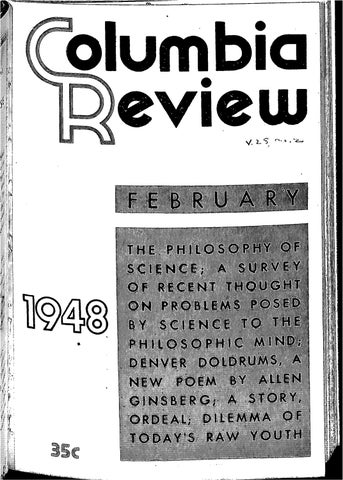
blumbia <evieiju
asc
THE PHJIOSOFHV OF Sfitt'NCti -A §«''RVe-'<'' ' o f SiClNT, t h o u g h t ON .FWBtSMS. POSSU, lY §OH'NOt 'TO, -T'M£-; PMtlOSOPHiC MIN^J BBNV6R pOtftRUMS. A 14'1 W :FOt'i^ \8'V'" A'LIIN ‘/OiNS'BlR'Gr'.' A .StOtV,' OROEALj plttMMA Gf TODAY’S RAW YOUTH
!
i
More ihiiii iiiiy oilier gioup, redder^ oj the ( (Uiunhiu Keu 'h Ion redxoi to r. eleoiiie tins ilntiin^Hnheil aiicl exeitiiiv^ Jirst no^cl I
M
I
he
I)I)LK
()1 rhe JOUR N IO’ /7 LIONEL TRILLING \\ Ih’ii Lionel liilhng' ()! t/iis ! mu', of ! hdt Pldd' lii-l appeared in llie P\|{||S\.\ HlAli:"< <)inn»i.''^eiiis (d >li()i l-'*lni \ \\ riling liaile<l il ;is a in.islci pi(‘C(‘. His rare* al»ilil\ tn dramatize* th<* llllt‘lli‘cllial ami einntinnal prnhb'ins nl nnr day appear now in Ids fir-t novel. Il is tin* '•lory (»l a modern man al a lime w Iw'ii lie is eliaIl(*iiged !>> his World and when his hearl is h(*s<‘l hy proInmid <*molions. ‘di shows all i Ik * -ensilivily dial lIioH* who are* familiar with Ids short stori(*s and nilieal pu'ee's wniild have* ('\pe(i<*d. His bonk has a subtle* wit ami ireniv rare* in \me*rie*an writing today."' e ill me i 'MUMVN Of dU boot. ^e//ei > > hOU
IH<
\ I K I \ c
p |» p s
COLUMBIA REVIEW 2^28
No. 2
FEBRUARY, 1948
CONTENTS Symposium on the Philosophy of Science
Introduction
Science and Logic .... Science and Truth
Sylvain Bromberger Robert F. McFlaughton Heller
H
Science and Esthetic Experience . Benjamin Wollstein 20
.
Youth
Horman Kelvin
33
Herbert C V. Feinstein
41
COLUMBIA REVIEW Editor
Norman Kelvin
Editor
Business Mttnagef
Lewis Kurke
Batty Decker
Associate Editors Sylvain Bromberger Don Holub Joba Hollander Melvin Robbins
Sidney Blau
Staff Don Friedman
Ralph Gladstone
Art Editor Ted Melnechuk
Advertising Manager
Circulation Manage
Betty Goldberg
Fred Dnhl
Advertising Robert Feldman Judah Gtibitz I
ph il o s o ph y o f s c ie n c e ^^t r o d u c t io n h e reader of Review who has been accustomed to find in this periodical articles dealing ostensively with literary and may feel disappointed, if not indeed showed, by injection of a controversy about scientific problems into th^ Magazine. For some, the very terms ’’philosophy” and science ^ay appear as mutually exclusive. Others, weary of anything ^j^^^niscent of ”E=mcV’ will protest at the invasion of last ayen from formal rigour and barbaric nomenclature, the literary ^^iew, by the worshippers of test tubes, beam balances, and 9^clotrons. Finally, some, who will concede that the imj^rtant played by science in our society justifies a discussion o of its basic problems, will howl their disapproval of the t technical-sounding treatment given by the authors to discussion. This editor, at whose suggestion the symposium w^ 5^taken, has already been accused of heresy by some of his more iterate confreres, and expects similar anathemas from many o readers. In place of introduction he has chosen to answer of the most obvious objections to the symposium, an Wes that in the process he will define to some extent the ^^^e and significance of questions considered by the au ors g^ese articles. „ . .. , . shall answer those for whom scier^ in are incompatible terms. This belief, we th^, ® »«>m the same\inreasonable respect for science effiaen^, Wiandedness, and confidence which has fields to tempt prospective customers by labelling their
T
4
COLUMBIA r e v ie w
wares as "scientific shaving,” "scientific iflsp^^j metaphysics,” "scientific dancing,” etc., etc. The a visions of power and magic which the manufacture^ have successfully exploited, but its indiscriminate u it connotations which thoroughly confuse its meani ence” with which this symposium is preoccupic jjso nology, not lingoism, not gimmick ism. It is i plines which claim to define, organize, ana yz ’ observ^^^®^’f predict phy.''ical and social phenomena by oth^*^ precise formulation and rigorous deliberation. t the articles are about what is commonly re e "Pure Sciences.” orkefS The highly specialized training which the sciences require, as well as the emphasis place o (C exploitation of their result, has eclipsed the ^''l^jjosopbyfield of endeavor was once an intrinsic part o pj- af^ the mere fact that the same individuals ±rnhilosop'’ts interested, in both purely scientific and pu of , ggo tions does not warrant the conclusion that the .-^gs i-vidwhich originally linked the two types or the di abandoned. A great number of problems sti o of ing line between them. To mention but one, t ^gj., yet r has been traditionally dealt with by the utteraoe^, statement of the physicist is supposed to truth. To be fully understood, the -i^gophet* jo' must be accompanied by the analysis of the p * , gj ^-be the confusion in the domain of physics which m phi^^®^£,s. ning of this century has made many scientists tu gg,jjsidera^ to solve the dilemma caused by purely th^^ tQt No longer can the scientist labor under the i gam^. merely concerned with "facts,” that philosophy yocOO®^^^ incorrigible talkers. This very attitude amounts to a loa, assumption on his part of a philosophic systeip r acceptance has made it part of his mode of thin tion is considered complete nowadays without an
in t r o d u c t io n
5
yg Heisenberg Uncertainty Principle and the dualism of wave rsus particle theories. The apparent contradictions presented by indicates how vague the notion of "fact” actually is, as well e necessity for investigating what the content of scientific amounts to. Such a task must be undertaken the use of procedures which are themselves free of the jjj mtade by the physicist qua physicist. It requires an J g^^P^tion of the whole scientific undertaking from the initial o/ terms, through the processes of deduction, to the oh J which the scientist performs. It is the task of the to science. But, and here we answer those who object ttitroduction of such discussions into a literary review, such ^|.^'^®5*tgation clarifies more than the particular theories with kft I J By bringing precision into considerations about (jy J specifying the requirements for correct inference, inteJi nature of validation, it must influence the whole Jgf ®t^al community. The attitude towards these questions as a great extent the characteristics of particular eras, eva?^ perceived by recalling that the transition from mediism renaissance rationalism, from romanticism to naturally ’ ^oni impressionism to surrealism were accompanied by conf ^^anges in the domain of the sciences. The present g many of the fields of human thought and action to sciences also. Although it would be presumptuous Jthat the work of the philosopher who undertakes to delimit that confusion in some special domain will exn that existing in other domains, we may, however, that it will exert a great influence and clear the path of with which he is equipped to deal. jji ® ^te now left with one last set of objections. Why did we cus^y authors the use of their jargon, why couldn t their facoiiiP^ diluted with a larger portion of more human talk, we n-,., . course be sarcastic and warn you that you aint seen auth as a matter of fact, the editors as well as the Qrs have made a conscious effort to eliminate all terms w ic
6
COLUMBIA REVIE’’
re are not explained by the context. The articles before publication to people with little or no prev
ance with the literature of the philosophy o g&ve us the assurance that the articles require no special background. Since the most app
refleGci®® t characterise^ I method
the subject of this symposium is the precision have chosen to remain true to it by sacnncing where necessary. The readers of Review are, X , ested in and capable of the sort of thinking req^ portance of the subject matter discussed, and we that we have failed them in our presentation. One more point must be made clear. The in the articles are by no means universally^trcep' points they contradia each other. They must be acc
the ^ri
Qti sd^ U
,
senting the thoughts of individuals, not the q o tM *. g established subject. However we do pride that our contributors possess a thorough acqu represe?*^^e field of their debate and that those articles ar of the sort of endeavor with which we propose our audience.
,
Sy l v a in
SCIENCE AND LOGIC u r in g the War, I had some experience with^the
D
section of a battalion of small artillery—-before steady K.P. The task of this seaion was to compute setting of the battalion artillery pieces from the sen
t
SQENCE a n d l o g ic
7
sake of accuracy and speed it was found to adopt a uniform procedure for carrying through the The procedure was familiar to every one in the sect so that if a computer was disabled, some one could take his calculations without difficulty. J scientist is faced with a similar problem. Although he operate under the stress of battle conditions, he finds it cufarv^*?’ uniform procedure in his work to insure acscientist is not too concerned with the problem of con^’i concerned with a problem of accuracy which is subtle, and often philosophical. It will require much the insight to establish his procedure than to establish Prow^^*^^ control section. Nevertheless, fire control jj • f and logical procedure have the same general purpose, fjpoint of view that I wish to consider the problem of Sor^d the role of "symbolic logic” in the deductive sciences, of m science deals mostly with the axiomatic systems Qj .^^uematics. An axiomatic system, in its simplest conception, a few undefined terms, a few axioms expressed in these rules of derivation, by means of which theorems are dev^^’ naeaning of these will become clear as the discussion 0 ops. Euclid’s plane geometry is the most familiar example of system. When we examine Euclid’s exposition howaxin ‘Denver that it does not fulfill the requirement for an system. In the first place, we said the system hM to term ’undefined terms. Euclid does not specify his undefined Pot ^ow it is obvious that in any discussion, all the terms canPosiV When Euclid says, "A point is that which denotes without possessing any magnitude,” he is using at ^o terms which he does not define, namely, magnitude and position. Pnp second place, the procedure in Euclid is rather h^. 4_ instance, the first proposition allows him to introduce a i n assumption. The first proposition is the construction of an ateral triangle upon a given line segment (AB). Euc i as
REVIS’^
8
us draw a circle with center ar A.^wbh
. g. then “be J *e
draw another circle w'® ““ x- ^ging the P"?*' je. N®* -Lerthen has us draw AC_____________ lateral ““"“Ss’'i'* ^se«.
circles intersect. ABC ts these iy of his axioms or to prove that * ^vo-J sect. And, in fact, .t ts tmp^j jjcw « ptoeeJ"'
in
without further clear and pt o blunders that we nrnst “““Somatic system. e,oeots proving the theorems of an axiom sta . „t m A proof is nothing more ^gyiously P -gg hyb’ fs tte which is^ither an axiom, '®XmStsm the sen« , n^ from a preceding somewhat the same a rule of derivation. This is remem^^ ^rite used to give in Plane Geometry. K Y -th^' a line down the center of P of statements on the left, and jj ^nt> nght. To the last -tement we derivap,,ely
which was to be Proved. But A strict than the rules of high den assumptions can be tolera^
geometry- A gged m
„ M
r
The rules of derivation that rn gep ,s terns such as geometry turn Xs” law'of i»X„Xrh<>
found convenient “ P movemeo' j axiomatic system “H^d mS , , called logicism. It to deve P bra within this logic It seeks to dev
j^stb
[.es
I
a n d l o g ic
9
such as arithmetic and geometry. The first and best known carty out this program was Principia M^athematica by ertrand Russell and Alfred North Whitehead. Since Principia at ematica, the movement has progressed considerably. (It must said that logic is not used only to provide a procedure for eriyation. The Logicists have gone as far as to define matherms t)y means of logical terms.) j . ,, ® basis of this movement in mathematics is "symbolic / *^be basis of symbolic logic is the sentential calculus me propositional calculus). The sentential calculus presents if operating with sentences. It is important because ^^^mes the way in which we can proceed from sentence to derivation of a proof. meaning of "proof” as outlined above allows the matheEv without unwelcome philosophical commitments. since the time of Euclid there have been those who have accept Euclid’s axioms, then we must accept e theorems if they are derived correctly. The nature of this must ey leave unexplained. Modern mathematcs is, fortunately, getaway from this tendency of relying upon the existence of the ^^^P^ysical necessity between axioms and theorems. The ideal of ^mematics now is (or should be) to set up a uniform procedure ^ed on the sentential calculus for deriving the theorems from axioms. So mcent work in logic gives us the opportunity (although bave shunned it) to get away from the notion of self-evident ■ Up until very recently, it was insisted that the axioms of an xiomatic system be self-evident. The trouble with this is that difoth^^^ have different ideas as to what is self-evident. AnL point is that all the statements of science must be based upon outside of ourselves rather than what we feel within selves. Axioms then must be considered with other criteria. jf • "^^^oms are sometimes Justified by empirical considerations. „ understood what the expressions, "point,” ' line, l)^g "’ean in terms of a ruler, pencil and a sheet of paper, then
10
COLUMBIA
the axiom ’’Two lines (points) lie on one, and only *j
oviomalSilSlj
It has been found more fruitful to consider an ax . tern abstractly, that is to say, without assigning any terms. Suppose we consider geometry from this point o ' ave the pi^itive expressions ’’point’,, "line,” lying we do not identify with anything we see or conceive ’'wrld. The axiom "two points lie on one, and only f en interpreted as a sentence which gives meaning—to the concepts "point,” "line,” "lying onshould ask, "What do you mean by point, line, and should have to answer, ’’We do not wish to state comp - ^^^s
XL
we mean by these terms, but part of the meaning may y the axiom, ’Two points lie on one and only a vantages of developing an axiomatic system dewl^^^ attention may be given to the P complicated questions o( X,t?t is fully develop^ it may be
to a real situation. „ self eviX °axioms of an abstract syste It would be ridiculous to insist that There ar^ assigned meaning should be . is that tbp ^*^iteria for an abstract axiomatic syste . impossible^^^ ”"^^’^ consistent, which means axioms Thp Mutually contradictory statexne
others. It is tn k and that the semn
impossible to derive any mcio^A ^^^at the first requirement
not consist ‘^“^‘^^nient is only a "should.’ ““"■t atXT’ ’til'
fc
^Jfhouffhfr^J at Ip u' may sti tietived ofindependent “'Ion'S the“system « "ocessaty sm^e « ■’M ftom the others. /#«=f axionMn/'”™'"'" °I '°8‘0 and the statements of an ’'■omat.c system are not empirically verifiable. However. -
,
SCIENCE AND LOGIC
H
important sense in which they are subject to empirical che^. bogie and axiomatic systems are constructed not because we wish ^0 have something eternal, perfect, and soul-satisfying. They are instructed because of a scientific need. They must be chosen or ^^jected according to whether or not they fulfill that need. It is quite conceivable that logic should be responsible for iniething which contradicts our experience, and must therefore devised. Suppose the scientist has developed an axiomatic sysand he applies it to the world. And suppose by means of the Procedure of logic he has derived some statement S, which contra, ^^nipirical evidence. The first thing that he will do to solve dilemma will be to check S empirically and see if there has not , niistake in experimental practice. If not, he then makes a ^ough check of the derivation of S from the axioms. If there is mistake here, if the derivation of S is fully in keeping with the ogical procedure, he will then check the axioms empirically. If • axioms are experimentally proven, and if there is no mistake experimental technique, then there is only one thing that can Wrong, the logical procedure itself. Logic must then be relogician must bring forth a new logic by means of be possible to derive S from the axioms of ^be system. Now this will happen rarely. In fact, I am quite sure that it never happened in exactly the way I have described it. The r^edure of logic is much more certain than experimental pro^^^^^er, logic is constructed because of a scientific need, is not evaluated independently of experience. Ro b e r t F. Mc Na u g h t o n AND TRUTH
Co n t e m po r a r y science is described as an empirical dis-
^it makes assertions about an experiential world Aese assertions are tested by experimental techniques, n g
COLUMBIA B®*® tely • eral it is assumed that when a statement has , tfU^of course, successfully) tested, it is to be conside gjqje is a naive conception of that quality which a "norp« mentally verified assertion—the notion of truth ,aLrany cal rather than scientific origin; the statement A
to a true statement is not simply false, but untrue,^ this naive conception has, of late, shown the tion. For the physicists have decided that t e and that the electron is a particle; the
reex^’^^e js »
^pjjctiouS'^’^-gp-
universe is finite and unbounded. Similar co fjeM® parent contradictions—are to be found in all t tific investigation. amii’^‘^‘‘’^-ab Many of the modern attempts at such a from the "operational” doctrine of P. W. a ism redefines the objects of science in terms of co^ on the part of an experimenter: the concept of i^jcb
measuring rod; temperature is defined by a t gj^ents/^ -ts. over, it restricts meaning in physics to those s ^j^g ^sign measurable results to operationally prescri focaUt hus Boyle’s gas law is meaningful insofar as by gd prescription: measure the volume of a certain .he maintaining alwa'^s the same g hy "‘'n P«<i!«!on: the product of the mlume mil be the same in all cases. Such statements’^/' verythmg in the universe is doubling in size every be considered meaningless, since they prescribe no .J
^pos^
to any conceivable experiments. Evidently the restrict y operationalism is a very real one. ,^hicb .V • J Qpetationalism is subject to certain defert amno ® final solution to the problem of t ^posl^^ ij. of K ^®finre to distinguish between P that the physics, with the rather discon and mav logic must be subjected to empij’^^ tion su&oA Bridgman shows) be proved falseggests that the whole question of the logical st
r ggufC
'J
SCIENCE AND TRUTH
J i i I J I 1
theory is in need of deeper study. The study shall proalong the lines of the logical analj^is of language reto by R. Carnap and others as semiotic 'jM . Scientific theories must be considered from three asperts. 01 structure must be studied; the method of validation assigned; and a technique for comparison of different tnust be introduced. In terms of all these factors it will be ver'fi testate the problem of interpreting the experimental ten ^5^°^ scientific assertions and to offer a substitute conPt which may be more useful than the primitive one of truth.
13
fet ed
***** Fo t:onvenient to divide a scientific theory into two parts. senV^^^ theory must consist of a number of propositions (e.g. ®9tiations) which, considered solely as symbols, without conrf^ttiterpretation, must satisfy as a body certain jjj, tiotably that of logical consistency. Yet such a body of ^^omes a scientific theory only when interpretations when the system actually assumes a physi<^ The body of propositions will be referred to as the as*- 5a^ctilus of the theory; the interpretation which is to thf^^^ semantical rule. It must be emphasized that the pj ^o*^sists of the pair, that if either the calculus or the interation is changed, an entirely new theory results. As the name "calculus” suggests, the uninterpreted statescientific theory are to have as a bodyvcertain com ma Properties—to be precise, those of a formal logic. kin,! calculus must possess a certain rule which tells w a sg^ propositions may belong to it. A calculus consisting o En^?" English would have as this rule the set of rules of Wh^k^ Srammar; it could contain only combinations o con^ good Englsih sentences. Similarly, a calculus wh ^Jassical mathematics might be subjert to a ru
^•tion, the calculus must obey certain other ru es
COLUMBIA REVIEW
certain propositions classical’Pva” certain other propositions must belong as we11-
(for fostaS)’^the^^^ ponens, which ^4 "SoaatecT^ . propositions "All men are mortal. J < "Soaates i\ ^®forig to our system, then the propos
This included as well. In general the^f property has the important consequence pletely by givinc^o^J^^ calculus of a theory may be stat included bv vJrt^ subset of its propositions, the res while the numk^^ rules of deduction. It often rem depends in tk propositions in a calculus is infinite, r significance of th^f ^n only a finite nrrrnbe • cussion of validation^^^^^^^^^
with an operational^
,
become apparent m
scientific theory will, m
^f
Prescription.prediction'!^^,®^.®'^^^^^ -Ksoci^^® , to some or all nf ^^^r is, the semantical rule will cription for a r propositions of the formal calculus . prediction of the ?P^rations to be performed, together prescription-nredir*-'^ P^’^^^rming these opeations. Tfie "^Periment w?n be referred to as an experimeji^ experimenter hac ^^ve been successfully performe found the result tn V^®rmed the prescribed operations ^rtempt is here mid predicted. It should be noted th
orming” an experimO*^° ^.Precise about what is meant y J In terms of this question will be discussed efine the valiJatin ^’^^romy of a scientfic theory it is po^^ ^“'“talyaute " as the process of perf°«^
^"'“"UMtely, this defi S““h«ts unsi
prescribed by the semantica^^ is usually unhelpful, the nunJ*
^^f’^rintents i, ^f?'^*®’t)nally) validated when a ” ^videnthT Performed successfully ' ttecessary to sav th validation is not absolute; tt ^’y that as the number of experiments suce*-
RAW YOUTH
45
be entirely of this world he shares the lowest professional in|ome bracket. The antithetical resolution of conflict by physical promiscudiscussion here. There is no especial benefit to be sloppy misuse and insult of one’s body. It is true intercourse there is a cognition of one’s existence, and us the raw youth can gather from it ephemeral status. But for ? youths sexuality has become the new Holy Grail and 1 F K Guinevere gets them before they ever get there, xhaustion is no very good vantage point from which to spring ’nto intellectual action. There is indeed a better case to be made nut for the ascetic who burns with a ’’hard gem-like flame” than nr the profligate who, waylaid on the road of excess, never quite makes the palace of wisdom. The Hollywood desecration of reud has become the manifesto of the libido. To manifest his morality has become a ritual of the raw youth. He wastes much ^jme, money, and energy in convincing his own private opinion ^t he is the same as everyone else. The gonadal archetype he ^^^ks is in a Tahiti that has never existed. For despite the fan^sies of the free-love addicts—Diderot, Melville, Gauguin, and ussell’ ^Tahiti was simply never like that; in fact that is the P ace from v/hich the word taboo comes. It would be unfortunate if the raw youth were ever to really consistently love anyone; unfortunate for him and astronhic for the one whom he loved. Constancy is not his ait and six weeks is about the time it takes him to tire of a rand passion. Then he self-sacrificiall}^ withdraws, laments that rams in hfs heart, but somehow manages to live. He will proceed to Helen over Gretchen’s agonized death throes. It is an act alone. Perhaps his own loneliness— '^hich he keeps and guards at the same time—precludes greater miserv in those whose lives would otherwise be overflowing with him. The lesson of the raw youth would appear then to be not be a raw youth. That is an egregious error, for in reality the raw vouth js in love with his woes and feeds upon them. Put him
46
COLUMBIA RBVI^
in a bank-cage and he would swing from bar to bar pl® in his heart. Celesteville would bore him and it society there to destroy, him, before he des e youth is happiest in his private sea of loneliness, lesson IS not to be a sterile youth. Dostoievsky ^^^^.goifi' same infirmities managed to turn out four of the J to> ^^ve. Mozart despite—one is pi e his wretched youth composed a quantity of subl .uould From these world-historical characters then the raw y®»® ® but thpZ^ k precedents. His genius may not approach t ’ hiSi brave and he can gain f^‘’^LeS5 of th^M^ "measure of emotional independence. It is the to be abu become a spirited fugue in flesh an be able to ? stretto an infinitude of times—cru ? that it is in keeping musical form the student to select for an ideal an ^joje alive than f, ^'^^the music of Bach and Scarlatti is 7 mocked its co^osers P^®i^®plasmic cynics who bav strength^ is “ the way of the child andi his ^’^boaed with "rt tnalice. A child when he sticks o ^^I’.^caten, and sat upon; yet he "method, and not the^S successful. The n„; . '^cpnnted one, which is ultimat y Status comes wkk usually the most youth and the ^^r the difference between the to him. ptntleman is not what he does, but what tf
h. Wicity which comes V’’’®’!' for out raw youth. ■'Jf iaand ’’'^“"'t S ectn” *'’ ^"‘‘"ment of his desires. The
inri sense ’'ston” k^^^'k sexual determinism can ujs ;2jpe„de„ce. Th^menr’ ‘‘“V*’"’' "^’er take front h.®
for ’k-^ his witbrl^^ the raw youth is mostly f” *’™ in fear of S™’' “ “’’n'ission. Cowardice con^ '’tnng hurt no, by others but by himself- >"
47
A SLAW YOUTH
Wiagia half-existence, he suffers all the more. The fear of hurt g^^^ent in his delicate child-like nature, but he shrivels the ^^hryo within its shell in order to keep the shell intact. The raw y^ht^llfiows that both ate most important; he does not yet know world or how to live in it without sacrificing one or the other, not then break his shell because the greatest source of hhrt eomes from the self? It is better to let others get at him ffian for him to destroy himself. A pain from others is easier to ibeM than a pain self-inflicted. The world always seems to take his guilt-atonement even if he first does it himself. The S'^erings others impel leaves little room for self-torment. He too busy assuaging the wounds and making as clean and a patch of them as he is able. It is easier to be his brother’s 7^PSt than his own. Self is a very unpossessed thing; the more ind^endence it achieves, the more it becomes responsible to the ^Ji^e world. And if the raw youth does not extend his battered '^Slbryo to that world, he is really the most hurt person of all.
He r b e r t C. V. Fe in s t e in
, « fill
JillLSOM'S lb ■
M.eets Columbia pMQ STORE
I
rescription Specialists
Tel. UNiversi+y 4-6760
KEFF AS
l u n c h eo n et t e
flowers
Complele Slock ol MEN'S TOILETRIES ^'LL THESE AND MUCH MORE AT
Special rates to students tor corsages
ffom a Snack Io a Meal
Broadway & 116th Street ‘UN. 4-M44
We Deliver
1 177 Amsterdam Ave. Bet. H7th and UBth Streets New York 27. N. Y.
s c ie n c e a n d t r u t h
15
increased, the degree of validation attached to ? increase. The study of this degree of validaI of course, the problem of induction. iOfiUls r,u formal calculus can be expressed, by means iBiSlSfcet f ‘^oduction, in terms of a subset, sometimes a finite propositions, leads to a special technique of valida.5^ theories in which the semantical rule so-to-speak logical operations (i.e. the rules of deduction), which the rules of deduction correspond to certain rules the prescription of experiments to propositions in several propositions are combined bymeans ° 'deduction to form a new proposition, their associated combined in a definite way to give the experiment tesulting proposition. In such theories, it is Perform only those experiments corresponding to the , propositions, for the successful performance of these rnust constitute a successful performance of the exwith the rest of the propositions of the theory. theories satisfying this condition which need be I unsatisfied, it is to be expected that the assign to two propositions two mutually exitep ^^pcriments. The theory will then be automatically invali|S8;successful performance of either experiment con'^^^'^‘■^^ssful performance of the other. IllllO^iess noted that a non-trivial theory should semantical rule satisfying certain conditions of con3 irs formal calculus. But certain oAer syst^s considered trivial, namely those for which invalidai^possible. This occurs when the range of results prescribed ^^®^^cnt of the theory is unbounded, that k , when no results are in contradiction to those predict^ by the 'A'’,'*''^^^yoid' speaking, such a theory says nothing; since it is in^ ° content it is quite as trivial as a theory which is fal^> J: example is furnished by the classic vitalist ‘: -V entelechy. Evidently no experimental result can in■gg
ie
COLUMBIA
validate this theory, which simply explains
b e v is *
lilt by
that the entelechy behaves "that way. It is conveni®®^ In comparing scientific theories it is — first the question of validation and to-develop deve op ®of than another. Y ing when one theory is "stronger” than the equally well validated theories one is j j^ary seo®^ that one may then be said to be better, in the the other. • . of It is not to be expected that any two the theotY pared; it is patently meaningless to say that a . biology is better than a theory of physics. In of t*^^ n two theories to be comparable it will be required contains contain the other, in the sense that its formal calctuti cal^^^ the propositions of the other, in the sense that its tor pcrhaP® contains all the propositions of the other theory (W j^ero^ additional ones as well). But a reservation must there will be no distinction made between theories equivalent in the sense that they are intertranslatable, t gjatinn that the propositions of one go over under a definite rr ^j^g rule into the propositions of the other in such a way g^eexperiments assigned to corresponding propositions are t Thus two theories may actually be comparable when one not necessarily the other, but a translation of it. gj-jThe actual comparison is effected on the basis of tW teria—comprehensiveness and precision. Of two theories h^ the same propositions, one will be said to be stronger if its sem tical rule assigns to each proposition experiments prescribing same operations as the experiments assigned to the corresponding proposition of the other theory, and if the range of results pt® dieted in the former theory is in each case less than the range predicted in the latter. Thus if in one theory experimental resu ts are predicted to within five percent, and in another to within ten percent, the first will, provided they are in other respects the same, be the stronger theory. Of two theories one of which includes the other, the larger one will be said to be stronger if that part of it
I I I I '
AND TRUTH
17
is *L ^^enever th included theory is at least as strong. ®*Ust be Sa - J *’®ther special conditions do not hold, the theories It sho S '’O®-comparable. ?*^®ger noted that of two comparable theories, the 5at le naore difficult to validate. For, in the first place ih the seco^ naany experiments which must Ite performed, and ’^ith great P^ace, the results of these experiments are prescribed less fiOceiy t^ ^5triction, so that (in some intuitive sense) they are tion ©f ih ° successfully performed. More precisely, any validaan ^tttjnger theory is a validation of the weaker one, *^6 iSvgakeT'^^iitiation of rhe stronger theory need not invalidate *****
loregoing formulation of the nature of a is possible to introduce a precise concept of valid’^^hlve theory, and to demand that this concept play the Vnd^^^*^ assigned to the "truth” of a statement. ® t^onvention, no special significance will attach to been experimentally verified; indeed, the ^^porimentally verified” will have been lost. It will "^^^ti theory, rather than the individual statement whose ^®^th°f^ occupy the scientist. To investigate, for instance, PWon statement as "Bodies attract each other in pro^®®Cedur*^*- k of their masses.” will be a meaningless WJ'av’ proper question is, rather, whether Newton’s theory valid. And this state of affairs is in concord with j?.® which may be derived from a careful examination concept of truth. For a decision regarding - rf^e It statement cannot be made in terms of the statement always necessary to inject into the decision process the statement. But the meaning exists only in the confeto assertions belonging to the ssiae p^t of science, 5 ”, same theory, as the one under consideration.
18
COLUMBIA REVIE^ j
statement, then, is safe from
\s
invalif1<«<-
the theory, never its propositions, w the Ljor defect of o^erationahsm^*^,
and moi-k
possible disproof of the propositions o Pure mathemadcs is not a scienn&^^
incapable °pj having no semantical rule, an j.y cannot in r ^nvahdation. The applied mathematics of any sidered inv ^^^^^^tience of the invalidation of that theory But hut only, in some sense, incorrectly appU®^* g^ts ’bout ‘h “ n alternative theoVs"'h ’ “^boice must be made ^hich amnnovk t:hoosmg a statement, that one ^d most precis^ 9^ statements, is at once most informati ’bos=n"H::,4“- ">y. *5 .congest valid theory mjcomplished; the chn’’ • ^^hdation of a theory is never invalidated and v among theories which ar Thus inZt^"S„’i'‘^b have been validated to a certain d^ taken of the deXe2’S’"‘"ra’ ’“f™' ““'j t ea*
one under condd • ^'^hdation which has been assigned < jg ‘henries it cS ^hen the choice is among eomP^s the stronger is alwZ of two comparable the the theories under verified as the wea this is the case it is may not all be comparableof the sJeX «^"ke any final selection; it as possible of the th ^®ntmue his experimentation until as "’ay expect that the\ -^^^''^ invalidated. Ultimately
to a set of theories theories may be reduced to JJ 1 jg, tat IS, which are surh^'^k experimentally indistin^is :«hout invalidatx^?,t no experiment can such theories exists Tn Mo basis for distinction be as equivalent. some inexact sense they must be
and t r ut h ^®®ains only to consider what is meant by performing or rather, to excuse the absence of such '^nsideration. scient^^^ t»usiness of the scientist is to formulate and evaluate thenr' J^eories. In general, these theories are interpreted as ^°out the world; the empirical criterion of validity sugmust actually be so considered. But the scientist, 'bii need not concern himself with the interpretation o banct‘^°^*^5 “ sufficient that he be able to perform his two ^s of formulation and evaluation. it is certainly true that in order to formulate a va i a scientist must have some knowledge of experience,i y abstractly a theory may be formulate ■that knowledge of the world. It is, of course, to be expect^ will formulate valid theories, and it must ne seant ’■k® process of stating theories at random an valirl eyaluating them is a far-from-efficient way of pro tQ theories. Yet if a scientist were to use this means, an SaH theories, he would be fulfilling Ns •, g ^on. Similarly, if he were to formulate his theories with the a tinn intuition, or under the influence of were ^ke nature of the world, the fact that they ^te elated under these special conditions would not for .^.’^^lidated or invalidated theories. ;«vestiindependent phase of scien considering the testing of scientific theorie , ^hat theories are formulated; the ich the scientist uses to formulate them are n g fn ^ben, conceivable that a philosophy o , existence, '“;«ula,ed without the presupposWon of a theory X ««. a Aeory of knowled^, If k «
aft
Ev has a good subjective ” and if it Is nn. operations’ and "observing re thf. ^^’^'^bed that every two scientists have ‘ . validation of a ^bese procedures, then it is possible to define vaiiu
COLUMBIA REVIB^
20
theory in terms of these uninterpreted procedures. But e only points at which existential or epistemological Present discussion of scientific theories. Thus, u tion and observation” remain intuitive procedures, f ® -„ieteist^ssion indicates an approach to a non-existential, noti P molo^cal philosophy of science. ote<l .K observations are yet lacking. First, it should oe at va idation has become a personal process. There is , ^joo reason why two scientists should agree about the vali theory; in urging the acceptance of a do scientist can only argue that scientists have agreed, when an experiment has been performed, an abnnt successful, and that consequently they Uius lono vahdation of the theory it was designed to tes • accent!^ agreement does exist, it provides sufficient Sed ’’y scientists other than those strfetion?” Second, this formulation ” tific theorv ’■^^^oterpretation which is to be given to a for thpTk7 ‘^^'“^erpretation of the theory is given. K re P^^’losopher, not the scientist, to produce it.^^^^
AND ESTHETIC EXPERIENCE
A^irrSevam^^’
<^onunents on esthetic theory ®®y
rhey do, then tk^^ symposium on the philosophy of sci been par^^ ‘his contribution is partially accomplished. For the fact that eSt
ISSciEj^PP
5i
III ^ence”
esthetic EXPERIENCE
21
science only fortifies the belief that Sil^ialized tv gained of its literal import and restricted to i|'<West sens^^V^^ inquiry involving laboratory techniques. In its ^he whol ’ ’^Ee philosophy of science is concerned < subi human knowledge, every branch of which is a rat ^^^1 ^*^incal inquiry. And if it is still true that R‘^1 with animal, then criticism is indispensable when we That achievements. ■ natural pEilo^hy of art ranges closer to the social than iBnphasizedli^^^^ doubtless a truism. Yet this truism must be iS^ethodolo attention to the inchoate status of ifh Person social sciences. Concluding his recent volume '1^ a Well J Gardner Murphy throws into sharp relief the lack i^yle’s ®~ned methodology in psychology- He refers to Robert l&try Sceptical Chymist, that appeared when ch^SE^ginniiT fruits of the new logic of discovei^ was just I place in ^n^lant alchemy. With a similar transition taking j; Ptematui^ ^ial sciences today, he would strongly urge against ^ould h enthusiasm and imwarranted pronouncements. It ®foun least, ill-advised to make radical claims for of devel ° **^*l'Eries that are now at approximately the same lev« PEIIosomF™^”^ chemistry was in the seventeenth-century. And f*on science might well take seriously this admoni«om a specialist in the field. <lomain of psychology, the major problem is the conof adequate explanatory model for the interpretation Phv’c phenomena. But, as the wealth of evidence in Murgist gives encouraging testimony, the sceptical psyc o o parat-^ pessimistic. For experimental, genetic and comstudv*'^^ techniques have already been very prtxluctive , lem nf° Personality and psychological anthropology. . jiy which Murphy leaver unsett ed could har^y "he limits of this short wrtang even f Ac Sum ’"5' « hand. I would suspect that the groundwork for ^compassing both the genetic and functional factors is to be
22
COLUMBIA RBVIEV?
found in Dewey’s Logic, but this must be left for another I shall confine myself to the esthetic phase o experience, a phase that is widely consider^ an soothe pale of scientific treatment. By viewing it as stri cognitive, some philosophers have designated esthetic exp as the emotional impact of a work of art. Without validity to this non-cognitive or qualitative view of the it is nevertheless unnecessary to divorce the so-called divorce is actually a gsthetk within experience that is made to insure the possibility o appreciation, an insurance that becomes supererogatory w threat to its validity is removed. fast An esthetic theory is possible without this iTnultl separation. The cognitive and non-cognitive may an s g^jacombined as cooperating aspects of a single pursuit P standards of criticism have direct c gQursc tne immediate experience of a work of art. By charting tne all experience, moreover, critical judgment mpni^£^£ e<lncation of tastes and provide fof . ^itb the ^^P^^tence. The unification of the cogni gfienrp cognitive depends, of course, upon a theory t) ence that ,s dynamic and construaive. ^ ,„^pby
ever sina dnX^^“ <S,e„“ ml n
^as been available to American P““ phol' superseded the static murot psy , Yet philosophic perspe«.ves
analytic de. regress from this better theory to the PhSXrr “ disheartening, to find tha^gy
that was aX^r el ‘ the full import of a psy ^^ey would not isolaS^ tunate premise f esthetics from rational experience. T static theory isolation is many-sided. In additio , there is the “pon which it is ultimately jfb the objective fa<i esthetic values are out of connecti this disconnection ‘concrete experience. Among t>th^t tt"«‘on permits its supporters to impute to the at
AND ESTHETIC EXPERIENCE
.
23
ethereal L’i j r • • . ^Qtelligen msight which is beyond the reach of social ^PUes impervious to social criticism. It ®*iee is’n^‘^11 descriptive study of esthetic experi^sthetie necessary nor possible. It sustains the view that system esthetic insight without recourse in P’^ncedures, that thy may be laid down without any short experience they are supposed to regulate. Value® oi realm of values is severed from critical discipline; “es^e not natural facts.
Pnint of hnplications are untenable from the naturalistic ''^Md be^^^^ instead of polemicizing against them however, it based ' instructive to inspect the other point of view that ^Pproach^ naeasure on Dewey’s Art as Experience. Dewey’s P^rterns essentially similar to his approach to other tional fgp numan behavior whether they be political, educa°r economic. Generally speaking, it is empirical, th naturalistic. It is guided by an objective account of ^^gativel experience and the experienced materials; and, tijfg is free of any antecedent conceptions of the naWas function in experience. His deliberate task fotnis ® restore continuity between the refined and intensified ®Vents ^^Perience that are works of art and the every day coq«*;2 and sufferings that, are universally recognized to 5«^te experience.” refinement of the general characteristics esth^*^’ normally complete experience is the business '®Sees criticism. When they are complete, all specific experiquality of harmony, integration and wholeness, batm ^^P®riences are satisfying because they possess this internal <iatPf]°^^ order; they are desirable because the objects apprepossess a corresponding integration and unity that corroborate of the experience. Furthering as it does the quest harmony, criticism becomes the han ReJ ^^^‘^^.^PP'^ooiation. If art is the human way of constructing Situations to be experienced, then criticism is the uman way
COLUMBIA REVIEW of ordering them for prediction and control. For construction and control are mutually comparable functions of intelligence. Strictly speaking, the quality of a work of art is directly fc and unanalyzable. In this respect, it resembles every other immeexperienced quality; it is irreducibly given. But it does no toiiow, as some critics have argued, that esthetic judgment Although the quality is irreducibly given, an objective context that naturally gives it f • the w context is judged, the various factors that consti of our attention but neve^^J homogeneous quality. The given work of
obtained terms of the medium employed and the ms tradition against the background of the histot rooted ^hich that specific medium of artistic expmssio great enh J 'mderstanding of the reasons why a work of a structive in^th^ appreciation. In this way, judgment is m exoerienred ^^ose that it provides for the improvement o experienced quality, question^ overemphasize the danger of
atds, a daneer^k^^^^ valuation by blind appeals to general s ihe non-coemV divorce the cognitive need^to bf "^Hy elude. Each specific context
analyzed in are much too d^^ every
afresh and each work of art special conditions. Social con i human aims and interests too divers^^;
to permit a artZ ou^l-
hs predecessors and ^occe of values. And yet, neither w^^
ated and unique th^^^^ toward them are so completely m ‘ ment from one r tecurrent factors do not appear in the <liffers soniewhat^r^^^^ another; although each esthetic rno ftom them rt « is no? hermetically sealed o« periencing orean;«^^*^*^T^^ common faaors in both mon denomiiutor environing conditions yields a , continuity and culti makes for the conununi yond cultivation of personal tastes and social pKferen«
^ENCE a n d e s t h e t ic e x pe r ie n c e 'T’L
25
phase theory of esthetic valuation is this critical hcular^ • • grasping of chief elements of a parapDre creation in their interrelations; it permits deeper eygj ‘^tton to t^e place, lhe critical phase is neither a dreamystatistical analysis of the miscellaneous ’‘^otk active and selective scrutiny of the «ar J k^' critic must organize his dau objectively tlirect^ k asserting that his ocgAoization of data is jjjg J, .y/he properties of the object substantiating the enjoycerned he valid and enduring, his criticism must be conP ^hc objective properties of the work. ^^iticism strives for an understanding of the form in relajjjj. ^he subject matter and the manner of presentation and style. It requires some knowledge of techniques otdin^^ f special medium chosen. It performs the covaeuT^ analysis and synthesis, first dissociating a bl’ complexity into its components and then reassemthem into a new and harmonious configuration. field f ^‘^^hion to an adequate knowledge of the traditions in a th ^tifficient sampling of the archetypical works in ®5e ttaditions is requisite for the analytic phase, while the har^y^^hesis varies with the creative insist of the indiin ^hic. And this is the double function of criticism, accorden^ Dewey—"to evoke a clearer consciousness of the constituP^tts and to discover how consistently these parts are related whole.” Dewey’s emphasis on the total unified configufj *'^ther than any isolated factor has one important implicaj it ties in esthetic experience with every other type of comexperience. , Dp to this point, the criticism provides a summary statement the objeaive examination. That statement usually does not Ct denotatively to a valuation, because the criticism has been *^ted to the objective properties of the work of art and not its values. The valuation is based upon this judgment of artisac ^^chniques and depends upon it for whatever validity claimed.
COLUMBIA r e v ie w
made^at thp exhibited in technique and i-k the analyzable I’oth are cut a In between them are gets its status
i'ldgment oi 2l v/ock of arc nor at any poin‘ pronounced. An esthetic valuation js judgment of the technical skill materials. Bo± the judgment of worth derive their standing from same object under consideration,^ pattern of inference; the distin^o® subject matters. Every work o
ordinarily go undist’ ageticy of both judgment uical adequacy fm It is important to distinguish tecbto relate esthetic v^i * evaluation of the finished work if only ence that are also f ^^1^ other regions of human experiIn terms f valuation. possible sochl American culture, the 0^7
ation of the arts In would be a democratic the individual to ck .“^oeratic society, the arts which enable that are not part of k ^aginatively in activities and interest cultural function ^tk ’yhy routine perform a vital social an area of imaginative* • • ^^tablishing tastes and widening th® socially important "^tiy particular work of a^ standards of social vai that it is a vehicle of raising ards, and firmly entmn'^k- “ communicating those raised standof cooperative endeavr*^ them in the hearts of men as goals hancing and commun?.' E^^^ctjuently, art as a medium of eti* «atic growth. On^Xn^'“^^ “ indispensable for demounction of art: we ^ccms perfectly clear as to the social cspise its educational anT democracy and disregard or intellectual problem /„ ^“‘^,.''°tnmunicative function. The genuine order to eliminate them hs undesirable consequences m practical problem is to k^ tefashion them into greater goods; the strua the ever-widening social barriers that ob' , Any attempra ? “ ^PPteciation. 2;^rely iu the invemr^eT m of the arts lands res. This age-old disDml°k^^relation of esthetics and 'iispute has Its roots in Plato’s Republic. »
AND ESTHETIC EXPERIENCE
27
designated Ars gratia Artis, then the called Omnis gratia Moris. The protagonist Artis affirms the existence oi a boundary between ■One Th^*^*^ ®oral rectitude, making the distinction an invidious ^tincti^ Moralist from the other side makes a similarly invidious '• the insists on the supremacy of ethical standards ■ tomy universe of judgment. However, this formal dichoajg obviated when its static psychological assumptions ' same assumptions that sustain a strictly non; ognitive appreciation of art. I sonie^^ naoralist, puritanic as he may be, will have to grant that d«ssim^^‘^thiction between ethics and esthetics lies in the have subject matters. If he does, then his attempt to lejj values rebate artistic creativity will prove meaningdifferences in sources and resources. Or, if he barraM^^^^ forego any distinction, his will be the emposition of affirming Ars gratia Moris without indiV^ould Practical differences between art and morality which tan&l f®?^*ng. A thoroughgoing moralist is caught in the ® own dilemma. Moreover, he would have to demoninvalidity of a pluralist conception of experience in Qj not only beautiful but good, in which beauty has qualities and morality is beautiful. to bf>a^^ conception, the esthetic valuation may be brought an<l conduct, even to the extent of influencing social attitudes. Each individual pattern would enriA the Wo ®f human experience and the experiential continuum turn, enhance each individual pattern of behavior. And Op delegates the hegemony of ethics over esthetics and the Octal principle of Omnis gratia Moris to the museum of fancy. ^uppQj^ democratic evaluation of the arts, for just as the *o-culturai function of education and communication deter^Oes the status of artistic production SO the artistic production ^^0 envisions new possibilities of socio-cultural experience. Benjamin Wollstein of
®
Prom
DENVER DOLDRUMS AVICIDE tf'ALTZES FOR THE DENVER BIRDS
I
OEDIPUS EDDIE As wpn might well die AlT^i-^'^^’^'^’^^'-ePHehathnojoy; ut made a girl out of our boy.
Was orr>^
Was tied Was ran Tk
Eread, guilt his rancid butter;
outside the door to beg; behind the shutter; y a leper with a corruptible leg.
wanted a woman
H' -aped bXeXff"T^’ “d'” sum oiT a glass windowpane.
pr o m DENVER DOLDRUMS
29
n d e a t h h a t h n o JURISDICTION OP TONIO KROGER, ANDR6 GIDE a n d t h e TEXAS BAYOUX.)
Dancingmaster Death, he runs the ball. He stands on tiptoes wearing crepes-suzettes And gazes with a simper upon all Us jubiliant young gentlemen. His pet Old Armadillo, Josephine the fag, Grubs hysterically beneath the stairs. Then crosseyed Death gets high! Our stomachs sag, Some once gregarious girls take on airs, The Armadillo burps and all the boys Perspire on the potted cacti. Wow! Brilliant Death will introduce his toys: One silly suicide; a virile Ow That dances down the gallows-noose; the loveDeath of the jitterbugs; a sad and chic Waltz, done to the crowing of the stars above. 'Death’s dance is delicate and paralytic .. •
I have been half in love wih easeful Death, But I went through puberty all out of breath, I sat at his feet, almost took his advice. But my analyst warned me in time to get wise. I thought he was respectable and rich But Wishes Come Cheap, and his gifts have a
tc ,
30
COLUMBIA Besides he has affairs with little boys And tries to make them all play with his toys.
Pity the old boy, for he has seen Much better days: now just a dancing queen, He charms no more, and plays repulsive tricks.
office hours for us were six to six, On Sundays also, unlike the bourgeoisie, ough he lived in the suburbs just like you and toe-
This is the last big party Death will throw Inviting all the kids to step below;
®tids, it was no great success:
Wp
n less and less,
1
And
P
his invitation to stay overnight.
And hi
^1^5 vras never full,
Now pX,7^ ’?«
bis head,
Oancingmaster Death is dead.
in SWEET AND SOUR LYRICS
^ith Death^^^^ 7^
Earth, who do not lie
Physical naf Eteath's long mastery? y^*<^alpam, and madness of the soul
DENVER DOLDRUMS Are the two true live ills, but they are all.
There is no deadly evil except Death, Nought else hath equal terror while we breathe. So there’s sweet waltzes for our circumstance. Since Death doth entertain, shall we not dance? A, O World is Mind, and Mind’s but mind, unreal. Then why pick bones, what matter? We conceal Our simple insubstantiality In closets of dank immortality.
earth, for pure illusion ■^nd sensual forms proceed to sweet confusion. Jingling by night: while silver saucers bold op in the air like music, and grow old. Our Mad Ideas are like such Easter eggs. Our chicks, so boiled and spoiled, grow no legs. O, delicate visions’ O, tints on the shell! ^,One Sunday, they roll down the lawn into Heli.
®ut Mind or Matter, never the eggs unlock To hatch us that multidimensional Cock.
31
COLUMBIA REVIEW
IV
e pit h a l a m io n f o r a w a s t e o f s h a m e Gravely within their flowery bed Lie these lovers thoughtless in repose; A wound upon their ripened loins, wreathed
™nd all red with petals, is a Rose. silence melt; their eyes want sight> pale limbs are joined at one white source,
A
dreamless night ide these vain souls from their intercourse.
l a s t s t a n z a s in DENVER An isjllusion, for I cannot act
Dwell or depart—with Faithful merrituetit.
Lilff. k y
though skeptic, still is sacrament, P^^yer for knowledge of pure Fact.
’ enaa the Hope I can create
Sad P. world around my mournful eyes'>=■'1 Paradtse it is I
lallen angels whose lost wings are sighs-
Mv^^°
On About
where through I move Hope are hellish currency.
-"V'elf. and trade my soul for Love.
Al l e n Gi NSB
o r d ea l
Ij HILIP often wondered just how much there was of the extra-
ordinary in his relationship to Michael. The phone call he just received compelled him to turn his mind once again to ® paradox he had long ago constructed. All appearances, it ^San, justified the close friendship existing between himself and ^ichael. All the facts, theoretically, should have caused them to ate and repel each other. Yet the appearances had aflFected noth^og and the facts with which they menaced each other had succeeded in holding them together. Philip was twenty-one, Michael thirty-eight. Michael, in whom the chemistry of declining uiiraculously ceased, appeared to be about twenty-five, fiip looked his twenty-one years, no more nor less. Michael, ^ho appeared wise, who had dined with make-believe kings and noblemen before the War, was a sentimental sufferer who con^^uiplated suicide in terms at once naive and bitter. Philip, who . apologetic about being so much younger than his friend, ^ied to relieve his own embarrassment by always appearing to Manifestly young. The effort always cost him his last shred comfort. He mused over these various facts of truths and facts of lies, ^^d discovered he was as baffled as ever. Why should he ever see ^ichael again? That phone call seemed to have brought out all Jhat was wrong and intolerable. Brief aS it was—he had cut Michael short with a promise he would come and visit him right away-—he knew all that had happened. His friend had tried to hatter himself into the affections of a young girl—a girl of nine^5^ b^d repulsed him with fear and incipient horror, bis had happened many times in the last few years and each time Philip winced when he heard of it. That evening, howA
^fii
0
34
COLUMBIA REVIEW
and evasive Michael’s melancholy voice, just ekou^^^^^i“ to come to the studio, gvmg found himself Lt “^^’^“^tion to justify the urgency, P ,
to his own voice angrily protesting. He ®oed, spreading dn '“^Eling consolation and his anger . Eis abdomen LiaT tightening the ^oscles S®ts, tightenin/T*^^”^ arms and out into E^s » . ^as^SFn.^"^ ‘he phone. He assured Michael Stopped th^rXiv^ ‘hen carefully but
He ^*™r. pertain he Would
Why was it so overwhelrnio^^^
instead of more sLj his own voice become Ion to h? ^hen Michael’s plaints had hhered ^own the obstructin ‘^^‘’‘^ts- Why couldn’t he have hatte Michael with warm T’ ^.^^.^tcised the rights of friendship? He realized hp anger what was wrong? Whyeifiarette and delib^t uioved from the phone. He i ^ngy carpet ‘he burnt match onto the f^otn the gray nan^^‘hin whirl of smoke tuorning that she^w^^ landlady would be swearing m , never lived in a leaking a home for tramps who usually the neatest before, but he reflected that he responsibility for her^"‘‘“ ” *<= plane and needn’t ass^' er, anyway! He flirb ‘'I' 'owards mankind. The hell tl strode back to b^ I’’® cigarette onto the ca P As he ad? ?“ “«or, he wonde^rS ? ‘“pected his shaven chin Was a curious Michael would be this t P ay in affairs ‘h® Philip was allowe pacmg each other at Michael’s passions and hopes s^^r^hilip into hi<! ‘^h and on high levels, he aomettaes „ “"®dence. He would® tell him nothmg al" J “'■'realy to * ' 7“ gW'a name, and would shuP^ “■red to meet the ahi”t‘" °‘ '“otions. Philip was nevet s ■ It was only after Michael had fal
o r d ea l
35
'Was floundering in despair and anguish that he sought out unwilling friend and persuaded him to hear all the intite, disconnected details. This affair had, so far, followed the pattern. There had been the early days. Michael had tha^ happy this time and had told Philip more Q he usually did . . . her name, Madeline, and how he had ttiet her . . . how he had told her impetuously that she ^hat he would like to paint her ... his joy coi^kto come to his studio. Then, the months of over A • • • the presents he sent her so often ... his pleasure attentive way she listened to his reminiscences. Philip for believe Michael had triumphed — had succeeded self crowding all that was young and good in himajid front; in concealing all that was tired, cynical, pletin • Madeline, too. The pattern comthe Philip frowned at himself in the mirror, noticed his his forehead, and turned away slowly. He put on *he solemnly inspected himself once more, and left J He was weary as he rode the subway. His mind wanoered back to Michael’s imploring voice. There had been Sorn»»l,’ "ixvuacis uupioring voiuc. xiicic xiau goiii^^ in it this time, something more. Was he K S to be embarrassed in some new way this evening? How ^otild he have to stay? If he became suffiy disgusted, could he bring himself to leave? He was weary as he mounted the last flight of steps leadS to Michael’s studio. He stood for a moment, preparing his to register pleasure, and knocked. Michael opened the immediately, and his warm, melancholy words, his genurk helped Philip past the moment. Philip saw far* friend had been drinking heavily. His smooth, air face that evidenced only half the years he had ive . flushed to an unhealthy color. His wide eyes—the eyes 'dually reinforced the look of innocence—shone dully, ^nsual lips were being worked by a live pain.
36
COLUMBIA REVIEW
cepted indistinct words of greeting and acthe room, glaJced'^h^^'^^k" instant, his heart i j^’ stopped short. For one dtoy i’cgan to work- a stood rigid as his blank mind nimble each othef^^’ confused thoughts began to was sittine She rr» of focus. There, near the window, a gifi smuf and amazement with a brief, sin-
it were comine fro^ to meet Madefine.””^
loud and very close by, as if bead. "Phil, I’d like you
T“
again, but still too^rV ° «« ^bil” Michael’s voice was warm take whiskey, yes?” always good to see you. YouH He took whiskev j n> speak to her for J • ’^^ar Madeline. He began had said it. He lookp^^^^L^bat he was saying as soon as he description. Lovelv H temembered Michael’s early out taking his eves fr ^be word over in his mind withat the splendour of Sazed in excited appreciation thrilled at her slim bcr gentle, clear eyes. He P^^d, gracious. ^be way she sat, relaxed, y^^
bis shoulder. It was not resting
fbere, burpj^sg^^^^" band
‘bat he was supportino-\”-’ Philip sensed uncomfortably wave of alarm startin/' ^‘^^‘^d’s weight. He sensed, too, a H"S“ do^n, A7chll“ P" his aomach. bis voice. be said, startled by the authority m
fln^ Philip and^^l^j'^v and Madeline wem hot?^^'^^
‘^bair and placed himself to ^bibp notLd that Michael
wknie your tabl^ *^bne sounded^^^’ “We where the wSS
glasses. He rose. ^^h the same authority’ “ Wm. He moved to the
necessary paraphernalia had
o r d ea l
37
clattered about for a long while. When he returned, earnestly imploring Madeline to agree to somean protesting, and seemed troubled. As Philip glanced quickly from her to him, and fti% "You must, Madeline! Phil is my dearest ■ ^pcak to him, let him speak to you. You must speak! OU must listen! You can’t leave it this way!” Michael!” she was worried. "I agreed to come here. I I fo stay and meet your friend though you didn’t tell me Was coming until he was almost here. I didn’t agree to mind. You’re embarrassing me and I think you’re arrassing Philip. I’d better go.” J, No, Don’t go!” Philip heard himself saying. "That is, not embarrassed,” he added in confusion. downed most of his drink and gazed at suffering Michael. 1 don’t know what Michael wants me to say, but if one me things he wishes me to do is to ask you to say, Im ''^0' glad to do it.” . Ne spoke these words haltingly. , Ah hah,” Michael cried eagerly. "That’s Phil. Always uc right word. Always the proper sense of enough and not uough. Take him as your friend, Madeline. Listen to him! .. Philip was accustomed to Michael’s dramatics, and usuu them. This time he wondered. He confronted him5elf with all the thoughts that had been slipping into his words actions ever since he had entered the door. Michae n^metic old man who wouldn’t admit being old—who didnt , .to admit being old, but whose struggles at the moment 0 crisis were painful to watch . . . Madeline, the gril ® nfk tethers, had allowed Michael to pursue her, who, i e t e others, had finally decided that whatever had intrigued her was ?! ^orth the dangers and commitments about to begin . . . un f ’ younger than Michael by seventeen years, never a e o tget the fact yet never able to treat Michael like the wise,
Mich'^
38
COLUMBIA wished him to be. And noW
He understood
desi^^ called Join in itnporm^’ effort. He sgust, witpj humir unwilling girl. He shuddered It came to him how knew he must change it,
^npportable.
Xlne Itiend doin^^1?’r^°^'^^““^ whether Want no tnorp I°t the best, or like th *t'lV°."‘‘’'Madebne has what « « ^y Vri dont knn’CTT 1 ‘b‘’js between ’ you, «s:’?:'ied'"rw^d “ wrong ■?p^ r"
;:S' a,™“‘ ‘’^8. • 1
'
’”" ”
I’m nnt . saying?” , foolish. ’”'“8 ‘‘"ythlng. Thafs the point." PWUP ““
Michael’s V • ’^^nt^voi I^ha I’^T’^tive; gently, innocently foiends'^V"-) «=^eUn^::“u‘ “ythfos
P
anythin t> was xwnnzi . ^ach other, to becoine S so masonable sV’ij” words, .1 ^^ty glad t evident to PW' Micha^’’^ *I^^m’s rey,n Madeline. Hello, Madeline.” ,
<-p
>'« *hS
deep, serious hurt beneatn
•
His * '««> «> help keep it gay." /* S
^toupt] svh; ^othina wa '■' do^t k”
words of evasion, of “ ™‘''- "o btight P»-P‘’“'\;
"’‘®'’detstan^’'ed you'',h'e,'°y°o ” Mithael’s
^ds nie.”
because you’re my friend.
,
<
39
^H-DEAL
asking you to stop, please!” Madeline half why? You’re not fair. Philip could put matters into his words—for us both to hear. He could eliminate these ^iffioilti^!” Madeline’s displeasure was deepening, displacing passive worry. Philip noticed it and became uncomfortably ®®etg^c. . 9 ^d, Michael, I’m not up to this. Madeline isn’t ap®^er. Why don’t you stop?” tn'i , , faced him. He was very drunk, and Philip tried feeldrunk, also. slowl^*^^^ ®aore now, what are you saying?” Michael spoke
what I’m saying, damn it!” Philip shouted. A flooded the misery in him. "I know what and I know you’re acting like an idiot!” JJJarl stared at him.
sefiv I’m s •
swayed a moment, and then, f can’t take this.” them ' r ^^otd as she struggled into her coat. She faced Phi'i1°^^ said. The door closed behind her. Midjggj back into the funny, glazed, stupid eyes of Micba 1' leaving, too,” he said, and made for the door, moved nor spoke. stegj M Philip trembled. He hurried down the ’’eached catch her before she left the building. He stood facin^ Sf’® ’’"’as there. She turned. They teemblfn^k other ; she, wide-eyed, questioning, puzzled. afOunrl 1 ^’°lent. Then, in a moment, his arms "■jLr„, ^*5 body throbbed and pounded all over. She^^*^^ groaned fiercely.
"You
grasp. She was frightened, amazed herself. "Don’t!”
a one!
a’^kwardly. "Philip!” Her voice rose, She pleaded. "Philip, let me go! Let me go!”
40
COLUMBIA ^way completely, and hufrie^
the sSrs
o« on his for k the wall. Perspiration ■went on hands were clammy and the P® butwhVsh^T^"^" he go? He wanted He trembled't • tvhom should he cry to? To ’tt a breath of^*”" Michael? He hated Michael, moan. The fro^^ heard himself utter a ghastly» the buildine im clicked, and Madeline was gO® ^he steps /^^treet, into the night. He htHy, tentatively bannister, taking eacht s Sasps. He movld f began moving faster. His breath . under his feet in rk^? ^be steps began to AY ^'ildly. Down the Stent!?' ^?be jnns‘ go faster! Terror c j ^^^y going down, only d«ed and « hto. Hep$“er, faster, only on and r^ ’Counted. He was in a frenzy. jjjjp, ^ttfling him. Then The frenzy was consumes pletely, disanoenr:.,’ it changed, strangely* , ^atd, the terror ^otirely. And as he sped swiftly , „ in him. and a great new feeling surged up
No r m a n Kb l v A^
ma r t in ba r k er , in c . ,'<*■ L I T Y '^‘-OWERS is dandy ........... ... h..d,
CA+hedral 8-8231
■
I. SCHIEIFEI’ 2883 Broa^v/aV Between J 12th and J We Speclalixe In
Jewelry Rop^WJ'S,, —
^♦''SLandAn,sferda,nAve.
ALL WORK Sola Longines-Wiftnauor in nalqh
:
YOUTH
380^^^
malady is his tragic sense of being alone, half-consolation to know that the raw youth’s existconfined to this time and place, Arkady, the lOBl Dostoievsky’s mad, bad, and little-read novel, is perhaps the best fictional prototype of this z|W^ly recurring youth from whose past funded unhappiness extraa therapy. For despite consecration of the self, the raw youth finds that the world is too much with him and must out of his shell in order to feed the embryo withtJ^ll^self.
W'-B •^’^^dy’s quest, like the seekings of all the raw young three-fold; roughly it encompasses the Holy Trinpsychoanalysis—status, father, and love. As in the Trinultimately reside in one—the Divine Idea of |S5^*h)v, Arkady’s natural father. With the consummation of c>f his desires, there comes the concomitant refutation ( two. For Arkady is illegitimate; Versilov is an |;^^tic, philosophizing nobleman who, given the best of cir! ^'^^tances, would never accomplish anything; both love Katerthe passionately masochistic young woman who closely ll^embles her namesake in the Brothers^ Karamazov. Fester? It is the tragedy of the raw youth that he never Realizes that his legal father, Dolgoruky, an itinerant saint, | Wd have embodied his Godhead fllZ while. k spiritual climbing of Arkady forms the leit motiv of the novel; this can be summarized in the following fragment <of dialogue. Significantly, the novel is written in the first person.
COLUMBIA
42
'What’s your name?’ someone shouted to
'Dolgoruky,' I yelled. Prince Dolgoruky?’ No, yttj/ Dolgoruky.’ ” The author has Arkady permit this error of pass uncorrected. Arkady finds a twilight of status in the values of society. After a cathartic bout with the usual Dostoievsky brain-fever, Arkady withdraws from the e raw youths and passes down his passions and repress the next generation. definif-^^ question of passions and repressions leads us to ie 'he raw youth. His greac resource BeS »
Be abstracted iv*"'
“r^rgy. From this amorphous nebu
menace tn talents of creation and ^titicism. society Wh from his dread of heset him the hindrances and fetters that » tiot s^m^rk ^“’^^taws into the prevailing cultural shellhe is aSaS^ “ ^^^tted down by his society, but
eut, but by then^^Sometimes, too late, does he •remains closed ^‘'ertia suppresses the entropy and his syS iuS^^ ^'^^^^ess to^^con^ ^°^tig of things. Of course, it ® S? ifs in ^tiends and relatives that With Strangely^'^^’ °''^,tnight have produced more than
haps
and th
with
^^vays the same person who juS
-ho jus; makes it. Pej'
hy trial i ^h^uces and insut bad luck is afraid to take ‘Cental but .‘^’^yiug at all against the risk of defeat the raw youl? incidental in tk times, then, are not accitations are all hog down • ^^^hioning of life. Similarly *« ">miber’‘'"Sbt But „ro" “b °''«-“ution or regret. Prepa-
5tiit cases that k«^u
Sotten into heaven on ad packed in readiness. The
A KAW YOUTH
43
ww youth mourns his intelligence. He wishes that his I.Q. r?"® points higher so that he could be impervious to what k were fifty points lower, so that after ^Mving given back his ticket, he could help "them” to say I But has not the grace of consciousness damned the raw J youth irredeemably? The shock of opposition to the energies of the raw youth ^uses in him an apraxia—or lack of ability to do. Quietly, he languishes away. By post-Dostoievsky reputation the raw youth is thought *-o be a vehement breast-beater. But just as the mass of men lead lives of quiet desperation, he, too, endures silently. Only die sub-marginal raw youths noisily smash their fingers in subway doors; here boisterousness is the fig-leaf which conceals their intellectual impotence. These self-advertised neurotics impart stigmata to the cause of the raw youth. Just as the apartment of the kept woman is erroneously conceived to be a series of unmade beds, the popular trademark of the raw youth is thought to lie in transcendental confusion. True, he may appear to be going in several directions at once but the activity spokes radiate from a gooey-firm nucleus—his intelligence. The great feat of the raw youth is criticism. There is the sort of benevolent criticism which is out to save something and there is the malignant kind which is out to get it. The raw youth does not thrive on persecution or antagonism but on sympathy and cooperation. It is not easy to differentiate the helps from the hates; often they overlap in the same critic. From his sensitivity the youth is more apt to mistake the former for the later. His real danger flows from the fair and ’umble Uriah Heeps. Complete non-bias of mind, like thorough humility is either a lie or an illness. Give me the critic who has frank preferences and prejudices. Constructive prejudices are hne, tor they imply a set of accompanying duties and serve as a work of reference without which all aesthetics would be sporadic The critic who is impartial to an excess soon eci e
COLUMBIA r e v ie w
44
should be like whipped cream and removes the poC^ Bach music. By vulgar utilitarian standards the ^^.p^per who composes verses for the poet’s corner on a torial page is the most sincere and therefore the u his teacb®^ The raw youth would like most of all to T^rhe coflvfe^ . and critics tell him that ail his geese are swans. B cfiti<J’*® is true, however, he does prefer a constructively „ ^^5 piot^' to philanthropic crankiness and assurances that u ^bo tse. It is the obligation of every senior 8?* to S aduated into the realm of decorum and resp€Ctab sure that his junior partner is not done in either by or moths. Heaven is not rhe home of the raw youth although
• oecuLtj S^me
Force longs to transport him. In each own pragmatic hide-out. Pascal found his in ^P^°“5“5;John Henry Newman converted to sought degradation and died o( syp ly^tio^' directed him to a singular
sis and the ful recluqp sut:X“
trends are evangelical politics, psy favorite-religion. But in sheer given way to the university. Here the s h”-"'' Phi Beta Kappa keys apH
®ven if not fugitives pride themselves on being sometimes a com/’ ^-hapsodic immersion in the Here, at feast^tiblimation for the Saturday night ack-ack of "havin/k*^^ have to throw up a prote '^eive recognition 1 And like Mendl, he ate duplicated and creH^ genius fifty years later when his is stm world. For in Auieric^ anri opinion no lon/°^ ‘luite as respectable as the realtorhis achievem him, it does patronize h ‘ty- With the minister^"^*^k inferior stratum of bnpt^. ^ster whose interests are also conceded