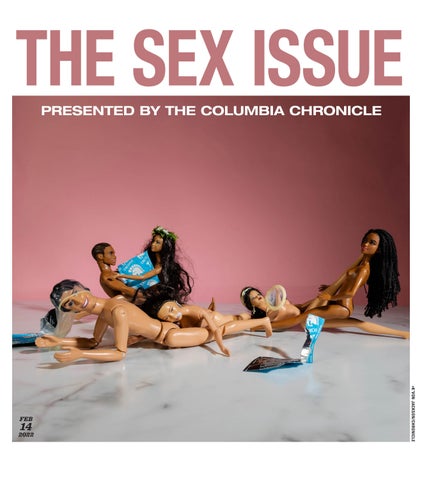
THE SEX ISSUE PRESENTED BY THE COLUMBIA CHRONICLE
14
2022
»K’VON JACKSON/CHRONICLE
FEB
»staff
editor’s note
Editor’s Note: I am not ashamed of being a person who menstruates, period. » CAMRYN CUTINELLO CO-EDITOR-IN-CHIEF I CAN PICTURE it now: I’m sitting in my
first period high school English class, trying to stay awake, when I feel the all too familiar start of my period. After a moment of silent rage, I carefully reach into my bag to grab a tampon, making sure no one is looking when I do. I hide the tampon with my sleeve and quickly ask if I can use the restroom. As I walk to the bathroom, all I can think about is if someone noticed me grab the tampon, my face burning at the very thought that someone could know I’m on my period. It isn’t until later that night, when I’m lying on my bed with a heating pad, that I wonder why it would be so embarrassing for someone to know. People who get periods are taught at a young age to hide them. On TV shows, we see women hide their menstrual products and become noticeably upset when their period comes. We are taught to hide our pads and tampons from sight because it is shameful for others to know we are on our period. We say it’s “that time of the month” or it’s “shark week” instead of saying we are on our period. A study conducted by Thinx, a company which makes period absorbing underwear, found that out of 1,500 women, 58% reported that they had felt embarrassed when on their period, 42% said they had been shamed for their periods and 71% said they had hidden a pad or tampon on their way to the bathroom. Why should we have to feel ashamed? The average person who gets periods will have around 450 periods in their lifetime, equating to about 10 years of their lives. It’s a natural part of the reproductive cycle, and at any given time there are around 800 million people menstruating worldwide. I used to work at a gym with mostly men. I remember tucking my tampons into the waistband of my leggings, hoping no one would notice as I made my mad dash to the bathroom. I would sit in the office in pain sometimes so excruciating I would throw up and hope that no one would need me for anything. Once, I pulled something out of my bag and a tampon fell on the floor in front of my boss. I was so embarrassed. I wanted to quit my job and never come back. It was a wrapped tampon, and I wasn’t even on my period at
2
the time, yet I remember it as one of the most embarrassing moments of my life. It is time for us as a society to put period shame behind us. That starts with us as individuals refusing to feel shame. Our annual Sex Issue works to demystify sex, sexuality and other topics that people are told to feel shame for. We do this by talking about them and refusing to hide. I decided a couple months ago that when I grabbed a tampon out of my bag, I wasn’t going to hide it because I shouldn’t have to. I will not hide my tampons or feel embarrassed when I purchase them because I am one of millions of people menstruating, and that is nothing to be ashamed of. I make no apologies for being a person on my period, and you shouldn’t either.
THE COLUMBIA CHRONICLE FEBRUARY 14, 2022
Editors-in-Chief Managing Editor News Editors Director of Photography Deputy Director of Photography Sales Manager Social Media Strategist Lead Graphic Designer Director of Production Design Staff Reporters
CCUTINELLO@COLUMBIACHRONICLE.COM
Photojournalists
Producer/Director
MANAGEMENT
Camryn Cutinello Noah Jennings Anna Busalacchi Olivia Cohen Jordan Perkins K’Von Jackson Bianca Kreusel Cale Holder Julie Arroyo Vivian Jones Colleen Hogan
REPORTERS
Samaher AbuRabah Seanice Batchman Amaris Edwards Kristen Gesicki Irvin Ibarra Kimberly Kapela Rachel Patel Abra Richardson Amina Sergazina Nathan Sirkin Robin Sluzas Kamy Smelser
MULTIMEDIA
Jared Callaway Peter Midwa Sam Tucker Shane Verkest Jackie Elliott
GRAPHICS
Graphic Designers
Elias Gonzalez Kayla Macedo Lucas Martinez
Copy Editors
Gabby Bach Amanda Burris Justice Lewis
Faculty Adviser General Manager
O X XO
COPY
ADVISERS
Curtis Lawrence Travis Truitt
VOL. 57, ISSUE 3
The Columbia Chronicle is a student-produced publication of Columbia College Chicago and does not necessarily represent, in whole or in part, the views of college administrators, faculty or students. All text, photos and graphics are the property of The Columbia Chronicle and may not be reproduced or published without written permission. Editorials are the opinions of the Editorial Board of The Columbia Chronicle. Columns are the opinions of the author(s). Views expressed in this publication are those of the writer and are not the opinions of The Columbia Chronicle, Columbia’s Communication Department or Columbia College Chicago. Letters to the editor must include full name, year, major and phone number. Faculty and staff should include their job title. Alumni should include year of graduation, or attendance, and major. Other readers should note their city of residence and occupation or employer, if related to the letter’s subject matter. All letters are edited for grammar and may be cut due to a limit of space. The Columbia Chronicle holds the right to limit any one person’s submissions to three per semester.
Th
ex Iss
ue
eS
Let’s talk about sex, baby: Columbia students weigh in on what their sex education lacked » KRISTEN GESICKI STAFF REPORTER AH, SEX EDUCATION.
We all remember those days of being sat down and told about the birds and the bees … or, if you went to most schools in America, you were taught that abstinence — the choice to not have sex until marriage — is the way to go. As Coach Carr from the movie “Mean Girls” said: “Don’t have sex. Cause you will get pregnant … and die. Don’t have sex in the missionary position. Don’t have sex standing up. Just don’t do it. Promise?” For some students, this depiction of sex education, meant to be funny in the movie, was a reality in their schools. Austin Dunham, a senior comedy writing and performance major, said his biggest issue with sex education was the amount of shame and fear his middle school and high school in Iowa instilled in its students. “I remember for such a long time after I was in those classes, I was like, ‘I’m not having sex with anybody. I don’t want to get any STIs; I don’t want anything to do with that,’” Dunham said. “They made people so afraid, and I think that’s what I hate the most about it.” According to World Population Review, in the United States, 37 states require that when sex education is taught, abstinence-only must be included, and 26 states require that it is emphasized. Cary Archer, manager of education and outreach at Planned Parenthood, refers to abstinence-only programs as “sexual risk avoidance programs.” Archer said there is more harm in abstinencefocused programs than benefits. “When young people who have gone through abstinence-only education choose to start engaging in sex, they’re much less likely to use contraception or condoms or to access health care around sexually transmitted infections or things of that nature,” Archer said. According to Planned Parenthood, each year in the U.S., half of the 20 million new cases of sexually transmitted infections are diagnosed in young people ages 15 to 24 years
old, and approximately 750,000 teenagers become pregnant annually. Another issue with sex education programs voiced by Columbia students is the exclusive emphasis on heteronormative, cisgendered intercourse. Reese Marcus, a first-year acting major, said she and other LGBTQ+ classmates felt that their high school in Minnesota neglected to teach students about sexualities and genders outside of female and male heteronormative education. “A lot of us, especially a lot of the LGBTQ+ students like myself, felt like it was very not inclusive,” Marcus said. “It was like, why does our experience with sex not matter as much as typical heterosexual intercourse?” Marcus decided to take the matter into her own hands by writing a letter to her principal about the school’s heteronormative and abstinence-only sex education during her last year of high school. According to classmates a grade level below Marcus, their letter did have an effect on the sex program regarding education about birth control and preventative methods, but it still fell short of better addressing issues of gender and sexuality.
stigmatized,” Archer said. Ada Greene, a sophomore film and television major, identifies as a straight, cisgender woman, but she disagrees with heteronormative sex education. “Even though I fit into that category, a lot of what I learned was not helpful to me because of that sort of atmosphere,” Greene said. “I can’t imagine how much more unhelpful it would be if you’re like, ‘Okay, well, this isn’t going to apply to me because I’m gay,’ or ‘this isn’t gonna apply to me because I don’t see myself represented,’ so what’s the point?” In Illinois, the Keeping Youth Safe and Healthy Act requires that sex education classes are “medically accurate, developmentally and age appropriate to include instruction that is also culturally appropriate, inclusive, and trauma informed.” The new law — which went into effect in August 2021 — also confirms that comprehensive personal health, safety and sexual health education is affirming of identities including LGBTQIA+ and pregnant or parenting youth. “If I had a sex ed class that was
just like, ‘Here’s everything about everything,’ I would take it in a heartbeat,” Dunham said. “I’m in the LGBTQ [community], but there’s things about gender and sexuality that I don’t understand. You know, things change daily, but if I could have that resource, I would take that now.” With the world adapting and evolving, Greene said sex education courses should be adapting as well to fit the needs of young adults who need proper guidance, support and education. ”I don’t really see any excuses for educators to dismiss an inclusive, diverse sex ed,” Greene said. “We have the resources; we have the people. The want is there; the need is there. I don’t see any reason not to do it.” KGESICKI@COLUMBIACHRONICLE.COM
According to Archer, abstinenceonly programs create shame and stigma toward people who do not identify as heteronormative or cisgender. “If you’re only going to say one type of sex is okay, specifically penile-vaginal sex, anyone who’s not going to have that type of sex is therefore automatically
»C OL LE EN HO GA N/ CH RO NI
CL E
FEBRUARY 14, 2022 THE COLUMBIA CHRONICLE
3
Th
ex Iss
ue
eS
Making ethics sexy: Three businesses that bring pleasure to body and peace to mind THE DIM LIGHT of candles, slow music in the
background, a bottle of organic lube, a pack of sustainably sourced condoms and a fair trade sex video to set the mood. There is nothing sexier than knowing your products were ethically made.
MakeLoveNotPorn
MakeLoveNotPorn is a social sex-sharing website that offers a non-exploitative alternative to mainstream porn. “We are pioneering an entirely new category called ‘Real-world Sex,’” said Ariel Martinez, the head of curation at MakeLoveNotPorn. “Porn is very performative, it’s very choreographed, it is scripted. And MakeLoveNotPorn wants to show real world sex, which is just what happens between people when there is not a [professional] camera rolling.” Each video and comment submitted by a person is moderated and viewed by a member of the curation team, unlike other traditional porn websites, Martinez said. Participants must submit two photo IDs per person, including one issued by the government, and an introduction to the video to contextualize the sexual experiences that
4
are being shown. People are encouraged to leave the video unedited to show the real sex with all the awkwardness. “Porn frequently becomes the default sex ed and creates unrealistic expectations for a lot of people when they’re venturing out and having sex, not even for the first time but just as they go about their adult lives having sex,” Martinez said. »VIVIAN JONES/CHRONICLE
» AMINA SERGAZINA STAFF REPORTER
The videos on the platform can be viewed by either renting one for $5 a video, which allows viewers to watch the video an unlimited number of times for three weeks, or by getting a monthly subscription. The revenue is split 50-50 between the website and video makers. MakeLoveNotPorn does not have any downloading options, allowing on-screen participants to delete the video if they no longer want it public.
THE COLUMBIA CHRONICLE FEBRUARY 14, 2022
maude
Maude is a modern sexual wellness company that has everything for before, during and after sex from personal lubricants, to sex toys, to massage candles, to an editorial platform about sexual health. Éva Goicochea, founder and CEO of maude, is one of the 10 Latinx women founders who raised over $10 million in consumer goods. Maude personal lubricants are 100% organic, vegan, cruelty-free, fragrance-free, paraben-free and pH balanced. “As a company that is dealing with your body [and] things that are touching your body directly ... [it’s] crucial to know what you’re putting inside of yourself and on yourself,” said Lily Sullivan, the senior manager of brand marketing and communication at maude. “Leading both with design and an awareness of the ingredients and the materials [of the products] was very crucial to the product development process.”
HANX
After going through the intimate care aisle and browsing the condom options, you might not find a suitable option because of ingredients in them like glycerin, parabens and propylene glycol that can lead to irritation of the vagina.
A woman-owned startup company run by four women in the United Kingdom called HANX makes condoms that are not peniscentric. The condoms are made with 100% fair trade rubber and are not cured with any chemicals. They are biodegradable within three months and can be thrown out with your normal household trash. The outer packaging is cardboard but the only part of the packaging that is not ecofriendly is the foil that the condom is required to be wrapped in. HANX condoms are officially sold on the Pepper website with the U.S. shipping option. “If we’re doing one thing differently, this is a chance for us to completely reimagine what our business could look like, what our impact could look like,” said Emily Prichard, brand and communications manager for HANX. “I think there is nothing sexier than knowing that everyone who is involved in your sexual experience is happy to be there and no one’s being negatively impacted by it.” ASERGAZINA@COLUMBIACHRONICLE.COM
Th
ex Iss
ue
eS
»K AYLA MACEDO/CHRONICLE
FEBRUARY 14, 2022 THE COLUMBIA CHRONICLE
5
Th
ex Iss
ue
eS
Swiping in the city: Columbia students weigh in on dating apps during the pandemic » ANNA BUSALACCHI MANAGING EDITOR AS GENERATION Z college students battle social
»ELIAS GONZALEZ/CHRONICLE
anxiety, isolation and fear of contracting the COVID-19 virus, meeting new people has become everything but the college experience our parents still reminisce about. Because of this, many have resorted to swiping left and right to meet partners, casual hookups or new friends online. Kenzie Iszard, a sophomore acting major, said boredom during quarantine led her to download Tinder and Bumble. If her potential date was unvaccinated, Iszard considered that to be a dealbreaker, and before she met anyone in person, she asked if they had tested positive for COVID-19 or had recent exposure to the virus. Since the pandemic hit in March 2020, most dating apps have added new profile features, such as the ability to display vaccination status and the option to filter users’ feeds according to their COVID-19 comfortability. “It’s hard to know if people are as [COVID-19] safe as you on dating apps or are vaccinated,” said Emily Ferneau, a junior
fashion merchandising major. “I know that a lot of [apps] ask on the profile, but not everyone’s honest and not everyone even adds them to their profile.” Ferneau said if she felt like she was going to kiss someone she met on a dating app, she would first ask for their proof of vaccination because some of her family members are high-risk individuals. Despite COVID-19, more people than ever have been using dating apps. According to Tinder’s annual user statistics, the app earned more annual revenue and had more subscribers than ever before in 2021, jumping from 9.1 million subscribers in the first quarter of 2021 to 10.6 million at the end of the year. In the U.S., people ages 1824 represent the highest percentage of the app’s users at 35%. “[Dating] has kind of shifted to being a little more comfortable with people online because you’re able to talk to them and get to know them more, and [you’re] able to set up a boundary that you may not be able to do when you meet people in person,” Iszard said. Taylore Mountain is an associate marriage and family therapist at the Chicago Center
6
for Relationship Counseling, 5100 N. Ravenswood Ave. She works with clients from college age and above, some of whom use online dating. Mountain said the pandemic helped many people better learn their wants and needs in a relationship, making dating apps a more intentional way of dating. “There are apps for really anybody in any kind of situation that they want, and there’s a lot of freedom to express what you are looking for in a relationship or friendship, whatever it may be,” Mountain said.
“I always feel safer meeting somebody online when they have their presence being promoted as a queer person.” Mountain is a dating app user herself, using Hinge, Match, Plenty of Fish, Her and eHarmony over the span of 10 years, and she has dated several people she met online. She said her personal dating experience inspired her to create an Instagram and a coaching
website to help codependent people realize their potential. When working with a client in the online dating process, Mountain said it is important to identify their top wants and needs and curate their feed accordingly with the app filters, like age, sexuality, height and vaccination status. Alex Murphy, a junior film and television major, said as a queer person, they prefer meeting people online. “I always feel safer meeting somebody online when they have their presence being promoted as a queer person,” Murphy said. Zanida Corujo, a sophomore music major, also prefers meeting people online first to avoid getting “mask-fished,” a new term coined during COVID-19 that refers to being catfished by someone wearing a face mask. The students interviewed for this story agreed that the pandemic has made them place more reliance on dating apps to make connections, including Sage Brahmstedt, a junior film and television major. But Brahmstedt said online dating feels “detached from reality” compared to meeting people in real life. “Literally, it’s just like when you play a game,” Brahmstedt said. “You’re literally just swiping left and right kind of like if you’re playing Marble Blast on the computer. Like, oh, ‘Let’s see if they like me back, and I get a match.’ Ding ding ding. You win.” And some students do find what they are looking for — whatever that may be. Reyna Zuno, a senior communication major, met her current boyfriend on Tinder, and Breslin Webb, a first-year dance major, met his exboyfriend, also a Columbia student, on Tinder. Even Carrie Bradshaw found a connection on dating apps after the death of her husband in the new “Sex and the City” reboot, “And Just Like That.” Fans, however, pointed out the unrealistic nature of finding the seemingly perfect match after just three swipes, according to Cosmopolitan. Corujo said while the convenience of dating apps have made it harder for her to meet people in real life, she gained personal empowerment and self-confidence through online dating during COVID-19. “I personally grew up in a small town in Wisconsin. As a woman of color, as a plussize woman of color, I did not fit in with the people around me. … No one really was really interested in the POC,” Corujo said. “But, the apps made me feel more confident knowing that there was someone that found ABUSALACCHI@COLUMBIACHRONICLE.COM
THE COLUMBIA CHRONICLE FEBRUARY 14, 2022
ex Iss
Th
» OLIVIA COHEN NEWS EDITOR THROUGHOUT HIGH SCHOOL, Libby Thomas’
days consisted of the same routine. Waking up, getting to school and settling into her first class of the day. The only problem was she was miserable. Thomas, a sophomore film and television arts major, initially got on the hormonal birth control pill during her junior year of high school to help with her chronic acne. Instead, she dealt with depressive dips in her mood, lacked motivation in school and experienced general sadness. She didn’t know what to do. After trying five different brands of the pill, Thomas called it quits. Since quitting, Thomas received the nonhormonal, copper IUD implant in January 2021 and hasn’t looked back. She’s happier, she has her drive back and she feels relieved. “There wasn’t really much of a decision that I had to make because I did not want to go on any hormones at all … even if it was the slightest hormones,” Thomas said. “Anything with hormones scared me.” Hormona l and non-hormona l contraceptives differ as non-hormonal options contain no hormones and therefore will not interfere with one’s cycle whatsoever. These methods can include copper IUDs, diaphragms and spermicides. On the other hand, hormonal contraceptives consist of the oral pill, the patch, the vaginal ring, the Progestin IUD, the Depo-Vera shot and more. Hormonal options of birth control can affect the user in a variety of ways, which could include changes in their mental health, weight fluctuations and changes in their menstrual cycles. For Kaya Lane, a senior journalism major, she finds herself reeling when it comes to taking her hormonal pills. Lane also got on the pill in high school, but she used it to ease her periods. “I was having horrible period pains; it got to the point where I was cramping really badly and I would vomit … I pretty much couldn’t do anything because my period was interfering with everything,” Lane said. “Without birth control, my periods were almost brutal to deal with.” Lane, who was initially prescribed a hormonal treatment by a hospital, said what prohibits her from getting on a new method of birth control is the potential cost of other contraceptives. “I’ve always considered doing other
contraceptives, but I think they’re a bit pricier,” Lane said. “I think the pill is one of the cheaper alternatives, so for me, that was kind of the reason I stuck with it.” Columbia’s Health Center offers a wide range of health care for its students, however, the clinic offers the oral pill and the DepoProvera shot – excluding students looking for a non-hormonal and long-term option. The center also offer female condoms. In a Feb. 3 email to the Chronicle, Beverly Anderson, associate dean of Student Health and Support, said the school’s clinic chose to offer the oral pill and the Depo-Provera shot in an effort to not duplicate the birth control services students could find elsewhere in Chicago for free. Anderson said if the school offers contraceptives, such as the IUD, it would require an obstetrician or gynecologist to perform the procedure, which would increase the health center fee that all Columbia students pay to bring the doctor on to the staff. The University of Illinois Chicago’s CampusCare, the school’s on-site clinic, offers both hormonal and non-hormonal contraceptive options. Similar to Columbia, UIC students pay a mandatory fee that goes to the school’s Student Health Service. Yvonne Oldaker, the associate medical director at Planned Parenthood of Illinois, said there are a variety of reasons why an individual may choose a specific contraceptive method, such as medical history, personal experiences and what an individual has heard about a method that could sway one’s decision. “The philosophical base here is for people to have access to the birth control of their choice,” Oldaker said. “Out there in the world, cost is a big issue for people; some methods are more expensive than others.” Oldaker added that implant birth control options – including the arm implant, and both hormonal and non-hormonal IUDs – are less available across the board, posing accessibility issues to those trying to access them. Chloe Skerlak is a licensed holistic reproductive health practitioner and certified fertility awareness educator, who runs a company that teaches clients how to approach all aspects of menstruation and fertility in a holistic, non-invasive way. “I was looking for hormone-free birth control and that’s when I discovered the fertility awareness method,” Skerlak said. “It was super easy, super empowering for me that after I learned and used it as contraception
for two years, I got really excited about helping others do the same.” Skerlak, who holds a Bachelor of Science degree in kinesiology from the University of Alberta, Canada, said she educates her students to look for their fertile window based on a three-step daily routine that focuses on what is actually happening to one’s body and how it feels. For example, Skerlak teaches her students to first examine their vaginal mucus every morning to tell when they enter and exit their fertile window. Secondly, Skerlak teaches menstruators to take their basal body temperature either orally or by putting an average thermometer under their armpit. Skerlak said that the basal body temperature method works by an individual taking and recording their temperature every morning. After one cycle, they would be able to confirm they have exited their fertile window and are now post-ovulatory, as one’s temperature would increase during ovulation. Lastly, Skerlak said the cervix itself changes shape and size based on what cycle stage someone is in. The last step to her practice is for menstruators to physically feel their own cervix to identify where they are in their cycle. “The cervix changes throughout the menstrual cycle as well, so paying attention to the subtle changes to your cervix can help confirm where you are in your cycle,” Skerlak said. Skerlak said this three-step method could be helpful, especially for a college student because the number one cause for delayed ovulation is stress. “A pet peeve of mine is when people say, ‘my period is late.’ Your period is never late, it comes on time, every time. What is late is ovulation. … If you can identify when you ovulate, you’ll be able to predict when you get your period,” Skerlak said. “The number one
»LUCAS MARTINEZ/CHRONICLE
Beyond the pill: Hormone-free contraceptives
ue
eS
thing that delays ovulation is stress, whether it’s emotional stress, physical stress, chemical stress … and I would say that when you are in school, that’s a really stressful time.” Skerlak added that although the copper IUD is hormone-free, it does not come without its own set of drawbacks. “The copper IUD is non-hormonal, which is great and won’t affect your ovulation, but is not without its consequences,” Skerlak said. “The copper IUD, its main intention is to create a hostile environment in your uterus through inflammation. … It acts as a toxin to sperm, so it’s going to act like a toxin to your body as well.” Oldaker said one of the biggest determinants for an individual to choose a certain birth control method is how it will fit into their life, as some individuals might adapt to taking a pill at the same time every day or waking up and taking their basal body temperature in the morning, but some might want a longer-term solution. Oldaker said if an individual is looking for a specific form of birth control or weighing their different options, there is a Planned Parenthood right in the South Loop. The South Loop’s Planned Parenthood location is currently in the process of moving to a bigger building with a higher client capacity. Doors at the new location are scheduled to open this Valentine’s Day, Feb. 14, at 16 N. Wabash Ave. “Planned Parenthood has a clinic in the Loop, right down the street from Columbia. … We stock multiple brands of birth control pills … we have all of the IUDs available, including the non-hormonal one; we’ve got the implant, Depo, the pill, the patch, the ring,” Oldaker said. “If they make it, we’ve got it or we will prescribe it for you.” OCOHEN@COLUMBIACHRONICLE.COM
FEBRUARY 14, 2022 THE COLUMBIA CHRONICLE
7
Th
ex Iss
ue
eS
Sex toy inclusivity: Chicago sex toy stores provide resources for LGBTQ+ community
» ABRA RICHARDSON/CHRONICLE
» ABRA RICHARDSON/CHRONICLE
SEX TOYS CAN HELP PEOPLE AFFIRM THEIR SEXUALITY AND LEARN HOW TO FIND PLEASURE.
» AMARIS EDWARDS STAFF REPORTER
8
THE COLUMBIA CHRONICLE FEBRUARY 14, 2022
Pharoah also reaches out to people who need advice via Instagram and direct messages. Lovers Playground, located at 1246 W. Randolph St. in Chicago’s West Loop, has also evolved to sell products geared toward members of the LGBTQ+ community over the past few years. Ken Arp, manager at Lovers Playground, said the store has a new sex toy line called
Gender X, which provides gender-neutral toys for customers. “Sex is still mostly in your head; what we’re providing is a tool,” Arp said. “The key is finding the right tool for you.” AEDWARDS@COLUMBIACHRONICLE.COM
» ABRA RICHARDSON/CHRONICLE
SEX TOYS AND the shops that sell them have long been a part of Chicago’s erotic landscape. But in recent years, some of the shops have pushed the boundaries beyond the needs and wants of the cisgender community to make sure everyone is being served. Vibrators, dildos, anal toys and transfriendly toys — Early to Bed, a sex shop in Andersonville, caters to all genders, sexualities and identities. Owner Searah Deysach said she opened Early to Bed, 5044 N. Clark St., 20 years ago because she was a “frustrated sex toy consumer.” While Early to Bed supports people of all genders, sexual orientations and identities, Deysach wanted to create a space particularly welcoming to people who are on the margins of what the mainstream consumer has been in the sex industry: cisgender straight men. “I felt there wasn’t anywhere in Chicago where someone who was a woman or womenidentified queer … could shop for sex toys in an environment that felt supportive and fun,” Deysach said. “And not focused strictly on either male heterosexual or gay male gaze.” Deysach identifies her store as “Chicago’s feminist sex shop.” Deysach said they are conscious about not labeling toys under terms like: for him, for her or for couples. The toys are divided by type of toy and in some cases what body part they go
on or stimulate. Deysach said there are lots of people who find affirmation with their sexuality or gender through sex toys. “For some people, a vibrator provides the first orgasm they’ve ever had … a butt plug can allow [people] to explore anal play in a way that is very sexuality affirming,” Deysach said. “For people who strap on a dildo for the first time or who use a gender expression device … that can also be very transformative.” Deysach is one of several community members creating safe sex toy spaces for Chicago’s queer community. Egor’s Dungeon, a sex toy store located at 900 W. Belmont Ave. in Northalsted, has been a resource to the LGBTQ+ community for more than 30 years. Amanda Mohr at Egor’s Dungeon said that they hire only LGBTQ people, including the manager. Mohr said manager “Lexxx” Pharoah specifically orders toys for lesbian and gay customers. The store offers toys such as plugs, prostate toys, double-ended dildos and harnesses for women. “Sex isn’t just for straight couples, it’s for everyone,” Mohr said. “Everyone deserves to feel pleasure, and that’s why we try to cater to everybody.” Additionally, Egor’s Dungeon provides a lesbian sex coach — manager Pharoah, who offers classes and advice for people who need assistance and for new lesbians. Mohr said
BUSINESSES LIKE EGOR’S DUNGEON ARE MAKING SURE THEIR SEX TOYS AND EROTICA CATER TO ALL LIFESTYLES AND INTERESTS.
A MANNEQUIN DISPLAY SITS NEAR THE REGISTER AT EGOR’S DUNGEON.
» KIMBERLY K APELA STAFF REPORTER ELIZABETH BRASE, A sophomore psychology
“You name three things you see in front of you, three things you hear and end by moving three parts of your body,” Fliess said. “Always make sure you’re present and in the moment and get in tune, so your head and body are connected by asking yourself, ‘Am I safe?’ ‘What’s happening right now?’ ‘Is there someplace I’d rather be?’ ‘Can my partner do something right now to help make me feel better?’” Emily Jackson, a student and campaign coordinator of the Consent and Sexual Health Committee at Loughborough University, England, said women experience post-sex depression more often in heterosexual relationships because of what she described as the orgasm gap. Jackson said society expects a man to climax after intercourse, leading to women’s pleasure being an afterthought. “During penetrative sex … women can’t orgasm just from that,” Jackson said. “Women might feel neglected, and that can lead to sadness from not feeling satisfied.” Jackson’s advice for sex and aftercare to
Th
ensure proper intimacy — whether it’s a onenight stand or a long-term relationship — is communicating wants and needs, which can lead to a stronger orgasm. Brase said she thinks aftercare and post-sex intimacy are things that seem to go overlooked, especially in heterosexual relationships. “Women need to know their bodies and masturbate and be aware of their sexual preferences. It allows you to have more control over your body,” said Brase. Regardless of how kinky or vanilla your sex life is, aftercare and intimacy through communication and physical touch lessens the chances of PCD occurring. Designing aftercare experiences to fit one’s personal pleasures helps ensure proper intimacy. KK APELA@COLUMBIACHRONICLE.COM
»COLLEEN HOGAN/CHRONICLE
major at Loyola University Chicago, didn’t feel like herself after sex. She was anxious and felt shameful when she did not have full body confidence in bed. Post-coital dysphoria, also known as PCD, refers to experiencing the feelings of anxiety, depression, irritability and shame after sex. Brase said she experienced PCD when she wasn’t aware of her own body and her sexual preferences. “I would be doing things [in bed] in the sense that I wanted to do them because it was going to make my partner happier, not myself,” Brase said. People with PCD experience it differently, and it can be hard for individuals to describe certain triggers or symptoms, such as past sexual trauma, body dysmorphia issues or not being emotionally available or ready during intercourse. “I blame [unhappiness in sex] on porn,” Brase said. “People who identify as women, a lot of their sexual preferences come from what they think is satisfying to men, especially if you go on PornHub or any porn website today, it shows a lot of BDSM that isn’t consensual or is aggressive.” Alex Fliess, a licensed clinical social worker, therapist and co-owner of Chicago Sex and Wellbeing, said PCD is related to anxiety, which can be exacerbated during and after sex. “By suppressing feelings of shame or guilt through sex … it’s similar to putting a BandAid on a much larger issue,” Fliess said. Fliess said the individuals who are most affected by PCD tend to be people who identify as women. “PCD is definitely more common in women,” Fliess said. “A lot of those feelings can come up for women or people who identify as female … it’s very common for women to have sex and never reach climax, and also very easy for them to fake an orgasm to please their partner.” Fliess said post-sex depression is more commonly documented in heterosexual relationships, and she suggests reading about both binary genders to understand pleasure points and triggers because they can apply to anyone. “A body is still a body,” Fliess said. “It doesn’t matter who you’re having sex with, it’s still a body, and you still have the same feelings that you do about your body and
about your partner.” Fliess also said hormone imbalances could play a role in causing PCD, and hormone drops related to sex can last anywhere from a few minutes to several hours. Oxytocin hormones and endorphins are released during sex which causes benefits to emotional health, but there can be a “dramatic drop” in hormone levels after sex that can lead to a “negative emotional response,” according to Psychology Today. “Hormone levels drop at the end of sex which can result in PCD,” Fliess said. “If you have any unresolved issues, fears or worries about your relationship, sex can bring them to the forefront of your mind and begin to make you feel overwhelmed.” Confronting PCD or sexual trauma can involve talking about sexual experiences with your partner, as well as evaluating past experiences or seeking out a sex therapist. Fliess said breathing and mindfulness exercises such as “the 3-3-3 rule” works to ground one’s thinking and will help a person remain present.
ex Iss
ue
Post-sex depression: Consensual sex doesn’t always equal satisfying sex
eS
FEBRUARY 14, 2022 THE COLUMBIA CHRONICLE
9
Th
ex Iss
ue
eS
Student Confessions Students from around the college anonymously reveal their craziest sex confessions.
Curated by Camryn Cutinello & Noah Jennings Designed by Colleen Hogan
Share your most awkward experience
It was my first time hooking up with this guy and I was on top and one of my nipple piercings unscrewed and landed in his mouth and he ended up choking mid-intercourse. - Journalism Major Man straight up held me while we laid in the bathtub while saying repeatedly “I got you, I’ve got you.” - Film and Television Major Started my period during sex & didn’t realize till everything was bloody. - Photography Major Making out to “Total Drama Island,” a full episode of it too. Not my proudest moment and I was just not feeling it. - Film and Television Major Sex with a face mask on. - Photography Major One time when eating my girlfriend out, I got a nosebleed. At first I thought it was just runny... after a bit, I realized it was a nosebleed and had bled all over her hair down there. Luckily she was cool about it, we’re still together to this day. - Comedy Major Right after we finished having sex he took out his computer and started watching “Bojack Horseman.” - Fashion Major I was over at this guy’s house and while we were going at it he got up to go get water, he was gone for longer than I expected but then, out of nowhere, in walks this guy’s roommate! He literally walked in, sat on the edge of the bed on his phone while I was butt naked, said, “Hey I’m _____” and then continued to scroll through Instagram on his phone (not looking at me btw) until I asked if the other guy was coming back and he said, “I’ll go ask.” He came back a moment later and said, “Yeah he said you can just leave if you want to.” - Acting Major 10
THE COLUMBIA CHRONICLE FEBRUARY 14, 2022
“
I’ve always wanted to try group play, but I can never find enough people who would be interested in doing it. Unfortunately it’s not that easy to set up an orgy like you think it is. -Fashion Studies Major
”
Favorite sex toy? WeVibe Moxie - Fashion Studies Major Okay Gaia Eco Bullet sold by Free People is 100% so worth it. It’s really affordable for a vibrator (it’s $14!!) and is eco-friendly and biodegradable. Go get one of these! - Film and Television Major My own two hands baby - Acting Major Pink dildo - Theatre Technology and Design Major I love anything that gets my partner involved. Butt plugs and rabbit vibes are the best. - Art History Major My vibrator that my partner can control from anywhere with internet. - Creative Writing Major Bullet vibrator - Music Major Strap-on - Film and Television Major Rose Toy Vibrator - Journalism Major
What’s your favorite movie sex scene? Cate Blanchett and Rooney Mara in “Carol” - Theatre Acting and Directing Major Anything in “50 Shades of Gray” - Fashion Studies Major It’s funny but the one in “The Bronze” - Photojournalism Major “Call Me By Your Name” is pretty decent. “Moonlight” is great. “House of Gucci” was INTENSE. - Marketing Major The ones in the beginning of “Deadpool” where they have sex at every holiday - Creative Writing Major Literally any sex scene in the “After” movie series - Audio Arts and Acoustics Major “Love Actually’s” scene with Sarah and Carl, sweet sex isn’t portrayed enough - Film and Television Arts Major
Th
I’m really attracted to ear piercings. Something about them is just so hot. -Theatre Major Pretending to get pregnant -Cinema Studies Major I like when someone takes control over me. -Audio Arts and Acoustics Major Most of my kinks revolve around being teased, and denied pleasure at my own pace. Oh and I have a huge worship kink. - Music Major Painted fingernails - Film and Television Major Foot fetish - Graphic Design Major Praise kink for sure - Creative Writing Major
What’s something you’ve wanted to try in the bedroom but never had the chance?
I’ve always wanted to try choking, being both the person doing the choking and the one getting choked. The thought of bondage, especially with your wrists pinned above your head also really intrigues me. - Theatre Major Role play - Theatre Major Women - Fashion Studies Major Blindfolding - Photojournalism Major Ice/temperature play - Film and Television Major
ex Iss
ue
What’s your fetish?
eS
Worst first date?
[They] talked about Quentin Tarantino being the best director of all time and wasn’t being sarcastic. -Musical Theatre Major The girl’s mom insisted on taking pictures of us in my car awkwardly and it was the first time I met her. -Creative Writing Major Went out with a guy for coffee and he refused to drink it until we found somewhere to sit. Once we found a bench, he sat his full cup of coffee down and a gust of wind came and knocked it over and spilled all over him. He got so embarrassed he just left. -Fashion Studies Major McDonald’s - Creative Writing Major My best and worst first date were both hosted over Minecraft. -Acting Major A friend I hadn’t seen in forever reached out and we scheduled to go out and chat. I hadn’t realized it was a date until he leaned in to kiss me. - Acting Major Woman mentioned I reminded her of her ex and then we went to a grocery store to eat premade potato salad. - Film and Television Major
“
What’s your favorite sex position?
It was my first time hooking up with this guy and I was on top and one of my nipple piercings unscrewed and landed in his mouth and he ended up choking mid-intercourse. -Journalism Major
Missionary with one leg up - Film and Television Major I love cowgirl, I can go at my own pace and it feels amazing being able to look at a guy and see how much you are satisfying them. - Fashion Studies Major Doggy - Audio Arts and Acoustics Major Cowgirl - Music Major Anything that’s close to a wall so I can charge my phone and scroll through Twitter at the same time - Screenwriting Major Missionary - Theatre Technology and Design Major I’m down with most. - Acting Major She’s on her side with one leg pulled up to her chest and I’m on top. It’s revolutionary. - Film Major
”
Weirdest place you’ve done it? Macy’s on State Street -Acting Major My ex and I did it in our friend’s dead grandma’s bed. There was legitimately a picture of her on the nightstand. -Theatre Acting and Directing Major The gender-neutral bathroom in the Student Center. Oops. -Journalism Major In a room where the window curtain wasn’t closed and a neighbor could possibly see - Graphic Design Major On a pool table - Film and Television Major His mom’s car - Musical Theatre Major Iowa parking garage in broad daylight - Acting Major Behind a bowling alley - Creative Writing Major Forest preserve - Cinema Studies Major
FEBRUARY 14, 2022 THE COLUMBIA CHRONICLE
11
Th
ex Iss
ue
12
eS
THE COLUMBIA CHRONICLE FEBRUARY 14, 2022
Th
ex Iss
ue
Signs you might be the rebound in a relationship
eS
be that person to string anybody along. She was understanding; she wasn’t really upset, and we didn’t end on bad terms.” Relationships founded on rebounding can sometimes last. Roach said some relationships can be maintained even if both parties are rebounding from previous relationships, as long as it’s based on respect and transparency from the beginning.
»LUCAS MARTINEZ/CHRONICLE
“If it makes you uncomfortable that they won’t go further [in the relationship], then you have the right to cut things off yourself.”
» K AMY SMELSER STAFF REPORTER DURING A RELATIONSHIP that lasted through
the summer of 2020, Spencer Washington, a creative writing graduate student, started seeing the red flags of their relationship with someone who had only been single for a few months. “I knew I was a rebound when they kept bringing up their ex, and then when I tried to be affectionate with them, they would pull away,” Washington said. “I felt that if they liked me enough, they would want to be affectionate and talk about serious things, like, ‘Are we together? Are we a couple?’” An exciting, new relationship can come crashing down when you see the previous relationship baggage the other person brought with them, and you are the drug that is supposed to help them move on. After realizing you are a rebound, it is good to take a step back and evaluate before heartbreak occurs. Katie Roach, associate licensed marriage
and family therapist at Relationship Reality 312, 333 N. Michigan Ave., recommends that if you notice a lack of accessibility or responsiveness within a relationship, this can be a sign the person may not be as committed or interested as you. “We talk a lot about dating and attachment in therapy, that you want partners in general who are accessible and responsive and who are willing to meet your needs or to negotiate to meet your needs,” Roach said. Roach said transparency is key when dating, especially now during the dating app age. When someone searches for a rebound, there can be issues along the way based on differing intentions between the two partners. “The risk of having someone be a rebound is that, ‘What if they have feelings for you?’” Roach said. “‘What if they want a relationship? What if they’re under the pretense that you’re available emotionally?’” As you continue to evaluate whether or not this person is truly interested in a serious relationship, Roach said it is important to
“Trust your gut because your gut knows more before you do emotionally.” recognize if they are making you feel satisfied as a partner. Roach gave an example of a sign to look out for: Your partner only reaches out to you when they are bored or want something, but they become dismissive when you want to see them or engage with them. Matthew Walcott, a junior graphic design major, said a month into a relationship in high school, he realized the downsides of entering a new relationship when he was not ready to be committed to a new partner. “I realized myself that I was really just [dating] because I felt hurt from something else I was in,” Walcott said. “I didn’t want to
“A relationship can survive almost anything,” Roach said. “I would equate that a little bit to people who meet who just want to hook up, and if that’s both people’s intention, then that often turns into a relationship, [though] certainly not always.” Washington was eventually cut off from their relationship after getting blocked and said they regret not listening to their friend’s advice about leaving their partner beforehand. “Trust your gut because your gut knows more before you do emotionally,” Washington said. “If it makes you uncomfortable that they won’t go further [in the relationship], then you have the right to cut things off yourself.” Walcott recommends that if you are about to look for someone new to date, especially after immediately ending a relationship, do some reflection on whether or not you are running to someone else for safety or comfort to escape the pain you may be feeling. “In the long term, you’ve got to really think, ‘Will that help you entirely? Or is it lust?’” Walcott said. “While you try to seek happiness from someone else, at the end of the day, can you really rely on that person to bring you happiness completely?” KSMELSER@COLUMBIACHRONICLE.COM
FEBRUARY 14, 2022 THE COLUMBIA CHRONICLE
13
Th
ex Iss
ue
eS
Title IX FYI: Know your rights ‘I just feel left out’: Asexual-identifying students balance identity and misconceptions » ROBIN SLUZAS STAFF REPORTER
NO COLLEGE STUDENT should be sexually
harassed or discriminated against in the classroom, on campus, at a college event or by a member of the college community. It’s not just a matter of respect – it’s actually the law. Title IX of the Education Amendments of 1972 prohibits sex discrimination in education and covers all students, staff, faculty and third parties, regardless of sexual orientation or gender identity, at any educational institution receiving federal financial assistance, including Columbia College Chicago. Sex discrimination includes sexual harassment, sexual assault, dating violence, domestic violence and stalking. The college’s Title IX policy and procedures detail the processes used by the college to ensure the rights of students to an education free from sexual discrimination and to protect victims, while holding perpetrators accountable for their actions. Victims of sexual assault, dating violence, domestic violence or any other unwanted physical sexual acts are encouraged to immediately get to a place of safety and seek police help and medical assistance. The Title IX section of the college’s website offers advice about preserving evidence. Students and all members of the campus community who are victims of any form of sex discrimination are also strongly encouraged to report their experiences to the college. Students can report violations directly to the Title IX office or to Campus Safety and Security. They can also speak to “Responsible Employees” or “Confidential Advisors.” Most full-time employees, including all full-time and part-time faculty members, as well as resident advisers are classified by the college as “Responsible Employees,” who are mandated to report any incident of sexual discrimination or sexual harassment and any details they become aware of to the Title IX office, which will begin an investigation. The college also provides Confidential Advisors for students to speak with, who are not required to report alleged incidents to the Title IX office. Confidential Advisors will listen and may offer support and guidance, while keeping the information shared with them confidential “to the extent permitted by law.” At Columbia, Orterio Villa, director of Student Organizations and Leadership, and Charee Mosby-Holloway, director of Student Diversity and Inclusion, are Confidential Advisors.
14
Students can also utilize Confidential Resources in the Student Health Center, Student Relations and Counseling Services, which offer “support (on- or off-campus), such as advocacy services, academic assistance, disability, physical health or mental health services, and changes to living, working, or course schedules.” A no-contact order could be enacted in some situations between students. In extreme circumstances, an alleged perpetrator could be subject to emergency removal. The Title IX process ensures victims are not subject to retaliation for filing a formal complaint. Alleged perpetrators, referred to as “respondents” in the college’s Title IX policy, also have rights, and the Title IX process may hold people accountable for knowingly making false allegations. When a formal complaint is filed, the college has the responsibility to investigate. When warranted, a three-person Hearing Panel will be convened to consider evidence in a case. The panel can include trained staff and faculty members. If the Hearing Panel determines a student’s rights have been violated, remedies or disciplinary sanctions will be determined and could lead to a perpetrator’s expulsion from the college. Verron Fisher is Columbia’s Title IX investigator. She told the Chronicle in 2020 that at any point, students can change their minds about an investigation or hearing. “However, sometimes we might have to continue with an investigation even if the Complainant requests to withdraw,” Fisher said in a Feb. 9 email to the Chronicle. “My office understands how stressful the process is for students, so we try to ease students’ concerns while being fully transparent with the process.” Fisher said the Title IX office is “available to provide students with additional resources, including on or off-campus resources. The Equity Issues office has partnerships with several off-campus organizations throughout the city and surrounding suburbs that have experience with working with college students, including therapy sessions at no charge to the student,” she added. For more information, search colum.edu for Title IX.
THE COLUMBIA CHRONICLE FEBRUARY 14, 2022
RSLUZAS@COLUMBIACHRONICLE.COM
» K AMY SMELSER STAFF REPORTER
»K AYLA MACEDO/CHRONICLE
WHEN FIRST-YEAR film and television major
Charlie Warren came out as asexual, they were in the car with their mom. “So you’re gay?” Warren’s mom responded. “I had to explain to her I was still interested in guys, but I didn’t want to have sex with or wasn’t attracted to them,” Warren said. “She still didn’t really understand it.” The term asexuality describes someone who has never had sexual attraction for others. Asexuality is closely related to aromanticism, which refers to someone who does not experience any romantic attraction. Outside of these two, there is a spectrum of how someone may identify sexually or romantically, or how they express intimacy. Warren also identifies as gray-sexual, which is an umbrella term for someone who falls within the gray area of asexuality and aromanticism, as they “sometimes, occasionally or rarely experience sexual attraction.” Valentine’s Day and the days leading up to it tend to be centered on how an individual will celebrate when accompanied by a partner. Whether that be platonically or sexually, 52% of Americans said they would celebrate Valentine’s Day in 2021, according to Statista. “I think society puts a big importance on sex when there really shouldn’t be any,” said Noey Budde, a junior music major. Budde identifies as demi-sexual and only feels sexual attraction toward someone after forming an emotional connection with them. “With Valentine’s Day and [movie] genres like romance and rom-coms, the importance of the film is when the protagonists have sex, and I always found that to be so dumb and weird,” Budde said. Kari Holman is a licensed clinical professional counselor, a national certified counselor and a level-two certified clinical trauma professional who also identifies as asexual. She said many people equate sex and love, but they are different. “Valentine’s Day is about love,” Holman said. “It’s not about sex. Focus on your love and the people you love.” Individuals who identify as asexual have other ways of expressing their love for someone that doesn’t involve sexual activity. Budde said she enjoys cuddling, and it is one
of the most romantic activities for her. “I’d love to meet someone and, you know, take them out for Valentine’s Day, but I’d have to come out to these people and [say], ‘I’m not going to take you home.’ [Sex] is mostly what they would want, and that’s fair, but, I just feel left out,” said Lex Romero, a first-year film and television major who is asexual. Holman said one of the biggest misconceptions about asexuality is that it originates from the traumas of sexual abuse or assault. “Sex and rape are two different things,” Holman said. “If so many other people who do experience rape and still have sexual desire, it doesn’t add up that somebody else would be sexually assaulted and then they suddenly have no desire.” Romero said this assumption frustrates her, as she was sexually assaulted after coming out as asexual in the seventh grade. Outside of the misconceptions that come with being asexual, the societal pressure to love sex puts asexuals in an awkward place. Both Romero and Budde said they experience discomfort when they are around friends who discuss their sex lives and hooking up. “I definitely feel uncomfortable [having that conversation], and I feel so bad about it because they’re my friends,” Romero said. “If that makes them happy, that’s great, but as they tell me, I’m just mentally like, ‘ew,’ and I feel bad.” Valentine’s Day is here, but for asexuals and gray-sexuals like Warren, it’s just another day. “I treat it like it’s Easter,” Warren said. “It’s there, and if I get some cool chocolates from it, that would also be nice.” KSMELSER@COLUMBIACHRONICLE.COM
Th
ex Iss
ue
eS
»LUCAS MARTINEZ/CHRONICLE
‘Seeing that hatred or that disgust or the attempt to erase bisexuals is difficult’: The harmful effects of bi-erasure
» RACHEL PATEL STAFF REPORTER KHAI HOWARD-NANCE’S road to accepting her
bisexuality was anything but an easy one, describing it as a “constant journey.” Howard-Nance, a sophomore acting major, has been dealing with the struggles that come from biphobia ever since she was a preteen. “I still sometimes feel insecure in my sexuality or feel like maybe I am just straight,” she said. “Even though I know that I’m not, hearing so many things from outside sources … seeing that hatred or that disgust or the attempt to erase bisexuals is difficult. You do kind of start to internalize it.” Even though they make up 52% of the LGBTQ+ community, it’s common for bisexual people to hear comments in their daily life, such as, “They’re just confused — they’re either gay or lesbian, and this is a transition phase until they come out,” “They’re actually straight, but they want the attention,” or “It’s not even real.” Statements like these are an example of bi-erasure, the attempt to ignore or deny the existence and legitimacy of the sexuality.
Britta Larson, the senior services director at the Center on Halsted, who is also bisexual, said biphobia can be especially harmful because of the higher rates of depression, anxiety, domestic violence and lower incomes already imposed on people who are bisexual. According to an article by the Harvard Health Blog, bisexual people are more likely to also experience higher rates of gastrointestinal problems, arthritis and obesity than their monosexual peers, with women specifically struggling with health-related quality of life and men with high cholesterol, high blood pressure and cardiovascular disease, all of which can stem from minority stress. “There’s a direct relationship to the stigma and the shame that is being attached to being bisexual and that erasure and that invisibility and people really denying that as a true sexual orientation and a true identity,” Larson said. “All those myths and jokes are not funny, and they have an impact on the bi community.” Emphasizing the importance of educating individuals, the Center on Halsted offers resources, such as STD testing and hotlines and an anti-violence project that helps
to support LGBTQIA+ individuals who are “survivors of hate and bias violence, discrimination, intimate partner violence, stalking and/or sexual assault.” In order to specifically support the bisexual community, they hosted a panel discussion for Bi Visibility Day in 2020, which takes place Sept. 23 each year, with presentations and an open Q&A session on Facebook Live. Elias Packard, a senior clinical psychology major at the University of Illinois at UrbanaChampaign, said he first found out he was bisexual when he was 15, saying he looked at both men and women “with the same star-eyes.” Having experienced biphobia firsthand from his own friends, Packard recalls feelings of reluctance to come out fully after getting made fun of or questioned by peers — further causing him to deal with internalized biphobia. Packard talked about hearing straight male friends make gay jokes and having women question the intent of his friendships with other guys. “It was pretty hard at times because it really makes you question your identity if
you have feelings and then they’re not being validated by the people you care about,” Packard said. “It’s really difficult to have a strong sense of identity.” Jude Ramirez, a junior communication major, first discovered their bisexuality through a threesome. Prior to that, they had often questioned if they were just straight or lesbian and consequently dealt with imposter syndrome. Ramirez also struggled with being hypersexualized and said it was dehumanizing, especially when being viewed through the male gaze. They said their sexuality did not define them as being overtly sexually promiscuous. “It’s just hilarious to me that so many people are so close-minded about the fact that there is something else besides being straight,” Ramirez said. “I feel like straightness is just the norm, and I hate it because straightness is what keeps the patriarchy alive. When people are trying — especially white cisgender men — when they try to think their way of existing is the only way, it makes me laugh out of frustration.” Ramirez also said they experienced internalized biphobia early on in their journey to coming to terms with their bisexuality. In middle school, they were told that bisexuality was not real and they had to be attracted to one gender. At around 18 years old, they became more comfortable with accepting their bisexuality, especially after enrolling at Columbia and meeting peers with similar experiences to theirs. “I’m really happy to be surrounded by more people who are … [not] just heterosexual white people, because that was a big demographic that I was surrounded by for a long time,” Ramirez said. “It’s just nice to finally not be a part of that and get more exposure to different ways of living, and I feel like Columbia has a great plethora of queer people that are so open and willing to speak about their own experiences and are very happy to be in this environment.” RPATEL@COLUMBIACHRONICLE.COM
FEBRUARY 14, 2022 THE COLUMBIA CHRONICLE
15
Th
ex Iss
ue
eS
Opinion: Condom or vasectomy? Why are those my only options for male contraceptives? »ELIAS GONZALEZ/CHRONICLE
» IRVIN IBARRA STAFF REPORTER CONTRACEPTIVE accessibility and affordability
is essential when looking for ways to prevent an unwanted pregnancy, and while there are several birth control options for people with uteruses, those who are sperm producers are limited to two options: either wear a condom or get a vasectomy — two drastically different methods. “Obviously, there’s contraceptives like condoms and stuff like that, but there can definitely be more. There’s a lot more for women. There should be a lot more for men,” said Michaelangelo Quintello, a sophomore acting major. “It shouldn’t just all be on women.” The contraceptive options offered to those able to get pregnant include birth control pills, cervical cups, implants, intrauterine devices, vaginal rings and more. There should not be only two contraceptive options available to those who are sperm producers. It puts the majority of the responsibility of contraceptive and birth control use on people with uteruses, creating an imbalance. This leaves sperm producers the inability to even explore options most comfortable for them or forces them to choose a contraceptive option that makes them uncomfortable: Wearing a condom too small for your size, or one made of latex even though you’re allergic, or even feeling pressured into getting a vasectomy. These should not be concerns cast aside by one’s partner. In my own relationship, I’ve been told to consider a vasectomy, but the cost of the operation and my own comfort with the decision makes me feel it’s not the right choice for me. In our private conversations, my partner said she also hasn’t found a form of birth control that’s comfortable to her, which leaves us with only one choice: condoms. Whether in a relationship or for your own individual preference, a contraceptive that is both affordable and comfortable must be the goal as newer and more diverse options for contraceptives become available. My frustrations with the lack of male contraceptives led me to reach out to Kevin Shane, marketing and communications director for the Male Contraceptive Initiative, a nonprofit organization based in Durham, North Carolina. “If you’re an egg producer right now, you should be all for sperm-targeting contraception, that is the only way you will 16
achieve reproductive autonomy,” Shane said. MCI’s mission since their founding in 2014 is to raise awareness and educate people, especially students, about male reproductive health through unique means like producing educational video games about male birth control. Through fundraising, MCI funds research for the field of andrology — the study of male reproductive health. Through fundraising, MCI is able to develop new, long-acting reversible contraceptives for sperm producers. Shane said the lack of a wider range of contraceptives for sperm producers is due to a lack of understanding of male reproductive biology. He said this stems from non-authentic conversations about anatomy with kids and teens who have a penis; misconceptions on current forms of spermtargeted contraceptives like vasectomies; distrust between couples regarding their male counterparts taking birth control; and a major the lack of investment into andrology research. “Vasectomy reversibility is a very, very
THE COLUMBIA CHRONICLE FEBRUARY 14, 2022
misunderstood thing,” Shane said. “They are not intended to be reversed at all, and it becomes extremely challenging to reverse them as you get further away from that initial operation.” Yvonne Oldaker, associate medical director for Planned Parenthood of Illinois, said for those who are uninsured, a vasectomy can cost roughly $900 at Planned Parenthood. “The thing about a vasectomy is that it is considered a permanent procedure,” Oldaker said, “The success rate of reversing a vasectomy is not guaranteed, and it can be expensive to go and get that reversed.” According to a 2019 consumer research study of 1,500 men conducted by MCI in collaboration with MLF Marketing, 82% of men who experienced an unexpected pregnancy in their relationships are interested in new initiatives of male contraceptives, and 70% of men in the study have used condoms but only 2% have undergone a vasectomy. “If there were more options out there [for sperm-targeted contraception] … we would see people taking them on and trying them,
and I’m sure that people would be satisfied,” Oldaker said. “I definitely think there’s a market out there for it.” As a method of protecting yourself from exposure to STIs, like HIV or hepatitis, condoms are still a great choice for ensuring safe sex, but you should not be limited to condoms as your only method of having safe sex. In today’s era, a push for producing nonhormonal and hormonal forms of spermtargeted contraception is essential to ensure body autonomy that is accessible for everyone without being forced to choose between a condom or a vasectomy. No one should ever have to be forced into taking a contraceptive option that is uncomfortable or too expensive for them. The mission of reaching full body autonomy for everyone must include sperm producers. IIBARRA@COLUMBIACHRONICLE.COM
Th
ex Iss
Column: Being a virgin in your 20s is not something to be ashamed of » BIANCA KREUSEL DEPUTY DIRECTOR OF PHOTOGRAPHY YOU JUST GOT a text from your friend: She
It is a damaging social construct that can lead to many problems down the line, including self doubt, sexual shame and relationship frustration, according to GoodTherapy. The best way to embrace your virginity is to begin to destigmatize it, support yourself
and your friends and start challenging the media’s hypersexual culture. BKREUSEL@COLUMBIACHRONICLE.COM
»COLLEEN HOGAN/CHRONICLE
is telling you her latest Tinder hookup story. This isn’t the first time you’ve heard about their sexual encounters, as all your other friends seem to be in some type of relationship or have been in one before. Except for you. Now you’re sitting on the couch feeling like everyone has experienced some kind of sexual encounter, and you have not. You feel left out, alone and maybe even a little weird. You are not religious; you are not saving yourself (or maybe you are, that’s okay, too); you just have not found the right person or even the right opportunity. According to Planned Parenthood, the average age for an individual to have sex for the first time is 18, when people enter their first step into adulthood. I left for college at 18 on birth control and wanted to get out into the dating world. I went on a few dates and went to a few parties but ultimately ended up partnerless ... and still a virgin.
I am now 20, and I have not even had my first kiss. According to a study by California State University, the average age when people have their first kiss is 15. Hearing that made me seem like an outcast, and there’s a feeling of shame that came with it. Sex is ever-present in the media we consume, whether it is through television, music, posters or nearly anything that corporate America can get its hands on. With the constant ideas of sexual encounters being shoved in our faces, there is a looming pressure to have sex and the embarrassment that comes with thinking that you should have experienced it by a certain age. The truth is, it doesn’t matter. Virginity is a big, socially-constructed idea that makes us virgins think there’s something wrong with us because we haven’t had a sexual experience yet. In reality, sex is not everything in life. Sex does not define your career, your education or your relationships with other people. It does not define who you are. The concept of virginity is heteronormative, sexist and erases trans and queer sexual — or nonsexual — experiences.
ue
eS
FEBRUARY 14, 2022 THE COLUMBIA CHRONICLE
17
»ELIAS GONZALEZ/CHRONICLE
Th
ex Iss
ue
eS
18
THE COLUMBIA CHRONICLE FEBRUARY 14, 2022
Th
ex Iss
ue
eS
»IRVIN IBARRA/CHRONICLE
Chicago’s NSFW artists are combatting stigma on nudity through sexual affirmation and artistic expression ONE OF THE ART TECHNIQUES KYE SMITH INCORPORATES IS THE USE OF STIPPLING AS A METHOD OF INCREASING DEPTH IN HIS WORK.
» IRVIN IBARRA STAFF REPORTER WHEN KYE SMITH, an independent artist
currently living in Lakeview East, began posting artwork of his cartoon-style character Strappy Wolf on Instagram, he drew inspiration from trans artists on the platform and his own experience. “I remember giving him the top surgery scars and I really, really liked that,” Smith said. “I found that I felt better about myself when I gave [Strappy Wolf] characteristics
that kind of matched my own body and my trans experience. … When I posted that, other people really connected with that, too.” Artists like Smith are combatting the stigma of nudity as being an inherently sexualized concept through the affirmation of their own sexual experience. Artwork categorized as “Not Safe For Work,” or NSFW, often labels artwork as not suitable to be shown in public or in workspaces. Smith feels the label is limiting. Isamar Medina, a full-time artist from McKinley Park who goes by Kawaii Suga,
has been impacted by people on Instagram reporting her work to the point the platform took down images of her paintings. “Throughout the ages, you see nudity and sexual themes in art … so it’s really interesting how now that there’s a large spectrum of artists, especially woman and queer artists … letting people know about their experiences, it has a label and has to be hidden from the internet algorithms,” Medina said. Taking down artists’ work on social media is not limited to just Medina. Smith also had his work reported,
taken down and even had his Instagram temporarily blocked from the platform days before Christmas Eve last year. “It was panic-inducing,” Smith said. “I’ve put so much work into this account … it is scary and even continuing to post ‘not safe for work’ artwork, I’ve had drawings that were removed before because they were reported, and it’s just disappointing.” This targeted reporting of artwork considered NSFW can directly impact an artists’ ability to boost their engagement on social media and sell their artwork; but mainly, it censors their sexual expression. Hina Mizuta, Pilsen native and owner of the clothing line Slut Bug Studios, has witnessed plenty of her friends on Instagram face censorship issues as well. Her art style uses an anime aesthetic screen-printed on clothing to depict “slutty bugs.” For Mizuta, her artwork is made in rebellious response to her religious upbringing. “I really want to change the stigma of sexualizing things,” Mizuta said. “Instead of shaming people for being provocative or sexual, we should instead empower that freedom of expression. It takes a lot of confidence.” Based on the positive feedback received from their audience and others, artists like Smith and Medina feel their efforts to make nudity in art more normalized are succeeding. “Chicago is doing big things right now,” Medina said. “Right now a lot of Chicago artists are getting recognized for their talents and that gives all of us a chance to be recognized on a bigger scale … and I’m really proud of it. I’m proud to be from Chicago.” IIBARRA@COLUMBIACHRONICLE.COM
»IRVIN IBARRA/CHRONICLE
»IRVIN IBARRA/CHRONICLE
THE TOP SURGERY SCARS, A COMMON SYMBOL AND REMINDER OF AN INDIVIDUAL’S TRANS EXPERIENCE, IS A COMMON THEME WITH SMITH’S ART AND EXPANDED UPON IN HIS CANVAS WORK.
STRAPPY WOLF, SMITH’S WOLF CHARACTER, IS REPRESENTED AS AN EXTENSION OF HIMSELF AND PRINTED ON A VARIETY OF STICKERS HE SELLS. FEBRUARY 14, 2022 THE COLUMBIA CHRONICLE 19