collegiatetimes.com
September 18, 2018
COLLEGIATETIMES
An independent, student-run newspaper serving the Virginia Tech community since 1903
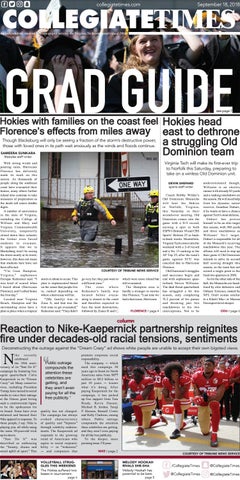
GRAD GUIDE see page 7
Hokies with families on the coast feel Hokies head Florence’s effects from miles away east to dethrone Though Blacksburg will only be seeing a fraction of the storm’s destructive power, those with loved ones in its path wait anxiously as the winds and floods continue. SAMEERA SUNKARA lifestyles staff writer
With strong winds and pouring rains, Hurricane Florence has definitely made its mark on this nation. As thousands of people along the southeast coast have evacuated their homes, many others further inland also continue to take measures of preparation as the death toll enters double digits. A number of universities in the state of Virginia, including the College of William and Mary and Virginia Commonwealth University, temporarily closed down their schools; the former even forced students to evacuate. It appears that we in Blacksburg won’t be seeing the storm nearly at its worst; however, this does not mean that students here have not been affected. “I’m from Hampton, Vi rgi n ia,” sophomore Enrique Redeemer said. “I was kind of scared when I heard about (Hurricane Florence), and I called home the first day.” Located near Virginia Beach, Hampton and the surrounding areas have a plan in place when a tropical
a struggling Old Dominion team
Virginia Tech will make its first-ever trip to Norfolk this Saturday, preparing to take on a winless Old Dominion unit. DEVIN SHEPARD sports staff writer
COURTESY OF TRIBUNE NEWS SERVICE
storm is about to occur. This plan is implemented based on the zones that people live in, ranked depending on where a hurricane will hit. “(My family) was in Zone A, and that was the first zone to get evacuated,” Redeemer said. “They didn’t
go very far; they just went to a different zone.” The zone where Redeemer’s family was located before evacuating is closest to the coast and therefore expected to face the most destruction, followed by Zones B and C,
which were more inland but still evacuated. The Hampton area is hardly a stranger to storms like Florence. “Last time we had a hurricane, Hurricane FLORENCE / page 4
Coach Bobby Wilder’s Old Dominion Monarchs will host the Hokies in Nor folk, Virginia, this Saturday in their second-ever meeting. Old Dominion comes into the game with a 0–3 record, earning a spot in both ESPN’s Bottom 10 and CBS Sports’ Bottom 25 in backto-back weeks. Meanwhile, Virginia Tech comes into the weekend with a 2–0 record and a No. 13 ranking in the AP Top 25, after the team’s game against ECU was canceled due to Hurricane Florence. Old Dominion’s struggles and successes begin and end with sophomore quarterback Steven Williams. The dual threat quarterback has struggled a bit this season, only completing 51.2 percent of his passes and throwing just two touchdowns to his two interceptions. Not to be
underestimated though, Williams is an electric runner with already 83 yards and a rushing touchdown on the season. He will need help from his dynamic senior receiver, Jonathan Duhart, if he wants to have a chance against Tech’s stout defense. Duha r t has proven himself to be an elite target this season, with 360 yards and three touchdowns as Williams’ No.1 target. Duhart is responsible for all of the Monarch’s receiving touchdowns this year. The offense will need to step up their game if Old Dominion intends to solve its second half scoring drought this season, as the team has not scored a single point in the final two quarters in 2018. As for the other side of the ball, the Monarchs are headlined by elite defensive end Oshane Ximines, touted by NFL Draft scouts similar to a Khalil Mac- or Marcus Davenport-level sleeper
ODU / page 6
column
Reaction to Nike-Kaepernick partnership reignites fire under decades-old racial tensions, sentiments
N
Deconstructing the outrage against the “Dream Crazy” ad shows white people are unable to accept their own bigoted views. i ke r e c ent ly celebrated the 30th anniversary of its “Just Do It” campaign by featuring free agent quarterback Colin Kaepernick in its “Dream Crazy” ad. Many conservatives, including President Trump, have turned to social media to voice their outrage at the fitness giant hiring such a controversial figure to be the spokesman for its brand. Some have even defamed and burned their Nike apparel in response. To those people, I say: Nike is playing you, all while using the same 30-year-old trick up its sleeve. “Just Do It ” was described as embracing the “beauty, drama and moral uplift of sport.” This
“
Public outrage compounds the attention these celebrities are getting, and they aren’t even paying for all the free publicity.”
quality has not changed. The campaign has always evoked cha racter istics of quality and “hipness” through celebrity endorsements. The Kaepernick ad responds to the growing trend of Americans who aspire to social responsibility — or “wokeness” — and companies that
VOLLEYBALL STRUGGLES THIS WEEKEND The Hokies suffered two losses in tournament.
page 6
promote corporate social responsibility. The company — which used this campaign 30 years ago to boost its North American sales from $877 million to $9.2 billion in just 10 years — knows what it’s doing. After paying Kaepernick for the campaign, it has picked up free support from Tom Brady, Kevin Durant, Michael B. Jordan, Taraji P. Henson, Russell Crowe and Kelly Clarkson, among others. Public outrage compounds the attention these celebrities are getting, and they aren’t even paying for all the free publicity. To the deeper, more pressing issue: I’ll pose NIKE / page 2
COURTESY OF TRIBUNE NEWS SERVICE
MELODY HOOKAH RIVALS SHE-SHA Melody Hookah has potential to be best.
page 5
/CollegiateTimes
@CollegiateTimes
@CollegiateTimes
@CollegiateTimes
opinions
PAGE 2 September 18, 2018
editor@collegiatetimes.com
collegiatetimes.com
collegiatetimes.com/opinion
NIKE: Kaepernick backlash indicates need for progress from page 1
three theories as to why white people are increasingly upset about black people asking the police not to shoot us — I mean, Colin Kaepernick. They believe that black people hate veterans and police officers. They also believe that kneeling during the anthem is meant to disrespect those personnel who work in dangerous conditions — sacrificing valuable family time, emotional capital, psychological well-being and some even their lives — to protect us. Soon after the first kneeling controversy began, I attended a show directed by Billy Bungeroth called “Black Side of the Moon,” featuring an all-black cast of Second City improv performers. Just before the intermission, the cast invited a white audience member onstage, asked him to dance a bit and then formed a line stretching across the stage with the audience member poised squarely in the center. “The Star-Spangled Banner” began to play. Toward the end, the cast members began to kneel one by one from the outside until the only person left standing was the audience member, who had plenty of opportunity to follow suit, especially after a spotlight was directed at him. However, he dissented, leaving himself alone standing onstage, the unsusceptible dupe of a brilliant stunt. Black Americans have been trying to wake white America up to the evils left behind by slavery, Jim Crow and segregation. Now that we have videos depicting black men, women and children beaten, abused and tortured by those meant to protect us, we thought America would take notice. We thought America would
join our cause. We published the stories of our fallen in newspapers, plastered the internet with their pictures and shouted their names in the streets. But to the broader white American public, our stories are of little interest. Our names do not evoke feelings of solidarity. Our faces do not appear familiar to them. Just as the unsuspecting audience member, they have declined to participate. So hating veterans and police officers is not the problem. Black people are more than represented in the military. In 2015, 17 percent of active duty military members were black, though our share of Americans 18 to 44 years old was 13 percent. While communities of color face strained relations with police officers, hating the police is not the focus. The act of kneeling as practiced by Kaepernick is to highlight systematic racism and police brutality against black Americans. People are misrepresenting the cause as anti-police or anti-military to undermine its true meaning. They are unwilling to face their own racist attitudes that allow them to believe America is truly egalitarian. Unfortunately, America is not a land of equal opportunity. As much as we are taught that segregation was outlawed in the mid-20th century, segregation still continues in 21st century America. In fact, public policy — especially within education and housing — supports residential and school segregation. Schools attended by black students have had poverty rates soar from 40 percent to 60 percent over the last 20 years, meaning schools have become more segregated during that time. Because educational quality is directly correlated with property tax revenue
— all derived from public policy — concentrated poverty is an ill that has yet to be remedied by policy en masse, though we have the tools to do so. This is disheartening because we know that lifting people out of poverty begins with true desegregation. Disparate outcomes in personal health, public health, life expectancy, educational attainment, socio-economic status, housing and criminal justice all erode the fallacious belief that America has moved into a post-racial society. The “pull-yourself-up-by-the-bootstraps” mentality is completely baseless for many black families who are metaphorically — and sometimes literally — without boots in the first place. They hate black people. Sometimes, it’s easier to just be honest. If anything should be protested against what Nike is doing, it is the wage disparity between the celebrities used in Nike’s ad campaigns and the thousands of factory workers who produce shoes and apparel for Nike. While Kaepernick makes millions and Nike reports a 31 percent increase in sales since the Kaepernick ad aired, people in Vietnam, Indonesia and Thailand are exploited so that we can continue to line Nike’s pockets. But to the broader American public, their stories are not of interest. Their names do not evoke feelings of solidarity. Their faces do not appear familiar. Just as the unsuspecting audience member, America will once again decline to participate.
JARRODD DAVIS • opinions contributor • senior, public and urban affairs
COURTESY OF TRIBUNE NEWS SERVICE Alex Jones speaks at Settlers Landing during the Republican National Convention in Cleveland on July 18, 2016.
column
Right to free speech ends with blatant rule-breaking Twitter guidelines must be enforced to protect users from the harmful rhetoric spread by the likes of Alex Jones and others.
I
n recent months, tech giants and their chief executives have been paraded in and out of Capitol Hill to participate in hearings ranging from user privacy to election interference. Because of their meteoric rise, social media platforms were conceived as unregulated oases for sharing pictures of cats and controversial opinions alike. The vagaries of social media policy have never before been under such heavy scrutiny, and the national debate at hand offers one crucial question: Where does the enigmatic world of social media fit into the framework of our republic? Somewhat overshadowed by the enormity of the congressional hearings was the news that Alex Jones, proprietor of the right-wing website InfoWars and peddler of inane conspiracy theories, had been permanently banned from Twitter. By doing so, Twitter joined YouTube, Facebook and Apple as the latest tech companies to muzzle extremist views on their platforms. Pundits, including many who fundamentally oppose Jones’ views, have offered that this silencing reeks of collusion, and, at the very least, that infringing on free speech is a slippery slope. I have written before about the merits of partisan rhetoric, and that the liberal tendency to pre-empt debate and invoke identity politics is more often damaging to rational discourse than it is helpful in preventing the spread of hateful ideologies. I do not, however, find that this line of reasoning extends so far as to rebuke Jones’ ban from Twitter. The public’s debate
with Jones has not been preempted. Jones has been allowed to use Twitter, among other platforms, to defame survivors of the Sandy Hook Elementary School shooting, and to misidentify the Marjory Stoneman Douglas High School shooter. He recorded a live video inciting his supporters to gather their “battle rif les” to fight “Chicom (slang for Chinese Communist) operatives” working in mainstream media. Through it all, Twitter CEO Jack Dorsey had — somewhat laudibly — maintained objectivity, only administering shadow bans when Jones violated Twitter’s terms of service. When the aggregate of Jones’ transgressions grew too great, Dorsey finally decided that a permanent ban was in order. Alex Jones is an unhinged man with detestable views, and his vapid approach to political discourse identifies insipid followers, tapping into their innumerable insecurities and seeking to monetize them. More important than any of that, though, is the simple fact that Alex Jones broke the rules. Twitter has rules against abuse, especially those “targeted at an individual or group of people.” The rules continue to stipulate that hateful conduct is a bannable offense, including acts that “promote violence.” However intellectually stimulating it may be to wax poetic about the implications of limiting speech on internet forums, the rules that bind all users to a certain level of decorum were broken by Jones time and again. Most other assertions are pabulum.
I can be counted as one who abhors the hypersensitive tendencies that seem so prevalent in our society. However, Jones’ Twitter ban is not symptomatic of our microaggression culture. Alex Jones does not deserve a platform on Twitter because he breaks the rules. The fact that he is widely disliked makes for a satisfying, albeit secondary, subtext. It is clear that internet sites have the right to ban people who so blatantly violate their terms of service; however, it remains unclear whether or not sites have an inherent responsibility to police speech that exists on the razor’s edge — speech that merely dips its toes in the deluge of hate instead of coldly diving in. This dichotomy illustrates just how much work there is to be done to improve discourse on social media platforms. Jones, however he is regarded by the public, should not be considered the poster-child of the struggle for free speech on the internet. His rhetoric exists somewhere far from the vast gray area of speech that confounds social media executives, somewhere planted firmly in targeted hatred and divisiveness. Jones’ Twitter presence was far from some linchpin preser ving unabr idged speech, so don’t despair; I certainly won’t weep for the loss of an account and platform that inspired exactly zero critical thought in anybody, friend or foe.
TRAVIS BAUER • opinions columnist • senior, civil engineering
COLLEGIATETIMES NEWSROOM. . . . . . . . . . . . . . . . . . . . . . . 231-9865
Assistant opinions editor: Justin Redman
Editor-in-Chief: Jessica Brady (editor@collegiatetimes.com)
Photo editor: Kaila Nathaniel
Managing editor: Izzy Rossi Assistant managing editor: Ashley Long Design editor: Sajanee Chithranjan
COURTESY OF TRIBUNE NEWS SERVICE San Francisco 49ers outside linebacker Eli Harold (58) and quarterback Colin Kaepernick (7) take a knee during the national anthem before a game against the Miami Dolphins on Sunday, Nov. 27, 2016. Voice your opinion. Send letters to the Collegiate Times. All letters must include a name and phone number. 365 Squires Student Center Students must include year and major. Faculty and staff Blacksburg, VA, 24061 must include position and department. Other submissions opinionseditor@collegiatetimes.com must include city of residence and relationship to Virginia Tech (i.e., alumni, parent, etc.). We reserve the right to edit for any reason. Anonymous letters will not be printed. Letters, commentaries and editorial cartoons do not reflect the views of the Collegiate Times. Editorials are written by the Collegiate Times editorial board, which is composed of the opinions editors, editor in chief and managing editors.
Copy editors: Alyssa Gilman, Hannah Goode and Becky Sutton News editor: Mike Liu Lifestyles editor: John Battiston Assistant lifestyles editor: Emily Hannah Sports editor: Maddie Thompson Assistant sports editors: Dillon Campbell and Robby Fletcher Opinions editor: Neha Ogale
Assistant photo editor: Anthony Wu Social media editors: Meg Connors and Anna Davis
Have a news tip? newstips@collegiatetimes.com
BUSINESS STAFF. . . . . . . . . . . . . . . . . . . . 231-9860 Business manager: Abby Setash (business@collegemedia.com) MEDIAMATE. . . . . . . . . . . . . . . . . . . . 888-897-7711 collegiatetimes.com/media_kit/ orders@mymediamate.com
The Collegiate Times, a division of the Educational Media Company at Virginia Tech, was established in 1903 by and for the students of Virginia Polytechnic Institute and State University. The Collegiate Times is published every Tuesday of the academic year except during exams and vacations. To order a reprint of a photograph printed in the Collegiate Times, visit reprints.collegemedia.com. The Collegiate Times is a division of the Educational Media Company at Virginia Tech, Inc., a 501(c)3 nonprofit with a mission to provide educational experience in business and production of mass media for Virginia Tech students. © Collegiate Times, 2018. All rights reserved. Material published in the Collegiate Times is the property thereof, and may not be reprinted without the express written consent of the Collegiate Times.
news
editor@collegiatetimes.com
September 18, 2018 PAGE 3
collegiatetimes.com
collegiatetimes.com/news
Town-Gown meeting sparks discussion about history of Blacksburg as college town ISABELLA ROSSI managing editor
The Blacksburg Town/ Gown prog ra m is a collection of Blacksburg citizens, Virginia Tech staff and students who voluntarily meet to work together toward goals that are important to both the town and the university, with the ultimate goal of blending the Blacksburg and Virginia Tech communities. Some issues that are regularly covered by the Town-Gown committee include proactive education about quality of life issues and neighborhood stability. The first Town-Gown meeting of the 2018 fall semester was hosted on Sept. 13 and covered the topic “Why Blacksburg? A History Lesson about a College Town.” The first half
of the lecture covered the history of Blacksburg from 1706, when the first colonies and settlements emerged in Virginia, to 1799, the year after Blacksburg was founded. “These meetings are going to be really exciting because we’re going to learn about why Blacksburg is here and why Virginia Tech is here,” said Hugh Campbell, member of the Board of Directors of the Blacksburg Museum and Cultural Foundation. “I think people can live in Blacksburg for years and not even think about how the town got here. It’s a lot more interesting and a lot more important than most people would guess.” The second half of the Town-Gown topic covered the years 1807–1999 and focused primarily on the way Virginia Tech has affected
Blacksburg. “It’s important for everyone to remember how fundamentally different Blacksburg would be without Virginia Tech,” Campbell said. “I think people can complain about things the university does and forget how much of the development of Blacksburg into a wonderful town would not have happened without Virginia Tech.” The next Town-Gown meeting will take place on Oct. 11 at the Alexander Black House, 204 Draper Rd. The meeting will cover the topic “Future Development in in Blacksburg Downtown Core” and will be hosted by Matt Hanratty and Steve Ross.
@IzzyRossiCT
TAHREEM ALAM / COLLEGIATE TIMES Hugh Campbell, member of the Board of Directors of the Blacksburg Museum and Cultural Foundation, gives a presentation about the first two centuries of the history of Blacksburg at the first Town-Gown Meeting of the school year, Sept. 13, 2018.
Virginia Tech receives more than $150 million in donations for the second fiscal year in a row Virginia Tech established Giving Day, a 24-hour-long event, for alumni, sudents, faculty and staff to give back to the university. BENITA LUKE
news staff writer
According to U.S. News, Virginia Tech has received more than $150 million in donations for the second year in a row. “I continue to be impressed by the spirit and generosity of the Hokie Nation, and I’m grateful for our donors’ commitment to the future,” said Virginia Tech President Tim Sands in a VT News press release. “They make it possible for us to fulfill our land-grant mission to change lives and communities through research and education, and
they empower our vision to become a leading global university.” In March 2018, a $20 million donation was made by David Calhoun toward Virginia Tech’s Honors College. Coined t he Ca l houn Honors Discovery Program, the initiative will build on the long-standing Pathways for General Education program and will help students integrate multiple disciplines. According to VT News, starting in 2019, 50 first-year students who will be known as the Calhoun Honors Discovery Fellows will receive scholarships.
Moreover, these donations also include a $5 million gift from Joe T. May and family to create the May Family Foundation Pathway. This will be a multi-year program that will try to encourage more first-generation students to enroll at Virginia Tech. The funds will go toward recruiting 60 students to connect and learn from the school’s College of Engineering through four sessions throughout their high school career. “The a dva n c e m e nt division has a mission to engage, communicate with and secure philanthropic gifts from a variety of
different audiences, but first and foremost, these donations come from alumni and friends, corporations and parents,” said John Torget, assistant vice president for leadership gifts and annual giving. One notable corporation we recognize is Boeing, who formed a $3 million partnership with Virginia Tech in support of Virginia Tech’s Honors College Discover Program.” With the establishment of Giving Day, the school also opened its doors to $1,626,389 and 4,841 gifts. Taking place March 20–21, 2018, 24 hours were set aside for alumni, students,
faculty and staff to give gifts of any size to help Virginia Tech take a step closer to its mission. “Giving Day is a tried and true ability to rally a university in all positive ways possible,” Torget said. It gives focus to the importance of engagement and giving back. Personally, it gives us an opportunity to mobilize the amazing work that is happening at the university. As to how we map out where to allocate these resources, it really stems from the vision of the university president. President Tim Sands set out a goal and objective, that he’s
reiterated in three different State of the University sp e e ches, to elevate Virginia Tech to become an outstanding 21st century global land-grant university. That vision is the charge for how we go about sharing the message and to encourage people to support the vision, values and mission of the university.”
@CollegiateTimes
Two years after Nicole Lovell’s death, trial of the accused accessory to the murder begins Monday Former Virginia Tech student Natalie Keepers was charged with concealing a dead body and accessory before the fact.
NATALIE KEEPERS MEG CONNORS social media editor
“It is still very confusing to me,” said Tim Keepers during testimony following his daughter’s arrest. “We are just very, very sad.” Natalie Keepers will be standing trial beginning on Monday, Sept. 17 for a charge of accessory before the fact in connection to the death of Nicole Lovell, a 13-year-old girl who was
a student at Blacksburg Middle School. Natalie Keepers came to Virginia Tech in August of 2015 from Laurel, Maryland. She’s one of four children, and her father said during testimony that prior to her arrest, she was a great role model for her other siblings. Beneath the surface, Keepers dealt with mental illness for years. She reported first experiencing mental illness in eighth grade, when she thought about suicide and began cutting herself. She testified that she began seeing a counselor and psychologist at the Cook Counseling Center when she arrived on campus in August, and was taking antidepressants and anxiety medication. The arrest D av i d E i s e n h a u e r, who was a freshman at Virginia Tech at the time, was arrested early in the morning on Saturday, Jan. 30, 2016, in connection with the disappearance of Lovell. Lovell’s mother had reached out to police after
she was discovered missing sometime between midnight and 7 a.m. on Wednesday, Jan. 27, 2016. Eisenhauer developed a relationship with Lovell online, claiming that he thought she was 16 or 17 at first. According to Keepers, Eisenhauer first met Lovell at a Blacksburg party in late 2015 and he woke up the next morning in a ditch without remembering the night’s events. After hearing from friends that he’d been seen kissing Lovell, Eisenhauer allegedly feared that he’d had sex with the 13-year-old. The first public report revealing that Lovell had been found dead was made by her father David Lovell on Saturday afternoon in a Facebook post. “Devestad (sic) to learn that my daughter has been found dead! I’m so in shock I know nothing more to say,” the post read. “I’m broken!” The Blacksburg Police Depar tment confirmed Lovell’s death later that night in a press conference. Eisen hauer was then charged with the first-degree
murder of Lovell, whose remains were found just south of the Virginia state border in Surry County, North Carolina. Keepers was arrested the next day on Jan. 31, 2016, and was charged with one felony count of improper disposal of a dead body and one misdemeanor count of accessory after the fact after the Blacksburg Police Department found evidence of her participation. Keepers was later charged with accessory before the fact, and her charge of accessory after the fact was dropped. According to Commonwealth’s Attorney Mary Pettitt, Keepers said she felt “excited to be a part of something secret and special with Eisenhauer.” Eisenhauer’s trial After being delayed multiple times, David Eisenhauer’s trial began on Feb. 5, 2018. Eisenhauer’s trial ended abruptly on Friday, Feb. 9 when he entered a plea of no contest to all three charges he faced — first-degree
murder, abduction and concealing a dead body — after a turning point in the trial the day before when Blacksburg Police Depa r tment Detective Desiree Twigger testified about messages recovered from a cell phone she had seized from Eisenhauer after his arrest. Eisenhauer’s attorneys im mediately objected, leading to a series of out-ofcourt discussions. The judge, Robert Turk, then called recess until the next morning, when Eisenhauer changed his pleas and a series of text messages from Eisenhauer’s cell phone were read. Once Eisenhauer changed his plea to no contest, Turk found him guilty on all three charges. In a June hearing — after a hearing scheduled for May was delayed — Eisenhauer was sentenced to 50 years in prison and 20 years of probation.
What to expect In August, Keepers pled guilty to concealing a dead body — a move made in attempt to limit evidence
that can be used in her trial for her other charge of accessory before the fact. Her charge of accessory before the fact is far more serious than concealing a dead body, as accessories before the fact may be held criminally liable to the same extent as the person who committed the murder. The charge can lead to up to a life sentence. The trial is set to begin at 9 a.m. on Monday, Sept. 17 at the Montgomery County Circuit Court in Christiansburg. For more coverage about the case, check collegiatetimes.com.
@Meg_Connors7
PAGE 4 September 18, 2018
editor@collegiatetimes.com
collegiatetimes.com
FLORENCE: Hampton families trapped in flooded homes from page 1
Isabel, the only thing that happened to us was our power went out,” Redeemer said. Hurricane Isabel was a major, Category 5 tropical storm that strongly impacted the east coast in 2003. Though its primary target was the Outer Banks of North Carolina, the Virginia Beach area was also hit pretty hard. “The power went out for three weeks, and the only way we could eat was because this one dude was grilling a bunch of food in the neighborhood.” Redeemer said. “Lines for (grocery stores) were long everyday, so there was no point where you could go without having to wait in line. Everybody needed everything at every time until the power came back on. It was just chaos for three weeks. The only problem was the
power, there was no flooding or anything. And just that makes everything so hard.” T h is t i me a rou nd, Redeemer’s family was initially reluctant to leave their home and evacuate, as they felt that this storm would be no different from the last one that hit the area. “They didn’t want to
“
We just got that house a year ago, and I really didn’t want to lose it.” Enrique Redeemer Sophomore Construction engineering management
evacuate, because they didn’t think the rain would affect us since we were in a new neighborhood,” Redeemer said. “I was pretty upset when they
said they weren’t leaving. And they didn’t until the last minute. I guess they watched the news, and it showed them how high the water can get depending on the hurricane. They eventually evacuated, so I was happy at that point.” The Redeemers initially prepared for the storm pretty quickly, the same way that even most students at Virginia Tech did: hitting the grocery stores. “My family was told to stay on the first floor and be aware of trees falling,” Redeemer said. “There was no need to board up our windows. My mom went shopping early, so she was early enough to get all the water and whatnot.” Redeemer’s area was initially supposed to be hit the hardest by Hurricane Florence, but luckily dodged the worst of the storm. Unfortunately, the area is still expected to be hit by severe
study break
f looding, causing many people to be trapped in their homes. “Three of my friends, they all stayed in their houses; they didn’t go anywhere,” Redeemer said. “The only thing they had to deal with is flooding. There’s a street right down from my neighborhood, it’s called Fox Hill, and it’s right by the water. So every time it rains, stuff is lost, like houses. (My friends) are stuck in their houses.” Overall, people from the Virginia Beach area were incredibly lucky that Hurricane Florence’s path was diverted further south. “I feel incredibly relieved,” Redeemer said. “We just got that house a year ago, and I really didn’t want to lose it.”
@CollegiateTimes
Today’s Birthday Horoscope (Sept. 18): Together you rise this year. Focus and coordination animate a dream. Academic studies and travels unveil their mysteries. Group collaboration flowers this summer before changes divert your work and health plans and lead to spiritual breakthrough. Family, creativity and romance take priority this winter. Strengthen your roots.
Hurricane Season
FOR RELEASE SEPTEMBER 18, 2018
Los Angeles Times Daily Crossword Puzzle Edited by Rich Norris and Joyce Lewis
ACROSS 1 Publisher Alfred 6 Spur to action 10 Mus. key with three sharps 14 Lost cause 15 Overconfident racer of fable 16 Hawaiian island 17 Hawaii or Alaska 18 Oil gp. that includes 57-Down 19 Take a load off 20 Horse sense 23 Pool tool 24 Try to win 25 Colonel Sanders facial feature 28 Main attraction 32 Lab maze navigator 33 Letter flourish 34 “... good witch, __ bad witch?” 35 Angry or achy 36 Test proctor’s reminder 40 Soap units 43 Gold in Granada 44 Semiaquatic salamanders 48 The “A” in “IPA” 49 Hard-boiled genre 52 Like Easter eggs before the hunt 54 Duct opening? 55 Debate side 56 Its measurements include liters and grams 60 Squared up 62 Tax-sheltered plans: Abbr. 63 More than suggest 65 Partial view? 66 Scandinavian language 67 Circular 68 Decrease 69 Organic compound 70 Sch. district VIPs DOWN 1 56-Across wts. 2 On the fence 3 Winning like crazy 4 Korda of ’80s-’90s tennis
9/18/18
By Roland Huget
5 Library amenity 6 Camera buff, for short 7 Shoots the breeze 8 Utah city near Provo 9 10-point star polygon 10 Main blood vessel 11 Orchestra leader 12 Contented sighs 13 Stick (out) 21 Years and years 22 Word after fuel or fly 23 LP successors 26 Cup handle 27 Season after printemps 29 Erma Bombeck’s “At __ End” 30 Décor choice 31 MLB’s D-backs 35 Editorial “let it stand” 37 Event often visible in the evening sky 38 “__ tu”: Verdi aria 39 Cutting teeth 40 Derisive interjection
PreviousPuzzle Puzzle Solved Monday’s Solved
©2018 Tribune Content Agency, LLC
41 “Rope-a-dope” boxer 42 Paleo diet protein source 45 Took care of, as a spill 46 Annoy persistently 47 __-cone: summer treat 49 Safety feature at a trapeze school 50 La Brea discovery
COURTESY OF TRIBUNE NEWS SERVICE As torrential rain falls, Sept. 15, 2018, police officers help civilians push a stranded motorist out of the flood water near downtown Lumberton, North Carolina.
U
U
Z
B
H
C
S
H
U
R
E
H
T
G
I
B
T
U
G
T
P
A
X
V
J
J
W L
C
Z
G
W C
J
G
K
M A
I
Q
T
C
Q
T
Q
Q
J
N
L
H
X
Y
B
B
H
B
H
I
Y
N
R
I
Y
V
J
I
V
A
B
F
G
C
L
L
A
F
D
N
A
L
M X
G
G
H
R
U
B
T
H
U
N
D
E
R
H
M G
C
C
W H
J
G
H
N
H
M L
A
C
I
P
O
R
T
B
Z
M I
R
T
D
T
Y
O
D
A
P
D
U
O
L
C
S
O
M K
Z
N
W K
N
S
C
D
O
E
Q
A
F
L
O
O
D
I
N
G
A
D
S
J
H
I
G
N
S
E
T
Y
H
Q
C
H
F
X
U
W D
Y
A
A
S
S
N
C
L
D
K
R
O
L
L
Z
O
O
E
K
R
V
L
Q
X
J
D
G
H
F
V
R
R
A
I
N
R
Z
C
K
V
R
L
H
S
E
G
A
M A
D
Y
G
K
U
O
I
Z
H
N
A
D
D
K
E
F
C
Q
A
Q
E
N
F
H
X
I
M K
J
V
G
E
T
A
U
C
A
V
E
Z
X
O
N
E
A
K
N
A
T
U
R
A
L
D
I
S
A
S
T
E
R
P
Z
J
C
E
K
G
P
R
Z
M Q
J
R
H
G
M R
O
T
S
V
N
G
V
Flooding Windy Lightning Thunder
Storm Cloud Natural Disaster Rain
P
Tropical Damage Evacuate Landfall
xkcd by Randall Munroe
xkcd.com
9/18/18
51 Wall-climbing plant 53 Slow on the uptake 57 Pakistan neighbor 58 “Duck Dynasty” attire, for short 59 Pants, briefly 60 Flow back, as a tide 61 By way of 64 Ave. and st.
Brewster Rockit: Space Guy! by Tim Rickard
Where you go, we go. collegiatetimes.com
editor@collegiatetimes.com
September 18, 2018 PAGE 5
collegiatetimes.com
Hole in the highway: Hilltop Grocery offers a slew of classic country eats Located on US-460 just outside Blacksburg, this hidden treasure thrives behind the facade of an old gas station.
JOHN MCBRIDE
lifestyles staff writer
I first heard about Hilltop Grocery from my Literature and Ecology professor. On multiple occasions she would mention the grocery store on the side of US-460, about nine miles northwest of Blacksburg, and its amazing doughnuts. I knew after about the fourth mention that I needed to go check this place out. One Saturday morning, a few hours before the Hokies pounded William and Mary, I woke up early and decided to drive out there on the way to the Cascades for a hike. What I discovered was unexpected.
When I pulled up to Hilltop Grocery, I had to double-check my map to make sure I was in the right place. It was just a normal gas station that I had passed multiple times on my drive out to Cascade Falls. In that moment I became skeptical. Had my professor fibbed and sent me to get breakfast at a gas station as a cruel joke? Out front of the grocery was a little boy holding out a football helmet asking for donations to his school’s team. Unfortunately I wasn’t carrying cash, but an idea dawned within me. Maybe this place was more than “just a gas station.” If locals knew that the grocery warrants enough foot traffic
— in the middle of nowhere, on the side of the highway — maybe it was just that good. I walked inside and I saw that the place was set up just as any other gas station would be. Aisles were lined with candy bars, peanuts and chips. After a minute of checking everything out, I looked over at the checkout counter. In a little plastic case I saw the fabled doughnuts my professor had sworn by. I then noticed a counter on the wall opposite the entrance. I walked back and saw a glass case with trays of fried chicken, french fries and a menu taped to the counter. As I decided what I wanted to try, two men
ordered a breakfast biscuit with eggs, ham, bacon and cheese from the man behind the counter.
“
All I’m saying is that if you’re in the market for affordable, delicious comfort food, then this is the place to try it out.”
When my turn to order came up, I decided that I had a hankering for some fried chicken. They boxed it up and I then headed to
check out, where I put four doughnuts in a box to go. Maybe I should’ve ordered one of those biscuits, too, but I decided that I didn’t want to spend $15 on breakfast that day. After my c of fe e, doughnuts and fried chicken were rung up by the nice lady at the counter, I waited to hear the total I owed. It all came out to $6.43. I could’ve ordered three biscuits and still not have broken my budget! But how did the food taste? I easily inhaled the doughnuts with fruit filling and the juicy, delicious fried chicken. The coffee washed it down nicely to boot. But this place had so much more
Melody’s chic, posh atmosphere clashes with the casual, college-kid aesthetic presented by its competitor. RACHEL KISER
lifestyles staff writer
Since 2004, She-Sha has unanimously dominated Blacksburg’s hookah scene with an urban underground ambiance that has attracted local artists, poets and hookah enthusiasts alike. However, once Mad Dog Boutique closed in 2017, a vacant store at the center of Blacksburg’s bar scene held great potential for whoever made their way downtown. Opening up over the summer, Melody Hookah Lounge brought a chic, posh atmosphere to the downtown area, elevating Blacksburg’s smoking experience. It was unclear if She-Sha regulars would test the waters and find Melody Hookah Lounge to be the new Friday night hangout spot. Across the street from the newly opened Sugar Magnolia, and neighbors with Champs, Melody Hookah Lounge entices bystanders with strobing neon lights that alert that it is open — despite the dark, dimly lit interior. You walk in, feeling like you entered a swanky, urban bar (with no booze), not a hookah lounge. Black tiled ceilings lead the way to the front desk, as crystal pendants drip from the ceiling. Black and white sofas line the walls, with lowered coffee tables, as well as tables and chairs, in the back of the lounge. Aside from a
migraine-inducing neon blue light neighboring every couch, the lighting was intimate in the sense that if someone was next to you, you wouldn’t be able to see their face unless a plume of smoke came out of it. The music boomed louder than the music playing in my headphones and made group studying very difficult. Its menu offers a plethora of unique hookah flavors: fuzzy lemonade, mango, blue mint, double apple, and other classic fruity concoctions such as a fresh fruit head and non-tobacco flavors. A sign forecasted that food was coming soon, but in the meantime, the lounge sold munchy food like candy and a wide variety of Turkish and American beverages. The Turkish coffee had a spicy bite to it that faintly resembled tumeric and rosemary (it made my lips pucker), but I was enthralled since no other place in Blacksburg offers this foreign blend. Despite the or nate hookah that I smoked out of, the flavors were slightly disappointing. The double apple was discouraging, tasting more like overchewed peppermint gum and missing that crispy apple tang. On the plus side, the service at Melody Hookah Lounge was above and beyond. Cleanliness is a big factor for me when I try a new hookah bar, and
this one takes the cake. My hookah and coffee came quickly, my coals were replaced well before they extinguished and the employees were enthusiastic about answering my random questions, especially about what “fuzzy” lemonade and “sweet” coffee meant. If you are looking for a new place to relax with friends and are trying avoid packed bars and drunk people, Melody Hookah Lounge could be a great hangout spot for you. However, what Melody forgot to include was a col lege -k id aest het ic that would pull Virginia Tech students in the door. She-Sha’s advantage over Melody lies in the cool and easy ambiance that great local joints like Bollo’s and Green’s also hold. It is missing a way to relate and bring college students in for a purpose that isn’t just a two-hour nicotine buzz. However, with the right changes and the superb location, Melody Hookah Lounge has the potential to be the next best hookah lounge of Blacksburg.
are you
to care for athletes?
Join the nearly 400 Virginia Tech alumni who were inspired to attend the private state-of-the-art osteopathic medical school in Blacksburg,Virginia. VCOM is a proud partner of Virginia Tech athletics and has a Sports Medicine Fellowship program with physicians who provide care for Hokie athletes. Visit us online to find out how you will be
inspired...
www.vcom.vt.edu Please visit our website at www.vcom.edu/outcomes for a copy of our Outcomes Report. ©2018 Edward Via College of Osteopathic Medicine. All rights reserved. VCOM is certified by the State Council of Higher Education to operate in Virginia.
@CollegiateTimes
@JohnMcBride98
ANTHONY WU / COLLEGIATE TIMES
The Melody Hookah Lounge in downtown Blacksburg, Sept. 12, 2018.
Melody Hookah Lounge brings great service, wide range of flavors
that I want to try. Breakfast, lunch, dinner. Hamburgers, sandwiches, fries. There are so many ways to fill your stomach. I’m not saying this place is the downright-best breakfast that you can get in the New River Valley. All I’m saying is that if you’re in the market for affordable, delicious comfort food, then this is the place to try it out. From now on, every time I go to the Cascades this place will be my staple breakfast before and lunch after.
PAGE 6 September 18, 2018
sports
editor@collegiatetimes.com
collegiatetimes.com
collegiatetimes.com/sports
Men’s soccer loses heartbreaker to Wake Forest The Hokies had the No. 1 Demon Deacons on upset alert early, but trouble started as the game moved into the second half. CONNOR FORD sports staff writer
Going into their home opener against No. 1 ranked Wake Forest, the Hokies were undefeated with four wins and two ties under their belt. Wake Forest was also undefeated going into this game with an impressive 6–0–0 record. The Hokies took an early lead, but after a frustrating second half, eventually came up just short, suffering their first loss of the season. There were cloudy skies and hyped Hokie soccer supporters as the ball was kicked off at Thompson Field. Through the first few minutes of the game, the procession was even, with Wake having the first shot on goal. Hokie midfielder Marc Hoppler opened the action with the game’s first yellow card in the eighth minute for a slide tackle through his opponent. Even though the procession was even, Wake had most of the game’s chances and shots early. The Hokie defense and goalkeeping remained solid. In the 30th minute, Tech’s Sivert Haugli recklessly
slide tackled Wake’s Brad Dunwell near midfield and was shown red and ejected for the remainder of the game, putting the Hokies down a man for the rest of playing time. Battling adversity being down a man to top-ranked Wake Forest, Tech’s James Kasak skillfully dribbled around defenders in the box and was tripped. This caused the referee to point to the penalty spot, and Jon Ingason went right upper 90 for his second goal of the season, putting his team up 1–0 in the 37th minute. The half ended with zero goals and a yellow card for Wake’s Tater Rennhack, clearly frustrated. The second half began with most of the possession and all the shots for the Deacons through the first 20 minutes. The Hokie’s defense finally broke when Wake’s Aristotle Zarris passed it to Bruno Lapa, who dribbled past defenders and slotted it easily past Tech’s keeper Mathijs Swaneveld in the 66th minute for his sixth goal of the season. Wake kept pressuring and Tech was doing all it could to hold for a tie. Wake’s Omir
Fernandez eventually broke the tie in the 84th minute with an assist past defenders from Justin McMaster, setting him up with an easy finish for his sixth goal of the season. “It was a frustrating game; the goals we conceded were not very good,” said head coach Mike Brizendine after the game. He pointed out that it was tough playing a team with the caliber of Wake Forest while being down a man for most of the game. “Halfway through that first half, I thought we were going to win that game,” Brizendine said.
@CTSportsTalk
ANTHONY WU / COLLEGIATE TIMES Kristo Strickler (15) shields the ball from Wake Forest’s Logan Gdula (17). The Hokies lost 1–2 against Wake Forest, Sept. 14, 2018
ODU: Tech will travel to Old Dominion for first time ever from page 1
CAT PIPER / COLLEGIATE TIMES Greg Stroman (3) leads the team out of the tunnel, Sept. 23, 2017.
talent. In spite of his team’s struggles, Ximines has lived up to his billing, with five tackles for life, three sacks and two forced fumbles in 2018. The Hokies young line could have a difficult time protecting Josh Jackson from the redshirt senior out of Ahoskie, North Carolina. To give the Hokies a run for their money defensively, the Monarchs will need a standout performance from sophomore linebacker Lawrence Garner, who leads the team with 42 tackles this season. All in all, Old Dominion will need a complete team performance and great coaching to stick with the Hokies this weekend, and probably a little bit more. As for the Hokies, the team has seen a welcomed success through the first three weeks of the season, with young players stepping up into big roles and thriving. Tech’s running game has been rejuvenated so far this season led by redshir t-sophomore
Deshawn McClease, averaging 4.9 yards per carry, up from Trayvon McMillan’s 3.4 stat from this point last year. Coach Fuente’s offense has also seen new guys break out on the perimeter as well, with two new big receivers being featured in transfer Damon Hazelton Jr. and junior Eric Kumah (both 6-foot-2, weighing 222 and 225 pounds, respectively). The pair has combined for 12 receptions for 238 yards and three touchdowns through the first two games, bringing electricity on the outside. The Hokies defense is headlined by senior defensive tackle Ricky Walker. The senior out of Hampton, Virginia, leads a unit that held Florida State to only three points in week one’s matchup. He will likely be questionable for Saturday’s game after suffering a left leg injury against the team’s home opener against William and Mary. On the back end, the Hokies are led by junior Reggie Floyd and
redshirt-freshman Caleb Farley, who have combined for five tackles for loss, a sack and two interceptions through the first two weeks. The Hokies look to continue their winning streak, on their quest for an ACC Championship appearance for the second time in Fuente’s three-year tenure with the team. With a superior defense, a replenished offense and two weeks of preparation, the Hokies should be able to continue their winning ways against a reeling Old Dominion team this week. The Hokies look to face the Blue Devils of Duke University (3–0) next, traveling to Durham on Sept. 29. Prediction: Virginia Tech 52–10
@DrashawnShepard
Volleyball suffers frustrating loss in the Alamo City During the UTSA Invitational in San Antonio, the Virginia Tech Hokies fell to the No.18 Baylor Bears and UTSA Roadrunners. SARAH SEDWICK sports staff writer
T he Vi rgin ia Tech volleyball team headed to the UTSA Tournament in San Antonio, Texas, over the weekend, to take on No. 18 Baylor University and the University of Texas at San Antonio (UTSA). However, the tournament was not as successful as the Hokies had hoped, which left them walking away with two losses and a record of 9–3. On Saturday, the Hokies
were faced with possibly their toughest opponent yet in the Baylor Bears, which marked their first game against a ranked opponent this season. Baylor kicked off the first set against Virginia Tech with a 5–0 lead, but the Hokies weren’t about to go down without a fight. With a kill from outside hitter Ester Talamazzi, Virginia Tech was able to cut the lead down by two points, marking the score 20–18. From that point on, the Bears and the Hokies
battled for the lead, closing out the match with two ties and an eventual win by Baylor 28–26. The next two sets played out in the same manner with a strong lead from Baylor right out of the gate and a catch-up round from the Hokies. Baylor would go on to win the second (25–18) and final (25–16) sets to wrap up the match. With its next match against UTSA, Virginia Tech planned to recover from its loss to Baylor on
Sunday. Unfortunately, the Roadrunners “out-ran” the Hokies in four sets and won the match 3–1. As UTSA built up a 5–0 lead in the first match, right side hitter Jaila Tolbert put together two kills to get Virginia Tech on the board, but the Roadrunners were able to put together another run, this one by seven (11–4). By the end of the set, the Hokies were not able to catch up and would lose 14–25. In the second set, the Hokies seemed to have
figured out the Roadrunners’ scheme and racked up two points right out of the gate with kills by outside hitter Kaity Smith and Tolbert. The set went back and forth between the two opponents, until Virginia Tech was able to edge out UTSA and go on to win the match 25–20. However, the last two sets seemed to mimic the first with a strong lead by the Roadrunners and a trailing team of Hokies. UTSA went on to win the third (25–21) and final (23–25)
sets to round out the UTSA Invitational. Virginia Tech will return home to the Carilion Court at Cassell Coliseum to take on the University of Pittsburgh on Friday, Sept. 21 at 6 p.m. The game will be aired on ACC Network Extra.
@SSedwick44
editor@collegiatetimes.com
collegiatetimes.com
September 18, 2018 PAGE 7
Kickin’ it with men’s soccer
ANTHONY WU / COLLEGIATE TIMES Jon Ingason (5) takes a penalty kick after a foul and puts the Hokies up 1–0 in the first half. The Hokies lost 1–2 against Wake Forest, Sept. 14, 2018.
ANTHONY WU / COLLEGIATE TIMES James Kasak (8) attempts to steal the ball from Wake Forest’s Aristotle Zarris (7) as he approaches the goal. The Hokies lost 1–2 against Wake Forest, Sept. 14, 2018.
ANTHONY WU / COLLEGIATE TIMES Marc Hoppler (17) races downfield as Wake Forest’s Aristotle Zarris (7) and Eddie Folds (19) chase him. The Hokies lost 1–2 against Wake Forest, Sept. 14, 2018.
Designed exclusively for students with STEM backgrounds, the Master of Science in Law degree provides practical, focused legal training in business law & entrepreneurship, intellectual property, and regulatory strategy. MSL students learn to communicate across disciplines, navigate the legal and regulatory structures that exist in STEM settings; bring ideas to market; and develop, protect, and manage IP. Become a more well-rounded professional and expand your career opportunities. The MSL program is offered full-time and part-time in a residential format, and part-time in an online format. Learn more and apply now! For more information, go to www.law.northwestern.edu/msl.
PAGE 8 September 18, 2018
editor@collegiatetimes.com
collegiatetimes.com
BE THE CHANGE. At the William & Mary School of Education, we’re preparing students to be transformative leaders in education. Our students go on to become teachers, counselors, researchers, advocates, policymakers and pioneers. Whether working on a local, national or global scale, our alumni change lives.
OUR GRADUATE PROGRAMS:
Students at ASL are given the opportunity to earn certificates in the following areas:
HIGHER EDUCATION ADMINISTRATION K-12 ADMINISTRATION
Natural Resources Law Criminal Law Litigation
CURRICULUM AND LEARNING DESIGN EXECUTIVE ED.D. ELEMENTARY EDUCATION
Contact us today to learn more or to schedule a visit!
SECONDARY EDUCATION ESL/BILINGUAL EDUCATION SPECIAL EDUCATION SCHOOL COUNSELING COUPLES, MARRIAGE AND FAMILY COUNSELING CLINICAL MENTAL HEALTH COUNSELING ADDICTIONS COUNSELING
Appalachian School of Law is located in scenic Grundy, Virginia, just over 100 miles from Virginia Tech’s main campus.
Visit us at the Graduate & Professional School Fair!
Hear Yourself Think
September 24 5:00 – 8:00 pm Squires Student Center
education.wm.edu
1169 Edgewater Drive, Grundy, Va. 24614 www.asl.edu · admissions@asl.edu 276-244-1203
editor@collegiatetimes.com
September 18, 2018 PAGE 9
collegiatetimes.com
GRAD GUIDE Grad school options with campuses (almost) as pretty as Virginia Tech
The aesthetic of your graduate school is more important than you think it is. Here are some gorgeous nearby institutions to consider. BRYCE NOLAN
lifestyles staff writer
As our seniors gear up for graduation and possibly start looking for graduate schools to attend, one thing to always keep in mind is just how much they will enjoy simply being on those graduate school campuses. This may seem miniscule in the long run, but your day-to-day experience in graduate school is going to be heavily influenced by the aesthetic beauty of the school you attend, and a pleasant-looking school can go a long way toward
boosting a student’s enthusiasm. So for those students, here are a few schools that both exceed in the academic areas in which Virginia Tech produces top students and are exceedingly beautiful. Vanderbilt University Vanderbilt, in Nashville, Tennessee, ranks third in beauty on The Princeton Review, as well as placing rather high on lists ranking both law and engineering schools. One standout building is the Engineering and Science Building, which melds both classical redbrick and tall windows
in a wavy building structure to produce an interesting contrast between the old and the new. Another interesting site is the Old Gym, built in 1880, which now houses Vanderbilt’s office of admissions. College of William and Mary The second oldest college in the United States after Harvard, founded in 1693 by its namesake monarchs, William and Mary will instantly transport anyone who visits back nearly 300 years. Being an integral part of the aesthetic of colonial
COURTESY OF WIKIMEDIA COMMONS Robins School of Business, Richmond University.
Williamsburg gives this campus a sense of age and wonder, and having a pretty good law school doesn’t hurt either. One notable building is the Wren Building, the oldest college building in the United States, which was designed by famed English architect Christopher Wren. Also of note is the Crim Dell bridge, a scenic pond crossing that is home to a number of romantic urban legends. University of Richmond In terms of beauty, Richmond ranks eighth on the Princeton Review, but
I’d personally put it higher if I could. The Robins School of Business is a feast for the eyes, and Jepson Hall isn’t too shabby either. Richmond’s law school comes within the top 50 law schools in the country as well. Interestingly, the university is now offering virtual tours of the Richmond campus through the company YouVisit, so if you’re considering Richmond, a virtual tour might just be the way to learn about the campus. Art is a support system for life, as the saying goes. And any place where you
plan to spend quite a bit of time better be a place you can stand to look at. A pretty campus does not a college make, but it can help in making a decision about what path you’d be happiest to take in your ever-nearing transition to adulthood. For students who value the aesthetic of college architecture, these are just a few of the most beautiful graduate schools that the United States has to offer.
@CollegiateTimes
COURTESY OF TRIBUNE NEWS SERVICE
PAGE 10 September 18, 2018
editor@collegiatetimes.com
collegiatetimes.com
Student- and adviser-approved strategies for applying to grad school What kind of program do you want? Do you know your deadlines? What’s your budget? These are the questions you should ask.
HEATHER TROBRIDGE lifestyles staff writer
The stress of picking out the perfect graduate school with the best program and a great location is a difficult process. Finding the best place to spend your undergraduate years is hard enough; now you have to start all over again for graduate school, if you plan on attending. It may feel similar to preparing to apply to an undergrad school, but the drama of studying for the GRE, preparing for interviews and writing personal statements is enough to make anyone feel like they’re in over their head. Janice Austin, assistant dean and director of admissions and academic progress for the Graduate School at Virginia Tech, provided insight into what a graduate school looks for in a student. Aside from high academic standing and a good GPA, she stressed that a student is more than their test scores and should use undergraduate experiences to their advantage. “If (students) want to go to higher-ed student affairs, (they must show) that they’re active as a student leader on campus,” Austin said. “If they’re wanting to go into a research type of field, (they must show) that they’ve done some kind of undergraduate research experience … other things that make them well-rounded and bring something to the table for that institution.” With that in mind, there are some things to consider when actually looking at
ETHAN CANDELARIO / COLLEGIATE TIMES
• Spacious 1, 2, and 3 bedroom homes! • Private balcony or patio • Majority of utilities in monthly value rate • Wired for high-speed internet access • Large Walk-in Closets • Pet friendly (restrictions apply) • Private laundry facilities in each building • Optional washer/dryer in apartment home • Optional furniture and all-inclusive packages
750 Hethwood Blvd. #100 G • Blacksburg, VA 24060 877-746-1676 • www.HethwoodLiving.com 800-828-1140 (TTY)
potential graduate schools and deciding whether they work for you. The program is obviously priority No. 1. Whether it’s for a Ph.D., an M.A., research or anything in between, every school offers a program that is a little different from all the rest. Tracey Myers, a senior neuroscience and biology double major, is applying to doctorate programs. “I’m looking for places that have good funding from the NIH (National Institutes of Health) and places like that, as well as a variety of research topics that I would be interested in,” Myers said. For sen ior hu ma n nut r ition, foods, and exercise major Junaid Qadir, dental schools with a strong clinical background and educational background are determining factors for picking a school. “Some of the ones I’m applying to, like Columbia, have an integrated system with the med school, so it’s like the best of both worlds when it comes to education,” Qadir said. Luckily, students like these have many tips and tricks to offer to make the application process feel slightly less overwhelming. Know your deadlines and be early Everyone will tell you: Be early. Many schools have a timeline published on their websites of important dates to remember when applying to their graduate programs. “It’s basically like rolling admissions for all these schools, so it’s first come, first served when they look at your application for an interview,” Qadir said Time management is key, especially when it comes
to planning for taking the GRE or GMAT, writing essays and getting all of your recommendations. Deadlines will creep up, so be sure to be mindful! Take advantage of the resources available to you Tech offers a variety of resources for its students who are applying to graduate programs to assist in a successful process. Austin says to use “the Writing Center through the library that can help with writing your statement of purpose or any of your academic essays that may be required of you” and “the career services center that can look over your resume or CV to make sure you’re highlighting all the things you want there.” She also suggests using the Office of Recruitment and Diversity and Inclusion at Virginia Tech’s Graduate School. Receive a strong letter of recommendation Austin stresses that the best person to have write a letter of recommendation is your professor. “Get faculty members that can talk to your academic capabilities to supervisors that may supervise you as a student leader or supervise your internship or research experience,” she said. As a student, Myers agrees that creating strong relationships with her professors have helped her throughout the application process. “Any professor that you’re going to have, especially if you’re going into a sciencebased Ph.D. program … (has) been through what you’re going through right now, so they’re really the best people to give you advice and support you,”
Myers said. Apply to more than one school Just like applying to undergraduate schools, be sure to apply to more than one school and not put all your eggs in one basket. Austin recommends applying to three to four schools. “Maybe one’s your dream school, one’s one that you’re pretty confident that you can be competitive at and one that maybe you’re sure you’re doing well in,” Austin said. “But don’t just limit yourself to that one opportunity.”
Consider your budget Austin also suggests looking into application fee waivers, as applying to grad schools can get expensive fast. The cost of applying and sending transcripts to multiple places can add up quickly, so there’s no harm in asking — even if you don’t qualify.
Be confident in your ability to succeed While you aren’t the only person to be applying to a graduate school, it can be intimidating to think of who you are applying against. Qadir suggests avoiding certain forums, like Student Doctor Network, where people share their stats and scores; it’s enough to shake anyone’s confidence. “Just know your application and know who you are and just have confidence that everything will work itself out,” he said. No matter what happens throughout your application process, following these steps may help to make it go as smooth as possible!
@Heather__Tro
editor@collegiatetimes.com
September 18, 2018 PAGE 11
collegiatetimes.com
What to expect from your transition from undergrad to graduate studies Aside from classes being obviously tougher, expect three-hour lectures, smaller class sizes, and never, ever skip the reading. MARISSA WHARTON lifestyles staff writer
Remember how we were told college would be an entirely different ball game than high school? Well, the same goes for graduate school versus undergraduate studies. I recently sat down with Janice Austin, the assistant dean and director of admissions and academic progress within Virginia Tech’s Graduate School, to talk about what makes school different at the graduate level. In her role, Austin works with students “from the time a student starts their application for admission … through enrollment and awarding their degrees.” In other words, she works with individuals every step of the way whether they are planning their courses of study or reviewing their dissertations. The first thing to expect in grad school is an increase in academic rigor. Graduate class sessions are usually held once a week for three hours. That’s right — no more 50-minute sessions three times weekly. Plus, the work tends to pile up much faster than in previous levels of education. Austin cites the increased amount of readings at the graduate level, as well as the quality and level of writing expectations, as a major point of transition for many students. Not to mention, when your class time rolls around for the week, you must come prepared — if you aren’t, there is nowhere to hide. “If you haven’t done the
assigned readings, then you can’t contribute to the discussions in class. With the class sizes being smaller … it’ll be more obvious if you haven’t come prepared,” Austin said. Sp ea k i ng of class sizes, gone are the days of 500-person lectures. More likely, you’ll be in classes of 10 to 20. The type of students in any given graduate program varies from indiv idu a l s t r a n sit ion i ng straight from earning their bachelor’s degree or master’s degree, to working professionals returning to school. According to Austin, there is a healthy size of both populations, and the needs of each student will vary; some may be coming in straight after graduating from another program, and others may be supporting a family off campus. D ep end i ng on t he program, you may be part of a “cohort” where you and the same few dozen students take the exact same blocks of classes from the beginning of the program through graduation. In other courses of study, you may see some familiar faces from time to time, but you won’t necessarily be with the same classmates for the duration of your graduate school experience. Austin explains that “if you aren’t in a lockstep cohort program, your plan of what classes you can take will vary a lot … You may even be taking classes outside of your department and meet students from outside of your specific program.” A f ter you’ve been
ETHAN CANDELARIO / COLLEGIATE TIMES
University Commencement Ceremony, May 11 2018.
adm itted to graduate school, Austin recommends networking with people from your undergraduate school or from your area who followed a similar path. She also points to departmental websites that often list names of current students in the program, or at least student leaders and liaisons, who can serve as points of contact for questions and advice. “Reach out
to those individuals … and get to know the community” before classes start to ease the transition. As for what makes Virginia Tech’s Graduate School unique? Quite a few things, actually. Austin mentions the rigor; the well-known, highly ranked programs offered; and “frankly, the really great faculty” as just a few of Tech’s graduate school
selling points. “O u r d e a n, Dean DePauw, has really worked hard over her time here to create a sense of graduate community,” Austin said. “The Graduate Life Center was her vision — it’s a place and a space for graduate students to come to get whatever services they need … there’s not anything like it around the country.” Yep — the same GLC we all pass
on the way to classes is a concept unique to Virginia Tech. Think you’re ready to step up to the big leagues after graduation? Just remember to do your research, be organized and stay prepared every step of the way.
@MarissaW19
pursue your passion. Choose from nearly 100 GW Arts & Sciences graduate programs, including: • Anatomical and Translational Sciences • Applied Economics • Applied Mathematics • Applied Social Psychology • Bioinformatics and Molecular Biochemistry • Biomedical Sciences • Biostatistics • Cancer Biology
• Data Science • Economics • Environmental and Green Chemistry • Financial Mathematics • Forensic Sciences • Geographical Information Systems • Mathematics • Physics • Statistics
The George Washington University’s Columbian College of Arts and Sciences, a hub of learning and research in the heart of Washington, D.C., is preparing the next generation of scientists, mathematicians and statistical experts to meet the challenges of the 21st century.
GO.GWU.EDU/CCASINFO
The George Washington University does not unlawfully discriminate in its admissions programs against any person based on that person’s race, color, religion, sex, national origin, age, disability, veteran status, sexual orientation, or gender identity or expression.
PAGE 12 September 18, 2018
editor@collegiatetimes.com
collegiatetimes.com
It’s never too early: Preparing for graduate school as an underclassman Grad school prep doesn’t have to wait until your senior year. Take these steps to think ahead if you think grad school may be for you. ASHLEY LONG
assistant managing editor
Just the words “graduate school” may send shivers down your spine. You’ve just started your undergraduate education and you can’t handle the thought of doing more school after four years, or maybe you’ve thought about it too much and now it scares you. Either way, there are things you can do as an underclassman that may help ease your mind when you have to start the graduate school process. Figure out if you actually need to go This may seem like an obvious first step, but you would be surprised how many people just assume they need a graduate degree these days. Depending on your major, it may be a requirement for occupations you’re interested in; however, you should not worry about going to graduate school until you actually know if it’s something other students in your major are considering. There are two great resources available to help you figure this out. The first is your academic adviser, who should be able to give you a nudge in the right direction. He or she is trained to answer your questions and has plenty of experience doing so. Your adviser may also be able to suggest schools and programs for you to check out. Secondly, you have the internet at your disposal. Go on LinkedIn and look at the profiles of people who are holding jobs you would like to have one day. Look at their experience and their education levels. If you see a master’s or doctorate degree in their field, you at least know that specific job may require graduate school. You may also see that they graduated from a four-year program with a bachelor’s degree and still got your
dream job. While LinkedIn may not be reliable enough alone to determine your entire future, it doesn’t hurt to see what professionals in your field decided to do when they were in your position. Start looking at a variety of schools that have your graduate program If you’ve solidified that you’re going to stay in your major and you need graduate school, start exploring schools that offer the program or degree you want to pursue. It’s in your best interest to look at schools that are considered both “easy” and “impossible” to get into, for more variety. Just like when you applied for college after your senior year of high school, it’s beneficial to have safety schools to fall back on; however, don’t just pick them at random. There’s no point in spending time and money applying to schools you don’t like, just because they’re easy to get into. Apply to schools you’re passionate about, whether you think you’ll get in or not. On the flip side, don’t just apply to schools that you think will look impressive on your resume. Getting into an Ivy League school doesn’t necessarily mean that their degree is more meaningful than one from another university. Do your research and see which school actually has the most highly acclaimed program for the degree you want, because the employers you’ll be looking to work for will know those distinctions. Make a definitive plan for your preparation process The sooner you know what is required by the schools you’re interested in, the sooner you’ll be able to start preparing to apply. Research the average GPA requirements, see if there are any recommended courses
The atrium of the Graduate Life Center, Feb. 1, 2017.
to take before applying, and see if your program requires any experience in your field before admission. Write down these characteristics (along with any others you might find useful) for each school you’re interested in. When you hit junior or senior year, you can add application deadlines to your list to make sure you never miss anything. Ad d it io n a l ly, sta r t considering who you may want recommendations from. If you have a professor you really click with, try to maintain that relationship as much as possible. That way, you can secure their positive
recommendation early on and you’ll have a support system from a faculty member when you begin the process. Now that you have recommenders and requirements figured out, start seeing what criteria you already meet and what you need to work toward. You may need to boost your GPA, rearrange your course schedule to fit to the program’s needs or look for an internship in your field. If you need to do any of those things, you can start now and get ahead of other applicants you will be competing against. If you already meet
BILLY CLARKE / COLLEGIATE TIMES
several of the requirements that your top schools are looking for, that’s great … but don’t stop there. All this means is that you’re a little more ahead than your competitors may be. If you can surpass all of the requirements you already meet, your chances of admittance into your dream program are just that much higher. Don’t let the idea of graduate school intimidate you. There are things you can do now that will help get you into the mindset of going to graduate school and furthering your education. There is no point in being
concerned about getting into your dream program for three whole years if you can start preparing yourself for the process now. If you stay confident, organized and determined, you’ll be just fine when the time finally comes.
@AshleyEL26
Don’t get behind on grad school apps, even if you’re unsure about going As you question whether to pursue a professional degree, doing these activities just might make your decision for you. JESSICA BRADY editor in chief
Deciding to go to graduate school is both a huge financial and time com mitment, and it’s important that you know you’re ready before deciding to enroll. But, you don’t want to get behind while you make up your mind. To help keep you on track, I’ve compiled a list of things that can help you stay on top of your stuff while making a decision. Take the test Most graduate programs require a standardized test. Whether it’s the GRE, the MCAT, the LSAT or another exam, take it while you’re still working on your undergrad. While doing so is not necessary, many students find it easier or more beneficial to take standardized tests while still in an academic setting. Plus, you can still use your score from these tests for a few years. Try working If you aren’t sure grad school is for you, try working in an office in your desired field. For example, if you are considering law school, work in a law office. Even working the front desk can give you good insight
BILLY CLARKE / COLLEGIATE TIMES
into the field and connections in the future. Ask for letters of recommendation When applying to grad school, you’re going to need letters of recommendation from your professors. Don’t wait until the last minute. Explain your situation to them and see if they would be willing to help you if the
time comes. Additionally, they may be able to give you some advice about what grad school is like and whether it’s for you. Visit Visit the schools you’re interested in and talk to people while you’re there. This can give you a better understanding of what life would be like and the people
you would be spending time with. Take a tour, visit a class, talk to an admissions officer. The more complete a picture you have, the easier your decision will be. Look at your finances As terrible as it is, looking at your options money-wise could make your decision for you. It could mean that you need to spend some time
working, look into loans or only look at schools with strong financial aid options. Ask questions Last and most importantly, ask lots of questions. The more information you have, the easier it will be to make a decision. Talk to your professors, advisers, family, friends and role models. Talk to admissions
officers, students and professionals. Take your time with such a huge decision, but don’t fall behind in the meantime.
@TheJessicaBrady