COLL LLEG EGIA IATTETIMES COLLEGIATETIMES.COM
An independent, student-run newspaper serving the Virginia Tech community since 1903
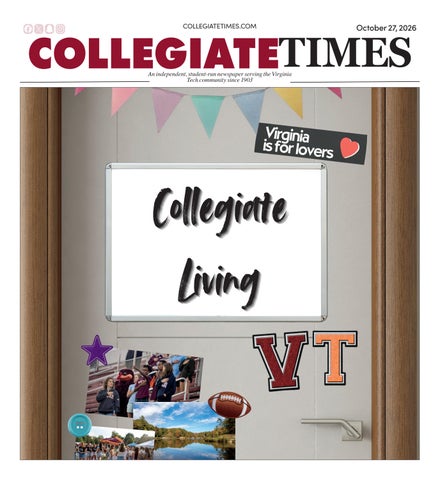
Collegiate Living
October 27, 2026
NEWS
PAGE 2 October 27, 2026
editor@collegiatetimes.com
COLLEGIATETIMES.COM
VIRGINIA TECH DESIGNS WILDLIFE DETECTION SYSTEM TO PREVENT ANIMAL COLLISIONS Abhigna Koochana | News Writer The detection system has a 97% accuracy in detecting wildlife.
DrivingdowntheruralroadsofSouthwest Virginia at night, one of the biggest concerns for drivers is deer, elk and other wildlife. According to Chester Leonard from the Southwest Virginia Wildlife Center to WSET News, fall is their mating season, so it is common to see more of them on or to the side of the roads. To combat this issue, the Virginia Tech Transportation Institute designed an automated system to detect wildlife and notify drivers in real time. According to Bioengineer, the system uses thermal cameras and Artificial Intelligence software to detect wildlife which then displays messages on roadside signs in real time. The system was tested on a 750-meter stretch of Route 460 and the effects were monitored within a 14-mile stretch. According to initial data, drivers who saw the roadside signs about wildlife
slowed down by approximately three miles per hour. “The motivation was to reduce the risk of accidents or fatalities while also protecting the elk in their habitat,” said Jean Paul Talledo Vilela, a VTTI research scientist, to VT News. According to the AAA Foundation for Traffic Safety, approximately 300 people die every year from a collision with a deer, elk or other animal on the road. Additionally, according to the feasibility study, elk collisions on average cost more than $80,000 per crash. “This system is unique because of the requirements of the area. It needed to be solar-powered, portable, and be able to withstand all weather conditions,” Talledo Vilela said. According to VT News, this project was
OUR CORE VALUES Impartiality means reporting, editing and delivering the news honestly, fairly, objectively and without opinion or bias. Credibility is the greatest asset of any news medium, and impartiality is the greatest source of credibility. To provide the most complete report, a news organization must not just cover the news, but uncover it. It must follow the story wherever it leads, regardless of any preconceived ideas on what might be most newsworthy. The pursuit of truth is a noble goal of journalism. But the truth is not always apparent or known immediately. Journalists’ role is therefore not to determine what they believe at that time to be the truth and reveal only
that to their readers, but rather to report as completely and impartially as possible all verifiable facts so that readers can, based on their own knowledge and experience, determine what they believe to be the truth. When a news organization delivers both news and opinions, the impartiality and credibility of the news organization can be questioned. To minimize this as much as possible there needs to be a sharp and clear distinction between news and opinion, both to those providing and consuming the news.
Voice your opinion. Send letters to the Collegiate Times. 365 Squires Student Center
All letters must include a name and phone number. Students must include year and major. Faculty and staff must include position and Blacksburg, VA, 24061 department. Other submissions must include city of residence and opinionseditor@collegiatetimes.com relationship to Virginia Tech (i.e., alumni, parent, etc.). We reserve the right to edit for any reason. Anonymous letters will not be printed.
Letters, commentaries and editorial cartoons do not reflect the views of the Collegiate Times. Editorials are written by the Collegiate Times editorial board, which is composed of the opinions editors, editor in chief and managing editors.
COURTESY OF VIRGINIA TECH NEWS Wildlife Crossing Detector Photo Courtesy of Virginia Tech news!
sponsored by the Virginia Department of Transportation as part of their expansion of Corridor Q, which is an additional 14 miles to Route 460 and is part of the Appalachian Development Highway System. It is also home to about 100 elk. VTTI also partnered with Crosstek which provided the AI software and cameras to develop the system and T-Mobile provided the cellular network and satellite service for
remote monitoring. According to Bioengineer, the system resulted in 97% accuracy in detecting wildlife during the initial stage of deployment. Researchers also see this technology being adapted to additional roadside safety applications.
NEWSROOM. . . . . . . . . . . . . . . . . . . . . . . . . . . . . . . . . 231-9865 Editor-in-Chief: Ava Garrison (editor@collegiatetimes.com) Managing editors: Jenna Mason and Cat Pizzarello Design editor: Sarah Jordan Assistant Design editors: Mx Zaleski, Alana Vernon, Jessica Grow and Harshitha Malay Copy editor: Isaac Liu News editors: Erin Bailey and Julian Namez Assistant News Editor: Hannah Skemp Lifestyles editor: Ella Winterling Assistant Lifestyles editors: Bailey Linza, Samuel Harvey and Annie O’Connell Sports editors: Dylan Tefft, Alex Winn and Brody Bryan
Opinions editors: Shelby Brann and Emily Urda Photo editor: Riley Thompson Have a news tip? newstips@collegiatetimes.com
@COLLEGIATETIMES
COLL LLEG EGIA IATTETIMES
BUSINESS STAFF. . . . . . . . . . . . . . . . . . . . . . . . . . . . . 231-9860 Business manager: Faith Casey (business@collegemedia.com) MEDIAMATE. . . . . . . . . . . . . . . . . . . . . . . . . . . . . 888-897-7711 collegiatetimes.com/media_kit/ orders@mymediamate.com
The Collegiate Times, a division of the Educational Media Company at Virginia Tech, was established in 1903 by and for the students of Virginia Polytechnic Institute and State University. The Collegiate Times is published every Tuesday of the academic year except during exams and vacations. To order a reprint of a photograph printed in the Collegiate Times, visit reprints.collegemedia.com. The Collegiate Times is a division of the Educational Media Company at Virginia Tech, Inc., a 501(c)3 nonprofit with a mission to provide educational experience in business and production of mass media for Virginia Tech students. © Collegiate Times, 2020. All rights reserved. Material published in the Collegiate Times is the property thereof, and may not be reprinted without the express written consent of the Collegiate Times.
Advertisements do not necessarily reflect the opinions of the Collegiate Times. Read about our organization’s Core Values online at collegiatetimes.com.
editor@collegiatetimes.com
October 27, 2026 PAGE 3
COLLEGIATETIMES.COM
HIGH TEMPERATURES THIS OCTOBER LEAD TO CAMPUS ENERGY CURTAILMENT Natalie Shannon | News Writer
Unusually high temperatures can overwhelm energy grids that supply power to communities.
On Oct. 13, the Virginia Tech Division of Facilities sent an alert that an energy curtailment is now underway. The division asked Blacksburg campus members to “turn off and unplug any non-critical lighting and electrical equipment,” according to Virginia Tech News. Virginia Tech generates a portion of its energy, heat and hot water from the Virginia Tech Powerplant. With the plant, Virginia Tech Energy Services provides electric needs to the Virginia Tech campus and to surrounding areas in Blacksburg. The Division of Facilities attributes the request for energy reduction by campus members to “unseasonably” high temperatures affecting the Blacksburg region. Moreover, Blacksburg and surrounding areas have seen abnormally high temperatures throughout 2026.
In April of 2026, Roanoke, Lynchburg and Danville saw their first 90-degree day. High temperatures such as this are uncharacteristic of this region, according to Kevin Myatt, a journalist at Cardinal News. Blacksburg experienced its last 90-degree day on Sept. 24, when in previous years, this 90-degree weather is generally gone with the end of August, except with a recent outlier in 2019. Additionally, on Oct. 2, Roanoke, Lynchburg and Danville hit 90-degree weather. Myatt writes that these regions “have only had 90-degree weather from October 13 to 15 times previously.” Energy grids that supply electricity and power to communities can be overwhelmed by unusually high temperatures, as this causes their production periods to be extended into seasonal scheduled maintenance periods. On Oct. 12, the Department
of Energy issued an emergency order to mitigate anticipated blackout risks in the mid-Atlantic due to high temperatures. The order allows PJM Interconnection, an energy regional transmission organization, to direct the movement of energy during this anticipated high-energy use period. Virginia Tech Power Plant operates under the balancing authority of PJM Interconnection and is therefore subject to the direction of PJM during the period of the emergency order. Virginia Tech’s Blacksburg campus houses about 10,500 students, while the projected total population of Blacksburg is 45,915 based on the 2020 census. Campus residents account for 23% of Blacksburg residents, significantly impacting the total energy expenditure of the town. Virginia Tech’s energy curtailment instruction will help ensure that local grids are not overwhelmed
by trivial energy use. With growing global concern over climate change, there is anticipation of future need for power grids operating near capacity and the need for more emergency orders as high temperatures continue to extend further into autumn months. Ali Mehrizi-Sani, director of Virginia Tech’s Power and Energy Center, stated in an interview with WTOP News, “we need to have more generation and more transmission to be able to deal with the rapid load growth that we are experiencing.” Updates on the status of the energy curtailment will be posted via Virginia Tech News and the Division of Facilities X and Instagram pages.
@COLLEGIATETIMES
“THE RESPONSIBILITIES OF BEING AMERICAN”, HUMANITIES WEEK KEYNOTE ADDRESS BY SCOTT SIMON Marley Vann | News Writer
Simon emphasized that 15% of Americans were born outside the country. On Oct. 20, Scott Simon spoke on the legacies of 1776 and the ideas that shaped America: freedom, equality, independence and sovereignty. “The ability to disagree is what makes us American,” Simon said. Simon is a host for Weekend Edition Saturday and one of the hosts for Up First at NPR. He has reported all over the country, the world and in many wars. Simon has also won several awards, from the Presidential End Hunger Award to the Barry M. Goldwater Award from the Human Rights Fund. Simon was inducted into the Radio Hall of Fame in 2025. Simon opened his speech by emphasizing the responsibility America has to welcome people into the country and show the world that a free society of different people can thrive.
He gave a history lesson, noting the Founding Fathers, the slave trade and the Civil War. Then, he talked of President Abraham Lincoln’s inaugural address, “We can grow, we can improve, and we are not forever bound to our mistakes,” Simon said. Simon voiced facts that about 40% of Americans can trace their ancestors back to arriving in America on Ellis Island and discussed how 15% of United States citizens were born outside of this country, naming Elon Musk, Arnold Schwarzenegger, Sammy Sosa and Albert Einstein. Simon also states that over 700 immigrants have received the Medal of Honor. “I thought it was really interesting, the format of it all, because he started with the historical context of America, which initially I was like, oh, we are getting a history lesson,” said Kristina Dabaghyan, a sophomore
majoring in communication. “But then he delved more into how the past carries on to our current state of responsibilities, and he delved into how we need to be welcoming and got a bit into immigration and issues now.” Simon touches on his time in Iraq and ties it to the power of free speech and mockery we have in America. In his time in Iraq, Simon and other journalists were sifting through case files, and one of them read about a student being imprisoned for scratching something profane against Saddam Hussein on a bathroom stall. “Mockery is one of the forces that tests our freedom and makes the United States stronger,” Simon said. Simon shifts his focus to the progress of America, citing Walt Whitman’s poem “I Hear America Singing” and Langston
Hughes’ “Democracy” in speech. Simon ended with a story about his daughter becoming a United States citizen when the family was called up at the airport. An agent stamped their passports and paperwork and said, “Once you cross that line, your little girl is a citizen of the United States. Welcome home, sweetheart.” Simon was wiping away tears when he said, “That’s what everyone should have.”
@COLLEGIATETIMES
LIFESTYLES
PAGE 4 October 27, 2026
COLLEGIATETIMES.COM
editor@collegiatetimes.com
THE SUITE LIFE OFF-CAMPUS: THE RISE OF LUXURY LIVING IN BLACKSBURG Max Welther | Lifestyles Staff Writer
Lifestyles staff writer, Max Welther gives an inside look at the newest off-campus housing options. An increasing number of modern apartments have popped up around Virginia Tech over the past decade, offering an elevated living experience for students. Modern apartment complexes that call Blacksburg home include Union Blacksburg, Hub Blacksburg, Park 37, Vue, The Flats at Uptown, The Summit, Old Row on North Main, Fourteen35, Cedar Pointe, Brexx at Blacksburg and the newest addition in development, Heyday Blacksburg. Each apartment has opened its doors within the last 10 years. Brexx, previously known as The Retreat, opened in 2016 and rebranded in 2025; Old Row on North Main opened in 2018; Park37 opened in 2020; Cedar Pointe and The Flats at Uptown opened in 2021; The Summit, Hub Blacksburg, Vue and Union Blacksburg opened in 2022 ; and Fourteen35 opened in 2023. Common features and amenities include updated appliances, vinyl and hardwood flooring, stone countertops, community common areas, outdoor spaces with pools and grills, study rooms, cafes, pet facilities, in-unit washing machines and dryers, on-site gyms and more. Select complexes lease by the bed, and all but Vue provide furnished units. Utilities, parking and other fees are often an additional cost, varying by apartment. Luxurious living comes with a matching price tag. One-bedroom units in these complexes begin at $1,520 at Cedar Pointe and range over $1,850 for furnished units at Hub Blacksburg, Union Blacksburg and Park37. Estimated per-person leases in two-bedroom units range from $1,000 at Cedar Pointe to $1,485 at Hub Blacksburg, three-bedroom units from $890 at Vue to $1,399 at Hub Blacksburg, four-bedroom units from $965 at Fourteen35 to $1,319 at Old Row on North Main and five-bedroom units from $1,069 to $1,199 at Brexx. Base rent costs exclude any additional fees. Some Virginia Tech students and local residents have expressed concern about growing rent prices in the area and noted a stark quality divide in the available housing supply. Expensive, modern apartments
and cheaper, dated apartments make up a majority of available options, leaving few in-between alternatives, according to an article from WSLS 10. Blacksburg has one of the highest pre-lease rates in the United States, further adding to availability constraints. Some renters find the higher prices worth it for the experience provided. Grace Wilson, a junior majoring in advertising, has enjoyed her two years living at Park37 and considers it worth the money for the quality, safety and amenities offered. “Before my current living situation, I lived on campus in Hoge Hall freshman year,” Wilson said. “Going from that to Park37 is such an upgrade. I have my own bedroom and my own bathroom. I live in a four-by-four, so each of my roommates have their own space. I have a pretty spacious room, especially compared to our dorms from freshman year.” Hannah Holmes, a junior majoring in physics, lives at Union Blacksburg and also prefers luxury-apartment living to her dorm days. “I lived in one of the nicer dorms my freshman year, but the Union Blacksburg is definitely an improvement from even that,” Holmes said. “The rooms are so much bigger; I have my own bathroom and a huge closet. I was worried being off-campus would be less convenient since you need to take the bus everywhere, but the buses are actually very reliable.” Holmes found Union Blacksburg to be worth the higher price point for the quality of its amenities, modernity, security and its proximity to stores and campus. While she noted areas of improvement such as the handling of the mailroom, she would recommend living there if within renters’ budgets. “It’s definitely on the more expensive side of the housing options I’ve seen around campus,” Holmes said. “The building has a pool, a gym and many study spots. I’ve seen other complexes with these before, but I think the ones here are a lot nicer. It definitely feels more modern than other places. The appliances are newer, the floors are vinyl, and the countertops are all granite.
From what I have seen, these are not all common in other apartment buildings.” Among recent additions to the housing market, Cardinal Group Management is bringing another modern apartment complex to the area: Heyday Blacksburg. Heyday is currently under construction and serves as the newest property on its way to Blacksburg for the fall 2027 leasing period. Heyday will provide a community-centric luxury living experience in the form of studio and one-to-three-bedroom apartments and three-bedroom townhomes, according to community manager Marie Denham. Heyday identifies itself as a boutiquestyle, student-specific and lifestyle-driven community accommodating under 500 residents, according to Denham. Some of its high-end competitors, such as Union Blacksburg and Hub Blacksburg, house up to 1,037 and 1,530 residents across all buildings, respectively, in comparison. Location is the property’s primary differentiating factor. Set on South Main Street in Downtown Blacksburg, Heyday will cater to all aspects of student life with its walkable proximity to campus, nightlife, shops, restaurants and Lane Stadium. Heyday describes its neighborhood as “the ultimate intersection of academic life, Hokie game-day culture and everyday convenience.” Community amenities include a pool, rooftop lounge, fitness center, game day lounge, outdoor common areas with fire pits and televisions, cafe lounge, a grab-and-go market and on-site covered parking. All units are fully furnished and have a washer and dryer, stainless steel appliances, hardwood floors and quartz countertops, with select layouts featuring private balconies, rooftop terraces and two-car garages. Of currently available units, one-bedrooms range from $1,939 to $2,059, two-bedrooms from $1,499 to $1,539 and three-bedrooms from $1,369 to $1,469 per person. Despite being in the highest price tier in the area, Heyday has had no trouble attracting residents. All studios and several one-bedroom floor plans have already sold
out, with remaining spots filling quickly, according to Denham. Heyday has made an effort to integrate into the Blacksburg community by meeting its new neighbors and future residents face-to-face. According to Denham, the team introduced themselves to every business on Main Street to build relationships and develop potential partnerships. Prior open-tab collaborations with The Burg Resto-Bar and Coffeeholics and prospective resident events, including pickleball games, fostered community engagement, which Heyday aims to sustain upon its grand opening with three-to-five special events each month. Heyday strives to provide “an elevated lifestyle where students feel authentically themselves, socially engaged and supported in their academic goals” that allows students to “live their best days.” Not only is the off-campus housing supply seeing an upgrade, but students can also expect enhancements to on-campus housing in the coming years. The Virginia Tech Board of Visitors approved plans to construct new residence halls and renovate existing ones, adding space for 1,200 students. Modern developments on–and-offcampus will continue contributing to the changing landscape of housing around Virginia Tech.
@COLLEGIATETIMES
October 27, 2026 PAGE 5
editor@collegiatetimes.com
CONVERTING TO COLLEGIATE LIVING: ADVICE ON LIVING INDEPENDENTLY The Collegiate Times Staff
The Collegiate Time’s staff share their tips and tricks for adjusting to independent living in college. The transition from living at home to the newfound independence of college can be exciting, yet challenging. To help ease the growing pains of living on one’s own, the Collegiate Times staff shares their advice on making living on your own at college a little bit easier. Greyson Togni, lifestyles contributor My advice for living on your own in college is to learn how to prioritize eating healthy meals. From my experience, making sure you eat balanced meals makes a huge difference in your well- being. In college, you’ll find a lot of emphasis being placed on pursuing success in your classes and extracurriculars — and a busy schedule makes it easy to let your diet fall through the cracks. Take it from someone who didn’t eat a vegetable for an entire semester. Eating healthy makes a huge difference in your energy and focus throughout the day. In my opinion, it’s really important to build a foundation of healthy eating habits in order to give your body what it needs to feel its best. I’m not telling you to become a health guru, but adding some healthy meals throughout your week goes a long way towards helping you succeed in College. A s h l e y W y n ko o p , l i fe s t y l e s contributor My advice for living on your own in college is to ensure that you make time for yourself. We all reach that point in the semester where we feel like we’re trying to balance schoolwork on top of our social lives, work and extracurriculars. If we fail to give ourselves time to recharge, it can take a toll both mentally and physically. Learning how to prioritize your well-being is one of the most crucial parts of academic success, even if it’s just for a few minutes between classes or right before you settle in for the night. It’s also important to start self-care habits in the fall and continue them throughout the school year, as it gives you plenty of time to figure out what can put you back in the right mindset after a long day. I personally love to curl up on the couch with my cat and a good book. I’ll even make myself a cup of hot cocoa since we’re entering the chilly fall months. No matter what you choose
to help you relax, and no matter how unproductive it may seem, you’re giving yourself a needed opportunity to take a step back from the stress of everyday life. Aleeza Ali, lifestyles staff writer My advice for living on your own in college is getting involved on campus. Sometimes, classes feel like a heavy weight on us students, and joining student organizations is the perfect way to unwind. There are approximately 800 student organizations on campus, spanning many different subjects and hobbies, from sports, food, fashion and everything in between, so there are lots of opportunities to choose from. It’s also a great way to find community; you can meet new people with a shared interest that you may not have met otherwise. Being involved here at Tech can help make Blacksburg feel like your home away from home, and make a big school feel small. After a long day of classes, assignments and studying, getting to go see your friends and talk about and bond over the thing that makes you all excited is such a special feeling. Max Welther, lifestyles staff writer My advice for living on your own in college is to not be afraid of being alone. It’s common to feel you immediately need a massive group of friends right when you get on campus, but this isn’t the reality for a lot of people. By all means, be outgoing and make friends, but finding comfort in your own company is equally important. In college, you will learn just as much about yourself as you learn about your field of study, if not more. I know I’m certainly not the same person I was my freshman year, and allowing yourself time to process and reflect is vital as you enter this stage of your life. Something as simple as going to the dining hall by yourself can build up your sense of individualism and self-confidence. Bailey Linza, lifestyles assistant editor My advice for living on your own in college is to make a to-do list to keep up with your responsibilities. Whether you need to clean, organize your dorm room or ensure you have enough essentials in your apartment, planning and
writing down what you need to do will help you out in the long run. Sometimes as students, we get caught up in our courses, jobs and social lives — but at the end of the day, we still have to go home and deal with chores or errands. The laundry piles up, the bathroom needs to be cleaned and there are no groceries in the fridge. Do not fret, though. Grab a sticky note or pull up your notes app on your phone and write everything you need to complete. Figure out what days of the week you desire to do each task and then incorporate them into your overall schedule. Doing one thing at a time will prevent you from becoming overwhelmed. One of the best pieces of advice I received is “be proactive, not reactive.” This strategy will lead you to a better quality of life and you will be proud of yourself as well. Samuel Harvey, lifestyles assistant editor My advice for living on your own in college is to make your new space feel as comfortable and uniquely you as possible. Dorms can feel like bland, cinder block prisons sometimes and many apartments off campus aren’t much better. However, a few touches can make these living spaces feel more personalized and lived in. I love lighting candles in my apartment depending on the seasons and also adding small decor touches like succulent plants or fun throw pillows and blankets. I come from a family where a lot of care and love was put into decorating our house each season and that was a big part of what made home feel like home. If you can incorporate little flourishes of personal home decor, it can transform the space more than people think. Annie O’Connell, lifestyles assistant editor My advice for living on your own in college is to have the willingness to embrace new experiences. Every opportunity that comes your way, take it. Transitioning to college can feel overwhelming, but instead of hiding away from that feeling, lean into it. Go on latenight walks around campus with your roommate, compliment strangers, go to that club meeting you know nothing
about, strike up a conversation with your classmates. College comes with a newfound freedom; take advantage of that, and just say yes. Ella Winterling, lifestyles editor Cooking is one big adjustment students may make when living on their own in college. My advice to students making a transition to more independent living is to make a meal plan to make cooking easier. Students can choose a couple of simple meals that they like and cook ahead of time. Mealprepping staple recipes like homemade burrito bowls or spaghetti and meatballs at the beginning of the week is a good way not only to stay healthy in college, but also to bring homemade comfort food to college.
@COLLEGIATETIMES
OPINIONS THE EMPTINESS OF UNIVERSITY LIFE
PAGE 6 October 27 2026
editor@collegiatetimes.com
COLLEGIATETIMES.COM
Jack Duenas-Bonham | Opinions Contributor
When college life feels empty, literary greats like Whitman provide inspiration. Everyone is doing an internship, attempting to attain the coveted 4.0 GPA and doing all the things that I cannot, will not and am not doing. I look around and see those who ought to be well off, and I will leave Virginia Tech’s campus with nothing to show for my time here. Far less than those who will pursue medicine, law and engineering — the noblest of professions. So I type from a four-bedroom condo that will leave me indebted to the future bankers that surround my block and will uphold the cities of glamour, New York, Chicago, and they will take their beautiful children to vacation in Mexico. I wake in the night drenched in sweat, far too wet and cold to survive a winter in Chicago, knowing my ambitions or lack thereof will saddle me in a vast land of nothing and debt. I lie at night at 4 a.m., reluctant to go to my 8 a.m. class the next morning, with a heart too weak to fill the seat in front of esteemed
professors who seem to have easily sprinted the path you shall trod. Everyone knows something that evades my brain like a small child in the midst of a global plague. T.S. Eliot personifies my feelings of inadequacy quite well when he describes a decadent room in which I am not invited, and from the outside, “In the room the women come and go, talking of Michelangelo.” I don’t know art, I don’t know love, I ought to leave Blacksburg distraught and empty-handed. “O Me! O life! of the questions of these recurring.” What am I if not a number, a taxpayer or worse, a student? At night, the questions are recurring: Why am I here? In the spirit of JFK, I ask not what Virginia Tech can do for me; I ask what I can do for Virginia Tech. I pay tuition. If not me, another will fill my seat and offer the same to the institution in dollars and cents as I. “Of the empty and useless years
of the rest, with the rest me intertwined.” Another Whitman quote, reminding me we are all barren in the same way. It does not bring me comfort to know we are all destitute in this three-mile radius of Blacksburg, Va, though I am relieved I am not the only one. This wonderful city filled with bright-eyed young adults drives forward the essence of America. It is on the youth to surmount this impossible cliff that covets the greener grass over the slope. Ask the questions no matter how sad or recurring, and find not answers, but yourself and your place in this world, starting with Tech. Join clubs, make someone’s day, be a person of consequence. At night I recognize the answer all along that sits at the bottom of a Whitman poem. If I wallowed in these feelings, I would cement myself in stone as a passenger in “the endless trains of the faithless, of cities fill’d
with the foolish.” I ask not the recurring questions of my inadequacy; rather, I recognize the answer at the bottom of a Whitman poem. “That you are here—that life exists and identity, That the powerful play goes on, and you may contribute a verse.” That the happiness found in New York and Chicago is cultivated first in cities like Blacksburg, Va; it is cities like these that house students like us who aren’t so foolish. That even in places that feel like a barren wasteland, life exists! Here at Virginia Tech, I no longer ask sad recurring questions: Why am I here? I know the answer: identity. That no matter what I am lacking, the powerful play goes on, and as long as I breathe, I may contribute a verse.
@COLLEGIATETIMES
WAFFLE HOUSE SHOWS US HOW PREPARED WE REALLY ARE FOR DISASTERS Kennedy Monahan | Opinions Columnist Sometimes it’s not the science that predicts how dangerous a storm is; it’s the local Waffle House.
As hurricane season continues, Americans are turning to one place to track storm severity: Waffle House. With the Federal Emergency Management Agency facing severe budget cuts since January 2025, many states have been told to handle disastersontheirown.Ontopofthat,cutstothe National Weather Service have degraded severe weather tracking, reduced forecast lead times and weakened public safety alerts, pushing even more people to rely on Waffle House. Former FEMA Administrator Craig Fugate created the Waffle House Index in 2004, and while today it is used as an informal index, it has become one of the most reliable ways to gauge a storm’s severity. For the Waffle House Index, green means the restaurant is serving a full menu, a signal that damage in an area is limited; yellow means a limited menu, indicating power from a generator, at best, and low food supplies; red means the restaurant is closed, a sign of severe damage in the area or unsafe conditions. So, while the Waffle House Index has been a fun way for Southerners to identify the severity of a disaster, right now, the number
of people who are relying on it also shows how unequipped the federal and state governments are to help communities faced with disaster. If Southerners are turning to a 24-hour breakfast chain restaurant before their own government, thatsaysalotaboutthereliabilityofthepolitical system. The Waffle House Index should be one way for the public to understand the consequences of a disaster, but it should not be the first or the only way. The operating status of a Waffle House cannot tell the entire story of a community’s ability to recover. About two weeks ago, Hurricane Isaias made landfall on Florida’s Gulf Coast, yet no FEMA aid has been approved, and many are speculating that Hurricane Isaias could be among the last natural disaster recovery aid funded by the federal government. In the immediate aftermath of Isaias, one place people could rely on being open was Waffle House. Across the Gulf Coast, only 49 restaurantswereclosed,with39withoutpower, while 1,166 locations remained open. This is in part due to Waffle House’s crisis
management processes, which the company started to focus on after Hurricane Katrina in 2005. One thing it began doing was tracking hurricanes early, so it could plan out what it can still serve in different situations, such as if there is gas but no electricity, or a generator but no ice. However, Waffle House’s main goal is to provide people with normalcy during a time of crisis, something that FEMA doesn’t have the resources for right now, when they are supposed to be the ones who should be helping people. FEMA should be the ones who are preparing areas for a natural disaster and helping the people there during and after the disaster, yet theycannotdothattofullcapacity.Thefactthat Waffle House seems to be doing this more efficiently than FEMA shows how their budget cuts have left them significantly less prepared for handling natural disasters. It’s great that Waffle House can help people recognize the potential severity of a hurricane’s impact and provide hot meals during a crisis; however, the restaurant chain cannot
replace the work of emergency management agencies. Waffle House can offer clues about local conditions through its operating status, but it cannot rebuild damaged homes or provide flood protection. Those responsibilities require government planning, funding and coordination. The Waffle House Index can be a useful indicator of how a disaster may be affecting a community, but it is not a substitute for official weather forecasts, emergency alerts or government assistance. The question is whether government agencies will have the resources to meet communities’ needs when major disasters strike. What happens if several hurricanes make landfall in the United States next year? How effectively can FEMA coordinate disaster assistance if its resources are insufficient? The number of people who use the Waffle House Index may be an indicator that FEMA is not prepared to effectively help Americans.
@COLLEGIATETIMES
SPORTS
editor@collegiatetimes.com
October 27, 2026 PAGE 7
ETHAN GRUNKEMEYER SHOWS GROWTH ON GAME-WINNING DRIVE Alex Winn | Sports Editor
The Hokies’ quarterback led Tech to its first win in Death Valley since 2007. CLEMSON, S.C. — Ethan Grunkemeyer arrived in Blacksburg as a quarterback with seven career starts, all coming in a lost 2025 Penn State season. On Saturday, he led a game-winning drive in Death Valley to give the Hokies bowl eligibility. “He’s grown a lot,” Hokies wideout Que’Sean Brown said of Grunkemeyer. “A lot of people expect (Grunkemeyer) to be something bigger, but he’s a young guy; he’s still learning. He’s been moving pretty fast and he’s definitely been taking the lead of this team.” Grunkemeyer was handed the ball with 6:29 remaining at his own 31-yard line, knowing the offense might not get the ball back. Tech’s defense had just forced a quick three-and-out, thwarting three straight runs by Clemson’s offense. The spot was not unfamiliar to the junior quarterback; he has had the chance to lead game-winning drives in recent weeks. Take two weeks ago, when Pitt left Lane Stadium with a win after kicker John Love missed the game-winner, spoiling the game-deciding drive. The next week against Cal, Grunkemeyer had another shot, but he threw an incompletion to the back of the end zone on the final play of the game. This time was different. The environment, stakes and history were all different. The Hokies hadn’t beaten the Tigers in Clemson since 2007, but were a touchdown away from securing that win, their sixth of the season. And to top it off, Grunkemeyer had to do it in Death Valley, one of the most raucous environments in the country. “We knew that was a great crowd; it was honestly awesome to play in,” Hokies tight end Luke Reynolds said of Death Valley. Grunkemeyer has implemented a new wrinkle to his game over the last two weeks: mobility. He has set career highs in rushing attempts in back-to-back games, 11 last week and 13 against Clemson. His legs were on full display to start the final drive. He scrambled for two yards on first down before evading pressure
on third-and-5 and throwing a 6-yard pass, moving the sticks. Grunkemeyer, excluding the six sacks he took, rushed eight times for 44 yards, both career highs. “I think it’s just more what the game calls for,” Grunkemeyer said of the increase in his rushing attempts. “We don’t always go into a game designing that many runs up, but we had some success on it early on in the game and kept going back to it.” Three plays later on first-and-10, Grunkemeyer displayed his rushing ability again, as well as his toughness. The Hokies quarterback ran the ball for eight yards, assisted by a holding penalty, but after going out of bounds, he was leveled on a late hit. As if nothing happened, he popped back up and continued the drive. “He’s a tough dude,” Brown said of Grunkemeyer. “I know that about him and the world got to see it. I see it every day in practice, but it’s nothing new to me. He’s a leader and he’s that guy.” A pair of penalties aided Tech later, and it had the ball on Clemson’s 38-yard line with 2:29 to play. Grunkemeyer looked for Brown over the middle and the wideout was interfered with, giving the Hokies another fresh set of downs. Brown has aided Grunkemeyer’s growth by being a constant threat with the ball in his hands. The Duke transfer ranks 12th nationally with 685 receiving yards. Two plays later, the Hokies’ field general took a shot to the end zone. He threw a 50/50 ball to Ayden Greene and lost the coin flip at first, throwing what would have been a game-sealing interception. Instead, another flag sailed, and the game swung from a turnover to a 15-yard gain for the Hokies via defensive pass interference. Before the two-minute timeout, Grunkemeyer ran the ball once again, this time for 4 yards. After a 10-yard rush by Brown on an end around, the Hokies had third-and-1 from the Clemson 5-yard line. They drew up a pass to Ja’Ricous Hairston in the back of the end zone that
DAVID SUITER / COLLEGIATE TIMES Virginia Tech Hokies quarterback Ethan Grunkemeyer (17) celebrates post-game in SECU.
he just dropped, setting up fourth-and-1. “The plan (was) just going out there and trying to execute that one,” Grunkemeyer said of his thought process before fourth-and-1. “Then look over at (head coach James) Franklin and I felt like he was pretty confident in going for it. Once I looked over after that play, I knew we were going to go for it.” “There was no hesitation,” Brown said. “We came in there with an aggressive mindset.” On fourth-and-1, the Hokies ran a mesh concept and Reynolds slipped by the defense to get wide open in the back of the end zone. Grunkemeyer found him for the eventual game-winning touchdown, giving the Hokies a 20-16 lead with 1:44 remaining. “I kind of threw it and didn’t see what happened,” Grunkemeyer said. “I kind of heard the crowd. I didn’t know really what was going on too much, but I got up and saw him with the ball.” “I’m just super pumped about us executing that play in such a crucial moment,” Grunkemeyer said. “I was just really fortunate hearing that play call coming out, I was just excited to have the
opportunity.” After a game-sealing sack by Hokies defensive end Mylachi Williams, Grunkemeyer finished the game in victory formation and capped off a statement win for the Hokies, making them bowl-eligible with their sixth win. Grunkemeyer finished the game 20-for-32 with 156 passing yards and two passing touchdowns. It was his secondlowest passing yards mark of the season, only behind the 147 he threw at Boston College through a nor’easter. “There’s gonna be a lot of stuff that I want to get cleaned up, it wasn’t my cleanest game,” Grunkemeyer said. The transfer quarterback has been as advertised if not better; he ranks top 10 in the nation with 2140 passing yards and top 15in passing touchdowns with 17. He has grown since Week 1, and Virginia Tech has been the beneficiary of that growth, riding with him to — at the very least — a bowl game in its first year under Franklin.
@COLLEGIATETIMES
PAGE 8 October 27, 2026
editor@collegiatetimes.com
COLLEGIATETIMES.COM
HOKIES DOWN CLEMSON IN DEATH VALLEY THRILLER Brody Bryan | Sports Editor
Virginia Tech took down the Tigers on the final drive to become bowl eligible. CLEMSON, S.C. — Twice in the past three weeks, Virginia Tech had found itself in a close game coming down to the wire. Twice, it came up short. So when the Hokies faced fourth-and-1 from Clemson’s 5-yard line on Saturday night, head coach James Franklin had a decision to make. Down by three, a field goal would have knotted the score at 16 and potentially sent the game to overtime. Going for it was a much bigger gamble: Anything other than a first down would have, in all likelihood, sent the Hokies home with yet another bitter loss. There was no guarantee that either choice was going to spare the Hokies from another heartbreaking finish, but the opportunity was there for the taking. “There was no hesitation,” said wide receiver Que’Sean Brown. “We came in here with an aggressive mindset and we knew we had to get a win here.” And so, the decision was made. After Clemson took its second timeout, Tech’s offense walked back onto the field for one of the biggest plays of Franklin’s young tenure. “That’s gutsy right there,” said linebacker Noah Chambers. Quarterback Ethan Grunkemeyer took the snap and faked a handoff to running back Marcellous Hawkins. As Tigers defensive end Jaheim Lawson lowered his pads to deliver a hit, Grunkemeyer lofted a ball toward the back of the end zone. Waiting there, without a defender in sight, was tight end Luke Reynolds. The nation’s leading receiver among tight ends hauled in his second touchdown of the game to give Tech a 20-16 lead with 1:44 remaining in its eventual victory at Memorial Stadium. “Come on now,” Brown said. “You can’t leave that man open.” High-stakes dice rolls like that can change the course of a season. But as Tech knew all too well, the game was far from over. Two weeks prior, the Hokies watched Cal march down the field for a gamewinning touchdown in the f inal minute. With Clemson quarterback Tait
Reynolds and his offense taking the field for the final 1:35, Tech’s defense faced an uncomfortably familiar situation. So, what was the message? “Shit, do what we know,” Chambers said. “Play to our standard.” But the Tigers began moving; a trio of completions allowed them to approach midfield. Tait Reynolds delivered a strike to wide receiver Bryant Wesco Jr. that appeared to set the Tigers up at Tech’s 25-yard line. The Hokies were almost watching the same ending unfold all over again, but the play was overturned and ruled incomplete after review. “When (Wesco) hit the ground, the ball came out,” Franklin said. “I was pretty confident once I saw the replay that that was going to be overturned.” That left Clemson facing fourth-and-9, its hopes of a fifth win in six weeks resting on one final play. As Tait Reynolds dropped back, Hokies defensive end Mylachi Williams and cornerback Jaquez White came bursting into the backfield. Williams finished the job, bringing Tait Reynolds to the turf and ending Clemson’s last gasp. Grunkemeyer kneeled out the remaining seconds, and after weeks of heartache, the Hokies finally found themselves on the right side of a close game. “Sometimes you’ve got to fail to succeed,” said cornerback Kenny Woseley Jr. “Obviously we weren’t playing our best in (the losses).” “We didn’t come out here to BS,” Chambers said. “We came all the way down here, man. We were going to leave with something.” Of course, it wasn’t perfect. It was hardly convincing. The second-half struggles that sank Tech in its losses and overshadowed its wins once again threatened to derail a promising start. Clemson had punted as many times as it had scored points in the first half — three. But it seemed to find whatever offensive rhythm it had been lacking to begin the third quarter. The Tigers scored on all three of their third-quarter possessions to turn a 10-3 deficit into a 16-10 lead. Tait Reynolds punctuated it with a 16-yard touchdown
PHOTO COURTESY OF VIRGINIA TECH ATHLETICS
run — his first career rushing score. Tech, meanwhile, managed two threeand-outs and a field goal. The Hokies were outgained 146-13 in the third quarter alone. And then there was the fake punt. Well, an attempt at one. On fourth-and-12 at its own 23-yard line, Tech reached deep into its bag of tricks to try and extend the possession. Luke Reynolds took a direct snap and tossed the ball across the formation to punter Nathan Totten, who, despite catching the pass, wound up four yards short of the line to gain. Clemson took over at the Hokies’ 31-yard line. “Honestly, it’s my fault,” Luke Reynolds said. “Definitely could have thrown a better ball.” But the Tigers got nothing out of it. Tech’s defense tackled Clemson wide receiver Tyler Brown for a loss before sacking Tait Reynolds twice, pushing the Tigers out of field goal range and forcing another punt. “That was huge,” Brown said. “Could have went a different way, but our defense held it down.” Then the Hokies turned around and methodically marched 87 yards on 17 plays, culminating in Luke Reynolds’
first touchdown; like his second, he was wide open. Luke Reynolds finished with seven catches for 44 yards and both of Tech’s touchdowns. Grunkemeyer completed 20 of 32 passes for 156 yards. Clemson made life difficult for the Hokies’ quarterback, sacking him six times and limiting Tech’s ground game to 70 rushing yards on 37 carries. Grunkemeyer spent much of the night under pressure, taking hit after hit from what Franklin called “a really good front.” “You can say whatever you want about Grunk,” Franklin said. “But you can’t question his toughness.” The Hokies enter their open week bowl eligible at 6-2, having doubled their win total from last season with four games remaining. Saturday also marked Tech’s first victory at Clemson since 2007, when Frank Beamer was still commanding the sidelines. “Every week we go into, we treat it like a Super Bowl,” Chambers said. “We don’t care who it is.”
@COLLEGIATETIMES