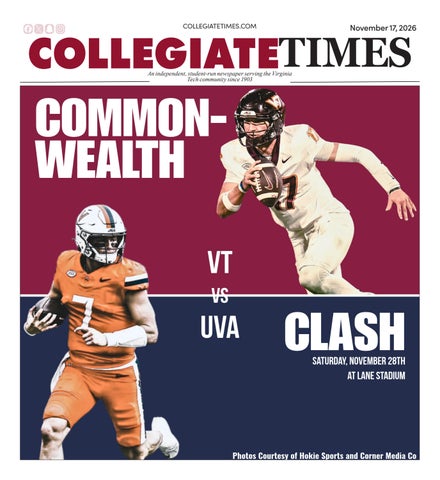
COLL LLEG EGIA IATTETIMES COLLEGIATETIMES.COM
An independent, student-run newspaper serving the Virginia Tech community since 1903
November 17, 2026
NEWS
PAGE 2 November 17, 2026
editor@collegiatetimes.com
COLLEGIATETIMES.COM
VIRGINIA TECH PROFESSOR LEADING A USDA-FUNDED PROJECT THAT COULD RESHAPE DAIRY NUTRITION Marley Vann | News Writer
Protein is the most expensive part of a dairy diet, redirecting it increases milk revenue. Backed by a four-year, $1.15 million USDA grant, researchers are combining artificial intelligence and precision agriculture to build a Self-learning Dairy tool. It would use robotic-milking data to match protein supply to individual cows. The project started in 2024 and is said to end in 2028. Project Director Mark Hanigan, Virginia Tech’s David R. and Margaret Lincicome Professor of Agriculture, is working with researchers from multiple universities, including Emory University, the University of Idaho, the University of Nebraska and the University of Tennessee. At the University of Idaho, dairy specialist Izabelle Teixeira is leading nutritional modeling and producer outreach, while economist Hernan Tejeda is evaluating the financial benefits. Together, Teixeira’s outreach will help dairy producers
adopt the SLDairy system to boost efficiency, cut costs and improve environmental sustainability. According to Dairy Producer, small-scale trials in Tennessee have already shown significant cost savings, with further commercial testing scheduled for 2025 and 2026. Over the past 35 years, Hanigan has studied how dairy cows utilize dietary protein and energy, research that helped shape the National Academies’ 2021 Nutrient Requirements of Dairy Cattle. His proposed strategy shifts dietary protein away from cows receiving more than they need and redirects it to cows that convert extra supply into milk. By continuously tracking milk production and performance metrics, robotic milking systems with automated
OUR CORE VALUES Impartiality means reporting, editing and delivering the news honestly, fairly, objectively and without opinion or bias. Credibility is the greatest asset of any news medium, and impartiality is the greatest source of credibility. To provide the most complete report, a news organization must not just cover the news, but uncover it. It must follow the story wherever it leads, regardless of any preconceived ideas on what might be most newsworthy. The pursuit of truth is a noble goal of journalism. But the truth is not always apparent or known immediately. Journalists’ role is therefore not to determine what they believe at that time to be the truth and reveal only
that to their readers, but rather to report as completely and impartially as possible all verifiable facts so that readers can, based on their own knowledge and experience, determine what they believe to be the truth. When a news organization delivers both news and opinions, the impartiality and credibility of the news organization can be questioned. To minimize this as much as possible there needs to be a sharp and clear distinction between news and opinion, both to those providing and consuming the news.
Voice your opinion. Send letters to the Collegiate Times. 365 Squires Student Center
All letters must include a name and phone number. Students must include year and major. Faculty and staff must include position and Blacksburg, VA, 24061 department. Other submissions must include city of residence and opinionseditor@collegiatetimes.com relationship to Virginia Tech (i.e., alumni, parent, etc.). We reserve the right to edit for any reason. Anonymous letters will not be printed.
Letters, commentaries and editorial cartoons do not reflect the views of the Collegiate Times. Editorials are written by the Collegiate Times editorial board, which is composed of the opinions editors, editor in chief and managing editors.
feeders let researchers see how individual cows respond to different dietary protein levels. Research shows that while roughly one-third of cows respond as average, one-third require significantly less protein and one-third benefit from more. Feeding to the group average wastes resources and limits top performers. Reallocating existing protein to high-responding cows allows producers to boost total milk protein output without increasing feed costs. This could solve multiple problems in the dairy industry. Overfeeding protein forces a cow’s liver and kidneys to work harder to flush out excess nitrogen. Tailoring diets to individual needs reduces metabolic stress and supports healthier cows. Protein is the most expensive component of a dairy diet. Redirecting it to the cows that use it most effectively increases milk revenue with zero added feed expense. Cows’ unused protein releases nitrogen in urine and manure. Eliminating overfeeding directly cuts ammonia and greenhouse gas emissions while reducing nitrogen runoff into local waterways.
According to the project, discovering true protein requirements and feeding cows to meet those requirements should result in a $0.22 to $0.44 per cow per day additional profit, and a roughly 1.6 to 3.25 ounce reduction per cow per day in nitrogen excretion. The expected long-term outcomes of this research are better management practices, greater acceptance for technological use and application of machine learning and greater economic incentives for daily producers.
NEWSROOM. . . . . . . . . . . . . . . . . . . . . . . . . . . . . . . . . 231-9865 Editor-in-Chief: Ava Garrison (editor@collegiatetimes.com) Managing editor: Jenna Mason and Cat Pizzarello Design editor: Sarah Jordan Assistant Design editors: Mx Zaleski, Alana Vernon, Jessica Grow and Harshitha Malay Copy editors: Isaac Liu News editors: Erin Bailey and Julian Namez Assistant News editor: Hannah Skemp Lifestyles editor: Ella Winterling Assistant Lifestyles editors: Samuel Harvey, Bailey Linza and Annie O’Connell Sports editors: Dylan Tefft, Alex Winn and Brody Bryan
Opinions editors: Shelby Brann and Emily Urda Photo editor: Riley Thompson Have a news tip? newstips@collegiatetimes.com
@COLLEGIATETIMES
COLL LLEG EGIA IATTETIMES
BUSINESS STAFF. . . . . . . . . . . . . . . . . . . . . . . . . . . . . 231-9860 Business manager: Faith Casey (business@collegemedia.com) MEDIAMATE. . . . . . . . . . . . . . . . . . . . . . . . . . . . . 888-897-7711 collegiatetimes.com/media_kit/ orders@mymediamate.com
The Collegiate Times, a division of the Educational Media Company at Virginia Tech, was established in 1903 by and for the students of Virginia Polytechnic Institute and State University. The Collegiate Times is published every Tuesday of the academic year except during exams and vacations. To order a reprint of a photograph printed in the Collegiate Times, visit reprints.collegemedia.com. The Collegiate Times is a division of the Educational Media Company at Virginia Tech, Inc., a 501(c)3 nonprofit with a mission to provide educational experience in business and production of mass media for Virginia Tech students. © Collegiate Times, 2020. All rights reserved. Material published in the Collegiate Times is the property thereof, and may not be reprinted without the express written consent of the Collegiate Times.
Advertisements do not necessarily reflect the opinions of the Collegiate Times. Read about our organization’s Core Values online at collegiatetimes.com.
editor@collegiatetimes.com
November 17, 2026 PAGE 3
COLLEGIATETIMES.COM
VIRGINIA TECH PERFORMERS BRING ‘DANCE NATION’ TO THE STAGE Anna Collier | News Writer Several creative elements are used to show the perspective of young characters.
Virginia Tech’s School of Performing Arts presented “Dance Nation,” a play that examined coming-of-age themes and the pressures of competitive dance, at Squires Studio Theatre Nov. 10-13 and Nov. 15. Tickets costed $12 for students and seniors, and $15 for general admission. Writ ten by play w right Clare Barron, “Dance Nation” premiered off-Broadway at Playwrights Horizons in April 2018. An “edgy” inspiration of the reality show “Dance Moms,” the play follows a competitive dance team, the Liverpool Dance Works, from Liverpool, Ohio, as its members pursue a national championship in Tampa, Fla., while navigating the challenges of adolescence. The team performs an acro-lyrical number titled “World on Fire,” which explores the legacy of Mahatma Gandhi. The production is directed by Julia Devine, assistant professor of Practice, Directing and Acting, and choreographed by Rachel Rugh, instructor of dance. Devine and Rugh began meeting in May 2026, starting with the creation of a music playlist that reflected the play’s themes. The playlist included songs such as “Thank Heaven For Little Girls” by Bing Crosby, Buddy Cole & His Trio, “It’s My Party” by Lesley Gore, “Cherry Bomb” by The Runaways and “Girl, So Confusing” by Charli XCX. The full cast began rehearsals in early October. Devine described the production as an opportunity to revisit adolescence through the lens of competitive dance, exploring the awkwardness, changing bodies and insecurities associated with growing up. The play also uses humor to “poke fun at” the seriousness and intensity of competitive dance. The cast is composed of Virginia Tech student performers portraying the young competitive dancers and their mothers. Kylie Preston, a junior double majoring in theater arts and multimedia journalism, plays dancer Ashlee. “Julia has done an amazing job bringing everyone together and helping us find who we are in the show and how we can connect that to who we are as women and as people who have all been that age,” Preston said.
Preston said Ashlee’s experiences reflect the challenges of transitioning from childhood to adolescence. “You’re still figuring out so much about yourself, while kind of developing this balance between now who you are as a person, growing into your teenage years versus how you were as a kid, and being a dancer, and being an athlete, but now, it’s like, being a woman,” Preston said. Preston described Ashlee as “outrageous and loud,” but said the character also reflects the uncertainty of growing up and establishing an identity. “You’re trying to fill the gap, well, like, I’m ready to be a teenager, but I’m still considered a kid, and I’m just in that stage of trying to find out who I am now,” Preston said. Jade Lemon, a senior theater performance major who plays dancer Amina, approaches the coming-of-age themes through a character whose identity is closely tied to dance. Lemon said Amina’s dedication to dance stems from the weight it holds in her life. “Her life has not been the most structured,” said Lemon. “This is all she has — this is why she works so hard at it, because it’s her only (form of) self-identity.” Lemon said she relates to Amina’s ambition and tendency to push herself without recognizing the consequences. “She will burn herself out but won’t even acknowledge it,” Lemon said. The physical demands of the production extend beyond the characters to the actors performing them. Lemon said the choreography has presented a challenge for cast members who do not have dance backgrounds. “This has been very challenging because not all of us are dancers. It’s a very physically exhausting show,” Lemon said. The play also explores the pressures young girls face as they become increasingly aware of how others perceive them. Themes of comparison, jealousy, body image and expectations of femininity appear throughout the play, alongside the characters’ hopes and ambitions for the future. Several creative elements reinforce the perspective of the young characters.
Music from albums and songs created by actual 13-year-olds plays before the performance and during intermission. Recurring wolf imagery also appears throughout the production. Devine described the wolf as a “sacred protector of women.” The performance also combines theater with cinematic elements through a collaboration with Lexi Tsanganelias, a senior at Virginia Tech and head of the Virginia Tech Cinema Club. Tsanganelias filmed throughout the rehearsal process at locations including Heritage Park and apartment complexes, incorporating footage into the performance. “Theater and cinema have something to learn from each other,” Tsanganelias said. “Find humor in certain moments, bring new ideas (and) utilizing all of these things to bring the play to life and execute themes.” Devine also added that the cinematic elements “Make theater more engaging for a young generation,” showing that “theater can be cool too.” The production has also fostered relationships among its cast members. Preston said the cast developed a close connection early in rehearsals, creating a dynamic similar to the dance team portrayed onstage. “This is the most fun I’ve ever had working on a production,” Preston said. “The cast off the bat just hit it off, it’s really started to feel like an actual team and close group of girls with this fun, raunchy, raw dynamic.” “It’s never felt like work, it’s always felt like a fun collaborative experience,” Preston added. Andria Papalabrakopoulos, a junior pursuing a double major in theater arts performance and psychology, plays a mom in the play. She said the production has also given cast members an opportunity to develop relationships with one another beyond their roles. “This is my f irst main stage production, and we have all just become so close,” Papalabrakopoulos said. “We’re talking about having a cast party, or a slumber party. We have all gotten closer through playing our characters as well.”
Outside the per for mance, Papalabrakopoulos helped organize a menstrual product donation drive in partnership with her service sorority, Omega Phi Alpha, and the School of Performing Arts Pantry. Audience members are invited to bring unopened menstrual products during the show’s run times to support students in the Virginia Tech community. “My idea for getting my sorority involved was because (the) SOPA pantry does not have great funding; we don’t really get as much money allocated to us as other departments do,” Papalabrakopoulos said. “Doing it in partnership with my sorority allowed us to have many more baskets.” Preston hopes that audiences leave with greater appreciation for themselves and a better understanding of the challenges that accompany adolescence. “I really hope that the audience walks away with a sense of appreciation for themselves at this age,” Preston said. She also hopes the play encourages audiences to look back on their younger selves with greater understanding, generosity and forgiveness. The production may also prompt audiences to reconsider memories they would otherwise prefer to forget. “This will make you think about the most embarrassing moments of your middle school years, that you just try to block out, and you cringe at, but you actually have to face it while watching the show,” Lemon said.
@COLLEGIATETIMES
PAGE 4 November 17, 2026
LIFESTYLES COLLEGIATETIMES.COM
editor@collegiatetimes.com
TWO TOWNS, TWO TRADITIONS: LIFE IN BLACKSBURG AND CHARLOTTESVILLE Aleeza Ali | Lifestyles Staff Writer Lifestyles staff writer Aleeza Ali examines the commonwealth rivalry through the towns the universities call home. Virginia Tech and the University of Virginia have had a rivalry that has spanned many years. The schools have quarreled over just about everything, from mascots to school colors, sports teams and much in between. Students and alumni squabble both on social media and in person, determined to make it known where their loyalties lie. One factor that’s up for debate is the college towns these schools are located in. Both Blacksburg and Charlottesville have their own special flair and charm, and they are also vastly different in their own ways. One similarity they definitely have, though, is that the students living there have found a sense of belonging in both towns. More than half of Blacksburg’s population is made up of Virginia Tech students, and the university’s influence can be seen throughout the town. “I think what makes Blacksburg unique is that the town runs off of the spirit of the school. The two are intertwined,” said Reilley Lin, a senior majoring in public relations. Lin described Blacksburg as a tight-knit community made up of not only students, but professors, alumni and longtime residents with a strong connection to the university. From going to downtown Blacksburg for a bite to eat to football games in Lane Stadium, she emphasized how clearly the town and the school are linked. Over in Charlottesville, there is a similar sense of community, although some students think that the town has developed somewhat of its own identity outside of UVA. “Charlottesville isn’t just a college town filled with students,” said Tate Fagan, a third-year public policy and psychology double major at UVA. “There are young families, little kids, older residents, and people who have lived here their entire lives.” Fagan pointed out Charlottesville’s local businesses, restaurants and town events that support the community’s
working atmosphere. However, UVA’s influence still shines through in Charlottesville. Third-year cognitive science and youth and social innovation double major Evelyn Kuzminski emphasized the university’s role in shaping the city’s culture and student experiences. “ H o n e s t l y, e ve r y part of Charlottesville is related to UVA to me somehow, even if it’s just that it’s a popular place for students,” Kuzminski said. Outside of their respective campuses, both towns offer a variety of restaurants, coffee shops and local businesses that have become staples of student life. In Blacksburg, students frequent downtown spots like Bollo’s Cafe, Coffeeholics and Coffee Lab for studying or catching up with friends. Restaurants like El Rodeo and The Cellar are also popular for group dinners, while the Lyric Theatre offers students another form of entertainment. Charlottesville has its own collection of student favorites, particularly along the Corner, a stretch of restaurants and shops located just steps away from UVA’s Grounds. Fagan and Kuzminski both highlighted Bodo’s Bagels, Grit Coffee and The Virginian as popular spots among students. The Corner is also home to 1515, a common study spot, while the nearby Lawn offers students a place to relax and socialize. While both towns offer plenty of places to grab a bite or study, their nightlife scenes reveal some noticeable differences between the two communities. “Blacksburg is most alive at night,” Lin said. Lin described downtown Blacksburg as a lively social scene, with numerous bars within walking distance of one another. She emphasized the connections students form through going out and meeting new people, describing the town’s social network as a web of people. In Charlottesville, nightlife is largely
PHOTO COURTESY OF VIRGINIA TECH NEWS AND CENTRAL VIRGINIA PARTNERSHIP FOR ECONOMIC DEVELOPMENT Blacksburg, Va. and Charlottesville, Va. are the respective homes of Virginia Tech and the University of Virginia.
concentrated around the Corner, where students frequent bars like Trinity Irish Pub, Coupe’s and Ellie’s. Fagan described UVA’s nightlife as more relaxed, with outdoor bars and live music contributing to the atmosphere. “Although the nightlife can feel small, it’s really fun knowing you’ll almost always run into people you know,” Fagan said. Student life in both towns extends far beyond restaurants and nightlife. Blacksburg students enjoy hiking, recreational sports, thrifting and spending time outdoors, while Charlottesville offers access to Shenandoah National Park, Carter Mountain and a variety of local farmers markets and music venues. Despite the appeal of both towns, students also acknowledged some challenges that come with living in them. Lin pointed to high rent prices in Blacksburg, while Fagan and Kuzminski
similarly expressed concerns about Charlottesville’s housing costs. Fagan also mentioned that Charlottesville can begin to feel limiting after several years, while Lin appreciates Blacksburg’s more isolated location. Although students from both universities may have their preferences when it comes to restaurants, nightlife and campus culture, their experiences reveal a common appreciation for the communities they’ve become part of. “I also love the home I’ve found and created here,” Lin said. Kuzminski expressed a similar sentiment about Charlottesville. “But honestly, Charlottesville is home. My people are here, my heart is here,” Kuzminski said.
@COLLEGIATETIMES
FAMILY FIRST, FOOTBALL SECOND: THE COMMONWEALTH CLASH
November 17, 2026 PAGE 5
editor@collegiatetimes.com
Thomas Bray | Lifestyles Contributor
Putting sports aside, sibling support prevails above every aspect of the VT and UVA rivalry.
The Commonwealth Clash has long given fans a reason to choose sides. The rivalry spans multiple sports, while the annual football matchup determines which school takes home the Commonwealth Cup. The rivalry is a definingpartofbothschools’identities. However, for some families with connections to both institutions, the divide isn’t nearly as significantastherivalrymightsuggest. For Virginia Tech student Claire Erny, a sophomore majoring in packaging systems and design, whose older brother attended the University of Virginia, the rivalry between the two schools has never created tension within her family. More than 100 miles separate the Hokie Stone of Blacksburg from the Rotunda in Charlottesville, but the distance between their campuseshasneverdividedthesiblings. Whenchoosingwheretoattendcollege,Erny wasn’t concerned about continuing a family tradition or siding with one university over the other. She wanted to attend an in-state school that offered a strong sense of community and a balancebetweenacademicsandcampuslife. VirginiaTechstoodout.
Her brother’s experience at UVA also helped shape her decision. Although he enjoyed aspects of attending the university, hearing about his experience made her realize she couldn’tnecessarilypictureherselfthere. She ultimately never applied to UVA, and her familysupportedherdecision. Despite attending rival universities, the siblings have never allowed their different schoolaffiliationstodefinetheirrelationship. “We’ll always mention it and say a joke or something, but no one’s really serious about it,” Erny said. “We don’t really care that much who winsoranything.” That attitude comes naturally to her. Erny doesn’t consider herself much of a football fan and admitted she wasn’t particularly familiar withtherivalrybeforeattendingVirginiaTech. Her lack of interest in football, however, isn’t the only reason the rivalry holds little weight in herfamily. “Me and my brother are pretty close,” Erny said. “I just can’t really imagine anything like that (rivalry) even remotely doing anything to our relationshipinanegativeway.”
For some passionate fans, a win over the opposing university is part of what makes college athletics special. Yet for Erny, the outcome of the annual football matchup matters less than the happiness of someone she caresabout. When asked how she would feel if UVA defeated Virginia Tech, she didn’t hesitate to put herbrother’shappinessfirst. “I would be happy if UVA won for him,” Erny said.“If he was happy, I’d be happy.” Shebelievesthefeelingwouldbemutual. If Virginia Tech won a big game in Lane Stadium and she had the opportunity to experience that excitement firsthand, she thinks her brother would be happy for her, regardless of his ownconnectiontoUVA. “I think he’d be happy for me more than anything,”Enrysaid. It’s a simple perspective, but one that can get lost in the intensity surrounding college rivalries. Fans can spend years identifying with a university, celebrating its victories and taking its losses personally. That passion helps create the
traditions and communities that make college sportsmeaningful. At the same time, supporting a school doesn’t have to mean resenting those who supportitsrival. For families like Enry’s, the two aren’t mutually exclusive. A person can take pride in their own university while celebrating the experiences and accomplishments of someone who attendedanother. Although the conflict will continue to bring out emotions on both sides, her experience offers a reminder that the rivalry doesn’t have to extendbeyondthefield. “Relax, it’s not that serious,” Enry said. “It’s a game; it’s supposed to be competitive, but it’s supposedtobefun.” For Erny, the message to fans who take the rivalrytooseriouslyissimple. “Don’t let a sport ruin a relationship with someone,”Enrysaid.
@COLLEGIATETIMES
THE COMMONWEALTH CLASH: HOKIES AND CAVALIERS GO HEAD-TO-HEAD IN TRADITIONS Annie O’Connell | Lifestyles Assistant Editor
From annual snowball fights to game day music, take a look at the Cavalier and Hokie traditions. The Commonwealth Clash between the University of Virginia Cavaliers and Virginia Tech Hokies has been ongoing for over 130 years. The competition started on the field in 1895, when UVA defeated Virginia Tech with a score of 38-0. This feud has continued off the field, seeping into the everydaylivesofUVAandVirginiaTechstudents. Heated competitions in sports games have remained a trending topic between the Hokies and Cavaliers. In addition to going head-to-head in sports, arguably one of the best elements in universitiesislong-livedstudenttraditions. “Traditions make me love UVA a million times more,” said Annika Bhargava, a UVA senior majoring in psychology. “As an out-of-state student, I always worried that I was choosing the wrong school, but as soon as I got to UVA and started to learn about all of these traditions, I realizedthatitwastheperfectschoolforme.” Through spirit-filled traditions such as trickor-treating on The Lawn and the annual snowball fight at midnight after the first snowfall of the schoolyear,BhargavafeelsmoreconnectedtoUVA becauseofthetraditionsthatstudentsshare.
Similar to Virginia Tech’s annual snowball fight vs. the cadets, the Hokies and Cavaliers share some traditions that are alike, each one having its own personalimpactsonstudents. “It is the perfect combination of sentimental and fun. I love every tradition we have and try to participateeverychanceIget,”Bhargavasaid. Traditions are some of the best ways to not only get involved at your school, but also to feel close within your school’s community. While most students focus on their own campus culture, a long-standing rivalry often exposes you to another university’straditions. “The only Virginia Tech tradition I know is playing Enter Sandman at football games, which I wouldlovetoexperienceoneday,”Bhargavasaid. Bhargava shared that she has personally never participated in any of Virginia Tech’s traditions, while Virginia Tech student Emma Grupce, a senior majoringinbiology,sharesadifferentexperience. “I have gone to a UVA game — they have a little school song that they sing at the beginning of every game and it’s pretty cute,” Grupce said. “But it definitely doesn’t compare to (Virginia Tech’s) energy.
It’saverymellowsong.” Metallica’s “Enter Sandman” is well-known to be Virginia Tech’s official football entrance song. With students jumping in sync and shaking the stadium, students feel connected through the chordsofthispopularrocksong. “You don’t even have to explain when you hear those first few beats,” Grupce said. “Everybody’s on the same page, and it’s (an) unspoken thing that we’vegotgoingon.” Grupce also noted “We Ready” by Archie Eversole and the Isley Brothers song “Shout,” played at the end of the third quarter, as memorableTechtraditions. “If I ever make it that long into the game, that is (the song “Shout”) what I’m staying for,” Grupce said. When asked if Grupce knows of other UVA traditions, she noted streaking the lawn as a unique and“prettycrazy”tradition. “One of my best friends goes to UVA, so I’ve heard all the stories about their Lawn and running from the Rotunda — naked endeavors,” Grupce said. “I don’t know that I would say I’m eager to
participate.” Streaking The Lawn is surely a tradition that stands out to most students looking at UVA from an outsider perspective. Students from the town of Blacksburg or Charlottesville may have specific celebrated traditions, but when there is direct competition in athletics or academics, an intense rivalryawakens. “Specifically when it comes to the Virginia Tech (vs.) UVA game, these traditions go full-fledged,” Grupce said. “I don’t think it’s quite as cutthroat as it might have been back in the day. We can still be friends, but we are here to win that day, so we will be loud.” The Virginia Tech Hokies and University of Virginia Cavaliers go head-to-head Saturday, Nov. 28 at 3 p.m. The game will be held at Hokie territory in Lane Stadium, which means Enter Sandman will play,andthecompetitionwillbefierce.
@COLLEGIATETIMES
OPINIONS
PAGE 6 November 17, 2026
editor@collegiatetimes.com
COLLEGIATETIMES.COM
THE FRENCH PROTESTS ARE MORE COMPLICATED THAN YOU THINK Ella Sleeper | Opinions Contributor
There is far more political and social detail under the surface of the French protests. If you’ve been keeping up with international news lately, you’ve probably seen articles about French students and young people storming the streets of Paris. Now, the image of a reckless French mob is not an unusual portrait in history. This must just be another instance of angry young Europeans taking their frustrations out on people in power, right? Wrong. The pictures and headlines can be deceiving. News outlets like NPR and the BBC have published photos of angry young people destroying property as well as engaging in street violence and aggression toward the police force called in by French President Emmanuel Macron. On top of that, the message of the protesters is hard to decipher. Some are calling for climate activism, others for the cost of living and masses of high school students are demanding better conditions in their schools. While this chaos may create a worrisome and cynical effect for people in power, I couldn’t help but notice the overall picture of what these protests represent at this moment in political history. What I think a lot of Americans don’t realize is how much the changes within the political landscape of the U.S. are largely reflected in the shifts in political views worldwide, especially in Europe. Over the past decade or so, both the U.S. and many countries in Western Europe like Italy, Germany and France have seen a rise in conservative politics. This trend has resulted from a variety of reasons, one being the frustration with neoliberal policies following the Great Recession in 2008. People felt like the left-leaning beliefs of Western democracies, which were increasingly popular at the time, had failed them when the recession occurred. As a result, conservatives have regained political power. For example, following the election of U.S. Republican President Donald Trump in 2016, more conservative-leaning leaders began emerging in Europe, like right-wing
Prime Minister Giorgia Meloni in Italy and the populist right-wing Alternative for Germany party. The power these leaders and groups now hold doesn’t seem to be going away anytime soon, leading those on the left to become less hopeful about their chance for representation. How might this pertain to angry French students? Well, it’s no secret that young people tend to favor leftleaning politics. Since liberal politics are on the decline across the nations in Europe, anger among their supporters has grown, with these protests being the result. The anger toward people in power is not an unusual stance for young people, but in 2026 it seems this aggression is not pointing toward one individual but the whole system. Yes, French students are angry with President Macron, but not strictly for the policies that he specifically has put in place. They are angry with a school system that has failed to provide them with the necessary resources to succeed. They are angry with a government body that doesn’t prioritize the rights and existence of labor unions. They feel like they are being deprived of job opportunities and no one is doing anything about it. This frustration isn’t just young people complaining and acting violently because they are unable to organize themselves. It’s an act of desperation and catharsis about the lack of hope for the future of their country. I think it is essential to establish that not all the protests across France have descended into violence. A large number of marches have remained relatively peaceful. But as with most issues pertaining to politics, the most extreme voices are the loudest. Regardless of the size of the group that is actually acting violently, people in power are amplifying this image to take the blame off of themselves. I couldn’t help but be reminded of a similar occurrence when the media chose to portray the Black Lives Matter movement in the
PHOTO COURTESY OF JEAN-FRANCOIS BADIAS, AP.
summer of 2020 as reckless and harmful rather than examine and evaluate the actual issues they were fighting for. It’s much easier to say “Look at how bad those people are, at least we’re not acting like them,” rather than “We need to take responsibility for promoting a failed system.” Not to mention the argument being raised that blames the increase in immigrants to France for the perceived chaos; a narrative unfortunately growing in support on the right and highlighting harmful xenophobic ideas. I think we can all agree that a majority of people are not naturally inclined to act violently, so this idea that Gen Z is irrational or whiny is damaging to any progress that could be made. In no way am I condoning the violence that has occurred. However, I am also not criticizing the French for wanting a change and taking collective action, even with
the effects that might result. I think it is rather naive to look at these events as black and white. After all, is it radical to want a good-quality education or support for labor unions? It’s easy to look at the violence that has resulted from the French protests and immediately dismiss the whole movement as an ineffective way to achieve change. But then, what is effective? What do you do when you’ve tried everything and nothing happens? Violence is obviously not the answer, but then what is?
@COLLEGIATETIMES
editor@collegiatetimes.com
November 17, 2026 PAGE 7
COLLEGIATETIMES.COM
IS VIRGINIA TECH FOOTBALL READY TO FACE UVA? Emily Urda | Opinions Editor
After a humiliating loss to Stanford, the outlook for the VT vs. UVA game looks frightening. Excited to watch the Stanford game Saturday night, my roommate and I promptly put the game on at 7:30 p.m. and sat in our respective chairs in the living room. A few minutes later, outside our window, we saw the red lights flashing from Lane Stadium. My roommate groaned: “I should be there, no.” We’ve both been sick this past week and know there is no way we should be out in the freezing cold. Our eyes glued to the television, the game began. Virginia Tech made a touchdown, but a flag was thrown. We intercepted, but it was offside. I’m not the most familiar with football jargon. I like watching and rooting for the Hokies, but even I knew this was a bad start to the game.
The SMU game was such a tough watch for me; we had to turn the television off. We were hopeful for a win, but maybe too hopeful going into this week. After the first half, my roommate and I discussed why we were playing so badly, and ultimately decided it was due to some poor calls and maybe the cold weather. The announcer promptly stated that Stanford had set up the ball nicely for their kicker, surely a dig at the failed kick Virginia Tech made at the Pitt game a couple of weeks ago, or maybe I’m still traumatized. During commercials, my roommate and I talked about the Miami game next week and there was little to say; we both knew the matchup would be rough. We had more hope of winning the UVA game at the beginning of the Stanford game. UVA has had some tough matchups with
SMU, Duke and Wake Forest. They’ve held a 5-5 overall, and a 4-3 record in conference record. They’ve even beaten Cal, but Virginia Tech can’t exactly say the same. Considering UVA has proven to be improving, they beat us last year, and they were able to really bring it to the Cal game; I’d say the matchup will be pretty close. It’s going to be an evenly matched lineup. At the beginning of this season, I had hoped it would be an immediate takeover on our part. We kept watching, hoping that Virginia Tech would come back and make some sacks, that Ethan Grunkemeyer would find slots and sink a touchdown. That maybe the Hokies would shake off that mold that has plagued our program for the last ten years, but alas, no such luck. My roommate and I saw that the score was
SPORTS
34-22, and felt all hope we had was now gone. The UVA game looked as bleak as never before. I was confident at the beginning of the season that we’d beat UVA, but now I’m not so sure. One of my takeaways from the game and from reading many articles about Coach Franklin’s reflections is that the team needs to handle adversity better. I think everyone can learn from the Saturday night Stanford game. I hope Hokie fans, myself included, continue to hold on to that hope and determination and know that the program is going through growing pains, very painful ones.
@COLLEGIATETIMES
HAMMOND SHINES AS HOKIES OUTLAST HAWKEYES Brody Bryan | Sports Editor
The junior guard tallied a career-high 32 points. Virginia Tech head coach Mike Young once compared Ben Hammond to “the Energizer Bunny,” and the Hokies’ junior guard spent Tuesday night showing exactly why. Hammond poured in a career-high 32 points to go along with five rebounds and a game-high four assists as Tech took down Iowa 93-88 in overtime at the Tyson Events Center in Sioux City, Iowa. “We beat a really good team,” Young told the Virginia Tech Sports Network. “A very well-coached team.” But for all Hammond did for the Hokies on Tuesday, he wasn’t around to finish the job. With 1.4 seconds left in regulation, Hammond fouled out, leaving Tech without its leading scorer heading into overtime. And he wasn’t the only one. Forward Miles Heide had already fouled out with 6:27 remaining, putting the Hokies down two starters. So, who was going to pick up the slack?
Well, Jaylen Curry had a pretty good answer. The Oklahoma State transfer scored nine of Tech’s 14 points in overtime — none bigger than a second-chance 3-pointer that put the Hokies ahead 84-81 with 1:35 remaining. And it wasn’t as though Curry had been quiet before that, either. The senior guard finished with 25 points, including 23 after halftime, helping Tech remain undefeated and earn its first major-conference win of the season. “We fought,” Young said. “And we found a way out.” The Hokies led for much of the first half thanks to contributions from Hammond and others, including FAU transfer Isaiah Elohim and Clemson transfer Butta Johnson. Johnson, a fifth-year guard, was granted eligibility this season through a preliminary court injunction amid legal challenges to the NCAA’s eligibility rules. “Butta is a great kid from a great family,” Tigers head coach Brad Brownell said at the
ACC Tipoff in Charlotte, N.C., in October. “He can shoot the ball, he’s experienced, (and) he knows the game. He’ll pick things up quickly.” Iowa forward Cooper Koch gave the Hawkeyes the lead with seconds remaining in the first half, but Hammond reclaimed it for the Hokies with a 3-point shot at the buzzer. Koch finished with a career-high 26 points, shooting 5-of-11 from the field and 15-of-17 from the free-throw line. The second half was a back-and-forth affair, with the Hokies leading by as many as six and trailing by as many as five. Curry and Hawkeyes guard Ty’Reek Coleman traded free throws at the end of regulation to send the game to overtime. Coleman went 1-of-2 during his trip to the line, though, missing what would’ve been a potential gamewinner. Iowa center Andrew McKeever tipped in the miss, but the ball left his hands a fraction too late to beat the buzzer.
So instead of heading home with a heartbreaking early-season loss, the Hokies had five more minutes to pull out a win in Iowa’s backyard. Despite Curry stealing the show in overtime, Elohim and junior guard Tyler Johnson knocked down critical free throws to maintain the Hokies’ lead. Elohim finished with 12 points, shooting 4-of-7 from the field and pacing Tech with six rebounds. Tech is now 3-0 for the third straight season with wins over Coppin State, Mercer and Iowa. Tuesday marked Tech’s third overtime win over a nonconference power-conference opponent in the past two seasons, beating Providence and South Carolina last year. And while Hammond’s career night grabbed the headlines, efforts from the entire team — including returning forward Amani Hansberry, who tallied 16 points and shot over 58% from the field continued on page 8
PAGE 8 November 17, 2026
continued from page 7 — were necessary to escape with a win. “We’re pretty damn hard to guard,” Young
COLLEGIATETIMES.COM said. “A lot to build upon, but we’ve got a long way to go and a lot more mountains to
climb.”
editor@collegiatetimes.com
@COLLEGIATETIMES
HOKIES PUMMELED BY STANFORD IN SECOND STRAIGHT BLOWOUT LOSS Brody Bryan | Sports Editor A disastrous night in Lane Stadium sent Virginia Tech reeling.
PHOTO COURTESY OF VIRGINIA TECH ATHLETICS Virginia Tech Hokies quarterback Ethan Grunkemeyer (17) scrambles away from a defender in Lane Stadium on Nov. 14, 2026, in Blacksburg, Va.
That couldn’t have been how Virginia Tech drew it up on offense. Or defense. Probably not on special teams, either. Whatever the Hokies had planned for Saturday night, Stanford had other ideas. The Cardinal walked into Lane Stadium winless on the road and walked out with a 40-22 victory that silenced — and eventually emptied — the home crowd. “We did not meet anyone’s expectations, including myself,” said head coach James Franklin. “We’re not playing winning football.” He’s not wrong. The Hokies closed as 17.5-point favorites. They lost by 18; they’ve dropped two in a row, giving up 91 points and turning the ball over five times during that stretch. That’s not a particularly winning formula. “The two biggest stats are explosive plays and winning the turnover battle,” said quarterback Ethan Grunkemeyer. “We haven’t done great in that.” No, they haven’t. The Hokies turned the ball over on downs on their first possession as Grunkemeyer’s ever-reliable fourth-and-1
sneak was stuffed. Then, Grunkemeyer — who entered Saturday with three interceptions all season — threw picks on backto-back drives against a Stanford defense that managed just three in its first nine games. “First couple of possessions … that’s not acceptable,” Grunkemeyer said. The giveaways didn’t stop there. Wide receiver Que’Sean Brown lost a fumble in the second quarter, setting up yet another Stanford touchdown. Tech’s defense, which was battered the week prior against SMU, forced three straight three-and-outs to open the game. But after Grunkemeyer’s second turnover, the dam broke. The Cardinal scored on eight of its final nine drives and put up 40 points — its most against a conference opponent since joining the ACC in 2024. “We came out hot,” said cornerback Isaiah Brown-Murray. “We started fast like we wanted to. … Those sudden-change moments that we’ve got to step up in, we don’t want to be in those situations. But we’ve got to step up.”
Interceptions weren’t the only area in which Stanford’s defense enjoyed an uncharacteristically productive night. The Cardinal entered Saturday with six sacks on the season. It had five by the end of the third quarter. Grunkemeyer was under constant pressure, and his stats showed it. He completed half of his passes — by far his lowest mark of the season. While he tallied 270 passing yards, 100 came in the fourth quarter with his team down several scores. “We have not really been doing a great job of protection all year long,” Franklin said. “People can bring up injuries, but it’s next man up.” Grunkemeyer, though, wasn’t interested in pointing fingers at his offensive line. “Sacks are everyone,” he said. “It’s not just the O-line. It’s the quarterback, wide receiver, the running back.” He acknowledged that getting the ball out of his hands quicker could have helped Tech avoid some of the pressure. The Hokies’ struggles in pass protection were nothing new. What has been new, though, is the disappearance of their defensive front. Tech entered Saturday leading the nation in tackles for loss, but didn’t record its first until just over five minutes remained in the game. The Hokies also ranked among the top 15 nationally with 28 sacks. Against Stanford, they managed none. “Typically the coverage and the pressure are tied together,” Franklin said. “If you can get the (quarterback) off his first read and make him hold the ball, I don’t think he did that very often tonight.” Stanford quarterback Davis Warren took full advantage. He wasn’t perfect — far from it. But he didn’t need to be. His 203 passing yards were more than enough, especially with running back Micah Ford providing a hat trick of touchdowns on the ground. Ford became the first player to rush for three scores against Tech since Syracuse’s LeQuint Allen Jr. in 2024. If there was a bright spot for the Hokies, it’s that Jeffrey Overton Jr. wasn’t far behind him. He rushed for over 100 yards for the
second straight game and found the end zone from 2 yards out in the second quarter for Tech’s first points of the night. However, Overton could only do so much. The Hokies struggled to turn his production into points, and by the time their offense sustained any rhythm, Stanford had already put the game well out of reach. “It’s just finding that spark again,” Overton said. “I just feel like this week coming up, we’ve just got to prepare harder than what we usually did.” The Hokies weren’t getting much help from special teams, either. While Stanford kicker Emmet Kenney was perfect on the night, Tech struggled to flip the field with its punting game — a problem Franklin admitted wasn’t limited to Saturday. “We got to be able to punt better, to flip field position,” Franklin said. “That’s been something we haven’t done a great job of, really all season.” Three weeks ago, the Hokies were 6-2, coming off their first win at Clemson in 20 years. They reached bowl eligibility in October for the first time since 2017. That all feels like ages ago now. So, what’s changed? According to Franklin, not much. The same mistakes Tech managed to survive earlier in the season have finally started catching up with it. “That typically is not a recipe for success,” Franklin said. “We haven’t been able to consistently get those things fixed.” Whatever the solution, the Hokies will have to find it quickly. And the schedule isn’t offering much relief. Up next is a daunting road matchup against ACC-leading Miami in Miami Gardens, Fla. “We go into Miami, and we’ve got to get a win,” Brown-Murray said. “We know it’s going to be a tough one, and we know it’s a really good team. But we’ve got to go in there and find a way to get a win.”
@COLLEGIATETIMES