WEDNESDAY, AUGUST 26, 2026
1B
THE COASTLAND TIMES
Off to a great start!
COURTESY TYRRELL COUNTY SCHOOLS
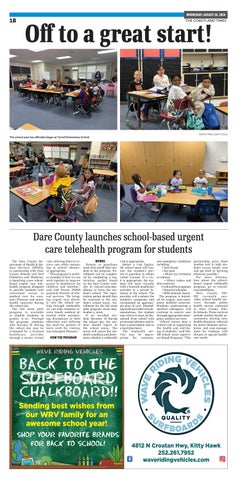
The school year has officially begun at Tyrrell Elementary School
Dare County launches school-based urgent care telehealth program for students The Dare County Department of Health & Human Services (DHHS), in partnership with Dare County Schools and Surf Pediatrics and Medicine, is launching a new schoolbased urgent care telehealth program designed to provide students with convenient access to medical care for common illnesses and minor health concerns during the school day. The fall 2026 pilot program is available to eligible students in grades 6-12. Through the program, students who become ill during the school day may be evaluated by a licensed he a lt hc a re prov ider through a secure virtual
visit, allowing them to receive care while remaining at school whenever appropriate. “This program is another example of how we can work together to improve access to healthcare for children and families,” said Jodi Wyant, DHHS assistant director of clinical services. “By bringing urgent care directly into the school setting through telehealth, we can help students receive timely medical attention while minimizing disruptions to their education and reducing the need for parents to leave work for routine, non-emergent illnesses.”
HOW THE PROGRAM
WORKS
Parents or guardians must first enroll their student in the program. Enrollment can be completed by completing a registration packet found on the Dare County website at tinyurl.com/3bud8am5 or from the student's school. The registration packet should then be returned to the student’s school nurse. Enrollment for the fall 2026 pilot program closes September 3, 2026. If an enrolled student becomes ill during the school day, the student should report to the school nurse. The nurse will assess the student's condition and determine whether a telehealth
visit is appropriate. Before a visit begins, the school nurse will contact the student's parent or guardian to obtain verbal consent. If a visit is appropriate, the student will meet virtually with a licensed healthcare provider in a private location at the school. The provider will evaluate the student's symptoms and recommend an appropriate plan of care. Depending on the provider's recommendations, the student may return to class, be dismissed from school with an excused absence and/or have a prescription sent to a local pharmacy. The telehealth service may be appropriate for common,
non-emergency conditions including: • Sore throat • Ear pain • Minor eye irritation or redness • Minor rashes and skin concerns • Cold and flu symptoms • Seasonal allergies • Mild stomach issues The program is intended for urgent, non-emergency medical concerns. Students experiencing a medical emergency will continue to receive care through appropriate emergency medical services. “School nurses play a critical role in supporting the health and well-being of students,” said DHHS school nurse supervisor Mandi Ferguson. “This
partnership gives them another tool to help students access timely care and get back to learning whenever possible.” For more information about the schoolbased urgent telehealth program, go to tinyurl. com/3bud8am5. Dare County DHHS currently pro vides school health services through public health nurses stationed in Dare County Public Schools. Those services include student health assessments, nursing care, health education, referrals for minor illnesses and injuries, and case management for students with chronic or special healthcare needs.
Back to School 2B
WEDNESDAY, AUGUST 26, 2026
Welcome back!
THE COASTLAND TIMES
First day of new school year at Cape Hatteras Elementary
MARY HELEN GOODLOE-MURPHY PHOTOS
On Aug. 24, 2026, the first day of school at Cape Hatteras Elementary School in Buxton was filled w ith hugs and smiles from
administrators, teachers, assistants and returning students. Several clever signs tried to eliminate the typical first day traffic jam.
Inside the building, a city was built. The two kindergarten rooms were entrances to City Zoo. Shannon Killam and Karla
Wishing all students a wonderful 2026-2027 school year!
DRIVERS
Be sure to use caution in school zones!
NAGS HEAD ELEMENTARY SCHOOL 3100 S Wrightsville Ave, Nags Head
Willis are “zookeepers” this year. An octopus filled the door to an aquarium. The school’s library was turned into The Reading Café by Jennifer Hooper and librarian Jenn Augustson. North Carolina Governor Josh Stein and State Superintendent Mo Green visited Conn Magnet Elementary School in Raleigh to welcome students back on the first day of school. “The first day of school is always exciting and holds so much promise for the students starting school across our state!” said Stein. “Thank you to the teachers and
staff for all you do to educate our future leaders. Thank you to all the parents for partnering with your schools to help your child succeed. And to all
of North Carolina's students, from pre-school to high school: This year is yours for the taking – good luck!”
2026-27 back-to-school welcome from CCS superintendent Dear Currituck County Schools Community, It is my pleasure to welcome you to the 2026-2027 school year! A new school year brings renewed energy and shared excitement for the many opportunities ahead.
At the end of June, Currituck County Schools celebrated the opening of Tulls Creek Elementary School (TCES) with a ribbon-cutting ceremony, and we look forward to our new Tiger family officially joining the district at the start of the
school year. The opening of TCES represents years of thoughtful planning, collaboration, and community support. We are excited to welcome our newest Tigers and look forward to seeing the school establish See CSS LETTER, 3B
Back to School
WEDNESDAY, AUGUST 26, 2026
3B
THE COASTLAND TIMES
DCS brings staff together ahead of 2026-27 school year Last week, Dare County Schools brought the entire district together for its annual convocation. “It was a day filled with connection, learning and celebration as we prepare to kick off another school year,” noted DCS. L ig ht hou s e Aw a r d w i n ner s ,
COURTESY DARE COUNTY SCHOOLS
CSS LETTER (continued from Page 2B)
traditions, build relationships, and become an important part of our district and community. The 2026–2027 school year also represents a new season of strategic growth. After completing our 2021– 2026 District Strategic Plan, we are embarking on a new strategic planning process to guide the district’s direction in the years ahead. This work will build upon the progress we have made while identifying new opportunities to strengthen student achievement, support our employees, engage our community, and respond to the evolving needs of our students and schools. The voices and perspectives of our families, staff, students, and community partners will remain important as we shape the future of Currituck County Schools together. We are also proud to expand mental health support across the district. We
recognize that students are best positioned to learn and thrive when their academic, social, emotional, and physical needs are supported. By strengthening access to resources and services, we are continuing our commitment to developing the whole student and fostering safe, welcoming, and supportive learning environments throughout our schools. As we begin the year, we will remain focused on strong instruction, meaningful learning opportunities, safe and well-maintained schools, effective communication, and positive relationships among students, families, staff, and the community. We are grateful for our dedicated educators and employees whose work makes a difference each day, as well as the families and community partners whose involvement strengthens our schools. This shared commitment and collective belief in every student's potential make our success possible. We encourage families
to stay connected with us throughout the school year. Look for CCS Connections, our weekly district newsletter, released each Monday. Frequently check the district and school websites for the latest announcements and news, and calendars for special events. Information is also available on our social media channels, and special episodes will be posted through Sound Waves, our official district podcast. Thank you for your continued trust, encouragement, and partnership. I am confident that the year ahead will be filled with growth, achievement, and memorable experiences for our students. Together, we will continue Inspiring Excellence in Every Student and building an even stronger future for Currituck County Schools. Welcome to the 2026– 2027 school year. We are excited to begin this journey with you! Sincerely, Dr. Matt Lutz Superintendent Currituck County Schools
Classified Employees of the Year and Teachers of the Year were celebrated and the 2026 DCS Teacher and Principal of the Year were announced. The Dare Education Foundation and ThriveOBX helped welcome DCS staff back with door prizes, giveaways and valuable resources.
Back to School
WEDNESDAY, AUGUST 26, 2026
4B
THE COASTLAND TIMES
How students can improve reading comprehension
Students will encounter a wide range of obstacles over the course of their academic careers. As students progress through academia, many learn to overcome new challenges by looking back on past experiences when they faced obstacles and ultimately prevailed. Younger students do not necessarily have that history of overcoming academic challenges to help them when faced with fresh obstacles. When reading for school, young students may not have identified an approach that can help them more easily comprehend texts. When such situations arise, parents and educators can encourage students to employ various strategies designed to strengthen
reading comprehension. • Encourage young students to monitor their comprehension. The national public media literacy initiative Reading Rockets notes that comprehension monitoring teaches students to recognize what they understand when reading a text and what they do not understand. Monitoring comprehension encourages students to be active readers who check what they do and do not understand while they’re reading. Young students can be taught to ask themselves, ‘Do I understand this?’ when reading a text. Students also can summarize each paragraph as they finish it to further monitor their comprehension.
• Employ metacognitive strategies. Reading Rockets defines metacognition as ‘thinking about thinking.’ While young students may hear the word ‘metacognition’ and run for the hills, the process is far simpler than its name might suggest. Prior to reading, students can be encouraged to identify why they’re reading. A brief preview of the text, such as the synopsis on the back of a book or the inside jacket of the cover, can help students clarify what the book is about. As children begin reading, they can monitor their own understanding of the text relative to the preview they read. Thinking ahead about a text and how they can process it can help students
understand it better than they might if they just start reading without giving the text and what to look for any prior thought. • Teach students to ask themselves questions while they’re reading. Reading Rockets notes questions encourage students to combine information from different segments of the text. While reading, students can ask how a newly introduced character might relate to text or a storyline introduced earlier in the story. Or students can ask questions about characters previously introduced who they do not recall. Going back and searching through previous chapters or text to answer questions can make it easier to comprehend the
text. • Summarize the text upon completion. Reading Rockets notes that summarizing requires students to determine the important aspects of a text and to explain that importance in their own words. Summarizing also helps students identify the main ideas, connect themes throughout the
text and eliminate unnecessary information. All of that helps students remember what they read, which is the foundation of strong reading comprehension. Reading comprehension can be challenging for young students. But various strategies can help kids develop strong reading comprehension skills.
What parents can do to avoid overscheduling students
The start of a new school year presents a fresh opportunity for students. Parents know that the start of a new school year also means a return to the hustle and bustle that many households with school-aged children have grown accustomed to. When that hectic period begins, parents may wonder if their children are overscheduled and, if so, what effect that might be having on their performance in the classroom? A 2024 study published in the journal Economics of Education Review found that modern students could be dealing with a host of adverse consequences due to what’s piled onto their plates during the school year. According to the study, the amount of homework students are assigned coupled with the abundance of extracurriculars students now participate in is not helping
them to build their academic skills but is harming their mental health by increasing feelings of anxiety, anger and depression. Choosing where to draw the line regarding students’ schedules is not an exact science. But parents can consider a number of strategies as they seek to avoid overscheduling their kids in the coming school year. • Take an age-based approach. While parents may feel structured activities can benefit kids of all ages, some childhood development experts note that organized activities may not be as beneficial to younger children as they are to older kids. Andie Stallman, a clinical and developmental health and psychology specialist and the childhood and play expert at Imagination Playground, notes that childhood development professionals suggest that organized activities
prior to age six and seven are not developmentally appropriate. Stallman notes at this age kids should be encouraged to discover their own interests through self-directed play and exploration. Kids can still engage in organized activities at this age, but the focus should be on fun and socialization more than building skills and improving performance. As kids advance through elementary school, parents can talk to them about organized extracurricular activities and which ones, if any, they want to participate in. • Keep a running dialogue about the schedule. Parents understandably don’t want kids to quit, but it’s also important that kids are encouraged to let Mom and Dad know if they feel they have too much on their plate. The American Academy of Child & Adolescent Psychiatry recommends
parents encourage kids to be open about their schedules, especially if they feel overwhelmed by their obligations, and let them know that it’s alright and healthy to take a break. The AACAP also urges parents to talk to kids about their thoughts and feelings when children repeatedly resist an activity. • Learn to spot the warning signs of an overscheduled child. Children do not want to disappoint their parents, so even those encouraged to share their thoughts about their activities and schedules may hesitate to speak up if they feel overwhelmed. With that in mind, parents can learn to spot the early warning signs that a child may be overwhelmed,
which the AACAP notes include: • Making excuses or refusing to go to the activity • Feeling over-tired or not having enough time to sleep • Exhibiting problems with organization or struggling to meet deadlines • Declining school grades • Unexplained physical symptoms, such as
headaches or stomach aches • Increased anxiety It can be difficult for parents to avoid overscheduling kids. But it’s important that parents remember the value of free time for youngsters. More information about striking a balance when it comes to kids’ schedules can be found at aacap.org.
How to minimize distractions during study time Digital technology may have impacted life for the better in many ways, but the same devices that educate, entertain and connect users can distract students at every turn. According to a 2026 study on the habits of highly effective students published on Research. com, students are distracted for roughly 35 percent of their total study time on average. But smartphones, tablets and gaming systems are not the only distractions that students face. Learning to turn attention away from distractions is a key to a successful study session. Here are some ways to manage distractions while studying for academic success. • Gatekeep digital distractions. Students can move their phones entirely out of arm’s reach or into another room while studying. When studying on tablets or laptops, students can use software to disable non-academic platforms so they’re
not tempted to check social media or browse the internet. • Avoid cognitive fatigue. Study blocks should be a maximum of two hours per course before switching subjects to keep the mind fresh. Trying to maintain intense concentration for hours on end often ends with attention waning and the brain seeking other stimuli. • Study during the day. People naturally get tired after dark, which means moving study times to daylight hours may lead to greater success. • Set aside a dedicated study area. Students should establish a consistent, quiet and remote study spot that is physically separated from visual and auditory disruptions. Also, a study area should be separate from relaxation spots so the brain automatically switches to focus on the task at hand. • Advise others not to disturb. Students can establish
boundaries with roommates or family members to ensure study sessions are not interrupted. Ask roommates or family members to avoid a designated study area and to silence phone notifications and alerts. • Quiet the environment. Some students prefer complete silence for studying, and can benefit from noise-canceling headphones. Others may prefer ambient noise or instrumental music to drown out background noise. • Build in breaks. Study sessions can be broken up with breaks to provide a change of scenery and also to grab snacks and beverages or make a trip to the restroom. Minimizing distractions while studying requires students to determine what works for them in a study environment. Additional measures to reduce external stimuli also may need to be implemented.