EL CENTRO
NEWSLETTER SPRING 2025
Forever Home By Daniela Ochoa
E H T NO
R E V O C
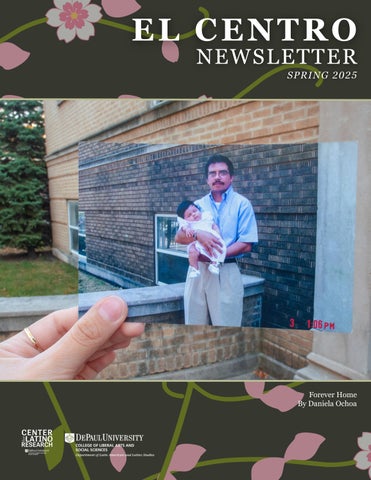
COVER IMAGE: Forever Home
Daniella Ochoa Daniella Ochoa is the winner of our first Latinx Photography Competition, which was organized by the CLR and the DePaul Art Museum, in connection with their current exhibition on the work of photographer Christina Fernández. Daniella’s savvy winning entries tie photography to memory, community history, the passage of time, and loss. Our cover photo restages a family photo of the artist as an infant with her father. Daniella’s award was announced at a recent panel discussion of Chicago Latinx photographers, held at the DePaul Art Museum. The event is described on page 44. Daniella is a Mexican American Chicago-born design student at DePaul, double majoring in User Experience and Graphic Design. Born as an only child to her immigrant parents, she grew up on the Northside of the city in a predominately white neighborhood. She took a beginning photography course at DePaul, which she ended up loving and in which she excelled. Although she is working towards her design degree, she has always loved all creative things! She is mainly inspired by her upbringing, hoping to uplift others like herself. She loves surrounding herself with other creatives and working with people from all sorts of backgrounds to exchange ideas, communicate meaningful stories, and create work that is inclusive, thoughtful, and community-centered.
IN THIS ISSUE... 3 4 5 6 9 11 14 15 17 18 19 20 21 22 25 26
About | Center for Latino Research and Latin American and Latino Studies Letters from the CLR Director & LALS Chair CLR Advisory Committee and LALS Faculty Faculty & Staff Announcements Remembering One of Our Own: Maria Isabel Ochoa Alvarez
27 28 29 30
Event Recap Latina Lesbian Lives
33 34
Event Recap Poesía En Abril: Amaneceres
35
LALS Spotlight: Dr. Lourdes Torres
Film Screening for La Pescera (The Fishbowl)
Latinx Book Club: Her Body and Other Parties
CLR/LALS External Advisory Board Members CLR/LALS External Advisory Board Members’ Spotlight: Yvette Flores Know Your Rights
Event Recap Latinx in Higher ED 2024-2025 CLR Board Spotlight: Dr. Ionit Behar
38 39
Event Recap Film Screening and Discussion Separated (2024) By Errol Morris
Event Recap The Threat of Mass Deportation
40
Event Recap 2023-2024 CLR Faculty Fellows Tertulia
Event Recap Sanctuary for None: Border Violence Against Migrants and Nature in the Sonoran Desert with Dr. Naomi Paik
41 42 43 44 45
STRC Updates
Event Recap James Baldwin at 100
Center for Latino Research 2024-2025 Faculty Fellows
2024 - 2025 CLR Faculty Fellows Spotlight: Dr. Yoalli Rodriguez Aguilera Event Recap Latinx Book Club: Krik? Krak! Latin American and Latino Studies External Advisory Board Scholarship Awardees
Event Recap Know Your Rights: A Workshop with Fred Tsao
Event Recap Latinx Chicago Photography LALS Fall 2025 Course Flyers
Farewell, Yamitza!
¡Bienvenidos al equipo!
Contact Us
3
CLR MISSION STATEMENT
The Center for Latino Research (CLR) strives to open and sustain dialogues that foster the empowerment and advancement of Latinx communities. To that end, the CLR creates learning opportunities for students and supports scholars in their research, while forging collaborative relationships with local, national, and international research partners. We also publish an award-winning scholarly journal, Diálogo, and sponsor many activities on campus, including film series and speaker series.
ABOUT
LATIN AMERICAN & LATINO STUDIES The Department of Latin American and Latino Studies (LALS) explores the myriad contributions of Latin Americans and Latinx people to the global community. The department’s programs emphasize the profound linkages that have emerged between Latin America and the United States, particularly through the construction of Latinx communities in the U.S. We also critically analyze the complex intersections with Indigenous, African, European, Semitic, Arab, and Asian communities throughout the Americas.
Edited and Designed by:
Published by:
Gigi Lara Goutam Kumar Yamitza A. Yuivar Villarreal
The Center for Latino Research and The Department of Latin American and Latino Studies at DePaul University
4
Letters from the CLR DIRECTOR & LALS CHAIR One of James Baldwin’s biographers, Fern Eckman, quoted Baldwin as having said: “There really is a level on which, you know, everybody finds himself [sic]–dictated to—by his time and his place. [The] fact that you’re born in 1924, in a certain country, a certain color […] dictates a certain course. Dictates, in some way, what you will do.” (57) Like St. Vincent, Baldwin emphasizes what must be done. The end of another school year gives us the opportunity to look back over what we’ve been doing. One significant accomplishment this year was the renewal by the Mellon Foundation of the grant funding the Social Transformation Research Collaborative (STRC). Co-led by Dr. Julie Moody-Freeman of the Center for Black Diaspora, the STRC will continue to sponsor research about the histories and cultures of people of color through fellowships for faculty and students, our annual Summer Institute for new students, and our symposium in the fall. We are grateful for the Mellon Foundation’s generosity, which has played a crucial role in allowing us to support this anti-racist work in today’s difficult political climate. Congratulations to all our new fellows! In addition to the STRC, the CLR has also worked consistently throughout the year to create programming to raise awareness about immigration and human rights. We want to express our gratitude to all the community activists, guest speakers, filmmakers, and DePaul faculty experts who shared their knowledge and creative work with us at these events. You help us fulfill the CLR’s mission to empower our communities!
Letter from the CLR Director
There are so many other wonderful things to be grateful for right now – a new group of CLR Faculty Fellows, an anniversary edition of Diálogo on Chicago, another successful quarter of our Latinx Book Club! We’re staying focused; we’re doing the work. ~Bill Johnson González Hola lectores, It’s been a challenging year, and as I reflect on the contents of this newsletter, I’m heartened by all that we’ve accomplished together over the past quarter. The events and activities we’ve hosted and participated in demonstrate the strength of our collective efforts to confront the many challenges facing Latinx communities, both on campus and beyond, while also uplifting and celebrating the remarkable scholarship and creative contributions of our faculty and students. Though the obstacles remain significant, we must continue to support one another in the ongoing pursuit of social justice and transformative change. Now is not the time for discouragement or despair. Instead, let us draw inspiration from the work and lives of students, alumni, and colleagues featured in this newsletter, such as Daniella Ochoa, Yoalli Rodríguez Aguilera, María Isabel Ochoa, Yvette Flores, and Ionit Behar. Their passion and dedication remind us of the power of community and the importance of remaining steadfast in our commitments.
Letter from the LALS Chair
As the academic year comes to a close, we also celebrate the achievements of our graduating students in Latin American and Latino Studies. To those who have completed majors and minors in our department, and to all Latinx student scholars, we offer heartfelt congratulations. You and your families should be proud of all you’ve accomplished. As you join the community of DePaul alumni, we can’t wait to see where your journeys take you. Please stay in touch—we are excited to cheer you on every step of the way. ~Lourdes Torres
5
CLR ADVISORY COMMITTEE Marisa Alicea, Professor, Vincent DePaul Professor School of Continuing and Professional Studies
Jacqueline Lazú, Associate Professor, Vincent DePaul Professor | Modern Languages
Carolina Barrera Tobón, Associate Professor Modern Languages
Jesús Pando, Associate Professor, Chair Physics and Astrophysics, College of Science and Health
Ionit Behar, Curator | DePaul Art Museum
José Perales, Interim Vice President Office of Institutional Diversity and Equity
Rocío Ferreira, Associate Professor | Modern Languages Martha Martinez-Firestone, Associate Professor and Director of Undergraduate Program | Sociology
Carolina Sternberg, Professor Latin American and Latino Studies Joe R. Tafoya, Assistant Professor | Political Science
Julie Moody-Freeman, Associate Professor, African and Black Diaspora Studies | Director, Center for Black Diaspora
Core Faculty
LALS FACULTY
Lourdes Torres, Vincent DePaul Professor, Chair Latin American and Latino Studies
Jesse Mumm, Professional Lecturer Latin American and Latino Studies
Carolina Sternberg, Professor Latin American and Latino Studies
Miguel Ángel Castañeda, Social Transformation Research Collaborative (STRC) Post-Doctoral Fellow | Latin American and Latino Studies
Yoalli Rodriguez Aguilera, Assistant Professor Latin American and Latino Studies
Affiliated Faculty Marisa Alicea, Professor, Vincent DePaul Professor School of Continuing and Professional Studies
Juan Mora-Torres, Associate Professor History
Luisela Alvaray, Associate Professor Media and Cinema Studies
Vincent Peña, Assistant Professor Journalism and Sports Communication, College of Communication
Glen Carman, Associate Professor Modern Languages
Xavier Pérez, Assistant Professor Criminology
Delia Cosentino, Professor History of Art and Architecture
Olga Salazar Pozos, Assistant Professor Spanish, Modern Languages
Rocío Ferreira, Associate Professor Modern Languages Department Chair, Women's and Gender Studies
Lydia Saravia, Professional Lecturer Writing, Rhetoric and Discourse
Bill Johnson González, Associate Professor, English Director, Center for Latino Research
Monica Reyes, Assistant Professor Writing, Rhetoric and Discourse
Jacqueline Lazú, Associate Professor, Vincent DePaul Professor Modern Languages
Ana Schaposchnik, Associate Professor History
Jordan Levy, Assistant Professor Anthropology
Jose Soltero, Professor Sociology
Martha Martinez-Firestone, Associate Professor, Sociology Director, Undergraduate Sociology Program
Sonia Soltero, Professor, Chair Leadership, Language and Curriculum, College of Communication
Susana S. Martínez, Associate Professor, Modern Languages Director, Peace, Justice & Conflict Studies Program
Rose J. Spalding, Professor, Vincent DePaul Professor Political Science
Elizabeth Millán, Professor, Chair Philosophy
Joe R. Tafoya, Assistant Professor Political Science
Heather Montes-Ireland, Associate Professor Women's and Gender Studies
Faculty & Staff Announcements JOE R. TAFOYA Joe Tafoya is honored to announce that he received an Early Career Award from the Latina/Latino Caucus of the Midwestern Political Science Association. This award recognizes his commitment to excellence in research, service to the academic community, and mentorship of emerging Latinx politics scholars. He is grateful for the support of his colleagues and excited to continue contributing to the growing field.
FLOR REZA The Latinx Cultural Center will be hosting a Send Off Celebration to honor the Class of 2025 on Friday, May 30th at 6:30 PM in the Lincoln Park Student Center Room 120AB. This celebration recognizes the academic journey and involvement of students of Latina/e/o/x descent and is meant to embrace their culture as a part of the celebration. For any further questions, contact latinx@depaul.edu or visit the Latinx Cultural Center located in O’Connell Hall 360.
DELIA COSENTINO In support of her sabbatical for the 2025-2026 academic year, Delia Cosentino has received a Mellon Foundation Long-Term Fellowship at the Newberry Library. An initial foray into her new research project, entitled “The Making of a Mexican Spartacus: Aztec Gladiators and European Print Culture,” has been published in the Colnaghi Studies Journal (London, Spring 2025). Cosentino was recently invited to join the editorial board of the journal Latin American and Latinx Visual Culture (University of California Press) and will serve for the next three years.
HEATHER MONTES IRELAND At the National Women's and Gender Studies Association conference in Detroit, MI, Dr. Heather Montes Ireland presented her work on dignity and the post-work imagination in Latina visual culture on the panel "Dignidad y Justicia: Envisioning Latina Decolonial Feminist Conceptualizations of Dignity and Justice" along with DePaul alumnae Priscila Sanchez Neyra (LAS '23) and Kassandra Castillo (LAS MA '20).
Faculty & Staff Announcements
ROCÍO FERREIRA Dr. Rocío Ferreira (ed.) has published a new poetry anthology titled Amaneceres. Poesía en Abril 2020/2021–2025 with Rialta Ediciones. The collection brings together the voices of 77 poets from across the Spanish-speaking world, representing both emerging and established figures in contemporary poetry.
CAROLINA STERNBERG Carolina Sternberg is very pleased to announce that she received the 2025-2026 CLR Faculty Fellowship to advance her project on: "Unearthing Racial and Urban Dynamics in Salvador (Brazil) and Chicago (US): Race, Gentrification, and Whiteness." She is interested in exploring the intersections of race and gentrification in Salvador, Brazil, and Chicago, USA, two cities with long histories of racial segregation and dynamic urban transformations that have significantly impacted Afro-Brazilians’ and African Americans’ access to affordable housing. She has already conducted research on this topic in Chicago, specifically in Bronzeville and Garfield Park. During the fellowship, she aims to examine how anti-Black rhetoric and the presence of a white population shape property and rent values in Salvador and later compare her results for Salvador with Chicago. She will begin this project in Fall 2025 and will take the Winter Quarter off to conduct interviews with residents, community organizers, and government officials in Salvador.
GIGI LARA Gigi is excited to announce her summer plans as a Social Transformation Research Collaborative (STRC) Undergraduate Student Research Fellow and a McCormick Intern through the Steans Center for Community-Based Service Learning & Community Service Studies. As an STRC undergraduate research fellow, Gigi will learn how to conduct her own humaaaanities research and write a report on her chosen topic concerning social justice. Through the McCormick Internship, she will collaborate with the LALS Chair, Dr. Lourdes Torres, and the National Museum of Puerto Rican Arts & Culture in Humboldt Park to advocate for Spanish-language acquisition by teaching culturallydriven Spanish classes. “Thank you, Billy Johnson Gonzalez, Lourdes Torres, Alejandra Delgadillo, and the rest of our lovely CLR & LALS team for your unconditional support!”
Faculty & Staff Announcements JACQUELINE LAZÚ Dr. Jacqueline Lazú (Modern Languages) has been awarded the Dammrich Faculty Innovation Award to support her project “Activating Archives: Hybrid Teaching and Public Humanities through Tengo Lincoln Park en mi Corazón”. The award will fund the redesign of SPN 392/492: Transnationalism and Social Justice as a hybrid course that bridges classroom learning with the public humanities. Students will engage directly with the DePaul Art Museum exhibition Tengo Lincoln Park en mi Corazón: The Young Lords in Chicago, producing bilingual zines and original audio projects rooted in archival research, memory, and community resistance. Their work will be shared on a course-linked digital platform, extending the impact of both the class and the exhibition.
JESSE MUMM
State Rep. Lilian Jimenez, Jesse Mumm, and Oisin Mumm Jimenez joined 30,000 people to protest the Trump administration on April 5th in downtown Chicago.
Jesse Mumm is on leave to write his book on gentrification in Chicago neighborhoods, but still spoke on Mexican and Puerto Rican Chicago history at the Juntos, Educados y Unidos series hosted at the Latinx Cultural Center. He is also sharing recent work on native, Black, and Latino presences in Kankakee County with our Native American and Indigenous Student Association. He was interviewed by Dr. Jonathan Rosa at Stanford as part of the book project Community As Intellectual Space, looking at the history of the Puerto Rican Cultural Center, where he taught for 8 years. Partnering with his wife, State Representative Lilian Jiménez, he drafted legislation now introduced in the Illinois House supporting property tax abatement in Cultural Heritage Districts. Jesse organized a panel on mixed race ‘outlaw’ settlements in the US for the annual meeting of the American Anthropological Association in November and will be a featured presenter on this research at Illinois State University in September.
VINCENT PEÑA Dr. Vincent C. Peña, a third-year assistant professor of sports communication and journalism, recently joined the editorial board for the Sociology of Sport Journal. He was also elected as secretary of the Sport Communication Interest Group of the International Communication Association. This year, he’s had several articles published in journals such as Communication & Sport and the International Journal of Sport Communication. Most recently, Dr. Peña presented a paper with his graduate research assistant, PRAD MA student Lorenzo Bryce-Perea, entitled “Different quotes for different folks: Analyzing racial and gendered stereotypes in sports press conferences,” at the International Association for Communication & Sport Summit in Chicago.
Ochoa l e b Alv sa I a ia
z re
Ma r
Remembering One of Our Own
Febr uar
y1
6,
19
78
–
Ma
rch
17, 2025
A Letter from LALS Chair, Lourdes Torres It is with deep sadness that I write of the passing of our dear friend and colleague, Maria Isabel Ochoa Alvarez. She suffered from cancer and died on March 17, 2025. She is survived by her husband Gustavo Alvarez and her parents, Abigail Belman and Antonio Ochoa. I first met Maria Isabel in a Latino studies class during one of my first years teaching at DePaul in the early 2000s. I remember that she was a brilliant student who loved learning and debating ideas and always had a thoughtful comment to share. Maria Isabel consistently sought new ways to deepen her understanding of the world. She earned her bachelor’s degree from DePaul University in 2002, double majoring in Latin American and Latino Studies and Political Science. She was an active student, involved in many clubs and activities and she even founded an organization, Bailando al Imagen de Latino América con Energía (BAILE) where she shared her love of traditional Mexican dance and culture.
10
A Double Demon, her dedication to knowledge and public service led her to earn a master’s degree in international public service management in 2007. Maria Isabel’s commitment to learning extended beyond the classroom; she was a passionate traveler who loved exploring new cultures and their cuisines, and she was an avid reader, always ready with a book title to recommend. Upon graduating, Maria worked at DePaul for almost twenty years. She joined the Center for Latino Research soon after she graduated, eventually serving as managing editor and creative director of Diálogo, the Center’s journal. She also organized and managed events at the Center including conferences, seminars, film screenings, and performances. In 2008, she curated a 75-piece photography exhibit focusing on the Young Lords, the Black Panthers, and the Rainbow Coalition. When I took on the editorship of Latino Studies in 2012, I invited Maria Isabel to join me. While the then Director of the Center never forgave me for recruiting her away, I never regretted that decision; her partnership was invaluable from the start. Maria Isabel served as managing editor throughout my entire tenure as editor of Latino Studies from June 2012 to June 2023. Maria Isabel was a collaborator, and an innovator, and helped me take the journal to the next level. As the journal evolved, Maria Isabel took the lead in overseeing changes and refining processes to foster creativity and efficiency. Maria Isabel also loved teaching, so while at DePaul she also worked as a part-time ESL instructor in Chicago’s community college system. Later, Maria Isabel left DePaul and took on a new challenge as Dean of Humboldt Park Vocational Education at Wright Community College. Maria Isabel was more than a colleague, she was a true friend and showered everyone in her path with kindness, humor, and unwavering generosity. Maria Isabel was hard-working and ambitious, yet she never lost sight of the human connections that make our work meaningful. Her friendship, warmth, and laughter were gifts that I will forever treasure. While we grieve her loss, we also celebrate her life. Lourdes Torres
El Centro, Spring 2025
11
LALS SPOTLIGHT: DR. LOURDES TORRES THE POWER OF INCLUSIVE COMMUNITIES Interview conducted by Yamitza Yuivar Villarreal After several years out of this position, Dr. Lourdes Torres returned to chair the Department of Latin American and Latino Studies in Fall 2024-2025. Dr. Torres is a Vincent de Paul Professor and affiliate faculty in Critical Ethnic Studies, Women’s and Gender Studies, and LGBTQ Studies. With a vast trajectory at DePaul, Dr. Torres’s research and teaching interests include sociolinguistics, Spanish in the U.S., and queer Latinidades. In this conversation, we discussed her expectations for the department of LALS and an essential call for action in the current socio-political moment at higher education. Congratulations on returning as the chair of the Latin American and Latino Studies Department last fall. I know you performed this role before. How has the department changed since the last time that you were here?
And
what
are
your
goals
and
expectations for this new period? We're in a different time now and it feels very challenging compared to when I was last chair. It’s a different
political
context,
which
feels
very
threatening for our communities, and so that has changed. We had more staff and faculty back then, and as in the rest of the college, we have experienced financial issues, so we just don't have the staffing
Dr. Lourdes Torres
that we need across the college. We're not the only
We understand that a lot of students come to their
department. We're operating with a smaller team
first year in college and they've never heard of Latin
and fewer resources. That's what I sensed very
American/ Latino Studies. So, in addition to doing
quickly when I assumed this role. Carolina, our last
more to make sure that those options are visible to
chair, has done an amazing job doing the best you
students when they get here, we're working on
can with the situation so the department's in good
creating materials and doing outreach to high
shape. I was happy to see that. And Carolina is very
schools and parents, to create information that
helpful to me as I assume the role.
would help people understand why courses, majors, and minors in Latin American and Latino Studies
Like all of the other departments in our college,
would be a good thing to have for anybody, not just
there have been fewer students now majoring and
Latino students. The demographics are clear. The
minoring in both humanities and social science and
Latino population is rising and that's going to
in interdisciplinary programs. I think we have to
continue to be the case. They are also the
rebuild that body of students that minor and major
demographic that's going to college right now;
in Latin American and Latino Studies. One of my
Latinos are a young population. And so when we
goals is to work with the faculty, students, and staff
look at who is going to be enrolling in our
to work on increasing enrollment in our classes. We
universities, a large percentage of those people are
have to build that base up and we started doing that.
going to be Latinx folks, so we need to do a better
12 job of reaching out to them and also making other people who aren't Latinx aware of the value, the importance, and the contributions of the Latinx community. And so that's just making us more visible across the different communities. I think it's going to be an important job for all of us in the next years.
It's not just a question of educating Latinos, it's a question of educating everyone to be more aware of this population which is demographically, culturally, and historically important.
The university is committed to becoming a Hispanic-serving institution. How do you see
The tools and strategies that we use will be
the role of LALS in this process and in the
strategies that cut across all these communities. We
institutional roadmap?
have to be intentional about that; it's about all of
It's unnerving that given the current political climate
the communities that come to our space and we
and the new administration, I'm not sure that HSI
should make sure it's welcoming for everybody.
designation will exist since the funding that HSIs have received is threatened right now. We've been in
You’re not only the LALS chair, but also an
these discussions, and my position is that whether or
affiliated faculty in Critical Ethnic Studies
not it exists at a federal level, HSI exists in practice. If
and Women's and Gender Studies. Can you
you have a large body of Latinx students, you're an
tell us more about your time at DePaul and
HSI, whether the government is funding programs
what you like about working here?
around that or not. So we have to make sure we
I'm also affiliated with the LGBTQ Program. I love
become a Hispanic Serving Institution, figure out
that aspect of my experience at DePaul. Before
what it means to serve Latino students, and that
DePaul, I taught at two other places, Stony Brook
we're doing a good job of making sure that DePaul is
University in New York and the University of
a welcoming community for Latinx students, that
Kentucky. And in both universities, which are
we're providing them with the resources and tools
research 1 universities, I was very limited in what I
that they need to succeed at the same time that we're
could teach. I was researching Spanish linguistics
educating the rest of the population about who
and that's all I could teach. I wasn't able to teach
Latinos are, what their experiences have been in the
outside of my discipline and that has changed. One
United States, and what the history tells us about
of the beautiful things about DePaul is that we are
why Latinos are here.
invited and encouraged to teach outside of our main discipline. I'm interested in all these things,
We need to know the history between Latin America
Critical Ethnic Studies, LGBTQ Studies, and
and the United States. People need to understand
Women and Gender Studies. I love the variety of
that it's not an accident that so many Latinos are
teaching I can do, the variety of students that I
here, as Juan Gonzalez explains, it's the harvest of
encounter in each of those spaces, and the ability to
Empire. It's not just a question of educating Latinos,
build things. Critical Ethnic Studies is a master's
it's a question of educating everyone to be more
program that the faculty built. We knew there was a
aware of this population, which is demographically,
need for a program that took us out of our little
culturally, and historically important, and what that
Latinx, ABD, and gender studies silos, and we were
means and how that changes the institution. When
looking at the intersectionalities between our
we focus on one community that has been
identities and issues. I think that CES is really
marginalized, that helps us think about ways other
cutting edge and that's the way of the future. We
communities have been marginalized. We have to
have to be able to speak to each other across these
make sure DePaul is a welcoming community, not
communities, to work together, to figure out what
only for Latinos but also for African Americans,
are the things that connect us, and how we can
Asians, and Middle Eastern folks.
build strength. That’s the curriculum we're trying
El Centro, Spring 2025
13 to build, and it's also a beautiful space where
a beautiful profession. So I feel great that I can do
faculty from different areas are committed to
it. I'm grateful for that. It's not as much fun to do
building that program. That's really cool.
the administration, but the teaching gives me life and energy and makes me happy.
I love that I can teach LGBTQ studies. I taught in that program last year and learned so much from
We are in the LALS and CLR office. What
students, including how they identify in new ways.
elements of this department would you like
They are identifying in ways different from what I
to highlight and share with the DePaul
experienced as a queer person in the past. I love
community?
having conversations with students and learning
I think in terms of the staff and the faculty that
where they're at politically, culturally, and socially,
work
and the issues they're concerned with; it's just the
community space. I feel lucky to be able to come to
best part of my job I have to say.
work here too because everyone is doing so much to
here,
we
have
created
an
incredible
make the space comfortable. That has changed I have an honors course on language and identity
from the last time I was here. I don't remember
and the students have been amazing; just this
that kind of community. Everyone works really well
weekend
linguistic
together and creates things like the newsletter,
autobiographies. We've read a number of linguistic
which is a project of students, faculty, and staff, and
autobiographies in the class. We've read people like
it comes together beautifully each quarter. I'm very
Toni Morrison talking about language, Jhumpa
proud of that. I take it around and show it to people
Lahiri talking about different languages in her life.
and everybody is always really impressed. I think
So I asked students to write about their experiences
it's the best newsletter in the university. I love how
with language, and they're so different. All of them
it highlights students, faculty, alumni, and the
are so powerful. I have a Palestinian student talking
projects and events that we have. These units do a
about coming to the United States and learning
hell of a lot, and I think the newsletter
English. I have a white woman who was raised in
demonstrates that and helps capture it for history.
Honduras because her parents were missionaries,
It's like a document that reminds us of the spaces
talking about learning English and Spanish. I have
and events that we've created. That's really
another student whose mother is from Barcelona,
important.
I
was
reading
their
so she speaks Catalan and English. Everyone is so different and they're such beautiful essays. And I'm
The Center [for Latino Research] is amazing. Under
so proud of them for going there, talking about
Billy's leadership, it has metamorphosized. They
really hard things. Some Latinos feel shame
bring in grant money and bring community people
because they don't speak Spanish and they're
together with our students and staff; it's more
humiliated when they go back to Mexico. They went
vibrant and active than I ever remember in my 25
so deep; it was moving and makes me happy to be
years here. I think Billy and Marcela are incredible
in a space where I can share that with them. It was
leaders, and they must be really tired because they
just beautiful. I was humbled by their willingness to
do many things.
be vulnerable and to share those very difficult, very moving stories.
Also, the political context calls for a renewed sense of responding to the moment, and I think we're
I've always loved teaching and I try to create a good
seeing that with the work that LALS and CLR are
community where people feel safe to talk about
doing. And stay tuned; there is more to come!
serious issues. That's what teaching should be. It’s wonderful to be in a space with people exploring topics that they haven't had the opportunity to consider. I think that’s what makes teaching such
LATINA LESBIAN LIVES: OUR LIVED EXPERIENCES On March 12, 2025, the
EVENT RECAP
Department of Latin American and Latino Studies co-hosted Latina Lesbian Lives: Our Lived Experiences with María’s Poetas Collective. The evening featured an inspiring lineup of Latina poets and a special guest appearance by comedian Gwen La Roka, who led the audience in reflection and laughter. The event highlighted powerful stories of identity, love, and resistance through spoken word and performance. Attendees engaged deeply with themes of community, intersectionality, and celebration. It was a night of shared voices, vibrant expression, and collective joy.
Thank you to everyone who helped bring this event to life!
POESÍA EN ABRIL Amaneceres From April 24 to 27, Poesía en Abril held its 17th annual Spanish-language poetry festival, bringing together a vibrant community of poets, musicians, and poetry lovers. The festival’s inauguration took place on Thursday, April 24, at DePaul University, featuring performances by 12 poets and musicians.
CARLOS CUMPIAN
MARCOS DE LA FUNETE
This year’s honored poets were Yolanda Pantin, María Ángeles Pérez López, and Carlos Cumpián. Guest poets included Juana Goergen, Marcos de la Fuente, Elizabeth Narváez, Silvia Goldman, José Ernesto Hernández, Mariela Dreyfus, Mauricio Espinoza, Judith Santopietro, and Jorge García de la Fe.
Former Poesía en Abril director Juana Goergen greets current festival director and co-organizer Rocío Ferreira.
Lourdes Torres, chair of the Latin American and Latino Studies Department was among those who provided opening remarks for the festival.
In her opening remarks, Dr. Rocío Ferreira introduced the 2025 festival theme, "AMANECERES" (DAWNS)—a powerful invocation of hope, rebirth, transformation, and the promise of new beginnings. She invited attendees to experience the healing and unifying force of poetry as a path to renewal and community. The event showcased poets from across the Spanish-speaking world, including Peru, Venezuela, Puerto Rico, Spain, the United States, Cuba, Mexico, Costa Rica, and Uruguay. The evening concluded with a musical performance by Chicago-based singer Patricia Ortega and Cuban guitarist Norberto Guerra.
YOLANDA PANTIN
17
El Centro, Spring 2024
Social Transformation Research Collaborative Updates From Program Coordinator for the Social Transformation Research Collaborative, Alejandra Delgadillo
We are also thrilled to announce that Dr. Chernoh Sesay, Jr. (Religious Studies) will be leading this year’s Undergraduate Student Fellowship, teaching a research methods course and mentoring all six fellows through the end of the Fall quarter.
The Social Transformation Research Collaborative is delighted to share its 2025 fellowship cohorts! 2025-2026 Professional Development Faculty Fellows: Dr. Amor Kohli, African and Black Diaspora Studies Project Title: “Spirit and Structure in the Music of Alice Coltrane”
We will host a Summer Kickoff on Monday, June 18th at 4pm in the Arts and Letters Lobby to celebrate all of our 2025 fellowship cohorts and the start of our summer programming. Stop by to grab a bite and say hello!
Dr. Shiera Malik, International Studies Project Title: “Encountering the Stranger: Curating Close Encounters with African Anticolonial Archives”
Lastly, a reminder to save the date for our fourth annual symposium, scheduled for Tuesday, October 22, 2024. We will hear from our 2024-2025 faculty fellows, Dr. Kalyani Menon, Dr. Sanjukta Mukherjee, and Dr. Carolina Sternberg, as well as our student fellows from our 2025 cohort, mentioned above. Stay tuned for more updates!
2025-2026 Faculty Research Fellows Dr. Michael McIntyre, International Studies Project Title: “Deolinda Rodrigues and the African Anticolonial Archive” Dr. Xorla Ocloo, African and Black Diaspora Studies, Environmental Studies Project Title: “Sowing Seeds and Building Neighborhood Resilience through Urban Farming”
Congratulations to the Awardees! These fellows represent diverse disciplines and will bring fresh perspectives to our academic community. We look forward to the innovative work they will produce.
2025 Graduate Student Fellows: Rosbel Garza, International Studies Sukhmani Mandair, Women’s and Gender Studies Bridget Salada, Critical Ethnic Studies
Stay tuned for updates on this year’s Summer Institute for New Students program.
2025 Undergraduate Student Fellows: Angelique Lara, English, Latin American and Latino Studies, African and Black Diaspora Studies Zoe-Anna Wilson, Psychology, African and Black Diaspora Studies Vivian Wong, English, Modern Languages - Spanish Robyn Underwood, Philosophy Karmen Johnson, African and Black Diaspora Studies Kei Smith, International Studies
Follow our Instagram page for more updates on events and opportunities @strc_depaul For more information please contact STRC Coordinator Alex Delgadillo: a.delgadillo@depaul.edu For more information please contact STRC Coordinator Alex Delgadillo a.delgadillo@depaul.edu
9
JAMES BALDWIN Event Recap At 100 James Baldwin at 100 On February 27, 2025, the Center for Latino Research proudly co-sponsored James Baldwin at 100—a celebration of Baldwin’s legacy through readings, performances, and scholarship.
✨ Event Highlights
Welcome by Dr. Amor Kohli, Chair of African & Black Diaspora Studies Keynote by Dr. Darrell Moore (Claremont Graduate Univ.): “At Sixty: A Meditation on the Baldwin-Buckley Proposition” Theatre School students performing excerpts from Sonny’s Blues Presentation of the American Dream project by Ashli Rene Funches
Event Co-Sponsors The Theater School • African & Black Diaspora Studies • English Department • Timeline Theatre Company • DePaul’s Center for Black Diaspora • Center for Latino Research • Social Transformation Research Collaborative Pictured (Clockwise from top): Amor Kohli, Chair ABD; Miya Jefferson and Jennifer Gardner, Asst Dir, CBD; Darrell Moore; Darrell Moore, Amor Kohli, and Bill Johnson González; Damon Kiely, Asso Dean TTS, Dexter Zollicofer, Diversity Advocate, TTS; Miya Jefferson, BJG.
EVENT RECAP
The Threat of Mass Deportation An Update and Response Workshop
KEYNOTE SPEAKERS
Dr. Kathleen Arnold
Dr. Susana Martinez
Dr. Maria Ferrera
Dr. Shailja Sharma
Dr. Lourdes Torres
On Tuesday, April 29th, DePaul Faculty from the Refugee and Forced Migration Studies program; the Dept of Latin American and Latino Studies, Global Asian Studies; Peace, Justice, and Conflict Studies; Social Work; and International Studies came together to inform and reflect on the current rhetoric and realities surrounding migration, movement, and deportation. After the keynote speakers shared their insights , students, staff, and faulty workshopped possible solutions and responses to the threat of mass deportation in our community. Thank you to all of our speakers, sponsors, and attendees for creating a community-oriented and productive event.
2023-2024 CLR FACULTY FELLOWS TERTULIA EVENT RECAP On February 6th, the CLR hosted our annual Tertulia, featuring short research presentations from our current and former CLR Faculty Fellows. The event was followed by a thoughtful conversation between the CLR fellows and attendees who discussed the research and themes presented.
CLR Director, Dr. Bill Johnson González, welcomed staff, faculty, and students who joined the event and thanked the CLR Faculty Fellows for all their amazing work.
Dr. Jessica Polos (Public Health) explained the intersectional factors in premature birth among Hispanic women in her presentation, “The Role of Changes in Maternal Education in Explaining the Hispanic Birthweight Paradox.”
Dr. Jacqueline Lazú (Modern Languages) introduced her book project “Young Lords Speak: (Re)Constructing the Narrative of Revolution” and talked about her experience exploring the hidden stories of this emblematic organization.
Thank you to everyone who attended and to our wonderful CLR faculty fellows! Our new CLR Faculty Fellows were chosen in April. Please see the flyer on page 12.
Dr. Joe R. Tafoya (Political Science) discussed his work, “Mobilizing the Politically Invisible: Political Participation and the Unlisted Latino Population in Chicago,” which seeks to create strategies to mobilize the “politically invisible” Latino vote. 2022-2023 CLR Faculty Fellow, Dr. Monica Reyes (Writing, Rhetoric, and Discourse), presented her book, Cultivating Community: Rhetorical Practices of Migrant Volunteers in Chicago, which examines migrants' spaces and practices of resistance in the current sociopolitical situation.
CENTER FOR LATINO RESEARCH 2024-2025 FACULTY FELLOWS Susana Martínez Associate Professor | Director of Peace, Justice & Conflict Studies Program Chicago’s Central American Peace and Sanctuary Movements: A Historical Memory Project Chicago has a long history as a sanctuary city. This historical memory project connects past and present social justice activism by studying Chicago’s role in the movement to provide sanctuary to Central American refugees beginning in the 1980s. Steeped in the Central American peace and solidarity movements, Chicago organizers created an interfaith coalition to reject the U.S. government’s Cold War agenda. My primary goal is to spotlight Chicago’s understudied sanctuary activism by collecting oral histories of community members and consulting the recent donations of the Chicago Religious Leadership Network archives to the Richardson Library. Several CRLN members were and continue to be active social justice leaders in the community. My goal is to contextualize the oral histories within a larger context of Peace Studies and immigrant justice activism. I am prepared to interview Central American community members in Spanish to add their lived experiences and critical perspectives to historical spaces where their voices have often been silenced. In addition to publishing an article on my findings, I plan to introduce students to this important activism and advocacy work throughout my interdisciplinary teaching at DePaul
Vincent Peña Assistant Professor | Sports Communication “From the Locker Room to the Press Box: Understanding How Latino Sports Figures Navigate Politics and Policy in the Age of anti-DEI” With this study, Dr. Vincent Peña will explore how Latino athletes, journalists, and sports professionals are navigating the growing backlash against diversity, equity, and inclusion (DEI) initiatives, particularly under the Trump administration. By using sports as a political platform, recent anti-DEI efforts have had disproportionate effects on communities of color, including Latinos. Through qualitative interviews, this study will examine the personal and professional challenges Latinos face in this shifting climate and attempt to shed light on how these policies impact one’s identity, career opportunities, workplace culture, treatment, and the overall inclusivity of American sports.
Olga Salazar Pozos Assistant Professor | Spanish, Modern Languages “Mourning Together: Artistic Interpretations of Mexico’s War on Drugs” In The Restless Dead, Cristina Rivera Garza asks: What is the ethical and aesthetic significance of the literature and art produced in the context of war? This question is especially salient to Mexico, where the ongoing War on Drugs has produced a human rights crisis that has been worsened by impunity and the constant criminalization of the victims. In cases like this, where the circumstances create feelings of social fear and separation between those directly affected and those not affected by human rights violations, it becomes imperative to re-establish social connections and to mobilize collective responses against the war nationally and internationally, as this forces the State to respond. The question is: how to mobilize such responses? Mourning Together, my book project seeks to contribute to this debate by analyzing the answers provided by an emerging culture in Mexico: a mourning culture. By tracing and characterizing this movement through the study of literature and documentary films, I seek to demonstrate how the mourning culture has contributed to diluting criminalizing narratives, constructed other ways of understanding human rights violations from a site of care and affect, and established or reestablished social connections between victims, readers, and spectators.
Carolina Sternberg Professor | Latin American and Latino Studies “Unearthing Racial and Urban Dynamics in Salvador (Brazil) and Chicago (US): Race, Gentrification and Whiteness” I aim to examine the dynamics of the intersection between gentrification and race in Salvador, Brazil, and Chicago, USA—two cities with long histories of racial segregation and urban transformations that impact Afro-Brazilians’ and African Americans’ access to affordable housing. Drawing from recent publications on gentrification, neoliberalism, and anti-Black rhetoric in Salvador along with my ongoing research, I plan to conduct qualitative research in Salvador to later draw comparisons with Chicago. This research will examine how anti-Black rhetoric, upgrades to the physical environment, and the growing presence of the white population in two Afro-Brazilian neighborhoods in Salvador have influenced increases in property and rent values, further limiting Afro-Brazilians' access to affordable housing.
22
El Centro, Spring 2025
2024 - 2025 CLR FACULTY FELLOWS SPOTLIGHT: DR. YOALLI RODRIGUEZ AGUILERA TENDING TO OUR BODIES AND LAND Interview conducted by Gigi Lara Dr. Yoalli Rodríguez Aguilera is Assistant Professor of Latin American and Latino Studies at DePaul University. They earned a Ph.D. in Latin American and Latino Studies and Anthropology from the University of Texas at Austin. Dr. Rodríguez Aguilera is an interdisciplinary scholar whose work explores the intersections of gender, race, and environmental justice in Afro-Indigenous communities in Mexico. In this conversation, we discussed their work for the CLR Faculty Fellowship, "A History of Afro-Indigenous Women Against Environmental Racism on the Coast of Oaxaca, Mexico," which allowed them to do research concerning communities of Chacahua, uncovering the historical and ongoing impacts of environmental racism and state policies.
I was born and raised in Mexico, specifically in Puebla. I did my undergrad in anthropology in Puebla and my master's in social anthropology in Mexico City. I'm very grateful for the first part of my education in Mexico because higher education in Latin America is of high quality. This was only confirmed when I came to the U.S. for my PhD at UT Austin in Latin American and Latino Studies and Anthropology. I'm queer. I prefer they/them pronouns but also use she/her. My work is intertwined with my personal life. I did a lot of political work and community organizing in Mexico as part of student organization mobilizations. Even though I'm a professor in the U.S., I always keep my roots in Mexico. I am actively working in Mexican academia, going to conferences, publishing, and working with universities in Mexico. It is ethical for me to continue working in both Mexican and U.S. academia. Tell us about your current project as a 20242025 CLR Faculty Fellow, “A History of AfroIndigenous Women Against Environ-mental Racism on the Coast of Oaxaca, Mexico.” First, I am very grateful for the fellowship because it gave me time to return to my book and research project about environmental racism in Mexico. Since 2016, I've been working with Afro-Indigenous communitybased organizations on the coast of Oaxaca, Mexico, specifically with Afro-Indigenous women-led organizations. My work is around the Chacahua lagoons connected to the Pacific Ocean in Oaxaca.
Dr. Yoalli Rodriguez Aguilera
The project aims to document the conditions of the lagoon, which is slowly dying due to pollution toxicity, and the environmental policies of the Mexican government. Because it's an Afro-indigenous ancestral territory, I claim that it is a case of environmental racism. If it were in Mexico City and belonged to the middle-upper class, white, and mestizo communities, the lagoon would have already been healed. Since it is an Afro-indigenous working-class community, this ecocide has been happening for over twenty years. One of my book chapters provides historical context. During my quarter off because of the CLR fellowship, I went to the National Archive in Mexico City and saw maps and documentation of slavery. It was my first time going, and I was excited. I even had an ID card to enter as an official researcher. I was doing a lot of manual, analog work.
El Centro, Spring 2025
23 They told me, “This is a room full of archives and cards.” I spent hours reading one-by-one cards that
I was in an environment where every day, people were mobilizing. Social justice permeated the
were typewritten. I learned a lot about all the territorial environmental struggles: territorial land dispossession cases in Mexico by white and Mestizo Mexicans toward Black and Indigenous populations. I plan on going back to learn more.
environment where I grew up, and it inspired me.
Through this fellowship, I also have a student assistant, Simon Rafet. What they are helping me do is create a visual archive of my research. During my fieldwork, I lived for fourteen months in the community. I have thousands of images that I alone have not been able to catalog. Simon’s [archival] work is already helping me when I go to present at conferences. What is your final book project going to look like? What are the chapters going to look like? It will be an ethnographic book where I write about the experiences of these women. What are they doing for activism, for defending the land and the water? There is going to be a historical chapter where I go back to the archives and talk about the history of the Mexican state in that region with Black and Indigenous territorial land dispossession. There will also be a geographical chapter using geographical methodology. It will feature an alternative method, community mapping. Simon helped me scan some of the research materials. For example, we collected “body maps”; women in the community drew themselves during workshops discussing the importance of self-representation and their relationship with the environment. I asked them to name and map emotions regarding the lagoon dying — rage, sorrow, sadness, and hopelessness. I'm very excited to keep working on my book using these nontraditional methodologies. What was the moment in your academic career or life that sparked your interest in studying environmental racism and AfroIndigenous resistance? Or is this something you have always had an interest in? Growing up in Mexico shaped my whole life. When you live and grow there, in Latin America, and especially in Mexico, there are so many social movements for justice happening.
When I was in undergrad, I started reading the work of anthropologists who were doing politically committed work. I learned how academia can support social movements and mobilizations for liberation. For me, that was what made me say, “I want to do this as part of my academic job.” If my academic job can be tied to movements for liberation and social justice, I want to do that. Since my undergrad, I've worked with subjects concerning racism. In Mexico, you have to do a dissertation for undergrad, so I wrote 200 pages about juridical practices of institutional racism against Indigenous women in prison. For my fieldwork, I entered prisons at a young age, around 21 years old. For nine months, I interviewed Indigenous women inside the prison about the processes and their experiences. A lot of them were locked up unfairly because of racism. That research changed my life because once I worked with them and saw how bad the judicial system works in Mexico, I knew I needed to keep working on this subject. So, for my master's, I worked on the southern border of Guatemala in Chiapas with shelters for immigrants coming from Central America to Mexico. I lived in the shelter for four months, helping cook for the people. It was very impactful to see the conditions under which the migrants traveled. I was working, again, with xenophobia and racism against non-Mexicans. Specifically against Indigenous and Black immigrants coming from Central America. When I came to the U.S., I knew I was going to continue working on racism in Mexico. Initially, I had no idea my research would be about the environment. I thought it would be research about Afro-Mexican women because I had always worked with women. When I went to the community where I was going to research, the women were worried about the lagoon, and it kept coming up. So, I changed the topic of my research to focus on the lagoon — how the environment is toxic and how they were worried about the potential loss of their
24
El Centro, Spring 2025
ancestral water and land. They wanted a researcher to document what was happening and comment on it. So, I developed the research to prioritize their voices and support their efforts. Why are you centering your research in Mexico? I’m interested in knowing how Mexican policies and the state operate while simultaneously oppressing and being very racist toward indigenous and Black populations. Also, my grandfather was a farmer in northern Mexico. He didn't even finish elementary school but was a land defender organizer fighting for the communal land. Even though he was not Black or Indigenous, that inspired me. What are the chances that my grandfather was a land defender, and I ended up working with issues of environmental struggles? For me, it is a cyclical thing. I was not supposed to occupy this space in academia, especially in U.S. academia, for many reasons: I was born and raised in Mexico; English is my second language, so I did a PhD in a second language; I am an immigrant, and I am queer. Whenever I think about my work, I always think about my ancestors and family—I am not here by myself. It was the support and example of my grandparents defending something. How would you define decolonial environmental justice? What does that look like as a researcher? We cannot impose outside definitions of decolonial environmental justice. You have to listen to the people from the land, as they are the ones who have to guide the definition and steps [toward justice]. We have to learn to be humble in academia. Access to higher education is a privilege, in any form. Utilizing that privilege to center the voices of people who historically have been silenced is one. Also, citing authors who usually do not have the space to be read. In my classes, I center these authors because the politics of citing is essential for decolonial work. Another way to decolonize these efforts is to seek non-traditional [research and documentation] methodologies other than reading and writing.
In my case, I don’t want my project to be presented only in book form. Ideally, it would also be done as a short documentary about the lagoons, a sound piece about ecocide, and a small “zine”-like book for a broader audience using the body maps where the women from the community are co-authors. How can we do research that goes beyond academic audiences and toward the community? What has been your experience working at DePaul? What is one thing you have learned from your students? I love the students, and I love teaching. It is a lot of fun. At DePaul, I am very grateful for the Department of Latin American and Latino Studies because I feel welcome as a new junior faculty member. They have supported me in my decisions. For example, in the classes I want to offer and the types of syllabi I want to create. It is exciting to feel the freedom to explore my academic intellectual questions. In terms of my students, I have learned so much from them. My classes are more seminars than lectures. On the first day of class, I clarified that the classroom is a co-learning space, where I am not the only one teaching, but they are also teaching, so we are learning together. Because of that, I have created good relationships with students. I feel very proud that my students tell me they have found classmates and made friends in my classes because I give them space to get to know one another better. It makes me happy to know that my students feel safe enough to create friendships in my classroom. In your free time, you DJ. What kind of music do you make, and what artists inspire your art the most? I have not been deejaying lately, but I keep collecting music. Latin American music is a huge part of my specialty collection because I feel people connect through music. Latin American music has been a space of resistance, to give messages to the community and create community by collectivizing music and spaces of joy. Many people say that joy is resistance. Creating spaces of music where people enjoy and dance and their spirits are lifted, in a world where our spirits are not lifted, feels radical.
25
El Centro, Spring 2025
LATINX BOOK LATINX BOOK CLUB CLUB
EVENT RECAP EVENT RECAP
Krik? Krak!
by Edwidge Danticat
This winter, our book club discussed Edwidge Danticat’s book, Krik? Krak!, is a collection of short stories that explore the daily lives of Haitian women, particularly those enduring the harsh realities of the Duvalier dictatorship and the lasting heritage of trauma across time and space. Throughout the three sessions, we discussed the literary elements used by the author to depict not only the constant violence and oppression but also women's agency and aspirations, which were particularly moving for the participants. The book club members also highlighted women's resilience and the importance given to preserving cultural and spiritual practices through storytelling. All women's lives were interconnected by ancestral rituals and shared struggles.
THANK TO OUR ATTENDESS FOR THEIR REFLECTIONS AND OPENNESS. SEE YOU SOON!
THE CLR/LATIN AMERICAN & LATINO STUDIES EXTERNAL ADVISORY BOARD SCHOLARSHIP
2025 Awardees
Gigi Lara
Dayana Alvarado
Evelin Regalado
A fourth year student majoring Latin American and Latino Studies
A third year student majoring in Psychology with a minor in Latin American and Latino Studies
A second year student double majoring in English and Latin American and Latino Studies with a minor in African and Black Diaspora Studies
(Not pictured)
Congratulations to our scholarship recipients! Your outstanding work makes this award welldeserved. We are grateful to all who participated—your enthusiasm and effort are what make this program special! The CLR/LALS External Advisory Board scholarship was made possible by the generosity of our Advisory Board members. The scholarship fund was established by them last year. The award reflects the board’s ongoing commitment to empowering and supporting DePaul students; many of the board members were themselves DePaul students and LALS majors. This year is the first year in which these scholarships have been awarded.
Contact for more information: clr@depaul.edu or lals@depaul.edu
FILM SCREENING FOR
LA PECERA (THE FISHBOWL) Presented by the Center for Latino Research and Latin American and Latino Studies
MONDAY, MAY 19TH STARTING @ 5:45 PM MCGOWAN SOUTH 103 Followed by a Q&A with the film's director Glorimar Marrero-Sánchez A CANCER DIAGNOSIS INSPIRES NOELIA TO RETURN TO HER NATIVE PUERTO RICO AND REUNITE WITH FRIENDS AND FAMILY WHO ARE DEALING WITH INDUSTRIAL POLLUTION LEFT BY THE US MILITARY.
REGISTER TO ATTEND HERE:
For more information: ediaz68@depaul.edu
LATINX
BOOK CLUB Reading and Celebrating Latinx Authors
Meeting Dates Thursday, May 1st 4:30 - 5:45pm Wednesday, May 14th 4:30 - 5:45pm Thursday, May 29th 4:30 - 5:45pm All meetings will take place at the Center for Latino Research (SAC 5th Floor, Suite A-H)
REGISTER HERE
The first 15 students who register will receive a FREE COPY of the book!
Sponsored by: Center for Latino Research Latinx Cultural Center
El Centro, Spring 2025
29
CLR/LALS External Advisory Board Members Maria G. Arias Principal, Maria Arias Solutions BA, Political Science, DePaul University, 1983 Martin Arteaga President, Green Building Partners, Inc. BA, Political Science, DePaul University, 2000 Trish Brown Cordes Master of Public Service Management, DePaul University, 1983 Leonard Domínguez Secretary, Little Village Rotary Club of Chicago BA, Economics, DePaul University, 1967 Yvette Flores Managing Partner/Director, Cardinal Green Investments LLC BA, Sociology, DePaul University, 1986 Marisol Morales Executive Director, Carnegie Elective Classifications, American Council on Education BA, Latin American Latino Studies; MA/MS International Public Service Management, DePaul University, 1999 Maria Pesqueira President, Healthy Communities Foundation BA, Latin American Studies, DePaul University, 1990 Edgar Ramírez President/CEO, Chicago Commons Association BA, Political Science/Latin American Studies, DePaul University, 2000 Ulises Iván Sánchez Human Resources Officer/U.S. Department of State BA, Leadership and Human Resources Management, DePaul University, 2015 MS, Human Resources, DePaul University, 2016 Lou Sandoval President/CEO, Halo Advisory Group BS, Biochemistry, DePaul University, 1988
30
El Centro, Spring 2025
CLR/LALS EXTERNAL ADVISORY BOARD MEMBERS’ SPOTLIGHT: YVETTE FLORES Interview Conducted by Yamitza Yuivar Villarreal In 2022, the CLR and LALS Department worked with Dr. Marisa Alicea to establish an External Advisory Board made up of DePaul alumnae/i and community members. This volunteer group serves as advocates, advisors, and resources for CLR & LALS faculty and students. The group meets quarterly to remain informed about CLR & LALS activities and to establish a plan to assist in our efforts. The board’s work is grounded on a common understanding of the importance of the opportunity to study and research Latin American and Latinx communities. Yvette Flores serves as one of the managing members of Deerfield Capital, where she oversees the company's legal and business development efforts. Her experience spans all phases of commercial real estate. Before joining Deerfield, Yvette was a founding member of the law firm Flores & Mihevc, LLC ("FM Law"), where she focused on commercial real estate transactions. Yvette earned a bachelor’s degree in Sociology from DePaul University and received her Juris Doctor from the University of Notre Dame. She is also the director of a family foundation that supports residents of Puerto Rico affected by Hurricane Maria. Currently, Yvette is a member of the CLR/LALS External Advisory Board. I am a first-generation college graduate from DePaul
How has your experience as a Latina alumnae
University, having earned my degree in Liberal Arts
at DePaul influenced your work in law and
and Sciences in 1986 with a concentration in
now in real estate?
sociology of law. Later, I pursued a law degree at the
DePaul helped shape me into the person I am today,
University of Notre Dame, graduating in 1989. My
along with my family. I'm the daughter of a deacon in
sister, Jeannie Edwards, also graduated from DePaul
the Catholic Church, so faith has always been
in 1988 and subsequently attended law school at
fundamental to me, so I was thankful to attend a
Notre Dame. I love that we were at school together in
Catholic college and law school.
two different places. I cherish the memories of
When I attended DePaul, we could count the Latino
attending college with her.
students there, and I knew many of them, including
I was born and raised in Chicago. My parents moved
one of my fellow board members, Lou Sandoval.
to Chicago from Puerto Rico in the 1950s, and it has
During college and law school, I often found myself in
been our home ever since. My mom was very young
environments where few individuals resembled me,
when she came, around six or seven years old, and
which taught me to adapt to different situations.
my father was 14. But I am very proud of my Puerto
Navigating DePaul taught me that I belonged. In
Rican heritage, and I keep the culture in my heart.
school, you spend time with people of other ideas and
While I view work as important, my greatest joy
cultures. DePaul, along with my family, helped me
comes from my family and friends. My parents, my
develop
son (who plans to attend DePaul in 2026), my
perseverance, hard work, discipline, and dedication.
nephews – my oldest nephew played on DePaul's
I’m a blue-collar kid. One crucial thing that I learned is
soccer team, and we would attend their games –, and
how to manage my time. In your career and personal
my niece, who also attended DePaul. I also now work
life, I have found that the ability to manage time
with my sister, who is my lawyer.
distinguishes those who have achieved success.
DePaul has been so important in our lives that my
Participating in and understanding sports helped me
niece went there because she felt it was home. My son
succeed in a male-dominated industry because I was
now wants to go to DePaul. We already have
able to connect and work effectively with both men
someone in the second generation who has attended
and women.
DePaul, and we may have another one. And it's a sense of pride for me.
essential
skills,
such
as
teamwork,
El Centro, Spring 2025
31 As a founder of Flores & Mihevc ("FM Law") and a managing member at Deerfield Capital, how has your professional journey evolved? From a young age, I was driven to help others. I believed that a career in law would be the most effective way to achieve this goal. I began my professional journey at a litigation firm, where my first year was exciting and new. However, I realized that litigation was not my preferred path by my second year. I didn’t like it because it was combative, a winlose operation. I wanted to be in situations where there is compromise, where our company and the other side can work together to find a solution. The firm allowed me to transition to corporate contracts, which I found more fulfilling. My career then led me to practice real estate law, and basically what I did was the legal work for locations that would ultimately be McDonald’s and Walgreens. In 2001, I decided to shift my focus to the business side of real estate, leveraging my legal experience with a desire to enhance my business acumen. In 2008, seeking a change due to a desire to build a company from the ground up, I left the corporate world to establish a boutique real estate law firm. I practiced law and engaged in various real estate-related roles within the firm until 2019 when I co-founded Cardinal Green Investments, a real estate investment firm specializing in buying and selling commercial real estate properties. We manage risk and own properties throughout the United States. Given
all
your
years
of
professional
and particularly Latina representation in the estate
and
business
fields?
What
challenges did you face as a Latina leader and how did you overcome them? As a Latina and a woman, I have been in real estate since 1992, for 33 years, and when I started, there weren't a lot of women in real estate. I was the second person in my department; the other person was also a Latina, out of hundreds of people. In my second job, I was the only one in the Law. In real estate, after about 8 years, there was one other person in the department who happened to be a woman, and we are still good friends. Right now, there is still not a single woman broker that I deal with regularly.
An example of the challenge is that guys make deals on the golf course. I'm athletic, so I took up golf, and I now golf with them. I also love sports, so I know enough where I can talk to the guys, and it helps. The challenge is being in a male-dominated world, and you have to find ways to have a commonality because you want to do business with people you like and who like you. I want to be looked at as a person and as a Christian, but my cultural background has shaped who I am. I am committed to giving back and feel it is my duty to help others within the community. Owning a business has afforded me the flexibility to support the Latinx community. I have been involved in a family charity, mentored aspiring professionals, hired summer interns, and served on various boards to support the Latinx community through
experience, what do you think about Latinx, real
Yvette Flores
these ongoing efforts. Right now, I'm working with two Latino brokers, and I have worked with a few more. It's changing. I look for opportunities not only for Latinos but also for minorities. But the fact that I have to count the numbers says something. The good thing is that the numbers are increasing, and that’s encouraging. Over the last few decades, a sector of the growing Latinx population has come of age and has been gaining more purchasing power in cities like Chicago. Do you consider that there is a gap or disconnection between the real estate market’s characteristics, mostly dominated by white people, and Latinos trying to own properties or build careers in the field?
32
El Centro, Spring 2025
I believe there is a gap between Latinx ownership of
You are also deeply involved in various civic
residential and commercial properties and other
and community organizations, including
ethnic groups due to factors such as discrimination in
supporting Puerto Rican residents post-
the housing market, predatory lending practices, and
Hurricane Maria. Can you elaborate on this
financial barriers. By financial barriers, I mean if you
work?
don’t have enough money to pay the 20% or the
I am Puerto Rican. I believe in the importance of
required amount to buy a home, you aren’t going to
giving back. Education transformed my sister's and
be able to get it. The way to address those gaps is
my life, and subsequently, our children's lives.
through education, buying power, and the political
Being just one generation removed from living on a
process.
dirt floor, I felt an obligation to assist Puerto Rico
Education opens many doors for you; it gives you
following the devastation caused by Hurricane
higher income potential. There is a gap in Latinx
Maria.
income due to the types of jobs we are led towards.
My cousin and I mobilized our networks, including
There is a significant difference between a college-
family,
educated household and one that's not. As a result,
coworkers, and successfully raised $50,000 in a
there is a lack of knowledge on how to enter these
short period. With these funds, we were able to
fields. And then you add the historic discrimination
address the immediate need for water, which led to
in the housing market that works to keep out people
the reopening of two schools and aided several
of color, and then predatory lending practices. All
others.
friends,
classmates,
neighbors,
and
those factors come into the gap. How you address it is through education and networking. What advice would you give to current
As a member of the LALS/CLR Advisory
students who may be interested in pursuing a
Latinx students and alumni in achieving
career in law, business, or real estate?
professional success, particularly in fields
If anybody is interested in a career in real estate, I
where our representation is still limited?
board, how can DePaul continue to support
encourage them to reach out because if I can help one person, it makes us all better. It's also a people-
DePaul can support Latinx and all students and
oriented business. Networking is crucial—engage with
alumni through mentorship and guidance. By
people, build friendships, and cultivate relationships.
having professionals in those fields share their
Ask
experiences
professionals
about
their
career
journeys,
and
insights,
students
can
gain
challenges, failures, and successes. Connect with
knowledge, but knowledge is only the first step.
DePaul alumni, who are often willing to assist. Speak
DePaul can work with alumni to give students
with recent graduates and experienced individuals.
experience and exposure to various industries
Don't hesitate to explore different opportunities, and
through
remember, it's perfectly acceptable to change your
opportunities. Through networking events, students
career path after graduation.
and alumni can obtain access to individuals who
Two years into my career, I wanted a new direction. I
could assist them and open different career paths.
reached out to my best friend from DePaul’s sister, who is also a DePaul graduate, who worked as a Real Estate Attorney at McDonald's. Despite having minimal
commercial
real
estate
experience,
I
dedicated hours to making inquiries, and researching the field and the company, which, along with my McDonald's contact, helped me secure the job. Being open to change and seeking help when needed. No one has all the answers; we are all continuously learning and growing. You'll be surprised at what you can achieve by simply asking.
workshops,
internships,
and
job
SOCIETY OF ST. VINCENT de PAUL PROFESSORS’ GLOBAL JUSTICE COMMITTEE, DEPAUL MIGRATION COLLABORATIVE DEPARTMENT OF LATIN AMERICAN AND LATINO STUDIES & THE CENTER FOR LATINO RESEARCH PRESENT:
KNOW YOUR
RIGHTS
A RESOURCE WORKSHOP FOR IMMIGRANTS, INTERNATIONAL STUDENTS, AND ALLIES
JAMES DORSETT DIRECTOR OF INTERNATIONAL STUDENT AND SCHOLAR SERVICES
ROSE KEEL STUDENT DEPAUL COLLEGE OF LAW
CRAIG MOUSIN
SIOBAN ALBIOL
MODERATOR ADJUNCT PROFESSOR, DEPAUL COLLEGE OF LAW
PROFESSOR OF LEGAL PRACTICE AND DIRECTOR OF ASYLUM & IMMIGRATION LAW CLINIC
EMMA SOGLIN STUDENT DEPAUL COLLEGE OF LAW
KELLI A. FENNELL ATTORNEY PARTNER AT HUGHES SOCOL PIERS RESNICK & DYM, LTD
IAN WAGREICH ATTORNEY
PARTNER AT HINSHAW &CULBERTSON LLP
EVENT IS ONLY OPEN TO DEPAUL AFFILIATED FACULTY, STUDENTS AND STAFF.
14 MAY 2025 4:30 PM TO 6:00 PM ARTS & LETTERS HALL | ROOM 209 QUESTIONS? EDIAZ68@DEPAUL.EDU
FOR ONLINE PA RT I C I PAT I O N REGISTER HERE: T I N Y U R L . C O M / D E PAU L K Y R
34
34
El Centro, Spring 2025
LATINX IN HIGHER ED CULTIVATING SUCCESS, SERVICE AND COMMUNITY
EVENT RECAP DA N I A M ATO S
N A N C Y V I L L A F R A N CA
D E B O R A H SA N T I AG O
MARISOL MORALES
ROBERT MANUEL
D R . L O U R D E S TO R R E S
Together with the President’s Office and the Society of Vincent DePaul Professors, LALS and CLR cosponsored the program “Latinxs in Higher Ed: Cultivating Success, Service and Community” on Tuesday, May 27, 2025, at the National Museum of Mexican Art, Chicago. At a time when federal support for higher education is under threat, this President’s salon served as a call to action. Following a reception where over 80 participants shared great food and conversation, President Rob Manuel welcomed the audience and spoke of the importance of the gathering. Deborah Santiago, CEO and co-founder of Excelencia in Education, a leading voice in Latinx higher education, provided an overview of the changing national landscape and current policies and challenges shaping Latinx student access to higher education today. DePaul alumni Marisol Morales and Nancy Villafranca Guzmán shared their experiences as student leaders, reflected on DePaul’s impact in their careers, and explored innovative ways the university can strengthen its role in community. Dania Matos, VP for Diversity, Inclusion and Belonging announced “Latinos Thriving at DePaul” initiatives in the works for the upcoming year. Following the panel discussion their audience shared their reflections and ideas for upholding our commitment to Latinx student success and forging deeper partnerships with the communities we serve. This conversation will continue!
35
2024 - 2025 CLR BOARD SPOTLIGHT: DR. IONIT BEHAR: CURATING CONSIDERATION Interview conducted by Goutam Kumar Dr. Ionit Behar is the Curator at the DePaul Art Museum and worked to bring the current exhibition of the work of photographer Christina Fernández to DePaul. Here she shares with us her vision for curatorial work and what brought her to DePaul. I'm the curator at the DePaul Art Museum, and I will have been here for five years this August. I have been working as an institutional curator for over a decade, but I love and continue to work on independent projects. I have gotten different degrees in art history, with my undergraduate studies focusing on film studies and art history from Tel Aviv University, my MA in Art History from the School of the Art Institute at Chicago, and my PhD from the University of Illinois at Chicago also in art history. I have been interested in curatorial work since high school --- I loved museums and was very lucky to go to museums in different parts of the world. Starting from when I was six years old, I would travel with my grandparents, who were academics, and they would treat me like an adult. They asked me questions and respected my opinions. I especially loved how I felt inside a museum, being surrounded by works from different artists, time periods, and places. I was fascinated by how they lived together, and of course, I also admired the architecture of the museums. Walk me through the process of being a curator, from the initial concept to the final installation of an exhibition. There are many different approaches to curating, and for me, it’s very much an artistic practice in its own right. People often ask if I consider myself an artist, and I usually hesitate—because no, I don’t create physical objects—but I do create exhibitions. And that, to me, is a kind of making. Curating is a thoughtful blend of conceptual, historical, and philosophical research, but it’s also deeply intuitive and emotional. There’s
a
balance
between
the
external—the
scholarship, the cultural context, the institutional framework—and the internal, personal, and subjective decisions that ultimately shape an exhibition. My perspective, my emotions, and even my body are part of that process.
Ionit Behar
The steps involved in curating vary depending on the project. For example, when organizing a solo exhibition, the process often begins well before an artist is even selected. I spend a lot of time doing fieldwork—visiting studios, engaging with artists, seeing what’s being made, what conversations are happening, and what exhibitions are resonating. I think of it like training your eye and your sensibility. Just like a writer needs to read widely, a curator needs to see a lot, to remain open and engaged. I take that seriously and do studio visits regularly— almost every week. Choosing an artist is never easy. There are so many incredible artists whose work deserves to be seen. At the DePaul Art Museum (DPAM), that decision-making process is grounded in our mission and context. We think about how each artist contributes to a broader conversation, and how a diversity of voices can come together to reflect the values we hold. It’s not just about individual brilliance—though that’s important—it’s also about creating a dialogue that feels meaningful, inclusive, and rooted in place. Curating is inherently project-based, which is why there’s always a timeline.
El Centro, Spring 2025
36 An exhibition has a clear beginning and end, and everything must be ready by the opening date. Ideally, there’s ample time to fully develop the project, allowing for a more cohesive and well-
I joined the museum five years ago through the Latinx Initiative, which had been in development since around 2018 and became more formalized in 2020. My background and research focus on Latin
resolved exhibition. Still, I like to think of an exhibition as a kind of test—a research experiment.
America and art history aligned closely with that effort. My first project here was co-curating the
It’s rarely ever fully resolved.
LatinxAmerican exhibition.
How has your academic and professional journey shaped your curatorial approach?
Your curatorial work often highlights themes of memory, identity, and also social
I’ve been involved in curating exhibitions throughout my academic career, so rather than one shaping the
history. What inspires you to focus on these topics?
other, they’ve influenced each other mutually. Spending many years as a student in an academic
I believe these themes are fundamental to the human experience. They affect all of us in one way or another. For me, it’s important to find ways to foster connection—even across different histories of
environment has deeply informed my approach to curating. The critical thinking skills I developed during that time remain invaluable, and I continually draw on them in my work. Curating at a university museum differs from working in other types of institutions. Here, we often present artworks and artists that raise challenging, sometimes philosophical questions. Thanks to my academic background, I feel well-prepared to engage with these complex ideas and to communicate them clearly. As curators, we serve as mediators—we’re responsible for translating these concepts to a diverse audience. At DPAM, our visitors include not only students and faculty but also a broader public interested in art and museums. This mix means we have to make our exhibitions accessible and engaging for people with varying levels of familiarity with academic discourse. I'm very interested to know what brought you to the DePaul Art Museum, and what excites you the most about working in this space. I've always had an appreciation for this museum. When I moved to Chicago for my Master's at the School of the Art Institute, I visited the DePaul Art Museum and was immediately drawn to it. The exhibitions felt fresh, different, and intellectually engaging—they were showcasing emerging artists in ways that felt bold and relevant. I genuinely enjoyed spending time here. And something that’s always stood out to me is that artists themselves appreciate this museum, which might seem like an obvious point, but it matters. When artists love a museum, it speaks volumes about the kind of space it is.
migration, lived experiences, and identities. I think it's possible to highlight those differences while also uncovering points of common ground. That thread runs through many of the exhibitions I’ve worked on, it’s a line of inquiry focused on connection. It’s a way of exploring not only the world but also understanding myself—where I come from— through the perspectives of different artists. What drew you to Christina Fernandez’s work, and how did you approach curating this exhibition at DPAM to best highlight her themes of migration, labor, and identity? The exhibition is a traveling show that began at UC Riverside, curated by Joanna Szupinska. When Joanna shared what she was organizing, with the hope that it would travel, I was immediately drawn to it. When Joanna shared what she was organizing, with the hope that it would travel, I was immediately drawn to it. There were several reasons why. First and foremost, it was the first museum retrospective of Christina Fernandez, which resonated with DPAM’s mission. We’ve often provided artists with their first major platform—as we did with Selva Aparicio and many others whose careers took off after exhibiting here. That kind of opportunity is core to what we do. Christina’s work also brings the Mexican American experience to the forefront, and it felt important to show her perspective—rooted in the West Coast—here in Chicago, to explore both the differences and the
El Centro, Spring 2025
37 shared threads. While her work is deeply tied to the Mexican American experience, it also speaks to broader themes of migration. I love how she approaches that—her photography isn’t documentary or journalistic, but it’s still deeply political. There’s a poetic quality in the way she explores these themes that stay with you. What are the challenges that have arisen from curating exhibitions like LatinXAmerica that reflect this multifaceted cultural identity? How do Latinx artists in Chicago and the Midwest influence these discussions over identity and cultural heritage? It was what we call a survey exhibition, so it was broad, and it was important at that time to have an exhibition that included almost 40 artists, many of whom were represented in our museum’s collection. We did that on purpose to show that we've been expanding LatinX representation in our collection. But the show had its difficulties because it meant that we were categorizing these artists as LatinX artists, and not all of them would necessarily talk that way about themselves. They might say yes, I'm a Latinx artist, but I'm also other things: I'm a woman, or I'm a black Latino. It's a different experience being AfroLatino than being a white Latino. So we tried to bring in all these distinctions, either in the texts that we placed with the artworks or in the public programs we did. We did many public programs that were so informative at a time when we were all at home during the early days of the pandemic. A lot of the things we did were virtual, we were able to connect with people from many different parts of the world. Latinx artists in Chicago—and in the Midwest more broadly are shaping national conversations about identity, place, and cultural heritage, even if they haven’t always been centered in those discussions. Their work often reflects a deep engagement with themes of migration, memory, labor, race, and belonging, but through a distinctly regional lens. That regionality matters. It challenges the dominant narratives that tend to come out of coastal art scenes and expands our understanding of what Latinx identity can look like across different geographies. Chicago, in particular, has a rich and layered Latinx history, and the artists here are rooted in that complexity. Many are doing remarkable work, gaining recognition nationally and internationally
but not nearly enough. The Midwest remains underrepresented in critical discourse, and that’s where curators and institutions have a real responsibility. I see my role as helping to bridge those gaps. Yes, we brought in Christina Fernandez’s exhibition from LA, but we’re also using that opportunity to connect it directly to local voices. For example, we’re organizing a panel this May featuring four Latinx photographers based in Chicago. They’ll be in conversation with Fernandez’s work, but also speaking to their practices and experiences. It’s about creating dialogue—across regions, generations, and perspectives—and making sure that artists here aren’t just part of the conversation, but helping lead it. What advice would you offer to students and community members looking to enter the art world, especially those interested in curating or working with Latinx art and communities? in curating—especially within the Latinx context—I would say: start wherever you are, and don’t wait for the “perfect” opportunity. Some of my most formative experiences as a curator happened while I was still a student, working alongside other student artists who were my peers. There’s so much value in collaborating with the people around you, rather than only looking up to those further along in their careers. Pay attention to your community—your classmates, your friends, your local networks— because those relationships can grow into some of your most meaningful and impactful projects. One of my favorite memories is of the very first exhibition I curated here in Chicago, which I co-organized with a friend who was also an art student at the time. That experience shaped so much of how I think about curating today. Another key piece of advice is to seek out mentors. That’s something that has been and continues to be, incredibly important in my journey. Don’t be afraid to reach out to a professor, a curator, or anyone whose work you admire. Ask them to grab a coffee. So much can come from a simple conversation— guidance, support, and maybe even collaboration. Curating is not just about organizing exhibitions; it’s about building relationships, and that starts with the people around you.
On February 20th, we gathered to watch Separated (2024), a documentary by Errol Morris that explores the devastating U.S. family separation policy during Donald Trump’s first administration. The film features interviews, news footage, and emails, while also recreating a migrant family’s experience at the border to exhibit the emotional damage inflicted on people.
Film screening & discussion
SEPARATED (2024) BY ERROL MORRIS EVENT RECAP EVENT RECAP After the film screening, Dr. Susana Martínez (Peace, Justice & Conflict Studies) guided a reflective discussion around the trauma related to family separation for both parents and children, the challenges of migration, and the lack of state accountability. In addition, Dr. Martínez shared about the importance of considering the sociopolitical contexts behind migration, including the impact of US interventions in Central America.
Thank you for a memorable night!
39
El Centro, Spring 2025
KNOW YOUR RIGHTS: A WORKSHOP WITH FRED TSAO
EVENT RECAP On February 13th, we welcomed Fred Tsao, Senior Policy Counsel at the Illinois Coalition for Immigrant and Refugee Rights (ICIRR), to DePaul University for a Know Your Rights training and an insightful discussion on immigrant rights in the current sociopolitical context.
Faculty, staff, and students came together to learn about the current laws and guidelines in Illinois and the city of Chicago, and ways to protect ourselves, our peers, and neighbors. This was a very important training, given the recent threats to the undocumented community in the city.
THANK YOU FOR BEING PART OF THIS IMPORTANT CONVERSATION!
EVENT RECAP Sanctuary for None: Border Violence Against Migrants and Nature in the Sonoran Desert with Dr. Naomi Paik
On February 26th, Dr. Naomi Paik, Associate Professor of Criminology, Law and Justice and Global Asian Studies at the University of Illinois, Chicago visited DePaul to give a lecture entitled, “Sanctuary for None: Border Violence Against Migrants and Nature in the Sonoran Desert.” In her presentation, Dr. Paik explored the ironic and contradictory ways in which government forces have deployed environmental protection laws against undocumented migrants and the activists who seek to protect them from harm. Dr. Paik shared the story of how a group of activists was brought up on charges of “polluting the environment” because they had left water bottles out for thirsty migrants crossing desert areas. Dr. Paik also highlighted how the installation of physical barriers and other technology along the border – such as the border wall or stadium lights – actually contributes to disrupting ecosystems and the natural migration patterns of animals. In the Q&A period following her talk, Dr. Paik answered a range of questions about human rights, environmental Global Justices Committee of the Society of Vincent de Paul Professors regulations, and immigration activism.
LATINX CHICAGO PHOTOGRAPHY EVENT RECAP
On Thursday, May 15, 2025 The Center for Latino Research, in collaboration with the DePaul Art Museum, welcomed Latinx Chicago-based photographers Jonathan Michael Castillo, Teresita Carson, Juan Molina Hernandez, and Jonathan Vega. They were able to have the space to talk about their work, as it revolves around themes of immigration, displacement, belonging, grief, memory, and lineage. Their Panel conversation, moderated by DPAM Curator Ionit Behar, Opened a discussion on the different intricacies of their work and how it ties into the cultural fabric of our community. Thank you to DPAM, the fellow artists, and everyone involved In making this collaboration possible.
42
El Centro, Spring 2025
LATIN AMERICAN AND LATINO STUDIES
Fall 2025
This interdisciplinary department explores the broad dynamics shaping Latin American & Latinx experiences and draws courses and insights from multiple fields. The Department of Latin American & Latino Studies also serves to deepen Latinx students’ awareness of their cultural heritage.
LST 121: Latin America to 1765: Life Before and After Columbus
ASYNC
Ana Schaposnik
LST 201: Struggle and Resistance in Latin America
T/TH: 1:00-2:30 PM
Carolina Sternberg
LST 206: Mexico: From the Olmecs to Independence
M/W: 1:00-2:30 PM
Juan Mora-Torres
LST 245/HAA 245: Art of the Andes
T/TH 9:40- 11:10 AM
Amy Szumilewicz
LST 300/ WGS 345/445: Women, War, and Resistance
M/W 2:40-4:10 PM
Rocio Ferreira
LST 306/LSP 306/SPN 393/HON 302/AMS 397-101: Humanities X: From FM Waves to Activism: Storytelling of Latino Voices through Community Radio.
M/W: 2:40-4:10 PM
Yoalli Rodríguez Aguilera
LST 307: Growing Up Latino/a in the U.S.
T/TH 2:40-4:10PM
TBA
LST 310/CES 401: Intro to Critical Ethnic Studies
M: 6-9:15 PM
Lourdes Torres
LST 310/CES 402: Mobility and the State
T: 6-9:15 PM
Jesse Mumm
LST 310/PAX 384: Activism and Advocacy
M/W: 9:40 - 11:10 AM
Susana Martinez
T/TH: 11:20 AM - 12:50 PM
Joe Tafoya
PSC 212: Latino Politics
CORE FACULTY AFFILIATED FACULTY
@DePaulLALS @LALS_depaul
For more information, contact ediaz68@depaul.edu
Far ew
itza! m a Y , l l e
The CLR and LALS team thank you for all of your hard work and creativity. We wish you the best of luck and cannot wait to follow all of your accomplishments!
“Though I am moving on to new challenges, I know I will never forget my time with the CLR and LALS departments. Earning my master’s degree while working here was an incredible experience, and I was fortunate to connect with people who guided and enriched my journey. It has been an absolute pleasure to learn from the amazing, thoughtful, and committed individuals who work every day to support Latinx communities. This space truly became a home away from Chile during my time at DePaul. ¡Muchísimas gracias! I am eager to apply what I have learned to help build a more equitable and compassionate world.” - Yamitza Yuivar Villarreal
¡Bienvenidos al equipo! Goutam Kumar He/Him/El
Graduate Student Assistant Masters in Business Analytics “I love exploring new cafés, designing visuals, and catching up on my favorite podcasts. I’m excited to join the LALS & CLR Team because of their dedication to amplifying underrepresented voices and fostering inclusive storytelling. Contributing to projects that support Latinx students and communities in creative and thoughtful ways truly inspires me”
Michelle Cisneros She/Her/Ella
Undergraduate Student Assistant Latin American and Latino Studies Major + Screenwriting Minor STRC Summer Institute Alumna “I enjoy watching films, taking long walks, and discovering new places in Chicago. I am excited to join the LALS and CLR Team as a way to get involved in the different opportunities they provide for Latinx students and the community.”
Contact Us LALS | CLR Lourdes Torres LALS Chair ltorres@depaul.edu
Emilio Díaz Department Assistant ediaz68@depaul.edu
Bill Johnson González CLR Director bjohns58@depaul.edu
Gigi Lara Student Assistant alara26@depaul.edu
Marcela L. Reales Visbal CLR Assistant Director mrealesv@depaul.edu
Michelle Cisneros Student Assistant mcisne11@depaul.edu Goutam Kumar Graduate Student Assistant gkumar5@depaul.edu
Follow us on Instagram
@clr_depaul @lals_depaul Email us
clr@depaul.edu lals@depaul.edu Call us
(773) 325-7316 (773) 325-4818 Visit us
2320 N Kenmore Ave Schmitt Academic Center (SAC), 5A-H Chicago, IL, 60614 Like us on Facebook
Center for Latino Research-DePaul University The Department of Latin American and Latino Studies-DePaul University