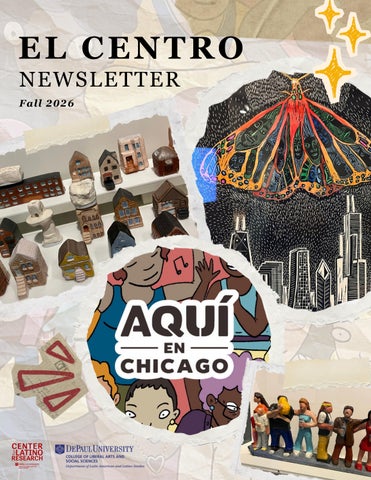
EL CENTRO NEWSLETTER Fall 2026
REVOC EHT NO
Collage of photographs from the Aquí en Chicago exhibition at the Chicago History Museum. Photographs by: Billy Johnson González and Marcela L. Reales Visbal
Aquí en Chicago Temporary Exhibition - Closes Nov. 8, 2026 Chicago History Museum Scan QR code for more information about the exhibition:
IN THIS ISSUE... 4 5 6 7 9 10 11 12 13 14 16 19
About | Center for Latino Research and Latin American and Latino Studies Letters from the CLR Director & LALS Chair CLR Advisory Committee and LALS Faculty Faculty & Staff Announcements
Student Announcements
LALS/CLR/STRC Fall Calendar
Latinx Open House EVENT RECAP: Conversation with Dr. Lorgia García Peña STRC Updates STRC Annual Symposium: “The Art of Change Revolutionary Humanities”
LALS Spotlight: Dr. Juan Mora-Torres
Justice in View
20
EVENT RECAP: Book Launch: The Young Lords Speak
21
Play as Protest: People’s Park and the Young Lords
22
2026-2027 CLR Faculty Fellows
23
2026-2027 CLR Faculty Fellows Spotlight: Dr. Marisa Alicea
26 27
Fall 2026 Latinx Book Club Chicago Poet Laureate Mayda Del Valle at DePaul
28 29 30
EVENT RECAP: Lotería Latinx Book Club
33 34 35 36
EVENT RECAP: Latinx Studies Now! Professional Development Workshop
CLR/LALS External Advisory Board Members
LALS Alumni Spotlight: Claudia Peralta
EVENT RECAP: Book Launch for Dr. Rocío Ferreira and Dr. Susana Martínez Conversation with DePaul Professor and Writer: Dr. Rocío Ferreira IDS Fest
37
Dancing the Revolution: From Dancehall to Reggaetón Exhibition Review
38
EVENT RECAP: Dancing the Revolution: From Dancehall to Reggaetón Exhibition Visit
39 40
LALS Winter 2027 Course List
Contact Us
4
CLR MISSION STATEMENT
The Center for Latino Research (CLR) strives to open and sustain dialogues that foster the empowerment and advancement of Latinx communities. To that end, the CLR creates learning opportunities for students and supports scholars in their research, while forging collaborative relationships with local, national, and international research partners. We also publish an award-winning scholarly journal, Diálogo, and sponsor many activities on campus, including film series and speaker series.
ABOUT
LATIN AMERICAN & LATINO STUDIES The Department of Latin American and Latino Studies (LALS) explores the myriad contributions of Latin Americans and Latinx people to the global community. The department’s programs emphasize the profound linkages that have emerged between Latin America and the United States, particularly through the construction of Latinx communities in the U.S. We also critically analyze the complex intersections with Indigenous, African, European, Semitic, Arab, and Asian communities throughout the Americas.
Edited and Designed by:
Published by:
Gigi Lara Aidan Ramos Giana Enciso
The Center for Latino Research and The Department of Latin American and Latino Studies at DePaul University
El Centro, Fall 2026
5
Letters from the CLR DIRECTOR & LALS CHAIR Querides lectores, As autumn rolls in, the winds of change are upon us. The leaves have started to flare up in reds and oranges as people crowd into the CTA, steaming coffee in their hands to ward off the chill, heading out to take on the day’s challenges. Autumn is expectation, the turning point of the year, the time when you settle in, chart your path, and commit to the future. We are certainly in need of change in this country – so autumn gives me hope. Hope that the awful things will finally die, that new possibilities will emerge. The theme for this year’s STRC Symposium is “The Art of Change: Revolutionary Humanities,” and our invited speakers will each engage how the arts give us hope and can actually bring about change. I encourage you to watch the film ASCO: Without Permission, which we will be streaming online for free beginning October 12th. The film introduces us to a group of college-aged Chicanx artists – Gronk, Willie Herrón, Patssi Valdez, and Harry Gamboa – who, despite having very little (tape, makeup, a camera, a restless desire for radical change) produced artwork and activism that continues to rock the art world and advance Chicanx liberation. The CLR invites you to join us at our autumn activities – visits to Aqui en Chicago at the Chicago History Museum, a panel discussion on the Young Lords, a reading by Chicago’s poet laureate Mayda del Valle, a Día de Muertos celebration, and of course, our STRC Symposium – where you can be inspired by history, and experience the arts of change that will call a better future into being.
Letter from the CLR Director
~Bill Johnson González Hola lectores, Welcome to the 2026-2027 academic year and another issue of El Centro! I am always in awe of all the beautiful programs and projects put together by the energetic faculty, students, and staff of the Department of Latin American and Latino Studies (LALS), the Center for Latino Research (CLR) and the Social Transformation and Research Collaborative (STRC). It is a joy to see how faculty and students seamlessly merge community and academic work in the service of social transformation. In that regard, as chair of LALS I was especially moved by the interview with former DePaul student, Claudia Peralta, who reflects on how her experiences in LALS courses and her engagement with our programs helped shape her path in public service and community organizing. Her story is a compelling reminder of the lasting impact that our classrooms and communities can have. I want to share a powerful message from Claudia’s interview, especially for our DePaul students: “…I would also encourage whoever’s reading this, any young person who is perhaps thinking, ‘What can I do with a degree in Latin American and Latino Studies?’ You can do a lot, because your voice matters, your culture matters, your lived experiences matter; you bring perspectives into this world that other people don’t have. Do not minimize it. Do not shrink it. There are people who came before us who have been fighting our struggle. It is our responsibility to continue this work….”
Letter from the LALS Chair
So, students, we invite you to be part of this work. Sign up for a LALS course, join us at our events, meet our faculty and fellow students, and bring your voice to the conversation. We look forward to another year of learning, connecting, and transforming together. Warm saludos, ~Lourdes Torres
6
CLR ADVISORY COMMITTEE Marisa Alicea, Professor, Vincent DePaul Professor School of Continuing and Professional Studies
Jacqueline Lazú, Professor, Vincent DePaul Professor Modern Languages
Carolina Barrera Tobón, Associate Professor Modern Languages
Jesús Pando, Associate Professor, Chair Physics and Astrophysics, College of Science and Health
Rocío Ferreira, Professor | Modern Languages
Carolina Sternberg, Professor Latin American and Latino Studies
Martha Martinez-Firestone, Professor and Director of Undergraduate Program | Sociology
Joe R. Tafoya, Associate Professor | Political Science
Julie Moody-Freeman, Associate Professor, African and Black Diaspora Studies | Director, Center for Black Diaspora
LALS FACULTY Core Faculty Lourdes Torres, Vincent DePaul Professor, Chair Latin American and Latino Studies
Jesse Mumm, Professional Lecturer Latin American and Latino Studies
Carolina Sternberg, Professor Latin American and Latino Studies
Camila Gavin, Social Transformation Research Collaborative (STRC) Post-Doctoral Fellow | Latin American and Latino Studies
Yoalli Rodriguez Aguilera, Assistant Professor Latin American and Latino Studies
Affiliated Faculty Marisa Alicea, Professor, Vincent DePaul Professor School of Continuing and Professional Studies
Juan Mora-Torres, Associate Professor History
Luisela Alvaray, Associate Professor Media and Cinema Studies
Vincent Peña, Assistant Professor Journalism and Sports Communication, College of Communication
Glen Carman, Associate Professor Modern Languages
Xavier Pérez, Assistant Professor Criminology
Delia Cosentino, Professor History of Art and Architecture
Olga Salazar Pozos, Assistant Professor Spanish, Modern Languages
Rocío Ferreira, Professor Modern Languages Department Chair, Women's and Gender Studies
Lydia Saravia, Professional Lecturer Writing, Rhetoric and Discourse
Bill Johnson González, Associate Professor, English Director, Center for Latino Research
Monica Reyes, Assistant Professor Writing, Rhetoric and Discourse
Jacqueline Lazú, Professor, Vincent DePaul Professor Modern Languages
Ana Schaposchnik, Associate Professor History
Jordan Levy, Assistant Professor Anthropology
Jose Soltero, Professor Sociology
Martha Martinez-Firestone, Professor, Sociology Director, Undergraduate Sociology Program
Sonia Soltero, Professor, Chair Leadership, Language and Curriculum, College of Communication
Susana S. Martínez, Professor, Modern Languages Director, Peace, Justice & Conflict Studies Program
Rose J. Spalding, Professor, Vincent DePaul Professor Political Science
Elizabeth Millán, Professor, Chair Philosophy
Joe R. Tafoya, Associate Professor Political Science
Heather Montes-Ireland, Associate Professor Women's and Gender Studies
Faculty & Staff Announcements CAROLINA STERNBERG Carolina Sternberg was awarded a grant from DePaul University's Vincentian Endowment Fund (VEF) to support her research project, “The Ethics of Temporary Care: Moral Responsibility, Displacement, and Homelessness Policy in Buenos Aires.” In December 2026, she will travel to Buenos Aires to conduct focus groups and semi-structured interviews that will advance this research. Together with her colleague in Argentina, Mónica Farías, she is completing a book chapter tentatively titled "The Ambivalent Role of Local Government in Implementing Caring Policies Toward Unhoused Populations in Buenos Aires: Increasing Spatial Mobilities and Spaces of Care.” The chapter is scheduled for publication in early 2027 by Edward Elgar Publishing in the co-edited volume A Research Companion to Care Work, Infrastructures, and Technologies: Emerging Geographies. This Fall, Carolina will teach her first Global Learning Experience (GLE) course, the first such course offered in LALS, in partnership with the University of Buenos Aires. Titled “Gentrification and Displacement in Buenos Aires and Chicago,” the course will bring together students from both cities in weekly synchronous sessions to examine processes of gentrification and displacement, compare their manifestations across distinct urban contexts, and exchange perspectives across hemispheres.
SUSANA MARTÍNEZ From August 4-7, 2026, Susana Martinez attended the Latin American Studies Association’s inaugural regional symposium in San José, Costa Rica, where she presented her ongoing research, “Chicago’s Central American Peace and Sanctuary Movements: Archiving Historical Memory in the Diaspora.” The symposium brought together scholars of U.S. Central American Diaspora Studies and researchers from across the region for critical dialogue on democratic backsliding, shrinking civic spaces, and the criminalization of dissent. Participants highlighted innovative forms of resistance led by Indigenous, campesino, feminist youth, and LGBTQIA+ communities confronting structural violence and exclusion. Particularly impactful were conversations with Central Americans living in exile, which underscored the vital role of historical memory in resisting erasure, advancing justice, and imagining pathways toward peace. The experience offered both inspiration and renewed urgency for preserving and sharing community histories. ¡Pura vida!
XAVIER PÉREZ Dr. Xavier Perez, faculty member in Criminology, is the 2025–26 recipient of the Provost's Award for Inclusive Engagement. The award recognizes a faculty member who demonstrates excellence in advancing inclusive engagement at DePaul University. The selection committee honored Dr. Perez for his research, teaching, and advocacy that amplify marginalized voices, particularly Latinx communities, incarcerated individuals, and community violence intervention workers. The committee also recognized his efforts to bridge the classroom and community through prison education, collaborative scholarship, and community partnerships that position justice-impacted individuals as knowledge producers while advancing institutional
accountability,
¡Felicidades, Xavier!
transformative
learning,
and
meaningful
engagement.
Faculty & Staff Announcements ROCÍO FERREIRA We are delighted to announce that Dr. Rocío Ferreira was promoted to Full Professor on July 1! ¡Felicidades, Rocío! Dr. Ferreira recently published her latest book, De las Veladas literarias de Lima 1876– 1877 a la Cocina ecléctica. Mujeres, nación y cultura en el Perú decimonónico (MYL, 2025). The book has been warmly received at presentations in France, Germany, Peru, and Argentina. It was also the fourth best-selling book in Lima in July. Following the book’s publication, Dr. Ferreira was interviewed by La República, one of Peru’s leading newspapers, about literary criticism and culture. From May through August, Dr. Ferreira presented her latest research at several international conferences, including the Latin American Studies Association (LASA) Congress in Paris, the Memory Studies Association (MSA) conference in Buenos Aires, and the Jornadas Andinas de Literatura Latinoamericana (JALLA) in Arequipa. Dr. Ferreira was also invited to deliver a lecture at the Heisenberg Colloquium “Rails and Mines: Networks of Tropical Coloniality” at the University of Bayreuth on July 6–7. Her presentation, “Material and Sentimental Extractivism: Gold and Dis/love in 19th Century Women’s Narratives,” explored the intersections of extractivism, gender, literature, and coloniality in nineteenth-century women’s narratives.
JOE TAFOYA Professor Tafoya has been promoted to Associate Professor with Tenure. In Political Science, he leads the department's expanding offerings in statistical research methods and advances impactful research on Latinos in American democracy. His courses include Latino Politics, Latino Political Behavior, Public Opinion, Political Inquiry, and Social Science Statistics, along with Multiculturalism for the Honors Program. This promotion recognizes his exceptional scholarship, dedicated teaching, and valuable ongoing contributions to the broader academic community. ¡Felicidades, Joe!
LUISELA ALVARAY Luisela Alvaray recently published the article “Latin American Stories Stream Worldwide: Producing for Global Platforms” in the collection Locating Media Industries: Spaces, Places, Platforms, edited by Paul McDonald, Chris Meir and Andrew Spicer (Routledge, 2026). The article extends her research on the transformation of Latin American film and media in response to new technologies of production and viewing, as well as the evolving organization of regional media industries. She previously presented this article at the Latin American Studies Association conference, held in Paris in May 2026. During the Fall 2026 Convocation, Professor Alvaray received the Excellence in Teaching Award of DePaul’s Quality of Instruction Council in recognition of significant achievements in teaching and commitment to the teaching mission.
Student Announcements MICHELLE CISNEROS Michelle Cisneros was recently appointed as the Department Assistant for the Department of Latin American and Latino Studies, the Center for Latino Research, the Department of African and Black Diaspora Studies, and the Center for Black Diaspora. Alongside her new role, she is currently beginning her second year in the Master of Arts program in Critical Ethnic Studies. This October, she will conclude her 2026 STRC Graduate Fellowship by serving as a featured panelist during a roundtable presentation at the Annual Fall STRC Symposium.
GIANA ENCISO Giana is the newest Graduate Student Assistant for the Center for Latino Research and the Department of Latin American and Latino Studies. Born in Crystal Lake, IL. She moved to Chicago in August of 2025 after living in Hawaii for 6 years. She got her undergraduate degree in Political Science and Philosophy from the University of Hawaii at Manoa. She is currently earning her Master’s in Public Policy at DePaul University. Her main academic interests are urban planning and development and their relationship with the environment. She hopes to conduct research that can influence environmental and urban planning policy. Her personal interests include reading, film photography, and spending time her family and friends.
AIDAN SEBASTIÁN RAMOS Aidan is the newest Undergraduate Student Assistant at the Center for Latino Research and the Department of Latin American and Latino Studies. Born in Chicago but raised in Skokie, IL, he is a proud Mexican American and first-year Latin American and Latino Studies major. His interests include playing guitar, music, reading, studying history, Lucha Libre, and learning more about different cultures. His favorite movies are La Bamba and The Crow, his favorite books are Frankenstein and Batman: The Long Halloween, his favorite albums are Rubber Soul by The Beatles and Caifanes Volumen 1, and his favorite wrestler is Rey Mysterio. Aidan came to DePaul to learn more about his culture and other Latino cultures.
GIGI LARA Gigi spent the beginning of her summer doing archival research and learning from Black Studies scholars at the Schomburg Center for Research in Black Culture in New York City. She was also a HumanitiesX Fellow, collaborating with Dr. Shailja Sharma, Prof. Ambarien Alqadar, and the Indo-American Center to create a community-engaged public humanities course being taught in the Fall. Additionally, she served as Dr. Camila Gavin’s research assistant for her oral history project “La Historia es Nuestra”, documenting stories from Chilean exiles to the U.S. during and after the Pinochet dictatorship. This is Gigi’s last quarter at DePaul. She is a Chicago Quarter Mentor for Dr. Jesse Mumm’s Discover Chicago course “Puerto Rican Chicago”. She is looking forward to life post-grad and finding new ways to engage with the communities she cares about.
RADNELAC 6202 LLAF CRTS/SLAL/RLC
9/17-18
Visit to the Museum of Contemporary Art Dancing the Revolution: From Dancehall to Reggaetón 10:00 AM
10/1
Latinx Open House Latinx Cultural Center (360 O’Connell Hall) 1:00 - 3:30 PM
10/4
Creolism: Arts & Culture | Professional Development Workshop for K-12 Educators 18th Street Casa de Cultura (2057 W. 18th St) | 11:00 AM - 1:00 PM
10/6
Play as Protest: People’s Park and the Young Lords Panel Discussion with Dr. Jacqueline Lazú and Dr. Marin Sullivan A&L 103 | 6:00 - 8:00 PM *In collaboration with DoCoMoMo
10/12 - 10/18
Streaming of the film ASCO: Without Permission
10/14
Latinx Book Club | A South Side Girl’s Guide to Love & Sex: Poems by Mayda Del Valle Center for Latino Research (SAC 5 A-H) | 4:30 - 5:30 PM
10/20
Social Transformation Research Collaborative Annual Symposium The Art of Change: The Revolutionary Humanities 935 W. Fullerton Ave | 9:00 AM - 6:00 PM
10/26
Día de muertos Workshop | 1:00 PM (Location TBD)
10/29
Visit to the Chicago History Museum Aquí en Chicago 11:20 AM and 2:40 PM
10/29
Día de muertos Celebration Latinx Cultural Center | 4:00 PM
11/4
Reading and Conversation with Chicago Poet Laureate: Mayda Del Valle McGowan South 104 | 6:00 PM
COME AND JOIN US AT OUR ANNUAL
LATINX
OPEN HOUSE OCTOBER 1ST, 2026 | 1:00 PM - 3:30 PM O’CONNELL HALL ROOM 360
Learn about DePaul’s Latin American & Latino Studies Department, the Center for Latino Research, and the Latinx Cultural Center, over snacks and refreshments!
a conversation with
DR. LORGIA GARCÍA PEÑA event recap
On Monday, April 13th, LALS, CLR, and STRC hosted Princeton University scholar, writer, and activist Dr. Lorgia García Peña, who discussed Suzan Beraza’s film, Massacre River: The Woman Without a Country (2019). Dr. Yoalli Rodríguez Aguilera, Assistant Professor in the Department of Latin American and Latino Studies, moderated the conversation. Dr. García Peña and Dr. Rodriguez Aguilera spoke about migration and negotiations of race and nationhood between Haiti and the Dominican Republic, as well as building spaces for community and solidarity within higher education. They opened up the forum to the audience and held a fruitful Q&A session discussing how racialized, economically violent politics disproportionately affect Dominicans of Haitian descent and the implications of nationlessness on the individual. The Latin American & Latino Studies Department purchased the film for viewing for one year. Scan the QR code to watch!
El Centro, Fall 2026
13
STRC Summer Institute for New Students This July, we kicked off our 6th annual STRC Summer Institute. We went on a variety of excursions such as the Chicago Architecture Boat Tour, the Chicago Public Housing Museum and tours in Pilsen.
Social Transformation Research Collaborative’s New Student Assistant! Olivia Hanif is a junior majoring in journalism and minoring in intercultural communication and peace, justice & conflict studies. She’s an associate editor for student-ran 14 East Magazine and a workshop assistant for Meet Me at the Mission. In her free-time, she enjoys reading, watching movies, and any type of creative endeavor. Over the summer, she pursued research on the Original Rainbow Coalition for the STRC Undergraduate Research Program and went to Kona Island.
STRC FALL SYMPOSIUM: THE ART OF CHANGE REVOLUTIONARY HUMANITIES WITH KEYNOTE SPEAKERS: DR. SARAH LEWIS DR. ONDINE CHAVOYA AND FATIMAH ASGHAR FREE AND OPEN TO THE PUBLIC
OCTOBER 20TH 2026, 9 AM-6 PM LOCATION:
DEPAUL ART MUSEUM Questions? Contact ediaz68@depaul.edu
STRC Annual Fall Symposium:
THE ART OF CHANGE: REVOLUTIONARY HUMANITIES
tuesday, October 20, 2026 935 W Fullerton
9:00am
STRC 2026 Graduate Fellows Moderated by Dr. Lourdes Torres Dom Keith-Maher Leon Friedrich Diaz Joel Halexander Emmanuel Flores Jabari Scott Thawng Hmung Zhi Qing Yaw Michelle Cisneros
10:40am Keynote: Dr. Ondine Chavoya (University of Texas, Austin) Talking about ASCO, an avant-garde Chicano art collective, and the recent film, ASCO: Without Permission.
12:00PM
Lunch/STRC Undergraduate Fellows Charise Conard Virginia Edwards Jackelyn Garcia
Grace Fitzgerald Nel Afenya Olivia Hanif
1:00pm
Keynote | Dr. Sarah Elizabeth Lewis (Harvard University)
2:40pm
STRC Faculty Fellows Dr. Xorla Ocloo Dr. Shiera Malik
4:20pm
"The Power of Narrative: The Hidden Lever for Justice in America" (Zoom presentation)
Dr. Michael McIntyre Dr. Amor Kohli
Keynote | Poet/Director/Screenwriter Fatimah Asghar (Brown Girls)
Light Breakfast Snacks and lunch will be provided. Contact ediaz68@depaul.edu for more information.
LALS SPOTLIGHT 16
LALS SPOTLIGHT: DR. JUAN MORA-TORRES CONOCIENDO NUESTRA LATINIDAD THROUGH HISTORY Interview conducted by Angelique Lara
Juan Mora-Torres is an Associate Professor in the History Department and an affiliate faculty with the Latin American and Latino Studies Department. He is currently working on a manuscript tentatively titled Mexicans in Babylon: Barrio Making in Chicago's West Side 1917 to 1973. He has been at DePaul for nearly 20 years, focusing his teaching and research on the borderlands.
I am the son of Esther Mora Torres, a cannery worker, and Magdaleno Mora Rojas, a railroad worker. I was born in a small town called Tlalpujahua, Michoacán, in Mexico. My family migrated to the US when I was very young. We worked as a family in the fields and orchards of the San Jose South Bay area. We picked all kinds of crops such as tomatoes, onions, pears, apricots, grapes, cherries, and plums. They were seasonal, meaning that from March to October, there was always work in the fields, and then I went back to school. My parents ensured that we did not miss school. When I was 14, I found work in the canneries, processing fruits and vegetables into canned goods. My family was working class, and I would have been working class too if I had not gone to university. I grew up in San Jose, in a neighborhood called the Gardner neighborhood; young kids called it the horseshoe barrio. It was one of those neighborhoods that was made-up of all kinds of people from different backgrounds. My childhood was during an era of tremendous fermentation of social movements: the Black Liberation Movement, the Women's Movement, the Equal Rights Movement, the student movement, and among them also the Chicano Movement. The politics of that era, especially the Chicano movement, influenced my worldview and the way I began to understand my place and the place of my community in the larger picture of the world. It led me to my political interventions. I came to understand that the most exploited, oppressed people in our communities, and perhaps in the entire U.S., were the undocumented workers and their families. I am a scholar-activist interested in studying the subaltern, lower-class people and politically active in issues that impact the subaltern populations, and in my case, primarily the immigrant rights movement and the rights of immigrants.
Dr. Juan Mora-Torres What made you decide that your activist route was a scholarly route? It's a product of the 1960s. One of the demands of the Chicano movement was access to higher education because there were very few people of Latino ancestry attending universities, including the public universities. Another demand of the Chicano movement was for an educational system that catered to the needs of the community: bilingual education, knowing your history, saying no to the punishments for speaking Spanish in class, etc. Students engaged in sit-downs and strikes and protests and confrontations with the authorities until the doors began to open slowly and gradually for Latinos, and in my case, Chicano students in California. I am very grateful that I benefited from that opening of the door. I realized that I really like history. Up to that point, when it came to Mexican American history and Latino history, we had very little.
El Centro, Fall 2026
17 Many in my generation, including myself, went into the social sciences to understand who we were, where we were coming from, and where we were going. That led me to get a degree in history with a minor in Chicano studies. Then I went to the University of Chicago to study Latin American history. It was a moment when there was financial aid, so the doors were open. That doesn't mean that we had it easy. Most of us were poorly prepared because schooling did not teach us to go to college. We were supposed to be factory workers. It was a relearning of ourselves. We had to do double the work. I was very happy to be with students who looked like me, who thought like me. We were all guided by the idea of helping our communities. You have worked with community organizations and public domains in Pilsen, like Casa Michoacan and the Rudy Lozano Library. What have these collaborations taught you about who gets to produce and preserve history? As late as the 1970s, if you opened a survey textbook on American history, you would not find a paragraph on Mexicans, Latinos, Puerto Ricans, and their contributions to this country, despite the fact that Latinos have a very long history in this country. For me and for Latino students at that time, it was an injustice. It wasn't an erasure of history because it wasn't erased; it was the invisibility of a people when it comes to their contributions to American society. The production of our history begins with the Chican@s, Boricuas, Latinos who began to produce history of their communities to understand where they were coming from and why they were here. Early historians would take this view of history as a means of liberating people from the conditions of oppression. The main task in the production of our history is centered on recovery and preservation. By recovery, I mean collecting what's out there in terms of archives, written materials, photographs, and anything else. I work with the Rudy Lozano Library. Our mission right now is to transform the Rudy Lozano Branch Library into a regional library. Hopefully one that houses the archives. It is a Herculean task in the sense that it involves a lot of work. We have to knock on the doors of government officials, donors, and so on. Since many of us are veterans of the movement, if that doesn't work, then we will do what we know best—
confrontational politics. It is, for us, a necessity. It's also a debt that the city owes to our communities for the many years of labor they put into making Chicago a global city. It's a historical debt because we have been paid very little in wages. This is one way in which there could be some kind of redemption between the city and our Latino communities with this archival library. How do you think gentrification in Chicago may affect the way communities remember and represent their own histories? For the most part, Latinos have been missing from the official history of Chicago. It has to do with how our communities came about. One of the areas in Chicago where Latinos concentrated was the inner city, especially around the Loop, because it was the oldest housing in the city. It had the cheapest rent and was close to employment. In the 1940s, the Loop was madeup of black and brown people, and migrants. Before we got gentrification, there was urban renewal. The urban renewal projects were federally funded, and the city used them to destroy the inner-city neighborhoods surrounding the Loop because they did not want black and brown people living in poverty around that area. Latinos have this history of being forcefully removed and displaced from communities that they had worked hard to establish and build institutions in. That happened from the 40s through the 60s. In the '70s, we got gentrification because the new neighborhoods that were being targeted were no longer the ones around the loop. When we talk about how we remember, we're talking about communities that have been traumatized by gentrification or urban renewal. These are communities made up of poor working-class people. Suddenly, the city declares those spaces a sore sight that need to be removed, because they can no longer afford to pay skyrocketing rents or property taxes. When we deal with Latino history in Chicago, we have to engage with the trauma of displacement. That's part of the essence of modern Latino history. Gentrification, more than anything, is driven by profit. The people in these communities are driven by the idea of community use, that the community has value to them: their church, their businesses, and friends. Gentrification, in the end, erases everything. For us as historians of communities, it leaves behind very little traces of the past.
LALS SPOTLIGHT 18 What are some key takeaways for students to know about the history of Mexican immigration and Mexican people in Chicago? First, Mexicans have been part of Chicago's history since they started building their first communities in the Near West Side, Back of the Yards, and South Chicago. Mexicans have a historical presence that's over 100 years old. Second, although our contributions -I'm talking about Latinos in general- have not always been recognized, every Chicagoan should know at least a couple of the important contributions Mexicanos and Latinos have made to the city. Their most important contribution has been their labor to the city. Beginning with track, railroad, steel, and meatpacking workers in the 1920s, all the way to today's era, in which you cannot understand modern Chicago as a global city without the labor of Latinos, such as construction, hotel, and restaurant workers. The city would not move without this labor, and if Latinos ever declare a strike, the city will become paralyzed. Culture would be the second most important contribution. We have transformed the city from a cold, gray space to a tropicalized city. You go to any neighborhood, and you see the different colors, the murals, the street life, the music. We have contributed to the richness of Chicago's culture through our cultures Third, we have not been recognized in our history. It’s missing from the curriculum and the cultural centers that define the city, such as the Art Institute, the Chicago Historical Society, and the Newberry Library. We have been invisible, and we're not being represented. That's an injustice because when we look at today, there are about 2.3 million Latinos living in the metro area. We are about 25% of Chicago's metro population and growing. One of our goals is that we have to bring recognition to Latinos in Chicago and the metropolitan area. Talk to us about your most recent book project. The book is tentatively entitled Mexicans in Babylon: Barrio Making in Chicago's West Side, 1917 to 1973. Not really a neighborhood, but a colonia because they were not the majority. They were living with Italians, Greeks, Jews, and so on. They worked hard not only to send remittances back to their home communities and support their families, but also to improve themselves in Chicago.
To learn English, go to school, learn a Mexican instrument, write poetry and theater, and do all the things that we love to do as humans. Along the way, they began to build bigger communities that would include other people, like Puerto Ricans, in the 1940s. These communities later became barrios as they moved to Pilsen and Little Village. In barrios, they became the majority. They struggle for labor recognition, selfdetermination, and community empowerment. Mexicans also established political alliances with Puerto Ricans, African Americans, and other progressives in their quest to create a more inclusive Chicago. My book ends in 1973 at the height of the urban crisis. It was a massive de-industrialization of the city, where more than half of its industrial jobs left. It was a fiscal crisis where the government began to disinvest from communities and the welfare of people. At the same time, there is a demographic shift from a white majority city to a minority majority city because of white flight to the suburbs. The book is about how the West Side of Chicago went from being almost 100% white to, by the 1970s, being basically a black and brown region of Chicago. For students who may be interested in doing community-based historical research, what advice would you give them about building relationships with communities and organizations? Students have a voice. They can bring their writing and research abilities, as well as critical thinking skills, to the table when working with community organizations. Organizations don’t have a history. They may have collections of records, but there's no history. If you are interested in working with community organizations and the history of these organizations, then my suggestion is you get your hands dirty. They will appreciate any kind of historical account; even if it's poorly written or poorly researched, it's something they have as a reference to develop later. You get your hands dirty by doing the research, the writing, asking questions, and doing the oral history with the members. Even if you make a mess, at the end, you are helping. You are learning. It goes both ways. Otherwise, that history will never be done. So put on your apron and start building connections.
JUSTICE IN VIEW
Critical Pedagogies of Immigration Court Watching and Lessons from the Immigration Research Hub Sponsored by de Dept. of Latin American and Latino Studies and Dept. of Anthropology
This workshop for faculty introduces a framework for incorporating immigration courtwatching into university classrooms and connecting students and educators with a growing national research effort.
Thursday, October 22 4:30–6:30 pm JTR 111 and on Zoom
Dr. Amelia Frank-Vitale Assistant Professor, Princeton University
Presenters will share practical curricular tools— including training materials, observation protocols, survey instruments, reading lists, and discussion guides—along with lessons from a project now implemented in undergraduate and graduate classrooms, research labs, and communityengaged research. To date, participating students and researchers have observed over 2000 hours of proceedings across 26 immigration courts and 148 courtrooms in 15 states and Puerto Rico.
Participants will learn how courtwatching can help students analyze judicial discretion, informal norms, and off-the-record exchanges while connecting experiential learning to civic engagement. Attendees will leave with adaptable resources and pathways into the Immigration Research Hub. Dr. Lauren Heidbrink Professor, California State University, Long Beach
Questions? MCISNE11@depaul.edu
Scan QR code to Register
EVENT RECAP
BOOK LAUNCH: THE YOUNG LORDS SPEAK
PAUL MIRELES
DEREK POTTS
OMAR LÓPEZ
DR. JACQUELINE LAZÚ
On Wednesday, April 29th, the CLR, LALS, DPAM, and the STRC hosted a Book Launch Celebration for Dr. Jacqueline Lazú’s The Young Lords Speak: Building Revolution on the Streets of Chicago. The event brought together scholars, community members, and students for an engaging evening at the DePaul Art Museum. The program featured a conversation titled “Ourchive,” with author Dr. Jacqueline Lazú (DePaul, Modern Languages), Omar López (YLO, Minister of Information), and Derek Potts (DePaul, Special Collections Library), moderated by Paul Mireles (Chairman, New Era Young Lords), which highlighted the history and impact of the Young Lords Organization and the importance of preserving their stories through accessible archives. Attendees reflected on themes of activism and community building. Thank you to all who attended! Pa’lante!
PLAY AS PROTEST: PEOPLE’S PARK AND THE YOUNG LORDS
PANEL DISCUSSION WITH DR. JACQUELINE LAZÚ AND DR. MARIN SULLIVAN
In the summer of 1969, an unlikely public space appeared in Chicago’s Lincoln Park neighborhood. People’s Park was created by the Young Lords, a group of Puerto Rican community activists that eventually became a nationwide political force. Created as a protest against gentrification and displacement, People’s Park embodied community empowerment and served as a communal space for gardening, public gatherings, and play. The centerpiece of the space was a group of interactive play sculptures created for the park by noted artist Mark di Suvero. Dr. Jacqueline Lazú
This panel discussion will examine the background of the Young Lords and the creation of People’s Park; di Suvero’s play sculptures; and what we can learn today from People’s Park and its intersection of political protest, modern art, and play.
OCTOBER 6, 2026 6:00 - 8:00 PM
ARTS & LETTERS 103 2315 N KENMORE AVE CHICAGO, IL 60614
Dr. Marin Sullivan
Dr. Marin Sullivan
The event is free, but registration is required. Scan to register! Sun-Times photograph by Larry Graff. August 7th, 1969.
The program is part of Docomomo Tour Day, an annual nationwide celebration of modern architecture and design.
Center for Latino Research 2026 – 2027 FACULTY FELLOWS
Dr. Bradley Hoot Professor | Modern Languages
Testing the tests: Validating quick proficiency measures for Spanish/English bilinguals Measuring language proficiency is often necessary in educational, clinical, and research settings. Yet for heritage speakers of Spanish—that is, U.S. Latinx Spanish/English bilinguals who acquire Spanish in childhood but by adulthood are usually dominant in English—traditional Spanish proficiency tests can reinforce experiences of linguistic and social marginalization and produce inaccurate results. This project aims to contribute to an ongoing effort to identify better, more equitable ways of describing these bilinguals’ language knowledge by empirically testing and critically evaluating the validity of two popular proficiency measures for use with this population. To achieve this aim, I will collect data from three groups of bilinguals at two time points, then analyze how the tests behave using statistical techniques from the educational testing literature. I will publish the resulting evaluations of the selected instruments, which will be of interest to researchers in bilingualism, language acquisition, and heritage languages, as well as practitioners, clinicians, and educators who need valid, reliable, and fair proficiency tests to serve U.S. Latinx Spanish/English bilinguals.
Dr. Jacqueline Lazú Professor | Modern Languages/Critical Ethnic Studies
Ritual Routes: Afro-Cuban Religion, Diaspora Networks, and Spiritual Exchange Between the United States and Cuba This project examines how Afro-Cuban religious traditions create and sustain connections across Cuba, the Caribbean, and diaspora communities in the United States. Through ritual practice, travel, and the circulation of religious knowledge, practitioners have built enduring networks that persist despite political tensions, economic restrictions, and shifting migration patterns. These networks provide pathways for cultural continuity, spiritual grounding, and community formation while also revealing the unequal conditions that shape encounters between diaspora communities and practitioners on the island. Drawing on archival research, oral histories, and ethnographic fieldwork, this project explores how religious communities negotiate questions of belonging, authority, and responsibility across national borders. By centering lived experience and transnational religious exchange, the project demonstrates how Afro-Cuban traditions sustain relationships across dispersed communities and offers new insights into diaspora, mobility, and survival under conditions of constraint.
Dr. Xavier Pérez
Assistant Professor | Criminology
Latino Resilience in Action: Community Violence Intervention and Cultural Wealth in Chicago’s Latinx Communities Traditional violence prevention literature focuses on criminal justice policies and practices while ignoring the contribution of community-centered approaches. Specifically, the literature neglects the work of community-based agencies that reduce interpersonal violence. This project examines how Community Violence Intervention (CVI) efforts operationalize Latino Resilience within Chicago’s 26th Ward, a predominantly Latinx community. CVI offers a novel approach to reducing crime by drawing upon the cultural wealth embedded within Latinx communities, including strong social networks, shared values, and collective forms of support. Using a qualitative design, the study consists of in-depth, semi-structured interviews with CVI outreach workers. By centering the experiences of outreach workers and the communities they serve, this project challenges deficit-based assumptions about Latinx populations and critiques punitive paradigms of public safety. The findings underscore the effectiveness of community-based interventions and highlight the assets within Latinx communities.
Dr. Marisa Alicea
Professor | School of Continuing and Professional Studies
The Path to Spanish Citizenship: Motivations and Experiences Under Spain’s Democratic Memory Law This research project examines why individuals, primarily from Latin America, are applying for Spanish citizenship under Spain’s Democratic Memory Law (Ley de Memoria Democrática) and what the pursuit or acquisition of Spanish citizenship means in their lives. Enacted in 2022, the law allows children and grandchildren of Spaniards who lost or renounced their nationality during the Spanish Civil War and Franco dictatorship to reclaim Spanish citizenship, generating more than 2.3 million applications worldwide. Using an online survey and in-depth interviews, the research team has collected 260 surveys from applicants across Latin America, Puerto Rico, the United States, and the Philippines. Led by Nilda Flores-Gonzalez, with Maura Toro-Morn and Marisa Alicea as co-principal investigators, the project explores the intersections of historical memory, migration, identity, and citizenship. During the fellowship period, Alicea will focus on Puerto Rican applicants, conducting and analyzing 21-25 qualitative interviews. Findings will contribute to scholarship on the Puerto Rican diaspora, transnationalism, citizenship, and the contemporary significance of ancestral claims to national belonging.
El Centro, Fall 2026
23
2026-2027 CLR FACULTY FELLOWS SPOTLIGHT: DR. MARISA ALICEA A QUEER CHICAGO RICAN STORY Interview by Marcela L. Reales Visbal Dr. Marisa Alicea is a Professor of Sociology in the School of Continuing and Professional Studies, an affiliated faculty member in the Department of Latin American and Latino Studies, and a member of the Center for Latino Research Advisory Committee. We talked about her experience as a lifelong Chicagoan, her scholarship and work serving the ChicagoRican community.
I'm a queer Chicago Rican, a Professor of Sociology, and a faculty member at the School of Continuing and Professional Studies. I am also proud to be an affiliate faculty member of the Latin American and Latino Studies Department. I'm a member of the Society of Vincent DePaul Professors. I'm a daughter of Puerto Rican migrants, I'm a sister, I'm a tía to 3 nephews and many, many cousins that I've adopted as my nieces and nephews. And I've been a partner for 18 years to Ann Stanford. I love to garden, and I love kayaking. I'm an amateur photographer. And also, at a professional level, I'm really proud to be an associate editor of Latino Studies Journal. I grew up in Chicago, and I stayed in Chicago for my graduate studies. I was fortunate enough to get a position here at DePaul. I grew up in Chicago in the 1960s and 70s, and it was around that time that the Puerto Rican community was starting to come together in West Town and Humboldt Park. But I always like to say that my primary education was in a Chicago Public School, and the key thing about that is that I was part of one of the first bilingual programs that our community fought for. It was probably in 1970. I was in 5th grade, and they had just started a bilingual program at my school, Peabody Elementary. I joined a bilingual program not because I didn't know how to speak English, but because I knew my parents were talking back then about returning to Puerto Rico, and I thought it would be great if I enhanced my Spanish-speaking and writing skills. Up until then, I did not think that Puerto Ricans could be professionals. In the community that I grew up in, all I knew was that people worked in factories and as janitors. My father was a custodial worker. My mom was a stay-at-home mom, and when she did work outside the home, she worked in factories.
Dr. Marisa Alicea Nothing wrong with this, these were hard-working people, but that's all I knew. I remember the first day that they took me to our classroom, and before I even could see who the teacher was, I could hear her. And I remember that she was not only speaking Spanish, but she was speaking “Puerto Rican Spanish.” I just remember being awestruck at realizing that Puerto Ricans could be professionals and teachers, and that was really a life-changing experience for me. I was a good student, but I didn't feel a sense of place and belonging. Once I joined the bilingual program, I really felt that the teachers, who were largely all Puerto Rican, understood who I was, and for the first time, my parents could become actively involved. So I'm very proud of the public education that I got here in Chicago. Can you tell us about your journey at DePaul? I started as Associate Director of the Center for Latino Research (CLR). Felix Padilla, who was hired as the
2026 - 2027 CLR FACULTY FELLOWS SPOTLIGHT
24 director of the CLR, was the one who brought me on board. The Center had been dormant for 2 years, and I have to say that one of the highlights in my career was being part of relaunching it. We created programming and offered that to students and faculty. But we also launched the Latino Studies Journal. It's not the current Latino Studies Journal that we have now, but it was named very similarly. I started with the center in 1988, so I've been with DePaul for nearly 40 years. Throughout my career, I remained connected to the CLR and continue to serve on the board. After that, I was appointed faculty at the School for New Learning (SNL), which was the former name of the current School of Continuing and Professional Studies (SCPS). As a faculty member, I was very attracted to the college because of its non-traditional nature. I really saw that kind of synergy between my work in the college and Latino Studies. In the same way that I worked alongside colleagues to help Latinx students gain access to higher education, our college is about providing access to education to adult and non-traditional students who wouldn’t otherwise have been able to earn a degree. I also appreciated the school's innovative nature. We created non-traditional programs and classes, and there were many things that we had been doing for a number of years that then DePaul, at large, adopted. We really put students at the center and as co-producers of knowledge. I have served as a faculty member, Associate Dean, and had the privilege of serving as Dean of SNL for 10 years. A highlight in my role as an administrator is that when I became Dean, we launched an undergraduate program in Nairobi, Kenya. Through a trip that several faculty from DePaul had made to Nairobi, came the idea of our college offering a degree for adult and non-traditional students there. We graduated 8 cohorts of students, somewhere in the neighborhood of 150 or 160 students graduated from our program there. We were very clear from the beginning that we would launch and offer our degree there, but once they had created a similar program under the Department of Education in Kenya, we would pull back. It was about providing education to students there, and we have a group of alumni who created the Leaders Guild, which is both an alumni association and an organization that offers leadership development opportunities for people in Kenya. So it's still an ongoing initiative.
How does your community engagement relate to your scholarship? It's hard to say what informs what because I have been active and engaged in community work at different levels since I was a young adult and throughout my career. In addition to being on the board and board president of Mujeres Latinas en Acción, I served on a board sub-committee with the Mexican American Legal Defense and Education Fund, I was on the board of the National Museum of Puerto Rican Arts and Culture, and I also did some volunteer work with Amigas Latinas, which is a Latina lesbian organization. My scholarship informs my work in community, but frankly, it's really my community work, and being a member of this community, and having grown up in Chicago, that informs my scholarship and my teaching, so there's a lot of great synergy between my scholarship, my community work, and the courses that I teach. Can you talk to us about your CLR project? For several years now, I've been interested in doing research on Latin American immigrants to Europe. About a year and a half ago, my colleague Nilda FloresGonzalez from Arizona State University mentioned she was working on this project and invited me and my colleague Maura Toro-Morn from Illinois State University to collaborate with her. The project itself has to do with the Ley de Memoria Democrática that Spain passed that allows children, grandchildren, and greatgrandchildren of Spanish citizens who lost or renounced their nationality due to political, ideological, or religious reasons, to be able to recover their citizenship. Spain follows that legal principle that dictates that you’re a citizen if you are born in Spain or you're the child of people born in Spain. But during the Spanish Civil War in the mid to late 30s, and then during the subsequent Franco rule, there were many people who left Spain and renounced their Spanish citizenship. And, thinking about the Puerto Rican community, during the SpanishAmerican War, some people had Spanish citizenship in Puerto Rico at the time, and they lost it when the U.S. took possession of Puerto Rico. So, basically, the law offers a simplified path to secure Spanish citizenship. Unlike other paths to secure citizenship, this new law provides people the opportunity to apply for Spanish citizenship from their country of origin without having to meet residency requirements in Spain. So, as a result of that law, over 2 million people from across Latin
El Centro, Fall 2026
25 America and the U.S. who can trace back their ancestry or parentage to Spanish grandparents or greatgrandparents have applied for Spanish citizenship. What we did is we collected about 260 surveys from individuals who had already applied, were in the process of applying, or who had already, under this law, secured Spanish citizenship, or were rejected. Among the people who completed the survey, we have people from every Latin American country who have applied, as well as from the U.S. and the Philippines. From the beginning, we had intended to do qualitative interviews. A subset of the 260 people, 76 people, said they would do a more indepth interview. And of the 76, there are 27 who are of Puerto Rican descent. During the fellowship, I'm going to be interviewing los Boricuas, trying to understand why they have applied for Spanish citizenship. What does it mean for them to be pursuing this? What would it mean for them to actually be granted Spanish citizenship? The preliminary data shows the variety of reasons that people have for applying for Spanish citizenship: a great opportunity or place to retire, a place to pursue education, acquire healthcare, and in some cases, it's just, “I want the opportunity to be able to travel freely back and forth,” so not everybody is intending to immigrate to Spain. I would venture to say that less than half are necessarily intending to move to Spain. I'm also curious about the notion of second-class citizenship for people from Puerto Rico. Even though we are U.S. citizens, if you live in Puerto Rico, it's very much a second-class citizenship, because you're not able to vote for the president of the United States or have legislative representation in the federal government. So, I think part of the question we have as we're going into the qualitative interviews is: Are people, in effect, applying for Spanish citizenship, recognizing that the current citizenship that they have is second-class citizenship? The reality is that Puerto Ricans were made citizens of the U.S. by a law. It's not a constitutional citizenship. So there are legal scholars who talk about Boricuas being almost citizens. We are formally recognized by the United States, but constitutionally, we're excluded from full membership. I think that our work will help contribute to the diasporic literature. There are more Boricuas living outside of Puerto Rico than there are on the island. So you have this relatively new reality where, in addition to
being a transnational community and having a community both in the U.S. and on the island, now you have this broader diasporic reality where people are looking transatlantically. Conceptually, what I'm interested in is how do we remap the Puerto Rican experience to include that transatlantic experience, which several scholars have started to do. We're always used to looking at Latinx people coming to the United States. How do we shift that view and begin to look at and think about this transatlantic, diasporic reality that we're beginning to witness? I am so thrilled and honored to have received this fellowship, because since I started my career at the CLR, this very much feels like coming full circle. Especially since I'm at the tail end of my career. You recently co-curated A ChicagoRican Story, an exhibition focused on Carlos Flores, at the Puerto Rican Arts Alliance. Can you tell us about that project? When I was early on in my career, I remember reaching out to Carlos on a number of occasions because he was someone who documented the history of our community, largely through his photography. One of the couple of times that I met with him was at his apartment in West Town, now Wicker Park, and you'd walk in there, and there'd be filing cabinets and boxes full of material. For me, it’s very important to recognize the knowledge and the production of knowledge that takes place in our communities. You have people like Carlos Flores who really are documentarians of our community and participate in the production of knowledge. He was documenting the communities in the late 60s and 70s. I was still relatively young then, and my own research has focused more on the generation of my parents, so those who came in the 1950s. But I knew that this would give me an opportunity to deepen my knowledge about the children of those migrants. This exhibit is meant to inspire and encourage people to document that history. We're now at the point where we're starting to lose that generation of Boricuas, so it is important to document these stories. I hope people go see the exhibit and attend some of the programs we are hosting as part of the exhibit.
LATINX
BOOK CLUB Reading and Celebrating Latinx Authors
author will e h be T
jo in g in
us
on
N
ov
em
ber 4th
A South Side Girl’s Guide to Love & Sex: Poems 2026 Chicago Poet Laureate M AY DA
D E L
VA L L E
The first 15 students who register will receive a FREE COPY of the book!
DISCUSSION DATE
Wednesday OCT 14 4:30 - 5:30 PM
HOSTED BY: Center for Latino Research Latinx Cultural Center
REGISTER HERE Questions? clr@depaul.edu
Center for Latino Research (SAC 5 A-H)
SAVE THE DATE WEDNESDAY, NOVEMBER 4TH, 2026 6:00 PM | LOCATION: TBD (LINCOLN PARK)
READING AND CONVERSATION WITH CHICAGO POET LAUREATE
MAYDA DEL VALLE Mayda del Valle was born and raised on the Southside of Chicago. She is the author of The University of Hip Hop and A South Side Girl’s Guide to Love and Sex. She began her artistic career at the Nuyorican Poets Café, where she was the 2001 Grand Slam Champion, and went on to become the National Poetry Slam Champion in the same year. She appeared on six episodes of the HBO series Russell Simmons Presents Def Poetry, and was a contributing writer and original cast member of the Tony Award winning Def Poetry Jam on Broadway. She has performed at venues across the world, including the White House in May of 2009, by invitation of President Obama and the First Lady. In 2024 Mayda was the recipient of the Letras Boricuas Fellowship, sponsored by Flamboyan Arts Fund and the Mellon Foundation. Most recently, in January 2026, she was selected to be the second Poet Laureate of the City of Chicago.
Questions? clr@depaul.edu
Department of English Peace, Justice and Conflict Studies
LATINX
Event Recap
BOOK CLUB Reading and Celebrating Latinx Authors
On May 28th, Latinx Book Club welcomed Chicago-based author Cynthia Pelayo, to discuss her short story collection, Lotería. It was an incredible afternoon talking about her haunting inspirations, her journey as a Latina journalist and author, and the rise of Latin American and Latinx horror literature. Cynthia Pelayo Raised in Chicago, she is a Bram Stoker and International Latino Book Award-winning author and poet. Her latest novel, It Came From Neverland, was published in June, and her forthcoming anthology, Something Followed Us Home: Tales of Latiné Horror, will be published in September.
Sponsored by:
Thank you to all our members who participated this quarter, and a special congratulations to our graduating seniors! Huge thanks to Cynthia Pelayo for a truly meaningful visit!
El Centro, Fall 2026
29
CLR/LALS External Advisory Board Members Maria G. Arias Principal, Maria Arias Solutions BA, Political Science, DePaul University, 1983 Martin Arteaga President, Green Building Partners, Inc. BA, Political Science, DePaul University, 2000 Trish Brown Cordes Master of Public Service Management, DePaul University, 1983 Leonard Domínguez Secretary, Little Village Rotary Club of Chicago BA, Economics, DePaul University, 1967 Yvette Flores Managing Partner/Director, Cardinal Green Investments LLC BA, Sociology, DePaul University, 1986 Marisol Morales Executive Director, Carnegie Elective Classifications, American Council on Education BA, Latin American Latino Studies; MA/MS International Public Service Management, DePaul University, 1999 Maria Pesqueira President, Healthy Communities Foundation BA, Latin American Studies, DePaul University, 1990 Edgar Ramírez President/CEO, Chicago Commons Association BA, Political Science/Latin American Studies, DePaul University, 2000 Ulises Iván Sánchez Human Resources Officer/U.S. Department of State BA, Leadership and Human Resources Management, DePaul University, 2015 MS, Human Resources, DePaul University, 2016 Lou Sandoval President/CEO, Halo Advisory Group BS, Biochemistry, DePaul University, 1988
30
LALS ALUMNI SPOTLIGHT
LALS ALUMNI SPOTLIGHT: CLAUDIA PERALTA PUBLIC SERVICE AND COMMUNITY ORGANIZING Interview by Marcela L. Reales Visbal
Claudia Peralta is a public servant and community advocate. An immigrant from Ecuador, she has built her career helping families navigate government and access the resources they need. She currently serves as District Director for U.S. Representative Delia Ramirez and previously served as Chief of Staff to State Representative Lindsey LaPointe. Peralta also helped lead a statewide immigration initiative at the Illinois Coalition for Immigrant and Refugee Rights, supporting more than 50 community organizations across Illinois. Throughout her career, she has worked to connect families with public resources, strengthen community partnerships, and make government more responsive to the people it serves.
My name is Claudia Peralta, and I am an immigrant from Ecuador who came to the United States as a 12year-old and has been living in Chicago for almost 30 years. Chicago's home, and I am a mom of two wonderful kids. Being their mom is the highest accolade I can ever claim in my life. I feel so grateful to be given that responsibility to raise incredible humans, and everything I do in life is rooted in forward thinking about how I am being an example to them, so that they can also be good people, good citizens, empathetic, and kind to others. I've been in public service for almost a decade, and I never thought I would be a community leader. I feel like a lot of my life experiences have shaped my view of the world, and I'm currently the District Director for one of the most incredible members of Congress, and that is the Congresista Delia Ramírez. She is the first Latina elected to Congress in the Midwest. It's worth noting this because it is a huge historic accomplishment, and I get to lead her district team. Prior to that, I used to be Chief of Staff for State Representative Lindsey Lapointe. Before that, I worked at the Illinois Coalition for Immigrant and Refugee Rights (ICIR) as a Program Coordinator. And before that, I was in the medical field as a surgery scheduler and ended up managing a medical, sameday surgical center. All of those interactions shaped me into who I am, because I saw the needs of a lot of people who looked like me, immigrants, folks who didn't have language access, and struggle to navigate the system. So, in a nutshell, I am a regular girl who grew up in Logan Square, originally from Ecuador,
Claudia Peralta
now raising her family in Portage Park, and very excited to be engaging with the community and ensuring that I'm a public servant who meets the needs of the people. How did your upbringing shape your perspective on public service and community advocacy? My mom and my dad were working-class folks in Ecuador. Because of the politics there, we were forced to migrate to the United States. My parents wanted to pursue a life that would offer opportunities to their children. I come from a country where my family had to struggle to make ends meet, and then come to the United States and navigate an immigration system that is broken. I lived undocumented for almost 19
El Centro, Fall 2026
31 years of my life. I came at 12 years old, went through my teen years and young adulthood, became a mom as an undocumented person, and through it all, I saw my parents struggle to find jobs and to see if they could qualify for specific services, like health insurance. Language access was really real for me. Having to learn a new language and feeling the urgency to assimilate as quickly as possible so that I could thrive. I saw what it was like to be afraid to speak about my real journey. Many times, my parents would tell me, “You cannot speak about our status because La migra is gonna come and get us.” It wasn't from a place of malice, it was from a place of “we need to protect each other, because there's nothing to go back to in Ecuador.” When I graduated high school, I had really good grades, so I started applying for scholarships. DACA wasn't a thing yet, and my parents and I were told to our face that there was no pathway for me to access higher education. That was heartbreaking for me. But I knew that at one point in life, when the timing was right, I was gonna go back to school, and that's exactly what I did when I was able to adjust my status. I was already a mom of two in my 30s. I was an adult learner. My green card arrived in May of 2015, and I immediately enrolled in a community college, Wilbur Wright College. I did my Associate's and transferred to DePaul, the one school that, as a younger person, I used to long to attend as a scholar. I majored in Political Science and minored in Latin American and Latino Studies. CLR and LALS were a little hub for me, and I even became a Student Assistant. I felt right at home. How did your time at DePaul shape your journey to public service and community organizing? Being able to take classes that provided the historical context for understanding the struggles of Latinos in Chicago, and at the national level, understanding how immigrant groups have struggled over the years since the 1800s. Through my minor in LALS, I was able to understand the struggles and resistance of different Latin American communities, indigenous communities, Afro communities, and labor movements. And the power that it yields when we don't back down and we organize the community. We may be in a big world, but the issues that affect our communities and working class are the same regardless
of where you're at. So, having the understanding that there are a lot of things that are interconnected in the struggle was the foundation for knowing that my drive to do what I wanted for my community comes from generations before me. It gave me the opportunity to think that I, too, should get involved in my community; I should go to a meeting about demanding rent control in Pilsen. It helped me understand that I wasn't alone in this work, and that it may look different for everyone. I used to be undocumented, and I had never explained that anywhere before attending DePaul. Even though I had already adjusted my status, I was still afraid to say it, because that fear of 19 years was still lingering. I remember I was in a class with Maria Hinojosa, where she organized a peace circle, and she would ask questions like, “Who are you?” I felt like I could talk about my story because I was not alone and no longer afraid. Being able to speak about my journey as a formerly undocumented immigrant in a group of other Black and Brown students felt safe. I remember that I cried throughout the entire time I was sharing the story, and it felt so liberating. It gave me a newfound power and really brought closure and healing because there was also some resentment built within me because I was a product of broken systems. I started thinking, How can you continue organizing so that these things change, and that these things don't keep on happening to other people like you?
I felt like I could talk about my story because I was not alone and no longer afraid. Being able to speak about my journey as a formerly undocumented immigrant in a group of other Black and Brown students felt safe.
I feel like DePaul helped me find my voice out of a cave of darkness that had been put away for 19 years. I finally went to school and was able to understand that this goes beyond me, that this is a struggle that our people have been facing for centuries. How dare I even consider staying quiet? I had to go in there, pull that voice out of that cave, and speak out. And I haven't stopped.
32 You went from being the Constituent Services Director to the District Director for Congresswoman Delia Ramírez. What are some things that you want to highlight from your work with her? It's an honor to work for a member of Congress who comes from the community, and the Congresswoman is that kind of person. She used to lead an organization that helped homeless people for many years. Fighting for fair housing is at the heart of everything she does, and now, stepping into Congress and leading, being a member of the Homeland Security Committee, and demanding that Kristi Noem resign, and protecting her family, conducting shadow hearings, and even going to do oversight in prisons. I have had the opportunity and the privilege to be the right hand that is doing this work, especially in the immigration spaces. Representation matters. Representation from the people who are in positions of power at all levels of government is really important. When you work for someone whose values are aligned, it makes a world of difference. I have gratitude because I know that she is one of us, that she will continue to fight for us. And she's become a mentor in my life. As I continue to grow as a professional, as I continue to step up in spaces where I demand more accountability, I know I can count on her. She leads from the heart, and in that sense, I feel like we are very similar. We need to make sure that we continue organizing at every level of government, because when we are represented, our voices are at the table; we have a seat at the table, and there is nothing wrong with doing that. There's nothing wrong with having a seat at the table, at the city level, at the county level, at the state level, at the federal level, at the board level. In any county, in any space, we deserve to have a seat at the table. When you look at the landscape of public service in Chicago today, what gives you the most hope about the future of community-led leadership? That despite the circumstances, despite the climate that we're living in, despite the political atrocities that we are seeing at the federal level from the president, I think that we still have good people in leadership that will continue to fight, to protect the well-being, to
LALS ALUMNI SPOTLIGHT
ensure that people from Chicago and Illinois have a dignified life, and that gives me hope. But I would also encourage whoever's reading this, any young person who perhaps is thinking, “What can I do with a degree in Latin American and Latino Studies?” You can do a lot, because your voice matters, your culture matters, your lived experiences matter; you bring perspective into the world that other people do not have. Do not minimize it. Do not shrink it. There are people who came before us who have been fighting our struggle. It is our responsibility to continue this work. Most importantly, do not ever question your identity. Do not ever question where you come from; do not ever question the power that comes within you, because that's how others win. Our voices matter, we belong here, and we need to have a seat at the table.
Claudia Peralta, Monica Ramos and Alejandra Delgadillo at DePaul’s Latinx Graduation
EVENT RECAP
RIELES Y RAÍCES/FIRST WAVE OF MEXICAN MIGRATION TO CHICAGO: K-12 PROFESSIONAL DEVELOPMENT WORKSHOP
On Saturday, April 25th, the Latinx Studies Now! Collaborative hosted a Curriculum Development Workshop for K-12 teachers from the Chicago area at Casa Ilumina, in Pilsen. The workshop explored the first wave of Mexican migration to Chicago and the vital role of traqueros (railroad workers) in the city’s history. The workshop began with a thoughtful presentation by Dr. Juan Mora Torres (DePaul, History), focused on early Mexican migration to Chicago, highlighting railroad work in the Midwest as one of the most lucrative avenues at the time.
After the initial lecture, the group walked to the National Museum of Mexican Art, where we met Ismael Cuevas, cocurator of the Rieles y Raíces: Traqueros in Chicago and the Midwest exhibition, for a guided tour. The exhibition, which closed on April 26, included archival artifacts, photographs, maps, and models, and explored the history of Mexican and Mexican-American traqueros (railroad workers) in the Midwest. Thank you to all who collaborated on this wonderful event!
Book Launch
EVENT RECAP
On Thursday, May 14th, we had the honor of celebrating recent publications by two CLR and LALS affiliated faculty members: Susana Martínez, Director, Peace, Justice & Conflict Studies/ Associate Professor, Modern Languages: Coming of Age(ncy) on the Migrant Trail: Adolescent Journeys in Contemporary Latinx Young Adult Literature Dr. Rocío Ferreira Dr. Susana Martínez
Rocío Ferreira, Department Chair, Women's and Gender Studies/Associate Professor, Modern Languages: De las Veladas literarias de Lima, 1876–1877 a la cocina ecléctica: mujeres, nación y cultura en el Perú decimonónico We were joined by faculty and staff colleagues and students. After listening to book presentations from both authors, the group engaged in a Q&A discussion which included themes of research and writing processes, impact, and contributions to their respective fields of study. We are honored to be able to celebrate this incredible accomplishment with our colleagues. ¡Felicidades por sus publicaciones!
IDS FEST explore interdisciplinary studies
Discover amazing courses, meet dedicated faculty, and learn about opportunities to shape your future at Interdisciplinary (IDS) Studies Fest!
THURSDAY TH OCTOBER 8 10:00 AM - 3:00 PM
LPCSTUDENTCENTERATRIUM
Free candy, giveaways, and more!
Our IDS programs and departments include ABD, CBD, AMS, LGQ, LST, WGS, INT, IWS, PAX, GLAS, IRE, CTH and more!
FOR MORE INFORMATION, EMAIL LGBTQSTUDIES@DEPAUL.EDU
Dancing the Revolution:
From Dancehall to Reggaetón exhibition review Reviewed by: Aidan Sebastian Ramos
Dancing
the
Revolution:
From
Dancehall
to
Reggaetón has been one of my favorite museum exhibits. The exhibit focused on the political, spiritual, and visual history of Dancehall and Reggaetón. The entire exhibit space was filled with music and colorful pieces that made it feel more like a dancehall than a museum. Going from room to room was almost a pilgrimage from Kingston, Jamaica, to England, to Panama, arriving in Puerto Rico. My favorite section of the exhibit was Denzel Forrester’s paintings. His work captured the vibrancy of London's 1980’s dancehall scene, depicting a lively atmosphere. At the same time, illustrating racial injustices many faced during those times, such as police brutality. I also really enjoyed the music listening stations, where I could sit down and listen to a playlist of dancehall and reggaeton. The photographs of the 2019 protests in Puerto Rico were something else that really struck me, especially the photograph of Bad Bunny, Residente, and Ricky Martin holding up the Puerto Rican flag. In my opinion, the exhibit should’ve given more space to the reggaetón section. Overall, the exhibit was enjoyable. Dancing the Revolution: From Dancehall to Reggaetón was exhibited at the Museum of Contemporary Arts from April 14 to September 20, 2026.
EVENTRECAP
DANCINGTHE REVOLUTION
FROM DANCEHALL TO REGGAETÓN AT THE MUSEUM OF CONTEMPORARY ART
On Friday, May 22, we visited the Museum of Contemporary Art to check out one of their latest exhibitions, “Dancing the Revolution: From Dancehall to Reggaeton.” This powerful exhibition explores the visual, political, and spiritual roots of dancehall and reggaetón through the lens of contemporary art. Through a dynamic mix of mediums, including photography, painting, music, and sculpture the exhibit beautifully demonstrates the origins of both the visuals and sounds behind two of today's most popular genres.
LATIN AMERICAN AND LATINO STUDIES This interdisciplinary department explores the broad dynamics shaping Latin American & Latinx experiences and draws courses and insights from multiple fields. The Department of Latin American & Latino Studies also serves to deepen Latinx students’ awareness of their cultural heritage.
WINTER 2027
CORE COURSES Dr. Yoalli Rodriguez Aguilera 11:20 AM -12:50 PM
LST 200: FOUNDING MYTHS AND CULTURAL CONQUEST IN LATIN AMERICA
OTHER COURSES IN LST/LALS *These courses fulfill Liberal Studies SCBI requirement LST 113 LATINO RELIGIOUS EXPERIENCE IN THE UNITED STATES
M/W: 2:40 pm 4:10 pm
Dr.Jessica Nelson
LST 121 LATIN AMERICA TO 1765: LIFE BEFORE AND AFTER COLUMBUS
Asynchronous
Dr. Ana Schaposchnik
LST 226 /PSC 226 Latino Political Behavior
T/ TH: 1:00 pm2:30 pm
Dr. Joe Tafoya
LST 219/HST 201: Mexican American (chican@) History
M/W: 11:20 am 12: 50 pm
Dr. Nicolas Soto
LST 300/ CCA 221 BAD BUNNY & CULTURAL HEGEMONY
Asynchronous
Dr. Juana Goergen
LST 310/ MPOP 257 Mexican Cinema
M/W: 2:40 pm 4:10 pm
Dr. Luisela Alvaray
LST 375/ HAA 375 Mexico City (world Cities)
M/W: 2:40 pm 4:10 pm
Dr. Delia Cosentino
Other departments - courses of interest: M/W: 1:40 pm 2:30 pm
Dr. Juan Mora Torres
CES 403 Cities and Racial formations
W: 6:00 pm 9:15 pm
Dr. Carolina Sternberg
HON 203 Seminar in Social Justice
M/W: 11:20 am 12: 50 pm
Dr. Carolina Sternberg
LSP 200 Latinx in the US
T/TH: 2:40 pm 4:10 pm
Dr. Camila Galvin
LSP 112 Mexico in Chicago
M/W: 9:40 am 11:10 am
Dr. Yoalli Rodriguez Aguilera
TBA
TBA
HON 302 Language and Identity
PSC 244 US-Latin America Relations **Spanish courses can be used for the major/minor in LST
Contact Us LALS | CLR Lourdes Torres LALS Chair ltorres@depaul.edu
Gigi Lara Student Assistant alara26@depaul.edu
Bill Johnson González CLR Director bjohns58@depaul.edu
Aidan Ramos Student Assistant aramos38@depaul.edu
Marcela L. Reales Visbal CLR Assistant Director mrealesv@depaul.edu
Giana Enciso Graduate Student Assistant genciso@depaul.edu
Michelle Cisneros CLR/LALS Department Assistant mcisne11@depaul.edu
Follow us on Instagram
@clr_depaul @lals_depaul Email us
clr@depaul.edu lals@depaul.edu Call us
(773) 325-7316 (773) 325-4818 Visit us
2320 N Kenmore Ave Schmitt Academic Center (SAC), 5A-H Chicago, IL, 60614 Like us on Facebook
Center for Latino Research-DePaul University The Department of Latin American and Latino Studies-DePaul University