Top Stories N: Colorado bill bans conversion therapy for minors O: A student perspective on the college admissions scandal S: Gymnasts heads to nationals A&L: Discoll Green: Celebrity products
New Look!
DU Clarion [www.duclarion.com]
April 10, 2019 Volume 126 Issue 1
Weather Wed: snow, 50° Thurs: cloudy, 42° Fri: cloudy, 46° Sat: cloudy, 50° Sun: cloudy, 65° Mon: cloudy, 70° Tues: cloudy, 66°
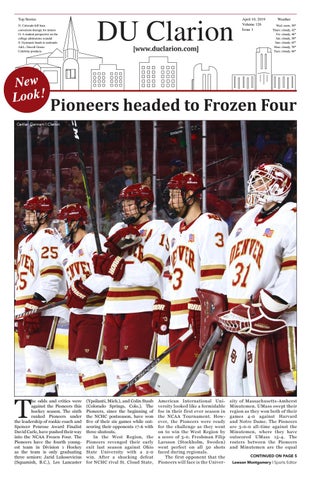
Pioneers headed to Frozen Four
Caitlan Gannam | Clarion
T
he odds and critics were against the Pioneers this hockey season. The sixth ranked Pioneers under the leadership of rookie coach and Spencer Penrose Award Finalist David Carle, have pushed their way into the NCAA Frozen Four. The Pioneers have the fourth youngest team in Division 1 Hockey as the team is only graduating three seniors: Jarid Lukosevicius (Squamish, B.C.), Les Lancaster
(Ypsilanti, Mich.), and Colin Staub (Colorado Springs, Colo.). The Pioneers, since the beginning of the NCHC postseason, have won five of their six games while outscoring their opponents 17-6 with three shutouts. In the West Region, the Pioneers revenged their early exit last season against Ohio State University with a 2-0 win. After a shocking defeat for NCHC rival St. Cloud State,
American International University looked like a formidable foe in their first ever season in the NCAA Tournament. However, the Pioneers were ready for the challenge as they went on to win the West Region by a score of 3-0. Freshman Filip Larsson (Stockholm, Sweden) went perfect on all 50 shots faced during regionals. The first opponent that the Pioneers will face is the Univer-
sity of Massachusetts-Amherst Minutemen. UMass swept their region as they won both of their games 4-0 against Harvard and Notre Dame. The Pioneers are 3-0-0 all-time against the Minutemen, where they have outscored UMass 15-4. The rosters between the Pioneers and Minutemen are the equal CONTINUED ON PAGE 5 Lawson Montgomery | Sports Editor
DU CLARION
2
APRIL 10, 2019
| NEWS
The State of Colorado has a brand new logo
C
olorful Colorado became even more colorful when Governor Jared Polis announced that the state is rebranding. Gone is the minimalist green triangle and in comes a vibrant replacement. The new logo incorporates the iconic Colorado State Flag “C” with superimposed mountains, all bordered by an evergreen tree. Polis stated that while the old logo celebrated the mountains, the new logo is more inclusive of all of Colorado’s natural wonders. The old logo was a green triangle with a white top to represent snow-capped mountains. The new one is more diverse and incorporates many more aspects of the Coloradan identity. The red of the “C” represents the red rocks of the Front Range, the blue represents the state’s rivers and lakes and the yellow represents the sunshine and the expansive fields of Eastern Colorado. Polis stated that the rebranding “better reflects our whole state–really is consistent with our goal of having a Colorado for all.” The new logo was met with
Photo courtesy of Colorado Public Radio
controversy, namely from Twitter users and people looking to admonish the newly elected governor. However, Polis’s commitment that the logo redesign would not cost the taxpayers was entirely uncontroversial. Polis stated that replacement would come in
ABOUT US
increments as the old logo would be phased out of production. To further cut costs, the design was done in-house. This contrasts the previous governor’s logo redesign, which cost the state almost twoand-a-half million dollars because of replacement and designer fees.
You can expect to see the old logo phased out, and the new one phased in, within two years.
Isaiah G. Jakab | News Editor
DU Clarion EDITORIAL STAFF
HANNAH BRANIT, Editor-in-Chief VICTORIA VALENZUELA, Executive Editor TARYN ALLEN, Editor-in-Chief Emeritus GRACE CARSON, Executive Editor Emeritus The Clarion is the official student newspaper of the University of Denver, serving as the “Voice of the Pioneers.” Founded in 1899, it covers campus and local stories with the highest level of journalistic integrity possible. 1000 copies are distributed each Wednesday afternoon (throughout the academic year) across the DU campus, and every article is also published at duclarion. com. The Clarion does not necessarily reflect the opinions of the faculty, staff and/or administration of DU, and the opinions expressed by columnists and contributing writers do not necessarily reflect those of the Clarion. Reproduction of the Clarion in whole or part in any form written, broadcast or electronic without written permission of the Clarion is prohibited. The opinions expressed by columnists and contributing writers do not necessarily reflect those of the Clarion. The Clarion reserves the right to reject advertising, stories, columns or letters to the editor that it deems graphic, obscene or that discriminate on the basis of race, culture, gender or sexual orientation. The Clarion welcomes letters to the editor. Those who submit letters must limit them to 500 words. Some letters may not be published because of space limitations, overly-libelous content or similarity to past submissions. Please submit letters to duclarioneditor@gmail.com.
HOW TO JOIN The Clarion is open to contributors of all years and majors at DU, including both undergraduate and graduate students. There’s no application necessary; all you have to do is show up to one of our weekly meetings, which are held every Monday at 6 p.m. (during the academic year) in the Hub. Can’t make it to a meeting? Send an email to duclarioneditor@gmail.com and we’ll do everything we can to get you published.
ISAIAH G. JAKAB, News Editor LAWSON MONTGOMERY, Sports Editor ELIZABETH LOCHHEAD, Opinions Editor NINA PETROVIC, Arts & Life Editor CAITLAN GANNAM, Photo/Video Editor SARA LOUGHRAN, Copy Editor MAYA PINON, Copy Editor CHELSIE FINCHER, Illustrator VISHAL BEEKI, Paper Delivery Person HALEY BIRT, Paper Delivery Person SYDNEY KAPP, Business Manager ANDREW MATRANGA, Faculty Adviser Masthead graphic design: David Fain
CONTRIBUTING STAFF GRACE WILKINS
KAT FUSCO
KIANA MARSAN
HALEY PAEZ
ALESSANDRA BRUNTON
JAMAL ABDULLAHI
RACHEL KUNZI
REBECCA SHAGRIN
DU CLARION
APRIL 10, 2019
NEWS | 3
Conversion therapy ban expected to pass in Colorado
A
fter five years and five iterations, a bill to ban sexual orientation conversion therapy in Colorado was recently passed. According to The Trevor Project, “Conversion therapy, sometimes referred to as ‘reparative therapy,’ is any of several dangerous and discredited practices aimed at changing an individual’s sexual orientation or gender identity. Conversion therapists use a variety of shaming, emotionally traumatic or physically
painful stimuli to make their victims associate those stimuli with their LGBTQ identities.” The American Psychological Association and most other medical organizations agree that conversion therapy is an outdated and ineffective practice, one that does more harm than good. House Bill 1129 would prohibit mental health professionals in Colorado from using conversion therapy practices on patients under the age of 18. It would also make advertis-
ing such practices a deceptive trade practice under the Colorado Consumer Protection Act, as stated in the Denver Post. Colorado would be the 16th state to pass a bill like this; states that currently enforce laws are shown on the map below. Supporters of the bill side with the medical community and members of the LGBTQ community, some 700,000 of which have been subjected to conversion therapy. Opponents, particularly lobbyists and supporters of the organi-
zation Focus on the Family, cite the bill as a potential violation of free speech and religious freedom. The bill was passed in both the House and the Senate. It will be sent back to the House, where it will likely be approved again and sent to the desk of
Taryn Allen | Editor-in-Chief Emeritus
Photo courtesy of lgbtmap.org
FOLLOW US ON SOCIAL! @DUCLARION
DU CLARION
4
| NEWS
APRIL 10, 2019
Governor Polis’s commitment to clean air
O
n Friday, Mar. 29, Governor Jared Polis released a statement declaring that Colorado would terminate a previous request that would have asked the Environmental Protection Agency (EPA) for an extended deadline to meet the National Ambient Air Quality Standard Attainment. The request would have given Colorado more time to comply with the guidelines set by the EPA regarding safe ground-level ozone. However, the Polis administration concluded that ground-level ozone is presenting a problem in the state now. Therefore, delaying compliance with the National Ambient Air Quality Standards would only exacerbate air quality issues that Colorado is facing, instead of preventing them. The statement out of the Colorado State Capitol said that there were 55 days last year that were deemed unsafe for people to go outside because of unsafe air conditions, more than half of the summer. Pollution, and more specifically ground-level ozone, presents dangers to people. Therefore, “Cleaner air saves us money on healthcare and reducing smog will lead to lower asthma rates and lower insurance premiums
and out of pocket costs,” Polis said in the statement. Colorado has been out of line with EPA air quality standards for nearly seven years. Colorado and Denver’s growing population, geographical specificities and booming oil and natural gas business have
resulted in unsafe and irregular pollution. Governor Polis hopes to curtail that pollution and meet the EPA standards by working with the oil and gas industries to lower emissions and eventually rely completely on renewable energy. Polis hopes to have met the
National Ambient Air Quality Standard Attainment by the middle of summer in 2021.
Isaiah G. Jakab | News Editor Photo courtesy of Westword
USG Weekly Update: 4/2/19
T
he Undergraduate Student Government (USG) meeting on Apr. 4 passed two bills and tabled one. The first bill passed was the Election Reform Bill 2.0, which, among other things, banned those running for a USG position from using stickers during their campaign as to avoid defacing DU property and signs. The second bill passed was the Elections Commission Bill. This bill confirmed Sen-
ator Jenni Trigilio as USG’s Election Commissioner, per the appointment of USG President Bryce Armijo. Lastly, the bill that was tabled was the Amendment Amendment. This bill proposes to change the process in which amendments are made on bills. At the meeting, USG also passed one organization’s request for funding while denying two other requests. The request that passed was $600
for a collaboration fund between Society of Women Engineers, National Society of Black Engineers and American Society of Mechanical Engineers. Those that failed were requests from the Muslim Student Association (MSA) and Delta Zeta. MSA requested $5,000 for a Supplemental Emergency Fund for a trip to a national conference, while Delta Zeta requested $800 for a Collaboration Fund to financially support their
fundraiser for the nonprofit Starkey Hearing Foundation. USG voted not to fund MSA because USG lacked the adequate funds. Furthermore, USG could not fund Delta Zeta because, as a nonprofit themselves, DU is not able to fund other nonprofits.
Grace Carson | Executive Editor Emeritus
DU sued over alleged disability discrimination
O
n Mar. 9, 2019, Benjamin Gerig, a former DU spokesperson, was given permission by the U.S. Equal Employment Opportunity Commission (EEOC) to file a lawsuit against the university for disability discrimination. According to their website, the EEOC is responsible for enforcing federal laws that make it illegal to discriminate against a job applicant or an employee because of the person’s race, color, religion, sex, national origin, age, disability or genetic information. The EEOC has headquarters offices in Washington, D.C. and 53 field offices serving every part of the nation. A recent Denver Post article says that Gerig worked at DU for five years and received great work reviews until he was asked to move to a windowless office in April of 2017. After moving into his new office, his mood and work
performance started to deteriorate, and he was fired for his poor work performance shortly after. Greig claims that he should not be blamed for his decrease in productivity because he has Seasonal Affective Disorder (SAD), a condition caused by a lack of sunlight, a feeling of isolation in times of cold weather and alterations in the brain’s concentration of serotonin and melatonin. Gerig claims that DU did not give him necessary accommodations, such as schedule changes and access to windows when he asked for them in August of 2017. Therefore, he claims that he should not have been fired from the university. Results of the lawsuit will be given after the U.S. District Court in Denver makes its final decision in July. Grace Wilkins | Contributing Writer
Photo courtesy Athletics Connor W. DavisDenver | DU Clarion
APRIL 10, 2019
DU CLARION
SPORTS | 5
Looking forward: Pioneers in the Frozen Four
STORY CONTINUED FROM PAGE 1
as they have three seniors and 19 underclassmen. The outcome of this meeting will advance to the 2019 National Championship and face the winner of Providence/Minnesota Duluth. This is the 16th Frozen
Four appearance for the Pioneers as they begin their campaign towards their ninth national championship. This season, no matter the result, has been one of positivity. The Pioneers have shown strength and major promise towards
the coming seasons with their young roster and as a Pioneer Hockey fan, something to look forward to. The Apr. 11 semifinal matchup between Denver and UMass will be available to watch on ESPN2 at 6:30 P.M.
MT. If the Pioneers progress, the National Championship game will be available to watch on ESPN2 on Apr. 13 at 6 p.m. MST. Lawson Montgomery | Sports Editor
Photo courtesy of DU Pioneers
Clarion
Clarion
DU CLARION
6
| SPORTS
APRIL 10, 2019
The No. 10 Pioneers fall to Big East foe Villanova 12-11
T
he No. 10 Pioneers came up short against Big East foe Villanova as spring began to appear in Colorado. This is the first home loss the Pioneers have suffered to a Big East team in regular season during the six years the Pioneers have been in the conference. Villanova’s goalkeeper played on his head during Saturday’s meeting saving 19 of the 30 shots he faced. The first half began quickly for the Pioneers as freshman
Ellis Geis (Tustin, Calif.) drew first blood for the Pioneers only 38 seconds into the game. Villanova answered with a fourgoal run to end the first quarter 1-4. The second quarter saw senior Austin French (Danville, Calif.) and junior Ethan Walker (Peterborough, Ontario) both get a tally for the Pioneers to draw within one goal. Villanova was able to score two goals around sophomore Jack Hannah (Milford, Ohio) goal to go up 6-4 into the half.
Entering the second half, the Pioneers were not able to level the score as they reached within one goal seven times. Denver finished strong as they went on a four-goal run in the dying minutes of the fourth quarter; however, they were not able to tie the score as Geis’s shot rang off the Villanova keeper’s face mask for the final attempt. Freshman Brett Boos (Parker, Colo.) continued to show promise for the Pioneers
as he went 20 for dot. The Pioneers tinue their Big East as they travel to St. Apr. 13 at 11 a.m.
27 at the will concampaign John’s on
Lawson Montgomery | Sports Editor Photo courtesy of DU Pioneers
DU Gymnastics heads to NCAA National Championships
T
he No. 5 University of Denver Gymnastics team punched their ticket to the 2019 NCAA National Championships after winning their first-ever NCAA regional title on Apr. 4. Denver scored 197.375, the highest postseason for the program, as well as its ninth-best score overall. DU topped No. 4 Florida (196.700), No. 15 Oregon State (196.900) and No.12 Boise State (196.075). “I am incredibly proud of our team. They showed grit, resiliency, mental and physical toughness, and consistency in back-to-back days in the championship new format.” Head Coach Melissa Kutcher-Rinehart said following the meet. “They came out on floor with great energy and focus and joy, and then they stayed in the moment and blocked out the distractions. They took it one event at a time and one routine at a time, and they stayed completely focused on the process.” DU started the meet on floor, scoring their third-highest score at a NCAA Regional meet. Junior Maddie Karr (Stillwater, Minn.) and sophomore Lynzee Brown (Kansas City, Mo.) earned matching 9.900s, tying for second overall. Sophomore Mia Sundstrom (Boulder, Colo.) and senior Kaitlyn Schou (Orlando, Fla.) scored matching 9.850s, while freshman Alexandria Ruiz (Lake Mary, Fla.) scored a 9.800. Denver moved on to vault, posting a team score of 49.200 with all five scores being higher than 9.800. Karr took second in the event with a score of 9.875,
while Brown scored a 9.850. Schou tied her career best with a 9.850. Sundstrom and senior Diana Chesnok (Charlotte, N.C.) scored 9.825 and 9.800.
and Sundstrom scored a 9.825. On the beam, Denver earned a 49.925, securing their victory. Schou took first in the event with a 9.950, followed
to the all-around and earned fourth with a score of 39.350. “It’s incredibly rewarding. This has been a special team from the beginning. And we wouldn’t be in this position and accomplishing what we are without our tremendous alumni who helped build the foundation for this program and allowed us to keep building.” Kutcher-Rinehart commented after the meet. “We’re excited for nationals. We’ve trained for this for the whole year. This isn’t a surprise, but it’s still very exciting.” DU will be making its fifth appearance at the NCAA Nationals, last appearing in 2017. At least one Denver gymnast has represented DU at the NCAA National Championships in each of the last 20 seasons. The 2019 NCAA National Championships will be held in Fort Worth, Texas, Apr. 19-20. Denver will compete in Semifinal II on Friday, Apr. 19 at 5 p.m., MST. Denver will be joined by No. 1 Oklahoma, No. 8 Georgia and No. 15 Oregon State. The top two teams from the two semifinals will advance to the new “Four on the Floor” meet on Sunday, Apr. 20. The meet will be televised on ESPNU, switching over later to ESPN2.
Photo courtesy of DU Pioneers
On the bars, the Pioneers scored the program’s highest score for the event at NCAA Regionals, tying their fifth-best score. Karr took the top spot in the even with a 9.950, followed by Brown with a 9.925. Ruiz set a new personal best with a 9.900, senior Claire Kern (Charlotte, N.C.) scored a 9.850
by freshman Alexis Vasquez (Arcadia, Calif.) who scored a 9.925, finishing second overall. Sundstrom, Ruiz and Karr all had matching scores of 9.800. Brown scored a 9.800. Karr tied for first in the allaround with a score of 39.575, while Brown took third with a 39.475. Sundstrom returned Hannah Branit | Editor-in-Chief
APRIL 10, 2019
DU CLARION
OPINIONS | 7
The college admissions scandal is a maze of doors
I
n March the FBI unveiled that trusted coaches and staff at top Ivy League universities were entrenched in criminal plots. They had helped admit the children of prominent figures from the world of finance, trade and Hollywood alike into prestigious schools on the basis of falsified test scores, aptitude and disabilities. After federal authorities made 50 arrests, the Department of Justice characterized it as the “largest college cheating scam” ever prosecuted in U.S. history. The conspiracy was orchestrated by William “Rick” Singer, a college counselor, through a series of briberies. Parents paid up to $6.5 million for his services, the payments received by what Singer shrouded on government forms as a charitable organization. These illegal activities were largely carried out without the knowledge of the students, and schools are currently reviewing and re-assessing their admission statuses. Now, in court, the parents have begun to take the stand. As they either prepare to fight or secure plea deals that will allow them to save face, the scandal continues to spur conversations at both the high school and collegiate levels of how issues of class, race and privilege reflect a flawed and broken college admissions system. “Colleges are increasingly seen for what they are: another system that the wealthy can game,” Vox’s Libby Nelson writes. For many students, the news was less than surprising. Instead, they saw it as another iteration of what has become the
disheartening norm in the U.S.: the tangible difference between equity and equality. “We can put in work from fifth grade to 12th grade, every single day, come in early, leave late, and it’s still not enough,” said 17-year-old senior Khiana Jackson to the New York Times. It is this disparity that creates a shadow that lingers over the scandal in the form of a question: Whose spots did these students, admitted through dirty money and dubious morals, take? Because in many places, the unfortunate truth is that college admissions letters are seen as a powerful force that can make or break the trajectory of one’s future. Where I grew up, students were expected as early as the age of 10 to sketch out their plans for high school, college and beyond. We were all smart, all competitive and all driven by a fear of our parents and teachers and what failing them meant. You were a workaholic, or you were no one. For me, the shadow takes the form of a meek girl in the seventh grade that was the smartest of us all. She would raise her arms up over her head, as if ready to hit something, whenever she explained to us how her parents chased her around the house with wooden spoons and frying pans when she came home with scores that were anything less than perfect. Twice, she had been locked out. For me, the shadow takes the form of a classroom filled with scared-straight students because the SHSAT prep teacher liked to make noise, scream at us and slam doors. When we wouldn’t or couldn’t answer his questions, he thought he could
Photo courtesy of The Los Angeles Times
shame us out of our silence. Once, he came back from his coffee break and found that we had been brave enough to lock him out. For me, it is difficult to talk of the students that had their spots bought for them without thinking of the people I grew up with—students that lived with those same expectations and pressures but didn’t have the shortcuts to get there. Instead, they were berated with the idea that their worth was equatable to their academic success until they believed it themselves. For some, their efforts were for naught. They still lost out to people who knew how to cheat the system. The true horror of this scandal lies in how it testifies to what our youth is being reduced to, whether it is by themselves, their parents or their school system: numbers, resumes and prestigious college names. “[The college admissions process] comes down almost to marketing one’s soul, which gets to undermining the mean-
ing of one’s entire life,” said one admissions counselor to the New York Times. When giving his testimony, Singer made use of a metaphor to explain his actions. “There is a front door to get in [to college] where a student just does it on their own, and then there’s a back door where people go to institutional advancement and make large donations,” he stated, continuing, “I created a side door that guaranteed families to get in. That was what made it very attractive to so many families— I created a guarantee.” Part of the sentiment he speaks of—that the path to opportunity is paved smoother for some than it is for others— is true. What he fails to see, though, is that with each back door and side door that is opened for one student, a front door is closed for another. They are left to fumble for the key, wondering who they are and where they went wrong—and eventually, they stop looking. Kiana Marsan | Contributing Writer
The Supreme Court takes on gerrymandering again
T
he concept of one-person, one-vote has been disputed since the creation of the Constitution. Most recently, this pursuit has been centered around partisan gerrymandering, the process that occurs when a party in power redistricts the state according to voters’ party affiliation to win more House seats. The Supreme Court is currently hearing Russo v. Common Cause and Lamone v. Benisek, cases of Republican and Democrat gerrymandering, respectively. Inconsistent with the other conservative justices, Justice Brett Kavanaugh has hinted he will rule against partisan gerrymandering if given a defendable opportunity. Justices Clarence Thomas, Samuel Alito and Neil Gorsuch firmly believe that redistricting is strictly a legislative power. Kavanaugh and possibly John Roberts are on the fence because of their close ties to specific gerrymandered districts in Maryland. Ruth Bader Ginsburg, Elena Kagan, Sonia Sotomayor and Stephen Breyer will almost definitely vote against partisan gerrymander-
ing if the prosecution can meet all of the requirements the court has previously recommended. Gerrymandering utilizes two key methods: “cracking” and “packing.” Cracking is done by separating a group of voters into different districts to minimize the value of their vote in a district where they cannot compete against the monolithic majority. Packing is done by placing voters into dense, partisan districts in order to remove their vote from districts where it could swing the election. This is a bipartisan issue. Both Republicans and Democrats have lost votes through gerrymandering, although Democrats have lost significantly more. Republicans typically resonate more with rural voters and Democrats with urban voters, thus it is easier for Republicans to group dense Democrat voters into one district by “packing” and “cracking.” The Supreme Court has delayed ruling on the legality of gerrymandering numerous times, most recently in Gill v. Whitford (2018), for various reasons. First, the Supreme
Court wants to hear a specific individual’s case in which their rights were infringed upon in order to provide a proper ruling and not to meddle in the act of policy making. Second, and most importantly, there is no agreed-upon solution to gerrymandering. What percentage of proportionality should be the cutoff rate for legal versus illegal gerrymandering? In other words, should the state-wide popular vote evenly reflect the party alliance of the elected officials? What defines fair? Humans are inherently biased, and this makes drawing congressional district maps extremely difficult. Brian Olson, a software engineer, suggests taking the human out of the equation and using an algorithm, which can be biased but is consistent, to map districts with data from each census to achieve compactness. Even this algorithm has drawbacks, as racial gerrymandering is illegal according to the Supreme Court, and drawing lines around minority communities is a form of racial gerrymandering. This algorithm has not found
an effective way to ensure each person receives an equal vote, but it puts forth interesting ideas and thoughtful debate. Ultimately, this Supreme Court decision could protect or deny thousands of individuals’ voting rights and affect the millions of citizens of the U.S. California and Arizona have taken positive steps towards redistricting their states based solely on “the Voting Rights Act, district shape, geographical features, respect for communities of interest and potential competitiveness.” Personalizing state’s redistricting committees will take into account the human factor and come up with a result that is consistently more reliable. Whether each state is willing to take the time and money to ensure the one-person, onevote principle is up to the state and federal governments. It is essential, especially when our democratic institutions are being threatened, to protect the simplest principle of democracy, even if that protection is presently imperfect. Alessandra Brunton | Contributing Writer
The opinions expressed here do not necessarily reflect those of the Clarion or of the DU community.
DU CLARION
8
APRIL 10, 2019
| OPINIONS
PIONEER VOICES Question of the week:
Who do you think will win Game of Thrones’s Iron Throne?
“I think King’s Landing is going to get destroyed, Daenerys and Jon will have a kid or something and one of them will probably die.”
“I hope it is Tyrion Lannister who wins and gets the Throne. I think he deserves it.”
JP Lawrence, Fourth Year
Aliyah Price, Fourth Year
“I don’t think anyone suspects this, but I think Sansa has a good chance at winning the Throne.”
“I think Jon Snow is going to win the Iron Throne. If you look at the book title, it’s a Song of Ice and Fire, and he is ice and fire, so I think that will be the ultimate conclusion.”
Maya Piñón, Third Year
Noah Kanary, Fourth Year
APRIL 10, 2019
DU CLARION
OPINIONS | 9
Colorado’s proposed “red flag” law stirs controversy
T
Photo courtesy of Wikipedia
he amount of backlash being generated over the approval of Colorado’s new “red flag” bill, created with the goal of limiting the possession of guns by people who are deemed “threats,” isn’t surprising, given the state’s rocky history with firearms. One of the bill’s key proponents, State Representative Tom Sullivan, lost his son in the 2012 Aurora, Colo. movie theater shooting. Another one of its main proponents is Sheriff Tony Spurlock, who lost one of his officers, Deputy Zach Parish, in an “ambush-style attack” by a man known to be mentally ill and who owned a gun his own mother actually attempted to take but was legally unable to do so. The bill, which is largely expected to become a law soon enough, allows for the confiscation of a person’s gun(s) should a family member, medical professional or law enforcement officer consider them “threats.”
Those threats are regarded as posing actual danger to others or to themselves. If a request is submitted, a judge may decide to have the person’s firearms seized. Following the seizure of the weapon(s) in question, the person could be without them for anywhere from two weeks to almost a full year, depending on how long the presiding judge deems appropriate. One of the bill’s most vocal opponents is Sheriff Steve Reams, who has publicly stated that he would rather go to jail than uphold the potential passing of the law. He takes issue specifically with the lack of warning given to the people whose weapons may be seized, and points to the Second Amendment to support his claims. Although this is not to say that the Constitution ought to be ignored, modern governments, as well as citizens, must be mindful that the document was created during a completely different time period, and its stipulations should be adapted for the 21st century. Firearms in the 1700s pale in comparison to today’s guns in terms of sheer power and accessibility, and this is something that lawmakers must be keenly aware of when interpreting the Constitution in this contemporary era. Ultimately, Sheriff Reams has made it blatantly obvious that an object in the form of a gun takes precedent over the potential loss of human lives.
On one hand, it’s understandable that people might be concerned that their property would be taken from them without good cause or warning. However, the bill declares that a judge must determine whether or not the claims are wellfounded or not. Ergo, if there’s no reason the person’s firearm should be taken away, then they have nothing to worry about. Additionally, if someone is truly a danger to themselves or society, then giving them a heads-up would be simply illogical, as it might only further prompt harmful actions. In the other 14 states that have passed similar legislation, it was largely law enforcement who requested the weapons seizures, with 159 gun confiscations taking place in California in 2016 and just over 300 requests for possible seizures being submitted in Maryland within the first three months following the law’s implementation. Given that about half of those requests were followed by actual seizures, it’s clear that some people did pose real threats to their communities. This is evidenced by the fact that over half of the requests came from family members, those who likely know the gun owners best. Additionally, of those whose weapons were confiscated, there were also a number that displayed “significant threats” to places of education in the area.
However, after Maryland joined the list of states with a “red flag” law, there was an instance of violence that rose from the law’s enactment this past November. Police officers attempted to seize the guns of a man who had been reported as a potential “threat,” but he answered the door already holding a handgun, firing it after refusing to hand it over. The man was then shot and killed by the officers serving the seizure. One might try and suggest that the “red flag” law brought about violence, and strictly speaking, they would be correct. But, as the local chief of police stated, the fact that the man attempted to shoot the officers just goes to show that, without their intervention, he may have harmed others. With no intent of insensitivity, it must be acknowledged that someone willing to fight and die over a gun may not be the right person to own such an object. The approval of this law in Colorado would only serve to benefit the Colorado population, protecting citizens from potentially encountering a dangerous person wielding a gun. The fact that other states have already successfully passed and implemented measures such as this one is only further proof that citizens would become safer with its enaction. Rachel Kunzi | Contributing Writer
Like the new look? Advertise with us!
For information and media kits, email business.duclarion@gmail.com
The opinions expressed here do not necessarily reflect those of the Clarion or of the DU community.
DU CLARION
10
| ARTS
& LIFE
APRIL 10, 2019
Brasstracks brings vibrancy to Cervantes
O
Photo courtesy of Fuxwithit
n March 9, Brasstracks performed at Cervantes Masterpiece Ballroom with Kemba, Pell and JusChill. Brasstracks is a music duo consisting of Conor Rayne on drums and Ivan Jackson on trumpet. They met at the Manhattan School of Music and formed in 2014. Their sound is a hybrid between electronic and jazz music. Rayne and Jackson were joined by JJ Kirkpatrick, another trumpet player, and Nadav Nirenberg, a trombone player, throughout their set. Kirkpatrick and Nirenberg are both prominent composers. Brasstracks also brought out one of the members from Big Gigantic, Dominic Lalli, who plays saxophone. I got there around 8:45 to find the balcony and the outskirts of the bottom level of Cervantes Masterpiece were full. The show started at 9 p.m. It was mixed ages from 16 to about 50, yet the majority of the people that were in the room were in their 20s to 30s. It was very cosmopolitan. People were put together but ca-
sual. Some people wore sweaters and sweatshirts. There was a table full of various merch to pick from and the people working the table were friendly. The atmosphere was comfortable and relaxed as Denver native JusChill, a hip-hop producer and turntablist, started the show. Imagine funky lo-fi with some heavier 808s and record scratching for a little over an hour. During the show, JusChill brought a fun energy with a chill ambiance that quickly filled the room. Kemba took the stage at 10:30 p.m. The venue was filled throughout its extremities by this point. Kemba is a rapper from the Bronx. He held the crowd captive with his prophetic conscious rap. During Kemba’s set, the crowd had their hands up as he directed a call and response where the crowd repeated “No you ain’t” to everything that he said. The set changes were punctual, featuring contemporary mainstream artists (such as Childish Gambino) to up-andcoming artists on the rise (such
as Jean Deaux) to classic intermission tunes (such as remixes of Missy Elliott). It was a little after 11 p.m. when Brasstracks came on stage. Rayne opened with a drum solo and Jackson was quick to get the crowd dancing and clapping to the rhythm. The band was as vibrant as the crowd. You could tell that all of the musicians involved in the show have a strong bond as they made sure to announce each other’s names and had their own solos. Jackson was wearing his signature wide-brimmed hat and took lead on entertaining the crowd; he seemed to subtly be mouthing raps to himself at times. I would not be surprised if Jackson explored expanding his sound to include rapping in the future. Rapidly fluid, Rayne was focused on drumming. His swift, yet controlled, motions were simply mesmerizing. I immediately understood why he had an abundance of extra drumsticks. Pell, a rapper from New Orleans, joined Brasstracks for a number of songs bringing a faster pace to the stage. He bounced
with the beat as he rapped and even stage dived at one point. The crowd danced the entire show, however, they picked up their pace to keep up with Pell. The energy in the room was consistently radiant. At one point Rayne and Jackson stepped back for Pell and Big Gigantic to take the stage and perform their song, “Miss Primetime.” This was followed by Big Gigantic performing a solo and joining Brasstracks for a number of their songs. Overall, the show was not as loud as I had expected. However, I was wearing ear protection. I walked through the crowd during the peak of the show and found that the venue was full throughout. From the upstairs balcony, the lights were reflecting off the enormous disco ball in the center of Cervantes ceiling. Essentially, the show was a rave to big band music. Brasstracks is a must-see show that I would recommend to people of all ages.
but gone the next. Chinese cuisine loves a good kick, which my Mexican background can resonate with because I grew up on comida picante–spicy food. Therefore, there was no hesitation to try one hot pot that got that name from both temperature and spice level. The deep red broth arrived at the table with flecks of chiles swimming freely. It looked like yin and yang when the other pot of pork bone broth arrived by its side as a murky pale broth similar to miso soup in appearance but comprised of meaty saltiness that kicks any chain miso soup to the curb. The magic begins once you regain consciousness after being mesmerized by the bowls of flavor simmering away in front of you. With the broth comes a shaved protein of choice which makes cooking a breeze; obviously it depends on what you’re cooking, but just a quick dip in the pool or a long lasting soak can inject tons of flavor into that one piece of meat. But that’s not near the end of the party: it’s like Burger King, because you can have it your way. They have a buffet to choose from fresh produce that rotates daily. It’s composed of everything from American classics like broccoli and button mushrooms to the unique Asian staples like bok choy, enoki and wood ear mushrooms. Each is a delight
in its own right and capable of sopping up the broth like rustic bread absorbing olive oil at an Italian restaurant. Now let the seafood fiends rejoice in the unlimited options available. The head-on shrimp should be cordially invited to the feast because staying intact through the cooking process allows for their sweetness to mix with the broth for an intense shrimp flavor that notoriously gets lost in the sad shrimp cocktail. Crawfish are always in season and the squid tentacles are waving you down as we speak. This experience allows for the adventurous eaters to test their bounds while also accommodating those that usually stick to scanning the children’s menu before ordering. No meal would be sufficient without hitting all the food groups, and that is where the noodles come into play. Religious ramen eaters can get their fix and continue to live the college dream. Everyone knows that the key to a perfect ramen is the soft boiled egg, and while it may take some research to time it just right, the perfect soft boiled egg can be achieved from grabbing one of the eggs of the buffet bar and giving it a nice bath in the hot pot. Additionally, if you’re interested in tapping into your Italian roots, the udon noodles remind me of a thicker bucatini that absorbs spices beautifully.
At this point, you have gotten the hang of this style of cooking, and culinary school might start to seem more and more enticing, it’s time to continue building flavor, at which point comes at the sauce bar. They have a white board with their versions of flavor bombs sure to intensify your meal, but again, the fun is experimenting. Be your own mad scientist and concoct your new favorite flavor combination. Sure, it might end up like the Jelly Belly Bean Boozled game, where it looks like tutti-frutti but tastes like stinky socks, but this allows for your creativity to surface along with your iron chef abilities. Show your family and friends that you’re the next Bobby Flay. For only 20 dollars this is basically an all-you-can-eat experience, so bring your sweat pants and some hungry pals because you’ll be eating well. No dinner is complete without a bit of sugar to top it off, so get rolling with their rolled ice cream ladled with chocolate sauce.
Kat Fusco | Contributing Writer
D Station is a hot pot dream
N
ormally people associate the most popular restaurants in Denver as the ones located right by Union Station or in the suburbs on Pearl Street. Instead, DU students can rejoice to know that solely a block or two from campus, they can relive their thrilling experiences studying abroad with the new Asian fusion cuisine being served on Evans. D Station harbors a fun environment that encourages friends and family to come together over their ability to play with their food. D Station focuses on hot pot cooking, which can pretty much be explained by the name itself. Originally developed in China, a pot of simmering stock is heated over a burner within the table to allow those hovering around it to cook their meal before their own eyes. They have integrity when it comes to building flavor profiles in their stock with bones and vegetables that steep for hours in large pots in the back of the kitchen to ensure every ounce of flavor is extracted. If you think that the stock was made that day, you’re wrong. Seasoning, richness and depth take time, which is definitely delivered here. They rotate their bases, so be prepared for a unique experience if you ask for the special of the day, because it’s here this time
Haley Paez | Contributing Writer
APRIL 10, 2019
DU CLARION
ARTS & LIFE | 1 1
How celebrities are promoting cannabis use Chelsie Fincher | Clarion
W
ith their sponsored cannabis products and partnerships, celebrities are offering a weed experience designed to attempt to ensnare the consumer. As of 2019, there are many celebrities jumping headfirst into the cannabis industry. Celebrities like Tommy Chong, Joe Montana, Whoopie Goldberg and Gwyneth Paltrow are joining ranks as cannabis legalization gains traction and support. However, are their cannabis products hype worth the value? Cannabis Edibles Snoop Dogg is known for his cannabis consumption. With songs like “Smoke the Weed,” “This Weed Iz Mine” and “California Roll,” it’s no secret that the rapper Snoop Dogg has long been a cannabis connoisseur. Snoop Dogg created a cannabis line called “Leafs By Snoop.” To go along with the fancy packaging for his flower products, edible chocolates and fruit chews are also offered by the famous celebrity rapper’s cannabis brand. Melissa Etheridge also has a line of cannabis-infused wine. The singer has won multiple Grammy Awards for her songwriting, but it was a scare with cancer in 2004 that opened Melissa Etheridge’s eyes to the medicinal benefits of marijuana. During her battle with breast cancer, she fought her chemotherapy side effects with cannabis, concluding, “This is crazy, how does anybody go through this without cannabis?” After emerging from her battle cancer-free, Etheridge threw herself into a whole new entrepreneurial venture:
Photo courtesy of HyperAllergic
infusing wine with cannabis. Her new line of Private Reserve Cannabis Infused Wine Tincture is available exclusively in California dispensaries. Celebrity-created strains Some of the biggest weed-smoking celebrities have created their own weed strains. Some of the most loved strains include Snoop’s aforementioned “Leafs By Snoop,” Tommy Chongs’s “Chong Star,” Willie Nelson’s “Willie Reserve” strains and Bob Marley’s “Marley’s Natural.” “Leafs by Snoop” offers strains called: 3D CBD, Blueberry Dream, Bananas, Purple Bush, Lemon Pie, Northern Lights, Cali Kush and Tangerine Man. Marley’s Natural has four different flower offerings: Sativa, Indica, CBD rich and Hybrid. Along with these offerings, they offer a studio strain of weed for creatives to help create the mood, vibe and ambience for the creation of each of their respective arts. To further differentiate themselves, they researched and produced strains that Bob Marley used to smoke. The “Heritage Flower” offerings are old artifacts brought back from the past. This collection is offered in glass containers that each holds 3.5g of flower. Offering varying strains of cannabis is important because the interest in cannabis is what led to the discovery of cannabidiol (CBD). CBD is a component in some cannabis strains that has wide use in the cannabis community for illnesses such as anxiety, seizures and even chemotherapy. An example of a strain used for illness would be Hayleigh’s Hope. Hayleigh
was a four-year-old kid who was suffering from cerebral palsy and epilepsy that was treated with a strain of cannabis that predominantly contained CBD. Celebrities like Hayleigh are the reasons why we have the tools to combat these illnesses today. Cannabis Products In the Cannabis accessory industry, many celebrities come up with some amazing ideas to help revolutionize your cannabis consumption. Some of these ideas include Tommy Chong’s glassware, Wiz Khalifa’s Raw Papers, Snoop Dogg’s “G Pen” and Tyga’s gold rolling paper. Marijuana and “good smoke” have almost become synonymous with Snoop. Long before the legalization of weed in California, Snoop rhymed about using the plant with “his homies” for almost any occasion. The G Pen is boasted as the smart way to smoke weed. The vaporizer eliminates any detection of smoke through limited aroma and light lung impact. Snoop’s G Pen is the first official celebrity-endorsed G Pen, debuting in 2013. The importance of these weed products is that they help shape and create the weed experience of the people who smoke them. In a capitalist society, it is important to market a lifestyle, and in the present moment, weed is one of the biggest things to invest in currently, so it makes sense that people who influence culture would be jumping in the industry post-legalization. Celebrities are creating products worth supporting and valuing. In a time like now where weed is being legalized sporadically around
the country, it is important for weed to be paired with the experience and brands of other celebrities. The reason why it’s important for more people — e specially notable people—to delve into the cannabis industry is because it normalizes and de-stigmatizes cannabis use/consumption. Further, the personalization of weed strains and edibles is done with research and with cannabis being a popular topic of conversation. It incentivizes research into cannabis and its uses for the world in the sectors of illnesses and recreational use.
Jamal Abdullahi | Contributing Writer
DU CLARION
12
| ARTS
APRIL 10, 2019
& LIFE
Amy Schumer talks marriage, pregnancy and food in Netflix special
I
would like to note that I would give more detail regarding the specific topics that were talked about in this Netflix special, but most of it is not so family-friendly, because Amy Schumer is so raunchy, which is really just another reason why we love her. Amy Schumer recently married Chris Fischer, a wellknown chef. Schumer discusses the fact that she thinks she is the smartest woman in the world for marrying a chef, and honestly, I can’t really argue with that. Being married for almost a year now and both of them being in their late 30s, they are also expecting a baby. Throughout this Netflix special, Schumer hits on the many obstacles she has faced during her pregnancy, specifically her various hospitalizations and lack of alcohol consumption. She talks about how being pregnant at the same time
Photo courtesy of RedAlertPolitics
as Meghan Markle is one of her most difficult struggles. Markle sports the most stylish stilettos while Schumer showed the audience her double band-aided belly as a result of her deformed belly button that has been changing throughout her pregnancy. She flashed the audience and looked down to the front row to recognize that it is “more than they bargained for.” She goes on to discuss one of the many times she was hospitalized during her pregnancy, where her sister and her husband left her in the hospital to go paint pottery. Fischer comes back and shows her the plate he painted with her face on it, which freakishly looks exactly like Trump. If you follow Schumer on Instagram, you may already know how much time she has spent in the hospital the past few months, and she recognizes the fact that her audience was
probably worried that she would be unable to perform her Netflix special. However, Live Nation would have sued her for backing out of her contract, so it wasn’t exactly a “the show must go on” type of situation. Live Nation must have loved that joke. Then, Schumer explains the many different people she consulted to decide whether or not it is a bad idea to drink during her pregnancy, even just a few glasses of wine. Her most responsible friend, a nurse, said that just to be safe, she shouldn’t drink at all; another friend said a few glasses a week would be okay, and her raunchiest friend said to just stop when she gets drunk enough. No doubt, she was very pleased with this last response. Schumer also talked about being arrested in Washington D.C. for opposing Brett Kavanaugh’s confirmation.
Minutes before being arrested, she explains that her biggest fear of getting arrested was being hungry while behind bars, a totally valid concern. With that said, she stuffed as many snacks as she could into her mouth before she was arrested, while the rest of the crowd protested beside her. Different from her other performances, this comedy special focused mainly on Schumer developing her own family. No doubt, it made me laugh, but it was not as creative as I expected from a comedian who I often rave about. This sold-out comedy special was performed in Chicago, where her fans appreciated the honesty and absurdity for which Schumer is known.
Rebecca Shagrin | Contributing Writer
The Clarion Crossword: Week 2 Need some help? Visit duclarion.com for the answer key.
Chelsie Fincher | Clarion