S E P T. 1 9 , 2 0 1 8 VOLUME 126 ISSUE 2
pg.
5
DU falls nine spots in college rankings
pg.
7
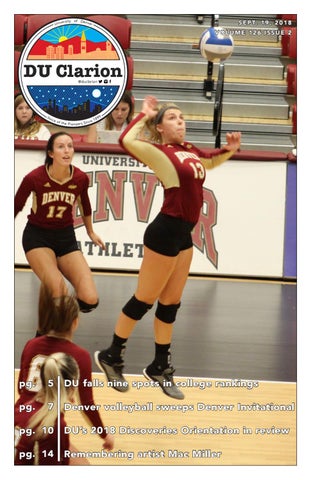
Denver volleyball sweeps Denver Invitational
pg. 10
DU’s 2018 Discoveries Orientation in review
pg. 14
Remembering artist Mac Miller
2
DU CLARION
| NEWS
S E P T. 1 9 , 2 0 1 8
A student’s guide on registering to vote
R
egistering to vote can be done in one of three ways; online, through a voter registration drive or paper voter registration form. Online registration eligibility is determined by state of residence and where intended registration is occurring. For students who are Colorado residents, as well as those from most other states, this process can be completed online through the Colorado Secretary of State website (or, if from another state, on a site such as vote.gov) and requires a few pieces of information including first and last name, birthday, identification (valid driver’s license or social security number) and both a residential and mailing address if the two differ. Later on in the registration, an opportunity to affiliate with a political party is also provided if one chooses to do so. Affiliation means
that you choose to register as a supporter or member of a specific political party and will mean that you have the chance to vote in that party’s primary elections. When online, the voter registration websites also provide the opportunity to have a paper voter registration form mailed directly to you which can then be completed and mailed to your County Clerk and Recorder. A paper voter registration form can also be picked up from your county’s election office, library, U.S. post office or Department of Motor Vehicles office. Voter registration forms can be submitted in person to your local election office, rather than through mailing, if preferred. Voter registration drives are another method of registration that requires you to fill out a paper registration form. These drives are typi-
ABOUT US
cally organized by non-profit organizations in the community who can be campaigning for a specific cause, but they allow an accessible method to register. The process takes a few minutes, filling out a paper voter registration form with the same information as gathered online or on other paper voter registration forms. With this method of registration, those working the voter registration drive will take your forms to the proper office for you. To be eligible for voter registration, one must be a U.S. citizen, meet any state requirements for registration and be 18 years of age by the date of the election. Specifically for Colorado voting, one must also have lived in this state for at least 22 days prior to election. Registration also requires the individual to not be currently serving a detention sentence
or parole for a felony conviction. Also, note that votes are only valid if they are cast for the state and county in which one is registered. The information in this article is specific to guidelines for voter registration in Colorado, but specifications for other states can be readily accessible online if choosing to register and vote in another state. Voting is an opportunity for citizens to have a say in the workings of state and local governments and can play an influential role in how our society runs. Registering to vote is the first step in having your voice heard.
Cameron Elder | Contributing Writer
DU Clarion EDITORIAL STAFF
TARYN ALLEN, Editor-in-Chief GRACE CARSON, Executive Editor DANIELA SANTOS, News Editor The Clarion is the official student newspaper of the University of Denver, serving as the “Voice of the Pioneers.” Founded in 1899, it covers campus and local stories with the highest level of journalistic integrity possible. 1000 copies are distributed each Wednesday afternoon (throughout the academic year) across the DU campus, and every article is also published at duclarion. com. The Clarion does not necessarily reflect the opinions of the faculty, staff and/or administration of DU, and the opinions expressed by columnists and contributing writers do not necessarily reflect those of the Clarion. Reproduction of the Clarion in whole or part in any form written, broadcast or electronic without written permission of the Clarion is prohibited. The opinions expressed by columnists and contributing writers do not necessarily reflect those of the Clarion. The Clarion reserves the right to reject advertising, stories, columns or letters to the editor that it deems graphic, obscene or that discriminate on the basis of race, culture, gender or sexual orientation. The Clarion welcomes letters to the editor. Those who submit letters must limit them to 500 words. Some letters may not be published because of space limitations, overly-libelous content or similarity to past submissions. Please submit letters to duclarioneditor@gmail.com.
HOW TO JOIN
The Clarion is open to contributors of all years and majors at DU, including both undergraduate and graduate students. There’s no application necessary; all you have to do is show up to one of our weekly meetings, which are held every Monday at 6 p.m. (during the academic year) in the Hub. Can’t make it to a meeting? Send an email to duclarioneditor@gmail.com and we’ll do everything we can to get you published.
HANNAH BRANIT, Sports Editor ELIZABETH LOCHHEAD, Opinions Editor JUSTIN CYGAN, Arts & Life Editor NINA PETROVIC, Arts & Life Editor CAITLAN GANNAM, Photo/Video Editor VICTORIA VALENZUELA, Photo/Video Editor SARA LOUGHRAN, Copy Editor MAYA PINON, Copy Editor CHELSIE FINCHER, Illustrator OLIVIA KAYANG, Paper Delivery Person ANDREW MATRANGA, Faculty Adviser Cover Photo Courtesy of Caitlan Gannam
CONTRIBUTING STAFF MEGAN COONEY
MIA PRAHLAD
ROBERT CORL
GRACE WILKINS
KIANA MARSAN
RYAN DUNN
RACHEL KUNZI
NAYMA AKTAR
JAKE GLOTH
ISAIAH JAKAB
VALERIA MONCADA
LAWSON MONTGOMERY
EMMA COHEN
JOEL ROBERTS
AVA TUSEK
JON STAFFEL
ASHLEY POTTHOFF
JACOB MILTENBERG
ALESSANDRA BRUTON
GRACE GONZALEZ
CAMERON ELDER
AUBREY POLLIARD
LAUREN KIESEL
S E P T. 1 9 , 2 0 1 8
DU CLARION
NEWS | 3
Four Friends Kitchen closes University location Chariots blazing
D
U has had to say goodbye to one of the most popular restaurants on University Boulevard this year with the loss of Four Friends Kitchen. Four Friends Southern inspired brunch and lunch fair has been incredibly popular among students and Denver families alike since the University location opened just last year. The first Four Friends opened in Stapleton in 2015 and was such a success that the owners decided to open a second location on University. But the Kitchen - started by a group of, as the name suggests, four friends - has now closed their University location after
just one year due to an extreme staffing shortage. According to an interview with Westword, the restaurant has had great business at both locations but has had much more difficulty keeping the University location staffed with a skilled kitchen staff, something that is necessary for the home-cooked food that Four Friends is known for. In order to adhere to the high standards that Four Friends has in place, owners Kurt and Sarah Pletcher and Genefer and Tim Thornton decided to close the University location rather than settle for less skilled chefs. The staffing shortage may be indicative of a larger trend in Denver where high wages and
low unemployment rates make finding even unskilled labor very difficult to find. Staffing is especially challenging for restaurants who must find chefs, bakers and other skilled workers in an area where there is an incredible boom in new restaurants. Unfortunately, this means that DU loses a beloved and close by diner. Luckily, students can still find Four Friends Kitchen’s food at their original location in Stapleton, which is open from 6:30 a.m. to 2:30 p.m. every day.
Mia Prahlad | Contributing Writer Photo courtesy of Mark Antonation, Westword
through campus
S
chool has started and students are rushing across campus to get to their destination, whether it be class, practice or their favorite lunch spot. As far as transportation around campus goes, most students choose to walk, although bikes, skateboards and the occasional Razor scooter can be spotted zooming by on the pathway. However, DU has brought easier and quicker alternatives to campus such as ofo bikes and Chariot shuttles. Chariot is a service recently adopted by DU that is operated by professional and insured drivers and is dedicated to reducing traffic flow and pollution in the city. Students can ride in a Chariot at no cost; the service only requires that each individual download the Chariot app on either the Apple or Google Play store and create an account. From there, you put in your start and finish destinations and show your driver your confirmation code when your ride arrives. Implementing the Chariot service is a major step in DU’s journey to becoming more sustainable, as this public transport holds 12-15 passengers and will help decrease DU’s carbon footprint. The destinations one can travel to with Chariot are the DU light rail station, the new administration building, Centennial Towers, Nagel Hall, Mary Reed building and parking lots H1 and H2. A shuttle can be booked from 7 a.m. to 7 p.m. daily. Shuttles that are accessible to those with disabilities may also be requested. Lauren Kiesel | Contributing Writer
Examining the facts on Muslims in America
O
n Sept. 14, Craig Considine gave a presentation about his novel “Muslims in America,” which explores the validity of various ideas about U.S. Muslim culture. The lecture was sponsored by the Sie Cheou-Kong Center for International Security and Diplomacy. About 40 people attended the event. Considine addressed five main points during his speech: there has never been an America without Muslims, Muslims have always defended the United States, U.S. Muslims are highly integrated and are similar to mainstream Americans, Anti-Muslim realms misrepresent reality and combating the Islamophobia industry is a major challenge. First, Considine disproved the claim that Muslims are a new migrant population to the United States. According to his research, Muslims have always called the United States their home, living there even before
Columbus. Evidence has shown that 10-30 percent of slaves across the Atlantic were Muslims who practiced their religion during the time of the American Revolution. Additionally, Considine said that the founding fathers welcomed Muslims to American soil and had no intention of the U.S. being a Christian country. A quote from George Washington claims that “[The U.S.] is open to all the oppressed people” and not just those of a particular group. Not only have Muslims lived in the United States for a long time, but Considine verified Muslims have always defended the United States. They have fought for our country in every major civil war including the Civil War, American Revolution, Korean War and Vietnam War. Muslims are loyal to the U.S. and want to keep it free from harm. Considine said that most Muslim refugees are women and children who fled their country because of violence, so they are less likely than Americans to cause it.
Next, Considine confirmed that Muslims are highly integrated and similar to mainstream Americans. He said that Muslims are one of the most educated groups in the United States behind Hindus and Jews with an average of 14 years of education and 39 percent achieving bachelor’s degrees. A majority of Muslims lean towards the Democratic Party, prefer to be governed by the Constitution versus Islamic law and are strong advocates for free speech. Considine’s fourth concept was that Anti-Muslim realms misrepresent reality. Americans tend to believe influential leaders such as President Trump and Sarah Palin, so comments such as “true hatred among Muslims is too great” and “Islam puts the ‘I’ in Isis” are taken as fact even if they aren’t backed by significant sources. Considine argued that when we look at Muslim culture represented in the media, we need to be more discerning and ask the Muslim community for answers.
Considine concluded the presentation by noting that combating the Islamophobia industry is a major challenge that can be combated through open discussion. He said, “I can build bridges, but Muslims need to be the ones talking in the media.” Considine suggested that there are likely people who are uninformed about Muslim culture, but to truly know their intentions, just ask questions. The Sturm College of Arts, Humanities and Social Sciences hosts numerous lectures throughout the year which community members may sign up for on their events webpage. Considine continues to give similar presentations at universities across Colorado and is in the midst of writing a new novel called “Islam in America: Exploring the Issues” to be released in 2019.
Grace Wilkins | Contributing Writer
4
| NEWS
DU CLARION
S E P T. 1 9 , 2 0 1 8
Recovery help now available at DU
T
his fall, DU opened its Collegiate Recovery Community (CRC) to provide recovery support for students in pursuit of sobriety. As described by the Association of Recovery in Higher Education (ARHE), collegiate recovery “is support for students in recovery from addiction seeking a degree in higher education. It can consist of campus-based infrastructure to support recovering students by sharing the goals of providing support, preventing relapse and promoting academic performance. It can also consist of a community to the student population participating in recovery on campus through peer support.” According to CRC Coordinator Dylan Dunn, at DU there are about 180 students already seeking help for their relationship with alcohol and drugs. “We have already been in contact with 20 students,” he said. Having a space such as the CRC is rare in the country. As
reported in the Denver Post, less than five percent of colleges and universities in the U.S. have recovery-focused programs. Overall, according to the Centers for Disease Control and Prevention (CDC), there have been more than 72,000 drug overdose deaths estimated in 2017. Nationwide deaths related to synthetic opioids have had the sharpest increase in 2017 compared to other drugs, according to the same study. Dunn explains that college campuses can be an abstinence-hostile environment. “College in general is described a lot as recovery hostile, meaning that we center alcohol and drug use as just part of life in college. We don’t often tell the stories of students for whom that’s not an option.” He hopes to remove any negative stigma that students in recovery may face. Resources that the CRC will offer include a community lounge, alcohol and drug free social events, support meetings, peer mentoring and educational
seminars and events. During regular office hours, students can use the space to relax or work. After regular hours on Monday, Wednesday and Friday, there will be weekly meetings. As described on their website, Mondays will host the all-recovery meeting. Wednesdays will be a general meeting discussing ideas on how to make the university more recovery supportive. On Fridays, students will be invited for hang out over breakfast or lunch, reflect on the week and make plans for the weekend. The CRC is partially due to the passing of Jonathan Winnefeld, who accidently overdosed last year during orientation week. Since the tragic event, Winnefeld’s parents, Mary and retired Navy Admiral James “Sandy” Winnefeld, Jr., have been strong advocates for preventing similar happenings and shining a light on the opioid epidemic. They created the S.A.F.E Project and won the ARHE Recovery Champions Award this year for their actions
towards the cause. At the CRC, there will be a plaque honoring Jonathan. “My biggest message that I try to communicate to students is that we… are a space that wants to be supportive of students in recovery - knowing that they are students. They’re not ‘these’ people that are broken down kind of like the vision we all kind of have of people in AA [alcoholics anonymous] in the basement of churches,” he explains. The CRC is set to finish its construction this week. It has a living room, study space, kitchen, a director’s office, two additional rooms in the basement and an open backyard near the Ritchie center. Regular office hours are from 9 a.m. to 5 p.m. Students can find the space at 1931 S. York street. For additional times and information, visit https://www. du.edu/health-and-counseling-center/collegiate-recovery/ index.html. Daniela Santos | News Editor
The ballot bulletin: Guide to the 2018 Colorado elections
A
s of Sept. 30, 2018, 13 ballot measures were approved for the statewide ballot initiative. Coloradans have the uncommon power to initiate ballot measures and referendums, and after 98,492 signatures were gathered for each, seven that were citizen-initiated made their way onto the November 2018 ballot. The remaining six ballot measures were referred by the Colorado state legislature. Though candidates will not be covered in this article, you can find more information about them on the Colorado Secretary of State’s website. Below is your guide to all 13 ballot measures, the first six of which were proposed by the state legislature. Amendment V would amend the constitution, changing the age qualification for legislatures from 25 to 21. Proponents of this amendment argue that a 21-year-old is an adult in the eyes of the law and that issues of maturity, wisdom and poise can be determined by the voters. Opponents of the bill state that a 21-year-old legislature does not yet have the experience to govern effectively. Amendment W attempts to make the Colorado ballot easier to understand by changing the ballot format for judicial retention elections. Proponents say it will make the ballot more readable, while others argue that it will confuse voters even further, running the risk that voters skip the section entirely. Below is an estimated example of the changes. Amendment X seeks to strike the definition of “industrial hemp” from the Colorado Constitution, defaulting to the federal definition. Proponents
argue that it will ensure the largest industrial hemp manufacturer in the country remains relevant. Those against say that it may stray from voters’ original intention for legalized marijuana. Amendment Y would create a bipartisan Independent Congressional Redistricting Commission for the 2020 census. It aims to eliminate so-called gerrymandering that favors one political party. This proposal is controversial; proponents say that Amendment Y will make redistricting more nonpartisan, transparent and orderly. Opponents say it will make the redistricting process more unaccountable, complex and vague. Amendment Z aims to create a bipartisan Independent Legislative Redistricting Commission for the 2020 census. This amendment is the same as Amendment Y, but it establishes a commission regarding the state legislature. It shares the same controversy as Y. Amendment A would remove a portion of the Colorado Constitution allowing slavery and involuntary servitude as a punishment for crime. Proponents argue that it should be removed because it champions a time when discrimination was considered appropriate. Opponents say it is redundant and symbolic because slavery and involuntary servitude are already illegal. Amendment 73 would increase funding for preschool though secondary public education by increasing the individual tax rate for earners making more than $150,000 a year. It would also increase state corporate tax rates. Proponents argue
that the funding cuts that came after the Great Recession have significantly hurt teachers, students and the community, and this would aim to ameliorate that issue; students would be better taken care of and usher in more economic growth. Opponents are nervous that it would not affect student performance and negatively impact the state’s economy. Amendment 74 would mandate that landowners be justly compensated for any land damaged or devalued by government law or regulation. Proponents argue that it is only fair that they be compensated. Opponents state that taxpayers might pay a hefty bill for any new law, inadvertently altering the value of property. Amendment 75 seeks to change the rules regarding campaign finance contributions using new limits and rules. Proponents argue that the wealthy have an unfair advantage in our democracy, and this would ameliorate that issue. Opponents argue that our campaign finance rules are complex, and this amendment would only complicate the issue more without addressing the problem. Proposition 109 would amend Colorado statutes to raise bond funds for roads and transportation without raising taxes. Proponents say that this proposition would solve problems of traffic and highway needs without demanding more money from taxpayers. Opponents voice concerns over the money that would be borrowed and the unsustainability of not finding new sources of revenue. Proposition 110 proposes to tackle the same issue as Prop. 109, but by raising taxes. Pro-
ponents say that the highways and roads are deteriorating, and sustainable methods should be taken to fix them. Opponents argue that taxpayers should not have to foot the bill for the state’s infrastructure and that Proposition 110’s taxes would disproportionately affect people with a lower socioeconomic status. Proposition 111 would seek to protect recipients of payday loans by reducing the total cost of a payday loan to 36 percent annual percentage rate and abolishing the current fee structure. Proponents argue that the payday lending practices put people in a cycle of debt with APRs that exceed 180 percent. Opponents argue that this will discourage payday loaners from doing business, hurting those who rely on payday loans further. Proposition 112 would mandate that new oil and gas wells be 2,500 feet back from vulnerable areas such as human dwellings and water sources. Proponents argue that oil and gas pose a risk to the public, and their proximity exacerbates the danger. Opponents argue that the parameters of Proposition 112 would prevent new oil and gas extraction from 85 percent of non-federal land, driving one of Colorado’s largest industries from the state. If you want to learn more about all 13 ballot measures, you can find the analysis of every amendment on the Colorado Secretary of State’s website, including budget analysis, previous iterations of the text and much more. Your mail-in ballot will be delivered starting the week of Oct. 15. Your ballot must be received by Election Day on Nov. 6. Isaiah Jakab | Contributing Writer
S E P T. 1 9 , 2 0 1 8
DU CLARION
NEWS | 5
DU falls 9 spots in college rankings What’s at
T
he U.S. News and World Report ranked the University of Denver 96 out of 312 schools in its 2019 National University Rankings. DU slid nine spots from its 2018 ranking, which saw the university tie for 87th amongst all national universities. Despite its drop in the overall rankings, DU placed within top 60 in both the “Best Value Schools” and “Best Colleges for Veterans” categories. The university was ranked as 58th in best value and 59th for best college for veterans nationally. U.S. News and World Report compares institutions of higher learning by segmenting them into five categories: National Universities, National Liberal Arts Colleges, Regional Universities, Regional Colleges and Historically Black Colleges and Universities. National Universities are defined as research institutions that “offer a full range of undergraduate majors, plus master’s and doctoral programs”, according to the U.S. News and World Report’s website. The ranking outlet considers a number of quantitative factors in compiling their list of best colleges, evaluating class size, teacher-to-student ratios, cost of attendance and more. This year’s rankings ushered in changes to the U.S. News and World Report’s methodology, which notably increased the weight of “student outcomes” from 30 percent in 2018 to 35 percent in 2019 – the most weight given to any category. “We strongly believe it’s important that schools are able to do what is necessary to support their students through graduation,” said Robert Morse, the chief data strategist at U.S. News, in an email. “Getting into a good college means nothing if stu-
dents cannot graduate.” The U.S. News estimates DU’s four-year graduation rate to be 65 percent. In 2009, the National Center for Education Statistics discerned that the six-year graduation rate for students at four-year institutions was 59 percent. Despite DU’s drop in this year’s rankings, officials from the university urged prospective students to consider other factors that might not be encapsulated by strictly quantitative data. “We are pleased that U.S. News & World Report continues to recognize the University of Denver in its top100 list of best national universities,” DU said in a statement. “While rankings are one factor for prospective students and their families to consider when selecting a university, we aim to go beyond the numbers and deliver a transformative student experience while expanding our impact on the communities we serve.” DU’s Veterans Services office has seen its ranking rise consider-
ably over the past few years, according to Veterans Services Director Damon Vine. “Prior to three years ago, DU was not ranked by U.S. News and World Reports,” said Vine. “Since then we have been staying in about the 50-to60 range the last three years.” Vine noted that the office also provides services for dependents of active duty service members and saw an increase in Yellow Ribbon funding last year, a program that helps veterans pay for college. Through these initiatives and other programming throughout the year, the Veterans Services office aims to make DU accessible and hospitable for veterans and their dependents. “It’s really just about ensuring that – on top of finances – veterans have a place to call home,” said Vine. The full U.S. News and World Report college rankings can be found at the publication’s website.
Ryan Dunn | Contributing Writer
Ryan Dunn l Clarion
How Impact 2025 affects tuition
D
U undergraduate tuition this year for 12 to 18 credit hours was $49,392—paying this much in tuition makes it important to see what one’s investment goes towards. DU has announced Impact 2025, a plan to modernize campus as a hub for community, innovation and convenience. In the plan, students can expect three new buildings. During winter 2019, North Driscoll will be closed off for construction. It will transform into the Community Commons—a center for classes, programming and studying, and equipped with a central dining hall. This $72.5 million-dollar building hopes to centralize campus. Student Services staff will be in one location rather than spread throughout campus. The new dining hall in Community Commons looks forward to being more sustainable. DU says, “With input from our community members, we’ll explore a variety of options including the feasibility of a greenhouse where we grow and preserve foods that could be used throughout the year.” This building does directly
affect tuition, as whatever is left over from the $45 million of donations, which is also paying for the upcoming Pioneer Career Achievement Center, will be funded by a $6.50 fee per credit hour. Tuition will increase by about $300 yearly depending on how many credits a student takes and DU will earn about $3,430,200 more to pay for construction. Also breaking ground in winter 2019 is the new FirstYear Residence Hall. This building costs about $55.5 million, to be paid for by room and board charges; however, DU says, “Room and board charges are determined annually, at the same time as tuition and typically based on the rate of inflation. These construction projects will not impact those rates.” This new building should optimize its location as well as provide comfort in a newer design. The third building in the plan is the Pioneer Career Achievement Center which will cost $15 million and is paid for by philanthropy and partnerships of $45 million. The center will provide opportunities for students
to attend workshops geared towards helping reach out to alumni and other influential figures. Construction is set to begin in spring 2019. In addition to these three buildings, DU plans to completely remodel the entirety of campus over the next 20 years. The full plan can be found on DU’s website on the page, “The Denver Advantage”. All construction will be completed with sustainability in mind. Solar panels and green roofs will be equipped to every new building, and the acres around DU will be landscaped to minimize water usage. DU currently uses more than a million gallons of water each week for irrigation; the plans hope to impressively reduce this number. DU is taking advantage of Denver’s growing economy; in 10 years, the quiet brick buildings blended with large, glass monuments will represent DU’s convergence of history and development.
Alessandra Brunton | Contributing Writer
the Hub?
N
estled in front of the Sturm College of Lawout on Driscoll Green lies a cottage-style building newly referred to as The Hub. The Hub was created as a place to relocate the services previously offered at the Driscoll Student Center which is now under construction. The small building now houses Campus Life & Student Engagement (CLIE) programs catered towards a common goal of student engagement and campus inclusiveness. The foyer is the first to appear after entry. Furnished with quiet spaces, couches and free coffee, the foyer is the perfect place to drop by for a quick pick-me-up and doubles as a study room. Upstairs is where students can find student life programs, including, but not limited to, • Center of Multicultural Excellence • Office of Student Engagement, to get the most out of campus life • DUPD (DU Programming Board), in charge of campus events • VIP (Volunteers in Partnership), reaches out to schools in underrepresented areas to bridge and encourage transition into higher ed • 1GenU, a facility for first-generation students to receive guidance and mentorship throughout their college career • Office of Inclusion and Equity Education • Fraternity/Sorority Life • Native American Community Relations & Programs, community and tribal leadership on campus • Jasmine Pulce, who works closely with members of the LGBTIQA community • DU Clarion “Our floor is specifically tailored for underrepresented students on campus,” says Roberto de Mata, a committee member of Volunteers in Partnership. “Collaborating and bouncing ideas off of each other to build a really cool program for our undergraduates to be involved and feel welcome— that’s always the fun part,” he answers when asked what the best part of his job is. So the next time you’re nearby, feel free to grab some coffee and stay for a bit. Nayma Aktar | Contributing Writer
6
| SPORTS
DU CLARION
S E P T. 1 9 , 2 0 1 8
Men’s Soccer stays undefeated with Harvard win
W
ith the beautiful mountains as the backdrop, the No. 5 Denver Pioneers defeated the Harvard Crimson 3-1. Fans filled into the stadium at Ciber Field to support the Pioneers and fill their appetites with $1 hot dogs. Denver began with an onslaught of possession combined with a multitude of shots on cage right after kickoff. This offensive pressure led to the first goal of the night scored in the 24th minute by Denver’s senior Andre Shinyashiki (Sao Paulo, Brazil). Shinyashiki turned with an amazing one touch to slot it past the Harvard keeper to get his first goal of the night and ninth on the season. The Denver goal was assisted by senior Kenny Akamatsu (Niigata, Japan). The Pioneer offensive continued to pressure Crimson defensive that was beginning to bend under the
continuous attack. Two yellow cards were awarded to Harvard within two minutes of each other. In the 27th minute, the Denver Pioneers broke through the back line of Harvard with a ball played over the top by Shinyashiki to redshirt freshman Brooks Crawford (Greenwood Village, Colo.) who was left all alone with the Harvard keeper. Crawford would score his first goal of the season and of his collegiate career with the assist coming from freshman Callum Stretch (Encino, Calif) and Shinyashiki. With a 2-0 lead and the crowd behind them, the Pioneers would continue to press forward in looks for a third goal before the half. A few more attempts were taken by Denver to increase their lead, and Harvard had the last shot going into the safe hands of redshirt senior goalie Nick Gardner (Marvin, N.C.) to end the first half.
At the start of the second half, Harvard looked to get past their two goal deficit and played to get back a goal. However, Denver had other plans as the Pioneers continued to show great class through teamwork and skill that could not be matched by their opponent. Heading into the 65th minute, the Pioneers began to push up the field on a counter attack with a ball played to the center of the field by freshman Liam Johnson (Golden, Colo.). Sophomore Jacob Stensson (Stockholm, Sweden) was the receiver of this pass whom then in turn sent a tremendous switching ball to Shinyashiki on the left side. Shinyashiki was left one-on-one with a Harvard defender, where Shinyashiki took a step to his right and curled the ball past the outstretched hands of the keeper. Shinyashiki ended the night with ten goals on the season as he continues to
increase his career goal tally to 33. Denver continued to place pressure on the Harvard backline, but Harvard was able to create their fair share of chances and eventually score in the 77th minute. Overall, Denver led many of the offensive stats as the Pioneers took eighteen shots with twelve going on-goal over Harvard’s eight shots with only two on-goal. Denver also lead in corners as they took six of the ten during the night. Denver continued their unbeaten streak into Sunday where they beat No.22 San Francisco 3-0 to go 6-0-1 on the season. Shinyashiki netted a SportsCenter top-10 worthy hat trick to take his season total to 36 goals. The Pioneers will look to keep their undefeated streak as the team travel to University of Omaha on Saturday to begin their campaign in the Summit League.
Lawson Montgomery | Contributing Writer
Lynsey Gagner | Clarion
Shinyashiki’s hat trick scores 3-0 win for DU
S
enior striker Andre Shinyashiki (Sao Paulo, Brazil) led DU past No. 22 San Francisco during DU’s annual Bark in the Park game. This is Shinyashiki’s third hat trick in seven games and his third-straight multi-goal game. Following a frustrating first half where Denver had a multitude of good looks but none on target, Shinyashiki scored his first goal of the game in the 54th minute off a
corner kick from sophomore Jacob Stensson (Stockholm, Sweden). This goal was Shinyashiki’s 11th goal of this season and would fuel an offensive spark. Shinyashiki scored again in the 66th minute. Redshirt freshman Jared Jungjohann (Highlands Ranch, Colo.) began the play bringing the ball up the left side and passing to senior winger Kenny Akamatsu (Niigata, Japan). Akamatsu took the ball up the the end-
line and passed back to Shinyashiki, who took one touch and buried the ball into the the net for his second goal of the night. Shinyashiki completed his hat trick in the 76th minute, dribbling through three defenders before beating the goalie and sending the ball to the back of the net for his final goal of the game. This goal was Shinyashiki’s 36th career goal and completed his third hat trick this season. Redshirt senior goalie Nick Gard-
ner had several impressive saves throughout the first half of the game, while the offense outshot San Francisco 20 to nine. DU plays again on Sept. 22 at 6 p.m. MST against Summit League opponent Omaha in a rematch of last year’s Summit League Tournament Final that saw Denver fall in a shootout. Hannah Branit | Sports Editor
Lynsey Gagmev | Clarion
DU CLARION
S E P T. 1 9 , 2 0 1 8
SPORTS | 7
Denver Volleyball sweeps Denver Invitational
T
his weekend’s Denver Invitational for Women’s Volleyball saw an impressive and dominant showing by the now 11-1 Pioneers. After a sweep over Navy on Friday night, they secured back-to-back wins over Maryland Eastern Shore (3-11) and Samford (5-9). Denver comes off the invitational with a nine game winning streak and has swept opponents in exactly half of their matches.. This on-the-court dominance was certainly on show against Maryland Eastern Shore. In the first set, play was evenly matched with the score tied at 8-8 early on. However, the tide changed quickly as Denver rallied behind an incredible offensive effort to close the first set 25-12 after a 17-4 run. The second set saw a much closer competition; however, Denver ended the set strong in a 25-22 finish. The
final set saw a miraculous opening begun by nine unanswered points and later a 17-2 run-up. Denver coasted to a 25-17 finish. The opening match on Saturday was the fifth straight sweep for the Pioneers this season. An unstoppable offensive effort was at the root of the rout; Denver nearly doubled Maryland East Shore in points, kills, assists and digs. They also led in aces 14-3 and trailed only in blocks 2-4. To close out the invitational, Denver went head-to-head against Samford Coming in with Denver as a heavy favorite, Samford surprised spectators by winning a first set 25-19 after a tight start. Denver countered by pulling their own victory in the second 25-20. With the match tied one set to one, the sway of the contest would be determined in a nail-biting third set. Both teams came out swinging hard; the score remained close.
FREAKY FRESH! FREAKY FAST! ™
Coming to the 25-point mark, there had been seven ties. The score stood at 24-24, promising an overtime swing set. Samford and Denver went back and forth alternating points and allowing chances to finish, but neither team could bring it over a two-point differential. Ties popped up at every next point value, evening the pivotal set time and time again. The crowd stood on edge, reacting to every point with unbroken attention. Coming on 34-34, Denver had missed five chances to finish and fought off six possible eliminations. Finally, after two straight attack errors by Samford, Denver brought the match back at 2-1. In the final set, Denver finished the match with a strong 12-3 run. Denver led Samford 11-0 in aces and 13-6 in blocks. They also led in points 83-64, with all other categories split evenly. Throughout the invitational, sophomore Ellie
Anderson (Cedar Rapids, Iowa) posted 64 assists. Senior Becca Latham (Austin, Texas) had 36 kills, and junior Katarina Marinkovic (Belgrade, Serbia) showed high allaround stats. The triple-header weekend pushed Denver into a nine game win streak. Led by a deadly offensive strike and backed up by a solid defense, this success showed why the Denver Pioneers were named as pre-season favorites to repeat as Summit League Regular Season and Summit League Tournament Champions. The Pioneers will begin Summit League play on Sept. 21 against Oral Roberts University in a repeat of last year’s Summit League Tournament. Following that, the team will return to Hamilton Gymnasium for a game against South Dakota State on Sept. 23 at 2 p.m. MST.
Joel Roeberts | Contributing Writer
Lauryn Butler | Clarion
Pioneers fall to Boulder
H
ot off their win against Eastern Washington, the DU Women’s Soccer team trekked up to Prentup Field for the penultimate match of the Colorado Cup.. The cup comprised of the six big name Colorado schools (Air Force, CU Boulder, Denver, Northern Colorado, Colorado College and Colorado State). There was no direct elimination, just a table in which every team plays three games and the winner is determined by their final ranking. The opening goal came in the 28th minute off the head of Colorado’s Marty Puketapu, who tapped in a cross whipped from in from the goal line by Emily Groark. Shortly after in the 40th minute, Chaynee Kingsbury brought Colo-
rado up to a comfortable 2-0 lead with a hefty lob that just grazed off the fingertips of junior goalkeeper Brittany Wilson (Littleton, Colo.). Denver began a comeback, however, in the 67th minute when freshman Camryn MacMillan (Littleton, Colo.) capitalized on the rebound of senior Leah Swander’s (Grand Junction, Colo.) shot at Colorado keeper Jalen Tompkins. Sadly, they were not able to make a follow up goal, resulting in a 2-1 loss in what was also the 33rd Colorado Derby. This marks Denver’s last match of the cup, with their next game this Friday, 8 p.m. MST at UC Riverside, followed by another match at Cal State Fullerton Sunday at 2 p.m. MST. Jon Staffel | Contributing Writer
WE DELIVER! Photo Courtesy University of Denver | Clarion
VISIT JIMMYJOHNS.COM
8
| OPINIONS
DU CLARION
S E P T. 1 9 , 2 0 1 8
Harvard’s defense of admissions makes no sense Photo courtesy of Wikimedia Commons
T
he story from academia that has dominated the news throughout the summer is the lawsuit being brought against Harvard University admissions, a proceeding that has exposed some less-than-savory truths about the way the admissions process works at ultra-selective schools. While the lawsuit focuses on admissions practices that are unfair to Asian Americans, it has also become clear through depositions how influential financial standing and connection to donors can be in admissions. Faith has not generally been high in the college admissions process to begin with, but this lawsuit should prompt other schools, including and perhaps especially schools like DU, to evaluate their practices and goals in
building incoming classes. Most universities take race into account when deciding on admissions, hoping to create a diverse incoming class. Harvard uses such a process, though the current lawsuit holds that Harvard has consistently discriminated against Asian Americans, based on acceptance rates and ratings on personality categories of applications. Since the lawsuit was filed, other Ivy League and top schools have defended Harvard, arguing that Harvard’s system helps create more campus diversity. Potential longstanding discrimination against Asian American applicants is central and concerning, but so are the ways that admissions connects to wealth and personal network, factors that court proceedings
have revealed to be heavily influential. To some degree, there has always been an understanding of how much these things matter in college acceptances, but it is difficult to see this defended in the same breath as admissions staff claiming efforts for diversity. A New York Times report of the proceedings thus far details the ways that Harvard accounts for financial standing and connections, methods that have only recently been made public. This includes assessing a student’s ability to pay, whether their parents went to Harvard or whether a student is “of interest” to donors or those who have Harvard connections (these students are placed on the misleadingly-titled “dean’s interest list”). There is also the secretive “Z-list” where students who aren’t as strong academically but who have connections are placed. The system is even far more intricate than described here. There is a general icky-ness about even the names of these strategies. It is hard to understand how Harvard admissions can defend its system as a way of creating a diverse and strong student body when it is heavily favoring those with connections or money. Admitting students
with academic records not strong enough for Harvard’s standards but who are in on the alumni or donor network is not giving an incoming class additional excellence—it is probably doing the opposite. This is an interesting and motivating chance for DU admissions to evaluate practices. DU has a wealthy alumni network and many students able to pay high amounts, and keeping those students incoming is no doubt a consideration in admissions. But DU is a notably less selective school than Harvard, so we have a higher level of accessibility to students of all backgrounds and abilities to pay tuition. Schools like ours—those without the perceived impenetrability of schools like Harvard—should especially support admissions of those who are not able to rely on personal connections to get them in. By following more need-blind practices and moving away from methods like early decision (which can negatively impact students who need to compare financial aid packages before deciding), universities can learn a lesson from Harvard’s rough summer and take more steps toward a truer diversity of incoming classes.
Elizabeth Lochhead | Opinions Editor
Taryn Allen | Clarion
The influence of youth perspectives on the corporate world
T
oday’s youth are forming a world where discrimination is becoming intolerable, and businesses have begun to ally with the future rather than the past in hopes of it propelling their profits. Within the past few years, the younger generations have shaken our government’s foundations by confronting gun violence, sexism, racism, homophobia and much more. Change is coming quickly, and businesses are hoping to keep up with it. Movements such as the March for Our Lives, #MeToo and Occupy Wall Street have grasped the media’s attention, and with it, the attention of the corporate world. It’s evident when looking at corporate reaction to such movements. After #MeToo broke out, brands began to alter their marketing towards women. J.C. Penney
launched its “Style and Value for All” quickly following #MeToo, in attempts to relate to a wider range of women. Companies such as Apple, Nike and Google are noticing that many incoming youth are extremely progressive. Let’s dissect Nike for a moment. Their target market is people aged 15-40. They are known to sponsor athletes of all backgrounds ranging from Serena Williams to Lebron James, and many others. Their sponsored athletes tend to be engaged in social causes that many youths support, such as gender equality, poverty and education. Serena Williams proves to be a role model for aspiring tennis players— particularly those of color— and she actively fights against sexism. She also supports numerous charities and foundations.
Lebron James is one of the most well known athletes, and he uses his fame to go outside of the court. He had a rough upbringing and acts as a role model to underprivileged students. He actively advocates for equality and recently opened the public I Promise School that provides free meals, bikes and college tuition upon completion of the schools program. Athletes like Williams and James put these issues at the forefront of their namesake, and with it, it inadvertently associates Nike with their beliefs. Beyond featuring commendable athletes, Nike aims to be inclusive. They currently sell sport hijabs. Their newest catchphrase is “It’s Only a Crazy Dream Until You Do It.” Nike also released a controversial ad that features Colin Kaepernick focusing on their new slogan.
According to The Guardian, their sales rose 31 percent following the ads release. Brands like Nike are not just selling their products to us, they’re selling their beliefs. In the year 2016, based off of Nike’s fiscal report, their net revenue reached approximately 34.4 billion. Comparatively, a similar athletic brand, New Balance, netted at 3.8 billion in 2016. Yet, both brands are arguably of the same quality. It implies that the youth will rather buy from a strong brand that shares a similar ideology— even if their product is equivalent to or worse than the competitors. It has become evident that businesses are stepping into uncharted terrain where their brand is no longer just a logo, but a symbol of social issues that have yet to be resolved. Megan Cooney | Contributing Writer
DU CLARION
S E P T. 1 9 , 2 0 1 8
PIONEER VOICES
OPINIONS | 9
Question of the week:
What helped get you through your first week of school?
“I was thinking about the end goal and the targets I have set for myself.”
“I was a part of Denver Promise and they were super helpful in my transition here.”
Lombe Chileshe, graduate student
Jordan Santistevan, first year
“I was in this program called 1GenU, and I got to meet so many people. When classes started, I already had a friend group.”
“I’m a higher education student so just learning about my field in student affairs and what I want to do later on in the future. ”
Nicky Gallegos, first year
Sarah Divine, graduate student
10
DU CLARION
| OPINIONS
S E P T. 1 9 , 2 0 1 8
DU’s 2018 Discoveries Orientation in review
T
he beginning of college is marked by a scene of loosely organized chaos: a horde of stressed out first year students and overly aggressive tiger-moms rampage through Denver, pillaging local Walmarts and storming through crowded dorm hallways in a desperate attempt to cram all of the gear from their overpacked cars into even smaller dorm rooms. It’s like watching someone trying to fit a square peg into a round hole; it probably won’t work unless you try really, really hard. The chaos of move-in week is nearly unavoidable, yet DU tries to provide at least some amount of structure through their Discoveries Orientation program, which aims to mitigate the overwhelming process of moving into college. Despite minor complaints, the Discoveries Orientation program successfully provides order to this otherwise disorderly week through organized schedules, events and orientation groups; however, there are still some areas in need of improvement. Beginning with the complaints about orientation week, some of the larger issues that floated around the freshman student body revolved around schedules being too busy, gen-
Taryn Allen | Clarion
eral inefficiency and a messy registration process. The thought process for having full schedules is to keep students busy and out of trouble, and to try to introduce them to campus life at DU in the short timespan of a week. While this idea worked to some degree, DU seemed to have overcorrected and instead made the schedule too busy for students to handle. The schedule induced fatigue on the class of 2022, driving students to merely want time to themselves. There was too much “go, go, go,” with activities planned back-to-back starting at eight in the morning every day. The DU staff is going to need to either cut back on activities or make more activities optional for next year’s orientation week to relieve the level of fatigue on the
already overwhelmed students. Moreover, multiple of the events that they packed the schedule with were run surprisingly inefficiently, including the Pioneer Passage, the large DU picture and especially registration. Both the Pioneer Passage and the DU picture took twice as long as they should have as a consequence of a lack of an ability to quickly get students in their seats or where they needed to be on the field. The registration process was marred by disorganization, general confusion on where to be or what to do, tardiness and even false fire alarms. Students were randomly selected for registration times, with priority times going to Honors students and athletes, which resulted in students randomly drawing the short end of the stick and not
being able to get into the classes they wanted. In some shape or another, the registration process, and other such large events will need to be improved. Perhaps the individual colleges could handle the registration or students could register with their assigned orientation groups instead of having everyone cram into the library. Regardless of these minor complaints, the program as a whole was indeed a success. The assigned orientation groups allowed students to meet other students, have their questions answered and get orientated with campus in a structured method. The Orientation Leaders and professors that were paired with these groups alleviated the well known fear of the unknown among first year students. The schedule included events that were both enjoyable and useful, ranging from block parties, a Rockies game, a hypnotist show and an interactive play on sexual assault. Orientation week was a success, and should the aforementioned issues be resolved, it will be even more of a well-polished process next year.
Robert Corl | Contributing Writer
Harmful “diets” and avoiding the freshman 15 at DU
E
veryone has heard of the freshman 15, the phenomenon that claims first year college students will gain 15 pounds due to lifestyle changes and stress. This idea is extremely prevalent online with dozens of articles, YouTube videos and crazy diets in order to avoid the weight gain. Most of these diets involve calorie reduction to the point of starvation. They are marketed as “get skinny quick” diets and claim that you could lose up to 15 pounds in under a week. What may seem like a miracle is actually borderline starvation and can even develop into both physical and mental health problems later down the road. In order to maintain a healthy lifestyle college students must be conscious of their health choices and avoid these harmful diets. One of the most popular of these particular diets is the military diet, which claims you can lose ten pounds within the span of a week. The most appealing aspects of the diet is the fact that it doesn’t involve supplements, lifestyle changes or long term commitment as well as all the foods needed for the diet can be easily found in your local grocery store. The diet, according to Joe Leech, MS, involves reducing caloric intake to 1,1001,400 calories a day for three days, eating a dangerously small amount of food. The second part of the diet, which takes place over the last four days of the week involves the person eating whatever they want as long as it doesn’t exceed 1,400 calories. Though the low calorie
intake doesn’t seem unhealthy, the recommended calorie intake for a moderately active man between the ages of 18 and 25 is 2,400-2,600 calories a day, while a moderately active women between the same ages should be eating 2,200-2,200 calories a day. There are healthier alternatives for avoiding the freshman 15 at DU that involve eating healthy and doing exercise, but students have to be willing to put in the time and effort. One of the many resources available on campus is MyPlate, a government service focused on promoting healthy eating. Their goals are to “focus on variety, amount and nutrition. Choose foods and beverages with less saturated fat, sodium and added sugars. Start with small changes to build healthier eating styles. Support healthy eating for everyone”. They are responsible for the pie chart-esque pictures of plates divided into separate food groups that you see in the dining halls. Though those diagrams seem childish in nature, they are very helpful, especially for students who are not used to planning out their own meals. Their website gives more in depth information on how to set up your plate, as well as more resources specifically for college students. Another huge part of being healthy is doing exercise in order to burn calories. On campus, you could go to the Coors Fitness Center, which is free for students, in order to get in your daily workout. Besides the gym, they offer dozens of fitness
Photo courtesy of Connor W. Davis
classes from yoga, to zumba, to cycling and much more offered everyday of the week at different hours of the day to best accommodate your schedule. If fitness classes aren’t your thing, then they also have open lap swimming, open recreation basketball, tennis, ice skating, hockey and more. There are also ice skating and swimming lessons for adults if you want to improve your skills or pick up a new one. In your journey to better physical health you mustn’t neglect your mental health, which is just as, or more, important than your physical well being. If you find yourself in a downwards spiral for whatever reason, especially during finals season, don’t hesitate to ask for help. The Health and Counseling Center has dozens of experts who specialize in different areas from depression and anxiety to loss and even eating disorders. They offer therapy in English, Spanish, Portuguese, Arabic and Mandarin if you feel more
comfortable talking to someone in your native language. Don’t hesitate to call the counseling center at 303-871-2205; they are even available after hours if you need someone to talk to. Though they may seem appealing, many viral internet diets can be unhealthy and even harmful for the participants. Fortunately there are various alternatives to these diets that can be found on campus at little to no cost for students. With time, hard work and effort students can avoid the freshman 15 by eating right and doing exercise. There is no one right way for a person to lose weight since everyone has a different lifestyle, schedule and physical abilities, but there are many wrong ways for someone to lose weight. The important part is that students make sure they are staying healthy and not going to either extremes of over or under eating. Valeria Moncada | Contributing Writer
S E P T. 1 9 , 2 0 1 8
DU CLARION
OPINIONS | 1 1
Including all in IMPACT 2025
F
or anyone who has been near campus in the last several weeks, changes related to DU’s IMPACT 2025 strategic plan are becoming apparent. The plan is ambitious to put it modestly, and aims at large-scale revamp, renovation and engagement of campus and the community. The master plan, announced by Chancellor Chopp this past April, is supposed to incorporate input from students, faculty, staff, outside advisors and neighbors, and as this herculean project advances, sights have been set on a future DU that is a “vital resource” in more ways than twenty. IMPACT 2025 is currently divided into ten working groups focusing on the plethora of elements the project has taken on, both off and on campus. In line with DU’s intention to be a private university for the public good, many efforts are being focused outward. The working group on the Collaboration for the Public Good has selected a theme of “Thriving Communities” for its Grand Challenges Initiative, which is focusing on more large-scale problems (sometimes keeping track of these project subsets can feel like repeatedly increasing the magnification of a microscope). Another working group is focusing on DU engagement with Denver and the region. It is goals like these that tend to garner the most attention from the wider community. Over the summer, the Denverite covered some of the changes happening in the DU area. As millions of dollars of building projects take place on campus, there are also plans for
new restaurants nearby, more programming to bring visitors to campus and the possibility of one-way traffic on York St. The article quoted Debbie Harrington, the president of the University Park Community Council, as saying that the neighborhood is “cautiously optimistic” about the efforts. While there is lots of benefit to be gained from the changes, realistically-minded people like Harrington are likely wise to put caution on their optimism—strategic plans do not usually go entirely and swimmingly according to plan. However, Harrington mentions that many people live in the neighborhood in part because of the resources the university can provide, and the changes could be a positive boost. Harrington was quoted in another Denverite article expressing hope for a “mutually enriching” relationship between community and campus. A part of that relationship will most certainly come through buildings themselves, and as this article lists, demand for housing near DU is sky high and being acted on by various developers. Herein lies one of the most crucial parts of IMPACT 2025’s community efforts. Moving the DU area away from a Hogwarts-Hogsmeade model (in which interaction is fairly transactional) and towards an inviting and bountiful place of porous community engagement will, in the hopes of project leaders, make it a more desirable place for everyone. But as has been observed in many other notoriously-expensive college towns, this can mean that the area will
Elizabeth Lochhead | Clarion
become less and less affordable. The text of IMPACT 2025 mentions a focus on affordable housing, but it is not entirely clear how this can be achieved. Public transportation is a good first step, and an Urban Land Institute committee that gave recommendations to DU over the summer included emphasizing public transit and possibly installing a shuttle system around campus. There have also been recommendations for down-payment and rental assistance for faculty and staff as an incentive to live near campus. However, more concrete ideas about how to ensure we aren’t on our way to being an even more expensive little enclave
are needed. Keeping neighbors included in the process will help, and as Harrington mentioned, neighbors are being encouraged to participate. To some extent, rising demand for housing in the area will inevitably make it more expensive, but DU has made it wildly apparent that it has the capability to transform the area, and this can include strategies to keep the district as accessible as possible. If DU has the ambition and imagination to come up with a plan like IMPACT 2025, there should certainly be enough creativity when it comes to including people of all incomes in the plentiful benefits the plan seeks to bestow.
Elizabeth Lochhead | Opinions Editor
Kneelin g for Americ a: Trump and the NFL
A
t a rally on Sept. 22, President Trump took to the stage and gave his opinion on what should happen to NFL players who decided to kneel during the national anthem. Amid calling players “sons of bitches,” he called for owners of NFL teams to immediately fire anyone who kneels or otherwise protests during the anthem. Much to his surprise, the NFL fired back with shocking force. The controversy started with Colin Kaepernick, a former San Francisco 49er, who knelt during the national anthem back in September of 2016. Since then many have followed in his footsteps, kneeling during the national anthem as a form of peaceful protest and to raise awareness about police brutality in the U.S. Interestingly enough, as the frontrunner of this movement in the NFL and despite leading the 49ers to the Super
Bowl, Kaepernick remains a free agent for the upcoming season. But with Trump’s newest media feud, #takeaknee has become more than just a movement about police brutality. This past weekend, almost 250 NFL players and numerous teams across the country took to the field in protest of the president himself. Many teams were joined by their owners – a scene that is very rare in normal circumstances – including Dallas Cowboy’s owner Jerry Jones, who formerly gave Trump’s campaign $1 million. Players locked arms and knelt before their games throughout Sunday and Monday, sending a powerful message about equality and standing up for what is right. Yet Trump continues to take his hard-line stance on kneeling during the anthem. Following the protests, he took to Twitter in true presidential style, saying that he approved of linking arms,
however kneeling was absolutely not acceptable. But what he and thousands of angry white Americans do not realize is that they are missing the point. To kneel during the national anthem is not to disrespect the country or anyone who has sacrificed their lives defending it. Quite the opposite, it’s a peaceful protest meant to bring awareness to police brutality and the value of black lives in the U.S. that keeps our country from reaching its full potential. The people who are protesting (peacefully, as it is very important to keep in mind) do not do so out of malevolence for America, but rather out of a vision for her future – a vision where we are all afforded equal rights and no one faces discrimination because of the way they were born. Kaepernick did not stand for the anthem for a very specific purpose. In 2016 he said, “Ultimately, it’s to bring awareness
and make people realize what’s really going on in this country. There are a lot of things that are going on that are unjust, people aren’t being held accountable for and that’s something that needs to change… This country stands for freedom, liberty, justice for all and it’s not happening for all right now.” He used his platform to take a stand for something that he believed in, to make meaningful social change and push the country to take a step in the right direction. Almost exactly one year later, his simple act inspired hundreds to follow suit, in turn earning attention from the president himself and media headlines for over a week. But now it is time to capitalize on this strength and force the movement forward— for a brighter future and a better America.
Aubrey Polliard | Contributing Writer
FOLLOW US ON SOCIAL: @DUCLARION
12
| OPINIONS
DU CLARION
S E P T. 1 9 , 2 0 1 8
How Nike not only survived, but thrived, after delving into politics
“
Photo courtesy of The New York Times
Believe in something,” former NFL quarterback Colin Kaepernick sayd in Nike’s latest advertising campaign, the short film “Dream Crazy (2018)”, “even if it means sacrificing everything.” He was one of many athletes featured in the commercial, appearing alongside the likes of tennis professional Serena Williams, basketball player LeBron James and Paralympics basketball player Megan Blunk to celebrate the 30th anniversary of the company’s “Just Do It” slogan.
In the days that followed its release, though, he was considered the sole catalyst of the controversy, backlash and acclaim extended towards Nike in the aftermath. Last August, Kaepernick triggered a nationwide conversation when during the national anthem that played before his game, he choose to kneel as a form of peaceful protest against recent incidents of police brutality against people of color. Ultimately, it resulted in Kaepernick finding himself out of work for the next season, and the issue has been largely mute in mainstream media in recent months. At least, until the Nike commercial aired. On social media, #BoycottNike started trending, and masses of people declared their animosity towards the brand and spread pictures of them cutting the logo off their Nike socks and burning their Nike shoes. While many believed that these boycotts would result in economic downfall for the company, their impact was only short-term. Initially down, Nike’s stock has now risen since the release of the advertisement, and sales have shot up 31 percent. A large part of this success can be attributed to Nike’s precise
understanding of the consumers they cater to: young people. In today’s “cancelling” culture that has facilitated both growth and toxicity to how we think, social media allows us to monitor one another’s behavior, and silence is now interpreted as a cowardly act that lacks accountability. Advocacy and communication with the consumer have become increasingly valued, and companies are no longer expected to remain objective and detached in an environment where consumers are aware of their purchasing power and who they are supporting when they empty their pockets. While putting out this campaign can still be considered a calculated risk by Nike, it is reflective of a company that has proven itself as a supporter of social justice and marginalized athletes time and time again throughout its life span. In the first major TV campaign the brand launched in 1968, they structured their commercial around the Beatles’ song, “Revolution”. Similar to the “Dream Crazy” commercial, the cast showcased a wide variety that ranged from professional athletes to ordinary civilians. The public reaction was identical to that we are witnessing today: initial boy-
cott and resistance, followed by economic success. Through campaigns such as “Revolution” and “If You Let Me Play (1995)” that consistently stayed true to their “Just Do It” message, Nike has established themselves as a respectable, reliable and well-intentioned company in the eyes of the consumers they serve. Whether or not people agree with Nike’s choice to have Kaepernick as the face of their campaign, most have little doubt that Nike included him solely because of the publicity he can garner. Nike was able to not only survive, but thrive, after they delved into the murky waters that is politics because when the semantics of the question and the politics of it are stripped down, all of us have still bought into the “dreamer” ideology the commercial promotes. Throughout history, it has been proven that those who know how to touch both people’s heads and hearts are the ones who hold the power, and over the years, Nike has learned how to perfect this with great success. “Don’t ask if your dreams are crazy,” Kaepernick closes the commercial with, continuing, “ask if they’re crazy enough.”
Kiana Marsan | Contributing Writer
Controversy at the U.S. Open
W
hen you’ve got 23 tennis Grand Slam titles under your belt and a net worth of millions of dollars, losing $17,000 of it may seem like chump change. That may be so, but in Serena Williams’s case, it’s not about the money at all. Some hand motions from the stands during the U.S. Open Sept. 8 was all it took: Williams received a warning from umpire Carlos Ramos for illegal assistance from her coach, Patrick Mouratoglou. To be fair, the mentor admitted that he was, in fact, attempting to coach his apprentice, but upholds the thought that Williams didn’t even realize Mouratoglou was doing so, and even suggested that most coaches attempt to guide their players during matches. Williams was eventually charged $4,000 for a meager coaching warning, while her male counterparts who actually get caught receiving instruction get fined far less. For example, male Israeli player Dudi Sela was discovered communicating with his coach via cell phone in 2009, denied it despite video evidence and was only made to forfeit $1,500 because of it. This is just the first instance of unfair standards for women tennis players as compared to men, and only a component of this controversy. What closely followed that warning included Williams’s misplaying of a point, a smashed racquet and yet another penalty in the form of the removal of
a point for the mistreatment of said racquet. Williams then accused Ramos of being a “thief” for that deduction, and she was then docked an entire game for “verbal abuse.” While viewing this whole fiasco, one
ever, when viewed in relation to similar incidents in professional tennis, the realization surfaces that players often go through bouts of frustration such as this and seldom face punishments of this rigor. For example, in
Photo courtesy of NBC News
fact remains: Williams’s actions did not merit the penalties she received, plain and simple. In the 2017 French Open, Ramos was berated by Spaniard Rafael Nadal, who then received no repercussions other than a warning. Clearly, the standards for men and women are somewhat different. At first glance, one may think that her punishment is just. How-
2012, Marcos Baghdatis from Cyprus demolished not one, not two or three, but four racquets. His fine? Only $1,250. In 2009, British player Andy Murray blew up at a line judge for a misunderstanding and was given no penalty at all. Tennis legend John McEnroe even chimed in, saying that he’s “said far worse” to umpires, and never got penalized as harshly as Williams, who
ultimately was subject to the aforementioned $17,000 fine for the three separate violations. Let’s also take a look back to the French Open, when French Tennis Association President Bernard Giudi barred Williams from wearing a specially-designed “catsuit” at the tournament. While citing its “standards”, one should keep in mind the fact that there has never been a dress code at the French Open, and that suit was made to prevent blood clots following Williams’s complicated pregnancy. There was no real issue with the outfit, save for it not being up to “standards”. The focus in any sport ought to be on the game, not the clothes the players are wearing. Another instance of this can be noted with French player Alize Cornet, who was given a code violation for changing her shirt mid-match. Male players frequently do this, so why was Cornet penalized? Easy: because her sports bra was exposed for a few seconds. The fact of the matter is, men in professional tennis are not held to the same standards as women are. Time and time again, men become heated on the court and receive either minimal or nonexistent repercussions. Williams, upon doing the same, though, was slapped with fines and was penalized. But, hey, she’s probably just “overreacting.”
Rachel Kunzi | Contributing Writer
S E P T. 1 9 , 2 0 1 8
DU CLARION
ARTS & LIFE | 1 3
Gimme some of your tots (with consent)
L
ast Thursday night, students “oohed” and “aahed” in front of the tater tot bar at DU After Dark’s ice skating event, “Keeping It Cool and Consensual.” The Sodexo-donated bowls of bacon bits, gooey cheese, green onions and of course, crunchy tots provided a fun and yummy environment for the night’s important message: ending the taboo around discussing the issue of sexual assault. Around 50 people dropped into the event, which started at 9:15 p.m., to show off their skating skills in Magness Arena and demonstrate their support for the importance of consent. Put on by the Health and Counseling Center in partnership with DU After Dark, which hosts substance-free late night activities throughout the school year, “Keeping It Cool and Consensual” was designed as a fun alternative to parties and a way to get the conversation started
about the emphasis on consent. They even provided a soothing activity of making sachets out of funky animal-printed socks, rice and essential oils such as grapefruit and lavender, as a way to keep the message of the event resonating long after Thursday night. Not only was the evening sponsored by Insomnia Cookies and Sweet Action Ice Cream, but Fraternity and Sorority Life (FSL) played a huge part in making the night happen as well. Senior Matthew Meyer of Zeta Beta Tau spent the evening skating around to freshmen and other students, educating them about the importance of consent and the issue of sexual assault on college campuses. He and Carson Lance, the associate director of FSL, have been working hard in past years to get fraternity chapters to do something about gender-based violence. They especially wanted
to plan an event during the “red zone,” the first six weeks of college during which new students are most susceptible to sexual assault, to demonstrate the FSL community “coming together to show engagement and effort to work towards prevention.” While they initially hoped the fraternities could host their own event, the timing and convenience of DU After Dark’s shindig fit perfectly with their goals. As a result, they reached out to various chapters of both fraternities and sororities, asking for three to five members to volunteer and help spread the word about bystander awareness. Emma, one of Delta Zeta’s delegates, mentioned that her sorority “has CAPE representatives who are educated and trained to know how to handle victims of sexual assault,” should the issue present itself. They also recently created another program, called Protect Your Shell, which combats other
important concerns such as mental health and illness. The Collegiate Counsel on Gender Violence Topics intends on hosting more events during Domestic Violence Awareness Month in October and Sexual Assault Awareness Month in April. Until then, students can read up on the many pamphlets and resources provided Thursday night by the Health and Counseling Center, and freshmen can expect to sign up for Intervene DU, the university’s required active bystander training. While not as many freshmen showed up as Matt and the turquoise-clad volunteers wearing “I Heart Consent” t-shirts had hoped, they were just glad people could “come together to help fight this issue.”
Grace Gonzalez | Contributing Writer
Ready, set, recruitment 2018
Taryn Allen | Clarion
O
ne of the ways that students at DU can get involved with things on campus is by becoming a part of Fraternity, Sorority Life (FSL). FSL at DU encompases three different councils, providing plenty of options for students. The three councils are Interfraternity Council (IFC), Panhellenic Association (PHA) and the Multicultural Greek Council (MGC). In addition, students at DU are members of organizations that are a part of the National Pan-Hellenic Council (NPHC), although the recruitment or membership intake process differs widely between each council. IFC and PHA both hold formal recruitment in the fall quarter of each year. While there is a possibility for informal recruitment to occur periodically throughout the year, students are encouraged to participate in formal recruitment to learn more about each chapter located here on campus. The IFC comprises of seven, soon to be eight, member organizations, and the Panhellenic Association consists of seven member organizations. Organizations in the IFC are: Alpha Gamma Omega, Beta Theta Pi, Lambda Chi Alpha, Pi Kappa Phi, Sigma Chi, Theta Chi and Zeta Beta Tau. The eighth member organization, Delta Chi, is a new organization that will be
introduced to the DU campus in January. Organizations in the PHA are: Alpha Delta Chi, Alpha Phi, Chi Omega, Delta Delta Delta, Delta Gamma, Delta Zeta and Gamma Phi Beta. Formal recruitment for the PHA is Sept. 20 through 24. The first day, Sept. 20, is an orientation session held in Davis Auditorium at 6 p.m. for all female identifying students who are interested in formal recruitment. Registration is mandatory, and there is a mandatory $30 fee. To register, interested students should go to https:// tinyurl.com/DUPHAregistration. Students have up until 5 p.m. on Sept. 20 to register. From Sept. 21 through Sept. 23, potential new members will visit sororities to learn more about sisterhood, philanthropy and chapter culture. Sept. 24, Bid Day, will occur for individuals who receive a bid. Formal recruitment for the IFC will take place Sept. 21 through 27. The first night, Sept 21., is also an orientation session for all male identifying students who are interested. It will be held in Davis Auditorium at 5 p.m. Registration is required for IFC recruitment, but there is no fee. To register, interested students should go to https:// tinyurl.com/DUIFCregistration.
Students will have up until 5 p.m. of Sept. 26 to register for recruitment. Chapters will then host on-campus and off-campus events from Sept. 22 through 25. Interested students are encouraged to attend as many events as they can to learn more about the different chapters at DU. On Sept. 26, chapters will hold a preference dinner, and bid notifications will be sent out the following night. The Multicultural Greek Council at DU comprises of six different chapters, each with its own chapter-specific guidelines regarding membership intake. The six chapters are: Beta Gamma Nu Fraternity, Inc., Kappa Phi Lambda Sorority, Inc., Pi lambda Chi Latina Sorority, Inc., Sigma Lambda Beta International Fraternity, Inc., Sigma Lambda Gamma National Sorority, Inc. and Theta Nu Xi Multicultural Sorority, Inc. If students are interested in a specific chapter, they are encouraged to reach out the members within the chapter and consistently attend events put on by that chapter. It is up to each chapter to determine whether or not they conduct membership intake in a given quarter. While members of the DU community are members of NPHC organizations, it is import-
ant to remember that these organizations are state-wide chapters and are not specifically located on the DU campus. The two NPHC chapters at DUare Alpha Kappa Alpha Sorority, Inc., and Kappa Alpha Psi Fraternity, Inc. Interested students should contact the chapters they are interested in for more information. Finally, DU also houses several professional fraternities, as well as a service fraternity, which are housed out of the Office of Student Engagement and are not a part of FSL. Each of these fraternities hosts events around campus in which students can learn more about what being a member means. The most important thing to remember about professional fraternities is that one can be a member of a professional fraternity and a member of FSL, since the professional fraternities are not a part of FSL. However, one cannot hold dual membership in any IFC, MGC, NPHC or PHA organization. While there are a multitude of options for students to choose from, there are options for each student at DU that has an interest in joining FSL or a professional fraternity. Hannah Branit | Sports Editor
14
| ARTS
DU CLARION
& LIFE
S E P T. 1 9 , 2 0 1 8
Remembering artist Mac Miller An important element of music is the artist’s ability to relate to listeners through talking about important milestones in life, from their first heartbreak to their battles with their demons. An artist that can successfully express their emotions and stories to their listeners allows the listener to delve into another person’s life, perspective and emotions. For many music lovers, this artist was Mac Miller. On Sept. 7, Mac Miller was found dead in his home at the age of 26. According to TMZ, Miller died from cardiac arrest following an apparent overdose. Fans of Miller expressed disbelief about his death and sent condolences through social media outlets such as Twitter. One fan wrote, “Mac Miller... I will never stop listening... thank you for the memories.” Miller was known for his early works, such as his 2010 mixtape “K.I.D.S.,” that discussed themes of adolescence, from skipping school to having dreams of being successful. In his later works, such as “The Divine Feminine” and the 2018 summer release of “Swimming,” Miller explored mature, darker themes such as depression, addiction and death.
Miller was candid in interviews discussing his struggle with drug addiction and depression, stating, “I really wouldn’t just want happiness. And I don’t want sadness either. I don’t want to be depressed. I want to be able to have good days and bad days.” The honesty of Miller in his interviews allowed his fans to relate to his struggles. Similar to Miller, many struggle with depression and hope that they can also feel days of happiness. Perhaps the devastation surrounding Miller’s death was due to losing an artist who faced the battle with his demons as his fans did with theirs. It was Miller who was able to convey his pain and depression through his music and encourage his fans to fight through the highs and lows in life. However, there were times when Miller seemed to worry that he would lose against his personal demons. A notable lyric from his song “Grand Finale” from his “Faces” album may have been a tragic foreshadowing, with Miller stating, “If by chance this is my grand finale, then bury me in Allegheny county.” Miller left behind a legacy of honesty, vulnerability and artistic integrity. His talent of transi-
Photo courtesy of NPR
tioning from the party music featured in “K.I.D.S.” to his darker albums such as “Swimming” show an artist willing to discuss issues that plagued many of his fans. For this, Miller’s fans will be grateful for the work Miller
released and will remember him as an artist who was unafraid to speak out and allow listeners to delve into his mindset and the struggles he faced in his lifetime. Nina Petrovic | Arts & Life Editor
The springs’ special: Colorado destinations After surviving your first week back at DU, it’s important to remember to take a break every once in a while. The best way of doing so is by going out and discovering what the beautiful state of Colorado has to offer you. From the big cities to the evergreen mountains, there is a wide variety of Colorado destinations that should be on everyone’s bucket list. As a college student, it’s important to take a step back from school, but it is also necessary to find cheap and exciting activities to partake in due to our strict budgets. Founded in 1872, and located an hour away from campus, Manitou Springs is a popular tourist destination. However, if you would like to step outside the box of a normal tourist, there are two attractions in Manitou that aren’t well known. The first activity that’s a must is Rainbow Falls. Though
the waterfall is quite impressive, Rainbow Falls is better known for its’ colorful and intricate graffiti. For years, the Falls have provided an artistic opportunity to locals and travellers alike. Hidden beneath a highway overpass, the canyon walls are covered with a wide variety of artistic pieces, from self portraits to intricate symbols. It requires a short hike, but the view is worth it all in the end. The Falls are only open on Saturdays and Sundays from 10 a.m. to 4 p.m., and no fee is required for entrance. Just 2.7 miles away from Rainbow Falls, you can stroll down memory lane by visiting the Penny Arcade. The Penny Arcade has hundreds of antique and new arcade games, from pinball machines to racing games. The arcade has a variety of games that accept pennies, nickels, dimes and quarters, so you can have the full experience for a low price.
Open from 11 a.m. to 5 p.m., the Penny Arcade is a great location to continue your adventure in Manitou. For those who are brave and willing to try, there are 11 naturally carbonated spring water fountains scattered in the town. The fountains can be located by smalls signs throughout the town, which also detail the chemical makeup of each spring. From being “too salty”, or “purely refreshing”, opinions vary on the taste of the water, but it’s a needed experience to fully enjoy Manitou. After your mini-adventure in Manitou, hunger will be a thing on your mind. Just 25 minutes away, Colorado Springs is home to one of the most unique dining experiences. The Airplane Restaurant is an aviation-themed joint that serves a variety of items. Unique to Colorado, the Airplane Restaurant is a Boeing KC-97
tanker airplane that was transformed in 2002 into a dining area. The plane can hold up to 42 guests and displays a variety of memorabilia and rare artifacts, such as signed autographs of astronauts and the KC-97’s last logbook. To finish up your day, head to see the World’s Largest Beetle Sculpture. Only found in Colorado, this sculpture adds to the unique quality Colorado has to offer, and it isn’t well known. Make sure you take advantage of the opportunity while you’re in Colorado Springs. Adventure doesn’t end in Manitou and Colorado Springs. Colorado is a state full of beauty, amazement and hidden treasures, so make use of your time here and jump at the opportunity to go and see a Colorado destination.
Ashley Potthoff | Contributing Writer
Photo courtesy of Wikipedia
S E P T. 1 9 , 2 0 1 8
DU CLARION
ARTS & LIFE | 1 5
Hozier makes the wait worthwhile on “Nina Cried Power”
S
ept. 6 marked a rare and joyous occasion for Hozier fans everywhere: the release of the “Nina Cried Power” EP, Hozier’s first new music since his single written for 2016 blockbuster “The Legend of Tarzan.” The EP opens with the title track, which Hozier describes as “a song about protest songs.” It’s dedicated to–and featuring one of–Hozier’s artist/activist heroes. “Nina” is none other than Nina Simone, one of the most iconic artist/activists of the 20th century, and the song continues to name legends such as James Brown, B.B. King and Woody Guthrie, as well as many others who have left indelible marks on music and society. One of these legends, gospel singer and civil rights activist Mavis Staples, adds her incomparably soulful vocals to the track, driving home the song’s urgent message of fighting towards a common goal amidst political turmoil: “And I could cry power / Power has been cried by those stronger than me / Straight into the face that tells you to rattle your chains / If you love bein’ free.” Though the song starts off with your average altrock beat and melody, each chorus crescendos in a gospel-like medley of voices that separates the song from the rest of Hozier’s catalog. The video for “Nina Cried Power” features the genuine reactions of Irish activists upon hearing the song for the first time, as well as Mavis Staples and Hozier themselves. The work of these activists, who fight for a wide range of things including racial and gender equality, was further bolstered by footage of various protests being projected behind each of them. Also featured on the album is
another one of Hozier’s musical heroes: Booker T. Jones, frontman of seminal blues/funk band Booker T. and the M.G.’s. Jones arranged parts of the EP and plays organ on three of the four songs, including the second track, “NFWMB.” This song brings a complete tonal shift, slowing things down and returning to Hozier’s usual lyrical subject: love and relationships. The refrain of the song, “Nothing fucks with my baby,” is certainly a stylistic expansion for Hozier, though it may not be one his most prolific lines ever written. The third song, “Moment’s Silence (Common Tongue),” continues with a similar theme, where Hozier makes yet another political statement. This time, it’s about the overpowering of religion when it comes to sexuality. Backed by a catchy guitar riff, in which Jones’s influence is unmistakable, Hozier details his frustration with religious moralism. “What yields the need for those who lead us oh so morally / Those that would view the same we do through their deformity / Who view the deed as power’s creed, as pure authority / This moment’s silence when my baby puts their mouth on me.” Hozier finishes off on an optimistic note with his most sonically different song yet: “Shrike.” What sets it apart, you ask? His brogue. For the first time, Hozier lets his Irish accent come through in his singing, which soars above chirpy, Irish folk-tinged guitar. The shrike, a bird notorious for impaling its prey on thorny branches, is how Hozier sees himself after the end of a relationship he longs for once again, the thorn, his ex-partner. “I was housed by your
Photo coutesy of Hozier
warmth / But I was transformed / By your grounded and giving and darkening scorn / Remember me love, when I’m reborn / As the shrike to your sharp and glorious thorn.”
Hozier has plans for a full-album release sometime in 2019. To see updates on that project as well as his current tour, go to Hozier. com.
Emma Cohen | Contributing Writer
“To All The Boys I’ve Loved Before” becomes the newest Netflix hit
Netflix may have started its book-to-movie adaptations with the wildly popular “The Kissing Booth”, but it’s clear that “To All The Boys I’ve Loved Before” has stolen the summer spotlight and perhaps even paved the road for a new generation of teenage romantic-comedies. Adapted from Jenny Han’s 2014 novel, “To All The Boys I’ve Loved Before” presents a new spin on the classic fake-dating trope that has enraptured teenage audiences for decades. Lara Jean, portrayed by the amiable Lana Condor (“X-Men: Apocalypse”), finds herself the subject of unwanted attention when five love letters she wrote to previous crushes are mailed. Expecting humiliation, Lara Jean is instead approached by Peter Kavinsky, a recipient of one of her letters, who proposes they pretend to date in order to spark jealousy within each of their crushes (for Peter, his ex-girlfriend, and for Lara Jean, her neighbor, Josh). The fake-relationship trope is as old as time and, when done well, makes for instantaneous classics (does “Pretty Woman” sound familiar?). “To All The Boys I’ve Loved Before” doesn’t just beautifully execute the archetype: it reminds audiences of why it’s such a classic. From the beginning, the chemistry between nerdy Lara Jean and popular Peter shines; between debating about popular culture, shared family trauma and their
easy banter, it’s obvious that their connection is far from faked. Plotwise, it’s nothing audiences haven’t seen before, but “To All The Boys I’ve Loved Before” embraces its own predictability in a revamp of what made ‘90s movies so classic. Peter and Lara Jean engage in modern teen dating etiquette by using pictures of each other as backgrounds for their phones and coordinating the cutest posts for their Instagrams. There are no boomboxes or landlines, but the modernization reminds audiences that teenage romantic comedies did not end with the 20th century: they just needed an update. Just as “10 Things I Hate About You” and “Clueless” became classic choices for sleepovers, “To All The Boys I’ve Loved Before” has set itself up to join the ranks of the romantic masterpieces, with Noah Centineo (“The Fosters”) and Lana Condor poised to be immortalized right alongside Heath Ledger (“10 Things I Hate About You”), Julia Stiles (“10 Things I Hate About You”), Paul Rudd (“Clueless”) and Alicia Silverstone (“Clueless”). So, if you’ve been hunting for a sweet, summer film worthy of a rewatch, look no further than “To All The Boys I’ve Loved Before.”
Ava Tusek | Contributing Writer
Photo Courtesy of DU Theatre
Photo Coutesy of Netflix
16
| ARTS
DU CLARION
& LIFE
S E P T. 1 9 , 2 0 1 8
Mac DeMarco excels at Red Rocks
M
ac DeMarco has a reputation for amazing and at times rambunctious live sets, and his previous show at Red Rocks, opening for Tame Impala in 2016, was an energetic, frenzied playthrough of his first two albums and his “Another One” EP. Two years and a new album later, DeMarco returned to the storied venue, this time to headline in front of an engaging, animated crowd. Opening for DeMarco were The Free Nationals, probably best known for backing Anderson .Paak, and Noname, the soulful, poetic rapper who brought both bouncy sing alongs and sharp Chicago humor to the stage. Struggling from the high altitude, Noname still managed to soulfully lift the crowd and perform impressively. For Mac DeMarco, whose position as a prince and figurehead of modern indie music has left him with a cult like, bumchic-dressing following, live shows have regularly centered around his ability to provide a sense of close-knittness between himself, his band and the crowd—no matter the size. It is impressive to command a crowd, especially one as big as that which Red Rocks provides. It is even more impressive to make that crowd of some 8000 feel like they’re in a small room, jamming along with him and his friends. Between the banter of him and
his bandmates, his engagement with the crowd and his good willed lack of pretension and self-inflation, DeMarco makes everyone in a crowd feel like his friend, and this is possibly one of the greatest reasons for his success. Instead of posturing as a Rock God or some untouchable artist, DeMarco takes the stage and one can’t help but feel like they could walk right up to him and start up a conversation like long-time friends. By the end of “Still Together,” DeMarco’s lovely tribute to his girlfriend Kiera and his perpetual showender, the crowd seemed to realize they’d just enjoyed a one-of-a-kind show, a fantastic production from DeMarco and a great Red Rocks set. However, after the lights went out and the majority of the crowd had left the venue, DeMarco and his keyboardist came back out to the stage and performed in front of those that had remained a teary, sublime rendition of “Watching Him Fade Away.” While the melancholic song is about DeMarco’s father—an already touching subject—the intimate Red Rocks version had a clear connection to the recent death of rapper Mac Miller, whose fatal overdose the previous weekend had cast an obvious shadow over DeMarco. The crowd remained nearly completely silent as DeMarco sang the heartfelt lyrics against the simple piano beat, remarking multiple times on the obvi-
ous zeitgeist of the moment, saying “fuck this is too real” at one point, as his face clearly grimaced in grief and sadness. In a few short minutes of song, DeMarco turned what was once a nominal, typically great Red Rocks set into nothing short of an intimate grieving between friends and a touching example of the beautiful symbiotic relationship between venue, crowd and artist. In its most pure form, music seeks to heal us. Naturally, live performances seem to usually
be hedonistic excuses to “let go”. Of course, going to a show to dance your ass off and make a fool of yourself is a wonderful thing, and smoking a joint and jamming along with your friends is a pretty good way to heal one’s soul. But, as DeMarco’s sentimental performance on a steamy night in September showed— sometimes—live music can move from a fun time to an intense session of group therapy, a chance for people to come together and release their collective grief. Justin Cygan | Arts & Life Editor
Photo courtesy of Mac DeMarco
‘Doozin at Grandoozy: Grandoozy Review
F
Photp courtesy of Sydney Kapp
illed with amazing music, free henna and the most refreshing frozen rosé wine courtesy of 14 Hands Winery, Grandoozy proved to be an absolute hit in Denver this September. Grandoozy, started by the same creators of Bonnaroo and Outside Lands, is a three-day music festival that is meant to “celebrate the culture and spirit of Denver and the greater Colorado region,” according to denver.org. This reviewer would whole-heartedly agree with that testament. From amber craft beers, to The Breakroom, which had a professionally led yoga session, Grandoozy was the perfect Coloradan weekend get-away. Headlining the festival were Kendrick Lamar on Sept. 14, Florence + the Machine on Sept. 15 and
Stevie Wonder on Sept. 16. While three-day passes were available, this reviewer only purchased the one-day pass for Saturday. Arriving at 1:30 p.m. at the start of the festival, this reviewer first partook in the free henna offered by Destination Venture by Capital One and then headed to the first performance of the day by the up-and-coming band, Wilderado. The band was a perfect first performance of the day, with their rich harmonies and melodies that reminded you of driving through the mountains. Next up on the agenda was picking up the four pack Bud Light beers offered by Bud Light as we headed to the the totally tubular ‘80s Ski Lodge. Not only were we able to cool off from the 90+ degree heat, but we also were able to jam out to the different DJs available.
We then went to get delicious little burgers from the STK Denver vendor and head over to the Young the Giant show. Only an hour long, Sameer Gadhia and the rest of the band gave an electric performance with amazing backdrops and breathtaking vocals. Followed closely after Young the Giant was the headliner for the day, Florence + the Machine. When Florence Welch entered the stage, the audience was immediately energized by the red-headed lead singer. Dressed in flowing white skirts, she started out her magical performance with one of their newest songs, “June.” The band didn’t only perform songs from their newest album “High as Hope,” however. They also performed fan favorites from their other three
albums, “Lungs,” “Ceremonials” and “How Big, How Blue, How Beautiful.” The favorite song of the night was clearly “Dog Days Are Over,” when the singer asked the audience to put their phones away, raise both hands to the sky and throw away all their worries. With good vibes and wonderful head-banging provided by Ms. Welch, if you weren’t a fan of Florence + the Machine before Grandoozy, you definitely were after the stupendous performance. Needless to say, Colorado’s newest music festival was a success. With a 10/10 rating from this reviewer, hopefully Grandoozy will continue to come to Denver in the future.
Sydney Kapp | Business Manager