L
ANNIV
E
RS
A RY
SPECIA
ISSUE 100
SUMMER 2019
EXPAND YOUR MIND, REFINE YOUR WARDROBE
E
DI
TIO
N
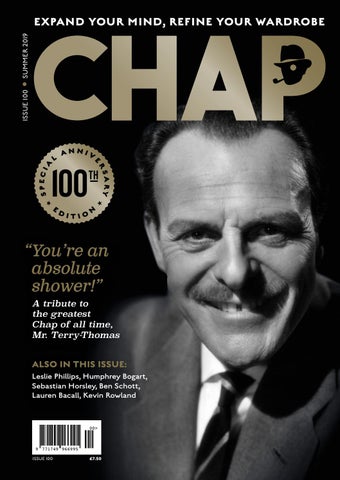
“ You’re an absolute shower!” A tribute to
the greatest Chap of all time, Mr. Terry-Thomas
ALSO IN THIS ISSUE: Leslie Phillips, Humphrey Bogart, Sebastian Horsley, Ben Schott, Lauren Bacall, Kevin Rowland
00>
9 771749 966995
ISSUE 100
£7.50
- 20 Years of -
THE CHAP MANIFESTO 1 THOU SHALT ALWAYS WEAR TWEED. No other fabric says so defiantly: I am a man of panache, savoir-faire and devil-may-care, and I will not be served Continental lager beer under any circumstances. 2 THOU SHALT NEVER NOT SMOKE. Health and Safety “executives” and jobsworth medical practitioners keep trying to convince us that smoking is bad for the lungs/heart/skin/eyebrows, but we all know that smoking a bent apple billiard full of rich Cavendish tobacco raises one’s general sense of well-being to levels unimaginable by the aforementioned spoilsports. 3 THOU SHALT ALWAYS BE COURTEOUS TO THE LADIES. A gentleman is never truly seated on an omnibus or railway carriage: he is merely keeping the seat warm for when a lady might need it. Those who take offence at being offered a seat are not really Ladies.
132
4 THOU SHALT NEVER, EVER, WEAR PANTALOONS DE NIMES. When you have progressed beyond fondling girls in the back seats of cinemas, you can stop wearing jeans. 5 THOU SHALT ALWAYS DOFF ONE’S HAT. Alright, so you own a couple of trilbies. Good for you - but it’s hardly going to change the world. Once you start actually lifting them off your head when greeting passers-by, then the revolution will really begin. 6 THOU SHALT NEVER FASTEN THE LOWEST BUTTON ON THY WAISTCOAT. Look, we don’t make the rules, we simply try to keep them going. This one dates back to Edward VII, sufficient reason in itself to observe it. 7 THOU SHALT ALWAYS SPEAK PROPERLY. It’s really quite simple: instead of saying “Yo, wassup?”, say “How do you do?” 8 THOU SHALT NEVER WEAR PLIMSOLLS WHEN NOT DOING SPORT. Nor even when doing sport. Which you shouldn’t be doing anyway. Except cricket. 9 THOU SHALT ALWAYS WORSHIP AT THE TROUSER PRESS. At the end of each day, your trousers should be placed in one of Mr. Corby’s magical contraptions, and by the next morning your creases will be so sharp that they will start a riot on the high street. 10 THOU SHALT CULTIVATE INTERESTING FACIAL HAIR. By interesting we mean moustaches, or beards with a moustache attached.
34
96
CONTENTS 8 AM I CHAP?
A look back at the successes and failures of this publication’s attempt to right the world’s sartorial wrongs
12 H ISTORY OF THE CHAP
The tables are turned on Gustav Temple, as he submits himself to an interview about the founding of this publication
FEATURES 22 TERRY-THOMAS
An in-depth look at the man behind the gap, with some insights and never-seen family photographs from Terry-Thomas’s niece
32 T HE FILMS OF TERRY-THOMAS
We pick the top five films starring T-T and explain why each one of them should feature in a Chap televisual library
34 L ESLIE PHILLIPS INTERVIEW
Chris Sullivan meets the debonair actor at his London home to look back at the suave one’s 100-film career
SPECIAL ANNIVERSARY EDITION
•
SUMMER 2019
Cover photograph: © Rex/Shutterstock
ISSUE 100
SARTORIAL FEATURES
LONGER FEATURES
44 CHAP PHOTO PORTRAITS
106 S EBASTIAN HORSLEY
We photographed some chaps and chapettes whose sartorial élan has helped define this publication’s style
52 THE HISTORY OF SAVILE ROW
Chris Sullivan takes a meditative stroll along the checkered history of the home of bespoke tailoring
60 S OUL BOY SOCCER
Dermot Kavanagh on Laurie Cunningham, the first black player to play for England, who also cut a stylish rug in 40s threads
Alexander Larman’s tribute to the last of the true dandies
116 T HE 100 BEST THINGS ABOUT DRINKING
Olly Smith lists one libatory joy for every issue of this publication
122 B IRDING
Nick Ostler on how the avian species pierced his soul as a child
126 D ANDIZETTE
The style, talent and seductive allure of Lauren Bacall
66 S ADDLE SHOES
132 CHAP TO THE FUTURE
68 A SARTORIAL PRIMER
REVIEWS
One chap’s quest to locate a pair of these surprisingly elusive 1950s suede two-tone shoes
Liam Jefferies recaps 99 issues-worth of sartorial advice, to see if readers have been paying attention
74 H UMPHREY BOGART
Nick Guzan reminds us why Bogie defined 1930s menswear by sartorially surpassing all other actors of his era
82 G REY FOX COLUMN
David Evans of www.greyfoxblog.com gives salient tips for living the analogue life by rejecting the digital fripperies of our age
88 S TYLE TRIBES
Olivia Bullock on Future Nostalgia and how street fashions nearly always look to the past before creating the future
94 T HE STRAW BOATER
Matt Deckard advocates the return of this oft-maligned item of headwear to the wardrobe of a gentleman
96 C HAP PORTRAITS PART TWO
Our second selection of notable chaps and chapettes who cut the sartorial mustard
The enduring appeal in popular culture of this style we call Chap
138 A UTHOR INTERVIEW
Miscellanist and Wodehouse homagiste Ben Schott
138 B OOK REVIEWS
Books about Wallis Simpson and Auberon Waugh
146 J .P. DONLEAVY
Noel Shine met the legendary author at his home in rural Ireland
152 T RAVEL: PARIS
Chris Sullivan discovers the city’s seedy and glamorous underbelly
160 R ESTAURANT REVIEW
A visit to Kaspars Seafood Restaurant at the Savoy, London
162 P EACOCKS & MAGPIES
Gosbee and Minns smoke their pipes without fear of prosecution
164 A POCALYPSE CHIC
How future humans will be dressing for the next 100 issues
170 CROSSWORD
The Timeline
Issue no.1 of The Chap is published. Initial attempts at self-distribution, in a Triumph Vitesse around London, receive a mixed reception. One doyen of a comic shop in Camden looks at it and says, “What the bejesus is this?” FEBRUARY 1999
The Chap’s first shindig takes place on HMS President moored on the Thames. Entertainment includes a snake charmer and a man reciting dada poetry through a megaphone.
Chaps, attired as Edwardian mountaineers, attempt to scale the north face of ‘Embankment’ by Rachel Whiteread at Tate Modern, a 40-foot pile of resin casts of cardboard boxes. They are successful but escorted from the premises.
NOVEMBER 2002
APRIL 2005
OCTOBER 2001
OCTOBER 2003
JULY 2005
Publication of The Chap Manifesto by Fourth Estate. The title is followed by The Chap Almanac and Around the World in 80 Martinis.
The Chap’s first protest against vulgarity, Civilise the City, takes place in London. Protesters enter McDonald’s and order devilled kidneys, before being escorted from the premises.
The inaugural Chap Olympiad takes place in Regent’s Park, London. 25 competitors alarm tourists by performing Trouser Gymnastics and Raconteur’s Relay.
The key points in the founding, development and manifesto-spreading exercises of this 20-year-old journal for the modern gentleman
The Chap expands to a larger A4 format and nearly goes bankrupt. The publication is saved by its readers in a fundraising campaign and quietly goes back to its former size.
The Chap’s second major protest is against Abercrombie & Fitch opening a store on Savile Row. The slogan is ‘Give Three-Piece a Chance’. They didn’t.
After years of failed attempts, The Chap finally secures an interview with Fenella Fielding, which turns out to be her last full published interview before she dies in 2018.
DECEMBER 2008
APRIL 2012
JUNE 2016
JULY 2012
MAY 2017
The Chap recreates the famous tennis match in School For Scoundrels at the 1960 film’s original location, Corus Hotel Elstree.
The Chap mistakenly agrees to field a mini version of The Chap Olympiad at the Olympic Games in London. Hardly anyone shows any interest except Linford Christie, who asks us where the toilets are.
The Chap relaunches as a quarterly (which it was in the first place, before becoming bi-monthly in 2005), redesigns all its logos and graphics and doubles in size. There are a few letters from disgruntled subscribers.
ISSUE 92
•
SUMMER 2017
APRIL 2008
17 17
92>
9 771749 966070
Sartorial
THE STRAW BOATER Matt Deckard sings the praises of this often maligned item of gentlemen’s headwear
I
’ve never been too keen on the boater. Yes, it’s made of straw and cool for summer and came out long before the soft roll up panama, but it’s like wearing an inedible cracker on your head. Although now often viewed as a hat that is functionally terrible and aesthetically comical, the boater became the standard summer hat for millions of men around the world in the early 1900s. It became a staple item in the respectable businessman’s wardrobe; in essence it was, for a time, the summer version of the bowler. Originally, in the mid 1800s, the boater (Also known as a ‘Sennet’ or ‘Straw’) used to be a seafaring hat that was issued to and worn by British Royal Navy sailors during the summer months. These early boaters were softer than the version we see on the heads of Harold Lloyd and Fred Astaire in the 1920s and 30s, because they were made to yield somewhat to the forces of wind and water encountered by a seaman on a long voyage. In its early days, keeping the brim flat
wasn’t much of a concern, so you’d see sailor after sailor sporting straw hats with warped brims. Many Italian gondoliers still sport versions similar to the original ones worn by British sailors. As time went by, the boater went from being an item of military issue to a fashionable and somewhat formal summer accessory. This is reflected in Manners for Men (1897), in which Mrs C. E. Humphry informed her dapper readers that “For a morning walk in the Park in summer the straw hat, or low hat and tweed suit, are as correct as the black coat and silk hat.” Around the same
“Manners for Men informed its dapper readers that, for a morning walk in the Park in summer the straw hat, or low hat and tweed suit, are as correct as the black coat and silk hat” 94
time, English schools and colleges made the boater into a uniform requirement. Clearly, the boater had successfully made the leap from respectable British military issue headgear to the smart but cumbersome lacquered and pressed straw halos you ended up seeing on American luminaries like David Wark Griffith and Calvin Coolidge, and on businessmen around the Western world. Unsurprisingly, these hats never had the staying power of more comfortable summer hats. Their impractical and comical nature was played up by young students ‘skimming’ them under buses to pass the time (if they were lucky the passing bus would eat the hat); in the 1920s, boaters were turned into a faddish novelty, as college kids began pairing them with raccoon coats and pennants at pep rallies. The farcical side (and thus the end of the more formal application) of this headwear was echoed in the appropriation of the boater by Vaudevillians and carnival barkers. Soon enough, you’d see foam versions worn with red, white, and blue ribbons issued to crowds at political rallies. The seriousness of the hat had clearly departed. If it had had more functionality than fashionability, perhaps the boater would have had as long a run as the Panama hats that you can still find at your local department store today. Unlike its winter felt counterparts, the bowler, which originated as a hard gamekeeper’s hat that can be moulded to the cranium to perfection with steam, or the soft fedora that’s an offshoot of the comfortable slouch hat worn in the field of battle, the boater requires that your head be exactly the shape of the hat, or you’re in for an ill fit. It is stiff and has no give. If you try to alter the shape to fit your head, you tend to warp the brim.
95
And yet, I like the boater now. I like it because nobody else is wearing it. It stands out on the street corner. Although shunned by well-heeled men decades ago and thus best worn with a slightly irreverent air, I find it adds an unexpected jauntiness to a well-tailored suit. In 2019, it can give your look a panache that will certainly make you stand out among a sea of businessmen on a crowded summer street. n
Chris Sullivan
Writer/Impresario
ISSUE
2 0 Y E A R A N N I V E R S A RY
Photograph: Eliza Hill
C H A P P O RT RA I TS
Christos Tolera
97
Photograph: Eliza Hill
Artist
Photograph: Soulstealer Photography
Costumier and model
Eva Leigh
100
Kevin Rowland
101
Photograph: Eliza Hill
Musician
Drink
The 100 Best Things About Drinking Olly Smith marks one hundred issues of The Chap with his definitive list of the 100 very best things about alcohol
H
appy 100th birthday to The Chap! Does this mean a telegram from Her Majesty? A polite round of applause from the Pavilion? Or a chance to celebrate the hundred best things about drinking? Almost certainly all three. Here for your delectation (and in no particular order) are the hundred best things about drinking. Happy Hundredth!
1. Oliver Reed. Oliver Reed is at once the best and worst thing about drinking, but without doubt shooting sofas in the middle of the night to startle your sleeping houseguests is an extraordinary way to finish a night on the sauce. 2. Ming The Merciless. Ming’s power potions are the stuff of legend. Rumour has it his sommeliers travel the far corners of the galaxy to ensure that his potency, when it comes to romance, is a hurricane of hugs.
116
3. Sherry. It’s probably what Ming’s secretly been drinking all these years, and there is no doubt that a chilled glass of Fino with a carefully carved platter of jamón is one of life’s greatest pleasures. 4. Withnail. A morose theatrical old soak he may be, but Withnail is without question responsible for some of the greatest quotes connected with the dark arts of drinking. “We want cake and fine wine.” 5. Condorman. A much underrated drinker, especially when Michael Crawford’s character orders a double Istanbul Express. “Nobody orders the double” trembles the waiter. “Alright then, make it a triple”. The flames shooting out of Crawford’s face after a single sip look like a butane barbecue. Magic. 6. Keith Floyd. Cooking on location with effortless improvisation was a showcase to his wit and wonder. Alas the booze had a tendency to gain the upper hand but when on song, this chap was nothing short of operatic. 7. The Queen. For her love of gin, for her love of Dubonnet, for her love of our country, “The Queen” should be the toast of all drinks. 8. Harvey’s Best Bitter. A long established tradition in these pages to extol the virtues of the world’s greatest pint. 9. Sausages. On the bar of The Grenadier, The Duke of Wellington’s old mess and a splendid Belgravia boozer, you will find sausages. And you should order them. 10. Edinburgh. The greatest drinking city in the world. Whisky, beer, wine, or just coffee laced with outrageousness, there is no better scenery in which to get steadily sloshed. 11. Cricket. What Edinburgh is to cities, cricket is to sport. No finer backdrop to getting slowly pickled. 12. Tennis. Except tennis. 13. The Hipflask. A hipflask is sacred and the contents are the diplomatic bag of personal enjoyment. Armagnac Port or Aquavit are all as acceptable as the
usual suspects. Fill it with your dreams. 14. Pastis. The aniseed outrage of this drink is enough to reassure even the most jaded palate that the frontier of flavour is laced with eternal astonishment. 15. The Colombe D’Or. A favourite of my late friend Sir Roger Moore, this hostelry not far from Nice is adorned with Picassos and what the rustic food doesn’t quite deliver, the setting and ice cold rosé more than make up for. 16. The Hangover. Impossible to appreciate the glory of the night before without the penance of the morning. And the only excuse you will ever need to drink early in the day. Bloody Mary, you say? 17. The Full English. See above. 18. Al Bowlly. In your frailest moment of sublime regret, when your curses to Bacchus writhe to the ceiling, nurse your hangover with the gentlest crooner of them all, Al Bowlly singing The Very Thought Of You. Satisfaction guaranteed. 19. Jesus. Water into wine. Enough said. 20. Dawn French. For her love of cider and infectious giggles, we salute the best of the French. 21. Horace. The great Roman poet loved a glass of local wine from around his Sabine farm, rather than the posh pricey stuff back in Rome. My favourite translations of poetry are by Harry Eyres. Try this, from Odes 3:25, Quo Me Bacche: My words will soar, O Lord of the Wine Press, And they will not die: I am drinking deep, Taking the risk, binding my brow with vine shoots. 22. Long Haul Travel. A glass of excellence while flying far away is excellent. Doesn’t matter so much where as what’s in our glass – make it strong, cold and repeatable. 23. Prohibition. Not so much fun at the time but the source of many legends, stories and, oddly enough, the finessing of boutique booze production.
117
152
Travel
A CHAP’S GUIDE TO PARIS
T
Chris Sullivan recommends the most authentic bars, clubs, bistros and cafes in which to refuel while pounding the hedonistic streets of Paris
he Eurostar is still really rather wonderful. You get on a train at St. Pancras and alight some two hours later at Le Gare Du Nord into a different world, where the attitudes, tastes, smells, people and culture are as different from London as sand is to salt. Undeniably, it is quite an anomalous experience – one that usually only a plane journey can really prepare us for – stepping off a train into this alien environment that is both Parisian and, due to French colonisation, Gambian, Moroccan, Tunisian, Sudanese and Algerian. It’s in all respects downright foreign. A train journey of such duration would normally take us to the heady heights of somewhere like Manchester, which in every particular is definitely not Paris. I first visited Paris as a rambunctious 19year-old youth, accompanied by five like-minded others, unknowingly staying in a thoroughly sordid Pigalle hotel (Pigalle was then perhaps the sleaziest red light district in the world) favoured by ladies who rented by the hour. We should have suspected, when the door was opened by a rotund 40-something black woman dressed in a see-through baby doll nightie holding a banana, that this was a knocking
shop, but it was only when I opened the wardrobe and found three platinum wigs, a whip and a crusty set of knickers that I twigged. Consequently, we had our belongings stolen, were overcharged at every turn, given counterfeit change and brawled with Teddy Boys, Punk rockers, Market Traders, bouncers and football fans. Since then I have visited Paris some 40 times and have got to know the ins, outs and in-betweens of the City of Lights. I checked into Le Crillon, a hotel opened in 1909 in a stone palace dating back to 1758, and which really is the last word in unrestrained luxury. Located on Place de la Concorde at the bottom of the Champs Elysees, it is the perfect location and one of the world’s great hotels. After a swift café we made our way to Le Puce (the flea market) located outside Metro Porte de Clignancourt in the suburb of St Ouen; not specifically for the market, but to enjoy a typical Parisian lunch of snails and bœuf bourguignon at Chez Louisette, a marvellous little café where you’ll catch one of their septuagenarian crooners delivering a touch of Aznavour, Chevalier or even a Gallic rendition of My Way. This kitsch throwback to an age well missed is a
153