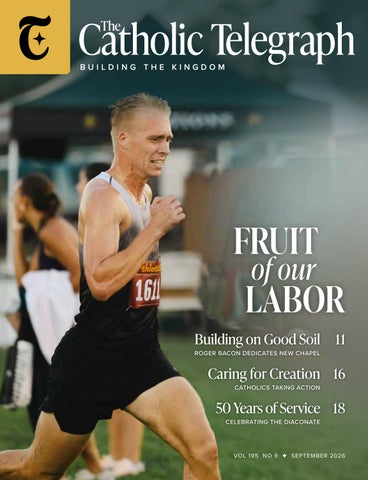
Catholic Telegraph The
FRUIT of our
LABOR Building on Good Soil
11
ROGER BACON DEDICATES NEW CHAPEL
Caring for Creation 16 CATHOLICS TAKING ACTION
50 Years of Service 18 CELEBRATING THE DIACONATE
VOL 195 NO 9 ✦ SEPTEMBER 2026
From the Editor’s Desk WE MAY NEVER SEE THE FRUIT—PLANT ANYWAY! The people who began in 1163 to build Notre Dame Cathedral in Paris didn’t live to see its completion—and they didn’t expect to. In fact, a saying attributed to medieval cathedral builders is: “We plant trees under whose shade we will never sit.” Beautiful churches are concrete expressions of faith. For centuries, the beauty of Gothic cathedrals and other great churches have moved countless hearts, including those with little or no experience of God, pointing them toward something transcendent. Thank goodness for those who came before us and recognized the value of building something beautiful for God, regardless of the cost. It takes tremendous faith to dedicate your life and resources to a project from which you will receive no temporal reward. A cathedral is not built for the glory of one generation but for the worship of God and the benefit of generations to come. We, too, are called to take up our particular tasks in building the Kingdom of God, asking for no reward other than the confidence that we are doing the Lord’s will. This kind of faith requires us to think beyond ourselves. Our current culture tends to measure success by immediate results: What did we accomplish? What did we gain? How many people noticed? But the Kingdom of God does not operate according to those measurements. Some of the most important work we do may bear fruit long after we are gone—and some of it may bear fruit in ways we will never know. Whatever our particular vocation or responsibilities, we are all called to be disciples of Christ and to make disciples of Christ. In evangelization, our role is often simply to plant seeds, trusting that we may never see what the Holy Spirit does with them. A parent who teaches a child to pray may never know how that prayer sustains the child decades later. A teacher may never know which lesson remains with a student for a lifetime. A friend may offer a word of encouragement that someone
remembers years later when he or she desperately needs it. A person who quietly lives his faith at work may never know that a colleague was watching—and inspired to seek God because of it. Building the Kingdom also means doing what is right and just even when we may never see the fruits of our labor or benefit from our sacrifices. Sometimes, in fact, doing what is right will cost us dearly. This is where we need unwavering faith and trust in the Lord. There has never been, nor will there ever be, a more just and holy person to walk this earth than Jesus of Nazareth. And yet, He was crucified. By every worldly measure, His life ended in failure. Why should we expect anything different for ourselves? But the Cross was not the end of the story. The sacrifice that appeared to accomplish nothing became the source of the world's salvation. That is the Christian hope. We are not responsible for seeing the entire plan. We are responsible for being faithful to the part God gives us. We may not see the cathedral completed. We may never sit beneath the shade of the trees we plant. We may never know how many lives were changed by the seeds we scattered. But we are called to build anyway—to plant anyway—to sacrifice anyway—to trust anyway. Because the Kingdom of God is not built in a single generation. We are building on foundations laid by those who came before us, and we are laying foundations for those who will come after us. Our task is simply to be faithful builders.
David Cooley
cteditorial@catholicaoc.org
Publisher: Archbishop Robert G. Casey
Creative Director: Nick Abele
Videographer: Nathan Schuster
Editor: David Cooley
Photography: Mary Kate Fleisher
Media Sales: Deacon Graham Galloway
Managing Editor: Margaret Swensen
Social Media: Taylor Motley
Circulation: Catherine Ampfer
Table of Contents Columns Into Your Hands
4
ARCHBISHOP ROBERT G. CASEY
A Closer Look
6
Christian Anthropology 28 DR. ANDREW SODERGREN
8
FR. DAVID ENDRES
From the Archives
26
GAIL DEIBLER FINKE
DR. KENNETH CRAYCRAFT
Question of Faith
House of the Lord
Catholic at Home
30
KATIE SCIBA
21
Shine On
MICHELLE WIRTH SMITH
DOMINICK ALBANO
Church Fathers 22
Luminous Lives
FR. JACOB LINDLE
CORYNNE STARESINIC
31 32
Color the Saints 36 DAVID COOLEY & TAYLOR MOTLEY
Book Review 38 MARGARET SWENSEN
The Final Word 40 DR. REBECCA ALLEN
On the Cover
Features Roger Bacon Dedicates New Chapel
11
50 Years of Service: Celebrating the Diaconate
18
DAVID COOLEY
DEACON MARK MACHUGA
Synod 2027: Where is the 14 Holy Spirit Leading Us?
The Saintly Seven: 24 Venerable Henriette Dilille
MIKE SCHAFER
MACKENZIE DOYLE
Catholic Communities Caring for God’s Creation
16
JILLIAN FOSTER
To Educate 33 MATT DANIELS
70 Years and Counting 34 MARYBETH SPROULL
THE CATHOLIC TELEGRAPH • 195th Year No. 9 • September 2026 • 513-263-5164 • thecatholictelegraph.com ctadvertising@catholicaoc.org • The Catholic Telegraph (xUSPS 094-520) ISSN. 10736689 is published monthly by the Archdiocese of Cincinnati 100 E. 8th St., Cincinnati, OH 45202. Periodical’s postage paid at Cincinnati and at additional mailing office. POSTMASTER: Send address changes to: The Catholic Telegraph, 100 E. 8th St., Cincinnati, OH 45202.
2
T H E C AT H O L I C T E L E G R A P H
Seminarian David Adamitis crosses the finish line of the inaugural Verso l’Alto cross country race. The running club is featured in The Catholic Telegraph short film Running Through Faith, available on YouTube @CatholicTelegraph PHOTO BY MARY KATE FLEISHER
The Columnists Dominick Albano
Michelle Wirth Smith
is a passionately Catholic husband and father of four boys. He has been writing, speaking, and leading Catholic retreats for more than 20 years. He is the co-founder of the National Society for Priestly Vocations.
has served as the archdiocesan Archivist since 2019, bringing a Cincinnati-born passion for preserving Catholic history. She earned her Master of Library & Information Science degree from Kent State University.
Dr. Kenneth Craycraft
Katie Sciba
holds the James J. Gardner Chair of Moral Theology at Mount St. Mary’s Seminary & School of Theology. He is the author of Citizens Yet Strangers: Living Authentically Catholic in a Divided America.
is a national speaker and Catholic Press Award-winning columnist. She and her husband Andrew were married in 2008 and are blessed with seven children.
Fr. David Endres
Dr. Andrew Sodergren
is professor of Church history and historical theology at Mount Saint Mary’s Seminary & School of Theology.
is a Catholic psychologist and director of psychological services for Ruah Woods. He speaks on the integration of psychology and the Catholic faith. He and his wife Ellie have five children.
Fr. Jacob Lindle
Corynne Staresinic
was ordained a priest for the Archdiocese of Cincinnati in May 2022. He is presently studying for a Doctorate in Patristic Theology at the Pontifical Gregorian University in Rome.
is a writer and research fellow at the McGrath Institute for Church Life at the University of Notre Dame. She lives in Greater Cincinnati with her husband Nick and their children.
The Catholic Telegraph has a new website! Visit thecatholictelegraph.com regularly throughout the month for more stories (easy to share), timely news and in-depth video content. Contact us: cteditorial@catholicaoc.org
SEPTEMBER
Pope Leo XIV’s Prayer Intention
For the care of water Let us pray for a just and sustainable management of water, a vital resource, so that everyone may have equal access to it. SEPTEMBER 2026
3
Recognizing Christ in Our Neighbors I N T O Y O U R H A N D S | Archbishop Robert G. Casey
I recently traveled to Washington, D.C., to advocate for our Haitian community with members of the U.S. Senate and their staff. Organized by the U.S. Conference of Catholic Bishops, the day brought together Cardinal Chibly Langlois from Les Cayes in Haiti, Archbishop Wenski from Miami, Bishop Fabre from Charleston, SC, Fr. Jazon, a Haitian priest from Camden, NJ, and me. We spent the day in conversation about the current reality faced by the Haitian community, both here in the USA and in Haiti. Our time together opened my eyes to the important work our Church has been called to do in this present moment. Our daily labor as disciples of Jesus Christ must include providing voice to the voiceless and accompaniment to those who suffer. We must recognize Jesus on his way to Calvary and wounded under the weight of the cross when we look upon our neighbors who struggle to find their way in the world today. Our Lord instructs us in Matthew’s Gospel, “Whatsoever you do to the least of my people, that you do unto me” (cf. Mt 25:40). St. Paul then echoes this teaching in his letter to the Corinthians, reminding us that when one member suffers, all suffer (cf. 1 Cor 12:26). Our discipleship bears fruit when we shine the light of Christ upon the sufferings of our brothers and sisters and when we see the light of Christ shining bright from within them. This balance, between being Christ for one another and seeing Christ in one another, finds a profound expression in the Holy Sacrament of the Eucharist. What we do at Mass, in remembrance of the great sacrifice of Jesus, teaches and transforms us. Christ is not simply present in the Host and Chalice but becomes present in His Body the Church. Made one in the Communion we share, our dignity as God’s 4
T H E C AT H O L I C T E L E G R A P H
sons and daughters and our unity as brothers and sisters in Christ are revealed. That day in Washington, D.C., concluded with a celebration of Mass with the Haitian community. That evening, the Lord was truly present in Word and Sacrament. From the wonderful singing to the powerful preaching to the heartfelt praying, there was no doubt that Jesus was with us in that church. I was privileged to distribute Communion that evening. As the people came forth to receive the Eucharist, I said, as I always do, “The Body of Christ.” But in that moment, Jesus was not simply present in the Host that I held before each communicant. As I said those words, “The Body of Christ,” Jesus was revealed to me in the men, women, and children who received the Host. My words became a declaration of their identity as a people transformed through the Eucharist. I quickly found myself challenged by Christ, “Do you recognize Me truly present in the people surrounding you?” Like St. Peter, I was asked by Jesus, “Do you love me?” And as the word “amen” was spoken, a deep and abiding “yes” was experienced in that moment of Communion. What occurred for me that evening with the Haitian community expresses my hope for our family of faith every time we gather for the Eucharist. I pray that the grace of the Eucharist may enter our hearts, inspiring us to see that every person possesses inherent dignity as a child of God. I pray that the nourishment of the Eucharist may strengthen us for our daily labor, knowing that when we help someone in need we care for Christ directly. I pray that our “amen” in that moment of Communion may be a “yes” to Christ’s call to love our neighbors, including those who are different from us, those who are strangers, those who are outcast, and even our enemies. ✦
Reconociendo a Cristo en nuestros prójimos E N T U S M A N O S | Arzobispo Robert G. Casey
Recientemente viajé a Washington, D.C., para abogar por nuestra comunidad haitiana ante miembros del Senado de los Estados Unidos y sus respectivos equipos. Organizado por la Conferencia de Obispos Católicos de Estados Unidos, el evento reunió al Cardenal Chibly Langlois de Les Cayes en Haití, al Arzobispo Wenski de Miami, al Obispo Fabre de Charleston, SC, al Padre Jazon, un sacerdote haitiano de Camden, NJ, y a mí. Pasamos el día conversando sobre la realidad actual que enfrenta la comunidad haitiana, tanto aquí en los Estados Unidos como en Haití. El tiempo que pasamos juntos me abrió los ojos a la importante labor que nuestra Iglesia está llamada a realizar en este momento actual. Nuestro trabajo diario como discípulos de Jesucristo debe incluir dar voz a quienes no la tienen y acompañar a quienes sufren. Debemos reconocer a Jesús camino al Calvario, herido bajo el peso de la cruz cuando observamos a nuestros prójimos que luchan por encontrar su camino en el mundo actual. Nuestro Señor nos instruye en el Evangelio de Mateo: “Cuando lo hicieron con el más insignificante de mis hermanos, conmigo lo hicieron” (cf. Mt 25, 40). San Pablo luego se hace eco de esta enseñanza en su carta a los Corintios, recordándonos que cuando un miembro sufre, todos sufren (cf. 1 Cor 12, 26). Nuestro discipulado da fruto cuando hacemos brillar la luz de Cristo sobre los sufrimientos de nuestros hermanos y hermanas, y cuando vemos la luz de Cristo resplandecer desde dentro de ellos. Este equilibrio, entre ser Cristo los unos para los otros y ver a Cristo en los demás, encuentra una profunda expresión en el Santísimo Sacramento de la Eucaristía. Lo que hacemos en la Misa, en memoria del gran sacrificio de Jesús, nos enseña y nos transforma. Cristo no solo está presente en la Hostia y en el Cáliz, sino que también se hace presente en su Cuerpo, la Iglesia. Unidos en la Comunión que compartimos, se revela nuestra
dignidad como hijos e hijas de Dios y nuestra unidad como hermanos y hermanas en Cristo. Ese día en Washington, D.C., concluyó con la celebración de una Misa con la comunidad haitiana. Esa tarde, el Señor estuvo verdaderamente presente en Palabra y Sacramento. Desde los maravillosos cantos hasta la poderosa predicación y las oraciones sinceras, no cabía duda de que Jesús estaba con nosotros en esa iglesia. Tuve el privilegio de distribuir la Comunión esa tarde. Cuando la gente se acercó para recibir la Eucaristía, dije, como siempre, “El Cuerpo de Cristo”. Pero en ese momento, Jesús no estaba simplemente presente en la Hostia que sostenía delante de cada comulgante. Al pronunciar esas palabras, “El Cuerpo de Cristo”, Jesús se me reveló en los hombres, mujeres y niños que recibieron la Hostia. Mis palabras se convirtieron en una declaración de su identidad como pueblo transformado a través de la Eucaristía. Pronto me encontré con el desafío de Cristo: “¿Me reconoces verdaderamente presente en las personas que te rodean?” Al igual que a San Pedro, Jesús me preguntó: “¿Me amas?”. Y al pronunciarse la palabra “amén”, hubo un “sí” profundo y duradero en ese momento de Comunión. Lo que viví aquella tarde con la comunidad haitiana expresa mi esperanza para nuestra familia de fe cada vez que nos reunimos para la Eucaristía. Que la gracia de la Eucaristía entre en nuestros corazones, inspirándonos a ver que toda persona posee una dignidad inherente como hijo de Dios. Que el alimento de la Eucaristía nos fortalezca para nuestro trabajo diario, sabiendo que cuando ayudamos a alguien necesitado cuidamos directamente de Cristo. Que nuestro “amén” en ese momento de la Comunión sea un “sí” al llamado de Cristo a amar a nuestros prójimos, incluyendo a aquellos que son diferentes a nosotros, a los extraños, a los marginados e incluso a nuestros enemigos. ✦ SEPTEMBER 2026
5
The Dignity of Work and the Place of Labor Unions A C L O S E R L O O K | Dr. Kenneth Craycraft
All work must prioritize the dignity of the worker as a subjective moral agent and not as a mere instrument—as though he were nothing more than a component or machine. This is what Pope St. John Paul II calls the “priority of labor over capital” in his 1981 encyclical Laborem Exercens (no. 12). Failure to prioritize the worker dehumanizes him, stripping work of its contribution to the well-being of the worker. We do not consider simply the “utility” of the worker in the process of production but rather the whole range of elements that constitute his dignity, as a subjective moral agent, ordered toward rest in God. When the employer and employee are not able to reach agreement on the protection of the worker’s subjective agency, it may be necessary for the employees to pool their resources in solidarity with one another in the form of a labor union. In Rerum Novarum (no. 49), Pope Leo XIII refers to labor unions as “the most important” of cooperative societies of workers. When properly constituted and managed, labor unions give workers legitimate leverage to negotiate for better working conditions, higher wages, or a place at the decision-making table. They may also provide safeguards against layoffs or safety nets in the event of economic downturns or workplace calamities or accidents. Of course, as illustrated in the films On the Waterfront and The Irishman, unions are as susceptible to corruption as any other human institution. Unions fail their members when they advocate for political candidates or social policies that are not directly in service of their mission to serve all their constituent members. The need to regulate and reform unions when this occurs is no different from any other human institution that strays from or fails in its proper mission. Important as unions are—and as wholly legitimate as they are when needed—the presence of strong unions might be seen as a failure of employee and employer to reach a mutually agreeable consensus on the enterprise. I want to be careful and clear in this discussion so that I am not misunderstood. Labor unions are valued and honored institutions, enjoying the favor and support of the Church through its social doctrine. Unions are a legitimate expression of the solidarity of workers as they join in a united enterprise to protect themselves against both hostile employers and economic turbulence. Unions have 6
T H E C AT H O L I C T E L E G R A P H
had a positive social impact on workers and their families for generations. Perquisites and benefits that we take for granted in the workplace—such as health insurance, paid vacations, safety regulations, and overtime pay—exist because of the presence of unions in American economic life. As Pope St. John Paul II put it in Laborem Exercens (no. 20), the presence of labor unions “remains a constructive factor of social order and solidarity.” Having said that, however, the good of labor unions for workers might be analogized to the good of medicine for the body. Medicine is a good thing. It should be seen as part of the “normal endeavor” to treat illness. Where a person has chronic health issues, the ongoing use of medicine contributes both to the good of the individual patient and society more generally. But medicine is only required when the body is not functioning as it is supposed to. The better situation is a healthy body, in which the parts are all working properly and in harmony with one another in a common endeavor. In this case, medicine is not indicated. We do not disparage medicine when it is needed, but we recognize the “better” state of affairs when it is not needed. Labor unions can be seen in a similar way. Where the workplace is one of harmony and cooperation, in which employers and employees engage in a common enterprise, rowing in the same direction and in the same rhythm, the need for labor unions is lessened, if not, in some cases, eliminated. The better path is for labor and capital to work in harmony with one another, working toward common goals and always with the moral development of the worker in mind. Unions may be indispensable for the common good of the enterprise. But where the common good is achieved without unions, such as where health is maintained without medicine, this is the better path. These kinds of employee/employer relations meet the needs of both employer and employee outside the rigid regulations of formal unions and are a better indication of the health of the business. Thus, they contribute to the social principle of subsidiarity. Laborers, managers, and owners help one another at the most local and immediate place available, without having to enlist regulatory or legal structures to keep everyone in line. Smart business managers, even those with no training in Catholic social teaching, see the value in addressing the needs
American Oak Leather Company, Winold Reiss, 1933.
FAITH. VALUES. STEWARDSHIP. Investing according to Catholic principles for more than 50 years.
Cincinnati Union Terminal Rotunda, Winold Reiss, 1933. In 1933, Winold Reiss created a series of 23 murals for Cincinnati’s Union Terminal. While many artists of the time focused on exposing the injustices of industrialism, Reiss celebrated the dignity of the workers. In the Cincinnati murals, technology provides a backdrop for the workers’ unique skills and contributions to progress.
of their employees rather than allowing problems to fester until the intrusive hand of government is required. Most importantly, such cooperation is built upon the foundation of the dignity of the worker, whose presence in the enterprise is a good in itself, not merely the means to a profit. ✦ (Editor’s note: This column was adapted from Dr. Craycraft’s book, Citizens Yet Strangers: Living Authentically Catholic in a Divided America [OSV Books, 2024]).
For Catholic families, foundations, endowments, and institutions seeking investments aligned with their faith.
600 Vine Street, Suite 2000 Cincinnati, OH 45202 513-621-2733 www.1919ic.com
SEPTEMBER 2026
7
The Dignity of Workers Q U E S T I O N O F F A I T H | Fr. David Endres
My parish often prays for workers and farmers as part of the petitions. Can you explain the Church’s approach to work and why it prays for workers? The Church has long prayed for workers because work is common to humanity and often arduous and dangerous. Every person is called to work, though work takes many forms and may be fulfilled in different ways according to a person’s circumstances and abilities.
WHY WO R K ? Work is so essential to humanity that we find in the Scriptures, “If anyone is unwilling to work, neither should that one eat” (2 Thes 3:10). Unless prevented by old age, illness, or other circumstances, a person is meant to work. As the Catechism of the Catholic Church (CCC) relates, through work the person “exercises and fulfills … the potential inscribed in his nature” (CCC, no. 2428). Work is natural and part of the divine plan for the human person. God’s first commandment to humanity to "fill the earth and subdue it" (Gn 1:28) is understood as a call to cultivate the earth and contribute to human flourishing. Work is not only for survival but to develop human potential, engage one's talents and creativity, and serve one's family and community.
WOR KER S’ D I G NI T Y AND R I G HTS A worker’s dignity, whether in paid employment, agriculture, the home, or other forms of labor, is rooted in being made in the image and likeness of God. Because of this God-given dignity, certain rights should be protected, including a fair wage for oneself and one’s family, freedom for workers to form associations like labor unions, and the assurance of appropriate rest and leisure. The Church reminds us that “work is for man, not man for work” (CCC, no. 2428). The dignity of the human person must always take priority over economic interests, capital, and profit.
N EW C HAL L E NG E S In his first encyclical, Magnifica Humanitas, Pope Leo XIV addresses contemporary challenges facing workers. The 8
T H E C AT H O L I C T E L E G R A P H
pope writes that automation and artificial intelligence (AI) are “rapidly transforming the very structure of work.” Concerned about their impact on workers, he writes, “It is said that this will bring great improvements for everyone … however, the ‘new ways’ of working are not necessarily better, for while AI promises to boost productivity by taking over mundane tasks, it frequently forces workers to adapt to the speed and demands of machines, rather than machines being designed to support those who work” (Magnifica Humanitas, no. 150). While modes and circumstances of work change, the principles that underlie a proper understanding of work remain. The dignity and rights of workers must be assured. As the pope teaches, “Work is not simply an instrument, [but] it expresses and enhances the dignity of our lives” (Magnifica Humanitas, no. 149). Work, therefore, should be ordered toward the flourishing of the human person rather than allowing efficiency or profit to guide it.
S PI R I T UAL S UPPO RT The Church prays for workers and farmers because labor has not only economic and social dimensions but also a spiritual one. Through these prayers, the faithful ask God to bless human labor, provide for daily needs, and help workers recognize their efforts as participation in God's creative work. Prayers for workers can be included in the general intercessions of the Mass, and the Roman Missal contains Mass prayers for the planting and harvesting of crops. Prayers for workers are especially appropriate on the feast of St. Joseph the Worker (May 1), which reminds us that work can be a path to holiness. The Church's teaching and prayer both witness to the material, spiritual, and moral dimensions of labor. Work is not merely a means of economic support but a participation in God's creative plan and an expression of service to others. ✦
4.0 x 5.0
SEPTEMBER 2026
9
P E R M A N E N T D I AC O N AT E 1 9 7 6 – 2 0 2 6
Celebrating 50 Years of Service to the Archdiocese The Archdiocese of Cincinnati ordained the first permanent deacons in September, 1976. Since then, 343 deacons have served as ministers of the Word, Liturgy, and Charity. Congratulations and gratitude to all permanent deacons for their service to the Church! For more information on the vocation of the permanent deacon, contact the Office of the Diaconate: (513) 263-6641 | DeaconOffice@catholicaoc.org
10
T H E C AT H O L I C T E L E G R A P H
Building on Good Soil B Y DAV I D COOLEY
PHOTOGRAPHY BY
M A R Y K AT E F L E I S H E R
Roger Bacon Dedicates New Chapel
R
oger Bacon High School celebrated a monumental occasion in the school’s 99-year history. On the feast day of St. Clare, August 11, members of the school community gathered for the dedication of Our Lady of the Angels Chapel.
Archbishop Robert Casey presided at the chapel’s first Mass and dedication of its altar, officially consecrating the sacred space into the life of the school. Many Franciscan friars and brothers, as well as the Poor Clare sisters, attended with school students, staff, and alumni. “We pray this day for all who will enter this school building, for all who will gather here in this chapel, for students and faculty, staff, and alumni, that they may discover Christ seeking to save them,” said Archbishop Casey during his homily. “We pray that Christ will be their firm foundation, helping them to live a life with joy, for they know of the Lord's commitment to care for them, to protect them, and to save them.” The chapel was constructed inside the Anne Nurre Heidt Atrium, a recent addition to the school and cornerstone of Roger Bacon's “We Are the Good Soil” capital campaign. The twostory atrium also contains administrative offices and gathering spaces decorated with murals and displays that celebrate the history of the school and the Franciscan order. It is the latest of many projects that Elevar Design Group, a local architecture and engineering firm, has worked on in the Archdiocese of Cincinnati. John Rademacher, an architect with a pivotal role in this project and a Roger Bacon graduate, said this opportunity brought him full circle: it was at Roger Bacon that he first fell in love with drawing. SEPTEMBER 2026
11
“Quite often, I'm asked how I found architecture, and I'd rather say that architecture found me,” Rademacher said. “I took a drafting class at Roger Bacon High School and began to really appreciate the art of drawing.” He noted that the chapel and atrium are designed in a way that highlights both what it means to be Franciscan and the beauty of simplicity. “The simplicity of the structure and the interior decoration help us to focus on what we do there. It’s a place where we can focus on the sacrifice of the Mass, the Eucharist, and the beauty of God’s creation outside,” Rademacher said. “We’ve created a space where people can begin or expand their faith journey and understand what it means to be part of the Roger Bacon community.” He hopes that the Our Lady of the Angels Chapel ensures that Roger Bacon remains a beacon for the community. “I hope it remains a place where people can gather and celebrate in times of joy and support each other in times of suffering,” he said. “It has been an amazing 99 years for this school, and I know the next 100 years will be amazing for the generations to come who will experience the Franciscan tradition. 12
T H E C AT H O L I C T E L E G R A P H
A rose window skylight (previous page and above) is located above the altar, helping to focus attention on the Eucharist during the Mass. Six stained-glass windows adorn the south wall depicting saints prominent in the Franciscan tradition.
The Stations of the Cross (above) were obtained from the Friary of St. Francis Seraph Church which closed in June 2026. The chapel incorporated these and other artifacts ensuring they can continue to inspire future generations. The San Damiano cross (top center) is the style crucifix that St. Francis of Assisi prayed before when he heard Jesus’ call.
Sanctuary furnishings including the ambo, credence table, chairs, altar, and tabernacle (right) were handcrafted by local artist Josef Otmar V (top right) and include the Tau cross, which is particularly meaningful in Franciscan spirituality. The furnishings are designed to be both dignified and simple, reflecting Franciscan values.
I'm glad to have been a small part of it. I'm glad to be back after all these years. It's exciting to be part of the Roger Bacon family.” In his closing remarks, Steve Shadd, president of Roger Bacon High School, said that he was asked many times why the campaign to build the atrium and chapel was called “We Are the Good Soil.” “Roger Bacon High School is the soil,” he said. “We know that many young people drift away from their faith after high school. Yet, in time, many will return in search of meaning and faith. When that moment comes, their formation at Roger Bacon matters deeply. The lessons learned here, the values instilled, the recognition of dignity in themselves and others, and the call to serve are essential elements of the ‘good soil’ we provide. We may not know when the seed will take root, but we are called to prepare the ground so it may flourish when the time is right.” “Roger Bacon is very proud of our Franciscan heritage. We are very proud of our Franciscan charism, and we are very proud to be Catholic,” Shadd said. “We profess it every day in the way we behave, in the way we talk, in the expectations of our community.” And, he asked for continued prayers and support as Roger Bacon “steps boldly into our second century.” ✦
Visit thecatholictelegraph.com on September 18 for a video about the design and construction of the new chapel.
SEPTEMBER 2026
13
SYNOD 2027
Where is the Holy Spirit Leading Us? BY MIKE SCHAFER
T
hink about a time when you had to make an important decision and the right course of action was not obvious. What did you do? Certainly, you pondered the options, rolling them over in your mind. But perhaps you also sought the guidance of experts; considered the life experiences of others similarly situated; and offered your deliberation up to God in prayer, asking for His assistance. In short, you discerned. Discernment is at the core of every diocesan synod, including our own Synod 2027. Archbishop Robert G. Casey has the specific responsibility of discerning the questions which the synodal deliberations will address. But first, he wants and needs our input. According to the Holy See’s Instruction on Diocesan Synods, “The faithful should be afforded the opportunity of expressing their needs, their desires, and their opinions with regard to the topics being dealt with in Synod.” The means for doing this is by participating in one of the many Conversations in the Spirit scheduled throughout the archdiocese this Fall between Labor Day and Thanksgiving 2026. In these sessions, we ourselves will be asked to prayerfully discern what suggestions to offer Archbishop Casey for his consideration.
WHAT IS DISCERNMENT? Discernment is a process whereby one is called to recognize situations, challenges, and opportunities (in this case, in the life of our local Church); interpret them in the light of faith; and choose a path forward. Just as discernment is at the core of the synod, prayer is at the core of discernment. In his famous work Introduction to the Devout Life, St. Francis de Sales, patron of the Archdiocese of Cincinnati, wrote, “Prayer opens the understanding
to the brightness of divine light, and the will to the warmth of heavenly love.” The Conversations in the Spirit therefore will be grounded in prayer, asking the Holy Spirit where He is leading us.
CAN WE ACTUALLY HEAR THE VOICE OF THE HOLY SPIRIT? Yes, we can, if we are properly disposed. “My sheep hear my voice; I know them, and they follow me” (Jn 10:27-28). The Lord speaks to us through Sacred Scripture, through the Eucharist, through prayer, through candid or difficult conversations with others, and through the quiet movements of our hearts. This is the critical work of discernment: learning to recognize God’s voice amid the cacophony of other voices in our lives.
HOW DO WE KNOW IF WHAT WE ARE HEARING IS ACTUALLY THE HOLY SPIRIT AND NOT JUST OUR OWN PREFERENCES? A friend of mine often observes that he knows it’s the Holy Spirit when he is called to something he doesn’t want to do! In truth, there is no clear-cut answer to this question. Much of it depends on our own sincere and prayerful disposition to know and do God’s will. There are two reliable markers, however, on which we can rely: the Holy Spirit will never contradict the revealed truths of the Catholic faith; and God’s word is always uplifting, encouraging, and consoling. If you have not already done so, please register for a Conversations in the Spirit session. And please ask the Holy Spirit to prepare your heart and mind for fruitful participation. May we be humble enough to hear Him, courageous enough to follow Him, and trusting enough to pray, in the words of St. Ignatius of Loyola, “Take, Lord, and receive all my liberty, my memory, my understanding, and my entire will, all that I have and possess…. Give me only your love and your grace, for that is enough for me.” Amen. ✦ To register for a Synod 2027 Conversations in the Spirit listening session, visit catholicaoc.org/Conversations.
14
T H E C AT H O L I C T E L E G R A P H
Mike Schafer served as the Director of Communication & Evangelization for the Archdiocese of Cincinnati from July 2017 until his retirement this summer.
F
THE CATHOLIC TELEGRAPH EXPANDS STORYTELLING THROUGH FILM
or Jack Cordonnier and Chatham Anderson running is about more than just personal fitness. It deepens the pursuit of their respective vocations, for one as a father and husband, and for another as a seminarian and aspiring priest. The Catholic Telegraph is using film to take storytelling beyond the pages of the magazine. Our team produced a short film documenting Jack, Chatham, and the Verso l’Alto Track Club’s dedication to running, faith, and the daily pursuit of holiness.
Watch the film on The Catholic Telegraph YouTube Channel!
“Running is a passion of mine that I can share with my children. I can instruct them by showing them how I carry myself in the things that I love, through hardship, struggle, failure, and success.” JACK CORDONNIER
“Running mirrors the spiritual life really well. Every day you get up and you have to put in the miles.” CHATHAM ANDERSON
@CatholicTelegraph
|
www.thecatholictelegraph.com
SEPTEMBER 2026
15
Catholic Communities Caring for God’s Creation BY JILLIAN FOSTER
T
he “Season of Creation” runs from the World Day of Prayer for the Care of Creation (Sept. 1) to the feast of St. Francis of Assisi (Oct. 4). This season is, in Pope Francis’ words, “a fitting opportunity [for individual believers and communities] to reaffirm their personal vocation to be stewards of creation, to thank God for the wonderful handiwork which He has entrusted to our care, and to implore His help for the protection of creation as well as His pardon for the sins committed against the world in which we live” (Letter of His Holiness Pope Francis for the Establishment of the World Day of Prayer for the Care of Creation). For many years, communities and individuals in the Archdiocese of Cincinnati have embraced this vocation to be stewards of creation, but it can be difficult and intimidating to determine where to start. Here are four Catholic communities who successfully started their own programs with small practices and then grew them to encompass the wider community.
Xavier University’s NEXUS Community Garden and urban farm cultivates relationships between students and neighbors, addresses food insecurity, and promotes environmental justice and sustainability activities related to food.
16
T H E C AT H O L I C T E L E G R A P H
St. Ursula Academy, Cafeteria Recycling and Composting: Laurel Fiorelli, St. Ursula Academy
Mother of God Family, Zero-Waste: Linda Scharf and Diane Borchers, Mother of God Family Green Team
St. Ursula Academy’s care for creation takes center stage in the lunchroom and in buildings around campus. They partner with Go Zero to process food scraps into compost, collect everyday recyclable items for Rumpke, and collect harder-to-recycle items for the Cincinnati Recycling and Reuse Hub. For the past two years, with help from the organization Plastic Free Campus, St. Ursula has been slowly transitioning from single-use cafeteria containers to compostable containers. Next year, they hope to transition to compostable silverware as well. Their sustainability efforts also extend to their Fair Trade School certification and 513 Green certification, because school members realize they are on a journey in evaluating St. Ursula’s environmental footprint more critically and how to reduce its negative impact on the planet. Conversations with students are rooted in the United Nation’s Sustainable Development Goals, with an understanding that they are a tiny piece of the puzzle but can have a huge impact when working together.
Mother of God Family of Parishes label many parish events as “zero-waste,” caring for God’s creation by reducing what goes to the landfill. It is an intentional effort to sort food scraps, compostable products, recyclables, and other items into the proper bins at events. While reusable items are preferred, compostable products are used as well, then taken to the Dayton Food Bank for processing in a commercial composting unit. Its resulting compost nourishes urban gardens to grow nutrient-rich produce. A “miscellaneous” container collects uncertain items that are taken to The Hub in Cincinnati, which sorts, cleans, and disposes of them and other materials not accepted in curbside recycling. These can then be recycled by specialized end-users. Notable Mother of God events implementing zero-waste practices include the Family Picnic and two Lenten Fish Fries.
Bellarmine Chapel / Xavier University, Gardening: Jim Brown, Co-chair Jesuit Parish Family Healthy Earth Team The NEXUS Community Garden and Urban Farm is a collaborative project engaging Xavier University students, faculty, and staff; Jesuit Parish Family (Bellarmine Chapel and St. Xavier Church) parishioners; and neighbors from nearby communities. This eco-partnership on the university campus provides garden beds for community rental, educational events, potluck dinners, produce donations to local pantries, and countless opportunities for volunteering by Xavier students, neighbors, and parishioners, all under the leadership of the Jesuit Parish Family Healthy Earth Team. It is a place to grow genuinely transformative relationships, address food insecurity and hunger, and educate around the importance of urban agriculture. Through diverse food and farming-related projects on and offcampus, this central nexus point promotes environmental justice and sustainability activities related to food. Over 1,000 pounds of produce are distributed annually to local food pantries. The NEXUS Garden and Urban Farm is an ongoing project within the parish’s annual Laudato Si’ Action Plan, now in its fifth year.
Jillian Foster is the Regional Director (Dayton/Northern Region) of the Catholic Social Action Office.
Sisters of the Precious Blood, Solar Energy: Sr. Linda Pleiman, C.P.P.S. Over many years, the Sisters of the Precious Blood have acted to protect the environment where and when they could, including recycling, switching to LEDs, and adjusting thermostats to reduce fossil fuel consumption. In 2015, congregational leadership explored solar energy production with the Dayton properties then started small, installing solar panels on two buildings. Pleased with the installation and energy results, they built a solar array at Salem Heights, their central house in Dayton. In all, 1,696 panels were installed on land that was once an orchard. The system produces 557.57 kW of capacity on sunny days and somewhat less on cloudy days, supplying about 60% of Salem Heights’ electrical needs. Since the solar array became operational in 2020, it has saved an estimated 1,180 barrels of fossil fuel and reduced carbon dioxide emissions by about 1,500 tons. It is in the Sisters of the Precious Blood’s DNA to care for God’s creation. These Catholic communities provide great inspirations and examples of what caring for creation can look like. They all started small and grew. And they are not alone! Numerous archdiocesan parishes and schools have gardens and have been experimenting with composting and zero-waste, and parish Green Teams have introduced advanced recycling programs. Many of our vowed religious leaders, such as the Sisters of Charity and the Marianists, are experts on native plants and all things sustainability related. For help getting started, please don’t hesitate to contact Jill Foster at jfoster@catholicaoc.org, who can get you connected and started on your own community’s care for creation journey! ✦ SEPTEMBER 2026
17
BY DEACON MARK MACHUGA
“Finally, after issuing these norms the desire springs spontaneously from our heart that deacons in performing their arduous functions in the modern world follow the examples which we propose for their imitation; the example of St. Stephen the protomartyr, who as St. Irenaeus says ‘was the first chosen for diaconal service by the Apostles,’ and of St. Lawrence of Rome ‘who was illustrious not only in the administration of the sacraments but also in the stewardship of the possessions of the Church.’” Sacrum Diaconatus Ordinem, Motu Proprio of Pope Paul VI, June 18, 1967
T
he motu proprio Sacrum Diaconatus Ordinem, promulgated by Pope Paul VI in 1967, formally established the general norms for restoring the permanent diaconate in the Latin Church and provided the guidelines for the dioceses of the world to begin creating their diaconate formation programs. It followed the Second Vatican Council document Lumen Gentium (1964), which restored the diaconate as a permanent rank of the hierarchy of Holy Orders. The bishops of the United States subsequently petitioned the Holy See in 1968 and were granted permission for the Order’s restoration. The Archdiocese of Cincinnati did not take long to explore the benefits of ordaining men to the diaconate to serve the local Church; however, as the “permanent diaconate” concept was new, not only to the Church in Cincinnati but to the entire Latin Church, the path forward was completely unknown. Thus, the Archdiocese established the Committee on the Permanent Diaconate in 1972, which eventually presented a proposal for the diaconate’s implementation to the Pastoral Council of the Archdiocese, then the Priests’ Senate. After the Pastoral Council 18
T H E C AT H O L I C T E L E G R A P H
1967
Archdiocese of Cincinnati
June 1967: Pope St. Paul VI issued Motu Proprio Sacrum Diaconatus Ordinem
in the
1964
Celebrating the Diaconate
November 1964: Pope St. Paul VI promulgated Lumen Gentium restoring the diaconate as a permanent rank of Holy Orders
50 Years of Service:
accepted the proposal, Archbishop Joseph Bernardin formally announced the establishment of the permanent diaconate. Finally, in September 1974, candidates attended the first training weekend for permanent deacons. They were installed into the ministries of Reader in June 1975 and Acolyte in March 1976. For the first ordination ceremonies of permanent deacons in the Archdiocese of Cincinnati, 39 men presented themselves. Their large number prompted two ceremonies: 11 men were ordained on Sept. 25, 1976, by then-Auxiliary Bishop Daniel Pilarczyk at the Church of Our Lady of the Immaculate Conception in Dayton, and 28 men were ordained the following day, by then-Archbishop Bernardin at the Cathedral of St. Peter in Chains in Cincinnati. This month, the archdiocese celebrates the 50th anniversary of those 39 men ordained for service in the Church. The Greek word diakonia means service, and “deacon,” which derives from it, means “one who serves.” Deacons are ordained for service, which is characterized in the threefold ministry of deacons: ministry of the Word, ministry of the liturgy, and ministry of charity. During these past fifty years, 343 men were ordained to serve the archdiocese as permanent deacons. There are currently 130 deacons in “Active Status” and 55 deacons in “Senior Status” who serve our parishes. Another 18 deacons are incardinated in the archdiocese but are on a leave of absence or living outside the archdiocese. Often overlooked is the vital role a deacon’s wife plays in her husband’s ministry. While some deacons are single or widowed, the vast majority in our archdiocese (92%) are married. The Church in her wisdom requires the full support of a married man’s wife before he can be accepted into the deacon formation program. Thus, before, during, and after ordination, his wife’s sacrifice and encouragement are essential to his calling. Without exception, deacons recognize and appreciate their wives’ contributions and support in the fulfillment of their diaconal ministry.
Do you feel called to explore a vocation as a permanent deacon? If so, start with prayer, talk to others about it, then contact Deacon Mark Machuga in the Office of the Diaconate at (513) 2636641 or DeaconOffice@catholicaoc.org.
“If I, therefore, the master and teacher, have washed your feet, you ought to wash one another’s feet. I have given you a model to follow, so that as I have done for you, you should also do.”
August 1976: Canonical retreat at the Holy Cross Center, Mt. Adams
June 1976: Bishop Pilarczyk admitted men to Candidacy
1976 March 1976: Bishop Pilarczyk installed the men into the ministry of Acolyte
June 1975: Archbishop Bernardin installed the men into the ministry of Reader
September 1974: First diaconate training weekend
1975
1974 April 1974: Archbishop Bernardin approved and announced the establishment of the Diaconate
1973
1972 October 1972: First meeting of committee on the Permanent Diaconate at Mount St. Mary’s Seminary
For 50 years, deacons have administered sacraments, proclaimed the Gospel, taught the faith, and served the sick, poor, homebound, prisoners, and others in our parishes, communities, and the Church. On behalf of a grateful archdiocese, we extend heartfelt thanks to all deacons past, present, and future who have dedicated so much of their lives to serving their brothers and sisters in Christ. May God continue to bless these dedicated ministers. ✦
Deacon Jim Kowalski and Deacon Tim Geiger on their respective ordination days. Photos from The Catholic Telegraph Archives
Deacon Jim Kowalski, a member of the first class of permanent deacons in the Archdiocese sat down with Deacon Tim Geiger for a wide ranging discussion about faith, life, and vocation. Watch their conversation on The Catholic Telegraph website and YouTube channel on September 26th, the 50th anniversary of Jim’s ordination.
John 13:14-15
Deacon Mark Machuga is Director of the Office of the Diaconate, Vice-Chairman of the National Association of Diaconate Directors, and serves as deacon at the Mary Queen of All Saints Family of Parishes in Cincinnati. SEPTEMBER 2026
19
September 25 & 26, 1976: First permanent deacon ordinations in the archdiocese
ORDINANDS - SEPTEMBER 25, 1976 Alan J. Braun, St. Patrick Parish, Troy William J. Fortener, St. Francis of Assisi Parish, Kettering August A. Hehemann, Corpus Christi Parish, Dayton Arthur J. Kronenberger, St. Mary Parish, Dayton William T. Krumm, St. Patrick Parish, Troy Frank B. Laengle, St. Raphael Parish, Springfield Vincent J. Orlando, St. Mary Parish, Dayton Paul E. Richardson, St. Paul Parish, Yellow Springs Milton W. Royer, Corpus Christi Parish, Dayton William M. Saluke, St. Mary Parish, Dayton Eugene H. Wabler, Precious Blood Parish, Dayton
Ordained by Auxiliary Bishop Daniel E. Pilarczyk at Our Lady of the Immaculate Conception Church, Dayton, Ohio ORDINANDS - SEPTEMBER 26, 1976 Marvin B. Albers, St. Dominic Parish, Delhi Thomas J. Austing, Assumption Parish, Mt. Healthy William W. Barum, Our Lady of the Rosary Parish, Greenhills Elmer A. Brunner, St. Stephen Parish, Hamilton Willard Brunsman, St. Mary Parish, Oxford Charles G. Burst, St. Vivian Parish, Cincinnati David G. Camele, St. Columban Parish, Loveland David E. Childers, St. Martin Parish, Cheviot John H. Cooper, St. James Parish, Wyoming Thomas J. Coyle, Holy Trinity Parish, Middletown Edward V. Cramer, Our Lady of Perpetual Help Parish, Cincinnati Frederick J. Haas, Jr., St. Catharine Parish, Cincinnati Paul G. Hagedorn, St. Vivian Parish, Cincinnati W. Edward Hess, Sacred Heart Parish, Fairfield Charles J. Jenkins, Our Lady of Victory Parish, Delhi George J. Kelly, St. Lawrence Parish, Cincinnati James M. Kowalski, St. John Parish, Deer Park Gilbert Lozier, St. Vivian Parish, Cincinnati Robert J. Marcotte, St. Susanna Parish, Mason James S. McCormick, St. Joseph Parish, Hamilton William J. Petrie, Our Lady of Victory Parish, Delhi Arthur Runnels, Nativity of Our Lord Parish, Cincinnati Joseph R. Schultheis, Our Lady of Victory Parish, Delhi James J. Sonnenberg, St. Margaret of Cortona Parish, Cincinnati Charles Stelzle, Our Mother of Sorrows Parish, Cincinnati Thomas R. Stratman, St. Columban Parish, Loveland James P. Sunderman, St. Jude Parish, Cincinnati Manuel D. Vilaboy, St. Bartholomew Parish, Cincinnati
Ordained by Archbishop Joseph L. Bernardin at the Cathedral of St. Peter in Chains, Cincinnati, Ohio 20
T H E C AT H O L I C T E L E G R A P H
Habits & Lab Coats F R O M T H E A R C H I V E S | Michelle Wirth Smith
“We pray that God will bless their work … may our dear Lord give the increase very soon in the matter of curing cancer. We have our share of the dreaded disease.” When Mother M. Francina of Villa Maria penned those words in 1943, she prayed for women religious working in the laboratories of Cincinnati’s Institutum Divi Thomae (IDT). Her letter reminds us that behind the IDT’s scientific achievements stood communities of sisters who believed that laboratory research could be both an act of faith and act of scientific inquiry. Today, the Institutum is often remembered for Dr. George Sperti and his scientific discoveries, such as Preparation H, Aspercreme, and his UV “Vitamin D” Lamp. The archives, however, tell a more complete story that includes women religious from communities nationwide who came to Cincinnati to study, conduct research, and return home to teach science, establish laboratories, and mentor generations of students. The IDT was cofounded by the Archdiocese of Cincinnati and Dr. George Sperti in 1935 on the belief that scientific inquiry, pursued with humility and rooted in faith, belonged alongside teaching, prayer, and the Church’s other works of service. Religious communities were invited to send promising sisters for advanced scientific training, not simply to produce researchers but to strengthen scientific education at their own small colleges. By 1970, nineteen of these colleges maintained laboratories connected to IDT research efforts. Each day these women moved between chapel, classroom, and laboratory, treating scientific research as part of their vocation. Their lives challenged the assumption that religious life and scientific inquiry occupied separate worlds.
Sr. Mary Jordan Carroll, O.P., investigated genetics using fruit flies to better understand heredity. Sr. Miriam Michael Stimson, O.P., analyzed growth-promoting compounds through spectroscopy. Sr. Mary Norbert Morgan, R.S.M., studied yeast cells and their production of growth factors. Sr. Mary Petronella Schroeder, C.P.P.S., explored how plant cells responded to treatments already being studied in animal cells. The archives preserve more than institutional history. They preserve names and restore them to the story they helped write. In remembering these sisters, we discover that the history of the Institutum Divi Thomae was never the story of one remarkable scientist. History is told most truthfully when their names are remembered alongside his. ✦
Religious Communities Represented at the Institutum Divi Thomae: Sisters of Notre Dame Sisters of St. Joseph Sisters of the Most Precious Blood Sisters Adorers of the Most Precious Blood Sisters of Charity of Nazareth Sisters of Charity of the Incarnate Word of San Antonio, Texas Sisters of Providence Religious Sisters of Mercy Benedictine Sisters Sisters of the Order of St. Benedict Sisters of the Third Order of St. Dominic Sister Servants of the Immaculate Heart of Mary Sisters of St. Francis of Penance and Charity SEPTEMBER 2026
21
AD 1
ST. IRENAEUS TERTULLIAN ORIGEN 100
50
100
200
150
200
ST. CYPRIAN 250
300
ST. EPHREM THE SYRIAN ST. BASIL THE GREAT ST. CYRIL OF JERUSALEM
300
ST. GREGORY NAZIANZEN
ST. AMBROSE ST. JOHN CHRYSOSTOM ST. JEROME
VULGATE 382–405
350
C H U R C H F A T H E R S | Fr. Jacob Lindle
22
T H E C AT H O L I C T E L E G R A P H
ST.
ST. GREGORY OF NYSSA
The Ancient Providers and Protectors of God’s Family Almost 1,600 years ago, the wild-eyed Genseric and his horde of 80,000 Vandals ravaged the Roman provinces of North Africa—burning churches, torturing priests, and leaving chaos in their wake. By the spring of 430, the Vandals reached the small but fortified town of Hippo Regius where an elderly bishop was living out his final days. Bishop Aurelius Augustinus had gained notoriety throughout the Mediterranean world through his preaching, letters, and treatises, but he watched helplessly as decades of his pastoral work went up in flames. In August, Augustine caught a fever and knew he was dying. The bishop commanded four penitential psalms to be written out and hung on his walls. He cried out day and night, "Have mercy on me, O God, according to thy great mercy.” Thus did one of the Church’s greatest saints and one of human history’s greatest intellects die on August 28, 430, with the appeal for God’s mercy on his lips. When the Vandals finally breached the walls of Hippo, Augustine’s library was miraculously saved. 100 treatises, 300 letters, and 900 sermons are still known to us today. Augustine’s biographer, Possidius, said that anyone who claims to have read all of Augustine’s work is probably fibbing. How then, could we possibly summarize this man’s life and work in one little article? It’s impossible, obviously, but after reading many (not all!) of Augustine’s works, I think one way to understand the heart of Augustine is mercy. Above all, Augustine was a man who personally experienced the mercy of the Lord and wanted others to enter into that same mercy.
393 COUNCIL OF HIPPO
ST. JUSTIN MARTYR
48 COUNCIL OF JERUSALEM
33 PENTECOST
BIRTH OF CHRIST
ST. IGNATIUS OF ANTIOCH
325 COUNCIL OF NICAEA
313 EDICT OF MILAN LEGALIZED CHRISTIANITY
ST. CLEMENT OF ROME
ST. ATHANASIUS
If you know one book by a Church Father, it’s probably Augustine’s Confessions, and if you haven’t read it yet, I command you with the full authority of my columnist power to do so. The book has been called the first autobiography, but that’s not exactly right. It’s really a prayer and an invitation to prayer, and Augustine uses his own life as the material for meditation. He wrote the work as a newly ordained bishop trying to understand his life in God’s light. How did this hotshot rhetorician and passionate lover boy become a Catholic bishop? In the end, there is only one answer: God’s mercy. Only God’s mercy can bring truth, goodness, and beauty from the ugly fragmentation of our sin. For a time, Augustine bought into the dualist religion of Manicheanism, which tried to blame an evil god for the problem of sin and evil. Through an intellectual search and surrender of his will after an encounter with God’s word, Augustine opened his heart to the life-changing mercy of God and entered the Catholic Church through baptism. Along his journey, there were many instruments of grace, but his mother, Monica, stands above all, as she won for her son the grace of conversion with her tears. Without St. Monica, there is no St. Augustine. In 387, St. Ambrose baptized Augustine in Milan, and soon after, Augustine headed back to Africa to live a monastic life. In 391, however, the bishop and people of Hippo compelled Augustine to become a priest, and he was made the bishop a few years later. As the bishop of Hippo, one of his most difficult challenges was the Donatist schism.
400
400
450
732 BATTLE OF TOURS
ST. GREGORY THE GREAT 537 HAGIA SOPHIA COMPLETED
451 COUNCIL OF CHALCEDON
431 COUNCIL OF EPHESUS
ST. LEO THE GREAT
476 FALL OF WESTERN ROMAN EMPIRE
ST. AUGUSTINE CYRIL OF ALEXANDRIA
500
ST. MAXIMUS THE CONFESSOR
550
ST. JOHN DAMASCENE 500
600
600
650
700
700
750
800
ST. AUG USTIN E OF HIP P O D OCTOR OF T H E CH U RCH LIVE D 35 4–430 Painting: Saint Augustine, Philippe de Champaigne c. 1645. Permanent collection of the Los Angeles County Museum of Art (LACMA).
The Donatists broke off from the Catholic Church because they were scandalized with the cowardice of some bishops and priests during the Roman persecutions. The Donatists claimed to be the pure Church, unstained by sin. Part of Augustine’s response centered around the parable of the wheat and weeds (Mt 13:24-30), where Christ compares the Kingdom to a field of wheat that is then sown with weeds by an enemy. The servants want to pull up the weeds right away, but the Master tells them to wait until the harvest to sort them. Augustine compares the servants to the Donatists who want to eliminate the impure from the Church. Augustine says that the Catholic Church listens to the Master and doesn’t try to anticipate His judgment. He argues that the Church is and should be a place of mercy. The Church is the place where saints are made, not a club where the self-righteous assemble. As the Donatist schism was ending, a new controversy began. A British monk named Pelagius took issue with Augustine’s teaching on grace. The way to perfection, Pelagius taught, depended on us and our own will power. For Augustine, Pelagius contradicted the heart of the Gospel. Christ was more than just a teacher or example: He came to save us with His grace. We can’t save ourselves. Pelagius and Pelagians deny the fundamental and continuing need for God’s mercy. Today, we often hear people dismiss religion and just insist on “being a good person.” This disposition disguises a hidden Pelagianism where “being a good person” is thought to be enough for salvation. But it’s not enough! We are all wounded by original sin, and left to
ourselves, we are inclined to sin. We can’t get to heaven without God’s grace and mercy given to us in Christ. At the end of his life, Augustine spoke about two cities in which we all participate. The city of man is marked by pride and ultimately violence whereas the city of God is marked by humility and self-sacrificial love. Wounded by Original Sin, we are all caught up in the power politics of the city of man, but we have been chosen by Mercy (Jesus) to enter into the fellowship of mercy (the Church). St. Augustine teaches us that the meaning of our lives is learning how to live in this mercy and how better to say thank you for it. ✦
FURTHER READING St. Augustine, Confessions (tr. F.J. Sheed, Hackett, 2006) —the most beautiful translation St. Augustine, Confessions (tr. Maria Boulding, New City Press, 2002)—the most readable translation St. Augustine, Essential Sermons (New City Press, 2007) St. Augustine, Instructing Beginners in the Faith (New City Press, 2006) Henry Chadwick, Augustine: A Very Short Introduction (Oxford, 2001) Matthew Levering, The Theology of St. Augustine (Baker Academic, 2013) Peter Brown, Augustine of Hippo: A Biography (University of California Press, 2000)
SEPTEMBER 2026
23
THE SAINTLY SEVEN: BLACK CATHOLICS ON THE PATH TO SAINTHOOD
Venerable Henriette Delille FO U ND E R OF T HE SI ST E R S O F T HE HO LY FAM I LY, M OT HE R O F N E W O R LE AN S BY MACKENZIE DOYLE The next presentation on the Saintly Seven from the Catholic Social Action Office will focus on Venerable Henriette Delille, a native of New Orleans, Louisiana. Her story reflects the complex racial dynamics of Louisiana as it navigated being a French and Spanish colony and eventually an American state in 1812. Henriette was born that same year as a free woman of color, but her matrilineal ancestors reflect the history of Louisiana and its religious heritage and cultural diversity. Her great, great grandmother, known as Nanette, was forcibly brought to New Orleans as a slave in the 1720s from West Africa, and was baptized during the 1720s to 1740s when many female enslaved persons were baptized largely because of the religious confraternity of the Children of Mary and the Ursulines. Despite Nanette not having much choice in her baptism, there is also evidence that she might have already been familiar with Catholicism given she was likely Senegambian and of the Wolof ethnic group. In her culture, women were primarily the sacred practitioners and mothers inducted their daughters into religious cults and beliefs. Thus, she would likely have been open to the mother-centered approach of the Ursulines and the Children of Mary. Nanette and other enslaved women, rather than just making superficial acts of submission to the Catholic faith, became creators of a new religious tradition adapted to their circumstances and African culture. Nanette most definitely passed on her faith tradition to her daughters as records showed two of her daughters, including Henriette’s great grandmother Cecile Dubreuil, serving as godparents for numerous people who were enslaved, both infants and adults. Nanette herself also was a godparent to many 24
T H E C AT H O L I C T E L E G R A P H
people in the records including after she was freed in 1770. This practice continued with future generations as Henriette’s mother Maria Josefa Diaz served as a godparent in the 1820s. Henriette’s faith, therefore, was inherited through the women in her family’s commitment to the Catholic Church and its Afro-Creole heritage. Faith was not the only thing passed down through the female members of her family. Even though they were free after 1770, life was not easy, and many women of color found themselves in a system of concubinage called placage, where wealthy white men formed liaisons or serial monogamous relationships with women of color. Henriette’s mother and grandmother were in this dehumanizing system and likely, Henriette herself. In 1836, when she was 24 years old, Henriette had a religious experience and began drafting a rule of life for devout Christian women. These rules and regulations would eventually become the Society of the Holy Family, a religious confraternity, whose purpose was nursing the sick, caring for the poor, and instructing the ignorant. In 1842, Henriette, along with two of her friends, Juliette Gaudin and Josephine Charles, founded the Sisters of the Holy Family, a Black Catholic religious order, with the same purpose as the Society. Her order opened what would become America’s first of its kind Catholic home for the elderly and cared for the sick and dying in both yellow fever epidemics in 1853 and 1896. The Sisters of the Holy Family endured a lot of hardship and prejudice, especially when they were getting started. Henriette died in 1862, three years before the end of the Civil War. Her obituary notes Henriette’s untiring efforts for the
THE PATH TO SAINTHOOD Honored
SERVA NT OF G O D Declared
V ENE R AB L E Beatified
BLESSED
Nativity Fall Fest
80TH St. Saviour Fest
September 4 & 5 6-11 PM
September 11, 12, & 13
5935 Pandora Ave Cincinnati, OH 45213
4136 Myrtle Ave Sycamore Township, OH 45236
Canonized
SAI NT
Friday 6-11 PM Saturday 5-11 PM Sunday 4-8 PM
Across from Deer Park Highschool
Transfiguration-Parish.org/Festivals
religious instruction of slaves in New Orleans. She truly lived her prayer of: “I believe in God. I hope in God. I love God. I want to live and die for God.” The presentation on Venerable Henriette Delille will take place on Sunday, Sept. 20 at St. Benedict the Moor Church in Dayton (519 Liscum Drive). Those attending are invited to Mass at 10:30 a.m. in the church. After Mass, all are invited to the Church Hall for lunch starting at approximately 12 p.m., with the presentation starting at 1:30 p.m. ✦ Mackenzie Doyle is the Justice Promoter for the Sisters of Charity of Cincinnati.
T H E S A I N T LY S E V E N S E R I E S Session 6: Venerable Henriette Delille Sunday, Sept. 20, St. Benedict the Moor, Dayton, 1:30 p.m. Session 7: Servant of God Fr. Martin Maria de Porres Ward Tuesday, Oct. 27, Church of the Resurrection, Brother Hugh Hall, Cincinnati, 6:30 p.m. Black Catholic History Month Celebration Tuesday, Nov. 17, Church of the Good Shepherd, Cincinnati, 7 p.m.
Scan for all current information about the Saintly Seven Series and more detail on upcoming events.
M S T. A N G E LA
E R IC I PA R IS
H
St. Patrick, Fayetteville & St. Martin, St. Martin Parishes
Sunday, September 6 • 11am–9pm Chicken or Ham Dinners
Served Sunday beginning at 11:30am Raffles, Silent Auction, Booths, Games & Bingo
St. Patrick Chapel• Fayetteville, OH • US 50 at US 68 513-875-5020
SEPTEMBER 2026
25
HOUSE OF THE LORD
St. Joseph Church Cincinnati BY GAIL DEIBLER FINKE
A
s a downtown Cincinnati historic parish, St. Joseph dates to 1846, built after its mother parish, Holy Trinity, was established in 1834 as the first German-speaking parish in the United States. St. Joseph is the third of its three daughter parishes, which include St. Mary Church (still operating in Over-the-Rhine as “Old St. Mary’s”) and St. John the Baptist (closed in 1968; the original home of the St. John Passion Play). The original Romanesque-style church, topped with a belltower and steeple, stood at Linn and Laurel Streets. Its interior featured a German-style carved altar and altar furniture, pews, and Stations of the Cross. For its Golden Jubilee in 1898, parishioners bought seventeen stained glass windows made in Austria and hired Bavarian artist Wilhelm Lamprecht to paint the walls and ceiling (Lamprecht is best known in Cincinnati for his massive mural in the chapel at the Sisters of Charity motherhouse in Delhi). When the Laurel Homes housing project opened in 1938 as the first racially-integrated public housing community in America, neighborhood demographics were already changing fast. Fr. Clement Busemeyer, OFM, became pastor in 1948 and insisted that “all people were God’s people” as he helped the mixed-race parish grow. When Fr. Clarence Rivers—the first black priest raised, trained, and ordained in the archdiocese—was assigned to the parish in 1956, Fr. Clement discovered he was a composer and asked for his help with music. Influenced by both African and European sacred music, Fr. Rivers composed hymns, Mass settings, and other music that helped launch the African American Catholic liturgical movement. However, the so-called urban renewal in the late 1960s demolished old neighborhoods and buildings in cities nationwide, and St. Joseph was a casualty. Linn Street’s widening swallowed some land the church sat on, so the original building was replaced with the smaller, current building designed 26
T H E C AT H O L I C T E L E G R A P H
by Gartner, Burdick, Bauer-Nilsen Architects (now GBBN). Partners John Burdick and Otto Bauer-Nielson also designed numerous local Catholic churches and Moeller High School. The church building features a warm orange and tan brick exterior, a contemporary ceramic bas relief (designed by Walter Driesbach) over the double set of glass entrance doors, and a freestanding belltower that has become a landmark and gateway to the West End. The original Austrian windows are now set in a line at the top of the Linn Street wall. And a street-level chapel dedicated to St. Ann incorporates four stained glass windows from St. Ann Church on John Street, which closed in 1938. Additional windows, statues, and other furnishings from both churches are found throughout the interior. The parish continues to change. The parish continues to change. Its school, first built in 1846 and last operating as a member of the Catholic Inner-City Schools Fund, closed in 2023 in hopes of opening after necessary repairs, but did not reopen. As part of the archdiocese’s Beacons of Light reorganization, the parish was initially a member of the Guadalupe Family of Parishes, but in 2026, it joined the Cathedral Basilica Family of Parishes, with Archbishop Robert Casey’s assurances that its “distinctive and beautiful liturgical traditions” would continue to “enrich our archdiocese for generations to come.” ✦
“It’s an incredibly welcoming community of people—whoever you are, you’re welcome. And the people here are so generous and committed to go the extra step.” FR. LEN WENKE MO DE RATO R FO R PASTO RA L CA RE
St. Joseph has been a tower of faith since 1846 and continues to be a beacon of hope for Cincinnati’s West End neighborhood.
“The windows are beautiful during the day, and if you drive north on Linn Street after dark, they’re beautiful at night.” — W I L MA JEAN BROWN SEC RETA RY
SEPTEMBER 2026
27
The Sign of Marriage – PART 2 C H R I S T I A N A N T H R O P O L O G Y | Andrew J. Sodergren, M.T.S ., Psy.D.
Note: This article is part of an ongoing series on Pope St. John Paul II’s “Theology of the Body” (TOB). Reflecting with the help of Pope St. John Paul II on the sacramentality of marriage, we saw last month that marriage immerses the spouses in Christ’s spousal gift of Himself to the Church. His self-gift is also the definitive act of salvation for the human race. Thus, Jesus unites redemptive love with spousal love. The Sacrament of Marriage celebrated and lived by Christian spouses immerses the man and woman in the redemptive, spousal love of Christ for the Church. This participation in the spousal union of Christ and the Church is what makes Christian marriage indissoluble and a source of divine grace for the spouses. By taking up this vocation to love and accept one another as Christ, spouses heed their fundamental call to holiness. This graced participation in the spousal union of Christ and the Church is what Pope St. John Paul II referred to as the “realizing” or “actualizing” aspect of the Sacrament of Marriage. In addition, sacraments also have a “revealing” or “sign” dimension. Indeed, God seems to delight in speaking to human beings through signs and symbols to remind us of divine realities. In the case of the sacraments, these signs and symbols not only remind us of God but actually make Him present to us. In marriage, the sign aspect consists in the mutual self-gift of the man and woman. Their union is meant to remind us of Christ’s spousal gift of Himself to the Church, a self-gift that is eternal and infinitely fruitful. Their gift of self is definitively established in the wedding liturgy through the vows publicly expressed and witnessed. The bride and groom give and accept each other in an exclusive, unconditional, and permanent (i.e., lifelong) manner. They pledge fidelity to this exclusive and unconditional bond and promise to love and honor each other for the rest of their lives. In his apostolic exhortation Familiaris consortio (FC), John Paul II wrote of how the self-gift of man and woman in marriage necessarily involves the whole person, including the body. This is a natural consequence of God making us embodied persons: “As an incarnate spirit, that is a soul which expresses itself in 28
T H E C AT H O L I C T E L E G R A P H
a body and a body informed by an immortal spirit, man is called to love in his unified totality. Love includes the human body, and the body is made a sharer in spiritual love” (FC, no. 11). It follows, then, that there are specific bodily expressions of love that are unique and proper to the spousal gift of man and woman in marriage. These are not acts of mere animalistic instinct or recreational activities but are sacramental, liturgical acts that only retain their dignity and beneficial character within a sacramental marital bond: “Consequently, sexuality, by means of which man and woman give themselves to one another through the acts which are proper and exclusive to spouses, is by no means something purely biological, but concerns the innermost being of the human person as such” (FC, no. 11). However, because man is a union of body and soul, the union of man and woman in marriage involves all aspects of our humanity, elevating bodily gestures and feelings to the level of personal love and even spiritual worship of the Creator. John Paul II said it this way: “Conjugal love involves a totality, in which all the elements of the person enter—appeal of the body and instinct, power of feeling and affectivity, aspiration of the spirit and of will. It aims at a deeply personal unity, the unity that, beyond union in one flesh, leads to forming one heart and soul” (FC, no. 13). In view of the dignity of the person participating in this mutual giving and receiving, conjugal union “demands indissolubility and faithfulness in definitive mutual giving” and must be “open to fertility” (FC, no. 13). This union “is realized in a truly human way only if it is an integral part of the love by which a man and a woman commit themselves totally to one another until death. … The only ‘place’ in which this self-giving in its whole truth is made possible is marriage, the covenant of conjugal love freely and consciously chosen, whereby man and woman accept the intimate community of life and love willed by God Himself which only in this light manifests its true meaning” (FC, no. 11). ✦
Free estimates Fully insured Residential & Commercial 25+ years of experience Seniors & military discounts
Committed to safely serving our community. Tree Trimming, Tree Removal, Hazardous and Dead Trees, Storm Jobs, Stump Grinding
treeserviceoh@gmail.com jaimestreeservice.com (513) 372-5194
Free estimate form here
SEPTEMBER 2026
29
The Dignity and Humanity of [Yard] Work C A T H O L I C A T H O M E | Katie Sciba
Over the past few years, I've developed a strong attachment to my riding mower, a gift my stepdad gave our family a few summers ago. Earbuds in, throttle forward, sun beating down; every spot I cover looks better than it did before. Ninety minutes later, I’ve moved on to weed eating and blowing debris when I realize the yard and I switched places: it looks pristine and I'm a mess, beaming with pride. I relish hours of time outside and back-breaking, soul-stirring work. On all occasions, I trudge in the house filthy as sin and desperate for a good clean-up, but the satisfaction I feel from doing such hard work is deep. The overgrowth adds a layer of unpleasantness to our otherwise open and inviting yard, so being able to experience it again is refreshing. I tried articulating the level of thrill I get from yard work to Andrew. Though he doesn't mind a good morning of grasscutting, he acknowledges my pleasure as singular. If I get to be outside renewing the exterior of our house and physically working hard in the process, it awakes a contentment and gratitude in me. Truly, though, this isn't just about being outside. It's about work— hard work—and the dignity found therein. One of the seven themes of Catholic social teaching is the dignity of work and rights of workers (check out Pope St. John Paul II’s Laborem Exercens and Pope Leo XIII’s Rerum Novarum). Though it discusses work as making a living and earning income to stabilize one's own family, it more generally focuses on work as a participation in God's creation. In working, we're cultivating God's gifts—accepting them, tending to them, keeping them— and enabling them to continue. I think this is the underlying reason for my deep satisfaction in yard work—available in any good work—staying at home with kids, education, insurance, food service, the arts, odd jobs around the house, delivering a baby… you name it! A job completed in the spirit of fostering God's gifts is one that gives the worker a sense of humble selfworth because he experiences how his existence relates to others, especially God. In working, he makes a gift of self. I love this quotation from John Paul II, which elaborates in a better way: “Work is a good thing for man—a good thing for his humanity—because through work man not only transforms nature, adapting it to his own needs, but he also achieves 30
T H E C AT H O L I C T E L E G R A P H
fulfillment as a human being and indeed, in a sense, becomes ‘more a human being’ (Laborem Exercens, no. 9). And that's exactly it. I feel more human when I'm working hard and especially when I get to enjoy the fruits of my labor so immediately. Work has a stigma pinned to it that reads AVOID ME and NO FUN because of the effort it requires that sometimes we'd rather not exert. It's often used as punishment or discipline, but consider that work itself was divinely assigned to man before the fall. Genesis 1:28 calls man to "fill the earth and subdue it," and two verses earlier, God gave man dominion over creation. You can't take what you have and just leave it alone—you must take care of it to reap its benefits. There are plenty of times when the idea of working by the sweat of my brow doesn't sound so exhilarating and I'd rather just get some R&R or do something that offers a little more dopamine. I'm not nearly as giddy over my washer, dryer, or dish scrubber as I am over my mower. But, if we get beyond the tendency to preserve ourselves from challenges and mental hurdles—the idea of "it's not fun so I'm not going to”—and see work for what it truly is, a glorifying participation in God's creation and the fulfillment of a divine order, there is satisfaction and joy to be found. ✦
Work Isn’t a Weed S H I N E O N | Dominick Albano
Imagine how much easier it would be if food-bearing plants grew like weeds. For most of human history, the primary concern for most of humanity on a daily basis was simple: get food. Work consisted of doing what you had to do to eat today and (hopefully) eat tomorrow. The rich were primarily rich in food and systems that produced food. Of course, today is quite different. In the last 100 years, we have finally figured out ways to make food abundant. But keep in mind, an abundance of food is how everything started. When God created the Garden of Eden, it was filled with plants of all kinds that produced food of all kinds. Then, of course, Adam and Eve went and messed everything up by doing the ONE THING they were told not to do. (As a parent of 17-, 13-, 11-, and 9-year-old boys, how differently I see this story than when I was a young man!) One of the oft-overlooked consequences of that act (we usually focus on getting kicked out of the garden, wearing clothes, Original Sin, and labor pains) comes from Genesis 3:17-18: “Cursed is the ground because of you! In toil you shall eat its yield all the days of your life. Thorns and thistles it shall bear for you.” What does the ground bear easily? Thorns and thistles— leave the ground unattended and these will flourish. It takes no work to make them grow, keep them safe, or spread them. Do no work and the field will yield weeds in abundance. But that's not how God originally intended it. Imagine what it would be like to leave the ground unattended and see fruit flourish... Imagine bushes and trees of the most delicious fruits sprouting without care on the side of the road... How different work would be, then! The work was never meant to be toil; it was always meant to be caring. From the beginning, God did not create us for toil. He created us to tend: To care for. To harvest. To provide. The gift of labor—the dignity that comes from a hard day's work—does not come from the pain or suffering endured during the task. It comes from those who were cared for. Man was the peak of creation, and we were created to care for everything that God had created before us.
There is great dignity in work: in being a provider, a nurturer, a protector. And if you've ever been without work, you know it. If you've ever been laid off, fired, or unable to find a job for any reason, you know the fear and the shame that come with being unable to work. There's a reason why: We were made to provide. We feel most alive when we are taking care of others and the world. Work in the modern world is a continuation of that earliest mandate after Creation, and it feels awful if you can't live out that aspect of your purpose. The pinnacle of the apple tree is the apple. Everything comes most fully alive when it is most aligned with its purpose. It's when our light shines. Work is not a weed. It's part of who you were created to be—not because of the tasks you accomplish, but because of the people you provide for. ✦
SEPTEMBER 2026
31
St. Hildegard of Bingen L U M I N O U S L I V E S | Corynne Staresinic
Doctor of the Church St. Hildegard of Bingen was a famous Benedictine Abbess known across medieval Germany for her visionary gifts. Her numerous achievements include founding two monasteries, composing an expansive corpus of liturgical music, and authoring multiple books—three theological tomes (including the artistic imagery for one) and collections of texts on natural science. She went on preaching tours in her 60’s, advocating for Church renewal amid clerical corruption. And somehow, she also managed to keep regular correspondence with political and religious leaders and the women in her care, all of whom sought her counsel. Despite these accomplishments, Hildegard thought it best to regard herself “as nothing.” In the wisdom of her 70s, she wrote: “I am fully aware that I am only human. For many wise men have been so miraculously inspired that they revealed many mysteries, and yet they fell, because in their vanity they ascribed all these miracles to their own power. On the other hand, those who have drunk deeply of God’s wisdom in elevation of spirit while still regarding themselves as nothing—these have become the pillars of heaven” (The Letters of Hildegard of Bingen: Volume II, 22). Hildegard never lost sight of humankind’s susceptibility to sin and error. Her awareness of this weakness was responsible for her waiting decades to record the Scripturally inspired visions she had received since childhood. Only by the Holy Spirit’s bidding, and encouragement of spiritual authorities and friends, did Hildegard have them published, in the form of her papally-approved multimedia (text and illustrations) text Scivias (short in Latin for “Know the Ways of the Lord”). To regard herself “as nothing” did not mean Hildegard disregarded herself altogether; her kind of self-regard begins with recognizing the eternal source of one’s own goodness. As Hildegard wrote: “[T]he more [man] recognizes the good in himself, the more he loves God. For if someone looks in a mirror and finds that his face is very dirty, he will want to wash it clean.” Our faces—like our lives—are made to reveal God, to become an extension of His life in heaven. But how do we become capable of recognizing the goodness of God when it is so often obscured in our vision by the dirt of sin? 32
T H E C AT H O L I C T E L E G R A P H
A depiction of Hildegard of Bingen (1098–1179 AD) receiving divine inspiration and dictating to a scribe. This illustration is copied from the frontispiece to the Rupertsberg manuscript of Scivias, the name derived from the Latin phrase "Sci Vias Domini" ("Know the ways of the Lord"). Scivias was probably written around 1151 AD and is one of three manuscripts produced by Hildegard on the subject of her visions. The Rupertsberg manuscript is now lost, and only black-and-white photos are available. This illustration and other color copies of the illustration are based on a faithful copy that was made in the early 20th Century.
We can also learn from another dimension of Hildegard’s daily life: her days were structured by the Divine Office (also known as Liturgy of the Hours) in the community. The Office is the official daily prayer of the Church, consisting of scriptural readings (especially the psalms) and hymns, which are often chanted or sung with others. For Hildegard, praying the Office was less a task to be completed than a way of harmonizing with “the sweetness of the songs of heaven, mankind's homeland” (The Letters, Vol. I, 78). Notice Hildegard identifies Heaven as home. For her, the Church’s worship is itself an act of homecoming—a turning away from the exiled lands of sin, and a return to the lands of our merciful Father, who eagerly awaits us. Hildegard’s work arose from a life grounded in the Church’s daily prayer, which can help us more easily perceive the goodness of God amid the obscurity of sin. As Hildegard once wrote in a pastoral correspondence: “Keep your mind on the embraces of Christ, and seek all good things from Him. Offer up all your works to Him, and He will bless you. …Learn, therefore, to flee the vanity that covers the light of the sun, that is to say, separates mankind from Christ” (The Letters, Vol. II, 63). She invites each of us to flee from vanity, which inhibits our capacity to perceive God’s goodness, by returning to the source of our creaturely being—Christ Himself, who will transform our work from the inside out, and make our lives an extension of our heavenly homeland. Hildegard’s feast is on Sept. 17. In her honor, consider praying the Liturgy of the Hours, and spend some time contemplating creation in light of God’s grace as she did. St. Hildegard of Bingen, pray for us. ✦
A MESSAGE FROM THE SUPERINTENDENT
To Educate BY M AT T DA N I E L S
As the anticipation of a new school-year crescendos to the thrill of that first day of school, it seems fitting to reflect on why we partake in this sacred work. The perseverance and fortitude needed for the year-long journey ahead requires a spirit of self-introspection that’s helpful for students, teachers, principals, and parents. The English word “educate” comes from two Latin terms: educare (to train, to mold) and educere (to draw or lead out). In addition to excellent academic outcomes, Catholic schools are particularly gifted at helping students draw out the best in themselves; that is, we educate in the virtue of self-discipline. You may imagine some antiquated stereotype of a stern teacher, like those from my father’s stories of his experiences in the 1950s at St. Anne Parish School outside the Steel City; however, Catholic schools are much more than those typecasts of old. The term self-discipline reminds us that the deepest formation cannot be imposed solely from the outside; it is internally embraced. Routines, daily prayer, and steadfast traditions provide a framework. A Catholic education draws forth a student's capacity to see, then choose, what is good, true, and beautiful. This is the work of educere—leading the heart and mind toward God, and into the person He created each child to become. Catholic education also naturally gives rise to the virtue of magnanimity, literally meaning “greatness of soul.” A magnanimous person refuses mediocrity because he or she recognizes that every gift is entrusted to us by God for His glory, which leads to the service of others. Catholic education is not simply about producing high GPAs, entrance to elite schools, or lucrative careers; it is about forming saints who possess courage to make difficult decisions, humility to serve others, and resilience to persevere faithfully in a culture that often incites the opposite. Our teachers and school leaders encourage students to strive for excellence because Christ calls us to renewal and toward the best versions of ourselves; they see beyond test scores to the dignity of every student. Students learn to use their own gifts for their community. Parents become partners in a mission larger than themselves, recognizing that education is not merely a transaction but a shared vocation. Catholic schools are also communities vertically integrated toward Christ and horizontally integrated with its members. Ordinary activities like morning prayer, classroom conversations, athletic contests, concerts, service projects, and the celebration of the Eucharist are all opportunities to strengthen the bonds that unite us to Christ as members of His Body. At the advent of this school year, it is good to remember that Catholic education is the careful formation of virtue and the joyful drawing forth of God's gifts , which is accomplished in each classroom and subject. When self-discipline is rightly cultivated, magnanimity inspires hard work and generous hearts, and the school community reflects the communion to which Christ calls us. Catholic schools become places where lives are transformed. This is the sacred work entrusted to us, and it is a mission worthy of our very best. ✦ Matt Daniels, Ed.D., is Superintendent of Catholic Schools in the Archdiocese of Cincinnati. SEPTEMBER 2026
33
70 Years and Counting The Story of Jack & Claire Kanhy BY MARYBETH SPROULL
J
ohn and Mary Claire Kanhy, affectionately known as Jack and Claire, met in high school. June 16 marked their 70th wedding anniversary and a lifetime of wisdom about marriage and raising a family. They’re grateful to still be going strong—they host their ever-growing family for holidays every other year and attend grandkids’ sporting events—thanks to the love they share with each other and with Christ through the foundation of the Catholic faith. They first met on a blind date to the senior prom when Jack was a senior and Claire a freshman. “Jack was going to go to seminary as soon as he graduated if he didn’t have a date to the prom,” said Claire. “But he never went to seminary.” Instead, they married soon after Claire’s high school graduation; she was 19 and he was 21. That first date is one of Claire’s favorite memories. Since her father captured on video Jack walking into the house for the first time, they occasionally replay it to show their many descendants how it all began. “Back then, big families were nothing special,” said Claire regarding their eight children. “Children were given to you by the Lord, and you took them.” The number of their descendants has grown significantly: along with their eight children, they have twenty-seven grandchildren, twenty-nine great grandchildren, and their first great-great grandchild was born in July 2026. Debbie, their fifth child, said that having many siblings made holidays and family vacations so much fun. “Our dad opened his own printing business, so when we went on vacation, he would shut down the shop, and we would drive all over the United States,” she said. “It was so fun!” The siblings remain very close and run the family printing business, Kanhy Printing, together. Debbie does the bookkeeping as her mother once did. So, what’s the secret to a long-lasting marriage? “Just pray for your spouse,” Claire said. “As long as you love
them and pray for them, it’ll take care of everything. And let them know you love them and pray for them. And count your blessings, not your failings.” Claire said that sharing the Catholic faith was a cornerstone within their marriage and something they could lean on during trials and tribulations. When Jack underwent an operation recently, she said that praying the Rosary got them through the worst of it, “You’ve just got to rely on the Lord.” When asked what she would say to her 19-year-old self, Claire said, “Love him [Jack] through his faults, and be thankful for all the little blessings the Lord has sent you.” “And,” she continued with a smile, “after 70 years, there’s nowhere else to go for me. He’s it.” Claire and Jack are a beautiful witness of what it means to have a Christ-centered marriage and vocation. For just as Christ is our path to eternal life, our vocations—our marriages—are the path to Christ. There is so much to be learned from a relationship that has stood the test of time. Jack and Claire center their marriage around love and their shared Catholic faith; that seems like a recipe for success. ✦
G O LDE N JUBI LE E 2026 Parishioners celebrating Jubilee Anniversaries (25th, 50th, 55th, 60th, etc.) in 2026 are invited to Mass with Archbishop Robert G. Casey Sunday, Nov. 15, 10 a.m., Cathedral Basilica of St. Peter in Chains (Cincinnati) Saturday, Nov. 21, 4:30 p.m., St. Francis of Assisi (Centerville) A special blessing will be offered to the jubilarian couples. Family members are welcome to attend. Couples should RSVP by Nov. 2, 2026. Scan this code for more information or to RSVP
34
T H E C AT H O L I C T E L E G R A P H
Visit Our New Website
for timely news and in-depth stories! The Catholic Telegraph has launched a new website offering a better experience for readers across different digital devices. Visit often for timely Catholic news as well as in-depth video content bringing you immersive stories beyond the pages of the magazine. UPCOMING VIDEO STORIES
September 1: Running Through Faith, a short film about dedication to running, faith, and the pursuit of holiness. September 18: An inside look at the design and construction of Our Lady of the Angels Chapel at Roger Bacon High School. September 25: An interview with Deacon Jim Kowalski, one of the first Deacons ordained for the Archdiocese on the 50th Anniversary of the Permanent Diaconate in Cincinnati.
www.thecatholictelegraph.com
SEPTEMBER 2026
35
St. Teresa of Calcutta EA R LY L I F E & VO CAT I O N Born on Aug. 26, 1910 in Skopje, North Macedonia, Agnes Gonxha Bojaxhiu was the youngest child in a devout Catholic family. Her father died when she was only eight years old, leaving her family in financial straits. Agnes moved to Ireland at age 18 to join the Sisters of Loreto, and a year later, as Sr. Teresa, traveled to India and taught at St. Mary's School for girls in Calcutta. She taught there for 17 years and was affectionately called Mother Teresa. During a train ride from Calcutta to Darjeeling for her annual retreat in 1946, Mother Teresa received her "call within a call." She dressed in a white, bluebordered sari and left her beloved Loreto convent to enter the world of the poor. Starting each day with Communion, she then went out, rosary in hand, to find and serve Jesus amongst "the unwanted, the unloved, the uncared for." After some months, one by one, her former students joined her.
charity. Her service to Christ among the poor made her a symbol of compassion to the world and a living witness to the thirsting love of God. Mother Teresa's earthly life came to an end on Sept. 5, 1997. She was beatified by Pope John Paul II on Oct. 19, 2003 and canonized by Pope Francis on Sept. 4, 2016. She is the patron saint of World Youth Day and the Missionaries of Charity and a co-patron of the Archdiocese of Calcutta alongside St. Francis Xavier. Her feast day is celebrated on Sept. 5. ✦
“Peace begins with a smile.” ST. TERESA OF CALCUTTA
WO R D F I N D
M I S S I O NAR I E S O F C HAR I T Y Mother Teresa established the Missionaries of Charity, a religious congregation dedicated to serving "the poorest of the poor." Over the decades, the congregation grew to operate in over 138 countries, with more than 5,000 professed nuns (along with hundreds of brothers and priests) operating over 750 homes or missions worldwide. The missionaries manage homes for those dying from HIV/AIDS, leprosy, and tuberculosis,and they run soup kitchens, dispensaries, mobile clinics, orphanages, and schools.
L E GACY Mother Teresa received several honors, including the 1979 Nobel Peace Prize. She left a testament of unshakable faith, invincible hope, and extraordinary
36
T H E C AT H O L I C T E L E G R A P H
Agnes Calcutta Compassion
Charity Missionaries Peace Rosary
Sari Smile Teresa
St. Teresa of Calcutta
SEPTEMBER 2026
37
Grow Where You’re Planted: Reclaiming Eden in Your Own Backyard B O O K R E V I E W | Margaret Swensen
Gardening isn’t a necessity for most of us. In terms of food and flowers, it’s much more practical and often less expensive to buy our groceries than to grow them. Gardening seems to require an abundance of space, time, and equipment and often results in disappointment, frustration, and failure. So why bother? Impracticalities aside, I am an avid gardener. If you aren’t one yourself, you surely know a gardener. Gardening books sit stacked high on my bedside table all year long, each dedicated to a different gardening subject, and I know which to reference for my current whim or dilemma. A new book recently joined my library of such practical and valuable resources: Grow Where You’re Planted: Reclaiming Eden in Your Own Backyard by Samantha Stephenson. It offers something my other gardening books do not: a direct invitation into deeper connection with Christ. Each season comes with a particular to-do list that can be demanding, daunting, and even heartbreaking, but if properly ordered, gardening is also deeply enriching. Stephenson demonstrates how transformative this quiet, slow work of our hands can be. Whether you are a life-long gardener or never sowed a seed, this book provides a wealth of practical and prayerful resources. Stitched together with her personal anecdotes of triumph and failure in equal measure, Stephenson walks through the calendar year with you, sharing her hard-earned expertise for successfully growing your own food, no matter what your space, time, or budget can afford. With comprehensive monthly checklists of action items, she offers you a simple jumping-off point for the garden that you, maybe, never dared dream possible under your care. But equally important, Stephenson pairs each task with an opportunity for spiritual growth, aptly labeled “Seeds for Contemplation.” Analogies to the interior life abound in the garden but are easy to overlook among the seemingly endless mundane works the garden asks of us. However, the wisdom of monastic life shows the fruitfulness of combining prayer and work: ora et labora. As you kneel in the dirt, you may also kneel in prayer. While you uproot weeds, you may also weed out sin. Even while peering with envy at our neighbor’s flourishing garden, we may 38
T H E C AT H O L I C T E L E G R A P H
Grow Where You’re Planted: Reclaiming Eden in Your Own Backyard Samantha Stephenson Sophia Institute Press, 2026 256 pages | $29.95 Scan QR code to purchase the book
turn this vice on its head. “Envy is a clue to what we truly desire for ourselves,” Stephenson writes, “The more attuned we are to our deepest desires, the more freely we can respond to the call God has placed uniquely in our hearts” (36). And for you who are both called to the garden and blessed with children to care for but are daunted by combining these endeavors, Stephenson encourages and enables soliciting help from eager little ones in your home. The tasks for “Little Hands in the Dirt” alongside her family favorite seasonal recipes appear every few pages and will inspire wonder in your whole household. So, while gardening may not be a need in one sense, this book will help you start thinking, planning, and praying like a gardener. And through the process, you may find a life of abundance you didn’t think possible right where you are. ✦ Margaret Swensen is the Managing Editor for The Catholic Telegraph.
CATH O L I C C R OS S WOR D 1
2
3
4
5
6
7
8
9
10
14
15
16
17
18
19
20
21 24
22
25
26 28
33
34
35
39
30
31
32
Mihovk-Rosenacker Funeral Homes White Oak/Monfort Heights 5527 Cheviot Rd.
44
43 46
54
48
55
56
49
57
50 58
62
63
64
65
66
67
68
69
61
Gilligan Funeral Homes A Catholic family-owned funeral home since 1877 513-891-8373
41
47
Gerry Kelly Fritsch Traditional Irish Bagpiper 513-404-0049 gfritsch48@zoomtown.com cincinnatipiper.com
27
40
45
60
13
37
38
53
12
23
29
36
42
11
F UN E R AL S E RVI CES
51
52 59
Blue Ash/Evendale/Sharonville 10211 Plainfield Rd. 513-385-0511
Naegele Kleb & Ihlendorf Funeral Home Serving Norwood, St. Bernard & surrounding communities 3900 Montgomery Rd. 513-631-2240 Geo. H. Rohde & Son Funeral Home 115 years of family service to Eastern Cincinnati 3183 Linwood Ave. Mt. Lookout Square 513-321-0404 rohdefuneral.com T.P. White & Sons Funeral Home Family-owned and operated since 1870 2050 Beechmont Ave. 513-231-7150
www.wordgamesforcatholics.com
DOWN 1 Hymn: “___ and Eat” 2 Delight 3 Old sailors 4 Attempts 5 “___ to God in the highest” 6 Princely 7 French protest cry 8 The day of the month 9 Vane reading 10 Son of Jacob 11 Engagement enders? 12 Brewery device 13 Jolly Roger hand 22 Haul 25 Month of the Assumption (abbr.) 26 Perry’s creator
27 According to Psalms, the wicked boast of this 29 “When we ___ this bread…” 30 Steep, rugged rock 31 Rent 32 Barks 33 Soared 34 Fat-reducing procedure, briefly 35 Internet-speak comment qualifier 36 Of necessity 39 Cease 40 Arm of the Amer. military 43 Large mop 44 An Old Testament high priest 46 “___ at the right hand of the Father” 49 Head pest 50 Father of David 51 Spoken 52 Moist 53 Sanctuary ___ 54 Islamic chieftain 55 Home of the Nobel Peace Center 56 First murderer 57 Data 59 Mother of Apollo 61 Eccentric 62 Coll. degree
www.wordgamesforcatholics.com
56 Goodbye in Roma 58 12th month of the Jewish calendar 60 Playground retort 62 Language that includes Swahili 63 Unspecified in number 64 Temperate 65 Flutes 66 Hearts or diamonds 67 Goad 68 Battery terminal 69 Root of the taro
Follow us online for more stories and in-depth video content! thecatholictelegraph.com
@TheCatholicTelegraph
T E S T G L A D E D I O S A L A R L A B A N A D A M K A L I O V A T E N O S E R I S E D S T E E T T E E S S A Y S E R G U H I E R A R C H Y A L G E R I A F L I N G Q U O T E E A R P L I M E E D G E S E P H E S U S L W O O D W I N D S S A T E L I J A H L E O B C I A O E L U L B A N T U S O M E A M S O M I L D F I F E S S U I T P R O D A N O D E E D D O
ACROSS 1 “You shall not put the Lord, your God, to the ___” (Lk 4:12) 5 Open space in a forest 10 “Vaya con ___” 14 Having wings 15 Father-in-law of Jacob 16 He was made from the dust of the ground 17 Wife of Shiva 18 Egg-shaped 19 Facial feature 20 Major and bar ender 21 Ascend 23 Title for Jeanne d’Arc (abbr.) 24 Compositions 26 Unit of energy 28 Church leaders 33 Throw with force 37 Country in North Africa 38 Calcium compound 39 Cite Scripture 41 Masterson’s friend 42 First of the seven churches listed in Revelation 44 Borders 45 Instruments 47 A time for Sunday Mass? (abbr.) 48 He went to heaven in a whirlwind 53 ___ II, seventh century pope
AI and the Fruit of Our Labor THE FINAL WORD |
Dr. Rebecca Allen
As a professor of computer science at Mount St. Joseph University, I'm often asked, "Is artificial intelligence going to take all of our jobs?” The honest answer is that we do not yet know. The U.S. Federal Reserve asserts that current evidence does not show that AI is independently driving mass layoffs across the nation, but they do acknowledge that emerging metrics raise a quieter concern: AI may be limiting some entry-level opportunities, especially in fields where beginning workers traditionally learn by doing routine research, writing, coding, or analysis (Soto et al., 2026). This slowdown should concern us. Young workers need a first chance to contribute, learn from experienced colleagues, develop sound judgment, and discover dignity through purposeful work. When an organization uses AI to hire fewer beginning workers, the harm may not immediately appear in headline aggregated unemployment numbers, but AI replacement threatens to close doors for a generation. Investing in human growth requires patience, compassion, and mentorship. It may not be the quickest or cheapest path in the short term, but it bears fruit over time: capable workers, stronger communities, and people who know their gifts have value. At the same time, AI is not solely a threat to societal wellbeing. It can reduce drudgery, improve efficiency, and help people see patterns that would otherwise remain hidden. In my own research, colleagues and I use AI to examine whether people with kidney disease can easily find the information they need about transplantation. Using AI, we can review large amounts of online information and identify gaps that would be nearly impossible to detect manually. The purpose, thus, is not to replace human care or professional judgment, but to help make essential information more accessible to people facing a serious illness. This is the central tension of AI: the technology itself does not produce only good or only bad fruit. Its effects depend on the values, decisions, and people guiding its use. Pope Leo XIV addresses this challenge in his recent encyclical, Magnifica Humanitas. He calls us to ensure that AI serves human dignity rather than allow efficiency, profit, or power to determine what human beings are worth. The pope turns to the Tower of Babel (Gen 11:1-9), a story of human ambition, pride, and self-sufficiency. Technology can 40
Rebecca Allen, Ph.D is the Chair of Computer Science and Mathematics at Mount St. Joseph University. She enjoys teaching AI literacy and leveraging AI to improve human health outcomes.
T H E C AT H O L I C T E L E G R A P H
become Babel when it is used to concentrate power, treat people as replaceable, or pursue capability without wisdom. The question is not whether we can build something powerful, but whether what we build serves the common good. Pope Leo XIV offers another Biblical image in contrast: Nehemiah rebuilding Jerusalem’s walls (Neh 2-6). This was not the work of one person seeking glory. It was a community effort, carried out with prayer, courage, and shared responsibility. That image offers a better model for AI. We should not leave its development and use only to technology companies, experts, or market forces. Parents, teachers, employers, workers, faith communities, and public leaders all have a role in asking what kind of society these tools are helping us build. The response to AI need not be only fear or blanket avoidance; rather, we should respond with skill, discernment, and knowledge. We should learn enough to recognize both AI’s possibilities and its dangers. We should ask whether a particular use of AI strengthens human relationships or weakens them; whether it helps people exercise judgment or encourages them to surrender it; whether it expands opportunity or denies someone a needed beginning. We need to weigh AI’s possible efficiency gains in one area against its resource consumption and downstream impacts on God’s creation. AI education is a pressing responsibility. Young people need preparation not merely to use AI, but to lead ethically in a world shaped by it. Experienced leaders, too, need to understand AI’s effects when they make decisions that shape other people’s lives. Given AI’s growing presence in society, all of us need both the confidence to use these tools well and the moral formation to know when not to use them. So, the question before us is not simply what can AI do for us, but what kind of people—and what kind of community—we are becoming through the choices we make about when, how, and whether to use it. ✦ REFERENCES Pope Leo XIV. (2026). Magnifica humanitas: On safeguarding the human person in the time of artificial intelligence. The Holy See. Soto, P. E., Thieu, M., & Allen, J. S. (2026, July 17). The AI buildout and the economy: Publicly available data to assess AI’s impact. Board of Governors of the Federal Reserve System.
visit campus & earn
$4,000 OFF YOUR MSJ TUITION
Scan the QR code or go to msj.edu/visit for eligibility requirements and to select the visit format that meets your needs.
Mount St. Joseph University is committed to providing an educational and employment environment free from discrimination or harassment on the basis of race, color, national origin, religion, sex, age, disability, sexual orientation, gender identity, or other minority or protected status. Visit www.msj.edu/non-discrimination for the full policy and contact information. 10-WO-002700
Catholic Telegraph The
100 E 8 TH ST ✦ CINCINNATI, OH 45202
Ave Maria Mutual Funds – 8.25x7.5 Knowles Ad | 2026 05
You shouldn’t have to compromise your values when it comes to investing. That conviction is among the many reasons I support Ave Maria Mutual Funds and why I’m proud to serve on their Catholic Advisory Board. Since 2001, Ave Maria Mutual Funds has refused to invest in companies that profit from pornography, abortion, or attacks on the family. Their strong long-term performance is proof that principled, Pro-Life, Pro-Family investing works.
MICHAEL KNOWLES Podcaster and Author
This testimonial may not be representative of the experience of other customers. “As a member of the Ave Maria Mutual Funds Catholic Advisory Board, I receive compensation from the Funds of approximately $14,000 per year, which I do not believe affects my objectivity. Such compensation for my time and advice is not payment for this endorsement. I truly believe in the mission of the Ave Maria Mutual Funds.” – Michael Knowles. Past performance does not guarantee future results. Schwartz Investment Counsel, Inc., a registered investment adviser established in 1980, serves as investment adviser for Ave Maria Mutual Funds and invests only in securities that meet the Funds’ investment and religious requirements. The returns may be lower or higher than if decisions were based solely on investment considerations. The method of security selection may or may not be successful and the Funds may underperform or outperform the stock market as a whole. All mutual funds are subject to market risk, including possible loss of principal. Request a prospectus, which includes investment objectives, risks, fees, charges and expenses and other information that you should read and consider carefully before investing. The prospectus can be obtained by calling 1-866-283-6274 or it can be viewed at www.avemariafunds.com. Distributed by Ultimus Fund Distributors, LLC. Schwartz Investment Counsel, Inc. is not affiliated with Ultimus Fund Distributors, LLC. 200-174-011525 | 20241023-3957293