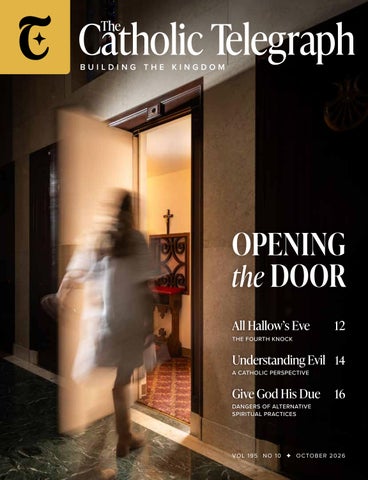
Catholic Telegraph The
OPENING the DOOR All Hallow’s Eve
12
THE FOURTH KNOCK
Understanding Evil 14 A CATHOLIC PERSPECTIVE
Give God His Due
16
DANGERS OF ALTERNATIVE SPIRITUAL PRACTICES
VO L 1 9 5 N O 1 0 ✦ O C TO B E R 2 0 2 6
THE DOOR IS YOURS TO OPEN Catholics know that opening a door can be a good thing or a bad thing. The door, in this case, is an allegorical pathway into our hearts and minds. We are constantly deciding what we will allow into our lives and what we will keep out. We don’t get to choose whether the world will knock on our door. We do get to choose whom or what we let in. The world can be a dangerous place, and there are countless influences competing for our attention and seeking entrance into our hearts and minds. We are not always careful about what we allow inside. Consider the media we consume, the ideas we entertain, and the habits we gradually accept. Our culture has moved further from its Christian roots, and things that once would have shocked or troubled our consciences can, through repeated exposure, begin to seem ordinary. That doesn’t mean Christians are called to hide from the world or build walls around themselves. Quite the opposite. We are called to engage the world—but to do so with discernment. We are called to know what should be welcomed and what should be resisted. This is a particularly appropriate consideration in October. As the leaves turn, the days shorten, and the air cools, we are reminded of life’s changing seasons. The fall naturally turns our thoughts toward mortality and the reality that nothing in this world lasts forever. For Christians, however, death is not the end. We have faith and hope in something beyond this material world. Depending on how we are living, contemplating that reality can bring either tremendous joy or great fear. And in October, with the darker and more secular elements surrounding Halloween, we can easily focus too much on the darkness in our world. But the darkness has no power over the light. This edition of The Catholic Telegraph explores many ways we can open—or close—the doors in our lives. Sometimes, opening a door means something as simple as welcoming a neighbor into our parish or church. Sometimes, it means opening ourselves to better habits, deeper relationships with God, or a renewed desire to become the people He created us to be. October is also Respect Life Month, when we are reminded to open our hearts to the gift and dignity of every human life. We also celebrate World Mission Sunday, reminding us that the Gospel cannot remain behind our church doors. As missionary disciples, we are called to open those doors, go out,
and meet a world in need of the hope of Christ. However, there are also doors that should remain firmly closed. We should be cautious about what we deliberately invite into our (and our family's) lives, particularly when it can lead us away from God or open us to spiritual dangers we may not fully understand. Discernment is not fear. It is wisdom. The Christian does not need to be fascinated by darkness to recognize that it exists. Finally, there is the most important door to consider. William Holman Hunt (1827-1910) created one of the most famous religious paintings of the 19th century, The Light of the World, inspired by Christ’s words in Revelation: “Listen! I am standing at the door, knocking; if you hear my voice and open the door, I will come in to you and eat with you, and you with me.” In the painting, Jesus stands outside a door in the darkness, carrying a lantern and knocking. The door is covered with weeds, and its hinges and nails are rusted, suggesting that it has not been opened for a very long time. But Hunt included one striking detail: there is no handle on the outside of the door. It can only be opened from within. The image beautifully captures the mystery of God’s invitation. Christ does not force His way into our lives. He knocks. He waits. He invites us to make a free decision to welcome Him. At some point in our lives—perhaps at many points—we are the person standing behind that door. Christ is still knocking. And the most important question is not what else we will allow through the door, but whether we will open it to Him. Because, when we open the door to Christ, the light comes in. And once we have welcomed that light, we are sent out to carry it into the world. To open this door or not is the most important decision of our life.
David Cooley
cteditorial@catholicaoc.org
Publisher: Archbishop Robert G. Casey
Creative Director: Nick Abele
Media Sales: Deacon Graham Galloway
Editor: David Cooley
Social Media: Taylor Motley
Circulation: Catherine Ampfer
Managing Editor: Margaret Swensen
Videographer: Nathan Schuster
"The Light of the World," William Holman Hunt, 1851-53, Manchester City Art Gallery.
From the Editor’s Desk
Table of Contents Memento Mori “To This Favour” 1879, William Michael Harnett. Cleveland Museum of Art.
Columns Into Your Hands
4
ARCHBISHOP ROBERT G. CASEY
A Closer Look
6
DR. KENNETH CRAYCRAFT
Question of Faith
8
FR. DAVID ENDRES
From the Archives
Christian Anthropology 44
FR. JACOB LINDLE
DR. ANDREW SODERGREN
Divine Seeing 30
Color the Saints 52
DR. CECELIA DORGER
DAVID COOLEY & TAYLOR MOTLEY
Luminous Lives
40
CORYNNE STARESINIC
20
MICHELLE WIRTH SMITH
House of the Lord
Church Fathers 28
Shine On
42
DOMINICK ALBANO
22
GAIL DEIBLER FINKE
Catholic at Home
43
12
That They All May Be One: Pastoral Letter Released
FR. JACOB DUMONT, LC
36
DAVID COOLEY
The Catholic Understanding 14 of Evil & Hell
Celebrating 800 Years 38 of St. Francis of Assisi
LINDA BADER
MATT HESS
16
Men’s Eucharistic 46 Procession
FR. JACOB SCHMIESING
JOSEPH FINKE
The Saintly Seven: Friar 24 Martin Maria de Porres Ward
When Secrets Surface 48 LAURA CURRAN
REV. DEACON ROYCE WINTERS THE CATHOLIC TELEGRAPH • 195th Year No. 10 • October 2026 • 513-263-5164 • thecatholictelegraph.com
ctadvertising@catholicaoc.org • The Catholic Telegraph (xUSPS 094-520) ISSN. 10736689 is published monthly by the Archdiocese of Cincinnati 100 E. 8th St., Cincinnati, OH 45202. Periodical’s postage paid at Cincinnati and at additional mailing office. POSTMASTER: Send address changes to: The Catholic Telegraph, 100 E. 8th St., Cincinnati, OH 45202.
2
The Final Word 56
On the Cover
DEACON JOHN O’MALEY
Dangers of Dabbling in the Occult
DAVID COOLEY
KATIE SCIBA
Features The Fourth Knock on Halloween Night
Book Review 54
T H E C AT H O L I C T E L E G R A P H
This month’s features reflect on the various forces at work in our world and remind us that opening the door to Christ, especially in the Sacraments, bring us hope, love, and infinite mercy and are healthy ways to satisfy our need for spiritual nourishment. PHOTO BY NATHAN SCHUSTER
The Columnists Dominick Albano
Michelle Wirth Smith
is a passionately Catholic husband and father of four boys. He has been writing, speaking, and leading Catholic retreats for more than 20 years. He is the co-founder of the National Society for Priestly Vocations.
has served as the archdiocesan Archivist since 2019, bringing a Cincinnati-born passion for preserving Catholic history. She earned her Master of Library & Information Science degree from Kent State University.
Dr. Kenneth Craycraft
Katie Sciba
holds the James J. Gardner Chair of Moral Theology at Mount St. Mary’s Seminary & School of Theology. He is the author of Citizens Yet Strangers: Living Authentically Catholic in a Divided America.
is a national speaker and Catholic Press Award-winning columnist. She and her husband Andrew were married in 2008 and are blessed with seven children.
Dr. Cecelia Dorger
Dr. Andrew Sodergren
is an art historian and author who specializes in sacred art. She taught at Mount St. Joseph University and currently teaches at Mount St. Mary’s Seminary & School of Theology. She and her husband have two married children.
is a Catholic psychologist and director of psychological services for Ruah Woods. He speaks on the integration of psychology and the Catholic faith. He and his wife Ellie have five children.
Fr. David Endres
Corynne Staresinic
is professor of Church history and historical theology at Mount Saint Mary’s Seminary & School of Theology.
is a writer and research fellow at the McGrath Institute for Church Life at the University of Notre Dame. She lives in Greater Cincinnati with her husband Nick and their children.
Fr. Jacob Lindle was ordained a priest for the Archdiocese of Cincinnati in May 2022. He is presently studying for a Doctorate in Patristic Theology at the Pontifical Gregorian University in Rome.
We want to hear from you! cteditorial@catholicaoc.org
OCTOBER
Pope Leo XIV’s Prayer Intention
For mental health ministry Let us pray that the mental health ministry be established throughout the Church, helping to overcome the stigma and discrimination of persons with mental illnesses. OCTOBER 2026
3
St. Joseph as a Model for Protecting Life I N T O Y O U R H A N D S | Archbishop Robert G. Casey
As our Church celebrates Respect Life Month this October, we might give some thought to St. Joseph, who serves as a model for how we can incorporate respect for life into our daily discipleship. We know St. Joseph to be a defender of dignity, a model of faith, and a protector of the vulnerable. As a defender of dignity, Joseph stood by Mary at a time when others would have judged and condemned her. As a model of faith, Joseph demonstrated deep trust in God’s will, even when the path forward for Mary and him seemed unclear and challenging. As a protector of the vulnerable, Joseph embraced his vocation as husband and father, enfolding Mary and Jesus in his shielding embrace. As we see human life becoming a disposable commodity for many people in the world, we join St. Joseph in proclaiming the goodness and sacredness of all life, so that each person’s dignity may be defended from womb to tomb. We are compelled to educate others about concerning practices that continue to grow. For example, the usage of abortion pills, which dehumanize pregnancy and disconnect couples from the physical, spiritual, and emotional effects of their choices, as well as medical assistance in dying, a practice quite different from hospice ministry that fuels indifference and ignores the worth of those who suffer. As we see a growing separation between faith and society, we join St. Joseph in declaring that all that we do, from the most mundane daily labor to the most sacred worship, must reveal God to the world. Otherwise, all too easily, faith becomes a private experience. As we struggle to comprehend why things are the way they are, we must strive to prevent ourselves from becoming exceedingly defensive, with hardened hearts and closed minds. From the unborn to the migrant in our midst, we hear the voice of the vulnerable crying 4
T H E C AT H O L I C T E L E G R A P H
out for our protection today. The world around us may demand we follow a path that divides and conquers. Many will insist that it’s every man and woman for him or herself; individual wants supersede the importance of anyone else’s needs or wants. Yet, like St. Joseph, we believe differently. We hear the voice of Jesus in the voice of the vulnerable, the same Jesus who prayed, “that all may be one.” This past month, I wrote a Pastoral Letter on the Eucharist to the faithful of our archdiocese in which I discuss the importance of striving for greater unity among all children of God. Our protection of the vulnerable is linked directly to our identity as a Eucharistic people, a community defined by our experience of communion. One with God and one with neighbor, we seek to protect the most defenseless from those who might wish to do them harm, knowing that when one of us suffers, all of us suffer. Unity is at the heart of the Church’s mission. My hope is that my Pastoral Letter, entitled “That They All May Be One,” will be a catalyst for greater communion with God and one another through the liturgical life of our archdiocese and embolden us to defend those who can’t defend themselves. Through his quiet strength and obedience to God, St. Joseph offers a powerful example of the protection of human life and dignity. Throughout the year, may we imitate his faithful trust and fearless conviction in our efforts to uphold human dignity and celebrate the gift of life. Like St. Joseph, may we offer those around us a powerful witness, teaching through words and example that all life is sacred. ✦
San José como modelo para la protección de la vida E N T U S M A N O S | Arzobispo Robert G. Casey
Mientras nuestra Iglesia celebra el Mes Respetemos la Vida este octubre, podríamos reflexionar sobre San José, quien nos sirve de modelo sobre cómo podemos incorporar el respeto por la vida en nuestro discipulado diario. Sabemos que San José fue un defensor de la dignidad, un modelo de fe y un protector de los vulnerables. Como defensor de la dignidad, José apoyó a María en un momento en el que otros la habrían juzgado y condenado. Como ejemplo de fe, José demostró una profunda confianza en la voluntad de Dios, incluso cuando el camino a seguir para María y para él parecía incierto y lleno de desafíos. Como protector de los vulnerables, José aceptó plenamente su vocación de esposo y padre, envolviendo a María y a Jesús en su abrazo protector. Al ver que la vida humana se está convirtiendo en una mercancía desechable para muchas personas en el mundo, nos unimos a San José para proclamar la bondad y el carácter sagrado de toda vida, para que la dignidad de cada persona sea defendida desde el vientre materno hasta la tumba. Nos vemos obligados a educar a otros sobre prácticas preocupantes que siguen en aumento. Por ejemplo, el uso de píldoras abortivas, que deshumanizan el embarazo y desconectan a las parejas de las consecuencias físicas, espirituales y emocionales de sus decisiones, así como la ayuda médica para morir—una práctica bastante distinta a la pastoral de cuidados paliativos—que fomenta la indiferencia e ignora el valor de quienes sufren. Ante la creciente separación entre la fe y la sociedad, nos unimos a San José para declarar que todo lo que hacemos, desde el trabajo diario más mundano hasta el culto más sagrado, debe revelar a Dios al mundo. De lo contrario, la fe se convierte con demasiada facilidad en una experiencia privada. Mientras nos esforzamos por comprender por qué las cosas son como son, debemos procurar
no ponernos excesivamente a la defensiva, con corazones endurecidos y mentes cerradas. Desde los no nacidos hasta los migrantes que viven entre nosotros, escuchamos la voz de los vulnerables que hoy claman por nuestra protección. Es posible que el mundo que nos rodea exija que sigamos un camino que divide y vence. Muchos insistirán en que cada uno debe velar por sí mismo; los deseos individuales tienen más importancia que las necesidades o los deseos de los demás. Sin embargo, al igual que San José, nosotros pensamos diferente. Oímos la voz de Jesús en la voz de los vulnerables, el mismo Jesús que oró: “para que todos sean uno”. El mes pasado escribí una Carta Pastoral sobre la Eucaristía a los fieles de nuestra arquidiócesis en la que hablo de la importancia de esforzarnos por lograr una mayor unidad entre todos los hijos de Dios. Nuestra protección de los más vulnerables está directamente ligada a nuestra identidad como pueblo eucarístico, una comunidad definida por nuestra experiencia de comunión. Unidos a Dios y al prójimo, buscamos proteger a los más indefensos de quienes puedan querer hacerles daño, sabiendo que cuando uno de nosotros sufre, todos sufrimos. La unidad está en el corazón de la misión de la Iglesia. Mi esperanza es que mi Carta Pastoral titulada “Para que todos sean uno” sea un catalizador para una mayor comunión con Dios y unos con otros a través de la vida litúrgica de nuestra arquidiócesis, y que nos anime a defender a quienes no pueden defenderse a sí mismos. Mediante su fortaleza serena y su obediencia a Dios, San José ofrece un poderoso ejemplo de protección de la vida humana y la dignidad. A lo largo del año, imitemos su fiel confianza y su intrépida convicción en nuestros esfuerzos por defender la dignidad humana y celebrar el don de la vida. Al igual que San José, ofrezcamos a quienes nos rodean un poderoso testimonio, enseñando con palabras y con el ejemplo que toda vida es sagrada. ✦ OCTOBER 2026
5
Opening the Door to Sobriety A C L O S E R L O O K | Dr. Kenneth Craycraft
In past issues of The Catholic Telegraph, I have mentioned my ongoing recovery from alcoholism. In early October, my new book, Staying Sober One Story at a Time: Seeking Sobriety Through the Lens of Literature, will be released by Scepter Publishers. In the book, I use four novels to explore possible causes of alcoholism, through the lives of alcoholic characters: Charles Jackson’s The Lost Weekend; Malcolm Lowry’s Under the Volcano; Evelyn Waugh’s Brideshead Revisited; and Edward O’Connor’s The Edge of Sadness. This column is adapted from Chapter 1 of the new book. Every discussion of the recovery from addiction must include a discussion of the practices that become habits, which (may) become virtue. This is because our moral lives are not ordered by abstract theorizing, but by the concrete choices we make throughout our days. Of course, those discrete choices must conform with the good. But it is of little use to know the good if we don’t have the moral skill to seek and choose it in the crisis of moral decision making. We call this moral skill “virtue.” A discussion of virtue must include an account of prudence, because prudence is the “ordering” virtue. Prudence is the virtue of proper exercise of the other virtues at the right time, in the right manner, with the right disposition. No other virtue is of any use if one has not acquired the skill of properly applying them in specific circumstances. This is the role of the virtue of prudence. As Dominican theologian Fr. Romanus Cessario explains in Introduction to Moral Theology, “When prudence enables one to discover the right way to implement a particular moral virtue, then the prudent person has discovered the meaning of that virtue, tailored to his or her specific condition and circumstances.” This implies that the practice of virtue always involves a subjective element. Prudence does nothing in the abstract. Rather, it is the concrete application of whatever virtues are required in a particular moral action or series of moral actions. To point out the subjective nature of human action is not to say that the good is relative. On the contrary, we measure the good of the subjective action precisely by its relative correspondence to moral truth. But the concrete achievement of the good is often different for different people, or even the same person in different 6
T H E C AT H O L I C T E L E G R A P H
circumstances. For considerations of addiction and recovery, a consideration of temperance easily illustrates this point. The Catechism explains that temperance is the moral virtue “that moderates the attraction of pleasures and provides balance in the use of created goods. It ensures the will’s mastery over instincts and keeps desires within the limits of what is honorable. The temperate person directs sensitive appetites toward what is good and maintains a healthy discretion” (CCC, no. 1809). This illustrates why temperate moral actions are particular to each individual moral agent who commits them. Temperate moral actions have an element of concrete subjectivity because the particular actions that constitute temperance for one person may be different for another. As philosopher Joseph Pieper has described it, temperance “is distinguished from the other cardinal virtues by the fact that it refers exclusively to the active man himself.” By the virtue of temperance, “man should look to himself and his condition, that his vision and his will should be focused on himself.” Temperance, Pieper explains, “is selfless self-preservation.” This is another way of saying that temperance is highly subjective in its applications, which are as myriad as the number of people who exercise it. Its application to the problem of alcoholism is probably the most obvious example. For non-alcoholics, the temperate amount of alcohol will vary by several subjective factors. These include the relative size of the person and the times and circumstances in which it is appropriate to consume alcohol. Regardless of what contingent factors are relevant for a particular person, the amount of consumption consistent with temperance for the normal person is some amount greater than zero. Not so for the alcoholic. For the alcoholic, the only amount of alcohol consistent with temperance—selfless self-preservation—is zero. Thus, I am a pragmatic agnostic as to the causes of alcoholism in general and my alcoholism in particular; in the practice of my sobriety, the causes of alcoholism are not important to me. This is not to say that we should not do all we can to discover its sources and causes. But for the alcoholic, that is a secondary consideration to the problem of staying sober today. Regardless of the clinical condition, the treatment will always be the same:
“The temperate person directs sensitive appetites toward what is good and maintains a healthy discretion” C C C , N O. 1 80 9
don’t take a drink. For an alcoholic, the temperate amount of alcohol is no alcohol. This returns us to the framework of my new book. I use the four alcoholic characters in four novels to illustrate that the only solution is to stop drinking. The circumstances that contribute to the abuse of alcohol by the four characters are unique to each. But the solution is common. No amount of alcohol is a temperate amount for the alcoholic. As the saying goes, for the alcoholic, “One drink is too many and a hundred is not enough.” But to know that is of little use if we do not develop the moral skill—the virtue—to make that choice. One concrete, particular day at a time. ✦
OCTOBER 2026
7
Spiritual Warfare Q U E S T I O N O F F A I T H | Fr. David Endres
Can you explain what spiritual warfare is? Spiritual warfare is our resistance to sin, temptation, and the powers of evil through prayer, virtue, and sacramental grace. Man’s contest with evil goes back to the beginning of creation, when humanity first struggled—and fell—to temptation. The Second Vatican Council, in reflecting on humanity in the modern world, taught that spiritual struggle will continue until the end of time: “A monumental struggle against the powers of darkness pervades the whole history of man,” and “man is obliged to wrestle constantly if he is to cling to what is good” (Gaudium et Spes, 37 §2). This struggle plays out internally in each person who experiences the tension between the desire for God and temptations that lead away from God’s will. As St. Paul says, “I do not do the good I want, but I do the evil I do not want” (Rom 7:19).
TH E T E M P T E R Humanity’s difficulties are rooted in temptation and weakness. Because of Original Sin, man has a wounded human nature, which is expressed in concupiscence—our disordered inclinations, thoughts, and desires. We often experience this inner weakness as the source of our struggles with sin. But the Church reminds us that temptation is not merely an internal battle: “Evil is not an abstraction, but refers to a person, Satan, the Evil One, the angel who opposes God” (Catechism of the Catholic Church, no. 2851). While man remains free and his choices are his own, the devil retains influence over humanity. The Evil One is the adversary who seeks to separate man from God. Since he is cunning, his temptations are often indirect, offering a distortion of what is truly good.
TH E R E D E E ME R Although humanity struggles on earth, we do not struggle alone. Jesus is called the “New Adam” since He undoes the sin of our first parents. Whereas Adam succumbed to temptation, 8
T H E C AT H O L I C T E L E G R A P H
Jesus remained faithful to the Father and now aids us in our weakness. By taking on human nature, Christ entered fully into mankind’s condition, experiencing its suffering and weakness, though without sin, in order to restore humanity to the life of grace and bestow the gift of salvation. Only Jesus—the one who has power over the devil—can redeem us. Through His Death on the Cross, He destroyed “the one who has the power of death, that is, the devil” (Heb 2:14). Even if striving for sanctity is a battle, it is a battle already won by Christ. The Resurrection reveals that, while sin and death remain, they have been defeated.
S HAR I N G I N T HE VI C TO RY The power of Christ over evil is seen in one of the petitions of the Our Father: “Lead us not into temptation, but deliver us from evil.” This prayer recognizes both the reality of temptation and the greater reality of God’s saving power. In asking for deliverance from evil, Christians acknowledge their dependence upon God. The members of Christ’s body share in His victory. Through the Church, Christ provides spiritual help to overcome the Evil One. This is seen chiefly in the sacraments, prayer, and assistance to believers in living virtuous lives. The baptized are called to grow in holiness through perseverance, and when they sin, they are prompted to repent. Confession restores those wounded by sin, while the Eucharist strengthens believers against future sin. Spiritual warfare, then, is not a battle we fight by human strength alone. It is the daily struggle to remain in Christ, who has already conquered the powers of darkness and invites His followers to share in His victory. ✦
ST. M I C H A E L T H E A R C H A N G E L +
D E F E N D U S I N B AT T L E
+
Free estimates Fully insured Residential & Commercial 25+ years of experience Seniors & military discounts
Committed to safely serving our community. Tree Trimming, Tree Removal, Hazardous and Dead Trees, Storm Jobs, Stump Grinding
treeserviceoh@gmail.com jaimestreeservice.com (513) 372-5194
Free estimate form here
Senior Vice President
B E O U R P R OT E C T I O N AG A I N ST T H E W I C K E D N E S S + + + AND SNARES OF THE DEVIL + + +
CRC5397728 04/26
OPEN HOUSE WEDNESDAY, OCTOBER 21 4:30-6:30 pm
www.purcellmarian.org
Success For 96 Years
10
Open House Sunday, November 15, 3 – 5 PM 1200 E. High St., Springfield | (937) 325-9204 T H E C AT H O L I C T E L E G R A P H
OCTOBER 2026
11
The Fourth Knock on Halloween Night BY DEAC ON JOH N O ’M A L EY
P
icture this: on the evening of October 31, a porch light clicks on. The doorbell rings. There stands a saint with a cardboard halo, a ghost tangled in a white sheet, and a skeleton whose plastic bones glow green. They ask for candy. Unbeknownst to them, they have brought a Catholic homily to the door. This year, the Church’s calendar makes that homily unmistakable. November 1, 2026, falls on Sunday. In the Archdiocese of Cincinnati, regularly scheduled Saturday evening Masses on Halloween will celebrate the Solemnity of All Saints. We can leave Mass, turn on the porch light, and discover three great truths of our faith dressed as children. For Catholics, Halloween’s deepest color is white—not the orange and black of commercial Halloween, but the liturgical color of All Saints and the robes in St. John’s heavenly vision, washed in the Blood of the Lamb (Rev 7:14). Before the first candy wrapper opens, white announces Christ’s victory. THE SAINT ARRIVES FIRST… Perhaps she is St. Thérèse holding paper roses or St. Michael carrying a cardboard sword. Her halo may slip over one eye, but she points toward the real celebration waiting beyond Halloween. In Revelation, St. John beholds “a great multitude, which no one could count” standing before the Lamb (Rev 7:9). They are not wearing disguises. They have become, by grace, who God created them to be. The child dressed as a saint reminds us that holiness is not about religious celebrity, and sainthood is not a costume reserved for the unusually pious. All Saints’ Day is our family feast and our hoped-for future as Christ makes us holy.
12
THE GHOST COMES NEXT… His white sheet does not make him a messenger from another world; rather, it makes an essential Catholic distinction. We pray for the dead; we do not attempt to summon them, consult them, or manipulate the unseen world. The Catechism firmly rejects divination, conjuring the dead, and spiritism (CCC, nos. 2116-2117). Such practices replace trust in God with a desire for secret knowledge or power. Catholic prayer for the dead is entirely different. Judas Maccabeus arranged an offering for fallen soldiers precisely because he believed in their resurrection (2 Mc 12:43-46). The Church continues this ancient work of mercy, above all through the Eucharist. We place our beloved dead in God’s hands—not because our love is desperate, but because the communion of Christ’s Body is stronger than the grave.
or candy. It can become a threshold: from fear to hope, from forgetfulness to prayer, from pretending to holiness. After the candy is gone, place the names of your dead before God. Attend the All Saints Mass. Ask one saint to intercede for your family as you follow Christ. Then listen for the fourth knock. It belongs not to death, but to the One who says, “I am the resurrection and the life” (Jn 11:25). OPEN THE DOOR. ✦
Deacon John O’Maley was ordained in the Archdiocese of Cincinnati in April 2019. A member of Our Lady of Hope Family of Parishes and the Knights of Columbus, he has been married for over 51 years and has four grown children and five grandchildren.
THEN THE SKELETON STRETCHES OUT A CANDY BAG… Our culture often turns death into entertainment, then avoids it when it becomes personal. Read through Catholic eyes, the skeleton tells a more serious story: Memento mori— remember that you will die. That is not despair. It is an invitation to live truthfully. The skeleton also tells only half the story. Catholics proclaim not merely the immortality of the soul but “the resurrection of the body.” God does not discard what He created. St. Paul looks directly at death and announces its defeat: “Death is swallowed up in victory” (1 Cor 15:54). Those plastic bones at the door can remind us that Christ intends to raise what death has taken. THE THREE CHILDREN RACE DOWN THE SIDEWALK, BUT HALLOWEEN STILL HOLDS ONE MORE KNOCK… Christ says, “Behold, I stand at the door and knock” (Rev 3:20). He is not a spirit to be summoned. He is the crucified and risen Lord, asking entrance into lives crowded with distraction, fear, and half-remembered faith. Every saint opened that door. Every soul we commend is entrusted to His mercy. Every grave will answer His voice. That is Halloween’s deepest Catholic possibility. It can become more than an argument about pagan origins, costumes,
PHOTOS: (LEFT) MARGARET SWENSEN, (ABOVE) MARY KATE FLEISHER
OCTOBER 2026
13
The Catholic Understanding of Evil & Hell BY L I N DA BA DER OPENING THE DOOR
T
he image of Jesus waiting at a door with no doorknob prompts our response to answer His knock, which respects our free will to let Him enter. Jesus’ enemies also knock on the door, trying to influence us in the battle for our souls. Ignoring this reality only gives them more freedom. Why do they harass us? Why are they evil? Why did God create evil? Ah, let’s start by correcting that last question: God, the source of all goodness, only creates what is good. According to Catholic teaching (and echoed in papal encyclicals like Veritatis Splendor), God is the very essence and fullness of the good. Therefore, evil is not created by God but is the absence of goodness (like darkness is the absence of light). Evil came into existence because God gave His creatures the free will to choose to love Him or not. This new way of being described by the word “evil” is the result of God’s creatures choosing to reject His goodness.
other. The fallen angels, also called demons, permanently rejected communion with the source of pure good. Now, two-thirds of our spiritual “big brothers” love and help us constantly against the one-third who are wickedly jealous of God’s love for us. While I wholeheartedly echo my mom’s lament, “Why can’t everyone just do the right thing?”, the reality is that evil beings constantly seek our downfall in this life— utopia won’t happen here. The demons’ hatred for God drives them to hurt who He values—values enough to humble Himself to live, suffer, and die as an “inferior” human being to then rise up and redeem us. Remember always: they only attack you because you are important to God! HELL
God created only good things. He gave the angels all they needed to choose the good, but a third of them (see Rev 12:3-4) chose their perspective and desires over trust—trust that the Creator’s love, omniscience, might, and goodness would ultimately fulfill their flourishing. They pridefully, and with sufficient knowledge of the consequences, chose to reject Him—forever. Because angels receive infused knowledge, instantly given by God, they never change their minds (whereas, we change our minds as we learn more). The holy angels chose to trust their Creator and entered Heaven, gaining fuller communion with God and each
Heaven and hell are not so much “places” as “states of being.” After death, our immortal souls will live on, and our physical bodies will be transformed for God’s new Creation whose exact existence we don’t fully understand. Those in Heaven, as our Catechism of the Catholic Church (CCC) explains, “are like God for ever, for they ‘see him as he is,’ face to face. … this communion of life and love with the Trinity, with the Virgin Mary, the angels and all the blessed—is called ‘heaven’” (CCC, nos. 1023, 1024). On the other hand, the “state of definitive self-exclusion from communion with God and the blessed is called ‘hell’ (CCC, n.1033). There is no good in hell. God does not infringe on the free will of those who persistently choose to reject unity with Him. And that solitude is the worst thing imaginable—complete and permanent separation from God. But know that, as the perfect loving parent, God relentlessly sought His children’s turning to truth, goodness, and authentic beauty, pouring in His mercy and grace through any opening they gave while they lived.
14
PHOTOS: MARGARET SWENSEN
CHOICES
T H E C AT H O L I C T E L E G R A P H
As Heaven is so far beyond our comprehension regarding its utter bliss and happiness, so is hell regarding the horrors and misery demons craft for us. Except… by His mercy and love: we can act and pray for God’s greater intervention in others’ lives to save their souls. KEEPING THE DOOR CLOSED TO DEMONS The demons are real, but don’t often grasp for our souls the way they do in movies. It’s in subtle, daily trials, minimizing joy and magnifying sorrow and anger. They exploit our weaknesses (as expected) and our strengths, especially through pride (first sin and root of all evil) and despair (distrust), nurturing vices and smothering our virtues. Humility is the strongest defense against pride (consider Mary’s example!), but the intellectually superior (to us) fallen angels can distort every virtue, ultimately twisting our perspective to distrust God’s mercy, love, truth, and activity. We counter this by falling penitently into our loving Father’s arms! Refuse demonic entrance, including through curiosity, ignorance, and disbelief: Ouija boards “for fun,” dreamcatchers for protection, or superstitious acts “just in case” invite them into our lives. Once we know God, new age practices, fortune telling, and all practices seeking knowledge, healing, or protection through any “power” other than God IS a denial of the one true God, because our God provides everything for us. Unlike remedies through what He provided in His creation, “supernatural” aid and “energies” reject Him as our sole provider. Hell is real and horrific. The demons tirelessly work to get us there, but they are mere beings created by God. When tempted, remember sin’s ultimate destination (hell) and quickly seek confession when you fall—confession can sever their hold and strengthen our resistance: after numerous confessions, a sin I couldn’t shake for years suddenly ceased to be any temptation, for over 30 years now! God wants us flourishing in the eternal bliss of Heaven with Him. He constantly calls for us to seek Him and His aid—and to pray and sacrifice for others. Will you trust Him? ✦ OCTOBER 2026
15
Dangers of Dabbling in the Occult BY FR. JAC OB SC H M I ESI NG
T
he Biblical images of statue-worshipping idolatry that are explicitly prohibited by the First Commandment are rare in the United States. In many examinations of conscience, violations of this Commandment are often reduced to having generically “put something else before God.” However, changing cultural currents are increasingly promoting a “modern” form of idolatry. Especially, but not exclusively, among young adults, there is a growing interest in and experimentation with what is broadly called “the occult.” This includes a wide range of practices, often tied to New Age spirituality, including Ouija boards, fortune-telling, Zodiac signs, and witchcraft. The term “occult” means hidden or secret and refers to the knowledge or power that is sought through these practices. Although called “modern,” the current phenomena is not new, as occult practices have been around for millennia. Rather, the present blend of agnostic or atheistic materialism coinciding with these practices creates a previously unknown danger. The strange marriage of materialistic mindsets and New Age practices has opened entrances to the occult for many curious people who justify it intellectually by denying its power or relevance. Previously, people sought out the occult for the perceived advantages it gave them, but many today trap themselves by thinking they can dabble in these practices without danger because the practices are powerless. Unfortunately, a cracked open door is still an open door. In one respect, the rising interest in the occult is, ironically, a positive sign: people want deeper spiritual experiences than the culture provides. However, God, and only God, can genuinely meet our desire for spiritual fulfillment. Experimenting with occult practices is a cheap substitute that carries two distinct dangers. First, engaging with the occult takes power and authority that properly belong to God alone and credits them to some creature, becoming a form of idolatry. The additional
danger is opening oneself to demonic activity. This danger of the occult doesn’t arise from it being “merely” superstitious but ineffective, as serious as that may be. Rather, since the spiritual realm is real, the occult is dangerous because it does work, though not how most people realize. Put plainly, any effective occult activity works through demonic power. Demons are real, and their power vastly exceeds our own. They aren’t limited by physical bodies and, as fallen angels, God endowed them with great abilities that they retain, even after their fall. Thus, occult practices often “work” from our perspective, but they work because the practitioner has, whether or not he or she realizes it, opened his or her self to demonic power. This does not necessarily mean that every such instance results in demonic possession, but it is still gravely dangerous. Especially if engaged habitually, demonic activity through the occult can have wide-ranging and devastating effects on one’s physical, mental, and spiritual well-being. Of course, God is all-powerful, but he permits both demons to prowl around, seeking the ruin of souls, and us to sin, through our free will. The best defense against demonic activity in the occult is to avoid it completely. Resist even sports’ superstitions, as well as newspaper horoscopes or “magic 8” balls, which are both forms of fortune-telling. In humility, give God His due, and don’t seek out power and authority that is not proper to our human nature. If you have engaged in the occult or New Age practices, as with all sins, God is ready and waiting to receive us if we turn back to Him. The best corrective after even dabbling in the occult is the Sacrament of Confession and being in a state of grace. Confess any participation in the occult, and be confident that God’s grace in your soul is your strongest protector. God’s power completely overwhelms that of the demons, which is why demons need our invitation, whether implicit or explicit, to affect us. Filling our urge for spiritual nourishment
16
PHOTO: MARGARET SWENSEN
In humility, give God His due. Do not seek out power and authority that is not proper to our human natures.
T H E C AT H O L I C T E L E G R A P H
with genuine religious practices, especially the Sacraments, is a win-win; we worship the one, true God and have our spiritual needs met. To quote St. Augustine, “Our hearts are restless until they rest in you, O Lord.” No demonic power can or will ever provide the rest that our hearts so intensely desire. ✦
God, and only God, can genuinely meet our desire for spiritual fulfillment.
Fr. Jacob Schmiesing is Parochial Vicar of St. Boniface, Piqua; St. Mary, Piqua; St. Patrick, Troy; St. Teresa of the Infant Jesus, Covington; and Transfiguration, West Milton. Pictured: Fr. Matthew Summe, LC, hosts a “Sacramental Hub” for Young Adults every other Tuesday evening at the Cathedral Basilica of St. Peter in Chains, offering the opportunity for adoration, confession, and Mass.
OCTOBER 2026
17
18
T H E C AT H O L I C T E L E G R A P H
History Has a Face F R O M T H E A R C H I V E S | Michelle Wirth Smith
✦
The death mask is my favorite item in the archives. ✦
That may be an odd thing to say... Among the letters, photographs, vestments, books, and devotional objects that fill our collections, why am I most drawn to the plaster impression of a dead man’s face? Perhaps, because the death mask makes the past unusually difficult to keep at a distance. William Henry Elder (1819-1904) was appointed Archbishop of Cincinnati in 1883, inheriting an archdiocese in serious financial turmoil. He spent the next twenty-one years establishing greater order and stability. By his death on October 31, 1904, at 11:50 p.m., he had navigated us through a period of significant growth and change. Yet, the accounts of Elder’s life are strikingly untheatrical. He is remembered as reserved and retiring, a man whose influence was steady and understated. He spent long years in the confessional, attended to the work of education and charity, and remained devoted to the ordinary work of his office. He was described as “the most loving and the most lovable of all the hierarchy,” a sentiment with "almost universal" expression among the press and the people. That affection was visible when approximately ten thousand people lined West Eighth Street as the Archbishop’s remains were carried from Seton Hospital to the Cathedral to lie in state. Elder’s episcopal motto was Vincit mundum fides: Faith conquers the world (1 Jn 5:4). A grand motto for a quiet man. There is something almost fitting about encountering such a man through an object that brings the past so close. Before photography became commonplace, death masks were one way of preserving a person’s likeness after death. A painting or photograph gives us an image of a person. A death mask gives us something else. An impression was made from the face, capturing its contours and particularities in physical form. The wrinkles around his eyes and along his neck remain visible. You can see the shape of his brow and the fine hairs of his eyebrows and eyelashes. The result is both ordinary and uncanny: a record of what someone looked like, at the moment when that person was no longer there to inhabit the face. It is an unsettling kind of closeness: not a likeness made by someone else, but an impression left by the body itself. 20
T H E C AT H O L I C T E L E G R A P H
Archivists spend a great deal of time with the dead. Not literally, of course, but through the objects, words, and physical traces left behind. A letter still bears the pressure of a person’s handwriting. A photograph is evidence that someone once stood before the camera. A prayer card records the touch and attention of the person who made it her own. But I think there is something else happening in these encounters. It is easy to look at history and see abstraction: movements, institutions, controversies, dates. The further away we get from an event, the easier it becomes to turn the people involved into characters or categories. Distance can give us the illusion of certainty because we can see what came before and after; we somehow understand the choices made in between. The archives complicate that distance. It puts a face to a name. The archive cannot give the dead back to us. It cannot tell us what happened at 11:50 p.m. or what came after. It can only bring us close—to a face, a body, a life that was lived—close enough to leave an impression. And so, for a moment, the distance between the living and the dead feels very small. ✦
PHOTOS: (ABOVE) THE CATHOLIC TELEGRAPH ARCHIVES, (RIGHT) MARY KATE FLEISHER
OCTOBER 2026
21
HOUSE OF THE LORD
The Church of the
Holy Angels DAY TO N
A
BY GAIL DEIBLER FINKE
22
T H E C AT H O L I C T E L E G R A P H
rchbishop Henry Elder established Holy Angels Parish in South Dayton in December 1901 to serve workers at National Cash Register (NCR), during the height of the Protestant Sunday School movement. An alliance of Protestant churches was, with the support of NCR’s leaders, proselytizing workers and their families through free classes, sports, and activities. Despite some grumbling—one Dayton pastor said that if potential parishioners had money to build a new church, they had money to take the streetcar to his—a new, 200-seat wooden church on Stewart Street opened the following fall. In 1906, the wooden church was moved to land donated by the Society of Mary, on Brown and L Streets. The first pastor, Fr. Martin B. Neville, added an ornate belltower and school and began a building fund for a permanent church. In 1924, the school was remodeled and used for Masses while the current church was built. Designed by Maginnis and Walsh, Boston, in the Norman Gothic-style, the stone building opened in 1927 and features a flat façade, a square “lantern tower” over the nave and transept, solid buttresses and Gothic spires, and windows with pointed arches. The main and side altars from the original church were reused until they could be replaced, and the interior, decorated over time, was finally completed in 1944. By 1967, the church had 8,500 parishioners and offered eight Masses every weekday and seven every Sunday. But demographics shifted along with changes in the liturgy. Church records show that in 1971 the doors were locked at 5 p.m. on Sundays and 8 p.m. on weekdays, and by 1991, they were locked at all times except during Mass. The last Sister of Notre Dame de Namur (the order that had staffed the school since its founding) retired in 1986. During those years, manufacturing jobs dried up or left. NCR—which had employed tens of thousands of people and been an important part of Dayton civic life—shrank rapidly and left Ohio in 2009. The church currently offers one Sunday Mass and a vigil Mass Saturday and is part of the Bread of Life/Pan de Vida Family of Parishes. Significant remodels include: 1952, the first major renovation, when the angels flanking the sanctuary windows were painted; 1970, when the roof was replaced and some of the crumbling spires had to be removed; 1976, when the baptistry was replaced with a reconciliation chapel; 1987, when a parish center was constructed; and 1994, when renovations added a new altar and ambo.
PHOTOS BY FRANTISEK ZVARDON
+ A NGE L S +
+ T H E HOLY A NGEL S +
Painted by Cincinnati firm Greiwe & Co. in 1952, the angels flanking the window in the sanctuary represent the nine choirs of angels: Seraphim, Cherubim, Thrones, Dominions, Virtues, Powers, Principalities, Archangels, and Angels.
The spiritual beings who serve God are called “angels” (Greek for “messengers”) and with the exception of three, are identified in Scripture only by the type of work they do. The Bible identifies seven archangels, but names only Michael, Gabriel, and Raphael. The most venerated angel is Michael, Prince of the Heavenly Hosts and special protector of Israel and later, of the Church. The modern Church calendar celebrates the three named archangels on the original Feast of St. Michael, Sept. 29, and it celebrates the guardian angels (who watch over every person from birth to death) on Oct. 2. ✦
+ W IN DOWS + Holy Angels has 30 stained glass windows featuring symbols of the Church, and the major window in the sanctuary depicts the Coronation of the Blessed Virgin accompanied by the seven principal archangels.
OCTOBER 2026
23
THE SAINTLY SEVEN: BLACK CATHOLICS ON THE PATH TO SAINTHOOD
Servant of God Friar Martin de Porres Ward, O.F.M. Conv. B Y R E V. D E A C O N R O Y C E W I N T E R S This final presentation in the series on the Saintly Seven, from the Catholic Social Action Office, looks at the life of Servant of God, Friar Martin de Porres Ward, O.F.M. He was born in Boston, Massachusetts, on March 20, 1918, into the bi-racial family of William Henry Ward and Clara Iorby, who named him Matthias DeWitte Ward and later moved their family to Washington, D.C. His family were Methodists, however, Matthias attended Holy Mass with a friend for the first time at age 17 and was touched by grace, which began his conversion to Catholicism. From 1935-1939, he attended Dunbar High School in Washington, D.C., and he was baptized into Catholicism at St. Augustine Church in 1936. As of the 1940 census, he resided in Brooklyn, New York, with his parents and six siblings. From 1942-1945, he was drawn to religious life and entered the Salvatorian Seminary in Saint Nazianz, Wisconsin. When he applied in May 1945 for entry into St. Francis Seminary of the Conventual Franciscans in Staten Island, New York, he declared himself to be “colored” of African descent in a heart-felt letter to the vocation director, Fr. Celestine Regnier, O.F.M. Conv. Fr. Celestine’s response on June 8, 1945, indicated that the Provincial Chapter had never considered, nor ever accepted, colored applicants; however, they were beginning to work in fields that could provide opportunities for such applicants. Late in that month, the Provincial Chapter accepted missions in Central and South America, including Brazil. That same year, Friar Martin de Porres Ward became the first African American Conventual Franciscan in North America. He did his novitiate in 24
T H E C AT H O L I C T E L E G R A P H
1947, took his first religious vows on March 19, 1948, and made his solemn profession in the Order of Friars Minor on August 8, 1951. His Excellency, Bishop William A. Scully ordained him to the priesthood June 4, 1955, at the Cathedral of the Immaculate Conception in Albany, New York, and Friar Martin was immediately sent as a missionary to Brazil, where he served until his death in 1999. His fellow friars described Friar Martin as “an engaging personality who loved to laugh and to make others laugh.” “Living with him in community was a delight,” they said, also stating, “He was a holy, warm, and loving person with a great sense of humor.” He was dedicated in service to the people of Andrelandia, Brazil, especially to those who were poor. Friar Martin’s vocational testimony was always an important part of his encounters with young people who were interested in becoming Franciscans. He was a true follower of St. Francis of Assisi, not only in spreading the greeting, “Peace and Good,” but also in continually chanting, “Laus Deo Semper!” (“Praise God Forever!”). He met personal struggles with faith in Divine Providence and in devotion to the Immaculate Virgin Mary, to whom he entrusted his vocation and turned for support during difficult times. On March 28, 1995, by Municipal Decree, Friar Martin received the title of “Cidadao Andrelandense” (“Citizen of Andrelandia”). People showed their admiration for this simple, cheerful, kind, and always available figure, who faithfully served the people of God. He lived most of his 51 years of consecrated life in Andrelandia. On June 20, 1999, despite not feeling well, he celebrated Sunday Mass at Igreja de Rosario. He felt a severe pain in
THE PATH TO SAINTHOOD
Honored
S e r va n t of G o d
Declared
Ve n e ra b l e
Beatified
Bl essed
Canonized
Saint
his chest during the celebration and was rushed to the hospital after Mass. On June 22, at 6:30 p.m., he received the Sacraments of the Anointing of the Sick and the Holy Eucharist, then Friar Martin welcomed “Sister Death” in preparation for his great encounter with “his God and his Everything.” After his death and funeral, his friends and acquaintances began the custom of visiting his tomb, in the cemetery of the Andrelandia Seminary. His fame and sanctity took on a new import with reports of graces and blessings, which became more frequent and drew the custodial government’s attention. Friar Martin’s personal story is an inspiration for many who, like him, must face the challenges of one whose family holds a different religious tradition, and the sometimes not-so-favorable reactions to their religious or priestly vocation. The beatification of Friar Martin would be a great contribution to the Catholic Church at a time when there are still no great theories on how to develop a mission amongst other cultures and peoples. Friar Martin assumed this new mission with a Franciscan spirit of obedience. ✦ Deacon Royce Winters is the Director of African American Catholic Ministries for the Archdiocese of Cincinnati.
T H E S A I N T LY S E V E N S E R I E S Session 7: Servant of God Friar Martin Maria de Porres Ward Tuesday, Oct. 27, Church of the Resurrection, Brother Hugh Henderson Hall, 1619 California Avenue, Bond Hill, Cincinnati, 6:30 p.m. Black Catholic History Month Celebration Tuesday, Nov. 17, Church of the Good Shepherd, Cincinnati, 7 p.m.
OCTOBER 2026
25
C e S What Ma s
St. Rita School for the Deaf
So Special
There is something extraordinary about walking through the doors of St. Rita. It’s the joyful conversations happening in American Sign Language, the confidence growing in every classroom, the individualized support, and the sense of belonging that fills our hallways.
Join us for a First Friday Mass, schedule a campus tour, or better yet, do both and witness the life-changing impact your generosity makes possible. We can almost guarantee what you’ll say when you leave:
“I’ve driven by St. Rita countless
times... but I never knew.”
Call or email today to schedule a visit 513-771-7600 | afrith@srsdeaf.org www.srsdeaf.org
26
T H E C AT H O L I C T E L E G R A P H
FAITH Founded in 1926
FAMILY
FUTURE
St. Columban School 896 Oakland Road Loveland, Ohio 45140 513-683-7903 saintcolumbanschool.org
AD 1
ST. IRENAEUS TERTULLIAN ORIGEN 100
50
100
200
150
200
ST. CYPRIAN 250
300
ST. EPHREM THE SYRIAN ST. BASIL THE GREAT ST. CYRIL OF JERUSALEM
300
ST. GREGORY NAZIANZEN
ST. AMBROSE ST. JOHN CHRYSOSTOM ST. JEROME
VULGATE 382–405
350
C H U R C H F A T H E R S | Fr. Jacob Lindle
28
T H E C AT H O L I C T E L E G R A P H
ST.
ST. GREGORY OF NYSSA
The Ancient Providers and Protectors of God’s Family P: Why do you Catholics focus so much on Mary and the pope? Don’t we just need Jesus? Is all that extra stuff necessary? C: It’s good to see you too, my brother in Christ! Those are some great questions. Before I answer them, can I ask you a question? P: Sure. C: Who is Jesus? P: Classic Catholic. Doesn’t even know Jesus! Well, Jesus is my Lord and Savior. C: Amen to that, brother! He is mine too! So, Jesus is God right? P: Of course! C: But isn’t He also human? P: Well, yeah. C: How does that work? How can He be God and man? Is He two persons? P: That doesn’t sound right. C: I’m with you there. Jesus is definitely one Person. But does that mean He is like a mixture between God and man, part God and part man? P: That doesn’t sound right either. C: My brother, we are in total agreement! Jesus is fully God and fully man. The fancy way to say that is that Jesus has two natures, divine and human, which are united in one Person. P: Cool. A little intellectual but cool. So now you must answer my question. If we agree on Jesus, what’s all this extra stuff about Mary and the pope? C: What if I told you the reason that we agree about Jesus is because of Mary and the pope?
393 COUNCIL OF HIPPO
ST. JUSTIN MARTYR
48 COUNCIL OF JERUSALEM
33 PENTECOST
BIRTH OF CHRIST
ST. IGNATIUS OF ANTIOCH
325 COUNCIL OF NICAEA
313 EDICT OF MILAN LEGALIZED CHRISTIANITY
ST. CLEMENT OF ROME
ST. ATHANASIUS
P: I’m not sure I would believe you. C: Would you be up for reading this article in The Catholic Telegraph about the Church Fathers? It explains it all! P: I heard that the Church Fathers column was a little longwinded and dry, but I’ll give it a shot! After the fourth-century debates over the Trinity, one might have guessed that the hard work was over. The councils of Nicaea (325) and Constantinople (381) instructed us that God is three divine Persons in one divine Nature. What more was there to say? A lot more actually, and the fifth century became the age of Christological controversy. Who is Jesus? Nicaea told us that Jesus was the eternal Son of God, consubstantial with the Father, who became man for our salvation. But how does that work? How can God become man? Is Jesus Christ one or two? One or two what? These are the questions of the fifth century, and many people gave their opinions. But who gave us the truth? On one hand, we could say that St. Cyril of Alexandria and St. Leo the Great did, but it would be just as true to say that Mary and the pope did. How did Mary provide insight into Christ? Well, the disputes about Christ really began when Christians in Constantinople kept calling Mary the Mother of God (Theotokos in Greek). Around 428, a young priest started preaching against the title, and the patriarch, Nestorius, agreed with him. Nestorius decided that we should call Mary the Mother of Christ rather than the Mother of God. This debate raged throughout the empire down to Alexandria where it pricked the pious ears of their patriarch, Cyril, who began to write letters to Nestorius to correct him. Cyril’s argument was clear:
400
400
450
732 BATTLE OF TOURS
ST. GREGORY THE GREAT 537 HAGIA SOPHIA COMPLETED
451 COUNCIL OF CHALCEDON
431 COUNCIL OF EPHESUS
ST. LEO THE GREAT
476 FALL OF WESTERN ROMAN EMPIRE
ST. AUGUSTINE CYRIL OF ALEXANDRIA
500
ST. MAXIMUS THE CONFESSOR
550
ST. JOHN DAMASCENE 500
600
600
650
700
700
750
800
S T. C Y R I L O F A L E X A N D R I A DIED 444
S T. L E O T H E G R E A T DIED 461
Premise 1: Mary is the Mother of Jesus. Premise 2: Jesus is God. Conclusion: Mary is the Mother of God. Nestorius took issue with premise 2. Nestorius thought it would be better to speak about two persons in Christ, one human and one divine. Thus, Nestorius concluded that Mary was not the Mother of God but only the mother of the human Christ. Faithful Christians, however, had been calling Jesus God and Mary the Mother of God for centuries by that point. Were they wrong? Nestorius thought so. He argued that popular piety wasn’t sophisticated enough; it tended to exaggerate rather than properly distinguish. Cyril, on the other hand, contended that authentic piety pointed the way to orthodoxy. Jesus is one Person, not two. The humble Christian people weren’t corrupted by the classroom: they simply passed on the faith of the Fathers. By holding on to Mary as the Mother of God, they were holding on to Jesus as God. At the Council of Ephesus in 431, the people’s Marian devotion triumphed, and Mary was universally proclaimed the Mother of God. Cyril fought the battle, but Mary won the war to defend the divinity of her Son. There remained a problem, however. The Church recognized that Jesus is God, but what about His humanity? Nestorius went too far when he divided Christ into two persons, but does the humanity of Jesus just get swallowed up by His divinity? A monk named Eutyches thought so, and he thought he had the support of Cyril who had recently died in 444. Cyril once wrote that Jesus had only one nature of God: the Word made flesh. Was that the correct response to the divisive Nestorius? Does Jesus only have one nature?
Although everyone held Cyril in highest honor, they did not deem him infallible, and throughout the 440s, there was tumultuous debate about the oneness and twoness of Jesus. It wasn’t until hundreds of bishops gathered in Chalcedon in 451 that the issue could really be resolved. At first, there was clamor in the council as quotes from Church Fathers were used against each other. The confusion lasted until a letter from Pope Leo was read, which confessed that Jesus possessed two natures united in one person. When this ‘Tome of Leo’ was read, the assembly of bishops cried out, “Peter has spoken through Leo!” Amid the storms of controversy, the infallible rock of the Church gave stability. Who is Jesus? The second Person of the Holy Trinity. What is Jesus? Fully God and fully man. Jesus is one Person with two natures. Chalcedon’s statement of faith is one of the greatest masterpieces of theology. It holds the mysteries of salvation in paradoxical and perfect harmony, and it was all made possible by Leo, the pope. ✦
FURTHER READING St. Cyril of Alexandria, On the Unity of Christ (Popular Patristics, St. Vladimir’s Seminary Press, 2015) St. Leo the Great/Bronwen Neil, Leo the Great (The Early Church Fathers Series, Routledge, 2009) Richard Norris, The Christological Controversy (Fortress Press, 1980) Adrian Fortescue, The Early Papacy: To the Synod of Chalcedon in 451 (Ignatius Press, 2008) Hilda Graef, Mary: A History of Doctrine and Devotion (Ave Maria Press, 2009)
OCTOBER 2026
29
The Vierge Ouvrante (Opening Virgin) D I V I N E S E E I N G | Dr. Cecelia Dorger
A GUIDE TO VISIO DIVINA Invite the Holy Spirit to enlighten your experience as you gaze at the artwork. Notice what thoughts and emotions enter your heart and mind. Be still. Pray with the image as you are led.
When I walk up to receive Communion, this is the artwork that appears in my mind’s eye. It perfectly embodies the Eucharistic sacrament of which I am about to partake—Divine Seeing in action during the pinnacle of my day.
B AC KG R O U ND It is called a Vierge Ouvrant or Opening Virgin. Over 700 years old, it is a small, hinged altarpiece sculpture that would have been placed on an altar in a medieval monastery or used as a devotional in a private home. In its closed state, the seated Virgin Mary feeds the infant Jesus, who is perched on her hip. When Mary said yes, she was open to participating in God’s plan for our salvation, which included joys and sufferings. Nursing the Savior was certainly one of the joys. There were countless sculptures of the Madonna and Child adorning altars in the medieval period. Why? As medieval altarpiece scholar Henk van Os explained, “The image of the Virgin and Child suggests the theme of Christ’s repeated rebirth in the Eucharist” (van Os, 14). In this rare example, the Eucharistic theme is emphasized by the dramatic and tactile opening of the doors. Looking inside reveals the Trinitarian Crucifixion. The Trinity dwells within the Virgin, and we see God the Father enthroned and supporting His crucified Son. The Body of Christ is offered up to the beholder, inviting the devotee to an intimate physical union between God and His children. “The sculpture represents the cognitive and bodily process of accepting God and being received by God” (Shira Brisman). 30
T H E C AT H O L I C T E L E G R A P H
Vierge Ouvrante – Opened, c. 1300, carved oak, gilding, polychromy, Metropolitan Museum of Art, New York. OCTOBER 2026
31
The Body of Jesus is now lost, as is the dove, the Holy Spirit. Notice the black holes on the Father’s torso and on the Cross where they were once attached. There are six panels on the inside of the doors flanking the Trinity, which depict the infancy narratives. The upper registers on either side portray the Annunciation and Visitation scenes, acting as an introduction into the story. The middle registers reveal the birth of Christ on one side and the Presentation of Jesus in the Temple on the other side. The bottom registers depict the Adoration of the Magi and the Annunciation of Christ’s birth to the Shepherds. The kings come from far flung regions, while the humble shepherds react with jubilant enthusiasm; here, royalty and the working class are made equal, alluding to the availability of salvation to all people. This is the Body of Christ.
E NT E R I N Mary’s open response to God and all that carrying the Savior into the world entails is metaphorically embodied in this sacred object. She is called Ecclesia, Mother of the Church established by Jesus. She is a holy vessel, with much to reveal to those who open themselves to her and her ardent desire to lead us, her children, to God. On the Feast of the Assumption, the Diocese of Covington’s Bishop John Iffert relayed that “Mary is a tabernacle for the Incarnate Lord of Heaven and Earth.” Scholar Aisling Reid described Mary: “She is the cloister that guards purity and the tabernacle of divine presence” (Reid, 42). Both Marian descriptions are fit explanations of this sacred artwork. When the object’s doors are closed, we see Mary in her role as Gate of the World or “porta mundi, the gateway through which Christ passed into the world, and as [Gate of Heaven] ports coeli, the gate through which the elect will pass into Heaven” (Brisman). When this artwork is opened, the Trinity dwelling inside is presented as the Throne of Mercy, a Trinitarian composition-type popular in late medieval painting. God the Father holds up the Crucifix, and the Holy Spirit as a dove hovers over them. Masaccio’s famous Holy Trinity, from around 1427 in Florence, is an example. It likely inspired Frank Duveneck’s 1909 mural in the Cathedral Basilica of the Assumption in Covington, Kentucky.
RE F L E C T I ON My hunger for fully grasping the wonder of the Virgin Mary is never completely satiated—I never tire of pondering her. Help comes in the marvel of this single piece of medieval art, which speaks volumes. Marian prayers are invoked in the 32
T H E C AT H O L I C T E L E G R A P H
Annunciation and Visitation scenes… the Hail Mary and the beautiful Magnificat recited by Mary to Elizabeth flood in. We come to adore the Christ Child as people far from Bethlehem or as humble folks working the night shift. Either way, we are invited to the inmost region of Mary’s Immaculate Heart, where the Father, Son, and Holy Spirit dwell, compelling us to rejoice in God our Savior. When I make the Sign of the Cross, I picture this artwork. When I say the Glory Be, I imagine it. When I receive Communion, contemplating it lifts me to another plane—somewhere between the clay of the Earth and the radiance of Heaven. ✦
FOR FURTHER EXPLORATION Brisman, Shira. “Opening Virgin (Vierge Ouvrante).” Object Narrative. In Conversations: An Online Journal of the Center for the Study of Material and Visual Cultures of Religion (2014).
OPEN HOUSE
van Os, Henk. Sienese Altarpieces 1215 – 1460 Volume I. Groningen: Bouma’s Bockhuis bv, 1984.
Thursday, November 19 4:00 – 8:00 PM
Reid, Aisling. “Revealing the Threshold, The Vierge Ouvrante as Liminal Devotion in Medieval Europe.” In Venezia Arti. New Series 7. Vol. 34. (December 2025): 39–48.
*pre-registration required
Visit: https://smarthistory.org/hiding-the-divine-in-amedieval-madonna-shrine-of-the-virgin/.
For more information, contact Seton High School Director of Institutional Advancement Sara Cranley Lykins ‘02 at 513.471.2600 ext. 2422 or lykinss@setoncincinnati.org
GUIDE 1. Top left door: The Annunciation
1
4
2
5
3
6
2. Middle left door: The Nativity 3. Bottom left door: The Adoration of the Magi 4. Top right door: The Visitation 5. Middle right door: The Presentation 6. Bottom right door: Annunciation to the Shepherds
setoncincinnati.org OCTOBER 2026
33
SUPPORT THE HOLY FATHER’S
P O NTIF ICAL M ISSION SOCIETIE S
WORL D M I SS I O N WE EK EN D OCTOBER 17–18, 2026 In these difficult times worldwide, Pope Leo invites us to support his Pontifical Misson Societies that bring the hope and love of Christ to our 1,200 mission dioceses worldwide. He writes, “Let us all commit to contributing to the great mission of evangelization—which is always a work of love—according to our own vocation and the gifts we have received. Your prayers and practical support will be a great help in bringing the Gospel of God’s love to everyone, especially the poorest and those most in need. Every gift, no matter how small, becomes a meaningful act of missionary communion. I renew my heartfelt gratitude ‘for everything you will do to help me help missionaries throughout the world.’ May God Bless all missionary men and women, support them in their efforts, and watch over them in hope! Mary, Queen of Missions, accompany our work of evangelization in every corner of the earth: make us instruments of peace, and grant that the whole world may recognize in Christ the light that saves.” –LEO PP. XIV
J O I N U S F O R O U R M U LT I C U LT U R A L WORLD MISSION MASS
Sunday October 18 | 2pm St. James of the Valley Church 411 Springfield Pike, Cincinnati. Mass followed by dinner and entertainment
Please know that in our struggling 1,120 mission dioceses: $50 Supports shelter and feeding of homeless children. $160 Covers a month’s educational expenses for seminarians and novices. $500–$1,000 Builds chapels, clinics, and convents $5,000 Would do wonders for God’s reign! Gratefully in the mission of Christ, Dr. Mike Gable Mission Office Director
Help us share God’s love across the globe! Offer your gift to the missions through the QR code or write a check to the Mission Office, c/o Mission Office, 100 E. 8th St., Cincinnati, OH 45202. Please consider adding the Mission Office to your will as a legacy gift!
Visit our website: catholicaoc.org/offices/mission-and-pontifical-mission-societies 34
T H E C AT H O L I C T E L E G R A P H
In First Pastoral Letter, Archbishop Casey Reflects on Living in Communion BY DAV I D C O O L E Y
A
rchbishop Robert Casey has written a pastoral letter to the people of the Archdiocese of Cincinnati on the Eucharist. Entitled “That They All May Be One,” he reflects on the Eucharist as the Sacrament of Unity, which draws Catholics into deeper communion with Christ and with one another. He says that by actively participating in the Mass, the faithful are united in Christ and sent forth to carry His presence into the world through lives of service and love.
36
T H E C AT H O L I C T E L E G R A P H
In a recent interview with The Catholic Telegraph about the come to know Christ.” He emphasized that those who receive pastoral letter, Archbishop Casey emphasized that communion Christ must be willing to become like Christ, especially through means unity, not uniformity. Catholics can have different humble service. cultures, experiences, customs, and personalities while remaining The pastoral letter comes at an important moment in one Church in Christ. He sees the worldwide Catholic Church archdiocesan history, following the Beacons of Light pastoral as a powerful witness to unity amid diversity, planning process and coinciding with the particularly in a society marked by division beginning of the preparation work for the “We must allow and polarization. archdiocesan synod. The name of the pastoral He said that the Eucharist is a letter draws on Jesus’ prayer that his followers our reception of communal rather than merely personal “may all be one.” Archbishop Casey said that he experience. Catholics at Mass are not an Holy Communion hopes the letter will help inspire the work that audience watching the priest; they are active needs to be done in the upcoming Synod 2027. participants in the Church’s prayer. The “I think the two walk hand in hand. to transform us priest, he said, gives order and voice to the And I think that the two will help each into a people of joy other,” he said. “As we read the letter on the celebration, but the entire congregation participates in the Eucharistic offering. Eucharist as a Sacrament of Unity, it's going sent on mission to to help us make sense of the synod. And as we However, Archbishop Casey also said that personal faith relates to communal faith. experience the synod, it's going to call us into share God’s love He shared how his own relationship with a deeper experience of Eucharist.” ✦ Jesus began through his family, teachers, and wherever it is most others who helped him encounter Christ. That personal relationship ultimately called needed.” him outward—to serve others and help ARC H B I S HO P R O B ERT CAS EY them encounter Christ themselves. In this sense, the Catholic faith cannot remain simply a private relationship with Jesus; it naturally leads to communion with others. Archbishop Casey said that during the Last Supper Jesus provides the model Christians are to follow. Jesus washed the Apostles’ feet and shared the table even with Peter, who would deny Him, and Judas, who would betray Him. The Eucharist therefore does not require a community of perfect people. Rather, it calls imperfect people to become a community of service, forgiveness, and love. In the interview and in the pastoral letter itself, Archbishop Casey reflects on the Eucharist as the “source and summit” of Christian life. As the source, the Eucharist grounds and strengthens Catholics in Christ. As the summit, it points toward the ultimate fulfillment of the Christian journey—the heavenly banquet with Christ and the saints. READ THE PASTORAL LETTER Inspired by St. Teresa of Ávila, Archbishop Casey said that receiving the Eucharist should transform believers so that they Available online in both English and Spanish or become Christ’s hands, feet, eyes, ears, and heart in the world. download a printable copy. catholicaoc.org/letter “St. Teresa of Ávila reminds us that if we are truly living Watch Archbishop Casey’s interview with The Catholic our Catholic faith, we are allowing that experience of Holy Telegraph on YouTube @CatholicTelegraph Eucharist to permeate every cell of our body and change us so that we become Christ in the world around us. And people OCTOBER 2026
37
Celebrating 800 Years of St. Francis of Assisi
T
his October marks an important anniversary for the Church; in fact, Pope Leo XIV dedicated 2026 to celebrating it. Eight hundred years ago, St. Francis of Assisi passed from his earthly life into the next. His livedout lessons of simple, peaceful living, love of Christ and His Church, and care for creation still ring true for Christians today. St. Francis Church in Cranberry Prairie is trying to live out their patron’s virtues while marking this milestone of his life.
STORY BY M AT T H E S S PHOTOS BY DANNY SCHNEIBLE
38
T H E C AT H O L I C T E L E G R A P H
The church itself was not founded by Franciscans but by Missionaries of the Precious Blood, who ministered to the area’s German-speaking Catholics. Known for its many wild cranberry bushes, the marshy land’s rustic natural beauty (so fitting for a church under St. Francis’ patronage) remains evident today in the green fields of corn, beans, and wheat cultivated by descendants of the church’s founders. The first church was built in 1858, and the current structure was dedicated in 1906. “I think the importance of this Jubilee Year in the life of the Church is clear when recalling the two aspects of Francis’ life that Pope Leo has chosen to emphasize,” said Fr. Andrew Hess, pastor of St. Henry Parish, which has five churches, including St. Francis Church. “He desires that ‘every faithful Christian, following the example of St. Francis, shall become a model of holiness of life and a constant witness of peace.’” Inspired by their patron, parishioners do their best to spread peace and holiness in the community and beyond. Mary Schmitmeyer, a long-time parishioner and the parish life coordinator for St. Francis Church, said, “Our parish is a farming community with many families who have young children and who are always willing to help their neighbor in times of need; always going out of their way to tend to the parish. I never have a problem finding someone to help or volunteer with events, ministries, cleaning, or groundskeeping.” The church community regularly donates food to the poor and has bereavement and homebound ministries. The Mission Club sends aid to support missions abroad in Haiti and Jamaica. St. Francis Church coordinates a “Casseroles of Kindness” program: parishioners make a meal for families in the parish who have just been released from the hospital, had a baby, suffered from a fire, or experienced some other life-changing event. “My parishioners are always very quick to respond generously to the needs of their neighbors,” Fr. Hess said. “With deep roots here for many parishioners, the people at St. Francis in Cranberry Prairie take pride in their church,” shared Schmitmeyer. But you do not have to have deep roots to see why the building is a gem. The church’s interior retains its carved lacquered gothic altars, eye-catching statues, and historic murals. Its transepts are short and wide, making the building’s footprint a unique, Greek cross shape. Two large windows in the transept inspire regular parishioners and pilgrims alike, including one depicting St. Francis of Assisi sitting among lush green plants, brightly colored animals, and a stream of blue flowing water. The ornate beauty is a way of leading others to holiness and honoring the Creator of all.
“St. Francis was known as the poverello ("little poor man") of Assisi,” said Fr. Hess. “He wanted to be poor but he believed that every effort to express the beauty, greatness, and grandeur of God was necessary for the edification of the faithful. I think St. Francis Church expresses that conviction well.” The beautiful worship space is a special site for the Jubilee Year of St. Francis, and its church is hosting many events for the local community and beyond. The parish’s day of recollection at St. Francis marked the Jubilee and offered a family guide passport for youth to learn about St. Francis’ life and teachings. This year’s parish picnic, which rotates annually between the five churches, will be at St. Francis Church on his feast day, October 4, providing an opportunity for the community to gather for fellowship, games, food, and door prizes. To celebrate their patron, the parish has made available a first-class relic of St. Francis of Assisi for public veneration, which can be accessed by pilgrims at any time. “We strongly encourage local Catholics throughout the archdiocese to make a pilgrimage to Cranberry Prairie and visit St. Francis Church,” Fr. Hess said. Under the prescribed condonations, such a pilgrimage can gain the visitor a plenary indulgence. “That alone is worth the trip,” said Fr. Hess. ✦
St. Francis Church Dayton
Cincinnati
V I S I T S T. F R A N C I S C H U R C H St. Francis Church is located in Mercer County at 1519 Cranberry Rd. St. Henry, Ohio 45883
OCTOBER 2026
39
Br. André Bessette The Miracle Man of Montreal L U M I N O U S L I V E S | Corynne Staresinic
The famous Canadian doorkeeper, Br. André Bessette, began his vocation with a near-rejected admission to the Order of the Holy Cross, due to his poor health. Only through the bishop’s intervention (after Br. André begged to stay) was the young man given a secure place in the order. The quiet and determined porter spoke of his humble beginnings with characteristic wit: “When I first came to the college, I was shown to the door…and I remained there for forty years!” (Brother André, Jean-Guy Debuc, 37). His responsibilities as doorkeeper of the Collège NotreDame in Montreal included the following instruction: “Should the poor people come to the door, porters shall receive them with kindness, remembering that Jesus Christ is hidden under the rags of poverty” (38). And over the course of his life, Br. André ended up drawing to his post hundreds of thousands of poor and sick persons for whom he prayed. He invoked St. Joseph’s intercession, often rubbing on their ailments the melted oil that had burned under the saint’s statue—and sometimes, his visitors received miraculous healings. However, his controversial apostolate earned him more than a few enemies at the college, some of whom mocked him with nicknames, such as “Old Greaser” for his use of the oil. One of his most hostile critics, the college physician, coined the nickname, believing Br. André took advantage of the sick and put their health at risk. When the physician's wife fell into critical condition with a nasal hemorrhage, however, she insisted her husband bring Br. André to her side. Out of love for her, he asked Br. André to come; the doorkeeper simply told the skeptical physician that his wife would not die. The physician arrived home to find the bleeding had ceased. By his death in 1937, “Old Greaser” was known as “the miracle man of Montreal.” He had seen decaying skin restored to health, crippled legs standing up to walk, the terminallydiagnosed recovered, and more than anything else, agonized hearts finding peace in God. He understood his role in these matters not as a miracle-making man, of course, but as a witness of “divine goodwill, revealed by St. Joseph’s intervention” (87). Br. André’s devotion to the quiet earthly father of Jesus was so great that he even commissioned a chapel consecrated to St. Joseph, to be built on the hill across from the college, with 40
T H E C AT H O L I C T E L E G R A P H
money he saved up as a barber and help from his many friends across town. The tiny chapel opened in October 1904. After multiple expansions to accommodate its unexpected number of pilgrims, it became a Basilica—St. Joseph’s Oratory. Despite the mockery Br. André faced and the confusion surrounding his apostolate, he remained steadfast in his call to be a friend to the poor, like his Savior. He knew their pain, from his own lifelong chronic illness and having been orphaned as a boy, forced to earn a living at age twelve. Even though he endured such an arduous past, the Brother kept a cheerful, reserved temperament, and enjoyed “nothing more than a good joke” (66). His friends described him as a man of few words, much like St. Joseph. Br. André was never healed of his own illness, and yet, he marveled at the healings he saw: “How good the Good Lord is! The recoveries are wonderful for the persons cured, of course, but also for those who hear of them. It strengthens their faith” (87). The healings he witnessed were a source of grace for him. Healings and miracles give us glimpses of the existence we were made to experience in Heaven with God. Miracles are supernatural signs of the healing effects of God's friendship with us. By Br. André’s mediation of supernatural grace to those who visited him, the doorkeeper’s holy life became a doorway through which the sick and poor—and even his enemies— could encounter that friendship. In this season of supernaturally inspired festivities and of hospitality, may our lives, homes, and communities become openings through which the poor, vulnerable, and suffering may encounter the healing friendship of God. St. André Bessette, pray for us. ✦
OCTOBER 2026
41
Who is Waiting on the Other Side? S H I N E O N | Dominick Albano
I don't like scary movies. I know October is supposed to be a spooky season, but scary just isn't my thing. The thing is, scary movies scare me. And I don't like being scared. My sister loves scary movies—she loves that feeling of being scared. I suppose that must be a thing… but I don't get it. Halloween as a season has grown (massively) in popularity over the past decade. I think it started with those 12-foot-tall skeletons sold by the big box home improvement stores. Don't ask me why, but I think that was it. Other than carving pumpkins, we didn’t decorate much for Halloween when I was a kid; sometimes fake spiderwebs in the front bushes or a bat silhouette in the window. That was about it. Now, some people set up more lights for Halloween than for Christmas. You drive past yards that basically have haunted houses out front, and trick-or-treating is as much for the adults now as it is for the kids (trust me, I've been handed enough "adult" treats while walking my kids around to know). I think the fascination with all things spooky stems from our own curiosity about death. Who am I? Why am I here? Everyone asks these big questions of life, but let's not forget these other big questions: Where did I come from? Where am I going? What happens to me when I die? It's natural to wonder about death... the other side. Most of us encounter a death at a young age, when we're much too young to understand and, frankly, more comfortable with the mystery of it all. As we grow, we get used to knowing things. Mystery frightens us. We're not so comfortable anymore with what's out of our control. And sometimes, death becomes more personal. We've all got that person—the person we can't wait to meet again in Heaven. We imagine them sitting just on the other side, wrapped in light, smiling, waiting with open arms, and ready to greet us. It's truly a heavenly image. Maybe it's a friend... a parent... a grandparent... a spouse. We've all got that person. Maybe for some of you, it's a group of people. 42
T H E C AT H O L I C T E L E G R A P H
There's some sadness, but it's also, happily, true: I can't wait to talk to my grandpa about the Chicago Cubs winning the World Series in 2016. And that's not very scary. Don't be afraid to wonder about who is waiting on the other side. In fact, there might be more of a crowd than you think. Yes, that special person... And your extended family. All the people who have gone before you. And the saint you were named after. And your confirmation saint. And the saint whose feast day is on your birthday. And the patron saint of the parish where you grew up. In fact, there might be a whole host waiting just out of sight, cheering you on... like the end of some great marathon, surrounding the finish line, waiting to catch you on the other side and welcome you. Who is waiting for you? Who is cheering you on? It might be a spooky season. But really, this is about as far from spooky as you can get! In fact, it's filled with hope. ✦
PHOTO: MARGARET SWENSEN
Invite Christ to Dispel the Darkness C A T H O L I C A T H O M E | Katie Sciba
“Everyone SIT DOWN, right this minute.” I hadn’t yelled, but the hard shift into “mom voice” was clear to my children. While our morning looked like any other on paper, I felt like I was watching the bizarro version of my family interact with each other. Dark clouds followed my husband while he prepped for work. His bad mood wasn’t just morning grouchiness—it was uncharacteristic and unfamiliar. I found myself anxious and overwhelmed just looking at our messy kitchen. My kids’ bickering escalated to eye-widening fights, the severity of which I hadn’t seen before. My mind scanned the last few days to find what had sent us into a sudden tailspin. A few late nights? Too much Red 40? Our family wasn’t having an off morning, something was wrong. Dark, intense, confusing—these are hallmarks of someone who wasn’t welcome in our home, but who nevertheless invited himself in to sow chaos. Finally recognizing the Adversary, I got my children’s attention and directed them to sit. Five pairs of eyes stared at me in alarm. “Let’s take a deep breath…and pray,” I invited. We made the Sign of the Cross, and I prayed calmly on my family’s behalf: “In the name of Jesus Christ, I renounce all evil spirits attacking our family. Lord, send them directly to the foot of Your Cross to receive their punishment, never to return to us again. Amen.” The prayer was a patchwork from a few deliverance prayers I knew, and it was brief. We wrapped up our time and got on with the day. At lunchtime, I heard my daughter extend an offer to her oldest brother, “Liam, I’m making mac and cheese. Do you want the extra?” He gave a big grin and accepted. Previously overwhelmed by the state of the kitchen, I saw that a quick tidy-up would be easy, even pleasant. Answering my query about an unclaimed sweatshirt draped over a chair, my son Tom said, “Oh, that’s Pete’s. I’ll take it to his room.” In came Eamon and Peter, telling each other that they did a great job at taekwondo that day. I sat back amazed. The family so burdened hours before was at ease and charitable with each other. “How’s your day, Love?” I texted my husband, just to see how he was faring after the morning. He replied that he was in a great mood, and though not sure why, he was glad the day had turned around.
The kids and I recognized that the change from tension to peace came when we asked Jesus to take over. Deliverance prayers are direct invocations of God and His authority to expel evil spiritual forces from a person, family, or home. Our go-to resource for these prayers, in a variety of circumstances, is Deliverance Prayers for the Laity by Fr. Chad Ripperger. We often imagine evil as something grandiose—a crisis, a temptation loud and obvious. But darkness doesn’t announce itself with fanfare. Our routine morning was fractured from the escalation of a few small disturbances. Satan erodes peace; sowing discord, dividing what is united, and spoon-feeding confusion. The Lord, however, drove him from the house, restoring clarity and kindness to levels greater than before. It's easy to dismiss the idea that evil could torment our families. Not in my house. My family is faithful. We say Grace, attend Mass, try to live decently. Evil is something that happens to people pursuing it; but also by way of analogy, pests don’t require an invitation to come inside. They enter through any space we overlook. What struck me most from our small experience was the speed of the Lord’s movement. I asked Him to come through a simple prayer offered with intention and faith. We identified the enemy, renounced him in the name of Christ, and not only did he flee, but the Lord then unmistakably took up residence. In instances of disturbance among your children and within your marriage, consider spiritual solutions along with the tangible ones. While hormone fluctuations, poor sleep, and diet can negatively impact our interactions, sometimes, an enemy hides behind those things who will flee when we invoke the Name of Jesus. A direct, sincere prayer of renunciation in Christ's name is powerful medicine. I keep a copy of Deliverance Prayers for the Laity on my shelf, now. It's a small investment for armor against the quiet chaos. The Lord wants to bring your family peace, and it’s only an invitation away. ✦
OCTOBER 2026
43
Introducing the Language of the Body C H R I S T I A N A N T H R O P O L O G Y | Andrew J. Sodergren, M.T.S ., Psy.D.
Note: This article is part of an ongoing series on Pope St. John Paul II’s “Theology of the Body” (TOB).
As we explored Pope St. John Paul II’s thoughts on the sacramentality of marriage, we saw that every sacrament has a “sign” function by which it reveals or points to something important about God and His plan for humanity. In marriage, the sign aspect consists in the mutual self-gift of the man and woman. Their total, reciprocal giving and receiving is meant to remind us of Christ’s spousal gift of Himself to the Church, and indeed all that God has done for humanity from Creation onward and our call to eternal union with Him. The “sign” of marriage (i.e., the mutual self-gift of the spouses) first comes about in the wedding liturgy through the vows exchanged by the bride and groom. These vows bond them together in an exclusive, unconditional, and permanent relationship marked by mutual love, honor, fidelity, and openness to new life. What is spoken through vows must also be enacted through bodily acts, “so much so that without this consummation, marriage is not yet constituted in its full reality” (TOB, 103.2). We began exploring last month how the body expresses and participates in the mutual giving and receiving of the spouses. The human body, designed by God with the complementarity of male and female, is in fact made for this purpose. As Pope St. John Paul II said in his apostolic exhortation Familiaris Consortio (FC), “Love includes the human body, and the body is made a sharer in spiritual love” (FC, no. 11). The bodily giving and receiving of spouses in marital intimacy “is by no means something purely biological but concerns the innermost being of the human person as such” (FC, no. 11). This is so because the human body has a capacity built into it by God of expressing and participating in spiritual love whereby spouses fully give themselves to each other and form a communion of persons in marriage. While reflecting on this capacity of the human body to express spiritual love and form a communion of spouses in marriage, Pope St. John Paul II coined the term “the language of the body.” While “body language” more generally has been something of interest in the human sciences for some time, the 44
T H E C AT H O L I C T E L E G R A P H
late pope used this expression in a new way. Recall his prior— and closely related—concept of the “spousal meaning of the body.” By this term, John Paul II referred to how the sexual difference of male and female inscribed in our bodies reveals our deep call and capacity to form a communion of persons. Our male and female bodies, in a sense, speak a language of giving and receiving, of forming a one-flesh union in marriage, of belonging to one another in a covenant of love. Thus, when John Paul II spoke of the “language of the body,” he had in mind the ways men and women speak to each other through their bodies and the extent to which what we speak conforms with the spousal meaning of the body inscribed by God. According to Pope St. John Paul II, the vows that the groom and bride profess (“I take you as my wife/husband… I promise to be faithful to you always… to love and honor you all the days of my life”) “bear within themselves” the “perennial” “language of the body” (TOB, 103.5). When the new spouses speak these solemn words and later express them through marital consummation, they take up again “the language of the body” and must do so with intentionality, consciousness of the meaning of these words and actions, and with will, heart, and conscience (TOB, 103.5). For John Paul II, the language of the body “is not only the ‘substratum’…” but “also the constitutive content of the communion of persons” by which spouses “become a reciprocal gift for each other” not only through sexual union but “in the dimension of life as a whole” (TOB, 103.5). In addition, the language of the body echoes and reflects God’s love for humanity expressed through creation, His covenantal relationship with Israel, and our redemption in Christ. This language spoken by a man and woman in marriage, then, must not only remain true to the personal, spousal meaning intended by God but also remain “the visible and efficacious sign of the covenant with God in Christ” (TOB, 103.6). This gives the language of the body a “prophetic” character, which will be the subject of further reflections. ✦
No Fear at the Men’s Eucharistic Procession
BY JOSEPH FINKE
One of the most influential lessons of my childhood occurred when I witnessed my father living and expressing, without fear, his faith in Jesus Christ. 46
T H E C AT H O L I C T E L E G R A P H
My father dedicated his life to the care of others. He humbly practiced family medicine in Price Hill and was well regarded by his patients. As a physician, he was a very busy man, and I would only see him briefly on weekday evenings or on Sundays. Living in Western Hills, I grew up attending St. Antoninus Church, where my father ushered at Sunday Mass alongside many other good men. I could tell he was a proud member of the St. Antoninus Holy Name Society. Sometimes after Mass, I would have the great privilege of joining my father at St. Francis Hospital on Queen City Avenue, when he made his rounds. This was a big deal because he would drop me off at the nurses’ station while he visited the patients. I always loved the ladies, and as a 7-year-old boy, hanging with a bunch of attentive nurses was like heaven on earth. I noticed that after rounds and before leaving the hospital, my father always made certain we stopped at the Chapel for a short visit to say hello to Our Lord. I noticed! Sometimes, we stopped to chat with one of the Franciscan Priests on staff. For me, meeting these towering Franciscans dressed in their traditional brown Franciscan robes was like meeting St. Francis of Assisi himself. My father kept a rosary in the car glovebox, and from time to time, he pulled it out in my presence, and we would say a decade or two. I saw my father pray in the car, at church, and even by his bed at night. Once again—I noticed! A few years ago, a friend who served with me on the Advisory Board for the Little Sisters of the Poor asked me to join him and several other good men to support The Holy Name Society of St. Antonius Parish’s “Men’s Eucharistic Procession” through downtown Cincinnati. For those who understand the enormous power in the whisper of the Holy Spirit, this was no coincidence. With that little request, I was swiftly taken by “The Wayback Machine” to a time in the early 1960’s: I was a boy of just 6 or 7 years old, proudly walking alongside his dad in procession with the Eucharist. I vividly recall how excited I felt at the time by what I see now as a foundation of a faith that has evolved within me ever since.
PHOTOS: MARY KATE FLEISHER
That event with my father was the Holy Name Parade. Begun in the early 1900’s, it once drew tens of thousands of men to publicly demonstrate their faith through a Eucharistic procession in downtown Cincinnati, ending with Benediction at Crosley Field. Unfortunately, due to changing times and interests, the parade was discontinued in 1969. However, the tradition was revived around 2015 through the Holy Name Society at St. Antoninus Parish. Now called “The Catholic Men's Eucharistic Procession,” it is in its 12th year with over 1,000 men expected to participate, and it is growing. The upcoming October 17 event will begin with a spectacular Mass at the Cathedral Basilica of St. Peter in Chains. A procession follows with hymns, prayer, and Rosary through Cincinnati’s downtown—it is an amazing experience to witness family and friends along the procession route. The procession will close with Benediction at Old St. Mary's Church in Over-the-Rhine. During my participation this past year, I noted the varied reactions of those observing the Eucharist in procession. One can only imagine similarities to what Jesus experienced when he came through our world 2,000 years ago. There were a few moments when folks showed contempt by turning music to an obnoxious volume or shouting some nonsense. I believe, however, that most folks showed an enormous amount of respect. I was extremely impressed by those who knelt and prayed as the procession of men walking with the Eucharist passed, and I was saddened by those who joked or were offended. My father taught me very early in my life that one of the most important elements of being a man is the ability to stand up without fear and live our faith in Jesus Christ. Please join us as we process with our Lord at the October 17, 2026 Men’s Eucharistic Procession starting with an 8 a.m. Mass at the Cathedral Basilica of St. Peter in Chains. For more details, visit CMEPS.org. ✦ Joseph Finke is a parishioner at Our Lord Christ the King in Mt. Lookout. He has been married to Christina for 32 years and they have two adult children. OCTOBER 2026
47
WHEN SECRETS SURFACE O N E FA M I LY ’ S J O U R N E Y T H R O U G H P O S T-A B O R T I O N H E A L I N G BY LAURA CURRAN
S
andy* called Pregnancy Center Plus, reeling from a conversation she just had with her adult daughter, Jackie*. Amid a tense discussion about Jackie’s apparent lack of direction, the truth finally fractured the surface: Jackie blurted out, “Mom, I had an abortion last year.” Sandy’s face could not hide her shock and disappointment. How was she supposed to process this revelation? In an instant, her mind was flooded with questions: Hadn’t I raised her to value human life? What could I have done differently? Why didn’t she come to me for help? How am I supposed to grieve the grandchild I will never know? We immediately connected Sandy with one of our counselors who has personal experience in this area. These specialized client advocates are trained to gently support both the women who have experienced abortion and the hurting family members who are impacted by the decision. *Pseudonym
48
T H E C AT H O L I C T E L E G R A P H
RECOGNIZING THE SIGNS OF SILENT SUFFERING Looking back, Sandy realized she had seen subtle changes in Jackie over the past year for which she hadn’t been able to pinpoint the cause. Jackie had increasingly withdrawn from family events like baby showers and baptisms. How was Sandy to know that her daughter was suffering in absolute silence? Jackie exhibited many classic symptoms that are common among women struggling with the aftermath of an abortion: •
Intense Anxiety and Depression: Constant emotional distress and mood shifts
•
Sleep Disturbances: Insomnia or vivid, recurring nightmares
•
Flashbacks: Intrusive thoughts about the abortion or the lost child
•
Masked Grief: Deep sorrow that manifests outwardly as anger or irritability
•
Social Isolation: A loss of interest in previously enjoyed activities
•
Coping Mechanisms: Increased alcohol or substance use to numb the pain and "forget"
•
Self-Destructive Behaviors: Engaging in unhealthy relationships or experiencing eating disorders or suicidal ideation
THE STATISTICS IN THE PEWS Our counselor explained to Sandy that Jackie is far from alone. Statistics show that one in four women will have an abortion by the age of 45—a reality that deeply affects just as many men. Furthermore, an estimated 24 to 27% of these women identify as Catholic. Many describe feeling completely trapped—alternating between emotional numbness and reliving the trauma. Out of shame, the vast majority keep their pain a secret for years, or even decades, before finally confiding in a trusted loved one.
To help Jackie lighten the burden, our client advocate gave Sandy a roadmap of compassion: 1. Listen without judgment: Allow her to pour out her entire story without interruption. Let her release the weight of the secret. 2. Be patient with her timeline: Understand that her grief, regret, and trauma will not subside after just one conversation. Healing is a process, not an event. 3. Reassure her of your unconditional love: Tell her how sorry you are for the pain she has endured and reassure her that your love for her has not changed. 4. Point the way to restoration: Gently encourage her to connect with PCPlus or Project Rachel, the post-abortion healing ministry of the Archdiocese.
T HE R OAD TO F O R G I VE NESS The very next week, Jackie summoned the courage to walk through the doors of PCPlus. She was ready to take the next step on her road to recovery. In addition to receiving compassionate, professional support, Jackie was connected with a priest uniquely trained in post-abortion pastoral care. Through this gentle accompaniment, Jackie was introduced to the profound love and total forgiveness that Jesus offers. Today, Jackie and her mother are actively walking the path of healing and closure— the very transformation that many women and men sitting in the pews so desperately seek.
HO PE AN D HE ALI N G AR E PO S S I BLE If you or a loved one is struggling from a past abortion decision, you are not alone. Contact Pregnancy Center Plus today at (513) 321-3100 or supportpcplus.org/post-abortive-care for confidential, compassionate, and non-judgmental support. ✦ Laura Curran is the Executive Director of Pregnancy Center Plus.
OCTOBER 2026
49
Statement of Ownership, Management, and Circulation (All Periodicals Publications Except Requester Publications)
1. Publication Title
2. Publication Number
The Catholic Telegraph
0
0
9
4
_
3. Filing Date
5
2
0
0
09/01/2025
4. Issue Frequency
5. Number of Issues Published Annually
6. Annual Subscription Price
Monthly
12
$20.00
7. Complete Mailing Address of Known Office of Publication (Not printer) (Street, city, county, state, and ZIP+4®)
The Catholic Telegraph, 100 E 8th St., Cincinnati OH 45202-2199
Contact Person
Catherine Ampfer Telephone (Include area code)
(513)263-5164 8. Complete Mailing Address of Headquarters or General Business Office of Publisher (Not printer)
The Catholic Telegraph, 100 E 8th St., Cincinnati OH 45202-2199 9. Full Names and Complete Mailing Addresses of Publisher, Editor, and Managing Editor (Do not leave blank) Publisher (Name and complete mailing address)
Archbishop Robert Casey, Archdiocese of Cincinnati, 100 E 8th St., Cincinnati OH 45202
Editor (Name and complete mailing address)
Dave Cooley, The Catholic Telegraph, 100 E 8th St., Cincinnati OH 45202-2199
Managing Editor (Name and complete mailing address)
Margaret Swensen, The Catholic Telegraph, 100 E 8th St., Cincinnati OH 45202-2199
10. Owner (Do not leave blank. If the publication is owned by a corporation, give the name and address of the corporation immediately followed by the names and addresses of all stockholders owning or holding 1 percent or more of the total amount of stock. If not owned by a corporation, give the names and addresses of the individual owners. If owned by a partnership or other unincorporated firm, give its name and address as well as those of each individual owner. If the publication is published by a nonprofit organization, give its name and address.) Full Name Complete Mailing Address
Archdiocese of Cincinnati
100 E 8th St., Cincinnati OH 45202
11. Known Bondholders, Mortgagees, and Other Security Holders Owning or Holding 1 Percent or More of Total Amount of Bonds, Mortgages, or Other Securities. If none, check box None Full Name
Complete Mailing Address
Archdiocese of Cincinnati
100 E 8th St., Cincinnati OH 45202
12. Tax Status (For completion by nonprofit organizations authorized to mail at nonprofit rates) (Check one) The purpose, function, and nonprofit status of this organization and the exempt status for federal income tax purposes: Has Not Changed During Preceding 12 Months Has Changed During Preceding 12 Months (Publisher must submit explanation of change with this statement) 14. IssueSee Date forprivacy Circulation Below PRIVACY NOTICE: our policyData on www.usps.com.
13.Form Publication PS 3526,Title July 2014 [Page 1 of 4 (see instructions page 4)] PSN: 7530-01-000-9931
The Catholic Telegraph
10/01/2026
15. Extent and Nature of Circulation
Average No. Copies Each Issue During Preceding 12 Months
Monthly
a. Total Number of Copies (Net press run)
b. Paid Circulation (By Mail and Outside the Mail)
(2)
Mailed In-County Paid Subscriptions Stated on PS Form 3541 (Include paid distribution above nominal rate, advertiser’s proof copies, and exchange copies)
(3)
Paid Distribution Outside the Mails Including Sales Through Dealers and Carriers, Street Vendors, Counter Sales, and Other Paid Distribution Outside USPS®
(4)
Paid Distribution by Other Classes of Mail Through the USPS (e.g., First-Class Mail®)
c. Total Paid Distribution [Sum of 15b (1), (2), (3), and (4)] d. Free or Nominal Rate Distribution (By Mail and Outside the Mail)
(1) Free or Nominal Rate Outside-County Copies included on PS Form 3541 (2) Free or Nominal Rate In-County Copies Included on PS Form 3541 (3)
Free or Nominal Rate Copies Mailed at Other Classes Through the USPS (e.g., First-Class Mail)
(4)
Free or Nominal Rate Distribution Outside the Mail (Carriers or other means)
e. Total Free or Nominal Rate Distribution (Sum of 15d (1), (2), (3) and (4))
f. Total Distribution (Sum of 15c and 15e)
g. Copies not Distributed (See Instructions to Publishers #4 (page #3))
h. Total (Sum of 15f and g) i. Percent Paid (15c divided by 15f times 100)
119,389
119,122
(1) Mailed Outside-County Paid Subscriptions Stated on PS Form 3541 (Include paid distribution above nominal rate, advertiser’s proof copies, and exchange copies)
No. Copies of Single Issue Published Nearest to Filing Date
119,122
119,389
0
0
0
0
0
0
119,122
119,389
0
0
0
0
0
0
0
0
0
0
119,122 310
119,389 310
119,432
119,699
100 100Circulation Statement of Ownership, Management, and
(All Periodicals Publications Except Requester Publications)
* If you are claiming electronic copies, go to line 16 on page 3. If you are not claiming electronic copies, skip to line 17 on page 3. 16. Electronic Copy Circulation
Average No. Copies Each Issue During Preceding 12 Months
No. Copies of Single Issue Published Nearest to Filing Date
a. Paid Electronic Copies b. Total Paid Print Copies (Line 15c) + Paid Electronic Copies (Line 16a) c. Total Print Distribution (Line 15f) + Paid Electronic Copies (Line 16a) d. Percent Paid (Both Print & Electronic Copies) (16b divided by 16c x 100)
I certify that 50% of all my distributed copies (electronic and print) are paid above a nominal price. 17. Form Publication Statement of Ownership PS 3526,ofJuly 2014 (Page 2 of 4)
x If the publication is a general publication, publication of this statement is required. Will be printed in the October 2026
Publication not required.
issue of this publication.
18. Signature and Title of Editor, Publisher, Business Manager, or Owner
Date
09/01/2026 Verified by pdfFiller 08/19/2025
I certify that all information furnished on this form is true and complete. I understand that anyone who furnishes false or misleading information on this form or who omits material or information requested on the form may be subject to criminal sanctions (including fines and imprisonment) and/or civil sanctions (including civil penalties).
50
T H E C AT H O L I C T E L E G R A P H
I N O C TO B E R T H E C AT H O L I C C H U R C H I N T H E U N I T E D S TAT E S C E L E B R AT E S
Respect for All Human Life
St. Francis of Assisi St. Francis of Assisi lived from around 1181 to 1226 in Italy. A poor little man, he astounded and inspired people by truly living out the Gospel. He tried his best to follow all that Jesus said and did—joyfully, without limit, and without a sense of self-importance—and is one of the Church’s most beloved saints.
the Gospels. He never intended to start the Franciscan order, but once it began, he protected it and accepted the structures needed to sustain it. His devotion and loyalty to the Church were unwavering.
CA REF R E E TO D E VOT E D
During the last years of his short life, Francis received the stigmata—the real and painful wounds of Christ in his hands, feet, and side. He died at the age of 44. His feast day is Oct. 4, and this year, we commemorate the 800th anniversary of his death. He is the patron saint of animals, ecology, Italy, merchants, archaeologists, messengers, and metalworkers.
Before his conversion, Francis was a privileged wealthy young man who served as a soldier of Assisi. Becoming a prisoner of war and suffering a serious illness opened his eyes to see the emptiness of his lifestyle, so he turned toward God. Encountering a leper on the road one day, he embraced and kissed the man—Francis knew he was called to see Christ in the poor and to be Christ for others. From a cross on which was painted an image of the crucified Christ, in the neglected chapel of San Damiano, Francis heard a voice say, “Build up my house, for it is nearly falling down.” He first believed the Lord was telling him to repair the abandoned chapel but later realized a deeper meaning, and so dedicated the rest of his life to renewing the Catholic Church.
ST I G M ATA
WO R D F I N D
A JOY F U L B E G GAR AN D P R E AC HE R Francis gave all his possessions to the poor because he wanted to be completely free to follow God’s will. He lived as simply as possible and was even considered a religious fanatic for a time. When he could not get money for his work, he begged from door to door, sometimes evoking sadness, ridicule, or disgust—even from former friends. Torn between a life devoted entirely to prayer and one of active preaching, Francis chose the latter but returned to solitude whenever he could. People began to follow him and live by his rule, drawn largely from
52
T H E C AT H O L I C T E L E G R A P H
Animals Assisi Ecology
Francis Italy Joy Leprosy
Merchants Prayer Stigmata
St. Francis of Assisi
OCTOBER 2026
53
The Necromancers A Novel About Opening Doors That Should Stay Closed B O O K R E V I E W | David Cooley
“If human evidence is worth anything, those things happen,” he said. “What things?” “The dead return.” Published in 1909 by Fr. Robert Hugh Benson, The Necromancers is an unsettling cautionary tale about the dangers of “spiritualism” and dabbling in the dark arts. The story is a slow burn that contains little of what would be defined today as “horror.” But many of the eerie scenes and subtle implications of spiritual warfare stick with you long after you leave the last page. The story takes place around London after the turn of the 20th century, when a young man named Laurie Baxter is grieving the death of his fiancée, Amy. He converted to Catholicism a couple years before the story begins and takes his faith seriously, but the death of his beloved has shaken him to the core. Through what seems like a chance meeting, he discovers a group whose members claim to have spoken to deceased loved ones with the help of a medium named Mr. Vincent. Skeptical at first, Laurie eventually becomes consumed by an obsession with the supernatural. Attempting to reach Amy, he attends rituals and séances, spiraling deeper into his embrace of the occult. But instead of reconnecting with his lost love, he is brought into contact with forces far more sinister. The heart of the book is found in discussions Laurie has with those holding different beliefs, who he encounters while searching for answers. His adopted sister, Maggie, does everything she can to help him grieve in a healthy manner. His professor and atheist friend, Mr. Morton, is convinced that necromancy—conjuring and communicating with spirits—is all nonsense and trickery. A Catholic priest who knows the dangers warns him, “So far as it’s not fraud, it’s diabolical.” As much as Laurie is drawn toward the spiritualists, they are, in turn, drawn toward him. From their perspective, he appears to be “a sensitive”—someone in tune with the spiritual realm who can easily open the door between the two worlds. During one séance, he fell into a trance and attracted spirits who wanted to communicate, which is why the spiritualists are so determined to get him to join them. After apparent success in contacting Amy, Laurie succumbs to temptation and does, indeed, open a door. 54
T H E C AT H O L I C T E L E G R A P H
170 Pgs. | Robinia Classics, 2025 $10.99 | Scan code to purchase
What comes out of that door is not what he expected. Fr. Benson (1871–1914) is the youngest son of Edward White Benson, Archbishop of Canterbury, and his wife, Mary Sidgwick. He himself was an Anglican priest until 1903, when he converted to Catholicism. After nine months of study in Rome, he was ordained a Catholic priest. A prolific author and extensive traveler, he wrote many apologetic works, novels, and short stories. His most famous works include Come Rack! Come Rope! and Lord of the World, the latter an excellent dystopian tale. Spiritualism was popular in the 19th and early 20th centuries, centering on the idea that those who die continue to interact and evolve in the “spirit world” and may be contacted by the living. The appeal of such contact was less about assisting with grief than gaining secret knowledge. It is another example of humanity wanting to go beyond the limits set by God. The Necromancers is not an action story, by any means. But Fr. Benson paints beautiful Gothic scenes in your mind, and his descriptions have an uncanny way of building suspense. His characters, while clearly products from a different time, are fleshed out, interesting, and believable. The dialogue can be challenging because of the period, but if you have the patience, I think you’ll find it rewarding. More importantly, the novel leaves you with something to consider: God placed a chasm between this world and the next, and our desire to cross it—even for reasons that seem innocent or understandable—can have consequences we never anticipated. The Necromancers is ultimately a warning about what can happen when grief, curiosity, or the desire for hidden knowledge take us to open doors that were never meant to be opened. ✦
CATH O L I C C R OS S WOR D 1
2
3
4
5
6
7
8
9
10
14
15
16
17
18
19
20
21 23
24
25
26
35
42
41 45
52
36
53
31
32
37
Mihovk-Rosenacker Funeral Homes White Oak/Monfort Heights 5527 Cheviot Rd.
44
46
47
48
49
54
55
50
56
57
59
60
61
63
64
65
66
67
68
Gilligan Funeral Homes A Catholic family-owned funeral home since 1877 513-891-8373
40
43
Gerry Kelly Fritsch Traditional Irish Bagpiper 513-404-0049 gfritsch48@zoomtown.com cincinnatipiper.com
30
39
38
13
27
29
34
12
22
28 33
11
F UN E R AL S E RVI CES
51 58
Blue Ash/Evendale/Sharonville 10211 Plainfield Rd. 513-385-0511
62
Naegele Kleb & Ihlendorf Funeral Home Serving Norwood, St. Bernard & surrounding communities 3900 Montgomery Rd. 513-631-2240 Geo. H. Rohde & Son Funeral Home 115 years of family service to Eastern Cincinnati 3183 Linwood Ave. Mt. Lookout Square 513-321-0404 rohdefuneral.com T.P. White & Sons Funeral Home Family-owned and operated since 1870 2050 Beechmont Ave. 513-231-7150
www.wordgamesforcatholics.com
DOWN 1 Holy ___ 2 Online sales 3 Sealing cement 4 Carol contraction 5 Deacons, priests, and bishops 6 Cries of discovery 7 Pole 8 Vane reading 9 Vegas introduction 10 Personal name of John XXIII 11 Scorch 12 Typee sequel 13 Do a laundry job 22 Solemn Mass 24 “Breakfast Anytime” site
25 Arrest 26 Diocese in Idaho 27 Wee worker 30 Not if ___ help it 31 Members of a religious order 32 Son of Jacob 33 “…we put the ___ on the foreheads of the servants of our God” (Rev 7:3) 34 Our ___ of Fatima 35 Liturgical celebration 36 Math course (abbr.) 38 Chi follower 40 Describes the gate that leads to destruction 42 Mil. mail centers 43 Small band 44 The Prodigal ___ 46 University in Quebec 47 Lector 50 Month of the feast of St. Patrick 51 Seaport in the Crimea 52 Turkey 53 Result of too many missed payments, briefly 54 Like zero 55 Baptismal basin 56 The Mystical ___ 58 16th letter of the Hebrew alphabet 60 Bathing suit top 61 Diamond ___ 62 Exemplar of might
www.wordgamesforcatholics.com
47 ___ of Jesse 48 Crotchety person 49 Foe 52 One of the 10 plagues 55 Title of address for a friar or monk 57 Road service org. 59 AKA Matthew, in Luke 60 The wine, after the consecration 62 Paris landing site 63 Gemstone 64 Word on a shampoo bottle 65 Globe opening 66 The act of voting 67 Let out, perhaps 68 Asian prince
Follow us online for more stories and in-depth video content! thecatholictelegraph.com
@TheCatholicTelegraph
W E P T C A M E L A S O F E T U I L H A S A N E M O E A T S E A S E S G A O L R S T H E R O D K I T L Y I N G B A I L H A Y O N G O I N G S L O B F A I T H C U A E L S W A N D R E A P A D A G E S I N S H A D O L Y M P U S R O D C O O T E N E M Y F R O G S F R A A A A B L O O D O R L Y L E V I O P A L R I N S E A C T I P O L L A L T E R K H A N
ACROSS 1 What Peter did when he heard the cock crow for the third time 5 Biblical animal of transport 10 By this date 14 Sewing case 15 Capital of Tibet 16 Nautilus captain 17 Polishes off 18 Relaxes 19 London jail 20 Equipment 21 Alphabet string 22 He had John the Baptist executed 23 Fibbing 26 Remove water 28 Mattress for the Baby Jesus? 29 Continuing 33 Slovenly person 35 “O, you of little ___” (Mt 6:30) 37 US school of higher learning founded by bishops (abbr.) 38 “As I see it, those who plow mischief and sow trouble will ___ them.” (Job 4:8) 39 High trains 40 Stick used by a magician 41 Did possess 42 Proverb 44 Original and actual 45 Mountain in Greece
All About All Saints Day THE FINAL WORD |
Fr. Jacob DuMont, LC
All Saints’ Day, celebrated on November 1, is the vibrant Christian solemnity honoring both known and unknown saints and reflecting deep-rooted traditions of the Catholic Church. Tracing its unofficial origins back to the fourth century, this holy day evolved significantly, culminating in the observance we recognize today. But what exactly does this day signify, why do Catholics celebrate it, and how does it connect with Halloween? Initially established as a feast for martyrs, All Saints’ Day can be traced back to May 13, A.D. 609, when Pope Boniface IV dedicated the Pantheon in Rome to the Virgin Mary and all martyrs. Pope Gregory III moved the celebration in the 8th century to November 1, dedicating a chapel in St. Peter’s Basilica to honor all saints. Officially recognized as a universal holiday by Pope Gregory IV in the ninth century, this date was likely chosen to coincide with existing pagan harvest and spirit festivals, such as Samhain, thereby facilitating the transition from paganism to Christianity. This connection to ancient festivals highlights the Church’s strategy of integrating Christian celebrations within the cultural practices of its followers. While the exact origins of the festival are somewhat murky, the Church aimed to create a day dedicated to honoring all saints, regardless of their recognition. Catholics celebrate All Saints’ Day as a solemn acknowledgment of the saints’ significant roles in spiritual life. The day serves multiple purposes: • Recognition of Saints: It honors all saints, both canonized and unknown, acknowledging their contributions and sacrifices for the faith. The Church emphasizes the need to remember those whose sainthood is known only to God, reinforcing that all believers can aspire to holiness. • Encouragement of Faith: By venerating the saints, Catholics are inspired to emulate their virtuous lives. The day is a reminder of our faith’s communal aspect—how believers remain connected with those who have gone before them. • Holy Day of Obligation Observance: Catholics are required to attend Mass, unless exceptional circumstances arise, to reinforce the day’s significance within the liturgical calendar. The Church’s practice of honoring both well-known and lesser-known saints underscores the belief that holiness can 56
T H E C AT H O L I C T E L E G R A P H
manifest in various forms. Those who were canonized, like St. Patrick and St. Jude, have their own feast days, but All Saints’ Day encompasses all saints, including those who may have lived ordinary lives yet achieved the extraordinary virtue we are all called to in order to become saints ourselves. This inclusive approach allows the faithful to connect with saints who might reflect their own struggles and experiences. It reemphasizes that anyone can (and needs to) aspire to sanctity and that all lives can contribute to the greater tapestry of faith. The night before All Saints’ Day, October 31, is known as All Hallows’ Eve, or Halloween. Its connection is both historical and cultural. During the Middle Ages, begging for “soul cakes” emerged as a practice, where the poor received pastries in exchange for prayers for the deceased. This custom morphed into the modern-day Halloween festivities, which, while largely secular now, retain echoes of their religious origins. The Church’s effort to merge Christian observance with local traditions is evident in how Halloween evolved. While today’s Halloween is marked by costumes and trick-or-treating, its roots lie in honoring the dead and recognizing the communion of saints, setting the stage for the Solemnity of All Saints. All Saints’ Day stands as a powerful reminder of the communion between the living and the dead, encouraging Catholics to reflect on the lives of saints—both known and unknown. It fosters a community of faith that transcends time, urging believers to seek inspiration from those who have achieved holiness. As Pope Francis aptly noted, the saints accompany us on our earthly pilgrimage, guiding us toward eternal happiness. This holy day, intertwined with Halloween, invites all to honor a rich legacy of faith and virtue, reinforcing the importance of remembering those who paved the way to holiness. In this celebration, Catholics find not only a call to respect the past but also a challenge to live out our faith in the present, striving to emulate the virtues embodied by the saints. ✦ Fr. Jacob DuMont, LC, is the Deputy Superintendent of Catholic Mission and Culture for the Catholic Schools Office in the Archdiocese of Cincinnati.
Catholic Telegraph The
100 E 8 TH ST ✦ CINCINNATI, OH 45202
Ave Maria Mutual Funds – 8.25x7.5 Knowles Ad | 2026 05
You shouldn’t have to compromise your values when it comes to investing. That conviction is among the many reasons I support Ave Maria Mutual Funds and why I’m proud to serve on their Catholic Advisory Board. Since 2001, Ave Maria Mutual Funds has refused to invest in companies that profit from pornography, abortion, or attacks on the family. Their strong long-term performance is proof that principled, Pro-Life, Pro-Family investing works.
MICHAEL KNOWLES Podcaster and Author
This testimonial may not be representative of the experience of other customers. “As a member of the Ave Maria Mutual Funds Catholic Advisory Board, I receive compensation from the Funds of approximately $14,000 per year, which I do not believe affects my objectivity. Such compensation for my time and advice is not payment for this endorsement. I truly believe in the mission of the Ave Maria Mutual Funds.” – Michael Knowles. Past performance does not guarantee future results. Schwartz Investment Counsel, Inc., a registered investment adviser established in 1980, serves as investment adviser for Ave Maria Mutual Funds and invests only in securities that meet the Funds’ investment and religious requirements. The returns may be lower or higher than if decisions were based solely on investment considerations. The method of security selection may or may not be successful and the Funds may underperform or outperform the stock market as a whole. All mutual funds are subject to market risk, including possible loss of principal. Request a prospectus, which includes investment objectives, risks, fees, charges and expenses and other information that you should read and consider carefully before investing. The prospectus can be obtained by calling 1-866-283-6274 or it can be viewed at www.avemariafunds.com. Distributed by Ultimus Fund Distributors, LLC. Schwartz Investment Counsel, Inc. is not affiliated with Ultimus Fund Distributors, LLC. 200-174-011525 | 20241023-3957293