Catholic Telegraph The
UNDER MY
ROOF
10 A Faith that Crossed the Ocean VIETNAMESE CATHOLIC EXPERIENCE
From Haiti to a Life of Service
14
A DEEPLY PERSONAL CALLING
We’ve Come 22 This Far By Faith A LEGACY OF BLACK CATHOLICS
VOL 195 NO 11
✦
NOVEMBER 2026
From the Editor’s Desk WE LC O M I NG CHR I ST IN TO O U R H EA RTS Around this time last year, my team and I discussed monthly themes for the 2026 editions of The Catholic Telegraph magazine. We decided that, when appropriate, we would lean into our newly articulated mission of “Building the Kingdom.” The theme each month would relate to a literal house or act of construction, with an underlying spiritual meaning. It has been intriguing and fun to see where our writers have taken these themes. November’s theme is “Under My Roof.” If I remember correctly, the team discussion about this month first focused on the American holiday of Thanksgiving. While it isn’t a Catholic holy day, it is a beautiful, time-honored tradition that focuses on family, friends, and food. It’s a day that brings together under one roof people who maybe don’t see each other often, to enjoy beloved company, important conversation, and a substantial meal. That last sentence could describe our gathering for Sunday Mass. And, of course, the word “Eucharist” means “thanksgiving”! Before we receive the Body, Blood, Soul, and Divinity of Jesus, we say these words: “Lord, I am not worthy that you should enter under my roof, but only say the word and my soul shall be healed.” At Mass, we say we are unworthy to have Christ enter under our roof, and the truth is that we could never make ourselves worthy of such a gift. Yet, Christ comes anyway. We are loved beyond our comprehension, and that love requires a response from us. As Catholics, we are called to respond to God’s love by striving toward holiness. We will never be perfect on this side of heaven, yet we are called to live as Christ commanded in obedience and love. If we, for example, are hosting Thanksgiving dinner, we make sure our house is clean and everything is properly prepared. We want our guests to feel welcome, comfortable, and loved.
We put time and effort into preparing for their arrival because they are important to us. Shouldn’t we do the same for Christ? Since we go to such lengths to prepare our homes for family and friends, how much more should we prepare our hearts for the Lord who loves us beyond measure? We do this through prayer, frequent confession, acts of charity, and a sincere effort to turn away from sin. We can never earn the gift of the Eucharist, but we can always strive to be more receptive to the grace Christ offers us. At Mass, we receive Christ himself. He nourishes our souls and draws us into communion with Him and with one another. We do not simply gather under one roof; we become members of one Body, united in the love of the One who gave Himself for us. How do we respond immediately after we receive Him? Do we make the most of this intimate time with Him, close our eyes and pray, or are we distracted by what’s going on around us? As we celebrate Thanksgiving this month, may we remember that gratitude is more than a feeling or a holiday tradition. It is a way of life. Every time we approach the altar, we have an opportunity to give thanks for the greatest gift imaginable: Jesus Christ, who comes to us despite our unworthiness and invites us into His divine life. And perhaps, that is the most beautiful meaning of “Under My Roof.” Christ does not wait for us to have everything in order before He comes to us. He enters our lives as we are, offering mercy, healing, and the grace to become who He calls us to be. Our task is to welcome Him, prepare a place for Him in our hearts, and allow His presence to transform our homes, our families, and the world around us.
David Cooley
cteditorial@catholicaoc.org
Publisher: Archbishop Robert G. Casey
Creative Director: Nick Abele
Media Sales: Deacon Graham Galloway
Editor: David Cooley
Social Media: Taylor Motley
Circulation: Catherine Ampfer
Managing Editor: Margaret Swensen
Videographer: Nathan Schuster
Table of Contents Features A Faith that Crossed the Ocean
Columns 10
4
ARCHBISHOP ROBERT G. CASEY
KARY ELLEN BERGER
From Haiti to a Life of Service 14 LISA FLETCHER
Guiding Principles of the Synod 2027 Preparatory Commission
Into Your Hands
18
A Closer Look
DR. KENNETH CRAYCRAFT
6
DR. KENNETH CRAYCRAFT
Question of Faith
8 16
AUGUST HAGEMANN
GAIL DEIBLER FINKE
We’ve Come This Far 22 By Faith — A Legacy of Black Catholics
Church Fathers 20
ANDREW MUSGRAVE
Making Space for Every 24 Story: Independent Filmmaking in Cincinnati
Christian Anthropology 26 DR. ANDREW SODERGREN
From the Archives
Local Author Chronicles 32 Journey Through Infertility and High-Risk Pregnancy
KATIE SCIBA
GRAHAM CRAYCRAFT
27
MICHELLE WIRTH SMITH
Catholic at Home
Movie Review 34
On the Cover
FR. JACOB LINDLE
MARGARET SWENSEN
KATIE WRIGHT
The Final Word 40 SR. MARIS STELLA
FR. DAVID ENDRES
House of the Lord
Book Review 38
Shine On
28 29
DOMINICK ALBANO
Luminous Lives
30
CORYNNE STARESINIC
Color the Saints 36 DAVID COOLEY & TAYLOR MOTLEY
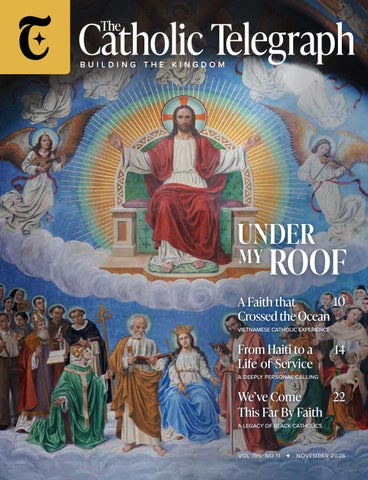
The sanctuary artwork at All Saints Church in Kenwood (St. Paul the Apostle Family of Parishes) depicts the two major Catholic feasts celebrated in November; All Saints Day and the Solemnity of Our Lord Jesus Christ, King of the Universe. PHOTO BY MARGARET SWENSEN
T H E C AT HOLIC T ELEGR A PH • 195th Ye ar No. 1 1 • November 2026 • 51 3 -263 -516 4 • thec atholicteleg raph .com ctadvertising@catholicaoc.org • The Catholic Telegraph (xUSPS 094-520) ISSN. 10736689 is published monthly by the Archdiocese of Cincinnati, 100 E. 8th St., Cincinnati, OH 45202. Periodical’s postage paid at Cincinnati and at additional mailing office. POSTMASTER: Send address changes to: The Catholic Telegraph, 100 E. 8th St., Cincinnati, OH 45202.
2
T H E C AT H O L I C T E L E G R A P H
The Columnists Dominick Albano
Michelle Wirth Smith
is a passionately Catholic husband and father of four boys. He has been writing, speaking, and leading Catholic retreats for more than 20 years. He is the co-founder of the National Society for Priestly Vocations.
has served as the archdiocesan Archivist since 2019, bringing a Cincinnati-born passion for preserving Catholic history. She earned her Master of Library & Information Science degree from Kent State University.
Dr. Kenneth Craycraft
Katie Sciba
holds the James J. Gardner Chair of Moral Theology at Mount St. Mary’s Seminary & School of Theology. He is the author of Citizens Yet Strangers: Living Authentically Catholic in a Divided America.
is a national speaker and Catholic Press Award-winning columnist. She and her husband Andrew were married in 2008 and are blessed with seven children.
Fr. David Endres
Dr. Andrew Sodergren
is professor of Church history and historical theology at Mount Saint Mary’s Seminary & School of Theology.
is a Catholic psychologist and director of psychological services for Ruah Woods. He speaks on the integration of psychology and the Catholic faith. He and his wife Ellie have five children.
Fr. Jacob Lindle
Corynne Staresinic
was ordained a priest for the Archdiocese of Cincinnati in May 2022. He is presently studying for a Doctorate in Patristic Theology at the Pontifical Gregorian University in Rome.
is a writer and research fellow at the McGrath Institute for Church Life at the University of Notre Dame. She lives in Greater Cincinnati with her husband Nick and their children.
We want to hear from you! cteditorial@catholicaoc.org
NOVEMBER
Pope Leo XIV’s Prayer Intention
For the proper use of wealth Let us pray for the proper use of wealth, that not succumbing to the temptation of selfishness, it may always be put at the service of the common good and solidarity of those who have less.
Under One Roof I N T O Y O U R H A N D S | Archbishop Robert G. Casey
“Lead all souls to heaven, especially those most in need of your mercy.” The Fatima prayer, a well-known Catholic prayer recited while praying the Rosary, reminds us that Jesus seeks to gather all of us under heaven’s roof. When we consider Christ yesterday, today, and forever, that adds up to a lot of souls. We will be gathered under one large roof! In Matthew’s Gospel, a Roman centurion remarks to Jesus, “Lord, I am not worthy to have you come under my roof; only say the word, and my servant will be healed” (Mt 8:8). The centurion’s words have become our words at Mass as we prepare to come forward in procession to share in Holy Communion. The journey down the aisle becomes a foretaste of our journey to heaven, giving us a glimpse into the future that awaits us. What a magnificent moment awaits us, when all God’s creation finds itself assembled under one roof and united in eternal worship of our Creator! I was recently reminded of my childhood days when Ringling Bros. and Barnum & Bailey Circus would stop in my city while traveling across America, inviting people far and wide to share a moment of childlike joy with friends and family under the roof of the big top. Posters would appear; billboards would announce, “Come one, come all!” Quite like a circus, our Church seeks to construct a “big tent” that can welcome all and unite God’s children in the joy of the Gospel. We are called to create a Church with a roof large enough to accommodate many people; it is not only a select few or simply some lucky people who can find a seat. All are invited to gather. Gathering many people together does have its tensions. As each of us tries to find our place and take a seat, there can be friction, arguments, and 4
T H E C AT H O L I C T E L E G R A P H
disagreements. When we call something a “threering-circus,” this can suggest a chaotic, loud, and messy situation where too many things happen at the same time. However, that three-ring-circus also allows all those gathered to be engaged and participating. Under one roof does not suggest one size fits all. The three rings at a circus remind us that there must be room for diversity and an allowance for different gifts but the same Spirit. Our life here on earth should help shape and form us for the eternal home that awaits us. Are we worthy of that heavenly home? Most days we are not; we must rely on the mercy of God. Are we prepared to stand under the same roof with all the souls Jesus is leading there? Most days we are not; we must rely on the grace of God. Yet, ready or not, Jesus continues to call out to the world in the words of the circus ringmaster, “Come one, come all!” We must heed the call of our Savior and make the journey to heaven. On our journey we put into practice the words of the prophet Isaiah, “Enlarge the place of your tent, and let them stretch out the curtains of your dwellings; do not spare; lengthen your cords and strengthen your stakes. For you shall expand to the right and to the left, and your descendants will inherit the nations, and make the desolate cities inhabited” (Is 54:2-3). Guide us, Lord, along the everlasting way. Encourage us in our invitation to one and all. May all of creation come to find its fulfillment under the roof of the heavenly banquet that awaits us. ✦
Bajo un mismo techo E N T U S M A N O S | Arzobispo Robert G. Casey
“Lleva al cielo a todas las almas, especialmente a las más necesitadas de tu misericordia”. La oración de Fátima, una conocida oración católica que se recita al rezar el Rosario, nos recuerda que Jesús busca reunirnos a todos bajo un mismo techo en el cielo. Si pensamos en Cristo ayer, hoy y siempre, eso suma muchísimas almas. ¡Nos reuniremos bajo un mismo e inmenso techo! En el Evangelio de Mateo, un centurión romano le dice a Jesús: “Señor, no soy digno de que entres en mi casa; basta que digas una palabra y mi sirviente se sanará” (Mt 8:8). Las palabras del centurión se han convertido en nuestras palabras en la Misa mientras nos preparamos para avanzar en procesión y participar de la Sagrada Comunión. El camino hacia el altar se convierte en un anticipo de nuestro camino al cielo, dándonos una visión del futuro que nos espera. ¡Qué momento magnífico nos espera cuando toda la creación de Dios se reúna bajo un mismo techo y se congregue en la adoración eterna de nuestro Creador! Hace poco recordé mi infancia, cuando el circo Ringling Bros. y Barnum & Bailey hacía escala en mi ciudad durante sus giras por los Estados Unidos, invitando a gente de todas partes a compartir un momento de alegría infantil con amigos y familiares bajo el techo de la gran carpa. Aparecerían carteles y anuncios publicitarios en las carreteras diciendo: “¡Vengan!, ¡vengan todos!” Al igual que un circo, nuestra Iglesia busca construir una “gran carpa” que pueda acoger a todos y unir a los hijos de Dios en la alegría del Evangelio. Estamos llamados a crear una iglesia con un techo lo suficientemente grande como para acoger a mucha gente; no se trata solo de unos pocos elegidos o de personas afortunadas que puedan encontrar un asiento. Todos están invitados a reunirse.
Reunir a mucha gente conlleva ciertas tensiones. Mientras cada uno de nosotros intenta encontrar su lugar y sentarse, pueden surgir fricciones, discusiones y desacuerdos. Cuando decimos que algo parece un “circo de tres pistas”, esto puede sugerir una situación caótica, ruidosa y desordenada en la que suceden demasiadas cosas al mismo tiempo. Sin embargo, ese circo de tres pistas también permite que todos los presentes se involucren y participen. Vivir bajo un mismo techo no significa que una sola solución sirva para todos. Las tres pistas de un circo nos recuerdan que debe haber espacio para la diversidad y que se debe dar cabida a diferentes talentos, pero con el mismo Espíritu. Nuestra vida aquí en la tierra debe ayudarnos a formarnos y prepararnos para el hogar eterno que nos espera. ¿Somos dignos de ese hogar celestial? La mayoría de los días no lo somos; debemos confiar en la misericordia de Dios. ¿Estamos preparados para estar bajo el mismo techo con todas las almas a las que Jesús está guiando hasta allí? La mayoría de los días no lo somos; hay que confiar en la gracia de Dios. Sin embargo, preparados o no, Jesús continúa llamando al mundo con las palabras del maestro de ceremonias del circo: “¡Vengan!, ¡vengan todos!”. Debemos atender al llamado de nuestro Salvador y emprender el camino hacia el cielo. En nuestro camino ponemos en práctica las palabras del profeta Isaías: “¡Ensancha el espacio de tu carpa, despliega tus lonas sin mezquinar, alarga tus cuerdas, afirma tus estacas! Porque te expandirás a derecha y a izquierda, tu descendencia poseerá naciones enteras y poblará ciudades desoladas” (Is 54:2-3). Guíanos, Señor, por el camino eterno. Anímanos en nuestra invitación a todos y cada uno de nosotros. Que toda la creación encuentre su plenitud bajo el techo del banquete celestial que nos espera. ✦ NOVEMBER 2026
5
Three Necessary Societies Under One Roof A C L O S E R L O O K | Dr. Kenneth Craycraft
In 1929, Pope Pius XI promulgated his encyclical letter, Divini Illius Magistri, known in English as “On Christian Education.” While the letter’s central concern is the education of children, Pope Pius situated his teaching in what he called the “three necessary societies” of the family, civil society, and the Church. “Now there are three necessary societies, distinct from one another and yet harmoniously combined by God,” the pope explained. Two of them, “namely the family and civil society, belong to the natural order; the third, the Church, to the supernatural order” (11). Taking a closer look at the Divini Illius Magistri reveals that all three of these societies exist to some degree or other under the roof of the Catholic home. Or at least they should, if we understand them correctly. To get the full sense of Pope Pius’ thought, it is important to explain how he is using the term “necessary” and how this differs from typical everyday usage in American English. In popular usage, when we say something is “necessary,” we actually don’t mean what the pope means. In fact, when we say “necessary,” we usually mean its opposite: something like “contingency.” For example, this morning when I woke up, I thought to myself, “If I’m going to get the November Catholic Telegraph column filed in time, it is necessary that I start on it today.” In other words, I thought, “For some goal Z to occur, it is necessary that Y must occur first.” But “Y” might not have occurred at all. Thus, “Y” was not necessary. Rather, it was contingent upon me sitting down to my computer to begin typing. When we say that Y was the necessary condition for Z to happen, we do not mean that it was necessary for Y to happen. I might have neglected writing my column (as some of you are wishing I had), so starting on it today was not necessary. In contrast, as Pope Pius uses the term, “necessary” means something like “that which cannot not exist.” Even that, however, must be qualified and explained. God alone is that—or better He—that cannot not exist. God is a necessary being, which means God’s existence simply is, and could not be otherwise. This is how to understand God’s answer to Moses from the burning bush in Exodus 3:14. “I am that I am,” God said to Moses, meaning that God does not merely possess the attribute of existence, but that God’s very essence 6
T H E C AT H O L I C T E L E G R A P H
is to exist. His existence is necessary; He could not not exist. His necessary existence, however, does have certain attributes, which I account for below. Everything that is not God is created by God. But because God might not have created (all that exists), everything that is not God is contingent upon God’s creative act. Creation might not have occurred. On the other hand, the three necessary societies of which Pope Pius writes have their existence—or, perhaps, “proto-existence”—in God Himself. In an analogous sense, the three Persons of the Holy Trinity constitute a family, a society, and a Church in the one Triune God. These three necessary societies in the one necessary Being—God—are thus reflected in the three societies that exist through God’s creation of the universe. This is how Pius XI can say that these three societies are necessary. They are human expressions of attributes of God who Himself is necessary. Now, of course, because they are human expressions, the three necessary societies are analogues of the attributes of God in which they are based. And, as Pope Pius explains, the three necessary societies of family, civic society, and Church are hierarchically ordered. Civil society is ordered toward the good of the family; the family is ordered toward the good of the Church; and all is ordered toward finality in God. “In the first place comes the family, instituted directly by God for its peculiar purpose, the generation and formation of offspring,” explains the pope. “[F]or this reason it has priority of nature and therefore of rights over civil society.” But the family is not self-sustaining. For some of its requirements, the family necessarily is dependent on social institutions outside itself. These pertain to employment, health care, moral formation, education, and other aspects of human development and flourishing outside the competency of families to perform. Thus, in its sustenance of these other aspects of human development, civil society completes the family. The family “finds its own suitable temporal perfection precisely in civil society” (12). The third society is the supernatural society of the Church, into which a person is born through baptism. It is, explains the pope, “a perfect society, because it has in itself all the means required for its own end, which is the eternal salvation of
mankind” (13). Thus, the natural societies of family and civil society are ordered toward, and find their ultimate fulfillment in, the supernatural society of the Kingdom of God; which, on this earth, is found in the Church. This is how all three societies come under one roof. Education, Pius explains, is concerned with the whole human person in the order of both grace and nature. Therefore, education “belongs to all these three societies.” In other words, because education involves the whole person—as a member of the family, civil society, and the Church—all three come together as one in the Catholic household. Or at least, they should. ✦
FAITH. VALUES. STEWARDSHIP. Investing according to Catholic principles for more than 50 years. For Catholic families, foundations, endowments, and institutions seeking investments aligned with their faith.
600 Vine Street, Suite 2000 Cincinnati, OH 45202 513-621-2733 www.1919ic.com
NOVEMBER 2026
7
Other gods? Q U E S T I O N O F F A I T H | Fr. David Endres
One of the Ten Commandments is: “You shall not have other gods beside me.” Who are the other gods referred to in this verse? Did the Jewish people believe in these gods before God gave them these commandments? T HE LAW
The Old Testament shows the interplay between right belief in the True God (Yahweh) and errant belief in other gods. The True God is the God of Israel, but the Israelites found themselves surrounded by peoples, including the Egyptians, Canaanites, and Ammonites, who believed in various gods. Throughout the Old Testament, God’s chosen people are tempted to turn away from Him and worship their neighbors’ gods. No sooner had God delivered the Israelites from the Egyptians than they constructed a golden calf to worship. They chose an idol over Him. As the Psalmist writes, “They forgot the God who had saved them. They exchanged their glory for the image of a grass-eating bull” (Ps 106: 20-21).
Wherever these gods are mentioned, the Scriptures conclude that they are powerless and cannot be compared to Yahweh: “They were not gods at all, but the work of human hands—wood and stone” (2 Kgs 19:18). But these gods—even if not gods at all—were attractive even for the people of Israel. Their tendency to turn toward other gods led to Yahweh giving the First Commandment: “You shall have no other gods beside me” (Ex 20:3). The commandment demanded exclusive fidelity to the God of Israel, who had delivered them from Egypt.
OTH ER G ODS
T RU E OR FALSE
The gods of the ancient world were many. Different tribes and peoples worshipped deities associated with aspects of life, including war, weather, and the harvest. Baal, a Canaanite deity believed to have power over the natural order, including weather, appears in Judges, 1 Kings, and Hosea 2. In each case, Baal and the “prophets of Baal” are placed in opposition against fidelity to Yahweh. Asherah, a Canaanite goddess associated with fertility and motherhood, was represented through cultic objects. Those who followed the True God destroyed the objects associated with the false worship of Asherah (2 Kgs 23:4-15). Chemosh, the god of the Moabites, was honored by Solomon with a shrine near Jerusalem (1 Kgs 11:7), which was deplored as infidelity to the God of Israel.
The contest on Mount Carmel between Elijah and the prophets of Baal (1 Kgs 18) offers a dramatic example of the conflict between true and false gods. Here, Elijah proposes a contest of sorts between him and the followers of Baal. Each will prepare a sacrifice and call on his god. The one who answers will be recognized as the True God. The prophets cry out, “Baal, answer us!” and cut themselves, but there is no answer. But when Elijah prays, “Lord, God of Abraham, Isaac, and Israel, let it be known this day that you are God in Israel,” fire consumes the sacrifice. Yahweh shows himself to be the True God. Israel was not to divide its allegiance between Yahweh and the gods of its neighbors. This set Israel apart. Its identity was to be the people of the covenant, which demanded their singular worship. While we may not worship Baal, Asherah, or Chemosh, the temptation to idolatry—whether power, pleasure, or politics— remains (Catechism of the Catholic Church, no. 2113). So, too, does the command of the Lord: “I am the first, I am the last; there is no God but me” (Is 44:6). ✦
8
T H E C AT H O L I C T E L E G R A P H
Free estimates Fully insured Residential & Commercial 25+ years of experience Seniors & military discounts
Committed to safely serving our community. Tree Trimming, Tree Removal, Hazardous and Dead Trees, Storm Jobs, Stump Grinding
treeserviceoh@gmail.com jaimestreeservice.com (513) 372-5194
Free estimate form here
Hamilton • 173 N. Brookwood Ave West Chester • 9232 Princeton Glendale Rd
NOVEMBER 2026
9
BY K A RY E LL EN B ERG ER
F
or Deacon Dominic Hoang Vu and his wife Lan, their Catholic faith has been a constant through war, immigration, family life, and decades of service to the Church.
The couple met at a rehearsal event in preparation for the 1979 Vietnamese New Year celebration with recently arrived refugees in Cincinnati and Northern Kentucky. Both attended the University of Cincinnati at the time. They grew up in Catholic families and married after four years of dating. Today, they have three children, one daughter-in-law, and one grandson, and their faith continues to shape their family and their service to the Church. Deacon Dominic and Lan served the Vietnamese Catholic community until 2010 and have since served in several parishes around the archdiocese. Lan’s faith was tested early in life.
Family photos courtesy of Lan Huong Tran Vu. Above: Lan’s family celebrates a first communion in Vietnam. Page 11: Lan’s family escaped Vietnam in 1975 via boat. A Taiwanese merchant ship later rescued them and helped them reach Guam. The Catholic Church sponsored the family to resettle in the United States.
10
T H E C AT H O L I C T E L E G R A P H
One of 11 children, she grew up in central Vietnam amid political upheaval. Lan’s family escaped the country on April 29, 1975, seeking freedom from the communist regime and the oppression of their Catholic faith. In a small boat in the middle of the ocean, they prayed the Rosary throughout the night before a Taiwanese merchant ship rescued them the next day. After reaching Guam and spending nearly six months at Fort Indiantown Gap, the family was sponsored by the Diocese of Erie, Pennsylvania.
“My parents were only comfortable with being sponsored by the Catholic Church,” Lan said. They were not familiar with American culture but the Catholic Church felt like home. “We were welcomed, and the people there took great care of us.” That welcome became part of the family’s American Catholic story. Fifty years later, Lan’s family has grown from two parents and 11 children to 65 people. Lan remembers the Catholic Church in Vietnam as the center of community life. Families attended Mass together, parishioners cared for one another, and priests were involved in nearly every aspect of parishioners’ lives. “The community is vibrant as one large family,” Lan said. Deacon Dominic’s family migrated from North Vietnam to South Vietnam in 1954 for fear of persecution of Catholics by the newly formed communist government in the North. Twenty years later, when Dominic was 15, his parents and their children escaped again following the 1975 takeover by the same communist regime. Like his wife’s family, Dominic’s family spent time at sea before being rescued, in their case by the U.S. Navy, and taken to Guam. Their journey at sea lasted three weeks. Dominic was injured in a fall and separated from his family during their journey to Guam. After three months in the United States, he was reunited with his family in Ohio with the help of the Red Cross. He said this was one of the many miracles he and his family experienced on their journey. NOVEMBER 2026
11
In August 1975, St. Gabriel Parish in Glendale sponsored Dominic’s family of nine, most of whom have lived in that area ever since. They remain grateful for the assistance they received upon arriving in the United States. Deacon Dominic said he learned to be generous from the people who helped him and his family during that time and wanted to emulate their Christian witness. After attending a Vietnamese Cursillo weekend in Chicago in 1992, Deacon Dominic felt a deeper responsibility toward the Church, which he carried into his ministry. He began serving Cincinnati’s Vietnamese Catholic community, organizing programs and retreats and helping refugees who struggled with the English language to find resources in Vietnamese. In 1993, he organized a pilgrimage for 21 young adults to attend World Youth Day in Denver. Those experiences led others to encourage him to consider the diaconate. After completing Lay Pastoral Ministry formation, he entered the Archdiocese of Cincinnati’s Deacon 12
T H E C AT H O L I C T E L E G R A P H
Formation Program in 2007 and was ordained a permanent deacon in April 2010. His formation journey was a shared experience with Lan, who accompanied him throughout the process, including during a period of serious illness that left him attending classes in a wheelchair. “I think God had provided me with a companion who also had interest in learning about our Catholic faith just as much as I do,” Deacon Dominic said. “She was with me every step of the way.” Deacon Dominic and Lan remain grateful for the freedom to practice their faith and for the Catholics who welcomed their family. “Here in the U.S., I don’t have to worry about not being able to live my faith,” Lan said. They hope to continue sharing what they received with others, especially the Vietnamese Catholic tradition of caring for one another.✦
Left: Fifty years after making a new home in the United States, Lan’s family has grown from two parents and 11 children to 65 people. Right: Deacon Dominic Huong Tran Vu and wife Lan at St. John Neumann Church in Fairfield. Photo by David Cooley.
“My parents were not familiar with American culture but the Catholic Church felt like home. We were welcomed, and the people there took great care of us.”
NOVEMBER 2026
13
FROM HAITI TO A LIFE OF SERVICE BY L I SA F L ETC H ER
W
Marc Joseph’s experiences as an immigrant and United States soldier have shaped his work with Catholic Charities.
14
T H E C AT H O L I C T E L E G R A P H
hen people walk through the doors at Catholic Charities, they often carry more than paperwork. They carry questions about what comes next, worries about providing for their families, or the uncertainty that comes with building a life in a new place. Sometimes, they carry experiences that are difficult to put into words. In Springfield, Catholic Charities Southwestern Ohio meets those needs with practical assistance, legal guidance, and perhaps most importantly, people who understand that behind every case are people and families. One such person is Marc Joseph. His own journey from Haiti to the United States, along with profound personal loss and military service, shaped the way he now serves immigrant families and gave him a firsthand understanding of what it means to walk alongside someone going through a difficult season. “I joined the Army because I wanted to be part of something greater than me, and now, while I am working for Catholic Charities, I feel like I am doing something special, which is being able to serve others,” Joseph says. That sense of service is rooted in a personal story marked by both loss and perseverance. Joseph was born in Haiti, where violence devastated his family. In 2019, he and his wife witnessed the killing of her brother, a Haitian police officer. Two years later, Joseph’s older brother, who worked in immigration services, was assassinated. Then, in 2023, his aunt and two cousins were killed in gang violence. After coming to the United States, Joseph and his family built a life in Springfield. But leaving Haiti did not mean leaving uncertainty behind. His wife and children have experienced harassment and bullying because of their Haitian heritage, deepening Joseph’s understanding of what it means to wonder whether you belong. Those experiences now inform the work he does every day.
Archbishop Casey celebrated Mass in solidarity with the Haitian community at St. Raphael Church in Springfield in October. Photos by Danny Schneible
Tony Stieritz, CEO of Catholic Charities Southwestern Ohio, said Joseph brings something particularly meaningful to the Springfield office beyond his Haitian Creole language skills: his cultural understanding and lived experience. He said that Joseph’s presence helps the Catholic Charities team understand the realities facing Haitian families in a more personal way. “He brings the situation home for us,” said Stieritz. Joseph has worked at Catholic Charities for about a year, joining the organization after returning from basic combat training. He chose Catholic Charities from among other job opportunities because he wanted to remain close to immigrant families and serve people who face many of the challenges he understood personally. “Marc brings empathy and determination to his work, quickly recognizing connections between his own experiences and the stories of the people he serves,” Stieritz said. “He wants to make a difference by offering families guidance and hope during difficult circumstances.” For Haitian families in Springfield, those circumstances can be complicated. Catholic Charities’ Springfield team includes Joseph, a case manager, and an immigration attorney, enabling the organization to address legal questions alongside the accompanying practical needs. Stieritz said the work can range from helping someone understand their legal options to assisting families facing the loss of employment or access to basic necessities. More recently, Catholic Charities has seen increased requests for emergency assistance, including help with food and rent, while connecting families with other community organizations. Through it all, Joseph recognizes something in the families that seek assistance through Catholic Charities. “When immigrant families tell me they are afraid, I understand that fear,” Joseph said, reflecting on the violence experienced in Haiti
and the discrimination his family has encountered in Springfield. For Joseph, the people who walk through Catholic Charities’ doors are not statistics or abstract issues. They are parents, children, and friends trying to build stable lives. Stieritz said that Joseph’s experiences have given him an empathy that allows him to recognize the resilience of the families he serves. Perhaps just as importantly, those experiences have made Joseph appreciate the welcome he receives from others. “All of this shines a light on what Christian behavior looks like,” Stieritz said. Joseph explained that his family’s story is not only about suffering. It is also about “service, resilience, responsibility, and belonging.” He identifies himself as Haitian by heritage, American by citizenship, a husband, father, soldier, and member of the Springfield community. For Stieritz, that kind of service reflects the heart of Catholic Charities’ mission: recognizing the dignity of each person and responding to the needs of neighbors with compassion. Catholic Charities’ work begins with the people who have come to them for help. While broader immigration questions continue to shape lives, the immediate focus is practical: helping people navigate difficult circumstances with dignity and compassion. For Catholics who want to help, Stieritz points first to prayer, then to practical support through donations and volunteering. In Springfield, that can include helping deliver food or connecting families with organizations equipped to meet their needs. It is a simple expression of a larger calling: to see the person before the circumstance and respond to a neighbor’s need with compassion. For Joseph, that calling is deeply personal. His own experiences have shaped both the way he sees the families he serves and the way he understands what it means to serve others. ✦ NOVEMBER 2026
15
HOUSE OF THE LORD
All Saints Church Kenwood
BY GAIL DEIBLER FINKE
O
riginally known as Christ Church, the first All Saints parish was founded in Cincinnati’s East End for Irish immigrants, in 1845. “Built by the steamboat, destroyed by the railroad,” according to the Cincinnati Enquirer, it closed in 1936 because of railroad expansion along the river and construction of what is now Columbia Parkway. Relics of St. Alesia and St. Laetus in its altar stone were relocated into the altar at the new All Saints church.
16
T H E C AT H O L I C T E L E G R A P H
THROUGH THE YEARS 19 4 8
Current All Saints Church in Kenwood founded (now part of the St. Paul the Apostle Family of Parishes); 50 acres of land purchased and Mass held there in a house that doubled as the rectory.
19 5 1
Fr. Thomas Devitt, laid the stone church’s cornerstone on July 21. Maguolo and Quick designed the church in an eclectic modern style that combined elements of Romanesque, Tudor, and Art Deco with other styles. It features a low A-frame roof with exposed limed wood joists; bas relief stations of the cross by George Youstel; and a recessed mural behind the altar that depicts Christ enthroned in Heaven above the Virgin Mary, who is flanked by saints. The mural was painted by German-born, liturgical artist Gerhard Lamers (then 87).
19 5 4
Foundation for the school, designed by famed Cincinnati church architect Edward J. Schulte, poured on March 1. During construction, the 87 pupils had class on the house porch and in the basement.
19 5 5
Archbishop Alter dedicated the completed building.
19 5 6
First eighth graders graduated. Multiple additions since then greatly expanded the campus.
19 5 8
Parish donated 10 acres of its land to the archdiocese for Archbishop Moeller High School.
19 6 0
South Wing added.
19 71
North Wing added.
19 9 7
Parish center built.
2 011
All Saints School named a National Blue Ribbon School.
PHOTOS BY MARGARET SWENSEN
“The daily rosary prayer followed by daily Mass has been a great way for me to start my day. We have a list of people we pray for as we reflect on mysteries, and the regular attendees have made for a relaxing, welcoming venue for visitors.” TO M P E R N IK LO N GT I ME PA RI SHI O N E R
HIGHLIGHTS GERHARD LAMERS Born in Germany, liturgical painter Gerhard Lamers, with a crew of artists, decorated more than 100 churches in Europe before he worked in America. He eventually settled in Price Hill with his family and worked in the United States throughout the Midwest and East, including many Cincinnati churches, the Pontifical College Josephinum in Columbus, and the Shrine of Monte Casino in St. Meinrad, Indiana. His work had a strong Byzantine influence, which can be seen in the composition of All Saints’ sanctuary mural.
CROSS AND CROWN On a 1963 trip to Europe gifted to him by the parish, pastor Father Thomas Devitt sketched an unusual cross from an Irish tombstone that became the model for the distinctive metal cross and crown topping All Saint’s Art Deco-style square bell tower.
RENOVATIONS Major church renovations in 1983 and 2007 transformed the interior: converting confessionals into shrines for the Sacred Heart of Jesus and the Virgin, adding Reconciliation and Blessed Sacrament chapels, replacing the organ, and replacing the plain glass windows with light-colored art glass.
FAÇADE The flat façade is broken only by two flat buttresses and a large crucifix carved into the external supports of the windows over the recessed double doors. Symbols in the windows (a man, a lion, an ox, and an eagle) represent Saints Matthew, Mark, Luke, and John. ✦ NOVEMBER 2026
17
SYNOD 2027
Guiding Principles of the Synod 2027 Preparatory Commission BY AUGUST HAGEMANN
W
hile many of us have been busy praying and listening for the Holy Spirit’s direction at Conversations in the Spirit, another group has been hard at work on discernment for Synod 2027 in a different way. Their work began before Conversations in the Spirit started, is ongoing now, and will continue through the next 10 months, all the way through the synod’s conclusion at next year’s General Assembly Session. This group is the Synod Preparatory Commission. The Synod Preparatory Commission consists of 28 men and women from around the archdiocese, comprising laypeople, clergy, and religious who oversee the organization and progress of Synod 2027. This includes examining Vatican documents about diocesan synods and deciding how to apply that guidance to our local Church, as well as reviewing the takeaways from the Conversations in the Spirit and prayerfully discerning themes for further consideration throughout the remainder of the synod. The Preparatory Commission will also play a role in finalizing the selection of delegates to the General Assembly. All this discernment is a massive undertaking that impacts how everyone in the archdiocese experiences Synod 2027. Preparatory Commission members are deeply rooted in prayer, listening carefully for how the Holy Spirit is guiding them through every discussion and decision. One fruit of this orientation is the articulation of three guiding values that shape everything they do: love, listening, and faith.
18
These values aren’t three separate things. They build on one another to guide the whole synodal process. Devon James, Senior Campus Minister at Xavier University and a Preparatory Commission member, notes that this “wasn’t intentional. It’s the work of the Holy Spirit that connects so well.” Samantha Asmah, a young adult parishioner at the Cathedral Basilica of St. Peter in Chains and another Preparatory Commission member, explained the connection: love of God and neighbor animates everything, but to love, “we have to listen, and we need faith to wait and see what blossoms from that.” Jared Potkotter, a Preparatory Commission member, father of seven, and parishioner of St. Henry Parish, noted that the process of choosing love, listening, and faith as the guiding values was less about deciding on something that had been missing from the Commission’s work and more about “identifying values in play throughout the process.” Though the values have animated the Commission’s work from the start, articulating a top three took significant discussion and debate, which were crucial in the discernment process. Asmah emphasized that the goal of the Commission’s discussions has always been to “make our disagreements work together” rather than to make them disappear and to “allow [their] differences to make [them] stronger.” In this way, the Preparatory Commission’s work mirrors the whole mission of the Synod, which mirrors the broader life of faith. It is a diverse body of people—the Church—making room for one another, hearing one another, loving one another, and praying to see where the Holy Spirit leads us. As James put it, “Synodality is not going away… it’s been around since the time of the early Church. The more folks can lean into the practice, the more the Church can do amazing things.” If you haven’t had a chance yet, you can still sign up for Conversations in the Spirit at catholicaoc.org/conversations. Whether you can make a session or not, please pray for a fruitful outcome for Synod 2027, and that we all may love more fervently, listen more openly, and have deeper faith in God’s guidance. ✦
PHOTOS BY MARY KATE FLEISHER
THANK YOU SYNOD 2027 SPONSORS
Interested in becoming a Synod 2027 sponsor? Contact the Archdiocese Stewardship & Giving Department: stewardship@catholicaoc.org
Franciscan Poor Clare Nuns Cincinnati, Ohio
Our Mission: To pray for the needs of the Church, the World and all people. Mission: Women ages 22-50: Do Our you feel called to the contemplative life? To pray for the needs of the Church, the World and all people.
Sr. Dianne • 513-825-7177 • VocationDirectorOSC@gmail.com Our dailyLearn life includes of the Eucharist, personal and Morecelebration at: PoorClaresCincinnati.org communal prayer, community work, study, recreation and rest.
NOVEMBER 2026
19
AD 1
ST. IRENAEUS TERTULLIAN ORIGEN 100
50
100
200
150
200
ST. CYPRIAN 250
300
ST. EPHREM THE SYRIAN ST. BASIL THE GREAT ST. CYRIL OF JERUSALEM
300
ST. GREGORY NAZIANZEN
ST. AMBROSE ST. JOHN CHRYSOSTOM ST. JEROME
VULGATE 382–405
350
C H U R C H F A T H E R S | Fr. Jacob Lindle
20
T H E C AT H O L I C T E L E G R A P H
ST.
ST. GREGORY OF NYSSA
The Ancient Providers and Protectors of God’s Family What’s more interesting to you? 1. A seventh century monk reveals the meaning of life. 2. A seventh century monk’s tongue is cut off. The second option is more interesting to me, but I think I’m in the minority—perhaps even alone. Before you figure out what that says about my psychology, I’m going to quickly move on to the first option, then see if we have time for the second one. What is the meaning of life? Is that a helpful question for you? I’m guessing one of two things happens when it’s asked: 1. You already know the right answer, so your brain shuts down. 2. You don’t care about my opinion, so your brain shuts down. Either way, your brain shuts down, so you aren’t thinking too much; but I need you thinking... so, what gets people to think? Someone getting their tongue cut off certainly makes me stop and think… Yeah, we’re back at the second option. So, why did St. Maximus get his tongue cut off? Well first, we need some background. Beginning in 610, an Arab man named Muhammad claimed to receive revelations from the angel Gabriel (see Galatians 1:8 for what Paul has to say!). To spread his message, Muhammad took up the sword, and by the end of his life in 632, he had basically conquered the Arabian Peninsula. He had many wives (11-13) but no surviving sons, creating debate about proper succession, but the leaders known as the Rashidun caliphs became dominant as they began their own expansion. After two decades of fighting with the Zoroastrians in Persia, the exhausted Christian Byzantine Empire began collapsing as the young and vigorous Muslim army took Syria, Palestine, and Egypt—all strongholds of Christianity and patristic thought.
393 COUNCIL OF HIPPO
ST. JUSTIN MARTYR
48 COUNCIL OF JERUSALEM
33 PENTECOST
BIRTH OF CHRIST
ST. IGNATIUS OF ANTIOCH
325 COUNCIL OF NICAEA
313 EDICT OF MILAN LEGALIZED CHRISTIANITY
ST. CLEMENT OF ROME
ST. ATHANASIUS
In response to these wars without, the emperor wanted to silence all wars within. Inside the Christian world, the great theological debate of the time was whether Christ had one will or two. The emperor, Constans the Bearded, thought the best way to unify the Empire was to silence the debate. A stubborn monk named Maximus refused, as did his friend, the pope, Pope St. Martin. They called a council together in 649 in Rome to defend the two wills of Christ, but were then arrested, convicted on false charges, dragged through the streets of Constantinople, and exiled. When Maximus continued proclaiming the two wills of Christ, he was brought back to Constantinople where both his tongue and right hand were cut off. So, there we have our answer: Maximus’ tongue was cut off because he wouldn’t stop proclaiming the two wills of Christ. But our answer is really another question: why were the two wills of Christ so important for him? If you remember from last month, the Christological controversies of the fifth century centered around how Christ is both one and two. Ephesus (431) told us that Christ is one Person, and Chalcedon (451) declared that Christ has two natures. Well, after Chalcedon, not everyone was happy. Some did not want to acknowledge the humanity of Christ at all; they thought it somehow lessened Him. Some bishops thus denied the authority of Chalcedon altogether and split away from the Church. Others remained in the Church, but they tried to limit the humanity of Jesus as much as possible. They started to teach that, although Chalcedon proclaimed Jesus to have two natures, He only had one divine will.
400
400
450
732 BATTLE OF TOURS
ST. GREGORY THE GREAT 537 HAGIA SOPHIA COMPLETED
451 COUNCIL OF CHALCEDON
431 COUNCIL OF EPHESUS
ST. LEO THE GREAT
476 FALL OF WESTERN ROMAN EMPIRE
ST. AUGUSTINE CYRIL OF ALEXANDRIA
500
ST. MAXIMUS THE CONFESSOR
550
ST. JOHN DAMASCENE 500
600
600
650
700
700
750
800
ST. MAXIMUS THE CONFESSOR DIED 662
For Maximus (and the pope!), this position compromised our salvation. If Jesus did not share our full human nature— including our will—then how could our full human nature— including our will—be saved? Jesus must have two wills, which are both perfectly united but also unconfused, to lead us back to God. In the Garden of Eden, our wills were broken, but in the Garden of Gethsemane, our broken wills were healed in Christ’s perfect obedience to the Father. Maximus stands near the end of the line of the Fathers as a kind of summit—looking out upon all their insights and handing down to us their gloriously integrated vision of reality. According to Maximus, God creates every type of thing as a kind of logos or word. Every nature is called forth from the one Logos (the Word), and as a particular creature does what it has been created to do, it images that one Logos and returns to Him. Plants and animals instinctually fulfill their nature and, so, automatically return to God in their own limited way. Humans, however, are special since our logos includes freedom. We have been called forth by God, but our return to Him isn’t automatic. It involves our free choice. As we read in Genesis (and know from experience!) though, this capacity for freedom has been broken. In our sin, we chose to reject our return to God, and so we are stuck. We were made for God, but we can’t get back to Him. Our nature is fallen. Our broken logos is the backdrop for the good news that the one Logos was made flesh. The Logos took on our whole human logos and perfectly united our nature to God. The Logos assumed our human will in order that our broken wills might receive a new
way of willing. On our own, heaven remains closed to us since we can’t love God as we ought. Christ, however, did and does love the Father perfectly, and we can now love through, with, and in Him. In Christ, we can now become who we were made to be. And that’s the meaning of life. ✦
FURTHER READING St. Maximus the Confessor, On the Cosmic Mystery of Jesus Christ (Popular Patristics Series, St. Vladimir’s Seminary Press, 2003) Maximus Confessor (The Classics of Western Spirituality, Paulist Press, 1985) Andrew Louth, Maximus the Confessor (The Early Church Fathers, Routledge, 1996) Hans Urs von Balthasar, Cosmic Liturgy: The Universe According to Maximus the Confessor (Ignatius Press, 2003)
NOVEMBER 2026
21
WE’VE COME THIS FAR BY
VENERABLE FATHER AUGUSTUS TOLTON
VENERABLE PIERRE TOUSSAINT
FAITH SERVANT OF GOD SISTER THEA BOWMAN
V E N E R A BL E M OT H E R M A RY L A N GE
SERVANT OF GOD FRIAR MARTIN MARIA DE PORRES WARD
A LEGACY OF BLACK CATHOLICS BY ANDRE W MUSGRAVE SERVANT OF GOD JULIA GREELEY
22
T H E C AT H O L I C T E L E G R A P H
VENERABLE HENRIETTE DELILLE
S
everal months ago, the Catholic Social Action Office embarked on a journey to share the good news about a group of individuals being considered for the declaration of sainthood (canonization). This group was not together on Earth (e.g., the Jesuit martyrs in Japan) but rather a group united by a common heritage: all seven members are African American and are the first possibilities of an African American being declared a saint. To be sure, there are many Black saints—St. Augustine, St. Martin de Porres, St. Benedict the Moor, and St. Josephine Bakhita. And there are many American saints—St. Elizabeth Ann Seton, St. Frances Xavier Cabrini, St. Kateri Tekakwitha, and St. Katharine Drexel. But the Catholic Church has yet to recognize an African American saint. Each month since April, The Catholic Telegraph featured an article on one of these holy men and women, while a presentation somewhere in the archdiocese brought their stories to life. As a refresher, here's a rundown of these remarkable witnesses to the faith:
VENERABLE PIERRE TOUSSAINT Born into slavery, he went on to help free several people from enslavement. He was also one of the original donors who helped build St. Patrick’s Cathedral in New York City and is regarded as a grandfather of Catholic Charities.
VENERABLE MOTHER MARY LANGE In a city where no public schools existed for Black children, she opened a school in her own home to educate Black youth. She later founded the Oblate Sisters of Providence, the first Catholic religious order for women of African heritage in the United States.
VENERABLE HENRIETTE DELILLE In 1842, she founded the Sisters of the Holy Family in response to exclusion, creating a sacred space where Black women could serve, teach, and minister with dignity.
SERVANT OF GOD JULIA GREELEY
VENERABLE FATHER AUGUSTUS TOLTON He faced the harsh reality of institutional racism when no seminary in the United States would accept a Black candidate for the priesthood. So, he went to Rome to study and was ordained there before returning to the United States to serve faithfully as a priest.
SERVANT OF GOD SISTER THEA BOWMAN She embraced the Catholic faith as a child despite coming from a non-Catholic family. She became the only African American woman in her religious community and challenged the Church to confront its history of racial exclusion while embracing the gifts Black Catholics bring to the Body of Christ.
SERVANT OF GOD FRIAR MARTIN MARIA DE PORRES WARD He broke through racial exclusion to become the first African American Conventual Franciscan friar in North America. He later went to Brazil, where he ministered for more than four decades as a teacher, pastor, and spiritual guide, serving communities that embraced his gifts and honored his presence. It’s fitting that we are wrapping up this series in November, Black Catholic History Month in the U.S. Catholic Church. Since the National Black Catholic Clergy Caucus established Black Catholic History Month in 1990, we’ve celebrated the legacy of African and African diaspora Catholics while shining a light on the historical oversights, marginalization, and lack of support found throughout Church history. There are far too many notable Black Catholics to list but, suffice it to say, our Church—both locally and nationally—stands on the shoulders of African American scholars, theologians, teachers, priests, brothers, sisters, musicians, publishers, and countless others. Now, we invite you to join us Tuesday, November 17, at 6:30 p.m. at Good Shepherd Catholic Church, Cincinnati, as we recognize that “We’ve Come This Far by Faith”—and we still have a long way to go. ✦
Born into slavery, she found deep spiritual refuge in the Sacred Heart of Jesus. She humbly—and secretly—spent her evenings delivering food, clothing, and coal to poor families: Black, white, immigrant…anyone in need.
NOVEMBER 2026
23
Making Space for Every Story: Independent Filmmaking in Cincinnati BY MARGARET SWENSEN
A PLACE FOR IND E PE ND E NT FILM M AKING IN CINCINNATI
“Saving the Mariemont Theater has changed my life,” said Allyson West. When the historic Mariemont Theater, which opened in 1938, was on the brink of permanently closing its doors in late 2025, West didn’t balk at the opportunity to save this beloved community space. “I love the Mariemont Theater,” West said. “I took my daughter to see her first film here, and more importantly than that, I know what a space like this symbolizes for the community. It is a place of hope. It is a place of connection. And if a space like the Mariemont Theater was going to close and there was an opportunity for it to stay open, then I was going to be the person who took the next step to make this happen.” While a rescue mission of this magnitude was daunting, West’s entrepreneurial experience uniquely equipped her for the task. A life-long cinephile, she grew up in Texas and moved to Cincinnati in 2007 to pursue an acting degree at the University of Cincinnati’s College-Conservatory of Music.
“I was somewhere between being an actor, being a producer, and being a director,” West said. “I had made my first short film and toured an independent film festival circuit with it.” While on tour, she continually encountered a powerful camaraderie within the independent filmmaking community. “I kept meeting other artists, other directors, other producers, and lots of community members that continued to show me how important it is for people to be in conversation with each other,” West explained. “And I would come back from my travels and sit next to my husband and say, ‘I just don't understand why Cincinnati doesn't have anything like this.’” His response: “You should do it.” While West initially laughed at the idea, a seed was planted and took root. In 2017, she founded Cindependent, a non-
24
PHOTOS BY ANGIE LIPSCOMB. COURTESY OF CINDEPENDENT.
T H E C AT H O L I C T E L E G R A P H
FIND ING A BALANCE
profit with a mission to open doors for artists and make space for storytelling in Cincinnati. By 2018, she and seven volunteers launched Cindependent’s first annual film festival, bringing together 160 artists, showcasing 200 films and screenplays, and hosting educational masterclasses. The inaugural festival made an immediate impact, with more than 2,000 attendees. “Cindependent’s purpose is really to turn strangers into friends,” said West. “I have met people who are trying to say something about the world they live in. And when people are given the ability to tell their stories, to communicate whatever it is that is in their minds or in their hearts, we really start to see new connections amongst neighbors that just didn't exist before.”
TA K I NG TH E P LUN GE The past year was transformative for West in many ways. “It's been probably the hardest I've ever worked in my life,” she said. When she accepted the challenge to reopen the Mariemont Theater, West had to find a new balance, navigating the responsibilities of her full-time role as a producer and director for Kroger Studios, as well as continuing to grow the non-profit and show up for her husband and their two young children. With her family and community’s support behind her, by February 2026, West was able to leave her corporate job to refocus that time and attention toward bolstering the cinematic landscape in Cincinnati. By March 2026, she officially signed the lease on the Mariemont Theater. She and her team worked in earnest to reopen the theater as soon as possible, successfully fundraising over a million dollars to reoutfit and reoperate the theater within six months. The theater’s grand re-opening kicked off Cindependent’s 2026 Film Festival. “I am just infinitely grateful to the City of Cincinnati for supporting this effort,” said West. “There have been hundreds of people who donated time, treasure, or talent to be a part of this moment. And it really speaks to how deeply community means here and how much the Mariemont Theater means to everybody.”
West noted, “Throughout this entire process, my faith has allowed me to every day wake up and take the right next step to make honorable choices, [ones] that were for the good of people around me, not really knowing what might come next.” She witnessed her father pass away at the age of 62, shortly before these other tumultuous changes came for her and her family. “When he was dying, he allowed my brothers, sisters, mom, and me to be with him as he very bravely walked into what was next,” West said. “It was one of the most amazing things I’ve ever seen and completely changed how I value my time on this earth. Every day I'm waking up, I want to make sure I'm doing things that, at the end of my life, allow me the courage to approach the next step, the way [my dad did].” Encouraged by her father’s bravery, West hopes to pass on this example of courageous living to her children. “My balm to the challenges of the world is to look for opportunities to contribute something joyful,” said West. “I think it’s inherently important for us to always look into our hearts, pull out the flowers that we have and find ways to share them or plant them [and] watch them grow. Having the courage to look for the good is not easy but is infinitely valuable. My hope is that my children understand that nearly any idea you have can come true if you are willing to put in the work.” ✦ Learn more about Cindependent at cindependentfilmfest.org. Visit @CatholicTelegraph on YouTube for a video about Allyson’s work building community through the arts.
NOVEMBER 2026
25
The Prophetism of the Body C H R I S T I A N A N T H R O P O L O G Y | Andrew J. Sodergren, M.T.S ., Psy.D.
the intimate, bodily acts reserved for marriage, they rediscover and make their own the “language of the body” written in it by God and spoken by Him through Christ’s total gift of Self on the Cross: “This is my body which is given for you” (cf. Lk 22:19). Through the vows of the wedding liturgy, man and woman In this context, John Paul II spoke of the “prophetism of the engage in a mutual gift of self by which they enter into a body”: “A ‘prophet’ is one who expresses with human words the lifelong covenant of love. This mutual self-gift is a visible sign truth that comes from God, one who speaks the truth in the or reminder of God’s spousal love toward humanity—and each place of God, in his name and in some sense with his authority” of us individually—expressed through Creation, Redemption, (TOB, 105.2). The language of the body has and the fulfillment we await at the end of a prophetic character because it speaks the time. God has espoused us to Himself, first language of covenant and communion. Indeed, through Creation, then through choosing The language John Paul II emphasized the spousal language Israel as a nation peculiarly His own, and now of the body has found in Old Testament prophets, such as through Christ's once-and-for all gift of Self a prophetic Isaiah, Ezekiel, and Hosea, who variously spoke on the Cross. All are called, through baptism, the spousal relationship between Yahweh, to become part of the Church, the Bride of character because of the ever-faithful husband, and Israel, the Christ, and enter into a spousal relationship it speaks the often-unfaithful bride. Israel’s infidelity to the with Him. The exclusive, permanent, and lifeCovenant shows how we can speak the language giving covenant of marriage serves as a constant language of of the body in truth or with dishonesty. As the reminder of this fundamental reality and covenant and late Pope said, “In the texts of the prophets, vocation that encompasses all humanity. who saw in marriage the analogy of Yahweh’s However, the divine reality signified by the communion. covenant with Israel, the body tells the truth communion of spouses in marriage is so great through faithfulness and conjugal love, and, that the vows spoken in the wedding liturgy when it commits ‘adultery’ it tells a lie, it commits falsehood” cannot do it justice in revealing and reminding us of so great a (TOB, 104.8). mystery. God gave us the “language of the body” as an additional, When we use our bodies and sexuality in ways that do profound expression of the mystery of divine communion. As not signify total self-giving, exclusivity, permanence, fidelity, we discussed last month, what is spoken through vows must openness to life, and respect for the dignity of the person, we also be enacted through the body. Through the male and female speak falsehood. Put simply, we lie and distort the language body, we discover and experience anew the depth of our call of the body. Conversely, when spouses speak the language and capacity for communion. As Pope St. John Paul II taught, of “conjugal love, faithfulness, and integrity” through their in marriage, “the perennial and ever new ‘language of the body’ bodies, they speak with a prophetic voice the truth of God’s is not only the substratum, but in some sense also the constitutive ever-faithful, self-giving love for us and our call to communion content of the communion of persons” (TOB, 103.5). Through with Him. It is only when this occurs that such bodily acts can the complementarity of their maleness and femaleness, spouses truly be called expressions of love. We can say, therefore, with “discover the spousal meaning of the body” and “become a Pope St. John Paul II: “The essential element for marriage as a reciprocal gift for each other” (TOB, 103.5). Indeed, the male sacrament is the ‘language of the body’ reread in the truth. It is body does not make sense apart from the female body and vice precisely through this that the sacramental sign is constituted” versa. Our bodies show us that we are made for each other. (TOB, 104.9). ✦ When spouses speak the language of mutual self-giving through Note: This article is part of an ongoing series on Pope St. John Paul II’s “Theology of the Body” (TOB).
26
T H E C AT H O L I C T E L E G R A P H
The Past Speaks Through Historic Episcopal Miters F R O M T H E A R C H I V E S | Michelle Wirth Smith
I have always thought it a shame when beautiful pieces of our Catholic history disappeared into boxes, where almost no one would ever see them again. There is an important place for archives. We need them. We need people who understand how to preserve fragile objects and documents so they are not lost. But history should not be packed away in dusty corners and forgotten, it should be allowed to speak. Four historic episcopal miters are now on exhibit at the Mount St. Mary’s Seminary Maly Library. The collection includes the miter and gloves of Bishop Edward Fenwick (18211832), the first bishop of the Diocese of Cincinnati; the miter of Archbishop John Baptist Purcell (1833-1883); and two miters from Archbishop Henry Moeller (1904-1925). Miters were not simply passed from one archbishop to another; each new archbishop commissioned a uniquely crafted miter for his tenure. And what craftsmanship there is to see! The miters are made of silk and adorned with religious imagery, intricate embroidery, metal-wrapped thread, metallic fringe, and synthetic gemstones. Their designs draw on Christ and the saints, as well as flowers, vines, leaves, and geometric patterns. Archbishop Purcell’s miter bears a Maltese Cross, a popular motif during the 19th-century Gothic Revival. It is a small detail, but one that reminds us that even the designs chosen for sacred vestments were shaped by the artistic world in which the Church lived. The beauty of these objects is only part of their story. The miter itself has a long history in the Church. By the middle of the 11th century, gifting bishops with miters had become tradition in the Latin church. Over time, several distinct styles developed, including the precious, golden orphreyed, and simple miters. All four miters in this collection are considered precious miters. These miters were worn by bishops during significant moments in the life of the Church, including confirmations, ordinations, and church dedications. One of Archbishop Moeller’s miters depicts Saints Peter and Paul and was worn when Moeller was formally installed as Archbishop of Cincinnati and received his pallium on February 15, 1905. Think about that for a moment. This isn’t simply a beautiful object that happens to be more than a century old. It was there when a new archbishop stood before the Church of Cincinnati.
PHOTO BY MARGARET SWENSEN
And now, more than a century later, we can stand before that same miter. That is the power of material history. For too long, these pieces of our history have never been publicly displayed. They were stored in archival boxes, protected and preserved, but largely unseen. Perhaps that is why I was so struck by Pope Leo XIV’s recent reflection on art. He spoke of art as “a form of cultural and spiritual regeneration,” something that can pick up the great questions of the human heart and make them visible, audible, and shareable (Address of His Holiness Pope Leo XIV to the Artists and Curators Participating In “The Art Of Possibility: Weaving Together” Meeting, Oct. 2, 2026). That is what happens when we allow these objects to be seen again. These are not simply old things. They are witnesses. They remind us that the Church we know today did not begin with us. We have received something. Bishops have served before us. Priests have celebrated Mass before us. Catholics have knelt in prayer before us. Artisans have made beautiful things for the worship of God before us. Generations of faithful people have carried the faith beneath the roofs of their homes and churches and handed it on to the next generation. Perhaps, standing before them, someone will remember that the faith we celebrate today was received from someone who came before us. That is the real gift of preserving history: not keeping the past behind glass but allowing the past to speak to the present. We are always receiving something. And if we are grateful, we will not keep it to ourselves. ✦ Visit the Maly Library at Mount St. Mary’s Seminary & School of Theology to see Treasures from the Archives of the Archdiocese of Cincinnati on exhibit, through mid-January 2027. The library is open Monday through Friday, 8 a.m.-12 p.m., 1-5 p.m., with limited evening and weekend hours. NOVEMBER 2026
27
AT YOU SHO
UL
O
L
T H E C AT H O L I C T E L E G R A P H
OF
28
O
“Lord, I am not worthy that You should enter under my roof, but only say the word and my soul shall be healed.” I prayed these words on my knees in my own living room with my family, our pastor standing firmly before us, elevating the Precious Body for us to adore just before receiving. My eyes were open. He was here. It was an answer to a forgotten, but suppliant prayer. How long ago did I ask Jesus to be so obviously present? I couldn’t remember. My family is busy with a lot of new responsibilities. It’s tempting to recite the litany of changes we are experiencing, but for the sake of brevity, I’ll keep it simple and relatable. We’re getting used to new schools, new health issues (and old ones) and new schedules for all of us. I’m trying my best to keep another round of plates spinning alongside the old ones, including my own well-being, but I confess that the confluence has gotten the best of me a time or two. Each recent change, though necessary and positive, came complete with its own emotional weight and details, and lately, there is very little margin in my bandwidth. You understand. The busier I get, the more aware I am of my dependence on God; however, when I’m moving at a more frenetic pace, I lose the eyes to see that He’s right here with me. So often we cast our desperate gazes heavenward in overwhelming moments, inadvertently believing that the One who provides, guides, and blesses is all the way up there. But He’s right here—so close we could whisper or just think our prayers and He hears them well. Bl. Julian of Norwich said, “God is nearer to us than our own souls.” It’s a concept strange and challenging to human understanding, but no less true. I was on the go—in my van, off to drop two kids one place and take the older three somewhere else before I had an appointment—when I was reminded of this encouraging consolation. He’s not far, He’s right here. So, I asked for a favor from the God who was so immediately close: “Jesus, I know you’re with me, but will You make it so obvious that I can’t miss it?” No sooner had I finished my brief petition than new thoughts and to-dos barraged my mind. I forgot all about it. The weekend blew by, nearly gone before we could really take it in. Sunday afternoon I was prepping for the upcoming
YR
RD
I AM
UNDER M
N OT W
TER
OR
T
TH
EN
C A T H O L I C A T H O M E | Katie Sciba
H
Y
D
Amid Our Busy Lives, He is Here!
week when my husband, recovering from recent surgery, stepped into the kitchen. “Father texted and said he’ll bring me Holy Eucharist in an hour.” My husband was telling me that Jesus was coming, but what I heard was that we were expecting a guest and our house was not “guest ready.” I called the kids and told them it was time to pick up. The kids scattered, picking up shoes and straightening pillows. I hurried through the house, trying to make it presentable before our priest arrived. My daughter missed the details on why we were cleaning. “Who’s coming over?” she shouted above the vacuum. “Jesus!” I laughed. Then came the sobering reality: He was coming to my own home. The same Lord I had begged to make Himself obviously present was about to be in our house. And He wasn't waiting for us to get our act together, for my mind to calm down, or for our schedule to clear. When Father arrived, we knelt in the living room. “Lord, I am not worthy that You should enter under my roof... ” There He was. Under our roof. Jesus gave me something far greater than a passing consolation. He gave me Himself in the very place where everything going on in our lives is happening. I don't suppose the plates will stop spinning anytime soon. The appointments, responsibilities, health concerns, and demands of family life are still there. But I know now, I don't need so much margin to realize that Christ moves through it with me. We spend so much time trying to make room for God in the constant hum of our lives that we forget He has already made His home with us. We needn't wait until the house is clean, the calendar is clear, or our minds are quiet to receive Him. He is nearer than our own souls and there He remains. ✦
Jesus Feeds Us Anyway S H I N E O N | Dominick Albano
I was having breakfast with a stranger at a Catholic conference last week when she asked something that stopped me in my tracks: What could God do for you over these next couple of days that would be an answer to prayer? Why did it stop me? Because I realized I didn't have an answer. It's a simple question. If we really believe in God, it's almost an obvious one. Shouldn't I be praying so fervently and frequently that I always know what I'm asking of God on any given day? It reminded me of a priest friend’s words: the most important prayer I can offer after receiving the Eucharist is to ask God for good gifts. He said it's a great spiritual waste to receive the Eucharist and not ask God for anything. The truth is that I spend a lot of time at Mass tired... wishing I had some coffee. And—especially at this time of year—thinking about the football game later that day. I don't spend as much of it as I should in awe and gratitude at the great gifts God has given me and wants to give me. And I don't think it's a coincidence that right there, smack dab in the middle of the Liturgy of the Eucharist, right before we receive Jesus, we all say these words from the centurion: “Lord, I am not worthy that you should enter under my roof but only say the word and my soul shall be healed.” The Church, in her wisdom, knows just how human we all are. Maybe you're all a lot better Catholics than I am. But how often are we sitting there, saying these words about being unworthy, while actively behaving unworthily? How often are our minds wandering or are we just going through the motions? It happens. I know it happens because I live it. Of course, Jesus is no stranger to feeding an ungrateful and unworthy crowd. Remember when Jesus fed the 5,000? How many of those 5,000 do you think were there only because they wondered why there was a huge crowd? How many do you think came to make fun of Jesus? Do you think any of them started lining their pockets as the bread was passed around? Hey, free bread, might as well save some for later, right? Scripture doesn't tell us any of that. But it does tell us Judas was there. And Scripture does tell us that Judas was lining his pockets from the common purse. And Scripture does tell us that at another meal, the Last Supper, when Jesus instituted the
Eucharist, He still fed the Twelve. He did it knowing that one of them was in the very act of betraying Him, another would deny Him three times, and all but one of the rest would run away before the night was over. Jesus isn't afraid to feed unworthy people. He does it all the time. The power in the centurion's prayer isn't that he claims to be unworthy. The centurion knew he wasn't the right guy. But he came anyway. He asked anyway. And that makes all the difference. We're all unworthy. That's true in the big-picture sense that all of humanity falls short of the glory of God. It's also true in the everyday sense that each of us is actively sinning. Jesus feeds us anyway. And that's something to be thankful for. You know, it's hard to feel thankful for something you feel like you deserve. You'll never feel grateful for a paycheck the way you do for an unexpected, undeserved gift. That's what the Eucharist is. It's an unexpected, undeserved gift. It's being fed when we don't deserve it. When we admit, fully and finally, that we don't deserve it, the Eucharist stops being an obligation. That's when “going to Mass” becomes “celebrating the Eucharist.” This November, the month of Thanksgiving, let's remember that “Eucharist” means “thanksgiving” and take time to admit to our Lord just how much we don't deserve Him. And then ask Him for His good gifts anyway. ✦ NOVEMBER 2026
29
Venerable Nguyễn Văn Thuận L U M I N O U S L I V E S | Corynne Staresinic
Prison is a cathedral The sound of the door keys Replaces the church bells. But it still proclaims The sacred time of the Eucharist Celebrated in union with the universal Church. (Cardinal Nguyen Van Thuan: Man of Joy and Hope, 103) This text (translated from Vietnamese) is from a poem written by Venerable Cardinal Francis Xavier Nguyen Văn Thuan* during his 13-year-long detainment that began in 1975. Sentenced without trial by Vietnam’s communist government (for his faith and his family’s political ties), he spent those long years in prisons and re-education camps, enduring psychological and physical torture and a total of nine years in solitary confinement. And yet, fellow prisoners and guards knew this man for his pleasant and serene demeanor. Cardinal Van Thuan taught them prayers and hymns and had a gift for befriending his captors. Central to his life of mercy was the Eucharist, as he found means of celebrating Mass in secret throughout his detainment. He thus came to see prison as his cathedral, and of the prisoners and guards, he wrote, “The people of God you [Lord] have given me to take care of ” (96). Befriending others amid such miserable conditions was not a given, but an ongoing work of grace, discernible in a particularly formative experience earlier in solitary confinement. His sister’s biography on his life tells the story. As Cardinal Van Thuan was frequently forced to use his small, dingy, insect-infested cell as a toilet, the woman responsible for cleaning his cell taunted him: “They say you are a bishop, but you look more like an animal. Look at the mess you’ve created around yourself ” (94). Her mockery continued for weeks, to the point that Cardinal Van Thuan feared he was beginning to hate her, so he begged God for the strength to not give in to it. When the woman arrived one day as he was in prayer, he “felt bold enough to look her in the eye and say: ‘Miss, there’s no quarrel between you and me. You are just doing your duty, and I did not choose to be here, in this revolting filth. I am just 30
T H E C AT H O L I C T E L E G R A P H
a prisoner and you, on the other hand, have a job you need to do. For my part, I do not hate you, and I am sure that you have nothing against me either’” (94). As soon as he finished speaking, he felt himself and his enemy enveloped in a bright, warm light, his heart overwhelmed with peace, and he became aware of the presence of God in this woman who had taken such pleasure in mortifying him. To see the image of God in an enemy does not mean pretending that they are faultless. It is rather to see that person in light of their dignity: that they were willed into existence out of love by God and are made for Him. When asked how he retained his capacity to love after all those extraordinarily difficult years, Cardinal Van Thuan credited the Eucharist and prayer (128). After he was liberated, he surprised his elderly parents, presenting to them a gift: “I am your eldest son. According to our culture, I should be taking care of you and should offer you something when I come to see you. I have no money to give, but what I do have for you is a very beautiful present that all the money in the world could not buy.” He opened the box, explaining what was inside: a couple of little glass bottles and a plastic spoon, seemingly cheap trinkets, that he had used for celebrating Mass in prison. “See, you can lose everything, you can even lose your life, but you don’t lose anything when you welcome the Lord in the Eucharist. Christ came down in these objects here, in this box. I lost my freedom for thirteen years, but these little vials are a reminder that we have the Lord with us. It is never right to despair” (141). In this season of Thanksgiving—a time of joy for many but one of loneliness and conflict for others—let us say thank You to Jesus Christ, our source of life, who is with us always in the Eucharist. In the face of conflict, let us ask (with Venerable Cardinal Van Thuan) for the grace to not yield to hatred or resentment, but to see our enemy through the Eucharistic love of his or her Creator. Venerable Cardinal Francis Xavier Nguyen Văn Thuan, pray for us. ✦ *Pronunciation: Nguyễn (Nwin) Văn (Vahn) Thuận (Twuhn)
NOVEMBER 2026
31
Local Author Chronicles Journey Through Infertility and High-Risk Pregnancy BY K AT I E W R I G H T
On January 1, 2019, Julie Yost woke with a clear call on her heart: write her story. While she didn't know her journey would become a book, she knew she needed to put her personal experiences on paper. In the years leading up to her "yes" in writing The Point of Viability: A Coming Alive Story, she endured a long season of trial, suffering, and devastating loss. While the book is geared toward Catholics and Christians, Yost hopes her story will help a variety of readers encounter God in a personal way. She wants them to know the hope, healing, and abundant life Jesus promises, regardless of the challenges life brings. In the early pages of The Point of Viability, Julie shares the struggles she and her husband, Dave, faced when trying to conceive their second child. After many prayers, including a novena to St. Therese of Lisieux, they were expecting triplets! But it was a high-risk pregnancy. As the book progresses, Yost walks readers through one of the most trying seasons of her pregnancy and personal life. She writes of the emotional and physical weight of carrying their pregnancy and what it was like to endure extended bedrest and not be able to see her husband and son regularly. And she shares both her pain during their family's time of heartbreaking loss and the joys from the miracle of survival. Her story is an incredible testimony of faith and trust in Christ and how God never fails to meet you in the valley. As readers turn the pages, they may wonder how one person could be capable of enduring so much anguish. Yost explained that it was within these periods of prolonged heartache and physical pain when she felt the Lord’s presence. "I believe now that my story is meant to serve as a witness to the nearness and goodness of God when faith gets tested in the fire," Yost said. "It is also a testimony of the Lord’s power to redeem and transform even our most painful circumstances, when we surrender everything to Him." Yost’s surrender to the Lord during that time came in part through regular, daily conversation with God. While on bedrest, the nightly Ignatian Examen prayer method helped take her mind off the physical and emotional afflictions and turn her 32
T H E C AT H O L I C T E L E G R A P H
gaze back toward God. "I found myself especially drawn to the part of the meditation that invites us to prayerfully review the day and recognize the ways that the Lord has been present and active within it,” she said. “Even in the midst of great trials and prolonged suffering, I began to notice the moments of grace woven throughout each day." At each chapter’s end in The Point of Viability, readers are offered a chance to reflect on moments where God met them in their own life or revealed beauty in seasons of challenge or suffering. Readers are given encouragement and helpful ways to pray and have personal conversations with Christ. As for what she wants readers who may also be carrying a heavy cross to know, "Don’t walk away from it. The Lord has many grace-filled treasures for those who enter into their suffering with Him," she said. "The Lord truly is so near to the brokenhearted and will lead you through the pain. He will tend to your wounds until they heal, and He will use it all for good when you place your trust in Him." God is always faithful. If you are interested in reading The Point of Viability: A Coming Alive Story, it’s found online at Good and True Media, Amazon, and Barnes & Noble and at local Catholic bookstores, including The Catholic Shop in Madeira and The Holy Spirit Catholic Shop at Our Lady of the Holy Spirit Center in Norwood. ✦
NOVEMBER 2026
33
Step Into the World of Spirited Away by Hayao Miyazaki Myth, fable, and fantasy are staples of human life as products of our imagination. Whether it’s the Fangorn Forest of Tolkien’s Middle Earth or the Titan Atlas holding up the very world, we are fascinated by the other worldly. We can gaze into the sky or across a valley and imagine a different realm— not to escape, but to connect to what we know is beyond our physical reach. Fantasy stories are a connection to the divine, the beautiful, and the mystical. Spirited Away understands this well. Few names command more respect in the animation world than writer and animator Hayao Miyazaki. Creator of such films as Princess Mononoke and The Boy and the Heron, as well as two films regarded as some of the greatest ever made, My Neighbor Totoro and 2001’s Spirited Away. Miyazaki, born in 1941 and still active today, helps show what the world of animation has to offer and why it is a valuable medium for artists and viewers. Protagonist Chihiro doesn’t want to leave her town, her school, or her home. As she sulks in the back seat and argues with her parents, they suddenly come upon an overgrown path that leads them to a tunnel. Nervously, Chihiro follows her parents to walk through the tunnel to an abandoned amusement park. They do not realize that they crossed into the realm of spirits. When the land’s witch and ruler turns her parents into pigs, it’s up to Chihiro to bring them back and get them all home. Spirited Away is a beautiful story in many aspects. We get to travel with Chihiro through Miyazaki’s brilliant imagination. Every time you turn a corner or meet a new character, you are shocked at how inventive another human being can be. Spirits can be frogs, ducks, living balls of soot, globs of refuse, guardians of rivers, or just vague shadows. We are plunged like Chihiro into the Spirit Realm without any initial explanation. If you’re like most people when you read myth or fantasy, such as The Lord of the Rings, every few pages you shake your head in wonder at how the author created such a work. This wonder is a chief function of fantasy. We are drawn out of our own minds into the heart of another writer and world. I am reminded of St. Paul’s words in his letter to the Corinthians, “We speak God’s wisdom, mysterious, hidden… what eye has not seen, and ear has not heard, and what has not 34
T H E C AT H O L I C T E L E G R A P H
PHOTO CREDIT: ALAMY
M O V I E R E V I E W | Graham Craycraft
entered the human heart, what God has prepared for those who love him.” Through fantasy we are pulled into the mysterious and we get to walk along the hidden paths of the divine. The Lord says in Isaiah that the distance between God’s thoughts and human thoughts is the distance between the heavens and the earth. This could be a distressing statement or, as I see it, a beautiful invitation to bask in wonder of God. We can connect to that infinite mind of the Creator through our creation. While watching Spirited Away, we are pulled into that mysterious and hidden world that God shows us through the minds of his artists. In the Liturgy of the Hours, we pray, “The talents of artists reflect your splendor, may their work give the world hope and joy.” Hayao Miyazaki, especially with Spirited Away, does just this. They reflect the splendor of the Creator and bring hope and joy to the world. God be praised. As Chihiro fights through her external trials and her own fears in her quest to save her family, she learns about sacrifice, fortitude, humility, and what love demands, lessons humanity learned from the divine Savior. What will it take to get her parents, her family, and her life back? What will it take to get back to the land she knows, back under her roof? Whether you watch this movie with your children or on your own, let yourself step into the mystical, the beautiful, and you will find yourself drawn closer to the divine. ✦
GIVE TO THOSE WHO HAVE GIVEN A Support the Retired Religious They spent their lives serving others. Now it’s our turn. More than 600 women and men religious are part of the life of the Archdiocese of Cincinnati. Many have spent decades teaching, caring for the sick, serving in parish ministry, and bringing Christ to those in need. Your gift to the Retirement Fund for Religious helps ensure that those who cared for others receive the care they now need themselves.
SCAN ME!
How to Give: • December 12th and 13th • By mail: Office for Consecrated Life, Attn. Maria Reinagel, 100 E. 8th Street, Cincinnati, OH 45202. Checks payable to the Archdiocese of Cincinnati/RFR • Online by scanning the QR code
R E T I R E M E N T F U N D F O R R E L INGO VIE O US MBER 2026 resources.catholicaoc.org/offices/consecrated-life/retirement-fund-for-religious
35
St. Martin de Porres Martin de Porres was born in Lima, Peru, in 1579, the son of a Spanish gentleman and a freed slave from Panama of African or Native American descent. His parents never married each other. Martin inherited the features and dark complexion of his mother, which kept his father from acknowledging Martin as his son for eight years. After the birth of Martin’s sister, the father abandoned the family.
J OI N I NG TH E DOMIN ICA NS When Martin was 12, his mother apprenticed him to a barber-surgeon who taught Martin to cut hair, care for wounds, and prepare and administer medicines. A few years later, he applied to the Dominicans to be a “lay helper,” not feeling himself worthy to be a religious brother. After nine years there, his example of prayer, penance, charity, and humility led the community to request he make full religious profession. He spent many of his nights in prayer and penitential practices and filled his days with nursing the sick and caring for the poor.
A M AN OF M IRACLE S When 60 years old, Brother Martin became very ill with chills, fevers, and tremors causing him agonizing pain. This continued for almost a year, until he passed away on Nov. 3, 1639. By the time he died, he was widely known for his miracles in medicine and care for the sick. Miracles attributed to him continued after his death, and he was canonized by Pope John XXIII. He is the patron saint of people of mixed race, innkeepers, barbers, public health workers, and more. His feast day is Nov. 3.
WORD FIND
S E RVIC E TO A LL P EOP LE Brother Martin treated all people equally, regardless of their color, race, or status. He was instrumental in founding an orphanage, cared for slaves brought from Africa, and managed the priory’s daily alms with practicality, as well as generosity. Many of his fellow religious took Martin as their spiritual director, but he continued to call himself a “poor slave.” He was good friends with another Dominican saint of Peru, Rose of Lima.
36
T H E C AT H O L I C T E L E G R A P H
Barber Dominicans Humble
Innkeepers Lima Martin Medicine
Miracles Peru Rose
St. Martin de Porres
NOVEMBER 2026
37
Advice from St. Thomas More on Living and Dying Well B O O K R E V I E W | Dr. Kenneth Craycraft
This past July, my wife and I traveled to Oxford, England to celebrate the baptism of our grandson, James Peter. We extended the trip to include our first visit to the Tower of London. As I emerged from the Tube and walked down the steps toward this infamous castle, I burst into tears at the first sight. Now, I freely confess that I am a Highly Emotional Person, as James Peter’s mother, Beatrice, often reminds me. Nonetheless, when I first glimpsed the Tower, I was not merely looking at an ancient citadel. Rather, I was face-to-wall with the site of the imprisonment and execution of one of the great saints of the Church, St. Thomas More. As an attorney, I have a special devotion to St. Thomas. And as a Catholic Christian who “is not the stuff of which martyrs are made” (as St. Thomas says in Robert Bolt’s play, A Man for All Seasons), I look to More as a man I aspire to be, but mostly fall short. Of course, despite the disclaimer Bolt attributes to him, St. Thomas More was indeed the stuff of which martyrs are made. Even when entreated by his beloved wife and daughter to compromise his conscience, More stood by his refusal to acknowledge Henry VIII as the supreme head of the Church. This led to his eventual beheading on July 6, 1535 on Tower Hill, just outside the walls of the castle where More had been imprisoned since April 1534. Why was St. Thomas so resolute in his faith? Or, to ask in More’s own words, how is it that a man “may lose his head and yet have none harm, but instead of harm inestimable good at the hand of God”? The answer is found in Stephen Smith’s remarkable new book, The Last Riddle: Advice on Living & Dying Well from the Imprisoned Saint Thomas More, published by Word on Fire. Smith, the Temple Family Chair of English Literature at Hillsdale College, is perhaps the leading More scholar in the United States. In 2020, he published (with Gerard Wegeman) the definitive one volume collection of More’s writing, Essential Writings of Thomas More (Yale University Press). In The Last Riddle, Smith has collected the extant writings of St. Thomas from his 15 months in the Tower prison. In the Introduction, Smith attributes the improbable availability of these documents to More’s intrepid daughter, Margaret, and a friendly jailer who 38
T H E C AT H O L I C T E L E G R A P H
The Last Riddle: Advice on Living & Dying Well from the Imprisoned Saint Thomas More By: Stephen Smith Word on Fire; 288 pages | $24.95
turned a blind eye while Meg (as More affectionately called her) smuggled the writings from the tower after her frequent visits. The Last Riddle is divided into two parts, “The Tower Letters” and “The Tower Instructions and Prayers.” In both parts, Smith contributes thoughtful commentary on the letters and writings, giving the reader background, clarifying obscure or difficult passages, and offering both scholarly and spiritual insight into More’s remarkable letters and prayers. Even as he faced his inevitable death, More was able to write loving and encouraging letters to his family and friends. And, as Smith puts it, he was also able to write faith-filled letters to God. For More, the journey from life to death was a continuum, not a discontinuity. This conviction is the reason he could answer the last riddle as he did. How does one lose his head and yet obtain inestimable good? By, as Stephen Smith concludes, adhering to the “most virtuous lesson” that one should “look first unto God, and then unto the King.” With his eyes fixed on his heavenly reward, St. Thomas More’s life and death were, and are, indeed, salutary “advice on living & dying well.”
CATH OLIC C ROSSWORD 1
2
3
4
5
6
7
8
9
10
14
15
16
17
18
19
21
20 23 27 33
24
25
44
45
51
32
43 46 48
52
49
53
54
57
58
59
61
62
63
64
65
66
Gerry Kelly Fritsch Traditional Irish Bagpiper
Gilligan Funeral Homes A Catholic family-owned funeral home since 1877 513-891-8373
40
47 50
31
37
39 42
13
513-404-0049 gfritsch48@zoomtown.com cincinnatipiper.com
30
36
35
41
12
26
29
38
11
22
28 34
FUNE RAL SE RVICE S
55
56
Naegele Kleb & Ihlendorf Funeral Home Serving Norwood, St. Bernard & surrounding communities 3900 Montgomery Rd. 513-631-2240 Geo. H. Rohde & Son Funeral Home 115 years of family service to Eastern Cincinnati
Mihovk-Rosenacker Funeral Homes White Oak/Monfort Heights 5527 Cheviot Rd.
3183 Linwood Ave. Mt. Lookout Square 513-321-0404 rohdefuneral.com
Blue Ash/Evendale/Sharonville 10211 Plainfield Rd.
T.P. White & Sons Funeral Home Family-owned and operated since 1870
513-385-0511
60
2050 Beechmont Ave. 513-231-7150
www.wordgamesforcatholics.com
DOWN 1 Ishmael and Isaac, to Abraham 2 Ancient Roman day 3 Japanese-American 4 His, in Le Harve 5 “___ this day our daily bread” 6 Where the bombs burst, in the United States anthem 7 “Hail Mary ___ of grace…” 8 Movie about Capote 9 Jurisdiction of a bishop 10 Jesus praised her generosity 11 Capital of Yemen 12 Prescribed amount 13 Egyptian goddess of fertility 21 Old TV movie players 22 French novelist 24 Certain tides 25 “___ et Magistra” 26 Israel’s Barak
27 Knocker’s reply 29 Peter’s name, originally 30 Seamless Garment of ___ 31 Ponder intently (with “over) 32 Nighttime annoyance, perhaps 34 English public school 35 Crosswalk, briefly 36 More rational 37 Stories 39 Alphabet string 42 “Take ___ leave…” 43 Eastern Catholic who played Klinger on M.A.S.H. 46 Approached 47 Catholic news reporter Roberts 48 “And a ___ came from heaven, “You are my beloved Son” (Mk 1:11) 49 The flight to here is one of the Sorrows of Our Lady 50 Colgate VIP 51 “The ___ of the Ancient Mariner” 52 A contraction 53 Social standing 55 Poker stake 56 To a smaller extent 58 Abbreviation for the Mother of God 59 Nero’s full deck? 60 Former coin of France
www.wordgamesforcatholics.com
58 British Prime Minister who converted in 2007 60 “Auld Lang ___” 61 Discontinued Dodge 62 Catholic sports figure Lombardi 63 Chooses 64 Festive occasion 65 Amplified electronically 66 Native Americans
Follow us online for more stories and in-depth video content! thecatholictelegraph.com
@TheCatholicTelegraph
S I N S G I F T S W A D I O D I E I N U R E I D O S N E S S V A L U E D E S I V E I L Z O N E S S S E I N C U R M E O W I E R S S A H L L P S S I T U A T I O N T E X A S F A M E D A F R O S T I P F L E E R M O N S I G N O R T H E N N A E E E N G C O I R V E R S E P R I O R R O A R G A L B L A I R S Y N E R I S K O M N I V I N C E O P T S F E T E M I K E D U T E S
ACROSS 1 Original and actual 5 Preparation of the ___ 10 Dry watercourse 14 Drooling dog of comics 15 Accustom 16 Engagement enders? 17 Promontory 18 Worth 19 Ricky, in real life 20 Vane reading 21 Nun topper 22 Area and Zip 23 Become liable for 25 Sound of a cat 28 Hosp. trauma centers 29 Satirist Mort 30 Turntable times (abbr.) 33 The Archdiocese of San Antonio is here 36 Location 38 Legal term briefly 39 Well-known 40 Hairstyle 41 A cleric 43 Deride 44 Classroom subj. 45 At that time 46 Not, to a Scot 47 Coconut husk 48 Biblical division 50 Head of a monastery 53 Savannah sound 54 NT epistle 57 Hazard
Accross the sea, He found me THE FINAL WORD |
Sr. Maris Stella, SV
The first thing I do each morning is thank God for my baptism and for my vocation as a Sister of Life! As a child, I developed an affection for our Blessed Mother when I heard the story of her apparitions to the Fatima children. The day after my First Holy Communion, I consecrated my life to Jesus through Mary; she has been a guide my entire life. Following graduation from high school, I went to the U.S. Naval Academy in Annapolis, MD, wanting to do something meaningful with my life and serve our country. At the Academy, I competed on the triathlon team and ran marathons, and in the midst of this very competitive and performance-based environment, I also grew in my faith. I learned that God’s love is a free gift that I could not earn, I only had to receive. Throughout my time in the Navy, whenever we traveled in uniform, people thanked us for serving our country. It made me aware that I represented something greater than myself. During my sophomore year at the Academy, I made a pilgrimage to the Holy Land. Walking through the Garden of Gethsemane, I saw a Sister in habit walking by and realized that she was representing something greater than herself—she was representing God. Her presence spoke aloud my heart's deepest desires, which I did not yet have the words to express: to live completely for God. After graduating from Annapolis, I was stationed as the gunnery officer on a destroyer. Our ship spent hundreds of nights out to sea off the coast of South America, chasing drug traffickers. The day’s stress was healed each night by the beauty and tranquility of the stars. I came to know God there, in the beauty of His creation and through the men and women with whom I served. I was continuously humbled by their generosity and willingness to make sacrifices. Miles from shore with few distractions, people began to ask questions of life. I saw the deep human need for love, and I witnessed God’s mercy in my own life and the lives of others. 40
T H E C AT H O L I C T E L E G R A P H
Stationed in Naples, Italy, after finishing my tour on the destroyer, I saw through my friends the beauty of marriage and family and wondered if I was called to marriage. As I prayed, God showed me that I could get married if I wanted to. He would bless me, and I would be happy; yet, I longed for something else. He was calling me to love Him with an undivided heart. Through this spousal union with Christ, I would take on the joys and sorrows of the entire world. Traveling to Assisi one weekend, I stopped in the church where Francis and Clare were baptized and knelt down before the tabernacle. A few moments later, I walked out of the church and knew in the depths of my being that I would belong completely to God. So began my visits to different religious communities. When I finally met the Sisters of Life, their charism of life amazed me—the way they proclaim the dignity of the human person and care for the most vulnerable. I was humbled by the radiance of God’s mercy I saw in our apostolates’ care for pregnant women and support of women healing after abortion. After attending a discernment retreat, I began the total consecration to Mary by St. Louis de Montfort. On the 33rd and final day, I once again consecrated my life to Jesus through Mary, in the same place I had done so as a child. When I returned home, my acceptance letter to the Sisters of Life had arrived in the mail. ✦ Sr. Maris Stella is the Vicar General for the Sisters of Life.
His Plan Is Love. Yours Can Be Too.
Pre-Planning Seminars Pre-Planning Gives Your Family Peace of Mind October 20 | 11AM, 2PM, or 6PM | Admin. Building Learn about Catholic burial and cremation options, Catholic Funeral Rites, the benefits of planning ahead, and more. Our Family Service Advisors are here to guide you.
Reserve Your Seat | 513-489-0300
Tidings of Comfort and Joy An Advent Concert Featuring Local Parish Choirs
December 4 | 7:00 PM | Admin. Building Join us for a special Advent evening of fellowship and sacred music, featuring performances by several local parish choirs. Gate of Heaven will be accepting donations to help provide car seats for Pregnancy Center Plus.
No RSVP is required
gateofheaven.org | 513-489-0300 | 11000 Montgomery Rd
Catholic Telegraph The
100 E 8 TH ST ✦ CINCINNATI, OH 45202
Ave Maria Mutual Funds – 8.25x7.5 Knowles Ad | 2026 05
You shouldn’t have to compromise your values when it comes to investing. That conviction is among the many reasons I support Ave Maria Mutual Funds and why I’m proud to serve on their Catholic Advisory Board. Since 2001, Ave Maria Mutual Funds has refused to invest in companies that profit from pornography, abortion, or attacks on the family. Their strong long-term performance is proof that principled, Pro-Life, Pro-Family investing works.
MICHAEL KNOWLES Podcaster and Author
This testimonial may not be representative of the experience of other customers. “As a member of the Ave Maria Mutual Funds Catholic Advisory Board, I receive compensation from the Funds of approximately $14,000 per year, which I do not believe affects my objectivity. Such compensation for my time and advice is not payment for this endorsement. I truly believe in the mission of the Ave Maria Mutual Funds.” – Michael Knowles. Past performance does not guarantee future results. Schwartz Investment Counsel, Inc., a registered investment adviser established in 1980, serves as investment adviser for Ave Maria Mutual Funds and invests only in securities that meet the Funds’ investment and religious requirements. The returns may be lower or higher than if decisions were based solely on investment considerations. The method of security selection may or may not be successful and the Funds may underperform or outperform the stock market as a whole. All mutual funds are subject to market risk, including possible loss of principal. Request a prospectus, which includes investment objectives, risks, fees, charges and expenses and other information that you should read and consider carefully before investing. The prospectus can be obtained by calling 1-866-283-6274 or it can be viewed at www.avemariafunds.com. Distributed by Ultimus Fund Distributors, LLC. Schwartz Investment Counsel, Inc. is not affiliated with Ultimus Fund Distributors, LLC. 200-174-011525 | 20241023-3957293