Catholic Teleg raph
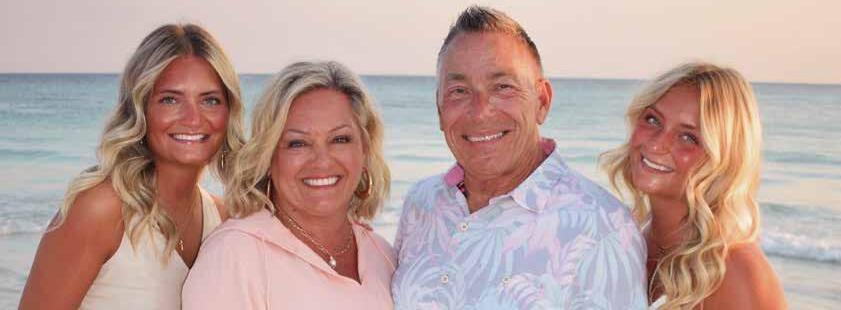
Honoring Mothers and Fathers, Protecting Families.
“Helping families is the most meaningful part of what I do.”
This season, we celebrate the parents, grandparents, and caregivers whose love and guidance shape our families and our faith.
From growing families to retirement and beyond, having the right health coverage helps protect those you love — and gives you one less thing to worry about.
Our caring advisors provide no-cost, personalized guidance for family, individual, and Medicare plans — so you can focus on what matters most.
RetireMed Health Plan Advisor, Lauren Mann and her family.
Photo:
From the Editor’s Desk
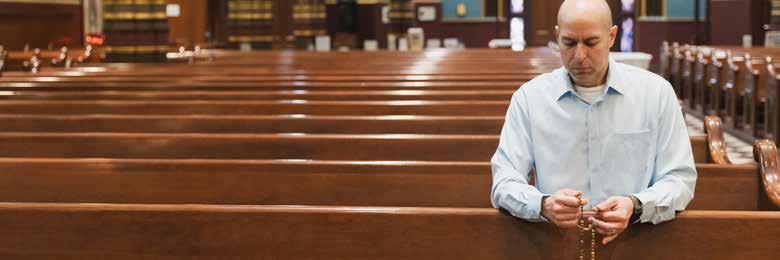
The Virtue that Changes Us
In his book The Purpose-Driven Life, Rick Warren shares this thought: "True humility isn't thinking less of yourself; it's thinking of yourself less."
In my late teens and early 20s, I was not the person God was calling me to be. If I could go back in time and give myself advice, I would say something like this: Boy, try to have a little more patience and humility. Perhaps, if I had been less selfish and more grateful, some memories wouldn’t be tainted with such cringe-worthy behavior.
A country song from years back, Humble and Kind, was made famous by Tim McGraw, but written and also recorded by one of my favorite singer-songwriters, Lori McKenna (whose version I prefer). Written from the perspective of a mother giving advice to her children, the words are simple and at the same time profound.
The chorus begins: “Hold the door, say please, say thank you. Don’t steal, don’t cheat, and don’t lie. I know you got mountains to climb but always stay humble and kind.”
This is a mom who has been through a lot, has much to say, and doesn’t want her children to make the same mistakes she’s made. But she keeps returning to humility and kindness, as if to say that everything else will fall into place if you can live out these virtues.
What is it that keeps us from being humble and kind?
Often, it’s our own fears and insecurities or our blind ambitions. We tend to focus on our own wants, our own problems, and our own dreams, and we miss the opportunities to be there for each other and do what’s right despite the personal cost. Our pride, our envy, and our inward focus blind us to the needs of others and the ways that God is working in our lives.
Scripture calls us to imitate Christ’s humility. The Son of God went all the way down as far as He could go for our sake.
In his letter to the Philippians, St. Paul writes: “Do nothing from selfish ambition or conceit, but in humility regard others as better than yourselves. Let each of you look not to your own interests, but to the interests of others. Let the same mind be in you that was in Christ Jesus” (Phil 2:3-5).
We are only on earth for a small amount of time, and yet, it’s easy to lose focus and take so much for granted. When I finally grew to be more mature, my perspective changed, and the struggles of life were bearable. I recognize how small I am but also that St. Paul was right when he said, “I can do all things through Christ who strengthens me” (Phil 4:13).
Our disposition not distance keeps us away from God. Humility is the foundation that leads us to prayer.
In June, we celebrate Father’s Day, and being a good dad is not for the faint of heart. It takes a lot of humility to be a good husband and a good father. We have a great role model of humility in St. Joseph. The foster father of Jesus demonstrates for us silent obedience, selfless service, and total submission to God's will without seeking any recognition. He placed his family’s needs before his own—that’s a dad!
This month, I’ll leave you with some final advice from Lori McKenna’s beautiful song:
“Don’t take for granted the love this life gives you. When you get where you’re going, turn right back around and help the next one in line. Always stay humble and kind.”
David Cooley
cteditorial@catholicaoc.org
Publisher: Archbishop Robert G. Casey
Editor: David Cooley
Managing Editor: Margaret Swensen
Creative Director: Nick Abele
Photography: Mary Kate Fleisher
Social Media: Taylor Motley
Videographer: Nathan Schuster
Media Sales: Deacon Graham Galloway
Circulation: Catherine Ampfer
The Columnists

Dominick Albano
is a passionately Catholic husband and father of four boys. He has been writing, speaking, and leading Catholic retreats for more than 20 years. He is the co-founder of the National Society for Priestly Vocations.


Dr. Kenneth Craycraft
holds the James J. Gardner Chair of Moral Theology at Mount St. Mary’s Seminary & School of Theology. He is the author of Citizens Yet Strangers: Living Authentically Catholic in a Divided America.
Dr. Cecilia Dorger
is an art historian and author who specializes in sacred art. She taught at Mount St. Joseph University and currently teaches at Mount St. Mary’s Seminary & School of Theology. She and her husband have two married children.

Fr. David Endres
is professor of Church history and historical theology at Mount Saint Mary’s Seminary & School of Theology.

Fr. Jacob Lindle
was ordained a priest for the Archdiocese of Cincinnati in May 2022. He is presently studying for a Doctorate in Patristic Theology at the Pontifical Gregorian University in Rome.


Michelle Wirth Smith has served as the archdiocesan Archivist since 2019, bringing a Cincinnati-born passion for preserving Catholic history. She earned her Master of Library & Information Science degree from Kent State University.
Katie Sciba
is a national speaker and Catholic Press Award-winning columnist. She and her husband Andrew were married in 2008 and are blessed with seven children.


Dr. Andrew Sodergren
is a Catholic psychologist and director of psychological services for Ruah Woods. He speaks on the integration of psychology and the Catholic faith. He and his wife Ellie have five children.
Corynne Staresinic
is a writer and research fellow at the McGrath Institute for Church Life at the University of Notre Dame. She lives in Greater Cincinnati with her husband Nick and their children.
We want to hear from you! cteditorial@catholicaoc.org
Let us pray that sports be an instrument of peace, encounter, and dialogue among cultures and nations, and that they promote values such as respect, solidarity, and personal growth.
The Gift and Art of Fatherhood
INTO YOUR HANDS | Archbishop Robert G. Casey
I remember the first time I did something that made me realize I had become just like my father. Many of us have had similar experiences. We reach a certain age and the DNA that has been passed down from generation to generation becomes undeniable. A wife may say something to her husband and realize she sounds just like her mother. A father may say something to his children and hear the voice of his own father coming out of his mouth.
Some years ago, while visiting Ireland, I walked into a room, raised my hand, and greeted all who were present. The way I gestured to them, with a certain tilt of my head and manner of speaking, reminded everyone of my grandfather. This surprised me, since I never knew my grandfather. Yet, he lives on through my DNA. Family and friends in Ireland could recognize him in my traits and mannerisms.
Fatherhood, however, is more art than science. The science of it is quite simple. Mix some DNA of a father with some DNA of a mother and produce a child. Yet, once that child has life, the role of fatherhood becomes much less simple. From day one, there are choices to be made and opportunities to be grasped.
To become a good father, a man must root his life in faith, hope, and love. Each day must be seen as an opportunity to perfect the art of parenting, giving one’s children the example of a life spent in continuous learning. Within our families, we have some inheritance that we treasure and some that must be discarded. Learning how to break the habits and customs that hurt more than heal the bonds of family becomes an important endeavor for every father in his effort to become accomplished in the art of fatherhood.
The familiar phrase “like father, like son” reveals a powerful truth about fatherhood. At first glance, that phrase speaks to the traits,
characteristics, and mannerisms that are handed down through our DNA. Viewed from a different perspective, though, that phrase calls us to greater love and reconciliation in our families. Do we like our father? Do we like our son? Can that “like” be deepened into love? The well-known story of the Prodigal Son demonstrates how a father can learn to like and love his children in sunshine and in shadow. And, when a father has developed a deep love, rooted in God’s love for us, he can teach his children how to weather life’s storms and not be shaken.
The Shema is the daily Jewish prayer taught to children to remind them that life must be rooted in faith in God. “Hear, O Israel! The Lord is our God! The Lord is One!” (Dt 6:4). Each morning as we begin our day and each night before we sleep, we pray that we may live according to our faith and love as God loves. A father’s love for his children, essential and enduring, becomes a reflection of the love of God our Father, who will not disown us even amidst deep disappointment.
As we celebrate Father’s Day this month, we pray for our fathers, living and deceased, asking God’s blessing upon them, whether that be for their eternal rest or their continued journey here on earth. As we consider the love of God that we have come to know through our fathers, and the example they did or did not provide us, we pray, too, for all those who will be given the gift of fatherhood. May they receive that gift with humility and gratitude. And may they learn how to mirror the love of God in their life, so that future generations may come to know God our Father as a loving provider, protector, and pardoner. ✦


El don y el arte de la paternidad
EN TUS MANOS | Arzobispo Robert G. Casey
Recuerdo la primera vez que hice algo y me di cuenta de que me había convertido en alguien igual que mi padre. Muchos de nosotros hemos tenido experiencias similares. Llegamos a cierta edad y el ADN que se ha transmitido de generación en generación se vuelve innegable. Una esposa puede decirle algo a su marido y darse cuenta de que suena igual que su madre. Un padre puede decirles algo a sus hijos y oír la voz de su propio padre saliendo de su boca.
Hace algunos años, durante una visita a Irlanda, entré en una sala, levanté la mano y saludé a todos los presentes. La forma en que hice este gesto, con cierta inclinación de cabeza y mi manera de hablar, les recordó a todos a mi abuelo. Esto me sorprendió, ya que nunca conocí a mi abuelo. Sin embargo, él sigue vivo a través de mi ADN. Mis familiares y amigos en Irlanda podían reconocerlo por mis rasgos y gestos.
La paternidad, sin embargo, es más un arte que una ciencia. La ciencia que hay detrás es bastante sencilla. Para crear un hijo se mezcla el ADN de un padre con el de una madre. Sin embargo, una vez que ese niño vive, el papel de padre se vuelve mucho más complejo. Desde el primer día, hay decisiones que tomar y oportunidades que aprovechar.
Para ser un buen padre, un hombre debe fundamentar su vida en la fe, la esperanza y el amor. Cada día debe ser visto como una oportunidad para perfeccionar el arte de la paternidad, dando a los hijos el ejemplo de una vida dedicada al aprendizaje continuo. En nuestras familias, recibimos parte de una herencia que valoramos y otra de la que debemos deshacernos. Aprender a romper los hábitos y costumbres que dañan más de lo que sanan los lazos familiares se vuelve un esfuerzo importante para cada padre en su intento de llegar a ser un maestro en el arte de la paternidad.
El dicho “de tal palo, tal astilla” revela una poderosa verdad sobre la paternidad. A primera vista, esa frase alude a los rasgos, características y gestos que se transmiten a través de nuestro ADN. Sin embargo, si lo vemos de otra manera, esa frase nos invita a tener más amor y reconciliación en nuestras familias. ¿Nos gusta nuestro padre? ¿Nos gusta nuestro hijo? ¿Puede ese “gusto” transformarse en amor? La conocida historia del Hijo Pródigo demuestra cómo un padre puede aprender a querer y amar a sus hijos, tanto en la luz como en la sombra. Y cuando un padre ha desarrollado un amor profundo, arraigado en el amor de Dios por nosotros, puede enseñar a sus hijos cómo afrontar las tormentas de la vida sin dejarse abatir.
El Shema es la oración judía diaria que se enseña a los niños para recordarles que la vida debe estar arraigada en la fe en Dios. “Escucha, Israel: el Señor, nuestro Dios, es el único Señor” (Dt 6, 4). Cada mañana al comenzar nuestro día y cada noche antes de dormir, oramos para que podamos vivir de acuerdo con nuestra fe y amar como Dios ama. El amor de un padre por sus hijos, esencial y perdurable, se convierte en un reflejo del amor de Dios nuestro Padre, que no nos abandonará ni siquiera en medio de una profunda decepción.
Al celebrar el Día del Padre este mes, oramos por nuestros padres, vivos y fallecidos, pidiendo la bendición de Dios sobre ellos, ya sea para su descanso eterno o para su camino aquí en la tierra. Al reflexionar sobre el amor de Dios que hemos llegado a conocer a través de nuestros padres, y el ejemplo que nos dieron o no nos dieron, oramos también por todos aquellos a quienes se les concederá el don de la paternidad. Que reciban ese don con humildad y gratitud. Y que aprendan a reflejar el amor de Dios en sus vidas, para que las generaciones futuras lleguen a conocer a Dios nuestro Padre como un proveedor, protector y perdonador amoroso. ✦
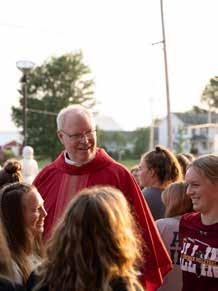
Call No Man Father?
QUESTION OF FAITH | Fr. David Endres
Q: Why are priests called “father”? What is the history, and isn’t it discouraged in the Scriptures (“Call no man father … ”)?
The title “father” as applied to priests in the Catholic Church has both historical and theological significance. It reflects the role of priests as spiritual leaders and caretakers of their communities, analogous to a biological father’s role in a family. The use of this title, however, also raises questions about its compatibility with Scripture, especially its potential prohibition in Matthew 23:9, where Jesus says, “Call no one on earth your father; you have but one Father in heaven.”
EARTHLY FATHERS
Some Protestants highlight the potential incongruity of father as a priestly title, but most Christians, whether Protestant or Catholic, do not interpret the Scriptures as condemning all those who use this term. Otherwise, calling one’s father or grandfather by this name would be problematic.
Nor does “father” stand on its own among the potentially problematic titles. The broader passage from Matthew (23:810) cautions against other honorific titles, such as rabbi and master (sometimes translated as “teacher”). Christians have not generally understood these titles as absolutely forbidden, but rather as a warning against placing oneself above God.
SPIRITUAL FATHERS
The use of the term “father” to denote spiritual authority is an ancient practice. The first Christian teachers and preachers, known as the Church Fathers because of their spiritual paternity, witness to such usage. St. Ignatius of Antioch and St. Clement of Rome, who both lived during the first century, refer to spiritual paternity; mirroring the words of St. Paul, who called himself a “father in Christ” through the Gospel (1 Cor 4:15).
Over the centuries, “father” came to be applied to various forms of spiritual fatherhood, from desert monks in Egypt and
bishops in the early Church to heads of monastic communities (abbots, from the Biblical word “abba”). Eventually, clergy in general were called “fathers,” though this practice was not universal across time and place. Dom or Don, meaning “lord” or “master,” were also terms used for priests in some places. The usage of “father” as a title for priests became more common in Europe by the Middle Ages.
BIBLICAL INTERPRETATION
The correct interpretative lens is the key to understanding “call no one on earth your father.” Catholics interpret Scripture in its literary, historical, and theological contexts rather than isolating verses from their broader meanings.
The command to “call no one on earth your father,” for instance, contains an important spiritual lesson. In its immediate context, it is a teaching on the proper understanding of authority. Jesus is warning against elevating any human above the divine.
ON BEHALF OF CHRIST
Even if it can be proper to call someone a rabbi, teacher, or master, that person’s authority does not substitute for God’s. They are His ministers, who assist others in following the Lord, but they are not Him. A term commonly used in the Church refers to the priest as acting in persona Christi (in the person of Christ), participating in Christ’s unique mediation. They are not the Lord, but they assist others in encountering Him.
While the Bible cautions against the misuse of authority, the Church allows for the respectful use of the title "father" in the context of priestly ministry. “Father” has consequently become a term of respect and endearment for priests, reflecting the role of priests in the lives of those to whom they minister. ✦
The Sacred Heart of Jesus on the Air
A CLOSER LOOK | Dr. Kenneth Craycraft
As most readers of this column are aware, my primary job is Professor of Moral Theology at Mount St. Mary’s Seminary and School of Theology. Some of you might know that I am also an attorney, licensed in Ohio and many federal courts. But for the past five months or so, I have added a new job to my resume. The month of June, dedicated to the Sacred Heart of Jesus, is as good a time as any to talk about my new gig as the new host of the afternoon radio show Driving Home the Faith on Sacred Heart Radio.
Of course, an account of my position as host of Driving Home the Faith cannot begin without a tribute to Fr. Rob Jack, who hosted the show for about 8 years prior to his sudden, untimely death last October. Fr. Rob was one of the first priests I knew when my family moved to the area in 2001. While teaching at Mount St. Mary’s, Fr. Rob was on the regular rotation of visiting priests at my parish. Who could forget this humble, prayerful man, with his plain-spoken but powerful homilies about the moral and spiritual life? And, of course, he always had his rosary CDs stacked at the exits for people to take after Mass. How many Catholics in the Archdiocese of Cincinnati still say the rosary with Fr. Rob from these CDs? He was beloved as the host of Driving Home the Faith. I can neither replace Fr. Rob nor replicate the program as he hosted it. Nor shall I try. He was one-of-a-kind, and we all miss him terribly.
Some of Fr. Rob’s regular guests on the show have continued to appear since I took over the microphone in January—if it ain’t broke, don’t fix it! On the other hand, I am steering the show in a slightly different direction, at least in terms of dominant themes and interests. Specifically, three principles direct my choice of guests and themes for Driving Home the Faith.
First, I am guided by a strong theology of the goodness of creation, which means the goodness of all things. In St. Augustine’s great spiritual memoir, The Confessions, he wrestled mightily with the problem of the “existence” of evil in the world. His journey toward Christian faith took him through a philosophical school of thought called “Manichaeism.” This philosophy taught that evil and good are two independent realities in the world, the former characterized by matter and the latter by spirit. But, thought Augustine, if evil has its own existence, it must have been
created by God. This conflicted with his growing conviction that God is all good and that He is the creator of all things. How can an all-good God create evil? And yet, we see “evil” all around us. Augustine’s solution is that “evil” does not have its own existence, but rather is the lack of perfection, or the privation of good. This means that all things as created are good but fallen. The goal, then, is not to eliminate evil, but rather to embrace, celebrate, and propagate the good—to love the evil away. This also implies that, in their essence, all things are good.
This leads to the second major impulse of my intentions for Driving Home the Faith. Because all things are good as created by God, all things are capable of communicating to varying degrees the love and grace of God. Ours is an incarnational faith, which means that grace is communicated through material things. God is present in all things, and thus all things can communicate God’s love. As Georges Bernanos’ protagonist priest in Diary of a Country Priest declares, “Everything is grace.” With this in mind, Driving Home the Faith will feature guests and themes who represent goodness, even if the topic is not expressly “Catholic.” If it’s good, it’s from God and, therefore, can contribute to human flourishing. Toward that end, I will continue increasing the number and frequency of guests who represent goodness in art, music, literature, and sport, as well as in prayer, liturgy, and sacraments.
And this leads to the third animating theme of Driving Home the Faith. Catholicism is a faith of “both/and” rather than “either/ or.” Our faith is full of paradoxes and tensions. But those are a feature of our faith, not a bug. Indeed, we have official celebrations of some of these paradoxes. We both feast and fast. We believe in both justice and mercy; in both law and grace; in both faith and works. We celebrate celibacy and fecundity, work and leisure, solitude and community, giving and receiving. We believe in the authority of the Church and the freedom of conscience; of the redemptive nature of suffering and the rejuvenating power of joy; of the solemnity of the sacred and the celebration of the secular.
As June is the month of the Sacred Heart of Jesus and the Immaculate Heart of Mary, Driving Home the Faith will continue its goal of representing the mission of Sacred Heart Radio and try to communicate—as best as I am able—the overwhelming grace and mercy flowing from those Hearts. ✦
Sacred Heritage Tours
BY PATRICIA M c GEEVER
There are many sacred spaces in the Archdiocese of Cincinnati. Annie Huey, Ph.D., wants to tell you all about them. She is the founder of Sacred Heritage Tours and about twice a month she conducts tours at various churches, chapels and other holy sites.
“I love doing the research and finding out all the mysteries and history of the people. I think that’s really fun,” said Huey.
She’s been leading these tours since January 2025. Huey has her bachelor’s degree in religious studies, plus a master’s and Ph.D. in theology. In high school, she thought she’d become a high school religion teacher. And she did for a while, teaching at St. Ursula Academy. While studying for her master’s at Xavier, a course sparked an interest in American Catholic History. While studying for her Ph.D. at the University of Dayton, she came up with the idea for the tours.
“I just really fell in love with old churches, but also being able to use materials within the church to tell stories,” she explained. “I’m really drawn to Catholic devotional materials, and the church has big Catholic devotional materials, stained glass windows, stations of the cross, statues. I’m able to use those as touchpoints to tell bigger stories.”
On a recent Saturday morning, Huey told the story of St. Martin of Tours in Cheviot. Judy and John Kirsch came from Dayton to hear it. Judy’s father grew up in the parish, and she’d been to Mass there as a child, but the couple didn’t know its history.
“There’s obviously so much more to them than just beautiful spaces,” said Judy of the church tours. “If people
could just appreciate the history and then the beauty, just what went into this. It’s not just a building.”
The couple was impressed with the efforts and the faith of the people, mostly farmers, who founded the parish in 1911.
“We had no idea that this is the third church. They started very small and got a little bit bigger. And then this,” said John gesturing to the Lombard Romanesque-style church.
This tour gave guests the last chance to see the stunning stained glass windows in the church for a couple of years. The parish raised almost $1.4 million to have them restored. Some have now been removed and are at a studio in Minnesota where the work is taking place.
Huey has tours of other sacred spaces scheduled through the end of the year. She also gives private tours and presentations to community groups and others. Tickets can be purchased on her website, sacredheritagetours.com. Many who attend are repeat customers.
“The first one we went to was St. Lawrence,” said Jill Thompson, who is not Catholic and drove from West Chester to Cheviot. “My husband grew up in Price Hill, so we are very connected to that area. We’ve been in the church 100 times, but we wanted to learn about it. We liked it so much. This is the third one we’ve done.”
The tours are open to everyone, regardless of faith. Guests leave after two-hours with a richer understanding of the sacred spaces in our midst and the sacrifices and determination it took to build them. ✦
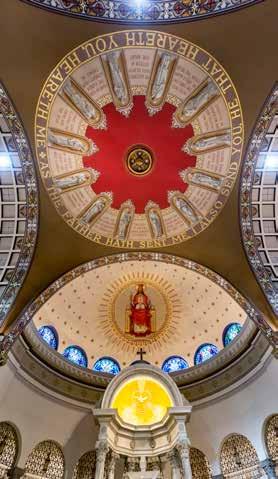
The transept dome of St. Martin of Tours, Cheviot. Mural by Carl Zimmerman, 1936.
Humility Hurts (And That's the Point)
SHINE ON | Dominick Albano
You’ll never regret acting in humility. A friend shared this advice years ago, and I’ve never forgotten it. It applies in every circumstance you’ll encounter, particularly to relationships.
Your boss gives you feedback you don't agree with. Act with humility. A friend says something that lands wrong and probably wasn't meant that way. Act with humility. Someone at church rubs you the wrong way every single week. Act with humility. Your kid's coach makes a decision you disagree with. Act with humility.
Okay, sure. Sounds good. But let’s be honest, easier said than done.
The Catechism of the Catholic Church defines humility as: “The virtue by which a Christian acknowledges that God is the author of all good. Humility avoids inordinate ambition or pride and provides the foundation for turning to God in prayer. Voluntary humility can be described as ‘poverty of spirit.’”
It’s a perfect definition drawn from the great wisdom of the Church. But what does it look like in our daily lives?
I’m talking about something deeper than “the opposite of arrogance.” We all know what an arrogant person looks like (and hopefully, we all know to avoid arrogance ourselves). That part is kind of easy. And everyone, generally, would like to be described as humble.
But what does it really look like to act in humility in the non-obvious circumstances of everyday life?
Forgive me, but I’ve got another baseball story. Recently, my 17-year-old son, Anthony, texted me after a tough baseball game. Anthony has always been one of the best players on whatever team he played on, and is used to having tremendous success at the plate. He started his varsity baseball season with a triple, then a double, then another triple. He routinely got multiple hits per game and led the team in batting average. And then, out of nowhere, he started striking out.
Nothing changed. No injury, no change in routine, no personal upset in his life, it just happened. Suddenly, he is going hitless with two or three strikeouts. One game you can shrug off, but he was going on a full week’s worth of games in this struggle. Instead of leading the team in batting average, he was now leading the team in strikeouts. Anthony felt horrible and didn’t know what to do about it.
The root of the problem wasn’t actually the result—poor batting average—the root of the problem is what the result said about himself: his belief about his ability. He believes wholeheartedly that God gave him the talent to be a great baseball player, but now, he is faced with the reality that for those games he stunk.
This is what makes humility hard: When you believe something and then encounter anything that challenges that belief.
That’s the true moment for humility.
While the Catechism’s definition for humility is perfect, I’ll offer you another framing to bring it down to a more human level: Humility is staying open to the possibility that you don’t have the full picture yet.
Everyone loves to be right. It’s part of the human condition. Studies have shown that the same region of the brain lights up both when you experience physical pain and when you experience social/emotional pain (like being wrong). Being excluded, dismissed, or flat out wrong is not metaphorically painful; the brain processes it similarly to when we are physically hurt.
So, being wrong is painful.
And it’s not just that. For most of human history, being wrong had serious consequences. Wrong about a predator, wrong about the weather, wrong about the food source, you died. The brain developed a strong protective bias around what it believes. Being wrong feels dangerous.
Of course, that’s not true today, but the brain still feels that way. Think you did a good job on a project, and get feedback that it isn’t quite right? The brain thrusts you into this horrible feeling, and you enter survival mode. Oh no! I screwed up the expense report, am I about to be eaten by a mountain lion?
That’s a silly reframing, but be honest with yourself: Haven’t you ever been in a situation where you felt extreme stress, anxiety, and worry, even though you told yourself you shouldn’t? Haven’t you gotten worked up over something that you knew was no big deal?
There is a scientific term for these feelings: cognitive dissonance.
When you hold a belief and encounter contradicting evidence, the brain doesn’t treat it as neutral information it treats it as a threat.
When my son has a week’s worth of bad baseball, his brain naturally induces his threat response. There’s a reason his text said, “I don’t know Dad. I’ve never felt this bad.”
Now, this is where humility comes in. Jesus is the Truth. The evil one is the lie.
Humility is the grace—the gift from God—to experience the pain of having something you believe challenged by external evidence and move through that pain to find truth.
See, usually, we experience the pain of cognitive dissonance, and we try to run from it as quickly as we can. We defend, rationalize, or ignore it, or we can even numb ourselves to it!
This is why habitual sin is such a problem. Sin is the greatest example of cognitive dissonance. You believe something to be wrong; you do it anyway. Now you must deal with this pain and discomfort (we call it guilt) of having done something that goes against what you believe. And what do we do? We justify it, rationalize it, ignore it, or if we keep going back to the sin repeatedly, eventually numb ourselves to it.
Here is what I told Anthony, word for word:
The feeling isn't the enemy. Avoiding the feeling is. The guy who never feels the threat of losing his spot—always
comfortable, always sure of himself—he stops working. Not because he's lazy. Because there's nothing pushing him. But the guy who feels it and runs from it—makes excuses, blames someone else, tells himself it's not a big deal—he stops growing, too. He's using all his energy to protect his ego instead of getting better. The best athletes feel it and use it. They sit with the discomfort long enough to ask: what is this telling me? What do I need to do? That's it. That's the whole thing. The feeling that stinks right now? That's fuel. Don't waste it.
Jesus is the Truth. And everything in this life is about getting back to Jesus. Humility is the willingness to stay in the room with pain and discomfort long enough to let it do its work and find the truth.
Maybe you didn’t do as good of a job as you thought. Maybe your wife is right about how little you help around the house. Maybe you do owe someone an apology. Maybe you do need to go to confession more often.
You’ll never regret being humble enough to sit with the discomfort and let it point you to the truth. Because truth always points us to Jesus. ✦
Taking the Long View of History
FROM THE ARCHIVES | Michelle Wirth Smith
When I first sat down to write this month’s column, I must admit I wasn’t especially inspired. Humility felt like a difficult theme to draw out of the archives. Then my colleague Sarah said something that really resonated with me. She spoke about the quiet beauty of recovering family histories, of being able to pray for people by name, knowing something of the lives they actually lived. Not abstract ancestors, but individuals who endured illness, childbirth, migration, and loss. How she said a simple date in a register can become an occasion to pause and pray for them.
To recover a name is to do something more than remember. It makes possible a kind of prayer that is concrete rather than abstract— commending a person to God not as part of a lineage, but as someone who lived and suffered and was loved. That shift moves us away from pride in what “our people” accomplished—who arrived first, who built what, who persevered under harder circumstances—and toward something steadier and more honest.
To recover a name is to do something more than remember. It makes possible a kind of prayer that is concrete rather than abstract— commending a person to God not as a part of a lineage, but as someone who lived, and suffered, and was loved.
There is, I think, something quietly spiritual in the work of archives, history, and genealogy. To search through registers is not only to reconstruct history, but to attend to what remains of lives otherwise at risk of fading into anonymity. It is a kind of listening across time. In that sense, archival work is not only about the past; it is an act of attention in the present.
The records themselves make humility unavoidable. In sacramental registers, the patterns emerge with quiet force: infant deaths, mothers lost in childbirth, outbreaks of illness, families marked repeatedly by grief. The past does not feel distant in those moments. It feels fragile. It reminds me how thin the line has always been between presence and absence, and how easily none of us might have been here at all.
Each of the people whose names we recover stood just as we do within a network of circumstances they did not choose and could not fully understand. Their lives could easily have taken another course, or not occurred at all. It is tempting, looking back, to ask why people did not choose differently. But those questions often depend on knowledge the people themselves did not have. And beneath them lies a subtler temptation—the belief that clearer hindsight means greater moral clarity, that because we see more now, we must somehow stand on firmer ground than those who came before us. And beyond even that, there is the larger horizon we are prone to forget: that history is not only what we can trace, but what God is doing within it—often quietly, invisibly, and always just beyond the reach of our full understanding. Perhaps, then, humility is not something dramatic. Perhaps it is simply this: telling the truth as best we can: about ourselves, about others, and about how little of the full picture we ever really see. ✦
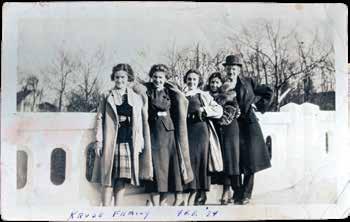
Family photograph courtesy of Michelle Wirth Smith
Introducing
Luminous Lives: Stories of the Saints
LUMINOUS LIVES | Corynne Staresinic
On most Sundays at St. Maximillian Kolbe Parish, my family sits facing a stained glass window of Fr. Kolbe. The window contains a constellation of symbols representing the events of his life; from well-known facts (his Auschwitz uniform) to those lesser known (his time in Nagasaki). At the top of the frame is an image of Mary, inspired by Kolbe’s childhood vision of her. When he was a boy, he saw the Mother of God holding two crowns before him, one representing purity and the other martyrdom. The window is fittingly framed with these crowns, for they became the defining framework for his life.
I often think of how shortly before Kolbe saw Mary, his mother had reprimanded him. He did something objectionable, and she said to him in exasperation, “I don’t know what will become of you!” Soon thereafter, Kolbe received the mystical vision, as if in response to his mother’s implicit question.
That question—“what will become of you?”—is one we all ask of ourselves. When I sit in Mass before that window, sometimes with my boisterous kids, other times with frustration at my sinfulness, and often with distress at the state of the world, his mother’s exasperation resounds in my heart. What will become of you, of myself, of those I love, of humanity? What will become of us?
Initiation, 48). What characterizes the saint before anything else is not the lofty heights of mysticism (if present), their magnanimity, or their piety but as Bouyer wrote: the charity of Jesus Christ, which “is spontaneous, gratuitous and unselfish,” offered for all, even for the most wicked and even unto death (Christian Initiation, 46).
This charity is made present in each saint uniquely, but it comes from the same source. The communion of saints then, as Bouyer wrote, is really a “testimony to the continuous living presence of the Word of God in God’s people, the Church” (Christian Initiation, 48). Bouyer gives a lovely analogy: like flowers blooming on a tree, the saints reveal “in dazzling colors” God’s love which “flows everywhere beneath the bark” of the tree of the Church like sap (48). The communion of saints is thus not “an exclusive spiritual club, to be respectfully bowed to from a distance, but a brotherhood open to all, which all are invited to join” in the life of the Church (48).
"What will become of you?" is a question we all ask ourselves. When I sit in Mass before that window, … his mother's exasperation resounds in my heart.
Theologian Hans Urs Von Balthasar wrote that the life of a saint “is an expression of the Gospel teaching whose kernel is found in the unity of truth and life” (Balthasar, Thérèse of Lisieux: The Story of a Mission, 167). The saints bear in their being the image of Jesus Christ in a diverse array. Startlingly, this same life of grace that begot the depths of divine wisdom in the AfricanItalian saint, Benedict the Moor, the unwavering sincerity of the teenage saint, Bernadette of Soubirous before the mocking crowd, and the sober courage of Kolbe to die in the place of another is in fact the same life of grace to which we are all invited.
Balthasar’s colleague and friend, theologian Louis Bouyer, wrote that we misunderstand the communion of the saints if they remain for us only distant isolated wonders (Bouyer, Christian
When the sun flickers in through that window at our parish, the illustration of Kolbe’s life is activated and lights up the Church. The same grace shining through his life in dazzling colors to us today—like a flower blooming from an old tree or sunlight streaming through stained glass—is the same grace offered to each of us by the God who loves humanity even unto death. Our lives are like dormant buds and unlit naves. Though Kolbe’s mother did not know it, her exasperated question brimmed with hope. The answer to her question as it pertains to us then lies in our willingness to let the light in as our brothers and sisters, the saints, did.
This column marks the beginning of a new series on the saints called Luminous Lives. Each month we will explore the witness of a saint, bringing into focus some defining moments in her or his life. Together, we will trace the thread of divine grace binding the saint to God—the same thread that is still extended and offered to each of us by Him, today. ✦
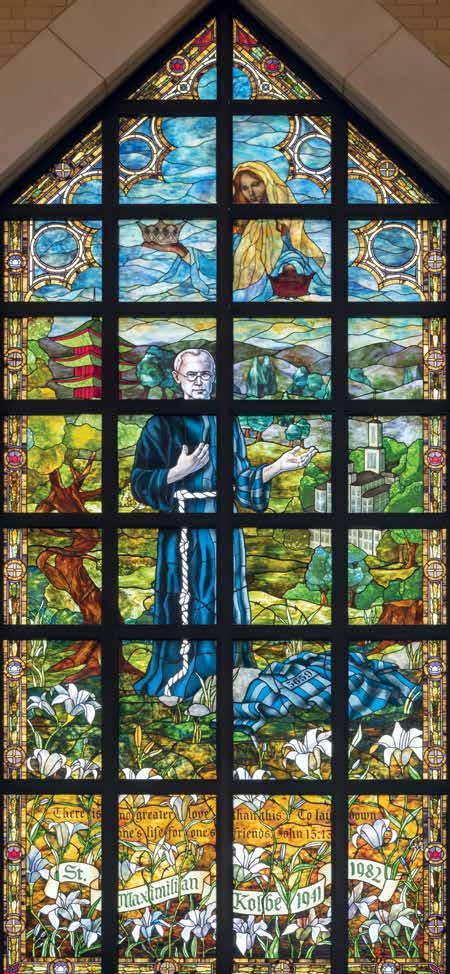
This stained glass window in the transept of St. Maximillian Kolbe Parish in Liberty Township illuminates the church. The window includes a collection of symbols illustrating events in his life including the following:
Virgin Mary
Kolbe had a childhood vision of the Mother of God holding two crowns, one representing purity and the other martyrdom. This vision is illustrated at the top of the window.
Japanese
Temple
Located in the upper left of the window, the temple represents the six years Kolbe lived in Nagasaki, Japan.
Niepokalanów
Polish for “City of the Immaculata,” Niepokalanów is a massive Fransiscan friary and publishing center founded by Kolbe in 1927. It is included on the right side.
Prison Uniform
Included at Kolbe's feet, the prison uniform represents his imprisonment at Auschwitz concentration camp, where he was martyred.
Corynne Staresinic is a writer and research fellow at the McGrath Institute for Church Life at the University of Notre Dame. She lives in Greater Cincinnati with her husband Nick and their children.






Erma’s House
A Place to Heal Relationships and Strengthen Families
BY SUSAN BERGMAN
Erma’s House is named after Dayton native Erma Bombeck, whose writing reflected both the beauty and complexity of family life.
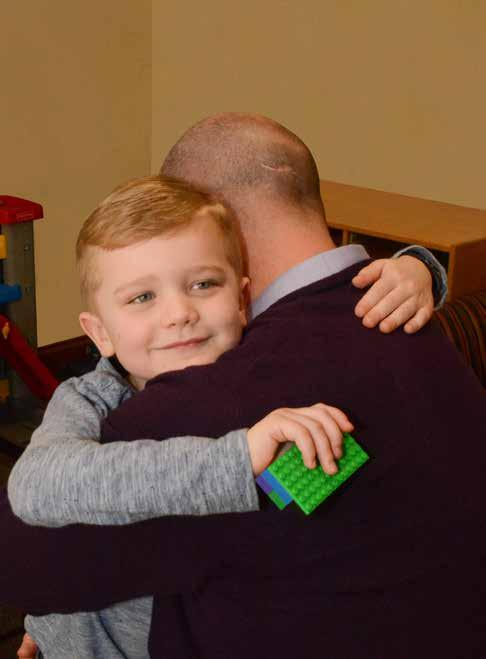
The work is rooted in a belief that family relationships, even strained ones, are worth nurturing with care and intention.
There is a quiet rhythm to Erma’s House. On the surface, the work appears simple... rooms are prepared, toys are rotated, and schedules are followed. Children arrive, visits take place, and families leave. Yet, behind that steady routine sits something much deeper.
Erma’s House in Dayton serves families navigating some of life’s most difficult circumstances, often shaped by conflict, instability, and uncertainty. For more than 28 years, it has provided supervised visitation and safe exchanges where children can spend time with their parents in a structured, supportive environment.
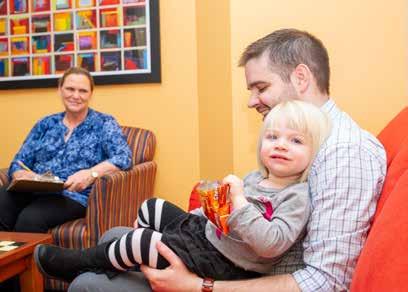
Each step is thoughtfully designed to reduce stress and protect everyone involved, with separate arrivals, staggered timing, and trained staff guiding interactions with consistency and care. Much of that structure occurs behind the scenes, so children experience something simpler: a welcoming space where they can begin to rebuild connection.
As Program Manager MaryPat Zengel explained, “We have to meet families where they are. Every situation is different, but the goal is always the same, to support the child and give that relationship a chance to grow.”
No two visits look the same. Some children arrive eager, while others are hesitant, unsure of what this visit will bring. Staff and volunteers are trained to recognize the mix of anxiety, confusion, and fear children commonly carry and to respond with patience and understanding.
Before visits begin, these supporters help each child settle in, walking through the space together or offering reassurance in a way the child can understand. Children receive a code word
to signal the monitor when they need a break or additional support. It is a small but meaningful reminder that, even in an unfamiliar situation, their voice still matters.
The purpose of Erma’s House extends beyond supervision, creating space for trust to grow over time. Zengel recalled when one father began visiting his young daughter after a separation, but she had no memory of him and was understandably hesitant. Rather than rush the process, he met her where she was, speaking gently and allowing the relationship to develop at her pace. With consistency, the visits changed. What started as distance gradually became comfort and connection. Over time, their visits were filled with play and laughter, and the man who had once been a stranger in her eyes became “Daddy.”
Much of that transformation is made possible through the steady presence of staff and volunteers. They create an environment that is calm, consistent, and free of judgment, where rules are applied fairly and parents are treated with dignity. This supportive role requires patience, strong boundaries, and a deep understanding of how trauma can affect a child.
As volunteer Theresa Ross Grant shared, the work calls for “a calm presence and a genuine care for the families,” a combination often as important as the structure itself. Volunteers undergo extensive training and remain with the same families over time, helping build trust that children can rely on.
Erma’s House is named after Dayton native Erma Bombeck, whose writing reflected both the beauty and complexity of family life. While the situations families face here are often heavy, the work is rooted in a belief that family relationships, even strained ones, are worth nurturing with care and intention. Bombeck’s words continue to resonate that mission: “When I stand before God at the end of my life, I would hope that I would not have a single bit of talent left, and could say, ‘I used everything you gave me.’”
As part of Catholic Social Services of the Miami Valley, Erma’s House reflects a broader commitment to protecting children and strengthening families. “I can see directly the impact our center has on families, and it fills my cup,” Zengel said.
The need for these services continues to grow—there is a waitlist for families seeking support. Even so, the focus remains the same. Each visit is an opportunity to provide stability, support connection, and offer a sense of peace in situations that often feel anything but peaceful.
At its core, the work of Erma’s House echoes a belief deeply rooted in the Catholic faith: the strength of the family nucleus is not defined by perfection but by a commitment to love, even in difficult circumstances. By creating a space where children feel safe and relationships can be rebuilt, what was once lost can be restored. ✦
CHURCH FATHERS | Father Jacob Lindle
The Ancient Providers and Protectors of God’s Family
Then God said, “Let us make man in our image, after our likeness…” So God created man in his own image, in the image of God he created him; male and female he created them (Gn 1:26-27).
What does it mean to be made in the image of the God who speaks in the first-person plural? Why does God say, “Let us make man in our image, after our likeness”? For a long time, the answer wasn’t clear. Other religions claimed that there were many gods, but that can’t be: there is only one God. Day after day, Israel was told, The Lord our God is one Lord (Dt 6:4). We’ll have to wait to see the entire answer to our question, but one thing is clear: if we are made in the image of that one God, we are called to show forth the unity of this God to the world.
A quick look at human history, however, shows that we haven’t done such a good job. Sin, death, and division have marked our lives ever since the Garden. What’s the solution to this predicament? Should we try to gather ourselves together to show that we can be united as God? Well, no. We tried that first in a little town called Babel, and things didn’t go so well (see Genesis 11). If we try to achieve unity on our own, we end up with more division.
So, how does God bring unity? First, God gathered a family named Israel, and in the fullness of time, God opened this family to all, in the Church. Unlike the confusion of Babel, the Church born at Pentecost offers a God-given, definitive bond of unity to the world (Acts 2:1-12). We who have been born into the brokenness of Adam’s family must be reborn into the
unity of God’s family. How are we reborn? Jesus told us right before He ascended (Mt 28:19), and Peter echoed his Lord on Pentecost (Acts 2:38): we must be baptized in the name of the Father, and of the Son, and of the Holy Spirit. And here, we finally have our answer to the God who speaks in the plural. We are made in the image of the One Who is Three.
Sadly, not everyone baptized into God’s family has lived out this unity. As we saw last month, Arius caused serious division in the Church when he taught that the Son was created. Bishops met at the Council of Nicaea in 325 to reunite God’s family in the true faith, and Athanasius spent the rest of his days fighting for the eternal union of Father and Son.
Unfortunately, the division continued, and throughout the fourth century, many bishops and imperial leaders tried to achieve peace on their own through compromised positions. Nicaea was a little radical, they thought: can’t we all just meet in another synod and make everyone happy? But this isn’t how saints think. Saints want unity, but they want the unity that comes from God and in God.
Thanks be to God, many theologians stood up to fight for true unity, and the three which stood tallest were Basil of Caesarea, Gregory Nazianzen, and Gregory of Nyssa. Basil and Nyssa were brothers, and Basil and Nazianzen were best friends. These three men (later called the Cappadocian Fathers) spoke, wrote, and lived the true unity of God.
Basil in particular promoted unity in his heroic dedication to the poor and communal monasticism, but all three were united in their common mission. Against a heretic named
THE CAPPADOCIAN FATHERS
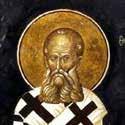
Eunomius, who divided God even more harshly than Arius, the Cappadocian Fathers insisted on the fundamental unity of God. Between the Creator and creatures, they insisted, there is an essential divide. The Creator is totally distinct from creatures. Since the Father does not create alone but through the Son and in the Holy Spirit (Let us make man…), the Son and Spirit are not creatures but truly God. These arguments culminated in another family meeting, the Council of Constantinople in 381, which reaffirmed Nicaea’s teaching on the unity of Father and Son and further proclaimed the divinity of the Holy Spirit as the Lord, the Giver of Life, Whom we should adore and glorify.
The Cappadocian Fathers settled on the terms that we will forever use to speak about God: God is one Nature and three Persons. Nature answers the question “what?” and Person answers the question “who?” What is God? One divine Nature—uncreated and perfect. Who is God? Father, Son, and Spirit—three distinct Persons fully sharing the one divine Nature. The Father is neither the Son nor the Spirit, and the Son is not the Spirit; but the Father is fully God, the Son is fully God, and the Spirit is fully God in an ineffable exchange of divine Life, Light, and Love.
Our language fails here, but our inability to grasp is a neverending invitation into the Mystery. In the beginning, we were made in the image of this triune God. Even after we distorted our likeness, God called us back to communion through baptism, which superabundantly restores the unity that we lost. When we were baptized, we became God’s children, and we became members of God’s family. Now, may we become who we are. ✦
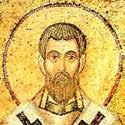
Fr. Jacob Lindle, ordained a priest for the Archdiocese of Cincinnati in May 2022, is presently studying for a Doctorate in Patristic Theology at the Pontifical Gregorian University in Rome.
FURTHER READING
St. Basil the Great, On the Holy Spirit (Popular Patristics, St. Vladimir’s Seminary Press, 2011)
St. Gregory Nazianzen, On God and Christ (Popular Patristics, St. Vladimir’s Seminary Press, 2002)
St. Gregory of Nyssa, The Life of Moses (Classics of Western Spirituality, Paulist Press, 1978)
Frank J. Sheed, Theology for Beginners (Angelico Press, 2013)
Lewis Ayres, Nicaea and its Legacy (Oxford University Press, 2006)
Thomas Joseph White, The Trinity (The Catholic University of America Press, 2022)
ST. BASIL THE GREAT
ST. GREGORY NAZIANZEN
ST. GREGORY OF NYSSA
The Saintly Seven: Black Catholics on the Path to Sainthood
Venerable Fr. Augustus Tolton 1854–1897
THE FIRST RECOGNIZED BLACK CATHOLIC PRIEST IN AMERICA
BY ESPERANZA GALLON
As we continue learning about the Saintly Seven, we are enlightened and encouraged by their examples. Venerable Augustus Tolton's extraordinary life gives hope to the faithful amid serious societal trials.
Fr. Tolton’s life is a “rags-to-riches” story, albeit not in the classic way. While born into slavery and without financial wealth, he was rich in spirit—which enabled him to face and overcome many obstacles rooted in racism. His great faith uplifted all who were open to receiving God's love. Though he never accumulated financial wealth, he died a spiritually wealthy man, leaving a powerful legacy of service and faith that is still felt today.
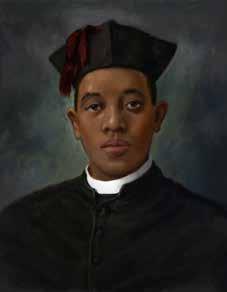
Encouraged by his mother from a young age, he demonstrated a caring spirit and often prayed for his community. His appetite for God and studiousness at a young age attracted the attention of his mentors, who guided him on the path to become America’s first Black diocesan priest.
Fr. Tolton served his community with his whole heart; despite harsh experiences from members of the Church and surrounding community. He was a trailblazer, not only opening the door for black priests who came after him, but also providing a guide for all of us on how to live out our faith in the face of hostility.
BACKGROUND
Martha Jane Tolton and Peter Paul Tolton were enslaved when they met on neighboring plantations. On April 1, 1854, in Brush Creek, Missouri, Martha gave birth to a bright-eyed boy named Augustine John Tolton, also called Augustus. Born into slavery, he was baptized into the Catholic faith and
encouraged by his mother, who was also a “cradle Catholic.”
In 1862, Martha Jane escaped with Augustus, then about eight years old, and his two siblings to Quincy, Illinois, where they could live as free people. Although the family’s slavery status changed, mistreatment persisted. When Augustus enrolled in St. Boniface School, he was forced to leave only a month later due to threats from both parish members and staff. Several years later, he enrolled in St. Peter’s Catholic School and was successfully supported by Irish priest Fr. Peter McGirr to finish his schooling.
Many observed that young Augustus had a grace for serving his community. He was often found in prayer between work and school, and as a teenager, he taught religion classes to black children in Quincy. Graduating from St. Peter’s in 1872 at the age of 18, he prepared for seminary and college.
FROM SLAVE TO PRIEST
In 1878, Augustus started at St. Francis College (Quincy University today) and excelled so much beyond his peers that he received separate instruction. Due to racism, however, when he attempted to enroll in seminary, none would accept him.
With Fr. McGirr’s support, he went to Rome and was accepted into the Collegium Urbanum de Propaganda Fide seminary, returning to the United States in 1886— on assignment as the first Black diocesan priest. He was told he would not succeed as a black priest, and Cardinal Giovanni Simeoni in Rome, who supported Fr. Tolton, said, “America has been called the most enlightened nation; we'll see if it deserves that honor. If America has never seen a black priest, it has to see one now!”
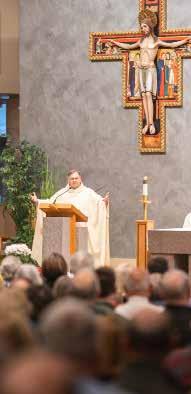
YOU ARE INVITED
Please join Archbishop Robert G. Casey and members of the faithful at
Evening Prayer for the Convocation of Synod 2027
on the occasion of the 205th Anniversary of the Founding of the Archdiocese of Cincinnati
Friday, June 19, 2026
7:00pm | St. Francis of Assisi Church 6245 Wilmington Pike, Centerville, Ohio 45459 Reception to follow | RSVP not required
Likely gaining a new appreciation for the Scripture that states Jesus could not perform many miracles in his hometown (cf. Mt 13:58), the newly ordained Fr. Tolton endured persistent racism to such an extent when assigned first to his home parish in Quincy that he was eventually reassigned in Chicago. At his new assignment, he founded St. Monica Church, the first African American Catholic parish in Chicago. He continued to experience racism but remained faithful to the Gospel. Fr. Tolton served at St. Monica and traveled to other parishes sharing the Good News until his death from heatstroke in 1897, at the age of 43.
His journey to recognized sainthood began in 2010 when it was announced that his cause for canonization could commence. In 2019, the Cardinals assigned to the Congregation for the Causes of Saints voted that he had lived a life of service to God, which promoted him to the status of Venerable Fr. Augustus Tolton. He was acknowledged to have maintained the virtues of faith, hope, charity, prudence, justice, fortitude, and temperance throughout his lifetime. The work continues, researching and documenting miracles attributed to prayer through Fr. Tolton’s intercession. This is the next step toward declared sainthood! ✦
Esperanza Gallon is a member of the archdiocese Anti-Racism Task Force and a parishioner at St. Clare Church, part of the Our Lady of Divine Providence Family of Parishes.
FURTHER READING
Most Reverend Joseph N. Perry. Biography – Augustus Tolton. Augustus Tolton. https://tolton.archchicago.org/ about/biography
UPCOMING EVENTS
Mass Honoring Fr. Tolton: Sunday, June 28, 10 a.m., at Church of the Resurrection: 1619 California Ave., Cincinnati. Mass celebrated by the Most Rev. Joseph N. Perry, Auxiliary Bishop of Chicago.
Formal Presentation on Fr. Tolton’s life: Monday, June 29, 7–8:30 p.m., at St. Andrew Church: 552 Main Street, Milford. Guest speaker will be Most Rev. Joseph N. Perry, vice postulator for the sainthood cause of Venerable Fr. Augustus Tolton.

Up to date Saintly Seven Series information

Scan for June 29 presentation livestream
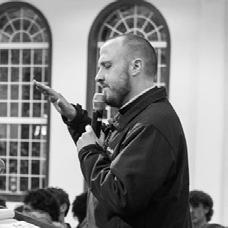
Catholic Athletes for Christ grows presence in archdiocese
BY JOHN STEGEMAN
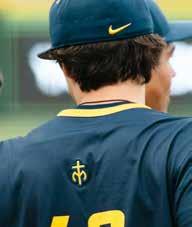
Catholic Athletes for Christ (CAC), a national organization serving professional and amateur athletes, is expanding its presence in the Archdiocese of Cincinnati through a new, local missionary focused on helping student-athletes and staff put faith at the center of competition.
Based out of Dayton, Mike Hoendorf is the new Midwest Region Sports Missionary and Director of Strategic Development, a new position created by CAC that Hoendorf started at in February 2025.
“The goal for this position is to be a resource for every athlete, coach, parent, athletic office, or anyone associated with sports in this region, to better connect their faith with athletics,” Hoendorf said. “Through meaningful events, relationships, and faith-focused programs, we look to bring Christ back to the center of athletics.”
Already known for organizing Masses for MLB and NFL players and staff on game days, CAC also operates the “Cathlete Program,” a club-based approach for high school student-athletes at
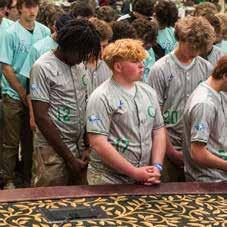
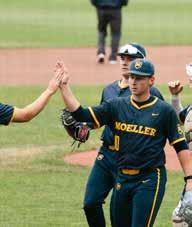

Catholic schools. Trenton, New Jersey, is among a few dioceses to adopt Cathlete on a diocesan-wide level, but nationally, it is primarily a school-by-school operation. Not yet in Ohio schools, Hoendorf is in talks with some local schools to adopt it or a similar program.
Though CAC is new to the area, Hoendorf has made inroads. The highest profile event on the local level is the Catholic Baseball Showcase, which hosted its third annual event in March.
Played in Xenia, the showcase features top Catholic high school baseball teams from the archdiocese and around Ohio, as well as a welcome dinner and keynote speaker who talks about faith and athletics. This year’s speaker was retired minor league pitcher J.J. Niekro, son of former Houston Astros’ Joe Niekro and nephew of the famous knuckleballer Phil Niekro. J.J. shared his life story and spoke about how deeply faith shaped the lives of both his father and uncle, as well as his own career.
In addition to the dinner, the showcase features Mass, confession, and adoration. This year’s showcase featured eight teams, including local schools Chaminade Julienne, Badin, McNicholas, and St. Xavier, along with schools outside the archdiocese: Archbishop Hoban, Walsh Jesuit, Lakewood St. Edward, and Toledo St. Francis de Sales.
“Many kids are pulled in because they get to play in a premier baseball event,” Hoendorf said. “I think we had 30 or 35 pre-season all-state players playing in that one weekend. One game had 12 pro scouts sitting in the stands. So, these kids are excited to play in the event, some of them just because of baseball. But once we get them there, most of the time the feedback is not about baseball. [Players, parents and coaches] say things like, ‘Man, did you hear J.J.’s story? Wow. How impactful is that?’ Or ‘I loved the opportunity to go to adoration last night.’ So that ends up being how we draw them in.”
In addition to organizing opportunities for the sacraments, CAC also supports local teams by hosting team retreats. These retreats help teams come together, building camraderie and trust. CAC hosted a pre-season retreat for Chaminade Julienne's girls and boys basketball teams. It was a great start to the season, and then the girls team went on to win the state championship.
“I thought the retreat rooted us so we could grow,” said Chaminade Julienne girls basketball head coach, Logan Allen. “Our team had a lot of newcomers—a lot of young players in important roles—but we also had a lot of established experience with not a lot of middle ground. So, it was important for us to find roots and commonality that we could always revert back to when times inevitably got tough.”
Hoendorf would like to see more high schools and teams take advantage of similar opportunities with CAC.
“The question is, how do we start to make this something where a coach is sitting there saying, ‘I know I want this. I know it's important for my team, but I don't know how to do it. Let me engage with the organization,’” Hoendorf said. “If you're interested in sports, if you're interested in how to bring faith into sports, CAC is a great partner in that, from an individual all the way through an entire school or entire team.”
Hoendorf also launched the Virtuous Athlete podcast, where he talks to local and national guests about the importance of their Catholic faith in sports. Featured guests included San Diego Padres Manager Craig Stammen and Chicago White Sox Catcher Drew Romo. The podcast can be found at VirtuousAthlete.com or on Spotify.
As the organization builds its presence locally, Hoendorf sees an opportunity to form athletes in a way that lasts longer than any final score. ✦
SATURDAY, SEPTEMBER 5 TH REDS VS BREWERS | 6:40 PM
Celebrating inspiring individuals from both the Archdiocese of Cincinnati and Diocese of Covington who put LOVE INTO ACTION
SCAN TO PURCHASE DISCOUNTED TICKETS

Spousal and Redemptive Love
CHRISTIAN ANTHROPOLOGY | Andrew J. Sodergren, M.T.S., Psy.D.
Note: This article is part of an ongoing series on Pope St. John Paul II’s “Theology of the Body (TOB).”
From the beginning, God gave us marriage not only for the good of spouses sharing this life together but also as a sign of the intimate union God Himself desires to have with each of us. God created the human race to share in His divine life. He wants us to be intimately united with Him for all eternity, so that we can participate in His infinite perfection, infinite joy, infinite love. He gave us marriage as an efficacious sign (i.e., a “sacrament”) of this incredible plan to unite Himself with us as intimately as a husband who lovingly unites himself with his bride in marriage.
This spousal analogy for God’s relationship with His people appears repeatedly in the pages of Scripture and comes to a crescendo in Ephesians 5, which portrays Christ as the Bridegroom and the Church as the Bride for whom He has given Himself completely on the Cross to redeem and sanctify.
In his meditations on this passage, Pope St. John Paul II saw that Christ’s spousal love for the Church moved Him to suffer and die for us so that our sins may be forgiven. This interweaving of spousal and redemptive love demonstrates how marriage is the central form or figure for God’s plan to save us, which includes the seven sacraments of the Church He gave us as channels of sanctifying grace.
In addition to being one of the seven sacraments, John Paul II wrote of how “marriage constitutes … the figure” upon which the whole “sacramental order is built” because the latter “springs from the spousal gracing that the Church receives from Christ” her bridegroom (98.2). This means that “all the sacraments of the New Covenant find their prototype in some way in marriage” (98.2).
For example, St. John Paul II saw an allusion to baptism in Eph 5:26 when it refers to Christ cleansing His bride “by the washing of the water with the word” (99.1). He further saw St. Paul’s words about the husband nourishing and cherishing his wife in Eph 5:29 as an allusion to the
Eucharist (99.1). Thus, all of the sacraments have a spousal character and origin.
Christ’s spousal love for us is also a saving, redemptive love. It is both a love of union (i.e., wanting to be united with the beloved like spouses in marriage) as well as a love that calls forth action, change, and growth. His spousal, redemptive love calls us to repentance and holiness of life. Through the Sacrament of Marriage, Christian spouses participate in Christ’s love for the Church. Therefore, St. John Paul II taught that our marital love must be based on this model. The love of Christian spouses, then, must also be a love grounded in redemption, self-sacrifice, mercy, and the sanctifying work of the Holy Spirit. Christian spouses are called to let Christ’s love for the Church penetrate and purify their love, strengthening their union and transforming their hearts.
Thus, Christian marriage is not only meant to be a source of natural consolation but a sacrament that calls us to holiness. According to St. John Paul II, the Sacrament of Marriage is given to us both as a grace and a life task; it is where “eros and ethos” interpenetrate in the heart of man and woman (101.3). He saw Christian marriage as “an exhortation to gain mastery over concupiscence” (101.1) and the fruit of this mastery as unity, indissolubility, and a deepened sense of one another’s dignity.
Even for the unmarried, John Paul II held up the Sacrament of Marriage as a reminder that Christ “assigns the dignity of every woman as a task to every man … and the dignity of every man to every woman” (100.6) and that all “are called to chastity” (101.4). Through the grace of Christ’s redemption, we can and should hope to “master the concupiscence of the flesh” such that the communion of persons in marriage— including bodily communion—is lived in a truly dignified manner, “a manner worthy of persons” rather than for mere “egotistical satisfaction” (101.4).
In this way, fervently cooperating with “the grace of the sacrament of marriage”—which has its roots in Christ’s spousal and redemptive love—can enable “man and woman to find the true freedom of the gift together with the awareness of the spousal meaning of the body” (101.5). ✦
St. Francis Seraph & The Franciscan Friars
INVITE YOU TO A HOMECOMING MASS MARKING THE CLOSING OF THE CHURCH AND FRIARY
June 21, 2026 10am Mass
ARCHBISHOP
Celebrating our 166 years as the heart of Over-the-Rhine
ROBERT G CASEY PRESIDING
LIGHT RECEPTION TO FOLLOW
All Are Welcome


The Madonna of Humility
DIVINE SEEING
| Dr. Cecelia Dorger
A GUIDE TO VISIO DIVINA
Invite the Holy Spirit to enlighten your experience as you gaze at the painting. Notice what thoughts and emotions enter your heart and mind. Be still. Pray with the image as you are led.
BACKGROUND
From the seat opposite me in the confessional, the priest said, “For your penance, look up Ephesians 3:18-19 and contemplate God’s love for you.”
“And I pray that you … grasp how wide and long and high and deep is the love of Christ, and to know this love that surpasses knowledge.”
The sin I confessed? Pride. C. S. Lewis wrote, “It is pride which has been the chief cause of misery in every nation and every family since the world began” (Mere Christianity, 109).
Pride was the serpent's tool to entice our first parents in the Garden of Eden in Genesis 3. The devil undermined God’s authority, planting doubt in Eve about God’s truthfulness and reliability. In a few cunning phrases, the “proud spirit” enticed Eve to “Edge God Out,” and the ego took over. The desire to become God-like overcame Adam and Eve in that catastrophic fall, plunging the human race into spiritual ruin. The desire to exalt oneself, the appeal of autonomy, took root in that garden. The devil must have thought, “That was easy.” And he has used that tool continually down through the ages. As Lewis wrote, “It was through pride that the devil became the devil: Pride leads to every other vice: it is the complete anti-God state of mind” (Mere Christianity, 109, 111).
The virtue opposite of pride is humility; thus, the Madonna of Humility became a popular Madonna theme in the 14th and 15th centuries across Europe. There are countless examples of this Madonna-type, distinguished by Mary’s lowly position, seated on the ground as she cradles the Christ Child. But the
Contemplating God’s bottomless love for us is the antidote to counteract the prowling devil’s poisonous pride scheme.
greatest example of humility in history is the Incarnation of Jesus, the enormously humble act of God becoming a human. The Incarnation was made possible through Mary, the “New Eve” when she said yes to God’s request to be the mother of the Savior. Mary’s yes supplanted Eve’s no.
ENTER IN
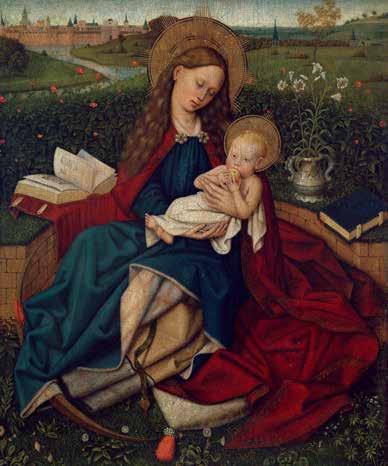
In our Madonna painting from the Getty Museum by an unnamed follower of Robert Campin, Mary sits on the ground in a garden, surrounded by symbols of her role as the New Eve. On her lap, Jesus eats an apple—a reference to Original Sin and His future sacrificial conquering of sin. The open and closed books symbolize the Old and New Testaments. Mary’s sinlessness is emphasized by the white lilies. Being seated on the ground is a reference to Adam, as Adamah is the Hebrew word for ground, soil, earth—used in biblical language to indicate the earth as a source of life: “Then the Lord God formed a man from the dust of the ground” (Gn 2:7).
In this Netherlandish painting, Mary sits in a niche, walled off and apart from the city in the distance, protecting us from our propensity to grasp at the vanities of the world. At the hem of her skirts is a crescent moon, representative of the Woman of the Apocalypse described in the Book of Revelation: “A woman clothed with the sun, with a moon under her feet” (Rev 12:1).
The paradox of a gentle mother cradling her baby and the powerful woman of the Apocalypse is precisely what Mary embodies. Her humility gives her strength.
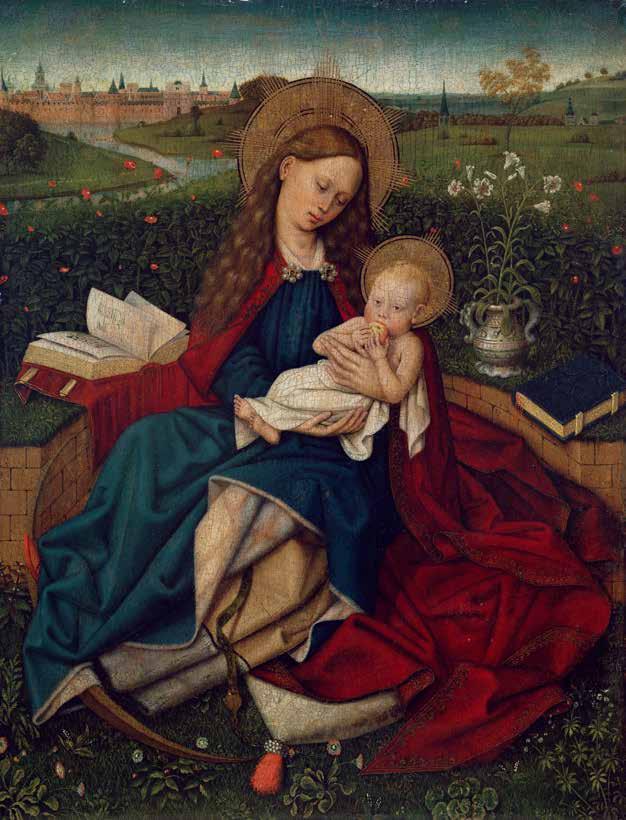
The Madonna of Humility depicts the Virgin Mary sitting on the ground or a low cushion, rather than a throne. It emphasizes her role as a humble, relatable mother nursing the Christ child. Many artists have created similar works, but depictions of the Madonna of Humility were particularly popular in Italy and Flanders during the 14th and 15th centuries.
City
Mary sits apart from the city in the distance, protecting us from the vanities of the world.
Garden
Mary sits on the ground surrounded by plants in a garden, alluding to both her humility and role as the New Eve.
Moon
At the hem of Mary's skirts is a crescent moon, representative of the Woman of the Apocalypse described in the Book of Revelation.
REFLECTION
St. Augustine wrote that Mary's humility was a requisite for being the Mother of the Incarnate Son of God: “Mary’s humility certainly became the Heavenly ladder by which God descended to earth” (quoted by Meiss in “The Madonna of Humility,” The Art Bulletin 18, 461). And she exemplifies tremendous humility when the Holy Spirit fills her kinswoman Elizabeth to recognize that Mary is carrying the Savior and Mary responds:
“My soul proclaims the greatness of the Lord; my spirit rejoices in God my Savior. For He has looked upon His handmaid’s lowliness; behold, from now on all ages will call me blessed. The Mighty One has done great things for me, and holy is His name. His mercy is from age to age for those who fear him.”—Luke 1: 46–50
This gorgeous poetry is part of Mary’s longest speech in Scripture, and it is remarkably telling. By giving all the glory to God, by emptying herself and surrendering to God’s will, Mary becomes the Queen of Heaven and Earth.
The Incarnation and Mary’s role in it are wrapped in love.
Pure Lilies
Mary's sinlessness is emphasized by the inclusion of a vase of white lilies.
Apple and Child
Jesus eats an apple—a reference to Original Sin and His future sacrificial conquering of sin.
“For God so loved the world that He gave his only Son so that everyone who believes in Him might not perish but might have eternal life.”—John 3:16
Contemplating God’s bottomless love for us is the antidote to counteract the prowling devil’s poisonous pride scheme. That is what Father had in mind as he sent me from the confessional. God’s love surpasses the hollowness of self-love every time. ✦
FOR FURTHER EXPLORATION
C.S. Lewis, Mere Christianity. New York: Simon & Schuster Touchstone edition, 1996.
Millard Meiss, “The Madonna of Humility,” The Art Bulletin 18, no. 4. (December 1936): 435-465.
Thomas A. Tarrants, III, D. Min., “Pride and Humility,” Knowing & Doing. (Winter, 2011): 1-6.
Humbly Believing Leads to Peace
CATHOLIC AT HOME |
Katie Sciba
My dad passed away almost 13 years ago. The raw impact has dulled from time, but the reality that someone so essential is gone remains a painfully unflinching reality. My oldest son vaguely remembers him, but to my four other children, Pop Pop is a character in beloved stories from my childhood.
Because I want his memory to be as alive as possible, I flood the kids with stories of my dad, so he lives as a legend in their minds. From every account of him narrowly escaping death (a time or two), and surprising me with trips to the zoo, to taking me to buy my first car, my dad became a man my children were gleefully desperate to know. When my son Peter was four, he sweetly asked, “Where is Pop Pop now?”
I told Pete the truth: I don’t know.
THAT'S WHY WE PRAY
I seriously doubt that my father is in hell—perish the thought—and though I hope so much that he’s in heaven among Christ, the angels, and saints, I don’t know that for certain either. We’re all familiar with Purgatory, and my family frequently prays for the poor souls there, often mentioning my dad “just in case.” Truly, it is only God who sees the fullness of a man’s heart in death, and it is only God Who knows where the soul goes.
Peter asked how long Pop Pop would have to wait if, indeed, he is in Purgatory. “When will Jesus say he’s done?” he asked me innocently.
“I’m not sure,” I said, taking his hand. “That’s why we pray for Pop Pop, so the Lord will bring him to heaven. We pray for the souls in Purgatory and then they go to be with the Lord. If Pop Pop is already there, then Jesus takes our prayers and does something else with them.”
MAYBE THAT'S HOW IT WORKS
Peter furrowed his brow in childlike curiosity, “Can I pray for Pop Pop to get out?”
“Of course!” I smiled. “We do it all the time.” Pete shut his eyes tight not a second later and squeezed my hand as hard as he could. Then, opening his eyes slowly, he beamed
so beautifully at me, as though he knew something I didn’t. “I did it. He’s out.”
I laughed in surprise at my son’s innocent frankness and opened my mouth to let out a “It doesn’t work quite like that…” but I stopped myself. Doesn’t it work like that? Why wouldn’t it? I had just told my inquiring child that when we persistently pray for those in Purgatory, they are released and united to the Lord. He prayed, he’s been praying, and now he’s sure the grandfather so dear to him beholds the Face of God. His childlike faith revealed humility in a way I hadn’t grasped until that point: God is Who He says He is. If He reveals that prayer furthers a soul’s progress through Purgatory, who am I to say otherwise? Who am I to live as though it’s not true?
FIND PEACE IN TRUSTING
What is it about adulthood that causes us to doubt the truths we learn in our youth? Even after teaching Peter that prayer will aid the Church Suffering in Purgatory, why is it still hard for me to believe that my dad could be in heaven? I suspect that at some point in our lives, our sense of trust begins to crack, and divine revelations that call for faith become harder for us to swallow. Maybe, questions aren’t answered to our satisfaction or some kind of hurt leaves us asking why.
What remains real and constant among our doubts or hesitations is the fact that the Lord waits. He wants us to ask the unbelievable and the impossible from Him. He wants us to believe what He says and Who He is. From faith comes certainty, and from trust in the words of Christ, peace is born. During this month of the Sacred Heart, let go of your hesitations and doubts, yielding to the One Who is all goodness and love. ✦
“Do not let your hearts be troubled; you believe in God, believe also in me.”
JOHN 14:1
COLDWATER'S Knights & Squires
BY MATT HESS
Celebrated annually on the third Sunday of June, Father’s Day is a time when many reflect on the influence of their dad or father figure in their life. Many Catholic families associate their father leading their family in the faith with Christ’s self-sacrificing love.
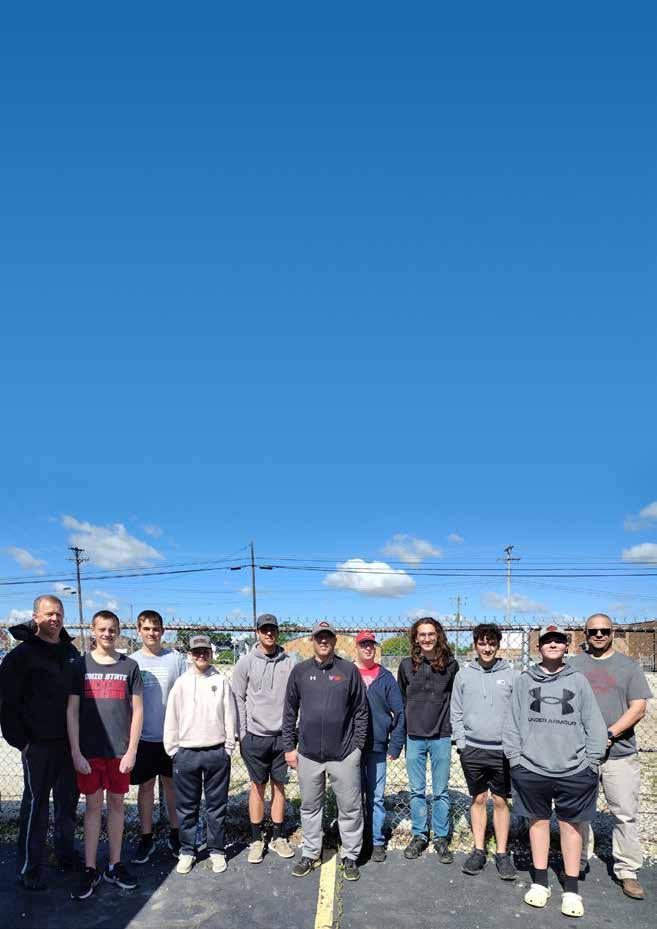
In Coldwater, Ohio, the Knights of Columbus Council 1991 is made of many fathers, who support both the local churches and community at large. They also pass on the faith to the next generation through their collaboration with the Holy Trinity Squires Circle, a group of young men in middle and high school who work to cultivate faith through their prayer, fraternity, and service. Members are from the Holy Cross Family of Parishes, with the majority hailing from Holy Trinity, St. Mary, and St. Anthony.
ESTO DIGNUS
“Parents frequently express appreciation for how the Squires get their sons involved in parish life alongside peers,” said Scott Gels, who leads the Squire program that came under the parish’s auspices in 2018.
The Squires and Knights have a mutually beneficial relationship: the youth help with events and drives, and the Knights help fill the Squires' councilor positions.
Gels exemplifies how the two programs work together and can be generational. His father, Ralph, was involved with the Knights for over fifty years and led the Squires for decades. Scott grew up as a Squire and leads them today, while also active with the Knights.

“My nephews and my son were Squires,” Gels shared, “and now that my children are grown, I understand the joy my father felt watching these young men develop.”
One of the Knights and Squires’ longeststanding collaborative projects is operating the Sugar Waffles Stand at the K of C and Coldwater Community Picnics. “For at least 50 years, we have made what many consider the best sugar waffles,” said Gels. “People travel for hours to get them.” The Knights fry the waffles as the Squires help bag and sell them. Each year, the recipe and technique are passed down to a new generation.
Every autumn, the Squires and Knights assist at a local corn maze to raise money for the Mercer County Cancer Association. The Squires also gather and load boxes of clothing for a semi-annual clothing drive to help the needy in Dayton, and they hand out water to runners during the Knight’s 5k Run for Vocations race. Both groups are on hand for a number of other events that provide spiritual and material assistance to the parish and community.
The Catholic faith of these fathers and sons lies behind all these good works. Gels believes “the Knights model leadership and faith, showing the boys what it looks like to live their faith both inside and outside the Church.”
Many Squires are altar servers in their local parishes and active in a youth group. With a nod to our Blessed Mother, Gels said, “Every October on Wednesday nights, the Squires will lead the Rosary, [and] 15–20 boys typically attend, with the Chief Squire announcing the mysteries.” The Holy Trinity Squires can boast at least one recent vocation to the priesthood, with another former Squire in seminary formation now.
The relationship between the Knights of Columbus and Holy Trinity Squires has borne fruit in many valuable ways, including the leadership skills passed on through the partnership that plays out in work and family life, building up the domestic church.
“Many former Squires have gone on to meaningful roles in the community and in the workforce,” stated Gels.
From the ranks of the Squires, there have risen many self-sacrificing members of the Coldwater community. Today, they are educators, members of the local government, health care workers, high school sports coaches, and more. Many Squires join the Knights after high school—for decades, a healthy Squires program has helped build a strong K of C Council in Coldwater. Most importantly, these Squires go on to become loving husbands and fathers.
The annual observance of Father’s Day enables us to reflect on the men who helped form each of us in our youth. For the Catholics in Coldwater, it is easy when looking at the Knights and Squires to see how strong values and faith can be lived out and passed down. ✦

FESTIVAL GUIDE

Encounter School of Ministry: Making Disciple-Makers

BY DEACON RUSS FELDKAMP
“Go therefore and make disciples of all nations, baptizing them in the name of the Father and the Son, and of the Holy Spirit”
MT 28:19
Jesus gave His disciples this commission just before ascending into heaven. Scripture and the Catechism of the Catholic Church (CCC, nos. 849-852) teach that we are the living perpetuation of this original commission as ambassadors and evangelists. In this article, I discuss how we’ve been equipped to be great evangelists, some reasons why we’re not as effective as we could be, and an antidote.
Should we all be enthusiastic and effective evangelists?
Yes! Jesus cast the mold for us in Luke 3:21-22: “Jesus had also been baptized and was praying, the heaven was opened, and the Holy Spirit descended upon him in bodily form, as a dove, and a voice came from heaven, ‘You are my beloved Son; with you I am well pleased.’”
Four key things happened in this Gospel; Jesus was baptized, heaven was opened, the Holy Spirit descended with power, and Jesus received His identity statement. Immediately after His baptism, Jesus began His public ministry empowered by the Holy Spirit.
What happened on the day of our baptism? We were baptized, emerged from the font under the same open heaven Jesus did, were empowered by the Holy Spirit, and received our identity statement. You and I are beloved, chosen, empowered, and adopted children of the Father. In baptism, we received the same gifts from the Father that Jesus did, so we could go forth and make disciples of all the nations just as Jesus did! We have what it takes.
Why are some of us not enthusiastic or effective evangelists?
I’ll narrow the many reasons to two key obstacles: many of us don’t know who we are, and we are reluctant or unable to tap into the power the Holy Spirit gave us at baptism and confirmation. First, the Father loves us, and not because of what we do but because of who we are as His children. Once we live from that perspective, we shift from operating out of a slave mentality to operating out of a family relationship rooted in gratitude. Personally, I became much more resilient and effective in every area of life once I began to live as a son of God the Father.
Second, most of us have a limited engagement with the Holy Spirit and don’t actively seek opportunities for the responsible use of the Holy Spirit’s gifts for evangelization— and I’m talking about the spiritual gifts in 1 Cor 12 that are specifically bestowed for the building up of the Church. Our efforts to evangelize and make disciples would benefit greatly from effective mentoring in how to access the spiritual gifts given to us at baptism.
The Antidote: Making disciple-makers
In 2018, Encounter Ministries USA, a global teaching apostolate headquartered in Brighton, Michigan, invited a small team I was part of to open their first satellite campus. Our mission was and is to “teach, equip and activate disciples to demonstrate the love of God through the power of the Holy Spirit in their spheres of influence.” The Cincinnati campus opened in 2019. Our primary work is the Encounter School of Ministry, an eight-quarter school of evangelization. We also run weekend conferences on Identity, Physical Healing and on Hearing the Voice of God (prophecy). And we offer free public events like our Transformation Nights and praise nights to bring the power of the Gospel into our community.


Jesus is alive and active in His Church, and what the students in our school and participants in our events experience is the Lord’s continuing desire to bring healing, restoration, and renewal.
One graduate shared what happened when he partnered with Jesus in prayer at an Encounter event:

“Growing up Catholic, I believed, in theory, [that] God hears all my prayers and, in theory, will occasionally answer prayers for healing. At the very first Encounter Ministries event I attended, I prayed with a woman on crutches in severe pain who had broken her foot and was in a walking boot. Without crutches or a boot, she left the event walking under her own power and pain free. At that moment, I heard Jesus speak right to my heart: ‘So Chris, do you still think this is all just theory?’” —Chris Stier
Our ministry is not focused on miracles, though we know their value in breaking through doubt and making the Gospel come alive for believers. It is about preparing normal, relatable Christians to experience a full life in Christ and exercise all the ministry they were baptized into. It’s about preparing disciples to make disciples, starting in our own homes:

“Encounter School of Ministry deeply impacted my life, but the greatest fruit has been my family. What I learned created a ripple effect in our home, especially for our daughter. At six years old, she began learning how to hear the Father’s voice and pray for others with me every day. Now at nine, she boldly shares Jesus with her friends. Watching her faith grow has been beautiful and reminds me how powerful it is when children are formed in Christ.” —Jessica Pellingra
Our flagship “come and see” event is our four-night Summer Intensive, where each night covers one quarter of the first year of “our school”: Identity as a Child of God, Prophecy, Physical Healing, and Inner Healing. Even if this isn’t the right season for you to consider the school, come to the Intensive from 6–9 p.m., July 20–23 at Our Lady of the Holy Spirit Center in Norwood. I’m confident you’ll have a life-changing encounter with the Lord and leave with powerful tools for sharing the Gospel. ✦
Deacon Russ Feldkamp is the director of Encounter Ministries of SW Ohio and EM Cincinnati School.

PRAISE TEACH EQUIP ACTIVATE
Drawing from the richness of our Catholic heritage, we seek to teach, equip, and activate disciples to demonstrate the love of God through the power of the Holy Spirit in their spheres of influence. Through a quarter-based curriculum, the Encounter School of Ministry offers practical tools in evangelization and long-term discipleship to make the supernatural life of the Holy Spirit a natural part of your everyday life, just as Jesus intended.
SUMMER INTENSIVE
JULY 20–23 | 6PM–9PM

—EXPERIENCE THE FIRST 4 QUARTERS IN 4 NIGHTS—
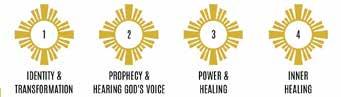
For more information about the school and Summer Intensive visit https://encounterschool.org/cincinnati
For more information about Encounter Ministries USA visit https://encounterministries.us
Sacred Heart Church Dayton
BY GAIL DEIBLER FINKE
Sacred Heart Church in Dayton is home of the Dayton Vietnamese Catholic community and is served by the Congregation of the Mother of the Redeemer (CRM, called the Congregation of the Mother Co-Redemptrix until 2017), a religious order formed in Vietnam in the 1940s.
About half of the order’s members arrived in the United States as part of the “Boat People” refugees in the late 1970s and were invited by the bishop of SpringfieldCape Girardeau to purchase a former seminary in Carthage, Missouri, for $1. Approved in 1980 as the CRM’s Assumption Province, it provides priests for Vietnamese-speaking Catholics in several states, including Ohio, and holds an annual three-day festival, Marian Days, that is attended by tens of thousands.
“On the day the church was dedicated, many former members were there. When the bell rang, many of them were crying.
We were so happy to have a church, and they were so happy to see it a church again.”
HUY DANG
Longtime member of the Dayton Vietnamese Catholic Community
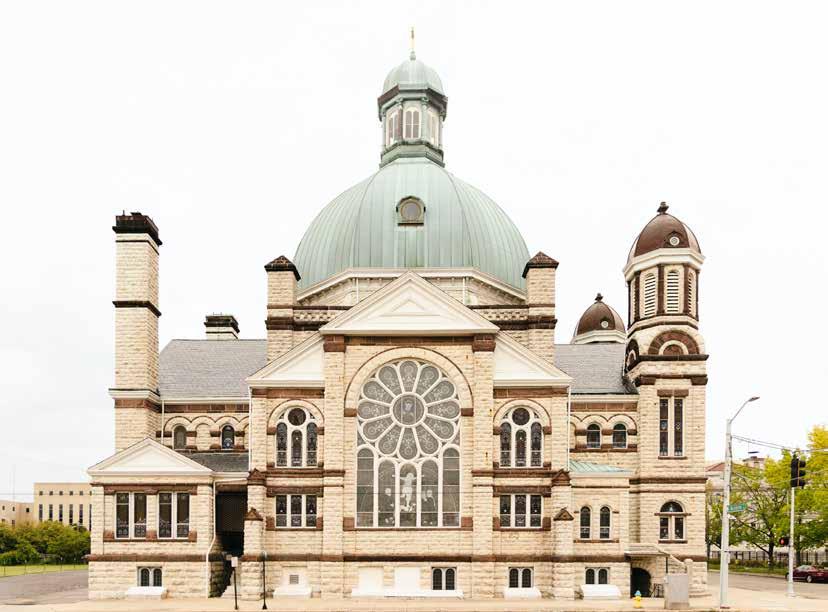
Sacred Heart Church was built between 1888, when Archbishop William Henry Elder laid the cornerstone, and 1895, when Covington Bishop Camillus Maes consecrated the building—though Masses were held in the basement from 1889 to 1893, when they moved to the sanctuary. It was the fourth Catholic church in Dayton, and the second created for English-speaking Irish Catholics.
Its Richardsonian Romanesque revival structure with the massive, copper-covered Baroque dome cost $100,000 to build. Designed by Charles Insco Williams, and made of local limestone, with brown sandstone trim quarried from Berea, Ohio, its many exterior features include triangular pediments, two front towers, three cupolas, and multiple rose windows. Massive stained glass windows dominate the once ornate interior, which has undergone several extensive renovations. Donated by parish families, the windows cost more than $7,000.
Cincinnati artist Charles Svendsen and G. Gloscio of Indianapolis painted the church interior in a Roman style—some of Svendsen’s paintings remain, including four in the dome, but Gloscio’s frescoes do not. The current, contemporary-style sanctuary features a back wall with colored panels that can be changed for the liturgical seasons.
The parish school built in 1902 was purchased and razed by the city in 1964, and the church’s interior was completely renovated in 1972 through a project designed by Cincinnati architect Albert V. Walters. By 1996, however, church attendance had dwindled and the parish closed. St. Vincent de Paul (SVDP) wanted the building as a retirement home for priests and religious, but the Dayton Vietnamese Catholic Community approached SVDP leaders about acquiring it after losing their previous home.
As Anthony Staub, who oversaw the church’s maintenance, toured a group from the Vietnamese Catholic Community through the building one day in 2000, the long-silenced electric bell began to ring. Taking it as a miraculous sign, he recommended turning the property over to them. Thirty-five families worked for more than a year, and in 2002 Archbishop Daniel Pilarczyk reopened Nhà Tho' Thánh Tâm —“Sacred Heart Church”— with a celebratory Mass and ceremony attended by Dayton officials, Vietnamese Catholics from around the region, and former parishioners. The archbishop cut the ribbon to the doors following a procession that included traditional Vietnamese music and a lion dance, and Dayton Mayor Rhine McLin rang the church’s massive bell—on purpose, this time. ✦

St. Joan of Arc
Born to peasants on January 6, 1412, Joan lived in northeastern France, an area loyal to the French crown. Her father was a farmer and village official, and her mother was a devout Catholic who passed on her deep love of the Faith to Joan.
CALLED TO ACTION
During this time, France was doing very poorly against England in what became known as “The Hundred Years’ War.” The Queen of France had signed a treaty that disinherited the Dauphin of France (the king’s eldest son), so King Henry V (followed by Henry VI) became king of both England and France. England and its Burgundian allies thus controlled almost all of northern France.
Three saints—St. Michael, St. Catherine, and St. Margaret—appeared to Joan and told her to help drive the English out of the French land and install the Dauphin as the rightful ruler. Since she believed it was the Lord’s will, 16-year-old Joan asked the commander of the French military to be escorted to the French Royal Court. Denied at first, she was eventually taken to the Dauphin.
JOAN ON THE BATTLEFIELD
The Dauphin sent Joan to the Siege of Orléans, where she helped bring about a French victory! This and other victories led to the Dauphin’s coronation as Charles VII in July 1429. His coronation greatly boosted French spirits and Joan was recognized for her courage.
CAPTURE, TRIAL, SAINTHOOD
While the French believed Joan was sent by God, the British saw her as an enemy. On May 23, 1430, Joan was ambushed and captured by the Burgundian army, who handed her over to the English. They tried her (unfairly and unjustly), and a year later, at 19 years old, she was burned at the stake. When Pope Callixtus III
commissioned a court in 1456 to fairly examine Joan’s trial, the court pronounced Joan innocent and declared her a martyr.
Canonized in 1920 by Pope Benedict XV, St. Joan of Arc is the patron saint of France, military personnel, soldiers, the Women’s Army Corps, captives, and prisoners. She is affectionately known as The Maid of Orléans, and her feast day is May 30.
“Go forward bravely. Fear nothing. Trust in God; all will be well.”
ST. JOAN OF ARC
WORD FIND


St. Joan of Arc
Our Lady of the Sign: A Novel
BY ABIGAIL FAVALE | IGNATIUS, 2026 | 224 PAGES | $17.95
“I don’t suppose there’s any way I can talk you out of it?” The gas station attendant’s question comes at Simone’s last stop on her journey back to the remote farmhouse she hasn’t seen in 16 years. The query is about buying cigarettes; the house is now a vacation rental; and she’s woefully unprepared for the snow and the cold of December in rural Idaho. But Simone sets off, cigarettes in hand, to spend three weeks alone with her thoughts and a secret plan.
That’s the setup for a thriller—or a ghost story or Gothic novel—and Abigail Favale’s debut novel, Our Lady of the Sign, is those things and more. She deftly weaves threads of multiple genres into a story that surprises and unsettles, constantly veering from the reader’s expectations. Like all such stories, it’s about evil and the wages of sin. But, in a twist that makes the book a worthy addition to the novel of the supernatural, Simone’s sins are distinctly female, and so is the evil they call forth.
Like the protagonist of a Hitchcock film, Simone is neither innocent nor entirely likeable. Thirty-three, independent, dedicated to her career and, perhaps, to her live-in boyfriend, she’s determined to make decisions about her future without reference to anyone but herself. The empty house draws her back to choose her life's direction in chilly seclusion, surrounded by memories merely papered over for renters.
Strange occurrences begin—cold blasts of air, doors opening and closing, terrible dreams... but wonderful things, too. Perhaps, she was wrong to leave. Perhaps, a new and better future awaits than the one she’s come to ensure. As Simone returns to old temptations and sins, events in the house escalate, and her dreams come to focus on a woman, a mother alternately beautiful and terrible. Simone seeks answers from friends and strangers and, finally, the local parish.
Simone’s actions aren’t always moral, and her perceptions are often skewed. But are they her own inclinations, or is she being influenced by forces, perhaps even beings, that the single mother who raised her "to hold her own in a material world" left her blind to? If the woman she’s seeing isn’t Mary, who is it? If she doesn’t believe in God, will He help her? If her life is suddenly full of evil signs, where are signs of the good?
In a terrifying finale, Simone faces off against whatever or whoever is in the house with a bottle of holy water and a vial of

Scan QR code to purchase the book
blessed salt. She’s as unprepared to deal with her sin as she was to face the bleak winter. But glories as well as horrors lie beyond the veil of what we can see, a female face for love as well as one for death, and only by accepting both can Simone understand, forgive, truly choose her future, and take the first steps on her journey to God. Abigail Favale's gripping debut novel will hold your attention to the very last paragraph and is a worthy addition to the literature of the uncanny. ✦
Gail Deibler Finke is an author, freelance writer, and producer of "Driving Home the Faith" for Sacred Heart Radio.
Catholic Crossword






“Blessed is the fruit of your ___”
Mission to remember
“Categorical Imperative” philosopher
Jesus found Nathanael under one
Kingly psalmist
Differ ending
Cain traveled this direction from Eden
Chew the scenery
Cervine animal
Holbein or Arp
Glace or tasse starter
Pale reddish purple
Possible occupation of Jesus
Cousin of Mary
Freedom, Identity, and the Heart of Christ
THE FINAL WORD | Fr. Kyle Schnippel
June is the month of the Sacred Heart, when we celebrate the passionate Heart of Jesus bleeding in a deep desire to be united with each of us in those moments of struggle, those moments where we experience a particular passion in our lives. It is in these moments that we meet Jesus in a deep and profound way, realizing that life does not come despite the Cross, but exactly in the experience of the Cross.
Because without Jesus, we can do nothing (cf. Jn 15:5). Therefore, whatever leads us to Jesus, especially those things that lead us to Jesus while He hangs on the Cross, leads us to life. For with Jesus, there is life, there is peace, there is purpose.
In the Sacred Heart of Jesus, we find all these things. In the Sacred Heart of Jesus, we find our true identity as beloved sons and daughters of the Father; and it is in this identity that we find true peace, true fulfillment.
June is, however, also Pride Month, during which so many other competing factors seek to claim our identity and our purpose. Through an idea of “freedom,” Pride Month seeks to express the human person solely in sexual terms, terms that will always fail to express the entirety of the human person and the human experience. Instead of bringing freedom, these expressions bring imprisonment and chains.
I know this because, for the last twelve years, I have been blessed to serve the Archdiocese of Cincinnati as a chaplain for Courage International. And for the last eight years, I have also served as a member of the Executive Board for Courage, even serving a short time as its interim executive director.
For those unfamiliar with Courage, it is a support network for those who experience same-sex attraction and seek to live in the teachings and bounds of the Church. We also support family members and loved ones of those who are in the “lifestyle” via EnCourage (see more at www.couragerc.org).
It was through my work for Courage that I received the call of a lifetime: the Holy Father, Pope Leo XIV, asked to meet with us regarding this ministry and to hear the experiences of chaplains and members of Courage and EnCourage. This past February, four leaders of Courage, including myself, discussed this vital ministry with the Holy Father and it was a blessed encounter in every way.
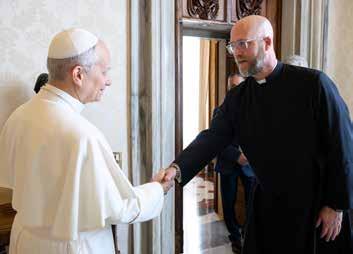
What struck me was both the Holy Father’s awareness of Courage's mission and importance and his message of finding life with Jesus Christ via the Cross. He displayed a great tenderness in seeing the person who has the experience of samesex attraction and their family members.
In our conversation, the Holy Father recalled the road to Emmaus (Lk 24:13-35). He noted that, for a time, Jesus walked in the wrong direction with Cleopas and his companion. In Luke’s account of the Gospel, the Temple is the focal point. Yet, here at the end, Jesus was walking away from it. But He did so to eventually bring these two lost and hurting souls back to Himself, as He slowly stoked the flame of faith back to life in the deep recesses of their hearts.
The work of Courage and EnCourage—ministering to persons who experience the Cross in a real way—is simply this: to walk with people until that little flame of faith is back alive and burning brightly, so that we can all recount how the Lord has walked with us along the way and made Himself known in the breaking of the bread. ✦
Fr. Kyle Schnippel is the pastor of the St. Gabriel Family of Parishes and chaplain of the Cincinnati chapter of Courage.