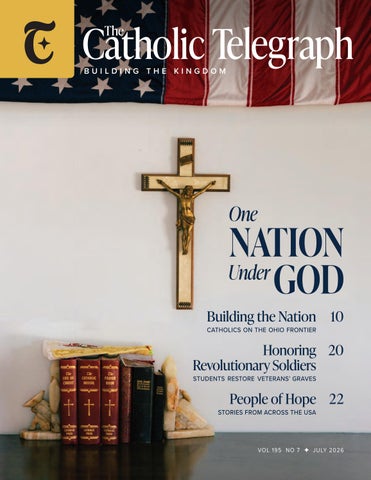
Too often, we as citizens of the United States focus on what divides us. While it is good and necessary to discuss our differences and challenge one another in the search for truth and the common good, it is neither necessary nor healthy to become enemies of everyone with whom we disagree. The 250th anniversary of the Declaration of Independence offers an opportunity to step back, focus on what we share, and celebrate the remarkable nation we have inherited.
No human system is perfect, but the American experiment is exceptional because of the principles upon which it was founded. The United States’ appearance on the world stage marked a unique historical moment, and its ideals as expressed in the Declaration of Independence and Constitution deserve our celebration.
The Founding Fathers knew they could not foresee the future, so they established a framework that held citizens and leaders accountable while allowing for growth and reform. This system was designed not to preserve perfection but to help future generations continue striving toward better.
The only Catholic signer of the Declaration of Independence, Charles Carroll of Carrollton, was educated in Europe because Maryland law at the time strictly forbade Catholics from voting, holding public office, and practicing law. He overcame these barriers, using his immense influence and fortune to heavily finance and advocate for the Revolutionary cause.
Tension always existed between the American proposition and the Catholic faith. From the secular perspective: How can Catholics fully embrace a pluralistic society when their highest allegiance belongs to Christ and His Church? From the Catholic perspective: Doesn't the separation of church and state imply that all religions are equally true or that faith is merely a private preference?
American priest and theologian John Courtney Murray (d. 1967) believed the American proposition—constitutional government, limited state power, and religious liberty—could be understood as a political expression of truths deeply rooted in the Catholic natural law tradition. Fr. Murray argued that
Publisher: Archbishop Robert G. Casey
Editor: David Cooley
Managing Editor: Margaret Swensen
one can be both a faithful Catholic and a patriotic American because Catholic teaching calls believers to love God and neighbor in concrete civic life, while always placing God first.
He maintained that the American proposition depends upon several principles consistent with natural law and Catholic moral teaching: human beings possess inherent dignity and natural rights; political authority is limited, not absolute; government exists to protect the common good and the rights of citizens, not to control conscience; religious belief must be freely embraced, not coerced; and people of different faiths can work together through reasoned discussion to pursue the common good.
These principles make it possible for people of every race and creed to flourish in the United States.
The Church’s teaching authority helps us form our consciences and guide our moral judgment without reducing faith to partisan politics. It is important to recall that civil law does not always mirror what is morally just. Catholics are called to obey legitimate authority but recognize that something isn't right simply because it's legal. Freedom carries responsibility and requires moral discernment.
Despite periods of anti-Catholic prejudice and continuing debates about religion’s role in public life, Catholics have helped shape the American story from the beginning. We, therefore, have good reason to celebrate both our country and the principles that sustain it.
The American experiment is not perfect, nor is it complete. Each generation is called to strengthen it by defending human dignity, pursuing justice, and seeking the common good. For Catholics, this task is not a compromise of faith but an expression of it. By bringing the wisdom of the Gospel and the natural law tradition into public life, we can help ensure that America remains a source of freedom, opportunity, and hope for generations to come.
David Cooley
cteditorial@catholicaoc.org
Creative Director: Nick Abele
Photography: Mary Kate Fleisher
Social Media: Taylor Motley
Videographer: Nathan Schuster
Media Sales: Deacon Graham Galloway
Circulation: Catherine Ampfer

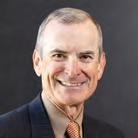
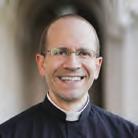
Dominick Albano
is a passionately Catholic husband and father of four boys. He has been writing, speaking, and leading Catholic retreats for more than 20 years. He is the co-founder of the National Society for Priestly Vocations.
Dr. Kenneth Craycraft
holds the James J. Gardner Chair of Moral Theology at Mount St. Mary’s Seminary & School of Theology. He is the author of Citizens Yet Strangers: Living Authentically Catholic in a Divided America.
Fr. David Endres
is professor of Church history and historical theology at Mount Saint Mary’s Seminary & School of Theology.
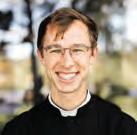
Fr. Jacob Lindle
was ordained a priest for the Archdiocese of Cincinnati in May 2022. He is presently studying for a Doctorate in Patristic Theology at the Pontifical Gregorian University in Rome.


Michelle Wirth Smith has served as the archdiocesan Archivist since 2019, bringing a Cincinnati-born passion for preserving Catholic history. She earned her Master of Library & Information Science degree from Kent State University.
Katie Sciba
is a national speaker and Catholic Press Award-winning columnist. She and her husband Andrew were married in 2008 and are blessed with seven children.


We want to hear from you!
cteditorial@catholicaoc.org
Dr. Andrew Sodergren
is a Catholic psychologist and director of psychological services for Ruah Woods. He speaks on the integration of psychology and the Catholic faith. He and his wife Ellie have five children.
Corynne Staresinic
is a writer and research fellow at the McGrath Institute for Church Life at the University of Notre Dame. She lives in Greater Cincinnati with her husband Nick and their children.
Follow The Catholic Telegraph on social media for more in-depth stories and video content
@TheCatholicTelegraph @CatholicTelegraph
JULY For respect for human life
Let us pray for the respect and protection of human life in all its stages, recognizing it as a gift from God.
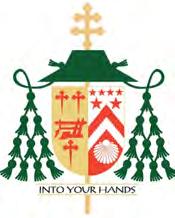
INTO YOUR HANDS | Archbishop Robert G. Casey
You Gotta Have Heart is a classic showtune from the 1955 musical Damn Yankees. Sung by a group of baseball players trying to keep their spirits up amidst a losing season, the lyrics reveal that only with each teammate giving his all will their hapless team find its way to victory. They sing out, “You gotta have heart... All you really need is heart... When the odds are sayin’ you’ll never win... That’s when the grin should start... You’ve gotta have hope.” The song reminds us of our own challenge as Church today to be united in efforts, one in heart and one in hope, one body and one spirit in Christ.
This year, as we celebrate the 250th anniversary of the United States of America’s Declaration of Independence, the bishops of this nation remind us that within America’s independence resides a continual and necessary dependence upon God and each other.
Our bishops recently made the most of this milestone in our history by consecrating this nation to the Sacred Heart of Jesus, a heart that strives to unite us with God and with one another.
At a time when so many people feel compelled to separate and divide, to build walls and ramparts, and to hold at arm’s length those deemed enemies and adversaries, our Church proclaims her Eucharistic identity. Consecrated to the Sacred Heart of Jesus, we are a Church centered on communion, seeking to pattern our heart after the heart of our Savior.
The “Pledge of Allegiance” proudly proclaims us to be “one nation, under God, indivisible, with liberty and justice for all.” That profound experience of unity can only be achieved with the help of a higher power—God, who challenges us to greater love and mercy. When we try to “go it alone” or believe that we have the fullness of all wisdom and knowledge, God will, no doubt, shake
us awake and remind us of our interdependence. The consecration of this nation to the Sacred Heart of Jesus can be for us the wake-up call we need.
The Sacred Heart burns with the passion of Christ’s love and the fire of the Holy Spirit. How do we allow that divine love to burn in our hearts? Are we directed by the Holy Spirit—that God’s will be done—or by our own wants and ambitions?
The Sacred Heart is crowned with thorns, reminding us of the wounds caused by our shared sinfulness. Can we allow Christ’s divine mercy to bring about healing and reconciliation, that we might find our hearts encircled by love and not thorns?
The Sacred Heart is wounded and bleeding. Will we permit our stony hearts to be softened, that they may be pierced by the sharp and forceful call of Christ to allow God’s grace and mercy to flow forth from our every word and action?
As our nation celebrates its 250th anniversary of independence, we’ve gotta have heart. Specifically, we need hearts modeled after the example of the Sacred Heart of Jesus. In this “land of the free and home of the brave,” may we boldly choose to love our neighbor and extend the Lord’s mercy to all, so that with our hearts aflame we may truly live as one nation, under God. ✦


You Gotta Have Heart [Hay que ponerle corazón] es una canción clásica del musical de 1955 Damn Yankees [Malditos yanquis]. Cantada por un grupo de jugadores de béisbol que intentan mantener el ánimo en alto en medio de una temporada perdedora, la letra revela que solo si cada compañero del equipo da lo mejor de sí, su desafortunado equipo encontrará el camino hacia la victoria. Cantan: “Hay que ponerle corazón... Todo lo que realmente necesitas es corazón... Cuando las probabilidades dicen que nunca ganarás... Es entonces cuando debería empezar la sonrisa... Hay que tener esperanza”. La canción nos recuerda nuestro propio desafío como Iglesia hoy: estar unidos en nuestros esfuerzos, uno en corazón y uno en esperanza, un solo cuerpo y un solo espíritu en Cristo.
Este año, al celebrar el 250 aniversario de la Declaración de Independencia de los Estados Unidos de América, los obispos de esta nación nos recuerdan que, dentro de la independencia de los Estados Unidos, reside una dependencia continua y necesaria de Dios y de los unos con los otros.
Nuestros obispos aprovecharon recientemente este hito histórico al consagrar esta nación al Sagrado Corazón de Jesús, un corazón que se esfuerza por unirnos con Dios y entre nosotros.
En un momento en que tantas personas se sienten obligadas a separarse y dividirse, a construir muros y murallas, y a mantener a distancia a aquellos considerados enemigos y adversarios, nuestra Iglesia proclama su identidad eucarística. Consagrada al Sagrado Corazón de Jesús, somos una Iglesia centrada en la comunión, que busca modelar nuestro corazón según el corazón de nuestro Salvador.
El “Juramento de Lealtad” proclama con orgullo que somos “una nación, bajo Dios, indivisible, con libertad y justicia para todos”.
Esa profunda experiencia de unidad solo puede lograrse con la ayuda de un poder superior—Dios, que nos desafía a un mayor amor y misericordia. Cuando intentamos “hacerlo solos” o creemos que poseemos toda la sabiduría y el conocimiento, Dios, sin duda, nos despertará y nos recordará nuestra interdependencia. La consagración de esta nación al Sagrado Corazón de Jesús puede ser para nosotros la llamada de atención que necesitamos.
El Sagrado Corazón arde con la pasión del amor de Cristo y el fuego del Espíritu Santo. ¿Cómo permitimos que ese amor divino arda en nuestros corazones? ¿Nos guía el Espíritu Santo—para que se haga la voluntad de Dios—o nuestros propios deseos y ambiciones?
El Sagrado Corazón está coronado de espinas, recordándonos las heridas causadas por nuestra pecaminosidad compartida. ¿Podemos permitir que la divina misericordia de Cristo traiga sanación y reconciliación, para que nuestros corazones se vean rodeados de amor y no de espinas?
El Sagrado Corazón está herido y sangrando. ¿Permitiremos que nuestros corazones de piedra se ablanden, para que sean traspasados por el llamado agudo y poderoso de Cristo a dejar que la gracia y la misericordia de Dios fluyan de cada una de nuestras palabras y acciones?
Al celebrar nuestra nación el 250 aniversario de su independencia, hay que ponerle corazón. En concreto, necesitamos corazones que sigan el ejemplo del Sagrado Corazón de Jesús. En esta “tierra de los libres y patria de los valientes”, que nos atrevamos a amar a nuestro prójimo y a extender la misericordia del Señor a todos, para que, con nuestros corazones ardientes podamos vivir verdaderamente como una sola nación, bajo Dios. ✦
As we collectively commemorate the 250th anniversary of the Declaration of Independence, it is good and appropriate to celebrate the good things that can be identified with the founding and history of the United States of America. While every nation, culture, society, and political entity has faults— including those comprising the contemporary U.S.—we do well to hold to the things that are true and good about any political culture. Having said that, however, reflecting on 250 years since the Declaration of Independence is a good time to examine the truth-claims that are asserted there, and how—or even whether—they are compatible with Catholic faith.
As a threshold matter, the Catholic Church does not endorse any particular political arrangement as exclusively good. As stated in Gaudium et Spes (the Pastoral Constitution on the Church in the Modern World from Vatican II), “In virtue of her mission and nature [the Church] is bound to no particular … political, economic or social system.” It also asserts that “Christ … gave His Church no proper mission in the political, economic or social order,” rather, “the purpose which He set before her is a religious one” (42). Of course, this religious purpose has profound political implications, because the relative good or bad of any politics is measured by this purpose. All politics must answer to Catholic moral theology, but no politics can ever be identified with it. Regardless of the relative good that may be found in it, no nation or political arrangement can be identified with the Church. There is no such thing as a “Christian” nationstate. Nation-states may establish and preserve principles that are more or less consistent with Christian morality, but none can be identified with the Church. Indeed, to identify an earthly political regime—whether the U.S. or any nation-
state—with the Church is idolatry. The Church endorses no particular political model precisely because the theology of the Church transcends and relativizes all political structures and arrangements. To collapse the tenets of Catholic faith into political identity is the essence of idolatry.
This is an especially cautionary note for us Americans. Many of us are tempted by narratives about the American founding that, either impliedly or explicitly, identify the United States with some kind of divine plan, as though God has blessed the U.S. as the Christian form of politics; that the U.S. is a “Christian nation.” A variation of this error might be one that does not identify the U.S. as a Christian nation, per se, but which nonetheless asserts that God has granted us special favor as a nation-state. This assertion would typically avert to the founding “principles,” such as those found in the Declaration of Independence. We Catholics must strenuously and consistently resist such stories, as they lead directly to the risk of idolatry I noted above.
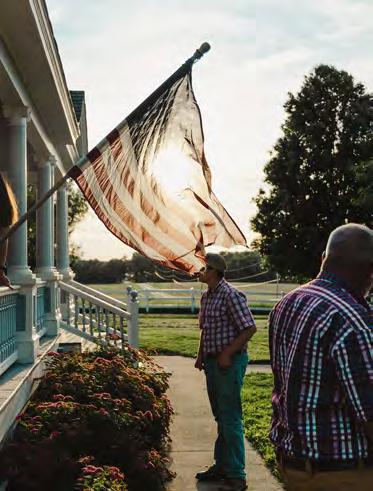
Rather than to offer a single model of political life—or to endorse any particular political regime—the Church instead offers a set of criteria by which any political structures should be judged and evaluated. While many factors and elements are included in these criteria, they can be summarized by reference to the four pillars of Catholic Social Doctrine: the dignity of the human person, the solidarity of all humankind, the subsidiary nature of social institutions, and the preservation of the common good. Taken together, the Church’s social doctrine is a coherent body of truth that both suggests policy guidelines and sits in judgment over all policy. The purpose is not to endorse any political regime, but rather to identify those elements of any politics that do or do not comport with these principles.
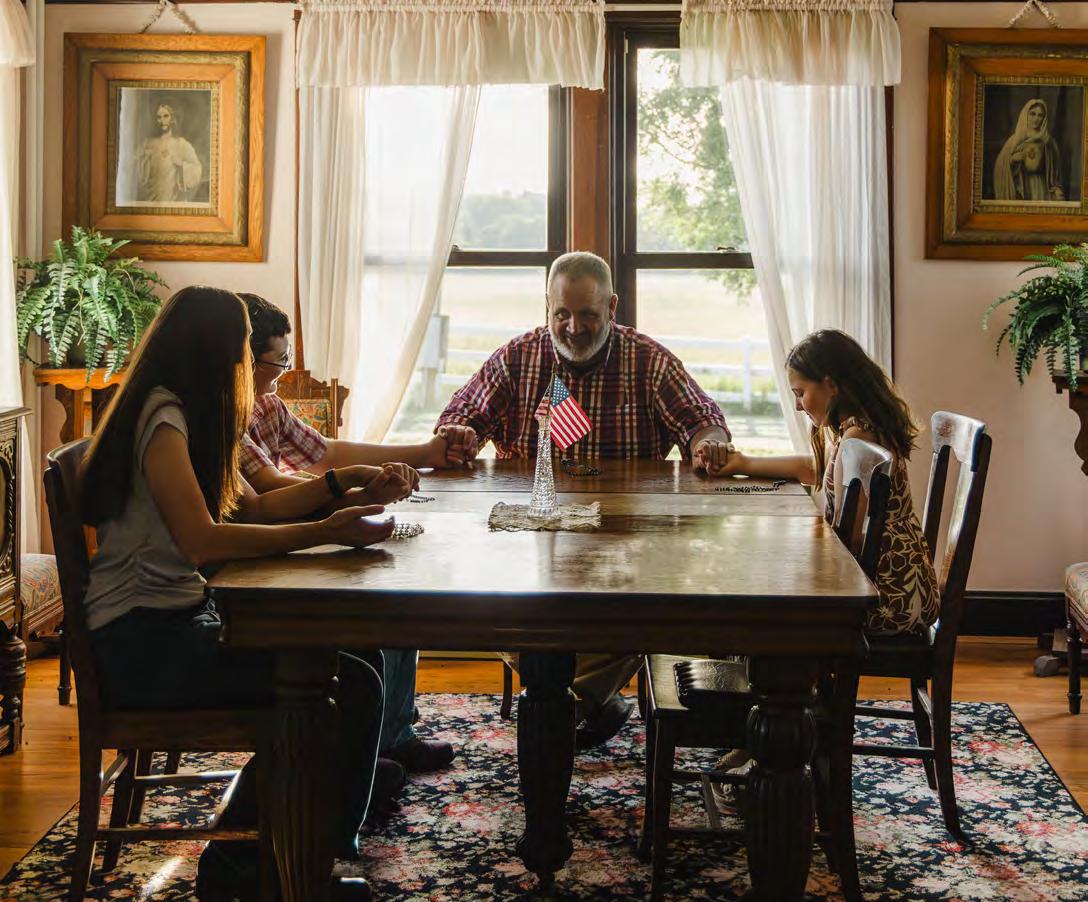
Which brings us back to the Declaration of Independence. The vast majority of the Declaration is a recital of complaints and grievances against England’s King George III, but few people ever read that catalogue of complaints. Rather, we more typically avert to a single sentence of the Declaration, upon which we build the entire edifice of our national political identity. “We hold these truths to be self-evident,” the Declaration asserts, “that all men are created equal, that they are endowed by their Creator with certain unalienable Rights, that among these are Life, Liberty and the pursuit of Happiness.” These are the “selfevident” “truths” that we are celebrating on July 4, 2026.
But what if this most fundamental statement of American identity is, well, false? The notion of “inalienable Rights” is, from the judgment of Catholic Social Doctrine, highly problematic. The rights asserted in the Declaration of Independence are the possessive individual rights invented by 17th century philosophers Thomas Hobbes and John Locke. For both these thinkers, the “state of nature” is one of radical individualism, in which each of us has absolute claims against
every other person in a “war of all against all.” This theory is in tension with—if not contradicted by—the four pillars of Catholic Social Doctrine. These individual rights are a denial of both the doctrines of solidarity and common good. And they lead inevitably to the practical denial of subsidiarity, as the government assumes a greater role in adjudicating among these various individualist claims of rights. It goes without saying that such a regime cannot serve and preserve human dignity, the first pillar of the Church’s social doctrine, and the ultimate rule of any politics.
Can Catholic Christians live happily under the institutions of such a political philosophy? Yes, certainly. But we must strongly and persistently resist any temptation to identify Catholic faith with this theory. Moreover, we must maintain a moral and religious skepticism of this or any political regime that would presume to make such absolute pronouncements about the nature of the human person. We can live under the Declaration as an article of peace; but we must reject it as an article of faith. ✦
Q: How did Catholics in the colonies respond to the Revolutionary War? Did they back the revolution or the British crown?
Before the U.S. Revolution, Catholics were a small minority in the Thirteen Colonies (perhaps only one to two percent of their population). They suffered under both anti-Catholic measures and popular persecution. Even in Maryland where they were the most numerous, Catholics could not worship publicly, become teachers or lawyers, or be elected to political office. In many colonies, the Church of England became the official Church, and Catholics were taxed to support it.
As members of a minority, Catholics had a vested interest in the colonies’ future. The Revolution provided Catholics an opportunity to help chart that future, including the possibility of a new nation that assured their freedom of worship.
England was a difficult place for Catholics. In breaking from the Catholic Church in the 1530s, King Henry VIII took most of his subjects with him. Under Henry and his eventual successor, Queen Elizabeth, laws were enacted against those who refused to renounce Catholicism. Catholics were imprisoned and had their properties confiscated. Priests found it necessary to carry on their ministry in disguise and in secret. Many Catholics dreamed of a land where they could worship God in the old way.
In 1633, some Catholic colonists left England aboard two ships, the Ark and the Dove. The Ark halted off the Isle of Wight to take aboard two Jesuit priests (anti-Catholic laws did not permit them to sail from England). The colonists landed a few months later on the Potomac River island of Saint Clement, just off the Maryland shore, and began a settlement.
Despite continued persecution under British colonial rule, Catholics managed to thrive in Maryland, becoming some of the colony’s richest families. Their manor houses became centers where the faith was practiced privately. Visiting priests said Mass, taught catechism to children, and administered the sacraments. One of these wealthy families was the Carrolls. No Catholic family played a greater role in the foundation of the United States.
Having suffered under the anti-Catholic British monarchy, Catholics, including the Carroll family, were usually prorevolution. Numerous Catholics participated in the independence movement—in a far greater number than their overall population would suggest. Charles Carroll, for instance, was elected in 1775 to the Continental Congress and signed the Declaration of Independence in 1776. According to tradition, when he made his signature, one member of Congress reportedly remarked, “There are so many Charles Carrolls, he can feel safe from reprisal!” But Charles quickly added “of Carrollton” after his name and retorted, “Now King George will know with whom he is dealing!”
Charles Carroll’s cousin Daniel Carroll also played an important role in shaping the new nation through its Constitution. A delegate to the Constitutional Convention of 1787, he was one of the few Catholics involved in drafting it. The theological training he had received, including his studies of St. Thomas Aquinas and St. Robert Bellarmine, informed his understanding of law, authority, and the common good.
He then supported the Constitution's ratification in Maryland and helped build support for the new federal government. Later, he helped pick a site for the national capital, and when the selected site included one of his own farms, he promptly transferred it to the new government.
Together, the Carroll family and other patriot Catholics aided in the revolution against England and charted the framework for a new country that would guarantee religious freedom. These early Catholics helped forge a path for the growth of the Church in the United States. ✦


BY FR. DAVID ENDRES
On September 3, 1783, the Treaty of Paris was signed, ending the American Revolutionary War. As part of the treaty, the Ohio Country—the region between Lake Erie and the Appalachian Mountains—was surrendered by Great Britain to the newly independent United States. The treaty also opened the Ohio Valley to settlement and land speculation, leading to the beginning of westward migration.
This frontier region, in addition to the presence of Native American tribes, was the site of French trading posts and small settlements, though most did not remain intact after the French
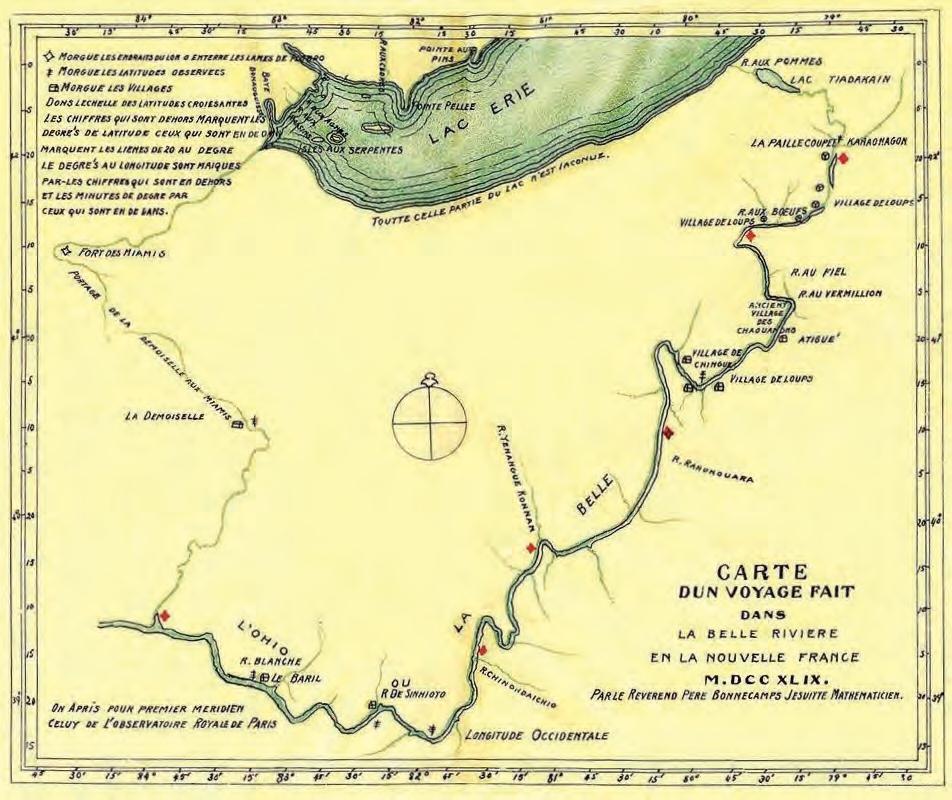
Fr. Joseph-Pierre de Bonnécamps, a Jesuit priest, mathematician, and skilled cartographer documented the details of his expedition with Pierre Joseph Céloron de Blainville into the Ohio Valley from June to November 1749. Fr. Bonnécamps acted as chaplain, hydrographer, and historian during the expedition and created the first detailed map of the region.
relinquished their claims to the region following the Seven Years’ War (1756–1763). While the British were anti-Catholic, the French brought their Catholic faith with them. The French viewed the land not only as territory to be claimed but as a field for evangelization.
In 1749, Pierre Joseph Céloron de Blainville claimed for the French crown the land that is today Ohio. He came to the area near present-day Piqua with almost 300 men, including Jesuit priest Fr. Joseph-Pierre de Bonnécamps, who likely offered the first Mass in this part of the Ohio Country. An accomplished mathematician and cartographer, the priest kept a record of the expedition, providing an early account (and the first detailed map) of the Ohio region.
Beginning about 1769, the French trader PierreLouis de Lorimier (Peter Loramie) operated a store near today’s village of Fort Loramie, in Shelby County. Lorimier traded with Native Americans and eventually married a Shawnee woman, but after his trading post was destroyed in 1782 during George Rogers Clark’s anti-Indian campaign, he and his family relocated farther west. The French trading presence in Shelby County ended with Lorimier’s departure, but additional French came to the region in the nineteenth century, forming the communities of Versailles, Frenchtown, and Russia.
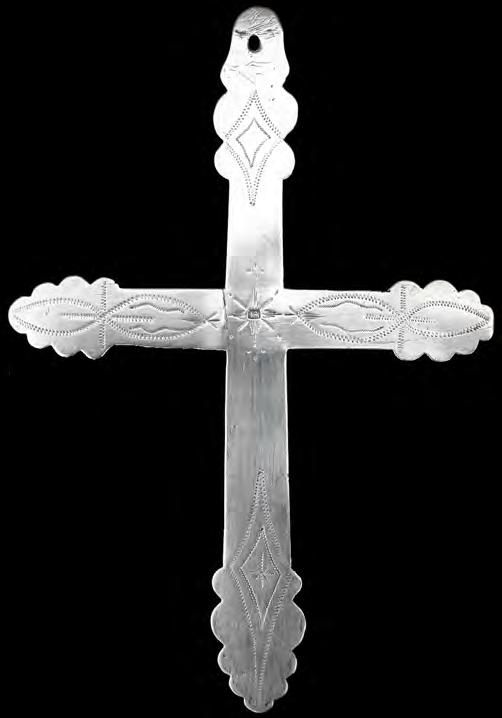
Although no Catholic presence from the colonial period survived, a relic of Fort Loramie’s early French influence remains. In 1872, a silver cross, nine inches long by six inches wide, was found near the site of Lorimier’s store. The cross may have been more a form of currency than a sign of religious devotion, but it was interpreted as a sign of the earliest settlers’ Catholic faith.
The Northwest Territory was established in 1787 by the U.S. Congress’s passage of the Northwest Ordinance. The territory encompassed present-day Ohio, Indiana, Illinois, Michigan, Wisconsin, and Minnesota.
It was notable for guaranteeing religious freedom and prohibiting slavery. At a time when some states still had forms of religious establishment (the U.S. Bill of Rights was not ratified until 1791), the Northwest Ordinance declared that no one “shall ever be molested on account of his mode of worship or religious sentiments.” And even more positively, “Religion, morality, and knowledge, being necessary to good government and the happiness of mankind, schools and the means of education shall forever be encouraged.” The promotion of religion and education brought the possibility of Catholic settlement.
Gauls, referring to the French) in Gallia County along the Ohio River, in 1790. The settlement encountered difficulties from the start. The immigrants received deeds to land the company did not actually own, and although they believed they had bought cleared land, they found instead a dense wilderness.
The settlement retained its French identity, including Catholic traditions and practices, although with some difficulty. Benedictine priest Pierre-Joseph Didier who had come with the settlers but moved farther west within two years. Thereafter, Gallipolis was sporadically attended to by traveling missionaries. The faithful were largely left to sustain their faith practices on their own—a common condition on the frontier.
While sporadic settlement continued north of the Ohio River, the site that became Cincinnati was the location of a large military stockade named Fort Washington (built in 1789). Near today’s downtown, the site faced the Licking River in present-day northern Kentucky. The settlement north of the river was originally named Losantiville, a combination of Latin and Greek terms meaning “town opposite the mouth
Unlike other early settlements that included Catholics, there was no identifiable Catholic presence in Cincinnati prior to 1800. A handful of Catholics from Baltimore and Philadelphia began to settle there around that time, but the first Catholic congregation did not organize in Cincinnati until 1819.
French immigrants associated with the Scioto Land Company established Gallipolis (literally, City of the
Today, there are few traces of Ohio’s frontier Catholics. They left no formal institutions—no parishes, schools, or charitable organizations—but they did contribute to the larger story of keeping faith alive amid adversity. It largely fell to the settlers and immigrants who came after 1800 to establish the Catholic Church’s presence in Ohio, but they did so according to the pattern of those who came before. story continues...
The city of Cincinnati was originally founded in 1788 as “Losantiville.”
Territorial governor, Arthur St. Clair, renamed the settlement “Cincinnati” In 1790 to honor the Society of the Cincinnati, which was formed by officers who had served in the American Revolution and was named after the Roman statesman Lucius Quinctius Cincinnatus, who was famous as a symbol of civic virtue.
According to Roman tradition, Cincinnatus left his farm to lead Rome during a crisis, then voluntarily gave up power and returned to private life once the danger had passed. America’s Revolutionary officers admired that example of service without personal ambition.
One of the Society’s most prominent members was George Washington, who served as the organization’s first president-general.
George Washington earned the nickname "American Cincinnatus" after he took up military command during a national crisis and, upon victory, voluntarily surrendered absolute power to return to his private life as a farmer. ✦
FROM THE ARCHIVES | Michelle Wirth Smith
America’s 250th anniversary offers a moment for us to reflect on how the Catholic Church first took root in Ohio and how fragile those beginnings were. Few in number, the early Catholics of the Northwest Territory and frontier Ohio were scattered across forests, river towns, and isolated settlements, where priests were rare and the sacraments infrequent. Yet they believed deeply in the American promise of freedom to live their faith openly and to pass it on to their children. That dream required both sacrifice and generosity.
In 1808, Jacob Dittoe, a German immigrant who settled near Somerset, Ohio, repeatedly wrote to Bishop John Carroll of Baltimore pleading for a priest to be sent westward. The Dominicans based in Bardstown, Kentucky, sent Fr. Edward Fenwick to minister to the small Catholic community. Through his persistence, St. Joseph Church in Somerset claims the honor of being the first church in the state of Ohio, dedicated on December 6, 1818.
The following year, Catholics in Cincinnati established the city’s first church, on the edge of the settlement in what is now Over-the-Rhine and the present site of St. Francis Seraph. According to Fr. David Endres’ Bicentennial History of the Archdiocese, Christ Church was a rough wooden chapel, inconveniently located in the woods a mile beyond the city, reached by muddy roads that were notoriously difficult to travel in wet weather.
These were the conditions Bishop Edward Fenwick encountered when he arrived in the newly created Diocese of Cincinnati two years later. There was little money, few priests, and almost no institutional foundation. The territory included all of Ohio and Michigan and parts of Wisconsin. He wrote in 1823, “It requires nearly six months to make the visit of my Diocese of Ohio, not allowing myself more than a week or two to spend in each congregation or settlement of Catholicity.”
The situation became so desperate that Fenwick traveled to Rome to resign his office as Bishop. Instead, Pope Leo XII encouraged him to persevere. He travelled throughout Europe seeking help for his fledgling diocese. Catholics across France, Belgium, and Germany responded with remarkable generosity, donating funds, books, vestments, and sacred vessels.
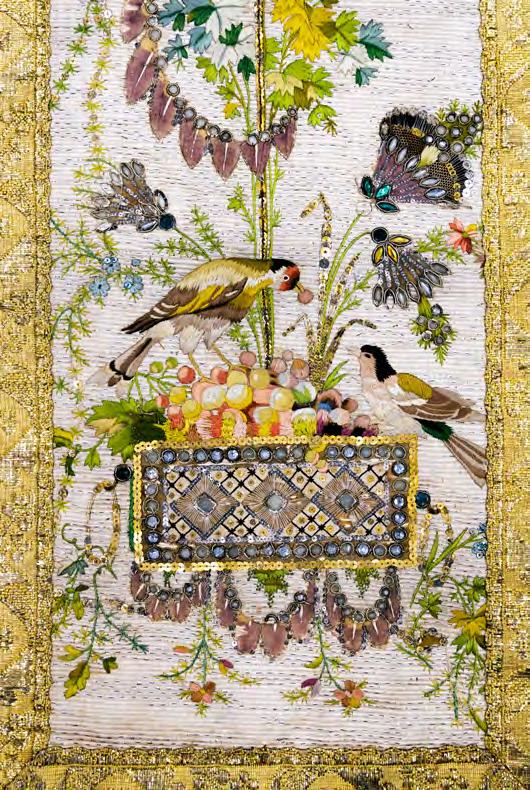
A richly embroidered chasuble associated with Fenwick’s European journey survives here in the archives. Small birds, butterflies, and flowers are stitched across the fabric, as a gold braid edging and wide gold ribbon frame the neckline and central panels. The panels are asymmetrical and not identical in design, suggesting they were salvaged from another decorative cloth. Much like the early Church in Ohio, it bears signs of repair, adaptation, and careful preservation.
Throughout the nineteenth century, millions of Catholic immigrants arrived in the United States, bringing with them devotional practices, languages, and traditions that shaped parish life in Ohio for generations. Priests volunteered for missionary work, and women religious crossed oceans into uncertainty. Over time, small Catholic communities became woven into the fabric of society through schools, hospitals, charitable institutions, and public service.
The archives preserve traces of those lives: letters sent across oceans, vestments carried westward, records of baptisms, marriages, and burials entered carefully by hand. Together, they tell the story of a Church sustained across distance and generations through countless acts of endurance and mutual care. ✦


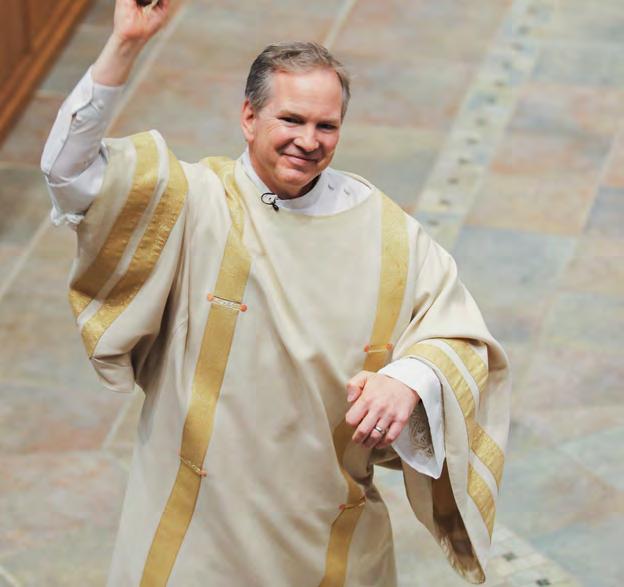
BY DEACON MARK MACHUGA
“For, strengthened by sacramental grace, they [deacons] are dedicated to the People of God in conjunction with the bishop and his body of priests, in the service of liturgy, of the Gospel and of works of charity.”
LUMEN GENTIUM
The Dogmatic Constitution on the Church, Second Vatican Council, Nov. 21, 1964
In 1964, the Second Vatican Council issued the Dogmatic Constitution on the Church, Lumen Gentium, which restored the diaconate as a permanent rank of the hierarchy of Holy Orders. For centuries prior, the order of deacon was reserved as one step toward ordination as a priest. Realizing the difficulty in fulfilling the need for the many ministries in the life of the Church, the Council reestablished the order of the permanent diaconate. Tens of thousands of men have since been ordained as permanent deacons. As of 2023, over 51,000 permanent deacons actively serve worldwide, with more than 21,000 of them (over 40%) serving in the United States.
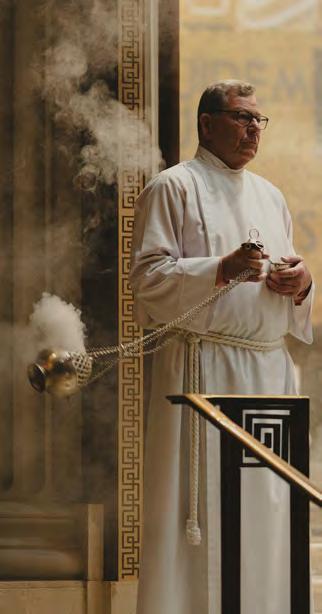
Men discern their call, learn about the realities of ministry, consult with their wives and pastors, and evaluate personal readiness.

Two year period of foundational coursework, prayer, and pastoral growth. This stage is a critical time for an aspirant's wife to consider the impact on family life. She must provide written consent for her husband to continue.
Such numbers evidence the intense passion of Catholic men to answer the call to serve the Church as an ordained deacon. In our own archdiocese, nearly 200 deacons serve our Families of Parishes, and another 18 are currently studying at the seminary, having completed the Aspirancy phase and the first of three years of formation for the diaconate. In fact, a significant milestone will be celebrated in the archdiocese this September: the 50th anniversary of the first ordinands to the permanent diaconate. In 1976, two separate ordinations took place because of the large number of ordinands: 11 men were ordained Sept. 25 by then Auxiliary Bishop Daniel E. Pilarczyk, and 28 men were ordained Sept. 26 by Archbishop Joseph L. Bernardin.
So, how does a man become a deacon in the Catholic Church? The Church has established the basic qualities that men should possess when considering the vocation of deacon. These include:
· Emotional maturity
· Personal integrity
· Christian holiness and an active prayer life
· Generosity for service already being demonstrated
· Good physical and psychological health
· Ability to work in a team; work well with people
· Good communication skills, both as a speaker and as a listener
· Ability to speak publicly and proclaim the Gospel effectively
· Acceptance by the Catholic community as evidenced by his ministry in the parish
The discernment of this vocation must start with selfreflection and an interior examination of a man’s motives, desires, and state of life. First, do you have a solid prayer life and do you participate regularly in Mass and the Sacrament of Penance? Second, do you serve in the ministries of your parish and local community? Third, do you feel called to dedicate yourself to the service of Christ and the Church? And finally, have you spoken to others—your wife, your pastor, a deacon—to allow them to help you recognize what is God’s call and how to respond to it?
The journey toward ordination as a deacon requires a commitment of at least five years of formation. The first two years are called Aspirancy, in which a man is “aspiring” to
Three year period of advanced theology studies and liturgical training. Candidates receive formal ministries, including Lector and Acolyte. After completing studies, candidates apply to their local bishop for ordination.
possibly become a candidate for Holy Orders. Aspirancy is a program of basic academic formation classes in the Lay Ecclesial Ministry Program at Mount St. Mary’s Seminary and School of Theology, coupled with periodic discernment meetings with the men and their wives and other men considering the diaconate.
Upon completion of Aspirancy, men may apply for the three-year Deacon Formation Program. If accepted, they become candidates for Holy Orders, which culminates in ordination. It is a rigorous program that requires sacrifice on the part of the man as well as his wife and family. But for the men called to this vocation, the years of education and formation are simply one more way to express their desire to serve the Lord and His Church, the people of God.
Throughout the formation journey, prayer and participation in the sacraments are essential, and a man meets with a spiritual director and academic advisor. The formation years are currently overseen at the seminary by Fr. Eric Wood, the Director of Permanent Deacon Formation for the Archdiocese of Cincinnati, in conjunction with the Office of the Diaconate. ✦
Do you feel called to explore a vocation as a permanent deacon? If so, start with prayer, then talk with others about it, then contact the Office of the Diaconate at (513) 263-6641 or DeaconOffice@catholicaoc.org.
“If I, therefore, the master and teacher, have washed your feet, you ought to wash one another’s feet. I have given you a model to follow, so that as I have done for you, you should also do.” –Jn 13:14-15
Deacon Mark Machuga is Director of the Office of the Diaconate and Vice-Chairman of the National Association of Diaconate Directors, and he serves as deacon at Mary Queen of All Saints Family of Parishes in Cincinnati.
BY MIKE SCHAFER
This is an exciting time to be Catholic. All over the world, record numbers were reported entering the Church at Easter. Lay- and clergy-led apostolates are flourishing across the U.S. and several dioceses, including our own, are seeing a growth in priestly vocations. This May, through the grace of God, Archbishop Robert Casey ordained nine men to the priesthood, tying for the largest such class in our archdiocese in the past 53 years. The Holy Spirit is truly on the move!
On top of all that, we now have the opportunity to help shape the future of our local Church. In January, Archbishop Casey announced that, for the first time since 1971, we will conduct an archdiocesan synod. He wrote, “Inspired by the story of the disciples on the road to Emmaus, encouraged by Pope Leo’s efforts to create a more synodal Church, and considering the more than fifty years that have passed since our last synod was held, Synod 2027 will offer our local Church a blessed opportunity to recognize Christ in our midst and respond enthusiastically to His call.” Given its extraordinary nature, Synod 2027 might well be called the opportunity of a lifetime.
This opportunity naturally raises questions. “Synod” and “synodal” are not words that one uses or encounters very often. So, here are some of the basics.
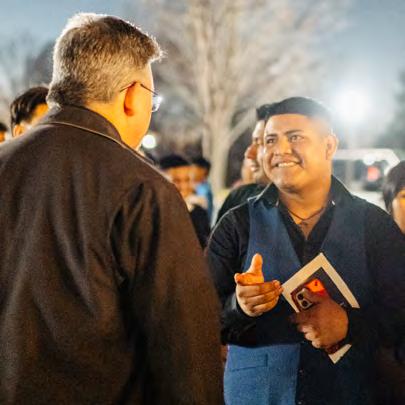
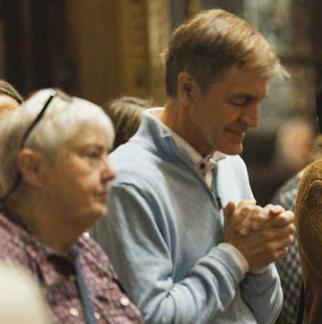
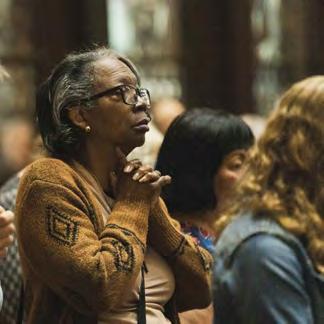
To be synodal is to journey together. Synod 2027 will be an engagement of our whole archdiocese to consider what the Holy Spirit may be asking of our local Church.
A diocesan synod is a time of prayer and listening to the Holy Spirit and to one another, culminating in a general assembly with representatives of the clergy, vowed religious, and laity to assist the local bishop. To be synodal is to journey together. Thus, Synod 2027 will be an engagement of our whole archdiocese to consider what the Holy Spirit may be asking of our local Church at this moment. The goal will be to discern needs and recommend pastoral priorities for the future to Archbishop Casey.
As Archbishop Casey indicated when he announced Synod 2027, it is a priority of the Holy Father, Pope Leo XIV, that the Church be intentionally synodal so that pastoral plans and decisions are made in a spirit of prayerful discernment. Synod 2027 will be particularly useful to Archbishop Casey as he gets to know our archdiocese more intimately and establishes priorities for the future. Our last archdiocesan synod was soon after Vatican II, and much has changed in our Church and in our society since then. One might say we are overdue for a synod!
The two-year timeframe of Synod 2027 corresponds to the conclusion of the timeframe designated for the archdiocesewide pastoral planning initiative Beacons of Light. Synod 2027 will help set in place the foundations of Beacons of Light as a way of life in our archdiocese.
For starters, pray. Pray that Synod 2027 bears great fruit in our local Church and in our communities. In addition, throughout Synod 2027, clergy, vowed religious, and laity—in other words, you—will be invited to participate. A major part of this participation will be facilitated through local listening sessions called “Conversations in the Spirit” to be held throughout the archdiocese this Fall 2026 and through discernment of delegates to the culminating General Assembly planned for Fall 2027.
Next month, I will delve into the Conversations in the Spirit listening sessions. Please join me and Catholics across the archdiocese in this defining moment. Don’t miss this opportunity of a lifetime. ✦
“Being a synodal Church means recognizing that truth is not possessed, but sought together, allowing ourselves to be guided by a restless heart in love with Love”
POPE LEO XIV
To learn more about Synod 2027 and to register for a Listening Session, visit catholicaoc.org/Synod2027.
Mike Schafer serves on the Synod 2027 Secretariat, the body providing coordination, planning, and communication for Synod 2027.
ST.
ST.
Stories matter. What you watch matters. What you listen to matters. What you scroll through matters. Whatever you take into yourself has an effect, and there are a lot of stupid stories out there.
How do we navigate through the narrative wildness of “NetflInstaTok”? Well first, I’d recommend more silence (like, a lot more). But then, I’d insist that you get to know our own story. We accept junk because we don’t know the goodness and glory of our inheritance. As baptized Catholics, we have been taken up into the most beautiful story of all time, but I don’t know how many of us know the plot. The Church Fathers can really help us here. They could still hear the echo of the Apostles when they introduced God’s story to the ends of the known world.
The Fathers communicated God’s saving story less by writing books (though they did some of that) than by preaching, and this month, we are looking at three of the greatest preachers of all time. The preacher is kind of a supernatural storyteller with three goals: he wants us to see God’s story 1) told in Scripture, 2) presented in the liturgy, and 3) enacted in our lives.
One of the richest ways he can accomplish these is through something called typology. God tells stories by repeating patterns (typoi), and the preacher tries to teach his congregation how to see and experience these patterns, then live them.
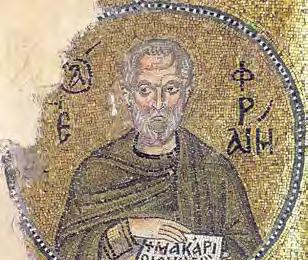
Take St. Ephrem the Syrian who preached in Nisibis and Edessa on the Roman Empire’s eastern border. Before teaching his people how to live, he taught them how to see. He was a poet theologian who showed the superabundant richness and
interconnection of Scripture. One of his favorite images was “the robe of glory.”
Ephrem explained to his congregation that Adam and Eve were originally endowed with grace that was worn as a robe of glory in the garden of Eden. In our sin, we lost the robe, and we were ashamed of our nakedness. On Mount Sinai, God began to robe us back with glory when He commanded His priests to vest in magnificent robes when they served Him in the tabernacle. But what about the rest of us? When do we get our robes back? It is not until the Word who is robed with glory in heaven comes down to earth that grace and glory are restored to mankind.
Ephrem directs our attention to the baptism of Jesus. The waters didn’t cleanse Jesus because Jesus didn’t have sin. Instead, Jesus placed His own robe of glory in the waters so that all of us who are then baptized in water can once more be clothed in Christ and robed in His glory. What was lost in the garden is restored in baptism.
This typological connection leads to our next Father, St. Cyril of Jerusalem. Cyril had the privilege of preaching in the very place where Jesus died and rose from the dead. He especially wanted to show his people that the story that took place three centuries before still continued in the present day. Cyril is famous for his sacramental catechesis in which he prepared his people for the sacraments of initiation then explained what happened in baptism, confirmation, and the Eucharist.
Liturgy is not some empty ritual but a deeper participation in reality. In the sacraments, God’s saving hand reaches out
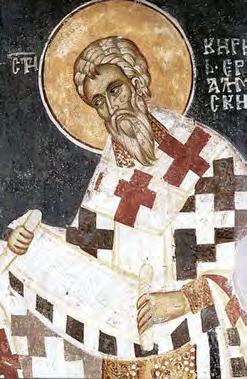
through tangible materials and continues to write His story in us. When water flows over our head and those holy words are spoken, we don’t just remember the death and resurrection of Jesus: we die with Him, and we rise with Him. Through the oil of confirmation, the Holy Spirit actually descends upon us. And as bread and wine are transformed into the Eucharist, we really partake in the Body and Blood of Jesus.
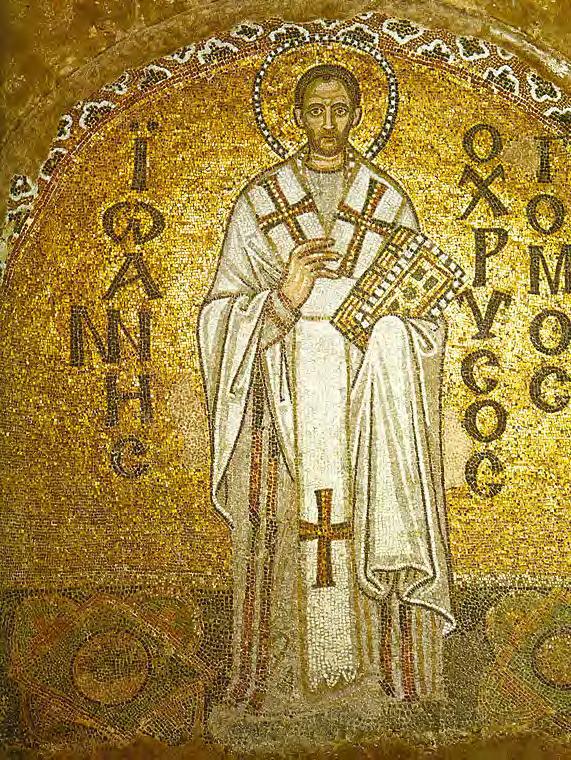
Finally, St. John Chrysostom teaches us how to live the story that God spoke in Scripture and that He continues to speak in the liturgy. Chrysostom first preached in Antioch before moving to Constantinople, where he preached some of the greatest homilies of all time. St. Thomas Aquinas once said that he would rather possess Chrysostom’s commentary on the Gospel of Matthew than own the city of Paris!
John is called “golden-mouthed” (Chrysostom in Greek) for a reason. He had the great gift of making the Gospel come alive. Whether before emperors or his regular Sunday congregation, Chrysostom showed the beauty of the Gospel made flesh, here and now. He was particularly concerned about the poor and raising good families. If we have been baptized into the family of God, we better start acting like the children of God. Chrysostom said we shouldn’t listen to the world which tells us to take for ourselves; we must listen to Jesus who tells us to sacrificially love and give till the end.
Christianity is the greatest story of all time. And it’s true. It was foretold by the prophets, fulfilled in Jesus, proclaimed by the Apostles, and continues in the Church. Ephrem, Cyril, and Chrysostom took up the story. So should you. ✦
2026)
BY JEFFREY LAYNE BLEVINS
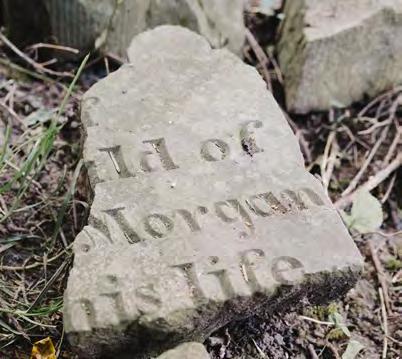
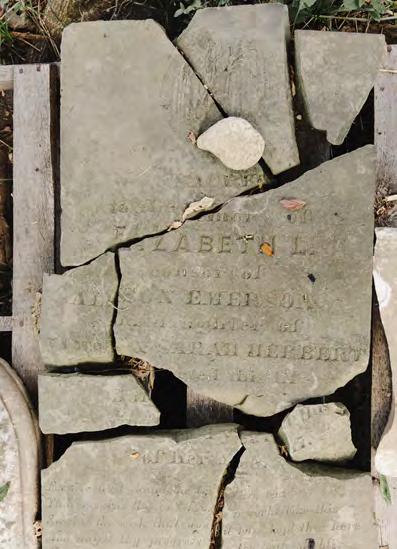
As faithful Catholics, we are called to perform corporal works of mercy, including respectful care of the deceased. Recently, students from Archbishop McNicholas High School, along with some local veterans, restored a forgotten cemetery where several Revolutionary War veterans are buried that was suffering from decades of neglect. Their endeavor is even more poignant as we recognize our country’s 250th anniversary, and observances remind us that we should always remember the soldiers who made our nation possible.
When he discovered the abandoned Fulton-Presbyterian cemetery off the Ohio River Trail in an industrial area of Columbia-Tusculum four years ago, James Hay, a Marine Corp veteran and McNicholas High School alumnus, acquired its property title for American Legion Post 744 and led restoration efforts.
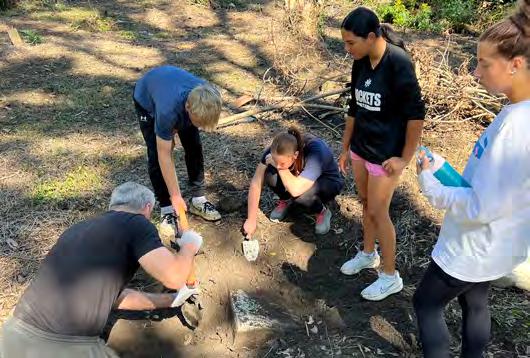
Hay’s fellow vets and continually changing crew of McNicholas students have painstakingly cleared brush, vines, and other invasive plant species. The makeshift crews cut around engulfing, large, tangled roots to dig out submerged headstones, using a small collection of shovels and hatchets. Floods and erosion make the work harder and muddier.
“When we identify one [headstone], we mark it and start digging around it,” said Hay. Using spray bottles to clear the soil from the stones, they look for engravings. “[Those] in good shape, we can salvage,” said Hay, “but if they’re in pieces, there’s nothing I can do about it.” An added difficulty is that “it’s hard to know what’s a head stone or just a stone when you begin digging,” said Jeff Zalar, a Marine Corp vet, member of American Legion Post 484, and Chair of the Catholic Studies program at the University of Cincinnati.
Zalar said it is “unacceptable” that the cemetery had been allowed to deteriorate to such a condition, especially with so many Revolutionary War veterans buried there. “This is really a scandal … when you think about how much veterans have contributed to the defense of this country.”
Continental Army Soldiers were mostly poor commoners who fought and served while enduring harsh conditions with little to no pay. Unfortunately, in many cases they returned home to nothing, not even back pay. And yet, without the sacrifice of these soldiers, America would not have won its independence.
That is why it is important to “preserve the memories of these Revolutionary War veterans,” said James Gaunt, a McNicholas student and member of its Military History Club.
Anne Steinmetz, also a Military History Club member, said she “wanted to honor people who had been in wars,” adding that her father had told her to “always respect veterans.”
Most students working in the cemetery had family—great grandfathers, grandfathers, aunts, and sisters—who were veterans, including some who served in World War II and Vietnam. Students who were earning service credit for their AP Government or History classes, including Molly Armstrong, Tori Stewart, Elena Escamilla, Annabell Moeves, Connor Miller, Blayden Chitwood, and Brendan Dennis, all agreed that it was “important to honor veterans.”
Randy Royal, who founded and advises the Military History Club, said his family had a strong history of military service, including an uncle and cousin who served in the Marine Corps and another relative who was a pilot in Vietnam.
Now in its fourth year, the club has averaged a small number of members but made a big impact in restoring the cemetery with the American Legion. Royal said their dedication to the project has been indispensable, and “they are really excited about the military.”
“McNicholas as a whole is very supportive of vets,” said Royal, who attributes the backing to the school’s strong alumni program, particularly alumni like Hay, who served in
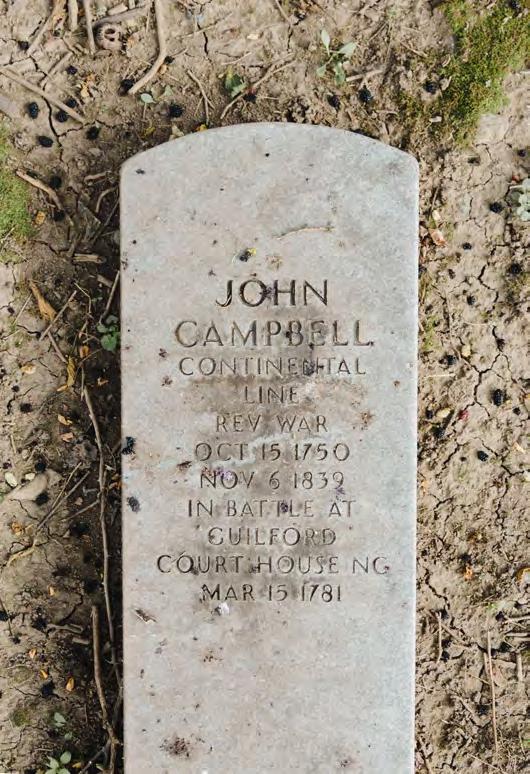
the military and continues to serve as a veteran preserving the memory of other veterans.
Sean Young, an AP History teacher at McNicholas, said he liked the opportunity of “getting kids out here to do something service-related that is also related to history.” McNicholas student Judah Kelly noted that the cemetery project is “important work, and it’s sad that these people were forgotten back here. They deserved to be remembered.”
The students volunteering this year are all juniors or seniors, and several have helped since eighth grade. This project is now part of their legacy. ✦
Jeffrey Layne Blevins is a parishioner at the Cathedral Basilica of St. Peter in Chains, an Army veteran, and a member of American Legion Post 484 in Mt. Washington.
ABY KARY ELLEN BERGER
national traveling exhibit highlighting the lived experience of Catholic service will soon arrive in Cincinnati, inviting visitors to encounter stories of faith, resilience, and mercy in action.
The People of Hope Museum Tour, launched by Catholic Charities USA, will stop for two days, July 16 and 17, along Freedom Way, near the National Underground Railroad Freedom Center.
The immersive exhibit, housed in a retrofitted tractor-trailer, uses storytelling, interactive displays, and personal witness to illustrate the mission of Catholic Charities across the country.
“The People of Hope Museum Tour tells a comprehensive story of all the work we do and the shared mission behind it all. Through storytelling, it gives voice to clients, staff, and volunteers who are living the Gospel call to respond with the love of Christ,” said Tony Stieritz, CEO of Catholic Charities Southwestern Ohio.

The exhibit reflects both local impact and a wider national mission, said Stieritz. Catholic Charities agencies across the country serve millions, each agency rooted in the needs of its local community while sharing a common identity.
“This is an opportunity for us to celebrate the work we do throughout Southwest Ohio and recognize that we are part of a vast network of agencies putting God’s love into action,” said Stieritz.
The Cincinnati stop also offers the local public a moment of connection and invitation. Parish, school, and community groups are encouraged to experience the exhibit firsthand.
Set steps away from the National Underground Railroad Freedom Center, the location adds deeper meaning to the tour’s message.
“Catholic Charities strives to free those in need from physical, mental, and spiritual poverty, and we share a longing to promote the lives and human dignity of all,” said Stieritz. For him, the exhibit ultimately points beyond itself, toward conversion and action.
“[It] can help form visitors’ consciences about the realities of those in poverty and present signs of hope made possible through works of mercy,” said Stieritz.
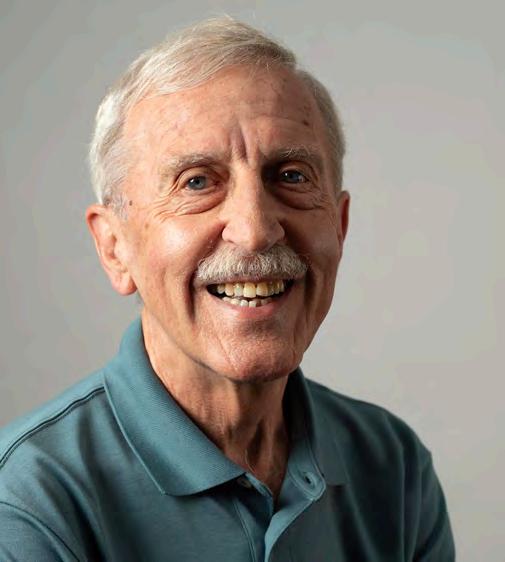
Among those signs of hope is Cincinnati volunteer Bob Miller, featured in the exhibit as one of the “People of Hope.”
A retired Navy officer and former corporate executive, Miller said his path to service developed gradually through faith, experience, and encounter.
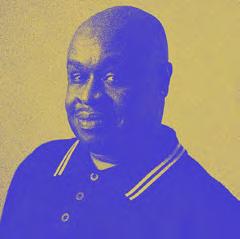

“I believe service is part of my purpose, and we discover that purpose when we pay attention to where God is nudging us,” said Miller.
His volunteer work has included refugee resettlement, reentry programs, and Habitat for Humanity, each shaping his understanding of faith in action.
“Christ’s message is one of hope and service to others, and Matthew 25 reminds us that Christ is all around us in our neighbors,” said Miller.
Some of the most meaningful moments have come from his time with refugee families, he said.
“In a room filled with many languages and cultures, I watched people laugh together, help one another, and share both hope and fear, and I think God put those people in front of us to show us how to live,” said Miller. He sees hope as something real that shows up in everyday moments of human dignity.
“I see signs of hope every time I’m with the refugee families I’ve come to know, and these moments may seem small, but they carry so much meaning,” said Miller.
Stieritz said those lived experiences are precisely what give the exhibit its strength: “The stories of hope share examples of Christian love that can inspire others to want to follow Jesus more closely.”
The exhibit is free and open to the public Thursday, July 16 from 1 to 7 p.m., and Friday, July 17 from 3 to 6 p.m.
BY JEN MORIN-WILLIAMSON
Servant of God Sr. Thea Bowman’s story continues to inspire Catholics because of her joyful faith, prophetic voice and unwavering belief that the Church is strengthened by every culture and people. More than a teacher or speaker, Sr. Thea witnessed to racial justice, evangelization, and hope, helping many Catholics see what it means to be both “fully black and fully Catholic.”
Born Bertha Elizabeth Bowman in Mississippi in 1937, she was drawn to Catholicism through the witness of the Franciscan Sisters of Perpetual Adoration who taught at her school. Although raised in a Protestant family, she asked to become Catholic at age nine because she was deeply moved by the sisters’ faith and service. At 15, she entered religious life, becoming the only African American member of her religious community.
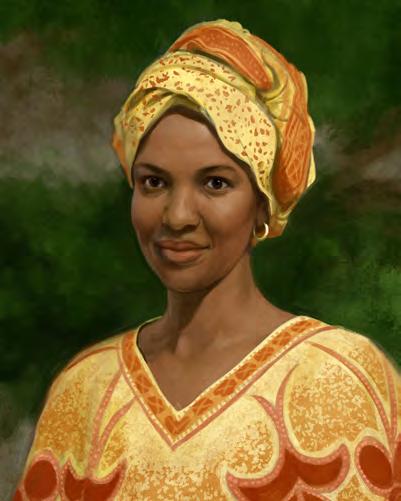
Sr. Thea’s ministry unfolded during segregation and the civil rights movement. She experienced racism personally, yet refused to let prejudice define her response. Instead, she dedicated her life to teaching, evangelization, and building understanding across cultures. After years of teaching at the elementary, secondary, and university levels, she became a national speaker and consultant for intercultural awareness in the Diocese of Jackson, Mississippi. Her presentations blended storytelling, gospel music, prayer, and humor to help people confront racial division and appreciate the richness of black spirituality.
One of Sr. Thea’s most enduring contributions was her call for the Catholic Church to recognize the gifts black Catholics bring to the life of the Church. In her historic 1989 address to the U.S. bishops, delivered while she battled cancer, she challenged
Church leaders to embrace black culture not as something separate from Catholicism, but as a vital part of it. She spoke of bringing her “black self” fully into the Church as a gift, concluding her address by inviting the bishops to stand and sing “We Shall Overcome,” which became a moment remembered as both joyful and transformative.
Even after a breast cancer diagnosis in 1984, Sr. Thea traveled and spoke from her wheelchair. Having often prayed “to live until I die,” she remained active in ministry until her death in 1990. Her witness of courage, joy, and deep faith continues to resonate with Catholics across the country.
Today, Sr. Thea’s influence lives on through Catholic schools, black Catholic ministries, and ongoing efforts toward racial justice and inclusion within the Church. In 2018, the Diocese of Jackson formally opened her cause for canonization, giving her the title “Servant of God.” Earlier this year, the diocesan phase of the process concluded, and materials were sent to the Vatican for review.
The Archdiocese of Cincinnati’s fourth Saintly Seven session on July 7 will reflect on Sr. Thea Bowman’s life and ministry and the advancement of her cause for canonization. Hosted by the archdiocesan Anti-Racism Task Force, the gathering begins at 6:30 p.m. at Salem Heights, home of the Sisters of the Precious Blood in Dayton (4560 Denlinger Rd.), with a livestream option also available. The presentation will be co-guided by Sr. LaKesha Church, CPPS. ✦
Jen Morin-Williamson is the Peace, Justice and Ecology Coordinator for the Sisters of the Precious Blood.
Session 4: Servant of God Sr. Thea Bowman
Tuesday, July 7, Central House of the Sisters of the Precious Blood, Dayton, 6:30 p.m.
Session 5: Servant of God Julia Greeley
Sunday, Aug. 23, Lehman High School, Sidney, 12:45 p.m.
Session 6: Venerable Henriette Delille
Sunday, Sept. 20, St. Benedict the Moor, Dayton, 1:30 p.m.
Session 7: Servant of God
Fr. Martin Maria de Porres Ward
Tuesday, Oct. 27, Church of the Resurrection, Cincinnati, 6:30 p.m.

Scan for all current information about the Saintly Seven Series and more detail on upcoming events
Aug 8th
Have you or someone you know experienced the loss of a child to abortion? Join us for a one-day healing retreat in the Dayton area on Saturday August 8th. is con dential event o ers a safe space to share, re ect, and nd hope in Christ. A priest, counselor, and volunteers will provide support. All communications are kept in strict con dentiality. More details will be shared upon registration.
CHRISTIAN ANTHROPOLOGY | Andrew J. Sodergren, M.T.S., Psy.D.
Note: This article is part of an ongoing series on Pope St. John Paul II’s “Theology of the Body” (TOB).
For several months, we have been exploring Pope St. John Paul II’s meditations on marriage in Part Two of Theology of the Body (TOB). The pope deeply analyzed chapter 5 of St. Paul’s letter to the Ephesians in which he compared the relationship of Christ and the Church with that of a husband and wife.
As we have seen, this spousal analogy helps us understand God’s love for each of us as well as our calling as Christian spouses. It shows us the unity and fidelity spouses are called to preserve in marriage. It highlights the sacredness of our calling to love, cherish, and nurture each other in marriage. This analogy also opens our eyes to how much God loves each of us, desiring us to be united with Him forever in such an intimate way that there is no better human image for this than spousal union.
Indeed, this spousal analogy is woven throughout salvation history. From the beginning, God has used marital images to gradually reveal His plan for us to be intimately united with Him forever in the greatest experience of love and joy that could ever be imagined. This progression culminates in Christ’s spousal gift of Himself to the Church through which marriage became the “form” or “prototype” of all the sacraments.
As we conclude our review of this portion of the pope’s meditations, it is important to see that marriage comes from God. Unlike popular opinion today, marriage is NOT a mere human construct. It is a divine gift instituted by God in the beginning, with a specific form and pattern. Pope St. John Paul II was very clear on this point, saying, “Marriage comes from the Father. It is not from the world, but from the Father” (TOB 101.7).
Marriage is the “place” where a man (male) and a woman (female) come together in a spousal union by which they become “one flesh.” This one flesh union is not merely a physical or instinctive joining but a true communion of persons in which spousal “love not only unites the two subjects, but allows them to interpenetrate each other, belonging spiritually to one another,” such that “the ‘I’ becomes in some way the ‘you,’ and the ‘you’ the ‘I’” (92.7). This love embraces the whole person
and penetrates the whole of life. Such communion of persons must protect and preserve the sacred dignity of the man and the woman. The only proper context for such communion is a permanent, exclusive, lifelong covenant, which we call marriage. For Christians, such marriage is a sacramental participation in Christ’s spousal union with the Church.
As we have seen previously, Christ’s spousal gift of Himself to the Church coincides with his self-sacrificial act of redemption on the Cross. Thus, His spousal love is also a redemptive love that stops at nothing to save and sanctify the beloved. This love never gives up on the beloved no matter the amount of betrayal, abuse, or neglect. It is a love that continually extends mercy and remains faithful in the face of all infidelity. This love moved Jesus to freely suffer and die for us: “God shows his love for us in that while we were yet sinners Christ died for us” (Rom 5:8). What’s more, Christ’s spousal love calls us to repentance, conversion, and holiness of life. He loves us so much that he painstakingly teaches us, leads us, and spiritually empowers us to rediscover our dignity and live according to life in the Spirit. He gives us, His Bride, everything to show us the way to ultimate joy—our sanctifying union with Him.
As human beings made in God’s image and disciples of Christ, members of His body, we too are called to embody this spousal love in our own marriages. In marriage, we are called to be Christ to one another, to love one another as Christ the Bridegroom loves His Bride, the Church. Of course, we are finite and wounded by sin and unable to embody Christ’s spousal love on our own. We need continual divine help and human support.
When we embrace this vocation and all the help that God provides, marriage becomes a path to gradually overcome the power of sin in our fallen human nature and progress in Christian maturity. As Pope St. John Paul II summarized, “Marriage as a sacrament immutably serves the purpose that man, male and female, by mastering concupiscence, does the will of the Father. And the one who ‘does the will of God will remain in eternity’ (1 Jn 2:17)” (101.10). Indeed, “Marriage as a sacrament remains a living and life-giving part of this salvific process” (102.8). ✦


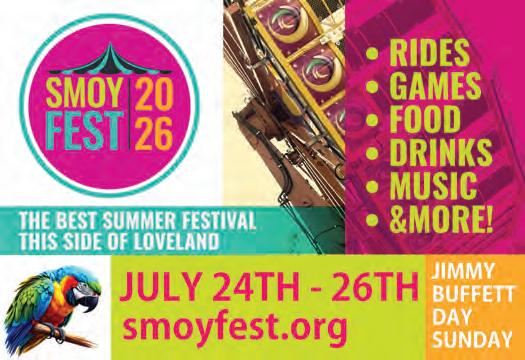
Live Music, Games, Food, Drinks, Raffle, Rummage Sale, Trackless Train

Giant Flea Market, Live Music, Games, International Food, Drinks, Raffle Mary, Help of Christians, Fairborn July 17–19 St. Brigid, Xenia August 7–9


Michael the Archangel Family of Parishes
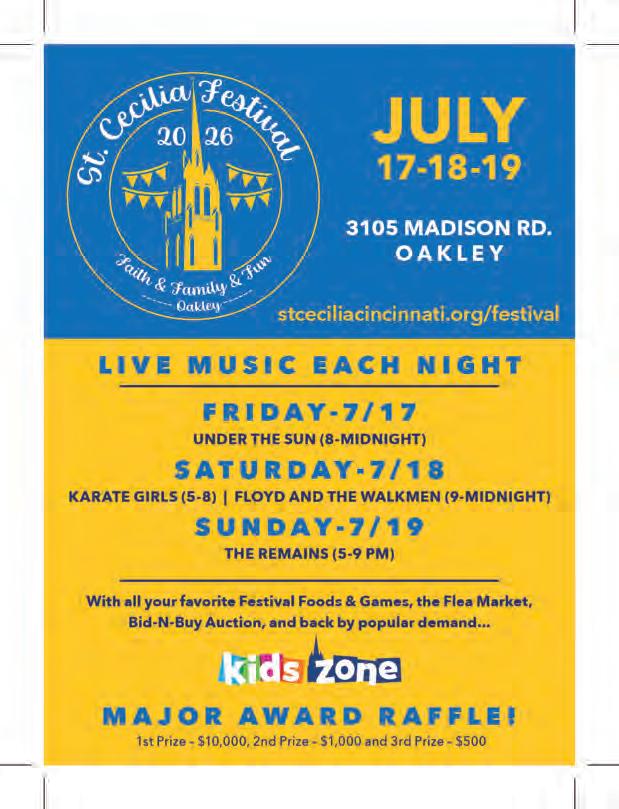
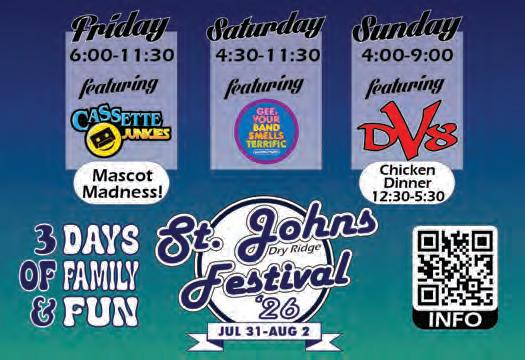
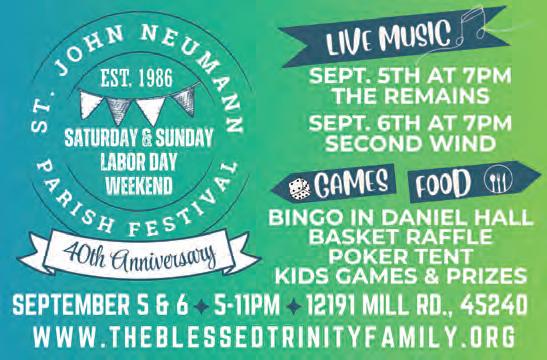
SHINE ON | Dominick Albano
Would you do something you thought was right even if you knew there was a good chance it would get you killed?
On paper, it sounds like this should be an easy "yes." But I wonder, in reality, is it that simple?
What do you do when the high school coach adds mandatory team practice on the same night your son planned to attend the parish youth retreat?
What do you do when you get a promotion at work, then learn one of your first responsibilities is reorganizing a department to eliminate three jobs?
How do you react when adult children want to come home for a few days during the summer, but will want to share a room with their fiancé?
Two hundred and fifty years ago, a group of ordinary men signed their names to a piece of paper knowing fully it could get them killed. They weren't superheroes or incredible fighters. They were farmers and lawyers and merchants. They signed anyway, knowing they could lose their lives, their families, their land… because they thought freedom had a price worth paying.
It's because of the sacrifices of bold men and women 250 years ago that we, today, get to be "One Nation, Under God." It's because of their sacrifices that we get to worship freely.
Of course, free and easy are two very different ideas.
250 years ago, Catholics were "free" to worship how they pleased. But they weren't "free" from public scrutiny, sideways glances from neighbors, and lingering suspicions about their allegiances. Catholics were a suspect minority. Twenty years ago, openly practicing any religious faith was often met with scorn. It was popular to be an atheist. If you believed in God, you were considered foolish. Better to keep those “hocuspocus” superstitions to yourself.
Interestingly, the tide has turned in the past few years, especially with young people. It is now popular to have "God First" in your social media profiles. It's popular to wear clothing that gives glory to God, to have a bumper sticker featuring a Scripture passage, and for athletes to put crosses in their eye black.
The "freedom" to worship has always been there. And today, "One Nation, Under God" feels easier than it has in my lifetime. But we can't mistake this moment for a permission slip.
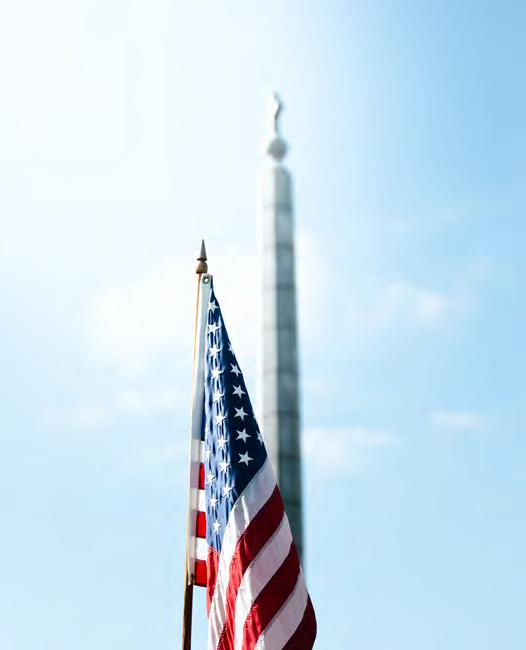
"One Nation, Under God" isn't a promise that proclaiming the Gospel will be easy. It never was. It's never meant that anyone has to believe, that the culture would applaud, or that the cost wouldn't be too steep. In fact, our situation hasn't really changed at all—from the Apostles to the great saints of history to today. You've always been free to worship and spread the Gospel… it was just a matter of what it was going to cost you.
The Apostles were free to worship Jesus and spread the Gospel. But doing so might get them stoned to death. St. Damien of Molokai was free to serve the outcast lepers of Hawaii. But doing so cost him his life. We're all free to do what we believe God is calling us to do at any moment. But we can't help ourselves from wondering—what is this going to cost?
True, most of us probably aren't too worried about contracting leprosy like St. Damien. And we probably won't be stoned to death like St. Stephen. It might even be safe to post about the faith on social media, if you can believe it!
But what if it costs your son playing time?
Or, what if it costs you being looked over for a promotion?
What if it's an eye-roll from a neighbor when you mention church?
Yeah, these are small moments. Small prices. But the willingness underneath those moments—the willingness to show up, to love others, to do what God is asking us to do—that's nothing different than any saint from the past 250 or 2,000 years.
"One Nation, Under God." It's a beautiful thing.
You've always been free to pay the price. Luckily, we live in a land where that price shouldn't have to be paid with our lives. But it still begs the question… What price would you pay? ✦
Katie Sciba
We all know “America, the Beautiful.” The compelling lyrics ring strong and true every time I hear them, filling me with pride and confidence in the Lord’s greater plan for the United States. The familiar verse asking God to shed His grace upon our nation is a lovely prayer, but through years of crooning the classic melody, I noticed the common tendency to end after verse one or occasionally two. Curious, I searched for the lyrics in their entirety and was deeply impressed. I felt as though I had stumbled upon undiscovered treasure. How many times do we have the opportunity to raise our voices in the complete anthem?
The aspirations that flow through Katharine Lee Bates’s poem deepen patriotic humility and faith in the God we trust. While present day patriotism is reduced to political affiliation or social ideologies, the essential definition is found here in this hymn.
“America! America!
God mend thine every flaw, Confirm thy soul in self-control, Thy liberty in law!
America! America!
May God thy gold refine, Till all success be nobleness, And every gain divine!”
The lines point to greatness not built on the self, but available from virtue. The recognition of shortcomings underscores that the United States is ever in need of refining. We ask that whatever wealth, success, or influence America possesses be purified by God into virtue, i.e. the mentioned “nobleness.” America’s highest pursuit should be gains of a divine nature.
This is patriotism.
250 years ago, the United States was founded with hope upon God-given rights, the dignity of the human person, united together with a government formed to serve these principles. It seems to me that to be a patriot—a real redblooded American—is to cultivate the greatest possible faith in God. If our rights and dignity are divinely given, then every person has inherent worth because he or she is made in the image of the very Author of our lives. Freedom will thrive when
we as individuals and as a country enjoin ourselves to its Source.
Practically speaking, good stewardship of our nation is easily taken in stride for the faithful.
Pray for the nation and its leaders. Pray that elected officials, judges, military personnel, and first responders will be blessed with wisdom and humility, as well as the conversion of the nation. This teaches children and reinforces to us parents that living in our country carries a spiritual responsibility.
Celebrate American history with gratitude and honesty. Read biographies of founders, saints, presidents, inventors, and reformers. Teach children to appreciate what is noble in our history while acknowledging our failures. Take the good with the bad in our American heroes, recognizing that, through space and time, we all need a Savior. Patriotism is rooted in truth, not mythology.
Create a culture of service. Love of country begins with love of neighbor. Loop your kids in on making dinner for another family on a regular basis. Call someone and volunteer to keep their kids so they can get a break. Keep a stash of coats, blankets, socks, and toiletries to offer to the homeless as you see them. Children will witness that life as a Catholic and as a citizen involves looking beyond ourselves.
Practice virtue in the home. The Founders frequently connected liberty with self-government. A family that cultivates prayer, responsibility, self-control, diligence, and respect for others will form citizens capable of sustaining a free society.
Perhaps this is why the later verses of “America the Beautiful” remain so compelling. They offer a prayer for a nation still being sanctified.
As we mark 250 years of American history, we would do well to recover this understanding of patriotism. Love for America is not measured by slogans, political victories, or nostalgia for a bygone era. It is expressed through gratitude for God's blessings, fidelity to truth, and a sincere desire for the good of our neighbors and nation.
May God continue to shed His grace on America. May He mend her flaws, ever refining her to greater strength and virtue. And may we, as faithful Catholics and grateful citizens, do our part to become the kind of people upon whom such blessings are bestowed. ✦
OF
BY GAIL DEIBLER FINKE
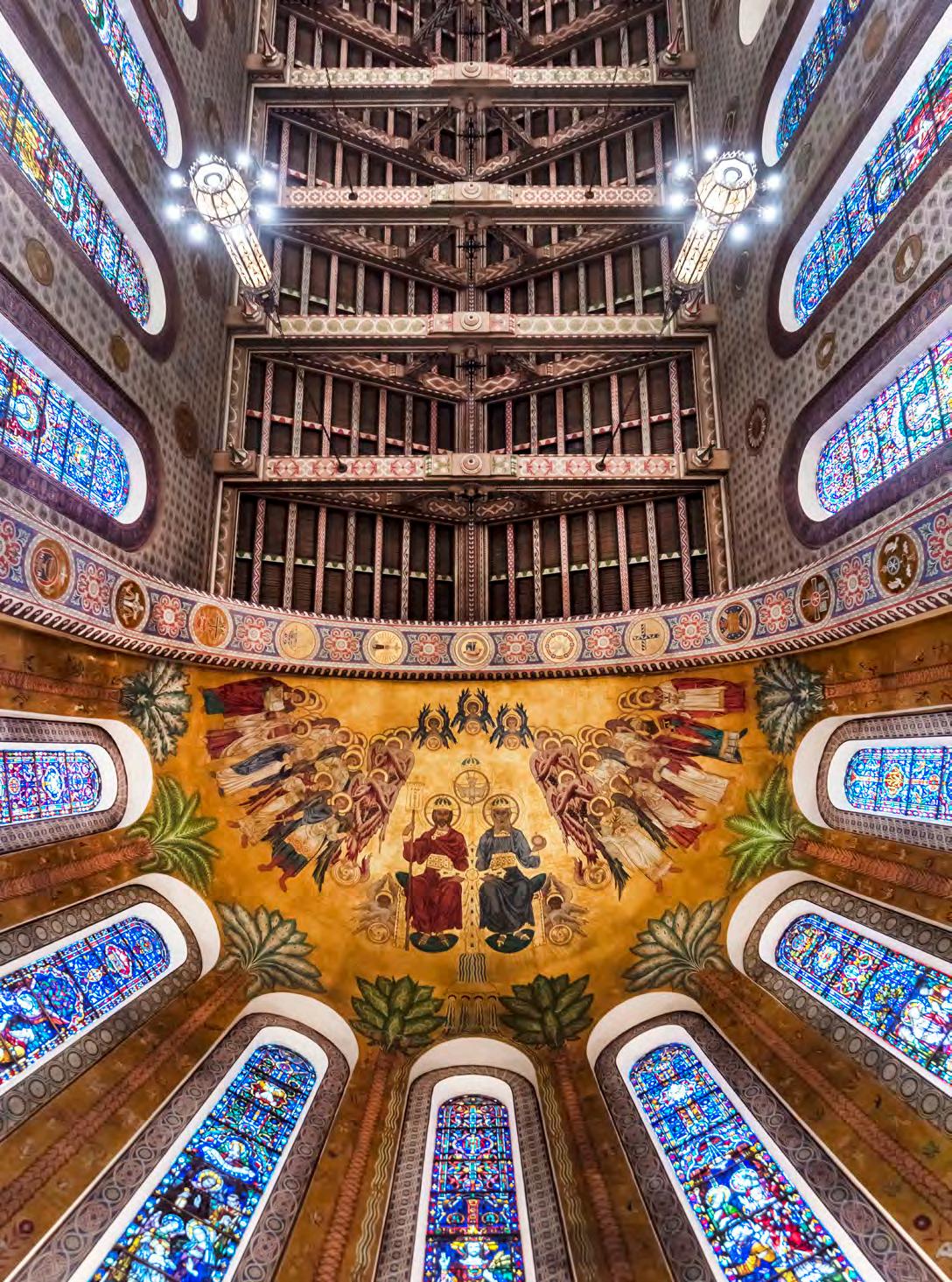
Born in North Africa around 330 A.D., Monica famously prayed for years for her brilliant son, Aurelius Augustinus, to become Christian. She followed him to Rome, then Milan, where he was influenced by St. Ambrose, and converted before her death. She’s buried in Rome, and thanks to a request by that son (now known as St. Augustine), pilgrims still visit her tomb to pray. She’s the patron saint of mothers, women in difficult marriages, and parents whose children have left the Faith.
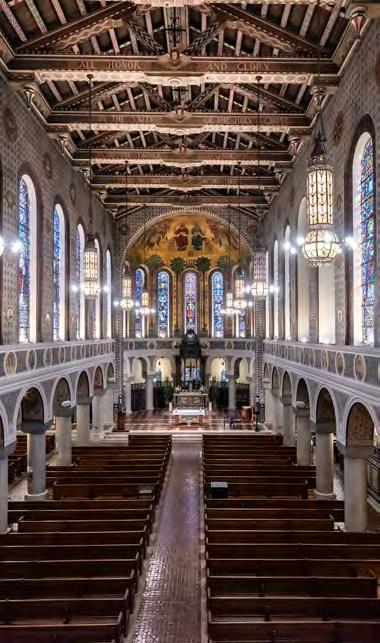
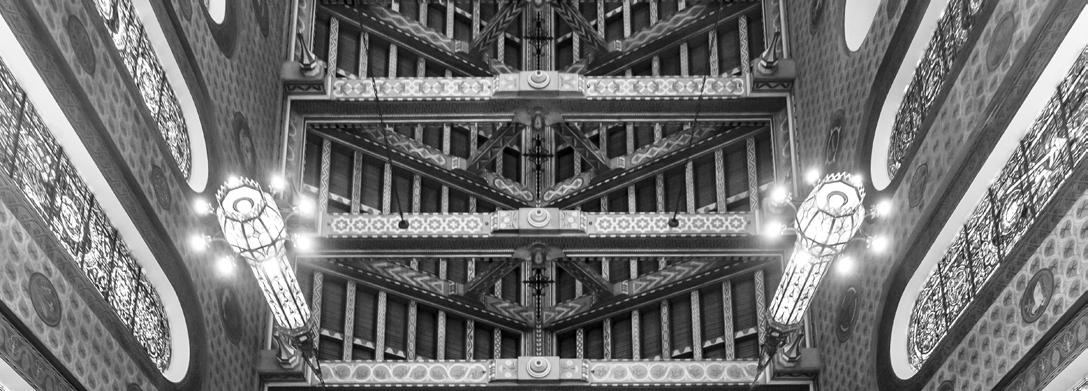
“We love that church! The sisters are there every week for adoration. It’s so beautiful. Every inch of it speaks the Gospel. The painted designs on the ceiling, the carvings, and even the floor tiles are all different Christian symbols. Next time you’re there, look at the floor!”
MOTHER SERAPHINA MARIE
Franciscan Daughters of Mary
St. Monica Church was established as a parish in 1911, after almost 20 years of contention between area Catholics who wanted a parish of their own and the nearby Franciscan parish of St. George, which served a large area. When the dust settled, St. George was designated the parish for Corryville and St. Monica, the parish for Clifton Heights.
Built in 1928, the ornate limestone church designed by Edward Schulte was modeled on the Basilica of St. Apollinare in Ravenna. Its neo-Romanesque style has many Byzantine influences and features: a red clay tile roof, a 144-ft. campanile (freestanding belltower), ornate carved stonework, stone tile floors and wall ornaments, a curtain wall of German stained glass in the clerestory, more than 100 motifs and portraits of saints, multiple reredos, and an elaborate, eight-sided, brass baldachino. Almost every surface is carved, stenciled, or painted, including the wooden ceiling and trusses.
In 1938, St. Monica became the temporary proto-cathedral for the archdiocese, when the Cathedral of St. Peter in Chains was in such disrepair that its future was in jeopardy and the building had to close. St. Monica served as the archbishop’s seat until the original cathedral reopened in 1957.
In 1993, St. George merged with both St. Monica and the University of Cincinnati Newman Center, served by the friars of St. George until 2020. This merged parish is now part of the Uptown Catholic Family of Parishes, with Annunciation of the Blessed Virgin Mary and Holy Name churches and schools.
In 2022, the Covington-based Franciscan Daughters of Mary worked with prior pastor Fr. Ethan Moore to spearhead cleaning and repair of the sanctuary. Over several weeks and using scaffolding loaned by a Kentucky supply company, the sisters and more than 100 volunteers—many of them students and families—polished the blackened brass in the sanctuary to restore its golden shine. ✦
“Here are the injections for Converso. The pawn ticket is Sappa’s. I had forgotten it; renew it on my behalf” (Letters to His Friends and Family, Pier Giorgio Frassati, 238).
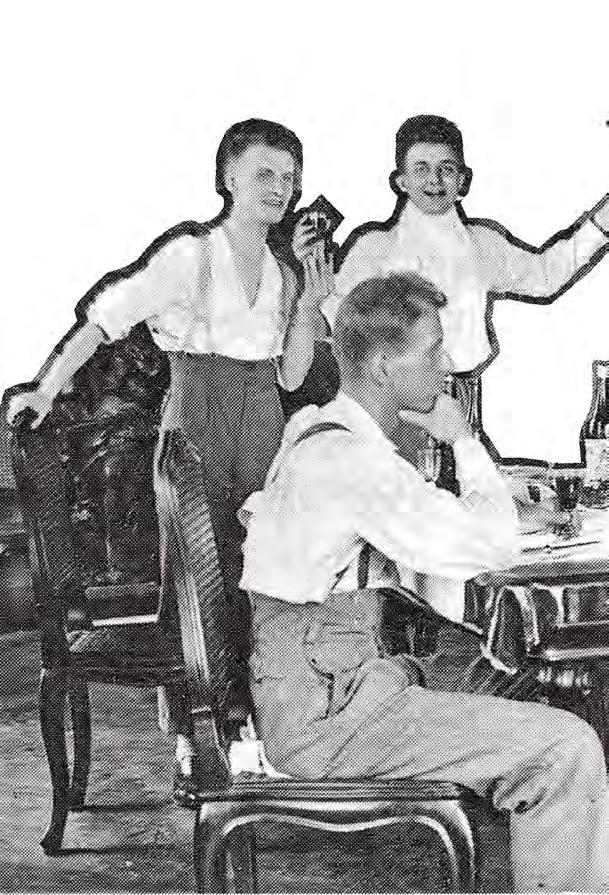
This was the last letter St. Pier Giorgio Frassati wrote, composed while he was dying of polio at age 24, directing his colleague at the St. Vincent de Paul Society to supply, in his absence, the requested goods for two impoverished friends (medication for Converso and the renewed ticket to prevent the loss of Sappa’s belongings). He likely contracted polio from his time serving the poor in his hometown of Turin.
Pier Giorgio was the son of an Italian senator who founded one of Italy’s preeminent newspapers, but Pier’s activities among the poor were unknown to his parents, who had often been wary of their son’s Catholic faith. As his sister wrote of their family dynamic: “What help was it to Senator Frassati … to have a son who carried away the flowers from drawing rooms to put them on the coffins of the poor?” (Luciana Frassati, A Man of the Beatitudes, 73). They only began to understand him when the poor of Turin flooded his funeral.
The act of charity made just before his death marked the end of his marvelous life on earth. We will consider just a sketch of that life.
Preferring hikes with friends and collecting rocks to doing schoolwork, Pier Giorgio adored the mountains (“If my studies permitted, I’d spend whole days in the mountains contemplating the Creator’s greatness in that pure air,” Letters, 132). Though he struggled academically, he was well cultured: he delighted in Dante, whom he was prone to quote spontaneously and sonorously around the grounds of his family home, and he kept a collection of St. Paul’s writings in his pocket alongside his rosary, which he once affectionately referred to as his will.
Like St. Catherine of Siena (whose biography was found open by his deathbed), he was a Dominican tertiary. Belonging to numerous clubs, he fought communism and abhorred fascism (“I glanced at Mussolini’s speech and my blood boiled,” Letters, 86). He was even arrested once for defending a Catholic flag with his friends. Inspired by Pope Leo XIII’s encyclical Rerum
Novarum, he advocated for the rights of workers and vowed to give his inheritance to the poor. Having almost completed his degree, he planned to become a missionary miner so he could work in solidarity with those suffering terrible working conditions and share Christ with them.
His love of the poor cannot be understood apart from his lifelong devotion to the Eucharist, which he first encountered as a child through the priests at his school. Of this devotion, he wrote as an adult:
I urge you with all the strength of my soul to approach the Eucharistic Table as often as possible. ... And when you become totally consumed by this Eucharistic Fire, then you will be able to thank with greater awareness the Lord God who has called you to be part of His flock and you will enjoy that peace which those who are happy according to the world have never tasted. —Letters, 129
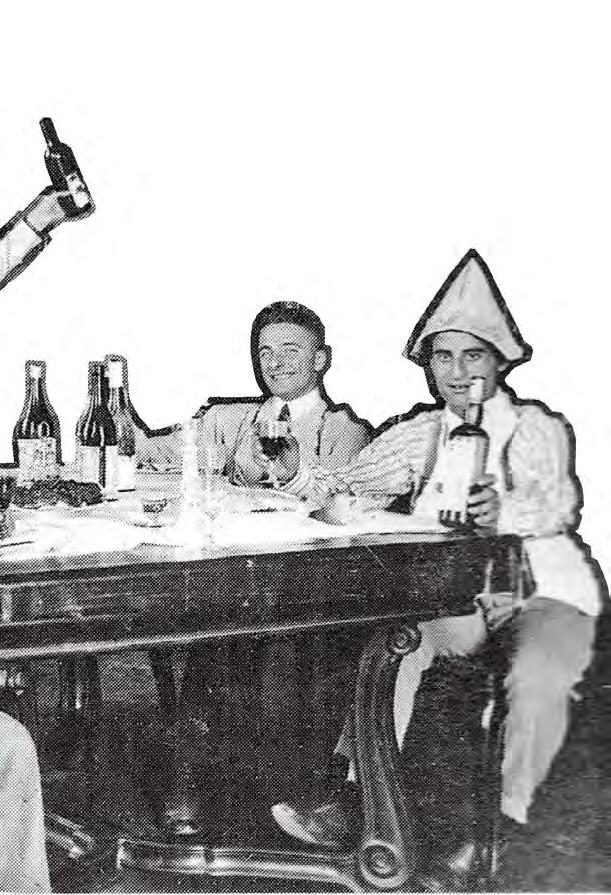
St. Pier Giorgio’s witness reminds us that devotion to the Eucharist is inextricably tied to love for the poor and vulnerable.
Pope St. John Paul II once said of America: “The ultimate test of your greatness is the way you treat every human being, but especially the weakest and most [defenseless] ones.” Pier Giorgio (whose feast we celebrate on July 4th) persuades us that that kind of life is worth living—even at the risk of discomfort, of being misunderstood, and of death. When his friend asked how he overcame revulsion to the smells in houses when they visited the poor, Pier Giorgio responded: “Don’t ever forget that even though the house is sordid, you are approaching Christ. Remember what the Lord said: the good you do to the poor is good done to me” (A Man, 143).
As we reflect on American identity for the 250th anniversary of our country’s founding, may God give each of us the eyes to see with ever more clarity the Eucharistic face of His Son in all the poor and vulnerable. St. Pier Giorgio Frassati, pray for us. ✦
JOIN CATHOLICS FROM ACROSS THE REGION AT GREAT AMERICAN BALLPARK FOR
SATURDAY, SEPTEMBER 5
REDS VS BREWERS | 6:40 PM
SCAN TO PURCHASE DISCOUNTED TICKETS
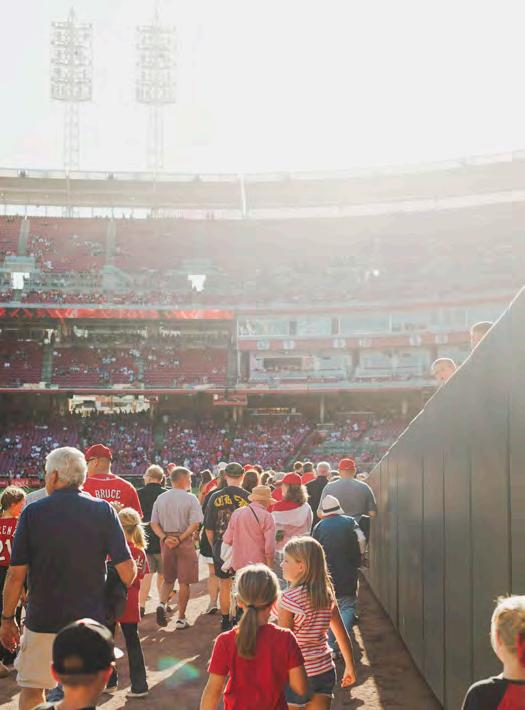

PREGAME ACTIVITES
5:30pm Parade on field. All who purchase tickets through the code above are invited to participate.
6:15pm On-field ceremony recognizing individuals who put love into action in our community.
HONORARY GAME CAPTAINS
Archbishop Robert G. Casey and Bishop John C. Iffert
FIRST PITCH
Fr. Michael Willig pitching to Fr. Jacob Willig
BY ISABELLE HELTON
One of the first phrases I remember learning to say in French was the sign of the cross: Au nom du Père et du Fils et du Saint-Esprit.
It was long before I declared a minor in French at the University of Kentucky. In elementary school, at Queen of Peace, a woman came weekly to teach us English and poetry. She taught the class the English language, but we began and ended it with prayer in French. A few years later, as I sat in Badin High School’s gym scheduling my classes, I had no clue that my decision to check “French” instead of “Spanish” would shape everything I do and am today.
Bonjour! My name is Isabelle, I’m 23 years old, live in Deauville, France, and teach English at the local elementary school. Deauville is a small town on the northern coast of Normandy, along the English Channel. When I accepted this job, I knew absolutely nobody here. Leaving my family at the airport gate to walk alone into complete uncertainty required an amount of faith I never needed before.
They say, “Let go, let God,” and that’s exactly what I had to do. I was so scared in the month before my departure. My heart felt heavy, which I thought was a bad sign, but now I think it was just the culmination of graduation from university and saying goodbye to my family—my sister and my new nephew. When I asked God to put me on the right path, all signs pointed to France.
I trusted He would lead me to exactly where I needed to be, and I love it here! I never thought I’d enjoy working with kids as much as I do, but they bring so much joy to my days. I love watching their minds work as they try to figure out how to explain something to me. I get to be a source of comfort, trust, and stability for my students. And sometimes, when a kid needs a hug, they have no clue that I needed one, too, because I was missing my parents.
I also love the community—I know the people in town who work at the bakeries and shops. I have a place here. This
doesn’t mean my days aren’t full of effort and challenges. Every day, I face a culture that knows me as an outsider. As much as I’d love to say I’m fluent, I still have more to learn and bilingualism is something I work toward every day. When I speak with someone in a store and hesitate too long because I want to use correct grammar, I can see it on their face—there’s a moment where they don’t know where I’m from or anything about me, but they know I’m “other.”
God blessed me with a friend who shares my dreams. Although we live on opposite ends of France, she has the same travel bug I do. We’re lucky enough to meet up in different cities across Europe, and in our travels, we’ve seen incredible churches! The cathedrals and basilicas are so ornate. I’ve made a habit of sitting and praying in every church I visit—so, I’ve prayed in magnificent places. While a prayer in St. Peter’s Basilica is the same as a prayer sitting in my car, I love seeing how such grandeur was built as a symbol of the people's love of God. Last Christmas Eve, we attended the vigil at Notre Dame in Paris. Despite my years of speaking French, I could only follow the Mass because of my faith, not because I understood all that was spoken.
This summer, Normandy is honoring American soldiers for the 82nd anniversary of D-Day in World War II (WWII), as they do every year. I’m lucky enough to be included in welcoming WWII Veterans at the airport in Deauville and taking students to Omaha Beach and the American cemetery for a memorial service. It offers me the chance to tie my two communities together. I’m happy to be here in France, and I also really miss the place that built me. The U.S. will always be home, but I have more to learn here before I bring it back. Cincinnati, I miss you. God bless! ✦
Isabelle Helton is a parishioner of Queen of Peace parish in Hamilton, Ohio, presently teaching the English language to elementary students in Deauville, France.

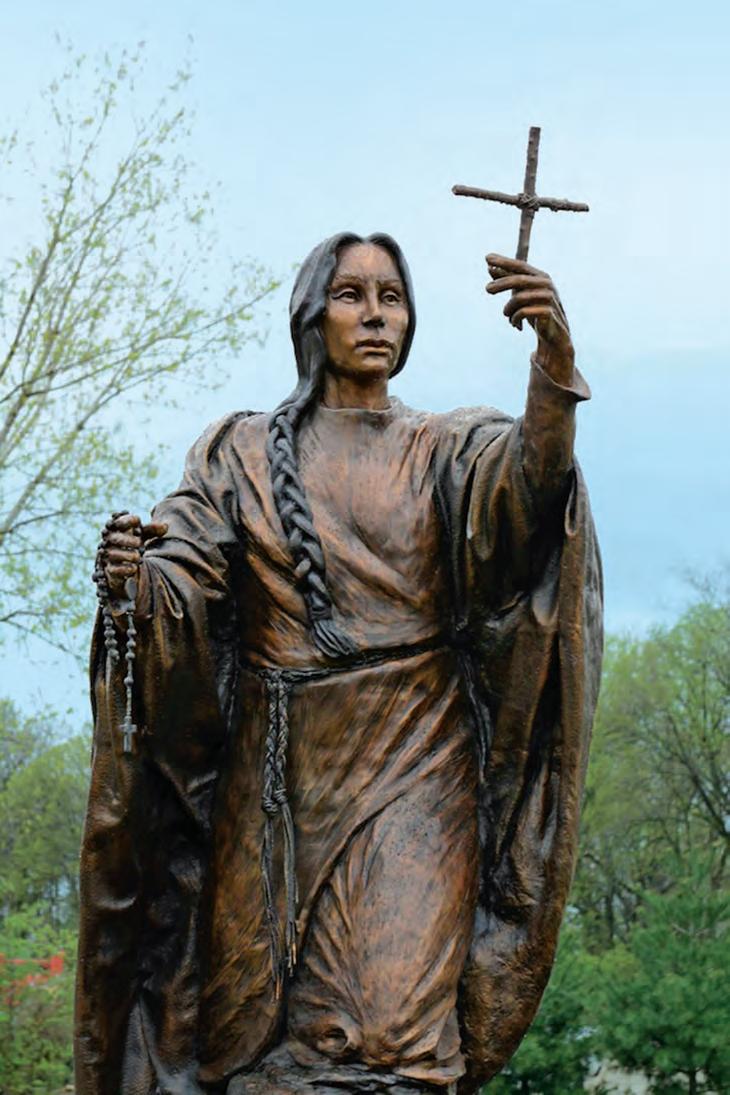







Elizabeth Ann Bayley Seton is a true daughter of the American Revolution—born Aug. 28, 1774, two years before the signing of the Declaration of Independence. Growing up Episcopalian in the upper class of New York society, she was a prolific reader, reading everything from the Bible to contemporary novels.
At 19, Elizabeth was the belle of New York and married the handsome, wealthy businessman William Magee Seton. They had five children before his business failed and he died of tuberculosis. When she converted to Catholicism in March 1805, many of her family and friends rejected her. Widowed and penniless at age 30, she opened a Catholic school in Baltimore to support her five small children.
Three faith points led her to the Catholic Church: belief in the Real Presence, devotion to the Blessed Mother, and conviction that the Catholic Church led back to the Apostles and to Christ. She founded a religious community in 1809, the Sisters of Charity, pronouncing vows of poverty, chastity, and obedience, and eventually became known as Mother Seton.
Thousands of letters reveal the development of Elizabeth’s spiritual life from ordinary goodness to heroic sanctity. She suffered great trials of sickness, misunderstanding, the death of loved ones (her husband and two young daughters), and the heartache of a wayward son.
Along with founding the first American religious community for women, the Sisters of Charity, she opened the first American parish school and established the first American Catholic orphanage. Elizabeth did
all this in the span of 46 years while raising her five children. She died Jan. 4, 1821, and became the first native-born American to be canonized by the Catholic Church. Buried in Emmitsburg, Maryland, St. Elizabeth is the patron saint of Catholic schools, teachers, loss of parents, and widows. Her feast day is Jan. 4.
“Do what we can, and God will do the rest. What seems so impossible to nature is quite easy to grace.”
ST. ELIZABETH ANN SETON

BOOK REVIEW | Anna Mitchell
“Lord, open my lips, and my mouth shall declare your praise” (Ps 51:15).
If only that were true! If all things (as the Catechism teaches) were made by God for His glory and to communicate His divine life to all, then the highest purpose of our mouths is for things like consuming the Eucharist, singing hymns of praise, and simply communicating with God through prayer. We open our mouths countless times in the day: What percentage of these times do our mouths open for their created purpose? How could that percentage be higher?
This is the question Fr. Gregory Pine aims to answer in, Training the Tongue and Growing Beyond Sins of Speech, from Ignatius Press. As a priest of the Order of Preachers (a.k.a. the Dominicans), Fr. Gregory’s ministry involves a good amount of speaking. Unlike, say, a Benedictine monk, it would be unrealistic for him (and many of us) to follow what St. Benedict writes in his Rule: “Indeed, so important is silence that permission to speak should seldom be granted even to mature disciples, no matter how good or holy or constructive their talk, because it is written: In a flood of words you will not avoid sin (Prv 10:19).”
Fr. Gregory takes a slightly different approach to overcoming sins of speech. Sure, it is important to root out sin. But when we focus on “cultivating our lives in grace and virtue,” he admonishes, then “sin and vice get pushed to the edges of the garden in the process.” Basically, we crowd out bad and sinful habits with a multitude of good and virtuous habits of speech—things like being truthful, listening, building each other up, instructing, and of course, talking to and praising God.
That said, Fr. Gregory does not omit a discussion of sin. In fact, this is one of those books you initially “regret” reading, because you can’t un-read what he says. And the things he says demand we do better. Once you realize that your conversations are meant for communion, you can’t not think about how your words fail to build—or worse, they break—communion with someone else. When you learn that needlessly harming someone’s reputation (even if what you say about them is true) is the sin called detraction, you can’t claim ignorance of the gravity of your words. When you discover that your attempts
Fr. Gregory Pine, O.P. Ignatius Press, 2026
176 pages | $17.95

Scan QR code to purchase the book
at correction must be motivated by love for the person you’re claiming to correct, you can’t get annoyed if he or she defies your assumptions and becomes a better person.
To put it briefly, this book is for those brave enough to train their tongues for the higher things.
In the penultimate chapter (on “Giving Instruction”), Fr. Gregory writes, “By helping students to see a subject in the right light, the teacher enables them to establish connections among facts and access the inner coherence of those facts. In this way, the teacher helps students to acquire the tools for future acquisition and unaided discovery. In doing so, the teacher has moved the student beyond the need for instruction.” In this insightful book, Fr. Gregory is an effective teacher, indeed. ✦
Anna Mitchell is the host and producer of the Son Rise Morning Show on Sacred Heart Radio.
1
43 Maximum (abbr.)
Whimsical
Silliness 46 Month of the feast of St. Francis Xavier
Lacking interest
Sycophant
56 These hands are the devil’s workshop 57 Catholic Canadian Prime Minister 1979-80
59 Method
60 LA problem
61 Contradict
30 “…your___and your staff comfort me” (Ps 23:4) 31 Cut grass 34 Pungent bulbs 35 Catholic actor, Fred ___Murray 36 Ruin 37 Country that has produced the most saints
38 The feast of St. Polycarp is in this month (abbr.) 39 Commonplace 40 Queue
41 Tribe of Israel 42 Scorched
62 Like good cheese
63 Regarding 64 Kind of power
65 “…and do not share in another’s ___” (1 Tim 5:22)
1 The Holy See 2 Employs 3 Demonstrative pronoun 4 Detest
5 Benedict of Nursia is their patron saint 6 The East
Residence
8 He traveled with Abraham
9 More than one Benedictine (abbr.) 10 Number of popes named Alexander 11 Prophet in Luke 2 12 Scrutinize
13 Sharp to the taste
21 Wood for black piano keys, once 22 Religious instruction, formerly (abbr.)
24 Dull
25 Biennial games org. 26 French World War I soldier 27 Pending 28 Cheerful 29 Long, cylindrical piece of wood 31 New Zealand aboriginal 32 Beginning
Overgrown
35 “For us ___, and for our salvation…”
36 Ground husk of wheat
38 Catholic actress Dunaway



St. Nicholas’ feast is in this mon. 42 Athletic shoe
“I’m ___ up!”
Spain and Portugal
St. Juan ___
“I’ll give it ___”
Passport endorsement 49 Naval officers’ rank (abbr.) 50 Scheme 52 Latin 101 word
Catholic athlete known for his malapropisms
Biblical garden
39 Purloined fruit in Augustine’s Confessions
Clarets 57 TV station 58 Pope of the fifth century
“All roads lead to Rome.” This proverbial saying from the ancient empire remained true even as Jesus’ disciples made their way across the world. The Eternal City, the capital of one of the world’s greatest empires, has served as the center of Christ’s Church for two thousand years, unifying and strengthening Christian communities worldwide.
As the United States celebrates the 250th anniversary of its founding, we have the unexpected joy of one of our own ascending the papal chair. It’s a remarkable occasion for such a young church, and it marks a significant turning point for both the Church and our country. Although the Gospel did not reach the Americas for a millennium and a half, it has certainly taken root here. Just under half of the world’s Catholics reside in North and South America combined (47.8% as of 2023). It shouldn’t be too surprising, therefore, that the Americas have begun to produce their first popes.
Many people predicted, with Cardinal Francis George among the most prominent, that America would never produce a pope so long as it was a superpower. It would seem like undue influence in the Church alongside its political and economic clout. Pope Leo XIV, however, is not the typical American. He spent most of his life outside his homeland as a missionary priest and bishop, head of the Augustinian Order in Rome, and within the Papal Curia. He typifies America’s identity as a great melting pot—with European, Latin American, and African descent— and a ministry that has reached across continents. In Leo, we see American leadership and service at its best.
families fighting over the papacy. With the rise of the French kingdom, French popes predominated, although this proved disastrous when they moved the papal court to Avignon. And in the very year Spain discovered the New World, the infamous Spaniard, Alexander VI, the Borgia, was elected pope. After four hundred years of Italian popes, who provided stability following the Reformation and modern political revolutions, the Church looked behind the Iron Curtain and called upon a Pole to lead the Church’s stand against Communist oppression, inaugurating a new era of an international papacy.
John Paul II’s election became a watershed moment for Poland, fulfilling centuries of pent-up hopes and aspirations. Suffering from partition among hostile neighbors and occupation by both Naziism and Communism, Poland came to see itself as a martyr nation, whose suffering would serve a redemptive purpose. The opportunity came by preparing one of her sons for the Petrine ministry, instilling in him the hard-won faith and confidence solidified by centuries of faithful perseverance. His election also marked a turning point for the world, as John Paul led a moral revolution that proved instrumental in the peaceful downfall of the Soviet Union.
Looking back in history, we find that the predominant political power of the age often produces popes. Compelling candidates emerged from the most advanced cultures, which were attuned to the needs of the day. When Byzantium ruled Rome, there were many Greek popes, and during the later rise of the Damascus Caliphate, there were many Syrian popes. At the height of the Roman Empire, we saw German popes called into the city as reformers to break the stranglehold of noble
If John Paul was called from Poland to face the challenge of Communism, Pope Leo, with his American background, has already stated his intention to address the AI revolution, expanding Catholic Social Teaching to address the pressing need to guide new technological discoveries. Since America has been leading the charge in this innovation, it is only fitting that an American has been called to lead the Church at this crucial moment.
This is America’s opportunity to make its greatest impact upon the world. For Catholics, looking with the eyes of faith, we know that spiritual contributions exceed the happenings that usually take center stage in history books—battles, economic crises, and the doings of political figures. The first American popes may become one of our greatest contributions to the Church and the world.
What are the gifts our nation brings into this moment?
America is known for its emphasis on freedom, which lends itself to standing up for human dignity but can also lead to excessive autonomy. We have an optimism that informs a “can-do” attitude, which is valued by other nations. We are both entrepreneurial and efficient managers leading the way in technological development. America has been known as a melting pot for the world, becoming “one out of many,” though its unity has become seriously strained. Pope Leo brings this background into his pontificate and has the opportunity to purify these gifts in Christ. His own motto shows how America can live up to its ideal of unity: In Illo uno unum, meaning “one in the One.” He has already manifested this priority in bringing needed unity to the Church. Likewise, Christ shows us the path to true freedom and the end to which we should put our efforts and wealth: building others up in charity.
More than a laurel to rest upon, the election of Leo XIV may be an invitation for American Catholics to follow in his footsteps, using the great legacy of our nation and the gifts we have been given to serve all those in need. While we celebrate America’s 250th anniversary, the Lord may be calling the nation’s Catholics to redouble our efforts to put people before profits, wisdom before innovation, and spread the Kingdom of God throughout the world. ✦
Dr. R. Jared Staudt serves as Director of Content for Exodus 90. He is a teacher, speaker, writer, and administrator. Dr. Staudt’s column is syndicated by the Denver Catholic, the official publication of the Archdiocese of Denver.