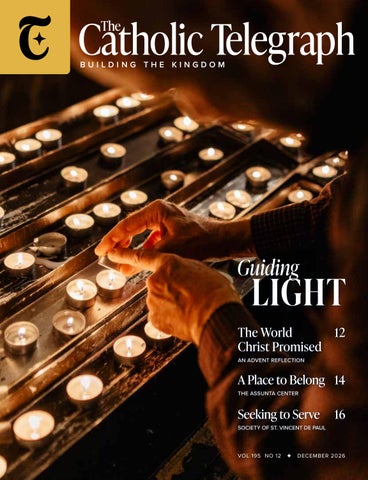
Catholic Telegraph The
Guiding
LIGHT
The World Christ Promised
12
AN ADVENT REFLECTION
A Place to Belong 14 THE ASSUNTA CENTER
Seeking to Serve
16
SOCIETY OF ST. VINCENT DE PAUL
VOL 195 NO 12
✦
DECEMBER 2026
From the Editor’s Desk LOOK FOR THE STARS AND MAKE ROOM FOR THE LORD As with many others, the night sky has always captivated me. When I was younger, I wished to live far away from city lights so I could see as many stars as possible. I sometimes wonder how many more people might recognize the hand of God if they could experience His creation in all its glory, the way it was meant to be seen. In an age dominated by science, technology, and distraction, God’s signs are still all around us. We simply have to be willing to look for them and remain open to what they reveal. The world Jesus was born into was a mess. Political power, corruption, and self-interest often took precedence over what was right and just. This was a world where someone like Herod could rise to the top of the political ladder. Obsessed with preserving his power by any means necessary, Herod was so selfconsumed that he failed to see the significant sign in the sky, and surely other signs around him, which would have warned him that he was on the wrong path. Others did not miss God’s sign because they never stopped searching for it. To this day, we call them the “wise men” from a distant land. Far from the center of the action and unconcerned with worldly power, they continually surveyed the night sky for signs of God. We can contrast that with those in Bethlehem who failed to recognize holiness in their midst. There was no room for Mary and Joseph, and so, Jesus was born in humble surroundings, largely unnoticed by the world around Him.
A star is something visible to people across nations and borders. Its light can guide those willing to follow it. God’s signs are all around us, but not everyone will notice them, and not everyone who notices will care enough to respond. When the wise men saw the Star of Bethlehem, they were willing to leave the familiar and do whatever was necessary to draw near to God. After their encounter with the Christ child, they returned “to their own country by another road” (Mt 2:12). They were changed! They could not simply return the same way. Their lives were changed in the best way possible, because you can’t encounter the Lord and remain unmoved. We don’t want to be like Herod, blind to God’s signs and threatened by His presence. Nor do we want our own lives to so preoccupy us that we leave no room for Jesus. He asks us to open our hearts and welcome Him in. Like the Magi and the shepherds in the infancy narratives, we should approach Him with humility and wonder, ready to receive the greatest gift imaginable—Jesus Himself! The Star of Bethlehem guided the Magi to Christ, the true light of the world. We, too, are called to recognize the signs of His presence, follow where He leads, and allow His light to transform our lives. What signs of God’s presence (“stars”) might you be overlooking? How might you ensure that there is room for Jesus in your life, despite all the chaos? The answers to these questions are keys to a holy and merry Christmas. ✦
David Cooley
cteditorial@catholicaoc.org
Publisher: Archbishop Robert G. Casey
Creative Director: Nick Abele
Media Sales: Deacon Graham Galloway
Editor: David Cooley
Social Media: Taylor Motley
Circulation: Catherine Ampfer
Managing Editor: Margaret Swensen
Videographer: Nathan Schuster
Table of Contents Features Advent: Practice for the World to Come
Columns 12
DEACON JOHN O’MALEY
A Place to Belong: Serenelli 14 Project Opens Assunta Center
Into Your Hands
6
ARCHBISHOP ROBERT G. CASEY
A Closer Look
8
DR. KENNETH CRAYCRAFT
SUSAN BERGMAN
Question of Faith
Society of St. Vincent de Paul 16 Seeking to Serve
House of the Lord
11
FR. DAVID ENDRES
18
SARAH WELLS
GAIL DEIBLER FINKE
An Alpine Christmas 29 in Maria Stein
Church Fathers 20
MATT HESS
Divine Seeing 24
Color the Saints 36 DAVID COOLEY & TAYLOR MOTLEY
Book Review 38 DR. KENNETH CRAYCRAFT
The Final Word 40 FR. THOMAS WRAY
On the Cover
FR. JACOB LINDLE
DR. CECELIA DORGER
From the Archives
26
MICHELLE WIRTH SMITH
Catholic at Home
30
KATIE SCIBA
Shine On
31
DOMINICK ALBANO
Christian Anthropology 32 DR. ANDREW SODERGREN
Luminous Lives
33
Candles are lit in prayer at the Basilica of St. Catherine in Siena, Italy on an archdiocesan pilgrimage. PHOTO BY JAKE EMSER
CORYNNE STARESINIC
T H E C AT HOLIC T ELEGR A PH • 195th Ye ar No. 1 2 • December 2026 • 51 3 -263 -516 4 • thec atholicteleg raph .com ctadvertising@catholicaoc.org • The Catholic Telegraph (xUSPS 094-520) ISSN. 10736689 is published monthly by the Archdiocese of Cincinnati, 100 E. 8th St., Cincinnati, OH 45202. Periodical’s postage paid at Cincinnati and at additional mailing office. POSTMASTER: Send address changes to: The Catholic Telegraph, 100 E. 8th St., Cincinnati, OH 45202.
2
T H E C AT H O L I C T E L E G R A P H
The Columnists Dominick Albano
Michelle Wirth Smith
is a passionately Catholic husband and father of four boys. He has been writing, speaking, and leading Catholic retreats for more than 20 years. He is the co-founder of the National Society for Priestly Vocations.
has served as the archdiocesan Archivist since 2019, bringing a Cincinnati-born passion for preserving Catholic history. She earned her Master of Library & Information Science degree from Kent State University.
Dr. Kenneth Craycraft
Katie Sciba
holds the James J. Gardner Chair of Moral Theology at Mount St. Mary’s Seminary & School of Theology. He is the author of Citizens Yet Strangers: Living Authentically Catholic in a Divided America.
is a national speaker and Catholic Press Award-winning columnist. She and her husband Andrew were married in 2008 and are blessed with seven children.
Dr. Cecelia Dorger
Dr. Andrew Sodergren
is an art historian and author who specializes in sacred art. She taught at Mount St. Joseph University and currently teaches at Mount St. Mary’s Seminary & School of Theology. She and her husband have two married children.
is a Catholic psychologist and director of psychological services for Ruah Woods. He speaks on the integration of psychology and the Catholic faith. He and his wife Ellie have five children.
Fr. David Endres
Corynne Staresinic
is professor of Church history and historical theology at Mount Saint Mary’s Seminary & School of Theology.
is a writer and research fellow at the McGrath Institute for Church Life at the University of Notre Dame. She lives in Greater Cincinnati with her husband Nick and their children.
Fr. Jacob Lindle was ordained a priest for the Archdiocese of Cincinnati in May 2022. He is presently studying for a Doctorate in Patristic Theology at the Pontifical Gregorian University in Rome.
We want to hear from you! cteditorial@catholicaoc.org
DECEMBER
Pope Leo XIV’s Prayer Intention
For single-parent families Let us pray for families experiencing the absence of a mother or father, that they may find support and accompaniment in the Church, and help and strength in the Faith during difficult times. DECEMBER 2026
3
Thomas Cole The Angel Appearing to the Shepherds, 1834 Chrysler Museum of Art
4
T H E C AT H O L I C T E L E G R A P H
DO NOT BE AFRAID
The words spoken by the angel to the shepherds—“Do not be afraid”— are a challenge to us all. This Advent, may we actively seek Christ’s guiding light and allow the Lord to illuminate the darkness. Let every heart prepare room for Jesus to enter and dwell within us. DECEMBER 2026
5
The Light That Leads Us Home I N T O Y O U R H A N D S | Archbishop Robert G. Casey
Every year, the beginning of Advent reminds me of one of the many lessons of my childhood, lessons handed down in my family from generation to generation. In my grandparents' house there was always a light in the kitchen window. It served as a beacon for all those seeking refuge. Driving down the dark country road to my grandparents’ house, my family would see the light in the window and immediately feel the warmth and safety that awaited us. My parents continued that custom. The light in the kitchen window of my childhood home would remain turned on until everyone in the family was home. As we got older, we would find a note from our mother next to the kitchen sink with a list of all our names. Arriving home, whether from work, school, or some social activity, each of us would look at that note to see who was "checked in," with the last to arrive turning off the light knowing that all were safely home. In Baptism, we receive the Light of Christ. That light is meant to burn brightly within us, serving as a beacon for others. Like the light in my family’s kitchen window, our Christ light must shine through our words and actions to help those around us experience the warmth and safety awaiting them in the discovery of Christ, our refuge. Christ seeks to bring all people safely home, not wanting anyone to be left outside in the darkness. Like the holy light that shone bright over Bethlehem, assisting the shepherds and the Magi to find their way, we bring light into our celebration of Advent to teach the next generation how God guides us. The candles of the Advent wreath, breaking through the darkness and growing brighter as Christmas draws near, make known God’s guiding light and introduce us to Emmanuel, born in the darkness of night to lead us out of the darkness and into a bright new day. 6
T H E C AT H O L I C T E L E G R A P H
Looking around the world today, we can easily feel the dark of night in the sadness and suffering of so many, the anger and resentment that overshadow us, and the hopelessness and despair that leave us feeling lost and without direction. We watch for the dawn of a brighter day, trusting that the night will pass. We look to Christ to guide our way. Hopefully, amid the busy rush to Christmas, each of us might find a moment for some Advent prayer and consider where we find ourselves on life’s path at this moment. Are we in a moment where darkness surrounds us? Do we need to set our sights on the path ahead, looking for the light that can encourage our next steps? Or are we aware of being surrounded and safe in the warmth of Christ’s light? Do we need to assist others who feel lost in the darkness? Might we become that light in the kitchen window that offers others encouragement and hope? The Second Letter of St. Peter reminds us, “Moreover, we possess the prophetic message that is altogether reliable. You will do well to be attentive to it, as to a lamp shining in a dark place, until day dawns and the morning star rises in your hearts” (2 Pt 1:19). Come, all ye faithful, come and behold the Christ. Like those who came on that holy night to worship the newborn Jesus, perhaps we, too, might find ourselves comforted by Christ’s light this year. May the bright joy of Christmas inspire us so that we may serve as a beacon for all who wish to accompany us out of the darkness and into God’s marvelous light. ✦
Synod 2027 Prayer Intention For an increase in faith among all people in the Archdiocese of Cincinnati.
La luz que nos guía a casa E N T U S M A N O S | Arzobispo Robert G. Casey
Cada año, el comienzo del Adviento me recuerda una de las muchas lecciones de mi infancia, lecciones transmitidas en mi familia de generación en generación. En la casa de mis abuelos siempre había una luz encendida en la ventana de la cocina. Servía de faro para todos aquellos que buscaban refugio. Mientras conducíamos por el oscuro camino rural hacia la casa de mis abuelos, mi familia veía la luz en la ventana y, de inmediato, sentíamos la calidez y la seguridad que nos esperaban. Mis padres continuaron con esa costumbre. La luz de la ventana de la cocina de la casa donde pasé mi niñez permanecía encendida hasta que todos los miembros de la familia llegaban a casa. A medida que crecíamos, encontrábamos una nota de nuestra madre junto al fregadero de la cocina con una lista de todos nuestros nombres. Al llegar a casa, ya fuera del trabajo, de la escuela o de alguna actividad social, cada uno de nosotros miraba esa nota para ver quién había “registrado” su entrada, y el último en llegar apagaba la luz sabiendo que todos estaban a salvo en casa. En el Bautismo, recibimos la Luz de Cristo. Esa luz está destinada a brillar intensamente en nuestro interior, sirviendo de faro para los demás. Al igual que la luz de la ventana de la cocina de mi familia, nuestra luz de Cristo debe brillar a través de nuestras palabras y acciones para ayudar a quienes nos rodean a experimentar la calidez y la seguridad que les esperan al descubrir a Cristo, nuestro refugio. Cristo busca llevar a todas las personas a salvo a casa, sin que nadie se quede fuera en la oscuridad. Al igual que la luz sagrada que brilló sobre Belén, guiando a los pastores y a los Reyes Magos, nosotros traemos luz a nuestra celebración del Adviento para enseñar a la próxima generación cómo Dios nos guía. Las velas de la corona de Adviento, que atraviesan la oscuridad y brillan con más intensidad a medida que se acerca la Navidad, dan a conocer la luz de
Dios que nos guía y nos presentan a Emmanuel, nacido en la oscuridad de la noche para sacarnos de la oscuridad y conducirnos a un nuevo día brillante. Si miramos a nuestro alrededor en el mundo actual, podemos sentir fácilmente la oscuridad de la noche en la tristeza y el sufrimiento de tantos, la ira y el resentimiento que nos ensombrecen, y la desesperanza y la desolación que nos dejan sintiéndonos perdidos y sin rumbo. Esperamos con ansias el amanecer de un día más brillante, confiando en que la noche pasará. Buscamos la guía de Cristo en nuestro camino. Ojalá que, en medio del ajetreo previo a la Navidad, cada uno de nosotros pueda encontrar un momento para la oración de Adviento y reflexionar sobre en qué punto del camino de la vida nos encontramos. ¿Estamos viviendo un momento en el que la oscuridad nos rodea? ¿Debemos fijar nuestra mirada en el camino que tenemos por delante, buscando la luz que pueda animarnos a dar los siguientes pasos? ¿O somos conscientes de estar rodeados y seguros en la calidez de la luz de Cristo? ¿Debemos ayudar a quienes se sienten perdidos en la oscuridad? ¿Podríamos convertirnos en esa luz en la ventana de la cocina que brinda ánimo y esperanza a los demás? La Segunda Carta de San Pedro nos recuerda: “Tenemos también la firmísima palabra de los profetas, a la que con toda razón ustedes consideran como una lámpara que ilumina en la oscuridad, hasta que despunte el día y el lucero de la mañana amanezca en los corazones de ustedes” (2 Pe 1, 19). Venid, fieles todos, venid a contemplar a Cristo. Al igual que aquellos que acudieron en aquella noche santa a adorar al niño Jesús, quizás nosotros también podamos encontrar consuelo en la luz de Cristo este año. Que la brillante alegría de la Navidad nos inspire a ser un faro para todos aquellos que deseen acompañarnos al salir de la oscuridad y entrar en la maravillosa luz de Dios. ✦ DECEMBER 2026
7
Waiting for the Light with Hank Williams and St. John Henry Newman A C L O S E R L O O K | Dr. Kenneth Craycraft
On November 4, 2001, I attended one of the 20 or so Bob Dylan shows I’ve seen over the years. This one, about two months after the terrorist attacks in New York and Arlington, Virgina, opened with a surprising song. Rather than one of his scores of familiar tunes, Dylan began that night (and throughout that installment of his Never-Ending Tour) with a raucous rendition of the countrygospel standard, “Wait for the Light to Shine.” Written by Fred Rose and recorded by such luminaries as Roy Acuff and the Louvin Brothers, “Wait for the Light to Shine” is mostly associated with Hank Williams, from the posthumous 1960 album of the same name. Dylan added the song to his setlist after 9-11 as an expression of hope in a very dark period in the U.S. and across the world. But of course, the song has much wider implications. It is, in fact, a nearly perfect Advent Song. It begins with the image of a lonesome person, laboring under a heavy burden, traversing a difficult and hopeless road. “When the road is rocky and you’re carrying a load/Wait for the light to shine,” sings the narrator. “If you find you’re friendless on that weary lonesome road/ Wait for the light to shine.” Within the context of this manifest hopelessness, the song encourages the pilgrim to keep heart and hope. “Pull yourself together and keep looking for the sign/Wait for the light to shine.” And not merely for your own benefit, but rather for the good of all, including those whose lives may be more difficult than yours: “Don’t forget your brother as you travel through the land . . . ‘Cause he may be in trouble and may need a helping hand.” And, as always, “Wait for the light to shine.” Unlikely as it may sound, this 20th century American gospel song is resonant of a 19th-century poem by one of the great saints of the Church, St. John Henry Newman. Prior to his conversion to Catholicism, Newman faced enormous struggles and burdens on many levels. As his theological journey moved him closer to Rome, he faced constant rhetorical squabbles with fellow Anglican churchmen. Coupled with the burden of his spiritual journey, Newman became very ill during an 1833 trip to Sicily, probably with typhoid or typhus. Delirious from fever and near death, Newman repeatedly said, “I shall not die, for I have not sinned against the light.” Not fully recovered, but well enough to travel, Newman finally set sail toward the Italian mainland, only to encounter a treacherously 8
T H E C AT H O L I C T E L E G R A P H
high sea and buffeting winds. Again, the specter of death closed around him as he feared the ship would founder. Rather than to despair, however—to sin against the light—Newman penned perhaps the most famous words of his lifetime, calling upon that Light in whom he had never lost faith. “Lead, Kindly Light, amid the encircling gloom,” wrote Newman. “Lead Thou me on; The night is dark, and I am far from home; Lead Thou me on.” Hank Williams and St. John Henry Newman teach us two important lessons about the season of Advent. First, Advent is a season of penance. I am not suggesting that the narrator of “Wait for the Light to Shine” or Newman in “Lead Kindly Light” are being punished for some sin or other. Rather, the travails they articulate remind us that hardship is not the same as hopelessness. But the difference between difficulty and despair is often a function of the intentionality of the moral agent. In many cases, the quality of a spiritual or moral action turns not on the objective events that impose themselves upon us, but rather on our own intentionality in the face of those burdens. Both Newman and Williams’ narrator may have seen the violent waves and rocky road as a legitimate reason to abandon hope. The difference between pessimism and penance is a function of intention; and intention is a function of spiritual growth into maturity. They turn their eyes to the light, not the darkness. Second, both songs teach us that the Light will prevail over darkness. Of course, we understand that the Light has prevailed. This is the “true light; … the light of the human race,” as the prologue to the Gospel of John tells us: “the light that shines in darkness” that the darkness cannot overcome (Jn 1:4-5). Hank Williams tells us that “it’s darkest just before the dawn.” But Newman completes the thought: the Light “still will lead me on. O’er moor and fen, o’er crag and torrent, till the night is gone.” Advent is not empty time between Thanksgiving and Christmas. Rather, it is a season of anticipatory penance. It’s a season of taking inventory of those things that inhibit our moral and spiritual growth in Christ as we anticipate His coming. And it’s a time of entering into the darkness so that the light of Christ shines ever brighter. Intending our penance toward the fulfillment that awaits us prepares us to receive the unspeakable joy of the Light in the stable. ✦
Advent & Christmas at the Cathedral Basilica Advent Lessons & Carols Sunday, Nov. 29 at 7:30 p.m. The annual Advent carol service, sung by the Cathedral Basilica Choirs, featuring seasonal choral music with the O Antiphon chants and handbells to mark the beginning of the Advent season. Bambinelli Sunday Sunday, December 20 Bring your infant Jesus figurine (Bambinelli) from your home Nativity set to any Mass today for a special blessing, reminding us that Christ is at the heart of our homes and our celebration of Christmas.
Venite Adoremus! | Come Let Us Adore Him.
Christmas Eve Thursday, December 24 Vigil Masses 3:00 p.m. & 5:30 p.m. Mass During the Night 10:00 p.m. with Archbishop Robert G. Casey (Carols with choir at 9:30 p.m.) Christmas Day Friday, December 25 Mass at 10:00 a.m. with Archbishop-Emeritus Dennis M. Schnurr
Cathedral Basilica of Saint Peter in Chains
(Carols begin 1/2 hour befo
Holy Family Catholic Church
Traditional Latin Christmas Mass 140 S Findlay St. • Dayton
12 a.m. (Midnight) High Mass 8 a.m. Low Mass 10:30 a.m. High Mass (Carols begin 1/2 hour before High Masses)
8th & Plum Streets, Downtown Cincinnati | Tel. (513) 421-5354 | website: cathedralaoc.org
DECEMBER 2026
9
Step away from the noise and enter into God’s peace on an
Ignatian Weekend Retreat Guided by an experienced retreat leader Spiritual Direction Time for silence
Register online or learn about our other retreat offerings:
Private room, meals, and access to our 37-acre property Mass, Adoration, Rosary, Stations of the Cross, Reconciliation
10
T H E C AT H O L I C T E L E G R A P H
Sharing in the Divinity of Christ Q U E S T I O N O F F A I T H | Fr. David Endres
At Mass, I notice the priest or deacon mixing water and wine. What is the purpose of mixing water and wine, and why only in the chalice from which the priest drinks? At every Mass during the preparation of the altar, the deacon or (if no deacon is present) the priest mixes a small amount of water into the chalice containing wine. This ancient practice is not a recipe but an action with symbolic meaning.
C H R I ST’ S EX A MP LE The mixing of water and wine likely dates back to the earliest celebrations of the Eucharist. Jesus, when He celebrated the Last Supper, may have mixed water and wine, which was the custom of the Jews. The practice is attested in the writings of the Church Fathers. In the third century, Cyprian of Carthage explicitly defended the mixing of water with wine in the Eucharistic chalice. The current instructions for celebrating the Mass say the same: “Following the example of Christ, the Church has always used bread and wine with water to celebrate the Lord’s Supper” (General Instruction on the Roman Missal, § 319).
A “ S EC RET” P R AYER When the water is poured into the chalice, the deacon or priest prays quietly: “By the mystery of this water and wine, may we come to share in the divinity of Christ, who humbled himself to share in our humanity.” His words are among several “secret” prayers that the minister offers during the Mass, so-called not because they cannot be known by others but because they are not meant to be heard by the congregation.
H U MA NITY A ND DIV IN ITY As the prayer indicates, the water and wine are symbolic: their mingling signifies the union of Christ's humanity and divinity. But the symbolism can extend further: to the union of the faithful in Christ and to the divine life shared through the sacraments, especially in the reception of the Eucharist. The
mixing of water and wine is also connected to the blood and water that flowed from Christ's side during the Crucifixion (Jn 19:34), suggesting the Sacraments of Eucharist and Baptism.
T HE RUBRIC The Roman Missal contains the text the priest is to pray and instructions on ritual actions to perform. These instructions, because they are colored red, became known as “rubrics”—a word etymologically related to red. According to the rubric related to the preparation of the chalice, only a small amount of water is used, so as not to dilute the wine significantly. This action is required in the Roman Rite, but the failure to mix the water in the wine would not invalidate the consecration. Furthermore, following a 2012 response given by the Dicastery for Divine Worship and Discipline of the Sacraments, the rubric does not require mixing the water and wine in multiple chalices when side chalices are present. Since it is a symbolic action, it need not be repeated. Mixing the water and wine in the celebrant’s chalice is sufficient.
PART ICIPAT ION IN D IVINE LI FE The prayers and ritual actions of the Mass are according to ancient Christian practice, perhaps going back to the Last Supper itself. But it is not antiquarianism; it has deep theological meaning. The mingling of water and wine expresses a profound theological truth: Christ, the Son of God, humbled Himself to share in our humanity so that we might share in His divine life. When we receive the Body and Blood of Christ, therefore, we do not merely remember what Christ did for us; we are drawn into the divine life He came to share with us. The small amount of water added to the chalice thus becomes a simple sign of the exchange at the heart of salvation: Christ takes our humanity so that we might share in His divinity. ✦ DECEMBER 2026
11
Practice for the World to Come BY DEACON JOHN O’MALEY
12
T H E C AT H O L I C T E L E G R A P H
In challenging moments, choosing the high road is a way of preparing for the world Christ promised. A small act of renewal expresses hope in the future that God alone will bring to fulfillment. We readily understand Advent as looking back toward Bethlehem: we prepare to celebrate the birth of Jesus. But the Church also turns our attention forward, toward His coming again in glory. The season holds together the Lord who has entered history and the Lord who will bring history to its fulfillment. That future deserves more than a passing thought before we return to our Christmas lists. It can shape the way we live an ordinary Tuesday. Isaiah offers a startling image of the peace God will establish—weapons become tools for cultivating the earth (Is 2:4). Imagine the change in a person's hands. The strength once used to threaten a neighbor becomes strength used to grow something that can feed that neighbor. The material is given a new purpose. What might that transformation look like in the things we handle every day? A phone call can carry gossip or an encouraging message. Money can purchase another object we don’t need or help someone keep the heat on. A sharp mind can devise an especially cruel reply or find a patient way through a disagreement. The same hands, resources, and abilities can begin serving a different future. We cannot manufacture God's Kingdom through good intentions, but Christ will bring His work to completion. Thus, the Second Vatican Council teaches that hope for the new earth should strengthen our responsibility for this earth, while distinguishing human progress from the growth of Christ's Kingdom (Gaudium et Spes, no. 39). Christian hope gives us a reason to care about what happens here. That matters when discouragement begins to feel like wisdom. We see another war, another betrayal, another cruel exchange online. We wonder whether gentleness accomplishes anything. Perhaps we tried to repair a relationship and received a cold shoulder. Perhaps our work seems to vanish as quickly as we do it. It is tempting to protect ourselves by expecting very little.
Advent gives us grounds to keep loving before the results are visible. Our hope rests in the faithfulness of Christ. We can entrust the future to Him while taking responsibility for the next thing within our reach. Choose one small act of repair for this Advent. Let it involve something real enough to inconvenience you. Return what you borrowed. Correct a false story you helped spread. Pay attention to the person whose work makes your comfort possible. Apologize for one specific wrong without requiring the other person to apologize first. If direct contact would cause harm, seek a responsible way to make amends. Then, connect that act to prayer. Before beginning, ask: Lord, what in me needs to change so that I can do this with love? The answer may lead to confession. Preparing for Christ's return includes allowing His truth to reach our own conduct. Repentance clears space for a more faithful life. His judgment calls our choices into seriousness; His mercy gives us courage to begin again. At Mass, the horizon opens further. The Lord whose return we await already gives Himself to us in the Eucharist. We receive strength for a life we cannot sustain by determination alone. From the altar, we return to the same streets and kitchens, carrying a renewed responsibility for the people we meet there. A family can practice this together. During evening prayer, invite each person to remember one thing that they did that day to help something heal. Allow honest answers, including an admission that someone needs to try again tomorrow. A child who learns to repair a wrong is learning something lasting about hope. The Advent candles will burn down. Your act of mercy may remain unknown. The person you helped may never know what it cost you. Bring that unfinished result to Christ and keep the promises you can keep. Tomorrow, the conversation will begin again. You will have another chance to use your strength well. Before you speak, remember the world for which you are waiting. Let someone hear a little of its peace in your voice. ✦
Deacon John O’Maley was ordained in the Archdiocese of Cincinnati in April 2019. A member of Our Lady of Hope Family of Parishes and the Knights of Columbus, he has been married for over 51 years and has four grown children and five grandchildren.
DECEMBER 2026
13
A Place to Belong: Serenelli Project Opens Assunta Center BY SUSAN BERGMAN
O
ne unexpected question inside a prison chapel changed the direction of Martin Arlinghaus' life and planted a seed for a ministry rooted in the transforming power of God's grace. As Arlinghaus helped lead a Catholic instruction class, one man who was incarcerated turned to him and asked, “Marty, could a guy like me become a priest?” The man wondered whether his tattoos stood in the way; however, Arlinghaus recognized the greater challenges to come after his release. How would this man remain connected to the Church? Who would encourage him in his conversion? Where would he find a community willing to look beyond his past and help him discern God's call? “That's when I felt as though God's call in my life was to make a community for him and others like him and to get the Church's presence into every facility and area of incarceration in the country,” said Arlinghaus. That calling led to the Serenelli Project’s founding in 2020 The Serenelli Project is a Cincinnati-based Catholic apostolate dedicated to accompanying individuals who are or were incarcerated through prayer, meaningful work, and Christian community. This October, the ministry achieved another milestone: its Assunta Center opened in Cincinnati's Sedamsville neighborhood, establishing a gathering place where volunteers, individuals formerly incarcerated, and fellow Catholics can deepen their faith and build lasting relationships. Throughout more than a decade of prison ministry, Arlinghaus witnessed volunteers bringing Christ's presence into correctional facilities, but he recognized the need for that ministry to continue beyond prison walls. The Assunta Center is a home for those relationships to grow and provides a foundation from which the Church's outreach can expand. “Assunta Center makes prison ministry a place for the Holy Spirit to work wonders,” he said. 14
T H E C AT H O L I C T E L E G R A P H
A LE GACY OF FORGIVE NE SS The Assunta Center’s name carries a remarkable history, one rooted in tragedy, conversion, and an extraordinary act of Christian mercy. In 1902, 11-year-old Maria Goretti died after Alessandro Serenelli attacked her, but she forgave him before her death. Alessandro later experienced a profound conversion during his imprisonment, eventually seeking reconciliation with the family whose lives he had forever changed. On Christmas Eve in 1934, Alessandro approached the home of Maria's mother, Assunta, seeking her forgiveness. Faced with the man responsible for her daughter's death, Assunta chose mercy over resentment. She forgave Alessandro, and the two attended Christmas Eve Mass together and received Holy Communion.
Local artist Leandra Ulmer created a painting of St. Maria Goretti, displayed prominently in the central space. Inspiring artwork and sacred details including light fixtures from the former St. Louis Church in downtown Cincinnati create a contemplative, peaceful environment. Photos by Margaret Swensen and Nathan Schuster.
Nearly a century later, that encounter continues to inspire the Serenelli Project, which takes its name from Alessandro and its mission from the belief that no person is beyond the reach of God's grace. A person’s conversion does not diminish the gravity of his crime nor the suffering it caused, but does offer a witness to the possibility of repentance, reconciliation, and spiritual transformation. “If Alessandro could persevere in his conversion, then I cannot write someone off as irredeemable solely because of a type of crime they committed,” Arlinghaus said. While acknowledging that prudence and careful discernment remain essential, he believes Catholics must resist the temptation to determine who is worthy of redemption. “We cannot put a limit on God's grace.”
A P LAC E TO BELONG For those returning to society after incarceration, rebuilding a life often involves more than finding employment or securing housing. Relationships may be strained, communities may no longer feel welcoming, and faith developed behind prison walls may be difficult to sustain without support. Arlinghaus believes lasting restoration requires a community where individuals are known, valued, and encouraged to continue growing in their relationship with God. Drawing inspiration from the Rule of St. Benedict, the Serenelli Project embraces prayer, work, stability, and community. Rather than enabling past mistakes to define a person's identity, its approach encourages individuals to embrace the responsibilities and relationships of everyday life while continually turning toward Christ. Restoration becomes not a single moment of change, but a lifelong process shaped by faithfulness, humility, and perseverance. Since its founding, the Serenelli Project has expanded to include archdiocesan prison ministry, re-entry efforts, parish outreach, the Serenelli house, and Serenelli Industries. The organization purchased the building that became the Assunta
Center in December 2025, creating a central gathering place for its growing ministries. Arlinghaus hopes to establish prison ministry centers in additional dioceses, expand opportunities for vocational discernment, and eventually develop a cloistered Benedictine monastery. Yet, these aspirations remain rooted in the Benedictine commitment to stability and the quiet faithfulness of everyday life, trusting that genuine conversion and lasting relationships develop through patience, prayer, and perseverance. He hopes that anyone entering the Assunta Center will encounter the same deep peace and presence of the Holy Spirit that he experiences when visiting a monastery. Whether they come seeking spiritual guidance, a place to serve, or a community in which they can belong, the center offers an opportunity to experience the Church as a living expression of Christ's love and mercy. Nearly a century after Assunta Goretti opened her door to the man who took her daughter's life, her extraordinary act of forgiveness continues to inspire a ministry where individuals carrying the weight of their past can encounter compassion, accountability, and the possibility of a renewed life in Christ. ✦ DECEMBER 2026
15
Society of St. Vincent de Paul: Seeking to Serve BY SARAH WELLS
Pat Gill with Fr. Frantisek Fedorisin at a feast day celebration for St. Vincent de Paul. Photo courtesy of Josh Plandowski and the St. Vincent de Paul Society.
16
T H E C AT H O L I C T E L E G R A P H
Pat Gill’s guiding light has always been the Lord. That North Star has led her on a path she never could have imagined for herself, but one she wouldn’t change for the world. Born into a military family in St. Louis, Missouri, Pat’s parents raised her with a profound example of what it means to be part of the Catholic Church. “Wherever we were, we were active in the Church. That’s just what you do.” After moving around, the family settled in Cincinnati, where she ultimately began her life of service. After graduating from Seton High School then the College of Mount St. Joseph (now Mount St. Joseph University), Pat worked at schools in Milford and Dayton. She has been a teacher, bereavement committee member, sacristan, lector, and Eucharistic minister. She always strives to meet whatever needs arise. While a teacher in Dayton, Pat met a man named Joe at a charismatic renewal group. “Everybody asked him for help. Joe knew something about everything. One day, we were at a prayer meeting, and I thought, ‘I feel bad for whoever marries him. He’ll never be home; he’s always out helping people!’” Joe and Pat dated and eventually married. They have three sons: Andy, Pete, and Mike. Their lifelong instinct for service led Pat and Joe to the Society of St. Vincent de Paul (SVDP) in 2008, when Pat was asked to handle helpline calls for her parish’s SVDP conference. She agreed, and Joe soon joined her. They became part of the Corpus Christi Conference, where Pat eventually served as secretary, followed by six years as conference president. Today, she serves as the spiritual advisor for the Dayton District Council. “I was thrilled, because that’s where my heart is. I love talking about the Lord. One of the responsibilities of the spiritual advisor is facilitating the spiritual growth of members, which is so important.” Pat said she is humbled by this role. “I pray often, ‘Lord, cleanse me of all that is not You, and fill me to overflowing with all that is You.’ The more we grow spiritually as Vincentians, the better we can serve those in need whom the Lord brings to us. It is such a joy that the Lord lets us help Him answer people’s prayers!”
Vincentian spirituality focuses first on its members’ holiness, and it upholds as essential elements spirituality, friendship, and service, in that order. “The first way you get to helping people is by growing in holiness,” she said. “If you don’t have it, you can’t give it. It’s important to have a regular prayer life and to grow together in holiness as a conference and as a council. We pray together before a home visit, we pray with them during the visit, and we pray afterward. Prayer is how we relate to each other.” Service to their neighbors comes second. The SVDP Manual states, “The ministry of a Conference of the Society of St. Vincent de Paul is to bring concrete aid and the comfort of the Gospel to those who are poor and suffering. This loving service, in turn, brings each member closer to God.” “I am still learning the importance of seeking the guidance of the Holy Spirit before talking with the neighbors who call us for assistance and [of ] seeing how faithful God is in providing us with what we need to do whatever He calls us to do,” said Pat. The work became a staple of Joe and Pat’s marriage. Through SVDP, they lived out the Vincentian virtues of simplicity, humility, and selflessness—sometimes putting dinner on hold to ensure a neighbor’s utilities stayed on. Often, because of their geographical location, the Gills served their literal neighbors when they went on home visits. “Spirituality is first, friendship is second. We grow together as members and with the people we serve. From our growth in spirituality and friendship comes our service to neighbors in need.” Pat’s Vincentian spirituality is lived out in all aspects of her life, setting an example for those around her. She encourages others to live a simple, prayerful, sacramental life focused on family and the surrounding community. Pat is “big” on holy water, and she blesses herself and her son Mike nightly as they pray together. Living the faith in these small ways has inspired those closest to her—now, when she is stressed or troubled, Mike is the one who grabs the holy water and offers her comfort through prayer. Pat’s journey demonstrates that your vocation is part of who you are. It is the mission God gives you when He forms you. It is lived out with God as your guiding light through all the twists and turns of life. Pat said she got through all the difficult parts of her journey, especially the loss of her husband in 2024, because “God is faithful. He’s got a plan, and He’s always doing something.” “We are all saints in training,” said Pat. “As baptized Christians, it’s what we are all called to—a life with God. A life in service to Him.” Being a Vincentian is simply the beautiful, continuous, winding path God laid out for Pat to live out that lifelong mission. ✦ DECEMBER 2026
17
HOUSE OF THE LORD
St. Anthony of Padua M A R O N I T E C AT H O L I C C H U R C H + C I N C I N N AT I BY GAIL DEIBLER FINKE
T
he Maronite Parish of St. Anthony of Padua was established in 1910 for Maronite families from Lebanon, Palestine, Jordan, Syria, and Egypt who came to the United States to escape persecution by the Ottoman Empire. Founding pastor Fr. Behara Kayata celebrated the Divine Liturgy for them in a rented church building on West Third Street. The parish moved to a rented house on Third Street in 1922, which parishioners later purchased. As part of a massive public road works project in 1955 (including construction of what is now Fort Washington Way), the property’s building was torn down, prompting the purchase of the current building, originally built as a synagogue in 1915, from the Church of Jesus Christ of Latter-Day Saints, who bought it in 1941. The parish celebrated at the Cathedral of St. Peter in Chains for a year while extensively renovating the building. Additional renovations over the years include a new 500-seat parish center (1981), the addition of the Chapel of St. Aqualina (2021), and expanded parking for large events, including the parish’s spring and fall Taste of Lebanon Food Festival. The renovations completed in 2022 included refurbishing the gilded and painted apse (work by John McCoy Art, Cincinnati) and adding a large reliquary (“beit sodeh”—“home of the martyrs”), which was placed in the church’s lightest section to symbolize the saints’ dwelling place in the splendor of God. As immigrants fleeing wars in the Middle East brought more Eastern Catholics to our area, parishioners helped establish the mission parishes of St. Ignatius of Antioch in Dayton, in the mid-1980s, and Our Lady of Cana in Indianapolis,
18
T H E C AT H O L I C T E L E G R A P H
in 2023. In more recent years, area Ruthenian Byzantine Catholics have been celebrating their ancient liturgy on Sunday evenings at St. Anthony. The Maronite Church is one of 23 Eastern Catholic Churches and celebrates six Divine Liturgy (Eucharist) rites, all dating to the Apostles. It originated in the fourth century with St. Maron, a contemporary and friend of St. John Chrysostom. Founded in Syria and now centered in Lebanon, the Maronite Church uses the Antiochene (West Syriac) rite. St. Anthony Church celebrates most of the Divine Liturgy, or “Holy Qurbana,” in English, with the central prayers in Syriac (Aramaic), and celebrates Friday evening liturgies in Arabic. On First Fridays, the church is open from noon to 9 p.m. for confession and Eucharistic adoration.
ST. ANT HONY A N D ST. AQU ILIN A St. Anthony of Padua has for centuries been one of the world’s most beloved saints. Born in Portugal, he became a Franciscan friar known for his tireless travels and preaching to heretics. In 1231, he died at the age of 36 outside the city of Padua. His feast day is June 13. St. Aquilina of Byblos was martyred at age 12 under Emperor Diocletian in the year 293; her feast day is July 13.
BL. PAT RIARCH E LIAS HOWAY E K Beatified this past July by Pope Leo XIV, Bl. Patriarch Elias Howayek established Maronite parishes around the world— including in Cincinnati. Born in Batroun, Lebanon, in 1870,
“I would say to visitors, welcome home! Any Catholic church is the home of all Catholics. Come pray with us and experience the glory of the Catholic East! We pray the Lord’s Prayer, the and ordained a bishop in 1889, he re-opened the Maronite College in Rome, built 22 parishes in Lebanon, built the Shrine of Our Lady of Lebanon (the shrine of the same name in Youngstown is a copy), and helped establish Lebanon as an independent nation. ✦ Above: The sanctuary of St. Anthony centers attention on the tabernacle set within a gold-leaf apse and beneath a marble crucifix. Right: The exterior of St. Anthony of Padua Church includes beautiful mosaics depicting Maronite saints including St. Charbel Makhlouf, St. Maron, St. Rafqa Choboq Ar-Rayes, and St. Nimatullah Kassab AlHardini. Photos by Margaret Swensen.
‘Holy God, Holy Mighty’ prayer, and others in Syriac-Aramaic. It’s the language that our Lord, the Apostles, and the Blessed Mother spoke!” + + + F R . GE O RGE H A JJ PASTO R
DECEMBER 2026
19
AD 1
ST. IRENAEUS TERTULLIAN ORIGEN 100
50
100
200
150
200
ST. CYPRIAN 250
300
ST. EPHREM THE SYRIAN ST. BASIL THE GREAT ST. CYRIL OF JERUSALEM
300
ST. GREGORY NAZIANZEN
ST. AMBROSE ST. JOHN CHRYSOSTOM ST. JEROME
VULGATE 382–405
350
C H U R C H F A T H E R S | Fr. Jacob Lindle
20
T H E C AT H O L I C T E L E G R A P H
ST.
ST. GREGORY OF NYSSA
The Ancient Providers and Protectors of God’s Family Finally! This month, we end our intellectual pilgrimage with the Fathers—not because the chain of truth has been broken but because the time of a united Christianity has come to a close. As the Roman Empire was collapsing, various Gothic and Lombard kingdoms vied for power, and the newly unified Arab people violently spread their new religion, Islam, by military might. Eastern Christians were divided from Western Christians not just in language, but now, also in territory. Our last two Fathers stand on the edge of this collapse: Gregory in the West and John Damascene in the East. By the time Gregory the monk became pope in 590, Rome had long lost its worldly glory. Constantine moved the capital from Rome to Constantinople in 330, and Ravenna eventually became the imperial center in the West. Rome was sacked by the Visigoths in 410 and again by the Vandals in 455, and this former capital became caught in the machinations of the Eastern Empire, the Ostrogoths, and the Lombards. Despite, and in some sense because of, this political unrest, the bishop of Rome became increasingly important. Gregory inherited and developed the authority which Clement of Rome exercised over the Corinthians and which Leo exercised over the universal Church at Chalcedon. Gregory wrote much as a monk and then pope, but he is sometimes accused of being unoriginal; which is incorrect, but it's also not really a sensible accusation. Church Fathers aren’t in the business of being original; they desire fidelity. In a sense, the Fathers are the most original because they are faithful to their Origin. Through his spiritual exegesis and pastoral theology,
393 COUNCIL OF HIPPO
ST. JUSTIN MARTYR
48 COUNCIL OF JERUSALEM
33 PENTECOST
BIRTH OF CHRIST
ST. IGNATIUS OF ANTIOCH
325 COUNCIL OF NICAEA
313 EDICT OF MILAN LEGALIZED CHRISTIANITY
ST. CLEMENT OF ROME
ST. ATHANASIUS
Gregory simply handed on that Life that had been handed on to him. In a world of crumbling kingdoms, Gregory desired to be a rock, like the first pope. On the other side of the Empire, John’s grandfather worked in Damascus when Muslim commanders laid siege to the city in 635. After six months, a surrender was negotiated, and the Damascene Christians were allowed to live, in exchange for yearly tribute. John’s father even worked as a chief financial officer for the Muslim caliphate, until another Muslim leader sought to Islamize the government. Amid this turmoil, John decided to dedicate his life to God as a monk. Like Gregory, John Damascene is criticized for being unoriginal. And as with Gregory, the accusation is neither true nor an accusation. It’s based on John’s frequent citations of the Fathers (which is hardly a weakness!), but John creatively synthesizes and develops the Fathers to address the issues of his day. He is the first Christian to address Islam—what he calls the heresy of the Ishmaelites. And he rigorously defends the use of images against the iconoclasts, the image-breakers. Against the Muslims who denied the divinity of Christ, John fearlessly preached the Word made flesh. And against his fellow Christians who denied that Christ should be depicted, he defended the “depict-ability” of the Word who made Himself depictable. Either the Word became flesh or He didn’t. If He didn’t, you better just pack up and go home sad; the meaning of life remains outside our reach, and the best thing you can probably do is eat, drink, and be merry because tomorrow we die and enter oblivion. But if the Word became flesh, it changes everything—literally
400
400
450
732 BATTLE OF TOURS
ST. GREGORY THE GREAT 537 HAGIA SOPHIA COMPLETED
451 COUNCIL OF CHALCEDON
431 COUNCIL OF EPHESUS
ST. LEO THE GREAT
476 FALL OF WESTERN ROMAN EMPIRE
ST. AUGUSTINE CYRIL OF ALEXANDRIA
500
ST. MAXIMUS THE CONFESSOR
550
ST. JOHN DAMASCENE 500
600
600
650
700
700
750
ST. GREGORY THE GREAT
ST. JOHN DAMASCENE
DIED 60 4
DI ED 7 49
everything. Nothing is the same if God became an embryo in the womb of the Virgin Mary and the omnipotent Lord was born for us in Bethlehem. That hint of an explanation that you catch in the glimmer of a newborn’s eyes, that whisper of meaning that you hear echoing in your beloved’s voice—all of that would have a Source, and that Source would have a face, and His name would be Jesus. There is, then, really only one question: Jesus Christ—yes or no? I hope you know where I stand on the matter, but you don’t have to take my word for it. How about we listen to one of the men who walked around with Jesus? That which was from the beginning, which we have heard, which we have seen with our eyes, which we have looked upon and touched with our hands, concerning the word of life—the life was made manifest, and we saw it, and testify to it, and proclaim to you the eternal life which was with the Father and was made manifest to us—that which we have seen and heard we proclaim also to you, so that you may have fellowship with us; and our fellowship is with the Father and with his Son Jesus Christ. And we are writing this that our joy may be complete (1 Jn 1:1-4). The meaning of reality became visible. The source of life became touchable. The Apostle John saw Him, John touched Him, and John preached Him until his dying day. The Apostle John handed on that Life he received to men like Polycarp and Ignatius of Antioch, and Polycarp handed
800
on that Life to Irenaeus. Tertullian, Cyprian, and Augustine took that Life to the Latin-speaking world while Origen and Athanasius took Him to the Greeks. The mystery of that Life was explored in the reflections of the Cappadocians and preached in pulpits across the world—even against emperors. With Gregory and John Damascene, we have seen kingdoms rise and fall while the Kingdom of God has remained. Even while the Church has entered into disputes, the Fathers of each generation have not ceased to proclaim the full truth of that Life whose fellowship they enjoy: without losing His divinity, the second Person of the blessed Trinity took on our humanity—body and soul, intellect and will—to offer to our humanity participation in His divinity. The one, holy, catholic, and apostolic Church has safeguarded that Life in an unbroken chain, and the Fathers of the Church have stood as torchbearers to protect and provide the perpetual Flame. We are their sons and daughters. Let’s start acting like it! ✦
FURTHER READING St. Gregory the Great, Book of Pastoral Rule (Popular Patristics Series, St. Vladimir’s Seminary Press, 2007) St. John of Damascus, On the Orthodox Faith (Popular Patristics Series, St. Vladimir’s Seminary Press, 2022) Sigrid Grabner, In the Eye of the Storm: A Biography of Gregory the Great (Ignatius Press, 2021) Andrew Louth, St. John Damascene: Tradition and Originality in Byzantine Theology (Oxford University Press, 2002)
DECEMBER 2026
21
"The sky is the limit "
shared the family of James while discussing his future.
Before joining St. Rita School for the Deaf, James struggled to communicate his needs,
which naturally led to frustration. However, our teachers believed in James’ potential. Within just a few months in a supportive, small classroom tailored to his needs, his academic and social abilities quickly emerged. Through American Sign Language (ASL), vocabulary expansion, and intentional tools, his confidence blossomed.
Our dedicated staff provided the family with resources, guidance, and ongoing encouragement throughout this journey. Today, eight-year-old James freely communicates with staff, family, and the community while showing his vibrant personality. St. Rita also empowered James to grow in his Catholic faith while his family learned ASL alongside him, offering a powerful reminder that we are truly better together. “The support and services here are something you won’t get anywhere else.”- James’ grandmother. St. Rita remains dedicated to providing a barrier-free environment where every child can flourish. Through the many gifts of our generous community, we can continue helping students like James find their voice, grow in faith, and reach their full potential. This Christmas season, your support helps us ensure one bright future for every child at St. Rita School for the Deaf.
www.srsdeaf.org 513-771-7600
Scan QR Code to Watch James' Story
My gift this Christmas season to the children of St. Rita School for the Deaf is: $50 $75 $100 Other I would like to give throughout the year in the amount of $_______________________ $25
Monthly
Quarterly
Payment Method: Check (Please make checks payable to St. Rita School for the Deaf)
Visa
MasterCard
Card #_______________________________________________________ Exp. Date __________
AMX
Discover
CVV __________
Email ________________________________________________________ Phone ________________________________
Name ________________________________________________________________________________________________
Address ______________________________________________________________________________________________
City _________________________________________________________ State _______________ Zip ______________ Mail to Deaf, Milford Road, Cincinnati, OH 45215 22St. Rita T H ESchool C A T Hfor O Lthe IC T E L E 1720 G R A PGlendale H Or Call Tom Reusch at 513-771-7600 to make your gift.
Donate Online
a
ty?
Are you experiencing a decline in memory or Are Areyou youexperiencing experiencingaa problem-solving ability? decline declinein inmemory memoryor or Who problem-solving problem-solving ability? ability? Men and women 55 to 82 years old who have experienced mild to
moderate cognitive changes, such as difficulty organizing and planning
and/or forgetfulness, including those who have been diagnosed with Who Who subjective cognitive decline or mild cognitive impairment mild to Men Men and and women women 5555 toto 8282 years years old old who who have have experienced experienced mild mild toto nd planning moderate moderate cognitive cognitive changes, changes, such such asas difficulty difficulty organizing organizing and and planning planning What osed with and/or and/or forgetfulness, forgetfulness, including including those those who who have have been been diagnosed diagnosed with with The purpose of this study is to evaluate the effects of daily subjective subjective cognitive cognitive decline decline oror mild mild cognitive cognitive impairment impairment supplementation with a new omega-3 fatty acid formulation that may provide greater benefit for brain function What What
n that may
The The purpose purpose ofof this this study study is is toto evaluate evaluate the the effects effects ofof daily daily Pay supplementation supplementation with with aa new new omega-3 omega-3 fatty fatty acid acid formulation formulation that that may may Compensation for this study is $920 for attending 4 in-person visits and provide provide greater greater benefit benefit forfor brain brain function function regular phone visits over a 25-week period
Pay Pay Details son visits andCompensation Compensation forfor this this study study is is $920 $920 forfor attending attending 44 in-person in-person visits visits and and For more information, please contact Hannah Kiperman at regular regular phone phone visits visits over over aa 25-week 25-week period period kipermhh@ucmail.uc.edu or call 513-558-5059 Details Details IRB#2024-0620 For For more more information, information, please please contact contact Hannah Hannah Kiperman Kiperman atat kipermhh@ucmail.uc.edu kipermhh@ucmail.uc.edu oror call call 513-558-5059 513-558-5059 CNS DHA Delivery in Elderly Adults IRB#2024-0620 IRB#2024-0620 CNS DHA Delivery Elderly Adults CNS DHA Delivery inin Elderly Adults
DECEMBER 2026
23
The Adoration of the Shepherds D I V I N E S E E I N G | Dr. Cecelia Dorger
A G U I D E TO V ISIO DIV INA Invite the Holy Spirit to enlighten your mind as you gaze at the artwork. Notice what thoughts and emotions enter your heart and mind. Be still. Pray with the image as you are led.
We stood outside the tiny campus post office at the University of Dayton one fall day almost five decades ago, leaves swirling around in the breeze, talking about God. He was a friend from some classes, and it was a rare thing, being philosophical about religion. We were art students. I do not remember what started the conversation. I do not remember if we remained friends past that semester. I do not even remember his name. What I do remember is what he ended the conversation with. It has never left me, and I have needed it as a guide from time to time when discerning direction in my life. He said, “Seek the light, and walk therein.”
BAC KGROUND Gazing at this painting is seeking the light, and its composition invites us in. Jacob van Oost, the Elder (1601–1671), painted this version of Adoration of the Shepherds in 1642, and it is a painting about The Light. Van Oost was born in Bruges, Belgium, about the time Caravaggio, who was 30, was hitting his stride as an upand-coming painter of religious themes in Rome. In 1621, Van Oost earned the distinction of Master of the Guild of St. Luke in Bruges. That same year he, like many aspiring young artists, set out for Rome to study the great Renaissance masters. But it was the innovative, irrepressible Caravaggio and his theatrical work that caught van Oost’s eye. Caravaggio’s signature dramatic play of light-and-dark (called chiaroscuro) and the inviting arrangement of figures in his hyper-realistic religious subjects attracted van Oost like a moth to a flame. The 16th century ushered in the Protestant Reformation, a lasting division within Europe between Catholics and Protestants that had a tremendous effect upon the arts. A program of renewal embarked upon by the Catholic Church in the 1540s came to be known as the Counter Reformation. 24
T H E C AT H O L I C T E L E G R A P H
It was in full bloom by the seventeenth century and used art and architecture to bring back the faithful who had wandered from the fold. Counter Reformation art endeavored to be both doctrinally correct and visually and spiritually attractive. Pushing figures up close to the picture plane and creating space for the viewer to enter into the scene became hallmarks of Caravaggio’s Counter Reformation style. Caravaggio (and his many followers) employed folks from the street to model as apostles in their compositions, making the Bible stories on canvas immediate and accessible. The intense lighting focused the viewer’s attention upon Christ, the Light of the World.
E NT E R IN Jacob van Oost returned to Belgium from Italy in 1628, where he became the leading painter in Bruges during the 17th century (National Gallery, London website). In Adoration of the Shepherds, we, the viewers, are invited into the inner circle as intimates. Figures emerge from an inky dark background, and those closest to the baby are lit by the only source of light in the composition, the Christ Child himself. A halo of light surrounds Jesus’ head—the only halo visible. The intense light emanating from Jesus illuminates the kneeling, humble shepherd’s hands and face. His weathered skin emphasizes the ordinariness of everyone called to adore the newborn Savior. Mary’s face reflects the radiance from her baby, but notice that she does not shine as luminously as Jesus does. His face shines “like the sun and His garments [are] as white as light” (as Jesus is described when revealing Himself as God in the Transfiguration, Mt 17:2).
RE FLE CT ION This Advent season let us say yes to the invitation to seek the light, to find Jesus in everyone we meet. Let us get near enough to reflect Jesus’ radiant light like Mary does. Let us seek this light in others. In folks that are hard to be near, let us seek His presence in them with all our hearts. “Let the hearts of those who seek the Lord rejoice! Seek the Lord and His strength, seek His presence continually” (Ps 105:3-4). As we contemplate the mystery of the Incarnation this season, let us truly “Seek the light and walk therein.” ✦
Jacob van Oost, the Elder The Adoration of the Shepherds, 1642 St. Salvator Cathedral, Bruges, Belgium
Figures emerge from an inky dark background, and those closest to the baby are lit by the only source of light in the composition, the Christ Child himself.
DECEMBER 2026
25
Lost Chapel Murals F R O M T H E A R C H I V E S | Michelle Wirth Smith
Two massive charcoal sketches stand propped against an archive wall, portraying the Annunciation and the Nativity. These are among the most beloved Christmas story scenes. Of all the details in these 6-foot-tall sketches, the one I keep returning to is Mary swaddling Jesus, with one hand drawing the fabric up and over him. She isn’t simply posed beside the manger, gazing at her newborn. Here is Mary, caring for her baby as mothers have cared for their babies across generations. Jesus entered human life not just as a child to be adored but as a newborn who needed to be held, fed, and kept warm. He depended entirely on another person to care for Him. I’ve swaddled my three children more times than I could count. I know the work of caring for a newborn: the feeding, changing, wrapping and rewrapping, the seemingly endless attention required by a small body that can do very little for itself. Caring for a baby is a tremendous amount of work, and the work doesn’t disappear just because the baby is extraordinary. There is an interesting contrast between the quiet domesticity of the Nativity scene and the grand setting it was intended for. Created in the early to mid-1950s by German muralist Gerhard J. Lamers, the sketches were preliminary studies for Archbishop Karl J. Alter’s private chapel at Laurel Court. Though the murals were later painted over, the drawings survived, offering a lasting connection to the faith and artistry that Lamers brought to Cincinnati.
A LI F E DEVOTED TO SAC RED A RT Born in Cleves, Germany, in 1871, Gerhard J. Lamers studied at the Düsseldorf Art Academy and trained under painter Frederick Stummel, following in the footsteps of his elder brother, Heinrich. Under Stummel, Lamers was involved in painting murals in the Basilica of St. Mary in Kevelaer. Today, the basilica is one of northwestern Europe’s major Catholic pilgrimage destinations. Lamers continued his studies at the Munich Art Academy and traveled in Italy, absorbing the artistic traditions that shaped his work. His career carried him across Europe, where he helped adorn churches in Germany, Luxembourg, the Netherlands, and Poland. His style was also shaped by artists Ernst Deger and Eduard von Gebhardt and rooted in the 26
T H E C AT H O L I C T E L E G R A P H
Painter Gerhard Lamers’ completed mural of the Annunciation can be seen behind Archbishop Alter in this photo published in the 1965 edition of the Sunday Pictorial Enquirer. Lamers’ charcoal sketch for his mural of the Nativity shown at right.
Düsseldorf School of Painting, a major 19th century artistic movement. Its artists were known for their careful technique, expressive compositions, and interest in subjects drawn from history, literature, and religion. Within the school, painters influenced by the Nazarene movement sought to renew the spiritual character of Christian art. Working in these traditions, Lamers developed the skills and artistic sensibility that carried him from the churches of Europe to the United States Midwest, where he created murals for Catholic churches and chapels. Lamers arrived in Cincinnati in 1940 and remained here until his death in 1964. After his death, the Lamers’ family asked Dr. W. A. Ritschel of Clifton (professor of pharmacology and a successful artist himself ) to help select objects for an exhibit in Germany. In appreciation, they gave him these two sketches, which hung in his Clifton home until November 1997, when he donated them to the Archives. Their journey reminds us that art can become a form of memory. Across generations, an artist’s work can awaken wonder, deepen faith, and help others encounter truths that transcend time. The walls of Laurel Court may no longer reveal Lamers’ paintings, but these towering sketches continue to do what sacred art has always done—connect the present with a history of faith, artistry, and devotion.
A LE GACY OF SACRE D ART IN LOCAL CHU RCHE S Gerhard J. Lamers created religious murals for Catholic churches and chapels throughout the Cincinnati area. His work has been associated with the following local churches and sites, although the murals are not necessarily visible today; Annunciation, All Saints; St. Leo; St. Louis; Our Lady of Victory; St. Pius; Holy Family; St. Michael, Lower Price Hill; Chapel at St. William; Chapel at Mt. St. Mary’s Seminary of the West, now Our Lady of the Holy Spirit Center, Norwood. ✦
DECEMBER 2026
27
Bring Home the Beauty of the Season
A.J. RAHN greenhouses
Cyclamen & Poinsettias • Assorted Colors • Quality Discounts • Grown Locally with Care
Poinsettias
• 12 Sizes, Starting at $3.99
We also have a large selection of house plants!
AJRahn.com • (513) 541-0672 80 YEARS OF CHRISTMAS TRADITION THE COMBONI MISSIONARIES
Nativity Experience December 16–27, 6–8 p.m. December 16 & 23, 10 a.m.–3 p.m. Closed December 24 & 25 1318 Nagel Road, Cincinnati, OH 45255 513-474-4997 Please bring nonperishable food donations for area pantries.
www.combonimissionaries.org/nativity
The Maria Stein Shrine of the Holy Relics The Shrine houses over 1,200 relics of the Saints and five relics of the True Cross. The Shrine provides faith nourishment and spiritual renewal through opportunities for prayer and pilgrimage.
28
T H E C AT H O L I C T E L E G R A P H
2291 St. Johns Road, Maria Stein, OH | mariasteinshrine.org
An Alpine Christmas in Maria Stein BY M AT T H E S S
T
he smell of spiced wine travels as Silent Night plays in the background, snowflakes in the air, Christmas lights twinkling, and vendors offering Christmas treats and décor. It sounds like a scene you would have to fly to Europe to experience, but really, it’s all at Maria Stein in Ohio. The Maria Stein Retreat House is hosting its inaugural Christkindlmarkt (“Christmas market”) on Friday, Dec. 11, 4-9 p.m., and Saturday, Dec. 12, noon-9 p.m. Archbishop Robert G. Casey will bless the market when it opens on Saturday! It will be a preparation for and celebration of the coming of Jesus and begin a wonderful, new family Christmas tradition. “The idea has been in the back of my mind for several years,” said Robin Goettemoeller, the Retreat House’s coordinator. After visiting several Christmas markets in Germany with her husband, she thought, “We could do something like this!” It’s an inspired idea given Maria Stein’s connected heritage to Mariastein, Switzerland. While the Retreat House already hosts an annual public Christmas lights display from Thanksgiving to the feast of the Epiphany, maintenance man Paul Hemmelgarn, a Christmas enthusiast at Maria Stein, was excited to add the new tradition— as were many other staff, board members, and volunteers. The local community banded together, with businesses offsetting startup costs and volunteers stepping up to be part of the fun. As the name “market” implies, Goettemoeller said, “We are excited to host 36 diverse vendors offering an impressive variety of high-quality gifts, seasonal food, and holiday drinks.” The most famous drink is “Glühwein” (spiced wine served hot), an essential at any German-style market. Many of their vendors are local craftspeople and artisans, and the Maria Stein Shrine Pilgrim Gift Shop will extend their hours for guests to enjoy browsing. Local artist Marcie Stammen will be painting a Christmasthemed piece, as well as offering her works for purchase. A free concert on Saturday evening by Nashville recording artists Caleb + Kelsey will bring the event to an exciting conclusion, performing Christmas favorites in the main tent. As the adage goes, “Christmas is for the children,” and this family-friendly market will feature several fun holiday activities, including meeting Santa and signing the “Nice List.” Little ones
can also meet Santa’s reindeer or tour the property on a festive train to view the 50,000 Christmas lights on display. While other American cities and towns might have a Christmas market, Maria Stein’s is oriented toward something bigger. “In today’s increasingly secular culture,” Goettemoeller said, “an authentically Catholic Christkindlmarkt offers an opportunity to recover the true meaning of Christmas by placing the Incarnation of Jesus Christ at the center of the celebration.” The market’s organizers hope to evangelize through beauty and hospitality. This brush with Christian art, music, and traditions will hopefully draw visitors deeper into the life of the Church. The Christmas Market also aims to help fund the Retreat Houses’ work at both the Maria Stein and Montezuma locations. While many retreat centers around the country still struggle from the COVID-19 shutdowns, the Maria Stein Retreat House is thriving. “The best indicator of how busy we are is the number of meals served,” Goettemoeller said. “In 2026, we will [have prepared] nearly 40,000 meals for our guests— an amazing increase of 24% over the last few years.” And the Christkindlmarkt further reflects their ministry’s expansion. “Most importantly, we hope that people come to celebrate the Advent season and prepare for the upcoming Christmas celebration,” Goettemoeller said. “An outdoor Christmas market will be new to our region of western Ohio, and we hope that people will be as excited to attend as we are to host this wonderful event.” If you need that European Christmas feeling without the plane ride, it’s just a short drive to Maria Stein in Ohio. ✦ DECEMBER 2026
29
The Star of the Sea Directs us to Peace C A T H O L I C A T H O M E | Katie Sciba
“O whoever you are, who, in the sea of this world, feel yourself rather tossed about between storms and tempests than walking on the earth, do not look away from the brightness of this Star.” ST. BERNARD OF CLAIRVAUX
Even with sincere efforts for goodness and holiness, we can become so tangled in daily life that we lose sight of the One who gave it to us. We know we need Jesus, but finding Him, sometimes, seems complicated or unnecessarily challenging. Enter Our Lady. It’s Mary’s responses and presence that aptly combat common human obstacles that inhibit our closeness with Christ. As the first Christian—the first one in the world to believe in Jesus as the Messiah, and the first to receive Him—she lived and spoke in ways that see us to the heart of God. In his emboldening homily on the Stella Maris, the Star of the Sea, St. Bernard compels us, “In dangers, in troubles, in doubts, think of Mary, call Mary.” I have a vivid memory from a night when I was a teenager. I lay awake, plagued with anxious thoughts, and I felt absolutely engulfed. A sobering thought made it through the wild of my mind: just saying the name of Our Lady was a prayer. She would come if invited. “Mary...” I spoke through the darkness. The thoughts vanished instantly. My mind cleared so abruptly that my eyes flew open and I sat up. Even now, decades later, I can’t recall what I was thinking about before saying her name. Mary comes when invited and guides us to peace in her Son. An obstacle to that peace is how busy we let ourselves become, even outside of Advent. Not only do we face demands on our time and energy from family and work, albeit justly, we also ladle more exhaustion upon ourselves with unnecessary preoccupations. We overcommit. We scroll. We impose to-dos on ourselves to suit our ideals and make ourselves frantic in the process. I don’t know how busy Mary was in her earthly life, but I imagine she was more than frantic when she and St. Joseph realized the young Lord was missing from their caravan. After 30
T H E C AT H O L I C T E L E G R A P H
Above: Photo by Mary Kate Fleisher Page 31: The Wise Men Guided by the Star, Gustave Doré 1866. Wood engraving created for La Grande Bible de Tours.
searching and asking and racing back to Jerusalem, they found their Son in the temple. His response? “Of course I’d be in my Father’s house.” In the thick of worry, fear, and chaos, Mary found the Prince of Peace Himself in a place of prayer. In our time, we don’t have temples but tabernacles where our Lord still remains in the Father’s house. When we go there physically or even sit in our own homes to be with God, we receive peace that perforates distracting busyness to set us on a clear course. Another pitfall on the path of closeness with Christ is comparing ourselves to one another. This is a challenge that doesn’t care how old you are—from a pair of first graders comparing Christmas gifts to parents comparing lifestyles or divine blessings. The inclination to look at someone else and find oneself inferior or superior keeps our gaze on created things instead of on things above. But no one in the history of the world aside from Christ Himself received a more miraculous gift than Mary. Her blessing was to bring the Savior into the world, to raise Him, and to love Him in the exclusivity of her motherhood. And when St. Elizabeth praised Mary for being the Mother of God, Mary didn’t accept the words for herself, but instead prayed, “My soul proclaims the greatness of the Lord,” citing herself as a lowly servant who received the goodness of God. In feast or in famine, we’ll experience Christ when we thank Him for blessing us according to his perfect wisdom and love for us particularly. Mary, the Star of the Sea, never makes herself the destination. Her every word and action direct us to her Son. She shows us where to bring our weary hearts, how to quiet our distractions, and how to receive God's blessings with gratitude. When life becomes deafening, when comparison steals our joy, or when we simply cannot find our footing, remember the woman who knew Jesus first and loves Him best. Call on Mary. And trust that the mother who carried Christ into the world will never tire of leading us back to Him. ✦
The Star Will Shine Again S H I N E O N | Dominick Albano
I keep thinking about the Magi. I know, it's Advent and a little early to talk about them. But there's a star on top of the Albano family Christmas tree, and we're moving the three wise men a little closer to the Nativity set every day, so I can't help it. I have been wondering about celestial navigation—traveling by starlight, looking at the sky to get around. It's funny, because even though every child knows about the three kings traveling to Jesus guided by the bright star that appeared in the sky, it never really occurred to me before that, while being guided by starlight sounds fantastical in the modern day, humans have, in fact, been getting around by starlight for thousands of years. If you consider the whole of human history, it might be our oldest form of navigation. Curious, I double-checked: Yes, ships used stars to navigate, and (get this) it was a common form of navigation on land in the Middle East because they traveled across deserts. A desert is a great big old ocean of sand—no landmarks, shifting dunes. So, while it is a captivating idea to us… to be guided by a star to a destination… for most of history, it was kind of like, "Yeah, that's how you get around." Then, my wondering took another turn. Stars only come out at night. What did the Magi do all day? Traveling at night is dangerous. Very dangerous. We’re talking about a time when there weren't any streetlamps. I don't know if you've ever found yourself in some remote place, but it can get pretty dark out there without the ambient light of civilization. On the other hand… have you ever seen the radiance of a crystal-clear sky from one of these remote places? You don't realize how many stars exist until you’ve done that. What we see when we walk out our back door and look up at night is a feeble representation. How easy would it be to get lost? To misread the stars? Imagine for a moment this situation’s reality—because this really happened. I imagine these three wise men traveling with a caravan of servants and fellow travelers. Maybe they're moving in the early morning or early evening. I can see them, every day watching the star disappear, hoping it will return. I imagine every night they stopped and looked up and hoped they were going in the
right direction. This bright beacon of hope, shining in the sky, saying, “Yes, keep going!” And then, in the long hours without it, they moved in faith. They set their sights on the horizon where the star had been last and trusted it would show up for another night. Just imagine what that was like! Imagine the doubt and fear and worry, and then the reassurance every night. The reward for faithfulness. After another long, hot day traveling through the desert, to a destination unknown with no sense of what they would find, a star appeared to renew their hope. And here's the thing: we know they lost it. Somewhere along the way, the Magi ended up in Jerusalem, knocking on Herod's door, asking for directions. And when they set out again, Matthew tells us the star reappeared, and they were overjoyed. The star shone again. It’s Advent! The season of waiting for a promise you know will be kept. The Lord is faithful. He is shining, even when we can’t see it. And best of all, He invites us to shine for others. Maybe somebody you know is going through a rough time right now, trusting a light they can’t see. Maybe you're the star that shows up to tell them, “Keep going.” How incredible is it that our Lord chooses to let us be that light for others? Let your light shine, brothers and sisters. Shine on! Merry Christmas. ✦ DECEMBER 2026
31
The Prophetism of the Body — Part 2 C H R I S T I A N A N T H R O P O L O G Y | Andrew J. Sodergren, M.T.S ., Psy.D.
Note: This article is part of an ongoing series on Pope St. John Paul II’s “Theology of the Body” (TOB). In recent reflections, we have been exploring the “sign” function of the Sacrament of Marriage. The sign of marriage is the mutual self-gift of the spouses through which they form a communion of persons. The intimate unity and fidelity of human spouses remind us of all the ways God has espoused humanity to Himself, culminating in Christ’s gift of Himself to the Church, His bride. His love and faithfulness to us knows no limits or bounds. Christian spouses enact this sign first through the vows we express in the wedding liturgy and then through our bodies in marital consummation. Pope St. John Paul II spoke of the “language of the body” as the human body’s capacity to communicate such profound meanings as love, fidelity, and integrity through the intimate acts exchanged by spouses. He went on to explain how this “language” has a prophetic character. As we saw in our last reflection, “A ‘prophet’ is one who expresses with human words the truth that comes from God, one who speaks the truth in the place of God, in his name and in some sense with his authority” (105.2). The late pope connected the language of the body with the prophetic ministries of Isaiah, Ezekial, and Hosea, who spoke of the relationship between Yahweh and Israel in spousal terms. When man and woman as “ministers of the sacrament of Marriage” reread the language of the body in truth and honestly, sincerely express this language through their vows and consummation, they “perform an act of prophetic character” (TOB, 105.2). Taking up the language of the body in truth through marital intimacy solidifies the spouses’ union and enhances the prophetic power of their witness to reveal God’s love to the world. However, just as with any language, man has the capacity to lie and distort his meaning. Thus, “the 32
T H E C AT H O L I C T E L E G R A P H
body speaks the truth through conjugal love, faithfulness, and integrity” and speaks “untruth or falsity… through all that negates conjugal love, faithfulness, and integrity” (105.1). It should come as no surprise, given all that we have said about the sacramental nature of the body, that what we do with our bodies matters deeply. Good intentions or feelings are not enough. Our bodily acts—even those within the intimacy of marriage—must conform to an objective standard of truth if we are to avoid lying with our bodies and distorting the image of God. St. John Paul II was also quick to point out that the sign of marriage pertains not only to the wedding day or moments of marital intimacy but must encompass the entirety of marital and family life. For him, the sign of marriage “looks toward the future and produces a lasting effect, namely the conjugal bond, one and indissoluble.” This future perspective includes “the procreative meaning of the body, that is, fatherhood and motherhood” (TOB, 105.6). The sign of marriage (i.e., the mutual self-giving of the spouses) must therefore be filled “with the manifold contents offered by the conjugal and familial communion of persons.” “In this way, the essential ‘truth’ of the sign will remain organically linked with the ethos of conjugal conduct” (TOB, 105.6). In other words, there must be an integral harmony between our marital vows (i.e., to love, honor, and remain exclusively faithful), the bodily expressions of marital intimacy we enact, and our daily conduct toward our spouses and children. The vocation of marriage calls us to continually pursue ever greater harmony across these three dimensions. As John Paul II put it, “The couple—through their conduct and behavior, actions and gestures—are called to become the authors of these meanings of the ‘language of the body,’ from which they then build and continually deepen love, faithfulness, conjugal integrity, and the union that remains indissoluble until death” (TOB, 106.2). ✦
Making an Act of Faith with St. Catherine of Siena L U M I N O U S L I V E S | Corynne Staresinic
A hallmark of St. Catherine of Siena’s spirituality is the importance of self-knowledge. Seeking to know oneself, according to Catherine, is not just about understanding one’s psychology or history, but contemplating one’s whole existence before God. This itself is a task, as Catherine encourages: "You ought to strive, with true and holy attention, to know that existence is not your own, and to recognize that your being is from God, and the many gifts and graces you … receive every day” (Translated by Denis Vincent Wiseman, O.P. and quoted in his article, "Jesus Crucified and Gentle Mary: Salvation and Mary in the Life and Writings of Catherine of Siena," Marian Library Studies: Vol. 27, Article 5, 107). Catherine lived her life in the warm, bright light of such knowledge. She had a heart for those living without it—a heart which was not her own but given to her. When she was a young adult, Catherine, praying Psalm 50, asked God to make within her a pure heart. Christ visited her, took her heart out from her side, and within a few days, returned to give her His heart. It was this heart that led her to the homes of contagious plague victims, to a man at the guillotine whom she consoled, and to leaders of her day whom she instructed. Catherine believed that most people lived their lives unaware of who creates and sustains them, and so, encouraged everyone to contemplate their lives before God. Now, we might find such a task to be troublesome, daunting, or maybe even pointless. Some of us may suspect that all there is to discover in prayer is the self, before an abyss, in isolation. Cardinal Joseph Ratzinger, in Introduction to Christianity, described how the mystery of human existence confronts us all, haunting the believer and unbeliever alike. Faith is perhaps not so much about ignoring or attempting to overcome the mystery as it is an act of trust—one made again and again—not against reason, but in accord with it. What reason have we been given to make this act of trust?
What do we make of the abyss before us? We return to Catherine, who stands with us at its precipice. And what she sees in the mystery of our existence is not an endless void threatening to consume us, but a presence—an abyss of love from whence we came, each of us created “not out of obligation” nor “for any benefit” of the Creator’s, but because and out of His abyss of love for us (Wiseman, 103). The reality that Love characterizes the mystery of our existence is revealed in the Incarnation. Catherine writes: In order that with my littleness, I might be able to see Your greatness, You made Yourself a little one, enclosing the greatness of Your Godhead in the littleness of our humanity. And so You have manifested Yourself to us in the Word, Your only begotten Son. So I have known You, abyss of charity, in myself in this Word. —Wiseman, 112 What would it mean if Catherine is right? Friend, this Advent, if you struggle with belief in God or with prayer, consider taking repeated time to contemplate your existence before God, setting the doubts either aside or simply before God. Here is an image, from Catherine, to take with you: I beg you that you find yourself in this holy Advent … in the creche with this sweet and humble Lamb, where you will find Mary with such reverence to that Son, and a pilgrim in such poverty, having the wealth of the Son of God. —Wiseman, 286 As you close your eyes to enter prayer and open yourself up to the mystery of existence, imagine your soul as a dark expanse, stretched out under a star-smattered sky. Flickering within your soul’s expanse is a tiny, low-lit manger, with animals, a mother, and her newborn. In the vulnerable newborn Jesus Christ, we find reason to trust that our existence is held and sustained by Love. Let us pray for Jesus Christ to be born into the expanse of our souls this Advent. ✦ DECEMBER 2026
33
Veni, veni Emmanuel!
CincinnatiRighttoLife.org
Committed to safely serving our community.
Free estimate form here
Tree Trimming, Tree Removal, Hazardous and Dead Trees, Storm Jobs, Stump Grinding
treeserviceoh@gmail.com jaimestreeservice.com (513) 372-5194
Free estimates Fully insured Residential & Commercial 25+ years of experience Seniors & military discounts
Senior Vice President
Ave Maria Mutual Funds – 8.25x7.5 Knowles Ad | 2026 05
CRC5397728 04/26
Support local businesses that share your values! Check out The Catholic Telegraph’s DeSales List to find companies, schools, and services in our archdiocese.
Hamilton • 173 N. Brookwood Ave West Chester • 9232 Princeton Glendale Rd You shouldn’t have to compromise your values when it comes to investing. That conviction is among the many reasons I support Ave Maria Mutual Funds and why I’m proud to serve on their Catholic Advisory Board. Since 2001, Ave Maria Mutual Funds has refused to invest in companies that profit from pornography, abortion, or attacks on the family. Their strong long-term performance is proof that principled, Pro-Life, Pro-Family investing works.
MICHAEL KNOWLES Podcaster and Author
thecatholictelegraph.com/de-sales-list This testimonial may not be representative of the experience of other customers. “As a member of the Ave Maria Mutual Funds Catholic Advisory Board, I receive compensation from the Funds of approximately $14,000 per year, which I do not believe affects my objectivity. Such compensation for my time and advice is not payment for this endorsement. I truly believe in the mission of the Ave Maria Mutual Funds.” – Michael Knowles. Past performance does notD guarantee futureEresults. SchwartzEInvestment Counsel, Inc., EC M 2 0 Funds’ 2a 6 registered investment adviser established in 1980, serves as investment adviser for Ave Maria Mutual Funds and invests only B in securitiesRthat meet the investment and religious requirements. The returns may be lower or higher than if decisions were based solely on investment considerations. The method of security selection may or may not be successful and the Funds may underperform or outperform the stock market as a whole. All mutual funds are subject to market risk, including possible loss of principal. Request a prospectus, which includes investment objectives, risks, fees, charges and expenses and other information that you should read and consider carefully before investing. The prospectus can be obtained by calling 1-866-283-6274 or it can be viewed at www.avemariafunds.com. Distributed by Ultimus Fund Distributors, LLC. Schwartz Investment Counsel, Inc. is not affiliated with Ultimus Fund Distributors, LLC. 200-174-011525 | 20241023-3957293
35
St. Barbara St. Barbara was a third-century Christian martyr, traditionally believed to have been born in Heliopolis, Phoenicia. Her mother died when she was young, and her father, a wealthy pagan named Dioscorus, dedicated himself to “protecting” and controlling her. Barbara was exceptionally intelligent and beautiful, so Dioscorus confined her to a tower, allowing only pagan teachers to visit her.
LE GACY AND PAT RONAGE St. Barbara is the patron saint of architects, armorers, artillerymen, firefighters, mathematicians, and miners. She is invoked for protection against lightning, fire, and sudden death. Her intercession has also traditionally been sought by those in danger of dying without receiving the sacraments. Her feast day is celebrated on December 4. ✦
T H E TOWER A N D C ON V ERSI ON WORD FIND
Barbara spent her days gazing upon the hills and admiring God’s creation. According to tradition, she learned about Christianity, secretly became a Christian, and dedicated her life to knowing the true God and making Him known to others. She offered herself completely to the Lord, choosing a life of consecrated virginity. Her father began presenting men to her for marriage, but Barbara refused them all. Hoping that greater freedom would change her attitude, he eventually allowed her to leave the tower, and Barbara used this opportunity to be baptized and meet other Christians.
BETR AYA L A N D MA RTYR DO M When Barbara informed her father that she had become a Christian and would no longer worship his idols, he became enraged and handed her over to Roman authorities. She was severely scourged and tortured before being condemned to death by beheading. According to tradition, her own father delivered the fatal blow but was then struck by lightning and died.
36
T H E C AT H O L I C T E L E G R A P H
Architects Armorers Artillerymen
Barbara Consecrated Firefighters Greek
Lightning Miners Tower
St. Barbara
DECEMBER 2026
37
A Catholic Guide to Being Human B O O K R E V I E W | Dr. Kenneth Craycraft
We live in a time of severe crisis about moral issues and public policy that reflects them. I am not referring to concrete issues like contraception, abortion, gender ideology, in vitro fertilization, surrogacy, or euthanasia. While these are, of course, sources of public debate and contention, the real crisis is deeper and more fundamental than the issues that grab the daily headlines. That’s because those moral or policy issues are all merely symptoms of the actual crisis of our times. What is that crisis of which these issues are merely symptoms? It is this: prevalent voices in politics, law, and public policy do not even know what it means to be a human being. And, unfortunately, we Catholics have neither done a good job maintaining the right answer nor living our lives accordingly. If we Catholics do not articulate clearly and consistently what it means to be human, solutions to these effects will remain elusive. This is why I enthusiastically commend Dr. John S. Grabowski’s new book, A Catholic Guide to Being Human. Dr. Grabowski, Professor of Moral Theology at Catholic University of America, is among the leading moral theologians in the U.S. today, making significant contributions to moral theology in academic journals. What makes his new book special, however, is its accessibility to the lay reader. This book is written for the inquisitive Catholic lay person who is concerned about the moral drift in American public life and who seeks a way to understand and articulate the fundamental crisis of the definition of a human being. From my perspective, the most valuable section of A Catholic Guide to Being Human is not Grabowski’s discussion of specific issues in the latter part of the book, important and insightful as these are. Rather, I am most impressed by the first several chapters explaining what it means to talk about a human person, and why we have such a difficult time doing so. This starts with a careful, perceptive reading of the two creation accounts in Genesis 1-2. Dr. Grabowski understands that these chapters of Genesis should be read primarily as a moral treatise. Beginning with a brief excursus on a Catholic understanding of how to read Sacred Scripture, Grabowski then proceeds to show us how and why the first chapters of Genesis are the 38
T H E C AT H O L I C T E L E G R A P H
A Catholic Guide to Being Human By: John S. Grabowski Our Sunday Visitor; 176 pages | $24.95
very foundation for Catholic moral theology. And, of course, this begins with its theology of the human person. Simply stated, the human person is the creature in God’s created order who is uniquely ordered toward rest in God. This speaks to, as Dr. Grabowski puts it, both our “purpose and direction.” The “fundamental relation” articulated in Genesis 1-2 is “our relation to God,” he explains. “If that relation is in right order, all of our relations with other creatures can be as well.” Of course, this fundamental principle must be explored in more detail, as Dr. Grabowski does in the rest of the book. But if we do not begin on the proper course—and in the proper direction—we will never find our way to the right destination. A Catholic Guide to Being Human is a great road map to our final end, the worship of God. ✦
CATH OLIC C ROSSWORD 1
2
3
4
5
6
7
8
9
10
14
15
16
17
18
19 21
20 23
24
33
27
28
38
41
42
31
43
44
47
55
56
49
57
50
51
58
59
60
61
63
64
65
66
67
68
Gerry Kelly Fritsch Traditional Irish Bagpiper
Gilligan Funeral Homes A Catholic family-owned funeral home since 1877 513-891-8373
40
48 54
30
36
39
46
53
13
513-404-0049 gfritsch48@zoomtown.com cincinnatipiper.com
29
35
37
52
12
25
34
45
11
22
26 32
FUNE RAL SE RVICE S Naegele Kleb & Ihlendorf Funeral Home Serving Norwood, St. Bernard & surrounding communities 3900 Montgomery Rd. 513-631-2240 Geo. H. Rohde & Son Funeral Home 115 years of family service to Eastern Cincinnati
Mihovk-Rosenacker Funeral Homes White Oak/Monfort Heights 5527 Cheviot Rd.
3183 Linwood Ave. Mt. Lookout Square 513-321-0404 rohdefuneral.com
Blue Ash/Evendale/Sharonville 10211 Plainfield Rd.
T.P. White & Sons Funeral Home Family-owned and operated since 1870
513-385-0511
62
2050 Beechmont Ave. 513-231-7150
www.wordgamesforcatholics.com
DOWN 1 Bread for the Eucharist 2 Nanette’s school 3 Little 4 Desert region in Africa 5 Photo 6 Jeremiah was put in these 7 “Whatever!” 8 Alphabet string 9 Untidy condition 10 Ark landing 11 Jazz musician and Catholic convert Brubeck 12 East of Eden son
13 Set right 24 Diamond (Slang) 25 Cardinal author of “Lead Kindly Light” 27 ___ IV, Pope before Benedict III 28 Car safety device 29 Noted murdered shepherd 30 The Mystical ___ 31 “Piece of cake” 32 View from Chamoix, to a native 33 Night light 34 VCR replacements 35 Genetic marker (abbr.) 39 Catholic letters 40 Alan Jay Lerner 44 To be unwell 46 Chosen People 47 Catholic Composer Beethoven 49 Intro giver 50 Hits 51 Dyes 52 “Your word is a ___ for my feet” (Ps 119:105) 53 Hint 54 Trickery 55 Ovine cries 56 Level 57 Screenwriter Ephron 61 His, in Le Harve
www.wordgamesforcatholics.com
48 Most gruesome 52 Association of heads of women religious in the US 55 Curve 58 CCCXXI + DCXXX 59 Inter ___ 60 Asserts openly 62 Not if ___ help it 63 Hybrid 64 Lofty nest 65 Michaelmas mon. 66 Rind 67 Jagged parts 68 Alec D’Uberville’s slayer
Follow us online for more stories and in-depth video content! thecatholictelegraph.com
@TheCatholicTelegraph
W E L K P S A L M A D A M A C E A I T S M E R A R E F O A L C O I N S A V O N C F O S R E N D E L S A A R E T H I N K A C E S L A E T A R E D E I B O A A N D R E W M I N O R L E S S L E V I A H A B A Y L E Y P O D L A I R E N S I G N S S U G L I E S T B E N D C M L I L C W R A V O W S I C A N A L I A M U L E A E R I E S E P T P E E L S N A G S T E S S
ACROSS 1 Catholic bandleader, Lawrence ___ 5 Sacred song 10 Father of Seth 14 Suffix (zool.) 15 “Hello ___” (Todd Rundgren hit) 16 Admirable 17 Young horse 18 Nickels and dimes 19 River in England 20 “Born Free” lioness 21 Corp. VIPs 22 Tear apart 23 Consider again 26 Scores 100 on 27 A rose Sunday 32 One of the 12 35 “Agnus ___” 36 Fur scarf 37 Son of Leah 38 Exorcist is a ___ order in the Church 40 To a smaller extent 41 Seed vessel 42 Exclamation of surprise 43 First bishop of the Archdiocese of Newark and brother of St. Elizabeth Seton 45 Flags 47 Hibernation habitation
Fear, Denial, and a Counter-Cultural Hope THE FINAL WORD |
Fr. Thomas Wray
Since my beloved wife, Janet, died nearly three years ago, friends, family members, and parishioners have often said to me empathetically, “I can’t imagine….” I know what they mean. They cannot imagine the particular shape of my grief—any more than I could have imagined it before she died. At another level, however, I have come to see and know there is a dimension in which we can imagine death—indeed, as Catholics, I believe we must. The day will surely come when someone we love dies or when those who love us must face our impending death. This is not maudlin. Nor is it dismissive of the reality of death. Our culture actively and adroitly denies death. Industries market scores of anti-aging cosmetics, therapies, and medical protocols. The emerging growth market of elders seeking “young-plasma donors” is a commoditized fact. I truly thank God for the honesty, faith, and love of my friends and family who comforted me during Jan’s journey home to the Lord, a journey that revealed that deep hesitation in my heart and mind: Scripture calls this the “fear of death.” And it tells us that this is precisely what Christ came to liberate us from. Psychologist Ernest Becker coined the phrase “the denial of death”—not just the fear of death but the denial of death. He documented our often-unconscious tendency to build habit patterns that minimize our mortality. We may know intellectually that death will one day come, yet we functionally live our days, as the Psalmist says, haunted by that very fact, thereby “walking through the valley of the shadow of death,” trying to ignore that shadow. This is why Holy Mother Church now calls us to the liturgical season of Advent and the feasts of the Incarnation. These “great fires,” as GK Chesterton likened them, foreshadow the most important event of human history, which is, of course, consummated at the Paschal Mystery in Lent and Easter: the Passion, Death and Resurrection of Christ. This is the central proclamation of the Christian faith. Everything that is Christian flows from this: a way of life, a way of prayer, a set of teachings, and a transcendent peace that the world can never give. 40
T H E C AT H O L I C T E L E G R A P H
As Dom Jeremy Driscoll, OSB, so poetically put it, The resurrection of Jesus has introduced an unimaginable new content into our world. Everything in creation is changed by it. What was once natural can be played in a new key, a sweeter, stronger music that is nothing less than supernatural. The new note of resurrection takes up every melody of the old creation, from the joyous sounds of life's pleasures to the heartwrenching cries of suffering and death, and it plays it now in its supernatural tones. All that was passing and destined to be lost in the natural world is transformed into a song that will sound forever in the presence of God (Driscoll, Jeremy, OSB, Awesome Glory: Resurrection in Scripture, Liturgy and Theology). Dear brothers and sisters, this Advent, let us drink deeply from the well of classic resurrection theology. This is a beautiful witness, a new horizon of meaning to those numbed out by the death-saturated culture of the secularized world. May we always have the sanctified imagination to see and embrace the beauty of Resurrection. May we have the halcyon focus of Saint Braulio who dared to address even death itself: Yes, you separate those joined in marriage; yes, you cruelly divide those united in friendship. But your power is broken. Your yoke has been destroyed by Christ. With the Apostle, we too may dare to ask: O death, where is your victory? O death, where is your sting? (1 Cor 15:55). Make it a Blessed and Counter-Cultural Advent, everyone. ✦
Fr. Thomas Wray is Parochial Vicar of St. Paul the Apostle Family of Parishes in Cincinnati and Catholic chaplain for the Cincinnati Bengals. He was ordained a priest of the Catholic Church in 2015 after serving as an Anglican priest and experiencing a conversion.
Grateful to Serve Every Family of the Archdiocese Thank You for allowing us to walk with your families in their most difficult moments.
Tidings of Comfort and Joy December 4 | 7 - 9:30 PM | Admin. Building An Advent Concert featuring beautiful music by the Chamber Ensemble of Ursuline Academy, and the Choirs of St. Columban and St. Elizabeth Ann Seton. Enjoy complimentary appetizers and refreshments as we gather in the spirit of the season.
St. Elizabeth Ann Seton
‘Tis the Season to Give As a part of the celebration...
Gate of Heaven will be accepting donations to help provide car seats for Pregnancy Center Plus. In the spirit of giving, Gate of Heaven will joyfully match your contributions, doubling the blessing for young families in need.
Catholic Telegraph The
100 E 8 TH ST ✦ CINCINNATI, OH 45202
Ave Maria Mutual Funds – 8.25x7.5 Knowles Ad | 2026 05
You shouldn’t have to compromise your values when it comes to investing. That conviction is among the many reasons I support Ave Maria Mutual Funds and why I’m proud to serve on their Catholic Advisory Board. Since 2001, Ave Maria Mutual Funds has refused to invest in companies that profit from pornography, abortion, or attacks on the family. Their strong long-term performance is proof that principled, Pro-Life, Pro-Family investing works.
MICHAEL KNOWLES Podcaster and Author
This testimonial may not be representative of the experience of other customers. “As a member of the Ave Maria Mutual Funds Catholic Advisory Board, I receive compensation from the Funds of approximately $14,000 per year, which I do not believe affects my objectivity. Such compensation for my time and advice is not payment for this endorsement. I truly believe in the mission of the Ave Maria Mutual Funds.” – Michael Knowles. Past performance does not guarantee future results. Schwartz Investment Counsel, Inc., a registered investment adviser established in 1980, serves as investment adviser for Ave Maria Mutual Funds and invests only in securities that meet the Funds’ investment and religious requirements. The returns may be lower or higher than if decisions were based solely on investment considerations. The method of security selection may or may not be successful and the Funds may underperform or outperform the stock market as a whole. All mutual funds are subject to market risk, including possible loss of principal. Request a prospectus, which includes investment objectives, risks, fees, charges and expenses and other information that you should read and consider carefully before investing. The prospectus can be obtained by calling 1-866-283-6274 or it can be viewed at www.avemariafunds.com. Distributed by Ultimus Fund Distributors, LLC. Schwartz Investment Counsel, Inc. is not affiliated with Ultimus Fund Distributors, LLC. 200-174-011525 | 20241023-3957293