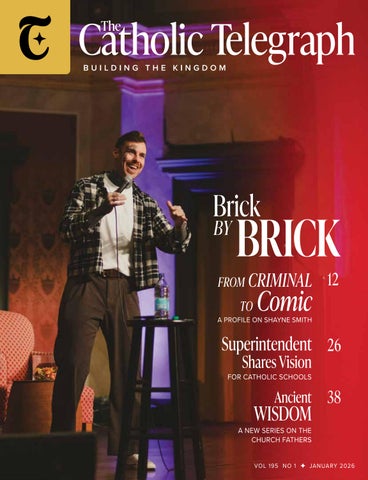
Catholic Telegraph The
BUILDING THE KINGDOM
Brick by
BRICK
from CRIMINAL to
Comic
12
A PROFILE ON SHAYNE SMITH
Superintendent 26 Shares Vision
FOR CATHOLIC SCHOOLS
Ancient
WISDOM
38
A NEW SERIES ON THE CHURCH FATHERS VOL 195 NO 1 ✦ JANUARY 2026
From the Editor’s Desk R O O T E D I N C H R I S T, B U I L D I N G F O R T H E F U T U R E
It’s a new year—a fresh start—and The Catholic Telegraph has a new cover design to support our exciting and bold initiative to help build up the Kingdom of God in the Archdiocese of Cincinnati. For five years now, The Catholic Telegraph as a magazine has been “bringing faith into the home,” and that is something we will always strive to do. Yet, we know that while everything begins in the home—the place where we nurture our faith and the faith of our family—we can’t just stay within its confines and comforts. As Christians, we are called to go out into the world and bring the Good News of the Gospel of Jesus Christ to our community and everywhere we go! Mission territory awaits right outside the front door, and we want to partner with you on that Christian adventure. And so, we decided this year on the theme “Building the Kingdom.” We will do our best each month to expand on that theme with stories and articles to inform and inspire. My team and I have talked at length about our mission to evangelize, and our new cover is just one way through which we hope to reach more people. We seek to lead with beauty and include more information on the cover to encourage people to not only open and read it, but also share it with another person who might find it interesting or helpful. Additionally, we hope to expand our reach through the various channels available to us. We want a more robust digital presence to better engage with the community, so we plan to produce more videos and photos for our stories on our website, as well as share and communicate with people via social media. Whether we like it or not, the digital arena is also mission territory and, on the positive side, allows us
Publisher: Archbishop Robert G. Casey Editor: David Cooley Graphic Design: Emma Cassani
more flexibility and space than the printed page. Sharing the Gospel in today’s world is not for the faint of heart but for the brave and joyful. We often find ourselves in environments that are indifferent or even hostile. We are all called to build the Kingdom, but the task is sometimes daunting and overwhelming, leaving us uncertain of where or how to begin. It’s always a good idea to start small. If we are building something beautiful for God, let’s do it brick by brick; with one small action at a time, focusing on one person at a time. This might be reaching out to a neighbor in need, getting more involved at our parish, starting a new apostolate, or simply setting aside more time to pray and inviting others to join us. Whenever I get overwhelmed, I like to remember Mother Teresa’s famous quote: “Not all of us can do great things. But we can do small things with great love.” When constructing a building or bridge, the work is done board by board, brick by brick. It’s a good analogy and a reminder to take things one step at a time. The worker’s key task when building is ensuring the foundation is strong. If we are to help build God’s Kingdom here on earth, we must have Christ as the foundation, the cornerstone upon which we build. If we keep Christ at the center of everything we do, we can at least know we are on the right track even if we don’t see the results we hoped for. I’ll close with another quote from Mother Teresa: “God doesn’t ask that we succeed in everything, but that we are faithful.”
Media Sales: Deacon Graham Galloway New Media / Circulation: Greg Hartman Photography: Mary Fleisher
David Cooley cteditorial@catholicaoc.org
Social Media: Taylor Motley Video: Margaret Swensen
Table of Contents Columns 4
Into Your Hands ARCHBISHOP ROBERT G. CASEY
A Closer Look
Christian Anthropology
9
The Final Word
15
KATIE SCHIBA
Shine On
17
DOMINICK ALBANO
Divine Seeing
46
DR. ANDREW SODERGREN
48
BOB WURZELBACHER
FR. DAVID ENDRES
Catholic at Home
42
DAVID COOLEY & EMMA CASSANI
6
DR. KENNETH CRAYCRAFT
Question of Faith
Color the Saints
28
CARL BROWN
26
Growing Toward Greatness KARY ELLEN BERGER
The Carlo Connection
34
MELISSA GILLIE
Features
Church Fathers Series
Finding the Presence of God 10 SARAH WELLS
From Criminal to Comic
25
God's Generosity Can't Be Outdone
12
MARGARET SWENSEN
38
FR. JACOB LINDLE
On the Cover Catholic Telegraph The
BUILDING THE KINGDOM
EMMA CASSANI
Book Review
32
Opening Doors to Young Disciples
18
Brick by
BRICK
from CRIMINAL to
Comic
13
A PROFILE ON SHAYNE SMITH
TIMOTHY P. O'MALLEY
Superintendent 27
LISA FLETCHER
Shares Vision
FOR CATHOLIC SCHOOLS
Ancient
WISDOM
38
A NEW SERIES ON THE CHURCH FATHERS
From the Archives MICHELLE WIRTH SMITH
33
A Call to Spiritual Arms DR. NICOLE BEST
22
VOL 195 NO 1 ✦ JANUARY 2026
P HOTO BY M A RY F LE ISHER
Shayne Smith shares his sense of humor and conversion story Nov. 6 at The Serenelli Project Gala.
THE CATHOLIC TELEGRAPH • 195th Year No. 1 • January 2026 • 513-263-6635 • thecatholictelegraph.com • 100 East Eighth St., Cincinnati, OH 45202 ctadvertising@catholicaoc.org • The Catholic Telegraph (xUSPS 094-520) ISSN. 10736689 is published monthly by the Archdiocese of Cincinnati 100 E 8th St., Cincinnati, OH 45202. Periodicals postage paid at Cincinnati and at additional mailing office. POSTMASTER: Send address changes to: The Catholic Telegraph, 100 E. 8th St., Cincinnati, OH 45202
The Columnists Father David Endres
Emma Cassani
is professor of Church history and historical theology at Mount Saint Mary’s Seminary & School of Theology.
is the graphic designer behind The Catholic Telegraph and author of Divine Seeing, which earned first place for Best Column in Arts & Leisure from the Catholic Media Association in 2025.
Dr. Kenneth Craycraft
Dominick Albano
holds the James J. Gardner Chair of Moral Theology at Mount St. Mary’s Seminary & School of Theology. He is the author of Citizens Yet Strangers: Living Authentically Catholic in a Divided America.
is a passionately Catholic husband and father of four boys. He has been writing, speaking, and leading Catholic retreats for more than 20 years. He is the co-founder of the National Society for Priestly Vocations.
Dr. Andrew Sodergren
Katie Sciba
is a Catholic psychologist and director of psychological services for Ruah Woods. He speaks on the integration of psychology and the Catholic faith. He and his wife, Ellie, have five children.
is a national speaker and Catholic Press Award-winning columnist. She and her husband Andrew were married in 2008, and are blessed with seven children.
Michelle Wirth Smith has served as the archdiocesan Archivist since 2019, bringing a Cincinnati-born passion for preserving Catholic history. She earned her Master of Library & Information Science degree from Kent State University.
The Pope’s Prayer Intention
Want to reach out? cteditorial@catholicaoc.org
JANUARY
For prayer with the Word of God Let us pray that praying with the Word of God be nourishment for our lives and a source of hope in our communities, helping us to build a more fraternal and missionary Church.
Putting it Together Bit by Bit I N T O Y O U R H A N D S | Archbishop Robert G. Casey
When I was a young child, I enjoyed playing with building blocks. Frequently, my siblings would come and topple my construction, but I would simply start building again. Soon, those blocks were replaced with Legos to construct much stronger and more intricate things. As much as I enjoyed playing with Legos, I did not follow the path to becoming an architect. Instead, I heard the voice of Jesus the Carpenter calling me to priesthood and inviting me to join Him in the construction of holy lives and the Kingdom of God. But I haven’t forgotten the lessons learned from those Legos. You may recall that Legos are made to build both upward and side-to-side. This is a good reminder of what God calls us to do. We must live our lives in such a way that we journey upward, with our sights set on heaven and a desire to find our home in the heart of God. We must also live lives that reach outward, building relationships with each other and never allowing ourselves to think only of ourselves. In the Stephen Sondheim song “Putting It Together,” we find some wonderful lyrics about the creative process of the journey of life. “Bit by bit… putting it together… piece by piece… only way to make a work of art. Every moment makes a contribution. Every little detail plays a part. Having just a vision’s no solution. Everything depends on execution. Putting it together… that’s what counts!” In these lyrics we can imagine the voice of the Creator, who first knitted us in our mother’s womb, uniting cell to cell and giving us the gift of life with purpose and intention. We hear God’s challenge to us to build a life that is not self-focused and that recognizes the important contribution of others, playing a part in living a life that counts. 4
T H E C AT H O L I C T E L E G R A P H
God’s creative process with us does not conclude at our birth. God continues to give shape and direction to our lives, placing us within a family and communities that assist us in becoming all that God wills and wishes for us. As we come together, whether at home, school, work, or church, we learn what counts. We discover that we are wonderfully made by the hand of God and placed into this world not as some unmoving, never-changing work of art, but as God’s living, breathing, and thinking creation that continues to learn and grow throughout life, enriched through so many encounters in the world. In this month when we celebrate Catholic Schools Week, we recognize the important foundational work of our schools. Catholic schools offer their students a firm base on which each of them can build a life. Our schools teach their students that even after graduation they must continue to seek further development and discovery. Every part of one’s life—from early days of learning, through entry into the workforce, and on to later years—can contribute to the work of art God wishes each of us to be. Our lives are continuous works in progress. There are moments of construction that make us joyful and grateful. There are moments, too, where life seems to topple around us and we find ourselves confronting sorrow and confusion. Thankfully, we have Jesus the Carpenter accompanying us. This Jesus not only learned the art of carpentry from St. Joseph but also was present when our Heavenly Father first began assembling the building blocks of creation. Bit by bit, brick by brick, may we never tire in our efforts to join Jesus in building a holy life for ourselves and in building up the Kingdom of God. ✦
Armar Todo Poco a Poco E N T U S M A N O S | Arzobispo Robert G. Casey
Cuando era pequeño, me encantaba jugar con bloques. Con frecuencia, mis hermanos venían y derribaban mi estructura, pero yo simplemente comenzaba a construir de nuevo. Pronto, esos bloques fueron reemplazados por Legos para construir cosas mucho más fuertes y complejas. Por mucho que me gustara jugar con Legos, no seguí el camino para convertirme en arquitecto. En cambio, escuché la voz de Jesús el Carpintero que me llamaba al sacerdocio y me invitaba a unirme a Él en la construcción de vidas santas y del Reino de Dios. Pero no he olvidado las lecciones que aprendí de esos Legos. Quizás recuerden que los Legos están hechos para construir tanto hacia arriba como de lado a lado. Este es un buen recordatorio de lo que Dios nos llama a hacer. Debemos vivir de tal manera que viajemos hacia arriba, con la mirada puesta en el cielo y el deseo de encontrar nuestro hogar en el corazón de Dios. También debemos vivir vidas que se extiendan hacia afuera, construyendo relaciones con los demás y nunca permitiéndonos pensar sólo en nosotros mismos. En la canción de Stephen Sondheim “Putting It Together” [“Armar Todo”], encontramos una letra maravillosa sobre el proceso creativo del camino de la vida. “Poco a poco… armar todo… pieza por pieza… es la única manera de crear una obra de arte. Cada momento aporta algo. Cada pequeño detalle juega un papel. Tener sólo una visión no es la solución. Todo depende de la ejecución. Armar todo… ¡eso es lo que realmente cuenta!” En esta letra podemos imaginar la voz del Creador, quien nos tejió primero en el vientre de nuestra madre, uniendo célula con célula y dándonos el regalo de la vida con propósito e intención. Escuchamos el desafío de Dios de construir una vida que no esté centrada en nosotros mismos y que reconozca la importante contribución de los demás, haciendo nuestra parte de vivir una vida que realmente cuente. El proceso creativo de Dios con nosotros no concluye en nuestro nacimiento. Dios continúa dando forma y dirección a nuestras vidas, colocándonos dentro de una
familia y dentro de las comunidades que nos ayudan a convertirnos en todo lo que Dios quiere y desea para nosotros. Cuando nos reunimos con los demás, ya sea en casa, en la escuela, en el trabajo o en la iglesia, aprendemos lo que realmente cuenta. Descubrimos que fuimos creados maravillosamente por la mano de Dios y puestos en este mundo no como una obra de arte que nunca se mueve ni cambia, sino como la creación de Dios que vive, respira y piensa, que continúa aprendiendo y creciendo a lo largo de la vida, enriquecida a través de tantos encuentros en el mundo. En este mes en que celebramos la Semana de las Escuelas Católicas, reconocemos el importante trabajo fundacional de nuestras escuelas. Las escuelas católicas ofrecen a sus estudiantes una base sólida sobre la cual cada uno de ellos puede construir una vida. Nuestras escuelas enseñan a sus estudiantes que incluso después de graduarse deben continuar buscando un mayor desarrollo y descubrimiento. Cada parte de la vida de una persona, desde los primeros días de aprendizaje, pasando por el ingreso a la fuerza laboral, hasta los años posteriores, puede contribuir a la obra de arte que Dios quiere que cada uno de nosotros sea. Nuestras vidas son obras en continuo progreso. Hay momentos de construcción que nos hacen sentir alegres y agradecidos. También hay momentos en que la vida parece derrumbarse a nuestro alrededor y nos encontramos ante el dolor y la confusión. Afortunadamente contamos con Jesús el Carpintero que nos acompaña. Este Jesús no sólo aprendió el arte de la carpintería de San José, sino que también estuvo presente cuando nuestro Padre Celestial comenzó a ensamblar los componentes básicos de la creación. Poco a poco, ladrillo a ladrillo, nunca nos cansemos de esforzarnos por unirnos a Jesús en la construcción de una vida santa para nosotros mismos y en la edificación del Reino de Dios. ✦ I nto Y ou r H a nd s | J A N U A R Y 2 0 2 6
5
We are Not Just Another Brick in the Wall A C L O S E R L O O K | Dr. Kenneth Craycraft
In 1979, the rock group Pink Floyd released a concept album called “The Wall.” Written by now disgraced band leader Roger Waters, the record is angry, depressing, and claustrophobic. It is the fictional story of a cynical, despondent rock star who attempts to construct a wall around himself to insulate himself from everything and everyone. The album yielded the hit song “Another Brick in the Wall, Pt. 2,” which contains such familiar lyrics as “We don’t need no education,” “Hey, teacher, leave them kids alone,” and “All in all, you’re just another brick in the wall.” Despite its bleak, bitter tone, the album was an enormous commercial success, selling more than 30 million copies and confirming Pink Floyd as rockand-roll royalty. The image of bricks in the wall from that album is far removed from the theme of this issue of The Catholic Telegraph. It’s a useful place to start, however, by juxtaposing the hopeless despair of the album with the hopeful anticipation of the fullness of the Kingdom of God. In the album, bricks are used to build a barrier that the narrator thinks will shield him from all the things he perceives make him unhappy. As he attempts to shut out the world, the best he hopes for is to become—in the words from one of the album’s singles— “comfortably numb.” The bricks in “The Wall” serve the purpose of false security from isolation and despair. Bricks build barriers. In contrast, when we Catholics think of building something brick-by-brick, it is not to construct isolating walls but rather reconciling bridges.
Bricks and Bridges We commonly refer to the Pope as the “Pontiff,” which is derived from the Latin compound word “pontifex,” meaning bridge maker. Adopted from ancient Roman references to emperors, in the Catholic tradition it refers to the office of 6
T H E C AT H O L I C T E L E G R A P H
bishop generally. The bishop is the “bridge” between us and God, invested by Christ with authority to “bind and loose” on earth and in heaven. This is derived from the Gospel of Matthew (and synoptic parallels) where Jesus says to the Apostles, “Amen, I say to you, whatever you bind on earth shall be bound in heaven, and whatever you loose on earth shall be loosed in heaven” (Mt 18:18). The context of this commission is Jesus’ broader teaching about repentance and reconciliation. This is the scriptural foundation for the Sacrament of Confession, through which we are reunited to the Church and God. The Apostles were given the authority to hear the confession of the repentant sinner then build a bridge back to God. As successors to the Apostles, bishops inherit this bridge-building authority. The Pope, as primus inter pares (“first among equals”), is the “pontifex maximus,” a doctrine based in St. Peter’s confession to Jesus and Jesus’ commission of Peter as what we now call the first pope (Mt 16:16). Thus, the “bricks” of this bridge are for the purpose of forgiveness and reconciliation, not despair and isolation. Bricks do not shut us off from everyone else but rather reconcile us to God and others. From this central truth of the Christian tradition, we derive our own responsibility both to be reconciled to our brothers and sisters and to be instruments of reconciliation. Brick by brick, we build bridges, not walls.
Bricks, Buildings, and the Body of Christ About 800 or so years ago, St. Francis of Assisi knelt before a crucifix at the church of San Damiano in Italy. The church building was in serious disrepair and on the verge of collapse. As Francis prayed before the crucifix, Christ spoke to him from the cross, saying three times, “Francis, go and repair my Church, which, as you can see, is falling into ruins.” Initially
taking the charge to be about the church building in San Damiano, St. Francis gathered the bricks and mortar to repair the chapel there. Of course, St. Francis soon realized that his commission was not merely to rebuild the physical church building at San Damiano but also to spiritually rebuild and reawaken the faith in the hearts of his fellow Christians. “To rebuild the Church” became the mandate for Christian renewal and revival, using spiritual bricks to restore what had fallen into neglect and disrepair. Brick by spiritual brick, St. Francis was instrumental in rebuilding the Church not only in the 13th century but in the centuries to follow. St. Francis never became a priest but still played a pivotal role in Christian revival, and his legacy lives on as we, too, are called to repair the Church.
Brick by brick, Christ builds a bridge between us and heaven. In Pink Floyd’s album “The Wall,” bricks serve to isolate the despairing narrator from a world that he perceived had irreparably wounded him. In the Catholic tradition, bricks are the means by which bridges and buildings are built, not for isolation but for the reconciliation Christ offers to all of us, regardless of the wounds we have inflicted or incurred. Brick by brick, Christ builds a bridge between us and heaven, entrusting the magisterium to its care and maintenance. And from the cross, Our Lord calls us to maintain and repair the Church, brick by spiritual brick. ✦ A C lo s e r L ook | J A N U A R Y 2 0 2 6
7
he
Two Schools. One Family. Making saints together at the St. Michael the Archangel Family of Parishes
Established 1855
St. Brigid School • Xenia 937-372-3222
St. Luke School • Beavercreek 937-426-1733,ext. 6401
From faith, academics, leadership and service to athletics, fine arts and experiential learning, it’s easy to see why thousands of young women have chosen to become Saints at
setoncincinnati.org
8
T H E C AT H O L I C T E L E G R A P H
Can those who have never had an opportunity to form a relationship with God go to heaven? Q U E S T I O N O F F A I T H | Father David Endres
The Church holds to the possibility that those who do not know God, through no fault of their own, can be saved. Despite the preaching of the Gospel in many parts of the world, some people have not yet heard it. Even in places where it has been preached, the faith may not be actively practiced in families and communities. In short, not everyone may have had the message of salvation preached to them, whether in the past or present.
God’s Desire The Church’s understanding of salvation is rooted in God’s love for us. God is rich in mercy, but He is also just. The Church understands this to mean that God desires the salvation of each person, but He does not force faith or salvation on anyone. It is a free choice. The Catechism of the Catholic Church (CCC) offers this teaching: “Those who, through no fault of their own, do not know the Gospel of Christ or his Church, but who nevertheless seek God with a sincere heart, and, moved by grace, try in their actions to do his will as they know it through the dictates of their conscience—these too may attain eternal salvation” (CCC, 847).
God’s Grace For everyone who is saved, salvation is made possible by Jesus’ death on the Cross. A person without a formal relationship with God may still receive grace, but even this is made possible through Christ, though perhaps outside of the Church’s structures and sacraments. The Church is understood to be the ordinary means of salvation, and those who are saved are in relationship to the Church in some way, even if unknown or unacknowledged: “All salvation comes from Christ the Head through the Church which is his Body” (CCC, 846). However, this is
not limited to the visible membership of the Church; it may also exist outside of it.
Baptism Baptism is seen as an essential, but not an exclusive, means of salvation: “The Church does not know of any means other than Baptism that assures entry into eternal beatitude.” At the same time, “God has bound salvation to the sacrament of Baptism, but he himself is not bound by his sacraments” (CCC, 1257). According to this understanding, God can bestow His grace outside of the sacraments. But this does not mean baptism is unimportant. It is the ordinary point of entry into life in Christ and salvation. And it may be presumed that those persons open to His grace would have desired baptism if they had known its importance (CCC, 1260).
Our Response We hope in God’s mercy for everyone, including those who do not know God and have not been baptized. Every year on Good Friday, as part of the solemn intercessions, the Church prays for those who do not acknowledge God. We pray that they may desire and find God and so enter into His rest, despite any obstacles that may prevent it. Many of us have friends or family who do not believe in God or do not have a relationship with Him. We can invite such persons into an encounter with God, but we cannot force it upon them. Though it cannot be presumed that those outside of a relationship with God will be saved, we acknowledge that God’s grace and mercy are beyond human understanding, for we trust in God who, according to the Letter to the Ephesians, can “accomplish far more than we ask or imagine” (Eph 3:20). ✦ Q ue s tion o f F a ith | J A N U A R Y 2 0 2 6
9
Finding the Presence of God FR. LEWIS RECALLS SPIRITUAL JOURNEY TO PRIESTHOOD SARAH WELLS
O
rdained a priest for the Archdiocese of Cincinnati this past May, Fr. Adam Lewis became Parochial Vicar at Our Lady of the Hills Family of Parishes, which includes Holy Trinity, West Union; St. Benignus, Greenfield; St. Mary, Hillsboro; and St. Mary Queen of Heaven, Peebles. He defers credit for his unique story and journey to Catholicism to others. “It’s not my story—it’s the Holy Spirit’s story,” he said. “It’s my parents’ story working itself out through me, and you’re also part of it.” In our every turn toward God, it is God who draws us first, as expressed in Eucharistic Prayer III’s words: “You never cease to gather a people to yourself.” Fr. Lewis’ faithful Christian parents homeschooled their four children and prayed together as a family. Thanks to their efforts, he and his siblings grew up with discerning hearts and minds. But as high school ended and college began, Fr. Lewis’ faith was tested. “I think my faith has always been strong, but I don’t think I’ve always lived it out very well,” he said. “I don’t think I’ve ever doubted God’s existence or that I should trust Him, but how close was I following Him? Really, it was up and down.” While attending Milligan College in Tennessee, he competed on the swim
team and studied business. “The idea was [that] I’d be successful,” Fr. Lewis said. Still, he enjoyed chapel and vespers on Sunday evenings—a hint of things to come. Reflecting on sins of his past, Fr. Lewis said, “We can accuse ourselves of our sins, which we should, and be hard on ourselves so that God will be merciful. But comparatively, it was quite mild for me. God allowed me to fall enough to where it was so hard and humiliating. It was really the medicine that I needed to draw closer to him. It was the ‘vaccine’ I needed. Just a little bit of the virus so I don’t get really sick.” While studying in Uganda during his final semester, Fr. Lewis saw God’s presence in the people he met. He found in them hospitality, patience, gentleness, and a spiritual depth that bore peace. “In the Protestant world, there is no Real Presence, so there’s not much of a focus on the presence of God. But I was experiencing the presence of God in these people and, at the same time, growing in my own prayer life.” Returning home from Uganda, Fr. Lewis graduated, but he felt lost and empty. Deciding to pursue graduate studies in Dayton, he moved closer to a cousin he was mentoring. At the same time, his family began attending a Southern Baptist church in Centerville. Fr. Lewis
and the pastor immediately connected, prompting Fr. Lewis’ acceptance of the offered internship at the church. Thus began the next leg of his journey. “I was quickly learning what I did not want to do with the rest of my life,” Fr. Lewis said, noting that he felt anxious at graduate school, while his church community made him feel alive. “Now, for the first time in my life, I was really connected with a church community and invested in their lives. Bible study, praying together, fasting together.” Meanwhile, his private prayer was deepening. Without intending it, he developed his own version of the Liturgy of the Hours, beginning with one psalm in the morning, adding one in the evening, and eventually incorporating a hymn. In these small moments, the Lord prepared Fr. Lewis’ heart for the True Presence of God on earth, the Eucharist—until the day he wept when he read St. Ignatius of Antioch and realized “that the Catholic Church is the Church Jesus founded, and the Eucharist is His Body and Blood. That was the early Christian belief, it always has been, it’s right there.” He then began attending daily Mass. This brought a time of both sorrow and joy, as he grew in intimacy with God but departure from his church became inevitable. The thought of leaving was devastating, especially because
of his deep friendship with the pastor. “In a certain sense, I betrayed my best friend [to become Catholic],” Fr. Lewis said. He hesitated to share his new convictions regarding the Eucharist. “I didn’t even understand how God was working in my own soul, trying to make sense of what I’m reading. The Eucharist— flesh and blood, drink it, it’s medicine and immortality— how do you explain that to someone?” Ultimately, his sister Rachel gave him the confidence to join OCIA, encouraging his Catholic convictions while they backpacked together. Three weeks later she called him in tears, insisting that they both become Catholic as soon as possible.
Always Catholic. Authentically Montessori. Helping children grow in wisdom, age and grace.
Join us for Open House January 25 12-2 p.m. For more information visit gscmontessori.org Find us on Facebook @GSCMontessori
After sharing their convictions with their family, Fr. Lewis and Rachel invited their parents and sisters to OCIA simply to learn about Catholic beliefs. It was the Jubilee Year of Mercy, and by December of that year, the whole family was all in. Approaching the Real Presence of God at the Easter Vigil as he watched his own family one by one receive Holy Communion for the first time, Fr. Lewis experienced great joy. However, he discovered his heart yearned for more. Thus, soon after his conversion and entrance into full communion with the Catholic Church, he began the next chapter of his spiritual journey: answering God’s call to the vocation of priesthood.✦ Finding the P r e s ence o f G od | J A N U A R Y 2 0 2 6
11
from
CRIMINAL to
COMIC MARGARET SWENSEN
S
hayne Smith was born into a world of organized crime. He and his three brothers endured abuse at
the hands of their step-father and ultimately took after him as full members in a motorcycle gang. Robbery and violent crime became their full-time jobs. But then, Smith and his brothers chose to abandon this way of life. U.S. government intervention enabled them to safely leave the gang, relocate, cover their gang tattoos, and reintegrate into society. The government also helped Shayne secure employment with a non-profit that assists and cares for young men with severe autism. This was a transformative experience—one step toward his eventual conversion. Now a devout Catholic, Smith spent most of his life devoid of belief in God and even dabbled in the occult. He credits much of his radical conversion of the heart to a personal encounter with Our Lady of Guadalupe.
my mind.” Through the Catechism of the Catholic Church, the writings of St. Thomas Aquinas, and study of Natural Law, Smith’s worldview continued to shift; and with it, his life. It became clear that his approach to his career—now as a successful comedian—needed to change. So, he jumped in with faith and left everything in God’s hands. Now living a life of mission, Smith says he knows his duty in this new apostolic age: “I do think that we live in a pagan society … full stop. Everything about it is pagan, from the way we view humans in the womb to the way we engage with art and culture and the worship of money and all these other things. … And just like the Christians that came before us, our job is to baptize these people and this culture.”
My heart is converted.
“I was praying for the first time in my adult life in a church. And I saw ‘Her.’” Not knowing who this mysterious lady was, Shayne continued speaking directly to God.
I give my life to Jesus.
i’m all in.
“Mary decided to intervene in that and revealed herself to me, which, in that moment, should have been terrifying.” But it wasn’t. “I saw ‘Her’ and she just sort of reached out and touched me, and then she was gone, and I was different.” Smith knew there was no going back: “After encountering ‘Her,’ I intuitively grew closer to Jesus without understanding who she was, what her role in the plan of salvation is, or anything else.” While the change of heart was immediate, his acceptance of Church teaching came gradually. “My heart is converted. I give my life to Jesus. I’m all in. I’m chomping at the bit to get baptized,” Smith said, “but [then] I began to struggle with doctrine. And that’s when I realized I need to convert
His remedy is not to strip away from today’s popular culture, but to embrace each medium and use it as a channel to communicate truth. Commenting on his personal love for heavy metal music, Smith said, “Christ gave us music to raise our hearts to the Lord. And so, I think we need to take these things from the pagans and show them what the most authentic and best version of them are.”
Now, Shayne Smith uses his voice in service to God. His conversion reassures those afraid to take the leap into a radically different life. His tattoos convince those afraid of losing themselves that in Christ their true identity can be found. And his career exemplifies that God has a distinct plan for every one of His sons and daughters. “They see me listening to heavy metal, still enjoying being tattooed, and not being ashamed, and they realize … ‘Oh, I can be modest, I can be weird, I can be eccentric or silly or goofy, but I can still live a sacramental life.’ And so, my favorite thing about my conversion, for sure, is basically getting all the freaks and weirdos into Mass.” ✦
Shayne Smith recently visited Cincinnati in support of The Serenelli Project. F r om C r imin a l to C omic | J A N U A R Y 2 0 2 6
13
u
The Simple Path to Heaven C A T H O L I C A T H O M E | Katie Sciba Two weeks after our wedding, Andrew and I boxed up the studio that was more his than ours and moved to Louisiana. I did my best to fashion a home in our five hundred square foot apartment, and we spent rainy days watching movies and reading on our tiny couch. I looked at my new husband over dog-eared pages and wondered if there was ever a married couple who enjoyed each other as much as we did. Mornings were sweetly slow with my one-year-old son. The two of us spent our early days—his in childhood, mine in motherhood—eating waffles and bananas, quietly playing in his nursery, and taking naps. He was happy by nature, which made his tears few and giggles plenty. I hugged my little one tightly to try to keep him from growing, so sure that this was my favorite age. While I was expecting our second son, I shook with nerves when emailing a professional I didn’t know. I had a penchant for writing as a stay-at-home mother and, as is often the case in young families, our income was small. Maybe the recipient of my email—the editor of a small Catholic publication in the South—had an opening for a columnist. She replied days later saying she’d give me a try and maybe this would work long term if it went well. Every deadline gave me fearful imposter syndrome, but every printed copy made me beam with gratitude for God’s will. Things shifted in every part of life. Old wounds bore new pain into the heart of my marriage. The Lord’s grace abounded every time Andrew and I were given the chance to bare our souls and forgive. We grew in devotion and dedication to each other. The children grew in age and number, and we gratefully received all seven souls God entrusted to us. My work as a fledgling columnist developed into a career more meaningful and long-lasting than I could have possibly anticipated.
These changes happened certainly and slowly, which is hardly the way we want change to happen. There is no shortage of comments about this era of instant gratification in humanity. We want life to be how we want it when we want it to be that way; but, if we consider how the Lord has moved in each of us, we’ll see the peace and wisdom in a gradual pace. One long day at a time. Looking back, I can see how every season—the joyful, the uncertain, the stretching, the tender—was quietly shaped by God’s hand. Nothing unfolded quickly, and rarely did anything resolve on my preferred timeline, yet grace was always present. It was steady like a heartbeat beneath the noise of daily life. In our hidden work of parenting, in the conversations that heal old hurts, the Lord forms us with a patience far greater than our own. It has taken years to understand that Heaven is not reached in dramatic leaps but in a thousand humble steps. God works little by little in souls: through gentle invitations, small promptings, and daily opportunities to choose love against the lingering temptation to choose ourselves. His transforming grace is not rushed. He honors our freedom, allowing us to grow at a pace we can bear, even when we long for instant holiness or immediate clarity. And just as the Lord moves slowly and faithfully in us, we are called to move slowly and faithfully toward Him. Our tiny acts of surrender, our imperfect efforts at virtue, our repeated returns to prayer—all of it becomes a simple path to Heaven when offered with trust. We don’t need to be extraordinary to become saints; we only need to be willing, day after day, to take the next right step toward Christ. God has never hurried with you, and yet He has never stopped working. Little by little, He leads every willing heart to Himself. ✦ C a tholic a t H ome | J A N U A R Y 2 0 2 6
15
Scan & Save
Committed to safely serving our community. Expert Tree Care for All! Tree removal, topping, canopy thinning, dead wood removal, storm job and more Free estimates Fully insured 25+ years of experience
jaimestreeservice.com (513) 372-5194
Mothers find hope hope here.
SupportPCPlus.org | 513-321-3100
G
CTIN E T O R P daytonlife.org 16
T H E C AT H O L I C T E L E G R A P H
LIFE
972
since 1
❊ Who’s Kingdom Are You Building? S H I N E O N | Dominick Albano
I was told once that an old African catechism stated: Q: Why did God create the world? A: Because He thought we would like it. I’ve tried researching this, and frankly, I don’t know if it’s true. But it’s a wonderful idea regardless… the thought that the God of the universe would be so delighted by us that He’d make all of this out of love for us. Imagine walking around this earth, seeing its beauty, and thinking, God did that for me. That sunrise? It’s for me. The beautiful blanket of fresh white snow? God thought I would like it. Of course, it’s harder to look at the more challenging aspects of life and believe God gave us those, too. But the truth is, in God’s economy, every part of life is a chance to grow closer to Him or move further from Him, to choose holiness or not, and to build His Kingdom or our own. And that’s the central question: Whose kingdom are you building? New Year’s is a funny time, a time of renewal when many of us feel motivated by the energy of new beginnings and fresh starts. Culturally, we’re encouraged to examine our lives, find areas we wish were better, start new habits, break old ones, and move forward. In theory, this is all great. But now is also a perfect time to consider the why behind your ways. Are you rooting out sin, breaking bad habits, purifying yourself from things that hold you back from the Lord? Or are you building something for yourself? For someone else?
The truth is, we can do a lot of really good things for really bad reasons. We can get caught in the trap of building our own kingdom instead of God’s. “Thy Kingdom come” becomes “my kingdom come.” Consider the people in your life. We’ve all met those who are building their own little kingdoms around some aspect of their life—even if they don’t think of it that way. They pour all of their time, energy, and attention into building their business, career, kids’ sports teams, physique, lawn… any of a million things where they find control, accomplishment, and pride. Brick by brick, we build a kingdom through the choices we make. And sometimes—many times—the why behind those choices is just as important as the choices themselves. Is there anything wrong with being ambitious about your career, wanting your kid to be the best on the team, or striving for 7% body fat? No. But the minute we find ourselves doing what we want, rather than doing what we believe God wants us to do… then we’re in trouble. Let me be clear: I’m not trying to shine a light on the horrors of New Year’s resolutions. Nor am I condemning ambition. It would be hypocritical, as most people would describe me as ambitious, and I wholeheartedly believe in taking advantage of the forward thrust of new beginnings to motivate ourselves. But the why… we can’t forget about the why. Whenever I forget to ask myself, “Whose kingdom am I building?” that’s usually when I find myself accidentally going astray. So this month, shine a light on your why. Ask yourself, “What does God want me to do?” and don’t forget: whatever happens when you build God’s Kingdom, God created the world… …because He thought you would like it. ✦ Shine O n | J A N U A R Y 2 0 2 6
17
Opening Doors to Young Disciples LISA FLETCHER
A
cross the Archdiocese of Cincinnati, increasing numbers of high school students are expressing a beautiful desire: to become Catholic. Now, a revised archdiocesan policy helps that desire take root by bringing parishes and schools together in a spirit of collaboration. For the first time, students have a welcoming, structured, and accessible way to enter the Order of Christian Initiation of Adults (OCIA) process, beginning their discernment within the school community they already know and trust and continuing sacramental formation within their parish. For many years, Catholic high school students drawn to join the Catholic Church often didn’t know where to begin. While most Catholic elementary schools are parish-based, the majority of Catholic high schools stand independent of parishes, leaving teenagers, and often their families, uncertain about how to enter OCIA or even whom to approach. It also created practical barriers, as evening OCIA classes frequently collided with extracurricular schedules, including for jobs, clubs, sports, and other activities. And, “as you can imagine, if a student hasn’t been to a Catholic church in the 18
T H E C AT H O L I C T E L E G R A P H
past or very infrequently, [both student and parents] would most of the time be hesitant to take the next steps,” said Fr. Jacob DuMont, LC, Deputy Superintendent of Catholic Mission & Culture for the archdiocese. He oversees Catholic identity across the 24 high schools in the archdiocese, 10 archdiocesan and 14 private, and has seen the need grow for several years. For many students, the desire was there, but the support and clarity were not. That changed this year. The Center for the New Evangelization’s new policy formally establishes collaboration between high schools and parishes to enable students to begin discernment and preparation within their school community; campus ministers guide them and parishes provide sacramental formation. For the first time, Catholic high schools have a clear, structured, and pastorally grounded way to accompany students who express the desire to enter into full communion with the Church. And the archdiocese is already seeing the fruits of this change. The challenge prior to the new policy was highlighted most vividly when a campus minister contacted Fr. DuMont about
five students who wanted to join the Church. “She reached out to a local pastor and director of the OCIA program to see if she could do some of the formation at the high school,” Fr. DuMont said. The parish leaders decided “to have the students just come to the parish—and most of the five students decided not to move forward with the process.” That event made something clear: structure, collaboration, and accessibility were necessary to meet high school students and bring them into the Church.
The new policy directly addresses this challenge by: ✧ Formally requiring collaboration between pastors and campus ministers ✧ Allowing initial accompaniment and discernment to take place within the school community ✧ Ensuring the parish remains the home for sacramental preparation, but is not the sole entry point ✧ Encouraging formation schedules that respect students’ academic, extracurricular, and work commitments ✧ Mandating that parishes be ready and welcoming to high school-age candidates “With this new policy, there is a stronger emphasis on the collaborative effort between a Catholic high school and parish to ensure a more supportive process,” Fr. DuMont said. “High school students should be embraced by the parish community and accompanied by the same on their journey of faith.” The hope, Fr. DuMont said, is rooted in evangelization: “We are called to look for new ways to reach out to families today, to invite them into a deeper relationship with our Lord. Our Catholic high schools provide a great place for evangelization and inviting students and their families to grow in their relationship with the Lord.” At Bishop Fenwick High School, the impact was immediate and significant. “We currently have 10 students who are discerning entry into full communion with the Catholic Church,” said campus minister Ally McGrath. “It’s incredibly moving to witness the Lord stirring this desire in so many of our young people.” This year marks the first time Fenwick could offer such a
Schools now have a clear, structured, and pastorally grounded way to accompany students who want to enter into full communion with the Church. structured pathway, and it was made possible by student interest and the policy shift. “Being able to go through this process with peers and in an environment they are already familiar with takes a lot of pressure and fear off our students,” McGrath explained. “Students juggling athletics, clubs, and jobs now have a path fitted to their reality rather than in conflict with it. Making the OCIA process available to them through Fenwick and in partnership with St. Maximilian Catholic Church has made receiving the sacraments far more accessible within their full schedules.” For McGrath, the change is more than logistical; it’s spiritual. “I am thrilled!” she emphasized. “I have had the privilege of walking with several of these students as they have encountered Christ and discovered the beauty of the Catholic faith.” She sees the new policy as part of a broader movement in the Church: “I believe the Church is entering into a new era of evangelization. We must be prepared to go out, introduce the faith, and bring others into the Church through a process that is as welcoming as possible.” McGrath shared her belief that students are responding. “To me, it’s a sign that our Church is alive, sees the needs of its people, and draws near, just as Christ does.” Elder High School is also seeing the fruits of the policy change. Campus minister Al Kovacic said, “I marvel at the fact that in my 29 years of teaching, I have never had this many students seek to enter the Catholic faith.” Five Elder students might enter the Church this Easter—far more than in previous years. O P ening D oo r s to Y oung D i s ciple s | J A N U A R Y 2 0 2 6
19
While Kovacic doesn’t think the students were aware of the policy change, he sees a meaningful difference: “They seem to have made things simpler on the school side of things, as we help students navigate their way through the OCIA process in a way that’s more comfortable and accessible to them.” The familiarity matters. “It’s comfortable because they know their campus ministers and chaplains and will want to work with us more,” he explained. Ultimately, he sees the Spirit at work. “The Holy Spirit seems to be working through the school and it’s wonderful to see.” As more high schools adopt the policy—Fr. DuMont noted Moeller, McNicholas, Elder, and Fenwick already have—one thing is clear: when the Church makes the path accessible, young people respond. The new policy does not replace parishes; rather, it strengthens them by ensuring that when a student says yes to Christ, the Church is ready together to receive that yes fully. For an increasing number of students, that path now begins not with confusion or hesitation, but with a trusted mentor, a supportive school community, and a straight, welcoming road to Jesus Christ and His Church. ✦
20
T H E C AT H O L I C T E L E G R A P H
we are
ProLife St. Vincent de Paul Parish 4026 River Rd Cincinnati, OH
St. Aloysius on-theOhio and St. Simon the Apostle Cincinnati, OH We recognize the Sanctity of Life. We thank God for our life on this Sunday.
Mary, Queen of Heaven Family of Parishes Supports all life from conception to natural death. St. Ann | St. Bernard | St. James | St. Margaret Mary
Cincinnati, OH Life - What a wonderful gift!
Loveland, OH Before you were formed ... I knew you, and before you were born I consecrated you. (Jer. 1:4)
St. Maximilian Kolbe
Supporting life from conception until natural death. stgertrude.org
Mary, Queen of Angels Family of Parishes Logan & Champaign County, Ohio
St. Dominic Parish
St. Columban Church
Liberty Township, OH Behold, children are a heritage from the Lord, the fruit of the womb a reward. ~ Psalm 127:3
St. Isidore the Farmer Holy Rosary | Immaculate Conception | St. Patrick | Our Lady of Guadalupe | St. Teresa Life is precious! Divine Mercy Family of Parishes “You are called to stand up for life! To respect and defend the mystery of life always and everywhere ...” - St. John Paul II We are grateful for and respect all life, from conception to natural death.
Sacred Heart Church
St. Francis Xavier Downtown Cincinnati
Fairfield, OH I will neither give a deadly drug to anybody who asked for it, nor will I make a suggestion to this effect. Similarily, I will not give to a woman an abortive rememdy. In purity and holiness, I will guard my life and my art. (Hippocratic Oath)
A Call to Spiritual Arms
PA R T 3
THE PRIESTHOOD & THE ROLE OF THE LAITY NICO LE A . BE ST, P SY D
(Note: The second installment of this 3-part series can be found in the December 2025 issue.)
A
s is the case with the United States’ military, the Special Operations Unit in God’s army, the Priestly Force, is the most highly trained unit for protecting us from threats and engaging in small-scaled and detailed missions. It is tasked to furnish the Lay Infantry with the needed intel and sacramental equipment for engaging in large-scale, close-range spiritual combat in their homes, places of work, and the public square. In turn, these baptized laity are the backbone of the Lord’s military and are commissioned to not only destroy enemy forces and recapture God’s territory, but also support His Special Ops. The Lord’s troops differ from the secular ones in that their engagement is never violent, their armament is spiritual, their adversary is not human, and their battalions are small and weak by design (e.g. see the story of Gideon in Jgs 6-7). But why do God’s priests need back-up? To put it bluntly, they are a bigger prize to the opponent. No priests means: no baptism, no Eucharist, no confession, no handing on of the one true faith through Apostolic Succession. Although attacks mounted against our priests can be purely diabolic in nature and come directly from the enemy, more often, the attacks come through you and me without our awareness. We launch missiles that aren’t usually mortal blows but can weaken, discourage, and tire our priests, increasing their vulnerability to attacks from the true foe. Such missiles include:
22
long to purify the sacred vessels after Communion; preaching too long; not responding to emails; not immediately complying with requests to start a new parish project; spending “too much” time at other parishes in the Family; not being like their previous priest ✧ Blame for changes resulting from the Beacons of Light initiative ✧ Unrealistic expectations (e.g. regarding their time or capacity to solve certain problems) So, if we can unknowingly weaken our priests by our behavior, how can we start to intentionally strengthen them?
A Proposed Battle Plan as a Personal Examen The following prompts us to consider our relationship, or lack thereof, with our priest and how we can help him so he can help us.
1. Protection of our priest’s time: ✧ Do I contact my priest regarding unimportant matters or those that other parish staff can handle? ✧ Have I considered what talents God specifically blessed me with that I could offer periodically in service to my priests?
✧ Harassment and threats (by the news media, nonCatholics, and even parishioners) for faithfully preaching Catholic teaching
✧ Do I over-stay allotted appointment times with my priest? Do I expect him to converse with me extensively after Mass while he is greeting everyone? Have I grabbed him right before Mass when I could wait until after Mass?
✧ Criticism from parishioners for: praying the words of consecration too slowly and devoutly; taking too
✧ Do I expect my priest to attend every social event or meeting?
T H E C AT H O L I C T E L E G R A P H
2. Protection of our priest’s feelings and good name: ✧ Do I criticize or spread rumors about my priest for trivial matters? ✧ Do I have my priest’s back? If a parishioner complains to me about one of our priests, do I try to shut it down immediately? Remember priests are people, too. ✧ Do I hug my priest without knowing if he is comfortable with this? ✧ Do I dress modestly at church, and otherwise show respect for God, my priest, my fellow parishioners, and myself by how I dress? Does my dress reflect that the Mass is the re-presentation of Christ’s ultimate sacrifice on the Cross and that when we attend Mass, we are at Calvary, joined by all the saints and angels in Heaven?
3. Protection of our priest from stress overload and burnout: ✧ Do I show my priest appreciation? After Mass, do I tell him when I liked his homily (specifically, the part I found helpful)? Has my parish organized a priest appreciation day/week (such as a dinner for him or notes about how he positively impacted my life)? ✧ Have I ever upbraided my priest for changes at the parish (e.g. Mass or confession times)? Am I aware that the Beacons of Light initiative was developed, in part, to ensure that the lay faithful would continue to have their spiritual needs met; that the ones most impacted by this initiative are the priests themselves; that some of these men are responsible for up to 8 parishes; and that others are required to drive 50 miles between parishes? ✧ Do I have realistic expectations? Am I patient and
merciful with my priest? When we see a priest falter, is our first reaction one of rebuke or compassion?
4. Have our priest’s back spiritually: ✧ Do I remember to pray for my priests daily and offer up little sacrifices for them? ✧ Could I establish the “Seven Sisters” prayer ministry at my parish? In this worldwide apostolate, seven women agree to pray a Holy Hour for one of their priests on a different day of the week. (For help in establishing a Seven Sisters group, see sevensistersapostolate.org or contact Julie VanHoose of the Cincinnati Serra Club at 740-352-1984 or julievanhoose57@gmail.com.) ✧ Could my parish consider organizing a “priest-care squad,” whereby interested parishioners would volunteer as a group for acts of service that our priest would find helpful (e.g. cooking, cleaning, grocery shopping, repair work, blood pressure checks, etc.)?
In conclusion Every Christian has an “office” in the Church; it is bestowed on them by God and through it they are called to serve others. The lay office is lived in the world and directed toward transforming it so that Christ’s love may touch every heart, His truth may enliven every mind, and His will may permeate every institution. The priestly office exists for the laity’s sake, to empower them to respond to their call. Without the Lord’s Special Ops, the Infantry cannot complete its mission. The opponent knows this—he knows that if he takes out God’s Priestly Force, he will eliminate the entire legion. Let us take up our positions and leverage our strengths so that God’s Tier 1 Unit may enjoy more recruits, remain solid in the fight, and help us in our campaign to win back the world for Christ! ✦
a
Help us in our campaign to win back the world for Christ.
SUNDAY, FEBRUARY 7
Bethany Brunch Take a morning to rest, connect, & get inspired by the beauty of your
vocation with the
Salesian Sisters St. Luke Parish, Beavercreek 8:30 AM-11:30 AM Open to women 16–35 (under 18 needs a chaperone) For more info or to register, scan the QR code.
24
T H E C AT H O L I C T E L E G R A P H
CULTIVATING THE BEST IN EACH FOR THE BENEFIT OF ALL
www.purcellmarian.org
God’s Generosity Can’t Be Outdone CARL BROWN
W
hen we’re laying an educational foundation in the faith for our children, we don’t always get to see the finished product—the final results. But recently, I did see the foundation my wife and I had built yield good fruit.
Still, I didn’t nag—God gave him free will, so I should do the same. Instead, I had simply planted a seed. And the next Sunday, my wife whispered, “Don’t look now, but Joseph’s putting an envelope in the offertory.”
When my son, Joseph, first started working a part-time job, I told him, “Now you can start putting money in the Sunday offertory! It’s a precept of the Church, and you remember Malachi 3:10, right?”
I was thrilled that he had listened, but the story doesn’t end there. Joseph burst into the family room the following week exclaiming, “Dad, guess what? It’s working already!”
“Daaaaaad,” was his response—how do kids learn to stretch that syllable so dramatically? A somewhat obscure passage from a little-known prophet, Malachi 3:10 is tucked away in the back of the Old Testament and never appears in the cycle of readings, so you might not be aware of it. “Bring the whole tithe into the storehouse, that there may be food in my house. And test me in this, says the LORD of hosts: shall I not open the floodgates of Heaven for you and pour down blessing upon you without measure?” (Mal 3:10). This message is often rephrased as, “God’s generosity can’t be outdone.” Since I run the Catholic Ministries Appeal (CMA) for the Archdiocese of Cincinnati, Joseph has heard me explain this passage many times. He has also witnessed my wife and I try to live in accordance with that reality. So, when I reminded him that Malachi 3:10 applies to him, Joseph understood what that meant in his own life.
“What’s working?” I asked, puzzled. “Mr. Hanavan called. He wants me to tutor! And … he’s paying me way more than I’ve been putting in the Sunday offertory!” I was stunned—God’s generosity had shone through! This was better than Christmas morning. I didn’t know whether I was more proud of my son or in awe of God’s providence. Did Joseph’s generosity prompt Mr. Hanavan’s call? We can’t know that, but we do know Joseph’s giving changed how he saw God at work. Because of tithing, he started seeking evidence of God’s generosity—and found it everywhere. Sacrificial giving trains our eyes to recognize God’s gifts. When we give with trust, we become more attuned to how God provides, often in ways we never imagined. It’s not always about money returning to us directly—it’s about noticing the floodgates of Heaven opening, as Malachi promised. ✦
Carl Brown is the Director of Development Operations for the Office of Stewardship and Giving. To learn more about ways to give, visit catholicaoc.org/give. G od ' s G ene r o s ity C a n ' t B e O utdone | J A N U A R Y 2 0 2 6
25
zzzyz d | | | | | | | | | | | | | | | | | | d zyzzzd d
26
T H E C AT H O L I C T E L E G R A P H
Growing Toward
GREATNESS KARY ELLEN BERGER
H
ope and possibility are shaping the future of Catholic education in the Archdiocese of Cincinnati. In classrooms across the region, teachers are forming not only strong students, but young people who understand their purpose and potential. Superintendent Matt Daniels believes this work reaches far beyond academics; it’s about helping children grow into the kind of people who strengthen their communities and, ultimately, strive for heaven. That mission-centered focus has contributed to six consecutive years of enrollment increases across the archdiocese. While many dioceses nationwide have struggled to stabilize numbers, Daniels sees the local gains as a sign of a deep, renewed trust. He credits strong school cultures, dedicated educators, and families who share their positive experiences with others. “Parents telling other parents has always been the best and most sincere way to attract new families,” said Daniels. Scholarship opportunities, such as Ohio’s EdChoice and Jon Peterson programs, along with Scholarship Granting Organizations, have also opened doors for more families. The Catholic Education Foundation contributes more than $2.25 million in additional aid annually. Daniels believes that strengthening Catholic identity and welcoming all families work hand-in-hand. He draws inspiration from his own athletic experiences: teammates changed each year, but intentional leadership sustained success. “Great leaders create great cultures,” said Daniels. Catholic schools, he explained, reveal truth, goodness, and beauty to every student who walks through the doors. “The culture we work to create helps young people encounter the risen Lord, which speaks to the minds and hearts of all our students,” said Daniels. One persistent misconception Daniels hopes to dispel is that educators must “take a vow of poverty” to teach in a Catholic school. Salaries have increased significantly, and in
many cases are now competitive with public school systems. More importantly, Catholic school teachers are supported as both educators and ministers. “We work to help form and inform our teachers so they can reach their full potential as co-workers in this part of the Lord’s vineyard,” said Daniels. New teacher formation programs, ongoing professional learning, and dedicated days for spiritual renewal all work together to support and strengthen mission-driven educators. That support isn’t limited to career teachers, either; it also extends to those stepping into the classroom from completely different fields, helping them bring their gifts into the distinctive rhythm and mission of Catholic education. As schools expand STEM programs and adopt new technologies, Daniels emphasizes that Catholic identity is not an “addition” to the curriculum, it is woven throughout it. “The truth of a linear equation, the goodness of a virtuous character in literature, or the beauty of a harmonious piece of music are all glimpses of God’s attributes,” said Daniels. Above all, he is inspired by the saints and educators who shaped the Church’s rich tradition of learning. Their example strengthens his own vocation. “Those of us fortunate enough to serve in a Catholic school are stewards of a tradition influenced by some of the world’s best minds and greatest saints,” said Daniels. Their stories, like the students in today’s classrooms, point toward great things and the Archdiocese of Cincinnati is working to help reach them. ✦ G r o w ing T o w a r d G r e a tne s s |
JANUARY 2026
27
What Building the Kingdom Does Not Look Like D I V I N E S E E I N G | Emma Cassani In a visually saturated world, it’s easy to feel overwhelmed and become desensitized to beauty. Visio Divina, Latin for “divine seeing,” encourages us to slow down and engage in visual contemplation, using art as a profound tool for connecting with the Divine.
A Guide to Visio Divina Spend a moment meditating on The (Great) Tower of Babel (ca. 1563), painted by Pieter Bruegel the Elder. It can be found at the Kunst History Museum in Vienna, Austria. Then read Genesis 11:1-9. 28
T H E C AT H O L I C T E L E G R A P H
Background The (Great) Tower of Babel was painted during the Northern Renaissance, a period known for its extraordinary attention to detail. Artists of this era often filled their work with tiny narratives tucked inside larger scenes—worlds within worlds—inviting viewers to slow down and notice. Pieter Bruegel the Elder was exceptionally skilled at this. His paintings reward patience: the longer you look, the more you discover. In this painting, Bruegel blends biblical imagining with
the busy innovation of 16th-century Europe. Cities were expanding, trade was flourishing, and construction cranes stood beside unfinished towers across the skyline of Antwerp, where he lived. Ambition was everywhere. Bruegel was so fascinated by human ambition—its beauty, its energy, and its danger—that he created three different versions of the Tower of Babel. First came The (Great) Tower of Babel—the most monumental of the three—painted on wood panel, measuring 45 x 61 inches. Within the same year, he produced The (Little) Tower of Babel, roughly half the size. The third was a miniature painted on ivory, which has unfortunately been lost to history.
Enter In As you step into the painting, the air is thick with dust. From a distance, crowds of workers swarm around the rising structure. Tower doesn’t feel like the right word—more like a colossal fortress carved into a mountain, peaking just above the clouds. Ships line the coast with imports; workers unload crates and haul materials onto pulley systems. Others lug bricks up ramps, staircases, and ladders. The whole plain seems to vibrate with one intention: build. But as you walk closer, you notice something unsettling. A cracked archway. A section built too quickly, already caving under its own weight. The higher the tower rises, the more its foundation seems to crumble. Shouts echo against unfinished walls, and what started as a somewhat coordinated effort dissolves into chaos. Voices shift— growing sharper and louder, charged with confusion. Commands are repeated, but no longer understood. The tower in Pieter Bruegel the Elder’s painting is remarkably impressive, expanding in width and depth as it spirals upward with meticulous detail. Dr. Zucker, an art historian, playfully exclaims, “What we see here is Pieter Bruegel the architect!” Bruegel invented this massive, chaotic structure. However, the architecture does look slightly familiar, with its arched levels, elliptical form, and tiered construction resembling Rome’s Colosseum (Flavian Amphitheatre, 80 AD). Art historians suggest that the similarity is not coincidental and serves as social commentary. Bruegel uses the Colosseum as a metaphor for the empire’s hubris, the fragility of human achievement, and the consequences of selfish ambition. At first glance, the tower’s left side appears nearly complete— rows of windows carved into the walls, merchants and
dwellings tucked along each level. But beneath this polished façade lies open scaffolding and a foundation already beginning to fail. In fact, the whole building is leaning to the left. In the foreground, a ruler appears with an entourage of followers. He stops arrogantly before the kneeling stonecutters—the ruling figure is meant to be King Nimrod. Though not mentioned in the Babel passage itself, Nimrod appears a chapter earlier as a mighty warrior whose kingdom began at Babel (Gn 10:6-10). Early Christian writers, like St. Augustine of Hippo, reinforced this idea, portraying Nimrod as a symbol of defiance against God. Whether or not he stood on this plain, Bruegel includes him to further personify ambition without God, embodying the drift toward tyrannical control. Looking at the builders, we begin to see what happens when something else replaces God. Life becomes harder—more chaotic, more confusing. They move frantically, endlessly active yet strangely empty. Their labor has no anchor, no purpose beyond achieving something impressive enough to make them feel worthy in the eyes of their king, or even in the eyes of themselves. And so the tower rises, appearing to make progress, yet leaning and crumbling as it climbs.
Reflection At first, the story of Babel seems simple, almost innocent—a group of people migrate, settle, and build a city, all within a few verses. It feels orderly enough, maybe even hopeful. They make bricks and mortar. They start to shape a society Continued on page 30. D i v ine Seeing | J A N U A R Y 2 0 2 6
29
Continued from page 29.
together. But something important is missing—they are building without God. Some drifted away unintentionally, while others turned away deliberately, choosing to design a world on their own terms. In his Reconciliation et Paenitentia, Pope St. John Paul II describes this moment not as outright defiance, but as “forgetfulness and indifference toward God, as if He were of no relevance in the sphere of man’s joint projects.” Ambition itself is not inherently wrong—God created us with the desire to build. But ambition without Him slowly twists into something else. Pride, power, and control turn a good desire into a dangerous one. It’s easy to fall into this pattern, but The (Great) Tower of Babel warns us what happens when mortal dreams start to outweigh dependence on God. We try to carry everything alone, and eventually, like the painting’s tower, we crumble under the weight of it all. But God does not ask us to prove our worthiness or to earn His love—He just loves us. So a prayer offers us another way: Lord, “when I cannot span the distance between my grand visions and my finite abilities …
[or] when I am tempted … to wallow in my failures, remind me that Your love was never based on my performance” (McKelvey, 64). This prayer, called “A Liturgy to Begin the Day’s Labors,” names the danger of self-directed ambition beautifully: “When pride intrudes, when I exult in my seeming success, or in the illusion of my own originality and significance … then lead me instead to invest my talents as means to serve others, from a posture of right humility” (McKelvey, 63). The builders of Babel lost this posture. They were creating their own perfect city—“our own little empires,” as the prayer names it—rather than collectively building with purpose for the greater glory of God. God invites us to let go of our need for control, affluence, and relevance. He calls us to work together with humility, charity, and trust. And so we return to the painting with new eyes: called to create alongside the True King, not to raise towers of our own making, but to build His Kingdom, brick by brick. ✦
For further exploration Augustine of Hippo, The City of God. Translated by Henry Bettenson. Penguin Classics, 2003. Barron, Bishop Robert. The Word on Fire Bible: The Pentateuch. Word on Fire, 2023. McKelvey, Douglas and Pete Peterson. Every Moment Holy: Volume III (The Work of the People). Smarthistory, Dr. Beth Harris and Dr. Steven Zucker. “Bruegel, Tower of Babel,” 2012. YouTube. The Catholic Encyclopedia. Edited by Charles G. Herbermann et al. New York: Robert Appleton Company, 1912.
30
Book Review Your Eucharistic Identity Fr. Gregory Pine, O.P. TIMOTHY O’MALLEY
T
hroughout the country, a revival of adult initiation is underway. At the University of Notre Dame, for example, we have the largest number ever of students entering the Catholic Church. What happens after these Catholics are initiated? Formal mystagogy (a deeper contemplation of the sacraments) should occur following the reception of the Easter sacraments, but it is difficult in many places. Whether we like it or not, our parishes operate according to the school year model, which leaves recent initiates to fumble their own way toward deepening their spiritual lives. What are we to do about this? I can think of nothing better than giving to such neophytes Your Eucharistic Identity: A Sacramental Guide to the Fullness of Life by Fr. Gregory Pine, O.P. It’s a masterful Eucharistic mystagogy on the theme of identity, which is so central to young adults—and really all of us—asking: Who am I? Where do I belong? Am I loved? In eight succinct chapters, Fr. Pine answers these questions through an insightful unfolding of the Eucharist and sacramental life. The first chapter attends to the nature of the world itself as a gift, a truth that has been forgotten by us fallen creatures. The second introduces the Trinitarian quality of the Christian life, the way that each of us are brought into the sonship of Jesus and, thus, into the infinite love of the Father through the gift of the Spirit. The third presents the sacramental life as key to this renewal of our identity, with a specific focus on the Sacrament of sacraments, the Eucharistic presence of our Lord. The fourth focuses more carefully on how the Mass, as a series of signs, is intended to lead us to our pilgrim home, the beatific vision. The fifth, sixth, and seventh chapters attend to: the past, present, and future orientation of the Eucharist as participation in the once-and-for-all sacrifice of Christ upon the altar; the reception of Holy Communion, which fills us with the grace and virtues of our Redeemer; and
32
T H E C AT H O L I C T E L E G R A P H
how the Eucharist points us toward our perfect belonging to the Body of Christ. The eighth and final chapter shares the wisdom of spiritual practices that enable the reader to take up this Eucharistic identity. Fr. Pine moves with stunning facility from the Eucharistic theology of St. Thomas Aquinas to the writings of other saints and contemporary theologians. He provides a Eucharistic education into sacrifice, the fruits of the Mass, transubstantiation, and the communion of saints. As someone who regularly teaches about the Eucharist, I see in Fr. Pine’s book a unique gift: it is rich enough for both those who have studied all their lives and those who never heard of the Summa Theologiae. I have but a single quibble with the book. In its final chapter, Fr. Pine encourages readers to find a church or parish that celebrates the Eucharist reverently, even if it is not your home parish. Of course, there is spiritual wisdom to this: we want to enter the Eucharistic mystery with delight. At the same time, looking for such reverence can easily become a mode of Eucharistic consumerism. Our parishes are not just buildings for the sacraments, but the specification of the Body of Christ into concrete communities. The Eucharistic identity of my parish extends to its neighborhoods. In that sense, commitment to the Eucharistic mystery may mean solidarity with that place, worshiping with the people who are my neighbors, even if the pastor isn’t our ideal celebrant. But as noted, this is a minor quibble. It does nothing to recommend against reading and re-reading Fr. Pine’s Your Eucharistic Identity, which I cannot recommend highly enough to every Catholic. ✦
Timothy P. O’Malley is Associate Director for Research at the McGrath Institute for Church Life and Academic Director of the Notre Dame Center for Liturgy. He teaches liturgy and sacraments at the University of Notre Dame.
An Invitation to Remember F R O M T H E A R C H I V E S | Michelle Wirth Smith
O I
t is a privilege to introduce myself as the curator and storyteller behind "From the Archives," an exploration of the treasures preserved in the archdiocesan Archives. My love for history started early, shaped in no small part by my grandmother, whose storytelling taught me long before graduate school that memory is sacred. My years in the archives have carried me deep into the quiet corners where the past waits to be rediscovered, where documents bear witness, and where the smallest fragment can echo in your mind for weeks. Perhaps the clearest echo in my mind is one small pyx. Enclosed within it is a note stating that it was carried by Reverend Xavier Donald MacLeod when he was struck and killed by a train on his way to a sick call in Sedamsville. His hand, still shielding the Blessed Sacrament when he was found, speaks silently yet powerfully of a life devoted to God and neighbor. In that single artifact, a quiet act of pastoral care in 1865 resonates across time, quietly preserved in the archives as a humble testament to steadfast faithfulness. For me, this work is deeply personal. My Catholic family has called this archdiocese home since the 1850s. This is more than just the place where I grew up, it’s the place that shaped generations of my family, each one building upon the faith
of the last. I’m always especially moved when I find traces of the parishes, schools, and neighborhoods that formed my own story as well as those who came long before me. They are a reminder that while institutions may organize the Church, it is the quiet, persistent faith of ordinary people that has carried it forward for generations. In time, the quiet records of our own lives will rest in these archives as well, waiting quietly to remind future generations that we, too, belonged to this story. My hope for this column is that it provides more than interesting anecdotes. I hope it deepens our collective sense of identity and continuity, revealing how faithfully God has worked through the people, parishes, and institutions of this archdiocese. These records are not dusty scraps of history; they are the ongoing memory of a living Church, shaped by ordinary Catholics who prayed, built, served, and believed. I invite you to join me each month as we lift lids, turn pages, and follow the threads of memory. May these glimpses into our past awaken our gratitude and reveal the quiet, steady grace woven through our history. Dusty but devoted, Michelle Wirth Smith ✦
F r om the A r chi v e s | J A N U A R Y 2 0 2 6
33
The Carlo Connection HOLINESS IS POSSIBLE
MELISSA GILLIE
F
or nearly my entire adult life, I’ve worked with children and young people in some capacity: camp counselor, mentor, youth group leader, speaker at high school or college events, and more. I’ve been the one with the “wisdom” to share, usually about my Catholic faith, sharing my journey, perspective, and gifts. And I love it. I love being the big sister, trusted advisor, and go-to person to share about life’s questions, heartbreak, and confusion. But recently, I gained wisdom from the example of someone much younger than me. And boy, it was humbling and beautiful! I knew of him but didn’t really know him. I knew other people loved him, but I just didn’t get it. What could a 15-year-old boy teach me about life and faith? Little did I know how strong of a connection I would have! And now, there is no turning back. He imprinted his life into mine in a profound way, and all hyperbole aside, he changed my life. I’m talking about St. Carlo Acutis, the first millennial saint canonized by our first American Pope, on September 7. On that day, I found myself among 80,000 other people in St. Peter’s Square who also felt a similar connection.
34
T H E C AT H O L I C T E L E G R A P H
My first encounter with Carlo occurred on a visit to Assisi for work on a pilgrimage in 2022. I love Italy—but it wasn’t my choice to be there this time around. However, I fell in love with Assisi. The quaint town is incredibly beautiful and peaceful. Visiting Carlo’s embalmed body at the Church of Santa Maria Maggiore was on the to-do list. It was after dying in 2006 from leukemia that this 15-year old’s legacy impacted the Catholic Church. People travel from far and wide to pay him respect. The day we arrived, our approximately 60-person group entered the church together. Many others were there, paying their respects, praying for his intercession, and touching the glass case that held his interred body. When we had free time the next day, I found myself drawn back to Santa Maria Maggiore. Walking into the church this time, I was the only person there, seeking a brief and intimate encounter with Carlo, then a “Blessed.” In jeans, a sweatshirt, and sneakers, his interred body lay there—it was incredibly peaceful. I thought of all the young people I encountered and loved through my work and time in youth ministry, and it became a deeply personal and special
moment, being alone with a future saint before the crowd poured in. Fast forward to June 2025 while working for The Angelico Project, a non-profit organization that evangelizes through beauty by offering encounters of art, thought, and culture. At our annual fundraising gala, the only auction item offered was a painting of Carlo Acutis. Objectively, this painting by sacred artist Holly Schapker is incredibly impressive. But subjectively, I thought we could have chosen a better option—something more universal like a painting of Jesus or Mary. As the gala approached, I made recommendations and projections for how much money we could raise. We boldly set high goals that seemed a little insane at the time. I projected a best-case scenario—which we greatly exceeded! While relishing the night’s success on the following day, a gala committee member shared the announcement that Carlo would be canonized on September 7. I was so moved, I immediately booked an Airbnb within walking distance of the Vatican to be present for the canonization, then asked the other committee members, “Who’s coming with me?” Eighteen of us traveled from all over the U.S. to witness the canonization: two teenage boys, seven young women aged 24-40, seven women over 40, and two priests—all taking a spontaneous trip together. Many began as strangers, but we parted as lifelong friends. This “Carlo Connection,” as I call it, prompted me to pursue work I didn’t think was possible, but knew was needed. I’m doing whatever I can to help people hear about Carlo Acutis—I quit my day job to sell this incredible art that tells the story of a young boy whose deep commitment and faith show us that holiness is possible. I think holiness freaks people out; if I’m holy, I won’t get to do all the things I want to do. The reality is that holiness purifies our desires, not deplete them. Carlo wasn’t perfect. He was an ordinary kid, known for his love of Pokémon, PlayStation, and soccer. What made him extraordinary were his love of Christ, his desire to share the incredible miracles that took place to prove the Real Presence of Jesus in the Eucharist, his attention and service to the poor, and his profound wisdom to suffer graciously and, ultimately, die with dignity. And now, this humble boy has been exalted as the first modern-day saint in a moving ceremony witnessed by tens of thousands of Catholics standing shoulder-to-shoulder with me in St. Peter’s Square. ✦ T he C a r lo C onnection | J A N U A R Y 2 0 2 6
35
36
4.0 x 5.0 T H E C AT H O L I C T E L E G R A P H
Providing a Catholic Education for Preschool through 8th Grade + Students earn their H.A.L.O. everyday by being Honest, Accountable, and a Leader to Others + Recognized as a Blue Ribbon School of Excellence + Halo Bell enrichment program for all students + Makerspace Lab opened in 2022 + Full-time school counselor and nurse on staff + Whole-child formation: spiritual, academic, emotional, physical + Technology in every classroom + Weekly Spanish, Art, Music, and PE for K–8
Learn more at gaschool.org
+ Athletics, music, drama, and more + EdChoice program provider
Schedule a Personal Tour Today 513-624-3141
JANUARY 2026
37
† = year of death † Tertullian † St. Ignatious of Antioch † St. Clement of Rome
† St. Irenaeus
† St. Cyprian
† St. Justin Martyr
99 107
church fathers
165
|
† St. Basil the Great
† Origen
202
220
253 258
† St. Athanasius † St. Ephrem the Syrian
373 379
FAT H E R JAC OB L IN D L E
The Ancient Providers and Protectors of God’s Family
E
very Sunday, you stand up from your creaky pew and proclaim, “I believe in one, holy, catholic, and apostolic Church.” Now, how on earth do you believe that? There are tens of thousands of Christian denominations around the globe, and yet, there you are at your Catholic Mass in your Catholic archdiocese with the audacity to announce that, with Leo our Pope and Robert our bishop, you have full communion with the very Church Jesus Christ Himself founded. Maybe you’ve never thought about it, but that’s crazy. The good news, though, is that it’s also true. I know I’m a priest so I have to say that, but you don’t just have to take my word for it. In the 1800s, there was an Anglican priest named John Henry, and John Henry didn’t like Roman Catholics very much. He thought we worshipped Mary and added all kinds of things to the Gospel. This John Henry fellow, however, was brilliant. He could fluently read Greek and Latin, so he started reading all the documents from the first centuries after Christ to show how the first Christians were so different from the Catholics of today. He studied figures like Athanasius and Cyril of Alexandria, Augustine and Leo. He was shocked by what he found: even the earliest Christians sounded like Catholics! He resisted and resisted because of his prejudice against Rome, but he eventually came to see his conversion to the Catholic Church as an entry into fullness. He had learned to love God and Scripture as an Anglican, and he wasn’t rejecting that: he was simply receiving even more.
38
T H E C AT H O L I C T E L E G R A P H
Well, as you might know, this Englishman was then ordained a Catholic priest, made a cardinal by Leo XIII, beatified by Benedict XVI, canonized by Francis, and is now declared a Doctor of the Church by Leo XIV. St. John Henry Newman is a great figure to promote our upcoming series on the Church Fathers, not only because the Church Fathers made him Catholic but because he shows us a great method to understand them. It was from the Church Fathers that Newman learned his theory of doctrinal development. Unlike some caricatures you may have heard, the “development of doctrine” does not mean that Church teaching simply changes with the times—as Newman knew well from the Fathers, the deposit of Faith that Jesus entrusted to the Apostles cannot and will not change. What can grow, however, is our own conscious understanding of it and our precise articulation of it. Within the preaching of the Apostles and the record of Scripture, for example, we find the presence of the Trinity, but we never once find the word “Trinity.” This addition of identifying the presence by the word “Trinity” is really a clarification. Authentic development does not corrupt doctrine, but like a seed to a tree or a baby to a man, development reveals growth while also remaining essentially the same. This is why God gave us the Church Fathers: they help the Church grow in her understanding of the faith while also defending that one faith from corruption. Just like an
† St. Gregory of Nazianzus † St. Gregory of Nyssa † St. Cyril of Jerusalem
† St. Augustine
† St. Ambrose † St. John Chrysostom
395 390 397 407 386
† St. John Damascene
† St. Jerome
† St. Cyril of Alexandria
430 420 444
† St. Maximus the Confessor † St. Gregory the Great † St. Leo the Great
461
604
662
earthly father provides for his children and protects them from harm, the Church Fathers provide for the Church with rich teaching and protect her from schism and heresy. We know, of course, that Jesus tells us to call no man “father” (Mt 23:9), but we also know this must not be understood literalistically; if it were, St. Paul would be in some trouble for writing, “I became your father in Christ Jesus through the gospel” (1 Cor 4:14–15). The point here is that no one should be a father who does not point to God the Father. The Church Fathers are fathers precisely because they reflect God’s profuse paternal love for His Church.
century, there are well over 100 men who qualify—some lists record over 200. Sadly, I don’t have it in me to do a 16year series, but over the next year, we will have the chance to look at some of the greatest Fathers spanning these first centuries. In our journey, we will find Fathers who gave their all to provide for and protect the sacred Tradition entrusted to them. We will find the greatest of all families in the one, holy, catholic, and apostolic Church. And we will find a faith worth living for and worth dying for. May St. John Henry Newman and all the Fathers of the Church intercede for us along the way.
So, who exactly qualifies as a Church Father? A Church Father himself asked that very question, and St. Vincent of Lérins offered four qualities: 1) antiquity, 2) sound teaching, 3) holiness, and 4) Church approval. If we take “antiquity” to mean between the time of the Apostles and the eighth
Fr. Jacob Lindle, ordained a priest for the Archdiocese of Cincinnati in May 2022, is presently studying for a Doctorate in Patristic Theology at the Pontifical Gregorian University in Rome.
749
For further exploration Benedict XVI, Church Fathers: From Clement of Rome to Augustine Mike Aquilina, The Fathers of the Church: An Introduction to the First Christian Teachers Robert Louis Wilken, The First Thousand Years: A Global History of Christianity Jimmy Akin, The Fathers Know Best: Your Essential Guide to the Teachings of the Early Church John Henry Newman, An Essay on the Development of Christian Doctrine (Beware of fancy writing!)
C hu r ch F a the r s | J A N U A R Y 2 0 2 6
39
WHERE LEADERS LEARN WE ARE FENWICK. fenwickfalcons.org • (513) 423-0723
40
T H E C AT H O L I C T E L E G R A P H
www.stxavier.org
OPEN HOUSE
Sun, Jan 25 | 11:30am - 1pm Visit us at stmaryhp.org
4x National Blue Ribbon School: 1986, 1994, 2006, & 2023
“Excellence in the classroom. Opportunities for life
EXCELLENCE IN THE CLASSROOM
OPPORTUNITIES FOR LIFE
1200 E. High St. ccirish.org 937-325-9204, ext. 123
JANUARY 2026
41
St. André Bessette Humble Beginnings
Hospitality
Born to a French-Canadian couple near Montreal on Aug. 9, 1845, St. André Bessette was the eighth of 12 children. His parents died when he was 12 so he was adopted and became a farmhand. He later tried being a shoemaker, baker, blacksmith, and factory worker but failed each time.
One of the most important aspects of his life was hospitality. Brother André received hundreds of visitors at the chapel where he was the doorkeeper and spent his days listening to people’s requests for healing and their stories of pain, anguish, and uncertainty. When people came to him, they felt heard and loved. He slept little and spent his nights praying for those he encountered during the day. He died at 92 and was canonized on Oct. 17, 2010.
Friendly Doorkeeper At 25, St. André first applied for entrance into the Congregation of Holy Cross, but was rejected because of his poor health and frailty. Eventually, he was received and given the humble job of doorkeeper at Notre Dame College in Montreal, with additional duties as sacristan, laundry worker, and messenger.
Miraculous Healings Whenever he heard that someone was ill, Brother André, as he was affectionately called, visited them to bring comfort and pray with them, rubbing oil on them and praying to St. Joseph. Word of healings through him began to spread. When an epidemic broke out at a nearby college and André volunteered to nurse—no one died. The trickle of sick people to his door became a flood.
Andre Brother Doorkeeper Healing Hospitality Humble Joseph Listening Miracle Montreal
C olo r the S a int s | J A N U A R Y 2 0 2 6
43
44
T H E C AT H O L I C T E L E G R A P H
OPEN HOUSE January 25 11:30-1:30
Christ-centered, Catholic education in a welcoming and loving community. Preschool to 8th grade.
St. Vincent Ferrer Catholic Preschool & Grade School
7754 Montgomery Road Cincinnati, OH 45236 513-791-6320 www.svf-school.org
JANUARY 2026
45
Mutual Submission (Part One) C H R I S T I A N A N T H R O P O L O G Y | Andrew J. Sodergren, M.T.S., Psy.D. Note: This article is part of an ongoing series on Pope St. John Paul II’s “Theology of the Body.” As we saw in last month’s article, the theological principle of analogy allows us to compare human concepts and experiences with divine realities. These analogical comparisons are a valid way to deepen our understanding of theological mysteries as long as we remember that there is always a greater dissimilarity between God and humanity than there is a similarity. God is eternal, infinite, and perfect. Human beings are mortal, finite, and fallible. Yet, all of creation—and especially human beings—bear a likeness to the Creator.
46
Paul II, Christian marriage positively “excludes this element…, which weighed on this institution and at times does not cease to weigh on it.” Thus, in his view, the submission described by St. Paul is “not one-sided submission.” Rather, “Husband and wife are, in fact, ‘subject to one another,’ mutually subordinated to one another” in Christ (89.3).
In Ephesians 5:21-33, when St. Paul compares human marriage with the relationship of Christ and the Church, he is drawing an analogy. He is saying that there are genuine similarities between these two relationships while there are also vast differences. While both are marked by spousal love, Christ is infinitely superior to the Church as its divine creator, savior, and head, whereas human marriage is a relationship of two equals. This point was very important to Pope St. John Paul II and figured prominently in his reflections on marriage in Theology of the Body.
Pope St. John Paul II’s teaching on the mutual submission of spouses in Christian marriage has been somewhat controversial and deserves careful consideration. The pope was not telling spouses how to go about making decisions in their day-to-day lives as married couples. Rather, he was speaking about how they regard and relate with each other in general. For him, a fundamental principle of marriage is the equal dignity of men and women. As we saw in the pope’s reflections on original unity in Part One of TOB, man and woman are both made in the image of God and bear the dignity of being persons, His sons and daughters. The pope summarized this principle in his apostolic letter Mulieris dignitatem by saying, “Man is a person, man and woman equally so, since both were created in the image and likeness of the personal God” (no. 6).
Ephesians 5:21-33 begins with the exhortation to “be subject to one another out of reverence for Christ.” According to the late pope, this opening line provides the framework for everything that follows. Thus, St. Paul “speaks about the mutual submission of the spouses, husband and wife, and in this way shows also how to understand the words he writes afterward about the submission of the wife to the husband” (TOB 89.3). While St. Paul goes on to exhort wives to be subject to their husbands, Pope St. John Paul II opposed any interpretation that implies a one-sided submission or supports male domination. The pope taught that St. Paul “does not intend to say that the husband is the ‘master’ of the wife and that the interpersonal covenant proper to marriage is a contract of domination by the husband over the wife.” Indeed, according to John
Furthermore, when man and woman are baptized into Christ, their dignity is elevated to be co-heirs with Christ in the Kingdom of God. Christ (and, indeed, the entire Blessed Trinity) comes to dwell within each of them, and they are incorporated into the Church, the Body of Christ. Indeed, to become a Christian literally means to become a “little Christ.” Since each one is intimately united to Christ, it is fitting for Christian spouses to reverently “submit” to each other because in doing so, they submit themselves to Christ dwelling in the other. Pope St. John Paul II taught that “the source of this reciprocal submission” lies in reverence for Christ “and its expression is love” (89.3). We will continue to explore the meaning of the mutual submission of Christian spouses and how it enlightens our understanding of marriage as a sacrament and a path to holiness. ✦
T H E C AT H O L I C T E L E G R A P H
Catholic Crossword 3
4
5
6
14
7
8
18
24
25
21
13
33
34
35
22
27
28
29
31
30 32
36
37
38
in the Archdiocese of Cincinnati
42
43
44
48
49
51
Since 1910
45
Funeral Home
Mt. Washington/Anderson Twp.
2050 Beechmont Ave. | 513.231.7150 Family owned & operated since 1870
George H. 1910
John H. 1920
J.H.(Don) 1948
Steve 1975
Naegele Kleb & Ihlendorf
52 54
55
56
60
61
62
63
64
65
57
58
42 There are Christmas and Easter ones 43 Silk tree 45 Source of chocolate 46 Catholic entrepreneur Monaghan is founder of this company 49 Eldest son of a king of France 51 Ticonderoga topper 52 “Sufficient for a day is its own ___” (Mt 6:34) 53 Women, old style 54 Deliverance from sin 60 ___ boy! 61 Prayer ender 62 9 AM prayer 63 The ___ of Confession 64 Catholic actress, Bonnie, of “Cheaper by the Dozen” fame 65 It may be blank
FU NE RA L HO M E Serving Norwood, St. Bernard & surrounding communities
59
3900 Montgomery Rd. | 513.631.2240
Gerry Kelly Fritsch
www.wordgamesforcatholics.com
DOWN 1 Catholic TV sitcom actor Newhart 2 Very skilled person 3 PBS funder 4 Slave Turner
T.P. White & Sons 2050 Beechmont Ave. • 51 3-231 50 Family-owned & operated since-71 1870
Steve Rohde, Darrell Schneider & Belinda Harper
50
53
ACROSS 1 The ___ of matrimony 6 Send forth 10 Back part of the foot 14 Body of salt water 15 Yard implement 16 There is a basilica to this saint in Quebec 17 There are eight in the Sermon on the Mount 19 Short letter 20 Catholic poet whose works include “The Rape of the Lock” 21 Drunk 23 Low protective wall 27 Cream cakes 28 “Joyful, Joyful We ___ Thee” 29 Angel of the highest order 31 Beeped 32 Urn 33 ___ Mahal 36 Water, to Pedro 37 Farm birds 39 Castor’s mother 40 Shelter 41 Maize
FU NER A L SERV I CE S
39
41
47
12
19
26
40
11
16
20
46
10
15
17
23
9
5 Cut 6 Bursts forth 7 First question of the Baltimore Catechism, “Who ___me?” 8 50’s nickname 9 Precedent setter 10 Mother of the Prophet Samuel 11 Valued mushrooms 12 Go into 13 City in West Yorkshire 18 Polish place 22 View from Chamoix, to a native 23 ___ infallibility 24 Proverb 25 Scoundrel 26 Space 27 Periods of history 30 Levels 33 “Lord, ___ us to pray” (Lk 11:1) 34 Two-time loser to 8D 35 He housed Paul and Silas in Thessalonica 37 Not Sodom 38 Greek god of love 39 Jump
White Oak / Monfort Heights 5527 Cheviot Rd.
Traditional Irish Bagpiper gfritsch48@zoomtown.com cincinnatipiper.com 513.404.0049
Blue Ash / Evendale / Sharonville 10211 Plainfield Rd.
513.385.0511
Family-owned & operated since 1912
A Catholic family owned funeral home since 1877
513.891.8373
41 Movie 42 Carves 43 Book containing the prayers of Mass 44 Liturgical year start 46 Catholic painter of ballerinas 47 Take to the soapbox 48 Paul was shipwrecked here 50 Direct a gun 52 Home of Adam and Eve 55 Large flightless bird 56 ___ Aviv 57 George Gershwin’s brother 58 Mon. of the Rosary 59 Born
8350 Cornell Road • Cincinnati
(Across from Gate of Heaven Cemetery)
info@weilkahnfuneralhome.com (513) 469-9345
www.wordgamesforcatholics.com
2
B A N N S E M I T H E E L R A K E A N N E O C E A N B E A T I T U D E S N O T E P O P E T A N K E D P A R A P E T E C L A I R S S E R A P H A D O R E P A G E D V A S E T A J A G U A G E E S E L E D A C O R N S E A L S L E E M I M O S A C A C A O D A U P H I N D O M I N O S E R A S E R E V I L G A L S R E D E M P T I O N A T T A A M E N T E R C E S E A L H U N T S L A T E
1
C a tholic C r o s s w o r d | J A N U A R Y 2 0 2 6
47
T H E F I N A L W O R D | with Bob Wurzelbacher
When Abortion Pills Become Tools of Coercion, Policy Must Change January is a month of new beginnings. As we begin 2026, so does a familiar movement of hope and witness: in just a few weeks, tens of thousands of people from across the country will gather again to promote the dignity of the unborn, work toward ending abortion, support women in crisis pregnancies, and offer real hope and healing to those suffering after an abortion decision. This annual moment reminds us that the issues at stake are not distant or theoretical; they are present and urgent in our own communities. As recent U.S. cases have come into focus, the argument for restoring stronger safeguards around the abortion pill is no longer abstract—it has become urgent and practical. There were at least three disturbing incidents in 2024 alone: a Toledo doctor accused of secretly administering mifepristone and misoprostol to his girlfriend, a North Texas man charged with allegedly slipping “Plan C” into a partner’s drink, and a Massachusetts man accused of deceiving a woman into taking pills that ended her pregnancy. Each case shows how easily a third party can obtain abortion drugs and use them without a woman’s consent. The Toledo case, involving a physician alleged to have misused medical access and personal data, is especially alarming. These cases share a common and avoidable mechanism: someone other than the pregnant woman obtains abortion pills—typically through online or mail-order channels— and administers them secretly or coercively. Easy access, anonymity, and remote prescribing combined to create opportunities for abuse that did not exist when in-person safeguards were standard. Where clinicians once verified identity and consent face to face, remote pathways now allow a third party to obtain pills intended for someone else. Policy choices over the last decade contributed to these vulnerabilities. Mifepristone was originally approved with a REMS (Risk Evaluation and Mitigation Strategy) that required in-person dispensing and clinician oversight. Those safeguards were relaxed over time: the in-person follow-up was removed in 2016, and the in-person dispensing requirement was lifted in 2021. The FDA claimed these 48
T H E C AT H O L I C T E L E G R A P H
changes were based on safety data and access concerns, but the practical result has been an expansion of pathways by which drugs can be obtained remotely and delivered by mail, creating more opportunities for misuse. Beyond the criminal cases, broader research shows that pressure and coercion in abortion decisions are common. Large surveys and analyses—including work cited by the Lozier Institute—report that many women who underwent abortions felt pressured or coerced. Such pressure is associated with worse emotional and mental-health outcomes later on. While these studies do not determine causation in every situation, they demonstrate that vulnerability and outside pressure are real factors that policy must address. From a Catholic moral perspective, abortion is a grave wrong because it ends an innocent human life. Yet, even setting that conviction aside, any responsible policy must at a minimum prioritize women’s safety. Restoring key elements of the original REMS—including an in-person clinician assessment or a robust verification of informed, voluntary consent, along with tighter controls on who may obtain and dispense mifepristone—would meaningfully reduce the ability of bad actors to weaponize abortion drugs against women and their unborn children. We cannot know how many incidents have gone unreported or presumed to be miscarriages, but it seems likely there have been many. Even the known cases should prompt a cautious public-health response. When a drug can be used covertly to end a pregnancy, it is sensible to require clearer verification of consent, meaningful clinician involvement, and better tracking of dispensing. Restoring appropriate REMS protections is a prudent measure to ensure safety, consent, and the protection of life. ✦
Bob Wurzelbacher is the Director of the Office for Respect Life Ministries & Office for Persons with Disabilities.
Catholic Telegraph The
100 E 8TH ST ✦ CINCINNATI, OH 45202