
Aristotle said that the true end of all human endeavors is the quest for happiness itself. We can agree that all people seem to desire to be happy, but beyond that there’s not much else on which we agree.
If happiness is our destination, how do we know how to get there? Can happiness mean different things for different people?
Still buzzing from all the excitement around the recent 250th anniversary celebrations of the signing of the Declaration of Independence, I couldn't help but note the question of happiness woven into the American experiment itself.
In the Declaration, the signers declared: “We hold these truths to be self-evident, that all men are created equal, that they are endowed by their Creator with certain unalienable Rights, that among these are Life, Liberty and the pursuit of Happiness.”
We have a fairly clear sense of what the Founders meant by “Life” and “Liberty,” but “the pursuit of Happiness” is less obvious.
I think it’s fair to say that they weren’t envisioning modernday luxuries, technology, long vacations, or the notion that “I’m free to do whatever I want.” They were, after all, men who cherished hard work, knowledge, and virtue. They did not think of happiness in relativistic or narcissistic terms, but rather as something universal and real.
John Adams wrote a famous letter to his wife and children from Europe in 1780, during the American Revolutionary War, that provides a window to his vision of happiness. He had been away from his family for years. He missed them dearly, and they longed to be with him. In this letter, he attempted to explain why the sacrifices for independence were so important:
“I must study politics and war [so] that my sons may have liberty to study mathematics and philosophy. My sons ought to study mathematics, philosophy, geography, natural history, naval architecture, navigation, commerce, and agriculture in order to give their children a right to study painting, poetry, music, architecture, statuary, tapestry, and porcelain.”
Adams’ vision of freedom was never an end in itself. Liberty existed so that each generation could devote itself more fully to learning, culture and, ultimately, the cultivation of virtue.
There is something profound in that progression toward happiness that he envisioned for his family and, by extension, for his country and the whole world. His words reflect an understanding of freedom that resonates with the classical and Christian tradition. Human beings naturally seek the good, the true, and the beautiful—the transcendentals—which ultimately lead us to the Father through Christ.
I am grateful that my children live in a free country where they can receive a Catholic education. Freedom, however, is not self-directing. Children must be formed to recognize what is truly good. They will encounter countless temptations and competing visions of happiness, making the formation of conscience, virtue, and sound judgment all the more essential. This is one of the great gifts of Catholic education.
It is a true blessing that my children can receive the education that Adams imagined for his descendants. Once our basic needs are met and we have the freedom to pursue higher things, we naturally begin seeking beauty—in art, music, literature, architecture and, ultimately, in worship itself.
Whatever is beautiful in the culture has the potential to open us up to the source of all beauty, Christ—whose holiness and truth shine in a way that draws people into Himself.
For Catholics, the good, the true, and the beautiful are not only categories of philosophy; they also describe the Gospel’s way of reaching the human person through the beauty of Christ, the truth of God, and the goodness of divine love that orders life toward its end—happiness in eternity.
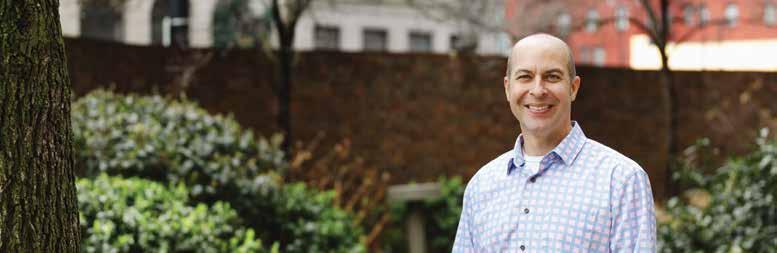
David Cooley
cteditorial@catholicaoc.org
Publisher: Archbishop Robert G. Casey
Editor: David Cooley
Managing Editor: Margaret Swensen
Creative Director: Nick Abele
Photography: Mary Kate Fleisher
Social Media: Taylor Motley
Videographer: Nathan Schuster
Media Sales: Deacon Graham Galloway
Circulation: Catherine Ampfer
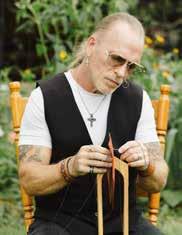

Dominick Albano
is a passionately Catholic husband and father of four boys. He has been writing, speaking, and leading Catholic retreats for more than 20 years. He is the co-founder of the National Society for Priestly Vocations.

Dr. Kenneth Craycraft
holds the James J. Gardner Chair of Moral Theology at Mount St. Mary’s Seminary & School of Theology. He is the author of Citizens Yet Strangers: Living Authentically Catholic in a Divided America.


Dr. Cecelia Dorger
is an art historian and author who specializes in sacred art. She taught at Mount St. Joseph University and currently teaches at Mount St. Mary’s Seminary & School of Theology. She and her husband have two married children.
Fr. David Endres
is professor of Church history and historical theology at Mount Saint Mary’s Seminary & School of Theology.

Fr. Jacob Lindle
was ordained a priest for the Archdiocese of Cincinnati in May 2022. He is presently studying for a Doctorate in Patristic Theology at the Pontifical Gregorian University in Rome.


Michelle Wirth Smith has served as the archdiocesan Archivist since 2019, bringing a Cincinnati-born passion for preserving Catholic history. She earned her Master of Library & Information Science degree from Kent State University.
Katie Sciba
is a national speaker and Catholic Press Award-winning columnist. She and her husband Andrew were married in 2008 and are blessed with seven children.


Dr. Andrew Sodergren
is a Catholic psychologist and director of psychological services for Ruah Woods. He speaks on the integration of psychology and the Catholic faith. He and his wife Ellie have five children.
Corynne Staresinic
is a writer and research fellow at the McGrath Institute for Church Life at the University of Notre Dame. She lives in Greater Cincinnati with her husband Nick and their children.
The Catholic Telegraph is launching a refreshed online presence. Visit thecatholictelegraph.com for more in-depth stories and video content!
Contact us: cteditorial@catholicaoc.org Pope Leo XIV’s Prayer Intention
AUGUST
Let us pray that in large cities often marked by anonymity and loneliness we find new ways to proclaim the Gospel, discovering creative paths to build community.
There is something special about trees. My love for them can be traced back to childhood summer days spent playing in the white pine forest on my grandfather’s farm, to sacred moments spent in the woods of Pacem in Terris retreat center, and to days spent backpacking along the Superior Hiking Trail in northern Minnesota. Trees are counted among the teachers of my life. As one walks through the woods, whether in the whispers of the aspens or the rustling of the oaks, life lessons are sure to be learned.
Trees require both roots and branches. Roots set deep will hold the tree secure, helping a tree to let go of any worry about the storms or winds that may come. Branches allow a tree to grow, helping a tree to reach out in new directions, to seek the light, and to provide shade and shelter for others.
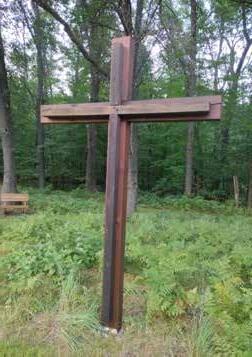
Like trees, we also need to be rooted. When we set ourselves on a firm foundation, we will have no fear of any challenges our life may bring. With roots planted in eternal truths, deep history, and ancient wisdom, we can continually tap into the rich lessons that God has taught past generations for millennia.
Despite their importance, we cannot simply rely on our roots. The stability they provide encourages us to grow. We must set our sights outward to unfamiliar territory, stretching forward like a tree’s branches and expanding our understanding of who we are and how we relate to the world around us.
American poet Howard Nemerov’s poem “Trees” offers an image of trees that might assist in our own self-reflection, allowing us to discover the wisdom trees can teach about truth, goodness, and beauty.
To be a giant and keep quiet about it,
To stay in one’s own place;
To stand for the constant presence of process
And always to seem the same;
To be steady as a rock and always trembling,
Having the hard appearance of death
With the soft, fluent nature of growth,
One’s Being deceptively armored, One’s Becoming deceptively vulnerable…
Nemerov’s poem says quite a bit about humanity, not just trees. Sharing the same Creator, our human family might look to the beauty of nature for wisdom. Armored with truth and firmly planted, we are strong. Yet, the charity and love we are called to exercise make us vulnerable. We surrender ourselves through every season, whether that comes in the shedding of leaves— moments of finding ourselves humbled before others—or the sharing of fruit—moments when we can be a blessing for others.
The Tree of Life, found in the Book of Genesis and on the hill of Calvary, serves as a powerful symbol for us in our faith journey. From the first days of creation to the final days of resurrection, God accompanies us through the many seasons of life—in our living, our growing, and our dying—continually strengthening and sustaining us. Christ, who spoke at the dawn of creation and speaks to us from the Cross, promises us new life. The Spirit, blowing through our branches, reminds us that we are both “steady as a rock and always trembling.”
Whether experienced in a blessed encounter with the beauty of God’s creation or in a sacred moment of meditation before a crucifix, the Tree of Life informs us of God’s will for us, that we may remain rooted in faith as we rise to our call. ✦
| Arzobispo Robert G. Casey
Los árboles tienen algo especial. Mi amor por ellos viene de los días de verano de mi infancia, cuando jugaba en el bosque de pinos blancos de la granja de mi abuelo, de los momentos sagrados vividos en los bosques del centro de retiros de Pacem in Terris, y de los días que pasé en el Superior Hiking Trail [ruta para el senderismo del lago Superior] en el norte de Minnesota. Los árboles se encuentran entre los maestros de mi vida. Al caminar por el bosque, ya sea entre el susurro de los álamos o el crujir de los robles, seguro que se aprenden valiosas lecciones de vida.
Los árboles necesitan tanto raíces como ramas. Las raíces profundas mantendrán el árbol seguro, ayudándolo a no preocuparse de las tormentas o los vientos que puedan llegar. Las ramas permiten que un árbol crezca, ayudándolo a extenderse en nuevas direcciones, a buscar la luz y a proporcionar sombra y refugio a otros.
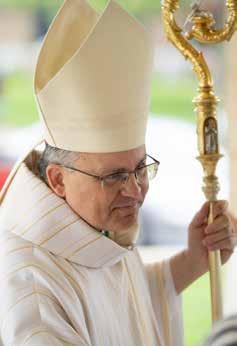
Al igual que los árboles, nosotros también necesitamos tener raíces. Cuando nos asentemos sobre una base sólida, no tendremos miedo de ningún desafío que la vida nos pueda deparar. Con raíces plantadas en verdades eternas, una historia profunda y sabiduría ancestral, podemos acceder continuamente a las valiosas lecciones que Dios ha enseñado a las generaciones pasadas durante milenios.
A pesar de su importancia, no podemos simplemente confiar en nuestras raíces. La estabilidad que nos brindan nos anima a crecer. Debemos dirigir nuestra mirada hacia territorios desconocidos, extendiéndonos hacia adelante como las ramas de un árbol y ampliando nuestra comprensión de quiénes somos y cómo nos relacionamos con el mundo que nos rodea.
El poema del poeta estadounidense Howard Nemerov, titulado “Árboles,” ofrece una imagen de árboles que podría ayudarnos en nuestra propia autorreflexión, permitiéndonos descubrir la sabiduría que los árboles pueden enseñarnos sobre la verdad, la bondad y la belleza.
Ser un gigante y guardar silencio al respecto, permanecer en tu lugar; defender la presencia constante de un proceso y parecer siempre igual; estar firme como una roca y temblar siempre, con la dura apariencia de la muerte y la suave, fluida naturaleza del crecimiento, estar engañosamente blindado, volverse engañosamente vulnerable…
El poema de Nemerov dice mucho sobre la humanidad, no solo sobre los árboles. Al compartir el mismo Creador, nuestra familia humana podría buscar sabiduría en la belleza de la naturaleza. Armados con la verdad y firmemente arraigados, somos fuertes. Sin embargo, la caridad y el amor que estamos llamados a practicar nos hacen vulnerables. Nos entregamos en cada estación del año, ya sea al caer las hojas—momentos en los que nos sentimos humildes ante los demás—o al compartir la fruta—momentos en los que podemos ser una bendición para los demás.
El Árbol de la Vida, que se encuentra en el Libro del Génesis y en el monte Calvario, sirve como un poderoso símbolo para nosotros en nuestro camino de fe. Desde los primeros días de la creación hasta los días finales de la resurrección, Dios nos acompaña a través de las muchas etapas de la vida—en nuestro vivir, nuestro crecer y nuestro morir—fortaleciéndonos y sosteniéndonos continuamente. Cristo, quien habló al amanecer de la creación y nos habla desde la Cruz, nos promete una vida nueva. El Espíritu, que sopla entre nuestras ramas, nos recuerda que somos a la vez “firmes como una roca y temblando siempre”.
Ya sea que se experimente en un bendito encuentro con la belleza de la creación de Dios o en un momento sagrado de meditación ante un crucifijo, el Árbol de la Vida nos informa de la voluntad de Dios para nosotros, para que permanezcamos arraigados en la fe mientras respondemos a nuestro llamado. ✦
“Truth, Beauty, and Goodness” are often called the “three transcendentals.” But while we use these terms frequently, their meanings are not obvious, especially in a political and legal culture that either denies one (or all) of these terms or redefines them in unrecognizable ways. So, how do Catholics define and understand truth, beauty, and goodness as transcendentals? I cannot provide an exhaustive answer in a short column, of course, but this is an appropriate opportunity to introduce brief definitions of these terms. The better we understand the three transcendentals of truth, beauty, and goodness, the better we understand God and ourselves.
In everyday parlance, transcendence has the typical connotation of overcoming or exceeding. To transcend one’s limitations, for example, is to perform some extraordinary feat. It might be considered the proverbial exception that proves the rule. It connotes going above and beyond the typical or usual situation to something greater. As a theological term, transcendence means all those things, and much more.
St. Thomas Aquinas identifies three fundamental aspects of what he calls “natural law.” The first two are shared by all living animals, he explains, including human animals. These are the natural impulses to self-preservation and propagation. All animals act in such a way as to try to preserve their lives and extend their species. The third principle is unique to the human animal: to know the truth about God. This natural impulse and desire to understand is an aspect of transcendence. Put another way, the human person is unique among creatures in our capacity and inclination to think outside ourselves. We don’t merely exist and survive, we think about existing and surviving. And of course, we think about much more. What is our nature? What is the nature of society? Is there a God, and if so, how do we know Him? Our inclination to ask these questions and our ability to understand their answers are aspects of transcendence.
Philosophers identify various theories of truth, a discussion that exceeds a short column. For our purposes it is sufficient to name two, one deficient and one not. The deficient one is sometimes
called the “coherence” theory. This reduces truth to an internal consistency of assertions of truth, but without any regard for whether the assertions actually correspond to anything outside the system. We hear people use the phrases “your truth” and “my truth.” This is a crude form of the coherence theory. And of course, it is tantamount to saying that there is no such thing as truth. “Truth” is produced by the individual in this theory.
The Catholic Christian understanding of truth, in contrast, can be called a “correspondence” theory. This means that assertions of truth are intended to say something fixed and objective about the world, without regard to our acceptance or rejection of it. A correspondence theory of truth means that truth exists outside our assertion of truth. We do not create coherent systems of “truth,” but rather stand in relation (for good or ill) to the truth about the world. Truth is received by the individual. This proper understanding of truth contributes to our sense of transcendence. The quest for truth is meaningless if no truth exists to be embraced.
Similarly, we can identify two broad ways of thinking about judgments of beauty. The first is completely self-referential. In this theory, observations of beauty are nothing more than personal preference. This is characterized by the popular phrase that “beauty is in the eye of the beholder.” This is precisely the same thing as saying, “There’s no such thing as beauty.” Rather, “beauty” simply means “something I like.”
In contrast, we Catholic Christians believe that beauty exists outside the judgment of any particular person. A beautiful painting, song, poem, play, sculpture or story is one that holds a mirror to the truth about God’s creation. Beauty reveals God. A statement of beauty is an assertion about the objective correspondence (that word again!) to the real world around us. People of good will might disagree about what constitutes beauty. And even then, we can acknowledge a broad range of aesthetic tastes and preferences. But this discussion must be in the context that beauty is more than mere assertion of personal preference. Beauty either transcends our assertions about beauty, or it doesn’t exist at all.
“All that is . . . is good.” So utters the empress Theodora in Handel’s oratorio by the same name. This echoes the medieval philosopher Boethius, who explained that existence itself is good. This is fundamentally a statement about God. If God created all things, and God is all good, then all that God creates is good. Good, therefore, is everything that exists in its proper state. In this context, evil is the word we use to describe the privation of good or the perversion of good. And, it almost goes without saying: all that is good is from God and reflects the very goodness of God. Thus, goodness, like beauty and truth, transcends our statements about it, and contributes to our ability to answer the questions, “Who am I, and why do I exist?” ✦



This vital work continues to grow in the archdiocese, thanks to your support and hundreds of volunteers. Together, we’re ensuring families across Southwestern Ohio have reliable access to nutritious food.
To learn more about our programs and services, visit ccswoh.org.


Q: Is confession the only way God can forgive sins? If not, what are the other ways?
For centuries, the Church has relied on confession for the forgiveness of sins that are committed after baptism. Sacramental confession is the ordinary means of reconciling with God and the Church when we sin. But there are other means of forgiveness, and God’s activity, including his mercy, is not bound by the sacraments. Scripture and tradition teach that God may forgive through repentance, prayer, charity, and other expressions of a desire for reconciliation.
At the heart of forgiveness is contrition: a sincere sorrow for sin and desire to amend one’s life. Contrition is a prerequisite for forgiveness in the Sacrament of Penance. Contrition, however, can be meritorious outside the sacrament.
The Scriptures give witness that if a person has a genuine desire to turn away from sin, he or she can be forgiven. For instance, the Psalmist writes, “A contrite, humbled heart, O God, you will not scorn” (Ps 51:19). And in the Gospel, when Jesus compares the tax collector and the Pharisee, he says that the tax collector who “beat his breast and prayed, ‘O God, be merciful to me a sinner,’” went home justified, not the Pharisee (Lk 18:10-14).
The Catechism describes contrition as an “interior process” that begins with God’s prompting and should, in ordinary circumstances, and especially in the case of serious sin, be “brought to completion by sacramental absolution.” By itself, contrition—when it is imperfect—does not forgive grave sins, but “it disposes one to obtain forgiveness in the sacrament of Penance” (Catechism of the Catholic Church, no. 1453).
Early Christians understood that sins, especially lesser sins, could be forgiven through repentance, which often took the form of external acts, such as prayer, fasting, charity, or even
extraordinary actions like pilgrimage or martyrdom. These were seen not merely as good deeds but as outward signs of an inward transformation and return to God.
The Church’s liturgy contains prayers for forgiveness. When someone prays the Our Father devoutly, that person asks forgiveness of trespasses and, according to the Church’s tradition, their sin can be remitted. Similarly, at the beginning of Mass, during the Penitential Act, the people ask for God’s mercy: “Lord, have mercy; Christ, have mercy; Lord, have mercy.” The Eucharist— the medicine of immortality—has long been understood to remit venial sins and strengthen believers against future sin.
Additionally, reception of the sacrament of the Anointing of the Sick is connected with the forgiveness of sins, especially if, because of the severity of illness or lack of access to the Sacrament of Penance, the person is unable to confess.
The Sacrament of Penance, also known as confession, developed over time. Prior to the early medieval period (around 700 AD), reconciliation was possible, but was usually only for serious sin, was of a public nature, and was not repeatable. However, private and repeatable confession to a priest gradually became the usual way of seeking forgiveness. Before confession became normative, Baptism was seen as the primary means of forgiveness. This led many people to delay Baptism until late in life.
Christians have always believed in God’s power to forgive sins and the Church’s authority to reconcile sinners and restore them to communion. Confession of sins to a priest is the ordinary means of reconciliation, but Scripture and tradition show that there are various ways a person may seek God's mercy and begin the process of conversion. Wherever there is sincere repentance and a desire to return to Him, God’s grace is at work. ✦
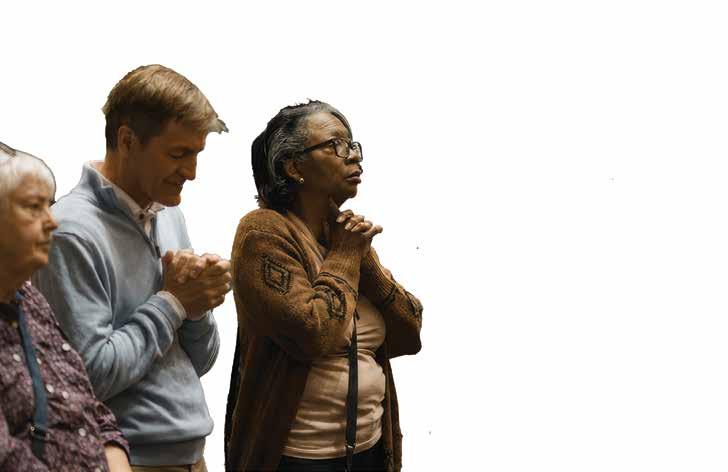
As part of Synod 2027, Archbishop Casey invites each of us to participate in a Conversations in the Spirit listening session. Join others across our archdiocese in prayerfully considering what the Holy Spirit is asking of our Church at this time, thereby assisting Archbishop Casey as he establishes pastoral priorities for the future.
There are approximately 60 sessions scheduled between Labor Day and Thanksgiving.
Register today at catholicaoc.org/conversations

BY KARY ELLEN BERGER
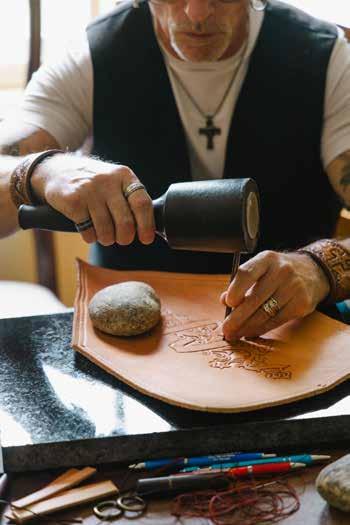
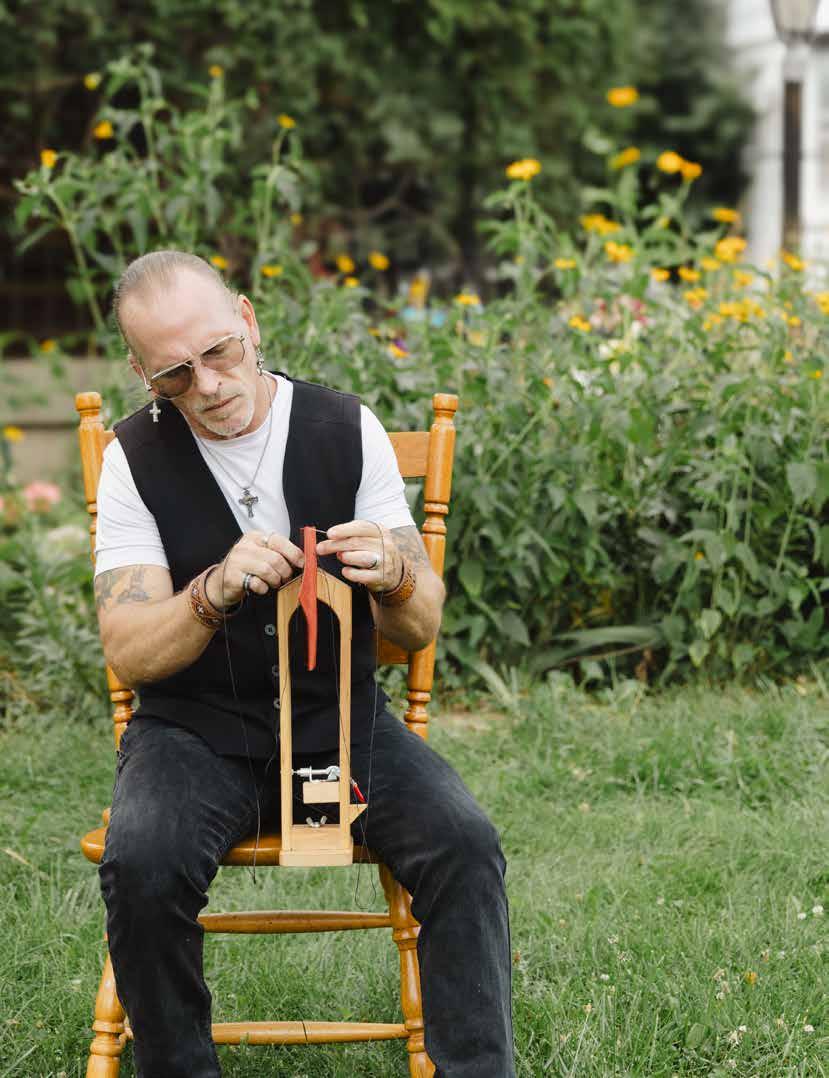
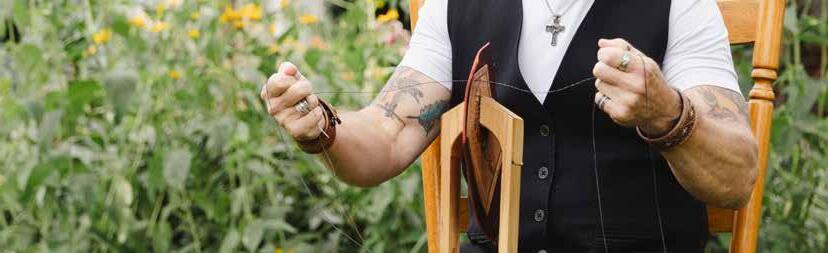
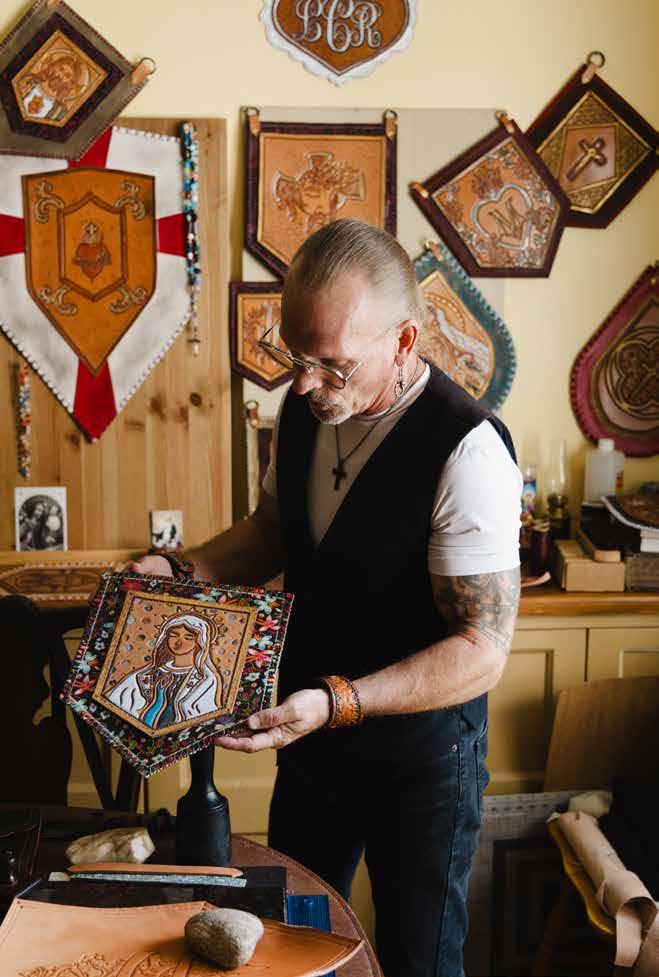
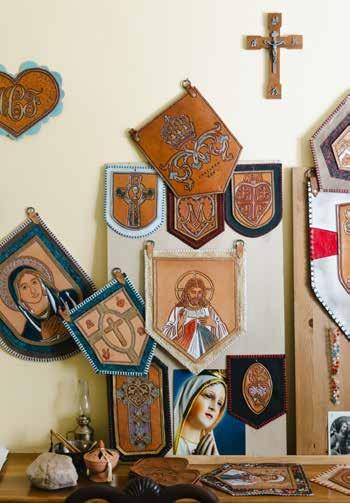
alk into Paul and Ann WolfSong's home-based studio in Dayton, and you'll find leather, carving tools, and artworks in various stages of completion. What you won't immediately see is what Paul WolfSong considers the most important part of every piece they create: prayer.
"Every item, every work, everything is heavily prayed over,” said Paul, owner of WolfSong Leather Works. “Our hours of work are accompanied by rosaries, litanies, novenas, Masses, Gregorian chants, and other prayers and music. Everything we create is prayed for before it ever reaches the person who will receive it.”
For the WolfSongs, leatherworking is far more than a craft or business. It is a mission rooted in faith, beauty, and the desire to draw others closer to Christ.
Paul is the first to admit he never expected this path. What began with the purchase of a handcrafted leather bracelet for Ann on their third wedding anniversary led him to wonder if he could learn the craft himself. That curiosity transformed into a passion.
"I came into this with great arrogance and ignorance," said Paul. "I certainly wasn't called to do this, but I immediately fell in love with it."
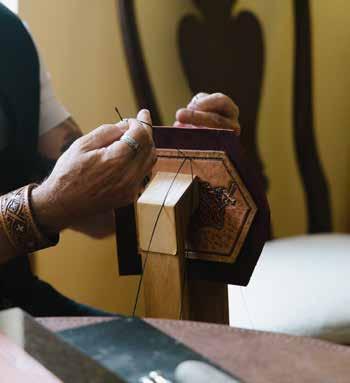
Over the years, he immersed himself in learning every aspect of leatherworking, creating everything from journals and wallets to belts, guitar straps, and family crests. Yet, along with developing his skills, he found himself asking a deeper question: “Why am I doing this?”
The answer came not through business success but through prayer.
As Paul spent more time attending Mass and praying in some of Dayton's historic Catholic churches, he found himself captivated by the beauty surrounding him. The architecture, stained glass, carvings, and sacred imagery became more than artistic inspiration—they became reminders of the beauty of the Catholic faith itself.
Rather than simply creating leather goods, he realized he wanted his work to reflect the beauty, hope, and truth found within the Church.
"I wanted to dedicate all my work to Him and the Holy Family and share the faith, hope, love, goodness, and beauty that our Holy Mother Church provides," said Paul.
Today, that mission shapes everything produced at WolfSong Leather Works.
Paul believes the process itself is as important as the finished work, so, along with handcrafting each piece using traditional methods and materials, prayer accompanies every step as he carves, tools, and finishes the leather. He and Ann pray for the people who will eventually own each piece, asking God to bless them with faith, health, protection, and joy.
WolfSong Leather Works has found customers through online marketplaces and Catholic events, but Paul measures success differently than many artists or business owners.
He finds the greatest joy in meeting people face-to-face, watching them experience the texture and craftsmanship of the leather, sharing the stories behind each piece and, most importantly, talking about the Catholic faith.
“Maybe this was God's way of helping me fall more deeply in love with His Church and share her beauty with others,” Paul said.
Among all the works he creates, one remains especially meaningful: the crucifix. For Paul, the crucifix is more than another piece of art, it is the foundation of his faith and a reminder of Christ's love and sacrifice. While he enjoys creating many different pieces, his main hope is that each one encourages someone to slow down, pray, and grow closer to God.
For the WolfSongs, leather is simply the medium. The true masterpiece they hope to share is the beauty of Christ Himself. ✦

Watch our full length interview with WolfSong on our YouTube Channel: @CatholicTelegraph
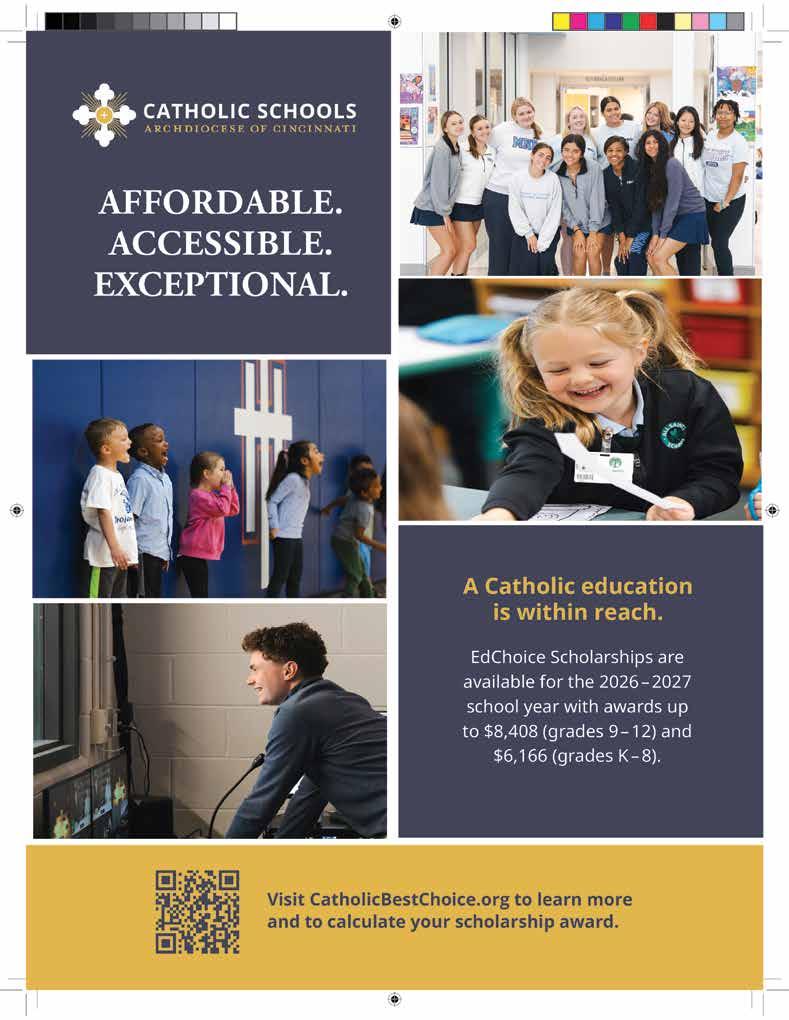


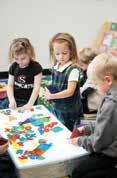
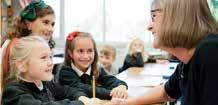
offers four K–8 Catholic Schools where faith and learning go hand in hand

St. Antoninus 513-922-2500 saintacatholicschool.org Our Lady of Lourdes 513-347-2660 school.lourdes.org



St. Aloysius Gonzaga 513-574-4035 Preschool: 513-587-3978 saintals.org
St. Catharine of Siena 513-481-7683 stcathosschool.org
BY LUCY KONRAD
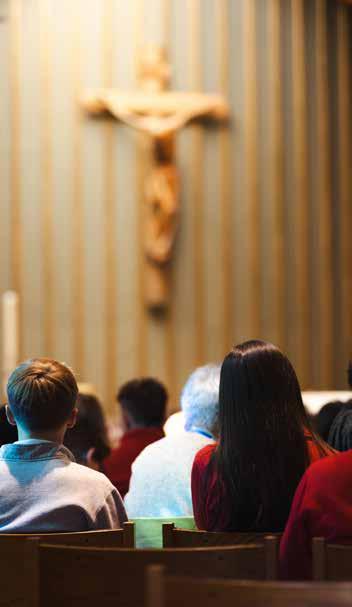
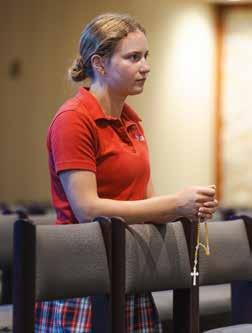
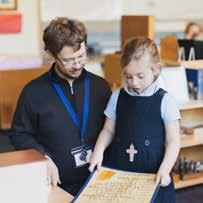
Perhaps the greatest beauty of Catholic education is the schools’ opportunity to create space for our communities’ youth to discover their definite purpose—or vocation— in life. More than just a career, this vocation is our path to sainthood through the priesthood, diaconate, religious life, marriage, or a chaste single life.
During each Sunday Mass, the faithful across the Archdiocese of Cincinnati pray in the Prayer for Vocations that our communities may be “fruitful ground for [the Lord’s] gift of vocations,” and that our youth may “respond to [His] call with courage and zeal.” Our Catholic schools have been and can continue to be that fruitful ground for vocations.
Deacons Alex Parra and Luke Danis, both transitional deacons who, God willing, will be ordained into the priesthood next year, attended Catholic schools in the archdiocese for much of their education. Both men testify to how their Catholic education planted seeds and instilled an openness to God’s call to the vocation of the priesthood.
Deacon Parra attended St. Gertrude in Madeira for grade school and Moeller for high school. While much of his discernment occurred outside of school, he said that “a lot of the seeds for it were planted in my education.” Most influential for him was his exposure to different vocations from a young age. Taught by the Dominican sisters and friars present on St. Gertrude’s school campus, Deacon Parra said, “Their presence made the idea of a vocation a lot more plausible.”
Additionally, Deacon Parra found that “having learned to pray in school and, as time went on, learning to have a deeper prayer life” were helpful when discerning his vocation. He said that “to be able to hear the call, you need to spend time in prayer,” and he is grateful for how he was taught to pray in school.
Similarly, Deacon Danis’ experience with prayer and seeing vocations lived out authentically at school attracted him to the priesthood. He attended grade school at St. Luke in Beavercreek then Carroll High School before discerning the call to the priesthood at Mount St. Joseph University.
While reflecting on his discernment journey, Deacon Danis remembered an image of Pope St. John Paul II displayed in his grade school that resonated with and inspired him, making the priesthood appealing. “He's just wearing a cassock and cool sunglasses, and he's hiking up a mountain,” Deacon Danis said.
At Mount St. Joseph University, Deacon Danis had the opportunity to visit the Adoration chapel for prayer every day, and he said that it was there that the Lord “was moving my heart to consider this question again of ‘Are you called to be a priest?’”
Both Deacon Danis and Deacon Parra’s discernment stories exemplify how our Catholic schools have been God’s instruments in calling people to vocations.
Fr. Michael Willig, Vocations Director for the archdiocese, is hoping to help our Catholic schools continue creating a culture for vocations. He acknowledged that “the Lord has already answered our prayer” for vocations and “we believe He will continue to answer.”
But, “We want more!” Fr. Willig said. And so, he is encouraging our Catholic schools to recite the Prayer for Vocations weekly and offer penance on Fridays, hoping it helps students consider more deeply what vocational state they might be called to.
“Prayer and fasting are a great source of grace and a way that the Lord has given us to be united with him, to be on mission together, and to build up the Church” said Fr. Willig, and all of these should be achievable through our own vocations.
Additionally, Fr. Willig hopes to work with schools’ communications teams to display images around the buildings of people authentically living out their vocations, so that “the students, as they’re praying, can see examples of others who are pursuing or discerning or living out their vocation.”
By doing these small yet profound things, Fr. Willig said, our Catholic schools will continue creating a culture for students to remain open to and discern their vocation. “Each vocation builds up the Church in a unique way,” he said. “It takes a generous heart to say yes to God, and so we want to cultivate that in our Catholic schools.” We pray that, with God’s grace, our Catholic schools will continue to be fruitful ground for vocations in the years to come! ✦
BY MATT HESS
Even though it is traditionally a period of rest, summer is a time when teachers and students often reflect on the previous year’s triumphs, as well as let the next school year’s cares seep into their minds.
This past school year, Archbishop Moeller High School initiated the MoeTerm program, for which Jennifer Boggess, Director of MoeTerm and a Moeller educator, has a lot to be proud of from its inaugural year. To continue its success, she used her summer to start planning for the 20262027 school year.
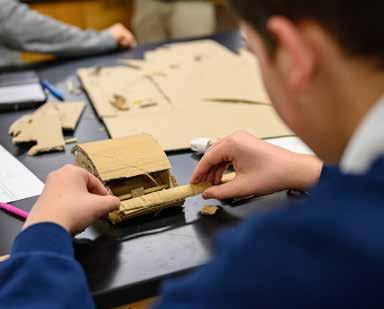
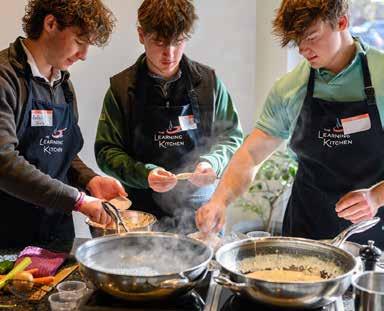
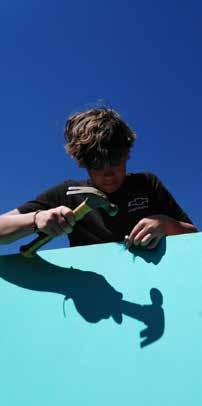
A four-day immersive encounter, MoeTerm lifts students out of the traditional classroom for new and relevant experiences. It enables them to explore new interests or dive deeper into a potential career. With dynamic opportunities on and off campus, students meet new people, exercise their critical thinking, and reflect on the impact of their experience.
And this past year saw many successful encounters!
“A service project group traveled to Guatemala to work with ImagininGuatemala to build houses for families in Antigua,” said Boggess. Another course, “‘Rock and Roll Revolution’ had students building and decorating their own guitars, learning basic chords, and gaining insight into the origins and evolution of rock ‘n’ roll,” she continued. Students could also choose a course on “Farm to Table,” learning both about animal husbandry and processing from a local butcher, or they could spend time at the University of Cincinnati learning about different areas of engineering.

When student Joseph Nanista was going to miss MoeTerm because he’d be out of town during its scheduled four days, Boggess and Nanista put their heads together and developed an independent study that allowed him to creatively explore his interests outside the classroom.
“Around my eighth-grade year or so, I remember reading George Weigel's Letters to a Young Catholic and being quite impressed with how Weigel tied certain Catholic places together with certain aspects of a sacramental worldview,” said Nanista. “Since I'm more acquainted with animated movies than globetrotting, I decided to write about those instead.”
Nanista paired Pixar movies with papal encyclicals for a more focused direction and produced three essays filled with deep insights on how the Christian worldview can be found in ordinary American entertainment.
“I'd say that the WALL-E/Laudato Si' pairing was the easiest,” Nanista said. “They're two pieces about the human impact of neglecting creation, and the parallels were easy for me to spot.” In WALL-E, a robot in the future is developing consciousness and is left to clean up Earth after human consumption spoiled the environment. If we do not care for the gift of creation, Pope Francis warns, our future may be in jeopardy.
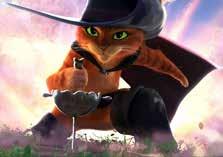
Nanista’s second essay looked at the value of human life as expressed by Pope St. John Paul II in Evangelium Vitae and compared it with Puss in Boots: The Last Wish. Puss in Boots is given nine lives that he wastes away until the last one, when he decides to find the Wishing Star to receive eight lives back. During that quest, he comes to many of Pope John Paul II’s conclusions about finding joy and improving quality of life.
“Puss in Boots: The Last Wish has always been a favorite movie of mine, and since the main theme of that one was about accepting death, I knew it had to be paired with an encyclical about valuing human life,” said Nanista.

Finally, Nanista said he also “wanted to honor Rerum Novarum with an essay, as it was the encyclical that really brought Catholic Social Teaching into the mainstream.” After considering several movies that could pair well with Pope Leo XIII’s encyclical, he settled on A Bug’s Life. In this Pixar film, ants must gather food for their grasshopper overlords, who are led by Hopper. Eventually, Flik, an ant with the zeal of Pope Leo XIII, leads the colony to overthrow the oppressive grasshoppers.
“Managers as cruel as Hopper and his gang are (I hope) few and far between,” Nanista wrote, “but their demise serves as a cautionary tale as to what the working population will do in order to restore justice if they are pushed to the end of their strength.”
This MoeTerm project successfully helped Nanista develop writing and analysis skills he hopes to use as an English major and author. “I’m rather interested in stories,” he explained, “and I feel that they are quite effective vehicles for transmitting ideas and doctrines.” Stories, he believes, are accessible to people and help them think about things in a deeper, more unguarded way.
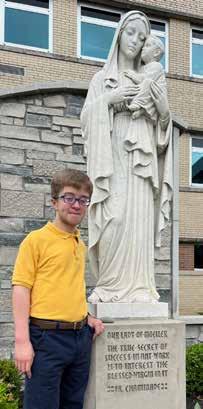
For Boggess, this independent study was a highlight of the first successful MoeTerm at Moeller High School. “His ability to draw complex connections between children’s movies and papal encyclicals was amazing,” Boggess said.
As the school prepares for the second year of MoeTerm in 2027, there are plans for a course on Ecotourism in Costa Rica, a Silicon Valley immersion experience, and an opportunity for service with Give Kids the World (an organization much like the Make a Wish Foundation).
Through innovative courses and dedicated instructors, Moeller High School excels in Catholic education. MoeTerm is forming a new generation of Catholic men who are ready to face the challenges and opportunities they encounter. ✦

Read Nanista’s full report at thecatholictelegraph.com
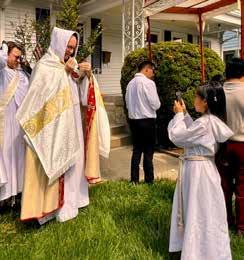
BY EILEEN CONNELLY, OSU
Beauty captured through the eyes of a child is especially meaningful. With a keen eye and discretion beyond her years, Camila Morales, 10, has captured many beautiful, even sacred, moments at St. Clement Parish in St. Bernard.
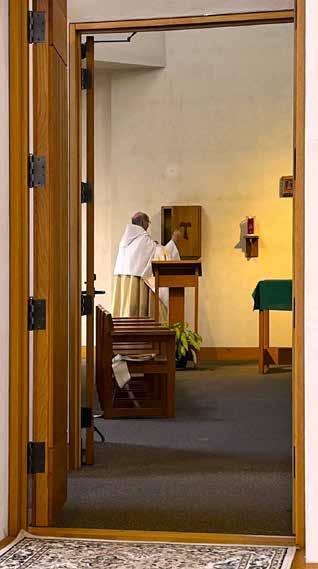
A rising fifth grader, Camila is one of the altar servers recruited by Fr. William "Jud" Weiksnar, OFM, parochial vicar, to photograph special Masses and celebrations for the faith community. An avid photographer himself, Fr. Weiksnar said all the student photographers are talented, but he is particularly impressed by Camila’s work.
At the start of last school year, said Fr. Weiksnar, “When I saw the pictures Camila took, I was astounded at her sense of timing, and, as the months went on, she became much surer of herself and knew a good opportunity for a photo. She has really come into her own as a photographer … able to capture the beauty of a moment like very few people have the ability to do.”
Camila, whose family is originally from Guatemala, said she has enjoyed taking photos for the past couple of years, especially nature shots. “It’s something that’s fun for me,” she said. “I was excited when Fr. Jud asked me to take pictures to help him and also get better with taking pictures.”
With a nod and smile, Fr. Weiksnar gives the sign to Camila, and she quietly takes photos that are both moving and professional. He said Camila also quickly learned to identify
appropriate shots on her own and has taken the initiative to capture many beautiful images. She photographed numerous parish and school events over the past year, and dozens of her pictures were featured on St. Clement’s Facebook page.
Using an iPhone as the tool of her trade, Camila said, “Staying still and being quiet,” along with “not taking pictures of people from behind, showing their faces, and being sure the pictures are natural, not posed,” are key to achieving good photos.
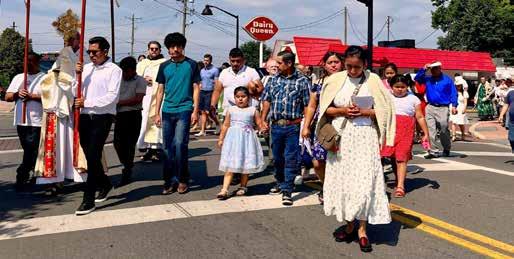
On the feast of Corpus Christi in June, Camila slipped quietly into the parish procession around several blocks in the St. Bernard area, taking pictures of the faithful as they joyfully honored the gift of the Eucharist. The Mass that followed was extra special for her because she photographed her mother, Ilsa, receiving her first Communion.
“I was so happy and excited for her,” Camila said.
Besides being a skilled young photographer, Camila is one of the kindest children Fr. Weiksnar said he has encountered during his years in ministry. He moves to a new assignment in August, but remembers how she was the first student to welcome him to the school when he arrived at St. Clement in the Fall of 2024. She is known to offer fellow students part of her lunch if she senses they’re hungry and give her snack and drink to her exhausted teammates after a soccer game. Fr. Weiksnar recalls one day after school when Camila offered him a pack of cookies. He politely
declined but later found the cookies in his jacket pocket.
“That’s just how Camila is—always thinking of others,” he said.
It’s clear that Camila, who will attend Holy Family School in Price Hill this fall, was inspired by Fr. Weiksnar and the other friars from the Province of Our Lady of Guadalupe who live and serve at St. Clement. “Fr. Jud and all the friars are so kind and humble and full of joy,” she said. “They’re always helping people.”
“I like helping people, too,” Camila added. “You can make a choice to either help or be mean. My choice is to be kind to people.”
This sweet child, who shares external beauty through photography and inner beauty through her selflessness, has big plans for the future: “I want to be a photographer, or a doctor, or a police officer, or an FBI agent—just something to help people.” ✦

BY MIKE SCHAFER
In his June 19 Decree convoking Synod 2027, the Seventh Synod of the Archdiocese of Cincinnati, Archbishop Robert G. Casey wrote, “This Synod of the Archdiocese of Cincinnati will help the people of this local Church to advise and assist the archbishop in the governance and care of the faithful entrusted to him.” Sounds great! But how are we to do that?
The answer, of course, is by actively engaging in the synod, primarily by participating in one of the many local listening sessions called Conversations in the Spirit scheduled throughout the archdiocese this Fall between Labor Day and Thanksgiving 2026. All are invited to register for a session— laity, priests, seminarians, deacons, and consecrated religious; those active in their faith and those inactive; those at the center of the Church and those at the periphery; those who feel welcomed by the Church and those who feel shunned by the Church. In a word, everyone.
Synod 2027 is grounded in prayer. Unlike a secular listening session, as between managers and employees at work, Conversations in the Spirit are intentionally structured to help participants prayerfully listen for and discern the voice and guidance of the Holy Spirit, as well as each other. This is beautifully expressed in the opening of the Adsumus, Sancte Spiritus, a prayer invoked at synods throughout the Church’s history and the official prayer of Synod 2027:
We stand before You, Holy Spirit, as we gather in Your name.
With You alone to guide us, make Yourself at home in our hearts; teach us the way we must go and how we are to pursue it.

The purpose of Synod 2027 is to assist Archbishop Casey with “the discernment of pastoral priorities, the adaptation of Church laws to local circumstances, and the development of strategic plans for the spiritual renewal of the archdiocese” (Decree). Thus, suggestions regarding any aspect of the archbishop’s three-fold responsibility to teach, sanctify, and govern—which affects the everyday life of our parishes, schools, and families—are fair game. Not up for debate are the enduring doctrines and dogmas of the Church or any practices or disciplines (e.g. celibate clergy) of the universal Church that are beyond the authority of the local bishop.
Yes, it will. By baptism, we are each a member of the Mystical Body of Christ: “As a body is one though it has many parts, and all the parts of the body, though many, are one body, so also Christ” (1 Cor 12:12). Without any one of us, that body is incomplete. To be synodal is to journey together Archbishop Casey is not interested in a divided Church, but rather one of unity in diversity. The participation of every teen and adult Catholic, therefore, is both desired and valued.
Next month, we will explore the concept of discernment, which is pivotal to the success of Synod 2027. Between now and then, please pray. Pray that Synod 2027 bears great fruit in our archdiocese and in our communities. And be sure to register for a Conversations in the Spirit listening session! ✦
To register for a Synod 2027 Conversations in the Spirit listening session, visit catholicaoc.org/Conversations.
Mike Schafer served as the Director of Communication & Evangelization for the Archdiocese of Cincinnati from July 2017 until his retirement this summer.



I’m so old that as I was growing up I had to Google the answers to my questions. How did I even survive before AI? Now, we simply ask one of the many forms of artificial intelligence, then receive an answer tailored to our own most whimsical whim:
Q: Can “you” write a haiku about Ambrose and Jerome?
A: Here’s a haiku:
Ambrose lights the dawn. Jerome tends the ancient words. Wisdom walks with both.
Brave new world! What should we do with all this artificially intelligent power at our fingertips? My first suggestion is to chuck our TVs, laptops, and phones in a bonfire, then sit around it looking each other in the eye and telling stories about what matters. If you aren’t willing to follow me to the bonfire of the vanities, at least follow me to the Church Fathers for this month.
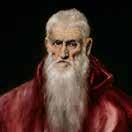
Our data-driven digital age bears little exterior resemblance to the western Roman Empire in the 4th and 5th centuries, but St. Jerome and St. Ambrose still speak to us today. No matter how much blue light bathes the information, our minds will never be satisfied with the accumulation of facts, because our minds are made for wisdom—and Jerome and Ambrose teach us where to find it. These scholar-saints challenge us to pursue true wisdom through a disciplined attention to Christ speaking in Scripture. Jerome was a grouchy genius born in AD 340, somewhere in modern day Croatia or Slovenia. He loved Latin literature
and mastered it as a young adult. When he decided to become a monk, he took his secular Latin books with him. He would fast and pray, then binge Cicero and Plautus. (We’ve all been there!) Well, Jerome fell ill and had a dream: Taken up before the judgment seat in heaven, the Judge asked him who he was. “I am a Christian,” Jerome replied. “You lie,” the Judge responded, “You are a Ciceronian, not a Christian. For where your treasure is, there your heart will be” (Mt 6:21). Jerome immediately repented: “If you let me live, I will give up Netflix, Instagram, everything, and consecrate my entire mind to You!” That’s a dynamic translation, but you get the point.
Jerome dedicated the rest of his life to Scripture. He mastered Greek and Hebrew, and Pope St. Damasus I asked him to translate the Bible into Latin. Jerome lived out his days as a monk in Bethlehem, writing scriptural commentaries and letters next door to the cave where Jesus was born. “Ignorance of Scripture is ignorance of Christ,” Jerome wrote in his commentary on Isaiah. The same Word who hid Himself in a manger in Bethlehem is also hiding in the words of Scripture.
Today, Jerome summons us to silence our screens and surrender to Wisdom Himself calling out in these sacred words.
But how do we find this Wisdom in Scripture? Here, Ambrose helps us. He was also born in 340, in modern day Germany. He grew up in a Christian family, but Christianity was on the back-burner of priorities, so he remained a catechumen instead of being baptized while he pursued his political dreams. He studied rhetoric and was made imperial governor in Milan. Things were going well until the bishop of Milan died. There
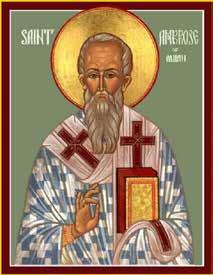
was turmoil in the city over who should succeed the bishop, until a little child cried out, “Ambrose for bishop!” The crowd unanimously agreed, and Ambrose was baptized, confirmed, and then ordained a deacon, priest, and bishop all within a week.
His life is amazing. Ambrose stood up to emperors and invited them to humble repentance—while preaching sermons that we still read and composing hymns that we still sing. Where did he find all the wisdom and strength? Once he became bishop, Ambrose immersed himself in Scripture, and he let the Church Fathers teach him how to read God’s Word. The Fathers taught Ambrose that Scripture was a layered text that found its meaning in Christ. The first layer is the literal meaning of the text, the meaning intended by the author according to the text’s literary genre. Then, there is the moral meaning “layer,” which shows us how to live. The final layer is the mystical meaning, which reveals our life with Christ in God.
Ambrose called the moral and mystical senses the two eyes through which the Church sees Christ in Scripture. When we read Exodus, for example, we not only find the truth about God’s saving power in history (literal sense), but if we have eyes to see, we also find our story. The Exodus becomes an invitation to leave behind everything that spiritually enslaves us (moral sense) by receiving and living our baptism into Christ (mystical sense). Some smartphones and televisions might end up with Pharoah’s horses and chariots.
There has always been a battle for our attention, and the rapid developments of digital technology don’t make the battle any easier. Many of us step out into the digital arena defenseless,
as profit-seeking powers and far more fracturing forces seek to use us for their gain. We’re more entertained than ever, but we’re also more bored, anxious, and divided. Jerome and Ambrose knew the solution. Before you let your screens speak to you, why don’t you let God? ✦
St. Ambrose, Theological and Dogmatic Works, The Fathers of the Church, vol. 44 (Catholic University of America Press, 2002)
St. Jerome, Dogmatic and Polemical Works, The Fathers of the Church, vol. 53 (Catholic University of America Press, 2014)
Boniface Ramsey, Ambrose (Routledge, 1997)
J.N.D. Kelly, Jerome: His Life, Writings, and Controversies (Duckworth, 1975)
Catena Aurea (Baronius Press [leatherbound] or Aeterna Press [paperback]) [Commentary on the Four Gospels by the Church Fathers, compiled by St. Thomas Aquinas. There is also a free version online!]
The Cathedral Basilica of the Immaculate Conception in Denver, Colorado, is the resting place for one saintly person: a humble African American laywoman named Julia Greeley. Encapsulated in marble and placed prominently near the cathedral’s front, her tomb celebrates a former slave who owned nothing but her faith in Jesus and His call to serve others out of her poverty. Her life continues to inspire all who learn about her. Today, we have an opportunity to pray with her to God for miraculous help.
BY DIANE MENGOS
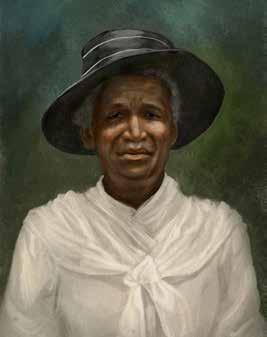
Julia’s inspiring story begins with a recognition of her oppressed status throughout her life. Born into slavery in Hannibal, Missouri, she never knew her birthdate, which is estimated to be between 1833 and 1848. When Julia was ill as a young child, her mother was scourged with a whip for staying in from the field to tend to her. It is believed the end of the whip caught young Julia’s right eye as she clung to her mother and it never healed.
Once freed of her servitude by the state of Missouri in 1865, she found employment as a domestic servant for a wealthy family who introduced her to Catholicism and invited her to work for them in Denver, Colorado. Her newfound faith gave her life fortitude, purpose, and an astounding ability to love and forgive even while society continued to treat her as a second-class citizen.
Julia was a witness to the love of Christ for all people and won over multitudes—rich and poor alike—who grew to revere her. Her daily life of prayer was matched by her daily life of service. Fasting each morning, she walked to church from whatever room she could rent around the city. Receiving Holy Communion, praying in adoration, and cleaning the church
were part of her regular routine before she set out to work wherever she could—cleaning, cooking, or caring for children. From her meager pay, which sometimes did not cover her basic needs, she shared her earnings and she gave her extra energy to the needy in her community.
During her years in Denver, its population was burgeoning, and its destitute were known and loved by Julia. As a Third Order Franciscan, she begged like St. Francis from the wealthy and delivered to the impoverished. She often made her daily treks around Denver with a red wagon on which she gathered firewood, food, baby supplies, clothing, and even mattresses. Gathering by day, she delivered in the darkness. Julia wore the same basic dress, coat, and hat each day, keeping none of the nice apparel donated by the affluent; she instead gave them to poor families for special events.
Also noteworthy in Julia’s life was her devoted support for her Sacred Heart Church’s fundraising and charitable collections; she topped the list for tickets sold and meetings attended. She had a distinct love for children—both privileged and underprivileged— and assisted at the homes of newborns, orphans, and families with illness, giving them her tender love and playful attention.
Also remembered for her attention to Denver’s firefighters, Julie walked to every fire station each First Friday of the month, delivering Sacred Heart badges and leaflets. Her friendship and prayers spiritually supported the men. They, in turn, informed her of the community members in need of her help.
Firemen and policemen were among the hundreds of people who attended Julia’s wake on June 9, 1918. Even without a newspaper notice, word spread quickly around Denver of
her death. Rich and poor alike headed to Loyola Chapel on Ogden Street to pay their respects to a woman in whom they recognized extraordinary holiness, compassion, and humility. The stream of visitors continued without pause for five hours that summer day, just two days after she died on the Feast of the Sacred Heart.
The Archdiocese of Cincinnati, through the Anti-Racism Task Force, invites all Catholics and people of our region to hear more about the beautiful life of Julia Greeley in this fifth installment of the Saintly Seven Series, which celebrates seven black Catholic Americans on their way to canonization. A free Julia Greeley Lunch is being offered for all ages, to begin at noon on Sunday, August 23 at Lehman Catholic High School in Sidney (childcare provided if noted at pre-registration). The program begins at 12:30 and ends at 2 p.m. Registration is helpful for food preparation. All who attend will find delight in the stories presented by several narrators, the table activities, and the special gift each household will take home to remember Servant of God Julia Greeley of Denver, Colorado. ✦
Diane Mengos is a doctoral student in Theology and Religious Studies at the University of Dayton.
Session 5: Servant of God Julia Greeley Sunday, Aug. 23, Lehman High School, Sidney, 12:45 p.m.
Session 6: Venerable Henriette Delille Sunday, Sept. 20, St. Benedict the Moor, Dayton, 1:30 p.m.
Session 7: Servant of God
Fr. Martin Maria de Porres Ward Tuesday, Oct. 27, Church of the Resurrection, Cincinnati, 6:30 p.m.

Scan for all current information about the Saintly Seven Series and more detail on upcoming events



SAT, SEP 5 | 6:40 PM REDS VS BREWERS FIRST PITCH
SCAN TO PURCHASE DISCOUNTED TICKETS

DON’T MISS THE FULL LINEUP OF FESTIVITIES!
5:30pm
6:15pm
HONORARY GAME CAPTAINS
Archbishop Robert G. Casey and Bishop John C. Iffert
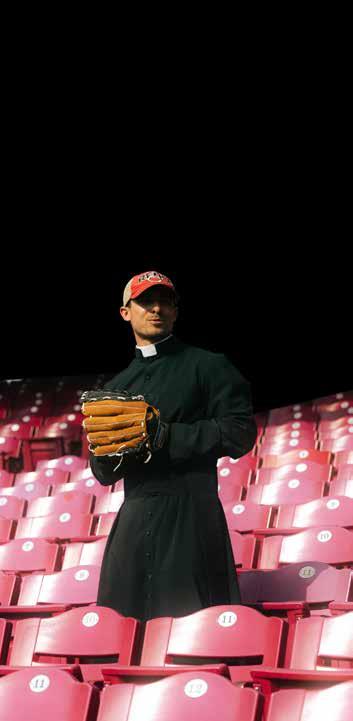
Fr. Michael Willig pitching to Fr. Jacob Willig NATIONAL
Cecelia Dorger
Invite the Holy Spirit to enlighten your experience as you gaze at the artwork. Notice what thoughts and emotions enter your heart and mind. Be still. Pray with the image as you are led.
“Sacred art by being true and beautiful should evoke and glorify the mystery of God made visible in Christ, and lead to the adoration and love of God, the Creator and Savior, who is the surpassing, invisible Beauty of Truth and Love” (Compendium of the Catechism of the Catholic Church, 526).
The Eucharistic Prayer II says, “At the time He was betrayed and entered willingly into His Passion, He took bread and, giving thanks, broke it…” The adverb willingly is curious. One might argue that Jesus exhibited reluctance in the Garden of Gethsemane before His Passion when, in agony, He prayed, “My Father, if it is possible, let this cup pass from me. Yet not as I will, but as You will” (Mt 26:39). A homilist explained that Jesus’ prayer expressed profound human dread over His impending suffering, but His dread does not negate that He willingly handed himself over, as His Father desired.
It is precisely that paradoxical mix of willingness and reluctance that Auguste Rodin captured in his groundbreaking piece, The Burghers of Calais. The bronze sculpture is a public monument to the six burghers—or citizens—who, in 1347, volunteered to ransom themselves to England’s King Edward III in exchange for the besieged city’s freedom. They offered up their lives to liberate their fellow townspeople from starvation.
When the Hundred Years’ War began, King Edward III claimed the French crown. He captured and blockaded Calais, a major port city on the northern coast of France, starving its citizens for nearly a year. The story was recounted in Jean Froissart’s chronicles around 1360. Froissart described the
wretched famine: “Many were losing their bodies and their souls from madness caused by hunger” (quoted by Levkoff, in Rodin: A Magnificent Obsession, 47).
The king stipulated: “The only mercy they can have from me is if six of their most notable burghers leave their city, stripped, with ropes around their necks and the keys in their hands: and with them I shall do as I please” (quoted by Levkoff, 47). In response, the wealthiest property owner, Eustache SaintPierre, stood up and said, “I shall find grace and forgiveness in our Lord God if I die to save these people, that I want to be the first, and I willingly strip down to my undershirt, with a noose around my neck, for the will of the king of England” (quoted by Levkoff, 47–48). The crowd wept bitterly as, one by one, five other emaciated townsmen stood and joined the first. They walked as a unit to the town square to meet their fate, where the king had ordered his executioner to wait.
In 1884, Rodin captured this walk to the square. Departing radically from French academic norms used to portray heroism, he shifted the focus from triumphant glory to human suffering. The city had called for artists’ submissions to honor Eustache Saint-Pierre in a commemorative monument, and Rodin’s design was accepted from the pool of sculptors’ maquettes. His sculpture included all six burghers walking reluctantly to meet the king, their feet oversized, anchored to the ground. Each figure meditates differently on his imminent death.
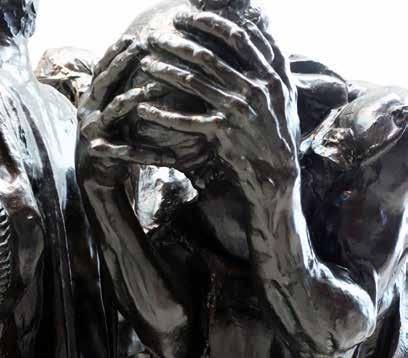
Rodin arranged the figures in a circle, ignoring hierarchy and refusing to highlight any one figure. Each gaunt burgher draped in tattered sackcloth personifies individual responses to his fate. One buries his head in his hands making a confession. Another steps forward; stoic, jaw set, gripping a giant key with both hands. The drama is heightened by the heroes’ diverse and ambiguous poses. They form a human rosary, trapped in a timeless march of fear, courage, despair, and heroic determination. Vividly displayed are the virtues of valor and self-sacrifice but mixed with the truth of abject fear. Continued...
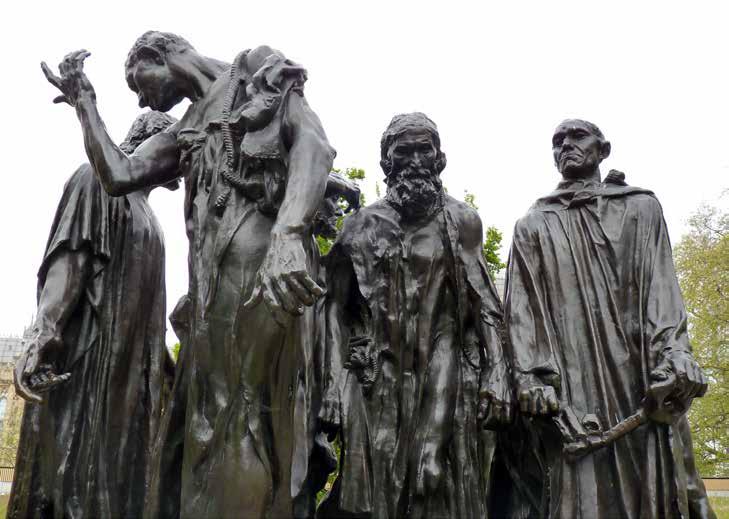
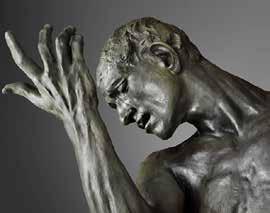
The six figures each meditate differently on their fate. At right, one buries his head in his hands, making a confession. Another expresses anguish with his hand gesture shielding his face. The leader of the group, Eustache de Saint-Pierre, is shown in the top image, second figure from right with a beard and bowed head.
Concerned above all with telling the truth, Rodin achieved great beauty, and his work forever changed civic memorial sculpture. But his path was not easy; the project met resistance at every step.
Representing the general consensus, one committee member said, “It was not like this that we envisioned our glorious fellow citizens … Their dejected attitudes are an offense” (Grunfeld, 251). Rodin’s struggles mounted as the expense of casting six figures far exceeded the budget.
Furthermore, Rodin stipulated that the aggregate composition should not be placed on a typical high pedestal but instead on the ground in the public square, where contemporary citizens could walk in solidarity with the heroes. Yet, the committee installed the finished piece on an elevated pedestal and fenced it off in a remote park. In 1924, the pedestal and fence were removed and the sculpture was placed on the ground in front of the town hall—seven years after Rodin’s death.
The Christological theme has not been lost on viewers through the ages: “No one has greater love than this, than to lay down one’s life for one’s friends” (Jn 15:13). ✦
Mary L. Levkoff, “The Monuments to The Burghers of Calais, Victor Hugo, and Honoré de Balzac,” Rodin: A Magnificent Obsession, London: Merrell Publishers Limited, 2001.
Frederic V. Grunfeld, Rodin: A Biography, New York: Henry Holt and Company, 1987.
FROM THE ARCHIVES | Michelle Wirth Smith
Truth begins by looking closely at something small. Prayer cards are, strictly speaking, ephemeral. They are printed in large numbers, distributed widely, and rarely intended to last. In most archival settings, they are not treated as individually significant objects. There are too many of them and too little distinguishing most from one another. We group them together in a single box—Prayer Cards—because discarding them feels inappropriate, but assigning each one detailed cataloging time cannot be justified. They sit in a familiar middle space: not quite disposable but not usually considered central to serious historical research.
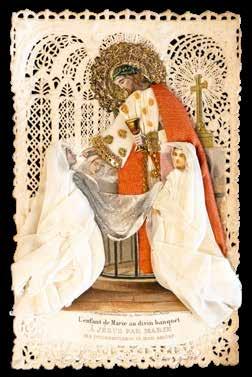
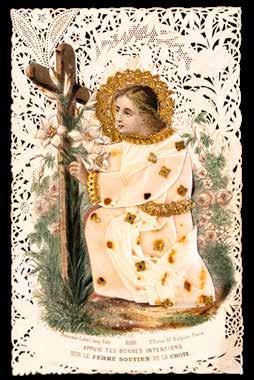
One example from such a box includes a standard printed devotional card depicting a saint, likely mass-produced and originally identical to thousands of others. The card’s inscription in German reads: “Friedericka Prues – in memory of your godmother Dina Borgmann.” On its own, it would be unremarkable. But this particular card was altered after production. Small fabric pieces were added to the printed figure, as if to clothe the image.
From a descriptive standpoint, none of this changes the object’s basic classification. It remains a printed prayer card with later applied materials. Its production history is anonymous, and its provenance is likely limited to general devotional use. But the alterations do record something the printed object alone does not: individual handling.
Friedericka added the lace, glue, and applied fabric that interrupted uniformity and introduced variation where the production process did not intend. These also introduced literal material differences—raised surfaces, layered textures, and irregular edges—that change how the object sits in the hand or is stored.
A prayer card, no matter how modest, becomes a small witness to the belief that love can be made visible through touch, effort, and attention.
There is a quiet discipline in learning to see this way. It requires us to slow down enough to notice what does not announce itself. It asks us to receive ordinary objects as if they might still be speaking. And when we do, we begin to recognize that truth, beauty, and goodness are not distant ideals but ways of attending to what is already near; turning a religious souvenir into something else entirely when you look close enough. In the end, archives do not only preserve documents, they keep alive the texture of human intention, especially where that intention has been shaped by faith. ✦
Kitahara Satoko* kept a box of newspapers and magazines that reported on her charitable work with the children from a homeless village called Ants Town. The articles’ headlines dubbed the 22-year-old Catholic convert “Mary of Ants Town”—much to Satoko’s embarrassment and delight, as she later confessed.
Born August 22, 1929, Satoko was the artistically-inclined daughter of an esteemed Tokyo family. Drawn to the truth of Catholicism at age 20 by the beauty of self-sacrificial love she saw embodied in the Mercedarian sisters who catechized her, she wanted to dedicate her life in service to others, too. So, she volunteered at Ants Town—a village of ragpickers near her wealthy family home—tutoring the children, leading them in the Rosary, and teaching them hymns on her family piano. She even came to practice the trade of “ragpicking,” leading the children on scrap collecting excursions to raise money for the community; for this, Satoko made national headlines.
Soon, however, Satoko’s tuberculosis worsened, forcing her to take frequent breaks from Ants Town. Admittedly angry at and jealous of those who replaced her, she detected vanity in her heart.
Around this time, a priest asked Satoko to collect articles published about her, to share her witness with his community. She initially kept the articles for him, but realizing that they had become an idol of her own reputation and fame, Satoko took them to her garden and, one by one, lit them on fire.
With this striking act, Satoko proclaimed that she counted her reputation as nothing before God. Detached from these superficial riches, she was free to more fully receive and dispense the riches of God’s love to those around her. Thus, as her health continued declining, Satoko wrote:
I feel my path to heaven will be a long and painful one. I do not intend to work just for my own eternal salvation, closing my eyes to the people around me. No, I want to offer God many beautiful sacrifices so that I may help others avoid the pains of hell, and reach Him in heaven. (Kitahara, quoted in Paul Glynn, The Smile of a Ragpicker, 183)
This desire—to allow her suffering to become an offering of love for others—eventually led to Satoko permanently
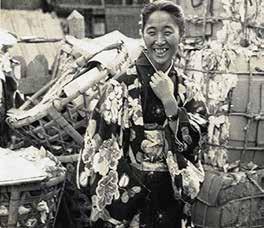
residing in Ants Town. She lived her final four years as one among the community, dedicating herself prayerfully to those around her as the settlement secretary, striving to always smile at those she encountered.
Satoko, the rich-girl-turned-ragpicker, died of tuberculosis at age 28 in Ants Town, poor and happy. Because of her influence, many residents, as well as her own family, were baptized. Prayer became a settlement staple, proclaimed daily over the intercom, and a Lourdes Grotto was built near Satoko’s room.
In the end, Satoko bore in herself the beauty which first attracted her to the faith. This beauty is not pure aesthetics, but Jesus Christ Himself, who revealed on the Cross that the truth of beauty encompasses suffering and death. The realization of beauty, then, lies not in escaping suffering and death but in accepting these realities and entrusting them to Christ, who makes them a means of redemptive love.
For Satoko’s life to image Christ the Beautiful, she first had to reckon with her own vanity, as she wrote:
[F]rom childhood, we have been taught to think highly of ourselves, believing we have done something truly good merely by occasionally making small donations or visiting the poor, all under the name of “charity.” Reflecting on it now, what a dreadful “morphine for the conscience” that was. Just as no illness can be cured by a numbing agent alone [...] self-satisfied “charity” alone will never eradicate poverty from this world. (Kitahara, Children of Ants Town, translated by Shannon Saruwatashi, 109)
Her words echo those of Pope Leo XIV, who recently said that “the cult of self-image” is “nothing more than anesthetics designed to numb our conscience.” The solution then—as Venerable Satoko shows us—is to return to the Garden of our existence and light aflame all the little idols we hold onto, reconciling ourselves to the God whose beauty is revealed through the offering of His life for ours. For, in and through and with Him, we find one another.
Venerable Kitahara Satoko, pray for us. ✦
* Satoko is her given name, and Kitahara is her family name; in Japan, the family name comes first.






Katie Sciba
I had a consistent Panera habit years ago when my son, Thomas, was two. Every so often, I'd drive through with Tom in the back and order the same cookie for him and coffee for me. A few months into this ritual, as I pulled up to the familiar speaker and opened my mouth to place the order, I heard my son's small voice in the back, "Hi there! May I please have a black hazelnut coffee and a shortbread cookie?"
He nailed it. Two years old and he not only recited the item names correctly, but in my exact, routine inflection. I cracked up at hearing what registered as a recording of myself coming from the back seat. Twelve years later, it's all the more amusing to me, as this child has more than a few traits he got directly from his mom, having caught mindsets and behaviors that I didn't even realize I demonstrated.
The phrase "parents as primary educators" comes to mind every time I catch my kids doing something just like my husband or me. The idea seems simple enough: the role of educator is inherent to parenthood—and not just any educator… the first.
From the initial moments of life, children are forever assuming their parents' attitudes and approaches to life. I read and have witnessed that even from within the womb, a child learns his mother's vocal inflection and mimics it back to her in his newborn cries. Kids tend to take on their parents' passions and pursuits and, assuredly, their personalities.
It's not hard to trace my qualities and values back to one or both of my parents. I have my mother's spontaneity and father's pragmatism. While I certainly learned life lessons more formally in conversation at the kitchen table, most of the principles I learned from them were in our daily exchanges. No planning involved—just action and audience. They had my full attention whether they knew it or not.
The bottom line is that as parents, we're the first place our children look for how to approach work and play and, most importantly, faith. Though many of us supplement our children's catechetical instruction with religious education or Catholic schools, the example that takes hold is our own. And not only that; their experiences of us inform their understanding of God, a phenomenon that many of us spiritually wrestle with into adulthood. We must authentically demonstrate the
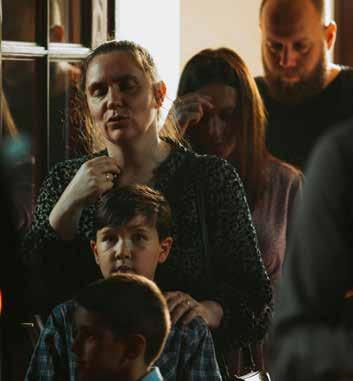
faith at home in order to foster the seeds that are planted in environments outside the home.
The Catechism of the Catholic Church states, "Family catechesis precedes, accompanies, and enriches other forms of instruction in the faith. Parents have the mission of teaching their children to pray and to discover their vocation as children of God" (CCC, no. 2226). It's a huge responsibility, yes, but also an incredible privilege—God placed us with our children by His perfect wisdom.
Pope St. John Paul II said, “As the family goes, so goes the nation and so goes the whole world in which we live." These days, it's both wise and exhausting to race against the culture to be the first source of information. From faith to sexuality to any other information short enough to fit on a meme, children are bombarded with it as early as toddlerhood.
We succeed by cultivating a connection of love and ease with our children, who will always have questions as they grow. When faced with a charge too daunting, I fall into thinking that I must do it on my own; but God’s grace is enough, and He is ever ready to give me more when I ask.
Tom’s back seat echo was never about coffee and cookies. Scripture tells parents to teach God's ways to their children in the most ordinary moments—sitting at home, walking along the road, lying down, rising up (Dt 6:7). Every drive-through order, every unscripted moment, is quietly forming our children’s hearts. Take courage: we don't have to be perfect, just present—yes, to our children, but even more so to the Lord, who will uphold us to love well as parents. ✦
SHINE ON | Dominick Albano
The Basilica of St. Josaphat in Milwaukee might be the most beautiful church in America. I'm no expert—and I certainly haven't seen every church in the country—but it's hard to imagine it has much competition.
The Basilica is run by the Conventual Franciscans, one of whose priests gave me a tour about a decade ago, and he said something I'll never forget:
"The world has done away with truth and goodness, but beauty... beauty is something the world hasn't figured out how to get rid of. Even if an atheist walks into this Basilica, his jaw drops open and his eyes turn to heaven."
I grew up during the death of truth and goodness.
The attacks began long before my formative years, but I vividly remember hearing "Who am I to judge?" and "That's your truth" in my teens and twenties.
If truth, goodness, and beauty always point us toward God, it's no surprise the world wants to do away with all three.
Relativism is a direct attack on truth and goodness. What's true for you might not be true for me. "I'm living my truth." If you aren't hurting anyone, do whatever you want. We've all heard some version of it. And the underlying lie is that there is no truth at all.
The world tried to kill truth to stop us from finding God.
The world tried to kill goodness to stop us from seeing God in ourselves and one another.
But beauty is different. Beauty doesn't argue. You can debate a claim about truth or goodness, but beauty reaches the heart before the mind can object. Music, painting, poetry… the arts stir something deeper than the senses.
So, how does the world attack beauty?
Counterfeit. If you can't kill it, fake it.
What once required the creative power of a human being can now be thrown together by artificial intelligence. A movie. A poem. A painting. Even an article for a Catholic diocesan magazine can be produced with the click of a button (I promise, no AI here).
But AI is only an imitation of intelligence, and it can only produce an imitation of beauty. The Vatican's document on AI, Antiqua et Nova, reminds us of the artisan who can see in
raw material a form no one else recognizes and the friend who knows exactly the right word to say. Some things simply can't be faked. As Pope Francis put it, "Poetry and love are necessary to save our humanity."
That won't stop the world from trying.
I grew up while truth and goodness were under attack. Now, I'm raising kids in a world coming after beauty.
Endless streaming content. Enough YouTube videos to fill a hundred thousand lifetimes. AI slop.
The world isn't claiming beauty doesn't exist, the way it did with truth and goodness. It's making counterfeit beauty so easy, so quick, so effortless that young people can't tell the difference anymore.
This endless stream of "content" sure is stimulating… but it’s not beauty. It's not wonder. It's not awe.
Endless streaming is stimulating, but it leaves you drained.
Beauty like a Basilica is wonderful, and it fills you up.
This is where our Catholic schools come in. Outside the home, this is where young people learn the power of creating. Not for attention. Not for content or algorithms or becoming YouTube famous. My favorite author, Kurt Vonnegut, said that practicing an art, no matter how well or badly, is "a way to make your soul grow, for heaven's sake." Sing in the shower. Tell stories. Write a lousy poem for a friend. You will have created something.
So go make something. The counterfeit beauty the world casts into our laps is passive. You just take it in, repeatedly. Your kid's lump of clay that was supposed to be a St. Joseph statue is doing more for his soul than another YouTube video ever will. The hymn sung in choir is worth more than a thousand autotuned karaoke apps.
School starts this month. It's a great time to get back to creating instead of consuming.
Take your kids to the art museum. Go watch the ballet. Visit the Cincinnati Symphony Orchestra.
Or just put on a puppet show in your living room.
Because beauty just might be the one thing the world can't kill. And as long as we keep showing our kids the difference between the real thing and the counterfeit, we can have great hope for the next generation. ✦
CHRISTIAN ANTHROPOLOGY | Andrew J. Sodergren, M.T.S., Psy.D.
Note: This article is part of an ongoing series on Pope St. John Paul II’s “Theology of the Body” (TOB).
In Part Two of TOB, Pope St. John Paul II reflected at length on marriage. First, his reflections on the sacramentality of marriage largely centered on analyzing Ephesians 5 where the relationship between Christ and the Church is described using spousal terms. We saw how Christ’s gift of Himself to the Church results in a convergence of redemptive love and spousal love. Redemptive love seeks and saves the lost through acts of sacrifice whereas spousal love seeks intimate union with the beloved. As Bridegroom of the Church—and of each of our souls—Jesus’ love for us integrates these elements, and He calls us as His disciples to emulate His example in our own marriages.
Moreover, as members of Christ’s body, the marriage of Christian spouses is a participation in Christ’s spousal union with the Church. This participation guarantees the indissolubility of our marital bonds and provides a direct channel of grace to live this beautiful vocation despite our human weakness.
After completing his reflections on Ephesians 5 and the sacramental gracing of marriage, Pope St. John Paul II moved on to reflect on the “sign” dimension of marriage. Recall that the late pope tended to use the word “sacrament” in a broad sense as a way to refer to anything that has the function of “revealing” and “realizing” an aspect of God’s salvific plan for humanity.
A sacrament has an aspect of a “sign” that reveals some aspect of God and His plan for us while also actualizing God’s plan by putting us in direct contact with Him and His grace. As we have seen, Christian marriage fits this description by immersing us in Jesus’ spousal union with the Church. This participation in Christ’s spousal love helps explain the “realizing” aspect of the Sacrament of Marriage, but what of the “revealing” or “sign” dimension?
Each of the sacraments of the Church involves certain words, gestures, and materials that are taken up into a specific liturgical action conducted by certain prescribed people. In marriage, the sacrament is administered by the man (bridegroom) and the woman (bride). As baptized Christians, they conjointly
administer the sacrament through the words of marital consent solemnly given during the wedding liturgy and witnessed by the priest or deacon and by other parties in attendance. The priest or deacon further blesses the couple’s consent.
For Pope St. John Paul II, the sign aspect of marriage consists in the mutual gift of self, signified first by the words spoken during the wedding liturgy and later through the bodily gestures of marital consummation. Let us examine the words spoken by the man and woman in the Catholic wedding liturgy.
First, the couple publicly testifies that they are fully aware of what they are about to do, are doing so freely, and are prepared to carry it out. To this end, the priest or deacon asks the couple, “Have you come here to enter into marriage without coercion, freely, and wholeheartedly?” He then follows with, “Are you prepared… to love and honor each other for as long as you both shall live?” Lastly, for those of childbearing years, “Are you prepared to accept children lovingly from God and to bring them up according to the law of Christ and His Church?” These are all prerequisites for the marital consent that the couple is about to exchange. They establish the basic conditions (e.g., knowledge, freedom, capacity to take up the vocation, openness to life) necessary for marital consent.
Having publicly asserted their readiness and intentions, the man and woman, as ministers of the sacrament of marriage, then solemnly speak the words that bring the marriage into existence. These words take the form of a lifelong vow: “I (name) take you (name) to be my wife/husband. I promise to be faithful to you in good times and in bad, in sickness and in health, to love you and to honor you all the days of my life.”
This permanent (for the rest of one’s life), exclusive (you and no other), unconditional (in good and bad) gift of self is the essential sign of marriage.
With Pope St. John Paul II’s help, we will continue to unpack their meaning and explore how the body must participate in and harmoniously express this language of self-donation. ✦
In Catholic circles, some movies and series are held in such high esteem that they are essentially considered “required viewing.” Among these are Lord of the Rings, It’s A Wonderful Life, A Man for All Seasons, and The Passion of the Christ. Another film that should be added to this pantheon of artistic giants is Terrence Malick’s 2019 film, A Hidden Life. Among the treasured company, this masterpiece is every bit as true and good (and even more beautiful).
The movie explores the life of an Austrian conscientious objector in World War II, a devout Catholic man named Franz Jagerstatter who peacefully defied Nazi orders. He was a man who, much like St. Thomas More, had much to live for—he had a beautiful family, a loving wife, and an idyllic property in the Austrian countryside. At the same time, he felt Christ’s ultimate calling and knew that his soul could not rest if he joined forces with something he knew was evil. Christ Himself tells us, “Whoever loves son or daughter more than me is not worthy of me; and whoever does not take up his cross and follow after me is not worthy of me” (Mt 10:37-38).
As with all great examples of Catholic art, A Hidden Life completely employs goodness, truth, and beauty to tell its story and give viewers a transcendent experience: love for the Divine is fully on display. Franz and his prayerful family are often seen contemplating the Cross, even (and especially) while the foreboding presence of evil is advancing on their serene dwelling. He is a good man worth knowing about, and Malick’s film helps us get to know him and, perhaps, internalize his struggle.
Bishop Robert Barron describes beauty as “the arrowhead of evangelization” for its ability to charm and delight a person beyond words. Beauty in art can leave one speechless; it can direct one’s gaze upward and outside of oneself. From an egocentric starting point, we find ourselves suddenly in a theocentric place when the beauty of sacred art or God’s wonderful creation captures and mystifies us. A Hidden Life has perhaps the most striking natural beauty ever captured in a mainstream movie. The camera, in its fluid dance, weaves and meanders across the gorgeous Austrian countryside, perfectly juxtaposing the bucolic perfection on display in
the wilderness against the cold and angular brutality of the Nazi encampments.
Indeed, this movie is like a cathedral in the way that its beauty can leave viewers completely spellbound, much like The Sound of Music did with similar landscapes many years ago. Malick clearly understands that these visuals connect with Franz’s love for God, as the perfection in creation always reflects the Creator—“For from the greatness and beauty of created things comes a corresponding perception of their creator” (Wis 13:5). Quite literally, the positioning of the camera often points the viewer skyward, as Malick sets cameras very low to the ground to gaze upward at the characters and the surrounding vistas.
This type of feast for the senses requires patient, thoughtful viewing, and the pacing of this movie accentuates this. It is a breath of fresh air to have a movie that lets scenes breathe, so that we can take it all in, unlike so many blockbusters today that rapidly cut between scenes to both stimulate the viewer and simulate intense action. Movies are meant to be a delightful escape from everyday life, but shouldn’t those two hours we spend watching them bring us out of ourselves and make us ponder something greater? Whether that be Christ specifically or any number of other explorations of truth as told from a secular perspective, we can see that escapism without psychological depth is no more enriching than, as Martin Scorsese once put it, “an amusement park thrill ride.”
Witnessing beauty feeds our soul in ways that we sometimes don’t realize we need until we’ve been starved of it. The purpose of Brutalist architecture, for example, devilishly seems to acknowledge this fact, as its coldness and blank indifference seeks to make humans fall in line—ordering them toward a purely human servitude rather than the Divine servitude that is begged by the beauty in every magnificent European cathedral. These are pieces of art that people from every nation, creed, and background come to see, and their spirits soar at the grandeur of the masterpiece.
Let A Hidden Life into your home as soon as you can, and perhaps you will find it to be a cathedral on film. Its beauty will enrich you, its goodness will inspire you, and its truth will draw you out of yourself to something infinitely more fulfilling. ✦

Born c. 225 A.D., Lawrence served as a humble deacon in Rome, which was dangerous mission territory at the time. Christians were accused by the pagan authorities of being enemies of the state. In 258 A.D., the emperor Valerian issued an edict to the Roman senate to arrest and execute all Christian bishops, priests, and deacons.
Deacon Lawrence was responsible for the Church’s material goods and distribution of alms to the poor. After Pope Sixtus II’s martyrdom, Rome’s prefect offered to spare Deacon Lawrence’s life if he turned over all the Church’s riches to the emperor. The prefect was delighted when Lawrence asked for three days to gather the Church’s treasures. He went through the city and invited those who were marginalized to come together. When the prefect arrived, Lawrence presented him with a great number of people who were poor, blind, sick, lame, widowed, or orphaned. “These are the treasures of the Church,” he said. Filled with rage, the prefect ordered Lawrence to be roasted alive, slowly, on a gridiron. Witnesses who recorded the public martyrdom said that Lawrence cheerfully offered himself to the Lord Jesus and even joked with his executioners.

St. Lawrence understood what was at the heart of his vocation and offered his life on behalf of others. His story is one of love and redemption. He spent his life in service to the poor and offered himself fully to Jesus Christ. It is said that his death marked the end of idolatry in Rome. He inspired numerous people to convert to Christianity, and many miracles were worked through his intercession.
St. Lawrence has been one of the most venerated martyrs of the Roman Church since the fourth century. He is the patron of Rome, deacons, chefs, firefighters, comedians, and the poor. His feast day is August 10.
BOOK REVIEW | Joseph Pearce
Of all living writers, Peter Kreeft is the one who reminds me most of C. S. Lewis. Like Lewis, Dr. Kreeft has an uncanny ability to put the most abstract and abstruse philosophical and theological concepts into language that anyone can understand. This is the reason that he is one of the most popular and powerful Christian apologists of our day, emulating Lewis’ own perennial popularity and powerful witness.
With the publication of An Ocean Full of Angels, Kreeft proves that he can emulate Lewis in writing great apologetic fiction, as well as non-fiction. This might come as a surprise. Lewis was a literature professor; Kreeft is a professor of philosophy. Might we not expect him to be out of his depth, or at least outside his comfort zone? Perhaps so. But Lewis wrote The Problem of Pain and Miracles, both works of philosophy. If the literature professor can successfully dabble in philosophy, might not the philosopher successfully dabble in fiction? The answer, at least in the case of An Ocean Full of Angels, is a resounding yes!
Although this is Kreeft’s first novel, it does not bear the telltale hallmarks of the novice. On the contrary, it has integrity in its entirety, which is to say that each character and plot line, every detail, serves the whole. Continuing the comparison with Lewis, it reminds me of Lewis’ last and best novel, Till We Have Faces, in which Lewis grapples with the rival claims of religious faith and philosophical reason. Kreeft’s principal protagonists are a young, devout Muslim man and an equally young and equally devout Jewish woman. Like a latter-day Romeo and Juliet, these young folks, ostensible enemies, become “lovers.” Unlike Shakespeare’s lovers, however, who abandon reason in pursuit of passion, Kreeft’s lovers do not permit the heart’s longing to lead to a headlong descent into heedless and headless self-destructiveness. Both are on a pilgrimage in pursuit of ultimate union with divine truth.
Kreeft adroitly handles the interaction between the faith traditions of Judaism, Christianity, and Islam. A resolute and indefatigable defender of truth, he doesn't succumb to the ecumenism that seeks to eliminate religious differences by embracing relativism. On the contrary, Kreeft follows the approach of Lewis’ Mere Christianity in which the lowest
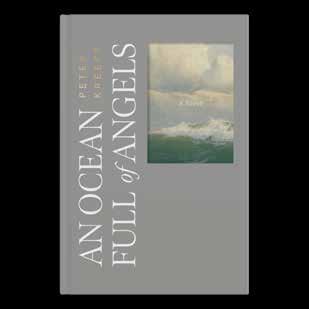
An Ocean Full of Angels by Peter Kreeft
Word on Fire Luminor, 2026 432 pages | $34.95

Scan QR code to purchase the book
common denominator of relativist “ecumenism” is spurned in favor of the highest common factor between the faith traditions. Ultimately, union can only come with communion in Christ. Although this is clear from the trajectory in An Ocean Full of Angels, it is followed without preachiness and without facile dismissal of non-Christian belief. Instead, the principal characters, irrespective of their theological starting points, or their predilections and prejudices, are invited, in the words of Aslan in The Last Battle, to venture “further up” and “further in.”
More to the point, the reader is also invited to venture further up and further into the divine mystery of God’s divine mastery.
Of all the novels written this century that I have read, and I have read many, this stands alongside the best. I might even suggest that only Laurus by Eugene Vodolazkin is its superior. Considering that it’s safe to prophesy that Vodolazkin’s masterpiece is destined to be a canonized classic, this is about as high a praise as I can give to Kreeft’s own literary tour de force. ✦
Gerry Kelly Fritsch
Traditional Irish Bagpiper 513-404-0049
gfritsch48@zoomtown.com cincinnatipiper.com
Gilligan Funeral Homes
A Catholic family-owned funeral home since 1877 513-891-8373
Mihovk-Rosenacker Funeral Homes
White Oak/Monfort Heights 5527 Cheviot Rd.
Blue Ash/Evendale/Sharonville 10211 Plainfield Rd. 513-385-0511
Naegele Kleb & Ihlendorf Funeral Home
Serving Norwood, St. Bernard & surrounding communities
3900 Montgomery Rd. 513-631-2240
Geo. H. Rohde & Son Funeral Home
115 years of family service to Eastern Cincinnati
3183 Linwood Ave. Mt. Lookout Square 513-321-0404 rohdefuneral.com
T.P. White & Sons Funeral Home
Family-owned and operated since 1870
2050 Beechmont Ave. 513-231-7150
36 “Come to me all who labor…I will give you ___” (Mt 11:28)
37 Casts aside
Buddy
“Same here”
From a distance 42 Forces upon
Sea, to Sartre
New ___ Standard Version of the Bible
47 TV frequency 49 Inspires dread 50 Magazine published by the Jesuits
Mended
Retriever 58 Maria’s friend
Medieval Scandinavian chieftain
Nautilus captain
Refine metal
Natural balm
Taxis
Gaps 65 Author of Atlas Shrugged
Otherwise
1 Vestment worn about the neck and shoulders
Certain inert gas
Wedge
Implore urgently
americangreetings.com
13 Be mindful of 21 Long lock of hair
22 What Jesus told the blind man to do at the pool of Siloam
24 “We are ___ on Christ’s account” (1 Cor 4:10)
27 Thin stratum
28 Woe ___!
29 Agitate
30 Partly open
31 “…the Lord, the giver of ___.” 32 Belgrade resident 34 Portable tunes players
35 Chou En-___
38 Symbol of the Blessed Trinity 40 Son of Jacob
“___ my sheep.” (Jn 21:17)
Fell 46 Warm-ups
48 St. Therese of Lisieux is a patron of this country
50 Brother of Moses
51 Standard of perfection
52 Decorative hair accessories
53 Got up
Pizzazz
55 Rifle power
56 Cambodian cash
57 Refrain syllables 59 Glass container

Leandra Ulmer
“To be sure, no human being has ever really seen everything that lies visibly in front of his eyes.”
Upon first reading these words about ten years ago, I was deeply struck by them. I also received them as a challenge. How much has been right in front of me all of my life that I have not seen? Of course, there is a figurative sense of “sight” as well as the literal sense, and the two mirror each other; but as someone who loves to draw, I wanted to take this idea and apply it to the creative process. Over time, I have come to view this process in three stages.
The first stage is seeing. I agree with Pieper that we do not usually see what is right in front of us. To draw anything, we must first learn to observe the world around us with openness and attention. In my experience, this kind of sight usually begins with admiration. When I admire something, I start to look at it more carefully, and the longer I look, the more I see. An artist who draws from life often spends long hours observing the same subject. This may sound boring, but little by little the subject turns over its secrets—the subtle textures, the reflected light, the solid form standing in perfect balance—in the end, what seemed at first a simple scene is actually too much visual information to take in.
That brings us to the second stage of the creative act: interpretation. The artist’s job doesn’t end with seeing. An artist interacts with the visual world in a way that requires making decisions about what to include or exclude and emphasize or minimize. When drawing or painting, it quickly becomes evident that you cannot include every visual detail you see, so the artist gets to curate, or interpret, the information until it becomes something that appears satisfying on the page. This action can be done more or less skillfully and is a stage when technical training becomes a
great advantage. During this stage, an artist also develops a personal style, and imagination and memory play an important role.
Once a beautiful artwork is produced, the artist’s job remains unfinished. The third and final stage in the creative act is relation. An artwork has not fulfilled its purpose until it is seen by someone else—we create with the hopeful expectation of relating a message. Learning to see and learning to interpret information is certainly edifying for the artist, but the “good news” is not meant to stop at the person who learns it—it is meant to be shared!
In addition to being an artist, I am also a third-grade teacher, and I believe that this principle applies to teaching. What we learn is not meant to stop at us; it is meant to be taught. If water is stagnant for too long, all kinds of harmful bacteria start to grow in it, and it becomes a hazard to its environment. A river, on the other hand, always moves and flows toward lower ground, spreading nutrients to sustain life. We should all seek to be part of a life-sustaining cycle—to give in some way what we receive, so we can encourage life and growth in those around us.
In all cases: we cannot give without first drawing from the source of everlasting life; and we cannot draw, unless we first learn to see. ✦
“Whoever believes in me, as Scripture has said, rivers of living water will flow from within them.”
JOHN 7:38
Leandra Ulmer is a local Catholic artist who grew up in Wilmington, Ohio and studied theology at Our Lady Seat of Wisdom and Sacred Art at The Sacred Art School in Florence, Italy. She is currently working as a third-grade teacher at St. Gertrude School in Madeira, Ohio and spends her summers travelling and painting.
With a transformative $500,000 gift, Phil and Beth Rielly are helping ensure high quality Catholic education is accessible to all students. Their leadership encourages others to join them in giving every child the opportunity to learn, grow, and thrive in a faith centered environment.
Exceptional students.
Exceptional service.
Exceptional success.



OptimALL Services equips students in Catholic schools to realize their full potential. Now serving more than 200 students with learning disabilities in Catholic schools, OptimALL is breaking barriers and answering God’s call to serve all students.

You shouldn’t have to compromise your values when it comes to investing. That conviction is among the many reasons I support Ave Maria Mutual Funds and why I’m proud to serve on their Catholic Advisory Board.
Since 2001, Ave Maria Mutual Funds has refused to invest in companies that profit from pornography, abortion, or attacks on the family. Their strong long-term performance is proof that principled, Pro-Life, Pro-Family investing works.
This testimonial may not be representative of the experience of other customers. “As a member of the Ave Maria Mutual Funds Catholic Advisory Board, I receive compensation from the Funds of approximately $14,000 per year, which I do not believe affects my objectivity. Such compensation for my time and advice is not payment for this endorsement. I truly believe in the mission of the Ave Maria Mutual Funds.” – Michael Knowles. Past performance does not guarantee future results. Schwartz Investment Counsel, Inc., a registered investment adviser established in 1980, serves as investment adviser for Ave Maria Mutual Funds and invests only in securities that meet the Funds’ investment and religious requirements. The returns may be lower or higher than if decisions were based solely on investment considerations. The method of security selection may or may not be successful and the Funds may underperform or outperform the stock market as a whole. All mutual funds are subject to market risk, including possible loss of principal. Request a prospectus, which includes investment objectives, risks, fees, charges and expenses and other information that you should read and consider carefully before investing. The prospectus can be obtained by calling 1-866-283-6274 or it can be viewed at www.avemariafunds.com. Distributed by Ultimus Fund Distributors, LLC. Schwartz Investment Counsel, Inc. is not affiliated with Ultimus Fund Distributors, LLC.