MAGAZINE
189th year | issue 10
bringing faith into the home
september 2020 | religious liberty | 1
2 |
edi t or’s not e
We’ll Pass the World to you In the Spring of 2019, I took my oldest daughter to see the stage production of Hamilton. Huge fans of the music since the time the cast album dropped, we couldn’t wait to finally see it performed in person. As the theatre darkened and the first notes of the show played, we squeezed hands and practically squealed with delight while whispering the lyrics under our breath. And even though we knew the songs backwards and forwards, seeing the performance was something new and awe-inspiring. One of the standout moments of the show, for me, is when Alexander Hamilton and Aaron Burr step onto the stage with nothing but a chair in front of each of them. Together, in “Dear Theodosia,” they sing to their young children: “You will come of age with our young nation. We’ll bleed and fight for you, we’ll make it right for you. / If we lay a strong enough foundation, we’ll pass it on to you, we’ll give the world to you, and you’ll blow us all away.” As my daughter sat next to me, riveted by this retelling of American history, I couldn’t help but wonder: “What will I do to make the world a better place for her? What will I pass on to her?” Fast forward to a weekend in late July 2020. We were watching Guardian Angels’ live-streaming Mass, and Father Sunberg was giving the homily on Solomon. He said: “Solomon could have asked for anything… He could have asked for wealth or power or prestige, but he asked for wisdom… so he could be able to discern what is good and right and valuable throughout his reign as king. And he’s showing a deeper level of his sense of his own integrity, of who he is as a person, to go to that deeper level that he has in his relationship with God, so that he could be able to take care of God’s people in a good, right manner.”
enough foundation, for my children? And how do I proceed with wisdom? As with all good decisions in our lives, the answer is to turn to God in discernment and prayer – as well as use the teachings of our faith to guide us. In preparation for the coming months, the archdiocese has assembled an initiative called iVoteCatholic. The program doesn’t tell you who to vote for, but instead equips you with the tools and information necessary to learn more about where Catholic teaching stands on important social and political issues. It’s a tool, when used alongside prayer and discernment, that can help inform your mind, your conscience and, ultimately, guide you to wisdom. (pg. 22) My hope is that as we move forward and prepare the way not only for ourselves, but for the next generation, that we do so guided by our faith, instilling those values into those trusting little faces who are constantly turning their eyes to us.
As the election season approaches, these two ideas weigh on my mind. What can I do to build a better future, a strong
cteditorial@catholicaoc.org
THE CATHOLIC TELEGRAPH 189th Year No. 10 • September 2020 513-263-6633 • thecatholictelegraph.com
PUBLISHER Archbishop Dennis M. Schnurr
EDITOR Jessica Rinaudo
MEDIA SALES Deacon Graham Galloway
GRAPHIC DESIGN Emma Cassani
NEW MEDIA EDITOR Greg Hartman
DIGITAL ENGAGEMENT Dominick Albano
PHOTOGRAPHY Margaret Swensen
BOOKKEEPING Karen Cromer
100 East Eighth St., Cincinnati, OH 45202 ctadvertising@catholicaoc.org The Catholic Telegraph (xUSPS 094-520) ISSN. 10736689 is published monthly by the Archdiocese of Cincinnati 100 E 8th St., Cincinnati, OH 45202. Periodicals postage paid at Cincinnati and at additional mailing office. POSTMASTER: Send address changes to: The Catholic Telegraph, 100 E. 8th Street, Cincinnati, OH 45202
| 3
contents religious liberty
news
columns
18 A CLOSER LOOK
8 JOYFUL LITTLE CATHOLICS
5 SEEK THE LORD
DR. KEN CRAYCRAFT
BONNY VAN
ARCHBISHOP DENNIS M. SCHNURR
The profound irresolution of Christian citizenship
West Chester father creates Catholic books for young children
Soothing disharmony with prayer
21 SHINE ON
12 ANTHONY DICELLO
FATHER DAVID ENDRES
DOMINICK ALBANO
JOHN STEGEMAN
The gift of freedom
26 years of music at the cathedral
22 IVOTECATHOLIC
15 PROFILE: ISABEL MENDEZ
7 QUESTION OF FAITH In what cases can someone be denied communion?
MICHELLE DUSHENSKY
PATTI MCGEEVER
10 KIDS’ CORNER St. Thomas More
New archdiocesan initiative aims to form faithful citizens
16 VACACIONES ÚTILES
11 CATHOLIC AT HOME
REGAN MEYER
KATIE SCIBA
BONNY VAN
Catholic Charities provides academic intervention over summer
Rules of engagement for spousal sparring
Modeling God’s love in our interactions with others
26 HUNGRY FOR MORE
14 DID YOU KNOW?
24 CIVILIZE IT!
MAGAZINE
189th year | issue 10
bringing faith into the home
EILEEN CONNELLY, OSU
GAIL FINKE & EMMA CASSANI
Dayton native prepares to enter the Dominican Sisters of Mary
Cathedral of St. Peter in Chains
29 A SPLINTER OF FAITH
BOB WURZELBACHER
SUSIE BERGMAN
New Bremen’s Paul Dwenger inspires others through humble actions 30 REMEMBERING THE DAYTON SHOOTING KARY ELLEN BERGER
september 2020 | religious liberty | 1
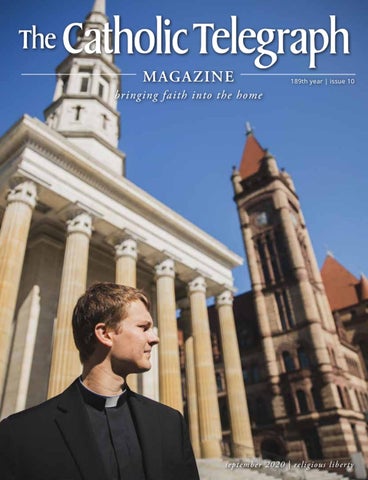
ON THE COVER PHOTO BY: MARGARET SWENSEN
Father Christopher Komoroski stands in front of the Cathedral of St. Peter and Chains and City Hall in downtown Cincinnati. 4 | CO N TE NTS
28 BEING PRO-LIFE Catholic bioethics in a morally confused world 34 SEIZE THE MOMENT NICHOLAS HARDESTY
Fear and the end of all things
Honoring victims one year later
38 MAKING CATHOLIC MEMORIES
32 LINKING SCIENCE & FAITH
WAYNE & MARIANNE TOPP
MARK DANIS
St. Michael and the Archangels
Nuclear physicist makes STEM lab at Carroll High School possible
42 THE FINAL WORD
36 GREGORIAN CHANT IN YOUR POCKET?
Celebrating Hispanic Catholic culture
KARLA EYSOLDT
GAIL FINKE
Pope Francis’ Prayer Intention for September: We pray that the planet’s resources will not be plundered, but shared in a just and respectful manner.
SEEK THE LORD ARCHBISHOP DENNIS M. SCHNURR
Since the onslaught of the COVID-19 pandemic and the resulting shutdown of many businesses, we have often heard the term “essential workers.” But as I pointed out in my recent pastoral letter, Radiate Christ, everyone is essential. Each of us has a role to play in the Church and in civil society because God works through human hands. In the past six months our country has been rocked by the pandemic, by the disruption to lives and jobs from the resulting lockdown, and by the social upheaval that followed the senseless and brutal killing of George Floyd. It is understandable that in the face of such daunting challenges, we turn to government and other human institutions for solutions. At the same time, however, we are each called to be part of the answer by our own individual actions. Laws, rules and policies by themselves will never obliterate the sin of racism, for example, because human beings can break laws, ignore rules and flout policies. In a letter announcing the “Holy Hour for Conversion” held at the Cathedral of St. Peter in Chains on June 3, I called for the necessary conversion of hearts that will compel change and ultimately reform our institutions and society. For by changing ourselves, we can help to change the world. To that end, a key element of the holy hour was a very moving examination of conscience led by Deacon Royce Winters, director of the Office for African American Pastoral Ministries. This reflection helped participants confront their own responsibility to radiate the love of Christ to all people and be witnesses to His kingdom on earth, particularly in the area of racial justice. Racial disharmony is only one aspect of the deep division we see all around us, however. Even the war against COVID-19 has not brought our country together. Instead, it has fostered more division as both government
actions and personal behaviors have become flashpoints for controversy. On this issue, as with so many others today, respectful exchanges of opinion are rare, while mean-spirited judgmentalism is all too common. This disharmony is a problem for which there is no simple government fix. It can only be solved by conversion of hearts, with God’s help, through prayer. That is why the Pastoral Center of the archdiocese has launched the Pray a Minute campaign to encourage prayer for the intention of peace, justice and goodwill in our archdiocese and in our country. The ambitious goal of the Pray a Minute project is one million hours of prayer specifically for this intention for our country by January 1, 2021, the Catholic Church’s World Day of Prayer for Peace. That target number reflects in a very practical way both the importance of the individual person and the power of prayer. The sum is large, and yet it would only take one extra minute of prayer per day by every Catholic in the archdiocese to reach the hoped-for total. Of course, you may feel called to do more. Although the Pray a Minute initiative is already underway, do not feel that it is too late if you have not yet joined. Additional prayer at any time will help to change you and change the world. Go to PrayAMinute.com now, if you have not already done so, to make a prayer pledge. You will also find resources there that may inspire you to try new forms of prayer. To paraphrase the Christian writer C.S. Lewis, the purpose of prayer is not to change God, but to change ourselves. In other words, prayer is not magical thinking. It is the pathway to a deeper, life-altering personal relationship with Jesus so that we can radiate Christ and thereby be instruments of the peace, justice and goodwill that we seek. For that, we are all essential workers. S E E K T HE LO R D | 5
BUSCA AL SEÑOR ARZOBISPO DENNIS M. SCHNURR
Desde el ataque de la pandemia COVID-19 y el cierre resultante de muchas empresas, a menudo hemos escuchado el término “trabajadores esenciales”. Pero como señalé en mi reciente carta pastoral, Radiate Christ, todos son esenciales. Cada uno de nosotros tiene un papel que desempeñar en la Iglesia y en la sociedad civil porque Dios trabaja a través de las manos humanas. En los últimos seis meses nuestro país se ha visto sacudido por la pandemia, por el cierre resultande de la interrupción de vidas y empleos, y por la agitación social que siguió el asesinato sin sentido y brutal de George Floyd. Es comprensible que ante desafíos tan desalentadores recurrimos al gobierno y a otras instituciones humanas en busca de soluciones. Al mismo tiempo, sin embargo, cada uno de nosotros está llamado a ser parte de la respuesta por nuestras propias acciones individuales. Las leyes, las reglas y las políticas por sí mismas nunca destruirán el pecado del racismo, por ejemplo, porque los seres humanos pueden violar las leyes, ignorar las reglas y burlar las políticas. En una carta anunciando la “Hora Santa de la Conversión” celebrada en la Catedral de San Pedro en Cadenas el 3 de junio, pedí la necesaria conversión de los corazones que obligue al cambio y, en última instancia, a reformar nuestras instituciones y nuestra sociedad. Porque cambiando a nosotros mismos, podemos ayudar a cambiar el mundo. Con ese fin, un elemento clave de la hora santa fue un examen de conciencia muy conmovedor dirigido por Deacon Royce Winters, director de la Oficina de Ministerios De Pastoral Afroamericanos. Esta reflexión ayudó a los participantes a enfrentar su propia responsabilidad de irradiar el amor de Cristo a todas las personas y ser testigos de Su reino en la tierra, particularmente en el área de la justicia racial. Sin embargo, la desarmonía racial es sólo un aspecto de la profunda división que vemos a nuestro alrededor. Ni siquiera la guerra contra COVID-19 ha unido a nuestro país. Al contrario, ha fomentado una mayor división a medida que tanto las acciones gubernamentales como
6 |
los comportamientos personales se han convertido en puntos de inflexión para la controversia. Sobre este tema, como con tantos otros hoy en día, los intercambios respetuosos de opinión son raros, mientras que el juicio de mal espíritu es demasiado común. Esta desarmonía es un problema por el que no hay una simple solución del gobierno. Sólo se puede resolver mediante la conversión de corazones, con la ayuda de Dios a través de la oración. Es por eso que el Centro Pastoral de la arquidiócesis ha lanzado la campaña Orar un Minuto para fomentar la oración por la intención de paz, justicia y buena voluntad en nuestra arquidiócesis y en nuestro país. El ambicioso objetivo del proyecto Orar un Minuto es un millón de horas de oración específicamente por esta intención por nuestro país para el 1 de enero de 2021, que es la Jornada Mundial de Oración por la Paz de la Iglesia Católica. Ese número objetivo refleja de manera muy práctica tanto la importancia de la persona individual como el poder de la oración. La suma es grande, y sin embargo, sólo tomaría un minuto extra de oración por día por cada Católico en la arquidiócesis para alcanzar el esperado total. Por supuesto, es posible que se sienta llamado a hacer más Aunque la iniciativa Orar un Minuto ya está en marcha, no sienta que es demasiado tarde si aún no se ha unido. La oración adicional en cualquier momento le ayudará a cambiarle y a cambiar el mundo. Visite PrayAMinute.com ahora, si aún no lo a hecho, para hacer una promesa de oración. También encontrarán recursos allí que pueden inspirarle a probar nuevas formas de oración. Parafraseando al escritor cristiano C.S. Lewis, el propósito de la oración no es cambiar a Dios, sino cambiarnos a nosotros mismos. En otras palabras, la oración no es pensamiento mágico. Es el camino que altera la vida personal y hacia una relación más profunda con Jesús para que podamos irradiar a Cristo y así ser instrumentos de la paz, la justicia y la buena voluntad que buscamos. Por eso, todos somos trabajadores esenciales.
Q UE S TION OF F AITH
IN WHAT CASES CAN SOMEONE BE DENIED COMMUNION? I have heard it is possible for someone who wishes to receive communion at Mass to be denied. In what cases can someone be denied communion? Is this different from being “excommunicated”? When Catholics approach to receive communion, it is presumed that they are in a proper state to receive. A person can be denied, however, because they are known to be in grave sin or have placed themselves outside of the Church. SIN SEPARATES
The Eucharist is the Body and Blood of Jesus, and its reception is a sign of communion with Christ and His Church. Sin separates us from God. Receiving the Eucharist heals minor transgressions, but serious sin so separates one from God that the person should not receive. According to Church law, a person “conscious of grave sin” is asked not to receive communion without previous sacramental confession, (Canon 916) since the person risks, as a St. Paul says, “eating and drinking judgment on himself ” (1 Cor 11:27-29). Since it is difficult to know the state of another’s soul, the persons themselves are best able to discern their reception. PUBLIC SIN
The Church teaches that someone who “obstinately perseveres in manifest grave sin” should be denied communion (Canon 915). Grave sin is rarely known publicly, but in some cases, it is public. In this case, every effort should be made to help the person embrace the Christian life, including repentance through sacramental reconciliation. If the person cannot be reconciled to the Church, the Eucharist could be denied, but because of the delicate nature of denying communion and concern for the person’s reputation, this decision should be left to the pastor or bishop, not an individual minister. The denial of the sacrament has occurred in rare cases, and not always consistently, for those who act contrary to
Church teachings, including membership in organizations that support racism, abortion or euthanasia. The Church recognizes that such support is often public. Out of concern for public scandal, withholding communion can be exercised. EXCOMMUNICATION
Denial of the Eucharist is not the same as excommunication, though the two are related. Rarely does the Church issue formal excommunications. When enacted, they are for the most serious of public sins. In New Orleans during the Civil Rights era, for instance, the archbishop excommunicated three pro-segregationist Catholics, two of whom eventually returned to the Church. Most excommunications are forms of self-excommunication in which a person places oneself outside of the Church, though without any formal decree. Often these situations can be resolved. A person who contracts marriage outside of the Church, for instance, and later has their union convalidated, may again receive the Eucharist. In most cases, the status of someone who may not receive is not known to the minister, but, like the person who is aware of grave sin, the person should refrain until he or she has been reconciled. CONVERSION
In whatever form it may take, denial of communion is a call to conversion. It is not meant to be a punishment, but a remedy. As the Catechism explains, excommunication does not “restrict the scope of mercy” but “makes clear the [sin’s] gravity” (2272). It is not a permanent state, but highlights the path to reconciliation and peace. Absence from receiving the Eucharist can be a reminder of the treasures of the sacramental life, which point to the life of heaven. FATHER DAVID ENDRES
is associate professor of Church history and historical theology at Mount St. Mary’s Seminary & School of Theology. QU E S T ION O F FA I T H | 7
BY BON N Y V AN
Joyful Little Catholics West Chester Father Creates Catholic Books for Young Children When it comes to ABCs and 123s, stay-at-home dad Zach Hinger hopes young children are able to add a little more faith to their early education. That’s why he’s written and illustrated a board book perfect for tiny hands, titled My First Catholic Words. Based on the concept of other “first words” books, Hinger said the project started out with just his own family in mind. “I never intended for it to be anything bigger than that,” said Hinger. “I wanted something for these two- and three-year-old kids, to help them start to learn the faith. And I know there are a lot of great resources out there, but a lot of them are targeted to kids slightly older than that. And I felt like there was a hole, especially in that very first step.” Hinger knows about those first steps into the Catholic faith. He graduated in 2010 from Franciscan University of Steubenville with a double major in theology and catechetics with a focus on youth ministry and a minor in business. Following college, Hinger landed a job as director of Children’s Formation for St. Patrick Church in Taylor Mill, KY, guiding the faith of children from pre-school to eighth grade, and eventually taking on junior high and high school students. During Hinger’s four years in Covington, he married his wife, Amanda, whom he met when both were involved in youth ministry at St. Maximilian 8 | N EWS
Kolbe Church in Liberty Township. Family illness brought the couple closer to home in West Chester, and Hinger said “a nudge from God” got him back in youth ministry at his old church. Within a year, he was the pastoral associate for evangelization and catechesis and his first child, Lillian, now 5, was born. By the time Hinger’s second daughter, Theresa, now 2, arrived, there was a change in Amanda’s schedule. Instead of working from home as a consultant, she would have to return to full-time work outside the home at a position that also required travel. Hinger’s job required “a lot of evening and weekends,” and after much prayer and discernment, the decision was made for him to stay home with the children. Hinger said he spent his first year at home enjoying time with his children, but by the second year, he started working parttime for his family’s construction company and creating a children’s book for his daughters. “I just kind of started it as a pet project for our kids and over this last year, in prayer as I was finishing it, God was nudging me and telling me that he wanted me to do something more with it,” said Hinger. Hinger said in January, he decided to self-publish the book, tapping into his business degree to create his own company,
Joyful Little Catholics, LLC, and build a website for people to purchase the book. Then a funny thing happened on the way to the printer: His wife was due to give birth to the couple’s third daughter the same week 1,500 books were to be delivered to their home. The quarantine, however, stopped everything, except the arrival of baby Cecilia, and the books were delivered two months later in June. Hinger said just by word of mouth and social media, 100 books sold within the first month. Now, packing and selling books has become a family affair, and Hinger said he and Amanda take turns praying for those who have made purchases.
Jaime’s Tree Service Commercial + residential Tree removal Stump grinding Trimming Storm work Cabling Free estimates! jaimestreeservice.com treeserviceoh@gmail.com 513.372.5194
$50 off Trimming or tree removal Valid with coupon only. Cannot be combined with another offer. Expires 9/30/20
$10 off Stump grinding Valid with coupon only. Cannot be combined with another offer. Expires 9/30/20
“It has been incredible to see how this venture has brought our family together,” said Amanda. “The kids love helping us count out books and fill orders. All along, Zack’s whole mission has been to bring families closer to God and closer together. I love seeing the fruit of his work and hearing from people it has impacted.” Hinger said a second book is already in development, one aimed at slightly older children, and proceeds from the first book will pay for that one. With a built-in test audience, it shouldn’t be hard to complete. Now that the family is back in church physically, Hinger said he has used the book to re-introduce his daughters to things in the church, like the sanctuary lamp, altar and baptismal font. Included in the book is an image of the Sacred Heart of Jesus, which is also used for the company logo. Hinger said he and his wife were drawn to the image when they were praying about branding for the business. Little did he know the significance of that image with this new direction from God. “God’s timing is always different from our own,” said Hinger. “I was thinking this thing was going to happen two months earlier, and God put us on hold for a while, and then it all fell in place and we were ready to run on the Feast of the Sacred Heart, which was really cool.” T H E C AT H OL IC T ELE G R A PH | 9
As a young man, Thomas More was fascinated by joining the monastery in the English hillside, but God called him to be a husband and father instead. He and his wife, Jane, had four children before she passed away at a young age. Thomas remarried a woman named Alice, taking her daughter in as his own. He was known as a loving father who wanted the best for his children, making sure that his daughters received the same education as his son.
St. Thomas More
Thomas was also an excellent writer, lawyer, and politician who was known for his honesty and integrity. He rose to the high and powerful position as Lord Chancellor of England in 1529. King Henry VIII trusted Thomas as his political righthand man. However, King Henry decided that the government would not follow the pope anymore and in turn, broke away from the Catholic Church. This did not shake Thomas’s faith and he continued to remain loyal to both the Church and the pope. Thomas also refused to accept King Henry’s divorce and remarriage which made King Henry livid. Despite Thomas’ honesty and integrity, he was arrested and sentenced to death. His last words were: “I die the king’s good servant, but God’s first.” Pray through the intercession of St. Thomas More that you may always have the courage to stand up for what you believe in, even when others put you down.
“I die the king’s good servant, and God’s first.” 1 0 | K IDS’ CORNE R
BELIEF
COURAGE FATHER FREEDOM HUSBAND
LAWYER POLITICS
STRENGTH THOMASMORE WRITER
CAT H OL IC AT H OM E
RULES OF ENGAGEMENT FOR SPOUSAL SPARRING My husband and I had a disagreement a few weeks ago. We were both tense, defensive and in utter disbelief that the other held an opposing perspective. Andrew and I typically see eye to eye, or at the very least we understand one another, so coming to a stalemate made the whole situation even more uncomfortable. In short, we made it, but not without following a handful of guidelines to keep the fight clean. YOU’RE NOT OUT FOR BLOOD
One of my professors at Benedictine said, “My wife and I know that arguments aren’t for either spouse to win or lose; they’re joint efforts for us to arrive at the truth.” If you look at it that way, a fight can quickly dissolve into a more civil discussion, one in which you regard your spouse as a teammate instead of an opponent. Personally, this concept has been transformative. Looking at Andrew as on my side, instead of against me, in an argument helped bring down my defenses. I became a better listener and more interested in hearing how he felt. BE HONEST ABOUT YOUR CONTRIBUTION
When I argue, I think I’m right and not the one to blame. I bet I’m not alone on this one. But over the years I’ve learned to accept the possibility that I could have caused as much pain and confusion as I project onto my husband. Being honest with myself keeps the argument from becoming defensive, since I’m able to see and admit my own faults. HIT THE BREAKS
St. Paul said, “Be angry but do not sin, do not let the sun set on your anger” (Eph. 4:26). I suspect St. Paul wasn’t actually speaking to finishing an argument before the actual sunset. Anger is a powerful emotion, and if we hit the brakes before it becomes resentment or sinful, then we don’t “give the devil an opportunity” to work on us (Eph. 4:27). While we’re upset, it’s still possible to be respectful and charitable. Time apart or a good night’s sleep can yield clarity of thought and the selfcontrol for calm conversation. And, because the wound isn’t as fresh, it’s easier to base words on reason rather than heightened emotions. In the light of day, Andrew and I better see that we’re on the same team, and whatever caused the rift between us isn’t important enough to threaten our marriage.
DON’T ADD INSULT TO INJURY
Proverbs 15:1 says, “A soft answer turns away wrath, but a harsh word stirs up anger.” A current argument isn’t the time to unearth old wounds, seasoned grudges, character flaws or name-calling. To speak plainly, it’s not nice. Taking jabs will make you lose focus and stir up more pain and issues unnecessarily. If you’re tempted to roast your spouse in the heat of an argument, call for a time-out until you can keep a civil tongue. APOLOGIZE & FORGIVE LIKE YOU MEAN IT
From honest lips, “I’m sorry” and “I forgive you” are paramount to reconciliation. For sincere apologies and forgiveness, I have to let go of my grudge, hold myself accountable for my mistakes and move forward. God Himself is quick to forgive, and we should imitate Him. Arguing carries countless pitfalls along with it, and if charity doesn’t rule the day, we might find ourselves in pain over more than the original issue. If we focus on respecting the inherent dignity God gave each of us (even through clenched teeth), an argument won’t turn ugly. Marriage is 10 times bigger than selfishness, fights and faults. “What God has joined, let no man turn asunder,” and that includes the two of you. Regardless of how deeply rooted arguments are, holding your tongue or considering yourselves as a team goes a long way. It takes just one person’s calm to disarm the other’s unnecessary defenses. The family – the domestic church – is the building block of society, and that building block is formed around the relationship between husband and wife. With these rules of engagement in your pocket, the whole family will feel the difference, and the resulting peace will make its way into the world. KATIE SCIBA
is a national speaker and Catholic Press Awardwinning columnist. Katie and her husband Andrew have been married for 11 years and are blessed with six children. C AT H OL IC AT HO ME
| 11
ANTHONY DICELLO Twenty-Six Years of Music at the Cathedral BY JOH N S T E G E M AN
As a young boy, Anthony DiCello would sit outside school listening to his brother’s choir practice. When he got home, he’d recreate what he heard on a toy piano. That was the genesis of a profound career in liturgical music that spanned 26 years and officially came to a close on June 30. DiCello retired this past summer as music director for the Cathedral of St. Peter in Chains in downtown Cincinnati after 26 years in the position. He is also retiring from his role as Director of Music for the Archdiocese of Cincinnati. DiCello came to Cincinnati in 1984 to work as a faculty member and music director at Mount St. Mary’s Seminary & School of Theology and took on his role at the cathedral a decade later. DiCello’s first liturgical music job came at the age of 13, when he became the organist for his home parish in Wellsville, OH. He continued in that role through high school and studied a variety of music in college. He got his first job as a music director at age 20, at St. Columba Cathedral in Youngstown. His next stop was Dallas, TX, to serve as Director of Music for that diocese and its seminary. After that, he moved to Cincinnati. His career in music has spanned nearly six decades “Serving as music director for Saint Peter in Chains Cathedral for the past 26 years has been a very blessed time for me,” DiCello said. “I have a special place in my heart for the cathedral parish community. It has been such a privilege to lead musical prayer in this cathedral parish setting with these faith-filled parishioners. The parish has 1 2 | NEWS
been very supportive.” Father Jan Schmidt, rector of St. Peter in Chains Cathedral, had high praise for the outgoing Music Director. “Tony DiCello has been a vital part and the inspiration that has led to the high quality of the liturgy as it is celebrated in the Archdiocese of Cincinnati,” he said. “For 36 years, as a teacher to our priests and deacons and as the director of the cathedral musical program, there are none to compare. The quality of those who were interested in replacing him alone has been a testament of how others view what he has done here in our archdiocese. We enjoy a quality of music in our cathedral church that has often, as Mass has ended, left me wondering if perhaps I had died and gone to heaven.” DiCello’s successor is Matthew Geerlings, who has spent the past 20 years as music director for the Cathedral of the Epiphany in Sioux City, IA. Geerlings was one of 51 applicants for the role. The application process included several interviews as well as auditions on the cathedral organ. DiCello had an advisory role on the search committee. “As the time has come in my life to retire from full-time church music ministry, I leave with a profound sense of gratitude,” DiCello said. “What a privilege it has been to serve the Church of the Archdiocese of Cincinnati. I am so grateful that the Lord has allowed me to make music in such a wonderful place, among such wonderful people.”
Can you help us preserve this magnificient cathedral?
St. Peter in Chains Cathedral was built in 1845 as a tribute to the faith of immigrant Catholics. It was rescued from ruin in the 1950’s and today is a shining symbol of that same Catholic faith. But it needs your help if it is to remain that same impressive symbol and home to all the Catholic people of the Archdiocese of Cincinnati. Become a “Friend of the Cathedral” with your contribution to sustain and preserve St. Peter in Chains.
Help us preserve our archdiocesan treasure for future generations. I would like to help support our cathedral. Please specify how you would like to direct your donation. Friends of the Cathedral Archbishop Karl J. Alter Society (gifts of $1,000 or more)
Donate by credit card online at stpeterinchainscathedral.org
Name Address
Phone Email Payment by personal check $
Make check payable to St. Peter in Chains Cathedral
Mail this form, along with your check to St. Peter in Chains, 325 W 8th Street, Cincinnati, OH 45202 T H E records! C AT H OL IC Your donation is tax deductable. Save a copy of this document for your
T E LE G R A PH | 13
Written by Gail Finke • Illustrated by Emma Cassani 1841: cornerstone laid 1845: Archbishop Samuel Eccleston of Baltimore dedicated the building 1938: demoted to a parish church; cathedral status given to St. Monica in Clifton 1957: rededication
St. Peter in Chains Cathedral was built just outside Cincinnati city limits, because no Catholic churches were allowed in the city at the time. So Bishop John Baptist Purcell planned a cathedral across the street from city limits, grander than any building inside them. Henry Walter, the architect of Ohio’s statehouse, designed the cathedral in a Greek revival style typical of grand government buildings. Archbishop Karl J. Alter then renovated and expanded the dilapidated building. Edward Schulte designed the renovations in a variety of architectural styles, combining Greek and Roman.
Lafcadeio Hearn, an Irish-American writer, then a Cincinnati reporter, wrote a famous account of a climb up the 224-foot steeple in 1876!
On the exterior of the cathedral, large bronze doors in the ancient Greek style feature panels combining the crossed keys and an inverted crucifix. The Corinthian columns bordering the church are 33-feet high, symbolizing Christ’s 33 years on Earth.
Inside, the giant Stations of the Cross frescos, designed by Loveland artist Karl Zimmermani, recall ancient Greek vase paintings. The 35- x 34-foot glass mosaic, designed by Anton Wendling, is one of the largest in the country.
St. Peter is often pictured imprisoned in chains with two keys. But if he has keys, why can’t he escape? The keys are a symbol of the keys to the Kingdom of Heaven, or the keys to the Church that Jesus bestowed upon him. The two crossed keys are also the symbol for the pope, since Peter was the first pope.
Peter was imprisoned by King Herod because he was one of Jesus’ apostles and spoke out against heresies. The night before his execution, an angel broke his chains and led Peter past sleeping guards to freedom. However, not long after, Peter was caught and crucified. He chose to be crucified upside-down because he felt unworthy to die in the same manner Christ did. “It’s a gem that few have discovered - glorious, beautiful architecture and art that not enough people have explored. Come and see!” Fr. Jan Schmidt, rector
ET PETRUS QUIDEM SERVABATOR IN CARCERE VINCTUS CATENIS | “And so Peter was being kept in prison…bound with chains” (Acts 12: 5-6) 14 |
Isabel Mendez Su Casa Volunteer Helps Hispanic and Latino Children Have Options in Life BY PA TTI M C GEEV ER
When Isabel Mendez came to Cincinnati from Mexico City in 2008 with her husband and young daughter, her coworkers at Procter & Gamble told her about their volunteer work at Su Casa Hispanic Center. She decided to look into it. “This was totally word of mouth,” said Mendez. “They were speaking highly of the mission of Su Casa and what Su Casa was doing that got me interested, and since then I have not stopped.” Su Casa is a program of Catholic Charities of Southwestern Ohio (CCSWO) and provides social, education and health services to the Hispanic/Latino immigrant population. The goal is to help people overcome poverty, become selfsufficient and create a better way of life. For the last two years, Mendez has volunteered on the Su Casa advisory council and is the current co-chair, but there isn’t an aspect of volunteer work she won’t tackle. She listens to the concerns of Spanish-speaking parents as she helps them fill out forms for their children and registers families at health fairs. She helps coordinate activities at a summer camp for kids to meet others like themselves and help them become more fluent in English. Her favorite, though, is the annual Adopt-a-Family Christmas event for which she helps find sponsors so every family receives gifts from Santa Claus. “It broke my heart when the lists from families requesting gifts for their children were shoes, underwear, jackets – things that you would not be asking Santa to bring you,” she said.
Invaluable is an ideal word to describe Mendez, too. “She’s been very involved in a leadership role and fundraising efforts,” says Giovanna Alvarez, director of Su Casa. “Her expertise and her professional experience advance the mission of Su Casa. She is a professional Latina woman, a very busy woman, but she doesn’t forget the community.” Mendez organized a forum at Good Shepherd parish in Montgomery, where her family attends, to spread the word about the work Su Casa does, raise money and recruit volunteers. There is always a need for volunteers. “If they would just do it one time, they would immediately understand how powerful it is to help somebody else have an option in life,” she explained. “So if I can get people to try it once, then I know we can retain them.”
Slowly, the lists have begun to change to include dolls, footballs and toys. She’s seen some of the children she first met grow into confident and happy teens.
There is plenty of work for them to do and volunteers don’t necessarily have to speak Spanish.
“This is not work that you do and goes away. It is work that has a tremendous impact in someone’s life,” said Mendez. “The gratitude that these families demonstrate and show you when you do this work is simply invaluable.”
“I think the reason I’ve done it so many times for so many years, you cannot let go,” said Mendez. “It is so important and you’re making an impact, and it’s impossible to deny that there are people who need your help out there.” IN PR O FI LE | 15
VACACIONES ÚTILES Catholic Charities Provides Academic Intervention Over Summer BY RE G AN M E YER
When Ana entered kindergarten after her family came to the U.S. from Guatemala, she consistently tested at a lower academic level than her peers. As a native Spanish speaker, Ana also struggled to communicate with her teachers. Fast forward to this summer, and Ana is enrolled in Catholic Charities of Southwestern Ohio’s (CCSWO) Vacaciones Útiles summer program. According to her instructor, Ana speaks English in complete sentences and excels in all her assignments. This is Ana’s first year at Vacaciones Útiles, and, because of the global pandemic, her experience has been anything but typical. For more than a decade, the eight-week, day-long summer program focused on retention of English language skills with guest speakers, field trips and themed programming. Now, COVID-19 has forced the program online. Su Casa Education Services Supervisor Karri O’Hara said that the focus of the program is much more academically-centered than in previous years. “It’s [much] more of an academic intervention,” O’Hara said. 1 6 | NEWS
“These kids haven’t been in school since March. What we do every year is important, but it feels more important now.” Rather than grouping them by ages, Vacaciones Útiles is now split into different classes of students for an hour at a time. Instead of being grouped by age, the classes are divided by reading level. Vacaciones Útiles teacher Marisa Giglio has four class sessions each day. During those sessions, she teaches phonics, reading and math. While the transition to online learning has been an adjustment, the Su Casa team had some experience from moving their adult English for Speakers of Other Languages (ESOL) classes online in March. They knew from that transition that access to technology would be a bigger barrier to the success of the program than anything else. According to Giglio, only five of her 45 English as a Second Language (ESL) students at Cincinnati Public Schools had access to computers when they moved to remote learning in March. Thanks to a generous donation, Su Casa was able to provide brand-new Google Chromebooks to all 54 of its Vacaciones
Útiles students. To receive a Chromebook, families had to make a $50 deposit and sign a contract. If the student has 100 percent attendance during the summer program, they can keep the laptop through the school year. Su Casa is also providing free wireless hotspots to families who do not have access to wifi.
language barrier. The forms were in Spanish.” O’Hara said. “But this man knew that this was important enough to bring his child and sign up for it. That is what makes a difference in a generation and a different outcome for this child.” CCSWO CEO Tony Stieritz said that by equipping vulnerable Latino students with the skills necessary to enhance learning and look forward to a brighter future, Vacaciones Útiles furthers the overall mission of Catholic Charities and the Catholic Church.
Families of Vacaciones Útiles students are grateful to the Su Casa team. “I am very happy that someone like you has helped my children,” Ana’s mom said of the Su Casa volunteers. “I have noticed that the program has benefited them a lot. I am very grateful to you.” Vacaciones Útiles would not be successful without help from students’ parents. O’Hara detailed one interaction with a father who couldn’t fill out the forms to register his child. “He couldn’t read or write, and it wasn’t because of the
“The Catholic faith recognizes that every human person deserves to advance in their physical, intellectual and spiritual development. By providing education and enrichment opportunities to Latino children in the summer months, Vacaciones Útiles is a shining example of what that looks like,” he said.
STILL SERVING LOCAL FAMILIES. STILL CHANGING LOCAL LIVES. Su Casa Hispanic Center, a program of Catholic Charities Southwestern Ohio, serves local families and changes local lives through emergency assistance, education, health promotion and family reunification. Su Casa is now empowering the Hispanic community to confront the COVID-19 pandemic by addressing immediate needs, equipping them with personal protective equipment and advancing important safety measures. JOIN US IN OUR MISSION TODAY.
DONATE TODAY AT www.ccswoh.org/donate
SUSTAIN WORKS OF MERCY IN SOUTHWESTERN OHIO Enclosed is my gift of: £$25 £$50 £$100 £$250 £$500 £$__________ Please make checks payable to: Catholic Charities Southwestern Ohio Mid Pointe Tower, 7162 Reading Rd., Ste. 600 Cincinnati, OH 45237
CT_September HalfPage_FINAL.indd 1
Name E-Mail
Phone
Address
City
State
Zip
T H E C AT H OL IC 7/23/20 T ELE G5:25 R APM PH | 17
A C L OS E R L OOK
The Profound Irresolution of Christian Citizenship Twentieth Century theologian John Courtney Murray, S.J., remains the most important interpreter of the American Catholic experience of citizenship and religious liberty. Featured on the cover of Time magazine in 1960, Father Murray was a chief architect of Vatican II’s Declaration on Religious Liberty. In his seminal book, We Hold These Truths, he famously noted, “The question is sometimes raised, whether Catholicism is compatible with American democracy.” But this “impertinent” way of asking the question “inverts the order of values,” he continued. “It must . . . be turned round to read, whether American democracy is compatible with Catholicism.” Father Murray’s “turned round” question poses a challenge for many of us. In practice, if not in principle, we Catholics often live our moral and political lives as though American
1 8 | RELIGIOUS LIBERTY
democracy is the rule by which Catholicism is to be judged and practiced. This can take one of two problematic forms: Either we subordinate Catholic principles to American ones, making “American” the standard and “Catholic” the conditional qualifier; or we collapse Catholicism into Americanism, such that we are not even able to see a distinction between them, thinking that being a patriotic American is coextensive with being a pious Catholic. These dangers are manifest in the way that we think about what it means to be a conscientious citizen and how we think about political freedom. EVERY HOMELAND IS A FOREIGN COUNTRY
In a Second Century letter known as Epistle to Diognetus, a Christian apologist describes the social and political predicament of the early Church during a time of
persecution. “Christians are indistinguishable from others by nationality, language or custom,” the anonymous author explained. “They do not inhabit separate cities of their own,” and “with regard to dress, food and manner of life in general, they follow the customs of whatever city they happen to be living in.”
The Catholic social doctrine of subsidiarity, most famously expounded in Pope Pius XI’s 1933 encyclical, Quadragesimo Anno, is the principle that our civic and political lives should be exercised primarily and most fundamentally in the communities where we live, at the closest and least complex level available.
While a variety of political and cultural customs are compatible with Christians’ faith and practice, they neither identify faith with, nor collapse it into, those traditions. And this makes them “extraordinary,” the Epistle continues: “They live in their own countries as though they were only passing through... Any country can be their homeland, but... their homeland, wherever it may be, is a foreign country.”
Applied to questions of citizenship, subsidiarity suggests that national political identity and activity are less urgent demands for civic life than local, non-political expressions of civic responsibility. It tells us that we should not define moral, civic or political commitments by nationalist, patriotic or partisan identification, but by being civic friends to our families, parishioners, neighbors and, yes, our enemies. Main Street should be a more immediate concern than Pennsylvania Avenue; reconciliation is more important than political triumph.
Thus, the Epistle betrays an important tension between Christian faith and political engagement: While various cultural and political particularities are compatible with Christian faith, that faith also calls them to transcend those alien identifications. The Christians the Epistle describes seem to understand good citizenship as being observant of the laws of the state, but not necessarily endorsing the philosophical foundations of those laws, or underwriting their values. In fact, it is clear from the Epistle that they are doing something (or refusing to do something) that is getting them killed. In other words, they are good citizens, but not necessarily enthusiastic patriots. This is a salutary lesson for us. We have a mandate to participate in civic life. As the Catechism of the Catholic Church states, we have an “ethical obligation” to “[a] s far as possible . . . take an active part in public life.” (CCC 1916, 1915.) Fulfilling this obligation may entail political activity, but it cannot be reduced to that or simply identified with politics. Civic friendship – citizenship – is broader and more fundamentally important than political activity or identity. To ignore this crucial point is to conflate citizenship (an obligation) with patriotism (a possible option), which can lead to reducing faith to political identity.
This is not to deny the legitimacy of political activity, but to question partisan identification, which often seems to override Christian civic friendship. Neither patriotism nor party identification should define our moral positions. To the contrary, our moral positions must always precede and question both patriotic fervor and partisan zeal. At least in the American context, a Christian can be more supportive of the positions of one party than another, but we cannot simply identify ourselves by political party. If we ignore this, we tend to define our commitments by party platforms rather than by the Christian virtues.
Neither patriotism nor party identification should define our moral positions.
Patriotism is the means by which the Christian calls the nation to judgment, not by the nation’s own standards, but rather by the standards of the Gospel. Put another way, it is not the role of the Christian to make America better at being America. Rather, it is the role of the Christian to be a witness to the moral life that transcends the moral and political philosophy of America (or any other nation) and calls it to judgment in the terms of theological truth. In this way, we will always be following Father Murray’s mandate of questioning whether American democracy is compatible with Catholicism.
T H E C AT H OL IC T ELE G R A PH | 19
Christian freedom was won by blood on wood at Calvary, not by ink on parchment at Philadelphia. FOR FREEDOM, CHRIST SET US FREE
In his book, The Moral Tradition of American Constitutionalism, Duke University theologian and law professor H. Jefferson Powell provocatively asserts, “The liberty of which constitutionalism has spoken has never been Christian freedom, and so the degeneration of the tradition’s internal rationality is not itself of grave importance to Christians.” This is a profoundly important lesson for Christians to understand, and it is a reminder that we cannot identify American notions of liberty with authentic Christian freedom. Christian freedom was won by blood on wood at Calvary, not by ink on parchment at Philadelphia. And this freedom is realized not by the exercise of American “rights,” but rather by Christian virtues. Our freedom is directly proportionate to adherence to the obligations of Christian discipleship. As we embrace the truth of those obligations, we move toward the true freedom for which Christ has set us free.
START HERE, GO THERE XU | UC | MSJ | NKU Classes transfer to a 4-year degree.
In contrast, the American tradition of freedom is rooted in the fundamental notion that any positive moral obligation is an impediment to true liberty. While few of us would call ourselves “libertarians,” we often order our moral lives as though we are. We think of freedom as defined by throwing off constraints rather than embracing truth. But if American freedom is not Christian freedom, we must be far more cautious in the way that we embrace it than we often are. This does not mean that we cannot be good citizens. Indeed, we should be. But our citizenship calls
us to sit in skeptical judgment of all politics, including the politics that flow from truncated or faulty understandings of liberty. It is not the role of the Christian to change the world, but to make disciples. When disciples are made the world will change. The mandate of discipleship certainly encompasses and orders our civic responsibility, and thus our faithful citizenship. But we must resist the presumption to underwrite the values of any regime with the virtues of the Gospel, because we inevitably wind up compromising the latter to fit the former. In an article entitled, “The Kingship of Christ: Why Freedom of ‘Belief ’ Is Not Enough,” theologians Stanley Hauerwas and Michael Baxter wrote, “Christians are called first and foremost not to resolve the tension between church and state, but to acknowledge the Kingship of Christ in their lives, which means leaving church-state relations profoundly unresolved, until the day when He comes again in glory” (emphasis added). I take this not as a description to be regretted, but rather as a mandate to be observed. Our desire to resolve the problem tempts us to collapse Catholic faith into American politics. But if we do recognize, as we should, that no resolution is likely, we must do so in a sober and profound way. The best way to answer Father Murray’s question is to acknowledge the profound irresolution, to confess Christ as king and to love our neighbor as God loves us. This is authentic Christian citizenship.
DR. KENNETH CRAYCRAFT www.cincinnatistate.edu
2 0 | RELI GIOUS LIBERTY
is an attorney and the James J. Gardner Family Chair of Moral Theology at Mount St. Mary’s Seminary & School of Theology. He holds a Ph.D. in moral theology from Boston College, and a J.D. from Duke University School of Law.
S H IN E ON
THE GIFT OF FREEDOM Before Lin-Manuel Miranda’s hit musical, Hamilton, Thomas Jefferson’s place in the minds of many Americans was simple: founding father, third President, sculpted into Mount Rushmore. After Hamilton... well, let’s just say he’s probably now known more for his flamboyant portrayal. I want to shine a light on one of Jefferson’s lesser-emphasized historical achievements: his protection and advocacy for American religious freedom. Before his death, Jefferson left explicit instructions regarding any memorial or monument that should be erected over his grave site. It was to be a simple obelisk and, “on the faces of the Obelisk the following inscription, & not a word more: Here was buried, Thomas Jefferson, Author of the Declaration of American Independence of the Statute of Virginia for religious freedom & Father of the University of Virginia. Because by these as testimonials that I have lived, I wish most to be remembered.” Jefferson wrote the Statute of Virginia for Religious Freedom shortly after the American colonies declared independence from Great Britain. It served as a critical influence in the development of the First Amendment of the U.S. Constitution, and was even cited in the first Supreme Court case concerning religious freedom, which adopted the definition of religious freedom as suggested in the Statute. Suffice it to say, Jefferson felt strongly about religious freedom and had more than a small hand in securing it for our nation. And here is where it gets really interesting: Thomas Jefferson wasn’t very religious. In today’s parlance, Jefferson would be called “spiritual but not religious.” He wasn’t an atheist or even agnostic, and he certainly had Christian influences, but he never subscribed to organized religion. To him, a person couldn’t reasonably look at the natural world and believe there wasn’t a God. It was a matter of reason and nature to Jefferson.
Why, then, would someone who was opposed to organized religion fight so vehemently for religious freedom? Why would it be something by which he wished to be remembered? Perhaps the answer is in his document, the Virginia Statute for Religious Freedom: “Almighty God hath created the mind free, and manifested his supreme will that free it shall remain.” Freedom. Not only religious freedom but freedom itself is a gift of God. Under Article 3 titled, “Man’s Freedom,” paragraph 1730 of the Catechism of the Catholic Church states: “God created man a rational being, conferring on him the dignity of a person who can initiate and control his own actions.” It would seem Jefferson and the Catholic Church agree: God created us to be free. And yet, so often, we give up our freedom. We sin. We fail to do good and choose to do evil. We deny life and embrace death. In the words of St. Paul to the Romans, “for I do not do the good I want, but I do the evil I do not want.” (Romans 7:19.) Perhaps we should ask ourselves, “What is the evil I do that I do not want?” Perhaps it is time to shine a light on the darkness that takes away our freedom, and bring it into the light. Freedom is a gift that allows us to be in relationship with God. So the next time you pray, say a quick prayer for Thomas Jefferson, and thank God for freedom! DOMINICK ALBANO
is the director of digital engagement for The Catholic Telegraph, as well as an author and national speaker. He and his wife have been married for 13 years and have four sons. SHI NE O N | 21
iVoteCatholic iVoteCatholic Solidarity iVoteCatholic Family, Community & Participation
New Archdiocesan Initiative Aims to Form Faithful Citizens
iVoteCatholic iVoteCatholic Life & Dignity of the Human Person Dignity of Work & Rights of Workers iVoteCatholic iVoteCatholic
BY M IC H E L L E D U S H E N S K Y
It’s that time of year again: election season. called to participate. As Catholics, our faith calls us to not just participate by casting a vote, but to do so in a manner that is consistent with the mission of Jesus. The problem is, many Catholics don’t actually know what the Church Option the teachesfor about thePoor dignity&ofVulnerable every human Family, Community Participation person, the dignity of life, & caring for the poor and the earth, the importance of family and community, the value of work and the rights Dignity of Work & Rights of Workers of workers.
Rights & Responsibilities As citizens of this country, we are Solidarity
iVoteCatholic iVoteCatholic iVoteCatholic
iVoteCatholic Life & Dignity of the Human Person iVoteCatholic iVoteCatholic Care for God’s Creation iVoteCatholic Rights & Responsibilities iVoteCatholic Life & Dignity of the Human Person Family, Community & Participation iVoteCatholic iVoteCatholic Solidarity Regardless of where we stand — or lean — we’re all faced with the same timeless question as the 2020 presidential election quickly approaches: Who do I vote for?
It’s not a question that your husband or wife, parent, pastor or anyone else can answer for you. As stated in Forming Consciences for Faithful Citizenship, a document from the United States Conference of Catholic Bishops (USCCB), “The responsibility to make choices Option for the Poor & Vulnerable in political life rests with each individual in light of a properly formed conscience.”
iVoteCatholic iVoteCatholic Option for the Poor & Vulnerable iVoteCatholic Rights & Responsibilities Dignity of Work & Rights of Workers iVoteCatholic So how does one properly form his or her conscience and vote with confidence? By reading the papal, conciliar and episcopal documents on the Church’s social teaching. While these are deep and rich, many of us do not have the time to dive into Gaudium et Spes, “Statement on Capital Punishment,” “Called to Care for God’s Creation Compassion and Responsibility,” or any of the other 50-plus foundational documents — and thanks to the Archdiocese of Cincinnati’s new initiative, iVoteCatholic, you don’t have to.
iVoteCatholic Care for God’s Creation iVoteCatholic
The goal of iVoteCatholic is to equip
Family, Community & Participation
2 2 | RELI GIOUS LIBERTY
iVote iVote Life & Dign
Care for Go
iVote Option for iVote
archdiocesan pastors, parish leaders, and educators with the resources they need to help Life & their parishioners and students get a fuller picture of Catholic social teaching and form good consciences, not only for the November election but also for life. The hope is that with a better understanding of what the Church teaches and why, people will apply these teachings to their lives, thoughtfully evaluate Care candidates during elections and vote with their faith in mind.
Dignit
iVote for Go iVote
Option for th
“Instead of people voting Republican or Democrat, we want people to vote Catholic,” said Andrew Musgrave, director for Catholic Social Action and point-person for the initiative, “And that doesn’t mean voting for Catholics. That doesn’t mean only voting for people who line up with one particular issue in the Catholic Church. You’re never going to find someone who lives by the Catechism and for God Care always abides by every teaching of the Church, but who do you find best embodies, best lives & Digni Life out, best leads from the fullness of the Catholic position? It’s a discernment process.”
iVote iVote
SEVEN THEMES
To assist in that discernment process, Musgrave and the iVoteCatholic initiative team, consisting of Jeremy Helmes, director for Divine Worship and Sacraments; Bob Wurzelbacher, director Option for Respect Life Ministries; six members of the Catholic Social Action Office; and Maddie Lees, parish outreach coordinator for Catholic Charities Southwestern Ohio (CCSWO_, examined the seven themes of Catholic social teaching and paired them with the seven Sundays preceding this year’s election, with the exception of November 1, All Saints Day:
iVote
for t
iVote
Care for Go
• September 13: Call to Family, Community, and Participation • September 20: The Dignity of Work and the Rights of Workers • September 27: Option for the Poor and Vulnerable • October 4: Life and Dignity of the Human Person • October 11: Solidarity • October 18: Rights & Responsibilities • October 25: Care for God’s Creation They then compiled and created dozens of digital resources for each of those weeks, housing them on iVoteCatholic.org, which rolled out to every parish, Catholic school and Catholic community in the archdiocese at the beginning of August. MATERIALS FOR CATHOLIC COMMUNITIES
During the past few weeks, each of these institutions has been combing through those resources and finding ways to utilize the materials in their respective pastoral ministries between September 13 and October 25. Materials include explanations of each theme, prayers, videos, homily helps, social media posts, bulletin articles, discussion guides for small groups, musical suggestions, activities for kids, lesson plans, papal statements and more. The ideal scenario is that every Catholic community – school, parish, religious order – would overlay all of their activities during each of those seven weeks with a community-wide focus on the Catholic social teaching themes. “We want the whole parish to focus on one of those themes,”
A Cenacle of Life HOLY HOUR Every Sunday 3pm Resurrection Church 1750 First Ave | Price Hill
+
exposition of blessed sacrament • two rosaries • pro-life prayers concluding with benediction
said Helmes, “not just on Sunday morning, not just in the hymns or the homily or the readings, but also when kids are going to religious ed class, and what [they] put on social media, in [the] bulletin, what the small faith sharing group is doing, what the Bible study is doing. The whole parish is going to be focused that week on, ‘What does the Church actually teach us? What does the Gospel actually offer us about this theme that is truly Catholic?’” Helmes said that because the Church does not align herself with political parties, some pastoral leaders tend to shy away from social and political issues. He hopes this initiative will open up those conversations and inspire parishes and schools to help their communities grapple with urgent political issues and understand more about what the Church actually teaches. Because, in the long run, iVoteCatholic isn’t about the 2020 election. “It will be really easy to strip off ‘2020’ and the election-focused content,” said Helmes. “It’s really about Catholic social teaching. It’s evergreen content. We’re hoping that this [website] will continue to be a resource.” The times are calling us to be more engaged in our political lives. We’re not all going to vote the same way, but Musgrave said that by making a concerted effort to learn more about the fullness of our faith and what it means to vote Catholic, we can step forward with peace of mind. For more details, visit iVoteCathoilc.org, and look for information about the seven themes of Catholic social teaching in your community in the coming weeks.
Please save the date for October 10th! Due to COVID-19, we will be making some adjustments to our annual 5K. Please check our website at cincinnatirighttolife.org for updated information as the date approaches. T H E C AT H OL IC T E LE G R A PH | 23
Civilize It! Modeling God’s Love in Our Interactions With Others BY BON N Y V AN
of respect for all life and dignity, we needed to model that respect in our very interactions with each other,” said Stieritz. “Even when we disagree, we can rise above the rhetorical mess and leave the discussion still having modeled God’s love. There didn’t seem to be a well-known movement encouraging this. Hence, we Even when we all felt a calling to step into that space, and Civilize It! was born.” disagree, we can
When it comes to politics, Catholic leaders are encouraging the faithful to “Civilize It!” The initiative, developed in the Archdiocese of Cincinnati four years ago, is now taking on a national audience, thanks to a plug by the United States Conference of Catholic Bishops (USCCB).
Tony Stieritz, former director of the Office of Social Action for the archdiocese rise above the According to Sean Ater, director of the and current CEO of Catholic Charities rhetorical mess and Center for New Evangelization for the of Southwestern Ohio, was among the leave the discussion Cincinnati archdiocese, Civilize It! was original creators of (CCSWO), Civilize a collaborative effort of the Family Life, It! He said Catholics are “called to form still having modeled Social Action and New Evangelization our consciences based on our faith and to God’s love. Offices. He said the USCCB already proclaim the truth as we know it in the had a document with guiding principles public square.” However, he noted, the for Catholic voters during election years called Forming “tone of public discourse” seemed to get more divisive over Conscience of Faithful Citizenship. However, he said, issues time, especially by the 2016 presidential election. such as right to life and immigration reform did not “fit neatly in any party platform.” “It seemed clear to us that, to be authentic in our promotion 2 4 | RELI GIOUS LIBERTY
“We realized that, in order to propose a Catholic viewpoint during the election cycle, we needed to begin a campaign to promote civility,” said Ater. “Civility sets the foundation for having significant conversations between people we disagree with. In the end, Civilize It! was an evangelization campaign.” Andrew Musgrave, director of the Office of Social Action for the archdiocese, said the marketing tools to spread the message for Civilize It! include presentations, yard signs, t-shirts and bumper stickers. He said the presentation, given in-person at churches in the past and now going virtual, incorporates seven “Ground Rules for Civil Dialogue” that cover such issues as giving everyone a chance to speak and listening carefully. Musgrave noted that listening to opposing opinions is good for the political process because it leads to a better understanding of the issues but added, “They can be difficult conversations because people are passionate about whatever that issue is.” “I think it’s also a place for the Church to say, ‘It’s a big tent, and we’ve got a lot of people that have different understandings of [Church teachings] and while some of them are nonnegotiable … there’s a lot of space to understand how those look and how those work, so we need to be approaching each other with love,’ ” said Musgrave. Besides the “Ground Rules” of Civilize It!, people are also encouraged to sign a pledge to strive for “civility, compassion and clarity” in their political discussions. Musgrave said he was not surprised the USCCB adopted the initiative in November, in advance of this year’s presidential election, especially since so many of the faithful look to the Church for guidance regarding how to cast their vote.
neighbor during an election year,” said Jill Rauh, director of Education and Outreach for the USCCB. “Building on the excellent materials provided by the Archdiocese of Cincinnati, the initiative offers an opportunity for individuals, families and leaders to commit to ‘Civility, Clarity and Compassion.’ We believe that several dozen dioceses across the United States are implementing the campaign, which has received a great response from Catholics who seek to encounter the ‘other’ and engage in civil dialogue.”
I PLEDGE: CIVILITY To recognize the human dignity of those with whom I disagree, treat others with respect, and rise above attacks when directed at me.
CLARITY To root my political viewpoints in the Gospel and a well formed conscience, which involves prayer, conversation, study and listening. I will stand up for my convictions and speak out when I witness language that disparages others’ dignity, while also listening and seeking to understand others’ experiences.
COMPASSION To encounter others with a tone and posture which affirms that I honor the dignity of others and invites others to do the same. I will presume others’ best intentions and listen to their stories with empathy. I will strive to understand before seeking to be understood.
“Through Civilize It!, the bishops are seeking to help Catholics imitate the example of Jesus through love for T H E C AT H OL IC T E LE G R A PH | 25
Hungry for More Dayton Native Prepares to Enter the Dominican Sisters of Mary BY E IL EEN C O NNEL L Y , O S U
There is much joy and a certain sense of peace that accompany following God’s will for us. This was how Karen Izor felt as she prepared to enter the Dominican Sisters of Mary, Mother of the Eucharist on Aug. 22, along with 17 other young women responding God’s call. The Ann Arbor-based religious community was founded in 1997 by four members of the Dominican Sisters of St. Cecilia. The sisters’ educational apostolate includes staffing schools in their home diocese of Lansing, along with Catholic educational institutions across the country, where they teach pre-K through college.
It’s the perfect fit for Izor, 22, who hails from Emmanuel Parish in Dayton, and is a 2019 graduate of Bowling Green State University with a degree in education. “From a very young age, as early as Kindergarten, I told my mom that I wanted to become a sister,” she said. “I also loved my teachers. I remember coming home from school crying because I thought I couldn’t be a nun and a teacher. When my mom told me I could do both, I was overjoyed.” God “further planted this in my heart,” explained Izor, during high school, when she attended Source and Summit, a Eucharastic-centered retreat for young people, where the Dominican Sisters were present. At another retreat with the sisters during her freshman year of college, Izor felt an inexplicable sense of joy and peace. After a night in the presence of the Eucharist, she shared what she was feeling with the community’s vocation director, who encouraged her to continue her prayer and discernment. While her mother has been entirely supportive of Izor’s call, her father, who isn’t Catholic, has wrestled with her decision, concerned about “losing” his daughter. “He doesn’t understand that I want to give myself fully to the Lord and that we’ll still be able to see each other and communicate,” Izor said. “Out of respect for him, I agreed to wait until after I graduated from college to enter.” What followed for Izor was a period of waiting and accepting that things happen in God’s time. Looking back, she’s grateful for the opportunities she had in the interim, including student teaching and pilgrimages to the Holy Land, where she spent a night in prayer at the Church of the Holy Sepulchre, Rome and Assisi. “I was so blessed by those extra years out in the world, all the people who have been praying for me, and how good the Lord has been. He has taught me so much about sacrifice and surrender.” Her first year as a postulant, when she will become known as Sister Karen, will be a rhythm of prayer, classes on Dominican spirituality and history, and an immersion into the life of her new religious family. At the end of the postulant year, she’ll receive the Dominican habit with a white veil and her religious name. The second year of the novitiate provides the opportunity for the sister to discern and prepare for profession, along with experiencing the apostolic work of the community. At the end of this year, she professes the vows of poverty, chastity and obedience for three years. After her first profession of vows, the sister exchanges her white veil for a black one, which symbolizes conversion, penance and consecration to God.
2 6 | NEWS
The years of initial profession include guidance on living out the vows and continued growth in personal conversion and prayer and deepening of one’s relationship with God. After a minimum of five years in temporary vows, the sister makes her profession of perpetual vows. Izor emphasizes that while many people may not understand her choice, it is still an “attractive lifestyle” for young women. “When I was in college, studying and working on becoming a teacher, I found myself hungry for more. I found that through daily Mass, Eucharistic adoration and making the Lord my priority, everything fell into place. I love Mary and the Eucharist, the source and summit of our lives, and the sisters’ priorities are so much in line with mine, everything flowing from the Lord and a desire to do His will.”
“Our ultimate vocation is to love, and that will look different for everyone.”
“They begin every day with a Eucharistic Holy Hour, followed by Mass, which centers them for the rest of the day,” she added. “They are running toward heaven, with their sights beyond the everyday world. Obviously, we all have day-today things to do, but our hearts are made for eternal love. It’s such a beautiful life to be centered on Christ and the angels and saints in heaven. It’s so beautiful to have a community surrounding you, praying for you, and helping you grow.” For other young adults discerning a call to religious life, Izor advises attending daily Mass, spending as much time as possible with the Blessed Sacrament, researching a variety of religious communities, talking to vocation directors and, most of all, “trusting in and surrendering to the Lord. He will not steer you wrong if you desire to do His will.” “Our ultimate vocation is to love,” she said, “and that will look different for everyone. God doesn’t place desires in our hearts to not fulfill them. He wants to fulfill them if we allow Him to, if we surrender to His timing and plan. When we say ‘yes,’ we find that true peace and joy.”
Learn more about the Sisters of Mary at
SISTERSOFMARY.ORG
INTRODUCING... T WO O N L I N E CO U R S E S
BY THE SISTERS OF MARY NOW AVAILABLE ON THE LUMEN ECCLESIAE L E A R N I N G P O R TA L
A FREE Course for K-4th Grade Students C U LT I VAT I N G THE
VIRTUES
Cultivating the Virtues | God Gives the Growth is a FREE video series. Join with the Dominican Sisters of Mary in educating the next generation about the joy of living a virtuous life.
A Course For 7th Grade and up (including adults) Life of Christ, Lectio Divina Journal Companion is a video series that accompanies the Life of Christ Lectio Divina Journal to assist participants in the practice of lectio divina—the habit of prayerfully reading Scripture.
goLEpress.com/eLearning T H E C AT H OL IC T E L E G R A PH | 27
B E IN G PR O- L IF E
CATHOLIC BIOETHICS IN A MORALLY CONFUSED WORLD Responsible men can become more deeply convinced of the truth of the doctrine laid down by the Church on this issue if they reflect on the consequences of methods and plans for artificial birth control. Let them first consider how easily this course of action could open wide the way for marital infidelity and a general lowering of moral standards. Not much experience is needed to be fully aware of human weakness and to understand that human beings – and especially the young, who are so exposed to temptation – need incentives to keep the moral law, and it is an evil thing to make it easy for them to break that law. (Paul VI, Pope, 1897-1978, Humanae Vitae, 17).
On the other end of the fertility spectrum is help for those who are battle infertility. I spoke with Dr. Paul Day, a local family physician, about solutions for infertility. One of the more commonly-known methods today is in vitro fertilization (IVF), which is contrary to Church teaching for several reasons. First, it uses technology to replace the marital act, treating children as products. Secondly, IVF can lead to abortion if more embryos are successfully implanted than are desired. Finally, IVF produces multiple embryos, the majority of which are either discarded or frozen in storage. There are hundreds of thousands of human beings stored in fertility clinics around the world and possibly millions already discarded.
This quote from St. Pope Paul VI’s famous encyclical on artificial birth control, Humanae Vitae, has proven prophetic, even 50 years later. He affirmed Church teaching that marital love is about giving oneself completely to the other, using the words “total,” “faithful” and “fecund” (fruitful). He went on to discuss the damage that a relationship incurs when those principles are disregarded, and how it would damage society as a whole as well. I spoke with Dr. Diann Ecret of the National Catholic Bioethics Center (NCBC) about artificial birth control. In addition to Church teaching, Dr. Ecret also spoke about the medical problems with artificial birth control. There are physical health risks such as heart disease, loss of bone density and even infertility after ceasing their use. She also discussed emotional side effects such as depression and lowered libido. The modern world downplays these risks, declaring them the tolerable side effects of a drug designed to cure an illness – as if pregnancy is comparable to death. Advocates of birth control also seem to presume that there are only two options for people: artificial birth control or pregnancy. They ignore the very real and positive choices of abstinence for single people and Natural Family Planning for married couples, a family-planning method that promotes respect, mutual love and other virtues essential for a fulfilling marriage.
2 8 | B EIN G PRO-LIFE
BEING PRO-LIFE PODCASTS SEPT 1 Dr. Ted Furton, vaccines & aborted fetal cell lines SEPT 8 Dr. Diann Ecret, artificial birth control SEPT 15 Dr. Paul Day, ethical and unethical treatment for infertility SEPT 22 Terri Schaivo’s death and Catholic teaching on end-oflife issues
Is there hope for Catholics who suffer from infertility? The answer is, yes, and it is called NaPro Technology. This is treatment that works cooperatively with a woman’s body to restore fertility naturally. It begins with charting and hormone tests. Treatments can include hormone supplementation and/or corrective surgery, among others. To learn more, visit naprotechnology.com. Of course adoption and foster care are beautiful ways to make a family, as well. This is neither the end of the story nor the end of bioethics topics. Tune in to the full interviews of Drs. Ecret and Day, as well as my interview with Dr. Ted Furton on common vaccines developed from aborted fetal tissue lines. I also interviewed Bobby Schindler on end-of-life issues in light of his experience with the 2005 court-ordered cessation of life support for his sister, Terri Schiavo. Watch the video interviews and listen to the podcasts from our website at www.catholicaoc.org/being-pro-life. Let us strive to educate ourselves so we can all take a stand for life on these important medical issues. BOB WURZELBACHER
is the director of the Office for Respect Life Ministries. He and his wife, Cindy, live in Sharonville with their two young daughters.
A Splinter of Faith New Bremen’s Paul Dwenger Inspires Others Through Humble Actions BY SUS I E B ER GM A N
Many of us fret over our faults and failures. Our imperfections discourage us and our defeats often break our spirits and cause us to give up hope. But when we look at them in a certain way, we can see the experiences that have been imperfect or undesirable, actually contain elements of hope and encouragement hidden within them. Some even reveal physical reminders of how imperfectly perfect we are. Paul Dwenger of New Bremen is a humble, soft-spoken man who is always looking for ways to help others. For more than 50 years, he has been an active member of Our Lady of Guadalupe parish in Montezuma as an usher, CCD teacher and Eucharistic Minister, and he even earned the nickname “Mr. Mission” for his active work on a well project for their twinning parish in Guatemala. Now that he is retired, he dutifully cares for the building and grounds of his beloved parish. About a year ago, there was a dead ash tree on the parish grounds that needed to be removed. Dwenger recalled, “At the time, in Coldwater, they were making statues and things out of trees at the park and it kind of inspired me. I thought maybe I could make something of this dead tree instead of just cutting it down.”
stopped by for a visit. She was going through a tough time and knew she could rely on the comforting words of her grandparents to help her get through what was troubling her. Dwenger recalled telling her that sometimes things happen that we cannot explain and we must remain faithful. He then showed her the small cross under his fingernail.
Dwenger admitted he had never carved anything out of wood before, yet he went forward with the project, knowing it would be less than perfect. He cut the dead wood into the shape of a cross.
Jordan was so moved by the experience that she took her grandfather’s story to social media and wrote, “Miracles are everywhere. And I could not have gotten a bigger sign than if I were to stick my fingers in the palms and side of Jesus Himself. I am so fortunate to live in a community, and especially my family, that teaches and proves this to me daily. I try to thank God for everyone in my life who makes it as wonderful as it is. For my grandpa who embraces the faith so willingly and shows everyone around him how to truly live in the likeness of Jesus.”
“I decided to just go for it. And when it was complete, I really didn’t think I did a good job. But Father heard the chainsaw running, so he came out and told me it was wonderful. That was really nice to hear, but I still didn’t know what the other parishioners and community members would say of it.” Several days later, Dwenger noticed something under his fingernail. It appeared to be two small splinters in the shape of a cross. “I remember thinking to myself, at that very moment, this was a sign that God must think I did a good job with the cross and that’s all that mattered.” That same day, one of Dwenger’s grandchildren, Jordan,
Life is imperfect, full of splinters and flaws. We often strive too much for perfection and fail to see the beauty in our human limitations, defects and defeats. A splinter is a fragment of a larger parent body that penetrates or is purposely injected into another body. In this case, it’s a physical reminder of a God who loves and appreciates the raw imperfections of His creation. T H E C AT H OL IC T E LE G R A PH | 29
Mass at Holy Trinity honored those who died in the Oregon District one year later. Photos / Jeff Unroe
REMEMBERING THE DAYTON SHOOTING Dayton Parishes & Sisters of the Precious Blood Honor Victims One Year Later BY K ARY E L L E N BER G E R
“With the anniversary of the Oregon District shooting, we On the morning of August 4, 2019, people in and around the thought it would be appropriate, again, to come together Dayton area woke up to the horrifying news that a gunman at Holy Trinity to continue healing and find strength with took nine innocent lives and injured dozens of others in Christ in the Eucharist to build the Kingdom the city’s downtown Oregon District. In of God here in Dayton,” Phillips continued. memory of those victims, the downtown Dayton parishes of Holy Trinity, Emmanuel Following the shooting, Holy Trinity and St. Joseph united for a memorial Mass With the anniversary Church’s doors remained opened throughout on the one-year anniversary of the tragic act. of the Oregon District the day and night for anyone needing to talk shooting, we thought it ,or seek spiritual guidance. The church is “In October 2019, with the support of would be appropriate, located in the Oregon District, only a block pastor Father Angelo Anthony, C.PP.S, and again, to come together away from where the shooting happened. the Dayton downtown Catholic Pastoral at Holy Trinity to Region 7 (Emmanual, St. Joseph and Holy continue healing The downtown Dayton Catholic parishes are Trinity), there was a Mass for healing and served by the Missionaries of the Precious hope for the deanery at Emmanuel,” said and find strength Blood. Both the Missionaries and the Sisters Shaughn Phillips, director of Evangelization with Christ in the of the Precious Blood have been involved and Young Adult Ministry for Pastoral Eucharist... with remembering victims of homicides for Region 7. “We also provided prayer cards many years. and samples of letters Catholics could send to their elected officials regarding gun-responsibility policies to enable us, as The Sisters of the Precious Blood began holding homicide we say at the end of Mass, to, ‘Go and preach the Gospel vigils in 1993 and prayed at 131 sites until May 1997. In with y[our] lives.’” 3 0 | N EWS
DAILY MASSES
2006, the Sisters and the Missionaries of the Precious Blood Beginning July 1, daily Monday through assembled an ecumenical group Masses that resumed the work of this Friday will be at 7:00 am and 5:15 pm and on ministry.
Saturday at 11:30 am. On Tuesday September 8, Mass will be “Wethe pray11:30 for all am of [the victims], andadded we prayto forthe theirMonday families as well,” said Sister Jeanette C.PP.S. “When we come through Friday dailyBuehler, schedule. together to remember those people who have been killed, we witness to the preciousness WEEKEND MASSES of all life. All of us were created by God, and when Jesus died, he died for all.”
Weekend Masses for July and August will be on Saturday at 4:30 pm and on Sunday at 11:00 am. “Victims’ final moments do not define who they were,” said Beginning Sunday September the 6:00 pmareMass Sister Buehler. “We have found over the13, years that there will be added weekend schedule. innumerable stories to andthe circumstances surrounding violent
IF YOU C AN’T JO I N US IN PE RSON :
ST. PETER IN CHAINS
Live-Stream Mass
CATHEDRAL
WATCH AT stpeterinchainscathedral.org
As of May 25, public Masses have been permitted in Catholic churches. We are following social-distancing guidelines and sanitation rules. Please see our website for the most up-to-date Mass schedule.
PLANNE D LITURG I ES: Mon–Fri | 7 am & 5:15 pm Starting Sept 8 | 11:30 am (M-F) Saturday | 11:30 am Weekend| 4:30 pm (Sat) & 11 am (Sun) Starting Sept 13 | 6 pm (Sun) Confessions | Saturday | noon to 2 pm
death, but there are common denominators: The victims are remembered for their smiles, or the care they showed to family and friends, or their struggles to make changes in their lives. The deceased person portrayed in the news does not tell the whole story of the person, the child of God, who was cherished by family and friends.”
“As we remembered the precious blood of our neighbors that was spilled on the brick street down the block last August, we were also reminded at Mass that we were not alone in our experience,” Phillips said. “There was a tremendous sense of solidarity, peace, and hope that came with such an experience of God in the midst of such heartbreak.” Phillips added, “Our hope was that anyone who walked through Holy Trinity’s doors encountered the love of the Father and knew they were beloved, especially during this turbulent time in our community. But we also hoped this opportunity to pray together provided continued healing needed from last August and strengthened us to continue the work God has given us.”
Explore all that our senior living community has to offer from the comfort of your own home! Participate in an online virtual tour today to see our dining room, courtyard, suites, and everything in between. TA K E YO U R TO U R TO DAY B Y V I S I T I N G O U R W E B S I T E AT W W W. T R I P L E C R E E K R E T I R E M E N T. C O M ! |
ASSISTED LIVING | INDEPENDENT LIVING
MORGAN STANLEY Catholic Values Investing • College Saving Plans • Professional Portfolio Management
J A MES E. GH O RY , J R Associate Vice President | Financial Advisor 4380 Buckeye Lane, Ste 200 Beavercreek, OH 45440
9 3 7 -4 3 1 -7 8 9 0
james.ghory.jr@morga nstanley.com morganstanleyfa.com/james.ghory.jr NMLS #1657687 BC008 CRC 2136877 06/18 ©2018 Morgan Stanley Smith Barney LLC. Member SIPC.
Sisters of the Precious Blood at the Oregon District Prayer Vigil T H E C AT H OL IC T E LE G R A PH | 31
Linking Science & Faith State of the Art STEM Lab at Carroll High School Made Possible by Contribution From Catholic Nuclear Physicist BY M AR K DA NI S
“The world is spiritual, but it is also scientific. The more our students today know about science, the better they will contribute to the world they will enter.” This is the expressed motivation for Bob Barthelemy’s generous contribution to Carroll High School’s new STEM Lab. STEM stands for Science, Technology, Engineering and Math, and according to this devoted scientist, the lab was the perfect opportunity for him to continue his long association with the Dayton-based Catholic high school. Barthelemy was born in New Bedford, MA, and did his undergraduate studies in nuclear physics at the Massachusetts Institute of Technology (MIT). He then joined the Air Force, where his first assignment was to Wright Patterson Air Force Base. He later earned his PhD at Ohio State University. Bob’s long association with Carroll High School started with his three daughters, all graduates. Now, some of his grandchildren are beginning their own high school experiences at Carroll. Barthelemy says, “The greatest contribution the new STEM Lab will make to a student’s experience at Carroll is that it will allow them to ‘do,’ not just study, science. I am an inherently inquisitive person. I am a scientist, and 3 2 | NEWS
I know that doing science is what provides the greatest benefit to learning. There are many times when I have heard students say, ‘I do not see what this is for.’ I can show them what science is for. A lab allows students to experience how to apply what they study, how it will work in the real world.” AP Biology, Honors and AP Chemistry, microbiology and physics classes will take place in the new lab. Students now have the space to work with new materials not only in class, but as part of Carroll’s STEM extracurricular activities like Science Olympiad and statewide science fairs. Dr. O’Malley, Carroll High School science teacher, said the new labs are, “really a space for students to learn in an interactive way that is also their space.” But, said Barthelemy, a scientific education must be built on a solid moral foundation. “Students need as much spiritual training as possible. They need a foundation in the faith,” he said. “I build weapon systems for a living, and I am a Catholic and a scientist.” Catholic education,” he said, “must seek to build the whole person, people who understand how the pieces fit together.” In this regard, Barthelemy echoes the words of another
patron of Catholic education, Pope St. John Paul II, who said, “Catholic education aims not only to communicate facts but also to transmit a coherent, comprehensive vision of life, in the conviction that the truths contained in that vision liberate students in the most profound meaning of human freedom.” The topic of faith and a scientific education are very close to Barthelemy’s heart, but if you really want to get him talking, ask about his vision for high school education. He has given it a great deal of thought. “Our high schools of the future must learn to partner with industry in much the same way colleges do today.” And Barthelemy should know; he founded and runs his own non-profit technology firm called Wright Brothers Institute. Barthelemy explained, “There is no question education in the future will be more virtual, and we are learning how to do that now. But, it is not just about studying from home. High school students today are doing mathematics I did in graduate school. The high school students of tomorrow will be working virtually and participating in designing airplanes with businesses in the Dayton area. Educational institutions will benefit greatly by gaining access to technology partners. Industry will benefit by helping build its own workforce, and the local economy will benefit by developing an economic foundation for future growth. All of this must become more integrated with faith, and it must begin at the high school level.” Barthelemy emphasized, “Catholic high schools are the ideal forum for linking vocation with faith.”
A contribution by nuclear physicist, Bob Barthelemy, made the new STEM lab at Carroll High School possible. T H E C AT H OL IC T E L E G R A PH | 33
S EIZE TH E M OM E N T
FEAR AND THE END OF ALL THINGS Death creates a tension within us. We know that it is inevitable, yet we also have a strong desire to prolong our lives. Dr. Ernest Becker, father of Terror Management Theory, says that we develop various phobias in order to cope with this tension. If you’re afraid of heights, it’s because you might fall… and die. If you’re afraid of enclosed spaces, it’s because you might not escape… before you die. Fear of flying, fear of spiders, fear of the dark – it’s all a desperate attempt to avoid the unavoidable. I think there’s some truth to this. My fear goes a little deeper, though. I’m afraid my soul will die. Even though my conversion experience brought me a boatload of grace, truth and joy in being Catholic, I still wrestle with the fear that God is going to zap me when I’m not ready, and that’ll be it. I’ll pass through the gate that says, “Banish hope, all ye who enter here,” and that’ll be the end of Nicholas Hardesty. To be clear, this isn’t the laudable fear of Hell that compels us to repent of our sin. This is the desperate and despairing kind of fear that, unfortunately, many Christians feel today. This is the “fear that leads to bondage” that Jesus came to save us from (see Romans 8:15 and Hebrews 2:15). Where does this fear come from? THE SOURCE OF THIS FEAR
I know God isn’t the issue here. God doesn’t want anyone to go to Hell. “The Lord is not slow about his promise as some count slowness but is forbearing toward you, not wishing that any should perish, but that all should reach repentance.” (2 Peter 3:9) Some still go to Hell, by persisting in their rejection of God. But that’s not God’s doing. God doesn’t positively predestine anyone to Hell. Some say this fear comes from a weakness in Catholic theology; since Catholics believe that a Christian can lose his salvation, we necessarily walk around anxious and fearful of judgment and Hell. But that’s not the truth, either. Catholics have the fullness of grace and truth. We have all seven sacraments. We have a Church that exists to save us and a Mother and Son who constantly intercede for us. All of this gives us hope that if we keep trying, progressing and coming back to Jesus, then, 3 4 | SEIZ E THE MOMENT
when our time comes, we’ll be ready. Well then, if the source of this fear is not God, and it’s not the Church, then what is it? TO FEAR AND NOT TO FEAR
Deep-seated fear of judgment and Hell is, at least in part, an effect of sin. Sin is what keeps us from God. Sin is what sends us to Hell and what makes judgment such a terrifying prospect. At the end of time, the mighty and the proud will be so afraid of judgment that they will prefer being buried in an avalanche to facing Jesus (see Rev. 6:15-17). But, the meek and the humble will cry out, “Amen! Come Lord Jesus!” (Rev. 22:20) Why are they so unafraid? Why do they actually long for His coming? FEAR NO MORE
St. John gives us a beautiful answer: “For fear has to do with punishment,” but “love casts out fear,” “that we may have confidence for the Day of Judgment.” (1 John 4:16-18) Confidence for the Day of Judgment – wouldn’t that be a wonderful thing! LOVE MAKES IT HAPPEN
Love of God compels us to glorify Him and never displease Him. Love of neighbor compels us to serve others and never mistreat them. Love of self compels us to seek what is good for us and avoid what is harmful. Yes, death and judgment are unavoidable. But Hell isn’t, and love puts us in a sure and steady place so that when we finally meet Jesus, there will be no crippling fear – just peace, joy, and entrance into His Kingdom. NICHOLAS HARDESTY
creates content and leads workshops for Contagiously Catholic, an archdiocesan initiative that seeks to empower parishes and schools to equip the laity for evangelization.
#Cincy200 Consecrated Women & Men to Celebrate Bi-centennial with Service B Y R E BE C C A S ON T AG
“We knew we wanted our part of the celebration to be a day of service,” said Sister Rita Sturwold, SNDdeN. And nothing could be a more fitting contribution from these women and men religious to the Archdiocese of Cincinnati’s bicentennial celebrations. When the first orders of sisters and brothers first arrived locally, beginning with the Sisters of Charity in 1829, it was to serve and care for the burgeoning communities of immigrants. They brought with them a rich tradition of prayer, love and community, which formed the foundation of their vast and varied contributions to health care, education and social justice. The respective legacies these communities – 21 in all – have cultivated continue to bear much fruit. WELCOME NEW NEIGHBORS.
As they prepare to join in the celebration of the archdiocese’s 200 years of existence, the sisters, brothers and priests who belong to these communities would like to invite each of you to unite in this grand celebration that will be punctuated by two major events. The warm-up for the big show is 10/10/2020 and it’s easy to get involved. Start by visiting www.cincy200.com for lots of information and fun ideas that are both simple and meaningful. Bake some cookies for a neighbor, learn about a different culture or do a good deed for a stranger. And, ask yourself this: Who are the “strangers” in my life, and how can I welcome them? Snap some pictures of your service project, and make sure to use the hashtag #Cincy200 when you post on social media! Don’t forget to search for the hashtag, too, so you can see
what everyone else is doing. This is a story that we not only create together, but one that we collectively tell, as well. THERE FOR YOU THEN, HERE FOR YOU NOW.
There is no denying that consecrated religious are fewer in number and older in years. What has not diminished is their mission, and the passion and love with which they serve. They can’t do it alone – but they never did! Even in their very beginning years, they came to the area to serve God by serving others, not by serving themselves. Lay people have always been necessary to the mission of these religious communities. They have always been there for us, and they need us, too. SO, LET’S BE THERE FOR THEM, NOW.
Think of the October event as small group training. Get your family involved. Reach out to someone close. Come up with more ambitious plans and think of how you can get even more people involved. It’s time to think big! Gather your church groups, some friends or other families to take on a bigger project. At cincy200.com, you’ll find ways to collaborate with these religious communities to help magnify the blessings they share. AND ON APRIL 17, YOU MAKE IT HAPPEN.
Together, we will honor and continue this dazzling legacy that shines a welcoming light to those in need. We will ask ourselves how we can welcome the stranger, immigrants and others, in our neighborhoods, towns and cities. We’ll be here for one another now, just as we were then. Please visit cincy200.com for fun ideas, inspiration, motivation, general information and more! T H E C AT H OL IC T ELE G R A PH | 35
Gregorian Chant in Your Pocket? B Y GA IL FINKE
distributing photocopies. The brothers worked together to make a printable book of the Psalms that change each week for Vespers, but then Albert had a better idea: What if a program could do the work for you right on your computer or phone? GOING DIGITAL
Ben, a computer programmer, went to work. The result is the free Chant Tools webpage and app, which people all over the world are using to learn chant, create and provide chants for their choirs, and even plan performances. “I figured if we found this useful, there was a good chance someone else would too,” Ben said.
Brothers Albert & Ben Bloomfield.
It all started at Old St. Mary’s, the archdiocese’s oldest church, located in what is now one of Cincinnati’s hottest urban neighborhoods. Albert Bloomfield was starting a choir to sing the Tridentine Latin Mass, which had been celebrated there for years without music. He wanted the choir to learn to chant, and the easiest place to start was the Psalms in printed settings of Vespers, the evening “hour” or set of psalms and prayers in the day-long sequence called the Liturgy of the Hours. But there’s much more to Gregorian chant, the music developed more than 1,000 years ago to allow Psalms and prayers to be sung to the same few “modes” or patterns of notes. All the Mass prayers and readings can be chanted, once singers get the hang of the distinctive sound and the millennium-old way the notes are written. But logistically, for a modern choir starting out? Daunting. The texts are in books and available online, and the most common chant settings are found in a 2,000-page book called the Liber Usualis. But putting a new set together every week, making the syllables of each text fit the chosen chant, and getting copies to everyone in a choir? “It’s a nightmare,” said Ben, Albert’s twin brother. Even when what the choir needed was printed in the Liber Usualis, Albert found himself flipping through the thick tome, scanning pages, enlarging the music to make it easier to read and 3 6 | N EWS
Dallas Gambrell, music director for St. Joseph Church in Palm Bay, FL, is one. It’s so useful, “Benjamin Bloomfield can plead with that app on Judgment Day,” Gambrell joked. “It’s a flexible and helpful tool. I use it twice a month, publicly, at our regular Tridentine Mass, but it gets more frequent use in choir planning and rehearsal. I can use it to plan and ponder and think about music [for instance], to compile different levels of difficulty into a single PDF. But I can also email a link to singers for extra practice, or load a setting and have them sing straight from their devices.” At first it included only the Propers (the prayers and psalms that change
with each Mass). On pilgrimage to Chartres, Albert asked for the Ordinaries, the prayers that don’t change, so people could sing from their devices without additional references. GOING GLOBAL
The Bloomfields did not advertise Chant Tools, but Ben has heard from singers, choir directors and monks from all over the world. “Brother Gregorius, a Chinese Benedictine monk, said he was honored to use it,” he remembered, “but was sorry it didn’t recognize the Psalms in Chinese.” Alysia Ladner, music director of Our Lady of the Gulf in Bay parish in St. Louis, said Chant Tools has been perfect to teach her choir. “It has been a crucial part of our learning to sing the Missa Cantata,” she said. John Ridgeway-Wood, Master of Music at England’s York Oratory,
discovered Chant Tools during the country-wide pandemic church closures this spring, and can’t wait for choir practice to resume. “It will be of great use,” he said, “especially as we are planning extra Tridentine Latin Masses.”
Free Chant Resources
Back home at Old St. Mary’s, choir director Brother Brent Lucas uses it “for every single sung Mass” at the parish. “It has so many great features. I will use it as long as it’s available.” Ben is now working on a version of the tool for the Ordinary (new) Form of the Mass for Source & Summit, publishers of Lumen Christi Missals and Hymnals, and hopes it will be available before the end of the year.
from Benjamin & Albert Bloomfield Chant Tools App:
Apple or Android app stores and bbloomf.github.io/jgabc/ transcriber.html
“This year at the Sacred Heart Corpus Christi procession, I was chanting from my phone and someone asked me where I got the app. It was fun to say, ‘I wrote it!’” Ben said.
Vespers with Gregorian Chant for Sundays & Holy Days eBook: asbloomf.github.io/gabcchants/pdfs/vespers-book/ vespers-book-letter.pdf
• Personalized and exceptional service for post-mastectomy care. • Custom breast forms, breast prostheses, bras, camisoles, postmastectomy swimwear and postsurgical garments.
www.personalsymmetrics.com
Call Tammy for an appointment (513) 221-7200
• Interview your caregiver • Assistance with hygiene • Light housekeeping • Meal preparation • Errands/shopping • Respite care • 2-24 hour care
Serving Greater Cincinnati & N Kentucky 513-531-9600 859-261-1234 familybridges.com T H E C AT H OL IC T E LE G R A PH | 37
ST . MIC HA EL A N D THE A R C H A N GE L S
BY WAYNE & MARIANNE TOPP
September is Hispanic Heritage month and, although we hail from German and Irish ancestors, we love learning about the ways people in other cultures make being Catholic fun! So, this month, we chose to honor St. Michael and the Archangels. This feast day is not only popular in the Hispanic community, but also became one of our go to devotions throughout the pandemic.
Many Latin Americans have a strong devotion to St. Michael, the defender. His name means, “Who is like God.” He is celebrated with great enthusiasm for his powerful intercession against Satan and all evil spirits, his apparitions in Mexico and other countries, and his role in ending plagues. While St. Michael takes center stage and is deserving of a feast all his own, it is the Feast of the Archangels after all, and we also want to celebrate the great work of the other two archangels, Gabriel, the messenger, and Raphael, the healer. St. Gabriel, whose name means “the strength of God,” is the angel God sent to deliver the annunciation message to Mary and then to Joseph. St. Raphael, whose name means “God heals,” appears in the book of Tobit as the angel sent by God as a healer and guide. Because of their role throughout salvation history and their powerful intercession even today, these saints are certainly worth celebrating. In some cities in Latin America, the Feast of St. Michael and the Archangels is celebrated with Mass, processions, fireworks, food and fun! While fireworks and processions aren’t usually the way at our family parties, we do love food and fun! Of course, angel food cake immediately comes to mind as a delicious way to commemorate the day, and is a great option. However, we also came across the tres leches cake, a traditional Latin American dessert that is often served at celebrations. Just like angel food 3 8 | MAKING CA THOLIC M EM O R I ES
cake, this recipe uses whipped egg whites to make a light and airy cake, which is then soaked in three types of milk (which we thought was a perfect way to remind us of the three key archangels). This cultural baking adventure is a great way to include older children and try something new. Since we have lots of little ones running around, we decided on a classic archangels handprint craft and an angel food cake from the store.
As we do the craft (or wait for it to dry), bake the cake, or just indulge in the store-bought angel food cake, let’s not forget to mention why we’re doing these things. This is a great chance to read a story from the Bible that mentions one of these angels, or talk about the miracles that have happened because of their intercession. Another option is to make a list of intentions and pray the St. Michael Prayer. Whatever we choose to do to celebrate the day, let it be an opportunity to pray with our children that these Archangels might defend us from harm, deliver to us God’s plan for our lives, and heal us of our wounds.
• Scissors • Glue • Markers, crayons or colored pencils • Construction paper - 3 sheets of any color for the background, a ½ sheet each of blue and green, 1 sheet of white (cut in ½), and a few other small pieces to add accessories to your angels • White paint (we use washable Tempera) • Any paper plate • 1 Gold pipe-cleaner cut into thirds • (Optional) Glitter & Googly eyes
1) Using the ½ sheets of construction paper, cut 1 blue, 1 white and 1 green construction paper triangle (a little larger than the size of your child’s hand). 2) Cut out 3 white circles to use as heads for the archangels.
POST-ACUTE HEALTHCARE SERVICES ASSISTED LIVING | AND MORE 513-769 - 0511 | T H E G L E N S L .C O M |
The Jesuit Spiritual Center offers transformational Catholic retreat experiences modeled on the Spiritual Exercises of St. Ignatius.
3) Draw the faces. Set those aside. 4) Prepare a plate with paint and place each of your child’s palms (fingers together) in the paint and place them firmly onto the background construction paper in the form of a wide V. 5) Repeat the handprints for the next 2 sets of angel wings on the additional sheets of paper. 6) Place glue on the back of the triangles and place one in the middle of each of the hand-print angel wings. 7) Glue the heads at the top of the triangles. 8) Draw arms on each angel.
The Jesuit Spiritual Center offers transformational Catholic retreat experiences modeled on the Spiritual Exercises of St. Ignatius
Upcoming Retreats September 18 - 20, 2020 | Ignatian Men’s Retreat October 2 - 9, 2020 | Personally Directed Retreat October 16 - 18, 2020 | Ignatian Men’s Retreat October 23 - 25, 2020 | Ignatian Men’s Retreat October 30 - November 1, 2020 | Women’s Retreat
Register for your Retreat: jesuitspiritualcenter.com (513) 248-3500
November 27 - 29, 2020 | 12-Step Men’s Retreat Nov 29 - Dec 6, 2020 | Personally Directed Retreat 5361 S. Milford Road • Milford, OH 45150 • www.jesuitspiritualcenter.com
9) Use the small pieces of paper to cut out, 1 sword, 1 envelope and 1 Band-Aid (or use a real one). 10) Glue each of these symbols to the angels as reminders of their special roles: the sword to the blue angel, Michael, the defender; the envelope to the white angel, Gabriel, the messenger; and the Band-Aid to the green angel, Raphael, the healer. 11) Form each third of the pipe cleaner into a halo and glue them just above the head of each angel. 12) Feel free to add glitter, googly eyes or any other fun decorations to complete the set. T H E C AT H OL IC T E LE G R A PH | 39
OUT AND ABOUT IN THE ARCHDIOCESE
1
2
1) 100 YEARS FOR ST. MARGARET MARY
St. Margaret Mary parishioners celebrated their 100th anniversary on July 1 while enjoying some frosty treats together. Kona Ice visited the parish grounds as a fun way to mark the day with a safe outdoor gathering. Souvenir cups and balloons were distributed and everyone enjoyed the opportunity to visit and celebrate the parish’s 100-year milestone moment.
2) MARY GARDEN STORY TIME
With Mary overlooking families, Yolanda Clayton leads story time for some fellowship and respite in Mary’s Garden at Holy Angels Parish in Sidney.
3) BADIN NATIONAL AP SCHOLAR
3
4
Badin High School graduate, Will Giffen, has been named a National AP Scholar, leading another large group of BHS students in outstanding performances on Advanced Placement exams they took in May. Giffen, a covaledictorian of the Class of 2020, is a graduate of Mother Teresa Catholic Elementary School. He will attend Washington University in St. Louis and major in mathematics and computer science.
4) PERPETUAL VOWS
5
Sister of Charity of Cincinnati Tracy Kemme professed perpetual vows during a Communion service on Saturday, July 25, in the Chapel of the Immaculate Conception at the Mount St. Joseph Motherhouse (Delhi Township).
5) AMAZON FUTURE ENGINEERS
DePaul Cristo Rey High School has been selected as an Amazon Future Engineer (AFE) school. The AFE program is a partnership between Amazon and Edhesive to improve access to computer science education in communities currently underrepresented in the technology field. When the 2020-21 school year begins in August, DPCR will offer a Computer Science course for the first time with curriculum, resources and software provided through the AFE program. 4 0 | OU T & ABOUT
Catholic Crossword 1
2
3
4
5
6
7
8
9
14
15
16
17
18
19
20
21
12
13
27
28
29
52
53
24 25 31
32
37
26 33
34
38
35
36
39
41
40
42
45
43
46
47
49 54
11
22
23
30
10
55
44 48
50
56
51
57
FUNERAL SERVICES IN T HE A R C H D I O C E S E
58
59
60
61
62
63
64
65
66
A Catholic family-owned funeral home since 1877 513.891.8373
S I N CE 19 10
Directors: Steve Rohde, Denise Mercier, Darrell Schneider
GERRY KELLY F RITSCH
3183 Linwood Ave | Mt. Lookout Square
rohdefuneral.com 513.321.0404
Traditional Irish Bagpiper gfritsch48@zoomtown.com cincinnatipiper.com 513.404.0049
NAEGELE KLEB & IHLENDORF FU N ERA L HOM E 3900 Montgomery Rd | 513.631.2240 Serving Norwood, St. Bernard & surrounding communities
T.P. White & Sons
White Oak/Monfort Heights 5527 Cheviot Rd | 513.385.0511 Blue Ash/Evendale/Sharonville 10211 Plainfield Rd
FU N ERA L HOM E
2050 Beechmont Ave | 513.231.7150 Mt Washington & Anderson Twp Family-owned & operated since 1870
MISSING THE OBITUARIES?
I S A A C
J E S B U A I N T C
A C O B L O P E P I E S I L D S N I O C H S H O O T S M E O A S E N C E S T U R E A R O N I S S O L E E R
SEARCH FOR “OBITUARY” AND FIND OUR FULL LISTINGS
T U R N K E
VISIT OUR WEBSITE
thecatholictelegraph.com
A M P G O R R O O E D E C A S T I I O U X I S T H F C I P O R E L S
YOU CAN STILL FIND THEM ONLINE!
R E A P V A R N E I A H A I R A S S I G N B E E L I N S S E E C O M Y A U D I O R E I N E P R E F E C R I C C A H I L L O P I N E M E R G E
DOWN 1 She tied a scarlet cord in her window 2 Take off the board 3 Italian cookie flavoring 4 Hazards 5 John who is patron saint of the clergy 6 Give consent 7 Emotional state 8 Debate side 9 Member of the Society of Jesus 10 Mountain climber 11 Loop 12 Newspaper essay 13 Harry’s wife 21 Gadget
22 Fiduciary institution, to Jacques 24 Third Century pope 27 Very very 28 Prolonged unconsciousness 29 Garden tools 30 Law at the OK Corral 31 One who prompts 32 Garfield’s pal 34 Commandment that forbids adultery 35 You, to Pierre 38 Transgress 40 Brother of Ishmael 42 “Vanity of vanities” source (abbr.) 43 Jailer 46 Catholic actress Brennan who appeared in “Private Benjamin” 48 Involve 50 Commandment that tells us to worship only God 51 Job’s wife told him to, “___ God and die” (Job 2:9) 52 Uneven 53 The Lord, in Madrid (with”El”) 54 Entire (abbr.) 55 Copier 56 Rent 57 Young male horse 59 Cause of misery for a princess
www.wordgamesforcatholics.com
45 Cardinal in charge of a congregation in the Curia 47 OPEC member 49 “…the ___ he has sent away empty” (Lk 1:53) 50 St. ___ Cabrini 54 Catholic author of How the Irish Saved Civilization 57 Ecclesiastical belt 58 Express a belief 59 Flesh of a hog 60 East of Eden son 61 Unite 62 Ultimatum word 63 “This ___ sudden!” 64 Groom oneself 65 Trial fig. 66 Sly look
A T T Y
ACROSS 1 “As I see it, those who plow mischief and sow trouble will ___ them.” (Job 4:8) 5 Beguile 9 His name was changed to Israel 14 “Judith” composer 15 Composer Stravinsky 16 Quickly form a union? 17 Paul says this is the glory of a woman 18 Buck ender 19 Secret agents 20 Allocated 22 Erects 23 Direct route 24 Biblical perpetrator 25 Vane reading 26 The term “Christian” was first used here 30 Name of the Rose author 33 Like Theresa of Avila or John of the Cross 36 Chase away 37 Sound reception 39 Acknowledgement of debt 40 Knocker’s reply 41 Restraint 42 Lives 44 Western hemisphere grp.
Four generations of family service to Eastern Cincinnati
P R E E N
www.wordgamesforcatholics.com
T H E C AT H OL IC T E L E G R A PH | 41
THE FINAL WORD with Karla Eysoldt
CELEBRATING HISPANIC CATHOLIC CULTURE
Growing up in Guatemala, I went to a Catholic School, celebrated our Catholic faith – Catholicism was all I knew. Guatemala, at the time, was probably 99 percent Catholic.
with different levels of education, cultures and religious traditions. Our contributions to the Catholic Church have been vibrant and unique.
Some aspects of liturgy are especially important to Hispanics. Music from their native country at Mass is Moving to the U.S. was a big change in every way. When expressed through a variety of instruments. Posadas are I moved here, directly from Guatemala to Ohio, I didn’t celebrated in Advent, three kings in speak the language. I did not look like Epiphany, acting out the Stations of everyone else, and I didn’t have any the Cross in Lent. We demonstrate family members here. What kept me our devotion to our Blessed Mother sane was going to church, going to by reciting the Rosary and celebrating Mass, having that feeling of familiarity Mass for Our Lady Marian feasts, particularly Our Lady and knowing that God was with me all of Guadalupe on of Guadalupe. Mass for Our Lady of the time. What a great feeling: a feeling Guadalupe on December 12 is as packed of comfort, a feeling of strength, a December 12 is as the Masses on Easter and Christmas. feeling of home! It is a tradition at this Mass for whole as packed as the families to attend, with children dressed In my ministry with the Archdiocese Masses on Easter in their country’s native clothing. of Cincinnati, one of my priorities is to help members of the Hispanic and Christmas. I am so thankful to our Lord for leading community feel at home. Many of the me down this path, where I can be an people that I accompany in my ministry instrument to those looking for a space where they can are the “little ones” (Mt 11:25-30). They radiate Christ in feel safe and at home. Many of our fellow Catholics in the their fidelity. Archdiocese of Cincinnati have had to leave behind their family in order to flee violence, corruption and poverty. It This can be seen in our many gifts of spirituality, simplicity, is their strong faith that sustains them. generosity and importance of family and community. Faith is an important part of our daily life and is conveyed in numerous ways. Many families in our community have KARLA EYSOLDT home altars that express our Catholic love for life and the is married to Matt, and they have four children. They live in Mason and are parishioners of St. Susanna. Karla is the faithfulness and devotion to our Blessed Mother. The history of Hispanic Catholics in our country is long. We bring strong family values with the beauty of our faith, culture and language. Hispanic immigrants come from every Spanish-speaking nation in the world, 4 2 | TH E F INAL WORD
coordinator of Hispanic Ministry for the Archdiocese of Cincinnati. Her vocation is helping the less fortunate, and she loves helping the Hispanic community; her passion is bringing healing to people that have been through a traumatic or stressful experience. In her free time, she enjoys time with her family and friends and being outdoors.
The ministry of the Catholic cemetery is a continuation of the ministry, which began at your parish with baptism into the Catholic community and continued with reception of the sacraments and life among the faithful. The culmination of this life of faith is realized with the Rite of Committal in the Catholic Cemetery. Gate of Heaven Catholic Cemetery attends to your needs before, during, and after a loss. We participate in the corporal and spiritual works of mercy of burying the dead and comforting those who are mourning.
Give the gift of peace of mind to your family. Preplanning is a wise decision that shows you care and emphasizes the importance of your faith to your family and friends. Pre-Planning
• Ease the financial burdens for loved ones • Thoughtfully make a difficult time less stressful • Consider all options without the urgency and emotions • Assure that your wishes are secured • Avoid inflation by locking in today’s cost
Speak with a Cemetery Sales Advisor today with no obligation. Call, stop by, or visit us online.
| 43
100 E. 8th St. • Cincinnati, OH 45202
44 |