MAGAZINE
190th year | issue 8
bringing faith into the home
august 2021 | back to school + technolog|y1
Count on Us for Life Your local experts in Medicare are with you the whole way.
Local Advisors, Expert Advice.
More Than a Medicare Plan
We’ve delivered Medicare peace of mind to over 50,000 local individuals, all at no cost. To get started, reach out to our team today.
That’s just the beginning. We’ll advocate on your behalf for life—giving advice on how to make the most out of your coverage, sharing updates about Medicare, and assissng if your needs ever change.
Our advisors get to know you. Then we help you find, select, and enroll in the right plan.
Three generaaons of St. Rose parishioners: Our Benefit Advisor Clare Gebhardt with her mother, ReereMEDiQ client Martha Wenstrup, and grandmother Virginia Wenstrup.
2 |
Visit retiremediq.com/tct to learn more.
513-880-2241
edi t or’s not e
The Unsung Heroes During the course of the pandemic, we were forced to become more resourceful and creative, all while the world was turned upside down. Organizations across the globe had to figure out ways to keep going during the uncertainty and fear. Amid all the change and turmoil, our schools became, in short order, shining examples of deciphering and engineering effective plans for teachers and students. Teachers, principals and parents pulled together to keep education moving forward, and students showed their resiliency through continued learning, despite limited social interactions with their classmates and wearing masks all day. It was an effort that took collaboration and determination from all involved. There was, however, a group of people who mostly flew under the radar during this change and upheaval – men and women who kept everything running under the surface. They were the often-unsung heroes of our schools during the pandemic: the technology (IT) workers. I’ll let you in on a secret: I’m married to a man who works as the sole IT professional for a Catholic church and school. During the pandemic ,my husband, Mark’s, job fell firmly into the “essential employee” category. While he has always been necessary to employees and students of the school and parish, in a matter of days, everyone’s education depended on access to tablets, computers and the internet. I watched my husband as he worked late into the evening helping teachers and students troubleshoot problems with programs and devices. I kept our children distracted as Mark installed live-streaming so everyone could still watch Mass from home during church closures. I cheered for him as he implemented single-point login for multiple softwares and apps that students and teachers needed to continue virtually with school.
computers, install new firewalls and prepare the entire school for a new year of learning so when everyone walks through the school doors this month, it’s all ready to go. And Mark is not the only one. IT staff for schools across the archdiocese have been diligently working, researching and listening to feedback from teachers, principals and families to make sure everyone can continue to learn and have an effective school year no matter what life throws at us. And these dedicated school workers do it not for the recognition, but because they desire to serve coworkers and students. This issue of The Catholic Telegraph is dedicated to schools and technology. Our schools are where students are nurtured and taught by dedicated teachers and staff. And through it all, they are supported by technology – the technology that was a lifeline during the pandemic and will continue to be an essential tool for learning and growth. As Pope Francis said in his 2017 TED Talk, “The future is, most of all, in the hands of those people who recognize the other as a ‘you’ and themselves as part of an ‘us.’ We all need each other.”
And even this summer, as more and more people got vaccinated and teachers and students enjoyed their well-deserved vacation time, Mark went to work every day to format tablets and
cteditorial@catholicaoc.org
THE CATHOLIC TELEGRAPH 190th Year No. 8 • August 2021 513-263-6635 • thecatholictelegraph.com
PUBLISHER Archbishop Dennis M. Schnurr
EDITOR Jessica Rinaudo
MEDIA SALES Deacon Graham Galloway
GRAPHIC DESIGN Emma Cassani
PHOTOGRAPHY Margaret Swensen
DIGITAL ENGAGEMENT Dominick Albano
NEW MEDIA EDITOR Greg Hartman
SOCIAL MEDIA Katherine Geiger
100 East Eighth St., Cincinnati, OH 45202 ctadvertising@catholicaoc.org The Catholic Telegraph (xUSPS 094-520) ISSN. 10736689 is published monthly by the Archdiocese of Cincinnati 100 E 8th St., Cincinnati, OH 45202. Periodicals postage paid at Cincinnati and at additional mailing office. POSTMASTER: Send address changes to: The Catholic Telegraph, 100 E. 8th St., Cincinnati, OH 45202
| 3
contents news
school + technology
columns
8 A LETTER FROM ARCHBISHOP DENNIS M. SCHNURR ON BEACONS OF LIGHT
22 WHAT CATHOLIC SCHOOL TAUGHT ME
12 A PRIEST’S PERSPECTIVE
STEPHANIE DUGGAN
The Church as the Family of God
10 BEACONS OF LIGHT: THERE IS NOTHING LIKE FAMILY
24 FANUEL UWISHIMWE
13 SEIZE THE MOMENT
EILEEN CONNELLY, OSU
NICHOLAS HARDESTY
DOMINICK ALBANO
Rwandan student found sanctuary in Dayton Catholic schools
A Christian life of biblical proportions
26 EMPOWERING FUTURE LEADERS
FATHER DAVID ENDRES
14 BICENTENNIAL: A CRUSADE FOR CHRIST
FATHER EARL FERNANDES
7 QUESTION OF FAITH
SARAH ATER
KARY ELLEN BERGER
When is marriage a sacrament?
16 A SOARING LEGACY
Catholic schools are creating technology spaces to help students develop critical thinking and problem-solving skills
38 CATHOLIC AT HOME
PATRICIA MCGEEVER
Newly discovered owl named for Sister Dorothy Stang
30 ON THE CUTTING EDGE
KATIE SCIBA
Asking for help
KARY ELLEN BERGER
18 THE CT GETS SOCIAL Katherine Geiger hired as Social Media Coordinator
39 SHINE ON
Badin High School a trailblazer in technology
DOMINICK ALBANO
20 PAINTING IS PRAYER
32 RESCUING THE MOMENTS
40 DID YOU KNOW?
PATRICIA MCGEEVER
GAIL FINKE & EMMA CASSANI
Dr. Manuel Iris, Cincinnati’s Poet Laureate Emeritus, shares love for words with his students at De Paul Cristo Rey
St. Antoninus, Cincinnati
EILEEN CONNELLY, OSU
Cincinnati artist Holly Schapker creates holy art for local churches
Where’s the line?
44 THEOLOGY OF THE BODY DR. ANDREW SODERGREN
42 PREACH THE GOSPEL... USE WHATEVER TECHNOLOGY NECCESSARY
34 KIDS’ PAGE EMMA CASSANI
Blessed Carlos Acutis
MATT HESS
36 CALCULATING THE FUTURE ON THE COVER PHOTO BY: MARGARET SWENSEN
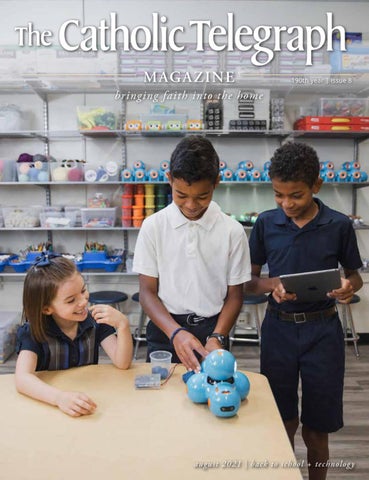
St. Ignatius of Loyola students, Aden Thomas, Dion Thomas and Jade Schneider, in the school’s iLab. 4 | CO N TE NTS
Pope St. John Paul II on “Original Experiences” 46 MAKING CATHOLIC MEMORIES WAYNE & MARIANNE TOPP
EILEEN CONNELLY, OSU
St. Bernard Honey Lavender Cupcakes
CISE partners with Hamilton County to design math curriculum
42 THE FINAL WORD ABBY KLARE
College: A cascade of transformations Pope Francis’ Prayer Intention for August: The Church Let us pray for the Church, that she may receive from the Holy Spirit the grace and strength to reform herself in the light of the Gospel.
SEEK THE LORD ARCHBI S H OP DE N N IS M . S C H N U R R
In this ever-changing world, the 111 Catholic schools of the Archdiocese of Cincinnati are constantly updating their curriculum, incorporating new knowledge, and adopting new methodologies and technologies to teach more effectively. At the same time, however, our schools are anchored in the Church’s timeless and unchanging faith in the Lord Jesus Christ. Our faith is the fundamental reason Catholic schools exist. Pope Benedict XVI reminded us in his encyclical Deus Caritas Est, “Being a Christian is not the result of an ethical teaching or a lofty idea, but the encounter with an event, a person, which gives life a new horizon and a decisive direction.” That person is, of course, Jesus Christ. The Catholic school difference, therefore, is not just fidelity to Catholic teaching in religion classes, access to the sacraments, and the presence of priests and religious on campus – although those are important. There is also present in each school a Catholic spirit of peace, joy and the fullness of life that comes from following the Lord. They have been radiating Christ since the first Catholic school was founded in Cincinnati with 25 female students in 1825. We now have nearly 40,000 students and are the fifth largest Catholic school network in the country! But our mission remains the same: Our schools are centers of formation as well as education. The crucial role played by school principals, teachers and staff also has not changed. The Church has long understood that teaching is a ministry because Catholic schools exist to witness the love of God in Christ. St. John Baptist de la Salle, who founded schools for the poor in France in the late 17th and early 18th Centuries, was very clear about this. In a meditation for his teachers, who were not ordained, he wrote: “In your teaching, the [children] in your charge must see by the way you teach that you are true ministers of
God, full of charity and sincere in carrying out your task.” While faith is marginalized in our culture today, Catholic school teacher-ministers and principal-ministers are rightly expected to stand as models of faith in the classroom and outside of it. And at this time of great social, political and racial division in our country, they are to witness to the Lord every day by their devotion to the common good. They are to live, as well as teach, such important Catholic truths as the dignity of the human person from conception to natural death, the importance of marriage and family, the rights and responsibilities of every individual, the option for the poor and vulnerable, the dignity of work, solidarity and care for creation. The very nature of authentic Catholic education is the search for goodness, beauty and truth and the cultivation of wisdom and virtue under the guidance of the Church. The various arts and sciences are pathways for growing closer to God since students learn in these the endless wonders of His creation. A passion for learning is thus a passion for Jesus Himself, who is the Way, the Truth and the Life. Catholic schools play an important role in forming disciples to know, love and follow Jesus through this life and into the next. All educational institutions faced an incredible pandemiccreated challenge during this past school year. The performance of school administrators and faculty in keeping our schools safely open for on-site learning was remarkable. I am profoundly grateful to them, to the parents who trusted Catholic schools to keep their children safe, and to parishes which continued to support our schools. Whatever new challenges the future may bring, Catholic education will continue to be a vital ministry of the local Church as the Archdiocese of Cincinnati enters its third century. S E E K T H E L OR D / AU G U ST 2021 | 5
BUSCA AL SEÑOR ARZO BISPO DENNIS M. SCHNURR
En este mundo en constante cambio, las 111 escuelas Católicas de la Arquidiócesis de Cincinnati están constantemente actualizando su plan de estudios, incorporando nuevos conocimientos, y adoptando nuevas metodologías y tecnologías para enseñar de manera más efectiva. Al mismo tiempo, sin embargo, nuestras escuelas están ancladas en la fe eterna e inmutable de la Iglesia en el Señor Jesucristo. Nuestra fe es la razón fundamental por la que existen las escuelas Católicas. El Papa Benedicto XVI nos recordó en su encíclica Deus Caritas Est, “Ser Cristiano no es el resultado de una enseñanza ética o una idea elevada, sino el encuentro con un acontecimiento, una persona, que da a la vida un nuevo horizonte y una dirección decisiva”. Esa persona es, por supuesto, Jesucristo. La diferencia de la escuela Católica, por lo tanto, no es solo la fidelidad a la enseñanza Católica en las clases de religión, el acceso a los sacramentos y la presencia de sacerdotes y religiosos en el campus – aunque esos son importantes. También hay presente en cada escuela un espíritu Católico de paz, alegría y la plenitud de la vida que proviene de seguir al Señor. Han estado irradiando a Cristo desde que se fundó la primera escuela Católica en Cincinnati con 25 estudiantes mujeres en 1825. ¡Ahora tenemos casi 40,000 estudiantes y somos la quinta red de escuelas Católicas más grande del país! Pero nuestra misión sigue siendo la misma: Nuestras escuelas son centros de formación así como de educación. El papel crucial desempeñado por los directores de las escuelas, los maestros y el personal tampoco ha cambiado. La Iglesia ha entendido durante mucho tiempo que la enseñanza es un ministerio porque las escuelas Católicas existen para testimoniar el amor de Dios en Cristo. San Juan Bautista de la Salle, que fundó escuelas para los pobres en Francia a finales del siglo 17 y principios del siglo 18, fue muy claro al respecto. En una meditación para sus maestros, que no fueron ordenados, escribió: “En su enseñanza, los [niños] a su cargo deben ver por la forma en que enseñan que son verdaderos ministros de Dios, llenos de caridad
6 |
y sinceros en el desempeño de su tarea”. Mientras la fe está marginada en nuestra cultura hoy en día, se espera con razón que los maestros-ministros y los ministros-directores de las escuelas Católicas se identifiquen como modelos de fe en el aula y fuera de ella. Y en este momento de gran división social, política y racial en nuestro país, deben testificar al Señor todos los días por su devoción al bien común. Deben vivir, así como enseñar, verdades Católicas tan importantes como la dignidad de la persona humana desde la concepción hasta la muerte natural, la importancia del matrimonio y la familia, los derechos y responsabilidades de cada individuo, la opción para los pobres y vulnerables, la dignidad del trabajo, la solidaridad y el cuidado de la creación. La naturaleza auténtica de la educación Católica es la búsqueda de la bondad, la belleza y la verdad y el cultivo de la sabiduría y la virtud bajo la guía de la Iglesia. Las diversas artes y ciencias son caminos para crecer más cerca de Dios, ya que los estudiantes aprenden en estas las infinitas maravillas de Su creación. Una pasión por el aprendizaje es, por lo tanto, una pasión por Jesús mismo, que es el Camino, la Verdad y la Vida. Las escuelas Católicas juegan un papel importante en la formación de discípulos para conocer, amar y seguir a Jesús a través de esta vida y en la próxima. Todas las instituciones educativas enfrentaron un increíble desafío creado por la pandemia durante el pasado año escolar. El desempeño de los administradores y profesores de la escuela en mantener nuestras escuelas abiertas de manera segura para el aprendizaje en el sitio fue notable. Estoy profundamente agradecido con ellos, a los padres que confiaron en las escuelas Católicas para mantener a sus hijos seguros, y a las parroquias que continuaron apoyando a nuestras escuelas. Cualesquiera que sean los nuevos desafíos que el futuro pueda traer, la educación Católica continuará siendo un ministerio vital de la Iglesia local a medida que la Arquidiócesis de Cincinnati entra en su tercer siglo.
Q UES TION OF F AITH
WHEN IS MARRIAGE A SACRAMENT? As part of marriage preparation, the priest informed us only a marriage between two baptized persons is a sacrament. Since my fiancé is not baptized, how will the Church view our marriage?
EXCEPTIONS TO SACRAMENTAL MARRIAGE
Catholics exult marriage, believing God is its author. Marriage is meant to be a covenant between two baptized persons that signifies the union of Christ and the Church. However, the Church recognizes that marriages between a baptized and non-baptized person may be common, especially where Christians are not the majority.
Recognizing the union between a baptized person and a nonbaptized person as natural and not sacramental respects the non-baptized person’s freedom and convictions. At the same time, the Church recognizes that non-sacramental marriage should be an exception for Catholics. For this reason, a dispensation (a relaxation from Church law) is necessary for a Catholic to marry a non-baptized person. This dispensation is requested by the priest or deacon preparing the couple for marriage. Though usually granted, the permission is an exception to the law of the Church.
NATURAL AND SACRAMENTAL MARRIAGE
THE VALUE OF MARRIAGE
Marriages may be either natural or sacramental. Natural marriage is a vowed covenant, a partnership of the whole of life ordered to the good of the spouses and the procreation and education of children. The Church recognizes natural marriage as valid, presuming the spouses marry freely, intend marriage as an exclusive and permanent bond, and do not exclude the possibility of children.
The Church recognizes natural marriages as being both valid and good. They can be fruitful, bringing forth children and assisting the spouses in growth in virtue. Also, within natural marriages, it is common for spouses to examine their religious beliefs. Seeking a common faith, a non-baptized spouse may desire to learn about the faith or even enter the Rite of Christian Initiation of Adults (RCIA), the process by which someone becomes baptized and fully initiated into the Catholic Church. When a non-baptized spouse is baptized, the marriage becomes a sacrament.
A sacramental marriage, however, is more than a natural bond. When marriage occurs between two baptized persons, it is sacramental. As a sacrament, marriage is “intended to perfect the couple’s love and to strengthen their indissoluble unity” (Catechism of the Catholic Church, 1641). Christ dwells with the couple and assists them in living out their vocations. When Christians marry, they receive the grace to help one another attain holiness and are strengthened to love one another with a supernatural love. A sacramental marriage can only be between two baptized Christians (though neither need be Catholic). Since baptism is the gateway to the other sacraments, it is impossible to enter into a sacramental union without baptism. If one spouse has received baptism but not the other, it is not a sacramental marriage.
Both natural and sacramental marriages are true marriages recognized by the Church. When children are born of these unions, they provide a further witness to the good of marriage and family life. At the same time, sacramental marriages alone unite the spouses to Christ and through Christ to one another. A sacramental marriage shows that marriage is not purely a human institution, but a participation in the covenant of Christ and His Church, an image of the union that is possible between God and humanity. FATHER DAVID ENDRES
is associate professor of Church history and historical theology at Mount St. Mary’s Seminary & School of Theology. QU E S T ION OF F AIT H / AU GU ST 2021 | 7
A Letter from Archbishop Dennis M. Schnurr
Dear brothers and sisters in Christ, As we celebrate the bicentennial anniversary of the Archdiocese of Cincinnati, we give thanks to our generous God for the many blessings He has bestowed on us and look forward with expectant faith to what is to come. Much has changed in our archdiocese and in the United States over the past 200 years. For instance, we are an increasingly mobile society, no longer traveling to work or church on foot or horseback. Compared to earlier eras in our country’s history, when waves of European Catholic immigrants faced scorn and discrimination, Catholics have made tremendous progress in educational level, social acceptance, career achievement and affluence. Catholics can now be found in the highest tiers of every profession and public office in this country. Unfortunately, not all change over the past two centuries has been for the better. American assimilation has brought with it a certain diminishment of distinctive Catholic culture. Religious practice among Catholics, following the overall U.S. trend, is in serious decline. One need only look at the empty pews of an average Sunday Mass to know this. Catholic families are generally not as large as they used to be and fewer parents encourage their children to consider a religious vocation. Here in our own archdiocese, while we have been blessed these past few years with an increase in the number of men ordained to the priesthood and in seminary formation, we have even more in active ministry who are at or beyond retirement age. Despite these discouragements, our mission – Christ’s great commission to proclaim the Good News of salvation and make disciples of all nations – remains. We are called to be God’s joyful witnesses, to radiate Christ 8 |
T H E C A THOLIC TELE GR A PH
in all we do, so that all people might know, love and follow Jesus through this life and into the next. As Church, together we always have the responsibility to look ahead and make the best use of all the Lord has provided us. If we are to be the Church as Christ intends, we must understand that “status quo” can have no place in our vocabulary. We must prayerfully ask ourselves, “What in God’s plan must we do next?” Are our resources properly and most effectively aligned with our God-given mission? Is each of our parishes a strong, vital community of evangelization, centered on the Eucharist, that continuously draws its parishioners and attracts new members into a more intimate relationship with Jesus… or is it just struggling to survive? If the latter, why is that? And what might we do about it? To address these questions, the Archdiocese of Cincinnati has launched Beacons of Light, a process of comprehensive pastoral planning for our third century of faith in this archdiocese. Under the leadership of Father Jan Schmidt, Director of Pastoral Vitality, and in collaboration with our priests and experienced consultants, we are studying every aspect of our archdiocese and parishes to determine how to best array our resources – human, physical and financial – to spread the Gospel far and wide. This process will naturally bring with it much anxiety and trepidation as you wonder about the future of your beloved parish. This is a testament to the deep affection parishioners have for their parishes, for which I am very grateful. Beacons of Light will challenge each of us to place the best interests of the Church and our future generations at the forefront of our planning. It will require us to be open to solutions with which we may not immediately feel comfortable. Our local Church is a part of the Lord’s plan for His
BEACO NS O F L I G H T
Glossary
people, and that plan cannot fail. God’s love is too powerful for that. It is up to us to rely on that love and respond to it, both as individuals and as members of the one Church. As we look to the future, we can be certain that the Gospel will continue to be preached, the sacraments will continue to be celebrated, and the Lord will always be with His people. The Beacons of Light plan will be finished by the end of this year, but the actual implementation will take several years. You will have an opportunity to comment on the plan in October before it is finalized, and you will be invited to assist your pastor with the implementation at the parish level. I urge you to stay engaged with this initiative by signing up for the free Beacons Update newsletter at CatholicAOC. org/Beacons. As we embark on this challenging but necessary endeavor, let us together ask for the intercession of our Blessed Mother that God continue to bless us with His presence and His love, as He has our first 200 years. Sincerely yours in Christ,
Most Reverend Dennis M. Schnurr Archbishop of Cincinnati
Universal Church: The Universal Church is the community of the Christian faithful incorporated into the life of Jesus Christ through baptism and sent out to continue His mission to the whole human race. The Church is “the People that God gathers in the whole world. She exists in local communities and is made real as a liturgical, above all a Eucharistic, assembly. She draws her life from the word and the Body of Christ and so herself becomes Christ’s Body.” (Catechism of the Catholic Church, 752) Church / church: “Church,” when capitalized, refers to the Catholic Church, the faithful of the whole world united under the guidance and authority of the pope, the successor of Saint Peter. A “church” is a sacred building set aside for public worship. Each parish has at least one church. Each church has a title which cannot be changed after its consecration. Diocese / Archdiocese: Also known as a “particular Church” or “local Church,” a diocese is a portion of the people of God, a specific community within the Catholic Church which is defined by geographical boundaries and typically entrusted to a bishop who serves as shepherd of this portion of Christ’s flock. An archdiocese is the major diocese within a province (which is a grouping of dioceses) and is led by an archbishop. Parish: A stable community of the faithful constituted with a church or group of churches within a diocese. Its oversight and care are entrusted to a pastor as its shepherd under the authority of the diocesan bishop. “The parish is the presence of the Church in a given territory, an environment for hearing God’s word, for growth in the Christian life, for dialogue, proclamation, charitable outreach, worship and celebration.” (Evangelii Gaudium, 28)
Family of Parishes: A grouping of parishes led by a common pastor and characterized by collaboration and shared resources. A parochial vicar (or multiple parochial vicars) or retired priest may also serve a Family of Parishes. Pastor: The pastor is the proper shepherd of the parish or parishes entrusted to him under the authority of his (arch)bishop. He is an ordained priest responsible for the ministry of teaching, sanctifying, and governing, with the cooperation of other priests or deacons in the parish and the assistance of lay members of the faithful. Parish Leaders: Those members of the parish faithful who collaborate with the pastor to help inform and guide the parish to best fulfill the evangelizing mission of the Church. These leaders could include parochial vicars, deacons and members of the laity (employees or volunteers), each according to their proper roles and charisms. Pastoral Planning: A process by which a diocese, parish or Family of Parishes evaluates its current situation and resources, prayerfully discerns God’s will for the future of that community and crafts a plan to move toward that future. Beacons of Light: A program of comprehensive pastoral planning for our third century of faith in the Archdiocese of Cincinnati. The overall plan for Families of Parishes across the archdiocese will be completed by the end of 2021. The planning and implementation within each Family of Parishes, under the leadership of each pastor, will unfold over the next several years.
BE AC ON S OF L IG H T / AU G U ST 2021
| 9
BY DOMINICK ALBANO
THERE IS N OT H ING LIKE FA M ILY. As the pastoral planning initiative, Beacons of Light, moves forward, Catholic Telegraph writers are meeting with its leaders, including Father Jan Schmidt, to bring you the most up-to-date and accurate information and communication on what is happening, how decisions will be made and to provide clear descriptions of what to expect. This article series on Beacons of Light will appear in every issue of The Catholic Telegraph. Additionally, please visit catholicaoc.org/beacons to sign up for the weekly Beacons Update newsletter.
there. They’ve made friends, volunteered, donated to building projects and worshiped in this same space for years. Is all that going to end?
Is my parish going to close? What is going to happen to my kids’ school? Will I have to change where and when I go to Mass? What is going to happen next?
Each Family of Parishes will typically consist of three to six parishes – although some will have more and others less. Each of the parishes in a “Family” will join the grouping with their own buildings, budgets, sacramental schedules, staffs and resources of a typical parish. Decisions about life in the Family of Parishes will be made by the pastor and parish leaders within the basic guidelines in place for the entire archdiocese.
These are some of the first questions that might come to mind when you hear about Beacons of Light. The pastoral planning process of the Archdiocese of Cincinnati is underway, and as more Catholics become aware of the initiative, there will be an understandable amount of uncertainty in the hearts and minds of parishioners. For many Catholics, their parish is like a second home. Some people have belonged to the same parish for decades. They attended school there, got married there, saw their kids baptized and receive the sacraments 1 0 | T H E CA THOLIC TEL EGR A PH
First and foremost, Beacons of Light is not about closing parishes. It is about making parishes stronger. Through the process of collecting data, listening to pastors and lay faithful, consulting with experts and receiving feedback, parishes will be formed into 50 to 60 groups called “Families of Parishes.”
The goal is for these parishes to join together as one faith community, stronger than ever before. By coming together, this new faith community will have the resources needed to focus more on mission than on maintenance, thereby helping people grow closer to Jesus and radiate Christ throughout the cities, towns, suburbs and rural communities of the 19 counties in Western and Southwestern Ohio.
Will things change? Absolutely. But are you going to show up at Mass one Sunday to find the building locked and an eviction notice nailed to the front door? Not at all. The pastor and parish leaders in each Family of Parishes will collaborate and embark on their own process of assessing the resources and needs for their faith family. No one in the Archdiocese of Cincinnati can wholly predict what kinds of changes each Family of Parishes will enact. Could they close buildings? Yes. Could they consolidate schools? Yes. Could they change Mass times? Yes. But those decisions will not be made centrally, they will not be made lightly, and they will not be made quickly. Those decisions will be in the hands of the priests, parish councils, parish staff and other leaders within each Family of Parishes. Ultimately, the goal is for each Family of Parishes to come together as one, true faith community. That goal might sound scary. Change – even good change – is always a little bit scary. Will the process be easy? Probably not. Will every parishioner be happy with every decision their pastor or parish leaders make?
That’s certainly not the case now, and it likely won’t be in the future. Can Archbishop Schnurr or any of his staff members tell you today if your parish will close, or your school will be consolidated, or your Mass times or locations will change? No, because they don’t know, and they won’t be the ones making those decisions. You can be a part of the Beacons of Light process in your own parish. By signing up for the free monthly Beacons Update at catholicaoc.org/beacons, you can stay in the know throughout every step of Beacons of Light. By using Beacons Update to ask questions and give feedback, you can help influence how this initiative develops. By presenting yourself as a positive and proactive supporter to your pastor, you can get involved as the process unfolds in your parish. And, through prayer, you can place your trust (and your worries) in Jesus, who tells us in Matthew 6:34a, “Do not worry about tomorrow; tomorrow will take care of itself.”
BE AC ON S OF L IG H T / AU GU ST 2021 | 11
A PRIE S T’ S PE R S PE C TIVE
THE CHURCH AS THE FAMILY OF GOD Beacons of Light is a multi-year process of pastoral planning for the Archdiocese of Cincinnati that seeks to help our parishes carry out the mission of evangelization. It will have a major impact on our parishes, which will be grouped together into “Families of Parishes.” This month – and in coming months – I will provide theological explanations for this process. The Church is a sign and instrument of communion with God and of unity among all men and women who are called to bring the joy of the Gospel to the whole world. One scriptural image used by the Second Vatican Council which may be helpful for understanding the forthcoming parish groupings and the Beacons of Light process is that of the Church as the Family of God – “the house of God in which His family dwells; the household of God in the Spirit” (cf. Eph. 2:19, 22). The image of the Church as a family is ancient, and the idea of a family as a “domestic church” has re-emerged in recent times. Parishes are communities of families, gathered under a pastor, a “father” of the family, in communion with the bishop, to worship God and to build the Kingdom. The family is a place of belonging, a privileged place to experience love and growth, an original sign of Christ’s love for His Church, given to us by God the Father. It is both a building block of society and a critical means by which we are introduced into a decisive relationship with God. The family exists to generate life and deepen the companionship between believers as they journey toward their common destiny. Family stability is critical for the future. This is true not only of our individual families, but also of our parish families. Every family, including a parish family, has a mission to build up the Church and increase the Kingdom of God in the world; to be a community of love in which people experience a sense of belonging; and, to be a beacon of light and hope to others. In the Family of God we continually meet and encounter 1 2 | TH E C ATHOLIC TE LEGR A P H
Christ who, according to Pope Benedict XVI in Deus caritas est, “gives life a new horizon and a decisive direction.” In our personal families, we learn to confront difficulties and face the realities of life, enlightened by His Presence. In family life, we encounter Christ in each other. In both our individual families and parish families, our companionship comes together in a space, in our daily living and working together, on a common journey with a common goal: our destiny with God. The Church can be understood as the Family of God. Jesus addresses God as Father and the early Church addressed its members as adelphoi (brothers and sisters). The Church is not principally an administrative grouping, organized and occasionally re-organized like a company; rather, its distinctive characteristics are prayer and the Eucharist. Believers are called by name to be part of this family and are drawn together and constituted as a family by the Holy Spirit. No family is perfect, and there are always members of the family with different temperaments, but there is one fundamental bond: faith. The Church, constituted by God, is mandated to evangelize. Every family and every parish must have a missionary outlook. We must radiate Christ to the world, and yet, we are experiencing profound change, which makes the task of evangelizing more challenging. Pope Francis frequently says, “we live not so much in an epoch of change as in a change of epoch.” Acknowledging this and the current reality of the Archdiocese of Cincinnati, which includes demographic shifts and fewer priests, it is essential to adapt to effectively carry out the Church’s mission in a changed environment. Beacons of Light is not principally about a priest shortage; it is about the mission of evangelization. At the beginning of his Pontificate, Pope Francis described his dream for the Church in The Joy of the Gospel: “I dream of a ‘missionary option,’ that is, a missionary impulse capable of transforming everything, so that the Church’s customs, ways of doing things, times and schedules, language and structures can be suitably channeled for the evangelization of today’s world rather than for her self-preservation.” I invite you to dream about how our parishes can be evangelizing communities, beacons that radiate the light of faith and respond to the needs of the whole Family of God. FATHER EARL K. FERNANDES
is the pastor of St. Ignatius of Loyola Church in Cincinnati and holds a doctorate in moral theology from the Alphonsian Academy in Rome.
S E IZ E TH E M OM E N T
A CHRISTIAN LIFE OF BIBLICAL PROPORTIONS There are many falls on a pilgrimage. No one teaches us this more poignantly than Jesus. His humanity was on full display when He fell three times under the weight of the Cross on His way to be crucified. It’s both alarming and relatable to see the God-man fall and get back up again. He carried the heavy burden so that we can carry the light one. These falls are even memorialized in Stations 3, 7 and 9 of the Way of the Cross, but would you be surprised to learn that the New Testament provides no clear reference to them? It’s true – and I’m okay with that. For one, Jesus did many things that aren’t recorded in Scripture (Jn. 21:25). Secondly, I think the three falls can be reasonably inferred from what we do see in Scripture. Jesus had already suffered significant physical and emotional trauma before He even started towards Golgotha. He sweat like blood (Lk. 22:44). He was betrayed and abandoned (Mt. 26:48-49, 56). He was spit on, blindfolded and beaten (Mk. 14:65). He was scourged (Mt. 27:26). He was mocked and crowned with thorns (Mt. 27:29-31). Jesus must have been struggling to carry His Cross or the soldiers would not have asked Simon to carry it for Him (Mk. 15:20-21). As I consider the struggles in my own life, Jesus’ falling is powerfully instructive and inspiring to me. These events of His Passion have taught me so much that, biblical or not, I can’t help but believe them. BUT THERE’S MORE
Recently, a friend asked me, “If you could use one word to describe your spiritual life, what would it be?” I said, “Tired.” Sometimes I think my whole spiritual and moral life can be summed up in the endless cycle of falling and getting back up again. Fall. Get up. Fall. Get up. Fall. Get up. It’s tiring! And on days when hopelessness creeps in, I think I’d rather either not fall, or not get up again. At least then the cycle would be over. I wouldn’t have to exhaust myself anymore. I
wouldn’t have to try so hard anymore. I poured all this out to my friend. He listened. He nodded. I could tell he understood. Then he spoke a powerful truth: “There’s more to your spiritual life, to morality, to being a Christian, than falling and getting back up again.” BEHOLD THE MAN
This may seem like a no-brainer, but for me, at that moment, it was a revelation. Suffering can trick you into thinking it’s all there is, and I was falling for it. As I prayed about it more, I realized that all I had to do was “behold the man” (Jn. 19:5) to discover the truth of the matter. Jesus’ Way to the Cross – and through the Cross to victory – was not made up solely of falling and getting back up again. Yes, He did that. But, Jesus also preached (Lk. 23:28-31). He prophesied (Lk. 23:43). He prayed (Lk. 22:41-42). He cried (Heb. 5:7). He healed (Lk. 22:50-51). He served (Jn. 13:3-5). He was strengthened (Lk. 22:43) and defended (Lk. 23:40-42). He forgave (Lk. 23:34). He loved to the very end (Jn. 15:13). In this, Jesus teaches us how to walk our own Way, and, in Him, we learn there is much more to life than striving. Yes, we fall. Yes, we get back up again. We should! But, with Jesus, we also rest. We listen. We learn and grow. We use our imagination and our unique gifts. We are strengthened and defended. We are humbled. We are forgiven. We are blessed. We are befriended. We love and are loved by Jesus. With Him, we are victorious! In Jesus, suffering never has the final say. In Jesus, there is always more to life – and, I can assure you, there’s nothing more biblical than that. NICHOLAS HARDESTY
is the associate director of Adult Evangelization and RCIA for the Center for the New Evangelization, an archdiocesan initiative that empowers parishes and schools to equip the laity for missionary discipleship. nhardesty@catholicaoc.org. S E IZ E T H E M OM E N T / AU GU ST 2021 | 13
ARCHDIOCESE OF CINCINNATI BICENTENNIAL
BY S ARA H A T E R
A Crusade for Christ at the “Crusade Castle,” a former winery next to Ault Park. Local units were overseen by priests or women religious, but students led the activities. The many publications of the society educated members and their rallies attracted tens of thousands of attendees. They informed their society about both Catholic teaching and world events through a variety of communications outlets, including their newsletter, The Shield, plays, radio programs, Masses, and public lectures.
With joyous note let earth resound, o’er hill and dale let it rebound; A new Crusade do we proclaim with rapturous hearts in this refrain. Our banner to the winds unfurl, our battle-cry to all we hurl; Like knights of old there’s no reprieve until all men this truth receive. This hymn was sung by members of the Catholic Students’ Mission Crusade (CSMC), a massive movement for Catholic youth in the 20th Century that ended as quickly as it began. Several seminarians in Techny, IL, founded the grassroots movement 1918 in response to life following the First World War. Young people created the CSMC for young people. They established their first units at seminaries and colleges, and grew to include membership for high schools and elementary schools with “units” at schools and parishes. Using language evocative of medieval Europe, the CSMC’s mission was to educate members in the universal needs of the Church, as well as form young people into virtuous and upstanding citizens. CSMC’s flag bore a shield (representing soldiers going into battle) with an open book (education) bearing the Latin phrase, Cognoscetis Vertitatem (“You shall know the truth”). The national organization established their headquarters in Cincinnati, as several founding members were from the area and the archdiocese’s bishops were active, vocal supporters of the organization. In 1923, the executive offices, which orchestrated the activities, publications and conventions of the CSMC, were set up
CSMC’s radio shows covered a wide and diverse set of topics. Listeners were educated on the dignity of man, the right to organize a strike and descriptions of foreign places. Other radio programs included skits emphasizing the importance of holy days, religious practices or examples of virtue. “The High Road, the Low Road” was broadcast in 1949 and told the story of Tom who was at first too lazy to attend church for eight days in a row to pray for Christian unity, but after encountering characters in a dream, including Martin Luther, he zealously prayed for his separated brethren. What began with a handful of members quickly grew to 500,000 by the 1930s, and to more than one million by the 1950s. A combination of many changes led to the waning of the Catholic Students’ Mission Crusade after the 1950s, including the declining popularity of pageantry and Army imagery. In 1970, CSMC voted to disband. Although the memory of the CSMC has faded, it remains an important event in the life of the 20th Century Church.
On June 19, 2021, the Archdiocese of Cincinnati will celebrate its bicentennial, recognizing 200 years of faith in Western and Southwestern Ohio. Each month, we will feature events and people who played significant parts in its story. These stories aim to inspire, educate and celebrate the many gifts God has given our local Church.
1 4 | T H E C ATHOLIC TE LEGR A PH
Inspiring the Future
Msgr. Martin Gilligan (1914-1993)
Sister Monica Foltzer, OSU (1909-2001)
•
Ordained in 1939 in Rome, Father Martin Gilligan was “loaned” to the Archdiocese of St. Augustine, FL, before serving the U.S. Navy as a chaplain during World War II.
•
•
Following the war, Gilligan was sent to Rome to assist in the Vatican Information Service office in Algiers, Africa. He also served in the Vatican Relief Services from the Vatican to Germany.
As a young religious with the Ursuline Sisters of Cincinnati, Sister Monica Foltzer was distressed by her’s students’ struggle with reading. After extensive research on how to help the children overcome their struggles, she was struck by one teacher’s comment. She found that students had a higher success rate when taught the difference between long and short vowels.
•
Between 1944-1946, Gilligan served as an attaché to Cardinal Montini, the future Pope Paul VI, who in 1966, conferred the title “Monsignor” on Gilligan.
•
•
Father Gilligan was then assigned to the newly established Apostolic Internunciature in China, arriving in late 1946. Civil war between the Nationalists and Communists forced the Vatican office to move to Hong Kong, where Gilligan remained until 1953. He was an intermediary between the Vatican and Catholics in China. He helped thousands of priests, religious sisters and missionaries travel back and forth to China, but especially those expelled from the country by Communists.
Inspired by this comment, Sister Foltzer created worksheets for her students. Instead of using the “sightsay” method, she presented vowels and consonants in a logical manner, and when tied that together with five simple vowel rules, it resulted in a complete unit in the child’s mind. Her “Professor Phonics Kit” included phonics practice book, instruction manual and alphabet picture key word cards.
•
It was not until the 1960s, when illness forced her to step down from her administrative duties, that Sister Foltzer reentered the classroom. The movement to teaching phonics was gaining momentum, and she realized the time was ripe for sharing her work on a larger scale. With two fellow sisters, Professor Phonics Gives Sound Advice was published in 1965. Used throughout the U.S., by 1975, it was already in its fifth printing. This method is still used today.
•
Adapting her work from teaching children to teaching adults English as a second language, Sister Foltzer had much success first using it with religious sisters who were refugees from Cuba.
•
For more than 10 years, Sister Foltzer was the Director of the Intensive Phonics Workshops at Xavier University and gave lectures throughout the U.S.
•
•
Upon his return to the archdiocese, Gilligan was pastor at Our Lady of Loretto in Cincinnati, and Sacred Heart in Dayton. He was the founding pastor of St. Luke in Beavercreek, St. Charles Borromeo in Kettering, and St. Henry in Miamisburg. Msgr. Gilligan was vocal about following the Second Vatican Council, particulary regarding pastors’ inclusion and appreciation of the talents and viewpoints of the laity. “There is much to do to use the liturgy to develop the family image of the parish and to make the parish a dynamic center that radiates Christ in the whole community.”
BIC E N T E N N IAL / AU GU ST 2021 | 15
A SOARING LEGACY Newly discovered owl named for Sister Dorothy Stang
BY P A T R ICIA M CGEEV ER
There are a lot of creatures living in the Amazon rainforest, but only one of them is named after a martyred American nun. The Xingu Screech Owl was thought to be part of another species until biologists heard its rapid-sounding call. It was discovered about a decade ago, but was only named earlier this year. Its scientific name is Megascops stangiae and honors Sister Dorothy Stang, a Sister of Notre Dame de Namur who was born in Dayton and murdered in Brazil. “I think it’s wonderful and I think that it’s so symbolic,” says Sister Judi Clemens, SNDdeN. “I just love the idea, and I think that Dorothy would really just love being a companion to this great creature God has created.” Sister Clemens worked with Sister Stang doing pastoral work in Brazil. For nearly 40 years, Sister Stang worked with poor rural families to help them grow crops to feed their families while respecting the natural resources of the rainforest. She started 39 schools, began a center to educate women on health and child development, and even started a factory to make banana flour. She fought for the poor when their land was stolen from them by powerful ranchers and loggers. She was bold, brave and an advocate for impoverished people in Brazil. And, it made her a target. Sister Sandra Araújo dos Santos, SNDdeN knows firsthand the impact of Sister Stang’s work. She lives in Brazil and was only 11 when she met her. “She was an influence in my life and for my whole family because my family was very poor,” said Sister Santos. “We didn’t have land and were exploited in this place where we worked. She helped us find a piece of land for ourselves. That changed our lives.” Sister Santos became a Sister of Notre Dame de Namur and then became a lawyer. “It was beautiful what she did,” said Sister Santos, referring to Sister Stang’s work. “I wanted to do something similar.” Sister Stang helped many people, but in Brazil, conservationists continue to fight corruption, poverty fights power and evangelization fights evil.
16 |
| 17
The CT Gets Social Katherine Geiger Hired as the Social Media Coordinator for The Catholic Telegraph and Archdiocse
KATHERINE, TELL US A LITTLE BIT ABOUT YOURSELF!
I grew up in Mason, OH, and I have a big family – I’m one of seven kids – and my siblings are my best friends. I just graduated from the University of Cincinnati this past spring with a major in Electronic Media and a minor in Marketing. I’m a big fan of mornings, coffee and beautiful things. WHAT SPARKED YOUR INTEREST IN WORKING WITH DIGITAL CONTENT?
dare to change that story? If
In high school I worked with the school news broadcasting team. I liked to be creative with how we told stories and communicated to our friends. There were so many possibilities in how we could weave things together and use digital media to tell stories in an extremely powerful and effective way. When I got to college, I focused on digital content – video, photo, audio – and the way it can be used in marketing. The more I learned, the more excited I got about digital marketing, specifically with social media, and the idea of bringing good, beautiful and meaningful content directly to people.
social media is where people
HOW DID COLLEGE PREPARE YOU FOR WORK?
It makes sense that many view social media as something negative – we see so much noise and division every time we log on. But why can’t we
are, who are we as Catholics to not meet them there with genuine truth, beauty and goodness?
My classes gave me a baseline skill level, but my internships were the most valuable things I did in college. I interned with Drive Media House, and they taught me so much about video production and editing, from start to finish. I also interned for a summer at Annunciation Heights Youth and Family Camp in Colorado, where I did more video work and tried my hand at social media. This past year, I interned at St. Monica-St. George with Catholic Bearcat and it was so much fun and a huge blessing. That prepared me for social media management and design. WHO OR WHAT INSPIRES YOU?
Jesus Christ! If He can meet me right where I’m at with endless love and grace, then I can meet other people right where they’re at on 18 |
social media and try to communicate His message of endless love and grace to them in a way they can easily encounter and understand. The Catholic Telegraph team and their dedication to the mission to evangelize through beauty inspires me. To work with people who want to use their gifts to make living the faith feel doable is an incredible gift. Also, FOCUS – the Fellowship of Catholic University Students – has amazing digital media talent on their team, and they use digital platforms to communicate the faith to college students. I remember going to their SEEK conference in 2019, and I was blown away and brought to tears by the digital content they created. It stirred something in me that I really can’t explain. It was the most real example I can think of beauty making me long for the divine. After that conference, I knew I wanted to use whatever gifts Jesus could give me to put others in a position to look for Him and want to know Him more deeply. HOW DO YOU SEE SOCIAL MEDIA USED FOR GOOD?
For better or worse, social media is where people are. It’s where they’re interacting with others now more than ever before – especially young people. It makes sense that many view social media as something negative – we see so much noise and division every time we log on. But why can’t we dare to change that story? If social media is where people are, who are we as Catholics to not meet them there with genuine truth, beauty and goodness?
Jesus came to be among us, broken and miserable, and to offer us hope. I think Jesus is asking us to do the same, every day, in every part of our lives, and, for most of us, that includes social media. We can be the hands and feet of Jesus in the digital world. Social media is one of the best ways to bring what’s good, beautiful and true right to people’s fingertips. We can help people realize faith isn’t something distant and unattainable but something that’s close and real. I’ve seen this in action. At St. MonicaSt. George’s Newman Center, we started investing time into making our social media accounts attractive. We wondered if it mattered or if it was even working. But then, after a couple of months, as we started to grow, we had students tell us they came to an event because they saw it on social media.
Do I Really Need A Will Or Estate Plan? Yes, you do. Life can change in an instant. Protect the ones you love. Make sure your wishes are fulfilled. Contact us today:
WHY IS IT CRUCIAL FOR THE CATHOLIC FAITH TO BE PRESENT IN SOCIAL MEDIA?
It’s crucial for the Catholic faith to be present in social media because it’s crucial for the Catholic faith to be present in every part of our lives. Social media is a means of mass communication that can feel very personal, and, if anything, should be used to communicate the truth of the Catholic faith. If we’re not present on social media with the truth of Jesus and His Church, then we’re surrendering that platform to the lies society tries to throw at us around every turn. The Catholic faith is the source of light and truth, and it needs to be present in any place where there are darkness and lies.
Follow us! FACEBOOK: FACEBOOK.COM/THECATHOLICTELEGRAPH INSTAGRAM: @THECATHOLICTELEGRAPH
Drew Emmert 513-357-5289 aemmert@dbllaw.com
Kelly Holden 513-357-5284 kschoening@dbllaw.com
@dbllaw DBL Law Congratulates the Archdiocese of Cincinnati on 200 Years of Faith. THIS IS AN ADVERTISEMENT. Other DBL Law attorneys may provide estate planning services.
T E C H N OL OG Y / AU G U ST 2021 | 19
Holly Schapker with her painting of the Holy Family at Christ the King in Mt. Lookout.
Painting is Prayer Cincinnati Artist Holly Schapker Creates Holy Art for Local Churches BY EILEEN CONNELLY, OSU
St. Joseph’s example of faith, humility and courage has inspired local artist Holly Schapker to share her talents to create images of the saint during this Year of St. Joseph. Schapker, whose studio is in a renovated 140-year-old building in Over-the-Rhine, is a 1992 graduate of Xavier University’s art program. Her painting and research have taken her around the world, and her work can be found at universities, churches, schools and in numerous corporate and private collections. She has been painting representational art of Catholic icons for more than 10 years and has a special devotion to the Blessed Mother. Schapker was commissioned to paint series of paintings for Xavier University in 2011, and her painting of Pope Francis’ mother was presented to the pontiff at the Vatican in 2011. “For me, painting is prayer,” she said. “I try to honor God through my paintings. Two area parishes – Our Lord Christ the King in Mt. Lookout, and St. Cecilia in Oakley – commissioned works by Schapker, unveiling them in time for the feast of St. Joseph in March. 2 0 | T H E C ATHOLIC TE LEGR A PH
HOLY FAMILY AT CHRIST THE KING
A parishioner at Christ the King, Schapker recalls leaving an early-morning Mass and stopping to gaze up at statue of St. Joseph in the back of church. Fellow parishioner Steve Green noticed her focus on the statue and recommended Schapker read, Consecration of St. Joseph by Donald Galloway. Meanwhile, Karen Dorger, another parishioner who was familiar with Schapker’s talent, approached Father Ed Smith, pastor, about the parish’s plan to honor St. Joseph. The result was an oil painting of the Holy Family, which was unveiled and blessed by Father Smith on March 20. Each member of the congregation present received a card with an image of the painting and a prayer written by Father Smith for the occasion. The piece depicts Joseph and Mary presenting the Christ child at the Temple, and “also to us in the here and now,” Schapker said. “My goal is to show how relatable the Holy Family is and that they truly understand us with loving care. Mary and Joseph are inviting each and every one of us into the Holy Family.” Father Smith praised the artwork, which is now permanently
installed in parish’s Atrium gathering space. “This wonderful family portrait inspires us to work every day to live as the family God has called us to be in our homes, in our community, in our world, and, in a special way, in our parish dedicated to Christ the King, who was himself a member of a family on earth, with Mary and Joseph, and who is eternally a member of a family in heaven, with the Father and the Holy Spirit,” he said. ST. JOSEPH AT ST. CECILIA
At neighboring St. Cecilia Parish, Father Jacob Willig, parochial vicar of the East Side Region, said it was an encounter with Schapker after Mass last December that prompted him to commission an image of St. Joseph for a holy card. His vision of the image, Father Willig explained, was based on a statue of the saint at St. Cecilia, depicting him as “modern, normal, relatable guy, but more mid-Eastern and authentic.”
Celebrate the Archdiocese of Cincinnati’s 200th Anniversary! The Cincinnati Cursillo Movement
de colores
will host a Grand Ultreya (party) on October 16 from 6:30 - 8:30 at the Incarnation Parish Center in Centerville. Join the celebration and RSVP at cincinnati-cursillo.org
It starts with friendship... pass it on!
Schapker’s portrait of St. Joseph with Lilies, featuring him with a young Jesus, was used for the holy card.
[St. Joseph] is there in the Bible, speaking to us through his actions. As an artist, that’s something I can relate to. “His Eyes are an invitation to be embraced by them and receive his fatherly protection and guidance,” she explained. “St. Joseph exemplifies the qualities of silence (listener), strength, faith and action. ... The white lilies symbolize his chaste white purity, while being married to the Blessed Virgin Mary. His hands are not smooth, referencing his workmanship and ability to successfully battle any demon.” Eight hundred holy cards, with the Litany of St. Joseph printed on the back, were delivered to St. Cecilia just in time for his feast day. “Holly did a beautiful job on the holy cards,” Father Willig said.“The beauty of the card reminds us that he’s relatable, someone we can pray to, an intercessor, a loving father, a protector, someone to help us experience God’s compassion, a normal, imperfect person who leads us to Christ and opens our hearts and minds to Him.”
Explore all that our senior living community has to offer from the comfort of your own home! Participate in an online virtual tour today to see our dining room, courtyard, suites, and everything in between. TA K E YO U R TO U R TO DAY B Y V I S I T I N G O U R W E B S I T E AT W W W. T R I P L E C R E E K R E T I R E M E N T. C O M ! |
ASSISTED LIVING | INDEPENDENT LIVING
As for Schapker, the artist said she has found herself drawing closer to St. Joseph and looking to him for inspiration as she works. “When I think of St. Joseph as a carpenter, I think of him as a fellow artist with a creative spirit,” she said. “He’s known to be more of a doer than a talker. He’s there in the Bible, speaking to us through his actions. As an artist, that’s something I can relate to. When I work with my hands, I ask him to guide me as I create, confident that just as the Holy Spirit guided him in his work, he will be an intercessor for me with the Holy Spirit.” AU GU ST 2021 | 21
My siblings have long joked that I am a teacher’s pet. To make their case, they need only to point out that my favorite day of every summer as a child was school supply shopping. While my three siblings groaned and grudgingly filled the cart with the required items, I held the supply list like it was a cherished object. Once selected, my items were placed carefully to one side of the cart not to be mixed with the others’. Back at home I neatly filled the brand-new pencil bag and backpack, taking care to fill each slot and pocket. While getting fresh school supplies was a thrill, now I realize the excitement of a new school year stemmed from something much more important. At Catholic grade school, high school and university, all my experiences in the classroom, on school trips and on playing fields were rooted in faith. My parents made a choice and a sacrifice to put four kids through Catholic schools to ensure the values and expectations we learned at home were mirrored at school. As a child it seemed so natural to blend my faith and character development with my education. Fast forward 25 years and I am profoundly grateful for my parents’ foresight and planning. When I was old enough to have a voice in my own education, I chose to go to a Catholic university where I studied education and religious studies. This is my 17th year teaching in a Catholic school, and I send my two children to a Catholic school. I continue to choose Catholic schools because they have enriched my life in faith, relationships and learning. I was provided opportunities to develop myself academically, emotionally and spiritually. I have constantly been surrounded by a community of people who give of themselves endlessly. And lastly, the Catholic school environment provides me with an opportunity to serve others and God. 2 2 | T H E C ATHOLIC TE LEG R A PH
To be honest, I never minded the affectionate joking and label of “teacher’s pet.” However, as a teacher myself and a mother of two I am abundantly aware that not every child fits that term. There are easy kids, smart kids, difficult kids, scared kids, self-aware kids, challenged kids, and the list goes on. But there is one thing they all have in common: Kids get it wrong. All. The. Time. And they are supposed to make mistakes; it’s part of growing up. What I have found in my professional practice and my limited parenting experience is that the most teachable moments are not in my lectures, or lessons, or tests; it is not in my chore lists or structured activities or in setting expectations for my children. The most teachable moments have been in the times where kids mess up – when they made a poor choice, missed the mark, misunderstood or ignored the expectation. It is in these moments where educators and parents can show God’s grace, mercy, patience and unconditional love. I choose Catholic schools over and over because I want to teach my students (and my children) about God and how He loves them despite their mistakes or shortcomings. Catholic schools offer the best of all worlds: academic rigor, spiritual development, character education and limitless opportunities to grow and serve. For me, teaching in a Catholic school allows me to have a career and a personal ministry all in one. I’m blessed to look back on my journey so far and know that my parents set me on the right path to having a faith-filled life.
STEPHANIE DUGGAN is the campus minister and an Upper School religion teacher at The Summit Country Day School. She and her husband Liam have two children, Will and Declan.
St. James • A Blue Ribbon School
By honoring God through our words and actions, the St. James School community embraces Catholic values and commits to faith formation, personal and academic excellence, and service to others.
srsdeaf.org
Welcome back for another great school year!
OPEN E S U HO SAVE THE DATE! Sunday, October 10 | 1 – 3:30 p.m. 6000 Oakwood Avenue, Cincinnati, OH 45224 www.mercymcauley.org
Join us for student-led tours, meet our faculty and staff, and see all that Mercy McAuley has to offer!
BAC K T O S C H OOL / AU G U ST 2021 | 23
MEET CARROLL HIGH SCHOOL’S
Fanuel Uwishimwe Rwandan Student Found Sanctuary in Dayton Catholic Schools BY EILEEN CONNELLY, OSU
You never know where God will lead you. For Fanuel Uwishimwe, it was a journey from Kigali, Rwanda, to the football field at Carroll High School, from which he was graduated in May. He made the journey from the East-Central African country to Dayton with family members in 2009 at the age of five. “My dad was already in the United States working, trying to make enough money for the rest of us to come here,” Uwishimwe explained. Because he was so young at the time, his memories of life in Rwanda are limited, but his parents have shared stories about the ethnic strife, civil war, and genocide that ultimately left the country in shambles in 1994. “They’ve told me about alarms going off, barricading themselves in the house, trying to flee to another country, hoping things would get better,” he said. “We’re lucky to be here after all of that happened. If things had gone differently, my parents could have been killed.” Uwishimwe initially attended public school as his family became settled in Dayton. Believing in the value of a Catholic education, his parents eventually transferred Uwishimwe to Our Lady of the Rosary, then Ascension School. It was there that the eighth-grader caught the eye of Pete Williams, a 1998 graduate of Carroll High School involved in coaching youth football and track. Carroll, where Williams now works director of advancement, was the natural choice to continue his education, Uwishimwe said. A natural athlete, he quickly became involved not only in 2 4 | T H E C ATHOLIC TE LEGR A PH
“We’re lucky to be here after all of that happened. If things had gone differently, my parents could have been killed.”
playing football at Carroll, but also participating in track and basketball. In addition, Uwishimwe found a caring community, committed to nurturing his faith and gifts. “You can just tell how much the teachers care, how dedicated they are to helping you, to your success,” he said. He recalled struggling with biology, in particular, during his freshman year. “I just wasn’t getting it all and really needed help. Mrs. [Laura] Wright [science teacher], worked with me and wouldn’t give up on me until I understood.” One class Uwishimwe found to be particularly interesting was a government course taught by Erik Ramsey. The young man admits he was “never much into politics” prior to the
class, but quickly realized how much he enjoys discussing current events and learning about other people’s points of view. “It also really helped me become more confident about expressing my opinion,” he said. The strong sense of community at Carroll became especially evident during the height of COVID-19. The cancellation of regular school activities, protocols to follow, and schedule changes were a challenge for everyone, but the example and leadership of the faculty made all the difference. “It was hard not doing what we normally do, but the teachers kept emphasizing that we’re in this together and that we’re all one, so that helped,” Uwishimwe explained.
Providing a Catholic Education for Preschool through Providing a Catholic Education Eighth Preschool Grade through Eighth Grad
Along with his teammates and fellow members of the Class of 2021, he was grateful that things returned to close to normal for their senior year. They played the usual football season in the fall, minus the pep rallies, and had prom as scheduled.
+ Now offering full-day preschool + aNow offering full-day presch Providing Catholic Education for + Recognized for STEM education + Recognized STEM educa Preschool through Eighth for Grade + Leader in technology Leader in technology Now + offering full-day preschool ++ Excellent fine arts + Excellent fine arts opportuni + Recognized for STEM education opportunities + Leader + inAlltechnology students participate in ar ++ AllExcellent studentsfine participate in art, arts opportunities music, PE, &inspanish weekly + All students participate music, PE & Spanish weekly art,
Uwishimwe will soon be heading to Otterbein University, where he hopes to major in sports management. He credits his parents’ faith and courage, and the Carroll community, with helping him achieve success on the path that God laid before him.
music, PE, & spanish weekly
Learn more at gaschool.org Open House Sunday, Jan 26 | 1-3 PM
Schedule a
Learn more at gaschool.org
Open House Informational Coffee personal tour PM Sunday, Tuesday,Jan Feb 26 20 ||91-3 AM
by calling
Schedule a personal tour Informational Coffee 513.624.3141 anytime by calling Tuesday, Feb 20 | 513.624.3141 9 AM
Schedule a personal tour anytime by calling 513.624.3141
Passionately Catholic • Preschool - 8th Grade
www.PiquaCatholic.org K-8 937-773-1564 Preschool 937-773-3876 • • • • • • •
Strong Faith & Values Excellent Academics Spanish & French Music, Band, Art Sports & Extracurriculars Summer Camps Before & After School Care BAC K T O S C H OOL / AU G U ST 2021 | 25
Empowering Future Leaders Catholic Schools are Creating Technology Spaces to Help Students Develop Critical Thinking and Problem Solving Skills B Y K AR Y E L L E N BE R G E R
“It’s much more than old-fashioned computers.” Principal Carolyn Murphy with St. Michael the Archangel School described perfectly how technology has evolved across schools in the archdiocese over the past several years. What may have been a computer lab or media space in schools 10, five or even two years ago are not the same technological opportunities thousands of students are experiencing as they go back to school this fall. Many schools throughout the archdiocese now have spaces strictly dedicated to technology. From makerspaces to media centers, no matter the name, these classrooms are giving students opportunities to create and explore like never before. Here are four schools showing how technology is making a difference for their students and their futures.
ST. IGNATIUS OF LOYOLA SCHOOL Kevin Vance, Principal at St. Ignatius of Loyola School, has served more than 20 years in administration at various schools and is starting his fourth year at St. Ignatius of Loyola this fall. “I had started a smaller [makerspace] at a previous school,” Vance said. “When I came to St. Ignatius, the technology team took some time to review hardware, software and curriculum. We identified that we wanted to expand our technology options, implement some social-emotional training and increase the number of higher level thinking exercises.” That’s how the school’s iLab was born. 2 6 | TH E C ATHOLIC TE LEGR A PH
MAKERSPACE: an area within the school that gives students the opportunity to learn and explore technology
STEM:
the studies of science, technology, engineering and math
BAC K T O S C H OOL / AU G U ST 2021 | 27
We are also asking them to take cognitive risks, synthesize what they’ve learned across subject areas, think critically and creatively to solve problems, develop socialemotional skills as they work in teams, and, most importantly, examine issues in light of Catholic teaching.
“On the surface, the iLab is a beautiful place to encourage exploration, creativity, and to ‘make cool stuff,’ but I have learned that its purpose is much more powerful than that,” Director of Innovation amd Design, Megan Mears, said. “Through the implementation of the innovation projects, we are equipping our students with empathy, powerful critical thinking and problem solving skills, and the confidence to take risks within a context that is wholly and beautifully Catholic. I firmly believe that students who engage in this type of learning will truly, ‘Go forth and set the world on fire.’”
called the school’s technology curriculum an “essential learning opportunity.”
Mears added that the nearly 1,200 students of St. Ignatius learn more than just how to operate a computer when they enter the iLab — it’s imperative that what students learn ties back to their faith.
Penley added that the school’s technological advances also prepared their student body when COVID restrictions were in place or if students opted for virtual learning last school year.
“Instead of solely focusing on training our students to operate an iPad or a 3D printer — which may change or become obsolete within their lifetime — we are also asking them to take cognitive risks, synthesize what they’ve learned across subject areas, think critically and creatively to solve problems, develop social-emotional skills as they work in teams, and, most importantly, examine issues in light of Catholic teaching,” Mears said. “The technology will continue to change, but the skills our students are developing will give them the tools to thrive in a multitude of situations they will find themselves in as they continue to grow and mature.”
“It was amazing to see the creativity of our staff and students allowing us to lift one another while together in-person or virtually,” Penley said.
ST. MARGARET OF YORK SCHOOL Kristen Penley, Principal at St. Margaret of York School, 2 8 | T H E CATHOLIC TE LEGR A P H
“Children are so intuitive with technology,” Penley said. “Students at St. Margaret of York are able to work with the 3D printer and robotics kits as well as many other devices during their technology class. This experience increases students’ understanding while building a positive relationship with technology in the world around them. We strive to ensure our students are confident in all skills, especially in technology.”
IMMACULATE CONCEPTION SCHOOL In Dayton, Immaculate Conception School is preparing to open a Makerspace this fall. “A computer/STEM space for students is important because we are living in a globalized world,” said Tammy Haus, Principal of Immaculate Conception School. “Creating an environment where students have the opportunity to be exposed to technology that they may not have access to elsewhere is one way to empower our students to be future leaders in their communities whether locally or globally.”
Haus said plans for the Makerspace had been in the works since before she arrived at the school two years ago. And just as the school builds up its diverse student body (“We cherish it, we value it, we embrace it,” Haus shared), she is ready to also build up this new learning space for both students and staff. “Getting the space ready post-COVID year has been a challenge… however; we’ve gone into this with the attitude that we are going for it... no matter what the challenges are,” Haus said.
ST. MICHAEL THE ARCHANGEL SCHOOL Nestled in Sharonville lies St. Michael the Archangel School, which is also opening a new Media Center this fall. “We have a lot of teachers that do STEM things in their classroom but this will take that one-step further and it’s going to take
the use of the computer one-step further,” Murphy said. “Computers aren’t just to get information out, they’re also to put information into it.” Murphy noted that the school’s former library is being transformed into the new Innovation Center. While students will participate in a technology class, Murphy is confident that teachers will collaborate with the technology program to build crosscurricular awareness and experiences. “We’re trying to empower students to be innovative designers, creative communicators, and global collaborators working together,” Murphy shared. While these four schools are not the only ones in the archdiocese embracing technological advances, they certainly showcase the advantages students in area Catholic schools are receiving as more and more young people embrace technology in the future.
Celebrating 40 years as Purcell Marian
www.purcellmarian.org/explore
BAC K T O S C H OOL + T E C H N OL OG Y / AU G U ST 2021 | 29
On the C u t t ing E d g e Badin High School a Trailblazer in Technology BY KARY ELLEN BERGER
For more than half a century, the only Catholic high school in Butler County has made a name for itself with its students, faith life, focus on technology and “Ramily.” What is “Ramily?” Brian Pendergest, Badin High School Principal, and Dirk Q. Allen, Director of Admissions and Media Relations, explain it best. “When our students are here, that’s the atmosphere in which they go to school, and we really thrive on that close-knit connection,” the duo said. “The Ramily comes together every year and it’s very rewarding to see.” That atmosphere was especially important during the 2020-21 school year when Badin students attended school in person at a time many students couldn’t be face-to-face (or mask-to-mask) with one another. 3 0 | T H E C A THOLIC TELE GR A PH
“Everyone pulled together because we wanted to be in school [in person], so we dealt with the adjustments that needed to be made — masks, smaller class sizes, lunches in two different locations by class — in order to have a successful year,” Pendergest and Allen said. “We’ll return to some ‘normalcy’ in 2021-22, but our students will never forget the ‘Covid Year’ and everything they did to have a memorable year.” One aspect that helped make the 2020-21 school year come together was the use of technology. Equipping students with the latest technology is nothing new for the high school. During the 2010-11 school year, students were given iPods to enhance their learning experience. Fast-forward two years, and Badin rolled out its 1-to-1 iPad program.
“At that point, we were just the second school in the state of Ohio to have each student with an iPad,” Pendergest and Allen shared. Students continued to utilize iPads until the 2020-21 school year, when the school decided to utilize tablet PCs instead. “[We try] to give our students the tools that will help them the most,” Pendergest and Allen said. “We’re always looking to enhance what we do.”
Be a part of something extraordinary!
Recruiting the Class of 2026 OPEN HOUSE - Nov. 7, 1-4 PM Upcoming Ramformation Nights and other recruiting events can be found on BadinHS.org under Admissions.
As part of making sure students are getting the most use of the technology at their fingertips, each student takes an integrated technology course their freshman
“[We try] to give our students the tools that will help them the most. “We’re always looking to enhance what we do.”
A Place To
Mount Notre Dame year. Additionally, for the past seven years, Badin has offered Project Lead the Way courses, with a focus on the engineering track. “Because there are so many careers in the STEM [Science, Technology, Engineering, Math] subjects, we find many of our students going to college with those majors in mind,” Pendergest and Allen said. While technology always continues to evolve at the high school, Pendergest and Allen noted that the same philosophy of progress is felt throughout the entire school campus. The school opened a $3 million recreation complex (the Pfirman Family Activity Center) 15 years ago and a $2 million Student Development Center last school year. Having these facilities allowed school leaders to offer new locations for guidance, campus ministry and other school offices, while opening up more classrooms.
be you
is Cincinnati’s oldest all-female Catholic high school, founded in 1860 by the Sisters of Notre Dame de Namur, and is part of the worldwide Notre Dame Learning Community. MND provides a college preparatory learning environment with an average class size of 19 students. Led by its talented faculty, each student is challenged through a broad selection of engaging classes, including 26 Honors and 20 Advanced Placement (AP) courses. Instruction is enhanced through collegiate-style Block Scheduling and a One-to-One Tablet PC Program that supports a variety of learning styles. MND graduates are prepared for the journey that lies ahead.
www.mndhs.org
“‘Continuous improvement’ is the watchword at Badin,” Pendergest and Allen shared. “You can’t just rest on your laurels. We’re always working to improve our programs for the benefit of the students.” BAC K T O S C H OOL + T E C H N OL OG Y / AU G U ST 2021 | 31
Dr. Manuel Iris
(Photo provided)
Words on a page are like flowers in a garden. They can blossom into a thing of beauty. When they come from the pen of poet, Dr. Manuel Iris, they can create a bouquet of love and light. He recently released his sixth book of poetry, The Parting Present/Lo Que Se Irá. It’s his first book published in the U.S. and Mexico simultaneously. The collection of poems is more personal than in his other books as he reflects on becoming a father and living through the pandemic. It’s dedicated to his daughter, Olivia, who was born in Cincinnati in 2018. “This book was to rescue those moments I didn’t want to forget,” said Iris. “This book was also some sort of a letter because I didn’t know if I was going to survive the pandemic and I wanted my own voice to tell my daughter that I love her. The only device I found that I could do that successfully was poetry.” Iris said he realized words were important in his life when he was just a child and his father brought home a dictionary. He devoured the words and definitions in it. Iris began writing seriously when he was in high school after receiving encouragement from teachers. He won a national poetry award in Mexico when he was 19 and published his first book when he was very young.
Rescuing the Moments Dr. Manuel Iris, Cincinnati’s Poet Laureate Emeritus, Shares Love for Words With His Students at DePaul Cristo Rey High School B Y PATRICIA MCGEE V ER
32 |
“Writing is not a side gig for me. Writing is the center of my life,” said Iris. Now, he’s a teacher, sharing his love and the power of words with seniors in his English Literature class at DePaul Cristo Rey High School where he also serves as the Hispanic Outreach Coordinator. He is a bridge between the students and their Spanish-speaking parents. The school had one Hispanic student when it opened in 2011. Now, Hispanic enrollment is at 21-percent. One of the poems in his new book is dedicated to a migrant father and daughter who drowned
“Writing is not a side gig for me. together trying to cross the Rio Grande.
Writing is the center of my life.”
“It was impossible for me to see this man and his daughter and not to think about me and my daughter, who have the same skin color, come from the same country with completely different stories,” said the Mexican-born poet. Iris says he writes about things, never against things. He writes about love and unity but admits that poem was written with fear.
“The fear that one day I’m going to have to explain to my daughter that some people don’t think that she should be equal to others, and that she should be careful. This is a conversation that some parents have to have with their kids and others don’t. I wrote this poem to start the conversation later.” Iris writes first in Spanish, then translates his poems into English. Sometimes, he likes the English version better and edits the original. He says he’s trying to take down boundaries
he has with the English language since it will be important in his daughter’s life. He writes about it in the poem “The Language of the House.” “I end that poem saying if someone asks you where you are from, say you came from your father’s heart.” After earning a B.A. in Latin American Literature from the Autonomous University of the Yucatán, Iris earned a Masters Degree in Spanish from New Mexico State University and his Ph.D. in Romance Languages from the University of Cincinnati. He is Cincinnati’s Poet Laureate Emeritus (20182020) and calls it one of the greatest honors of his life. “The city of Cincinnati welcomed me with open arms and a lot of love, and I’m never going to forget that, and I will spend the rest of my life trying to be worthy of that love and that honor.”
Find your Brilliance
Join our close-knit, faith-based community. Learn more at www.mcnhs.org
ALTER: PREPARED, PURPOSEFUL AND PASSIONATE
faith formation | academic excellence | compassionate leadership
WE ARE LOOKING FORWARD TO ANOTHER SUCCESSFUL SCHOOL YEAR!
1
The only area Catholic school with a Conservatory of the Arts program & building
69
Individual and Team State Championships since 1962
#1
10:1 4
Faculty/Student ratio that allows for individualized instruction
Course levels are offered to students to allow them to succeed within their own abilities
919,000
$
Financial aid and scholarships were awarded last year to 50% of families
The top Catholic school in Ohio as ranked by The Washington Post Most Challenging High Schools List
alterhs.org
Where achievement matters!
Hamilton, OH • sjcshamilton.org BAC K T O S C H OOL / AU G U ST 2021 | 33
Blessed Carlo Acutis
Blessed Carlo Acutis was beatified last year and will be the first Millennial saint. He was born in 1991 and grew up in Milan, Italy. When he was a young boy, Carlo liked to go on walks with his mom through their town. He would go into churches and place flowers at Mary’s feet. This surprised his parents, who were not practicing Catholics. Carlo’s wonder inspired his parents to re-devote themselves to the Church. Once he received his First Communion at age 7, Carlos attended daily Mass and weekly Confession. He prayed the Rosary daily and spent time in front of the tabernacle. Carlo didn’t understand how people didn’t recognize the beauty of the Eucharist. He would say, “They’ll stand in line for hours to go to a concert, but won’t stay even a moment before the tabernacle.” Eager to bring people to Jesus, Carlo created a website to document Eucharistic miracles. He traveled all over, visiting different shrines and taking photos for his website. Not only was Carlo passionate about his faith, but he was also passionate about his many hobbies – computer programming, coding, video games, soccer, making silly videos with his friends and dogs, and watching his favorite TV show, Pokémon. He set time limits for himself on video games and TV because he didn’t want to become obsessed with them. Carlo was so outgoing and charismatic that everyone knew and liked him. He talked to people on the street, made friends with the homeless, stood up to bullies and was a listening ear and motivator to his soccer friends. Carlo was 15 when he died from leukemia, and his incorrupt body is on display in Assisi, Italy. He is the patron of youth, the internet, computer programmers, gamers and soccer players. Pray through the intercession of Blessed Carlo for the health, safety and anxieties of your youth as you embark on a new school year.
“I can die happy,” he told his mother, “because I haven’t wasted even a minute on things that aren’t pleasing to God.” FEAST D AY OCTOBER 12 3 4 | TH E C ATHOLIC TE LEGR A PH
coding computer dog eucharist pokemon silly videos soccer st carlo tabernacle video games
Take YOUR Place at
WA L S H U N I V E R S I T Y
Faith – Academics – Leadership – Service Athletics – Fine Arts and MORE For more information, contact Seton Director of Institutional Advancement Sarah Cranley Lykins at 513-471-2600 ext. 2422 or lykinss@setoncincinnati.org
www.walsh.edu
www.setoncincinnati.org
98% OF STUDENTS
are employed, attending grad school or working in service or volunteer positions within six months of graduation
RANKED
#1
For our excellent reputation among top competitors in the region Greater Cincinnati Survey 2019
Class of 2020
85% OF APPLICANTS are excepted into medical school compared to 40% national average
Five year average, Class of 2020
26 YEARS RANKED
TOP 10 BEST Midwest Regional Schools
U.S. News & World Report, 2021
7 GRAD PROGRAMS Ranked among the best in the country
U.S. News & World Report, 2021
3
RD
BEST COLLEGE
For Veterans among Midwest Regional Schools U.S. News & World Report, 2021
Learn more at xavier.edu BAC K T O S C H OOL / AU G U ST 2021 | 35
guidance geared toward creating uniformity, yet reflecting each school’s uniqueness, has been provided. In addition, teaches have been given professional development opportunities, and Veronica Diaz and Elizabeth Sewell, HCES school improvement specialists and math coaches, have been working with them in their classrooms.
Ca lc u l at i ng the Future CISE Partners with Hamilton County Educational Services to Design Math Curriculum and Give Schools a Boost B Y EILEE N CONNEL L Y , O S U
Ask Kal’el, a sixth grader at Corryville Catholic School, how he feels about math, and he cheerfully responds, “I like studying it and solving problems.” That wasn’t always the case, but thanks to a collaborative effort between CISE and Hamilton County Educational Services (HCES), students like Kal’el are recognizing that math can indeed be fun and useful. CISE currently serves students at 10 schools in Cincinnati’s poorest neighborhoods and exists to improve the lives of children through quality Catholic education, transforming lives and rewriting futures. The non-profit organization partnered with HCES in 2018 to improve mathematical instruction and address performance issues on state and local mathematical assessments. Based on assessment, HCES designed a consistent curriculum and a pacing guide for Kindergarten through the eighth grade that align with Ohio mathematical standards, archdiocese graded course study, IOWA test and the entrance exam for eighth graders into Catholic high schools. Resources for each school’s text books, initiatives and electronic supports were also made available, and curriculum 3 6 | T H E C ATHOLIC TE LEGR A PH
“Our goal is to make sure that the learning standards are the focus of student needs,” Diaz said. “A lot of students struggle with abstract mathematics and need more than paper and pencil to learn. That’s important, but we also need to focus on their problem-solving skills; provide interactive experiences that engage the students; teach them to understand mathematical language so they have deep understanding of the concepts, rather than just one concept after another; and show them how math connects to everything they do.” “I’ve had the pleasure of working with many amazing teachers, students, and administrators,” Diaz added. “Their passion and desire to improve math achievement and outlook are evident as they share a willingness to try new strategies and activities to enhance student success. The goal is to make math visible, engaging, so the kids learn to love math and thrive in it. Hearing students say, ‘I now like math!’ or ‘I now understand math better!’ is priceless.” Lauren Clements, principal at Corryville Catholic explained the need for the program. “Our math scores had just been lower than we wanted them to be and weren’t showing a lot of growth,” she said. “We’ve seen a tremendous impact through this partnership: support
for the teachers, planning with the math coaches, the best instructional strategies, and the skills needed most at each grade level.” Clements added, “Our teachers all follow the same framework from year to year, so the consistency is going to be there with concept development. The students will know what to expect and won’t lose the concepts they’ve mastered.”
“We also need to focus on their problem-solving skills; provide interactive experiences that engage the students; teach them to understand mathematical language so they have deep understanding of the concepts...”
The collaboration has yielded impressive results thus far. For example, on the IOWA test, four of the five grade levels analyzed had at least 60-percent of the CISE schools showing an increase in the Math National Percentile rank of average standard scores for 2019-2020. CISE Executive Director Mabe Rodriguez expressed her gratitude to the C. Schott Foundation, Marge and Charles J. Schott Foundation and Barry Bucher for supporting the
program. The goal moving forward, she said, “is to keep this program on an ongoing basis and continue increasing the academic performance in CISE schools. The better academically prepared our CISE scholars leave grade school, the higher chance of success they have in high school and beyond.”
“We want our students to succeed in high school and college, to be competitive, and they need strong math scores for that,” Clements said. “We want them to feel empowered, confident, and excited about math. If we change how they feel about math early, then we’ll have done our job.” Kal’el’s change of attitude about math and newfound confidence says it all: “I didn’t like math when I started the fifth grade last year. The new stuff was hard to understand, and I forgot about it. It really helped to have it written down and explained. Now I get it, and I like it!”
An adventure-driven, faith-filled, Catholic video game that immerses kids in: CATHOLIC PRAYERS & PRACTICES THE SACRAMENTS DISCIPLESHIP
Wanderlight™ is a groundbreaking Catholic video game that invites kids to venture out in their role as “the Pilgrim.” They complete exciting quests, discover the faith, and learn to walk in the light of Christ. To learn more scan the QR code or visit www.WanderlightGame.com!
BAC K T O S C H OOL / AU G U ST 2021 | 37
CAT H OL IC AT H OM E
ASKING FOR HELP “So what do you think you can do before our next session that would help your relationship?” I stared blankly at our therapist. My husband and I had just spent the last hour revealing pains and sores in our marriage. She had already asked Andrew this question and now turned to me. Still raw from the conversation, I struggled to think of an answer; and if I’m being honest, I was more ready to voice what I wanted my husband to change in his behavior than to try to come up with what I needed to do. Andrew and I celebrated 13 years of marriage this summer. Leading up to our anniversary, we didn’t make plans because we weren’t sure that we would be celebrating or acknowledging at all. Like other couples, we’ve experienced seasons rich with joy and contentment, but more recently, our relationship was characterized by tension and deep misunderstandings of ourselves and each other. We tiptoed around difficult subjects and lacked the skills necessary to handle them with grace. We wounded each other whenever we tried. Spoiler alert: we’re still married and glad to be, but not without some serious elbow grease, help from others, and openness to God’s grace; which, as far as I’m concerned, is the recipe for a good marriage. I’ve never had a clearer understanding of how much I need a thriving relationship with Jesus than in these days of healing with my husband. Made in the image of God, it’s my job to imitate Him and in order to do that, I have to know intimately Who He is. In our struggle, the best course of action was surrender to God. I needed to surrender how I thought Andrew should be living. We both needed to surrender our resentments, criticisms and – most of all – the idea that we could fix our own problems. My mind was so clouded by our stress that I failed to recall that Jesus was the answer to every pain and uncertainty. 3 8 | TH E C A THOLIC TELE GR A PH
So we prayed the Surrender Novena – both together and individually. I mentioned it here a few months ago and reiterate everything I said then to underscore the novena’s transformative effects. Each day’s prayer revealed the same message in ways that penetrated my heart: Jesus is Lord of every circumstance – including those in the past. “I muse on what Your hand has wrought” (Ps. 143:5) This verse has steadily invited me to look back at how God joined my husband and me, as well as the ways He has upheld us over the last 13 years. Andrew has told me countless times, “God has not abandoned us so far, and He’s not going to start now.” The same God Who brought us together and called us to marriage is the same God Who will sustain us and Who holds our future. Overcome with burdens and stress, it’s easy for anyone to withdraw from help; but God heals through communion with others, and one of the best connections Andrew and I have is with our therapist. Though society is letting go of the stigma of going to counseling, hesitation lingers. I’ve learned, however, that asking for help is a winning strategy. Sometimes you need an unbiased third party to help clear the air, fix the cracks in the foundation and plan for a loving future. Our counselor is a tremendous gift to us, and together, we’re returning to the truth and beauty of our sacrament. I read the other day that the pursuit of happiness doesn’t yield holiness, but the pursuit of holiness yields both. In the time we’ve been recovering our marriage, what has buoyed our hearts and efforts is closeness to Jesus. We’ve been blessed by the words of Christ and the wisdom of others to keep us loving and level-headed. Every marriage endures trials, but with Jesus and willingness, will experience resurrection. KATIE SCIBA
is a national speaker and Catholic Press Awardwinning columnist. Katie and her husband, Andrew, have been married for 13 years and are blessed with six children.
S H IN E ON
WHERE’S THE LINE? “No! I don’t want to go to Disney World! I just want to stay home and have screen time!” My wife and I often feel like we are failing as parents. The house isn’t clean enough. The meals aren’t healthy enough. We don’t spend enough quality time with the kids. We aren’t strict enough. We don’t pray enough as a family. Maybe that’s the way parenting goes. You do the best you can, usually feeling like you have no clue what you’re doing, and you hope things will turn out OK. Parents of older children, who are just a few steps ahead of us on the parenting journey, have said not to worry – that this is completely normal. But, normal or not, it’s frustrating. Sometimes, it’s more than frustrating. During a recent family vacation to the so-called Happiest Place on Earth, one of my younger sons frequently whined about wanting screen time, leaving me enraged and thinking, “You’re going to spend time with your family and it’s going to be wonderful and you’re going to make beautiful happy memories... or else.” Technology is a primary source of frustration in my family. We don’t let our kids have their own phones. We limit the use of tablets and video game consoles and have designated “screen-free” days every week. Most days, my kids have to spend a specific amount of time outside or do certain chores before they can have any screen time. Our goal is to raise kids who aren’t addicted to screens, who know how to live and be happy without them, who interact with the world around them in healthy ways and have healthier relationships with friends and family. But I wonder if all of our restrictions have had the exact opposite effect. My first job after college was at a Catholic high school. I
once had a conversation with the Dean of Students about discipline. She told me in her experience, “the tighter the collar, the more the dog struggles against it.” Have all of our restrictions around screens actually produced kids who are more obsessed with them? Have we created a forbidden fruit scenario? If you know the answer, please tell me, because I don’t. But this personal situation – and the topic of technology in general – does raise questions I think are worth exploring: How do we recognize the line that separates virtue from vice? How do we know when something tips over from helping into hurting? Technology is like any other earthly blessing – work, money, food, sex, recreation. Often, there is a difficult-to-recognize point beyond which lies pride, greed, gluttony, lust, sloth or some other sin. Too much of a good thing and all that. What about you? Where do you draw the line? How do you know when enough is enough? Most people don’t spend much time thinking about the line, but the line matters. The line – and whether or not we are intentional about it, pray about it, discern the line, draw the line, and stick to the line – is part of our path to holiness. Like a kid who tells his dad he doesn’t want to stop playing with a screen because he can’t imagine the greatness of Disney World, how often is God Our Father looking down at us to see children who are distracted from heaven by some trivial earthly thing? DOMINICK ALBANO
is the director of digital engagement for The Catholic Telegraph, as well as an author and national speaker. He and his wife have been married for 14 years and have four sons.
| 39
by Gail Finke Illustrated by Emma Cassani
St. Antoninus in Green Township has a relic chapel also used for Eucharistic Adoration. About 100 relics are displayed on shelves, as well as a painting of the infant Christ and the Virgin Mary. Included among the relics is an amice that was once part of the vestments on the incorrupt body of St. Antoninus.
Perpetual Adoration St. Antoninus is currently working to establish perpetual adoration in its Blessed Sacrament Chapel and welcomes adorers. Contact the parish office to sign up for a regular adoration hour.
1944: Parish established.
“When the present church was built, a chapel was built behind the sacristy for adoration. Father Chris Armstrong found the last will and testament of Father Goeckeler, who had an extensive collection of relics that were still in storage. He left instructions that a relic chapel be created for them and a painting, called “Our Lady of the Garden,” and so they are now part of the chapel.” – Father Ronald Haft, pastor
1945: Original church dedicated. It was built by Dominican Brother Bertram Bailey, OP, “the Little Brother of the Missions,” who built 25 mission churches in the archdiocese and converted or repaired 20 more. 1948: School opened. It was staffed by Sisters of the Most Holy Rosary (Adrian Dominicans). 1963: New “underground” church and rectory dedicated. 1971: School athletic fields purchased from the Schott Estate. 1974: Last remaining Dominican sister left the school. 1992: Current church building dedicated. 1999: “Under One Roof” campaign begun to renovate school and build addition. 2000: School addition and renovations dedicated. 4 0 | TH E C A THOLIC TELE GR A PH
Holy Name Parade The St. Antoninus Holy Name Society revived Cincinnati’s downtown Holy Name Eucharistic procession for men in 2015. All Catholic men are invited to the October procession that once drew tens of thousands each year.
Antonio Pierozzi de Forciglioni (1389-1459) was an archbishop of Florence whose writings and work as a diplomat, jurist and administrator were famous. He was also well known for his holiness, labors for clerical and lay reform after the Great Schism, and his service during plague and other disasters. Received into the Dominicans at age 16, he went by “Antoninus” (“little Anthony”), even after he became an archbishop. He lived a life of strict poverty, even remembering on his deathbed to return the mule he had borrowed as his only way to travel. His incorrupt body is displayed beneath an altar at the Church of San Marco in Florence.
“We have very, very generous volunteers here, especially at our liturgies. For instance, we don’t have a full-time music director, and almost all our musicians are volunteers. And there’s a … grassroots desire here for Eucharistic Adoration. We’ve had Friday adoration in place for years, but Thursday adoration that began as an occasional prolife event is now weekly, and we’re working on expanding that to perpetual adoration by adding Wednesdays.” – Deacon Robert Schroeder
FALLFEST www.nativityfallfest.org
FRIDAY, 3,6-11 6-11pm P.M. Friday,SEPTEMBER September 3, SATURDAY, 6-11pm P.M. Saturday,SEPTEMBER September 4,4,6-11 JOIN US FOR... • Gambling • Basket Raffle • Grand Raffle • Children’s area • Live music • Craft & domestic beer Join•us for... Whiteclaw
Food Alley... FOOD ALLEY
- 562 Que •- 562 The Que Coffee Exchange •- The Coffee Exchange Delhi Palace •- Delhi Palace Fabulous Funnel Cakes Fire on High •- Fabulous Funnel Cakes Italianette •- Fire on High - Johnny’s Creamy Whip • Italianette - Kona Ice • Johnny’s Creamy Whip - Share: Cheesebar • Kona Ice - Grilled Corn • Share: Cheesebar • Grilled Corn
- Gambling - Basket Raffle - Grand Raffle - Childrens area - Live music - Craft & domestic beer - Whiteclaw Church of the Nativity of Our Lord
Bishop Fenwick HIGH SCHOOL
Middletown Schools 6 miles 9 minutes
17 miles 18 minutes
Bishop Leibold
6 miles 9 minutes
Est. 1952
15 miles 17 minutes
Springboro Schools 7 miles 10 minutes
St. Francis de Sales
Mother Teresa 11 miles 16 minutes
8 miles 12 minutes
Bishop Fenwick HIGH SCHOOL
Lakota Schools
Franklin Schools
Est. 1952
15 miles 18 minutes
8 miles 12 minutes
Bishop Fenwick HIGH SCHOOL Est. 1952
St. Susanna 14 miles 16 minutes
St. Gabriel Consolidated
PMS: 186 CMYK: 0, 100, 81, 4 HEX: f5002f
PMS: 1235 CMYK: 0, 29, 91, 0
Mason Schools 12 miles 16 minutes
21 miles 23 minutes
Lebanon Schools 8 miles 12 minutes
Royalmont Academy 13 miles 18 minutes
St. Michael 19 miles 23 minutes
5935 Ridge Ave. Cincinnati, OH 45213 Church of the Nativity of Our Lord 5935 Ridge Ave. Cincinnati Oh 45213
Incarnation
John XXII
St. Margaret of York 17 miles 25 minutes
ols
om n fr
The
dist
an
ow ce sh
the
publ
ho ic sc
is an
from age aver
the
St. Columban 22 miles 35 minutes
rict.
dist
Bishop Fenwick HIGH SCHOOL Est. 1952
RECRUITING THE CLASS OF 2026!
OPEN HOUSE - OCTOBER 24 WWW.FENWICKFALCONS.ORG
Preschool - 8th grade
Helping each child grow in wisdom, age, and grace
Please call 513-271-4171 for more information or visit gscmontessori.org Find us on Facebook: @GSCMontessori
BAC K T O S C H OOL / AU G U ST 2021 | 41
Preach the Gospel Use Whatever Technology Necessary BY MATT HESS
In the Great Commission, Jesus tells His disciples, “Go into all the world and preach the Gospel to all creation” (Mk. 15:16). But what good is it to preach, if the Word is never heard? Before the advent of the microphone, churches sought to use the technology at hand to amplify the Word of God. Pulpits were constructed to help amplify the voice of the person reading or giving the homily. Much like the confessional and baptistry, designating a furnishing in the church building specifically for the Liturgy of the Word also helps congregants recognize its importance. BEFORE MICROPHONES
The English word pulpit takes its root from the Latin pulpitum, meaning platform. Today, the connection between the simple, yet noble, ambo in the sanctuary and a platform may not be all that obvious. However, before microphones, priests ascended large, raised pulpits with their own staircases to address their congregations.
42 |
The raised pulpit in St. Joseph Church in Fort Recovery.
Standing atop the raised pulpit, the priest was easier to see for the faithful and his voice was projected over the congregation rather than into or through it. Some pulpits were placed on the side of pillars in the nave of the church to further amplify the sound. Many had a canopy over the pulpit, which served as a sounding board, allowing the sound to reverberate off of it. Sound was also manipulated during the rest of Mass in the sanctuary. Acoustics
When microphones were introduced, the priest could in traditionally-designed churches tended to run on an remain both in the sanctuary and on the floor while his axis from the altar, down the main aisle, to the choir loft. congregation could still loudly and clearly hear him. Height and the hardness of surfaces in the church allowed The large, often beautifully-adorned pulpits, were often the sound to amplify. Depending on the reverberation time removed in the 1950s to make way for and other factors, the congregation more seating or better sight lines. could better hear what was happening. These acoustical factors are at play in The technology for amplifying sound churches even today, with speaker during the Mass continues to change systems and organ pipes angled and These acoustical to fit the needs of our current times. tuned with this in mind. If you are ever factors are at play in The cordless microphone, lapel mic alone in a church, it can be fun to play churches even today and, recently, the ear-set microphone, with this simple architectural sound continue to give pastors options for technology and find the best spots in with speaker systems what works best in their liturgical space. the sanctuary to amplify your voice. PULPITS TODAY
and organ pipes angled and tuned with this in mind.
Today, with modern technology, the height of the pulpit and its sounding board are unnecessary. As a result, there are just a few raised pulpits left in our archdiocese, and even fewer have canopies. Although these marvels of carved wood and marble are, in some churches, still in use, many became casualties of modern technology and were removed decades ago.
gateofheaven.org 513.489.0300
Recently, as parishes streamed Mass online, sound systems of various churches were updated to allow their streaming technology to connect directly into the church’s sound system. Just as it was for centuries with raised pulpits, the goal today remains the same: to clearly amplify sound to transmit the Gospel in response to Christ’s Great Commission.
jaimestreeservice.com • treeserviceoh@gmail.com • 513.372.5194
free estimates
fully insured
JAIME’S TREE SERVICE Tree removals, hazardous removals, expert pruning, stump grinding, land or lot clearing, emergency and storm damage clean up.
$50 off
$100 off
any tree service of $500 minimum with coupon
The
Are you prepared?
Expires 8/31/21
signing bonus any tree service of $1,000 or more at the time of estimate Expires 8/31/21
Valid with coupon only. Cannot be combined with another offer.
Let our ministry at Gate of Heaven Cemetery, Archdiocese of Cincinnati serve you. Let us help you preplan to be at peace knowing that your wishes will be carried out. • Traditional Burial • Lawn Crypts • Above Ground Mausoleum • Private Estates • Niches
• Indoor Columbarium: Cremation, Glass Front Niches • Outdoor Columbaria: Cremation, Above Ground
And when the chief Shepherd appears, you will receive the unfading crown of glory. 1 Peter 5:4 T E C H N OL OG Y / AU G U ST 2021 | 43
ORIGINAL WHAT? POPE ST. JOHN PAUL II ON “ORIGINAL EXPERIENCES” This article is the second in a series of reflections on Pope St. John Paul II’s “Theology of the Body.” In Theology of the Body (TOB), Pope St. Pope John Paul II sought to answer difficult, contemporary questions pertaining to marriage and sexual ethics. However, in order to do so, he believed one has to first establish an “adequate anthropology.” This refers to an understanding of the human person that does justice to his mystery and dignity. In other words, before we can answer questions about what we ought to do (ethics), we first have to arrive at an adequate understanding of who we are. For this reason, he followed the example of Jesus in Matthew 19:3-8 and went back to the “beginning,” i.e., to the story of Creation in the opening pages of Genesis. In the first few chapters of Genesis, we read about the creation of the world and human race, as well as our first parents’ fall from grace, which we call original sin. We all have heard of original sin, but did you know this is not the only “original” we encounter in the opening pages of Genesis? Indeed, in his Theology of the Body, Pope St. John Paul II reflected on three “original experiences”: original solitude, original unity, and original nakedness. Before unpacking each of these, it is important to understand a few things about the saintly pope’s approach and to ponder what he meant by “original experiences” in the first place. Pope St. John Paul II brought a unique approach to his reflections on the creation stories in Genesis. Not only did he interpret these texts through the lens of Catholic tradition and theology, but he also sought to bring them into dialogue with our own human experiences. He believed that an adequate anthropology should not only be consistent with Catholic teaching, Sacred Scripture, and Sacred Tradition, but also resonate with human experience. He believed that if we ponder our experiences deeply enough, with an open mind guided by the Holy Spirit, it can enrich our understanding of the profound truth contained in Scripture and Church teaching. 4 4 | T H E C A THOLIC TELE GR A PH
While our first parents came into being in a state free from sin and corruption now inaccessible to us, Pope St. John Paul II believed pondering our experiences on this side of the Fall can still give us glimpses into that “theological prehistory.” In particular, he believed that pondering our experiences of our bodies and of being in relationship with one another through our bodies can help us catch glimpses of God’s plan for man and woman and arrive – with the help of Scripture and our Catholic faith – at an adequate anthropology. In a crucial passage in TOB, Pope St. John Paul II wrote, “When we speak of original human experiences, we have in mind not so much their distance in time, as rather their foundational significance. The important thing, therefore, is not that these experiences belong to man’s […] theological prehistory, but that they are at the root of every human experience. That is true even though, in the unfolding of ordinary human existence, we pay little attention to these essential experiences. Indeed, they are so interwoven with the ordinary things of life that we generally do not realize their extraordinary character” (TOB 11:1, emphasis added). The original experiences are “original” not only because the first man and woman experienced them at the beginning of time but also because they are foundational for all of us and our understanding of what it means to be human. They are interwoven in our experiences of our bodies, our relationships with one another, with the rest of Creation and with God. With this understanding in mind and with Pope St. John Paul II as our guide, we will reflect in future articles on the meaning of original solitude, original unity and original nakedness. As we do so, I invite you ponder the truth of what it means to be human. DR. ANDREW SODERGREN, MTS, PSY.D.
is a Catholic psychologist and director of psychological services for Ruah Woods. He speaks on topics related to the integration of psychology and the Catholic faith. He and his wife, Ellie, have been married 21 years and have five children.
Cincinnati Right to Life’s
Evening for Life Thursday, October 21, 2021 Sharonville Convention Center
Different but not less Featured Speaker
George Dennehy Reservations are required
KEEPING KIDS SAFE ONLINE As a side effect of the pandemic, the past year has seen an exponential jump in the use of technology to reach out to people, access information, work, play and even shop with the ease of our mobile devices. With all of these advances, however, comes increased access to harmful things, which affect not only ourselves, but our children, as well. This month, we talk to professionals who are dealing with these same struggles and have advice on how to utilize technology while keeping kids away from things like pornography, bullying and even non-Christian ideals about family life. Check out this month’s podcasts for some tips on how to keep your kids safe while using technology.
5200 CLUB
When you purchase a 5200 Club ticket for $10 (or 6/$50), you are eligible to win $100 each week for 52 weeks. You heard that right after you win, your ticket goes back in the hopper! Winners are posted in the bulletin and their check is mailed to them. First drawing will take place on September 20, 2021 with the final drawing on September 12, 2022. Complete this ticket and return with your payment to: Church of the Assumption • 7711 Joseph St • Cincinnati, OH 45231
• Aug. 3: Substance Abuse Pt 5: A Catholic Recovery Programy
Name
• Aug. 10: Rod Dunlap, Coordinator for the AntiPornography Initiative
City, State, Zip
• Aug. 24: Jason Jenkins, School Psychologist, Troy City Schools • Aug. 31: Jodie Blindauer, Youth Minister, Sacred Heart of Jesus parish in McCartyville B OB W U R Z E L B A C H E R is the director of the Office for Respect Life Ministries. He and his wife, Cindy, live in Sharonville with their two young daughters.
Win $100!
The 5200 Club is a fund raising raffle that supports Church of the Assumption Parish in Mt. Healthy.
Listen to this month’s podcasts on each of these topics at being-pro-life.buzzsprout.com.
• Aug. 17: Greg Schnutte, Director of Marriage Works Ohio
CincinnatiRighttoLife.org
Address Phone (optional)
MORGAN STANLEY Wealth Management • Retirement Planning • College Savings Plans
BR IAN ANDZIK First Vice President Financial Advisor 4380 Buckeye Lane, Suite 200 Beavercreek, OH 45440 937-431-7880 brian.m.andzik@morganstanley.com
NMLS#1868565
2019 Morgan Stanley Smith Barney LLC. Member SIPC.
M IN D & S OU L / AU GU ST 2021 | 45
S T. BERNA RD H O N E Y LAV E N D E R CU P CAKE S
B Y WAY NE & MARIANNE TOP P
My grandfather was well known in his small
should be lived out, he would say, both in the
town. He was a farmer, a veteran WWII officer
contemplative life of the abbey and in ministry in
and a bus driver. There wasn’t a student in the
the world. The greatest example and perfection
Marion Local School District who didn’t know
of these virtues, he told them, is the Blessed
Bernard “Ben” Droesch. He had a gruff exterior
Virgin Mary, to whom he had a deep devotion.
and was known for his choice of words (which
Because of his great writings and influence on
remained as colorful as they were when his time
the Church, St. Bernard was declared a Doctor
in World War II ended). He had little patience for
of the Church.
bad behavior, but he loved his family and the kids he took to and from school. In his own way,
It would seem these two men, St. Bernard and
Grandpa Ben modeled a simple life of humility,
Grandpa Bernard, do not have much in common.
hard work and holiness that his namesake, St.
One was well known for his eloquent preaching,
Bernard of Clairvaux, expected from his fellow
the other for his colorful language. One was
friars and himself.
frequently sought after for his intellectual writing; the other was a simple farmer and
St. Bernard lived in 12th Century France where,
bus driver who left high school early to enter
from a young age, he displayed great levels of
World War II. However, both men desired a life
religious piety. As a young man he joined the
of simplicity. Both were willing, at all times, to
Cicstercian Order and quickly became the abbot
do what was needed – even when it was not
of the community of friars at Clairvaux. He was a
what they wanted. Both men lived their lives by
brilliant man and has been called “the last of the
expecting greatness in others, and both were
Church Fathers.” He was well known throughout
dependent on the will of God.
the Christian world as a great preacher, earning the title of “Mellifluous (or honey-tongued)
This is why we named our youngest son after his
Doctor.” Because he spoke so eloquently about
great-grandpa and one of the greatest saints of
faith and did so with uncompromising love,
the Church. I pray that he, and all our children,
he converted countless people and attracted
will live a life marked by hard work, devotion,
hundreds of men to the Cistercian order.
holiness and humility.
Despite his popularity and great demands on
To honor the Mellifluous Doctor, we decided to
his time, St. Bernard always emphasized to his
bake Honey Lavender Cupcakes.
novices the need for holiness and humility. These 4 6 | T H E C A THOLIC TELE GR A P H
CUPCAKES
FROSTING
• ½ cup unsalted butter
• 4 cups
• 2 eggs
powdered
• 2 cups flour
sugar
• 1 ½ tsp. baking powder
• 2 Tbsp. unsalted
• 2 tsp. dried lavender (ground)
butter • ¼ cup honey
• ½ tsp. salt
• ½ tsp. vanilla
• ¼ cup granulated
• 3-4 Tbsp.
sugar
milk
• 1 cup honey • 1 cup milk
INSTRUCTIONS 1. Preheat oven to 350 degrees F. 2. Whisk together flour, baking powder, lavender and salt. Set aside. 3. Beat butter on medium speed for 1-2 minutes until light and fluffy. 4. Add sugar, honey and vanilla to butter and mix until smooth and creamy. 5. Add eggs to butter and honey mixture. 6. Pour in dry ingredients and stir until combined. 7. Slowly add milk until it is well incorporated into the mixture. 8. Pour batter into a prepared muffin tin with cupcake liners. Fill each liner about ¾ full. 9. Bake for 15-18 minutes, or until a toothpick comes out clean. 10. Remove from oven and cool about 30 minutes on a wire rack.
11. While the cupcakes cool, prepare the frosting by beating the butter until fluffy. 12. Add all other ingredients except milk, and begin mixing on low speed. 13. Once the sugar begins to incorporate into the mixture, slowly add milk one tablespoon at a time. 14. The frosting is ready when the lines from the mixing blade stay in the frosting. It should be soft but pipeable. 15. Spoon frosting into a piping bag with a large circle tip. 16. Frost each cupcake with about 2 tablespoons of frosting in a circular pattern to resemble a beehive. 17. Just before serving, drizzle a small amount of honey over the icing and sprinkle some ground lavender over the top. 18. Note: Lavender is a flower associated with the Blessed Virgin Mary and the story is quite remarkable. Google it!
• Interview your caregiver • Assistance with hygiene • Light housekeeping • Meal preparation • Errands/shopping • Respite care • 2-24 hour care
Serving Greater Cincinnati & N Kentucky 513-531-9600 859-261-1234 familybridges.com
M AK IN G C AT H OL IC M E M OR IE S / AU GU ST 2021 | 47
OUT AND ABOUT IN SCHOOLS IN THE ARCHDIOCESE
1
2
1) 75 YEAR CELEBRATION
St. Vincent Ferrer Parish in Kenwood was the site of a joyous celebration June 6, as the faith community marked its 75th anniversary. Archbishop Dennis M. Schnurr presided at the anniversary Mass, with Fathers Dennis Jaspers, pastor, and Tom Wray, parochial vicar, as concelebrants.
2) NEW LANDSCAPING FOR LSP
3
With help from Fredericks Landscaping in Lockland, plus Joe and Lynn Schnirring of Hyde Park, residents of Little Sisters of the Poor’s St. Paul’s Home in Clifton now have a vibrant welcome when they come home. The plants were donated by Fred Hollmann of Alexandria, KY.
3) VBS AT ROYALMONT
Royalmont Academy held Vacation Bible School June 7-11. Children aged 4 through 11, along with teen and adult volunteers, enjoyed a fun week learning about the Bible by playing games, making crafts and singing songs!
4) ROCKY RAILWAY BIBLE CAMP
St. Charles hosted “Rocky Railway Bible Camp” June 21-25. A group of 145 campers, 71 teens and 50 adults taught Bible stories, created arts arts crafts, played games and sang songs of praise with a band led by deacon candidate Jesse Fanning. Father Paul Ruwe, pastor, celebrated the closing Mass on Friday.
4
5) NATIONAL CICADA STUDY
This spring Cardinal Pacelli School fifth graders participated in real-world science research. The students determined the habitat and sex of 50 Brood X cicadas and mailed them to a professor at the University of Tennessee. The study was called “What’s the Buzz: Citizen Science with Cicadas” and sponsored by Students Discover, which is is devoted to creating opportunities for real scientific discovery by pairing students and teachers with researchers and scientists. 4 8 | T H E C ATHOLIC TE LEGR A PH
5
Catholic Crossword 5
6
7
8
9
10
14
15
16
17
18
19
21 24
25
28
29 36
35
41
42
44
45
51
56
40 43 46
47 50
55
37
39
38
32
48
52
49
53
54
57
58
59
61
62
63
64
65
66
FUNERAL SERVICES IN T HE A R C H D I O C E S E
60 A Catholic family-owned funeral home since 1877 513.891.8373
S I N CE 19 10
GERRY KELLY F RITSCH
3183 Linwood Ave | Mt. Lookout Square
rohdefuneral.com 513.321.0404
Traditional Irish Bagpiper gfritsch48@zoomtown.com cincinnatipiper.com 513.404.0049
NAEGELE KLEB & IHLENDORF FU N ERA L HOM E 3900 Montgomery Rd | 513.631.2240 Serving Norwood, St. Bernard & surrounding communities
T.P. White & Sons
White Oak/Monfort Heights 5527 Cheviot Rd | 513.385.0511 Blue Ash/Evendale/Sharonville 10211 Plainfield Rd
FU N ERA L HOM E
2050 Beechmont Ave | 513.231.7150 Mt Washington & Anderson Twp Family-owned & operated since 1870 C
JB Magazine Ad.pdf
1
9/22/20
M
Y
CM
MY
CY
CMY
To subscribe, visit our website, or call The Catholic Telegraph offices at 513-263-6635.
T Y K E
K
R O C K
Subscriptions for the faithful of the Archdiocese of Cincinnati are FREE!
A L I T S I N E H O S T E N T H S J I G T U A L O L G A A Y O N S D T S E L I O T O S N O R M A N D S
DOWN 1 One of the three theological virtues 2 Above 3 Showed over 4 Vane reading 5 Catholic actor of “Cocoon” fame, Don ___ 6 Commandment word 7 Regretted 8 There was no room here 9 Banned pesticide (abbr.) 10 Lent markers 11 First of the four living creatures in Revelation 4 12 Learning ctr. 13 9th letter of the Hebrew alphabet 21 Composer Stravinsky 22 Small child
24 List parts 25 John Paul II’s given name 26 Sports buff’s TV station 27 Foil relatives 29 Father of Abram 30 St. Veronica’s feast day is in this month 31 Othello’s betrayer 32 Secreting organ 34 Public showing 35 Hindmost part of an animal 36 Energetic 37 “Here’s to…,” e.g. 39 You might hear music while on it 42 Catholic family conference 43 Peter (with “The”) 46 ___ Heart of Jesus 47 Country in which Mother Teresa founded her order 48 Portion 49 St. Elizabeth ___ 50 “God is the Supreme Being who ___ all things and keeps them in existence.” 51 Help out on a job 52 Resting place 53 Foretell 55 ___ of Hosts 56 Doctrines 58 Mail deliverer (abbr.) 59 Vigor 60 “Three ___ Match”
www.wordgamesforcatholics.com
high priest 57 Retired 58 The ___ Room, where the disciples experienced the Holy Spirit 60 Plains people 61 Half of a ‘50’s comedy duo 62 Fruit of the Holy Spirit 63 Standard 64 Miss Kett 65 Swiftness 66 No ifs, ___, or buts
Directors: Steve Rohde, Denise Mercier, Darrell Schneider
C R I D O U N D V E N T E D T K E T A S P E R P E R O N P A L P H S Y P A S I C P P E R E A C E P E E D
ACROSS 1 Biblical instrument 5 Bitterly pungent 10 Landed 14 Baking chamber 15 Embankment 16 Trigonometric function 17 Paris pop 18 Incident 19 Communion wafer 20 Period of history 21 Like some tea 22 A no-coveting commandment 23 Time when Nicodemus visited Jesus 25 Papal symbol 28 Digit 29 Checklist item 30 It may be up 33 St. ___ in Chains 36 Type of vow 38 Midterm 39 Wading bird 40 Gymnast Korbut 41 Pertaining to the bishops 43 Semi-synthetic textile 44 Scale note 45 Xanadu’s river 46 Distress signal 47 Annual race, familiarly 48 Agreements 50 Desert food 53 “…the ___, raise the dead…” (Mt 10:8) 54 An Old Testament
Four generations of family service to Eastern Cincinnati
N A N M E E I C I G H T O E E R H M S C O A L I N D N A U D I P A S
www.wordgamesforcatholics.com
R E R A N
34
31
26
O V E R
33
30
22
H O P E
27
13
T A I L
23
12
E X P O
20
11
E P E E S
4
N E S T
3
A B E T
2
M A D E
1
AU GU ST 2021 | 49
2:42
THE FINAL WORD with Abigail Klare
COLLEGE: A CASCADE OF TRANSFORMATIONS
Rich with choices and newfound autonomy, many students are determined to “find themselves” in college. Our culture measures success in terms of our ability to obtain the perfect job, most prestigious title, or most glamorous relationship. College students are sold the idea that freedom means greater choice and control of their lives’ plans. There’s an understanding that an interest in faith can be set aside for a later time. These concepts are lies. I know, because not too long ago, I believed them. My first three years at the University of Cincinnati (UC) were full of new people, abundant opportunity, and meaningful recognition for my achievements inside and outside the classroom. I built up a beautiful kingdom of successes and believed myself to be happy. Born and raised Catholic, I attended Mass on Sundays, but never established roots in my young adult faith life. Instead, I was transient, jumping from parish to parish. However, I knew my “check the box” outlook towards the Sunday Mass obligation characterized me as more involved in my faith than most of my peers, and, in turn, I grew complacent. COVID-19 destroyed this false sense of control over my life. With nothing to occupy my attention and energy, I found myself at an emotional and spiritual bottom, but didn’t recognize it as such, given the habitual, restless self-seeking that dominated my early years of college. It was in this place that the Lord found me, and, by His grace, I let Him in. When I met Father Ethan Moore and Father Christopher Komoroski last August, they were only a few weeks into their new assignments at St. Monica-St. George Parish Newman Center. The only explanation for our meeting was the guiding hand of the Holy Spirit, because when my uncle informed me the “new priests from UC were coming over for dinner,” I almost didn’t go. I was heading into my fourth year at UC and not looking for new friends, let alone involving myself in a faith community. However, after meeting them, I knew life was going to be different. 5 0 | TH E F INAL WORD
Father Ethan immediately connected me to students involved in Catholic Bearcat. What began as a small “yes” to getting coffee with a few girls, quickly became a bigger yes to joining them for Mass or Adoration. From there, a cascade of transformations ensued. My heart quickly moved from a place of apprehension to conviction in my faith, leaving me little time to process what was unfolding. In hindsight, I see the truth in the words of St. John Henry Newman: “He does nothing in vain. He knows what He is about.” A mere month into this newfound life in my Catholic faith, my mom called with news that she had been diagnosed with cancer. She fought her battle courageously, but it only lasted a few months, as God called her home to heaven this past February. Throughout the entirety of her illness, I found myself turning to something I had only recently cultivated in my life: a relationship with Jesus Christ, made known to me through the faith community at my Newman Center. God’s timing is certainly not our own, but He promises all will turn out for good. For 21 years, I, like most of my peers, sought validation and affirmation in the things of the world; yet, in His faithfulness, the Lord poured out His mercy and prepared a particular path for me to know my identity as His daughter at the time I would need it most. While I was content to wait to pursue a relationship with Him until after college, I thank Him daily that He was never waiting for me – He moved first. College years should be a time of joy and discovery, but never at the expense of Truth. Instead of searching for our identities in career or status, college students have a unique opportunity to bravely pursue freedom found in a personal relationship with Jesus Christ. It’s one thing to go to school to earn a degree; it’s another to grow in sanctity. The two aren’t mutually exclusive, and we need not put off one in pursuit of the other. ABIGAIL KLARE is a student at the University of Cincinnati, studying economics and political science. She is an active member of Catholic Bearcat at St. Monica-St. George Parish Newman Center.
Catholic Investments for Catholic Families Introducing Knights of Columbus Asset Advisors’ advisory services. Contact me today to learn more about our faith-based investments. Guard. Grow. Give.SM
KoCAA is an SEC registered investment adviser that maintains a principal place of business in the State of Connecticut. For information about KoCAA’s business operations, please consult the Firm’s Form ADV disclosure documents, the most recent versions of which are available on the SEC’s Investment Adviser Public Disclosure website at www.adviserinfo.sec.gov. Knights of Columbus Asset Advisors, LLC, is a wholly-owned subsidiary of Knights of Columbus, the world’s largest Catholic Lay Organization. Knights of Columbus does not offer investment products outside of the affiliated products offered through KoCAA.
Contact me today to learn more:
Jason Staas
Investment Advisor Representative 513-257-2585 JASON.STAAS@KOFC.ORG www.kofcassetadvisors.org | 51
100 E. 8th St. • Cincinnati, OH 45202
52 |