MAGAZINE
190th year | issue 6
bringing faith into the home
commemorative edition juneBIC2021 | bicentennial E N T E N N IAL / J U NE 2021 | 1
Chief Executive Officer Marisa O’Neill and her family, parishioners at All Saints in Montgomery.
Count on Us for Life Your local experts in Medicare are with you the whole way.
More Than a Medicare Plan Our advisors get to know you. Then we help you find, select, and enroll in the right plan. That’s just the beginning. We’ll advocate on your behalf for life—giving advice on how to make the most of your coverage, sharing updates about Medicare, and assisting if your needs ever change.
Local Advisors, Expert Advice We’ve delivered Medicare peace of mind to over 50,000 local individuals, all at no cost. To get started, reach out to our team today.
1-866-625-4609
2 | TH E CATHOLIC TELE GR A PH
retiremediq.com/tct
edi t or’s not e
Courage. Collaboration. Faith. As we worked on this commemorative bicentennial issue of The Catholic Telegraph, we dug into the 200-year history of the Archdiocese of Cincinnati, and, much like archaeologists we unearthed treasures, hardships and victories of the past. From the beginning, the Catholic faithful in this area had to overcome obstacles that might feel insurmountable now. Crossing the Atlantic Ocean by boat, unsure of survival or what lay waiting on the other side and then settling in the swampy lands of the Northern archdiocese, or along the Ohio and Miami Rivers, took unfathomable courage. To do so, and then build churches, often with bricks made by the faithful themselves, took resilience, determination and a reliance on faith. And as the congregations of Catholic faithful quickly grew –- both through births and a greater influx of immigrants – it took great collaboration to build enough Catholic churches and schools for everyone. Priests and religious made the ocean crossing to give aid to Bishop Fenwick and the Catholic faithful as they founded this great diocese. The faithful traveled by wagon through dense woods and swampland – and even braved wolves – to make it to Mass miles away. The faithful of Dayton watched in horror as a great flood robbed them of their churchbuilding supplies. Still, the faithful persisted. With courage, collaboration and faith they built, they grew and they handed down the faith to their children. Although present day looks much different, the Catholic faith continues to thrive in Western and Southwestern Ohio. Our priestly vocations are swelling again, and I’ve witnessed the enrollment of our own Catholic school reach numbers it hasn’t seen in years. People are still looking to God even in a culture that often pushes Him away. PUBLISHER Archbishop Dennis M. Schnurr
EDITOR Jessica Rinaudo
MEDIA SALES Deacon Graham Galloway
GRAPHIC DESIGN Emma Cassani
DIGITAL ENGAGEMENT Dominick Albano
NEW MEDIA EDITOR Greg Hartman
The Catholic Telegraph staff
It is our duty to continue the legacy of the last 200 years. Our ancestors endured many physical obstacles separating them from the sacraments. Today, many of us want for very little, but we are a spiritually-starved culture. The faithful must, therefore, adapt in order to grow and evangelize. Our deprivations look different, yes, but we can still learn from the wisdom 200 years has brought us: courage, collaboration and faith. This bicentennial issue of The Catholic Telegraph was born of those very things. You hold 116 pages of a 190-yearold Catholic publication in your hands. It was created through the collaborative talents of faithful writers, artists and photographers, and it shares the stories of some of the courageous people who raised this archdiocese to what it is today. Together, through the centuries, we have all taken part in forming the Catholic faith of this region; and, together, let us courageously form generations of Catholic faithful for the next 200 years.
cteditorial@catholicaoc.org
THE CATHOLIC TELEGRAPH 190th Year No. 6 • June 2021 513-263-6635 • thecatholictelegraph.com
PHOTOGRAPHY Margaret Swensen
100 East Eighth St., Cincinnati, OH 45202 ctadvertising@catholicaoc.org The Catholic Telegraph (xUSPS 094-520) ISSN. 10736689 is published monthly by the Archdiocese of Cincinnati 100 E 8th St., Cincinnati, OH 45202. Periodicals postage paid at Cincinnati and at additional mailing office. POSTMASTER: Send address changes to: The Catholic Telegraph, 100 E. 8th St., Cincinnati, OH 45202
BIC E N T E N N IAL / J U NE 2021 | 3
columns
bicentennial
7 SEEK THE LORD
12 ARCHDIOCESE OF CINCINNATI’S TIMELINE
ARCHBISHOP DENNIS M. SCHNURR
JESSICA RINAUDO
9 QUESTION OF FAITH
38 LIVING HISTORY MATT HESS
St. John Church in Fryburg has stood in continuous use since 1850
FATHER DAVID ENDRES
16 COAT OF ARMS
Whose buried in Purcell’s tomb?
FATHER DOHRMAN BYERS
10 MASS PRESENCE FATHER CHRIS GEIGER
18 SERVING IN THE WILDERNESS
Physical vs. virtual
SARAH ATER
46 WHAT IN THE WORLD?
Ursulines’ history in the archdiocese
JENNIFER SCHACK
26 DID YOU KNOW?
42 ELDER HIGH SCHOOL OPENED DOORS IN 1922 KARY ELLEN BERGER
What was happening in 1821?
GAIL FINKE & EMMA CASSANI
20 SERVING THE NEGLECTED
Maria Stein Shrine of the Holy Relics
SARAH ATER
48 A CENTURY OF SERVICE
Pioneers in caring for others
KARY ELLEN BERGER
DR. KEN CRAYCRAFT
22 INTO THE UNKNOWN
Mount St. Mary’s Seminary: Legacy, promise and hope
MATT HESS
Catholic Social Services of the Miami Valley has been a beacon to those in need for 100 years
Early settlers in the northern archdiocese confronted nature’s perils to make it to Mass
52 MAJOR SHRINES IN THE ARCHDIOCESE
28 A CLOSER LOOK
56 CATHOLIC AT HOME KATIE SCIBA
Part of something bigger
GAIL FINKE
30 SERVING THE FORGOTTEN LINDSAY BRAUD
58 WHO’S WHO?
Comboni Missionaries welcomed to the archdiocese by Archbishop McNicholas
GAIL FINKE
64 FATHER JOSEPH BECKMAN
FATHER EARL FERNANDES
34 COOL THINGS IN THE ARCHIVES
Slavery: A moral virus
MICHELLE SMITH
110 MAKING CATHOLIC MEMORIES
36 FATHER CLARENCE RIVERS
Oldest living priest a veteran, journalist and advocate for the poor
JOHN STEGEMAN
68 CINCINNATI’S FIRST PARISH
WAYNE & MARIANNE TOPP
The Archdiocese of Cincinnati’s first Black priest launched musical legacy
FATHER DAVID ENDRES
83 SHINE ON DOMINICK ALBANO
The power of memory 102 A PRIEST’S PERSPECTIVE
St. Erasmus storm globes
Who (or what) are Catholic high schools named after?
EILEEN CONNELLY, OSU
The establishment of Christ
114 THE FINAL WORD
Pope Francis’ Prayer Intention for June: The Beauty of Marriage
FATHER DAVID ENDRES
Let us pray for young people who are preparing for marriage with the support of a Christian community: may they grow in love, with generosity, faithfulness and patience.
Generations of faith: a living inheritance 4 | TH E CATHOLIC TELE GR A PH
72 SISTER BLANDINA SEGALE PATRICIA MCGEEVER
Legendary Sister of Charity of Cincinnati ministered in the Wild West, now on the path to sainthood
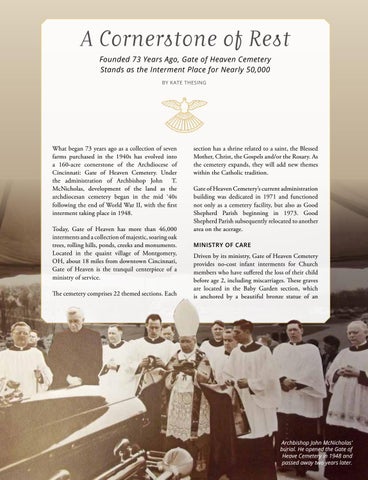
89 A CORNERSTONE OF REST Founded 73 years ago, Gate of Heaven Cemetery stands as the interment place for nearly 50,000
76 KIDS’ CORNER
92 OLDEST CHURCHES IN THE ARCHDIOCESE
EMMA CASSANI
SARAH ATER, JESSICA RINAUDO &
St. Francis de Sales
JENNIFER SCHACK
78 LET YOUR SERVICE SHINE REBECCA SONTAG &
99 FROM CINCINNATI TO RURAL AMERICA WITH LOVE
SISTER RITA STURWOLD
JOHN STEGEMAN
80 IN THE SERVICE OF TRUTH
Glenmary Missioners rooted in Cincinnati
KARY ELLEN BERGER
Sacred Heart Radio celebrates 20 years on air 84 AN INTERVIEW WITH THE DIOCESE’S FIRST BISHOP A collection of excerpts from Bishop Fenwick’s letters
104 HOLY CARD ART WINNERS 107 ST. MICHAEL PARISH BREATHES NEW LIFE INTO COMMUNITY MICHELLE DUSHENSKY
One Faith, One Hope, One Love Campaign supports update to 175-year-old church
ON THE COVER DESIGN BY JESSICA RINAUDO
Pilgrims pray the steps at Immaculate Conception Church in Mt. Adams in 1860 and in 2019. Modern day photo Courtesy of Don Nesbitt.
Congrat ulat ions Archdiocese of Cincinnati
Celebrating 200 years of service to God’s people
BIC E N T E N N IAL / J U NE 2021 | 5
C ONG R A T U L AT E S
THE ARCHDIOCESE OF CINCINNATI ON T H E I R B IC E NT E NNI A L !
INTERESTED IN BOOKING A CATHOLIC YOUTH RETREAT?
Congratulations to the
Archdiocese of Cincinnati on its Bicentennial! From The Pastoral Region of Holy Trinity - Norwood Nativity - Pleasant Ridge
6 | TH E CATHOLIC TELE GR A PH
Learn more at netusa.org/retreats
KNOW A YOUNG ADULT WHO WOULD MAKE A GREAT MISSIONARY? Send them to netusa.org/apply
SEEK THE LORD ARCHBI S H OP DE N N IS M . S C H N U R R
With great joy and gratitude, this month the Archdiocese of Cincinnati celebrates the 200th anniversary of our founding as a diocese by Pope Pius VII on June 19, 1821. In doing so, we reflect on our rich history. At the same time, we look ahead to a future that will be different, but full of promise if we remain faithful to our promises as God’s people. Catholics are probably more aware of being members of a parish than members of a diocese. The parish is where we encounter Christ in the Eucharist and in our fellow communicants on a week-to-week or even a daily basis. Pope Emeritus Benedict XVI called the parish “a beacon that radiates the light of faith.” For that, the parish is indispensable. And yet, the diocese – under the leadership of its bishop in union with the Pope – is the basic unit of the Church. The Second Vatican Council’s Decree on the Pastoral Office of Bishops in the Church says the diocese “constitutes a particular church in which the one, holy, catholic and apostolic Church of Christ is truly present and active.” That is why a diocese is referred to as “the local Church.” Our local Church, which spans 8,500 square miles over 19 counties of Western and Southwestern Ohio, has a coat of arms with deep significance that may not be immediately obvious. The crest features stylized images of a plow and three crosses. The plow represents the ancient Roman farmer-general Cincinnatus, who famously left his plow and farm to lead Rome’s army against its enemies, and then returned home afterwards rather than assume political power. The three crosses have sharpened feet for planting in the earth, and budded tips burgeoning with new life. Taken together, these two elements of our diocesan crest signify that we
are a people called to work our land for the growth of the Gospel. This task is not, nor has it ever been, exclusively for those called to the priesthood, diaconate or religious life. It is the primary vocation of every member of the Church established by our Lord, Jesus Christ. As I wrote in my bicentennial pastoral letter, Radiate Christ: “We all have a role to play in the present and future of the Church, even as our parents and grandparents had a part to play in the Church’s past. None of us is superfluous, disposable or unimportant. God has given each of us something specific to contribute … Our local Church will only be the instrument God intends it to be if each of us seeks the face of the Lord, is converted to Him and allows Jesus to work through us – in short, if we each radiate Christ!” With the decline of religious practice in this increasingly secular age, we are tempted to echo the words of Jesus: “But when the Son of Man comes, will he find faith on earth?” (Lk. 18:8). Yes, He will! Our faith in Christ is alive! We see that lived out every day in homes, schools, offices and even recreation. It has been my hope that the call to Radiate Christ will focus each of us ever more intentionally on our own roles in building up the Body of Christ. On June 19 we celebrate the 200 years of faith since the establishment of our local Church, but the depth of our faith is far more important than the number of years. May our faith always remain strong and may we radiate the love of Christ to all whom we encounter every day. Mary, Mother of the Church and our Mother, pray for our local Church as we begin our 201st year of faith! BIC E N T E N N IAL / J U NE 2021 | 7
BUSCA AL SEÑOR ARZOBISPO DENNIS M. SCHNURR
Con gran alegría y gratitud, este mes la Arquidiócesis de Cincinnati celebra el 200º aniversario de nuestra fundación como diócesis por el Papa Pío VII el 19 de junio de 1821. Al hacerlo, reflexionamos sobre nuestra abundante historia. Al mismo tiempo, miramos hacia un futuro que será diferente, pero lleno de promesas si seguimos fieles a nuestras promesas como pueblo de Dios. Los Católicos son más conscientes de ser miembros de una parroquia que miembros de una diócesis. La parroquia es donde nos encontramos con Cristo en la Eucaristía y en nuestros compañeros comunicadores semana a semana o incluso a diario. El Papa Emérito Benedicto XVI llamó a la parroquia “un faro que irradia la luz de la fe”. Por eso, la parroquia es indispensable. Y sin embargo, la diócesis – bajo el liderazgo de su obispo en unión con el Papa – es la unidad básica de la Iglesia. El Decreto del Concilio Vaticano II Sobre la Pastoral de los Obispos en la Iglesia dice que la diócesis “constituye una iglesia particular, en la que verdaderamente está y obra la Iglesia de Cristo, que es Una, Santa, Católica y Apostólica”. Es por eso que una diócesis se conoce como “la Iglesia local”. Nuestra Iglesia local, que abarca 8,500 millas cuadradas sobre 19 condados del oeste y suroeste de Ohio, tiene un escudo de armas con un significado profundo que puede no ser inmediatamente obvio. El escudo presenta imágenes estilizadas de un arado y tres cruces. El arado representa al antiguo granjero general Romano Cincinnatus, quien famosamente dejó su arado y granja para dirigir el ejército de Roma contra sus enemigos, y luego regresó a casa después en lugar de asumir el poder político. Las tres cruces tienen pies afilados para plantar en la tierra, y puntas en ciernes floreciendo con nueva vida. En conjunto, estos dos elementos de nuestro escudo diocesano significan que somos un pueblo llamado a trabajar nuestra tierra para el
8 | TH E CATHOLIC TELE GR A PH
crecimiento del Evangelio. Esta tarea no es, ni ha sido nunca, exclusivamente para aquellos llamados al sacerdocio, diaconado o vida religiosa. Es la vocación primordial de todo miembro de la Iglesia establecida por nuestro Señor Jesucristo. Como escribí en mi carta pastoral bicentenario, Irradiar a Cristo: “Todos tenemos un papel que desempeñar en el presente y el futuro de la Iglesia, aun cuando nuestros padres y abuelos tuvieron un papel que desempeñar en el pasado de la Iglesia. Ninguno de nosotros es superfluo, desechable o poco importante. Dios nos ha dado a cada uno de nosotros algo específico para contribuir … Nuestra Iglesia local sólo será el instrumento que Dios pretende que sea si cada uno de nosotros busca el rostro del Señor, se convierte en Él y permite que Jesús trabaje a través de nosotros – en resumen, ¡si cada uno irradia Cristo!” Con la disminución de la práctica religiosa en esta era cada vez más secular, nos sentimos tentados a hacer eco de las palabras de Jesús: “Pero, cuando el Hijo del hombre venga, ¿encontrará la fe sobre la tierra?” (Lc 18:8). ¡Sí, lo hará! ¡Nuestra fe en Cristo está viva! Vemos que vivía todos los días en hogares, escuelas, oficinas e incluso recreación. He tenido la esperanza de que el llamado a Irradiar a Cristo se centre cada vez más intencionalmente en nuestros propios papeles en la edificación del Cuerpo de Cristo. El 19 de junio celebramos los 200 años de fe desde el establecimiento de nuestra Iglesia local, pero la profundidad de nuestra fe es mucho más importante que el número de años. Que nuestra fe permanezca siempre fuerte y que irradiamos el amor de Cristo a todos los que encontramos todos los días. María, Madre de la Iglesia y nuestra Madre, ¡reza por nuestra Iglesia local al comenzar nuestro 201º año de fe!
Q UES TI O N O F F AITH
WHO’S BURIED IN PURCELL’S TOMB? Where is Archbishop Purcell buried? I have heard that he might not have been buried in the grave bearing his name. There is an old riddle: “Who’s buried in Grant’s tomb?” The answer could be “no one” (since his body, strictly speaking, remains entombed above ground in a mausoleum). We in the Archdiocese of Cincinnati have a similar riddle: Who’s buried in Archbishop Purcell’s tomb (or, more accurately, his grave)? Many have raised this question over the years, which stems from the circumstances of the archbishop’s later years. THE FINANCIAL COLLAPSE
Archbishop John B. Purcell was named bishop of Cincinnati in 1833 at just 33-yearsold. He served as the Diocese of Cincinnati’s bishop (and, after 1850, archbishop) for an incredible 50 years. His final years, however, were marred by financial collapse. The diocese formed a private bank (not unusual for the time) and accepted deposits from local Catholics. Archbishop Purcell had little oversight of the bank; he entrusted the day-to-day operations to his brother, also a priest, Father Edward Purcell. A series of poor investments and a financial downturn led to the bank’s total collapse. Though the Purcells had not used the money for personal gain, they had used some of it for churchrelated projects. By 1878, almost none of the deposits remained. After a protracted court battle, the depositors received only seven cents back for each dollar. MOVE TO BROWN COUNTY
The bank collapse paralyzed the archdiocese and led Archbishop Purcell to leave Cincinnati. He, along with his brother, moved 45 miles east to the Ursuline Convent in St. Martin, Brown County (today’s Chatfield College). A coadjutor archbishop, William H. Elder, was named as his successor in 1880. Archbishop Purcell spent his retirement among the sisters – largely outside of the reach of those who
blamed him for their financial losses. After suffering a series of strokes, Archbishop Purcell died on July 4, 1883, at age 83. His body was taken back to Cincinnati, where a funeral Mass was held at the cathedral. After Mass, his casket was returned to Brown County and he was buried in the Ursuline sisters’ cemetery. Among the many burials of Ursuline sisters is Archbishop Purcell’s grave, surrounded by his family: his mother, Johanna; his sister, Kate; and his brother, Edward. A HYPOTHESIS
The hypothesis that Archbishop Purcell might be buried elsewhere (perhaps another location on the convent grounds) has circulated over the years. His burial place, some argued, may have been hidden to prevent angry creditors from disturbing the grave or even stealing his body. Evidence at the site strengthened the supposition. A marble slab, placed over the grave site, began to sink into the ground, leading some to believe the grave was empty. There is no evidence that the site was ever disturbed or that Purcell was buried in any location other than the plot bearing his name. Likely, the ground beneath the casket settled, the result of decomposition and natural shifting of the soil. If, contrary to the evidence, Purcell is buried elsewhere, it is a well-guarded secret. His actual whereabouts may be lost forever. But if they are not, I’d like to imagine that the location has been passed down through the generations by the Ursuline sisters, who if questioned, would provide the answer you might expect: Purcell’s buried in Purcell’s tomb. Where else? FATHER DAVID ENDRES
is associate professor of Church history and historical theology at Mount St. Mary’s Seminary & School of Theology. BIC E N T E N N IAL / J U NE 2021 | 9
Mass Presence Physical vs. Virtual BY FATHE R CHR I S GEI GER
“It’s not perfect, but we are doing our best to make it work.” The bride-to-be did her best to appear cheerful during the marriage preparation meeting with her fiancé and me. The meeting took place over Zoom, not because of the pandemic, but because all three of us were in different states. The couple had spent most of their engagement separated by a ten-hour drive and were working hard to navigate the difficulties of a long-distance engagement. They faithfully texted each other throughout the day and never missed their video call each evening, the only opportunity they had to see each other “face-to-face.”
Anyone who has attempted to maintain a long-distance relationship can sympathize with this couple’s longing to be together, especially as they prepare for marriage. Even as a celibate priest, I am frequently moved by the beauty of spousal love, which the Scriptures frequently use as a metaphor for the relationship between God and His people. Isaiah says, for example, “For your husband is your Maker; the LORD of hosts is his name” (Is 54:5); both John the Baptist and Jesus Himself refer to Jesus as the bridegroom (Jn 3:29; Mk 2:19); and heaven is described as a wedding feast (Rev 19:9).
But while virtual communication was necessary and even a great gift, both agreed that the situation was putting a strain on their relationship. Virtual presence was not enough and a poor substitute for the real presence of the other.
The Catechism of the Catholic Church condenses this reality: “The entire Christian life bears the mark of the spousal love of Christ and the Church” (CCC 1617). (For an excellent overview of the relationship between God and His people as one of marital love, I recommend Jesus the Bridegroom, by Dr. Brant Pitre).
1 0 | TH E C ATHOLIC TE LEGR A P H
We must never lose sight of the remarkable truth that Jesus calls each of us to a relationship with Him that resembles marriage. It is a covenantal relationship in which the Lord gives the entirety of Himself to the Christian, and the Christian gives him/herself entirely to the Lord. At every Mass, we have the opportunity to enter into this spousal relationship. Jesus offers Himself wholly to us in the Eucharist, which is Jesus Christ himself – Body, Blood, Soul, and Divinity (CCC 1374). For our part, we have the opportunity to receive this total gift of Jesus himself into our bodies, and, in this reception, to give ourselves wholly back to Him.
We must never lose sight of the remarkable truth that Jesus calls each of us to a relationship with Him that resembles marriage.
NOTHING CAN REPLACE UNION WITH THE ONE WE LOVE
Keeping all of this in mind, it becomes readily apparent that “virtual Mass” is not enough. During the pandemic, it was necessary for a time (and, for some, it may still be necessary), but making the choice to attend Mass virtually is akin to choosing to remain in a long-distance relationship with the one we love and maintaining our distance from the One who deeply loves us. Nothing can replace being in the physical presence of, and being physically united with, the one we love.
Explore all that our senior living community has to offer from the comfort of your own home! Participate in an online virtual tour today to see our dining room, courtyard, suites, and everything in between. TA K E YO U R TO U R TO DAY B Y V I S I T I N G O U R W E B S I T E AT W W W. T R I P L E C R E E K R E T I R E M E N T. C O M ! |
ASSISTED LIVING | INDEPENDENT LIVING
Our hearts break for those who, because of age or medical vulnerability, cannot be physically present with us for Mass. We must never forget nor neglect those who are homebound, as they are never forgotten by God. For those of us who can attend Mass safely, however, it is time to come back into the Real Presence of the Bridegroom. “Virtual Mass” has been a necessary supplement to our relationship with the Lord, but every authentic spousal relationship desires union with the beloved. It is time to come back home to the “source and summit of the Christian life” (CCC 1324). It is time to dwell again in the presence of Jesus Christ, who satisfies the deepest desires of every human heart. BIC E N T E N N IAL / JU NE 2021 | 11
1831
Anti-Catholic sentiment prompts Bishop Fenwick to found The Catholic Telegraph.
1821
Pope Pius VII issues Papal bull creating the Diocese of Cincinnati and names Fr. Fenwick as the first bishop.
1820s 1829
Bishop Fenwick establishes the Athenaeum of Ohio, a seminary school. The Sisters of Charity arrive in the diocese.
1879
1832
Bishop Fenwick dies of cholera.
1840s
1837
Bishop Purcell publicly debates Alexander Campbell. This debate marks the first time an American bishop engaged in a debate with a Protestant clergyman.
1845
Ursuline Sisters arrive in Cincinnati from France. Led by Sister Julia Chatfield, OSU, they open Ursuline Academy and lay the groundwork for what is now Chatfield College.
1885
Daniel Rudd, a Black Catholic and former slave, establishes the American Catholic Tribune, a Catholic newspaper for Black Americans.
1880s 1883
With the death of Archbishop Purcell, Bishop Elder is appointed archbishop of Cincinnati.
1 2 | TH E C ATHOLIC TE LEGR A P H
14 priests and brothers from the Congregation of the Precious Blood arrived in Cincinnati. Bishop Purcell sends them to Maria Stein. Women religious from the Sisters of the Precious Blood soon follow.
Father John B. Purcell, a teacher, named second bishop of Cincinnati.
1830s
Archdiocesan bank fails. Financial devastation affects archdiocese and laity who deposited life savings into the bank. The seminary closes and does not reopen until 1887. Archbishop Purcell resigns, and Bishop William Elder assumes administrative duties.
1870s
1844
1833
1890
Second Black Catholic Congress is held in Cincinnati July 8 -10.
1890s 1898
The first Knights of Columbus chapters are established in the archdiocese.
1904
Henry Moeller is installed as the fourth archbishop of Cincinnati.
1909
Hamilton Catholic High School becomes the first regional Catholic high school.
1900s 1907
The first Holy Name Rally is held in Mount Adams.
1853 1850
Pope Pius IX issues bull on July 19, elevating the Diocese of Cincinnati to rank of archdiocese.
Archbishop Bedini visits Cincinnati. On Christmas night, hundreds of rioters gather around St. Peter in Chains Cathedral, protesting the influence of the Vatican in America.
1860 1859
Franciscan Fathers arrive in Cincinnati. Their parish ministry begins with St. John the Baptist and St. Francis Seraph, both in Over-the-Rhine.
The faithful begin the practice of “praying the steps” at Holy Cross Immaculata.
1850s 1852
Sisters of Charity found St. John’s Hotel for Invalids, the first Catholic hospital in the city with a teaching college attached to it. This private hospital has evolved and is now Good Samaritan Hospital.
1863
Editorial in The Catholic Telegraph by Father Edward Purcell calls for the emancipation of slaves, the most public declaration by a Catholic newspaper.
1860s 1855
1861
On Aug. 20, gunpowder destroys newlybuilt Holy Angels Church in Sidney.
Father Dwenger, C.PP.S., founds St. Charles Seminary in Carthagena, for the Congregation of the Precious Blood.
1915
1911
Cincinnati hosts the fifth National Eucharistic Congress.
1913
Father Henry Waldhaus is tasked with opening a school for the deaf. With the aid of benefactors, 237 acres of land are purchased for St. Rita School for the Deaf. The school opens with 11 students and three teachers from the Sisters of Charity.
Extensive flooding along the Miami River causes considerable damage and suffering in Dayton, Hamilton and Middletown. Relief funds are raised throughout the archdiocese to support those affected.
1916
Bureau of Catholic Charities is created with Father Francis Gressle as director.
1919
Catholic Students Mission Crusade headquarters moves to Cincinnati.
1910s
ARCHDIOCESE OF CINCINNATI A Hi s t o r y o f Ca t h o lic is m in Wes t er n a nd So u t h wes t er n Oh io
BICOR E ND TE NAT N IAL NE IN ION // JU MA Y 2021 | 13
1939
1920
1936
The Sisters of Charity open the College of Mount St. Joseph for women.
Cardinal Pacelli, the future Pope Pius XII, visits the U.S. and stops in Cincinnati. After this visit, the elementary school at Our Lord Christ the King Church is named the Cardinal Pacelli School.
1920s 1921
Catholic Social Services of the Miami Valley established.
Father William Bishop, a priest in the Archdiocese of Baltimore, founds the Glenmary Home Missioners and is invited by Archbishop McNicholas to establish the headquarters in Cincinnati.
1930s 1937
1925
Following the death of Archbishop Moeller, John McNicholas is named archbishop.
Flooding along the Ohio River causes extensive damage. In Cincinnati, the water crests at 80 feet, which is 30 feet over flooding levels. Many Catholic churches suffer damage, including St. Rose of Lima and St. Michael in Lower Price Hill, prompting relief efforts. With the downtown population shrinking and St. Peter in Chains requiring much upkeep, Archbishop McNicholas decide to move the cathedral to St. Monica Church in Clifton. St. Peter in Chains is referred to as “the old cathedral.”
1970
Franciscan Friars of the St. John the Baptist Province in Cincinnati create Franciscan Media.
1976 1972
Following the unexpected death of Archbishop Leibold, Joseph Bernardin is named Archbishop of Cincinnati.
1975
Archdiocese launches the Lay Pastoral Ministry program.
1970s 1971
Following the Second Vatican Council, Archbishop Leibold launches the sixth archdiocesan synod, involving, for the first time, a significant number of laity in planning for the Church’s future. 1 4 | TH LEGR H T HEE CCATHOLIC A THOLIC TE TELE GRAAPPH
Cardinal Karol Wojtyla visits Archbishop Bernardin, then the head of the National Conference of Catholic Bishops. (Two years later Cardinal Wojtyla is elected pope and takes the name John Paul II.)
1974
50 men enroll in the newly established permanent diaconate program. Mother Teresa makes her first of three visits to the greater Cincinnati area.
1982
When Archbishop Bernardin is sent to the Archdiocese of Chicago, Dayton-born Auxiliary Bishop Daniel Pilarczyk is named the ninth archbishop of Cincinnati.
1980s 1986-1989
Archbishop Pilarczyk serves as vice president (1986–1989) and president (1989–1992) of the National Conference of Catholic Bishops.
1962 - 1965
Archbishop Alter and Bishops Paul Leibold and Edward McCarthy participate in the Second Vatican Council, with Alter present at all four sessions. A leader among bishops in the U.S., he was a member of committees preparing materials prior to the council. At the conclusion of the council, he directs every parish to establish a parish council and begins the process of implementing liturgical reforms.
1957 1941
Father Bishop founds Glenmary Sisters.
1954
Renovation and expansion of St. Peter in Chains begins.
St. Peter in Chains rededicated. Week-long celebration takes place.
1950s
1940s
1960s 1969
1950
Bishop Paul Leibold named archbishop and charged with implementing many of the conciliar reforms in the archdiocese. He dies suddenly at age 57, having served as archbishop for less than three years.
Karl Alter named archbishop.
1993
Archdiocese publishes the Decree on Child Protection, establishing policies and procedures to prevent abuse of minors by the clergy, lay employees and volunteers.
2000
Archbishop Pilarczyk establishes The Futures Project to discuss and make plans for the future of the local Church in light of declining priest numbers. Among the accepted recommendations is the creation of pastoral regions.
1990s 1997
Su Casa Hispanic Center is founded as a program of Catholic Charities Southwestern Ohio. It is the primary provider of social, case management, family reunification, educational and health-promotion services to the Hispanic/Latino community in Greater Cincinnati.
2020 2009
Archbishop Dennis Schnurr is named the 10th Archbishop of Cincinnati.
2000s 2001
Sacred Heart Radio begins, bringing Catholic content to the public 24/7.
2008
Bishop Dennis Marion Schnurr named Archbishop Pilarczyk’s coadjutor in October.
COVID-19 pandemic closes churches and instigates year-long dispensation from Mass. In June, 190-year-old Catholic Telegraph newspaper converts to magazine format.
2010 - present 2016-2019
Archbisop Schnurr serves as Treasurer of the USCCB.
2021
June 19, 2021: Archdiocese turns 200.
BICOR E ND TE NAT N IAL NE IN ION // JU MA Y 2021 | 15
Coat of Arms The coat of arms appeared for the first time in a publication, The Ecclesiastical Review, around 1921 combined with the arms of Archbishop Moeller. Before that time, it seems that the bishops and archbishops of Cincinnati used only their personal coats of arms with the heraldic insignia of a bishop or archbishop.
The colors of the arms, red and gold, are traditionally associated with St. Peter, the patron of the cathedral of the archdiocese, St. Peter in Chains. The bishop’s miter placed above the shield indicates that these are the arms of a diocese.
The three crosses in the arms evoke the Holy Trinity. They also associate the plow with the Church’s missionary labors. The crosses are pointed at the foot for planting in the earth and budded at their tips, burgeoning with new life. They recall the planting of the Catholic faith in the territory northwest of the Ohio, where Cincinnati was the first diocese established (1821).
The plow represents the Roman hero Cincinnatus. In 458 BC, Rome was under attack from hostile neighbors. Cincinnatus was plowing his field when a delegation from the Senate came and called him to assume the dictatorship in defense of the Republic. He responded at once, leaving his plow behind in the field. He was to hold absolute power for six months; but when, after just 15 days, he defeated Rome’s enemies and set the city’s affairs in order, he resigned the dictatorship and returned to finish plowing his field. Cincinnatus was taken as a model by the officers who served with Washington in the War of Independence. After the war, they joined together as the Society of the Cincinnati. In 1790, General Arthur St. Clair, governor of the Northwest Territory and president of the society, changed the name of the settlement on the Ohio opposite the Licking River from Losantiville to Cincinnati in honor of this organization.
INFORMATION PROVIDED BY FATHER DOHRMAN BYERS 1 6 | TH E C ATHOLIC TE LEGR A P H
SR. PAULITA HOFFMAN from Cincinnati who served in Taiwan for 50+ years! You have blessed us with many wonderful missionaries who have made God’s love visible around the world!
Making God’s Love Visible Making God’s Love Visible
TogeTher wiTh The PriesTs, Deacons, consecraTeD religious anD lay FaiThFul oF The Diocese oF ToleDo
MOST REVEREND DANIEL E. THOMAS Bishop of the Diocese of Toledo
oFFers PrayerFul congraTulaTions To
MOST REVEREND DENNIS M. SCHNURR anD all The MeMbers oF The Archdiocese of cincinnATi on The occAsion of The Joyful celebrATion of The bicenTenniAl of The founding of The diocese.
May the Lord Bless you Abundantly!
BIC E N T E N N IAL / JU NE 2021 | 17
ARCHDIOCESE OF CINCINNATI BICENTENNIAL
BY S ARA H A T E R
serving in the wilderness Both the Sisters of the Sacred Heart and the Sisters of Notre Dame de Namur rejected the remote location. Loving the peace of the countryside, Bishop Purcell moved St. Francis Xavier Seminary from Cincinnati to the donated property in 1840, and, for two years, it was administered by diocesan priests. By 1842, Bishop Purcell successfully handed the seminary’s management to the Lazarist Fathers. However, the property’s distance from the city proved problematic, and there were disagreements between Bishop Purcell and the Lazarist Fathers. As a result, the seminary returned to Cincinnati before the end of the 1844-1845 school year, leaving the property’s occupancy available for another religious community. THE URSULINE SISTERS
Mother Julia Chatfield, OSU
In the archdiocese, there are “mother churches,” the first Catholic churches, for each region. In the East, that parish is St. Martin Church in Brown County. Thirty miles northeast of Cincinnati, Catholics began to settle in that area as early as 1820, though it was 10 years before the parish formally organized. THE LAND PROBLEM
General William Lytle gifted 200 acres of land near the parish to Bishop Edward Fenwick for the purpose of establishing a school. Although Bishop Fenwick was unable to complete the project this before his death in 1832, Bishop John Purcell saw it to completion. Both of these early bishops made great efforts to bring religious communities to Ohio to assist in the vineyard, but settling Brown County did not come easily.
In 1838 Bishop Purcell visited the Ursuline Sisters at Boulogne-sur-Mer, France, and invited them to Cincinnati. At first, the sisters declined, but then an Ursuline community in Beaulieu requested to go. Within a few years’ time, the first community changed its mind, and, in 1845, 11 nuns traveled to Cincinnati. Deferring to Bishop Purcell’s choice of where they would teach, they went to Brown County. Mother Julia Chatfield led this newly organized community. The Ursulines in France educated Julia, and she converted to Catholicism. Disowned by her father, she eventually entered the convent. Propelled by a desire to be a missionary, Mother Julia took on the responsibility of administering the young community in less-than-desirable circumstances. The sisters had to overcome many obstacles, including the language barrier, isolation, strenuous farm work and a lack of financial assistance. Their unusual circumstances led them to loosen the strict rules of cloistered life, and English became their primary language. Seeing God’s providence in their work, Mother
On June 19, 2021, the Archdiocese of Cincinnati will celebrate its bicentennial, recognizing 200 years of faith in Western and Southwestern Ohio. Each month, we will feature events and people who played significant parts in its story. These stories aim to inspire, educate and celebrate the many gifts God has given our local Church.
1 8 | TH E C ATHOLIC TE LEGR A P H
Julia wrote, “This entire affair has been conducted by an invisible hand which we must adore in silence.” ST. URSULA INSTITUTE
Incorporated as the St. Ursula Institute, the girls’ school opened in Oct. 1845 with 15 boarders and local day students. Girls traveled from many locations in the U.S. to attend the school, even non-Catholics. During the Civil War, daughters of generals from the North and South attended, and the nuns forbade the students from talking about the war. The Ursulines were dear to the heart of Archbishop Purcell, and his mother and sister lived on the property. When the archdiocese underwent the financial crisis in 1879, Archbishop Purcell retired to Brown County. CHANGES
A major change in the life of the sisters was a disagreement about ministry and remaining in their remote location. Several sisters believed they could be more effective if they established a school and motherhouse in Cincinnati. And so, with the permission of Archbishop Henry Moeller in 1910, many members left to found Saint Ursula Academy on McMillan Street, and became the Ursulines of Cincinnati.
Because the membership of the Ursulines of Brown County was modest, they had fewer schools in the region. In 1896, they opened Ursuline Academy, a day school, in Cincinnati. Although its location has changed a few times, Ursuline Academy is now located in Blue Ash, a suburb of Cincinnati. In 1958, the sisters opened the Ursuline Teacher Training Institute to provide their members with higher learning opportunities. In 1971, its name changed to Chatfield College, and it admitted laity and other religious community students. In 1989, a second campus opened in Over-the-Rhine. Changing needs for the academy led to its closure in 1981, and the buildings were demolished. The sisters built a new residence and motherhouse on the site of the original seminary. In the second half of the 20th Century, the sisters expanded their ministries beyond education and began to serve in social services and social justice causes. The Ursulines of Brown County continue the legacy begun by Mother Chatfield and her fellow sisters to serve the poor of their community through Emergency Hope Center, and the students entrusted to their care.
Ursuline College congratulates the Archdiocese of Cincinnati on 200 years of shining the light of Christ!
ursuline.edu BIC E N T E N N IAL / JU NE 2021 | 19
Serving the Neglected When established, the Diocese of Cincinnati was mission territory with few priests and even fewer parishes. In its first 100 years, nearly 200 parishes were established, but many rural areas still existed without a Catholic Church. Archbishop John T. McNicholas, OP, was passionate about evangelizing these areas. A member of the National Catholic Rural Life Conference, in 1923 he proposed the establishment of a society of diocesan priests and religious dedicated to rural missions. He wasn’t alone in this desire, and other like-minded individuals aided our local church in these efforts.
Father William Bishop (1885-1953)
Brother Bertrand Bailey, OP (1887-1954)
•
William Bishop was born in Washington, D.C. to an affluent family and was gifted a chalice from a Justice of the Supreme Court at his ordination for the Archdiocese of Baltimore.
•
•
While serving in a parish for 22 years, Father Bishop grew in desire to serve the poor and neglected of rural America. A founding member of the National Catholic Rural Life Conference, he saw missionary activity as the core work of the Church.
Brother Bertrand was born in St. Mary’s County, MD. He made his solemn profession with the Dominicans in 1919, and was appointed secretary to Most Rev. John T. McNicholas, OP, Bishop of Duluth.
•
With permission from his archdiocese, he founded the Glenmary Home Missioners. Archbishop McNicholas granted Father Bishop permission to establish Glenmary’s foundation in Cincinnati in 1939.
•
•
At the time of Glenmary’s founding, approximately one-third of U.S. counties did not have a Catholic church. Focusing on “No Priest Land, U.S.A.,” Glenmary’s strategy was to establish a parish, build a simple church and/or school and give administration of the parish to the diocese.
When McNicholas was made Archbishop of Cincinnati in 1925, Brother Bertrand followed him to Ohio. In addition to his secretarial duties, he repaired local churches.
•
Standing five feet, three inches tall, Brother Bertrand was called “the Little Brother of the Missions.” The trunk of his car was a traveling workshop with tools necessary for building repairs.
•
In 1938, Brother Bertrand built the first simple church for the archdiocese. Over the next 12 years, he built 25 new chapels, converted 10 existing buildings into chapels, repaired and remodeled 10 existing churches, and constructed six schools, among other projects. He used standard plans to simplify the projects and worked alongside the volunteers he recruited.
•
Some churches he built include St. Susanna, Mason; Church of the Transfiguration, West Milton; St. Teresa of the Infant Jesus, Covington; Queen of Peace, Millville; and San Antonio Church, Cincinnati.
•
Father Bishop also founded the Home Mission Sisters of America, envisioning priests, sisters and laity working together. The sisters are now headquartered in Owensboro, KY. The priests and brothers are based in Fairfield, OH.
“A flower is small, like the small, isolated groups that we minister to, like the little children. So small a flower is easily overlooked on the roadside. You hardly see it as you pass by. But pick it up and examine it; it becomes a thing of beauty; so, too, the country parish and the country child.” – Father William Bishop 2 0 | TH E C ATHOLIC TE LEGR A P H
Congratulations to the Archdiocese of Cincinnati on 200 years of radiating Christ’s light!
Find your Brilliance
ST. DOMINIC PARISH The parish family of St. Dominic, “Radiating Christ” for 88 years, is proud to be part of the local Church of Cincinnati - who have “Radiated Christ” for 200 years! May God continue to bless us all!
BIC E N T E N N IAL / JU NE 2021 | 21
INTO THE UNKNOWN Early Settlers in the Northern Archdiocese Confronted Nature’s Perils to Make it to Mass B Y MA TT H E S S
One of the unique areas of our archdiocese is the Land of the Cross-Tipped Churches. Those who visit this northern region often ask, “Why did they build so many churches so close together?” This is especially profound at points in Mercer County where several spires are visible at once. The short answer is the hardships of the times called for parishes to be nearer to the rural people served by priests who traveled great lengths in their ministry. Driving through the lush green fields of corn and beans, it is hard to believe this land was once a formidable swampy forest, set on the Maumee and Miami watersheds. An early settler to Maria Stein in the mid-1830s, Liwwät Böke (in English, Boeke), said, “Of the forest, my first impression was: I am imprisoned, swallowed deep in its gloomy throat.” German Catholic immigrants, like she and her husband Natz, began clearing the forest, digging ditches and creating drainage systems that have been updated and are used today to procure rich farmland. Those that settled here, had a lot of faith that they would survive in this environment. Travel was tough and goods were expensive, but the people were not going to give up on trying to make it in the New World. During the War of 1812, one soldier noted, “The road from [Fort] Loramie’s block house to St. Mary’s…was 2 2 | TH E C ATHOLIC TE LEGR A P H
one continuous swamp, knee deep to the horses and up to the hubs of the wagons…many were left sticking in the mire and ravines.” After 1845, the Miami-Erie Canal helped relieve that burden. This water way, which is comparable to Interstate-75 today, moved people and goods at a breakneck speed: 4 miles an hour. Locally, though, the question still remained: “How will we get to Mass?” As noted above, the trails and even the main roads were bad, and the problem persisted for decades. The pioneer roads often became impassible in winter snow and in the mud that came with spring rains. Even in the Fall, dense forests would drop upwards of eight inches of leaves, making travel cumbersome. Obviously, the roads were unlike our modern streets. Paving often consisted of logs laid across the marshy land. Charles Dickens described a stagecoach ride across Ohio in 1842 as “enough, it seemed, to have dislocated all the bones in the human body.”
*Download & print copies at thecatholictelegraph.com
BIC E N T E N N IAL / JU NE 2021 | 23
A common saying, often attributed to Father Francis de Sales Brunner, C.PP.S., who was a missionary leader in the area, was, “Faithful should not have to walk more than four miles to attend Mass.” Whether he said it or not, many communities followed that axiom and petitioned for a closer parish. One of these parishes is approximately two miles west of Minster in a place called Egypt. The charming country parish of St. Joseph was founded there in 1852, after the local farmers had so much trouble getting to Minster for Mass, due to swampy conditions. In fact, Minster considered using a windmill to drain the land, like in the old country, but the forests were deemed too thick for strong enough winds to power it.
Blessed to be part of our 200 year-old local church! Coldwater Cluster of Catholic Parishes: Saint Anthony, St Anthony Saint Mary, Philothea Holy Trinity, Coldwater
Celebrating 200 Years of Faith
According to local lore, the area gets its name, “Egypt,” after settlers in the 1830s found it to be a harsh, unforgiving environment; their toil and hardships reminded them of the accounts of Egypt in the Old Testament. Later, in 1856, the Sisters of the Precious Blood founded a convent there, Mary’s Flight to Egypt, which many mistakenly believe to be the origin of the name. The spires of the cross-tipped churches continue to be a beacon above the fields and pastures, just as they were above the trees of the dense forests and marshlands. The sun glinting off the gold crosses on top radiates the presence of God to those who toil in the fields that their ancestors drained and made fertile. Although travel is easier today, the cross-tipped churches continue to remind the faithful that God’s presence is moving among them.
Founded in 1834 - Serving God’s people in Ohio since 1844 www.preciousbloodsistersdayton.org
Congratulations to the Archdiocese of Cincinnati on their 200th Anniversary of Faithfully Proclaiming the Gospel! Holy Angels Church Sidney, OH
2 4 | TH E C ATHOLIC TE LEGR A P H
200
We Celebrate years with the
ARCHDiocese OF Cincinnati DOMINICAN FRIARS PROVINCE OF SAINT J OSEPH
and
St. Gertrude CHURCH & PRIORY MADEIRA, OH
BIC E N T E N N IAL / JU NE 2021 | 25
Written by Gail Finke Illustrated by Emma Cassani
1843-44 Father Brunner and companions arrive in Ohio 1850 All Swiss Sisters of the Precious Blood relocate to America
1,200 relics
1872 Father J. M. Garner of Milwaukee added 175 more relics (now housed in the main altar) to the collection.
95% of the relics are first class (from a saint’s body) 850 saints are included in the collection 1 full-body wax reliquary (St. Victoria)
Father Brunner was a Benedictine priest in Maria Stein. He joined the Congregation of the Most Precious Blood after political upheaval in Europe. Archbishop John Baptist Purcell invited him to travel to Ohio and minister to German-speaking Catholics. His mother, Maria Anna Brunner, founded a community of Precious Blood Sisters. He brought 10 of the sisters with him, along with his collection of relics.
1 reliquary of St. Peregrine used for monthly veneration and a quarterly cancer prayer service by the St. Peregrine Cancer Care Ministry 6 carved altars by Schroeder Brothers 2 relics of the True Cross
Most popular relics: • Wood from the True Cross • Hair from Pope St. John Paul II • A relic of St. Maximilian Kolbe
Maria Stein Shrine of the Holy Relics has the second largest collection of relics in the United States.
M a r ia S e tein is the Virgin Mary. The title c omes from a shrin to M a M ary of the Rock (“ ria Stein”). It w the as built in a cave in Sw iss Alps in the 1300’s after a you nd ng boy fell from a cliff a w as found picking flowers for the “be ved autiful la h im dy” w h o s a . Later, Benedictines built a mo nastery there. 2 6 | TH E C ATHOLIC TE LEGR A P H
“Pilgrims don’t have to go to Rome to come in contact with items attached to the life Christ, they are right here in our archdiocese. In the high altar of the Relic Chapel we have small pieces of the True Cross, manger, last supper table, dirt from the tomb, Veronica’s veil, a thorn from the crown of thorns, and many others. These relics from daily life, usually considered second class for saints, are first class for Our Lord.” – Matt Hess, Maria Stein Shrine Director of Programming
Congratulations on 200 years!
Congratulations
to the Archdiocese of Cincinnati on your Bicentennial!
From the Maria Stein Shrine of the Holy Relics
Retirement Fund for Religious Please give to those who have given a lifetime.
www.retiredreligious.org
Since 1948, Mission Helpers have in theHelpers Archdiocese of in Sinceserved 1948 Mission have served Cincinnati.ofWe are pleased the Archdiocese Cincinnati during its behistory. with you celebrate 200toyear Weas areyou pleased to be with your Bicentennial. you as you celebrate your Bicentennial.
National Religious Retirement Office Sponsor of the Retirement Fund for Religious 3211 Fourth Street NE • Washington DC 20017-1194
THE MOST REVEREND EDWARD C. MALESIC, AND THE CLERGY, RELIGIOUS AND FAITHFUL OF THE DIOCESE OF CLEVELAND OFFER THEIR CONGRATULATIONS AND PRAYERFUL BEST WISHES TO THE
Most Reverend Dennis M. Schnurr, Archbishop and the clergy, religious and faithful of the Archdiocese of Cincinnati, ON THE OCCASION OF THE BICENTENNIAL ANNIVERSARY OF THE ARCHDIOCESE OF CINCINNATI.
BIC E N T E N N IAL / JU NE 2021 | 27
Seminary Chapel in Norwood in the 1920s.
A C L OS E R L OOK
MOUNT ST. MARY’S SEMINARY: LEGACY, PROMISE & HOPE While the Archdiocese of Cincinnati celebrates its bicentennial in 2021, Mount St. Mary’s Seminary & School of Theology, founded in 1829, will have to wait a few more years. Nonetheless, the milestone anniversary of the archdiocese is an appropriate time to consider the past legacy, present promise and future hope of Mount St. Mary’s. As the third-oldest Catholic seminary in the U.S., it serves the Church far beyond the boundaries of Western and Southwestern Ohio. While its core mission remains the education and formation of priests for the Archdiocese of Cincinnati, Mount St. Mary’s has an expanding national influence. LEGACY
The Diocese of Cincinnati’s first bishop, Edward Fenwick, founded St. Francis Xavier Seminary on Sycamore Street in Downtown Cincinnati near the location of the present St. Francis Xavier Church. That first class had four seminarians and six preparatory students. Two years later, a college of liberal arts for lay students, the Athenaeum, was established next door. In 1839, St. Francis Xavier Seminary moved to Brown County, but the location proved to be impractical, and so it was moved back to Cincinnati after a few years. In 1851, Bishop John Purcell moved the seminary to Price Hill and renamed it “Mount St. Mary’s Seminary of the West.” The name change was partly to avoid confusion with the new St. Francis Xavier College (now Xavier University), after the Society of Jesus assumed control of the Athenaeum and renamed it thus. But the name change was also an homage to Mount St. Mary’s Seminary in Maryland (the second oldest in the U.S.), where Bishop Purcell served as president and rector before moving to Cincinnati. Due to a financial crisis, in 1879, the seminary closed its doors, reopening in Price Hill in 1887. And, in 1890, a separate college seminary, St. Gregory’s 2 8 | TH E C ATHOLIC TE LEGR A P H
Seminary, opened in Mount Washington. In 1923, under the leadership of Archbishop John Moeller, the seminary moved from Price Hill to a newly erected building in Norwood. It operated in Norwood until 1982, when it moved to its current Mount Washington location, on the former campus of St. Gregory Seminary, which closed in 1980. (The Norwood campus on Moeller Avenue is the current site of Our Lady of the Holy Spirit Center.) PROMISE
In 2020, the seminary was rebranded as Mount St. Mary’s Seminary & School of Theology. The primary purpose and core mission of the institution is as a seminary, to form and educate men for the ordained priesthood. But the name change also reflects the institution’s continuing commitment to lay education and ministry, which began in 1975 with the creation of the Lay Pastoral Ministry Program, now operating as the School of Theology. In the just-completed academic year, 85 men were enrolled in the seminary division, and 67 lay students were enrolled in various degree or certificate programs in the School of Theology. While some seminary students may also complete Master of Arts degrees, all who finish the program receive the Master of Divinity degree, leading to their ordinations to the priesthood. Lay students are enrolled in programs for the conferral of a Master of Arts in Pastoral Ministry, a Master of Theology, or one of two slightly less strenuous certificate programs. Of the 85 seminarians, approximately 50-percent are from the Archdiocese of Cincinnati. The other half are from other dioceses or religious orders that have sent their men to Mount
St. Mary’s for formation and education. These include the Ohio dioceses of Toledo and Youngstown as well as the dioceses of Tulsa, OK; Kansas City, MO; Louisville, KY; Charlotte, NC; Fort Wayne/South Bend, IN; and the Congregation of the Oratory of St. Philip Neri, and the missionary order of the Fathers of Mercy. This reflects the confidence that these dioceses and religious orders have in the formation and education that their seminarians receive at Mount St. Mary’s Seminary.
opened a new residence building in 2019, Fenwick Hall, which brings its residency capacity to more than 100 men.
This hope is consistent with the conclusions of Franciscan University sociologist, Anne Hendershott, who has identified four key factors common to successful Catholic seminaries in the U.S.: (1) a “transformational” bishop who (2) places a high emphasis on vocations; (3) commitment to Archbishop Schnurr blesses the addition to Mount theological orthodoxy; and (4) a St. Mary’s Seminary in October 2019. strong seminary rector who recruits faculty who are faithful to the Magisterium. Mount St. Mary’s HOPE Seminary & School of Theology could be exhibit A for this Despite the many challenges for the Church in the U.S, analysis. And it is a sign that this institution can look forward Mount St. Mary’s Seminary & School of Theology is a sign of to its own joyous bicentennial, building upon a strong legacy, hope for the future of the Church. Over the last three years, with the promise of a hopeful future. the Archdiocese of Cincinnati has ordained 21 new priests, in addition to those ordained in other dioceses. The 2021 class of nine priest ordinations matches the 2019 class as the highest number over the last 40 years. And the enrollment trend of the seminary indicates that these numbers will continue at or above these levels. To meet this growing trend, the seminary
DR. KENNETH CRAYCRAF T
is an attorney and the James J. Gardner Family Chair of Moral Theology at Mount St. Mary’s Seminary & School of Theology. He holds a Ph.D. in moral theology from Boston College, and a J.D. from Duke University School of Law.
200 YEARS AND COUNTING Xavier University and St. Xavier High School are proud to partner together to congratulate the Archdiocese of Cincinnati on upholding its honorable mantle of faith and tradition for 200 years. As two of Cincinnati’s oldest Jesuit, Catholic education institutions, it’s been a privilege to witness the journey leading up to this historical moment and we are happy to celebrate it together in spirit.
BIC E N T E N N IAL / JU NE 2021 | 29
St Henry Baptismal Class 1951
Serving the Forgotten Archbishop McNicholas Welcomed Comboni Missionaries to Archdiocese in 1940 BY L IN D S AY BRAU D
On a cool, clear autumn morning, Comboni Father Edward Mason arrived in the port of New York on Thanksgiving Day, Nov. 23, 1939. Behind him, Europe was fighting a brutal, bitter war. Ahead lay the exciting challenge of establishing a Comboni Missionary community, searching for vocations and seeking support for missions around the world. Founded in 1867 by St. Daniel Comboni, the Comboni Missionaries are an international Catholic organization dedicated to ministering to the world’s poorest and most abandoned people, often working 3 0 | TH E C ATHOLIC TE LEGR A P H
in unstable political climates in the midst of extreme poverty. After knocking on many chancery doors and receiving some chilly rebuffs that might have discouraged a less determined priest, Father Mason finally arrived in Cincinnati. There he called upon Archbishop John T. McNicholas, OP, who was deeply committed to the minority population. Archbishop McNicholas warmly welcomed him and introduced him to five pastors of inner-city Black
parishes. Father Mason asked for the opportunity to care for one of the parishes. Three of the pastors offered him their own. Father Hamlet Accorsi was the epitome of a selfless Comboni Missionary, many of whom left their families and friends for the missions of Africa. Father Accorsi, a veteran of African missions, arrived in Cincinnati on Jan. 24, 1940. Assigned to Holy Trinity in the West End, Comboni Father Dominic Ferrara joined Father Accorsi in July 1940. The two men soon proved effective in gaining support for African missions. In 1941, Father Accorsi succeeded the pastor of Holy Trinity, Father Leo Walsh, a determined fighter against racism in the Catholic community. Their purpose in coming to the U.S. was threefold: • To minister to the descendants of those St. Comboni loved and died for in Africa, who came to this country, not of their own free will, but as enslaved persons • To grow the missionary vocation • To gain support for overseas missions by educating the faithful about the Church’s missionary nature
With the continued support of Archbishop McNicholas, in 1947, the Comboni Missionaries purchased a 57-acre estate in Forestville, a rural area 15 miles east of Cincinnati (now the bustling suburb of Anderson Township). This became the site of Sacred Heart Seminary. Bishop George J. Rehring blessed the cornerstone on July 31, 1949. In addition to the high school seminary in Cincinnati, the Comboni Missionaries needed a novitiate to prepare missionaries for the religious vows that distinguish them from diocesan priests. After some searching, they settled on a site in Monroe, MI. Over time, the Comboni Missionaries’ presence in Cincinnati grew, and they began to take on the care of many parishes, including St. Henry (which is now gone), St. Anthony in Madisonville, St. Michael in Lower Price Hill, St. Pius in Northside and, most recently, St. Charles Borromeo, which was closed and demolished last year. Comboni Father Rodolfo Coaquira now serves as associate pastor for St. Boniface in Northside, supporting the Catholic Hispanic community. The commitment of the Comboni Missionaries today is
BIC E N T E N N IAL / JU NE 2021 | 31
The commitment of the Comboni Missionaries today is the same as it was in 1939 – to serve the forgotten and often overlooked communities wherever their missions are located.
the same as it was in 1939 – to serve the forgotten and often overlooked communities wherever their missions are located. For decades, that meant serving the Black communities in Cincinnati, the Italian community in Chicago and the Indigenous communities in California. Today, their mission in the U.S. focuses largely on Hispanic Catholic communities.
in the common goal to bring compassion and love to God’s people.
Their gifts and talents vary greatly, but they remain united
Learn more at www.ComboniMissionaries.org.
✠ ARCHBISHOP CHARLES C. THOMPSON AND THE ENTIRE CHURCH IN CENTRAL AND SOUTHERN INDIANA SEND GREETINGS OF CONGRATULATIONS TO THE
Archdiocese of Cincinnati ON THE OCCASION OF ITS
BICENTENNIAL CELEBRATION ✠
3 2 | TH E C ATHOLIC TE LEGR A P H
Currently, the Comboni Missionaries have communities in Cincinnati, OH (home to the provincial headquarters); Los Angeles, CA; Newark, NJ; La Grange Park, IL; and Kitchener, Ontario, Canada.
The Comboni Missionaries Congratulate the Archdiocese of Cincinnati on 200 years of Service!
ComboniMissionaries.org
The Region of St. Augustine and St. Mary of the Assumption would like to Congratulate the Archdiocese of Cincinnati on its Bicentennial.
Your neighbors to the South, the Most Reverend Roger J. Foys, D.D., the Priests, Deacons, Religious and Lay Faithful of the Diocese of Covington, Kentucky, send our congratulations, best wishes, and prayers to the people of the Archdiocese of Cincinnati as you celebrate your 200th Year Anniversary.
BIC BICEENNTTEENNNNIAL IAL // JU JUNE NE 2021 2021 | 33
3 4 | TH E C ATHOLIC TE LEGR A P H
COOL THINGS IN THE ARCHIVES BY MICHELLE SMITH
1. DRAWINGS BY GERHARD LAMERS Born in Germany in 1871, Gerhard Lamers came to America in 1925, settling in Cincinnati in 1940. He painted countless churches in many states, including many churches in this archdiocese, among which are All Saints, St. Leo, St. Louis, St. Michael (Lower Price Hill), Chapel at Mt. St. Mary’s Seminary (Norwood), and Holy Family.
5. BISHOP PURCELL’S JOURNAL Bishop (later Archbishop) John Purcell arrived in Cincinnati in 1833 to be the second shepherd of the diocese. For his first three years as bishop, he kept a written account of his duties, including his arrival in the city, information about parishes and schools, relations with non-Catholic churches, and his interactions with the people of the diocese.
2. BISHOP FENWICK’S VESTMENT Thought to be worn on his begging trip(s) to Europe for the new diocese.
6. BARREL Archbishop Elder’s coat of arms, painted on miniature wine barrel that would have been presented during the episcopal ordination ceremony
3. MARIANNE REILLY JOURNALS Marianne was active in social and churchrelated activities in Cincinnati, and her family enjoyed a close relationship with Archbishop John B. Purcell. Through this connection, the Sisters of Charity briefly stayed with the Reilly family in 1829 when they were new to Cincinnati. She was also able to travel to New Orleans, Louisville, Baltimore, and Mexico. 4. ARCHBISHOP WILLIAM ELDER Sick call set and glasses used by Archbishop William H. Elder (1819-1904). Death mask.
7. SUNLAMP The Institutum Divi Thomae was founded in 1935 by Dr. George Sperti and the Archdiocese of Cincinnati. It was a graduate school for scientific research. Among many of the advancements at the institute were Aspercreme, Preparation H, methods to freeze-dry orange juice, a sunlamp to enhance vitamin D in milk, and a burn ointment. The institute included men and women students, laity and religious brothers and sisters. The only person excluded from research in the institute was the atheist. In his lifetime, Dr. Sperti held more than 120 patents and developed many sunlamps.
BIC E N T E N N IAL / JU NE 2021 | 35
Father Clarence Rivers Archdiocese of Cincinnati’s First Black Priest Launched Musical Legacy B Y JOH N S T E G E M AN
Father Clarence J. Rivers was the first Black priest ordained in the Archdiocese of Cincinnati. He is a nationally known figure in Catholic music and liturgy and was an iconic figure for the Black Catholic community throughout the country. Father Rivers died in 2004, but his influence is still perceptible throughout the archdiocese and beyond. “When Black Catholics around the United States reflect on the inculturation of Black spirituality [music, art, movement, prayer and faith], Father Rivers is the name that rises to the top,” said Deacon Royce Winters, director of African American Pastoral Ministries for the archdiocese and pastoral administrator at the Church of the Resurrection in Bond Hill. “The local Black Catholic communities in the U.S. and in this archdiocese have continued to carry on the legacy of inculturation which began with Father Rivers.” 3 6 | TH E C ATHOLIC TE LEGR A P H
Father Rivers was born in Selma, AL, but his family moved to Cincinnati when he was young. He attended St. Gregory and Mount St. Mary’s Seminaries and was ordained to the priesthood on May 26, 1956. His was an associate pastor at St. Joseph’s in Cincinnati’s West End and spent time teaching at Purcell High School. He later served at Assumption in Walnut Hills. In 1965, the archdiocese released him from his assignments to pursue his program of inculturation of African American culture in Catholic worship. He went on to become known as a liturgical artist, composer and author. Perhaps his best-known hymn, “God is Love,” was sung at the 1964 National Liturgical Conference during the first High Mass said in English in the U.S. Catholic Church. After the song, the assembly applauded for 10 minutes.
Celebrating the
200th Anniversary of the
Archdiocese of Cincinnati
Saint James White Oak † Founded 1843
CHURCH | SCHOOL | CEMETERY
“When Black Catholics around the United States reflect on the inculturation of Black spirituality [music, art, movement, prayer and faith] Father Rivers is the name that rises to the top.” Father Rivers spoke out on the need for his ministry. In a 1977 article in The Catholic Telegraph, he said that, to some people, the Church “is one big happy family and any giving in to ethnic concerns is wrong. To them, there is one faith, one Baptism, one Church and one culture – namely, European.”
ARCHDIOCESE OF CINCINNATI B I C E N T E N N I A L As we journey together in mind and heart, may we always remember that we are called to be “Living stones. Let ourselves be built into a spiritual house to be a holy priesthood to offer spiritual sacrifices acceptable to God through Jesus Christ.” 1 Peter 2: 5
Deacon Winters, who called Father Rivers a friend, feels his legacy in his own continued ministry. “In 1978, as my family and I searched for a church home, we attended Saint Agnes Church,” Deacon Winters said. “Father Rivers was serving as the guest homilist, and he preached about racial injustice. I spoke to him afterwards because I was disturbed about his message. I was seeking the Christ, and he was preaching about racial injustice. Father Rivers invited me to his home, and we began a lasting friendship. After my ordination, he would often call me and say, ‘I need my deacon.’ I would accompany him to various dioceses for liturgical services and workshops, serving as his deacon and cantor. Father Rivers was instrumental in my liturgical formation and the freedom to embrace the culture of being authentically Black and Catholic.” In his obituary in the Cincinnati Enquirer, Father Rivers’ sister said, “Although small in physical stature, he had a presence that was larger than life. Once he entered a room or a gathering, you knew you were in the midst of someone extraordinary.” BIC E N T E N N IAL / JU NE 2021 | 37
St. John Church in Fryburg as it stands today. Below: The same church in 1950.
3 8 | TH E C ATHOLIC TE LEGR A P H
Living History St. John Church in Fryburg Has Stood in Continuous Use by the Faithful Since 1850 BY M AT T H E S S
The village of Fryburg, a little more than five miles from the city of Wapakoneta, is reminiscent of the rural villages of the old country. Exiting Interstate 75 and passing by the town, you might think you just exited the Autobahn, but, really, you are in the Ohio heartland. A spired church draws you to the center of this tucked away town, beckoning you to answer the invitation the Lord gives in the first chapter of St. John’s Gospel to “come and see.” One of the oldest structures in the Archdiocese of Cincinnati in continuous use, St. John the Evangelist Church, has been a part of the Archdiocese for more than 170 of its 200 years. Constructed in 1850, the church has been a place to encounter the Lord for generations of Catholics. The physical building is also Fryburg’s connection to its roots – the traditions and people who give meaning and flavor to small town life. Moreover, this parish is unique in the Archdiocese of Cincinnati by its treasures and history. ORIGINS
The majority of St. John parishioners were Bavarians who came to farm the land for a better life. In the late 1840s, the devoted people of Fryburg desired a parish of their own, as they tired of traveling the cumbersome roads to the Petersburg Church, which was a couple miles west of town. Trustees began planning for the parish by buying two lots in town and mobilizing the parish to donate a portion of the labor and materials. The bricks of the church were made in Fryburg by members of the fledgling congregation. However, these are hidden today by the stucco that covers the exterior walls of the Church. The parish started small, with just 30 families, in 1850. However, the parish was able to operate a school, which became a parish hall in later years, and furnish a priest
St. John Church in Fryburg parishioners circa 1890.
house for their pastor. Before the priest lived in town, they shared him with other local parishes. In 1870, the pastor could not get to Fryburg for a funeral due to harsh weather. The irate parishioners chose to bury the person without a priest present. This incident, known as “The Fryburg Rebellion,” led to St. John getting a resident pastor a few years later, as they had also doubled the number of families registered there in just 20 years. FATHER LAWRENCE TEBBE
Of the many pastors of St. John Church, one looms largely in the historical consciousness of the parish and village, Father Lawrence Tebbe. Born in nearby McCartyville, Father Tebbe was stationed at Fryburg in 1938, at the age of 36 until his death in 1972. Wanting to remain at a small parish for his health, he was never transferred. Because of this, he became a father figure to the people of the parish, presiding at the marriages of young people he had once baptized. Father Tebbe was a notable painter, woodworker, and stone mason, drawing on skills he acquired in high school and college. He was known for his paintings, which were raffled off at the annual Fryburg Homecoming Festival, which continues today as a way of fundraising to keep BIC E N T E N N IAL / JU NE 2021 | 39
Inside the sanctuary of St. John Church in Fryburg. Right: Father Lawrence Tebbe
National Catholic would like to congratulate the Archdiocese of Cincinnati on 200 years of sharing the Gospel of Our Lord.
The National Catholic Risk Retention Group, Inc. is a church owned specialty liability insurer that provides coverage for
513-683-0105 • STCOLUMBAN.ORG 894 OAKLAND ROAD, LOVELAND, OH 45140 4 0 | TH E C ATHOLIC TE LEGR A P H
a multitude of exposures in all 50 states.
National Catholic is also the provider of the VIRTUS® The National Catholic Risk Retention Group, Inc. is a church Programs, owned specialty liability insurer that provides coverage for a the preeminent safe environment suite of products and multitude of exposures in all 50 states. services to the Church in the United States and overseas. National Catholic is also the provider of the VIRTUS® www.nationalcatholic.org www.virtus.org Programs, the preeminent safe environment suite of products and 877‐486‐2774 888‐847‐8870 ser i es to the Ch r h in the United States and o erseas
up the parish. The paintings, which were never sold by Father Tebbe, are prized pearls of the community, passed on in families from one generation to the next.
Communion in 1950. The embellished Pieta scene in the back was by Father Tebbe and is worth the trip to Fryburg on its own. At one time it also served as the baptismal font.
Father Tebbe built the rectory next door during his pastorate. It is a unique building, clearly the work of a skilled mason WHERE DWELLEST THOU and pastor. The structure is part brick, part stone, part house and part Lourdes Grotto. Our Lady keeps watch over Father Tebbe’s magnum opus the front door from her upper niche in the was St. John chimney (Father Tebbe was especially adept Church, which at laying hearths). In the front lawn is a he redecorated in wooden crucifix. It was designed by Father 1949-50. Above Tebbe in the style of the wayside Bavarian the proscenium Father Tebbe’s shrines to remind locals not only of their arch are the words of the first disciples called magnum opus heritage, but also of the sacrificial love of by the Lord, “Where Dwellest Thou” and was St. John Jesus. the Lord’s response, “Come and see.” Thus, Church which he all are invited by Jesus to his tabernacle, “Come and see.” This summons of Christ redecorated in residing in our midst. Father Tebbe also spurred on the generations of Catholics in painted intricate designs around the statues, 1949-50. Fryburg who followed the Lord at St. John windows, and high altar that accentuate Church. This parish is exceptional in its preservation of these features. There are a number of Christian symbols on history and desire to radiate Christ to those living around it. the walls and a depiction of Mary above the back door that In this bicentennial year of the Archdiocese of Cincinnati, is also the work of the beloved pastor. On the walls near come and see for yourself the rich faith we have inherited the ceiling of the nave, there are four angels with blonde and the joy that comes in passing it to others. hair believed to be based on four girls who made their First
Most Reverend William E. Lori and the faithful of the Premier See join the Archdiocese of Cincinnati in celebration of its Bicentennial.
Together in
MISSION
Calvary Cemetery Association of Dayton OH wishes to congratulate Archdiocese of Cincinnati on 200 years of service to the Catholic Community of Southwest Ohio.
The Sisters of Mercy are honored to support, and congatulate, the Archdiocese for 200 years of faithful service to the people of Cincinnati.
Share the mission of Mercy at sistersofmercy.org.
BIC E N T E N N IAL / JU NE 2021 | 41
A CENTURY OF CATHOLIC EDUCATION
Elder High School Opened Doors in 1922 BY KARY ELLEN BERGER
Elder High School, the oldest high school in the Archdiocese of Cincinnati, has been a mainstay of Price Hill for nearly 100 years. The school, which has more than 22,000 alumni, will celebrate its 100th graduating class in 2022. The high school began when parishioners of St. Lawrence Parish in Price Hill asked to have a ninth grade, and later tenth grade, added to their elementary school in 1913. The new additions were called Elder High School in honor of William Henry Elder, the second archbishop of Cincinnati. Soon
4 2 | TTH ATHOLIC TE TELEG LEGR PH H EE CCATHOLIC R AAPH
after, additional parishes, including St. William, Holy Family, St. Michael, St. Teresa, Blessed Sacrament, Resurrection, St. Vincent de Paul, St. Aloysius, Our Lady of Perpetual Help and Our Lady of Victory, along with Rev. Louis J. Nau of St. Lawrence, asked the archbishop at the time, Henry Moeller, for permission to begin a four-year high school. The new Elder High School opened its doors in the fall of 1922 as a coeducational school. It was only the fourth high school in Cincinnati and the city’s first Catholic diocesan school. Elder remained
coeducational until Seton High School opened next door to Elder in the fall of 1927. The two schools still share a special bond to this day, including holding performing arts programs together. For Kurt Ruffing (Elder ’81), current principal and president of Elder, going to the school was a given. “I have three brothers who all graduated from Elder – Bud (’77), Jim (’78) and Rick (’82),” Ruffing said. “My two older brothers attended Elder, and so I was next in line!”
19 years as assistant principal under our former principal, Tom Otten, and now I am in my fifth year as principal,” Ruffing said.
The school, which has more than 22,000 alumni, will celebrate its 100th graduating class in 2022.
During his senior year at Miami University, Ruffing shared that then principal, Father Tom Kuhn, connected with him during a district wrestling tournament which Ruffing and his then-girlfriend (now wife) attended. The two chatted about Ruffing’s future, and after a phone call the following weekend, Ruffing accepted a position to teach at his alma mater. “I initially taught math and computer science, then served
Ruffing shared that while he had several memorable experiences as a student at Elder, one of his favorite memories occurred more recently.
“Last year, because of the COVID-19 pandemic, we were not able to hold our traditional graduation exercise,” Ruffing explained. “Instead, we held personalized ceremonies for each graduate over four evenings at the main entrance to the school. Those were very long days for our faculty and staff, but it was well worth it. To see the reactions of the graduates and their parents (and family members) was incredible. Each graduate walked up the steps to the main entrance, was greeted and given his diploma, all while Pomp and Circumstance and the school’s alma mater were being played. Many parents and graduates later expressed their appreciation for the time and effort put into the individual, personalized ceremonies.”
Blessings on your bicentennial It was in Cincinnati that the bishops of the province proposed the establishment of the Diocese of Fort Wayne. Our first bishop, John Henry Luers, was ordained a bishop by Archbishop John B. Purcell at the Cathedral of St. Peter in Chains on January 10, 1858. Congratulations and prayerful best wishes to Archbishop Dennis Schnurr and all the faithful of the Archdiocese of Cincinnati from Bishop Kevin C. Rhoades and the
Giving thanks for the Lord’s blessings over these 200 years! St. Michael
the Archangel CATHOLIC PARISH AND SCHOOL
www.saintmichaelchurch.net BIC E N T E N N IAL / JU NE 2021 | 43
Looking ahead to what’s next for Elder, Ruffing shared that the school is currently in a $10 million capital campaign with the goal, “to stay in Price Hill for another 100 years!” “We are as strong now as we were in 1922 when the doors opened, and people notice that,” Ruffing added. “Elder’s tradition, spirit, loyal alumni, community service, and our motto, Altiora – ‘To Strive for the Higher Things’ [makes the school unique]. There is a quote on the wall in the lobby of our new fitness center – ‘What I Had I Gave, What I Saved I Lost’ – and this embodies what we attempt to instill in our students every day. Give everything you have and make the best of your God-given talents.”
Congratulations to the Archdiocese of Cincinnati in your Bicentennial year! We are grateful and proud to have served the churches in the diocese since 1842. — The Verdin Family
Congratulations on the Bicentennial! The Permanent Deacons of the Archdiocese of Cincinnati Servants of the Archdiocese of Cincinnati since 1976
THE VERDIN COMPANY A FAMILY OF INNOVATORS SINCE 1842 800-543-0488 | www.verdin.com
The Office of the Diaconate Deacon Mark Machuga, Director The Office of Permanent Deacon Formation Rev. David Sunberg, Director
4 4 | TH E C ATHOLIC TE LEGR A P H
2OOth
Congratulations
to the Archdiocese of Cincinnati on
Elder High School
its Bicentennial.
is proud to be the first diocesan high school in Cincinnati.
OUR 1OOth We are looking forward to celebrating our 100th anniversary in 2022-2023!
BIC EPN N N IAL NEY 2021 | 45 M ARIAN ILTGERIM AG E // JU MA
What was happening in the Church, the United States and the world when the Diocese of Cincinnati was officially founded in 1821?
In the United States: •
President: James Monroe
•
Vice President: Daniel D. Tompkins
•
Chief Justice: John Marshall
•
Congress: 16th (until March 4), 17th (starting March 4)
•
Jan 21: John Breckinridge: 14th U.S. Vice President was born. He was a Confederate General in the Civil War.
•
July 10: The U.S. took possession of its newly purchased territory of Florida from Spain.
•
Aug. 4: The Saturday Evening Post relaunched.
•
Aug. 10: – Missouri is admitted as the 24th U.S. state.
•
Nov 16: William Becknell reached Santa Fe, NM, on the route that became known as the Santa Fe Trail.
•
Dec: 25 – Clara Barton, humanitarian and founder of the American branch of the Red Cross.
In the World: •
Feb. 23: Death February 23 – John Keats, British poet (b. 1795)
•
May 5: Emperor Napoleon dies in exile.
•
June 14: Egyptian conquest of Sudan. King Badi VII of Sennar surrenders his throne and realm without a fight to Ismail Pasha, general of the Ottoman Empire.
•
June 24: Battle of Carabobo: Simón Bolívar wins Venezuela’s independence from Spain.
•
•
•
Aug. 24: The Treaty of Córdoba signed, ratifying Mexico’s independence from Spain and concluding the Mexican War of Independence.
July 19: George IV is crowned king of the United Kingdom of Great Britain and Ireland.
•
Sept. 4: Russia proclaims territorial sovereignty over Northwestern North America, modern-day Alaska.
Aug. 21: Birth of Louis Vuitton, French fashion designer
•
Nov. 11: Birth of Fyodor Dostoyevsky, Russian writer
4 6 | TH E C ATHOLIC TE LEGR A P H
In the Catholic Church: •
The first Catholic Cathedral Constructed in the U.S. was completed - the Historic Baltimore Basilica. (St. Louis Cathedral in New Orleans was completed in 1794, but was not part of the U.S. at the time of its completion).
•
•
Future saint, English cardinal and theologian John Henry Newman (1801-1890) graduated from Trinity College, Oxford. Newman was canonized by Pope Francis in Oct. 2019.
•
Saint Elizabeth Ann Seton died Jan. 4, 1821. She was the first citizen born in the U.S. to be declared a saint. She was the founder of the Daughters of Charity of Saint Vincent de Paul in the U.S. and the Sisters of Charity of Cincinnati.
•
Pope Pius VII, head of the Catholic Church. Pope Pius VII, original name Luigi Barnaba Gregorio Chiaramonti, (born Aug. 14, 1742, Italy—died Aug. 20, 1823, Rome), Italian pope from 1800 to 1823, whose dramatic conflicts with Napoleon led to a restoration of the Church after the armies of the French Revolution devastated the papacy under Pius VI.
•
Roughly 195,000 Catholics in the U.S.
•
Massive immigration to the U.S. from Ireland and Germany between 1820 and 1860 dramatically increased the size of the Catholic Church in the U.S., from 195,000 to 3,103,000.
The first U.S. diocese, Baltimore, was erected in 1789 by Pope Pius VI. Following that the diocese of New Orleans was established in 1793 while under Spanish rule. In 1808, Pope Pius VII erected the Dioceses of Boston, New York, Philadelphia and Bardstown. The dioceses of Charleston and Richmond were established in 1820. Cincinnati was erected in 1821 at the 9th diocese in the now defined U.S. BIC E N T E N N IAL / JU NE 2021 | 47
A Century of Service From the Spanish Flu to Tornado Recovery, Catholic Social Services of the Miami Valley Has Been a Beacon to Those in Need for 100 Years B Y KARY E LLEN BER GER
From its beginnings of helping immigrants and orphans, to now serving 10 counties in the northern part of the archdiocese and 20,000 people each year, Catholic Social Services of the Miami Valley (CSSMV) has seen growth and gratitude for a century. This spring marked the organization’s 100th anniversary of service. “Father Francis Gressle opened the first Catholic Charities office in Dayton as a response to a growing concern over the conditions immigrants were living in Dayton at the time,” Mike Lehner, Director of Marketing and Development for CSSMV, said. “There were also up to 500 orphans from the Spanish flu of 1918 and people still recovering from the flood.” CSSMV is an affiliate of Catholic Charities USA, which has 162 affiliates of Catholic Charities across the country. 4 8 | TH E C ATHOLIC TE LEGR A P H
CSSMV’s CEO, Laura Roesch, is a member of Catholic Charities USA’s Board of Directors. With a focus on both individuals and families, CSSMV provides services in eight primary areas: • Mission Services — including family stabilization and support and the organization’s choice food pantry; • Pregnancy and Parenting Services — including parent education, groups for mothers, and postadoption support services; • Supervised Visitation and Exchange Services at Erma’s House — providing a safe place for parents and their children to visit and for parents to have a supervised exchange; • Refugee Resettlement — assisting those coming to the Dayton-area with initial housing, help finding employment, and providing community resources;
CSSMV’s Dayton food pantry is open Monday through Friday and is one of the busiest pantries in Montgomery County.
• Counseling — for individuals, families, and children; • Senior Services — including guardianship, PASSPORT Medicaid waiver services, visiting and respite care; • Mobility Management — helping those in need with transportation services; and, • Long-Term Tornado Recovery Case Management — providing guidance on various tornado-related topics including financial assistance, short-term and longterm housing, and finding resources to fix homes following the Dayton-area tornadoes in 2019. Lehner noted that he feels the work of CSSMV will continue to expand for years to come. “My hope for CSSMV’s next 100 years is to continue to grow our capacity to serve,” Lehner said. “Throughout our history, we have been able to meet the needs of our community as they arose, and I hope that we can continue to be counted on for this. Similar to the way in which we have worked collaboratively to solve complex issues like infant mortality, hunger, long-term tornado recovery, and access to transportation and mental health services in our rural communities today, I
Happy 200th Anniversary Archdiocese of Cincinnati! St. Joseph Springfield
St. Bernard Springfield
St. Teresa Springfield
St. Charles Borromeo
S. Charleston
St. Raphael Springfield
Congratulations to the Archdiocese of Cincinnati on your 200th anniversary from Bishop John Doerfler, Bishop Emeritus James Garland (Auxiliary Bishop of Cincinnati 1984-1992), clergy, religious and faithful of the
Diocese of Marquette, Michigan BIC E N T E N N IAL / JU NE 2021 | 49
hope to position the agency to have the flexibility to respond to the issues we will face in the next century.” Celebrations for the organization’s 100th anniversary began in April and will continue to be showcased in a variety of ways.
Father Francis Gressle opened the first Catholic Charities office in Dayton as a response to a growing concern over the conditions immigrants were living in Dayton at the time.
“[We will] celebrate 100 stories of impact over the next year,” Lehner shared. “Throughout the year, we will share stories from clients, staff, volunteers and community partners about all of the ways in which CSSMV has impacted our community. There will be a large community celebration on September 25 at Riverscape, where we will host a free family-fun Centennial Celebration with games,
live music, a 5K fun run, and featuring the largest fish fry the region has ever seen with the Corpus Christi Fryers and the Hecht Family Fryers joining forces for the first time.” Lehner added that there is hope to also hold a community-wide Mass that same day for the entire archdiocese. Support for CSSMV is ongoing, with multiple ways for people to help the organization including prayers, volunteering (annually, CSSMV has more than 350 volunteers), and financial contributions. Those interested in reading the 100 stories series can go to CSSMV’s website, cssmv.org, or their Facebook page, facebook.com/CSSMV.
Diocese of
Columbus
the most reverend robert j. brennan and the priests, deacons, religious, and faithful of the
DIOCESE OF COLUMBUS extend their congratulations to to the faithful of
THE ARCHDIOCESE OF CINCINNATI in celebrating their
200th Anniversary We are proud to trace our own roots to the Archdiocese and pray for your continued success and blessings upon your ministry. 5 0 | TH E C ATHOLIC TE LEGR A P H
We’re celebrating 100 years of joyfully serving our neighbors! Mark your calendar for Saturday, September 25 ... We’re planning a free, daylong Centennial Celebration at RiverScape MetroPark in downtown Dayton, and we want YOU to be there! You’ll find more information at cssmv.org/events.
100 Years/100 Stories We’re sharing 100 stories about the positive impact our agency has had on people’s lives. You can follow along throughout our anniversary year at facebook.com/cssmv. If YOU have a personal story you’d be willing to share, please contact Linda Spanel at spanell@cssmv.org or 937.223.7217 x2100.
Join in the Celebration at cssmv.org
937.223.7217 Dayton 937.498.4593 Sidney Facebook, Twitter & Instagram @CSSMV
DBIC ID EYOU NTEN K N OW IAL ? // JU MNE A Y 2021 | 51
M AJ OR S H R IN E S I N THE A R C H D IO C E SE OF CIN C IN N ATI
relic of the true cross
What is a shrine? Associated with popular piety since the earliest days of the Church, shrines are places of pilgrimage and prayer. Pope St. John Paul II once said, “Christian shrines have always been, and continue to be, signs of God, and of His intervention in history. Each one of them is a memorial to the Incarnation and to the Redemption.” According to Archdiocese of Cincinnati Chancellor Father Steve Angi, Canon Law stipulates local shrines be approved by local bishops, national shrines approved by a country’s council of bishops and international shrines approved by the pope. According to the official Directory on Popular Piety and the Liturgy, many places “often humble little churches in the cities or in the countryside, locally fulfill the same functions as shrines, even without canonical recognition. These also form part of the ‘topography’ of the faith… of a particular community living in a specific geographical area, on its journey towards the heavenly Jerusalem in faith.”
BY G A I L F I N KE 5 2 | TH E C ATHOLIC TE LEGR A P H
The Archdiocese of Cincinnati is home to one national shrine, two local shrines, and many popular places for special prayers or devotions.
Home of the second-largest collection of relics in the U.S. and located in the scenic “Land of the Cross-Tipped Churches,” the Maria Stein Shrine of the Holy Relics is part of a complex of buildings that date back to the 1840s. The site was once a center of Catholic missionary activity, the Motherhouse of the Sisters of the Precious Blood and a pilgrimage destination for Catholics from around the country. The first Sisters of the Precious Blood in the archdiocese lived on the same property as Precious Blood fathers and brothers, who later moved to Dayton. Father Brunner, who brought the sisters over with him from Europe, also brought more than 1,000 relics to Maria Stein in 1875. The relics drew so many visitors that a separate staircase was required to keep them from the sisters. In the late 1880s, the convent became the Motherhouse of all Precious Blood sisters, and a new, larger, building was built to serve that purpose until 1923, when the motherhouse moved to Dayton. In the 1950s, a lay Adoration Guild took over Eucharistic Adoration, which the sisters had practiced at Maria Stein since their pioneer days. The convent eventually became a retreat center. Now the Spiritual Center of Maria Stein is run by a lay board, as is the separate Shrine of the Holy Relics. The Shrine Chapel holds more than 1,200 relics, and the Heritage Museum tells the story of missionary work in early Auglaize and Mercer counties. Adoration continues in the adoration chapel, a gift shop supports the property, and a variety of special Masses, prayer services and programs are held throughout the year.
TA K E A T R I P 2291 St. Johns Road, Maria Stein, OH 45860
CA L L (419) 925-4532 EXP L OR E O N L I N E MariaSteinShrine.org
One of the most popular saints in the world, St. Anthony of Padua was an Augustinian priest who joined the Franciscans after seeing the bodies of martyred missionary Franciscans processed to his monastery. He hoped to become a missionary to Morocco, but was shipwrecked in Sicily, where his gift for preaching sent him all over Italy. His commitment to poverty and humility earned him universal respect. Shortly before he died at age 36, he delivered a series of talks so popular that he needed bodyguards to protect him from people trying to cut his robes apart for relics. The National Shrine of St. Anthony is located on spacious grounds atop a hill in Cincinnati’s Mt. Airy neighborhood, along with a friary and an outdoor shrine to St. Anthony, St. Francis and Our Lady of Guadalupe. Built in the late 1880s, the church that now houses the shrine originally had eight side chapels and elaborate, Tyrolian-style paintings. It was renovated in 1978. The church and shrine are open year-round for prayer, and every Tuesday they host a novena service in the afternoon and novena Mass in the evening. Both end with Eucharistic exposition and a blessing with a first-class relic of St. Anthony. The novena is especially attended during the nine weeks leading up to the saint’s feast day on June 13, when celebrations include the distribution of blessed “St. Anthony Bread” to take home and eat. In the church, a shrine to the saint opposite the altar includes a computer screen that displays prayer intentions sent in from around the world, so that the friars and visitors can pray together for each other.
TAKE A TRIP 5000 Colerain Avenue, Cincinnati, OH 45223
CALL (513) 721-4700 BIC E N T E N N IAL / JU NE 2021 | 53
Dedicated in 1964, the Our Lady of Fatima Shine at Indian Lake was the tallest statue of the Virgin Mary in the world at the time. It was located in a Catholic park run by George B. Quatman on the grounds of the former Sandy Beach Amusement Park, “The Atlantic City of the West.” Quatman’s San Juan Amusement Park featured wholesome entertainment and a train ride past the statue, which rotated to recorded music, surrounded by dancing waters and lit with colored lights and a life-sized statue of the Last Supper. All profits went to charities. Only Our Lady of Fatima remains. The fiberglass statue stands at 19’ 6”, part of a 43-foot monument built and supported by the American Society of Ephesus (ASE). Quatman founded ASE in the 1950s to support holy sites in Turkey, including the home of the Virgin Mary in Ephesus, and to build shrines in Turkey and the U.S. The Indian Lake shrine celebrated its 50th anniversary in 2014, when ASE restored the wooden Stations of the Cross signs set up around “St. Mary’s Point.” In 2017, ASE added a lacy white metal fence and gate designed to resemble a lace veil, honoring the centennial of the apparitions of Mary in Fatima. Today St. Mary of the Wood parish in Russells Point holds a Monday evening Rosary at the statue from May to October, and a Eucharistic procession to the statue followed by a “family fun day” in September. Every August, an outdoor Mass on the Feast of the Assumption draws large crowds. The shrine is open daily for devotion and prayer.
TA K E A T R I P 261 Chase Avenue, Russells Point, OH 43348
EX P L O R E O N L I N E SaintMaryoftheWoods.com/Fatima ASE-GBQfoundation.org
Built by Archbishop John Baptist Purcell, the church now known as Holy Cross-Immaculata is home to the unique tradition of “praying” or “making the steps” on Good Friday. Praying to the Virgin Mary during a storm at sea, Archbishop Purcell promised that if he lived, he would build a church dedicated to her on the city’s highest point. That cornerstone was laid in 1859. According to the parish’s official history, Archbishop Purcell asked people from all over the city to contribute to building the church, and to climb the steep hillside while praying for the needed funds. According to an article by the Passionists, who staffed the church for decades, the origin of the practice may be have been similar Bavarian traditions loved by German parishioners. Either way, the faithful have gathered from all over the region to pray on the hill beginning at midnight on Good Friday, and on the various sets of steps built since then. “Immaculata,” as Archbishop Purcell called the church, holds several holy relics and is home to other annual devotional practices. Though it’s not official, the church is a de facto shrine, according to the pastor, Father Len Fecko. “Archbishop Purcell wanted it to be a shrine to honor Mary,” he said. “We’ll go with Archbishop Purcell.”
TAKE A TRIP 30 Guido St., Cincinnati, OH 45202
EXPLORE ONLINE HCIParish.org 5 4 | TH E C ATHOLIC TE LEGR A P H
Want more? Ohio is home to shrines large and small, including: •
National Shrine of Our Lady of Lourdes, Euclid
•
Sorrowful Mother Shrine, Bellevue
•
Basilica and Shrine of Our Lady of Consolation, Carey
•
Jubilee Museum and Catholic Cultural Center, Columbus
•
National Shrine of Our Lady of Lebanon, North Jackson
•
Servants of Mary Center for Peace/Shrine of Our Lady of Guadalupe, Windsor
•
National Shrine of St. Dymphna, Massilon
•
Shrine of Our Lady of Mariapoch, Burton
•
Shrine of the Conversion of St. Paul, Cleveland
200 years
to the Archdiocese of Cincinnati on your Bicentennial! Wishing you many more years of continued success in supporting the Catholic community.
A Milestone Worth Celebrating! Here’s to the next century of bringing faith alive through service to our neighbors in need. Your friends at St. Vincent de Paul–Cincinnati
Effingham, IL 62401 • 800-743-5151• kingeryprinting.com BIC E N T E N N IAL / JU NE 2021 | 55
CAT H OL IC AT H OM E
PART OF SOMETHING BIGGER Happy Bicentennial! We’re right in the middle of an historical event, marking 200 years of life, work and prayer at home in the Archdiocese of Cincinnati. If we open our eyes to it, we can realize in a more concrete way that, as individual Catholics, we’re part of something and Someone so much bigger. The word catholic means universal; around the world, Catholics share the same credo, liturgy and practices. I’ll never forget attending Mass in Avignon, France as a child. I didn’t speak a word of French, but because the sights, sounds and gestures were the same, I was able to keep up and participate spiritually. I was in a foreign country, but the liturgy itself was anything but strange.
This kind of communion is worth celebrating, but what makes the bicentennial so significant is Whom we’re celebrating. The faith, the Mass, the community wouldn’t exist but for Jesus. It’s the love and mercy He contributors extended during His ministry and now.
These aren’t distant figures in black and white; they’re fellow Catholics who worked and struggled.
Our bicentennial this year calls for celebration with the whole family. This Catholic party recognizes 200 years of communal faith in our area; a duration just a few decades shy of our own country’s establishment. The faith is the same across the geographical archdiocese, and it has also spanned across centuries now. How incredible is it that the prayers, readings and experiences of Mass at your parish today are the very same that were heard and prayed here 200 years ago? 5 6 | TH E C ATHOLIC TE LEGR A P H
But it gets bigger. The Holy Sacrifice of the Mass possesses the same consistency globally going back thousands of years. Such devotion points to the Holy Spirit’s presence within the Church around the world and here in our corner of Ohio.
But the miracle of this celebration is hard to grasp when what’s right in front of us doesn’t seem to connect to the greater reality. How can we possibly feel part of something so big as the Body of Christ when we’re in the thick of real life? IMAGINE IT IN COLOR
What concretizes the events of history is paging through pictures. The bicentennial website (200.catholicaoc.org) features a fantastic collection of historical photos – the places, churches, priests and lay people who were part of the last 200 years. These contributors aren’t distant figures in black and white; they’re fellow Catholics who worked and struggled. They had passions and pursuits, families
and jobs. Like us, their normal lives included a call to radiate Christ, and they did so by simply saying yes to what Jesus asked of them. When we’re looking at the past through still shots of straight-faced priests, sisters and parishioners, let’s strive to see their humanity. COME AND SEE
The bicentennial is an extended celebration of faithcentered events for the whole family. Check the website for a complete calendar, and in the meantime know that somewhere near you is a concert, a Rosary or Benediction. The Marian Pilgrimage is a particularly unique event in itself, stretching across 33 days – a period of preparation before the archdiocese is consecrated to Jesus through Mary. In His time on earth, no one was more devoted or supportive of Jesus than His mother; this pilgrimage is a way to prayerfully imitate Mary’s love for her Son. To further experience our connection to the Body of Christ, visit the local religious communities. The Comboni Missionaries, the Sisters of Charity, the Ursulines and the Sisters of the Most Precious Blood are religious communities with different charisms that radiate Christ. Attend a Vietnamese Mass at Our Lady of Lavang
D OW N T OW N DAY T O N C AT H O L I C PA R I S H E S Served by the Missionaries of the Precious Blood
Emmanuel Church 1837
Give thanks to God, whose faithfulness lasts through every age.
or Lebanese liturgy at St. Anthony of Padua. Right here in our own backyard is a variety of experiences of the global Church. TAKE A (VIRTUAL) TOUR
Though all devoted to the same Lord and faithful in the same prayers, the archdiocese is blessed with manifold beauty in its parishes. The churches themselves feature stunning and diverse architecture that point to the truth, beauty and goodness of God. It would be worth the trip to visit in person, but the bicentennial site offers a virtual experience of 12 different parishes. It’s time to embrace and praise God for His providence over the last 200 years, because it’s by His grace that our churches, communities and faith have stood the test of time. Join us in any way you can to honor our history and hope for the time to come. KATIE SCIBA
is a national speaker and Catholic Press Award-winning columnist. Katie and her husband, Andrew, have been married for 11 years and are blessed with six children.
We joyfully celebrate 200 years of Radiating Christ with the Archdiocese of Cincinnati North Bend
St. Joseph, Pray for Us!
Psalm 100:5 St. Joseph Church 1847
Holy Trinity Church 1861
facebook.com/DaytonCatholic
On behalf of the students and staff, congratulations on the bicentennial! BIC E N T E N N IAL / JU NE 2021 | 57
Who (or what) are all our Catholic high schools named after, anyway? Here’s a quick guide to the names of the archdiocesan and independent Catholic high schools in the Archdiocese of Cincinnati:
Archbishop Alter High School, Dayton Named for Karl Joseph Alter, fifth archbishop of Cincinnati, the school opened in 1962 and is associated with the Sisters of Charity of Mount St. Joseph. Formerly Bishop of Toledo, Archbishop Alter initiated a massive building campaign (erecting nearly 100 churches, 94 elementary schools, 14 high schools, 79 rectories and 55 convents) and renovated the dilapidated cathedral.
Archbishop McNicholas High School, Cincinnati Founded in 1915 as St. Joseph Academy by the Sisters of St. Joseph of Medaille, “McNick” joined the diocesan school system and became the first coeducational high school in the archdiocese at the direction of Most Rev. John T. McNicholas, OP, fourth archbishop of Cincinnati, in 1950, the year of his death. In 1951 his successor, Archbishop Alter, approved renaming the school for him.
Archbishop Moeller High School, Cincinnati Named for the third archbishop of Cincinnati, Henry K. Moeller, the school was founded in 1960 and is one of the country’s 19 Marianist high schools. Born in Cincinnati to immigrant parents, Archbishop Moeller had two brothers who also became priests, and a sister who became a nun. He was the Bishop of Columbus for three years before being named Coadjutor Bishop of Cincinnati in 1903.
Bishop Fenwick High School, Franklin Named for Edward Dominic Fenwick, OP, the high school opened in 1952 and has been in its current location since 2006. Born in Maryland, Father Fenwick returned to the U.S. in 1804 after teaching in Belgium and London, hoping to start a college. Instead, he became an itinerant priest ministering throughout the Mississippi Valley, built the first Dominican foundation in the country and, in 1922, became the first Bishop of Cincinnati. He founded what became Mount St. Mary’s Seminary in 1829 and, in 1831, established The Catholic Telegraph.
5 8 | TH E C ATHOLIC TE LEGR A P H
Carroll High School, Dayton Named for Jesuit priest and early American leader John Carroll, Carroll High School opened in 1961 and has a Purple Star designation from the State of Ohio for military-friendly schools. Educated in a secret Maryland Jesuit school before completing his education in Europe, Carroll was a friend of notable American revolutionaries and worked to build tolerance for Catholics in a country suspicious of all ties to foreign leaders. He was consecrated America’s first bishop in 1790, founded Georgetown University in 1791 and later laid the cornerstone of America’s first cathedral. In 1808, he was made archbishop after the creation of four new dioceses – including Bardstown, KY, the mother diocese of Cincinnati.
Chaminade Julienne High School, Dayton The successor to several Catholic schools, CJ is named for Father William Joseph Chaminade, founder of the Society of Mary, and St. Julie Billiart, foundress of the Sisters of Notre Dame de Namur (Julienne High School’s name was originally Notre Dame Academy de Julienne). The current school was founded in 1973 and became a joint project of the Marianists and the Sisters.
Catholic Central School, Springfield The result of a number of parish school mergers, beginning with the merger of three high schools in 1932, Central Catholic is now a K-12 school in one building (as of 2013), with a preschool in a separate campus. The name dates back to 1932, when it was chosen to unify the high school student body. All predecessor schools were associated with the Sisters of Charity of Cincinnati.
DePaul Cristo Rey High School, Cincinnati Named for St. Vincent DePaul, founder of the Sisters of Charity (for the school originated as a project of the Sisters of Charity of Cincinnati) and Christ the King (as part of the Cristo Rey network of schools), DePaul Cristo Rey is an independent collegepreparatory Catholic high school sponsored by the Sisters, founded in 2011. Students work at area businesses as part of its corporate work-study program.
Elder High School, Cincinnati Named for William Henry Elder, second archbishop of Cincinnati, the school was founded as a two-year school for boys in 1912. It was originally part of St. Lawrence Parish (Elder laid its cornerstone in 1886). In 1922, Elder opened in its current location, and was the fourth high school in the archdiocese. As Bishop of Natchez during the Civil War, Elder refused to have prayers for the President said at Masses, applying to Washington for protection from government interference into church services, and was briefly jailed. He became Coadjutor Bishop of Cincinnati in 1880, and archbishop in 1883. He established the Office of Chancellor to fix the archdiocese’s dire finances.
BIC E N T E N N IAL / JU NE 2021 | 59
La Salle High School, Cincinnati Named for St. Jean-Baptiste de la Salle, a 17th-Century French priest and educational reformer, and the founder of the Institute of the Brothers of the Christian Schools (the Christian Brothers), the high school for boys opened in 1960. Father La Salle taught poor workers’ children in their native language, using many teaching methods that are now standard, including grouping students by ability.
Lehman Catholic High School, Sidney Named for Monsignor Edward C. Lehman, the pastor of Holy Angels Parish who supervised the school’s construction, Lehman is the successor of several schools. The oldest was established by Holy Angels with the Sisters of Charity of Cincinnati in 1889; the current school dates to 1970.
Mercy McAuley High School, Cincinnati Named for the Sisters of Mercy and their foundress, Catherine McAuley, Mercy McAuley was established in 2018 when the two area Mercy high schools (Mercy, founded in 1915 in Westwood, and McAuley, founded in 1960 in College Hill) combined at the College Hill campus. The Sisters of Mercy were founded in Ireland in 1827 as a laywoman’s community to help poor women, children, and orphans. They combined contemplative prayer and an active life. Invited to Cincinnati by Bishop Purcell, they opened their first two schools in 1858 and their first hospital in 1892.
Mount Notre Dame High School, Cincinnati Mount Notre Dame High School was founded by the Sisters of Notre Dame de Namur and named for the Virgin Mary and the French city of their founding. Originally founded as Notre Dame Academy in 1860, it was the first all-female academy in the archdiocese. Renamed “high school” in 1956, when it joined the diocesan school system, the school moved to its current location in 1965.
Purcell Marian High School, Cincinnati One of 19 Marianist high schools in the U.S., Purcell Marian high school is named for the first archbishop of Cincinnati, John Baptist Purcell, and for Mary, the Mother of God. Purcell High School for boys was founded in 1928. The school combined with Marian high school (the latest in a series of schools associated with St. Mary Parish in Hyde Park) in 1981. A Sulpician priest born in Ireland, Father Purcell was consecrated bishop in 1833 and archbishop in 1850, built St. Peter in Chains Cathedral, and invited numerous religious orders to help run the rapidly expanding parishes and schools.
Roger Bacon High School, Cincinnati Named for medieval English philosopher and Franciscan Friar Roger Bacon, now considered an early advocate for empirical proofs in scholarship, the school was founded by the Franciscans in 1928. In 1984, it consolidated with Our Lady of Angels school for girls (also founded in 1928). Known as “Doctor Mirabilis,” Brother Roger wrote about grammar, mechanics, optics and many other subjects, and argued that natural sciences should be part of education. Largely passed over during his lifetime, his works became famous in England during the 1500s, when he was considered an alchemist who had discovered arcane secrets. 6 0 | TH E C ATHOLIC TE LEGR A P H
Royalmont Academy, Mason Founded by parents as an independent Catholic school in 1996, and originally located in Oakley, Royalmont Academy moved to Mason in 1998. It is named for Mount Royal in Montreal, Canada, the site of St. Joseph’s Oratory. A basilica and national shrine, it was established by St. Andre Bessette, a lay Holy Cross brother known for miraculous healings. Part of the Regnum Christi network of academies, Royalmont serves students from preK-12, and, in 2009, it joined the archdiocese’s school system.
Seton High School, Cincinnati Named for St. Elizabeth Ann Seton, foundress of many schools and the first American-born saint canonized, Seton’s roots date to 1854 and Mount St. Vincent Academy/Cedar Grove, established by the Sisters of Charity of Cincinnati. Seton opened in 1927, and taught the students of Cedar Grove, as well as the female students who were taught at Elder High School during Seton’s construction.
St. Ursula Academy, Cincinnati Named for St. Ursula, a semi-mythical princess and martyr killed in what is now Germany in the early 400s, the school was founded by the Ursuline Sisters of Cincinnati. They, in turn, came from the Ursulines of Brown County, a group of mostly French sisters established in St. Martin, OH, to teach Irish and French immigrants. The Ursuline Sisters followed in the footsteps of St. Angela Merici, the 16th Century foundress of the Companions of St. Ursula.
St. Edmund Campion Academy, Cincinnati An independent Catholic school offering a classical curriculum, St. Edmund Campion is named for one of the 40 Martyrs of England and Wales – an English Jesuit priest who was hung, drawn and quartered after refusing to recant his faith. Founded by parents in 1997, the school is now located in the former St. Margaret of Cortona School in Fairfax.
St. Rita School for the Deaf Founded in 1914 by Father Henry J. Waldhaus (with the help of the Knights De l’Epee, a fraternal organization of deaf Catholics) as Ohio’s first accredited high school for the deaf, the school is named for St. Rita of Cascia, “saint of the impossible,” an Italian widow whose husband was killed as part of a vendetta with another family. Though she worked to end the feud, the scandal almost kept her from being accepted as a nun. Today, the K-12 school teaches students with a variety of communication needs, including dyspraxia.
St. Xavier High School, Cincinnati Named for St. Francis Xavier, “St. X” is now the second-largest private high school in Ohio. One of the country’s oldest high schools, it was founded 1831 as a combined high school, college and seminary. St Francis Xavier, one of the co-founders of the Society of Jesus, was born in the Kingdom of Navarre and vowed his life to mission when he was a student in Paris. He worked in India, Japan, Borneo and other Asian countries, and died on his way to China in 1552. He helped develop the distinctive Jesuit methods of missionary work, and purportedly converted more people than anyone since St. Paul and is the namesake of churches and schools around the globe. BIC E N T E N N IAL / JU NE 2021 | 61
Stephen T. Badin High School, Hamilton Named for pioneering missionary priest Father Stephen T. Badin, the school was founded in 1966 when Hamilton Catholic High School and Notre Dame High School consolidated. It is affiliated with the Sisters of Notre Dame De Namur. Father Badin, the first priest ordained in the U.S., served in Ohio, Kentucky, Indiana, Michigan and Tennessee. Born in France, he worked with Indian tribes as well as American pioneers, and donated the land for the University of Notre Dame.
Summit Country Day, Cincinnati Founded in 1870 by the Sisters of Notre Dame de Namur as a girls’ school, the Academy of Our Lady of Cincinnati was nicknamed “Our Lady’s Summit.” The school adopted the Country Day School model in 1927. A second school for boys was founded in 1941. By 1972, it was a coeducational, preK-12 school offering a Montessori preschool program.
Ursuline Academy, Cincinnati Originally incorporated as the St. Ursula Institute, the Ursuline Sisters of Brown County opened the girls’ school in 1845. Girls traveled from all over the U.S. to attend. During the Civil War, daughters of generals from the North and South attended, and the nuns forbade them from talking about the war. Named for St. Ursula, the school moved from Cincinnati to Blue Ash in 1970.
6 2 | TH E C ATHOLIC TE LEGR A P H
g
in Celebrat
Live, Jesus, in our hearts. We are... called to serve.
200 YEARS OF FAITH!
Congratulations on your Bicentennial Anniversary!
Congratulations to the Archdiocese of Cincinnati on its Bicentennial!
1821-2021
Never before have we needed each other more. BadinHS.org
Congratulations
Celebrating200Years 3.5x4.75 21_349.indd 1
4/19/21 9:05 AM S C HOOL 1912
2012
Celebrating 100 Years of Catholic Education
to the Archdiocese of Cincinnati 200 Years…..And Counting!
CONGRATULATIONS ON THE BICENTENNIAL www.mndhs.org
711 E. Columbia Avenue • Cincinnati, OH 45215
“Lord, if your people need me, I will not refuse the work. Your will be done.” - St. Martin of Tours
Cheviot, Ohio • saintmartin.org BIC E N T E N N IAL / JU NE 2021 | 63
6 4 | TH E C ATHOLIC TE LEGR A P H
Father Joseph Beckman Oldest Living Priest in the Archdiocese a Veteran, Journalist and Advocate for the Poor B Y EIL E E N C ON N E L L Y, OS U
World War II veteran. Journalist. Advocate for the poor. World traveler. As he approaches his 100 birthday, Father Joseph Beckman, the Archdiocese of Cincinnati’s oldest living priest, reflects on a life filled with travel and unique experiences, devoted to God and a mission of love.
went on to serve as a chaplain for the Brown County Ursuline Sisters, and from 1964-71, ministered as a chaplain at Miami University. “This was during the Vietnam War, Kent State, all kinds of unrest,” Father Beckman explained.
Feeling “beat up and burned out” by the turmoil, he A native of Hamilton, Father Beckman graduated traveled to Mexico to study Spanish, and before long, from the then Hamilton Catholic High School, where was traversing the globe as a freelance journalist. With he was educated by the Marianists, in 1939. He spent his notebook and camera in hand, Father Beckman the next three years working at a local machine shop, visited 100 countries over the years, while discerning a vocation to the documenting the lives of the poor, priesthood. A Marianist priest rather listening to and sharing their stories, bluntly told the young man to “get and interviewing missionaries who off the fence and make a decision,” ministered among them. More than recalls Father Beckman. “But, I was In 2011, at the age of 65 publications, both secular and about to be drafted, so I decided to religious, including The Washington go into the Army Air Corps, and if I 89, Father Beckman Post, Chicago Tribune and Kansas City came back alive, I would go into the made his 13th trip Star, Our Sunday Visitor, America, seminary.” Catholic Digest and St. Anthony to Haiti. Messenger featured his articles and At the age of 20, he started training as photos. a navigator aboard a B24 “Liberator.” He flew 44 combat missions out of Guadalcanal, along In 2011, at the age of 89, Father Beckman made his New Guinea, and into the Philippines. The experiences 13th trip to Haiti, at a time when the impoverished gave him his first exposure to the plight of the poor in island nation was still recovering from the January 2010 those countries and led to a lifelong interest in writing earthquake that left 300,000 people dead and another about world poverty and the Church’s global mission. 1.5 million homeless. Accompanied by a representative “The people had serious health problems: elephantiasis, from the Parish Twinning Program of the Americas, malaria, dengue fever, malnutrition,” Father Beckman Father Beckman’s goal was to see the progress made in said. “Many lived in thatched roof huts, on dirt floors, Haiti as a result of twinning partnerships with Catholic and without electricity and toilet facilities.” faith communities in the U.S. The Haitian people hold a special place in Father Beckman’s heart, and he shared his Throughout his military service, Father Beckman kept experiences on this journey with The Catholic Telegraph a high school Latin book close by as a reminder of his upon his return. calling. Remaining true to his pledge, he entered the seminary after being discharged from the Army Air Father Beckman has never served as a pastor but has Corps and was ordained in 1954. The new priest’s first assisted at various parishes over the years, including assignment was teaching at Purcell High School. He
BIC E N T E N N IAL / JU NE 2021 | 65
St. Rose Church in Cincinnati, from 1995-2017. Now nearing the centenarian mark, Father Beckman said firmly, “I am still deeply interested in helping wellto-do people all over the world to recognize the plight of our millions of our poorest fellow human beings.” He doesn’t write much anymore but contributes to a variety of organizations dedicated to helping the poor. And, of course, he prays for love, peace and unity in a world that sorely needs it. “I say Mass every day in my room, and I remember all of you in my prayers,” he said. “I hope God will bless all of us and someday take us to a better world of perfect happiness.” Father Beckman has some “bothersome health problems, but nothing life threatening,” he said, and still drives his little red Chevy
for necessary errands. A self-professed “news junkies,” he keeps up to date on current events and takes an active interest in issues such as racism, immigration, fair housing, and homelessness, just to name a few. His space at Mount St. Mary’s Seminary is filled with books, photos, and mementos from his
travels, including a model of the B24 “Liberator,” his aircrew flew in during the war. “I’ve had a fantastic life,” Father Beckman said. “I’m grateful to wake up every morning and just take things day by day, knowing that God is in charge.”
Congratulations
200th
On behalf our our local ministries and our exceptional alumni, the Marianist Province of the United States congratulates the Archdiocese of Cincinnati on the occasion of its Bicentennial Anniversary.
6 6 | TH E C ATHOLIC TE LEGR A P H
BIC E N T E N N IAL / JU NE 2021 | 67
The Establishment of Christ Church
C I N C I N N AT I ’ S F I R S T PA R I S H BY FATHER DAVID ENDRES
The following is an excerpt from A Bicentennial History of the Archdiocese of Cincinnati: The Catholic Church in Southwest Ohio, 1821-2021 by Fr. David J. Endres.
A group of four German Catholic families arrived in Cincinnati in 1817 as part of a coordinated migration. Perhaps only by coincidence, by the time they arrived efforts at organizing the Catholics in the city were gaining strength. Only weeks before the families’ arrival in Cincinnati, the Cincinnati Western Spy and Dayton Ohio Watchman advertised a meeting of area Catholics, to be held on October 12, 1817, to make plans to build a Catholic church, which would be named Christ Church. The note encouraged Catholics “to please take notice that great encouragement is already held out to them.” Nine men, seven women and four children attended the October 1817 meeting at the Michael Scott home. Soon a campaign to raise funds for the building of a church commenced. OBTAINING LAND
In the spring of 1819, the Christ Church congregation, representing an estimated 100 Catholics, was officially incorporated in the state of Ohio as a religious society with five lay trustees. With meager funds, the pioneer Catholics purchased a lot north of the city limits, in the “northern liberties” (named because it was outside the reach of “the law”) near what would later become the northwest corner of Liberty and Vine Streets. Though it has been claimed that the church was built outside the city limits because of an anti-Catholic ordinance forbidding a church in town, it seems more likely that a city location was not proscribed but that the land in the northern liberties was acquired more easily and on better terms. This, however, placed the property in proximity to saloons, gambling houses, brothels and other undesirable neighbors. BUILDING THE CHURCH
Once the land was secured, Michael Scott drew up the plans for a simple frame church of 55 by 30 feet. The building was soon assembled, and on Easter Sunday, April 19, 1819, Christ Church held its first religious service. Father Nicholas Dominic Young, OP – the nephew of the missionary and future bishop Edward Fenwick – celebrated Mass that day and continued, along with Fenwick, to serve Catholics in Cincinnati. The church was quite modest, made of bare wood, without plaster or ceiling. Perhaps because the building was unsecured, the 6 8 | TH E C ATHOLIC TE LEGR A P H
congregation members brought “pictures, crucifixes and candles every time they went to the chapel.” One chronicler, unimpressed with the structure and its location, stated that this first Catholic church – if one could call the barn-like, plank hut a church” – was inconveniently located in the woods one mile distant from the city, such that in bad weather “the bottomless muddy path” from the city to the church was “almost impassable.”
Christ Catholic Church and Cemetery.
While the attempt to form a congregation had finally been successful, the lack of Catholics in Cincinnati was pronounced. Bishop Benedict Joseph Flaget of Bardstown, Kentucky (who then had jurisdiction over the Catholics in Cincinnati), wrote in June 1819, just as Christ Church was beginning, that it was a “great misfortune” that so few Catholics had settled in the city. He lamented that only a smattering of Catholic “laborers and clerks” and a mass of potential converts composed the populace. THE FIRST CATHEDRAL
Notwithstanding its modest Catholic beginnings, on June 19, 1821, Cincinnati was established as the center of a new diocese, with Fenwick its first bishop. He, along with several other Dominican priests who arrived in March 1822, began to serve the Catholics of the new diocese. With the establishment of Cincinnati as a diocese, the humble Christ Church was elevated to the position of a cathedral and was the site for Ohio’s first priestly ordination when on April 6, 1822, Bishop Fenwick called to priesthood Father Francis Vincent Badin, the younger brother of missionary Father Stephen Theodore Badin (the first priest ordained in the U.S.). A BIG MOVE
The original Christ Church was moved via oxen to Sycamore Street, which became the location of St. Peter in Chains Cathedral, St. Francis Xavier Seminary and the Athenaeum College.
The city’s Catholics – regardless of ethnicity – worshipped together at the new cathedral only until the middle of 1822. Though they had used the property for only three years, it became evident to Fenwick that the BIC E N T E N N IAL / JU NE 2021 | 69
northern liberties location was not suitable. Against the advice of the church’s lay trustees, he decided to relocate the church south to Sycamore Street, closer to the Bottoms neighborhood, where most of the Irish lived. The structure was moved using oxen, but it fell apart en route and had to be rebuilt in its new location. The first Sunday afterward, the building began to sway visibly during Mass. Michael Scott and another parish member sprang from their pews to secure the building, with Scott climbing underneath and risking harm to steady the supports. Pioneer Catholics continued to worship in the former Christ Church building (then renamed St. Peter in Chains) after its move. However, the structure’s size was inadequate. In 1825, Michael Scott drew up plans for a new brick cathedral on the Sycamore Street site. While Christ Church was noted for its simplicity, the new cathedral church was a Gothic-inspired church at a size of 110 by 50 feet with five 15-foot windows on each side. Once the new building was ready for worship, on June 29, 1826, the original Christ Church was no longer used for religious services (but would house St. Francis Xavier Seminary when it opened in 1829). The location of the cathedral would change again in 1845, when it was moved to its current location at Eighth and Plum Streets. Sycamore street would become the site for a parish church for English-speakers staffed by the Jesuits and called St. Francis Xavier Church.
20 0
We congratulate and thank the Archdiocese of Cincinnati for 200 years of faith.
CONGRATULATIONS on the Bicentennial! 7 0 | TH E C ATHOLIC TE LEGR A P H
www.sndusa.org
Father David J. Endres works on A Bicentennial History of the Archdiocese book. The book is available for $29.95 from shop.catholicaoc.org, or littlemiamibooks.com
St. Margaret of York parish and school congratulate the Archdiocese of Cincinnati for 200 years of making disciples of Jesus Christ.
BIC E N T E N N IAL / JU NE 2021 | 71
Memorial Card for Sisters Blandina and Justina Segale honoring their service at Santa Maria Institute, circa 1942
Sister Blandina Segale Legendary Sister of Charity of Cincinnati Who Ministered in the Wild West Now on the Path to Sainthood BY PATRICIA MCGEEVER
Holy, heroic, brave and bold: all words that describe the Sister of Charity of Cincinnati who could become Cincinnati’s first saint. Servant of God Sister Blandina Segale spent most of her life in Cincinnati but the Archdiocese of Santa Fe claims her as its own, too, and took the action that led to the opening of her cause for sainthood in 2014. Her adventures are legendary and the subject of comic books and television shows. Now, her journey along the Santa Fe Trail may be part of her path to sainthood. Her story began in Italy in 1850 when Rosa Maria Segale was born. At age four, she emigrated to the U.S. with her family and at age 16, entered the convent. After teaching in Dayton and Steubenville, she was given orders to join other sisters in on the western frontier. “She was in her twenties,” said Veronica Buchanan, Archivist for the Sisters of Charity of Cincinnati. “She traveled west alone, which was very rare at the time.” At 22, she landed in Trinidad, part of the Colorado Territory and eventually moved to Santa Fe and Albuquerque. Formidable and fearless, she never faced a challenge she couldn’t meet. Sister Blandina oversaw the building of schools, hospitals and a convent. She stood up to human traffickers and stood up for the oppressed. She negotiated with tradesmen and lawmakers. When her school needed a roof, she climbed 7 2 | TH E C ATHOLIC TE LEGR A P H
A private detective in New Mexico and two Sisters in up there and started the work herself and she helped a Cincinnati researched and confirmed Blandina’s good man with plastering when he had no crew. She tended to works. The documents were sent to Rome where a Historical the sick and buried the dead. She convinced the legislature Committee and a Theological Committee will examine them to provide funding for a hospital that cared for indigent and make a recommendation to Pope patients. She taught school, cared for Francis if she should be given the title, orphans and visited prisoners in jail. When she returned Venerable. She encountered cowboys, indigenous people and outlaws, including the to Cincinnati from As of today, there are 29 miracles infamous Billy the Kid. Her adventures the frontier, Sister reported due to Sister Blandina’s out west are detailed in a series of letters intercession. Pamela Kent is convinced sent to Sister Justina, her biological Blandina taught at she’s one of them. She gave her sister who was also a Sister of Charity. St. Gabriel in Glendale testimony to a team working for Sister They were later published in a book and St. Boniface in Blandina’s canonization. In 2014, called, At the End of the Santa Fe Trail. Kent got sick and, after being told Sister Blandina met Billy the Kid when Northside. she had asthma, then bronchitis, and she treated a wounded member of finally pulmonary fibrosis, doctors said his gang. No doctors would care for she had two years to live. Two Sisters of Charity she knew the man. Grateful, the outlaw made her a promise. Sister witnessed her rapid decline. Blandina writes that Billy told her, “any time my pals and I can serve you, you will find us ready.” “Unbeknownst to me, they started to pray to Sister Blandina for my recovery,” said Kent. “Heroic Virtue is what gets you veneration,” said Allen Sanchez, the petitioner for her Cause. “You have to prove Eventually, she learned about the prayers, and she began the person had heroic virtue. So these very important stories a devotion to Sister Blandina, too. Kent got worse before from her journal had to be researched.”
CONGRATULATIONS
Archdiocese of Cincinnati ON YOUR
200th Anniversary ST. ALOYSIUS ON THE OHIO & ST. SIMON THE APOSTLE PASTORAL REGION
CONGRATULATIONS to the Archdiocese of Cincinnati! St. Antoninus pray for us. - St. Antoninus Parish BIC E N T E N N IAL / JU NE 2021 | 73
Sister Blandina with her class at San Felipe School in Albuquerque, New Mexico circa 1882
Congratulations to the Archdiocese of Cincinnati on 200 Years of Faith in our Community!
WELCOMING NEW NEIGHBORS As our Archdiocese celebrates 200 years of advancing the Gospel, Catholic Charities Southwestern recognizes that welcoming newcomers from other lands has been a constant part of the local Church’s work. Today, Catholic Charities continues that tradition by empowering refugee families for self-resiliency through cultural orientation, English as a second language, job readiness and placement, youth mentoring and much more. TO LEARN MORE about our refugee resettlement services program, visit ccswoh.org. DONATE TODAY at ccswoh.org or mail in your donation Enclosed is my gift of: £$25 £$50 £$100 £$250 £$500 £$__________ Please make checks payable to: Catholic Charities Southwestern Ohio Mid Pointe Tower, 7162 Reading Rd., Ste. 600 Cincinnati, OH 45237
CT_June_HalfPage _v5 21_357.indd 1
7 4 | TH E C ATHOLIC TE LEGR A P H
Name E-Mail
Phone
Address
City
State
Zip
5/3/21 4:32 PM
she got better. Then, one day, her illness disappeared as quickly as it came. “The sisters prayed for me for two years to Sister Blandina, and by April of 2016, I met with my pulmonologist, and he said, ‘I’ve never seen this before,’” said Kent. “’There’s absolutely no explanation for this. None. He said, ‘You don’t have any scarring on your lungs at all. They’re clear.’” When she returned to Cincinnati from the frontier, Sister Blandina taught at St. Gabriel in Glendale and St. Boniface in Northside. Then she was given a new mission. She and Sister Justina were asked to help the influx of Italian immigrants to the city. In 1897, they founded the Santa Maria Institute. It helped the immigrants meet housing and education needs, helped them find jobs and helped bridge the language barrier. Today, it’s called
The Brother Knights and their families from throughout the Archdiocese and the entire state of Ohio are pleased to celebrate the bicentennial of the Cincinnati Archdiocese.
Santa Maria Community Services and ministers largely to Hispanic immigrants. Sister Blandina helped found San Antonio parish in 1922 as a place for Italian immigrants to attend Mass. Sister Blandina died in 1941 at the age of 91, but not before she returned to Italy one more time. She went to petition Pope Pius to plead the Cause of St. Elizabeth Ann Seton, the foundress of the Sisters of Charity. Now, they wait for her to move one step closer to sainthood.
Cel ebratin g with the Arc hd io ces e o f Ci nc inn ati for rad iat ing Ch ri st an d ma kin g dis c ipl es fo r 2 00 y ears !
Robert Byers State Deputy
CHARITY Charity is at the heart of our work and our faith — and it always has been. For the Knights of Columbus, charity means supporting a virtually boundless variety of projects supporting the needy and outcast. FAITH Our commitment to charitable service is just one of the many ways that we express our Catholic faith. We're here to build a daily bridge back to what matters, for our members and fellow Catholics. For more information visit KOFCOHIO.ORG Join online free for your first year through June 30, 2021 Use the promotional code MCGIVNEY2020
purcellmarian.org
[Congratulations!
Thank you for answering God’s call to serve our city for the last 200 years!
BIC E N T E N N IAL / JU NE 2021 | 75
Did you know that St. Francis de Sales is the patron saint of the Archdiocese of Cincinnati?
St. Francis de Sales
Francis loved God from a young age and knew he had a vocation to the priesthood. At first he ignored his priestly vocation because his father wanted him to study politics. Francis got his law degree, but continued to study theology. One day, when Francis was horse-riding, he fell off his horse three times. Each time, his sword and sheath landed in the shape of a cross. He took this as a sign from God to stop ignoring his true vocation and became a priest. During this time, the Protestant reformation was also happening. Francis felt a strong call to evangelization and to bring people back to the Catholic Church. He had a photographic memory and used it to play card games with Protestants. He would start out with an easy hand, and eventually work his way up to a difficult hand. People would bet their money and lose the game. However, Francis was compassionate and didn’t really want their money. He gave the losing players the option to go to Mass that Sunday to listen to his homily instead of giving up their money. Francis won a lot of souls back to the Catholic Church with this technique. Pray through the intercession of St. Francis de Sales for confidence to be who God created you to be, as well as for the future of the Church in the Archdiocese of Cincinnati.
“Be who you are and be that well.” 7 6 | TH E C ATHOLIC TE LEGR A P H
card games cross evangelize francis de sales homily horse photographic politics protestant vocation
Kenwood Catholic Pastoral Region Every Life is Sacred
All Saints and St. Vincent Ferrer are excited to join the Archdiocese of Cincinnati in celebrating 200 years of radiating Christ in Western and Southwestern Ohio. Fr. J. Dennis Jaspers, Pastor
CONGRATULATIONS ON 200 YEARS!
In every age, O Lord, you bless your people. SAINT JOHN THE BAPTIST PARISH Harrison joins the Archdiocese of Cincinnati in thanking God as we celebrate the bicentennial of the beginning of this great diocese.
TRANSFORMING PEOPLE
one at a time IS AT THE
HEART
OF GOD’S PLAN
for the world. Thank you for 15 years of collaboration in this great work of the Church and congratulations on 200 years of bold faith, passionate service and generous love. May the next 200 years be even
BIGGER, BOLDER, and more impactful
d
than the last 200.
– The Dynamic Catholic Team
BIC E N T E N N IAL / JU NE 2021 | 77
ON OCTOBER 9
Let Your Service Shine! BY REBECCA SONTAG & SISTER RITA STURWOLD, SNDDEN
HOW IT ALL BEGAN
More than two years ago, Sisters Georgia Kitt, SC, and Madonna Ratterman, CPPS, invited representatives of women’s and men’s religious congregations to meet and determine a joint project to celebrate the Archdiocese of Cincinnati’s bicentennial. The group quickly agreed on a day of service. THERE FOR YOU THEN, HERE FOR YOU NOW!
When the first religious congregations arrived locally, beginning with the Sisters of Charity in 1829, they came to serve and care for the burgeoning communities of immigrants. They brought with them a rich tradition of prayer, love and community, which formed the foundation of their vast and varied ministries. The respective legacies that these 21 communities have cultivated over the past 200 years continue to bear much fruit in the archdiocese. Each of us has benefited from their gifts, both then and now.
7 8 | TH E C ATHOLIC TE LEGR A P H
HOW DOES SERVICE HONOR 200 YEARS OF FAITH IN THE ARCHDIOCESE?
Since the 1800s, the laity and religious have always been vital partners in the ministries of education, healthcare and social services. Today the religious communities of this archdiocese invite you to minister alongside them, or on their behalf, by participating in an Archdiocesan Service Day. OCTOBER 9: LET YOUR SERVICE SHINE
In the 1800s, the religious women and men served their neighbors, the immigrants. Today, while we certainly have neighbors from other countries, we are inviting everyone to consider the story of the Good Samaritan and ask, “Who are my neighbors?” and “How can I welcome or reach out them?” On Oct. 9, 2021, we encourage as many individuals, families, parish groups, schools, young adults, groups of
neighbors or friends, to live the bicentennial theme, “Radiate Christ,” through service. We encourage any act of service, big or small. Prepare a meal or bake cookies for someone recovering from an illness. Rake leaves for an elderly neighbor. Learn about a new culture. Start a canned food drive for the local homeless shelter. Write a letter advocating for a cause about which you care deeply. HOW DO I PARTICIPATE?
Today the religious communities of the archdiocese invite you to minister alongside them or on their behalf.
The religious congregations created a web site: www.cincy200. com, which will be updated as plans progress. There you will find a fact sheet, ideas for service, agencies with whom you can partner, such as the St. Vincent de Paul Society in Cincinnati and Dayton, and publicity materials to promote the event. Information is also being sent to various individuals and groups in the Archdiocese such as pastors, parishes,
principals and youth ministers. The religious communities encourage you to send your ideas of service to www.cincy200.com so they can be shared with others. Snap some pictures of your service project, and make sure to use the hashtag #Cincy200 when you post them on social media. Be sure to search for the hashtag, too, so you can see what others are doing. This is a story we not only create together but one that we collectively tell! JUST IMAGINE…
• The sense of community, the strength in knowing that you are connected with thousands of people at the same time, celebrating the bicentennial through service. • The impact on the people whose lives will be enhanced through your service! • The story we are creating and collectively telling together. • Radiating Christ to others across the Archdiocese of Cincinnati all on one day!
THE SISTERS OF NOTRE DAME DE NAMUR CONGRATULATE THE ARCHDIOCESE OF CINCINNATI
faith, hope and grace
on their 200th anniversary of radiating Christ in southwest Ohio SISTERS OF NOTRE DAME DE NAMUR — Providing Catholic education in the Archdiocese of Cincinnati since 1840
Mount Notre Dame Academy Students, 1905
SNDdeN 2021 200th anniversary congratulations ad.indd 1
sndohio.org
4/9/2021 1:33:17 PM
BIC E N T E N N IAL / JU NE 2021 | 79
IN THE SERVICE OF TRUTH
Sacred Heart Radio Celebrates 20 Years on Air BY KARY ELLEN BERGER
For 20 years, Sacred Heart Radio has brought Catholic programming to the Greater Cincinnati-area. On Jan. 1, 2001, the husband-and-wife team of Bill and Leah Levitt launched the station. “When I heard the voice of Archbishop Daniel Pilarczyk welcoming Sacred Heart Radio to the air, I was relieved,” Bill reflected. “After Leah and I had just pulled an allnighter to get the station on (what a way to celebrate the New Year, huh?), it was more of a relief than excitement that the computers and phone lines were working.”
“I really feel that led us to this radio ministry and gave us the perfect foundation and work experience that helped realize the dream of Catholic radio in our community in a unique way.”
The radio business was nothing new for the Mitchells. Bill has more than 50 years’ experience in the business, and Leah was also previously involved with radio before the development of Sacred Heart. IN THE BEGINNING
“My ‘call’ to create Sacred Heart Radio began the day I was surfing the cable channels and stopped on EWTN to see a nun laughing and talking in a way I’d never heard a nun speak before,” Bill said. “Mother Angelica was so different and captivating that, even though I had been away from the church for 25 years, I kept coming back to the channel, which eventually led me back to the church. Because of that reversion, I did have the fleeting thought of putting a Catholic radio station on the air. Even though I chuckled at the thought then, now I believe it was the Holy Spirit asking me to consider the possibility, if ‘called’ upon.” “I really feel that God led us to this radio ministry and gave us the perfect foundation and work experience that helped realize the dream of Catholic radio in our community in a unique way,” Leah added. “Bill’s incredible talent of 8 0 | TH E C ATHOLIC TE LEGR A P H
Bill and Leah Levitt
St . C e ci li a
The Eastside Region St .Margaret /St . Joh n
St. Ant hony
congratulates The Archdiocese of Cincinnati on its 200th Birthday.
Father Rob Jack hosts “Driving Home the Faith” weekdays from 4 - 6 p.m.
packaging and producing a radio station, the promos, the vision, the discovery of and ability to direct people is very unique and was integral to getting Sacred Heart Radio listeners on board with the dream from the beginning.”
Congratulations and Prayerful Best Wishes to the Archdiocese of Cincinnati on the occasion of their Bicentennial
That beginning started with carrying programs from EWTN. The station has now grown to produce their own morning and afternoon programming. “We started with one station, two employees and a couple of computers,” Bill said. “Eventually, we added staff to begin producing the Son Rise Morning Show, now heard nationally on 400 radio stations through EWTN. Along the way, two local radio stations were added to expand our coverage over the entire Archdiocese of Cincinnati and the Diocese of Covington. More recently, Driving Home the Faith with Father Rob Jack was added to the lineup, [which is] still the only program in all of Catholic Radio to feature a priest as the daily host of a two-hour afternoon drive program.”
Bishop David J. Bonnar and the Diocese of Youngstown
THE STATION TODAY
The Son Rise Morning Show began in 2007 and was hosted by Brian Patrick and Matt Swaim. Today, Swaim and cohost Anna Mitchell lead the program, talking about a variety of topics each day. “We like to talk about anything through the lens of our Catholic faith because our Catholic faith can – and should – touch all aspects of our lives,” Mitchell said. “Our Catholicism should certainly inform how we pray and BIC E N T E N N IAL / JU NE 2021 | 81
worship and read the Bible, but also how we think, how we raise a family and interact with others, how we understand current events, how we vote, how we work, how we cook, or even how we watch sports or have fun.”
heard on the airwaves. And especially during a year of pandemic restrictions, we hear [repeatedly] from people who are incredibly grateful to be able to listen to the Mass on the radio when they haven’t been able to go in person the way they’d like to. It’s truly a gift to be part of this apostolate.”
Swaim agreed, “People sometimes think the Catholic faith “[A] big reason why I love my job is the fact that when I’m isn’t relevant to everyday life because they haven’t taken the reporting the news, I am operating in service of the Truth time to realize just how intrinsic to everyday life the faith with a capital T,” Mitchell said. actually is. Hopefully, listening to Sacred Heart Radio helps people make “We get calls all the When looking ahead to the next 20 that connection!” years and beyond, the crew from Sacred time from listeners who Heart Radio agree that they won’t be Mitchell and Swaim noted a rewarding have come back to their going anywhere. part of their job is hearing from people Catholic faith or become who were impacted by their program. interested in the Catholic “At 20 years old, I feel like Sacred Heart Radio has come into its own, maturing “We get calls all the time from faith for the first time.” into something more than we could listeners who have come back to their have ever anticipated, but that doesn’t Catholic faith or become interested in mean it is done growing,” Leah said. “God always thinks the Catholic faith for the first time,” Swaim said. “We hear bigger! I foresee more local programming and perhaps more account after account of people who decided to give their network shows to give back to EWTN and the rest of the marriage another try, or discerned a call to religious life, world.” priesthood, or the diaconate. We hear time and time again from people who were really struggling with their prayer life, Bill added, “With God, everything is possible. You ain’t or with depression, or guilt, or difficult relationships, who heard nothing, yet!” have found faith and freedom through the things they’ve
Congratulations on 200 years of Inspiration & Shepherding! Gerry Kelly Fritsch
Traditional Irish Bagpiper gfritsch48@zoomtown.com www.cincinnatipiper.com 513-404-0049
The Most Reverend David J. Malloy, and the clergy, religious and laity of the Diocese of Rockford offer congratulations to and prayers for the
Archdiocese of Cincinnati as it celebrates its bicentennial. Diocesan Administration Center 555 Colman Center Drive P.O. Box 7044 Rockford, IL 61125 (815) 399-4300 www.rockforddiocese.org
8 2 | TH E C ATHOLIC TE LEGR A P H
S H IN E ON
THE POWER OF MEMORY What do you remember about your grandfather? Cardigan sweaters, a red Ford Ranger truck, pipe smoke and treats for the dogs are the first things that come to my mind – that and him slipping a $20 bill in my hand as long as I promised I would waste it. Memory is powerful and sometimes difficult to understand. A common fear for those who have lost a loved one is that their loved one’s face or voice will fade from memory. How could our memory lose hold of something so important like a face or a voice, when at the same time a smell or a place or a song can hurl us back through time to a moment long gone with such intensity that it’s as if we are there once again? My grandfather died of Alzheimer’s disease, which ravishes the memory. He died at age 76, and, over the last five or so years of his life, it was like a little piece of him was chipped away every time I saw him. For a while, he knew me and knew I was his grandson, but he couldn’t remember which of his children I belonged to. Later on, he knew I was important, but he called me “The Bull” because he couldn’t remember my name. Later still, he sat quietly at family gatherings, a once boisterous joke-teller and avid card player, recognizing only his wife. THE RUDDER THAT SAILS US
The Catechism of the Catholic Church, paragraph 363, says, “In Sacred Scripture, the term ‘soul’ often refers to human life or the entire human person. But ‘soul’ also refers to the innermost aspect of man, that which is of greatest value in him, that by which he is most especially in God’s image: ‘soul’ signifies the spiritual principle in man.” I’m not exactly sure where memory fits into body and soul, but I know this: Memory is sacred.
Our memories tell us who we are, where we’ve been, and what we value. They are the rudder that sails us into the blue ocean of hopes and dreams and helps us avoid dangerous waters. Anniversaries are occasions to commemorate and sometimes celebrate memory. This month we celebrate the bicentennial of the Archdiocese of Cincinnati – 200 years of memory, of churches built and torn down, of birth and death, of souls saved and sacraments celebrated. This is a great moment to remember who we are, where we’ve come from, what matters most, what matters least and how we wish to move into a future of hope. “For I know well the plans I have in mind for you, says the Lord. Plans for your welfare, and not for woe. So as to give you a future of hope.” Jeremiah 29:11. And, as it is for the archdiocese, so it is for us. There will be many celebrations for the bicentennial, but this is also a great time for you to remember that God’s plan is for your good, that He has a hopeful future in mind for you. It’s a chance for all of us to steer into the hope of God’s plans. Take some time to look back this month, then take some time to look forward. Shine on into your future, harnessing the power of memory to help you become the person God made you to be.
DOMINICK ALBANO
is the director of digital engagement for The Catholic Telegraph, as well as an author and national speaker. He and his wife have been married for 13 years and have four sons. BIC E N T E N N IAL / JU NE 2021 | 83
An interview with the Diocese’s First Bishop
BISHOP EDWARD DOMINIC FENWICK The following answers come from letters and papers written by the founding Bishop of Cincinnati, Edward Dominic Fenwick, between 1803 and 1832. COMPILED BY DOMINICK ALBANO
Bishop Fenwick, how did you feel when you were ordained Bishop of Cincinnati?
A dept of unspeakable gratitude calls me to the feet of the Most Holy Father at this time. While I am at a loss for words, Most Eminent Father and Patron, do you supply by reason of your accustomed kindness the words that fail me and raise me up to kiss your kind hand, for all must know to whom I owe reception of this extraordinary honour. Certainly, I would be the most ungrateful of men, and I would break the universal laws of courtesy should I ever forget so great a kindness. (25 January 1822, 117) Could you give us a brief overview of the Diocese of Cincinnati when you were ordained Bishop in 1822?
Ohio lies 264 miles long, and 281 miles wide, with 581,434 inhabitants, of whom 6,000 are Catholics, spread over the entire region. I entered this region six years ago as the only priest. I built a church near Somerset in 1819 in which vicinity were nine Catholic families – now there are 150. Since then, fourteen other churches have been built in different places in this region. More than 100 adults and 300 infants have been baptized. Most of the inhabitants are sober people, hard working and eager for religious instruction? (25 January 1822, 117) 8 4 | TH E C ATHOLIC TE LEGR A P H
The Diocese of Cincinnati included Michigan and other Northwestern territories, like present-day Wisconsin. What were those areas like?
The Northwest Territory and Michigan lie within my diocese. Detroit, the largest city of this region, has 350 Catholic families capable of supporting three priests. In the Michigan Territory, there are now more than 1,200 Indians once converted by the venerable Marquette of the Society of Jesus. At a place called Green Bay, 160 miles from Mackinac, there are sixty Catholic families. (25 January 1822, 118) Do you consider it a special obligation to minister to the indigenous people in your territory?
Once Catholic, now without a priest for many years, these Indians, after an agreement made with the American government concerning the sale of their lands, have among other things recently stipulated that a “Black Robe,” as they are wont to say, be given them, of the same Religion as the Canadian one. The Americans sent a Presbyterian minister to them, but in vain, for when the Indians learned from him that he was married, they immediately sent him away. (25 January 1822, 118)
How did you feel about the prospects of your young diocese?
Our little Church here is finished, and is very decent; unfortunately it is not yet paid for… Our Congregation daily increases; prejudices are wearing away; it is not possible to have a fairer prospect before us; not only no impediment on the part of the government, but on the contrary every encouragement, as our establishments are looked upon as contributing to the public utility, by diffusing religious principles and useful knowledge. (5 December 1822, 121) How did you feel about being the Bishop of such a geographically large diocese?
It requires nearly six months to make the visit of my Diocese of Ohio, not allowing myself more than week or two to spend in each congregation or settlement of Catholicity. Hence you will readily conclude on the necessity of a Bishop of Detroit, as I have absolutely more to do in Ohio than my abilities and circumstances enable me to do and where no provision was made, nor enquired into, for a Bishop. (9 February 1823, 122) What are the people of Ohio like?
The people of Ohio are generally moral, steady, and thoughtful, fond of instruction, and inclined to be religious. Their docility and respectful conduct towards myself, and all the Priests, have always afforded me consolation, pleasure, and almost vanity. (May/August 1823, 137) What kind of challenges did you face in those first few years?
Now I am writing to Robe laying open claim to my unworthiness, my lack of knowledge, the shortage of co-workers, and the lack of temporal necessities for obtaining food and clothing. Not even a house was prepared for me wherein to dwell with my associates in my city, thus was I forced to rent a house BIC E N T E N N IAL / JU NE 2021 | 85
for 200 Spanish dollars a year and, in addition, to buy a field for lactating my cathedral, if a mere chapel built of timbers can be called that. The total [financial support] that comes from my Cathedral See derives from the free will offering, or collection, which takes place after Mass on Sunday – up to two or three dollars a week. With this modest sum, I am obliged to provide for a household of seven persons as well as two horses. (10 September 1823, 139) What plans did you make for the young Diocese in those early years?
Near the cathedral there is a small field where I hope to build my seminary... I am going to purchase it in a few days in order to build the seminary I much desire, for without it I cannot secure anything stable
The Americans sent a Presbyterian minister to them, but in vain, for when the Indians learned from him that he was married, they immediately sent him away.
and lasting. Without the seminary I could obtain some priests from Europe from time to time, but they will always be too few to suffice for the need of the Diocese… If I have a seminary I can form a native clergy already knowing the customs of the country, the difficult roads, the language, etc., and I do not have to forgo those coming from Europe… In a word, Gentlemen, with a seminary I have before the prospect of many blessings, without a seminary I see
Father Fenwick blessing Catholics in Somerset, 1814 8 6 | TH E C ATHOLIC TE LEGR A P H
fenwick-aoc-200-congradulations.pdf
nothing for the future but distress. (12 August 1832, page 399)
1
5/3/21
12:41 PM
C
M
Y
How did the docese grow during your time as bishop?
In Ohio we have three schools conducted by Religious women who are doing much good. My college is in full operation. The seminary is a brick building with a stone foundation. It is to have a belfry to correspond with those of the cathedral and college on either side. (12 August 1832, page 399) How did you feel as you approached the end of your life?
I feel myself sinking under the weight of solicitude and infirmity [having] arrived at my 64th year of age “I have finished my course, I have kept the faith”, but I cannot add with confidence “there is laid up for me a crown of justice,” because man knowth not if he be worthy of love or hatred; however, I may say with truth “in thee, O Lord, have I hoped, let me never be confounded.” I hope you think of me sometimes in your prayers. (13 August 1832, page 400) If you were not bishop, what kind of ministry would you like?
We had a procession of the Blessed Sacrament on that day after Mass with as much order and decorum and piety as I have ever seen in Europe at such events. I believe that there was more piety, faith and veneration as have ever been seen in similar circumstances among American Catholics. Finally, my dear friend, I can say that this was the most beautiful day, the most consoling day, that I have experienced since I have been a Bishop. I would gladly exchange my place in Cincinnati and all my honours, etc. for a cabin here in order to aid these good Indians. (3 June 1831, 347)
CM
MY
CY
CMY
K
Congratulations TO THE
People OF THE
Archdiocese of Cincinnati
ON THE OCCASION OF OUR
Bicentennial Celebration FROM THE
Communities of the Cathedral Deanery + Cathedral Basilica of St. Peter in Chains + + Annunciation + + St. Bernard + Mother of Christ + + St. Boniface + + St. Francis Seraph + + St. Francis Xavier + + Holy Cross-Immaculata + + Holy Name + + St. Joseph + + St. Leo the Great + + Old St. Mary’s + + St. Monica-St. George + + Sacred Heart +
What achievements are you particularly proud of?
Our college in Cincinnati is in complete operation, excepting the philosophical department, for which the apparatus long expected is not yet arrived. Our seminary which unites college and cathedral contains thirteen seminarians preparing for Holy Orders, all seculars, as those establishments are secular. We have a printing press and a weekly paper entitled The Catholic Telegraph of Cincinnati. (1 December 1831, page 362)
a family of faith • dedicated to worship • committed to serve
The parish of Our Lady of Lourdes offers prayerful best wishes & congratulations on the 200th anniversary of The Archdiocese of Cincinnati. www.lourdes.org • parish@lourdes.org 3450 Lumardo Ave, Cincinnati, OH 45238 BIC E N T E N N IAL / JU NE 2021 | 87
Congratulations to the Archdiocese of Cincinnati
The Missionaries of the Precious Blood
are blessed and privileged to serve the people of God in the Archdiocese of Cincinnati for more than 175 years. We are in awe of the good and the grace that we see among the people! We ask God to continue to guide us, and that through the Blood of Christ, “all may be one.” cpps-preciousblood.org
Thank You
to our Amazing Faculty & Staff for sharing God’s goodness with our students each and every day.
www.mndhs.org
711 E. Columbia Avenue • Cincinnati, OH 45215 8 8 | TH E C ATHOLIC TE LEGR A P H
A Cornerstone of Rest Founded 73 Years Ago, Gate of Heaven Cemetery Stands as the Interment Place for Nearly 50,000 BY KATE THESING
What began 73 years ago as a collection of seven farms purchased in the 1940s has evolved into a 160-acre cornerstone of the Archdiocese of Cincinnati: Gate of Heaven Cemetery. Under the administration of Archbishop John T. McNicholas, development of the land as the archdiocesan cemetery began in the mid ‘40s following the end of World War II, with the first interment taking place in 1948. Today, Gate of Heaven has more than 46,000 interments and a collection of majestic, soaring oak trees, rolling hills, ponds, creeks and monuments. Located in the quaint village of Montgomery, OH, about 18 miles from downtown Cincinnati, Gate of Heaven is the tranquil centerpiece of a ministry of service. The cemetery comprises 22 themed sections. Each
section has a shrine related to a saint, the Blessed Mother, Christ, the Gospels and/or the Rosary. As the cemetery expands, they will add new themes within the Catholic tradition. Gate of Heaven Cemetery’s current administration building was dedicated in 1971 and functioned not only as a cemetery facility, but also as Good Shepherd Parish beginning in 1973. Good Shepherd Parish subsequently relocated to another area on the acerage. MINISTRY OF CARE
Driven by its ministry, Gate of Heaven Cemetery provides no-cost infant interments for Church members who have suffered the loss of their child before age 2, including miscarriages. These graves are located in the Baby Garden section, which is anchored by a beautiful bronze statue of an
Archbishop John McNicholas’ burial. He opened the Gate of Heave Cemetery in 1948 and passed away two years later.
BIC E N T E N N IAL / JU NE 2021 | 89
angel cradling a child. The cemetery also partners with Mercy Health and provides space for the cremated remains of babies who have died pre-term. Additionally, they provide no-cost indigent interments at the direction of archdiocesan priests. In 1998, Bishop Carl Moeddel and Knights of Columbus from around the country gathered in Cincinnati for a pro-life convention during which they dedicated the statue “Rachel Mourns Her Children.” Named for the biblical passage Jeremiah 31:15, which reads, “A voice is heard in Ramah, mourning and great weeping, Rachel weeping for her children and refusing to be comforted, because they are no more,” the statue memorializes children lost to abortion. RESTING PLACE FOR THOSE WHO SERVED
Archbishops, bishops and more than 100 priests lie in rest in Gate of Heaven Cemetery. Archbishop John McNicholas, whose administration developed the cemetery, passed away in 1950, two years after the cemetery opened. Also buried on
this sacred site is Archbishop Karl Alter. Archbishop Paul Leibold, Archbishop Daniel Pilarczyk, Auxiliary Archbishop Nicholas Elko and Auxiliary Bishop Carl Moeddel also lie at rest in the Priests’ Mound. Also buried at Gate of Heaven is Army Staff Sergeant Keith Maupin, a prisoner of war (POW) during the Iraq War. Staff Sgt. Maupin was captured and missing for four years before his remains were returned to the U.S. Because of his interment at Gate of Heaven, the cemetery now has a designated Veteran’s Garden to honor those who have made the ultimate sacrifice for our country. Other notable interments include Marge Schott, former owner of the Cincinnati Reds; Reds first baseman Ted Klaszewski; and Sonny Kim, a fallen Cincinnati Police officer. Eighty acres of undeveloped land remain to take the cemetery far into the future. Upon this very special 150th anniversary of the Archdiocese of Cincinnati, Gate of Heaven Cemetery reaffirms its commitments to the sanctity of the human person, the belief in the resurrection and the virtue of hope.
1948
This Bicentennial celebration of our Archdiocese of Cincinnati is a testament to the perseverance of Catholics. Gate of Heaven Catholic Cemetery is proud to be a ministry of the Archdiocese since 1948 committed to fulfilling the role in providing the corporal and spiritual works of mercy burying the dead and comforting those in mourning.
2021 gateofheaven.org • 513.489.0300 9 0 | TH E C ATHOLIC TE LEGR A P H
We continue to follow St. Elizabeth Seton’s
permanent and pervasive spirit over these 192 years, with this unrelenting goal “to assist the poor, visit the sick, comfort the sorrowful, clothe little innocents and teach them to love God.”
www.srcharitycinti.org www.facebook.com/sistersofcharityofcincinnati BIC E N T E N N IAL / JU NE 2021 | 91
O L D EST CHURCHES in the Archdiocese BY SARAH ATER, JESSICA RINAUDO & JENNIFER SCHACK
NORTH
ST. AUGUSTINE MINSTER -1834
ST. JOHN THE BAPTIST MARIA STEIN -1836
St. Augustine Church was completed in 1850. Significant updates were made to the building in 1874, most notably, the addition of twin Gothic spirals designed by Anton Goehr. Inside the church, the halfbarrel ceiling is adorned with frescoes that depict the communion of saints and events in the life of Jesus. St. Augustine Church is the only remaining church of the original three mother churches for the Society of the Precious Blood. It was added to the National Register for Historic Places in 1979.
The first St. John the Baptist church building was constructed from logs, but the congregation quickly outgrew it. The current church was completed in 1891. It was designed in the Romanesque style by famed local architect Anton DeCurtins. Inside, the church contains rounded lancet windows of stained glass. St. John the Baptist Church was added to the National Register of Historic Places in 1979.
9 2 | TH E C ATHOLIC TE LEGR A P H
ST. MICHAEL FORT LORAMIE - 1838 The present St. Michael Church was completed in 1881, and is a beautiful example of TuscanGothic architecture. The church maintains many features it possessed when originally dedicated, notably the wood-carved high altar and two side altars. Seventeen stained glass windows made in New York adorn the church. The three windows above the altar depict Jesus and St. Gabriel, St. Augustine and St. Boniface.
DAYTON
EMMANUEL DAYTON - 1837
ST. JOSEPH DAYTON - 1847
Emmanuel Parish was the first Catholic parish in Dayton. The present church building was completed in 1873. Since that time, it has survived a flood, a windstorm that destroyed a church spire, and a lightning strike that resulted in a fire. The marble high altar is flanked by two murals: one depicting the Assumption of the Blessed Virgin Mary, and the other the Ascension of Christ.
In 1846, the Irish of Dayton sought to establish an English-speaking Church. Construction for the first St. Joseph Church was interrupted by the 1847 flood, which carried away lumber and supplies. Completed in 1911, the present St. Joseph Church was built in the Italian Byzantine style. Angels are prominently featured in the stained-glass windows overlooking the main altar. Two small windows are housed in the tower entrance - one depicts St. Peter in Chains Cathedral in Cincinnati, the other the original St. Joseph Church. BIC E N T E N N IAL / JU NE 2021 | 93
ST. RAPHAEL SPRINGFIELD -1849 The current St. Raphael Church began construction in 1892 and was dedicated in 1898. Inside, a vibrant stained glass window depicting the crucifixion rises above the altar and apse of the church. Above the main scene are smaller windows depicting Eucharistic imagery including a pelican, a lamb, the Sacred Heart, a monstrance and angels kneeling in worship. The church was added to the National Register of Historic Places in 1976.
EASTERN REGION
9 4 | TH E C ATHOLIC TE LEGR A P H
ST. MARY ARNHEIM - 1837
ST. PHILOMENA STONELICK - 1839
St. Mary Church was a small country mission church for 45 years before it received its first permanent pastor. The building was erected by a local craftsman and constructed with bricks handmade by parishioners and fired on the property. Several decades after the dedication of the church in 1858, the parish installed stained glass windows in place of the clear glass.
St. Philomena Church is the oldest church in Clermont County. The present church, completed in 1905, is the third church for the parish. In 2016 parishioners located the charred remnants of the first log cabin church, built in 1839, about 60 feet west of the present day church. A small country church, St. Philomena was a hub for missionary priests’ efforts throughout the neighboring counties in the 19th Century.
ST. MICHAEL RIPLEY - 1840 Although the original St. Michael Church building was constructed in 1840, church growth and occasional flooding led to the construction of a new church in 1864. When the current church was completed in 1890, the old church became the parish hall. Throughout the church are Cincinnati artist Theodore Brasch’s beautiful paintings. Stained glass windows, made in Innsbruck, Austria, line the walls.
CINCINNATI
OLD ST. MARY OVER-THE-RHINE - 1840 Located in the heart of Over-the-Rhine, Old St. Mary’s Church was dedicated in 1842, making it one of the oldest standing churches in the archdiocese. Its cornerstone was laid on March 25, 1841, with about 10,000 people present. Inside the church, behind the high altar, hang oil paintings from Prague and Germany depicting events in the life of the Blessed Virgin Mary. The paintings are rotated according to the liturgical season. In 1890 arches were formed above the windows and along the ceiling as part of a major renovation for the jubilee year celebration. Throughout the church are shrines dedicated to the titles and apparitions of the Blessed Virgin Mary. The church was placed on the National Register of Historic Places in 1976. BIC E N T E N N IAL / JU NE 2021 | 95
OUR LADY OF VICTORY DELHI - 1842 Originally dedicated to the patronage of St. Stephen at its founding, Our Lady of Victory Parish was the first Catholic church in Hamilton County outside the city of Cincinnati. The present Our Lady of Victory Church was completed in 1980. Although one of the oldest parishes in the archdiocese, the buildings on the property are modern, due to an expansion in the mid-20th Century. Two 7-foot tall sculptures adorn the brick bell tower on the outside of the church. The sculptures are an angel giving to the Blessed Virgin the laurel wreath of victory.
ST. JAMES THE GREATER WHITE OAK - 1843 The first St. James the Greater Parish church was blessed on May 5, 1844. A second, larger church was completed in 1849, and it served the parish for more than 100 years despite a fire in 1944. In 1962, construction began on a larger church. Parishioners worshiped in the church basement until the church was completed in 1980. A renovation to St. James the Greater Church in 2013 included additional stained glass windows and new pews. Additionally, preserved historic elements from the 1849 church were incorporated.
9 6 | TH E C ATHOLIC TE LEGR A P H
Congratulations!
WANT MORE? These excerpts were taken from Treasures of the Archdiocese of Cincinnati, a newly published photo book commemorating the archdiocesan bicentennial. To view photos and read about many more parishes throughout the Archdiocese of Cincinnati, you can purchase the book through your parish.
The Poor Handmaids of Jesus Christ congratulate the Archdiocese of Cincinnati in celebrating 200 years of service and faith. May God bless you and guide you as you serve.
BIC E N T E N N IAL / JU NE 2021 | 97
9 8 | TH E C ATHOLIC TE LEGR A P H
From Cincinnati to Rural America with Love Glenmary Missioners Rooted in Cincinnati BY JOHN STEGEMAN
In its early days, the Archdiocese of Cincinnati was home mission territory. The faith wasn’t widespread, and priests had to travel long distances to serve the people. Now, and for the past 82 years, the archdiocese has hosted the headquarters of Glenmary Home Missioners, a society of priests and brothers that serves today’s home missions. Glenmary starts mission parishes in rural counties in Appalachia and the South where Catholics are few and poverty is high. In Glenmary mission areas there is no pre-existing Catholic ministry. They spread the faith, grow their communities and help the poor and marginalized however they can. THE SEED
The idea for such a society came from Father William Howard Bishop, a priest of the Archdiocese of Baltimore. Father Bishop enjoyed rural ministry and had the foresight to realize much of the country, with a particular concentration in Appalachia and the South, was at risk of being lost to the Church.
Glenmarians like Father Les Schmidt bring spiritual and material aid to people throughout Appalachia and the South.
When it came time to found his society, he needed a home base. Several bishops were enthusiastic, others less so. On April 17, 1937, Archbishop John T. McNicholas gave Father Bishop the good news. The Archdiocese of Cincinnati would be the home for his yet unnamed society dedicated to bringing the Church to priest-less counties and winning souls for Christ. BIC E N T E N N IAL / JU NE 2021 | 99
from combining Glendale with Mary, the society’s patron under her title Our Lady of the Fields. IN FULL BLOOM
Glenmary has long-since grown up. Home Missioners have successfully established and returned to local dioceses more than 120 missions across 14 states. Today, the society operates a dozen missions throughout Tennessee, North Carolina and Georgia. Tennessee is also home to Glenmary’s group volunteer program. Glenmary’s missionary efforts even include
Without the courage and wisdom of Archbishop McNicholas and the support of the priests and people of the archdiocese, Glenmary most likely would not have experienced the success it has over these past 80-plus years.
Archbishop of Cincinnati John T. McNicholas, center, is seen with Glenmary Home Missioners Founder Father W. Howard Bishop, left, and Father Raphael Sourd, the first priest to join Glenmary.
In August of that year, Archbishop McNicholas wrote to Father Bishop, “Asking God to bless you and your work, and trusting that Cincinnati will give to you some of its best young men, because the mission field should have the best.” Just two years later, Archbishop McNicholas formally approved the Home Missioners of America (Glenmary’s official name) as a diocesan society.
two churches still operating in the Archdiocese of Cincinnati. St. Mary Queen of Heaven in Peebles, and Holy Trinity in West Union both began as Glenmary missions. In 1971, Glenmary relocated to its current location in nearby Fairfield. The current campus includes Our Lady of the Fields Chapel, main administrative offices, a residence for senior members and Glenmarians employed at headquarters, and the novitiate house. Glenmary also operates a house of studies in St. Meinrad, IN.
Father Bishop regarded Archbishop McNicholas highly. Upon the archbishop’s death in 1950, Father Bishop wrote to his brother Glenmarians, “He was, as you know, a most consistent and devoted friend of our society.… He has, ever since, given our work the backing and the fatherly care that has proved such a boon to us during these years of infancy and early childhood of our society.”
“The sponsorship of Archbishop McNicholas was a critical moment in the development of Glenmary,” said Glenmary President Father Dan Dorsey. “Without the courage and wisdom of Archbishop McNicholas and the support of the priests and people of the archdiocese, Glenmary most likely would not have experienced the success it has over these past 80-plus years.”
After being released from the Archdiocese of Baltimore, Father Bishop moved to St. Martin, OH. He purchased a large piece of property in Glendale in 1940 to build a seminary and serve as the society’s headquarters. The name Glenmary is a nickname coined
There are currently 42 fully professed Glenmarians (13 brothers and 29 priests) with 12 men in formation. Learn more about Glenmary and the home mission cause at Glenmary.org.
1 0 0 | T H E CA THOLIC TEL EGR A PH
Honoring 200 Years of
catholic faith in cincinnati
fr. Ken schartz and st. mary hyde parK www.smchp.com
Our Lord Christ the King Parish has been blessed to be a part of the
Archdiocese of Cincinnati for 95 of its 200 years!
Holy Family - Sagrada Familia & San Antonio celebrate with our brothers and sisters of the Archdiocese in giving thanks for 200 years of Ministry in SWO A Multicultural Faith Community Parish | School Holyfamilycincinnati.org • 3006 West 8th St., Cincinnati 45205 BIC E N T E N N IAL / JU NE 2021 | 101
A PR IE S T’ S PE R S PE C TIVE
SLAVERY: A MORAL VIRUS The following is a modified version of an article written by Father Earl Fernandes for The Catholic Telegraph in Feb. 2011. The U.S. has a rich history of freedom. Still, every nation’s history is filled with shadows and light; great evils have been tolerated and even perpetuated. This year marks the 160th anniversary of the start of the Civil War and the 200th anniversary of the Archdiocese of Cincinnati. Amid the racial tension and civic unrest currently plaguing our country, it is important to reflect on a certain historical moment in our archdiocese to discern what role, we, the people of the Archdiocese of Cincinnati, might play in constructing a more just society, one in which we see one another as brothers and sisters. A DARK ERA
Above: This editorial, likely co-written by Archbishop John Purcell and his brother, Father Edward Purcell, published in The Catholic Telegraph in April 22, 1863, was the first article in a diocesan newspaper to expressly condemn slavery. Top right: Archbishop Purcell. 1 0 2 | T H E CA THOLIC TEL EGR A PH
The presence of slavery and its legacy cast a shadow over a country which holds out the light of liberty to so many. Though not perfect, the Archdiocese of Cincinnati has a rich history. A light in that dark era of slavery and the Civil War was Archbishop John Baptist Purcell, bishop of Cincinnati from 18331883. Archbishop Purcell’s record was mixed. Early in his episcopacy, he did not favor emancipation; he criticized abolitionists for their extremism and anti-Catholicism. He spoke only of preserving the Union and avoiding violence, even if compromise was necessary. Archbishop Purcell had to attend prudently to the needs of his flock, including an influx of Irish Catholics, who were the lowest class
in society and who feared free blacks would compete with them for jobs, and so for many years he did not publicly support emancipation. One is tempted to think of him as slow to act and not at all a champion of racial equality. Still, Archbishop Purcell’s own sentiments can be gleaned from an 1838 speech he gave in his home town of Mallow, Ireland. While speaking, he lamented the inconsistency between the “admission in the American charter which said ‘that all men were born free’ and that the existence of slavery in that country.” Archbishop Purcell condemned slavery in principle as degrading, calling it a “moral virus,” not introduced by Americans; still, he felt that for prudential reasons such an evil could not be eliminated easily. For nearly 25 years, he was silent on the subject of slavery. In May 1862, Archbishop Purcell journeyed to Rome. While there, he met Bishop Dupanloup of Orléans, who sharply criticized American slavery. The encounter profoundly influenced Archbishop Purcell; it caused him to “get his Irish up”. Upon his return, he gave a lecture, “Impressions of Europe,” at Pike’s Opera House. TURNING TO EMANCIPATION
During the lecture, Archbishop Purcell responded to European criticisms of America, arguing that despite its imperfections, the American government was still superior to anything Europe offered. Europeans criticized the discrepancy between the Constitution’s tolerance of slavery and the Declaration of
Independence. Archbishop Purcell said that the South “…kept millions of men in bondage, forbidding them to marry, which St. Paul calls a doctrine of devils, and forbidding them to be educated.” He showed how the South had been uncompromising and how the North could have declared the slaves emancipated and provided them with arms, but for the sake of humanity refrained. In contrast, the South was “imitating her perfidious friends in Great Britain,” who had persecuted, subjugated and starved Archbishop Purcell’s own people. Archbishop Purcell’s speech drew hostile criticism from Catholic and non-Catholic quarters. He prudentially held his tongue, but The Catholic Telegraph began its move from opposition to emancipation to favoring abolition of slavery. The Church in Cincinnati began taking a stronger stand in favor of the dignity of the human person. This stand emerged not from politics but from principle and from Archbishop Purcell’s sense as an Irishman of solidarity with an oppressed people. The Church found her voice to speak up against a great evil.
C O NGRAT ULAT IONS
We are the heirs to that legacy. In history, the Church is filled with light and shadows. Archbishop Purcell’s example teaches that in the face of evil, one cannot forever remain silent. In January, people march against the injustice of abortion, and in February, Black History month, we remember the contributions made to our country by those once deemed by the courts to be “property”. This June, as we celebrate our archdiocese’s bicentennial, and, as we move toward Independence Day, we learn from the “faith of our fathers.” Archbishop Purcell reminds us that it is the task of all Catholics to affirm the selfevident truth that “all men are created equal; that they are endowed by their Creator with certain unalienable rights, that among these are the right to life, liberty, and the pursuit of happiness.” FATHER EARL K. FERNANDES
is the pastor of St. Ignatius of Loyola Church in Cincinnati and holds a doctorate in moral theology from the Alphonsian Academy in Rome.
to the Archdiocese on its 200 years!
Bishop Joseph M. Siegel and the people of the Diocese of Evansville congratulate and send prayerful best wishes to
From Guardian Angels & St. Jerome Churches
Archbishop Dennis M. Schnurr and the people of the Archdiocese of Cincinnati
as you celebrate the
bicentennial
of your founding The Catholic Church in Southwestern Indiana BIC E N T E N N IAL / JU NE 2021 | 103
The Angelico Project collaborated with the Archdiocese of Cincinnati on an art competition for Marian Pilgrimage Holy Cards. These winners were chosen from each age group and are printed on prayer cards distributed during the Marian Pilgrimage!
THE MASS Mike Hasselbeck Digital Illustration MARY AND JESUS Lucy Timko 9th Grade, McNicholas High School Printmaking
FATHER FORGIVE THEM MaryJane Noe Acrylic on Yupo
TENDERNESS Deborah Ridgley Oil on Linen
OUR LADY OF THE WAY Liette McManaman Acrylic
RADIATING CHRIST THROUGH MARY Gerard DuBois 7th Grade Colored Pencils RADIATING CHRIST THROUGH MARY Wendy Fleury Watercolor
1 0 4 | T H E CA THOLIC TEL EGR A PH
THE ANNUNICATION Cecelia Brendel Oil on Linen
OUR LOVING LADY OF GUADALUPE Victoria Angelo 6th Grade Watercolor on Fabric
Bring the celebration of 200 years of faith home from the official shop of the Bicentennial!
RADIATING CHRIST THROUGH MARY Joseph DuBois 9th Grade Colored Pencils
Order your Deneen Pottery limitededition* Bicentennial Mug today!
RADIATE CHRIST MARY WITH BABY JESUS Elizabeth Schuster 8th Grade Acrylic on Canvas MARY RADIATES CHRIST Nicole Westrich 5th Grade, GSCM Pastel
with apparel, home goods, gifts and more at shop.catholicaoc.org
*only 200 available BIC E N T E N N IAL / JU NE 2021 | 105
ST. CATHERINE CHURCH FESTIVAL in St. Maurice, Decatur County, IN
Sunday, June 27, 2021 10:30 a.m. to 4 p.m. • Mass at 10 a.m. Fried Chicken Dinner and Sides Mock Turtle Soup, Live Music, Raffles Games, Beer & Wine Garden, Pedal Tractor Pull Rachel at 812-593-3681
@stcatherineofsienain
License # 002472
Newport-Ft. Loramie Pastoral Region St. Michael Parish, Ft. Loramie Ss. Peter & Paul Parish, Newport Celebrates the 200th Anniversary of the Archdiocese of Cincinnati with our Brothers and Sisters Across Southwestern Ohio
MORGAN STANLEY Wealth Management • Retirement Planning • College Savings Plans
BRI A N A NDZI K First Vice President Financial Advisor 4380 Buckeye Lane, Suite 200 Beavercreek, OH 45440 937-431-7880 brian.m.andzik@morganstanley.com
NMLS#1868565
2019 Morgan Stanley Smith Barney LLC. Member SIPC.
The historic One Faith, One Hope, One Love Campaign has raised over $139 million to support five key priorities in the Archdiocese.
Special Thanks to all of the 35,000+ families that contributed to this campaign. The One Faith, One Hope, One Love campaign supports: Catholic Education Fostering Vocations Retired Priests Parish Priorities Catholic Charities & Catholic Social Services For the latest news and to view your parish’s updated campaign pledge and paid amount, visit: www.1faith1hope1love.org 1 0 6 | T H E CA THOLIC TEL EGR A PH
St. Michael Parish Breathes New Life Into Community One Faith, One Hope, One Love Campaign Supports Update to 175-Year-Old Church BY MICHELLE DUSCHENSKY
At a time when Mass attendance all over the world is down due to the pandemic, St. Michael Parish in Fort Loramie has drawn people back to church and infused new life into its community. The secret: modifications to its worship space and offering parishioners a piece of the church’s history to take home. At the end of March, St. Michael Parish completed a five-week renovation project, using a majority of the rebates from the One Faith, One Hope, One Love campaign to replace the church’s 30-year-old carpet and 140-year-old pews – just in time for Holy Week and Easter. “We’re getting more people to come back to church after COVID,” said Father Steve Shoup, pastor at St. Michael. “It’s put a lot more energy back into the church. A lot of people have come in just to look at the changes.” Kate Boeke, communications associate for the Newport-Fort Loramie Pastoral Region, said it was very neat that the first Masses back in church with the new carpet and pews were during the most important week in the Church’s liturgical year. “Many, many people commented that they could just feel the spirituality this year of Holy Week,” Boeke said. During the five weeks of construction, St. Michael held all of its Masses at Sts. Peter & Paul in Newport, the other parish in the Newport-Fort Loramie Pastoral Region. The two parishes even had to add an extra Mass to accommodate the number of people. “They were a great help,” said Father Shoup. “Sts. Peter and Paul and St. Michael worked very well together during this project but even before this project as a pastoral region.”
BIC E N T E N N IAL / JU NE 2021 | 107
In addition to installing new carpet and high-quality, handmade pews, the St. Michael made a few other alterations to its interior, which included moving the confessional to a more handicapped accessible area; returning the baptismal font to its original position next to the stained glass window of St. John the Baptist baptizing Jesus; and transferring the tabernacle back to the high altar, giving it the highest and most prominent place in the church. Father Shoup said he has received positive feedback regarding all the changes and that people are very happy things are back to the way they used to be.
“We wanted to keep [the pews] in the community and give people the opportunity to have a memento,” said Sholtis. “People have been members of the parish for a long time, so having a piece of the church’s history in their home means a lot [to them].”
We wanted to keep [the pews] in the community and give people the opportunity to have a memento.
Keeping St. Michael – a church that is more than 175 years old – functional and appealing by modern standards, while at the same time trying to preserve its rich history is certainly a delicate balance. George Sholtis, business manager for the Newport-Fort Loramie Pastoral Region, said there was a lot of discussion and careful consideration as to whether to refinish the old pews or to purchase new ones.
“Although we knew [that] if we refinished them and even had them strengthened we would have beautiful pews, we still had square nails and felt that things would continue to come loose over the years and [the pews] would require a lot of maintenance,” Sholtis said. So, what happened to the 96 old pews? The parish sold them,
1 0 8 | T H E CA THOLIC TEL EGR A PH
at a very reasonable price, to its parishioners.
All of the old pews were spoken for within a week, and the parish set aside the $7,300 raised to help with the general upkeep of the church. The parish also plans to save the rest of the rebates from the “One Faith, One Hope, One Love” campaign for future church improvements. Boeke says that everyone in Fort Loramie, whether they are Catholic or not, is proud of St. Michael, as it is the only church of any denomination in the community – and one of the oldest churches in the Archdiocese of Cincinnati.
“The people here in the community [are] very proud of their church,” said Father Shoup, “and they will do whatever they need to do and spend whatever they need to spend to keep the church going.” Next time you’re in Fort Loramie or just looking for something to do, stop by St. Michael to take a look at this beautiful piece of the archdiocese’s history. The church is open daily from 7 a.m. to 9 p.m.
• Personalized and exceptional service for post-mastectomy care. • Custom breast forms, breast prostheses, bras, camisoles, post-mastectomy swimwear and post-surgical garments.
www.personalsymmetrics.com
Call Tammy for an appointment (513) 221-7200
THE BEAUTY OF ADOPTION Despite the great efforts of so many who care for women in crisis pregnancies, the disabled and the elderly; who fight for protective legislation or who pray constantly for our efforts, our culture still seems to be turning more and more against a respect for life in all its stages. People often ask, “What can I do?” This month we focus on people who have boots on the ground on the local, state, federal and even international levels. They share what they are doing and how you can get involved, whatever your ability and time allow. Head to the website at www.catholicaoc. org/beingprolife to listen in or watch the video interviews and learn how to impact your local or broader community, or even those far away. Listen to this month’s podcasts on each of these topics at being-pro-life.buzzsprout.com.
Ohio's Only CATHOLIC JUNIOR COLLEGE Accredited
Focused on You School/Life Balance Affordable
• June 1: Part 5 of our series on Adoption • June 8: Leaders from Cincinnati and Dayton Right to Life
www.chatfield.edu
• June 15: Ohio Senator Stephen Huffman on state legislation • June 22: Tom McClusky, President of March for Life Action • June 29: Fighting Infanticide and Gendercide Across the Globe B OB W U R Z E L B A C H E R is the director of the Office for Respect Life Ministries. He and his wife, Cindy, live in Sharonville with their two young daughters.
• Interview your caregiver • Assistance with hygiene • Light housekeeping • Meal preparation • Errands/shopping • Respite care • 2-24 hour care
Serving Greater Cincinnati & N Kentucky 513-531-9600 859-261-1234 familybridges.com
BIC E N T E N N IAL / JU NE 2021 | 109
ST. ERASMUS STORM GLOBES
B Y WAY NE & M ARI ANNE T OPP
On February 10th of this year, our oldest
people where he preached powerfully and
son received his Confirmation. It was a day
courageously and converted more people
of great anticipation and excitement and
to Christianity. Finally, he was put to death
another milestone in the life of a child whose
in the year 303 by disembowelment. Today,
beginning was a battle. Justin was born with
he is always depicted holding the windlass
a hole in his diaphragm. His liver and part of
around which his small intestines were
his small intestine had floated into his chest
wound.
cavity and compressed his lungs. Therefore, he was born in a procedure called EXIT to
Fast forward 1,717 years and we were
ECMO which allowed the doctors to attach
helping Justin to choose his confirmation
Justin to a special machine that provided his
saint. It was a shock to learn our Sesame
body with all the oxygen his body needed.
Street-loving son could choose for a patron
He spent many stressful months in the
with the name St. Elmo (St. Erasmus’s
hospital following his birth. At times we felt
other name). As we looked into his story,
like the apostles on the sea of Galilee, being
we found all these beautiful connections.
tossed about in the boat while Jesus was
St. Erasmus is the patron of people with
asleep. Eventually Justin came home with
intestinal ailments. Justin certainly had that
his diaphragm repaired, his small intestines
for some time. St. Erasmus is the patron of
and in their correct place, a tracheotomy
sailors and has been invoked in the midst of
tube, a feeding tube and some machines and
storms at sea. As we said, we certainly felt
medications to help him continue to grow
like we were in the midst of a storm during
and thrive. All along, without our knowledge,
his first several months of life. St. Erasmus
Justin was being cared for by the prayers of a
endured indescribable torture and survived
saint we had never met: St. Erasmus, whose
several attempts at his life. Justin survived
feast day is June 2.
when all seemed impossible. Today, Justin is thriving and we truly believe we have St.
St. Erasmus was the Bishop of Formia in the late
Erasmus to thank for that. So, we want to
3rd Century. He endured great persecution
honor him with this month’s craft. And as
and torture because of his Christian faith.
we do so, let’s pray that, in the midst of the
Bishop Erasmus was tortured to the point
storm or in times of great struggle, we can
of death several times. Each attempt to kill
be like St. Erasmus and keep our eyes on
him or force him to deny his faith was just as
the Lord as we ask for His grace to help us
cruel as the last, and none were successful.
endure.
After each failed execution, he returned to his
1 1 0 | T H E CA THOLIC TEL EGR A PH
Supplies: • St. Erasmus coloring page • Globe and name plate template • Colored pencils or crayons • Clear plastic dessert plate (6”) • Glue stick • Yellow and blue puffy paint (or window cling gel pens) • Clear tape
Do I Really Need A Will Or Estate Plan? Yes, you do. Life can change in an instant. Instructions: 1. Color the St. Erasmus, the ship and waves, and the base of the globe template. 2. Cut out St. Erasmus and the ship in a close outline (it doesn’t have to be
Protect the ones you love. Make sure your wishes are fulfilled. Contact us today:
perfect) 3. Write “St. Erasmus, Pray for Us.” On the name plate. 4. Cut out the globe template and name plate from the globe template sheet. 5. Glue the ship and St. Erasmus to the
Drew Emmert 513-357-5289 aemmert@dbllaw.com
globe template. Hint: Leave room on the bow of the ship to glue St. Erasmus into the ship. 6. On the clear plastic plate, make lightning and raindrops on the face of the plate using the yellow and blue puffy paint (or gel pens). 7. Allow the paint to dry for a couple
Kelly Holden 513-357-5284 kschoening@dbllaw.com
minutes then flip the plate over on top of the globe. Hint: the paint can continue to dry after the project is complete. 8. Tape the plate to the globe. 9. Tape or glue the name plate to the base of your storm globe.
@dbllaw DBL Law Congratulates the Archdiocese of Cincinnati on 200 Years of Faith. THIS IS AN ADVERTISEMENT. Other DBL Law attorneys may provide estate planning services.
BIC E N T E N N IAL / JU NE 2021 | 111
Experience the Joy of Faith and Learning
Saint Ignatius of Loyola School Congratulates the
Class of 2021! Follow us: @StIgnatiusCincy
Now serving preschoolers and grades K-8 Learn more at sainti.org
Join us in celebrating the
Feast of St. Anthony!
Join us on June 13, 2021, at the National Shrine of St. Anthony in Cincinnati, Ohio, to celebrate St. Anthony’s Feast Day: Mass: 10:00 a.m. and 4:00 p.m. (EST) Novena: 2:30 p.m. (EST) Visit StAnthony.org/live to access the events virtually via livestreaming from your computer, phone, or device.
The Franciscan Friars, Province of St. John the Baptist St. Anthony Shrine 5000 Colerain Ave. • Cincinnati, OH 45223 StAnthony.org • 513-721-4700, ext. 3219
1 1 2 | T H E CA THOLIC TEL EGR A PH
Catholic Crossword 1
2
3
4
5
6
7
8
9
10
14
15
16
17
18
19
20
21 23
24
25
26
35
42
41 45
52
36
53
30
31
32
37
39
38
13
27
29
34
12
22
28 33
11
40
43
44
46
47
48
49
54
55
50
56
57
59
60
61
63
64
65
66
67
68
51 58
62
www.wordgamesforcatholics.com
JB Magazine Ad.pdf
C
1
9/22/20
M
Y
CM
MY
CY
CMY
www.wordgamesforcatholics.com
C L E I D D E B O D Y
E M C E E
S E G A
R C I D S E E I R A I R S C H
Y C E A T N S A C E D O T A T H A A B A L B S L E S I J S E I B
P R I D E T I M E A V E C
T U B A L
B S M T
E D V O I S L S O A R
A N T E
To subscribe, visit our website, or call The Catholic Telegraph offices at 513-263-6635.
A P E R
K
L L M E O O A S C X U P N N A L A N D J O Y L A W F O O X P A R A M E R I T G A R Y O Y I M I S D R M S E
Subscriptions for the faithful of the Archdiocese of Cincinnati are FREE!
V O T E
DOWN 1 ___ of Christ 2 Intro giver 3 Pertaining to a particular place 4 Bagel accompaniment 5 Holy Thursday that begins the Triduum 6 Sports buff’s TV station 7 Ascend 8 Alphabet string 9 Nevertheless 10 Site of World Youth Day 2002 11 ___ plaisir 12 Fly 13 Poker stake 22 Brother of Cain 24 Cleanser or Greek hero 25 “As it was in the beginning, is ___…” 26 Notre Dame
nickname, “The Fighting ___” 27 Portable bed 30 ___, talent, and treasure 31 “Sufficient for a day is its own ___” (Mt 6:24) 32 After uno 33 Yield 34 Rich soil 35 Number of years the Israelites wandered in the desert 36 Trajectory 38 Cover 40 Calais monastic 42 “___ for us” 43 According to I Thessalonians, we will meet the Lord in this (with “the”) 44 ___ Souls’ Day 46 Conceit 47 Italian city of St. Clare 50 One of the seven deadly sins 51 ___-cain, the first metal worker named in Genesis 52 Without 53 Arguing 54 Ballot choice 55 Copier 56 Dreamcast maker 58 Cellar (abbr.) 60 Picture cards? 61 Theology degree (abbr.) 62 Governor Bush, convert to Catholicism
A T I T
52 Royal house of Italy 55 Jesus entered Jerusalem this type of animal 57 Chafe 59 To you, to Pierre 60 Louvre Pyramid architect 62 Sails 63 Louse eggs 64 Sediment 65 Yellow cheese coated with red wax 66 Stalk 67 Caravansary 68 Waistband
S A N S
ACROSS 1 Angelus call 5 “I desire ___, not sacrifice.” (Mt 9:13) 10 Pedro’s home 14 Melville work 15 Comment to the audience 16 River in England 17 710, to Cato 18 Overturn 19 Tidy 20 Affirmative reply 21 Vane reading 22 First word in the name of Parisian basilica 23 Antelope 26 Chilled 28 “___ to the World” 29 Turned 33 Scratch 35 A gift from God 37 Patron saint of lawyers 38 A Medici pope 39 Sites for body work? 40 Parisian friends 41 Two sacred mountains in Greek mythology 42 Make thirsty 44 Noted murdered shepherd 45 Mark given for offense 47 Mass apparel 48 Actor and convert Cooper 49 What the apostles did while Jesus prayed in the Garden
BIC E N T E N N IAL / JU NE 2021 | 113
2:42
THE FINAL WORD with Father David Endres
GENERATIONS OF FAITH: A LIVING INHERITANCE In 1851, a traveler to Cincinnati was stunned by the Catholic churches that dominated the fast-developing city. This wayfarer enthused, “I say freely: in no city have I observed such deep Catholicity.” Though there are few objective measures of how Catholic a place is, the deep faith found in our archdiocese suggests some veracity to the wayfarer’s assertion. Through the everyday activities of parishes, schools and outreach ministries to events such as farm Masses, Rosary rallies and Eucharistic processions, our deep Catholicity abounds. But faith is not ours for which to take credit. As Catholics, we believe in the relationship between the Church on earth and those who have preceded us – not just the saints whose memories are immortalized, but the deceased members of our families, parishes and communities. Together, they – and we – form the Body of Christ, a reality that transcends time and space. To study the past is to know more completely the Body of Christ, which is the Church. And to learn the history of the local Church is to understand better our small part of the Body of Christ. Our local Catholic heritage is semi-auto-biographical for many of us: It is our personal story and our family’s story. It is the reason we are here in Western and Southwestern Ohio. And it is the source, at least in part, of our faith – because our forebears believed, lived out and handed on faith to us. Some of the earliest branches of my family tree arrived in the archdiocese before 1840. My German Catholic ancestors settled in Cincinnati, Hamilton and a lone great-great-greatgrandfather, in Minster. They worshiped at St. Philomena and Holy Trinity downtown, at Old St. Mary’s and St. Paul in Over-the-Rhine and at St. Peter and St. Ann in Hamilton. For generations we have remained, moving a few miles here or there, but never too far. We form an ever-enlarging nexus of family lines that can be traced back to the believers who have gone before us. 1 1 4 | T H E CA THOLIC TEL EGR A PH
In researching and composing A Bicentennial History of the Archdiocese of Cincinnati, I gained insight into my story and my family’s story. My particular ancestors’ names may not be found in the book, but their stories are in its pages. Like others, they struggled to establish themselves in a new land. They endured poverty, disease and ethnic prejudice. Through it all, they sought to impart and nurture the faith among their children and grandchildren. In considering the past, I cannot help but grow in appreciation, respect and understanding for earlier generations. I was struck, for instance, by the zeal of the first missionaries who traveled days at a time to minister to a scattered flock. I grew in respect for the immigrant generation who sacrificially built churches and schools – often with their own hands. I increased my appreciation for women religious, without whom we would lack many charitable and educational institutions that remain important today. I came to understand the significance of the laity, who, prompted by their faith, made advances in social work, science, education and mission promotion. I believe reflecting on their stories – and their values and motivations – is essential. Inherent in an appreciation of history is the belief that it has a teaching role. History can inspire, challenge, caution and correct, but our Church’s history can do more. Since faith is often bequeathed and inherited from one generation to the next, appreciation of history can stir up the response of faith. Through us, the dead continue to speak: their memories serve as examples and witnesses and invite us to even greater faith. It is our challenge to hand on the faith to future generations so that it can be said of us, just as it was said of our ancestors: “I say freely: in no city have I observed such deep Catholicity.” FATHER DAVID ENDRES is associate professor of Church history and historical theology at Mount St. Mary’s Seminary & School of Theology. He is the author of A Bicentennial History of the Archdiocese of Cincinnati: The Catholic Church in Southwest Ohio, 1821-2021.
BIC E N T E N N IAL / JU NE 2021 | 115
100 E. 8th St. • Cincinnati, OH 45202
1 1 6 | T H E CA THOLIC TEL EGR A PH