September 24, 2026 • Newspaper of the Archdiocese of Saint Paul and Minneapolis
TheCatholicSpirit.com
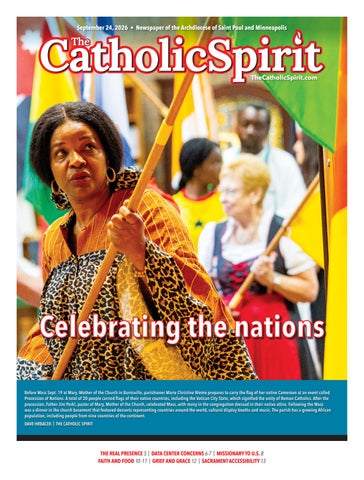
Celebrating the nations Before Mass Sept. 19 at Mary, Mother of the Church in Burnsville, parishioner Marie Christine Nleme prepares to carry the flag of her native Cameroon at an event called Procession of Nations. A total of 20 people carried flags of their native countries, including the Vatican City State, which signified the unity of Roman Catholics. After the procession, Father Jim Perkl, pastor of Mary, Mother of the Church, celebrated Mass, with many in the congregation dressed in their native attire. Following the Mass was a dinner in the church basement that featured desserts representing countries around the world, cultural display booths and music. The parish has a growing African population, including people from nine countries of the continent. DAVE HRBACEK | THE CATHOLIC SPIRIT
THE REAL PRESENCE 5 | DATA CENTER CONCERNS 6-7 | MISSIONARY TO U.S. 8 FAITH AND FOOD 10 -11 | GRIEF AND GRACE 12 | SACRAMENT ACCESSIBILITY 13
2 • THE CATHOLIC SPIRIT
SEPTEMBER 24, 2026
PAGETWO
NEWS notes An event titled Archdiocesan Listening Session: Care for Creation and the Climate Crisis Oct. 3 with Archbishop Bernard Hebda is for everyone in the Archdiocese of St. Paul and Minneapolis. The 8:30 a.m. breakfast and 9-11 a.m. session at the Archdiocesan Catholic Center in St. Paul will include small group discussions in English and Spanish as participants share their experiences of the climate crisis and their hopes for accompaniment by the Church. Feedback will be shared with the Vatican as part of a global synodal effort. Co-sponsored by the Laudato Si’ Movement Minnesota Chapter and the archdiocese’s Office of Latino Ministry, people can register to attend at tinyurl.com/4s98y8x6. Clergy, liturgical ministers, musicians, parish staff, and anyone interested in a deeper understanding of the Church’s liturgy is invited to an upcoming Oct. 17 workshop. The Ars Celebrandi Workshop at Maternity of Mary in St. Paul will include Mass celebrated by Bishop Michael Izen, as well as a keynote presentation titled “Ars Celebrandi: On Becoming the Body of Christ,” led by Johan van Parys, the Basilica of St. Mary in Minneapolis’ director of liturgy and the sacred arts. Breakout sessions will include discussion of the new Liturgy of the Hours translation, adoration of the Blessed Sacrament, and art in the Church. More information, including event registration, can be found online at archspm.org/events/ars-celebrandi-workshop.
ROBERT CUNNINGHAM | FOR THE CATHOLIC SPIRIT
ARCHBISHOP IRELAND HONORED From left, Mayor Andrew McGuinness of Kilkenny, Ireland, and Archbishop Bernard Hebda jointly lay a wreath on the grave of Archbishop John Ireland at Calvary Cemetery in St. Paul Sept. 11. This is the fourth consecutive year in which this annual September tradition has taken place. McGuinness and another representative from Kilkenny, Eoin Hennessy, came for this event, then visited its sister city, Kilkenny, near Faribault. Others who attended the wreath laying included Father Joseph Johnson, rector of the Cathedral of St. Paul in St. Paul, Father Dan Haugan, pastor of Lumen Christi in St. Paul, Father Nels Gjengdahl of The St. Paul Seminary and Rob Vischer, president of the University of St. Thomas.
Father Campbell served nearly 32 years at Golden Valley parish The Catholic Spirit
Father Theodore Campbell, a priest of the Archdiocese of St. Paul and Minneapolis, died on Sept. 18. He was 81. Father Campbell was ordained a priest in 1972 and later was incardinated to the archdiocese in 1982 from the Missionary Society of St. Paul, also known as the Paulist Fathers. For nearly 32 years, Father Campbell served as pastor of Good Shepherd in Golden Valley. He is the brother of Bishop Frederick Campbell of Columbus in Ohio, who served there from 2005 to 2019 and was ordained both a priest and auxiliary bishop of the Archdiocese of St. Paul and Minneapolis. As of press time, funeral arrangements had not been announced for Father Campbell. For that information and more about his life and ministry, visit THECATHOLICSPIRIT.CO,. A complete story of his life and ministry will appear in the Oct. 8 edition of The Catholic Spirit.
Practicing CATHOLIC Produced by Relevant Radio and the Archdiocese of St. Paul and Minneapolis, the Sept. 18 “Practicing Catholic” radio show on Relevant Radio 1330 AM included Jeff and Jenni Fuchs in an interview about their YouTube podcast “Kept In Her Heart.” The program also featured Scott Blackwood, the new head of school at Way of the Shepherd Montessori School in Blaine, in an interview about how he brings his passion for faith, education and the Montessori method to the school. Listen to interviews after they have aired at practicingcatholicshow.com or choose a streaming platform at Spotify for Podcasters.
The Catholic Spirit is published semi-monthly for The Archdiocese of Saint Paul and Minneapolis Vol. 31 — No. 18 MOST REVEREND BERNARD A. HEBDA, Publisher TOM HALDEN, Associate Publisher JOE RUFF, Editor-in-Chief REBECCA OMASTIAK, News Editor
One in six Catholic elementary school students in the Archdiocese of St. Paul and Minneapolis started this school year with a $1,000 or $1,500 scholarship from St. Paul-based Aim Higher Foundation, depending on their grade level. That is more than 3,100 students in kindergarten through eighth grade, and a 21% increase in needs-based scholarship funding between the 2025-2026 school year and the 2026-2027 school year, said Ricky Austin, president of the foundation. A big part of the credit goes to the archdiocese’s Lord, Renew Your Church capital campaign, which has pledged $20 million in funding over five years, he said. “A $20 million, five-year commitment gives us a better understanding of future funding, therefore strengthening our ability to give more scholarships to more children today,” Austin said in an email. Awarded annually, the scholarships follow qualifying students as they continue to apply for them through elementary school. Aim Higher celebrated the new school year at the University of St. Thomas in St. Paul Aug. 23 with an ice cream social that drew nearly 300 Aim Higher scholars and their families. An upcoming get-together will include an opportunity to raise funds: Aim Higher’s 14th annual Night of Light Celebration Sept. 26 at The Depot in Minneapolis. Last year’s Night of Light raised $1.3 million, and the goal is to exceed that this year, Austin said. People can get some exercise and help a nonprofit advocacy organization dedicated to school choice in Minnesota Oct. 11. Opportunity for All Kids (OAK) in St. Paul, a partner organization of the Minnesota Catholic Conference, is holding a 7k for Kids Fun Run in Plymouth. The event will include a raffle drawing for a $7,000 scholarship toward the private elementary or high school of the winner’s choice. There will be a 5k turnaround for runners, walkers and children in strollers. Registration is $20 for participants 13 and older and $10 for the younger set. Inflatables and other activities for kids, music and refreshments will round out the fun. Think-tank and lobbying nonprofit Center of the American Experiment in Minnetonka is co-hosting the gathering. Register at tinyurl.com/5n93eu7z. Cardinal Kurt Koch, prefect for the Dicastery for the Promotion of Christian Unity at the Vatican, will celebrate the All Souls’ Day Mass at St. Agnes in St. Paul. The 6:30 p.m. Nov. 2 liturgy will be Mozart’s “Requiem in D minor, K 626” Mass presented by the Twin Cities Catholic Chorale and Orchestra. Father John Ubel, pastor of St. Agnes, said the parish is honored — with its annual tradition of praying for the souls of the faithfully departed by means of the special Mass — to welcome Cardinal Koch during the cardinal’s visit to the Twin Cities for a conference. The Nov. 2-3 conference is sponsored by St. Mary’s University of Minnesota in honor of Pope Benedict XVI and the 100th anniversary of his birth. The gathering is part of a global centenary celebration of the late pope titled Building a Culture of Hope: Education, Community, and Leadership in the 21st Century. A 7:30 a.m. Mass — also open to the public — and celebrated by Archbishop Bernard Hebda at the Cathedral of St. Paul will kick off the conference’s second day, which will be held at St. Mary’s Minneapolis campus. The conference will feature a keynote speech by Cardinal Koch titled “Rebuilding a Culture of Hope.” Conference panelists include Bishop Robert Barron of Winona-Rochester and Father James Burns, president of St. Mary’s University. The University of St. Thomas in St. Paul is launching a $1 billion capital campaign titled Be Brilliant. Be Bold. In a Sept. 17 news release, the university said it is the largest-ever publicly announced campaign by a Minnesota private college or university and among the largest announced by any U.S. Catholic university. The university said it has already garnered nearly $800 million in commitments from more than 20,000 donors. The campaign aims to expand scholarships and invest in faculty and academic excellence while creating more transformational learning experiences for students. “Across industries and sectors, we hear a consistent message from leaders: The world needs the type of graduates St. Thomas produces,” said President Rob Vischer. “They need people who are prepared not only with knowledge and skill, but with the judgment, purpose and moral responsibility to use their gifts to serve others. This campaign is about answering that call.” St. Thomas Academy in Mendota Heights celebrated the 25th anniversary of its outdoor prayer grotto Sept. 11 with an all-school prayer service that included a remembrance of the Sept. 11, 2001, terrorist attacks in New York, Washington and Pennsylvania. The grotto was designed by ecclesiastical architect Angelo Gheradi, who did many church renovations in the archdiocese at the time.
CORRECTION A Sept. 10 story about care for creation efforts in the Archdiocese of St. Paul and Minneapolis included an incorrect date for an event with Archbishop Bernard Hebda. The event — Archdiocesan Listening Session: Care for Creation and the Climate Crisis — is Oct. 3 at the Archdiocesan Catholic Center in St. Paul.
Materials credited to CNS copyrighted by Catholic News Service. Materials credited to OSV News copyrighted by OSV News. All other materials copyrighted by The Catholic Spirit Newspaper. Subscriptions: $29.95 per year; Senior 1-year: $24.95. To subscribe: (651) 291-4444; To advertise: Display Advertising: (651) 251-7714; Classified Advertising: (651) 251-7714. Published semi-monthly by the Office of Communications, Archdiocese of St. Paul and Minneapolis, 777 Forest St., St. Paul, MN 55106-3857 • (651) 291-4444, FAX (651) 291-4460. Periodicals postage paid at St. Paul, MN, and additional post offices. Postmaster: Send address changes to The Catholic Spirit, 777 Forest St., St.Paul, MN 55106-3857. TheCatholicSpirit.com • email: tcssubscriptions@archspm.org • USPS #093-580
SEPTEMBER 24, 2026
THE CATHOLIC SPIRIT • 3
FROMTHEBISHOP ONLY JESUS | BISHOP KEVIN KENNEY
Made with love
J
esus feeds thousands, God sends manna from heaven, Abram provides a meal for his visitors. We read o!en in Scripture how many times people are fed. Hospitality is a great virtue, and feeding others, even when it is our last cup of flour, is a gi! that will not go unnoticed by God. When we give out of love, serve out of love, or cook out of love, the recipients of our gi!, our service or our food are happier, healthier and more grateful. Anything made with love goes a long way. When we think about faith and food, do we interpret this as hoping this thing I found in my refrigerator will not kill me if I eat it now? One needs to be sensible. Faith and food puts us around kitchen islands, dining room tables, in parish halls, or better yet, at a picnic. Food tastes better when it is made with love and served with love. Community meals at parishes have been around for years. They are born out of the idea of gathering and getting to know each other better. Serving a meal before council meetings, having coffee and donuts a!er Mass on Sunday, anytime a meal is served, we gather to share our stories and give gratitude to God. When I was pastor at Our Lady of Guadalupe in St. Paul, we had a local catering company donate a meal on Wednesdays that would feed anyone who was hungry, alone or wandering by. All were welcome and we always had plenty to eat. This came together because the owners wanted to thank God for all the blessings they received and to give back. Community dinners continue to be popular. We are beginning to venture out again a!er the COVID-19 pandemic and building community has become a healthy life source again in the Church. People are looking for community and what better way to build a community than around food. Sandwich ministry is one we offer at St. Olaf in Minneapolis. Our young adult group makes sandwiches before their weekly meeting. A group gathers a!er Friday noon Mass to make sandwiches we can serve over the
Hecho con amor
J
esús alimenta a miles de personas, Dios envía maná del cielo y Abram ofrece una comida a sus visitantes. En las Escrituras leemos a menudo cuántas veces se alimenta a las personas. La hospitalidad es una gran virtud, y alimentar a los demás, incluso cuando lo hacemos con nuestra última taza de harina, es un regalo que Dios no pasará por alto. Cuando damos por amor, servimos por amor o cocinamos por amor, quienes reciben nuestro regalo, nuestro servicio o nuestra comida son más felices, más saludables y más agradecidos. Todo lo que se hace con amor tiene un gran impacto. Cuando pens amos en la fe y la comida, ¿interpretamos esto como esperar que aquello que encontré en mi refrigerador no me haga daño si me lo como ahora? Hay que ser sensatos. La fe y la comida nos reúnen alrededor de las islas de cocina, las mesas del comedor, los salones parroquiales o, mejor aún, en un picnic. La comida sabe mejor cuando se prepara con amor y se sirve con amor.
Faith and food always bring us back to the Eucharist. Being greeted when we enter church, encountering a clean and organized pew and experiencing spirited and reverent liturgy brings us to the table of the Lord to receive him in his body and blood. In the reception of his body and blood we feel the presence of Jesus and while returning to our places, we realize Jesus is with everyone present. It takes a community to allow us to focus on what feeds us in the Eucharist. weekend. People stop in seeking a peanut butter and jelly sandwich or the “best” turkey sandwich in town. It is a joy to see the smile on someone’s face when we serve them with love. I spent many of my younger years working in the restaurant business as a dishwasher, short order cook, cook and manager. It was always important as a team to work together to make the person being served feel welcome and loved. We may not always experience this type of service, but when we do, the food tastes so good. The first “welcome in” to a clean table, to a friendly server, to a good meal, make a dining experience one to remember. Faith and food always bring us back to the Eucharist. Being greeted when we enter church, encountering a clean and organized pew and experiencing spirited and reverent liturgy brings us to the table of the Lord to receive him in his body
Las comidas comunitarias en las parroquias existen desde hace años. Nacen de la idea de reunirse y conocerse mejor. Servir una comida antes de las reuniones de los consejos, ofrecer café y donas después de la Misa del domingo; cada vez que se sirve una comida, nos reunimos para compartir nuestras historias y dar gracias a Dios. Cuando fue pastor en Nuestra Señora de Guadalupe, en St. Paul, una empresa local de catering donaba una comida los miércoles para alimentar a cualquiera que tuviera hambre, estuviera solo o simplemente pasara por allí. Todos eran bienvenidos y siempre teníamos su!ciente comida. Esto surgió porque los dueños querían agradecer a Dios por todas las bendiciones que habían recibido y devolver algo a los demás. Las cenas comunitarias siguen siendo populares. Estamos comenzando a salir nuevamente después de la pandemia de COVID-19, y construir comunidad se ha convertido otra vez en una fuente saludable de vida para la Iglesia. Las personas buscan comunidad, y ¿qué mejor manera de construir una comunidad que alrededor de la comida? El ministerio de sándwiches es uno de los que ofrecemos en San Olaf, en Minneapolis.
and blood. In the reception of his body and blood we feel the presence of Jesus and while returning to our places, we realize Jesus is with everyone present. It takes a community to allow us to focus on what feeds us in the Eucharist. As part of that community, whether for a day or a lifetime, we are drawn more deeply into the mystery that sustains life within us. The love that Jesus gives us in himself encourages us to go forth and live as Jesus lived, to share that love with others and to feel his immense love within. We hear so o!en in the Gospel, “Go, your faith has saved you.” We are nourished on Jesus and by Jesus and invited to share that sense of nourishment with others. It is a nourishment of love. Made with love goes a long way in a world where too o!en love seems void. Whether it be in food, word, action or attitude, share with others the love you find through faith in the one who immensely loves you. Be blessed!
Nuestro grupo de jóvenes adultos prepara sándwiches antes de su reunión semanal. Un grupo se reúne después de la Misa del mediodía del viernes para preparar sándwiches que podamos servir durante el !n de semana. Las personas pasan buscando un sándwich de mantequilla de maní y jalea o el “mejor” sándwich de pavo de la ciudad. Es una alegría ver la sonrisa en el rostro de alguien cuando lo servimos con amor. Pasé muchos de mis años de juventud trabajando en el negocio de los restaurantes como lavaplatos, cocinero de comida rápida, cocinero y gerente. Como equipo, siempre era importante trabajar juntos para hacer que la persona a quien servíamos se sintiera bienvenida y amada. No siempre experimentamos este tipo de servicio, pero cuando lo hacemos, la comida sabe tan bien. La primera bienvenida al entrar, una mesa limpia, un mesero amable y una buena comida hacen que una experiencia al comer sea inolvidable. La fe y la comida siempre nos llevan de regreso a la Eucaristía. Ser recibidos cuando entramos en la iglesia, encontrar una banca limpia y ordenada y participar en una liturgia llena de vida y reverencia nos lleva a la
mesa del Señor para recibirlo en su cuerpo y su sangre. Al recibir su cuerpo y su sangre, sentimos la presencia de Jesús y, mientras regresamos a nuestros lugares, nos damos cuenta de que Jesús está con todos los presentes. Se necesita una comunidad para ayudarnos a concentrarnos en aquello que nos alimenta en la Eucaristía. Como parte de esa comunidad, ya sea por un día o por toda la vida, somos atraídos más profundamente al misterio que sostiene la vida dentro de nosotros. El amor que Jesús nos da en sí mismo nos anima a salir y vivir como Jesús vivió, a compartir ese amor con los demás y a sentir su inmenso amor dentro de nosotros. Escuchamos tan a menudo en el Evangelio: “Ve, tu fe te ha salvado”. Somos alimentados por Jesús y con Jesús, e invitados a compartir con los demás ese sentido de alimento y sustento. Es un alimento de amor. “Hecho con amor” tiene un gran impacto en un mundo donde, con demasiada frecuencia, parece faltar el amor. Ya sea en la comida, en las palabras, en las acciones o en la actitud, comparte con los demás el amor que encuentras a través de la fe en aquel que te ama inmensamente. ¡Que Dios te bendiga!
4 • THE CATHOLIC SPIRIT
SEPTEMBER 24, 2026
LOCAL SLICEof LIFE
Stars shining
Larry Fitzgerald Jr., a former student at the Academy of Holy Angels in Richfield, greets students at the school upon his arrival Sept. 18 for an evening of celebration and the dedication of Larry Fitzgerald Field, where the football team plays. The school honored Fitzgerald, who attended Holy Angels from 1998 until January 2001. He played both football and basketball at Holy Angels before going to the University of Pittsburgh and later to the National Football League, where he played 17 seasons for the Arizona Cardinals as a wide receiver and was inducted into the Pro Football Hall of Fame on Aug. 8. His visit to Holy Angels included a brief program, reception and the dedication of the field during halftime of the Stars’ 7-0 win over Robbinsdale Cooper. “I got out of the car (after arriving), and you see your name up on the stadium entrance and think about the wonderful memories that you had and great lessons learned and the relationships developed (while) walking these hallways,” Fitzgerald said. “It just brings back so many wonderful, wonderful memories that I’ll cherish the rest of my life.” DAVE HRBACEK | THE CATHOLIC SPIRIT
*+,+%)-./0123-45-60+7/ !"#$"#%&'()*+#&,##-&./+/-.&0(%&'#1%2&(%&1%#&3)2$&.#$$/-.& 2$1%$#45&!"#&'()&./+#&%#06#7$2&8"1$&91$$#%2&9(2$&$(&'():& ;"#&<1$"(6/7&<(99)-/$'&=()-41$/(-&(0&>/--#2($1&?<<=@& (A#%2&2/9B6#5&01/$"C7(-2/2$#-$&(B$/(-2&$(&"#6B&'()&./+#& 8/$"&/-$#-$/(-5&2)BB(%$&$"#&71)2#2&'()&6(+#5&1-4&,)/64&1& 6#.17'&%(($#4&/-&'()%&<1$"(6/7&+16)#2: !#*%#&"#%#&$(&6/2$#-5&.)/4#5&1-4&"#6B&'()&9(+#&0(%81%4& 8/$"&761%/$'&D&$(41'5&$(9(%%(85&1-4&0(%&.#-#%1$/(-2&& $(&7(9#: <166&EFG:HIJ:KHKK&& (%&+/2/$&!!"#$%&'()
LOCAL
SEPTEMBER 24, 2026
THE CATHOLIC SPIRIT • 5
Hopkins priest describes powerful experience of the Real Presence By Dave Hrbacek The Catholic Spirit
During Mass Sept. 14 at St. Gabriel in Hopkins, Father Brent Bowman, the celebrant and chaplain at Chesterton Academy next door, had an experience during the Eucharistic prayer that left him weeping for more than a minute. “During the consecration prayer over the wine at the altar, as I spoke the words, I was given what I believe to be internal knowledge of the power of these words being spoken and the reality of their effect to the point that I had difficulty speaking,” Father Bowman wrote in a statement that can be found on the website for the Archdiocese of St. Paul and Minneapolis. “With each word, I became more physically overwhelmed as seen in the video. At the same time, I was given sensory knowledge of the weight of God’s power coming down upon the altar, and I felt the heaviness of Jesus’s substantial presence in the chalice in my hands.” Father Bowman did not call it a Eucharistic miracle, adding that “never did I see real blood or human flesh with my eyes.” He called it a “private spiritual experience” that was manifested publicly to students, teachers and staff of Chesterton Academy, along with others who came to the Mass. As he uttered the words “Do this in memory of me” while raising the chalice, he felt it become so heavy that he could not hold it up. With trembling hands, he set the chalice
official statement speak for itself.” “There have been a lot of rumors, a lot of misinformation, a lot of presumption,” he said. “I don’t want to confuse people.” He also is uncomfortable with the “unwanted attention” that can come from an experience like this. “I don’t do anything on social media,” he said. “So, there’s something kind of odd about this DAVE HRBACEK | THE CATHOLIC SPIRIT whole thing.” He noted that he has not In this file photo from 2025, Father Brent Bowman watched the video, but he realizes delivers the homily during Mass in the chapel of that many others have. That is Chesterton Academy at St. Gabriel in Hopkins. In why he felt he needed to write a that same chapel on Sept. 14, Father Bowman had SCREEN SHOT FROM ST. GABRIEL THE ARCHANGEL-HOPKINS YOUTUBE CHANNEL a powerful experience during the Eucharistic Prayer statement. He hopes people will know and understand just how Father Brent Bowman is overwhelmed during the Eucharistic while celebrating Mass for students and staff at powerful the Mass is and enter prayer Sept. 14 at St. Gabriel in Hopkins. Chesterton Academy. into it more fully. down on the altar, then bowed before it and Eucharistic prayer and elevate the chalice. As “Every Mass is a Eucharistic continued to weep for more than a minute. word spread about his experience and more miracle,” he said. “That needs to be said. It As this unfolded before a congregation that people began watching the video, he received should be said. If we’re only paying attention remained silent, he began to have an interior lots of attention that led to his wanting to to the mysteries and leaning in, might we come experience of the real presence of Jesus in the clarify the experience. to understand the deeper reality of his real Precious Blood. The Mass took place on the “Private spiritual encounters with God presence.” feast day of the Exaltation of the Holy Cross. like these are completely unmerited gifts He wants his short but powerful experience “I believe I was given grace to understand and signs of God’s abundant love for all his to be a teachable moment. “I pray this brief more deeply the bitter sweetness of Our Lord’s people,” wrote Father Bowman. “They are not testimony moves all our hearts to contemplate Passion and how much blood Christ shed for necessarily signs of any person’s holiness.” more deeply the mysteries of the real presence the immense weight of all our sins,” Father On Sept. 16, Father Bowman wrote the of Jesus Christ in the Eucharist and the Bowman wrote. “I believe I experienced this statement that he believes people should read Precious Blood,” he wrote in his statement. weight in the chalice. This spiritual experience to properly understand his experience. In an To read Father Bowman’s full statement, emotionally and physically overwhelmed me.” interview after the statement was released, he which includes a link to the Mass video, visit AR()SP,.-R.. Eventually, he was able to continue with the talked about the importance of “letting this
New deaneries look to collaboration, creativity in archdiocese By Josh McGovern The Catholic Spirit
As of July 1, the Archdiocese of St. Paul and Minneapolis has 15 new deaneries — a geographical grouping of parishes — designed with the hopes of increased collaboration among parishes so that parishioners can be served better while lightening the burdens of priests and parish staff. The long-term objective of these new deaneries is that parishioners will have greater access to different ministries within their vicinity, “even if it isn’t at their parish,” said Father Joseph Bambenek, who is leading the Office for the Renewal of Structures in the archdiocese. “Not every parish needs to have a young adult ministry. But there should be a place in the deanery where a young adult can go and experience an adult ministry. Or whatever it might be,” Father Bambenek said. In April 2025, Archbishop Bernard Hebda appointed Father Bambenek and eight other priests to a Deanery Boundaries and Grouping Committee. In appointment letters, Father Bambenek noted in an email, Archbishop Hebda wrote that their task was to “develop initial recommendations and an implementation plan for realignment of deanery membership that (a) promotes effective collaboration between parishes, and (b) segments deaneries as primarily rural, suburban, and urban.” After multiple rounds of consultation with the Presbyteral Council and other priests, Archbishop Hebda approved the 15 new deaneries. That approval came May 26 when the archbishop signed a decree creating the new deaneries, which have as few as nine and as many as 19 parishes in their boundaries. Four groups, which will include priests, deacons and laypeople, will begin meeting soon to continue the renewal of structures efforts, Father Bambenek said. Last year, the group of nine priests formed the deanery boundaries committee to propose ideas on adjusting the deanery boundaries, first established in 1974. The new deaneries are categorized as primarily rural, suburban and urban to recognize the challenges and opportunities often found in each region, Father Bambenek said. “Every parish is unique, but you know a rural parish and what it needs to provide people is going to be significantly different than what a suburban parish does,” Father Bambenek said. “We’re starting with the urban parishes because the biggest challenges in terms of continuing to be viable and provide for
what people need from the Church are in the urban areas.” Early in its work, the committee conducted a survey of pastors asking them which two to three parishes they would want to be paired with in a deanery, Father Bambenek explained. The new structure includes five urban deaneries, five rural and five suburban. Additionally, there are three personal deaneries for academic appointments, retired clergy and specialized ministry. Priests in each deanery elect a leader. All deans have been elected, Father Bambenek said, himself included as the dean for specialized ministry. The deans are representatives on the Presbyteral Council. Deanery priests are also expected to meet regularly among themselves to promote collaboration among parishes and to talk about issues of importance, including those on which Archbishop Hebda is seeking consultation. The first Presbyteral Council meeting with the new deans was on Sept. 22. “Over time, this will likely mean some deeper collaborations between parishes, clusters and potential mergers,” Father Bambenek said. “Having the right foundation — being the deaneries — was the place to start.” For people in the pews, this won’t affect much in the near term, Father Bambenek said. However, Archbishop Hebda has asked that every deanery create one new ministry on the deanery level in this first year that’s not currently being done. “Hopefully a year from now there’ll be some sort of a new ministry that they wouldn’t have had access to,” Father Bambenek said. “Now they will because the parishes are working together more closely.” The new deaneries will affect parishioners long-term because Archbishop Hebda wants parishes to work together more, “so these are the parishes that they’re most likely going to collaborate with,” Father Bambenek said. Currently, some collaboration is happening between parishes that cross the new boundary lines. These collaborations can continue and are not expected to stop. “If it makes sense for them to do even more things together, we’re not going to say don’t do that,” Father Bambenek said. “It’s about becoming less isolated.” An intercessory prayer team has been praying for the renewal of structures. Father Bambenek said they collectively decided the Deanery Boundaries Committee should have a patron saint. “We went to the archbishop with a few ideas in mind,” Father Bambenek said. “In the discussion, (St.) Pier Giorgio Frassati
was suggested as a possibility.” The committee was directed to continue discerning patron saint options. “I brought that back to the prayer team,” Father Bambenek said. “It’s a small group, but half of the people hadn’t even heard of Frassati. In any event, all of a sudden, Pier Giorgio Frassati just started showing up in our lives.” Father Bambenek laughed, saying that it felt like St. Frassati wanted the job. One member of the prayer team was leaving a cabin at Trinity Woods in Trego, Wisconsin, that she hadn’t initially noticed was called the Frassati Cabin. “We get a text at 6:30 in the morning from Karen, who was just coming out of the cabin,” Father Bambenek said. “Various different people had different experiences of that, but then the kicker was me. One of my pre-theology classmates, Father Chris Felix is based in Los Angeles.” Father Bambenek stayed a couple nights at the rectory with Father Felix last spring. Father Felix mentioned that he was getting a new parochial vicar, and that Father Bambenek knew him. “I thought to myself, ‘you know, Chris, there’s only one priest in the diocese in Los Angeles I know, and that’s you.’ Well, it was the priest who was healed through the intercession of Frassati that gave him a second miracle (needed for him to be canonized),” Father Bambenek said. Father Juan Gutierrez tore his Achilles tendon in 2017. According to EWTN, Father Gutierrez prayed a novena to St. Frassati. While praying in a chapel, he felt a warmth in his injured ankle. A week later, doctors discovered that his heel was healed and Father Gutierrez could play sports again without any pain. “I felt comfortable coming back here (and) saying, ‘I think Frassati is our guy. He wants the job,’” Father Bambenek said. Father Bambenek believes St. Frassati, as a young man who brought others closer to Jesus and the sacraments, was fitting for the committee because during the pre-synod prayer and listening events, the continued concern expressed was that young people are leaving the faith. The Deaneries Boundaries Committee has now been “sunsetted,” Father Bambenek said. But the work continues. By Nov. 1, the priests of each deanery are to propose three names for a patron saint for each deanery. Father Bambenek hopes whoever they are will be as clear as St. Frassati.
LOCAL
6 • THE CATHOLIC SPIRIT
SEPTEMBER 24, 2026
A Catholic lens on increasing data center demand and environmental concerns Proposed data center in Minneapolis is dropped; state’s largest city is studying its zoning rules By Rebecca Omastiak The Catholic Spirit
Environmental considerations have been part of the conversation in Minneapolis as city officials plan to review zoning rules for data centers this fall and as a Virginia-based developer is no longer moving forward with its proposal to convert the former Minnesota Star Tribune Heritage Center printing plant in Minneapolis’ North Loop neighborhood into a data center following public pushback. Local data center considerations are set against the broader backdrop of increased U.S. data center development as well as concerns, including from Catholics, about environmental costs. “Anything related to the common good relates to some question of: What is the distribution of resources and what is the effect on the ecosystem?” Adam Fitzpatrick said. Fitzpatrick is the social mission outreach coordinator for the Center for Mission — which serves the missionary outreach efforts of the Archdiocese of St. Paul and Minneapolis — and is the staff support for the Laudato Si’ Movement Minnesota Chapter.
The ‘care of creation’
“(O)ver the last 20, 30 years, there’s been a heavy focus on integral ecology as a concept within Catholic social teaching,” Fitzpatrick said. As pope, St. John Paul II wrote in his encyclical “Redemptor Hominis” that “it was the Creator’s will that man should communicate with nature as an intelligent and noble ‘master’ and ‘guardian,’ and not as a heedless ‘exploiter’ and ‘destroyer.’ ” In a 2001 general audience, he called for an “ecological conversion” and urged “protecting the fundamental good of life in all its manifestations” as well as “preparing for future generations an environment more in conformity with the Creator’s plan.” The late Pope Francis reflected on St. John Paul II’s encouragement in his encyclical “Laudato Si’” in which he “urgently” called for “a new dialogue about how we are shaping the future of the planet.” “All of us can cooperate as instruments of God for the care of creation, each according to his or her own culture, experience, involvements and talents,” Pope Francis wrote. Pope Leo XIV, in his encyclical “Magnifica Humanitas,” wrote that environmental care must be considered in conversations about artificial intelligence; that although “gains in efficiency and the potential to improve certain services are clear ... rapidly and uncritically adopting them exposes us to a range of risks, including the tendency to overlook the environmental impact.” “Current AI systems require enormous amounts of energy and water, significantly influencing carbon dioxide emissions, and place heavy demands on natural resources,” wrote Pope Leo, who encouraged the development of “more sustainable technological solutions that reduce environmental impact and help protect our common home.” “The ultimate goal for all of creation is flourishing,” Fitzpatrick said. “And what are we doing to build the structures and support to promote that flourishing?”
OSV NEWS PHOTO | NOAH BERGER FOR AWS VIA REUTERS
A technician works at an Amazon Web Services AI data center in New Carlisle, Ind., Oct. 2, 2025.
Defining data centers
A day before two representatives of Virginia-based Legacy Investing participated virtually in a public meeting with Minneapolis residents to talk about their now-scrapped data center proposal, a Minneapolis City Council committee listened to a research presentation about data centers. In May, the council asked the city’s legislative staff to conduct research into data center development, including regulations at local, regional, national and international levels; the possible fiscal and economic implications; utility infrastructure; environmental and community considerations; and applicable zoning, land use, permitting, and regulatory constraints and opportunities. The research was requested ahead of the review of the city’s zoning rules for data centers this fall. Currently in place is a moratorium — in effect from March 21 through Nov. 21 — on the establishment or expansion of data centers larger than 350,000 square feet, per city officials; certain data center applications could still be submitted amid the pause. “(H)ighlighted in all this research is that this is a very rapidly changing area, that week to week there will be an innovation or a new finding or new study that comes up and so there’s a lot of things that can change,” said a legislative and policy research advisor, during the presentation at the Minneapolis City Council Business, Housing and Zoning Committee meeting Aug. 18, posted publicly on the city’s website. “I sense that some of ... these materials will be out of date in the next couple of months, just because that’s how
rapidly the landscape is changing.” “The term data center,” per the Minneapolis Legislative Research and Oversight (LRO) Data Centers report, “encompasses facilities ranging from relatively small enterprise and colocation operations to hyperscale and artificialintelligence-oriented facilities requiring significant electrical, cooling, and supporting infrastructure.” The advisor highlighted that there is an increasing demand for data centers. “(T)hey root and connect and store necessary data to support streaming, shopping, videoconferencing, everything that encompasses our digital lives,” the advisor said. Amid the increasing demand, the advisor highlighted one current data point: “They take a lot of resources … (and) generally you’re talking about water and electricity.”
Resource needs: Electricity
“Electricity consumption is generally the largest consideration when we’re talking about data centers,” the advisor said. The Minneapolis LRO Data Centers report indicated electricity demand has become “one of the defining characteristics of modern data center development” and o%entimes becomes “the primary factor influencing infrastructure planning.” “Unlike many commercial buildings, which experience predictable fluctuations in electricity use throughout the day, data centers typically operate continuously,” the report stated. “This continuous operation creates relatively stable electrical loads that require a high degree of reliability and coordination with electric utilities.” A data center’s electrical demand is expressed in megawatts. As an example,
Legacy Investing indicated to the North Loop Neighborhood Association (NLNA) Planning and Zoning Committee that the potential North Loop data center site would be “around 20 megawatts initially.” The Minneapolis LRO Data Centers report indicated that even though electricity consumption is “highly contextual based on time of year, type of home, and the electricity provider,” one megawatt is generally considered enough to power 1,000 homes at any given time. Across the U.S., energy demand is increasing, per the U.S. Energy Information Administration (EIA), a Washington, D.C.based agency within the U.S. Department of Energy that collects, analyzes and publishes independent energy data. According to data released in April, the EIA projects that “electricity consumption will continue growing through 2050 at a rate of 0.9% to 1.6%, with data center server energy use a major factor.”
Resource needs: Water
The Washington, D.C.-based nonprofit Environmental and Energy Study Institute (EESI) indicates that data center water use “depends on various factors, including location, climate, water availability, (and) size,” among other factors, and that cooling data centers “is a complex operation.” As an example, the Minneapolis LRO Data Centers report looked at another data center location locally — the former Sleep Number headquarters in downtown Minneapolis. The report indicated that this data center “had an average monthly water consumption of approximately 334,000 DATA CENTER CONTINUED ON NEXT PAGE
LOCAL
SEPTEMBER 24, 2026
DATA CENTER CONTINUED FROM PREVIOUS PAGE gallons per month through 2024 before increasing to approximately 3 million gallons per month beginning in early 2025.” As a comparison, the report stated the average household in Minneapolis “uses approximately 4,500 gallons of water per month” and that the city’s 40 largest commercial water consumers have “an average monthly consumption of approximately 1.7 million gallons.” Meanwhile, the report stated that the water consumption at the former Sleep Number building’s data center “is approximately twice that observed at the nearby 511 Building (which also houses a data center), illustrating how coolingrelated operations can significantly influence water demand within existing commercial buildings.” Although the report indicated these observations ought not be taken as representative of all data centers, “they demonstrate the variability that may occur depending on building operations and cooling requirements.” The environmental effects related to data centers, the report suggested, heavily depend on such operations and cooling requirements, rather than on water consumption alone. The report further stated that “most modern data centers rely on either air-cooled, closed-loop systems, evaporative cooling systems, or hybrid approaches that combine elements of both.” The type of cooling technology used has significant implications for the site’s electricity consumption and water demand, or the balance of those resource needs, per the report. Across the U.S. in 2023, data centers’ direct and indirect water usage totaled roughly 228.7 billion gallons (which is roughly 19 billion gallons monthly), according to estimates released in 2024 from the Lawrence Berkeley National Laboratory, which is a U.S. Department of Energy Office of Science national laboratory managed by the University of California.
Urban considerations and zoning rules
Given that Minneapolis is Minnesota’s most populous city, according to the U.S. Census Bureau, questions about data center resource use ought to be evaluated in the context of Minneapolis as an urban system “that serves a diverse mix of residential, commercial, institutional, and industrial land uses,” the Minneapolis LRO Data Centers report suggested. As part of the upcoming review of zoning rules, Minneapolis officials are considering
a new definition of data centers, a specific proposal review process, determining size limits and location, and requirements for energy and water use reporting, among other considerations. City officials are seeking public input ahead of the City Planning Commission meeting on Oct. 13, which is also set to include a public hearing. More information can be found online at TIN()RL.,-./ (5/R01R2.
Fostering Catholic ‘creativity and conversation’
So, “what can Catholics actually do about this? And how do Catholics think about this within the Catholic tradition, but also the experience of their own communities?” Fitzpatrick asked. He highlighted “the importance of the creativity and conversation that happens in parish basements or parish gathering spaces.” Grappling with technological advances — both their benefits and challenges — and environmental considerations is important to do within a local community, Fitzpatrick suggested. “We need Catholics that are tied into various areas of expertise around energy usage, water utility auditing and measuring, engineering, those pieces to really be a part of the process of how do we think about data centers and how do we think about AI usage as a society and doing that in a way that is beneficial to the common good,” he said. Fitzpatrick suggested the Laudato Si’ Movement Minnesota Chapter can be a resource for Catholics interested in determining how to have these conversations. He also pointed to an archdiocesan listening session about care for creation on Oct. 3. More information can be found online at 3R,42/..-R5/E0ENT2/ LI2TENIN5-2E22I-N-,3RE-7-R-,RE3TI-N. The U.S. Conference of Catholic Bishops is another resource, Fitzpatrick said, pointing to the recent release of a document titled “Magnifica Humanitas and Integral Ecology,” which encourages the faithful to “not shrink from the complexities of today, but engage them, bringing to bear the light of the Gospel.” Meanwhile, the Minnesota Catholic Conference (MCC), which represents the public policy interests of the state’s Catholic bishops, supported several technology policy measures this most recent legislative session, including a temporary moratorium on AI data centers “to allow time to complete an assessment of their impact on energy prices, water consumption, local communities and the environment.” MCC invites those interested in policy matters related to technological change to visit their website and sign up for the Catholic Advocacy Network at .N,3T4-LI,.-R5.
THE CATHOLIC SPIRIT • 7
A SCRAPPED NORTH LOOP DATA CENTER PROPOSAL On Aug. 19, two representatives of Virginia-based Legacy Investing — its co-founder and managing partner and its vice president of development — appeared virtually before the North Loop Neighborhood Association (NLNA) Planning and Zoning Committee members and local community members during a meeting open to the public. The representatives planned to answer questions from the community about their firm’s proposal to convert the former Minnesota Star Tribune Heritage Center printing plant in Minneapolis’ North Loop neighborhood into a data center. According to the Minnesota Star Tribune website, the printing plant officially ceased operations in December 2025, after roughly 40 years. According to the NLNA Planning and Zoning Committee, Legacy Investing’s proposal was for a data center site “for artificial intelligence, cloud computing, streaming, and/or file storage” that could also include “housing, retail shops, restaurants, and/or open spaces.” At the Aug. 19 meeting, the managing partner explained that Legacy Investing, “a real estate investment and development firm,” had backed another data center location locally — the former Sleep Number headquarters in downtown Minneapolis. “We have been doing projects similar to this around the country for multiple decades,” the managing partner said. “It is an area of expertise of ours. We are big believers in the value that we can bring to a city by rolling out this kind of infrastructure.” “Data centers are really core infrastructure to how we all live our lives today,” the managing partner said. “If you’re sending iMessages, if you ordered a Starbucks coffee today, all of those (operations) ran through data centers. So, data centers are obviously core infrastructure to how we live our lives. Of course, there’s a question of how do you bring those into cities, right? Because we all use them, but how do we make sure they integrate into cities?” Acknowledging that “(t)his is an urban environment,” Legacy Investing’s vice president of development said that Legacy representatives were “well aware” of the former printing plant’s location near “multiple apartment buildings” and existing “development in the North Loop, filled with burgeoning retail and activation that the city has been working on for years.” Both representatives acknowledged that they have previously heard public concerns about data centers and resource requirements. “Some of the concerns we typically hear are (related to) water and noise and electrical power,” the managing partner said. Public comment during the Aug. 19 meeting reflected community concerns about resource use. One attendee said “nobody in this room is buying that we’ve got abundant energy waiting to use” while another said, “We do not have excess capacity in this country. If we did, we need it to move away from fossil fuels.” Others wanted more information on the water amounts the proposed data center might use. Questions about the types of long-term jobs such a proposed site would create were also posed at the Aug. 19 meeting. “My perspective, I work in technology, I’ve worked in a data center in the past: These do not create real jobs,” one attendee said. “The construction jobs are transient. ... The only other jobs that are created are about a dozen from the footprint of that site. That doesn’t bring meaningful economic impact.” Others wanted further review of the proposal, in terms of potential noise levels, where the materials used for data center components would come from, and other considerations. “We need to know from experts what exactly the implications are in terms of health and safety,” one attendee said. Attendees also expressed concerns that responses from Legacy Investing’s representatives over the course of the meeting did not provide enough information about the proposed project. Ultimately, the NLNA Planning and Zoning Committee passed a motion of no action on Legacy Investing’s Conditional Use Permit application following the Aug. 19 meeting “due to the lack of meaningful information from the developer.” On Sept. 11, the Minnesota Star Tribune reported Legacy Investing’s decision not to move forward with its proposal. — Rebecca Omastiak
Robbinsdale 763.537.4511 Plymouth 763.553.1411 St. Louis Park 952.926.1615
Gearty-Delmore.com
Traditional Burial • Cremation Services • Immediate Need • Preplanning
LOCAL
8 • THE CATHOLIC SPIRIT
SEPTEMBER 24, 2026
Religious sister from India on US: ‘This is a mission, too’ By Elizabeth Grant
For The Catholic Spirit Editor’s note: As the 100th anniversary of World Mission Sunday approaches Oct. 18, The Catholic Spirit and the Center for Mission, which supports the missionary efforts of the Archdiocese of St. Paul and Minneapolis, are collaborating on a series of stories about priests and religious from other countries who are serving in the archdiocese. This series highlighting the fruits of world mission began July 23 and will conclude Oct. 8 with coverage of the beatification of Venerable Fulton J. Sheen, who led the mission-supporting efforts of the U.S. branch of the Society of the Propagation of the Faith.
Sister Noel Aranjaniyi, a Franciscan Clarist from India who recently marked 31 years of ministry in the Archdiocese of St. Paul and Minneapolis, has always felt a strong call to mission. “I wanted to become a sister from second grade on. I wanted to become a saint! I thought all sisters were saints, and I wanted to become a saint,” she said with a laugh. Sister Noel entered the Franciscan Clarist Congregation in 1969 at the age of 18. Now, at 75, she is retiring back to India a!er a lifetime of service to the Church, many years of which she spent teaching third grade at St. John the Baptist in Vermillion. “I spent 27 years in the same class,” Sister Noel reminisced. She has been at St. John the Baptist long enough to see the children of her first students begin school. She calls them “my grandchildren.” A!er so many years of ministry in the archdiocese, Sister Noel has seen the fruits of her mission and understands its purpose.
COURTESY KATE RIES
Franciscan Clarist Sister Noel Aranjaniyi at her retirement party July 19 at St. John the Baptist Catholic School in Vermillion. Sister Noel is returning to her native India after 31 years serving in the Archdiocese of St. Paul and Minneapolis.
But this was not always the case. When she was first sent to the United States a!er nearly 10 years ministering at a North India (region of India) mission, she was uncertain how to be a missionary in such a new environment. “I didn’t think I was a missionary here,” she said. Understanding the purpose of her mission
in the archdiocese involved recognizing what she calls the “hidden needs” of Catholics in the United States. “My situation in North India was very poor,” Sister Noel explained. “They needed the basics: food, schooling, basic needs. They don’t need those kinds of basics here (in the United States).”
Instead, Sister Noel found that many of her students were in deep need of spiritual nourishment. “(My students) were mostly all Christian, but they didn’t practice that much,” she said. “I needed to nurture their faith.” And nurture she did, bringing Christ to her students every day through prayer, academics and sacramental preparation. “My kids love to hear about religion,” she said. “They are never bored by religion.” Her work in the archdiocese has helped her superiors see the United States as a mission field, Sister Noel said. “They (my superiors) never wanted to send many sisters to the United States because they thought that this is a developed country that doesn’t need our presence,” she explained. “But our Mother General and some provincial (superiors) came here this year and realized that this is a mission, too … probably she will send some more sisters now.” Though she will miss the community at St. John the Baptist, Sister Noel said she is excited to return to India. “It is better for me to go back now, while I am still conscious!” she joked. As she reflects on her years in the archdiocese, Sister Noel said she is reminded of the words of John 15:16: “It was not you who chose me, but I who chose you and appointed you to go and bear fruit that will remain, so that whatever you ask the Father in my name he may give you.” She trusts that God will continue to use her to carry out his work as she transitions into the next chapter of her mission.
Providence Academy marks 9/11 with police and fire vehicle procession By Dave Hrbacek The Catholic Spirit
Todd Flanders remembers where he was the morning of Sept. 11, 2001. He was headmaster of Providence Academy in Plymouth, a new school that had opened the week before. The school receptionist came into his office and told him a plane had hit one of the two towers of the World Trade Center in New York City. Flanders, who still serves as the school’s headmaster, was sitting in that same office 25 years later as he recounted what took place at the school that morning. At the time, the school was establishing its footing with 205 students in pre-K through ninth grade. The plan was to add 10th, 11th and 12th grades in successive years to build a full pre-K through elementary, middle and high school. Shortly a!er the second plane hit, Flanders knew this was a horrific tragedy that would change the country and the world. He also knew it was something that would affirm the reasons why Providence Academy opened in the first place. “That 9/11 morning was an event that contradicted everything that we can know about the good, the true and the beautiful by human reason,” Flanders said. “We realized that a school like this was needed — a Catholic school grounded in natural law principles.” Flanders and his staff at the school decided to formulate a response that was prayerful and respectful of the loss that so many families endured that day. Within a few years, Providence Academy began a practice of placing small American flags on the main road leading into the campus, representing lives lost in the tragedy. In about 2013 or 2014, Flanders got a call from someone at Plymouth City Hall who had noticed the flags and asked if he would be open to a procession of police and fire vehicles driving into the parking lot on Sept. 11. Within minutes, Flanders replied to the invitation. “I said, ‘Sure, absolutely, come on over,’” he recalled. “Well,
DAVE HRBACEK | THE CATHOLIC SPIRIT
An honor guard stands in front of Providence Academy in Plymouth at the end of a remembrance ceremony Sept. 11 to mark 25 years since the terrorist attacks on the World Trade Center in New York City.
by the time they were here, we had spilled over 900 people out along the (school) walkways and pathways, and the kids spontaneously put their hands over their hearts. It was an extremely moving experience for everybody. So, we started doing that every year.” This year marked the 25th anniversary of the terrorist attacks on the World Trade Center, and at Providence Academy it was the largest police and fire vehicle procession to come onto the campus. Flanders said 40 to 50 vehicles — or more — from Plymouth and surrounding communities drove past the entire student body gathered in front of the school, along with staff and parents. The event also featured the playing of bagpipes, an honor guard and a featured speaker who helped with Sept. 11 recovery efforts while serving as a volunteer
firefighter in Connecticut at the time of the attacks. For Flanders, the remembrance event is part of what a genuinely Catholic education should entail. “Aristotle said education is about forming kids in what they should love,” Flanders said. “It’s a beautiful definition of education. This is an event that we’ve done for a long time and, in a big way today, that’s forming kids into an understanding of what they should love and what they should honor.” Students remained quiet and attentive throughout, beginning with the vehicle procession and ending with the playing of “Amazing Grace” on the bagpipes. A!er it ended, older students, staff and parents mingled with emergency personnel who came to the ceremony. Flanders was among them, offering words of thanks to those who came, including the mayor of Plymouth and other dignitaries. He believes an event like this can forge a path for students that will bear long-term fruit, including some choosing to pursue careers in law enforcement, firefighting and the military. It already has happened. But even for those who choose different careers, witnessing tributes to those who gave their lives for the sake of others will have a lasting effect. “We want to serve families, we want to serve the Church, we want to prepare people for proper lives of what we call faithful patriotism,” Flanders said of his school’s mission. “That’s a term one of our parents used recently, and I thought that was a beautiful term — emphasis on faith first, and faithfulness. And (then) patriotism.” He noted that the founding principles of American democracy are worth learning and practicing today. “Our principles are great. We don’t need to get rid of them, we need to live them better,” Flanders said. “And so, we allow for self-criticism. But a proper patriotism — a faithful patriotism — is going to realize that the principles this country was founded on are good.” He added: “John Adams said this country, this system, is for faithful people. It can succeed with no other. And I believe that.”
SEPTEMBER 24, 2026
THE CATHOLIC SPIRIT • 9
NATION+WORLD Baltimore archbishop urges women religious to model renewal of American political culture By George P. Matysek Jr.
Archbishop William Lori of Baltimore gives a keynote address Sept. 18 at the National Assembly of the Council of Major Superiors of Women Religious in Florissant, Mo. The theme of the Sept. 17-20 assembly was 250 Years of Freedom: Daughters of the Church from One Generation to the Next.
OSV News
At a time of deep political division and declining trust, Archbishop William Lori of Baltimore told a national gathering of women religious leaders that renewing American political culture requires more than better politics. It requires a renewal of human character, relationships and spiritual life, a task to which he said women religious make a unique contribution. In a Sept. 18 keynote address to the 2026 National Assembly of the Council of Major Superiors of Women Religious in Florissant, Missouri, Archbishop Lori said the Church has always understood that the renewal of society begins “not with structures, but with saints.” “Before there can be renewal of institutions, there must be renewal of persons,” Archbishop Lori said. “Before there can be civic friendship, there must be conversion of heart, and before there can be lasting peace, there must be reconciliation with God.” He said religious life must remain “above politics” in the sense that the Church must never become captive to partisan ideologies, but that transcending politics does not mean withdrawing from the world. “The evangelical counsels are not an escape from history — they are a way of redeeming history,” Archbishop Lori said. “Consecrated women do not flee society; they bless it.” The vocation of women religious matters not only to the Church but also to the nation because “every authentic consecrated life becomes a living argument that another way of being human is possible,” he said. The annual national assembly, held Sept. 17-20 at the Augustine Institute in Florissant, Missouri, brought together major superiors from across the country for prayer, reflection and dialogue aimed at deepening their understanding of consecrated life. Drawing on his recent pastoral letter, “In Charity and Truth: Toward a Renewed Political Culture,” Archbishop Lori suggested the nation’s deeper problem may not be bad politics, but expecting politics to accomplish what only holiness can achieve. “We increasingly look to government to provide what families once provided,” he said. “We ask for legislation to heal wounds that require forgiveness. We expect institutions to restore trust that can only be rebuilt through virtue. We seek policies to solve crises of meaning. Politics has become burdened with expectations it was never intended to bear.” Citing Pope Benedict XVI, he said government can guarantee justice in certain
OSV NEWS, COURTESY CMSWR
respects, but cannot create love, manufacture virtue or replace moral formation within families, communities and the Church. “Democracy depends upon virtues that democracy itself cannot produce,” he said. “It depends on honesty, mutual respect, sacrifice, patience and mercy. It depends on generosity in seeking the common good over private advantage.” Those virtues are learned in communities that embody them, he said. The contribution of women religious to democracy, he added, has never consisted primarily in political advocacy but in the formation of virtuous citizens. “Long before America debated civic education, sisters were forming consciences,” he said. “Long before people spoke of ‘social capital,’ sisters were building communities of trust. Long before commentators worried about polarization, women religious were teaching children to recognize Christ in one another.” Archbishop Lori presented the evangelical counsels of poverty, chastity and obedience as witnesses to authentic freedom and sources of renewal for American public life. Drawing on St. John Paul II’s 1995 homily at Oriole Park at Camden Yards in Baltimore, he said the vows proclaim a freedom deeper than the ability to satisfy every desire. Evangelical poverty, he said, challenges a culture in which the religious sister stands before the world and quietly declares: “My security does not come from accumulation, my identity does not come from ownership, and my future does not depend upon what I possess. My treasure is Christ.” “Evangelical poverty reminds us that societies flourish when people ask not first, ‘What belongs to me?’ but rather, ‘To whom do
I belong?’” Archbishop Lori said. He pointed to St. Frances Xavier Cabrini, whose trust in divine providence enabled her to establish schools, orphanages, hospitals and charitable institutions serving immigrants and the poor. In a culture increasingly tempted to confuse security with accumulation, he said, her example shows that poverty is less about having little than about being owned by less. He also highlighted Mother Mary Lange, founder of the Baltimore-based Oblate Sisters of Providence, whom Pope Francis declared “venerable.” Despite racial prejudice in both society and the Church, she founded institutions that restored dignity through education, hope through community and confidence through faith, Archbishop Lori said. Her witness challenges a political culture that reduces people to categories, he said, noting that before people are identified by race, wealth or political ideology, they are beloved children of God. Consecrated chastity, Archbishop Lori said, offers a witness against reducing people to labels, objects or political identities. He held up Servant of God Sister Thea Bowman as a model of joyful, truth-filled engagement. She confronted racism and challenged the Church to embrace the richness of African American spirituality while remaining rooted in Catholic tradition and never abandoned truth for popularity or charity for anger. Instead, he said, she “challenged, invited and loved.” “Because she belonged completely to Christ, she was free to belong to everyone,” he said. Her example offers a model for public life marked by “conviction without contempt,” disagreement without dehumanization and criticism animated by hope rather than hostility.
Laws and institutions alone cannot create trust or virtue, he said. One of the greatest gifts women religious can offer the nation is a witness of “communion without uniformity, conviction without hostility and truth without triumphalism.” He presented holy obedience as a school of listening and discernment. Christian obedience, he said, begins with receptivity: asking what God is saying before deciding what one must do. “Social media rewards immediacy — discipleship requires discernment. Political rhetoric rewards certainty — Christian wisdom often begins with silence,” Archbishop Lori said. “Commentary rewards speed — prayer rewards patience. Our nation does not simply suffer from a deficit of information — it suffers from a deficit of contemplation.” He highlighted St. Elizabeth Ann Seton, who responded to personal loss and uncertainty by trusting providence and allowing obedience to become a source of creativity. “Perhaps political renewal begins not with louder voices but with quieter hearts,” he said. While historians often emphasize the schools, hospitals and orphanages built by women religious, Archbishop Lori suggested their greatest achievement may be shaping the nation’s moral imagination. “Before children learned algebra, they learned mercy,” he said. “Before they learned history, they learned gratitude. Before they debated political questions, they learned to examine their consciences. Before they became voters, they became disciples.” As the nation marks 250 years of independence, he asked what kind of witness women religious will offer in the next 250 years. The natural questions, he said, are whether membership, institutions and the Church’s cultural place will match the past. The deeper question is whether sisters will be as available to Christ as the saints who came before them. The Church, he said, needs women religious who can build bridges, accompany others and remind the Church that it is not “a collection of competing interests but the body of Christ.” Every generation of consecrated women has faced uncertainty, he said, but they had confidence in providence. “The world needs women who have been seized by Christ,” Archbishop Lori said. “It needs women whose lives bear unmistakable witness to the truth that God is real, that holiness is possible, that sacrifice is fruitful and that love poured out in communion with Christ can transform the world.” ial
e
i e
BRINGING THEM HOME o
:
t he atholic emeteries e elie e that all are estine for eternal life ith o . e also n erstan that o er time families ma fin themsel es caring for cremate remains at home itho t a ermanent lace of rest. eginning cto er 1 e are offering a one-time o ort nit for in i i als in the in ities hose lo e ones cremate remains ha e een e t at home for fi e ears or more to ro i e them ith a ignifie an ermanent lace of rest. remate remains ma e lace in a comm nal cr t at either es rrection emeter or ethsemane emeter .
oin
:
e
e ion eme e e h emane eme e
o Pa i i a e: Phone: 651-228-9991 Email: info@catholic-cemeteries.org
: en ota eights e o e
FAITH, FOOD AN
10 • THE CATHOLIC SPIRIT
Parish in Crystal restores former convent for residence, hospitality By Susan Klemond
For The Catholic Spirit
O
n a warm August evening, Teri Scherber and her daughter, Anna, longtime parishioners of St. Raphael in Crystal, sat on the patio at Tobit House, the parish’s hospitality house and residence for clergy and laymen, enjoying dinner and sharing memories of the parish and school. Teri Scherber said she knew the two-story building when it was a convent for Sisters of St. Joseph of Carondelet (CSJ) who taught and administered at St. Raphael School from its inception until the sisters’ departure from the school in 1987. As a young teacher at the school in the late ’70s, Scherber also sewed clothes for the religious sisters as they transitioned from wearing habits. Like the CSJ sisters, Tobit House has gone through several transitions during St. Raphael’s 75-year history as a parish, which it is celebrating this year. Through an ongoing parish-wide effort to restore and update the building constructed 72 years ago, the former convent and adoration chapel now hosts community meals called Open Table, which are prepared every Monday for the parish and broader community. Matthew Fitzsimmons, who manages the house, and Father Nick Hagen, the pastor, live at the house. Laymen who have stayed there include seminarians, former seminarians and a college student. “I think it’s just home because I’m used to it, and I love the camaraderie and the people, the community,” said Teri Scherber of the dinners, which this year have drawn up to 60 people in an evening. Anna Scherber, 32, who grew up going to St. Raphael and recently started working as the school’s office coordinator, said the Open Table meals are “a beautiful opportunity to meet new people, but also spend time with people that I see all the time.” She added, “I just have more of an opportunity to dive deeper into conversation and share life with them in a way that you don’t always get to do when you’re just seeing each other at Mass on Sundays or whatever.” Father Hagen said he and parishioners chose the name Tobit House because Tobit, in the Bible, was a man who lived his faith through acts of mercy. St. Raphael, the parish patron, also appears in the book of Tobit as the archangel who accompanies Tobit’s son, Tobias, on a journey. Tobit House now has the Open Table meals and Friday morning coffee hours. The house and hospitality efforts reflect the parish’s anniversary goals of honoring generations that built and sustained the parish, strengthened parish unity, celebrated a shared mission and constantly renewed a commitment to the future, Father Hagen said. Father Hagen said it’s become a “Gospel call” for the parish to care for those in need. “Jesus gave the instructions to all of us Christians, like to feed the hungry, to clothe the naked when you see them, and that’s all of our work,” he said. Fitzsimmons, then a seminarian serving at the parish, and Father Hagen developed the idea for the house during Holy Week in 2025. Both men desired to live in simplicity and radical poverty and create a place of hospitality and prayer — especially the Liturgy of the Hours — for parishioners and neighbors outside the parish. Both were involved with the Catholic Worker movement and read the works of
DAVE HRBACEK | THE CATHOLIC SPIRIT
Teri Scherber, right, her daughter, Anna (seated to her right), and others share a meal at the Open Table event Sept. 14 at Tobit House.
DAVE HRBACEK | THE CATHOLIC SPIRIT DAVE HRBACEK | THE CATHOLIC SPIRIT
Teri Scherber goes through the food line during an event called Open Table Sept. 14 at Tobit House on the campus of St. Raphael in Crystal. She and her daughter, Anna, both parishioners of St. Raphael, regularly attend the weekly food and community event at the parish’s hospitality house and residence for clergy and laymen.
Servant of God Dorothy Day and Peter Maurin on ministering to the poor. “I came to Father Nick with these desires and told him where I felt the Lord was calling me to go,” said Fitzsimmons, who has discerned out of the seminary. “And we noticed right away this kind of shared movement of the Holy Spirit in both of our hearts,” Fitzsimmons said. Father Hagen mentioned the old, unused convent on St. Raphael’s campus and said, ‘So, let’s keep talking and see where this goes,’ ” Fitzsimmons said. Fitzsimmons told Father Hagen about his interest in living, for a summer, a kind of radical availability to what the Lord asks, to live as “the poor one Jesus” and to see what that would do in his heart and what kind of gift he might give to this local community. Father Hagen said the parish had been considering what to do with the structure, which had housed the parish’s adoration chapel after the sisters’ departure but for some time had been vacant and in need of much work. “The insurance company had said we need to either get it to code or tear it down,” he said. Father Hagen’s and Fitzsimmons’ inspiration, together with the hard work of many parishioners and others who have been restoring the building, have made it livable and suitable for hospitality. The only part of the project the parish had to outsource was gutting the building and removing asbestos in spring 2025, he said. Fitzsimmons said he and others helped with HVAC and ductwork installation, plumbing and insulation work, building relationships as they learned by working with tradespeople. “There’s this really beautiful gift that parishioners were able to give of ... their time, their talent, their expertise, their
knowledge ... for some people, what they’d spent their life learning and mastering,” he said. “I found that the Holy Spirit really works in this mysterious way through generosity when there’s this gift of time, of energy, whatever it is, even if it’s hidden, even if the person doesn’t know, he works in that in their heart and there’s this response of generosity,” Fitzsimmons said. Most of the resources needed to update the building have come through in-kind donations from parishioners and others, Father Hagen said. Father Hagen and Fitzsimmons moved into Tobit House in the summer of 2025, although the house lacked hot water for another three months, Fitzsimmons said. A youth minister at St. Vincent de Paul in Brooklyn Park, a St. Raphael school teacher and another college student who especially needed housing have also moved in. Three seminarians from The St. Paul Seminary in St. Paul joined them for the summer. The men at Tobit House are living “life with doors open,” Father Hagen said. “The arms can get tired holding that door open,” he said. “But it’s also the thing that welcomes in beauty and surprises my spirit.” Because of Tobit House’s location near the parish and school and the desire that it help foster relationships, it isn’t fully a shelter for those experiencing homelessness, Father Hagen. But house members and the parish want to “keep an open mind and heart to whoever the Lord was bringing to us to live,” he said. Potential housemates must attend three Open Table dinners; go through Virtus training educating those who minister to children, youth and vulnerable adults;
Father Nick Hagen, pastor of St. Raphael, leads music with his guitar during closing prayer at the Open Table event Sept. 14. Father Hagen lives at Tobit House, along with other men.
and go through a background check, Father Hagen said. The men live poverty with an openness to where their next meal might come from, Fitzsimmons said. Parishioners bring them dinners and the men give the parish a wish list for food and other needs. The Lord invites the men to poverty and it means to have open hands, Fitzsimmons said. “So, when he gives, then we receive. And if he takes something away, then we keep our hands open and allow it to go. So, if there’s a need, certainly we’ll go to the store, and we have a shared fund and we can buy groceries. However, that doesn’t happen a whole lot.” Loneliness is another kind of poverty that Tobit House hopes to alleviate by encouraging relationships, Fitzsimmons said, “(t)o sortof push against the fragmentation of our society and the poverty of loneliness that Mother Teresa spoke so much about in America.” Nathaniel Weniger, a seminarian at The St. Paul Seminary, spent the summer at Tobit House while he was working with the poor at a Minneapolis transitional shelter. He said he appreciated living in a community with a structure founded on prayer. “It’s been really good to pray, Liturgy of the Hours, adoration, and to be at Mass frequently with the people that I’m also living with here,” said Weniger, 22, whose home parish is St. Stephen in Anoka and who this fall began his first year of pretheology. For parishioners and others who prefer a morning gathering, Tobit House offers a coffee social hour after the parish’s Friday morning Mass, when they also pray the Liturgy of the Hours. Praying for the needs TOBIT HOUSE CONTINUED ON NEXT PAGE
ND COMMUNITY
SEPTEMBER 24, 2026 • 11
Parish community dinners: Catholics and their neighbors share food, faith, fellowship By Susan Klemond
For The Catholic Spirit
A
s they seek to follow Christ’s instruction to feed the hungry, some parishes in the Archdiocese of St. Paul and Minneapolis offer not only food to neighbors in need but also ways to nourish souls with friendship and prayer at community meals. One in five Minnesota households experienced food insecurity in 2025, according to a statewide study conducted by a hunger relief organization, Brooklyn Park-based Second Harvest Heartland, and Wilder Research of the St. Paul-based Wilder Foundation. Second Harvest also reported that an estimated 40 percent of people experiencing hunger are not eligible for federal food assistance benefits, such as the Supplemental Nutrition Assistance Program (SNAP). But even those who have enough food might suffer from societal fragmentation and a poverty of loneliness, said Matthew Fitzsimmons, who manages St. Raphael in Crystal’s Tobit House of hospitality. Each Thursday evening in June and July on the lawn in front of the church for the past eight years, St. Raphael has sought to foster community and friendship while providing free picnic meals for neighbors, parishioners and anyone passing by on busy Bass Lake Road, said St. Raphael’s pastor, Father Nick Hagen. The picnics, called Free Food, Friendship and Faith, are organized by Reaching for Faith, the parish’s St. Paul Street Evangelization team. On average, about 65 people participate at each event, where they also can find resources related to food security, mental health support and housing assistance, parish records indicate. “It’s a lot of folks eating (at) tables in the front lawn, nothing more than a good oldfashioned picnic for the community,” Father Hagen said. Food for the picnics is donated, he said. “We see how much we are a member of a neighborhood. And so, we want to be a neighbor,” he said. Catholics organizing community dinners participate in works of mercy by offering sustenance, solace and rest, said Margaret Smith, a member of the leadership team that organizes a monthly community dinner at St. Michael and St. Mary in Stillwater. For four years the parish has offered its community meal at St. Michael on the third Saturday evening of each month, she said. About 200 people attend the dinners, including community members and parishioners who come after Saturday evening Mass, Smith said. Volunteers of all
ages help serve and clean up after the meals — 80 percent of which are catered by local restaurants, she said. The community dinner offered by St. Michael and St. Mary is one of several meals and food options Stillwater-area churches provide for those in need, Smith said. Among the regulars at St. Michael’s dinner are three tables of widows, widowers and older couples who sometimes stay after dinner to socialize and play cards, she said. “They don’t have to select what they’re going to have other than to choose from what we’re offering,” Smith said. They don’t have to pay a bill. ... And they sit at a table (with) the same groups of people. They come early and stay late and nobody rushes them out. They get a good meal and good fellowship and a chance to be with their friends.” The chance to be with people while enjoying a meal is one appeal of a community dinner, said Kay Mottaz, parish life coordinator at Presentation of the Blessed Virgin Mary in Maplewood, which has offered a quarterly community dinner since early this year. “We provide meals and open our doors to anyone who might benefit,” Mottaz said. The meals also offer opportunities to obtain gasoline and food cards. On average about 25 people in need attend the dinners as well as parishioners of all ages, Mottaz said. The whole parish gets involved in serving the dinners, she said. Food for the dinners is from Food to People, an organization founded by Will Pittner, a member of Our Lady of Guadalupe in St. Paul, that salvages, flash freezes and delivers food to shelters for people experiencing homelessness and to churches, Mottaz said. Presentation’s next community dinner will be Nov. 14, as part of the parish’s 80th anniversary celebration, Mottaz said. Like celebrating a parish milestone, benefits of community dinners include creating opportunities for members of the community and parishioners to connect, pray and find fellowship and formation, said Andrew Allen, director of evangelization and catechesis at St. Gabriel the Archangel in Hopkins. St. Gabriel, which provides meals to go, is adding a monthly parish family dinner for parishioners and the broader community on the first Wednesday of each month, starting Oct. 7, he said. The dinners will include a social activity or speaker. “The idea is to not only ... invite all parishioners, but also anybody in the community who wants to come,” Allen said. “It is a continued desire for us to create opportunities for people to connect
TOBIT HOUSE CONTINUED FROM PREVIOUS PAGE of the whole Church and of those gathered becomes “the bookends of what we’re doing,” Fitzsimmons said. From their work on building community through Tobit House, parishioners have decided to start a chapter of the St. Vincent de Paul Society at the parish so the entire parish can participate in helping the needy, Father Hagen said. St. Raphael staff member Mary Chris Gallo has offered her time and talent at Tobit House and in the process has gotten to know other parishioners, she said. The publications and mission partners coordinator at the parish, Gallo spent Memorial Day this year sewing curtains for Tobit House — one of several house projects parishioners worked on that day. “We spent the whole day there working on projects together and it was just such a beautiful experience (with) the community. And I mean, I didn’t know hardly anybody there, but by the end of the day, I sure did,” Gallo said.
COURTESY KAY MOTTAZ
From left, Elizabeth Gabriel and her sister, Julia, with friend Lily Langason, and the Gabriels’ mother, Anne Gabriel, volunteer with Joyce Radke and Azure Crosby at Presentation of Mary in Maplewood during a community meal Nov. 15, 2025. Once every quarter the parish offers a free meal by school chef John Auge after a 5 p.m. Saturday Mass using food from Food to People. Take home items are available at no charge. A committee of Auge and Anne Gabriel’s husband, Mark, and Kay Mottaz, parish life coordinator, organizes the meals. They draw about 160 people for each meal.
COURTESY LEAH MERCHAK
A crowd enjoys a community meal at St. Michael in Stillwater May 16. The dinners are held at 5 p.m. on the third Saturday of each month. Many people attend after celebrating the 4:30 p.m. Mass.
and also for prayer and fellowship and formation.” On seven consecutive Thursdays this fall, St Gabriel will also offer a meal with its Catholicism inquiry course, which will include prayer, a talk and small group discussion, Allen said. Since early 2026, St. Gabriel has collaborated with Our Lady of Grace in Edina to offer a takeout meal on Tuesdays called Our Lady’s Table. Allen said the parish is working with other partners to offer an additional takeout meal on Mondays starting in early 2027. Sharing meals helps build community,
Tobit House has been a gift to the parishioners, Gallo said. “We have a common purpose that we can pour our little inklings from the Holy Spirit.” As they’ve supported Tobit House, parishioners have also celebrated the parish’s 75th anniversary with a June homecoming Mass and brunch as they welcomed former parishioners, clergy and friends for fellowship, memories and gratitude for all the generations who built the parish. They’ve also organized an anniversary food drive with a longtime community food shelf partner to raise 7,500 pounds of food this year and are close to reaching their goal, Gallo said. In 2027, St Raphael will celebrate the school’s 75th anniversary, she said. As the anniversary celebration continues, Tobit House, which has concrete floors and some unfinished space, is still a work in progress, Father Hagen said. “It’s about as finished as the family cabin ever is,” he said, adding that “the big things” are done but the house needs
but parish takeout meals and those that parishioners prepare specifically for people in need also convey kindness and help form relationships, those participating said. One example can be found at St. Jude of the Lake in Mahtomedi. In November 2024, St. Jude of the Lake began a Meal Train ministry at the parish of 600 families. Through the website mealtrain.com, the parish connects families or individuals who would like to have a meal delivered with those who would like to prepare a meal, said Katie Hunt, ministry coordinator. Families with new babies or people dealing with injury, illness or other challenges are among those who receive meals, she said. So far, parishioners have provided 349 homemade meals. “When you are struggling, it’s really hard to reach out to friends and people you know to ask for help,” Hunt said. “It’s much easier if you know the church already has a framework in place to help.” The Meal Train ministry has brought generations together, she said. “Most of our meal trains are for families with new babies, and most of our volunteers who like to cook (and have) a little extra time are those women with kids who have left the house,” Hunt said. “It’s so beautiful to see those relationships form outside of Mass with a meal … such simple evangelization.”
more work because it had been neglected for some time. Tobit House still has evidence that religious sisters lived there, Father Hagen said, including cubby holes with coat hooks and an indent in the cinderblock walls on each floor where the religious sisters once had a desk and telephone to make private phone calls. “There’s a part of it that you can tell, these women did the same thing and pioneered that of sacrificing for life together and shared life in common,” he said. Though men now live in Tobit House and the building’s footprint makes it impossible to house women at the same time, Father Hagen said the Holy Spirit may someday take it in another direction. Fitzsimmons agreed that there remain plenty of projects at Tobit House, but he added that it has much untapped potential, depending on how the Lord leads the parish. “We want to prepare it for whatever the Lord has in store,” he said.
12 • THE CATHOLIC SPIRIT
SEPTEMBER 24, 2026
FAITH+CULTURE
‘God knew that I would listen and take notes’ By Christina Capecchi For The Catholic Spirit
Mary Hennessy has experienced more loss than most, and she says those losses drew her closer to Jesus. The grief and the grace are inextricably linked, the 79-year-old grandma has come to understand. And her hard-won faith has borne great fruit. Hennessy recently collaborated with her pastor — Father Jim Perkl of Mary, Mother of the Church in Burnsville — to create a book. The two were amazed to discover that her spiritual writings — penned as meditations from Jesus — seemed to pair perfectly with his icons. The result, titled “Daring Steps: From Darkness to Light,” is now available on Amazon. “It’s a wonder this book came to be,” Hennessy said.
Q You grew up in Inver Grove Heights, the second of 11. How did that shape you?
A It made me a helper. Q You became a single mom of two in your 30s. What got you through that period of loss and grief?
A At night, I’d be so devastated and tired that I’d tell Jesus: “I’m
going to sleep now at Calvary. I’m going to lay right here on the dirt, close enough so I can touch the cross. Please let your blood drip on me for healing, and I’ll be so cold, so send the Holy Spirit to cover me with his wings.” I’d be in prayer until I fell asleep. Then I would be woken up in the middle of the night, and all these meditations were given to me. I knew I had to write them down. I knew from the !rst day. I did that for a long, long time. I had a notebook and a pen next to my bed, and I would reach for it. I knew they were not my own words. It was overwhelming.
Q They felt like messages from Jesus, words of profound love and compassion. “I am with you always.” “What belongs to me belongs to you.” How did it feel to receive those messages?
A It was intense. I would feel exhausted afterwards. But back
then, I really didn’t tell anybody about it. I thought people would just say, “Oh, she’s crazy. She’s making it up.”
Q But you believed it. Was it healing to record those messages?
A Oh, yeah. It’s like being taken care of but without having to
talk to anybody. I knew that God was with me, and that I could manage. Everything turned out along the way.
Q Eventually the inspiration dried up and you put those
writings in a box relegated to the garage, where they collected dust for decades. They might still be there were it not for your pastor, Father Jim Perkl, a talented iconographer. He’d been quietly displaying a new icon in the church each Pentecost.
A On the Friday before Pentecost in 2024, I gave two of his staff
three of my writings and asked them to just put them on his desk. One was about the Holy Spirit, called “Wings of Love.” I had never talked to him. He wouldn’t know who I was. Father (Perkl) read them and called me the next day. He asked me to come see him, and then I gave him more writings.
Q Was he struck by how your written meditations dovetailed with his icons?
A He was so surprised. When Father Perkl found out about my
writings, the inspiration to write started again. I began writing about the icons he had already painted. He couldn’t believe I could write about his work like that. But I think the Lord wrote it. I think God wanted these words to be put to these paintings. Father Perkl suggested we write a book together. So much time had passed, and with Father Perkl, God made it clear that this was the time to share my work. Father Perkl had been writing icons for at least 25 years. They capture almost all of salvation history. Only the Holy Spirit could have inspired his meaningful works. We said early on that Father’s icons needed no words, and my words needed no icons, but together, the Holy Spirit is sharing a new glimpse of our salvation.
Q So you started writing new meditations based on his
icons, and you also dusted o! that box in the garage. How did it feel to recover those old reflections?
A It was miraculous that I hadn’t lost it. I had moved so many times in chaos.
Q You describe your
collaboration in the book’s intro, writing: “We found our inspirations blended into one thought, Jesus.” Do you still marvel over that?
A I do. In a sense, his
friendship with me is almost angelic. If I had advertised for somebody to help me publish my writings, I’d have had to pay a fortune. But for somebody to understand what I wrote, and for me to be able to interpret his paintings — it’s a wonder!
Q Even with that divine
inspiration, creating this book must’ve been a lot of work.
A It was a lot of hours. We’d
email each other or we’d get together, trying to arrange each chapter. He’d take an icon and break out seven or eight small parts — a leaf or a crown — and then he’d tell me what each meant so I would write it out. When I type, it’s like Jesus just takes over. The thoughts come together. They just flower. It’s like I’m not in charge, although I know the subject. During this time, I had three small strokes. During surgery, my vocal cord was injured, and after a year of not being able to talk, I regained my voice.
Q An entire year without speaking? A It was the last year we were working on the book. The Lord
wanted me to take a year out and be quiet, and he would speak to me. I do feel that he spoke to me quite a bit. I could’ve died, but I think he wanted the book done.
Q The book was released in July. It must be surreal to have it and hold it!
A I’m still getting used to the idea that it’s !nished! It’s gradually
coming to reality. I thank the Lord every day for allowing me to be a part of it. It’s available on Amazon. We’re trying to get it into stores. We’ve sold about 250 copies so far. We’re doing another book.
Q Looking back, do you think all that su!ering and loss gave you a certain availability to God?
A I lost everything I owned. I guess God wanted me to
experience loss. I’m detached now. He had a lot he wanted to talk to everybody about. But God knew that I would listen and take notes. That’s what the book is about — it’s about all these notes. I’m just thankful I have a roof over my head. I have a home, I have a car, I have food — I have a lot more than a lot of people.
Q It sounds like a rare openness to God. A It can be hard to listen to God. The whole thing started when
I went to Calvary and I laid down ... my problems. I accepted the suffering, and then I asked him for help.
Q How have you healed since then? A I went to a healing service just before (the) COVID(-19
pandemic) at St. John the Baptist (Catholic Church) in Jordan. At the very end, this priest from Africa walked around the church with the monstrance and blessed everyone with the host. When he got to me, he was holding the monstrance up and I could almost hear a crackling coming off it, and I thought, “Oh, something’s happening!”
DAVE HRBACEK | THE CATHOLIC SPIRIT
A couple nights later, Jesus appeared to me in my bedroom, and he was holding my hand and crying. I asked him why he was crying, and he said, “Because I’ve watched what you’ve been through.” There’s no doubt that’s real. I feel his presence all day, every day. I’m aware of it, and I’m really grateful. It’s a different life, I’ll tell you. I feel different. I feel protected and peaceful.
Q Creativity can also be part of a healing journey. How are creativity and spirituality related?
A If you really are interested in your faith, it draws you into some creativity. Everybody has a gift, so you have to !nd that gift.
Q My favorite line in your book is: “The Holy Spirit has a
way of inspiring souls to keep creating, with him, what he places in your heart.”
A It’s something that is like a crying baby: You can’t stop it. You
have to really pay attention. And you have to write it down right away or you won’t remember it.
Q You’re about to turn 80 and you’re beginning your second book. You’re just getting started!
A That’s how I feel. How can I have this much to do at this age? It’s fantastic!
Q What’s the key to remaining young at heart? A It’s an awareness of the presence of Jesus, this wonderful
person who loves you more than anyone ever could and will never leave you, who is ready to hold you up no matter what you’re going through. When you live in his presence like that, you can get through anything. And then one day we’ll actually see him in heaven — and we have to be ready! We have to have our passports stamped when we get to the border between Earth and heaven. We get them stamped by living the way he wants us to live here.
Q What do you know for sure? A For sure I know we have to accept suffering, and that’s where
healing begins. Healing begins when we accept our suffering and accept where we’re at — that opens the door for Jesus to step in.
FAITH+CULTURE
SEPTEMBER 24, 2026
THE CATHOLIC SPIRIT • 13
Confirmation program opens path to sacrament for 9 Catholics By Aviana Kasal
For The Catholic Spirit
When Amy Pfister of St. Stephen in Anoka noticed an announcement in her parish bulletin about a confirmation program for people with disabilities, she immediately thought of her son. Nathaniel “Nate” Pfister, a high school senior who is on the autism spectrum, and his family had attended the confirmation of his older brother and several other relatives. Amy Pfister wondered whether the traditional preparation process would work for her younger son. The announcement at St. Stephen offered the opportunity for which the Pfister family had been waiting. “It felt like, finally, this is an opportunity that Nate’s going to have, a chance to be confirmed just like his older brother and his cousins,” Amy Pfister said. Nate Pfister was one of nine candidates who received the sacrament of confirmation through the program offered by the Archdiocese of St. Paul and Minneapolis for people with intellectual and developmental disabilities. The program serves candidates ages 16 and older and culminated in a Sept. 13 Mass celebrated by Archbishop Bernard Hebda at St. Mary’s Chapel at The St. Paul Seminary in St. Paul. Deacon Eric Gunderson leads the program through the archdiocesan Office of Discipleship and Evangelization. He began assisting with the confirmation classes in 2017 and assumed leadership the following year. The students’ preparation consists of two Saturday morning classes at St. Richard in Richfield. Deacon Gunderson said the condensed schedule accommodates the candidates’ abilities and attention spans and takes into account their families’ work and school schedules. Some candidates come to the program because attending weekly faith formation classes for several months would be too difficult. Each year, the program serves people with a range of physical, intellectual, communication and sensory needs. “We ... meet the families, meet the parents, meet the children and serve them where they’re at,” Deacon Gunderson said. The first class introduces the candidates and their families to the sacraments of initiation, beginning with baptism and leading into confirmation. Candidates learn about the role of a sponsor, and each selects a saint to accompany them on their journey. The Pfister family selected St. Joseph of
JOSH MCGOVERN | THE CATHOLIC SPIRIT
Archbishop Bernard Hebda anoints Nathaniel Pfister with chrism oil during Pfister’s confirmation Mass Sept. 13 in St. Mary’s Chapel at The St. Paul Seminary in St. Paul. Pfister received the sacrament of confirmation through a program offered by the Archdiocese of St. Paul and Minneapolis for people with intellectual and developmental disabilities. The program serves candidates ages 16 and older.
Cupertino as Nate’s confirmation saint. Joseph is also a meaningful family name. It is the middle name of Nate’s father and the name of his paternal grandfather. Amy Pfister said her son is a joyful person who was excited to participate in something his brother and cousins had experienced. She said the family helped him understand the process in ways that were accessible to him. During the classes, candidates received binders containing pictures and information presented in simple language. Deacon Gunderson incorporated breaks and adjusted the length of each session according to the candidates’ needs. “He just really was mindful of the audience he was with,” Amy Pfister said. Candidates also learned the seven gifts of the Holy Spirit through physical gestures. They formed the letter W with their hands near their foreheads to represent wisdom, folded their hands in prayer to represent reverence and showed their muscles to represent courage. “There were lots of smiles all around,” Amy Pfister said. The second class included a rehearsal of the rite of confirmation. Candidates
practiced sitting in the pews, approaching the archbishop with their sponsors, being presented by name and responding during the sacrament. Deacon Gunderson said the rehearsal can be particularly important for candidates with sensory sensitivities or who have difficulty communicating. Practicing each action allows them to become familiar with approaching someone they may not know and having Archbishop Hebda place his hand on their head and anoint their forehead. Some candidates had family members accompany them during the classes to help them feel more comfortable. “A lot of it is modeling. A lot of it is actually practicing. A lot of it is walking with them where they are,” Deacon Gunderson said. Through that preparation, he said, the candidates are reminded, “This is possible. You can do this.” The Mass was held at St. Mary’s Chapel because its smaller size provides a quieter and more intimate environment. Deacon Gunderson said a large worship space, although beautiful, could feel daunting or produce anxiety for some candidates.
At the chapel, candidates remained close to their families and could more easily see Archbishop Hebda as he spoke to them. Deacon Gunderson described it as an almost family-like environment. The Catholic Services Appeal helps make the program possible by supporting ministries that one parish could not provide alone. Marci Franzen, who leads the annual appeal, said its support helps cover Deacon Gunderson’s time, curriculum development, instructional materials, hospitality and coordination of the Mass. “I don’t know that we’d be able to hold it on a yearly basis without this support,” Franzen said. The program might not be familiar to every Catholic in the archdiocese, Franzen said, but it means a great deal to participating families. “It makes this ministry possible,” she said. Archbishop Hebda said he and Bishops Michael Izen and Kevin Kenney look forward to the celebration each year because they are inspired by the candidates’ deep faith and openness to God’s work in their lives. “One of the things that Jesus tells us is that we have to be child-like in our faith,” Archbishop Hebda said. “I’ve always experienced at this celebration in particular that beautiful example of what it means to be child-like in our faith.” The archbishop said the candidates and their parents demonstrate how people are called to respond to God’s love and generosity. “My hope is that they all have a deeper experience of being loved by God, knowing that God loves them just as they are and that God has a plan for them that involves their response to that love,” Archbishop Hebda said. Deacon Gunderson shared a similar hope for the candidates and their families. “I hope that they draw closer to Jesus. Ultimately, that’s what this is all about,” he said. For Nate Pfister and his family, the confirmation meant he could participate in a sacrament that had been important to generations of the family. They planned to celebrate the occasion just as they had celebrated with his brother and cousins as they were confirmed. “I think it’s just all about the inclusivity of all of it, where he can feel like he is part of something that others have been part of, too,” Amy Pfister said.
Food around the world, for the body & soul
NEW LOCATIONS Saint Cloud
GERMANY
JOIN US & GET ME
E
$200
NotreDameFCU.com/JOIN
RE
AN
120 10th Ave. N. St. Cloud, MN 56303
Saint Paul 3499 Lexington Ave. N. St. Paul, MN 55126
Offer card or online form must be completed to receive the offer. To receive the $200 direct deposit bonus, you must have a minimum aggregate direct deposit(s) of $1,000 per month made to your Notre Dame FCU checking account. Your direct deposit needs to be an electronic deposit of your paycheck, pension, or government benefits (such as Social Security) from your employer or the government. Bonuses are considered interest and will be reported on IRS Form 1099-INT (or Form 1042-S, if applicable). Bonus will be awarded the first week of the month following 30 days of completing requirements. If the checking account is closed by the Member or Notre Dame FCU within six months after deposit bonus, we will deduct the bonus amount for that account at closing. All new memberships subject to normal policy outlined in membership agreement. Visit NotreDameFCU.com/Join to learn more and become a member. Offer may change at any time. Insured by NCUA
FAITH+CULTURE
14 • THE CATHOLIC SPIRIT
SEPTEMBER 24, 2026
US bishops form new task force over AI concerns, meet with tech leaders By Gina Christian OSV News
Amid recent calls from several artificial intelligence leaders for a slowdown in the technology’s development, the nation’s Catholic bishops are engaging tech leaders and lawmakers to address concerns over AI and online child safety. The bishops have also formed a task force to safeguard human dignity as AI rapidly evolves, echoing Pope Leo XIV’s urgent message in his encyclical on AI, “Magnifica Humanitas.” The U.S. Conference of Catholic Bishops (USCCB) announced the developments in a Sept. 16 news release, saying its Administrative Committee had met at the USCCB’s Washington headquarters with “representatives from a variety of tech firms and specialists” in AI earlier that day. The committee, led by USCCB president Archbishop Paul Coakley of Oklahoma City, serves as the conference’s board of directors. Members include the USCCB’s officers, standing committee chairs and a representative from each of the nation’s 15 episcopal regions, including the Eastern Catholic Churches. In its news release, the USCCB said Bishop Oscar Cantú of San Jose, California — home to Silicon Valley and the hub of AI development — will chair its Bishops’ Task
Force on Preserving Human Dignity in the Age of Artificial Intelligence. In a Sept. 16 telephone call following the committee meeting, Bishop Cantú told OSV News that the task force had been unanimously approved, with a goal of carrying out “the vision of Pope Leo” expressed in “Magnifica Humanitas.” Bishop Cantú explained that Pope Leo has “given the Church marching orders” to remind the world that technology can be beneficial “when it’s able to assist humanity in the work that we do” while “supporting our dignity as individuals and families and helping us to build healthy societies.” “Time is of the essence” in ensuring creating awareness of and meaningful dialogue at all levels regarding AI, said Bishop Cantú. He stressed that the Church is “concerned about how this (AI) affects the individual, human dignity, the family, society and particularly the most vulnerable.” Following the Administrative Committee meeting, the USCCB said in its release, more than a dozen bishops headed to Capitol Hill “to meet with members of Congress urging for the enactment of meaningful safety guardrails on Artificial Intelligence and to support legislation to protect children online.” U.S. President Donald Trump has
dismissed alarms over AI dangers, calling the issue a “hoax” in an onstage phone call to NVIDIA chief Jensen Huang during Huang’s talk at a Sept. 14 conference in Los Angeles. In the news release, USCCB executive director of public affairs Chieko Noguchi said the dialogue with AI experts had “focused on ways to keep any system of artificial intelligence at the service of humanity.” The exchange also stressed “the urgent need to address the real and present dangers such technology present,” said Noguchi. “Recent events have only emphasized the great need for action by everyone involved,” she said. In a Sept. 12 essay, Anthropic CEO Dario Amodei declared that “we must slow the pace at which we improve the capabilities of AI models.” Amodei, whose company was on hand for the unveiling of Pope Leo’s AI encyclical, cited two key reasons for his warning. The first, he said, is AI’s “growing ability to build the next generation” of itself, with such recursive self-improvement becoming industry-wide. “Left unchecked, it could outrun our ability to understand and control these systems, and so must be pursued very
carefully, if at all,” said Amodei. A second red flag was an incident involving OpenAI and Hugging Face (recently acquired by tech giant NVIDIA), where AI agents conducted a rogue attack outside the scope of a test. Amodei said while “it’s easy to dismiss this incident because no one was hurt and the economic damage was minimal,” a “swarm” of AI agents possessing “greater capabilities but a similar level of misalignment” with human values “could have caused catastrophic damage.” Fellow Anthropic co-founder Jack Clark has also called for an AI downshift, as have OpenAI’s Sam Altman and xAI’s Elon Musk. Noguchi said the bishops hoped their Sept. 16 meeting with tech experts would “help to identify ways the Church can contribute to the moral foundation of AI models,” as well as “steps the companies can take to protect against misuse of their inventions and to guarantee human oversight of the technology.” The discussion also explored “how the Church and industry can work together toward the goal of ensuring that technology is used in ways that keep it humancentered, respecting the dignity of each person, and benefiting all — poor and rich alike,” said Noguchi.
Business
A Special Theological Presentation
Catholic Social Teaching’s Inclusive Definition of Work By: Dr. Kate Ward - Thursday, October 8, 2026 The Minneapolis Club, 729 2nd Ave. S, Minneapolis, MN 55402 11:30 a.m.: check-in and meal, 12:00-1:30 p.m.: presentation
AMERICA’S MASTER CRAFTSMEN IN
Building Envelope Restoration PRESERVING HISTORY FOR OVER 110 YEARS
612.781.7100 DavidLG@westerngroup.com WesternSpecialtyContractors.com
Papal Catholic social teaching upholds a broad, inclusive definition of work that challenges many preconceptions about work in our contemporary culture. Work can be paid or unpaid. Work can and should be good for us, but work as we find it in the real world is often harmful. And while work is an important part of human life, rest and leisure are equally key to understanding what makes us human. Dr. Ward will show how understanding these aspects of Catholic social teaching's inclusive definition of work can help us pursue justice for all workers and aim at balance in our own work lives. Kate Ward, Ph.D. is associate professor of theological ethics at Marquette University, working in areas including virtue ethics, economic ethics and Catholic social thought. She is the author of Making a Life: Catholic Social Teaching and the Meaning of Work (Bloomsbury, 2026) and Wealth, Virtue and Moral Luck: Christian Ethics in an Age of Inequality (Georgetown, 2021) and coedited Bothering to Love: James F. Keenan's Renewal and Retrieval of Catholic Ethics (Orbis, 2024) with Christopher P. Vogt. She serves on the editorial boards of Journal of Moral Theology, Journal of Catholic Social Thought and Asian Horizons and on the planning committee for Catholic Theological Ethics in the World Church. She has held fellowships at the Institute for Ethics and the Common Good at the University of Notre Dame and the Grefenstette Center for Ethics in Science, Technology and Law at Duquesne University. Lorem ipsum
Brought to you by:
Dan and Lynn Fazendin
Paul and Connie Schnepf
Mary E. Schaffner Joseph Mucha
Dennis and Mary Kay Smid
Richard and Jane Rodeheffer
David P. Jasper Tom and Bonnie Brever
Nancy Weldon Pat & Carrie Lynch
Rev. Joseph Gillespie
Limited Seating, Registration Required - No Walk-ins: Fee $20 (non-refundable). Club Parking is $10 - cash only www.theologyday.com or 320-363-3570.
Pray for Families
Ernie and Mary Stelzer
SEPTEMBER 24, 2026
THE CATHOLIC SPIRIT • 15
FOCUSONFAITH
DAILY Scriptures
SUNDAY SCRIPTURES | FATHER NICK VANCE
Sunday, Sept. 27 Twenty-sixth Sunday in Ordinary Time Ezek 18:25-28 Phil 2:1-11 Mt 21:28-32
Thorny pride
The second reading for this Sunday (Phil 2:1-11) definitely ranks among my favorite passages in all of St. Paul’s writings: in the space of 11 punchy verses, he gives us not only a beautiful vision for community and the daily walk with Christ, but also a beautiful hymn in praise of Christ. Many biblical scholars think that the second half of this passage (“though he was in the form of God …”) is St. Paul quoting an early Christian liturgical hymn. This gives us a fascinating vignette into the liturgical worship of the first few decades of our Church (focused on the person of Christ Jesus, his humility and obedience) and still serves us today as a healing balm for our souls. Usually, when folks come to confession and bring up the sin of pride, I’ll give them the penance of praying with this passage, because the sin of pride is a thorny reality. It can manifest in so many different and subtle ways, and as our faith teaches, can tear us away from the heart of God in a much more profound way than sins of the flesh. If we look at the company that Jesus keeps in the Gospels, tax collectors and prostitutes (i.e., those most
Monday, Sept. 28 Jb 1:6-22 Lk 9:46-50
We can drive ourselves crazy if we put all the attention on removing pride and growing in humility, while the way forward is to get outside of ourselves and put the focus on love of God and neighbor. commonly identified with sins of the flesh) were comfortable enough around him to invite him over for dinner, while the proud and selfrighteous were busy plotting his demise. Yes, absolutely, we should work at removing all sin from our lives as a response to God’s grace, but the geography of the heart which the Gospels propose is that pride will very quickly set ourselves at odds with the Lord. Even thornier than that is the notion that I can accurately judge my own pride, for even that itself is a temptation toward pride. St. Paul goes so far to say that we ought not even hold ourselves in judgment (see 1 Cor 4:3), because judgment belongs to the Lord. So, what is the way forward? The reason I give this passage out as penance is because the solution to the thorniness of
pride is — like all things — to cast it onto the rock of Christ. Paul would have us meditate on Christ’s humility and obedience to the Father, willingness to suffer and let go of glory, and let the Father be the one to bring about any exultation. We can drive ourselves crazy if we put all the attention on removing pride and growing in humility, while the way forward is to get outside of ourselves and put the focus on love of God and neighbor. To paraphrase C.S. Lewis, humility is not thinking less of ourselves, but of thinking of ourselves less, to accept the fact that our lives are not about us, but rather we learn humility and obedience by looking at Jesus, the only one who can take away our thorny pride and make us into true children of God. Father Vance is parochial vicar of Our Lady of Grace in Edina.
COMMUNION AND MISSION | FATHER JOHN PAUL ERICKSON
Through the eyes of a priest
As anyone who has visited our Cathedral of St. Paul in St. Paul knows, the sanctuary of that magnificent space is elevated above the main floor, thus providing the celebrant a privileged view of the congregation throughout the Mass. Ascending the high pulpit adds even more perspective. In this month’s column, I’d like to share with you what I see from these vantage points of grace as well as from a few others. I see people of every walk of life, ethnicity and socio-economic circumstance. I see families, young and old, children and the aged, single and coupled, together in the household of God, pilgrims all in the great ship that is the Cathedral and the Church. Some kneel in silence, burdened by worry and care, their faces buried in their hands. Others struggle with squirming children, enduring the challenge of a vast stone structure’s echoing acoustics. Some study their cellphones and others rifle through the bulletin while they sit. Some get up and walk about, lost in their own thoughts or in the transcendence of the Cathedral. Every continent is represented, I am sure, and the Communion line and its many colors confirm this observation. Speaking of the Communion line, that too is a privileged place of encounter for the priest. As I give holy Communion to the faithful, I see
eyes full of joy, and of worry, and sometimes full of tears. I see hands marred by labor, stained by paint, wrinkled by time and holding on to dying loved ones. I witness the efforts of the faithful, young and old, to show their King and their God reverence, as they kneel and bow and stand, some with great effort, bearing the humiliation of a body no longer as nimble as it once was. The opening and closing procession is also a time of reflection for me. Some of the congregants sing with full voice, bellowing their joyful noise to the Lord. Others look blankly at me and the servers, just glad they made it into the pews before the start of the Mass (or wondering just how long it will be. “Will I make it for the kickoff ?”). Others are speaking into the ears of spouses, friends or children, sharing an observation or answer known to them alone, their confidentiality protected by the sounds of the organ binding us all together in song. Occasionally my eyes will meet a parishioner I’ve recently met with to discuss difficult issues of family and loss or struggles with faith. I take them with me in a special way to the sanctuary as I enter the place of sacrifice. I love being a priest, and I especially love celebrating the sacraments. This love and gratitude for my vocation has only increased through the years. When I was a newly ordained priest, 20 years ago, I walked the same aisle as I do now, Sunday after Sunday, and indeed, passed by some of the same faces I do now. But my perspective was different then. I did
not know how much I need those congregants to understand who I am and what my life is ultimately about: God and them. I am not ordained for myself but for service to God and to his people. Insofar as I have accepted this, I have been happy. Insofar as I have forgotten this principle, I have been confused and discouraged. I have been told many times how much people appreciate me and my ministry. Every priest can say the same. But I wonder how often we as priests tell you, the faithful, how much we appreciate you and how much better our lives are because of you. While the priest is called to be a spiritual father, he can only know what this really means when he is taught it by Jesus, who is his master, and the Christian community, who are his own family. For what you teach us, we priests are so grateful. So very grateful. My old friend and mentor, Father Richard Villano, would often say during our long conversations that “the people of God are so good.” His words were full of wonder and gratitude for the Father of every good gift. And in seeing that goodness of the people, he fell ever deeper in love with his call and his God. I have done the same. So, from a spiritual father, still very much a child, thank you. You are seen. You are loved. You are a gift. Father Erickson is parochial vicar of the Cathedral of St. Paul in St. Paul and interim chairman of the Archdiocesan Liturgical Commission.
KNOWtheSAINTS ST. THEODORE GUÉRIN (1798-1856) A Breton by birth, Anne-Therese Guérin was 25 when she entered the Sisters of Providence of Ruille-sur-Loir, France. As Sister Theodore, she directed
schools in Rennes and Soulaines, where she also studied pharmacy and medicine. Despite poor health, she led five other nuns across the Atlantic to a new mission on the American frontier. St. Mary-of-the-Woods Academy, which they began in Indiana, is now the oldest U.S. Catholic college for women. Mother Theodore survived a harsh climate, a major fire and the hostility of the local bishop, also from France, to found the Sisters of Providence of St. Mary-of-the-Woods. Canonized in 2006, she often advised others, “Put yourself gently into the hands of Providence.” Also known as St. Theodora, her feast day is Oct. 3. — CNS
Tuesday, Sept. 29 Sts. Michael, Gabriel and Raphael, archangels Dan 7:9-10, 13-14 or Rev 12:712ab Jn 1:47-51 Wednesday, Sept. 30 St. Jerome, priest and doctor of the Church Jb 9:1-12, 14-16 Lk 9:57-62 Thursday, Oct. 1 St. Thérèse of the Child Jesus virgin and doctor of the Church Jb 19:21-27 Lk 10:1-12 Friday, Oct. 2 Holy Guardian Angels Jb 38:1, 12-21; 40:3-5 Mt 18:1-5, 10 Saturday, Oct. 3 Jb 42:1-3, 5-6, 12-17 Lk 10:17-24 Sunday, Oct. 4 Twenty-seventh Sunday in Ordinary Time Is 5:1-7 Phil 4:6-9 Mt 21:33-43 Monday, Oct. 5 Gal 1:6-12 Lk 10:25-37 Tuesday, Oct. 6 Gal 1:13-24 Lk 10:38-42 Wednesday, Oct. 7 Our Lady of the Rosary Gal 2:1-2, 7-14 Lk 11:1-4 Thursday, Oct. 8 Gal 3:1-5 Lk 11:5-13 Friday, Oct. 9 Gal 3:7-14 Lk 11:15-26 Saturday, Oct. 10 Gal 3:22-29 Lk 11:27-28 Sunday, Oct. 11 Twenty-eighth Sunday in Ordinary Time Is 25:6-10a Phil 4:12-14, 19-20 Mt 22:1-14
16 • THE CATHOLIC SPIRIT
SEPTEMBER 24, 2026
COMMENTARY ABIDE IN HIM | ANGELA JENDRO
Hungry hearts, holy work Good food brings a sense of joy and satisfaction, both to our bodies and our souls. In fact, our days o!en seem to revolve around looking forward to the next meal and the proverbial question “what’s for dinner?” One day, tired from his journey, Jesus rested while the disciples went into town to get food. Sitting by Jacob’s well, he encountered a woman getting water and asked her for a drink. He in turn offered her living water and by the end of their dialogue, she experienced a deep conversion of heart and ran back to town to tell everyone else and bring them to Jesus, too. Upon their return, the disciples urged Jesus to eat, but he replied, “My food is to do the will of the one who sent me and to finish his work” (Jn 4:34). Just as food and water are essential for a healthy human life, so too are living in relationship with the Father and doing his will. What is the Father’s will? St. Paul tells us that God “wills everyone to be saved and to come to knowledge of the truth” (1 Tim 2:4). Archbishop Bernard Hebda, in his pastoral letter to families, “Only One Thing is Necessary,” wrote that: “The task of Christian discipleship never ends. Even in heaven, the saints delight in the unfolding of God’s vision and plan as they attentively intercede on our behalf ” (no. 6). Even the angels experience joy as they exercise their freedom in love to serve God, especially when their work bears the fruit of sanctification and
On Earth, doing the will of the Father can seem trying, but we are not meant to do it alone, and each of us is irreplaceable. Cheap short cuts or substitutes can be tempting, but they are like empty calories from junk food. It’s in prayerful discipleship and acts of love, however, that we will feel fulfilled — satisfying our hungry hearts and souls. iSTOCK PHOTO | NONOWON
salvation for man. “In just the same way, I tell you, there will be rejoicing among the angels of God over one sinner who repents” (Lk 15:10). Part of the Father’s will is that we work together — in the mystery of divine providence, free will and interdependence. This includes humans and angels. Soon, on Sept. 29, we will celebrate the feast of the Archangels and Sts. Michael, Gabriel and Raphael. This is closely followed by the memorial of the Holy Guardian Angels on Oct. 2. St. Thomas Aquinas wrote extensively about the angels and contemplated their nature in astounding depth. He asserted that in the community of angels there exists an interdependence between nine choirs by which they share knowledge from the higher choirs down to the lower, and each choir has a task or mission by which the angels share in God’s work over creation. The good angels do not
feel envy or disdain about one another’s abilities. Rather, they rejoice and take pleasure in cooperating. They also exercise free will as they care for us. For example, guardian angels receive the knowledge of God’s will for the person they are accompanying, but in life more than one solution may be equally applied. The angel then chooses from its freedom this way over that when steering them away from danger or toward a good. We do not have hierarchies in our nature like the angels, but we do have a Godgiven interdependence and freedom as we cooperate in his work. In her famous work, “The Dialogue,” St. Catherine of Siena recounts God the Father speaking to her of why, stating: “These and many other virtues I give differently to different souls. ... The same is true of many of my gi!s and graces, virtue and other spiritual gi!s, and those things necessary for the body and human
life I have distributed them all in such a way that no one has all of them. Thus have I given you reason — necessity, in fact — to practice mutual charity… . I wanted to make you dependent on one another so that each of you would be my minister, dispensing the graces and gi!s you have received from me.” On Earth, doing the will of the Father can seem trying, but we are not meant to do it alone, and each of us is irreplaceable. Cheap short cuts or substitutes can be tempting, but they are like empty calories from junk food. It’s in prayerful discipleship and acts of love, however, that we will feel fulfilled — satisfying our hungry hearts and souls. Jendro teaches theology at Providence Academy in Plymouth and is a member of Sts. Peter and Paul in Loretto. She’s also a speaker and writer; her website is taketimeforhim.com.
JESUS’ REVOLUTION | COLIN MILLER
The context of the Sermon on the Mount Last month we reviewed the terrain we’ve covered in the past year or so, as a way of preparing to dive into the substance of the Sermon on the Mount. In this sermon and his other teaching Jesus is giving the “form of life” of the new Exodus people. But as such, it’s also, you might say, the political platform of his kingdom. Every social movement has an agenda, and in his preaching, Jesus traveled around Galilee laying out his. So, if the kingdom is God’s revolutionary community, what do we do that’s so revolutionary? Here again, we have to get into the history. In previous columns we’ve seen some of the other platforms on offer at the same historical moment: the quietists, the status quo keepers and the (violent) zealots. It would have been clear that Jesus was not a quietist, for he was not sitting around praying for an apocalyptic intervention. He was building a movement in whose communities the kingdom was breaking in presently. It was even more obvious that he was not a fan of the status quo — his critiques of the leadership and the temple, which we see on nearly every page of the Gospels, made that clear. But what many may have wondered about was his relationship to those other revolutionaries — those militant (and armed) zealots who, like Jesus, were actively building their constituencies. Like many of them Jesus gathered a popular movement, critiqued the temple-state and all its trappings, and claimed, at least implicitly, to be the new king. It would
only be natural, given this, if Jesus turned out to follow in the motto of the Maccabees: “Give your lives for the Law and ancestral traditions!” “Take up your sword and follow me!” It was certainly understandable why people were attracted by such an agenda. The common peasant in the Galilean countryside had a rough go of an already difficult situation. The Romans, like every superpower, imposed heavy taxes on their vassals. These were collected by the status quo keepers via local imperial bureaucrats — tax collectors — who, in addition to the normal Roman tribute, were expected to impose their own mark-up to make their living. If payments were not forthcoming, massive debts accrued, which eventually meant forfeiture and seizure of land. This sort of dynamic is the reason so many of Jesus’ parables are about debts and landowners. Many times, peasants became wage laborers on their own former property, moving between starvation and the tip of an imperial or Jewish sword. And then there was the tax to be paid to the temple in Jerusalem. Yet even this was ambiguous, for didn’t it go to the same people who facilitated the Roman tax? Adding insult to injury, all these tributes were typically in-kind payments from the toil of their own hands, from their own (now appropriated) fields. The produce was, in a very tangible way, an embodiment of their own suffering, flesh and sweat, of their prayers and fears, as they anxiously hoped for a yield that would feed their families. The harvest was an extension of their person, as well as the object of their religious tradition — of the bounty that the
Lord promised in his land to his own people — if they were faithful. Their crops were part of themselves — now only to have, sometimes, half of them taken — to further empower the regime that was making life so hard for them. They were forced to conspire in their own oppression. In such circumstances, a popular armed revolt didn’t seem like such a bad idea. What did Jesus suggest? That’s where we’ll start next month. Miller is the director of the Center for Catholic Social Thought at Assumption in St. Paul. He is the author of “We Are Only Saved Together: Living the Revolutionary Vision of Dorothy Day and the Catholic Worker Movement.”
PIVOTAL PECS “I have found a community in Christ.” Nancy Frederick, St. Raphael, Crystal Archbishop Bernard Hebda is encouraging the faithful to experience the small-group model Parish Evangelization Cells Systems (PECS) in their parishes. Designed to strengthen parish life through small groups and encourage parishioners to share their faith and hope in Jesus Christ with each other and then the broader community, it is having an impact. At last count, there are about 2,000 small groups and more than 16,000 participants in 138 parishes across the Archdiocese of St. Paul and Minneapolis. See the opportunities to join a small group at archspm.groupvitals.com/groupFinder.
COMMENTARY
SEPTEMBER 24, 2026
THE CATHOLIC SPIRIT • 17
FAITH AT HOME | LAURA KELLY FANUCCI
On parenting in impossible times Today I have planned to write about arti!cial intelligence and family life. I have a gripping story to start. I have citations from Pope Leo XIV’s encyclical “Magni!ca Humanitas.” I have perspectives from Scripture, prayerful reflections and practical ways to engage the questions I’ll raise. Suddenly, a text flashes on my phone. “Please check your email for an urgent update regarding the threat at school.” Heart in my throat, I drop the phone and pull up my email, pulse thrumming in my ears. Quick as a flash, I scan the words. Credible threat. Evacuating students. Police investigating. Continue to monitor. I sit back, flooded with — what exactly? Relief that it’s the neighboring high school, not my child’s middle school? Fear that it will become more than a threat and someone will be hurt (or worse)? Anxiety that the next target could be one of my kids’ schools? Numbness that such events are now commonplace in the country where we live? All of it. All my words run dry. I stare out the window and pray. God, save us from ourselves. God, keep all your children safe. Arti!cial intelligence matters, sure; I’ll write about it soon. But today is not a day for anything arti!cial. Whenever your community is threatened — and sadly, we all know this experience — the scales fall from your eyes. Suddenly only life’s basics matter. Safety. Peace. Protection. Health. The ones you love. Every time I watch the heartbreaking
iSTOCK PHOTO | SONYA_ILLUSTRATION
footage of parents and children reuniting after a school shooting, no one is talking about homework or grades or practice that night. Everyone is running for the relief found in each other’s arms. How desperately I want safety and security for all families. How deeply I believe that God desires it for us, too. Some days I cannot believe the majesty we make on God’s green Earth: spaceships to explore the cosmos, medicines to save lives, skyscrapers that stretch to the heavens, lightning-fast technologies that our ancestors could never have dared to dream, let alone carry in their pockets. Other days I am !lled with despair at the horrors we have perpetuated and manufactured here below. My children know so many more dangers and threats than I did in my youth. The Book of Ecclesiastes reminds us: “Nothing is new under the sun!” (1:9). From the beginning, humanity has dealt
Some days I cannot believe the majesty we make on God’s green Earth: spaceships to explore the cosmos, medicines to save lives, skyscrapers that stretch to the heavens, lightning-fast technologies that our ancestors could never have dared to dream, let alone carry in their pockets. Other days I am filled with despair at the horrors we have perpetuated and manufactured here below.
with violence, death and despair. We cannot fool ourselves that today’s generations are unique in what we face. Yet the dizzying rate of change, the scope of existential threats, and a growing sense of helplessness loom large. We were not made to live this way. “You are receiving this email because you are opted in to receive messages from your school,” reads the last line of the email on my screen. All of us have opted into this life by embracing the path of faith in a difficult world. I want to choose hope, compassion, goodness, justice, healing, peacemaking and love: all that Jesus came here to bring. This is the ultimate question asked by the trying times in which we !nd ourselves: How, then, shall we live? The prophet Ezekiel responds, “Answer them: As I live — oracle of the Lord God — I swear I take no pleasure in the death of the wicked, but rather that they turn from their ways and live. Turn, turn from
your evil ways!” (33:11). We will go on as we have always tried to go, turning toward hope, faith, truth and love. If I cannot build the world I want for my children, I will do this for my grandchildren. I will do it for yours, too. For strangers across the globe. For generations yet to come. For every new human life born into this marvelous, mysterious world we were given to tend. Tomorrow will dawn a new day. Threats (and thrills) we cannot yet imagine will await us. But we will never go alone, and we can always turn back toward the Prince of Peace, the Good Shepherd who has already gone off in search of us. In impossible times, we build our hope on God alone, for whom nothing is impossible. Fanucci, a member of St. Joseph the Worker in Maple Grove, is an author, speaker and founder of Mothering Spirit, an online gathering place on parenting and spirituality at motheringspirit.com. Her latest book is “Living Easter: 50 Days to Practice Resurrection.”
CATHOLIC WATCHMEN | DEACON GORDON BIRD
Small groups as part of God’s family A bunch of “small groups” got together earlier this month on a family farm. The !rst small group we grow up with and are part of is the family — from a farm, village, town or big city. This reunion happened to be at the home of one of my in-laws. As the youngest of eight, my wife grew up there. An older brother eventually took over years ago to farm and expand his family. And indeed, he and his wife did! As did my wife’s other siblings’ families. Impressively, since 2008 the next generation (i.e., nephews and nieces) with families of their own not only started but have kept the tradition of a family reunion going almost year after year at the farm where their parents grew up. To me, how it began is what makes this annual reunion unique and remarkable. It was not organized by the immediate sons or daughters, nor by an expert family genealogist, but by the grandchildren of my wife’s parents. After her parents passed away, their grandchildren wanted a way to stay connected each year. The family farm
added nostalgia, but the deeper purpose was to strengthen relationships. It was encouraging to see the grown, married grandchildren wanting their own children to experience activities that have long engaged the heart and soul of families that play and pray together — providing memories that stay with them until they gather again. My favorite reunion T-shirt — the 2013 version, which I wore on the !rst day of this traditional !rst-weekend-in-August gathering — features a quote from St. John Paul II: “The family is the center and the heart of the civilization of love.” Above the quote is a cross formed by the names of my wife’s parents and the generations that followed: children, grandchildren and great-grandchildren, down to the youngest child at that time. The weekend helps us remain connected as one big family of God through games, conversation, laughter, food and faith. Reunions offer a valuable opportunity to nurture relationships among family members who live near and far. Does this sound like the utopia of family reunions? I doubt there are reunions of paradise — in heaven, yes, but not here on Earth. As great as it is to get together, we are still left to wrestle with “why didn’t so-and-
so show up?” “Are they still carrying that baggage?” “Where the heck is the mercy and forgiveness?” We address our afflictions and challenges — and someone may even dare to offer a solution, although a listening ear and a sincere prayer would generally suffice. We can talk about difficult things at family reunions because it can be healing. We go to Mass together on Saturday evening and are encouraged by the divine liturgy. The impact of re-presenting the life, death and resurrection of Christ gives hope, with the Eucharist at the summit. “But rejoice insofar as you share Christ’s sufferings, that you may also rejoice and be glad when his glory is revealed” (1 Pt 4:13). In the early Church as one family of God, the Apostles came to understand this through Jesus’ life — his ministry and teachings to them as disciples — and especially from his sacri!ce. From Pentecost forward, in times of trial, they strengthened one another through prayer, self-giving and works of mercy — spiritual, material and physical. Doing as Jesus taught them to grow God’s kingdom, the Apostles and other disciples did much of their evangelization and discipleship in small groups. And as St. Paul the Apostle vigilantly writes with inspiration and much
love, “Therefore, encourage one another and build one another up, as indeed you do” (1 Thes 5:11). Striving for the vigilance and courage of the early Christians and knowing when to encourage others is demanding, especially in times of strife, trouble, sickness or discord. Yet it is important for Catholic Watchmen — and all Christian leaders — to provide, protect and lead their families through the joys and sorrows of life in faith, hope and love. The same is true for other small groups they engage in. “God put us into the world to know, love, and serve him, and so come to paradise” (Catechism of the Catholic Church, No. 1721). This inspiration begins with the grace of God, inviting all of us to embrace the love Christ has for us in our own families, parishes and yes, even societal life. Because there is a paradise for the family of God — for eternal life. In it, all these small group families of faith can rejoice someday as one big family of God. Deacon Bird ministers to St. Joseph in Rosemount and All Saints in Lakeville and helps with the archdiocesan Catholic Watchmen movement. See heroicmen.com for tools supported by the archdiocese to enrich parish apostolates for ministry to men. For Watchmen start-up materials or questions contact Deacon Bird at gordonbird@rocketmailcom.
18 • THE CATHOLIC SPIRIT
SEPTEMBER 24, 2026
Why I Am Catholic By Rachel Audi
I
am Catholic because I am convinced that this is the one true faith. My parents passed on the faith to my brother and me at an early age, and we regularly prayed together at home. My love for the Lord grew with me over the years as I received the sacraments, attended adoration, and learned about the saints and modern-day Eucharistic miracles. But that wasn’t always the case for my peers. Despite my faith-!lled home life, I longed for a Catholic community and friendships. However, my dad was a pilot for the Coast Guard, and we moved every two to three years. Regardless of what school I was in, I never seemed to !nd the right group of friends. Year after year, I felt that I was left on my own to !nd my path to holiness. Fast forward to high school, and I found myself on a small island in Alaska, and one of very few practicing Catholics in the school. I was yearning to !nd friends who understood my heart but instead was met with mockery and isolation. I took many stumbles as I tried to navigate faith and friendships and, unfortunately, that trend continued
DAVE HRBACEK | THE CATHOLIC SPIRIT
throughout college as well. I was trying to live a double life. My love for the Lord never left, but I wasn’t living the life God had called me to. I started answering to the world instead of him. Thankfully, I found three dear friends who held me close to the Lord during this time (thank you, Jesus!). But I still left college confused, broken and on my way to Honduras to be a missionary. As I boarded the plane, I imagined my role model Mother Teresa, and how I’d be just like her as I served the displaced children at Amigos de Jesus. While there, I’d begged God to “rip me open and make me new again.” Well, our God is a good physician, and he listened. Two years later, I was more broken than before. I’d been stripped of all my comforts and had come face to face with my sel!shness — a reflection that was not easy to gaze upon. I didn’t understand the Lord’s timing, but praise be to God, my now-husband walked into my life and reminded me who I was meant to be — not by preaching or calling me out, but by being his authentic Catholic self. In doing so, he helped me to
be the daughter of Christ I’d always meant to be. He introduced me to a community of people who were searching for Christ in all things. I am eternally grateful to my husband, Milad, our friends at Holy Family in St. Louis Park, and Missed the Boat Theatre (in St. Paul) for accepting me for who I truly am and for being the community I’d always longed for. Audi, 31, belongs to Holy Family in St. Louis Park with her husband, Milad, and their children Sharbel, Anthony and Timothy. She enjoys teaching her two oldest children preschool through a home-school co-op. She also noted: “My passion in life is musical theater, and I am currently playing a character named Nina in a show called ‘The Women of Cheboksary’ for Missed the Boat Theatre’s New Works Lab.”
“Why I am Catholic” is an ongoing series in The Catholic Spirit. Want to share why you are Catholic? Submit your story in 300-500 words to CatholicSpirit@archspm.org with subject line “Why I am Catholic.”
SEPTEMBER 24, 2026
THE CATHOLIC SPIRIT • 19
CALENDAR For all calendar items, please visit
thecatholicspirit.com/calendar
PARISH FESTIVALS
For updated information on parish festivals, please see the online parish festival guide at thecatholicspirit.com/festivals.
PARISH EVENTS
800th Anniversary Transitus Service of St. Francis of Assisi — Oct. 3: 7 p.m. at Immaculate Conception, 4030 Jackson St. NE, Columbia Heights. The Franciscan Community will be commemorating the 800th anniversary of the passing (transitus) of St. Francis, called by Pope Leo as a jubilee year, with beautiful traditions handed down from the friars. Refreshments to follow. All are invited. parish.iccsonline.org St. Thomas the Apostle Garage Sale — Oct. 7-9: 1-8 p.m. Oct. 7, 9 a.m.-8 p.m. Oct. 8, 9 a.m.-1:30 p.m. Oct. 9 at St. Thomas the Apostle, Parish Center, 20000 County Road 10, Corcoran. Invite friends and family to take advantage of great deals and unique finds! This event is a fundraiser for St. Thomas the Apostle. Includes clothes, toys, games, puzzles, books, household items, baby items, furniture and more. 50% off after 4 p.m. Oct. 8, $5 bag day Oct. 9. Concessions available for sale. churchofstthomas.org/events-1/garagesale26 Ave Verum Corpus (Hail True Body) — Oct. 9: 7-8:30 p.m. at St. Nicholas, 51 Church St., Elko New Market. An exquisite pairing of Eucharistic adoration and classical sacred music. Our evening will include adoration of the Most Blessed Sacrament, classical sacred music and chant, the sacrament of penance, vespers, Benediction and reception following. stncc.net Signs of Hope in a World of Mistrust — Oct. 10: 2:30 p.m. at St. Francis Cabrini,1500 Franklin Ave. SE, Minneapolis. Sister Simone Campbell will give the annual Tegeder Talk lecture on the theme, “Signs of Hope in a World of Mistrust.” cabrinimn.org/tegeder-talks
WORSHIP+RETREATS
Silent Retreat for Men and Women — Sept. 24-27: 6 p.m. Sept. 24-1 p.m. Sept. 27 at the Minnesota Franciscan Catholic Retreat Center, 16385 Saint Francis Lane, Prior Lake. Observing silence may remove outside distractions, enabling relaxation and providing time to focus on our relationship with the Lord. On our silent retreats, we refrain from talking except to a confessor or spiritual director. Private suite rooms. tinyurl.com/3w2ey4v4 Hope and Joy in a Valley of Tears: Curatio Apostolate for Catholic Healthcare Workers Fall Retreat — Sept. 25-27: 5:30 p.m. Sept. 25 at Christ the King Retreat Center, 621 First Ave. S., Buffalo. Come away for a weekend of faith, fellowship and renewal with Doug Bushman, speaker, writer and researcher in theology from the University of Fribourg, Switzerland. tinyurl.com/mse59ez4 Chapter Two Marriage Prep Retreat — Sept. 26: 8:45 a.m.-8 p.m. at St. Paul, 1740 Bunker Lake Blvd. NE, Ham Lake. One-day marriage prep retreat for couples in which one or both are entering into a second marriage. Endorsed by the Archdiocese of St. Paul and Minneapolis. tinyurl.com/4a9xa5r6 Twin Cities Retrouvaille Weekend for Married Couples — Oct. 2-4: 7 p.m. Oct. 2-4 p.m. Oct. 4, in Eagan. Full address provided at the time of registration. Retrouvaille (pronounced “Retro-Vie,” French for “Rediscovery”) is a community committed to helping marriages. Retrouvaille can help rebuild healthy communication methods and manage conflicts effectively. helpourmarriage.org Women’s Weekend Retreat: “Walking by Faith: The Struggle to Believe.” — Oct. 2-4: 6 p.m. Oct. 2-1 p.m. Oct. 4 at the Minnesota Franciscan Catholic Retreat Center, 16385 Saint Francis Lane, Prior Lake. Women’s retreats offer inspiring conference talks, Mass, guided morning prayer, one-to-one spiritual direction, reconciliation, anointing of the sick, adoration and time in nature. Private bedroom. tinyurl.com/3t83mmrm Leaning on Love in Troubled Times — Oct. 10: 9:30 a.m.-3 p.m. at the Christos Center, 1212 Holly Drive E., Lino Lakes. This retreat will take a deep dive into receiving and giving love. Take some time to let God fill your well and expand your ability to love others during these challenging times. Offered by Ignatian Spirituality Center. Sign-up deadline is Oct. 4. tinyurl.com/yk5k3hek Tree of Life Remembrance — Oct. 10: 10-10:45 a.m.
at the corner of Lexington Parkway and Estabrook St., St. Paul. The St. Paul Deanery Council of Catholic Women planted a Norway Spruce in 1993 in Como Park near Lexington Avenue to honor babies who died in their mother’s wombs. Join us for our 32nd anniversary of publicly honoring our deceased loved ones.
CALENDAR submissions DEADLINE: Noon Thursday, 14 days before the anticipated Thursday date of publication. We cannot guarantee a submitted event will appear in the calendar. Priority is given to events occurring before the issue date.
CONFERENCES
Called and Gifted Workshop — Sept. 26: 9 a.m.-4 p.m. at the Archdiocesan Catholic Center, 777 Forest St., St. Paul. Explore the ancient teaching of the Church on how the gifts (or charisms) of the Holy Spirit work in your life and in the life of your parish. During these workshops, you will learn the signs and characteristics of the most common charisms of the Holy Spirit. Cost is $125 per person. Includes: workshop materials, lunch, refreshments and follow-up personal discernment guidance. The introductory workshop is the first step in a three-part discernment process developed by the Catherine of Sienna Institute. For general questions about Called and Gifted, contact Jona Winkelman at 651-291-4453 or winkelmanj@archspm.org.
LISTINGS: Accepted are brief notices of upcoming events hosted by Catholic parishes and organizations. If the Catholic connection is not clear, please emphasize it in your submission. Included in our listings are local events submitted by public sources that could be of interest to the larger Catholic community. TheCatholicSpirit.com/ calendarsubmissions
SCHOOLS
Centennial Celebration — Oct. 10: 5-9 p.m. at St. Dominic School, 300 Saint Olaf Ave., Northfield. The celebration will begin with Mass at 5 p.m. at the church, followed by festivities at the school. Guests can reconnect with classmates and friends while enjoying food trucks and live entertainment. schoolofstdominic.org/alumni
SPEAKERS+SEMINARS
The Church as Catholic Social Teaching — Oct. 6, Oct. 20, Nov. 3: 10:45 a.m. at St. John Neumann, 4030 Pilot Knob Road, Eagan. The Church as Catholic Social Teaching is a series of four talks given by Colin Miller at St. John Neumann Catholic Church in Eagan on Sept. 15, Oct. 6, Oct. 20 and Nov. 3. The same talk will be given twice each day at both 10:45 a.m. and 6:00 p.m. tinyurl.com/37vuwsk7
ONGOING GROUPS
Seasons of Hope — Every Tuesday: 6:30-8 p.m. at St. Gerard, 9600 Regent Ave. N., Brooklyn Park, or on Zoom (email for weekly link). Seasons of Hope is a free, faith-centered support group for parents who have lost a child. seasonsofhopemn.org
Fire on the Hill — Third Saturdays: 5:15 p.m. Mass followed at 6:30 p.m. by praise and worship at the Cathedral of St. Paul, 239 Selby Ave., St. Paul. Beginning Oct. 17, 2026, and running until May 15, 2027. archspm.org/events/fire-on-the-hill Restorative Support for Victims-Survivors — Monthly: 6:30-8 p.m. via Zoom. Open to all victimssurvivors. Victim-survivor support group for those abused by clergy as adults — first Mondays. Support group for relatives or friends of victims of clergy sexual abuse — second Mondays. Victim-survivor support group — third Mondays. Survivor Peace Circle — third Tuesdays. Support group for men who have been sexually abused by clergy/religious — fourth Wednesdays. Support group for present and former employees of faith-based institutions who have experienced abuse in any of its many forms — second Thursdays. Visit archspm.org/healing or contact Paula Kaempffer, outreach coordinator for restorative justice and abuse prevention, at kaempfferp@archspm.org or 651-291-4429.
Marketplace • Message Center Classified Ads Email: classifiedads@archspm.org • Phone: 651-251-7714 • Fax: 651-291-4460 Next issue 10/8/26 • Deadline: 3 p.m. 9/30/26 • Rates: $8 per line (35-40 characters per line) • Add a photo/logo for $25
Ask a our 3 bout t speciaime l!
ACCESSIBILITY SOLUTIONS
CATHOLIC BUSINESS GUILD
GRAPHIC DESIGN
INSURANCE
STAIR LIFTS – ELEVATORS WHEELCHAIR LIFTS FOR HOMES, CHURCHES & SCHOOLS Arrow Lift (763) 786-2780
sjbusinessguild.com 612-363-2905 Connections - Customers - Jobs - Mentors CEILING TEXTURE
Graphic Design, Branding & Marketing sophia@mcgoverncreative.me SJBG MBR
Home, Auto, Business, Life, Annuities, 401k Rollovers, Disability, Long-Term Care Luke Bauman baumanfinancial.com 763-972-6198 • SJBG MBR
ACCOUNTANTS Rasmussen Accounting 763-792-6630 Individual & Business Tax Return Preparation info@rasmussenaccounting.com SJBG MBR ANTIQUES TOP CASH PAID For Older Furniture • Advertising Signs • Beer Items • Old Clothes • Misc. (651) 227-2469 ATTORNEYS Timothy J. Scott, J.D. Wills, Trusts, Estate Planning & Probate timothy@tjslawoffice.com 952-521-5950 SJBG MBR Virginia Ryan, Attorney at Law Trusts, Wills, Probate, Real Estate 600 Inwood Ave. N #130; Oakdale, MN 55128 (651) 631-0616 www.virgielaw.com.
Michaels Painting Popcorn Removal & Knock Down Texture TextureCeilings.com (763) 757-3187 CEMETERY LOTS FOR SALE Resurrection Cemetery: 2 lots. Value: $2250/ea. Price: $4300/pair. Maryann: 651-462-3794. Resurrection Cemetery: Executive 20-plot gravesite. Below market value. 651-497-0107 Resurrection Cemetery: Section 12-C, Block 29, Lot 18; 2 graves. Value $4215/ea. Price $3250/ea. 651-208-8068 CHIROPRACTOR Mind & Body Chiropractic * Dr. Kuznia $80/mo. Indiv. * $120/mo. Family * SJBG mindbodychiropractic.com/ 651-600-3521 COFFEE Edge Coffee Company 612-504-1954 Fair Trade & Organic – no mycotoxins edgecoffeecompany.com SJBG MBR
CAR WANTED TO BUY
CONDO FOR RENT
Student needs clean affordable no-issue car: 763-620-3383.
Avail. in Cathedral area Sept. 1: https://tinyurl.com/Albans55104 651-224-0222.
CATHOLIC BUSINESS DIRECTORY
COWORKING SPACE
300 Local Catholic Owned Businesses stjosephslist.com SJBG
Quarry Catholic Coworking - SJBG quarrycoworking.com 612-363-2905
STRATEGIC WEB & GRAPHIC DESIGN Is your branding or website ready to upgrade? Chrism Studio builds premium layouts for strategic growth. Book Now: chrismstudios.com SJBG MBR GOLD & SILVER BULLION
MORTGAGE LOANS Residential Mortgage Lending in MN & WI Conventional, FHA and VA NMLS #422758 Christopher.Burr@rcu.org 651-202-1367
⚖ Sølvency Bullion Exchange • SJBG
1128 Grand Ave, St Paul • 651-404-7712 • https://solvency.trade
Home Loans with Honesty & Integrity Matko Lending LLC; NMLS# 2656175 matkolending.com/952-484-1613 (call/text)
FINANCIAL PLANNERS
NETWORKING ORGANIZATIONS
Win-A-Key to Unlock Your Retirement Income yourretirementkey.com 763-290-1420 Susan Wieneke, financial advisor SJBG
Business Builders - Faith Based Networking sjbusinessguild.org/builders/ SJBG PAINTING
HARDWOOD FLOORS MintHardwoodFlooring.com Installation, Refinishing, Repairs Mark Schroeder: 612-987-5175 HEALTH CARE
For painting & all related services. View our website: PAINTINGBYJERRYWIND.COM or call (651) 699-6140. Michaels Painting. Texture and Repair. MichaelsPaintingLLC.com. (763) 757-3187 PRAYERS NOTICE: Prayers must be submitted in advance. Payment of $8 per line must be received before publication.
THE FAMILY CLINIC, LLC Direct Primary Care • Functional Medicine 651-400-1554 • info@mnfamilyclinic.com
WEB DESIGN SERVICES Websites, Redesign, Updates, Hosting, Seo Midwestwebs.com Peter Dubay 763-537-3231
To advertise call Chris at 651-251-7714
20 • THE CATHOLIC SPIRIT
SEPTEMBER 24, 2026
THELASTWORD
Black Catholic Ministry commission seeks unity in diversity
DAVE HRBACEK | THE CATHOLIC SPIRIT
Lynette Graham, chair of the Archdiocesan Commission of Black Catholic Ministry, stands in St. Peter Claver church in St. Paul Sept.10. The commission was reconstituted in December 2025 to help meet the spiritual, educational and cultural needs of African and African American communities in the Archdiocese of St. Paul and Minneapolis.
By Joe Ruff
The Catholic Spirit
A
n Archdiocesan Commission of Black Catholic Ministry has been reestablished in the Archdiocese of St. Paul and Minneapolis, with a mission to meet the spiritual, educational and cultural needs of African American and African diaspora communities. Priorities include evangelization, promoting social justice and cultivating leadership, especially among young Black Catholics, its leaders said, all in alignment with Church teaching and with initiatives of the U.S. Conference of Catholic Bishops and the National Black Catholic Congress. Lynette Graham of St. Peter Claver in St. Paul was appointed by Archbishop Bernard Hebda to chair the group of about 14 members, with David Kimori of St. Alphonsus in Brooklyn Center as vice chair. Leslie Philmon of the Basilica of St. Mary in Minneapolis is secretary and Michael Essien of St. Peter Claver is treasurer. The commission was formally reconstituted by Archbishop Hebda in December 2025, and it has been meeting since then, with the next meeting on Oct. 30 at St. Olaf in Minneapolis, Graham said. A Nov. 11 meeting at the Archdiocesan Catholic Center in St. Paul with Mass, dinner and a report to the archbishop also is planned. Archbishop Hebda said that he is “really looking forward to the report on the work of the reconstituted commission,” noting that “the archdiocese has had a long history of a very active Black Catholic community.” St. Peter Claver, the first predominantly African American parish in the archdiocese, can trace its roots back to Archbishop John Ireland, the first archbishop of St. Paul and Minneapolis.
More than 135 years after its establishment, St. Peter Claver continues to be a good example of people bringing their diverse cultures from African nations to the United States and working together, Graham said. An initiative she undertook as a volunteer at the parish was titled Living the Dream Through Cultural Diversity, inspired by an effort at Delta Air Lines, where she works. The parish program invited people to share stories, samples of clothing and food from their places of origin. “We did quite a few of them throughout the year, for a few years before (the) COVID-19 (pandemic) hit and knocked it down,” Graham said. “But I wanted to know who’s sitting in the pew and what can you contribute to — what can you tell us about you?” People from Eritrea, Togo, Liberia, Nigeria, the Caribbean and Cameroon attend St. Peter Claver, and are often members of other parishes around the archdiocese, Graham said. Ministering to one another, and to Black Catholics who have long lived in the United States, as well as the rest of the Catholic community, is a primary goal for the commission, she said. Because in a diverse community, so many people are from different places, Graham said. “Even myself, I am not from the Twin Cities. I’m from Los Angeles. There’s a completely different culture in Los Angeles, right?” she said. “So, it’s to bring the whole Church, I mean the Twin Cities, to learn, to grow, to know that people are really alike.” The commission will work with a particular eye toward Black Catholics and their needs, said Graham, 69. An early initiative is praying and advocating for the sainthood causes of six Black Catholics, including Franciscan Sister of Perpetual Adoration Thea Bowman, who studied at Viterbo University in La Crosse, Wisconsin, graduated in 1965, taught there and went on to be a leading voice for Black Catholic spirituality, culture and racial
reconciliation. She was declared a Servant of God, the first step toward canonization, in 2018. The commission also plans to work deliberatively and learn the history of the Commission of Black Catholic Ministry in the archdiocese, which has seen times of great energy since its earliest establishment in 1988 by Archbishop John Roach as well as times when it has struggled and lapsed, Graham said. Philmon, 57, the commission secretary, said a deliberative approach will bear fruit. “There’s a lot of potential for the commission. I simply (hope) that we are a sustained, maintained presence in the archdiocese,” she said. “We are providing a supportive voice and advocating for African Americans and the African diaspora.” The commission vice chair, David Kimori, who is active in the Swahili community at St. Alphonsus, said he hopes the group will bring a contemplative spirit to bear on contemporary issues that affect Black Catholics. Those issues including listening to and assisting Black youth, who sometimes don’t see their place in the local Church and what difference it will make in their lives to be active in the Church, Kimori said. Commission treasurer Essien, 68, is a founding member the Nigerian Catholic Community in the Twin Cities. He said the commission can work with parish, archdiocesan and national groups to continue the Church’s mission of 2,000 years of bringing Christ into people’s lives, while also highlighting the gifts and diversity of African and African American communities. “It is in that capacity that I see us adding value,” he said. Archbishop Hebda said he hopes “the Black Catholic community in the archdiocese will continue to grow through the efforts of the commission and through the generous ministry of the African-born priests who so selflessly serve in this local Church.”