September 10, 2026 • Newspaper of the Archdiocese of Saint Paul and Minneapolis
TheCatholicSpirit.com
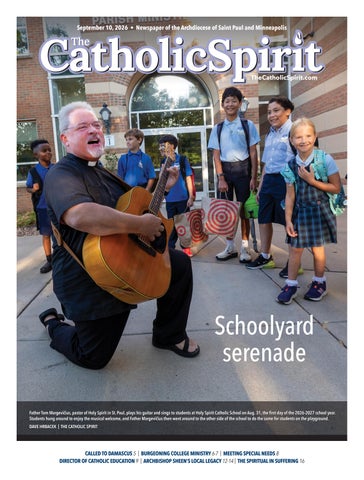
Schoolyard serenade Father Tom Margevičius, pastor of Holy Spirit in St. Paul, plays his guitar and sings to students at Holy Spirit Catholic School on Aug. 31, the first day of the 2026-2027 school year. Students hung around to enjoy the musical welcome, and Father Margevičius then went around to the other side of the school to do the same for students on the playground. DAVE HRBACEK | THE CATHOLIC SPIRIT
CALLED TO DAMASCUS 5 | BURGEONING COLLEGE MINISTRY 6-7 | MEETING SPECIAL NEEDS 8 DIRECTOR OF CATHOLIC EDUCATION 9 | ARCHBISHOP SHEEN’S LOCAL LEGACY 12-14 | THE SPIRITUAL IN SUFFERING 16
2 • THE CATHOLIC SPIRIT
SEPTEMBER 10, 2026
PAGETWO
NEWS notes Prayers continue for Auxiliary Bishop Kevin Kenney as he battles lung cancer. Latino ministry leaders from across the Archdiocese of St. Paul and Minneapolis came to St. Paul for their quarterly meeting Aug. 20 and Bishop Kenney — the vicar for Latino Ministry in the archdiocese — presided at a Mass that included prayers for his health. At St. Michael and St. Mary in Stillwater, parishioners were encouraged to pray a novena to St. Anthony Mary Claret for the healing of Bishop Kenney, from Aug. 30 to Sept. 8. In his homily during the Aug. 20 Mass, Bishop Kenney referred to the day’s first reading from Ezekiel as the prophet expresses God’s desire to bring his exiled people back to their land. “Ezekiel says God will create ‘a new heart and a new spirit within you,’” the bishop said. “As I was pondering upon that this morning, I also added a new lung. Create in us clean hearts, new hearts, new spirits and new lungs, oh Lord, so that we can continue to work,” he said. Volleyball squads competing and the fans watching them Sept. 2 at DeLaSalle High School in Minneapolis against Academy of Holy Angels in Richfield honored and supported Annunciation elementary school in Minneapolis. Proceeds from the evening at DeLaSalle were donated to Annunciation’s athletics and physical education programs. Aug. 27 was the one-year remembrance of a tragic shooting at Annunciation. “We are so grateful for the lasting friendship and partnership among our school communities and for everyone who helped make this meaningful evening possible!” DeLaSalle officials said in a Facebook post about the matches. Totino-Grace High School in Fridley honored an annual tradition at the school Sept. 2. Members of the senior class gathered on the football field to watch the sunrise on that first day of school. Called Senior Sunrise to note the students’ bright futures, a Facebook post also encouraged members of the class to “cherish these ‘lasts’ you experience this year, Eagles! Senior sunrise will be here before we know it.” COURTESY WINE: WOMEN IN THE NEW EVANGELIZATION
WINE IN THE VINEYARD Dixie Mattern, left, Gail Gunderson and Brenda Fouts stand with Archbishop Bernard Hebda Aug. 31 at Sovereign Estate Winery in Waconia during the fifth annual Wine in the Vineyard gathering for the ministry WINE: Women in the New Evangelization. The women are leaders of the Aberdeen, South Dakota, Prairie WINE core team. The event drew 165 guests from Minnesota and 11 other states: Indiana, Illinois, South Dakota, North Dakota, Texas, Colorado, Virginia, Alabama, Florida, Michigan and Nebraska. The archbishop celebrated Mass, which was followed by a concert by Catholic singer-songwriter Marie Miller. Founded by Kelly Wahlquist, who is also director of The St. Paul Seminary Catechetical Institute in St. Paul, WINE offers book clubs, Bible studies, retreats, evening events and conferences designed to help women grow in their faith. More information about the ministry can be found at CatholicVineyard.com.
On Sept. 3, a section of railing at TCO Stadium in Eagan collapsed after a football game between Cretin-Derham Hall (CDH) in St. Paul and St. Thomas Academy in Mendota Heights, as reported by the Pioneer Press. Approximately 20 to 30 CDH students fell four to six feet onto the field. CDH president Jeb Myers said Sept. 4 that one student was hospitalized but has since been released, the article said. TCO Stadium officials are working on an incident report, the article stated. School officials did not immediately return a telephone call and email from The Catholic Spirit seeking comment. “Last night was a mixture of emotions with the excitement of the team’s win, the scare of the fall and injuries, and the exhaustion of the late night,” Myers said in an email to families, the Pioneer Press reported. “Please join me in praying for all those injured, may they have a speedy recovery.” Officials at TCO stadium are asking for names of the students who fell for the incident report. Representatives from the Minnesota Vikings and MV Ventures are reviewing the damage and assessing all railings inside the stadium ahead of remaining high school football games at TCO Stadium this season, the Pioneer Press reported. An image of Jesus of the Divine Mercy was in the crop art gallery during the Minnesota State Fair in Falcon Heights, the work of Barb Herzog, a member of St. Peter in Forest Lake, who won fourth place in the senior class. Herzog said there were 596 crop art entries, 150 more than the previous record at the fair. Herzog used an image of Jesus and filled it with jewel-toned decorative corn and other seeds. While making the card last March, Herzog said she thought it would be nice to bring peace to the fair. “Thousands of people go by that exhibit — just spreading peace to people and … showing Jesus’ mercy,” said Herzog, a nurse at Lakes Life Care Center pregnancy resource center in Forest Lake. At the fair, Herzog said she also made holy cards of the crop art that are available at St. Peter’s library, which is next to the parish’s Divine Mercy Chapel. Herzog won a blue ribbon at the fair in 2024 for her crop art image of Our Lady of Guadalupe. That art has been placed in the church library, and with the fair having ended Sept. 7, the Jesus of the Divine Mercy image might join it, Herzog said. The pastor of St. Peter, Father Daniel Bodin, blessed each of the crop art images before they were entered in the fair.
DAVE HRBACEK | THE CATHOLIC SPIRIT
WORLD MISSION ROSARIES Kim Williams, director of operations for the Society for the Propagation of the Faith in the Archdiocese of St. Paul and Minneapolis, shows off part of a collection of rosaries that will be shipped to St. Louis for the beatification of Archbishop Fulton J. Sheen Sept. 24. Williams said the number of rosaries is around 15,000, including Immaculate Conception in Watertown sending about 3,000. Two parishes each sent 2,000 rosaries: St. Mary of the Lake in White Bear Lake and St. Joseph in Waconia. Rosaries also came in from California, Louisiana and Texas, Williams said.
Practicing CATHOLIC Produced by Relevant Radio and the Archdiocese of St. Paul and Minneapolis, the Sept. 4 “Practicing Catholic” radio show on Relevant Radio 1330 AM included Bishop Kevin Kenney in an interview about his recent lung cancer diagnosis and his pilgrimage to Norway. The program also featured Meg Forgette, associate director of educational quality and excellence in the archdiocese’s Office for the Mission of Catholic education, in an episode about the Archdiocesan Commission on Serving Students with Special Needs in Catholic Education. Listen to interviews after they have aired at practicingcatholicshow.com or choose a streaming platform at Spotify for Podcasters.
The Catholic Spirit is published semi-monthly for The Archdiocese of Saint Paul and Minneapolis Vol. 31 — No. 17 MOST REVEREND BERNARD A. HEBDA, Publisher TOM HALDEN, Associate Publisher JOE RUFF, Editor-in-Chief REBECCA OMASTIAK, News Editor
The Minnesota Supreme Court heard arguments Sept. 1 related to the petition of a former employee of Academy of Holy Angels in Richfield in a case that dates to 2024. The former employee had in 2024 sued Academy of Holy Angels and the Archdiocese of St. Paul and Minneapolis, alleging the nonrenewal of an employment contract, based on considerations of “sex and sexual orientation/gender identity,” according to a court filing. The arguments on Sept. 1 included discussion about the state and U.S. constitutions, employment laws in Minnesota, as well as determinations that came out of previous courts related to the case. Attorney Luke Goodrich, who argued on behalf of the Archdiocese of St. Paul and Minneapolis through the Becket Fund for Religious Liberty, suggested, in part, that the case centers on whether a Catholic archdiocese and school have freedom to maintain religious standards for employment — in this case within a Catholic school. Attorney Greta Wiessner, who argued on behalf of the former employee through Gender Justice, suggested, in part, that the case hinges on a different question: whether civil rights protections apply to Minnesotans who work in secular roles within religiously-affiliated organizations, such as schools. The Minnesota Supreme Court justices ended the hearing by expressing that the matter would be taken under advisement. A decision is expected sometime in early 2027. Sept. 27 is Priesthood Sunday, a one-day celebration of the priesthood that encourages all Catholics in the United States to show support for their priests with prayer and public recognition. Parish lay leaders often organize a celebration, and the USA Council of Serra International, a global lay organization, has promoted the day since 2005. Kathleen Randolph, a member of St. Paul Serra and the district governor for District 7, which includes the Archdiocese of St. Paul and Minneapolis, said ideas for honoring priests include students in Catholic schools writing greeting cards, a donut Sunday honoring priests and special prayers at Masses. More information can be found at serraspark.org/tools-new/priesthood-sunday. A musical theatre ministry at Maternity of Mary in St. Paul called ARISE! is holding tryouts for its upcoming production “Francis — The Musical.” Performances are planned for June 2027 in the Twin Cities. The ministry is looking for adults, young adults, teenagers, children and entire families to join the cast of this musical about the life of St. Francis of Assisi. Experienced singers, actors and dancers are encouraged to audition for principal and featured roles, but no experience or audition is required to participate in the ensemble or smaller roles. Young adults and young men in particular are encouraged to audition. Registration is open through Oct. 4 at arise-ministry.com.
Materials credited to CNS copyrighted by Catholic News Service. Materials credited to OSV News copyrighted by OSV News. All other materials copyrighted by The Catholic Spirit Newspaper. Subscriptions: $29.95 per year; Senior 1-year: $24.95. To subscribe: (651) 291-4444; To advertise: Display Advertising: (651) 251-7714; Classified Advertising: (651) 251-7714. Published semi-monthly by the Office of Communications, Archdiocese of St. Paul and Minneapolis, 777 Forest St., St. Paul, MN 55106-3857 • (651) 291-4444, FAX (651) 291-4460. Periodicals postage paid at St. Paul, MN, and additional post offices. Postmaster: Send address changes to The Catholic Spirit, 777 Forest St., St.Paul, MN 55106-3857. TheCatholicSpirit.com • email: tcssubscriptions@archspm.org • USPS #093-580
SEPTEMBER 10, 2026
THE CATHOLIC SPIRIT • 3
FROMTHEVICARGENERAL ONLY JESUS | FATHER MICHAEL TIX
Newly married couple’s faith, persistence demonstrate God’s ever-present love Over the summer, I was blessed to witness a number of weddings. Weddings are a special time in the lives of two people as they become husband and wife. The blessings extend to their families, broader communities and the Church. Weddings are filled with the kind of hope that only love can bring when it is founded on the example of Jesus’ love, which is faithful, permanent and life-giving. A summer wedding that stood out for me was the wedding of Mason Garcia and Kassie Carson, which took place Aug. 15 at the Academy of Holy Angels in Richfield. Both are graduates of the high school, where they met during the COVID-19 pandemic, when people spaced themselves a specified distance from one another. In the lunchroom one day, Garcia was already seated as Carson entered to search for a seat. One of the school’s long-standing teachers and Carson’s basketball coach was supervising the lunchroom and had Carson sit with Garcia. The two had never met. The teacher said to Carson, “make a new friend” without any thought that this might one day lead to marriage. Garcia and Carson dated throughout high school. A defining moment for both came during Garcia’s senior year, when he was playing hockey at Holy Angels. In an early November game, he was checked
headfirst into the boards and left lying on the ice, paralyzed. The arena fell silent as Garcia was taken from the ice on a stretcher and transported by ambulance to a St. Paul hospital. I heard about the incident in the evening at a Holy Angels function, and on Sunday I COURTESY GREG DEVERAEUX visited Garcia in Kassie and Mason Garcia stand with Father Michael Tix after the couple’s Aug. 15 the hospital. His wedding at the Academy of Holy Angels in Richfield. The Garcias are members of room was filled St. Hubert in Chanhassen. They were married at the high school where they met. with people — including Carson — and it was sad and to visit Garcia. He was at therapy when I scary to see an otherwise healthy 18-yeararrived, and his mother was the only person old with his life in front of him, laying in a in the room. We talked about the injury and hospital bed unable to move anything more many other things, and as we were talking, than maybe — slightly — his toes. Recovery Garcia walked into the room. was uncertain, and many prayers were The shock and surprise were like a modern offered. I asked Garcia what he remembered day setting of Jesus raising Lazarus from the of the injury. Much to my surprise, he said grave. We saw Garcia walking unassisted and he remembered everything. At the time he then were told that he had chosen to take the appeared to be unconscious, but Garcia said stairs from therapy rather than the elevator to he remembered everything that happened get back to his room. Garcia was determined and everything that people said around to heal and live. him; he just couldn’t communicate with His recovery continued as he was released others. from the hospital, and slowly re-entered Two days later, I returned to the hospital school. Although unable to play hockey again
because of the risk he could suffer a more serious injury, Garcia was on the bench at games to inspire and cheer on his teammates. Garcia graduated that spring, walking unassisted to receive his diploma, and last month, after graduating from a trade school to become an electrician, he walked down a church aisle with his new bride to begin their life together. It was a beautiful wedding filled with emotion that highlighted the importance of faith, hope and resilience. I have no doubt that as a couple, the Garcias have a bright future, and with their family and friends they look forward to seeing what life has in store for them. They firmly believe that after everything they’ve already experienced, they can handle most anything that comes their way. At times we can be thrown a curve ball, or life checks us into the boards. The key to getting through those times are faith and the importance of persisting in ways that draw us deeper into God’s love, trusting in the Lord’s love, which surrounds us. In any given moment that might be difficult to see, but God’s love surrounds us in ways that can support us, as so many people supported Garcia in his recovery and then filled the chapel to support him and his bride as they began their new life in God’s love, together as one in marriage. May we all be persistent in our journeys of faith and experience the gift of God’s new life surrounding us.
La fe y perseverancia de una pareja de recién casados demuestran el amor siempre presente de Dios Durante el verano, tuve la bendición de presenciar varias bodas. Las bodas son un momento especial en la vida de dos personas que se convierten en marido y mujer. Las bendiciones se extienden a sus familias, a sus comunidades y a la Iglesia. Las bodas están llenas de ese tipo de esperanza que solo el amor puede traer cuando está fundado en el ejemplo del amor de Jesús, que es fiel, permanente y da vida. Una boda de este verano que me llamó especialmente la atención fue la de Mason Garcia y Kassie Carson, que tuvo lugar el 15 de agosto en la Academy of Holy Angels, en Richfield. Ambos son graduados de la escuela secundaria, donde se conocieron durante la pandemia de COVID-19, cuando las personas debían mantener una distancia determinada unas de otras. Un día, en el comedor, Garcia ya estaba sentado cuando Carson entró buscando un lugar donde sentarse. Uno de los maestros con más años en la escuela y entrenador de baloncesto de Carson estaba supervisando el comedor y le indicó a Carson que se sentara con Garcia. Los dos nunca se habían conocido. El maestro le dijo a Carson: “Haz un nuevo amigo”, sin imaginar que algún día aquello podría conducir al matrimonio. Garcia y Carson fueron novios durante toda la escuela secundaria. Un momento decisivo para ambos llegó durante el último año de Garcia, cuando jugaba hockey en Holy Angels. En un partido a principios de noviembre, recibió un golpe de frente contra las tablas y quedó tendido en el hielo, paralizado. El estadio quedó en silencio mientras sacaban a Garcia del hielo en una camilla y lo trasladaban en ambulancia a un
hospital de St. Paul. Me enteré de lo sucedido esa noche durante un evento de Holy Angels y el domingo visité a Garcia en el hospital. Su habitación estaba llena de personas —entre ellas Carson—, y era triste y aterrador ver a un joven de 18 años, por lo demás saludable y con toda la vida por delante, acostado en una cama de hospital, incapaz de mover nada más que quizá, ligeramente, los dedos de los pies. La recuperación era incierta y se ofrecieron muchas oraciones. Le pregunté a Garcia qué recordaba de la lesión. Para mi gran sorpresa, dijo que lo recordaba todo. En ese momento parecía estar inconsciente, pero Garcia dijo que recordaba todo lo que había sucedido y todo lo que las personas habían dicho a su alrededor; simplemente no podía comunicarse con los demás. Dos días después, regresé al hospital para visitar a Garcia. Cuando llegué, estaba en terapia y su madre era la única persona que se encontraba en la habitación. Hablamos sobre la lesión y muchas otras cosas y, mientras conversábamos, Garcia entró caminando en la habitación. La conmoción y la sorpresa fueron como una escena de nuestros días de Jesús resucitando a Lázaro de entre los muertos. Vimos a Garcia caminar sin ayuda y luego nos dijeron que había decidido subir las escaleras desde terapia en lugar de tomar el ascensor para regresar a su habitación. Garcia estaba decidido a sanar y a vivir. Su recuperación continuó después de que salió del hospital y poco a poco regresó a la escuela. Aunque no pudo volver a jugar hockey debido al riesgo de sufrir una lesión más grave, Garcia estaba en el banquillo
durante los partidos para inspirar y animar a sus compañeros de equipo. Garcia se graduó aquella primavera, caminando sin ayuda para recibir su diploma. Y el mes pasado, después de graduarse de una escuela técnica para convertirse en electricista, caminó por el pasillo de una iglesia junto a su nueva esposa para comenzar juntos su vida matrimonial. Fue una hermosa boda, llena de emoción, que puso de relieve la importancia de la fe, la esperanza y la resiliencia. No tengo ninguna duda de que, como pareja, los Garcia’s tienen un futuro brillante y que, junto con sus familiares y amigos, esperan con ilusión descubrir lo que la vida les depara. Creen firmemente que, después de todo lo que ya han vivido, pueden afrontar casi cualquier cosa que se les presente. A veces podemos recibir un golpe inesperado, o la vida puede golpearnos contra las tablas. La clave para superar esos momentos está en la fe y en la importancia de perseverar de maneras que nos lleven a profundizar En un momento determinado puede ser difícil verlo, pero el amor de Dios nos rodea de maneras que pueden cada vez más en el amor de Dios, confiando en el amor del Señor que nos rodea. Sostenernos, así como tantas personas sostuvieron a Garcia durante su recuperación y luego llenaron la capilla para apoyarlo a él y a su esposa cuando comenzaron su nueva vida en el amor de Dios, juntos como uno solo en el matrimonio. Que todos perseveremos en nuestros caminos de fe y experimentemos el don de la nueva vida de Dios que nos rodea.
OFFICIALS Archbishop Bernard Hebda has announced the following appointments in the Archdiocese of Saint Paul and Minneapolis:
Effective August 1, 2026 Reverend TJ McKenzie, assigned as canonical administrator of Saint Jerome Catholic School in Maplewood. This is in addition to his current assignments as pastor of the Church of Saint Pius X in White Bear Lake and as chaplain for Frassati Academy in White Bear Lake.
Effective August 10, 2026 Reverend Connor McGinnis, assigned as sacramental minister for the Church of Saint Michael in Saint Michael. This is in addition to his assignment as chaplain for Providence Academy in Plymouth.
Effective August 15, 2026 Reverend Luke Marquard, assigned as sacramental minister for Cretin-Derham High School in Saint Paul. This is in addition to his assignment as pastor of the Church of Saint Joseph in West Saint Paul. Reverend Joseph Wappes, assigned as sacramental minister for Cretin-Derham High School in Saint Paul. This is in addition to his assignment as parochial vicar of the Church of Saint Joseph in West Saint Paul.
4 • THE CATHOLIC SPIRIT
SEPTEMBER 10, 2026
LOCAL SLICEof LIFE
Come pray at the Fair Archbishop William Lori of Baltimore, left, greets people gathered at the Minnesota State Fair for Mass Aug. 30. Concelebrating the Mass with him was Father Robert Fitzpatrick, right, a retired priest of the Archdiocese of St. Paul and Minneapolis and former pastor of Corpus Christi in Roseville who has celebrated State Fair Masses since 2014. Archbishop Lori made his first visit to the State Fair at the urging of Jenny Kraska, executive director of the Maryland Catholic Conference, which represents the Archdiocese of Baltimore and two other dioceses. Kraska is from Prior Lake and has gone to the State Fair. “She told me that I had to come to the Minnesota State Fair or otherwise my life would not be complete,” Archbishop Lori said, jokingly. “I believed her, so here I am. I spent the whole day Friday (Aug. 28) at the Fair and enjoyed myself tremendously.” Attendance on Aug. 28 was 204,065, an all-time record for a single day, according to the State Fair website. Archbishop Lori said he feasted on a corn dog and “lots of ice cream.” DAVE HRBACEK | THE CATHOLIC SPIRIT
Ignatian Volunteer Corps Twin Cities
*+,'(-+,-.%/%)"01++ 2.3+4'+5/6-
presents An Evening of Gratitude
!"#$%&'('$")*+,%-.(%/"%0"$'%+1.(%% 1'23%+"/.,%4%*+%-.(%)+$'(&+1'(%% +1'%51#$-1%6"$%+"0"$$"78
Practical wisdom for faithful citizenship and Gospel-centered living
91'(%,"#%3.$+('$%7*+1%+1'%% 5.+1"2*-%5"00#(*+,%:"#(/.+*"(%% "6%;*((')"+.%<55:=>%,"#%-.(%-$'.+'%.%% &*?*(&%32.(%+1.+%$'62'-+)%71.+%0.++'$)%% 0")+%+"%,"#8%51"")'%.%6#(/8%@*?'%"?'$%+*0'8%% A'23%+1'%3.$*)1>%)-1""2>%"$%0*(*)+$*')%-2")'%+"%,"#$%1'.$+8
LIVING OUR FAITH IN CHALLENGING TIMES
JOHN CARR
Founder, Initiative on Catholic Social Thought and Public Life GEORGETOWN UNIVERSITY
91'$'?'$%,"#%.$'%*(%,"#$%&*?*(&%B"#$(',>%55:%0.C')%*+%'.),%+"D E% @*?'%7*+1%*(+'(+*"(8 E% F(?')+%7*+1%5.+1"2*-%?.2#')8 E% G#33"$+%+$#)+'/%"$&.(*H.+*"()%7*+1%-2.$*+,%.(/%-"(6*/'(-'8 I'.-1%"#+%+"/.,%+"%2'.$(%1"7%7'%-.(%1'23%,"#8% JKL8MNO8PMPP%%%Q%%%!!"#$%&'()
DR. CYNTHIA BAILEY MANNS
National leader in synodality and adult faith formation
FR. DAN GRIFFITH VP – Mission, University of St. Thomas
One of the voting women at the Synod on Synodality in Rome
SAINT THOMAS MORE CATHOLIC COMMUNITY
1079 Summit Avenue St. Paul, MN 55105
T U E S DA
Y
O C TO BE
6R
5:00 PM SOCIAL • 6:00 PM DINNER • 7:00 PM PANEL DISCUSSION
A conversation that will help you Apply Catholic Social Teaching to today’s challenges ● Reeect on the legacy of Pope Francis and the leadership of Pope Leo ●
Information & Registration: ivcusa.org/TwinCitiesEvent 612.916.7495
Ignatian Volunteer Corps connects retired and semi-retired adults with local nonproots serving people in need while nurturing a deeper spirituality rooted in the Ignatian tradition.
Join Us – Your next chapter can be your most meaningful one
LOCAL
SEPTEMBER 10, 2026
THE CATHOLIC SPIRIT • 5
St. Maron pastor Chorbishop Maroun named Maronite archbishop-elect of Damascus By Rebecca Omastiak The Catholic Spirit
Chorbishop Sharbel Maroun — pastor of St. Maron in Minneapolis, a Maronite Catholic church — has been named as archbishop-elect of the Maronite Archeparchy of Damascus in Syria, according to a Vatican announcement Aug. 28. “I was thrilled to learn that Pope Leo XIV has given his assent to the election of Chorbishop Sharbel Maroun as Archbishop of Damascus of the Maronites in Syria by the Synod of Bishops of the Patriarchal Church of Antioch of the Maronites,” Archbishop Bernard Hebda wrote in a statement published Aug. 28. Born in Lebanon, Archbishop-elect Maroun, 64, and his family relocated to the United States in 1983, according to the Vatican announcement. He pursued specialized studies in information technology, entering the Washington, D.C.based seminary of the Maronite eparchy of Our Lady of Lebanon of Los Angeles in 1984. While there, he studied philosophy and theology. Archbishop-elect Maroun’s priestly ordination (in 1989), his designation as a monsignor (in 2007), and his ordination as chorbishop (in 2015) have all coincided with his Jan. 6 birthday, according to St. Maron’s website. He has served the St. Maron community since 1989 and has continued to hold various roles in the Maronite eparchy of Our Lady of Lebanon of Los Angeles. “Chorbishop Maroun has served as pastor of St. Maron Maronite parish in Minneapolis for more than 35 years and is beloved by not only his parishioners but also by the priests and faithful of our Archdiocese,” Archbishop Hebda wrote. “I have long admired his pastoral heart and have been inspired by his generous and collaborative leadership
in Northeast Minneapolis. His presence will be deeply missed. I pledge to him my heartfelt prayers as he prepares to assume leadership of the Church of Damascus, a venerable community rich in Christian history.” The announcement comes as Archbishop Samir Nassar — who had led the Maronite Archeparchy of Damascus since 2006 — retires from ministry. Since 2017, the Archdiocese of St. Paul and Minneapolis and the Archeparchy DAVE HRBACEK | THE CATHOLIC SPIRIT of Damascus — Chorbishop Sharbel Maroun, left, greets people before Mass for the ordination to the priesthood of Father George Younes on July 26, 2025. which operates like an archdiocese — of Archbishop Samir Nassar, who until this have maintained a partnership. When the U.S. archeparchy. The Damascus Partnership was formalized on Jan. 25, 2017 — the feast of the morning’s announcement was serving as Conference of Catholic Bishops requested conversion of St. Paul the Apostle on the road Archbishop of Damascus. Archbishop Nassar U.S. dioceses come to the aid of su!ering to Damascus and patron of the Archdiocese has been a beacon of hope to the faithful and persecuted Christians in war-torn parts of St. Paul and Minneapolis. of his flock as he guided them through the of the Middle East, Archbishop Hebda “It is wonderfully providential that our challenges of civil war. I wish Archbishop conferred with Deacon Mickey Friesen, Archdiocese has already been in a partnership Nassar all the best and promise him my director of the Center for Mission, which with the Archeparchy of Damascus since prayers for a well-deserved retirement.” serves the archdiocese’s missionary outreach. 2017,” Archbishop Hebda wrote in his Aug. 28 Read Archbishop Hebda’s full statement Deacon Friesen had some knowledge of the statement. “It is my hope that the relationship online at TINYU().CO,/3-6./(/0. Maronite Archeparchy of Damascus through will only grow stronger in the days ahead. Read the Vatican announcement online at Archbishop-elect Maroun and suggested a I have valued the friendship and example TINYU().CO,/581Y2(23. partnership between the archdiocese and the
A Mass, pilgrimage site, listening session highlight aspects of archdiocese’s care for creation efforts By Joe Ruff
The Catholic Spirit
A new Mass setting, “For the Care of Creation,” was accepted by the Vatican Aug. 4, and Archbishop Bernard Hebda celebrated that liturgy Sept. 6 at St. Francis of Assisi in Lake St. Croix Beach — during the month of the global Season of Creation celebrations. The World Day of Prayer for the Care of Creation was Sept. 1, and the special season concludes Oct. 4 on the feast of St. Francis of Assisi. The Mass setting “is a clear resource that can be celebrated around the care for creation,” said Adam Fitzpatrick, social mission outreach coordinator for the Center for Mission, which supports the missionary outreach e!orts of the Archdiocese of St. Paul and Minneapolis. Other Mass settings marking various needs and occasions didn’t quite 4t the bill, he said. The Catholic, volunteer-led ministry Laudato Si’ Movement Minnesota quickly heralded the move with an email noting “Mass for the Care of Creation Approved!” Texts for the Mass are available in English and Spanish through the U.S. Conference of Catholic Bishops at TINYU().CO,/45C6196.. In addition, according to a decree issued by Archbishop Hebda, in accordance with the Year of St. Francis designated by Pope Leo XIV (from Jan. 10, 2026, through Jan. 10, 2027), St. Francis of Assisi in Lake St. Croix Beach has been designated as an o7cial pilgrimage site at which a plenary indulgence may be obtained, “for the
duration of the Year of Saint Francis, by ful4lling the usual conditions of sacramental confession, reception of Holy Communion, prayer for the intentions of the Holy Father, and complete detachment from sin.” Read the full decree at TINYU().CO,/2/98,.C6. In yet another development, a gathering with Archbishop Hebda titled Listening Session: Care for Creation and the Climate Crisis, will begin with breakfast at 8:30 a.m. and run from 9-11 a.m. Oct. 23 at the Archdiocesan Catholic Center in St. Paul. Laudato Si’ Movement Minnesota and the Archdiocese of St. Paul and Minneapolis’ O7ce of Latino Ministry are co-sponsoring the opportunity to foster new connections and invite members of the Catholic community to talk about the environment and ecology. In addition, for the Care of Creation season, The Catholic Spirit is running a series of 4ve essays online through September about integral ecology, which stresses the interconnectedness of environmental, spiritual, cultural, social and economic challenges. The 4rst and second columns can be found at TINYU().CO,/329946:4 and subsequent essays will be published each Tuesday. The essays are written by Christopher Thompson, the academic dean of The St. Paul Seminary in St. Paul and a professor of moral theology. Thompson also has a website designed to encourage people to think more deeply about the connection between the care for creation and the Catholic faith at T158OY0U),Y-T5(Y/(O85CT.CO,. The website includes a new video on the topic.
Only One Thing Is Necessary HOW CATHOLIC FAMILIES CAN STRIVE TO BE UNITED IN THIS LIFE AND THE NEXT
Archbishop Bernard Hebda released his second pastoral letter in May and is urging everyone to read it, learn from it and pray with it. An excerpt: “ We are blessed by God’s superabundant grace and by the examples of holy families who remind us that it is indeed possible for us to pass through that narrow gate. Pope Leo (XIV ) has recently held up for our imitation three saintly couples who were together recognized by the Church for their holiness: Saints Zélie and Louis Martin (the parents of Saint Therese of Lisieux who were canonized together in 2015 and referenced in the Preface of this letter); Blesseds Luigi and Maria Beltrame Quattrocchi (beati4ed by Saint John Paul II in 2001); and 4nally, Blesseds Józef and Wiktoria Ulma (beati4ed by Pope Francis along with their children in 2023). ... More recently, I made the pilgrimage to Markowa, Poland, to pray at the tomb of the Ulmas, seeking their intercession that this pastoral letter might bear some pastoral fruit in our Archdiocese. The Ulmas were simple farmers from Southeastern Poland (living in the same diocese as my grandmother’s family, the Archdiocese of Przemysl). Along with their six children (and one on the way), they were brutally killed by the Nazis in 1944 for having given refuge on their farm to Jews who were fleeing from the persecution of the Third Reich.”
6 • THE CATHOLIC SPIRIT
LOCAL
SEPTEMBER 10, 2026
University of Minnesota campus ministry looks ahead to new year in ‘golden age’ of Newman Centers By Josh McGovern The Catholic Spirit
A long street near the University of Minnesota campus was alive with people the evening of Sept. 3 for the Gophers’ first football game of the season. The sidewalks brimmed with fallen leaves and students wearing similar reds and yellows — overalls, jerseys and shirts showing school spirit. A new residence is on the corner of that street. On the front lawn, students in red and yellow gameday attire played lawn games, mingled and listened to music. This student housing might appear to be just another fraternity or sorority in a long line of Greek-life houses. But there are no Greek letters above the door. Instead, there is a sign out front. It reads: Gopher Catholic. The new St. Paul’s Outreach (SPO) residence will soon house 48 to 50 Catholic men. It hosted a tailgate party that night. All were welcome, Catholic or not. Father Jake Anderson, pastor of St. Lawrence Catholic Church and Newman Center just a few blocks away, played games with the students. “At what other house would you see a priest?” a student laughed. Father Anderson joked that the Newman Center isn’t a city on a hill, but more like Nazareth. “You would never know the Son of God is living and abiding and working there,” he said. “People can walk right past it and not even know it’s a church. In order for this vehicle to go, there has to be a deep culture of mission.” Every day, staff and students go out onto campus. Father Anderson calls it salmon fishing. More often than not, the building is relatively empty because everyone is out on campus evangelizing. Events like these, tailgate parties, Bible studies and ice cream socials are creating connections on a bustling campus. Newman Centers across the country are in a “golden age,” said Father Anderson, also director of Gopher Catholic, the University of Minnesota’s Catholic campus ministry. There is something of God that is “very much at work at Newman Centers,” Father Anderson said. “There is most definitely something of the Holy Spirit going on,” Father Anderson said. “Certainly, perhaps, the biggest one that gets the most fanfare is just the number of people coming into the Church by way of OCIA (Order of Christian Initiation of Adults). At this particular moment in time, Sept. 3, classes don’t begin until after Labor Day. But right now, we have (50) people signed up for OCIA, and we haven’t even met the new students. It’s ... been going up almost every year. This is my eighth year at St. Lawrence Student (Newman) Center. It’s been going up every year.” Father Anderson explained that to attract souls, “you have to have people to get them.” Staff at St. Lawrence is a big expenditure, but it has led to a bold move to have several different charisms working in campus ministry at one time. The Brotherhood of Hope, a religious community based in Boston that serves in college campus ministry, has been a mission partner with Gopher Catholic since 2014. SPO, based in Mendota Heights, is also engaged in campus ministry and has had households on campus since 2007. In 2019, SPO was completely integrated into Gopher Catholic. “We really are one team, one family, driving together,” Father Anderson said. “Then of course this year we’ve added this massive, colossal, big step (by) bringing in
DAVE HRBACEK | THE CATHOLIC SPIRIT
Father Jake Anderson, pastor of St. Lawrence Catholic Church and Newman Center, talks with people gathered for a tailgate party at a St. Paul’s Outreach men’s house Sept. 3 near the University of Minnesota’s Minneapolis campus.
FOCUS (Fellowship of Catholic University Students). We are the only campus ministry ... certainly in the country, to have three different groups working together: The Brotherhood of Hope, SPO and FOCUS.” FOCUS is based in Denver and provides Catholic evangelization through on-campus ministry. Father Anderson said his job is to “direct traffic” under one roof, so that everyone is not just “cohabiting, but really working in communion and deep collaboration. Unity is the clarion call. For all of us to work together with different charisms, we have to become very humble and not fly our respective flags, but the banner of Christ and the Catholic Church at the Newman Center.” Among those mingling with students was Brother Austin Riordan, an SPO alumni whose attire stood out from the rest of the gameday gear. He wore a grey button-down shirt with a closed collar. On the shirt was an anchor with the word “Hope.” Brother Austin is a member of the Brotherhood of Hope. He is also the managing director of campus ministry for Gopher Catholic. Like Father Anderson, Brother Austin said having three different groups working on campus is not an issue, but a blessing. “As a religious brother, we have a particular heart for unity in the sense that we live a fraternal common life,” Brother Austin said. “I think it flows from our vows that we, in our ministry, desire to build a deep communal life in our community.” Brother Austin said he considers the Brotherhood of Hope older brothers to the community who can provide “wisdom and experience of campus ministries,” but they are not just campus ministers. “We’re really consecrated men who can bring the unity, the body of God, the body of Christ, and try to foster that in the people of God in this particular location,” Brother
Austin said. With new people comes an added richness “of their own witness to Christ, their own life in Christ,” Brother Austin said. “They’re first disciples of God,” Brother Austin said. “Our team life, our whole staff life, just got four times richer because four more people came in (FOCUS coming to the University of Minnesota). But also, you know, very practically, they have great expertise in fraternities, with sororities and athletes. It’s been a joy for me to see them have the time, capacity, knowledge, connections to be able to get into doors where we’ve never got into. In the first week, they’ve already made it into places we’ve never made it into before.” Father Anderson said FOCUS missionaries have been getting a foot in the door with sororities, fraternities and sports teams. “We’ve got some Bible studies now with different sports teams,” Father Anderson said. “We’re just trying to create inroads however we can.” Carlos Cerda, the Catholic men’s residence coordinator for SPO, said the house and what God is doing at the University of Minnesota are the beginning of something big. Father Anderson is passionate about intentional Christian living. Most of life is not spent in a church; it’s “with your roommate,” he said. “How do we become a transformative environment that the air you’re breathing is conducive to a deeper life, both conversion and life in Christ?” Father Anderson said. “That transition to college is already so tumultuous for guys,” Cerda said. Many questions arise for young men leaving home for the first time. Questions like, “Who am I? Where do I belong? And what kind of man am I going to be?” Cerda said.
When young men seek a place of belonging before asking, “What kind of man do I want to be?” they may find themselves living outside of God’s will. “(Young men) are so vulnerable at that moment,” Cerda said. “These kids are just leaving the good structure of home, and maybe (having) that excitement for the college experience, and then they just find themselves doing stuff that they don’t even really want to do, but (do it) just to belong.” Father Anderson said there is an increasingly complicated nature of Newman Centers because of the experiences many students carry with them as they enter campus. “Many parishes are really on the front lines, but specifically Newman Centers, because we’re seeing ... most clearly ... what the secular culture is feeding students,” Father Anderson said. “Students are starving for a relationship.” Cerda believes that in SPO households and in the community of Gopher Catholic, students can have a better college experience and a “better depth of relationship.” Father Anderson said the response to this complicated reality is through the beauty of Catholicism, especially in the dimension of healing. However, there is a second reality, Father Anderson said, that Gen-Z is deeply comfortable and needs to be deeply challenged. “We need the Church to have a backbone and to stand for something, and that’s actually what’s making it attractive for people coming into the Church because the Church is not caving,” Father Anderson said. “We stand for something. We stand in the power of the cross. We stand to proclaim Jesus. We also stand to proclaim what sin is.” Hospitality is taken seriously, Father Anderson said. CAMPUS MINISTRY CONTINUED ON NEXT PAGE
SEPTEMBER 10, 2026
LOCAL
THE CATHOLIC SPIRIT • 7
DAVE HRBACEK | THE CATHOLIC SPIRIT
Gwen Herbst, far right, a senior at the University of Minnesota (U of M) studying chemical engineering, joined Gopher Catholic her freshman year and now is a student leader. At left is U of M sophomore Gloria Reither. The two women attended a gathering Sept. 3 at a St. Paul’s Outreach men’s house on campus.
CAMPUS MINISTRY CONTINUED FROM PREVIOUS PAGE “I say, ‘You belong here even if you don’t feel like you do,’ ” he explained. “Plenty of people are questioning, ‘Can I belong if I still have questions about Catholicism? Can I belong if I still have habitual sin and have addictions?’” The answer, Father Anderson said, is a resounding, “Yes.” The tailgate party, which had a DJ and a young man grilling hamburgers, was a “good, holy party” before kickoff, Cerda said. At the tailgate party were missionaries with SPO and FOCUS. Men and women were greeting strangers and making connections, especially with incoming freshmen. Four years ago, one of the incoming freshmen was Gwen Herbst. Her older sister was involved in Gopher Catholic. When Herbst made it to campus, her sister and
other senior girls invited her to dinner or Mass. “I wanted to join the Catholic community when I was coming to college, and I heard my sibling talk about it, but I did not expect to be this involved,” Herbst said. She came from St. Michael, a “pretty Catholic town,” she said, but her faith was not her own. Her faith is growing, and now she has a more personal relationship with the Lord, she said. As a student leader, she and other leaders go to freshmen’s dorms to hold fun events. As a freshman and sophomore, she wouldn’t go out onto campus to talk to people about faith. Now, she’s more receptive to talking about it with others. “I wouldn’t just go talk to people,” Herbst said. “I’ll tell (people) about the events that we have. It built confidence spreading the faith.” In training students to do outreach, Cerda said, there are steps. At first, students are
scared to do it. Then, they look at successful missionaries and try to imitate them. “I gotta dress like them, I gotta start talking like them, and then what they learn is ... God has made you a mission to the world. For Christ, his identity and his mission were identical,” Cerda said. The Lord has equipped each student with the talents to be on mission, Cerda said. Mission is all about being authentic and “caring for each person in front of you.” During Gopher Catholic Leadership Week before freshmen students moved onto campus, Father Anderson quoted Abe Gross, the music director for SPO, saying, “The secret of not caring what people think is caring for them.” “Yes, we put on events. Yes, we do a lot of things. We send a lot of emails, but people have to know we care about them, or else we’re just another group trying to get numbers,” Brother Austin said. “One of the things we preach to the students is
it can’t just be an obligation. It can’t just be something like a checkbox. We really have to have a heart for these people, that they are people looking for God, and that every human heart, the Catechism (of the Catholic Church) says, was made for God. And so, praying on that, really understanding and believing that in my heart gives me the courage to go out, and really the perseverance, the endurance. It’s not only courage, but at least endurance to keep having that.” Cerda believes that Gopher Catholic students get to be in the world but not of the world. He also believes people need to expand their vision of what this season of life can look like. Rather than simply keeping the faith, this is an opportunity to grow closer to the Lord, he said. “(Students) are experiencing an excellent formation in Gopher Catholic programs, and they’re actually able to orient it towards evangelization and actually bring people who are very far away from God into an encounter with him. ... My commitment this year is to develop the best place for a freshman to live.” Slowly, over the years, Herbst became more involved. For any high schooler coming to the University of Minnesota for their freshman year, Herbst suggested they come to Gopher Catholic events. She even said it might not feel like a fit at first. “(That’s) any new environment or situation,” Herbst said. “Give it at least five or six times so you can meet people. When you come back, you’ll see faces that you’ve seen before, and that’ll just make it so much easier. I remember as a freshman, it just felt kind of weird. Like I don’t know these people that well.” Now a senior looking to graduate with a degree in chemical engineering, Herbst said when she walks into a room, she knows so many faces. “What I tell some of these incoming freshmen is, ‘Hey, if you want to grow, you have no excuse not to grow if you live here,’” Cerda said. “You are walking distance to the Eucharist. You’ll probably never live closer to the Eucharist if you live here.” On the gridiron Sept. 3 following the tailgate party, the Gophers drubbed Eastern Illinois 59-7. But to Cerda as well as Gopher Catholic, SPO, FOCUS, the Brotherhood of Hope college ministry and Father Anderson, the real victory happened on a street corner less than a mile from and just before the game was played at Huntington Bank Stadium, when many gathered in Christ’s name.
Service of Remembrance For Those Who Lost a Child Before Birth
Sa
r a
c ober
Gethsemane Cemetery Chapel Mausoleum 8151 42nd Ave N., New Hope, MN 55427
es rre t n Cemetery Chapel Mausoleum 21 1 e n on Ave ., Mendo a He h s, MN 5512
Losing a child before birth is its own type of grief. o n us o a spe al se v e o emem hono n h ld en los e o e h. andle and name ou h ld.
... will not forget yo . ehold ha e engra ed yo on the pal s of y hands. Isaiah 49:16 ESV
ee e s a on e u ed. an he ode o all 51 228 1.
an e h a
8 • THE CATHOLIC SPIRIT
LOCAL
SEPTEMBER 10, 2026
Archdiocese’s Catholic schools striving to meet students’ specialized learning needs By Maria Wiering
For The Catholic Spirit
At Ave Maria Academy in Maple Grove, Ericka Walz has seen students’ specialized learning needs grow in recent years. In Vermillion, Pam McSweeney at St. John the Baptist Catholic School has observed the same. ELLEN GROSSMAN Recognizing the changing needs led both experienced school leaders — from very different preK-8 schools on opposite sides of the Archdiocese of St. Paul and Minneapolis — to a workshop at St. Charles Borromeo in Minneapolis Aug. 17-19. For three days, small teams from their schools — and 12 others — received training to help them better identify student needs, set goals and measure improvement. Ave Maria’s head of school since 2024, Walz said she and her team wanted to improve their ability to meet broader needs, but desired direction. “We want to be a place that welcomes all children who desire a really robust education,” said Walz, whose suburban school enrolls around 220 students, because “first and foremost, we’re a Catholic school.” McSweeney, principal of rural St. John the Baptist — which enrolls about 120 students — shared a similar view: “I believe we’re called to do it.” The training, which used a framework called Multi-Tiered System of Supports, was the first major initiative born of the Archdiocesan Commission on Students with Special Needs in Catholic Education. The archdiocese’s Office for the Mission of Catholic Education (OMCE) convened the 17-member commission in April 2025 to examine the current special education landscape with the goal of developing recommendations on how to expand or better serve students with unique needs in its Catholic schools. Commission members made formal recommendations to Archbishop Bernard Hebda last October, which are expected to be published for Catholic schools this fall. Leading the training was Ellen Grossman, a special education consultant, school psychologist and founder of Uptick Education, a company she launched in 2022 “to help bridge the gap” as schools aimed to address “increased student needs paired with a shortage of qualified special educators,” according to its website, UPTI()EDU(,TI-..(-M. A parent of two daughters who attend St. Joseph School in Rosemount, Grossman was also a member of the archdiocese’s special needs commission. She called that experience “an honor in my career” for uniting her passion with faith. In an Aug. 19 interview, Grossman explained that most of her work has been in public schools that are required to make their systems more accessible to learners with special needs. “So, for the Catholic schools to choose to make their systems more accessible because it’s the right thing to do is a different ‘why,’ and I think extremely powerful,” she said. She describes a Multi-Tiered System of Supports — MTSS — as “the basic scientific method of education” with a long history of use, just under other names. The datadriven system recognizes three support tiers: Tier 1, which provides instruction and behavior support for all students in a classroom; Tier 2, which targets small groups of students with additional support; and Tier 3, which provides support for
COURTESY MARIA WIERING
Ellen Grossman, founder of Uptick Education and member of the Archdiocesan Commission on Students with Special Needs, smiles while leading a workshop Aug. 19 at St. Charles Borromeo in St. Anthony.
COURTESY MARIA WIERING
Pam McSweeney, principal of St. John the Baptist Catholic School in Vermillion, shares insights Aug. 19 from a three-day training in Multi-Tiered System of Supports at St. Charles Borromeo as other educators look on.
individuals with greater needs. “It’s not a program that you buy,” Grossman explained. “It’s a ‘shelf ’ of best practices that still allows for autonomy in your local community and responsiveness to the needs of your families, your parish, your faculty. To know that, you have data systems, you have curriculum that is aligned to your standards, you have to know how kids are doing — but what ‘books’ you choose to put on that ‘shelf ’ can vary and be responsive to your own local community.” Grossman provided the school leaders with a trove of resources, but she aimed not to overwhelm. The goal, she repeatedly told them, was to take “the next best step.” In addition to Ave Maria and St. John the Baptist, other participating schools in this year’s training were the host school, St. Charles Borromeo; All Saints, Lakeville; Divine Mercy, Faribault; Hill-Murray, Maplewood; Immaculate Conception, Columbia Heights; Nativity of Our Lord, St. Paul; St. Helena, Minneapolis; St. Joseph, West St. Paul; St. Michael, Prior
Lake; St. Vincent de Paul, Brooklyn Park; and Transfiguration, Oakdale. As a pilot cohort, these schools will continue to receive training and assistance through Uptick Education as they work to expand the support needed to meet a wider range of needs in their schools. Megan Forgette, OMCE associate director of Catholic schools, said that the goal of the commission’s work and the training is “continuing to widen the doors a little bit more” for students with special needs. “We can’t do all of this work all at once, knowing that when we talk about our students with special needs or those with diverse learning styles, there’s a huge range of needs this can cover,” she said in an Aug. 7 interview. “But our work is really about continuing to widen the doors of what and how we’re able to serve a wider and wider range of learners, so that slowly but surely we’re getting closer and closer to giving that gi0 of Catholic education to more and more of our children not currently in our Catholic schools.”
MTSS offers common language, assessment and documentation standards, along with data-collection standards for schools. Meanwhile, the system not only benefits students with special learning needs, but also all students in a classroom, Forgette emphasized. Research shows that schools embracing MTSS find that strategies cra0ed for students with special learning needs “are actually excellent practices for all learners,” added Gayle Stoffel, OMCE associate director of Catholic school leadership, who collaborates with Forgette on the initiative. “The Lord has given us this great mystery of the human person, and we’re trying to put the building blocks in place for a very strong foundation, so that this work doesn’t fizzle out, but it becomes a re1ection of how we believe children are made — as the image and likeness of God,” Stoffel said. Sue Kerr, who oversees special education at St. Michael Catholic School in Prior Lake, said her school team recognized that they needed to be more systematic in their approach to students with special learning needs, “and this really kind of helped us focus our attention that way,” she said at the end of the training. “We got marching orders now, and I feel like it’s just going to be a great way for us to connect with what the faculty is already doing and to move them along,” she said. “Also, it’s going to be great for the kids.” Walz said she le0 the training, which she attended with three other Ave Maria faculty members, feeling “very excited” about the opportunity before them. “There’s no two students that are alike,” she said, “and we also just want to do everything that we can to develop our skills and our understanding to just meet each child’s unique, God-given talents.” With Grossman’s training, Walz added, “we know we’ve got a good sense of where to start.” Editor’s note: This story first appeared on the Catholic schools of the Archdiocese of St. Paul and Minneapolis’ website at spmcatholicschools.org.
LOCAL
SEPTEMBER 10, 2026
THE CATHOLIC SPIRIT • 9
Director of Catholic education and superintendent of schools reflects on new role The Catholic Spirit
A I’ve been spending
my time connecting Deacon Michael with other archdiocesan McGinty has stepped leaders and learning into his role as the more about our newest director of priorities for Catholic Catholic education and education this coming superintendent of schools academic year. I’m for the Archdiocese of really looking forward St. Paul and Minneapolis. to visiting our schools In a June 1 announcement and parishes in the year about Deacon McGinty’s ahead. new role, Archbishop Q What has been a Bernard Hebda wrote that highlight for you in the deacon demonstrates your new role, so far? “deep faith, pastoral wisdom, operational A There have been excellence, and a profound several highlights. DEACON MICHAEL MCGINTY commitment to the Already, it is apparent evangelizing mission of Catholic education.” to me that our Catholic school leaders “He has consistently demonstrated that are doing remarkable work. It’s been a he is a servant leader who understands that joy and privilege to see the amazing and Catholic schools and parish catechetical meaningful ways leaders are serving their programs are not simply institutions, but communities across our 89 schools. essential ministries of the Church that help I am also fortunate to have an young people encounter Jesus Christ and experienced, dedicated staff in the grow in holiness, wisdom and truth,” the Office for the Mission of Catholic archbishop wrote, in part. Education. Whether tackling day-to-day Deacon McGinty had most recently responsibilities or responding to urgent served as head of school at Our Lady of needs, they consistently deliver with Grace in Edina, where he helped lead excellence. pre-K through eighth grade students Also, I am excited that our office just “with a strong focus on Catholic identity, published the “Treasury of Catholic academic excellence, enrollment vitality, Prayers,” a beautiful keepsake prayer book and operational sustainability,” wrote the that Archbishop Hebda is gifting our archbishop. Deacon McGinty had also Catholic school students to encourage them previously served as the archdiocese’s in prayer and participate more fully in the associate director of Catholic school sacramental life of the Church. The book operations. includes beautiful sacred art, personal The following responses were provided prayers, litanies and responses for the via email and appear in their entirety. Mass and the sacrament of reconciliation. We hope it will become a well-used and Q To begin, what has been on your mind treasured resource for students. and in your heart as you begin your new Q You have more than 30 years of role as director of Catholic education experience in Catholic education, and superintendent of schools for the ministry and leadership. How would you Archdiocese of St. Paul and Minneapolis? say your previous roles have prepared you A What’s been on my mind is the for this new role? tremendous responsibility we have to form A Throughout my journey, I’ve trusted young people not only academically, but that God has been guiding my path and spiritually and morally. Catholic education providing exactly what I needed for each has always been about helping students role. Whether drawing on my education encounter Jesus Christ while equipping them with the knowledge, skills and virtues experience, my business background or my formation as a deacon, I’ve seen how they need to flourish in the world. That the Lord has prepared me for each new mission is as important as ever. opportunity. I feel blessed by that guidance Q You began your new role in July. What and will continue to rely on his wisdom as I have these recent weeks looked like for you? serve in this new role.
Q You shared with The Catholic Spirit
that you view Catholic education as being about more than academic excellence, that it’s about helping young people encounter Jesus and grow in virtue. How have you shaped this perspective over time?
A The more I’m around families and
youth, the more I see how truly special Catholic education is. While many schools can provide a great academic education, Catholic schools do something more. They form the whole person — mind, heart and soul. Over time, I have become more and more convinced that Catholic education offers a truly integrated approach to formation, nurturing every dimension of a child’s development and preparing them not only for success in life, but for a life of purpose, service and discipleship.
Q What does it mean to you, that students — and their families — are participating in Catholic education in our archdiocese?
A It brings me great hope and joy to see so
many families benefiting from our Catholic schools and faith formation programs. When young people come to know Jesus Christ, they learn to love him and are inspired to serve him and his Church. That relationship with Christ is a gift they can rely on throughout their lives. In a culture that often challenges faith and Christian values, our schools partner with parents to provide a community where students and families are supported, encouraged and formed in their faith. Together, they gain the confidence to live as joyful disciples and faithful witnesses in the world.
Q Prior to your ordination to the
permanent diaconate, you shared with The Catholic Spirit you were interested in the areas of education, family and youth ministry. How do you see your vocation as a deacon fitting with your new role?
A In my vocation, I am called to serve. So,
this new role is a natural extension of my ministry as a deacon. I’m grateful to be able to build relationships and approach the work holistically.
Q Part of your role is to oversee the
archdiocese’s Catholic elementary schools and Catholic high schools. What might that look like for you on a day-to-day basis?
A My role is to support the archbishop and
help carry forward his vision for Catholic education throughout the archdiocese. That means working with our Office for the Mission of Catholic Education (OMCE) and our schools and parishes to strengthen and advance our shared mission. No two days are the same. One day our office might be developing formation opportunities for our Catholic school boards, and the next we might be collaborating with pastors, principals and educators to identify new ways to support our schools and parish faith formation programs. For example, we’re hosting a conference on educational technology and artificial intelligence to help ensure these tools are used thoughtfully, enhancing learning while always keeping the formation of the whole child at the center of our work.
Q How can the faithful of this archdiocese best support you as you begin this new role?
A Please keep our local Church, our
schools, our families, and one another in your daily prayers. And really take to heart Archbishop Hebda’s pastoral letter to families, “Only One Thing Is Necessary.” The archbishop has said that the whole Church should consider the education of our youth, in partnership with parents, as our No. 1 commitment. In his pastoral letter, he lays out beautifully how we all have a role in that.
Q What else would you like the faithful of
the archdiocese to know as you embark on your new role?
A Excellence, if it’s to have a lasting impact,
takes time. I’m so grateful for all the work of OMCE to lay a foundation that is now unifying our Catholic school system and strengthening Catholic education as a whole in our archdiocese. I experienced that when I previously worked in the office and also as a school leader, and it’s exciting to see the progress and momentum to ensure that Catholic education is giving students everything they need to reach their full potential as sons and daughters of God. We have a solid, rich tradition of Catholic education in our archdiocese, and at the service of the archbishop, it is a sacred honor to see to it that children continue to flourish in our Catholic schools, faith formation programs and homeschooling groups.
Theology Day
Faith Seeking Understanding
NEW LOCATIONS Saint Cloud
JOIN US & GET
$200
NotreDameFCU.com/JOIN
120 10th Ave. N. St. Cloud, MN 56303
Saint Paul 3499 Lexington Ave. N. St. Paul, MN 55126
Offer card or online form must be completed to receive the offer. To receive the $200 direct deposit bonus, you must have a minimum aggregate direct deposit(s) of $1,000 per month made to your Notre Dame FCU checking account. Your direct deposit needs to be an electronic deposit of your paycheck, pension, or government benefits (such as Social Security) from your employer or the government. Bonuses are considered interest and will be reported on IRS Form 1099-INT (or Form 1042-S, if applicable). Bonus will be awarded the first week of the month following 30 days of completing requirements. If the checking account is closed by the Member or Notre Dame FCU within six months after deposit bonus, we will deduct the bonus amount for that account at closing. All new memberships subject to normal policy outlined in membership agreement. Visit NotreDameFCU.com/Join to learn more and become a member. Offer may change at any time. Insured by NCUA
September/October 2026
Theology Day brings together people seeking a deeper understanding of faith and daily life to learn from and engage with the theologians of Saint John's School of Theology and Seminary.
And Who Is My Enemy? by Benjamin Durheim, Ph.D.
Active Participation: From Liturgy to Daily Life by Fr. Anthony Ruff, OSB
Join Ben and explore Jesus’ challenging Join Fr. Anthony and learn how active call to love our enemies and how it can participation in worship can deepen your transform the way we live and relate to faith and enrich your everyday life. others.
Thursday, Sept. 17 - 6:30 - 9:00 p.m. Basilica of Saint Mary, Minneapolis, MN Friday, Oct. 2 - 9:00 a.m. - 1:00 p.m. Emmaus Hall, Saint John’s University
Friday, October 16 - 9:00 a.m. - 1:00 p.m. Emmaus Hall, Saint John’s University
View this year’s full series by scanning the QR code: Participation is FREE, but registration is required. Go online to theologyday.com or call 320-363-3560.
10 • THE CATHOLIC SPIRIT
SEPTEMBER 10, 2026
NATION+WORLD German archbishop says US-Mexico border wall recalls Berlin Wall, warns against loss of humanity By Junno Arocho Esteves OSV News
Touring the U.S.–Mexico border between Ciudad Juárez, Mexico, and El Paso, Texas, Archbishop Stefan Hesse of Hamburg, Germany, said the towering fortifications and razor wire dividing the two border communities evoked a painful memory in his own country’s history: the Berlin Wall. “In a way, the inhumanity and massiveness of these border fortifications reminded me of the Berlin Wall, which divided the German capital for nearly 30 years and caused great suffering for the people living there,” Archbishop Hesse told OSV News in an Aug. 31 interview. “I found the border situation to be disturbing,” added the archbishop, who serves as chairman of the German bishops’ conference’s migration commission. “Two cities that had essentially grown together into one — and whose populations remain connected in many ways — are now hermetically separated by a border wall and razor wire.” Archbishop Hesse embarked on an Aug. 20-27 “solidarity trip” to assess the humanitarian reality along key migration routes, the German bishops’ conference said in a statement published Aug. 20. Also serving as the conference’s special envoy for refugee issues, the archbishop has embarked on similar trips in past years, including Ukraine, Kenya and Egypt. During his visit to the United States and Mexico, Archbishop Hesse met migrants, volunteers, aid agency representatives, civil and Church leaders, including Bishop Mark Seitz of El Paso, immediate past chairman of the U.S. bishops’ Committee on Migration. Recalling his visit to Mexico, Archbishop Hesse told OSV News that, due to restrictive U.S. policies, the country that was once “a country of origin and transit” has now become “a destination country for migrants” and is also facing additional challenges from deportations “out of the U.S.” The German prelate said he was struck by two distinct encounters, one “with an elderly gentleman from Cuba whom I met at the church-run Albergue Belén (“Bethlehem Shelter”) in Tapachula.” “He lived and worked in the U.S. for 46 years, was well integrated, and has now been deported to southern Mexico — to a region
OSV NEWS | DANIELA ELPERS, COURTESY GERMAN BISHOPS CONFERENCE
Archbishop Stefan Hesse of Hamburg, Germany, the special representative for refugee issues for the German Bishops’ Conference, looks through the U.S-Mexico border fence Aug. 25, after returning from Ciudad Juárez, Mexico, to El Paso, Texas.
he doesn’t know and where he has little prospect of a dignified life in his old age. His fate is like that of a tree that has been uprooted,” he said. The second was with a young man from Ciudad Juárez who, at a young age, was involved in organized crime and had also worked as a “smuggler” who guided people along the treacherous border. “The young man told me with remarkable openness OSV NEWS | DANIELA ELPERS, COURTESY GERMAN BISHOPS CONFERENCE how, with the help of his faith, Bishop Mark Seitz of El Paso, Texas, left, and Archbishop Stefan he finally managed to escape Hesse speak to a reporter Aug. 26 during a visit to Annunciation the clutches of organized House in El Paso, a shelter run by the Diocese of El Paso for those crime. Now he is involved seeking protection and those in need. in a project that helps young One such example, he noted, was the migrants find their way in CAFEMIN shelter run by the Sisters of Mexico,” the archbishop said. St. Joseph in Mexico City, which “truly Amid the suffering of those along the brings Pope Francis’ four verbs to life: border, Archbishop Hesse told OSV welcoming, protecting, promoting and News that he had heard and witnessed integrating migrants.” that “without the Church’s services, the However, the archbishop also noticed situation would be much worse.” that there is a “wide gulf ” between “Approximately 80% of the shelters are Christian shelters that are “centered on run by the Church. There, refugees and the dignity of every single person” and migrants not only receive a roof over their detention centers “where migrants are heads but are also treated with dignity as primarily viewed as a threat.” human beings,” he said.
“Certainly, it is the state’s responsibility to regulate migration. But during my trip to Mexico and the U.S., I also witnessed what happens when migration is treated exclusively as a security issue: A fundamental sense of humanity ends up being lost,” he told OSV News. In Ciudad Juárez, Archbishop Hesse was joined by Bishop Seitz in a visit to a migrant youth center. He expressed his gratitude to the bishop for welcoming him to the Diocese of El Paso and noted the diocese’s support for migrant initiatives in Mexico. However, he said, what stood out was “the spiritual dimension,” where people on either side of the border “see themselves as one large Catholic community on both banks of the Rio Grande.” “When Bishop Seitz and I celebrated a beautiful Mass in Ciudad Juárez with Mexicans, Americans and migrants, the bishop summed it up perfectly: In the Church, there are no borders. That is how Catholicism is brought to life,” the archbishop told OSV News. Drawing a parallel between the migration crisis in the U.S. and growing tensions in Europe, especially in the Spanish enclave of Ceuta and in countries along the Mediterranean sea routes, Archbishop Hesse expressed concern that, in most circumstances, “the rule of law and the respect for human rights are declining.” “As soon as wealthy countries focus primarily on deterrence and externalization, they fail to live up to their humanitarian responsibilities and risk losing sight of human dignity,” the archbishop said. Ensuring safe pathways for people seeking protection, while dedicating “sufficient resources for development cooperation,” he said, would help reduce risks for those fleeing their homeland and address “the root causes of forced migration.” “Surely people in the industrialized nations of North America and Europe have their own set of worries,” Archbishop Hesse told OSV News. “However, it is important to keep reminding ourselves of the situation in other regions of the world.” “If we, as Americans and Europeans, reflect on such examples of charity and allow ourselves to be moved by them, we can succeed in overcoming our tendency to indifference and self-centeredness,” he said.
Peruvian city to unveil world’s tallest statue of Pope Leo for trip to South America By David Agren OSV News
The Peruvian city of Callao announced an unusual tribute to Pope Leo XIV ahead of his November visit to the South American country: the largest statue of the pontiff in the world. The 45.9-foot-tall statue of Pope Leo will grace a seafront park overlooking the Pacific Ocean in Callao, located in the northern suburbs of Lima, the national capital. “This work will be a source of pride for all the residents of Callao and a new space for us to come together as a community,” said Mayor César Pérez, according to the newspaper El Comercio. “May the (statue) be a place that transmits faith, hope, and unity, and may this sculpture become a symbol that accompanies families.” The mayor added that the local government donated park space, while a private firm provided funding for the statue. The steel and marble statue of the pope with open
arms is expected to be installed prior to his arrival in Peru Nov. 11. Pérez expressed hope that the statue would be inaugurated during the pope’s five-day trip to Peru. The visit — a homecoming for Pope Leo, who became a Peruvian citizen while serving as bishop of Chiclayo — will cap an 11-day journey to South America, which includes visits to Uruguay and Argentina. Pope Leo is expected to arrive in Callao, site of Lima’s international airport, but not spend time in the city, despite serving as apostolic administrator of the Diocese of Callao for 13 months, ending in May 2021. Pérez remembered Pope Leo driving some 475 miles from Chiclayo to Callao during the COVID-19 pandemic, where, the mayor told EFE, “he oversaw food donations, helping those who have the least and need the most. That was Robert Prevost’s way of working when he was administrator of the Callao Diocese.” The statue being built in Callao reflects the stature and popularity of Pope Leo in his adopted home country, where Catholic observers say he has emerged as the world’s most
prominent Peruvian since his May 2025 election. Observers say excitement for the papal trip is especially strong in northern Peru, where Pope Leo served as an Augustinian missionary and later bishop of Chiclayo from 2015 to 2023. “What’s being promoted,” by Peruvian Church leaders “is how important it is to have a Peruvian pope and how good it is that he’s returning,” Jesuit Father José Luis Gordillo, told OSV News. Church leaders have promoted Pope Leo’s teachings ahead of the visit, with “the result being an emphasis on (Pope) Leo’s role as someone who will be a relevant leader, a leader relevant to the world, and who will say something relevant to the country,” Father Gordillo said. “I do believe that the archdiocese (of Lima) and probably the episcopal conference are also expecting that.” Pope Leo is expected to visit Lima, Chiclayo, Pucallpa and Cusco between Nov. 11 and Nov. 17. Observers say the trip incorporates the three regions of Peru: the coast, mountains and jungle — each representing different cultures and socioeconomic realities.
SEPTEMBER 10, 2026
NATION+WORLD
THE CATHOLIC SPIRIT • 11
HEADLINES Pope Leo expresses hope Ukraine, Russia negotiations bear fruit. Pope Leo XIV renewed his urgent plea for peace in Ukraine Sept. 6, praying that fresh U.S.-led diplomatic efforts will finally halt the four-year war. Speaking to pilgrims gathered in St. Peter’s Square after the Angelus prayer, the pontiff lamented the escalating violence and the loss of innocent lives, calling on world leaders to open space for meaningful dialogue. His appeal comes after a wave of devastating Russian strikes on Kyiv and civilian infrastructure, which Ukrainian Greek Catholic Major Archbishop Sviatoslav Shevchuk of Kyiv-Halych condemned as “state terrorism.” Both nations temporarily paused military strikes over the weekend as American envoys Jared Kushner and Steve Witkoff held separate talks with Russian President Vladimir Putin and Ukrainian President Volodymyr Zelenskyy. Ahead of his prayer, Pope Leo reflected on the day’s Gospel, reminding Christians that genuine love requires both honest, fraternal correction and an active commitment to living in harmony. Women must lead as ‘artisans of peace’ amid ‘culture of power,’ Vatican tells UN. Women must be able to “exercise their leadership” and become “artisans of peace and guardians of life,” as the global community fractures and conflicts increase, the Vatican told the United Nations. The Holy See’s permanent observer mission to the U.N. shared its thoughts in a Sept. 2 statement during the global body’s High-Level Forum on implementing the Programme of Action on a Culture of Peace. The annual forum — which has been held since 2012, and which took place at the U.N.’s New York headquarters — furthers the aims of the U.N. General Assembly’s 1999 resolution to foster worldwide peace and nonviolence. This year’s forum focused on the importance of women’s leadership in attaining that goal. “Women can and should play a much greater role in all these processes which are intended to heal societies fractured by violence and chaos,” the Holy See U.N. mission said in its statement. Quoting Pope Leo XIV, the mission called for “concrete decisions” to close gender quality gaps to ensure women and men enjoy “equal dignity and rights.” Doing so will enable women to exercise their gifts to nurture “’a culture of peace’ to restore trust among nations,” the mission said. A state challenge to a policy permitting mifepristone by mail is paused until after the midterms. A federal judge paused a lawsuit by Texas and Florida seeking to revoke the Food and Drug Administration’s approval of mifepristone, likely until after November’s midterm elections. The Aug. 30 ruling by U.S. Chief District Judge Reed O’Connor paused the states’ lawsuit until Dec. 1 or upon the conclusion of an ongoing FDA safety review of mifepristone, whichever comes first. Both states agreed to the pause. The 2025 lawsuit by Florida and Texas is among state challenges seeking to roll back Biden administration-era eased restrictions on mifepristone, sometimes called the abortion pill, but which is also used in some miscarriage care protocols. The Trump administration has thus far left that regulation in effect while seeking to block challenges to it pending a promised FDA safety review, prompting frustration from pro-life advocates. Meta’s $18 billion settlement over child safety raises questions about its real impact. Meta has agreed to pay approximately $18 billion to settle claims the company misled the public about the potential mental health impacts of its social media platforms on children and teens. A $17.1 billion settlement ends a landmark federal trial in California and includes agreements covering 47 states, the District of Columbia and several U.S. territories, with funds distributed over 10 years to support youth online safety initiatives. Texas obtained a separate $1 billion settlement with Meta. As part of the landmark settlement, Meta committed to implementing new safeguards for minors, including daily usage limits, restrictions on nighttime use,
stronger age-verification measures and additional parental safety tools. The company did not admit any wrongdoing. Observers told OSV News the settlement could mark an important step toward greater accountability for social media companies, but also cautioned that the financial penalty is relatively modest compared to Meta’s size and may not substantially affect its operations. Mary Graw Leary, a professor of law at The Catholic University of America Columbus School of Law, told OSV News that what would really affect Meta is “comprehensive regulation.” She said, “If there was a federal law that precludes them from having certain design features, that would be much more powerful.” Pope ordered the Vatican’s Dicastery for Communication to remove Rupnik artwork from the website, Lourdes bishop says. Pope Leo XIV ordered the Holy See’s communications office to stop using artwork by Father Marko Rupnik, according to a French bishop. Bishop Jean-Marc Micas of Tarbes and Lourdes told the publication Paris Match that the pope confirmed the directive during a private audience and backed plans to cover Father Rupnik’s mosaics at the Lourdes sanctuary ahead of his late-September visit to France. In July, Bishop Micas confirmed that the Lourdes mosaics will remain covered indefinitely following meetings with abuse victims, who described being assaulted by the Slovenian priest during the creation of the artwork. According to Paris Match, the chapel at the apostolic nunciature in Paris, where the pope will stay during his trip, also remains closed until a verdict is reached in Father Rupnik’s ongoing canonical trial. Asked the symbolism of the pope’s visit to a place that has covered Father Rupnik’s mosaics, Bishop Micas told OSV News in July the pope “didn’t choose Lourdes for that reason” but “to be a pilgrim in Lourdes and to do what all the pastors of the Church do when they are in Lourdes.” Lourdes, he said, “is considered as a very important place by victims of sexual abuse … because with the Immaculate Conception, they can find consolation and maybe some cure.” More than 270 faith leaders urge the Trump administration to extend TPS for El Salvador. Hundreds of faith leaders and organizations urged the Trump administration to extend Temporary Protected Status for El Salvador before it expires
in September. A TPS designation grants the U.S. government the power to shield eligible migrants from deportation if they are from countries experiencing dangerous conditions such as war, disaster, or other unrest. El Salvador’s TPS designation is scheduled to expire Sept. 9, according to U.S. Citizenship and Immigration Services. The removal of that status would impact the legal status of more than 170,000 El Salvadoran nationals in the U.S., according to the Congressional Research Service. In an Aug. 21 letter to President Donald Trump, Secretary of State Marco Rubio, and Department of Homeland Security Secretary Markwayne Mullin, more than 270 faith leaders and organizations including several U.S. bishops and the Catholic Legal Immigration Network, also known as CLINIC, and many other Catholic organizations — argued that Mullins should extend El Salvador’s TPS designation to prevent disruption to U.S. communities where Salvadorian migrants have established ties and prevent family separation due to remaining dangerous conditions in that country. Pope Leo XIV: See Jesus in the face of every person with disabilities. Pope Leo XIV said Aug. 24 that recognizing Jesus in the face of each person with disabilities can help advance society. Speaking to the Marsodeto Federation, a Spanish nongovernmental organization supporting people with cerebral palsy and intellectual disabilities, the pope thanked members for their work and urged them to discover “in the face of each person, Jesus Christ himself.” He said their mission gives witness to the Gospel call to serve Christ in the vulnerable. “Being able to recognize, in the lives of the weakest and most vulnerable, the gaze of Christ that challenges us, is something that helps us grow as a human and Christian society,” the pope said. Founded in 1980, Marsodeto now serves more than 2,600 people. Members traveled from Toledo to Rome for a pilgrimage marking 45 years of the federation’s mission. Ahead of beatification, the women behind Archbishop Sheen’s missionary work remember hidden labor. When Archbishop Fulton Sheen is beatified Sept. 24 in St. Louis, attention will rightly fall on the celebrated television preacher whose broadcasts brought Catholic teaching into millions of American homes. But for almost two
decades, behind Archbishop Sheen’s extraordinary reach stood a largely unknown group of women who opened thousands of letters, recorded donations, thanked contributors, and helped transform his words into material support for missionaries and young churches around the world. Archbishop Sheen served from 1950 to 1966 as the national director of the Society for the Propagation of the Faith, one of the four Pontifical Mission Societies. The society coordinates World Mission Sunday, the annual worldwide day of giving that supports the Church’s work in more than 1,100 mission territories. During those years, the office began producing donor acknowledgments in-house, an operation substantial enough to resemble a small print shop. A sign at its entrance captured the staff’s spirit: “The impossible, we do immediately. Miracles might take a little longer.” Dozens of women helped sustain the Society for the Propagation of the Faith during Archbishop Sheen’s 16 years as national director. Some of the women married and raised families. Others entered religious life. Most are no longer living, and their contributions were often known only to their colleagues and families. Vatican City mints new coins featuring the face of Pope Leo XIV. The Vatican has issued its first euro coin set featuring Pope Leo XIV, marking the start of his pontificate and the Jubilee Year of St. Francis of Assisi. The set includes coins bearing Pope Leo’s face and coat of arms, along with a commemorative five-euro coin depicting St. Francis renouncing his worldly possessions. It marks the 800th anniversary of the saint’s death. The Vatican had not featured a pope’s portrait on its coins since 2017, when Pope Francis asked that his image be removed. Vatican euro coins are popular with collectors because of limited minting quotas. The new set has a face value of 3.88 euros but is being sold for 39 euros (about $45). Sister Raffaella Petrini said the Vatican Mint is “not merely a place of production, but also a repository of historical and economic memory because, through the processes of engraving, casting, and minting, it creates coins that imprint on metal a message of universal significance.” Sister Raffaella Petrini, a Franciscan Sister of the Eucharist, is president of the Governorate of Vatican City State. Italian artist Daniela Longo designed the new coins. — CNS and OSV News
REAL ESTATE — SERVICE AND EXPERTISE
Mike Vanderheyden Guided by Faith. Decades of Service. MIKE@ALLMNHOMES.COM
From condos to castles, performance exceeds promise Kathy Kueppers kathykueppers.realtor@gmail.com
(612) 308-0826 WWW.ALLHOMES.COM
Demontreville Retreatant for 30+ years
Cell: (651) 470-0675
JOE CASSIDY 612.803.4301 joecassidy@kw.com joecassidyhomes.kw.com Realtor
Providing exceptional value is the cornerstone of my service to you!
How can I help you today?
12 • THE CATHOLIC SPIRIT
LIFEWORT
A Twin Cities chapter in the lif
By Maura Keller
For The Catholic Spirit
W
hen Venerable Fulton J. Sheen is beatified Sept. 24 in St. Louis, the milestone will have a special significance for the Archdiocese of St. Paul and Minneapolis. Archbishop Sheen’s connection to St. Paul and Minneapolis began when he arrived at The St. Paul Seminary in St. Paul as a young seminarian in 1917, but it did not end when he left to be ordained to the priesthood in Peoria, Illinois, two years later. Over the next six decades, he repeatedly returned to the area — to lecture, celebrate Mass, encourage young people considering the priesthood, reconnect with old friends and fellow seminarians, and share the faith with generations of Catholics. Now, as Archbishop Sheen moves toward beatification, the archdiocese is preparing to celebrate not only The St. Paul Seminary as the place where his priestly journey began, but the enduring relationship he maintained with the local Church throughout his life.
A cherished connection Archbishop Sheen’s beatification will take place at the Dome at America’s Center in St. Louis, bringing together Catholics from across the country for a daylong celebration including Mass, Eucharistic adoration, confession and an opportunity to venerate Archbishop Sheen’s relics. The occasion is particularly meaningful for The St. Paul Seminary. Father Joseph Taphorn, the seminary’s rector and vice president, said the news of Archbishop Sheen’s beatification has prompted a kind of rediscovery on campus. “We know, of course, from his own autobiography and academic records, that Archbishop Sheen was a seminarian here from 1917 to 1919,” Father Taphorn said. “We’re kind of rediscovering him with the news of his beatification. Knowing he’s an alumnus, for us, it’s all about finding out what we have.” That rediscovery has turned up some surprises. Staff recently found a signed photograph of Archbishop Sheen tucked away in a storage room; its intended recipient unknown. “We’re not sure who the someone is, but it was sort of found randomly,” Father Taphorn said. “Discovering things like that are just sort of fun. We want to tell the story of Fulton Sheen’s connection to us. We’re very proud to be his alma mater.” In an email interview, Archbishop Bernard Hebda said the beatification is “an occasion for great joy at The Saint Paul Seminary,” adding that the seminary’s connection is especially meaningful because of the high regard Archbishop Sheen expressed throughout his life for the theological formation he received there. “I feel particularly proud anytime I read Archbishop Sheen’s praise for the theological formation that he, one of the great minds of the 20th century, received at our seminary,” Archbishop Hebda said. “I am delighted that he was always willing to trace his commitment to a daily Holy Hour to his time at our seminary and in its beautiful chapel.” The connection between Archbishop Sheen and the Archdiocese of St. Paul and Minneapolis also reaches into the missionary life of the local Church, a link that is fitting given that his beatification coincides with the 100th anniversary of World Mission Sunday. The timing is especially meaningful
because World Mission Sunday, celebrated each year on the second-to-last Sunday of October, is an opportunity for Catholics around the world to recognize their shared responsibility for the Church’s missionary work. Deacon Mickey Friesen, director of the Center for Mission, which supports and coordinates the archdiocese’s missionary outreach efforts, said the timing offers a natural opportunity to reflect on Archbishop Sheen’s missionary legacy. For 16 years, Archbishop Sheen served as national director of the Society for the Propagation of the Faith, one of the four Pontifical Mission Societies, forming American Catholics in missionary spirituality while raising funds for the Church around the world. “He came into this role just as television was beginning to reach people’s homes, so he was the right man at the right time to really animate the world in a way that we had never done before,” Deacon Friesen said.
Historically speaking Long before Archbishop Sheen became a household name through radio and television, he was a young seminarian in St. Paul, and it was there, in the quiet rhythm of seminary life and prayer, that one of the defining spiritual practices of his life took root. According to accounts published over the years in The Catholic Bulletin, the predecessor to The Catholic Spirit, the official newspaper of the archdiocese, Archbishop COURTESY FATHER PAUL HEDMAN, SACRED HEART Sheen once wanted to pray Archbishop Fulton J. Sheen stands with altar boy Paul Aubart outside of Sacred Heart in Robbinsdale May 17, 1975. Gov. Wendell before the Blessed Sacrament Anderson proclaimed May 16, 1975, “Archbishop Fulton J. Sheen Day in Minnesota” as Archbishop Sheen returned to Minneapolis but found the seminary’s to speak on “Hope for Our Time.” Archbishop Sheen stayed overnight at Sacred Heart parish and celebrated a Holy Hour and Mass main chapel locked. Rather there the following morning. The photo is in Sacred Heart’s sacristy. than let the locked doors end his prayer, he walked seminarians of this Archdiocese.” Archbishop Sheen will be declared blessed. back and forth outside and That conviction is at the center of how made a promise to God: if given the grace Growing fame Father Taphorn frames Archbishop Sheen’s of ordination, he would make a Holy Hour legacy. “I think the big story we’re really before the Blessed Sacrament every day After his ordination, Archbishop Sheen focusing on is the daily Holy Hour,” he said. for the rest of his life in thanksgiving — a pursued advanced studies in Europe and “It’s really what we teach the men — if you’re promise he kept until his death in 1979. at The Catholic University of America in going to be fruitful in your priesthood, it While Archbishop Sheen’s path to the Washington, D.C., establishing himself has to start with your relationship first with priesthood had included studies at Spalding as a theologian, professor and author. He God and with Christ, and spending time Institute and St. Viator College in Illinois became a pioneering presence in Catholic with him.” Father Taphorn said he hopes to before St. Paul, it was here that his daily broadcasting, first through “The Catholic make the Holy Hour the centerpiece of the Eucharistic devotion took hold, and more Hour” on radio and later through the seminary’s own life of prayer. than six decades later he would still be television program “Life Is Worth Living.” This devotion is also shaping how the talking about its spiritual importance. Archishop Sheen’s ability to use emerging seminary plans to honor Archbishop Sheen Archbishop Hebda said he sees that media to communicate the Catholic faith physically. Father Taphorn said the seminary became an important part of his missionary Eucharistic foundation as central to understanding Archbishop Sheen’s life is researching artists to commission a work. Deacon Friesen said Archbishop and ministry. “While a brilliant orator and portrait — and hopes to eventually obtain Sheen’s influence continues to be evident thinker, Archbishop Sheen realized that it a relic of Archbishop Sheen for a small among Catholics who became committed to was our Eucharistic Lord who was the source shrine in the chapel — though relics are supporting the Church’s missionary efforts of all his gifts,” Archbishop Hebda said. “I not available until after beatification. “We during the 1950s and ’60s. believe that his advocacy of the daily hour certainly are making plans for that,” Father “He really inspired a whole generation has had a huge impact on the priests of our Taphorn said, along with broader efforts of people,” Deacon Friesen said. “There are nation, and certainly on the priests and to remind visitors of the story now that some of our most faithful donors who were
THLIVING
fe of Venerable Fulton J. Sheen
SEPTEMBER 10, 2026 • 13
Archbishop Sheen in New York on behalf of Archbishop Leo Byrne to discuss the TV segment on vocations, as Bishop Pates was serving as vocations director for the Archdiocese of St. Paul and Minneapolis at the time. Bishop Pates said he was struck by Archbishop Sheen’s demeanor. “With that charisma, you’re immediately attracted to what he has to say,” Bishop Pates said. “He draws you into himself. … He was very gracious, very happy to see us.” Archbishop Sheen “responded generously” to the request to film a segment on vocations, Bishop Pates said. “The outcome was a 27-minute video from the archbishop that (aired) on WCCO TV here.”
1975 and 1976: A day in his honor, and a final visit
COURTESY ARCHIVES OF ARCHDIOCESE OF ST. PAUL AND MINNEAPOLIS
Archbishop Sheen, center, in the Twin Cities Aug. 21, 1956, for the installation of Archbishop William Brady for the Archdiocese of St. Paul and Minneapolis.
captivated by the sense that we’re Catholic, we’re part of a universal Church and mission, and we’ve all got something to do to support it.” It was during his leadership of the Pontifical Mission Societies that Archbishop Sheen introduced the World Mission Rosary, whose five colors represent the world’s continents. “By the end of the rosary, you’ve prayed for the whole world,” Deacon Friesen said. “It’s a wonderful tool for praying, for teaching and for being in solidarity with the Church in mission.” The Center for Mission is highlighting that legacy in connection with Archbishop Sheen’s beatification. Deacon Friesen said the office organized a World Mission Rosary pilgrimage that is bringing the prayer to parishes throughout the archdiocese, particularly communities with strong connections to Catholics from around the world. Of course, Archbishop Sheen’s appeal extended beyond his ability to preach. Deacon Friesen said his charisma and willingness to embrace new forms of communication allowed Archbishop Sheen to reach people at a pivotal moment in the development of mass media. “He was able to take advantage of the media that was coming of age,” Deacon Friesen said.
Continuous connections Despite his growing fame, the Twin Cities did not disappear from Archbishop Sheen’s life. About a decade after he began his formation there, his cousin, Father Lyle Francis Sheen, came from the Diocese of Peoria to St. Paul for theological studies, and was ordained for the Diocese of Peoria on June 13, 1926. Archbishop Sheen returned to the region repeatedly over the decades, and the pages of the Catholic Bulletin o$er a remarkable
record of those visits — from his first documented return in 1930 to his final visit to the seminary in 1976. His first recorded return came just 11 years after his ordination. In October 1930, then a professor at The Catholic University of America, Archbishop Sheen came to Minneapolis at the invitation of the University of Minnesota. On Oct. 23, he spoke at Cyrus Northrop Memorial Auditorium on “Belief in God and the Necessity of Religion.” The public was invited, and Archbishop Sheen’s visit included a luncheon with university students. He addressed another audience that evening at then-College of St. Catherine in St. Paul and returned to The St. Paul Seminary, where he spoke to the community about “The Invasion of Paganism,” urging his listeners to find new ways to present the enduring truths of Christianity to a changing world. He told the seminarians, “Our greatest need today, in order to combat paganism, is to put our old truths in a new way” — a message that foreshadowed the ministry that would eventually make him famous. Archbishop Sheen had a gift for translating complex theological ideas into language that ordinary people could understand, and he would later apply that same approach to the Church’s missionary message. On April 21, 1938, then-Msgr. Fulton Sheen lectured on the “Heresy of Communism” at the Ellen Ireland Hall at then-St. Joseph’s Academy in St. Paul. The lecture was open to the public and tickets cost $1. His return visits continued as his national reputation grew. In May 1947, The Catholic Bulletin announced that Msgr. Sheen would spend two days in the Twin Cities delivering public lectures. On May 26, he was scheduled to speak at the St. Paul Auditorium on “Communism in Action.” The following evening, he was to lecture at the Academy of
Holy Angels in Richfield. By then, Archbishop Sheen was a nationally recognized author and speaker. Yet his ties to the seminary remained personal. A 1950 Catholic Bulletin article noted that Archbishop Sheen was “well known in St. Paul from his lectures here” and that many local priests knew him personally because they had been his fellow students. By the 1960s, Archbishop Sheen’s fame had reached an extraordinary level: one of the best-known Catholic voices in America through radio and television, winner of a 1952 Emmy for “Life Is Worth Living,” and by then auxiliary bishop of New York. Still, he continued to return to Minnesota. In November 1966, The Catholic Bulletin announced that Bishop Sheen, then national director of the Propagation of the Faith, would give a public address at the Minneapolis Armory. The talk was to be televised, an appropriate setting for a churchman who had become one of the Catholic Church’s most successful communicators through the new medium of television. In May 1970, now archbishop of Rochester, New York, Archbishop Sheen returned to the archdiocese as homilist at a Mass at the Cathedral of St. Paul in St. Paul commemorating the golden jubilee of Pope Paul VI’s ordination, with the seminary choir providing music and seminarians assisting. And on March 11, 1973, Archbishop Sheen participated in the Minnesota State Day of Prayer for Vocations. Sponsored by the Minnesota Catholic Conference, the Knights of Columbus and Minnesota Serra Clubs, the event included a half-hour, prime-time television program featuring Archbishop Sheen reflecting on his priesthood and what it meant to him. It was televised throughout the state. Bishop Richard Pates, retired bishop of Des Moines, Iowa, remembers visiting
In May 1975, Minnesota marked Archbishop Sheen’s connection to the state in an especially visible way. Gov. Wendell Anderson proclaimed May 16, 1975, “Archbishop Fulton J. Sheen Day in Minnesota” as Archbishop Sheen returned to Minneapolis to speak on “Hope for Our Time.” The governor’s proclamation recognized Archbishop Sheen’s Minnesota education, his distinguished service to the Church and nation, and the message of hope he o$ered to the times. Anderson also praised the archbishop as one of the nation’s most gifted speakers and writers and welcomed him on behalf of Minnesotans, expressing confidence that his visit would be “a truly memorable evening.” Archbishop Sheen’s appearance was a joint fundraiser for Ascension parish in Minneapolis and its “Ascension Pride” campaign, which was raising money to support the parish, and Overseas Friends, a project developed by Father Wallace Hermes, the pastor of Sacred Heart in Robbinsdale at the time, who was raising funds to support the Poor Clares in Rome. Archbishop Sheen stayed overnight at Sacred Heart parish and celebrated a Holy Hour and Mass there the following morning. Today, Sacred Heart boasts a photo in the sacristy of Archbishop Sheen standing with altar boy Paul Aubart outside of Sacred Heart, as part of this visit on May 17, 1975. The visit left a lasting impression on Michael Linn, who served as Archbishop Sheen’s driver during his stay. Struck by the archbishop’s warmth, according to The Catholic Bulletin, Linn — who had considered the priesthood — eventually entered St. John Vianney College Seminary in St. Paul, encouraged by Archbishop Sheen’s letters urging him toward a daily Holy Hour. One year later, Archbishop Sheen returned to St. Paul for the last time. In November 1976, he came to the Twin Cities to serve as the principal speaker at the annual dinner for the President’s Council of then-College of St. Thomas. During the visit, a St. Paul priest who served as his escort recalled to The Catholic Bulletin that Archbishop Sheen spent much of their conversations remembering his years at The St. Paul Seminary and asking about former classmates and friends. Before taking him to the airport, the priest asked if there was anything else he’d like to see. “I would like very much to visit the chapel at the seminary,” Archbishop PLEASE TURN TO VENERABLE FULTON J. SHEEN ON PAGE 14
14 • THE CATHOLIC SPIRIT
LIFEWORTHLIVING
SEPTEMBER 10, 2026
VENERABLE FULTON J. SHEEN CONTINUED FROM PAGE 13 Sheen replied, per the priest’s recollection. It was a cool November morning, and once again the chapel doors were locked. Rather than have someone open it, Archbishop Sheen walked along the side of the building with his escort, recalling the promise he had made as a seminarian over six decades prior: finding the chapel locked, walking back and forth, and vowing that if God gave him the grace of ordination, he would make a daily Holy Hour until he died. “Thank God — thank God — I have not missed a day since then,” Archbishop Sheen said. The rector offered to open the chapel, which at the time was being renovated. Archbishop Sheen declined. He did not need to go inside. The moment had come full circle.
prayer, evangelization and the missionary life of the Church. The path toward Archbishop Sheen’s beatification has unfolded for more than two decades. His cause formally began in 2002, and Pope Benedict XVI declared him venerable in 2012. In 2019, Pope Francis recognized a miracle attributed to Archbishop Sheen’s intercession — the unexpected recovery of a baby stillborn in 2010 — but the Vatican postponed the beatification, delaying the celebration until now. Beatification is the final step before canonization but does not itself make Archbishop Sheen a saint; one additional miracle would be required for that. Auxiliary Bishop Michael Izen, who shares Archbishop Sheen’s titular see, said he continues to turn to Archbishop Sheen’s writing when preparing to Media, evangelization preach. That connection became tangible in July, when he traveled and formation today to Peoria for a funeral and For nearly six decades after prayed after hours at Archbishop leaving The St. Paul Seminary, Sheen’s tomb. “I remember Archbishop Sheen kept coming asking for his intercession for back to the Archdiocese of my ability to preach clear and St. Paul and Minneapolis: to true homilies … and I asked for a lecture halls and auditoriums, COURTESY UNIVERSITY OF ST. THOMAS ARCHIVES little bit of his zeal,” said Bishop to churches and schools, to Izen, who will concelebrate the Archbishop Sheen speaks at then-College of St. Thomas’ President’s Council dinner in St. Paul, Nov. 19, 1976. fundraisers and Masses, to beatification Mass in St. Louis. reunite with old friends and “To be able to concelebrate that writings into our curriculum?” root in our Church and in our country is encourage young people considering the Mass as a bishop is very exciting and a huge wonderful.” priesthood. The Catholic Bulletin accounts blessing,” he said. The Eucharistic revival repeatedly capture him not simply as a All 100 seminarians at The St. Paul A legacy remembered celebrity churchman but as someone who Seminary, along with seminary leadership, Archbishop Sheen’s upcoming made time for individual people. faculty and staff, are expected to travel to beatification has already spurred a new book Archbishop Sheen died in New York in “Given the importance of seminary St. Louis, where the seminary will host from The St. Paul Seminary Press: “The December 1979. In the days following his formation in the life of any priest, I am not two exhibitor-hall booths — one for its lay Hour: Reflections on Archbishop Fulton death, The Catholic Bulletin published surprised that Archbishop Sheen would master’s programs, another dedicated to J. Sheen’s Holy Hour Devotion,” edited by recollections from Twin Cities residents have returned to our Archdiocese often prayer and the new book. Father Taphorn. “There are a dozen essays and priests who had encountered him over in the course of his ministry,” Archbishop in there. I wrote the introduction, and our the years — including his 1976 escort, Hebda said. A lasting legacy dean wrote the conclusion, and the essays who came to understand that Archbishop Archbishop Sheen’s decades of return are all fairly brief,” Father Taphorn said. Sheen’s connection to St. Paul went deeper Behind Archbishop Sheen’s public visits to the Twin Cities reflect more than “It’s really intended to be a book for your than his public appearances. Watching ministry, seminary leaders say, was a man sentiment; they point to a ministry that average person in the pew — anybody can him reminisce about classmates and walk committed to prayer, attentive to people reshaped how the Church communicates. pick this up and hopefully find it inspiring.” outside the locked chapel, the priest saw who were forgotten or overlooked, patient Father Taphorn said Archbishop Contributors are all connected to the something beyond the author, professor, in suffering and determined to offer his Sheen’s example resonates directly to his seminary — faculty, alumni, clergy and laity, broadcaster and bishop. He saw a priest. life in service to God. “My hope is that his engagement with the culture of his time. For Deacon Friesen, Archbishop example will continue to inspire this local “He was the first public figure churchman staff among them — including Archbishop Hebda, Bishop Andrew Cozzens of the Sheen’s missionary legacy offers another Church to a deeper appreciation of the to take to the modern media — radio and Diocese of Crookston, priestly formators, way of understanding the breadth of that Eucharist and to a renewed love for the television,” Father Taphorn said. “To look Deacon Eric Cooley, Dean Christopher ministry — helping American Catholics priesthood and for the missionary outreach back and say he’s really the first one to do see themselves not simply as members of our Church,” Archbishop Hebda said. that and recognize we need to do more than Thompson, Chief of Staff Josh Hengemuhle and Director of Communications and of a local parish but as participants in a That makes the story of Archbishop your regular Sunday preaching — I think Marketing Nell O’Leary Alt. “We really worldwide Church with a responsibility to Sheen and the Twin Cities more than a he was creative in that.” tried to make it something that can speak to support Catholics in mission territories. story about where a famous churchman Father Taphorn said Archbishop Sheen’s everybody,” Father Taphorn said. “He really mobilized the U.S. Church,” went to seminary. It is a story about a place natural gifts were matched by something The seminary will have a booth for Deacon Friesen said. “He was saying, he continued to regard as home in an beyond them. “You see the Holy Spirit sort the book at the beatification in St. Louis, ‘It’s our turn now.’ ” That legacy remains important spiritual sense — and about a of amping up, with spiritual fruitfulness, hoping to inspire people “if not to pray a visible at the Center for Mission, where spiritual practice he carried from that place his natural gifts,” he said. “That’s certainly whole Holy Hour every day, at least maybe some longtime supporters trace their into the rest of his life. part of our formation. We talk to the men pick up a weekly adoration hour in your commitment directly to Archbishop Sheen. It is also a story about how the influence a lot about putting your natural gifts in parish, whatever makes sense according to “I’ve been sort of living in Fulton Sheen’s of one priest can extend across generations service of the Lord, but being open to the your state of life,” Father Taphorn said. He shadow for 25 years,” Deacon Friesen said. and continents. Archbishop Sheen’s Holy supernatural gifts and allowing him to use sees the project fitting naturally with the The Center for Mission is marking the Hour continues to shape seminarians and multiply that — and that comes down broader Eucharistic revival through the beatification through its own initiatives. in St. Paul, while his missionary vision to that life of prayer.” U.S. Conference of Catholic Bishops and Deacon Friesen said his office is leading a continues to inspire Catholics to see That emphasis extends into the led by Bishop Cozzens, an alumnus and five-day pilgrimage from the Twin Cities themselves as part of a worldwide Church. seminary’s academic life. Father former auxiliary bishop of the archdiocese to St. Louis, with stops in Peoria, Illinois, As Archbishop Sheen now moves toward Taphorn plans several conferences on and board member of the seminary. “I think where Archbishop Sheen grew up and beatification, the Archdiocese of St. Paul Archbishop Sheen’s life for faculty, staff Archbishop Fulton Sheen would be very where his body is buried, before continuing and Minneapolis can claim an important and seminarians, and said the seminary’s proud to see Eucharistic devotion again,” to the beatification. chapter in that story: before he became a marriage-course professor will incorporate Father Taphorn said. “He was very vocal The pilgrimage reflects the broader bishop known across the country and a Archbishop Sheen’s writings on marriage way Archbishop Sheen’s legacy is being Catholic communicator whose influence and family into the curriculum. “We’ve now about it in his writings. All of his priest retreats over many years were trying to remembered: not simply as the story of a reached millions, he was a seminarian in got a blessed from our own seminary who famous Catholic communicator, but as the St. Paul, learning, praying and preparing wrote a lot,” Father Taphorn said. “Are there convince priests that this is an important ways we can incorporate some of his own part of your life. To see that now taking story of a priest whose ministry connected for the vocation that would define his life.
SEPTEMBER 10, 2026
THE CATHOLIC SPIRIT • 15
16 • THE CATHOLIC SPIRIT
FAITH+CULTURE
SEPTEMBER 10, 2026
Medical professionals, those with chronic pain gather for talks on suffering By Josh McGovern The Catholic Spirit
Editor’s note: This story deals with emotional issues, including drug abuse and suicide prevention. If you or someone you know is struggling or in crisis, help is available. In the United States, you can call or text 988 or chat at 988lifeline.org to reach the Suicide and Crisis Lifeline. If you are outside the U.S., please contact your local emergency services or a mental health support hotline.
Beginning the Minnesota Catholic Conference (MCC) fall study day Sept. 1, Jason Adkins, MCC’s executive director, said a proper response to pain and suffering — rooted in the dignity of the human person — is especially urgent today. Titled Righteous Relief: Addressing Pain and Suffering from the Heart of the Church, the event at St. Peter in Mendota featured physicians, nurse practitioners, hospital chaplains and people with chronic pain speaking about modern medicine and the reality of suffering. “Too often, the response is pharmacological,” Adkins said. “There is a pill for everything. In this context, the human being is conceived as a machine that just needs its parts recalibrated. Never mind the impact of the imbalance such chemical recalibrations in one area have on the whole person. On the other extreme, pain and suffering is understood as a purely psychological or spiritual problem, needing just a change of outlook or praying harder — a type of angelism.” Among four speakers and two panels, Aaron Kheriaty told those gathered — including Archbishop Bernard Hebda and Auxiliary Bishop Kevin Kenney — that modern medicine is rediscovering the deep connection between the body and the soul. Bishops Robert Barron of WinonaRochester, Patrick Neary of St. Cloud and Chad Zielinski of New Ulm also participated. Kheriaty, a psychiatrist and the director of the Program in Bioethics and American Democracy at the Ethics and Public Policy Center in Washington, D.C., said, “What affects the one has profound impacts on the other.” “Religious faith can instill a sense of meaning and purpose that transcends present circumstances or difficulties,” Kheriaty said. “This helps people not only survive periods of intense anguish, but even to find meaning in their suffering.” “Our Lord didn’t die on the cross so that we could be free of suffering, but so that we could discover that which transcends our suffering: his infinite love,” Kheriaty said. “None of our sufferings are foreign to him. In his passion, Jesus Christ suffered every pain, every agony, every horror, whether physical or psychological or spiritual, that any of us have experienced or could experience on the cross. Jesus went to the lowest depths of human misery in order to find us. Out of those depths, we cry to him, and he goes there. He goes precisely into those depths to find us and to raise us up.” A sobering reality was revealed on a large projection screen. Graphs, provided by Kheriaty, showed data from studies conducted by the Centers for Disease Control and Prevention (CDC) that showed the suicide rate in the United States is on the rise. In the last 25 years, there has been an increase in deaths by suicide among both men and women in every age group except for seniors. “Suicide is now the second leading cause of death among young people in the
JOSH MCGOVERN | THE CATHOLIC SPIRIT
Aaron Kheriaty provides a sobering statistic about a growing sense of loneliness in the United States during his talk at the Minnesota Catholic Conference fall study day Sept. 1. The event was held at St. Peter in Mendota and focused on themes of suffering and the dignity of the human person.
United States, and the 10th leading cause of death overall in this country, which is quite a sobering statistic,” Kheriaty said. “In conjunction with this crisis of deaths by suicide, we’re also witnessing the staggering toll of drug overdose and alcohol-related deaths. Collectively, these three are known as deaths of despair. Due to this epidemic of deaths of despair, the overall life expectancy in the United States, starting in 2018, has begun to decline for the first time since the Great Depression.” But there is hope, Kheriaty encouraged. Religious faith and practice are among the strongest protective factors against suicide found in research, he said. Religious faith “can be an important part of addressing the problems that we’re talking about today,” he said. “My colleague Tyler VanderWeele at Harvard School of Public Health published a study of suicide and religious participation among women in the United States. ... Against the grim backdrop of the increasing suicide rates that I mentioned before, this study found that some groups remain protected from the rising tide of despair and self-harm,” Kheriaty said. “What we see here is that those who attended religious service once a week or more were five times less likely to take their own lives. Those who identified as either Catholic or Protestant had a suicide rate about half of that of women in general in the U.S. and of the nearly 7,000 Catholic women in the study who said they attended Mass more than once a week, daily Mass attendees, not one of them in the study committed suicide.” Religious practice was more important than mere affiliation, Kheriaty said. Selfidentified Catholics who didn’t attend Mass had comparable suicide rates to other women in the study. “It turns out the most strongly predictive factor of death by suicide is not how sick the person is, or how many symptoms he or she exhibits, or how much physical pain the person is suffering, nor economic factors, whether the person is rich or poor. The most dangerous factor for suicide is a person’s reported sense of hopelessness. The man without hope is the likeliest candidate for suicide,” Kheriaty said. Viktor Frankl, an Austrian psychiatrist and Holocaust survivor, said that prisoners in concentration camps ascribed a phrase
for fellow prisoners who lost hope, a phrase roughly translating to, “the walking dead,” Kheriaty said. The prisoners who lost hope showed physical characteristics of their despair. Hopelessness was visible in the person’s eyes, their countenance, and in time, they would stop eating or drinking, Kheriaty said. “Man literally cannot live without hope,” Kheriaty said. “But hope can’t be delivered by a medical prescription. Here, only the Church, I would suggest to you, ultimately offers to people what they so desperately need, and I would suggest that all Catholics, clergy, religious, laity have something really important to contribute.” As Catholics, “we believe that Christ’s suffering and death on the cross can give our own anguish meaning,” Kheriaty said. The Catholic faith doesn’t promise a life free from suffering or affliction. “While on the one hand we do all we can to treat mental illness and to reduce the suffering associated with it, we cannot and never will completely eradicate it,” Kheriaty said. “Not all afflictions can be avoided, and not all illnesses can be cured. In this fallen world, some degree of suffering is inevitable. I would suggest for all of us: When we suffer, we understandably want to comprehend the reasons for our anguish. My patients often ask me, as I ask when I’m in pain, ‘Why is this happening? Did I do something wrong to deserve this? Is God punishing me?’ Now, these questions are perfectly natural, but this side of eternity, we’re not usually given the answers to these questions. Our finite intellects are probably not capable of comprehending the reasons behind God’s providential designs.” Anthony Isacco, program director and professor of clinical psychology at St. Mary’s University of Minnesota, said modern secular psychology has been shifting toward an approach to suffering that includes three A’s, as he calls it: Avoidance, affirmation and autonomy. “(A) psychologist or mental health professional that takes an avoidance-based approach will tell people, ‘If pain and suffering is bad, you just need to avoid it. A marriage is experiencing difficulty? Get a divorce. If you don’t like your parents, don’t talk to them. Have different political views from your friends? Don’t be friends with them anymore. Avoid those people that you
don’t like,’” Isacco said. These three approaches are a means to avoid pain and suffering, which actually cannot be avoided, Isacco said. Kheriaty addressed the “staggering devastation” of the opioid crisis which “we are still dealing with in the United States.” Kheriaty said it is the worst drug crisis this country has faced. “Since the year 2000, the number of deaths by opioid overdose has quadrupled. Drug overdose is now the leading cause of death for Americans under the age of 50. I would suggest to you this is a serious indictment on contemporary society and calls for a compassionate response on the part of the faithful,” Kheriaty said. Joe Cassady, a local Catholic and father of five, said his medical anomalies started when he was 14. He’s had joint pain since age 15. Following a traumatic brain injury from flipping a car, he had his first migraine when he was 17. “I got diagnosed very early with what they call chronic daily migraine syndrome, fibromyalgia, trigeminal, or occipital neuralgia, and more currently, one of my doctors said I more than likely have EDS (Ehlers-Danlos Syndrome) because my joints pop out very easily,” Cassady said. For over 20 years, “doctors would throw meds at it,” Cassady said. In 2012, while teaching theology at St. Thomas Academy in Mendota Heights, he collapsed in the lunchroom, Cassady said. What followed were weeks in the neurological rehab ward. After he was released, he was assigned to a pain center. “That started 14 years straight of just amping up more and more opioids,” Cassady said. Over time, his opioid dosage increased to a point where a nurse told him, “Be careful, you’re taking what’s called a terminal dosage, which means if an average person took the amount of opioids you’d take in a day, they would overdose.” Every three weeks, Cassady received injections through his head and neck for nerve blocks. Every three months for 14 years, he received Botox. “In those 14 years, me and my wife had four kids, and what I can say is … the silent sufferers are the families of those of us who have the physical pain. My wife is a saint in her own making, going through everything that we have,” Cassady said. “What really started to kick me was for almost five years, I was essentially bedridden, and was on so many meds that I would have about one to two functional hours a day, and I would try to spend those with the kids.” Finally, Cassady said, a doctor didn’t ask how he was feeling. She asked him, “What is your goal?” He told her that he wanted to be able to play on the floor with his children. The doctor told him that he was never going to be able to do that with his dosages and treatments. She told him to go home, think about it, and decide what he wanted to do. “Twenty-six months (and) eight days ago was my last narcotic pill,” Cassady said to loud applause from those attending the event. “I have a whole new treatment group now that includes (people) like my neighbor Chad (Parsons) here,” Cassady said. Parsons is a nurse practitioner who also spoke on the panel. As a Catholic, Parsons said he believes the core of people’s lives is being with other people. As a medical PLEASE TURN TO MEDICAL PROFESSIONALS ON PAGE 18
FAITH+CULTURE
SEPTEMBER 10, 2026
THE CATHOLIC SPIRIT • 17
Launching a business school at Catholic high school in Victoria By Christina Capecchi For The Catholic Spirit
It was an offer he couldn’t refuse, the culmination of his career. Scott Breimhorst couldn’t pass up the invitation to lead a new business school for Holy Family Catholic High School in Victoria. The 53-year-old father of three recognized an opportunity to bridge education and business, tapping into his vast network and cultivating the next generation of executives and entrepreneurs. “There’s a huge call for this,” Breimhorst said. “If we can put kids on a path where they go into business and they don’t forget the Catholic, LaSallian charism, then we’ve really made a dent in the world.” Breimhorst and his wife, Molly, live in Chaska. Two of their children have graduated from Holy Family and one is a junior.
Q How did you meet your wife? A We met at Valleyfair. We were teens and
we both worked at Valleyfair in the games department. I did the one where I guessed your weight on the scale. I liked the microphone. The dime slide was the big one back then. Q What excites you about Holy Family’s new business school? A It’s serving a need. And for me, having worked in education and then having left to go into the business world, it’s an opportunity to build something that’s an apex of everything I’ve ever done. That’s the moment I knew I couldn’t say no, honestly. I took a lot of walks and mentally walked through where I’d been. It just felt right. Q You studied at St. John’s University (in Collegeville) and then started off as an English teacher at Cretin-Derham Hall (in St. Paul). How did you move into leadership? A I taught there and coached football and a little baseball and built up the speech team. My third year in, Dick Engler — who is the greatest leader I’ve ever known — said, “You’ve got to be a principal. I’m paying for your degree.” So, I did the principal licensure and master’s degree at St. Thomas (University in St. Paul) and was guided to St. Matt’s (School) in St. Paul. Then Shakopee Area Catholic School asked me to be principal. We did some great stuff and grew enrollment to become the largest Catholic K-8 in the archdiocese. Q Next you served as executive director of the Aim Higher Foundation (in St. Paul) and then worked on enrollment for Holy Family. Were
DAVE HRBACEK | THE CATHOLIC SPIRIT
Scott Breimhorst.
you successful? A We grew the enrollment from 383 to 570 now. Q How did you do that? A There’s no one key. Number one: super highquality programs. You’ve got to be really good. If people are going to spend $15,000 to $20,000 a year, you better be great. One of the advantages of Catholic schools specifically is we know who we are. There’s no question what our identity is. It’s hanging on the wall, and we have a chapel. Parents come in and they feel that. It starts with overall quality, overall identity — which for us is unashamedly Catholic — and then making sure the pathway is very clear for these kids to go there. Q You also worked to build a class identity and strengthen bonds, right? A We started a program called Fire 22. We branded an identity for the Class of 2022, made stickers and T-shirts, got them together and went bowling, brought them together for programming here, got them passes to games. It was more than marketing. It was getting them into a mode where they had some friends. For the younger kids, the camps are huge at Holy Family. There are a ton. My favorite is the Italian cooking class that Italian teacher Jacob Dueck does. They have to fight to get in. Q A business school at a high school is unusual. What’s your goal? A The program has a great foundation because of Robb Richter, a successful businessperson and former Holy Family parent. He was asked to take on business classes several years ago,
AND THE BEAUTIFUL | MADELYN REICHERT
Short story collection plays on line between life and death “Here it Snows in June: and Other Stories” by Eric Cyr. Wiseblood Books. (Menomonee Falls, Wisconsin, 2026). 156 pp., $16. Autumn has come to Minnesota, the home state of this reviewer as well as the home state of Eric Cyr, the author of “Here it Snows in June: and Other Stories.” As the state tips from summer into fall, with grass starting to brown and leaves to desiccate or rot, thoughts of death are only natural. Perhaps that’s why Cyr’s collection feels like a natural read this time of year, as the stories in “Here it Snows in June” put life and death into gritty contrast, teasing out the thin ligament of faith connecting earthly life to eternal life, or lack thereof. It would be disingenuous to pretend that the short stories
and he started building the foundation for what we’re talking about now — some great classes and then introducing DECA (a student business organization). I’ve been asked to come in and work with parents and administrators: What is it that’s going to serve our kids the best? And then wrap the whole Catholic and LaSallian ethos into it. Q Outside education, you worked for a fitness company called Discover Strength, helping it grow from eight locations to more than 40. And you’re still doing franchise development for Jet-Black International. How does being actively involved in business enrich what you can share with students? A Yesterday in class, we had a business ethics issue that came up, and I looked at the class, mostly ninth and 10th graders, and said, “I’ve got a really interesting example. I just got off the phone with the CEO of a company.” It was a real-time example. If they can see behind the curtain a little bit and learn the fundamentals, I think that’s great. Q You’re currently teaching an intro to business course and marketing and will be enlisting other teachers. Plus you’re bringing in business leaders to speak to the class, right? A Every two and a half weeks, someone from my world is coming in to talk. I’m going to teach the kids how to prepare for that as if they were meeting them in a meeting, how to spin through their LinkedIn, how to ask questions and then work on follow-up. The kids are going to build the introduction to the speaker the day before. One will do a fond farewell at the end: “Hey, I really loved hearing about XYZ.” I’ve also been collecting these small videos from businesspeople saying: “I wish I would’ve known in high school.” And I’m going to start each day with a quick video message. The goal is to bring in many businesspeople, because each speaker will inspire a different student. Q I love your emphasis on interpersonal skills. A On our second day of school, I said, “Come and shake my hand.” We shook everybody’s hand. How was your handshake? Then I told them, “Tomorrow you have to have this sheet filled out with 21 people who you shook hands with and introduced yourself to.” And now 50 kids have a new skill. Next week we’re going to talk about how you can make yourself the most desired student in a classroom or a colleague everybody wants in a meeting. Here’s how you carry yourself and how
in this collection didn’t make this reviewer uncomfortable; there’s a fascination with the macabre in Cyr’s stories that isn’t usually to this reader’s taste. But this was likely the author’s intention, bringing out through that discomfort just how thin the veil between life and death really is. Whether on a winter’s morning hunt or a baseball diamond on a hot summer day, each of the stories finds a way to play in that liminal space. In “A Scout is Reverent,” a boy goes missing in the deep woods of Minnesota during a scouting camp, with genuine uncertainty whether he will be found; and likewise in “Bell Lap,” a man suffering from dementia wonders about the purpose of continuing to live when death is near on the horizon. Likewise, in “Primogeniture” the metaphor of an unused pencil provides a striking conceptualization for a life half-lived, and in “Sacrifice Hit” the question of martyrdom as posed to a teenage boy more interested in baseball draws out how smaller deaths to self show up even when life is still in its prime. And in the titular story, a June snowfall highlights the way life can be unexpectedly $eeting — here one moment and gone the next. Two stories in the collection are particularly effective at creating that liminal space between life and death, and the necessity of faith to bridge the gap. In “The Key,” Cyr forces a moment of liminality by having the main character held at gunpoint for the contents of his pocket, which include the keys
you listen. Become a great conversationalist. You can learn that and embrace it. Q Are these soft skills more needed than ever? A One hundred percent. We’re well beyond COVID(-19), but COVID crushed a lot of that, jammed us into screens. It’s just easy to get on a screen. I went into the year thinking we’d do less on paper and be on the computers, and on Day One, I saw them looking down at their computer screens, doing work, and I said, “Nope. Shut your computer. We’re up here, and the person is in front of you.” I did that pivot right away. I’m the kind of person who likes a concrete plan. I had all these plans that literally changed on Monday. But looking back, I’ve had other experiences like that, where you just dive in and figure it out. There’s a lot of God in there. Q Does that training feel more important in the age of AI? A Yes. Being a great human and engaged like that is AI-resilient. AI is not replacing the fact that you care about somebody. If you’re at any kind of business, empathy and elevating others around you, showing up and wanting to be the very best, the reason someone wants to come to work, can’t be AI-generated. It just can’t. Q Do you look at that relationship building as Catholic in some way? A Community, genuine connection, ensuring that the person in front of you feels like you care about their well-being — all these principles are Catholic for sure. It completely fits who we are. Q It sounds like you feel called to do this work. A It’s like my running career. When I figured out that I could run and then I figured out that I could run really, really long distances, it felt like something I’m supposed to do. I’ve been given this gift, and I better use it and not deny it. Q How long is really, really long? A I run ultra-distance trail races. I’ve done the Superior 100 four times. From Gooseberry Falls up to Lutsen, get on the trail and don’t get off till the ski lodge — 104 miles. It takes me about 32 to 34 hours. Interesting things happen. A good friend who’s also an ultra-distance runner has had a conversation with her deceased grandfather. I see bears that aren’t there. Q What do you get out of that experience? A People need to do really hard things. It’s PLEASE TURN TO BREIMHORST ON PAGE 23
to the cathedral tabernacle. Life goes on for the protagonist afterwards, but the threat of imminent death creates a bracket around the moment in which the character’s faith in what the tabernacle key represents, and the risk of having to die for it, allows him to answer his ruminations on predestination and free will. Contrarily, in “Cold is a State of Mind,” a man who makes an idol of his favorite sports team gets everything he ever wanted — only to find that it isn’t quite enough, after all. Cyr’s talents are particularly showcased in the moment of the main character’s passing; it’s never entirely clear when the scene transitions from the last moments of the character’s life into his final judgment, and working in that uncertainty allows Cyr to illustrate how closely our earthly lives are tied to the hereafter, and how what one worships in life will be what one worships in death. At turns beautiful and unsettling, “Here it Snows in June: and Other Stories” is the perfect short story collection for meditating on the change of seasons, both in life and in nature, and how essential it is to prepare for the hereafter even when life seems busy and abundant. Like the browning of leaves in September or the ephemerality of an unexpected summer snowfall, death is always nearer to life than we think. Reichert is publications administrative coordinator at The Catholic Spirit. She can be reached at reichertm@archspm.org.
FAITH+CULTURE
18 • THE CATHOLIC SPIRIT
SEPTEMBER 10, 2026
God is with us: Moments to remember at Annunciation on 8/27/2026 By Deacon Kevin Conneely For The Catholic Spirit
Editor’s note: Deacon Kevin Conneely, whose ministry includes serving at Annunciation in south Minneapolis, wrote this reflection for The Catholic Spirit about the Day of Remembrance at the parish and school where a tragic shooting occurred Aug. 27, 2025.
On Aug. 27, 2026, one year after the tragic shooting at Annunciation, members of our parish and its school came together for a Day of Remembrance. The planning committee included many elements: gathering, prayer, service and communion. This was an effort to give everyone the space they needed to approach the reality of our loss, our grief, our journey so far and our resilience. The community effort started that morning by gathering in prayer and taking time for reflection on campus. Then we “moved our feet” by engaging in various acts of service outside the parish throughout the day. We reconvened in the evening for an outdoor Mass and dinner. The day ended with an
MEDICAL PROFESSIONALS CONTINUED FROM PAGE 16 professional, that doesn’t go away, he said. While working in a hospital in the intensive care unit, often the question asked of patients is ranking their scale of pain. But Parsons believes the right questions are about how to live life more fully, like playing with one’s own children or attending a wedding despite chronic pain. “When you get into the actual ins and outs of life, we’re worried about something else,” Parsons said. “Can I do what I need to do? And can I do what I want to do? And how that fits into life.” Parsons said he can’t always take the pain away. But as a nurse practitioner, he gets to be present for people. Neal Buddensiek, a physician in palliative care who also was on the panel, said the aim of his job is for his patients to find the “sweet spot” in suffering. “We may not be able to take away
outdoor candlelight procession to the front of the Church to pray the rosary together at 9 p.m. We remembered what was lost, and we honored the lives of 10-year-old Harper Moyski and 8-year-old DEACON KEVIN Fletcher Merkel, who died CONNEELY in the shooting. We also remembered who we are and that God is with us, always. As the deacon who had experienced the tragedy personally one year before, I was uncertain what the Day of Remembrance would mean for me. But as the day unfolded, God was present in so many ways and so many moments. In this brief reflection, I will name just four. The first moment happened in an unexpected place: the Minnesota State Fair — right next to Sweet Martha’s Cookie stand. I had to get to the WCCO radio booth
before the gates opened at 7 a.m. for an interview about the Day of Remembrance and specifically about the financial generosity Annunciation continues to receive through the Hope and Healing Fund. There I was on the first day of the Great Minnesota Get Together, talking on air about how nearly 10,000 donations (so far) were being put to work to help Annunciation and so many impacted individuals heal from the 8/27 tragedy. Amid the anticipation of food, crowds, rides and exhibits at the fair, I felt a somber tinge and an urgency to get back to Annunciation. In that moment, I did not want to be caught up in the annual Minnesota celebration. I was anxious to see and feel what God had in store for a decidedly different, faith-focused kind of get-together. A second moment that brought home to me that God is with us happened at 8:26 a.m. At the conclusion of our brief morning prayer service there was a moment of silence. No one spoke. There followed the tolling of our church bells, at the very minute when the shooting
had started a year ago that took the lives of Harper and Fletcher and wounded so many others. Standing in the August sunshine with hundreds of others near the Church doors, I listened — actually listened — to the bells. Their ringing carried a cadence of one loud and deep ring followed by a higher, lighter ring. With my eyes closed, the bells sounded like a continuous call-and-repeat. I heard them as a prayer. The louder, stronger bell was God’s call to us to follow and to trust in him. The softer, smaller bell was our human response. As I heard this repeated call-and-repeat sequence, I thought of Mary’s “yes” at the Annunciation. God is always calling us from on high. Even in our broken, fallen world, we have to listen, trust God and respond as we are able. A third “God is with us” moment happened when Father Dennis Zehren, pastor of Annunciation, joined by Archbishop Bernard Hebda and Bishop Kevin Kenney, celebrated
everything. There’s a lot of baggage. There’s a lot of life history. There’s a lot of complex body issues, emotional, psychic issues, spiritual issues, and that milieu, that fusion, that synergy makes you who you are today,” Buddensiek said. “I’ve debated with a lot of atheists through my time, and a lot of them, what they want to bring up is pain,” Buddensiek said. “And it’s like, well, if you don’t believe in anything beyond this world, there’s no point in the suffering of this world.” Liz Kelly Stanchina, a Catholic author and speaker, quoted St. John Paul II as saying, “‘Suffering unleashes love.’ We could say if suffering had a job to do, that might be it.” Stanchina said that as she endured her own cancer diagnosis and chemotherapy treatment, she experienced an unleashing of love, love in “every form.” For example, “ice cream showing up at my doorstep because it was the only food that I could tolerate during chemo,” she said. “I had sisters come and move in and take care of me when I was at my sickest. Flowers,
prayers, Masses — it was a flood. I literally felt the love and prayers carry me to that first chemo appointment when I was so nervous and I didn’t know what to expect,” Stanchina said. Suffering without proper formation, without being introduced to its true vocation, Stanchina said, can unleash despair, violence or hatred. But for the Christian, “it becomes an opportunity to unleash and then to receive great love.” When suffering lingers, Stanchina said, “we can confidently assume that the Father is up to something good, and I would add even something spectacular in us, as we’ve heard many times today. Suffering is an opportunity to join directly in the work of Christ on the cross.” “Your names have been spoken before God to your efforts to move through this work, honoring the sacramental reality of life and death,” Stanchina said. “Even though this work is immensely hidden, it’s quiet, it’s very unknown, sometimes it’s unseen, even to your patients, but because something
is hidden doesn’t mean it’s ineffective or unimportant.” Kheriaty also addressed assisted suicide, stating that suicidal individuals do not typically want to die. Those who request assisted suicide should instead receive good palliative care as well as social and pastoral support, he said. “Of course, in this vale of tears, Christ’s kingdom has not yet reached its fullness,” Kheriaty said. “But we know in faith that it will, in the fullness of time, and this is our hope.” “On that day, on the other side of the veil, all things will finally be made new. Our faith provides us with this consolation and this firm hope as we try to minister to those afflicted with mental illness. In eternity with God, every beautiful thing in our lives that is now unfinished will be completed. All the good that is scattered will be gathered together. Everything that is lost will be found. All hopes that are now thwarted will be realized, and all that is broken will finally be made whole.”
ANNUNCIATION CONTINUED ON NEXT PAGE
ore e cellence ore st
ents
ore chil ren thri in in Catholic schools
earn more cscoe or
Enhancing excellence and increasing enrollment across Minnesota.
Catholic elementary schools
Catholic reschools
cities across the state o
st
ents an teachers lea ers an sta
P ray For Peace
FAITH+CULTURE
SEPTEMBER 10, 2026
THE CATHOLIC SPIRIT • 19
Our Lady of Grace hosts An Evening with Annunciation Parents By Josh McGovern The Catholic Spirit
The church was packed during Mass, with many guests filtering into the narthex, during a gathering at Our Lady of Grace (OLG) in Edina Aug. 19. Parishioners and visitors came for an event called An Evening with Annunciation Parents: Faith, Hope and Resilience. After the parish’s evening Mass in the church — with Archbishop Bernard Hebda presiding — the gathering in OLG’s Cassidy Hall featured a panel discussion with three parents from Annunciation in south Minneapolis and a recent graduate of the school recounting their experiences and their journey following the fatal shooting at Annunciation during an all-school Mass Aug. 27, 2025. Two students were killed in the shooting, 10-year-old Harper Moyski and 8-year-old Fletcher Merkel. The adult panelists were Laura Eiden, a kindergarten teacher at Annunciation, and parents Tara Keegan and Dan Brady. The Annunciation Light Alliance (ALA) — a parent-led advocacy group — helped organize the event. Father Kevin Finnegan, pastor of OLG, helped moderate the discussion and concelebrated the Mass. Father Dennis Zehren, pastor of Annunciation, also concelebrated. In his homily, Archbishop Hebda reminded the congregation that “we have a God who is generous with us.” “We can never be envious of his generosity,” Archbishop Hebda said. “Instead, we have to trust that the Lord is treating us in a generous way, even if it doesn’t seem that way. Even if there are those times when it seems like we’re being treated unjustly, we have to trust that God is being generous to us.” Archbishop Hebda encouraged everyone to trust that God “is treating us as that good shepherd,” a shepherd with a deep heart for his sheep, “who makes sure that there is nothing that we would want for in those green pastures to which he leads us.” “Now, my brothers and sisters, there are times when the pastures don’t seem so green, and certainly for so many families in our archdiocese, it’s been tough to see the greenness of the pasture since last Aug. 27,” Archbishop Hebda said. “And yet, we also see blessings. We see those hints of God’s goodness, of his generosity and his (shepherd’s) heart, and we trust that he’s going to continue to lead us into a deeper vision of how it is that he’s generous with us and how it is that he loves us with a shepherd’s heart.” Two fresco paintings depicting images of Mary are behind the altar at Our Lady of Grace. They are being created by artist Mark Balma. One painting in the project is filled with color. It depicts the Annunciation, with the angel Gabriel delivering God’s message of Jesus’ conception to Mary. On the other side is the second painting Balma is working on, depicting Mary at the foot of the cross. The project is expected to be completed in November, but now, there is only the outline of that painting to come. Archbishop Hebda pointed to both paintings, first to the one filled with bright color and then to the outline. “You can’t imagine what it’s really going to look like, how it is that it’s going to appear, and
DAVE HRBACEK | THE CATHOLIC SPIRIT
Laura Eiden, right, lights a candle during the final part of the gathering at Our Lady of Grace in Edina Aug. 19. Eiden was one of four people at the event who spoke about their experiences.
in some ways, I think it’s that way in our own lives,” Archbishop Hebda said. Pointing to the bare image of the cross, he continued, saying, “That more often than not, this is what we see when we just see the difficulties, the challenges, and there are the tears.” “But God has a plan that’s going to bring us to this brilliance, to this color,” Archbishop Hebda said, pointing to the Annunciation. “We have to be willing to trust that even in difficult times that he’s leading us to that kind of vision. It doesn’t mean that we can be passive or that we don’t have to act in a way that’s significant for us to bring about that vision, but it does mean that we have a God who’s generous and who loves us with a shepherd’s heart.” Archbishop Hebda encouraged everyone to give thanks to God for “the way in which he gives us glimpses of his generosity.” “Let’s (look) forward to that day when we might see it in all of its brilliance, and when all of those mysteries that we experience in this life will come into focus, and indeed will be technicolor, as reminders for us of God’s love and generosity,” Archbishop Hebda said. With Father Finnegan moderating, all four panelists shared their experience of Aug. 27. Some were in the church during the tragedy, and others were on their way after hearing the news. All speakers shared their pain. During the panel discussion, Brady said that for him, hope is found in moments like the event at Our Lady of Grace, with “people continuing to gather to hear these stories and to bear witness to it, and to take action.” People coming together and staying together with “a mind towards doing better” gives him hope, he said. “People ask me all the time how we are doing, how are the kids, how are the teachers,” Eiden said. “The reality is that I can only answer that question for myself. Since this journey toward healing is incredibly personal, no one’s story from that day is the same, and no journey is either. What I can see for
ANNUNCIATION CONTINUED FROM PREVIOUS PAGE Mass with about 600 people in the Annunciation parking lot. One of my roles as deacon at Mass is to receive the gifts brought to the altar. As I made my way to do so, I caught sight of the Forchas family coming forward with the bread and wine. One year ago, their daughter, Sophia, had been critically injured and for many weeks fought for her life. She did so with the support of excellent medical care and endless prayers for a miracle.
myself is that my Annunciation community, my children, and my students keep me going. They need me, and I need them. There were many days this past year when I looked down at my Hope and Joy T-shirt (Annunciation shirts specially made after the tragedy), feeling anything but hopeful and joyful. Yet my students would show up with smiles on their faces.” The children of Annunciation give Eiden hope. “Are they struggling? Yes, they really are. And yet, they are getting up every day after living what they lived through,” Eiden said. “They shine, and they continue to be the reason we’re here and telling these stories.” “Every time I feel that anger, I remind myself that what happened was not part of God’s plan,” Keegan said. “He did not just sit back and allow this to happen. This happened because of evil, and so when I’m feeling that anger, when any of us are feeling anger, it’s up to us to choose what we’re going to do with that anger. … The devil, evil, darkness wants nothing more than for us to be angry at God. He wants nothing more than for us to turn our backs on God and to never enter a church again. It’s up to us to take that anger and do good with it. Take what the enemy meant for evil and turn it to do good.” Gradually, Keegan said she spent more time in the adoration chapel. She prayed a rosary every single day and found comfort in prayer and God’s presence in Mass and the community. “It’s hard, and it’s different every day,” Brady said. “I think you do it step by step. Sometimes you take steps back. But it’s the reality of what we’re trying to do here.” “I do think a major part of it is this community,” Keegan said. “Not just Annunciation, but beyond. The community has been such a support to us. Honestly, without it, I don’t know where we would be. “I’m grateful every day for Annunciation.” Father Finnegan said he was grateful for the
And now, one year later, here walked Sophia, a smiling miracle surrounded by her family, to present not just bread and wine but indeed her own life as an answered prayer and a gift from God. A fourth moment that made my Day of Remembrance unforgettable happened only minutes later during the Eucharistic prayer when Father Zehren raised the Host high over his head. I looked intently at the Host, framed by blue skies, as he said the words, “Do this in memory of me.” At that moment, I heard the not-too-distant sound of a single siren.
boldness and honesty with which the guests shared their hearts. “It’s a powerful reminder that we all carry grief and hurt and pain differently,” Father Finnegan said. “But we can also learn and grow from that as well.” Joe Eiden, an Annunciation parent and parishioner and Laura Eiden’s husband, spoke on behalf of the Annunciation Light Alliance. He said the group continues to look to Annunciation staff and leadership for guidance on “how to find strength to move our feet toward a safer future for all of you.” “Just a month and two days after the shooting in the rec room of a south Minneapolis school, the first meeting of what is now the Annunciation Light Alliance took place,” Joe Eiden said. “In the midst of the grief and the trauma that you heard this evening, dozens of parents and Annunciation community members gathered with a burning desire to transform this tragedy into a hope that might have lasting change. We did this for Harper and Fletcher. We did this for our Annunciation kids and for every single child across the state of Minnesota.” For the past several months, Joe Eiden said, the ALA built relationships with legislators across the political spectrum. “We believe that keeping kids safe from gun violence is not a matter of politics; it is a matter of conscience,” Joe Eiden said. “We continue to believe that sharing our experiences might lead to action, and action might lead to change. We cannot allow ourselves to believe these tragedies are inevitable. They are not inevitable.” The ALA also sat through numerous committee hearings and “got to know the halls of the (Minnesota) State Capitol almost as well as the legislators themselves,” Joe Eiden said. “We’ve even raised our voices in song to wish them well as the session starts in the Capitol rotunda,” Joe Eiden said. “We know their names, and by the end of the legislative session, they knew our students. … What we do know is that change will come from a sustained commitment to our kids and all kids, and it will come from the voices of those like you who might commit to doing your own part to make change.” By sharing their stories, the ALA hopes to invite more dialogue on difficult topics, Joe Eiden said. Under each chair was a bag with a commitment card for each person. The cards included personal pledges to promote positive change in local lives. “Take some time to reflect on what you’ve said, offer your words of wisdom and guidance, and decide how you can commit to bringing up this world,” Joe Eiden said. “It doesn’t have to be something big. In fact, lasting change often begins with this. What’s important is that you make a commitment, hold yourself accountable, put it on your refrigerator, put it on your dashboard, and continue this conversation with others. Share what you’ve heard tonight with a friend, a family member, a neighbor, or someone who sees the world differently.” The night concluded with Archbishop Hebda and Father Finnegan holding candles and leading a procession from Cassidy Hall to the church for time in silent prayer.
With Christ now truly present in our midst, nearby members of an emergency response team were on their way to help someone in need. This moment reminded me that sirens will continue to sound in south Minneapolis, and the police, EMTs, medical and fire professionals will continue to answer the call. So will we at Annunciation continue to come together to remember and to listen for and answer God’s call. And we will ask God, in the words of Zechariah from Luke’s Gospel, to “guide our feet into the way of peace” (Lk 1:79).
20 • THE CATHOLIC SPIRIT
SEPTEMBER 10, 2026
FOCUSONFAITH
DAILY Scriptures
SUNDAY SCRIPTURES | FATHER BOBBY PISH
Sunday, Sept. 13 Twenty-fourth Sunday in Ordinary Time Sir 27:30–28:7 Rom 14:7-9 Mt 18:21-35
Reflecting the good news of a God rich in mercy It is hard to deny that we live in an angry time. Anger fills our politics, social media feeds, news, dinner table arguments, and sometimes even our parishes. We quickly move to blame and have been taught to answer with outrage. But anger itself is not automatically sinful. God gave us this emotion. It can alert us to injustice or move us to protect someone being hurt. Scripture even shows Jesus expressing anger (cf. Mk 3:5). But Christ’s anger is never petty or vindictive. It is governed by love. The trouble starts when we hold onto anger. When we feed it. When we rehearse the wrong done to us until it hardens into resentment or contempt. Sirach warns us: “Wrath and anger are hateful things, yet the sinner hugs them tight” (Sir 27:30). He describes those times when we return to hurtful memories repeatedly — what was said and done, how unfair it was. We can resist forgiveness. The Catechism of the Catholic Church says, “It is not in our power not to feel or to forget an offense” (CCC 2843). We may still hurt and remember. But a heart offered to the Holy Spirit can have that memory transformed into forgiveness and compassion. Forgiveness is not amnesia. It is refusing to let the wound possess the heart.
A heart offered to the Holy Spirit can have that memory transformed into forgiveness and compassion. Forgiveness is not amnesia. It is refusing to let the wound possess the heart. Peter asks Jesus, “Lord, if my brother sins against me, how often must I forgive?” (Mt 18:21). Jesus answers with a parable about a king’s servant forgiven an enormous debt who then imprisons a fellow servant over a much smaller one. We are meant to recognize ourselves in that first servant, forgiven far more than we could ever repay, yet still keeping a ledger on what others owe us. Here is the examination of conscience: Which do I remember more vividly — what someone did to me, or what I have done against God? Can I recall another person’s cruelty in exact detail, years later, word for word, while forgetting my own failures? My careless words? The times I have let someone down, or let God down, without much thought afterward? Every time we say the Our Father we pray, “Forgive us our trespasses, as we forgive those who trespass against us” (cf. Mt 6:12). Jesus is not subtle about the connection. “The measure with which you measure will be measured out to you” (Mt 7:2). If I ask God for mercy while deliberately refusing mercy to someone else,
Monday, Sept. 14 Exaltation of the Holy Cross Num 21:4b-9 Phil 2:6-11 Jn 3:13-17
those words ought to make me uncomfortable. I am asking God for the very thing I am unwilling to give. Forgiveness does not require us to excuse injustice. We should not stay silent in the face of abuse or rush past a wound that needs time to heal. It means giving up our claim to vengeance and refusing to let another person’s sin determine what kind of person we become. Psychologists tell us that people who forgive tend to live with more peace and stronger relationships. But for a Christian, forgiveness means something deeper than mental health. It is a sign that the mercy of Christ has reached our heart and is changing what we do with the hurt we carry according to his own example. Our angry culture is starving for that kind of witness. People need to know that anger does not have to have the last word. Our lives need to reflect the good news of a God rich in mercy and that the peace people long for is still possible. Father Pish is pastor of St. John the Baptist in Savage.
FAITH FUNDAMENTALS | FATHER MICHAEL VAN SLOUN
The bishop as teacher Editor’s note: This is the ninth column in a series on the highest order of ordained ministry in Catholic teaching, that of bishop.
The Church is built on the foundations of the Apostles (see Eph 2:20; Rev 21:14), the first generation of teachers, who were instructed by Jesus to carry on his teaching mission (see Mt 28:19), and the bishops, the successors of the Apostles, continue their teaching ministry. The bishops “offer all humanity … heavenly teaching” (Preface II of Apostles in the Roman Missal). A bishop teaches, not with human wisdom, but with the wisdom of the Holy Spirit. The words spoken by a bishop are not ordinary human words, but words guided and inspired by the Holy Spirit. The bishop teaches what Jesus taught. The top priority for a bishop is to make Jesus known and loved, to teach about Jesus, who Jesus is, what Jesus said, and what Jesus did. He unfolds the meaning of the Gospel with insight and clarity, invites his listeners and readers to accept Jesus and the truths of the Gospel, and explains how the Gospel applies to daily living in modern times. Furthermore, the bishop teaches how the truths and principles of the Gospel provide
a divinely directed pathway for a person’s individual life, as well as for the family, the parish and diocese, the local neighborhood, the country, and the world. The bishop also teaches what the Church teaches, all those things revealed by God to be true. The Church teaches on a wide variety of topics, many which are explained in the Catechism of the Catholic Church, including the Creed, the Trinity, the sacraments and the liturgy, heaven and hell, grace and sin, morality and virtue, and individual and communal prayer, to name some of the major ones. It is the role of the bishop to disseminate these teachings, to present them clearly, give them a full explanation, encourage and uphold them, and to protect and safeguard them from error. The bishop is the official teacher of his diocese. The bishop has primary responsibility for the instruction of the Catholics in his diocese, and it extends to all people of goodwill. The bishop is the teacher of the teachers, the teacher of his priests, deacons and religious; theology professors in Catholic colleges and universities; religion teachers in Catholic elementary and high schools; and faith formation teachers and catechists in parishes. The bishop proclaims what Jesus taught and what the Church teaches, and he guides others who are extensions of his teaching office to carry
out their ministry to teach Church doctrine accurately, authentically and faithfully. A bishop upholds, protects and defends the teachings of Jesus and the Church. Jesus warned his apostles that his teachings would be attacked when he cautioned them, “Beware of false prophets, who come to you in sheep’s clothing” (Mt 7:15). Peter reiterated his Master’s words, “There will be false teachers among you, who will introduce destructive heresies” (2 Pt 2:1). False teachers are prideful, self-serving and dishonest. There are false prophets present in every generation. Erroneous and misleading teaching promotes the ways of the world. It takes the low road. It follows the easy path. It distorts, alters, minimizes, or discounts the truth. A bishop is the champion of orthodox teaching. A bishop identifies errors, and with courage and conviction, insists on the truth, and confronts and corrects misguided teaching. The teaching of a bishop has a powerful unifying effect. Believers rally around their bishop and the truth that he speaks, and in doing so, they are more firmly bonded to their spiritual leader and more firmly united to their sisters and brothers in faith. Father Van Sloun is the director of clergy personnel for the Archdiocese of St. Paul and Minneapolis.
KNOWtheSAINTS OUR LADY OF SORROWS This feast, a patronage for all the sorrowing, honors Mary’s tribulations as Jesus’ mother. Blessed Henry Suso, a German mystic who lived from 1295 to 1366,
practiced devotions he called the Five Joys of Mary and the Five Sorrows of Mary. Father John de Coudenberghe, a parish priest in Flanders, began preaching a devotion to the Seven Sorrows of Mary in 1482. The Servites have celebrated this feast since the 17th century, and in 1814 Pope Pius VII made it universal. The biblically-based sorrows are: the prophecy of Simeon, the flight to Egypt, the boy Jesus being lost for three days, his adult ascent to Calvary, his crucifixion and death, his body being removed from the cross, and his body being entombed. This feast is recognized on Sept. 15. — CNS
Tuesday, Sept. 15 Our Lady of Sorrows 1 Cor 12:12-14, 27-31a Jn 19:25-27 or Lk 2:33-35 Wednesday, Sept. 16 Sts. Cornelius, pope, and Cyprian, bishop, martyrs 1 Cor 12:31-13:13 Lk 7:31-35 Thursday, Sept. 17 1 Cor 15:1-11 Lk 7:36-50 Friday, Sept. 18 1 Cor 15:12-20 Lk 8:1-3 Saturday, Sept. 19 1 Cor 15:35-37, 42-49 Lk 8:4-15 Sunday, Sept. 20 Twenty-fifth Sunday in Ordinary Time Is 55:6-9 Phil 1:20c-24, 27a Mt 20:1-16a Monday, Sept. 21 St. Matthew, Apostle and evangelist Eph 4:1-7, 11-13 Mt 9:9-13 Tuesday, Sept. 22 Prov 21:1-6, 10-13 Lk 8:19-21 Wednesday, Sept. 23 St. Pius of Pietrelcina, priest Prov 30:5-9 Lk 9:1-6 Thursday, Sept. 24 Eccl 1:2-11 Lk 9:7-9 Friday, Sept. 25 Eccl 3:1-11 Lk 9:18-22 Saturday, Sept. 26 Eccl 11:9–12:8 Lk 9:43b-45 Sunday, Sept. 27 Twenty-sixth Sunday in Ordinary Time Ezek 18:25-28 Phil 2:1-11 Mt 21:28-32
SEPTEMBER 10, 2026
THE CATHOLIC SPIRIT • 21
COMMENTARY TWENTY SOMETHING | CHRISTINA CAPECCHI
Bake the lemon meringue pie Amelia Bedelia should have been !red. She botched every single task on her housekeeping list. When instructed to dust the furniture, Amelia Bedelia put dusting powder on the furniture. When told to dress the chicken, she put clothes on it. And her take on “change the towels” involved scissors and a drastic change of appearance. This series of mistakes in Peggy Parish’s 1963 picture book “Amelia Bedelia” has amused generations of readers. They’re brought to life by Fritz Siebel’s illustrations — line art accented with just one spot color, a minty green that lends the book its distinctive charm. Mrs. Rogers, the enraged boss, is about to !re the housekeeper — until she tastes the lemon meringue pie Amelia Bedelia baked.
“It was so good,” writes Parish, “Mrs. Rogers forgot about being angry.” Then comes the reveal: “So right then and there Mr. and Mrs. Rogers decided that Amelia Bedelia must stay.” It’s a delightful ending because it flips the story. Amelia Bedelia’s gift as a baker counts for more than the chaos she has caused. It feels a bit like a fairy-tale: redemption in the form of lemon meringue pie. Grace has a curious way of outweighing failure. Our culture forgets this. We catalog mistakes. Screenshots, social media posts turned into permanent records, public shaming. We assume a person’s worst moment tells us who they are. The Gospel insists otherwise. St. Peter writes: “Above all, let your love for one another be intense, because love covers a multitude of sins” (1 Pt 4:8). I’ve always been struck by that image. St. Peter doesn’t say love erases a multitude of sins. It doesn’t pretend they never
happened. Amelia still ruined the towels. The chicken is still wearing clothes. Love simply refuses to let failure have the last word. We’ve all known people whose generosity overshadows their absent-mindedness, whose devotion runs deeper than their temper, whose loyalty matters more than their social awkwardness. We don’t ignore their flaws. We simply remember something truer. When we take the time to do this — to look for the good in others and to see it — they flower before our eyes. And something changes in us, too. Our hearts soften, and our landscape shifts. We inhabit a more tender world — one of mercy over judgment, humor over irritation, connection over correction. This wisdom from St. Peter feels so timely as we settle into the new school year. We strive for a perfect record: to arrive early, to remember each task, to earn all A’s. September is the month when sharp
pencils dull and crisp folders bend. The gap between ideals and reality begins to show. It’s a time to be gentle with each other — and ourselves. The pressure to perform is very different from the call to love. When we stop keeping score, we can rest in grace. We can trust that a good teacher, like a good friend, will see our special gifts — even when we misinterpret the instructions. Back to school isn’t a mandate to get it all right. It’s an invitation to build relationships, to take the extra time to see the whole person, to learn and laugh together, to mess up and try again. A person’s worst moment doesn’t de!ne them. It tells us they are human, which makes them a perfect match for the rest of us. So let us rise each day with hope — to try again, to trust. God will take it from there. Bake the lemon meringue pie. Let love cover the rest.
cornerstone, chosen and precious … The stone rejected by the builder has become the cornerstone … a stone that will make people stumble” (I Pt 2:6-8). May the detours of our lives lead us to stumble upon new life, deeper faith and
enduring hope in God’s plan and presence along the way.
Capecchi is a freelance writer from Grey Cloud Island.
BRIDGING FAITH | DEACON MICKEY FRIESEN
Detoured by faith We like to joke in Minnesota about having only two seasons: winter and road construction. I am getting used to the weather report being followed by the road construction and detour reports. The GPS in my car alerts me to upcoming detours and says, “Rerouting, rerouting, recalculating.” Recently, I was talking with a man who just found out he had cancer. He told me that he thinks about cancer as his own personal detour in life. He said, “Detours always take us in a new direction. I don’t know where my detour is taking me, but it is leading me in a new direction of faith and trust in God.” So many stories of faith begin as detours. In the Bible, they are too many to count. Consider Israel’s exodus and exile as 40-year detours to and from the promised land. Or think of the prophets being detoured in their ministry to places they didn’t want to go. And don’t forget the women who were surprised and detoured by being chosen to bear a child as part of God’s saving plan. And yet, the detour led them to a new experience of God’s providence and presence. Detours are inconvenient and unnerving because they take us in directions that we did not plan for or choose ourselves. They choose us! There are detours in health, detours in relationships, detours in meeting inconvenient people or situations that can change our way of thinking. There are inconvenient truths that choose us. I think this gets close to the root meaning of the word “repentance” — which means to change your mind — or “conversion” which means to turn around. Faith includes detours!
You could say that God’s Word is regularly calling us to “reroute” and “recalculate” our worldview in the direction of God’s point of view. Whenever the disciples are in the middle of a detour, a storm or a big change, Jesus encourages them with the words, “Take courage, it is I, do not be afraid” (Mt 14:27). Christ meets us in the storm, during the detour or at the turning points to reveal a new life, a new way of thinking and a new opportunity to grow and deepen our faith. Taking courage does not mean that we don’t have fear about the detour ahead. It does mean stepping out and making the turn in faith despite our fear. The Church’s mission began in new directions that detoured its people’s faith. Jesus said, “You shall be my witnesses in Jerusalem, in Judea and Samaria; and even to the ends of the earth” (Acts 1:8). That sounds inconvenient! The Spirit moves through the Church, calling us in new directions like the voice of GPS rerouting us. One way the Bible talks about detours of faith is the image of a stumbling stone. This is the kind of faith that we stumble into by falling into God’s mercy. Jesus stumbles upon an inconvenient, Gentile woman who seeks healing for her daughter. Her love for her daughter and great faith in Jesus’ power to heal rerouted Jesus to compassion and healing. This detour of faith anticipated how the Church itself would one day stumble into a full-blown mission to the Gentiles. What started as a detour became the very missionary nature and vocation of the Church. Our mission is catholic because it means reaching beyond our borders, over the obstacles and around the detours that lead us to stumble upon God’s saving plan for all people. We might consider the detours in our lives and the inconvenient truths breaking into our world as an invitation to greater faith. How might the inconvenient people we meet be inviting us to stumble into God’s mercy, love and justice? “Behold, I am laying a stone in Zion, a
Deacon Friesen is director of the Center for Mission, which supports missionary outreach of the Archdiocese of St. Paul and Minneapolis. He can be reached at friesenm@archspm.org.
Beauty will save us.
Benedict XVI Centenary Conference Featuring His Eminence Kurt Cardinal Koch and Bishop Robert Barron
Nov. 2-3, 2026
Minneapolis/Saint Paul, Minn.
Register today!
6176_November 2026 Conference Catholic Spirit ad_5x6.75.indd 1
9/1/26 3:32 PM
COMMENTARY
22 • THE CATHOLIC SPIRIT
SIMPLE HOLINESS | KATE SOUCHERAY
September 2026 — 25 years after 9/11
Sept. 11 this year marks 25 years since the tragic moments that caused our nation to hold its collective breath in disbelief as planes crashed into the World Trade Center in New York, the Pentagon and a !eld in Pennsylvania, killing nearly 3,000 people (this number includes the 19 hijackers) and wounding thousands more. It changed our country’s sense of safety and set up a trajectory that continues to play out every day. Stories of bravery and heroism touched our hearts and impassioned us to live with a similar commitment to caring for our neighbor. I was invited to speak to a group of parents at a Catholic church in St. Paul in the fall of 2001 and the priest waiting for
my presentation to begin was a Jesuit. I was graduating from the seminary in December of that year, and when I told him my thesis addressed the Hebrew word “hesed,” he said, “Ah, there was so much hesed in those towers!” This beautiful Hebrew word means “steadfast love,” and is signi!ed by placing the needs of others ahead of our own. As we read Pope Leo XIV’s encyclical “Magni!ca Humanitas,” we may wonder if we continue to be touched by the event that rocked us a quarter century ago or if we are no longer impacted by the pain of that day. Pope Leo states, “what saves humanity is the divine love that descends into the most fragile point of our history and renews it from within ... the dignity inscribed in each of us by the Holy Spirit can also be seen in our capacity to reflect critically, choose and love freely, and form authentic relationships.” Have social media and AI shaped us so that we do not feel, or even see, the suffering of our brothers and sisters in Christ? Have we become desensitized to the anguish of those in need as we carry on daily activities that too often center on our own success and comfort?
ALREADY/NOT YET | JONATHAN LIEDL
Poverty, chastity and obedience On a recent Saturday, I had the privilege of watching four men make perpetual vows as members of the Congregation of the Holy Cross. It was a beautiful liturgy inside Notre Dame’s Basilica of the Sacred Heart, as the four lay prostrate during the litany of saints and professed their vows of poverty, chastity and obedience before their religious superior. But while the big day was about these newly professed men and their yes to God, I couldn’t help but think about what their vows had to do with the rest of us. In one sense, of course, the vows that members of religious communities make provide a great bene!t to the whole Church. In addition to drawing these men more closely to Christ’s way of life, their vows will also allow them to serve the Church as priests, pastors and professors with more radicality and availability. But more deeply, the vows of poverty, chastity and obedience that religious make, and the lives they accordingly live, are a
INSIDE THE CAPITOL | MCC
Applying Pope Leo’s AI wisdom to public policy in Minnesota Pope Leo XIV has been focusing much of his magisterium on the application of Catholic social teaching to public life. On Aug. 21, Pope Leo XIV spoke to a group of Catholic legislators from around the world about arti!cial intelligence (AI). He warned that AI risks becoming a “Tower of Babel, where power, efficiency and control obscure the face of the human person.” He urged legislators to be proactive in crafting policies that prioritize the dignity of the human person above all. Although the Church does not offer speci!c policy prescriptions for every situation, Pope Leo reminded legislators that the principles of the Church’s social doctrine “provide the sure criteria for discernment.” Rooted in these principles, Minnesota Catholic Conference (MCC) has been influential in shaping AI policy in our state and intends to continue doing so. In the
I remember so many stories of bravery and selflessness from the events of that inauspicious day. Examples included the man on the plane in Pennsylvania who was contacted on his phone, told about what was unfolding and with others stormed the plane’s cabin and overtook the plane, knowing it could lead to their deaths. Or the man who died in the South Tower as he held the door for roughly 2,700 others to safely escape. Or the !remen who rushed up the steps of the burning, crumbling buildings to save others. These were all examples of hesed, or placing the needs of others ahead of their own. Think of Jesus on the cross, giving his life for the world. We should not step back from whatever consequences righteous acts might bring. As Pope Leo XIV states, “let us remain faithful to the truth. Living amid incessant flows of information, opinions and images, we know how easy it can be to influence decisions and preferences through increasingly sophisticated algorithms. In this context, it is imperative to cultivate hearts that love the truth, prefer what is right despite the most appealing content and pursue wisdom rather than immediate results” (232).
great witness to all Christians, and an invitation to all of us to follow suit. These vows are, after all, called the evangelical counsels because they are invitations Christ makes in the Gospel to those who wish to radically follow him. For instance, Christ tells the rich young man that to be perfect, he should get rid of all his possessions. Similarly, Jesus tells his disciples that “those who can” should forgo marriage for the sake of the kingdom. Jesus also speaks often of self-denial. Those who make religious vows live these counsels out in a particularly perfect and complete way. But just because the rest of us don’t make these vows in an absolute sense doesn’t mean that we aren’t called to live out the evangelical counsels in our own lives and according to our own vocation. Let’s consider poverty. A married person with children, for instance, can’t embrace this counsel to the full. After all, they have a responsibility to provide for the material needs of their family. But they can still pursue Gospel poverty by growing in detachment from material possessions and focusing on the needs of the poor. Saying no to unnecessary purchases, parting from prized possessions and tithing generously are all great ways to live this counsel out as a nonreligious. Something similar can be said of chastity. While a celibate making this vow does not engage in sexual activity of any kind, this obviously isn’t the case for those who are married. In
2026 legislative session, MCC supported four landmark measures: 1) social media legislation to protect children from addictive, AI-fueled algorithms; 2) a requirement for human review of adverse health insurance coverage decisions; 3) a ban on the recreational use of chatbots by minors; and 4) a temporary moratorium on AI data centers.
Protecting kids from AI-fueled algorithms
MCC spearheaded legislation that was ultimately enacted to require parental approval for social media accounts for children under 16. It also removes the AI-fueled algorithms that keep kids glued to screens instead of playing with friends. As Pope Leo writes in paragraph 142 of his encyclical “Magni!ca Humanitas,” “interventions by legislators are appropriate for setting age limits, holding service providers accountable rather than shifting the whole burden of control onto families, and for providing speci!c protections against all forms of online sexual exploitation and violence.”
Keeping humans at the center of healthcare decisions
MCC helped pass a bill requiring human review of adverse health insurance coverage decisions. Such important decisions should
SEPTEMBER 10, 2026 How will we cultivate hearts that love the truth, learn to prefer what is right, and pursue wisdom? All we need do is turn to our faith and immerse ourselves in its truth, abide in the sacraments, learn more about the lives of the saints, and celebrate with our community. It is there that the Holy Spirit resides, for when two or more of us are gathered in his name, he is in our midst, helping us to understand and remain faithful to the call we have been given as we, too, give witness to heroic acts of hesed. Soucheray is a licensed marriage and family therapist emerita and a member of St. Ambrose of Woodbury.
ACTION STRATEGIES Talk about what you remember from 9/11. Do not forget that day and all that transpired through the courageous actions of others. Do something this week that stretches you and impels you to help someone in need, no matter how small it might seem. To the other person, your help might be a lifeline.
this vocation, chastity instead means faithful love. A married man pursuing chastity would, for instance, forgo forms of entertainment or relationship that might lead to unfaithful thoughts or desires, and would prioritize ways in which he can selflessly love — rather than possess or use — his spouse. Chastity in this case doesn’t mean abstinence; it means loving with a pure and selfless heart. Finally, while laypeople don’t necessarily make vows of obedience to a prior or abbot, they are still called to deny themselves and follow Christ. In a very concrete way, this means following the precepts of the Church, even and especially when a particular teaching or discipline might be difficult for us. Daily prayer, frequent reception of the sacraments and the cultivation of a posture of charity and openness to our leaders in the Church — from the pope on down to our parish priest — are ways in which the laity can respond to Christ’s invitation to obedience. Through their vows, men and women in religious life inspire us to pursue poverty, chastity and obedience in our own lives. The sacri!ces we make accordingly can be difficult. But by giving these goods up completely, men and women religious also witness to us what we gain in the process: the freedom to “possess” God alone, and to say yes to him with our whole lives. Liedl lives in South Bend, Indiana, and is managing editor for the National Catholic Register.
not be made solely based on data points analyzed by AI. Doing so depersonalizes the human-centered care that all have the right to receive. The Vatican document “Antiqua Nova” affirms this principle: “decisions regarding patient treatment and the weight of responsibility they entail must always remain with the human person and should never be delegated to AI.”
Banning chatbots for minors
MCC testi!ed in support of a bill that would restrict minors’ access to AI chatbots. Talking to AI chatbots instead of family and friends can further isolate children by diverting their attention from real-life relationships and emotional intimacy. In January of this year, Pope Leo spoke to this, saying, “Appropriate regulation can protect individuals from forming emotional attachments to chatbots and curb the spread of false, manipulative or misleading content, safeguarding the integrity of information as opposed to its deceptive simulation.”
Imposing a temporary moratorium on datacenters
MCC lobbied for a bill to impose a temporary moratorium on the construction of data centers in Minnesota to allow time to complete an assessment of their impact on energy prices, water consumption, local
communities and the environment. Data centers place enormous demands on energy, water and land. In many cases, communities are asked to absorb these costs before the full picture is clear. “Antiqua Nova” also speaks to this problem: “Considering the heavy toll these technologies take on the environment, it is vital to develop sustainable solutions that reduce their impact on our common home.”
Get involved with AI legislation We will leave you with a relevant question from Pope Leo himself: “Every technological achievement also confronts humanity with a moral question: not merely what can we do, but what ought we to do?” We invite you to visit our “Pope Leo on Politics” webpage at MN()TH,-.(.,/0/ 1,12-2,,N1,-.T.(3. In this free resource, MCC aggregates important addresses and writings from the Holy Father on politics, faithful citizenship and pressing policy matters, including the need for legislation related to technological change. We also encourage you to sign up for the Catholic Advocacy Network. Receive our newsletter and action alerts, which help bridge the gap between faith and politics. Sign up at MN()TH,-.(.,/0. Inside the Capitol is a legislative update from Minnesota Catholic Conference staff.
SEPTEMBER 10, 2026
THE CATHOLIC SPIRIT • 23
CALENDAR For all calendar items, please visit
thecatholicspirit.com/calendar
PARISH FESTIVALS
For updated information on parish festivals, please see the online parish festival guide at thecatholicspirit.com/festivals.
PARISH EVENTS
BOOYA — Sept. 19: 7 a.m.-noon at Transfiguration, 6133 15th St. N., Oakdale. Knights of Columbus #4374 Booya for sale, $12 per quart. Holy Name Rummage Sale — Sept. 17-19: 4-7:30 p.m., Sept. 17, 9 a.m.-5:30 p.m., Sept. 18, 9 a.m.-noon, Sept. 19 at Holy Name, 3637 11th Ave. S., Minneapolis. Preview sale Sept. 17, $2 per person; bag day Sept. 19, $3 per bag. We have books, clothing, footwear, decorations, furniture, household items, jewelry, toys and more. churchoftheholyname.org Fabulous St. Mark Fall Rummage Sale — Sept. 24-27: 5-7 p.m., Sept. 24, 9 a.m.-4 p.m., Sept. 25 and 26, 9 a.m.-11 a.m., Sept. 27 at St. Mark’s Preschool, 1983 Dayton Ave., St. Paul. Clothes, household items, collectibles, books and more. Sneak peek Sept. 24 with $5 admission. onestrongfamily.org/rummagesale Grill the Priest — Sept. 25: 6 p.m. at St. Katharine Drexel, 7633 161st Ave. NW, Ramsey. Join us for burgers and brats, and an open Q&A with Father Ryan Glaser. Ask about the Catholic faith, the Bible, Church history, life as a priest, or even his favorite snacks. Whether you’re curious, skeptical, new to the faith, or a lifelong Catholic, this is a chance to ask questions in a relaxed and welcoming setting. Even Just One: Catholic Social Teaching, the Realities of Immigration, and Our Call — Sept. 27: 12:15-1:15 p.m. at Our Lady of Peace, 5426 12th Ave. S., Minneapolis. “Whoever welcomes one such child in my name welcomes me” (Mt18:5). In honor of the World Day of Migrants and Refugees, join us after Mass for an encounter with the lived realities of our immigrant neighbors, reflecting on Catholic social teaching. olpmn.churchcenter.com/registrations/events Knights of Columbus Pancake Breakfast: Sharing and Caring Hands — Sept. 27: 8:30 a.m.-12:30 p.m. at St. Vincent de Paul, 9100 93rd Ave. N., Brooklyn Park. Join us in the St. Vincent de Paul Education Center for an all-you-can-eat pancake breakfast that includes
scrambled eggs, sausage, juice, milk and coffee. Free will offering with net proceeds going to Sharing and Caring Hands.
BREIMHORST CONTINUED FROM PAGE 17
WORSHIP+RETREATS
especially true with this new project. People have to choose to do it. Really hard things are actually going to happen, no matter what. My workouts always start with chin-ups. They’re particularly hard because it’s just you and gravity. There’s no stack of weights, no person, and you can quit or fall. Doing a chin-up and holding it there for 60 seconds is really hard, and I’ve been doing it for 10 years. I think I was more ready for my dad passing away because I was running and doing that workout. The mindset you’re creating for your (Discover Strength) clients is maybe helping them prepare for something unforeseen. I firmly believe that. So, you have to pick hard things to do. Learn how to play guitar. Go meet somebody. Why? Because I’m supposed to, on one level. And number two, that’s the hard thing I’m picking. Q How have you experienced God’s grace? A I think that grace has come from people who intersected with me at the moments I needed it. I’m not afraid to ask for help or tell people I’m struggling. Sometimes people just pop up.
Embodying Sacred Presence: A Day of Yoga and Contemplation — Sept. 17: 9 a.m.-2:30 p.m. at the Minnesota Franciscan Catholic Retreat Center, 16385 Saint Francis Lane, Prior Lake. This retreat is Christcentered and rooted in the Catholic contemplative tradition. Gentle movement, mindful breathing, silence and prayer are offered as ways of becoming more attentive to the presence of God. No yoga experience is necessary. tinyurl.com/2s4fn5wa Special Mass for People with Memory Loss — Sept. 17: 1:30-3 p.m. at St. Odilia, 3495 Victoria St. N., Shoreview. All are welcome, especially anyone experiencing memory loss, their family members and their caregivers. Hospitality after Mass allows socializing, and community resource information will be available. For information call Deacon Jim at 651-484-6681. stodilia.org “Healing Takes Time”: Grief Weekend Retreat — Sept. 18-20: 7 p.m., Sept. 18-11 a.m., Sept. 20 at the Minnesota Franciscan Catholic Retreat Center, 16385 Saint Francis Lane, Prior Lake. Find hope and healing. Focused on six different types of grief, a weekend of compassion, understanding, faith and hope. We will have main speakers with breakout sessions, one-to-one spiritual direction and optional Mass. A spiritual and healing experience. tinyurl.com/2s4fn5wa
CALENDAR submissions
Even the kids that first week back to school. I hadn’t been in a classroom that way for a very long time. And grace is what they’re giving. And I do think that that’s the God touch for sure. I didn’t ask them for grace. They just gave it. Q What’s your go-to prayer? A The LaSallian cadence of a prayer from Cretin has stayed with me. I’ll start with, “Let us remember we are in the holy presence of God.” I need to remember that, and then I get quiet. I always try to pray for someone else who I think needs it, ask for something and then try to give something. Q What do you know for sure? A We only have so many minutes. We’re going to die. Things end, seasons pass. (Holy Family president) Mike Brennan said: “We have to remember that every kid in the school only gets one shot at everything we’re doing. They only get to be a freshman one time. They only get to be a senior once.” The mindset is making those experiences meaningful. What you do with those minutes is really important. I want to think about what people put on my gravestone. I hope it’s something about making other people better. If I can use my minutes for that, in some shape or form, then it’s a life worth living.
DEADLINE: Noon Thursday, 14 days before the anticipated Thursday date of publication. We cannot guarantee a submitted event will appear in the calendar. Priority is given to events occurring before the issue date. LISTINGS: Accepted are brief notices of upcoming events hosted by Catholic parishes and organizations. If the Catholic connection is not clear, please emphasize it in your submission. Included in our listings are local events submitted by public sources that could be of interest to the larger Catholic community. TheCatholicSpirit.com/calendarsubmissions
Marketplace • Message Center Classified Ads Email: classifiedads@archspm.org • Phone: 651-251-7714 • Fax: 651-291-4460 Next issue 9/24/26 • Deadline: 3 p.m. 9/16/26 • Rates: $8 per line (35-40 characters per line) • Add a photo/logo for $25
Ask a our 3 bout t speciaime l!
ACCESSIBILITY SOLUTIONS
CATHOLIC BUSINESS GUILD
GRAPHIC DESIGN
INSURANCE
STAIR LIFTS – ELEVATORS WHEELCHAIR LIFTS FOR HOMES, CHURCHES & SCHOOLS Arrow Lift (763) 786-2780
sjbusinessguild.com 612-363-2905 Connections - Customers - Jobs - Mentors
Graphic Design, Branding & Marketing sophia@mcgoverncreative.me SJBG MBR
Home, Auto, Business, Life, Annuities, 401k Rollovers, Disability, Long-Term Care Luke Bauman baumanfinancial.com 763-972-6198 • SJBG MBR
ACCOUNTANTS Rasmussen Accounting 763-792-6630 Individual & Business Tax Return Preparation info@rasmussenaccounting.com SJBG MBR ANTIQUES TOP CASH PAID For Older Furniture • Advertising Signs • Beer Items • Old Clothes • Misc. (651) 227-2469 ATTORNEYS Timothy J. Scott, J.D. Wills, Trusts, Estate Planning & Probate timothy@tjslawoffice.com 952-521-5950 SJBG MBR
CEILING TEXTURE Michaels Painting Popcorn Removal & Knock Down Texture TextureCeilings.com (763) 757-3187
⚖ Sølvency Bullion Exchange • SJBG
CEMETERY LOTS FOR SALE
1128 Grand Ave, St Paul • 651-404-7712 • https://solvency.trade
Resurrection Cemetery: 2 lots. Value: $2250/ea. Price: $4300/ pair. Maryann: 651-462-3794.
FINANCIAL PLANNERS
CHIROPRACTOR Mind & Body Chiropractic * Dr. Kuznia $80/mo. Indiv. * $120/mo. Family * SJBG mindbodychiropractic.com/ 651-600-3521 COFFEE
Virginia Ryan, Attorney at Law Trusts, Wills, Probate, Real Estate 600 Inwood Ave. N #130; Oakdale, MN 55128 (651) 631-0616 www.virgielaw.com.
Edge Coffee Company 612-504-1954 Fair Trade & Organic – no mycotoxins edgecoffeecompany.com SJBG MBR
CAR WANTED TO BUY
Avail. in Cathedral area Sept. 1: https://tinyurl.com/Albans55104 651-224-0222.
Student needs clean affordable no-issue car: 763-620-3383.
GOLD & SILVER BULLION
CONDO FOR RENT
CATHOLIC BUSINESS DIRECTORY
COWORKING SPACE
300 Local Catholic Owned Businesses stjosephslist.com SJBG
Quarry Catholic Coworking - SJBG quarrycoworking.com 612-363-2905
Win-A-Key to Unlock Your Retirement Income yourretirementkey.com 763-290-1420 Susan Wieneke, financial advisor SJBG HARDWOOD FLOORS MintHardwoodFlooring.com Installation, Refinishing, Repairs Mark Schroeder: 612-987-5175 HEALTH CARE
MORTGAGE LOANS Residential Mortgage Lending in MN & WI Conventional, FHA and VA NMLS #422758 Christopher.Burr@rcu.org 651-202-1367 NETWORKING ORGANIZATIONS Business Builders - Faith Based Networking sjbusinessguild.org/builders/ SJBG PAINTING For painting & all related services. View our website: PAINTINGBYJERRYWIND.COM or call (651) 699-6140. Michaels Painting. Texture and Repair. MichaelsPaintingLLC.com. (763) 757-3187 PRAYERS NOTICE: Prayers must be submitted in advance. Payment of $8 per line must be received before publication.
THE FAMILY CLINIC, LLC Direct Primary Care • Functional Medicine 651-400-1554 • info@mnfamilyclinic.com
WEB DESIGN SERVICES Websites, Redesign, Updates, Hosting, Seo Midwestwebs.com Peter Dubay 763-537-3231
24 • THE CATHOLIC SPIRIT
SEPTEMBER 10, 2026
THELASTWORD Catholic school students, faculty receive gift of ‘Treasury of Catholic Prayers’
COURTESY OFFICE FOR THE MISSION OF CATHOLIC EDUCATION
The cover and pages 4-5 of the book: “Treasury of Catholic Prayers.”
By Maria Wiering
For The Catholic Spirit
A
mid the calendars, flyers and other back-to-school ephemera that fill students’ backpacks, Catholic school families in the Archdiocese of St. Paul and Minneapolis can soon expect to find a true keepsake: a prayer book prepared just for them. Titled “Treasury of Catholic Prayers,” the beautifully illustrated 70-page collection ranges from common prayers such as the “Our Father” and the “Hail Mary,” to the rosary, litanies, canticles and prayers for the Mass. The book is a gift from Archbishop Bernard Hebda and was commissioned by the archdiocese’s Office for the Mission of Catholic Education (OMCE). In a letter introducing the volume, Archbishop Hebda addressed the students, writing, “St. Paul, the patron of our Archdiocese, reminds us that we can do all things in God who is our strength. For that to happen, we need to be in relationship with God, who so much desires to be in relationship with you.” He wrote that Jesus taught that “prayer is a conversation between you and God” and is “how we turn to God with our sorrows and thank Him for our joys.” “I entrust this book to you in the hope that it may help you to pray often and pray well,” he said. The book was illustrated by Daniel
Mitsui, a sought-after Catholic artist inspired by medieval illuminated manuscripts, Celtic ornamentation and Japanese woodblock prints. For the book, he created three original full-page drawings, including cover art in color of Christ Crucified with four candidates for sainthood who are linked to the Archdiocese: Blesseds Father Solanus Casey (1870-1957) and Brother James Miller (1944-1982), who spent part of their lives in the archdiocese; the soon-to-be beatified Archbishop Fulton J. Sheen (1895-1979), who attended The St. Paul Seminary; and Bishop Frederic Baraga, whose missionary expeditions included Minnesota’s North Shore (1797-1868). Mitsui also drew with ink on paper images of St. Paul and Our Lady, Seat of Wisdom, which, like the cover, are rich with symbols that express the truth of the faith. The latter is the patroness of the archdiocesan Catholic school system. Meanwhile, each page is bordered with drawings of flora and fauna, and other images from Scripture or of the saints are featured throughout. “My philosophy is that children really do appreciate very highly detailed artwork,” said Mitsui, who lives in northwest Indiana. “I hope that these are pictures that will be worthy of spending a lot of time with — that people will look at them at length and not just glance at (them) and move on. I hope that these are pictures that will remain in people’s memories.”
Theresa Krueger, OMCE’s curriculum specialist who led the prayer book project, noted that even the youngest students who might not yet read could be inspired by the detailed pictures of angels, saints and creation. “We just want it to be a thing of beauty — not just a textbook to learn prayers, but something that becomes personally a treasure for them and a resource that they can carry from home to church to school,” she said. “That’s why we invested a lot of time and attention in terms of the actual design of it.” In time for this academic year, the prayer books were delivered to each of the archdiocese’s 89 Catholic schools for students in grades 2-10 and all full-time teachers. The prayer book is available online for parish catechetical programs and others to access at BIT.()/TRE,-.R)/0C,T1/(I2PR,)ER- and it will soon be available to purchase online. “The hope is to publish the first round this fall to most grade levels … and then continue that process for a couple years until every student has their own copy,” Krueger said. The project has been a decade in the making, but work began in earnest two years ago, she said. Krueger and colleagues selected prayers useful for school and home, as well as Mass, Eucharistic adoration and personal prayer. The prayer book complements Archbishop Hebda’s recent pastoral letter on Catholic family life, “Only One Thing
Is Necessary: How Catholic Families Can Strive to be United in This Life and the Next” in which he asked that OMCE “make available to every Catholic school and parish catechetical program a student prayer resource that will assist families in their efforts to pray at home.” Archdiocesan leaders hope that this prayer book helps local Catholic schools not only teach the prayers, but also live them through the communities’ daily rhythms. “We encourage them to be praying the Morning Offering together as a school, and to start each class with prayer, and have those times that are engaged in liturgy,” Krueger said. “We want to actually draw them up into the beauty of the Church.” Jason Slattery, the archdiocese’s former director of Catholic education and superintendent of schools, oversaw the commission before leaving the OMCE this summer to take a similar role with the Diocese of Charleston, South Carolina. “This prayer book, marked by the beautiful efforts of renowned artist Daniel Mitsui, when printed and put into little hands will surely have astonishing effects,” he said. To read more about the prayer book artwork, go to The Catholic Spirit website at T1E2,T1/(I2-4IRIT.2/5. Editor’s note: This story first appeared on the Catholic schools of the Archdiocese of St. Paul and Minneapolis’ website at spmcatholicschools.org.