October 22, 2026 • Newspaper of the Archdiocese of Saint Paul and Minneapolis
TheCatholicSpirit.com
Mass excitement – Page 5
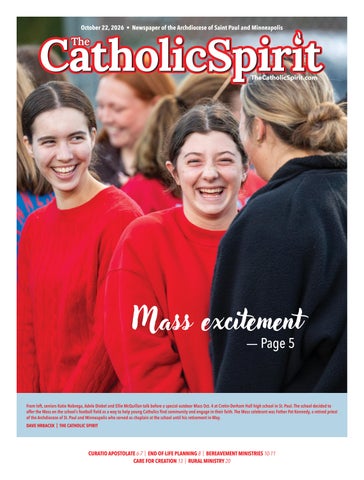
From left, seniors Katie Nobrega, Adele Diebel and Ellie McQuillan talk before a special outdoor Mass Oct. 4 at Cretin-Derham Hall high school in St. Paul. The school decided to offer the Mass on the school’s football field as a way to help young Catholics find community and engage in their faith. The Mass celebrant was Father Pat Kennedy, a retired priest of the Archdiocese of St. Paul and Minneapolis who served as chaplain at the school until his retirement in May. DAVE HRBACEK | THE CATHOLIC SPIRIT
CURATIO APOSTOLATE 6-7 | END-OF-LIFE PLANNING 8 | BEREAVEMENT MINISTRIES 10-11 CARE FOR CREATION 13 | RURAL MINISTRY 20
2 • THE CATHOLIC SPIRIT
OCTOBER 22, 2026
PAGETWO NEWS notes In a commentary on its website, the Minnesota Catholic Conference (MCC) — which represents the public policy interests of the state’s Catholic bishops — addressed an upcoming ballot question about the state’s Permanent School Fund. Changes to the policies governing the fund would go into effect should voters support amending the state’s constitution. MCC outlines considerations related to the ballot question in its commentary, which can be found at mncatholic.org/schoolfundamendment. Meanwhile, as Election Day Nov. 3 approaches, MCC encourages all who are interested in the political process to join the Catholic Advocacy Network, for updates on key pieces of legislation, ways to reach legislators, and how to view current issues through a Catholic lens. More information can be found online at mncatholic.org.
CNS PHOTO | LOLA GOMEZ
POPE LEO LEAVES HOSPITAL Pope Leo XIV waves to well-wishers as he walks out of Rome’s Gemelli hospital Oct. 17. The pope was discharged four days after undergoing surgery to remove the lower lobe of his right lung to treat a cancerous tumor. See page 8.
All who are interested in an evening of music are invited to attend the Nov. 1 premiere of a new song cycle for soprano and organ at Holy Cross in Northeast Minneapolis. Samuel Backman — a Twin Cities-based composer, conductor and virtuoso organist as well as Holy Cross’ director of sacred music — composed “Through the Flames” with soprano and poet Elena Bird Zolnick, director of sacred music at The St. Paul Seminary in St. Paul, who will sing at the premiere. “Through six martyrs spanning continents, cultures, and nearly two millennia, the work explores what their witness might still have to say to us today,” reads a description of the song cycle. That the premiere takes place on All Saints’ Day was intentional; “(a)lthough the cycle confronts suffering and martyrdom quite directly, its trajectory is ultimately one of hope and triumph: from earthly trial toward the communion of saints,” the description read. The premiere is free and open to the public. More information can be found online at samuelbackman.com/through-the-flames. Convents, monasteries and friaries in the Archdiocese of St. Paul and Minneapolis will host a religious communities open house Nov. 8 from 1-4 p.m. Corey Manning, director of the archdiocesan Office of Discipleship and Evangelization, worked with Nicole Bettini, the archdiocesan delegate for religious life, in an effort to help parents plant the seeds of vocations. Bettini wrote that the open house is a way for religious communities to assist in promoting Archbishop Bernard Hebda’s pastoral letter, “Only One Thing Is Necessary: How Catholic Families Can Strive To Be United In This Life And The Next.” On Nov. 7 from 9 a.m. to 5 p.m., the Minnesota Alliance for Ethical Healthcare is hosting a film festival at Coffman Memorial Union Theater in Minneapolis. The festival will feature four films: “Life After,” “Life Worth Living: Averting the Canadian Crisis,” “Better Off Dead” and “Prescription Poison.” Following the films will be a reflection or panel discussion with speakers and experts. According to organizers, the film festival is for “the broader MN community, healthcare professionals, disability advocates and partners of the Alliance. All are welcome to attend — please bring your family, friends and community.” Tickets are available for $15 at tinyurl.com/43s8stn4 or at the door. Snacks and refreshments will be included throughout the day.
DAVE HRBACEK | THE CATHOLIC SPIRIT
LEGACY SOCIETY MASS From left, Archbishop Bernard Hebda greets Jesse and Mollie Merkel after the Catholic Community Foundation (CCF)’s Legacy Society Mass Oct. 11 at The St. Paul Seminary in St. Paul, which was followed by a luncheon at Town and Country in St. Paul. The Merkels’ son, Fletcher, who died in the Aug. 27, 2025, tragedy at Annunciation, was inducted into the society along with seven others. Members of the Legacy Society “have formally entrusted their charitable legacy to CCF’s perpetual stewardship,” according to the CCF website. For more information about the Legacy Society and CCF, visit ccf-mn.org.
Practicing CATHOLIC Produced by Relevant Radio and the Archdiocese of St. Paul and Minneapolis, the Oct. 16 “Practicing Catholic” radio show on Relevant Radio 1330 AM included Nicole Bettini, the delegate for consecrated life in the archdiocese, in an interview about the Religious Communities Open House Nov. 8. The program also featured Andrew Lang, headmaster of Holy Spirit Academy in Monticello, in an interview about experiencing the beatification of Blessed Fulton Sheen with his students. Listen to interviews after they have aired at practicingcatholicshow.com or choose a streaming platform at Spotify for Podcasters.
The Catholic Spirit is published semi-monthly for The Archdiocese of Saint Paul and Minneapolis Vol. 31 — No. 20 MOST REVEREND BERNARD A. HEBDA, Publisher TOM HALDEN, Associate Publisher JOE RUFF, Editor-in-Chief REBECCA OMASTIAK, News Editor
Bishop Patrick Neary of St. Cloud has been named the Honorary Chair for the National Fund for Catholic Religious Vocations, succeeding Cardinal Seán O’Malley. “Bishop Neary’s appointment brings renewed attention to an important challenge facing religious vocations: educational debt can delay or prevent women and men from entering formation,” wrote the National Fund for Catholic Religious Vocations. “Since its founding in 2014, the Vocation Fund has awarded more than $1 million in educational debt assistance and helped more than 50 women and men pursue religious life and priesthood across the United States.” St. Olaf in Minneapolis has announced that a 25th anniversary celebration of the installation of the parish’s pipe organ has been postponed from its scheduled Oct. 29 date due to health reasons of its scheduled guest, Olivier Latry. Parish leaders said Latry, a world-renowned organist from the Cathedral of Notre Dame in Paris, hopes to make the trip in 2027, and more information will be shared as it becomes available. People who have purchased tickets for the Oct. 29 event will be refunded.
Materials credited to CNS copyrighted by Catholic News Service. Materials credited to OSV News copyrighted by OSV News. All other materials copyrighted by The Catholic Spirit Newspaper. Subscriptions: $29.95 per year; Senior 1-year: $24.95. To subscribe: (651) 291-4444; To advertise: Display Advertising: (651) 251-7714; Classified Advertising: (651) 251-7714. Published semi-monthly by the Office of Communications, Archdiocese of St. Paul and Minneapolis, 777 Forest St., St. Paul, MN 55106-3857 • (651) 291-4444, FAX (651) 291-4460. Periodicals postage paid at St. Paul, MN, and additional post offices. Postmaster: Send address changes to The Catholic Spirit, 777 Forest St., St.Paul, MN 55106-3857. TheCatholicSpirit.com • email: tcssubscriptions@archspm.org • USPS #093-580
OCTOBER 22, 2026
THE CATHOLIC SPIRIT • 3
FROMTHEBISHOP ONLY JESUS | BISHOP MICHAEL IZEN
The opportunity to be generous
W
e recently had the funeral for a longtime archdiocesan priest, Father Theodore (Ted) Campbell. Father Ted was wellknown and well-liked by priests and parishioners alike. One of the wise things he once said to me was a!er I had called him to apologize that I was not able to assist at a penance service to which I had previously committed. Unfortunately, I had a funeral come up. Father Ted said to me, “People die at the most inconvenient times.” While he said it with a little bit of jest, there is some wisdom packed into that little line. First, “of that day and hour no one knows” (Mt 24:36). Only our Heavenly Father knows the moment he will call us. Second, it also serves as a reminder that it is seldom going to be convenient to visit the dying or attend a funeral, but our generosity in those moments can prove to be a little leap of faith and a graced event. When I learned that this current issue of The Catholic Spirit would have an emphasis on end-of-life ministry, I was quickly reminded of Father Ted’s quote. I’m sure one of the reasons I have always placed value on attending funerals is because I lost both my dad and my mom at a relatively young age. My dad died at the age of 61 when I was 21 years old. My mom died at the age of 73 when I was 33. I can still tell you which of my friends were able to attend those funerals. I realize it’s not always possible, but in both cases, a good list of folks dropped everything or rearranged their schedules to be there for me. With their attendance, they brought sympathy, prayers and an assurance that even though I felt alone, I wasn’t. I encourage you to make funerals a priority. I suspect Father Ted’s words ring true for most of our experiences. Seldom does someone die and we think to ourselves, “Oh, the timing for that funeral will work well!” Instead, I believe the
La oportunidad de ser generosos
R
ecientemente celebramos el funeral de un sacerdote de larga trayectoria en nuestra arquidiócesis, el padre Theodore (Ted) Campbell. El padre Ted era muy conocido y apreciado tanto por sus compañeros sacerdotes como por sus feligreses. Una de las cosas sabias que me dijo ocurrió después de que lo llamara para disculparme porque no podría asistir a un servicio penitencial al que me había comprometido previamente. Lamentablemente, había surgido un funeral. El padre Ted me dijo: “La gente muere en los momentos más inoportunos.” Aunque lo dijo con cierto humor, esa pequeña frase encierra mucha sabiduría. En primer lugar, “en cuanto al día y la hora, nadie lo sabe” (Mt 24,36). Solo nuestro Padre celestial conoce el momento en que nos llamará. En segundo lugar, también nos recuerda que rara vez resulta conveniente visitar a alguien que está muriendo o asistir a un funeral, pero nuestra generosidad en esos momentos puede convertirse en un pequeño salto de fe y en una ocasión llena de gracia. Cuando me enteré de que esta edición de The Catholic Spirit estaría dedicada al ministerio al !nal de la vida, recordé enseguida aquella frase del padre Ted. Estoy seguro de que una de las razones por las que siempre he dado tanta importancia a asistir a los funerales es que perdí a mis padres a una edad relativamente temprana. Mi padre murió a los 61 años, cuando yo tenía 21. Mi madre murió a los 73 años, cuando yo tenía 33. Todavía puedo
It is hard to put my finger on it, but those two visits were two of the most powerful hospital visits that I’ve had in all my priesthood. Perhaps, while any emergency call requires a leap and a sacrifice, answering such a call on Christmas Day only enhances the dynamics. good Lord o!en gives us the opportunity to sacrifice, to make a leap of faith, and to be generous. For priests, similar to the urgency and sacrifice of attending funerals is the (literal) call to visit the dying. Laypeople and priests alike, however, can benefit from taking the time to visit someone who is near the end of their life. It’s actually one of the things I miss as a bishop. I no longer have a parish family and so I do not get called to do many anointings or visits to the dying. While I do not miss being on call, or getting emergency calls in the middle of the night, I do miss those graced moments of being with the people of God in those most critical and vulnerable moments before death. When that emergency call comes in, I suspect many priests are like me and initially find it a challenge and an inconvenience. But as priests, we quickly come around and realize that yes, someone dying is more important than anything else we need to do. I remember a particularly challenging request that happened a number of years ago on Christmas Day. I had just finished my first of two Christmas Day Masses, and a parishioner asked me if a!er my second Mass I could visit their loved one in the hospital. It is with embarrassment that I admit that my first thought was not, “Of course I will!” Instead, my first thoughts were, “It’s Christmas” and “My family is gathering in the early a!ernoon.” If you know anything about me, you probably know I love my family
decirles cuáles de mis amigos pudieron asistir a esos funerales. Sé que no siempre es posible, pero en ambos casos hubo muchas personas que dejaron todo lo que estaban haciendo o reorganizaron sus horarios para estar conmigo. Con su presencia, me brindaron su compasión, sus oraciones y la certeza de que, aunque me sentía solo, no lo estaba. Los animo a dar prioridad a los funerales. Sospecho que las palabras del padre Ted reflejan una experiencia que la mayoría de nosotros hemos vivido. Rara vez, cuando alguien muere, pensamos: “¡Qué bien, la fecha de ese funeral me viene de maravilla!” Más bien, creo que el buen Señor suele ofrecernos la oportunidad de sacri!carnos, dar un salto de fe y ser generosos. Para los sacerdotes, al igual que sucede con la urgencia y el sacri!cio de asistir a los funerales, existe también el llamado — literalmente — a visitar a quienes están muriendo. Sin embargo, tanto los laicos como los sacerdotes pueden bene!ciarse de dedicar tiempo a visitar a alguien que se encuentra cerca del !nal de su vida. De hecho, es una de las cosas que extraño de cuando era párroco. Ahora, como obispo, ya no tengo una comunidad parroquial propia, por lo que recibo pocas llamadas para administrar la Unción de los Enfermos o visitar a personas que están muriendo. Aunque no extraño estar de guardia ni recibir llamadas de emergencia en mitad de la noche, sí extraño esos momentos llenos de gracia en los que podía estar con el pueblo de Dios durante esos momentos tan decisivos y vulnerables que preceden a la muerte. Cuando llega una llamada de emergencia, sospecho que muchos sacerdotes reaccionan como yo y, al principio, sienten que atenderla
and I love Christmas. I, of course, soon recognized what was the right choice. I said yes to going to the hospital and arrived there shortly a!er noon. Not only did it end up being a graced visit, but while I was in the hospital, a second family spotted me and asked if I could visit their relative as well. It is hard to put my finger on it, but those two visits were two of the most powerful hospital visits that I’ve had in all my priesthood. Perhaps, while any emergency call requires a leap and a sacrifice, answering such a call on Christmas Day only enhances the dynamics. I remember finally leaving the hospital and my primary emotion was not, “I can’t wait to get to my family gathering.” Rather, I was blessed to realize what a gi! those two visits were. To bring Jesus to two hurting individuals and two suffering families — on Christmas Day of all days — was deeply appreciated by them and by me. When I finally got to my sister’s house, multiple loved ones expressed their sorrow for me, and their regrets that I had to miss about 90 minutes of Christmas Day. Although I might have tried, I quickly realized that I was not going to be able to communicate to my family the value of those two visits. People die at the most inconvenient of times. They also get sick at the most inconvenient of times. These are times that the Lord o!en offers us opportunities to drop everything and make this other person the priority. The Lord’s response to our efforts typically includes great grace.
es un desafío y un inconveniente. Pero, como sacerdotes, pronto recapacitamos y comprendemos que sí, la vida de alguien que está muriendo es más importante que cualquier otra cosa que tengamos que hacer. Recuerdo una petición particularmente difícil que recibí hace varios años, el día de Navidad. Acababa de celebrar mi primera de las dos misas del día de Navidad cuando un feligrés me preguntó si, después de mi segunda misa, podría visitar a un ser querido suyo en el hospital. Me avergüenza admitir que mi primer pensamiento no fue: “¡Por supuesto que iré!” En cambio, pensé: “Es Navidad” y “Mi familia se reunirá a primera hora de la tarde.” Si me conocen, probablemente sepan cuánto amo a mi familia y cuánto amo la Navidad. Por supuesto, pronto reconocí cuál era la decisión correcta. Acepté ir al hospital y llegué poco después del mediodía. No solo fue una visita llena de gracia, sino que, mientras estaba allí, una segunda familia me vio y me preguntó si también podía visitar a un familiar suyo. Es difícil explicar exactamente por qué, pero aquellas dos visitas fueron dos de las experiencias más profundas que he vivido en mis visitas al hospital durante todo mi sacerdocio. Quizá, aunque toda llamada de emergencia exige dar un salto de fe y hacer un sacri!cio, responder a una llamada así el día de Navidad intensi!ca aún más esa experiencia. Recuerdo que, al salir !nalmente del hospital, mi emoción principal no era: “¡Qué ganas tengo de llegar a la reunión familiar!”. Más bien, me sentía bendecido al comprender el regalo que habían sido aquellas dos visitas. Llevar a Jesús a dos personas heridas y a dos familias que sufrían — ¡nada menos que el día de Navidad! — fue algo profundamente
apreciado tanto por ellas como por mí. Cuando !nalmente llegué a casa de mi hermana, varios de mis seres queridos me expresaron su pesar y lamentaron que hubiera tenido que perderme unos 90 minutos del día de Navidad. Aunque quizá lo intenté, pronto comprendí que no iba a poder transmitirles el verdadero valor de aquellas dos visitas. La gente muere en los momentos más inoportunos. También se enferma en los momentos más inoportunos. Estos son momentos en los que el Señor suele ofrecernos la oportunidad de dejarlo todo y hacer de esa otra persona nuestra prioridad. La respuesta del Señor a nuestros esfuerzos suele incluir una gran abundancia de gracia.
OFFICIALS Archbishop Bernard Hebda has announced the following appointments in the Archdiocese of Saint Paul and Minneapolis:
Effective October 2, 2026 Deacon Steven Moses, assigned to exercise the ministry of a permanent deacon at the Church of Saint John Neumann in Eagan. Deacon Moses has returned to ministry after residing outside the Archdiocese. Reverend Francis Ta, CRM, assigned as sacramental minister for DeLaSalle High School in Minneapolis. This is in addition to his current assignment as parochial vicar of the Church of Saint Anne-Saint Joseph Hien in Minneapolis.
4 • THE CATHOLIC SPIRIT
OCTOBER 22, 2026
LOCAL SLICEof LIFE
From left, Tim Rethlake, Chase Osborne and Daniel Hall work on a grave marker of a priest at Resurrection Cemetery Oct. 9 during an event organized by members of the Virtuous Business Leadership program. The Catholic business organization invited new men at St. John Vianney College Seminary in St. Paul to work with VBL members on a service project to provide maintenance on graves of priests and bishops in the cemetery’s consecrated section. This is one in a series of regular gatherings designed to help SJV seminarians get to know local Catholic business leaders. There are around 150 priest and bishop graves at Resurrection, said Jonquil Shipman, executive director of The Catholic Cemeteries. “There’s no way for us to maintain every stone that’s in the cemetery,” Shipman said. “And to have these young men and esteemed business leaders come out and be willing to give their time and their gifts to help us maintain the consecrated section was such a blessing.” VBL was formed about 20 years ago by Father Bill Baer, who was rector of SJV at that time and died in 2018. Rethlake is a VBL member, Osborne and Hall are SJV men.
Corporal mercy
DAVE HRBACEK | THE CATHOLIC SPIRIT
La Grande Bande presents its 26/27 Season
Music from New France
*+,-$-./0+%102('300 4'5(06+$-789:02-;-%)
Holy Cross Catholic Church 1621 University Ave NE, Minneapolis From Battlefields to Bourbon Street: Celebrating Music of the French Alliance
Saturday, November 14
6:45pm Pre-concert talk 7:30pm Concert Performance
!"#$%&'&()&*+&,-&.'/0&'1"2'"3'4+%+,45'' 6"78'/0&*&$9':'7:2'/"'90:*&'/0:/'1"2'' 7+/0'2"#*'3:;+<2':9'7&<<5
Tickets $20 (advance), $25 (at door), $10 (students) Use discount code CSM1126 to save 10%
='.","*':.%+9&.'3#,.':/'>>?'' ;:@&9'+/'&:92'/"'+,%"<%&'<"%&.'' ",&9'+,'2"#*'-0:*+/:A<&'4+%+,4'' :,.'-*&:/&'90:*&.'&()&*+&,-&9'' "3'4&,&*"9+/2'/0:/'-:,'<:9/'' 3"*'4&,&*:/+",95
Online at www.lagrandebande.org/tickets or by phone at 507-237-6539
NEW LOCATIONS
>:<<'#9'/"'<&:*,'0"7':'.","*':.%+9&.'3#,.'-:,'+,9)+*&'' :'<&4:-2'"3'4&,&*"9+/2'+,'2"#*'3:;+<25 BCD5EFG5HEHH' !!"#$%&'()
Saint Cloud
JOIN US & GET
$200
NotreDameFCU.com/JOIN
120 10th Ave. N. St. Cloud, MN 56303
Saint Paul 3499 Lexington Ave. N. St. Paul, MN 55126
Offer card or online form must be completed to receive the offer. To receive the $200 direct deposit bonus, you must have a minimum aggregate direct deposit(s) of $1,000 per month made to your Notre Dame FCU checking account. Your direct deposit needs to be an electronic deposit of your paycheck, pension, or government benefits (such as Social Security) from your employer or the government. Bonuses are considered interest and will be reported on IRS Form 1099-INT (or Form 1042-S, if applicable). Bonus will be awarded the first week of the month following 30 days of completing requirements. If the checking account is closed by the Member or Notre Dame FCU within six months after deposit bonus, we will deduct the bonus amount for that account at closing. All new memberships subject to normal policy outlined in membership agreement. Visit NotreDameFCU.com/Join to learn more and become a member. Offer may change at any time. Insured by NCUA
OCTOBER 22, 2026
LOCAL
THE CATHOLIC SPIRIT • 5
Outdoor Mass on Cretin-Derham Hall’s football field in St. Paul: ‘A spiritual homecoming’ By Aviana Kasal
For The Catholic Spirit
Before Cretin-Derham Hall (CDH) high school students and families gathered for Mass on the football field Oct. 4 in St. Paul, school leaders laid the groundwork for something they hope will extend beyond the turf. School leaders spoke with area parishes about ways to strengthen students’ connections to their faith communities while creating opportunities for students to take more ownership of their faith at school, said Jeb Myers, president of CretinDerham Hall. The 6:30 p.m. Sunday Mass was planned as a unique and engaging option for students, families, faculty, staff and the community to worship together, Myers said. The initiative also aligns with the Archdiocese of St. Paul and Minneapolis’ effort at Reclaiming Sundays, which stems from Archbishop Bernard Hebda’s 2022 pastoral letter, “You Will Be My Witnesses: Gathered and Sent From the Upper Room.” “We’re very clear that we’re trying to partner with our students’ parishes,” Myers said. “We’re not trying to pull them away from it, but we’re trying to partner with them.” Those early conversations paved the way as it included pastors and parishes connected with the school’s partner elementary schools. Myers said pastors have asked how students who are not connected with a parish could be invited into one and how parishes and the school could work together when a student has not received the sacraments. In addition, all young
DAVE HRBACEK | THE CATHOLIC SPIRIT DAVE HRBACEK | THE CATHOLIC SPIRIT
Father Pat Kennedy talks during his homily to those gathered for an outdoor Mass Oct. 4 at Cretin-Derham Hall high school in St. Paul. Father Kennedy retired in May from his position as chaplain at the school.
adults are welcome at the community Masses, he said. “For the most part, our pastors and parishes have been really supportive,” Myers said. “Again, we’re all trying to figure out ways to engage young people and help them be strong.” At CDH, one answer is to give students a more active role in the Mass. Myers said he hopes students can participate as lectors, music ministers and extraordinary ministers of holy Communion, developing a sense that the Mass belongs to them, too. A positive experience of taking ownership of their faith during high school, he said, could help form how they approach Sundays later in life. Christian Brother Michael Phipps, interim director of Mission and Formation
From left, Lauren Mauer, Leila Colvin and Greta Johnson, all seniors at Cretin-Derham Hall, were among those gathered for the outdoor Mass Oct. 4. Colvin served as a lector during the Mass.
at CDH and a licensed school counselor, said a sense of community is particularly important for young people. “So much of when I’m talking and connecting with students, with young people, they’re looking for a community,” Brother Michael said. Students sometimes tell him about feelings of loneliness and isolation, he said. Creating a faith community among their peers can help students recognize that they are not walking their faith journey alone. For Brother Michael, that reflects what reclaiming Sundays means in his own life. Growing up Catholic, he remembers Sundays not only as a time for Mass but also for rest and being together as a family. “I think the heart of the Catholic faith, the Christian faith, is about family, is about community,” he said.
But school leaders also recognize the demands young people face on Sundays. Athletics, tournaments and other activities can fill weekends, sometimes continuing into Sunday. Rather than ignoring those realities, Brother Michael said the school is considering how it can still engage students in their faith. That helped inspire an evening Mass on campus, where students already spend much of their time. “We can’t necessarily expect them to come to us anymore,” Brother Michael said of young people. “There was a time where that was the culture, and that has shifted.” The decision to celebrate Mass on the football field was intentional, he said. By PLEASE TURN TO CRETIN-DERHAM HALL ON PAGE 14
St. John the Baptist turns Reclaiming Sundays into action
Choosing to treat Sunday differently amid sports, work and other responsibilities can be For The Catholic Spirit challenging, she said. When Father Bobby Pish arrived at St. John “To try and pull aside Sunday is very the Baptist in Savage, the parish was preparing to countercultural,” McNally said. “There’s great begin the Archdiocese of St. Paul and Minneapolis’ fruits once you start doing it, but it’s very Reclaiming Sundays initiative. countercultural.” Rather than simply tell parishioners about The parish hoped the monthly challenges could the initiative, Father Pish and the parish’s Synod give families manageable ways to begin. A low-tech Evangelization Team wanted to give them a way to Sunday, for example, could introduce a family to act on it. spending part of the day away from phones and “We wanted to encourage people to make a eventually encourage similar habits at other times. commitment to do this, not just inform them about McNally said older parishioners were it, but commit to one of the initiatives that was particularly enthusiastic about the initiative, while spelled out for each month,” Father Pish said. for families it helped keep the idea of reclaiming Beginning in September 2025, the parish Sunday at the forefront of their minds. incorporated Reclaiming Sundays into its monthly “I think it helped to keep that conversation Fellowship Weekends, or “donut Sundays.” COURTESY JULIE MCNALLY going,” McNally said. “And I think it’s a seed that Parishioners could review suggested practices, will be planted and hopefully it will continue to A wall in the atrium of St. John the Baptist in Savage provides a visual representation of commit to one for the month and take home a pay dividends, you know, years from now.” parishioner commitments to initiatives within the Archdiocese of St. Paul and Minneapolis. challenge card. The initiative also produced an unexpected A wall in the parish atrium provided a visual The team saw an opportunity to create that sense of visible result during Fellowship Sundays. The parish representation of those commitments. The display changed participation again with Reclaiming Sundays. reported that people increasingly remained after Mass to talk each month to reflect both the season and that month’s As the months changed, so did the wall. Leaves, turkeys and connect, eventually drawing other ministries into the Reclaiming Sundays theme. and feathers, manger imagery, snowflakes, conversation monthly gatherings. For September, which focused on building habits of prayer, bubbles and other decorations corresponded with different Although the formal year of Reclaiming Sundays has parishioners could commit to practices including regular monthly themes. concluded, St. John the Baptist is carrying elements of the Mass attendance, preparing for Mass in advance, Eucharistic “It was just a way to allow everybody to see who was approach into the archdiocese’s Parents as Primary Educators adoration, prayer before meals or evening prayer on the participating and support each other, and then pray for each initiative. Lord’s Day. Families wrote their names on paper apples and other,” McNally said. The parish has created another wall display where placed them on the display according to the challenge they Over 10 months, approximately 1,240 challenge cards parishioners can put their names on crosses after committing chose. were taken by parishioners, according to a report the parish to pray for the initiative through practices such as attending Julie McNally, a St. John the Baptist parishioner and prepared for Archbishop Bernard Hebda. Participation Mass, praying a rosary or spending an hour in Eucharistic volunteer member of the Synod Evangelization Team, helped remained relatively consistent even though the parish did adoration. implement the displays. She said the idea was partly inspired not offer prizes or other incentives. The report estimated For Father Pish, one lesson from Reclaiming Sundays is by something the parish had done during the COVID-19 that about 10% monthly engagement was a realistic level of the value of asking parishioners to do more than listen to an pandemic, when families put their names on snowflakes participation among approximately 1,400 weekly attendees. initiative’s description. displayed at the church. McNally said one of the biggest obstacles facing families “The way we did it,” he said, “really kind of encouraged “It was a way for people to feel reconnected to the church trying to set Sunday apart is time. people to participate in a more active way and bring this into at the time,” McNally said. “There’s so many demands on families,” McNally said. our family.” By Aviana Kasal
6 • THE CATHOLIC SPIRIT
LOCAL
OCTOBER 22, 2026
Curatio Apostolate’s mission: Bringing the heart of Christ to healthcare assistants) supported me in my beliefs regarding this issue,” he said. For Deacon Spencer, Curatio provides a similar sense of support among Catholic professionals. “All Curatio members support one another to practice their profession consistent with the faith,” he said. For some participants, the most important discovery is simply that they are not alone. Johnson said evaluations frequently reveal that attendees believed they were “the only ones trying to integrate their faith and their work.” “There is a sense of joy, genuine hospitality and belonging when that happens,” she said. Deacon Spencer said that knowledge is particularly encouraging. “It is so encouraging to know that other Catholic professionals, my brothers and sisters in Christ, are carrying their cross, too,” he said.
By Maura Keller
For The Catholic Spirit
The Curatio Apostolate — which has grown beyond its beginnings in the Archdiocese of St. Paul and Minneapolis — helps Catholic healthcare professionals navigate moral distress, spiritual fatigue and the demands of modern medicine by grounding their work in prayer, the sacraments and the dignity of every human person, its advocates say. For many people in healthcare, the pressures of the job do not end when a shift is over. For Catholics, the physical demands of caring for patients can be accompanied by difficult ethical questions, moral distress, emotional exhaustion and the challenge of remaining faithful to Catholic teaching in workplaces that may not share the same understanding of human dignity. Those realities were at the heart of Curatio Apostolate’s recent fall retreat at Christ the King Retreat Center in Buffalo in September. With the theme “Hope and Joy in a Valley of Tears,” the retreat brought Catholics working in healthcare together for Mass, reconciliation, prayer, silence, reflection and fellowship — offering them an opportunity to step away from the demands of their professions and reconnect with the spiritual foundation of their work. Professor Douglas Bushman, the St. John Paul II Professor of Theology for the New Evangelization at the Augustine Institute in Denver, led reflections exploring Jesus as the physician of souls and drawing parallels between physical and spiritual healing. Priests of the archdiocese Fathers Joseph Bambenek and Brian Lynch celebrated Mass, while Father Bambenek also offered the sacrament of reconciliation. Bushman emphasized Christ’s healing power and the transforming power of God’s love, encouraging participants to bring their spiritual needs to Mass and recognize God’s love as the ultimate remedy for spiritual suffering. For healthcare professionals who routinely encounter suffering, that message carries particular weight. One retreatant was Teresa McCarthy, an internal medicine physician trained in geriatrics and an associate professor at the University of Minnesota Department of Family Medicine and Community Health, who belongs to St. Bartholomew in Wayzata. McCarthy said she cares for frail older adults with multiple medical problems and complicated family and psychosocial circumstances, and she sees faith as an essential foundation for that work. “My faith is a grounding point from which to approach all of my patients and families,” McCarthy said. “Recognizing that within each is the manifestation of God’s love makes providing care a mission even under complex circumstances.” Deacon Patrick Spencer, who has worked as a family nurse practitioner for 30 years, including 10 years in the U.S. Air Force, also understands the importance of bringing faith into patient care. He tries to approach each patient in light of Christ’s command to love one another. “I try to care for each patient keeping in mind Christ’s command to ‘love one another as I have loved you,’ ” Deacon Spencer said. He also recalls Christ’s words in Matthew 25: “Whatever you did to the least of my brothers, you did unto me.” Deacon Spencer, a family nurse practitioner at AALFA Family Clinic in White Bear Lake and a deacon at Epiphany
COURTESY ROBERT REINKE MAJESTIC CREATIONS
Deacon Patrick Spencer blesses Franciscan Brother of Peace Conrad Richardson after Mass on the 34th World Day of the Sick Feb. 7 at Our Lady of Grace in Edina. World Day of the Sick is an annual Catholic observance of prayer for those who are ill, healthcare professionals and caregivers. The Curatio Apostolate provided yellow roses for those attending in honor of Our Lady of Lourdes after Mass and the Order of Malta provided water from Lourdes.
in Coon Rapids, said he first encountered Curatio years ago through an advertisement for one of its retreats. Attending the retreat convinced him that he wanted to become part of an effort to “reclaim healthcare for Christ” and be Christ’s “hands and feet” in caring for patients. A member of St. Vincent DePaul in Brooklyn Park, McCarthy said her first Curatio retreat introduced her to an extended period devoted to silence and contemplation. “I had never been on retreat prior to attending my first Curatio event,” she said. “It was a remarkable experience for me.” “The power of silence and focused contemplation was an eye-opener,” she said. Since then, McCarthy has tried to incorporate silence and focused contemplation into her daily life, even briefly. “My prayer life has grown immensely based on attending serial retreats,” she said. “All of these benefits sustain my ability to practice medicine in accordance with Catholic teaching.” Deacon Spencer described the retreats as opportunities to recharge spiritually and reconnect with fellow Catholic healthcare professionals. “The Curatio retreats offer enriching talks, a place of refuge to recharge one’s spiritual life, and to ‘find rest in Christ,’ ” he said. “The highlight is Mass, adoration, confession and renewing friendships.”
An oasis for healthcare workers
The retreat illustrates the larger purpose of the Curatio Apostolate, a ministry that Dianne Johnson established in 2001 after experiencing a profound crisis as a Catholic nurse. More than two decades later, what began as a small effort in the Twin Cities is reaching healthcare professionals beyond the archdiocese, including Catholics in the Diocese of Winona-Rochester and the Diocese of La Crosse, Wisconsin. Johnson, a member of St. Charles Borromeo in St. Anthony, said Curatio was born from her struggle to understand how her Catholic faith and vocation as a nurse were meant to fit together. Johnson described a gradual erosion of her confidence in healthcare’s fundamental purpose, leaving her struggling to reconcile
competing moral beliefs about the profession. During one particularly difficult evening as a charge nurse in a coronary care unit, Johnson was running from one emergency to another. After the third cardiac arrest of the night, she ran toward the patient’s room with the crash cart. In the middle of the chaos, she heard a voice say, “You don’t care anymore.” “I was scared to death and assumed everyone else in the hallway had heard it, too,” she said. “That was the moment I decided it was time to look for another job.” Johnson eventually realized that she was not simply physically exhausted. She was spiritually and morally depleted, struggling with contradictions she encountered in modern medicine. “I began to feel as though my Catholic faith was just an add-on or a checkbox in my vocation,” Johnson said. “But inherently and through the grace of God, I knew differently.” That realization became the foundation of Curatio, a Latin word that means healing. The name reflects the apostolate’s understanding that healing is not merely physical and that caregivers need spiritual nourishment. “At the heart of Curatio is the heart of Jesus Christ,” Johnson said. “Our goal is that we would be so transformed by the sacraments that we would be sources of healing grace to others.” Johnson describes Curatio as a Catholic healthcare “oasis,” where professionals can step away from workplace pressures, strengthen their relationship with Christ and encounter others who understand the challenges of integrating faith and medicine. Deacon Spencer said he has experienced that support firsthand. He recalls that after leaving the military and applying to a family practice clinic, a senior OB/GYN asked whether he would prescribe artificial birth control. When Deacon Spencer answered no, he did not get the job. His experience in the Air Force was different. “Surprisingly, when I was in the Air Force, my chief medical officer and all my peer MDs (doctors), NPs (nurse practitioners), and PAs (physician
An integrated vocation
Curatio’s central premise is that Catholic healthcare professionals do not have to compartmentalize their faith and professional lives. Instead, their Catholic identity can shape how they understand their patients, colleagues, responsibilities and difficult ethical decisions. “Curatio’s mission is to fortify the faith of Catholic healthcare professionals, enabling them to be inspired by the heart of Christ, the grace of the sacraments, and daily prayer,” Johnson said. McCarthy has seen what can happen when that shared sense of mission begins to disappear. Her career began in historically Catholic healthcare systems, where she said the connection between faith and the profession was once largely assumed. “There was a consistent understanding of healthcare as a sanctification,” McCarthy said. “The value of life was implicit in the work and almost universally supported.” Over the years, she witnessed those systems become increasingly secular. “There was (a) slow, inexorable change in the mission that I really didn’t recognize for some time,” she said. “Eventually that felt like the true loss of a professional community.” That loss of community is one of the gaps Curatio seeks to address. The apostolate does not ask Catholic healthcare professionals to withdraw from secular workplaces. Instead, it gives them a community in which they can strengthen their faith and receive formation so they can return to those workplaces better equipped to live their vocation. “The Catholic sees healthcare work as part of the evangelizing work of bringing Christ into every corner of existence,” Johnson said. “This does not mean that every doctor or nurse is a chaplain, but simply that he or she is animated in the work by the heart of Christ.” Curatio also provides resources from Catholic experts in biomedical ethics. Deacon Spencer said members can turn to those resources when they need guidance, while also relying on one another for prayer and listening. He finds particular encouragement in Johnson and the people who have been part of Curatio since its beginning. “The remarkable faith of Dianne Johnson and those who have been with her since the beginning, is very edifying to me,” CURATIO APOSTOLATE CONTINUED ON NEXT PAGE
LOCAL
OCTOBER 22, 2026
THE CATHOLIC SPIRIT • 7
Archbishop Hebda encourages prayers for pope, Bishop Kenney, all ‘with difficult diagnoses’ By Rebecca Omastiak The Catholic Spirit
After news of Pope Leo XIV’s lung cancer diagnosis and a successful surgery Oct. 13, Archbishop Bernard Hebda encouraged continued prayers for “all who are living with difficult diagnoses, their loved ones, and their care teams.” According to the Vatican, Pope Leo XIV underwent a 90-minute surgery during which surgeons successfully removed the lower lobe of the pope’s right lung, OSV News reported. Prior to the surgery, the pope said that doctors had discovered a nodule in his lung during a medical examination, and that he was informed the growth was “well-contained” and detected “at a very early stage,” according to OSV News. Doctors at Rome’s Gemelli Hospital stated after the surgery that the subsequent examination “confirmed the diagnosis of lung adenocarcinoma, as suspected by the preoperative tests,” OSV News reported. “While I had been praying that the diagnosis would not be cancer, I am grateful that his doctors were able to successfully remove the affected portion of his lung without any complications,” Archbishop Hebda said in a statement published to the Archdiocese of St. Paul and Minneapolis website Oct. 13. “The Pope’s diagnosis hits particularly close to
CURATIO APOSTOLATE CONTINUED FROM PREVIOUS PAGE Deacon Spencer said. “It is their great witness to the dignity of each human being that encourages me to continue to always do God’s will as best I can in any trying moments.”
When caring becomes overwhelming
That renewal is particularly significant in a healthcare environment in which professionals can become overwhelmed by technology, regulations, staffing pressures and documentation requirements. Sue Sendelbach, a registered nurse and a Curatio board member, said the need extends beyond specific bioethical questions. “We want to offer them support, prayer, resources that they can utilize in their personal life and practice as a healthcare professional,” said Sendelbach, a member of St. John the Apostle in Whitehall, Wisconsin. One of Curatio’s concerns is what Johnson describes as the dehumanization of both patients and the professionals caring for them. Healthcare workers can enter the profession because they want to help people, American Grill, yet find themselvesRedstone with increasingly limited Eden Prairie time to listen. “Instead of being able to take the time to listen to patients’ concerns and hear their stories, healthcare professionals often resort to completing tasks on a computer screen, treating patients as mere checkboxes,” Johnson said. “Efficiency should not come at the constant expense of the dignity and humanity of both patients and healthcare professionals.” For Catholics, those pressures can be compounded when workplace practices or medical procedures conflict with their understanding of human dignity and Church teaching. McCarthy said questions involving treatment decisions, patient autonomy and the beginning and end of life are not occasional concerns in her practice. “These are almost everyday issues in my practice,” she said. Curatio gives her reassurance that she does not have to navigate those questions in isolation. “Knowing that I have access to
COURTESY VATICAN MEDIA
Pope Leo XIV meets with Bishop Kevin Kenney Oct. 7 during the bishop’s recent visit to Rome.
Curatio support if needed is comforting,” she said.
Prayer in the middle of a shift Curatio’s philosophy extends beyond retreat weekends. Johnson encourages men and women in healthcare to find simple ways to incorporate prayer into their work days. Daily Mass is encouraged when possible, but even five to 10 minutes of conversation with Christ before a shift can establish a different foundation for the day, she said. Short prayers can reconnect professionals with God in difficult moments. One particularly simple Curatio practice is praying while “foaming in and foaming out,” referring to the hand sanitizer used repeatedly while moving between patients. The gesture becomes a physical reminder that the professional is not simply completing another task but attempting to serve Christ by caring for another person. Curatio also encourages members to pray for colleagues. Its CPR — Curatio Prayer Responders — prayer line allows healthcare workers to submit intentions that are then prayed for by members for a month.
home here in the Archdiocese of Saint Paul and Minneapolis as we have been journeying with Auxiliary Bishop Kevin Kenney since his own lung cancer diagnosis this past July,” the archbishop went on to say. In a video shared with The Catholic Spirit, Bishop Kenney offered a greeting from Rome on Oct. 9 and said that he had met with Pope Leo XIV after his audience. “In that greeting, I thanked him for his service and then alerted him of my recent diagnosis of lung cancer,” said Bishop Kenney, who on Oct. 1 shared that he is “doing well” after completing seven weeks of targeted gene therapy. “He offered a blessing and said he would pray for me. During the apostolic blessing he gave at the end of the audience, he included all of us, family members, children of those present and all who are sick.” In his Oct. 13 statement, Archbishop Hebda encouraged “all people of good will” to join him in praying for Pope Leo XIV, Bishop Kenney, all those experiencing challenging diagnoses, and their loved ones and care teams. “Through the intercession of Our Lady of Lourdes, may our loving God grant them healing and comfort.” Read Archbishop Hebda’s full statement online at ARCHSP,.-R./S/A/0,01/-R0.ARD31.-P-P0-L0-S-P0RA/3-1-A1D-CA1C0R-D3A.1-S3S.
Returning to the front lines Curatio’s expansion into other dioceses has happened largely through personal relationships. That growth now includes the Diocese of Winona-Rochester and the Diocese of La Crosse. Because Curatio is a Church-approved apostolate, expansion into a new diocese requires communication with and permission from the local bishop. Deacon Spencer said he hopes more healthcare professionals will discover the support Curatio offers. “I pray that all Catholic healthcare personnel — nurses, doctors, medical assistants, optometrists, podiatrists, physical/occupational/speech therapists — and all people of goodwill will respond to Christ’s generous call to ‘come follow me’ and ‘put out into the deep,’ ” he said. Johnson describes Curatio’s role as “spiritual rehab.” The purpose of stepping away is not permanent escape, but renewed strength to return to the same hospitals, clinics and difficult situations Curatio members left behind. “Curatio’s mission is to provide spiritual
OCT 1 | 11:30 AM Mr Pig’s Smokery, Shakopee
OCT 2 | 11:30 AM Redstone American Grill, Eden Prairie
OCT 6 | 11:30 AM
Discover the benefits of pre-planning and get your questions answered so you can focus on the here and now.
OCT 15 | 11:30 AM Axels, Roseville
OCT 20 | 11:30 AM
OCT 27 | 11:30 AM Redstone American Grill, Maple Grove
Coon Rapids Chapel, Coon Rapids
OCT 27 | 11:30 AM
OCT 21 | 11:30 AM
OCT 28 | 11:30 AM
Pinstripes, Edina
Tavern Grill, Apple Valley
OCT 6 | 10:30 AM
OCT 22 | 11:30 AM
Blaine Prearrangement Center, Blaine
Free Educational Pre-Planning Seminars
rehab for as many as possible so that they can return to the front lines with renewed rigor,” said Bushman, during the recent Curatio fall retreat. That mission begins with a conviction that illness, disability, suffering or diminished productivity never removes the inherent dignity of the human person. “The central mission of the Curatio Apostolate is to re-humanize healthcare, foster a culture of compassion and care by strengthening our relationship with Jesus through the grace of the sacraments and devotion to daily prayer all the while building community,” Johnson said. The vocation to care for the sick can be exhausting and can raise questions that have no easy answers. Curatio’s response is to help professionals remember that they are not alone and that their capacity to care is rooted in something deeper than the demands of the healthcare system. “At the heart of Curatio is the heart of Jesus Christ,” Johnson said. “First, we must have our own hearts be transformed by Christ; then we can be sources of healing to others.”
The Exchange, New Brighton
Pizza Luce, Hopkins Pub 42, New Hope
OCT 29 | 11:30 AM Nokomis Park Chapel, Minneapolis
OCT 6 | 5:30 PM
Blaine Prearrangement Center, Blaine
OCT 7 | 11:30 AM Pub 42, New Hope
OCT 13 | 11:30 AM Pub 42, New Hope
RSVP REQUIRED CALL 612.377.7841
or visit Washburn-McReavy. com/Seminars
8 • THE CATHOLIC SPIRIT
LOCAL
November workshop addresses end-of-life planning By Tim Montgomery For The Catholic Spirit
Where to begin? Family and friends left in the wake of a loved one’s sudden change in health or death may have many questions and few answers. They may be caught off guard, distracted and emotional. Organizers of an upcoming workshop know that end-of-life planning may not be the most pleasant topic of discussion, but it’s important. And they know it’s important to have these discussions with family and friends in advance. The workshop from 8:30 a.m. to 4:30 p.m. Nov. 7 at St. John the Baptist in New Brighton can help attendees think about long-term life situations and take action to begin appropriate planning. “This event is open to anyone in the Archdiocese (of St. Paul and Minneapolis), Catholics and nonCatholics alike,” said organizer Jonquil Shipman, executive director of The Catholic Cemeteries. Online registration information is available at DAVE HRBACEK | THE CATHOLIC SPIRIT CA%HO()C-CEME%E,)E-.O,.//O,0-HO1. Jonquil Shipman, left, executive director of The Catholic Cemeteries, has organized Thoughtful planning is one of the greatest gifts people can leave their loved ones, according to Dan a Nov. 7 workshop on end-of-life planning, with help from Amanda Cavanaugh, right, marketing and communications coordinator for The Catholic Cemeteries. McGraw, president of Gill Brothers funeral home and a longtime parishioner at Our Lady of Grace in Edina who will lead a workshop session on funerals. It can conversations today can spare loved ones a great deal of provide clarity, reduce stress and ensure that their wishes are uncertainty and di4cult decision-making later. understood and honored. Some people want a direct burial or cremation without Planning may begin with directives that set the tone for services. McGraw said funeral homes are currently seeing care when there is a sudden change in health. Jenna Firner, roughly 30% casket burials and 70% cremations — but another speaker at the event who is an estate planning having either doesn’t preclude planning a traditional attorney with Schromen Law, helps individuals and funeral service or a Catholic funeral Mass. Discussion families talk about this process. She proactively addresses focusing on family and loved ones often back2lls additional questions about what they want to do, who they would elements: Would loved ones want to gather for a service want to speak and to make decisions for them if the need and reception? What would make the most sense for a arose, and what will be their legacy. Firner wants people 2nal resting place? A memorial? Pre-planning creates a to feel more empowered by the decisions they can make guideline and eliminates guesswork and arguments among and record in advance by means of healthcare directives, those who remain. granting power of attorney, and establishing legal wills and People need to make their wishes known to family and trusts. leave advance directives, con2rmed Father James Buryska, Financial decisions form the basis of many plans and a retired priest of the Diocese of Winona-Rochester who can begin when a young couple 2rst has children and will speak on spiritual care at the end of life during the makes decisions about purchasing life insurance. Many workshop. “I’ve seen so many instances where that was not more people focus on assets that can help 2nance their done, and what happens is that it can create con3ict within retirement, provide for their care and living expenses, and the family.” be left to their loved ones. In 47 years of service as a chaplain at St. Marys Hospital Sarah Johnson is a 2nancial advisor with North Point in Rochester, Father Buryska has been with many patients Advisor Group who helps people identify, understand and who were near death. Families have requested sacraments utilize 2nancial assets to help with their unique situations and rituals, but he also encourages accompaniment — and to maximize their options. spending time with people who are in end-of-life scenarios. “We do a lot of work with estate planning attorneys “Just show up,” encouraged Father Buryska, who making sure 2nancial accounts and assets are set up in a said accompaniment is as important as any ritual or way that properly re3ects wishes spelled out in an estate sacramental attention. “Everyone has a story, and it’s plan,” Johnson said. As a 2duciary, she talks to people important for someone to listen.” about both long-term investing with third-party custodians Shipman discussed how next-of-kin who do not share — like LPL Financial and Charles Schwab — and tactical the deceased’s faith may feel overwhelmed or uncertain spending plans that help ensure funding of long-term goals. about planning a Mass with music, Scripture readings, She said that because life changes, 2nancial plans are living and other details. When these arrangements are made in and breathing documents. advance, however, loved ones have a clearer sense of the And if you think you don’t have a plan for your estate, deceased’s wishes and can focus on coordinating with the you may not realize that you actually do, according to church to schedule the service. Firner, who said not having a plan in place allows the state Shipman said there are approximately 1,000 burials to decide. “The state uses intestacy laws to determine next annually among the 2ve main Catholic cemeteries she of kin and uses the probate process to determine what is to manages in the archdiocese, including Resurrection, be done with an individual’s estate,” explained Firner. “It Gethsemane, Calvary, St. Mary’s and St. Anthony’s — and can be a lengthy and expensive process that may produce that doesn’t include the 90-100 smaller Catholic parish unintended results.” cemeteries. Natural burials, or “green” burials, are a current While individuals with no next-of-kin have a particularly trend. This involves an eco-friendly method of returning a important reason to make arrangements in advance, said body directly to the earth through natural decomposition McGraw, pre-planning is bene2cial to everyone. At the very without the use of embalming chemicals, metal caskets, or least, one should pre-plan to create a guideline of what to concrete vaults. Resurrection offers full-body natural burial do with their mortal remains for those who will ultimately in a prairie preserve and will soon have a cremation version be responsible for making decisions. And pre-planning in a savannah forest. There are also traditional burial vaults involves a separate set of decisions than pre-paying, as and mausoleums available as 2nal resting places. one can thoughtfully make plans without necessarily Speakers at the Nov. 7 workshop will address the topics arranging payment in advance. Many times, payment can of 2nancial and estate planning, legal guidance, assisted be handled through insurance. Not only is it important to living, senior care, veterans’ bene2ts, funeral and cemetery pre-plan, said McGraw, but also to share your plans with all planning, spiritual care and parish coordination. Attendees those you love (who may not necessarily be next-of-kin), can choose the sessions most relevant to their needs, with and particularly with the person who will have the legal core topics covered in both the morning and afternoon. authority to make decisions. Free on-site notary services and dedicated work time will Decision-making is often put off until tomorrow, McGraw be provided. The event is a unique opportunity to begin pointed out, but tomorrow isn’t guaranteed. He said having pre-planning for end-of-life scenarios.
OCTOBER 22, 2026
NATION+WORLD Pope Leo: Prayers sustained him after cancer surgery By Courtney Mares OSV News
One week after Pope Leo XIV 2rst revealed to the world that he would be undergoing lung surgery, the pope returned to the window of the Vatican’s Apostolic Palace Oct. 18, thanking Catholics worldwide for their prayers 2ve days after undergoing lung cancer surgery. “I would like to thank all those who have prayed for me in recent days. I have truly sensed your support,” the pope said after leading the crowd in St. Peter’s Square in the prayer of the Angelus. “This experience has made me feel particularly close to all those who are living with illness or in2rmity. Now that I have overcome this delicate phase, as you know, I will gradually resume my activities, always with God’s help and your prayers,” he added. The pope said he was especially grateful to all of the doctors, nurses, and staff at Rome’s Gemelli Hospital, where he underwent lung cancer surgery on Oct. 13 to remove the lower lobe of the right lung. It was Pope Leo’s 2rst public appearance since he was discharged from Rome’s Gemelli Hospital the day prior after his doctors deemed him 2t to return to the Vatican earlier than had been originally expected. Thousands of people in St. Peter’s Square on the cloudy Sunday cheered loudly when the pope waved from the window of his papal apartment less than 24 hours after his hospital discharge.
Emotional pilgrims welcoming Pope Leo back to the Vatican
For Ylenia Casati, a 32-year-old woman from Siena, Italy, the experience was very moving. “It was emotional. I almost started crying because it was so wonderful to see him again,” Casati told OSV News. “Today was the 2rst Angelus right after his hospitalization, and I wanted and needed to see him, and to be reassured by hearing him and seeing that he was doing well.” Her friend, Ilaria Beatrice, 31, from Prato, Italy, described St. Peter’s Square as “full of passion, full of love, of excitement.” “To feel like part of such a close-knit community of believers, it’s wonderful,” she said. “To turn around and see people clapping, crying and cheering — it gives you so much strength.” The Oct. 17 announcement of the pope’s imminent discharge from the hospital the day prior came earlier than previously expected, as the Holy See Press O4ce had originally indicated that the pope would remain in the hospital for about a week following his Oct. 13 admission to Gemelli on the day of his surgery.
Pope’s surgeon praised Pope Leo as an ‘ideal’ patient, said pope can go to South America
Dr. Stefano Margaritora, the lead surgeon for Pope Leo’s 90-minute lung cancer operation on Oct. 13, said in an interview with Vatican News on the day of his hospital discharge that he saw no clinical reason to cancel the pope’s planned trip to South America. “As for a long trip involving air travel in about three weeks, I would say there are no clinical reasons why it should not take place,” Margaritora said, indicating that he believed from a medical standpoint that Pope Leo could be ready to undertake the demanding visit to Latin America scheduled for Nov. 6-17. “At the time of his discharge from the hospital, Pope Leo was in entirely satisfactory clinical condition,” the surgeon said. “The lung’s re-expansion after surgery is proceeding according to the usual timetable.” The surgeon estimated that it usually takes “a couple of weeks to make a truly complete physical recovery after this kind of operation.” “Since almost a week has already passed, I believe the POPE’S RECOVERY CONTINUED ON NEXT PAGE
NATION+WORLD
OCTOBER 22, 2026
THE CATHOLIC SPIRIT • 9
POPE’S RECOVERY CONTINUED FROM PREVIOUS PAGE pope could be fully recovered in another 10 days or so,” he said. Margaritora, who is the chief thoracic surgeon at Gemelli Hospital, described Pope Leo as “an ideal patient.” “He was always serene, always smiling, and rarely complained, despite the pain a person inevitably feels, even with all the measures we take,” he said. The doctor also shared a story of how Pope Leo offered a helping hand moving chairs in the chapel so that he could celebrate Mass two days after his cancer surgery. “On the second day after the operation, we turned around and found him arranging the chairs in the chapel himself. We said, ‘Holy Father, we can do that.’ And he replied, ‘It doesn’t matter. I can do it, so I will.’ What can I say? He really was an absolutely ideal patient,” Margaritora said. OSV NEWS PHOTO | MATTEO PERNASELCI, VATICAN MEDIA
Pope Leo XIV gestures as he leads the Angelus in St. Peter’s Square at the Vatican Oct. 18, after being released from the hospital the previous day. Lead surgeon Dr. Stefano Margaritora said the pope’s recovery is progressing normally and that there is no medical reason to cancel his planned Nov. 6-17 trip to South America.
Pope Leo celebrating the centenary of World Mission Sunday In his Angelus address, the pope marked the 100th anniversary of World Mission Sunday. “Let us think of how much missionary
history has unfolded over these 100 years,” Pope Leo said. “Let us pray that the Church may always remain faithful to the mandate of the Risen Lord: ‘Go into all the world and proclaim the good news to the whole creation.’” Before praying the Marian prayer of the Angelus in Latin with the crowd, Pope Leo reflected on Sunday’s Gospel in which St. Matthew records Jesus as saying, “Repay to Caesar what belongs to Caesar and to God what belongs to God.” Pope Leo said, “In Jesus, we contemplate a God who is not afraid of history but comes instead to dwell within it. His Kingdom does not abolish human roles and responsibilities. It does, however, call us to live without compromise, free from selfish ambitions and unjust motives, seeking above all the Kingdom of God and his righteousness.” The pope described Jesus’ teaching to render unto Caesar as a command “to be truthful, free from servile fear or hypocrisy, (and) free to do good.” “Let us pray to the Lord to help us live in this way. And let us entrust ourselves to the intercession of the Virgin Mary,” he said.
HEADLINES “Great joy” as the canonization cause of the Irish military chaplain Father Willie Doyle heads to Rome. The canonization cause of Irish Jesuit war chaplain Father Willie Doyle is taking a major step forward, with the diocesan phase set to formally conclude Oct. 18 before being sent to Rome. Patrick Kenny, president of the Father Willie Doyle Association, told OSV News it is a “great joy” for supporters worldwide and said Father Doyle remains an “icon of peace and reconciliation” at a time of growing global conflict. Kenny said interest in the servant of God continues to build, with people around the world inspired by his holiness. According to postulator Father John Hogan, Father Doyle’s cause is the first in Ireland to formally close at the diocesan level in more than 40 years. If canonized, he would become the first Irish saint since St. Oliver Plunkett. Born in Dublin in 1873, Father Doyle joined the Jesuits at 18 and later volunteered as a British army chaplain during World War I. Serving with the Royal Irish Fusiliers, he earned the Military Cross for bravery at the Battle of the Somme and was killed in 1917 while ministering to wounded soldiers under fire. Father Hogan said Father Doyle’s struggles with mental health have also “touched the hearts of many.” The case now moves to the Vatican’s Dicastery for the Causes of Saints for further review. Salt Lake City Diocese hopes to start something new with its lay ministry for OCIA. Bishop Oscar Solis of Salt Lake City has commissioned 31 laypeople as “Worthy and Suitable Catechists” to impart some of the minor rites of the Order of Christian Initiation of Adults, also known as OCIA. Most of them already have extensive experience as certified catechists and lay ecclesial ministers or lay church leaders. “We understand we’re the first diocese in the United States to do this,” said John Valdez, OCIA coordinator at St. James the Just Parish in Ogden, Utah, who was commissioned. “I’m hoping it takes off across the nation — and across the world.” The 31 catechists currently represent 25 parishes within the statewide diocese. “They will help form disciples and prepare catechumens and Catholics to receive the sacraments of initiation,” Bishop Solis said at their commissioning Sept. 19 during the 2026 Utah Catholic Conference in Draper. Lorena Needham, director of the diocese’s Office of Worship, said they can administer one of nine special blessings and one of 11 minor exorcisms,
which are prayers used to break the influence of evil and sin in a person’s life as a catechumen preparing for baptism or as one of the baptized faithful. The U.S. bishops’ president urges Catholics “to put their faith before politics” in November elections. Ahead of the Nov. 3 midterm elections, Archbishop Paul Coakley, president of the U.S. Conference of Catholic Bishops, issued a statement Oct. 14 reminding the faithful that “For citizens in a representative democracy such as our own, participation in public life — including voting — is both a right and a responsibility.” “In a time of deep political division, the temptation is to be discouraged and to not participate in the election process. But discouragement is not a Christian virtue,” Archbishop Coakley of Oklahoma City said. The midterm elections will determine the balance of power in Congress, as well as governors’ mansions and state legislatures across the country. Archbishop Coakley said that as Catholics exercise their civic duty, “it is important to ensure that citizens not face unnecessary delays or complications in registering or exercising their right to vote.” “Together, we can contribute to the common good of our nation as faithful citizens by supporting free and fair elections,” he said. He also asked Catholics “to put their faith before politics.” “The Church’s contribution to the public life of a nation is not a political or partisan program; rather, it reflects our commitment to the dignity of every person, who is created in the image and likeness of God,” he said. “One of the great dangers of our moment is the belief that any criticism of ‘our party’ somehow strengthens our opponents. A well-formed conscience does not operate on those terms.” President Trump calls off Hegseth’s plan to livestream an execution denounced by Catholic leaders. President Donald Trump on Oct. 15 called off Secretary of Defense Pete Hegseth’s plans to livestream the execution of Fort Hood shooter Nidal Malik Hasan by firing squad in December. The plan was met with widespread condemnation, including from U.S. bishops. Archbishop Paul Coakley of Oklahoma City, president of the U.S. Conference of Catholic Bishops, denounced the plan as “a barbaric promotion of a culture of death” that “must be reconsidered.” In a post on his social media website, Truth Social, Trump said Hasan “is a very
bad and evil man,” pointing to his conviction for killing 13 people and injuring 32 others in a mass shooting at Fort Hood, Texas, in 2009. “With all of that being said, I think streaming the execution for all to see might have been a strong deterrent for the World to witness how America deals with Terrorists and SCUM like Hasan but, many very good and well meaning people would rather not watch him die, through streaming, or through any other visual device,” Trump said. “He will die, as scheduled, by firing squad, but this event will not be streamed.” A new poll released the same day by The Washington Post, ABC News and Ipsos found eight in 10 Americans opposed Hegseth’s plan to livestream the execution, while 53% supported and 46% opposed Hasan’s execution by firing squad. A novena and resources respond to the “urgent pastoral challenge” of mental health. As the global community marked World Mental Health Day Oct. 10, the U.S. Catholic bishops renewed their ongoing commitment to address an issue the Vatican has named an “urgent pastoral challenge.” That challenge affects more than 1 billion globally, and at least 1 in 5 in the U.S. In an Oct. 10 news release, the U.S. Conference of Catholic Bishops announced the 2026 start of its annual Novena for Mental Health, which took place Oct. 10-18, and which is part of the bishops’ ongoing National Catholic Mental Health Campaign. In its statement, the USCCB shared an Oct. 10 message for World Mental Health Day from Sister Alessandra Smerilli, a member of the Salesian Sisters of St. John Bosco and prefect of the Vatican’s Dicastery for Promoting Integral Human Development. Sister Alessandra stressed in her message that “no psychological wound can ever erase the dignity of a human person.” Sister Alessandra also stated that “the Church cannot limit herself to occasional or reactive responses” to the issue of mental health. “As Christians, we are called to develop a stable, competent, compassionate and preventive ministry that embraces the person in their totality: body, mind and spirit,” she said. “This requires trained pastoral workers, collaboration with health professionals, clear referral pathways, attention to suicide prevention, support for families and care for young people.” Pope Leo names Archbishop Viola as the new archpriest of St. Peter’s Basilica. Pope Leo XIV has named Archbishop Vittorio Francesco
Viola as the new archpriest of St. Peter’s Basilica and the pope’s vicar for Vatican City. The 61-year-old Italian archbishop succeeds Cardinal Mauro Gambetti, who was recently appointed archbishop of the Archdiocese of Chieti-Vasto. Archbishop Viola currently serves as secretary of the Dicastery for Divine Worship and the Discipline of the Sacraments, a position he has held since joining the Roman Curia in 2021. A native of Biella in Italy’s Piedmont region, Viola entered the Franciscan order after high school and was ordained a priest in 1993. He later served in Assisi and led the Diocese of Tortona from 2014 to 2021. He holds a doctorate in sacred liturgy from Rome’s Pontifical Liturgical Institute of Sant’Anselmo. As archpriest, Archbishop Viola will oversee the day-to-day administration of St. Peter’s Basilica and preside at major liturgies when the pope is not present. Pope Leo also named him president of the Fabric of St. Peter, the Vatican body responsible for the basilica’s upkeep, operations and care of pilgrims and visitors. Pope Leo XIV declares the death penalty an “inadmissible” attack on the dignity of the human person. Pope Leo has posted on his official X account that the Catholic Church holds the death penalty to be “inadmissible because it is an attack on the inviolability and dignity of the person.” In a post published Oct. 10, on the World Day Against the Death Penalty, the pope noted that justice can be upheld and the common good of humanity can be safeguarded without relying on capital punishment. He said criminals can be effectively detained to protect citizens, while still allowing those who are guilty of the possibility of redemption. “The death penalty is inadmissible because it is an attack on the inviolability and dignity of the person. The common good can be safeguarded and the requirements of justice can be met without recourse to capital punishment: effective systems of detention have been developed that protect citizens while at the same time do not completely deprive those who are guilty of the possibility of redemption. #NoDeathPenalty,” Pope Leo wrote. The pope’s post came a day after the Vatican Secretary of State Cardinal Pietro Parolin and the president of the U.S. Conference of Catholic Bishops made statements against the U.S. government’s originally planned public execution of Nidal Malik Hasan over livestream. — CNS and OSV News
GRIEFMIN
10 • THE CATHOLIC SPIRIT
2 GRIEF MINISTRIES BRING COMFORT, HE By Josh McGovern The Catholic Spirit
Editor’s note: The following article addresses pregnancy loss and death of a child.
M
arge Bona has four living kids. Her oldest is 9 and her youngest is just over a year old. In 2018, four years after marrying her husband, Matt, they lost a child in the first trimester. It wouldn’t be the only time they would lose a child. Bona knew miscarriages happened, but she said when most people view their life and family, they don’t envision child loss. “It was really unexpected and challenging and difficult,” Marge Bona said. She experienced feelings of grief and isolation. She and her husband struggled to grieve together. “It really was a difficult time,” she said. “There’s a lot of, like, darkness that came with it, and we didn’t really know how to navigate it, and we also didn’t have a lot of strong foundational faith life. But we got through it.” In 2024, Lisa Torbenson’s son, Neil, died at the age of 14 from brain cancer. Having also experienced that sense of isolation, Torbenson said the experience is isolating for any parent. “I don’t get worried about things anymore because my biggest worry happened,” Torbenson said. After Marge Bona and her husband had welcomed a daughter and a son, in June of 2024, their daughter, Mary, was born at 40 weeks and five days without a heartbeat. “That was really a very painful, rude awakening for us,” Marge Bona said. “There’s just a lot that came with that experience, like discerning our own grief and ... how God is moving through it, and then kind of honestly opening up the door to the grief that we didn’t properly grieve before when we lost the baby in 2018.”
Red Bird Ministries
After losing Mary, the Bonas discovered Red Bird Ministries, a Catholic bereavement ministry for parents who have lost a child at any age. The ministry, based in Breaux Bridge, Louisiana, is for “all parents who’ve lost children,” whether “(y)ou lose a baby in the first trimester, or you lose your 50-year-old son from a heart attack,” Marge Bona said. Together, Matt and Marge Bona found help in Red Bird Ministries’ online support groups. The experience was helpful, Marge Bona said, but she felt a need for in-person support. “We wanted to be able to connect with community in a deeper way, and so we did find out that there was a flock, which is what they call it when a parish has a group,” she said. “There was a Red Bird flock out in St. Boniface, Minnesota, at St. Boniface church, and it just seemed like a long ways for us to go. It was an hour away, so we didn’t really connect with them until later on.” This flock had been established at St. Boniface prior to the stillbirth of the Bonas’ daughter. The group was led by Therese Drey, who “was incredibly passionate about this ministry and spent the final years of her life while dying with cancer dedicated to connecting parents of loss to this resource,” Marge Bona wrote in an email.
JOSH MCGOVERN | THE CATHOLIC SPIRIT
Marge and Matt Bona, members of Red Bird Ministries, advocated for the ministry at the Wave of Light event at St. Mary in Stillwater Oct. 15. They attended with their children and Marge Bona’s parents, Connie and Hank Bona.
Marge Bona said she and her husband brought up the idea of starting a flock at their own parish, St. Charles Borromeo in St. Anthony, with their pastor and the parish’s director of Catholic family life. They encouraged the Bonas to pursue the establishment of an archdiocesan-wide chapter. It became one of 36 diocesan and archdiocesan chapters throughout the United States. Red Bird Ministries is a peer-to-peer ministry that fully vets and trains its peer leaders, Marge Bona explained. “Early, acute grief is a challenging and complex time, and one full of vulnerability. Red Bird Ministries is very careful about who they approve to lead fellow bereaved parents during this time of great sorrow,” Marge Bona wrote. “The ministry wisely requires that Red Bird leaders not begin active ministry until at least a year after their loss. Once the wait period ends, a parent of loss who is interested in becoming a Red Bird leader goes through an application process and discernment period to make sure they are pursuing this ministry out of a healthy and stable desire and not as a means of avoiding or postponing their own personal grief work.” “Because Red Bird Ministries is obedient to the local bishop, this meant asking the archdiocese for their blessing in beginning a chapter,” Marge Bona wrote. A year after receiving approval from Renee Oakes, the Archdiocese of St. Paul and Minneapolis’ director of Marriage, Family and Life, the Bonas had another meeting to share the ministry with Bishop Michael Izen and to ask him if he would say a special Mass for parents who had lost a child, Marge Bona explained. “That’s kind of how you introduce it to the community until you invite parents to come to that and community members to come to that,” Marge Bona said. “It’s a way for the Church to kind of show up and say, ‘Hey, we see you, we acknowledge this wound that you’re carrying, and we want to walk with you towards the cross and not make you feel alone and isolated and walking away from it.’ ”
The time that worked to hold this Mass is Nov. 7. Before Mass, for about 10 to 15 minutes, people can write the names of their children who died in a book at the entrance of the Cathedral of St. Paul in St. Paul, where the Mass will take place. During Mass, after the prayers of the faithful, the names of the children will be read, Marge Bona said. This is a powerful moment for grieving parents to hear the name of their child, a name nobody says anymore, spoken in a sacred place during the sacrament of the Mass, Marge Bona said. “I think it will be really healing for a lot of people,” she said.
Seasons of Hope
After losing her son Neil, Torbenson sought out community and other parents with similar grief, parents “who had a child living in heaven,” Torbenson said. She found support groups through other faith traditions but hoped to find a Catholic group. Somebody who attended Neil’s funeral suggested that Torbenson start her own group. Torbenson went to a church and asked about starting a group, but there wasn’t much interest. “I just continued to pray and drag myself to adoration and drag myself to church, not because I didn’t enjoy it, but because I had felt completely isolated,” Torbenson said. “And if you talk to any bereaved parent, it is a very isolating journey. You feel completely alone. You feel like you don’t belong anywhere anymore because everybody has their families and their kids that are healthy next to them.” One day, Torbenson attended Mass at St. John the Baptist in Dayton. St. John the Baptist was Neil’s confirmation saint before he died. Torbenson felt a sense of peace, calm and relief. She reached out to Cindy Gibbs, the parish’s small group coordinator, and told Neil’s story to Gibbs, who then brought it to Father John Powers, the pastor. Father Powers recognized an immediate need for this kind of support group. “(T)he Holy Spirit lined everything up,”
Torbenson said. “Father Powers was kind enough to let me speak at the pulpit about it. On June 3, we had our very first group, and that was six people.” Seasons of Hope was launched, with Torbenson leading the group. When faith formation started at St. John the Baptist, Seasons of Hope needed a place to go. “St. Gerard (Majella)’s (in Brooklyn Park) opened their doors for us, and now we’ve doubled the number,” Torbenson said. “Now we have 12 people at St. Gerard (Majella).” In each weekly session, grieving parents will find a table on which sit images that speak to Torbenson, such as Jesus with the woman at the well, Mary at the foot of the cross, Mary holding Jesus, and others Torbenson has printed out and put in frames. There is also a candle that Torbenson will light. Each parent gets a binder and a journal. “We all open in prayer together,” Torbenson said. “Then we share how God has met us the past week. Anything that we’ve seen, any ways we’ve been comforted, and then we share, and then we read the Scripture of the week, and then we talk about how that Scripture has spoken to us. Then we go into faith sharing. We answer three questions, and then we do some journaling and some more talking.” The group concludes with prayer. “It’s just really, really comforting because you’re in a room where everyone is living the same nightmare and every parent’s worst fear,” Torbenson said. “When you’re released out into the world, at least you have had that safe space for an hour and a half, where you know the parents in there can relate to you.” As Torbenson searched for Catholic support groups, she found one online group that charged a significant amount of money to be part of the group. “I just didn’t believe that you had to pay to pray, or to pay to be comforted, or pay to talk about living every parent’s biggest nightmare and your biggest fear, as a parent,” Torbenson said. “I just prayed about it, and it was just on my heart not to
NISTRIES
OCTOBER 22, 2026 • 11
EALING TO PARENTS WHO LOST CHILDREN ROB’S MOM Editor’s note: Mary Quade, a member of Seasons of Hope, shared the following written testimony of losing her son, Rob, and the healing she found in this grief ministry. I believe it was Sister Miriam James Heidland who said, “Christianity is not meant to be lived in isolation.” I have learned through Seasons of Hope (that) for child loss, neither is grief. I have lost many important people in my life: parents, siblings, aunts, uncles, a dear nephew and most recently, a dear niece. I have lost friends, beloved companions and friendships which I believed would last forever. The loss of my son, the one I love the most, has torn irreparable holes in my mind, body and soul.
PHOTO COURTESY LISA TORBENSON
A table at a Seasons of Hope meeting Oct. 13 at St. Gerard Majella in Brooklyn Park features images from Scripture and the names of mothers and their children.
charge anybody for this because a grieving heart, I just don’t think has to have that extra burden of how they’re going to come up with money.” Torbenson paid for all resources when Seasons of Hope was at St. John the Baptist. She said it was her way of giving back to the church. When the group moved to St. Gerard Majella, the parish offered to pay for everything. “It was just really important to me. I just kept continuing to bring it to Jesus,” Torbenson said. “The woman at the well didn’t have to pay. The woman that was healed, the one that was bleeding for 12 years. ... Jesus has comforted so many people, and he didn’t have them pay. It was just important to me, and I think Jesus ... knew how important it was. So, the Holy Spirit figured out a way to provide.” Seasons of Hope helped Torbenson recognize that everyone experiences Good Fridays in their lives, but what matters is what they do the following Saturday. She said all parents in these groups are experiencing the same loss. But Torbenson corrected herself. “We know where (our children) are; they’re not lost,” she said. “All of our children are in heaven. … (W)e are all experiencing having a child living in heaven. However, we all grieve very differently. We all are on a very different journey with our grief.” Seasons of Hope helped Torbenson realize that all parents who experience this grief are in this together. “We’re all alone, but yet we’re not alone. ... We all have sorrow, but we all are comforted knowing that we’re in this together. You have comfort and sorrow holding hands,” Torbenson said. “The loneliness of ‘I am the only person going through this’ has disappeared.” When Torbenson goes to Mass and sits in a pew with her other son, Vincent, and an open space where Neil would be, she knows that she’s not the only person in the church experiencing this. “Just because a child hasn’t had their funeral at that church does not mean that there is not a parent sitting in the pew, crying, feeling completely alone and isolated,” Torbenson said. “(Seasons of Hope)
helped me know that there’s a need for it, that it’s brought comfort, just like Jesus has comforted me. It’s also knowing that it’s helping people, and I’m not alone in this. ... Jesus has answered prayers in ways that I never imagined.” Torbenson said she reads Scripture differently after Neil’s death. Before, when she read John 11, she thought it was nice that Jesus raised Lazarus from the dead. “And then when Neil was in heaven, I was in adoration reading the same Scripture, and it completely, completely changed how I looked at (it),” Torbenson said. “Now I look at that Scripture as Jesus speaking, saying when he told them to unbind Lazarus, he was saying that to my Neil. ... I may not understand why he called my 14-year-old son home until I get to heaven, but I am comforted by that Scripture, knowing that he did the same for Neil as he did for Lazarus, just in a different way. He unbound him from his cancer.”
Future of the ministries
Torbenson’s plan is to continue Seasons of Hope, and wherever Jesus opens a door, “I will go,” she said. Seasons of Hope is having its first retreat Oct. 24, which happens to be Vincent and Neil’s birthday. Father Powers, who didn’t know the significance of that date for Torbenson, suggested the timeframe. “I know that was ... definitely a God thing,” Torbenson said. She hopes to eventually have retreat weekends at the Franciscan Retreats and Spirituality Center in Prior Lake, but she doesn’t know how she’ll come up with the money. Still, she trusts that the Holy Spirit will help. Because the ministry is called Seasons of Hope, Torbenson hopes to have a full-day parent retreat for every season of the year: in fall, winter, spring and summer. The hope is the retreat will include a remembrance Mass, the lighting of candles, a meal and testimonies. Meanwhile, Red Bird Ministries currently has “drop-in prayer groups that go to various churches around the archdiocese, (parishes that) are open to hosting us, and we just pray the Seven Sorrows Rosary together,” Marge
Bona said. A recent Red Bird Seven Sorrows rosary was Oct. 22 at St. Michael in Stillwater from 6:30 to 8 p.m. and another will be Nov. 16 at St. John the Evangelist in Little Canada from 6 to 7:30 p.m. “Then we have time afterwards to talk,” Marge Bona said. “But right now, we have only three Red Bird leaders in the archdiocese, so the hope is that as more people become aware of it and receive support from it, some people will feel called. God will actually ask them to do this, but I don’t feel any rush about it because I trust in God’s timing.” The ministry helps draw people into their faith instead of feeling abandoned by it, Bona said. “It has at its core the sacraments and the Church,” she said. When a chapter is launched in the archdiocese, there is the Mass of Remembrance, but also, the chapter follows it up with a workshop called Loving Through Loss. “It’s a one-day retreat for couples where they come and they hear testimonies from other families, parents who have lost children, and how they found Christ in the middle of that grief,” Marge Bona said. “We bring in therapists and spiritual directors who come in, and they visit with each couple and talk to them about how they communicate with each other, how they’re processing the grief together, and just open those lines of communication. It’s not like a group retreat; like everybody’s sharing with everyone. It’s solely you and your spouse sitting down with a structured guide.” There are other grief programs available through Red Bird Ministries including the Remember program “which pairs the human component of suicide loss with Ignatian spirituality,” Marge Bona explained, and “Finding the Passion of Christ in Our Story.” That 10-week series is designed to “walk with families and help them see their stories in the light of Jesus’ Paschal Mystery.” “We hope to bring these particular resources and more to our community here in St. Paul and Minneapolis as we grow,” Marge Bona wrote.
I have attended numerous groups, meetings and lectures; spoken with beloved clergy; and searched the internet for answers, peace, wisdom and fortitude. Each offered insights, fresh perspectives and knowledge, but none inspired me to attend more than three meetings. Three felt like the right number — Father, Son and Holy Spirit. I always felt a profound loneliness in my grief journey and learned to accept this as my new normal. Please realize I have family, friends and a trusted counselor who have and continue to stand beside me with unshakable dedication, even when I am undeserving. Seasons of Hope for child loss found me through the outreach of Lisa (Torbenson) and another kind soul named Laura (Zaldivar). I truly believe my name came to them through the Holy Spirit. Since my grief journey began eight years ago, I was not certain what I had to gain, or offer, with my attendance. Lisa and Laura, whom I have come to know and love, can be very persuasive. Walking into my first meeting, with much trepidation, I was greeted by a group of people whose Holy Spirit both glowed and wept, whose broken hearts match mine, who long for understanding and beg for comfort from heaven through trust in our Catholic faith, who believe through our God and his holy sacraments we not only participate in his love but the love of our children, everpresent, in our lives. As a group of bereaved parents we pray, we question, we share, we wail and sometimes gnash our teeth. We realize that even through our differences, we have one another, a beautiful faith and the support of a loving, caring and understanding Christian community, in which to lay our broken hearts. Lisa gives all of the glory and honor to God for the inception of this group. I continue to thank her for listening to that holy nudge, for her relentless perseverance to invite and make known her mission, which is to gather together broken-hearted individuals to share and find community through our faith during this, our most difficult season of hope.
12 • THE CATHOLIC SPIRIT
OCTOBER 22, 2026
FAITH+CULTURE
2 paths to ordination, 1 mom at the center God’s call. It will bring me to tears.
By Christina Capecchi For The Catholic Spirit
There’s a sign in the bottom corner of my bathroom mirror: “The more you learn about God, the more you come to love him.” They’re both learning so much and sharing it.
Mary Roberg could never have imagined that the same year her husband began his formation for the permanent diaconate and her firstborn began his formation as a college seminarian, her entire family would attend the beatification Mass for Blessed Fulton Sheen. “The life of a disciple is an exciting adventure,” said Roberg, 40, a business administrator and youth minister at St. Henry in Monticello. “God is never outdone in generosity.” She and her husband, Ben, have four kids — one at St. John Vianney College Seminary (SJV) in St. Paul, two teens at Holy Spirit Academy in Monticello and a 10-year-old at St. Francis Xavier Catholic School in Buffalo.
The Catholic faith is so deep and rich. We’re constantly learning, and I love to learn! Mother Church is wise and holds all the answers to our questions about the faith. It’s a gift and it’s a relief. I don’t have to know the answers. The youth can pose some really challenging questions.
Q It’s great to model that humility and curiosity.
A I wouldn’t like the expectations that it would put on me if they thought I knew everything. That would be exhausting. It’s much more freeing to say: “I don’t know, and that’s OK!”
Q What does your call to holiness look like
Q How did you meet your husband? A We’re high school sweethearts. He was a
these days?
A Doing two roles at the parish, I’ve found that
senior and I was a junior. I was on student council running a blood drive, and he was there giving blood. I went over and started talking to him. He was Catholic, he was cute, I enjoyed being with him. And he still gives blood! He keeps track of how many gallons he’s given.
I am giving up my plans and preferences for each day to accomplish whatever it is God puts before me. This initially was really hard for me, to be present to the needs around me at the sacri!ce of my own plans. But that has borne great fruit. It allows me to grow in my own detachment and openness: “OK, God, if this is for you, let’s do it.”
Q You worked in !nance and accounting for
15 years, spent time as a stay-at-home mom, then helped !ll in on a temporary basis for your church’s youth ministry position.
A The job wasn’t !lling. We were on a mini
Q And now you’re sacri!cing your time to DAVE HRBACEK | THE CATHOLIC SPIRIT
family pilgrimage, and we stopped at St. James Basilica in Jamestown, and the entire homily was about how a stay-at-home mom became the youth minister there and saved the ministry. My husband and I looked at each other: “OK, we need to do this.” I accepted the role in 2022.
territory at school and wanting to rise to that circumstance, so they’ve asked to learn about Church history and attacks in the past and the heresies so they’re equipped with that perspective.
position at your parish became vacant and your priest, knowing of your background, asked if you’d take it on. Those two roles combined are more than a full-time job!
Blessed Sheen.
Q A year later the business administrator
A They are. But I’ve grown a lot. All things work for his good.
Q What do you enjoy most about your work at St. Henry’s?
A The relationships and the people I get to
encounter each day — whether it’s parishioners or the youth or co-workers. I make it my own little mission to greet them joyfully. Another huge perk is getting to be in the same building where Jesus resides in the Eucharist. In the middle of the day, I can go over to the adoration chapel and pray.
Q So many people have a gloomy outlook on teens and the future of the Church. Do you see signs of hope?
A Absolutely! Hope is a virtue, and I’m full
of that hope. As a parent, I see many young families who are choosing to live out their faith intentionally, whether it’s by evaluating school options or !nding community with others who share their faith. Last week I put on an event at the parish: a young family holy half hour. We joked at the office that it was going to be a “chaos hour.” We had little mats out and we let the kids sit up front by the monstrance. At the end, we handed out cookies. See all those little ones coming to holy half hour — right there, that is hope! This year my high schoolers in youth group have a big desire to know their faith. Some are !nding themselves in apostolic
We are made for the time we live in. Our youth are rising to the occasion.
Q Tell me about your family’s connection to A In 2021, I read the book “61 Minutes to
a Miracle” and “Victory Over Vice.” That kickstarted the devotion. I was really drawn to the miracle and also the way (Blessed) Fulton (Sheen) presents Church teachings in a very accessible way, through analogies and simple logic. As a family, we started watching his “Life Is Worth Living” videos on YouTube. I’d be doing puzzles with the kids, and we’d flip on an episode. In 2022, we took a pilgrimage to Peoria, Illinois, to visit the (Blessed Sheen) museum and see where his body is entombed. My daughter said it was the !rst time a saint felt real to her. My youngest saw (Blessed) Fulton (Sheen)’s typewriter, and it was so cool. When we arrived back home, we looked up the same model and purchased it. We leave it out, and little notes get written on it. I’ll check it and it’ll say, “I prayed for you today!” or “We missed you while you were gone.” We all have our individual devotions, but he’s the !rst saintly person to inspire our whole family.
Q Given the chance to attend his
beati!cation Mass last month, you sprang for it. How was it?
A Surreal! We felt it was a huge blessing that it
was a drivable distance. We didn’t have to go to Rome for this!
Q Jacob, your eldest, got to be an altar server
into our vehicle. Father Kelly shouted, “Hey, Jacob, are you sitting with us?” He had an extra seminarian ticket, so my son ran back upstairs to grab his cassock and surplice. It was one of those God incidents. There was no planning for it.
Q What was it like seeing Jacob participate in the Mass in that special way?
A The beautiful procession that my son was
a part of gave me goosebumps. We were in the nosebleeds up high, but I was able to pick him out right away — his mannerisms and his gait. There was joy all around us! Joy and celebration. It was almost like a family reunion, but you didn’t know the people. Hearing the beati!cation rite felt like we were part of history in the making. “Holy God, We Praise Thy Name” was triumphant!
Q What was your prayer during the Mass? A My realization during the Mass was: It’s
possible. It’s possible for us to be saints. My prayer was that my family can live out God’s will with no limits. We want to put on our own limits — “Oh, God, I want to do your will, up to a point, but that’s crazy!” That’s the difference between the faithful and the saints.
Q Do you feel closer to Blessed Sheen now? A De!nitely. He continues to shower us with
his care. I bought my son a rosary featuring (Blessed) Fulton Sheen’s pectoral cross. A couple days later, he messaged me a picture of the cross and said, “It matches my surplice!” He was referring to the embroidery on his surplice that he wore while serving at the beati!cation Mass. The saints always choose us and are showering their little hints from heaven on us: “I’m praying for you! I’m rooting for you!”
at the Mass. How did that come to be?
Q What’s it been like to have your husband
were going with (Rector) Father (Jonathan) Kelly, and as he was getting ready to depart and loading up his van, Jacob was hopping
diaconate the same year your son begins his journey in college seminary?
A It was unexpected. The upperclassmen at SJV begin his journey toward the permanent
A I have a deep gratitude to their openness to
be part of the diaconate program with your husband.
A It’s a !ve-year commitment — every Tuesday
night and every other Saturday. It’s altered what Ben and I can be involved in. But there’s been fruit from that, and the fruit is that my kids have grown in their relationship with each other and are bonding without Ben and me there to facilitate. We give them little prompts, and they usually do lectio divina together. They take turns in who leads it. It’s good for them. It’s good to maybe not have Mom there all the time, even though my mama heart wants that.
Q Does the heaviness of your load hit you every now and then?
A Yes — yes, it does. My prayer time is non-
negotiable. I always think of Mother Teresa. When the sisters complained how busy they were and wondered if they should skip Holy Hour, she said, “Actually, we’re going to do two Holy Hours!” In prayer, I don’t read. I just sit and let God love me. My prayer is usually, “God, I cannot do this, but with you, I can.” God in his goodness keeps providing. And I try to take it one moment at a time. If I look too far ahead, I get overwhelmed.
Q What does leisure look like for you? A Walks. A lot of family walks. Reading. We
like to play Guesstures and Taboo and this card game called Carbles. And we’re very intentional with Sundays, protecting that day and using it as a day of rest, turning off all the things that are running around my brain. It takes work to rest. It takes work on Saturday so we can rest on Sunday. On Saturday, I tell my kids: “Let’s get to our laundry, let’s empty the dishwasher before bed.” It takes that intentionality. And it feels good.
Q What do you know for sure? A God loves me, and all of us, which we need
to remember when we are suffering our own conversion, becoming the saints he wants us to be. My biggest suffering is not being who I want to be for the Lord. I have to remember: He loves me just as I am, and that’s good, and I can keep trying to grow.
FAITH+CULTURE
OCTOBER 22, 2026
THE CATHOLIC SPIRIT • 13
Care of creation listening session draws people from around the archdiocese By Joe Ruff
The Catholic Spirit
Sue Schema of Risen Savior in Burnsville said she is concerned about environmental degradation and rising global temperatures as she thinks about what kind of world future generations will inherit. “I have four little grandchildren and I see what is happening to the natural world,” Schema said during a small group, roundtable discussion Oct. 3 at the Archdiocesan Catholic Center in St. Paul. “Every day you read about it. Our lifestyles are such that we are destroying our own environment.” Schema’s comments came as about 50 people gathered in groups of eight to share their stories during the Cry of the Earth, Cry of the Poor Listening Session sponsored by the Archdiocese of St. Paul and Minneapolis’ Office of Latino Ministry, the Laudato Si’ Movement Minnesota Chapter and the Center for Mission, which supports missionary and care of creation efforts in the archdiocese. Archbishop Bernard Hebda joined a small group. Afterward, he thanked everyone for the opportunity and lively discussions. He noted that many at the listening session were active in care of creation teams at their parishes. “I do encourage you ... to continue to do that work at the parish council level and with your pastors and administrators,” the archbishop said. “I think that’s really important.” Adam Fitzpatrick, the Center for Mission’s social mission outreach coordinator, said facilitators at each table took notes from the small group discussions that will be shared with the archbishop and organizers of the threeyear implementation phase of the Vatican’s Synod on Synodality. The global synod process includes discussions on issues raised during the 2021-2024 Synod on Synodality in Rome, with reports planned for a culminating Ecclesial Assembly at the
• Wills • Trusts • Probate John E. Trojack Attorney at Law
JOE RUFF | THE CATHOLIC SPIRIT
Adam Fitzpatrick, social mission outreach coordinator for the Center for Mission, talks during an Oct. 3 listening session on care of creation at the Archdiocesan Catholic Center in St. Paul.
Vatican in 2028. Concern at some tables during the Oct. 3 listening session included a desire for pastors to speak more forcefully about care of creation issues and the impact that extreme temperatures, increasingly severe weather, floods and drought have on the poor and vulnerable. Estela Villagrán Manancero, director of the Office of Latino Ministry, said after the listening session that migration to the United States is driven in part by years of drought in people’s homelands, which limits their ability to earn a living and put food on the table. With a translator assisting, Spanish speakers participating at Villagrán Manancero’s table included immigrants from Venezuela, Mexico, Ecuador and Guatemala. “It’s a much-needed theme that we all need to talk about and take responsibility for,” Villagrán Manancero said. “It doesn’t matter where you were born or where you came from. This is a global problem, and we need to do something about it.” In recent years, the late Pope Francis’
• Powers of Attorney • Health Care Directives
• Guardianships • Conservatorships
We offer tailor-made, client-focused estate planning and related services from a Catholic Perspective
Colton E. Peltier Attorney at Law
Trojack & Associate Law Office, P.A. • 1549 Livingston Ave., Ste. 101 • W. St. Paul, MN 55118
Phone: 651.451.9696 • www.TrojackLaw.com
2015 encyclical, “Laudato Si’: On Care for Our Common Home,” and his 2023 apostolic exhortation, “Laudate Deum,” raised concerns about people’s impact on the environment. Pope Leo XIV’s 2026 encyclical, “Magnifica Humanitas,” noted that with the advent of artificial intelligence and the data centers needed to drive it, “The gains in efficiency and the potential to improve certain services are clear, yet rapidly and uncritically adopting them exposes us to a range of risks, including the tendency to overlook the environmental impact” (101). The U.S. Conference of Catholic Bishops published pastoral statements on the environment in 1991 with “Renewing the Earth: An Invitation to Reflection and Action on Environment in Light of Catholic Social Teaching” and the bishops’ 2001 “Global Climate Change: A Plea for Dialogue, Prudence and the Common Good.” In 2019, the Minnesota Catholic Conference, which advocates for public policy concerns of the state’s Catholic bishops, published “Minnesota, Our Common Home,” which brings Pope Francis’ “Laudato Si’” to bear on the stewardship of creation in Minnesota. A participant at Villagrán Manancero’s table expressed hope that “seminarians and priests are instructed on the care of the common home so that they may guide parish communities in the formation of conscience and the coordination of efforts for the wise stewardship of available resources, especially for the poorest and most needy.” Schema said she volunteers with an Environmental Concerns Committee of about a dozen people at Risen Savior. It has taken on nearly two dozen projects at the parish in recent years, including a Lenten bulletin series on food waste, planting trees, creating a butterfly garden and sponsoring a bicycle rack, collecting and recycling used sneakers and placing signs above recycling and composting bins.
Others at the listening session talked about recycling, composting, energy conservation and other efforts in their homes, despite concerns among some that only governments and large corporations can make a discernible impact. It’s a move in the right direction, Schema said of individual efforts, citing a saying she had heard: “Aspire to inspire before you expire.” In his apostolic exhortation, “Laudate Deum,” Pope Francis noted how individuals can help, writing, “I ask everyone to accompany this pilgrimage of reconciliation with the world that is our home and to help make it more beautiful, because that commitment has to do with our personal dignity and highest values. At the same time, I cannot deny that it is necessary to be honest and recognize that the most effective solutions will not come from individual efforts alone, but above all from major political decisions on the national and international level” (69). “Efforts by households to reduce pollution and waste, and to consume with prudence, are creating a new culture,” Pope Francis wrote. “The mere fact that personal, family and community habits are changing is contributing to greater concern about the unfulfilled responsibilities of the political sectors and indignation at the lack of interest shown by the powerful. Let us realize then, that even though this does not immediately produce a notable effect from the quantitative standpoint, we are helping to bring about large processes of transformation rising from deep within society” (71).
WANT TO LEARN MORE? Laudato Si’ Movement Minnesota Chapter, a Catholic movement committed to protecting God’s creation, will host a noon to 4:30 p.m. in-person gathering, with Mass to follow, to discuss advocacy Nov. 14 at St. Dominic in Northfield.
FAITH+CULTURE
14 • THE CATHOLIC SPIRIT
OCTOBER 22, 2026
Global progress must ‘truly serve the human person,’ nuncio tells major interfaith forum in Utah By Marie Mischel
Intermountain Catholic, OSV News
“Resilient Hope, Shared Future,” the theme of the G20 Interfaith Forum in Salt Lake City, “raises a question which is becoming more urgent for all of us: What kind of human future are we building together?” the papal nuncio to the United States asked Oct. 15. When the leaders of the G20 meet in Miami in December, “among the principal questions before them will be economic growth, energy security and the rapid development of new technologies, especially artificial intelligence,” Archbishop Gabriele Caccia said. Although these may appear to be very different subjects, they are related by one fundamental question: “Whether the progress we seek will truly serve the human person,” the archbishop said, addressing what was the largest faith gathering ever held in Utah. The Oct. 15-17 forum opened with a ceremony at the Salt Lake City Tabernacle, with President Dallin Oaks of The Church of Jesus Christ of Latter-day Saints and Archbishop Caccia among the speakers. The G20 Interfaith Forum, or IF20, “unites scholars, faith leaders, and policymakers to turn faith-informed insights and lived experience into real solutions for today’s most urgent global challenges,” according to its website. Forum sessions addressed four primary themes: economic growth for the common good; energy security for a sustainable future; AI and the human future; and interfaith engagement and the United Nations’ sustainable development. IF20 “represents an important opportunity to ensure that faith perspectives contribute meaningfully to global policy discussions,” Imam Mohamed Magid said in a welcoming message to the forum. He is the executive imam of the Virginia-based ADAMS Center, co-president of Religions for Peace and a member of the IF20 Advisory Council. The G20, which addresses issues such as global growth and economics, is composed of 19 individual countries as well as the European Union and the African Union, bringing the total number of members to 21. The IF20 operates in parallel to the G20, linking religious institutions, leaders and scholars directly to the formal G20 process. In his address, Archbishop Caccia referenced Pope Leo XIV’s encyclical, “Magnifica Humanitas,” saying that at the center of it is the question of whether the progress “we seek will truly serve the human person.” In the document, he said, the pope “reminds us that each generation bears responsibility for shaping … in its time in a
sustainable endeavor, the sheikh said, adding that natural differences “should not be a threat, nor an incitement to clash and conflict. Rather, it’s a part of the diversity that God intended for humanity through his universal predestined wisdom.” “Religious diplomacy” will have a beautiful impact, he said, although that “will not be achieved except through sincerity, devotion, solidarity, sustainable work, and the analysis and measure of results.” It would be wonderful if these efforts helped form “a generation that enjoys its shared human values, acts from a firm faith in them, and deals with them spontaneously,” he added. Oaks, who followed Archbishop Caccia on the podium, expressed his support “for the praiseworthy goals that bring such a distinguished group together.” | OSV NEWS PHOTO MARIE MISCHEL, INTERMOUNTAIN CATHOLIC He noted that “faithArchbishop Gabriele Caccia, apostolic nuncio to the United States, chats with Orthodox Metropolitan Emmanuel inspired insights and Adamakis of Chalcedon, Turkey, during the opening ceremony Oct. 15 of the G20 Interfaith Forum at the Salt Lake City initiatives can contribute to Tabernacle in Utah. a meaningful and scalable worldwide solution,” and added that the IF20’s “approach is broader way which is worthy of the human person Parolin, Vatican secretary of state. than what individual religious perspectives and open to a more fraternal future. This “As you discuss the theme ‘Resilient are already doing to address humanity’s becomes especially important in the age of Hope, Shared Future,’ His Holiness prays deepest needs. Your approach — apolitical, artificial intelligence.” that your fraternal gathering may be a nondenominational and nonpartisan — is “The Holy Father warns us against shining example of the solidarity of the the effective way to address concerns for imagining that everything, even the human family,” the message said in part, human dignity and care for the world’s mystery of the person, can be reduced to “and thus promote a deeper commitment most vulnerable.” data and performance,” he explained. among nations to the universal principles At the core of peacemaking is “a desire to Technology offers extraordinary of human dignity, religious freedom and understand and help one another without possibilities, Archbishop Caccia continued, common good.” demanding a compromise of distinctive “but innovation alone does not tell us “In a particular way,” it said, “Pope commitments,” Oaks said, adding, “We what is good. We still need the kind of Leo XIV prays that your deliberation, want to be part of your efforts, and invoke judgment that asks whom progress is conducted with gentleness and respect, the Lord’s blessings on all of us as we go serving and whether it is serving them may inspire believers to find ever more forward.” well, and perhaps this is where religious compelling answers to those who ask a The opening ceremony for the IF20 communities have something particular to reason for our hope, and so help more included entertainment provided by offer.” people to draw closer with confidence to the Tabernacle Choir and Orchestra at Those attending the conference came the Creator.” Temple Square. Among those attending “because our tradition keeps alive the Ahead of Archbishop Caccia, Sheikh were Father John Evans, vicar general of deeper question of what it means to Mohammed bin Abdulkarim al-Issa, the Diocese of Salt Lake City, who was recognize every person as our neighbor secretary general of the Muslim World representing Bishop Oscar Solis. and to shape our common life accordingly,” League, spoke on the theme of hope, Other clergy of the diocese also he said. “Authentic interreligious dialogue “the decision taken by people of living attended, including Father Christopher does not ask us to become less rooted in consciousness and hard work for a better Gray, rector of the Cathedral of the our own faith. On the contrary, if we know tomorrow,” he said. Madeleine, host of the IF20’s closing who we are and what we believe, we can “Every religion represented by its ceremony Oct. 17. meet others more honestly.” followers in this hall carries this decision Archbishop Caccia closed his remarks by and its teachings,” he said. “In Islam, Mischel is editor of the Intermountain Catholic, reading a greeting from Pope Leo to those despair of God’s mercy is considered a the news outlet for the Diocese of Salt Lake City. This attending the IF20. The pope’s message to departure from the domain of faith.” story was originally published by the Intermountain the gathering was sent by Cardinal Pietro Hope is a faith-based beauty and Catholic.
CRETIN-DERHAM HALL CONTINUED FROM PAGE 5 bringing the liturgy into a familiar setting, school leaders hoped students could experience a place associated with athletics and activities in a different way and recognize that faith can be present throughout their lives. The Oct. 4 Mass, celebrated by Father Pat Kennedy, who retired in May as CDH chaplain, was the first in what the school plans as a series of Sunday community Masses. It came at the end of the school’s homecoming week, with students, families, faculty, staff and other community members gathering on the turf. After Mass, attendees were invited to stay for fellowship and s’mores around fire pits. Senior Ellie McQuillan said before Mass that she was looking forward to seeing people “come together in a way
that’s centered around faith, but still fun and casual.” Myers said the outdoor setting also solved a practical question. With approximately 800 students at CDH, organizers did not know whether the first Mass would draw 80 people or 800. The school chapel could not hold a large turnout, while preparing the field house for hundreds could make a smaller gathering feel empty. For Myers, however, success is not dependent on immediately filling the field. “I’m a big crawl, walk, run guy,” he said, adding that he would be excited even if only a few people attended initially. His long-term vision is much larger. Myers hopes students will eventually see announcements from area parishes at the CDH Mass and find opportunities to lead Bible studies, participate in service and become involved
in their parish communities while continuing to develop their faith at school. Brother Michael hopes students will come to see CDH as a home for faith formation, just as generations of students have found a home there through academics, athletics and activities. “This Mass,” Brother Michael said, “is in some ways a spiritual homecoming.”
FUTURE COMMUNITY MASSES Cretin-Derham Hall’s community Mass dates: Oct. 25, Nov. 15, Dec. 6, Jan. 10, Jan. 31, Feb. 21
OCTOBER 22, 2026
FAITH+CULTURE
THE CATHOLIC SPIRIT • 15
French bishops condemn ‘unacceptable violence’ as riots sweep nation their opinions and the ways they engage in political action, contemplate the ruins.” “Faced with the image of the burnedout Limoges City Hall, the recent echo of a speech comes to mind,” Chapuis said, referring to the words of Pope Leo XIV at the Élysée Palace, the seat of the French presidency, on the day of his arrival in France on Sept. 25. “Liberty, equality and fraternity are not simply words emblazoned on the front of your public buildings; they refer to universal ethical imperatives that also find in the Gospel message an inexhaustible source of inspiration and fulfillment,” the pope said that day, addressing President Emmanuel Macron and the o!cials present. For Chapuis, the papal words “would do well to be heard again by all those who cherish civil peace — those who know its value and its fragility.”
By Caroline De Sury OSV News
France’s bishops condemned “unacceptable violence” that “gripped” the country over the Oct. 17-18 weekend, saying the scenes of rioting “plunged the country into shock, fear, and despair, raising numerous questions about the root causes of this crisis,” the bishops wrote in their Oct. 19 statement. “We urge everyone not to be drawn into the spiral of this deadly violence: our country deserves better,” the bishops wrote, expressing their outrage at law enforcement o!cers being attacked and injured, shops looted, public property damaged, and buildings representing state institutions vandalized. “We wish to express our support and solidarity with all those who have suffered injuries, as well as with the many shopkeepers who have been victims of this vandalism,” the bishops said. Other Church leaders and commentators joined the bishops in their appeals for a peaceful solution to the crisis, urging that it’s time for citizens to become peacemakers and reject growing division, with Pope Leo XIV’s recent apostolic visit to the country remembered as a signpost to follow.
Violence and historic buildings destroyed
Initially called to protest the rising cost of living, the Oct. 17 demonstrations came amid a high school student protest movement that had evolved into a wider urban uprising since late September. Joined by far-left activists and masked rioters, some demonstrators clashed with police, leaving hundreds of o!cers injured, and carried out attacks on schools and other public property. Rioters smashed storefronts to loot shops, with desperate owners trying to protect their property, and set cars on fire in numerous cities across France. City halls and public buildings were attacked, severely damaged or destroyed. Limoges City Hall, a historic 19th-century building in central France, was almost entirely ravaged by fire.
Cardinal Aveline: France deserves better
The president of the bishops’ conference, Cardinal Jean-Marc Aveline of Marseille, also condemned “unacceptable violence” in his Oct. 18 statement. “Let us not get caught up in the spiral of this violence,” Cardinal Aveline said. “Our city and our country deserve better than this. Together with all believers, let us pray
OSV NEWS | ABDUL SABOOR, REUTERS
A fire burns as police officers in riot gear stand guard during civil unrest in Paris Oct. 18, the day after a national day of demonstrations against the cost of living and rising fuel prices.
for an end to these disturbances and for peace to return.” Cardinal Aveline, who witnessed the violence in Marseille, France’s secondlargest city, wrote that “our city, like many others in France, has been the victim of unacceptable violence.” “On the sidelines of planned demonstrations, shops were looted, churches were broken into, the town hall was invaded and vandalized, a police station was ransacked, and members of the security forces were attacked,” he said. “Along with the entire Church of Marseille, I wish to express my support and solidarity with those who were injured and with the shopkeepers who were victims of this vandalism,” Cardinal Aveline said.
Archbishop of Lyon points to a ‘society in crisis’
Archbishop Olivier de Germay deplored the destruction that took place in Lyon, another major city, of which he is the archbishop. “The violence that occurred in Lyon on Oct. 17 goes far beyond the scope of a protest in which legitimate grievances can be expressed,” he wrote on X on Oct. 18. “The city was the scene of clashes, hatred, destruction, and looting — all of which are unacceptable. Our thoughts and prayers go out to the shop owners, law enforcement, and all those who were victims of these excesses, including those who wanted to demonstrate peacefully.” For Archbishop de Germay, the urgent
need now is to act as “peacemakers.” “I am well aware that this violence is a sign of a society in crisis,” he stated. “But I want to reiterate emphatically that it is a dead end and can only lead to further injustices and divisions. It is not by pitting one group against another, but by working together, that we will be able to meet the challenges facing our society.” Reactions of deep dismay were evident throughout France on Oct. 18, with commentators expressing the “shame” of seeing the country so disfigured by looters and rioters bent on compulsive destruction. “What is happening to us?” wrote Jérôme Chapuis, editor-in-chief of the Catholic daily La Croix. “The outburst of violence on that fateful October 17 is disheartening, disturbing, and a source of shame for us.” Chapuis pointed to “the architects of chaos, influencers, or political parties engaged in the race toward extremes,” as those responsible for the damages as much as violent rioters themselves. He also called for accountability as Paris and other major cities witnessed post-warzone scenes on the morning of Oct. 19.
Voices of those tired of unrest highlight pope’s message to lawmakers
From the arrogance of protesters, Chapuis wrote, rose another form of anger in France, not even a month after a much successful papal visit in the country. “It is the peaceful anger of men and women of good will who, in the diversity of
President Macron: How could the French do this to France?
In Paris, where entire streets had been ravaged, the violence was still ongoing on the evening of Oct. 18 as President Macron addressed the nation on television. “Watching these images, we all asked ourselves how the French could do this to France,” Président Macron said. “How could they have come to this? Nothing justifies it; nothing explains it.” He referred to the many shop owners who had to “defend their stores themselves against criminals,” attributing responsibility for this “unbridled violence” to “troublemakers from far-left fringe groups joined by numerous criminals.” Macron concluded his address by referring to the upcoming presidential elections, which will take place in April and May 2027. “All those who are telling you today that the urgent need is to take to the streets, to protest, to create disorder have only one goal: to undermine the Republic and hijack the debate,” he lamented. “Debates must take place in public meetings. They must take place with the political parties, not in the streets through violence,” Macron continued. “They must take place in newspapers, on television programs, and at peaceful gatherings, where people speak and explain themselves with respect — never amid chaos and destruction. Our country deserves a great presidential election in six months.” “With all believers,” he said, “we pray that these disturbances will cease, that legitimate demands will be heard and addressed, and that, through dialogue and respect for justice, peace may return.”
Priest in Ecuador struck and killed by falling crucifix during Mass By David Agren OSV News
A priest in Ecuador was struck and killed by a falling crucifix while celebrating Mass, a tragedy captured during a livestream of the service on Oct. 17. Redemptorist Father Patricio Alfredo Sánchez Molinari, 53, was standing behind the altar at Our Lady of Perpetual Help Church in Guayaquil, Ecuador’s largest city, when a large crucifix tipped forward and fell, striking the priest directly on the head. He collapsed behind the altar after being struck.
Shouts of “Padre!” (“Father!”) could be heard from the congregation as people rushed to assist him. It’s uncertain why the crucifix fell during the service. The livestream of the Mass and a recording of the tragic incident went viral across the world, with the parish taking down the original video with sensitive content. The Archdiocese of Guayaquil confirmed Father Sánchez’s death in a short statement posted Oct. 17 to its Facebook page. A post from the San Lorenzo de Vinces Parish, 65 miles north of Guayaquil, where Father Sánchez previously served as pastor, read, “As
the Redemptorist family, we join in prayer for the eternal rest of his soul and we ask the Lord to grant comfort to his family, his brother priests and all the faithful who cherish his legacy and memory with gratitude.” A Mass remembering the life of Father Sánchez was celebrated Oct. 18 at the Our Lady of Perpetual Help Church. In his final homily, Father Sánchez urged parishioners to prioritize God above all else and to spend their time wisely. “In our lives, sometimes we fail to give that time, that space, to God. ... God should come first: before money, before work, and
before the activities of our family and our home,” Father Sánchez said just minutes before being mortally wounded, according to a transcript in the Guayaquil newspaper El Universo. “One day, all of us here will also die, and sometimes the time we have spent on certain things does not hold as much meaning as the time we have spent with God,” he continued. “The quality time we dedicate to God, to our brothers and sisters, to our spouse, to our children, and to our family, that is time spent in the best possible way.”
16 • THE CATHOLIC SPIRIT
OCTOBER 22, 2026
FOCUSONFAITH
DAILY Scriptures
SUNDAY SCRIPTURES | FATHER BRANDON THEISEN
Sunday, Oct. 25 Thirtieth Sunday in Ordinary Time Ex 22:20-26 1 Thes 1:5c-10 Mt 22:34-40
Love guides the 10 Commandments I knew from a young age that my parents loved me. Some of my friends could stay out as late as they wanted and spend time with friends my parents didn’t approve of. But my parents cared about me and wanted to protect me. They didn’t want me spending time with people who might be a bad influence on me. So, I had a curfew. I didn’t always see it that way when I was younger. At the time, the curfew seemed to get in the way of my fun. But my parents had that rule because they loved me. They wanted to protect me and keep me from getting hurt. Rules protect us. In our !rst reading from Exodus, God, like a loving parent, lays down some ground rules for his people: Don’t oppress foreigners. Don’t wrong widows or orphans. If you lend money, don’t take advantage of the person by charging interest. If you do these things, the Lord’s wrath will flare up. So, why would God get so angry? Well, we have to remember Israel’s story. God has just delivered his chosen people from slavery to Pharoah, and they are at the beginning of their journey toward the Promised Land. God is forming them into a people. He is teaching them how they are supposed to live
God gives us boundaries. Not because he is a strict parent, but because he’s a loving father. with him and one another. It’s a little like when the whole family gets into the car for a road trip, and mom and dad lay down the ground rules: Don’t touch your brother. No !ghting. Stop arguing. And if I have to tell you one more time, I’ll pull this car right over. We laugh because we know how it works. We all need some boundaries, because without them we tend to push the limits. Then we come to the Gospel. The Pharisees are trying to trap Jesus, so they ask him, “Teacher, which commandment in the law is the greatest?” In the Torah, the Jewish law, there are 613 commandments; they’re waiting for Jesus to misstep. But Jesus knows the law and what is at the heart of the law. He quotes the Shema, the prayer every faithful Jew knew by heart: “You shall love the Lord, your God, with all your heart, with all your soul, and with all your mind.” This is a prayer Jesus learned as a child from Mary and Joseph. They prayed it every day because it declared who God is and how his people are called to live. Then Jesus adds
Monday, Oct. 26 Eph 4:32–5:8 Lk 13:10-17
another piece, “You shall love your neighbor as yourself.” All 613 laws being re!ned to love of God and love of neighbor. If we love God, that should impact the way we treat others. This brings us back to the Ten Commandments. Isn’t it interesting that the !rst three commandments deal with our relationship with God, while the remaining seven deal with our relationship with our neighbor? The !rst three tell us: Have no other gods. Do not take the Lord’s name in vain. And keep holy the Sabbath. God wants us to have a relationship with him. And the other seven commandments teach us how to live with one another, because God knows the human condition. He knows we’re going to bump into one another, we’re going to get frustrated, and angry. So, God gives us boundaries. Not because he is a strict parent, but because he’s a loving father. He loves us and doesn’t want to see us get hurt, so he gives us “a curfew.” Father Theisen is pastor of St. Odilia in Shoreview.
COMMUNION AND MISSION | FATHER JOHN PAUL ERICKSON
Preach the word of God always
I am privileged this year to be teaching some courses on homiletics at The St. Paul Seminary. It’s been a great blessing to get to know some of the Church’s future preachers, and my time with the fellas has !lled my heart with a great deal of hope. The future of the Church is bright! Teaching homiletics is tricky. The main reason I say this is because what makes for a “good” homily can seem pretty subjective. To be sure, Holy Mother Church provides some guidelines as to what she wants her preachers to do when they speak to God’s people within the context of the Mass. What is more, there are some very important principles of public speaking in general that the homilist needs to keep in mind if he wants his message to have a decent chance of being received as he intends it. You know, things like speaking loud enough for people to hear him, and the need to enunciate words, and the need to show some modicum of interest in the topic or subject upon which the man is preaching. The proper use of a microphone is also pretty darn important these days. I’ve been told (believe me, I have been told) that length matters, too. But in the end, those homilies that bring people into contact with Jesus and the ones that truly make an impact upon real lives in lasting ways are so varied in style and in format that the
principles of preaching can seem, at !rst glance, to be a little arbitrary. What one listener thinks is the greatest homily they have ever heard might be a real snoozer for someone else. The men that I am teaching this year will be working in parishes, at least in the beginning of their priestly lives. As nearly all of my students this semester are from rural dioceses, they will also probably be pastors in short order. Life will get very busy very fast for them, and I hope that something I’ve taught them during our short time together will do them and the people they serve some amount of good as the hours available to prep for a well-thought-out Sunday homily gets more limited. But ultimately, the most important thing that they will need if they are to be the preachers God wants them to be, with their own voice and their style and their own stories, will be a great love for the people to whom they preach. This love will let them know the people in the pews, really know them, with all their struggles and joys, and the kinds of important questions they are grappling with, questions that only the Gospel can answer and of which the preacher is a servant. Good preaching is consistently listed in surveys as one of the more important things to the people of God as they evaluate what makes for a meaningful Sunday experience. But for the parish priest, his love for his people is even more important. I honestly don’t remember many of the sermons that my parish pastor
delivered growing up (sorry, Father Keiser!). There is one exception to this — the wellknown “Saints are those who let the light shine through” homily of All Saints Day. Like, every All Saints Day. But I will tell you what I do remember. I remember his tears when he spoke of the sufferings of those he served. I remember his joy when his people rejoiced. And I remember his presence, a paternal presence, that I even now associate with what parish life should be. In this, Father Keiser was as eloquent as St. John Chrysostom himself. And I still remember. Note that I am speaking here about parish priests, not missionaries or those who ascend the pulpit every once and a while to !re up the congregation. The parish priest is different. His sermon is his life and his love, and the people will remember these words, lived in sacri!ce and in joy. Pray for your priests and pray especially for your pastors. And when you think of it, pray for the seminarians preparing to enter into the pulpit of parish life, complicated and messy and hard at times. May they preach the word that is Jesus. And with whatever prayer may be left over, throw up an Ave for those charged with having some small part in their formation. It is a blessing and a responsibility. Like preaching itself. Father Erickson is parochial vicar of the Cathedral of St. Paul in St. Paul and interim chairman of the Archdiocesan Liturgical Commission.
KNOWtheSAINTS ST. ELIZABETH OF THE TRINITY (1880-1906) Elizabeth Catez lost her father, a French army officer, when she was 7. Later, her family opposed her wish to enter the Carmelite order. A
charming beauty, she had several suitors, but at 21, with her mother’s consent, she became Elizabeth of the Trinity at the Carmel in Dijon. Her health failed after a few years of religious life, and she died of Addison’s disease. Her prayer to the Trinity is cited in the Catechism of the Catholic Church (No. 260); it begins: “O my God, Trinity whom I adore, help me forget myself entirely so to establish myself in you, unmovable and peaceful as if my soul were already in eternity.” Her feast day is Nov. 8. — CNS
Tuesday, Oct. 27 Eph 5:21-33 Lk 13:18-21 Wednesday, Oct. 28 Sts. Simon and Jude, Apostles Eph 2:19-22 Lk 6:12-16 Thursday, Oct. 29 Eph 6:10-20 Lk 13:31-35 Friday, Oct. 30 Phil 1:1-11 Lk 14:1-6 Saturday, Oct. 31 Phil 1:18b-26 Lk 14:1, 7-11 Sunday, Nov. 1 Solemnity of All Saints Rev 7:2-4, 9-14 1 Jn 3:1-3 Mt 5:1-12a Monday, Nov. 2 Commemoration of All Souls Wis 3:1-9 Rom 5:5-11 or 6:3-9 Jn 6:37-40 Tuesday, Nov. 3 Phil 2:5-11 Lk 14:15-24 Wednesday, Nov. 4 St. Charles Borromeo, bishop Phil 2:12-18 Lk 14:25-33 Thursday, Nov. 5 Phil 3:3-8a Lk 15:1-10 Friday, Nov. 6 Phil 3:17–4:1 Lk 16:1-8 Saturday, Nov. 7 Phil 4:10-19 Lk 16:9-15 Sunday, Nov. 8 Thirty-second Sunday in Ordinary Time Wis 6:12-16 1 Thes 4:13-18 Mt 25:1-13
OCTOBER 22, 2026
THE CATHOLIC SPIRIT • 17
COMMENTARY ABIDE IN HIM | ANGELA JENDRO
Becoming fully grown God, in his enthusiastic, over!owing, creative love made creatures in his own image and likeness that could share in that love with him for all eternity. These include both angels and humans. God created the angels “fully grown.” He created each and every one himself (they do not procreate) and each as a unique angelic person. As rational beings with free will, the Lord made them for love and offered them a relationship of love in communion with him. St. Augustine identified the separation of light from darkness in Genesis (1:3-4) as signifying this moment, when some embraced the Lord’s supernatural call and assumed the light of glory while others preferred self over love and fell into the darkness of their impoverished state. Human beings share the same final end as the angels — friendship with God through grace. Unlike the angels, however, we become “fully grown” slowly through time. In consequence, our relationship with the Lord also develops over time, culminating at the end of our life into our final disposition of receptivity to his love and grace, or obstinate rejection of it in favor of pride. There’s a special sacredness to nearing the end of life, as a person approaches the greatest mystery and the defining moment of decision. The question “What
uman beings share the same final end as the angels — friendship with God through H grace. Unlike the angels, however, we become ‘fully grown’ slowly through time. In consequence, our relationship with the Lord also develops over time, culminating at the end of our life into our final disposition of receptivity to his love and grace, or obstinate rejection of it in favor of pride. is the meaning of life?” aches in every soul because God, the creator of our soul, draws us to him — its answer. Over the course of people’s lives, some listen attentively and ponder deeply; others feel awkward but open up periodically, while still others, afraid to even look, avoid it altogether by vigorously drowning it out with noise and distractions. At the end of life, however, the question is ultimately before us and we must answer it. This is no trite thing, and the Church does not leave souls abandoned or alone in this hour. She accompanies her sons and daughters as their ship sails toward the darkness of natural light and assures them of the light of Christ on the other side. Moreover, she offers them the graces of the sacraments, akin to candlelight dissipating the darkness with its comforting glow and warming chilly areas of the heart, priming it to receive the fire of divine love. Those with faith and those with seeking
souls understand the importance of those final days and hours, whereas to the worldly they appear as only embarrassing and awkward moments before an end. St. Teresa of Kolkata was questioned about the prudence of establishing a home for the dying. Why dedicate all those resources and take on difficult care for people who won’t even live? St. Teresa perceived its special importance because she saw her patients through the light of faith. She saw brothers and sisters abandoned by all human love as they were on the precipice of meeting Love himself. How will they know him? What fears must they be facing alone? They are human and even the most pitiable man dying in the streets with maggots eating at his !esh while he yet lives, questions in his soul, “What is the meaning of life?” and “What happens after death?” St. Teresa was sent by Jesus to answer that question and satiate that thirst to be loved by God and to love in return.
“We love because he first loved us” (1 Jn 4:19). Every Christian is called to respond to God’s love with love in return. The opening paragraph of the Catechism of the Catholic Church beautifully describes this inner call as well: “God, infinitely perfect and blessed in himself, in a plan of sheer goodness freely created man to make him share in his own blessed life. For this reason, at every time and in every place, God draws close to man. He calls man to seek him, to know him, to love him with all his strength.” Daily life requires so much from us, but it’s important to remember “the one thing necessary” because ultimately, it’s through our daily receptivity to the Lord’s love and grace that we grow into the person we choose to be for all eternity. Jendro teaches theology at Providence Academy in Plymouth and is a member of Sts. Peter and Paul in Loretto. She’s also a speaker and writer; her website is taketimeforhim.com.
JESUS’ REVOLUTION | COLIN MILLER
The nonviolent revolution Last month, this column introduced the context of the Sermon on the Mount and painted a picture of the difficult life experienced by the Jewish people under Roman occupation. Humble farmers were struggling to feed their families, and imperial taxation — supported by a massive administrative infrastructure and always visibly backed with military enforcement — insisted on taking a large portion of what little the farmers managed to produce. In such circumstances, armed revolt was appealing to many devout Jews. Wasn’t this the promised land, after all, where God promised Israel would be free? And wouldn’t Yahweh fight for those who fight for themselves, just like he had for Joshua and for the Maccabees? They may have thought: Our children are hungry — don’t we have to stand up and do something? Many might have thought Jesus was a new Joshua, a new Judas Maccabeus, who might finally make the Romans go away. Look at all the people he’s gathering! What an army that would make! And what does Jesus say? “Blessed are the peacemakers, for they will be called children of God” (Mt 5:9). “Blessed are the meek, for they will inherit the land” (Mt 5:5). “But I say to you, love your enemies, and pray for those who persecute you” (Mt 5:44). “You have heard that it was said to your ancestors, ‘You shall not kill; and whoever kills will be liable to judgment.’ But I say to you, whoever is angry with his brother will be liable to judgment” (Mt 5:21-22). “You have heard that it was said, ‘An eye for an eye and a tooth for a tooth.’ But I say to you, offer no resistance to one who is evil” (Mt 5:38-39). “When someone strikes you on (your) right cheek, turn the other one to him as well” (Mt 5:39). In all these passages, and many more, Jesus is responding
more or less directly to the suspicion that his revolution was a violent one aimed at casting off the Romans by a military coup. He is giving his disciples some detailed instructions for what to do when confronted with specific situations that arose all too often in their world. But more than that, he is indicating a general posture of social engagement for his communities. Jesus’ following was large, well-organized and devoted. This, very clearly, was not just a spiritual revolution. But it was also not a Maccabean-type revolt. Rather, paradoxically, this was a social revolution of the peacemakers. You want to really be in charge? Here’s the way. Your land — that you’ve been bullied off of — you want that back? Then you have an interest in being meek. Your overlords, whose tax collectors the rebels in the neighboring village drove out with rakes and clubs last week? Pray for them and love them. Not only are we not going to kill them — even though they make our children hungry — we must root out all anger and hatred for them. We are not going to simply oppose their violence with more violence. That would not be a new kingdom; that would be the same one with different faces in charge. But we are not going to be pushovers either. When someone collecting taxes hits you on your right cheek with a slap from the left hand — like someone might slap an enslaved person in that era — stand back up and hold out your left cheek. This way, they’ll have to strike you as a human equal. But you’ll also not be defending yourself, and so you’ll shame them by the very over-extension of their own power. As if you were to boast about striking a child. Or if a Roman soldier conscripts you to carry his armor for a mile, as his code of conduct allows, keep on carrying it for two. This will offend his sense of honor, and his buddies
will jeer at him and mock him. This, then, is some of the substance of an important part of the Jesus movement’s social and political platform. And here’s the upshot: This is the same path the Jesus movement is called to tread today. Like him, we are not to be status-quo keepers; we are not to be quietists; we are not for politics by any kind of violence, including state violence. It’s a hard path, and often the Church has fallen into one of the three options Jesus was concerned to refuse. With that in mind, next month we’ll continue exploring that radical fourth option, the peaceable kingdom. Miller is the director of the Center for Catholic Social Thought at Assumption in St. Paul. He is the author of “We Are Only Saved Together: Living the Revolutionary Vision of Dorothy Day and the Catholic Worker Movement.”
PIVOTAL PECS “Just started a couple weeks ago, but I asked for prayers and they seem to be helping.” John Sturm, 45, St. Peter, North St. Paul Archbishop Bernard Hebda is encouraging the faithful to experience the small-group model Parish Evangelization Cells System (PECS) in their parishes. Designed to strengthen parish life through small groups and encourage parishioners to share their faith and hope in Jesus Christ with each other and then the broader community, it is having an impact. At last count, there are nearly 1,800 groups and more than 16,000 participants in 138 parishes across the Archdiocese of St. Paul and Minneapolis. See the opportunities to join a small group at archspm.groupvitals.com/groupFinder.
COMMENTARY
18 • THE CATHOLIC SPIRIT
OCTOBER 22, 2026
FAITH AT HOME | LAURA KELLY FANUCCI
How to talk with kids about cancer With Pope Leo’s XIV’s recent diagnosis and extra prayers for the Holy Father added to every parish’s Prayers of the Faithful, conversations on cancer have taken center stage. Adults might be wondering how to share such news with children, whether kids have heard prayers for the pope or a family member is facing a di!cult diagnosis. According to the American Cancer Society, one in three Americans will be diagnosed with cancer in their lifetime. While the statistic is shocking, cancer therapies have also improved tremendously, turning many forms of cancer into a treatable disease and increasing survival rates. But how do we talk to children and those who struggle to comprehend a diagnosis or fear that it means death? Most importantly, how can we bring our own health concerns to God in prayer, trusting that we will be heard and held even when physical healing may not come as we hope? As a child whose brother was diagnosed with a rare sarcoma when I was 8 and died when I was 10, I grew up with cancer. But as a mother of five who faced breast cancer in my early 40s, I have also learned how this disease can be survived. From both sides — as a child and a parent — I know the importance of facing hard questions with compassion, curiosity and care. Though I’m not a child psychologist, chaplain or therapist, I have learned from experts and experienced parents alike how to address the practical, emotional and spiritual questions that cancer raises. First, everyone needs explanations at their level. Young children may worry that
Reminding children (and adults) that we can bring our deepest needs and concerns to God is a powerful way to face suffering as families, communities and the universal Church. The God who counts the hairs on every head surely wants to hear a child’s prayers for grandma’s cancer, a teenager’s worries about a sick classmate or a parish’s concerns for its members. cancer is contagious or automatically brings death. Explaining a diagnosis simply — that bodies get sick but doctors and scientists work to find the best ways to help — can give perspective. Kids need repetition and reassurance as they process over time. Checking in regularly to see if they have questions or concerns can help families stay connected. One of our refrains became “God made our bodies to heal,” which speaks to everything from scraped knees to surgeries. Adults may leap to offer well-meaning encouragement. But spiritual explanations are often overly simplified. Rather than insisting that suffering will be a blessing in disguise or “everything happens for a reason,” offer to pray for the sick. Check in after the initial shock has passed. Job’s friends give the best support when they sit with him in silence: “None of them spoke a word to him; for they saw
iSTOCK JACOB WACKERHAUSEN
how great was his suffering” (Jb 2:13). Kids may not want to talk directly about their worries, but spending time together is their love language. Second, practical concerns are the most pressing. When friends or family say, “Let me know what I can do,” it’s unhelpful. As in grief, the person at the epicenter can rarely articulate what they need. Instead start with the basics: meals, childcare, gift cards for gas or groceries, assistance with transportation, or a special game or treat for kids. Simon of Cyrene offers a concrete example: He took up Jesus’ cross rather than trying to explain away what was happening. Finally, let kids know that God can handle all our questions, anger, sorrow or fear. The gift of the Incarnation means we have a God who has suffered the pains of a human body. While Jesus never experienced a complex disease like cancer, he healed countless people who were
suffering from the same ailments that have plagued humanity from the beginning. Reminding children (and adults) that we can bring our deepest needs and concerns to God is a powerful way to face suffering as families, communities and the universal Church. The God who counts the hairs on every head surely wants to hear a child’s prayers for grandma’s cancer, a teenager’s worries about a sick classmate or a parish’s concerns for its members. Whenever we pray for Pope Leo, we can remember to pray for all the sick in our families, churches and communities. Suffering was never meant to be faced alone, and together we can hold each other in the hope of healing. Fanucci, a member of St. Joseph the Worker in Maple Grove, is an author, speaker and founder of Mothering Spirit, an online gathering place on parenting and spirituality at motheringspirit.com. Her latest book is “Living Easter: 50 Days to Practice Resurrection.”
CATHOLIC WATCHMEN | DEACON GORDON BIRD
The mantle of Mary has our back It is a magnificent scene. The defenses have been breached, the enemy has entered the Hornburg fortress at Helm’s Deep and Rohan’s army is collapsing. Even the keep can no longer shelter the women and children. Yet hope arrives with the sunrise in the east: “There suddenly upon a ridge appeared a rider, clad in white, shining in the rising sun. Over the low hills the horns were sounding.” As the sun’s fierce light blinds the demonic Orcs of Isengard, the white rider charges downhill with foot soldiers and Rohan’s riders, taking the enemy by surprise and defeating them. This scene is not from the Book of Revelation but from “The Lord of the Rings: The Two Towers.” Tolkien purists may object that the film does not always follow J.R.R. Tolkien’s novel precisely, sometimes altering scenes or relocating characters. The quotation, however, comes from the book. Rather than let the perfect become the enemy of the good, I focus on the outcome: the rising sun at the heroes’ backs. Revelation offers a related image: “A great sign appeared in the sky, a woman clothed with the sun, with the moon under her feet, and on her head a crown of twelve stars; she was with child” (Rev 12:1-2). Here, Mary appears as a cosmic queen and mother of Christ and all Christians. A good Catholic study Bible explains the passage’s multiple layers of meaning. The devil clearly resents this, for the next verses describe St. Michael
and his angels defeating the evil one and casting him and his minions from heaven. And as a result of that, “Then the dragon was angry with the woman and went off to make war on the rest of her offspring, on those who keep the commandments of God and bear testimony to Jesus” (Rev 12:17). Although Jesus has already won the victory through his cross and resurrection, Mary’s spiritual children must continue the fight against evil. As Catholic Watchmen defending the faith at the breach of our homes, parishes and communities, we need Mary’s most powerful intercession in our daily prayers. Especially as October is dedicated to the contemplative prayer of the rosary, a prayer we should embrace all year round. Our Blessed Mother “clothed with the sun” helps us to “pray with persistence.” Our Lord strengthened Mary at the foot of the cross and filled her with joy at the resurrection of Jesus — the risen Son of God who defeated death. Through her intercession to our Lord, she shines his light in the darkness — relieving our distress and strengthening our hope. As spiritual fathers who pray for and with our friends and family, we are watchmen at the breach of life’s challenges, and many times need to win the heavy battles in our lives. Challenges happen at home, at work, at our parish, or in other societal areas. Yet we are not alone! Our Blessed Mother has our backs and intercedes for us. Her prayers and those of the angels and saints provide supernatural intercession that leads us to Christ’s victory. Physical, spiritual, mental or emotional sickness, money
problems, addictions, lack of forgiveness — whatever trial or tribulation that comes about, the mysteries of the rosary take us through the Gospel. The rosary helps us remember the Lord’s promises and helps us give glory to God by the way we live. There are many reasons and needs that lead Catholic Watchmen to participate in the rosary. This beautiful, biblical and powerful prayer of the Blessed Virgin Mary illuminates the light of Christ, so we can rise with Christ, like the sun rising with the risen Son of God to help us experience the love of his divine friendship eternally in heaven. Mary is the first disciple, the first evangelist and our spiritual mother. Her intercession equips us to be better men and spiritual fathers to our loved ones and others in need who we are to serve. With the rosary, the Blessed Virgin Mary assists us with her powerful intercession to participate in the work of salvation. The rosary is a transforming devotion that speaks of the genuine joy, sorrow, light and glory of the Gospel messages that we can learn and live in our hearts. It can enliven our daily prayer lives. No matter how turbulent life might become, we can hold fast to the faith and be secure by the Blessed Mother’s mantle of true light. She will always lead us to Jesus. Deacon Bird ministers to St. Joseph in Rosemount and All Saints in Lakeville and helps with the archdiocesan Catholic Watchmen movement. See heroicmen.com for tools supported by the archdiocese to enrich parish apostolates for ministry to men. For Watchmen start-up materials or questions contact Deacon Bird at gordonbird@rocketmail.com.
OCTOBER 22, 2026
THE CATHOLIC SPIRIT • 19
CALENDAR For all calendar items, please visit
thecatholicspirit.com/calendar
PARISH FESTIVALS
For updated information on parish festivals, please see the online parish festival guide at thecatholicspirit.com/festivals.
PARISH EVENTS
OLP Pumpkin Patch — Oct. 22-25, 28-30: 3-7 p.m. weekdays, 10 a.m.-7 p.m. weekends at Our Lady of Peace, 5426 12th Ave. S., Minneapolis. Celebrate fall at the OLP Pumpkin Patch! Choose from 2,000-plus pumpkins and enjoy games, crafts, face painting, petting zoo, food trucks and more. No admission cost. olpmn.org/pumpkin-patch CCW Boutique, Bake and Garage Sale — Oct. 23-25: 9 a.m.-4 p.m. Oct. 23, 10 a.m.-6 p.m. Oct. 24, 9 a.m.-noon Oct. 25 at St. Peter, 2600 Margaret St. N., North St. Paul. The Council of Catholic Women has expanded our sale. We will have many treasures from handmade to vintage and baked items. Soup Social — Oct. 25: 11 a.m. at Ascension, 212 Church St. E., Cologne. Soups include beef (gluten free), chicken and pork chili, chicken noodle soup, chicken wild rice, and hearty vegetable. Eat in or takeout. Cash, quilt and meat raffles, farmers market and bake sale. Freewill offering. St. Peter KofC Council 4967 BOOYA — Oct. 25: 8 a.m. until gone at St. Peter, 2600 Margaret St. N., North St. Paul. Chicken and beef style booya with 10 vegetables and seasonings. Takeout at church’s east entrance and garage on 17th Ave.; containers provided. More information: 651-777-8304. Grandparents Apostolate of Sts. Joachim and Anne — Nov. 3: 8:45-11 a.m. at Nativity of Our Lord, 1938 Stanford Ave., Steiner Hall (lower level), St. Paul. All grandparents are invited to the Apostolate’s Fall Event with speaker Judy Cozzens on “Tips on Sharing Our Faith with Our Grandchildren.” Sign-in after the 8:15 a.m. Mass. Wheelchair-accessible, refreshments will be served. nativitystpaul.org Craft Fair — Nov. 7: 9 a.m.-4 p.m. at Mary, Mother of the Church, 3333 Cliff Road E., Burnsville. Annual craft fair featuring holiday and traditional hand-crafted items. mmotc.org Fall Craft and Bake Sale — Nov. 7: 9 a.m.-3 p.m. at St. Timothy, 707 89th Ave. NE, Blaine. The Council of
Catholic Women will host up to 50 craft vendors and have a variety of CCW baked goods in their bake shop. Fresh cinnamon rolls and lunch items such as hot roast beef sandwiches and chicken pasta salad are available for purchase. bit.ly/CCW2026 St Joseph the Worker Lady Knights of Columbus Craft Sale — Nov. 7: 11 a.m.-4:30 p.m. at St. Joseph the Worker, 7180 Hemlock Lane N., Maple Grove. In our annual Country Store, find the perfect Christmas gift. Featuring Father Mike’s homemade jams and handcrafted goods. sjtw.net/bulletin
WORSHIP+RETREATS
Friends of Francis Retreat: “‘He Opened the Book:’ Scriptural Moments in Celano’s Life of St. Francis” — Oct. 23-25: 6 p.m. Oct. 23-1 p.m. Oct. 25 at the Minnesota Franciscan Catholic Retreat Center, 16385 Saint Francis Lane, Prior Lake. This retreat is open to anyone with a heart for St. Francis and Franciscan Spirituality. Brother Ian will explore four key Gospel moments in the works of Celano. Women’s Weekend Retreat: “Walking by Faith: The Struggle to Believe.” — Oct. 30-31: 6 p.m. Oct. 30-1 p.m. Nov. 1 at the Minnesota Franciscan Catholic Retreat Center, 16385 Saint Francis Lane, Prior Lake. Women’s retreats offer inspiring conference talks, Mass, guided morning prayer, one-to-one spiritual direction, reconciliation, anointing of the sick, adoration and time in nature. Private bedroom. tinyurl.com/ caj6vsvx All Souls’ Day Mass at St. Agnes — Nov. 2: 6:30-8:30 p.m. at St. Agnes, 548 Lafond Ave., St. Paul. Cardinal Kurt Koch, Prefect for the Dicastery for the Promotion of Christian Unity, Vatican City State, will be the celebrant for the Mass, which features Mozart’s Requiem presented by the Twin Cities Catholic Chorale and Orchestra. churchofsaintagnes.org
CONFERENCES+WORKSHOPS
Guiding Star Cycle Show — Oct. 24: 9 a.m.-2 p.m. at 1140 S. Robert St., West St. Paul. The Guiding Star Cycle Show is an interactive, engaging workshop that informs girls ages 9-12 about puberty, periods and fertility, helping them understand, embrace and value their changing bodies with confidence. guidingstar.kartra.com/page/0Gr5 Human Trafficking 101: Education, Prevention and Taking Action — Oct. 27: 1-4 p.m. at Maternity of Mary, 1414 Dale St. N., St. Paul. Hear survivor Jean Marie Davis share her 25-year trafficking story and teach how to spot the signs, prevent exploitation and take action. Learn practical tools to protect the vulnerable and bring hope to those at risk. shorturl.at/csM0R
Twin Cities Prison Ministry Workshop — Oct. 31: 8 a.m.-1 p.m. at St. Nicholas, 51 Church St., Elko New Market. Hear the importance of Prison Ministry and discover how you can be involved as you answer Jesus’ call, both inside and outside prison walls. Begins with Mass at 8 a.m., registration and light breakfast at 8:30 a.m., workshop and lunch 9 a.m.-1 p.m. tinyurl.com/2zxuv6jn End-of-Life Workshop: Planning with your Next-ofKin (NOK) — Nov. 7: 8:30 a.m.-4:30 p.m. at St. John the Baptist, 835 Second Ave. NW, New Brighton. A comprehensive pre-planning workshop where you’ll learn from expert speakers about end-of-life planning topics and fill out a pre-planning workbook. Registration includes seat and lunch. Attendees can optionally purchase the workbook. tinyurl.com/sw2w9my5
CALENDAR submissions DEADLINE: Noon Thursday, 14 days before the anticipated Thursday date of publication. We cannot guarantee a submitted event will appear in the calendar. Priority is given to events occurring before the issue date. LISTINGS: Accepted are brief notices of upcoming events hosted by Catholic parishes and organizations. If the Catholic connection is not clear, please emphasize it in your submission. Included in our listings are local events submitted by public sources that could be of interest to the larger Catholic community.
SCHOOLS
Harvest Banquet — Oct. 24: 5 p.m. at St. Michael, 11300 Frankfort Parkway NE, St. Michael. Enjoy an evening of fellowship, live and silent auctions, dancing and great food. Tickets can be purchased online through Oct. 12. holyspiritacademy.org/harvest-banquet Knightsbridge Boutique — Nov. 7: 9 a.m.-2 p.m. at Benilde St. Margaret’s, 2501 Highway 100, Haben Hall, St. Louis Park. A unique event where several vendors will be on site selling handmade/small business merchandise. The vendors will be a wide range of home goods, foods, clothing and art. A portion of the proceeds will go to Benilde St. Margaret’s.
SPEAKERS+SEMINARS
Crash Course in Christian Discipleship — Oct. 21, Oct. 28, Nov. 4, Nov. 11: 6-8:30 p.m. at St. Katharine Drexel, 7633 161st Ave. NW, Ramsey. What does it mean to follow Jesus today? Join Father Ryan Glaser for four weeks exploring discipleship through Scripture, saints and stories. Oct. 21: Called; Oct. 28: Converted; Nov. 4: Consecrated; Nov. 11: Commissioned. stkdcc.org Life is Good Speaker Series — Oct. 27 and Oct. 28: 6-7:30 p.m. Oct. 27 and 8:30-10 a.m. Oct. 28 at St. John the Baptist, 608 Mill St., Shorewood. The event will be a panel discussion with parents of children with special needs. Topics will include Trisomy 18, Down syndrome, autism and physical disabilities. Choose from two sessions on Oct. 27 or 28. tinyurl.com/mr2hc7aw
ONGOING GROUPS
Seasons of Hope — Every Tuesday: 6:30-8 p.m. at St. Gerard, 9600 Regent Ave. N., Brooklyn Park, or on Zoom (email for weekly link). Seasons of Hope is a free, faith-centered support group for parents who have lost a child. Bereaved parents gather to share their struggles and the stories of their children, and to find comfort
TheCatholicSpirit.com/ calendarsubmissions in Jesus, our Blessed Mother and the sacraments. seasonsofhopemn.org Fire on the Hill — Third Saturdays: 5:15 p.m. Mass followed at 6:30 p.m. by praise and worship at the Cathedral of St. Paul, 239 Selby Ave., St. Paul. Beginning Oct. 17, 2026, and running until May 15, 2027. archspm.org/events/fire-on-the-hill Quilters for a Cause — First Fridays: 9 a.m.-2 p.m. at St. Jerome, 380 East Roselawn, Maplewood. Make quilts to donate to local charities. Quilting experience is not necessary, but basic machine skills are helpful. 651-771-1209. tinyurl.com/yzn7xsfc Restorative Support for Victims-Survivors — Monthly: 6:30-8 p.m. via Zoom. Open to all victimssurvivors. Victim-survivor support group for those abused by clergy as adults — first Mondays. Support group for relatives or friends of victims of clergy sexual abuse — second Mondays. Victim-survivor support group — third Mondays. Survivor Peace Circle — third Tuesdays. Support group for men who have been sexually abused by clergy/religious — fourth Wednesdays. Support group for present and former employees of faith-based institutions who have experienced abuse in any of its many forms — second Thursdays. Visit archspm.org/healing or contact Paula Kaempffer, outreach coordinator for restorative justice and abuse prevention, at kaempfferp@archspm.org or 651-291-4429.
Marketplace • Message Center Classified Ads Email: classifiedads@archspm.org • Phone: 651-251-7714 • Fax: 651-291-4460 Next issue 11/5/26 • Deadline: 3 p.m. 10/28/26 • Rates: $8 per line (35-40 characters per line) • Add a photo/logo for $25 ACCESSIBILITY SOLUTIONS
CEILING TEXTURE
STAIR LIFTS – ELEVATORS WHEELCHAIR LIFTS FOR HOMES, CHURCHES & SCHOOLS Arrow Lift (763) 786-2780
Michaels Painting Popcorn Removal & Knock Down Texture TextureCeilings.com (763) 757-3187 CEMETERY LOTS FOR SALE
ANTIQUES
Resurrection Cemetery: Section 12-C, Block 29, Lot 18; 2 graves. Value $4215/ea. Price $3250/ea. 651-208-8068
TOP CASH PAID For Older Furniture • Advertising Signs • Beer Items • Old Clothes • Misc. (651) 227-2469 ATTORNEYS Virginia Ryan, Attorney at Law Trusts, Wills, Probate, Real Estate 600 Inwood Ave. N #130; Oakdale, MN 55128 (651) 631-0616 www.virgielaw.com. CAR WANTED TO BUY Student needs clean affordable no-issue car: 763-620-3383. CATHOLIC BUSINESS DIRECTORY 300 Local Catholic Owned Businesses stjosephslist.com SJBG CATHOLIC BUSINESS GUILD sjbusinessguild.com 612-363-2905 Connections - Customers - Jobs - Mentors
HEALTH CARE
THE FAMILY CLINIC, LLC Direct Primary Care • Functional Medicine 651-400-1554 • info@mnfamilyclinic.com INSURANCE
Edge Coffee Company 612-504-1954 Fair Trade & Organic – no mycotoxins edgecoffeecompany.com SJBG MBR
Home, Auto, Business, Life, Annuities, 401k Rollovers, Disability, Long-Term Care Luke Bauman baumanfinancial.com 763-972-6198 • SJBG MBR
Avail. in Cathedral area Sept. 1: https://tinyurl.com/Albans55104 651-224-0222. COWORKING SPACE Quarry Catholic Coworking - SJBG quarrycoworking.com 612-363-2905 GRAPHIC DESIGN Graphic Design, Branding & Marketing sophia@mcgoverncreative.me SJBG MBR HARDWOOD FLOORS MintHardwoodFlooring.com Installation, Refinishing, Repairs Mark Schroeder: 612-987-5175
PRAYERS NOTICE: Prayers must be submitted in advance. Payment of $8 per line must be received before publication.
COFFEE
CONDO FOR RENT
Ask a our 3 bout t speciaime l!
MORTGAGE LOANS Home Loans with Honesty & Integrity Matko Lending LLC; NMLS# 2656175 matkolending.com/952-484-1613 (call/text) NETWORKING ORGANIZATIONS Business Builders - Faith Based Networking sjbusinessguild.org/builders/ SJBG PAINTING For painting & all related services. View our website: PAINTINGBYJERRYWIND.COM or call (651) 699-6140. Michaels Painting. Texture and Repair. MichaelsPaintingLLC.com. (763) 757-3187
SACRED MUSIC
Lift your heart, mind, and voice to God as a member of the Twin Cities Catholic Chorale, the only Catholic choir to be inducted into the Minnesota Music Hall of Fame. Share in the glory of the great Masses by Haydn, Mozart, Beethoven, and others, every Sunday at 10:30 AM Mass October through May (excepting Advent and Lent) at St. Agnes. Learn more and apply at www.catholicchorale.org. WEB DESIGN SERVICES Websites, Redesign, Updates, Hosting, Seo Midwestwebs.com Peter Dubay 763-537-3231
20 • THE CATHOLIC SPIRIT
OCTOBER 22, 2026
THELASTWORD
Rural Life Celebration coordinator reflects on decades of leading the event Story and photos by Dave Hrbacek The Catholic Spirit
O
n a postcard-perfect afternoon June 27, Dale Hennen was among those gathered at the homestead of Kevin and Carrie Riester near Red Wing for the Archdiocesan Rural Life Celebration, which began with a 4 p.m. Mass celebrated by Archbishop Bernard Hebda. This annual event for the Archdiocese of St. Paul and Minneapolis seeks to bring together urban and rural Catholics at a Catholic, family-owned farm or homestead. Having grown up in Belle Plaine, a rural town in the archdiocese southwest of the Twin Cities, Hennen is at home among farm crops, livestock and wide-open spaces. For the last 38 years, he has served as coordinator of the rural celebration event, which features a family he helps select from a rural parish. This year’s celebration was his last one as coordinator. At the end of Mass, Archbishop Hebda announced that Hennen, 73, was stepping out of that role and into retirement. Applause broke out on the Riester farm for a man who has served faithfully in the background and never sought the limelight. The Rural Life Celebration event has been taking place on and off for more than 60 years. For 31 of his 38 years (1988 to 2019) as coordinator, Hennen served in rural ministry for the archdiocese, including as director of the Rural Life Office. Some reorganizational changes moved him to work in parish and clergy services, but his heart remained connected to his rural roots. That’s why the end of his final Mass as coordinator of the celebration (formerly called Archdiocesan Rural Life Sunday) was emotional. “I was just filled with gratitude,” he said about being acknowledged by Archbishop Hebda at the Mass. “There’s a certain satisfaction that this event draws people together to … pray, remember and celebrate.” Those last words are at the heart of why he was so passionate about organizing the annual event for nearly four decades. But, he was quick to give credit to many people who helped him over the years, both in organizing the event and in assisting him in rural ministry. Among them is Laurie Wohlers, who works for the archdiocese as an executive assistant in the Office of Clergy Services and was a key partner in rural ministry with Hennen for more than 20 years. Hennen got his start in rural ministry in 1987 when he was hired as director of The Minnesota Farm Rural (MFR) project. MFR was an ecumenical effort funded mainly by local churches, including the archdiocese. It was designed to help farmers get through the farm crisis of the 1980s, when many family-owned farms struggled to the point of bankruptcy, with some farms going under and others being sold to large, corporate operations. “What it (MFR) established were services to help farmers get through the crisis,” Hennen said. “The major piece was initiating and developing a farm peer counselor program. So, farmers from various parts of the archdiocese” would be called to help other farmers with mental health issues, financial issues and any other problems that came up. Six months after starting this role, Hennen was invited by then-Archbishop John Roach to work in rural ministry for the archdiocese. He was hired as
Archbishop Bernard Hebda processes between rows of folding chairs at the start of Mass at the Archdiocesan Rural Life Celebration Sept. 27 at the homestead of Kevin and Carrie Riester of St. Joseph in Red Wing.
director of the newly formed Rural Life Office. One of Hennen’s roles was to work with and support priests at rural parishes in the archdiocese. Hennen could have been one of those priests. Raised in Belle Plaine, Hennen and his siblings were the first generation to grow up off the family farm in the Prior Lake area. After finishing elementary school, Hennen went to a Franciscan boarding school in Chicago for his high school years, specifically to take a serious look at the priesthood. “I just felt like I had a real attraction to the Franciscans and the priesthood,” Hennen recalled. “And so I just followed that.” After graduating from the prep school in 1971, he changed course and stopped pursuing the priesthood. Instead, he attended Mankato State University (now called Minnesota State University, Mankato), where he studied education and received a bachelor’s degree. He then went back to the high school he attended in Chicago and taught there for a year, after which the school closed. His experience drew him to the Franciscans, which he joined a year later. After two years, he left the Franciscan order, stayed in Chicago for two more years, then came back to the Twin Cities. He married his wife, Ellie, in 1988. They have three children and became grandparents four months ago. Dale and Ellie Hennen live in St. Paul and belong to St. Cecilia in St. Paul. With a new grandchild, another child getting married soon and another who recently became engaged, Hennen felt it was the right time to retire. “It’s just time to move on,” he said. “What’s next is to give more attention to my family in particular, now that I’m a grandpa, (with a) marriage coming up and then an engagement,” he said. “So, I’ve got a lot of stuff there.”
Dale Hennen ended his role as coordinator of the annual Archdiocesan Rural Life Celebration with this year’s event Sept. 27 near Red Wing.
As he looks back on all of the celebrations, all the farms, all the people, Hennen definitely has an abundant crop of cherished memories. One thing tops the list for him. “Most meaningful to me — relationships,” Hennen said. “I have met and worked with so many people from our parishes and beyond who, quite honestly, inspired and sustained me by their faith and lives of caring and commitment to others.”