November 19, 2026 • Newspaper of the Archdiocese of Saint Paul and Minneapolis
TheCatholicSpirit.com
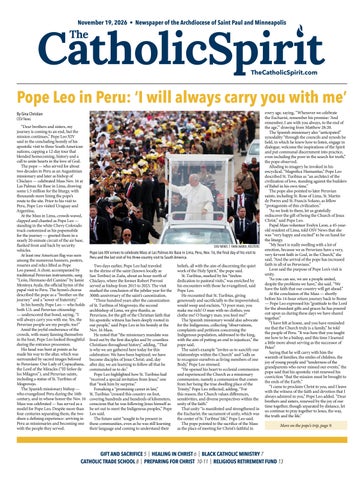
Pope Leo in Peru: ‘I will always carry you with me’ By Gina Christian OSV News
“Dear brothers and sisters, my journey is coming to an end, but the mission continues,” Pope Leo XIV said in the concluding homily of his apostolic visit to three South American nations, capping a 12-day tour that blended homecoming, history and a call to unite hearts in the love of God. The pope — who served for about two decades in Peru as an Augustinian missionary and later as bishop of Chiclayo — celebrated Mass Nov. 16 at Las Palmas Air Base in Lima, drawing some 1.5 million for the liturgy, with thousands more lining the pope’s route to the site. Prior to his visit to Peru, Pope Leo visited Uruguay and Argentina. At the Mass in Lima, crowds waved, clapped and chanted as Pope Leo — standing in the white Chevy Colorado truck customized as his popemobile for the journey — greeted them in a nearly 20-minute circuit of the air base, flanked front and back by security vehicles. At least one American flag was seen among the numerous banners, posters, rosaries and relics lifted as Pope Leo passed. A choir, accompanied by traditional Peruvian instruments, sang “León, Hermano del Camino” by Jamie Montoya Ayala, the official hymn of the papal visit to Peru. The hymn’s chorus described the pope as a “brother on the journey” and a “sower of fraternity.” In his homily, Pope Leo — who holds both U.S. and Peruvian citizenship — underscored that bond, saying, “I will always carry you with me. Yes, the Peruvian people are my people, too!” Amid the joyful exuberance of the crowds, with many fanning themselves in the heat, Pope Leo looked thoughtful during the entrance procession. His head was bent at points as he made his way to the altar, which was surrounded by sacred images beloved to Peruvians: Our Lady of Copacabana, the Lord of the Miracles (“El Señor de los Milagros”), and Peruvian saints, including a statue of St. Turibius of Mogrovejo. The Spanish missionary bishop — who evangelized Peru during the 16th century, and in whose honor the Nov. 16 Mass was celebrated — has served as a model for Pope Leo. Despite more than four centuries separating them, the two share a defining experience: arriving in Peru as missionaries and becoming one with the people they served.
OSV NEWS | YARA NARDI, REUTERS
Pope Leo XIV arrives to celebrate Mass at Las Palmas Air Base in Lima, Peru, Nov. 16, the final day of his visit to Peru and the last visit of his three-country visit to South America.
Two days earlier, Pope Leo had traveled to the shrine of the saint (known locally as San Toribio) in Zaña, about an hour north of Chiclayo, where the former Robert Prevost served as bishop from 2015 to 2023. The visit marked the conclusion of the jubilee year for the 300th anniversary of the saint’s canonization. “Three hundred years after the canonization of St. Turibius of Mogrovejo, the second archbishop of Lima, we give thanks, as Peruvians, for the gift of the Christian faith that his apostolic witness has been deeply rooted in our people,” said Pope Leo in his homily at the Nov. 16 Mass. He noted that “the missionary mandate was lived out by the first disciples and by countless Christians throughout history,” adding, “That is why we are gathered here today for this celebration: We have been baptized; we have become disciples of Jesus Christ; and, day after day, we are learning to follow all that he commanded us to do.” Pope Leo highlighted how St. Turibius had “received a special invitation from Jesus,” one that “took him by surprise.” Forsaking a “promising career in law,” St. Turibius “crossed this country on foot, covering hundreds and hundreds of kilometers, conscious that he was following Jesus himself as he set out to meet the Indigenous peoples,” Pope Leo said. The future saint “sought to be present in these communities, even as he was still learning their language and coming to understand their
beliefs, all with the aim of discerning the quiet work of the Holy Spirit,” the pope said. St. Turibius, marked by his “tireless dedication to pastoral visits,” was enriched by his encounters with those he evangelized, said Pope Leo. He recounted that St. Turibius, giving generously and sacrificially to the impoverished, would weep and exclaim, “O poor man, you make me rich! O man with no clothes, you clothe me! O hungry man, you feed me!” The Spanish missionary would also advocate for the Indigenous, collecting “observations, complaints and petitions concerning the Indigenous population, addressed to the king, with the aim of putting an end to injustices,” the pope said. The saint’s example “invites us to sanctify our relationships within the Church” and “calls us to recognize ourselves as living members of one Body,” Pope Leo stressed. “He opened his heart to ecclesial communion and experienced the Church as a missionary communion; namely a communion that comes from her being the true dwelling place of the Trinity,” Pope Leo reflected, adding, “For this reason, the Church values differences, sensitivities, and diverse perspectives within the unity of the faith.” That unity “is manifested and strengthened in the Eucharist, the sacrament of unity, which was the center of St. Turibius’ life,” Pope Leo said. The pope pointed to the sacrifice of the Mass as the place of meeting for Christ’s faithful in
every age, saying, “Whenever we celebrate the Eucharist, remember his promise: ‘And remember, I am with you always, to the end of the age,’” drawing from Matthew 28:20. The Spanish missionary also “anticipated” synodality “through the councils and synods he held, in which he knew how to listen, engage in dialogue, welcome the inspirations of the Spirit and put communal discernment into practice, even including the poor in the search for truth,” the pope observed. Alluding to imagery he invoked in his encyclical, “Magnifica Humanitas,” Pope Leo described St. Turibius as “an architect of the civilization of love, standing against the builders of Babel in his own time.” The pope also pointed to later Peruvian saints, including St. Rose of Lima, St. Martin de Porres and St. Francis Solano, as fellow “protagonists of this civilization.” “As we look to them, let us gratefully rediscover the gift of being the Church of Jesus Christ,” said Pope Leo. Papal Mass volunteer Evelyn Leon, a 45-yearold resident of Lima, told OSV News that she was “very happy and excited” to be on hand for the liturgy. “My heart is really swelling with a lot of emotion, because we as Peruvians have a very, very fervent faith in God, in the Church,” she said. “And the arrival of the pope has increased faith in all of us Peruvians.” Leon said the purpose of Pope Leo’s visit is unity. “As you can see, we are a people united, despite the problems we have,” she said. “We have the faith that our country will get ahead.” At the conclusion of the Mass — shortly before his 14-hour return journey back to Rome — Pope Leo expressed his “gratitude to the Lord for the abundant gifts and graces he has poured out upon us during these days we have shared together.” “I have felt at home, and you have reminded me that the Church truly is a family,” he told the people of Peru. “It was here that you taught me how to be a bishop, and this time I learned a little more about serving as the successor of Peter.” Saying that he will carry with him the warmth of families, the smiles of children, the joy of young people and “tenderness of the grandparents who never missed our events,” the pope said that his apostolic visit renewed his conviction “that the mission must be brought to the ends of the Earth.” “I came to proclaim Christ to you, and I leave with the witness of the faith and devotion that I always admired in you,” Pope Leo added. “Dear brothers and sisters, renewed by the joy of our time together, though separated by distance, let us continue to pray together to Jesus, the way, the truth and the life.” More on the pope’s trip, page 9.
GIFT AND SACRIFICE 5 | HEALING IN CHRIST 6 | BLACK CATHOLIC MINISTRY 7 CATHOLIC TRADE SCHOOL 8 | PREPARING FOR CHRIST 10-11 | RELIGIOUS RETIREMENT FUND 13
2 • THE CATHOLIC SPIRIT
NOVEMBER 19, 2026
PAGETWO
CSJ sisters leave legacy By Dave Hrbacek The Catholic Spirit
An era ended when Sister Jane McDonald, the last living sibling of four who joined the Sisters of St. Joseph of Carondelet, died Nov. 1, All Saints’ Day, at the Carondelet Village Care Center in St. Paul. She was 91. Just one month earlier, the third sibling, Sister Brigid McDonald, died Oct. 2 at the memory care center of Carondelet Village. She was 94. Their two other siblings, COURTESY SISTERS OF ST. JOSEPH OF CARONDELET Sisters Rita and Kathleen, died in 2023 and 2024, respectively. From left, Sisters Brigid and Jane McDonald pose “The impact of these four for a photo at the CSJ Ministries Gala in 2024. women cannot be understated,” the Sisters of St. Joseph said in a news release. “For more than 50 years, they individually and collectively dedicated themselves to teaching, peace activism, and social justice. All four were outspoken anti-war activists who regularly protested (the) weapons manufacturing industry in the Twin Cities. All four worked alongside people experiencing poverty, discrimination, and injustice. Their activism inspired a play at the History Theater (‘Sisters of Peace’) as well as (a) PBS documentary.” The sisters grew up as part of a large Irish Catholic family with 11 children on a farm about 40 miles west of the Twin Cities, according to the news release. “Despite having brothers who served in World War II and the Korean War, and a father who served in World War I, the sisters took a deeply pacifist path,” the news release said. “They entered the convent during the 1940s and 1950s, and over the decades, they became famous for their willingness to be arrested, actions they cheerfully reframed as ‘civil obedience’ to a higher moral law.” In the news release, Sister Jane was described as “a woman of deep wisdom, quiet strength and a generous spirit who devoted her life to serving others, working for peace and justice, and reminding those around her that they were loved.” Sister Jane entered the CSJ community in 1954, following in the footsteps of her three siblings who had joined earlier. Her gifts for caring for others led her into social service, where she served on the staff of Seton Center and The Bridge for Runaway Youth in Minneapolis, the news release said. She also worked in nursing homes and hospitals. “A deep commitment to peace and justice became another defining expression of Jane’s faith,” the CSJs said. “Her activism took her to communities and causes throughout the country, including the School of the Americas (SOA), where she joined others calling for justice and an end to violence. In recognition of their commitment to peace, Jane and her three sisters received the Vincent L. Hawkinson Foundation Award for Peace and Justice in 2003.” Sister Brigid entered the CSJs in 1952, the third of the McDonald sisters to join. She taught in schools, including CSJ-sponsored schools, for 25 years, then felt a calling to work for peace and justice. One important role was with Volunteers in Diocesan Action (VIDA) in Pueblo, Colorado, in 1981. There, she served as a hospital chaplain and taught adult and high school students. Sister Brigid “carried these gifts to new communities where her compassionate counseling, fierce advocacy, and ‘fun therapy’ as she called it, gave hope and purpose to the women and children she served at Ascension Place (1982-1984), and Incarnation House (1983-1994), which she co-founded with fellow Sisters of St. Joseph Rita McDonald and Marguerite Corcoran,” the CSJs said. “In her retirement, she continued to be a valued volunteer at Incarnation House, and along with allies from Women Against Military Madness (WAMM), and many CSJ sisters and consociates, was a constant presence at the Lake Street Bridge peace protests,” the CSJs said. The CSJs said Sister Brigid spent her life believing that, in her words, “Jesus never said ‘worship me,’ he said ‘follow me,’ and that is what I am trying to do.” The deaths of Sister Jane and Sister Brigid coincide with the 175th anniversary of the CSJs’ presence in the Twin Cities and Archdiocese of St. Paul and Minneapolis.
COURTESY NAW DEE PAW | ST. JEROME SCHOOL
CELEBRATING THE SAINTS Second graders at St. Jerome School in Maplewood display posters they made to celebrate All Saints’ Day this year. Led by second-grade teacher Naw Dee Paw, students studied the saints for several weeks, then worked in groups on the poster project. Students of each group were invited to choose a saint whose life was meaningful to them, then create their group’s poster about that saint, explained Principal Anne McNeill Gattman.
NEWS notes Holy Family in St. Louis Park recently acquired a series of relics, according to pastor Father Mark Moriarty. Among the series are relics of the True Cross as well as first-class relics of Sts. Matthew, Mark, Luke, Andrew, James the Greater, James the Lesser, Philip the Apostle, Bartholomew, Jude Thaddeus, Thomas, Thérèse of Lisieux, John the Baptist, John Neumann, and Pius X. Also recently acquired by the parish were second-class relics from the house of St. John the Evangelist, the stone altar at St. Peter’s tomb, the column where St. Paul was beheaded, and the shirt of St. Carlo Acutis, according to Father Moriarty. “I have noticed that the people of God appreciate the tradition of being able to see and venerate the saint’s relic on the altar on their respective feast days,” Father Moriarty told The Catholic Spirit. “The relic of the saint is tangible evidence of (the) disciple(s) of Christ who gave themselves in his service, body and soul.” Father Moriarty said that local Catholic Sean Pilcher, from Sacra Relics, has been assisting the parish in acquiring relics for public veneration, as the parish determines which relics will become part of the parish’s permanent patrimony. Father Moriarty and parish leadership are working to identify a public place within the church where the relics can be displayed for veneration. Parishes across Minnesota are encouraged to participate in the Catholic Voices Count Campaign of the Minnesota Catholic Conference (MCC) — and there are prizes. The weekend of Nov. 21-22, the solemnity of Christ the King, parishioners will be urged to sign up for MCC’s Catholic Advocacy Network (CAN) at mncatholic.org. Based on their size, parishes that have the most email signups will each receive a $2,000 grant from MCC. One prize will be awarded among parishes with one to 158 parishioners; another prize to parishes with 159 to 456 parishioners; and the third prize to a parish with 457 or more parishioners. Through the network, MCC staff share legislative news and ways to engage with lawmakers, including alerts to key votes taking place in the Minnesota Legislature. More details about the Catholic Voices Count Campaign can be found at mncatholic.org/catholicvoicescount. As good as his word, Father Tom Margevičius munched on bugs in front of delighted students who had raised more than Holy Spirit Catholic School’s fundraising goal of $50,000 in the annual Marathon for Nonpublic Education. Students gathered pledges for the fundraiser and walked around the school’s Minneapolis neighborhood Oct. 2. The Marathon idea originated with the Knights of Columbus in the Twin Cities in 1974 and now involves many Catholic schools. Students participate in walks, runs and bicycle trips. Traditionally, events are held in October. This year, students at Holy Spirit raised $55,000, fueled by the promise of Holy Spirit’s pastor — Father Margevičius — to eat bugs if they went over the $50,000 goal. Father Margevičius sat down with several faculty and staff members at the school’s end-of-Marathon carnival Oct. 30 and they crunched their way through protein-packed roasted crickets.
Practicing CATHOLIC Produced by Relevant Radio and the Archdiocese of St. Paul and Minneapolis, the Nov. 13 “Practicing Catholic” radio show on Relevant Radio 1330 AM included Deacon Eric Gunderson, a teacher at Epiphany School in Coon Rapids, in an interview about a recent prayer service at Epiphany for a family member of a staff member who died in a tragic accident. The program also featured Kate Soucheray, a columnist for The Catholic Spirit, in an interview about helping children process grief and loss. Listen to interviews after they have aired at practicingcatholicshow.com or choose a streaming platform at Spotify for Podcasters.
The Catholic Spirit is published semi-monthly for The Archdiocese of Saint Paul and Minneapolis Vol. 31 — No. 22 MOST REVEREND BERNARD A. HEBDA, Publisher TOM HALDEN, Associate Publisher JOE RUFF, Editor-in-Chief REBECCA OMASTIAK, News Editor
CORRECTION A story about World Mission Sunday in the Nov. 5 edition included an incorrect date for the collection. It was Oct. 18.
EDITOR’S note Please watch for the next print edition of the Catholic Spirit in three weeks, on Dec. 10.
Materials credited to CNS copyrighted by Catholic News Service. Materials credited to OSV News copyrighted by OSV News. All other materials copyrighted by The Catholic Spirit Newspaper. Subscriptions: $29.95 per year; Senior 1-year: $24.95. To subscribe: (651) 291-4444; To advertise: Display Advertising: (651) 251-7714; Classified Advertising: (651) 251-7714. Published semi-monthly by the Office of Communications, Archdiocese of St. Paul and Minneapolis, 777 Forest St., St. Paul, MN 55106-3857 • (651) 291-4444, FAX (651) 291-4460. Periodicals postage paid at St. Paul, MN, and additional post offices. Postmaster: Send address changes to The Catholic Spirit, 777 Forest St., St.Paul, MN 55106-3857. TheCatholicSpirit.com • email: tcssubscriptions@archspm.org • USPS #093-580
NOVEMBER 19, 2026
THE CATHOLIC SPIRIT • 3
FROMTHEBISHOP ONLY JESUS | BISHOP KEVIN KENNEY
The coming of Advent
S
tanding in line the other day at the pharmacy, I suddenly was attuned to what was playing overhead throughout the store. My feet began to tap to the beat of the song and then it hit me: a Christmas song. I almost covered my ears and to begin saying, “lalalalalala,” pretending I did not hear what I just heard. I stopped myself, not wanting to make a fool of myself, and thought, “It is only the !rst week of November.” I wanted to say something to the person at the counter but realized there was a long line behind me and I did not want to delay them. Advent is a time for reflection and preparation. As we begin a new liturgical year, we focus on what is ahead as we prepare for the coming of Jesus Christ. We will spend time this year with the Jesus of Mark’s Gospel. Jesus is on the move and speaks clearly and starkly. We need to be prepared to listen. As Advent begins, if we sit down and read through the Gospel of Mark, we will encounter Jesus who is intense, authoritative and a suffering servant. Following Jesus means self-sacri!ce and being challenged to conversion and forgiveness. Previewing what this new liturgical year offers can awaken within us the desire to take time in this season of hope, peace, joy and love, to ponder the gift we !nd in Jesus. Families have formed many Advent traditions to count down and prepare for Christmas. The Advent wreath in the home brings light into the darkness as each week a candle is lit to bring the brightness of hope, peace, joy and love to our hearts. An Advent calendar teaches the story of Jesus’ birth as the days draw closer to Christmas. Advent is a time to reflect on what God desires of us — and on Mary’s “yes.” How are we to bring Jesus into the world? Who are we called to walk with and serve during
We need to be prepared to listen. As Advent begins, if we sit down and read through the Gospel of Mark, we will encounter Jesus who is intense, authoritative and a suffering servant. Following Jesus means self-sacrifice and being challenged to conversion and forgiveness.
these days? We can get caught up in the hustle and bustle of the season and jump right into the wonders of Christmas as trees are lit, homes are decorated, concerts and pageants are attended. How can each household “Keep Advent” in a way that prepares for the coming of the Lord Jesus? There are many resources, books, reflections and movies that help us on our journey to Christmas. Find what is right for your family and prepare now. Like me, if you wait too long, Advent will be half over before you know it. Take time to read the
La llegada del Adviento
E
l otro día, mientras esperaba en la fila de la farmacia, de repente presté atención a la música que sonaba por los altavoces de toda la tienda. Mis pies comenzaron a seguir el ritmo de la canción y entonces me di cuenta: ¡era un villancico! Casi me tapé los oídos y comencé a decir: “Lalalalalala”, fingiendo que no había escuchado lo que acababa de sonar. Me contuve, porque no quería hacer el ridículo, y pensé: “Apenas estamos en la primera semana de noviembre”. Quise decirle algo a la persona que estaba en el mostrador, pero me di cuenta de que había una larga fila detrás de mí y no quería hacerlos esperar. El Adviento es un tiempo de re!exión y preparación. Al comenzar un nuevo año litúrgico, nos centramos en lo que está por venir mientras nos preparamos para la llegada de Jesucristo. Este año dedicaremos nuestro tiempo a conocer al Jesús del Evangelio de san Marcos. Jesús está siempre en movimiento y habla con claridad y contundencia. Necesitamos estar preparados para escucharlo. Al comenzar el Adviento, si nos sentamos a leer el Evangelio de san Marcos, encontraremos a un Jesús intenso, lleno de autoridad y un servidor sufriente. Seguir a Jesús significa sacrificarse y aceptar el desafío de la conversión y el perdón. Anticipar lo que nos ofrece este nuevo
daily readings during Advent. There are many wonderful reflections you can !nd virtually or on apps that will guide your thoughts. Make time during Advent to prepare. One movie I enjoy watching every year is “It’s a Wonderful Life,” starring Jimmy Stewart. I recently saw the newly released movie “Jimmy,” which is about Stewart. It is well worth watching and profoundly opens up the meaning behind “It’s a Wonderful Life.” We can all be grateful for many blessings
año litúrgico puede despertar en nosotros el deseo de dedicar tiempo, durante este tiempo de esperanza, paz, alegría y amor, a contemplar el don que encontramos en Jesús. Las familias han creado muchas tradiciones de Adviento para contar los días que faltan y prepararse para la Navidad. La corona de Adviento en el hogar lleva luz a la oscuridad, ya que cada semana se enciende una vela que hace brillar en nuestros corazones la esperanza, la paz, la alegría y el amor. Un calendario de Adviento nos enseña la historia del nacimiento de Jesús a medida que se acercan los días de Navidad. El Adviento es un tiempo para re!exionar sobre lo que Dios desea de nosotros y sobre el “sí” de María. ¿Cómo podemos llevar a Jesús al mundo? ¿Con quiénes estamos llamados a caminar y a quiénes estamos llamados a servir durante estos días? Podemos dejarnos llevar por el ajetreo de la temporada y lanzarnos de inmediato a las maravillas de la Navidad, encendiendo los árboles, decorando nuestros hogares y asistiendo a conciertos y representaciones navideñas. ¿Cómo puede cada familia “vivir el Adviento” de una manera que nos prepare para la llegada del Señor Jesús? Hay muchos recursos, libros, re!exiones y películas que pueden ayudarnos en nuestro camino hacia la Navidad. Encuentren lo que sea adecuado para su familia y comiencen a prepararse desde ahora. Si esperan demasiado, como me
and the journeys we have traveled in life. As we celebrate Thanksgiving, we reflect on God’s generosity and the bounty he provides. We again are in challenging times, so helping someone during the Advent season might include sharing gifts that you have received. Check with your parish about its Christmas ministries, and there are many centers where people can donate toys or food for the holidays. God bless us all in these days! Stay warm and enjoy the wonder that comes with the season.
sucede a mí, ¡el Adviento habrá llegado a la mitad antes de que se den cuenta! Dedíquense a leer las lecturas diarias durante el Adviento. Hay muchas re!exiones maravillosas que pueden encontrar en internet o en aplicaciones que les ayudarán a orientar sus pensamientos. Hagan tiempo durante el Adviento para prepararse. Una película que disfruto viendo todos los años es “¡Qué bello es vivir!”, protagonizada por Jimmy Stewart. Hace poco vi la película recién estrenada “Jimmy”, sobre la vida de Stewart. Vale mucho la pena verla, ya que nos permite comprender profundamente el significado que hay detrás de “¡Qué bello es vivir!”. Todos podemos estar agradecidos por las muchas bendiciones recibidas y por los caminos que hemos recorrido a lo largo de nuestra vida. Al celebrar el Día de Acción de Gracias, re!exionamos sobre la generosidad de Dios y la abundancia de sus dones. Una vez más, vivimos tiempos difíciles, por lo que ayudar a alguien durante el Adviento puede incluir compartir algunos de los regalos que hemos recibido. Consulten con su parroquia acerca de sus iniciativas navideñas de servicio, y recuerden que hay muchos centros donde las personas pueden donar juguetes o alimentos para las fiestas. ¡Que Dios nos bendiga a todos durante estos días! Abríguense bien y disfruten de las maravillas que trae esta temporada.
4 • THE CATHOLIC SPIRIT
NOVEMBER 19, 2026
LOCAL
Honoring those who served
SLICEof LIFE
Abena Baafi, a seventh grader at Benilde-St. Margaret’s School in St. Louis Park, presents a rose to a veteran during the school’s Veterans Day Celebration Nov. 11. Three-star Lt. Gen. Steven Whitney (not shown), who graduated from BSM in 1988, addressed the students, faculty, staff and guests. Out of 1.2 million active-duty enlisted service members, there are nearly 270,000 officers and over 60 three-star generals. Only four other lieutenant generals serve in the Space Force with Whitney. COURTESY AMANDA NICKLAUS, BENILDE-ST. MARGARET’S
NEW LOCATIONS Saint Cloud
JOIN US & GET
$200
NotreDameFCU.com/JOIN
120 10th Ave. N. St. Cloud, MN 56303
Saint Paul 3499 Lexington Ave. N. St. Paul, MN 55126
Offer card or online form must be completed to receive the offer. To receive the $200 direct deposit bonus, you must have a minimum aggregate direct deposit(s) of $1,000 per month made to your Notre Dame FCU checking account. Your direct deposit needs to be an electronic deposit of your paycheck, pension, or government benefits (such as Social Security) from your employer or the government. Bonuses are considered interest and will be reported on IRS Form 1099-INT (or Form 1042-S, if applicable). Bonus will be awarded the first week of the month following 30 days of completing requirements. If the checking account is closed by the Member or Notre Dame FCU within six months after deposit bonus, we will deduct the bonus amount for that account at closing. All new memberships subject to normal policy outlined in membership agreement. Visit NotreDameFCU.com/Join to learn more and become a member. Offer may change at any time. Insured by NCUA
AMERICA’S MASTER CRAFTSMEN IN
Building Envelope Restoration PRESERVING HISTORY FOR OVER 110 YEARS
612.781.7100 DavidLG@westerngroup.com WesternSpecialtyContractors.com
Pray for Peace
*+,-./01.213-'%.. .."'(.2$3(/.4,5,%) !"#$%$&"'#()*+#",-%#"'."//0"1'%"2+34"5$-"6'7+".2+"6$*."" $,"5$-&"12'&).'83+"9)()%9".2)*"*+'*$%"'%#"8+5$%#: ;'<)6)=+"5$-&"12'&).'83+")64'1.>"*)643),5".'<".)6+>"'%#" *-44$&.".2+"1'-*+*"5$-"1'&+"'8$-."6$*.")%"'"?'5".2'." &+,3+1.*"5$-&"/'.2$3)1"('3-+*:" /$%.'1."//0".$"3+'&%"6$&+:" @AB:CDE:FCFF" !!"#$%&'()
NOVEMBER 19, 2026
LOCAL
THE CATHOLIC SPIRIT • 5
Awe and sorrow captured in Mary’s life through Edina parish’s new frescoes By Aviana Kasal
For The Catholic Spirit
For the last six months, artist Mark Balma has climbed eight rungs of a ladder to bring two scenes from Mary’s life to the sanctuary of Our Lady of Grace in Edina. One scene depicts a young Mary encountering the angel Gabriel on her way to draw water. The other places her at the foot of the cross, surrounded by those who shared in her grief. “The painting was created in a reverent way,” Balma said. As the work neared completion, Balma turned his attention to what he called “tocchi maestri,” which is Italian for “masterful touches.” After months of preparation and painting, the finishing details help complete images intended to remain with the parish for generations. For Balma, 69, translating faith into something people can see also means examining his own. “You have moments where it challenges your faith,” he said. “It makes you reexamine everything that you consider, especially when you have to make it into a visual image.” Archbishop Bernard Hebda will join the parish Dec. 7 at 6 p.m. for the dedication of the frescoes. The public is invited, said Father Kevin Finnegan, the pastor. The project began with an idea from parishioners and grew through conversations about what sacred art could bring to the church. “We’re a parishioner-driven community,” Father Finnegan said. Several parishioners approached him about placing frescoes in the sanctuary, and others responded with enthusiasm. An offer — from a donor who wishes to remain anonymous — to cover the cost allowed the parish to continue exploring the possibility. Through a personal connection, one of those involved obtained Balma’s phone number and contacted him. Balma said a parishioner first approached him in March 2025. Several months later, he visited the church and met with those involved. The artist brought both international experience and a connection to the Twin Cities. Born in Wichita, Kansas, Balma spent part of his childhood in north Minneapolis and attended Ascension Catholic School. There, teachers encouraged his interest in sacred art by asking him to make posters for feast days and saints’ celebrations. At 18, he went to Italy. Standing inside buildings where paintings formed part of the architecture helped him recognize the kind of work he wanted to pursue. “I loved creating, especially sacred spaces,” he said. At Our Lady of Grace, the sanctuary’s open wall spaces suggested an opportunity to tell a story about the parish’s patroness. Balma proposed the Annunciation and Mary at the cross: moments showing her as a young woman and later as a mother confronting her son’s death. His Annunciation places the encounter outdoors. Rather than depict Mary inside a room, Balma imagined her carrying out an ordinary task: walking to the well for water. He said he returned to Scripture and noted that the account did not specify a room. The well, with its associations throughout biblical stories, offered a setting rooted in daily life. “I just imagine Mary, among other women, going to the well each day to get water,” he said.
AVIANA KASAL | FOR THE CATHOLIC SPIRIT
Balma’s fresco depicting Mary at the cross.
COURTESY OUR LADY OF GRACE
Mark Balma works on the fresco in the sanctuary of Our Lady of Grace depicting the Annunciation.
In the second fresco, Mary stands with Mary of Clopas, Joseph of Arimathea, John and Mary Magdalene. Balma wanted to bring the figures together at the foot of the cross in a grouping he had not seen depicted before. The frescoes measure approximately 7½ by 11 feet each, Balma said. Rámond Mitchell, the parish’s director of liturgy and the project lead, coordinated work among the artist, parishioners serving on the committee and those whose gifts made the project possible. Because the paintings were commissioned specifically for the sanctuary, Mitchell said, their proportions and placement complement the architecture and the worship taking place there. “They aren’t fighting with the architecture,” he said. “They’re working in the space.” He described the frescoes as offering “a spiritual window” into what the parish celebrates. Throughout the liturgical year, he hopes worshippers will discover new and various connections between the images, Scripture and the sacred mysteries. The paintings are already finding a place in parishioners’ lives. Mitchell recalled a couple who sent a wedding photograph to the parish’s wedding coordinator. With the Annunciation behind them in the photo, the two said it was as though Mary was looking down upon them while they exchanged vows. For Mitchell, the moment illustrated how the frescoes are becoming part of the parish’s history, accompanying joyful occasions and times of grief. Schoolchildren have also been able to watch Balma work and speak with him. Mitchell wondered what they might remember years from now, perhaps returning with children of their own to the church where they watched the paintings take shape.
AVIANA KASAL | FOR THE CATHOLIC SPIRIT
The completed Annunciation fresco.
Father Finnegan said Balma’s presence has been a gift beyond the artwork. The artist joined the parish for Sunday worship and welcomed conversations with people who stopped in during the day. “He’s just got the graciousness to visit with people,” Father Finnegan said. “Well, it’s always great to meet members of the community,” Balma said. Watching the work develop also gave the pastor a greater appreciation for the skill involved. He described the depth Balma creates and the knowledge he brings from studying generations of artists. “It’s not paint by numbers,” Father Finnegan said. The process draws on a tradition Balma described as simple and enduring. Pigments applied to plaster bond with the wall, creating a surface whose softness distinguishes it from other painting methods. That quality, he said, can make a new fresco appear as though it has occupied its place for decades. Before painting the scenes in the sanctuary, Balma prepared detailed studies of faces, hands, garments and elements of nature. Mitchell said those drawings took about six to seven months to complete and served as references as the artist worked on the walls. Those preparations were on display for several weeks beginning Oct. 6 in “Behold, the Handmaid of the Lord,” an exhibition at the University of St. Thomas’ Hoedeman Gallery of Sacred Art in St. Paul. The studies reveal the attention given to individual gestures, including Mary’s hands in the Annunciation. Mitchell described their position as expressing her willingness to receive God’s word and say yes to his plan. Another detail in that fresco connects the biblical scene to a neighboring parish’s grief and hope. Blue and green ribbons painted around Mary’s water jar pay tribute to the community of Annunciation in Minneapolis
following an Aug. 27, 2025, shooting during an all-school Mass. The colors are those of Annunciation’s school. As previously reported in The Catholic Spirit, Father Finnegan asked Balma whether the fresco could include a tribute to the school. Balma incorporated the ribbons into the composition. He wrote the names of the two children who were killed in the shooting, Fletcher Merkel and Harper Moyski, on his shirt cuff as he painted them. The tribute makes remembrance a permanent part of the image. For Balma, creating something that endures involves more than the painting method. One of the project’s greatest challenges, he said, was developing images with enough depth that people could continue discovering meaning in them over time. He wanted the details to serve the central message, allowing viewers to see more as the years passed. As he prepared to return to Assisi, Italy, Balma said he would carry memories of the people he had met and the community’s support for the project. Mitchell hopes that support will extend beyond the parish’s walls. He sees the frescoes as a gift to the wider Catholic community in Minnesota and he invites people to encounter them during Sunday worship or a quiet visit for prayer. He also hopes the project will encourage other churches, whether being built or restored, to invest in sacred art. For Mitchell, the investment begins with what beauty can reveal, and what it can change in those who encounter it. “Hopefully beauty and the love of God will transform our lives and transform our world,” he said. Balma hopes the images will continue to invite discovery, offering “a depth to them, so that people can see more in them as the years go on.”
6 • THE CATHOLIC SPIRIT
LOCAL
NOVEMBER 19, 2026
Parish staff leadership day focuses on forming, healing the whole person for ministry By Josh McGovern The Catholic Spirit
“The challenge for us isn’t physical healing. We know the Lord can (heal) bones and mend hearts,” Julianne Stanz said on Nov. 10 at the NET Center in West St. Paul. That day, clergy and parish staff gathered for fall Parish Leadership Day as part of regular formation days three times a year. The fall leadership day focused on forming the whole person for ministry — body and soul — and healing still to be found in the Church as an institution. (The challenge is) “to give him the wounds TOM HALDEN | ARCHDIOCESE OFFICE OF COMMUNICATIONS that we have carried Julianne Stanz addresses those gathered at Parish Leadership Day Nov. 10 at the NET Center in West St. Paul. underneath all the other wounds, the source of our rejection and pain,” Stanz said. For most of the day, those gathered heard from Stanz, the director of outreach for evangelization and discipleship at Loyola Press. When Jesus entered the upper room after his resurrection, Stanz reminded everyone, he came with his wounds clearly visible for the disciples to see. “Healed people and TOM HALDEN | ARCHDIOCESE OFFICE OF COMMUNICATIONS TOM HALDEN | ARCHDIOCESE OFFICE OF COMMUNICATIONS healed institutions; the wounds don’t go away,” Stanz makes a point during her talk. A light moment at Parish Leadership Day. she said. “Instead, they become places where others can touch the wound and receive regretted not praying with him. reality each story is unique — and Julianne’s their own healing. Healing does not mean “My life’s work has been spent in having witness to the uniqueness of her life helps that we don’t talk about it, and with his people to pray with, for, and over each other, me accept the uniqueness of the life God has usual directness and honesty, Archbishop and I did none of those things with your given me,” Salai said. (Bernard) Hebda spoke so beautifully about father today,” Stanz told the man’s daughter Stanz said many people have forgotten that that this morning. Some people would like over the phone. Jesus dwells in every human heart. these things that we have gone through So, she prayed with the man’s daughter. “Our job, our task, is to reveal the God who institutionally to just go away, but that isn’t The man, named Richard, was not seriously is hidden deepest within us and within them,” what Jesus teaches us. He teaches us that it is injured despite a few cuts and bruises. Stanz said. in the wounds, that is allowing others to touch “Someday I will know what God was doing Sarah Ginther, who helped host the event, the wounds, that they become healed and we in Richard’s life, but for now I’m content to told a story about her time in Army ROTC become healed.” know that he is peaceful today. He is sore, but in college. While doing a rucksack march, In Ireland, a seanchaí, Stanz said, was a he has survived,” Stanz said. “Healing isn’t Ginther fell in a creek and injured part of her traditional keeper of “old lore.” She asked the just in what we do in the moment; it’s how we spine. Her instructor asked, “Can you walk?” crowd, “What story do we carry with us?” carry forward in the kind word.” Ginther pushed through her injury and “Each one of us is a bearer of (those) “A lot of times we think that if we make kept marching. 2,000 years of healing and hope,” Stanz said. any mistake then what credible witnesses “I’m struck by the fact that when I stood “Jesus spent 38% of his time healing, and his are we?” Salai said. “Sometimes in our up, my instructor’s first question to me was, methodology was very simple: heal, proclaim, Catholic culture, I feel like we put pressure on ‘Are you OK? Are you at this place where teach. In that order.” ourselves to fit a certain norm before we think you can continue?’” Ginther said. “I think Later in the day, confession and adoration anyone would listen.” oftentimes in ministry, we’re really good at the were available for those gathered. But it’s through those mistakes and trench warfare mentality, where we are sitting Katie Salai — communications coordinator weaknesses, Salai explained, that people can there bleeding from all the proverbial spiritual for Mary, Mother of the Church in be taught. That thought resonated in her orifices that we aren’t supposed to be bleeding Burnsville — attended the event with other heart on Nov. 10. from, and somebody says, ‘Are you OK?’” staff members from the parish. Salai said it “It’s about learning to get honest, learning Due to her injury, Ginther had to forego wasn’t the first parish staff formation day she to get really, really honest about who you are, the rest of her military scholarship, “which had attended, but at each event, she finds owning your story, and that’s the way to find becomes part of my story, where I go from something new and exciting. Salai said she the people you are called to minister to,” Salai serving the country to serving the Church,” appreciated Stanz’s honesty about addressing said. she said. different times Stanz may have failed in After a short time of prayer between pairs However, Ginther said, like with her injury, ministry. of people, Salai said prayer doesn’t have to continuing ministry while not being well The night before traveling to Minnesota, be complicated or different from how “we enough hurts the ministry someone might Stanz was driving with her family when she communicate with each other.” desire to pour into. encountered a serious car collision. A man “I think we can get really perfectionistic in “We’ve all encountered the people and was injured in one of the cars, Stanz said. how we come across in ministry and work She and others assisted the man, but Stanz really hard to be a ‘normal Catholic’ when in PLEASE TURN TO LEADERSHIP DAY ON PAGE 8
‘THE SPACE BETWEEN’ “Blessed is the space between us,” Bishop Kevin Kenney said to start his homily at Mass during the fall Parish Leadership Day on Nov. 10. This “beautiful” space, Bishop Kenney explained to those gathered at NET Ministries in West St. Paul, “is a space that is graced by God.” However, that space grows into distance, Bishop Kenney suggested, “when you and I walk in our own path, when you and I think that we can do it on our own,” the bishop said. Yet, Bishop Kenney said, “a Simon comes, once in a while, into our lives and offers us help” in carrying daily crosses, as Simon of Cyrene helped Jesus carry his cross. “(Y)ou and I, in the work and the ministry that we do, are Simons as well,” the bishop said. Amid the different tensions of the modern world, Bishop Kenney asked: “(A)s an institutional Church, as parishes, as families, as communities, how do we handle that division? How do we see that space that oftentimes might be too hot to enter, might be too scary?” He continued, “(Y)ou and I know that we are called in our ministries to bring healing, to bring comfort and hope, and to have a vision that we are open to the great gift of the Holy Spirit.” Participation in the Eucharist, “the source and summit of our life in the Church,” Bishop Kenney said, allows Jesus “to strengthen us to seek living, and to empower us to encourage others, to see the good in their lives, in whatever situation they find themselves.” That strength and empowerment through Jesus in the Eucharist, Bishop Kenney said, allows the faithful to enter into “(t)he space between us and God, the space between us and one another, the space between us and our communities, the space between us and our neighbors — especially those who are different from us or those we might feel intimidated by.” “(I)n that space is God’s grace, that liminal space that calls us into the fullness of finding within ourselves the gifts that we have been given, the hearts that continue to beat, and the vulnerability of what life hands us,” Bishop Kenney said. Each day, Bishop Kenney said, is a gift and an opportunity to seek that space, “whether momentarily or throughout the day.” “(O)nce we hear that beat of the Sacred Heart within us as well, then we know this space is safe,” the bishop said. Referring to the Gospel reading for the Mass of Mary, Health of the Sick, Bishop Kenney reflected on Mary’s visit to Elizabeth. “(A)s she visited Elizabeth with great joy, she spent three months with her. What a gift that is to be able to spend three months with someone who is going through difficult or joyful times. Just think if Mary did not go. ... Mary brought a youthful hope, and Elizabeth gave her life’s wisdom.” Through this example, Bishop Kenney encouraged those gathered that “we do have gifts to share.” Bishop Kenney concluded his homily by reminding those gathered that God’s invitation is to walk with each other “and be surprised in life when we recognize who our Simon is that we would have never, ever guessed.” “(B)e grateful that there are others, and ourselves, out there willing to give of ourselves in moments that we don’t know why, or we might feel uncomfortable, but yet we’re willing to give, because that’s what we are called to do.” — Rebecca Omastiak, The Catholic Spirit
LOCAL
NOVEMBER 19, 2026
THE CATHOLIC SPIRIT • 7
Black Catholic Ministry explores ideas for speakers, parish and seminary visits By Joe Ruff
The Catholic Spirit
Brainstorming with Archbishop Bernard Hebda Nov. 11, members of the Commission of Black Catholic Ministry discussed visiting parishes across the Archdiocese of St. Paul and Minneapolis, inviting speakers and highlighting the archbishop’s pastoral letter, “Only One Thing Is Necessary.” The discussion followed Mass and dinner at the Archdiocesan Catholic Center in St. Paul, with more than a dozen commission members present. In his homily, Archbishop Hebda noted that the Gospel that day for the Memorial of St. Martin of Tours was Matthew’s describing the end times, when Jesus would separate the sheep from the goats, based on love for one another. “It would be pretty devastating to have heard this for the very first time and to think that there were those times when we passed up giving Jesus a drink when he was thirsty, or giving him something to eat when he was hungry. We all would want to do that. And yet so often we fail to see Jesus in those situations,” the archbishop said. The first reading from Isaiah pointed to the answer, the archbishop said, with the Lord’s spirit falling upon his anointed. “We celebrate the fact that our God continues to want to pour out his spirit upon us, so that we, like St. Martin; we, like Jesus, might be able to bring glad tidings to the lowly, so that we might be able to heal
The discussion that followed included the commission’s 2026 annual report to Archbishop Hebda, which noted in part that the commission was reconstituted in the archdiocese in December 2025, and held a full slate of meetings through 2026. Moving forward, the commission sought insight on next steps from the archbishop, who agreed with the suggestion that his pastoral letter for families, “Only One Thing | JOE RUFF THE CATHOLIC SPIRIT is Necessary: How Catholic Families Can Strive To Be Lynette Graham, center, makes a point during an Archdiocesan United in This Life and The Commission of Black Catholic Ministry meeting with Archbishop Bernard Next” could be encouraged. Hebda Nov. 11 at the Archdiocesan Catholic Center in St. Paul. Monique “It would be helpful for Maddox, left, and Festus Ejiofor, right, were among more than a dozen me also to get some feedback members of the commission who participated in the meeting. from you about how can we do that in our Black Catholic families,” the archbishop said. “I think it’s the brokenhearted,” Archbishop Hebda very different from different cultures, even said. among African cultures.” “And so my hope, brothers and sisters, Archbishop Hebda also agreed that is that your work might help us as an inviting speakers who could address archdiocese to be true to that anointing, questions about race and culture would that you might help us to be able to be helpful. Suggestions included Bishop recognize Jesus in all of our brothers and Robert Boxie, an auxiliary bishop of the sisters, and that you might inspire us to ever Archdiocese of Washington, and Father Josh deeper charity, like that of St. Martin,” the Johnson of the Diocese of Baton Rouge. archbishop said as he drew his homily to a Commission members suggested they close. could visit The St. Paul Seminary in St. Paul
to talk about the commission’s efforts and encourage vocations among people of color. Several commission members suggested visiting parishes across the archdiocese, both those with large African and African American congregations and those without. The Black Catholic community in the archdiocese is spread out, and being present is important, they said. “I would like to be involved,” said Deacon Will Pitts about visiting the seminary and parishes. “I’ve approached some people at church and different places, and I told them, you know, you ought to consider being a deacon,” said Deacon Pitts, who ministers at St. Peter Claver in St. Paul. “I don’t know how many African American deacons we have here right now, but I’d like to be involved in that.” “The Church needs to support you,” Archbishop Hebda said as the meeting wrapped up. “As a Church, we aren’t very good with the second generation. How do we keep your kids engaged? We didn’t do very well with Europeans. We are facing challenges with our Latino community.” Michael Essien, treasurer of the commission, said the Arican and African American community has a lot to offer. “St. Augustine was African,” he said. “The African theology is authentic.” “Thank you,” Essien told the archbishop. “You have brought the story back up. We will make a lot of this come alive.” Editor’s note: Learn more about the commission at archspm.org/blackcatholics.
Father Schoenberger remembered for love of God, sense of humor By Joe Ruff
The Catholic Spirit
Father James Schoenberger, who died Nov. 10 at age 95, is remembered for his love of God, family, parishioners and nature, FATHER JAMES a delightful sense of humor and his artistry with SCHOENBERGER painting, photography and woodworking. “He was known for telling jokes” at the end of each Mass, said Carol Diethelm, the director of sacred music at Sts. Joachim and Anne in Shakopee. Father Schoenberger stressed God’s love in his homilies and he enjoyed being with his parishioners, Diethelm said. Father Schoenberger served in Shakopee for 20 years, as pastor of St. Mary for 15 years, from 1973 to 1988 — and after he retired in 1999 — for five years from 2004 to 2009 as sacramental minister at nearby St. Mary of the Purification. In 2013, St. Mary, St. Mark in Shakopee and St. Mary of the Purification on Marystown Road combined to form Sts. Joachim and Anne. Before the merger, Diethelm was choir director at the Marystown church. Father Schoenberger’s funeral Mass will be celebrated at 11 a.m. Nov. 23 at St. Mary. It will be preceded by a 9 a.m. rosary and 9:30-11 a.m. visitation, also at the church. Interment will be at Shakopee Catholic Cemetery. A native of Perham, Father Schoenberger was the ninth of 15 children born to Frank and Esther Schoenberger. His family moved to Minneapolis when he was 11. He studied for the priesthood at then-Nazareth Hall Preparatory Seminary and The St. Paul Seminary, both in St. Paul. He was ordained in 1957. He ministered at eight parishes, including
COURTESY CAROL DIETHELM
A wooden bowl created by Father Schoenberg.
11 years as parochial administrator and then pastor of St. Gregory the Great in North Bend, from 1988 to 1999. He was spiritual director for Twin Cities Catholic Cursillo for 27 years, and he ministered for years as a counselor and
sacramental minister at the Minnesota Adult Correctional Facility for Women in Shakopee. In his retirement, Father Schoenberger lived at the Leo C. Byrne Residence in St. Paul and later at Carondelet Village, also in St. Paul. Father Schoenberger was close to his siblings and their families, traveling to visit them, share holidays and vacations and celebrate family weddings, baptisms and funerals, his obituary stated. “He was a beloved uncle whose presence, humor, jokes and playful pranks brought joy to family gatherings,” the obituary stated. “A lifelong love of art and the outdoors inspired Father Jim’s drawing, painting, photography and woodworking.”
He also enjoyed his cabin on Gilmore Lake near Minong, Wisconsin, and traveling throughout the United States and Europe. Marlene Link and her late husband, Larry, were close friends with Father Schoenberger. Her husband was a contractor who helped with renovations at the church of St. Mary in Shakopee in the 1970s and 1980s, and he helped build Father Schoenberger’s lakeside cabin, she said. “Father loved his cabin in Wisconsin,” she said. Preceded in death by his parents and siblings, Father Schoenberger is survived by his sister-in-law, Velora Schoenberger, and many nieces and nephews.
Proudly serving the Twin Cities for over 165 years. 16 CONVENIENT LOCATIONS washburn-mcreavy.com | 612.377.2203
LOCAL
8 • THE CATHOLIC SPIRIT
NOVEMBER 19, 2026
St. Paul parish sells property to St. Mary’s University for Catholic trade high school By Josh McGovern The Catholic Spirit
A sale of property is expected to close soon that would give St. Mary’s University two parish campuses formerly owned by St. Francis de Sales in St. Paul. The university — which has academic campuses in Winona, Rochester and Minneapolis — intends to use both the St. Francis de Sales campus and the St. James campus for a new Catholic high school of trade and technology. The high school will be named after Blessed James Santiago Miller — who was a graduate and faculty member of St. Mary’s University — and will welcome its inaugural class of freshmen in 2028, St. Mary’s University said in a news release. Blessed Miller was a religious brother, beatified in 2019 after having been martyred while serving in Guatemala in 1982, said Father Joseph Bambenek, associate director of the Archdiocese of St. Paul and Minneapolis’ Office of Renewal of Structures. Prior to his death, Brother Miller served for five years at Cretin High School — now Cretin-Derham Hall in St. Paul. St. James closed its doors in 2011 as the parish merged fully with St. Francis de Sales. The St. James property was used to house renters, and that helped finance parish operations. “The St. James church building has been used by one or more Protestant churches since then and (was) rented out. There was also a large daycare center, Sandcastle, that operated on the St. James campus (for) many, many, many, many years,” Father Bambenek said. The parish depended on the income from those renters, and others on the St. Francis de Sales campus, he said. Deacon Luis Rubi, the business administrator for St. Francis de Sales and Our Lady of Guadalupe, also in St. Paul, joked that he thought about answering the parish phone with, “St. Francis Property Management.” “When the renters all left at once, fortunately, St. Francis had a considerable amount of money in reserve, so they haven’t run out of money, but that reserve was being diminished greatly every year,” Father Bambenek said. “The parish started a process of looking at what options could be done for the campus, for how it could be used.” What followed were prayer and listening events with parishioners two years ago to
LEADERSHIP DAY CONTINUED FROM PAGE 6 places in our lives where somebody has asked us if we’re OK. We continue to push on, and then we get home … and in our loneliness, or in those moments where we’re by ourselves, it all starts to set in, and we start to recognize all of the places where the adrenaline was pumping, and maybe you thought you were OK,” Ginther said. “I stood up and I was like, ‘I got this. My 17-year-old body’s gonna bounce right back.’ It did not.”
COURTESY ARCHDIOCESE OF ST. PAUL AND MINNEAPOLIS
Exterior of St. Francis de Sales in St. Paul.
help discern next steps. Father Bambenek said it was an opportunity for the parish to share and get the reaction to ideas for what could be done. Deacon Rubi was heavily involved in the sale of the parish’s buildings. He said it was God’s providence that St. Mary’s University approached St. Francis de Sales. “Quite some time before St. Mary’s stepped into the picture, we as a church had come to grips with the fact that we couldn’t continue to live within the model that we were living in as a church,” Deacon Rubi said. Before St. Mary’s University entered the discussion, Deacon Rubi said the parish was conceptualizing a Catholic trade
high school. They went as far as writing a business plan and speaking to education consultants, he said. The entire sale was “God’s providence.” “There’s only a couple of Catholic high schools that are trade oriented, and literally less than five for sure in the whole country,” Deacon Rubi said. Amid financial concerns that prevented the business plan from taking a step forward, “St. Mary’s shows up, and their concept is a Catholic trade high school.” “We really knew at that point that we wanted to work with them. It was so affirming that this is what God wanted,” Deacon Rubi said. “It’s his providence that’s bringing this all together.”
An agreement was reached that St. Mary’s would buy the entirety of St. Francis de Sales campus minus the convent, currently owned by The St. Paul Seminary in St. Paul, and the DEACON LUIS RUBI church building on the St. James campus, which will be used by the St. Francis de Sales parish. Deacon Rubi said parishioners are excited for the future in their new home on the St. James campus. They plan to renovate and prepare the space, he said. Despite the amount of work to be done, Deacon Rubi explained, “it’s a new beginning, and it’s a wonderful time to be doing this.” “We know that there’s a lot of work to do between the closing date and when we would move into the church, including all the renovations,” Deacon Rubi said. “When you go from seven buildings … there’s a lot of thoughts about where we’re going to put all the stu$ that we have. There’s a lot of little details to work through between now and when we are able to celebrate our first Mass at the new church location. We’re looking forward to it though.” St. Francis de Sales’ footprint of eight buildings and two campuses will shrink to one campus and one building, Deacon Rubi said. This decision is exciting to Deacon Rubi and other parish sta$ because the physical assets of the parish “are going to continue to be used for the glory of God within the Church.” “I think it’s a beautiful way to move forward,” Father Bambenek said. “To have a school like that in the archdiocese, I think is going to be a great thing. The buildings will be used for Catholic purposes.” While the parish proposed this sale, it needed archdiocesan approval. Because the sale of the property is over $3.5 million, approval was needed from the Vatican, too. “It’s a way of just making sure that the assets of the church are treated appropriately. The patrimony of the church is appropriately handled,” Father Bambenek said. It’s beautiful, Deacon Rubi said, that the spaces that were previously tied to the parish will be used by the seminary and to educate young people in the faith. “It doesn’t get a whole lot better than that,” he said.
HEALING: ‘A SLOW AND MIGHTY PROCESS’ In remarks after the opening Mass for Parish Leadership Day Nov. 10 at NET Ministries in West St. Paul, Archbishop Bernard Hebda noted the importance of gathering to find healing, grow in faith, provide mutual support and “collaborate for the good of (God’s) kingdom.” “To be able to begin today with a Mass in honor of the Blessed Mother, especially as we focus on healing in the course of this day ... we always have her as our great example,” the archbishop said, also noting that Pope Leo XIV spoke in Argentina Nov. 9 about the importance of recognizing and following the unifying example of Mary. Healing can take place institutionally and individually, the archbishop told lay leaders from parishes around the Archdiocese of St. Paul and Minneapolis. “You know, we just celebrated last year our 175th (anniversary as an archdiocese) and we put out a little history of the archdiocese, and we got a little bit of criticism for including some of the difficult things that happened in this archdiocese that led up to our bankruptcy, for example,” Archbishop Hebda said. “And yet, that’s an important part of our history as well. And there’s always that need, there’s these wounds that exist in our Church because of our sinfulness, and there’s always a need for healing. And we have to be willing to address that
and to be able to really make our wounds available to Jesus to heal. We know that Mary wants to be part of that as well.” Going deeper into healing is important for the Church, and in a particular way for those who are engaged in the work of the Church, day in and day out, the archbishop said. “We have to be open to healing in our own lives, so that we’re able to then be instruments of healing,” the archbishop said. “So, we thought it would be important that we have this opportunity today to speak about healing in the Church,” the archbishop said, while expressing his gratitude that the keynote speaker of the day, Julianne Stanz, would address the topic. The archbishop had to leave for a meeting at the end of the day, but in taped remarks he thanked everyone for participating, and he again addressed healing, first saying that miracles do happen. “I know, however, that most healing is the result of a slow and mighty process,” Archbishop Hebda said. “It would be a mistake to think we are off the hook until we receive perfect healing. We’re called to act, even in our brokenness.” — Joe Ruff, The Catholic Spirit
NOVEMBER 19, 2026
THE CATHOLIC SPIRIT • 9
NATION+WORLD HEADLINES At the opening Mass for the fall assembly, the USCCB president encourages bishops to be aware of blind spots. The blind man who calls out for Jesus to heal him “was aware of his blindness,” which is what perhaps “enabled him to receive the healing that the Lord decided to offer him,” Archbishop Paul Coakley of Oklahoma City said in his homily at the Nov. 16 Mass opening the U.S. bishops’ fall general assembly in Baltimore. “We need to be aware of our blind spots as well,” the archbishop said, reflecting on the day’s Gospel reading from St. Luke. The Mass at the Basilica of the National Shrine of the Assumption of the Blessed Virgin Mary, America’s first cathedral, was Archbishop Coakley’s first in Baltimore since his election in November 2025 as president of the U.S. Conference of Catholic Bishops. He encouraged the bishops to pray for their people, but also for themselves, that they might be renewed in the “love that filled our hearts at the beginning and sustained and renewed us as it is brought to fruition.” Archbishop Coakley reminded them that they have been entrusted with great gifts and they must be good stewards of those gifts. The USCCB public sessions were Nov. 17 and 18, with a closed session Nov. 19. Pope Leo marks World Day of the Poor with a call to restore the voices and hopes of those in need. Marking the 10th World Day of the Poor on Nov. 15, Pope Leo XIV urged Catholics to see people living in poverty not as recipients of charity but as brothers and sisters whose dignity, voices and hopes must be restored. At the Vatican, Archbishop Luis Marín de San Martín celebrated Mass on the pope’s behalf while Pope Leo continued his pastoral visit to Latin America, including Peru. In his homily, Archbishop Marín said, “The love received at the altar must become concrete charity in daily life,” calling on Christians to recognize Christ in those who are hungry, lonely or excluded. Spending the afternoon in Peru’s Amazon region, during the longest apostolic trip of his pontificate so far, Pope Leo linked care for vulnerable communities with care for creation. “Anything that harms the dignity of life destroys the beauty of the earth,” he said during Mass in Pucallpa. Across the world, Catholic communities paired prayer with practical assistance. At the Vatican, 1,500 food packages were distributed and medical clinics expanded free services. In Poland, Church leaders emphasized restoring dignity through personal encounters, shared meals and hospitality. The
observance, established by Pope Francis in 2016, continues to challenge Catholics to move beyond sympathy and build real relationships with those in need. A Brooklyn Catholic high school’s students assist those affected by a building collapse. Those impacted by a building collapse in Flatbush Nov. 11 are getting some help from students from Cristo Rey Brooklyn High School, who came together to gather toiletries and clothes to donate to the New York State Assembly member whose district includes the collapsed apartment building and the high school. At least eight people were killed and 18 others, including four firefighters, were injured. Dozens of residents are displaced. The three-story building collapsed around 4 p.m. (EST). First responders concluded search and rescue operations Nov. 13. “We are committed to remaining engaged and working alongside our community partners to respond in any way we can be of help,” Cristo Rey said in a statement. The school’s principal and chief academic officer, Clyde Cole, said items the students collected were donated to Assembly Member Rodneyse Bichotte Hermelyn’s office. Bishop Robert Brennan of Brooklyn expressed his solidarity with victims and first responders on the day of the collapse. An investigation into the cause, led by the Department of Buildings and law enforcement, remains ongoing. A Mass for the victims will be celebrated at Our Lady of Refuge Church in Flatbush Nov. 28. Missionary priest “Father Joe” is one step further on the path to possible sainthood. An American priest who, like Pope Leo XIV, missioned for decades in South America is one step further along the path to possible sainthood. “With gratitude to Almighty God, I am pleased to announce that I have been informed that the Theological Congress of the Vatican’s Dicastery for the Causes of Saints has concluded its review of the Cause for Canonization of Father Joseph Walijewski,” said Bishop Gerard Battersby of La Crosse, Wisconsin, in a Nov. 9 statement. Ordained in 1950 for the Diocese of La Crosse, Father Walijewski — whose canonization cause was opened in 2013, just seven years after his death in Peru in 2006 — served assignments as a parish priest there and for many years as a missionary priest in both Bolivia and Peru. His steadfast determination and love for the impoverished saw him realize needed missionary projects amid mishaps, said Msgr. Michael Gorman, chancellor of the Diocese of La Crosse and the episcopal delegate for the cause when it was opened at the diocesan level. With his strong faith, the monsignor said, Father Walijewski knew that “because it’s God’s work, it’s going to succeed.” Pope Leo defies machismo culture in Peru and calls for the respect and protection of women and families. Pope Leo XIV used a gathering in Lima’s historic Plaza de Armas to deliver a strong appeal for the dignity
and protection of women, calling attention to domestic violence, family struggles and persistent machismo in society. Speaking outside Lima’s cathedral Nov. 12, the pope said, “I would like to renew an ardent appeal, not only to my brothers and sisters in the faith but to every man and woman of goodwill: Let us value women! Let us protect and respect girls!” He added: “It pains us to see that violence against women — who could be our grandmothers, mothers, sisters or daughters — continues to be a reality that wounds all of humanity.” Pope Leo stressed that women’s participation in society and the Church is “indispensable” and said unequal sharing of household responsibilities cannot be justified. He also highlighted the burdens carried by mothers and the effects of absent fathers, abuse and domestic violence. Addressing the challenges facing Peru, the pope pointed to economic hardship, migration, addiction and family breakdown, while insisting, “God loves all families, especially those going through crises.” The pontiff also urged employers and public officials to promote a healthier balance between work, rest and family life, and called on Catholics to build unity, confront the Church’s failures with humility, and work for the common good. Crowds estimated at 40,000 warmly welcomed the pope during his visit. At Argentina’s national shrine, Pope Leo calls the country to reconciliation, communion and mission. More than 2 million people gathered at the Basilica of Our Lady of Luján Nov. 11 as Pope Leo XIV celebrated the closing Mass of his visit to Argentina, urging the nation to “rise up and walk” on paths of reconciliation, communion and mission. Pilgrims spent the night singing, praying and waving Argentine flags around the country’s most important Marian shrine before the celebration centered on the Eucharist and the beloved image of Our Lady of Luján. In his homily, Pope Leo outlined a four-step path for Argentina: reconciliation, listening to God’s word, communion and mission. He urged people who feel “tired, disappointed or disoriented” to look to Scripture for guidance, adding, “We need a compass, a guide, and indeed we already have it in Sacred Scripture.” Pope Leo also recalled Pope Francis, who frequently visited Luján, saying that the late pope “always carried the ‘Patroncita morena’ in his heart” and taught Catholics through his life to love and venerate Mary. Calling for a Church that makes room for everyone, especially “the poor and the hungry, migrants, the sick and prisoners,” Pope Leo said Christians are called to serve others faithfully in daily life. “Go and evangelize; proclaim the joy of the Gospel through words and good deeds,” the pope said. He concluded with a missionary challenge: “Argentina, rise up and walk!” Before departing for Peru, he thanked Argentines for welcoming him “with open arms,” adding, “I have indeed felt at home.” — CNS and OSV News
Our senior sisters, brothers, and religious order priests need your help. After lives spent serving others, often for little or no pay, many communities now face limited retirement savings. Over 21,000 aging religious depend on the Retirement Fund for Religious for health care, medications, and daily living expenses. Your gift helps them live with dignity and security. Please give back to those who have given a lifetime of service.
Retirement Fund for Religious Please give to those who have given a lifetime.
Please donate at your local parish, December 12–13, or by mail at: Archdiocese of St. Paul and Minneapolis Attn: Retirement Fund for Religious 777 Forest Street St. Paul MN 55106-3857 Make check payable to Archdiocese of St. Paul and Minneapolis/RFR.
retiredreligious.org Visit retiredreligious.org/2026photos to meet the religious pictured.
©2026 United States Conference of Catholic Bishops, Washington DC • All rights reserved • Photo: Jim Judkis
ADVEN
10 • THE CATHOLIC SPIRIT
The evolution of the Christmas creche By D.D. Emmons OSV News
A
mong the ways Christians profess the miracle of the virgin birth, none is more evident than the Christmas creche. Every Advent, beginning most often on the solemnity of the Immaculate Conception, Nativity displays — the creche — begin to appear around the world. At the Vatican, in churches, in town squares, at shopping malls, in homes, millions of these displays honor the birth of Christ. The popularity is widespread, with some museums and churches displaying Nativity scenes year-round. This began 800 years ago with St. Francis of Assisi. Around the year 1220, St. Francis went to Bethlehem where he visited the Church of the Nativity and came away deeply impressed with the humility, poverty and lowliness emanating from the site. Francis visualized the Gospel according to Luke, the scenes and surroundings at the birth of Christ: God chose to enter the world through a young Jewish girl and to be born in a cave used as a stable because there was no other place for him. His crib was a feeding trough, a manger designed for animals. When Francis returned from Bethlehem to his home in Italy, he wanted to share his vision of the Nativity with others — of how the Savior of the world, the Messiah, was incarnated in abject poverty. Further, Francis prayed to turn people away from the secular gift-giving, away from the materialism that had become so associated with Christmas and restore the focus on Christ. He asked a friend to set up a living Nativity scene in a cave near Greccio, where Francis wished to celebrate Christmas Eve Mass. Placed in the cave was a stone block covered with straw representing the crib and a live ox and an ass. Certainly, no ox or ass is mentioned in the Scriptures describing the Nativity, but Our Lord’s birth did take place in a stable, so it is likely animals were present. The reference to an ox and an ass, humble work animals, is found in the Book of Isaiah 1:3, where the prophet writes: “An ox knows its owner, / and an ass, its master’s manger; / But Israel does not know, / my people has not understood.” This prophecy is believed to apply to the birth of Christ when neither Jew nor gentile
was present to worship him. Pope St. Gregory the Great (r. 590-604) interpreted Isaiah’s words to mean that the ox represents “the people of Israel, brought into subjection to the yoke of the Law,” and the ass represents “the people of the gentiles, given up to pleasure, and more overwhelmingly brutish.” Francis would have most likely known this interpretation and thus included those two animals. Since the outdoor Mass proposed by Francis would be considered a dramatization involving the clergy, permission had to be obtained from the pope. Such permission was received from Pope Honorius III (r. 1216-27) and the cave was arranged as requested. At midnight on Christmas Eve, local people were invited to the site and there, by torchlight, holy Mass was celebrated. This event is well described by St. Bonaventure in his book “The Life of St. Francis”: “Lest he should be accused of lightness or novelty, he asked and obtained the permission of the sovereign Pontiff. Then he prepared a manger and brought hay, and an ox and an ass to the place appointed. (After the people assembled,) “The man of God stood before the manger, full of devotion and piety, bathed in tears and radiant with joy; many Masses were said before it, and the holy Gospel was chanted by Francis, the Levite of Christ. … (A witness) affirmed that he beheld an infant marvelously beautiful sleeping in that manger, whom the blessed Father Francis embraced with both his arms, as if he would awake him from sleep.” Nearly eight centuries later, in December 2019, Pope Francis, wrote: “When, at Christmas, we place the statue of the infant Jesus in the manger, the Nativity scene suddenly becomes alive, God appears as a child, for us to take in our arms.” On that night in 1223, people looked on this holy scene as the words of the sacred Scripture were being read, Christmas Eve Mass proclaimed. Here was the !rst outside creche, the !rst living Nativity, the forerunner of our beautiful Christmas devotion. This !rst manger scene, now universally recreated with statues of live animals or persons, was inspired by the Holy Spirit through St. Francis. The Catechism of the Catholic Church speaks to what must have been in Francis’ heart: “Jesus was born in a humble stable, into a poor family. … In this poverty heaven’s glory was made manifest” (No. 525).
Worshippers take photos of a Nativity scene on Christmas Eve Mass at Xishiku Church, also known as the Nort
In Advent, preparing for the Christ Child as we would our own n By Father Stephen Schultz OSV News
I
f you have children, you remember very well the birth of your !rst child. Not only the birth, but the anticipation, the preparation and jubilation of your child’s entrance into the world. With great joy, you announced to family and friends, “We’re having a baby!” Surely everyone shared your happiness! Maybe you said, “We’re expecting!” What were you expecting? Your child, born of your mutual love. Your own child — a child that is truly a gift of God! You probably painted the baby’s room, procured a crib, changing table, diapers and all the other necessary things to make a home for your child. You were anxious and excited at the same time. Once you brought your baby home, you probably noticed some slight changes in your life. Did you get as much sleep as you did before? Did you have as much time to yourself ? Was your daily routine changed in any way by the glorious presence of your newborn child? I don’t know many couples who are fully prepared for their
!rstborn. Your life was probably turned upside down! One day you’re expecting, and the next the reality of it all is sinking in. The happiness was still there, but looking at your infant child, you knew that your life truly wasn’t your own anymore, and it would never be the same. Your baby was totally dependent on you from the beginning and couldn’t live without you and your spouse. Your child didn’t just change almost everything about your life — your child gave you a new life. Can we see now why Our Lord comes to us through the Blessed Virgin Mary, as humble and helpless as every newborn? He wants to give us a new life in him. Further, can we see why the Church celebrates Advent as a time of preparation and penance, year after year, so that we are truly ready to welcome our infant Lord at Christmas? Christ is born for us. Christ’s life is given to us, not just to receive as we would material Christmas gifts but to receive him as he gives himself to us at Christmas.
Change priorities
This means to welcome him as we welcomed our !rst child:
to be changed by him. Changed not in a way that fades with the passing of the Christmas season, but changed as we were changed by the birth of our !rst child. Consider how your life changed when you were expecting. You had time to prepare, and you used it well. For us to welcome the Christ child, this time to prepare is the season of Advent. We should use this time well, too. To begin, we should !x our heart on the reason for the season: the coming of Christ our savior. Your whole outlook on life changed when you found out you were pregnant. Your priorities completely changed because you knew you were going to welcome a new life into your heart and home. Perhaps our priorities need to change for us to truly receive the infant Jesus at Christmas. Advent is a good time to examine our priorities and choices in the light of the Holy Spirit, who is the life of God in us. Christ is born for us, so the great cry of Christmas joy echoes through the whole Church. Christ’s life is born anew in us through the divine love of the Holy Spirit. The Holy Spirit will help us to prepare to receive Christ at Christmas. Ask the Holy Spirit for this grace, with the
NT2026
NOVEMBER 19, 2026 • 11
CNS PHOTO | LOLA GOMEZ
The Nativity scene is unveiled in St. Peter’s Square at the Vatican Dec. 15, 2025.
OSV NEWS | MAXIM SHEMETOV
th Church, in Beijing Dec. 24, 2025.
Nativity can be traced to before the fourth century. Following the end of religious persecutions by Emperor Constantine in 313, a crib was displayed in many churches at Christmas. In 432, Pope Sixtus III (r. 432-40) created a cave scene of the Nativity in the first basilica built in Rome: Santa Maria Maggiore (St. Mary Major). Two hundred years later, relics of the holy crib from Bethlehem were given to Pope Theodore I (r. 642-49) and placed in St. Mary Major. A creche using statues of living beings was added about 1289 | OSV NEWS PHOTO DAVID MERCADO, REUTERS and is considered the oldest in any church. The relics of the holy A figurine of the Christ Child is displayed in a Nativity scene at a crib in St. Mary Major, pieces of home in Chicani, Bolivia, Dec. 7, 2020. wood, are part of a crystal reliquary shaped like a crib that is located in a Over the next 100 years, the Nativity basilica chapel built by Pope Pius IX scene (called “presepe” in Italian) could (r. 1846-78). be found throughout Italy. “From Greccio, From the time of St. Francis through the which had become like a new Bethlehem, the 14th and 15th centuries, the creche evolved representation of the crib, which had sprung in Italy and Germany, then into other areas of from the heart of a saint, capable of realizing Europe. Beginning in the 16th century, partly the most sublime poetry in life, spread in response to the Protestant Reformation, throughout Italy, Europe and the whole world,” explained Pope St. John Paul II during Nativity scenes became more prevalent, although indoor Nativities were often too an Angelus address in 1978. costly for average families. While the 13th-century Christmas It was the French Revolution (1789-99) Nativity scene created by St. Francis was a that created an increase in creches found in way to bring visual and living expression to the Gospel, drawings and paintings of the the home. During the Revolution, the French
newborn
confidence and trust of knowing that God wants to give all of us this great gift. Then, be led by the Holy Spirit.
Clean house
To make room for the Christ child, we should “clean house.” How can we clean house? Make room for God first by willing it to be so. I’ve heard it said (and since repeated many times) that if we can say to God, “I want what you want and only what you want,” then we are on the path to true holiness. How difficult that is. But we can at least begin with the desire to have that desire. That, in itself, is very pleasing to God. “I want to want what you want and only what you want.” That should be part of our prayer every day. Again, God wants to give us this grace. Make room for God with your time. Maybe your routine or the pattern of your day needs to change as it did when your first child was born. As a family and on your own, set aside time for prayer. Make a commitment as a family to do this every day. Support each other as a family to turn the television off, get away from the computer, get out of your room and pray. The rosary is a great family prayer, and the most powerful
prayer outside of the Mass. Even starting at the beginning of Advent with just one decade and adding another decade for each week of Advent, you’d be praying the whole rosary beginning at Christmas. Another wonderful way for a family to pray is to answer the following questions as a prayer: What do I have to be thankful for? Who shall we pray for? What do we need help with from God? To answer them as a prayer, you might pray, “God, I’m thankful for your love and constant presence to us, all the grace that you give us to help us each day. And especially for ... .” Be specific so that you are mindful of the actual blessings for which you are thankful. Go beyond the very popular bedtime prayers, such as, “God bless Mommy, God bless Daddy, God bless Fluffy.” If you pray using these questions with your children, you will teach them how to pray and how to relate to God. Your children will grow in trust of God and the knowledge that God is real, that he’s listening and he loves them. On your own, make time to pray in the morning and evening. Whatever devotional prayers you love to pray, as part of your prayer, be yourself with God. He’s the one who loves you the most and knows you the best. He wants us to pray this way — from our hearts and with the utmost trust. We don’t
government outlawed the Church and all things religious, including the Christmas creche. Frenchmen began to make Nativities and related figurines covertly, using a variety of materials. They kept these products small so they would be easy to hide if the authorities came looking. Eventually, clay was used and the small figurines were mass-produced. The popularity of the creche outside France exploded during the 18th century with the best artisans making and sculpting these items. It was now that liberties with the location or background of the scene took place and the representation was not necessarily of Bethlehem at the time of Christ’s birth, but often of the local community where the images were displayed. Also, in the 18th century, the creche was introduced to America by European immigrants as well as other countries of the world. During the next century, Nativity scenes could be found across the growing United States. In 1982, a creche was placed on the grounds of St. Peter’s Square at the Vatican for the first time. Everywhere in the world, there are more and more elaborate creche scenes, some with hundreds, even thousands of figurines, many mechanical and in some areas contests are held to see who can produce the most grandiose display. Controversy has frequently accompanied creche displays on public property in the United States. For example, the U.S. Supreme Court in 1989 upheld the challenge to a creche being displayed in a courthouse. The creche included an angel announcing, “Glory to God in the Highest.” The court said that the angel’s words endorse “a patently Christian message: Glory to God for the birth of Jesus Christ. … The government may acknowledge Christmas as a cultural phenomenon, but under the First Amendment, it may not observe it as a Christian holy day by suggesting that people praise God for the birth of Jesus.” Each case objecting to a creche displayed on public land is considered on its own merits and over the years court rulings have gone both ways. Today, if we visit the Church of the Nativity in Bethlehem and go down to the grotto, the place that inspired St. Francis, we would see a sign expressing what we all believe when visiting the Christmas creche and adoring the baby Jesus: “Here Jesus Christ was born of the Virgin Mary.” Pure, simple, in the humblest surroundings, Our Lord was born. Emmons writes from Pennsylvania.
have to be afraid of opening our hearts to him.
Go to reconciliation
Make room for God with a good confession. Advent is a penitential season. It is the time to repent, believe in God’s mercy and trust that God can make us saints. God’s mercy is the gateway into deeper union with him; it is not an end to itself. Therefore, we shouldn’t look at confession as one more Catholic “chore” we ought to do before Christmas, but rather to think of how Jesus can change us if we accept him as our very own child. Make room for God with visits to the Blessed Sacrament and daily Mass. Meeting Christ in his Eucharistic presence allows God to accomplish his work in us. The worship of the Mass is the most important and fruitful offering we can make. What’s more, this is the way Jesus has chosen to give himself to us. If there were anything better he could give, he would have given it. He gives himself to us. Christ is born for us. He wants to make us saints. We can be those saints if we prepare during Advent to receive him like our own newborn child. Father Schultz writes from Virginia.
12 • THE CATHOLIC SPIRIT
NOVEMBER 19, 2026
FAITH+CULTURE
Beating leukemia, leaning on prayer (and St. Carlo Acutis) By Christina Capecchi
We don’t know what God’s plan is. Of course, I’m super happy that Andrew made it, but I also understood there was a high chance he wasn’t going to make it. That doesn’t invalidate my prayers. It’s just that God has a di!erent plan, and I don’t know it yet.
A We fell into those modes. Lia had the
For The Catholic Spirit
At age 18, Kyle and Lia Brownell’s firstborn, Andrew, seemed like the picture of health. Andrew was a freshman at the University of St. Thomas in St. Paul when the Maplewood family of seven got his shocking diagnosis: leukemia. The couple mounted a battle involving reams of research and rosaries, drawing on faith and science — Kyle digging into the medical side, Lia focused on prayer. They were bolstered by their devotion to St. Carlo Acutis, who died of leukemia. What followed was a grueling series of setbacks and breakthroughs — including a liver complication, two bone-marrow transplants from his younger brothers and a clinical trial targeting Andrew’s exact mutation. The journey culminated in a cancer-free status and a trip to Rome, where Andrew and his dad attended St. Carlo’s canonization Mass. Kyle chronicled the entire experience in his new selfpublished book, “Run to the Fight,” available on Amazon. “If this helps even one person,” said Kyle, 56, an engineer who belongs to St. Agnes in St. Paul, “that makes this all worth it.”
Q What was Andrew like before cancer? A Andrew really loved sports. He was captain
of the football team, all-conference, straight A’s. But he was also the kid who sat at a di!erent lunch table to make people feel included. He didn’t want to be the weak link in the chain. He wanted to be the strong, dependable one, someone people could count on.
Q Take me back to the day you learned he had leukemia.
A They thought it was COVID(-19), but he
didn’t have any respiratory symptoms. The test was negative, and Lia wanted to take him back. I was a couple hours into a work trip to South Dakota when Lia called and told me his white blood cell count was over 100,000. I remember turning around while I was on the phone. I called a friend who’s a doctor, and he was honest: It’s either an error or it’s not good. I asked another friend for prayers, then prayed the rest of the way back in silence.
Q Andrew’s first response was, “It’s all
in God’s hands.” Did you feel that same confidence?
A I remember it like it was five minutes ago.
My reaction was: Wow! At 18, he really owns his faith. I was somewhat floored. I felt like he was stronger in his faith than me right then, because there was some terror and doubt. My wife and I both have master’s degrees in theology and engineering. You spend your life preparing, but when the time comes to accept what’s happening, it’s harder than the books. You can’t fully prepare.
Q You immersed yourself in medical
research while Lia focused on prayer and keeping the family going. How did those approaches complement each other?
capacity to do the research, but she didn’t want to understand the pretty dismal prognosis. She didn’t want to show up in tears, not only for Andrew but for the other kids. She didn’t know, and she didn’t know intentionally.
Q You open the book with a quote attributed
to St. Ignatius of Loyola: “Pray as if everything depended on God and work as if everything depended on you.” What did that mean in practice?
Q There are some things we
simply won’t understand on this side of heaven, right?
A I gave myself one mission: to find the
smartest people in the world and get them working on my son. Not to be the smartest person, because I’m not. And then to ask God to guide me. If I didn’t use my God-given talents, I wasn’t using what he already gave me.
A Right. Q Then, in September 2025, you stood beside a cancerfree Andrew at St. Carlo’s canonization in Rome. Tell me about that.
Q Two of Andrew’s younger brothers
donated bone marrow. What was it like to witness that?
A I don’t know that words
A It was amazing to see their lack of fear. They
can describe it. It was the capstone of the entire journey. It was powerful. And the day before the canonization, Andrew got to talk to about 50 young people from around the world about his story and Carlo’s intercession.
knew they were going to hurt, but they were excited to do it, excited that we had a chance.
Q Andrew prayed the rosary while walking hospital corridors and lifted arm weights even when he felt terrible. Where did that determination come from?
A He knew he needed to stay strong. It’s not
going to fix everything. You still need the chemo. But it was important to his recovery. One time I couldn’t get him out of bed for a walk, so I called his (St. Agnes) football coach, Tom Flood, and he got him out of bed.
Q That sounds like the spirit of the book
title, “Run to the Fight,” which comes from a motto Andrew learned through football at St. Agnes.
A You get knocked down, you get right back up and you get right back in it. You’re battling for your teammates. You’re going to get knocked down in life. The coaches taught that. It’s what we did. There were setbacks, but you don’t get stuck on that.
Q You and Lia moved your family from
JORDANA TORGESON | FOR THE CATHOLIC SPIRIT
A It’s pride. But we quickly came to the
conclusion: We have to accept because we need help. People want to do something, and we shortchange people’s desire to help. It helps them, too. We’re still finding out about people who helped. “Oh, you were in our house!” They did it out of love.
Q A friend introduced you to St. Carlo
Acutis soon after Andrew’s diagnosis and his story took hold in your hearts. Then, on St. Carlo’s feast day, Oct. 12, the leukemia returned. Did that shake you?
Wisconsin to Minnesota specifically for St. Agnes School. Six years later, parishioners gathered outside the hospital to pray the rosary, even in bitter cold. What did that mean to you?
A It did. I’d be lying if, for a day or two, it didn’t
moved to the right place. They came every Sunday for seven months, then returned when he went back for his second transplant. Some days there were 50 or 60 people out there, some playing guitar. The hospital sta! came to look: Oh, Andrew’s prayer group is out there! When he changed rooms, we’d tell them which side of the hospital he was on. They’d move to wherever he could see them.
Heikamp, whose research helped open a clinical trial for Andrew’s rare leukemia. How did she become part of your fight?
A Looking back, it was a validation: Wow, we
Q You and Lia decided early on to accept help. Was that hard?
somewhat freeze me. But then I realized: I’ve got to do something completely out of the box. I went back to praying every night, every day: OK, what do we do now? It had to be action.
Q That search led you to Dr. Emily
A She merged with us in this project, bringing
all her tremendous knowledge. We didn’t know the outcome of our prayers, and she didn’t know the outcome of her research. She wasn’t paid anything. She just became a partner, through prayer and emails and phone calls.
Q After the relapse, Lia prayed that she could
take Andrew’s cancer instead. He told her: “Mom, you can’t pray that way. This is my cross. Let me carry it.” What did he teach you?
A He taught me more about su!ering than
I learned my entire life. It was like a Ph.D. course on su!ering, through his quiet example. Andrew’s a quiet kid. He leads by example. • Wills • Trusts • Probate John E. Trojack Attorney at Law
• Powers of Attorney • Health Care Directives
Q In the book you write, “You are not about
• Guardianships • Conservatorships
We offer tailor-made, client-focused estate planning and related services from a Catholic Perspective
to read the story of a family who prayed better than yours did.” Why was that so important to say? Colton E. Peltier Attorney at Law
Trojack & Associate Law Office, P.A. • 1549 Livingston Ave., Ste. 101 • W. St. Paul, MN 55118
Phone: 651.451.9696 • www.TrojackLaw.com
A I know a lot of people whose loved ones
didn’t survive. My brother Curt passed away during this whole thing from cancer. We were praying for his healing as well, and he didn’t make it.
Q Andrew is pursuing
a career as a physician assistant. Can you picture him caring for patients?
A Oh, yeah. He wants to get to know patients
and enter their lives more closely. He wants to be hands-on. I think he’s going to be great. He either wants the emergency room or oncology.
Q What finally prompted you to turn your journals into a book?
A I wrote in a notebook every day. It became a
medical journal and a prayer book all in one. It was the guest book we’d bought for Andrew’s high school graduation party. Only the first couple pages were filled out, so I grabbed it. Writing the book was my son Nathan’s idea. He’d heard me tell the story so many times. He said people could benefit from understanding the medical system or the prayer or both. That’s my goal: to help people. It took about six months. It was easier than researching cancer.
Q What do you do for fun? A I like watching my kids’ sports, fishing and
working in my workshop. My next project is building some furniture. I want to turn a piece of marble from my grandmother’s old table into a new high-top table for our kitchen. I took up fishing 15 years ago because I wanted my kids to connect with nature. You just need a fishing pole. You don’t even need a boat. Fishing brings us together. It’s taught me patience and that you can improve your skills — or your prayer life — through practice.
Q What’s your go-to prayer? A The Divine Mercy Chaplet. Q What do you know for sure? A I know that God exists for sure. I know
that people are genuinely loving and people genuinely want God in their lives. Some people just don’t know it. I also know that God cannot be outdone in his generosity. Faith is not what keeps the cross o! our shoulders. That’s sometimes a belief. It’s what lets us pick it up. A friend once told me, “God must love you very much for the cross that he’s given you.” I know that now. I knew it before, but I know it now.
FAITH+CULTURE
NOVEMBER 19, 2026
THE CATHOLIC SPIRIT • 13
Parishioners invited to contribute to Retirement Fund for Religious in December By Rebecca Omastiak The Catholic Spirit
The faithful are invited to assist aging religious as they enter into retirement, via a collection Dec. 12 and 13 in parishes throughout the Archdiocese of St. Paul and Minneapolis. The national Retirement Fund for Religious — sponsored by the U.S. Conference of Catholic Bishops and national conferences for men and women religious — has helped support roughly 261 religious communities in the United States. The need is significant, according to the Washington, D.C.-based National Religious Retirement Office (NRRO), which reports that 19,000 aging religious in the U.S. depend on the fund as they enter into retirement and often face an increasing need for care. As an example, in 2025, the average annual cost of care was roughly $62,000 per person, with skilled nursing care averaging roughly $102,000, according to the NRRO. Meanwhile, the NRRO reported the average annual Social Security benefit for a religious was $9,390; for an average lay beneficiary, the amount is closer to $24,856.
The ‘wonderful contribution’ of religious communities locally
As part of a video about this year’s collection locally, Nicole Bettini, the archdiocese’s delegate for consecrated life, highlighted the Dominican Sisters of St. Cecilia and the Dominican Friars of the Province of St. Albert the Great as being among the religious institutes that have received support from the Retirement Fund for Religious. “These funds help religious institutes provide direct care to their current aging members and to improve their internal retirement planning through financial planning and savings,” she said. Bettini encouraged the faithful to re$ect on the “profound impact” the lives and vocations of religious sisters, brothers and religiousorder priests have on families. Archbishop Bernard Hebda said this impact is “a wonderful contribution.” “In the 10 years that I’ve been here in the archdiocese, I’ve consistently seen our consecrated men and women really be of such great value to the families of this archdiocese,” he said. “I love the way in which our religious have supported our families, seeing their work in parishes, seeing the work with our immigrant communities, seeing the many ways in which they continue to help people to grow into their response to the Lord, to be those first educators in their families.” “(P)art of it is the expertise that they bring.
But part of it is the witness that they bring as well,” the archbishop went on to say about religious locally. “So, as they’re able to show why it’s important to put God first in their lives, they’re also helping our mothers and fathers, they’re helping our young people to see the importance of putting God first in their lives as well.” St. Ambrose in Woodbury parishioners Hadrian and Cherryl D’Souza have seen this witness firsthand in their two sons’ lives. Now in college, the boys attended St. Croix Catholic School in Stillwater, at which the Dominican Sisters of St. Cecilia serve. In their search for a middle school for their boys, Hadrian and Cherryl learned about the sisters’ presence at St. Croix Catholic School from their church community. “(W)e really, really loved first being introduced to the school, but then meeting Sister Maria Ivana (Begovic, the school’s former principal) — she just gave us that feeling of comfort and homeyness in the school,” Cherryl said. “I also got a sense of her rigor and her discipline and how she would really, really help our boys grow.” Hadrian agreed: “(I)t was such a welcoming, loving, warm environment from the moment we visited that it just felt like it was the right spot for them to be.”
What stuck with Cherryl was the welcome offered to students, including by Sister Maria Ivana and Bishop Michael Izen, who served as canonical administrator of the school. Cherryl said that both would be waiting at the school’s entryway when she dropped her kids off. “No matter how cold the day was, they would name each child walking in. ... Every single child going into that school, they would name them and welcome them.” “I think that is so important for a child, especially in today’s day and age, to be seen and known personally,” Cherryl said. “For me, that sets the tone for how the school is run. I was always touched by that, that they knew every single child by name.” Hadrian said the welcome his boys received “translates out,” especially as he sees his boys reach out to welcome others into conversations or gatherings. “They understand how to make it welcoming for everybody.” Re$ecting on the impact of the Dominican Sisters of St. Cecilia in this school environment, Cherryl highlighted “the intentionality with everything that they do, be it in the classroom, in the church, during adoration, during praise and worship, whatever it was, you just sensed a different kind of presence with everything. … (T)hat’s really important for kids to witness.”
Thanking religious ‘for a lifetime of service’ Since the collection began in 1988, the Retirement Fund for Religious has received over $1 billion in contributions, according to the NRRO. In 2025, the fund raised a record $37.1 million nationwide, according to the NRRO; parishes and the faithful in the Archdiocese of St. Paul and Minneapolis specifically contributed over $463,366, according to Bettini. NRRO Director John Knutsen said contributions to the fund help members of religious communities plan for their future. “When we give, we thank them for a lifetime of service and make sure they can grow old in peace, dignity, and prayer,” Knutsen said in a statement. Those who don’t participate in the collection at a parish can mail contributions to Retired Fund for Religious, Archdiocese of St. Paul and Minneapolis, 777 Forest St., St. Paul, MN 55106. New this year is an opportunity to give online at RE()REDREL),)-./.-R,/012/-(--/.33-R(/ D-41(E. Learn more about the local collection online at 1R56/37.-R,/RE()RE7E4(-8.4D8-R-REL),)-./. La Grande Bande presents its 26/27 Season
A French Baroque Christmas WITH the Norseland Youth Choir
Transfiguration Catholic Church 6133 15th St N, Oakdale Travel with a seasoned Spriritual Director! Fr. Fitz has been working with JeriCo Christian Journeys for 30 years. Pilgrimages with Fr. Fitzpatrick 2027 below Mexico February 22 - March 3 Greece - September 14 - 28 Christmas Markets on the Rhine River November 27 - December 5
A Christmas tradition centuries in the making featuring vocal music and a carol sing-along
Saturday, December 12
7:10pm Organ prelude 7:30pm Concert Performance
Tickets $35 (Sec A) | $25 (Sec B) $15 (Sec C/Students)
Use discount code CSM1226 to save 10% Online at www.lagrandebande.org/tickets or by phone at 507-237-6539
14 • THE CATHOLIC SPIRIT
NOVEMBER 19, 2026
FOCUSONFAITH SUNDAY SCRIPTURES | FATHER STAN MADER
Christ’s kingship This weekend we celebrate the feast of our Lord Jesus Christ, king of the universe. This feast began in 1925 with a focus on asserting the supreme authority of Jesus Christ over human beings and their institutions. At that time, it was celebrated the Sunday before All Saints’ Day. In 1970, it was moved to the final Sunday of the Church’s year, the Sunday before Advent, and its focus became the more cosmic and end times character of Christ’s kingship. It leans into Advent, during which the first Sunday readings are about end-times, because Advent is not just about preparing for Christmas, but also preparing for the return of Jesus Christ. However, the placement of the feast of Christ the King at the end of the year lends a satisfying sense of the arc from the birth of Jesus to the ultimate victory of Jesus. “King” seems odd to Americans. For 250 years we haven’t had a king and certainly feel no need to bow to kings. But we all do bow to something. It might be money, it might be status, or power, or notoriety, celebrity, sleep, technology. Who will we choose as king? It is not a matter of when or
even if; we all, when we are honest with ourselves, worship something. What should we bow to? Jesus, the king of the universe, is the best candidate. In the first reading, Ezekiel, a prophet during the Babylonian Exile, relates the voice of God. The kings and rulers had been shepherding themselves rather than the people. The ancient kings had authority, but also the responsibility to care for their people. The kings had failed, and the kingship of David’s line went down with them. In the Gospel, we have the marvelous parable of the final judgment. This is also the last public preaching of Jesus in the Gospel according to Matthew. It reads like an open book test. We are graded on how we have treated others, specifically the hungry, thirsty, naked, lonely, sick and imprisoned. Strikingly, in the parable, both the goats and the sheep are surprised. When did we, when did we not, do these things for you? The great king of the universe disguised himself and identified himself with the lowly, not the powerful. Judgment is something we don’t like to consider. We typically consider it accusatory, and in our modern
mindset we often think a loving God will not judge us. But judgment is one of those final four things — death, judgment, heaven and hell. It is important for us to think of death sometimes; we will all get there. Death gives some meaning and impetus to life. Reflection on it forces us to consider, what sort of person am I becoming? Judgment, as this parable shows, is not only about our failures, but about the good things we have done as well. The good we have done is not forgotten, nor are those people who are overlooked. Judgment concerns whether we recognized the dignity of others, and whether our actions bear fruit. We ought not to use mercy as an excuse to not do good, but we also ought not to think our sin is stronger than God’s mercy when we return to God. Kings have fallen due to self-importance, scandal and attack. Jesus Christ the king of the universe remains, the humble king, one frequently attacked and bearing the scandal of the cross. He is our judge, but also our advocate. We’ve seen the test answers already. We only have to see, consider and act to ace the test. Father Mader is pastor of St. Joseph in Waconia.
COMMUNION AND MISSION | FATHER JOHN PAUL ERICKSON
Advent: Time to pray, reflect on the promises of God
Back in the Paleolithic Age, I was assigned to serve our Archdiocese of St. Paul and Minneapolis as the director of the Office of Worship, which largely meant that I would help organize and direct major liturgical celebrations for the local Church. I enjoyed the work and the opportunity, though as Father Tom Margevičius (my more-than-able successor) can tell you, serving as a master of ceremonies for any liturgy involving more than a handful of priests is a little bit like herding cats. I am happy to say that I emerged from the role after 10 years with only a few scratches. While serving in that capacity I had the privilege of occasionally writing an article or two for The Catholic Spirit. One of my first articles, as I recall, was a reflection on Advent. The article is published on the archdiocesan website, where it can be found at A()HS,-..(//A012N4-A-S2AS.N.5-6A747N/. I stumbled upon it recently while looking for some other items entirely.
So, for this month’s column, I’d like to dust it off and it is reprinted here. Consider it a little seasonably appropriate recycling. Waiting. ... Few of us like to do it. What is more, in a world of instant communication, fast food and easy intercontinental travel, most of us don’t have to wait for much. Of course, in some areas of life, indeed, perhaps the most important areas, waiting obstinately remains a critical part of our experience — we wait for test results; we wait for our loved ones to come home from school or the battlefield; we wait for the birth of a child. This side of the veil, that is, here on Earth, waiting remains one of the fundamental actions of the believer. In their captivity and exile, the Jewish people waited for the coming of the Messiah. And, in the fullness of time, he did come in the person of Jesus Christ, true God and true man. And now, like the Hebrews did of old, we Christians wait for the triumphant return of the King. In the words spoken at every holy Mass, “we wait in joyful hope for the coming of our savior, Jesus Christ.” With the eyes of faith, we know that Jesus Christ has encountered his passion and
death and has been raised from the dead and is now seated at the right hand of the Father. But Christ will come again at the end of time to judge the living and the dead. Every Christian is called to wait for that inevitable, final day; to wait and to be ready by living lives of prayerful love and mercy. But it is not only judgment day that we wait for as Christians. We wait for the coming of God today, as we offer our desperate prayers to our Father who can indeed seem so very distant. The beautiful, haunting words of the “O antiphons,” sung by the Church in the final days of Advent, echo the drama of waiting that is the Christian’s state. “O Wisdom, O holy Word of God, you govern all creation with your strong yet tender care. Come and show your people the way to salvation… O Radiant Dawn, splendor of eternal light, sun of justice: come, shine on those who dwell in darkness and the shadow of death… O Emmanuel, king and lawgiver, desire of the nations, Savior of all people, come and set us free, Lord our God ... .” Even as we acknowledge the goodness
and paternal love of God, we plead with him to hear our prayer, to touch the lives of those we care about, and to bring about that healing and peace in the world that only the true and living God can effect. The supremely hopeful message of Advent and Christmas is that the God we call out to in prayer does hear us, he does care for us, and he will save us. Advent is a time of quiet, of reflection and of prayerful meditation on the promises of God, not the least of which is his triumphant return at the end of time. But it is also a time to reflect on the fidelity of God, and the blessed assurance that has been given to those who persevere in the ways of love, an assurance that is rooted in the tender love of God for his people. “Zion said, ‘The Lord has forsaken me; my Lord has forgotten me.’ Can a mother forget her infant, be without tenderness for the child of her womb? Even should she forget, I will never forget you. See upon the palms of my hands I have written your name …” (Is 49:14-16). Father Erickson is parochial vicar of the Cathedral of St. Paul in St. Paul and interim chairman of the Archdiocesan Liturgical Commission.
DAILY Scriptures Sunday, Nov. 22 Solemnity of our Lord Jesus Christ, king of the universe Ezek 34:11-12, 15-17 1 Cor 15:20-26, 28 Mt 25:31-46 Monday, Nov. 23 Rev 14:1-3, 4b-5 Lk 21:1-4 Tuesday, Nov. 24 St. Andrew Dŭng-Lac, priest, and companions, martyrs Rev 14:14-19 Lk 21:5-11
Wednesday, Nov. 25 Rev 15:1-4 Lk 21:12-19 Thursday, Nov. 26 Thanksgiving Day Sir 50:22-24 1 Cor 1:3-9 Lk 17:11-19 Friday, Nov. 27 Rev 20:1-4, 11–21:2 Lk 21:29-33 Saturday, Nov. 28 Rev 22:1-7 Lk 21:34-36
Sunday, Nov. 29 First Sunday of Advent Is 63:16b-17, 19b; 64:2-7 1 Cor 1:3-9 Mk 13:33-37 Monday, Nov. 30 St. Andrew, Apostle Rom 10:9-18 Mt 4:18-22 Tuesday, Dec. 1 Is 11:1-10 Lk 10:21-24 Wednesday, Dec. 2 Is 25:6-10a Mt 15:29-37
Thursday, Dec. 3 St. Francis Xavier, priest Is 26:1-6 Mt 7:21, 24-27 Friday, Dec. 4 Is 29:17-24 Mt 9:27-31 Saturday, Dec. 5 Is 30:19-21, 23-26 Mt 9:35–10:1, 5a, 6-8 Sunday, Dec. 6 Second Sunday of Advent Is 40:1-5, 9-11 2 Pt 3:8-14 Mk 1:1-8
Monday, Dec. 7 St. Ambrose, bishop and doctor of the Church Is 35:1-10 Lk 5:17-26 Tuesday, Dec. 8 Solemnity of the Immaculate Conception of the Blessed Virgin Mary Gn 3:9-15, 20 Eph 1:3-6, 11-12 Lk 1:26-38 Wednesday, Dec. 9 Is 40:25-31 Mt 11:28-30
Thursday, Dec. 10 Is 41:13-20 Mt 11:11-15 Friday, Dec. 11 Is 48:17-19 Mt 11:16-19 Saturday, Dec. 12 Our Lady of Guadalupe Zec 2:14-17 or Rev 11:19a; 12:16a, 10ab Lk 1:26-38 or 1:39-47 Sunday, Dec. 13 Third Sunday of Advent Is 61:1-2a, 10-11 1 Thes 5:16-24 Jn 1:6-8, 19-28
NOVEMBER 19, 2026
THE CATHOLIC SPIRIT • 15
COMMENTARY ABIDE IN HIM | ANGELA JENDRO
Go out to John the Baptist for Advent Jesus loved John the Baptist. When they met in their mothers’ wombs, John leaped (Lk 1:41) for joy, and at the news of John’s death Jesus withdrew in a boat to a deserted place by himself (Mt 14:13). They both longed for the coming of God’s kingdom and their missions overlapped — John in its final preparation and Jesus in its inauguration. Jesus spoke passionately of John when he challenged the crowds, “What did you go out to the desert to see? A reed swayed by the wind? Then what did you go out to see? Someone dressed in fine clothing? Those who wear fine clothing are in royal palaces. Then why did you go out? To see a prophet? Yes, I tell you, and more than a prophet. This is the one about whom it is written: ‘Behold, I am sending my messenger ahead of you; he will prepare your way before you’” (Mt 11:7-10). Jesus could challenge us in the same way this Advent. As we encounter John the Baptist in the Sunday Gospels “wearing clothing made of camel’s hair” and whose “food was locusts and wild honey” (Mt 3:4) we too can be tempted to assume the stance of a spectator rather than entering into the drama of conversion to which John beckons us. John continues to call out to us today, with the same message given to him for the Jews by the Jordan, echoing the words of
John continues to call out to us today, with the same message given to him for the Jews by the Jordan, echoing the words of the prophet Isaiah, ‘Prepare the way of the Lord, make straight his paths’ (Mt 3:3).
the prophet Isaiah, “Prepare the way of the Lord, make straight his paths” (Mt 3:3). John lived as a sign of contradiction to the allures of worldliness. In his total consecration to God, his simple clothes and meals, and his desert dwelling, John eschewed the glimmer of wealth, status, comfort, pleasure and worldly security that press hearts away from the Lord. The late Pope Benedict XVI proposed that the reason many ignore Christ stems from the modern rejection of the reality of sin. In consequence, people feel they don’t need Christ because they have no need of a savior. John reminds us that for Jesus to do his work in our souls, we must be receptive. We can make straight his path by removing barriers of sin that block him and reducing hills of resistance that slow him. This conversion of heart begins with prayerful listening — “going out” to listen to God through his prophets. This can mean making more time for daily prayer, reading
the Scriptures, listening to a Christian podcast, attending an Advent retreat at your parish or spending time with a person of faith among your family or friends. As God’s Spirit opens our eyes to see where we need Christ’s healing, we can bring those fallen places in our hearts to Jesus in the sacrament of confession for forgiveness and grace. We can look to King David and Psalm 51 for an inspiring example of the disposition of heart Christ wants in us. David acknowledged his sin truthfully with deep regret. However, rather than despairing or beating himself up over it, he entrusted his weak soul to the Lord, confident in his mercy and in his ability to make him a new man. We can pray as David did, “Have mercy on me, God, in accord with your merciful love; in your abundant compassion blot out my transgressions. Thoroughly wash away my guilt; and from my sin cleanse me. A clean heart create
for me, God; renew within me a steadfast spirit” (Ps 51:3-4,12). Lastly, our conversion of heart ought to translate into external acts as well; our cups should overflow (cf Ps 23:5) and we should “produce good fruit as evidence of (our) repentance” (Mt 3:8). Advent and Christmas offer many opportunities for this. Generosity can uproot greed, hospitality can subdue self-centeredness, and embracing the liturgical celebrations can rekindle the fire of faith we may have neglected. The advent of Christ ought to make us new, different and changed. Spend time with John the Baptist — he will make sure you are ready for this incredible event. Jendro teaches theology at Providence Academy in Plymouth and is a member of Sts. Peter and Paul in Loretto. She’s also a speaker and writer; her website is taketimeforhim.org.
JESUS’ REVOLUTION | COLIN MILLER
Jesus’ critique of violence Last month we looked at Jesus’ nonviolent response, in the Sermon on the Mount, to the suspicion that he was gathering support for an armed revolt. We saw that his response was the difficult fourth option — the option the Church is still called to follow — beyond quietism, beyond keeping the status quo and beyond violence of all kinds. Yet his opposition to violence means that, while Jesus was not for casting off the Romans by force of arms, he was no friend to their violence either. In fact, he has keen insight into the psychological effects of living under totalitarian regimes. In the story of the possessed man who lives among the tombs (Mk 5:1-20), the demons holding him captive are called Legion — a Roman military unit. This story happens in gentile territory, where the army is encamped, suggesting some sort of connection between the imperial order and demonic oppression. In our own times we have become sensitive to this kind of connection, and the ways the spiritual-moral and physical-social orders are ultimately inseparable from one another. The citizens of Communist countries, for instance, have often suffered not only physically but mentally as well. It is here that our attention is drawn to this multi-sided reality of Legion in the Gospel. Jesus goes on to cast Legion into some pigs — and they do themselves in by running into the sea. Jesus’ nonviolent stance is consistent, then: He calls his followers not to oppose Rome by the sword, but neither does he cozy up to the occupying power. The Legion story is an enacted parable of opposition to any culture, ancient or contemporary, built on the blade of a sword or the barrel of a gun. But it’s not just Rome. Jesus also takes aim at his fellow Jews. He chastises the status quo keepers — the high
priests and Sadducees — for maintaining the current order by bloodshed, including engaging in the same sort of tactics toward him that killed the prophets of the Old Testament. The result is that the current temple leadership is no different than any other murderers that have existed throughout history: upon you will come “all the righteous blood shed upon earth” (Mt 23:35). Ironically, then, when those same authorities come out to arrest him in the Garden of Gethsemane on that first Holy Thursday, it’s that same violent order that they suspect Jesus of threatening. And this charge he definitively rejects: “Have you come out as against a robber, with swords and clubs to seize me?” (Mt 26:55). And when one of his followers turns out to have a sword, this is just another of many instances of the disciples’ failure to understand Jesus’ purposes. And it shows how much of a temptation such a solution continued to be. Disaster is perhaps only narrowly averted, as Jesus intervenes: “Put your sword back into its sheath” (Mt 26:52). Yet the resort to force could hardly have been surprising. Jesus himself had foreseen that, despite all his teaching, such recourse on his behalf would inevitably be made, precisely by his followers, which would only serve to incriminate him. At that crucial moment, he had warned at the Last Supper, they would take up the sword, and this would only confirm the Jewish leadership’s suspicions. As he put it, it ensured that he “be counted among the wicked” (Lk 22:37). And yet his own teaching remained that “all who take the sword will perish by the sword” (Mt 26:52). When, therefore, Jesus says, “Do not think that I have come to bring peace upon the earth. I have come to bring not peace but the sword” (Mt 10:34), this is not some unaccountable contradiction with the rest of his message. He means that with the rejection of his message of peace — by choosing the way of violence in any of the three parties’
forms — the world must inevitably descend into the “wars and reports of wars” (Mt 24:6) that characterize the only other path. Or, as he says as he rides toward the triumphal entry on Palm Sunday, weeping over Jerusalem, “If this day you only knew what makes for peace — but now it is hidden from your eyes” (Lk 19:42). In Gethsemane, then, Jesus’ disciples give into the temptation to assimilate his revolution to one of the options already on offer, typical of other kings and kingdoms. And in Gethsemane, Jesus rejects that option for the last time. Miller is the director of the Center for Catholic Social Thought at Assumption in St. Paul. He is the author of “We Are Only Saved Together: Living the Revolutionary Vision of Dorothy Day and the Catholic Worker Movement.”
PIVOTAL PECS “ We are meeting new people in our parish and gaining new insight into our Catholic faith and being closer with God.” Jill Thompson, St. Michael, Prior Lake Archbishop Bernard Hebda is encouraging the faithful to experience the small-group model Parish Evangelization Cells System (PECS) in their parishes. Designed to strengthen parish life through small groups and encourage parishioners to share their faith and hope in Jesus Christ with each other and then the broader community, it is having an impact. At last count, there are nearly 1,800 groups and more than 16,000 participants in 138 parishes across the Archdiocese of St. Paul and Minneapolis. See the opportunities to join a small group at archspm.groupvitals.com/groupFinder.
16 • THE CATHOLIC SPIRIT
NOVEMBER 19, 2026
COMMENTARY FAITH AT HOME | LAURA KELLY FANUCCI
Let ‘family intelligence’ shine in era of AI In 2018 Pope Francis exhorted parents to “know how to waste time with your children,” because “what you don’t learn in the family, most likely you won’t learn outside.” Simple on the surface, his stance is countercultural in a consumerist society where time is money, productivity is king, and everything must be optimized. Don’t we all fall into this trap at one time or another? In the AI era with chatbots at our !ngers, ready to help us with the tiniest tasks or life’s biggest questions, we may be tempted to think every new technology brings improvements. But Pope Leo XIV’s recent encyclical on arti!cial intelligence offers an eye-opening exploration of how AI is already changing our minds, relationships and ways of being with each other. “The quality of a civilization is measured not by the power of its means, but by the
care it is able to offer,” writes the Holy Father in “Magni!ca Humanitas.” “Reading stories to a child, offering company to an elderly person and arranging a home so that it is welcoming are simple gestures often rooted in family life. … In an era that favors speed and fragmentation, the human person still yearns to receive care and recognition from attentive minds, kind words and hands capable of tenderness.” In a society that lusts after what seems better, faster, stronger and smoother, the school of love that is family life thrives on a different logic: the slow pace of learning, the hard work of forgiveness, and even the frustrating rhythm of repetition. Every night, dinner must be made. Even in a world of drive-thrus and ready-made meals, our bodies demand that we stop and slow down to eat. Such “speed bumps” are baked into the human condition. If we mistake AI as an opportunity to rid ourselves of meddlesome realities like time, limits, or other people’s needs, we will miss much of what makes us human. Lately I’ve been trying to brainstorm more speed bumps to slow myself down in this dizzying AI era. In what ways could “family intelligence” become one of the many forms of human intelligence that
stand in defense of human dignity? Here are a few ideas. Let tasks take a few minutes longer. Accept interruptions. Go at the pace of the smallest or slowest in the group. Stop and smell the roses: pause before something beautiful and resist the urge to capture it with your phone camera. (Did you know studies have shown you’re less likely to remember what you photograph on your phone?) Ask a neighbor for sugar. Buy eggs from a curbside stand. Take the long way home. Bake something from scratch. Bring a neighbor a plate of Christmas cookies. Call up a relative for a recipe instead of asking AI. Check your kid’s homework with your own eyeballs. Draw a map on a piece of paper when giving directions. Offer to drive a friend to the airport so they don’t need to use Uber. Buy secondhand. Choose a slower delivery time on purpose. Put down your phone when waiting. Be bored for !ve full minutes. “Waste time” with the ones you love. We used to live without cell phones, grocery delivery and overnight shipping. Believe me, all of these have felt lifesaving more than once in my daily chaos! But if I
rely on ease and convenience to be ultimate goods, I will miss much of what God has waiting for me to learn, especially through family life — in which speed, control and ease rarely rule the day. Families are places of interruption, friction and tension. You might have expected me to lead with lauding the beauty and goodness of family, but you already knew that. What we tend to forget (and what’s especially important to remember for the holidays) is that since families are made of humans, they are by nature imperfect. We trip over our own faults and failings every time we come together. But this is part of the point. Any school of humanity — like marriage, religious life, or local parish communities — invites us to reckon with our sinfulness, strive to keep growing in love, and turn to God with humility to show us the way forward. Arti!cial intelligence cannot help us in the depths of that calling. But family intelligence can.
After all, we need someone to complain to! His advice was timely for November, when we, the Church militant, begin by honoring all the saints in heaven. Throughout the month, we visit cemeteries and pray for our departed loved ones and all the souls in purgatory. His reflections brought to mind the sacrament of confession and the purpose of purgatory: even after sin is forgiven, its effects can linger, like old wounds that still need healing. Until the day we die. In an age of relativism, our discussions can seem to lead nowhere. Yet one truth remains: someday we will die. Memento mori — “remember, you will die”— is often the subject of reflection in November. There are abundant opportunities to listen, pray and think about this topic via Catholic podcasts, small group discussions or individual devotions. Though sobering, the reality of death calls us to prepare each day for the end of our earthly lives. To paraphrase what I read in one of my reflections, we can look death in the eye and see it for what it is in light of the Resurrection. The wisdom with which our Lord teaches us through his parables, his example and ultimately his passion can bring light even to the darkest hour. In many of this month’s readings, Jesus uses parables to teach that readiness brings the reward of eternal friendship with him, the Blessed Mother, St. Joseph and all the angels and saints. Read Matthew 25, in which !ve wise virgins demonstrate the importance of staying awake and being ready. The sacrament of confession helps us live with that wisdom as we face life’s obstacles, difficulties and disorder. Through a good confession and a priest’s absolution, we !nd relief from sin’s burdens and healing for its wounds. This renewal lifts body, mind and soul, opening our hearts to greater charity. Monthly confession is one of the Catholic Watchmen movement’s seven disciplines, which also encourages us to bring our families. My wife and I go around the !rst Saturday of each month, and we are always heartened to see parents waiting with their children for confession. It is so
valuable for families to learn together how this sacrament of healing encompasses conversion, penance, confession, forgiveness and reconciliation. The Catechism of the Catholic Church (CCC 1423-1424) explains some of the dimensions of the sacrament. For a fuller understanding, read the entire section, which also touches on the doctrine of purgatory. Sins or shortfalls that are forgiven may still linger and need to be puri!ed in the afterlife. Only under Christ’s gaze will we fully understand our need for purgatory’s cleansing. Though we may wish to avoid it or pass through quickly, purgatory offers hope to souls destined for heaven. Here on Earth, suffering can also purify our hearts and souls. Few of us live with such complete purity and virtue that no cleansing is needed. Church teaching and sacred tradition describe purgatory as a place or condition of puri!cation. The late Pope Benedict XVI wrote of purgatory with deep insight: “I would go so far as to say that if there was no purgatory, then we would have to invent it, for who would be able to say of himself that he was able to stand directly before God.” His thinking can draw support from Scripture: “but nothing unclean will enter it” (Rev 21:27). Other Scripture passages that support this doctrine include Matthew 12:32; 1 Peter 3:19 and 1 Corinthians 3:15. Together with the Catechism of the Catholic Church, these passages offer a foundation for reflection on puri!cation, temptation and the suffering that sin causes — all of which give way to the beati!c vision of heaven, where all wounds have been healed and the saints dwell with God.
Fanucci, a member of St. Joseph the Worker in Maple Grove, is an author, speaker, and founder of Mothering Spirit, an online gathering place on parenting and spirituality at motheringspirit.com. Her latest book is “Living Easter: 50 Days to Practice Resurrection.”
CATHOLIC WATCHMEN | DEACON GORDON BIRD
Healing, lingering effects and purification Whenever I kneel on my right “bum” knee, I’m reminded of an old injury. Surgery helped many years ago, but wear and tear, gravity and age have taken their toll. Another
surgery is planned to improve my gait, ease the pain and bring my new knee into alignment with the left one. I may even regain an inch in height! Isaiah’s “crooked places” (Is 45:2) serves as a metaphor for the obstacles, difficulties and disorder God will straighten out for his people. Perhaps that will be my Scripture passage for surgery day. One morning, I told a pastor I was assisting at Mass about my injury and upcoming surgery. He offered a little theology in return. Priests make good sounding boards for deacons — and I hope the reverse is true.
Deacon Bird ministers to St. Joseph in Rosemount and All Saints in Lakeville and assists with the archdiocesan Catholic Watchmen movement. See heroicmen.com for existing tools supported by the archdiocese to enrich parish apostolates for ministry to men. For Watchmen start-up materials or any other questions regarding ministry to men, contact him at gordonbird@rocketmail.com.
NOVEMBER 19, 2026
COMMENTARY
THE CATHOLIC SPIRIT • 17
Why does the Church allow pieces of a saint’s body to be distributed for relics? By Jenna Marie Cooper OSV News
Q Recently at a Bible study session a
discussion came up about relics. Why does the Church allow pieces of a saint’s body to be distributed for relics? When the resurrection of the body happens all the saint’s remains will not be in the same place. Isn’t this the reason given as to why scattering of a person’s ashes is not OK?
A As counterintuitive as it might seem
at first, we as Catholics venerate relics for the very same reason we prohibit the scattering of a departed person’s ashes. Both points reflect our Catholic belief in the fundamental dignity of the human body and the necessity of always seeking to show it a fitting degree of respect and reverence. Regarding the dignity of the human body, the Catechism of the Catholic Church expresses this beautifully when it tells us that: “The human body shares in the dignity of ‘the image of God’: it is a human body precisely because it is animated by a spiritual soul, and it is the whole human person that is intended to become, in the body of Christ, a temple of the Spirit.” This sentiment is echoed in an otherwise rather prosaic 2017 document from the Congregation for the Causes of Saints in Rome, titled “Relics in the Church: Authenticity and Preservation.” Before launching into a discussion on the proper verification and care of relics, this document notes that: “Relics in the Church have always received particular veneration and attention because the body of the Blesseds and of the Saints, destined for the resurrection, has been on earth the living temple of the Holy Spirit and the instrument of their holiness.” Another reason we have the practice of preserving or venerating saints’ relics is because it hearkens back to the ancient custom of the Church’s first few centuries of celebrating Mass in the catacombs over the tombs of the martyrs. Even today, every Catholic church will ordinarily have a relic contained within or underneath the altar. The presence of these saints’ relics reminds us of the communion of saints, that is, our “family bond” with the faithful Christians who have gone before us and are now directly present with God in heaven. Still, I can see where our practice of preserving and venerating relics — or at least what we call “first-class relics,” which are typically some piece of the saint’s physical body — might seem to complicate our belief in the resurrection of the body, insofar as it might be hard to imagine the “logistics” of how a body that exists in small portions in multiple locations might be resurrected. But as the catechism teaches us: “This ‘how’ exceeds our imagination and understanding; it is accessible only to faith.” And in the New Testament we read that Christ “will change our lowly body to conform with his glorified body” (Phil 3:21). So, it seems that, while our future resurrected bodies will truly be ours, they will also be renewed in a profound and mysterious way. With respect to how the veneration of relics compares to the scattering of ashes, we can observe how respectfully saints’ relics are kept. Generally, they are carefully guarded and always treated with fitting honor. On the other hand, the scattering of cremated ashes would seem to be
COURTESY HEATHER TRIPLETT
Ambrose Triplett visited the relics of St. Margaret Mary Alacoque at Maternity of Mary in St. Paul with his family. He is holding a prayer card that he received during the visit on Nov. 14. The Knights of Columbus organized a pilgrimage of first-class relics of St. Margaret Mary, which made a few stops in the United States earlier this year. The Emmanuel Community in the United States was then given the opportunity to extend the tour in the U.S., including a stop in St. Paul.
fundamentally less respectful to the deceased, since at least on a surface level this could give the appearance of simply discarding the body. Additionally, the 2016 document “Ad resurgendum cum Christo” from the Congregation of the Doctrine of the Faith tells us that: “In order that every appearance of pantheism, naturalism or nihilism be avoided, it is not permitted to scatter the ashes of the faithful departed in the air, on land, at sea or in some other way.” That is, the Church is concerned that the scattering could reflect or foster false beliefs on the nature of death and resurrection. Cooper, who holds a licentiate in canon law, is a consecrated virgin and a canonist whose column appears weekly at OSV News.
6789:;<:=6>
*+,%-"'(-.'/&-0123-456-04(677&! ;?)$#)"@)&$?"@)$'%*+)AB$"+A$&((+$&+(C$CD##$E)FD+$ '($G"##-$6&$C)$H*)H"*)$'($I)#)E*"')$'?)$ED*'?$(G$!?*D&'B$ ,"+J$(G$%&$#((K$G(*C"*A$'($F"'?)*D+F$CD'?$#(@)A$(+)&B$ I"**JD+F$(+$I?)*D&?)A$'*"AD'D(+&B$"+A$*)G#)I'D+F$(+$'?)$ E#)&&D+F&$C)L@)$*)I)D@)A-$ M)'$'?)$&)"&(+$"#&($E*D+F&$"$#(+F$#D&'$(G$*)&H(+&DED#D'D)&-$ N(ID"#$I(,,D',)+'&B$&?(HHD+F$G(*$FDO&B$&)"&(+"#$ )@)+'&B$H"*D&?$"+A$&I?((#$(E#DF"'D(+&B$"+A$,(*)$ I(,H)')$G(*$(%*$"'')+'D(+$"+A$)+)*FJ-$ P?)+$#DG)$F)'&$E%&JB$)@)+$&(,)'?D+F$"&$,)"+D+FG%#$ "&$I?"*D'"E#)$FD@D+F$I"+$E)FD+$'($G))#$*%&?)A-$ Q(*'%+"')#JB$'?)*)L&$"$&D,H#)$C"J$'($,"K)$J(%*$J)"*R )+A$FD@D+F$,(*)$D+')+'D(+"#$"+A$#)&&$&'*)&&G%#8'9-,-:'%'(-;<=276<->?%<-@:;>A-B,%-86+3 6$76Q$I"+$?)#H$&D,H#DGJ$J(%*$I?"*D'"E#)$FD@D+F$&($J(%$ I"+$G(I%&$(+$'?)$I"%&)&$J(%$I"*)$"E(%'$,(&'-$PD'?$"$ A(+(*$"A@D&)A$G%+AB$J(%$I"+S T$ :)I)D@)$"+$D,,)AD"')$'"U$A)A%I'D(+$C?)+$J(%$ ,"K)$"$I?"*D'"E#)$I(+'*DE%'D(+$'($J(%*$G%+AT$ V*(C$J(%*$I?"*D'"E#)$*)&(%*I)&$'?*(%F?$'"URG*))$ D+@)&',)+'$F*(C'?-
!"##$%&$'($#)"*+$,(*)-$$ ./0-123-4144$$5$$!!"#$%&'()
T$ VD@)$(+$J(%*$(C+$'D,)#D+)B$*"'?)*$'?"+$*"ID+F$$ '($,))'$J)"*R)+A$A)"A#D+)&T$ !(+'*DE%')$"$@"*D)'J$(G$"&&)'&B$D+I#%AD+F$$ I"&?B$"HH*)ID"')A$&'(IKB$*)"#$)&'"')B$"+A$$ H)*&(+"#$H*(H)*'JT$ W))H$J(%*$I?"*D'"E#)$FD@D+F$(*F"+DX)A$D+$(+)$ I(+@)+D)+'$H#"I)T$ N%HH(*'$'?)$H"*D&?)&B$&I?((#&B$,D+D&'*D)&B$"+A$ I?"*D'D)&$J(%$I"*)$"E(%'$,(&'T$ VD@)$D+$J(%*$(C+$+",)$(*$"+(+J,(%&#J;+2)%-C'?(-D2=2%)-9245-C'?(->,245 M(%*$I?"*D'"E#)$FD@D+F$D&$"+$)UH*)&&D(+$(G$J(%*$G"D'?$ "+A$@"#%)&-$;?*(%F?$"$A(+(*$"A@D&)A$G%+A$"'$'?)$ !"'?(#DI$!(,,%+D'J$Q(%+A"'D(+$(G$YD++)&('"$Z!!Q[B$$ J(%$I"+$&%HH(*'$'?)$I"%&)&$J(%$I"*)$"E(%'$,(&'$$ CD'?$I(+GDA)+I)B$K+(CD+F$J(%*$"&&)'&$"*)$D+@)&')A$ "+A$J(%*$F*"+'&$"*)$*)@D)C)A$D+$"#DF+,)+'$CD'?$ !"'?(#DI$')"I?D+F:)"AJ$'($,"K)$J(%*$J)"*R)+A$FD@D+F$,(*)$D+')+'D(+"#B$ (*F"+DX)AB$"+A$"#DF+)A$CD'?$J(%*$G"D'?\$;?)$')",$"'$ !!Q$D&$?)*)$'($AD&I%&&$J(%*$I?"*D'"E#)$FD@D+F$F("#&$"+A$ ?)#H$J(%$)UH#(*)$J(%*$(H'D(+&-
18 • THE CATHOLIC SPIRIT
NOVEMBER 19, 2026
Why I am Catholic
TEreSa edaLí ménDez orTegA
COURTESY JOSE LARA ORTEGA
G
rowing up in La Barca, Jalisco, Mexico, my grandmother, Natividad Gonzalez Vazquez, was a third order Carmelite; she used to take me to Mass when I was 4 years old. I remember she went to Mass every day and visited the church to pray lauds and vespers, taking me along with her to daily Mass. Unfortunately, my parents separated when I was 10 years old; by then, my grandmother had already died. From that point on, it was the religious sisters and priests from the Sacred Heart of Jesus at my Catholic school who took charge of raising and educating me in the Catholic Church. The Church became my family, and for this reason, the Church is an invaluable gi! to me. I am a laywoman committed to the Church. My husband, Jose Lara, and I have five children — Omar Francisco, Clara María, Emily Juliette, Giancarlo Rafael, and Daniel Eleazar — as well as three babies in heaven. I arrived here in the United States in 2005, traveling to St. Paul at the age of 22, with only my husband and my son, Omar, who was 1 year old at that time; the Church welcomed and protected us as a family — much like what happened to Jesus when he had to flee to Egypt with his family. God called me to serve him from a young age; I discerned my vocation before deciding that the life of a wife and mother was the calling God had for me. Now, I can share everything the Church has taught me within my domestic church — my family — but also with all the families that God, in his infinite mercy, has placed on my way through faith formation programs and pastoral ministry in our parish, St. Gabriel the Archangel in Hopkins, and the Archdiocese of St. Paul and Minneapolis. God always places angels on our way. In addition to all the support and care from religious sisters and priests, I have met many
laypeople who have inspired me to offer all my gi!s and talents in service to our beloved Church. I am a volunteer at St. Gabriel, helping with the Spanish faith formation programs, Bible studies and family ministry. Also, I am a volunteer with the archdiocese, representing Latino and family ministry. I had the honor to be part of the Executive Committee for our Archdiocesan Synod 2022 and participated in Archdiocesan Synod 2025. I helped with data processing, communications and catechetical assessors; and healing ministry. What a great and undeserved honor it is to serve Christ in the poor, in those most in need! What a great privilege to share in our Redeemer’s mission alongside so many brothers and sisters in the faith — people with whom I work and share, and with whom I have grown in faith, wisdom and charity! I studied medicine in Mexico, but later, when my children were born, I put my career aside to raise and care for them (just as the Church cared for me). While my children were growing up, I was able to study theology at the University of St. Thomas in St. Paul with a scholarship for the lay ministry program — a source of great blessing for both my ministry and my family. Now that two of my children (Omar and Clara) are grown and graduating from university, I have resumed my studies with a scholarship from the University of Jerusalem to pursue a master’s degree in biblical studies. It is a dream come true for me to delve deeply into sacred Scripture, just as great saints and doctors of the Church did — such as St. Augustine, St. Jerome, St. Teresa of Ávila and St. Thérèse of Lisieux. For it was sacred Scripture that guided me when I had no one else to guide me; it was the word of God that illuminated my life and healed my wounds: “By his wounds we were healed” (Is 53:5). I would say that my spirituality is deeply
Eucharistic; I believe that Jesus is truly alive and present in the holy Eucharist. Yet there are also charisms of Franciscan, Augustinian, charismatic, Josephite, Carmelite, Salesian and Guadalupan spirituality in me. God has led me down ways unknown to me, allowing me to serve him as a layperson with a heart consecrated to his love and service through my family and my beloved Church. I would like to extend special thanks to all the clergy and laypeople with whom I have had the honor of collaborating and the privilege of hearing their wonderful teachings: Archbishop Bernard Hebda, Bishop Andrew Cozzens, Bishop Juan Miguel Betancurt, Bishop Joseph Williams and, of course, my pastors and mentors — Fathers Efrain Humberto González, Jim Liekhus and Paul Haverstock and my parish; the archdiocese’s Director of Latino Ministry Estela Villagrán Manancero and Associate Director Beatriz López, who have also been a great support to me; Catheryn Cory, Deborah Organ and Marta Pereira from the University of St. Thomas; the Catholic Community Foundation of Minnesota and the Hebrew University of Jerusalem; Eli LizorkinEyzenberg, director of the Israel Institute of Biblical Studies, and Academic Coordinator Manuela Guerrero; and all my professors for their support and for serving as examples and inspirations for my vocation: to love and serve the Church of Christ — my beloved Church, the Catholic Church. Méndez Ortega, 43, likes to read, write spiritual reflections, paint, work with graphic design, dance and exercise, cook and stay busy with family. She also likes “a good coffee with good friends.” Read a Spanish translation of this column at thecatholicspirit.com.
“Why I am Catholic” is an ongoing series in The Catholic Spirit. Want to share why you are Catholic? Submit your story in 300-500 words to CatholicSpirit@archspm.org with subject line “Why I am Catholic.”
NOVEMBER 19, 2026
THE CATHOLIC SPIRIT • 19
CALENDAR For all calendar items, please visit
thecatholicspirit.com/calendar
PARISH EVENTS
St. Thomas the Apostle Turkey Bingo — Nov. 22: noon-3 p.m. at St. Thomas the Apostle, 20000 County Road 10, Corcoran. Stop by for a chance to win a Thanksgiving turkey. Bring your friends and family for an afternoon of fun and fellowship. Profits fund the Men’s Club, which supports youth and other parish initiatives. $0.50 per game. churchofstthomas.org/events-1/turkey26 Christmas Bazaar and Village Display — Dec. 4-6: 6-8 p.m. Dec. 4, 10 a.m.-4 p.m. Dec. 5, 8 a.m.-noon Dec. 6 at Holy Cross Kolbe Center, 1630 Fourth St. NE, Minneapolis. Please use the Fourth Street entrance or the elevator entrance in the alley. The Holy Cross Council of Catholic Women (CCW) Rosary Guild is hosting its annual Christmas Bazaar and Village Display with crafts, snacks, raffles and baked goods. Dec. 4 events include a “Sip and Shop” featuring a musical performance by Sam Backman (Holy Cross director of sacred music), with appetizers, desserts, beer and wine. Dec. 5 events include free cookie decorating and games for children from 11 a.m.-3 p.m.; Dec. 6 events include coffee and rolls. All three days will include the Christmas Village Display, handmade crafts to purchase, and raffles. The bake sale will take place Dec. 4 and 5. Free admission; donations welcome. ourholycross.org/ccw St. Raphael Annual Christmas Village — Dec. 5: 8:30 a.m.-1 p.m. at St. Raphael, 7301 Bass Lake Road, Crystal. Use Door 11 (lower east side). Features homemade caramel and cinnamon rolls, baked goods, vegetable beef soup, sloppy Joes and hot dogs. Booths for jewelry, household items, decor and children’s books. Enjoy games for the young (and young at heart) and meet Santa. SaintRaphaelCrystal.org Knights of Columbus Christmas Brunch — Dec. 13: 8:30 a.m.-12:30 p.m. at Epiphany, 1900 111th Ave. NW, Coon Rapids. Serving pancakes, sausage, scrambled eggs, fruit cups, toast, orange juice, milk and coffee. Freewill offering. epiphanymn.org/bulletins “The World Awaits” Concert — Dec. 13: 3 p.m. at Holy Family, 5900 West Lake St., St. Louis Park. Holy Family in St. Louis Park is hosting an Advent Concert given by the Lux Vivens Ensemble. Entitled “The world awaits: The awe and mystery of Advent,” it will feature a 16-person professional choir led by Josh Wang.
WORSHIP+RETREATS
Women’s Silent Retreat — Nov. 27-28: 4 p.m. Nov. 27-4 p.m. Nov. 28 at Dunrovin Retreat Center, 15525 St. Croix Trail N., Marine on Saint Croix. Is rest possible in our be-busy-and-prosper world? Find peace as you take time away to be with our God who loves and knows you. Learn about the seven types of rest needed for a balanced life. Sacred rest is possible. tinyurl.com/3kmu87tt Advent Days of Prayer — Dec. 2, 9, 16: 9 a.m.2:30 p.m. at the Franciscan Retreats and Spirituality Center, 16385 St. Francis Lane, Prior Lake. These day retreats are not sequential; one may attend one or all. Includes holy prayer, reflection, learning, worship, social time, a topic presentation, an opportunity for confession, a guided prayer experience and free time. Lunch is included. tinyurl.com/4pe2suun Serenity Retreat — Dec. 4-5: 6 p.m. Dec. 4-1 p.m. Dec. 6 at the Franciscan Retreats and Spirituality Center, 16385 St. Francis Lane, Prior Lake. Our Serenity Retreat is for men and women retreatants in any form and stage of recovery to focus on their spiritual lives and share their struggles and joys in a safe and respectful context. Supportive community and space to listen for God’s voice. tinyurl.com/3dccwvm3 Twin Cities Retrouvaille Weekend for Married Couples — Dec. 4-6: 7 p.m. Dec. 4-4 p.m. Dec. 6 in Eagan. Full address provided at the time of registration. Retrouvaille (pronounced “retro-vie,” French for “rediscovery”) is a community committed to helping marriages. Retrouvaille can help rebuild healthy communication methods and manage conflicts effectively. helpourmarriage.org Men’s Weekend Retreat — Dec. 11-12: 6 p.m. Dec. 11-1 p.m. Dec. 12 at the Franciscan Retreats and Spirituality Center, 16385 St. Francis Lane, Prior Lake. Four retreat conferences, guided prayer, confession, Stations of the Cross, adoration, one-to-one spiritual direction, Mass with optional anointing, hiking and rest. Enjoy a full weekend of meals, quiet reflection, learning and spiritual growth. Hear God. tinyurl.com/9uxhndx2
SCHOOLS
Kindergarten Sneak Peek — Dec. 2: 3:45-4:45 p.m. at Community of Saints Regional Catholic School, 335 Hurley St. E., West St. Paul. Is your child getting ready for kindergarten? Join us at Community of Saints for a sneak peek. Kids enjoy hands-on classroom activities while parents meet staff, explore a day in kindergarten and get helpful school-readiness tips. communityofsaints.org
SPEAKERS+SEMINARS
Men’s Morning — Nov. 28: 8-10 a.m. at St. Timothy, 8 Oak Ave. N., Maple Lake. Join us for Mass, a continental
breakfast and a keynote speech by Msgr. Rolfs. Confessions available as well.
OTHER EVENTS
Quarterly Dinner of the St. Joseph Business Guild — Nov. 19: 5-8:45 p.m. at Holy Family, 5900 W. Lake St., St. Louis Park. Come out for copious networking, good food, prayer, fraternity and to support good work in our archdiocese, all to raise up our parishes, schools and families. $17.76 entry fee; free for clergy, students and the unemployed. sjbusinessguild.org/q4 Polish American Cultural Institute of Minnesota (PACIM) Annual Soup Festival — Nov. 22: 10:30 a.m.-3 p.m. at Holy Cross, 1621 University Ave. NE, Minneapolis. We’ll be serving Polish soups and bigos (Polish hunter’s stew). $15 to sample all the soups. Kids 5-10: $5, kids 4 and under: free. Takeout soup available. Pre-order on the PACIM website. pacim.org Christmas Boutique — Dec. 5: 9 a.m.-4 p.m. at Guardian Angels, 8260 Fourth St. N., Oakdale. Join us for a shopping event featuring handmade, unique items from over 70 vendors and our own crafters. Also, visit the cookie sale, buy your fresh Christmas tree or wreath, stay for lunch, visit with Santa, and visit the Santa Shop or elves’ workshop. guardian-angels.org/boutique
ONGOING GROUPS
Restorative Support for Victims-Survivors — Monthly: 6:30-8 p.m. via Zoom. Open to all victimssurvivors. Victim-survivor support group for those abused by clergy as adults — first Mondays. Support group for relatives or friends of victims of clergy sexual abuse — second Mondays. Victim-survivor support group — third Mondays. Survivor Peace Circle — third Tuesdays. Support group for men who have been sexually abused by clergy/religious — fourth Wednesdays. Support group for present and former employees of faith-based institutions who have experienced abuse in any of its many forms — second Thursdays. Visit archspm.org/healing or contact Paula Kaempffer, outreach coordinator for restorative justice and abuse prevention, at kaempfferp@archspm.org or 651-291-4429. Fire on the Hill — Third Saturdays: 5:15 p.m. Mass followed at 6:30 p.m. by praise and worship at the Cathedral of St. Paul, 239 Selby Ave., St. Paul. Running until May 15, 2027. archspm.org/events/fire-on-the-hill Griefshare Support Group — Every Monday: 12:30-2 p.m. at Guardian Angels, 8260 Fourth St. N., Lake Elmo. Griefshare video and in-person sharing for those who have experienced loss. guardian-angels.org Seasons of Hope — Every Tuesday: 6:30-8 p.m. at St. Gerard, 9600 Regent Ave. N., Brooklyn Park, or on Zoom (email for weekly link). Seasons of Hope is a free, faith-centered support group for parents who have lost
CALENDAR submissions DEADLINE: Noon Thursday, 14 days before anticipated Thursday date of publication. We cannot guarantee a submitted event will be in the calendar. Priority is given to events occurring before the issue date. LISTINGS: Accepted are brief notices of upcoming events hosted by Catholic parishes and organizations. If a Catholic connection is not clear, please emphasize it in your submission. Included are local submitted events that could be of interest to the larger Catholic community. TheCatholicSpirit.com/calendarsubmissions a child. Bereaved parents gather to share their struggles and the stories of their children, and to find comfort in Jesus, our Blessed Mother and the sacraments. seasonsofhopemn.org Coffee Group — Fourth Fridays: 9:30-11 a.m. at Our Lady of Grace, 5071 Eden Ave., Edina. Widowers of Grace is a newly formed Catholic group for men who have lost their wives. Join us as we learn together how to navigate life without our loved one. Contact olgwidowers@gmail.com for more information. olgparish.org Cancer Support Group — First Thursday: 11 a.m. at Guardian Angels, 8260 N. Fourth St., Oakdale. Contact Terry Quinn at 651-789-3181. guardian-angels.org Torchlight Readers: Book Study with Lay Dominicans — Every other Thursday: 7:30 p.m.midnight. Virtual meeting. Explore the Christian life through the charism of St. Dominic through a book study. Our first book will be “St. Dominic’s Way of Life: A Path to Knowing and Loving God.” For questions and to get the Google Meet link, contact jordanhazel3@gmail.com Rucksack Rosary — Last Saturdays: 7-9 a.m. at Lebanon Hills Visitor Center, 860 Cliff Road, Eagan. A challenging five-mile hike while carrying weight on our shoulders. Every mile we pray a decade of the rosary and discuss topics on developing ourselves as Christian men. Pack a rucksack (weight is up to you), water and a rosary. theruckingrosary.com, 612-351-7568 Catholic in Recovery — Every Sunday: 7-8 p.m. at St. Mark, 2001 Dayton Ave., St. Paul. Catholic sacramental recovery and fellowship for those seeking freedom from addictions, compulsions and unhealthy attachments. We overlap Scripture reading, liturgical themes, and 12-step recovery topics. Questions? Call Eileen M. at 612-483-2973. catholicinrecovery.com
Marketplace • Message Center Classified Ads Email: classifiedads@archspm.org • Phone: 651-251-7714 • Fax: 651-291-4460 Next issue 12/10/26 • Deadline: 3 p.m. 12/2/26 • Rates: $8 per line (35-40 characters per line) • Add a photo/logo for $25 ACCESSIBILITY SOLUTIONS STAIR LIFTS – ELEVATORS WHEELCHAIR LIFTS FOR HOMES, CHURCHES & SCHOOLS Arrow Lift (763) 786-2780 ANTIQUES TOP CASH PAID For Older Furniture • Advertising Signs • Beer Items • Old Clothes • Misc. (651) 227-2469 ATTORNEYS Virginia Ryan, Attorney at Law Trusts, Wills, Probate, Real Estate 600 Inwood Ave. N #130; Oakdale, MN 55128 (651) 631-0616 www.virgielaw.com. CATHOLIC BUSINESS DIRECTORY 300 Local Catholic Owned Businesses stjosephslist.com SJBG CATHOLIC BUSINESS GUILD sjbusinessguild.com 612-363-2905 Connections - Customers - Jobs - Mentors
CEILING TEXTURE Michaels Painting Popcorn Removal & Knock Down Texture TextureCeilings.com (763) 757-3187 COFFEE
HARDWOOD FLOORS MintHardwoodFlooring.com Installation, Refinishing, Repairs Mark Schroeder: 612-987-5175 HEALTH CARE
Ask a our 3 bout t speciaime l! PRAYERS
NOTICE: Prayers must be submitted in advance. Payment of $8 per line must be received before publication.
SACRED MUSIC
Edge Coffee Company 612-504-1954 Fair Trade & Organic – no mycotoxins edgecoffeecompany.com SJBG MBR CONDO FOR RENT Avail. in Cathedral area Sept. 1: https://tinyurl.com/Albans55104 651-224-0222. COWORKING SPACE Quarry Catholic Coworking - SJBG quarrycoworking.com 612-363-2905
THE FAMILY CLINIC, LLC Direct Primary Care • Functional Medicine 651-400-1554 • info@mnfamilyclinic.com INSURANCE Home, Auto, Business, Life, Annuities, 401k Rollovers, Disability, Long-Term Care Luke Bauman baumanfinancial.com 763-972-6198 • SJBG MBR
GRAPHIC DESIGN
NETWORKING ORGANIZATIONS
Graphic Design, Branding & Marketing sophia@mcgoverncreative.me SJBG MBR
Business Builders - Faith Based Networking sjbusinessguild.org/builders/ SJBG PAINTING
REFRESH YOUR BRAND FOR THE NEW YEAR Conversion-focused, high-end logos, strategy-driven design & custom print suites. Chrism Studio delivers meaningful impact. Reserve Your Spot: chrismstudios.com | SJBG
For painting & all related services. View our website: PAINTINGBYJERRYWIND.COM or call (651) 699-6140. Michaels Painting. Texture and Repair. MichaelsPaintingLLC.com. (763) 757-3187
Lift your heart, mind, and voice to God as a member of the Twin Cities Catholic Chorale, the only Catholic choir to be inducted into the Minnesota Music Hall of Fame. Share in the glory of the great Masses by Haydn, Mozart, Beethoven, and others, every Sunday at 10:30 AM Mass October through May (excepting Advent and Lent) at St. Agnes. Learn more and apply at www.catholicchorale.org. WEB DESIGN SERVICES Websites, Redesign, Updates, Hosting, Seo Midwestwebs.com Peter Dubay 763-537-3231
20 • THE CATHOLIC SPIRIT
NOVEMBER 19, 2026
THELASTWORD
Where there’s smoke
Holy Angels grad helps with house fire rescue
Story and photo by Dave Hrbacek The Catholic Spirit
G
avin Wagner was driving on Interstate 94 in Minneapolis close to 1 a.m. Oct. 8 while on duty as a trooper for the Minnesota State Patrol. The 23-year-old parishioner of St. Hubert in Chanhassen had just taken a dispatch call for another matter and was on his way when he noticed smoke and flames billowing from a house close to the freeway. As Wagner drew closer to the fire, he saw how big the flames were and went to the scene. He pulled up to the burning house, called dispatchers to report the fire and walked into the house. He was the first on the scene. Upon entering the home, Wagner encountered two people and led them outside to safety. The two told him there was one other person inside, an older woman. While inside the house, Wagner located the woman. Once Minneapolis firefighters arrived, Wagner directed them to the woman’s location. Several firefighters went in and brought her out of the house. They performed CPR on the woman and waited for an ambulance to arrive. According to the Minneapolis Fire Department, she had suffered smoke inhalation and was taken immediately to Hennepin County Medical Center in downtown Minneapolis. She was listed in critical condition. Wagner said that without his help, firefighters would have had trouble finding her in time to save her life. For his role in the rescue, people and organizations, including the Minneapolis Fire Department, are calling Wagner a hero. The State Patrol acknowledged Wagner’s decisive actions in a statement the department issued later that day about the incident. It reads, in part: “The Minnesota State Patrol is proud of the quick actions of Trooper Gavin Wagner, who
responded to this morning’s fire in Minneapolis, entered the burning home and located a resident still inside.” Why did Wagner choose a career path knowing such a choice could put his life at risk? “I have such a respect for life and the sanctity of it,” he said. “And that’s what motivates me to be willing to go into that (burning) building.” This mindset was formed by the faith of his parents and formative years in Catholic education — pre-K through eighth grade at St. John the Baptist School in Savage, and ninth through 12th grade at Academy of Holy Angels in Richfield. In elementary school, he pondered several career options: firefighter, police officer and soldier in the military. “My family has always been in public service,” he said. “My grandpa was a police officer, I have multiple cousins and uncles who are in the military, and I always knew I wanted to either be a firefighter or be in the military or be a police officer when I was growing up.” During his elementary and high school years, he went back and forth between these options. When he graduated from Holy Angels in 2021, he was leaning toward the Air Force. But, he wasn’t sure he wanted to live far away from his family. So, he grew hesitant. Then, he happened to see an ad for the Minnesota State Patrol and decided to explore this career path. The more he learned, the more he liked it. He decided to pursue an associate degree from Normandale Community College. After that, he went to Hennepin Technical College for more focused training and education. Upon completion, Wagner was hired by the Minnesota State Patrol and went to Camp Ripley in northern Minnesota for intensive training to become a state trooper. The State Patrol lists Wagner on the 70th State Patrol Academy class roster, graduating and beginning his patrol work in April 2025.
Wagner said one of his main motivations for pursuing this career is enforcing laws against driving while intoxicated (DWI). He decided this would be a powerful way to serve his community, as he works to remove dangerous drivers from the road, thereby protecting other drivers as well as the impaired drivers themselves. He knew it would be dangerous work that involves being on the road during overnight hours. Before choosing this career path, Wagner witnessed two DWI arrests, street racers driving past him at more than 100 miles an hour, and the aftermath of a fatal crash involving street racing. Wagner said he stays grounded and connected to his faith. He never misses Sunday Mass and he has joined two small groups at his parish that are based on the Parish Evangelization Cells System, or PECS, that is encouraged by Archbishop Bernard Hebda for parish-based small groups across the Archdiocese of St. Paul and Minneapolis. He also carries a tangible reminder of his connection to God and the Church. “The one main thing I make sure I always do is have a rosary in my car,” he said. “But I also make sure I have a pocket rosary. It’s the 10 beads and then the extra cross at the end. I always make sure I have that in my pocket — every single shift.” He leans heavily on his two PECS groups for support. The groups meet weekly, one consisting of young adults and the other centered on Bible study. “I wouldn’t be able to do the work that I do without PECS and the ability to have that (small) group to go back to and reset,” Wagner said. He sums up applying faith in all he does in this way: “Ultimately, it’s prayer, Mass, reflection, being in tune with yourself, being comfortable in that silence and your relationship with God, and then being able to use that as your reset to get back on track and move forward.”