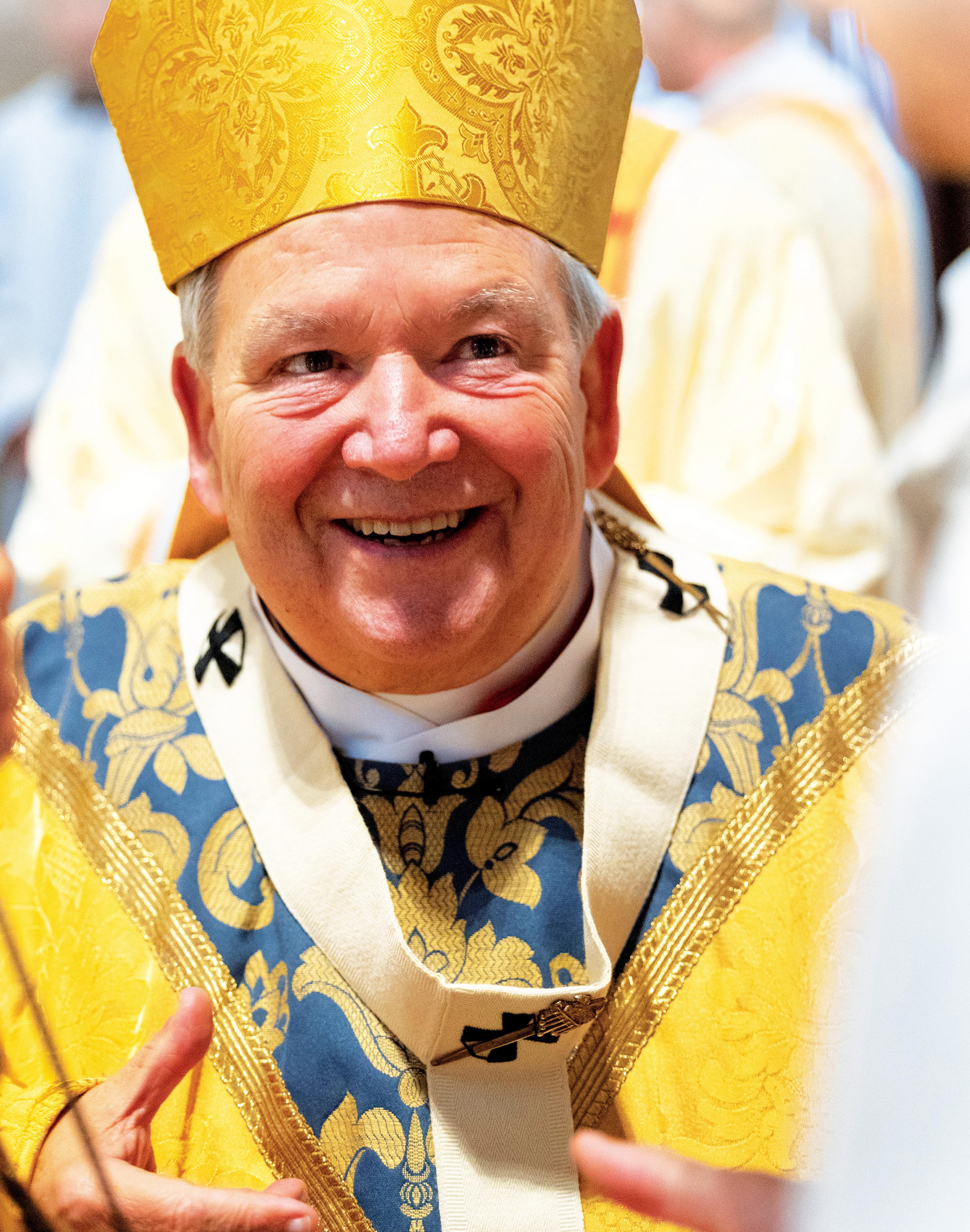
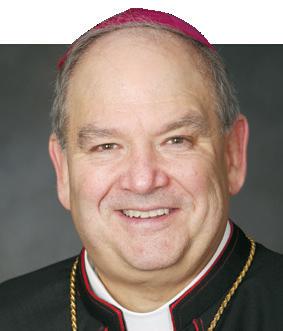
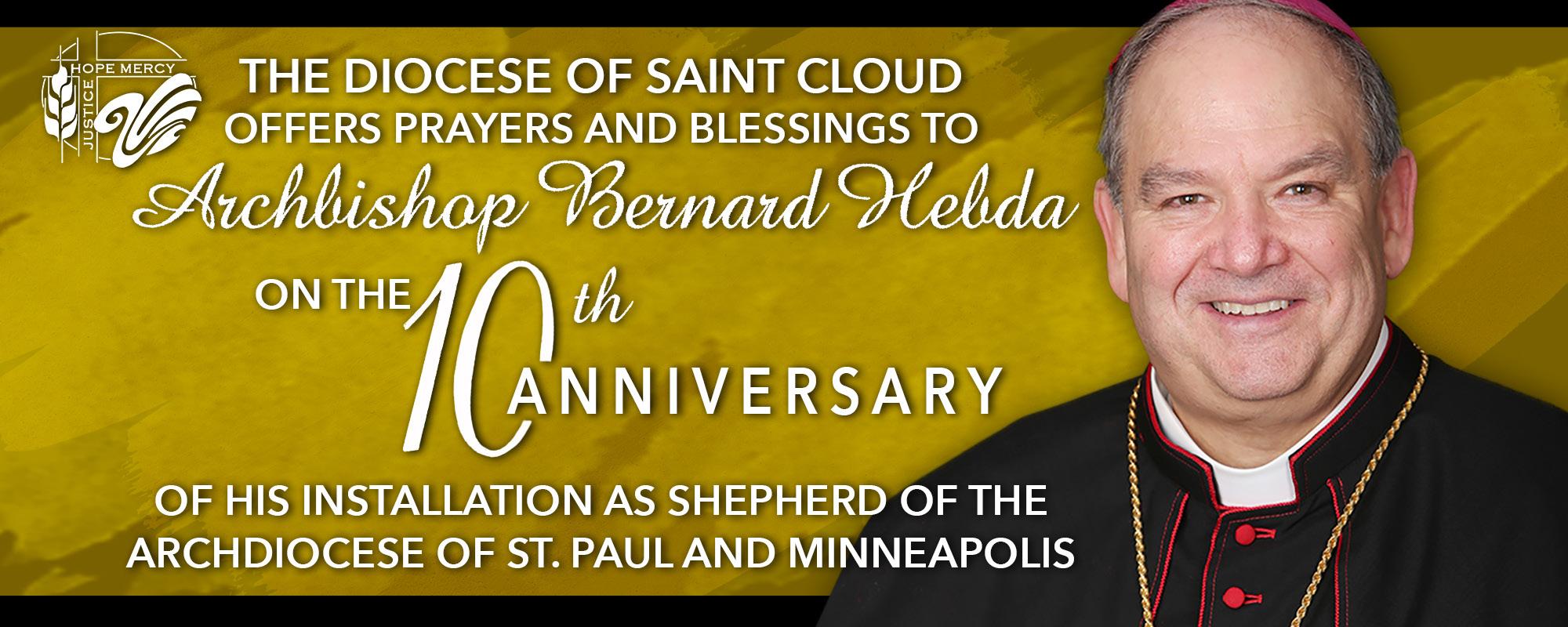
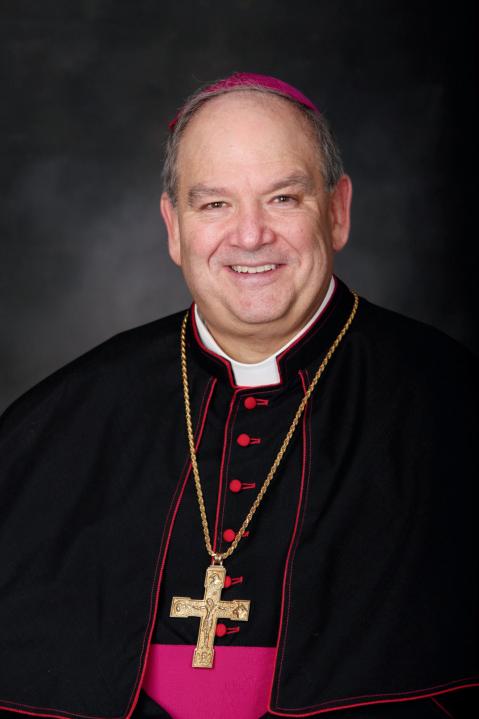
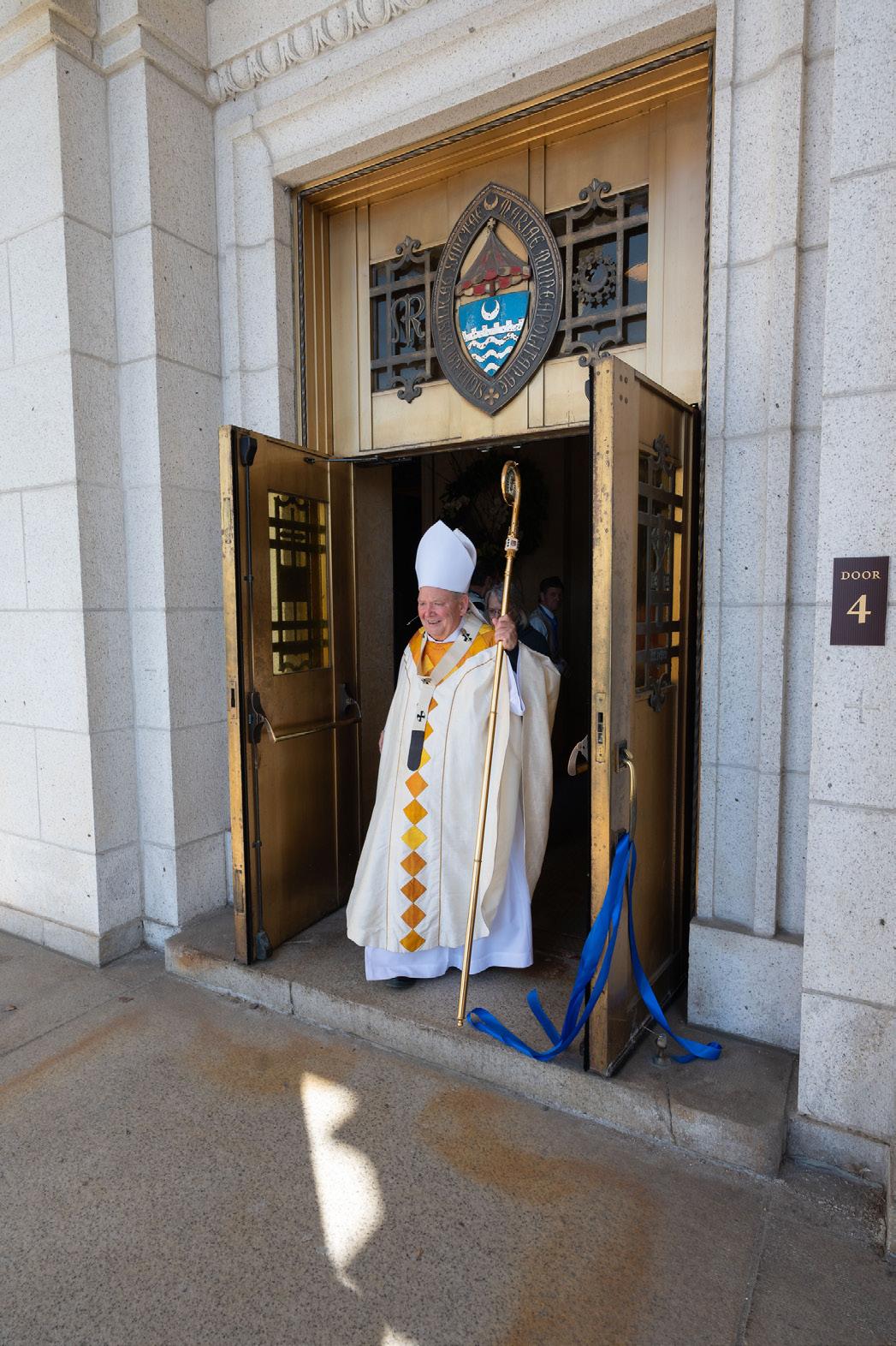
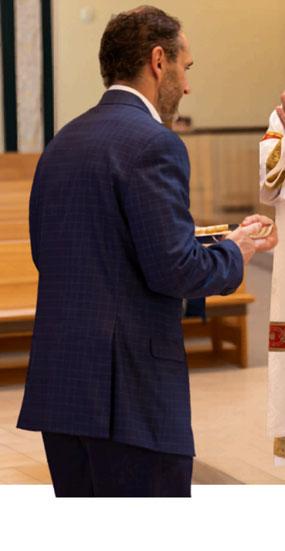
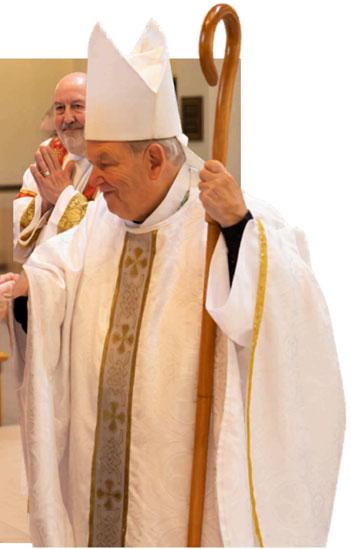
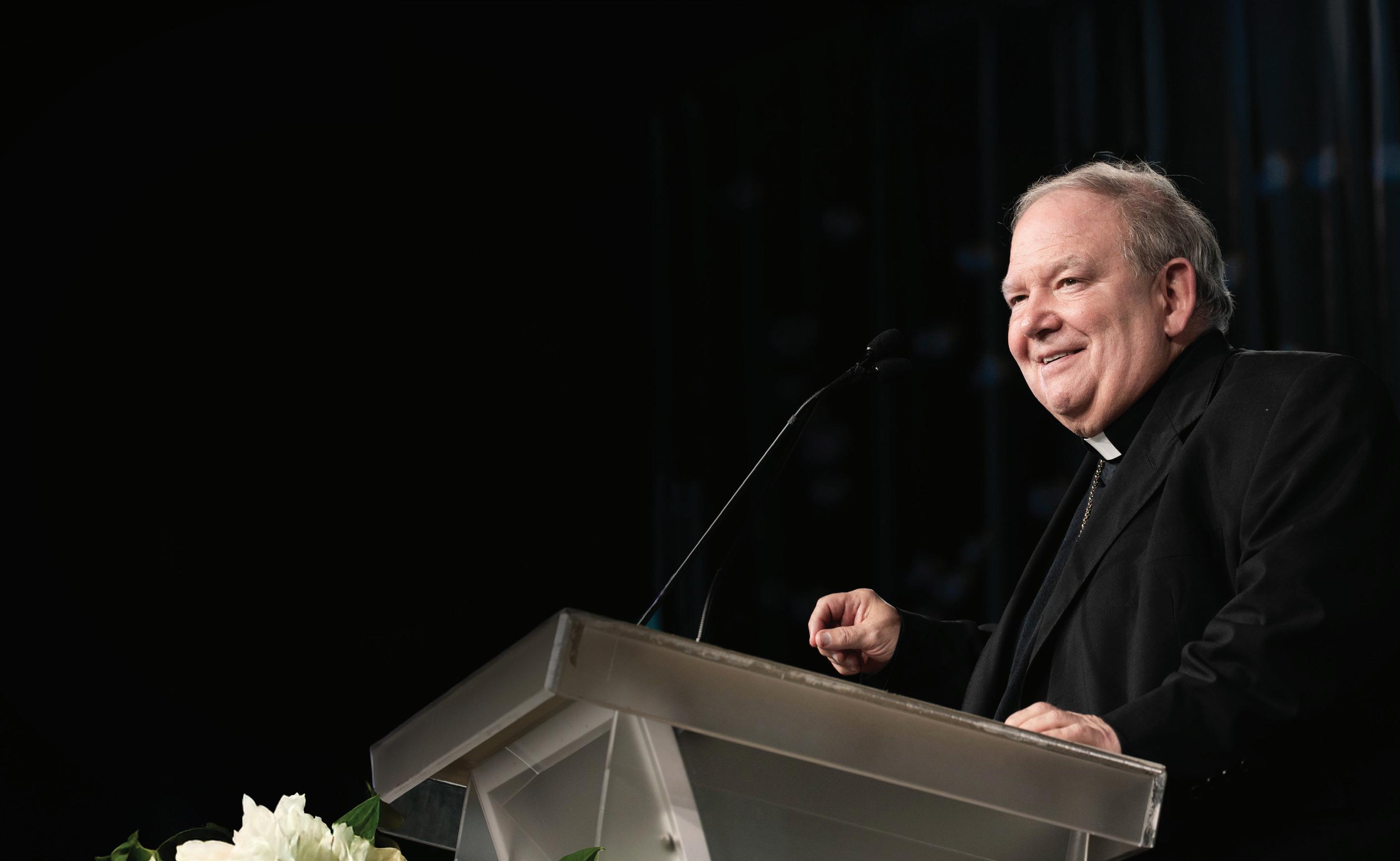
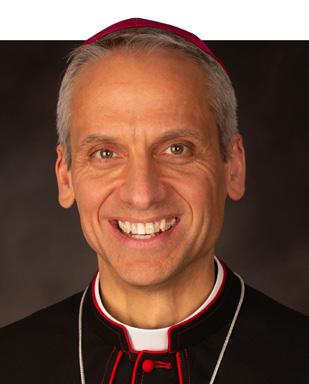
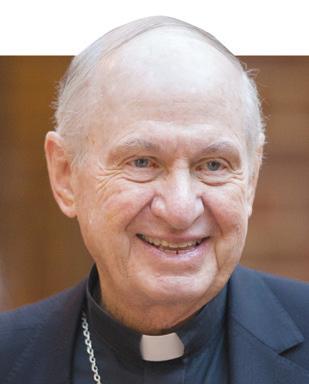
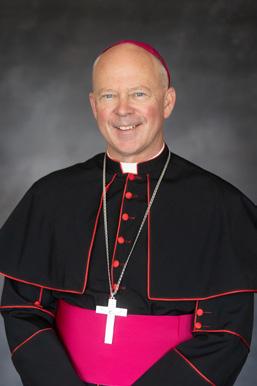
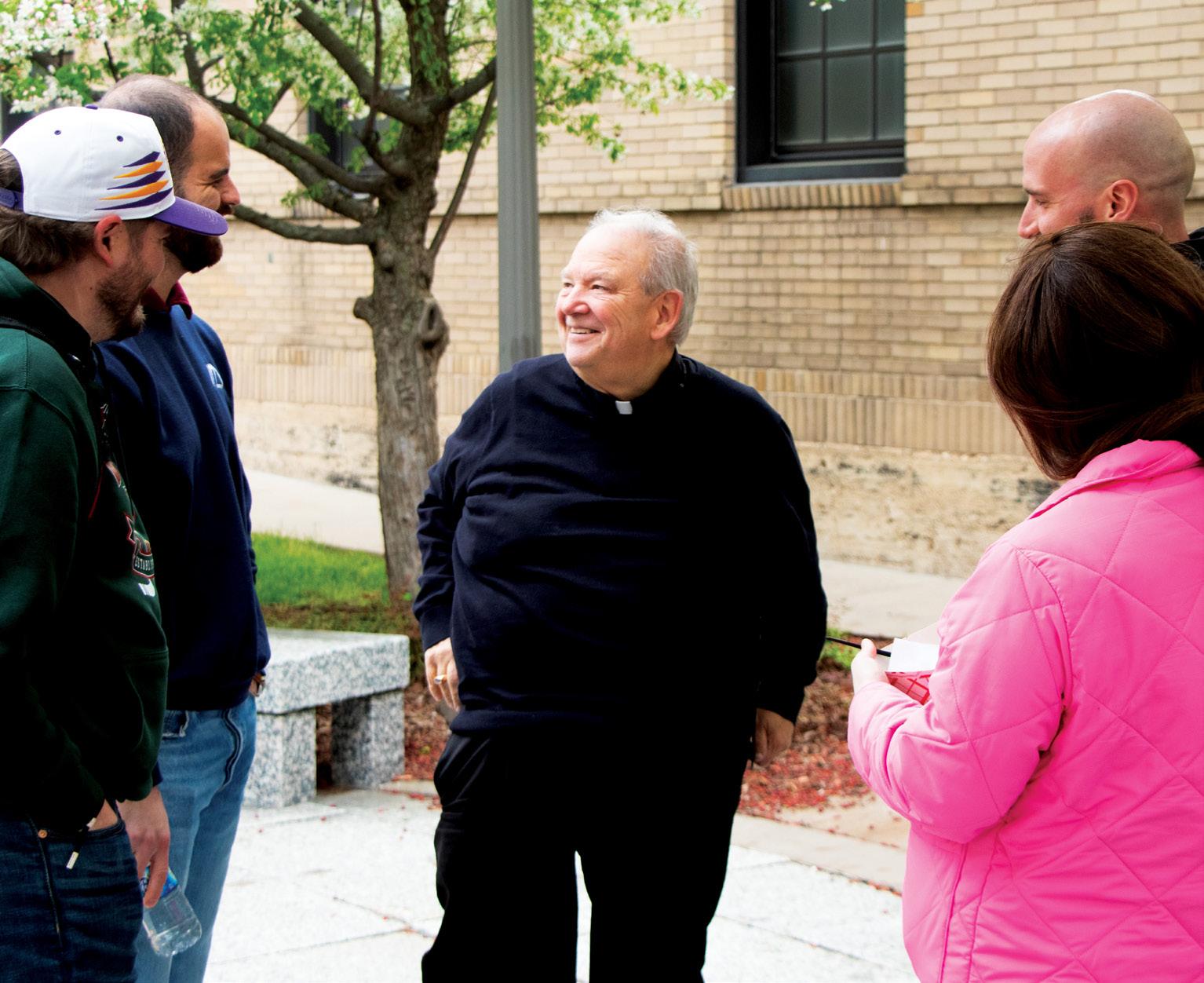
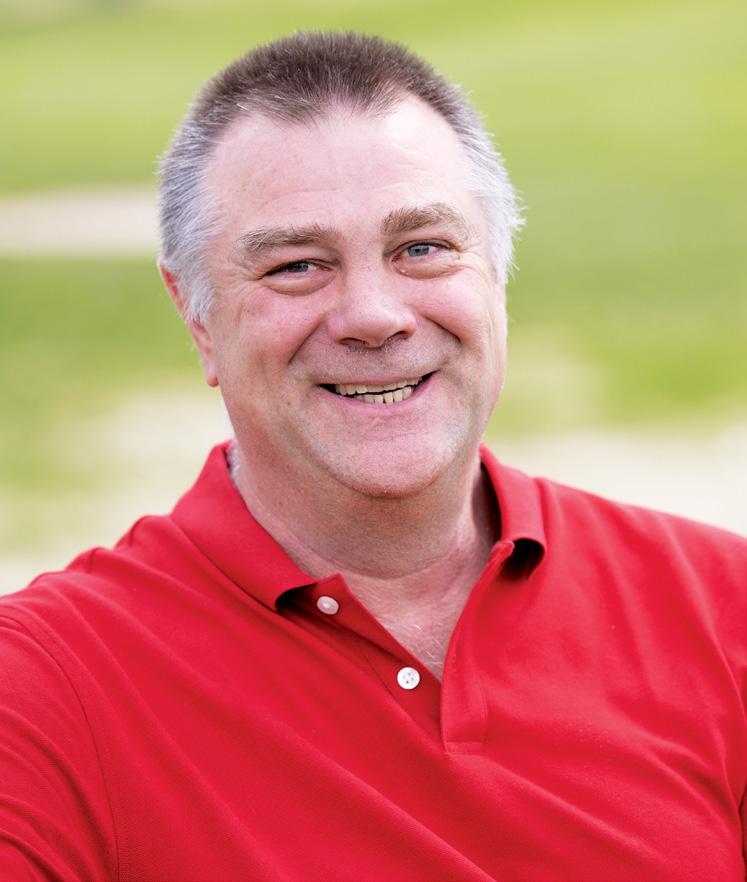
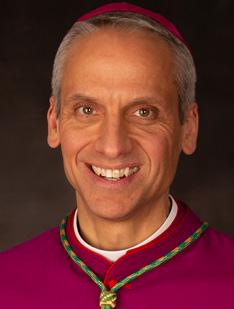
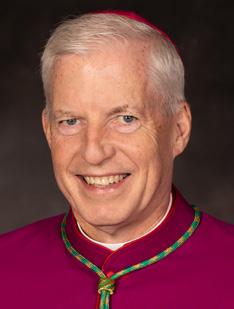
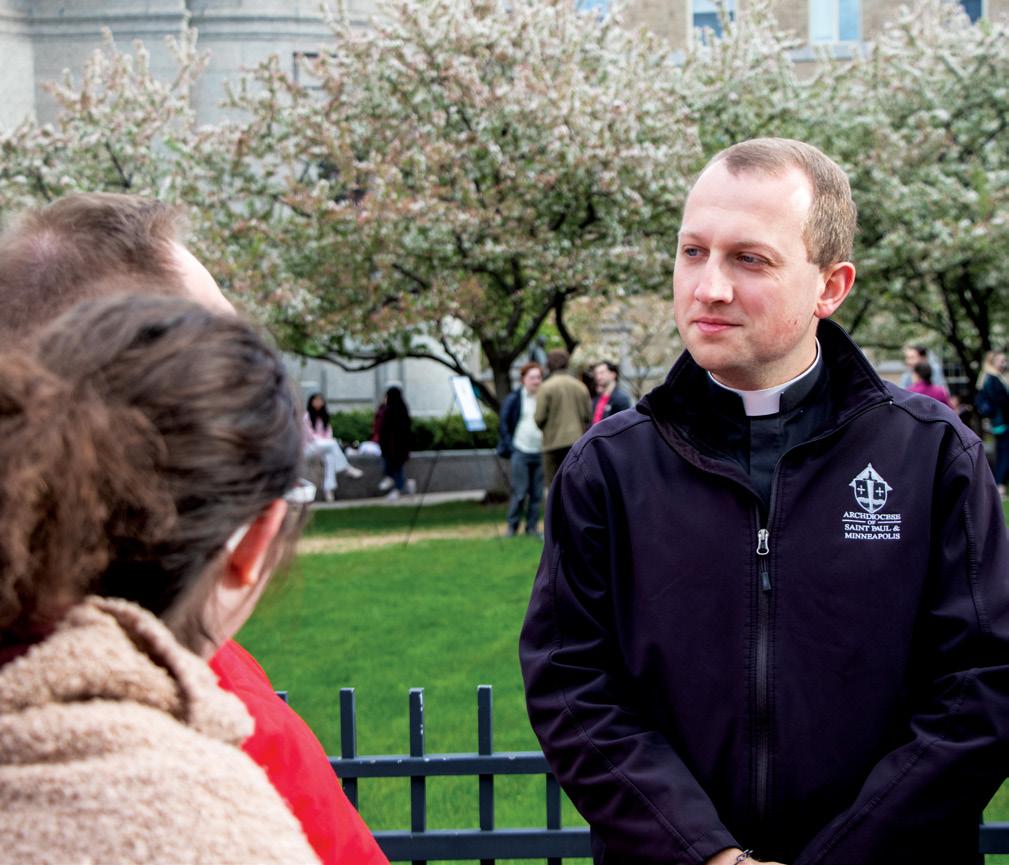
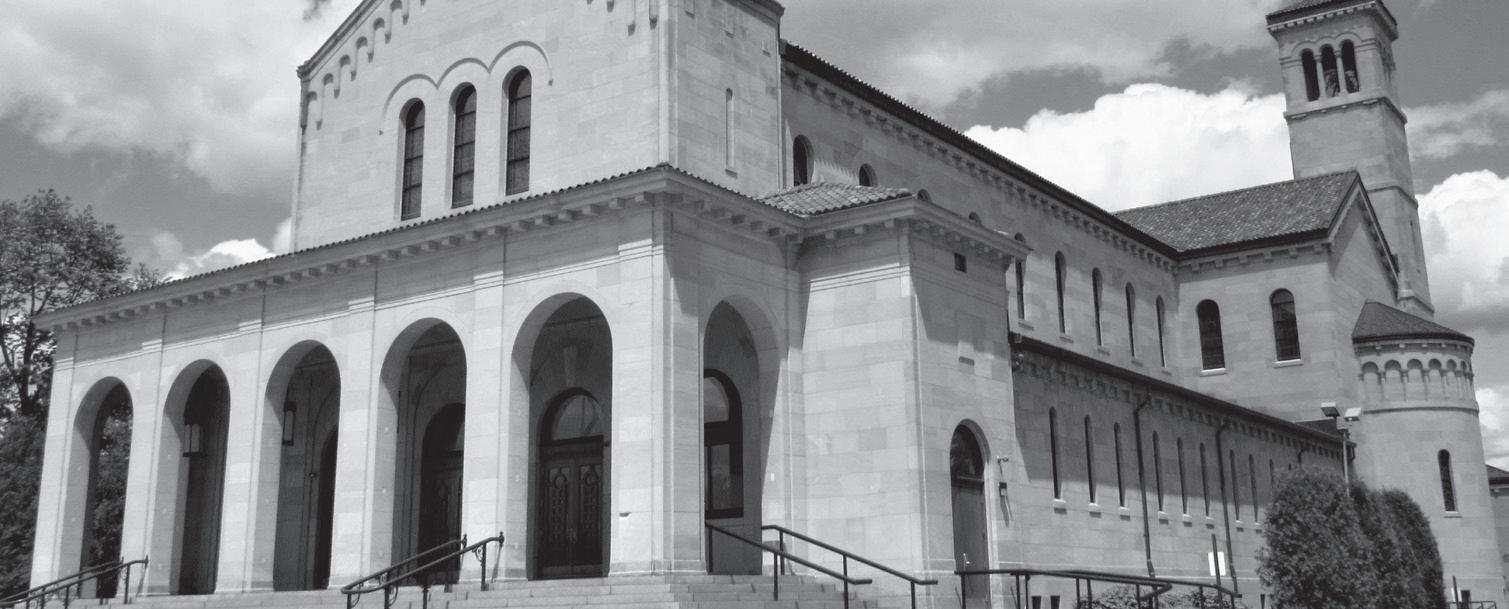
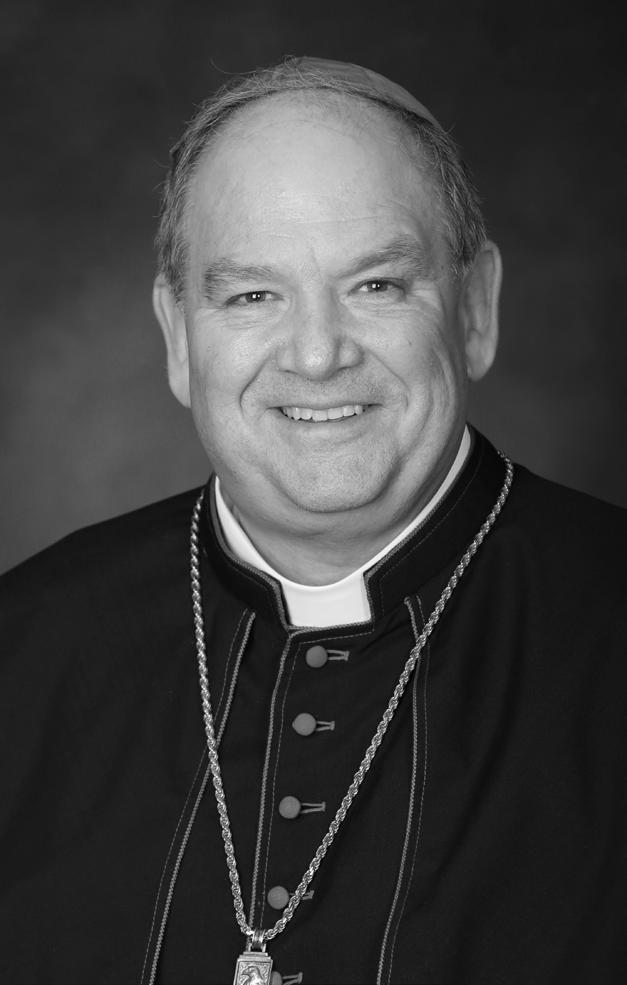
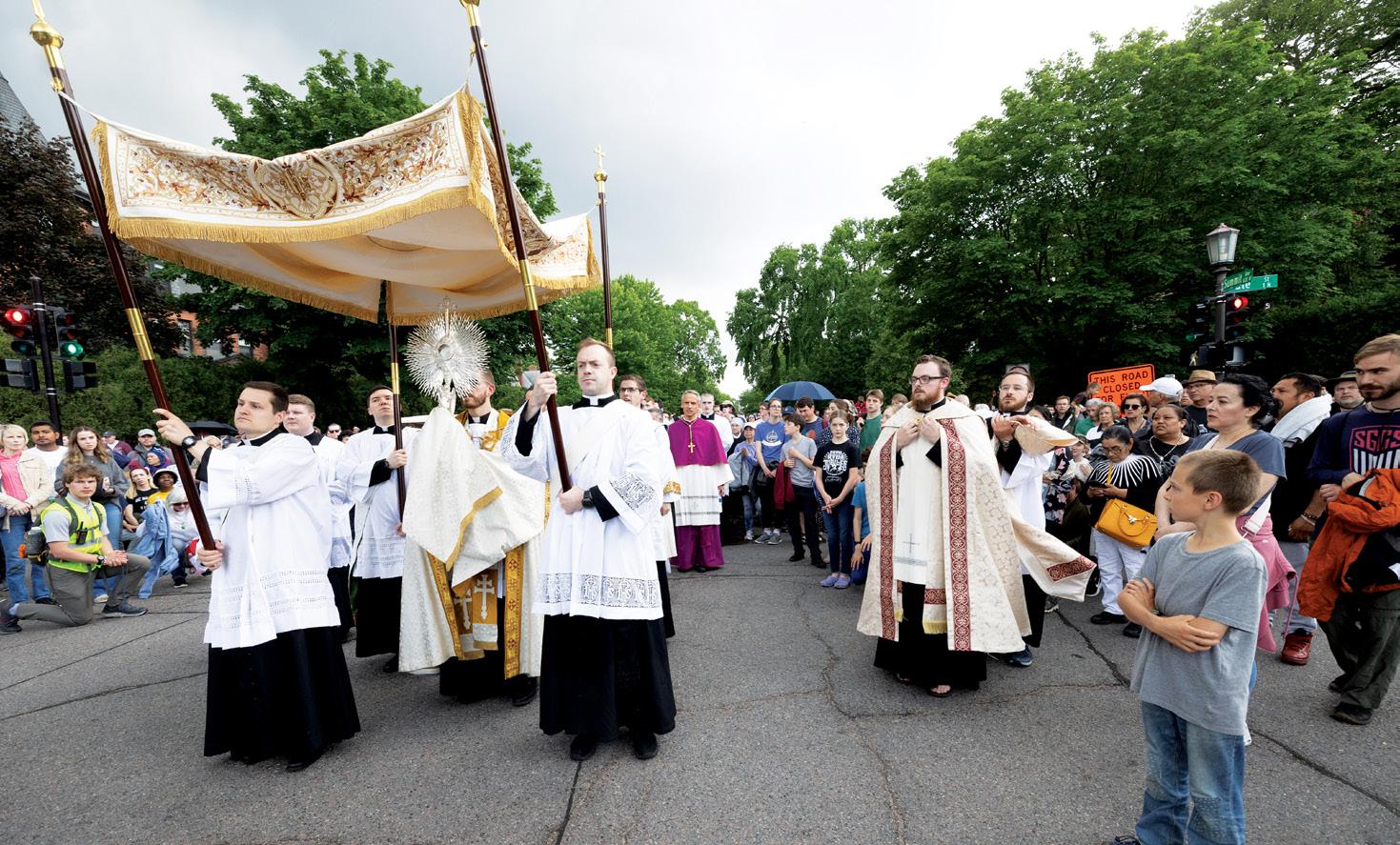
Archbishop Bernard Hebda smiles in conversation at the priestly ordination of five men at the Cathedral of St. Paul in St. Paul May 31, 2025. This month, Archbishop Hebda is marking the 10th anniversary of his installation as archbishop in the Archdiocese of St. Paul and Minneapolis.
DAVE HRBACEK | THE CATHOLIC SPIRIT
PAGETWO NEWS notes
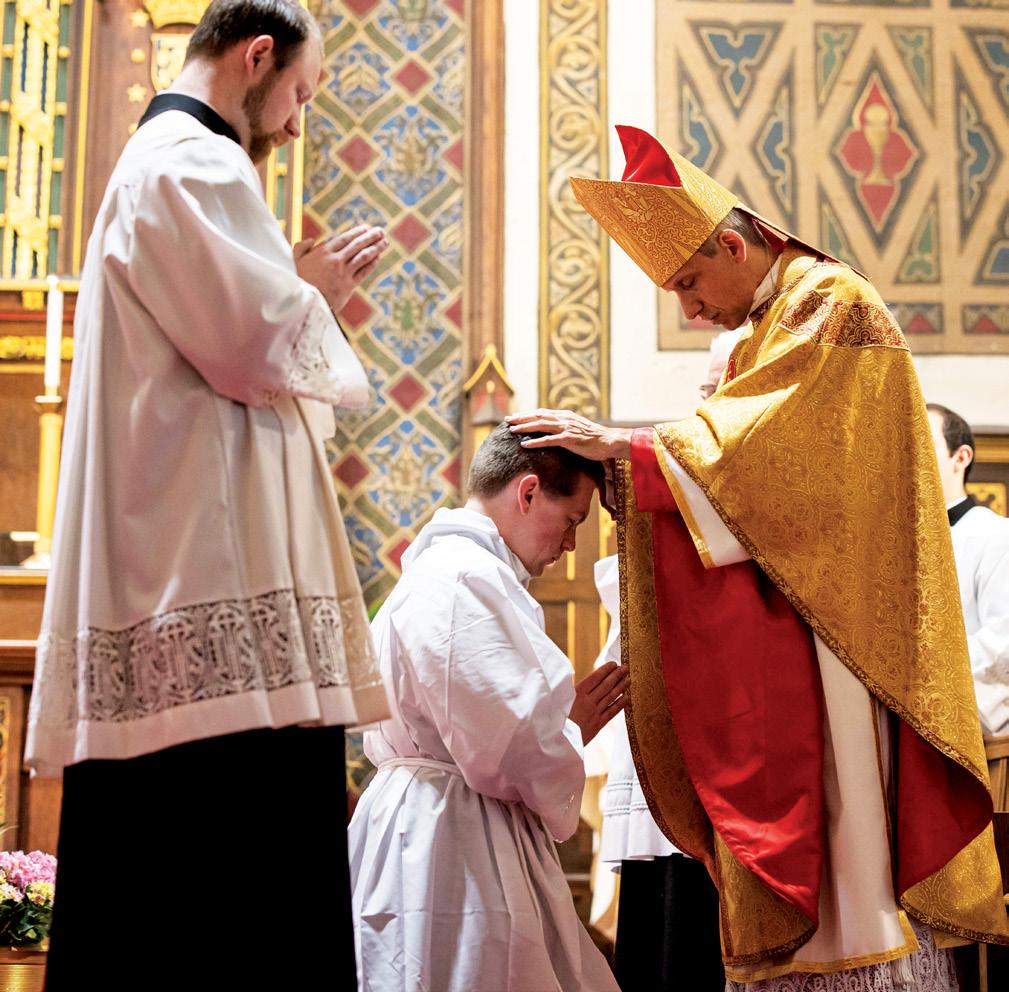
TRANSITIONAL DEACONS Bishop Michael Izen lays his hands in prayer on the head of transitional Deacon Evan Steeves during Deacon Steeves’ ordination Mass May 9 at St. Mark in St. Paul. Bishop Izen also ordained transitional Deacon José Ignacio Rodriguez, both for Pro Ecclesia Sancta, an ecclesial family of consecrated life in the Catholic Church. Deacon Steeves is on staff at St. Mark for Ignite Youth Ministry and Deacon Rodriguez is the parish’s master of ceremonies. They were the only two men ordained transitional deacons in the Archdiocese of St. Paul and Minneapolis in 2026. Deacon Steeves is from Maple Grove and attended St. Vincent de Paul. He made his perpetual vows with Pro Ecclesia Sancta on March 19. Deacon Rodriguez’s home parish was Sagrado Corazón de Jesús in Lima, Peru. He made his perpetual vows Dec. 8, 2023.
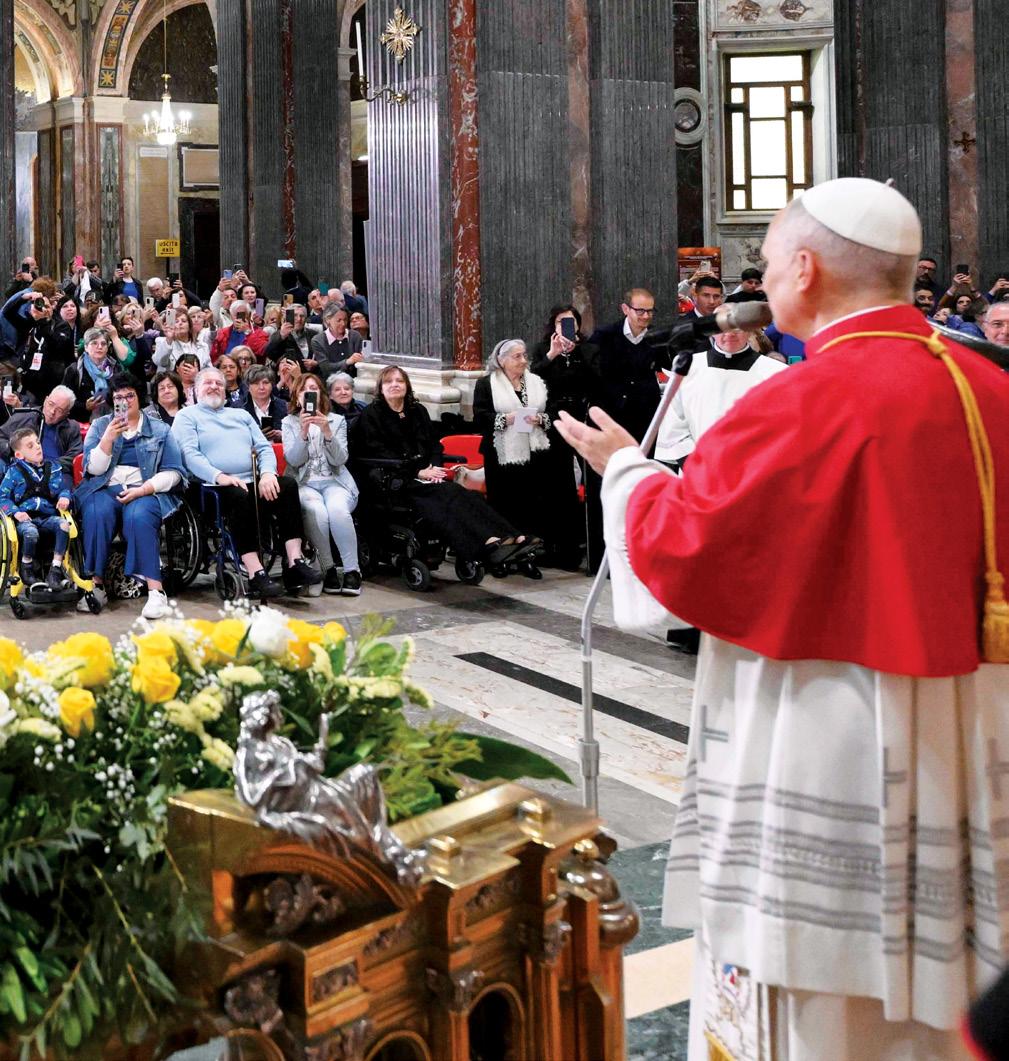
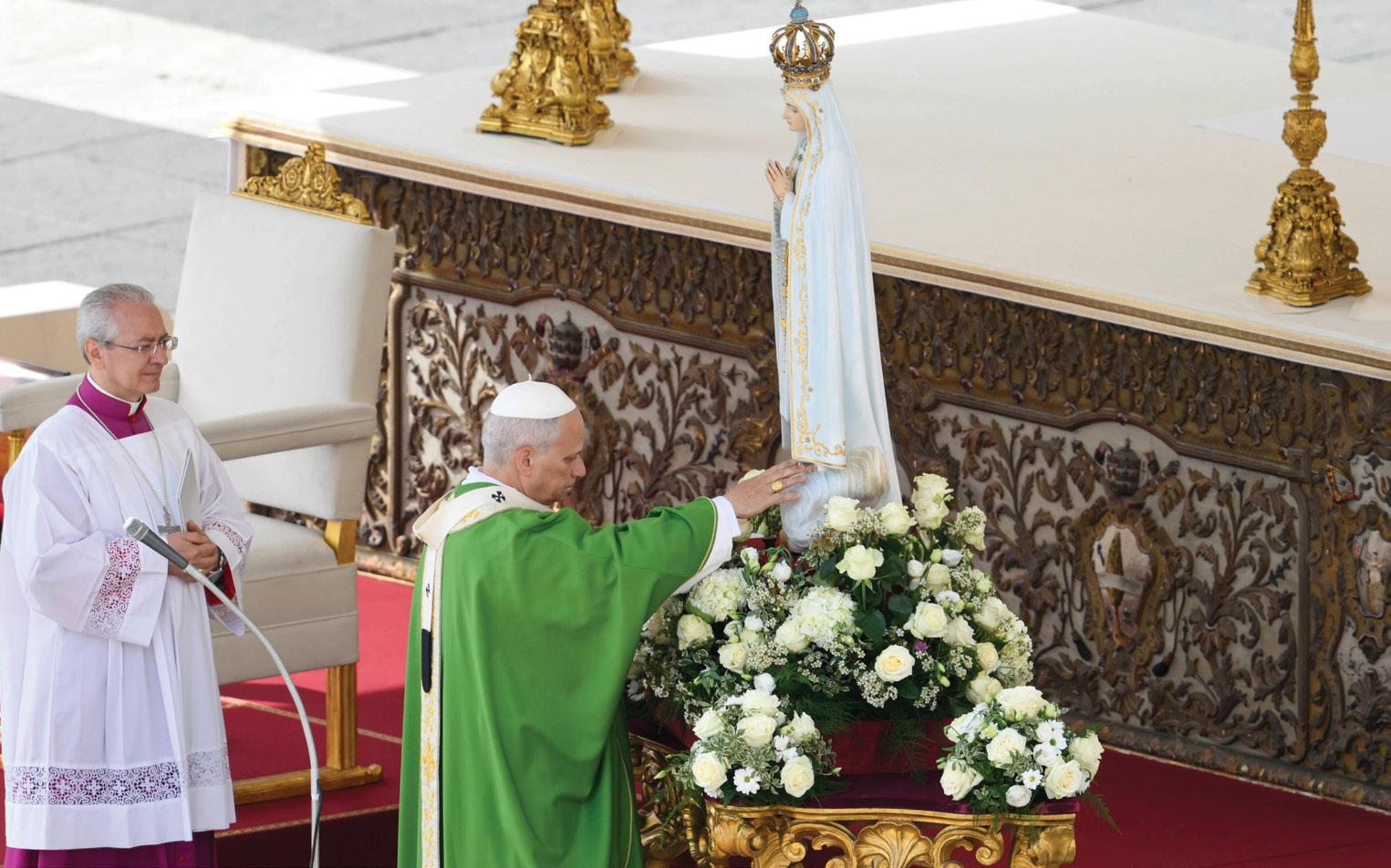
before celebrating Mass in the square outside the sanctuary May 8, on the first anniversary of his election as the first American pontiff. Pope Leo visited 400 sick and disabled people inside the shrine.
Hundreds of Catholics from across Minnesota came to the Minnesota State Capitol in St. Paul May 1 to pray before the Eucharist. It was the fourth and final Adoration at the Capitol held during this legislative session, which ended May 18. Four Minnesota bishops from their respective dioceses joined the faithful in the lower level’s Capitol Vault Room: Bishop Robert Barron of Winona-Rochester, Bishop Chad Zielinski of New Ulm, Bishop Patrick Neary of St. Cloud and Bishop Andrew Cozzens of Crookston. The Minnesota Catholic Conference which represents the public policy interests of the state’s Catholic bishops holds Adoration at the Capitol on the first Friday of each month during legislative sessions. On first Fridays this year, each Catholic bishop in Minnesota at some point joined the faithful. Archbishop Bernard Hebda and Bishops Kevin Kenney and Michael Izen of St. Paul and Minneapolis prayed at the Capitol March 6, and Bishop Daniel Felton was there April 10. On May 1, an estimated 350 people were present at various points during the day, often praying in silence. The rosary was prayed aloud at 1:30 p.m., right before Benediction, which closed with a triumphant singing of “Holy God, We Praise Thy Name.” The prayers of hundreds of adorers echoed from the Capitol’s basement.
The Franciscan Retreats and Spirituality Center in Prior Lake honored the friars of the Province of Our Lady of Consolation with its 67th annual Franciscan International Award (FIA). A member of the province and bishop of the Diocese of Lexington, Kentucky, Bishop John Stowe, conferred the award at the retreat center’s FIA Dinner May 7 in Prior Lake. The province founded and continues to staff the retreat center its first in the United States. The center is celebrating its own 60th anniversary of having been built. The award was founded by the late Father Urban Wagner in 1959 to recognize achievements that exemplify Gospel values and help raise money for a retreat center in Prior Lake, the center’s website notes. In addition, this year the province is celebrating its 100th anniversary. With their provincial headquarters in Mount St. Francis, Indiana, across the Ohio River from Louisville, Kentucky, the friars have served in the Midwest, Southwest and internationally in countries including Honduras, Zambia and Italy.
A singer-songwriter who created a nonprofit to assist new fathers dealing with an unexpected pregnancy, a political advocate for the Catholic Church in Minnesota and a couple creating community around a coffee shop recently received Leading with Faith awards May 1 from Twin Cities-based St. Joseph Business Guild. When not making music, Luke Spehar volunteers at Pregnancy Choices, a pregnancy resource center in Apple Valley, where he was asked to be a certified life coach for fathers who accompanied mothers to the center. Spehar transitioned that work to a virtual program in 2020. As it grew, he called the ministry Always Intentional Man, or AIM. In 2022, it gained nonprofit status and grew from six certified coaches to 14. In addition to Pregnancy Choices, AIM now partners with Women’s Life Care Center in Little Canada, Guiding Star Wakota in West St. Paul and First Care in Richfield, St. Paul and Minneapolis. Jason Adkins is executive director and general counsel of the Minnesota Catholic Conference (MCC), the public policy voice of the Catholic Church in the state. Adkins and his staff work to bring Church teaching to the Minnesota Legislature and beyond. “All law is applied morality, and therefore the Church’s voice in the public square is indispensable,” Adkins told the guild. “And because it is true, and we know the human heart hungers for truth, we believe in the power of reason and persuasion to propose to our neighbors Catholic and non-Catholic alike what we think helps the community.” Nate and Megan Whipple run Karol Coffee Co. in St. Paul, named after St. John Paul II, whose birth name was Karol Wojtyla. Recognized for their entrepreneurship, Nate Whipple said hospitality is important to him and to his wife. Opening a coffee shop took discernment, learning and trust in God that grew from roasting their own coffee in their garage to purchasing Karol Coffee’s current building last year, Whipple said. “It’s your income,” Whipple told the guild. “(But) inevitably, we always have enough. ... It’s been an exercise in trust and in receiving God’s blessing.”
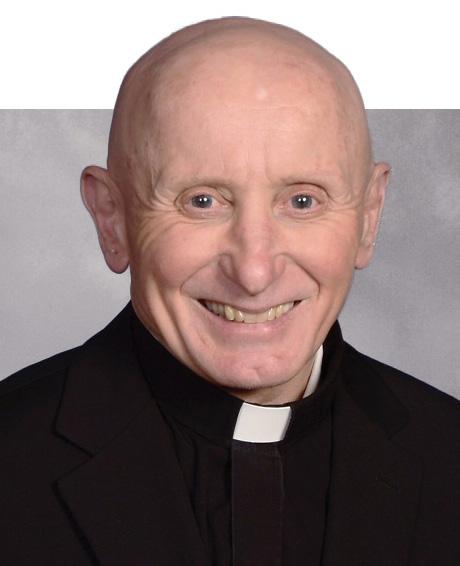
Father Shallbetter — known for adventurous spirit, love of people — dies at 84
By Josh McGovern
The Catholic Spirit
Father Martin Shallbetter, a priest who served at 11 different parishes in the Archdiocese of St. Paul and Minneapolis, died May 16 at the age of 84.
Known for his love of sailing, Father Shallbetter often incorporated the hobby into his ministry. Ann Rivera, his niece, said, “A lot of the images in his homilies over the years, or in his cards that he would design for holidays, often revolved around sailing. He would say, ‘You can’t control the winds, but you can adjust your sails.’”
Father Shallbetter was getting ready to sail again this summer on his sailboat that he’s had since 1974. Rivera called it his “partner for about 50 years.” Father Shallbetter had a sense of adventure, often traveling with friends from St. John’s University in Collegeville all around the world.
“He loved being with people,” Rivera said. “He was very adventurous. He has climbed mountains to the tops of the peaks, and he’s gone scuba diving to the depths of the oceans. He had two formal extended sabbaticals, one to Israel and one to Australia, that really deeply impacted him in his ministry.”
A native of Minneapolis, Father Shallbetter began his ministry in 1969 as assistant pastor of St. Margaret Mary in Minneapolis. He was associate director of the archdiocesan chancery vocations office from 1972 to 1974 and was the director from 1974 to 1978.
He was a priest for 10 other parishes in the Twin Cities: St. Luke and Assumption, both in St. Paul; St. Anne,
Practicing CATHOLIC CORRECTIONS
Produced by Relevant Radio and the Archdiocese of St. Paul and Minneapolis, the May 15 “Practicing Catholic” radio show included Archbishop Bernard Hebda in an interview about his 10 years as archbishop. Listen to interviews after they have aired at practicingcatholicshow.com or choose a streaming platform at Spotify for Podcasters.
St. Clement, Our Lady of Mount Carmel, all in Minneapolis; St. Mary in Waverly; St. Edward in Bloomington; St. Therese in Deephaven; St. Bernard in Cologne; and Ascension in Norwood Young America. He was also a chaplain for Cursillo de Cristiandad, an apostolic movement dedicated to spreading the word of God.
He retired in 2012.
Father Shallbetter also loved working with his hands and playing cards.
“If you knew him, you probably attended Mass with him and played cards with him,” Rivera said. “He was an engineer and a carpenter. He loved designing things and working out the mechanics of it. Family and friends would joke with him that his car was a traveling Home Depot, because you could ask for any number of tools at any point in time, and even if it was the most specialized (tool), he would most likely say, ‘It’s probably in the car,’ and it usually was. No matter where he was saying Mass, he could help out with a project if he needed to, or head to somebody’s projects before or after service, and he enjoyed doing that, getting his hands busy, and it kept his mind busy, too.”
Father Shallbetter’s funeral will be held at St. Edward with more details to come at TheCatholicSpirit.com
St. Wenceslaus in New Prague will hold its church festival Aug. 9. An incorrect date was printed in the Spring and Summer Parish Festivals guide in the May 7 edition.
The last name of Pro Ecclesia Sancta Brother José Rodriguez was misspelled in a second reference in a News Note on page 2 of the May 7 edition. Three teams of Totus Tuus missionaries from the Archdiocese of St. Paul and Minneapolis were sent to the Diocese of Crookston in 2025 to serve parishes during the summer. A story about the ministry in the May 7 edition indicated the teams trained in Crookston.
POPE LEO FIRST ANNIVERSARY Pope Leo XIV speaks as he visits the Pontifical Shrine of the Blessed Virgin of the Rosary of Pompeii near Naples, Italy,
COURTESY PRO ECCLESIA SANCTA
OSV NEWS | SIMONE RISOLUTI, VATICAN MEDIA
FROMTHEARCHBISHOP
ONLY JESUS | ARCHBISHOP BERNARD HEBDA
Praying for and witnessing an outpouring of the Holy Spirit
While the Church prays daily at Mass for an outpouring of the Holy Spirit, the days between Ascension and Pentecost, constituting the original nine-day novena, are a particularly appropriate time for this fervent prayer. With that in mind, I invite you to join me in echoing Pope St. John XXIII in asking the Lord to indeed renew his “wonders in this our day, as by a new Pentecost.”
In the dialogue with Nicodemus recorded in the Gospel of John, Jesus drew an analogy between the unpredictability of the Holy Spirit and the wind: “The wind blows where it wishes and you hear the sound of it, but do not know where it comes from and where it is going; so is everyone who is born of the Spirit” (Jn 3:8).
As your bishop, my responsibility is not to “control” the Holy Spirit but rather to help us recognize the presence of the strong wind of the Paraclete in this local Church and to coordinate our efforts so that our sails might lead us wherever the Holy Spirit wishes us to go. Just this week, Pope Leo XIV noted to a group of young people from Genoa about to be confirmed that “one of the greatest joys for a bishop — in all dioceses, I think — is to celebrate confirmation.”
Bishop Michael Izen, Bishop Kevin Kenney and I would all agree. We notice the excitement every time we celebrate the sacrament of confirmation as those gathering in the Cathedral of St. Paul in St. Paul anticipate the many ways in which the Holy Spirit will be manifested in the lives of our newly confirmed. We have come to recognize, as did Pope Francis, that our God is a God of surprises.
We’ve seen the surprising work of the Holy Spirit in technicolor this year as we welcomed more than 1,700 new Catholics into our archdiocese in this Easter season — and we rejoice that dioceses across our nation experienced similar growth. Pundits have been trying to explain this phenomenon, especially among young adults, but no one has been able to point to any one determinative factor, other than that the Holy Spirit is working overtime during a very trying time in our culture. Our recent young adult gathering at the
Orando por y siendo testigos de una derramamiento del Espíritu Santo
La Iglesia ora a diario en la Misa por un derramamiento del Espíritu Santo, los días comprendidos entre la Ascensión y Pentecostés —que constituyen la novena original de nueve oportuno días— son un momento particularmente p para esta ferviente oración. Teniendo esto presente, los invito a unirse a mí para hacer eco de las palabras del Papa San Juan XXIII, pidiendo al Señor que renueve verdaderamente sus “maravillas en nuestros días, como en un nuevo Pentecostés”.
En el diálogo con Nicodemo, registrado en el Evangelio de Juan, Jesús estableció una analogía entre la imprevisibilidad del Espíritu Santo y el viento: “El viento sopla donde quiere y oyes su sonido, pero no sabes de dónde viene ni a dónde va; así es todo aquel que ha nacido del Espíritu”(Jn 3:8).
Como su obispo, mi responsabilidad no es “controlar” al Espíritu Santo, sino más bien ayudarnos a reconocer la presencia del viento fuerte del Paráclito en esta Iglesia local y coordinar nuestros esfuerzos para que nuestras velas nos conduzcan adondequiera
We’ve seen the surprising work of the Holy Spirit in technicolor this year as we welcomed more than 1,700 new Catholics into our archdiocese in this Easter season and we rejoice that dioceses across our nation experienced similar growth. Pundits have been trying to explain this phenomenon, especially among young adults, but no one has been able to point to any one determinative factor, other than that the Holy Spirit is working overtime during a very trying time in our culture.
Cathedral attested to that as well (see page 17).
I feel so privileged as your archbishop to see the Spirit at work in so many endeavors. I’ve been inspired over the past year, for example, by the outpouring of fraternal support for our neighbors in need: I know that our sisters and brothers at Annunciation continue to model Christ-centered community in the aftermath of last August’s tragedy, and I’m humbled when I hear about efforts in so many of our parishes to advocate for those on the margins by rolling up our sleeves to pack boxes of groceries, to facilitate medical care and legal assistance, and to provide accompaniment in the most difficult of times. It reminds me of the strength of the early Christian community depicted so profoundly in our readings from the Acts of the Apostles throughout this Easter season — with the followers of Christ being of “one heart and one mind,” selflessly putting their resources together to address the needs of their brothers and sisters. That’s the work of the Holy Spirt.
That selflessness has been particularly evident to me as we have celebrated some significant milestones in our community. We’ve recently marked the 75th anniversary of Maternity of Mary-St. Andrew Catholic School in St. Paul and the 150th anniversary of St. Michael Catholic School in St. Michael. Imagine all the children who have encountered
que el Espíritu Santo desee que vayamos. Precisamente esta semana, el Papa León XIV comentó a un grupo de jóvenes de Génova que estaban a punto de confirmarse que “una de las mayores alegrías para un obispo —creo que en todas las diócesis— es celebrar la Confirmación”. El obispo Michael Izen, el obispo Kevin Kenney y yo estaríamos plenamente de acuerdo. Percibimos la emoción cada vez que celebramos el sacramento de la Confirmación, mientras quienes se congregan en la Catedral de San Pablo, en la ciudad de St. Paul, aguardan con expectación las muchas formas en que el Espíritu Santo se manifestará en las vidas de nuestros recién confirmados. Hemos llegado a reconocer, al igual que el Papa Francisco, que nuestro Dios es un Dios de sorpresas.
Hemos sido testigos de la sorprendente obra del Espíritu Santo en todo su esplendor este año, al dar la bienvenida a más de 1.700 nuevos católicos en nuestra arquidiócesis durante esta temporada pascual; y nos regocijamos de que otras diócesis de nuestra nación hayan experimentado un crecimiento similar. Los analistas han intentado explicar este fenómeno —especialmente entre los adultos jóvenes—, pero nadie ha logrado señalar un único factor determinante, salvo el hecho de que el Espíritu Santo está trabajando incansablemente durante una época de grandes desafíos en nuestra cultura. Nuestro reciente encuentro de jóvenes adultos en la Catedral también dio fe de ello (vean la página 17).
Me siento sumamente privilegiado, como su
Christ and his Holy Spirit over those years, benefiting from the sacrifices of parishioners who wanted nothing more than to assist parents in fulfilling their responsibilities as the first educators in the faith. The challenge of passing on the faith in and through our families continues to be a priority for our Church. I hope that you’ll take the time to read the pastoral letter on this topic, “Only One Thing Is Necessary,” issued on May 13.
On that same day, I was blessed to celebrate holy Mass at the Cathedral to give thanks to almighty God as I marked the 10th anniversary of my installation as the archbishop of this local Church. I’m so grateful to all of you who have been praying for me throughout that decade, and who have inspired me by your own docility to the Holy Spirit. I know that much work remains to be done and am confident that the same Holy Spirit who brought growth and vitality to the early Church desires that for our archdiocese in 2026 and beyond. I feel privileged to be serving alongside such great priests, deacons, consecrated women and men and lay faithful. Let’s pray fervently for one another this Pentecost. It would be a particular blessing to have you join me at the Cathedral for the vigil Mass of Pentecost, May 23 at 5:15 p.m. and for a gathering of prayer and praise immediately after that Mass. Come, Holy Spirit.
arzobispo, al verla obrar en tantas iniciativas. Durante el último año, por ejemplo, me ha inspirado la efusión de apoyo fraterno hacia nuestros vecinos necesitados: sé que nuestros hermanos y hermanas de la Anunciación continúan siendo un modelo de comunidad centrada en Cristo tras la tragedia del pasado mes de agosto; asimismo, me siento profundamente conmovido al enterarme de los esfuerzos que se realizan en tantas de nuestras parroquias para abogar por aquellos que se encuentran en los márgenes, arremangándonos las mangas para preparar cajas de alimentos, facilitar atención médica y asistencia legal, y brindar acompañamiento en los momentos más difíciles. Esto me recuerda la fortaleza de la primitiva comunidad cristiana, descrita de manera tan profunda en las lecturas de los Hechos de los Apóstoles a lo largo de este tiempo pascual: una comunidad en la que los seguidores de Cristo eran “un solo corazón y una sola alma”, uniendo desinteresadamente sus recursos para atender las necesidades de sus hermanos y hermanas. Esa es la obra del Espíritu Santo. Esa generosidad me ha resultado particularmente evidente al celebrar algunos hitos significativos en nuestra comunidad. Recientemente hemos conmemorado el 75.º aniversario de la Escuela Católica Maternity of Mary-St. Andrew en Saint Paul, así como el 150.º aniversario de la Escuela Católica St. Michael en St. Michael. Imaginen a todos los niños que, a lo largo de esos años, han encontrado a Cristo y a su Espíritu Santo,
beneficiándose de los sacrificios de feligreses cuyo único deseo era ayudar a los padres a cumplir con su responsabilidad de ser los primeros educadores en la fe. El desafío de transmitir la fe —dentro de nuestras familias y a través de ellas— sigue siendo una prioridad para nuestra Iglesia. Espero que se tomen el tiempo para leer la carta pastoral sobre este tema, titulada “Solo una cosa es necesaria”, publicada el pasado 13 de mayo. En ese mismo día, tuve la dicha de celebrar la Santa Misa en la Catedral para dar gracias a Dios Todopoderoso, al conmemorar el décimo aniversario de mi toma de posesión como Arzobispo de esta Iglesia particular. Estoy profundamente agradecido con todos ustedes, quienes han estado orando por mí a lo largo de esta década y quienes me han inspirado con su propia docilidad al Espíritu Santo. Sé que aún queda mucho trabajo por realizar y confío en que el mismo Espíritu Santo, que trajo crecimiento y vitalidad a la Iglesia primitiva, desea lo mismo para nuestra Arquidiócesis en el año 2026 y en adelante. Me siento privilegiado de servir junto a tan grandes sacerdotes, diáconos, hombres y mujeres consagrados, y fieles laicos. Oremos fervientemente los unos por los otros en este Pentecostés. Sería una bendición especial que me acompañaran en la Catedral para la Misa de la Vigilia de Pentecostés, 23 de mayo a las 5:15 p. m., y para un reunión de oración y alabanza inmediatamente después de dicha Misa. Ven, Espíritu Santo.
Honoring the Memory of Millions Through Music
Minnesota Sinfonia musicians will perform Jewish-themed music on instruments from the Violins of Hope collection - violins, a viola and a cello that belonged to Jewish musicians, many of whom perished in the Holocaust. Featuring cellist Amit Peled , performing on a cello from the collection.
June
University of Northwestern, Nazareth Chapel, St. Paul
Pre-concert talk starts at 6:30 pm
June
June
Minneapolis
Pre-concert talk starts at 6:45 pm
June
June
Feliz Día de las Madres
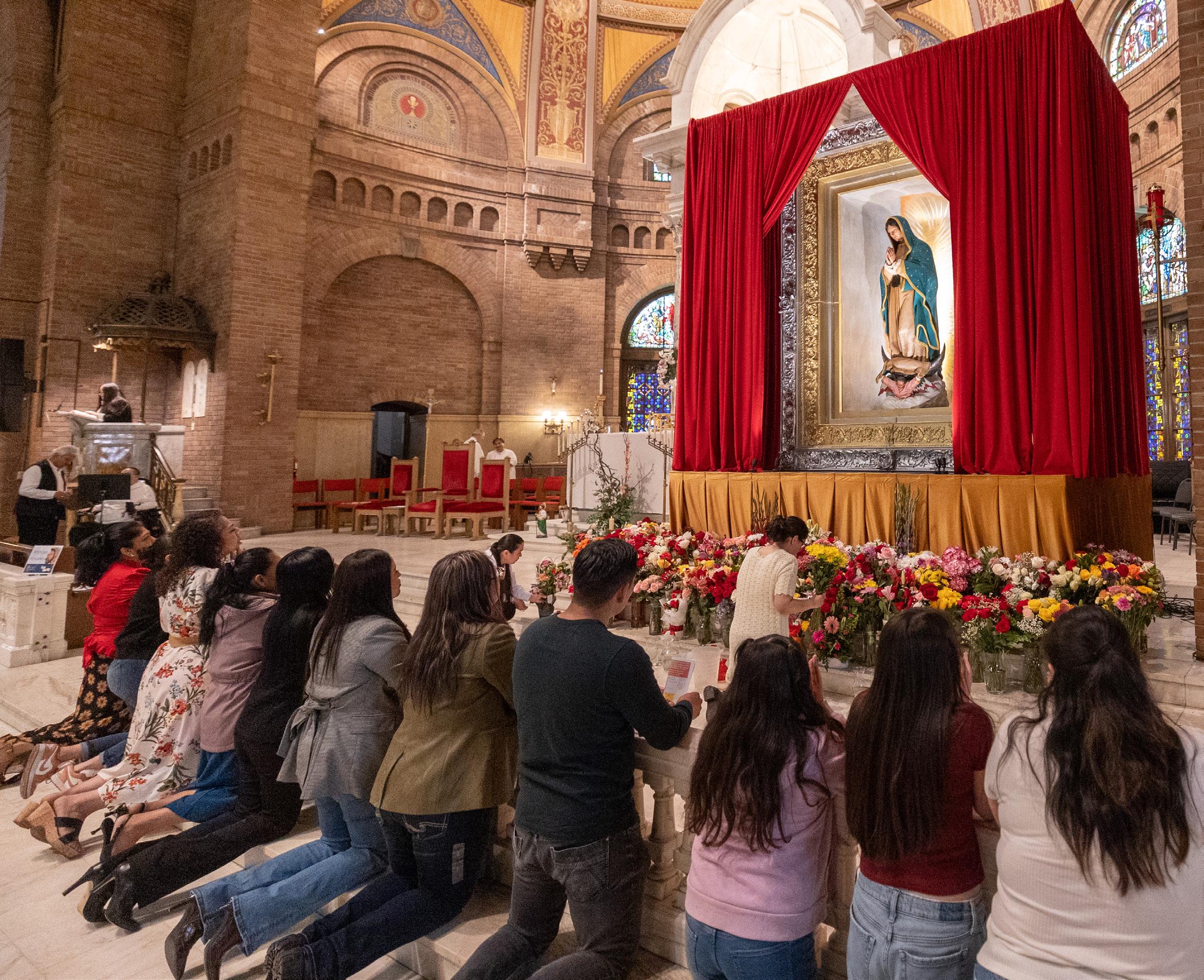
People gather in front of a statue called Madre Peregrina (Pilgrim Mother) to pray on Mother’s Day, May 10, before Mass at Incarnation in Minneapolis. This was the final day that the statue which depicts the image of Our Lady of Guadalupe that was left on St. Juan Diego’s tilma in 1531 in Mexico City was displayed in the Twin Cities. The Minnesota leg of the statue’s national tour began April 23 at the Cathedral of St. Paul in St. Paul and ended at Incarnation. People from the Latino community filled Incarnation church to overflowing for the May 10 Mass. A total of 2,000 people came that day, with at least 500 going downstairs to watch a livestream of the Mass after the main church filled. People were bused in throughout the tour, with about 8,000 coming to Incarnation and nearly 1,000 to the Cathedral, said Estela Villagrán Manancero, director of the Office of Latino Ministry in the Archdiocese of St. Paul and Minneapolis. She brought her mother, Maria Lombardi, 92, to Incarnation on Mother’s Day and they stayed for four hours, arriving before Mass and leaving well after it ended. “I never expected that it (Madre Peregrina tour) was going to be that large,” Villagrán Manancero said. “It was just amazing.”
DAVE HRBACEK | THE CATHOLIC SPIRIT
or visit ccf-mn.org causes forever. Church, your gift can support your parish and favorite Invested and granted according to the teachings of the leave a legacy that reflects your Catholic faith and values. By
Learn more about planning an endowment.
Presented by the Minnesota JCC In Partnership with the Minnesota Sinfonia
Archbishop Hebda celebrates 10th anniversary with Cathedral Mass
By Josh McGovern The Catholic Spirit
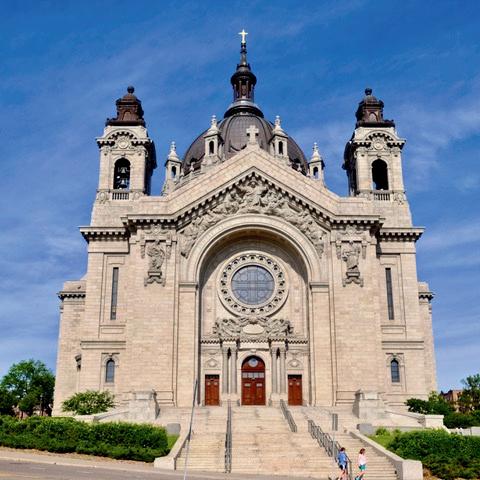
On May 13, Archbishop Bernard Hebda celebrated a Mass commemorating his 10th anniversary as archbishop on the feast of Our Lady of Fatima. Mass was held at the Cathedral of St. Paul in St. Paul where he was installed 10 years ago.
Bishop Robert Gruss, bishop of the Diocese of Saginaw, Michigan, as well as Auxiliary Bishops Kevin Kenney and Michael Izen joined the archbishop at the altar during Mass.
Two of the altar servers were seminarians in the Archdiocese of St. Paul and Minneapolis. After Mass, Archbishop Hebda joked that they were the most intelligent seminarians because “they know that I won’t forget that they were here on my 10th anniversary and they’ll probably get the best assignments in the archdiocese.”
Many gathered in the pews with enthusiasm to celebrate Archbishop Hebda. Following Mass, a long line formed down the center aisle to greet and congratulate the archbishop.
“Just seeing you in this congregation reminds me of how deeply I’ve been blessed in the course of these 10 years,” Archbishop Hebda said during his homily. “I can tell you that as I sat in the Cathedral today, it brought back all kinds of memories of when the nuncio brought me here 10 years ago and seated me on this cathedra (a special chair in the cathedral church of each diocese) for the first time.”
Archbishop Hebda said he recognized certain responsibilities come with sitting on that cathedra at the Cathedral. But “I never would have imagined the joys that I would have experienced over the course of these past 10 years,” he said.
When he first arrived in the Twin Cities, Archbishop Hebda said he learned that people love to quote his predecessor, the late Archbishop Harry Flynn, “who was a great source of wisdom.”
“One of the things that he would say is, ‘If God gave me 1,000 more lives, I’d want to live all of them as a priest,’” Archbishop Hebda said, quoting Archbishop Flynn. “And then what was implied was, ‘I wouldn’t want to live any of them as a bishop.’ I don’t think that that’s true. I can tell you that it’s been a great pleasure to be able to serve here as your bishop.”
Remembering the past 10 years, Archbishop Hebda said the archdiocese faced substantial challenges, and that when looking to the next 10 years, there will be challenges ahead.
“But it’s in the midst of the challenges that we’re able to see how it is that the Lord continues to work in his Church through the gift of the Holy Spirit that we heard about in the Gospel today, that advocate, that one who teaches us everything that we need to know, who speaks for us (and) gives us the words that we need,” Archbishop Hebda said.
A great hope can be found in Our Lady of Fatima, Archbishop Hebda said. “The very feast that we celebrate today can give all of us hope in our lowliness,” he said.
Following Mass, John Lamey, parishioner of the Cathedral, went up to the archbishop to thank him. Lamey, who attended Archbishop Hebda’s installation 10 years ago, said he’s been a friend to the archbishop ever since.
“He’s a great man, very religious, holy, and we’re lucky to have him,” Lamey said. Hamh To, a parishioner of the
Cathedral, said she believes Archbishop Hebda is helping people come back to the Church.
“He does so much with helping the Cathedral, and the Twin Cities, know the Holy Spirit more,” To said. “I think we were lacking that because of the history of not trusting the Holy Spirit as much. But Archbishop Hebda, he has brought so much, and especially Fire on the Hill (adoration events focusing on healing prayer at the Cathedral the third Saturday of every month). He helped bring Fire on the Hill here, and that has helped people heal.”
To wrote a letter to Archbishop Hebda
thanking him for bringing so much to the archdiocese.
“He’s so humble,” she said.
Kenny Nadeau, a leader of the young adult program at the Cathedral, moved to the Twin Cities from a town outside St. Cloud a year and a half ago. Though he is new, he said he appreciates just how publicfacing Archbishop Hebda is.
“I appreciate that from him,” Nadeau said. “I think that’s important to have that public face and be present.”
Archbishop Hebda joked after Mass that he was mortified to see his face on the Mass programs that night. He wanted a simple
parish Mass to give thanks to God for the blessings of the past 10 years, “and to ask that the Lord would continue to bless me, fill me with that Holy Spirit that we heard about in the Gospel today, so that I might know how it is that I can lead this flock over whatever time the Lord gives me here in this archdiocese.”
“I recognize that I have so much to learn from you. How important it is that we would be listeners together of the Holy Spirit,” Archbishop Hebda said. “I recognize over the course of those 10 years, how we’ve been blessed, not only with those prayer and listening sessions, but also with our two (Archdiocesan) Synods, recognizing how it is that the Holy Spirit continues to speak to us through you, through your good efforts, through your generosity, and indeed, through our willingness to walk together, even through some mighty challenges.”
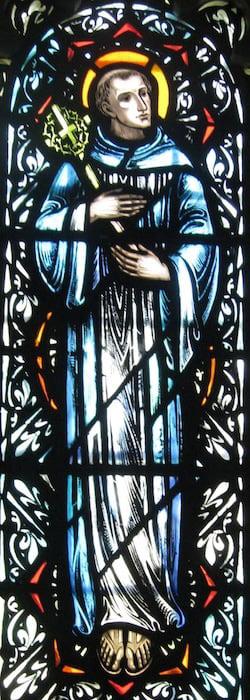
After Mass, Father Joseph Johnson, the rector of the Cathedral, offered Archbishop Hebda a gift in gratitude. It was a bronze copy of the image of St. Bernard of Clairvaux housed at the Cathedral.
“Despite the archbishop’s humility, we all know he’s such a great preacher. His patron saint, St. Bernard of Clairvaux, was a great preacher and doctor of the Church,” Father Johnson said.
“I had to pinch myself, just being in this beautiful Cathedral, that in some way this is where the Holy Father assigned me to be able to pray in this beautiful space with such a great congregation, with such a wonderful flock here in the archdiocese,” Archbishop Hebda said after Mass.
Archbishop Hebda concluded his homily by saying, “We certainly give thanks to God this day for the opportunities that he continues to give to us. Let’s ask that we might be inspired by Our Lady of Fatima and by those three shepherd children that we might be able to give witness to God’s glory, to his goodness and to the message that indeed he desires to share with us in 2026.”
DANIEL FLANAGAN | OFFICE OF COMMUNICATIONS
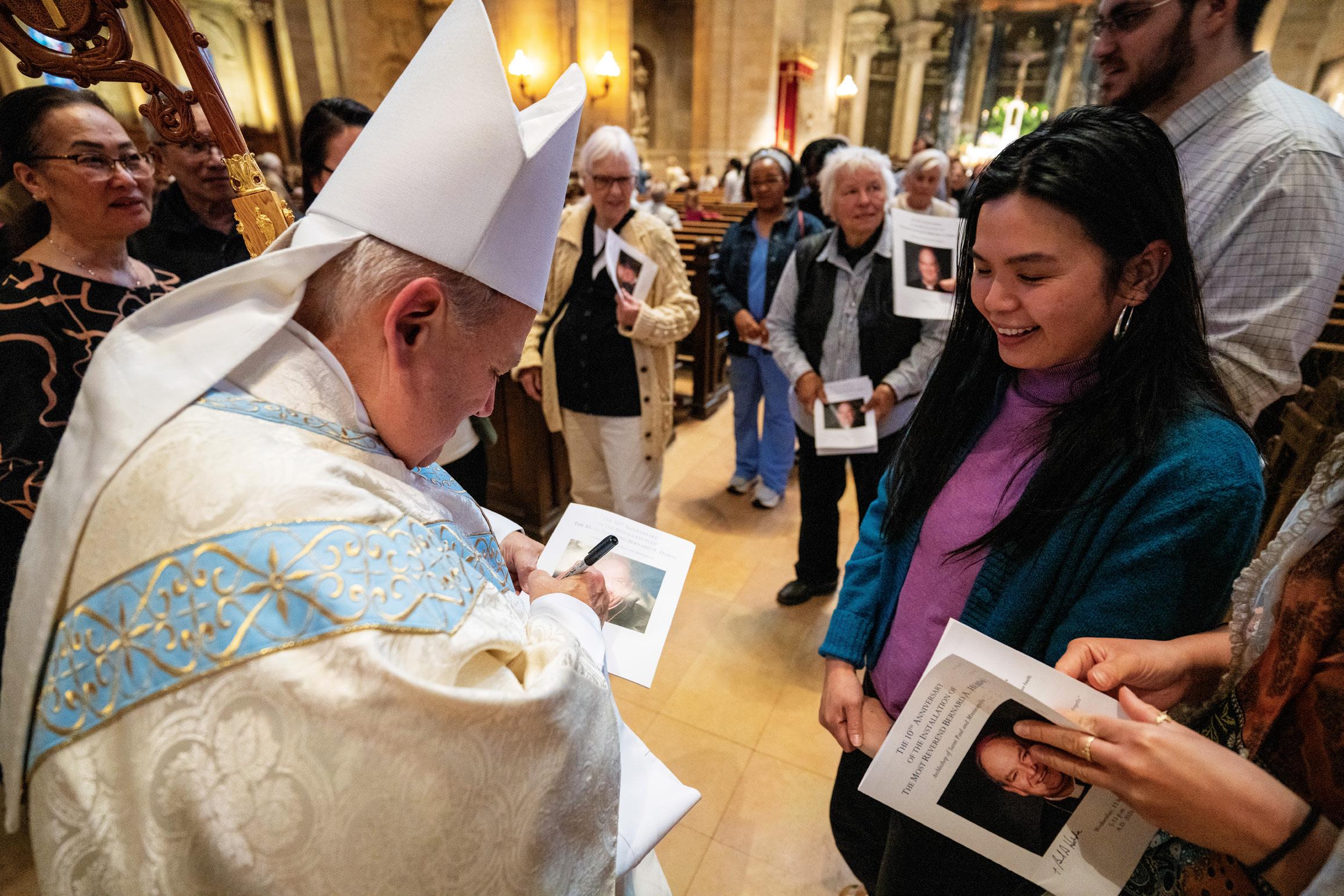
Archbishop Hebda signs an autograph for Cathedral parishioner, Hamh To, following his 10th anniversary Mass at the Cathedral.
DANIEL FLANAGAN | OFFICE OF COMMUNICATIONS
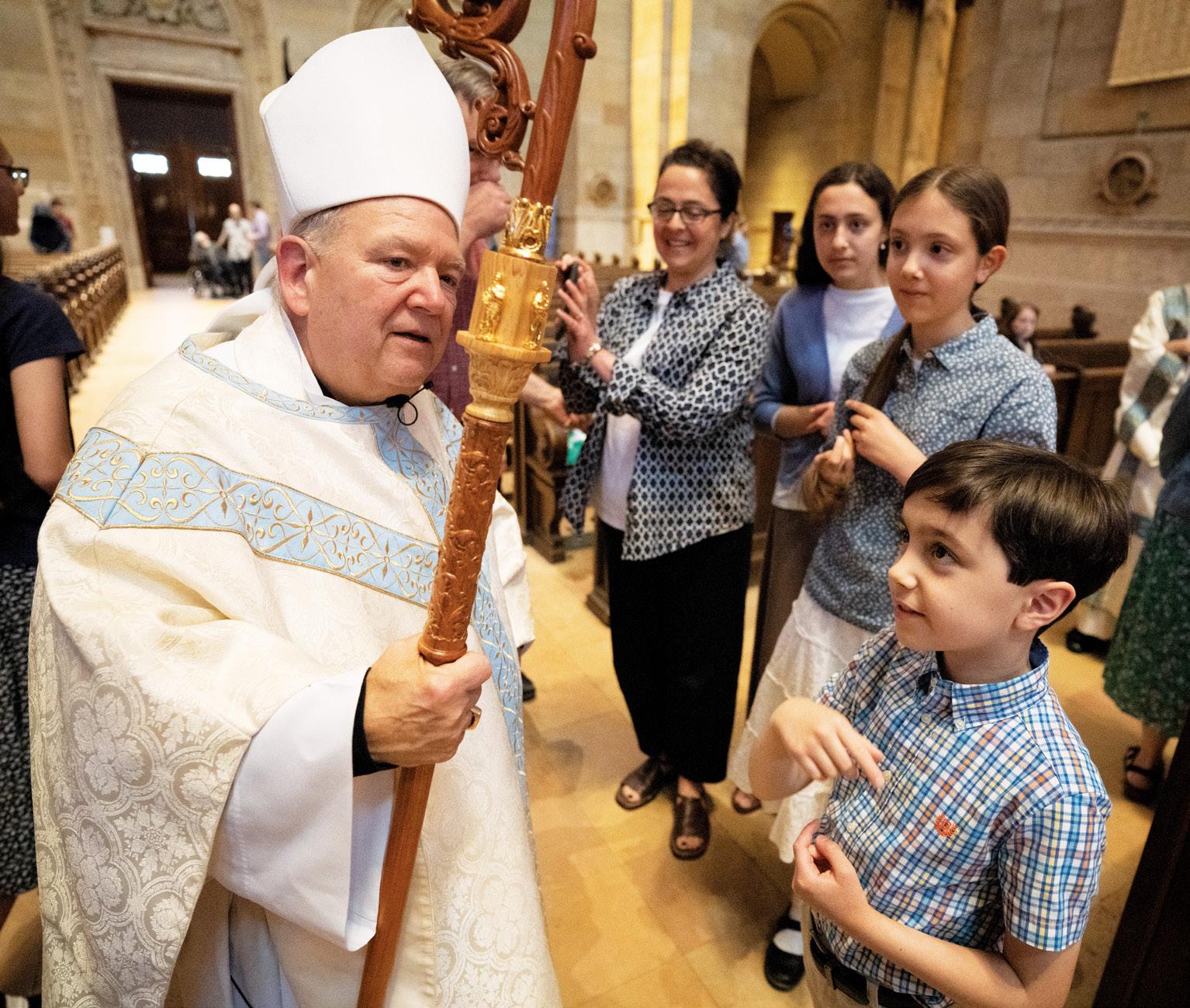
Archbishop Hebda discusses his crosier with John Braaten as John’s mother, Carmen, listens, along with two of his sisters, Cecilia and Julianna.
Archbishop Hebda’s new pastoral letter encourages families to ‘take heart’
By Rebecca Omastiak
The Catholic Spirit
Ten years ago, Archbishop Bernard Hebda was reflecting on how he hoped to encourage vocations in the Archdiocese of St. Paul and Minneapolis.
“First is to sustain family life,” he told The Catholic Spirit in an interview published in a May 26, 2016, special issue celebrating his installation as archbishop on May 13. “To the extent that we’re able to help our families or to help our married couples to see the life that they’re living is being a life of vocation, to the extent that we’re able to get them to be praying that their children might be able to respond however God might be calling them to serve, I think that’s going to have a positive impact on vocations.”
Ten years after his installation on the feast of Our Lady of Fátima, the archbishop released his newest pastoral letter, titled “Only One Thing Is Necessary,” to families.
That the archbishop spoke about sustaining families at the time of his installation to the present release of his latest pastoral letter shows “that’s Archbishop’s heart,” said Corey Manning, executive director of the archdiocesan Office of Discipleship and Evangelization (ODE).
“He truly wants marriages and families to be filled with joy, and that divine life, and that love,” said Manning, a member of St. Michael in Stillwater. The archbishop’s “desire hasn’t changed in 10 years, to accompany and to walk with” faithful families.
Jessica Trygstad — associate director of Catholic education communications for the archdiocesan Office for the Mission of Catholic Education (OMCE) — agreed.
“Here we are, 10 years later after planting some of those seeds, and he’s able to share this great gift of insights, and accompaniment, and grace, and love for the Lord with every family in the archdiocese, no matter where they are on their journey,” said Trygstad, a member of St. Charles Borromeo in St. Anthony.
The letter’s title draws from the Gospel of Luke, in which Jesus tells Martha that amid her anxiety, “There is need of only one thing” (Lk 10:42) — “Jesus Himself is that one true thing,” the archbishop wrote.
In a May 4 “Together on the Journey” video about the letter, Archbishop Hebda said that “Our Lord is the way through which Catholic families can be united in this life and the next,” underlining the letter’s subtitle (“How Catholic Families Can Strive to be United in This Life and the Next”).
Throughout the letter, the archbishop looks to the example of Sts. Zélie and Louis Martin — parents of St. Thérèse of Lisieux, a doctor of the Church — to guide families.
“I have been constant in my prayers
that they would intercede for the families of this Archdiocese,” Archbishop Hebda wrote in the letter’s preface.
Drawing from his own familial experience, the archbishop wrote that “my siblings and I often speak of our indebtedness to our parents for their witness to the faith and their willingness to sacrifice for their family. We will always be grateful for the way they introduced us to God’s love and made sure that we found a home in our Church.”
Archbishop Hebda wrote that he has seen many parents express this same zeal during prayer and listening sessions that led to the 2022 Archdiocesan Synod. “I heard time and again of the love and concern that reside in the hearts of so many parents in this local Church, who want nothing more than to lead their families to Jesus,” he wrote.
A high number of votes during the 2022 Archdiocesan Synod indicated interest in a proposition of “parents as the first teachers of their children in the ways of the faith.”
Next steps included the formation of a Blue Ribbon Commission — comprised of clergy, religious, educators, parents and grandparents — to help advise the archbishop on ways to support parents.
“Children aren’t formed in the abstract,”
said Alison Dahlman, associate director of educational quality and excellence for OMCE, who was an OMCE liaison for the commission. “And as important as the secondary and tertiary institutions are in the life of a human, without the primary institution of the family, their formation will not be as full.”
“Yes, a school, a faith formation program can augment something and reinforce something, but those institutions separate or divorced from a family will only go so deep,” suggested Dahlman, a member of St. Peter in North St. Paul.
Responding to the Archdiocesan Synod and the archbishop’s 2022 pastoral letter “You Will Be My Witnesses,” one of the commission’s recommendations was what ultimately became the “Only One Thing Is Necessary” pastoral letter. The archbishop wrote that the newest letter is “an expression of encouragement to parents and to all those who support them pastorally.”
Challenges both perennial and particular
Archbishop Hebda acknowledged what families have expressed to him as “what can seem to be an uphill battle,”
living amid “a general societal decline in religious practice and church affiliation.”
According to the 2023-24 Religious Landscape Study (RLS) released in 2025 by the Pew Research Center, Christians — who represent the largest share of religiously affiliated adults in the United States — “have been declining as a percentage of the U.S. adult population, while the share that is religiously unaffiliated has been rising.” The Catholic share of the U.S. adult population, meanwhile, had also ticked down in recent years, according to Pew researchers — from 24% in 2007, to 20% in 2014, to 19% in the 2023-24 RLS. These declines however, Pew researchers reported, had appeared to be leveling off with the most recent 2023-24 RLS data.
Alongside changes in religious affiliation and practice, the archbishop noted challenges that modern couples face, including that “(t)here is a significant decrease in the number of couples seeking the Sacrament of Matrimony or even choosing to marry civilly.” According to U.S. Census Bureau data published in 2025, 47% of U.S. households in 2025 were married couples, what the bureau called “a
DAVE HRBACEK | THE CATHOLIC SPIRIT
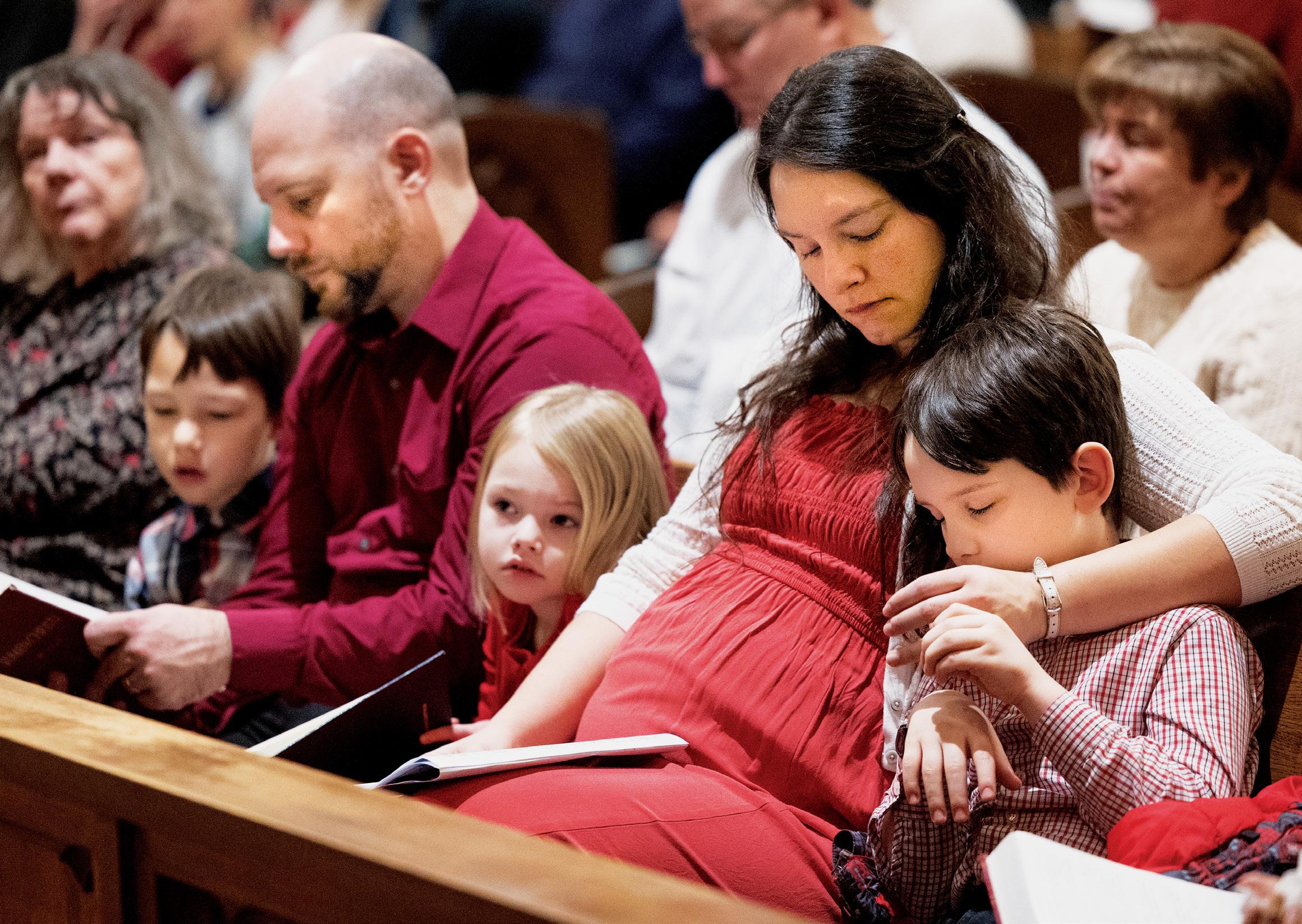
From left, Ambrose, Matthew, Avila, Victoria and Solomon Molko sit together for Mass at Holy Family in St. Louis Park on Dec. 28, 2025, during a celebration of the 100th anniversary of the parish.
PASTORAL LETTER CONTINUED FROM PREVIOUS PAGE
significant shift” from 50 years ago, when 66% were in 1975.
In his letter, the archbishop included the late Pope Francis’ words, that “today’s frenetic pace, fears about the future, the lack of job security and adequate social policies, and social models whose agenda is dictated by the quest for profit rather than concern for relationships” could be viewed as factors contributing to declining birthrates. Census data indicated that the share of U.S. married-couple households with their own children under the age of 18 had declined from 54% in 1975 to 37% in 2025.
The archbishop also acknowledged that many families face modern concerns. In 2023, the U.S. Surgeon General Dr. Vivek Murthy connected an “epidemic of loneliness and isolation” to diminished social connection during the COVID-19 pandemic as well as a general shrinking of social networks and declining social participation; decades-long declines in family size and marriage rates; declining trends in community involvement, “including with religious groups, clubs and labor unions”; and burgeoning technologies — including “social media, smartphones, virtual reality, remote work, artificial intelligence, and assistive technologies” — that “have quickly and dramatically changed how we live, work, communicate and socialize.”
In his letter, Archbishop Hebda acknowledged both the “perennial challenges” and “challenges particular to our time” that modern Catholics experience, advocating for spending time
“What would our families and our society look like if we spent but a fraction of what we spend on screens looking at the faces of our family members?” he wrote.
‘Take heart’
Archbishop Hebda encouraged families to “take heart,” including the words of St. John Paul II in his letter: “The future of humanity passes by way of the family.”
The archbishop suggested families must embrace the “narrow way” that Jesus identifies in Matthew 7:13-14. “To be certain, perseverance on the narrow path requires the grace that flows from our rooted friendship with Jesus Christ. Only within the context of that essential relationship can our other relationships be directed toward our highest calling: eternal life with God.
“You, dear families, are made for eternal life,” he wrote.
It’s the importance of living in relationship, including in marriage and family life, Manning suggested. “As that crumbles in our society, we can see, then, the fruits of that crumbling,” he said. “And as the pockets where we see the fruit of it being restored and strengthened, that’s where we can see that living, that the joy is complete, that we can become who we are.”
Manning, Trygstad and Dahlman view the newest pastoral letter as meeting families exactly where they are.
“You don’t need to be an expert theologian. You don’t need to know all the answers,” Manning said. “What you need to do is just model the pursuit, through the tough times and through the good times.”
For example, parents can ask, “when we’re struggling and we have a crisis in
ARCHBISHOP BERNARD HEBDA
Congratulations from the Clergy, Religious, and Lay Faithful of the
DIOCESE OF CROOKSTON
“The
- The Most
said. “Do we model forgiveness in the home” and are children shown “where we’re forgiven from our Lord?”
“We model the joy of going to Mass, even when it’s tough and I have screaming kids on my shoulder … because he (God) gives us everything,” Manning said.
Trygstad said she is encouraged that the newest pastoral letter “does not put on a pedestal any type of model Catholic family” and that Archbishop Hebda “knows that it will look different for every family, and it should.”
Dahlman said she hopes readers of the letter find this encouraging. “Take heart, parents. You can do this. … (C)laim this role, and God will equip you. And it won’t be perfect, and it will be messy, and you won’t get it all right. And that’s OK.”
The archbishop urged the faithful to follow Pope Leo XIV’s recommendation to look to Sts. Zélie and Louis Martin, Blesseds Luigi and Maria Beltrame Quattrocchi and Blesseds Józef and Wiktoria Ulma as guides along the way.
“Even in Minnesota, we can journey together with those holy families and in that way, we are never alone,” Archbishop Hebda wrote.
Accompanying families
In the video about “Only One Thing Is Necessary,” Archbishop Hebda said that “each of us, regardless of our state of life, is called to accompany families.”
“How do we know that families are so important? Our Lord chose the family as the way that he entered into our human experience,” he said.
Therefore, alongside the release of the newest pastoral letter are tools for all the faithful to participate in the effort “to strengthen the culture of family life in the Church and local communities.” Manning
With gratitude for 10 years of faithful, humble, and dedicated service. Congratulations!
Most Reverend Archbishop Bernard Hebda
and Dahlman said there was a strong collaboration between ODE and OMCE on these tools.
“(W)e want the same things for this local Church and for our own families,” Dahlman said. “It was a great partnership.”
One tool developed by ODE and OMCE is a series of pastoral letter implementation steps.
The steps provide recommendations to parents and families; clergy; parish staff; parish small groups; Catholic school staff; seminarians; consecrated women and men; and members of Catholic ministries and apostolates; among others in the archdiocese, as they read and reflect on the letter.
“The implementation plan, which is a small part of the letter, is so beautiful, because … everyone in the diocese is named in some way,” Dahlman said. “Everyone has a responsibility to this ‘One Thing Is Necessary.’”
“It’s one call; it’s one call to become who you are,” Manning agreed. “And there’s different avenues of how we do that.”
Dahlman highlighted one avenue of reading, and reflecting on, the newest pastoral letter in parish small groups.
“If every small group uses this for their content for the year, what a unifying power that is,” she said. “Small groups are clearly one of the archbishop’s key vehicles for the renewal that we hope the Holy Spirit can bring in our local Church.”
The archbishop concluded his video about his newest pastoral letter encouraging the faithful to read the letter and to pray with it.
“It is your prayers, reflections, actions and examples that will truly bear fruit in our Church and in our world.”
Read the full pastoral letter online at archspm.org/familyletter
The Catholic Cemeteries
Congratulates
ARCHBISHOP HEBDA
on 10 years of presiding at services, masses, and burials
faithful of the Diocese of Crookston give thanks to God for ten years of Archbishop Hebda’s shepherding of the Archdiocese of Saint Paul and Minneapolis. May Our Lady lend her heart, that he may continue to allow the light of the Lord to shine through him.”
Rev. Andrew H. Cozzens Bishop of Crookston
NATION+WORLD
HEADLINES
Pope Leo XIV to publish an encyclical on artificial intelligence May 25. Pope Leo XIV’s first encyclical “Magnifica Humanitas” will be published May 25, addressing artificial intelligence and the protection of human dignity, the Vatican has announced. The encyclical, the title of which is Latin for “Magnificent Humanity,” was signed by the pope on May 15, the 135th anniversary of “Rerum Novarum,” Pope Leo XIII’s foundational 1891 social encyclical on labor and capital written during the first Industrial Revolution. In an unprecedented first, Pope Leo XIV will be present in person at the Vatican press conference to mark the publication of the social encyclical, along with a tech founder from one of the world’s fastest growing AI companies. Christopher Olah, co-founder of the artificial intelligence company Anthropic, which developed the AI large language model (LLM) named Claude, will be among those speaking on a panel presenting the document at the Vatican on May 25. Pope Leo XIV has expressed interest in the issue of artificial intelligence and the dignity of work since the first week of his pontificate, telling the College of Cardinals two days after his election in May 2025 that he took his papal name partly in honor of Pope Leo XIII. “In our own day, the Church offers to everyone the treasury of her social teaching in response to another industrial revolution and to developments in the field of artificial intelligence that pose new challenges for the defense of human dignity, justice and labor,” Pope Leo XIV said.
Pope approves creation of commission on AI. Pope Leo XIV has approved the creation of an Interdicasterial Commission on Artificial Intelligence, according to a rescript dated May 12 and released by the Vatican on May 16. The document was signed by Cardinal Michael Czerny, prefect of the Dicastery for Promoting Integral Human Development. The pope approved the new body in response to the rapid growth of artificial intelligence and concerns about its impact on humanity. The rescript said he considered “the development in recent decades of the phenomenon of Artificial Intelligence and the most recent accelerations in its widespread use” along with “the Church’s concern for the dignity of every human person.” The commission will include representatives from seven Vatican institutions, including the Dicastery for the Doctrine of the Faith, the Dicastery for Culture and Education and the Pontifical Academy for Life.
San Diego mosque shooting is an “attack on the sacred dignity of all human life,” says a bishop. Bishop Michael Pham of San Diego said the faithful there “stand united in solidarity and prayer with the Muslim community” after a deadly May 18 shooting at a mosque complex in that city killed three adults, including a security guard. The two teen suspects were later found dead of apparent self-inflicted gunshot wounds. A nearby landscaper was reported to have been shot at during the attack, but, according to police, was expected “to be OK.” No children from the mosque’s school and no officers were injured, according to San Diego police. Law enforcement is now investigating the shooting as a hate crime. “Houses of worship must always be sanctuaries of peace, safety, and prayer. An attack on one faith community is an attack on the sacred dignity of all human life,” said Bishop Pham in his May 18 statement. Speaking “on behalf of the entire Roman Catholic community of San Diego,” Bishop Pham offered “my deepest condolences, solidarity, and fervent prayers to the families of the victims and the entire Muslim community.”
Study: Mass deportation has a “chilling” effect on the labor market for immigrant and U.S.-citizen workers. A mass deportation effort carried out by President Donald Trump’s administration could have a significant chilling effect on the economy and the labor market, including for U.S.-born workers, according to a new estimate. In the working paper, “Labor Market Impacts of ICE Activity in Trump 2.0,” released in early May, co-authors Chloe East, an associate professor of economics at the University of Colorado Boulder, and Elizabeth Cox, a research assistant with CU’s Institute for Behavioral Science, compared U.S. regions that experienced “a large and sudden increase” in monthly ICE arrests between January 2025 and October 2025 with regions that did not, and found a “meaningful chilling effect” on the labor markets in the areas that had the surges. East and Cox found that, on average, in a region that had experienced an ICE surge, 4% fewer “likely undocumented” immigrants remaining in the community reported working in the previous week.
J. Kevin Appleby, senior fellow for policy at the Center for Migration Studies of New York, told OSV News, that the CU Boulder research shows, “While it may seem counterintuitive to some, undocumented immigrants working in certain industries stimulate growth in the economy, thus generating jobs in related occupations.”
With Jesus’ command “Follow me” as its theme, Canada’s National March for Life draws thousands. Thousands of pro-life supporters filled the streets of Ottawa on May 14 for Canada’s annual National March for Life, with crowds taking nearly 25 minutes to move from Parliament Hill into the downtown core. Marchers of all ages and backgrounds including families, clergy, religious sisters and parish
groups carried signs calling for an end to abortion and euthanasia in Canada. The day opened with liturgies at Notre-Dame Cathedral Basilica, St. Patrick’s Basilica and St. Clement Church. This year’s march coincided with the anniversary of Canada’s 1969 Omnibus Bill, which decriminalized abortion. The event’s theme, “Follow me,” centered on human dignity and solidarity. March for Life organizer Debbie Duval told the crowd, “We march on a Thursday, in Ottawa, because that’s when our legislators are sitting in the House of Commons. We want them to hear us. We want them to know we’re here.” Speaker Aleš Primc urged participants to greet everyone from unborn children to the elderly with a simple “hello,” calling it “the start of recognizing our shared humanity.” Primc is co-founder of the Slovenian political party Voice for Children and Families that recently forced a referendum to overturn the country’s assisted suicide law.
Benedictine College denounces antisemitic flyers after a CatholicJewish relations conference. A Catholic college in Kansas is deploring a campus-based antisemitic campaign, after hosting a recent conference exploring Church teaching on Catholic-Jewish relations. In a May 14 statement, Benedictine College disclosed that in late April its campus had been “repeatedly leafletted with anonymous flyers from a group calling itself ‘Coalition of Catholics Against Jewish Supremacy.’” The flyer slammed the college’s hosting the 2026 “Nostra Aetate Beyond 60” conference in April, with the theme “Shoulder to Shoulder: Strengthening Jewish-Catholic Friendship at a Moment of Crisis.” Organized by the nonprofit Coalition of Catholics Against Antisemitism, the conference has previously been held at Franciscan University of Steubenville among other locations. Benedictine College, along with its Latin Mass Society, theology professor Matthew Ramage and the conference organizer, the nonprofit Coalition of Catholics Against Antisemitism, all issued statements denouncing the flyer campaign, which invoked uncontextualized Scripture, papal and patristic quotes, along with a suppressed medieval sainthood cult and multiple antisemitic tropes. Ramage told OSV News, “I’m proud to work at an institution that stands up for the teachings of the authentic magisterium of the Catholic Church and for the fundamental dignity of all human beings, no matter how unpopular it may be.”
Communion and Liberation founder’s sainthood cause heads to the Vatican. The sainthood cause of Msgr. Luigi Giussani, founder of the Communion and Liberation movement, is moving to Rome. The Archdiocese of Milan formally closed the diocesan phase of his cause May 14 with vespers at the Basilica of St. Ambrose, celebrated by
HEADLINES CONTINUED ON NEXT PAGE
With grateful hearts, we congratulate Archbishop Hebda on ten years of faithful service as shepherd of our Archdiocese.
May the Lord continue to guide you, strengthen you, and shine through you always.
Archbishop Mario Delpini. The archdiocese said about 3,000 members of the movement attended, along with local officials, clergy and Linda Ghisoni of the Dicastery for Laity, the Family and Life. Msgr. Giussani, who died in 2005, founded Communion and Liberation in 1969 after seeing many young people struggle to connect faith with daily life. The movement emphasizes faith as an encounter with Christ that shapes culture, work and society. Archbishop Delpini remembered the Communion and Liberation founder as “a man of God” who “with his life and his words led people to an encounter with Christ.” The diocesan inquiry gathered Msgr. Giussani’s writings, testimony from those who knew him, and tens of thousands of pages of documentation. The files now go to the Vatican’s Dicastery for the Causes of Saints for review. If his cause advances, the next step would be the recognition of his heroic virtues by the pope.
New data shows Americans oppose houses of worship endorsing political candidates. Most Americans oppose houses of worship endorsing political candidates, a May 14 report from the Pew Research Center said. The vast majority of Americans 79% said churches and other houses of worship should not support specific candidates in elections, the report from the nonpartisan Pew Research Center said. The report also found 66% said houses of worship should keep out of political matters rather than expressing views on day-to-day social and political questions, while 33% said they should express views on these questions. The Pew report said views on these questions have not changed very much in recent years. Large majorities of both Republicans and Democrats, as well as majorities of every major religious group surveyed, including Catholics, said the same. The Trump administration has sought to overturn a federal policy that prevents churches and other houses of worship from endorsing political candidates without losing their tax-exempt status. A federal judge recently dismissed a lawsuit that took aim at the policy. The U.S. Conference of Catholic Bishops has previously indicated the Catholic Church would maintain its policy of not endorsing or opposing political candidates regardless of possible changes to the Johnson Amendment.
The Vatican’s doctrinal office says SSPX bishop consecrations constitute a “schismatic act” subject to excommunication. Cardinal Víctor Manuel Fernández, head of the Vatican’s doctrinal office, said the traditionalist Society of St. Pius X would commit “a schismatic act” if it proceeds with plans to consecrate new bishops July 1 without papal approval. In a May 13 statement, Cardinal Fernández said the SSPX lacks the required pontifical mandate and warned that formal adherence to
schism is a grave offense that carries excommunication under Church law. He said Pope Leo XIV is praying that the Holy Spirit will guide SSPX leaders to reverse course. SSPX superior general Father Davide Pagliarani announced the planned consecrations in February, citing a “grave necessity” for souls after failed attempts to secure an audience with the pope. The Vatican offered continued dialogue if the SSPX suspended the consecrations, but Father Pagliarani rejected that condition, pointing to ongoing disputes over the Second Vatican Council and post-conciliar reforms. The dispute recalls Archbishop Marcel Lefebvre’s 1988 unauthorized bishop ordinations, which led to excommunications. A pilgrimage celebrates Pope Leo XIV with Mass and visits to papal boyhood landmarks. On the first anniversary of Pope Leo XIV’s election, a group promoting the Catholic faith in Chicago’s south suburbs led an inaugural pilgrimage to his boyhood home and the church he attended as a boy. The Pope Leo XIV American Legacy Foundation’s pilgrimage left downtown Chicago May 8 via shuttle bus and made its way to the first stop, Christ Our Savior Parish, known as “the de facto home parish” in South Holland, Illinois, of Pope Leo, who grew up as Robert Prevost. Christ Our Savior is the third iteration of the Prevost family’s home parish, St. Mary of the Assumption, located on the southernmost edge of Chicago, sandwiched between the villages of Dolton and Riverdale. Dolton, a south suburb, is where the pope lived until he was 13, when he went to the Augustinian minor seminary in Holland, Michigan. At the pope’s boyhood home, now owned by the Village of Dolton, the final stop of the pilgrimage at least until an envisioned museum exists the Midwest Augustinians blessed and hung a portrait of the pope in the living room. Before entering the house, the Midwest Augustinians’ outgoing superior, Father Anthony Pizzo, read from an email from Pope Leo, who noted his “appreciation” for the house being used to advance “social development.”
One year in, Pope Leo XIV navigates division through dialogue in his push for peace. One year after stepping onto the central balcony of St. Peter’s Basilica and greeting the world with the words, “May peace be with you all,” Pope Leo XIV has emerged as a pontiff attempting to guide a polarized Church and fractured world through dialogue, peace and increasingly forceful speech defending human dignity. His first year of the papacy has been marked with palpable tensions around the globe and persistent divisions within the Church challenges many cardinals believed he was uniquely positioned to confront when they elected him to continue Pope Francis’ broader vision. Beyond the Vatican, members of the U.S. President Donald Trump administration have frequently criticized the first American pope as “weak” on crime and dismissed his warnings about war and nuclear escalation after the pope reiterated that “God
does not bless any conflict.” Yet through it all, Pope Leo has remained remarkably consistent and steadfast in tone and message, repeatedly returning to peace, dialogue and reconciliation as hallmarks of his papacy.
A new sign on a street corner in Brooklyn, New York, honors the legacy of Dorothy Day. A street corner in the Brooklyn Heights neighborhood now honors one of American Catholicism’s most influential figures. The intersection of Pineapple and Henry streets has been renamed “Dorothy Day Way,” recognizing Dorothy Day, who was born nearby in 1897. On May 1, 1933, Day co-founded the Catholic Worker Movement, a faith-based organization that urges members to perform the corporal works of mercy and work for peace and justice. At the same time, Day also began publishing a newspaper, The Catholic Worker, which is still published today. Family, clergy and supporters gathered May 2 for the ceremony to reveal the sign. Day’s granddaughter Martha Hennessy joined Councilman Lincoln Restler, who sponsored legislation in the City Council to name the street corner, in the unveiling. Hennessy called the moment “beautiful,” reflecting her grandmother’s enduring legacy of faith and social justice. The event was organized with help from the Dorothy Day Guild, which continues to advocate for Day’s canonization. This marks the second major tribute from New York City. In 2021, a Staten Island Ferry was named in her honor, with the vessel entering service in 2023.
Catholic bishops in Africa urge an end to xenophobic attacks in South Africa. African Catholic leaders are calling for urgent action to stop rising xenophobic violence in South Africa, where attacks on foreign nationals have left several dead and others injured. In a May 5 statement, Cardinal Fridolin Ambongo Besungu, head of the Symposium of Episcopal Conferences of Africa and Madagascar, or SECAM, condemned the violence as “un-African” and a serious violation of human dignity. Since late April, armed mobs have targeted migrants in cities including Johannesburg, Durban and Cape Town, looting property and demanding foreigners leave. Church leaders stressed that such actions undermine African solidarity and the spirit of Ubuntu, or “I am because we are.” “The credibility of Africa, which aspires to become a key player on the international stage, is at stake,” Cardinal Ambongo said. The South African bishops reaffirmed that all people, regardless of legal status, have basic rights to safety, health care and education. The African Union, through its Commission on Human and People’s Rights, called on the South African government to “take decisive measures to dismantle and prevent the operation of vigilante groups engaging in unlawful enforcement activities.”
CNS and OSV News
OUR ARCHBISHOP AT 10 YEARS
‘Permission to hope’ as Archbishop Hebda points to Christ
By Joe Ruff
The Catholic Spirit
Since his arrival as parochial administrator in 2015 and installation as archbishop in 2016, Archbishop Bernard Hebda has relied on Christ through prayer in his leadership grounded in healing and accompaniment, said those who have worked closely with him.
In 2022, the archbishop led the first synod in the Archdiocese of St. Paul and Minneapolis in more than 80 years. For three years prior, he gathered information, hopes and dreams from the faithful during dozens of prayer and listening events and parish consultations in all corners of the archdiocese.
The archbishop guided that Holy Spiritdriven renewal in the wake of a clergy sexual abuse crisis that involved hundreds of victims-survivors, Chapter 11 bankruptcy reorganization, and criminal and civil charges that were resolved, those involved said.
“When Archbishop Hebda arrived here in 2015, we were living in chaos and confusion,” said Susan Mulheron, the archdiocese’s chancellor for canonical affairs, in an email. “The archdiocese was facing criminal charges, bankruptcy and incredible pain in the entire community.
“I remember feeling so at ease with Archbishop Hebda’s presence at the leadership table. I was particularly struck by his episcopal motto, ‘Only Jesus,’ which Archbishop referenced in his installation homily as he discussed his vision for the future of the archdiocese,” Mulheron said. “In a time when it seemed like so many tangible things were being lost or stripped away, and the future so uncertain, he reminded us that all we really need is Jesus.”
Accompanying the faithful
Archbishop Hebda’s desire to accompany victims-survivors and employ restorative justice initiatives to address the harm and promote healing played a key role in recovering from the abuse crisis, said Tim O’Malley, who for nine years led the archdiocese’s Office of Ministerial Standards and Safe Environment.
“He stepped forward and put himself right out front on this,” said O’Malley, now strategic adviser to the archbishop. “His willingness to meet with victims-survivors anywhere, any time and on their terms was very important. He and I worked on a number of those kinds of meetings. He never declined a meeting, never dodged a tough question and always offered both prayers and then asked for prayers. He instilled hope in a lot of people when some of them questioned whether there was really any reason for hope.”
Victims-survivors of clergy abuse “needed to know that they were understood, that they were heard, that he cared and that the Church cared,” O’Malley said. “And he at least gave many an opportunity to lean into their faith when they would have questioned whether that was worth the effort.”
Father Joseph Bambenek, who was assistant director of the Archdiocesan Synod process that led to the Archdiocesan Synod Assembly in 2022, said the 29 prayer and listening events and other synod initiatives helped people in the archdiocese through the crisis — and begin to heal and grow toward a renewed sense of pastoral purpose. That Synod Assembly led to Archbishop Hebda’s first pastoral letter, “You Will Be My Witnesses: Gathered and Sent From the Upper Room.”
15, 2019, at the University of St. Thomas in St. Paul.
CALLED BY NAME
Yen Fasano, a member of All Saints in Lakeville and executive director of Bethany Center for Prayer and Renewal in Scandia, said she was director of evangelization at the VietnameseAmerican parish St. Anne-St. Joseph Hien in Minneapolis when Archbishop Bernard Hebda invited her to the “Convocation of Catholic Leaders: The Joy of the Gospel in America,” held in Orlando, Florida, July 1-4, 2017.
Fasano attended the conference, and in 2018 was part of a prayer team in the Archdiocese of St. Paul and Minneapolis that helped discern whether the time was right for an Archdiocesan Synod. She also served on the Synod Executive Committee that helped organize the 2022 Archdiocesan Synod.
Reflecting on how her experience might provide an example of Archbishop Hebda’s leadership, Fasano recalled not knowing the archbishop well at the time and receiving a formal invitation to the 2017 convocation that was addressed “Dear Mrs. Fasano.”
“In his own handwriting he crossed out the word ‘Fasano’ and wrote, ‘Yen.’ I contemplated that for days and prayed about it. ... What was so special was the way he called me by name. It was so fatherly. ... So, the response was a mix of gratitude and weight, that there’s this deep awareness in me that this is so much bigger than a strategy or just simply an invitation or an experience.
“It was the first invitation to create space for the Holy Spirit to move through connection, listening, prayer and encounter,” Fasano said, “which was such a beautiful lead into when he first decided we’re going to go ahead and move forward with a Synod.”
Building trust
“It was a healing process and a trustbuilding process for the archbishop to come and listen,” said Father Bambenek, who now is associate director of the archdiocese’s Office for the Renewal of Structures. “People were at very different points — and they’re still at different points — in the healing from that,” he said. “It is something that will be part of our history and a part of our shared experience for many decades. But I think it was a beautiful way for people to start to regain trust in the archdiocese.”
The synod process was a creative approach inspired by the archbishop that has borne great fruit, said Bishop Andrew Cozzens of Crookston, who was auxiliary bishop at that time and led the Synod Executive Committee.
One fruit of the effort was seeing the Holy Spirit active in the process, helping give direction and guidance to the work of the archdiocese, Bishop Cozzens said. “The second thing, though, is engagement,” he said. “A lot of people got very engaged and wanted to participate in the future of the archdiocese.”
Yet another fruit was the beginning of small groups in parishes based on relational evangelization, the bishop said. “It’s been beautiful from a distance to watch that happening across the archdiocese.”
Initiatives and renewed collaboration came out of the first Archdiocesan Synod, but some of the deepest fruits have been seemingly invisible, Fasano said.
“Healed conversations, people returning to prayer, leaders learning how to listen differently, and individuals and parishioners, and even young adults and children, realizing that their voices matter in the life of the Church” are some examples of the spiritual life the process has fostered, Fasano said.
“I think what really excites me was this renewed sense that the Church is alive, that the Holy Spirit is alive, like here, in our archdiocese,” she said. “And that people genuinely desire holiness, communion and mission. And so ultimately, the Synod gave people permission to hope again.”
Responding to people’s needs
Anne Cullen Miller, president emeritus of St. Paul-based Catholic Community Foundation of Minnesota (CCF), has worked closely with Archbishop Hebda on meeting critical needs in the archdiocese, including the Annunciation Hope and Healing Fund established after the fatal Aug. 27, 2025, shooting during an allschool Mass at Annunciation Catholic Church, and a fund for assistance to individuals and families, parishes and schools during the COVID-19 pandemic.
Cullen Miller said she was particularly impressed by the humility expressed in prayer cards at the archbishop’s installation Mass citing his favorite prayer: “Dear Jesus, help me to spread thy fragrance everywhere I go. Flood my soul with thy spirit and love. Penetrate and possess my whole being so utterly that all my life may only be a radiance of thine. Shine through me and be so in me that every soul I come in contact with may feel thy presence in my soul. Let them look up and see no longer me but only Jesus.”
Joe Ruff
Father Bambenek said the synod process — which includes Archdiocesan Synod Assembly 2025 and Archbishop Hebda’s pastoral letter to families released May 13, “Only One Thing Is Necessary: How Catholic Families Can Strive to be United in This Life and the Next” — also has been exposing more people to prayer.
“I can see more of that happening, a deeper level of prayer and discernment about things,” Father Bambenek said. “You know, it developed new friendships. There’s even the example of the couple that met at the Synod 2022 and got married.”
“I think it helped bring people together,”
Father Bambenek said, including those who otherwise would not have spoken to one another at all.
Yen Fasano, now the executive director of Bethany Center for Prayer and Renewal in Scandia, said she was part of the prayer team the archbishop formed in 2018 to help discern whether the time was right for an Archdiocesan Synod. She also served on the Synod Executive Committee for the 2022 Archdiocesan Synod.
“Being surrounded by other leaders in this beautiful hidden backbone in the life of this archdiocese, to really pray for the intentions in (discerning) the timing (of a synod) was a huge, huge blessing,” Fasano said. “I felt like I got to be there throughout the entire process, from the very beginning.”
“Archbishop’s leadership style reflects these sentiments,” Cullen Miller said in an email. “In good times and in challenging times, Archbishop, as our shepherd, spreads the fragrance of Jesus everywhere he goes. He brings humility to his ministry and relationships, possessing energy and relatability. I have known him to be an incredibly collaborative leader, always willing to support, engage and connect with others to accomplish any objectives/ priorities. More so, this has played out in meaningful, healing ways as we have more recently, together, faced crises like COVID (and) the Annunciation shooting.”
Cullen Miller noted the strength of the archbishop’s ministry with multicultural communities, including recently reestablishing the Archdiocesan Commission of Black Catholic Ministry, with its priorities for evangelization, social justice and cultivating leadership.
The archbishop has brought the archdiocese from survival to missionary mode, Cullen Miller said. Signs of spiritual vitality include Catholic ministries and organizations coming to a “common table” mindset, breaking down silos and working together to the greater good, such as Catholic financial groups like CCF and Inver Grove Heights-based Emmaus Partners, and social ministries like Catholic Charities Twin Cities and Twin Cities Prison Ministry, she said.
O’Malley offered a succinct statement from his perspective about Archbishop Hebda’s leadership: “He’s one of the most genuine, unselfish, smart and compassionate leaders I’ve ever met.”
DAVE HRBACEK | THE CATHOLIC SPIRT
Archbishop Bernard Hebda greets University of St. Thomas students Milah Kouroma, center, and Tiaryn Daniels, left, before a Pre-Synod Prayer and Listening Event on Oct.
OUR ARCHBISHOP AT 10 YEARS
Archbishop Hebda ‘witnessing the fruit’ of capital campaign’s early success
By Rebecca Omastiak The Catholic Spirit
Father Ralph Talbot sees the work of renewal including both the intangible and the tangible.
Intangibly, the pastor of St. Hubert in Chanhassen said that the local and global Church are challenged in that “a lot of people have not heard the Gospel, or maybe (have) not heard it in its fullness.”
Tangibly, Father Talbot said, “it takes finances, it takes money to renew the Church, the parishes, so that our buildings, our facilities are in good shape, that people are safe when they come to school or to the Mass, that we have the basic infrastructure in place to do outreach and to minister to our people, and to help the poor and needy, as a demonstration of the Gospel.”
The Lord, Renew Your Church (LRYC) capital campaign works to address both intangible and tangible needs and reminds the faithful in the Archdiocese of St. Paul and Minneapolis “that we are one local Church and that together we can do a lot of great things at the same time that we’re strengthening our own particular parishes,” Father Talbot said.
LRYC is seeking to raise $250 million over five years, to support the work of the local Church in various ways. LRYC is prioritizing five core support areas: strengthening parishes, educating youth for discipleship, preserving and sustaining the Cathedral of St. Paul in St. Paul and the Basilica of St. Mary in Minneapolis, providing for clergy, and embracing the corporal works of mercy.
As Jean Houghton stepped into her role as director of the archdiocese’s Office of Mission Advancement, which oversees LRYC, she knew that “renewal is really what it’s all about.”
During the past three years in her role, Houghton said she has witnessed “a renewed energy, excitement and joy,” which she sees as a fruit of Archbishop Bernard Hebda’s leadership. “It’s a joy to watch it happen.”
“I think we’re at a moment in time right now where we are truly experiencing that renewal in person,” said Houghton, who is a member of the Cathedral of St. Paul in St. Paul and Assumption of the Blessed Virgin Mary in East Farmington, Wisconsin. “And it’s happening not just through giving — which, of course, is something very important — but it’s happening in Mass counts, it’s happening in Catholic school enrollment, it’s happening in the number of children that are baptized, women and men that are getting married in the Church.”
“We are seeing that trickle-down effect, and it started at the top with our leader,” Houghton said.
Father Talbot — who has worked with Archbishop Hebda in his roles with the archdiocese’s Comprehensive Assignment Board, the Presbyteral Council, and most recently as chair of the Priest Advisory Committee for over two years — has noticed the archbishop’s desire to listen and to collaborate.
“He is a very good listener,” Father Talbot said. “He very much recognizes his need to consult with other people before making a decision. And he values that consultation and those communications, or those conversations, with people.”
Father Talbot said the Priest Advisory Committee advises archdiocesan priests on the work of LRYC and makes recommendations to Archbishop Hebda regarding campaign matters.
“He very much wants to hear from us on some of these appeals before he makes his decision,” Father Talbot said of the archbishop. “He likes to know what the conversation was with the members of the committee, he wants to know if we’re divided or if we’re unanimous in these recommendations.”
To ‘genuinely renew the Church’
Prior to LRYC, it had been over 20 years since the archdiocese’s last “large-scale, all-inclusive, or collaborative campaign for the whole diocese,” Houghton said.
Both Houghton and Father Talbot indicated the archbishop’s prayer, listening and discernment accompanied the decision to launch LRYC in the archdiocese — “he consulted widely amongst the laity and among his priests,” Father Talbot said.
“(T)hrough his consultation and through his own prayer, and especially through the work of the (Archdiocesan) Synod, he just recognized that this was a good time for us to come
together as an archdiocese to run this campaign, to both unify the archdiocese and to strengthen the parishes,” Father Talbot said.
LRYC priorities, Houghton said, were determined through a feasibility study that included interviews with over 7,000 Catholics across the archdiocese. The five core support areas “were chosen by the archbishop,” with the backing of the feasibility study information, Houghton said.
“Those are the areas that will genuinely renew the Church; I know the archbishop is passionate about all of those areas,” she said.
That passion has translated into early campaign success. “Archbishop Hebda has brought this light of joy and energy and said we’re going to go forth, and we’re going to do this, and we’re going to renew, and we’re witnessing it,” Houghton said.
LRYC will have five waves — each wave consists of a six-month period of structured fundraising activity. LRYC involves all 185 parishes in the archdiocese, either through participation in the waves or through collaborative campaigns.
At the parish level, parishioners donate to support their parish’s designated goal. According to the Office of Mission Advancement, 60% of all funds raised through LRYC go toward “pre-established, locally decided parish needs.” The remainder raised goes toward LRYC-supported ministries.
A parish might be participating in a collaborative campaign, Houghton said, if additional funds are needed to complete specific capital projects — still a part of the LRYC effort, but “perhaps the parish has evaluated a much higher goal” which might require a different timeline than the wave timeline.
Currently, wave two is taking place, with 40 participating parishes and an end slated for July. Houghton said the pilot wave and wave one exceeded their fundraising goals. The pilot wave, which had 16 participating parishes, achieved the goal by 143% and wave one, which had 26 participating parishes, achieved the goal by 135%.
“(E)verybody’s working hard at it, and we’ve seen great success even in those parishes where the pastors may have been a little reticent about jumping in,” Father Talbot said of LRYC.
The archdiocese is also working with St. Paul-based Catholic Community Foundation of Minnesota to hold and invest funds raised through LRYC. According to the Office of Mission Advancement, $62 million raised through LRYC will be used to create endowments to proactively support future needs associated with the campaign priorities.
Continuing growth
Wave three of LRYC is slated for July-December this year and wave four is slated for January-June 2027.
“But then it doesn’t stop because it really is about renewal and it’s about these new relationships that we have built,” Houghton said. “(H)ow can we continue growing those and reaching even more people?”
Therefore, emphasis will shift to sustaining the campaign’s efforts and sharing the campaign’s stories, Houghton said.
“Sustaining the relationships but also showing what has been done with the funds,” Houghton said. “We’ve already
Lord, Renew Your Church
distributed back out to the parishes almost $6 million. And so, parishes that were in that pilot wave or wave one, they’re doing the projects that they talked about with their parishioners — we’re putting new roofs on, we’re doing HVAC units, we’re redoing parking lots, we are paying off debt. We are actually experiencing the fruit of the labor that went into it.”
Father Talbot sees that the needs of the local Church “are being met by the generosity of God’s people.”
The sacrifices people make to support this generosity do not go unnoticed by Houghton.
“Every single gift, whether it’s prayer, participation, or generosity, they’re all really important here,” Houghton said. “We are really one Church.”
Learn more about LRYC online at archspm.org/ lordrenewyourchurch
LEADERSHIP QUALITIES
Jean Houghton, director of the Office of Mission Advancement within the Archdiocese of St. Paul and Minneapolis, works closely with Archbishop Bernard Hebda.
The two meet frequently to discuss the Lord, Renew Your Church (LRYC) capital campaign, which is seeking to raise $250 million over five years to support the work of the local Church.
“He really is a witness for all of us on true generosity,” Houghton said of the archbishop. “He was, in fact, the first person to make a gift to Lord, Renew Your Church and what I thought was a very generous gift. … (H)e did that on his own because he wanted to show how important he thought this was at a historic moment in the (arch)diocese.”
Houghton said serving in her role for the past three years has given her “an incredible opportunity for me to now witness, from a different perspective, his leadership style, but also his true humility.”
“(I)n a leader, for me, that is something that I think is one of the most important characteristics,” Houghton said.
What surprised Houghton about Archbishop Hebda was “his sense of humor.”
“He ties his humility into a very self-deprecating sense of humor, but in a way that immediately makes people feel comfortable.”
Houghton said she regularly witnesses the archbishop’s “genuine gratefulness for every single gift and recognizing that a gift isn’t necessarily just a check” prayer and volunteering time are also gifts.
“It’s been fun to watch him experience success” amid the campaign’s fundraising waves, Houghton said.
“It’s a historic initiative,” Houghton said of LRYC. “The timing was critical, and he was absolutely the right leader to have at the helm to do this and now he’s witnessing the fruit of that labor.”
Rebecca Omastiak
Archbishop Hebda:
By The Catholic Spirit
Marking 10 years since his installation to lead the Archdiocese of St. Paul and Minneapolis, Archbishop Bernard Hebda reflected on his tenure with “Practicing Catholic” co-hosts Leah Heselton and Father Tom Margevičius for an episode that debuted May 15. That interview follows in a Q&A format that has been edited for clarity and length.
HESELTON Archbishop, when you arrived in 2015, you were the apostolic administrator. Did you imagine that the next decade would unfold the way it has?
ARCHBISHOP HEBDA No, never. You know, part of my job was to help the Holy Father find a good successor here in the archdiocese, and I was just coming here temporarily. And so, I would never have imagined that I would have been the one. I was slated to take over in the Archdiocese of Newark. I was the coadjutor. Which kind of means you’re on deck.
I was thinking that I would be the new archbishop in Newark in July of 2016. It was never on my radar screen that I would actually be staying. But obviously the Lord had another plan.
HESELTON Sometimes it’s easy for people to forget the primary ministries and responsibilities that you hold. Could you outline those for us?
ARCHBISHOP HEBDA The Church always speaks about the bishop as having three major functions. It’s teaching, governing and sanctifying. Now, sanctifying is probably the most fun. It’s when the bishop gets to lead the Church in celebrating the sacraments and just making the Church grow spiritually. That’s always fun. Think about how the bishop is involved in confirmations and ordinations. These are always wonderful opportunities.
And then there’s the teaching part. We’ve had the opportunity to have some pastoral letters here. Certainly, in the preaching that a bishop does, that’s all part of that teaching office.
Then also trying to supervise the Catholic schools, for example, and religious education programs. That would all be in the teaching area.
And then the governance part is the part that probably no bishop looks forward to. But we believe that Jesus was priest, prophet and king. The three areas are outlined in Jesus’ ministry as well, that the bishop has the privilege of continuing.
‘On my own, I would still be at square one’
HESELTON Archbishop, how would you describe your leadership style?
ARCHBISHOP HEBDA Well, I’m not sure that I actually have one. We just spoke about listening. (That is) part of my understanding of what it means to be a leader in the Church today. It’s to listen, certainly to be able to identify the gifts of the lay faithful, both our priests and our laity, and then to be able to organize their use.
But it really does involve a lot of listening. And (that) has to always be done prayerfully. So, there’s that discernment part that I’ve been striving to get better at over these 10 years as well, and really trying to figure out what it is that Jesus wants for his Church in the archdiocese and try to lead in the same way that he did.
FATHER MARGEVIČIUS Your posture as a listener, as someone who is discerning with the other members of the community, is such an example and a little bit surprising to some people. So, for example, many of the Pentecost vigils that have happened in the past 10 years in this archdiocese, you have even welcomed the faithful to pray over you for a greater outpouring of the Spirit.
And some people find that a little bit odd. But providentially you were installed on the feast of Our Lady of Fatima. And she herself was full of the Holy Spirit, as she was when she conceived Jesus. Nevertheless, she is in prayer with the Apostles in the Upper Room, waiting for an outpouring of the Holy Spirit. ... She is always humble and receptive and ready for the Spirit to speak anew in her. And your example follows right in line with that. It’s a great encouragement.
ARCHBISHOP HEBDA Thanks, Father Tom. You know, we’re kind of at the height of confirmation season, and I know Bishop (Michael) Izen and Bishop (Kevin) Kenney and I really love celebrating the sacrament of confirmation. But every time that we do that, and you think back to that first Pentecost, you listen to the beautiful readings that we have.
This year we’re using the reading where Jesus talks about (how it is) better for him to go so that he can send the Advocate. There is that sense that this is Jesus’ Church and it’s the Holy Spirit who’s going to lead us.
I feel really blessed over the 16 or so years that I’ve been a bishop, and especially the 10 years here, in recognizing how the Holy Spirit has poured out phenomenal gifts on our priests
and laypeople. And that really — for us to be the Church that Jesus desires — is going to require that we use all those gifts. And so, my job is to identify them, to encourage people to (use them for) the common use and then just to get out of the way so that the Holy Spirit can do such great things. And we’ve seen that.
HESELTON What are some of those gifts that you’re seeing in the laity here?
ARCHBISHOP HEBDA Yes, I feel really blessed, Leah, for example, to be at the Archdiocesan Catholic Center, where we have our professional staff in so many ways, people (who) are really carrying forward that work of evangelization — as you are — who are helping with the beautiful work that takes place in worship, as Father Tom is involved, and just seeing what goes on in our schools office, but also the nuts-and-bolts things, too.
Those who are in our accounting office, right there doing the Lord’s work, and they have gifts that I don’t have. Tom Mertens, our CFO (chief financial officer), is terrific at that. In recent years, I’ve really benefited from the example and great work of Bill Lentsch, who’s our chief operating officer. ... Those who are involved in Latino Ministry. I don’t have the same gift for languages that you have, Father Tom, but just being able to see the beautiful way in which our (Office of) Latino Ministry really helps me to do the work that Jesus wants me to do, and really helping that part of our Church to grow. If we didn’t have them and their gifts, we would be a much weaker Church.
I could really go through each of the offices here. And when I think about the priests and the deacons that we have in the archdiocese, I mean, they’re just doing phenomenal work. They continue to inspire me.
And I know that they’re assisted by great lay ecclesial ministers and staff as well. So, it’s only when we’re all able to use the gifts that God has given to us that we’re going to be that Church that Jesus wants.
To back up a little bit, when I arrived here, the archdiocese was in the midst of bankruptcy. We also had criminal and civil charges against the archdiocese. And it was at that point that I really realized how important it was to rely on the insights and gifts of the lay faithful. Whether we were speaking with the Ramsey County Attorney’s office or dealing with mediation or negotiations in the bankruptcy, I was really blessed to have laypeople who stepped up to
Archbishop Hebda 10 Year Highlights
2016
May 13: After serving as apostolic administrator for a year, Archbishop Bernard Hebda was installed as the shepherd of the Archdiocese of St. Paul and Minneapolis during a Mass at the Cathedral of St. Paul in St. Paul. Throughout the previous year, people in the archdiocese expressed a desire for his appointment to become permanent. Pope Francis agreed and appointed him as the ninth shepherd of the archdiocese.
May 28: Nine men became the first group that Archbishop Bernard Hebda ordained to the priesthood for the archdiocese: Fathers Neil Bakker, Michael Daly, Paul Haverstock, Kyle Kowalczyk, Michael McClellan, Matthew Northenscold, Mark Pavlak, Adam Tokashiki and Joseph Zabinski.
Dec. 18: Archbishop Hebda received his pallium from Archbishop Christophe Pierre, apostolic nuncio to the United States, at the Cathedral. The pallium is a small, white vestment that goes around the neck and rests on the shoulders. It was blessed by Pope Francis and signifies Archbishop Hebda’s jurisdiction as metropolitan archbishop of a province that includes the dioceses in Minnesota, North Dakota and South Dakota. It also symbolizes an archbishop’s bond with the pope.
2017
help us by bringing their insights. And it’s not just their professional insights, but also their deep faith. That’s really where I see that the Lord continues to bless us whenever we rely on those gifts. You made mention of two (Archdiocesan) Synods, Leah, and that’s another area. Father (Joseph) Bambenek was very involved from the very beginning. And Bishop (Andrew) Cozzens. But we also had wonderful lay leaders in that. Therese Coons did a fabulous job in putting together a whole team. A lot of people who were serving in our parishes and religious education and faith formation. People who were able to do all kinds of different things that helped us to listen well at the Synods, and then also to help with the production of the pastoral letters that have flowed from those Synods, too.
On my own, I would still be at square one. It’s only when we have the opportunity to have so many people working in the same area that we can really see how it is that the Lord moves things forward.
FATHER MARGEVIČIUS As certainly true as that is, Archbishop, I know you prefer not to be self-referential, but you would have to know your own particular gifts. How have you appreciated the gifts that the Lord has given you as being especially suited to this place at this time?
ARCHBISHOP HEBDA Yes. Thanks, Father Tom. I’m guessing one of the reasons the Holy Father had sent me here as the archbishop was because of the background that I had as a lawyer before I was ever a priest.
For a long time, I thought I had delayed because I had thought early on about being a priest and then ended up studying political science and going to law school. There was one point where I thought that had been a waste or a diversion on the path. And then in hindsight, now, and especially after 10 years here, I realized that was all part of God’s plan. He needs bishops with different gifts. I don’t have the same gifts that other bishops have, but I do have that experience that helps me to be able to practically see how it is that we can move things forward. And that listening part, I think, is a good gift. I’ve been told that people appreciate that, and I can see that in myself. And having the benefit of having a great family. I know how important it is to have strong families in our archdiocese.
Jan. 26: In response to an executive order from President Donald Trump banning citizens of seven countries from entering the United States, Archbishop Hebda issued a statement calling for prayers for local immigrants and refugees. He noted that “the Church has repeatedly underlined the importance of treating our undocumented brothers and sisters with the dignity that is theirs as children of God.”
Feb. 16: The archdiocese began the process of moving from three longtime office buildings and the archbishop’s residence on Cathedral Hill in St. Paul to its new and present home on Forest Street in St. Paul. The former 3M headquarters building, which the archdiocese now owns, is called the Archdiocesan Catholic Center. Money from the sale of the previous buildings was used to help compensate victims of clergy sexual abuse as part of the archdiocese’s Chapter 11 reorganization stemming from the abuse crisis.
Oct. 13: Coinciding with the 100th anniversary of the final apparition of Mary to three children in Fatima, Portugal, Archbishop Hebda reconsecrated the archdiocese to the Immaculate Heart of Mary following a candlelight rosary procession from the Minnesota State Capitol in St. Paul to the Cathedral.
2018
May 31: The archdiocese announced a $210 of clergy sexual abuse. As part of the plan, all that ended all litigation against them arising
2019
Jan. 24: “Roadmap for Excellence in Catholic Archbishop Hebda, who leads the effort.
Sept. 22: Archbishop Harry Flynn, who served his retirement in 2008, died at age 86 at the St. Archbishop Hebda celebrated Archbishop Flynn’s and led burial prayers afterward at Resurrection Archbishop Flynn was buried alongside other
Dec. 1: Bishop Paul Sirba, 59, a priest of the archdiocese died unexpectedly of a heart attack.
Dec. 12: Father Donald DeGrood was informed Sioux Falls, South Dakota.
HESELTON We’ve had dozens of listening sessions here in the archdiocese and two Synods. You’ve spoken a little bit about (being a listener). What led you to decide to have these Synods and these listening sessions? And what kind of fruit have you seen from it?
ARCHBISHOP HEBDA When I was working in Rome at the Pontifical Council for Legislative Texts, we collaborated very closely with the other offices at the Holy See and in the Curia. It was at that time that the Congregation for Bishops put out a letter on synods, diocesan synods. We were involved in that somewhat, and it certainly was on my radar screen.
One of the beautiful things about working in Rome is that you have the opportunity to see what is being done in other parts of the world. And even though synods hadn’t been such an important part of life in the United States, the synods were significant in other areas.
In my work and at the council, I had the opportunity to see the fruit that other dioceses were experiencing from synods and similar assemblies. And so, it was something that was already in the back of my mind when I came here. And then when I was here as the administrator and had the opportunity to have those listening sessions, as we were trying to think about what would be the qualities that would be necessary for the next archbishop at that point, it really came to me strongly that we had such a talented Church here, such talented laity, committed with ideas and experiences that I knew that we needed to find some avenue for being able to really use those gifts that our laity have, and the synod is one of the ways in which the Church allows for that.
FATHER MARGEVIČIUS
Everyone who listens to this program on the radio is within the archdiocese geographically. But there are people who listen online from all around the world. When you encounter people who aren’t from here and they know that you’re the bishop from here, especially fellow bishops or other people in the Church elsewhere around the country or the world. What do they say about the Twin Cities, if they know anything about it? What is their impression?
ARCHBISHOP HEBDA Well, they all think I’m really blessed to be here, Father Tom. Because there have been some amazing things that have had their roots here in the archdiocese, (that) my brother bishops would know all over our country. When it comes to things like NET Ministries or SPO, St. Paul’s Outreach, or when it comes to things like the Seven Sisters apostolate, that brilliant idea of having laywomen in our archdiocese pray for our priests by name, write
million settlement for 453 victims-survivors parishes received a channeling injunction from this matter.
Education” is announced and described by served in the archdiocese from 1994 to St. Vincent de Paul rectory in St. Paul. Flynn’s funeral Mass at the Cathedral Sept. 30 Resurrection Cemetery in Mendota Heights, where bishops of the archdiocese. archdiocese who served as bishop of Duluth,
informed that he would become the next bishop of
and to make Holy Hours every day. They’re all amazing things. I think about Catholic Studies at the University of St. Thomas, all over the country people know the good things that are happening here through that program. And the wonderful thing is, I can’t take credit for any of those. They were all here when I arrived. And yet there are things that people are very attentive to and recognizing that I’m blessed to be here, and people are looking to see how it is that we’re going to continue to move forward as (we draw) on these great gifts.
HESELTON In a broad sense, this is part of the renewal effort going on here in the archdiocese. When you were installed 10 years ago, you told The Catholic Spirit that one way you hoped to encourage this renewal and encourage vocations was to sustain family life. And now you’re releasing your pastoral letter to families, “Only One Thing Is Necessary,” and it centers on supporting families and the role that everyone has in this.
Can you share your thoughts on releasing this letter now as you reflect on that comment?
ARCHBISHOP HEBDA I’m so very, very grateful for the opportunity to release that pastoral letter and that there’s support within our archdiocese for moving forward with the renewal of family life. That came through very clearly in the two (Archdiocesan) Synods that we’ve conducted. It’s very much something that has flowed from that. In our first Synod, one of the ways of implementing the Synod was to call a Blue Ribbon Commission to look at this question. I certainly have been drawing on their insights, their recommendations in doing that as well. It’s interesting you mentioned the title, “Only One Thing Is Necessary.”
Every bishop is asked to propose a motto for his episcopacy. I had chosen the phrase Only Jesus, which was from a prayer that the Mother Teresa (St. Teresa of Kolkata) sisters, the Missionaries of Charity, prayed every day. I had really come to know that in my years in Rome and celebrating Mass for the sisters. But it was that idea of really trying to make sure that everything that I was doing and that our Church was doing was pointing to Jesus, only Jesus.
And then in this pastoral letter, with the focus on “Only One Thing Is Necessary.” It’s from Jesus’ beautiful dialogue with Martha and Mary. As Jesus tells Martha, there’s only one thing that’s necessary.
And that’s what Mary had chosen. And that’s to be with Jesus. In some ways it’s very consistent with that focus on only Jesus. But the hope is that together, we might be able to work in such a way
that the Church is able to support families and really turning to Jesus and only Jesus and helping people to recognize they have to be intentional about that.
They have to be sacrificial about that as well, that it’s the most important thing that we can do. It’s always kind of funny that a bishop who has no children or grandchildren of his own is always talking about the most important thing that we can do is to pass on the faith to our children and grandchildren. It’s important to be able to collaborate with parents and others in our Church who are able to move that forward. It does seem like this is a moment that is particularly significant for us.
FATHER MARGEVIČIUS Family life does seem like it needs a little bit of a shot in the arm. So many people in the culture are trying to avoid having families. They think that that’s an interruption or it’s selfish or it damages the environment or something like that. For the Church and our archdiocese in particular, to speak up forcefully is an appreciated prophetic voice, I think.
ARCHBISHOP HEBDA Thanks, Father Tom. And it is a response to what the Holy Fathers have been asking us to do. You know, Pope Francis, when he called for that Jubilee Year of Hope, spoke specifically about young people, young married couples, and being afraid to have children, that they lack the hope for that. How is it that we, as a faith community, are able to engender the hope that that helps our young people, first of all, to make the commitment of marriage and then to bring new life into the world?
HESELTON Archbishop, as you look back at your 10 years, what has been the most difficult challenge?
ARCHBISHOP HEBDA I think the most difficult challenge has been restoring trust in the Church. The Church all over our country had gone through a period where it really became difficult for people to trust us because of the breach of trust at the time of the clergy sex abuse crisis. And it became very, very difficult, not just for those who were directly involved, who had been survivors of that abuse, but for the Church more broadly. And so, especially coming here, which was one of the epicenters of the legal portion of that, was probably the most difficult time.
(But) my experience with the beautiful men and women who came forward to share their own experiences ... was certainly a blessing for our local Church. It enabled the truth to come out and enabled us then to also work together to find ways of moving forward so that we knew that we were doing the best we could do to
Sept. 24: Synod prayer and listening sessions began, with the first one taking place at St. Victoria in Victoria. The 20-plus planned sessions were designed to help Archbishop Hebda prayerfully discern pastoral needs of the archdiocese for an Archdiocesan Synod that was planned for 2021 but delayed until 2022.
2020
Jan. 13: Archbishop Hebda went to Rome for an “ad limina apostolorum” to the threshold of the apostles visit with Pope Francis. Joining the archbishop were other bishops of U.S. Region VIII, which includes the dioceses in Minnesota, North Dakota and South Dakota. Such ad limina visits are scheduled about every five years.
Feb. 1: Four years of supervision of the archdiocese’s safe environment procedures by Ramsey County as part of the clergy abuse settlement ended. Archbishop Hebda vowed to continue and strengthen Church efforts to protect children and others vulnerable to abuse.
April 12: Archbishop Hebda celebrated Easter Mass alone at the Basilica of St. Mary because of the COVID-19 pandemic, which closed churches and radically changed Catholic life beginning in March, when cases were documented in the United States after starting in China.
protect children, to create safe environments ... in all of our parishes and schools. I think that was very significant.
When you think about those who had been involved as minors and then also their families, too, I find that to have been such a blessing in the midst of the legal difficulties that were there, to see how it is that people were willing to share their stories with me amid such pain, and also to see how it is that the Lord was working in them and calling our Church to greater accountability, but also calling our Church to be more attentive to how we could be involved in healing.
What always impressed me when I had the opportunity to speak with survivors — that was such a large part of what I was doing when I first got here — I was always amazed that their number one interest was not looking for anything for themselves, or even healing for themselves, but really asking how it is that the Church could make sure it didn’t happen to others. And then begin to talk about how the Church could bring some healing into that situation. It was people asking out of great love for others to make sure that that kind of injury didn’t take place, or that the probability that it would take place was greatly reduced.
For some of those (impacted), I don’t know that they would ever be at a place where they’re going to feel comfortable in the Church. Many of them, though, have deep, deep, deep faith and continue to inspire me by their faith and their hope.
HESELTON Over the last 10 years, we’ve also had a lot of other turbulent things going on. When you were about four years into your time here, the COVID-19 pandemic happened. What was that like for you as a bishop, kind of having to be separated from the flock?
ARCHBISHOP HEBDA On the one hand, Leah, it was absolutely horrible, right? I’ll never forget being in our large Cathedral (of St. Paul in St. Paul) with just a handful of people for the Triduum, for example. And at the Basilica (of St. Mary in Minneapolis) on Easter Sunday (2020). That was a real low point.
Where there was a high point was seeing how it is that the Holy Spirit was leading the Church to respond. Hearing about what my brother priests were doing to make sure that the sacraments were available, hearing confessions in their driveways or in an icehouse. We heard confessions on the lawn at the Cathedral.
We had this powerful moment that Easter, when we invited people to come by for a blessing.
May 25: George Floyd died at the hands of Minneapolis police officer Derek Chauvin, which sparked riots and unrest in the city for days afterward. As a spiritual response, Archbishop Hebda and other priests joined a June 2 Black clergy march to the spot where Floyd died. The group of several dozen clergy members prayed for peace and healing in the city.
Dec. 8: Archbishop Hebda consecrated the archdiocese to St. Joseph to start the Year of St. Joseph.
2021
May 22: Archbishop Hebda formally announced that an Archdiocesan Synod will take place in 2022 and will involve the participation of every parish in the archdiocese.
Dec. 6: Bishop Andrew Cozzens was installed as the next bishop of the Diocese of Crookston, with Archbishop Hebda serving as the main celebrant of the Mass.
Dec. 10: Bishop Joseph Williams was announced as the next auxiliary bishop in the archdiocese.
OUR ARCHBISHOP AT 10 YEARS
Bishops reflect on Archbishop Hebda; Bishop Izen: ‘Right away I think of his humor’
By Joe Ruff The Catholic Spirit
Auxiliary Bishops
Michael Izen and Kevin Kenney and Bishop Emeritus Richard Pates have witnessed
Archbishop Bernard Hebda’s ability to listen, collaborate and care deeply about people as he leads the Archdiocese of St. Paul and Minneapolis.
As the Pittsburgh native marked 10 years since his installation as archbishop, the bishops also talked about his jovial and upbeat approach to life.
“Right away I think of his humor,” Bishop Izen said, admiring the archbishop’s ability to connect with something that has just happened.
AUXILIARY BISHOP MICHAEL IZEN
AUXILIARY BISHOP KEVIN KENNEY
Bishop Izen recalled a particular gala that drew 1,000 people, with a bar on both ends of the room and a sea of humanity between.
BISHOP EMERITUS RICHARD PATES
“They call him up for prayer and he says something like, ‘Well, this is amazing, this is the first gala I’ve been to where the two bars are in different zip codes.’ Isn’t that just classic?” Bishop Izen said, laughing.
Archbishop Hebda “carries with him the attribute identified by Pope Francis:
He travels widely to parish, personal and civic activities in support and celebration of the life of the community. He is a bonding force in his service as shepherd. And he connects. I hear so often following his conversations with folks, ‘He is so easy to talk with, and he takes a personal interest.’ He is upbeat and finds humor. He is one of us.
Bishop Emeritus Richard Pates
‘the smell of the sheep,’” said Bishop Pates, in an email. “He travels widely to parish, personal and civic activities in support and celebration of the life of the community. He is a bonding force in his service as shepherd. And he connects. I hear so often following his conversations with folks, ‘He is so easy to talk with, and he takes a personal interest.’ He is upbeat and finds humor. He is one of us.”
Bishop Kenney said the archbishop is “everywhere, and he has the pulse of the archdiocese. I’ve been impressed how he’s come to know it over the last 10 years, and it really seems like he’s been here a lot longer.”
Bishops Kenney and Pates credited the archbishop with pivotal work addressing the clergy sexual abuse crisis, a continued desire to minister to those deeply impacted
In thanksgiving to Almighty God for the Tenth Anniversary of the Installation of
and an ability to move the archdiocese forward.
“His leadership style is with the people, but yet making decisions and guiding us in a way that looks toward the future, especially in the way that he came in during the hard times, the difficult challenges of bankruptcy (stemming from the clergy abuse crisis), but to get us through that and then still to be concerned with everybody in the archdiocese,” Bishop Kenney said.
Bishops Kenney and Izen said the archbishop’s concern for people includes his efforts to stay closely connected to the priests of the archdiocese.
“He calls you,” said Bishop Kenney, who also is pastor of St. Olaf in Minneapolis. “Which we weren’t used to. I wasn’t used to having an archbishop call me just to check in, ‘How are you doing, what’s going on?’”
The fruit of that care for priests is “you have more of a trust in him as our archbishop, that he’s truly concerned and he’s listening and that he’s approachable in that sense that you could go to him and talk to him,” Bishop Kenney said.
That seems true for the faithful, as well, Bishop Kenney said. “He started out that way when he first got here; just having those listening sessions really, really won the heart of the people, I think.”
As auxiliary bishops, Bishops Izen and Kenney often visit schools; attend galas and meetings; and celebrate Masses, confirmations, parish feast days and festivals across the archdiocese. Bishop Kenney also is vicar for Latino Ministry.
Both bishops mentioned Archbishop Hebda’s desire to fully understand a situation before offering what becomes calm and reassuring counsel. Fatherly, Bishop Izen said.
“I think everybody experiences a situation and like, ‘Oh there’s no way out of this; so, this is like, paralyzing,’” Bishop Izen said. “And then the archbishop just sees a way to bring peace, to not just me, but the situation.”
The two bishops meet each Wednesday with Archbishop Hebda, Vicar General Father Michael Tix, Chief Operating Officer Bill Lentsch, and Father Michael Van Sloun as head of the Comprehensive Assignment Board, to discuss administrative and other needs of the archdiocese, Bishop Izen said.
Bishop Kenney said he and Bishop Izen work well with Archbishop Hebda, though they are not often at the same events.
“But I think coming together, people see the three of us as more of a team,” Bishop Kenney said. “We all have different personalities. And in those different personalities, we make up kind of a whole.”
A. Hebda as the Archbishop of Saint Paul and Minneapolis
Bishop Chad W. Zielinski and the faithful of
Hundreds gather for young adult prayer and listening session with Archbishop Hebda
Catholic Spirit
Hundreds of young adults gathered at the Cathedral of St. Paul in St. Paul to share their hearts with Archbishop Bernard Hebda during a May 5 prayer and listening session. For two hours, men and women in their 20s and 30s sat quietly in prayer and shared in small groups within the Cathedral what they think is going well and what could be improved in their parishes.
The small groups that night were fruitful, said Kenny Nadeau, a leader in the Cathedral’s young adult program. He was able to hear from other young adults from different walks of life, “telling their experiences as it relates to the faith and church activities,” Nadeau said.
“I got to hear firsthand why some people prefer the Latin Mass. And I gained insight into why some other people may or may not have reservations about attending young adult events,” Nadeau explained.
A topic that consistently came up in the small groups, Nadeau said, was a desire for access to young adult communities and ministries.
“Some didn’t have any sort of young adult groups, but those same people tended to want one, whether that be at their parish or elsewhere,” Nadeau said. “(W)hether it was people who spoke to Archbishop (Hebda) directly or in my small group, I heard several times throughout the evening that they have a small (group), but they still wish that they had immediate access to a larger one, like a larger group of people to connect with.
“I can’t help but feel like there’s some opportunity here for young adult ministry, especially those who are in young adult groups that are established, to help provide that community to those people who don’t presently have it. And I would like to think that one day we can have a couple flagship young adult programs who are also able to help the smaller ones in the area, so smaller parishes are still able to succeed, and they don’t have to fend for themselves.”
After the meeting with Archbishop Hebda, Gizella “Gizzy” Miko, small groups facilitator for the archdiocese, announced a young adult newsletter. Young adults can sign up at archspm.org/young-adults
At the end of the night, the groups came together for a large group session. Randomly selected people came to the ambo to share their visions for the local Church as the archbishop listened.
The evening began with a social hour with food trucks in the Cathedral courtyard. Addressing the young people,
Archbishop Hebda said, “The Holy Spirit has to rule over everything, certainly over our hearts, certainly over our archdiocese. … What’s most on my heart is gratitude as I look out (at all of you).”
This Easter, 1,700 people entered the Catholic Church in the Archdiocese of St. Paul and Minneapolis, “many of them your age,” the archbishop told the young adults in the Cathedral.
“When I had the opportunity at the rite of election to speak with some of them (about) what it is that would lead them to even (have an) interest in the Catholic
The Cathedral of Saint Paul rejoices with the faithful of the Archdiocese of St. Paul and Minneapolis in honoring Archbishop Bernard A. Hebda on the occasion of the Tenth Anniversary of His Installation May 13, 2016 – May 13, 2026 Feast of Our Lady of Fatima
Placed under Our Lady's mantle from the beginning, may God grant you many more years of faithful shepherding.
to the Twin Cities. When he came to the Archdiocese of St. Paul and Minneapolis, he felt a strong pull “deep within my bones” to join young adult groups, he said.
“I moved to a brand-new area, not really knowing anyone,” Nadeau said. “But what I did have … I had Christ and his Church. … When people say it was great to connect with other young adults and whatnot, I see myself in that, because that’s pretty much exactly how I found myself in this situation today.”
Archbishop Hebda referenced remarks made by Msgr. James Shea — president of the University of Mary in Bismarck, North Dakota — during Advent.
“(O)ur culture seems to be telling you, our young adults, that it is completely up to you to determine the meaning and purpose of your life,” Archbishop Hebda said.
“The sentiment, he says, is that the world is your oyster, to be something, to do big things, to define your own destiny,”
Archbishop Hebda said. “Yet, while these things are certainly important, we have to recognize that we can’t do any of those things on our own, that just having that responsibility can put a crippling weight on our young people. But the beauty of our faith and what our Catholic tradition brings to us is that it really isn’t only up to you,” the archbishop said, echoing Msgr. Shea’s message of faith.
Hundreds of young adults gathered at the Cathedral for the listening session. Before moving inside, they enjoyed a social hour with food trucks in the Cathedral courtyard.
Church,” the archbishop said, “so often they spoke about encounters that they had with peers, or what it is that they were seeing in those of you of the same age, leading them to ask those big questions.”
Recent studies show that many young adults in the U.S. are struggling to find meaning, “not knowing what to do with their lives, struggling with feelings of loneliness and insignificance, sometimes even depression and anxiety,” the archbishop said.
Nadeau was born and raised in a town near St. Cloud. A year and a half ago he came
There is a great freedom, the archbishop said, in knowing that “your life is ultimately not about you.” Young adults have to give themselves away in a great adventure, he said. Despite many people seeking comfort, relationships, technology, money and other things only for themselves, “most young people, and even for me — not so young — there’s still an ache for more,” the archbishop continued.
“St. John Paul II, who was the pope when I was a young adult — yes, I was a young adult at one time — famously shared that man cannot fully find himself except through a sincere gift of himself, and that applies to women too,” Archbishop Hebda said. “What inspires me is when I see you giving of yourselves to others. … The struggles that you face as young adults in deciding, for example, your career, who it is that you should date or marry, or where to live, or whatever else it might be, my hope is that our faith might be a great comfort for you, that no matter which direction you choose, no matter what mistakes you might make or what sins you’ve committed, your life and my life ultimately has meaning
Archbishop Bernard Hebda on 10 years. We warmly congratulate
| olphospice.org
Story and photos by Josh McGovern The
Archbishop Bernard Hebda laughs with a group of young adults during a social hour before a young adult listening session May 5 at the Cathedral of St. Paul in St. Paul.
MINNESOTA LEGISLATURE
Social media constraints pass both Minnesota House, Senate while gun restrictions fail
By Rebecca Omastiak The Catholic Spirit
As the legislative session ended on May 18, lawmakers agreed on some safety and security measures, while certain gun-specific measures did not ultimately pass both the Minnesota House and Senate.
This session, legislators debated proposals about the ownership and sales of certain semiautomatic rifles, funding for school safety measures and mental health care access, and stronger regulations for minors’ social media accounts, among others.
Bipartisan support for social media regulations
One proposal that found its way through the evenly split House was a bill that passed 132-2 on May 12 seeking to establish social media requirements related to accounts for minors as well as certain enforcement and regulation mechanisms. May 15, a 66-0 vote passed the bill in the Senate; because it contained different language, the House then repassed the bill 131-2 on May 16. The bill goes to Gov. Tim Walz, to sign into law.
The bill — HF4138/SF4696 — was included in “a threepart Protect Kids Package” encouraged by the Minnesota Catholic Conference (MCC), which represents the public policy interests of the state’s Catholic bishops. In an action alert about the Protect Kids Package, MCC argued the legislation would help to target the “negative mental health effects of social media” — one avenue in encouraging child safety that had “become even more pressing in the wake of the tragic shooting at Annunciation,” referring to the Aug. 27, 2025, shooting during an all-school Mass at Annunciation Catholic Church in Minneapolis.
“The design will be so much different for kids that will have social media accounts,” said Rep. Peggy Scott (R-Andover), an author of the bill, during a House floor session May 12. “(N)o more ads, no more push notifications, no more infinite scrolling ... and the strongest privacy protections.”
“I think all of us in here agree that Big Tech is generally collecting too much data on all of us and especially on our children,” said Rep. Andy Smith (DFL-Rochester), also an author of the bill, who particularly applauded language in the amended bill that proposed prohibiting the sale, transfer or disclosure of information collected from minors’ social media accounts, except to comply with any applicable state or federal laws.
In a Senate floor session May 15, Sen. Zach Duckworth (R-Lakeville), an author of the bill, applauded a bipartisan effort in “working across the aisle on a very complicated bill; it’s before us today and ultimately we’re going to vote on it and I think it has a really good shot at becoming law and helping a lot of kids, keeping them safe and protecting families in general.”
Sen. Erin Maye Quade (DFL-Apple Valley), also an author of the bill, echoed that acknowledgement, and said, “In this term that we’ve all served, we’ve done tremendous work to protect Minnesotans and kids from Big Tech and AI. ... Today, we say that kids can’t be on social media without their parents knowing, and if they are on social media, they have privacy and safety settings and no more addictive features on those kids’ accounts.”
“This legislation puts parents back in the driver’s seat and helps them foster healthy dialogue with their kids about social media use,” Maggee Hangge, assistant director for family policy at MCC, said in a statement. “It will mean happier kids who are less anxious, less worried, and more focused on the present moment.”
MCC said the Protect Kids Package also encouraged legislation to ban high-capacity ammunition magazines and expand school safety funding for students “in all sectors — public, nonpublic, charter, independent, cooperative, and tribal schools.”
Gun restrictions and student safety
The debate on gun-specific legislation intensified in the days leading up to the end of the session.
On May 4, the Minnesota Senate voted 34-33 in favor of an omnibus firearms bill that introduced a series of efforts aimed at combating gun violence.
Sen. Zaynab Mohamed (DFL-Minneapolis), an author of
the bill, said SF4067 would ban the sales of “semiautomatic military-style assault weapons and large-capacity magazines,” invest in safety upgrades for public and private schools, invest in mental health access for children in Minnesota, and reenact a binary trigger ban, among other efforts.
During the Senate floor debate, many legislators referenced the shooting during an all-school Mass at Annunciation. Before the floor debate began, legislators held a moment of silence for 8-year-old Fletcher Merkel and 10-year-old Harper Moyski, who died in the shooting. Members of Annunciation families were present, as the floor session unfolded.
After the omnibus bill passed the Senate, focus returned to the Minnesota House, where some similar measures had failed, on party-line votes, to move forward earlier in the session.
May 13, HF5140 — what was viewed as a companion to the Senate’s omnibus bill — was introduced in the House; the motion to hear the bill failed the next day on a partyline vote.
Acknowledging conversations about proposed funding for mental health resources and anonymous threat reporting systems at public and private schools, House DFL representatives expressed frustration over the inability to hear more gun-specific legislation as well.
“We have been advocating all session for comprehensive gun violence prevention, including an assault weapons ban and a high-capacity magazine ban. That is the work that Minnesotans expect us to do to address this issue and we are incredibly frustrated that Republicans won’t even let us have an up or down vote on the House floor,” said House DFL Caucus Leader Rep. Zack Stephenson in a news conference May 14.
During a separate news conference May 14, Republican House Speaker Rep. Lisa Demuth said, “As far as the gun bills that were brought up in committee in the House already … they did fail on a party-line vote in the committee. But there have been Democrat priorities that were brought forward in both committee and as an urgency on the floor, so those votes have already taken place.”
Rep. Harry Niska, the Republican House floor leader, argued that “they’re (House Democrats) not willing to work on those bipartisan solutions when it comes to school safety without conditioning it on gun bans that they know don’t have bipartisan support.”
Rep. Jamie Long, the DFL House floor leader, said at the start of the House floor session May 14 on taking up HF5140 that “Minnesotans want a vote. They want action on gun violence prevention; they want action to take into account what has happened in our communities after the
tragedy at Annunciation.”
“They chanted today ‘hold the vote,’” Long said. “We have heard from gun violence survivors, from doctors, from students, from Annunciation families and parents, from community members who have poured their hearts out to us in committee, in their homes, here at the Capitol; they want to know where legislators stand.”
“We all know that it is our job here at the Minnesota House to make policy for our state to protect everybody; and every student in every school should be safe,” Niska said. “We (House Republicans) have also been crystal clear that difficult policy issues like this have to go through a normal committee process and especially when we’re talking about bills criminalizing people, with major constitutional questions, with major due process questions.”
After more than six hours of floor debate, the motion to take up a vote on HF5140 failed 67-67.
End of the session
Stephenson said in a news conference May 18 that “the session ends with a few major disappointments” — one of which, he said, was “our failure to act on gun violence in a meaningful way.”
“We did not get a single Republican vote for a single gun violence prevention bill, despite the tragedy at Annunciation School, despite the repeated cries from Minnesotans who came to the Capitol day after day,” Long said during the news conference.
Demuth, however, argued in a May 18 news conference that “gun provisions were voted on in the House eight times, starting back in committee” — and many of them failed to proceed, she said. Demuth pointed to efforts this session to secure “school funding measures — we have the anonymous threat reporting (systems in schools), mobile crisis grants, and school-linked mental health.”
Ultimately, efforts to ban high-capacity ammunition magazines and expand school safety funding for all students, that MCC encouraged, did not pass both the House and Senate.
Meanwhile, as the session neared its May 18 deadline, legislators did reach agreement on funding for new public official safety measures at the Minnesota State Capitol — and beyond, as necessary — in addition to funding for ongoing security measures. In their debate of various safety proposals, legislators recalled the shooting deaths of Rep. Melissa Hortman and her husband, Mark, in Brooklyn Park as well as Sen. John Hoffman and his wife, Yvette, who were shot and hurt in nearby Champlin in June 2025.
Editor’s Note: Please watch for more coverage of the legislative session in upcoming issues of The Catholic Spirit.
The Minnesota House Chamber at the State Capitol in St. Paul.
FAITH+CULTURE
‘I
always try to bring the party’
By Christina Capecchi
For The Catholic Spirit
The Koran family’s approach to entertainment began out of necessity and turned into something deeper: tradition. George and Jeanne Koran brought their nine kids from the East Side of St. Paul to free events whenever possible, including Winter Carnival activities and year-round parades.
Their eighth-born, Tim Koran, now 60, sees those childhood traditions as lessons in community. He’s poured his heart into the Winter Carnival, serving as a puller on its longest-running tradition, the St. Paul Bouncing Team. Showing up for others is an expression of his Catholic faith.
“To me, that’s what life is about,” said Koran, who works in human resources for Ramsey County. “It’s not about the money.” He still attends his childhood parish, Presentation of Mary in Maplewood, and still lives on the East Side with his wife, Kelly. They are parents of two young adults.
Q How does it feel to have such deep roots?
A My faith is my deepest root. I was born on the East Side, I live on the East Side, I’m going to die on the East Side. It’s my identity. We grew up in a story-and-a-half house on Nevada. My dad died last year when he was 96. My mom, who just turned 96, still lives there. She’s my sounding board. I bring her the Eucharist every Sunday.
(In our house) the bedroom was for my parents. My sisters were in the basement in bunk beds. Five brothers lived upstairs. When you’re in the middle of that room, at the peak of the house, it’s 6 feet tall, so we had three beds on the one window wall, another bed in the middle and another bed on the other side.
All the people who grew up with me — those are your golden friends.
Q It was a different era, wasn’t it?
A It was. We were at the playground three blocks away, Prosperity Playground on Cottage, every day. In the summer we played baseball; in the fall we played football; and in the winter we played hockey. In the summer, we’d go there, we’d come back for lunch, go play more, come home for dinner and then we could stay out till 9 p.m. We had a dinner bell on the garage that my mom would ring. If you didn’t get there, there was going to be no food for you. There’d be about 30 kids on the block we could play with. We’d play ditch on the street, which is like
PEACE.
hide-and-seek. You’d know all the hiding spots and which trees they couldn’t see around and which bushes you could hide in.
Q What did that playtime build in you?
A It’s the whole thing of life. There’s that saying: Everything I ever learned, I learned in kindergarten. You have to get along with others. Those are life skills.
Q How has your faith evolved?
A During college, I started going to a Bible study, and I’ve been doing it for almost 40 years. I learned the Bible through Jeff Cavins, and that changed my life. Now I go to Father Mike Schmitz and “Bible in a Year.”
Q How did it change your life?
A It’s all that matters now. It gave me a clarity and a focus — and that led me to attend the Catechetical Institute (at The St. Paul Seminary in St. Paul). I was part of the St. Francis Class in 2016. I’ve been reading The Catholic Spirit for years now. I always read the Q&A. It brings out how everybody sees life.
Q Tell me about the St. Paul Bouncing Team.
A We need 14 pullers around the blanket. There’s a set of handles affixed to a circular canvas blanket, and then we launch the acrobatic bouncing girl into the air.
Q What’s it like to be part of the bouncing team?
A I love to see the face of someone who will bounce for the first time. Their smile makes you smile, and we know we made their day. We’re receiving more than we’re giving.
Q The team even includes a Santa Claus during the holidays. Is joy contagious?
A One hundred percent. We’re spreading joy. Everybody enjoys it. That’s why we’re a family. We have Santa Claus on the blanket, Steven Heinz, a retired Maplewood police officer, and Steve Lukin, the retired Maplewood fire chief. The girls are usually in their 20s and 30s. We did have one grandma bounce. We’re always looking for pullers, the guys on the blanket. If you want to spread joy, come and join the bouncing team!
Q How does it feel to be a puller? You’re giving people a literal lift!
A It’s the best feeling ever. I’ll do it as long as I can physically.
Q It sounds like the Christian call to service.
A You have to do it humbly. The cameras are always on the girl because that’s what people see. We enjoy it and we go out afterwards and have a good time together.
Q What are other ways you bring the party?
A I always try to bring the party everywhere. For instance, I play softball three days a week. I have a party set-up: I have two grills in my truck, I have tables, I have everything for it. We play ball and then we grill out and have fun with everybody. All the kids love hot dogs and sometimes we bring root-beer floats. Sometimes we’ll be out there till 2 in the morning. You’re building up your relationships with others.
Q How does that love of fun relate to your Catholic faith?
A I like Psalm 118(:24): “This is the day the Lord has made, let us rejoice and be glad in it.” We need to take every day the Lord has made and rejoice in it and be glad together. And I love Jesus’ first miracle of the Bible, the wedding feast.
Q What are little ways you rejoice in each day?
A I like to slow life down and relax. I play a lot of baseball in small towns around Minnesota. I
like to listen to the rosary with Mother Angelica on a CD when I’m out there. On Tuesdays from 9-10 p.m. I have an hour of adoration. It rejuvenates me.
I like to slow down and think — and try to be kind to others on a daily basis. At work right now it’s hybrid, where you can go in two days a week. Well, I go into work every day because I have an open door. “Hey, if you have a question, come in and ask. If you have any problems, come in, let’s work it out. I want to get it resolved.”
Q It sounds like you’re a leader.
A A bunch of guys from my softball team are from (the University of) St. Thomas (in St. Paul) and Hill-Murray (School in Maplewood). I go to church and then all these guys say, “Oh, I guess I should go.” So, we all go to church. You keep reminding them. You try to show them what’s right.
Q You’ve also done some polar plunges, right?
A My friend had a sauna, so we’d cut a hole in the ice, jump in there and then we’d go in the sauna. It’s so invigorating.
Q At 60, what have you learned about aging?
A We don’t stop playing because we grow old; we grow old because we stop playing. If you’re going to stay young, you have to keep being active.
Q How do you stay young at heart?
A Life is too short to worry. God is going to provide. That simple prayer, the Our Father, says: “Give us this day, our daily bread.” You look at what God has given you and you follow his will. The Catholic faith is the best faith because we get to go to confession. We have our own counselor. Now you’re forgiven!
Q You have a lightness that comes from trusting in God.
Q What do you know for sure?
A I know for sure that I want to be in heaven and see God as he is face to face.
A Yes! When I retire, I want to buy a camper and go around the whole United States and stop at every scenic sign. If I want to go five miles a day or 500 — I just want to enjoy everything that God has given us.
DAVE HRBACEK | THE CATHOLIC SPIRIT
6 times that Mary appeared to encourage, admonish or inspire the faithful
By Jeff Ziegler OSV News
Even though God has already “said everything” through Jesus Christ, as the Church teaches, some Christians throughout the centuries have attested that they have seen or heard Jesus, the angels or the saints, especially the Blessed Mother.
Thus “throughout the ages, there have been so-called ‘private’ revelations, some of which have been recognized by the authority of the Church,” as the Catechism of the Catholic Church teaches (No. 67). “They do not belong, however, to the deposit of faith. It is not their role to improve or complete Christ’s definitive Revelation, but to help live more fully by it in a certain period of history.”
What follows is a description of six of the most influential approved Marian apparitions of the past five centuries.
Our Lady of Guadalupe (1531)
On Dec. 9-12, 1531, Our Lady appeared four times to St. Juan Diego Cuauhtlatoatzin (1474-1548), a member of the Chichimeca people and a convert, on the hill of Tepeyac near Mexico City.
“Know for certain, least of my sons, that I am the perfect and perpetual Virgin Mary, mother of Jesus, the true God, through whom everything lives, the Lord of all things near and far, the master of heaven and earth,” she said. “It is my earnest wish that a temple be built here to my honor. Here I will demonstrate, I will manifest, I will give all my love, my compassion, my help and my protection to the people.”
Our Lady asked Juan Diego to make
known her request to Bishop Juan de Zumárraga. The bishop asked for a sign during a visit with Juan Diego. When he saw Our Lady again, she directed him to a hilltop where he saw a flower garden; he cut the roses and placed them in his cloak, or tilma. When he returned to the bishop, he opened his tilma. The roses fell to the floor, and the image of Our Lady of Guadalupe appeared miraculously on his tilma.
In 1754, Pope Benedict XIV approved Our Lady of Guadalupe as patroness of Mexico, and St. John Paul II named her “patroness of the Americas” in 1999. He visited her basilica in 1979, 1990, 1999 and
Our Lady of the Miraculous Medal (1830)
In 1830, the Blessed Virgin Mary appeared three times to St. Catherine Labouré (1806-1876), a member of the Daughters of Charity of St. Vincent de Paul. The second time, she saw Mary crushing a serpent, with rays coming forth from her hands. She also saw the words, “O Mary conceived without sin, pray for us who have recourse to you,” and heard a voice say, “Have a medal made on this model. Those who will wear it with confidence will
receive great graces.”
In time, the archbishop of Paris consented to the request.
In 1980, St. John Paul II made a pilgrimage to the chapel in Paris where St. Catherine saw the apparitions. “You obtain from God, for us, all these graces that the rays of light that radiate from your open hands symbolize, on the sole condition that we dare to ask them of you, that we ourselves approach you with the confidence, the boldness, the simplicity of a child,” he prayed.
Our Lady of La Salette (1846)
In 1846, Our Lady appeared to two French children, Maximin Giraud (18351875) and Mélanie Calvat (1831-1904), in southeastern France. She deplored sins of blasphemy, the refusal of most villagers to attend Mass in the summer and the lack of fidelity to Lenten discipline.
“If my people do not obey, I shall be compelled to loose my son’s arm,” she warned. “It is so heavy I can no longer restrain it.” Bishop Philibert de Bruillard of Grenoble approved the apparition in 1851.
“Mary, Mother full of love, in this place showed her sadness at the moral evil of humanity,” St. John Paul II wrote in a letter marking the 150th anniversary of the apparition. “Through her tears, she helps us to better understand the painful gravity of sin, of the rejection of God, but also the passionate fidelity that her son keeps toward her children — he, the redeemer whose love is wounded by forgetfulness and refusal.”
2002. Pope Francis visited in 2016.
CNS | VATICAN MEDIA
Pope Leo XIV touches the original statue of Our Lady of Fatima during Mass as part of the Jubilee of Marian Spirituality in St. Peter’s Square at the Vatican Oct. 12, 2025.
Our Lady of Lourdes (1858)
Our Lady appeared 18 times to St. Bernadette Soubirous (1844-1879) in Lourdes, a town in southwestern France.
“From Feb. 11 to July 16, 1858, the Blessed Virgin Mary was pleased, as a new favor, to manifest herself in the territory of the Pyrenees to a pious and pure child of a poor, hardworking, Christian family,” Pope Pius XII wrote in a 1957 encyclical.
Our Lady said on one occasion, “Penance! Penance! Penance! Pray to God for sinners. Kiss the ground as an act of penance for sinners.” After a spring began to flow, Our Lady said, “Go, tell the priests to come here in procession and to build a chapel here.” When Bernadette asked her to identify herself, she declared, “I am the Immaculate Conception.”
Bishop Bertrand-Sévère Mascarou-Laurence of Tarbeset-Lourdes approved the apparitions in 1862. In 1911, St. Pius X wrote that the Lourdes shrine “surpasses in glory, it seems, all others in the Catholic world.” St. John Paul II made pilgrimages there in 1983 and 2004, as did Pope Benedict XVI in 2008.
Our Lady of Knock (1879)
In 1879, 15 people of all ages in Knock, Ireland, witnessed an apparition of the Blessed Mother, St. Joseph and St. John the Evangelist on a rainy evening; the Blessed Mother prayed but did not speak. Within months, Archbishop John McHale of Tuam found their testimony credible, and the site soon became a place of pilgrimage.
In 1979, St. John Paul II celebrated Mass at Knock and dedicated the Basilica of Our Lady, Queen of Ireland.
“For a whole century now, you have sanctified this place of pilgrimage ... through your sacrifice, through your penance,” he preached. “All those who have come here have received blessings through the intercession of Mary.”
“From that day of grace, 21 August 1879, until this very day, the sick and suffering, people handicapped in body or mind, troubled in their faith or their conscience, all have been healed, comforted and confirmed in their faith
because they trusted that the mother of God would lead them to her son, Jesus,” he added.
Pope Francis visited the Shrine of Our Lady of Knock in 2018 and elevated it from a national to international shrine.
Our Lady of Fátima (1917)
In 1917, Our Lady of the Rosary appeared for six consecutive months to three Portuguese children: Venerable Lúcia Santos (1907-2005), St. Jacinta Marto (1910-1920) and St. Francisco Marto (1908-1919). Her message was one of prayer, atonement and devotion to her Immaculate Heart.
“Say the rosary every day to bring peace to the world and an end to the war,” she said. “And after each one of the mysteries, my children, I want you to pray in this way: O my Jesus, forgive us our sins, save us from the fire of hell. Take all souls to heaven, especially those who are most in need.”
“Make sacrifices for sinners and say often, especially while making a sacrifice: O Jesus, this is for love of Thee, for the conversion of sinners, and in reparation for offences committed against the Immaculate Heart of Mary,” she added.
She revealed to the children a three-part secret: a vision of hell, a request for the First Saturday devotion and consecration of Russia to the Immaculate Heart, and the killing of a bishop dressed in white, along with other clergy, religious and laity. Pope Pius XII, St. Paul VI, St. John Paul II and Pope Francis have consecrated the world to Mary’s Immaculate Heart, and the Congregation for the Doctrine of the Faith released text of the third part of the secret in 2000, along with commentary.
During the final apparition on Oct. 13, Our Lady requested the construction of a chapel, and 70,000 onlookers witnessed the sun dance in the sky. Bishop José Alves Correia da Silva of Leiria-Fátima approved the apparitions in 1930, and St. Paul VI, St. John Paul, Pope Benedict XVI and Pope Francis all made pilgrimages there.
Ziegler, who holds degrees in classics and sacred theology, writes from North Carolina.
Pope recalls St. John Paul II, calls Mary ‘perfect model’
By Josephine Peterson Catholic News Service
Marking the anniversary of the attempted assassination of St. John Paul II and the feast of Our Lady of Fatima, Pope Leo XIV said Mary is the “perfect model” of what the Church is called to be and urged Catholics to imitate her “humility, active faith and obedience.”
During his May 13 general audience in St. Peter’s Square, the pope dedicated his catechesis to Mary, reflecting on her role as “model,” “mother” and “pre-eminent member” of the Church through the teaching of the Second Vatican Council’s dogmatic constitution “Lumen Gentium.”
The date marked 45 years since St. John Paul was shot and seriously wounded in St. Peter’s Square during a general audience in 1981. The Polish pope was struck twice while passing through the square in his open popemobile. He was rushed to the hospital, where it was discovered that no vital organ was pierced. He later credited his survival to the protection of the Virgin Mary and maintained a lifelong devotion to Our Lady of Fatima.
The shooter, Mehmet Ali Agca, was apprehended immediately and later visited by the pope who forgave him and called for his pardon. After serving 20 years in an Italian prison, he was deported to his country of Turkey in 2000.
The pope was shot May 13, 1981, the anniversary of the first of the Fatima apparitions, and the feast of Our Lady of Fatima. Three children were tending sheep May 13, 1917, when they had a vision of the Blessed Virgin Mary. The apparitions continued once a month until Oct. 13, 1917. The children said Mary asked them to promote devotion to her Immaculate Heart and to pray the rosary daily to bring peace to the world.
In greeting the Portuguese speakers, Pope Leo said that the Church turns its gaze to the Shrine of Our Lady of Fatima today, where Mary delivered a message of peace.
“In that place, so dear to Christianity, numerous pilgrims from the five continents gather today: Their presence is a sign of the need for consolation, unity, and hope of the people of our time,” he said in Italian.
Pope Leo said Mary is the model of what the “Church is meant to be,” because her “unconditional ‘yes’ shows us how to be members of the Church.”
Blessed Theresa of Jesus Gerhardinger (1797-1879)
Foundress
FOCUSONFAITH
SUNDAY SCRIPTURES | FATHER LARRY BLAKE
Many gifts, but one Spirit
For many years I have maintained a friendship with a member of the clergy in the Assemblies of God, Pastor Dan.
Pastor Dan and I met when we were both young men and although we didn’t see each other often, when we did meet our conversations where fruitful.
Part of the reason for this was the mutual respect we held for one another’s traditions. I had respect for Pastor Dan’s Pentecostal traditions, rooted so firmly in the first reading for this Sunday from the Acts of the Apostles, in which the Holy Spirit descends upon the disciples. In Pastor Dan’s tradition, these manifestations of the Spirit are central to the practice of their Christian faith. Sunday worship often includes displays of the different spiritual gifts that St. Paul mentions in his letter to the Corinthians, that group of first century Christians who sometimes struggled to remind themselves that they were one body in Christ.
Likewise, Pastor Dan displayed a respect
for the liturgical traditions within our Catholic faith. He wanted to know more about our sacraments, especially our sacraments of healing — reconciliation and anointing of the sick — and how priests administer them.
Eventually Pastor Dan moved on from his congregation in the Twin Cities to work with men in recovery in Minneapolis. It was a faith-based program open to all men. Among some of the clients were Catholic men. Pastor Dan reached out to me while I was at the University of St. Thomas in St. Paul and asked if I might make myself available to hear the men’s confessions. I was happy to do this and grateful for his invitation. Several times during those years I made my way across the river from St. Paul to Minneapolis to hear men’s confessions. Pastor Dan also gave me time to offer a meditation to the men in the program.
Pastor Dan is now retired and living with extended family outside of the United States. We stay in touch now through Facebook. Each year as our liturgical calendar brings the 50 days of Easter to a close with the celebration of Pentecost, I am reminded of Pastor Dan and his love for
COMMUNION AND MISSION | FATHER JOHN PAUL ERICKSON
Mystery of the priesthood
Every year in every part of the world, priests of local churches gather with their respective bishops to celebrate what is called the Chrism Mass. At this Mass, celebrated often on the morning of Holy Thursday, the local bishop blesses and consecrates the holy oils that will be used throughout the coming year for the many sacraments and sacramentals that require this important sacred sign. What is more, the priests publicly renew within this Mass their priestly promises, pledging once again as they did on their ordination day to try to serve faithfully the Jesus who called them. It’s a very beautiful Mass, and I encourage anyone who has never attended our own Chrism Mass to do so. Back in the days of COVID-19 restrictions, but after we had been allowed to resume some form of public worship within our churches, the Chrism Mass was held in the Cathedral of St. Paul in St. Paul. But as you might imagine, very little about it was normal. No congregation was allowed into the space other than the priests, and we vested, concelebrated and renewed our promises all from our own individual pews in the church, separated safely from one another by well over 10 feet and, as best as I can recall, masked. It was a strange Mass, though certainly beautiful and meaningful.
One moment just before the start of that Chrism Mass that has long stuck with me was an experience I had while vesting in the cavernous mother church before the opening hymn. As I placed on my priestly garb, I looked around the Cathedral to watch my brothers vest as well. I couldn’t help but marvel at the rag tag group of men, all sorts of different shapes and sizes, personalities and gifts and struggles, assembled to re-commit themselves
to the service of Christ and his Church. They were human beings all, earthen vessels with histories and insecurities and talents and reputations. I saw men who drive me up the wall and I saw men whom I have long admired in secret. I saw men who have given me absolution and men who have chewed me out. I saw men whose politics could not be more different than mine and I saw men whose love of the poor and the weak puts my own faltering commitment to shame. In short, I saw men — human beings all, with wounds and strengths and histories.
I remember after taking this survey uttering a silent question to Jesus present in the tabernacle, himself looking upon us all, a question that came not only from the observations recorded in the paragraph above, but also from a pressing awareness of my own inadequacies and failures as a priest and as a Christian. “This is the group of men you have called to be your priests?”
A vocation to the priesthood is a mystery, and it has always been so. Over 2,000 years ago Christ gathered in the Upper Room with men with real human struggles and limitations. All but one of them would betray him even after he had called them his friends and washed their feet in that mysterious sign of intimacy and trust. Christ knew of their weaknesses and he chose them all the same. On a purely human level, it seems to me that Christ probably could have made better choices for his circle of influence. And yet these men, empowered by the Holy Spirit, would be the foundation of the Church that Christ intentionally and deliberately established and with whom he remains, “until the end of the age.” Priests, too, rely upon the choice of Christ and the power of the Holy Spirit to be the instruments of salvation for God’s holy people, and we too are often weak and frail amid the challenges of our duties like the scandalous 12. And yet, we
Christ. Indeed, there are many gifts but one Spirit and all of us benefit from the friendships and associations we have with Christians in other faith communities. The manifestations of the Spirit are given for mutual benefit, says St. Paul.
The Holy Father, Pope Leo XIV, has spoken about the importance of ecumenism. He has encouraged a synodal approach to ecumenical conversations, which promotes mutual knowledge, sharing and prayer to heal our divisions. He has spoken about the Ecumenism of Blood, particularly that of the modern-day martyrs who demonstrate an “invisible and profound unity.”
Their sacrifice for the Christian faith transcends doctrinal differences. In his speech at the 2025 Ecumenical Week in Stockholm, the Holy Father echoes the words of our Lord in today’s Gospel by encouraging all Christian people to be “architects of reconciliation and peace.”
As we celebrate our great liturgical traditions connected to the feast of Pentecost, let us also give thanks for faithful Christians who encourage us to see the work of the Holy Spirit in our daily lives.
Father Blake is pastor of St. Mary in Waverly.
have been called all the same.
I think that the people of God have the right to expect excellence and diligence and sacrifice from their priests. Most of all they have the right to expect that their priests will try to really love them. But it does not always happen, does it? And in those moments of the priest’s failure as a priest and as a Christian — whether great or small, obvious or subtle — I encourage the reader to remember that this is the mystery of our Church in miniature. He chooses the weak and chooses to work in and through the human foibles of the ordinary. And it is, I think, precisely in the priest’s own awareness of his own limitations that he finds the great meaning behind his call. I am, like the people I serve, in need of mercy, and it is in receiving that mercy myself and the unmerited love of Jesus that I hear the words of Jesus most profoundly. “Peace be with you. Whose sins you forgive they are forgiven them.” How do I, John Paul Erickson, have the right and the duty to stand by the bedside of a dying believer and utter words of tenderness and absolution? How do I, in all my contradictions, have the dignity to lead the chosen people in worship and to feed them with Christ’s own body? It is a mystery, and I am grateful, and every year I grow more grateful, even as I am ever more aware of my own weaknesses. Perhaps the two are connected.
This is the time of year of ordinations and anniversaries of ordination. It is a time of gratitude for the gift of the priesthood and all that it means for the people of God. Join me in thanking the Lord for this carnival act and for the men, oh so human, the Lord has chosen with a brother’s love.
Father Erickson is parochial vicar of Nativity of Our Lord in St. Paul and interim chairman of the Archdiocesan Liturgical Commission.
ST. JOAN OF ARC (1412-1431) An illiterate but intelligent French peasant girl, St. Joan was thrust into the Hundred Years’ War by her “voices,” inner promptings urging her to save France from England and Burgundy. After meeting the French dauphin and being examined by theologians, she led the army to victories at Orleans and Patay. Captured later by the Burgundians, she was abandoned by the dauphin and sold to the English, who burned her at the stake for witchcraft and heresy. St. Joan was rehabilitated by a papal commission in 1456. Her feast day is May 30. CNS KNOWtheSAINTS
Blessed Virgin Mary, Mother of the Church Gn 3:9-15, 20 or Acts 1:12-14 Jn 19:25-34
Tuesday, May 26
St. Philip Neri, priest 1 Pt 1:10-16 Mk 10:28-31
Wednesday, May 27 1 Pt 1:18-25 Mk 10:32-45
Thursday, May 28 1 Pt 2:2-5, 9-12 Mk 10:46-52
Friday, May 29 1 Pt 4:7-13 Mk 11:11-26
Saturday, May 30 Jude 17, 20b-25 Mk 11:27-33
Sunday, May 31
Solemnity of the Most Holy Trinity Ex 34:4b-6, 8-9 2 Cor 13:11-13 Jn 3:16-18
Monday, June 1
St. Justin, martyr 2 Pt 1:2-7 Mk 12:1-12
Tuesday, June 2 2 Pt 3:12-15a, 17-18 Mk 12:13-17
Wednesday, June 3
St. Charles Lwanga and companions, martyrs 2 Tim 1:1-3, 6-12 Mk 12:18-27
Thursday, June 4 2 Tim 2:8-15 Mk 12:28-34
Friday, June 5 St. Boniface, bishop and martyr 2 Tim 3:10-17 Mk 12:35-37
Saturday, June 6 2 Tim 4:1-8 Mk 12:38-44
Sunday, June 7 Solemnity of the Body and Blood of Christ Dt 8:2-3, 14b-16a 1 Cor 10:16-17 Jn 6:51-58
COMMENTARY
ABIDE IN HIM | ANGELA JENDRO
The helmet of hope
Awareness of the importance of mental health and wellness has risen tremendously in recent years. Much like medicine, which has expanded from treating illnesses to preventing them, and even grown to include healthier and more vibrant living, an appreciation for investing in mental health and flourishing has been a positive advancement.
When the term mental health began trending several years ago, it felt a little strange to me. I had always associated health with the body, so brain health seemed appropriate. But mental health seemed to point to something more.
The Church teaches that we are composite beings — with a physical and spiritual unity. As I’ve watched society’s conversation around mental health unfold, it’s been interesting to see the various emphases in approaching it, as people grapple with both its physical and non-physical factors. I’ve come to appreciate the term and its normalization for several reasons, but primarily because mental health hints at the Christian truth that we are rational creatures. The mind is at the heart of who we are and of our happiness. We are embodied, unlike angels, so we are affected by physical realities. Yet, we are also spiritual, unlike animals. We have a mind that can rise above our immediate experience and search for meaning, truth and ultimately love.
Summer boosts the mental health of many Minnesotans. The Easter season can do the same spiritually. Longer and warmer days, together with the music of newly arrived birds, have a way of restoring the spirit and body.
Just as we approach the 40 days of Lent with intentionality — drawing closer to Christ and allowing sin and self-reliance to die away — we can also approach Easter intentionally and consider how we can rise with Christ and flourish. In other words, having worked at treating spiritual illnesses, how might we
now work at building spiritual health and wellness, too? I never tire of St. Paul’s entreaty to the Romans, “Do not conform yourselves to this age but be transformed by the renewal of your mind, that you may discern what is the will of God, what is good and pleasing and perfect” (Rom 12:2). We can begin by feeding our minds with Scripture and quality spiritual books, podcasts or lives of the saints. They will nourish us with truth and inspire us to love more deeply and generously. Knowing the Lord, and being known by him, is a firm foundation for spiritual and mental health.
Bodily health needs protection with a robust immune system, and spiritual and mental health need protection, too. The two most important pieces of defensive wear for the spirit are helmets and protective vests.
For spiritual armor, St. Paul says, we must put on “the breastplate of faith and love and the helmet that is hope for salvation” (1 Thess 5:8). Faith and love guard our hearts by protecting us against temptations to abandon God because of a distorted view or weak affection. I find it interesting that the helmet is hope, since we most often associate the head with the intellect and faith.
Yet as I ponder it further, I find hope quite fitting. When we consider two common struggles with mental health — anxiety and depression — both are intensified by feeling our human limitations and powerlessness and the temptation to despair. Hope, on the other hand, takes an eternal perspective. It says, “even though I can’t see how this will work out, God does, and he promises it will be for a greater glory.” Hope says, “Jesus I trust in you.” Instead of worrying if there will be enough of what we need for tomorrow, we trust God will provide what we need for today, every day. We put on the helmet of hope to drive away discouragement and replace it with the encouragement of the Spirit, reminding us that all things have been made subject to Christ.
The Easter season lasts 50 days. As summer’s growing lushness and abundance unfold, may the season inspire us to do the same in our lives with Christ.
Jendro teaches theology at Providence Academy in Plymouth and is a member of Sts. Peter and Paul in Loretto. She’s also a speaker and writer; her website is taketimeforhim.com
The liturgy of the revolution
In this column, we’ve been looking at social and political aspects of Jesus’ founding of the Church to emphasize that the Church has always had — or rather, has always been — a social teaching.
In other words, we’ve been looking at the Church as Catholic social teaching. This way of framing the significance of our social tradition shifts the emphasis away from abstract issues (that can often be comfortably kept at arm’s length) to a focus on the form of life the Church is called to embody in our encounter with the world.
Last month we continued exploring the theme of the Jesus movement as an alternative Temple movement. We saw that narrative arc come to its fulfillment in the Last Supper, where Jesus instituted an alternative Passover meal — the Eucharist — as the center of the new Temple, with himself as the new Passover lamb.
In this way, Jesus had stepped into the central plot of the Old Testament story and recast it around his movement. Before moving on, let’s take a step back and be sure we
Love endures longer than time can contain
Love is what lasts — long after the “lasts” are done.
The last lullaby. The last bedtime story. The last push on the playground swing. Parenting is full of firsts. But we often lament the lasts, especially the moments that slipped away unnoticed. The last time you carried your sleeping child. The last time you held their hand as you crossed the street. The last time they came running to you with tears when they fell.
Living with kids is an ever-flowing stream. Even when we pause to take stock of where we are and how far we’ve come, the river keeps rushing. Time only moves in one direction. Especially in springtime, when another school year ends and graduations bring goodbyes, we often find ourselves longing at “the lasts.”
What if we looked to how Jesus handled his own “lasts”?
The last time he ate with his friends, the last time he gathered with the Twelve Apostles, and the last night before his death, Jesus gave himself completely to the disciples in word, action and example. Much like a parent, he fed those he loved — with the Eucharist. He showed them how to serve by washing feet. He shared the deepest truths he knew in the Last Supper discourse.
But like a parent, Jesus also knew that his work was not only for those in the room. His calling stretched to the whole world, even to those of us who seek him 2,000 years later. He left us love in the body: his own flesh and blood in bread and wine. What a profound truth for anyone who’s lamented how quickly time passes, how incomplete our efforts and how limited even our best intentions.
Yet the enduring presence of the Eucharist in our lives and the central place of the Last Supper in our faith remind us that every act of love lasts. In flesh and blood, our children will carry our love with them as they grow and go.
I can’t remember the last time my parents tucked me into bed, sang me a song, read me
see how the big pieces of Jesus’ story that we’ve covered in recent months fit together so far.
Jesus had shown up on the scene preaching that the kingdom the Old Testament had foretold was breaking into the world in the small communities he was gathering. They were the people through whom, starting with Abraham, the world was to be blessed. If you wanted to be in the right place in Israel’s continuing story, here was the movement for you. Here was the true king; here was the renewed Temple. For this Temple there was a new ritual system, but in strong continuity with the old. The old Passover sacrifice and meal was a revolutionary liturgy anticipating Yahweh’s liberation of Israel from Egypt and their establishment as a sovereign people. It was the ritual meal of a new kingdom: Israel. Now, in the Last Supper’s repurposed version of the Passover, Jesus brings to a climax what so much of his ministry had pointed toward: Here in his communities is not only the new Temple, but the new Exodus people. Here is the new kingdom about which he’d been preaching. This was Israel reconstituted, as the prophets had promised, right here in rural Galilee. He gives these communities the new Exodus liturgy — the Eucharist — to be the center of their life together.
We fail to appreciate the full significance of the Eucharist, therefore, if we reduce it, as we sometimes do, to a pious ritual
a bedtime story, or carried me inside when I fell asleep in the car. But the lasts matter far less than the countless times that came before: all the ordinary days and nights when they cared for me, when my whole self — body, mind, spirit and soul — learned that I was loved.
Exactly the gift I hope to offer my children, long after their little days are gone. Our lives are woven from the warp and weft of the ordinary and extraordinary, the joys and griefs. Parenting makes this mix even more poignant, at times painful, as you see before your eyes each day the passage of time and the changes it brings.
To be sure, the heartaches that spring brings are life’s ordinary grief: The reminder that the ones we love are growing up and moving out into a wider world. Beneath the surface of so many families are buried losses much bigger and grief much deeper.
But we still need space to name and mourn the shadow side of life’s brightest moments. Every milestone marked leaves a season behind. Every graduation, wedding, or arrival of a child brings both gain and loss. What was once will not be again.
When the band plays “Pomp and Circumstance” or the wedding march begins, there’s barely a dry eye in the house. What’s coming next is longed for, hoped for, even fought for. But we also feel the poignant, pressing turning of time. The grief that we are not here for long and the gratitude that we got to be here at all.
The tender words that Jesus left his friends at his ascension — “And behold, I am with you always, until the end of the age” (Mt 28:20) — speak of love that endures longer than any time could contain. Every echo of this greatest love, especially the gentle words and devoted deeds that we give to the children entrusted to our care, will remain long after we are gone.
Love is what lasts.
Fanucci, a member of St. Joseph the Worker in Maple Grove, is an author, speaker, and founder of Mothering Spirit, an online gathering place on parenting and spirituality at motheringspirit.com. Her latest book is “Living Easter: 50 Days to Practice Resurrection.”
for private devotion. Like the original Passover, it is first and foremost the central communal act of God’s alternative society — the source and summit of a life and identity together. Too much of the time we focus on it only as a means of individual forgiveness of sins or reduce it to a one-on-one encounter with the real presence of Christ. Of course, no Catholic would ever want to deny either of these things! The Eucharist does re-present Christ’s sacrifice — it’s a key way we make that forgiveness our own. And that sacrifice is really and truly present in Christ’s sacramentally present body and blood. But the Gospel accounts of the Last Supper help us see that these enormous benefits are ours as part of being members of God’s liberated people. We partake of the sacrifice, the forgiveness of our sins, and Jesus’ body, blood, soul and divinity, as participants in God’s revolutionary community. We are not first individuals who have personal relationships with Jesus that only then come together to make an “us”; we are only individuals in the first place by being the “us” that is the Jesus movement. We only know Jesus by first being members of his body; this is our most important relationship with him, and it starts by sharing the new Passover meal that makes us that people. In it we declare ourselves citizens of his kingdom. Miller is the director of the Center for Catholic Social Thought at Assumption in St. Paul. He is the author of “We Are Only Saved Together: Living the Revolutionary Vision of Dorothy Day and the Catholic Worker Movement.”
JESUS’ REVOLUTION | COLIN MILLER
FAITH AT HOME | LAURA KELLY FANUCCI
An active month for Mary
It is a special month for Mary. No matter how tame or turbulent life might become any month of the year, we can hold fast to the faith and elicit the intercessory prayers of the Blessed Mother. She will always lead us to Jesus. We are in the month the Church dedicates annually to Mary because she helps us in many ways, but especially in knowing his life, death and resurrection. And the fact that we are to live the Pentecost of that life.
Honoring the Blessed Mother and following her transcendent, timeless example of how to appreciate the goodness, beauty and truth of our Catholic faith strengthens us in holiness. We can also take advantage of each springtime day for special devotions, including yard and school crownings, daily rosaries and special novenas. The Blessed Mother’s last words (but not her last activity) recorded in the New Testament are, “Do whatever he tells you” (Jn 2:5) at the wedding in Cana. This was prudent advice at the time, and today it still delivers the profound message that living in the life of Christ can be found at the level of ordinary life.
Catholic Watchmen are to encounter our Lord daily in the Scriptures — as providers, protectors and leaders of the faith — and what better way than by praying with the Blessed Mother? Which is why many Watchmen pray the scriptural rosary at their gatherings. Her presence and actions revealed in the Scriptures help us better engage the Gospel story and Jesus as our lord and savior. She teaches us how to step it up as his disciples. She never misses a step in her roles as the first disciple, God’s humble and obedient servant, and sensitive and attentive Blessed Mother. Throughout the mysteries of the rosary — joyful, luminous, sorrowful, glorious — from the Annunciation to
the coronation of Mary as queen of heaven, she teaches and offers her children the fruits of the Gospel.
Rightly so, Catholic Watchmen enjoy this celebratory commotion about Mary at processions and rallies, in small groups, with family in prayer or alone at adoration with the Blessed Sacrament. St. Joseph reminds us of this responsibility. He has been the patron saint of the Catholic Watchmen movement, which is now going on its 11th year. We are to strive to be spiritual fathers like St. Joseph, and our concern for the Blessed Mother is paramount. St. Joseph’s life was centered on taking care of the Holy Family and we are to model him and take care of our families and others in need until the end of our days. That’s why this is such a special month to remember and honor Mary and even make a fuss about the monthly crownings, daily devotions and rosaries. She keeps us all closer to Jesus, our lord and savior, who left us the promise of the Holy Spirit to ignite and direct our actions.
Just before ascending to the Father, Jesus promised his disciples they would receive the Holy Spirit as their advocate. As we draw nearer to Pentecost on May 24, we continue to be enriched with readings of the Acts of the Apostles.
“All these with one accord devoted themselves to prayer, together with the women and Mary the mother of Jesus and his brethren” (Acts 1:14). With one accord, the early Church began at Pentecost — 3,000 were baptized. The power of the Holy Spirit was at work in them to convert and transform the world as they knew it. Mary was with them then — she is still with us today. Honor her always!
Deacon Bird ministers to St. Joseph in Rosemount and All Saints in Lakeville and helps with the Catholic Watchmen movement in the Archdiocese of St. Paul and Minneapolis. See heroicmen.com for tools supported by the archdiocese to enrich parish apostolates for ministry to men. For Watchmen start-up materials or questions contact Deacon Bird at gordonbird@rocketmail.com
PIVOTAL PECS
“Prayer intentions have been answered and I see friends feeling more comfortable talking about God. God is surrounding us with love!”
Diane Jaimes, 56, Epiphany, Coon Rapids
Archbishop Bernard Hebda is encouraging the faithful to experience the small-group model Parish Evangelization Cells Systems (PECS) in their parishes. Designed to strengthen parish life through small groups and encourage parishioners to share their faith and hope in Jesus Christ with each other and then the broader community, it is having an impact. At last count, there are about 2,000 small groups and more than 16,000 participants in 138 parishes across the Archdiocese of St. Paul and Minneapolis. See the opportunities to join a small group at archspm.groupvitals.com/groupfinder.
Colton E. Peltier Attorney at Law
John E. Trojack Attorney at Law
because Jesus chose to die for us.”
Archbishop Hebda said that he sees the great fruits young adults provide in the archdiocese, but that he’d be blind if he didn’t recognize that “many of you carry very heavy crosses today as well.”
Quoting Pope Leo XIV, the archbishop said, “‘The Holy Spirit speaks in the whole people of God. Therefore, the Church must learn to listen at every level now.’ Essentially brothers and sisters, that’s why we’re gathered here this evening. (It’s) to be able, as I said, to listen to one another and to listen to the Holy Spirit through your own experiences, your desires, your sufferings and aspirations. I want to hear about that now.”
Many topics were brought to the archbishop in the larger group, such as doctrinal confusion in and outside the local Church and concerns about political divisions among Catholics.
Young adults who shared their thoughts with the archbishop were addressed by their first names only. A man who identified himself as Tim, from Lakeville, said the Church has a responsibility to build community and social justice, otherwise those tasks are delegated to the government or secular community groups.
Adam, a parishioner of Transfiguration in Oakdale, said he appreciated how well small groups have helped strengthen parish formation. However, his concern was that at a certain point, the depth a small group reaches makes it difficult to invite newcomers.
A recent convert, Devin from Pax Christi in Eden Prairie, said that outside the Catholic Church he experienced spiritual desolation and doctrinal confusion that “our culture has to offer, especially through the internet.” In his experience entering the Church, he was shocked to see some of this same confusion inside the Church.
Abigail from St. Lawrence Newman Center in Minneapolis said she has encountered confusion with what the Church teaches and said that Catholics need to encourage each other to embrace good catechesis.
One concern raised by several young people with Archbishop Hebda was technology use and the accessibility of pornography, especially for young adults
OUR ARCHBISHOP AT 10 YEARS
and children.
Archbishop Hebda said the sacrament of reconciliation helps people affected by pornography. He also shared initiatives to help educate clergy about the seriousness of pornography addiction.
“We need to nip it in the bud and try to help our youngest,” the archbishop said. “It’s really through that ministry of the confessional where we have the opportunity to deal with those things.”
Archbishop Hebda concluded the evening by singing the “Regina Caeli” with the young adults in attendance.
“Jesus loves you, he loves us, and he has a plan for you, and wants to take you on this great adventure that we call life,” Archbishop Hebda said during the evening. “But it is only in this space of knowing that we need him. It’s only when we let him guide us, it’s only when we’re trying to follow him as best we can that the crippling pressure of our own aspirations and expectations can become a free journey of peace and the joy that only God can give.”
The presence of the archbishop at the young adult listening event gave Nadeau hope. The Cathedral young adult program he is involved in has grown significantly
Congratulations Archbishop Hebda!
Our prayers and support remain with you as you celebrate your tenth anniversary of shepherding God’s people of the Archdiocese of Saint Paul & Minneapolis
Bishop James Powers Faithful of the Diocese of Superior, WI
Most Rev. Bernard Hebda on celebrating your ten years of servant leadership as Metropolitan Archbishop of the Archdiocese of Saint Paul & Minneapolis!
From your brothers and sisters at Community of Christ the Redeemer
COMMUNITY OF CHRIST THE REDEEMER Catholic Lay Association of Christian Faithful
over the past year, he said.
“Some of this predates me,” Nadeau said. “But at one point in time, literally, a year ago or so, we were averaging about 15 people at very infrequent events every other week here and there. But now … we’ve developed into a weekly ministry, very strong, every Tuesday night. … We can reach upwards of 80 young adults at a single event. That growth over a single year, a period of time, quite frankly, it’s very encouraging. Regardless of all of that, however, I think if we really want to sustain what we’ve built with the young adult ministry, and continue to grow it into the kind of ministry at-large that it can be, not just the Cathedral, but, like, the entire archdiocese, I think that deeper communication and partnership with respective parishes and in the archdiocese is certainly vital.”
Simply put, Nadeau said, “we can’t expect a notoriously transient demographic to establish and sustain a flourishing community without support from an established source like the Church. If we want young adult ministry to thrive long-term, I think we have to partner together to remove friction in the everyday experience, rather than unintentionally causing it.”
Young adult ministry in the archdiocese is doing well, Nadeau said. “(P)rovided we continue to execute the way we have been, we’re going to be seeing some very solid growth over the coming years. I’m feeling very confident about that, very hopeful.”
Evenings such as the one May 5 with the archbishop provide an atmosphere in which people can share their thoughts, Nadeau said, and are a “ripe avenue for community building” that can help solve the rampant issue of loneliness in young adults. Providing a clear option for connection and community provides “a solid selling point, in and of itself, for people who truly are feeling disconnected and lonely,” he said.
“What I really liked about that event is that it attracted people to a single location who don’t normally come to the Cathedral young adult events, (and) it attracted people who just don’t go to any young adult event period,” Nadeau said. “I definitely talked to some people who just admitted that they normally don’t go to young adult events. Having them there was really nice. It just allowed young adult groups and people who don’t participate in those groups from different parishes around the archdiocese to connect.”
Congratulations Archbishop Hebda. We look forward to celebrating the 70th anniversary of
Aetate with you and the Archdiocese. (After 50 & 60, why stop now?) Thank you for your friendship and leadership.
The Jewish Community Relations Council of Minnesota and the Dakotas was honored to partner with the Archdiocese of St. Paul and Minneapolis and Archbishop Bernard Hebda to commemorate the 60th anniversary of Nostra Aetate.
Nostra
Father Ryan Glaser, parochial vicar of the Cathedral, listens to two young adults during a social hour. Father Glaser helped facilitate the young adult listening session.
ARCHBISHOP Q&A CONTINUED FROM PAGE 15
Bishop Cozzens and I were out there on Selby (Avenue near the Cathedral) as car after car after car drove by — and it was at the height of all of this, and people would roll down their windows, sometimes just a fraction of an inch, so that we could bless them and pray with them on Easter Sunday.
It was interesting because you always expect beautiful flowers on Easter, and it was one of those Easters where it snowed.
HESELTON There was a snowstorm.
ARCHBISHOP HEBDA Snowstorm, yep. You never know exactly what to expect. But just seeing the way in which people responded to that. As I said, our priests and their staffs were creative. I remember at one of our parishes doing coffee and donuts by Zoom after Mass. Listening to people speak, and they’re all in their living rooms with their kids, you know, but just an opportunity to be together. I think it was a moment when we as a Church once again were forced to recognize how important is the Eucharist, but also how important is community, that God’s created us for community, and everything that we do is touched by that need for community, and that’s all part of God’s design.
But it was beautiful to see the way in which God was leading us even through that difficult time. You know, we were blessed, we had a number of priests who stepped forward to get specialized training who were going into our nursing homes, into our hospitals to be able to administer the sacraments at a time when we didn’t really know exactly all about COVID. They were taking every possible precaution, but that was heroic in my mind.
I think it really helped us as well, when we
OUR ARCHBISHOP
coalesced not only here in the archdiocese, but within our state, saying that we needed to be able to move forward in bringing people back to Mass. I was grateful for the collaboration of the bishops of Minnesota as we went to the governor and said that we needed a change in what was being prescribed so that we would be able to meet those needs in a safe way. It was, I think, a moment in which our Church came together more closely.
I remember the letters that we received were heartbreaking, and I know for so many families who lost loved ones at that time, or who weren’t able to visit their loved ones in nursing homes or hospitals. That was just the bleakest of times.
And yet, in the midst of that, God was drawing us together and I think giving us new methods for even preaching the Gospel. We were really blessed that we did a little mini retreat (virtually) at the Cathedral during that time. Bishop Cozzens did a beautiful job with that as well. But it’s a way of being able to reach people who, not just because of COVID, but even people who are shut-ins or who are more remote, to be able to hear the Gospel proclaimed in that way, and we continue to benefit from that as well.
FATHER MARGEVIČIUS In this Twin Cities area, several cultural tragedies have afflicted us: the George Floyd killing (2020), (former Minnesota House Speaker Melissa Hortman and her husband, Mark, shot and killed in 2025), then Annunciation (Catholic Church and School fatal shooting in 2025) and then (Operation Metro Surge federal immigration enforcement effort in 2026). There are so many difficult things that this local area has endured over the past five, six years. The Church has had the opportunity, even the obligation, to step in and provide care and healing. How has that affected you
personally in your life as a bishop?
ARCHBISHOP HEBDA Once again, Father, it’s been an opportunity for me to be inspired. I’m inspired by what I see from other people. One of the things that’s always significant is that when a bishop is named bishop, it’s not just bishop of the Catholic faithful, he’s bishop of all the people that live in that territory of the diocese or archdiocese.
And so, recognizing that no matter what goes on in the Twin Cities, whether it’s directly involved with our Catholic community or not, we have to be there and try to bring Christ into those most difficult of situations. And so in the midst of the pain that came with the incidents that you mentioned, the Church, I think, has to be there and has to also be able to bring a message of hope into that, because that’s what Jesus did.
The time Jesus chose and the place that he chose to be born and to live among us and to teach was in a very complex area, in what we now refer to as the Holy Land. It was during a very difficult political situation, and yet it was particularly in that situation that Jesus manifested who he was, his identity, and then also formed his Church.
So, it shouldn’t be surprising for us ever that we’re at the crossroads when there are difficulties. And they might feel overwhelming at times, but they’re precisely where it is that we’re supposed to be. And so, in each of those incidents that you spoke about, I know that it was important for us to try to bring Christ into those situations.
HESELTON I’m thinking about your whole 10 years, the scope of it. It would seem like it would be such a heavy and discouraging place to be as a Church, but there’s (also) so much hope and so much renewal.
to be very supportive of one another. Father Tom, you’re a member of the Companions of Christ. That’s been a great source of renewal of the presbyterate here in the archdiocese as well. It has attracted some of those young vocations. I think all of those things contribute together as well as having two really excellent seminaries here, too. Not too many dioceses would have two seminaries. I think when we have the opportunity to see the young men, not just from our archdiocese but from other dioceses that are going through, it gives us hope. I think it would give a young person that hope that if the Lord’s calling them to be a priest, for example, that the Lord would continue to bless them and help them to be formed in that way.
Going back a little bit to our discussion of the family, one of the things that many pundits will say is that the vocation — socalled vocations crisis — isn’t really a crisis about vocations to the priesthood, but a crisis in the vocation to the family. That the family is the cradle of vocations and where it is that we come to know Jesus well enough that we’re able to trust him when he’s asking, whether it be to get married or to be a priest or to be a sister or to be a hermit or a deacon, whatever it is that the Lord might be asking from us, that when we’ve already come to know him through our family and we’ve seen how it is that the Lord is faithful in easy times and in not so easy times, it’s then that we’re able to say yes.
FATHER MARGEVIČIUS Speaking more about families, what would you say to them, as they’re looking toward young couples, just getting married, besides, “Hey, read my newest pastoral letter”? How would you encourage them to enter into their life as a young married couple in this archdiocese at this time?
ARCHBISHOP HEBDA I think they have to go together. And I think that we (must) have the confidence that comes from knowing Christ’s love for us. We’ve just been celebrating the Easter season, when we’re reminded each year about Jesus’ death and resurrection, which are beautiful signs of God’s love for us. When we know that Jesus wants to be involved in those situations, we have to be both confident and joyful. Because we recognize that we’re never alone, no matter how heavy the situation might be.
Going back to what we had spoken about earlier, you know, when I was able to see who were the people that the Lord brought into my life to help us, to help me, to help this Church through those things, it was a great source of confidence.
Somebody like Tim O’Malley, for example, who helped lead us at creating safer environments. His particular gifts were a great consolation to me because I said the Lord is trying to take care of his Church in helping us to see through those things. Or somebody like Susan Mulheron, who’s our chief canonist, right, but has a real heart for this work. Not every diocese has somebody with that gift, and yet it was so significant here, and for me was a way in which I was reminded that God has a plan for this Church. He’s bringing together these people, these priests who are really committed to being that Church that Jesus desires and for helping us to be transformed into that Church.
FATHER MARGEVIČIUS What about vocations, Archbishop?
ARCHBISHOP HEBDA Yes, Father Tom, we have been blessed with great vocations. When I think about the priests and deacons that I’ve had the opportunity to ordain, I’m just so grateful to God for that. And I know it’s in part because our people pray for vocations. That’s been a really significant part.
I’m really blessed that we have a good culture among our priests, where I find them
ARCHBISHOP HEBDA I think we’re really blessed with strong parishes, and it’s so often at the parish level that a young couple really can find a home. I would encourage our young couples to invest in that, you know, because you have the opportunity in the context of a community to find strength that you didn’t know that you had.
I love hearing stories about young people, both married and not yet married, who are involved in small groups, for example. We just had a beautiful event at the Cathedral for young adults. Over 200 came for that, and I asked how many are involved in small groups, and I was overwhelmed to see the number that raised their hands. But I think it’s when we realize that we’re not in this by ourselves, that indeed the Lord has a plan for us as a community, that we’re able to fulfill our own vocations. And especially for a young married couple to know other couples that might have some of the same struggles that they do, and to be able to share that in a hopeful way with them, with each other, I think is really, really helpful.
We’re blessed to have great priests, we’re blessed to have great deacons and lay ministers who work with those couples as they’re preparing for marriage, as they’re preparing for baptism, as they’re trying to figure out how it is that they can educate their children. They are helping them to see that the Church wants to be involved in their lives. We think sometimes about what the messages are that we get from society about what’s important, and we might be thinking about a bigger home or a better car or a better job or a better school. And for the Church to be able to say, no, what’s most important is that love of God and love of neighbor that’s expressed most beautifully in a family. And then being able to point to families that find great happiness in that, I think, really puts us in a position where we’re able to be of assistance to those young families.
CALENDAR WORSHIP+RETREATS
PARISH EVENTS
The Feast of St. Philip Neri May 26: 4-9 p.m. at St. Mary Lowertown, 267 Eighth St. E., St. Paul. Celebrate St. Philip Neri’s feast day with the aspiring Twin Cities Oratory. 4 p.m. Holy Hour; 5:30 p.m. Mass; 6:30 p.m. dinner; 8:45 p.m. compline. Tickets: $30 per individual, $500 for a table of eight. twincitiesoratory.org/neri-fest
St. Bridget Rummage Sale May 28-30: 1-5 p.m. May 28, 8 a.m.-4 p.m. May 29, and 8 a.m.-noon May 30 at St. Bridget, 3820 Emerson Ave. N., Minneapolis. $10 bag day Saturday. stbridgetnorthside.com
Yearly Sale of Perennial Plants May 30:
9 a.m.-noon at St. Rita, 8694 80th St. S., Cottage Grove. St. Rita’s Mission Outreach Commission will hold its yearly sale of perennial plants and yard items. The sale will include a large variety of gardener-tested perennials including hosta. saintrita.org
40 Hours of Adoration June 4-6: 8 p.m. June 45 p.m. June 6 at St. Bernard, 210 Church St. E., Cologne. Join the parishes of St. Bernard and Ascension in 40 hours of adoration. We will begin with Mass on June 4 at 8 p.m. and conclude with evening Mass on June 6 at 5 p.m. tinyurl.com/mr3t62j9
St. William Rummage Sale June 4-6: 5-8 p.m. June 4, 9 a.m.-5 p.m. June 5, 9 a.m.-3 p.m. and 5-6 p.m. June 6 at St. William, 6151 University Ave., Fridley. Pre-sale on June 4, $3 per adult. Clothing, sports and games, household and gardening items, books, knickknacks and more. chofstwilliams.com
Solemnity of Corpus Christi and Family Picnic
June 7: 10 a.m. at St. John the Evangelist, 20087 Hub Drive, New Prague. Join St. John the Evangelist in Union Hill (part of St. Wenceslaus) for Corpus Christi. Mass starts at 10 a.m., followed by a procession, three altars, Benediction and a free family picnic with burgers and games.
Women’s Midweek Retreat May 19-21: 4 p.m. May 19-1 p.m. May 21 at the Franciscan Catholic Retreat Center, 16385 Saint Francis Lane, Prior Lake. Morning prayer, themed conferences, Mass, adoration, confession, healing of the sick, rosary and more. Includes 1:1 spiritual direction. Private room, meals cooked onsite. Gazebo, labyrinth, outdoor stations and walking trails available. franciscanretreats.net/womens-catholic-retreats
Women’s Midweek Retreat June 9-11:
4 p.m. June 9-1 p.m. June 11 at the Franciscan Catholic Retreat Center, 16385 Saint Francis Lane, Prior Lake. Morning prayer, themed conferences, Mass, adoration, confession, healing of the sick, rosary and more. Includes 1:1 spiritual direction. Private room, meals cooked onsite. Gazebo, labyrinth, outdoor stations and walking trails available. franciscanretreats.net/womens-catholic-retreats
SCHOOLS
Spring Band/Orchestra Concert May 21:
7-9 p.m. at Benilde-St. Margaret’s, 2501 Highway 100, St. Louis Park. Join us for an evening performance by the BSM band and orchestra as they present a Spring Band/Orchestra Concert for all to enjoy.
Kindergarten Shadow Day May 26: 9:30 a.m.12:15 p.m. at Nativity of Mary, 9901 E. Bloomington Freeway, Bloomington. Still deciding where to send your child for kindergarten? Register them for our Kindergarten Shadow Day to let them experience a morning in a classroom and see what kindergarten is all about. Registration is required to attend. tinyurl.com/2cwwej27
52nd Commencement Exercises May 29: 7-8 p.m. at Benilde-St. Margaret’s, 2501 Highway 100, St. Louis Park. Benilde-St. Margaret’s celebrates its 52nd annual commencement exercises for the graduating class of 2026.
ONGOING GROUPS
Lumen Vero Second Thursdays: 6 p.m. at Concord Lanes, 365 Concord Exchange N., South St. Paul. Bold Catholic men are needed now more than ever. Monthly Lumen Vero meetings feature
Catholic leaders who share testimonies and convictions. Be inspired by men on fire for Christ. No cost, just show up. lumenvero.com
Calix Society First and third Sundays: 9-10:30 a.m. First and third Sundays hosted by Cathedral of St. Paul, 239 Selby Ave., St. Paul. In Assembly Hall, Lower Level. It also is a potluck breakfast. Calix is a group of men, women, family or friends supporting the spiritual needs of recovering Catholics with alcohol or other addictions. Daily meetings available at calixsociety.org. For more information call Jim at 612-383-8232 or Steve at 612-327-4370.
Career Transition Group Third Thursdays: 7:30-8:30 a.m. at Holy Name of Jesus, 155 County Road 24, Wayzata. The Career Transition Group hosts speakers on various topics geared toward helping people who are looking for a job, change in career or to enhance job skills. The meetings also allow time for networking with others and opportunities for resume review. hnoj.org/career-transition-group
Secular Franciscan Meeting of St. Leonard of Port Maurice Fraternity Third Sundays: 2:15-3:45 p.m. at St. Olaf, 215 S. Eighth St., Minneapolis. General membership meeting of Secular Franciscans who belong to the Fraternity of St. Leonard of Port Maurice. We welcome any who are interested in living the Gospel life in the manner of St. Francis and St. Clare to come and see!
Torchlight Readers: Book Study with Lay Dominicans Every other Thursday: 7:30 p.m.midnight. Virtual meeting. Explore the Christian life through the charism of St. Dominic through a book study. Our first book will be “St. Dominic’s Way of Life: A Path to Knowing and Loving God.” For questions and to get the Google Meet link, contact jordanhazel3@gmail.com
Natural Family Planning (NFP) Classes teach couples the Church approved methods on how to achieve or postpone pregnancy while embracing the beauty of God’s gift of sexuality. For a complete list of classes offered throughout the archdiocese, visit archspm.org/family or call 651-291-4489.
CALENDAR submissions
DEADLINE: Noon Thursday, 14 days before the anticipated Thursday date of publication. We cannot guarantee a submitted event will appear in the calendar. Priority is given to events occurring before the issue date.
LISTINGS: Accepted are brief notices of upcoming events hosted by Catholic parishes and organizations. If the Catholic connection is not clear, please emphasize it in your submission. Included in our listings are local events submitted by public sources that could be of interest to the larger Catholic community.
TheCatholicSpirit.com/ calendarsubmissions
Quilters for a Cause First Fridays: 9 a.m.-2 p.m. at St. Jerome, 380 East Roselawn, Maplewood. Make quilts to donate to local charities. Quilting experience is not necessary, but basic machine skills are helpful. 651-771-1209. tinyurl.com/yzn7xsfc
Restorative Support for Victims-Survivors Monthly: 6:30-8 p.m. via Zoom. Open to all victimssurvivors. Victim-survivor support group for those abused by clergy as adults first Mondays. Support group for relatives or friends of victims of clergy sexual abuse second Mondays. Victim-survivor support group third Mondays. Survivor Peace Circle third Tuesdays. Support group for men who have been sexually abused by clergy/religious fourth Wednesdays. Support group for present and former employees of faith-based institutions who have experienced abuse in any of its many forms second Thursdays. Visit archspm.org/healing or contact Paula Kaempffer, outreach coordinator for restorative justice and abuse prevention, at kaempfferp@archspm.org or 651-291-4429.
Options for Women East in St. Paul, MN provides no-cost medical prenatal and postpartum care and support/education to patients up to the age of 3 of their little one in assisting their “yes” to life. We are looking for volunteers and paid staff positions to help us in this mission! Please contact Jennifer Meyer: edjm@ optionsforwomeneast.com. To learn more about what we do and/ or support our prolife cause: https://ofwepartners.com/getinvolved/job-openings/.
Trojack & Associate Law Office, P.A., located in West St. Paul, MN, is seeking a legal assistant/paralegal. This is a part-time position with responsibilities including drafting correspondence, scheduling appointments, and tracking deadlines. To apply please submit a cover letter and resume to: John.Trojack@TROJACKLAW.COM. GRAPHIC DESIGN
Verify, Exchange, Advise, Educate ⚖ Sølvency Bullion Exchange • SJBG 1128 Grand Ave, Saint Paul, MN 55105 651-404-7712 • https://solvency.trade USE SILVER & GOLD AS MONEY TODAY! FINANCIAL PLANNERS
Win-A-Key to Unlock Your Retirement Income yourretirementkey.com 763-290-1420 Susan Wieneke, financial advisor SJBG HARDWOOD FLOORS MintHardwoodFlooring.com Installation, Refinishing, Repairs Mark Schroeder: 612-987-5175 HEALTH CARE THE FAMILY CLINIC, LLC Direct
OUR ARCHBISHOP AT 10 YEARS
Archbishop Hebda 10 Year Highlights
HIGHLIGHTS CONTINUED FROM PAGE 15
2022
Jan. 25: Bishop Joseph Williams was ordained and installed as an auxiliary bishop during a Mass at the Cathedral.
February: Russia invaded Ukraine under the orders of Russian President Vladimir Putin. On Feb. 24, St. Constantine Ukrainian Catholic Church in northeast Minneapolis held a rally and prayer service. Archbishop Hebda joined other Twin Cities church leaders March 6 for an ecumenical prayer service for peace at the Basilica of St. Mary.
May 11: A federal report revealed abuse at boarding schools across the country, including Minnesota, as these government-supported schools sought to forcefully assimilate Native American and Indigenous students into white society. Church leaders all the way up to Pope Francis listened to victims and families who suffered, and in some cases, offered formal apologies.
June 3-5: The Archdiocesan Synod Assembly took place at CretinDerham Hall. Archbishop Hebda led a weekend gathering of more than 500 laity, clergy and religious from across the archdiocese to pray, discuss and vote on 40 propositions that moved the archdiocese in the direction of 1) Forming parishes at the service of evangelization, 2) Forming missionary disciples who know Jesus’ love and respond to his call and 3) Forming youth and young adults in and for a Church that is always young. The propositions rose out of the prayer and listening sessions that began in 2019, and the Synod results were used to help Archbishop Hebda write a pastoral letter that was released five months later.
June 24: In a 5-4 decision, the U.S. Supreme Court overturned Roe v. Wade, the landmark decision by the court in 1973 that legalized abortion. The court found in Dobbs v. Jackson Women’s Health Organization that a right to abortion is not in the U.S. Constitution. However, abortion remains legal in Minnesota and Archbishop Hebda and the other Minnesota bishops along with pro-life Catholics continue to work to end abortion.
Sept. 5: Unity Catholic High School in Burnsville became an official Catholic school of the archdiocese, the result of a three-year process. The school opened in 2018.
Nov. 19-20: Archbishop Hebda released his pastoral letter, “You Will Be My Witnesses: Gathered and Sent from the Upper Room” as the Church celebrated the feast of Christ the King. In the 60-page letter, a culmination of the three-year synod process, Archbishop Hebda invites all the faithful in prayer to visit the Upper Room and then go forth and be witnesses for Christ. The pastoral letter helped launch parish Synod Evangelization Teams and the forming of small groups in parishes.
2023
April 11: Bishop Michael Izen was ordained and installed as an auxiliary bishop. He brought extensive experience with parish schools in nearly 20 years of priestly ministry and upon his episcopal ordination served alongside Bishop Joseph Williams, who later was assigned to Camden, New Jersey.
July 19-23: The Twin Cities hosted the 84th annual Tekakwitha Conference, which honored Indigenous Catholics’ culture, spirituality and traditions. The conference drew several hundred people from across the country and featured a Mass celebrated by Archbishop Hebda that incorporated Native American traditions.
2024
May 21: Bishop Williams was announced as coadjutor bishop of Camden, New Jersey, after serving more than two years as an auxiliary in the archdiocese. He was a valuable leader for the Latino community in the archdiocese, stretching back to his assignment to St. Stephen in Minneapolis, where he helped establish a sizable and growing Latino presence in the parish.
May 25: Archbishop Hebda ordained 13 men to the priesthood, the largest class since 2005, when 15 men were ordained. In his
homily during the ordination Mass, Archbishop Hebda said, “How God has prepared us is beyond our imagining.”
May 27: Just two days after priesthood ordination, Archbishop Hebda and a crowd of about 7,000 people walked from The St. Paul Seminary in St. Paul to the Cathedral in the Source and Summit Eucharistic Procession. The procession was part of the northern Marian Route of the National Eucharistic Pilgrimage, which began eight days earlier at Lake Itasca in northern Minnesota. This procession and three more in other parts of the country converged in Indianapolis for the 10th National Eucharistic Congress July 17-21. The procession in St. Paul was the largest of the four processions to Indianapolis.
Oct. 28: Bishop Kevin Kenney was ordained and installed as an auxiliary bishop at the Cathedral. He brought a wealth of experience in Latino ministry, including serving as the vicar of Latino ministry from 2010 to 2018.
2025
April 21: Pope Francis died the day after Easter. After celebrating a Mass that day for the repose of the pope’s soul, Archbishop Hebda held a news conference and reflected on the pope’s 12-year papacy. “His message has been so important, I think, for all of us,” Archbishop Hebda said during the news conference. “His emphasis on inclusion of all kinds of people, his great love for the poor, his great love for the Earth, for the environment, and his desire to help us to listen better to one another, even when we have differing opinions I think that’s been very significant for this archdiocese, but for the Church around the world as well.”
May 8: Cardinal Robert Prevost is elected pope on the second day of a papal conclave, choosing the name Pope Leo XIV. Originally from Chicago, he became the first American-born pope in history. On Oct. 1, Archbishop Hebda met with the pope to deliver letters written by Annunciation Catholic School students and families after the Aug. 27 mass shooting at the church (see Aug. 27 entry that follows) and called the encounter “particularly meaningful.”
June 7: About 450 people gathered for the Archdiocesan Synod Assembly at Cretin-Derham Hall in St. Paul. Synod Assembly 2025 members shared their thoughts and voted on eight remaining propositions of the 12 that received the highest number of votes during the 2022 Archdiocesan Synod Assembly.
June 13: A gunman shot and killed Minnesota Rep. Melissa Hortman and her husband, Mark, at their home and shot and wounded Minnesota Sen. John Hoffman and his wife, Yvette, at their home. Archbishop Hebda issued a statement after the tragedy, calling on “all people of goodwill to join me in prayer for the repose of the souls” of the Hortmans. More than 1,000 people came to the Basilica of St. Mary for the Hortmans’ funeral Mass.
July 19: This date marked the 175th anniversary of the founding of the Archdiocese of St. Paul and Minneapolis. As part of the celebration, the archdiocese released two books: “In Everything, Give Thanks, A History of the Archdiocese of Saint Paul and Minneapolis” (a 529-page collection of photographs, text and illustrations) and “Catholics in the Northland, The History of the Archdiocese of St. Paul and Minneapolis” (a 35-page graphic novel). As part of the celebration, the faithful were invited to visit different churches and mark them in a booklet as part
of the Archdiocesan Passport Adventure from May 17 through Oct. 12. Archbishop Hebda celebrated a Mass at the Cathedral Oct. 12 and said, “It’s important for us to recognize that we truly have been designated by the Holy Father, by the successor of Peter, as a local Church.”
Aug. 27: A lone gunman came to Annunciation church in south Minneapolis, shooting through stained glass windows. Fletcher Merkel, 8, and Harper Moyski, 11, died; 18 students and three adults were hurt. Archbishop Hebda led a prayer service that evening at Academy of Holy Angels high school in Richfield and spent time with Annunciation families and leaders in the days and weeks after the shooting. He attended a nightly rosary and celebrated a Mass for the Rite of Reparation Dec. 6 that restored the church for worship.
2026
Jan. 7 and Jan. 24: Fatal shootings that, respectively, left 37-year-old Renee Good and 37-year-old Alex Pretti, both of Minneapolis, dead happened amid “Operation Metro Surge,” a time of increased immigration enforcement actions the U.S. Department of Homeland Security (DHS) launched Dec. 1, 2025. Archbishop Bernard Hebda responded with a call for prayers, after both deaths. During a Votive Mass for the Preservation of Peace on Jan. 24, the archbishop said, “The loss of another life amidst the tensions that have gripped Minnesota should prompt all of us to ask what we can do to restore the Lord’s peace.” The archbishop reminded the faithful that “there are so many ways in which we’re able to bring that light of Christ in concrete ways; first of all, just by being a good neighbor, open to our brothers and sisters and the needs that they have.” Catholic leaders and community members responded amid increased immigration enforcement actions by connecting those in need with rent and food assistance resources. Bishop Kevin Kenney pastor of St. Olaf in Minneapolis and archdiocesan vicar for Latino Ministry said, “(W)e’ve seen many, many, many Minnesotans from all different walks of life step up to help their neighbor, to love their neighbor, to protect their neighbor and that’s the beauty of who we are.”
Jan. 10: Vatican Unveiled, the largest collection of papal artifacts outside of the Vatican, opened at the Mall of America. Father Richard Kunst of the Diocese of Duluth, the exhibit’s curator who amassed the collection, made visits to the exhibit, which ran through Feb. 1. In the evening after a priests-only preview Jan. 9, Archbishop Hebda blessed the exhibit and himself was a repeat visitor. “For us, the Vatican isn’t simply a tourist highlight, but a reality that ties us to the Church, founded by Christ, on Peter, the rock,” the archbishop said.
April 5: A total of 1,736 non-infant children and adults were welcomed into the Church during the Easter season: including 605 catechumens preparing for baptism and 1,131 candidates receiving other sacraments of initiation. It was a 54% increase over 2025.
April 7-9: The National Catholic Educational Association convention took place in Minneapolis, the first time in 17 years. Archbishop Hebda celebrated the opening Mass and said this: “It’s magnificent that you would always come together ... to not only be with one another, but also to try to improve your skills as teachers and to have a faith encounter that then sends you back energized to spread the Gospel.”
April 23: To reach out to the Latino community in the archdiocese, a statue of the Blessed Virgin Mary from Mexico City, called the Madre Peregrina (Pilgrim Mother) was placed in the Cathedral from April 23-26, then moved to Incarnation in Minneapolis and displayed there from April 27 to May 10. Archbishop Hebda was the main celebrant of a Mass April 23 to kick off the time of prayer and veneration. He also visited the statue at Incarnation and greeted Latinos who came by the busload to attend. People were invited to write prayer requests on ribbons that would be taken back to Mexico City, and many people were deeply moved by their experience, according to Latino leaders in the archdiocese.
May 13: Archbishop Hebda released his second pastoral letter “Only One Thing Is Necessary” the same day he celebrated his 10th anniversary as the archbishop of the Archdiocese of St. Paul and Minneapolis
DAVE HRBACEK | THE CATHOLIC SPIRIT
Thousands of people walk down Summit Avenue in St. Paul from The St. Paul Seminary to the Cathedral of St. Paul during the Source and Summit Eucharistic Procession on May 27, 2024.