
‘We’re all on the same team’
Regrouping of deaneries to provide ‘a reset’
By Christina Capecchi
For The Catholic Spirit
The Archdiocese of St. Paul and Minneapolis groups its parishes into 15 deaneries, which are small groups by geography. Archbishop Bernard Hebda recently announced a reconfiguration of those deaneries, effective July 1. The change flowed from several charges from the Vatican itself, as called for by the late Pope Francis, down to Archdiocesan Synod work in the archdiocese. As chancellor for canonical affairs, Susan Mulheron is a close collaborator with Archbishop Hebda. She shared her thoughts on the new deanery configurations with The Catholic Spirit.
Q Let’s start at the beginning. What led to this regrouping?
A This is the latest step in what’s been a long process. It has its roots in the (Archdiocesan) Synod that Archbishop Hebda called for and that process of reevaluating our priorities as a Church. Where do we put our energy and our resources? What are the needs?
This is something we heard consistently from clergy and the faithful: a need to look at our structures. Once we set up a parish, these things have a tendency to just operate in the same way on that structural level — whether anything can or should change or develop. Out of the Synod process came this conclusion, that we should be thinking in a strategic and systematic way across the entire archdiocese.
Then that was coupled with this charge from (then-)Pope Francis through the Congregation of the Clergy (now the Dicastery for the Clergy) calling for a renewal of structures. It was a call to think about renewal in terms of being the presence of Christ in the right way for your circumstances and situation. It was trying to get us out of that rut, where you think: We’re set up this way, we’re just going to keep doing it forever. Pope Francis said: We need you to continually be aware of your surroundings and adapt because the Gospel is alive and so are you and so is each parish. That’s been our guiding principle.
Q You had clear marching orders — twice over. Then what?
A The archbishop created the Office for the Renewal of Structures, and the people helping work in that office immediately got to work: OK, what does it mean to renew structures? This idea emerged, that if we want to be true to this call for renewal and adaptation to your local circumstances, solutions and decisions affecting parishes are best when they come from that community and from that parish, which knows its own situation and its history and its future. So that’s been the focus of this office: How do we empower these parishes and guide their discernment process on a local level? We don’t expect these parishes to do that work in isolation, in a vacuum. That’s when we start looking at the deaneries and re-evaluating the deanery structure. A deanery is a system designed to facilitate collaboration and communication among parishes who have this region in common. They’re neighbors.
Q Had it been quite some time since that structure was assessed?
A Yes. Our deanery structure was established a very long time ago and has been static. Parishes evolve. Communities change. The task was to look at those deanery structures and be intentional and strategic about them, thinking about how the parishes are today.
parishes know and like each other and get an idea. With this deanery project, we’re trying to build that into the system more and create more opportunities and an expectation for that kind of strategic thinking so it doesn’t just happen organically, but we build it into our muscle memory of how we do the work.
Q The archdiocese called this reconfiguration an “operational reset” that ushers in “an era of collaboration.” That sounds refreshing!
expectations for what activity is supposed to be happening at the deanery level will help these deans fulfill this responsibility.
Q What might a consultation with the archbishop look like in action?
Q It sounds like a very conscientious pursuit of that charge.
A Almost painfully conscientious, I would say! It’s not like we said it and the archbishop just sat down and redrew the map. It was a long process involving the pastors of the various parishes and many conversations and discussions spanning at least a year. Even when the final plan was presented, there were still a couple of parishes that didn’t like how they’d been assigned and wrote to the archbishop and said: “These are the reasons we don’t think this is the right fit for our parish.” And he wrote back: “I hear you, that makes sense, I’ll do that.” That type of giveand-take requires a lot of time.
Q Time and energy and prayerful discernment.
A Right. But when it’s a priority, that’s what you do. This isn’t a pro-forma exercise. We want it to actually bear fruit.
Q What are some reasons for the regroupings?
A We took a lot into consideration. Over the decades, how would something like putting in a new bridge reshape a community and traffic flow to a parish? Or the building of a school or closing of a school, anything that will drive a demographic change. Some communities were once full of young families and now, 30 or 40 years later, are full of older people.
Q So would that parish be moved to a deanery with another parish that has older members?
A The deanery configuration is still geographical, so that might be an example of how two parishes could collaborate and share resources. That parish could connect a young family with a program at a neighboring parish.
Q Which is a relief!
A Exactly! It allows for parishes to lean into their strengths and their primary needs and priorities and still have people being served.
Q How might one parish help another parish in its deanery?
A Parish collaboration does happen. It’s usually less on the deanery level and more a few parishes coming together on a smaller scale. It’s usually personality driven. The pastors of two
A Like we should’ve been doing this the whole time, ha! But it’s one more thing to do, and at times, that can feel like making the load even heavier. But I would emphasize that the goal is actually to relieve some of that pressure. Every parish doesn’t have to be everything for everyone, and we have a lot of great opportunities to work together. We can get a little territorial. Encouraging your people to seek something out at a neighboring parish might sound a little threatening, but you’re not sending them away. You’re sending them to a neighboring parish. We’re all on the same team. That kind of mindset is guiding this. If we do this right, it will help all of us.
Q It sounds like this change is both a mindset shift and an update on demographics.
A Yes, that’s the goal — and trying to break out of this island mentality. Major things that happen to a parish don’t just affect that parish but neighboring parishes. How do we think more broadly in terms of these really impactful decisions that a parish might be needing to make? How do we think long term? We’re not just looking at the end of the fiscal year but the end of the century. How do you plan for future generations? That’s really hard to do if you’re just trying to manage what’s right under your nose.
Q Does this excite you?
A Yes! When we’re thinking strategically, not just ignoring the infrastructure, that’s a signal that we’re not just managing a crisis but thinking about that long-term vitality and future: How do we ensure that stability that this church will be here longer than any of us who are currently here will be alive — and yeah, that’s exciting. It’s exciting to build something that’s perpetual and to help do that work to make sure it has that strong skeleton to keep it going.
Q How might this deanery change energize the Presbyteral Council that advises the archbishop?
A The Presbyteral Council is Archbishop (Hebda)’s connection to the deaneries. Most Presbyteral Council members are also appointed deans for their respective deanery, and this role comes with the responsibility to bring topics and questions from the agenda of the Presbyteral Council to the deanery. Then, at the next meeting, the deans are expected to report back on what they learned in that consultative process. Having some clearer
A There are success stories on the big and small level. This is how Archbishop Hebda leads, and it’s one of the things that makes him a really great archbishop, that he has the insight and the patience to work so collaboratively. One of the misconceptions that people have when they first start working with the archbishop on anything is they just want to know what he thinks and then they’ll do it. But he knows that is not his job. His job is not to hand down his authoritarian opinion. His job is to foster community and engagement and to discern how the Holy Spirit is leading this body of Christ — and that work is best done collaboratively. Any decision that is going to affect the community is best made by and with the community. He knows this and he models it on every level.
Q How does that play out for you as chancellor?
A A regular part of my job is to give him advice and recommendations for how to answer certain questions and resolve certain issues, and I know that the expectation is that I don’t just write back with: “Well, I think you should do this.” I need to come to him and show the work, to demonstrate that there’s been an appropriate collaborative process before the recommendation was presented to him. We need enough discussion and research and prayerful discernment with the people directly affected. We need to show that we’ve talked it through with the pastor affected, we considered alternatives, we consulted experts and talked to those who might be affected, and the result is this decision here, and I need to come to him with all of this laid out.
Then he makes the decision, and it’s almost always that he says yes because he can see it’s been thoughtfully arrived at — it’s not just my hot take. He insists on that — rightfully so — because that’s how we best serve him.
It’s a lot shorter and easier to just say: “Hey, here’s what I think.” That’s why I admire the archbishop so much for his patience, because that would be really hard. I like to just make decisions, but he shows incredible restraint, not even giving us a hint as to what he thinks.
Q Have you ever seen a case where not enough research was done and Archbishop Hebda asked for more data?
A Yeah! Sometimes it’ll come back, and he’ll say: “Did you talk to so and so?” “Oh, no, I didn’t.” “OK, go talk to this person and see what they think.” Sometimes we just didn’t think of it, or maybe he has knowledge that we didn’t, knowing someone who will be affected. That’s another way he can be this shepherd and bring all the sheep under a circle. It’s never a rubber stamp.
Q What does it feel like to be part of that process?
A It can feel like a lot of pressure, but then you remember we’re doing this together and that helps change your perspective and helps you to be faithful to the work that’s been entrusted to you, which is to draw upon the rich well of not only the Church’s law and theology but the Holy Spirit that imbues the hearts of all the faithful here.
We know Scripture says, “Where two
DAVE HRBACEK | THE CATHOLIC SPIRIT
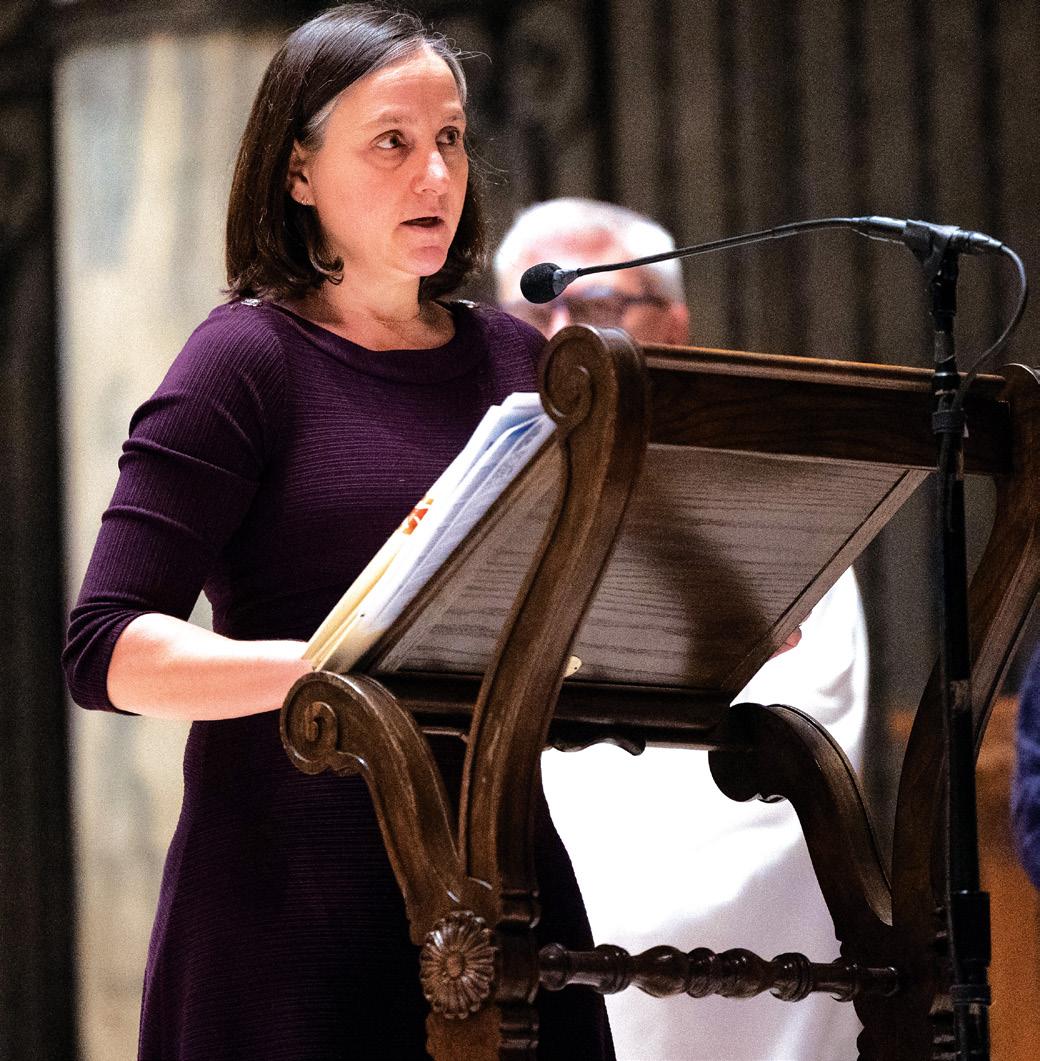
Susan Mulheron reads part of the 1926 decree from the Holy See naming the Basilica of St. Mary in Minneapolis a minor basilica at the 100th anniversary Mass of that event at the Basilica Feb. 1.
Father Jaroszeski celebrates 50th jubilee and retirement
By Dave Hrbacek
The Catholic Spirit
Asked to reflect on his 50 years of ministry and pending retirement as a priest for the Archdiocese of St. Paul and Minneapolis, Father Paul Jaroszeski produced an answer with little hesitation.
“I think what stands out the most to me is God’s faithfulness in the midst of everything,” said Father Jaroszeski, 75, who was ordained on May 29, 1976, by then-Archbishop John Roach. “Not just my life as a priest, but also the life of this community of faith and our establishing it and trying to bring it to fruition.”
He is referring to the parish of St. Katharine Drexel in Ramsey, which he helped start in 2004 with School Sister of Notre Dame Dianne Perry. It began in a very unconventional manner, with both co-founders walking on lots of pavement in the neighborhoods of Ramsey, an outer-ring suburb in the northwest metro.
“When we started, there was nobody — absolutely nobody,” Father Jaroszeski recalled.
“Sister Dianne and I started having what we called listening sessions, and we rented some space from the city. We got a list of Catholics in the area, so we sent out postcards to them inviting them to listening sessions.”
That effort produced 25 households when the church first became a faith community in 2004. It was the first step on the way to becoming a full-fledged parish. The first Mass, which was celebrated on Jan. 31, 2005, was a sign of the growth that lay ahead.
“It was packed,” Father Jaroszeski said. “There were about 400 people there. ... So, a lot of people showed up for it.”
The first place where worship took place was in space rented from PACT Charter School in Ramsey. This continued for nearly two decades until the people of St. Katharine Drexel were able to build a permanent church on land donated by a parishioner, Jerry Bauer. The 35 acres he gifted to the parish stood idle for more than 10 years due to economic uncertainties, then the project moved forward with groundbreaking in 2023.
Regular Masses are being held in the new worship space, while construction of other portions of the campus is nearing completion. It will include a new kitchen, which is finished,
The Catholic Spirit
In addition to sharing reflections of retiring Father Paul Jaroszeski as he celebrates 50 years of priestly ministry, The Catholic Spirit is honored to recognize priests of the Archdiocese of St. Paul and Minneapolis who have served 75, 70, 50 and 25 years of priestly ministry. We also recognize Father Stephen Boatwright as he retires, and we congratulate all priests who are celebrating significant milestones in their ministry.
75 years
Father George Welzbacher, 98, has been retired since 2013, but from 1999 to 2021 he was on the Board of Censors for the Archdiocese of St. Paul and Minneapolis. Before retiring, he was pastor of then-St. John (20062013) and St. Agnes (2001-2006), both in St. Paul, and St. Nicholas in New Market (1995-2001). He was parochial administrator (1994) of St. John in St. Paul and assistant priest of St. John the Baptist in New Brighton (1955-1966) and St. Peter in North St. Paul (1951-1955). In addition to parish ministry, Father Welzbacher was an instructor at St. Thomas Academy in Mendota Heights (1961-1966) and the University of St. Thomas in St. Paul (1966-1995).
70 years
Father James Reidy, 95, retired in 1997. Before retiring, he was on the faculty of the University of St. Thomas in St. Paul (1958-1997). He was parochial administrator of St. Henry in Monticello (1963) and assistant priest of then-St. Michael in St. Paul (19561958).
60 years
Father Robert Hazel, 85, retired in 2006. Before retiring, he was pastor of St. Joseph in New Hope (1999-2006), Ascension in Minneapolis (1993-1999) and then-St. Mark in Shakopee (1985-1993). He was associate pastor of St. John the Baptist in New Brighton
plus spaces for other aspects of parish ministry. The total cost of the project is $5.3 million, which was covered through three fundraising campaigns. The campaign got a boost after 20 acres were sold by the parish to PACT Charter School for $1.4 million. The K-12 public charter school, which now sits across the street from the new church, is using the space for its new high school.
Father Jaroszeski counts this part of his ministry among the highlights of his 50 years. He noted that the parish now has 525 families, including a few of the original 25, and that St. Katharine Drexel in recent years has welcomed immigrants from Africa to form a sizable community within the parish.
“I just think that founding a parish is a unique opportunity for the community and for the priest who’s involved,” Father Jaroszeski said.
On July 1, Father Jaroszeski will transfer leadership of the parish to Father Ryan Glaser, who will serve as parochial administrator after being appointed by Archbishop Bernard Hebda. Ordained in 2023, Father Glaser is currently serving as parochial vicar at the Cathedral of St. Paul in St. Paul. Father Jaroszeski, who served as the director of the Office of Priest Personnel for the archdiocese from 1993 to 2004, said he is confident that Father Glaser is the right person to help the parish move forward.
“I knew that the parish needed somebody younger, somebody with a lot of energy and enthusiasm and dedication,” Father Jaroszeski said. “The archbishop made a perfect choice with Father Ryan because he’s all of those things and more.”
Father Jaroszeski will have a chance to celebrate his retirement and say goodbye to parishioners at a 4:30 p.m. Mass June 27, with dinner and a reception following across the street at the PACT Charter School’s high school campus.
The list of parishes where he has served is long, including St. William in Fridley, St. Olaf in Minneapolis, Annunciation in south Minneapolis, St. Patrick in Jordan, St. Thomas the Apostle in Corcoran and St. Cecilia in St. Paul. His longest tenure has been 22 years at St. Katharine Drexel, with St. Cecilia next at 11 years (1993-2004).
Now, his thoughts are turning to retirement. He will move from Ramsey to a Catholic Eldercare independent living facility in Northeast Minneapolis. He will remain available to the parish and Father Glaser however he is needed, including celebrating Masses when Father Glaser is away.
“I’m a little nervous about it (retirement) because I’ve always been very busy,” Father Jaroszeski said. “It’s going to be different, but I think I will find ways to keep busy. I’d like to take some time to not say yes to anything and just kind of get my feet on the ground about being retired. But eventually, I want to be able to be helpful to others — other parishes and stuff if I can. I also would like to do some volunteer work.”
In the near future, he plans to take a trip to Poland to connect with his Polish roots, which include growing up as a Polish Catholic in Northeast Minneapolis and attending Holy Cross, a parish that still practices Polish traditions.
“Two friends and I are going to Poland in October, and I’ve never been to Poland,” he said. “I’ve traveled with these friends a lot and we’ve done (trips to) various places in Europe. We’re getting up there in age, so we think this might be the last transatlantic kind of (trip).”
He said he is ready to step away from leading a parish. “A lot of me is looking forward to it,” he said. “No more meetings that I have to be at. No more responsibility for a budget. I’ll be very happy with letting that go.”
CELEBRATING YEARS OF PRIESTLY MINISTRY
(1984-1985), assistant priest of the Venezuelan Mission parish Jesucristo Resucitado (1979-1984). He was associate pastor of then-St. Austin in Minneapolis (19751979), then-Newman Center and Chapel in Minneapolis (1970-1975), Sacred Heart in Robbinsdale (1967-1970) and Corpus Christi in St. Paul (1966-1967).
Father Michael Slusser, 85, retired in 2006. Before retiring, he was on the faculty of Duquesne University in Pittsburgh (1987-2006) and had stints as a faculty member of the University of St. Thomas in St. Paul (19851987, 1975-1981 and 1968-1970). Father Slusser was a graduate student at the University of Oxford in England (1970-1975) and was on the faculty of The Catholic University of America in Washington, D.C. (1981-1985). In addition to his work in education, Father Slusser was pastor of St. Frances Cabrini in Minneapolis (1985-1987), chaplain of DeLaSalle High School in Minneapolis (19671968) and assistant pastor of then-Our Lady of Perpetual Help (1967-1968) and then-Resurrection (1966-1967), both in Minneapolis.
50 years
Father Paul Jaroszeski, 75, will retire effective July 1. Before retiring, he was pastor of St. Katharine Drexel in Ramsey (2004-2026) and of then-St. Rose of Lima in Cherry Grove (2004). He was parochial administrator of 12 parishes at various times between 1993 and 2004, including St. Luke in Clearwater; Guardian Angels in Oakdale; Most Holy Trinity in Veseli; St. Henry in Monticello; Holy Cross and Holy Name, both in Minneapolis; Annunciation in Hazelwood; St. Dominic in Northfield; St. Ignatius in Annandale; Transfiguration in Oakdale; Immaculate Conception in Columbia Heights and St. William in Fridley. He was pastor of St. Cecilia in St. Paul (1993-2004), then-St. Peter in Credit River (1993) and St. Patrick in Maple Grove (1992-1993). He was parochial administrator of seven parishes at various times between 1990 and 1992, including St. Nicholas in New Market, then-St. Anne in Minneapolis, St. Columba in St. Paul, Holy Trinity in Waterville, St. Cecilia in St. Paul,
St. Peter in Richfield, Most Holy Trinity in Veseli and St. Thomas the Apostle in Corcoran. Father Jaroszeski was pastor of St. Patrick in Jordan (1987-1990), parochial vicar of Annunciation in Minneapolis (1985-1987) and associate pastor of St. Olaf in Minneapolis (1981-1985) and St. William in Fridley (1976-1981). In addition to his parish ministry, Father Jaroszeski was executive secretary of priest personnel in the chancery (1990-1993).
Father Stephen LaCanne, 76, retired in 2015. Before retiring, he was chaplain at Abbott Northwestern Hospital in Minneapolis (2014-2015) and pastor (2011-2015) and parochial administrator (2010-2011) of St. Leonard of Port Maurice in Minneapolis. He was director of pastoral care at then-Health East St. Joseph Hospital in St. Paul (2003-2010) and chaplain for then-University of Nebraska Medical Center, Fairview in Minneapolis (2000-2003). He was pastor of St. Bartholomew in Wayzata (1990-2000) and served on the Commission on Chemical Health in the chancery (1989-2015). He was parochial vicar of Pax Christi in Eden Prairie (1988-1990), chaplain of then-St. Mary’s Hospital in Minneapolis (1982-1987) and associate pastor of Incarnation in Minneapolis (1977-1982) and St. Matthew in St. Paul (1976-1977).
25 years
Father Cory Rohlfing, 56, has been ministering at The St. Paul Seminary in St. Paul as an external spiritual director in the propaedeutic year program since 2021 and has been pastor of St. Michael in Kenyon and Divine Mercy in Faribault since 2019. He was pastor of St. Jude of the Lake in Mahtomedi (2011-2018) and a part-time minister to clergy as part of parish and clergy services in the chancery (2018-2019). He was parochial administrator (2005-2010) and pastor (2010-2011) of St. Canice in Kilkenny and pastor of Most Holy Redeemer in Montgomery (2004-2011). He was parochial vicar of St. John Neumann in Eagan (2002-2004) and St. Joseph in Lino Lakes (2001-2002).
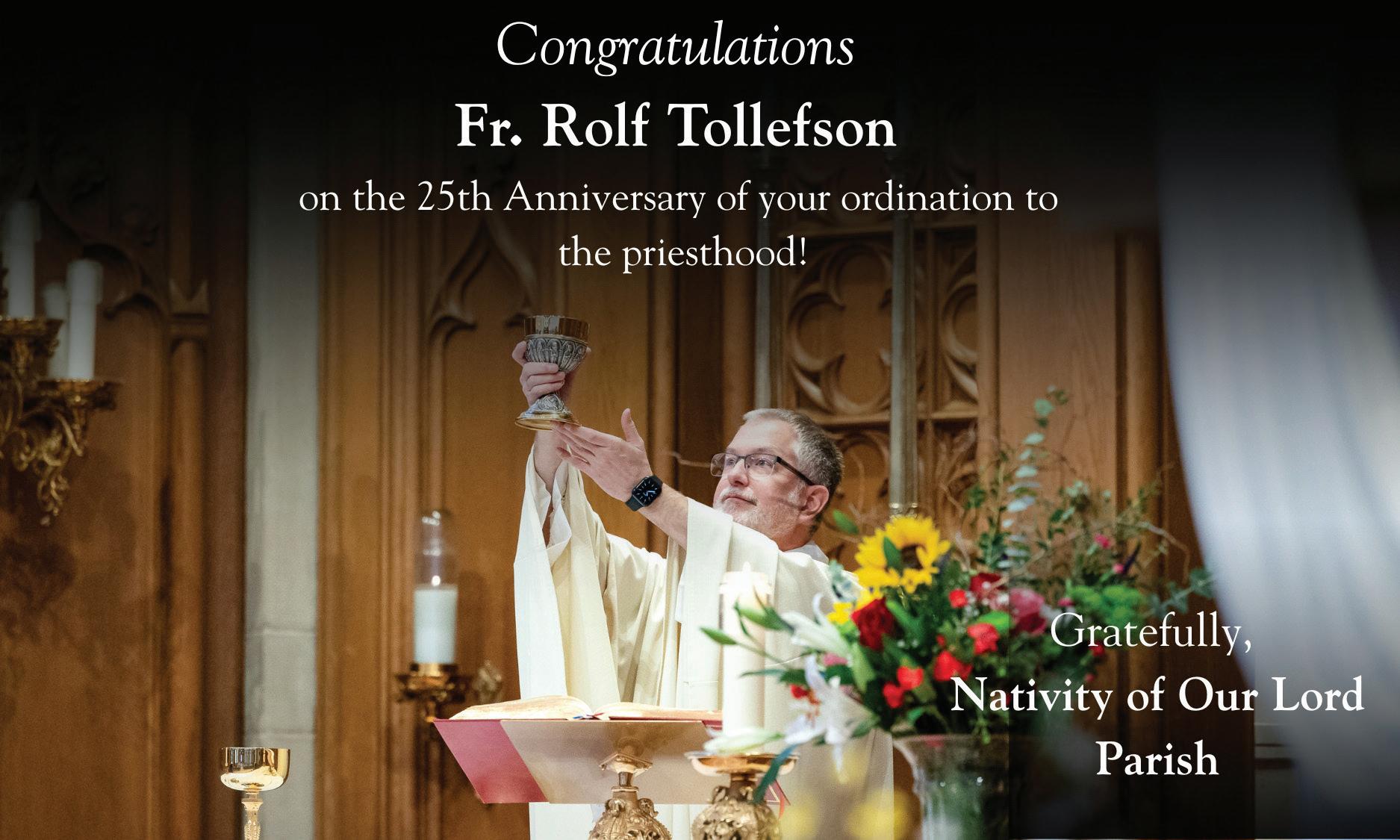
Father Rolf Tollefson, 55, has been pastor of Nativity of Our Lord in St. Paul and an external spiritual director at The St. Paul Seminary in St. Paul since 2023. He was an external spiritual director (2024-2025) at St. John Vianney College Seminary in St. Paul. He was the parochial administrator at St. Nicholas in Carver (2020-2021) and St. John the Baptist in Excelsior (2019). He was a pastoral advisor at Holy Family Catholic High School in Victoria (2011-2023). He was pastor of St. Hubert in Chanhassen (2011-2023). He was a chaplain for the archdiocesan Office of Marriage, Family and Life (2008-2011) and Curatio Apostolate (2002-2010). He was a spiritual director at The St. Paul Seminary (2004-2011). He began his priestly ministry as parochial vicar of St. Charles Borromeo in Minneapolis (2001-2004).
Father Jon Vander Ploeg, 56, has been the director of spiritual formation at The St. Paul Seminary in St. Paul since 2021. He was the parochial administrator at St. Lawrence Catholic Church and Newman Center in Minneapolis (2020) and St. Dominic in Northfield (2003-2004). He was the spiritual director at The St. Paul Seminary (2019-2021). He was chaplain (2013-2019) at the University of Minnesota, director and pastor at St. Lawrence Catholic Church and Newman Center in Minneapolis (2013-2019). He was pastor of St. Paul in Ham Lake (2004-2013) and parochial vicar of St. Dominic in Northfield (2001-2003).
Retired
Father Stephen Boatwright, 75, retired in March after serving as sacramental minister at St. Joseph in Rosemount and St. Michael in Kenyon (2025-2026). He was ordained May 31, 2025, after ministering for 33 years as a permanent deacon and retiring in 2023. As a deacon, he ministered at St. Joseph in Rosemount (2011-2023), St. Leonard of Port Maurice in Minneapolis (2007-2011) and St. Olaf in Minneapolis (1991-2006). In addition, as a deacon, he was a chaplain at the Hennepin County Medical Center in Minneapolis (2006-2011).
DAVE HRBACEK | THE CATHOLIC SPIRIT
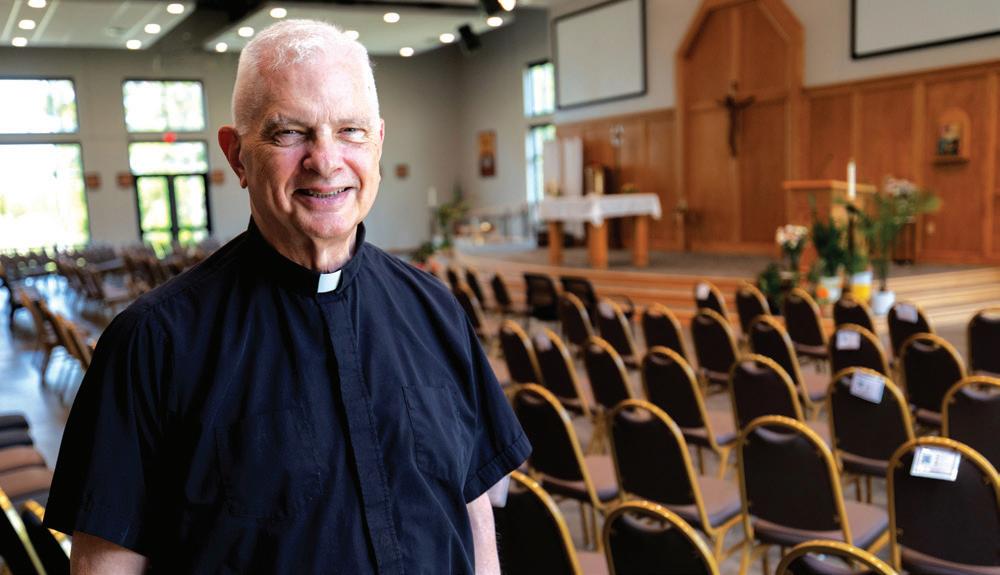
Father Paul Jaroszeski stands in the worship space of the new church at St. Katharine Drexel in Ramsey.
Limited ministry to continue amid changes at St. Boniface in Minneapolis
By Josh McGovern The Catholic Spirit
Effective July 1, parishioners of St. Boniface in Minneapolis will continue to attend Mass and receive sacraments at the church, even as parish assets are transferred to another owner.
The St. Boniface parish corporation will be suppressed and all parish assets, such as the church building and land, will be transferred to the nearby St. Maron of the Maronite Catholic Church in Minneapolis — a parish that celebrates liturgies in the Maronite Rite, which has its roots in Lebanon. The Maronite Church is Catholic and in union with the Holy Father; it operates under its own set of laws and liturgical rubrics.
St. Maron will continue to provide limited sacramental ministry to St. Boniface parishioners for at least one year and beyond that time if it continues to be possible to maintain and safely use the church. The priests of St. Maron parish have bi-ritual faculties allowing them to offer Mass and the sacraments in the Latin and Maronite Catholic rites.
Father Michael Tix, vicar general for the Archdiocese of St. Paul and Minneapolis, said the arrangement is a creative solution that doesn’t involve selling the property — a typical solution for the closure of a parish.
“It is a blessing that this beautiful church building will belong to another Catholic entity, and that the remaining funds of the parish will go to support the continued use of the building,” said Father Joseph Bambenek, associate director of the archdiocesan Office for the Renewal of Structures. “It’s intended to be a win-win for the current parishioners of St. Boniface and St. Maron.”
The pastor of St. Maron, Chorbishop Sharbel Maroun, will establish a regular schedule of Masses in the Latin rite with at least one Mass each weekend, under the arrangement reached between the archdiocese and the Eparchy of Our Lady of Lebanon of Los Angeles, which oversees St. Maron
much as the archdiocese oversees its parishes, Father Tix said.
In addition to Mass, St. Boniface’s church building can be used for funerals, marriages and baptisms for those already registered with the parish, and their immediate family, at the time of the suppression. Upon request, others can also use St. Boniface’s church building.
Father Tix said St. Boniface faces a changing neighborhood and demographics “that necessitate change in the parish and how it functions.”
Determining the best action to take has been considered for quite some time, he said, with many conversations involving St. Boniface’s parochial administrator, Father David Ostrowski, parish trustees, the archdiocese’s Presbyteral Council, the Archdiocesan Corporate Board
and Finance Council and Archbishop Bernard Hebda.
“The nice outcome of this is it leaves opportunity for people to continue coming to St. Boniface for at least the immediate term,” Father Tix said.
On July 11, Archbishop Bernard Hebda will preside at a 4 p.m. Mass at St. Boniface to recognize the changes. In a letter to St. Boniface parishioners, Chorbishop Maroun wrote that weekly Mass will be held every Saturday at 4 p.m. and weekday Mass will be celebrated Thursday mornings at a yetunspecified time.
“I urge all of you to become more involved by using your time, talents, and treasures to support your home parish of Saint Boniface,” Chorbishop Maroun wrote in the letter.
“I assure you of my sincere commitment to serve you with dedication, humility, and love. I look forward to getting to know you as we continue to grow together in faith. We are here to serve you and to accompany you with prayer, care, and pastoral support.”
Father Ostrowski will no longer be the parochial administrator of the parish at the end of the day June 30. St. Boniface sacramental records will be received by Our Lady of Lourdes in Minneapolis.
As the parish is suppressed, two representatives from St. Boniface will be chosen by parishioners to consult with St. Maron’s leadership semi-annually regarding the agreement, dedicated funds and sacramental needs of former St. Boniface parishioners, according to official Church documents.
In a letter to parishioners, Father Tix wrote, “As readily expressed at the all-parish meeting, this news is hard to hear and feels much like a death in the family, but many also expressed this as the understandable outcome, given factors ranging from changing demographics and the same kind of active engagement in parish life that was seen in the past as the lifeblood for St. Boniface’s 168 year history.”
For 2nd year in a row, archdiocese named a Minnesota Top Workplace
By Rebecca Omastiak The Catholic Spirit
For the second year in a row, the Archdiocese of St. Paul and Minneapolis was identified as being among the top workplaces in Minnesota, per an annual survey with results published in the Minnesota Star Tribune.
The Minnesota Top Workplaces survey was conducted by Energage, a Pennsylvania-based employee engagement company. The survey collected responses from thousands of employees at public, private and nonprofit organizations in Minnesota. To qualify, an organization was required to have at least 50 employees in Minnesota. This year, 200 organizations were ranked, with 111 additional organizations recognized for their national standards.
Workplace rankings were composite scores calculated specifically using employees’ survey responses to questions that covered organizations’ values, leadership and communication styles,
workplace dynamics, and employee satisfaction.
Referred to by its St. Paul offices — the Archdiocesan Catholic Center (ACC) — the archdiocese was also recognized for two Energage Culture and Excellence awards: in the Nonprofit category and in the Purpose and Values category (for organizations “that have successfully communicated the company mission and integrated those aspirations into the culture.”)
“This recognition reflects on each of our employees, who bring their talents, compassion and faith to their work in service of the Church every day,”
Archbishop Bernard Hebda said in a video message to ACC employees about the archdiocese being named a top workplace in 2026.
“Among the many organizations invited to participate in this rigorous program, it is truly an honor to be named to this list,”
Chief Operating Officer Bill Lentsch said in the video message. “This recognition reflects something we already know: There
is great purpose, dedication and care in the work happening here every single day.”
Meanwhile, Academy of Holy Angels — a Catholic high school in Richfield — was also again recognized, this year for meeting national standards on the survey.
Included in the archdiocese are 186 parishes, 89 Catholic schools, and the hundreds of thousands of Catholics who live in the 12-county greater Twin Cities metro area. It was established as a diocese in 1850 and the Holy See elevated it to an archdiocese in 1888.
The Minnesota Star Tribune published its full list of 2026 top workplaces in a special section of its June 14 edition, as well as online at topworkplaces.com/award/ minneapolis/2026.
The ranked listing recognized 65 large companies (with at least 500 employees), 65 midsize companies (with 150-499 employees) and 70 small companies (with 50-149 employees). The archdiocese was included among the ranked midsize companies.
COURTESY ARCHDIOCESE OF ST. PAUL AND MINNEAPOLIS
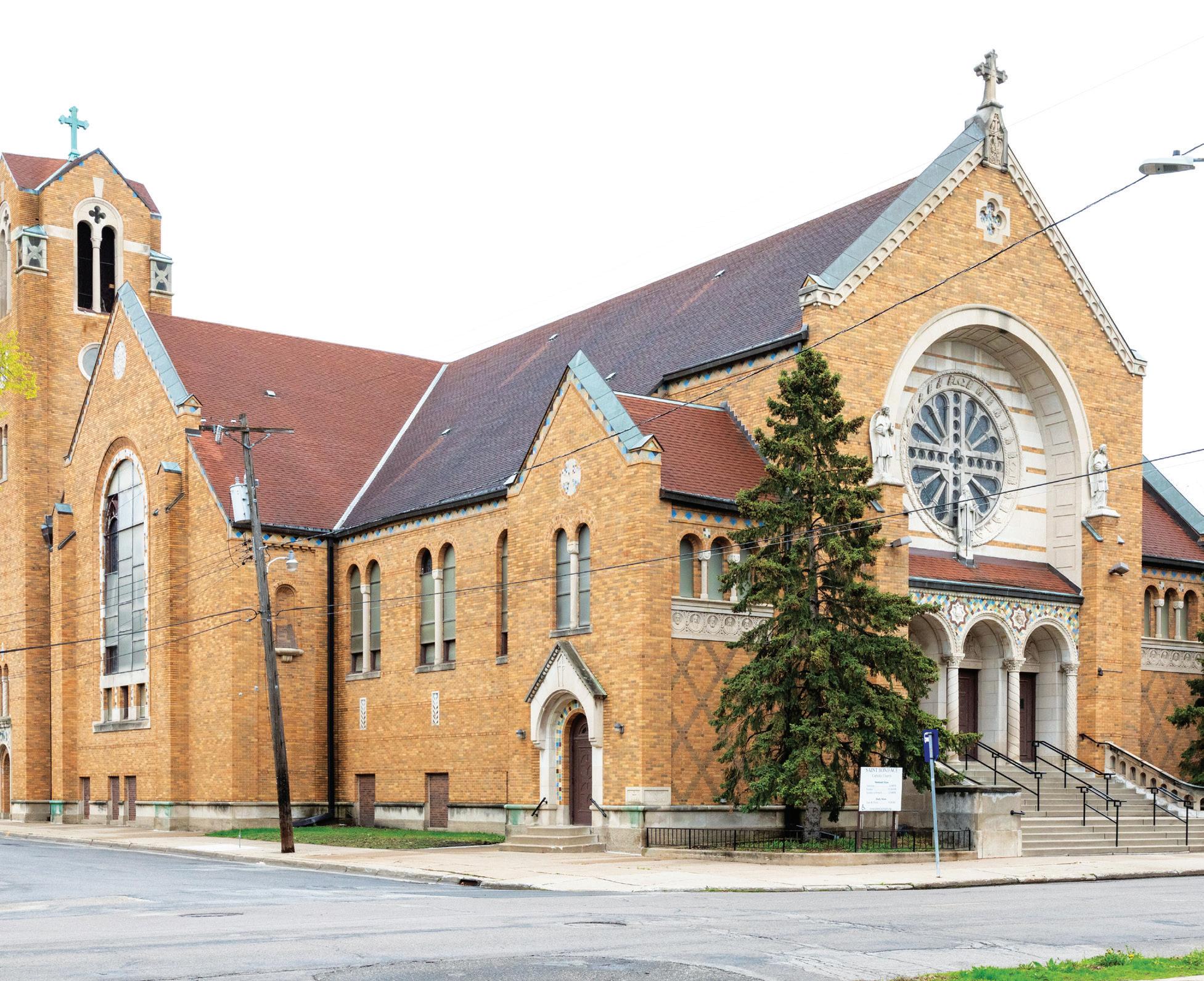
St. Boniface in Minneapolis.
HEADLINES
Pope Leo: Whoever immerses in the Sacred Heart no longer lives for themselves. Pope Leo XIV concluded his visit to Spain June 12 by urging Christians to reject the pursuit of profit and instead embrace hospitality toward migrants. Celebrating Mass at Tenerife’s main commercial port, a major migratory hub, the pontiff said residents have a unique opportunity to grow in faith through those seeking a better life.
“The greatest grace is to allow ourselves to be evangelized by those we assist,” Pope Leo told the crowd on the solemnity of the Sacred Heart. Earlier, the pope greeted cheering crowds from the balcony of Bishop Eloy Alberto Santiago’s residence, praising locals for welcoming migrants from across the globe. He reminded the faithful that all belong to “one single family.” Citing his apostolic exhortation, “Dilexi Te,” Pope Leo called the resilience of the vulnerable the “wealth of the poor.” He prayed that Tenerife remain a place of encounter with Christ through fraternal hospitality. “This is the heart of the Gospel, the heart of Christ,” he said. “Whoever immerses themselves in it no longer lives for themselves. Open this sea of love to everyone! This is my wish and my prayer for you and for all those who will come to know you.”
U.S. bishops approve updates to landmark child protection policies. The U.S. Catholic bishops approved several updates to their landmark document on protection policies for children and minors, seeking to define key terms while balancing care for victims-survivors with accused clergy’s right to a presumption of innocence until proven otherwise. The revisions, preliminarily introduced June 10 during the U.S. Conference of Catholic Bishops’ spring plenary assembly in Orlando, passed by a two-thirds vote June 11 after a period of debate. The changes will keep the “Charter for the Protection of Children and Young People” focused “exclusively” on clergy abuse of minors, with a new document being developed to address abuse involving vulnerable adults, said Bishop Barry Knestout of Richmond, Virginia, chairman of the USCCB’s Committee on the Protection of Children and Young People, in
his introductory remarks June 10. Joining Bishop Knestout on the dais during the presentation that day were Archbishop Ronald Hicks of New York, chair of the USCCB’s Committee on Clergy, Consecrated Life and Vocations; and Bishop Thomas Paprocki of Springfield, Illinois, chair of the USCCB’s Committee on Canonical Affairs and Church Governance. The charter was instituted by the USCCB in 2002 as a number of clerical abuse scandals emerged.
$70B immigration-enforcement funds exclude bishops-supported migrant protections. President Donald Trump signed legislation June 10 providing $70 billion to fund Immigration and Customs Enforcement (ICE) and Customs and Border Patrol (CBP) in the Department of Homeland Security (DHS). Prior to the bill’s passage, the U.S. bishops were among those who urged lawmakers to make immigration policy reforms aimed at protecting the dignity of migrants, such as efforts to prevent the separation of families. However, after months of debate over possible reforms, none of those measures were ultimately included in the final bill as negotiations in Congress fell apart. Called the Secure America Act, the legislation would fund ICE and CBP for the next three years, through the end of Trump’s second term in the White House, and was passed by the House in a narrow 214212 vote the previous day. Catholic immigration advocates beyond the bishops had also sought reforms to immigration enforcement during debate over the bill, and some raised concerns about the party-line measure that ultimately passed. Kevin Appleby, senior fellow for policy and communications at the Center for Migration Studies of New York and the former director of migration policy for the U.S. Conference of Catholic Bishops, told OSV News, “DHS now has an almost unlimited amount of funding to build a mass deportation infrastructure with no guardrails or accountability.”
A newly renovated center brings “The Rosary Priest” message to a new generation. With the June 6 grand reopening of the newly
renovated Father Peyton Center in North Easton, the faithful have a revitalized opportunity to again encounter or meet for the first time the dynamic Holy Cross priest on track to sainthood remembered for the phrase, “The family that prays together, stays together.” Father Fred Jenga, president of Holy Cross Family Ministries, the ministry Venerable Patrick Peyton founded in 1942, told OSV News that Father Peyton’s familyand Rosary-centric teaching is as relevant as ever. “His message has never been needed as much as it is right now because we know the pressures that are on family life,” said Father Jenga. Father Peyton was an Irish-born Catholic evangelization pioneer who early recognized the power of mass communication. He began promoting the family rosary in 1942 and eventually staged worldwide more than 540 Family Rosary Rallies attended by 28 million people. Father Peyton also founded Family Theater Productions, which produced 900 radio and television programs featuring star actors and celebrities in more than 10,000 broadcasts. These global ministries continue today joined by Catholic Mom, a resource for mothers, and The Peyton Institute for Domestic Church Life, which conducts research and offers professional training. Father Jenga also extended a pilgrimage invitation for all to come pray and see the man they are praying will one day “become a saint for families.”
Indigenous and Church leaders hold a “knowledge-sharing” meeting on the “Doctrine of Discovery.” Catholic and Indigenous leaders gathered in Edmonton, Alberta, May 26-29 for a symposium examining the legacy of the so-called “Doctrine of Discovery” and its impact on Indigenous peoples in North America. The doctrine is commonly linked to 15th-century papal documents, as well as later legal and political theories that were used to justify European claims to lands already inhabited by Indigenous communities. Held at St. Joseph Seminary, the knowledge-sharing gathering brought together Indigenous scholars and leaders with Catholic bishops and academics to discuss how those ideas contributed to the loss
of Indigenous rights, self-governance and control of traditional territories. The meeting built on a 2023 Vatican statement formally repudiating concepts associated with the doctrine. That statement affirmed the inherent human rights of Indigenous peoples and said historical papal texts cited in support of colonization “have never been considered expressions of the Catholic faith.” The symposium was co-sponsored by two Vatican dicasteries and the Canadian Conference of Catholic Bishops. At the end of the meeting, participants promised to continue meeting online and in person and to educate their local communities about the “Doctrine of Discovery” and the ongoing harm it causes.
It’s “all celebration” as Sister Blandina’s sainthood cause advances. A religious sister who immigrated to the U.S. as a child and became known as the “fastest nun in the West” is edging a step closer to possible canonization. Theological consultants for the Vatican’s Dicastery for the Causes of Saints have unanimously voted to advance the case of Servant of God Sister Blandina Spegale, an Italian-born Sister of Charity who missioned to the poor, the marginalized and immigrants in her adopted homeland. The news of her cause’s advancement was announced at a June 1 press conference organized by the petitioner for her cause, Allen Sánchez, president of CommonSpirit St. Joseph’s Children, a faithbased health nonprofit caring for vulnerable children and families. With the historical and theological assessments complete, Sister Blandina’s case will now be examined by the dicastery’s member bishops and cardinals, who will vote on whether to send the cause to Pope Leo XIV. Sister Blandina focused her decades-long ministry which began with her 1866 entrance into the order’s Cincinnati motherhouse, and ended with her 1941 death there on providing healthcare and education to those in need, while defending the rights of Hispanics, Native Americans and laborers as she served in Colorado, New Mexico and Ohio.
CNS and OSV News

MCC: Constituents contacting lawmakers helps open doors
By Joe Ruff
The Catholic Spirit
Catholics’ ability to shape public policy was apparent in the Minnesota legislative session that ended May 18, two leaders of the Minnesota Catholic Conference (MCC) emphasized in a recent conversation with The Catholic Spirit.
Jason Adkins, MCC’s executive director and general counsel, and Maggee Hangge, the conference’s assistant director for operations and family policy, cited MCC’s successful championing of legislation that puts guardrails around minors’ use of social media. They also cited fruitful conversations about the need for affordable housing while encouraging Minnesota lawmakers to opt into a Federal Scholarship Tax Credit program that would help Catholic schools. The latter program would allow taxpayers to donate up to $1,700 to a qualified scholarship-granting organization and receive a dollar-for-dollar federal tax credit in return.
Grounding its activities in prayer, MCC staff, who advocate on behalf of the state’s Catholic bishops, hosted all eight of the bishops during one of three prayer opportunities at the conference’s Adoration at the Capitol in St. Paul. In total, those opportunities drew more than 1,000 participants to the Minnesota State Capitol — the center of the state’s policymaking — to adore the Eucharist and pray for lawmakers.
The conversation with Adkins and Hangge follows, edited for length and clarity:
Q Jason and Maggee, thank you for hosting this conversation at your offices, and thank you for your ministry to the Church. As you reflect on the legislative session that ended May 18, what one item would you like the Catholic community to know about and why?
HANGGE One thing we really felt is that prayer makes a big difference and that your voice
matters. We had a lot of people showing up for adoration. We had a lot of people praying for the issues we were working on, and they wouldn’t have gotten done without that. Showing up and making your voice heard is so important.
ADKINS Faithful citizenship without prayer is mere activism, and we need both. I love the motto of St. Benedict, “Ora et labora,” pray and work, and that’s really the model of faithful citizenship. We need prayer because it’s important to be transformed ourselves by the prayer and the way that works on us and the life of grace and the Holy Spirit, but also in the way in which it can help till the soil for better conversations at the Capitol.
We were so encouraged by the providential things that we saw at the Capitol that don’t seem to be possible without prayer. I think the passage of this landmark social media legislation was really a great example. That’s something we were able to bring together from start to finish in one legislative session. Rarely does a piece of policy legislation make it from start to finish in a bipartisan way — and in a divided government in a shortened session — in one year.
Surely miraculous, on some level. Maggee did a fantastic job of shepherding that through the process, and we’re super proud of that.
Q In addition to prayer, how did lawmakers come to be together on this issue with such a split in the House (67-67 tie) and a one-vote DFL majority in the Senate?
HANGGE I think legislators are seeing on both sides of the aisle that kids need help. We need to put kids over the profits of Big Tech. For too long, Big Tech has had a hold, and legislators are done with that. They want to put kids first in Minnesota. And that’s what we saw this session by passing the Stop the Harms of Addictive Social Media Act. I should add that it’s not the first time that social media regulation legislation has been introduced. This has been building.
But I think the politics were right and the players were right this session to move it across the finish line.
ADKINS It had a simple premise: Let’s put parents back in charge and make sure that they understand what their kids are doing online. Make sure they consent before a child under 16 opens a social media account and really foster a healthy dialogue about social media use.
One of the great things about divided government and a divided legislature is that people understand that some of the biggest partisan hobby horses, or things that really drive politics on either side of the political spectrum, weren’t going to get done this year. So, legislators, to their credit, were looking for solutions to practical problems. (They asked) what can we do? We can just throw up our hands and say we’re not going to get anything done. But for many, this was a surprisingly productive session, despite the divisions in state government. The social media bill was a perfect example.
Housing infrastructure bonds and affordable housing policies advanced much further than a lot of people thought they would. So really, in divided government, sometimes we do best as a state because legislators have to work together to identify concrete problems that are facing real people and then try to find real solutions. We brought a solution to the table (with the social media bill). That’s what advocates and that’s what citizens can do.
Q It was part of a three-pronged approach (by MCC) to address violence in schools. We had a tragic example of that at Annunciation in south Minneapolis this last year. Other areas of that approach were banning high-capacity ammunition magazines and expanding school safety funding to include private schools. Those
didn’t make it. Will you try again next year as a conference to get those across?
ADKINS Protecting the right to life is very, very important. What we tried to do this session with those bills was to recognize the politics for what they were and be eminently practical, saying, what could we get done in this year 2026?
The three-part package that we proposed had something that Republicans are more inclined to like, something that Democrats are more inclined to find as a solution to gun violence, and then something that transcends those partisan divides. That was the social media bill. There were a few buckets of funds for school safety that did pass, such as threat assessment, programing and resources that nonpublic schools are eligible for, but by and large, we need to have a per pupil expenditure just like there is for public school students that includes all students. We’ll continue to work on common sense gun regulation on one side, but also for school safety.
Q You mentioned, Jason, some housing legislation that went further than you might have expected. What did that mean and what are some examples?
ADKINS I think from the standpoint of bonding, which is infrastructure and funding projects, there continues to be a need for housing. There’s affordable housing, which is typically state subsidized or government subsidized housing for low-income people. But there’s also housing affordability. Can young people, for example, buy their own home? The average age of a first-time homebuyer is about 38 years old in the state of Minnesota. Housing prices have gotten out of control. One solution is to create more housing stock. So, we supported the Minnesota Starter Homes Act, which has a great coalition surrounding it. It’s part of the conversation and really framing the issue


around housing affordability that didn’t pass this year. But we’re hopeful that in continuing years, that becomes a centerpiece of housing affordability conversations.
Q Is that something that could happen as early as January when the next session begins?
ADKINS Correct. The nice thing about the Starter Homes Act is it doesn’t cost anything at the state level. It’s a policy bill. It’s a preemption bill regarding zoning. It just says cities can’t engage in exclusionary zoning practices that limit the housing stock. It provides a toolbox of solutions for doing that. But we think that’s a really important step forward. Housing affordability is a key piece of what we’ve called the Family First policy platform that we’ve been championing here, whether it’s a child tax credit, whether it’s social media regulation for families, whether it’s housing affordability, whether it’s school choice.
Q Were there other aspects to this session that showed success despite the divisions that maybe went under the radar?
HANGGE There were things that didn’t pass, which was helpful. The IVF insurance mandate legislation has been stopped now for at least five years. But it continues to be in the conversation. We have worked to reshape that conversation around restorative reproductive medicine, because IVF really is not the best medicine when it comes to treating infertility.
ADKINS Assisted suicide did not get one hearing this biennium, which is a tremendous success. We’ve been able to stop that bill, 12 straight legislative sessions. Now, that will certainly come back because proponents are so adamant about it. But we think because our advocacy focuses on the threat that legislation is to vulnerable people, it’s been able to build a strong bipartisan coalition.
People recognize that when care is expensive and killing is cheap, which do we ultimately think will prevail and how will
that impact vulnerable people, the disabled, the chronically ill, the elderly, the poor, the marginalized? How will it impact racial disparities in health care? People are starting to recognize that there are a lot of reasons why we should say no to assisted suicide.
Q We started with prayer. Has it brought a positive dimension to conversations and the ability for people to meet a little differently than they might have otherwise?
ADKINS We think that legislative engagement and legislative contacts move the needle. We agree with the popes that politics is one of the highest forms of charity because it serves the common good. When you (talk) with legislators about issues that matter, that moves the needle. We try to engage the people in the pew through the Catholic Advocacy Network (CAN) to reach out and engage with legislators, even if it’s just sending an email. But most important is to pray for them. We think prayer matters. We think it changes hearts and minds, and legislators are encouraged knowing that as they do their difficult jobs, people are praying for them, and that matters.
That’s a service we can provide to the legislators. We have a legislative chaplain this year for the first time, Deacon Kevin Conneely, who prayed with the legislators and was a resource to them. He talked through difficult issues with some of them. He helped them navigate their responsibilities.
Q I was happy to see that more than 11,000 messages were sent to lawmakers through CAN (sign up at mncatholic.org) at crucial moments of legislative action.
HANGGE We’ve seen a huge growth on social media with engagement. We’ve seen a growth in Catholics being willing to talk with their legislators, and they often realize that the legislators respond back to them. It’s not just a black hole that you send a message to, but we get lots of messages from Catholics coming back to us that say, “Hey, I heard back from so-and-
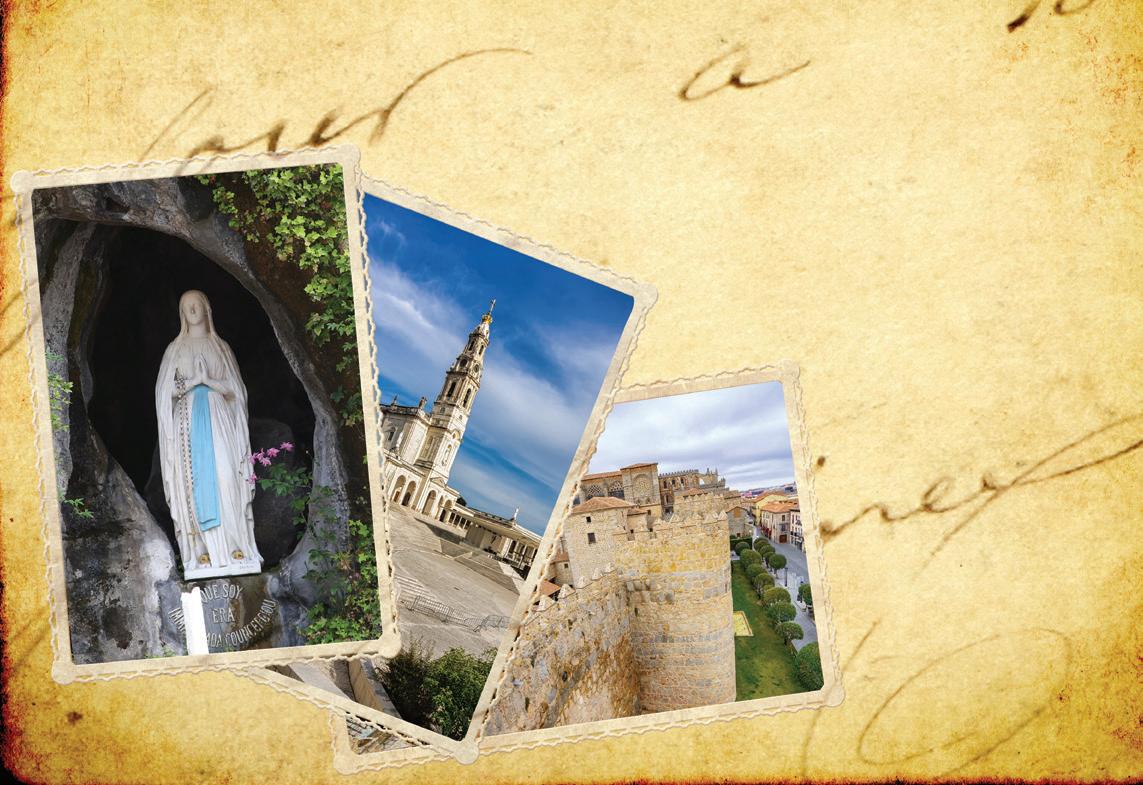
Pilgrimage To Lourdes & Fatima
Email any questions to: markmiller@brothersofpeace.org Or see all info and register at this link: https://selectinternationaltours.com/frseraphim-wirth-fbp/. Please register before the July 6th deadline. SCAN HERE to learn more and register.
so, this is what they said.” Or, “That was so cool, they actually responded to me.” When you have that personal experience, it makes you want to do more of that.
ADKINS We think legislative contacts matter. We keep track of those things. It helps us get meetings easier. When legislators know that Catholics in their community are concerned about issues, their doors are more open to us as lobbyists and staff. It’s really a team effort between the bishops, the staff and the people in the pew to get good legislation moving forward.
Q The Minnesota House was split 67-67, Democrat and Republican, this last session. The DFL held a one-vote advantage in the Senate. This November, every seat in the Legislature is open to election. How might Catholics think about this election season?
ADKINS You’ve hit it right on the head. Every legislative seat is up for election. We hear things from people in the pew such as, “well, state politics doesn’t really matter.” Or (we hear), “I contacted my legislator” — and they’re talking about their U.S. congress(person) and not their state House or state Senate member. Ninety-five percent of people — this is anecdotally from speeches and presentations we give — cannot name their state House member and their state senator. Think about how challenging this is. We don’t even know who’s making the laws. How can we expect that the laws they make will be good? And think of the issues, the important issues we’ve been talking about in this conversation, whether it’s social media regulation, assisted suicide, housing affordability, you name it, these important decisions are being made at the state level. We need to get to know our candidates. We need to talk to our candidates, form relationships with them and ask them questions about how they would govern if they were elected. We’ll have a whole slate of resources on our website at mncatholic.org, including candidate questionnaires and
election logistics. We’re going to have a primary election on Aug. 11, which is going to have more importance than perhaps it’s had in many a year in recent memory. So, Catholics can’t just be looking to Nov. 3. They need to be looking at Aug. 11 as well, to the respective party primaries. And I want to emphasize our materials transcend the partisan divides. We offer resources and questions that help people engage candidates and elected officials, no matter what their party. Our goal is to build common ground for the common good. Hopefully people in the pew will do the same and be hopeful and encouraged about what happens when you build relationships with elected officials and share your concerns with them.
Q The next legislative session is scheduled to open Jan. 12, 2027, and run through May 18. What will keep you busy in the months leading to the session?
HANGGE None of the issues that we’ve talked about today are going away, so we have a lot of work to till the soil on things like the IVF insurance mandate, physician-assisted suicide, getting testimony ready, getting more engagement in certain areas, finding physicians who want to talk about it, finding Catholics who want to talk about these topics, things like that. Really just building for session 2027 on the key issues that we know about right now.
ADKINS We can only do so much as lobbyists. We need the help of people in the pew. We’ll be speaking to churches, parishes, schools, especially Catholic schools, because we are likely to face the issue again of proposed cuts to nonpublic education, nonpublic pupil funding. We still haven’t opted in as a state to the Federal Scholarship Tax Credit, which is a hugely important issue. Already 30 other states have done so, and it’s important that we do that. So again, we help people understand that advocacy never sleeps. And those relationships with elected officials don’t need to wait until the legislative session. They can be built now.


Join Father Seraphim Wirth for the Marian Torchlight Rosary Procession at the Sanctuary of Our Lady of Lourdes Oct. 2026! We will also be visiting Fatima, Avila & Lisbon.
FAITH+CULTURE
At 91, retired priest tells his story
By Christina Capecchi For The Catholic Spirit
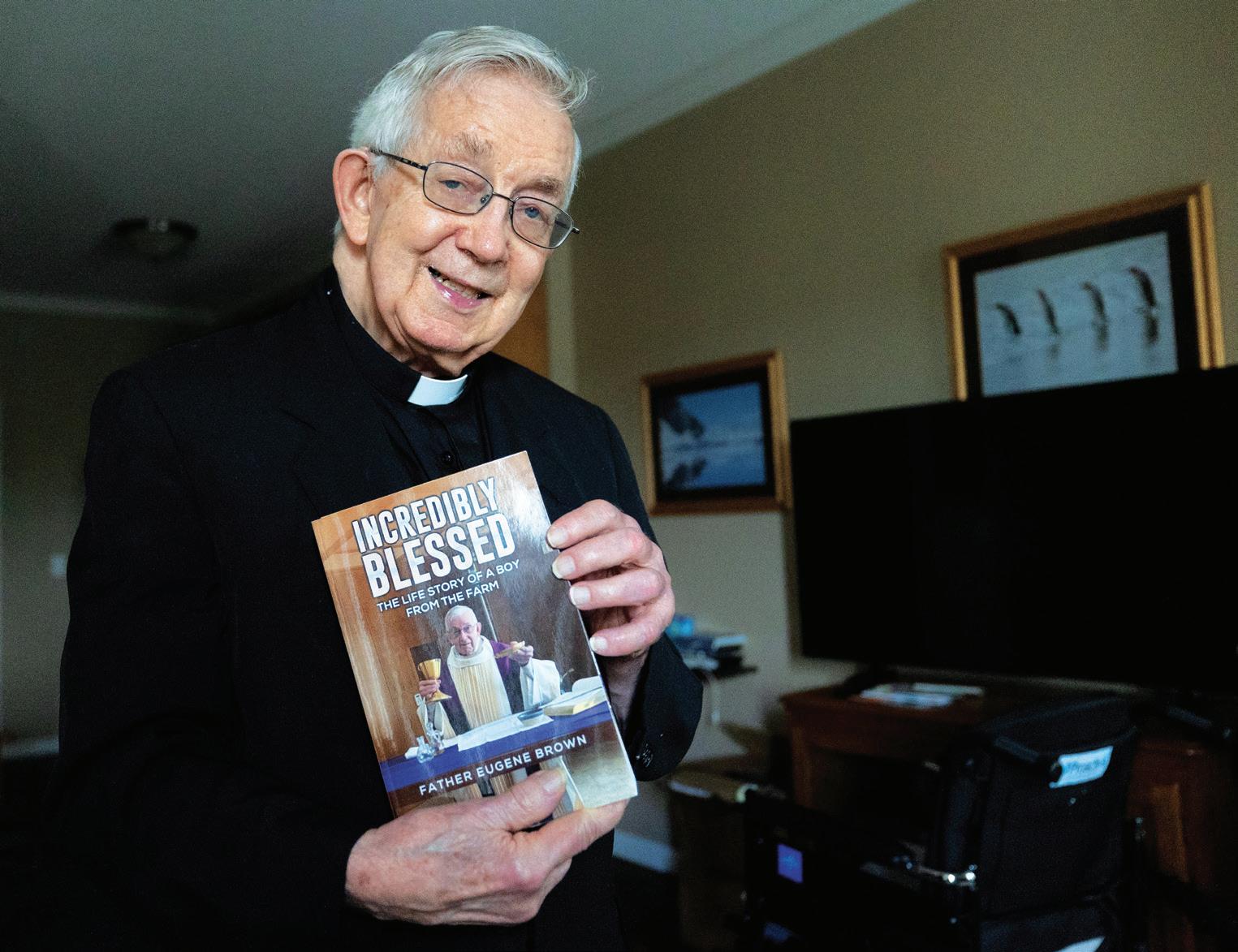
The epiphany struck on a sleepless night when Father Eugene Brown, then 89, was recovering from spinal surgery: How blessed he has been, how incredibly blessed. The next day the retired priest began typing the memoir that would become “Incredibly Blessed,” now available online and at St. Patrick’s Guild in St. Paul.
“If the present population is some 8 billion,” Father Brown wrote in the prologue, “I must be among the top 100,000 privileged people, if not higher. … This is extraordinary for a French-German-Irish boy born in Fort Wayne, Indiana, who came to Minnesota in a shoe box (no infant car seats in those days) at the age of 3 weeks and was raised on several farms in western Minnesota before starting at Nazareth Hall Preparatory Seminary at the age of 13.”
Now 91 and slowed by a stroke, the New Ulm priest is ready to tell his story. A resident of Lilydale Senior Living in Lilydale, south of St. Paul, Father Brown had just returned one recent day from a barbecue with fellow residents and was perched near a window, surrounded by his framed photographs and a stack of yellow National Geographics, his blue eyes fixed on the sunlit trees outside.
Q Tell me about your writing process.
A At first, I was going to write a few pages for my family and friends, but then I kept writing, and it turned into a 500-page memoir. I began to remember things I hadn’t remembered for a long time.
Q The book begins with three truths that came into clarity that night of your epiphany. One, sin is not so much a violation of God’s law as an act contrary to God’s plan for us, hurting us, not God. Two, the goal of life is to accomplish day by day God’s plan for us. Heaven brings that plan to completion. And three, everyone you meet is a delightful, walking example of the work of the Holy Spirit in the life of that person. How do you live differently knowing those three truths?
A It changed my idea of sin, and it helped me treat everyone I meet with kindness.
Q The book chronicles your entire life, starting with a dramatic beginning during the height of the Great Depression when your family moved to a Minnesota farm, desperate for a better life. Do you ever think about that newborn in the shoebox traveling in a 1929 Dodge?
A That was a difficult trip in those days — 800 miles on mostly gravel roads with two toddlers and a newborn, myself. God must’ve been watching over us.
Q You were poor as a boy but didn’t know it. Does our age of indulgence sometimes shock you?
A With Amazon, nowadays, we have what I call instant gratification. It was much different when I was growing up. We had to learn to do without, unless it was something we really needed. You realize that the world does not revolve around you. Other people have needs also.
Q You attended minor seminary at the encouragement of your mother and a priest, despite your dad’s urging to wait and attend your public high school first. Looking back, you concluded that your dad was right and that you would have benefited from being at
a regular high school and outgrowing your shyness.
A The idea was to get them early before they were corrupted by the world. But there were about 45 students in our freshman class and only five of us were ordained. The bishops were looking at that and deciding that there has to be a better way. Well, now, in the whole United States, I don’t know if there are half a dozen minor seminaries.
Q You were very shy and had a speech impediment. One of your professors told you: “You would be no earthly good in a parish.” Was that discouraging?
A I really was afraid that I’d get kicked out. That really affected me. I worked hard to overcome my shyness. I did not suddenly become an extrovert, but I became able to relate to people better.
Q Again and again, you’ve witnessed the goodness of humanity, like a honeymooning couple who gave you a private tour of Yellowstone back in 1954 when you were a seminarian. How have those experiences colored your philosophy of life?
A In spite of all the evil in the world, most people are basically good.
Q You retired from parish ministry at 70, but in many ways your most adventurous years seem to have followed.
A More opportunities for travel came along, and I took advantage of them. Most cruises were on National Geographic ships. My cruise through the British and Irish Isles was a favorite. It started in London and went down the Thames River. We traveled around England and Ireland to islands off the west coast of mainland Scottland, including Iona, where we saw the Iona Abbey and the ruins of the nunnery there. We explored Fingal’s Cave and an island way off in the Atlantic that is uninhabited now, which very few people have been to. We saw the Callanish Standing Stones on the Isle of Lewis, which pre-date Stonehenge.
Q What impact did those travels have on you?
A I began to realize how vast and interesting this Earth is.
Q At times your memoir almost turns into a
how old a person is. I have slowed down, and now I use a walker, but I try to keep going. Someone said: Age is a matter of mind. If you don’t mind, it doesn’t matter.
Q Your keen memory is on full display in your memoir. Did you keep a journal?
A I started keeping a daily journal while I was still in rehab, about the same time I began writing the book. I try to add to the journal every day. Sometimes it’s only three or four sentences, and sometimes it’s a lot longer. It’s one document, and every once in a while, I back it up to my hard drive.
Q What’s your attitude toward technology? You seem adept at email.
field guide, including an encyclopedia-style entry on seabirds of the South Atlantic and an entire chapter titled “Eight Species of Penguins.”
A I did not start out writing a memoir intending it also to be a travelogue, but that’s what it became.
Q At 83, you snapped some amazing photos in South Georgia, a remote island in the South Atlantic that has the largest known colony of king penguins.
A My favorite from that trip is a photograph of four penguins in a row, filing into the ocean, and the last penguin has his right foot raised, about to go into the water.
Q Is photography a hobby you picked up in retirement?
A I’ve been into photography quite seriously for 60 years. When I was in minor seminary at Nazareth Hall, I borrowed my mom’s box camera and started taking pictures. Photography has been my hobby ever since, and I’ve had a lot of cameras since that box camera — starting, of course, with film cameras and then digital. I had three digital camera bodies and six interchangeable lenses that would go on any of them, and that’s what I took on most of these trips.
Q Can photography be a spiritual exercise?
A I hadn’t thought of it in those terms, but yes. On my trips, I’ve had opportunities to take pictures of nature, and in Africa, of wild animals. I acquired an appreciation of God’s world.
After I came back from my travels, I put the still photos and videos on a series of DVDs. Felix Mendelssohn wrote an overture about Fingal’s Cave, so for my pictures of the cave I had his background music. It seemed like the perfect music to go with it.
Q Your travel observations are laced with humor.
A I have always tried to maintain a sense of humor. I love to tell jokes, especially puns. It makes life more interesting.
Q Some people withdraw and become less curious with age. You seem to have become more curious!
A There’s always more to learn, regardless of
A I had to learn to do those things because I’ve been editor of the newsletter of the Minnesota Astronomical Society for the past 19 years. When I moved to Winsted in 2004 and discovered that one of the main observatories was only 14 miles away, I joined, and I found out they needed a new editor, so I took over as editor in December of 2007. Now I’ve asked for a new editor, and I’ve met with him twice, and he will take over the December issue of this year.
Q What is it about astronomy that captures your imagination?
A How big the sky is. How far away the stars are. I’ve been interested in astronomy, but I’ve never known much about the constellations. I bought my first telescope when I was in my 70s.
The whole idea of astronomy has always been spiritual for me. In fact, a few years ago, I asked a member of the society, who is a Lutheran pastor, to write an article about the relationship between religion and science, and he wrote a marvelous article. There is no conflict between religion and science. Unfortunately, there seem to be a lot of people who think that science and faith are contradictory and you have to believe either one or the other.
Q Faith and reason! What might your life have looked like if you hadn’t become a priest? Do you ever imagine that?
A Ever since sixth grade when someone asked me to consider becoming a priest, I’ve never thought of being anything else.
Q Have you made friends with residents here?
A I’ve made many friends at Lilydale Senior Living, especially among those who came to my Sunday and Holy Day Masses. Some of us get together every morning for breakfast. In fact, my sister lives three apartments down the hall. Every night for the 10 o’clock news I go down to her apartment to watch with her, and between segments, we talk about what went on during the day.
Q What’s your favorite prayer?
A I pray my office or breviary first thing after breakfast every morning. I have come to love the Psalms.
Q There’s poetry and rejoicing.
A And anger at God and everything in between!
Q What do you know for sure?
A Not much except divinely revealed truth. Most other things in the world — even when we think we know them — we may or may not. We have to learn to live with uncertainty.
DAVE HRBACEK | THE CATHOLIC SPIRIT
Father Kowalczyk brings to life screenplay
By Josh McGovern
The Catholic Spirit
Long before Father Kyle Kowalczyk was appointed pastor of St. Maximilian Kolbe in Delano, he developed a talent for writing plays and screenplays in high school and college. After college, he joined a Hollywoodbased program called Act One, a collective of Christian entertainment professionals training Christian writers and producers.
“It was started by a Catholic woman named Barbara Nicolosi,” Father Kowalczyk said. “The problem she saw was that Christians don’t make good art. They don’t write good movies and scripts, because nobody’s ever taught them how, and so we relinquish the world of entertainment to (others).”
In a rigorous course schedule, Father Kowalczyk attended class from 9 a.m. to 5 p.m. each day for a month. Then, Father Kowalczyk was assigned a mentor, someone who had graduated from the program. That mentor was Haynes Brooke, who let Father Kowalczyk read a screenplay he wrote called “Longshot.”
“I just fell in love with the story,” Father Kowalczyk said. “It was so good, it was so powerful, so profound that 10 years later, I still remembered it very fondly. And at that point, I had started getting back into playwriting and producing plays, and so I wanted to make it happen.”
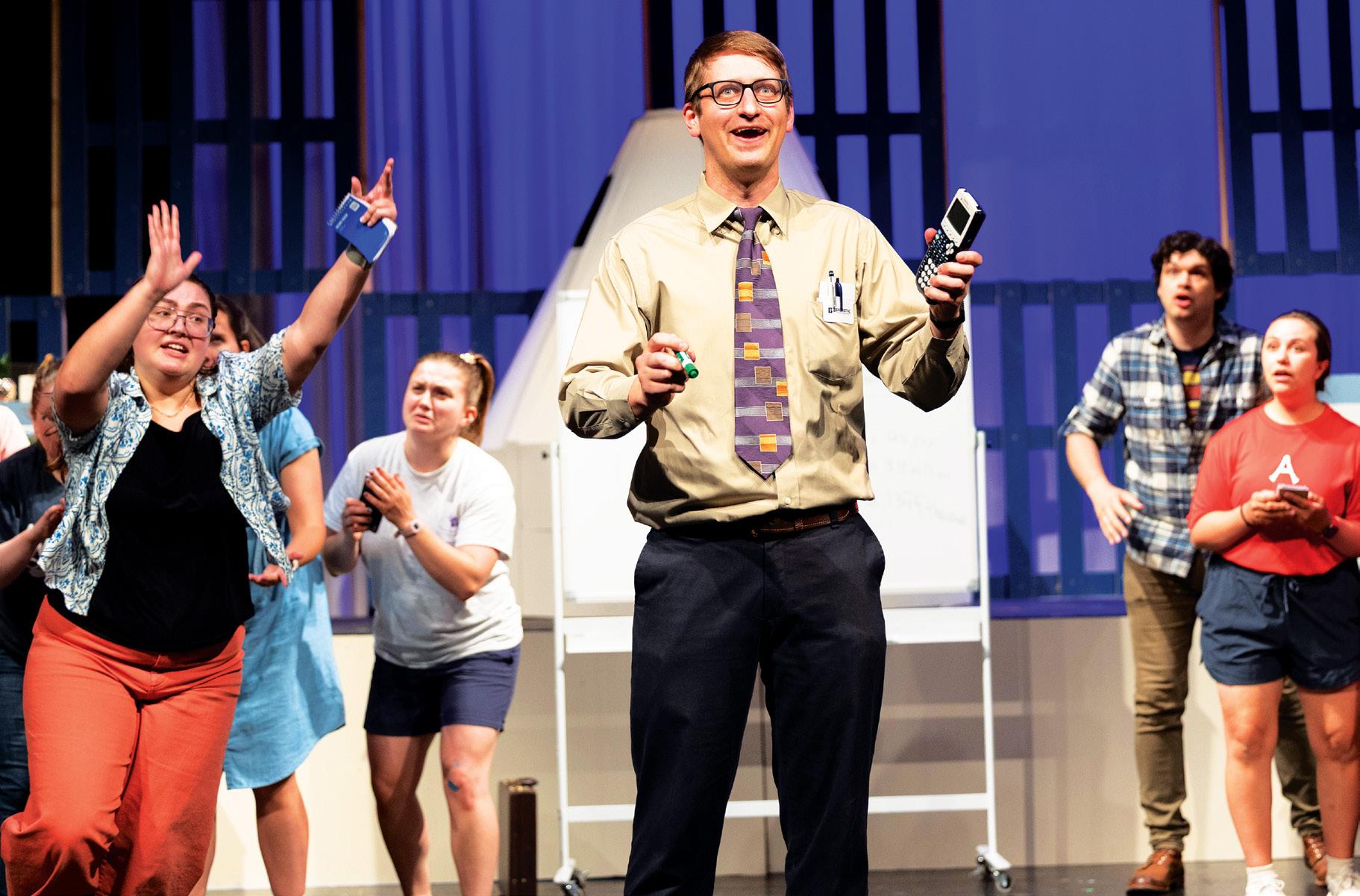
“Moonshot: A Statistically Insignificant Musical” — formerly “Longshot” — tells the story of Melvin, played by Michael Koester, an actuary who helps others avoid risk and faces the harsh reality of a life-altering health diagnosis. He finally takes a chance on all the things he’s missed out on. The second star of the show is Christa, played by Gabi Schafer, who is someone Melvin “can’t write off,” according to the show’s synopsis.
Father Kowalczyk, co-founder and director of mission for the St. Paul-based Catholic theater company Missed the Boat Theatre, reached out to Brooke 10 years
‘that was never going to see the light of day’
ago and received permission to adapt the screenplay for the stage. It was brought to life during the 2025 New Works Festival hosted by Missed the Boat Theatre, in which four plays are read dramatically onstage in front of the playwright, director and an audience.
“It was just a screenplay that was never going to see the light of day. But now that I was doing theater, I could actually bring this to life,” Father Kowalczyk said.
“Moonshot” is showing on two weekends, June 18-21 and June 25-27 at the Helene Houle Auditorium at St. Agnes School in St. Paul. Tickets can be purchased at the Missed the Boat Theatre website.
But bringing “Longshot” to the stage was “no easy task,” he said. Screenplays are written differently than stage plays.
“I had to do a lot of tweaking, and then of course 20 years had gone by,” Father Kowalczyk said. “(T)imes have changed, so I had to change a lot of things there to make it more believable for today.”
One change was to the script’s title. After deliberation, “Longshot” was changed to “Moonshot” — a word coined by President John F. Kennedy, playing off the word longshot, meaning an ambitious project meant to solve a massive problem.
“As the script went on, ‘Longshot’ just didn’t feel right anymore.” Father Kowalczyk said. “So, we had five options of what the title could be, and we solicited the cast and the crew, and we all voted on it. We narrowed it down.”
The finalists were “Longshot,” “Moonshot” and “One in a Billion.”
One of the older crew members, who is around 50 years old, remembered JFK’s use of moonshot.
“Now it just feels right,” Father Kowalczyk said. “Nobody second guesses it.”
Ellie Wagner, Missed the Boat’s marketing and communications director, said part of her role is boiling a story down into one picture, one title. She said the title works
well because it asks the question, “The biggest dream possible, what would it be?”
“You have to think about God’s hand in your life,” Wagner said. “Those two characters (Melvin and Christa) — this show is about them opening up to that — I actually believe that I can be given my moonshot, and that’s not in my control. … I think it’s really resonated in a way with the actors that I think only the title ‘Moonshot’ could have.”
Though Father Kowalczyk is not the original writer of “Moonshot,” he has grown to love the story. The original writer, Brooke, is flying out from Los Angeles to see the show this summer. Father Kowalczyk said that he, Brooke and Chad Berg, the musical’s composer, will be watching the musical opening night together for the first time. Berg was in Missed the Boat Theatre’s first play, “Catholic Young Adults: The Musical,” as the character Tyler. Father Kowalczyk said that sometime after that show, Berg approached him and said he’d be interested in composing any future projects the theatre would create. At the time, Father Kowalczyk was beginning to think about adapting “Longshot” and said, “As a matter of fact, I do.” “He shot me a possible song, I loved it, and we were off and running,” Father Kowalczyk said. “I’ve known this story for so long, and to watch it take a life of its own is so rewarding and life giving,” Father Kowalczyk said. “It’s neat to bring other people into the process and have the actors saying the lines and saying them maybe a little differently than you had thought, but it’s actually better than what you thought. The director (and) the way he envisioned the scene is different than (how) you envisioned it, but it’s actually better than you envisioned it.”
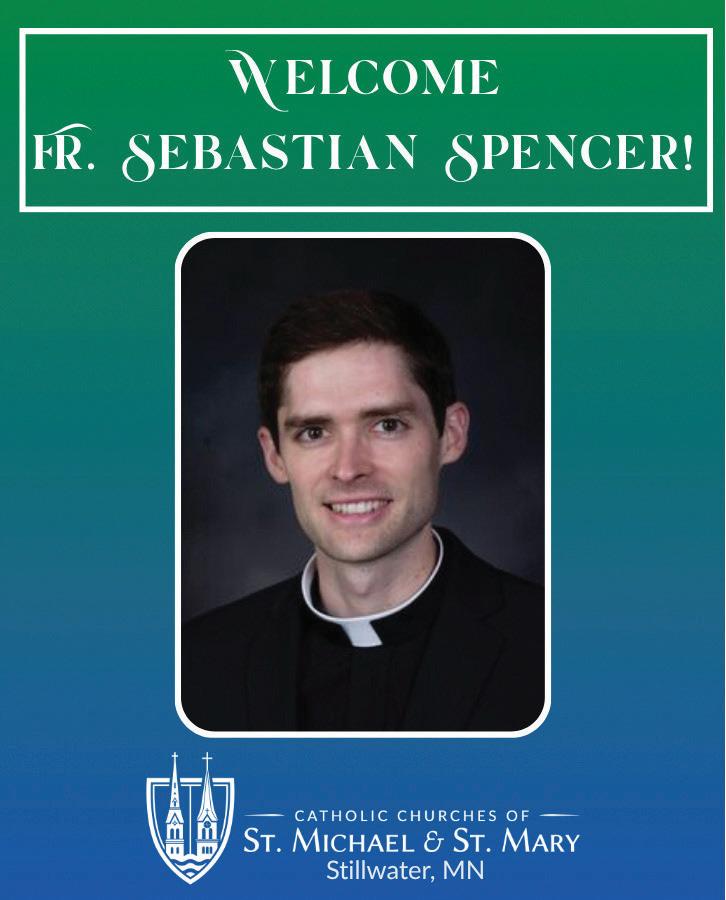
FATHER KYLE KOWALCZYK
DAVE HRBACEK | THE CATHOLIC SPIRIT
Melvin, center, played by Michael Koester, performs a scene from the musical “Moonshot” during a rehearsal June 10 at the
Helene Houle Auditorium at St. Agnes School in St. Paul.
FOCUSONFAITH
SUNDAY SCRIPTURES | FATHER TOULEE PETER LY
‘Fear no one’
Fear is a real thing in our lives that influences the choices that we make dayto-day. When we hear the word “fear,” it may cause us to react in a particular way. I would imagine that the normal response is to prepare for something bad. But is fear in itself a bad thing?
In the Gospel for June 21, we hear Jesus tell his disciples, “Fear no one,” or in another translation, “Therefore do not be afraid of them” (cf: Mt 10:26). This fear that Jesus refers to is exactly what we tend to think of when we hear that word. But Jesus is encouraging his disciples to not allow fear to control them and encouraging us to live as children of God, to prohibit the actions or thoughts of others to cause us to shy away from that life that he has given to all of us.
A great example of this is found in the story of the prophet Jeremiah, which is also part of the readings for June 21. In that passage, we hear Jeremiah exclaim, “I hear the whisperings of
many: ‘Terror on every side!’” This exclamation he gives is in response to the choice he has made, to be our Lord’s prophet in the world. Meaning, he is not only going to live out the life he has been given by God by following his commandments and teachings but also, Jeremiah is going out into the world to proclaim those same things. But, as many prophets have experienced and struggled with, doing so comes with persecution. For Jeremiah, the persecutions aren’t just coming from strangers, but also from his own friends. Thus, again, Jeremiah’s exclamation, “Terror on every side!”
Returning to the Gospel and to Jesus’ words of encouragement, “Fear no one,” Jesus reminds us that just as the prophets of old chose to follow God and go out to the world proclaiming his commandments and teachings, we are called to do the same. We must understand that we will be persecuted by others, including family and friends, but we must trust that God, that Jesus, is with us. Although we may fear suffering bodily or mental harm, we must not forget that we have souls that were made for eternity, which no one can take from us unless we allow them to.
This, then, is a good place to transition to another type of
COMMUNION AND MISSION | FATHER JOHN PAUL ERICKSON
God’s great love for us
Love is a principle of motion. It motivates us and gives us strength to do difficult things. It allows us to keep focused and gives us perseverance despite many obstacles.
I am reminded here of a great quote from a former superior general of the Jesuits, Father Pedro Arrupe. “What you are in love with, what seizes your imagination, will affect everything. It will decide what will get you out of bed in the morning, what you do with your evenings, how you spend your weekends, what you read, whom you know, what breaks your heart, and what amazes you with joy and gratitude.” Indeed.
The source of this love, the place where it is found within the human person, we call the heart. Not the physical heart, of course, though it is significant to the analogy that the heart is what pumps the life-giving blood throughout our bodies, giving power to
Sunday, June 21
Twelfth Sunday in Ordinary Time
Jer 20:10-13
Rom 5:12-15
Mt 10:26-33
Monday, June 22
2 Kgs 17:5-8, 13-15a, 18
Mt 7:1-5
Tuesday, June 23
2 Kgs 19:9b-11, 14-21, 31-35a, 36
Mt 7:6, 12-14
motion and warmth to our limbs. The heart is the place of decision, desire and direction, and it is found deep, deep within. Even our secular love songs bear witness to this. How many songs speak of the longing of the heart, or the truth that the beloved holds the singer’s heart?
For Jesus, this heart is firmly rooted in the will of the Father. For all eternity, the Son has looked upon the face of the Father and has said: Yes! I will do whatever you want. Because you are love.
In the fullness of time, this Son took on flesh and became one of us, because the Father asked him to do so. And this same Son, always in union with the Father, chooses to die for us, because it is the will of the Father. And the Son rose from the grave — because the Father said so. The Sacred Heart of Jesus burns with love for the Father, and it is this great mystery that lies at the heart of our salvation.
The month of June is dedicated to the Sacred Heart of Jesus, and our bishops consecrated our nation to this same Sacred Heart on June 11 as they concluded their annual national meeting in Florida. They did this to ask for Christ’s blessings upon
Wednesday, June 24
Solemnity of the Nativity of St. John the Baptist Is 49:1-6
Acts 13:22-26 Lk 1:57-66, 80
Thursday, June 25
2 Kgs 24:8-17
Mt 7:21-29
Friday, June 26
2 Kgs 25:1-12
Mt 8:1-4
Saturday, June 27
Lam 2:2, 10-14, 18-19
Mt 8:5-17
KNOWtheSAINTS
Sunday, June 28
Thirteenth Sunday in Ordinary Time
2 Kgs 4:8-11, 14-16a
Rom 6:3-4, 8-11
Mt 10:37-42
Monday, June 29
Solemnity of Sts. Peter and Paul, Apostles Acts 12:1-11
2 Tim 4:6-8, 17-18
Mt 16:13-19
Tuesday, June 30
Am 3:1-8; 4:11-12
Mt 8:23-27
fear that we hear throughout the Bible: “fear of the Lord.” A mistake we tend to make is to equate fear of the Lord with the fear of being persecuted or harmed by another. Fear of the Lord does not mean harm; rather, it is a response of love and reverence toward one whom you look up to and have profound respect for, so much so that you fear losing or hurting that person because you understand the value of that person, or in this case, God/Jesus.
When we weigh the fear of others causing us harm (via persecution) with our fear (love) of the Lord Jesus, which of the two is more valuable to us, and which of the two has eternal consequences?
Jeremiah, in the midst of “terror on every side,” could not help but go out and face the fear of persecution from others, because the fear, the love, of the Lord was so strong inside of him that he could not keep it to himself. In our lives, my dear brothers and sisters, have we allowed ourselves to have that encounter with the Lord? To have such a fear, a love, for him that we can share Jeremiah’s resolve and be unafraid, stopping our fears that hold us back from living for the Lord?
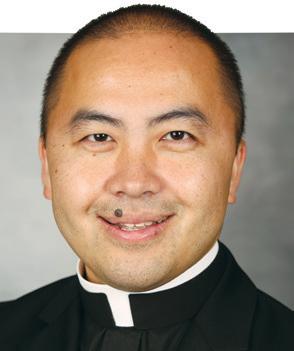
Father Ly is pastor of Presentation of Mary in Maplewood.
our nation, and to make reparation for the many ways that we as a nation have not been grateful for the countless blessings the Father has lavished upon our country in her 250 years.
The heart of Jesus burns for love of us, of course. But we must always remember that Jesus loves us because the Father asks him to do so. This is a source of great consolation, because it means that Christ’s love for us is not based on our personal merits or moral goodness. Christ’s burning love for us, a love that is pierced for our offenses, is motivated by that which he will never deny — the will of the Father, the merciful one. And this is eternal, never to end.
Christ always listens to the Father, and it is the Father who has said of us, his creatures: It is very good. Notice that this assessment by the Father in the Book of Genesis comes long before Adam and Eve have done anything. This is because the Father loves us because we are. And we are because the Father has made us. His love is as simple as that. He loves us because we are.
Because we are loved this way by the Father, we must love one another in the same way.
Wednesday, July 1
Am 5:14-15, 21-24
Mt 8:28-34
Thursday, July 2
Am 7:10-17
Mt 9:1-8
Friday, July 3
St. Thomas, Apostle Eph 2:19-22 Jn 20:24-29
Saturday, July 4
Am 9:11-15
Mt 9:14-17
Christ invites all who are weary and burdened to come to him and to learn from him, and he will give us rest. What is it that we will learn? The love of the Father, who loves us not because we are good but because he is good. In this revelation, we are unburdened of the need to earn God’s love and favor. We are invited to rest in the revelation that we are good. But it is also a liberation from the need to evaluate others and whether they are good. The Christian does not need to ask him or herself whether the other is worthy of affection, love and sacrifice. We are called to love all as we have been loved, without consideration of the merits of the other. They are — therefore they are good. This is a treasure of wisdom and knowledge, found in the burning heart of Christ.
May Christ teach us to love that which he loves — the will of the Father, which is the salvation of the world and the source of our goodness.
Father Erickson is parochial vicar of Nativity of Our Lord in St. Paul and interim chairman of the Archdiocesan Liturgical Commission. Effective July 1, he will be parochial vicar of the Cathedral of St. Paul in St. Paul.
Sunday, July 5
Fourteenth Sunday in Ordinary Time Zec 9:9-10
Rom 8:9, 11-13
Mt 11:25-30
Monday, July 6
Hos 2:16, 17c-18, 21-22
Mt 9:18-26
Tuesday, July 7
Hos 8:4-7, 11-13
Mt 9:32-38
Wednesday, July 8
Hos 10:1-3, 7-8, 12
Mt 10:1-7
Thursday, July 9
Hos 11:1-4, 8e-9
Mt 10:7-15
Friday, July 10
Hos 14:2-10
Mt 10:16-23
Saturday, July 11
St. Benedict, abbot Is 6:1-8
Mt 10:24-33
Sunday, July 12
Fifteenth Sunday in Ordinary Time Is 55:10-11
Rom 8:18-23
Mt 13:1-23
ST. ETHELDREDA (636-679) The daughter of an East Anglian king, this revered Anglo-Saxon abbess, also known as Audrey, is honored liturgically as a virgin, though she was twice married. Etheldreda promised her virginity to God and, supported by St. Wilfrid, took the veil at Coldingham. About 672 on the Isle of Ely she founded a double monastery over which she presided until her death. Many marvels were attributed to her intercession, and “tawdry,” a corruption of St. Audrey, was coined for the showy trinkets sold at the annual fair held in her name. Her feast day is June 23. CNS
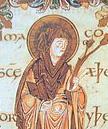
COMMENTARY
ABIDE IN HIM | ANGELA JENDRO
God’s joy
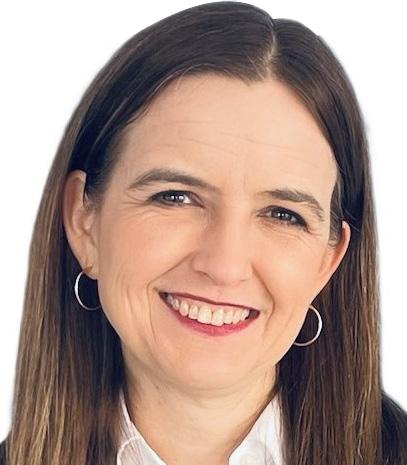
Everyone longs the most for joy — that kind of happiness that dwells deeply in the soul. It includes both the levity of delight and the security of peace, emanating from being loved and loving in return. Even though we only experience a taste of this joy on Earth, it points to its fulfillment in heaven, and more importantly to something about God’s own nature. As Jesus told the disciples: “As the Father loves me, so I also love you. Remain in my love. If you keep my commandments, you will remain in my love, just as I have kept my Father’s commandments and remain in his love. I have told you this so that my joy may be in you and your joy may be complete” (Jn 15:9-11).
It’s hard to imagine God’s joy and it certainly far exceeds our powers of intuition. However, since we are made in his image, we can contemplate this mystery a little bit by reflecting on our own experiences. For example, the deepest joy is being together with the ones we love and the activity of togetherness. Summertime especially provides many opportunities for this, with weddings, family reunions, graduation parties, weekend barbecues and even outdoor recreation with friends and neighbors. There’s an added joy when the
JESUS’ REVOLUTION | COLIN MILLER
The beatitude of heaven will be our joy, and it would seem it’s something of God’s joy, too. ‘For the Lord takes delight in his people’ (Ps 149:4); he delights in you and me.
ones we love share the ones they love with us and vice versa. This must be something of God’s joy in heaven. He will have us all together in one place (every parent’s dream) and will take joy not only in our love for him, but our love for each other as well.
Second, consider how much we delight in God’s creation. Catching sight of a fish jumping, an eagle soaring, a squirrel scurrying, a turtle surfacing, a deer strolling, a loon popping up from the water, the variety of flowers as they bloom, the lushness of the green foliage and so much more. If we take this much joy in nature, how much more joy God takes in watching us, the crown of his creation. “The Lord, your God, is in your midst, a mighty savior; he will rejoice over you with gladness, and renew you in his love, he will sing joyfully because of you” (Zep 3:17). He enjoys seeing how we use our
The new Exodus people
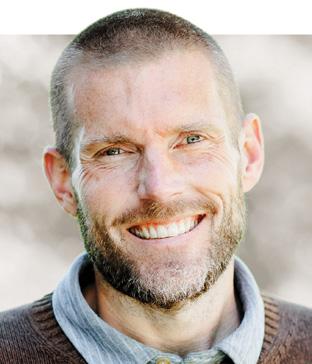
In my last couple columns, I’ve been focusing on the meaning of the Eucharist. Like the original Passover, this ritual meal is both the worship and the identity of God’s new Exodus people. This makes the Eucharist not just an object for pious individual devotion, but our pledge of allegiance to God’s alternative society.
This identity as the Exodus people is important for understanding how the Church is Catholic social teaching. Catholics have usually made use of the Exodus story as an allegory of each Christian’s journey out of the slavery of sin, through baptism in the Red Sea, and ultimately to the promised land of heaven when we die. In other words, we have usually spiritualized and individualized the Exodus, to make it applicable to our personal relationship with God.
I don’t want to deny this spiritualized reading — I think it can be illuminating when placed in the proper context — but I’ll never forget the first time I realized that it can sometimes fall pretty flat.
I was leading a study at my parish about the liturgies of Holy Week. The Exodus story forms a crucial part of the readings for both Maundy Thursday and the Easter Vigil on Saturday evening.
I had just finished recounting some of the connections between the Exodus and the Gospel passages of Jesus’ last days. From a teacher’s perspective, everything was going swimmingly. We were all reveling in reviewing the details of Moses’ calling, the plagues, and the confrontation with Pharoah. It’s such a rich story — a hard-hitting real-life drama of the emancipation of a slave people and their unlikely birth as a real historical sovereign nation. There’s a reason movies like “The Ten Commandments” and “Prince of Egypt” are so popular.
Then somebody asked, “What’s the new Exodus Jesus
freedom, even in the simplest activities of daily life, and especially those done in love. Nature may not notice our observation, yet we thrive from taking it in and are ecstatic when it reciprocates. Even when we fail to notice God’s eyes on us, he still takes joy in looking upon his children and is elated when we look back.
Our own sin and our guilty consciences can struggle to see God in this way at times, viewing him as an angry judge instead, and causing us to hide in fear. God does hate sin with a fearsome anger, but it’s because he loves us — the sinners — so fearsomely much.
St. Paul urges us to view God’s discipline as a gift from a loving Father who wants us to have joy, and to persevere in the battle against sin as Christ did on our behalf: “For the sake of the joy that lay before him he endured the cross, despising its shame, and has taken his seat at the right of the throne
was pointing to at the Last Supper, then?”
I thought for a second, and then my heart sank. This, of course, was the key question. But immediately I sensed how underwhelming my spiritualized answer was going to be. I think I mumbled something like, “Well, the traditional reading is that the Exodus happens to each one of us. We’re freed from sin and the devil and ultimately led to the promised land of heaven.”
But as I said it, you could actually feel in the room a collective sigh of “Bor-ing!” It was like setting up a long joke at a party and totally botching the punchline. I had taken a revolutionary epic and reduced it to a children’s Sunday school lesson. On a shallow level, it made for a lame use of great literature. But over time I came to think there was a deeper challenge in the parishioner’s question.
In the Exodus, God works a visible, social miracle. Something visible actually happened. That’s part of the definition of a miracle that makes it more than just a spiritual occurrence. God brought Israel out of Egypt, and the result was a real living and breathing people. Yahweh had made a sovereign nation out of a bunch of slaves. That’s what makes the story so compelling, and this story continued to be the bedrock of Jewish identity right down to the time of Jesus.
And this is the story Jesus stepped into at the Last Supper. His whole ministry, and especially his last week in Jerusalem, made sense only as part of that story. Here was the Messiah of Israel, the new Moses who had given the crowds bread in the desert, come to Jerusalem with a throng of his followers, confronting the rulers in their capital city, predicting his own death at their hands, and doing so precisely at the Passover meal that each year celebrates the miraculous birth of Yahweh’s new people, and his victory over their enemies.
We’re poised. The new deliverer is here. The new Exodus must be about to happen. Then the Last Supper, and we are right at the brink. We are all on the edge of our seats,
of God” (Heb 12:2). Even our purification, though painful, flows from the intention that we may share in the joy of God’s glory in heaven. As Jesus promised in the beatitudes: “Blessed are you who are now weeping, for you will laugh” (Lk 6:21); and urged us to have confidence in God’s joy at our conversion: “I tell you, in just the same way there will be more joy in heaven over one sinner who repents than over ninetynine righteous people who have no need of repentance” (Lk 15:7). Sin and shame need not turn us away from God’s joy but rather turn us back to him to embrace it.
The beatitude of heaven will be our joy, and it would seem it’s something of God’s joy, too. “For the Lord takes delight in his people” (Ps 149:4); he delights in you and me.
Jendro teaches theology at Providence Academy in Plymouth and is a member of Sts. Peter and Paul in Loretto. She’s also a speaker and writer; her website is taketimeforhim.com
exactly like my parishioner was. When are the plagues going to start? How is the Red Sea going to part this time? It’s the moment we’ve all been waiting for.
At the least, shouldn’t there be some tangible result? At the most, a miracle?
This, I think, as I have reflected on it over the years, was the real crux of our parishioner’s question. I didn’t have an answer then. But I think the Gospels do today. And so, we must ask again, “What is the new Exodus?”
That’s where we’ll pick up next month.
Miller is the director of the Center for Catholic Social Thought at Assumption in St. Paul. He is the author of “We Are Only Saved Together: Living the Revolutionary Vision of Dorothy Day and the Catholic Worker Movement.”
PIVOTAL PECS
“I am getting to meet more men of the parish and learning about their faith journey and the different ways they have encountered Christ. I also get practical examples for dealing with family, prayer, etc.”
Deacon Joel Neisen, 65, Sts. Joachim and Anne, Shakopee
Archbishop Bernard Hebda is encouraging the faithful to experience the small-group model Parish Evangelization Cells Systems (PECS) in their parishes. Designed to strengthen parish life through small groups and encourage parishioners to share their faith and hope in Jesus Christ with each other and then the broader community, it is having an impact. At last count, there are about 2,000 small groups and more than 16,000 participants in 138 parishes across the Archdiocese of St. Paul and Minneapolis. See the opportunities to join a small group at archspm.groupvitals.com/groupfinder.
The sacred heart of parenting
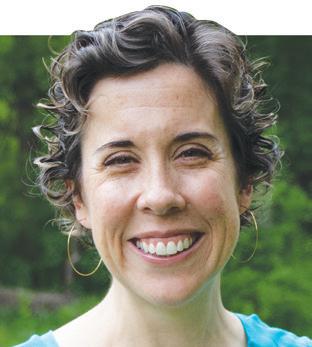
“Making the decision to have a child — it is momentous. It is to decide forever to have your heart go walking around outside your body.”
Over the years I’ve heard so many parents share this quote from Elizabeth Stone, because it speaks to the (literal) heart of raising a child: a calling that involves vulnerability, anxiety, lack of control, and above all, overwhelming love.
But what about the original One who let his (literal) heart be broken open and given to us?
In this month dedicated to the Sacred Heart of Jesus, I’m always struck by the vivid imagery of this title and devotion. Christ is shown holding
Spiritual fathers focus on the 1 thing necessary
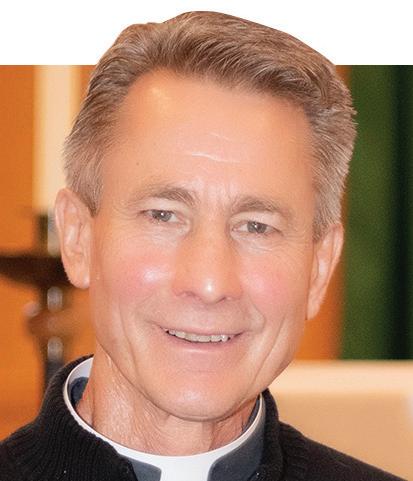
his own heart, pointing to a human heart pierced with thorns, held in his wounded hands, giving his whole self to us in the most visceral way.
What is the holy beat of the Sacred Heart if not the same joyful, painful throb that parents feel the moment a child is placed in their arms, knowing they will forever have their whole heart walking around outside their body?
Every time I speak at a church or conference, parents and grandparents come up afterward and want to tell me their most painful stories. Grief, loss, illness, estrangement, addiction, abuse — I am brought to my knees by what the human heart can hold.
Yet I’m equally amazed by how the heart can heal, mend, stretch, yearn and hope. I have witnessed the resilience and radical love of parents who come to understand that while they cannot control or change their children, they can always come to God with every hope that his love will carry their children through whatever life brings.
My own body bears physical scars and emotional wounds. The deepest pains I have
Given the human condition, no one is (or has ever been) better than Jesus in helping the faithful understand what’s going on in their lives and how to virtuously move forward.
Hopefully, the “not-so-faithful” would heed his words as well. “Ask and it will be given to you; seek and you will find; knock and the door will be opened to you” (Mt 7:7).
Our Lord spoke these words for everyone. There is this verse as well: “The harvest is abundant, but the laborers are few; so, ask the master of the harvest to send out laborers for his harvest” (Mt 9:37).
We’re all supposed to read the Bible and labor in the fields helping lead others to Jesus, who is the one necessary thing. Our chief shepherd helps us with our lifelong mission to know, love and serve God. Right where we are.
Archbishop Bernard Hebda’s pastoral letter, “You Will Be My Witnesses: Gathered and Sent From the Upper Room” was released almost four years ago to help the archdiocese implement
carried are from parenting: the babies I have buried, the wounds my children suffered that I was powerless to stop, and the dreams I had to let die to embrace the real life before me. But the Sacred Heart reminds me that nothing — not even the bruised or broken parts of our lives — needs to be hidden from God, especially not from Jesus who never shielded his own flesh from wounds but laid down his whole life out of love.
The 17th century mystic St. Margaret Mary Alacoque wrote of her intense visions of the Sacred Heart of Jesus: “The divine heart … is an abyss of joy into which all of us can immerse our sorrows … an abyss of love to meet our every need.” She spoke of God’s love and mercy in words that resonate with the unconditional, sacrificial love of anyone who has ever given their life to a child: “The Sacred Heart is an inexhaustible fountain and its sole desire is to pour itself out into the hearts of the humble so as to free them and prepare them to lead lives according to his good pleasure.”
Can we step back to let this sacred
the initiatives discerned from the faithful’s participation in the 2022 Archdiocesan Synod. The letter called for forming parishes that are in the service of evangelization, forming missionary disciples who know Jesus’ love and respond to his call, and forming youth and young adults in and for a Church that is always young.
Fast forward to the archbishop’s latest letter to his flock, “Only One Thing Is Necessary: How Catholic Families Can Strive to Be United in This Life and the Next” (released last month and available at archspm.org/familyletter). In it, he suggests ways to “strengthen our efforts to prepare authentic, healthy Christian life in our families.” He invites the faithful to share our “gifts in service of building a culture” through supporting parents “as the first teachers of their children in the way of the faith.”
Spiritual fatherhood is how Catholic Watchmen strive to do their part, helping the Lord’s children to understand that “only one thing is necessary” in the way of the faith. The movement has always stressed God’s love, first and foremost, and love of neighbor. That is why our patron saint and model is St. Joseph — the epitome of spiritual fatherhood.
Anyone we care for can benefit from our witness and teaching. As parents, grandparents, brothers, uncles, or good friends to any family, we can provide encouragement and support by our leadership. The basics of being a spiritual father are prayer, reading Scripture, attending Mass, serving others, going to confession and having regular fellowship with a band

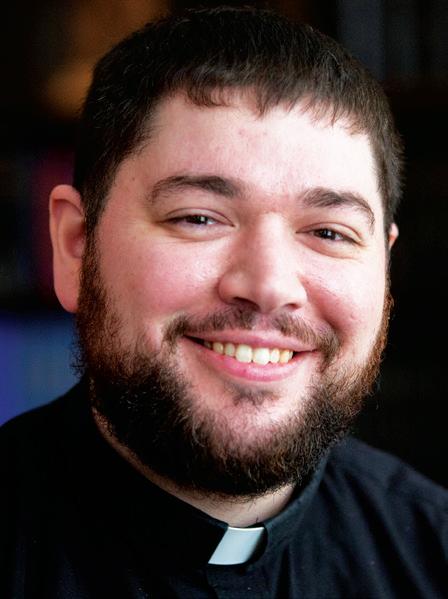
iconography startle us anew? A shining, flaming heart encircled by thorns and topped by a cross. An organ outside the body, outstretched and offered to us. What is Christ saying to us through this image if not the truth that love is costly and painful — yet also the ultimate offering of hope? You cannot see a bleeding heart and turn away unchanged.
We let our hearts walk around outside our bodies, and so does God, the ultimate loving parent.
What a gift to have not just a single solemnity but a whole month — at the sweet start of summer — to celebrate the greatest gift of the Sacred Heart. A heart that cannot contain all the compassion and mercy it offers, spilling over in abundance. A heart that beats for all of us, God’s beloved children walking out into the world, always part of the Body of Christ.
Fanucci, a member of St. Joseph the Worker in Maple Grove, is an author, speaker and founder of Mothering Spirit, an online gathering place on parenting and spirituality at motheringspirit.com. Her latest book is “Living Easter: 50 Days to Practice Resurrection.”
of Christian brothers. Being God’s instrument to help save souls is an endearing and enduring responsibility of spiritual fatherhood.
Jesus chose his disciples and pointed out to them that there are plenty of people who need healing — spiritually and physically. The Apostles were first to pray that God would raise up laborers for his kingdom, and the Lord would send them on mission to heal, pray with and teach those in need. More than 2,000 years later our chief shepherd — our spiritual father who is part of the sacred lineage of apostolic succession — has given us “Only One Thing Is Necessary” to read, reflect and act upon. Archbishop Hebda is directing his flock to bring, grow and sustain a life of faith through the saving grace of knowing Jesus. That not only includes the domestic church representing our homes, but also our parish lives with our clergy, the sacraments, faith formation teachers and catechists, and in small groups. In obedience and humility, take this inspiring and informative letter to Eucharistic adoration and ask the Good Shepherd how you can do your part to witness and teach “the better part” (Lk 10:42).
Deacon Bird ministers to St. Joseph in Rosemount and All Saints in Lakeville and helps with the archdiocesan Catholic Watchmen movement. See heroicmen.com for tools supported by the archdiocese to enrich parish apostolates for ministry to men. For Watchmen start-up materials or questions contact Deacon Bird at gordonbird@rocketmail.com
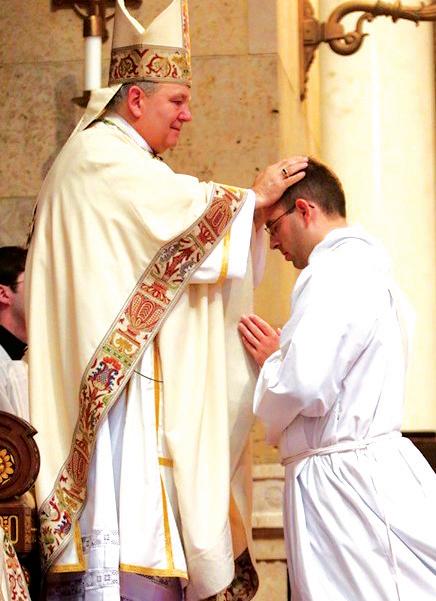

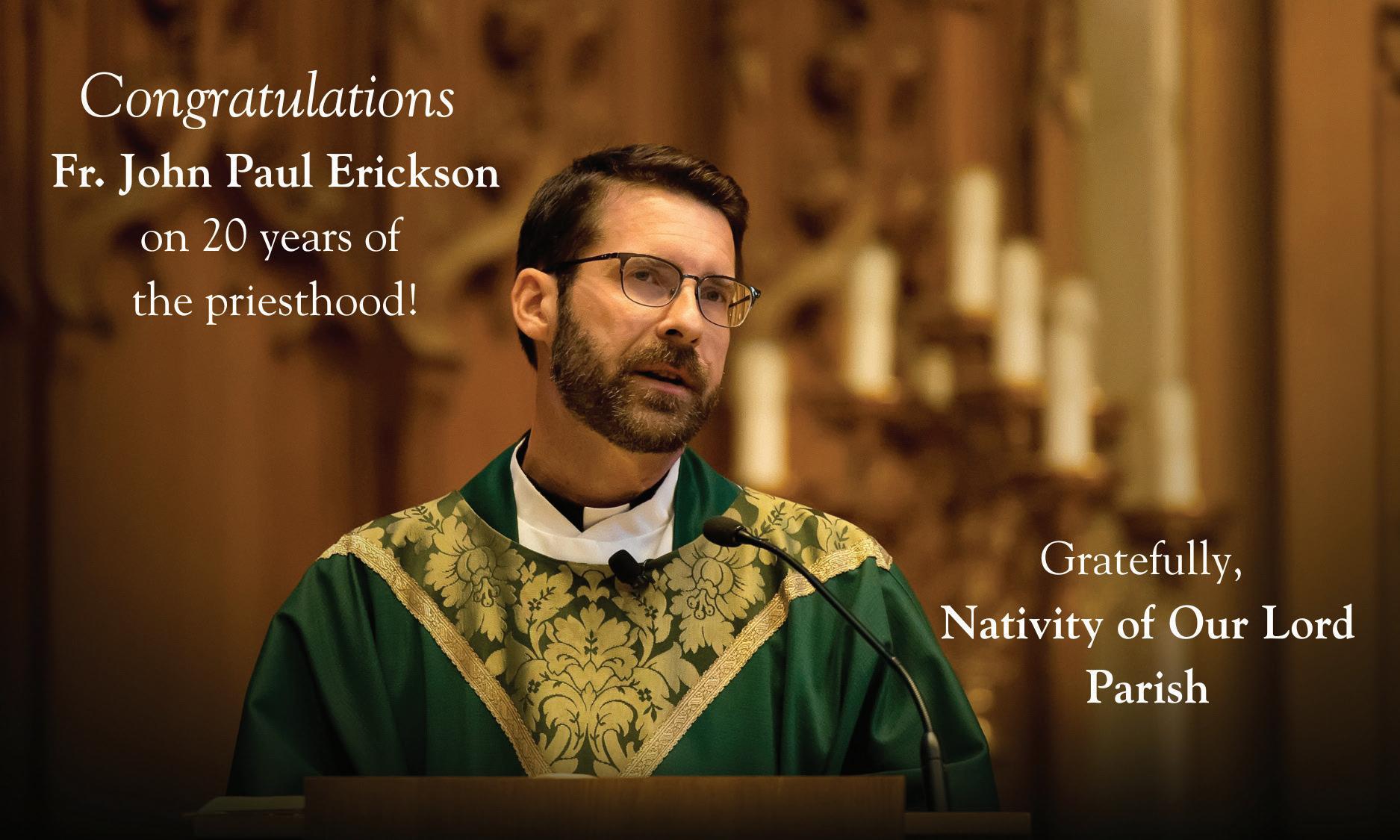
CATHOLIC WATCHMEN | DEACON GORDON BIRD
CALENDAR CONFERENCES+WORKSHOPS
For all calendar items, please visit thecatholicspirit.com/calendar
PARISH EVENTS
St. Gabriel the Archangel Spring Rummage Sale June 25-27: 9:30 a.m.-7 p.m. June 25, 9:30 a.m.-5 p.m. June 26, 9:30 a.m.-12:30 p.m. June 27 at St. Gabriel, 1310 Main St., Hopkins. Use East entrance. $1 bag day June 27. Cash or check only. stgabrielhopkins.org
WORSHIP+RETREATS
Holding On and Letting Go July 11: 9-11 a.m. at St. Paul’s Monastery, 2675 Benet Road, St. Paul. Step away from daily life and step into the labyrinth, an ancient path of contemplation. Enter the quiet rhythm; a single winding path that leads to the center and back out again, reflecting on the theme of “Holding On and Letting Go.” stpaulsmonastery.org/events
An Invitation to Longing Hearts: The Church’s Wisdom for LGBTQ+ experiences June 18: 7-10 p.m. at Our Lady of Grace, 5071 Eden Ave., Edina. Encounter Eden Invitation, a community of striving disciples with LGBTQ+ experiences and those walking with us. This evening will include a talk by Anna Carter, adoration and a social. Registration required and available at the door. tinyurl.com/4vut8n66
Discovering Benedictine Values June 25; July 9, 23; Aug. 6, 20: 7-8:30 p.m. Zoom event hosted by St. Paul’s Monastery. An online series featuring a different speaker each week highlighting a foundational Benedictine subject: deep listening, humility, hospitality, community, stewardship, justice, respect for persons, stability and others. $20 per individual session or $140 for all sessions. tinyurl.com/ms5azeyt
SCHOOLS
Transfiguration Tiger Classic Golf Tournament June 20: noon-7 p.m. at Applewood Hills Golf Course, 11840 60th St. N., Stillwater. Join us for the third annual Tiger Classic Golf Tournament to support Transfiguration Catholic School. For more information go to tinyurl.com/2s46h2n2
clicks into place?
or three are gathered, the Lord is in their midst.” That applies to our daily work — administrative work and decision-making just as much as anywhere else. Archbishop (Hebda) has really fostered that here, and he models it by his own example. That helps a lot.
Q It sounds like you’re challenged to be your best self — and a lot of self-awareness is needed.
A Right! And I think of a lot of people around the (Archdiocesan) Catholic Center would say the same thing. Sometimes I might feel a little lazy — “just tell me what to do and tell me what paperwork to draw up.” You can get in that space sometimes, and the archbishop won’t let you stay there. He really makes us rise to the occasion, and everybody is better off for it. It’s really beautiful.
YOUNG ADULTS
Young Adult Evening Prayer June 23: 7-8 p.m. on Zoom. Experience evening prayer in the gentle rhythm of the Liturgy of the Hours (Psalms, Scripture and intercessions) with other young adults and School Sisters of Notre Dame from around the U.S. and Canada. ssnd.org/events/6-23-26/
ONGOING GROUPS
Restorative Support for Victims-Survivors Monthly: 6:30-8 p.m. via Zoom. Open to all victimssurvivors. Victim-survivor support group for those abused by clergy as adults first Mondays. Support group for relatives or friends of victims of clergy sexual abuse second Mondays. Victim-survivor support group third Mondays. Survivor Peace Circle third Tuesdays. Support group for men who have been sexually abused by clergy/religious fourth Wednesdays. Support group for present and former employees of faith-based institutions who have experienced abuse in any of its many forms second Thursdays. Visit archspm.org/healing or contact Paula Kaempffer, outreach coordinator for restorative justice and abuse prevention, at kaempfferp@archspm.org or 651-291-4429
A Yes, I can think of many examples when that happens and there’s a peacefulness and sense of clarity. Other times we just don’t have enough information, so we’re trying to advise on a decision and circling around, lacking some key information. Then we have to go back and do that consultation, ask the questions, go talk to these people and color this in a bit more.
Sometimes we have the luxury of time. We can let something sit, especially a more complex issue. We like to take that time and look for those signs of the Holy Spirit in the decision-making. Some of those signs are a consensus, a sense of peace, serenity — versus confusion and anxiety and panic. Those aren’t signs of the Holy Spirit.
Q To ask the questions means you have to shut up and really listen to the answer.
CALENDAR submissions
DEADLINE: Noon Thursday, 14 days before the anticipated Thursday date of publication. We cannot guarantee a submitted event will appear in the calendar. Priority is given to events occurring before the issue date.
LISTINGS: Accepted are brief notices of upcoming events hosted by Catholic parishes and organizations. If the Catholic connection is not clear, please emphasize it in your submission. Included in our listings are local events submitted by public sources that could be of interest to the larger Catholic community.
TheCatholicSpirit.com/ calendarsubmissions
humility and respect for the person you’re listening to. I’m actually going to listen to what you say and take it seriously and find a way to adapt to that.
Q Is there ever a light-bulb moment where a decision just
It also requires humility to revisit a decision after it’s been made. We try our best to make the right decision, but sometimes after a decision is made, you realize it’s not having the benefit it should have, so you go back and re-evaluate. That’s something that Archbishop (Hebda) has modeled well for us, his openness. He wants to get it right, and he doesn’t care about being embarrassed. It’s huge, and it’s a big relief for us, as we’re advising him. We can have an honest conversation if it turns out it wasn’t the right thing. How do we pivot? We don’t get so dug into saving face that we’re unwilling to revisit something. He doesn’t instill a culture of fear or perfection. It’s the opposite — that collaboration, that consensus-making process. DEANERIES
A Right, you have to be open to the answer. You need trust and
(651) 227-2469
Timothy J. Scott, J.D. Wills, Trusts, Estate Planning & Probate timothy@tjslawoffice.com 952-521-5950 SJBG MBR
Virginia Ryan, Attorney at Law Trusts, Wills, Probate, Real Estate 600 Inwood Ave. N #130; Oakdale, MN 55128 (651) 631-0616 www.virgielaw.com.
CATHOLIC BUSINESS DIRECTORY
300 Local Catholic Owned Businesses stjosephslist.com SJBG
CATHOLIC BUSINESS GUILD
sjbusinessguild.com 612-363-2905
Connections - Customers - Jobs - Mentors
CEILING TEXTURE
Michaels Painting Popcorn Removal & Knock Down Texture TextureCeilings.com (763) 757-3187
CEMETERY LOTS FOR SALE
Resurrection Cemetery: Section 25; single grave. $1200 314-857-4933
Resurrection Cemetery: 5 graves; Section 13, Block 25, Lots 19, 20. Value: $2635/ea. Price: $1800/ea. 612-710-8697
CHIROPRACTOR
Mind & Body Chiropractic * Dr. Kuznia $80/mo. Indiv. * $120/mo. Family * SJBG mindbodychiropractic.com/ 651-600-3521
COFFEE
Edge Coffee Company 612-504-1954 Fair Trade & Organic - no mycotoxins edgecoffeecompany.com SJBG MBR
COMMUNITY ORGANIZATIONS
CLUES celebrating 45 years. Rooted in Community. Rising together. Help us raise 1 million dollars to support Latinos affected by Operation Metro Surge Clues.org/donate | 651-379-4258
COWORKING SPACE
Quarry Catholic Coworking - SJBG quarrycoworking.com 612-363-2905
EMPLOYMENT OPPORTUNITIES
Trojack & Associate Law Office, P.A., located in West St. Paul, MN, is seeking a legal assistant/paralegal. This is a part-time position with responsibilities including drafting correspondence, scheduling appointments, and tracking deadlines. To apply please submit a cover letter and resume to: John.Trojack@TROJACKLAW.COM.
GRAPHIC DESIGN
Graphic Design, Branding & Marketing sophia@mcgoverncreative.me SJBG MBR GOLD & SILVER BULLION
Verify, Exchange, Advise, Educate ⚖ Sølvency Bullion Exchange • SJBG 1128 Grand Ave, Saint Paul, MN 55105 651-404-7712 • https://solvency.trade USE SILVER & GOLD AS MONEY TODAY!
FINANCIAL PLANNERS
Win-A-Key to Unlock Your Retirement Income yourretirementkey.com 763-290-1420 Susan Wieneke, financial advisor SJBG
HARDWOOD FLOORS MintHardwoodFlooring.com Installation, Refinishing, Repairs Mark Schroeder: 612-987-5175 HEALTH CARE

THE FAMILY CLINIC, LLC
Direct Primary Care • Functional Medicine 651-400-1554 • info@mnfamilyclinic.com INSURANCE
Home, Auto, Business, Life, Annuities, 401k Rollovers,
Home Loans with Honesty & Integrity Matko Lending LLC; NMLS# 2656175 matkolending.com/952-484-1613 (call/text) Residential Mortgage Lending in MN & WI Conventional, FHA and VA NMLS #422758 Christopher.Burr@rcu.org 651-202-1367 NETWORKING ORGANIZATIONS
Business Builders - Faith Based Networking
THELASTWORD
Archbishop Lori: Sacred Heart reconciles divisions and transforms hardened hearts
By Jean Gonzalez OSV News
Asea of white robes and zucchettos of pink and magenta in the pews. A statue of Jesus welcoming the faithful with his exposed Sacred Heart upon the foot of the altar.
A setting fit for a June 11 Mass that united U.S. bishops gathered for their spring plenary June 10-12. After concluding the second of two days of public sessions, they left the Omni Resort in ChampionsGate for a halfhour drive up Interstate 4 for the spiritual refuge that is the Basilica of the National Shrine of Mary, Queen of the Universe in Orlando.
And the Mass was a momentous one as it served to formally consecrate the United States to the Sacred Heart of Jesus, as part of the celebration of the 250th anniversary of the signing of the Declaration of Independence.
Archbishop Paul Coakley of Oklahoma City incensed the altar after processing in from the thick humidity and cloudy sky of a typical Orlando afternoon outside the shrine. The president of the U.S. Conference of Catholic Bishops was joined on the altar by bishops and deacons of the Orlando Diocese.
“Clothe us, Lord God, with the virtues of the heart of your son, and set us aflame with his love,” the archbishop prayed in opening the Mass.
More than 200 bishops were present, along with about 150 observers, mostly benefactors and staff of the Diocese of Orlando. The monstrance used ahead of Mass for Eucharistic adoration was provided by the Servants of the Pierced Hearts, a Miami-based religious institute.
The relics of St. Margaret Mary Alacoque — the French Visitation sister who experienced visions of Jesus revealing his Sacred Heart — were also present at the Mass, on loan for the consecration from the Knights of Columbus.
In his homily, Archbishop William Lori of Baltimore described the Sacred Heart of Jesus not as an “abstract devotion,” but as a “visible sign of love.”
He explained why the Church consecrates, describing it as an act of faith and acknowledgment of the need for God’s mercy, wisdom and guidance. It is also an act of hope. It is “a heart that has known joy and sorrow, friendship and betrayal, suffering and sacrifice,” he said.
The act of consecration is an act of faith and hope, the archbishop said, but it is also an acknowledgment of God’s faithful work and love in the world and how we as people and as a Church have not always “clearly reflected that love.”
“Indeed, it is sometimes obscured almost beyond recognition,” the archbishop added. “To be sure, there have been moments of extraordinary witness and holiness. But there have also been moments of failure, division and sin. Consecration requires the humility to acknowledge both.”
And why the Sacred Heart? Because it reveals a savior who “desires not merely our obedience, but our friendship; not simply our service, but our communion with him,” he said.
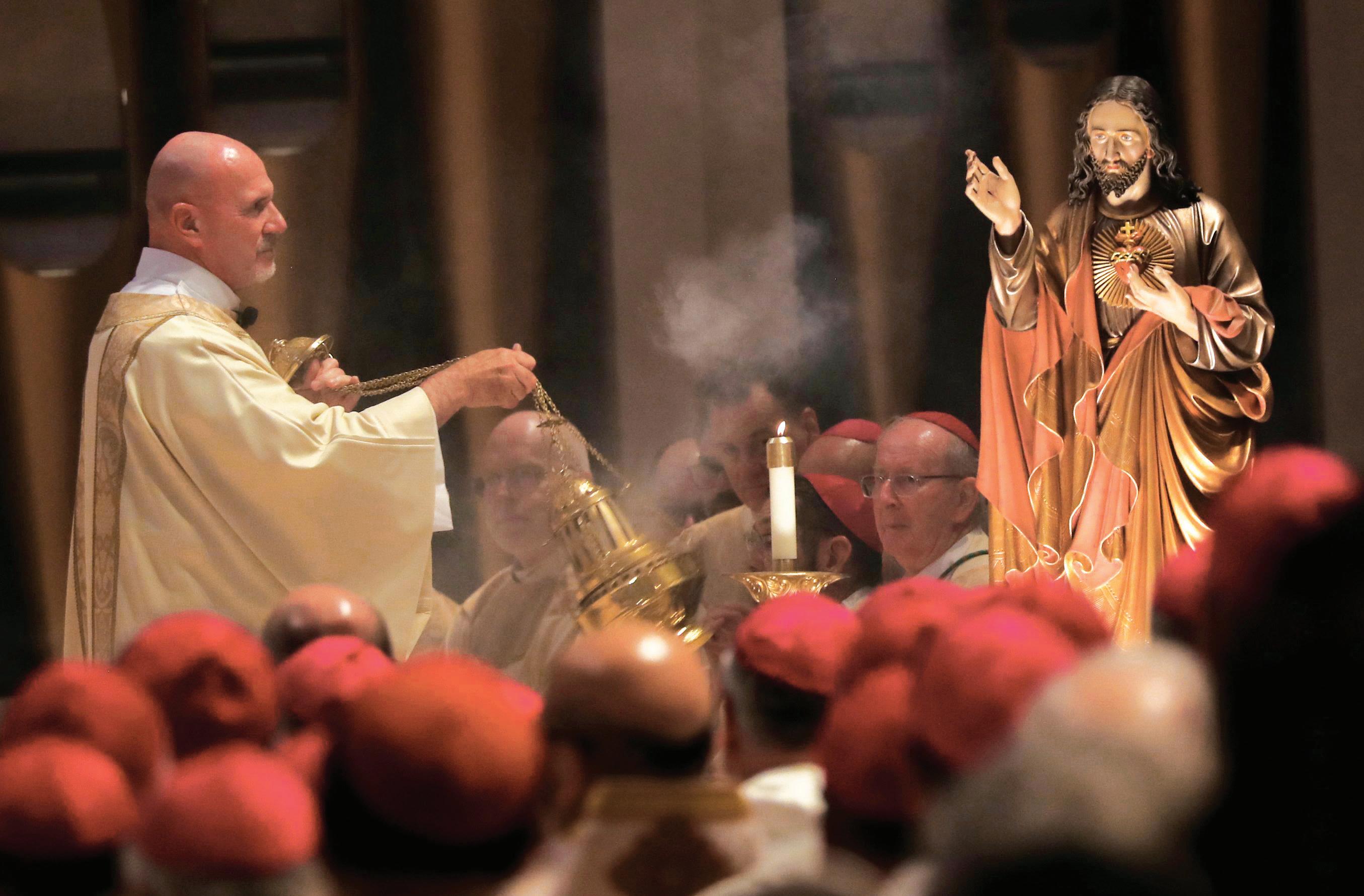
A clergyman swings a censer near a statue of the Sacred Heart of Jesus as U.S. Catholic bishops consecrate the country to the Sacred Heart at the Basilica of Mary Queen of the Universe in Orlando, Fla., June 11 during their spring plenary assembly.
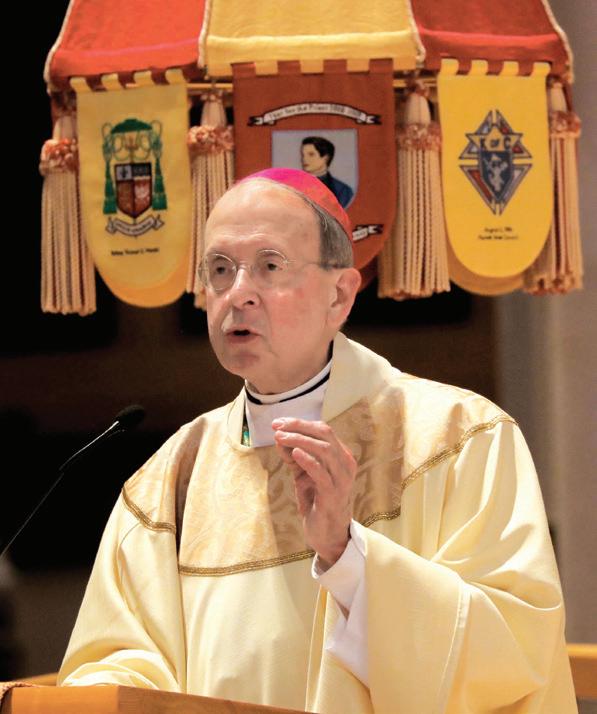
OSV NEWS PHOTO | BOB ROLLER
Baltimore Archbishop William Lori delivers the homily as the U.S. Catholic bishops consecrate the country to the Sacred Heart of Jesus at the Basilica of Mary Queen of the Universe in Orlando, Fla., June 11 during their spring plenary assembly.
“To consecrate ourselves to the Sacred Heart is ultimately to accept Christ’s invitation to remain in his love and to allow that love to shape every aspect of our lives, public and private,” Archbishop Lori said. “It is a declaration that the future does not belong merely to political movements, economic forces or human plans. The future belongs to God.”
The act of consecration does not just happen among the shepherds, but also the sheep. In speaking to the laity both in the pews at the shrine and watching
HEARTS ON FIRE
Before the consecration of the United States to the Sacred Heart of Jesus, Archbishop Bernard Hebda told the U.S. bishops during an assembly that suffering experienced in the Twin Cities cannot be undone.
Such suffering included a shooting during an all-school Mass at Annunciation in Minneapolis Aug. 27, taking the lives of students Harper Moyski and Fletcher Merkel, and the deaths of Renee Good and Alex Pretti during “Operation Metro Surge” and “the young mom, Nicole Amor, from our area who was killed in a drone strike in Kuwait while serving our country.”
“As much as Bishop (Michael) Izen and Bishop (Kevin) Kenney, the priests of our archdiocese and I would desire to undo the tragic events … we cannot,” Archbishop Hebda said.
The USCCB’s annual Spring Plenary Assembly was held in Orlando, Florida, June 10-12. The bishops consecrated the United States to the Sacred Heart of Jesus June 11 to coincide with the nation’s semiquincentennial. Archbishop Hebda spoke to his fellow bishops during an assembly before the Mass.
“Brothers, the reality is that even the hearts of bishops can be hardened. Sometimes it’s because of sin, sometimes it’s because of neglect or laziness. Soon-to-be beatified Bishop Fulton Sheen noted that physical idleness deteriorates the mind. Spiritual idleness deteriorates the heart. But sometimes the hardness is a result of a choice that we make to put up walls.”
Painful situations in ministry can lead priests and bishops to put up barriers, the archbishop
said, in order to be strong for others.
on the livestream, Archbishop Lori said the act of consecration is one the faithful and leaders do together.
“This consecration is not something the bishops do for you. It is something we do together,” he said. “The renewal of the Church and our nation will not come through declarations alone. It will come through disciples who remain in Christ’s love and bear the good fruit of holiness in families, parishes, communities and in their daily lives.”
The Sacred Heart reconciles divisions and transforms hardened hearts, the archbishop said.
“It means building communities — ecclesial and civil — where truth is proclaimed clearly and charity is practiced generously. It means resisting the temptation to define ourselves by division, ideology or resentment,” Archbishop Lori said. “We consecrate our nation, not because it is perfect, but because it is beloved by God. We entrust to the Heart of Christ our achievements and failures, our hopes and anxiety, our present challenges and our future aspirations.”
Gonzalez is an editor with Florida Catholic Media.
“But often it’s just to insulate ourselves from feeling pain,” Archbishop Hebda said. “Whether that be the pain of a brother priest struggling in his vocation, or of a family grieving the tragic loss of a child, or of a survivor sharing an experience from their childhood of abuse. The crustiness of our heart might help us to get through the day, but it does nothing to communicate to others the love that pours forth from the Sacred Heart of Jesus. And isn’t that what our sisters and brothers need most? That encounter with the love of a God who made himself vulnerable for us, who truly holds out to us, as in St. Margaret Mary’s vision, his beating wounded heart, and who desires to walk with us in his suffering.”
Archbishop Hebda said that “we can bring those who are hurting” to the Sacred Heart of Jesus “to have their hearts enlivened by the one who knew suffering like none other, the one to whom we are consecrating our nation this afternoon.”
Archbishop Hebda said that to be conduits for that love, “we have to be willing to hold out our hearts no matter how painful,” and “demonstrate how our hearts have first been molded, softened and enlivened by an encounter with the Sacred Heart of Jesus.”
“If we approach the heart of Jesus on fire with his love, it’s going to set even our dry or hardened hearts on fire,” Archbishop Hebda said.
Josh McGovern, The Catholic Spirit
OSV NEWS PHOTO | BOB ROLLER