August 6, 2026 • Newspaper of the Archdiocese of Saint Paul and Minneapolis
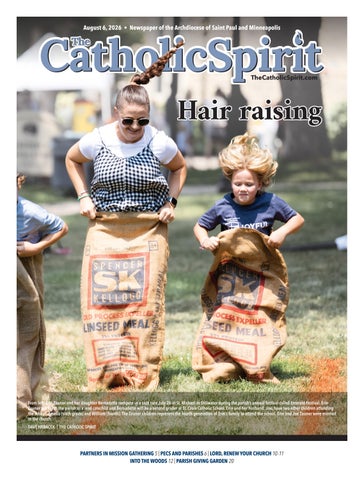
Hair raising TheCatholicSpirit.com
From left, Erin Zauner and her daughter Bernadette compete in a sack race July 26 at St. Michael in Stillwater during the parish’s annual festival called Emerald Festival. Erin Zauner works for the parish as a lead catechist and Bernadette will be a second grader at St. Croix Catholic School. Erin and her husband, Joe, have two other children attending the school: Amelia (sixth grade) and William (fourth). The Zauner children represent the fourth generation of Erin’s family to attend the school. Erin and Joe Zauner were married in the church. DAVE HRBACEK | THE CATHOLIC SPIRIT
PARTNERS IN MISSION GATHERING 5 | PECS AND PARISHES 6 | LORD, RENEW YOUR CHURCH 10-11 INTO THE WOODS 12 | PARISH GIVING GARDEN 20
2 • THE CATHOLIC SPIRIT
AUGUST 6, 2026
PAGETWO
OVERHEARD
COURTESY MELISSA STREIT, BASILICA OF ST. MARY
CARITAS COMMITMENT Natasha Sager of St. Paul in Ham Lake made her definitive dedication to the Caritas Christi Secular Institute July 22 at Christ the King Retreat Center in Buffalo, with Archbishop Bernard Hebda celebrating Mass. “Members are laywomen consecrated to Christ while living in the heart of the world,” according to the institute’s website. They do this through prayer, service and witness. Sager said she and her fellow members are called to be “leaven in the dough,” bringing the love of Jesus into the ordinary places of everyday life. Sager serves the parish of St. Paul by helping at Vacation Bible School, religious education, small groups and other parish ministries. Behind Sager is Thérese Druart, a fellow member of Caritas Christi.
PRAYER CARD FOR BISHOP KENNEY Two parishioners of the Basilica of St. Mary in Minneapolis sign a card wishing Bishop Kevin Kenney well as he prepares for treatment for lung cancer. The Basilica is inviting people through Aug. 9 to sign the poster-card in the Basilica’s Pope John XXIII Gallery after weekend Masses. On July 15, Bishop Kenney’s cancer diagnosis was announced in a video to the faithful of the Archdiocese of St. Paul and Minneapolis with Archbishop Bernard Hebda and Bishop Michael Izen. Thousands of people on social media reacted to Bishop Kenney’s health news by sharing their support. “Our Basilica community holds him (Bishop Kenney), his medical team, the parish of Saint Olaf Catholic Church, Downtown, Minneapolis, MN, our Archdiocese of Saint Paul and Minneapolis, and all those who care for him in prayer for successful treatment and a full recovery,” a Facebook post from the Basilica said.
uman trafficking is modern-day slavery and a scourge on our H collective humanity. Nearly 27 million people worldwide are trapped in forms of forced labor and human bondage, and Americans in all 50 states have been victimized as well. Rep. Kweisi Mfume, D-Md., said as he and Chris Smith, R-N.J., announced July 30 they will form and co-chair a new caucus in the U.S. House aimed at the prevention of human trafficking. The Frederick Douglass Trafficking Victims Protection and Prevention Caucus — named in honor of the abolitionist and statesman — will work to advance legislation to prevent human trafficking, prosecute traffickers, strengthen support and protection for victims, and facilitate greater cooperation to prevent the trafficking through partnerships between government, law enforcement, private and faith-based organizations. “I am honored to announce the formation of the Frederick Douglass Trafficking Victims Protection and Prevention Caucus alongside my Co-Chair, Rep. Mfume, who is fiercely committed to ending the modern-day slavery that is human trafficking,” Smith, a Catholic and longtime lawmaker, said in a statement. “We owe it to every survivor and victim to pass comprehensive anti-trafficking legislation out of the Congress and send it to the President’s desk,” Mfume said. “This Caucus and anti-trafficking organizations across the country represent proof of our collective intention to get that done, no matter how long it takes.” Smith added, “Human trafficking is an ever-evolving crime, as traffickers are constantly finding new ways — both in-person and virtually — to exploit, manipulate, and abuse victims. To meet these changing and challenging demands, this Caucus will work tirelessly to advance new anti-trafficking legislation — especially and including the Frederick Douglass Trafficking Victims Prevention and Protection Act of 2025 (HR1144), which Rep. Mfume and I introduced earlier this Congress — that uplifts and empowers survivors and raises awareness of this global problem.” Smith and Mfume urged the House to promptly take up HR1144 for debate and a vote. The Frederick Douglass Trafficking Victims Protection and Prevention Caucus will also be bicameral, Smith’s office said, as Sen. Marsha Blackburn, R-Tenn., plans to form a complementary caucus in the Senate. If enacted, HR1144 would “reauthorize and bolster anti-human trafficking programs across numerous federal agencies, including the State Department, Department of Justice, Department of Homeland Security, and Department of Health and Human Services; ensure robust prosecutions for human trafficking crimes, along with thorough investigations and jail time commensurate with the crime; and authorize the first-ever housing program for survivors ensuring wrap-around case management, including education, life skills training, mental health services, and employment assistance,” Smith’s office said. — OSV News
NEWS notes Annunciation Light Alliance — a group of parents from Annunciation in Minneapolis — and other groups concerned about gun violence plan to meet from 9 a.m. to noon Aug. 8 at St. Timothy in Blaine. Retired Father Paul Feela will talk about faith in light of the issue. Minnesota-based gun violence prevention organization Protect MN is organizing the morning of prayer, spiritual reflection, conversation and action. As part of its multi-phase restoration work, the Basilica of St. Mary in Minneapolis provided an update on social media July 25 that painters from EverGreene Architectural Arts — which bills itself as the nation’s largest specialty contractor for restoration and historic preservation — were working on the ceiling. The painters “brought back the first strokes of blue to The Basilica’s magnificent ceiling,” the social media post stated. “This radiant blue represents Mary and restores vibrancy to the architectural details overhead.” During the next nine months, according to the Basilica’s post, craftspeople will carefully restore the details. “As layers of paint are uncovered throughout the restoration, original decorative details continue to emerge,” the post stated. “Each discovery helps guide the restoration, bringing the ceiling back to the beauty seen at the first Mass in 1914.” The restoration project at the Basilica is receiving funds from the Basilica’s Restoring Beauty, Inspiring Hope campaign and the Archdiocese of St. Paul and Minneapolis’ Lord, Renew Your Church campaign. COURTESY JEAN MICHAELS
Practicing CATHOLIC Produced by Relevant Radio and the Archdiocese of St. Paul and Minneapolis, the July 31 “Practicing Catholic” radio show on Relevant Radio 1330 AM included Archbishop Bernard Hebda talking about burnout, ambition and trusting in God. The program also featured Jason Adkins from the Minnesota Catholic Conference in an interview about his new role as president of the National Association of State Catholic Conference Directors. Listen to interviews after they have aired at practicingcatholicshow.com or choose a streaming platform at Spotify for Podcasters.
The Catholic Spirit is published semi-monthly for The Archdiocese of Saint Paul and Minneapolis Vol. 31 — No. 15 MOST REVEREND BERNARD A. HEBDA, Publisher TOM HALDEN, Associate Publisher JOE RUFF, Editor-in-Chief REBECCA OMASTIAK, News Editor
The University of St. Thomas’ Lee and Penny Anderson Arena in St. Paul has been named Project of the year by Finance and Commerce — a Minnesota business newspaper — as part of its Top Projects of 2025: Best of the Best awards. The awards recognize Minnesota’s top construction projects. The 167,000-squarefoot arena opened in 2025 and is home to the university’s men’s and women’s hockey and basketball teams. It also serves as a “hub for campus and community events,” the University of St. Thomas wrote on its website.
CORRECTION The religious jubilarians list published in the July 9 issue of The Catholic Spirit did not include Sister Mary Louise Dolezal of the Sisters of St. Francis of Our Lady of the Angels, celebrating 60 years of religious life. Thank you, Sister Mary Louise, for your many years of faithful service!
Materials credited to CNS copyrighted by Catholic News Service. Materials credited to OSV News copyrighted by OSV News. All other materials copyrighted by The Catholic Spirit Newspaper. Subscriptions: $29.95 per year; Senior 1-year: $24.95. To subscribe: (651) 291-4444; To advertise: Display Advertising: (651) 251-7714; Classified Advertising: (651) 251-7714. Published semi-monthly by the Office of Communications, Archdiocese of St. Paul and Minneapolis, 777 Forest St., St. Paul, MN 55106-3857 • (651) 291-4444, FAX (651) 291-4460. Periodic als postage paid at St. Paul, MN, and additional post offices. Postmaster: Send address changes to The Catholic Spirit, 777 Forest St., St.Paul, MN 55106-3857. TheCatholicSpirit.com • email: tcssubscriptions@archspm.org • USPS #093-580
AUGUST 6, 2026
THE CATHOLIC SPIRIT • 3
FROMTHEBISHOP ONLY JESUS | BISHOP MICHAEL IZEN
Praying in nature
I
just returned from a weeklong summer vacation at a cabin. It seems I’m not too unique when it comes to this. Many Minnesotans find the month of July to be a good time to get away for a little while, and in our beautiful state, you don’t need to go far. Personally, the cabin I enjoy is only about an hour outside the Twin Cities. I know July is also a popular month for many of our archdiocesan employees to get away for a week. From my experience as a parish priest, where for 18 consecutive years I had a parish school, I know July is the only month that a Catholic school principal can get away for an extended time. Even the Holy Father — whether it’s Pope Leo or the many pontiffs before him — typically enjoys a significant vacation during the month of July. A particular emphasis of this edition of The Catholic Spirit is the great outdoors and how nature can give a boost to our spiritual lives. This has certainly been my experience. I have been going to my sister’s cabin for more than 15 years now. I remember when my dear sister and her husband were shopping for a cabin, she specifically said to him, “I want to find a place where Mike can take his priest friends during the summer.” It was a generous thought, and my sister and brother-in-law have been even more generous in their actions. This year especially, I found myself able to enter more deeply into my time with the Lord. For the most part, the week consisted of three priests, including myself, enjoying time together at the lake. Sometimes priests came and went, and at one point we maxed out at four priests for a short stretch. Our routine is such that we choose to keep to
W hether it’s a priest vacation or a family vacation, giving our first fruits to the Lord is always a good idea. It need not be the whole morning. But if we don’t spend some time with Jesus before the day’s activities begin, we may find that the day simply slips away. iSTOCK PHOTO | CALAMITY_JOHN
ourselves during the morning hours, almost like a retreat. I pray my typical Holy Hour in the presence of the Lord in the Blessed Sacrament. Then I spend an additional hour on the dock, praying with our Lord in the beauty of nature. Depending on the morning weather, sometimes I start in the “bedroom chapel,” and other times I begin on the dock. In any case, the time outside by the lake was peaceful, filled with loon calls, jumping fish and beautiful sunrises. I was typically out there early enough that there were few boats, people or other distractions. It is a great gift to pray two Holy Hours every morning, but it also turned out to be very practical. You might be thinking, “Of course, Bishop Izen, you’re a bishop. You can handle two Holy Hours.” But I think there is a lesson here for all of us. When we go on vacation, the last thing we want to
Orando en la naturaleza
A
cabo de regresar de unas vacaciones de verano de una semana en una cabaña. Parece que no soy tan único en esto. Muchos habitantes de Minnesota consideran que el mes de julio es un buen momento para alejarse por unos días y, en nuestro hermoso estado, no hace falta ir muy lejos. Personalmente, la cabaña que disfruto está a solo una hora de las Ciudades Gemelas. Sé que julio también es un mes popular para que muchos de los empleados de nuestra arquidiócesis tomen una semana de descanso. Por mi experiencia como párroco, donde durante 18 años consecutivos tuve una escuela parroquial, sé que julio es el único mes en el que un director de escuela católica puede ausentarse por un período prolongado. Incluso el Santo Padre —ya sea el Papa León o los muchos pontífices que lo precedieron— suele disfrutar de unas vacaciones importantes durante el mes de julio. Uno de los temas principales de esta edición de The Catholic Spirit es la vida al aire libre y cómo la naturaleza puede fortalecer nuestra vida espiritual. Sin duda, esa ha sido mi experiencia. Llevo más de quince años yendo a la cabaña de mi hermana. Recuerdo que, cuando ella y su esposo estaban buscando una cabaña, ella le dijo específicamente: “Quiero encontrar un lugar donde Mike pueda traer a sus amigos sacerdotes durante el verano”. Fue un gesto muy generoso, y tanto mi hermana como mi cuñado han sido aún más generosos con sus acciones. Este año, de manera especial, descubrí que podía entrar más profundamente en mi tiempo con el Señor. La
do is take a vacation from our prayer life. When we make a concentrated effort to preserve that time with the Lord, it can end up being even more fruitful than usual. I kind of wish I could tell you that my second Holy Hour included 50 minutes of meditation. But I use the word “practical” because what I was typically praying were the prayers I would normally pray throughout the day when I’m not on vacation: Midday Prayer from the Liturgy of the Hours, my rosary and perhaps some spiritual reading. In some ways, a vacation with three priests shares similarities with a family vacation. Once the part of the day begins when we are spending time together, it becomes very difficult to break away for some quiet time with Jesus. That is why I found it so valuable to make a concentrated effort to do that in the morning. A typical morning began with spiritual
mayor parte de la semana consistió en que tres sacerdotes, incluyéndome a mí, disfrutáramos juntos del tiempo junto al lago. Algunos sacerdotes iban y venían y, en un momento dado, llegamos a ser cuatro durante un breve período. Nuestra rutina consiste en mantenernos en silencio durante las horas de la mañana, casi como si estuviéramos en un retiro espiritual. Rezo mi Hora Santa habitual en presencia del Señor en el Santísimo Sacramento. Después paso una hora más en el muelle, orando con nuestro Señor en medio de la belleza de la naturaleza. Según el clima de la mañana, a veces comienzo en la “capilla del dormitorio” y otras veces empiezo directamente en el muelle. En cualquier caso, ese tiempo junto al lago era sereno, acompañado por el canto de los somormujos, los peces saltando y los hermosos amaneceres. Normalmente estaba allí lo suficientemente temprano como para que hubiera pocas embarcaciones, pocas personas y muy pocas distracciones. Es un gran regalo poder hacer dos Horas Santas cada mañana, pero también resultó ser algo muy práctico. Tal vez usted esté pensando: “Claro, obispo Izen, usted es obispo. Puede hacer dos Horas Santas”. Pero creo que aquí hay una enseñanza para todos nosotros. Cuando salimos de vacaciones, lo último que queremos hacer es tomar vacaciones también de nuestra vida de oración. Cuando hacemos un esfuerzo consciente por preservar ese tiempo con el Señor, puede resultar incluso más fecundo de lo habitual. Me gustaría poder decirles que mi segunda Hora Santa consistía en cincuenta minutos de profunda meditación. Pero utilizo la palabra “práctico” porque, por lo general, lo que rezaba eran las mismas oraciones que normalmente
reading, my first Holy Hour, some exercise, a second Holy Hour and then Mass with my brother priests. While I would not expect a layperson to follow this same rhythm, I do think this advice is worth sharing: find some time in the morning for just you and the Lord, when you can pray the equivalent of your daily prayers. Whether it’s a priest vacation or a family vacation, giving our first fruits to the Lord is always a good idea. It need not be the whole morning. But if we don’t spend some time with Jesus before the day’s activities begin, we may find that the day simply slips away. I highly recommend getting away in the summer, even if it’s just a week at a nearby cabin or a camping trip up north. I have found that a good way to approach vacation is to give the first fruits of the day — the gift of time — to the Lord. It turns out that’s a good way to start any day.
hago a lo largo del día cuando no estoy de vacaciones: la Oración del Mediodía de la Liturgia de las Horas, el rosario y quizá alguna lectura espiritual. En cierto sentido, unas vacaciones con tres sacerdotes tienen similitudes con unas vacaciones en familia. Una vez que comienza la parte del día en la que estamos compartiendo juntos, resulta muy difícil apartarse para dedicar un momento de tranquilidad a Jesús. Por eso me pareció tan valioso hacer un esfuerzo deliberado para reservar ese tiempo durante la mañana. Una mañana típica comenzaba con una lectura espiritual, seguida de mi primera Hora Santa, un poco de ejercicio, una segunda Hora Santa y, finalmente, la Santa Misa con mis hermanos sacerdotes. Aunque no esperaría que un laico siguiera exactamente este mismo ritmo, sí creo que vale la pena compartir este consejo: busquen un momento por la mañana para estar a solas con el Señor y rezar el equivalente de sus oraciones diarias. Ya se trate de unas vacaciones de sacerdotes o de unas vacaciones en familia, ofrecer al Señor las primicias de nuestro día siempre es una buena idea. No tiene que ser toda la mañana. Pero si no dedicamos un tiempo a Jesús antes de que comiencen las actividades del día, es posible que simplemente dejemos que el día se nos escape. Les recomiendo de corazón que busquen un tiempo para descansar durante el verano, aunque sea solo una semana en una cabaña cercana o un viaje de campamento al norte. He descubierto que una buena manera de vivir las vacaciones es ofrecer al Señor las primicias del día: el regalo del tiempo. Al final, esa resulta ser una excelente manera de comenzar cualquier día.
4 • THE CATHOLIC SPIRIT
AUGUST 6, 2026
LOCAL
SLICEof LIFE
When the saints come praying in Emi Montalvo, left, portrays St. Bernadette Soubirous during a Totus Tuus session July 23 at St. Hubert in Chanhassen. She is one of eight missionaries of Totus Tuus (Latin for totally yours) who offered the week-long catechetical program at St. Hubert. More than 20 Totus Tuus missionaries have been serving parishes in the Archdiocese of St. Paul and Minneapolis, starting June 6 and ending July 31. St. Hubert had about 90 children entering grades one to six participate in the day program, and about 50 children entering grades seven to 12 in the evening program. Liz Pham, faith formation director at St. Hubert, likes the emphasis on Church practices and themes in Totus Tuus. “Our favorite thing, though, is the missionaries,” said Pham, whose teenage daughter, Gianna, helped with the younger students during the day, then returned in the evening to participate in the program for teens. “The relational ministry they do with our kids and our teens is wonderful. The teens love them, the (younger) children love them. You can just see their faith flowing out of them.” DAVE HRBACEK | THE CATHOLIC SPIRIT
NEW LOCATIONS Saint Cloud
catholic women
who give
GIVE WITH INTENTION. LIVE YOUR FAITH.
Across our community, Catholic women are asking a deeper question: How is God calling me to give? Gather with others navigating similar questions — how your giving grows in each stage of life, how it’s shaped by family, and how to balance the priorities that matter most. Through conversation and shared wisdom, you’ll begin to shape a giving approach rooted in faith. Join us on September 17 at PAIKKA, St. Paul. Because generosity grows when it’s nurtured together.
Learn more and register. ccf-mn.org/cwwg
JOIN US & GET
$200
NotreDameFCU.com/JOIN
120 10th Ave. N. St. Cloud, MN 56303
Saint Paul 3499 Lexington Ave. N. St. Paul, MN 55126
Offer card or online form must be completed to receive the offer. To receive the $200 direct deposit bonus, you must have a minimum aggregate direct deposit(s) of $1,000 per month made to your Notre Dame FCU checking account. Your direct deposit needs to be an electronic deposit of your paycheck, pension, or government benefits (such as Social Security) from your employer or the government. Bonuses are considered interest and will be reported on IRS Form 1099-INT (or Form 1042-S, if applicable). Bonus will be awarded the first week of the month following 30 days of completing requirements. If the checking account is closed by the Member or Notre Dame FCU within six months after deposit bonus, we will deduct the bonus amount for that account at closing. All new memberships subject to normal policy outlined in membership agreement. Visit NotreDameFCU.com/Join to learn more and become a member. Offer may change at any time. Insured by NCUA
AUGUST 6, 2026
LOCAL
THE CATHOLIC SPIRIT • 5
Openness to the Holy Spirit, collaboration mark Partners in Mission gathering By Joe Ruff
The Catholic Spirit
Kevin Connors, coordinator with his wife, Fay, of Twin Cities Prison Ministry in the Archdiocese of St. Paul and Minneapolis, found a renewed openness to the Holy Spirit — and important contacts in the Latino community — as he participated in the archdiocesan-sponsored Partners in Mission July 22-23. Representatives of about 50 apostolates and mission groups across the archdiocese met at the NET Center in West St. Paul, the headquarters of NET Ministries, which equips young people for Catholic youth ministry and sends them around the country. Those gathered heard opening talks from Archbishop Bernard Hebda and Deacon Joseph Michalak, pastoral letter and formation adviser in the archdiocese’s Office of Discipleship and Evangelization (ODE). They also shared dinner, adoration of the Eucharist and night prayer July 22. The next day offered Mass, table discussions, a meal, midday prayer and adoration. Archbishop Hebda said his vision for unity, hope and healing, evangelization and missionary discipleship for the archdiocese grew out of prayer and listening sessions that led to Archdiocesan Synods in 2022 and 2025 and his pastoral letters, “You Will Be My Witnesses: Gathered and Sent from the Upper Room” and “Only One Thing Is Necessary: How Catholic Families Can Strive To Be United in This Life and the Next.” Without specifying a timeline but offering a glimpse at pastoral letter No. 3 — forming missionary disciples — the archbishop said, “I have utter confidence this is part of what we must do.” “My ask is that you strive to embrace this unified vision of the archdiocese,” and work through the Holy Spirit, the archbishop said. “Help us to be better. Help us find new avenues of cooperation within the archdiocese.” Deacon Michalak stressed the importance of bringing Jesus into people’s lives, and following Christ’s model of “preach to 1,000, work with 100 and come along with 12.” “Twelve average guys who continually failed. Eating, walking, praying with them,” Deacon Michalak said of Christ. “That’s a practical methodology. Why do we think we can do it better? Because we have the internet?” The two-day event marked the second time in the archdiocese’s history that apostolates and mission groups — such as Catholic Rural Life, St. Paul’s Outreach, the Catherine of Siena Institute and FOCUS Parish — met to discuss ways to coordinate and collaborate more closely. The first time was July 16-17, 2025, at St. John Neumann in Eagan. Jane Thornton, a member of the Neocatechumenal Way, an international movement that encourages small groups of people to come together for Scripture, the Eucharist and community, said she attended both gatherings and made contacts and connections. “I was very struck in a positive way,” Thornton said. “I didn’t know how many charisms or groups there are in the archdiocese. To bring all of them together was very positive for me.” Sharing a table with Mendota Heightsbased St. Paul’s Outreach college campus and young adult ministry, the Cana Family Institute of Crystal and its efforts to foster strong families, and other ministries
DAVE HRBACEK | THE CATHOLIC SPIRIT
From left, Jane Thornton of Neocatechumenal Way talks with Eric Dumas of Colorado-based Impact Center July 23 at Partners in Mission at NET Ministries’ headquarters in West St. Paul. The two-day gathering focused on how to be missionary disciples. Impact Center helps Catholic ministers meet emotional demands of the work.
JOE RUFF | THE CATHOLIC SPIRIT
Archbishop Bernard Hebda addresses those gathered at Partners in Mission July 22. Corey Manning, director of the archdiocese’s Office of Discipleship and Evangelization, is at the far left.
M y ask is that you strive to embrace this unified vision of the archdiocese. ... Help us to be better. Help us find new avenues of cooperation within the archdiocese. brought lively discussions about the need for evangelization, said Thornton, who gathers with Neocatechumenal Way members at St. Bernard in St. Paul. “Forming missionary disciples starts with us,” she said. “To have a mature faith, to start small” and to share it with others, Thornton said. Corey Manning, director of ODE, and Jona Winkelman, that office’s new director of adult discipleship, said an openness to the Holy Spirit was an important aspect of the meeting, along with people continuing to learn from one another and seeking ways to collaborate. Calling together experts in their ministries and urging prayer, “to have them
voice what the Lord is speaking to them, in union with what the archbishop is saying — like, how do we do this? I know that’s my heart, that’s the archbishop’s heart,” Manning said. “We want to hear from you. ... We want you to take it to prayer, and we want to hear your wisdom in these areas.” Questions formally addressed at the meeting were: “What does it take for a parish to reach the tipping point — when approximately 20-25% of its members embrace an ethos of missionary discipleship?” and “What are the biggest obstacles to collaboration between ministries and apostolates within our parishes?” Feedback at the meeting will be
combined with online comments compiled in the days after the gathering, Manning said. “Over the upcoming weeks and months, we’ll be sorting through that wisdom and that practical knowledge” to determine ways the archdiocese can help facilitate renewal and act on the inspirations, he said. “I know this is the archbishop’s heart — not to quash charisms,” Manning said. “We want the charisms to thrive. A lot of time was focused on what obstacles ... are hindering, maybe, some of this new life. And we’ll have to pray with that, sort through all of that in the upcoming weeks.” Winkelman said at last year’s gathering — and still after starting her new role in the archdiocese July 15 — she represented Colorado-based Catherine of Siena Institute’s Called and Gifted discernment process, which helps people understand how the Holy Spirit is working in their lives. She felt the Holy Spirit working in the room at Partners in Mission, Winkelman said. “From my perspective of that apostolate, it’s about discerning the Holy Spirit in particular ways,” Winkelman said. “I felt I was in the room with people who had done that. ... I was kind of witnessing it on the ground, amongst people who are doing the same thing. ... One of my great delights is just witnessing the Lord working in and through people. And to just be surrounded in the room by their zeal, but also by their prayer and insight. It generates hope.” Connors of Twin Cities Prison Ministry said he appreciated meeting people from the archdiocese’s Office of Latino Ministry as he looks to new ways to reach people. “It might call for Spanish-speaking priests or laity,” Connors said. And, Connors said, he appreciated opening the door to the Holy Spirit, even as various approaches to ministry are implemented. “We can have plans — our intentions — but we need to leave room for the Spirit to influence the plan,” Connors said. “It’s not ours; it’s God’s!”
6 • THE CATHOLIC SPIRIT
LOCAL
AUGUST 6, 2026
Formation day: Deepening the roots of small groups through relational evangelization By Joe Ruff
The Catholic Spirit
Parish-based small groups are about building community and strengthening the faith to share the love of Christ with the broader world, leaders of the effort in the Archdiocese of St. Paul and Minneapolis have stressed. Archbishop Bernard Hebda urged archdiocesan-wide small group formation in his 2022 pastoral letter, “You Will Be My Witnesses: Gathered and Sent From the Upper Room.” He selected the Parish Evangelization Cells System (PECS) to encourage collaboration between pastors and their parishioners, foster belonging to the parish and empower the laity to deepen their prayer lives, be attentive to the Holy Spirit and spread the Gospel. Training for small groups in the PECS model was held in 2023. There were 1,200 small groups in 2024, 1,800 in 2025 and at last count, 2,000 small groups across the archdiocese, said Gizella “Gizzy” Miko, small groups facilitator in the archdiocese’s Office of Discipleship and Evangelization (ODE). “But it’s not just about the numbers. More than the numbers is a focus on discipleship and evangelization,” Miko said Aug. 1, as she addressed Evangelization Cell Team (ECT) members and other parish leaders of PECS who came for a day of formation at the Archdiocesan Catholic Center (ACC) in St. Paul. They were there to learn more about the PECS model and ways to assist and accompany leaders of small groups in their parishes. A similar gathering was planned for Aug. 12, also at the ACC. Archbishop Hebda presided at morning Mass for the group. Afterward, Miko and other speakers led participants into a deeper understanding of PECS and evangelization through accompaniment. In his homily, Archbishop Hebda said the Gospel passage from Matthew pointed to the urgent need to evangelize. “Because we hear Jesus, as he’s speaking to his disciples, raise some great questions. As he reminds the people that they are the salt of the earth, that his disciples are the salt of the earth. But then he says, ‘But if salt loses its taste, with what can it be seasoned?’ “How important it is that we recognize, both for you individually and your work as ECT members, but for our Church more broadly, how important it is that we make sure we ... aren’t losing that taste,” the archbishop said. Similarly, Jesus told his disciples, “You are the light of the world,” and stressed that people don’t light a lamp and then place it under a bushel basket, Archbishop Hebda said. “I feel blessed that there’s so much light and salt in you, and I see the way in which that benefits our parishes and our archdiocese,” he said. “But we want to make sure that we continue to move forward in mission as well, trusting that our God has a great plan for us.” In her talk, Miko emphasized that PECS requires a network of leadership, with the pastor working with ECT members and other leaders in the parish, who in turn assist small group leaders as they center meetings on song and praise, personal sharing, learning about the faith, parish announcements, intercessory and healing prayers. As groups grow by inviting neighbors and friends, members are encouraged to form and lead new small groups, reaching out to their friends from inside and outside
JOE RUFF | THE CATHOLIC SPIRIT
Gizzella “Gizzy” Miko addresses parish leaders of the Parish Evangelization Cells System (PECS) Aug. 1 during a day of formation at the Archdiocesan Catholic Center in St. Paul.
ACCOMPANYING SMALL GROUP LEADERS Speakers at the Aug. 1 formation day for parish leaders of the Parish Evangelization Cells System (PECS) had several handouts for assisting and accompanying leaders of small groups in parishes. One handout offered five stages of growing missionary disciples, which read in part: Carrying Christ — the soil • Be in communion with the Lord and let the Gospel take shape in our lives • Allow Christ’s presence to change the way we live • Let his presence be made known to others by our transformed lives Being welcomed — seeds • Recognize that God is always at work in others’ lives • Awaken the desire to connect with the living presence of God • Strive to be Christ’s presence and bring his peace • Accept whatever is offered from the other, whether positive or negative the parish and continuing to share Christ’s love, she said. Deepening the roots of PECS in parish life includes parish leaders walking alongside small group leaders, listening attentively to their needs and concerns and responding with encouragement, empathy and dignity, Miko said. “How do we grow those roots in our small groups?” Miko asked. “First, we look — what did Jesus do when he rose from the dead? He found two disciples and walked with them. And this is really the key to what we are talking about today. How do we walk with our small group leaders? How do we equip our small group leaders to walk with those people in their small groups?” “I think a temptation in the American mind is to schedule a six-week series to get people to sign up, do the small group, (and say) you did it, woo-hoo!” Miko said. “And then never connect with those people. It can be very successful in terms of a program. But God did not come to bring us a program. He didn’t come as a curriculum. He came as a person who shows himself and reveals himself and accompanies others.”
Awaiting questions — roots • Embrace an inner attitude that God confirms and completes our humble witness • Share hospitality, respect and trust • Actively listen when questions arise • Respond with encouragement, empathy and dignity Encountering the other — buds • Stay true to the Gospel and God’s role of being the one who accompanies • Relate with mutual respect without imposing expectations • Accept the outcome, no matter the results of the encounter • Be open to following up Submitting to God’s will — flowers • Stay humble • Remain open to the other • Do God’s will
Other speakers at the gathering included Janae Bower of St. Paul in Ham Lake; Jona Winkelman, ODE’s director of adult discipleship; Regina Mancilla, small group support for ODE; and Father Paul Fenech, president of the international PECS movement, who joined the gathering online from Malta to extend his greetings and lead the opening prayer. The speakers shared several tips for accompanying small group leaders, including a handout on invoking and receiving the seven gifts of the Holy Spirit: wisdom, understanding, counsel, fortitude, knowledge, piety and fear of the Lord. The handout included prayers and commentary on each virtue. A participant in the day of formation, David Whatmuff, director of evangelization and faith formation for the Knights of Columbus Minnesota State Council, said he works with a ministry in the Knights called COR, which centers on small group sharing in prayer, formation and fraternity, similar to PECS. Encouragement heard through the archbishop, Miko and other speakers at the formation day convinced him he should
do more to accompany the leaders of those Knights’ groups, Whatmuff said. “To be honest, I’ve kind of said, ‘Look, here’s your job, go do it, you know. I think it’s really taught me that I’ve got to be a little bit more accompanying,” he said. Mancilla told those gathered that accompaniment is not the final goal. “It has a direction, a road map, to lead people closer to God, to respond more fully to his life,” Mancilla said. “God is the primary accompanist. We need to be open to who he is calling us to accompany. We do not initiate or control his action. We discern it and try to follow it.” Nancy Frederick, a PECS leader at St. Raphael in Crystal, said she planned to incorporate the virtues personally and as a leader. “I will make copies to help our group keep the virtues in mind as we meet,” she said. Tom Delaney of St. Henry in Monticello said he appreciated the call for unity, accompaniment through careful listening and the fact that growing in the faith as individuals and communities never ends. “How often do we take time and put effort into real listening?” he asked.
AUGUST 6, 2026
THE CATHOLIC SPIRIT • 7
NATION+WORLD ‘Care — not suicide’: Catholics and advocates push back as New York MAID law takes effect By Kimberley Heatherington OSV News
Bright orange and white signs told the story of the protesters holding them outside the United Nations: “We deserve care — not suicide.” “Suicide is not medical treatment.” “Fund services — not suicide.” “Assisted suicide is dangerous and discriminatory.” Some stood, while others sat in wheelchairs during the June 11 protest. They represented End Assisted Suicide, a coalition of patient advocacy groups that maintain assisted suicide is inherently discriminatory against the rights of people with disabilities. All had the same concern: that New York state’s Medical Aid in Dying Act (MAID) — which went into effect Aug. 5 — will, as their June 11 lawsuit in the U.S. District Court for the Eastern District of New York reads, “allow providers to prescribe drugs — not to alleviate pain or suffering — but to cause the death of the patient and intentionally facilitate suicide.” The MAID legislation itself, which makes New York the 13th U.S. state along with the District of Columbia to authorize physicianassisted suicide, was signed into law by Gov. Kathy Hochul Feb. 6. Hochul, a Catholic and graduate of The Catholic University of America’s law school, said in an official statement her personal family experience impacted her decision. “Witnessing my mother’s suffering from ALS was an excruciating experience, knowing there was nothing I could do to alleviate the pain of someone I loved,” she said. “Our state will always stand firm in safeguarding New Yorkers’ freedoms and right to bodily autonomy, which includes the right for the terminally ill to peacefully and comfortably end their lives with dignity and compassion,” Hochul said. The governor did not, however, sign the legislation without some amendments. “Gov. Hochul addressed several of our concerns by requiring them to amend it in exchange for her signature,” Dennis Poust, executive director of the New York State Catholic Conference, told OSV News. The amendments mandate a five-day waiting period, a mental health evaluation and an initial physician evaluation done in person. The MAID request must be recorded as video or audio, and anyone who may benefit financially from the patient’s death is barred from acting as a witness or interpreter for the request. MAID requests are also limited to New York residents. “One of those things is also increased religious liberty protection for our facilities,” Poust said. “There was always protection for inpatient healthcare facilities — but it was broadened to include affiliated agencies, such as home care institutions affiliated with Catholic hospitals, hospice programs, and things of that nature. So, we have pretty good religious liberty protection now — but it will certainly be tested, and we’ll have to be very on guard to ensure that holds up.” Poust, whose conference offers “Now and at the Hour of Our Death,” a downloadable Catholic guide to end-of-life decisionmaking, noted Hochul’s concerns were shared by other politicians. One Democratic member of the state assembly who voted against the bill, he said, “told me her mother, who lives in Canada, was offered assisted suicide in the hospital for a non-terminal illness. ... They said, ‘Well, we could offer you MAID.’ That opened her eyes,
OSV NEWS | ARMANDO MACHADO, THE GOOD NEWSROOM
Opponents of New York state’s proposed assisted suicide bill, including Auxiliary Bishop Peter Byrne, far left, and Sisters of Life, attend a candlelight vigil outside the office of New York Gov. Kathy Hochul in Manhattan Dec. 4, 2025. On Aug. 5, 2026, New York’s new medical assistance in dying law went into effect.
WOMEN RELIGIOUS TEMPORARILY SHIELDED A federal judge temporarily shielded on July 30 four orders of women religious and Catholic healthcare ministries from enforcement of the New York state law allowing physicians to aid terminally ill adults in dying by suicide. The Catholic entities — the Carmelite Sisters for the Aged and Infirm, the Dominican Sisters of Hawthorne, the Missionary Sisters of St. Benedict and the Little Sisters of the Poor — previously sued the state, arguing the law would require them to facilitate such deaths for their patients in violation of their faith. U.S. District Judge Anne Naracci’s temporary restraining order also sets an Aug. 20 deadline for New York Attorney General Letitia James to respond to the emergency motion. James’ office did not immediately respond to OSV News’ request for comment. Bishop John Barres of Rockville Centre, New York, said in a statement issued through Becket, the religious liberty firm representing the Catholic entities, “New York cannot force the Church to answer suffering with suicide or abandon the sick and dying when they need care most,” he said. “Until our legal fight is resolved, this temporary agreement keeps our ministries free to serve every patient according to the Gospel.” — Catholic News Service
as an assembly member, to say, ‘Whoa, wait a minute here.’ So, she was a no vote.” As to what passage of the legislation portends, “I think rather than look at the experience of other states for what we could expect, we all need to start looking at Canada — our immediate neighbor to the north,” suggested Poust. “Canada did this nationally — as opposed to the U.S. which is going state by state, because that’s how our system works,” he said. “But now that we’re starting to get to a critical mass of states that have passed this — including the biggest ones, California; New York; Illinois — we’re going to start seeing advocates push for expansions, like they did in Canada.” Poust said he expected legislation to expand MAID to those with chronic illnesses or even mental illness. He pointed to Canada’s expanding MAID law, which will permit people with mental illness to request MAID unless Parliament acts before March 17, 2027. “That’s my biggest concern,” he said. The Catechism of the Catholic Church is explicit in its opposition to euthanasia or assisted suicide. Regarding suicide, the Church teaches that human beings are “stewards, not owners, of the life God has entrusted to us. It is not ours to dispose of,” and for that reason suicide, or voluntary cooperation in it, is contrary to the love of God and the moral law. The Church also states, “Whatever its motives and means, direct euthanasia consists in putting an end to the lives of handicapped, sick, or dying persons. It is morally unacceptable.” Matt Vallière, executive director of Patients Rights Action Fund and the Institute for Patients’ Rights, said the impact of New York’s
law has yet to be felt. “We’re going to have to watch and wait. Who knows who will be hurt by this,” he told OSV News. “But as with other states, as they implement the law, you will see vulnerable people being harmed by this: whether it’s through the discrimination of being offered assistance (in) suicide ... or not receiving equal suicide prevention care and services, based on people’s disability status.” End Assisted Suicide has filed lawsuits in California, Colorado, Delaware, Illinois, and New York, with the aim of those cases eventually being heard by the U.S. Supreme Court. “These laws never get more careful,” Vallière said. “They never get tighter; they always expand. The ways they expand are by making it faster and easier to get, and they include additional subsets of people with disabilities.” Advocate Ebony Payne — in a statement provided to OSV News about why she joined the lawsuit against Illinois as an individual plaintiff — said, “The risks faced by people living with disabilities are tough enough. We don’t need to add one more in the form of assisted suicide — all in the claimed name of compassion.” Vallière noted a paradox at work. “In a medical setting — if somebody were to express a desire to kill themselves — in every other instance, they are going to get the full benefit of the state’s suicide prevention programs,” he explained. “Unless and except if that person happens to have a life-threatening disability. Those people may or may not get suicide prevention — but they can and they will get suicide help.” In California, where MAID became legal
in 2015, Molly Sheahan, associate director for healthy families at the California Catholic Conference, told OSV News, “On the whole, what you’re seeing in California is that there’s been a lack of oversight.” “There has been an expansion of assisted suicide, and we’re seeing an increase in the number of deaths by assisted suicide each year,” she added. “We’re over 1,000 in 2024, which is the most recent year we have data for.” In 2025, Gov. Gavin Newsom, also a Catholic, signed an amendment to California’s End of Life Option Act, making the MAID law permanent by removing its sunset clause. “From the Church’s perspective, it’s never acceptable to help someone end their life,” Sheahan said, “and we should be offering the best pain management possible — palliative care; supportive hospice care; spiritual care; whatever the person needs — and a recognition that whatever suffering a person is going through, they deserve to be accompanied through that in hope of the resurrection.” The Whole Person Care Initiative (wholeperson.care), a collaborative project of California’s Catholic bishops and Catholic health systems, seeks to ensure parishioners and patients are supported during their serious illnesses and end-of-life journey. Sheahan, too, stressed the danger to threatened populations. “Just from a public policy perspective,” she said, “regardless of one’s position on assisted suicide, it should be deeply concerning that assisted suicide continues to expand and puts at risk those who are most vulnerable.”
8 • THE CATHOLIC SPIRIT
NATION+WORLD
AUGUST 6, 2026
Pope Leo on his ancestry, and how he’s a ‘pope who happens to be American’ By OSV News
Pope Leo XIV spoke with Tom Llamas of NBC News July 29 about being the first American pope, his diverse ancestry and whether he might be coming to the U.S. soon. “You are the first American pope. It’s something you don’t speak about often,” Llamas noted, asking, “How important is being American to you, and what do you love about America?” “First of all, just to clarify, I think of myself more as the pope who happens to be American,” Pope Leo responded, “not to belittle what it means to be American. I was born in the United States, my family is still in the United States. I have great love for America. But I understand my mission, having a very important dimension, which is precisely being pastor of a universal Church and having a voice and opportunity to speak to people throughout the world. So, I will put things in that order.” “And yet, at the same time,” he added, “I will acknowledge that for myself as well as the people of the United States, judging by the response that we’ve seen since May 8 of last year, that there is great significance in being the first American pope.” Speaking to Llamas at a July 29 Concert for Peace at Castel Gandolfo outside Rome, which featured Andrea Bocelli and an interfaith choir of 200 children from conflict-affected regions around the world, Pope Leo said he loves “so many things” about America: “What America stands for, the sense of freedom, the sense of opportunity, the sense of having invited, for
generations, people from around the world to be part of America.” Discussing his ancestry, he noted that, “I come from a family that — my grandparents were immigrants. On my mother’s side, we have people who were both slaves and slave owners. There’s a history of, if you will, growing up in the kind of experience that helps me to recognize, myself, one of the greatest wealths of the United States. And I continue to hold the principles that have been a part of being American for so many years. That will continue.” Llamas asked if OSV NEWS | MATTEO PERNASELCI, VATICAN MEDIA Americans can expect Pope Leo XIV applauds as Italian tenor Andrea Bocelli and a 164-member children’s choir sing for the pontiff at the “Canticle of a papal visit soon. Peace” event in the Vatican Gardens at Castel Gandolfo on the evening of July 29. In an interview at the event, Pope Leo spoke “They will see about being the first pope from America, his diverse ancestry and whether he might come to the U.S. soon. me there,” Pope Leo replied, “by coincidence, today we were looking at following the pope’s concert. an invitation to all of us to look beyond, the calendar for the next couple of years. Pope Leo told Vaqueiro that the concert to see the beauty that can be created or Nothing is set in stone yet, but I certainly “featuring children from various countries, in which we can share when we set aside hope to be there soon.” of different races, perhaps from different certain differences and recognize the Julio Vaqueiro, anchor of Noticias traditions — all singing together to beautiful richness of being one — of all being created Telemundo, also spoke with Pope Leo music,” offered “a beauty that I believe was in the image of God.”
HEADLINES Russian attack leaves 8 dead in Ukraine; a suspected missile lands in Poland. At least eight people, including several children, were killed and dozens injured after a massive overnight barrage of Russian missiles and drones struck 10 regions across Ukraine July 30. Ukrainian President Volodymyr Zelenskyy reported that air defense forces intercepted more than 260 drones and numerous cruise missiles despite critical ammunition shortages. In the Dnipropetrovsk region, a direct hit on a home in Radushne killed a mother, father and three of their children. The attack also raised international alarms when a suspected Russian missile crashed in a Polish field near the border, prompting Polish Prime Minister Donald Tusk to consult European leaders regarding potential NATO airspace violations. The assault comes as Catholic leaders continue to decry civilian casualties. Major Archbishop Sviatoslav Shevchuk, head of the Ukrainian Greek Catholic Church, condemned Russia’s targeting of residential areas as a breach of international law. Echoing theologian George Weigel, Archbishop Shevchuk said Moscow’s campaign aims to break Ukraine’s spirit, but will ultimately fail. Israeli strike damages a Christian-run hospital in Gaza. A Catholic-supported hospital in Gaza City sustained damage after an Israeli airstrike hit a nearby residential apartment late July 29, according to the Catholic Near East Welfare Association’s Pontifical Mission in Lebanon and Syria. The blast shattered windows and doors at Al-Ahli Arab Hospital and damaged an elevator serving its diagnostic center, though the hospital itself was not directly struck. Hospital manager Mousa Ayad said the explosion traumatized patients and staff, underscoring the ongoing strain on Gaza’s health system despite the October 2025 ceasefire. He said hospitals continue to face shortages of medicines, equipment and basic supplies, while thousands of patients remain on surgical waiting lists or need treatment outside Gaza. Local emergency officials also reported an increase in
strikes on residential buildings and said evacuation orders often leave families unsure where attacks will occur. Civil Defense crews cited equipment shortages that delayed their response, while aid workers said the conflict’s psychological and humanitarian toll remains severe. “Even after more than nine months of the ceasefire, the war’s impact is still present in every part of daily life,” said Mousa Ayad, a manager at the hospital. Haitian cardinal urges those facing the loss of TPS to put “anxieties before God” and “not lose hope.” As an estimated 350,000 Haitian immigrants in the United States face losing Temporary Protected Status, Church leaders are calling for prayer and action. The concern follows the U.S. Supreme Court’s June 25 ruling allowing the Trump administration to end a program that had temporarily protected eligible Haitian and Syrian immigrants from deportation. On July 28, Cardinal Chibly Langlois of Les Cayes, Haiti, celebrated a Mass of solidarity at Our Lady of Sorrows Church in Takoma Park for Haitians affected by the policy changes. In his homily, Cardinal Langlois said the gathering was meant to bring before God “the pain, sorrow, and anxiety” of the Haitian community in the United States as it faces the consequences of the end of TPS. Joining him as concelebrants were Archbishop Thomas Wenski of Miami; Archbishop Robert Casey of Cincinnati; Haitian-born Bishop Jacques Fabre-Jeune of Charleston, South Carolina; and several priests, including those from Haiti serving Haitian immigrants in the U.S. Earlier that day, the cardinal and the three U.S. bishops met with U.S. senators and their staff on Capitol Hill, urging lawmakers to pass legislation that would extend Haiti’s Temporary Protected Status designation. U.S. bishops ready a nationwide prayer and action effort amid a rising abortion rate. The U.S. Catholic bishops are readying a nationwide call to prayer and action, with an official launch date of
Aug. 18, to mobilize Catholics to address the rising abortion rate and the increased availability of an abortion-inducing drug. Archbishop Paul Coakley of Oklahoma City, president of the U. S. Conference of Catholic Bishops (USCCB), as well as Bishop Daniel Thomas of Toledo, chairman of the USCCB Committee on Pro-Life Activities, in joint remarks about the upcoming campaign, which lasts through the end of Respect Life Month in October said, “Every abortion involves the death of a child and harm to the mother. Now with easier access to abortion pills, the abortion rate is tragically climbing, along with increased health risks.” A policy permitting the distribution of mifepristone (sometimes known as “the abortion pill”) by mail, first issued by the Biden administration, has thus far been left in place by the second Trump administration. The Department of Justice, under the current Trump administration, has sought to block state challenges to the policy pending a promised safety review by the Food and Drug Administration. But the status and timeline of the FDA review are unclear. Kat Talalas, assistant director for pro-life communications at the USCCB’s Secretariat of Pro-Life Activities, told OSV News they are setting up an online portal to mobilize efforts and will be “developing educational resources about the abortion pill, which will help explain distinctions between miscarriage care versus ending the life of a child in an abortion.” Jennie Bradley Lichter steps down as March for Life president. In a July 30 statement, Jennie Bradley Lichter said she will step down as president of the March for Life Education and Defense Fund. “This note is to wish you the fondest farewell, as I will be stepping down as President of the March for Life effective tomorrow, July 31,” Bradley Lichter said in a statement. “My next chapter will be a new one for me: full-time mom.” Organizers of the March for Life — first founded in protest of the 1973 Roe v. Wade Supreme Court decision, which was overturned in 2022 — describe it as the nation’s largest annual
human rights demonstration. The March for Life will seek new leadership while the pro-life movement faces a number of key challenges, such as preserving the Hyde Amendment, the recent approval of a new generic abortion drug, a policy permitting the distribution of that drug by mail, and a rising abortion rate. Bradley Lichter said in a statement that the role of March for Life president was the “highlight of my professional life.” But, she said, “it has become very clear that my family needs more of my time and my active presence than I’m able to give while leading the March for Life. And so I must step away.” A Polish suspect in the Medjugorje vandalism is detained; calls against online condemnation grow. A statue of the Virgin Mary was cleaned and an outdoor altar repaired in Medjugorje after a July 28 overnight attack, as police detained a Polish suspect and Church leaders urged restraint. The vandalism at Apparition Hill — a major pilgrimage site — left the statue defaced with black spray paint and offensive messages, and an altar burned. Despite the damage, the shrine remained open as workers quickly restored the site. A Polish Catholic filmmaker who said he knew the suspect called for caution in judging him, citing personal struggles while stressing the act was unjustifiable. “Why am I writing this? Because in moments like this it is very easy to pass judgment,” Jan Sobierajski wrote in a Facebook post. “Just look at the internet — full of harsh comments, condemnation and publishing the image and data of a person who found himself in a dramatic moment of his life.” He said the man had faced serious personal difficulties, including losing his job, the breakdown of his marriage and other crises. At the same time, the Catholic filmmaker stressed that such struggles do not excuse the alleged act. The parish also urged prayer over anger as Medjugorje prepares for its annual youth festival.
HEADLINES CONTINUED ON NEXT PAGE
AUGUST 6, 2026
HEADLINES CONTINUED FROM PREVIOUS PAGE President Trump marks the 45th anniversary of the martyrdom of Blessed Stanley Rother. President Donald Trump issued a message July 28 marking the 45th anniversary of the martyrdom of Blessed Stanley Rother, the first American-born martyr to be beatified by the Catholic Church. Born in Okarche, Oklahoma, in 1935, Stanley Rother became a priest of what was then the Diocese of Oklahoma City-Tulsa in 1963. Five years later, he joined the diocese’s mission staff in Santiago Atítlan, Guatemala. He was martyred on July 28, 1981, when three gunmen killed him at his parish rectory. His sainthood cause was opened in 2007, and in 2016, Pope Francis officially recognized his martyrdom, clearing the way for his beatification the following year. Blessed Rother was “an Oklahoma farm boy, the first American-born martyr beatified by the Catholic Church, and a champion of human dignity who heroically laid down his life to bring the light of Jesus Christ to a people plagued by horrific darkness,” Trump said in his statement. The priest “has stood as a living testament to the power of courage, sacrificial service, and fidelity to God,” said Trump, who publicly identifies as a nondenominational Christian, while first lady Melania Trump is Catholic. Vice President JD Vance is the second Catholic to hold that office. Archbishop Etienne offers prayers for Seattle Center shooting victims in a letter to the mayor. Archbishop Paul Etienne of Seattle conveyed his sadness in hearing of the shooting the evening before at the Seattle Center in a July 27 letter to Seattle Mayor Katie Wilson. “I wish to express our deep sorrow and assurance of prayers for the victims of yesterday’s shooting at the Seattle Center. We pray also for the family and friends of those who died or were injured as well as for the many who are traumatized by this shooting,” the archbishop wrote. Gunshots erupted around 6 p.m. July 26, leaving three people dead and four others injured during the Bite of Seattle food festival at the Seattle Center, an event that drew thousands of people. Four injured in the shooting, including a 2-yearold boy, were treated at the city’s Harborview Medical Center and the University of Washington Medical Center. Investigators said they believed that three suspects exchanged gunfire in a suspected gang-related incident, and victims were caught in the crossfire. A 15-year-old suspect was arrested while another remained at large, Seattle police said. The third suspect is believed to have been a 19-year-old who was among the three killed. Pope Leo XIV prays for the victims of deadly wildfires in Spain and France. Pope Leo XIV called for prayers July 26 as massive wildfires rage across Spain and France, forcing hundreds of thousands of people to evacuate their homes. Speaking from Castel Gandolfo, the pontiff expressed his closeness to victims and urged support for emergency crews. In France, fast-moving blazes near Bordeaux claimed the lives of two firefighters. The French bishops’ conference called on parishes to open their halls as shelters and offer respite from the extreme heat. In Spain, flames scorched over 190,000 acres across three provinces. Church leaders in both nations stepped up relief efforts. In Madrid, Cardinal José Cobo visited evacuees in Alcobendas, where church bells had sounded emergency evacuation warnings for local residents. Meanwhile, Spanish Prime Minister Pedro Sánchez urged political unity to confront the climate emergency, as Church leaders throughout the region call for solidarity, practical aid and continued prayer. Young Catholic missionaries bring hope to Baltimore’s homeless population. A Catholic outreach ministry in Baltimore is building friendships with people experiencing homelessness by focusing on relationships instead of quick encounters. Source of All Hope, based at the Basilica of the National Shrine of the Assumption of the Blessed Virgin Mary, sends young missionaries into the city’s streets to get to know people by name and accompany them with compassion. That mission was on display when missionaries Erin Kelter and Daniel Otto greeted Keith Quigg, who had been asking passersby for spare change. Quigg welcomed them with a warm embrace, a sign of the trust and friendship they have developed over time. Participants in Source of All Hope spend a year living in community, receiving spiritual formation modeled in part on seminary training, and relying on donor support and prayer as they serve. Their ministry centers on walking
THE CATHOLIC SPIRIT • 9 alongside people experiencing homelessness and recognizing their dignity. Missionary Yasier Herrera, a 23-year-old graduate of Mount St. Mary’s University in Emmitsburg, said the encounters have strengthened his faith. “I like to see how Jesus reflects himself in their eyes,” he said, describing the ministry’s focus on finding Christ in every person. Journalists launch an initiative to bring letters from Venezuelan quake survivors to Pope Leo XIV. Four Catholic journalists have launched an initiative to deliver the personal prayers and reflections of Venezuelan earthquake survivors directly to Pope Leo XIV. The campaign, “Cartas para el Papa,” or “Letters for the Pope,” is collecting written messages and photos via an online form through Aug. 15. Organized by journalists Lola Gómez, Daniel Cáceres, José Arnaldo Mujica, and Jovel Álvarez, the effort aims to offer comfort to those affected by two massive earthquakes that struck La Guaira state June 24, leaving more than 5,300 people dead. Organizers plan to compile the submissions into a single volume and present it to Pope Leo during his upcoming papal flight to France on Sept. 25. Gómez, a photojournalist for Catholic News Service, told OSV News the project gives victims and international first responders an
intimate way to process trauma and stay connected to their faith during ongoing recovery efforts. A woman whose confirmed miracle as a child led to St. Elizabeth Ann Seton’s canonization dies at age 78. Ann Teresa O’Neill, whose confirmed miraculous recovery from acute lymphatic leukemia as a child helped pave the way for the canonization of St. Elizabeth Ann Seton, has died at the age of 78. O’Neill died early July 17 at her home in Easton, Maryland, surrounded by her family after suffering a stroke a few days earlier. O’Neill was known as the child whose 1952 healing was recognized as the miracle that contributed to the canonization of St. Elizabeth Ann Seton, the first American-born saint. But for her son, Joseph Hooe, she was simply “Mom.” Hooe remembered his mother as a woman of deep faith and strong values, saying she taught her family the importance of compassion, integrity and living a life rooted in faith. “She had a very graceful death,” Hooe said, noting that he and siblings Gerrard Hooe and Mary Alice Zawodny were with her and they prayed the Hail Mary together. Archbishop William Lori of Baltimore is scheduled to celebrate O’Neill’s funeral Mass on July 25 at the Basilica of the National Shrine of St. Elizabeth Ann Seton in Emmitsburg, Maryland.
Burial will follow on the grounds of the national shrine. After an attorney is pressed for transparency, the Vatican answers rumors of Rupnik’s alleged acquittal. The Vatican has pushed back against reports that former Jesuit Father Marko Rupnik has been acquitted in his Vatican criminal trial. In a July 22 statement, the Holy See Press Office said rumors of an acquittal are “completely unfounded” and confirmed the canonical trial is still under review. Officials said judges continue examining evidence from dioceses, the Jesuits, alleged victims and media reports. The statement followed rebuke of the Dicastery for the Doctrine of Faith’s silence from attorney Laura Sgrò, who represents several women accusing Father Rupnik of sexual, spiritual and psychological abuse. She said victims have received little information about the proceedings and called the lack of communication “further violence” against her clients. The Vatican confirmed the case is a judicial process and that no statute of limitations applies under canon law. Father Rupnik, whose mosaics appear in churches worldwide, was expelled from the Jesuits in 2023 after decades-long abuse allegations involving more than two dozen women. — CNS and OSV News
ADVERTORIAL
Your Path to Giving with Purpose Let your faith lead the way.
For Catholics like you, generosity is more than a financial decision. It is a joyful expression of love, gratitude, and faith — an outpouring of God’s goodness in your life. Each person’s path to giving is unique. It is shaped by your faith, your experiences, and the ministries that matter most to you. You may feel called to strengthen your parish, support Catholic education, care for the vulnerable, or sustain ministries that have touched your life. Wherever your heart is leading you, the Catholic Community Foundation of Minnesota (CCF) is here to help you respond with intention and clarity. We walk with you every step of the way, helping make your giving simpler and more meaningful. Together, we can shape a plan that reflects what matters most to you — today and for the future.
Call us to learn more. 651.389.0300 | ccf-mn.org
CCF offers donor advised funds, endowments, and other charitable tools that make your giving practical and flexible. We help align your generosity with what matters most at each stage of life. With personalized guidance, thoughtful planning, and values-based investment stewardship, you can support the causes you care about now, plan for tomorrow, and build a legacy that continues to bear fruit. And you can move forward with confidence and peace of mind, knowing each gift is managed with care and in keeping with our Catholic faith. When you let your faith guide your generosity, your gift becomes part of something greater. It strengthens the Church, serves those in need, and creates new possibilities for good. Wherever you are on your journey, you do not have to take the next step alone. CCF is here to accompany you.
10 • THE CATHOLIC SPIRIT
Pastors, parishioners get behind $250 million capital c By Joe Ruff
The Catholic Spirit
F
or the first time in more than 20 years, the Archdiocese of St. Paul and Minneapolis has embarked on a major capital campaign that Archbishop Bernard Hebda trusts is building community as it strengthens the financial and evangelical position of parishes, assists families as they seek a Catholic education for their children, and renovates and restores the Cathedral of St. Paul in St. Paul and the Basilica of St. Mary in Minneapolis. The campaign is also investing in the welfare of the archdiocese’s current and future priests, providing funds to assist people in need through the corporal works of mercy and assisting with faith formation initiatives.
Seeds for renewal In one sense, the effort began as Archbishop Hebda arrived in the archdiocese in 2015 as apostolic administrator and held prayer and listening sessions, seeking input on what qualities the faithful might seek in a new archbishop. The next year, Pope Francis appointed him archbishop, and he was installed May 13, 2016. “At that time, I had the opportunity to hear people speak about what was in their heart, and what I heard so often was a call for renewal in our local Church, a renewal that would bring unity, a renewal that would respond to the desire in people’s hearts for the Gospel to be preached, and especially for our young people and our children,” the archbishop said in a recent interview with The Catholic Spirit. “I’ve always been thinking about what we can do to bring renewal,” he continued. “And part of this is reflected in the work that we did in the synod, our two synods (Archdiocesan Synods in 2022 and 2025). But then part of that is what we’re doing now, in Lord, Renew Your Church. I was really happy to have this opportunity to help our parishes and the archdiocese to raise funds to be able to finance that renewal, and to help people to dream about what are those things that are necessary for that kind of renewal and unity to take place.” Groundwork for the capital campaign began in the fall of 2023 with a feasibility study responding to needs discerned through the June 2022 Archdiocesan Synod: The call to form parishes at the service of evangelization, form missionary disciples, and form youth and young adults in the faith. The feasibility study included interviews with more than 7,000 Catholics across the archdiocese and a confidential online survey issued to more than 60,000. The overwhelmingly positive response to the call for a campaign led to a pilot wave of 16 parishes in 2025, followed by wave one of 26 parishes, wave two of 39 parishes that ended in July, and a July 14-16 kickoff of 40 parishes for wave three, said officials with the Office of Mission Advancement. Two more waves are planned, with the campaign for pledges slated to end in June 2027. The pilot wave achieved its goal by 143% and wave one achieved its goal by 135%. Lord, Renew Your Church involves the participation of all 185 parishes throughout the archdiocese. Archbishop Hebda identified the largest beneficiary of the campaign to be local parishes, where 60% of funds raised are retained; 40% supports Catholic education, archdiocesan priests, the Cathedral and the Basilica renovations, corporal works of mercy and faith formation. Jean Houghton, director of Mission Advancement, said the campaign is about much more than raising funds. “It is about strengthening our relationships, uniting our parishes in a common goal, and ultimately, renewing our Church,” Houghton said. “The gifts of prayer, service and financial gifts from the many volunteers, campaign leaders, clergy and community partners have been one of the most inspiring things I have ever witnessed. The renewal is palpable.”
Budding projects Money has begun flowing into projects that parishioners with their pastors helped determine were important. For example, St. John Neumann has begun renovating its sanctuary and Guardian Angels in Oakdale has entered the design phase of a sanctuary remodel. St. Albert the Great in Minneapolis replaced roofs on the church, school and priory buildings, renovation work that was completed July 27, said Dominican Father Joseph Gillespie, parochial administrator. Next up: solar panels on the school’s roof as an investment in renewable energy and a way to reduce costs, he said. “We’re repairing what needs to be done,” Father Gillespie said. “It’s been 20 or 30 years since the roof has been touched.” In addition to infrastructure, many parishes are talking about ways
BY THE NUMBERS Lord, Renew Your Church Priorities: Strengthening Our Parishes | $125 million (50%)* • Supporting local parish needs Educating Children and Young People for Discipleship | $57.5 million (23%) • $21.5 million endowment for the pursuit of Catholic educational excellence aligned with the Roadmap for Excellence in Catholic Education • $20 million to grow financial assistance and scholarships • $13 million endowment for Catholic faith formation initiatives • $3 million toward bolstering campus ministry Sustaining the Cathedral of St. Paul and Basilica of St. Mary | $30 million (12%) • $15 million investment in the Cathedral of St. Paul • $15 million investment in the Basilica of St. Mary Caring for Our Clergy and Future Clergy | $25 million (10%) • $10 million investment in the priest pension plan • $15 million endowment assisting retired priests with special needs, clergy wellness and training, and support for future clergy Providing for Those in Need: The Corporal Works of Mercy | $12.5 million (5%) • $12.5 million endowment to extend resources to those in need * The campaign’s goal is to raise $250 million, with parishes raising $200 million and Archbishop Bernard Hebda raising $50 million. Of parish-raised funds, 60% will remain with the parish and 40% will support archdiocesan initiatives. The archbishop’s fundraising effort will provide additional support for archdiocesan initiatives, resulting in an overall 50/50 split between parish needs and archdiocesan priorities. — Office of Mission Advancement
to bolster youth and young adult ministry, do more to support Catholic schools and reach out to students and families with exceptional needs, Archbishop Hebda said. “Those kinds of things, parishes are putting in their case studies,” he said. “Even the very process of bringing people together in the parish to dream about what they need to do for renewal, that in itself is really beneficial to parish communities, and that’s already bringing about the renewal,” the archbishop said. The July 14-16 kickoff for 40 parishes in wave three drew a total of more than 800 people to St. Vincent de Paul in Brooklyn Park, Pax Christi in Eden Prairie, and St. Michael and St. Mary in Stillwater. About 250 people attended the event in Stillwater, said Erin Lisle, parish director of operations. “Our parishioners were excited,” Lisle said. “It was great to hear from the archbishop. It was a nice reminder that we’re all in this together, 180plus parishes. It is unifying.” Father John Ubel, pastor of St. Agnes in St. Paul, said his parish is using the funds it raised to help renovate the lower level of the church, which includes a social hall and meeting rooms. Part of the pilot wave, St. Agnes had conducted multimillion dollar campaigns in 2013 for the parish and school and 2018 for a convent renovation. Father Ubel said he was concerned about donor fatigue, but parishioners raised more than $1.8 million or 122% of their goal, with more than 30% of parishioners participating. “When all is said and done, the archbishop did a masterful job of outlining a vision and choosing initiatives that could be embraced by so many,” Father Ubel said. Unity is a theme many people are ready to embrace, Father Ubel said. “I think this is a great example of an archdiocese that is coming together,” he said. “I have been a priest for 37 years. This is the most unified I’ve seen the archdiocese, the priests and the laypeople.” Crediting Archbishop Hebda with being present to everyone he meets — and recalling the archbishop declaring at his installation that he was “all in” for a more transparent and engaged Church, Father Ubel said, “He’s everywhere, visiting people, parishes, schools. It’s very obvious he is ‘all in.’”
Archbishop Bernard Hebda, center, holds Clare Miller after Mass J St. Paul and Minneapolis. Miller and her family belong to St. Mich
Archbishop Bernard Hebda recently expanded on the impa the Lord, Renew Your Church campaign is intended to hav on two of its five priorities: Catholic education and the rep and renovation of the Basilica of St. Mary in Minneapolis a the Cathedral of St. Paul in St. Paul. His comments have be edited for clarity and length: Q Please share ways the money slotted for education wi bring renewal. A We are called to pass on the faith to our young people, and so we’re dreaming about raising $57.5 million for tha purpose. A good portion of that is for an endowment to support the Roadmap for Excellence in Catholic Educati (which involves five areas of strategic importance for Catholic schools: Talent management; curriculum and assessments; access and sustainability; mission schools; and governance). We had great experts come from aroun the country to help us plot a future for our schools, wher they’re going to be places of encounter with Jesus. That’s very clearly related to renewal. And so, the largest portion
AUGUST 6, 2026 • 11
campaign for renewal in the archdiocese
COURTESY ABBY GANZ
Father Timothy Rudolphi, pastor, and Archbishop Bernard Hebda celebrate the success of the Lord, Renew Your Church campaign at St. Edward in Bloomington. Shortly after this photo was taken, the parish surpassed its campaign goal, ultimately reaching 126% of goal in June of 2025 during the pilot wave of the campaign.
VOLUNTEER VIDEO Generous parishioners, a well-run campaign, responsibility for the common good and growing community were highlights cited by more than a dozen volunteers in the $250 million Lord, Renew Your Church campaign in the Archdiocese of St. Paul and Minneapolis. Their comments were captured in a video for the campaign. “My great-grandmother from Madelia, Minnesota, was saving money for a new winter coat,” said Carol Rusinko of Sacred Heart in Robbinsdale, making a point about past generations doing their part for the Church. “She knew they were raising money for the church bell,” Rusinko said. “She had already given. He said, ‘Well, we need this much more.’ So, she took her money for her winter coat and she gave it for the church bell. And then she went home and put shoe polish on her winter coat so she could wear it another year.” Nancy Alvarado of Sts. Cyril and Methodius in Minneapolis said she and others were nervous about asking fellow parishioners for campaign pledges, but campaign staffers guiding their efforts were reassuring. “He was correct all along,” Alvarado said. “You know, just go and do it because you never know if it’s going to work until you do. So, we went out and did it. And we didn’t only reach our goal; we doubled our goal.”
DAVE HRBACEK | THE CATHOLIC SPIRIT
June 13 at Holy Family in St. Louis Park. At left is Miller’s mother, Grace Miller, along with her uncle, Father Joe Fink, a retired priest of the Archdiocese of hael in St. Michael. The archdiocese’s Lord, Renew Your Church campaign includes parishes retaining 60% of the funds they raise.
act ve pair and een
ill
at
ion
nd re
n
MAKING THE CASE of the funds that we’re raising for education are for the implementation of that Roadmap, looking at how it is that we develop leadership in our Catholic schools; how we make sure that our curriculum reflects our mission; how it is that we support those schools that we would call our Drexel Mission Schools (schools determined to have the highest concentration of children and families in need). That’s a very clear focus on mission and renewal. We have to help parents afford Catholic education. We’re trying to raise $20 million just to support parents, and we’re doing that in collaboration with Aim Higher Foundation, which has as their task (via scholarships) supporting families with students in our Catholic elementary schools. And we recognize that about half of our young people aren’t in our Catholic schools. They’re in our public schools. So, there’s an endowment being created to support faith formation programs, especially for our middle school youth and high school youth. To bring them things like Y Disciple, which is an amazing program for young people.
Finally, we’re trying to raise $3 million to support Catholic (college) campus ministry. Q How is renewal reflected in renovation of the Cathedral of St. Paul in St. Paul and the Basilica of St. Mary in Minneapolis? A We know that cathedrals play a central role in the life of the local Church. In our case, we have two cathedrals that are world-class but they also have great needs. So often, they’re the places where we gather as a whole Church to pray for renewal. Whether it be at ordination, whether it be at the Chrism Mass, our two cathedrals are the spot for us to be able to do that. And we know that we have to be responsible in taking care of the great gifts that we’ve received in those two beautiful, beautiful churches. For us to have that renewal in our Church, we need that symbol of a Church that is healthy and that is connected to our history and that gives us that opportunity for continuing ministry into the future. — Joe Ruff
In an interview, Alvarado told The Catholic Spirit the process was fulfilling in part because volunteers got to know each other and the families they visited. Some parishioners have faced great hardship, she said. “We got to learn people’s stories,” she said. “The little they had, they still contributed. The faith they had in God was amazing. They truly believed that everything comes from God.” Supporting Catholic education was a big draw for Wayne Beierman, a member of St. John Neumann in Eagan. The importance of his Catholic education was driven home when he joined the Air Force as a high school graduate and was assigned to a squadron that worked on the technical side of maintaining missile systems. “I’m with college graduates,” Beierman said, recalling his concern. He went to see the sergeant, who didn’t even look up from his desk. “You went to a Catholic school?” the sergeant asked. “You’re going to do fine.” In the campaign video, Beierman noted the universal flavor of Lord, Renew Your Church. “I see it as much bigger than just our parish,” Beierman said. “It’s archdiocese-wide, is what I see.” Kris and Peter Bauer of St. Odilia in Shoreview also appeared in the video. “I think it was important to know that this is the first campaign in 20 years for the archdiocese,” Kris Bauer said. “And that the pots of money were very thoughtfully done. And these are big projects. How many cities have a cathedral and a basilica to maintain? So, they’re not small. They’re big. So, the ask is big.” Reached by The Catholic Spirit, Peter Bauer said he and his wife decided one evening to learn more about the campaign as it was getting underway at St. Odilia. “We kind of stumbled into this,” he said. “We came home with like 10 (campaign) packets and said, ‘Oh, I guess we’re committed. Our church is a great place.’” — Joe Ruff
12 • THE CATHOLIC SPIRIT
AUGUST 6, 2026
FAITH+CULTURE
‘Nature is a love letter from God’ By Christina Capecchi For The Catholic Spirit
Gabi Brounstein still can’t believe that, at 23, she landed her dream job, one that combines her love of Catholicism and nature. The Blaine native, a member of St. Paul in Ham Lake, serves as the faith and science coordinator for Trinity Woods Catholic Retreat Center in Trego, Wisconsin. “Isn’t it crazy?” she said. “God spoils me!” As a girl, Brounstein planned to become a teacher. Now her classroom is the Wisconsin woods. “That would’ve been beautiful,” she said of her original plan. “But this is such an adventure!”
Q What first fostered your love of nature? A My mom’s side of the family would go
camping together every year. It was one of the highlights of my childhood. My grandma, Mary, taught sixth-grade science for many years. She encouraged me to explore and learn. On one camping trip, she helped me plant a bunch of seeds, and then we wrote a letter to the DNR (Department of Natural Resources). They sent me a package with pocket field guides and binoculars. What I love about camping is the simplicity. It strips away all the craziness and worries of life. All you worry about is basic survival: you get your food and water and set up your shelter. That allows for peace and reflection. We’re meant to be outside. It restores the soul.
Q You attended Franciscan University of
Steubenville, where you earned degrees in theology and science, for middle-school education. You’re perfectly trained for your job!
A I’m so blessed that God really put together
my skills as well as my passions and allowed me to do both at the same time. It’s kind of unreal. Essentially, I get to traipse through the woods with kiddos and teach them about everything from moss and mushrooms to skiing and survival skills. It’s the best job ever! Jesus led me to a place that fulfills my dream of exploring and marveling in the cathedral of the outdoors.
Q In the summer, Trinity Woods hosts
Extreme Faith Camp, which many of our local parishes attend. During the school year, do you operate like an Eagle Bluff, an overnight nature center welcoming in school groups?
A Yes, we’re a retreat option for Catholic
schools. We’re aiming to be like a Catholic Eagle Bluff or Wolf Ridge. They’ve been around longer, but we have all the enthusiasm. We’re also hoping to open up more to homeschool groups or co-ops.
something that exists out there. Nature is a love letter from God to them. It’s so beautiful to watch them come to that realization.
Q What kind of activities do you lead? A One of our classes focuses on raptors. We
do these experiments, including an eye test to learn what kids can make out at 100 feet away, the distance an eagle can see perfectly ... . We do another activity where they practice their reaction time because raptors can respond in five hundredths of a second and grab up prey quickly.
Q Do you help design these lessons? A Yes. I got to write the curriculum, which
is such a blessing and a cool responsibility. It’s been fun to be creative. I want to help the program grow and do it justice.
Q Tell me about the survival skills you teach. A The most popular has got to be fire building. We teach: What are the ingredients for building a fire that is going to last for a long time? If your fire is dying, you’re missing one of three aspects of the fire triangle: the fuel, the oxygen or the spark. We also teach shelter building and how to keep your body safe. We have a knot-tying class and a first-aid class. They check in on their partners and make them a sling.
My favorite part of the class is we talk about what humans need to survive. It’s important to me that every class incorporates some theology. We talk about how you need oxygen and food and water and then we talk about the role of hope in survival, that hope is saying everything will be fine and God will be with me regardless of the circumstance, and I am good regardless of the circumstances. It elicits beautiful discussion. Kids talk about the role of hope and how it plays out in their daily lives.
Q Are campers fascinated by the survival skills?
A It’s a confidence booster for them. They
realize, “I can do hard things.” We have that thirst to be pushed to do something brave, to become something more. It’s my hope that when kids stretch themselves in the different physical activities like rock climbing that that helps them to know that those skills are transferable, that they can be brave.
Q What does being a good steward mean to you?
A We have a camping skills class, and we talk
about leave-no-trace policies, and we connect that to Genesis, when God gives humanity the command to till and keep. It’s our responsibility to protect the land that has been given to us.
Q Camp has a no-cellphone policy for
Q What’s a highlight of your school-year
campers, right?
A My favorite class we teach is Night Sky. We
take care of enforcing it. There’s been less pushback than I expected. The kids are having too much fun to care that much.
offerings?
typically start indoors, and we talk about how the stars are formed, and then we go outside to the highest point on campus and we lie on the hill and we watch the stars in complete silence. We talk about how God made these stars for you. He knew for all time that you’d be lying on this hill watching these stars. You are worth more to him than the entirety of the universe. One kid said: “I’ve never watched the stars, and I didn’t know they were meant for me! I thought the rest of the world mattered more than me.” No, I told him — God said to St. Teresa of Ávila that he would make it all again just to hear her say, “I love you.” That’s been the case for many kids. It’s their first time realizing that nature is not just
A Yes. Most of the youth ministers and teachers
Q Do parents ever thank you for that policy? A They do. Sometimes at the beginning there’s some anxiety or withdrawal. Can I detach? But then there’s this freedom: Wow, I got to explore and invest in real life, these things and people right in front of me, which is the most fulfilling thing.
Q Does the need for nature as an antidote to screens feel greater than ever?
A Absolutely. God made us body and soul, so
we need to be fully grounded in the present, and there’s nothing like being outside for that. You’re outside, you’re feeling the wind on your
COURTESY CATHERINE HOWES, TRINITY WOODS MEDIA COORDINATOR
skin and you’re seeing the color of the trees and flowers. It brings you back to yourself and gives you the ability to hear yourself think — and that, in turn, gives you the space to talk to God. We need to view beauty as just as essential as oxygen. We need it for our souls, and we need to be present to experience it.
Q How does it feel to introduce indoors-y teens to nature?
A It’s so much fun. One thing I really want to
try to do as an outdoor educator is model a sense of wonder. That might be my chief goal in this program: to teach them how to be amazed. Life isn’t boring, but sometimes we act like it is. If I’m crouched on the ground looking at the worms, if I’m showing the kids lichen and explaining how it’s an indicator of air quality, they’re going to get into it. It’s so cool to see from their first day here to their last how their sense of wonder expands. “Oh my gosh, did you see that porcupine?” Or, “I think I saw evidence of a bug chewing on this leaf!” Even the small things become amazing if we learn to see them.
Q Is the effect of nature almost immediate on campers?
A Yes. It affects everything about their behavior
and their peace. It calms kids who are stressed and a little chaotic. The kids who may have behavioral issues feel more free than the confinement of a traditional classroom. It helps with relationships and bonding the group as a team. And because it’s a new environment, the kids are able to see each other in a new light and recognize the gifts of their classmates that might not shine in another setting.
Q What do you bring on your hikes in the woods?
A I always bring my prayer journal. I bring
drawing supplies — colored pencils and a sketchbook — and all my field guides. I have
some Petersons, and then Stan Tekiela has a bunch of great easy-to-use field guides for the Midwest specifically. Binoculars, always bug spray, a camera and a rain jacket.
Q Do you have a go-to prayer in the woods? A I like to do two things. First, I pray that, with
all of the beauty I behold, that I remember who it’s from. I pray: “Lord, let me see how this reflects you and what you’re telling me through this beauty and how you’re loving me through it.” And I also like to pray by reflecting on the body and the soul: “Thank you, Lord, that my feet are able to carry me up this trail and that I’m able to touch these trunks. None of it had to exist — there didn’t have to be textures and the color orange and music — but it does, and it’s a gift.”
Q What a powerful expression of gratitude. A You have to soak up every season. It slows time because you’re taking the time to pause and really look at everything.
A former coworker once said something that I think about at least twice a week. We were walking outside on this amazing October day. The trees were just glowing. And he turned to me and said: “I have experienced 34 falls and I’ll probably get 50 more, but it’s just not enough.” And I thought: “You’re right! We’re made for infinite beauty. We’re meant to bask in it forever.” When I’m outside, especially alone, I sort of think in poetry. I think about ways to describe, in our limited language, the things I’m seeing.
Q What do you know for sure? A There’s this quote by (Fyodor) Dostoevsky that beauty will save the world, and I am positive that is true. It pierces the heart. It reminds us who we are and who God is. Beauty’s already saving me, and he’s going to save you.
FAITH+CULTURE
AUGUST 6, 2026
THE CATHOLIC SPIRIT • 13
AND THE BEAUTIFUL | MADELYN REICHERT
Polish short story collection embodies a Church ever ancient, ever new “White Week and Other Stories” by Wojciech Chmielewski. Wiseblood Books. (Menomonee Falls, Wisconsin. 2025). 180 pp., $18. Ordinarily in this column, this reviewer opines on works of contemporary Catholic fiction — the ways in which a current novel or a collection of short stories attempts to tell us something true, good or beautiful about the world through the lens of the Catholic faith. For that reason, after reading Wiseblood Books’ English translation of Wojciech Chmielewski’s “White Week and Other Stories,” this reviewer was left a bit stumped. This is not an anthology of short stories written through a contemporary Catholic lens, but rather from a contemporary Polish perspective, in which Catholicism heavily figures. Perhaps for that reason it would be best to examine the ways in which Catholicism works through the stories, rather than examining the collection as a Catholic work per se. “White Week and Other Stories” is about many
things, but perhaps most clearly about the experience of living in a country where the past extends into the present, and history is layered just under modernity like sedimentary deposits. This is best exemplified by “The Chłodna Street Fantasy,” in which a child’s daydream during a religious procession is inextricably intertwined with the cultural memory of Nazi violence. This is very different from the experience of most Americans, given the relative youth of our nation and the ways in which the long history of this land prior to the 17th century has been largely erased from our national consciousness. It could therefore be tempting to reduce the Catholicism in “White Week and Other Stories” to the detritus of Catholic history scattered across the Polish landscape — churches, monasteries, graveyards left like ruins in the sand. But the Catholic institutions in these stories are living giants, both historical and contemporaneous; the characters move through Catholic settings whose significance extends far back into the past, as well as actively serving the spiritual
needs of those in the present. “All Saints’ Church is still and silent. Two massive towers, blackened at the top and capped with green spires, have always been here in this square, witnesses to a world which the people who rush past the wire fences know nothing about,” Chmielewski writes in the first story of the volume, “A Prayer.” The Church in “White Week and Other Stories” is tangibly ever ancient and ever new, and the stories in general are written with great care to the physical experience of places made heavy with history. The prose is so vivid that many scenes feel almost like paintings or snapshots of a moment captured on film. This overall positive review does come with some caveats. This reviewer personally thinks the female characters in many of the stories could have done with a little more agency and interiority ascribed to them; furthermore, several characters handle the topic of human sexuality rather crassly, sometimes to the point of immodesty. The individuals in question aren’t depicted as aspirational, so it doesn’t detract from the work as a whole, but the book is not appropriate reading for younger audiences. Overall, however, this collection is well worth the read for American Catholics interested in how our religion is experienced in a culture quite different from our own, and Wiseblood Books has my thanks for making this English translation available to us. Reichert is publications administrative coordinator at The Catholic Spirit. She can be reached at reichertm@archspm.org.
Pope Leo XIV’s August prayer intention is ‘for evangelization in the city’ OSV News
Pope Leo XIV is inviting Catholics to pray “for evangelization in the city” as his August prayer intention, asking the Lord to accompany millions searching for meaning amid the noise and haste of urban life. In his monthly “Pray with the Pope” video, Pope Leo expressed his hope that urban environments may provide “fertile
ground” for proclaiming the Gospel. The Chicago-born pope acknowledged that while cities are meant to be places of “freedom and opportunity,” they can also become “spaces of anonymity and isolation.” “Make us a Church that goes forth, able to reach out to the peripheries, to console those who are lonely, and to sow fraternity and connection instead of giving in to
Join Us For Two Faith-Filled
LEARNING OPPORTUNITIES by Colin Miller
The Church as Catholic Social Teaching Sept 15, Oct 6, Oct 20 and Nov 3, 10:45am and 6:00pm St John Neumann, Eagan
Work, Technology, and God Sept 21, Oct 5 and Oct 19, 6:30-8:30pm 720 Washington Ave SE, Mpls, U of M
Both events are FREE OF CHARGE For more info and to register: catholicsocialthought.org
P R AY F O R P E AC E
indifference,” the pope prayed. Today, almost 45% of the world’s population lives in urban areas, making cities one of the largest mission territories of our time, according to the Pope’s Worldwide Prayer Network. “Lord, may our urban communities be open and welcoming homes, places where hope is shared, where no one feels invisible, and where the joy of your Gospel shines in
the hidden lives of so many brothers and sisters,” Pope Leo said in his prayer for the month of August. “Make us your witnesses in the city, bold and creative missionaries, who proclaim your Love with their lives — a Love capable of overcoming haste, noise, and anonymity.” A version of this story was originally published by Vatican News and distributed through a partnership with OSV News.
14 • THE CATHOLIC SPIRIT
FAITH+CULTURE
AUGUST 6, 2026
Vatican’s UN Mission: Urban planning must address homelessness
Pope Leo writes to cardinal who spent 18 years in Albanian labor camps
By Isabella H. de Carvalho
By Courtney Mares
Homelessness must be addressed to create sustainable cities that enable every person to flourish and contribute to the common good, the Holy See’s Permanent Observer Mission to the United Nations said July 28. “The persistence of homelessness should trouble the conscience of the international community,” the mission said in a message issued for the United Nations’ 2026 high-level meeting on the world body’s New Urban Agenda. “Everybody deserves a place to call home, where they can build relationships, nurture family life, and participate fully in their community,” the message said. “Housing should therefore be viewed not just as a commodity or financial asset, but as a cornerstone of society at the service of the common good.” The New Urban Agenda is a global roadmap for sustainable, inclusive and resilient urban development, according to the United Nations. Approved at the U.N. Habitat III conference in Quito, Ecuador, on Oct. 20, 2016, and endorsed by the U.N. General Assembly, it provides guiding principles for managing cities through 2036. The high-level meeting celebrated the 10th anniversary of the agenda’s adoption. “When cities are shaped by solidarity, inclusion and care for those most in need, they become more than mere places of residence and of work; they become places of encounter, fraternity and hope,” the Holy See mission said in its message. It quoted Pope Leo XIV’s encyclical “Magnifica Humanitas,” on safeguarding the human person in the time of artificial intelligence, to underline how “development is truly human when it places people at the center.” “This principle should guide the implementation of the New Urban Agenda in the decade ahead,” the Holy See mission emphasized. “Not having a home means more than just lacking shelter; it means being deprived of security, stability, privacy, and a sense of belonging,” it explained in its message. “Homelessness undermines the ability to exercise many fundamental human rights and often traps individuals and families in cycles of exclusion and poverty.” Homelessness is an “affront to human dignity,” it said. The Holy See mission encouraged cities and countries to invest more “in affordable and adequate housing, as well as integrated social services,” and address the root causes of homelessness, such “as poverty, unemployment, drug addiction, mental health issues, family breakdown, displacement and conflict.” This must be done through “meaningful participation of local communities, civil society, faith-based organizations” and those who have experienced homelessness themselves, it said. The mission also noted the importance of pushing for housing policies that promote an integrated approach that takes into consideration the “strong links between education, employment, housing and health.” “This will also help to prevent exclusion and segregation,” it pointed out. The Holy See mission also emphasized the importance of “renewed international solidarity” through international cooperation, technology transfer, capacity building and adequate financing, especially to help least developed countries that struggle with rapid urbanization. “Urban development cannot be measured solely by the height of its buildings or the strength of its economy,” the mission said, “but above all by its ability to enable every person to flourish by participating fully in society and contributing to the common good.” Every city is a community of people, each endowed by God with dignity, it said. “The true measure of a sustainable city lies in how it treats all its members, and, consequently, in its capacity to address multiple forms of poverty, persistent inequalities and environmental degradation.”
At the age of 97, Cardinal Ernest Simoni returned to the former prison camp in Albania where he used to offer Mass in secret during his 18 years of sentenced forced labor, offering a public Mass July 31 in the memory of those who suffered and died at the labor camp. The camp at Spaç, built in 1968 around a copper and pyrite mine in central Albania, was one of the harshest forced-labor prisons run by the country’s communist government. Cardinal Simoni spent much of his 18 years of imprisonment there as a young priest. Pope Leo XIV sent a letter, read aloud at the close of the Mass, honoring both the cardinal and the many prisoners whose stories were never told. “No chain is strong enough to imprison a conscience illuminated by the Gospel, no night is so long that it can prevent the dawn the Lord prepares for his children, and no prison is deep enough to separate a person from the love of God,” the pope wrote. The pope called Spaç “one of the most painful chapters” in Albania’s national memory, a place “where many carried the heavy cross of injustice.” “The blood of those who suffered and died among those mountains has watered that land, making it a silent witness to fidelity, courage and hope,” the pope wrote. “How many prayers must have risen to Heaven from that place! How many supplications were whispered in the heart! How many people, marked by suffering and deprivation, entrusted their last hope to God!” The pope described the cardinal’s decision to return to celebrate Mass at the site as a witness to “the Sacrifice of Christ, which transformed the Cross from a sign of death into a promise of life.” On Christmas Eve 1963, Cardinal Simoni was arrested by the communist regime of Enver Hoxha after offering a Mass for the soul of assassinated U.S. President John F. Kennedy. He would spend 18 years in prison before his release in 1981. Even then he remained officially branded an “enemy of the people” and was compelled to continue forced labor working in sewers until the
Vatican News, OSV News
De Carvalho writes for Vatican News. This story was originally published by Vatican News and distributed through a partnership with OSV News.
OSV News
CNS | LOLA GOMEZ
Albanian Cardinal Ernest Simoni leaves the stage after greeting Pope Francis at the end of his weekly general audience in the Paul VI Audience Hall at the Vatican Feb. 14, 2024. At age 97, Cardinal Simoni returned to the former prison camp in Albania where he used to offer Mass in secret during his 18 years of sentenced forced labor, offering a public Mass July 31, in honor of those who suffered and died there. regime’s fall in 1990. Throughout his imprisonment, Cardinal Simoni continued to minister secretly to fellow prisoners, saying Mass from memory in Latin. “I risked my life each time,” he said, according to Vatican News. He also heard confessions and distributed Communion in secret, baking bread over makeshift stoves and using juice pressed from grapes in place of wine for the Eucharist. “If they had found me, they would have hanged me immediately,” he said. At the Mass on July 31, the cardinal showed those present the miner’s helmet he wore as a young priest condemned to work underground in the mines. Pope Francis made Cardinal Simoni a cardinal in November 2016, two years after visiting Albania and meeting the priest who had become a living witness to the faith’s endurance under persecution. In his letter, Pope Leo asked that the memory of Spaç not fade with the generation that survived it. “I join in prayer for those who suffered and died in Spaç, so that their memory may remain alive and serve for the younger generations as a constant call to respect the inviolable dignity of every human person, the value of freedom, and the commitment to peace,” he wrote.
REAL ESTATE — SERVICE AND EXPERTISE
Mike Vanderheyden Guided by Faith. Decades of Service. MIKE@ALLMNHOMES.COM
From condos to castles, performance exceeds promise Kathy Kueppers
kathykueppers.realtor@gmail.com
(612) 308-0826 WWW.ALLHOMES.COM
Demontreville Retreatant for 30+ years
Cell: (651) 470-0675
JOE CASSIDY 612.803.4301
joecassidy@kw.com joecassidyhomes.kw.com Realtor
Providing exceptional value is the cornerstone of my service to you!
How can I help you today?
FAITH+CULTURE
AUGUST 6, 2026
THE CATHOLIC SPIRIT • 15
Hidden for centuries: How newly identified St. Augustine sermons were found By Katarzyna Szalajko OSV News
Two previously unknown sermons by St. Augustine have been identified in a 12thcentury manuscript preserved in Poland, giving scholars a rare new window into the mind of one of Christianity’s greatest theologians more than 1,600 years after he preached them. The discovery was made in a 12thcentury manuscript preserved at the diocesan library in Pelplin in northern Poland after nearly two years of research by scholars from Germany and Austria. The sermons, to be published in a critical edition by the end of 2026, address Saul’s encounter with the Medium of Endor in the Book of Samuel. The manuscript had long been catalogued in the library’s collection, but no one had studied it in depth before the recent collaboration, Father Jan Walkusz, director of the diocesan library in Pelplin, told OSV News. “Only the recent research by scholars from Bad Doberan, Würzburg (both in Germany) and Vienna showed that the manuscript contains two previously unknown sermons by the Bishop of Hippo,” the priest said.
The story began with a phone call “In 2024 I was approached by Paul Nebauer from Bad Doberan ... who had found a medieval manuscript with sermons attributed to Augustine in the diocesan library of Pelplin,” Christian Tornau, a Latin scholar and professor at JuliusMaximilians-Universität Würzburg, told OSV News. “He asked me for help with the identification and translation of the texts,” the professor said. Nebauer, a member of the Bad Doberan Monastery Association, has spent years tracing medieval manuscripts from the former Cistercian abbey. Its library was destroyed during the Thirty Years’ War in the 17th century. During research visits to Pelplin in 2024 and 2025, Nebauer identified six manuscripts that clearly originated from Bad Doberan. One volume immediately drew his attention. “At first, the brief table of contents offered little insight into the content,” Nebauer told OSV News. “It was only the keywords ‘Phytonissa’ and ‘Resuscitatio Samuelis’ that drew my attention to the biblical story of the Witch (Medium) of Endor.” In the first Book of Samuel, chapter 28, King Saul consults a medium who
philological work over almost two years,” Tornau said. The scholars based their conclusion on liturgical, linguistic and theological evidence pointing consistently to St. Augustine’s authorship. OSV NEWS | PUBLIC DOMAIN, LOS ANGELES COUNTY MUSEUM OF ART Clemens A 17th-century painting of St. Augustine by artist Philippe de Champaigne. The Weidmann of saint lived in the years A.D. 354-430 and is considered a Church father and doctor CSEL, who also of the Church. worked on the edition, said the manuscript’s attribution summons the prophet Samuel before to St. Augustine was only the starting his final battle with the Philistines. The point. “This alone, however, is not enough episode has long challenged Christian to prove Augustine’s authorship because interpreters because it appears to show a medium exercising power over one of God’s many inauthentic sermons are attributed in manuscripts to him falsely,” he told OSV prophets. News. Nebauer “found the text very unusual “As the preacher is thus indistinguishable — words like that from St. Augustine?” he from Augustine, we found it methodically recalled. Recognizing that the manuscript safe to accept Augustine’s authorship rather required expert analysis, he contacted than to invent an anonymous ‘pupil’ or Tornau. The 12th-century manuscript was ‘follower,’ ” Tornau told OSV News. “No copied at Bad Doberan, possibly from a disciple, no author of later times would now-lost manuscript at Amelungsborn have been so familiar with Augustine’s style Abbey. and thinking to compile an ‘Augustinian Father Walkusz said the manuscript sermon’ by putting together so many reached Pelplin through the Cistercian stylistic features found across his writings,” monks. When monks from Bad Doberan Weidmann told OSV News. established a daughter abbey in Pelplin Father Walkusz said the discovery also in the 13th century, “it was customary for highlights the significance of the Pelplin Cistercians to equip the new community with the necessary liturgical and theological collection itself. “The discovery of these sermons proves beyond doubt that the books,” he told OSV News. “That is how carefully preserved collections in Pelplin this volume containing St. Augustine’s conceal enormous cultural and religious sermons, together with other manuscripts riches, accessible to researchers from from Bad Doberan, came to Pelplin.” around the world,” he told OSV News. Of the six sermons preserved in the “New discoveries of works from Late manuscript, four were already known Antiquity are always a sensation,” Weber, a to scholars, while two had never been retired professor and longtime Augustine identified. scholar with CSEL, told OSV News. The “We were fascinated, of course, by newly identified sermons also offer an the idea of having found new sermons unusually personal glimpse of St. Augustine of Augustine,” Tornau told OSV News, as a preacher, she emphasized. “but soon turned skeptical because at “It is extremely fascinating to see how some places the sermons did not seem to Augustine explained to the congregation read like Augustine.” The team, joined by why he did not have a chance to prepare scholars Dorothea Weber and Clemens for the Bible passage he was supposed to Weidmann of Corpus Scriptorum preach on,” Weber told OSV News. “He Ecclesiasticorum Latinorum — Corpus of initially tried to buy some time to organize Latin Ecclesiastical Writings in English, his thoughts, and yet, despite improvising, or CSEL, in Vienna — spent nearly two he achieved his typical stylistic brilliance years transcribing and analyzing the texts, and a clear structure in his complex including during a 2025 summer school argumentation,” she said. with about 20 specialists. The sermons focus on one of the most “Our final verdict that they are indeed authentic is the result of continuous debated episodes in the Old Testament.
Robbinsdale 763.537.4511 Plymouth 763.553.1411 St. Louis Park 952.926.1615
Gearty-Delmore.com
Traditional Burial • Cremation Services • Immediate Need • Preplanning
According to Tornau, ancient Christian interpreters generally proposed two explanations for Saul’s encounter with Samuel. Either God permitted the prophet to appear despite the medium’s actions, or Saul was deceived by an evil spirit impersonating Samuel. Rather than insisting that only one interpretation is correct, St. Augustine carefully considers both.
What St. Augustine discusses in the sermons “In the new sermons, Augustine discusses both options with pros and cons and concludes that they are both acceptable because neither is against Christian faith,” Tornau told OSV News. “This openness for divergent interpretations of Scripture is characteristic of Augustine in general.” Weber said that approach distinguishes St. Augustine from many other early Christian writers. “Augustine aims not at prescribing a single ‘correct’ interpretation, but rather at exploring the range of possible interpretations that remain within the framework of the doctrine of the Church,” she said. “There are not many of Augustine’s sermons that take such a systematic approach to an exegetical problem and thus demand a high level of intellectual engagement from the audience.” Nebauer believes that openness is precisely what makes the newly discovered sermons relevant today. “The subject of the ‘Witch of Endor’ poses a challenge for belief in God,” he told OSV News. “However, St. Augustine resolves the issue very elegantly.” “He presents several possible interpretations, refrains from making a final judgment, and allows his listeners to draw their own conclusions.” The researchers say the most surprising theological insight appears near the end of the newly identified texts. “The most remarkable element of the new sermons is the idea that Saul after hearing Samuel’s prophecy may have repented and been redeemed,” Tornau told OSV News. “It is indicative of Augustine’s independence of mind and his willingness to think of everyone, even those who appear most evil, as capable of salvation through the grace of God,” Tornau told OSV News. “This combines intellectual honesty and episcopal humility in a remarkable and very Augustinian way.” Szalajko writes for OSV News from Warsaw, Poland.
16 • THE CATHOLIC SPIRIT
AUGUST 6, 2026
FOCUSONFAITH
DAILY Scriptures
SUNDAY SCRIPTURES | FATHER CONNOR MCGINNIS
A voice from heaven? Amid a windstorm, earthquake and fire, Elijah, in this weekend’s first reading, discerned God’s voice in the quiet whisper. Would that all of us could be like Elijah in discerning the voice of God! In discernment, we sort one thing from another; in this case, specifically, we sort God’s still, small voice from Satan’s and from our own internal voice (at least when it departs from God). In prayer and in our mind, whose voice are we hearing, and what is it calling us to do? Adding my own piece to the cottage industry of discernment advice, I propose four filters to help do this sorting. The first filter: Among these voices or these options before me, do any depart from Scripture, Church teaching, or the natural law? God has already revealed himself and spoken through these things. The Bible, the Church, and even the very created order are his mouthpieces. So, if what we are “hearing” doesn’t fit with any one of these, then the voice is not from God. The second filter: Among these voices or
options before me, what is actually presently possible? This is especially helpful when we are trying to figure out a course of action. For example, if you apply to Harvard University, and get a rejection letter from Harvard, we can presume it is not God’s will for you to go to Harvard. God’s providence, his unfolding of the story of world history, is itself something that needs to be obeyed. So, if we are trying to kick down a door that is closed to us, it is probably not God’s voice we are listening to. The third filter: What is encouraging me or what will enable me to best live out a life of virtue, especially of faith, hope and charity? This is meant to screen out selfishness, where we seek merely our own comfort, pleasure, or exaltation. However, it also calls us to cultivate those circumstances where it is easier, rather than harder, to live a life of virtue. To be selfless while also setting ourselves up to succeed in virtue is the key. The fourth filter: What internal and external validations are present to help guide me? The chance encounter. The words of a faithful parishioner at church. Lasting convictions in prayer. Inner peace coming from and leading to love of and confidence in God
above all else. Our own carefully reasoned judgment. Even our own desires. All of these can help give credence and weight to where God’s voice might be speaking or pointing. Seldom would any one of them be decisive (though sometimes they are). All of them can give us a meaningful hint as to where God is moving. You might notice that the first two filters eliminate the more clearly bad options, whereas the last two filters help the good and the true rise to the surface more clearly. But let’s say you apply all of these. Then what? If we have multiple legitimate options before us, we simply choose. We take account of all of the above and then make a choice as the free and intelligent agents God made us to be. No outcome is guaranteed (that is where surrender comes in), and ultimately, there is only One who can make a choice and never be wrong. But at the end of the day, if we seek to be faithful to God and discern well as Elijah did, perhaps the above advice might serve to help readers to that end. I certainly hope it does. Father McGinnis serves as chaplain at Providence Academy in Plymouth.
FAITH FUNDAMENTALS | FATHER MICHAEL VAN SLOUN
Jesus chose the Apostles to continue the ministry that he began. After much prayer (Lk 6:12), Jesus handpicked his Twelve Apostles (Mt 10:2-4; Mk 3:16-19; Lk 6:14-16). He commissioned them to preach (Mk 3:14), to go on missionary journeys, to drive out demons (Mt 10:1; Mk 3:15, 6:7), to anoint the sick with oil and cure them (Mt 10:1; Mk 6:13). At the Last Supper, after Jesus offered the cup and bread, he asked the Apostles to “do this in memory of me” (Lk 22:19). After Jesus rose from the dead, he renewed his original commissioning, saying, “As the Father has sent me, so I send you” (Jn 20:21), and, “Go, therefore, and make disciples of all nations” (Mt 28:19), “teaching them to observe all that I have commanded you” (Mt 28:20). As he equipped them for a task that would demand every ounce of their energy, their very lives, Jesus granted each of the Apostles an indispensable gift. He breathed on them, saying, “Receive the Holy Spirit” (Jn 20:22). Jesus told Peter to “feed my lambs,” “tend my sheep,” and “feed my sheep” (Jn 21:15,16,17). Peter was designated by Jesus as chief shepherd (Mt 16:18-19). The other Apostles were Peter’s co-workers and main partners in his shepherding task, together continuing the work of Jesus, the good shepherd (Jn 10:11,14). The bishops are “the successors of the apostles” (Catechism of the Catholic Church, No. 880).
Tuesday, Aug. 11 St. Clare, virgin Ezek 2:8-3:4 Mt 18:1-5, 10, 12-14 Wednesday, Aug. 12 Ezek 9:1-7; 10:18-22 Mt 18:15-20 Thursday, Aug. 13 Ezek 12:1-12 Mt 18:21–19:1 Friday, Aug. 14 St. Maximilian Kolbe, priest and martyr Ezek 16:1-15, 60, 63 or 16:59-63 Mt 19:3-12 Saturday, Aug. 15 Solemnity of the Assumption of the Blessed Virgin Mary Rev 11:19a; 12:1-6a, 10ab 1 Cor 15:20-27 Lk 1:39-56
Monday, Aug. 17 Ezek 24:15-23 Mt 19:16-22
T o ensure that the ministry entrusted to the Apostles by Jesus would be preserved and continue after their deaths, the Apostles took care to appoint successors. St. Paul explained that from the beginning, the Apostles took the principal leadership role in the emergent Christian community. When he listed the different gifts for ministry for the building up of the body of Christ, the Church, he placed Apostles first on the list (1 Cor 12:28; Eph 4:11). To ensure that the ministry entrusted to the Apostles by Jesus would be preserved and continue after their deaths, the Apostles took care to appoint successors. They designated other proven men to take over their ministry (Catechism, Nos. 860, 861). Vatican II declared, “This sacred Synod teaches that by divine institution bishops have succeeded to the place of the apostles as shepherds of the Church” (Dogmatic Constitution on the Church, Lumen Gentium, 20.4). Initially, those who were appointed to succeed the Apostles were called overseers (Acts 20:28, Phil 1:1). The Greek term episkopos, which is translated literally as “one who oversees” or “a supervisor,” gradually came to be understood to refer to the successors of the Apostles, and “since the second century it has come to designate the ‘bishop,’ the official head of a local church,” states
Monday, Aug. 10 St. Lawrence, deacon and martyr 2 Cor 9:6-10 Jn 12:24-26
Sunday, Aug. 16 Twentieth Sunday in Ordinary Time Is 56:1, 6-7 Rom 11:13-15, 29-32 Mt 15:21-28
Biblical foundations of the episcopate Editor’s note: This is the eighth column in a series on the highest order of ordained ministry in Catholic teaching, that of bishop.
Sunday, Aug. 9 Nineteenth Sunday in Ordinary Time 1 Kgs 19:9a, 11-13a Rom 9:1-5 Mt 14:22-33
Tuesday, Aug. 18 Ezek 28:1-10 Mt 19:23-30
a footnote in the Revised New American Bible regarding Philippians 1:1. St. Paul used the term episkopos twice in his letters. He wrote, “Whoever aspires to the office of bishop desires a noble task” (1 Tim 3:1) and then described the character traits to guide the selection of a bishop (1 Tim 3:2-7). Again, in his letter to Titus, he wrote that “a bishop as God’s steward should be blameless” (Ti 1:7), described the attributes of a bishop (Ti 1:7b-8), and explained the bishop’s duty to “exhort with sound doctrine and to refute opponents” (Ti 1:9b). The New Testament does not provide a clear and detailed description of the office of bishop as it is known today. During the first century, the office of episkopos, bishop, was not sharply differentiated from that of presbyteros, priest (Johnson, L. T., Acts, 362). Over time as membership grew and the outside threat of false teachers increased, there was a greater need for organizational structure, and the distinct offices of bishop as leader and priest as helper emerged. Father Van Sloun is the director of clergy personnel for the Archdiocese of St. Paul and Minneapolis.
KNOWtheSAINTS ST. JOAN OF THE CROSS (1666-1736) Jeanne Delanoue ran a religious articles shop near a shrine in Anjou, France. She kept the store open on Sundays but felt guilty about her greedy
approach to business. In 1693 an eccentric woman spoke a prophetic word to Delanoue, which launched Delanoue on a season of repentance. After a significant conversion, she began to care for poor families, bringing them food and clothing. Delanoue soon welcomed the destitute into buildings and caves that came to be known as Providence House. Several women who joined her formed the Congregation of St. Anne in 1704. Delanoue took the name Joan of the Cross. Before her death in August 1736, she had founded 12 communities, hospices and schools for the poor. Her feast day is Aug. 17. — CNS
Wednesday, Aug. 19 Ezek 34:1-11 Mt 20:1-16 Thursday, Aug. 20 St. Bernard, abbot and doctor of the Church Ezek 36:23-28 Mt 22:1-14 Friday, Aug. 21 St. Pius X, pope Ezek 37:1-14 Mt 22:34-40 Saturday, Aug. 22 Queenship of the Blessed Virgin Mary Ezek 43:1-7ab Mt 23:1-12 Sunday, Aug. 23 Twenty-first Sunday in Ordinary Time Is 22:19-23 Rom 11:33-36 Mt 16:13-20
AUGUST 6, 2026
THE CATHOLIC SPIRIT • 17
COMMENTARY
TWENTY SOMETHING | CHRISTINA CAPECCHI
Learning to read the map Before there was a story, there was a map. The map contained the story. Robert Louis Stevenson just had to stare at it long enough. Eventually, characters emerged from the woods, and he began scrawling a list of chapters. “Treasure Island” was born. Nearly a century and a half later, the book still haunts and delights readers. It all started during summer vacation back in 1881, when the 30-year-old writer joined his wife and 13-year-old stepson, Lloyd, in the Scottish Highlands. On rainy days, they would draw together. Stevenson sensed that the teen needed something “craggy to break his mind upon,” he later wrote. He was thinking in geography — cliffs, hazards, drama. One day, Stevenson drew a map of an island, added color and labeled it Treasure Island. “The shape of it took my fancy beyond expression,” Stevenson recounted. “It contained harbors that pleased me like sonnets.” Maps had always fascinated him, with “the shapes of the woodlands, the courses of the roads and rivers, the
SIMPLE HOLINESS | KATE SOUCHERAY
Living in alignment with the Lord’s will for our lives Living our lives in alignment with the Lord’s will is one of the most difficult things we must learn to do as human beings. We may feel as though we are on autopilot much of our lives, checking in with God when things get rough, or more likely, telling him what we need in moments of desperation. But how often do we sit in prayer and ask God what he wants from us — what he hopes for from the life we have been given and from the gifts he has bestowed on us for the good of the world? The thought of praying to understand God’s will may have never crossed our minds. If it has, we may have had a thought that scared us and so we ran from it rather than allowed ourselves to ponder it. However, Pope Leo XIV encourages all of us in “Magnifica Humanitas,” “faith
prehistoric footsteps of man still distinctly traceable up hill and down dale, the mills and the ruins, the ponds and the ferries,” Stevenson wrote. “Here is an inexhaustible fund of interest for any man with eyes to see or two pence-worth of imagination to understand with!” The key is what happened after Stevenson sketched the map. He studied it. He entered into it. And his imagination began filling it in, like “a child staring into the infinitesimal forest and seeing it grow populous with fairy armies.” “As I paused upon my map of ‘Treasure Island,’” Stevenson wrote, “the future character of the book began to appear there visibly among some imaginary wood,” and then more faces and weapons “peeped out upon me from unexpected quarters, as they passed to and fro, fighting and hunting treasure, on these few square inches of flat projection.” Stevenson’s genius wasn’t simply drawing the map. It was refusing to rush past it. He lingered long enough for a story to emerge. August invites the same kind of lingering. School schedules haven’t reclaimed our days yet. There is still time to wander, to wonder, to unfold a map and see where it leads. If you’re seeking direction in life, hoping for arrows and nudges that lead to some treasure, the Catholic Church offers a remarkably detailed map. This is partly because we’re the oldest Christian church and partly because we draw on both Scripture and tradition. Over two millennia, the Church has amassed an extraordinary inheritance of wisdom, guidance and lived experience.
recognizes an openness toward the ‘beyond,’ which originates as a gift from God. This transformation is a work of the Holy Spirit” (127). I remember when I was in my first official class as I studied for my master’s in theology at The St. Paul Seminary in St. Paul in the fall of 1994. I say “official” because I had to take a year of pre-classes to be admitted. In that first official class, we were assigned to read the Book of Genesis and I was struck by Abram’s obedience to the voice of God. He could not see God with his eyes, hear with his ears, or perceive with his senses, and yet he followed God’s voice, leaving Ur with his family and flocks for the Land of Canaan. As I read this book, I wondered what would happen if I tried to follow God’s voice in my head, heart and soul. Would I be able to discern what he was asking of me? Would it make any sense or any difference if I did? So began my journey of faith. When I started at the seminary, I knew I owned a Bible. I wasn’t exactly sure where it was and so I bought the version that was recommended. I read, wrote and crossreferenced in that book until it literally fell apart! You know what they say about a person whose Bible is falling apart? Theirs is a life that isn’t! I came to love the glorious words of the prophets, the evangelists and
INSIDE THE CAPITOL | RYAN HAMILTON
When life hurts: A study day focused on the Church’s response to pain and suffering I recently heard a radio ad for an online casino that captures the American zeitgeist. After describing his life of physical chaos, professional wrestler Drew McIntyre delivers the pitch: “When life feels like a battle, kick up your feet, have some fun, and place a bet with (casino name omitted).” I’ll grant the first premise. I am a former athlete on the far side of 40, and every morning my back and knees remind me of it before my feet hit the floor. The ad identifies something true about
Open the map and you’ll notice you aren’t the first person to carry it. The margins are full. A saint has penciled a note beside a steep climb. An ecumenical council has clarified a fork in the trail that once confused travelers. A doctor of the Church has sketched the contours of prayer. The Catechism of the Catholic Church points toward a safe harbor when the way grows foggy. Folded inside are diaries of saints and encyclicals from popes, weathered guides from fellow pilgrims who learned the terrain before us. Combined, these careful observations don’t rewrite the map. They help the rest of us read it. The map isn’t merely beautiful. It’s practical, shedding light on human nature. The Catechism, for instance, begins with this profound claim: “The desire for God is written in the human heart” (CCC No. 27). We spend so much of life chasing happiness. The Catechism reframes the search, explaining that our restlessness isn’t a flaw to overcome but a clue to follow. Stevenson never set out to write a masterpiece. He drew a map. Then he lingered long enough for it to reveal its secrets. God has given us a map, too. Not one that eliminates mystery, but one rich enough to reward a lifetime of attention. The treasure isn’t reserved for those who race ahead. It’s found by those willing to pause, to study and to enter into the story. Capecchi is a freelance writer from Grey Cloud Island.
St. Paul. I began to change, wanting more of what God wanted for me and from me than what I wanted for myself. I believe it was a transformation that was potentially indiscernible to others, even to myself, but nonetheless, a transformation. It was the work of the Holy Spirit, encouraging me to trust him in all things. The saints became my best friends: Their courage and clarity were so appealing to me and I wanted the deep conviction and confidence they possessed. Two of the most notable saints were St. Paul, who went away for 14 years to study Jesus after his conversion on the way to Damascus. He was persecuted and imprisoned for his faith in the risen Lord. The other is St. John Henry Newman, an Anglican priest who converted to Catholicism, becoming a Catholic priest, and eventually a cardinal. When this final honor was bestowed on him, he said, “The veil has been lifted,” because he had been ostracized and held in suspicion by leaders of both the Anglican faith and his newfound Catholic faith. If you feel you have been ostracized by a group for your convictions, you are in very good company. We should not be surprised if we are, given the hostility and intimidation we are experiencing in our world today. It would be better to follow the
the human condition: Pain is pervasive. Life can feel like a battle.
The culture of escape It is the suggested response to the pain that fails. As a practicing Catholic, I am confident that a wager on the Minnesota Twins game will not heal my knees, my anxiety or my soul. Yet secular culture increasingly promotes escape as the answer to every form of human pain. Numb it. Mask it. Dispose of it. Too often, public policy follows the crowd instead of leading it. In an era of bitter division, some of the Minnesota Legislature’s most significant bipartisan efforts have involved marijuana legalization, psychedelic pilot programs, and attempts to legalize sports gambling — each offered as relief for some type of pain, whether physical, mental or economic. Policymakers want to be heroes in the war on pain, and the fastest route is to hand people the escape of their choice. This is not compassion. It is expediency wearing compassion’s clothes. At its logical terminus stands the
ACTION STRATEGIES If you feel you have been ostracized for your beliefs and willingness to follow Jesus, stay the course. Read the life of your favorite saint and find consolation and support there. Offer your pain to the Holy Spirit in the adoration chapel. Kneel at the rock with Jesus. Go to Mary and ask for nourishment in your prayer life.
voice of God in your head, heart and soul than to try to please any group of people. When we follow God’s voice, we are not assured it will be an easy or simple journey, but it will always be right. If we are to be followers of Jesus, this is the path we must be willing to walk. It is that simple and that uncomplicated, no matter what the intervening experiences may be. When we put our eyes on Jesus, he will never leave us or abandon us, but rather, he will stay with us through the pain, the hurt, and the misunderstandings. He is always stronger and more valiant than any human endeavor may attempt to be. Soucheray is a licensed marriage and family therapist emerita and a member of St. Ambrose in Woodbury.
gravest escape of all: the proposition that when people are judged more burdensome than useful, and pain cannot be dulled, sufferers should be given the means to dispose of themselves.
A different vision of healing The Church has a different answer because she begins with a different anthropology. A person is not merely a machine that hurts, a body to be repaired, or a bundle of symptoms to be managed. The human person is body and soul — physical, mental and spiritual — and pain can touch each dimension. A society unwilling to acknowledge the spiritual will remain ill-equipped to understand suffering or offer the fullness of healing. Modeling her care on Christ himself, the Church built ministries of healing long before healthcare became an industry — and before insurance became its organizing logic. She built them on a premise the industry has never supplied: human dignity does not rise or fall with health, PLEASE TURN TO INSIDE THE CAPITOL ON PAGE 18
COMMENTARY
18 • THE CATHOLIC SPIRIT
AUGUST 6, 2026
BRIDGING FAITH | DEACON MICKEY FRIESEN
The conversion of hungry hearts It was 50 years ago this week, in August 1976, that a global gathering of the Catholic Church took place in Philadelphia just one month after the bicentennial celebration of the United States. It was a Eucharistic Congress that drew more than 1.5 million people from all over the world. The theme of the congress was Hungers of the Human Family. It was inspired by Venerable Fulton J. Sheen, who said to the planners, “Have you ever thought of the starving souls all about us? There are people starving in body for food and people starving in soul for God.” Each day of the congress focused on a different kind of hunger of the human heart — for God, for bread, for freedom and justice, for the Spirit, for truth and unity, for understanding and for peace. On the last day they focused on the hunger for Jesus, the bread of life. Five of the main speakers during that week are saints today or on the path to sainthood — Archbishop Sheen, St. Teresa of Kolkata, Servants of God Dorothy Day and Archbishop Dom Helder Camara, and a Polish bishop who would soon become known to the world as Pope (St.) John
W e still need to draw closer to hungry hearts. The Eucharist is a sacrament that fills us with Christ. It is also a sacrament of being filled with a hunger for meeting Christ among the hungry, thirsty, naked, dying, lonely and distressed — the hungry hearts among us; including us. Paul II. Each of them spoke in their own way about the need to convert hungry hearts. They insisted that we get to know the hungers of the human family. Mother Teresa reflected that being filled with Christ will also fill us with a hunger for him in the world — among the little ones. She related how the Missionaries of Charity are not social workers. Rather, they are contemplatives living in the world seeking to love and serve the body of Christ among those who hunger and thirst. Each of them related their experience of living and serving among the hungriest bodies and souls. They challenged everyone to draw closer to the hungry hearts of humanity to encounter the body of Christ there. We still need to draw closer to hungry hearts. The Eucharist is a sacrament that fills us with Christ. It is also a sacrament of being filled with a hunger for meeting Christ among the hungry, thirsty, naked,
dying, lonely and distressed — the hungry hearts among us; including us. Recalling the miracle of the feeding of 5,000, it all began with hungry people — hungry for safety, food, healing — and hungry for meaning and love. Jesus asked the disciples to give what they had — five loaves and two fish — which seemed woefully inadequate to meet all needs. But it was enough for him to bless and share with everyone. This kind of giving compelled the disciples to draw close to the hungry in their midst and not send them away. Maybe part of the miracle is how a crowd of fragmented, hungry people became a community — a communion — filled and blessed in the sharing. The works of mercy draw us closer to the hungry ones in our world. It’s hard to meet them from a distance. The congress speakers all spoke about living and serving among the hungry ones. Serving the sick,
the immigrant and the prisoner can be a powerful way to meet Jesus. Being a contemplative living in the world is an attitude that flows from the Eucharist, seeking to always encounter and share the real presence of Christ. The 1976 Eucharistic Congress included a theme song composed and selected for that occasion. The song is still sung in our churches today: “Gift of Finest Wheat.” Its refrain continues to call us to convert our hungry hearts: “You satisfy the hungry heart, with gift of finest wheat. Come give to us, O saving Lord, the bread of life to eat.” As stated in Scripture: “Blessed are they who hunger and thirst for righteousness. They shall be filled” (Mt 5:6). Deacon Friesen is director of the Center for Mission, which supports missionary outreach of the Archdiocese of St. Paul and Minneapolis. He can be reached at friesenm@archspm.org.
ALREADY/NOT YET | JONATHAN LIEDL
What is the point of potential? Amid a recent online discussion about efforts to correct our country’s cratering birth rates, one commentator expressed her lack of interest in having children with a rhetorical question. “Why should I lose MY potential?” she wrote on social media. Now, there’s a temptation to respond to this kind of comment by saying that she’s got parenthood all wrong. That rather than dissipating, parenthood is life-giving. That it expands, rather than limits, one’s options. That all of her fears about parenthood — that it will deplete her body, limit her ability to travel, and box her into a set of daily responsibilities for the next 18-plus years — are unfounded, and her life will still be as potent as it was before. But the truth is, becoming a parent really does result in a real loss of potential. It does, in fact, limit your options. But rather than a problem, that’s kind of the whole point. We seem to have this mistaken idea in our culture today that potential, taken as the capacity to do something we as-of-yet have not done, is valuable in and of itself. This is probably because we place such an emphasis on self-
INSIDE THE CAPITOL CONTINUED FROM PAGE 17 independence, productivity or convenience. The Church’s healthcare mission recognizes the physical, psychological, social and spiritual dimensions of each person. Honoring the spiritual dimension of the human person does not mean romanticizing pain, withholding medicine or telling a suffering person simply to “offer it up.” The Church’s “Ethical and Religious Directives for Catholic Health Care Services” identifies effective pain relief and symptom management as essential. But the directives also insist on personal and spiritual accompaniment — care that addresses the conditions that so often drive self-medication and escapism: isolation, fear, powerlessness, alienation and the search for meaning.
creation — being able to pursue a life trajectory bound by nothing but our own desires at any moment. The enemy of self-creation is commitment. And there is no greater fear to a culture pursuing self-creation than committing to a life that turns out to be burdensome or boring or otherwise difficult. As a result, we tend to hoard potential like a scarce resource. We are loath to give it up. But the truth is that potential is only valuable insofar as it is actualized; insofar as it is put into motion. An analogy from the world of sports, just in time for the conclusion of Major League Baseball’s trade season, can help us see why. It’s fairly common to see a stalwart veteran traded away for a young and promising prospect. The team making the trade does this because they believe the up-and-comer has the capacity to someday become a highlevel contributor — that he has potential. But if a few years down the road the prospect fails to ever produce, the trade will be retroactively labeled as a failure. The young player’s potential never paid off. Ultimately, he did not bring value to the team — because unactualized potential has no value of its own. Most people would agree. We all want our life to not just remain in the realm of the hypothetical, but to be real and meaningful and fulfilled. But the paradoxical truth, one that our society has a hard time accepting, is that you can
only get to something real and concrete by expending your potential. Actualizing our potential does “use up” our choices. Choosing a path does, in fact, cut us off from other hypothetical paths that we could have chosen. For instance, becoming a religious sister prevents you from becoming a wife and mother. Marrying one person prevents you from marrying another. Or choosing to commit to one parish or lay movement means you don’t belong to another. Part of moving from potential to actuality is saying goodbye to other potential choices that you could have made. This is the rite of passage required in turning one’s potential into something actually real and useful. The alternative is to go through life with a pile of unrealized potential; lots of possibilities, but nothing to show for it. As our Lord teaches, “unless a grain of wheat falls to the ground and dies, it remains just a grain of wheat; but if it dies, it produces much fruit.” Fulfilling one’s potential is what makes life fruitful. By making choices that limit our options we become more concrete. The responsibilities we take on are what give our lives definition and purpose. This is the point of potential — to lose it. May more of us be willing to do so.
That is the inspiration behind Righteous Relief: Addressing Pain and Suffering From the Heart of the Church, a study day for medical professionals, clergy, caregivers and Catholic leaders, co-hosted by the Catholic Health Association of Minnesota and the Minnesota Catholic Conference. Along with a great lineup of speakers and panelists, keynote speaker Dr. Aaron Kheriaty — psychiatrist, bioethicist and author of “Making the Cut: How to Heal Modern Medicine” — will address the recovery of an integrated vision of the human person in medical practice. Dr. Anthony Isacco of St. Mary’s University of Minnesota will moderate a panel on mental health and Minnesota’s Catholic bishops will join us for reflection and prayer. Together, we will consider how the Church can respond
to physical suffering and emotional pain in both its healthcare work and public policy advocacy without surrendering either medical excellence or the truth about the human person. The Church cannot promise a life without pain. She offers something more honest — and ultimately more hopeful: relief where relief is possible, accompaniment where suffering remains and the conviction that no wound places a person beyond the reach of God. Join us from 9 a.m. to 1 p.m. Sept. 1 at St. Peter in Mendota. Registration is $25 and includes lunch. Register at mncatholic.org/fallstudyday2026.
Liedl lives in South Bend, Indiana, and is senior editor for the National Catholic Register.
Hamilton is the legislative and member liaison of the Catholic Health Association—Minnesota, a Minnesota Catholic Conference advocacy partner.
AUGUST 6, 2026
THE CATHOLIC SPIRIT • 19
CALENDAR For all calendar items, please visit
thecatholicspirit.com/calendar
PARISH FESTIVALS For updated information on parish festivals, please see the online parish festival guide at thecatholicspirit.com/festivals
PARISH EVENTS Thoughts, Prayers and Actions: The Catholic Call to End Gun Violence — Aug. 8: 9 a.m.-noon at St. Timothy, 707 89th Ave., Blaine. Join us for a spiritually centered conversation about what our faith calls us to do in the face of gun violence. Come together to learn, listen, pray, discern and share ideas — with faith at the core and action as our goal. Register at churchofsttimothy.com. Used Book Sale — Aug. 8-9: 9 a.m.-1 p.m. at St. Jude of the Lake, 600 Mahtomedi Ave., Mahtomedi. Love to read? Visit our book sale for your next collection or a gift for someone. stjudeofthelake.org/news-events The Basilica Golf Scramble — Aug. 17: 10 a.m. at the Town and Country Club, 300 N. Mississippi River Blvd., St. Paul. Join us for an afternoon of golf at the Basilica Golf Scramble, a fundraiser supporting the ministries of our active faith community. Cost: $750. All are welcome! mary.org/golf
WORSHIP+RETREATS Walking the Labyrinth Summer Sessions: Harvesting — Aug. 8: 9-11 a.m. at St. Paul’s Monastery, 2675 Benet Road, St. Paul. An introduction to the labyrinth with gentle guidance. Walk the labyrinth at your own pace, pause for reflection at the center and return, focusing on the theme of harvesting. stpaulsmonastery.org/events
SPEAKERS+SEMINARS Discovering Benedictine Values — Aug. 6, 20: 7-8:30 p.m. Zoom event hosted by St. Paul’s Monastery. An online series featuring a different speaker each week highlighting a foundational Benedictine subject: deep listening, humility, hospitality, community, stewardship, justice, respect
for persons, stability and others. $20 per individual session or $140 for all sessions. tinyurl.com/ydpuxd97 Fruitful Beyond Biology: The Adventure of an Open Heart — Aug. 18-19: 6-7:30 p.m. Aug. 18 and 8:30-10 p.m. Aug. 19 at St. John the Baptist, 680 Mill St., Excelsior. Kory and Alicia LaCroix will share how God led their family to welcome seven children beyond biology, beginning a journey that has transformed their faith and family life. An Evening with Annunciation Parents: Faith, Hope and Resilience — Aug. 19: 6-8 p.m. at Our Lady of Grace, 5071 Eden Ave., Edina. This evening will be about how we are called to respond as people of faith and hope when the world around us is unsteady. Moderated by Father Kevin Finnegan. olgparish.org/mp-event-details?id=353
YOUNG ADULTS World Youth Day 2027 Trip Info Meeting — Aug. 19: 7-8 p.m. at Holy Family Catholic High School, 8101 Kochia Lane, Victoria. World Youth Day will be in Seoul, South Korea, Aug. 1-10, 2027, with Pope Leo and more than 1 million young people. Join our group from the Twin Cities! RSVP to the virtual info meeting at squisitotours.com/wyd-august-2027
ONGOING GROUPS Griefshare Support Group — Every Monday: 12:30-2 p.m. at Guardian Angels, 8260 Fourth St. N., Lake Elmo. Griefshare video and in-person sharing for those who have experienced loss. guardian-angels.org Widowers Coffee Group — Fourth Fridays: 9:30-11 a.m. at Our Lady of Grace, 5071 Eden Ave., Edina. Widowers of Grace is a newly formed Catholic group for men who have lost their wives. Join us as we learn together how to navigate life without our loved one. Contact olgwidowers@gmail.com for more information. olgparish.org Cancer Support Group — First Thursday: 11 a.m. at Guardian Angels, 8260 N. Fourth St., Oakdale. Contact Terry Quinn at 651-789-3181. guardian-angels.org Torchlight Readers: Book Study with Lay Dominicans — Every other Thursday: 7:30 p.m.-midnight. Virtual meeting. Explore the Christian life through the charism of St. Dominic through a book study. Our first book will be “St. Dominic’s Way of Life: A Path to Knowing and Loving God.” For questions and to get the Google Meet link, contact jordanhazel3@gmail.com
Rucksack Rosary — Last Saturdays beginning Sept. 26: 7-9 a.m. at Lebanon Hills Visitor Center, 860 Cliff Road, Eagan. A challenging five-mile hike while carrying weight on our shoulders. Every mile we pray a decade of the rosary and discuss topics on developing ourselves as Christian men. Pack a rucksack (weight is up to you), water and a rosary! theruckingrosary.com, 612-351-7568. Catholic in Recovery — Every Sunday: 7-8 p.m. at St. Mark, 2001 Dayton Ave., St. Paul. Catholic sacramental recovery and fellowship for those seeking freedom from addictions, compulsions and unhealthy attachments. We overlap Scripture reading, liturgical themes, and 12-step recovery topics. Questions? Call Eileen M. at 612-483-2973. catholicinrecovery.com Faith and Recovery — Every Wednesday: 6-7 p.m. at St. John the Baptist, 835 Second St. NW, New Brighton. We are a Catholic recovery group that meets weekly on Wednesdays after our 5:30 p.m. Mass. We combine classic AA with the sacramental life of our Catholic faith, using two national recovery programs for Catholics: Calix and Catholic in Recovery. stjohnnb.com Calix Society — First and third Sundays: 9-10:30 a.m. Hosted by Cathedral of St. Paul, 239 Selby Ave., St. Paul. In Assembly Hall, Lower Level. It also is a potluck breakfast. Calix is a group of men, women, family and friends supporting the spiritual needs of recovering Catholics with alcohol or other addictions. Daily meetings are available at calixsociety.org. For more information call Jim at 612-383-8232 or Steve at 612-327-4370. Secular Franciscan Meeting of St. Leonard of Port Maurice Fraternity — Third Sundays: 2:15-3:45 p.m. at St. Olaf, 215 S. Eighth St., Minneapolis. General membership meeting of Secular Franciscans who belong to the Fraternity of St. Leonard of Port Maurice. We welcome any who are interested in living the Gospel life in the manner of St. Francis and St. Clare to come and see! Job Transitions and Networking Group — Tuesdays: 7-8:30 a.m. at St. Joseph the Worker, 7180 Hemlock Lane, Maple Grove. Are you unemployed, underemployed, looking to make a job change? Then join us to network, share ideas and learn about the job search process. This faith-based meeting will take place every Tuesday. For questions email Bob at bob.sjtw@gmail.com. sjtw.net/jobtransition-networking-group
CALENDAR submissions DEADLINE: Noon Thursday, 14 days before the anticipated Thursday date of publication. We cannot guarantee a submitted event will appear in the calendar. Priority is given to events occurring before the issue date. LISTINGS: Accepted are brief notices of upcoming events hosted by Catholic parishes and organizations. If the Catholic connection is not clear, please emphasize it in your submission. Included in our listings are local events submitted by public sources that could be of interest to the larger Catholic community. ITEMS MUST INCLUDE: Time and date of event Full street address of event Description of event Contact information in case of questions The Catholic Spirit prints calendar details as submitted. TheCatholicSpirit.com/ calendarsubmissions Restorative Support for Victims-Survivors — Monthly: 6:30-8 p.m. via Zoom. Open to all victimssurvivors. Victim-survivor support group for those abused by clergy as adults — first Mondays. Support group for relatives or friends of victims of clergy sexual abuse — second Mondays. Victim-survivor support group — third Mondays. Survivor Peace Circle — third Tuesdays. Support group for men who have been sexually abused by clergy/religious — fourth Wednesdays. Support group for present and former employees of faith-based institutions who have experienced abuse in any of its many forms — second Thursdays. Visit archspm.org/healing or contact Paula Kaempffer, outreach coordinator for restorative justice and abuse prevention, at kaempfferp@archspm.org or 651-291-4429.
Marketplace • Message Center Classified Ads Email: classifiedads@archspm.org • Phone: 651-251-7714 • Fax: 651-291-4460 Next issue 8/20/26 • Deadline: 3 p.m. 8/12/26 • Rates: $8 per line (35-40 characters per line) • Add a photo/logo for $25 ACCESSIBILITY SOLUTIONS STAIR LIFTS – ELEVATORS WHEELCHAIR LIFTS FOR HOMES, CHURCHES & SCHOOLS Arrow Lift (763) 786-2780 ACCOUNTANTS Rasmussen Accounting 763-792-6630 Individual & Business Tax Return Preparation info@rasmussenaccounting.com SJBG MBR
CEILING TEXTURE Michaels Painting Popcorn Removal & Knock Down Texture TextureCeilings.com (763) 757-3187 CEMETERY LOTS FOR SALE Resurrection Cemetery: 1 lot, 2 graves; Value: $3727/pair; Price: $2227/pair; 218-927-6827
ANTIQUES
CHIROPRACTOR
TOP CASH PAID For Older Furniture • Advertising Signs • Beer Items • Old Clothes • Misc. (651) 227-2469
Mind & Body Chiropractic * Dr. Kuznia $80/mo. Indiv. * $120/mo. Family * SJBG mindbodychiropractic.com/ 651-600-3521
ATTORNEYS
COFFEE
Timothy J. Scott, J.D. Wills, Trusts, Estate Planning & Probate timothy@tjslawoffice.com 952-521-5950 SJBG MBR
Edge Coffee Company 612-504-1954 Fair Trade & Organic - no mycotoxins edgecoffeecompany.com SJBG MBR CONDO FOR RENT
Virginia Ryan, Attorney at Law Trusts, Wills, Probate, Real Estate 600 Inwood Ave. N #130; Oakdale, MN 55128 (651) 631-0616 www.virgielaw.com.
Avail. in Cathedral area Sept. 1: https://tinyurl.com/Albans55104 651-224-0222.
CAR WANTED TO BUY
COWORKING SPACE
Student needs clean affordable no-issue car: 763-620-3383.
Quarry Catholic Coworking - SJBG quarrycoworking.com 612-363-2905
CATHOLIC BUSINESS DIRECTORY 300 Local Catholic Owned Businesses stjosephslist.com SJBG CATHOLIC BUSINESS GUILD sjbusinessguild.com 612-363-2905 Connections - Customers - Jobs - Mentors
EMPLOYMENT OPPORTUNITIES Trojack & Associate Law Office, P.A., located in West St. Paul, MN, is seeking a legal assistant/paralegal. This is a part-time position with responsibilities including drafting correspondence, scheduling appointments, and tracking deadlines. To apply please submit a cover letter and resume to: John.Trojack@TROJACKLAW.COM.
Ask a our 3 bout t speciaime l!
GRAPHIC DESIGN
MORTGAGE LOANS
Graphic Design, Branding & Marketing sophia@mcgoverncreative.me SJBG MBR
Residential Mortgage Lending in MN & WI Conventional, FHA and VA NMLS #422758 Christopher.Burr@rcu.org 651-202-1367
GOLD & SILVER BULLION Verify, Exchange, Advise, Educate
⚖ Sølvency Bullion Exchange • SJBG
1128 Grand Ave, Saint Paul, MN 55105 651-404-7712 • https://solvency.trade USE SILVER & GOLD AS MONEY TODAY! FINANCIAL PLANNERS Win-A-Key to Unlock Your Retirement Income yourretirementkey.com 763-290-1420 Susan Wieneke, financial advisor SJBG HARDWOOD FLOORS MintHardwoodFlooring.com Installation, Refinishing, Repairs Mark Schroeder: 612-987-5175 HEALTH CARE
NETWORKING ORGANIZATIONS Business Builders - Faith Based Networking sjbusinessguild.org/builders/ SJBG PAINTING For painting & all related services. View our website: PAINTINGBYJERRYWIND.COM or call (651) 699-6140. Michaels Painting. Texture and Repair. MichaelsPaintingLLC.com. (763) 757-3187 TOM’S DRYWALL, TAPING, & PAINTING since 1996 cell: 612-840-9307 PRAYERS NOTICE: Prayers must be submitted in advance. Payment of $8 per line must be received before publication.
THE FAMILY CLINIC, LLC Direct Primary Care • Functional Medicine 651-400-1554 • info@mnfamilyclinic.com INSURANCE Home, Auto, Business, Life, Annuities, 401k Rollovers, Disability, Long-Term Care Luke Bauman baumanfinancial.com 763-972-6198 • SJBG MBR
RELIGIOUS ITEMS FOR SALE www.HolyArt.com Over 50k Religious Items & Church Goods WEB DESIGN SERVICES Websites, Redesign, Updates, Hosting, Seo Midwestwebs.com Peter Dubay 763-537-3231
20 • THE CATHOLIC SPIRIT
AUGUST 6, 2026
THELASTWORD
Giving Garden — Eagan parish sows solution to food insecurity Story and photos by Dave Hrbacek The Catholic Spirit
T
he late Pope Francis once offered his advice for applying Catholic social teaching to the problem of hunger: “You pray for the hungry, then you feed them — that is how prayer works.” A group of 54 people at St. Thomas Becket in Eagan take that advice literally. Since 2019, they have been growing vegetables, herbs and flowers that they deliver to a local charity called The Open Door food pantry in Eagan, a hunger relief organization that serves Dakota County. This year, St. Thomas Becket parishioners expect to donate around one ton (2,000 pounds) of fresh produce, much of it grown in what they call their Giving Garden and more brought in by parishioners who have their own gardens. Roy and Paula Hosek started the Giving Garden after growing vegetables for a number of years at their home in Eagan. In 2019, they approached the pastor of St. Thomas Becket, Father Tim Wozniak, about creating a vegetable garden on parish grounds. The timing couldn’t have been better. A preschool at the parish had just closed and playground space outside the building became available. The Hoseks built and set up two raised beds, each measuring 4 feet by 8 feet. Eventually, after more parishioners joined the effort, they added six more similar-sized beds. Just one year after the Hoseks started the garden, the COVID-19 pandemic closed parish doors throughout the Archdiocese of St. Paul and Minneapolis. Rather than hinder the gardening effort, the pandemic enhanced it. “The parish had to shut down everything inside, so we had a bunch of masked people outside still getting together as a community,” Roy Hosek explained. “This community is incredible. We just have an incredible parish.” Up to 20 volunteers work for one to three hours every Monday and Thursday morning beginning in late February and ending in early November. They use a technique developed by a gardening entrepreneur named Mel Bartholomew called the Square Foot Gardening Method. It involves specific techniques for planting and watering, and features a specialized soil developed by Bartholomew called “Mel’s Mix.” It consists of one third compost, one third peat moss and one third vermiculite (crushed volcanic rock). Roy Hosek said this gardening method — which extends the season, uses every inch of space, goes vertical as well as horizontal, and calls for new seeds to be planted in a square immediately upon harvesting from that area — can yield up to five times more vegetables than standard raised-bed gardens of the same size. Roy and Paula Hosek continue to work in the garden, but the leadership team has expanded to include two more couples who have been instrumental in its growth and management — Joe and Bonnie Hess and Megan and Mark McGinty, also St. Thomas Becket parishioners. The three couples come every Monday and Thursday to work with the group, plus at least one of the six comes every day to make sure the beds are watered correctly and other assorted gardening chores get done. Start times on Mondays and Thursdays vary — 9 a.m. in spring and early summer and 8 a.m. during the hotter days of July and August. The volunteers begin with prayer, then spread out in the 891-square-foot garden (27 by 33 feet) to harvest vegetables, herbs and flowers. They also plant seeds for new crops to replace what was taken. On top of that, they receive vegetables that parishioners bring from their own gardens. When that day’s harvest is done, they pack both harvested and donated items into plastic containers referred to as “clamshells.” These grocery store produce containers, on which Giving Garden volunteers overlay new labels, are dropped off by parishioners when they come to church. The men and women, most of whom are retirement age, work hard, but at the heart of it all is building bonds of friendship. “If you ask anybody who comes to this garden, it’s (because of ) the people,” Bonnie Hess said. “It’s a wonderful community,” Paula Hosek added. “We support each other. We do prayers at the beginning and we know what’s going on in each other’s lives. So, it’s more than just the garden.” On July 30, 12 people assembled in the garden. While they were toiling in the soil, several other parishioners came in with their private produce donations. Mike Kawalak brought an
From left, Mark McGinty and Kristin Matlon of St. Thomas Becket in Eagan harvest vegetables in the parish’s Giving Garden July 30. McGinty and his wife, Megan, are on the leadership team with two other couples.
GARDENER’S PRAYER When volunteers gather each Monday and Thursday morning to work in the Giving Garden at St. Thomas Becket in Eagan, they begin with prayer. Roy Hosek, who started the garden with his wife, Paula, wrote the following prayer: “Gracious Creator, Pope Francis taught us: ‘You pray for the hungry, then you feed them — that is how prayer works.’ Today, we thank You for the Giving Garden at St. Thomas Becket, a living answer to that prayer. Bless the seeds we plant, with the miracles of life You have hidden inside. Bless the soil and the rain and the sunlight that nourish each sprout, and Bless the hearts and hands that tend this garden together. May our work here not only feed bodies but also grow friendship, laughter, and hope among all who labor. And when our harvest is gathered, may we understand it is Your abundance that fills the tables of our neighbors who hunger. We give thanks for The Open Door, who receives our bounty and graciously shares it with those in need. May their work continue to bring nourishment and dignity to all they serve. Help us to always recognize Your guiding presence as we live our mission: To love, to serve, and to be hope. Amen.”
assortment of produce, including corn on the cob, cucumbers, beets, yellow summer squash, rhubarb and basil. Everything grown and brought in by parishioners goes to The Open Door. Within an hour, the group had picked everything in the garden that was ready for harvest. After packaging, they loaded it up in the Hoseks’ car and Roy and Paula made the 10-minute drive to The Open Door. Their total for the day was 132 pounds of produce, which brought smiles to the faces of staff who receive their donations twice a week. Tara Lashley, director of development and communications at the food pantry, praised the efforts of St. Thomas Becket volunteers, some of whom also volunteer at The Open Door. So much produce comes from St. Thomas Becket that the parish has its own table at The Open Door’s food pantry. One popular item is a salsa kit that St. Thomas Becket volunteers make at their garden. It features ingredients such as fresh tomatoes, onions, jalapeno peppers and cilantro, plus a recipe taped to each container. This is a way of adding a personal touch to the food donations. “It means the world to our clients,” Lashley said of the produce that comes from St. Thomas Becket. “And I will tell you this right now: The food that’s out on that table (filled with St. Thomas Becket produce) will be gone probably by noon.” Since the Giving Garden began, its volunteers have grown numerous vegetables and herbs. But they have narrowed down the list based on feedback from staff at The Open
Paula and Roy Hosek arrange the day’s vegetable harvest and collection on a table at The Open Door food pantry in Eagan.
Door. Today, green beans are the top crop, with the list also including radishes, spinach, bok choy, snap peas, jalapeno peppers, cucumbers, green onions and grape and cherry tomatoes. The main herbs are cilantro, basil and dill. “We do a lot of (green) beans,” Roy Hosek said. “The Open Door said every ethnic group (it serves) loves green beans. So, when in doubt, plant green beans.” A next step for the Giving Garden is spreading the concept of Square Foot Gardening to other parishes and organizations. Already, inquiries are coming in, and Eagan High School has created a similar garden, Roy Hosek noted. Giving Garden leaders said there is an investment of several thousand dollars to start up this type of garden, but the cost levels off once all of the systems are in place. At St. Thomas Becket, there is a timed watering system with four separate irrigation lines to provide the proper amount of water to every plant. The gardeners also deploy netting over the plants to reduce sunlight on very hot days and to provide protection against hail. Very little produce is lost and almost no weeding is necessary because the plants are so thick they crowd out most of the weeds, Roy Hosek said. Giving Garden leaders say others may feel intimidated by the complexities of this type of garden, but they welcome questions and want to help those willing to give it a try. “We are more than willing to share our experience,” Roy Hosek said. “It would be really nice to expand this kind of thing to other parishes because not only is it providing a need, but it’s a great ministry (for) getting people involved.”