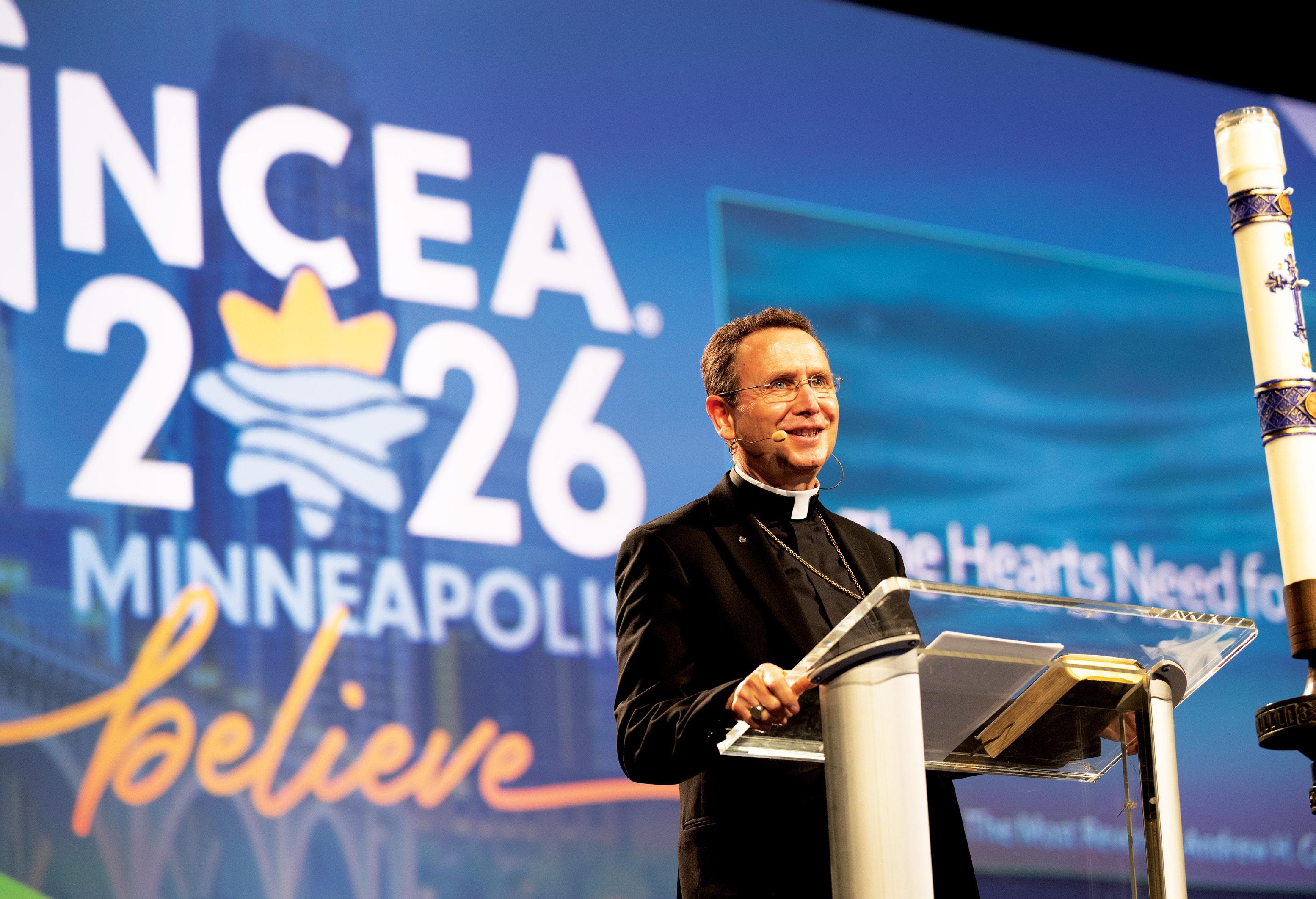
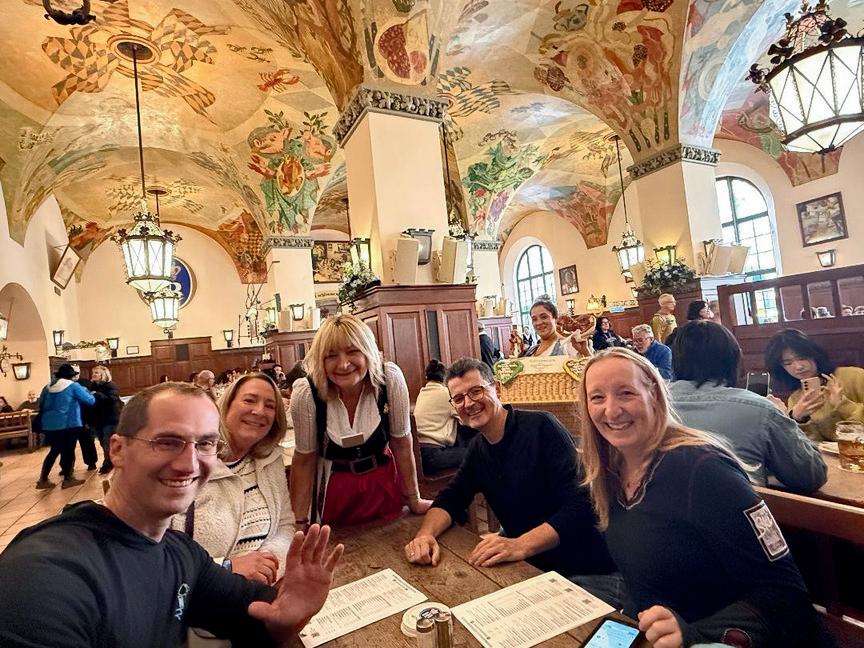
Bishop Andrew Cozzens of Crookston addresses those gathered for his keynote talk to begin the National Catholic Educational Association’s annual convention April 7 at the Minneapolis Convention Center. For more coverage of the April 7-9 convention, visit thecatholicspirit.com and watch for the April 23 issue. DAVE HRBACEK | THE CATHOLIC SPIRIT
Bishop Cozzens opens NCEA convention
By Josh McGovern
The Catholic Spirit
Opening the National Catholic Educational Association (NCEA) convention April 7, keynote speaker Bishop Andrew Cozzens of the Diocese of Crookston said too many people have wounded hearts and it is the job of Catholic educators to help them heal.
NCEA 2026 marked the first time in 17 years the conference was held in Minneapolis. Catholic and religious educators from around the country gathered at the Minneapolis Convention Center to exchange ideas and research related to education.
Steven Cheeseman, president and CEO of the NCEA, helped welcome about 3,800 educators to the April 7-9 conference. He said what people learn at the 2026 conference is not
meant to remain in a notebook, but is meant “to be lived, meant to be implemented. It’s meant to be shared.”
Bishop Cozzens stressed that like a spiritual director or pastor, a Catholic educator’s vocation is rooted in helping heal the heart. He shared a video recording of the singer Gracie Abrams during one of her concerts, singing her introspective song “Camden.”
The video, Bishop Cozzens pointed out, showed a young woman who is talented, beautiful, successful and “seems to have everything going for her,” he said. But the lyrics Abrams sings speak to someone who is experiencing sorrow.
“The poetry that she sings about expresses the depth of pain that she carries in her heart, and what’s even more clear is that it resonates with tens of thousands of people in the stadium all her same age,” Bishop Cozzens said. “Many people in the stadium also feel like singing … . Brother(s), sisters, this is the height of popular culture. This is what our young people are singing about, the gaping wounds in their hearts.”
A great evil that comes from social media, Bishop Cozzens said, is that a person’s value comes from their social media likes, and their identity is tied to how they are seen. At the center of his life, Bishop Cozzens said, are three words: relationship, identity and mission. The order is important, he said.
“The most fundamental thing in any person’s life is their relationship, and my identity comes from my relationship,” Bishop Cozzens said.
“I’m meant to know who I am, and I’m meant to experience my goodness, because I know
I am loved by God. And then my mission comes from my identity. The problem is we get the order all messed up. We learn to take our identity from what we do, not from who we are. We start to take our value from our success and what other people think of us.”
Artificial intelligence can’t help heal the human heart, Bishop Cozzens said. Neither can technology, popular culture or politics. “In fact, it seems to be making it worse,” he said.
Bishop Cozzens asked, “How can we speak to that wound in their hearts?”
“Brothers and sisters, this is why Jesus came,” Bishop Cozzens said. “He cares about those tens of thousands of people in that stadium. He wants to speak to the wound in their hearts. He understands that wound because he created the human heart, and he knows why it’s wounded. He has an answer for it. In fact, brothers and sisters, this is why he opened his own heart.”
It is the job of Catholic educators to invite people to let their hearts be healed by an encounter with the heart of Christ, the one who reveals what it means to be human, the “God who became human to heal our humanity,” Bishop Cozzens said.
Bishop Cozzens said his talk was inspired by a quote from Pope Leo XIV when he spoke to Catholic educators in October 2025 during the Jubilee of the World of Education. Bishop Cozzens said Catholic educators need to know the truth of their own hearts in encounters with the Lord to be able to invite other people to encounter Christ.
“This first must begin with you,” Bishop Cozzens told the crowd. “(The heart) is the place
where our deepest longings live, our deepest hopes live, and also our deepest fears. It’s the place where we are meant to know ourselves. It can be the place where we love ourselves or the place where we experience shame or even embarrassment … . It can be the place of truth, where we see our dignity, who God created us to be, but it can also be the place where lies live about myself, half-truths, and based on how my heart is, what I believe about myself.”
Bishop Cozzens said there are three practical steps to teach young people that might lead to the healing of their hearts. The first is to understand that hearts are broken. The second is to open young people to the truth that love can heal their hearts. The third is to teach that “when their hearts are healed, they’ll find joy in making a gift of themselves,” Bishop Cozzens said.
Our hearts, Bishop Cozzens explained, are broken because they are affected by sin.
“Healing of the human heart has to happen by experience and it happens primarily through the experience of being loved,” Bishop Cozzens said. “We call it mercy: unearned love. It restores. It regenerates. It reveals the truth about ourselves. This is the love that our young people are longing for, that you and I are longing for, and that God is longing to give.”
To be redeemed is to discover “that I am loved, to discover my own value, because God found me valuable, and thinks I’m valuable, valuable enough to die for,” Bishop Cozzens said.
“You have the opportunity to teach your young people the value of their hearts,” Bishop Cozzens said.
PAGETWO
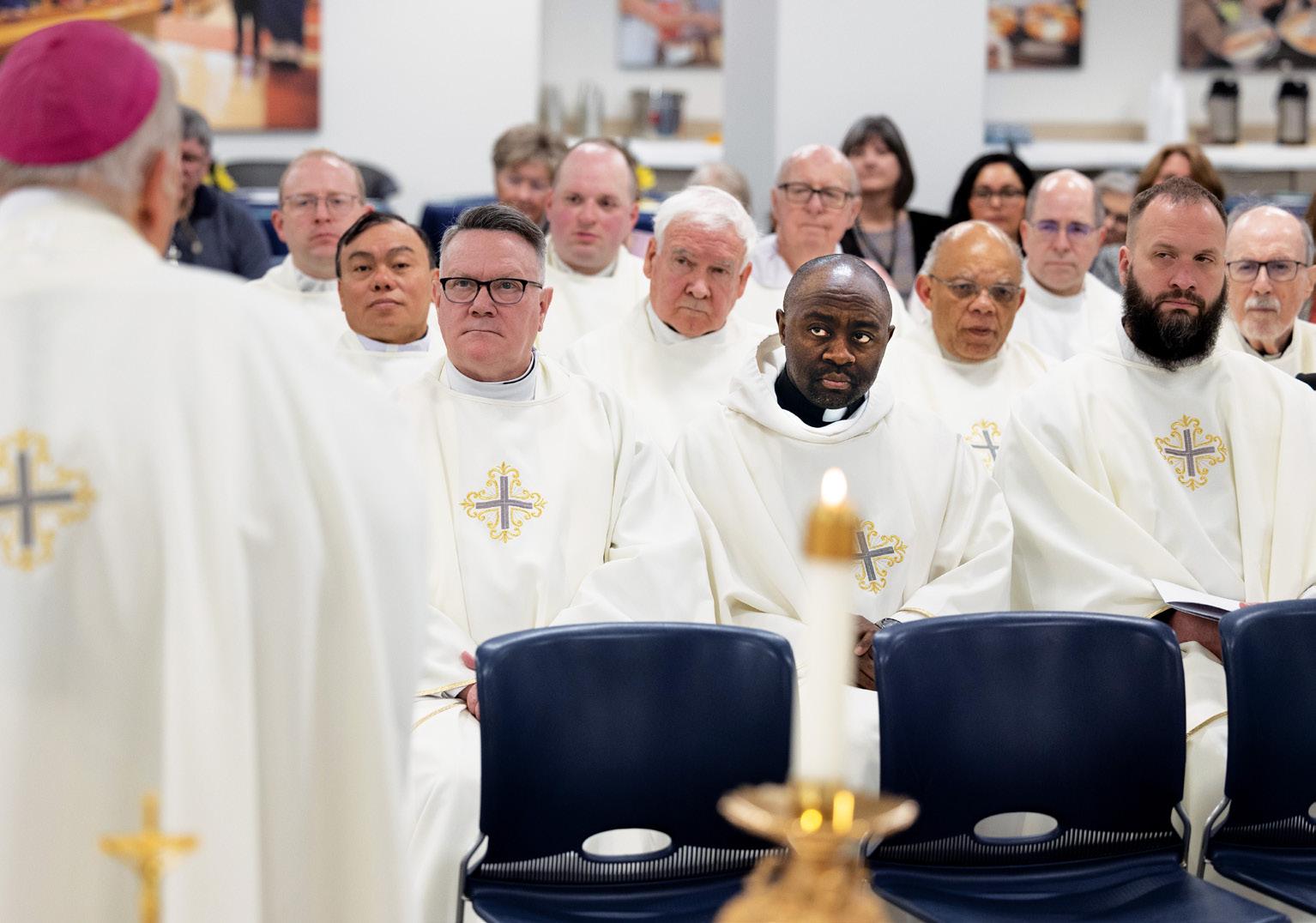
PRIEST JUBILEE MASS Archbishop Bernard Hebda, left, addresses priests gathered to celebrate their jubilees during a Mass April 7 at the Archdiocesan Catholic Center in St. Paul. Several dozen priests came for the Mass, which celebrated ordination anniversaries from 10 to 75 years taking place in 2023, 2024, 2025 and 2026. Front, from left are Fathers John Klockeman (25 years), Touchard Tignoua Goula (10) and Peter Hughes (10).
NEWS notes
A free concert celebrating Polish Constitution Day will be performed at Holy Cross in Northeast Minneapolis at 7 p.m. May 2. Presented on the eve of the historic Constitution of May 3, 1791, the program will feature the Holy Cross Choir and a chamber orchestra performing sacred music by Polish composers spanning more than four centuries. The program will explore Poland’s choral tradition from the early Baroque period to the modern era, with several works rarely heard in the United States. “During my years at Holy Cross, I’ve grown more and more fascinated by the rich cultural traditions of Poland especially its sacred music,” said Samuel Backman, director of sacred music at Holy Cross, in a news release. “After a good deal of online sleuthing and many hours preparing my own performing editions from the original sources, I’m thrilled to bring these beautiful and often overlooked treasures of Poland’s musical heritage to a 21st-century American and Polish-American audience.”
After a federal judge ruled that clergy must be allowed to provide spiritual care inside a U.S. Immigration and Customs Enforcement (ICE) processing facility in Minneapolis, Jesuit Father Christopher Collins and other faith leaders gathered outside the Bishop Henry Whipple Federal Building for a prayer service on Holy Thursday, April 2. On March 20, U.S. District Judge Jerry Blackwell granted an injunction permitting access to the building for pastoral care, siding with Father Collins and other members of an ecumenical group of Minnesota clergy who filed the lawsuit in February, OSV News reported. The judge found the group is likely to succeed in arguing that restricting ministry violates religious freedom and causes “irreparable harm.” The case came amid heightened immigration enforcement in the Twin Cities under what the U.S. Department of Homeland Security (DHS) called “Operation Metro Surge.” The increased enforcement effort began in December and wound down in mid-February. Federal officials cited safety concerns for limiting entry. Clergy argued the government failed to provide clear protocols, even as some detainees were reportedly held longer than typical processing times. The lawsuit states, “By prohibiting faith leaders from providing essential pastoral care … the federal government unconstitutionally obstructs their sacred obligation to exercise their faith through ministry.” Father Collins was among those denied access. The parochial administrator of St. Peter Claver in St. Paul, Father Collins described being turned away during a December prayer gathering and later in February. Other faith leaders prevented from providing pastoral care included members of the Minneapolis Area Synod of the Evangelical Lutheran Church in America and the Minnesota Conference of the United Church of Christ. Visiting those in prison, the plaintiffs said in the lawsuit, “is a core and non-negotiable religious obligation rooted in Scripture and centuries of practice.” Judge Blackwell ordered both sides to negotiate access and security details within days.
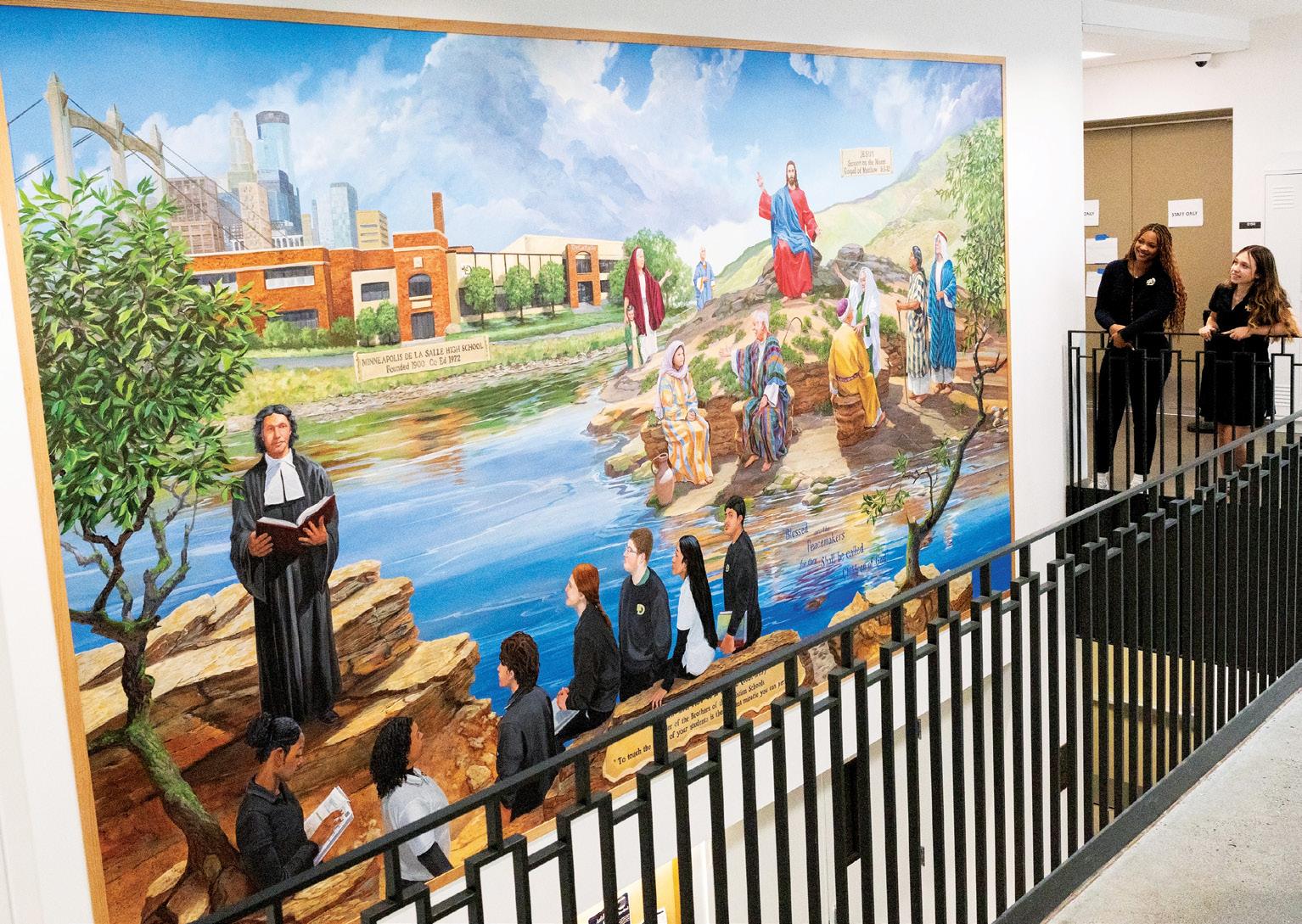
CATHOLIC IDENTITY From left, MacKenzie Askew, a senior at DeLaSalle High School in Minneapolis, and Isabella Manley, a junior, pause to view a new mural depicting Jesus’ Sermon on the Mount and St. John Baptist de La Salle teaching students from DeLaSalle, with the school and Minneapolis skyline in the background. Painted by DeLaSalle graduate and muralist Tom Stewart, the mural was installed March 25 to demonstrate and strengthen the high school’s Catholic identity. The mural is located outside the theater office on the first floor.
In the Archdiocese of St. Paul and Minneapolis, students from 17 Catholic schools raised $344,908 in the Catholic United Financial raffle. About 8,000 Catholic students from 50 schools in Minnesota and South Dakota raised a total of $950,000 to fund their school’s biggest priorities. The results of a six-week sales effort $10 per raffle ticket were announced March 12. Every dollar remains with the school. Participating schools in the archdiocese were St. Stephen in Anoka; St. Vincent de Paul in Brooklyn Park; St. Francis Xavier in Buffalo; St. Raphael in Crystal; Divine Mercy in Faribault; St. Elizabeth Ann Seton in Hastings; St. Jude of the Lake in Mahtomedi; Our Lady of the Lake in Mound; Transfiguration in Oakdale; Mary Queen of Peace in Rogers; St. Joseph in Rosemount; Holy Family in St. Louis Park; St. Michael in St. Michael; Maternity of Mary-St. Andrew and St. Peter Claver, both in St. Paul; St. John the Baptist in Vermillion; and Frassati Academy in White Bear Lake. St. Paul-based Catholic United Financial is a member-owned, nonprofit financial services company dedicated to connecting and impacting faith communities.
On Easter morning, Archbishop Bernard Hebda blessed and sealed the front bronze doors of the Basilica of St. Mary in Minneapolis to mark the beginning of a comprehensive interior restoration project of the upper nave. Part of the Basilica’s $45 million capital campaign Restoring Beauty, Inspiring Hope the multi-phase restoration project will help preserve and renew America’s first basilica. Beginning April 11, the Basilica community will temporarily relocate liturgical celebrations to the lower level of the church for approximately one year while the restoration work is completed. The Basilica and the Cathedral of St. Paul in St. Paul are also part of the Archdiocese of St. Paul and Minneapolis’ Lord, Renew Your Church campaign, with funds being raised to help with facility updates and conservation at both buildings. With help from the archdiocesan campaign, the Basilica has $35 million committed to its $45 million goal.
The Visitation Sisters in north Minneapolis will be honored for their 26-year partnership with Lundstrum Performing Arts’ mission to inspire children through musical theater when the center holds its annual gala May 9. Titled Out of the Ordinary, the event will include a cocktail reception with hors d’oeuvres followed by a musical review featuring Lundstrum students alongside Broadway performers and professionals from the Twin Cities theater community. Rooted in north Minneapolis since 1927, Lundstrum Performing Arts grew out of the Ascension School of Dance. It is led by Amy Ellis and four of her sisters who attended Ascension Catholic School, gained national performing experience and inherited the studio from its founder, the late Dorothy Lundstrum. Tickets for the event can be found at lundstrum.org/2026-lundstrum-annual-gala
Totino-Grace High School in Fridley won its fourth state boys basketball title in the last five years March 28 with a 72-70 win over DeLaSalle High School in Minneapolis. The Class AAA championship game at Williams Arena in Minneapolis included Totino-Grace senior guard Tian Chatman and senior forward Dothan Ijadimbola each scoring 13 points.
Annunciation Catholic School Principal Matt DeBoer was honored before the Minnesota Twins’ game at Target Field in Minneapolis April 4 as part of the Major League Baseball team’s Community Champions program with Minnetonka-based UnitedHealthcare. The program honors people who have had a meaningful and lasting impact on community well-being, opportunity and connection. DeBoer was honored in light of efforts at the Minneapolis school and parish to heal from an Aug. 27 fatal shooting at an all-school Mass.
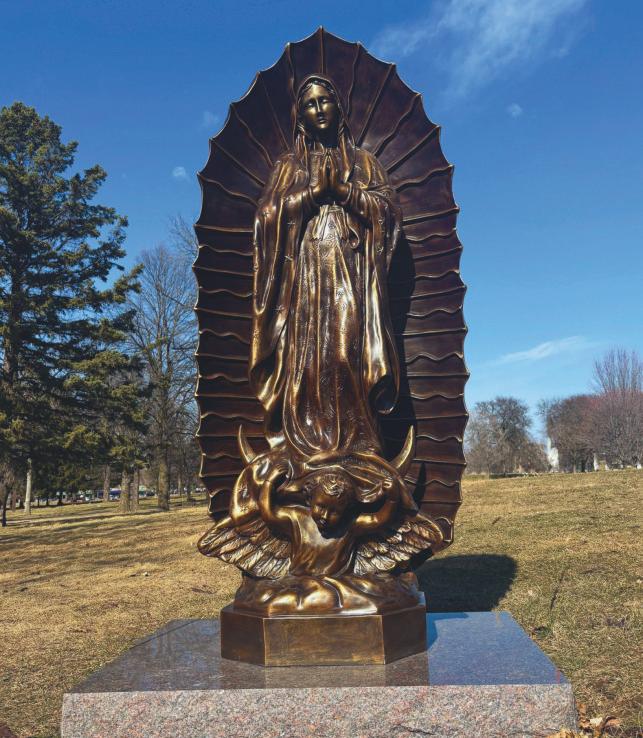
A three-dimensional image of the tilma of Our Lady of Guadalupe that marked her appearance to St. Juan Diego in Mexico is touring the United States in preparation for the 500th anniversary of the December 1531 apparition. The tours include an April 23 to May 10 stop in the Archdiocese of St. Paul and Minneapolis, first at the Cathedral of St. Paul in St. Paul, then April 27 to May 10 at Incarnation in Minneapolis. The original tilma is housed in the Basilica of Our Lady of Guadalupe in Mexico City. The statue creates an experiential journey and opportunity for a renewed sense of devotion. Details of special Masses and opportunities for veneration will be announced in the coming days and posted on the archdiocese’s website at archspm.org/events/guadalupepilgrimage
Practicing CATHOLIC
Produced by Relevant Radio and the Archdiocese of St. Paul and Minneapolis, the April 3 “Practicing Catholic” radio show featured Katie Phillippe, a parishioner of St. Paul in Ham Lake, who describes a near-death experience that renewed her faith. Listen to interviews after they have aired at practicingcatholicshow.com or choose a streaming platform at Spotify for Podcasters.
CORRECTION
The location was incorrect for a Marian shrine in the “Only Jesus” column on page 3 of the March 19 edition. The shrine is in France.
OMASTIAK, News Editor
COURTESY ALEX CONOVER, DELASALLE HIGH SCHOOL
DAVE HRBACEK | THE CATHOLIC SPIRIT
FROMTHEBISHOP
ONLY JESUS | BISHOP MICHAEL IZEN
Spring and new life in Christ
I’m embarrassed to admit that my fondest memories of childhood and the Easter season don’t sound all that spiritual. My mind usually turns to the warming of the weather and a chance to run outside and play. For me and my brother Paul, it usually included sweeping the water off the driveway (from the melting snow) so we could play basketball. It may have even included using a roof-rake to get that extra snow off the garage roof. All this so that we could have a somewhat dry surface for playing basketball with our neighborhood friends. Such a scene might not sound very “Eastery,” especially for a boy who became a bishop, but I believe there’s a connection between the excitement of the external life (being outdoors), and the excitement of the internal, spiritual life.
Every year in Minnesota, what begins to happen outside — warmer temperatures, budding trees and bushes, and an increase in green — reflects what is happening spiritually. For my brother and me, getting outside was an experience of new life, maybe even a resurrection of sorts for that warm weather activity we had said goodbye to six months before. It was a boy’s experience of abundant life.
Now, as a 59-year-old, my perspective is a little different. I’m not bolting outside with a push broom every time the snow starts melting. But I still notice the connection between nature and the spiritual life. I’m blessed to live at a rectory in an area where there is no shortage of wildlife. In my relatively small yard, I have seen deer, foxes, raccoons, opossum and — this time of year — plenty of rabbits. If you’ve ever wondered about the connection between rabbits and Easter, I cannot claim to have the definitive answer, but there seems to be evidence for a theory. We always see more rabbits around Easter and so we associate them with Easter. The association becomes more than just a coincidence when we consider rabbits’ reputations as prolific breeders. We make a connection between rabbits and fertility and new
La primavera y la nueva vida en Cristo
Me avergüenza admitir que mis recuerdos más entrañables de la infancia y de la temporada de Pascua no suenan precisamente muy espirituales. Mi mente suele dirigirse hacia el clima cada vez más cálido y la oportunidad de salir corriendo a jugar al aire libre. Para mi hermano Paul y para mí, esto solía implicar barrer el agua de la entrada del garaje (proveniente de la nieve derretida) para así poder jugar al baloncesto. Incluso podía incluir el uso de un rastrillo para techos con el fin de retirar esa nieve sobrante del tejado del garaje. Todo esto, para poder contar con una superficie razonablemente seca donde jugar al baloncesto con nuestros amigos del barrio. Puede que una escena así no suene muy “pascual” —especialmente tratándose de un niño que llegó a ser obispo—; sin embargo, creo que existe una conexión entre la emoción de la vida externa (estar al aire libre) y la emoción de la vida interna y espiritual. Cada año en Minnesota, lo que comienza a suceder en el exterior —temperaturas más cálidas, árboles y arbustos brotando, y un aumento del verdor— refleja lo que está ocurriendo en el plano espiritual. Para mi hermano y para mí, salir al aire libre era una experiencia de vida nueva; tal vez incluso una especie de resurrección de aquellas actividades de clima cálido a las que habíamos dicho adiós seis meses atrás. Era la experiencia de un niño de una vida abundante.
Every year, around this time, what begins to happen outside the warmer weather and the budding foliage reflects what is happening for us spiritually. There is new life, there is excitement and there is the Resurrection. Even the word Lent means spring — new buds, new growth. Just look around in this season and we are reminded of what matters.
life. They are a symbol of abundant life. We begin to see the connection between the abundance of natural life and the abundance of spiritual and eternal life that Jesus promises us in the resurrection. Jesus’ resurrection itself confirms God’s promise that he desires that we have life and have it to the fullest.
Bunnies and basketball — maybe there is a connection to Easter and new life. Every year, around this time, what begins to happen outside — the warmer weather and the budding foliage — reflects what is happening for us spiritually. There is new life, there is excitement and there is the Resurrection. Even the word Lent means spring — new buds, new growth. Just look around in this season and we are reminded of what matters.
The flipside to this correlation would be to consider the outlook of an atheist. An atheist is like a person in Minnesota who in January or February gets so depressed about the cold weather that you’d think they don’t believe
Ahora, a mis 59 años, mi perspectiva es un poco diferente. Ya no salgo corriendo con una escoba de empuje cada vez que la nieve comienza a derretirse. Pero sigo percibiendo la conexión entre la naturaleza y la vida espiritual. Tengo la dicha de vivir en una casa parroquial, en una zona donde no escasea la vida silvestre. En mi patio, relativamente pequeño, he visto ciervos, zorros, mapaches, zarigüeyas y —en esta época del año— una gran cantidad de conejos. Si alguna vez se han preguntado acerca de la conexión entre los conejos y la Pascua, no pretendo tener la respuesta definitiva, pero parece haber pruebas que respaldan una teoría. Siempre vemos más conejos en torno a la Pascua, y por ello los asociamos con esta festividad. Esta asociación deja de ser una mera coincidencia cuando consideramos la reputación de los conejos como reproductores prolíficos. Establecemos una conexión entre los conejos, la fertilidad y la vida nueva. Son un símbolo de vida abundante. Comenzamos a vislumbrar el vínculo entre la abundancia de la vida natural y la abundancia de la vida espiritual y eterna que Jesús nos promete en la resurrección. La propia resurrección de Jesús confirma la promesa de Dios: que Él desea que tengamos vida, y que la tengamos en plenitud.
Conejos y baloncesto: tal vez sί exista una conexión con la Pascua y la vida nueva. Cada año, por estas fechas, lo que comienza a suceder en el exterior —el clima más cálido y el brotar del follaje— refleja lo que ocurre en nuestro interior a nivel espiritual. Hay vida nueva, hay entusiasmo y está la Resurrección. Incluso la palabra “Cuaresma” significa primavera: nuevos brotes, nuevo crecimiento. Basta con mirar a
it’s ever going to warm up. But it always warms up.
This time of year, there are some subtle hints in the Gospels to this relationship between the natural life and the divine life. The Gospels of the Easter Vigil and Easter Day use phrases like “at daybreak” and references to the sun just starting to rise. The Son has also just risen.
The Resurrection and Easter had to happen, just as surely as spring must happen every year. Rabbits represent new life. Young boys and girls playing outside after months of being constricted is a sign of abundant life. We believe that, and we celebrate that during this season, because our Lord’s resurrection is our resurrection. Jesus’ resurrection wouldn’t mean much to us if it didn’t include the possibility of our resurrection. His new life doesn’t help us if it doesn’t include our opportunity for new life. Jesus has opened the gates of eternal life. Easter means that love now reigns definitively. Death and sin are overcome. The dark cold tomb does not get the last word. The Son — and the sun — have risen.
OFFICIALS
nuestro alrededor en esta estación para recordar aquello que verdaderamente importa.
La otra cara de esta correlación sería considerar la perspectiva de un ateo. Un ateo es como una persona en Minnesota que, en enero o febrero, se deprime tanto a causa del frío que uno pensaría que no cree que vaya a calentar nunca. Pero siempre calienta.
En esta época del año, los Evangelios ofrecen algunas sutiles alusiones a esta relación entre la vida natural y la vida divina. Los Evangelios de la Vigilia Pascual y del Domingo de Pascua emplean frases como “al amanecer” y hacen referencia al sol que apenas comienza a despuntar.
El Hijo también acaba de resucitar.
La Resurrección y la Pascua tenían que suceder, con la misma certeza con la que la primavera debe llegar cada año. Los conejos representan la vida nueva. Los niños y niñas que juegan al aire libre, tras meses de confinamiento, son un signo de vida abundante. Nosotros creemos en ello —y lo celebramos— durante esta temporada, porque la resurrección de nuestro Señor es nuestra propia resurrección.
La resurrección de Jesús no significaría gran cosa para nosotros si no incluyera la posibilidad de nuestra propia resurrección. Su vida nueva no nos sirve de nada si no abarca nuestra oportunidad de alcanzar una vida nueva. Jesús ha abierto las puertas de la vida eterna. La Pascua significa que el amor reina ahora de manera definitiva. La muerte y el pecado han sido vencidos. La tumba, oscura y fría, no tiene la última palabra. El Hijo —y el sol— han resucitado.
Archbishop Bernard Hebda has announced the following appointments in the Archdiocese of Saint Paul and Minneapolis:
Effective March 3, 2026
Reverend Il Sup (Augustinus) Shin, granted faculties of the Archdiocese and assigned as pastor of the Church of Saint Andrew Kim in Minneapolis. Father Shin is a priest of the Diocese of Incheon.
Effective April 6, 2026
Reverend Ryan Sustacek, assigned as parochial administrator of the Church of Saint John Neumann in Eagan while the pastor, Reverend Anthony O’Neill, is on sabbatical. Father Sustacek has currently been serving as parochial vicar of the same parish.
Reverend Timothy Wozniak, assigned as temporary canonical administrator of Faithful Shepherd Catholic School in Eagan, while the current canonical administrator, Reverend Anthony O’Neill, is on sabbatical. This is in addition to his role as pastor of the Church of Saint Thomas Beckett in Eagan.
SLICE of LIFE
A Quiet Moment
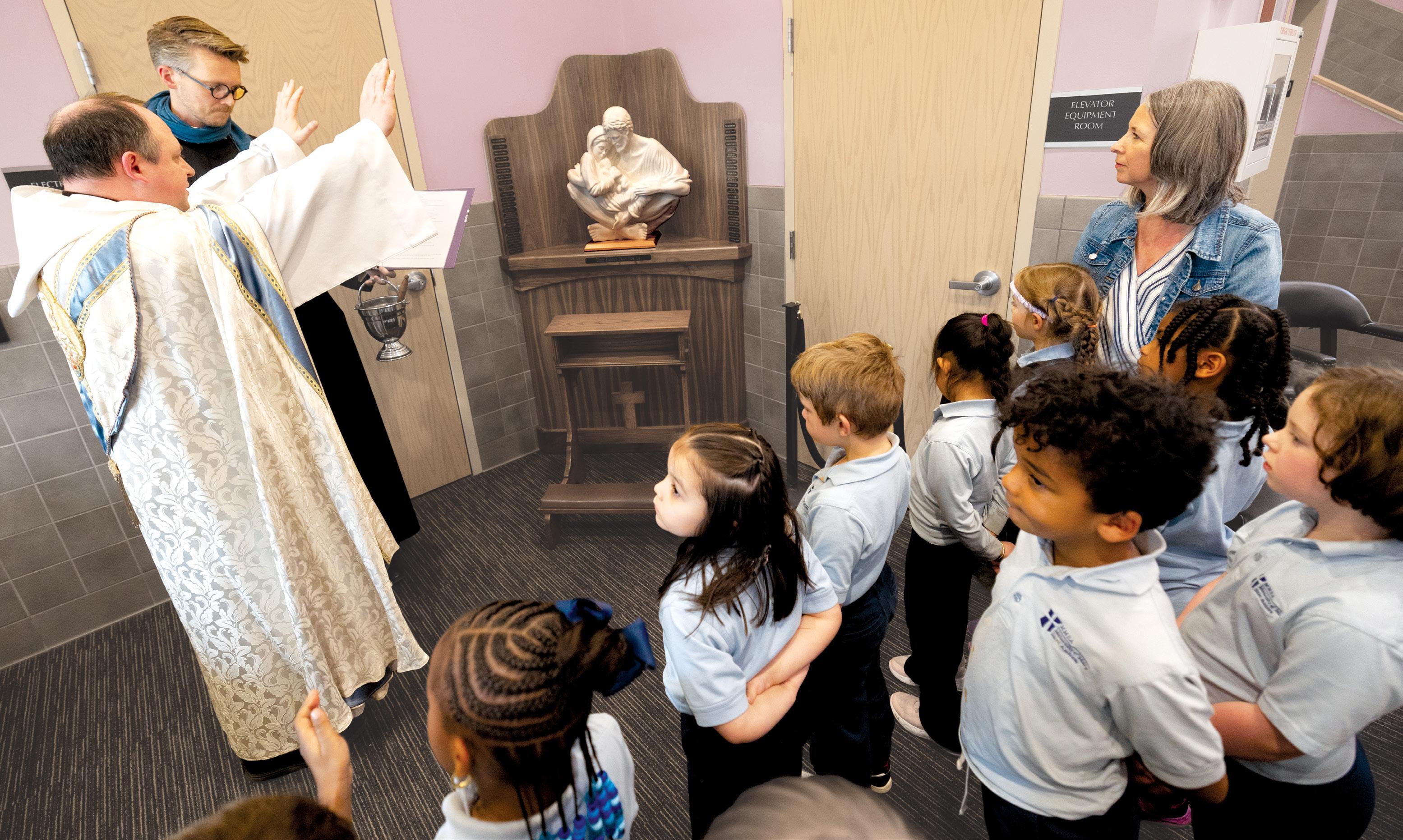
From left, Fathers Philippe Vigneron and Andrew Brinkman lead a prayer of blessing for a new statue near the front door of Maternity of Mary-St. Andrew Catholic School in St. Paul March 25. Called A Quiet Moment, the statue, which depicts the Holy Family, is meant to remind students, teachers, staff and parents to pray for the unborn, including babies who have died by abortion. The idea for the statue came out of a conversation last year among leaders of the annual spring gala fundraiser for the school. Principal Mike Langer then put in motion the process of having a local artist make an acrylic statue, which was placed on a pedestal in October 2025. “I think we have to be very deliberate about building that respect and that dignity for the sanctity of life,” Langer said. “We felt like we needed a strong visual (reminder) that was in a very obvious, (visible) spot so that anybody who comes into our facility can see that this is a school that has a deep respect for the sanctity of life.” Fathers Vigneron and Brinkman are pastors-in-solidum of Maternity of Mary, along with Father Kevin Manthey.
DAVE HRBACEK | THE CATHOLIC SPIRIT
9:00AM - 12:30PM Saturday, April 25th
too.
By building an endowment into your estate plan, you can
Invested and granted according to the teachings of the leave a legacy that reflects your Catholic faith and values.
Church, your gift can support your parish and favorite
causes forever.
Barry encourages perseverance, strength in faith at 2026 Men’s Conference
By Josh McGovern The Catholic Spirit
About 500 men packed the pews at St. Elizabeth Ann Seton in Hastings March 21 for the 2026 Archdiocesan Men’s Conference. Doug Barry, the keynote speaker, said the men were not the only people affected that morning, but rather thousands.
“There aren’t 500 people here,” said Barry, nationally known as a Catholic speaker and performer. “Most of you are married. Now the number doubles. You have children? Add those children in. (Now) how many do we have here? Three thousand? Four thousand? That’s how many people are affected by what we’re doing today. Thousands, not just 500 men.”
Wearing a shirt that said, “battle ready,” Barry spoke to the men passionately about spiritual warfare, especially in families. He referred to prayer as the ultimate tool of selfdefense. The rosary, he said, is a powerful tool that should be prayed every day.
The night before, Barry gave a one-man performance of the passion of Jesus Christ at the Cathedral of St. Paul in St. Paul.
“Are we choosing the better portion? Are we showing our children what it is to choose the better portion?” Barry asked. “We’re all going to die, and we’ll all stand before God … I like to err on the side of caution. That caution is that I want Jesus to look at me and say, ‘You made me necessary in the lives of those that I entrusted to your care.’”
If there was one thing, Barry said, that he hoped the 500 men would remember, it’s that only one thing is necessary: Jesus Christ. Barry encouraged the men to embrace “the good portion” — a close, spiritual relationship with Jesus Christ. In a chaotic world with war, conflict, sickness, Barry told the men to remain close to Christ, the one thing necessary, the good portion.
“Everything else passes. Everything else fades. All your money, all your goods, all your awards, all your trophies, all your athletic accomplishments. Any of us who
are getting older and feel it in your knees and your joints, yeah, that fades, too,” Barry said. “You will never find a U-Haul attached to the back of a hearse. … It is us in him. Everything starts today. … It should be our focus, our center of gravity.”
Barry spoke about elevating Sundays as a special day, and he emphasized the idea of healthy living throughout the week. Sundays, he said, are the bare minimum. He encouraged the men to focus on the daily practice and battle of pursuing and persevering with faith in Christ.
This can include physical strength through healthy lifestyle choices, not just spiritual ones, Barry said. Luke Spehar, the lead musician for the men’s conference, said at the conclusion of the conference that men desperately need to stay healthy “for our families, for ourselves, for our lives, for our cities, for our state.”
“We are the ones that are going to bring healing, because the Holy Spirit is in us,” Spehar said.
Faith should not stop at the conference, said Deacon Gordon Bird, a conference organizer and leader of the men’s ministry Catholic Watchmen in the Archdiocese of St. Paul and Minneapolis.
“You will take the lead. Make this be a bridge to better things,” Deacon Bird told the men.
Barry explained that often in Catholic funerals, the person’s hands are crossed over their chest. Around one hand is a rosary. Barry said that when he dies, should his children look into the casket and see a rosary around his hand, he does not want them to ask, “What’s that?”
“I want my kids to say, ‘That is an extension of my father,’ ” Barry said. “One thing is necessary: the relationship with
almighty God, calling on the Blessed Mother. Having that deep heart-to-heart relationship. That’s what we need to teach our family. This is the most important thing ever. … Gentlemen, we are the first line of defense.”
Bishop Michael Izen, during Eucharistic adoration, said that people become more like their five closest friends.
“Jesus can be one of our closest friends (and we) become more like him,” Bishop Izen said. “That’s a pretty good deal. (Make) time to be in his real presence.”
Confessions were available between speaker sessions. In the vestibule, Catholic organizations — including Catholic in Recovery and the Calix Group, which are Catholic groups that help people battle addictions — set up booths. The day began with Mass celebrated by Archbishop Bernard Hebda, Bishop Izen and Bishop Kevin Kenney.
PECS small group in Crystal reaches out to the needy
By Joe Ruff The Catholic Spirit
Patty Beissel, 74, urged her small group of about 20 women at St. Raphael in Crystal to select a way to give back some measure of God’s gifts during the Lenten season, rather than give something up.
In keeping with Christ’s 40 days in the desert, she suggested that the group do 40 of something — acts of kindness or praying for intentions, for example.
“The last thing I mentioned was assembling 40 blessing bags to give to” people experiencing homelessness, Beissel said. “This idea was well received and is what they wanted to do.”
Collecting toothbrushes, toothpaste, bars of soap, wool socks, snacks, rosaries with leaflets explaining how to pray with them, restaurant gift cards and other items, the women prepared 47 blessing bags to offer parishioners at weekend Masses Feb. 28 and March 1. Parishioners scooped up the large, clear plastic bags and handed them out to people on the street or through other organizations. In the weeks that followed, some parishioners asked whether her small group would do it again, Beissel said.
One woman said she was nervous but on a day with temperatures below zero she pulled over, got out of her car
and gave a blessing bag to a man who looked sad, angry and unwelcoming, only to have him thank her profusely, saying “God bless you,” Beissel said.
Beissel recalled the woman telling her that when she got back into her car, she was overwhelmed with emotion.
Beissel’s group is one example of small groups around the Archdiocese of St. Paul and Minneapolis that have modeled their gatherings on the Parish Evangelization Cells System (PECS), which include time for praise and worship, sharing ways Christ has been present to group members and ways they have responded, as well as a teaching moment, discussion and prayers of intercession. Archbishop Bernard Hebda has encouraged PECS as part of implementing his 2022 pastoral letter: “You Will Be My Witnesses: Gathered and Sent From the Upper Room.”
Deacons and priests have spoken to Beissel’s group, and at one point the group took time to learn about the church’s stained-glass windows, Beissel said. She has been leading her small group for several years and has seen it grow from a few women meeting at her home to the 20 now gathering at the parish every third Saturday of each month. Women in the group range in ages from about 40 to nearly 100 years old, she said.
“They support each other,” Beissel said. “Anyone could call anyone and they would step up immediately.”
PRAYER OVER THE BLESSING BAGS
Patty Beissel of St. Raphael in Crystal wrote this prayer for her small group during Lent as they prepared to fill 47 blessing bags for people experiencing homelessness: Heavenly Father,
As we come together this morning in unity and prayer, please guide our hands as we pack these gifts. When we meet our neighbors and share our names, let your peace settle over the conversation. May our introduction break down walls and offer a true sense of belonging and comfort to every person we meet.
Lord, use these items to provide comfort and hope. May every person who receives this bag feel seen, valued and loved by their community. We pray for the safety of each person, for their health and a path toward restoration.
Proverbs 3:27 says “Do not withhold good from those to whom it is due, when it is in your power to act.”
For this we pray, Amen.
JOSH MCGOVERN | THE CATHOLIC SPIRIT
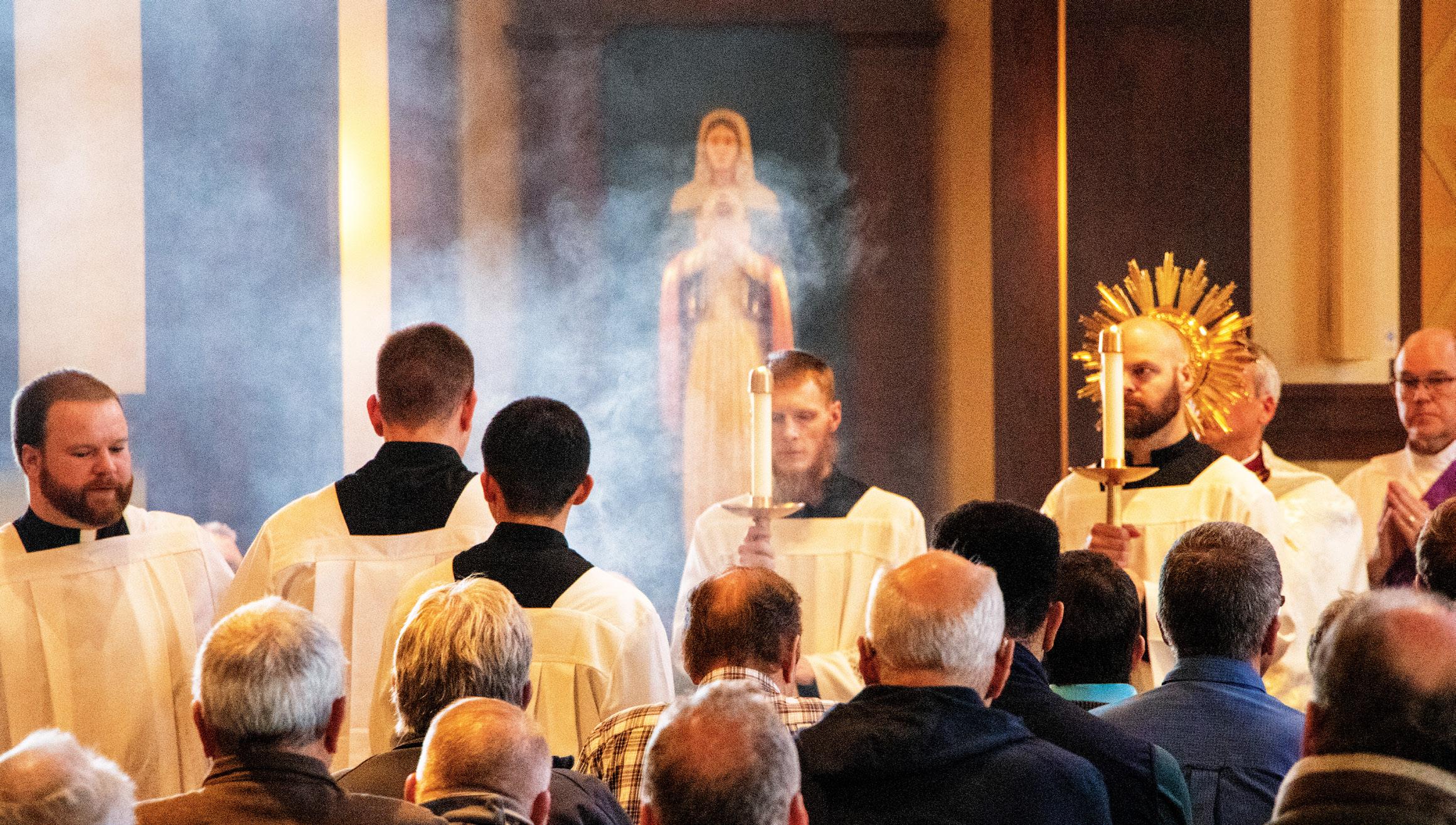
Incense clouds the Eucharist as it is processed through St. Elizabeth Ann Seton in Hastings during the 2026 Archdiocesan Men’s Conference, which was attended March 21 by about 500 men.
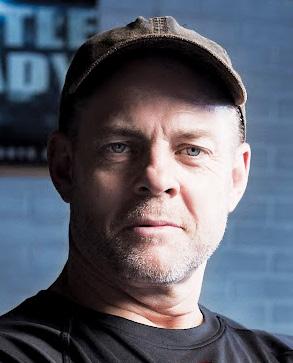
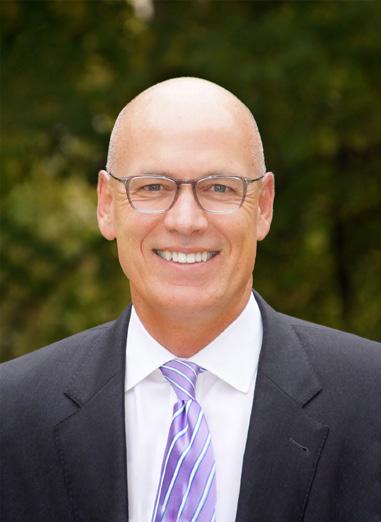
DOUG BARRY
ACCW to honor 4 laywomen at 93rd annual convention
By Susan Klemond For The Catholic Spirit
The Archdiocesan Council of Catholic Women (ACCW) will hold its 93rd annual convention May 1 at St. Elizabeth Ann Seton in Hastings, with the theme Shine Your Light into the Darkness.
Bishop Kevin Kenney will celebrate Mass and Leah Jacobson, CEO and founder of an Ironton-based wholistic women’s health care group called the Guiding Star Project, will be among the speakers. Also at the convention, four laywomen will be honored with Lay Woman
Volunteer awards for their involvement in the organization, their parishes and communities. Seven female teens and young adults will be recognized with the Golden Rose Award for their commitment to Mass and their activity in parish and community events.
The teens and young adults being honored will be announced in the April 23 edition of The Catholic Spirit. With details provided by the ACCW, the four women being honored are:
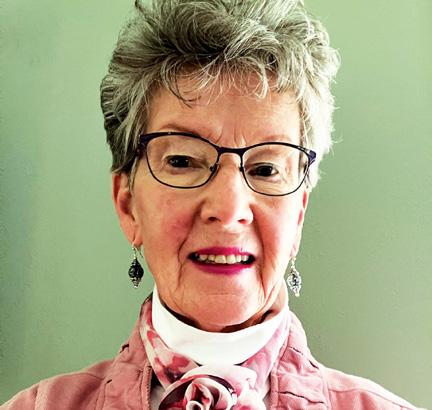
MOLLY BAUER — ST. TIMOTHY, BLAINE
With a marriage spanning 52 years and a life dedicated to service, Bauer has offered an unwavering commitment to the mission of Christ in her family, parish and the broader Twin Cities community.
A cornerstone of her parish’s music ministry for 40 years, her service extends beyond the choir loft. Since 2019, she has co-chaired a fleece blanket ministry that last year donated 150 blankets to families in need. Her heart for the vulnerable was evident during the COVID-19 pandemic, when she offered “drive-up Communion” to parishioners as an extraordinary minister of holy Communion. For the past decade she has prepared funeral luncheons and decorated the parish sanctuary.
Bauer has served in the Minneapolis metropolitan area in
JOAN BURK — ST. PIUS X, WHITE BEAR LAKE
A wife and mother, Burk demonstrates that the mission of Christ isn’t just a Sunday obligation — it is a lifelong vocation defined by a “servant’s heart.”
As a registered nurse, Burk has used her rehabilitation and hospice care skills as a ministry of presence for the suffering and dying.
She and her husband have modeled in their home a life of dignity and respect, raising their sons in the Catholic faith. Burk has been anchored in regular prayer and adoration.
A graduate of The St. Paul Seminary Catechetical Institute in St. Paul, she remains a pillar of her church, serving as a lector and an extraordinary minister of holy Communion, co-facilitating a grief support group, and donating meals for
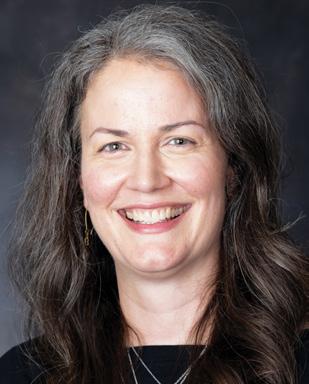
PAMELA PETERSEN — ST. IGNATIUS, ANNANDALE
Since 1975, Petersen has served as Jesus’ hands and feet in her parish and community.
An elementary and middle school educator for 32 years, Petersen has viewed her work through a lens of service. She and her husband of 54 years raised two children in the Catholic faith and now mentor their five grandchildren.
Through her devotion to the Miraculous Medal of the Virgin Mary, Petersen shares faith stories and medals.
She has taught faith formation at her parish and served on the parish council. She has said that her mission trips to her parish’s sister community — St. Vincent Ferrer in Pacuan, Philippines — and a pilgrimage to the Holy Land have made the Gospels come alive.
In her community, Petersen served on the Annandale
diverse ways, including helping to build homes with Habitat for Humanity and working with an interfaith network to assist families experiencing homelessness. An advocate for literacy and health, she coordinates blood drives and for the past seven years has helped Friends of the Library raise money for local reading programs through book sales and gala events.
Her CCW leadership has included acting as secretary and currently as membership coordinator. She has helped raise money for global and local causes including prosthetic care for Ukrainians and church improvements.
From sending hope-filled messages to prison inmates to singing at Minnesota state parks, Bauer models active faith through consistent, compassionate service to her neighbors.
funeral luncheons. She has nurtured the next generation by helping teach religious education at the parish.
Burk’s leadership shines in the Council of Catholic Women (CCW), where she has volunteered at the local, diocesan and national levels — including her vital role in the 2022 national convention in St. Paul and Minneapolis.
Her reach extends beyond the church walls to the vulnerable through her support of area pregnancy resource centers, homeless shelters and meals for shut-ins. Guided by a special devotion to the Blessed Mother, she is known by many as a prayer warrior and compassionate listener who empowers others with facts, faith, and a warm, welcoming smile.
Improvement Club and in local wellness initiatives.
When her local CCW organization was at risk of disbanding in 2017, as president, Petersen and her team helped ensure the council’s survival by updating its constitution.
She remains active as a lector and extraordinary minister of holy Communion. She helps tend the parish grounds, chairs a pro-life event that has been ongoing for 50 years, coordinates Meals on Wheels deliveries and assists with fundraising and parish retreats.
“She is a humble daughter of the Lord,” several peers noted in writing about her for the award. “Everything she does is to serve our Lord and church community.”
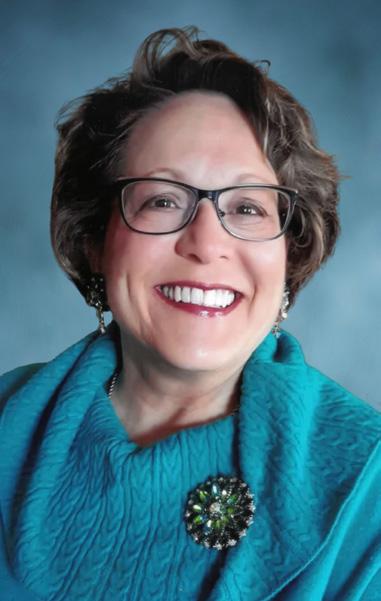
MADONNA RUSSO — ST. MARY AND ST. HENRY, LE CENTER
For many in Russo’s community, their path to leadership began with one of Russo’s warm welcomes. She is being celebrated not only for her decades of service but as a vital mentor who has guided a new generation of women into the heart of the Church.
As a paraprofessional in her local school district, Russo helped Latino students. Her passion for connection continues at her parish, where she links the English- and Spanishspeaking communities, ensuring every member feels at home at parish events and worship.
In her faith life, Russo has been a mainstay of her local rosary group for 20 years. Her behind-the-scenes parish dedication includes serving as a sacristan, extraordinary minister of holy Communion and pro-life team secretary. She prays regularly for clergy as part of the Seven Sisters Apostolate.
Russo’s commitment to the common good extends beyond the church pews, including service as an election judge, American Legion Auxiliary membership chair and Meals on Wheels volunteer. Whether staffing a county fair pro-life booth or engaging in local politics, she advocates for her values and her neighbors.
Russo’s more than 20 years of CCW leadership includes serving as parish and deanery president, historian and representing her region at national and province conventions.
“Without her encouragement, I would not still be involved,” one peer shared.
Russo is recognized for leading with a spirit of mentorship, tireless formation in the faith and generous outreach to the community.
Catholics join other denominations at Minnesota State Capitol for Palm Sunday Path prayer service
By Josh McGovern
The Catholic Spirit
On the front lawn of the Minnesota State Capitol building in St. Paul an estimated 10,000 Christians from different denominations gathered for a Palm Sunday prayer service March 29 called Palm Sunday Path. The prayer service began with a procession carrying signs, palm fronds and prayers to the Capitol steps.
For two and a half hours, local Christian leaders addressed those gathered. Members of churches with predominantly Black congregations in the Twin Cities performed praise and worship music, including Shiloh Temple International Ministries and Greater Friendship Missionary Baptist church, both in Minneapolis, and St. James A.M.E. in St. Paul.
The prayer service was supported by the Minnesota chapter of the Laudato Si’ Movement (LSM) and similar gatherings were held throughout the state, including Rochester, Mankato, St. Cloud and Duluth. An estimated 13,000 people participated in Palm Sunday Path statewide.
Across the country, Palm Sunday Path prayer services were held in a dozen states.
The Laudato Si’ Movement is a nonprofit organized to help Catholics translate into action the papal encyclical “Laudato Si’: On Care for Our Common Home” written by the late Pope Francis, said Mike Harley, a member of the Laudato Si’ Minnesota chapter and a parishioner of Lumen Christi in St. Paul.
“That is a document about climate change and the environment and sustainability,” Harley said. “Care for creation is how we have talked about those things in the Catholic world and Catholic teaching for a long time.”
“Laudato Si’” and its concern for creation extends beyond the environment, Harley said, and includes care for the marginalized, the poor and the vulnerable.
Though Palm Sunday Path was not created by the movement, the Minnesota chapter of Laudato Si’ supported the prayer service because it aligned with the many of the goals of the movement and the teachings of the Catholic Church, Harley said.
“(Palm Sunday Path) is an opportunity for thousands of Christians to show up publicly in faith and prayer, and then a show of love for God and a show of love for neighbor,”
By Rebecca Omastiak The Catholic Spirit
JOSH MCGOVERN | THE CATHOLIC SPIRIT
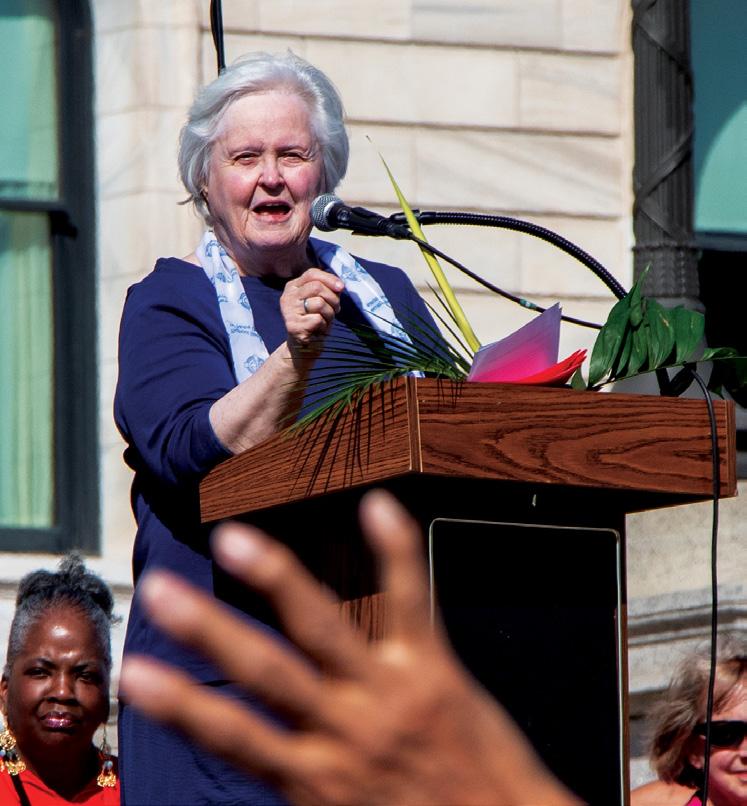
School Sister of Notre Dame Kathleen Storms gives a speech outside the Minnesota State Capitol during the ecumenical Palm Sunday Path prayer service March 29.
Harley said. “And when we talk about love for neighbor, we really understand that in the context of Matthew 25. Jesus has called us to feed the hungry and heal the sick and welcome the stranger among us.”
Katie Cassidy, 28, a parishioner of Immaculate Conception in Minneapolis and communications specialist for the Minnesota chapter of Laudato Si’, attended Palm Sunday Path and was deeply moved seeing thousands of Christians processing in faith.
“I joined the LSM because I am motivated by the understanding that environmental issues are pro-life issues, and we are called to work towards a political reality that honors the dignity of the human person,” Cassidy said.
Ann Mongoven, a member of Minnesota chapter of Laudato Si’ and parishioner of St. Joan of Arc in Minneapolis, said Palm Sunday is often a time of reenacting Jesus’ entrance into Jerusalem, “facing what we know is death” and a challenging situation for people walking with Jesus. On March 29, Palm Sunday Path brought together Christians to embody that path together, she said.
“It was a launch of this path,” Mongoven said. “That is what we need to be doing together in the world now. The folks from the Capitol steps talking to all of us together
In March, a student of Annunciation Catholic School in Minneapolis received a Citizen Honors Award, bestowed by the Congressional Medal of Honor Society, for shielding a fellow classmate amid a shooting during an all-school Mass at Annunciation’s church Aug. 27.
Recognized as a 2026 Young Hero Honoree, Victor Greenawalt “demonstrated extraordinary bravery far beyond his years,” according to a Congressional Medal of Honor Society news release.
“Instinctively, Victor protected a classmate with his own body, directly saving their life during the attack. His courage and selflessness became a powerful symbol of hope and humanity for a community in crisis,” the release stated. Victor, who was 10 at the time, shielded classmate Weston Halsne amid the gunfire.
“If one friend did that, it would for sure be him,” said Weston about Victor in a video released by the Congressional Medal of Honor Society in the days following the awards ceremony.
“He (Victor) acted incredibly bravely and instinctively, and his nature is to be loving and protective and he did that that day,” said Weston’s mother, Katie Halsne, in the video.
as a community and calling us all ... calling us to love God and love our neighbor and go forth in the world and the amens and the hosannas that were happening that day were very powerful. It felt to me, and I believe that it felt to an awful lot of people, that something new was happening, that we were creating something new together.”
Harley and Mongoven emphasized that the prayer service on Sunday was called a path for a reason, that without next steps it becomes only a one-time event.
Next action steps include a public discipleship formation called Such a Time as This. Mongoven described this formation as grounding Christians in Gospel values and bringing those values into congregations and faith communities and “living them out together in the work that we’re doing.”
On April 30, there is a 24-hour prayer vigil at Hennepin County Medical Center in Minneapolis and on May 7 a Christian rally will be held at the Minnesota State Capitol building.
Harley said that as the word spread about Palm Sunday Path, many Catholics were enthused about being part of the ecumenical prayer service to “see (that) the Catholic voice be represented and be visible and present.”
Catholic parishes — including Lumen Christi and St. Thomas More, both in St. Paul — organized buses to bring parishioners to the Capitol.
School Sister of Notre Dame Kathleen Storms spoke at the event. She said that faith is never private, but rather “public, courageous and lived in the streets.”
“Today we accompany people in 17 countries around the world where governments silence dissent, restrict freedoms and strip away basic human rights,” Sister Kathleen said. “Here at home in my parish of Lumen Christi Catholic Community in St. Paul, we walk with Indigenous people, Indigenous relatives, racially ostracized families and immigrant neighbors who still face exclusion and fear.”
Mentioning the Laudato Si’ chapter in Minnesota, Sister Kathleen said that when creation is harmed, people are harmed. When legislative policies “poison water, pollute air or destroy land,” it is the vulnerable who suffer first and most, she said.
“Our faith demands that we act together,”
Sister Kathleen said. “Archbishop Bernard Hebda sends his regrets that he cannot
be with us today. He promises his prayers for those gathered to express publicly our commitment to the Gospel and our connectedness to people of faith charged with serving Christ by lovingly serving the most vulnerable of his brothers and sisters among us.”
The Palm Sunday Path was an act of resistance, she said, by walking into places of power to challenge policies that keep food from the hungry, snatch safety from strangers and deny health care.
“When policies wound the poor, creation groans with them, and our faith compels us to respond,” Sister Kathleen said. “I am here today because we are here today, people of faith, refusing to be silent when human dignity is threatened.”
True security, she said, comes from trust, justice and solidarity among people.
The Palm Sunday Path came to the Capitol a day after a No Kings Rally in protest of President Donald Trump and recent immigration policies. Some sentiments trickled over into the Palm Sunday Path, but Harley reiterated that the prayer service was not a protest, even urging Catholics involved to leave their protest signs at home.
The Palm Sunday Path was in the works before the No Kings Rally was planned.
“The decision was made that these are two different things, and that No Kings will have its appeal, but that there really has not been an opportunity for Christians to talk as Christians (with) Christian values in the lead,” Harley said.
He urged Catholics to bring their palm fronds from Sunday Mass that day.
“Just as Jesus rode into Jerusalem and was greeted by the palms of the gathered crowd, we want to have that same dynamic.”
Jesuit Father R.J. Fichtinger, pastor of St. Thomas More, spoke toward the end of the prayer service.
“I’ve been empowered because I can see the beauty of our neighbors coming together, looking out for one another by ensuring that they have groceries, by looking out for one another and ensuring that they are able to be fed, both by the word of God, by the spirit and the sacrament of God,” Father Fichtinger said. “They’ve gone to their neighbors, they’ve gone to the poor, they’ve gone to the marginalized. They have done what God and our Lord has commanded us to do, to love our brothers and sisters.”
“And it wasn’t just Weston that he shielded, there were other children as well.”
“Vic has a lot of integrity and he’s a good friend,” said Victor’s mother, Annie Greenawalt, in the video.
“It’s pretty common for him to be looking out for someone.”
“He really shines when someone is in need,” said Victor’s father, Zac Greenawalt, in the video. Involved in basketball, baseball, Cub Scouts, and school patrols, Victor is “very much involved in his community … he’s an active 11-yearold boy,” said Zac.
Even though he had suffered head and back wounds,
Victor was helping other students in the shooting’s aftermath, which Matt DeBoer, principal of Annunciation Catholic School, witnessed.
“Victor having been there brought some comfort to people that day and his bravery, his courage really shined forth, not just for the children, (but also) for those first responders that showed up — to basically have a child ministering to them on one of the hardest days of their careers,” DeBoer said in the Congressional Medal of Honor Society video.
“We’re trying to find some good that came out of it (after Aug. 27) and this recognition is one way we can find good,” Zac Greenawalt said in the video.
Victor was recognized during a ceremony March 25 — on National Medal of Honor Day, according to the society. Five people and one nonprofit organization were recognized for demonstrating “courage, sacrifice and selfless service” within their communities.
The Congressional Medal of Honor Society assembled a panel to review nominations for the Citizen Honors Awards from across the nation; a second panel, specifically comprised of Medal of Honor recipients, then selected the five individuals and one nonprofit.
Learn more about the Citizen Honors Awards online at cmohs.org/citizen-honors/overview.
VICTOR GREENAWALT
COURTESY CONGRESSIONAL MEDAL OF HONOR SOCIETY, YOUTUBE
2 archdiocesan conferences seek to heal body, mind and soul
By Josh McGovern
The Catholic Spirit
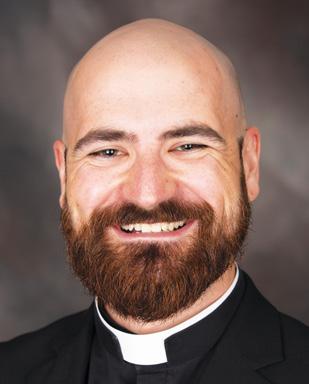
While in formation as a college student with Mendota Heightsbased St. Paul’s Outreach and in formation at The St. Paul Seminary in St. Paul, Father Nick Vance encountered regular discussions about sexual addiction and brokenness. In those communities, Father Vance described discussing these wounds in the light of God’s redeeming love, but “he saw that more work was desperately needed.”
All of this is actually oriented towards … self-gift. ‘I pursue healing and recovery, I pursue the Lord’s vision for marriage and sexuality and everything else so that I can be a self-gift, so that I can give myself in ways that God has called me to, because anything less than that, I think will only end in sadness, will only end in some version of brokenness and sin.’
Now, as parochial vicar of Our Lady of Grace (OLG) in Edina, Father Vance continues to encounter people impacted by these issues. The world’s vision of sexuality and intimacy, such as pornography, he said, may look appealing on the surface, but can “lead people into places of real woundedness.”
“We’d be kidding ourselves if we said it doesn’t affect followers of Christ,” Father Vance said. “I’ve certainly seen that now as a priest: It’s hurting all of us to some degree. If it’s not you personally, it’s affecting someone that you care about. It’s affecting your friends, your sibling, your spouse, your kids. It’s kind of everywhere.”
Part of the damage, Father Vance explained, is that people don’t talk about sexual addiction and brokenness.
“It might come up in confession, but I worry that some people (will) bring it up in confession and then just try and race past it, so that they don’t have to think about it too much.”
Building healthy relationships was the focus of a March 28 conference titled Holy Relationships in a Crazy World. Held at the University of St. Thomas in St. Paul, the conference included Renee Oakes, director of the Department of Marriage, Family and Life in the Archdiocese of St. Paul and Minneapolis, addressing lifelong health for marriage and fertility.
In an interview, Oakes said there is a current crisis in marriage. Generally, fewer couples are seeking sacramental marriage today compared with previous decades. The divorce rate is also high, she said.
“There’s an attack on marriage today,” Oakes said. “The hope is to support people as much as possible and to lay that foundation so that they can go into healthy, lifelong marriages. Sexuality is often so disordered today.”
Starting in September 2027, the Unite My Heart Conference will be moved to a yearly offering of the Department of Marriage, Family and Life with Oakes and Father
Vance working together.
The Unite My Heart Conference at Our Lady of Grace, Oakes said, was an opportunity to call the Holy Spirit into wounds surrounding sexuality and restore them. Restoring health, especially in fertility, is Oakes’ background. A FertilityCare practitioner, Oakes founded the Integrated Fertility Care Center in Stillwater. She encountered many physical health issues in young married couples, her own family included. Solutions to these health problems that align with Catholic Church teaching are not widely known, especially within the Church itself, Oakes said.
“There are major health issues today,” Oakes said. “Now we’re doing marriage prep retreats, and these are young people … people that really should be having pretty sound health at this point and they’re really struggling.”
Infertility or recurrent miscarriage, Oakes explained, is a symptom, a sign of a greater issue, such as endometriosis, hormone dysfunction or thyroid disease, among other causes. If the greater issue is treated, then “the body knows what to do, the health is restored and the babies come.”
While planning the Unite My Heart Conference, Father Vance wanted to begin the day recognizing the beauty of God’s plan for sexuality. To do this, he hoped to bring in a keynote speaker for the opening session about the Lord’s plan for marriage and sexuality, but nobody was available.
“We kind of kept coming up empty,” Father Vance said. “Then finally, the team that was helping to put all this together, they sat me down, and they said, ‘Father Nick, when are you going to take the hint?’”
Father Vance said the idea for a conference on healing and sexuality came to him a few years ago during prayer. The conference would bring in experts who would take an entire day to talk specifically about brokenness in sexuality.
Fifteen months ago, Father Vance pitched the idea to OLG’s pastor, Father Kevin Finnegan, who immediately approved the conference and pushed it forward.
“(There’s) the old line, ‘Hurt people hurt people.’ But I found that the opposite is true as well,” Father Vance said. “Healed people heal people.”
The conference touched on subjects including addiction and healing,
Father Nick Vance
discipleship in LGBT+ experiences and parent education for raising children.
Father Vance said that a good majority of people are exposed to things like pornography at an early age. The initial trauma of this exposure and its ramifications are not anyone’s fault, Father Vance said, “but dealing with it now is your problem.” Sexual brokenness and addictions need to be treated with gentleness, the same gentleness “that the Lord treats (us) with,” Father Vance said.
“You need to be gentle with yourself and ruthless with your environment,” Father Vance said. “We spent some time learning how to navigate that kind of gentleness with yourself, but also at the same time cultivating a ruthlessness with the things that I allow into my life, the things that I surround myself with.”
This extends to the “kind of media that I consume, how I spend my time, the sort of behaviors I allow in my life,” Father Vance said. This includes understanding accountability, psychology, behavior and the nature of addiction.
“If all I do is treat this as a moral question, then I risk not only ignoring really important parts of a recovery journey, but I also think I do violence to the Catholic notion of the human person,” Father Vance said. “We’re multifaceted people, and so yes, I need to come at this from a spiritual standpoint. I also need to come at it from a psychological standpoint, from a behavioral standpoint.”
However, Father Vance stressed that the Gospel is not a behavior management program. Jesus is “in the healing and transformation business,” Father Vance said. “He hasn’t come just so that we can lock down certain behaviors.”
“We’re called to live lives of sanctity, and that means forsaking certain things, especially in the face of the sort of gospel that the culture preaches when it comes to sexuality,” Father Vance continued. “All of this is actually oriented towards … self-gift. ‘I pursue healing and recovery, I pursue the Lord’s vision for marriage and sexuality and everything else so that I can be a self-gift, so that I can give myself in ways that God has called me to, because anything less than that, I think will only end in sadness, will only end in some version of brokenness and sin.’”
Oakes stressed that she doesn’t want to
raise concern but rather instill hope. She found hope and healing in her own life as she and her husband struggled to conceive. Of every diagnosis that can cause infertility, Oakes had all but two of them. Her husband was clinically infertile, too.
“The fact that we’ve conceived eight times … that, I mean, is the miracle of miracles,” Oakes said. “I haven’t encountered (anyone) yet with a harder case than my own. And if NaProTechnology can treat me to that extent, and my husband, then there’s just so much hope.”
With the Creighton Model FertilityCare System (a natural family planning method) and corresponding medical protocols of NaProTechnology, there is an 80% success rate of conception, Oakes said.
“NaProTechnology is covered by insurance, restores the woman’s health, all within the precepts of the Church and while respecting the dignity of the human person,” Oakes responded. “The result is a healthy husband and wife, and their healthy children, with a significantly improved quality of life.”
In vitro fertilization and other methods not supported by the Catholic Church “don’t even come close” to that rate, Oakes said.
“So few in the Church are aware … . What typically happens is women can’t conceive and then they start seeking (other methods to conceive). But if you, if somebody, is not conceiving or carrying to term (then) something is in need of treatment. There’s something wrong that needs to be treated.”
Oakes said that the younger people are when they receive ethical treatment for conceiving, whatever it might be, the better off they will be.
At the Unite My Heart Conference, speakers stressed the importance of approaching sexual brokenness and disorder as early as possible for men and women.
“This is affecting all of us, and we’re all in need of God’s mercy,” Father Vance said.
Father Vance hopes to hold more Unite My Heart conferences in the future. He expressed a willingness to help parishes or groups run their own conferences.
“If folks or groups or parishes are interested in having some version of this at their place, feel free to reach out to me,” Father Vance said.
CONGRATULATIONS MADONNA RUSSO
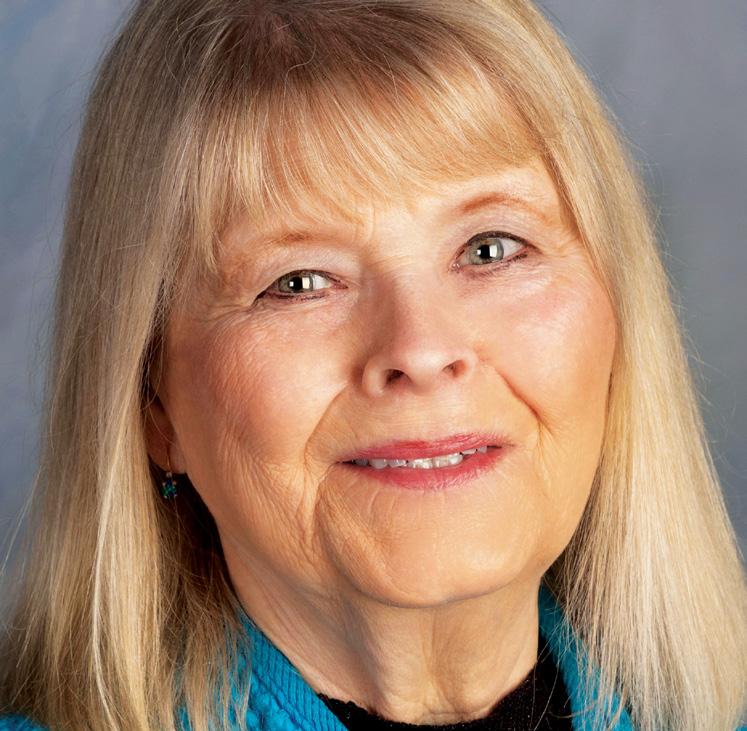
RENEE OAKES
FATHER NICK VANCE
NATION+WORLD HEADLINES
Pope at Easter: Jesus showed nonviolence is true power over evil
By Carol Glatz Catholic News Service
Appealing to those in power to end all conflicts through dialogue and not domination, Pope Leo XIV urged humanity to stop growing accustomed to wars and violence and announced a prayer vigil for peace April 11.
“We cannot continue to be indifferent! And we cannot resign ourselves to evil!” he said April 5 before giving his Easter blessing “urbi et orbi” (to the city and the world).
“In the light of Easter, let us allow ourselves to be amazed by Christ! Let us allow our hearts to be transformed by his immense love for us!” he said.
“Let those who have weapons lay them down!” he said. “Let those who have the power to unleash wars choose peace! Not a peace imposed by force, but through dialogue! Not with the desire to dominate others, but to encounter them!”
Before delivering his blessing from the central loggia of St. Peter’s Basilica, Pope Leo said, “The peace that Jesus gives us is not merely the silence of weapons, but the peace that touches and transforms the heart of each one of us!”
“Let us allow ourselves to be transformed by the peace of Christ! Let us make heard the cry for peace that springs from our hearts!” he said. “For this reason, I invite everyone to join me in a prayer vigil for peace that we will celebrate here in St. Peter’s Basilica next Saturday, April 11.”
Christ’s power is nonviolent, Pope Leo said. “Christ, our ‘victorious King,’ fought and won his battle through trusting abandonment to the Father’s will, to his plan of salvation.”
Jesus walked the path of dialogue, “not in words but in deeds: to find us who were lost, he became flesh; to free us who were slaves, he became a slave; to give life to us mortals, he allowed himself to be killed on the cross,” he said in his message.
This strength and power, he said, is the God of love who creates and generates, who is faithful to the end, and who forgives and redeems.
According to the Vatican, more than 50,000 people attended the Easter morning Mass in St. Peter’s Square, where colorful floral arrangements adorned the steps leading to the basilica, highlighting the joyful celebration of Christ’s resurrection.
In his homily, he said, “death is always lurking. We see it present in injustices, in partisan selfishness, in the oppression of the poor, in the lack of attention given to the most vulnerable.”
“We see it in violence, in the wounds of the world, in the cry of pain that rises from every corner because of the abuses that crush the weakest among us, because of the idolatry of profit that plunders the Earth’s resources, because of the violence of war that kills and destroys,” he said.
April 5.
And yet, because of the Lord’s resurrection, Christ invites the faithful to “lift our gaze and open our hearts,” recognizing that “the Lord is alive and remains with us,” the pope said.
“In every death we experience, there is also room for new life to arise,” he said. Easter gives the hope “that in the risen Christ, a new creation is possible every day” and that “a new life, stronger than death, is now dawning for humanity.”
This is the “song” of hope and joy that today’s Christians must proclaim on “the streets of the world,” and live out in their daily lives, he said in his homily, “so that wherever the specter of death still lingers, the light of life may shine.”
After the Mass, he greeted those gathered in the square and surrounding streets from the central loggia, saying in Italian to great applause, “Brothers and sisters, Christ is risen! Happy Easter!”
He also gave Easter greetings in 10 different languages, including Chinese, Arabic and Latin, though the crowds cheered loudest when he spoke in Spanish and his native English. The crowds enthusiastically waved flags and handed him babies as he was driven around the square in the popemobile after the ceremony.
Before reciting the noonday “Regina Caeli,” and giving his blessing, the pope delivered the traditional Easter message from the loggia, where almost a year ago, Pope Francis gave his final words before his death on Easter Monday, April 21.
Pope Leo repeated his predecessor’s words that day, and his warning against the increasing “globalization of indifference” to the “great thirst for death, for killing, we witness each day in the many conflicts raging in different parts of the world!”
Instead of making a series of appeals for peace regarding specific areas of conflict, as has been the norm, Pope Leo invited everyone to join him in a prayer vigil for peace at the Vatican, a few days before he leaves for a fourcountry journey to Africa.
“On this day of celebration, let us abandon every desire for conflict, domination, and power, and implore the Lord to grant his peace to a world ravaged by wars and marked by a hatred and indifference that make us feel powerless in the face of evil,” he said.
“To the Lord we entrust all hearts that suffer and await the true peace that only he can give,” he prayed. “Let us entrust ourselves to him and open our hearts to him! He is the only one who makes all things new.”
Artemis astronaut: Lunar mission inspires wonder, prayer and unity. NASA’s first crewed lunar flyby in half a century has sparked wonder, reflection and prayer both in space and on the ground. “I think, as we go into Easter Sunday, thinking about all the cultures all around the world, whether you celebrate it or not, whether you believe in God or not, this is an opportunity for us to remember where we are, who we are, and that we are the same thing, and that we’ve got to get through this together,” astronaut Victor Glover, pilot of the Artemis II mission, told CBS News. Glover spoke to the outlet on Easter Sunday, April 5, from aboard NASA’s Orion spacecraft Integrity, which launched April 1 from the Kennedy Space Center in Florida. The call for unity by Glover, who has spoken publicly about his Christian faith, took on an immediate urgency as the crew faced a 40-minute communication lapse with ground control April 6, when the Orion spacecraft successfully passed behind the moon, which blocked radio and laser signals. Speaking to BBC News ahead of the mission, Glover said, “When we’re behind the Moon, out of contact with everybody, let’s take that as an opportunity. Let’s pray, hope, send your good thoughts and feelings that we get back in contact with the crew.”
The pope sends Easter greetings to a Catholic parish in Gaza amid fear and the uncertainty of war. Pope Leo XIV sent Easter greetings to Catholics in Gaza, offering prayers and support to a community living amid war and uncertainty. Father Gabriel Romanelli of Holy Family Parish the only Catholic church in Gaza said the pope has remained in close contact through messages and calls, assuring them of his concern and blessing. The parish has endured significant hardship, including a 2025 tank strike that killed three people and injured others, including Father Romanelli. Despite ongoing violence and heavy casualties reported across Gaza, local Catholics marked Easter with resilient faith, proclaiming hope in Christ’s resurrection. Meanwhile, in Jerusalem, Cardinal Pierbattista Pizzaballa described a subdued and restricted Easter due to security concerns limiting access to major liturgies. Even so, he urged Christians to hold fast to hope, reminding them that no darkness can overcome the promise of the risen Christ, even in the most difficult circumstances. Jesus “is not waiting for us to be at the right level of faith” nor does he expect “anything from us,” Cardinal Pizzaballa said, but instead gave the “gratuitous gift to come to us as the risen Lord and to transform all our wounds and our difficulties to believe.”
At the Colosseum, Pope Leo carries the cross, leading thousands in Good Friday prayer for the suffering world. Below the ancient stones of Rome’s Colosseum, Pope Leo XIV led thousands in the Via Crucis on Good Friday, carrying the cross through all 14 stations in his first Holy Week as pope. For nearly two hours, the 70-year-old pontiff held the cross before his face, praying for victims of war, the poor and the suffering. It marked the first time since St. John Paul II that a pope carried the cross to every station. Meditations by Father Francesco Patton linked Christ’s passion to modern suffering, describing the world as “a chaotic, distracting and noisy environment” and urging Christians to live faith amid daily trials. Prayers addressed war, injustice and human dignity, warning against systems that “exploit nudity for the sake of profit.” When asked earlier in the week about his decision to carry the cross for all 14 stations, Pope Leo said, “It will be an important sign because of what the pope represents, a spiritual leader today in the world, for this voice that everyone wants to hear to say that Christ still suffers, and I carry all these sufferings too in my prayer.” He invited all people to walk with Christ and become bearers of peace.
CNS and OSV News
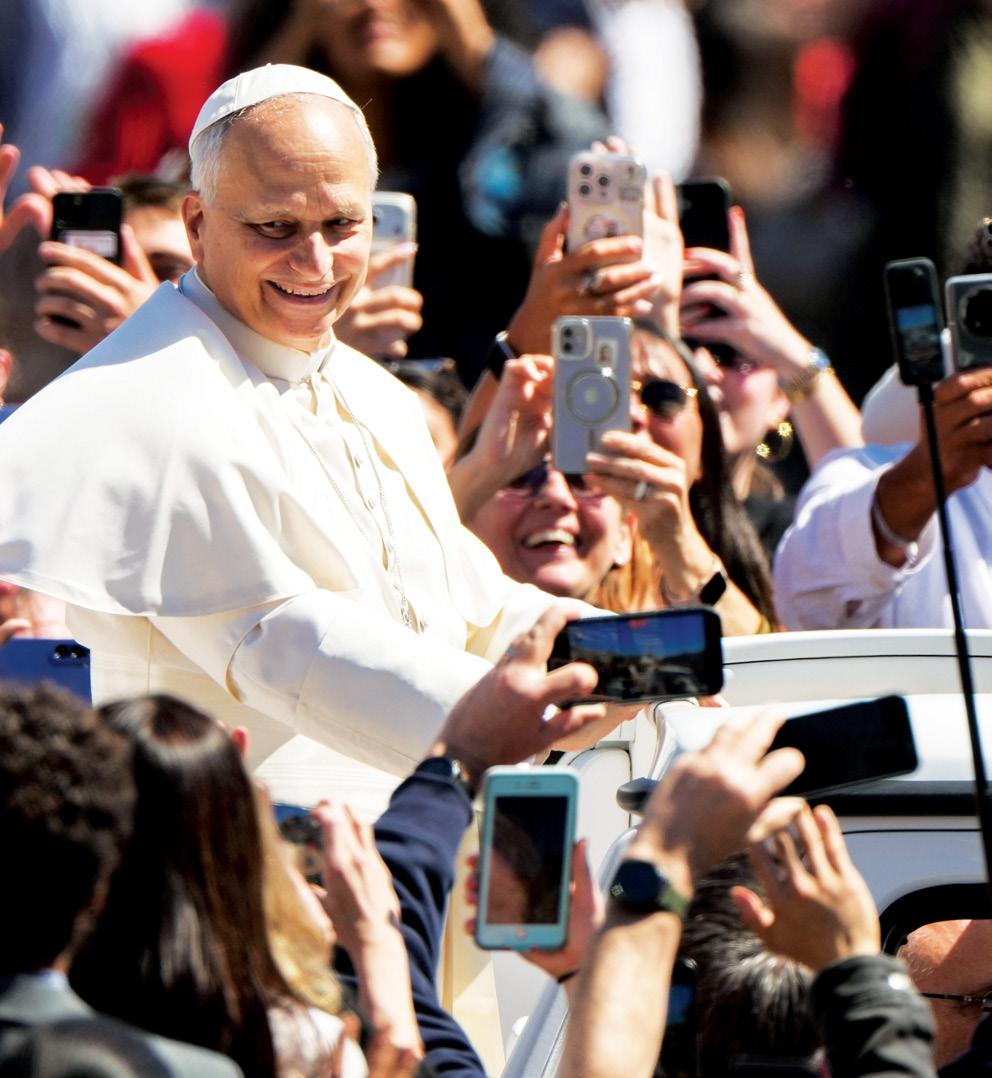
CNS PHOTO | LOLA GOMEZ
Pope Leo XIV greets people from the popemobile after appearing on the central balcony of St. Peter’s Basilica at the Vatican after Easter Mass
Aspiring community of priests in St. Paul grounded
By Rebecca Omastiak
The
Catholic Spirit
In St. Paul’s Lowertown neighborhood, three Catholic priests — Fathers Kyle Etzel, Bryce Evans and Byron Hagan — and one novice, layman Kai Olson, are growing in fraternal, communal life to become an established local household of the worldwide Oratory of St. Philip Neri.
The Rome-based Office of the Procurator General of the Confederation of the Oratory of St. Philip Neri sent a letter dated June 29, 2025 — the feast of Sts. Peter and Paul — informing the household, whose members live adjacent to St. Mary in St. Paul, of its “community-in-formation” status.
“Starting an oratory here in the Twin Cities goes back quite a long ways to men in seminary” contemplating communal life, said Father Evans, a member of the aspiring oratory and co-pastor of St. Mary. “We were all seminarians when it began,” said Father Hagan, also a member of the aspiring oratory and co-pastor of St. Mary.
“In 2017, there was a first stab of beginning the oratory in Northeast Minneapolis with some of the priests and Father Hagan and I were eventually both part of that project,” Father Evans said. “And it’s had various waves and various renditions through the years.”
Fathers Evans and Hagan moved to St. Mary’s campus in the summer of 2021 and “then-Deacon Kyle Etzel spent a summer with us” the following year, Father Evans said, all of which built momentum for this “most recent rendition” of the aspiring oratory.
“(W)e’re happy to have kind of gained steam here in the last five years,” Father Evans said.
The origins of this communal way of living date to the 16th century when St. Philip Neri founded the first oratory in Rome. Around his ordination as a Catholic priest, St. Philip Neri gathered a community of young men — eventually including other ordained priests — for prayer meetings, spiritually-focused conversation and works of charity.
“The original founding of the oratory was also very organic,” Father Evans said. St. Philip Neri, he said, “didn’t set out to found something; he just attracted people to pray with him, to have spiritual conversation with him, to engage in apostolic works with him. And this — that regular habit — established a network of spiritual friendships.”
This first community became known for its contributions to the revitalization of the Rome diocese and it became the first “oratorian” household. Pope Gregory XIII canonically established the Confederation of the Oratory of St. Philip Neri in 1575.
The spread of these Catholic communities — called oratories — is thanks in part to St. John Henry Newman. The doctor of the Church founded an oratory in England in 1848 and thus introduced the oratory to the English-speaking world.
According to the Confederation of the Oratory of St. Philip Neri’s website, there are 87 oratories consisting of more than 470 members in 19 countries. Classified as a Society of Apostolic Life of the Clergy of Pontifical Right, each oratory is independent — often with its own provost, who is “like a superior,” Father Etzel said — but the oratories collectively form the confederation. The confederation’s procurator general presents confederation concerns to the Vatican.
“It might be the shortest hierarchical flow chart in the Church,” said Father Etzel, a member of the aspiring oratory as well as parochial vicar at the Cathedral of St. Paul in St. Paul and a chaplain and instructor at Unity Catholic High School in Burnsville.
An oratory begins as “a pious household, which is really simply an arrangement with the local bishop to allow some men to live together and try to pursue something common,” Father Evans said. “And that can be an indefinite amount of time in which that stage lasts.”
Father Evans said that once the pious household demonstrates its members live complementarily and collectively in pursuit of the oratory’s goals, with the bishop’s approval — in this case, Archbishop Bernard Hebda’s approval — the household can make a formal petition to the Confederation of the Oratory of St. Philip Neri, to be established as a community-in-formation.
As Father Evans described it, during the minimally threeyear process of being a community-in-formation, “we have the responsibility to fortify our lives, to make sure that we’re
living up to what the oratorian tradition calls us to.”
This tradition is rooted in the community values of prayer, study and apostolic work. No formal vows are made as part of being in an oratory. “The oratory is not a religious order — we don’t take vows,” Father Evans said. “St. Philip really wanted it to be very free for the men, and he wanted it to be very familial and bonded in mutual affection for one another.”
As for the households themselves, “ideally they don’t get too large,” Father Evans said.
“St. John Henry Newman articulates this ethic where each man needs to know the other man’s face,” he said. “So, houses can’t get so large that every man doesn’t have a personal relationship with each man. So therefore, oratories don’t usually get much larger than 12 to 15 men.”
Oratory “discernment is a really intentional and slow thing as well,” Father Etzel said.
A universal constitution ensures oratorian households maintain their responsibilities but remains broad in its requirements. Father Evans said this is to allow each household “to figure out how to particularize the customs for their own time and place. So, there’s a lot of flexibility in what each oratorian household looks like.”
Still, “in the best situations, you’ll find that there’s something of the imitation of the original founding in the founding of other oratory houses,” Father Hagan said. “And that means that we remain not simply a clerical society — which is about simply personal cultivation of a way of internal life in the house — but rather, it’s the case that our lives are shared with one another and integrated with one another.”
Oratorians strive to live in simplicity and dedicate themselves to lifelong friendship with their fellow oratorians.
Included in this dedication is communal prayer and other communal activities, like shared meals and shared spiritual study. Father Evans views this sharing of daily life with his fellow oratorians as an opportunity to be oriented toward others.
“There is something to having very clearly placed before you that your spiritual life isn’t just about you — it’s something you’re engaging with others for the sake of others,” he said. “(D)aily commitments to common prayer and common life help place that right in front of you in very concrete and practical ways every day.”
Father Etzel agreed. “The way that we live puts immediately in front of you the need to live the Gospel,” he said.
“(W)hen we have our morning time of meditation and prayer together, when one is absent, that affects me, and it’s like a part of the body is not there,” Father Etzel said. He said he draws strength from “that daily reminder (that) our hearts are intended, without a vow, to be made into one in a very familial way.”
The ‘lay oratory’ and connecting with other oratorians
As co-pastors of St. Mary, Father Evans said that for himself and Father Hagan, “the mission of St. Mary’s and the mission of the (aspiring) oratory are deeply intertwined for us.”
“It’s always the endeavor of the oratory to have a permanent home in a precise physical location,” Father Evans said; for this community-in-formation, the location has inspired new involvement.
“One of our things we’ve been most encouraged by, in our efforts here at St. Mary’s, has been the closeness of
From left, Fathers Kyle Etzel, Bryce Evans and Byron Hagan. The three Catholic priests and one novice, layman Kai Olson, are growing in fraternal, communal of St. Philip Neri. The household, whose members live adjacent to St. Mary in St. Paul’s Lowertown neighborhood, is currently a “community-in-formation.”
grounded in prayer, study and apostolic work
DAVE HRBACEK | THE CATHOLIC SPIRIT
communal life to become an established local household of the worldwide Oratory
friendships we’ve developed with our lay partners in trying to build something special here in terms of community and apostolate,” Father Evans said.
In addition to “being a fraternal community of priests for their own sanctification,” an oratory’s mission must also consist of building “a community of laypeople who want to pray with, and receive formation from, and engage in apostolic works with the priests,” Father Evans explained. “It’s sometimes called the ‘lay oratory’ or the ‘secular oratory’ or the ‘little oratory.’”
Oratories often extend their ministry to laypeople and collaborate on apostolic initiatives — “closeness to the laity, inviting the laity into the mission, that’s a very important dimension of the oratory,” Father Evans said.
Father Hagan expanded upon this by saying, “St. Philip’s oratory very much anticipates the spirit of the Second Vatican Council in its call for the active participation of the laity in apostolic life and in charismatic movements.”
He went on to say that “at its best, oratories retain something of a freshness and a charismatic creativity. And that’s what we’re really committed to — preserving and being open to that.”
“(M)ost of our lay oratorians, I would say, are parishioners here at St. Mary’s,” Father Etzel said. “We have people that participate just as frequently as any of those in lay oratory life and events that are from other parishes, too, all mostly from around here.”
Interested laypeople currently gather monthly to pray together with the members of the community-in-formation. “After the Holy Hour, we come here (to the household) oftentimes for some spiritual conversation or a lesson from one of the priests together with some time for a good conversation amongst friends and a little reception,” Father
FEAST DAY CELEBRATION
Three Catholic priests and one novice have set up an opportunity to learn more about their “community-in-formation” to become an established local household of the worldwide Oratory of St. Philip Neri.
The three priests Fathers Kyle Etzel, Bryce Evans and Byron Hagan and one novice, layman Kai Olson, are hosting a gathering May 26, which is also the feast day of St. Philip Neri.
Father Evans described the event as a chance “to gather as many friends as we can and people who are curious about the oratory, who might want to support the oratory, to come join us for prayer and Mass and then dinner and we’ll give a talk.”
The event, held on the campus of St. Mary in St. Paul’s Lowertown neighborhood, will begin with a Holy Hour at 4 p.m., followed by Mass at 5 p.m., a reception and dinner at 6:30 p.m. and compline at 8:45 p.m.
For event and ticket information, visit archspm.org/philip-neri. Learn more about the community-in-formation in St. Paul online at twincitiesoratory.org
Evans said.
The priests reflected on a recent such gathering that “happened to fall nicely on St. Patrick’s Day, which allowed us to ease up on our Lenten disciplines just a little bit,” Father Evans said humorously.
Father Etzel said there were “kids running around, and pregnant couples, and elderly” attendees. “That’s one of the things I love about it … it’s pretty intergenerational.”
“I love having these elderly (attendees) with us, or the moms who are a little more into momhood helping the new moms, or (the) recently married, or (those) helping the ever-wandering single young adults navigate those things,” Father Etzel said. “That’s just kind of happened naturally from some of these various events.”
Another event that has garnered interest and consistent attendance among young adults has been Beads and Beers — a walk within the Lowertown neighborhood during which the rosary is prayed, then beverages at a local establishment.
“We might stop and talk to people on the way if we’re asked for money or such things,” Father Evans said.
“Usually we’re asked for prayer,” Father Etzel said.
“It’s kind of a gentle public witness,” Father Evans said.
It’s a public witness that has received broader attention, with Father Etzel remarking that the staff at Barrel Theory Beer Company has gotten to know the Beads and Beers group well.
“We’ve been invited to their weddings, we hear about their broken furnaces,” Father Etzel said. “They know when it’s Lent and Advent because we’re not there.”
The three priests explained that each diocese can have an oratory, but not all do; the aspiring oratorians communicate with other oratorians, to ask questions and seek advice.
“We maintain contact with them to kind of help us along the way,” Father Evans said, adding that the local group has visited some of the 13 oratories in North America, including in Philadelphia; Pittsburgh; Toronto; and Washington, D.C.
“We visited the oratory in Vienna, which is very successful and has a nearly 50-year existence,” Father Hagan recounted. These oratorians “have been very influential, too, with respect to the success of their sacred arts program and have been a great inspiration to us on that.”
From that inspiration has grown the aspiring oratory’s participation in the local arts. Through its “cultural calendar,” the aspiring oratorians have organized cultural events with corresponding conversations. Participants have visited Open Window Theatre in Inver Grove Heights; and the Guthrie Theater and Minneapolis Institute of Art, both in Minneapolis; as well as taking in the “symphony and opera,” Father Etzel said.
“(W)e try to encourage Catholic engagement with the arts that way,” Father Evans said.
In connection with Archbishop Hebda’s invitation to form small groups via the Parish Evangelization Cells System has been the community-in-formation’s creation of “oratory circles,” said Father Evans.
“We have a number of these to try and cultivate spiritual friendship amongst the people who are close to us, and we’ll try to chaplain these groups or shepherd these groups as we can,” he said.
The community-in-formation has also created a pamphlet that recommends various practices to unite its members “under the spiritual fatherhood of St. Philip.” In the pamphlet’s section on apostolic outreach, for example, lay oratorians are encouraged to pray about apostolic outreach “they can propose to the Fathers and execute under their supervision” and seek activities that “focus on the two-fold priority of charity to the poor and evangelical witness.”
The community-in-formation also intends to continue its practice of an annual retreat. “This last year we were able to have a common retreat together locally, just kind of over a weekend with our lay friends, just to try to deepen the vision of what we’re after,” Father Evans said.
Father Evans acknowledged an effort made by the aspiring oratory to try different things.
“We have many experiments underway right now, which have already been, I think, very fruitful,” he said. “I think we do have a real community of people forming with us, although maybe there’s a lot of different sides to it that have not yet fully coalesced.”
Becoming formally established
Ahead for the community-in-formation is the crafting of the house statutes, in consultation with other oratories.
“Each house has particular statutes to talk about how they’re going to govern their lives together,” Father Evans explained. During its probationary period as a community-information, aspiring oratorians continue to build their commitment to living in the ways outlined by St. Philip. The community-in-formation will receive at least one more visit from a representative of the Confederation of the Oratory of St. Philip Neri “to kind of check in on us, and he’ll live with us and see how things are going, and tell us what we need to work on,” Father Evans said.
Father Etzel said that during this probationary period, he is looking forward to seeing what “spiritual goods” develop, “in terms of love for one another and working together and living together and the spiritual fruits of those things.”
Once the probationary period is determined to be complete, “then we can, with the archbishop’s approval and cooperation, formally petition to be established as a full-fledged oratory,” Father Evans said.
Father Evans explained that “once an oratory is fully established, the men, if they were diocesan priests, are no longer diocesan priests. … (T)hey’re incardinated into the household of the oratory” and are considered secular priests. Father Hagan said that this doesn’t remove the oratory from its local connections and that close collaboration with diocesan bishops, including Archbishop Hebda, would continue.
Father Hagan said the support the community-in-formation has received from the archbishop — “who has taken a special interest in sponsoring our development and foundation here” — has been especially rewarding.
“When one feels in ministry that your heart is really kind of tuning up with the bishop in a special way in a certain moment, it’s deeply consoling and encouraging,” Father Hagan said.
Fathers Evans and Etzel agreed.
“He’s been very, very supportive,” Father Evans said.
“I’m very grateful for Archbishop Hebda, that he’s our shepherd, and that our project coalesced with him being here is probably something more than coincidence,” Father Etzel said.
FAITH+CULTURE
‘Grace is accessible to all of us’
By Christina Capecchi
For The Catholic Spirit
Junior Obrand grew up in rural Haiti eating the very meals he now helps deliver around the world. Today, through Coon Rapids-based Feed My Starving Children, his work has come full circle from receiving aid as a child to helping provide it to others.
He lives in Apple Valley with his wife, Paula, and their two children and belongs to Risen Savior in Burnsville.
“God has been pushing the right buttons in my life,” said Obrand, 41. “It’s nothing I’ve done. It’s all about the power of his grace.”
Q Take me back to Gris-Gris, your hometown in Haiti. What did an ordinary day in your childhood actually feel like?
A Gris-Gris was almost a different world. I grew up with nine siblings, mom and dad and a few cousins — so on any given day, the minimum number of people in the house would be a dozen. The house had one bedroom during the day and two at night, when we turned the little living room into a bedroom. We did not have beds. We slept on the floor. We would have anywhere from five, six, seven on a mat on the floor. Sometimes you’d have to lay diagonally or parallel trying to make sure we all fit. We walked several miles a day to get water for cooking and washing.
Q Hunger was a constant in your childhood. How do you explain it?
A Hunger is more than an empty stomach. The hunger I grew up with was not just an absence of food but an absence of hope.
Q Your mother taught herself to read at 50.
A She would be getting up twice a week, on Tuesdays and Thursdays, and going for three to four hours to sit down and learn how to read in a culture where that’s not normal. She did it for one reason: to read her Bible.
Q You were raised Catholic. What did faith look like in your home growing up?
A Faith was the foundation. My mother is as Catholic as Pope Leo (XIV). Faith is not something she does when things go wrong. It’s something she uses in her everyday life. I would fall asleep every night listening to the whispers of my mother’s prayer. And I would wake up to those same whispers.
Q Growing up, did you ever have a hint that your life might take a different path?
A No. Zero. It took 14 to 19 hours to reach the capital city. My mind could not think beyond Haiti.
Q You’ve described your life as a “statistical abnormality.” How so?
A A combination of three things that had to happen for my life to be the way it is today. The first one is the power of God’s grace. The second one is the love of my parents and the tenacity they have. And the third one is the power of education. It makes no sense except for those three things.
Q You’ve shared the story of your father running back into a collapsing house during a hurricane to find your sister. It feels almost like a living parable. What do you see in it now?
A It reminds me God will always run back to look for the lost one. My dad was a man of a few words, but he taught us so much without saying much.
Q What role has Risen Savior played in your life?
A Risen Savior has been my church before it was my church. Growing up in Haiti, Risen Savior has been supporting my home church in Haiti for over two decades.
I met my wife because of Risen Savior. She went to Haiti on a mission trip. I was living in Haiti, working as an interpreter. She is from Lakeville. We got married at Risen Savior.
I came to the U.S. in 2009, at 24, coming straight to Minneapolis from Port-au-Prince. I think that was the best place that God had for me.
Q How did your work with Feed My Starving Children come about?
A I was shocked because it was the very food I would eat in Haiti. The packaging, the smell of it — I knew it. Not only did I recognize the food, I thought: This is my food.
Q You once received aid. Now you help deliver it around the world. What does that feel like?
A I don’t see it as a job. It’s an assignment, and it’s deeply personal. When I tell kids I knew what hunger is, sometimes they look at me and think: “Yeah, sure. If you’re too busy, you don’t have time to eat.” No. I knew it. I grew up where you have no food on Monday or Tuesday and you’re not sure if you’re going to eat on Wednesday.
Q What’s something people think they understand about global hunger but don’t?
A There is enough food on the planet. The food is just not properly distributed.
Q Are Americans who travel to Haiti surprised by the joy among locals?
A I call it a recalibration that happens, and I have seen it more times than I can count. The people I depart the U.S. with are very different people who re-enter the country with me. They get recalibrated and they look at life differently to say: What really matters in life? When you have nothing, Jesus is everything. When people see the joy they have, it’s not happiness. It’s a deep joy that comes from within.
Q Now that you live with comfort and convenience, do you ever take it for granted?
A I do. It’s human nature. But I like to try to bring myself back.
Q I bet you make a point to remind your kids how fortunate they are!
A They hear that all the time! They each have their own bedroom. When I was a kid, we didn’t even have beds! I use it less as a comparison but more as a lesson to tell them: Hey, how we live here in Apple Valley is the exception, not the rule. Many people — in fact, the majority of the people in the world — don’t live like we live here. We are privileged and blessed to live this life, so let’s look at it and see: What can I do for somebody else?
Q You self-published “No Grave for Grace” last year (nograveforgrace.com). It’s a dramatic memoir with stories of poverty, near-death moments and change. Why did you feel called to write it?
A I see it as a way of leaving a trace. What if I could leave something that would outlive me? My dad died in 2006, and none of us have a picture of my dad. My kids don’t know
what my dad looked like. That is a haunting statement to me.
I know that by having this out there in the universe, my kids and their kids and their kids will get to read it. Being able to sell copies becomes a secondary objective.
We all can do something to leave a trace. Not all of us will write a book. Oftentimes leaving a trace can be an act of kindness. Bringing cookies to the neighbors who just moved in. Shoveling someone’s driveway without being asked. People will always remember how you made them feel. I remember driving to an appointment in Haiti one time and I saw an old friend. I parked the car and exited and gave him the biggest hug. He still talks about that nine years later. All it was, was a hug.
Q What’s your next big dream?
A I want more people to see life differently. I hope my book can be a tool for people to see the power of grace. Over the next couple of years, my hope is to speak to all groups of people, to remind them that grace is accessible.
Q What do you know for sure?
A I know for sure, with every fiber of my being, that grace is accessible to all of us. Life here on Earth is like being on an airplane. Some of us will have extra leg room, some of us will board first, some of us will have a complete meal during the journey but some of us will have to buy water. When we hit turbulence, all of us are shaken. The best way to make that journey more enjoyable and more worthwhile is by being kind to the other people on that journey with us. We’re on a layover. I don’t want to treat the layover as the final destination. This is not our final home. That I know for sure.
DAVE HRBACEK | THE CATHOLIC SPIRIT
Holy game show St. Agnes priest appears on ‘Jeopardy!’
By Dave Hrbacek
The Catholic Spirit
Father Paul Baker of St. Agnes in St. Paul took a seat in the Helene Houle Auditorium at St. Agnes School March 30. Next to him were his parents, Steve and Lisa Baker, who belong to St. Peter in Mendota.
Father Baker, the parochial vicar of the parish and chaplain at the school, was there to watch himself on TV. He was joined by a raucous crowd of students, school and parish staff members, family and friends. They filled the 482-seat auditorium to near capacity.
A hush fell over the crowd at exactly 4:30 p.m. On a big screen placed on the stage, Father Baker’s face appeared. In that moment, the hundreds gathered in the auditorium witnessed the priest’s long-time dream: He was on “Jeopardy!,” a popular game show that has been on the air since 1984.
After three unsuccessful attempts, Father Baker’s fourth audition in December 2025 landed him the chance to be filmed in Los Angeles at Sony Pictures Studios and compete against two other contestants.
He tried hard and battled through nerves and the newness of the experience. His nearly 10,000 points after “Final Jeopardy!” were not enough. He fell to Jamie Ding, who brought an 11-game winning streak into the episode and pushed it to 12 with his win March 30.
All in all, Father Baker thoroughly enjoyed his chance to compete and be on the air, and he smiled at the end of the school’s watch party after placing second. He also put the experience into a spiritual perspective.
“It would have been great to win the show and win a lot of money and go on an 11-game (winning) streak myself,” said Father Baker, 39, who was ordained a priest in 2017. “But I knew that anything that happened in that realm would be icing on the cake, that the best thing would be just to represent my church and my school well and to represent Christ well.”
The cheers that erupted throughout the half-hour episode demonstrate that he succeeded in that regard. His parents were bursting with pride, expressed in their comments after the episode ended and in their facial expressions while watching.
“I’ll tell you, my face has not hurt this much from smiling for a long time,” Lisa Baker said.
Likewise, Father John Ubel, the pastor of St. Agnes, was gushing with emotion and excitement before, during and after the episode aired. He led a brief prayer in the minutes right before the show began and then took his seat in the back row of the auditorium with his 95-year-old mother, Gix (short for Genevieve) Ubel. She lives at Carondelet Village in St. Paul and has been a faithful “Jeopardy!” viewer for 40 years, sometimes with her priest-son at her side watching with her.
While watching and cheering for Father Baker, Father Ubel also took in the energy of the room and noted the enthusiasm that permeated the air.
“You saw the love that people had here at St. Agnes for Father (Baker),” Father Ubel said. “It was very evident. It was win, lose or draw. He’s beloved here. The students love him. He’s an excellent teacher, but above all, he’s a faithful priest. They know that; they see that.”
Father Baker got his invitation to be on the show in January. While he was stepping outside the parish rectory to retrieve the daily newspaper, his cell phone rang. He didn’t recognize the number on his caller ID. It was from the Los Angeles area. Despite not knowing who was on the other end, he took a chance and answered.
A “Jeopardy!” staff member informed him that he had been selected for taping at Sony Pictures Studios in Culver City, near Los Angeles. Filming would take place over two days during the last week of February. He celebrated a 7 a.m. Sunday Mass at St. Agnes on Feb. 22, then went to the airport to fly to Los Angeles.
Before filming began, contestants were able to make brief introductions to one another. It was then that Father Baker learned about Ding and his 11-game winning streak. That dampened his optimism for winning.
Watching Ding while competing showed Father Baker why the reigning champion ended the March 30 episode as a 12-game winner.
“He’s a tremendous player,” Father Baker said of Ding.
“He’s one of the best in history.”
Yet, Father Baker had his moments to shine. He answered several questions correctly, each of which drew a burst of applause from the partisan crowd in the St. Agnes auditorium.
“The funnest part was just trying to ring it (his contestant buzzer) at the right time,” he said. “It was both the most frustrating but the most satisfying when you did get in (before the other opponents) and you saw your podium light up. That was the most thrilling part of the whole thing.”
Father Baker’s mother is well aware of her son’s desire and qualifications to be a “Jeopardy!” contestant. She noted his interest in Quiz Bowls as an elementary student at St. Joseph Catholic School in West St. Paul and his participation in similar competitions in college. He
watched “Jeopardy!” along the way, even while studying for the priesthood at The St. Paul Seminary in St. Paul.
“He was a vacuum (for) knowledge,” Lisa Baker said. “He literally slept with encyclopedias.”
His bedroom was atypical. “He had all the encyclopedias in his bedroom in a bookcase,” she said. “I would go in there and they’d be in bed with him and on the floor.”
One of the hard parts for Father Baker was keeping silent about his audition and — in particular — the results of the episode before it aired. He didn’t even tell his parents. He joked to those gathered in the auditorium right before the episode began that maintaining secrecy was similar to protecting “the seal of the confessional.”
“It’s a relief that I can finally tell other people what happened and can speak about the totality of the experience,” he said after the episode ended, “not just how I felt but what I was actually thinking as the game was going on.”
Father Baker amassed a total of $9,999 on the show but didn’t get to take that amount home. Instead, he got $3,000 for finishing second, which is the standard. He said he “has some ideas” of what he will do with the prize money and will “certainly use some things from this experience” in his priestly ministry, perhaps in a future homily. He wants those who watched him on the show to think beyond his performance as a contestant.
“My hope is just for people to see that a priest can do these things and have these aspirations, not for the purpose of winning money, but just to be a good face and a good image for God and his Church,” he said. “That was my most desired accomplishment. Anything (show winnings) ... on top of that is gravy.”
DAVE HRBACEK | THE CATHOLIC SPIRIT
Father Paul Baker, right, watches an episode of the game show “Jeopardy!” in which he appears during a watch party at St. Agnes School in St. Paul March 30. Sitting next to him are his parents Steve, left, and Lisa.
COURTESY SONY PICTURES STUDIOS
Father Paul Baker on the set of “Jeopardy!”
FOCUSONFAITH
SUNDAY SCRIPTURES | FATHER NATHANIEL MEYERS
The victory of Easter present in our lives
There is an old movie theater in Maplewood that has long since closed its doors and silenced its sound systems while turning off its projectors. The silver screens inside it stand blank and lifeless as one expects they will remain until finally the building is demolished and the land sold to some developer to create a new building.
When driving past the theater, it’s a reminder of the old Latin phrase, “sic transit gloria mundi” (thus passes the glory of the world); and while I certainly have passed many buildings that have shuttered their windows and locked their doors, this quaint theater catches my attention in a way that few others do on account of a message the old owners must have put up right as they went out of business. It’s an oftquoted line, naturally from a movie: “Hope is a good thing, maybe the best of things, and no good thing ever dies.”
The quote mentioned above comes from the climax of “The Shawshank Redemption” and serves as a repudiation to the claim made earlier in the movie that hope is dangerous and can drive a man insane.
For Catholics, we understand hope to be not simply a good thing, but a theological virtue. As a virtue, hope can bring us to God because its origins are in the Lord and lead us to him.
Thankfully, we do not need to wait until our own bodily resurrection to share in the redemption won for us by the Lord, because it is indeed a living hope. In the words of St. Peter, we can discern that the victory of Easter is already present in our lives.
Easter is a season full of hope, but not a hope based on human emotion or good wishes for the future. Instead, our Easter hope is rooted in the Resurrection, which is precisely what St. Peter speaks about in his letter that serves as the second reading at this weekend’s Mass. “Blessed be the God and Father of our Lord Jesus Christ,” the prince of the apostles writes, “who in his great mercy gave us a new birth to a living hope.” Yet what is this living hope? In the prayer that St. Peter makes, which follows the formula common to Jewish prayers of that era, the hope is the salvation offered by God that makes us coheirs with Christ to the kingdom of heaven.
As we highlight God’s mercy on this Octave Day of Easter, the Church invites us through St. Peter’s epistle to recognize that the greatest gift of divine mercy is not found in this world, but in the world to come. Whether it be a movie theater or our health or even our country, the
Symbols of the office of bishop
Editor’s note: This is the third column in a series on the highest order of ordained ministry in Catholic teaching, that of bishop.
The four main symbols of the office of bishop are the crosier, miter, pectoral cross and ring.
The crosier, crozier or pastoral staff. The crosier is the principal symbol of a bishop, and it represents his office and authority. The crosier resembles a walking staff. It is a long, slender, pole made of wood or metal — much like a walking stick used by shepherds — about 6 feet tall, with a curved top or crook which often encircles a cross, a religious symbol, or a small depiction of a biblical scene. Some crosiers are a single unit. Others are made in three sections, can be disassembled, and placed in a carrying case.
The staff is used liturgically for processions and held at other times during the Mass. The staff represents the bishop’s duty to continue the ministry of Jesus, the good shepherd (see Jn 10:1-18); the bishop’s continuity with the pastoral ministry of Peter, to whom Jesus said, “Feed my lambs” (Jn 21:15), “Tend my sheep” (Jn 21:16), and “Feed my sheep” (Jn 21:17); and the bishop’s responsibility to love, care for, watch over, and protect all of the members of his flock. The staff is also a symbol of journey and
KNOWtheSAINTS
the bishop’s duty to travel and carry the Gospel message throughout his diocese.
The miter. The miter is a tall, circular, pointed, ceremonial headdress, another symbol of the office of bishop. The term is derived from the Greek word “mitra,” a headband. It has two flat, stiffened pieces — one in the front, the other in the back — which are connected by soft expandable material on the sides, allowing it to be folded and lay flat in storage, and to take a round shape when placed on the head. The top is pointed in both the front and the back. The bottom of the back normally has two long, narrow, fringed strips called lappets. The miter is covered with silk, linen or another type of cloth material. The front is often embroidered with a cross or another sacred symbol. A few are decorated with gemstones. In the past the miter was always white. Today, bishops have miters in multiple colors to correspond to the liturgical season, the sacrament featured at the Mass (e.g., red for confirmation), or the color stipulated for the Mass of the day. It is worn at specified times during the Mass.
The pectoral cross is a small Latin-style cross, usually 4 or 5 inches in length. The pectoral cross is traditionally made of a precious metal, gold or silver, but more recently made of another metal or rich wood, occasionally decorated with gemstones, attached to a metal chain or a silk cord, worn around the neck, and hung in
things of this world are bound to fade into history and lose their power. For this reason, our hope cannot be founded upon such things but instead must be built on the redeeming work of Christ our Lord who guides us into the peace of the resurrection.
Thankfully, we do not need to wait until our own bodily resurrection to share in the redemption won for us by the Lord, because it is indeed a living hope. In the words of St. Peter, we can discern that the victory of Easter is already present in our lives. God brings us peace today just as he did to the Apostles gathered in the upper room. In the sacraments, the preaching of the Gospel, the communion of faith, and the corporal and spiritual works of mercy, the new birth referenced by St. Peter is in our world, our homes, and our very souls.
Father Meyers is pastor of Transfiguration in Oakdale.
full view over the front of the chest and close to the heart. The term is derived from the Latin word “pectus,” which means chest or breast. It is customary to wear the pectoral cross over the black clerical shirt outside of Mass. It sometimes is tucked inside the left coat pocket.
The ring. The episcopal ring is a special insignia of a bishop. It is given to the bishop at his episcopal consecration. It is worn on the right hand, not the left, and on the third or ring finger. As a husband or wife wears a ring as a sign of the commitment to one’s spouse, the bishop wears the ring as a sign of his commitment to Jesus, his Church, and the flock entrusted to his care. Furthermore, the ring represents the bond of the priests of the diocese and the faithful to their bishop. The traditional stone for the ring is the amethyst, a purple or violet variety of quartz. Today, bishop’s rings come in a variety of colors and materials and, with a desire for simplicity, are less ornate and expensive. Some rings have an image engraved on them, often a cross or another religious symbol. At one time it was customary for the faithful to kiss the bishop’s ring out of reverence and respect, partly for the bishop himself, but more for his office and his role as successor of the Apostles. While this custom is still practiced, it has become less common.
Father Van Sloun is the director of clergy personnel for the Archdiocese of St. Paul and Minneapolis.
ST. MARTIN I (died Sept. 16, 655) Born in Todi and educated in Rome, this pious Italian priest was sent by Pope Theodore I as nuncio to Constantinople, where he encountered the Monothelite heresy claiming Jesus had only a divine will and was not truly human. When St. Martin followed Theodore as pope in 649, he convened a council that condemned this heresy and an imperial decree supporting it. The emperor’s legates tried to arrest St. Martin in Italy and they succeeded in 653. The already sick pope was held in solitary confinement in Constantinople, condemned for treason and scourged. Banished to Crimea, he died there of starvation and is the last pope to be venerated as a martyr. His feast day is April 13.
Sunday, April 12
Second Sunday of Easter, Divine Mercy Sunday Acts 2:42-47 1 Pt 1:3-9 Jn 20:19-31
Monday, April 13 Acts 4:23-31 Jn 3:1-8
Tuesday, April 14 Acts 4:32-37 Jn 3:7b-15
Wednesday, April 15 Acts 5:17-26 Jn 3:16-21
Thursday, April 16 Acts 5:27-33 Jn 3:31-36
Friday, April 17 Acts 5:34-42 Jn 6:1-15
Saturday, April 18 Acts 6:1-7 Jn 6:16-21
Sunday, April 19 Third Sunday of Easter Acts 2:14, 22-33 1 Pt 1:17-21 Lk 24:13-35
Monday, April 20 Acts 6:8-15 Jn 6:22-29
Tuesday, April 21 Acts 7:51–8:1a Jn 6:30-35
Wednesday, April 22 Acts 8:1b-8 Jn 6:35-40
Thursday, April 23 Acts 8:26-40 Jn 6:44-51
Friday, April 24 Acts 9:1-20 Jn 6:52-59
Saturday, April 25 St. Mark, evangelist 1 Pt 5:5b-14 Mk 16:15-20
Sunday, April 26 Fourth Sunday of Easter Acts 2:14a, 36-41 1 Pt 2:20b-25 Jn 10:1-10
FAITH FUNDAMENTALS | FATHER MICHAEL VAN SLOUN
COMMENTARY
TWENTY SOMETHING | CHRISTINA CAPECCHI
Easter gets the short end of the stick.
That’s what author Laura Kelly Fanucci concluded. Any Catholic can tell you what the 40 days of Lent entail, rattling off the terms: praying, fasting and almsgiving.
But ask about the 50 days of Easter, and many get stuck on an egg hunt and “Alleluia.”
Then what?
“Why aren’t we living Easter more deliberately?” Fanucci found herself asking.
The 45-year-old Minnesota mother, whose column “Faith at Home” appears in The Catholic Spirit, explores this question in her new book, “Living Easter,” published by Ave Maria Press. “I set it up as a creative, theological challenge: How would you think about sustaining the practice of a whole season of Easter?” Fanucci said.
The book illuminates the Church’s most consequential liturgical season, gathering every Scripture story of Christ’s resurrection
into daily entries with Fanucci’s reflections and action items. They’re all tucked into a beautiful, hand-sized hardcover.
“Living Easter celebrates joy itself as our Resurrection practice,” Fanucci writes in the introduction. “Taking up joy as a daily discipline teaches us about feasting as a companion practice to fasting: an intentional sacred act that draws us closer to God.”
That doesn’t mean being cheerful for 50 consecutive days, Fanucci is quick to clarify.
“It’s OK if you’re not feeling very Easter-y, if things aren’t looking like bunnies and chocolate,” she told me. “Easter is for all of us — especially those who are suffering or lost or grieving. That’s exactly the kind of people that the first Easter came for.”
Fanucci has plenty of firsthand experience.
Three years ago, she received a horrifying diagnosis: triple negative breast cancer. A decade ago, she lost twin girls hours after their birth.
“Even in their dying, I could feel something of the life they were being
BRIDGING FAITH | DEACON MICKEY FRIESEN
‘Joy as a daily discipline’: Leaning into Easter Service and solidarity with the saints
Editor’s note: This is the sixth in a series of columns celebrating the 175th anniversary of the Archdiocese of St. Paul and Minneapolis by considering the travels and teaching of St. Paul.
During St. Paul’s missionary journeys, he often asked the Gentile Christians to remember the mother Church of Jerusalem. The area surrounding Judea was experiencing the effects of famine along with various kinds of poverty. Paul began to consider what it means to support one another in the Church as it spread to other parts of the world. He started to speak to his young Gentile Christian communities about the “saints in Jerusalem” in need. He pressed upon them the inherent responsibility to serve their brothers and sisters in the Church. For more than 10 years, Paul continued to seek support and solidarity for the “holy ones in Jerusalem.”
He wrote to the Romans, “Now, however,
born into or were going to hold onto,” said Fanucci, who is now cancer-free and a mom of five boys. “I came to a really deep understanding of the reality of the Resurrection. God does impossible things. He makes a way where there seems to be none. In small ways and big ways, resurrection is at the heart of my faith.”
Every page of the book is colored by her medical journey.
“Dying and rising are woven into creation. Surviving cancer helped me see that is part of what it means to be human,” said Fanucci, who lives in St. Michael and belongs to St. Joseph the Worker in Maple Grove. “God’s work of resurrection is always going on in the world.”
That conviction anchors Fanucci when war dominates the headlines and immigration raids sever her community.
Creating this book meant spending time with the saints who witnessed Jesus’ resurrection — Mary Magdalene, Thomas, Peter, Mary. They provided a companionship that Fanucci never could have anticipated.
She pairs her insights with simple action items for each day of Easter: pick flowers, bake bread, sing, take a walk, bless with holy water, call a friend, share a story about God.
Faith-based writing has always animated Fanucci, who has written more than a dozen books and houses her work at laurakellyfanucci.com. Lately she’s felt compelled to cast a wider net of readership. “Increasingly, I have such a yearning to write for those who don’t feel certain of their faith, who maybe don’t feel included in the Church,” she said. “The most meaningful feedback I get is when folks say: ‘I stopped going to Mass decades ago, but I really like what you’re saying and it’s made me think maybe I believe this, too.’”
She’s clear on her goal. “It’s a dream I have to help people strengthen their imagination to see how God is at work around us, so we don’t file away resurrection as an idea or a historical event. This isn’t the end. There is hope.”
I am going to Jerusalem to minister to the holy ones. For Macedonia and Achaia have decided to make some contribution for the poor among the holy ones in Jerusalem; they decided to do it, and in fact they are indebted to them, for if the Gentiles have come to share in their spiritual blessings, they ought also to serve them in material blessings” (Rom 15:25-27). Paul used this effort to encourage generosity (2 Cor 9), emphasizing that it was a privilege of service rather than a begrudging obligation. “You are being enriched in every way for all generosity, which through us produces thanksgiving to God, for the administration of this public service is not only supplying the needs of the holy ones but is also overflowing in many acts of thanksgiving to God (2 Cor 9:11-12).
Reaching out in service and solidarity beyond our own borders serves Christian communion and serves God.
The notion of outreach in service, solidarity and generosity informed the ministry of the Archdiocese of St. Paul and Minneapolis as changes in the world and
the Church invited a new spirit of outreach and solidarity at home and abroad. In the 1960s the civil rights movement came to the Twin Cities with calls to address patterns of racism and injustice, particularly in education and housing. By 1965, some 8,500 Native Americans were also living in the Twin Cities, many of whom were Catholic. Parishes in south Minneapolis joined an effort to reach out in service and solidarity to Native peoples being discriminated against in the metro area. Programs to address homelessness and poverty were organized under the auspices of the St. Vincent de Paul Society, Dorothy Day Center and Catholic Charities. A growing movement took root to protect the life of those most vulnerable including life in the womb and women in unexpected pregnancies and their families. The archdiocese helped to resettle migrants and refugees flowing into the Twin Cities due to war and poverty in other countries. And, in 1970, the archdiocese shared the gifts of priests to serve in the mission Church in Venezuela. These movements of outreach and solidarity
Capecchi is a freelance writer from Grey Cloud Island. informed the Church’s catholic, or universal, faith, generosity and mutual sharing to the “holy ones” among us in need.
Today, we continue to face challenges to reach beyond ourselves as the Church. As the U.S. bishops wrote in 1997 in their pastoral letter “Called to Global Solidarity,” “A parish reaching beyond its own members and beyond national boundaries is a truly ‘catholic’ parish.”
This catholic solidarity is expressed in prayer and stewardship, how we form our children and invest our resources, the choices we make at work and in the public arena. Like St. Paul, who called on the early Church to participate fully in the body of Christ, so are we meant to share our gifts in the global family of faith. Let us reach out in service, solidarity and gratitude to the saints in our midst at home and abroad.
Deacon Friesen is director of the Center for Mission, which supports missionary outreach of the Archdiocese of St. Paul and Minneapolis. He can be reached at friesenm@archspm.org.
Blessing & Dedication Celebration
Join us for the blessing of the Our Lady of Guadalupe Statue located in our new section! Archbishop Hebda will preside at the blessing and dedication.
All are warmly invited to attend this special occasion!
Join Fr. Bechtold for a pilgrimage to the German Black Forest, beautiful Abbeys, and enjoy Oktoberfest in Munich!
Chuck Norris, death and living forever
If any mortal man seemed like he stood a chance of getting the upper hand on death, it was Chuck Norris. After all, the karatemaster-turned-TV-starturned-living-legend inspired an entire genre of “Chuck Norris facts,” each playing up the idea that he was a singular force who seemingly stood above the laws of nature. A sampling:
“When Chuck Norris plays dodgeball, the
“Chuck Norris has a polar bear rug at home. It’s not dead; it’s just scared to move.”
“Chuck Norris doesn’t do push-ups. Chuck Norris does earth-downs.”
“The flu gets a Chuck Norris shot every year.” And, “Chuck Norris counted to infinity — twice.”
But alas, the legendary status that the “Walker, Texas Ranger” star reached on Earth
What does Easter truly mean for us?
was not enough to avoid the outcome that waits for us all. On March 19, Norris died at age 86. Obviously, Norris was not immortal. But instead of dismissing the “Chuck Norris facts” as pure silliness, it might be worthwhile to reflect upon something that they allude to: humanity’s very real desire to overcome the forces of nature and live forever.
Immortality has been a human preoccupation for ages. Ancient Greek philosophers like Plato, for instance, believed that our best shot at being immortalized was to produce “children of the soul,” great ideas or works of art that would be passed on in civilization even after we had passed away.
The yearning to live forever lives on in contemporary pop culture. In the song “What Do It Mean” the band Lord Huron ponders what the point of life is if it isn’t eternal. After all, if we cease to exist, what is the significance of all the ways we’ve grown and loved? Unfortunately, the lead singer denies the existence of God as part of a solution but still insists that he will “get it together and live forever.”
But this is mere cotton candy nihilism. Man may desire to live forever, but we have no way of transcending death on our own. Even the idea of transhumanism doesn’t solve the reality of death; it just extends life horizontally. It
Easter cannot simply be a holiday to celebrate with family over baskets from the Easter bunny, the proverbial brown-sugared ham and the coming of spring. Easter is the center of our Catholic, Christian faith. It loses so much of its power when we do not understand what it means for us.
I am a former high school religion teacher. As part of my teaching, I spent two weeks every year explaining Jesus’ arrest, passion, death and resurrection. A student in class once raised her hand respectfully and asked me how I knew Jesus’ sweat drew blood in the garden. My dad had sent me a pamphlet that he had received at a conference he attended in the mid-’60s that meant so much to him he kept it for over four decades. When it arrived at my house, it was
The Christian life is a marathon. As Matthew 24:14 reminds us, “the one who perseveres to the end will be saved.” This message resonates with Minnesota Catholic Conference (MCC) staff as we reach the midpoint of the legislative session. While the speed and intensity at the Capitol have increased, the number of bills with the momentum needed to pass this year has shrunk now that the March 27 policy bill deadlines have passed. Deadlines are the Legislature’s way of funneling thousands of introduced bills into a workable list. Think of them as the chopping block for legislation with little to no movement. These deadlines are necessary because there is only so much time in a legislative session. For context, of the more than 9,000 bills introduced this year, only around 50 will reach a final vote.
This year, for a policy bill to stay “alive,” these three things had to be true before 5 p.m. March 27:
1. The bill was scheduled for a committee hearing in both the House and Senate.
2. It was heard in a committee in both chambers.
seems that if man is to realize his desire of living forever, he must look beyond himself.
Of course, Norris knew this. Despite his stupendous roundhouse kick, he never thought of himself as self-sufficiently immortal. He was, after all, a devout Christian. And while he found the “Chuck Norris facts” amusing, he also used them to draw attention to the lone “superman” — Jesus Christ.
For instance, in a 2006 column, Norris responded to some of the “facts,” such as one that claimed that his tears cured cancer (with the addendum that he had unfortunately never cried in his life).
Pointing out that sin is the cause of all illness and death, Norris said that “If your soul needs healing, the prescription you need is not Chuck Norris’ tears, it’s Jesus’ blood.”
Norris gets at an essential truth. Our desire for life eternal is legitimate, but it is something we can never achieve on our own. Instead, eternal life is a gift, one that we receive only by being in union with God, who is “being” itself.
In the words of the Old Testament prophet Malachi, those who are separated from God will be burnt up like stubble. The lesson is clear: no matter how great our earthly accomplishments, we have no root or branch that will allow us to endure without God, the eternal one.
weathered and stained, but intact, and provided a beautiful answer to my student’s question. That particular class broke for lunch, meaning I taught a half hour before lunch and a half hour after lunch. I sent my students to lunch and told my questioner I would have an answer for her when they returned. I quickly took the pamphlet out of my files and made a PowerPoint, copied it for my students, and put it up on the Smartboard, which is what I used in my classroom at that time. When the students returned, I explained that what happened to Jesus in the garden was so unlikely that most of us would go into shock and die at the level of fear he experienced. The blood rushed to his head, into his capillaries and seeped out of his sweat glands.
As the final bell rang, two students waited and said to me, “We had no idea Jesus was afraid in the garden. We thought he was God and it didn’t really hurt. We don’t know what to do with this. We just have to let this percolate.” To which I replied, “Good, I did my job today. I made you think.”
Jesus’s death on the cross was painful and traumatizing, for him and for others around him. The Romans perfected crucifixion as a means of torture and reserved it for the worst criminals to dissuade law-breaking. The person who was being crucified stood
3. It received a favorable committee action (i.e., passed out of committee) in both chambers.
Finance bills involving the appropriation of funds have until April 17 to receive favorable action.
For MCC staff, deadlines serve as motivation, mile markers and encouragement to persevere in the race. And while important, deadlines are not absolute. As a certain captain of the Black Pearl once said, “The code is more what you’d call ‘guidelines’ than actual rules.” In other words, the legislative process has ways to circumvent the normal path bills must follow when exigencies arise. A stalled bill can re-emerge in new ways. It could, for example, be amended to a bill that is still progressing or put into an omnibus bill. Because an urgency can be declared to bring a bill immediately to the floor, we must remain vigilant, even when some “bad” bills are supposedly dead.
Still, not meeting deadlines generally means a bill will not pass this year. It focuses legislative resources and enables legislators to concentrate on negotiating the things that might get done.
Bills that passed (and didn’t)
Due to the 67-67 tie in the House and close split in the Senate, most of the bills MCC is focused on passing did not meet deadlines, strictly speaking. The Federal Scholarship Tax Credit and the Stop the Harms of Addictive Social Media Act, while technically “dead” because they only moved in one body, not
And St. Athanasius, in his work “On the Incarnation of the Divine Word,” teaches us that Christ’s incarnate life, death and resurrection is what saves mankind from this slide into nonbeing, precisely by being united to Jesus, the word of God:
“For of old, before the divine sojourn of the Saviour took place, even to the saints death was terrible, and all wept for the dead as though they perished. But now that the Saviour has raised His body, death is no longer terrible; for all who believe in Christ tread him under as nought, and choose rather to die than to deny their faith in Christ. For they verily know that when they die they are not destroyed, but actually (begin to) live, and become incorruptible through the Resurrection.”
During this Easter season, we celebrate Christ’s victory over death — and our participation in it. And so we have cause to hope that Chuck Norris is living forever right now. Not because of his karate skills or his masculine energy. But instead, because he placed his faith in Jesus Christ, the word of God who saves us from nothingness.
And in the end, that may be the greatest “Chuck Norris fact” of them all.
Liedl lives in South Bend, Indiana, and is senior editor for the National Catholic Register.
on a movable piece of wood called the seat of the cross and had to push up to breathe. When the Roman soldiers at Jesus’ crucifixion wanted to hasten the death of the criminals with him, they broke their legs, preventing them from pushing up, leading to death by suffocation. When they came to Jesus, he was already dead and they pierced his heart, releasing blood and water.
Jesus’ courage to face such a death encourages us to remain steadfast and committed in our efforts to live the Christian life. It should make us think. It should make us wonder how he did that. It should take our breath away and make us “percolate” on the mysteries of the beautiful sacrifice that he offered for us.
The question for each of us must be, are we committed and faithful to our Christian faith and would we be willing to offer our life for others? It might not mean death for us, but it might mean being ostracized or having others dislike us. Our Catholic, Christian faith calls us to be faithful in every situation to our baptism and all that is asked of us. We must ask ourselves if we are willing to answer the call.
Soucheray is a licensed marriage and family therapist emerita and a member of St. Ambrose in Woodbury.
both, still have a chance to move forward during end-of-session negotiations or through an extraordinary procedural move. Remember, the deadlines sometimes are more like guidelines than actual rules, and we will continue to advocate for those legislative priorities until the end.
Staying vigilant: The race isn’t over yet
The halfway point is significant, but there is still much to do. Your participation in the Catholic Advocacy Network makes real success possible. The thousands of messages sent to legislators over the last month have
been inspiring and have made a genuine difference at the Capitol. These messages help bills get hearings, show public opposition to harmful legislation, and help inform legislators about what their constituents are thinking. As said in the halls of the Capitol, it’s not done until the gavel falls.
Persevere, and be sure you are part of the Catholic Advocacy Network, where you will be formed in the faith, informed on the issues and take action to transform our state. Visit MNcatholic.org to join.
Inside the Capitol is a legislative update from Minnesota Catholic Conference staff.
Halfway mark of the legislative session
INSIDE THE CAPITOL | MCC
CALENDAR
PARISH EVENTS
Rosary Society Spring Tea April 11: 1-3:30 p.m. at St. Matthew, 510 Hall Ave., Door 5, St. Paul. Enjoy tea, coffee, lemonade, assorted sweet and savory treats. Advance tickets required. Purchase by calling the parish at 651-224-9793 or online at st-matts.org/ news/spring-tea. Cost: Adults: $15, seniors (65-plus): $12, kids: $7. st-matts.org/news/spring-tea
Divine Mercy Service April 12: 3 p.m. at St. Bonaventure, 901 E. 90th St., Bloomington. Join us for the Divine Mercy Chaplet, veneration of the Divine Mercy image and exposition and Benediction of the Blessed Sacrament. saintbonaventure.org/lent–easter.html
Easter Brunch 2026 April 12: 8 a.m.-10 p.m. at Sts. Cyril and Methodius church hall, 1315 Second St. NE, Minneapolis. Sts. Cyril and Methodius parish will host its Annual Family and Friends Easter Brunch. A joyful celebration of the resurrection, fellowship and new life in Christ.
Marcie Rendon: St. Pascal’s Women’s Book Club April 13: 6:30 p.m. at St. Pascal Baylon, 1757 Conway St., St. Paul. Minnesota author Marcie Rendon comes to share her novel “Broken Fields” with the St. Pascal’s Women’s Book Club. The novel explores themes of racism, the foster care system and the Missing and Murdered Indigenous Women (MMIW) crisis, blending a compelling mystery with social commentary and supernatural events. Social begins at 6:30 p.m., presentation at 7 p.m. All are welcome.
Craft Sale April 18: 9 a.m.-4 p.m. at Guardian Angels, 8260 Fourth St. N., Oakdale. Come see what’s new and get your usual favorites too at our Spring Sale. tinyurl.com/bdf43erp
Pancake Breakfast April 19: 8:30 a.m.-noon at St. Thomas the Apostle, 20000 County Road 10, Corcoran. The St. Thomas Men’s Club hosts a pancake breakfast; proceeds go to Youth Ministries. tinyurl.com/yck7st3d
Fabulous St. Mark Spring Rummage Sale
April 23-26: 5-7 p.m. April 23, 9 a.m.-4 p.m.
April 24, 9 a.m.-4 p.m. April 25, 9 a.m.-11 a.m.
April 26, at St. Mark, 1983 Dayton Ave., St. Paul. Clothes, household items, collectibles, books and more. Sneak Peek Sale April 23 from 5-7 p.m. for $5 admission. onestrongfamily.org/rummagesale
St. Alphonsus Parish Garage Sale
April 25-26: 9 a.m.-3 p.m. at St. Alphonsus, 7025 Halifax Ave. N., Brooklyn Center. Annual garage sale will take place in the gym. Affordable prices on furniture items, dishes, household items including pictures, mirrors and other home decorations. Men’s, women’s and children’s clothes are for sale. stalsmn.org
CONFERENCES+WORKSHOPS
Deacon Discernment Day April 25: 8:15 a.m.-5 p.m. at The St. Paul Seminary, 2260 Summit Ave., St. Paul. Join us on our Deacon Discernment Day 2026. Discerners and their wives (if applicable) will learn about the vocation of the permanent deacon, the application and formation process. The day includes Mass, prayer, reflections, lunch, Q&A and more. tinyurl.com/z34x575s
SCHOOLS
Spring Daytime Open House April 23: 9-11 a.m. at Benilde-St. Margaret’s, 2501 MN-100, St. Louis Park. BSM welcomes families to visit our campus to learn about enrolling for grades 6-12 in the 2026-2027 school year. tinyurl.com/4wbz25ah Drama Performance (Holy Spirit Academy) April 24 and 25: 7-9 p.m. April 24, 2-4 p.m. April 25, at Holy Spirit Academy, 1001 E. Seventh St., Suite 1, Monticello. The HSA Drama Club is excited to invite you to their 2026 performance, “The Maid of Orleans,” a story of St. Joan of Arc. tinyurl.com/2mew6n8k
SPEAKERS+SEMINARS
St. Lawrence Newman Center’s Spring Wine Social April 11: 4-9 p.m. at St. Lawrence, 5071 Eden Ave., Edina. Join us in celebration of Catholic college ministry at the University of Minnesota! David Henrie, star of Disney Channel’s “Wizards of Waverly Place” will join. Your support provides a spiritual home for college students around the Twin Cities. gophercatholic.org/springwinesocial
What it Means to be a Catholic Man in Today’s World April 11: 7:30 a.m.-noon at St. Therese, 18323 Minnetonka Blvd., Deephaven. The day will include Mass, continental breakfast, and two talks from Kevin Wells on leading children and grandchildren to a solid Catholic faith in the age of modernism and becoming a critical Catholic thinker and man in a sin-darkened world. tinyurl.com/56eaxsb6
God’s Promises of New Life: Moving Beyond Suffering and Sin April 13: 7-8:30 p.m. at St. Thomas More, 1079 Summit Ave., St. Paul. Explore the Resurrection stories through the use of Ignatian imagination. It includes contemplation of God’s promises of new life, moving beyond suffering and sin. tinyurl.com/mrx5nnuy
Do Not Be Afraid to Be Saints: The Pastoral Vision of St. John Paul II April 14: 6:30-7:30 p.m. at the O’Shaughnessy Education Center Auditorium, 2115 Summit Ave., St. Paul. At the Spring 2026 Archbishop John Ireland Lecture at The St. Paul Seminary, Bishop Andrew Cozzens of Crookston will reflect on St. John Paul II’s pastoral vision. tinyurl.com/f6zvsd77
St. Thomas More April Meeting of Team Savvy April 14: noon-2 p.m. at St. Thomas More, 1079 Summit Ave., St. Paul. In celebration of Earth Day, local author Jeff Olson will speak about his book, “Kindred Spirits,” and the golden age of nature conservation. Noon Mass followed by bring-yourown-bag-lunch and the speaker.
Faith and Culture Lecture: “Surprised by Joy” April 16: 7-9 p.m. at Holy Family, 5900 W. Lake St., St. Louis Park. Join educator, author, Church historian, and Anselm House Fellow Chris Armstrong for an engaging lecture on C.S. Lewis’ “Surprised by Joy.” All are invited to this free event; no RSVP required. hfcmn.org
Life is Good Speaker Series: Forgiving the Sins Against Life April 21, 22: 6:15-7:45 p.m. April 21 and 8:45-10:15 a.m. April 22 at St. John the Baptist, 680 Mill St., Excelsior. His life was not respected, and he faced a month of torture and was held for ransom. This is the story of Father CJ from Cameroon. Father CJ will share his miraculous story of survival, heavenly visitations and authentic forgiveness. Free events! tinyurl.com/36askhx8
CALENDAR submissions
DEADLINE: Noon Thursday, 14 days before the anticipated Thursday date of publication. We cannot guarantee a submitted event will appear in the calendar. Priority is given to events occurring before the issue date.
LISTINGS: Accepted are brief notices of upcoming events hosted by Catholic parishes and organizations. If the Catholic connection is not clear, please emphasize it in your submission. Included in our listings are local events submitted by public sources that could be of interest to the larger Catholic community.
TheCatholicSpirit.com/ calendarsubmissions
SINGLES
55-plus Singles Social April 16: 6-7:30 p.m. at Our Lady of Grace, 5071 Eden Ave., Edina. Our warm and friendly group consists of a wide range of people aged 55-plus who are single and/or living alone. Whether you’re widowed, divorced, or single, from any parish, you’re on a special journey to be shared with others who are like-minded in faith. olgparish.org
OTHER EVENTS
Twin Cities Retrouvaille Weekend for Married Couples April 17-19: 7 p.m. April 17- 4 p.m. April 19 in Eagan. Address provided upon registration. Retrouvaille is a community committed to helping marriages. Retrouvaille can help you rebuild your emotional connection, learn healthy communication methods and manage conflicts effectively. tinyurl.com/3ws5zwmk
Our Lady of Guadalupe: Blessing and Dedication Celebration April 27: 10-11 a.m., Gethsemane Cemetery, 8151 42nd Ave. N., New Hope. The Catholic Cemeteries is having a blessing and dedication celebration for the Our Lady of Guadalupe statue in our new cemetery section. Archbishop Bernard Hebda will preside at the blessing and dedication. tinyurl.com/38jv95t7
Trojack & Associate Law Office, P.A., located in West St. Paul, MN, is seeking a legal assistant/paralegal. This is a part-time position with responsibilities including drafting correspondence, scheduling appointments, and tracking deadlines. To apply please submit a cover letter and resume to: John.Trojack@TROJACKLAW.COM.
Win-A-Key to Unlock Your Retirement Income yourretirementkey.com 763-290-1420 Susan Wieneke, financial advisor SJBG HARDWOOD FLOORS
MintHardwoodFlooring.com Installation, Refinishing, Repairs Mark Schroeder: 612-987-5175
HEALTH CARE
THE FAMILY CLINIC, LLC
Direct Primary Care • Functional Medicine 651-400-1554 • info@mnfamilyclinic.com
INSURANCE
Home, Auto, Business, Life, Annuities, 401k Rollovers, Disability, Long-Term Care Luke Bauman baumanfinancial.com 763-972-6198
MORTGAGE LOANS
Home Loans with Honesty & Integrity Matko Lending LLC; NMLS# 2656175 matkolending.com/952-484-1613 (call/text)
Residential Mortgage Lending in MN & WI Conventional, FHA and VA NMLS #422758 Christopher.Burr@rcu.org 651-202-1367
NETWORKING ORGANIZATIONS
Business Builders - Faith Based Networking sjbusinessguild.org/builders/ SJBG PAINTING
For painting & all related services. View our website: PAINTINGBYJERRYWIND.COM or call (651) 699-6140. Michaels Painting. Texture and Repair. MichaelsPaintingLLC. com. (763) 757-3187 PRAYERS
NOTICE: Prayers must be submitted in advance. Payment of $8 per line must be received before publication. RELIGIOUS ITEMS FOR SALE www.HolyArt.com Over 50k Religious Items & Church Goods WEB DESIGN SERVICES
Websites, Redesign, Updates, Hosting, Seo Midwestwebs.com Peter Dubay 763-537-3231.
THELASTWORD
Pro Ecclesia Sancta’s Holy Kids Camp summer program expands beyond Minnesota
By Joe Ruff The Catholic Spirit
Pro Ecclesia Sancta’s (PES) effort to share the Catholic faith with children and families through videos, parent guides, summer camps and more began in Minnesota and now is finding audiences around the country.
One measure of the PES religious sisters’ growing ministry to evangelize families is the recent development of a portable, fiveday Holy Kids Camp summer program with dynamic online videos and in-person scripts, labs, games and more. The theme is holiness, and each day focuses on such truths as God loves me, God forgives me, God makes me strong, God is always with me and God calls me to be holy.
Designed for children in kindergarten through fifth grade, the package fits into its own colorful Holy Kids Camp box; it can be purchased online and adapted to the needs of parish and school faith formation teams. It is fashioned after the popular vacation Bible school (VBS) programs.
A Feb. 5 webinar offered by the religious sisters and other efforts have helped draw interest to Holy Kids Camp from parishes and schools in Chicago; Kansas City, Missouri; Sioux Falls, South Dakota; Prosper, Texas; and points in between, said PES Sister Fabiola Valdeiglesias, one of 10 Twin Cities-based religious sisters in the ecclesial family of consecrated life founded in 1992 in Lima, Peru.
Diane Pickert, family life and youth coordinator at St. Gabriel in Kansas City, said she heard about Holy Kids Camp through a parishioner and decided to participate in the Feb. 5 webinar. “I thought it sounded great,” Pickert said. Her parish decided to use the PES materials for its June 8-12 camp of preschoolers through students heading into fifth grade.
“The way they wrote it (the package of materials) is very simple” but also thorough, she said. “Any of my leaders would feel comfortable” launching right into the lessons, she said.
“I think it will resonate well with the children,” Pickert said. In addition, St. Gabriel has emphasized vocations over the last few years, and seeing religious sisters in action in the videos will be inspiring, she said. “The kids light up” at such opportunities, Pickert said.
Sister Fabiola said the religious sisters didn’t know what to expect in this first year of offering camp materials to a broader audience, but the dream has been to present Holy Kids Camp as a national offering. “The Lord has shown the way, little by little,” she said.
About five years ago, the religious sisters noted the distractions families face in life, work and the hum of social media, and they wanted to respond, PES Sister Leann Luecke has said. That marked the beginning of their Holy Kids ministry. Ever since, the PES sisters have been writing scripts, making videos and producing parent guides. They have been running in-person, half-day summer camps at parishes in the Archdiocese of St. Paul and Minneapolis, including at St. Mark in St. Paul.
The religious sisters put their Holy Kids Camp package together after seeing positive feedback from the videos they have been producing for their YouTube channel over the past five years, Sister
Leann said. Parents have also used the videos in their homes, she said.
The outline and many of the materials for the five-day camp — with an optional sixth day for a family day with students’ parents and others — will help parishes and schools plan and staff their own camps, while helping Pro Ecclesia Sancta evangelize and bring the joy that comes from walking with Christ into more lives, Sister Leann said.
“We know we are not able to go to all the parishes we would like to,” Sister Leann said. “So, we can be there through this program.”
Each of the 23 Pro Ecclesia sisters ministering in Minnesota, California, Michigan and South Dakota had some involvement in creating the curriculum, writing the scripts and editing the videos, Sister Leann said.
Margaret Jensen, faith formation coordinator at St. Michael in St. Michael, said she is grateful for the PES sisters’ work. The parish will bring the Holy Kids
Camp to life July 13-16, with about 200 children expected.
“First of all, it’s Catholic,” Jensen said. “That’s what we wanted for our VBS program. The videos are colorful.”
“The books with the program are colorful,” Jensen said. “They have scripts, prop ideas that are easy to incorporate, they have crafts” and other activities that relate to a Bible study for each day, Jensen said. The package also has a “Saint Spotlight” station with a new saint featured every day, she said. Students get a passport to have stamped as they visit the various stations.
“They are so creative,” Jensen said about the PES sisters.
St. Michael had used another Catholicbased product the last two years, Jensen said, but she had to rewrite many of the lessons to fit what the parish wanted the students to learn. The sisters’ program appears to be ready-to-go, she said.
St. Michael’s summer program is four days, but the sisters designed Holy Kids
so days three and four
or
Molly Rausch, elementary faith for life coordinator and youth minister at St. Stephen in Anoka, said Holy Kids Camp is “a life saver. It is really fun, it is easy to use and it is thoroughly Catholic.”
Rausch said she began her work as youth minister at St. Stephen in 2021 and conducted the parish’s summer camp without much time to prepare and using a Catholic-based program that needed a lot of tweaking.
The following year, Rausch used a VBS product that was generally Christian but needed to be adapted to include Catholic teaching. The following three years, Rausch worked with students to create St. Stephen’s own vacation Bible school. That was successful, but it took a great deal of work, she said.
“I know these sisters have run this program,” Rausch said. “They know what it takes and they are not going to make it harder. They made it simple, and they know when to go deep” into Catholic concepts and inspirations.
The camp at St. Stephen will be held July 6-9. While PES sisters are trying to appear for one day at many Twin Citiesarea Holy Kids Camps, they cannot make it to St. Stephen. However, the sisters will visit in person with the youth helpers and adult volunteers before the camp opens, Rausch said. In addition, she said, the sisters appear in the online videos.
“They won’t be physically with us,” Rausch said of the religious sisters ministering to the children at the camp, “but their pictures or videos will be, demonstrating that being a sister is a vocation and a beautiful life.”
To learn more about Holy Kids Camp and the broader Holy Kids ministry, go to beholykids.org. The sisters can answer questions about the camp and other aspects of their ministry at info@beholykids.org.
COURTESY PRO ECCLESIA SANCTA SISTERS
Pro Ecclesia Sancta sisters at work in January developing the curriculum for Holy Kids Camp at the Holy Kids headquarters office in the religious sisters’ Sacred Heart of Jesus Convent in Bloomington.
COURTESY PRO ECCLESIA SANCTA SISTERS
Pro Ecclesia Sancta Sister Eileen Leon with children at a Holy Kids Camp June 23-26, 2025, at Holy Name of Jesus in Watertown, South Dakota, part of the seven-parish Ave Maria Pastorate.
Camp
can be combined,
one of those two days can be dropped without losing the flow, Jensen said.