FOR NURSING AND RESIDENTIAL CARE HOMES
W W W. T H E C A R E R U K . C O M
WE NOW SUPPLY A WIDE RANGE OF FURNITURE
THECARERUK
THECARERUK
THECARER_UK
Issue 306
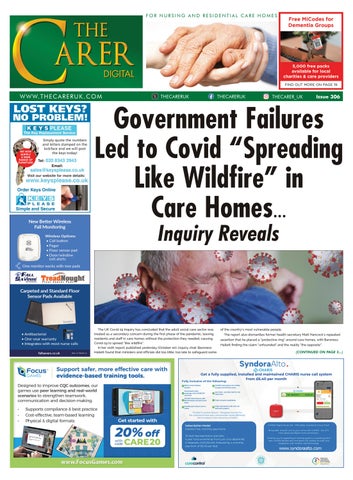
Government Failures Led to Covid “Spreading Like Wildfire” in Care Homes… Inquiry Reveals
The UK Covid-19 Inquiry has concluded that the adult social care sector was treated as a secondary concern during the first phase of the pandemic, leaving residents and staff in care homes without the protection they needed, causing Covid-19 to spread “like wildfire”. In her sixth report, published yesterday (October 20), inquiry chair Baroness Hallett found that ministers and officials did too little, too late to safeguard some
of the country’s most vulnerable people. The report also dismantles former health secretary Matt Hancock’s repeated assertion that he placed a “protective ring” around care homes, with Baroness Hallett finding the claim “unfounded” and the reality “the opposite”.
(CONTINUED ON PAGE 3...)
PAGE 2 | Issue 306 | THE CARER DIGITAL
EDITOR'S VIEWPOINT
Welcome to the latest edition of The Carer Digital!
Editor
NEVER AGAIN MUST SOCIAL CARE BE AN AFTERTHOUGHT
Baroness Hallett’s Module 6 report on the care sector is the Covid-19 Inquiry’s verdict on how the adult social care sector was treated when it needed protecting most makes harrowing reading. The comments and reaction of some of the sector’s leading spokespersons and organisations can be seen on page 6. Hindsight is a wonderful thing, but the whole episode still feels surreal. How could we get it so very wrong? The Inquiry Chair found that the sector “appeared to be something of an afterthought”, where the mantra of “protecting the NHS” sometimes came at the expense of the people who use and provide care. She rejected the long-held claim that a “protective ring” had been thrown around care homes from the start of the pandemic, finding it unfounded. She also called the failure to advise that patients discharged from hospital be isolated on arrival a “significant omission”. That omission allowed the virus to spread rapidly among residents and staff. More than 43,000 deaths involving Covid-19 were recorded in care homes between March 2020 and July 2022. Some 25,000 hospital patients were discharged into care homes to free up NHS beds before mandatory testing arrived on 15 April 2020. How on earth could that happen? It has always beggared belief to me that some of the country’s leading experts, the people we are meant to trust, could get it so catastrophically wrong. I have often recounted my experience at a care sector seminar held after the lockdowns were lifted. I use the word again: it was harrowing. Providers and staff in the hall were invited to stand and share their experiences, and many fought back tears as they spoke of deaths, of missing equipment, and of a government that had, as we now read, helped create the problem.
PUBLISHED BY RBC Publishing Ltd 3 Carlton Mount 2 Cranborne Road Bournemouth Dorset BH2 5BR
TELEPHONE:
01202 552333 EMAIL:
sales@thecareruk.com
Peter Adams
WEBSITE:
www.thecareruk.com There were staff wearing bin bags as PPE because nothing had been delivered. There were staff sleeping on settees and camp beds so they would not leave vulnerable residents or carry infection home to their own families. The Inquiry has now called that PPE situation “wholly unacceptable”. Lady Hallett was equally clear about the cost to residents. Visiting restrictions caused “immense emotional harm”, leaving people with a profound sense of isolation and abandonment. Families were kept from loved ones, some even at the end of their lives, and many remain wracked by guilt they do not deserve to carry. The workforce paid a heavy price too. Many trained and experienced staff left the sector entirely, some through sheer burnout under an intolerable burden, others because they chose not to take the vaccine, which was their decision and a fundamental human right. Another lesson from that seminar has stayed with me. As the country went into lockdown and jobs were furloughed, many young people from hospitality answered the appeals to support care. They wanted to make a difference, and they should never have been put in such a position. We too often see inquiries end in conclusions without accountability. The Chair has made eight recommendations, among them better pandemic planning, safe isolation of residents, financial support for staff who need to self-isolate, clear guidance on visiting, and a voluntary register for the workforce in England. She says they must be acted on now, before the next pandemic strikes. I would also encourage our readers to sign up for our bi-weekly digital newsletter at www.thecareruk.com and follow us on social media for all the latest news. I can always be contacted at editor@thecareruk.com
EDITOR Peter Adams editor@thecareruk.com
SALES DIRECTOR David Bartlett dave@thecareruk.com
PRODUCTION & DESIGN Matthew Noades
Published by
The Carer is published by RBC Publishing Ltd, 3 Carlton Mount, 2 Cranborne Road, Bournemouth, Dorset BH2 5BR. Contributions are welcome for consideration, however, no responsibility will be accepted for loss or damage. Views expressed within this publication are not necessarily those of the publisher or the editorial team. Whilst every care is taken when compiling this publication to ensure accuracy, the publisher will assume no responsibility for any effects, errors or omissions therefrom. All rights reserved, reproduction is forbidden unless written permission is obtained. All material is assumed copyright free unless otherwise advised.
Manufactured in the UK
Freephone: 0800 917 7943 www.euroservice-uk.com sales@euroservice-uk.com
PROVIDING PRACTICAL AND STYLISH TROLLEYS TO SUIT YOUR NEEDS Watch your resident's eyes light up when the beautiful tea trolley arrives! Euroservice trolleys can also be used as a vending trolley or to sell personal care products to residents. How about a delicious snack/pastry trolley or even a drinks trolley for that afternoon tipple?
Your lovely trolley could do so much for you and your residents! Euroservice trolleys are an attractive and practical alternative to clinical aluminium trolleys given that antibacterial spray can be used freely to sanitise them.
Get in touch with our friendly, experienced sales team
Visit the website at
www.euroservice-uk.com to see the full range.
THE CARER DIGITAL | Issue 306 | PAGE 3
Government Failures Led to Covid “Spreading Like Wildfire” in Care Homes (CONTINUED FROM FRONT PAGE)
She singled out the failure to advise that patients discharged from hospital into care homes should be isolated as a “significant omission”, which she said allowed infection to spread rapidly among residents and staff. There were more than 43,000 recorded deaths involving Covid-19 in care homes between March 2020 and July 2022. A lack of proper planning, plus failures to implement lessons from earlier pandemic planning exercises, meant the UK government and devolved administrations took critical decisions in the early weeks without the information they needed. Action to protect carers and care users came too late, with devastating consequences. Module 6, the sixth of the Inquiry’s 10 investigations, examined the impact of the pandemic on the publicly and privately funded adult social care sector in England, Scotland, Wales and Northern Ireland, including infection prevention, visiting restrictions, the experiences of the care workforce and decisions on discharge from hospitals and concludes that while the UK government and devolved administrations knew, prior to the pandemic, of the extreme vulnerability of care home residents to respiratory viruses, care homes received insufficient protection at the time they most needed it.
PROTECTIVE RING The claim that “a protective ring” had been put in place around care homes “right from the start” of the Covid-19 outbreak was unfounded. Not enough was done to protect people in care settings between March and mid-April 2020. The decision to speed up the discharge of patients from hospitals into care homes was necessary to free up hospital beds. But the decision to do so was taken in March 2020 when there was not enough testing capacity to know patients’ Covid-19 status. At the time, isolating discharged patients inside care settings was one of the few effective protections available. Yet, in March 2020, England, Wales and Northern Ireland did not initially advise this, a failure the Inquiry calls “a significant omission”. The report shows how, as the deadly virus spread rapidly, care home residents were left feeling isolated, abandoned and alone as visiting restrictions cut them off from loved ones, in some cases for months. Some people were not allowed to be with dying friends or relatives in their final moments, leaving bereaved people grief-stricken. They could not help their loved ones with daily tasks such as eating, drinking and washing, support which can be vital for some residents. As a result, Baroness Hallett concludes: “Many remain wracked by a guilt that they do not deserve to carry.” Visiting restrictions did not begin to ease until the summer of 2020.
The report concludes that the severity and duration of these restrictions caused “profound and enduring effects” inside care homes, particularly for residents with complex cognitive conditions such as dementia. Many millions of people across the UK receive adult social care. This includes older people, people with dementia and people living with physical and learning disabilities. For them and the people who dedicate themselves to providing their care, the pandemic totally disrupted their daily lives and had a devastating impact.
AFTERTHOUGHT “At the critical early stages of the pandemic, not enough was done to protect those living and working in care homes. The mantra at the time of ‘protecting the NHS’ sometimes came at the expense of the users and providers of care. The adult social care sector as a whole appeared to be something of an afterthought. “The profound isolation and sense of abandonment felt by residents as a result of the visiting restrictions resulted in immense emotional harm. Most distressingly, some people were not permitted to be with their dying loved ones. Many remain wracked by a guilt that they do not deserve to carry. “During the pandemic, the action taken by the UK government and devolved administrations to try and protect workers and users of adult social care came too late. The failures were the direct result of an absence of proper pandemic planning for the adult social care sector. It underlines why my recommendations in this report must be acted upon now before the next pandemic strikes. Baroness (Heather) Hallett, Chair of the UK Covid-19 Inquiry: The Covid-19 pandemic exposed and exacerbated the underlying fragility of the adult social care workforce. A workforce of at least 1.5 million people – including care in the home (domiciliary care) – provided care during the pandemic. Many put their own lives at risk.
BURNOUT Severe shortages of personal protective equipment (PPE) meant that some care workers were left having to wear waterproof ponchos from festivals, painters’ overalls, or home-made PPE made from fabric, bin bags and bed linen. The report describes this as “wholly unacceptable”, finding that care workers were left “without the protection they needed”. It concludes that while PPE shortages were a global problem, better planning could have ensured a much better supply from the outset. Many care workers suffered burnout. Some left the profession entirely. Changes to sick pay were introduced in England, Scotland and Northern Ireland between March and May 2020, but not in Wales until November 2020.
The UK’s 5.8 million unpaid carers were also heavily relied upon, providing complex care for longer hours with little or no respite. The Inquiry concludes that support for unpaid carers came too late and that for too long the adult social care sector as a whole has been undervalued and under-recognised. The Inquiry’s latest report also examines concerns about the use of Do Not Attempt Cardiopulmonary Resuscitation (DNACPR) decisions, echoing concerns raised in its Module 3 report that some decisions were made inappropriately or without proper consultation, based on a person’s age, health condition or learning disability. While finding no evidence of national policy encouraging blanket use of DNACPRs, the report recommends mandatory end-of-life care training for health and social care workers, who often lacked the skills to have these conversations thoughtfully and compassionately.
ABSENCE OF PLANNING Ultimately, the report finds that these failures and others stemmed from an absence of proper pre-pandemic planning for the adult social care sector. Exercise Cygnus, a pandemic preparedness exercise conducted in October 2016, recommended developing ways to assess social care and surge capacity, but this work had not been completed by the time the Covid-19 pandemic struck. As a result, ministers were left making decisions without the information they needed about the sector. The Chair makes eight key recommendations to ensure the adult social care sector is better protected and better equipped to respond to the next pandemic, including: • Improving arrangements for pandemic planning to ensure clearer structures, roles and responsibilities. • Better planning for the safe isolation of care home residents. • Implementing financial support schemes ready to be rolled out to support adult social care staff to self-isolate or to limit staff movement. • Publishing guidance on visiting restrictions. • Maintaining inspection and oversight by developing protocols to enable inspections to continue, including, where possible, on-site inspections. • Improving the collection of data about deaths in the adult social care sector. • Establishing mandatory end-of-life care training for relevant health and social care workers. • Introducing a voluntary register for the social care workforce in England, recognising and supporting a workforce that already benefits from such registers in Scotland, Wales and Northern Ireland. Leading care sector spokespersons and organisations have shared their views with THE CARER on page 6
PAGE 4 | Issue 306 | THE CARER DIGITAL
Covid Inquiry: “Don’t Let This Report Gather Dust – We Owe It To Those Who Died To Act Now,” Says Care Leader Independent Care Group Honorary President Mike Padgham welcomes Baroness Hallett’s findings but warns that social care remains dangerously vulnerable to another pandemic. The Honorary President of the Independent Care Group, Mike Padgham, has welcomed the latest report from Baroness Hallett's UK Covid-19 Inquiry, describing it as a stark reminder of the devastating consequences of failing to give social care the recognition, resources and priority it deserves. With more than 43,000 deaths involving COVID-19 recorded in care homes in England and Wales between March 2020 and July 2022, Mr Padgham said the scale of the tragedy must never be forgotten, nor must the suffering endured by residents, families and those working on the front line. But he has warned that unless the Government acts urgently on its findings, the report risks becoming yet another document gathering dust on a minister's desk. Mr Padgham, who has spent almost four decades working in social care, said: “Firstly, I wholeheartedly welcome Baroness Hallett's report and the important findings she has brought forward. In particular, I agree with her assessment that social care was treated as an afterthought during the pandemic. “That is something many of us working on the front line knew only too well. For far too long, social care has been the poor relation of the
NHS, and during the pandemic the consequences of that neglect were exposed in the most dreadful and tragic circumstances. “Before anything else, I want to pay tribute to the extraordinary care workers who worked tirelessly throughout that terrible period. They went above and beyond, often putting their own health and lives at risk, to protect and care for some of the most vulnerable people in our society. “I witnessed at first hand their courage, dedication, compassion and selflessness. They were true heroes, and we must never forget what they did. Many worked in the most frightening circumstances imaginable, often without the protection, guidance or support they so desperately needed. “My thoughts, too, are very much with the families who lost loved ones during the pandemic. No report can ever bring those people back or erase the pain and suffering their families endured. We owe it to them, above all else, to ensure that the lessons are learned and that such failures are never repeated. “One thing I feel particularly strongly about is the suggestion made at the time by Matt Hancock that care homes were somehow protected by a ring of steel. That was certainly not the experience of those of us on the front line. Care homes were not protected in the way they should have been, and staff and residents were left dangerously exposed. “Social care was not an afterthought to those of us who worked in it. It was our absolute priority, every hour of every day. Sadly, it was not always treated with that same priority by those making the decisions. “My greatest fear now is that, despite the powerful findings of this Inquiry, nothing meaningful will change. We have had decades of reports, reviews, commissions, promises and good intentions about social care. What we have not had is the fundamental reform the sector so desperately needs. “We simply cannot afford another period of delay. “It is not a question of *if* we face another pandemic, but *when*. And my real concern is that social care today is in an even
weaker position than it was when COVID-19 struck. “We continue to face serious pressures over funding, workforce recruitment and retention, rising costs and the sustainability of care services. If another pandemic were to strike tomorrow, I fear we would once again find ourselves dangerously ill-prepared. “That is why I welcome the Prime Minister's commitment to reforming social care and creating a National Care Service. I want him to succeed, and I will support him wholeheartedly in bringing about meaningful and lasting change. “But my message to Andy Burnham is simple: **please don't wait. Action this day.** “If the Prime Minister truly wants to leave a lasting legacy, he has an opportunity to do for social care what Aneurin Bevan did for healthcare when he created the NHS. “He can be the Prime Minister who finally brings social care and healthcare together as equal partners, delivering a properly funded, properly supported National Care Service that treats older and vulnerable people with the dignity and respect they deserve. “But that must happen during this parliamentary term, not be pushed into the long grass until after another general election. “None of us knows who will be in power after the next election. Governments change, priorities change, and promises can be forgotten. We cannot gamble the future of social care, or the safety of vulnerable people, on what might happen years from now. “My fear is that we could miss a once-in-a-generation opportunity to bring about the change that has been needed for so long. “Baroness Hallett's report must be a turning point, not simply another chapter in the history of social care being overlooked. “We owe it to every person who lost their life, every grieving family and every care worker who stood on the front line to make sure that something positive and lasting comes out of this tragedy. “Let this be the moment when we stop talking about reform and actually deliver it. “Prime Minister, you have the opportunity to make history. Be bold, be brave, and act now. Don't let this report gather dust. The people who died, the families who suffered and the care workers who gave everything deserve nothing less.”
Welcome to Blue Rain - our activity store is built on over 14 years experience supplying products that bring joy, inspire motivation, and enrich the lives of those who need a little extra support, or simply want to have fun, whatever the weather.
Come find your next reason to smile.
Scan me
THE CARER DIGITAL | Issue 306 | PAGE 5
Three Quarters of Public Back NHS Funding for Alzheimer’s Treatments Three quarters (75%) of people believe the NHS should fund new treatments that slow the progression of Alzheimer’s disease, even if the benefits are modest, according to new polling commissioned by Alzheimer’s Society. The findings come as commercial discussions are underway for the potential arrival of a new generation of Alzheimer’s treatments that target the disease itself rather than just its symptoms. Lecanemab and donanemab were licensed as safe and effective in Britain over two years ago, but NICE did not recommend them for routine NHS use. Discussions are ongoing about alternative arrangements that could enable people to access these treatments. For people affected by dementia, even a small slowing of progression can mean more time maintaining independence, relationships and everyday activities, as well as more time with the people they love, doing the things that matter most to them. Dementia affects around one million people in the UK and remains the country’s biggest killer. While current dementia medications can help some people manage symptoms, new disease-modifying treatments are designed to slow the underlying disease process in people with early Alzheimer’s disease, which is the leading cause of dementia. Alzheimer’s Society says the benefits of these treatments could extend beyond just the person living with dementia – by slowing progression of the disease, these treatments could ease some of the impact on fam-
ily carers. This is the first time NICE has considered the potential benefits to carers as part of its appraisal. A treatment approval would also help drive much-needed change to diagnosis and services. Michelle Dyson CB, Alzheimer’s Society’s CEO, said: “These findings send a clear message that the public wants to see dementia treated as a healthcare priority. These treatments mark an important step in how we treat and view dementia. “People with Alzheimer’s in other countries such as the US are already benefitting from these safe and effective new treatments, while those in the UK have been left waiting or must pay for them privately. “Our data shows the public agree with what we hear from families every day – an extra six months of independence makes a real and meaningful difference. “We’ve seen with cancer how new treatments have become more effective, safer and more affordable over time, and this will happen with dementia too. “But new treatments are only as powerful as the health system behind them, and an early and accurate diagnosis is needed to access them. Investment in diagnosis, testing, specialist services and care will be essential if people are to benefit fairly and quickly from advances in dementia research, whether it’s for these two drugs or others coming down the line.”
Hugh Myddelton House Care Home Celebrates World Food Day Staff and residents at Barchester’s Hugh Myddelton House care home in Southgate come together to celebrate cultural diversity through food, sharing and community spirit. The event brought people from different cultural backgrounds together, with participants proudly sharing dishes from their own traditions and giving others the opportunity to discover new flavours from around the world. The celebration featured an exciting variety of international cuisines, including Greek, Albanian, Romanian, Azerbaijani, Italian, Filipino, Nepalese and Mauritian dishes, alongside food from many other cultures. Guests enjoyed sampling the wide selection of homemade food, exchanging stories about their cultural traditions and discovering the personal memories and heritage behind each dish. The gathering created a warm and welcoming atmosphere, celebrating the diversity of the Hugh Myddelton House community. The culinary experience continued with a delicious dessert prepared by one of the home’s talented Housekeeping Assistants, providing a sweet finish to a memorable occasion.
The celebration demonstrated how food can bring people together, encourage meaningful connections and create opportunities to share experiences across generations and cultures. World Food Day provided a wonderful opportunity for Hugh Myddelton House to recognise the richness of its community and celebrate the importance of inclusion, friendship and belonging. General Manager, Mansukh Chander said, “Today was a wonderful celebration of different cultures and an amazing experience for everyone involved. All the food was delicious, but what made the day truly special was the happiness, warmth and sense of togetherness we shared. I feel incredibly proud to be part of this team. We are proud to celebrate diversity and make Hugh Myddelton House a place where everyone feels valued, respected and welcome.” Residents’ Ambassador Rosa Bertolino said: “As an Italian, I am a real foodie, and I can honestly say that all the dishes from different cultures were absolutely delicious and beautifully presented.. It is wonderful to experience different cultures, share traditions and come together as one community.”
PAGE 6 | Issue 306 | THE CARER DIGITAL
Care Sector Reacts With Deep Concern and Dismay to Latest COVID Inquiry Findings The care sector has reacted with deep concern and dismay following the publication of the sixth report from the UK Covid-19 Inquiry, which found that care homes and the wider social care sector were treated as an afterthought during the pandemic, with devastating consequences for residents, their families and the workforce. Industry representatives have warned that the findings underline the urgent need to learn the lessons of the crisis, strengthen protections for vulnerable people and ensure that social care is never again left without the support, resources and recognition needed to safeguard those who depend on it. Caroline, Abrahams, CBE, Charity Director at Age UK said: "Today's report is, in its own way, quietly devastating. It describes what in truth we already knew: that when COVID-19 took off, people using social care and the staff and unpaid carers providing it were left totally exposed. It makes clear that this was mainly due to a complete absence of pre-planning, leading to the system being overwhelmed when the virus struck. It is tremendously important that Government heeds this lesson and that work begins now on actioning those of the Enquiry's recommendations which do not depend on fundamental social care reform, visiting guidance in care homes in the event of another Pandemic being one of several examples. "But fundamental social care reform is also required, and today's report reinforces how important it is that we now actually see it. If a National Care Service had already been in place, underpinned by national standards and with clear accountability to Government, the various disasters that befell social care during the Pandemic would have been lessened and some might have been avoided altogether. It is for Baroness Casey to work out exactly how a National Care Service should operate, but especially in light of today's report it is also the responsibility of politicians across the spectrum to look firstly towards what they can all agree on, rather than where political advantage may lie. "We should never forget the hundreds of thousands of individuals and families who saw and experienced things in social care that no one ever should: the loved ones left to die alone or seen only through windows; the care home residents dying with pain that care staff could not alleviate because they didn't have the drugs and because health professionals had been withdrawn. If we can come together to implement the Pandemic Enquiry's recommendations and bring about the reform of social care then we've a good chance of ensuring tragedies like these won't happen again, but until then social care and the people in it remain vulnerable to threats of all kinds." Kieran Winterburn, Associate Director of Policy and Influencing at Alzheimer’s Society, said: “The COVID-19 pandemic had a catastrophic impact on people living with dementia, their families and carers. Around 34,000 people living with the condition died between March 2020 and early 2021, while restrictions on care home visits separated countless families at a time when they needed each other most. “COVID-19 laid bare the profound human cost when people with dementia and those who care for them are left without the support they need. The need for adult social care reform has never been clearer. We welcome the UK Government’s commitment to a National Care Service in the next parliament but this inquiry reveals that people living with dementia have been failed for too long. “Baroness Casey is currently leading a review of social care and has been very clear that dementia is critical. We look forward to seeing the detailed proposals that emerge from this work. Ultimately, we need meaningful, lasting change – for dementia to be treated as the priority it deserves to be and for people affected by it to get the treatment and care they need.” Helen Wildbore, CEO Care Rights UK said: “The devastating impact of isolation of people in care settings has been laid bare in Baroness Hallett’s report. We welcome the recommendation by the Inquiry that people relying on care ‘should have the right to in-person visitors’. An amendment to the Health Bill is passing through Parliament to introduce the right to a ‘Health and Care Partner’ across health and care settings. We encourage the Government to take forward this amendment in order to implement one of the Inquiry’s recommendations immediately. People relying on care services should never again be an ‘afterthought’.” Dominic King-Carter, Director of Policy at Carers Trust, said: "Today's Covid Inquiry findings reinforce what many unpaid carers and families have said for years: when social care was treated as an afterthought, those who relied on or provided care were left to bear the consequences. Local carer services and their staff were overstretched trying to maintain the services they could in unprecedented times. The pandemic took an enormous toll on carers, who were struggling in challenging conditions to provide even more care, with even less support. “What little support did arrive, often came too late. As Baroness Hallett noted, the pandemic exposed the fragility of social care. But it also outlined a reality where unpaid carers worked for the system. For future pandemic planning, we must make sure that the system works for carers. Dr Jane Townson OBE, Chief Executive of the Homecare Association said: “Throughout the Inquiry we heard heartbreaking testimonies from bereaved families and care professionals. We owe it to those we lost, and those who served to ensure we learn lessons and implement change in a way that is effective and enduring. In our evidence we pointed to a hierarchy of invisibility, with people at home supported by both unpaid carers and professional careworkers considered only as an afterthought. This must change. The adult social care sector entered the pandemic in a fragile state following decades of underfunding, poor commissioning and undervaluing of the workforce. The terms of reference of the UK Covid-19 public inquiry did not permit a focus on wider systemic issues. Baroness Casey of Blackstock has an opportunity to do so as part of the Independent Commission on Adult Social Care. We urge the Governments of the UK nations to act on the recommendations of the Covid-19 Inquiry and stand ready to support national and local government, the NHS, regulators, care providers and the Casey Commission to implement necessary change. History will judge this moment – not by what went wrong during the pandemic, but by what we chose to do next.” "The Inquiry is not just a chance to better plan for future pandemics, but an opportunity to recalibrate how the country values care. Social care has recently become a political priority, and this is positive. But too many failings that were highlighted by the pandemic, such as lack of respite for carers, remain. The majority of carers are still not getting access to the breaks they need. The Inquiry and its findings demonstrate why reform to social care is more important now than ever. We will continue to press the Government to act on
the Inquiry's recommendations, and work with the Casey Commission and the wider sector to secure real change that protects carers now and in the future." Nuffield Trust Deputy Director of Policy Natasha Curry said: “What happened to social care at the start of the pandemic represents the consequences of letting one of our most important public services languish in constant crisis for years. As today’s report starkly illustrates, this had a devastating impact on the people receiving care, their families and care workers. Baroness Hallett rightly draws attention to the more than 43,000 deaths in care homes involving Covid-19, and the failures that contributed to them. “While Covid has led to improvements in some areas of social care - such as better data collection and infection prevention and control processes - the underlying resilience of the care system is only in marginally better shape than it was in 2020. We carried out our own research on how the sector could become more resilient to future shocks. But several years later there has been little action on most of the weaknesses we flagged, such as the unstable supply of domestic workers. “We now have the Casey Commission focused on reform and a prime minister showing commitment, but no tangible change is likely to be felt until at least 2030. There is a risk that the 2020s will be a lost decade where social care has only just managed to keep its head above water. Countries such as Japan and Denmark learnt from Covid much more quickly and enacted reforms to build a better system. The Hallett Inquiry must be used to add to the gathering momentum towards reform, not just be seen as a historic account of failures that must never be allowed to recur.” Professor Martin Green OBE, Chief Executive of Care England, said: “The central lesson from this report is that adult social care cannot again be expected to carry national risk without the authority, information, resources and clinical support needed to manage it safely. “Pressure in hospitals must never again be relieved by transferring unmanaged risk into adult social care. Providers need to be part of emergency planning from the beginning, and national resilience must be properly funded directly to where the costs were incurred rather than passed down as another cost to individual services. “The Inquiry’s recommendations are essential, but the real test now is implementation. The government should be clear about who owns each action, how it will be funded, when it will be delivered, and how we will know that preparedness has genuinely improved. “We should not wait for wider reform through the Casey Commission to act on lessons that are already clear. There is a great deal that can and should be done now. "Six years on, the question is whether adult social care would be materially better prepared if another pandemic occurred tomorrow. The government must now demonstrate that it would be." Vic Rayner OBE, CEO of NCF said: “We took part in the Inquiry primarily to honour the experiences of our members and the testimony of bereaved families. Our thoughts have remained with them throughout this process. We also wanted to make recommendations that would make a difference to the experience of both those who rely on care and support and those who provide it during any future pandemic. “We are pleased to see that a number of the recommendations we made during our evidence sessions and in our closing submission as core participants in Module 6 of the Inquiry, have been included in the report. From reading the report it is evident that the Inquiry agrees with our assertion that during the pandemic the adult social care sector was overlooked, misunderstood and disadvantaged. “This report comes at a time when there is significant national focus on the changes needed to ensure we have a social care sector fit for the future. The current political debate about what should and should not be included in a National Care Service mean that the directions outlined in this report have a ready audience that should be prepared to show an intention to strengthen the sector’s capacity to ensure that never again is it overlooked, misunderstood and disadvantaged in any future pandemic. “Our initial submission to the Inquiry made clear that the terms of reference were narrow in scope and did not address the realities experienced by many drawing on care and support services or the wider workforce. As a result, it does not adequately address just how devastating this pandemic was for the widespread delivery of social care that is built around supporting people to live independent and fulfilling lives. “Those who lost access to day services, supported employment opportunities, access to vital advocacy, friends and family, education and training will feel their absence from the report. This reminds us how important it is that we build a National Care Service that meets the needs of all. “Workforce recommendations make up a significant proportion of the Inquiry team’s recommendations. The current focus on employment rights and the recent announcement of a focused workforce strategy give a vehicle to implement Baroness Hallett’s recommendations around training and terms and conditions around workforce pay. Our evidence and support for a workforce register were rightly incorporated as a key recommendation in the report but this needs to go further faster. A clear record of everyone who is in the workforce and how they are impacted by any type of pandemic cannot be left to chance and needs action now, not in five years’ time. “The report does not give confidence that there is a proper understanding and articulation of why pandemic planning did not happen, and how that lack of accountability and priority runs the risk of repeating itself in the absence of government focus. The Inquiry report contains a litany of testimony that exposes the prioritisation of health over care, and without explicit restructure which strengthens the hand of social care in debates and decision making, the risks of repeating the same mistakes in another pandemic remain too high.” Melanie Weatherley MBE, Co-chair of The Care Association Alliance said: “The Inquiry has put on record what providers and families have known all along: there was no protective ring in March and early April 2020, and the sector was an afterthought while the effort went into protecting hospitals. It traces that to the absence of any pandemic planning for social care.’ “We welcome Recommendation 8, a voluntary register for England, which we argued for last week in Towards a National Workforce Settlement. It has to be more than a list of names. The sector needs professional registration: membership tiers that recognise competence, and a phased model beginning with registered managers, advanced practitioners and delegated healthcare specialists.
THE CARER DIGITAL | Issue 306 | PAGE 7
CAA Shows Government How the Care Sector Can Help Solve the NEET Crisis The Care Association Alliance (CAA) has set out a roadmap to tackle the NEET crisis through careers in care. The number of 16 to 24-year-olds not in education, employment or training passed one million in January to March 2026 for the first time since 2013. It stood at 981,000 in April to June, still 30,000 higher than a year earlier. Alan Milburn’s interim review warned in May that it could reach 1.25 million within five years, a rise from one in eight young people to one in six. Adult social care, meanwhile, has around 96,000 unfilled posts and a vacancy rate still well above the wider economy’s. Across England, close to three young people claim unemployment-related benefits for every vacancy: 288,470 claimants against around 96,000 unfilled posts. The CAA’s second policy paper, Towards a National Workforce Settlement, argues that the two problems should be solved together, and sets out how.
THE ROADMAP The Youth Guarantee names health and social care as one of three sectors for its 350,000 training and work experience opportunities. But a placement is not a career, and no route leads from one to the other. The CAA has built that route. Its Pathway into Care programme adds what a young person’s first weeks in care require: structured supervision, honest preparation for the emotional side of the work, and a defined step from placement into a job. The CAA asks government to adopt it within the Youth Guarantee. It needs a decision, not a new budget line. Recruitment is not the sector’s real problem. Retention is. More than half of care workers under 20 leave within their first year, and Skills for Care’s latest figures show under-25s have the highest turnover of any age group, at 35.5 per cent. Pay is part of the reason. A care worker with five or more years’ experience now earns 12p an hour more than one with less than a year, down from 33p in 2016. The sector rewards presence rather than progression. The paper’s four immediate asks are aimed at that: Level 4 qualification funding, a qualification fund restored to the £53.9m at which it was designed, a national competency record that follows the worker, and independent prescribing for 1,000 social care nurses. Together they cost £61m to £76m a year. The funding does not fit either. The Youth Guarantee’s routes, including the £3,000 Youth Jobs Grant, were not designed around how social care employs people. The CAA asks the Treasury and the Department for Work and Pensions to fix the mechanism. Young people are not the only pool. Some 27 per cent of today’s workforce is over 55, and career switch-
ers need the same route. On the paper’s midpoint estimates, the package pays for itself. The sector loses around 320,000 people a year, at a replacement cost of £1.2bn to £1.9bn. Cutting turnover by one percentage point returns between £52m and £87m a year.
THE SERVICE OF THE FUTURE The Prime Minister has set out plans for a National Care Service, free at the point of use and funded collectively. It would be introduced in the next parliament, after the next general election, which must be held by mid-2029. That date matters. The 16 to 24-year-olds who are not in work or training today will be in their twenties when it arrives. They are the workforce it will have to hire. The sector cannot staff it from the people it has. Skills for Care projects a need for 410,000 more posts by 2040. The number of posts filled by British workers has fallen by 130,000 since 2020/21, and under-25s make up only 7 per cent of the workforce. A National Care Service built on the current workforce would be built on one that is ageing out and shrinking. For the CAA, young people are the service’s workforce, and the roadmap is how it gets one. Melanie Weatherley MBE, Co-Chair of the Care Association Alliance, said: “Every good care relationship runs in both directions. An older person gives a young worker purpose, and a young worker gives an older person care. A National Care Service that we can all be proud of needs to make it possible for this exchange to take place, and that means offering young people a career, not just a placement. “We have close to a million young people the labour market has not found a place for, and a sector that cannot fill its posts. Those are two halves of the same problem, and we are one of the most obvious answers to it. The route in already exists. What we need from government is a decision to adopt it, and a funding mechanism that fits the way care actually employs people. “Getting young people in is only the start. If they leave within a year because there is no progression and no recognition, we will have lost them. The National Care Service is years away, and the people who will staff it are 16 to 24 today. This roadmap is how we start.” The Rt Hon Damian Green, Senior Policy Adviser to the CAA, said: “This practical set of proposals hits two targets at once. It reduces pressure on the care sector, which needs new workers and to keep more of its existing ones, and it helps young people into a rewarding career. I very much hope Ministers will look at it seriously and adopt it as part of the long-awaited reform of the care sector.”
FOR ALL THE LATEST NEWS FROM THE SOCIAL CARE SECTOR PLEASE VISIT WWW.THECARERUK.COM
PAGE 8 | Issue 306 | THE CARER DIGITAL
Deborah’s Dedication to Care at Windmill Lodge and Beyond
At Windmill Lodge Care Home, Nurse Deborah is known for the dedication, kindness and compassion she brings to her role. With more than 30 years of nursing and midwifery experience across Nigeria and the United Kingdom, Deborah has spent much of her life supporting others. But her passion for helping people extends far beyond her work in the home. Alongside her nursing career, Deborah, also widely known as Chief Mrs Ayoyinka, is a philanthropist committed to supporting vulnerable people and communities through her charitable organisation, EDGSO. In September 2018, Deborah founded Enablers Diaspora Grassroots Support Outreach (EDGSO), a non-profit organisation established to support disadvantaged communities through healthcare, essential supplies and community outreach. Bringing together members from a wide range of professional backgrounds in Nigeria and across the world, EDGSO works to alleviate hardship and improve access to essential support for vulnerable people. The organisation holds community giveaways up to six times a year, distributing food, clothing and children's essen-
H.W. PICKRELL NEW & USED ACCESSIBLE TRANSPORT AT AFFORDABLE PRICES • We specialise in the sale and purchase of quality used wheelchair accessible vehicles and ambulances. • They can be bought as seen or refurbished and sign-written to your own requirements. • Fully serviced, new mot & warranty • Engineers inspection supplied if required.
• Free delivery service available • All buses comply with new legislation • Lease hire and purchase available • Always large stock of accessible vehicles
Tel: 01268 521033 Mobile: 07860 894331 Email: sales@hwpickrell.co.uk Gardiners Lane North, Crays Hills, Billericay, Essex CM11 2XE All current stock available to view at www.hwpickrell.co.uk
tials, particularly in rural communities. It also organises free medical outreach programmes, providing health checks, medical advice and medication to people who may otherwise struggle to access these services. Through EDGSO, Deborah and her volunteers have supported vulnerable communities worldwide, providing earthquake relief in Turkey, aid to disadvantaged people in the USA, medical outreach in South Africa and assistance during the COVID19 pandemic. Deborah's generosity is also felt closer to home. She extends her charitable spirit to the people living at Windmill Lodge by donating gift packages during seasonal celebrations to spread joy amongst the care home community. These thoughtful gifts bring smiles to residents' faces and offer a reminder of the difference small acts of kindness can make. At Windmill Lodge, Deborah is a valued member of the team, bringing her extensive nursing experience and caring nature to the people she supports. Her charitable work reflects the same compassion that she demonstrates in her professional role. Her story is a wonderful example of how a commitment to helping others can reach far beyond one workplace, touching lives and bringing support to people and communities around the world.
THE CARER DIGITAL | Issue 306 | PAGE 9
NACC Announces Winners of its National Awards 2026 The National Association of Care Catering (NACC) unveiled this year’s winners of its prestigious National Awards at a glittering gala dinner on Thursday 15 October. These highly coveted annual awards celebrate the achievements of the teams and individuals who have done most to raise the standards of care catering during the previous 12 months. The winners – all nominated by their peers – have not only demonstrated expertise and dedication, but also empathy for their service users and resilience in the face of challenging conditions. This year’s awards included a new category, the Innovation Award, highlighting the cutting-edge improvements that members are introducing to further enhance the nutritional care they provide. Said NACC National Chair Neel Radia: “In a field of inspirational superstars who all deliver excellent nutrition and hydration to older and vulnerable people every day, it is always difficult to single out just a few members to receive recognition. However, our annual awards seek to specially honour those who have gone altogether ‘above and beyond’ during the year, and we have found a troupe of very worthy winners. “Huge congratulations to everyone who received an award this evening, and thank you to all our members who make a real difference to so many lives, day in day out.”
The 2026 NACC National Award winners are: Care Establishment of the Year Award, sponsored by allmanhall * Branksome Heights, Kingsley Healthcare Meals on Wheels Award, sponsored by apetito * Health & Independent Living Support (HILS) Catering Team of the Year Award, sponsored by Rational UK * Middleton Hall Retirement Village Catering Manager of the Year Award, sponsored by Unilever Food Solutions
* Jody Marshall, Group Hospitality Manager, Meallmore Our Care Catering Hero Award, sponsored by Miele * Jane Oliver, Senior Relief Chef, Cinnamon Care Collection The Bev Puxley Award*, sponsored by The Worshipful Company of Cooks London * Darren Neal, Head of Culinary, White Oaks The Innovation Award, sponsored by Atosa Catering Equipment * Taste the Memories by Signature Dining The winners of the following special awards were also announced at the gala dinner: NACC Region of the Year Award, sponsored by Meiko UK * Midlands Region Pam Rhodes Outstanding Achievement Award, sponsored by Winterhalter * Nick Dutton National Chair’s Award (three winners) * Consortium of Tourism and Hospitality (CTH) * Hospital Caterers Association (HCA) * Umbrella Academy The gala awards dinner was the culmination of the NACC Training & Development Forum, which took place on 14-15 October 2026 at Hilton at St George’s Park, Burton-upon-Trent.
Hazel Lodge Care Home Hosts Women’s Health Event Barchester’s Hazel Lodge care home in Battle has marked Menopause Awareness month, which takes place throughout October by hosting a Women’s Wellness event at the home. The event which was free to attend, took place on the evening of Thursday 8th October with 20 ladies from the community coming to listen to women’s health experts offering advice on how to live well before, during and after the menopause. Attendees were provided with complimentary refreshments to enjoy whilst they listened to various topics from HRT, hair loss to nutrition and exercise and then had the opportunity to share experiences and ask questions before the end of the evening. Home Services Advisor, Sharon Ward, said: “Wow…What an amazing
evening! Thank you to our guest speakers Jo Holland and Fiona Coffee and everyone who came along to our Women’s Health event. It was inspiring and emotional being surrounded by such a brilliant group of ladies who shared their own journeys and supported others” Amanda, who attended the event, added “I just wanted to say thank you to everyone involved, for such a great informative evening. I really found it useful and very informative. I couldn’t believe your amazing hospitality and the goodie bags were a very lovely touch. Let’s hope you can have a few more events next year as I know we will both look forward to them!”
THE CARER DIGITAL | Issue 306 | PAGE 11
Self-Funding Care Residents are Being Caught in a Hidden Funding Gap Report Reveals A new report from Care England reveals how sustained funding pressures are resulting in local authorities arranging care for self-funding older people at rates that fall short of the true cost of delivering care. The practice, which creates an estimated annual funding shortfall of up to £506 million, is placing further pressure on care providers and limiting their ability to invest in their workforce, maintain high-quality services and meet the growing needs of an ageing population. Care England, the largest and most representative body for independent adult social care providers in England, today publishes The Hidden Subsidy, a new report revealing how local authorities are applying below-cost fee rates to people funding their own care, placing further financial pressure on providers and the services they deliver. These individuals, known as full cost clients, are people who do not qualify for public funding, but whose care is arranged by a local authority. Instead of being charged the prevailing private market rate, they are placed at the local authority rate, which across England typically sits materially below the true cost of delivering regulated care, as evidenced within our earlier report, Priced to Fail; contributing to an estimated annual funding shortfall of up to £506 million, placing further pressure on providers and limiting the resources available to support staff, maintain high-quality care and invest in services. Of the approximately 140,000 people who fund their own care in England, the report estimates that nearly 18,000 are deemed full cost clients. The average weekly gap between local authority-applied rates and prevailing private market rates is approximately £540 per resident. Applied across an example 60-bed care home, this amounts to an annual shortfall of around £84,000, equivalent to the cost of three full-time care workers. The findings build on the conclusions of Priced to Fail, which identified a total funding gap of £2.36 billion in 2025/26 between what local authorities pay for residential and nursing care and what it genuinely costs to deliver. The Hidden Subsidy shows how that same below-cost commissioning logic is being extended directly into the private market, affecting people who are capable to be funding their own care. Reacting to the findings, Professor Martin Green OBE, Chief Executive, Care England said: “This is a fundamentally unfair situation. Care providers are being expected to deliver high-quality care at prices that simply do not cover what that care costs. These are people paying for their own care, yet local authorities are still imposing the same inadequate rates that have already pushed publicly funded services into financial difficulty. We cannot continue to expect care providers to absorb hundreds of millions of pounds in lost income while meeting rising staffing costs, maintaining standards and investing in their services. This is not a sustainable way to fund care.” The report explains how the practice generates a self-reinforcing dynamic. Where providers accept
placements at local authority rates to maintain occupancy and financial stability, those transactions feed into the evidence base local authorities use to set Personal Budgets under the Care Act 2014. Authorities are legitimately able to demonstrate that care can be secured at a given rate because placements have been accepted at that rate, which in turn anchors Personal Budgets to levels that do not reflect the true cost of delivery. The report also highlights how sustained financial pressures on local authorities have created incentives within the commissioning system that work against the long-term sustainability of care services. Where individuals fund their own care, their personal assets are gradually drawn down until they become eligible for local authority support. With councils facing significant budgetary constraints and insufficient funding from central government, there is an understandable pressure to manage these future liabilities by securing care at the lowest possible rates. However, when those rates fall below the true cost of delivering care, the financial burden is simply transferred to providers. This is not a failure of individual councils, many of which are themselves struggling to meet growing demand with inadequate resources, but a consequence of successive governments failing to establish a funding system that properly reflects the cost of care. Without meaningful reform and sufficient funding from central government, both councils and providers will remain trapped in a system that prioritises short-term affordability over long-term sustainability. The report sets out five recommendations spanning immediate pricing practice and the wider commissioning framework. Care England calls on government, local authorities and providers to act on all five, recognising that the immediate practice and the structural conditions that allow it to persist must be addressed together if reform is to take hold. Professor Martin Green OBE added: “The solutions are within reach, but they require government to take responsibility for a funding system that has been failing both councils and care providers for far too long. Local authorities are under enormous financial pressure, and we recognise the difficult decisions they face every day. But expecting providers to deliver care at rates that do not cover its true cost is not a solution to those pressures. It simply shifts the financial burden from commissioner to already stretched providers. We need a fairer and more transparent approach to how care is priced, supported by a national understanding of what it genuinely costs to deliver high-quality services. That must be backed by sufficient funding from central government, rather than leaving councils and providers to manage an ever-widening gap between what care costs and what the system can afford to pay. Without that commitment, we will continue to see the same financial pressures passed down the system to providers, with the workforce, providers and ultimately those who rely on care paying the price.”
FOR ALL THE LATEST NEWS FROM THE SOCIAL CARE SECTOR PLEASE VISIT WWW.THECARERUK.COM
PAGE 12 | Issue 306 | THE CARER DIGITAL
Care Home Turnaround: Why Compliance Alone Isn't Enough By Adrian Cavendish, MA, BSc (hons), PRINCE2, Head Complex Interventions, Delphi Care Solutions (https://delphi.care/) When a care home faces operational or regulatory challenges, the immediate response is often to focus on compliance: reviewing policies, completing audits and implementing improvement plans. While these actions are essential, they don't necessarily address the underlying causes of poor performance. A care home can be meeting its identified regulatory obligations yet still struggle with workforce instability, declining occupancy, financial pressures or a loss of confidence among residents and families. The real challenge is not simply achieving compliance, but creating the conditions for sustainable improvement. In my experience, effective turnaround requires leaders to look beyond individual regulatory concerns and consider how five critical areas influence one another: quality of care, workforce stability, reputation, occupancy and financial resilience. These factors are intrinsically linked. Poor leadership or staffing instability can undermine the resident experience. This can erode trust among families and commissioners, affecting referrals and occupancy. Reduced income then places
further pressure on resources, creating a cycle that becomes increasingly difficult to break. Equally, the reverse can be true. Strong leadership, a supported workforce and consistently good care can help rebuild confidence, strengthen reputation and create the foundations for sustainable occupancy and financial performance. A completed improvement plan is not necessarily evidence of an improved service. The true measure of success is whether changes are embedded in everyday practice, residents experience better outcomes and the service can sustain those improvements over time. For care home owners, operators and Registered Managers, the priority should therefore be a joined-up recovery strategy that balances regulatory responsibilities with operational and commercial realities. Ultimately, a successful turnaround is not defined by the number of actions closed or policies rewritten, but by the creation of a safe, effective and resilient service that delivers consistently for the people who depend on it.
RAF Veteran Marks 100th Birthday with Belly Dance and a Trip Down Memory Lane A Chesterfield care home has pulled out all the stops to celebrate an RAF veteran’s 100th birthday, complete with a belly-dancing performance, a ride in a 1954 Jeep and visits from local veterans and members of the local community. Colin Bargh celebrated his milestone birthday on 11th October at Riverdale Care Home in Chesterfield, where he has lived for over a year. The team organised a day of surprises to celebrate his life, his military service and the people and memories that mean the most to him. Born and raised in Spital, Derbyshire, Colin ran a bicycle shop next door to the first Burton’s menswear store in Chesterfield before joining the Royal Air Force as a military police officer. In 1945, he was stationed in Bückeburg, Germany, where he served in the immediate aftermath of the Second World War, helping to maintain order. He later retrained as a secondary school teacher. The celebrations began with a surprise performance from Julia Bisby, a belly dancer from ‘A Taste of Cairo’ and one of Colin’s favourite live entertainers. Performing a variety of styles, from Egyptian Raqs Sharqi to Turkish Oryantal, Julia soon had residents and members of the care team joining in with hand fans and coin scarves. One of the highlights saw Colin’s son, Ian, being taught some dance moves, much to Colin’s delight and the amusement of everyone in the room. Colin also received a special visit from RAF Air Cadets Neil Hardy, Josh Gilbert and Daniel Filip, who presented him with a personalised birthday card from 331 (Chesterfield) Squadron and shared stories of flying and learning tricks. Another memorable surprise came courtesy of Kate and Richard Pearson and Loretta and Ian Brudenell, friends of the care home and enthusiasts of the 1950s. They arrived in a 1954 Willys Jeep from Ian’s personal collection, bringing back memories of the type of vehicle Colin drove during his service in Germany.
Dressed in their finest 1950s outfits, the visitors also brought a touch of vintage glamour to the home. Their outfits proved a hit with residents, particularly Sylvia, who told Kate: “You look absolutely lovely. I used to have an outfit similar to the one you’re wearing.” The celebrations continued with a drive through Chesterfield town centre, as Ian took Colin, his daughter and his sister-in-law out in the Jeep, allowing Colin to revisit familiar surroundings and reminisce about the past. The occasion also brought together members of the local community, with visitors including Derbyshire County Councillors Richard Smith and Mark Cliff, Graham Green representing the Sheffield Parachute Regiment Association, and Glyn Cooke, chairman of the Derbyshire Veterans Group. The Chesterfield community also showed its appreciation for Colin by sending hundreds of birthday cards for him to open. Among the messages were cards from local schoolchildren at Spire Nursey and Infant school, who handdrew pictures of Colin and sent him well wishes. The Riverdale Care Home team added the finishing touches by baking Colin a birthday cake and decorating the home, ensuring that Colin and his family could enjoy a celebration worthy of his remarkable milestone. Kayleigh Worsley, Senior Carer at Riverdale Care Home, said: “Celebrating Colin’s 100th birthday was a wonderful opportunity to recognise not only this incredible milestone, but also the life he has lived and the memories he has made. It was lovely to see his family, friends and the local community come together to make the day so special for him.” Colin’s daughter, Pat Walker, said she was "very happy" with the care her dad receives at the home and thanked the staff for going the extra mile to make his birthday special. "They're very caring and give him lots of fun by organising things like this," she said.
Beyond the Breaking Point: When Care Staff Are Asked to Do the Impossible By Stephanie Ryde I have worked in many roles across the care sector, and those varied experiences have given me a deep understanding of the challenges faced by care teams. Although each situation I encountered had its own details, the underlying issues were strikingly familiar — the same pressures, the same struggles, repeated across services and echoed in countless conversations with colleagues. Many of us were trying to deliver compassionate care in environments that continually asked us to operate beyond our limits, without the emotional or practical support needed to do so safely. I have seen first hand how poor funding, low resources, high turnover, and chronic understaffing create a cycle that is impossible to sustain. These pressures don’t reflect a lack of commitment within the workforce — far from it. They reflect systems that are stretched to breaking point. When staffing levels fall, everything feels the impact: safe staffing ratios, equipment maintenance, record keeping, communication, and access to specialist support. The result is a working culture where staff are expected to manage situations that contradict the very values our care system is built on — dignity, safety, and person centred practice. I have been placed alone with individuals exhibiting aggressive behaviours, sometimes as a new starter without the training or experience needed to manage such risks. I have been responsible for entire bays of patients with dementia through the night, unable to reach someone who had fallen because I was supporting another distressed individual. These situations were described as
“inevitable” due to staffing pressures, even though they were clearly avoidable in a properly resourced environment. In one role, I wasn’t even provided with individualised care plans to guide safe, person centred support. This wasn’t due to neglect — it was the result of overstretched staff, poor communication, and the difficulty of accessing behavioural specialists. It became clear to me that meaningful change requires a holistic approach: proper funding, better emotional and practical support for staff, and access to tools that genuinely reduce risk and prevent escalation. Without these, the system cannot uphold the values it claims to prioritise.
How the pobroll® Helps Address These Issues The challenges described above are exactly the kinds of situations where the pobroll® can make a meaningful difference. By providing gentle, sensory integrated containment, the pobroll® acts as the “third pair of hands” that staff so often lack. It helps prevent behavioural escalation, reduces the need for multiple staff during episodes of distress, and supports safer, calmer delivery of essential care — especially when staffing levels are stretched. In environments where turnover is high and training gaps are common, the pobroll® offers a practical, easy to use tool that protects both staff and residents, reduces incidents, and helps services uphold the dignity focused values they strive for, even under pressure. See the advert on page 7 for further information.
PAGE 14 | Issue 306 | THE CARER DIGITAL
Care Home Highlights Importance of Music Activities for Dementia Residents A care home in Holsworthy is planning a month of music-themed activities for their dementia residents. Deer Park Nursing Home has organised for bands and singers to perform for residents throughout October, in addition to their regular ‘sing along’ and ‘reminiscing sessions’, where residents choose a favourite song from their childhood to listen to. The popular Bude-based ukulele group, All@c, who are favourites with residents, staff and visiting family alike, performed at the start of the month, and singer Emma Louise Richards will also make a welcome return. Residents were so enthused by Emma’s music the first time she performed, they made the staff promise to have her back again. Alyce Barber, Activities Lead at Deer Park, said: “Music can help dementia patients recall memories, so we always make sure we incorporate as much music as possible to daily life as well as our organised activities, it’s a huge priority for us. “Our residents love their music – whenever we have a band at the home, there will always be a room full of singing and dancing. Many of our residents’ relatives come along to the events, and it always means
so much to them to see their loved ones enjoying the music. “As well as hosting performances from local singers and bands, we also try to incorporate music into day-to-day life for our residents. Whether that’s playing music during breakfast, or playing songs that link to a specific theme, like World Smile Day, we do our best to create a home that’s centred around music. “Music is something that brings people together – it gives them the chance to share moments of joy together. One of our residents spends a lot of her time in her room, but when she heard All@c play at the home recently, she quite quickly came out of her room and was dancing around with another resident – they were mirroring each other's moves and shared a special moment of friendship together.” Staff at Deer Park are currently organising further music-themed activities for residents including a drumming exercise session, a Christmas carol concert and a country music night with line dancing. Deer Park Nursing Home is run by award-winning dementia care providers Camelot Care, who also run Butterfly Lodge in Plymouth and three further dementia care homes in Somerset.
Dementia Residents Turn Back the Years on First-Ever “Memory Train” Care home residents living with dementia were taken on a nostalgic “trip down memory train” through the picturesque Dee Valley. Around 50 residents from Pendine Park’s care homes in Wrexham travelled on the first dedicated Memory Train service between Llangollen and Corwen. The special trip was organised by Llangollen Railway and Pendine Park to mark World Alzheimer’s Day, with the leisurely journey designed to spark memories of rail travel from years gone by. The idea came from railway manager Dave Hennigan whose grandmother died after suffering Alzheimer’s. Entertainment was provided on the platform in Llangollen by Corwen musician Chris Sims who played the piano and sang nostalgic hits including Blue Moon, Blueberry Hill, It’s a Long Way to Tipperary and Show Me the Way to Go Home. During the journey, Dee Valley Tours guide Louise Scotcher was on hand to tell the residents about the history of the railway and the region, as well as talk to them about their train experiences. The residents were treated to snacks and drinks on arriving at Corwen and then enjoyed tea and cake on the platform back at Llangollen on their return. Pendine Park owner Mario Kreft MBE said: “I think it was a fantastic experience for our residents, a real trip down memory train. “Dave Hennigan and everyone from the railway trust in Llangollen have done a wonderful job in organising such a memorable occasion. “We know Dave from his involvement with the Llangollen Eisteddfod which we support, and the idea he came up with of our residents going on this first Memory Train was an offer too good to refuse. “Trains and railways bring back such wonderful memories for many of our residents, I suppose as a child so many people would say they
Picture credit: Mandy Jones
wanted to be a train driver. “This is the first Memory Train, and we have supported in various ways the Llangollen trust that runs the railway, and they are all volunteers, just a group of hugely committed people, so it is fantastic to be working with them on this new venture. Dave Hennigan said: “My grandma had Alzheimer’s and I felt strongly there was not enough support and not enough engaging things for her to do when she was suffering. “That stuck in my head and the idea for the Memory Train came from a discussion with Mario. “Our first Memory Train was made possible with generous support from Dementia Aware Denbighshire, helping us raise awareness and challenge the stigma surrounding Alzheimer’s disease and other
forms of dementia.” Sarah Edwards, Pendine Park’s consultant artist in residence, organised the trip for the residents. She said: “It was wonderful to see the joy on our residents’ faces and them reminiscing about their past travels on trains. “And you do get such wonderful views of the Welsh countryside from this train, you can’t really ask for more. “The railway trust have been wonderful with our residents and we can’t thank them enough, they have been so helpful and caring. “There was such a lovely atmosphere on the train and everyone enjoyed themselves so much.” Pianist and singer Chris Sims was delighted to play a part in the first Memory Train. He performed as the residents and staff got on to the train at Llangollen, and performed again after they returned to the town after their trip out. Chris, who appeared in the first series of the Channel 4 music competition show The Piano in 2023, said: “I used to play at Pendine Park’s homes, so I know the organisation very well, I used to do a lot of care homes, all over Wales.” Dee Valley Tours guide Louise Scotcher said she was thrilled to be the guide on the first Memory Train on the Llangollen Railway. Louise, who qualified to be a guide with the North Wales Tourist Guide Association three years ago, said: “Because it was a Memory Train, I spoke about the train being from the 1950s and spoke to the residents about what they could remember about trains from that era. “I have been a guide on this railway with other groups about six or seven times before, and also work on other railways, so I have become something of a train enthusiast, I really enjoy it.”
How Blue Light Card Rewards Carers With Savings On Everyday Life Blue Light Card, the well-known rewards service for key workers across the UK, recognises care as vital frontline work. If you’ve already heard of Blue Light Card, you probably know it as the discount card used by your friends in the NHS to save on shopping and meals out. What you may not have heard? Carers across the UK are eligible for Blue Light Card membership too – including residential and home care workers, foster carers, social workers and retired care professionals. Blue Light Card recognises that care workers help to keep the country ticking. That’s why carers can sign up to join Blue Light Card’s community of 6 million frontline workers across the UK and get rewarded with perks that make life a little more affordable. In recognition of vital care workers, Blue Light Card offers discounts at over 15,000 top brands in store and online, helping carers save money and live more comfortably. One support worker and Blue Light Card member says that “you get praised for your hard work with Blue Light Card,” adding that “my job in general makes me so proud. When I use my discount, it’s like a ‘thank you’ for your service.” Members can save on everyday costs like grocery shopping and household bills, as well as bigger purchases including cars, technology, holidays and more. Blue Light Card’s brand partners include Sainsbury’s, JD Sports, Currys, Debenhams, Argos, Deliveroo, Jet2holidays, to name a few.
ets. Carers can also attend Member Days, where attractions like zoos and theme parks open their doors only to Blue Light Card members and offer discounted tickets and free parking. A care worker shared that “these days out are really important for those who spend a lot of their time caring for other people. It's a really good way to get a break, spend time with your family and have a good day enjoying yourself, instead of thinking about the work you do all the time.” Membership is just £4.99 for two years of discounts. Take it from a Blue Light Card member and care professional: “you’ll make your money back the first time you use it.”
HOW TO SIGN UP TO BLUE LIGHT CARD
One support worker recently saved £300 using Blue Light Card: “I purchased a fridge-freezer by following the Blue Light Card discount link. The item should have been £600, but I got it for £300 with free delivery. Blue Light Card makes a difference because my money goes that little bit further in a time when costs are increasing.” Beyond savings on shopping, Blue Light Card rewards members with exclusive VIP events and discounted cinema, theatre and concert tick-
Current and retired care workers in the UK are eligible to become Blue Light Card members. To sign up, visit www.bluelightcard.co.uk. You will need to provide evidence of your status as a carer during the sign-up process. Once your evidence has been reviewed, you’ll receive your Blue Light Card in the post and get access to your virtual card immediately via the app, ready to start saving.
THE CARER DIGITAL | Issue 306 | PAGE 15
Excelcare Honours Employees for Team Appreciation 2026 In October, Excelcare celebrated its annual Team Appreciation event, recognising team members across the Excelcare Family who make a lifechanging difference to residents’ lives every day. The dedicated celebration provides an opportunity for management teams across the organisation to thank their colleagues for their hard work, kindness and commitment, and to recognise the individual contributions that help make Excelcare’s care communities such special places to live and work. With more than 2,500 team members across its 30 care homes, regional offices and Central Support Office, Excelcare is proud of the people who make up its family. This year, every team member received a voucher and a letter from CEO, Osman ‘Ozzie’ Ertosun and COO, Sam Manning, expressing their gratitude for the dedication and the difference they make throughout the year. Alongside these personal gestures of appreciation, colleagues came together to celebrate in their own way, with each home choosing how to mark the occasion. From pizza parties and Oscar themed award ceremonies to barbecues, the celebrations offered an opportunity for colleagues to enjoy time together, recognise one another’s achievements and reflect on the difference they make each day.
Chief Operating Officer, Sam Manning was proud to see the celebrations taking place across the Excelcare Family and shared a heartfelt message of thanks: “We hope everyone enjoyed taking the time to celebrate their achievements and recognise one another for the kindness and commitment shown each day. Ozzie and I remain truly grateful for every member of the Excelcare Family. Thank you for the selfless, inspiring and life-changing difference you make to the lives of the people we care for and to your colleagues across the organisation.” The appreciation was also felt by residents’ relatives, who took the opportunity to share their own messages of thanks with the teams who support their loved ones. Among the messages received were: “Well done everyone and thank you for the love and dedication you pour out each day.” “We really appreciate your team and all that they do. We would not be here today without them.” “You are all amazing and do incredible work.” These heartfelt messages are a powerful reminder of the lasting difference care teams make to residents and their families. Team Appreciation was an opportunity to celebrate these contributions and ensure every member of the Excelcare Family knows that they are recognised and valued.
Voyage Care Acquires Orchard Healthcare Group Voyage Care has acquired Orchard Healthcare Group, which provides residential, nursing, dementia and respite care in its 23 care homes across Central and Northern England. The acquisition expands the specialist expertise within the wider Voyage Care family at a time when more people need complex dementia support close to home. It also creates opportunities for both organisations to learn from one another and build on what each already does well. Mike McKessar, Chief Executive of Voyage Care, said: “We are delighted to welcome Orchard Healthcare Group into the Voyage Care family. What makes this such a strong fit is the common ground between our organisations: specialist, person-centred care delivered in the community, with a focus on helping people with complex needs live fulfilling lives. “Orchard’s Reconnect model responds to a significant and growing unmet need in complex dementia
and mental health care. It is a high-quality model, grounded in the same principles that would shape our own approach to delivering this kind of specialist support. We have real confidence in Orchard’s expertise and colleagues, and together we have a strong platform to share learning and support more people who need specialist care.” Hayden Knight, Chief Executive of Orchard Healthcare Group, said: “This is a transformational step for both Orchard Healthcare Group and Voyage Care. “Orchard will continue to build on its established purpose and identity while playing a pivotal role in the group’s future growth, reflecting the strength of its services, people and reputation. “The alignment between Orchard and Voyage Care makes this a natural fit. By combining our complementary expertise and shared commitment to high-quality care, we’re creating a stronger organisation with greater opportunities to invest, innovate and improve outcomes for the people we support.”
PAGE 16 | Issue 306 | THE CARER DIGITAL
25 Years of SCIE The Social Care Institute for Excellence (SCIE) is celebrating 25 years of collaborating and innovating in care to improve the lives of adults and children. From our beginnings as an organisation established to improve the quality of care and support across England, we have grown into an independent improvement charity and trusted partner across the sector. While we reflect on the past and how much we’ve achieved, our 25th year also sees us sharply focused on our future: turning best practice and lived experience into practical change and helping to shape the National Care Service of tomorrow, underpinned by National Care Standards. Gerard Crofton-Martin, Interim Chief Executive at SCIE, said: “I am incredibly proud of what SCIE has accomplished in the last 25 years. Since our establishment, we have brought together evidence, lived experience and policy to drive improvements across adults’ and children’s social care. “We have supported major reforms, including the implementation of the Care Act, worked with NICE on quality standards, strengthened safeguarding practice, championed innovation and digital transformation,
and helped build the knowledge, confidence and skills of thousands of professionals, from facilitating the creation of The College of Social Work to launching our Care Equity Evidence Hub earlier this year. Throughout our history, co-production has been the golden thread underpinning all that we do, and our commitment to making a difference has never wavered. “Ultimately, SCIE’s vision is for a society that enables everyone who draws on social care to live fulfilling lives. We will continue working tirelessly until we see it realised.” Baroness Glenys Thornton, Chair of the Board at SCIE, said: “The Casey Commission and the Government’s commitment to a person-centred, high-quality and homefirst National Care Service means this is the most significant moment for social care in a generation. SCIE’s work to support best practice, shape policy, and raise awareness of the importance of social care is, therefore, as important now as it ever was. “Our focus remains firmly on working with the Government, local leaders, people with lived experience and partners across the sector to reinvent the social care system and how we care for one another.” SCIE has refreshed its brand and logo for its 25th year, matching its renewed mission at this crucial time
Blueleaf Achieves Double Sustainability Recognition with Green Mark Level 2 and EcoVadis Silver Blueleaf has further strengthened its sustainability credentials with the achievement of both Green Mark Level 2 Accreditation and an EcoVadis Silver Medal, marking significant milestones in the company's commitment to responsible business practices and continuous improvement. Together, the two independent recognitions reinforce Blueleaf's approach to sustainability across environmental management, governance, ethical business practices, employee wellbeing and responsible procurement. Green Mark Level 2 is an internationally recognised accreditation that validates how sustainability is managed, measured and continually improved throughout an organisation. Achieving Level 2 demonstrates that sustainability principles are embedded within Blueleaf's policies, processes and day-to-day decision-making, supported by documented evidence and clear accountability. The accreditation process included a comprehensive review of Blueleaf's environmental management practices, governance framework, sustainability objectives, reporting processes and supplier sustainability assessments. Building on this achievement, Blueleaf was also awarded an EcoVadis Silver Medal in August 2026. EcoVadis is one of the world's leading providers of business sustainability ratings, assessing organisations across four key areas: Environment, Labour & Human Rights, Ethics and Sustainable Procurement. As part of the assessment, Blueleaf achieved an overall sustainability score of 74/100, placing the company within the top 15% of organisations assessed globally over the previous 12 months and earning an Advanced sustainability performance rating. Blueleaf achieved particularly strong results across all four EcoVadis assessment categories, ranking in the top 4% of companies assessed in the Wholesale of Other Household Goods industry for Environment, and in the top 8% for Sustainable Procurement.
The assessment recognised a number of sustainability initiatives already embedded across the business, including environmental management systems, renewable electricity sourcing, carbon reduction programmes, employee wellbeing initiatives, responsible procurement processes and ethical governance practices. Together, Green Mark Level 2 and EcoVadis Silver provide independent verification of the progress Blueleaf has made in embedding sustainability throughout its operations and supply chain, while supporting customers and stakeholders seeking evidence of strong ESG performance. Ellen Ward, Sales and Marketing Director at Blueleaf, said: "We're incredibly proud to have achieved both Green Mark Level 2 Accreditation and an EcoVadis Silver Medal. EcoVadis has recognised Blueleaf as being within the top 15% of companies assessed globally for sustainability performance, highlighting the progress we've made in embedding responsible business practices across the organisation." "While these achievements are important milestones, we remain focused on continuous improvement and building on the strong foundations already in place." For customers, these achievements provide assurance that Blueleaf is taking a structured, measurable and accountable approach to sustainability. They also strengthen the company's wider ESG ambitions as it continues to support the care sector through responsible procurement, sustainable product innovation and ongoing environmental improvements. These achievements represent important milestones in Blueleaf's sustainability journey, but the company remains focused on continuous improvement and building on the strong foundations already established as it works towards its future sustainability goals. For further information visit www.blueleafcare.com
QCS Expands Care Sector Support Through Strategic Partnership with Weightmans Quality Compliance Systems (QCS) has announced a strategic partnership with leading law firm Weightmans, strengthening the support available to care providers as they navigate workforce challenges, new employment legislation and broader legal and regulatory change. QCS, an RLDatix company, is the UK’s leading provider of compliance, care management and learning for the care sector, supporting over 335,000 care providers and staff across more than 7,200 care locations. Weightmans has one of the largest specialist, full-service health and care sector legal practices in the country, with 200 sector-specialist lawyers acting for independent sector providers nationwide, as well as NHS providers and commissioners, local authorities, regulators and indemnifiers. Through the partnership, QCS and Weightmans will provide access to adult social care-specific guidance, practical resources, specialist legal knowledge and care sector insight, helping care leaders, HR professionals, and service providers navigate the full range of legal and regulatory challenges with confidence, consistency and evidencebased support. Nikki Walker, QCS CEO, commented: "As the adult social care sector continues to face legal, regulatory and practical challenges - including workforce pressures, changing employment legislation, evolving health and safety requirements and increasing regulatory scrutiny - managing people, compliance and operational risk has become more complex
than ever. At QCS, we're continually evolving our solutions to help providers meet these challenges and changes with confidence. “Our mission has always been to help organisations deliver safe, high-quality care through confidence, consistency and evidence-based best practice. By partnering with Weightmans, we're strengthening that commitment, combining trusted compliance support with specialist legal expertise to give care leaders the practical guidance they need to make informed decisions, reduce risk and support their teams effectively. “Together, we're creating an even stronger support network for care
providers as they adapt to an increasingly complex operating environment." Ben Troke, Partner in Weightmans’ healthcare team, commented: “There has never been a more challenging environment for health and care providers, dealing with workplace pressures, changing legislation and an evolving regulatory regime, in a very tight financial climate, and under greater scrutiny than ever. Our collaboration with QCS is a step change in equipping care providers to better respond to these challenges head-on. “Weightmans has a deep understanding of the health and social care sector, with a long-standing track record supporting regulated providers on the legal, regulatory, employment and commercial issues that affect care services every day, as well as dealing with acquisitions and disposals. Working alongside QCS, providers will now receive a full and enhanced provision of specialist legal and compliance support, when they need it the most.” The partnership strengthens QCS's role as a trusted compliance and operational partner to the care sector, providing organisations with the guidance, expertise, and support needed to manage challenges and focus on delivering outstanding care. The company’s own AI technology, Lyra, is the latest innovation in the QCS platform, providing users with instant answers to policy-related questions, pulling together trusted data from 100 QCS care experts. For more information, visit: https://www.qcs.co.uk/
PAGE 18 | Issue 306 | THE CARER DIGITAL
Proactive Pressure Care: Connecting Clinical Risk Assessment With Everyday Equipment By Venessa Hodgson, Managing Director at Complete Care Shop (www.completecareshop.co.uk) Preventing pressure ulcers in a care setting is a multidisciplinary responsibility. Clinical assessment determines what support a resident needs, but the resulting care plan depends on having suitable equipment available and using it correctly. Managing pressure care effectively in care homes requires aligning clinical management with procurement strategy. Bedding, seating, mattresses, and repositioning equipment must be tailored to each resident's specific needs, with regular evaluations as a patient's health evolves. Equipment does not replace clinical oversight, but properly specified equipment can help staff implement an individual plan while supporting residents’ comfort, dignity and independence.
TURNING ASSESSMENT INTO ACTION A pressure-ulcer risk assessment should consider several things, from skin condition to mobility, nutrition to weight; these findings can then translate into a practical plan covering what equipment is required, how it should be used and when its suitability will be reviewed. Where appropriate, decisions should involve specialists such as occupational therapists, physiotherapists, or nurses. If an assessment identifies reduced mobility, fragile skin and difficulty repositioning, the response might combine an appropriate mattress and seating cushion with heel protection, assisted repositioning, moving aids and a documented skin-monitoring schedule. The equipment
supports the care plan; it does not constitute the plan by itself.
BEDS AND MATTRESSES AS A COMPLETE SYSTEM A profiling bed has an adjustable platform with sections that can be raised or tilted. Subject to assessment, these functions can support changes of position, help redistribute pressure and allow residents to sit up for activities such as eating or socialising. Height adjustment can provide a more appropriate working level during personal care and repositioning, reducing bending and reaching for staff. The selected height must also support the resident’s assessed transfer, mobility and falls needs. Profiling beds also require mattresses designed to move with their adjustable platforms. Selection should reflect the resident’s assessed risk, mobility, weight, body shape, comfort and skin condition. No mattress removes the need for regular skin checks or an individual repositioning plan. The bed and mattress must also accommodate the resident’s height, weight and build, as those with higher body weights may require specialist bariatric equipment that addresses width, positioning and pressure redistribution.
CONTINUOUS SUPPORT ACROSS DAILY ACTIVITIES A resident’s risk profile follows them beyond the bed. Someone requiring pressure redistribution overnight may also need appropriate support when sitting in a lounge chair, using a wheelchair or travelling to an appointment. Pressure-redistributing cushions, including air-filled, contoured, and foam options, help to distribute weight effectively. However, air-filled designs must be properly inflated, positioned, and maintained according to manufacturer guidelines and, because introducing a cushion can alter seat height, posture, stability, and access to arm rests or foot rests, care teams must ensure it remains suitable for both the resident and their chair. Specialist cushions designed for coccyx discomfort should not automatically be treated as pressure-ulcer prevention products, as their
shape can alter posture and load distribution, so their suitability should be assessed against the intended clinical outcome. A patient's heels are particularly vulnerable because they carry weight over a small area. A heel pad using gel compartments may cradle and support the heels, helping to redistribute pressure. Heel protection should be selected as part of the wider care plan, with the resident’s skin and positioning checked regularly. Adjustable backrests can help some residents sit upright in bed, but changing the angle can affect posture and increase sliding or shear. They should therefore be used only where appropriate for the individual and the bed arrangement. Blanket cradles can keep bedding away from sensitive areas, but they do not redistribute pressure and should not be presented as a substitute for heel protection or repositioning.
PROCUREMENT BEYOND THE PRODUCT Effective pressure care depends on more than buying equipment. Providers need clear arrangements for assembly, staff training, cleaning, inspection, servicing and fault reporting. They should also confirm that replacement covers, components and technical support will remain available. Before equipment is introduced, care teams should ask: What has the resident’s assessment identified? Is the equipment compatible with other items in use? Do staff know how to position, check and clean it? How will its effectiveness be monitored? When will the resident’s needs be reassessed? Good pressure care begins with the individual, not the product. By connecting assessment, equipment selection and daily practice, care providers can support proactive prevention while making informed investments that benefit residents and staff. Complete Care Shop works with care providers to identify practical equipment options for a wide range of resident needs. To explore its pressure-care range or discuss requirements for your setting, visit www.completecareshop.co.uk
BAFTA-Winning Actor Joe Sims Opens New Pub At Kingswood Care Home BAFTA-winning actor and BBC Radio Bristol presenter Joe Sims pulled the first pint at Avon Valley’s new pub, the Stags Head Inn, on Monday 19 October, officially opening the latest addition in Kingswood, Bristol. Joe, best known for his roles in Broadchurch, Doctor Who, Father Brown and Casualty, was welcomed by residents, family members and the homes team, who packed into the new bar to cheer him on and toast the Stags Head Inn. The Stags Head Inn has been created from a previously unused lounge. Led by Well-being Coordinator Shelley Reeson, team members at the home have transformed it into a social space with a purpose. It features a jukebox, pool table, dartboard, purpose-built bar, wooden pub games and a well-stocked supply of pub snacks. The name reflects the home’s location and local history. Kingswood takes its name from the Kings Wood, a large royal hunting forest that once surrounded Bristol, where the constable of Bristol Castle acted as the ranger and hunted stags. The home’s three floors are named Kings Meadow, Kings Forest and Kings Oak, so the Stags Head Inn fits neatly with the wider theme. The project was led by Well-being Coordinator Shelley Reeson, with ideas and support from other team members in the home. The pub gives residents the chance to keep enjoying the social experiences they value, without the barriers of travel, poor weather or ill health. Many residents have enjoyed visiting their local social club, but outings can be difficult. Bringing that atmosphere into the home promotes independence, choice,
social connection and a sense of belonging. The pub follows the successful opening of the home’s shop, Valley Treats, earlier this year, and is another step in building a thriving community at Avon Valley. Residents are already looking forward to pub quizzes and darts tournaments. Rachael Bridgeman, Home Manager at Avon Valley, said, “Following the success of our shop, our new pub is another step in creating a thriving little community at Avon Valley, where residents can socialise, relax and make lasting memories. By bringing the social club experience into Avon Valley, we are creating opportunities for connection, enjoyment and meaningful moments right on our doorstep. Sometimes the best journeys are the ones that bring people together without having to leave home.” Residents can’t wait to spend more time at The Stags Head Inn. Resident Jeanette Morrison said: “I am looking forward to somewhere different to go and socialise.” Resident Kath Scott added: “I can’t wait for a pub quiz.” Resident Margaret Spearing said: “Getting to know people better, the ones you don’t always see, and having a cheeky Thatchers.” Joe Sims, who lives in Bristol, is no stranger to Avon Valley, having covered the home’s penguin and monkey story on his BBC Radio Bristol show last year. He is also appearing in this year’s pantomime at the Bristol Hippodrome alongside Craig Revel Horwood. Joe said: “The Stags Head is the place to be, you even get a bag of scampi fries and a cheese roll”
A Little Reassurance, Born from Love WHY MICODE EXISTS
Building on our work with Dementia Jersey, where codes have been
When you care for someone you love, you want to know they can get help, even when you cannot be beside them. That feeling inspired MiCode. My sister Louise and I cared for our brother Tony and our mother Betty. We understood how much it mattered for people helping them to have the right information. As a Professor of Computer Science at Goldsmiths, University of London, I wanted to make that easier. MiCode carries your chosen medical information and emergency contacts through a QR code. One smartphone scan opens it; no app is needed.
made available to support families, we are offering local community organisations supporting people with dementia up to 50 free MiCodes each, including free lifetime subscriptions. This builds directly on our outreach efforts, offering real reassurance to families. It is our way of turning a family experience into a little reassurance for other families, without ongoing subscription costs for the people receiving these free codes.
GET IN TOUCH Local dementia support organisations can register their interest by
NATIONAL RECOGNITION AND THE AXA AWARD
Winning a runner-up award in the national AXA Startup Angel Competition 2026, run in partnership with The Standard, from hundreds of entries, made us incredibly proud. The national recognition places MiCode among a select group of businesses backed by major UK pub-
lishing and mentoring support, giving us a valuable platform to reach
emailing info@micode.uk, including their organisation's name, area
families who may never have heard of us. We want to turn that recog-
served, contact person, and the number of MiCodes requested (up to
nition into practical help.
50). Individuals and families can also purchase MiCodes through
SUPPORTING LOCAL COMMUNITIES AND DEMENTIA CARE
Amazon or at www.micode.uk.
PAGE 20 | Issue 306 | THE CARER DIGITAL
Why The Clocks Going Back Can Affect People With Dementia, And Four Ways To Help Alzheimer’s Society shares four simple tips to support people living with dementia ahead of Sunday’s clock change. Alzheimer’s Society is urging families across the UK to prepare for the clocks going back this weekend, as the change in daylight and routine can be unsettling for some people living with dementia. On Sunday 25 October, clocks across the UK will go back by one hour. For people living with dementia, darker mornings and evenings can make it harder to distinguish between different times of day and may disrupt the body’s natural sleep-wake cycle. With around one million people living with dementia in the UK today, knowing how to support a loved one through changes like this is important. Angelo Makri, Senior Knowledge Officer for Wellbeing at Alzheimer’s Society, shares four simple tips to help people living with dementia adjust: Four practical tips for when the clocks go back
outside isn’t possible, having plenty of light in the home in the morning, or using a lamp or lightbox, can also help.
4. CONSIDER AN AUTO-SETTING CLOCK
1. PREPARE THE NIGHT BEFORE Consider having dinner and going to bed an hour later on Saturday evening. This can help the person get their usual amount of sleep and wake at their normal time on Sunday.
2. KEEP TO A FAMILIAR ROUTINE Regular activities at the same time each day, such as going for a walk after breakfast, can help regulate a disrupted body clock and help someone with dementia make sense of the time.
3. MAKE THE MOST OF DAYLIGHT Getting outside and taking some gentle exercise can help someone feel sleepier in the evening. If going
Radio-controlled and auto-setting clocks automatically adjust to the correct time. Day and Night clocks can also help people living with dementia distinguish between different times of day. As the days become colder, Alzheimer’s Society advises families to help people with dementia stay warm, encourage regular movement, make the most of natural daylight, and ensure they eat and drink regularly. Angelo says: “The clocks going back might seem like a small change, but for someone living with dementia a sudden shift in routine and changes in sunlight hours can be confusing or unsettling. “Preparing in advance, sticking to familiar routines and making the most of daylight are simple things that can help make the transition easier. “If you’re supporting someone with dementia, you’re not alone. Alzheimer’s Society is here with practical advice and support.” With the nights drawing in, Alzheimer’s Society is also encouraging people to check in on loved ones, friends and neighbours living with dementia. Simple steps such as keeping warm, staying active, making the most of daylight and eating and drinking regularly can help during colder weather. For dementia information, advice and support, visit alzheimers.org.uk or call the Dementia Support Line on 0333 150 3456.
Applications Open for Free Care Workforce Pathway Support Programme Adult social care providers across England are being invited to apply for a free support programme designed to help organisations put the Care Workforce Pathway (the Pathway) into practice and strengthen workforce development. Delivered by Skills for Care and fully-funded by the Department of Health and Social Care, the programme will provide expert guidance, practical resources and peer learning opportunities to help providers start using the Pathway within their organisation. Applications are now open and close on 5 January 2027. The Pathway is the first ever universal career structure for adult social care. It sets out the knowledge, skills, values and behaviours needed to deliver high-quality, personalised care and support, while providing clear routes for career development and progression across the sector. The support programme is aimed at adult social care providers that are ready to begin or build on their use of the Pathway. It is designed to fit around day-to-day operations and includes a series of online workshops, action and reflection forums, and ongoing support to help providers turn learning into action. Through the programme, organisations will: • get practical, guided support to start using the Pathway in their organisation; • find out how the Pathway can support existing workforce planning and development activity; • learn from organisations already using the Pathway; • develop practical approaches to strengthening recruitment, retention and career development.
Lindsey Dawson, Programme Head, Engagement (Care Workforce Pathway), Skills for Care, says: “The Care Workforce Pathway is an important framework for adult social care because it helps create greater consistency in workforce development, supports career progression and gives employers a practical way to develop and retain their workforce. Our provider support programme gives organisations the tools, knowledge and support needed to begin using the Pathway with confidence. “By the end of the programme, providers will have had the opportunity to develop a simple implementation plan, map a role category and start to make positive changes within their organisation. Participants will also have the opportunity to learn from others, helping them understand what works in practice and how the framework can support their existing workforce planning and development activity. We would encourage any organisation interested in strengthening its workforce to apply.” To take part, organisations will nominate a Pathway lead, attend three online workshops, develop a simple plan to use the Pathway, map at least one job role against the Pathway role categories and begin making changes informed by the framework. The programme is fully funded and available to eligible adult social care providers in England. Applications for the January 2027 programme are now open. Providers should apply by 5 January 2027. Find out more and apply now.
Bridging the Gap Between Clinical Support and Home Comfort: Complete Care Shop Unveils Next-Generation Riser Recliner Range In today’s fast-evolving care landscape, providing equipment that delivers robust mobility support without compromising an individual’s dignity or giving a room a cold, institutional look remains a top priority for care providers, procurement teams, and occupational therapists alike. Addressing this exact challenge, Complete Care Shop, one of the UK’s most trusted suppliers of independent living aids, has launched a new collection of riser recliner chairs engineered to blend advanced ergonomic functionality with a warm, residential aesthetic. Designed to enhance independence in both residential care settings and domestic living spaces, the collection delivers versatile seating solutions tailored to varying physical requirements and room dimensions. Built with sturdy wood and metal framing, each chair supports a maximum user weight of 135kg (21 stone) and features durable, easyto-maintain upholstery in timeless neutral tones to seamlessly blend into any décor.
FOUR MODELS FOR ALL NEEDS The collection offers care teams flexible, customisable options based on patient assessments and operational budgets: Vitality Heathersage (four-motor precision): The flagship model in the range features four independent motors controlling the back rest, foot rest, head rest, and lumbar support separately. This micro-adjustment capability makes it an exceptional choice for individuals requiring precise postural alignment, neck support, and targeted pressure relief,
mechanism synchronises backrest and footrest movement for simple, single-button operation.
COMMERCIAL VALUE AND PRACTICALITY FOR CARE PROVIDERS
alongside a smooth riser function for safer standing transitions. Stride Everleigh (therapeutic heat & massage): Combining dual-motor adjustability with targeted relaxation, this model includes integrated heat and multi-zone massage across the back, lumbar region, thighs, and legs. Caregivers can select from five distinct massage modes, two intensity settings, and integrated timers (15, 30, and 60 minutes) to relieve stiffness and promote circulatory comfort. Freedom Fenton (dual-motor flexibility): Offering independent control of the back rest and foot rest, the Freedom Fenton delivers high positioning versatility and gentle standing assistance in a dependable, midtier package, featuring a comfortable 49cm-wide seat. Freedom Foxcombe (compact single-motor simplicity): At just 70cm wide, this model features a compact footprint specifically tailored for rooms that might be a bit more restricted on space. Its single-motor
Beyond resident comfort, the range directly addresses the financial and practical constraints facing modern care operators. By facilitating smoother sit-to-stand transfers, these chairs help reduce manual handling demands on staff while encouraging self-reliance among residents. With VAT-exempt prices starting from just £399.99, the range makes high-spec supportive seating accessible across varying procurement budgets. By combining clinical-level functionality, residential aesthetics and exceptional commercial value, Complete Care Shop continues to help care sector professionals create dignified and comfortable living environments. To help care organisations maximise budgets, Complete Care Shop offers its Professional Buyers Scheme, designed exclusively for care homes, supported living providers, and charities. The scheme rewards ongoing custom with automatic tiered discounts applied every time you order, providing meaningful savings across thousands of care products. For more information or to place an order, visit www.completecareshop.co.uk
PAGE 22 | Issue 306 | THE CARER DIGITAL
A Practical Guide To 21st-Century Dementia Care
By Taleb Durgahee MSc (Dementia Studies), PhD at Palm Court Nursing Home (www.palmcourtnursinghome.co.uk)
Sharing is caring. Palm Court Nursing Home shares its approach inspired by Kitwood Model and invites managers and carers to use this guide to move dementia care beyond containment, rigid routine and risk avoidance. The practical aim is to support meaning, identity, connection and human flourishing while maintaining proportionate safety. Apply the guidance in everyday conversations, activities, environments and care planning. Palm Court Nursing Home is used throughout as an example of how a modern model can be translated into practice.
1. START WITH THE RIGHT CARE MINDSET Before each interaction or care decision, check that practice is focused on helping the person live well rather than simply completing tasks. Avoid the following outdated habits: • Treating safety as the only outcome, rather than balancing safety with choice and quality of life • Trying to control behaviour before asking what the person may be communicating • Following routines for organisational convenience instead of adapting them to the person • Prioritising physical tasks while overlooking emotional and social wellbeing These habits originated in custodial models developed when dementia was poorly understood and people were often separated from ordinary community life. Practice test: Ask, “Does this decision preserve identity, reduce distress, support connection and enable meaningful living?” If not, reconsider the approach.
2. PUT THE FIVE PILLARS INTO PRACTICE Use the five pillars below in care plans, handovers, activity planning and environmental reviews.
Pillar 1: Identity and Personhood
Do: Learn the person’s history, culture, preferences, abilities and familiar routines. Use this knowledge to personalise conversation, objects, activities and the timing of care.
Pillar 2: Social Connection
Do: Create regular, unhurried opportunities for conversation and shared activity. Arrange spaces so that interaction can arise naturally rather than relying only on scheduled entertainment.
Pillar 3: Sensory Comfort and Regulation
Do: Observe how noise, light, touch, smell and visual clutter affect the person. Reduce overstimulation, offer familiar sensory cues and provide a calm place when needed.
Pillar 4: Purposeful Activity
Do: Offer activity with personal meaning—something connected to
the person’s interests, roles or abilities. Adapt the steps so that the person can participate and experience success.
Pillar 5: Emotional Security
Do: Build trust through consistent relationships, reassurance, gentle communication and predictable routines. Respond to the emotion first, then address the practical need. Review prompt: For each person, record at least one current action under every pillar and review whether it is helping.
3. SEVEN PRACTICAL CHANGES TO MAKE IN A CARE SETTING 1. Make Social Interaction Part of Care Do not treat social contact as an optional add-on. Palm Court creates everyday opportunities for residents to connect by using: • Seating arranged in small conversational clusters • Staff trained to initiate meaningful engagement • Daily activities designed to stimulate memory, identity, and joy What good looks like: Interaction happens throughout the day, and residents are supported to take part without pressure.
2. Design Lounges for Connection and Orientation
Review each shared space from the perspective of a person with dementia. At Palm Court, lounge design is used to: • Reduce noise and overstimulation • Promote calm and familiarity • Support independence and mobility • Encourage natural social interaction Try this: Replace rows of seating facing a television with smaller conversational groupings, while keeping clear and accessible routes through the room.
3. Provide a Calm Sensory Space
Palm Court’s sensory room combines the following features. Introduce them individually and observe the person’s response rather than assuming that every option will be helpful: • Soft lighting • Gentle soundscapes • Aromatherapy • Tactile objects • Visual calm Use in practice: Offer the space when a person appears overwhelmed, restless or in need of quiet. Record what helped so that future support can be personalised.
4. Use Nature and Community Settings
Palm Court uses Eastbourne’s coastal environment as part of ordinary life. Plan outings around the person’s mobility, preferences, comfort and familiar associations to support: • Fresh air and gentle movement • Emotional uplift from natural scenery • Reminiscence opportunities • Social bonding in relaxed settings What good looks like: The outing is paced around the person, includes time to notice and respond, and is valued as meaningful engagement rather than simply a trip out.
5. Use Gentle Therapies with Consent and Care
Palm Court offers forms of gentle support that may create comfort and connection, including:
• Hand massage • Aromatherapy • Gentle relaxation therapies Use in practice: Explain what is being offered, look for verbal and non-verbal consent, stop if the person shows discomfort, and note individual preferences.
6. Embrace Behaviour as Communication When behaviour is difficult to understand, pause before trying to stop it. Palm Court trains staff to use: • Dementiaspecific communication • Reassurance techniques • Behavioural interpretation • Calm, predictable routines Ask in order: What happened just before? What might the person be feeling? Is there pain, discomfort, fear, confusion, boredom or an unmet need? What response reduces distress while preserving dignity?
7. Build Inclusion Rather than Segregation Palm Court integrates dementia care across the home rather than operating a separate locked dementia unit. The intended benefits are: • Community • Familiarity • Inclusion • Social mixing Practice check: Review whether rules, routines or spaces unnecessarily separate people. Where safe and appropriate, create shared opportunities that support belonging and ordinary community life.
4. DAILY PRACTICE CHECKLIST At the end of a shift, activity or care review, use these questions to test whether the person experienced modern, person-centred dementia care: Was the person known and addressed as an individual rather than managed as a set of tasks? Did staff respond to the person’s emotional world as well as their physical needs? Did the environment support comfort, connection, orientation and calm? Was there a genuine opportunity for purpose, choice, identity or joy? Were calming or engaging approaches personalised to the person’s response? Did the person remain part of the community rather than being unnecessarily separated? If any answer is “no”, agree one specific change, name who will lead it and review whether it improves the person’s experience.
5. WHAT 21ST-CENTURY CARE LOOKS LIKE Use these contrasts as a quick standard for service development and team reflection: • Holistic rather than custodial • Therapeutic rather than task-driven • Relational rather than institutional • Meaningful as well as safe Final principle: Good dementia care helps people live with connection, comfort, purpose and joy. Use the five pillars to make that principle visible in every care decision.
FOR ALL THE LATEST NEWS FROM THE SOCIAL CARE SECTOR PLEASE VISIT WWW.THECARERUK.COM
OakNorth Provides £4.7m Loan to Strengthen Close Care Facilities at Lavender Fields Care Village OakNorth, the digital bank for entrepreneurs, by entrepreneurs, has provided a £4.7m loan to Spring House Farm Developments Ltd, to support the development of 19 new close care bungalows at Lavender Fields Care Village near Pocklington, East Yorkshire The homes will be purpose-built for people living with care needs due to age or incapacity, and will form the latest phase of Lavender Fields Care Village a 10-acre integrated retirement and care community created by Chris Mitchell. The village already comprises a 72-bed specialist care home, 29 close care bungalows delivered across two earlier phases, together with a café, fully licensed pub, hydrotherapy suite, hair and beauty salon, village shop and consulting rooms for visiting healthcare professionals, all to enable sustainable living catering for every need within the site. Dementia Forward, Yorkshire’s largest dementia charity, whom Chris has worked with for over 10 years, have also based their East Riding of Yorkshire HQ on site at Lavender Fields. Chris Mitchell has spent more than 30 years in the care sector and has developed Lavender Fields into one of the UK's most distinctive integrated retirement living and dementia care communities. Previous phases of the development sold well ahead of schedule, with strong demand continuing for the village's close care bungalows. The latest phase has already attracted significant early interest and will further expand the community's offering.
Chris Mitchell, Owner of Lavender Fields Care Village, commented on the transaction: "We're delighted to once again be working with OakNorth as we continue to grow Lavender Fields. The team has consistently demonstrated a deep understanding of both the real estate and healthcare sectors, which has been invaluable in supporting our vision. James Espley and the wider team have been particularly impressive - combining expertise with speed, clarity and transparency throughout the process. We've now partnered with OakNorth on several projects because they understand what we're building here and consistently deliver. This latest phase will allow us to meet growing demand for high-quality close care housing while continuing to enhance the wider Lavender Fields community. A ‘one stop shop’ from the onset of care right through to the final days. A forever home!" James Espley, Senior Director of Property Finance at OakNorth, added: “Chris has built something truly distinctive at Lavender Fields. Having supported multiple phases of the development over several years, we've seen first-hand the strength of demand for this integrated model of retirement living, close care and specialist dementia care. Earlier phases sold ahead of schedule and the wider village has continued to evolve into a genuine destination community. We're delighted to continue supporting Chris and the team as they deliver the next phase of a scheme that is helping meet growing demand for high-quality close care accommodation."
PAGE 24 | Issue 306 | THE CARER DIGITAL
State-Funded Homecare Funding Gap Widens To £2.3 Billion Report Reveals A new report from the Homecare Association reveals that councils across England continue to purchase homecare at rates far below the cost of delivering safe, regulated and legally compliant care, creating a funding gap of around £2.3 billion just to cover wages at the legal minimum for all working time and other running costs. The report, Fee Rates for State-Funded Homecare in 2026-27, finds that the average council fee rate for homecare is £25.37 per hour, compared with the Homecare Association’s Minimum Price for Homecare of £34.42 per hour. Not a single contract reported in the research met the Minimum Price, representing the lowest rate at which providers can meet their legal obligations to staff, pay for all working time including travel and waiting time, and cover the costs of running a regulated service. The report also finds that: • 61% of contracts paid less than the direct employment cost of a care worker receiving the National Living Wage. • Fee uplifts averaged around 3.7%, below the 4.1% increase in the National Living Wage. Greater London had the lowest average fee rate of any region at £22.66 per hour, despite having some of the highest costs of care delivery. • Councils and the NHS together would need to invest an additional £2.3 billion to fund sustainable homecare provision based on the National Living Wage, but this rises to almost £3.0 billion to bring care worker
pay in line with an NHS Band 3 healthcare assistant with two or more years’ experience. Dr Jane Townson OBE, Chief Executive of the Homecare Association, said: “The Government has set out an ambitious vision for adult social care, including a National Care Service, a Fair Pay Agreement and a stronger workforce. But these ambitions will remain out of reach if councils and NHS bodies continue to buy homecare below the cost of delivering it.” “When commissioners pay less than the direct employment costs of care workers, providers are left with nothing to cover supervision, training delivery, recruitment, technology, insurance, and the other essentials required to deliver high-quality regulated care. The consequences are borne by care workers, providers, families, and ultimately the NHS.” “Homecare helps people live independently, prevents avoidable admissions to hospital and supports timely discharge. Investing in homecare is one of the most effective ways to improve people’s lives while reducing pressure elsewhere in the health and care system.” “Free care at the point of use must also mean fair funding at the point of delivery. If Government wants a National Care Service built on strong foundations, it must ensure commissioners pay a fair price for care.” The Homecare Association is calling on the Government to provide immediate, ring-fenced investment to close the homecare funding gap, introduce a statutory minimum price for homecare, reform commissioning practices, and develop a fully funded workforce strategy.
Brunelcare Celebrates 85 years of Caring for Older People Across the Southwest Bristol-based charity Brunelcare is celebrating its 85th anniversary on Sunday 18th October 2026, marking more than eight decades of supporting older people and helping them to live fulfilling, independent lives. Founded in Bristol in October 1941 as the Old People’s Welfare Committee (OPWC), the charity was established during the Bristol Blitz, at a time when the city and its residents faced significant hardship. Its original mission was simple but vital: to “keep them warm, keep them fed, keep them alive”. Since those early beginnings, Brunelcare has grown and evolved to meet the changing needs of older people and their communities. Today, the charity provides six care homes, three extra care housing sites, 30 sheltered housing sites and home care support to more than 2,000 people across Bristol, South Gloucestershire and Somerset. The organisation’s vision, “Later living that makes the most of every moment”, reflects its ambition to help people maintain their independence, wellbeing and quality of life. Brunelcare’s history reflects a longstanding commitment to responding to the needs of local people. In 1942, the organisation helped establish Uganda Hostel in Brislington, Bristol, providing accommodation for
people to live independently. Over the following decades, its work expanded to include housing for older people, with hot meal deliveries becoming an important part of its community support. In 1958, Bristol Older People’s Welfare was incorporated, followed by an ambitious programme to develop sheltered housing during the 1960s. By 1973, the charity was providing accommodation for more than 900 people. The organisation then became Bristol Age Care in 1975 before adopting the name Brunelcare in 1998, reflecting its growing reach across the region. Its development continued through investment in specialist care and support, including new care homes, approaches to dementia care and the opening of Orchard Grove in 2015, Bristol’s first dedicated short-stay reablement centre supporting people discharged from hospital. Sonia Furzland, Brunelcare’s CEO said: “It’s a real honour to be part of Brunelcare during such a significant milestone. Reaching 85 years is a fantastic achievement for any organisation, and particularly for a growing, not-for-profit charity like ours. We’ve come such a long way over the past eight and a half decades, and I’m sure our founders would be incredibly proud to see how far we’ve come and the difference we’re continuing to make in the lives of the people and communities we support.”
Building Confidence Through Compliance in the Care Homes Sector Trust is the foundation of every successful care home, and residents and their families place their confidence in providers to deliver not only high-quality care, but also transparency and professionalism throughout their experience. From initial enquiries and admissions through to ongoing care arrangements, every interaction shapes perceptions and helps build confidence in your service. Alongside delivering excellent care, providers must also ensure they are meeting a range of legal responsibilities designed to protect consumers and support informed decision making. Recent changes to consumer protection law have made this more important than ever.
UNDERSTANDING THE NEW CONSUMER LANDSCAPE The introduction of the Digital Markets, Competition and Consumers Act 2024 (DMCCA) marks one of the most significant developments in consumer protection legislation in recent years. While the legislation applies across many sectors, care homes need to pay particular attention to how the changes affect customer journeys, pricing information, advertising, contracts and communications with prospective residents and their families. Many of the requirements reflect principles that reputable providers already strive to follow. However, the new legislation strengthens expectations around transparency and fairness and introduces much stronger powers for enforcement authorities. Some of the key areas care home providers should be aware of
Prospective residents and their families should be able to understand the full cost of care before making a decision. The DMCCA introduces measures to tackle so-called "drip pricing", where additional mandatory charges only become apparent later in the purchasing process. Businesses are expected to provide clear information about unavoidable costs upfront, helping consumers make informed choices from the outset.
That's where the Business Companion’s FREE Care Homes Guide can help. This guide has been developed to provide straightforward, practical information specifically relevant to care home providers. Rather than navigating complex legal texts, businesses can access clear explanations and actionable guidance designed to support compliance in dayto-day operations. Whether you're reviewing resident contracts, updating pricing information, assessing marketing materials or considering how information is presented to prospective residents, the guide serves as an essential point of reference. Importantly, it helps providers understand not only what the law requires, but also how those requirements can be applied in a realworld care setting.
Authentic Reviews and Testimonials
A TRUSTED SOURCE OF GUIDANCE
Online reviews play an increasingly influential role when families are researching care options. The legislation prohibits fake reviews and misleading endorsements, reinforcing the need for businesses to ensure any testimonial or review content accurately reflects genuine customer experiences.
Business Companion supports businesses across a wide range of sectors with free, accessible and authoritative guidance on consumer protection and regulatory requirements. In addition to care home-specific resources, the platform provides information on topics such as consumer vulnerability, complaints handling, pricing practices, online sales, delivery charges and much more. All guidance is backed by the Chartered Trading Standards Institute and the Department for Business, Innovation, Science and Trade, and is regularly reviewed and updated by legal and regulatory experts. To find out more, visit: www.businesscompanion.info
include:
Greater Transparency Around Costs
Stronger Enforcement The Competition and Markets Authority (CMA) now has enhanced powers to take action against businesses that fail to comply with consumer protection requirements.
PRACTICAL SUPPORT FOR CARE HOME PROVIDERS
PAGE 26 | Issue 306 | THE CARER DIGITAL
Better Ratings Begin Before The Regulator Arrives By Kevin Groombridge – Chief Executive, Care Inspections UK (www.careinspections.co.uk) For a care provider, a regulatory rating is more than a judgement published online. It influences the confidence of people choosing care, families, commissioners, lenders, insurers and potential employees. A disappointing rating can damage a service's reputation and commercial performance, but it need not define its future. Improvement begins with knowing precisely where the service stands. That requires much more than a brief “mock inspection” or a checklist designed only around the most obvious regulatory questions. Care Inspections UK (CIUK) provides a comprehensive, independent assessment of the entire service, examining the factors that determine quality, compliance, safety and organisational resilience.
PROFESSIONAL ACCREDITATION CIUK is the UK’s only UKAS-accredited care service inspection body. Accreditation to ISO/IEC 17020 means that its competence, impartiality, methodology and consistency are independently assessed. This matters because providers need findings they can trust, based on verifiable evidence rather than opinion or reassurance.
PROFESSIONAL INSPECTION Each inspection looks across the whole operation. Depending on the service, this includes governance and leadership, safeguarding, medicines, staffing, recruitment, training, care planning, consent, infection prevention and control, health and safety, premises, record keeping, quality assurance and the experience of people receiving care. Broader risk management and commercial issues are also considered, as weaknesses rarely exist in isolation. A training gap may affect practice; poor oversight may allow it to persist; incomplete
records may then make it difficult to demonstrate good care. CIUK’s professional inspectors triangulate their findings from observation, interviews, records and other evidence. The resulting report does not simply identify what is wrong. It explains the evidence, the applicable requirement and the significance of each finding, while also recognising strengths and good practice.
ACTION PLAN AND SUPPORT Crucially, the report is followed by a detailed action plan. This converts findings into clear, prioritised steps, identifying what must be done to achieve compliance and strengthen performance. Providers are not left with a list of problems and no route forward. CIUK offers continuing support as actions are implemented, helping leaders address root causes, evidence-based improvements and embed changes that will withstand future scrutiny. Used proactively, the process also gives providers time to address weaknesses before the regulator visits, reducing avoidable surprises and allowing improvement to be evidenced in everyday practice rather than in last-minute preparation. This creates a disciplined improvement cycle: inspect, understand, act, verify and sustain. It enables boards, owners and managers to deploy resources where they will have the greatest effect, while giving staff clarity about expectations and accountability.
CIUK GUARANTEE CIUK guarantees that a service’s rating will improve when the complete process is followed and the agreed action plan is implemented. That confidence comes from experience: detailed inspection exposes the issues holding a service back, while structured support ensures they are properly corrected. A better rating should never be achieved through presentation alone. It must reflect safer systems, stronger leadership and demonstrably better care. CIUK helps providers deliver exactly that, turning independent inspection into measurable improvement and lasting assurance.
Milewood Mudders Battle The Elements To Smash Fundraising Target For Suicide Prevention Project A team of Milewood colleagues battled wind, rain, hail, freezing water and plenty of mud to raise thousands of pounds for a suicide prevention charity. The 14-strong team, took on the gruelling 6K Tough Mudder challenge in Manchester, helping to bring the organisation’s fundraising total for The Red Bench Project to an impressive £6,450 – smashing its original £5,000 target. The challenge, which took place on World Mental Health Day (Saturday 10 October), saw the Milewood Mudders tackle a series of demanding obstacles in some particularly unforgiving weather conditions. The Tough Mudder challenge was the culmination of a series of fundraising activities organised by Milewood in support of The Red Bench Project, which aims to raise awareness of suicide prevention and the importance of talking about mental health. Earlier fundraising efforts saw people supported by Milewood and colleagues from its Hudson Street and Caedmon House services in Whitby take part in a sponsored walk from Whitby to Robin Hood’s Bay, followed by a sponsored skydive. Simon Brown, Group Learning and Development Manager, who completed the Tough Mudder alongside his colleagues, said: “I don’t think any of us quite appreciated just how much mud, freezing water and sheer determination would be involved when we signed up for this! “The weather certainly didn’t make things any easier, but what stood out for me was the incredible spirit of the team. Whenever somebody was struggling, there was always someone there to offer a hand, some encouragement or a much-needed laugh. “Completing the challenge on World Mental Health Day made it particularly meaningful. The Red Bench Project carries such an important message about looking out for one another, taking time to listen and
recognising that a simple conversation can make an enormous difference. “In many ways, the teamwork we saw during Tough Mudder reflects exactly what this project is about. Life can throw some incredibly difficult challenges at people, but nobody should feel they have to face them alone. “I’d also like to thank everyone who has sponsored, donated and supported our teams. Their generosity will help The Red Bench Project continue its vital work.” The Red Bench Project was founded in 2023 by suicide survivor Wayne Rambo Groves, inspired by his own experiences of depression and mental health difficulties and the loss of his friend Mick. The initiative creates distinctive red benches in public spaces where people who may be struggling can stop, reflect and find information about mental health and suicide prevention support. Each bench features details of the Samaritans and a QR code directing people to further sources of help. The project also encourages people to check in with anyone who appears to be struggling, reinforcing the message that a simple conversation could help save a life. The Milewood Mudders who completed the challenge were Martyn, Simon, Kelly, Farah, Kieran, Matt, Gemma, Terri, Kim, Charlie, Martin (Fletch), Chris, Callum and Ellie. Martyn Heginbotham, Milewood CEO added: “There were certainly some aching muscles afterwards, but also a huge sense of achievement. Everyone gave their time, pushed themselves beyond their comfort zones and supported one another throughout. “We’re delighted with the amount raised, but just as importantly, we hope our efforts encourage more people to talk openly about mental health, check in on friends, family and colleagues, and never underestimate the difference that listening can make.”
Supporting Care. Enabling Better Lives. At the heart of every Care Home are the people who call it home. The residents, their families and the dedicated teams who work every day to make life safe, comfortable, fulfilling and meaningful. While providing exceptional care is the priority, making that happen involves so much more behind the scenes. From maintaining medical equipment and everyday essentials to compliance, training, budgets and unexpected challenges, there’s a lot to manage, and every decision can have an impact on the people who matter most. That’s where Fairfield Care comes in. For over 30 years, we’ve partnered with Care Homes across the UK, providing the products, expertise, and support they need to deliver outstanding care, remain compliant, and help their residents enjoy the best life possible. We don’t see ourselves simply as a supplier. We see ourselves as an extension of your team. By taking the time to understand your home, your people and your priorities, we help you find practical ways to save time and money, simplify procurement and ensure your teams have the right products, training and support when they need them.
Our extensive range brings together everything from medical and nursing equipment, to nursing consumables, infection control, housekeeping, laundry, catering and furniture, helping you spend less time managing suppliers and more time focusing on your residents. Our dedicated account management and servicing teams provide ongoing support, from training and cost-saving audits to LOLER inspections, preventative maintenance, repairs, installations and emergency call-outs. Keeping equipment safe, compliant and working as it should means your team can keep doing what they do best: caring. Today, more than 850 Care Homes partner with Fairfield Care. Because every home, every team and every resident is different, we work with you to understand what matters most, and provide tailored support that helps your home and residents thrive. 01234 324530 sales@fairfieldcare.co.uk www.fairfieldcare.co.uk See the advert on page 9 for details.
PAGE 30 | Issue 306 | THE CARER DIGITAL
New Dementia Trial Improves Wellbeing for People and Their Families An independent evaluation published today found significant benefits from a new social care trial offering earlier support to people living with dementia. The benefits reached the people supported and their families, with further value for councils, NHS and the wider economy, including unpaid carers. Tested in Greater Manchester over the past year, the trial, called Live More, has involved people living with dementia spending regular time and doing things that mattered to them, with a Shared Lives carer, often talked about ‘as a friend’. At the same time, it gave their family members some space and time to rest and recuperate. The trial aimed to reach people earlier and fill some of the ‘desert of support’ that people and families often experience after a dementia diagnosis and before exhaustion or crisis. The evaluation found improved mood and wellbeing, greater choice and independence and renewed social connection among people living with dementia. Family carers valued having more space and reported increased peace of mind, better relationships and a greater capacity to continue supporting the person they loved. It estimated a strong return of nearly £6 of value for every £1 invested. Most of this came from better wellbeing. The rest came from cashable savings and cost avoidance, shared across councils, the NHS and families. By helping people remain well and supported at home for longer, it could also delay or prevent the need for residential care. In Bury, Jean and John, who have been married for 50 years, took part in the pilot alongside nearly 70 other people and families. John, who is living with Alzheimer’s, had stopped going to a local DIY group he once enjoyed. Through Live More, John was introduced to Joe, a Shared Lives carer who shares his love of making and fixing things. Together they have built wooden planters, repaired a neighbour’s gate, gone bowling, hired bikes and become familiar faces at their local café. “They’re doing things, making things - it gives him a sense of achievement,” Jean said. “He’s happier. He’s in a better mindset.” For Jean, the time John spends with Joe offers something equally important: space to rest, see friends and recover the energy she needs to keep going. “It’s changed our lives,” she said. “I don’t know that I could manage without it. It’s a lifeline.” A core feature of Shared Lives care is building trusting relationships rather than focusing on tasks. Shared Lives carers share their home and lives, helping create opportunities for genuine connections and relationships to grow. Local Shared Lives schemes match people with carers based on shared interests, personality and the things they value most. Through Live More, that might mean spending time gardening, baking, swimming, shopping, walking, doing DIY, visiting cafés or simply sharing conversation. The evaluation showed that a few hours of Shared Lives support each week helped reinforce each person’s identity, confidence and interests. Families said they “saw the spark” of the person they remembered and described Shared Lives carers as trusted allies and experts who often felt like a friend, particularly at a time when people might be reluctant to reach out for help. Netta, also from Bury, lives alone without family nearby and was becoming increasingly isolated before being matched with Tricia, a Shared Lives carer. Now she’s got better routines and can get around her own house easily, as well as going to Tricia’s family home and getting out and enjoying regular company. “I go to certain places on a weekly basis – fresh air, nice views, good company. Tricia makes anything possible” she said.
Tricia, Shared Lives carer, said, “I cared for my mum, who had Alzheimer’s, for seven years and it was incredibly isolating. For people and families to have this kind of support, it’s encouraging. No-one should have to do it alone.” The Live More programme was designed and led jointly by Directors of Adult Social Services Greater Manchester (GM ADASS), NHS Greater Manchester (NHS GM) and UK charity Shared Lives Plus, in collaboration with Greater Manchester Combined Authority (GMCA), Dementia United and the 10 Shared Lives schemes in Greater Manchester. It was launched in summer 2025, with a video by Andy Burnham, then Mayor of Greater Manchester, to help recruit participants. Colligo Labs led the independent economic and wellbeing evaluation. Rachel Tanner, Director of Adult Social Services in Bolton and Chair of Greater Manchester Association of Directors of Adult Social Services (GM ADASS), said: “GM ADASS have been delighted to support the Live More initiative, with all 10 local authorities and partners in the voluntary and community sector, independent care sector and NHS and other partners. We have worked closely within a short timescale, to develop and test the potential of Shared Lives to support people living with dementia, and their families - early. The evaluation shows what can happen when we reach people early and start with the life they want to lead, rather than waiting until crisis point. “Behind the figures are people going swimming again, repairing a neighbour’s gate or choosing where they want to go that day. Their husband, wife, son or daughter can take a breath, see a friend or simply stop worrying for a few hours. “The relationship is the intervention. It is the careful matching, trust and consistent human connection that make the difference.” Sarah McClinton, Chief Social Worker for Adults and Co-Chair Frailty and Dementia Modern Service Framework Task and Finish Group, said: “Too often, families are given a diagnosis and information about dementia, but very little practical support to help them continue living well. Live More fills the space between diagnosis and crisis. It shows that early action does not need to limited to another clinical intervention or standardised programme. It can begin with something profoundly human: finding the right person, building trust and helping somebody continue doing the things that give their life meaning. “This is good for people living with dementia, good for their families and potentially good for the health and care system. We now want to build on the evidence so that many more families can benefit.” Ewan King, Shared Lives Plus, CEO, who facilitated the pilot, said: "People with dementia and their families tell us that what matters is staying connected, keeping active and having a life beyond dementia and, for family carers, having time to recharge. “Too often, that support isn’t there until crisis. Live More shows that when we act earlier, with trusted and supportive relationships, people enjoy greater wellbeing for longer and families are better able to cope, helping to delay moves into expensive residential care homes. We want to build on this approach, alongside many other fantastic examples of early action, which will need local and national commitment and funding.” The evaluation had three parts: a look at how the pilot was run, stories from the people and families taking part, and an economic analysis which followed HM Treasury methods. Together, these provided practical learning about the programme, stories showing the difference it made to people's lives and evidence of a strong social return on investment (SROI). An SROI evaluation measures the wider benefits created for people, families and society, not just direct financial savings. The evaluation found improvements including: • Improved mood and wellbeing: families described people living with dementia as happier, "more upbeat" and "really smiling" after spending time with their Shared Lives carer. • Meaningful activities and identity: re-engaging with their interests and
passions, with families describing seeing a "spark" of the person they remembered. • Choice, autonomy and dignity: Shared Lives carers consistently asked people what they wanted to do, helping preserve independence, dignity and control. • Genuine social connection: for many people, Shared Lives carers became genuine companions rather than care workers. Families described them as "like a friend" or "a neighbour". • Quality and trusted respite: giving family carers valuable psychological respite, not just physical time out. The evaluation also found wider benefits: • Experiences through Live More reinforced a sense of belonging and, cumulatively, contributed to a community in which people with dementia are present, active and visible. • The strongest system-level finding was that Live More contributed to preventing family carers from reaching crisis. Carers described the support as critical to their ability to keep going: “Without it I would have snapped…total emotional and physical collapse.” Referral partners and scheme staff reinforced this, describing families at or near crisis where regular, trusted respite helped prevent situations escalating. This is consistent with published evidence that support of this kind can help people stay at home for longer. • It helped fill gaps around formal provision. Shared Lives carers and scheme staff frequently identified and responded to needs that might otherwise have gone unnoticed, from accessing benefits and health appointments to recognising illness, falls and deteriorating mental health. Their regular presence and trusted relationships meant they could identify problems early and connect people with appropriate services. As one referral partner reflected, without this support, one person “would have fallen through the cracks.” Adult social care and support for people and families living with dementia is a growing national priority, highlighted by Prime Minister Andy Burnham, who has spoken publicly about his own family’s experience of dementia, and Baroness Louise Casey, who is leading a commission on the future of adult social care. In his conference speech on 29 September, the Prime Minister warned that the country is “paying for failure” and set out plans for a National Care Service that “starts in the home”. Live More offers an early picture of the alternative: support that reaches people before crisis, helps them stay at home and shares its value across councils, the NHS and families. Many families face long periods after diagnosis with little ongoing support, which can lead to isolation, declining wellbeing and increasing pressure on families and on health and social care services. National figures show: • Around 1 in 4 hospital beds is occupied by someone living with dementia. • People with dementia stay in hospital more than twice as long as other people aged over 65. • An estimated 70 to 80% of care home residents are living with dementia. There is a wider opportunity too. The Office for the Impact Economy exists to help government work with purpose-driven organisations to deliver better outcomes for people and places. Live More shows what that can look like in practice. Earlier support improves lives and eases pressure on councils and the NHS. It also gives family carers the time and energy to keep going. The approach relies on Shared Lives carers, who are self-employed and rooted in their own communities. The evidence and stories from the Greater Manchester trial show how relatively modest investment in personal, relationship-based support focused on what matters to people can improve wellbeing for people living with dementia and their families.
READ THE INDEPENDENT LIVE MORE EVALUATION To find out more about Live More with Shared Lives, visit: Live More: growing Shared Lives for people living with dementia and their families.
Derbyshire Home Takes Inspiration from Owners as it Hosts Awards Ceremony for Staff to Boost Morale A Derbyshire home took inspiration from its owners by hosting an awards ceremony for staff as a way to boost morale and celebrate one other. MHA Maple Leaf House hosted an OSCAR’S ceremony, similar to what MHA, the organisation that runs the home, hosts every year. Staff members at the home all voted for one another and every staff member was given an award. A buffet spread along with cake was arranged, with the home decorating the lounge with celebratory balloons and banners. The categories included Best ‘Winder upper’ Best Ideas Best ‘Glittery’ person Best Listener Best ‘Arty’ person Most Infectious laugh Most ‘organised’ person Best ‘resident’ dresser Most reliable person Best Manicurist Most helpful person Most ‘Shining star’ Most caring person Best Singer
Best Problem solver MHA Maple Leaf House provides nursing dementia care for 48 residents. Sheila Fowkes, activity coordinator said: “The OSCAR awards were something that was suggested to us by our home manager Sam. “We did it as a way to celebrate each other and boost the morale between colleagues. “We decorated our lunge with banners and balloons as well as arranging a buffet for all of us to enjoy. “It was interesting to see who staff voted for and the winner’s reactions when they realised they had won the award. “The residents had a great time, they were clapping for and conMost fun person Best cake maker
gratulating every winner and they really enjoyed themselves. “We received some lovely feedback from the staff and when we
Best Curry maker Best Team Leader
shared the winners on our Facebook page we received some lovely
Most forgetful person Best Designer
comments and feedback.”
THE CARER DIGITAL | Issue 306 | PAGE 31
King’s Fund Reveals Local Variations in Access to Long-Term Care as it Launches Radical Social Care Reform Proposals The proportion of people accessing long-term social care varies substantially even between similar local authorities, with some areas supporting up to twice as many people per 100,000 than their nearest ‘statistical neighbour’, new analysis from The King’s Fund has revealed. The analysis found that over half (59%) of local authorities had access rates publicly funded to long-term care that were at least 20% above or below those of their nearest ‘statistical neighbour’ (councils with similar social and economic profiles), for working age and/or older adults. The extent of these differences shows that social care reform should include an ‘equal access’ national assessment to eliminate the risk of a postcode lottery, says The King’s Fund. The King’s Fund has set out its recommendations on how to reform the social care sector in the midst of a new drive for action by the Prime Minister, who has brought forward the reporting timetable for Baroness Casey’s review to 2027 and at Labour Party Conference set out his vision of a ‘high-quality National Care Service to give peace of mind in later life’. Further major reforms advocated by The King’s Fund include: • universal access to publicly funded care, but with co-payments from users • a cap on lifetime care costs • national, rather than local, funding for social care • clear individual entitlements to social care support The think-tank said that together its social care reform proposals would cut unwarranted variation in access, ensure that everyone in need of social care would be entitled to at least some state-supported help, raise money more fairly for social care and give people greater freedom over how they received their support. It would also change the role of local authorities, who currently manage social care access, from ‘gatekeepers’ of public funds to organisations that help people find the care they need and join it up with health and other public services. The public spending required for the new system – and the extent of co-payments expected of people receiving services – would be set every five years during projections of required long-term care expenditure. The King’s Fund analysis found variation between statistically similar councils varied up to 101% for working-age adults and up to 60% for people over 65. In Thurrock, 7,680 older people per 100,000 accessed long-term care. In contrast, its nearest ‘statistical neighbour’, Medway had only 4,810. This means Thurrock has 60% more older people accessing care, relative to the older population, than Medway despite being demographically and economically similar. For working age adults, however, Thurrock had 10% fewer people access care than Medway.
There are other standout differences, such as between Torbay Council and Telford and Wrekin, with the former having a 101% higher access rate for working-age adults, and a 24% higher access rate for adults over 65. In Salford, the access rate for older adults was 52% higher than in Southampton, and 20% higher for working-age adults. Meaningful comparison between local authorities must happen between those that have a similar socio-economic profile. A statistical model used by the Ministry of Housing, Communities & Local Government (MHCLG) lists local authorities’ nearest ‘statistical neighbours’, considering factors including deprivation, disability prevalence and median income. Using this model, The King’s Fund compared access to social care between statistical neighbours and found large variations in the proportion of adults accessing long-term social care support. The King’s Fund said that the reasons for variation are likely to be due to a combination of factors including different levels of need, levels of wealth, the model of provision and levels of council resource, caused by differing abilities to raise money from council tax. It said that while all councils must assess people’s needs for care using national eligibility criteria, in practice there was enough subjectivity in these assessments to mean that people with the same level of need might experience different outcomes in different local authorities. Simon Bottery, co-author of the work and Senior Fellow for Social Care at The King’s Fund, said: ‘A national care service, which the Prime Minister has promised, must be genuinely national and ensure that all people, wherever they live, have the same access to social care support. ‘Our new proposals for an ‘equal access’ national assessment would help prevent this issue of unwarranted variation and ensure that access to social care support is not decided by your postcode. ‘But reform must go further than that and ensure that there is universal access to at least some publicly funded support, with a cap on the cost people are expected to pay to ensure that no one faces huge lifetime care bills. Currently, one in seven people aged 65 will spend at least £100,000 in lifetime care costs. ‘We must also introduce fairer, national funding of social care, with greater choice and control for people and their families over how their care needs are met. ‘The Prime Minister and Baroness Casey’s commitment to reform is clear but we are still awaiting the concrete policies that will turn this vision into a reality. To achieve that, their proposals will need to focus not just on who pays but on how the wider system operates on the ground. ‘What The King’s Fund has set out today can begin to plug these gaps and help politicians and the public decide what type of social care system they want to see. There is still a long way to go to tackle one the great unresolved policy problems of our generation but we are at least on the road towards reform and we hope the work we have put forward will help build the fairer and more effective system that has been
Bournemouth Care Home Teams Up with Local Pizzeria to Make Resident’s Wish Come True A Bournemouth care home resident has been filled with joy and nostalgia as staff helped to recreate some of his happiest lifelong memories. Staff at RMBI Care Co. Home Zetland Court organised for two Italian chefs from local pizzeria, El Murrino, to give Enzo and his fellow residents an opportunity to try their hand at throwing pizza dough, and tuck into their fresh handmade pizza. Resident Enzo Sgueglia, aged 86, always dreamed of working in the restaurant industry. His wish came true when he curated the first Italian trattoria in Hampshire and it was here he met his wife to be, Gillian. Born in Naples, Italy, Enzo was the youngest of six siblings. He got his first job at the age of 10 delivering bread in the local neighbourhood, but he longed to learn English and become a maître d. He moved to England at the age of 24, and
worked in The Raven Pub, in Hampshire, where he fell in love with Gillian, the landlord’s daughter. The couple got married in 1966 and eventually took over the family pub, which they extended into a hotel. They had three children and later moved to Salisbury where they bought The Inn at Highpost (now Stones Hotel) and worked there until they retired. Today, the couple have four grandchildren and two great grandchildren. “We wanted to do something that celebrated Enzo, his Italian heritage and his life achievements. It is such a big and important part of who he is,” says Natalia Davies, Dementia Care Manager at Zetland Court. “The chefs engaged with Enzo throughout the activity, and residents shared their own stories and experiences; it was a special moment for everyone involved,” Natalia added.
MHA Communities Horsforth Marks 30-Year Anniversary with Community Celebration Members of the team from MHA Communities Horsforth A communities scheme based in Horsforth marked their 30th anniversary with a celebratory party packed full of food, entertainment and fun. MHA Communities Horsforth have been providing their services within the community of Horsforth for 30 years. The scheme provides a range of groups and activities to empower older people to make new friends, maintain independence and reduce social isolation. To mark the occasion staff from the scheme invited members to spend the day with them at the Horsforth Conservative Club, in Town Street to celebrate the achievement. There was a buffet spread for everyone to enjoy along with some live entertainment, much to the delight of the visitors. The staff also arranged a memory tree for visitors to write down any words on their association with the scheme and the memories they have shared here. Dean Steadman, communities manager said: “It’s an absolute honour to be part of the journey that this scheme has been on.
“Being a part of the community for 30 years is a huge achievement “We had 70 members turn up, which was the maximum capacity, which meant we had a number of people who unfortunately were unable to come. “The atmosphere throughout the day was great and it was amazing to see so many members. “We received plenty of wonderful feedback, and hosting an event at the venue was a first, but it’s definitely somewhere we will host more events. “In the last 30 years we have had a very positive impact on the community around us and long may it continue. “I want to thank everyone who came and joined in with the celebrations and those who we have supported along the way in the last 30 years for making the scheme the success it is today. “Members and staff have made friends for life through the range of services we provide. “Combatting isolation and loneliness is something that we are always keen to break and enable those around us to have close connections they can rely on.”
PAGE 32 | Issue 306 | THE CARER DIGITAL
Ty Hafan’s Dedicated Support for Dads Shows Why Hospice Care Cannot Be Left to Chance Tŷ Hafan Children’s Hospice is highlighting the vital role hospice care plays in the community during Hospice Care Week (Oct 5- 11), supporting families to stay connected, supported and understood during the most difficult times. Tŷ Hafan’s dedicated work with fathers whose children live with life-limiting conditions or those who are grieving the loss of a child is just one example of this impact. Designed specifically for fathers who often struggle to seek support, the programme offers safe, informal spaces where men can talk openly about fear, responsibility, grief and identity. For many, it is the first time they have felt able to share their experiences with others who truly understand. Family Support Worker Dan Notley leads this work by creating informal, accessible spaces where dads can connect in ways that feel natural and pressurefree. From football and rugby meetups to community hub gatherings and online groups, Dan helps men build supportive networks. Many dads have also formed their own peersupport communities, including a Facebook group with more than 100 members. Dan understands that fathers often carry their grief differently, sometimes quietly, sometimes with humour, and often with a deep sense of responsibility that can feel isolating. He said: “Men often carry their grief quietly. We try to give them places where they can talk, laugh, share memories or say nothing at all, whatever they need. No dad should feel alone in this.” That’s why Tŷ Hafan is standing behind the theme of Hospice Care Week — don’t leave hospice care to chance — because support services like this are essential and must be protected through fair and stable funding. One of those fathers is Ian Watkins, who lost his fiveyearold son William to cancer. Ian describes Tŷ Hafan as “the only place where we could breathe,” adding: “Tŷ Hafan gave us space to be parents again. They held
us through the darkest moments and helped me find a way to talk about grief when I didn’t have the words.” Ian, who lives in Cowbridge, often talks about the small moments that became lifelines, quiet conversations in the garden, staff who remembered his son’s favourite songs, and the gentle support that guided his family through decisions no parent should ever face. He also said that the onetoone support Dan offered during the most difficult weeks of his son’s life was invaluable. He said, “Dan would take me out for a coffee every day, just an hour to breathe, step out of the room and feel normal for a moment. He could see when I was going into my shell and helped me refocus when I couldn’t see it myself. “Before I met Dan, I didn’t have any support. I did what I felt I had to do as a father. Those conversations got me through the final weeks and prepared me for what came next.” Tŷ Hafan’s support for dads shows that hospice care goes beyond clinical treatment, providing consistent help through families’ hardest moments. Matt Brindley, Policy and Advocacy Manager for Wales at Hospice UK, said, “Every story shared this week shows the extraordinary value and impact of hospice care in Wales. “Everyone deserves highquality hospice care, whoever they are and wherever they live, and compassionate care in the community is at the heart of everything we do. “Welsh hospices support individuals and their families with expert palliative and endoflife care, financial and emotional support, complementary therapies, bereavement care and vital respite for families of children with a lifelimiting illness. Increasing demand and rising costs are putting this care at risk. “We cannot leave something this important to chance. Wales needs fair and stable funding for hospice care now.” Next month Ian and wife Nicola will be sharing more of their son William’s Story for Tŷ Hafan’s Christmas Appeal. To sign up to become and Appeal Champion go to Become an Appeal Champion – Ty Hafan
Magnolia Court's Head Of Maintenance Crowned Apprentice Of The Year At Prestigious Care Awards Stephen Hughes, Head of Maintenance at Magnolia Court Care Home in Child's Hill, Hampstead, has been crowned Apprentice of the Year at the prestigious Leaders in Care Awards, recognising his outstanding achievements throughout the Barchester Property Maintenance Apprenticeship. Stephen, who works at the Barchester Healthcare home, received the accolade at an awards ceremony held on Tuesday 6 October at the Forest of Arden Hotel and Country Club. The Leaders in Care Awards celebrate excellence across the care sector, recognising individuals and organisations who demonstrate exceptional dedication, innovation and professionalism in their work. Stephen's achievement recognises his hard work, commitment to professional development and dedication to enhancing his knowledge and skills through the Barchester Property Maintenance Apprenticeship, alongside his responsibilities as Head of Maintenance. In his role at Magnolia Court, Stephen is responsible for helping to ensure that the home provides a safe, comfortable and welcoming environment for residents, visitors and colleagues. His work extends far beyond the day-to-day upkeep of the building, making an important contribution to residents' wellbeing and quality of life. Known for his friendly manner, efficiency and professionalism, Stephen has become a highly valued and respected member of the Magnolia Court team. Whether responding to residents' individual requests, supporting colleagues or ensuring the smooth running of the home, he approaches every task with enthusiasm and a genuine willingness to help. Throughout his apprenticeship, Stephen has demonstrated his commitment to learning and developing
his skills whilst continuing to fulfil the demands of his important role within the home. Wayne Hughes, Senior General Manager at Magnolia Court, commented: "We are absolutely delighted that Stephen has received this fantastic recognition. He is an incredibly hardworking and dedicated member of our team, and we couldn't think of anyone more deserving of this award. "As our Head of Maintenance, Stephen plays a vital role in the daily running of Magnolia Court, but what makes him so special is the way he approaches everything he does. He is always friendly, helpful and professional, and nothing is ever too much trouble. He understands that his role is about so much more than maintaining a building. It is about helping to create a home where our residents feel safe, comfortable and happy. "Stephen has shown tremendous commitment to his Barchester Property Maintenance Apprenticeship, developing his knowledge and skills alongside his daily responsibilities. We are immensely proud of his achievement and delighted to see his hard work recognised at such a prestigious event." Stephen's success highlights the importance of investing in apprenticeships and continued professional development within the care sector. It also demonstrates the valuable contribution made by maintenance professionals, whose work plays an essential role in creating safe and welcoming environments for residents. The entire team at Magnolia Court would like to congratulate Stephen on his outstanding achievement and thank him for his continued dedication to the home, its residents and colleagues.
Care Home Manager Takes to the Dance Floor for End-of-Life Care Fundraiser Christian Mason, Registered Manager at Thornhill House, swapped his day-today responsibilities for the dance floor, taking to the stage alongside professional dancer Amelia at a fundraising event in aid of end-of-life care at Barnsley Hospital. Christian joked that he had “two left feet”, but he proved that a person does not need to be a professional to put on a spectacular show. He impressed the
Strong Life Care sponsored the trophies for the event, and organisers thanked the company for helping to make the occasion even more special. Colleagues at Thornhill House said they were extremely proud of Mr Mason for stepping out of his comfort zone, embracing the challenge and raising money for such a meaningful cause. Residents of the home attended the event to watch their manager perform. They
audience with a performance full of energy, enthusiasm and excitement, and by
cheered him on and enjoyed every moment, and staff said it was wonderful to see
all accounts had the place on fire.
their smiles, support and pride as he shone on stage.
The event raised money for an important cause, supporting the work of the end-of-life care team at Barnsley Hospital.
Christian performance showed that with a little courage, plenty of enthusiasm and a good cause to dance for, even two left feet can make a big impression!
THE CARER DIGITAL | Issue 306 | PAGE 33
Costs of Supporting Children in Care Rise by £1 Billion a Year Spending on providing support for children in care is rising at a rate of £1 billion a year, according to new analysis by the Local Government Association. The findings have renewed calls by councils to tackle the shortage of provision and address systemic problems in the market, ensuring children’s social care funding is focussed on high quality care and support for children and families. Councils spent £9.5 billion on support for looked after children in 2025/26, compared to £6.6 billion in 2022/23, according to latest government data – an annual average increase of roughly £1 billion over the three years from 2022/23. Adjusting for inflation, council spend has increased by almost a third (29.1 per cent) in this period. The pressure on council budgets is also made clear by the continued presence of in-year overspends – a cumulative £3.2 billion overspend over this period – as councils have been hit with escalating in-year costs. The LGA says the figures are largely a result of astronomical care costs. Previous research by the LGA found the number of children’s home placements costing £10,000 or more per week increased from 120 to 1,500 between 2018 and 2023.
High care costs are driven by the increasing complexity of children’s needs and the lack of appropriate homes for these children, and the challenges of commissioning placements. Ahead of the Autumn Budget, the LGA, which represents councils, is calling on the Government to deliver long-term adequate funding for children’s social care that addresses increasing demand and cost pressures. It should also develop a cross-government strategy for children, young people and families to ensure all partners are working towards a shared ambition. Cllr Natalie Oliver, Chair of the LGA’s Children, Young People and Families Committee, said: “Every child deserves the support they need to thrive and flourish in life. “However these figures highlight the stark financial pressures on councils to provide this vital support. “It is crucial that the Government’s current reforms to the market for children’s placements deliver real and sustainable change, and that it adequately funds children’s services in the Autumn Budget. “We also need to see genuine investment in early intervention and prevention, including health services, as this can make a huge difference and prevent children and families from reaching crisis later on.”
Altrincham Home Celebrates National Curry Week with Traditional Food And Bollywood Dancing An Altrincham home spent a week engrossing in South Asian culture as part of National Curry Week. MHA Handsworth celebrated National Curry Week, which takes place annually from the 5th to the 11th of October. The purpose of the week is to encourage people to support local restaurants in the area as well as cooking curries from scratch. Residents at the home tried their hand at making chapattis, with one resident who originates from India sharing her tips and tricks to get the perfect chapatti. Alongside this, one of the chefs at the home, who also originates from India made home made curries, which was enjoyed by all. There were a host of other activities, including painting with spices, making henna designs and some Bollywood dancing to close the week out. MHA Handsworth provides residential care for 43 residents. Speaking after the week, Charlotte Fowke, activities coordinator said:
“Celebrating National Curry week was a very successful week and one that was enjoyed by us all. “The residents had a great time participating in various activities and learning more about the cultural culinary traditions of South Asia. “It was an educational eye opener for not just the residents but most of the staff as well. “We brought the week to an end with a Bollywood style exercise session arranged by an external organisation called Caring Hands Activities. “It was amazing to see so many of our residents up and dancing and engaging throughout the session. “We spent the morning learning dances to Bollywood style music and had so much fun that we didn't notice the exercises we were doing. “Promoting equality and diversity is something that MHA is very proud to support, and I do feel we played our part during National Curry Week.”
Haslemere Care Home Recreates Wedding Day So Groom’s Father Could Be Part of the Celebration A Haslemere care home helped a newly married couple recreate their wedding day so the groom’s father could share in the celebrations. Tom and Lydia Street officially married on Friday 18 September, but Tom’s father, Phil, was unable to attend the ceremony. Determined that he should not miss such an important family moment, the couple arranged a second wedding celebration at Brownscombe Residency on Sunday 20 September, bringing the ceremony, wedding breakfast and family celebrations to him. The Brownscombe team transformed the home’s gazebos for the occasion, decorating them in Tom and Lydia’s wedding colours of pink, peach and cream. Flower garlands, chair ribbons and confetti helped create the setting, while the couple wore their full wedding outfits and were joined by family members, including flower girls. The ceremony was conducted by Emmanuel, a carer at Brownscombe, who created a personal service for the couple. Afterwards, guests gathered in the home’s bistro for a wedding breakfast prepared by chef Dan. The menu included steak and ale pie, dauphinoise potatoes, tenderstem broccoli and braised red cabbage, followed by Eton mess and wedding cake saved from the couple’s official wedding day. The main course was chosen for a particularly personal reason, as steak and ale pie is Phil’s favourite meal. The celebration was organised by Charlotte Wareham, Client Relationship Manager, South Region at CHD Living, with support from Brownscombe’s wellbeing team, Molly and Niva, Home Manager Monika, Neil from maintenance, carer
Emmanuel and chef Dan. Tom’s mother, Vivien, said: “Thank you so much to everyone who made this special day happen. You went above and beyond and everyone was very emotional, especially the bride and groom.” Charlotte Wareham said: “It was an absolute privilege to help Tom and Lydia bring their wedding celebration to Brownscombe so Phil could be part of such a special family moment. “There was so much care behind every detail, from the colours and flowers to the wedding breakfast and the service itself. Everyone wanted the day to feel personal, joyful and full of meaning for the whole family. “The most moving moment was seeing how emotional Tom and Lydia were. That said everything. It showed us just how much the day meant, and why making these moments possible matters so much.” Brownscombe Residency is part of CHD Living, a family owned and operated care provider that has been supporting people across Surrey and South London for more than 40 years. The provider said the celebration reflected the importance of helping residents and families continue to share meaningful life events together, wherever possible. Charlotte added: “Care is also about family, memories and the moments people hold onto. This was a beautiful day for Tom, Lydia, Phil and everyone who joined them, and we were honoured to play a part in it.” The day ended with confetti, fizz, sunshine and happy tears, as Phil was able to watch his son and daughter in law celebrate their marriage surrounded by family.
FOR ALL THE LATEST NEWS FROM THE CARE SECTOR VISIT WWW.THECARERUK.COM
PAGE 34 | Issue 306 | THE CARER DIGITAL
PRODUCTS AND SERVICES CareZips Classic Adaptive Pants ®
CareZips® Classic are patented, easy dressing unisex adaptive pants designed for older and disabled people suffering with problems associated with continence, mobility, mental function and cognition. Suitable for persons living in care institutions, receiving care at home or living independently at home, CareZips® Classic enable people to dress themselves or with assistance from carers. CareZips® Classic feature patented 3-zipper system, which opens the front of the pants from the waist to the knees for quicker access during toileting, continence pads changes and personal hygiene. The forward positioning of the two side zippers lessens pressure on sensitive hip areas, helping to eliminate discomfort. The third zipper facilitates simple full frontal opening for faster more dignified diaper changes, catheter adjustments, personal cleansing and hygiene routines. CareZips® Classic have many benefits for the older and disabled users and their carers: • People dressing themselves enjoy the practical functionality and versatility of the CareZips® Classic, all day comfort and easy garment care.
• People dependent on assisted dressing appreciate quick easy dressing process with less stress, embarrassment and greater dignity offered by CareZips® Classic. • CareZips® Classic offer practical gains to the carers, helping them to provide better care, whilst reducing physical efforts and saving valuable time. CareZips® Classic are unisex, available in 6 sizes and 3 practical colours (i.e. black, charcoal and navy). Tapered fit at the ankles gives a tidy appearance. Made from breathable moisture-wicking 4-way stretchy crease-free and easy-care durable fabric, CareZips® Classic are comfortable, practical and conveniently functional. For more information, contact Win Health Medical Ltd - 01835 864866 www.win-health.com See the advert on page 3 for further information on Win Health’s product range.
Serve in Style with Euroservice Trolleys Watch your resident's eyes light up when the trolley arrives! Euroservice trolleys can also be used as a vending trolley or to sell personal care products to residents. How about a delicious snack/pastry trolley or even a drinks trolley for that afternoon tipple? Your lovely trolley could do so much for you and your residents! Visit the website at www.euroservice-uk.com to see the full range. See the advert on page 9 for further information.
Care Is Hard Enough. Activities Shouldn’t Be As the seasons change, so do our products.
Where fun knows no age or ability.
From autumn activities and seasonal crafts to games, sensory resources and
And when it comes to keeping everyone engaged this autumn... There's so mush-room for fun! 🍄
ready-to-go activity kits, our range is always changing to bring fresh ideas to care settings throughout the year. Whether you're planning activities for the weeks ahead or looking for something a
Explore our full activity range - www.bluerain.store where you will also find our informative blogs and contact form as friendly advice is always on hand.
little different, discover products for all ages and abilities at Blue Rain Activity Store.
See the advert on page 4.
External Compliance Audits – Are They Worth It? Working in social care is demanding. It is one of the most heavily regulated yet underfunded sectors, with providers expected to comply with regulations, meet Quality Statements, follow good practice guidance, respond to local authority monitoring, and operate under constant scrutiny. Regulation itself isn’t the problem — it protects people and improves standards. The challenge is capacity. Larger organisations may have in-house quality assurance teams, but smaller providers rarely have the time or budget to review compliance in depth. Many owners and managers tell us they feel overwhelmed and unsure how well their service is really performing, especially since the introduction of the Single Assessment Framework. For many, confidence in compliance is the number one concern — not because standards are poor, but because there simply isn’t time to step back and take a full, objective view. CAN AN EXTERNAL AUDIT HELP? In short, yes — when it’s done properly. A high-quality external audit provides: • A clear snapshot of current performance • Identification of good practice and priority risks
• Practical advice on how to improve • Evidence to support action plans and improvement journeys • Demonstration of good governance and continuous improvement — a key CQC focus • Reassurance for owners, directors, and managers HOW W&P CAN HELP W&P have supported health and social care providers for nearly 25 years, completing hundreds of audits across a wide range of services. This experience gives us deep insight into what regulators look for — and what genuinely improves outcomes. Our audits are supportive, non-judgmental, and practical. They typically include around six hours on-site, followed by a detailed report that links evidence to regulations and Quality Statements. Reports also include clear guidance, tips, and sources to help you respond confidently. Every audit is tailored to your needs — whether that’s safeguarding, medication management, or overall governance — ensuring it is truly fit for purpose. If you would like to know more, then please contact us on audits@wandptrainng.co.uk or call 01305 767104 for a no-obligation chat on how our audits can help you. See the advert on page 5.
Consort Unveils New Identity For Its Next Chapter In Electric Heating Electric heating manufacturer Consort Claudgen has adopted Consort as its master brand, introducing a new logo and visual identity effective 1 September 2026. The change reflects the name already used by customers and colleagues and creates a clearer, more consistent presence across the company’s communications and trade materials. The refreshed identity uses a warm red, retains the familiar heat-wave element and introduces the strapline, “Your trusted electric heating partner.” The Claudgen name remains part of Consort’s product brand portfolio.
Gareth Davies, Managing Director at Consort, said: “Customers already know us as Consort, so the new identity makes the brand clearer while reflecting the business we are today. What has not changed is our focus on dependable electric heating, practical support and long-term partnerships. The new look gives us a stronger platform for the next stage of the business.” www.consortepl.com | 01646 692172 | marketing@consortepl.com See the advert on page 8 for further information.
OXFORD UP - Supporting Safer, More Active Transfers with the Oxford Up The Oxford Up from Oxford Healthcare is an active manual stand aid designed to support assisted standing, seated transfers and rehabilitation. Developed for people who require some assistance to stand but are able to participate in the transfer, the Up encourages the individual to contribute to the movement process, helping to promote a more active approach to mobility and rehabilitation. With a safe working load of 200kg (31st), the Up is designed to provide a practical solution across a range of care environments. Its compact, portable design also makes it particularly convenient for care providers where equipment may need to be moved between rooms or stored when not in use. The Up can be quickly separated into three components without the need for specialist tools, making transportation and storage considerably easier. Once required, it can be reassembled in seconds and is ready for use. For carers, an oversized multi-point push handle provides improved control and manoeuvrability, while the integrated foot push pad enables the carer to generate for-
ward momentum when moving the individual. Adjustable leg opening allows the stand aid to be positioned more closely around furniture, helping facilitate better positioning during transfers. Patient comfort has also been considered throughout the design. Swing-away seat pads and adjustable knee support help provide a secure and comfortable position, while offering flexibility for different users and transfer requirements. Where additional seated support is required, the Oxford Deluxe Standing Sling with Clips is fully compatible with the Up and is available in three standard sizes - small, medium and large. Available to order now, the Oxford Up comes with a standard five-year warranty, providing added reassurance for care providers. For further information, contact Oxford Healthcare on 0344 811 1158, email info@oxfordhealthcare.co.uk or visit www.oxfordhealthcare.co.uk. See the advert on page 15.
PAGE 36 | Issue 306 | THE CARER DIGITAL
CATERING FOR CARE Hard To Swallow: Meeting the Challenges of Dysphagia Neel Radia, National Chair of the National Association of Care Catering (NACC), explores the challenges facing care home chefs when catering for residents suffering from dysphagia, and the solutions. Chefs in care homes are required to display far more than basic cooking skills. They bring culinary creativity to tempt the most jaded of palates, nutritional expertise to support the health and wellbeing of residents and, importantly, specialist knowledge of texture modification to cater for those suffering from dysphagia. Dysphagia is the medical term for difficulty moving food or liquid safely from the mouth to the stomach; sufferers may have trouble with swallowing food or drinks, chewing, sucking, controlling saliva, taking medication or protecting the airway from choking. It is estimated that around 60% of care home residents suffer from some degree of dysphagia and, every year, dozens of care home residents die from choking. Dysphagia can occur at any age, brought on by conditions such as stroke, progressive neurological disorders including Parkinson’s disease or multiple sclerosis, head injury, head and neck cancer, respiratory disorders such as COPD, or people with oesophageal disorders like reflux or hiatus hernia, but it is predominantly seen in frail, elderly people, especially if they are unwell or palliative. In addition, those living with dementia are likely to be experiencing cognitive changes that can result in swallowing difficulties. The main problem caused by dysphagia is aspiration, when food, fluid, saliva or vomit enters the airway. The immediate risk is an airway obstruction requiring immediate choking first aid response, but other long term health risks include life-threatening chest infections (or pneumonia), malnutrition, dehydration, fatigue, delayed recovery from illness and skin problems. In addition, people with dysphagia have a high risk of UTIs, constipation, headaches, dry skin, confusion, renal problems and pressure ulcers. The psychological impact and reduced quality of life can also be considerable, with affected residents potentially suffering from social isolation at mealtimes, anxiety when faced with eating or drinking and depression. Safe dining with dignity is something that the NACC as an organisation is committed to normalising for all individuals in care, and
texture modified diets are a huge part of this objective. Thankfully the traditional solution of putting the components of a ‘normal’ meal in a blender with some water to create a plate of grey slop has been largely consigned to history by the introduction of the IDDSI (International Dysphagia Diet Standardisation Initiative) Framework and Level Descriptors in 2015. Today’s care chefs take great pride in producing dishes that closely resemble the non-modified version that other residents are being served, based on the eight IDDSI Levels (0-7), which between them cover all the requirements of those who are mildly, moderately or severely dysphagic. Before the introduction of IDDSI, confusion and miscommunication regarding diet textures and drink consistencies was likely to result in increased risk of illness or even death. After all, one person’s interpretation of ‘thick’ or ‘thin’ may be very different from the next person’s and what IDDSI does is to take away any confusion or subjective bias. Drinks are measured from Levels 0-4 while foods are measured from Levels 3-7 with common terminology to improve safety for all individuals with swallowing difficulties. A clinician (Speech and Language Therapist) will make recommendations for suitable IDDSI Levels for their patients, but it is then the responsibility of the catering team to make sure any food or drink given to that individual is compliant with the required Level. Fortunately the guesswork has been taken out of this by the IDDSI Testing Methods. These are intended to confirm the flow or textural characteristics of a particular product at the time of testing – which should be done under the intended serving conditions, especially in regard to temperature. The IDDSI Testing Methods have been designed around a 10ml syringe for liquids and, for foods, the use of common eating utensils that are easily accessible and available in most food preparation and dining environments. Testing methods for purées, soft, firm and solid foods include the Fork Drip Test, Spoon Tilt Test, Fork or Spoon Pressure Test, Chopstick Test and Finger Test. Whilst there are a number of commercially available pre-prepared texture modified ranges on the market, the IDDSI Framework and Testing Methods have made it possible for care home chefs to adapt their regular menu options to suit individual textural needs. But, with resident safety on the line, training is obviously vital in ensuring that all relevant staff are familiar with IDDSI and can competently prepare and test texture modified diets. April 2026 saw the launch of the Level 2 Award for Catering in Health and Social Care, developed with input from both the National Association of Care Catering (NACC) and the Hospital Caterers
Association (HCA). The Award is suitable for all catering staff in care homes, hospitals and other health and social care settings, and is the only Ofqual-regulated qualification that supports the IDDSI Framework and other special dietary needs. It is quality assured externally by the Confederation of Tourism and Hospitality (CTH) and is delivered through a hybrid model combining virtual learning, guided learning and a face-to-face practical day. The new Award is appropriate for everyone from a kitchen assistant involved in preparing special diets right through to a head chef who may have been working in the sector for some time but without any formal training in texture modification. The aim is that it will become standard for new recruits and form part of every induction, and also enable senior chefs to mentor and train their future staff to work in the correct way. Despite having such a vital role in supporting both physical and mental health among residents, chefs working in the care home sector still tend to be undervalued and under-recognised for the skills and professionalism they bring to the table. Yet their ability to give residents suffering from dysphagia a dignified, safe and pleasurable dining experience day in, day out is testament to those skills. To register interest for the Level 2 Award for Catering in Health and Social Care or to find out more information, visit www.nacctraining.co.uk
WARNING SIGNS Dysphagia must ultimately be diagnosed by a Speech and Language Therapist, but all members of the care home team should be alert to the warning signs: • Coughing or choking when eating or drinking • A marked change in breathing/colour when eating or drinking • Tearing or watery eyes • A wet or gurgly voice after swallowing • Frequent throat-clearing after swallowing • A weak cough or no reflexive cough on aspirating
Simply Food Solutions Strengthens Support For Healthcare Caterers With New ‘Small & Mighty’ Range As healthcare catering teams continue to balance nutritional requirements with growing operational pressures, specialists in healthcare dining, Simply Food Solutions, has expanded its offering with the launch of its new ‘Small & Mighty’ meals. Unlike traditional 380g portions, ‘Small & Mighty’ provides concentrated nutrition in a more manageable format that’s straightforward for healthcare caterers to prepare. Developed in line with British Dietetic Association (BDA) guidance, each 300g ‘Small & Mighty’ meal provides at least 20g of protein and 500kcal to support the nutritional needs of patients and residents with reduced appetites. Available under Simply Food Solutions’ new healthcare brand, Tastefull, the range consists of eight frozen Level 4 texture-modified meals: Beef Casserole, Cottage Pie, Fisherman’s Pie, Fish & Chips, Lamb & Mint Sauce, Chicken & Potato Pie, Macaroni Cheese and Sausage & Mash. The launch forms part of Tastefull’s wider strategy to enhance the specialist healthcare range, with
continued development of individual-plated and multi-portion meals, as well as training and operational guidance on menu management. Yaqoob Ishaq, Managing Director of Simply Food Solutions, said, “We’re delighted to have launched ‘Small & Mighty’. This is an important step forward because we know how important it is for healthcare caterers to provide meals that are safe and suitable, without compromising on texture and flavour. “‘Small & Mighty’ will support residents and patients who may find traditional portions difficult to finish, while also giving healthcare teams access to practical, dependable products that will suit a range of dietary preferences. “By making more of the right products available through Bidfood, we can support customers with greater choice while continuing to focus on quality, consistency and ease of preparation. This is only the beginning, and I’m excited for the next stage and the positive difference it will make for the healthcare industry.” To find out more, please visit: https://simplyfoodsolutions.co.uk/tastefull/
Dishwashing Advice for Care Homes What are the biggest challenges in care homes when it comes to dishwashing? Infection control and compliance. But they’re not the only challenges. Winterhalter’s team of warewashing experts has put together a comprehensive advice guide for care home dishwashing. From the five key considerations when specifying a dishwasher through handling chemicals safely to budgeting and running costs, it gives care homes and the companies that supply them the information they need to select the best warewashing solution, whatever the site’s requirements may be. Care Homes: advice on dishwashing is available right now to download from the dedicated Care Home section at tinyurl.com/carehomedishwashing. It shows how to help care home staff get dishwashing right, focusing on areas such as simple operations and training. It considers how to protect the most vulnerable
patients, for example by using features like Winterhalter’s Thermo option, which disinfects the ware being washed. Ergonomics, workflows, managing critical hygiene risks, specifying for care homes with limited space – the Guide has it covered. And for care homes on limited budgets, there’s information on finance options. “Care homes have very specific requirements from their warewashing systems,” says Paul Crowley, marketing development manager at Winterhalter UK. “This guide is designed to give users and specifiers the information they need to ensure they are operating as safely, efficiently and hygienically as possible.” The guide is available as a free downloads from the Winterhalter UK website. Anyone interested in advice for other particular sectors can contact info@winterhalter.co.uk. Winterhalter provides a total solution for dishwashing and glasswashing, from pre-sales advice to aftersales service, training and maintenance, with sustainability fitted as standard. Alongside its market-leading dish washers and glass washers, the company’s range includes utensil washers, advanced water treatment machines, and cleaning detergents and rinse aids. For further details, call Winterhalter on 01908 359000, visit www.winterhalter.com/uk-en/ or email info@winterhalter.co.uk.
PAGE 38 | Issue 306 | THE CARER DIGITAL
LAUNDRY SOLUTIONS
Keeping Care Home Laundry Running When a washing machine stops, a care home's laundry keeps arriving. Bedding, towels and residents' clothing still need attention, while staff face the challenge of keeping daily routines moving. Reliable laundry equipment and support deserve a place in every care home's operational planning, before a breakdown forces the issue. At PDS, we help care homes choose, install and maintain commercial laundry equipment that suits the way they work. We have supported care homes since 2007, bringing together equipment supply, installation and repair services. Our aim is to help you keep your laundry working so your team can concentrate on caring for residents. Choosing equipment starts with understanding your setting. Space, the volume of washing and the demands of everyday routines all influence what will work best. A larger machine is not automatically the right answer. Capacity needs to fit the workload, while controls and programmes need to make sense to the people using them each day. PDS supplies commercial washing machines, tumble dryers, stacked equipment and ironers, with options for different spaces and laundry demands. We work with manufacturers including Electrolux, Miele, Ipso, Primus, Girbau, Grandimpianti and Schulthess to name a few. This choice allows us to discuss suitable equipment with you and explain the options in the context of your home, rather than expecting one solution to fit every setting. Our support covers laundry consultations, project design and management, installation and spare parts. Whether you are replacing an ageing machine or planning a new laundry, discussing the whole project early
helps bring equipment choices and site requirements together. It also gives your team the opportunity to ask questions before making an investment. For managers who want to see equipment working before deciding, the PDS Customer Experience Centre offers a useful next step. Visitors can watch washing, drying and finishing demonstrations, try the controls and explore different programmes. Seeing a machine in operation makes a specification sheet easier to understand and gives everyday usability the attention it deserves. The centre also provides an opportunity to review cycle data and energy consumption. These conversations help you consider operating costs alongside the purchase price. You can discuss your laundry requirements, ask about suitable programmes and understand how the available options relate to your workload. Bring your questions about capacity, routines and equipment performance: the visit is designed to help you make an informed choice. Support continues after installation. Our in-house engineers provide nationwide support, including maintenance and repairs, to help keep your equipment performing. Having a laundry partner who understands your setting gives you someone to turn to when you need advice, replacement equipment or help with a fault. If your care home's laundry is becoming harder to manage, start a conversation with PDS. Tell us what is working, what is causing difficulty and what you would like to improve. Call 02476 880 880 to discuss your requirements or arrange a Customer Experience Centre demonstration. You can also visit www.pdssolutions.co.uk. Let us help you find a way forward for your laundry and the people who depend on it.
Lavamac Award-Winning Sustainable Laundry Equipment Lavamac has built a reputation as a trusted name in industrial and commercial laundry technology. Recognized across global markets for its commitment to durability, innovation, and operational efficiency, the company continues to deliver advanced laundry solutions tailored to the evolving demands of healthcare, commercial laundries, and institutional facilities. With a product philosophy centered on reliability and performance, Lavamac has become synonymous with high-quality engineering and longterm value. Innovation remains a defining characteristic of the Lavamac brand. The company continues to invest heavily in research, engineering, and modern control systems that improve ease of use and machine efficiency. Lavamac’s commitment to sustainability is equally impressive. Its machines are engineered to meet stringent environmental standards while supporting lower water and energy usage. Advanced airflow systems in the dryers and optimized water management technologies in the washers contribute to reduced utility costs and greener operations. This meant that Lavamac was award-
ed a bronze award in sustainability by the Groundworks Trust, affirming their commitment to the sustainability industry Lavamac's refurbishment programme in their specialist facility includes stripping down the machines, and giving them a check-over, to see which parts, if any, can be carried over the refurbishment. Lavamac will only carry over the highest-quality parts from the machine from pre to post refurbishment. The machine then undergoes an extensive refurbishment, with almost all the parts being replaced, with the refurbished machines being given specialist parts based on the model type. The company offers a complete service-oriented approach that includes laundry design consultation, project management, technical expertise, installation support, and after-sales service. Supported by experienced engineers and factory-trained technicians, Lavamac works closely with customers to develop customized laundry solutions that meet operational goals and space requirements. Call today on 0151 317 3127, email info@laundrytec.com or visit www.lavamac.eu
AWARD-WINNING SUSTAINABLE LAUNDRY EQUIPMENT • New or refurbished Laundry equipment • Award-winning sustainability drive • washers, Dryers and Roller Irons • PPMs, Callouts and Installations • Fast and friendly service • Over 80 5* Trustpilot reviews
0151 317 3127 info@laundrytec.com www.lavamac.eu
PAGE 40 | Issue 306 | THE CARER DIGITAL
LAUNDRY SOLUTIONS
Washing Machines For Care Homes Trusted by thousands of care homes across the UK, MAG Laundry Equipment is an award-winning supplier of commercial washing machines and tumble dryers. Reliable laundry machines that meet the highest hygiene standards are essential for care homes, hospices, nursing homes, hospitals, and other healthcare organisations. MAG provides support to the care sector for all makes, models, and brands of laundry machines. Whether you require free technical assistance, maintenance, repairs or installation, the professional team of experts at MAG will be happy to answer any questions. MAG’s product range includes commercial washing machines, tumble dryers, ironers, presses, and detergents, all supported by a nationwide network of accredited engineers. Built since 1922, their commercial laundry equipment has a 5-star reputation for being reliable, energy-efficient, and cost-effective. Care homes benefit
from complete peace of mind knowing their commercial laundry machines can be professionally supplied, installed, maintained, and repaired throughout England, Scotland, and Wales. Thermal disinfection comes as standard on MAG washing machines designed for care home and healthcare applications, helping businesses maintain the highest hygiene standards and regulations. For organisations seeking exceptional wash performance and effective stain removal, MAG Laundry Equipment also supplies high-quality commercial laundry detergents. To find out more about how MAG Laundry Equipment can support your care home, visit www.maglaundryequipment.co.uk/care or phone 01353 883025. See the advert on the back cover.
Hetikal - Over 20 Years Of Clothing Identification Expertise For more than 20 years, Hetikal has been developing identification solutions specifically for the healthcare and care sectors. Born from the need for a reliable way to identify clothing in demanding healthcare environments, Hetikal developed its own patented clothing labelling system, designed to provide permanent, professional identification across a wide range of garments and fabrics. Unlike conventional product-only solutions, Hetikal works directly with its customers, without distributors or third-party sales channels. This allows the company to provide not simply a product, but a complete service. Equipment is provided on loan, together with installation, training, ongoing technical support and maintenance, helping care homes and healthcare organisations use the system correctly and achieve consistent results throughout its lifetime. When correctly applied, Hetikal labels are designed to withstand
labelling and full-colour printing capabilities. These solutions can help larger care homes and groups introduce greater levels of garment organisation and traceability, including visual identification by unit, department or service. Visitors will be able to see the system in operation and discover repeated industrial laundering without fading, smudging or peeling. Their low application temperature also allows the system to be used across a wide variety of garments, including delicate fabrics, as well as shoes and slippers. Today, Hetikal is trusted by over 2,000 care homes across the UK and thousands more across Europe. At Care Show Birmingham 2026, Hetikal will showcase its patented clothing identification system, with particular emphasis on its colour
how a structured approach to clothing identification can make day-today laundry management simpler, more efficient and easier for care teams. HETIKAL UK 01932 226866 sales@hetikal.com - www.hetikal.com For further information see Hetikal on Stand F01 at The Care Show or see the advert on page 11.
HYGIENE & INFECTION CONTROL Could Your Care Home's Infection Control Strategy Do More Than A Pulp Macerator? PROTECTING RESIDENTS EVERY DAY Maintaining high standards of hygiene is a daily priority for care homes. With residents often more vulnerable to infection, the way care utensils are cleaned and disinfected plays an important role in protecting residents, staff and visitors, while supporting safe, dignified care.
IS IT TIME TO REVIEW YOUR CURRENT APPROACH? For many care homes, pulp macerators have been a familiar part of the sluice room for years. However, increasing pressure to improve infection prevention, reduce waste and control costs is encouraging providers to take a fresh look at alternative approaches. Modern bedpan washer disinfectors help care homes maintain high standards of hygiene, while reducing waste and supporting more efficient sluice room routines.
RELIABLE HYGIENE AT THE TOUCH OF A BUTTON MEIKO's TOPLINE bedpan washer disinfectors have been developed for demanding care environments, where reliable hygiene and ease of use are essential. Trusted in healthcare and care settings across the UK and Europe, TOPLINE machines provide consistent cleaning and disinfection at the touch of a button. Highly effective against bacteria, viruses and even C. difficile spores, TOPLINE helps provide reassurance that care utensils are being processed to consistently high standards. Built for long-term reliability, the machines are designed to support care teams day after day.
BETTER FOR THE ENVIRONMENT AND YOUR
BUDGET Reusable systems can help reduce the waste associated with disposable products, supporting sustainability goals while maintaining excellent hygiene standards. To make investment easier, MEIKO SMARTPAY offers all-inclusive packages including service and support, helping care homes access proven infection control technology without significant upfront capital expenditure. As care homes continue to balance resident safety, staff pressures and rising costs, many are taking a fresh look at how care utensils are cleaned and disinfected. For those considering an alternative to pulp macerators, washer disinfector technology offers a proven route to improved hygiene, sustainability and operational efficiency. See the advert on the facing page for further details or visit www.meiko.com
THE CARER DIGITAL | Issue 306 | PAGE 41
HYGIENE & INFECTION CONTROL Gloveman Supplies Ltd – Supporting the Care Sector Since 2003 For more than two decades, Gloveman Supplies Ltd has been helping care providers across the UK protect their staff, residents and service users with dependable healthcare, hygiene and infection-control products. Established in 2003, Gloveman has grown into a trusted UK supplier and manufacturer of its own GLOVEMAN® disposable glove range, including nitrile, vinyl, latex, synthetic and Vynite blended gloves. Alongside hand protection, the company supplies an extensive portfolio of everyday care essentials, including infection-control products, paper and polythene disposables, hygiene wipes, first aid, incontinence products, housekeeping supplies, PPE and toiletries. With care organisations facing continued pressure
to control costs while maintaining high standards of hygiene and protection, Gloveman focuses on delivering the combination that matters: quality, competitive pricing, reliable stock availability and dependable service. Customers can also benefit from Gloveman’s VIP Online Account, providing negotiated pricing, quick ordering, access to invoices and statements, order history, multiple-branch ordering and tiered purchasing approval. As the care community comes together at Care Show Birmingham 2026 at the NEC on 7–8 October, Gloveman continues its commitment to supporting care professionals nationwide. Gloveman Supplies Ltd – We care because you do. Visit www.gloveman.co.uk
Angloplas Dispensers Help Reduce the Risk of Cross Infection Angloplas are a UK manufacturer who specialise in producing dispensers for the health and hygiene industry. Although these are designed to keep the workplace tidy and uncluttered they are, more importantly, built knowing the control of healthcare-associated infections (HCAIs) are a priority for healthcare providers, and who are employing a combination of infection prevention and control strategies, including hand hygiene, cleaning, training and the adoption of new technologies, to tackle the problem. As a result, a wide range of infection control products and technologies are emerging on the market, including antimicrobial technology. Angloplas’ range of dispensers are produced in the world’s first proven Antimicrobial PVC with silver ion technology and which is exclusive to Angloplas. This helps reduce the risk of cross
infection by stopping the growth of bacteria and mould and works continuously for the lifetime of the product, reducing levels of bacteria such as MRSA, E Coli, Legionella, Salmonella and mould by up to 99.99%. For non-clinical environments Angloplas has recently launched its new Budget Range of products which are made to the same exacting standards as the antimicrobial protected ones but with lower price tags. You can order Angloplas products directly from its website at www.angloplas.co.uk
PAGE 42 | Issue 306 | THE CARER DIGITAL
NURSE CALL AND FALLS MONITORING From Analogue to Action: Rethinking Digital Nurse Call for Better Care By Stuart Barclay, healthcare technology specialist at Syndora Alto (https://syndoraalto.com) The analogue-to-digital transition in health and social care is not simply a technology refresh. It is a chance to rethink how help is requested, how staff respond, and how care is coordinated across a home. Too often, procurement still begins with a like-for-like mindset: replace the old panel, keep the old workflow, and hope for a better result. But digital nurse call should not be bought as a newer version of an old problem. It should be purchased as part of a wider care model that improves visibility, response, accountability, and resident experience.
START WITH THE OUTCOME
Before comparing systems, providers should define the problem they are trying to solve. Is the issue slow response times, poor escalation, noisy environments, duplicated paperwork, or a lack of oversight? The right solution should be judged against those outcomes, not against a checklist
cation tools, the result is less duplication and faster decision-making. When systems do not connect, staff are left repeating tasks, chasing information, and working around the technology rather than with it. For care providers, that means the question should not be, “What does this system do on its own?” The better question is, “How well does it fit into everything else we already use?”
BUY SUPPORT, NOT JUST HARDWARE Digital systems do not end at installation. They begin there. Any provider selecting a nurse call platform should think carefully about what happens after go-live: training, maintenance, updates, fault resolution, and ongoing optimisation. Care homes need suppliers who understand the realities of the sector, not just the technology. A strong supplier relationship should include responsive support, practical training, and a willingness to adapt as the home’s needs change. In digital care, support is not an extra service; it is part of the product.
CHOOSE FLEXIBILITY OVER LOCK-IN
of features. This matters because modern nurse call is no longer just about a resident pressing a button and a sounder going off. In better-designed systems, alerts can be routed directly to staff mobile devices, calls can be prioritised, and managers can see patterns in demand and response. That creates a more responsive and less fragmented way of working.
The biggest risk in this transition is buying something that cannot evolve. Care homes are operating in a fastchanging environment, and technology that cannot scale or adapt soon becomes a constraint rather than an asset. Future-ready systems should be designed to expand, integrate, and respond to changing needs without requiring a complete replacement every few years. That flexibility is especially important in a sector facing pressure to modernise ahead of the 2027 digital switchover.
A presentation is not a demonstration. A brochure cannot show how a system behaves during a busy morning shift, when several alerts happen at once and staff are moving across different parts of the home. That is why live testing in a real care environment is essential. Staff should be able to use the system, question it, and pressure-test it before any decision is made. If the workflow is clunky in practice, the promise of digital efficiency disappears very quickly.
A BETTER QUESTION TO ASK
TEST IT IN REAL LIFE
INTEGRATION IS THE REAL VALUE
One of the biggest mistakes in purchasing technology is treating integration as a nice-to-have. In reality, it is central to whether the system adds value. When nurse call works alongside care records, mobility devices, alarm management, and internal communi-
The analogue era encouraged a narrow question: does the system work? The digital era demands a better one: does the system help us deliver safer, smarter, more person-centred care? That shift in mindset changes everything. It moves procurement away from hardware replacement and towards care improvement. It encourages providers to look for visibility, integration, responsiveness, and longterm support rather than simply ticking a technical box. The homes that get this right will not just be compliant with the digital transition. They will be better equipped to use technology as part of everyday care, supporting staff and improving the experience of residents.
Alarm Radio Monitoring - Wireless Nurse Call & Staff Alarm Systems Alarm Radio Monitoring is the market leader in the design, manufacture and installation of bespoke, end-to-end, wireless alarm systems and solutions for the healthcare, leisure, custodial and education industries. We have been providing wireless alarm and nurse call systems for over 30 years. Supplying care homes and hospitals with an essential lifeline that supports the delivery of outstanding care. We believe in excellence which translates into: Advanced Technology Industry-leading wireless alarm technologies and software Bespoke Solutions We design systems to your needs rather than your team having to work around
the system Innovative Design Pushing boundaries with the reliability that comes from decades in the industry Flexible Finance Options Ensuring organisations of any size can provide safety for their staff and clients 24 Hours a Day, 365 Days a Year Service Your ARM service team is on hand, on the phone, on-site or return to base, whether you have a service contract or not For further information, see the advert below or visit www.arm.uk.com
Wireless Nurse Call & Staff Alarm Systems Data Analysis software provides a full audit trail of events The all-new call logging software from ARM enhances the functionality of your care call system dramatically. • It can help you track the quality of your service to your residents. • It can help you demonstrate compliance with your aims and best practices, both to relatives and to authorities. • It can help you find bottlenecks in service provision, track staffing requirements, and allow you to ensure staff are meeting expectations. • Most importantly, it provides assurance that you know and can demonstrate what is happening in your care home.
The wireless ARM Nurse Call system has been developed over 30 years with both the client and user in mind. It enables staff to efficiently answer calls, making the
management of resources more flexible and provides the functionality you would expect of any nurse call system. The system is quick and easy to install and works wirelessly, using radio communication between both the call points and the system infrastructure.
Call messages can be sent direct to staff to speed up response times and can also be integrated to work with smart phones & messaging.
Phone: 01568 610016 | Email: sales@arm.uk.com | Website: www.arm.uk.com
THE CARER DIGITAL | Issue 306 | PAGE 43
NURSE CALL AND FALLS MONITORING
Courtney Thorne Leads the Way in Wireless Nurse Call Technology for UK Care Homes In today’s complex care environment, we understand that choosing the right technology is about far more than functionality alone. For care providers, reliability, sustainability, and supply chain resilience are critical factors—especially when it comes to nurse call systems that play such a vital role in resident safety and day-to-day operations. At Courtney Thorne, we are proud to champion the “Made in Britain” mark. For us, this is not simply about where our systems are manufactured; it reflects our commitment to quality, accountability, and supporting the UK care sector. By designing and building our nurse call systems here in Britain, we can ensure they are developed with a deep understanding of the real challenges faced by care homes, resulting in solutions that are practical, reliable, and easy to use. Manufacturing in the UK also allows us to maintain close control over our supply chain—something that has become increasingly important in recent years. Global disruptions have highlighted the risks of relying on complex, overseas supply networks. By keeping our production local, we are able to offer greater consistency, shorter lead times, and improved access to parts and upgrades. This means our customers can rely on continuity, even in uncertain times, with minimal risk of disruption to their services.
Sustainability is another area where we believe local manufacturing makes a meaningful difference. By reducing the need for long-distance transportation and focusing on robust, long-lasting system design, we help care providers lower their environmental impact. We are committed to creating solutions that not only meet today’s needs but are built to last—reducing waste and supporting more sustainable care environments over the long term. Of course, delivering high-quality technology is only part of the picture. We know that ongoing support is essential. That’s why our UK-based technical team is on hand to provide expert assistance, from installation and training through to maintenance and rapid response when it matters most. Our proximity allows us to respond quickly and effectively, giving our customers the confidence that support is always within reach. At Courtney Thorne, we believe that care homes deserve technology they can depend on—both now and in the future. By combining British manufacturing, sustainable practices, a resilient supply chain, and dedicated local support, we are proud to deliver nurse call systems that underpin safe, effective, and reliable care every day. For more information or to book a free demo, visit www.c-t.co.uk or contact info@c-t.co.uk.
Innovative Fall Prevention Solutions by Medpage: A Comprehensive Look Falls are a significant concern for vulnerable individuals, especially seniors and patients at risk. Medpage, a leader in assistive technology, offers a range of cutting-edge products designed to enhance safety and provide peace of mind for caregivers and families. Here’s an in-depth look at some of their standout solutions:
MPRCG1 (2023) BED LEAVING DETECTION ALARM WITH CAREGIVER RADIO PAGER The MPRCG1 is a comprehensive system tailored for fall prevention in domestic, commercial, and NHS care settings. This all-inclusive kit includes a bed pressure mat sensor, a BTX21-MP alarm sensor transmitter, and an MP-PAG31 radio pager. The system is designed to alert caregivers when a patient leaves their bed, reducing the risk of falls.
HDKMB2 HOSPITAL DISCHARGE KIT FOR FALLS RISK PATIENTS The HDKMB2 is a thoughtfully curated kit aimed at supporting patients transitioning from hospital to home care. It includes essential tools to mitigate fall risks and promote recovery. This kit is ideal for caregivers seeking a comprehensive solution to enhance patient safety during the critical post-discharge period.
CMEX-21 MULTI-PORT WIRELESS SENSOR INPUT EXPANDER FOR NURSE CALL CONNECTION The CMEX-21 is Medpage’s latest innovation, designed to integrate seamlessly with existing nurse call systems. This multi-port expander allows for the connection of multiple wireless sensors, enhancing the monitoring capabilities of healthcare facilities. Its versatility makes it a valuable addition to any care environment, ensuring timely responses to patient needs.
RON-WC2 WATERPROOF DISABLED PULL CORD ALARM TRANSMITTER WITH WIRELESS ALARM RECEIVER The RON-WC2 is a robust solution for disabled individuals requiring immediate assistance. This waterproof pull cord alarm is ideal for use in bathrooms and other high-risk areas. Paired with a wireless alarm receiver, it ensures that help is just a pull away. For more information, visit Medpage’s official website or contact their team to explore these products further. Safety starts with the right tools, and Medpage delivers just that. www.easylinkuk.co.uk or T: 01536 264 869 See the advert on page 2 for more information.
SEE US ON STAND K21 AT THE CARE SHOW
PAGE 44 | Issue 306 | THE CARER DIGITAL
NURSE CALL AND FALLS MONITORING Sector Challenges Inspire Technical Innovation and Solutions A commitment to continuous research and development, partnered with UK design and manufacturing, has made Intercall a global leading care technology brand. Established in 1986, Intercall nurse call systems can be found in residential care settings across the UK and in healthcare facilities around the world. Intercall has built a reputation as innovators in the care sector, developing nurse call, dementia care and staff duress systems in conjunction with healthcare professionals, through listening to their needs and understanding their challenges. Care Home managers are turning to technology to help support staff, improve resident safety, and enhance the operational efficiency of the Home. Intercall One and Touch nurse call systems can be programmed to individual home requirements. Calls and events are prioritised, with system colours and sounds specified to cause as little distress and alarm fatigue as possible, while the Intercall Connect App for Android mobile devices alert and keep staff updated on nurse call status, wherever they are within the building. The sector is seeing increasing numbers of residents requiring specialist dementia care. Intercall Safeguard for Dementia Care is being used to help care for patients with complex needs. Thermal imaging technology is used to monitor the patient environment. A ceiling mounted sensor encourages independence and privacy while alerting staff to wandering residents, especially at night, and automatically illuminating a light in the residents room to help reduce the risk of injury through falls. For daytime care, the Safeguard Portable Transmitter can be discreetly attached to furniture and fittings providing a simple wireless connection to assistive technology devices and the care home’s nurse call system, where it can be individually programmed to raise the appropriate alerts. Wearable call devices, in the form of either a comfortable wrist strap or neck pendant, can be personalised to provide invaluable independence for residents, giving peace of mind that help is immediately at
hand. Meanwhile, Managers are seeing the benefits of using Intercall Care Cards and Tokens, which can monitor staff response times, manage access to drug stores, log movement around the home and time spent in individual resident rooms, offering an extra level of security and reassurance for both families and Managers. Designed as accessories to the Intercall One and Intercall Touch nurse call systems, the Care Cards and Tokens are an invaluable tool in the day-to-day running of a care home. Likewise, the Intercall Insights App offers Managers access to detailed care data from wherever they are, powered by the secure Intercall Cloud. One of the more recently recognised sector challenges is the rise of violence against staff. The Intercall Guardian Staff Duress System includes a discreet, durable personal activation device that can be worn by all staff members requiring protection, which when activated generates a silent alert, summoning urgent assistance and reporting the precise alert location and caller identity to security staff or colleagues. Using infrared technology to accurately pinpoint a call, a signal is transmitted to wired receivers, providing the exact location and identity of the caller from the PAD’s own unique ID code. The PAD can be supported by Guardian system wall-mounted display units or integrated with the Intercall nurse call system. Intercall is committed to rigorously training and supporting distribution and installation partners, such as Safety Systems Distribution Ltd, who have specified and installed hundreds of Intercall nurse call systems. Safety Systems, in partnership with Intercall, will be exhibiting at the Care Show on the 7th- 8th October. They will be showcasing and demonstrating Intercall systems, including Intercall One, Intercall Touch and Guardian Staff Attack. Find them at Stand J11 at The Care Show Birmingham or visit www.intercall.com, +44 (0) 1403 713240 or email: sales@intercall.com
Fall Savers - Affordable Fall Monitoring Solutions Fall Savers®, are an experienced market leading healthcare provider of resident safety solutions for over 15 years.
FALL SAVERS ® WIRELESS MONITOR
Eliminate all cables with our new generation falls management solutions! Upgrade your falls programme with the latest technology from Fall Savers®. The NEW Fall Savers® Wireless eliminates the cord between the monitor and sensor pad. This results in less work for nursing staff, improved safety for patients and reduced wear and tear on sensor pads. Wireless advantages include the ability to use one monitor with two sensor pads simultaneously and support for many new wireless devices.
BENEFITS INCLUDE:
Safer for patients; less work for staff Bed and chair pads available One monitor works with two sensor pads Integrates with most nurse call systems A variety of options, including: Call button Pager Floor sensor mat Wireless door/window exit alerts
TREADNOUGHT ®FLOOR SENSOR PAD The TreadNought® Floor Sensor Pad is built to last with a durable
construction that far out lasts the competition. Our anti-bacterial floor sensor pad is compatible with most nurse call systems or can be used with a portable pager to sound an alert when a person steps on to the sensor pad. Caregivers typically place the sensor pad at the bedside, in a doorway or other locations to monitor persons at risk for falls or wandering. An optional anti-slip mesh reduces the potential for slippage on hard surface floors. FEATURES INCLUDE: Connects directly to most nurse call systems High Quality anti-bacterial Floor Sensor Pad Large Size Pad: Measures (L) 91cm x (H) 61cm Options (sold separately): Anti-slip mesh for hard surface floors See the advert on this page for further details or visit www.fallsavers.co.uk.
PAGE 46 | Issue 306 | THE CARER DIGITAL
NURSE CALL AND FALLS MONITORING Nursecall Shop Brings You Everything from Accessories & Falls Monitors to Complete DIY Systems From Falls Sensors to Wireless Crash Mats and pendants through to complete systems, Nursecall Shop has become a trusted supplier of quality products since its’ launch in 2016. It has become a valuable source of vital spares for most nurses call systems. For example, purchasing a jack socket nut can allow a call point to be repaired cheaply without the need to completely replace the whole unit. Anti-Ligature & Anti bacterial pull cords are a popular replacement for old nylon string. These can be easily changed by the user and provide a good wipe clean alternative. Assistive technology is used in almost every care home and forms a vital part of the care provided to residents. When connected to a Nurse Call system, it is the primary way staff are alerted to the needs of the resident. Nursecall Shop has a whole range of assistive technology that can connect to most nurse call systems and
is ready to order online. Wired and wireless bed and chair sensor packages are available. These help monitor a vulnerable resident trying to get out of bed or up off a chair and alert staff immediately. An urgent response can help prevent falls and injury to the resident. Ordering these through the online store is simple, choose the package, specify the nurse call system and checkout. It’s as easy as that. Visit NursecallShop.co.uk today Contact us on : Email : support@nursecallshop.co.uk Tel : 0330 321 1060
Growing Further and Staying Grounded Edison is growing fast and doing it our way. Our new Hampshire HQ on Reddan Road reflects a team and client base that continue to expand, with maintenance contracts spanning NHS Primary Care and Mental Health Trusts, Private Hospitals, Clinics, Care homes, and Specialist Education settings across the country. Alongside this, we have numerous installations underway. That growth is built on trust: trust from the NHS, from Private Healthcare providers, and from Care groups who rely on us for consistent, expert support. But scale isn't the only measure of progress. As our fleet grows, we're transitioning more work vehicles to hybrid and electric, and wherever possible, we choose to source local, including our partnership with Intercall, the market-leading NurseCall manufacturer based in neighbouring Sussex, for whom we're a main UK distributor. Since 1984, we've built our reputation on one core belief: NurseCall is not one-size-fitsall. Alongside Intercall, our engineers are trained across a wide range of manufacturer systems; we also hold international partnerships that extend our reach and expertise further still, giving healthcare providers seamless integration and support, however complex their setup. Bigger team. Bigger footprint. Smaller environmental impact. Talk to us about a tailored maintenance contract, including 24/7 engineer response and call-out.
THE CARER DIGITAL | Issue 306 | PAGE 47
TECHNOLOGY AND SOFTWARE Cyber Incident: Communication Checklists For Care Providers Support to communicate clearly during a cyber incident Digital Care Hub has launched new resources to help adult social care providers prepare their communications before a cyber incident happens. The resources include separate checklists for home care and residential care services, and are designed to sit alongside a provider’s Business Continuity Plan. When a cyber incident happens, people can feel under pressure very quickly. Systems may be down, information may be unclear and staff, families, commissioners and suppliers may all need updates at the same time. In that moment, it is easy for people to panic or say too much too soon, or forget about a key contact. The checklists give providers a simple structure to follow, helping them decide who needs to be contacted, what should be said and when the next update should follow. Daniel O’Shaughnessy, Head of Delivery at Digital Care Hub, said: “A cyber incident is not just a technical problem. It can affect care, staff confidence, family trust and the ability to keep services running. That is why communications planning is an important part of business continuity planning. Providers need to know who they will contact, what they will say, when they will update people and how they will reach them if normal systems are not work-
ing. Even basic things, like keeping contact details up to date, can make a real difference in a crisis.” The checklists cover the practical steps that are easy to overlook until they are needed. They prompt providers to identify key roles, keep printed and offline copies of important contacts, agree back-up communication routes, prepare short holding statements and practise their response at least once a year. They also include prompts for the first few hours of an incident, stakeholder updates and post-incident review. For residential care services, the checklist also looks at the extra risks linked to digital systems, connected equipment and building-based technology, such as digital care records, electronic medication administration records, nurse call systems, falls sensors, Wi-Fi, phones and access control. Dr Jason R.C. Nurse, Reader in Cyber Security at the University of Kent, who worked with Digital Care Hub and care services to develop the checklists said: “Effective communication is essential to planning for and responding to cyber incidents, but it is often overlooked. This new checklist will help care organisations strengthen their cyber resilience and respond more effectively when incidents occur.” Good communication will not solve a cyber incident on its own, but it can make a difficult situation easier to manage. It helps staff understand what to do, reassures people who use care and their families, reduces the risk of rumours and supports safe, joined-up decision making. The new resources are available now on the Digital Care Hub website: www.digitalcarehub.co.uk/cyber-coms-checklist
PCS introduces CarerOS at Care Show Birmingham to Tackle Disconnected Care Systems Person Centred Software (PCS) unveiled its new connected care operating system, CarerOS, at Care Show Birmingham, aiming to address the growing risks and operational pressures created by disconnected digital systems in care homes. While digitisation has transformed social care, it has also introduced new challenges. According to the Government’s Digitising Social Care programme, more than 80% of adult social care providers now use digital social care records. However, many care homes rely on multiple systems for care planning, medication, staffing and other essential functions, which do not always communicate effectively. This fragmentation can leave critical information overlooked, making it harder for care teams to identify emerging risks. A change in a resident’s medication, for example, may not reach those reviewing falls, while an increase in dependency may not be reflected in staffing decisions. Research cited by the Care Quality Commission estimates that more than 200 million medication errors occur annually in England, underlining the importance of effective information sharing. Meanwhile, care home managers face the
additional burden of navigating multiple platforms to build a complete picture of care delivery. Designed to address these challenges, CarerOS brings critical information and activities together in one place. Starting with a single homepage for PCS Care customers, the platform provides a real-time feed of activities requiring attention, with one-click navigation directly to action. Kehan Zhou, Group CEO of PCS, said: “I’ve spent nights on shift in care homes, and I’ve seen what it actually looks like when a manager can’t see the whole picture – this is not carelessness, just systems that were never built to talk to each other well. “This is what care providers have been asking the industry for: technology that finally works as one.” The launch marked a significant step towards more connected care, with PCS aiming to give care teams a clearer picture of what is happening across their homes and the tools to act before issues escalate. For further information visit www.personcentredsoftware.com
Care
See what care can be I WhWB ıDW‡ jıxI ıj {‡ jı{ h{ hWı‡ { ı ıL j ı Wı{h ıL ıj{ W{ı{ hıW ı ‡{ ı hı‡j{ı ı
Speak to an expert about CarerOS NhWj
Lh {WhWj {
WhÆL
Medication Workforce hL{hWıj j{h {ı {{hWj
Experience Intelligence
Book a demo
PAGE 48 | Issue 306 | THE CARER DIGITAL
TECHNOLOGY AND SOFTWARE The Changing Face of Telephony in the UK: A Survival Guide for Care Providers By Eric Toll, MD, 123Telecom Limited (www.123telecom.co.uk) Almost 10 years ago, Openreach announced a definitive shift: the UK telecoms industry would transition entirely to digital VoIP (Voice over Internet Protocol) telephony. This is not merely an upgrade; it is a total replacement of all traditional analogue and ISDN lines. With the official "switch-off" of traditional telephony planned for January 2027, every business in the UK— especially those in the care sector—must now treat digital transformation as an immediate operational priority. For care homes, this is not just about technology; it is about resilience, safety, and continuity.
UNDERSTANDING VOIP: MORE THAN JUST INTERNET CALLS At its core, VoIP is simple: your voice is converted into digital data packets and sent across the internet to your provider, who then routes it to the receiver. It is efficient, cost-effective, and flexible. However, unlike traditional landlines that draw power from the exchange, VoIP relies entirely on your local internet connection. When you disconnect from the old copper network, you disconnect from the traditional safety net of "always-on" power. This is where resilience planning moves from an IT concern to a safeguarding necessity.
RESILIENCE PLANNING: SAFEGUARDING YOUR HOME Reliable communication is the heartbeat of a care home. If your internet fails, your phones should continue to work. When planning for this transition to VoIP, you must prepare for the unexpected: total loss of your main Internet connection, power outages and maybe even router or switch failures. 1. Prioritise Physical Stability: Avoid relying on Wi-Fi for your desk phones. Wi-Fi can introduce unnecessary problems and failure points. Use physical Ethernet cabling to connect handsets directly to your network. 2.The Gold Standard of Internet Connectivity: Ideally, you should secure a dedicated "Leased Line" with auto failover to Fibre-To-The-Premises (FTTP) backup. While Leased Lines are a premium service, consider the cost against the daily operational risk—it often amounts to a modest
daily investment to ensure your home remains connected. 3.Redundancy is Key: Avoid providers offering "dual FTTP" services, as they usually share the same fibre route back to the exchange. If that optic fails, both lines go down simultaneously. Instead, combine FTTP with a secondary technology, like a 4G/5G mobile SIM backup or StarLink satellite service. 4.Hardware Matters: Consider Resilience VoIP handsets with integral SIM cards. These devices can be switched to mobile data if the wired internet drops. Furthermore, install mini-UPS (Uninterruptible Power Supply) on all critical desk phones and Internet equipment to ensure your phones remain operational in the event of a power outage.
discounts" to sign immediately on the spot. • Clarify Ownership: Ensure the contract explicitly states who owns the equipment. Avoid lease contracts if possible; if the suåpplier stops trading, the lease company will still expect payment in full. Ideally, buy the equipment outright or arrange credit terms with a defined ownership outcome. • Look for All-In Packages: Avoid hidden management fees or extra costs for features like call recording or analytics, as many providers offer them included within a transparent, inclusive price.
CLOUD VS. ON-PREMISES: THE GREAT SHIFT The last decade has seen a seismic movement away from traditional On-Premises PABX systems. With industry giants like Panasonic, Samsung, and NEC exiting the marketplace, these outdated systems are becoming increasingly unsupported and difficult to maintain. For the vast majority of care providers, Cloud Telephony is now regarded as the superior solution. It offers seamless integration across any number of locations—perfect for care groups managing several homes—and allows staff to use mobile Apps as extensions, ensuring they are reachable whether they are at the nurses' station, in the garden, or on the move. On-Premises systems can carry heavy upfront equipment and setup costs, ongoing support fees, and rigid licensing. Conversely, Cloud solutions operate on a simple "per-user" model, typically including unlimited calls, analytics, and CRM integration. Because the "system" lives in the cloud, it is inherently easier to update and maintain. Your telephony system should work wherever you have an internet connection, allowing you to manage communications across an entire care group from a single dashboard.
BUYER BEWARE: NAVIGATING THE MARKET As the 2027 deadline approaches, you may encounter aggressive sales tactics. Here are a few golden rules to protect your business: • Avoid Long Contracts: There is no industry justification for a five-year or seven-year contract. Two or three years is becoming the new standard. Be wary of providers using high-pressure tactics or offering "extra
• Do Your Due Diligence: Always check the provider’s reputation on independent sites like Google Reviews and consult the Ofcom website to ensure you are dealing with a regulated, reputable entity.
CONCLUSION The transition to digital telephony is inevitable, but it does not have to be painful. By treating this transition as a strategic opportunity to build resilience and improve mobile working, care providers can ensure their homes are better connected and safer than ever before. Take the time to audit your infrastructure now, avoid long-term traps, and ensure that your care home remains the reliable, communicative environment your residents and their families depend on. Find a service provider who offers both phones and connectivity with an established reputation in the industry. See the advert on this page for further information
PLEASE MENTION THE CARER WHEN RESPONDING TO ADVERTISING
Digital Transformation in Care Homes What Being Truly Digitised Really Means By Scott Hooper-Jones, Chief Clinical Data, Care & Operations Officer (RMN), Roda BI. Roda BI is the Cognitive Care Intelligence Platform, developed by Delphi Care Solutions
Digital transformation in care homes is no longer simply about whether an organisation uses software. The bigger question is whether digital systems work together well enough to give care leaders a clear, timely and trustworthy view of what is happening across the service. Digitisation is having fully connected care. The sector has already made major progress in moving away from paper. The Department of Health and Social Care reported that adoption of digital social care records among registered care providers reached 80% by July 2025. But digital records are not the finish line. A provider can use electronic care plans, eMAR, rostering, finance, training and governance platforms and still spend hours reconciling reports, moving between logins and trying to work out which version of the data is current. More importantly, is the alignment of your digital strategy with the NHS 10-year digitisation plan. Where does your organisation currently fit with the "digital by default by 2028" commitment? The plan drives a shift "from hospital to community" and signals that care homes will move from isolated entities to primary hubs for clinical monitoring, embedded directly into "digital by default" NHS infrastructure. That makes digitisation a core strategic focus, not a back-office project.
WHAT DOES BEING TRULY DIGITISED MEAN? A truly digitised care organisation does more than replace paper. Its digital systems are connected enough for reliable information to flow where it is needed, supported by clear data standards, secure access, good governance and a workforce that can use technology confidently. Leaders can see timely information across care, workforce, quality, finance and operations, identify patterns and risks, and use that insight to make better decisions. The goal is not more software. It is a more connected operating model. Digitisation and digital transformation are not the same thing Digitising a process usually means converting something paperbased into a digital format — moving a paper care plan into a digital social care record, for example. Digital transformation goes further: it changes how information, systems, people and decisions work together across the whole organisation. This matters because many providers have digitised in stages — rostering first, perhaps, then eMAR, care planning or governance software. Each system solves a genuine problem, but separate systems can create a new form of fragmentation if information stays trapped inside them. Leaders may still need to export spreadsheets, reconcile figures manually, or wait for different teams to produce reports before seeing the full picture.
WHAT DOES A TRULY DIGITISED CARE HOME LOOK LIKE? There is no single technology stack every care home should buy — providers differ in service model, budget and digital maturity. The principle matters more than the product list: critical information should be accurate, accessible to the right people and capable of being brought together for meaningful oversight. Important digital information typically sits across: accounting and finance; HR, rostering and workforce management; care planning and records; governance, quality and compliance; eMAR; policies and procedures; safeguarding and incident management; training and competency records; asset management; and health and safety. Each platform generates valuable information in its own area — the problem is when leaders must understand those areas separately. This direction is reflected in national guidance: Digital working in adult social care: What Good Looks Like is built around services digitising, connecting and transforming, with seven success measures covering leadership, secure foundations, safe practice, workforce capability, empowering people, improving care and using data to understand populations.
INTEROPERABILITY IS BECOMING MORE IMPORTANT As of August 2026, the direction of travel is clear: digital care is not only about putting records online, but making information consistent and easier to exchange safely. The Adult Social Care Digital Social Care Record Minimum Operational Data Standard (MODS) was formally published in April 2025, and from 1 July 2026 assured digital social care record suppliers are required to comply with it. For providers choosing new technology, interoperability
should be treated as a strategic requirement, not a technical detail.
WHY CONNECTED CARE DATA MATTERS 1. Less manual administration and duplication. Every report rebuilt by hand, every spreadsheet reconciled and every repeated search adds friction. CQC guidance states that good-quality records underpin safe, effective, compassionate and high-quality care, and that digital systems can support more effective working and quality monitoring. The benefit depends on implementation and data quality, but the principle is simple: technology should reduce unnecessary work, not add another layer of it.
• Are the same metrics and definitions used consistently across services and systems? • Can information move between systems without repeated manual reentry? • Can managers see relevant operational, care, workforce, quality and financial information in time to act? • Can emerging patterns or risks be identified across more than one dataset or location? • Are access controls, data protection, cyber security and business continuity appropriate and understood?
2. Better visibility of safety and care quality. A single incident may not reveal a wider problem — but several similar incidents combined with staffing changes, overdue training or other indicators may tell a different story. Connected data makes those relationships easier to identify. It should support, not replace, professional judgement, direct observation and clinical review.
• Do staff have the digital skills and confidence needed for their roles?
3. Stronger governance and regulatory oversight. CQC Regulation 17 requires providers to have effective systems to assess, monitor and improve quality and safety, and to assess, monitor and mitigate risk. Digital systems don't create compliance by themselves, but better-connected information makes governance more timely, transparent and defensible.
• Could the organisation change a system without losing the ability to access, exchange or analyse important data?
4. A clearer view of operational and financial performance. Care quality, workforce performance and finances do not operate independently — occupancy, agency use, training, incidents, overtime and sickness can all influence one another. Business intelligence helps providers move from "what happened in this system?" to "what's happening across the organisation, and where should we look next?" — especially valuable for multisite providers comparing services consistently.
CHOOSING THE RIGHT DIGITAL PARTNERS Before adding another system, providers should ask: Is it cloudbased, reliable and able to scale? Can it integrate with existing systems via APIs or agreed data exchanges? Can data be exported, with clear ownership and portability? Does it support recognised interoperability standards? Are access controls and audit trails appropriate? What reporting and alerting capabilities does it offer, and how is alert fatigue avoided? What security, governance, training and support arrangements are in place? Can it adapt as the organisation grows? The strongest digital ecosystem isn't necessarily the one with the most products — it's the one where systems, data and people work together with the least unnecessary friction.
DIGITAL TRANSFORMATION IS A PEOPLE PROJECT Technology succeeds when people understand why it's being introduced, trust the information it produces, and have the confidence to use it. Successful transformation needs involvement from Registered Managers, care coordinators, supervisors, care teams, administration and senior leaders — and often finance, quality, HR, IT and governance teams too. Providers should identify digital champions, build digital skills into induction, involve frontline teams in implementation, and ensure technology improves real workflows rather than forcing staff to work around it.
FROM DISCONNECTED SYSTEMS TO CONNECTED CARE INTELLIGENCE A care planning platform manages care records; a rostering platform manages scheduling; an eMAR platform supports medicines administration. Business intelligence sits above these individual functions and helps leaders understand the combined picture — analysing performance across services, clarifying risk and underperformance, and supporting earlier, better-informed action. This doesn't require replacing every existing system with one enormous platform; often the more practical goal is making existing systems work together and creating a trusted layer of intelligence above them.
• Can leaders show how data has informed decisions and improvement? • Are people receiving care appropriately involved in decisions about the technology used in their care?
If several answers are no, the organisation may be digitised but still digitally fragmented — a useful starting point for a transformation plan.
FAQs What is digital transformation in a care home? Using technology, connected data and improved processes to change how the organisation works — going beyond digitising paper records to how information supports care, governance, workforce management and decision-making. Is using digital social care records enough? No. It's an important foundation, but providers may still have disconnected workforce, medicines, finance and governance systems. Full digitisation also requires interoperability, data quality, security, staff capability and using information to improve care and operations. What does interoperability mean in social care? Different digital systems exchanging information and using it consistently. Common data standards such as MODS are intended to improve consistency and support safer information sharing between systems and organisations. How can care home data analytics support management? By combining information from different sources, identifying trends, comparing services and focusing attention where investigation or action may be needed — supporting professional judgement and governance rather than replacing them.
THE NEXT STAGE OF DIGITAL CARE IS CONNECTED INTELLIGENCE The practical next step is to map the systems already in use, identify where information is duplicated or trapped, and define the decisions leaders need to make more quickly and confidently. Digital transformation should be built around those needs, rather than around buying more technology for its own sake. Roda BI, the Cognitive Care Intelligence Platform from Delphi Care Solutions, helps care organisations bring fragmented operational, workforce, care, governance and financial information into a clearer, unified view. Delphi Care Solutions is a specialist Care Consultancy supporting care homes across the UK with regulatory compliance, registrations, turnaround, recruitment, occupancy and growth. Find out more at delphi.care.
www.delphi.care
HOW TO TELL WHETHER YOUR CARE ORGANISATION IS TRULY DIGITISED A useful test is not how many systems you own, but how easily information becomes action. Ask: • Can senior leaders get a reliable organisation-wide view without waiting for several teams to prepare separate reports?
www.rodabi.ai
PAGE 50 | Issue 306 | THE CARER DIGITAL
TRAINING Beyond The Green Dashboard: Why Compliance Is Not The Same As Confidence A new joint initiative from myAko, Care Business Associate Training and Confident Competence asks care providers one simple question: your training matrix is green, but is your team actually ready? Every care provider knows the feeling. The training matrix is green, the compliance score reads 98%, and the audit folder is in good shape. On paper, everything looks fine. Then a real moment arrives: a fall, a safeguarding concern, a resident who suddenly deteriorates. In that moment, nobody is thinking about completion certificates. The only question that matters is whether the person in the room knows exactly what to do. That question sits at the heart of Built for Confidence, a new joint initiative from myAko, Care Business Associate Training (CBAT) and Confident Competence. The campaign message is refreshingly blunt: compliance tells you the training happened. Confidence tells you your people can do the job when it counts. The two are not the same thing, and the gap between them is where risk lives. None of this is an argument against compliance. Regulation matters, records matter, and a well-run training programme is the foundation of safe care. The point is that a tick in a box is the start of readiness, not the proof of it. Knowledge fades without practice. Skills wobble without
rehearsal. And a certificate from eight months ago says very little about how someone will perform under pressure this afternoon. Built for Confidence brings together three specialists to close that gap, each covering one part of the journey. Learning sits with myAko, the eLearning and learning management platform built specifically for UK health and social care, giving providers structured training and clear, real-time visibility of compliance across every service and role. Practice sits with CBAT, whose face-to-face training means skills are rehearsed hands-on with expert trainers, not just read about on a screen. Proof sits with Confident Competence, whose structured competency assessments turn training into recorded evidence that each member of staff can genuinely do what their role demands. Together they form what the partners call a Confidence Ecosystem: learn it, practise it, prove it, all connected. For registered managers and quality leads, the practical benefit is a straight answer to the question
every inspector eventually asks: how do you know? Not "our matrix is green", but "here is the training, here is the practice, and here is the assessed evidence of competence for this person, in this role, today". That is a very different conversation, and a far more comfortable one. The timing is no accident. Workforce pressures, high turnover and rising regulatory scrutiny have made genuine readiness harder to build and easier to lose. Providers are being asked to do more with less, and stretched teams need training that translates into calm, capable action rather than paperwork for its own sake. Confidence, the partners argue, is not a soft extra. It is the difference between a workforce that has been trained and a workforce that is ready. You can see the whole approach in action at Care Show Birmingham on 7 and 8 October 2026 at the NEC. Visit the Care Business Associates stand, C31, where the Built for Confidence team will be on hand to talk through the ecosystem, share the campaign film and show how learning, practice and proof fit together in one connected picture of workforce readiness. Come and ask the awkward questions. That is rather the point. Find out more at www.builtforconfidence.co.uk, or visit the partners directly at www.myako.online, cbassociatetraining.co.uk and www.confidentcompetence.co.uk
Don’t Let Cyber Criminals Catch Your Care Team Off Guard AI is making scams harder to spot
A member of staff receives an email that appears to come from a regular supplier. At first glance, everything looks familiar: the logo, the wording and the request to update payment details, reset a password or open a document before the end of the day. A few years ago, staff may have spotted warning signs such as poor spelling, odd formatting or a message that did not sound quite right. Now, AI tools can help criminals create convincing emails, fake documents and messages in seconds, making scams look more professional, personal and relevant to a care setting. A single click could affect care records, staff rotas, payroll, medication information, family communications or confidential resident data. With care homes now using more digital systems — from care records and eMAR to staff platforms, shared devices and video calls — there are more places where information needs to be protected.
TRAINING TURNS AWARENESS INTO ACTION
This is not a reason to panic. Care homes do not need to become cyber security experts overnight; often, the most effective protections are simple habits built into everyday routines. Training and regular updates help staff understand how to spot something suspicious, who to tell and what to do next. October is Cyber Security Awareness Month, making it a good moment to refresh knowledge and upskill your team. Short reminders in handovers, team meetings and supervision can help reinforce everyday habits: pausing before clicking, checking unexpected requests through a trusted contact route, using strong passwords and individual logins, and reporting concerns early.
FREE SUPPORT FOR CARE PROVIDERS Digital Care Hub offers free elearning and an interactive Cyber Game for adult social care staff on data protection and cyber security, with practical examples drawn from care settings. Providers can also
share NHS England’s Keep I.T. Confidential campaign materials to keep cyber safety visible throughout October and beyond. Providers looking for practical, judgement-free support can also contact Digital Care Hub about a free Digital Health Check. It can help identify what is working well, spot gaps early and provide clear recommendations to strengthen your approach. And keep an eye out: new training resources are coming soon to help staff learn on the job. Find out more: www.digitalcarehub.co.uk/cyber-security
PAGE 52 | Issue 306 | THE CARER DIGITAL
TRAINING Why Care Home Training Needs to Move Beyond Tick-Box Learning Care home staff today face increasingly complex responsibilities. Supporting residents with dementia, autism, frailty, safeguarding concerns, and communication difficulties requires far more than theoretical knowledge. Staff need confidence, judgement, teamwork, and the ability to respond compassionately in challenging situations. However, much care home training still relies heavily on passive e-learning and compliance-focused approaches. While online modules may meet mandatory requirements, they often do little to improve reflective practice, communication, or real-world decision-making. Care home managers are increasingly recognising the need for more engaging and practical approaches to workforce development. Gamification, game-based learning, and facilitated group activities offer an important opportunity to improve staff learning and engagement. Instead of simply completing quizzes or reading policies, staff work together through realistic scenarios, discussion exercises, and collaborative problem-solving activities. This encourages active participation and helps teams apply learning directly to everyday care situations. Research increasingly supports these methods. Studies examining simulation-based learning in nursing homes have shown improvements in staff confidence, communication skills, leadership, and reflective practice. Dementia care simulations, for example, have helped staff develop more person-centred approaches
and greater confidence in responding to distressed behaviours. These approaches also strengthen teamwork and workplace culture. Much mandatory training is completed individually, often in isolation. Group-based learning encourages discussion, peer learning, and shared reflection, helping teams develop more consistent approaches to care. This aligns closely with the growing emphasis from the Care Quality Commission on learning cultures, staff understanding, and continuous improvement. Importantly, game-based learning is not about replacing professional standards or mandatory training. It is about making learning more meaningful, memorable, and practical. As pressures on the care sector continue to grow, providers need training approaches that build confidence, communication, and real-world capability — not simply certificate completion. To explore practical, evidence-based training tools designed specifically for care teams, see the Focus Games advertisement on the front page of this issue, including a special reader discount offer for physical and digital team-learning resources that support communication, teamwork, decision-making, and improved CQC outcomes. See the advert on the front cover or visit www.FocusGames.com
Eden Alternative - It’s Time to Change the Way We Care 23 years, operating 4 Devon Nursing homes, has been pretty tough, as anyone in social care, knows, only too well. And if it was hard already, after 2024 budget, it's just got harder. Anyway, at heart, I am just customer of Eden Alternative, and it was a stroke of luck to come across this whilst on holiday in New Zealand in 2009. It started in USA in 1994 and now runs in 22 countries. The fact that I am now involved with this not-for-profit organisation (in the UK area) came about when one of the 2 main UK directors died suddenly just before Covid. But it's something I have run with for 11 years to help make 'vision' a reality, not a struggle. So, being both a customer and helping the admin seems quite natural. It is a modern philosophy of care, but moreover, it's a programme that is straight
forward, tried and tested for 30 years and really works. Its member care organisations generally become trainers for their own teams, and run it themselves. The programme is run in person over 2-3 days or online 1 hr a wk for 7 weeks. You choose. It addresses loneliness, helplessness and boredom and operates through 10 principles to underpin 7 critical domains of wellbeing. Moreover, it's effective, transformational and really works. As residents, and team members wellbeing, matter so much , it's a must, in my opinion. Geoffrey Cox Southernhealthcare.co.uk eden-alternative.co.uk
New Level 2 Award for Catering in Health and Social Care Launched by HCA and NACC After more than two years in development, the new Level 2 Award for Catering in Health and Social Care has welcomed its first cohort of 15 learners, who began their studies on 7 September 2026. Co-produced by the Hospital Caterers Association (HCA) and the National Association of Care Catering (NACC), the specialist Level 2 Award for Catering in Health and Social Care is the only Ofqual-accredited qualification that supports the International Dysphagia Diet Standardisation Initiative (IDDSI) framework and other special diets. It is externally quality-assured by the Confederation of Tourism and Hospitality (CTH) and sits within funding frameworks, helping to reduce the cost for many employers. The course combines online and face-to-face learning, workplace assessments and a one-day practical assessment. It is available to people working in catering roles as part of their career pathway in health and social care kitchens, including catering assistants, catering supervisors, cooks, chefs, assistant catering managers, food service assistants and housekeepers in hospitals, care homes, hospices, Meals on Wheels services and other health and social care settings. The qualification will help participants prepare safe, nutritious and appetising meals that meet a wide range of dietary requirements, including texture-modified diets, dysphagia needs, allergies, intolerances and specialist clinical diets. Learners will build the knowledge to plan balanced, compliant menus using national nutrition guidelines, while considering hydration, malnutrition, sustainability, seasonality and the diverse needs of different service-user groups. They will also develop an understanding of food standards, multidisciplinary working and best practice in health and social care settings, enabling them to provide high-quality din-
ing experiences that improve nutrition, safety and quality of care. The HCA and the NACC have worked collaboratively to create sector-specific content around nutrition and dietary needs for the bespoke qualification, which is delivered in two modules. Said NACC National Chairman Neel Radia: “I am delighted that this landmark qualification is now available to all catering personnel in our two sectors. The Level 2 Award has been designed by caterers, for caterers and is suitable for any level as a benchmark standard, be that as a core skills standard for all new inductions or a careerenhancing qualification for existing staff. “With health and social care facing ever-worsening challenges when it comes to recruitment and retention, food price inflation and squeezed budgets, demonstrating support through clear career progression pathways is more important than ever. As a regulated, quality-assured qualification the Level 2 Award will carry far more credibility than any existing unregulated training courses. Not only will it give successful candidates the confidence to safely deliver nutritional support to their service users, but it will also provide valuable recognition in their chosen career.” Nicola Strawther, National Chair of the HCA, said: “The launch of this qualification is an important milestone for healthcare catering. Our workforce has a vital role in supporting patient safety, recovery and wellbeing. Providing colleagues with access to recognised, high-quality development ensures they can build the specialist knowledge their roles require. “The HCA is proud to have worked with the NACC to create a practical qualification that will strengthen professional standards, support career progression and help catering teams provide safe, nutritious and inclusive food for everyone in their care.”
THE CARER DIGITAL | Issue 306 | PAGE 53
FINANCE AND PROFESSIONAL Nine In Ten Home Carers Report Workplace Injuries, Research Finds
Workplace injuries and near misses are widespread among self-employed home carers, according to new research which highlights ongoing uncertainty about insurance and legal liability. A survey of 250 UK carers working in family homes found: • 91% had experienced an injury or near miss during their career. • 48% had suffered a serious injury. • 54% had experienced a minor injury. • 92% had cared for a client who was injured or involved in an accident. • 47% said the client’s injury was serious. • Among carers who had experienced an incident, almost half (49%) said they had personally covered some of the associated costs, while 42% said they had relied on their own insurance. Despite the frequency of workplace incidents, many carers remain unclear about the insurance they need if something goes wrong. The research, commissioned by specialist insurance provider Surewise, found: • 37% said insurance was too complicated. • 28% were unsure what cover they needed. • 29% did not know where to obtain appropriate insurance. • 40% did not currently have public liability insurance, which can help protect carers if they are found legally liable for accidental injury to a client or damage to their property, helping to cover legal defence costs and compensation claims. The survey also highlights ongoing confusion
around legal liability. When asked who would be legally responsible if a client was injured because of the care they provided, carers were almost evenly divided: • 45% believed the carer would be responsible • 45% believed responsibility would lie with the household • 10% believed liability would be shared. The findings suggest uncertainty over liability may be contributing to confusion about insurance requirements, particularly for self-employed carers working directly for families rather than through an agency. Stuart Bensusan, director at Surewise, said: "Home care is physically demanding and accidents can be frequent – affecting both the carer and those they care for. “Despite everyday risks, many carers are still unsure what insurance they need or who would be legally responsible if something went wrong. "Understanding liability can be complicated – it’s important not to assume someone else's insurance will automatically protect you. Taking the time to understand your responsibilities and ensuring you have appropriate cover can help prevent significant financial and legal difficulties later on." Surewise is encouraging carers to review their insurance arrangements regularly, particularly if they are self-employed or their working arrangements change, to ensure they have cover that reflects the way they work. For more information, please visit: www.surewise.com
PLEASE MENTION THE CARER WHEN RESPONDING TO ADVERTISING
PAGE 54 | Issue 306 | THE CARER DIGITAL
LEGAL AND PROFESSIONAL
Immigration Changes and the Future of Care Recruitment: What Providers Need to Know
By Nicola Maynard, Partner and Head of Department at Reeds Solicitors
For much of the past four years, international recruitment has played a vital role in helping care providers address workforce shortages, maintain safe staffing levels and continue delivering highquality care. However, the immigration landscape has changed significantly. Government reforms to the Health and Care Worker visa route, together with wider proposals aimed at reducing net migration, mean employers across the sector must reassess their recruitment and workforce planning strategies. Recent changes include restrictions on dependants, increased compliance requirements for sponsors and the closure of overseas recruitment routes for care workers and senior care workers. These developments represent one of the most significant shifts in social care recruitment policy in recent years.
THE END OF OVERSEAS RECRUITMENT FOR CARE WORKERS The most significant change has been the closure of the overseas visa route for new care worker and senior care worker recruits. From July 2025, care providers have no longer been able to sponsor new overseas applicants for these roles through the previous Health and Care Worker visa arrangements. For many providers, particularly in areas where domestic recruitment remains challenging, this has caused understandable concern. The sector continues to face substantial workforce pressures. Demand for services is increasing, the population is ageing and providers operate in a highly competitive labour market. International recruitment became an important part of many organisations' workforce strategies because it offered a solution to vacancies that remained unfilled despite extensive local recruitment efforts. Whilst the Government's intention is to encourage domestic recruitment and reduce reliance on overseas labour, many within the sector question whether sufficient numbers of UK-based applicants will be available to meet continuing demand.
EXISTING SPONSORED WORKERS REMAIN PROTECTED
WHAT HAPPENS NEXT?
Employers who already sponsor overseas care workers should be aware that existing visa holders remain entitled, subject to immigration rules, to continue working, extend their visas and, in many cases, progress towards settlement in the UK. Transitional arrangements are expected to continue for several years for those already in the system. This means providers should not panic. Existing sponsored employees remain an invaluable part of the workforce. Organisations should focus on retention, support and compliance to help these workers continue their careers in the sector. Retaining experienced staff is likely to become increasingly important as opportunities to recruit replacements from overseas become more limited.
Further immigration reforms have been proposed, and providers should expect continued change. Policy discussions have focused on tighter eligibility requirements, enhanced English language standards and wider measures intended to reduce overall migration levels. Some changes have already been implemented, while others remain subject to legislative and policy development. Recruitment decisions, sponsorship arrangements and workforce strategies should therefore be considered within the context of a rapidly changing regulatory environment. What was standard practice only a few years ago may no longer be available today.
GREATER COMPLIANCE EXPECTATIONS Alongside restrictions on recruitment, employers have also faced increased scrutiny from the Home Office. Sponsor licence holders are expected to demonstrate robust recruitment practices, accurate record keeping and effective oversight of sponsored workers. Enforcement activity has increased, with some organisations facing licence suspensions or revocations where compliance concerns have arisen. For providers, sponsorship can no longer be viewed simply as a recruitment exercise. It must form part of a wider governance framework that includes effective HR systems, right to work checks, reporting procedures and ongoing monitoring. A sponsor licence remains a valuable asset, but it carries responsibilities that should not be underestimated.
THE IMPACT ON WORKFORCE PLANNING The practical reality is that providers may need to rethink workforce planning over the coming years. Organisations that previously relied heavily on overseas recruitment may find themselves placing greater emphasis on staff retention, apprenticeships, training programmes and local recruitment initiatives. Investment in existing staff is likely to become increasingly important. Competition for experienced care workers may also increase. Employers who can demonstrate a positive workplace culture, clear career progression and a commitment to employee wellbeing will often be best positioned to attract and retain talent. While immigration policy continues to evolve, workforce sustainability is likely to depend on long-term planning rather than short-term recruitment solutions.
SPECIALIST LEGAL SUPPORT FOR CARE PROVIDERS Navigating immigration law, sponsor licence compliance and workforce planning can be challenging, particularly when the rules continue to evolve. Our specialist team advises on all aspects of UK immigration law. We assist with sponsor licence applications, all types of visa applications and strategic workforce planning. Whether you are seeking to protect an existing sponsor licence, support valued overseas employees or understand how the latest immigration reforms affect your organisation, obtaining clear and proactive legal advice can make a significant difference. The care sector has demonstrated remarkable resilience through periods of unprecedented change. While the immigration landscape may look very different today, organisations that remain informed, compliant and forward-thinking will be best placed to meet the challenges ahead and continue delivering outstanding care to those who depend upon their services. Reeds Solicitors LLP is a leading national law firm with offices across England and Wales, providing specialist legal advice to individuals, businesses and organisations. The firm is recognised for its expertise across a wide range of practice areas, including Criminal Defence, Prison Law, Family Law, Immigration, Court of Protection, Mental Health and Regulatory Law. Reeds' dedicated Immigration Team combine technical expertise with a client-focused approach, Reeds is committed to delivering clear, practical advice tailored to each client's needs. For further information, visit www.reedssolicitors.co.uk or contact the team on 01865 592670
Why Care Providers Must Take A New Approach To Deprivation Of Liberty By Kella Bowers, a Partner and Head of Insurance at Forbes Solicitors (www.forbessolicitors.co.uk) A recent Supreme Court judgement changes the definition of deprivation of liberty, requiring health and social care staff to now take a multifactorial approach.
MOVING AWAY FROM THE ‘ACID TEST’ The Supreme Court has moved away from the ‘acid test’ as the single means of determining whether someone is confined and has their freedom taken away. The ‘acid test’ stated that a person is deprived of their liberty if they are under continuous supervision and control, and not free to leave. It originated from a Supreme Court ruling in 2014 (P v Cheshire West and Chester Council [2014] UKSC 19, known as Cheshire West 2014) and proceeded on the basis that, if someone lacks the mental capacity to consent to their care and living arrangements under the Mental Capacity Act 2005, they cannot give valid consent to their confinement. Practically, care professionals relied on the ‘acid test’ as a basis for applying Deprivation of Liberty Safeguards (DoLS), helping to ensure the removal of an individual’s freedom was lawful and compliant with Article 5 of the European Convention of Human Rights. Care providers had a legal benchmark for identifying potential deprivations of liberty and managing the risks of liability associated with unlawfully restricting a person’s freedom. This process has now changed after the Supreme Court ruled the Cheshire west 2014 judgement was incorrect.
A NEW MULTIFACTORIAL APPROACH
On 2 June 2026, the Supreme Court handed down a judgement in a case brought by the Attorney General of Northern Ireland, which changes how deprivation of liberty is assessed. Rather than focusing solely on whether a person is under continuous supervision and control, and not free to leave, deprivation of liberty must now consider multiple factors. The multifactorial approach is in effect and places greater emphasis on an individual’s particular circumstances, including giving significant weight to their wishes and feelings. This could prove complex for care providers, especially in cases where a person’s cognitive impairment affects their ability to express preferences or wholly understand their situation. Care professionals are best placed undertaking a detailed and formalised evaluation of proposed restrictions, considering their nature, purpose, duration, implementation and overall impact when determining whether a deprivation of liberty exists. When assessing a person’s wishes and feelings, care professionals will need to clearly show how they’ve considered any objections. In some instances, where a person lacks the legal mental capacity to consent to their care and residence under the Mental Health Act 2005, objections may take different forms. For example, a person may make attempts to leave care settings, or they may refuse care treatment. Similarly, an individual may appear discontented or distressed. Care professionals will need to show how a multifactorial assessment has accounted for objections, including alternative options of care and the relative normality of care provision. It may be the case that greater restrictions would be placed on an individual when receiving care in a different environment. An important aspect of the new multifactorial approach is that it acknowledges that not all restrictions associated with care will amount to a deprivation of liberty. For example, it’s unlikely to be considered a deprivation where a person’s liberty is constrained by their own illness, condition and impairment. In many senses, there’s now a greater acceptance that any form of restrictions will be imposed on a person against their will. With this in mind, it’s crucial that care professionals adopt a personalised approach to assessing each person’s circumstances to clearly determine that a deprivation of liberty supports care requirements and provision.
PAGE 56 | Issue 306 | THE CARER DIGITAL
LEGAL AND PROFESSIONAL Sponsor Licence Compliance: Would You Be Ready if UKVI Came Knocking? By Kashif Majeed, Director of Aston Brooke Solicitors (www.astonbrooke.co.uk) If your organisation sponsors care workers, you already know the responsibility that comes with it. What has changed recently is the level of Home Office scrutiny, and how quickly issues can escalate when your systems, records, and day-today practices don't stand up to examination. Recently published numbers tell the story better than we can. Between July 2025 and June 2026, the Home Office revoked 4,403 Skilled Worker sponsor licences and suspended a further 4,840. Revocations increased by 141% compared with the previous 12-month period, reaching their highest level since the current employer-sponsored system was introduced. So here is the question worth sitting with. If the Home Office examined your organisation tomorrow, could you not just demonstrate compliance, but actually evidence it? That distinction matters more than most sponsors realise. Believing you run a tight ship is not the same as being able to prove it on the spot.
COMPLIANCE IS AN ONGOING RESPONSIBILITY One of the recurring issues we see when working with care providers is an over-reliance on individual members of staff or manual processes. Maybe your HR manager knows every sponsored worker by name. Maybe payroll double-checks salaries every month. That is great, until that person is off sick, moves on, or simply forgets a deadline in a busy week.
During a UKVI audit, a care provider needs to demonstrate that appropriate processes are in place and that compliance does not depend on a single individual. A spreadsheet tracking visa expiry dates is a start, not a system. You need something that actively flags a deadline before it becomes a problem, not after. The same logic runs through every part of sponsorship compliance.
SMALL GAPS TURN INTO BIG PROBLEMS Most compliance failures we see do not start as an obvious breach. They start small. In our work with care providers, recurring risk areas we see include salary underpayments, unpaid overtime, failure to report changes through the Sponsor Management System (SMS) and inadequate record-keeping. Salary compliance could be one of the biggest areas of risk for sponsors at the moment. UKVI is increasingly cross-checking the hours recorded on a Certificate of Sponsorship against payroll and HMRC data, and where the figures do not align, questions are likely to follow. Sickness, unpaid leave and changing shift patterns can all affect that picture, so if a change triggers a reporting obligation, it is important to act on it promptly and keep clear evidence of what was reported and why. That means HR, payroll and operations need to communicate regularly, rather than only reviewing compliance periodically or when an issue arises.
COULD YOU EVIDENCE YOUR COMPLIANCE TODAY? Here is a useful exercise that every sponsor can do right now. If a UKVI inspector turned up right now, could you quickly produce the relevant right to work evidence? Show exactly how you track visa expiry dates? Prove you still hold historic contact details? Produce clean recruitment and employment records? Could you show that absence, sickness and annual leave are appropriately tracked? Could you demonstrate that your organisation understands which changes need to be reported through the SMS?
These are not hypothetical questions. They reflect the areas UKVI examines when assessing sponsor compliance, from preventing illegal working through to maintaining migrant contact details, record-keeping and recruitment practices. The goal should be to move from reactive to continuous compliance, so that being ready for a UKVI inspection becomes a natural part of how you operate day to day.
BUILDING COMPLIANCE INTO THE WAY YOU WORK Years of helping care providers through real Home Office inspections led us to build Cierra Secure, a Compliance Case Management System designed to do one job well: Help you track, manage and evidence sponsorship compliance in one place, instead of across five spreadsheets and someone's memory. It will not replace good governance, a well-trained team, or proper legal advice. Instead, it provides the infrastructure to help those things work together, reducing reliance on scattered spreadsheets, manual reminders and information held across different places. At a time when Home Office enforcement is at record levels, providers should be asking not simply whether they are compliant today, but whether they have a system capable of keeping them compliant tomorrow.
COME AND TALK TO US If you would like to discuss UKVI compliance, protecting your sponsor licence or how Cierra Secure could support your organisation, visit the Aston Brooke Solicitors team at Care Show Birmingham, 7–8 October 2026, Stand F03. We will also have an exclusive gift available while stocks last for visitors who follow Aston Brooke Solicitors on LinkedIn and show us proof at Stand F03. Bring your compliance questions or just come say hello and discover a more structured way to manage your sponsorship responsibilities. See the advert on the facing page for further information.
Care Home Finance from Global Business Finance Global assists clients throughout the U.K. who specialise in the healthcare sector to achieve their objectives of purchase, development and refinance. We have organised over £1.8bn for clients in the past 30 years, providing clients with competitively priced funding to refinance existing debt, ease cashflow and develop businesses further.
From helping clients make their first purchase through to allowing groups to grow significantly in size we assist at every stage of your business expansion. Every proposal is individual and deserves to be treated that way, so we hope you will allow us to be of assistance to you and call us to chat through your plans and requirements, I am sure we will be able to tailor a facility to your requirements. Call us on 01242 227172 or e-mail us at enquiries@globalbusinessfinance.net
Re-Thinking Recruitment In The Care Sector
By Sarah Goldie, HR consultant in the employment team at Birketts LLP (www.birketts.co.uk)
The care sector continues to face significant recruitment and retention challenges, with an overall workforce vacancy rate of 6.2% in adult social care in 2025/26 and turnover at 23.6% according to Skills for Care. With increased demand for care services, skills shortages and growing competition for talent, traditional recruitment methods based primarily on qualifications and employment history are often no longer sufficient. Forward-thinking employers are increasingly rethinking recruitment approaches, as well as strategies to retain high-quality staff, who will thrive in care environments.
VALUES-BASED RECRUITMENT Care providers often still prioritise people with previous care experience. Widening recruitment criteria to focus on transferable skills and values can unlock new talent pools. Values-based recruitment focuses on identifying candidates whose personal values align with those of the organisation, rather than relying solely on experience or formal qualifications. While technical skills can often be taught, qualities such as compassion, empathy, respect, integrity and commitment to supporting others are more intrinsic. For care providers, this approach can broaden the talent pool considerably and improve retention. Individuals from retail, hospitality, education or customer service backgrounds, for example, may possess the interpersonal skills and attitudes necessary to succeed in care roles, even if they have no previous sector experience. Employers can implement values-based recruitment by incorporating behavioural interview questions, situational judgement exercises and strengths-based assessments into their recruitment processes. Instead of only focusing on what a candidate has done, recruiters should explore how they approach challenges, support others and demonstrate resilience and kindness.
BUILDING INCLUSIVITY INTO RECRUITMENT STRATEGIES An inclusive recruitment strategy aims to remove unnecessary barriers and attract candidates from diverse backgrounds. This is particularly important in the care sector, where a diverse workforce can better
reflect and understand the communities it serves. Inclusive recruitment starts with job design and advertising. Job descriptions should focus on the skills and behaviours genuinely required for the role and avoid unnecessary criteria that may discourage capable applicants. Recruitment materials should use accessible language and clearly communicate the organisation's commitment to equality, diversity and inclusion. Employers should also review where vacancies are advertised. Relying solely on traditional recruitment channels may limit reach. Expanding advertising to community groups, local networks and specialist platforms can help attract a broader range of candidates. Workforces increasingly value flexibility, particularly where people have caring responsibilities outside of work. An employer’s ability to offer flexible working options, or self-rostering, will increase attractiveness. Importantly, inclusivity must extend beyond hiring. Individuals who feel respected, supported and able to bring their authentic selves to work are more likely to remain with the organisation and contribute positively to workplace culture. They are also more likely to be employer advocates, positively contributing to, and impacting, recruitment.
USING TECHNOLOGY TO REACH AND ENGAGE TALENT Technology is transforming recruitment across all sectors, including social care. Digital tools can help organisations attract candidates more effectively, streamline recruitment processes and improve candidate experience. Significantly, social media platforms, online job boards and targeted digital advertising enable employers to reach potential applicants who may not actively be searching for care sector roles. Applicant tracking systems can simplify administration and reduce delays in the recruitment process, while video interviewing can increase accessibility and flexibility for candidates. In a competitive market, such agile recruitment can make a difference. Technology can also support retention. Digital onboarding, e-learning platforms and employee engagement tools can help new recruits feel connected and supported from day one. However, technology should enhance rather than replace human interaction. The care sector remains fundamentally people-focused, and personal engagement remains essential throughout the recruitment journey.
CREATING A CULTURE OF TEAMWORK AND BELONGING Recruitment success does not end when an offer is accepted.
Organisations must create environments where employees feel valued and that they belong, connected through a shared sense of purpose. A culture of teamwork and belonging can be fostered through effective induction programmes, mentoring opportunities, communication and visible, compassionate leadership. Employees who feel appreciated and supported, working as part of a well led and collaborative team, are more likely to remain engaged and committed to providing highquality care. Recognition schemes, wellbeing initiatives and opportunities for career development can all contribute to stronger retention outcomes. In a competitive labour market, organisational culture is increasingly becoming a key differentiator. Showcasing employee stories on their own paths into the care sector and career development is a great way to boost engagement and support recruitment.
STRENGTHENING COMMUNITY CONNECTIONS AND ALTERNATIVE PATHWAYS An effective way to expand recruitment pipelines is through greater community engagement. Building relationships with local colleges, schools, universities and community hubs can raise awareness of careers in care and challenge outdated perceptions of the sector. Employers can offer careers talks, open days and work experience placements to introduce people to rewarding care careers. Partnerships with local job centres, faith groups, voluntary organisations and community networks can also help reach individuals who may not otherwise consider a role in care. Further, offering a range of structured pathways into the sector can make it more accessible and attractive, such as apprenticeships, work academy programmes, preemployment training partnerships with local colleges and returnships for people re-entering the workforce.
LOOKING AHEAD The future of recruitment in the care sector requires organisations to think differently. Values-based hiring, inclusive recruitment practices, effective use of technology and strong community partnerships underpinned by a breadth of entry-routes and career pathways can help employers attract dedicated individuals who are committed to delivering excellent care. Combined with a culture that promotes teamwork, belonging and supports wellbeing and development, these strategies offer a sustainable approach to building and retaining the workforce that the care sector needs today and for the future.