FOR NURSING AND RESIDENTIAL CARE HOMES
W W W. T H E C A R E R U K . C O M
WE NOW SUPPLY A WIDE RANGE OF FURNITURE
THECARERUK
THECARERUK
THECARER_UK
Issue 305
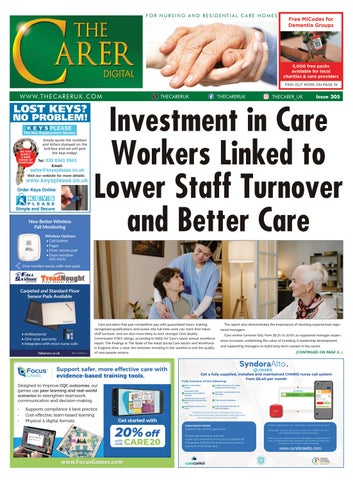
Investment in Care Workers Linked to Lower Staff Turnover and Better Care
Care providers that pair competitive pay with guaranteed hours, training, recognised qualifications and routes into full-time work can more than halve staff turnover, and are also more likely to earn stronger Care Quality Commission (CQC) ratings, according to Skills for Care’s latest annual workforce report. The findings in The State of the Adult Social Care Sector and Workforce in England draw a clear line between investing in the workforce and the quality of care people receive.
The report also demonstrates the importance of retaining experienced registered managers. Care worker turnover falls from 28.3% to 20.6% as registered manager experience increases, underlining the value of investing in leadership development and supporting managers to build long-term careers in the sector.
(CONTINUED ON PAGE 3...)
PAGE 2 | Issue 305 | THE CARER DIGITAL
EDITOR'S VIEWPOINT
Welcome to the latest edition of The Carer Digital! GOOD NEWS ON CARE STAFF RETENTION – BUT THE BIGGER CHALLENGES REMAIN Editor
Peter Adams
There is much to welcome in today’s latest report from Skills for Care, which has been broadly welcomed by leading organisations and spokespersons across the
adult social care sector. Covering the year to March 2026, the report reinforces something that, frankly, should come as little surprise: employers who invest in their workforce, offer fair employment conditions and provide opportunities for development are more likely to retain staff and deliver better-quality care. The findings are encouraging. When employers combine competitive pay, guaranteed hours, training, qualifications and opportunities for full-time employment, care worker turnover falls from 34.3% to 15.3%. The report also highlights the importance of experienced registered managers, effective leadership and a working environment in which staff feel valued and supported. Well, quite. Responsible employers who treat their staff fairly, invest in their development and offer reasonable employment conditions should expect to retain more of them. And when experienced, skilled staff remain in a service, continuity improves, relationships between carers and residents can flourish, and the foundations for consistently good care become stronger. This is not rocket science. It is good employment practice, and it is good business. Nevertheless, we should not lose sight of the fact that the sector continues to face some formidable
challenges. The adult social care workforce in England has grown for the fourth consecutive year, while vacancies have fallen to their lowest level in a decade. These are significant achievements and deserve recognition. However, the rate of growth is slowing. Filled posts increased by 1.4%, compared with a peak of 4.9% between 2022/23 and 2023/24. There are also worrying structural changes in the workforce. The number of British workers in adult social care has declined, while international recruitment has fallen sharply. At the same time, younger people remain underrepresented in the sector. According to the report, just 7% of the workforce is aged under 25, compared with 12% of the economically active population. More concerning still, workers under 25 have the highest turnover rate of any age group, at 35.5%. These figures should prompt some serious reflection. How do we encourage more young people to consider social care as a worthwhile, rewarding and sustainable career? How do we provide the training, progression and employment security that will persuade them to stay? And how do we ensure that care work is recognised for what it is: a skilled, demanding and vitally important profession, rather than an occupation too often undervalued by wider society? Of course, these questions cannot be considered in isolation from the broader economic climate. We commented back in May on the growing crisis facing young people, when concerns were raised that employment and career opportunities were shrinking rather than growing. The latest available figures from the Office for National Statistics estimated that 981,000 people aged 16 to 24 were not in education, employment or training in April to June 2026. That represents an enormous loss of potential, both for the individuals concerned and for the econo-
my as a whole. Surely adult social care, with its wide range of roles, opportunities to gain qualifications and scope for career progression, should be part of the solution? With the right investment in training, apprenticeships, recruitment and working conditions, the sector could offer a meaningful career pathway to many young people who currently find themselves shut out of employment. But that requires more than encouraging care providers to do better. Employers need the resources to pay fairly, train properly and offer secure jobs. Government, meanwhile, must recognise that workforce planning cannot be separated from the funding of the services those workers are expected to deliver. The long-term demographic challenge makes this all the more pressing. Skills for Care estimates that the population aged 65 and over will grow by 24% to 14.1 million by 2040. To increase the workforce at a comparable rate would require an additional 410,000 care workers over the next 14 years. That is a substantial recruitment challenge, particularly when workforce growth is already slowing and the traditional sources of labour cannot be taken for granted. Nevertheless, we should take our good news where we find it. The reduction in turnover and continued growth in the workforce are positive developments, and the employers who are achieving better retention through investment in their staff deserve credit. The challenge now is to build on that progress and ensure that good practice becomes the norm rather than the exception. I would also encourage our readers to sign up for our bi-weekly digital newsletter at www.thecareruk.com and follow us on social media for all the latest news. I can always be contacted at editor@thecareruk.com
PUBLISHED BY RBC Publishing Ltd 3 Carlton Mount 2 Cranborne Road Bournemouth Dorset BH2 5BR
TELEPHONE:
01202 552333 EMAIL:
sales@thecareruk.com WEBSITE:
www.thecareruk.com EDITOR Peter Adams editor@thecareruk.com
SALES DIRECTOR David Bartlett dave@thecareruk.com
PRODUCTION & DESIGN Matthew Noades Published by
The Carer is published by RBC Publishing Ltd, 3 Carlton Mount, 2 Cranborne Road, Bournemouth, Dorset BH2 5BR. Contributions are welcome for consideration, however, no responsibility will be accepted for loss or damage. Views expressed within this publication are not necessarily those of the publisher or the editorial team. Whilst every care is taken when compiling this publication to ensure accuracy, the publisher will assume no responsibility for any effects, errors or omissions therefrom. All rights reserved, reproduction is forbidden unless written permission is obtained. All material is assumed copyright free unless otherwise advised.
Manufactured in the UK
Freephone: 0800 917 7943 www.euroservice-uk.com sales@euroservice-uk.com
PROVIDING PRACTICAL AND STYLISH TROLLEYS TO SUIT YOUR NEEDS Watch your resident's eyes light up when the beautiful tea trolley arrives! Euroservice trolleys can also be used as a vending trolley or to sell personal care products to residents. How about a delicious snack/pastry trolley or even a drinks trolley for that afternoon tipple?
Your lovely trolley could do so much for you and your residents! Euroservice trolleys are an attractive and practical alternative to clinical aluminium trolleys given that antibacterial spray can be used freely to sanitise them.
Get in touch with our friendly, experienced sales team
Visit the website at
www.euroservice-uk.com to see the full range.
THE CARER DIGITAL | Issue 305 | PAGE 3
Investment in Care Workers Linked to Lower Staff Turnover and Better Care (CONTINUED FROM FRONT COVER) Together, the findings suggest that investing in the workforce helps providers both retain skilled staff and deliver higher-quality care. The strongest outcomes are achieved when employers combine good employment practices, development opportunities and effective leadership, creating workplaces where people feel valued, supported and able to develop their careers.
MIXED PICTURE The report also paints a mixed picture of the wider workforce. While the headline numbers suggest the adult social care workforce is relatively stable, growth is occurring at its slowest rate in four years, with the number of filled posts growing by 1.4% compared to a peak growth of 4.9% between 2022/23 and 2023/24. At the same time, there are fewer British workers in the sector and international recruitment has reduced significantly, presenting ongoing challenges for employers. The findings also highlight opportunities to strengthen the future workforce. Young people remain underrepresented in adult social care, making up just 7% of the workforce compared with 12% of England’s economically active population. Turnover among workers under the age of 25 is 35.5%, the highest of any age group. As workforce growth slows and international recruitment declines, attracting younger workers becomes increasingly important to future workforce supply. Statistics included in the report for the first time this year demonstrate the important role social care plays within the wider health and care system. Delegated healthcare activities – activities that a regulated healthcare professional delegates to a colleague in a non-regulated job role – are a significant part of care delivery. Non-nursing staff carry out delegated healthcare activities in 59% of responding CQC-regulated services and an estimated 46% of direct care workers undertake these activities.
WORKFORCE DEVELOPMENT The findings highlight the increasingly important contribution social care makes to health and care delivery and reinforce the importance of including social care in neighbourhood health models, clinical capacity planning, workforce planning and funding decisions. Workforce development continues to be a priority for the sector. The report found that the Care Workforce Pathway is already being used by 26% of responding employers, primarily to identify skills gaps and development opportunities. The Pathway – which launched in 2024 – provides a clear framework for career progression, helping people understand how they can build and develop long-term careers in adult social care while supporting employers to nurture talent and retain skilled staff. However, the report also highlights continued challenges around qualifications. Just 37% of care workers and support workers hold a qualification at level 2 or above, down from 48% in 2018/19, reinforcing the importance of continued investment in learning and development.
The findings also reveal examples of employers going beyond statutory employment requirements to support their workforce. One in four independent sector employers contribute more than the minimum 3% to care workers’ pensions, while one in four pay care workers more than Statutory Sick Pay.
“DEFINING MOMENT” Professor Oonagh Smyth CBE, Chief Executive at Skills for Care, said: “This feels like a defining moment for adult social care. The Prime Minister has set out an ambition to build a National Care Service, free at the point of use, with greater recognition for care workers and a stronger relationship with the NHS. That ambition reflects the fact that there can be no sustainable reform of care without a sustainable, skilled and valued workforce. “It’s positive to see that the adult social care workforce is becoming more stable. This year’s report shows that employers who invest in their workforce through good employment practices, development opportunities and strong leadership are more likely to retain staff and deliver high-quality care. “The report also shows the increasingly important role social care plays in supporting health and care delivery, with many care workers now undertaking delegated healthcare activities as part of their role. “However, workforce growth is slowing, and we must continue to attract more people into adult social care to meet future demand. In particular, we need to do more to attract younger people and men into the sector, as set out in the Workforce Strategy for Adult Social Care in England. Continued investment in workforce development, leadership and career pathways, including scaling up the Care Workforce Pathway, will be essential if we are to build the sustainable workforce needed to deliver high-quality care in the years ahead.”
STRONGER POSITION Cllr Dr Wendy Taylor MBE, Chair of the LGA’s Health and Wellbeing Committee, said: The care workforce does extraordinary, deeply skilled, and human work enabling people who draw on care and support to live independently. "It is positive to see the workforce in a stronger position this year, with a reduction in vacancies and better retention. But those long-standing serious recruitment and retention challenges remain, along with predicted future need for growth. “A successful adult social care Fair Pay Agreement with better pay, conditions and recognition has the potential to be a fundamental part of building a care system we can all have confidence in. But its success will depend on it being fully funded and the government guaranteeing to cover all costs. "We need long-term, sustainable reform of the adult social care system built on prevention, and one that delivers for both workers and those who draw on care and support.” For a full in-depth industry reaction to todays report see page 6.
PAGE 4 | Issue 305 | THE CARER DIGITAL
Free Care, Two Payers: What The National Care Service Could Do To A Care Home's Cash By Harvey Dhillon, Founder and CEO of Zmartly (www.zmartly.co.uk) The National Care Service is planned for the next Parliament. The Budget is on 28 October. Care home operators should plan for both, but not in the same spreadsheet. Start with what has been announced. On 29 September the Prime Minister, Andy Burnham, set out plans for a National Care Service providing free personal care for older people, based on need rather than ability to pay. Personal care means help with things like eating, bathing and using the toilet. Downing Street has since confirmed that the free element applies to people aged 65 and over. The service will not cover bed and board, which stays subject to existing means-tested council contributions. It will be phased in and paid for from savings made by adjusting the State Pension triple lock from April 2030. Baroness Casey's commission is due to recommend how and when it is built up, in summer 2027. Nothing in your contracts changes this year, but the shape is clear enough to model.
ONE RESIDENT, TWO PAYERS Today a self-funding resident usually pays one weekly fee. Under the plans, the personal care part would be paid by the state. The bed and board part would still be paid by the resident, unless their means are low enough for the council to help. For an operator, that changes three things at once. The first is who sets the price. Residents aged 65 and over who are assessed as needing personal care would become, at least in part, publicly funded. Whoever commissions the care element, whether councils, the NHS or a new body, is likely to want to set its rate. The second is when the money arrives. Payroll goes out every month, whatever happens. Check your contracts for when each payer settles: if private residents pay you in advance and your council pays in arrears, every resident whose care moves from one payer to the other opens a gap that your bank balance has to fund. A home can need more working capital even if its annual income does not fall at all.
The third is the cross-subsidy. In its 2017 care homes market study, the Competition and Markets Authority found that many care homes rely on higher prices charged to self-funders to remain viable, even when providing the same services. If the care element of a self-funder's fee is paid at a state rate, that margin is at risk. It survives only if the state rate is set at a sustainable level, or if the bed and board charge can carry more of the cost. Nobody yet knows which. It is the question to press hardest while Baroness Casey's work continues. A simple test is worth running now. Split each private fee into a care element and a bed and board element, using your own cost data. Then reprice the care element at your current council rate and see what is left. That figure, in pounds, is what your home needs to discuss with commissioners before the design is fixed. Nursing homes have an extra step. The NHS already pays a flat-rate contribution towards nursing care for eligible residents. How that sits alongside a new free personal care entitlement has not been set out, so model it as an open question rather than assume either outcome.
THE WORKFORCE BILL IS ALREADY HERE Whatever the new service eventually pays, staff costs are rising now. Since April 2026 the National Living Wage for workers aged 21 and over has been £12.71 an hour. For most staff aged 21 and over, employers pay National Insurance at 15 per cent on earnings above £5,000 a year. Employment Allowance can take up to £10,500 a year off the employer National Insurance bill, though not for an employer doing more than half its work in the public sector, so a home whose residents are mostly council or NHS funded should check it qualifies. And where several homes are run through connected companies, only one company in the group can claim it. Take a home with 50 carers aged 21 or over, each working 37.5 hours a week at the National Living Wage. Its pay bill is £1,239,225 a year, and employer National Insurance adds £148,383.75 before any allowance. Every 10p on the hourly rate adds £9,750 to pay and £1,462.50 to National Insurance: £11,212.50 a year, before pension contributions. The government has said the first fair pay agreement for adult social care, setting minimum standards for pay and terms and conditions, will take effect in April 2028. Operators should treat sector pay rising faster than council fees as their base case, not their worst case.
WHAT TO MODEL BEFORE 28 OCTOBER Keep two models. The first runs to April 2027 and covers what can move this month: National Insurance, any announcement on next April's National Living Wage, and anything on local authority funding that feeds into fee rates. Know your cost per resident per week at today's rates, so you can recalculate within a day of the Budget and take the new figure to your commissioners. The second runs to the end of the decade and asks three questions. What share of your income comes from self-funders aged 65 and over? What happens to that income if the care element is paid at today's council rate? And how many weeks of payroll could you carry if more of your income arrived in arrears? For older people, the National Care Service could settle what personal care will cost them. For providers, the open question is what the state will pay for that care, and it is still to be decided. Operators who bring their own numbers to that discussion will fare better than those who wait to be told.
Welcome to Blue Rain - our activity store is built on over 14 years experience supplying products that bring joy, inspire motivation, and enrich the lives of those who need a little extra support, or simply want to have fun, whatever the weather.
Come find your next reason to smile.
Scan me
THE CARER DIGITAL | Issue 305 | PAGE 5
Prime Minister Unveils £48M Investment to Combat Dementia Prime Minister Andy Burnham has announced a £48 million public-private partnership to accelerate dementia research and improve access to clinical trials. The BARBARA Alliance, created through the Dame Barbara Windsor Dementia Goals Programme chaired by Alzheimer’s Research UK Chief Executive Hilary Evans-Newton CBE, will bring together government, industry, charities, researchers and the NHS to speed up recruitment to dementia clinical trials and help promising treatments reach people sooner. The announcement comes at a critical moment. More Alzheimer’s medicines are in development globally than ever before, but the UK has dropped from second in 2015 to sixth in 2025 for number of new dementia drug trials running each year. Without urgent action, people in the UK risk having fewer opportunities to take part in research that could shape the next generation of treatments. Hilary Evans-Newton CBE, Chair of the Dame Barbara Windsor Dementia Goals programme and Chief Executive of Alzheimer’s Research UK, said: “We know that people affected by dementia want the opportunity to be part of the search for better treatments. More than 90% we’ve surveyed told us they would like to take part in research, helping to shape a better future for everyone affected by the condition. “The BARBARA Alliance has been created to change that. By tackling the barriers to dementia research and speeding up recruitment to clinical trials, this funding will help more people contribute to breakthroughs in diagnosis and treatment.” By connecting and strengthening the UK’s existing research ecosystem, the Alliance aims to speed up access to new dementia treatments and make it easier for discoveries to move from research into realworld use. This joined-up approach will help unlock the value of existing knowledge and resources and reinforce the UK’s position as a global leader in dementia research and innovation.
At the heart of the Alliance’s work is BARBARA: the Brain Ageing Registry for Biomarkers, Access to Trials, Research and Adoption. This flagship UKwide platform will link existing datasets, research cohorts and registries, creating a more connected route between people, researchers and clinical trials. By helping researchers identify and recruit suitable participants more quickly, efficiently and equitably, BARBARA has the potential to accelerate studies, widen access to research opportunities and bring new treatments to people affected by dementia sooner. For families like Elaine’s this progress matters. Her mum, Jeannette was diagnosed with Alzheimer’s disease. Elaine shares: “When my mum was diagnosed with Alzheimer’s it was heartbreaking to learn that there were no treatments that could slow or stop the development of the disease.” Since her mum’s diagnosis and passing, Elaine has been dedicated to raising awareness and funds for dementia research. But people can only benefit from this progress if the NHS is ready to deliver access to new treatments. Health professionals are working hard to support people affected by dementia, but the health service is not yet equipped to deliver the next generation of treatments and diagnostics. This September, Alzheimer’s Research UK launched ‘Ready for a Cure’, a new policy campaign and national petition calling on Government to prepare the NHS for the next generation of dementia treatments and diagnostics. Elaine was one of many of our supporters backing the campaign: “Today, research is giving us hope that other families won’t have to go through what we did. That’s why I’m supporting the Ready for a Cure campaign. “It’s so encouraging to see breakthroughs being made in dementia research and the confidence among scientists that new treatments are on the horizon. “There’s hope for the future that other people won’t have to go through what we went through with my mum.”
Pat Celebrates 104th Birthday With Family, Friends and Her Daily Glass of Wine One of the south’s oldest people has celebrated her 104th birthday, enjoying her daily glass of white wine among family and friends. Pat Dartnell was naturally the centre of attention at her party at Colten Care’s New Milton home, Kingfishers, where she has lived for several years. The former John Lewis staffer and Oakhaven charity shop volunteer welcomed friends, cousins and fellow residents for a vintage afternoon tea with live music from visiting pianist Karen Lassy Smith. Born in South Wales in 1922 just four years after the end of the First World War, Pat grew up as the middle one of three sisters. Her earliest memories are of the trio cycling to school and going for walks together. Still a teenager when World War II broke out, she took part in community volunteering during the war years. Her husband Les, to whom she was married for more than half a century, had a brother in Brockenhurst and visiting him over the years led to the couple retiring to the New Forest and realising their dream to live near the south coast.
On her 100th birthday at Kingfishers four years ago, Pat said her secrets of longevity were to stay active and optimistic, take lots of exercise and holidays aboard and indulge in a daily glass of white wine, usually before lunch. Thanking the Kingfishers team for arranging her latest party, Pat said: “They made my day a memorable one. I didn’t expect to have such a big party. I am very grateful for all their effort and hard work to make my day extra special.” Rose Arcellana, Companionship Team Leader at the Outstanding-rated home, said: “Pat is a lovely lady with a highly positive attitude to life and we were only too happy to help organise her special afternoon. A key highlight was the live piano performance from Karen, something that Pat had expressed as a birthday wish. The beautiful live music was the perfect soundtrack as guests chatted, laughed and shared happy memories together.” Home Manager Jacqui Williams said: “Everyone at Kingfishers wishes Pat a very happy 104th birthday and we thank Karen for helping to make her special birthday wish come true.”
PAGE 6 | Issue 305 | THE CARER DIGITAL
Industry Reacts to Skills for Care Report Linking Workforce Investment to Better Retention and Quality of Care Skills for Care’s latest State of the adult social care sector and workforce in England report (see page 1) has found that care worker turnover falls from 34.3% to 15.3% when employers combine competitive pay, guaranteed hours, training, qualifications and full-time opportunities. The report, which covers the year to March 2026, also links better workforce conditions to stronger CQC ratings and shows that turnover drops as registered manager experience grows. It comes as the workforce grows for a fourth successive year and vacancies fall to their lowest level in a decade, though growth is slowing, international recruitment has dropped sharply, and just 37% of care workers hold a Level 2 qualification or above. We asked leading voices from across the residential and nursing care sector for their reaction to the findings and what they mean for providers. Vic Rayner, CEO of the National Care Forum, said: "We welcome the publication of this year’s Skills for Care annual report which provides a comprehensive picture of the adult social care and support workforce and offers important evidence about both the progress being made on workforce and the challenges that remain. It is encouraging to see vacancy rates continue to fall and workforce stability improve, reflecting the commitment of providers and the extraordinary contribution of the social care and support workforce." "The report also substantiates what we know helps people stay in the sector. Better pay, guaranteed hours, training, qualifications and strong leadership all contribute to improved retention; better workforce conditions are also associated with better quality care. These findings reinforce what notfor-profit providers have long understood: investing in the workforce is fundamental to delivering high-quality care and support. Through NCF's Leading Better Employment Practice programme, we are working with members to share practical approaches that support workforce wellbeing, development and retention, helping providers build the sustainable workforce the sector needs." "However, alongside these positive signs, the report highlights some significant long-term challenges. Workforce growth has slowed, the number of British workers in the sector continues to fall, international recruitment has reduced sharply, and younger people remain underrepresented in the workforce. In addition, the report highlights a growing mismatch between the increasing complexity of care being delivered by our workforce and the qualification levels of the workforce. Around three in five regulated services report that non-nursing staff are undertaking delegated healthcare activities, demonstrating the increasingly skilled role being played by the social care workforce. Yet qualification levels have fallen significantly in recent years, with just 37% of care workers and support workers qualified to Level 2 or above. If social care staff are being asked to take on greater responsibility for supporting the more complex aspects of people's health and wellbeing, it is essential that national investment in their learning, development and career progression must keep pace." "These findings demonstrate why a long-term workforce strategy for adult social care is so important. We welcome the government's commitment to develop a national workforce strategy and place a greater strategic focus on the care workforce. As this work progresses, there is a strong foundation already available in the cross-sector Adult Social Care Workforce Strategy coordinated by Skills for Care and developed with partners from across the sector. Government should build on that work and provide the sustainable funding needed to support recruitment, retention, qualifications, skills development and career progression. Investing in the workforce must be central to future reform, ensuring care providers can develop and retain the skilled workforce needed to meet growing demand now and in the future." Dr Jane Townson OBE, Chief Executive of the Homecare Association, said: "Skills for Care's data are invaluable, and they tell a clear story. Homecare is growing because that is where people want to receive care, but we are not yet creating the conditions for local people to choose it, stay in it and build a career in it." "Careworkers do not pay their rent with an hourly rate. They pay it with their total income, week after week. What matters is whether they can rely on enough paid hours, at a fair rate, across their whole working day. Too often, they cannot." "Many councils and NHS bodies buy homecare by the minute, pay only for time spent in people's homes, spread work thinly across many providers and guarantee no volume at all. In one provider's payroll records, careworkers were expected to be available for up to 98 hours in a week to deliver 39 paid contact hours. A higher headline rate does nothing for a worker in that position. A provider cannot guarantee its careworkers hours that nobody guarantees to it." Rachael Dodgson, chief executive of Dimensions said: “It’s positive to see that better employment conditions across the adult social care sector have led to higher levels of retention. This matters enormously to people we support with learning disabilities and autistic people who rely on consistent, skilled support. At Dimensions, we’re proud to pay close to nine in ten of our support workers at or above £13.45, the Real Living Wage. This is higher than the median hourly pay across the wider sector. Higher pay has led to our colleague turnover falling by more than a third since 2022. However, Skills for Care’s report exposes serious concerns about the longterm sustainability of the adult social care workforce. The report estimates that England will need an additional 410,000 adult social care roles by 2040 - an entire city’s population! But nationally, both domestic and international recruitment are falling. The country faces serious questions about where this city-sized workforce will come from. Incentives are key to outcomes. The government’s upcoming Fair Pay Agreement in 2028, the recently announced collective pension scheme for care workers and the current Care Workforce Pathway, established in 2024, are all positive steps in the right direction. Dimensions is an early adopter of the Care Workforce Pathway. But more widely, this pathway’s potential will be limited unless career development is accompanied by meaningful pay progression. We cannot expect to build a skilled, experienced workforce without a structure that properly recognises and rewards that experience. For hundreds of thousands of adults with learning disabilities and autistic people who draw on support, familiar faces, trusted relationships, and consistency are crucial to live fulfilling, independent lives.” Sarah Woolnough, Chief Executive of The King's Fund, said: 'This report points to the scale of the challenge the Prime Minister will face in trying to build his ambition of a National Care Service and a sustainable workforce. 'Vacancies may be falling but they remain above the national average for
other sectors, and it is due significantly to international recruitment plugging the gaps. With the closure of overseas recruitment for social care workers, there remains a serious challenge to social care if recruitment of British nationals does not rise to compensate for it. 'These issues will likely be further exacerbated by our ageing population. The report states that the population aged 65 and over is expected to grow by 24% to 14.1 million by 2040. It goes on to state that to increase the size of the workforce at the same rate would require an additional 410,000 care workers in the next 14 years. 'This should bring into sharp focus the urgent need for improvements in recruitment and retention, particularly for younger workers since 18–24-year-olds make up only 7% of the social care workforce. They could be an important source of new recruits, but our previous work has shown younger people often have a poor experience within the sector. We heard about some appalling treatment of young care workers on the basis of their age. ‘Career development also matters. The Prime Minister has spoken passionately about the need to end 'poverty pay' for care workers but to attract long term retention, including of younger workers, alongside the Fair Pay Agreement needs to be the provision of viable, long-term career paths. ‘There also needs to be consideration given to how to best use technology and changes in service patterns to most effectively use the care workers that the sector is able to recruit. ‘Andy Burnham and the government will need to look at all these options, alongside how a future system may operate to facilitate this including our proposals, if a National Care Service will be able to stand the test of our ageing population.' Social care must now urgently be put on an equal footing with the health service Chief executive of the NHS Alliance, Sir Ciarán Devane, said: “These findings show just how essential a stable, skilled and supported adult social care workforce is – both for the social care sector itself, and to help solve some of the most severe pressures on the health service. “Longstanding issues around pay, working conditions and access to training have made it harder to recruit and retain staff, contributing to workforce shortages across the sector. “A fragmented social care system is a problem in itself, and because of the knock-on impact it has on the NHS. Social care must now urgently be put on an equal footing with the health service, so people get the support they need to keep them out of hospital and in their homes. “As the government makes plans to create a better funded, universal national care service, it must make sure that social care is a great place to work, so it can attract and retain the staff the sector needs.” Care England says new workforce figures highlight urgent need to invest in pay, retention and experienced leadership Professor Martin Green OBE, Chief Executive of Care England, said: "We welcome Skills for Care's excellent new report on the state of the Adult Social Care sector and workforce in England. “While the report highlights a number of positive indicators, with vacancies falling to 96,000 and staff turnover declining, it also highlights the scale of the challenge facing the sector. Workforce growth has slowed from 3.2% to 1.4% over the past year, and Skills for Care estimates that the sector could need an additional 410,000 posts by 2040 to keep pace with population ageing alone. “While overseas recruitment is not a silver bullet, it has played a vital role in filling workforce gaps, though the report provides compelling evidence that the sector is getting better at drawing people in, this is met with difficult conclusions around retention. Staff are supporting people with increasingly complex needs, working more closely with the NHS and taking on greater responsibilities (with 46% of direct care workers now undertaking delegated healthcare activities), but workers who have five or more years of experience earn, on average, just 12p an hour more than those with less than one year's experience. “Of particular concern is the reversal in the long-term decline in registered manager turnover, which rose from 17% to 19.7% in the latest year. The importance of experienced leadership is clear, with care worker turnover averaging 28.3% in services where registered managers have been in post for less than a year, compared with 20.6% where managers have been in post for 20 years or more. Alongside rising turnover in senior management and increased vacancies among senior care workers, these findings raise concerns about the sector's ability to retain the experienced staff and leaders on whom services depend. “The question of retention, the report reminds us, does not have to be complicated. Turnover was just 15.3% among workers benefiting from five positive employment factors, including better pay, guaranteed hours, training, relevant qualifications and full-time employment, compared with 34.3% among those with none of these factors in place. We need more people to join the sector, but we also need them to see social care as a career in which they can build their future. This is only possible when providers see fair funding and stable commissioning that enables long-term workforce investment. “With the Autumn Budget just two weeks away, the Government faces a clear test of whether its ambitions for social care are matched by the investment and changes to commissioning needed to deliver them. Without addressing the financial pressures facing providers, there is a real risk that its workforce commitments will fall short of the improvements care workers, employers and those who rely on care services need and deserve to see.” Gerard Crofton-Martin, Interim Chief Executive at SCIE, said: “With vacancy and turnover rates both falling, there are positive signs of stability for the social care workforce. The report demonstrates how a better supported workforce leads to high-quality care and improved outcomes for people who draw on care and support. This positive trend is one we need to continue building on for the long term. “There is some cause for concern at the lack of growth of our domestic workforce, coupled with falling numbers of internationally recruited care workers. With the tightening immigration rules for overseas care staff that are driving the latter seemingly here to stay, there must be a concerted effort to build social care as an attractive career for people to join and remain in. “This report comes in the wake of the Secretary of State for Health and Social Care’s commitment to better support and value the social care workforce through fair pay, clearer career pathways, investment in training and development, and a collective pension scheme. These announcements are overdue recognition of the compassionate and skilled individuals who care for us all. The workforce is this sector’s backbone, and for too long it has been undervalued and under-recognised by decision-makers. “Moving these reforms forward serves to benefit not just those working in care, but crucially those who draw on care and support, the taxpayer and the wider economy.”
THE CARER DIGITAL | Issue 305 | PAGE 7
Quarter Fewer Good Care Options Relative To Need In Worst Off Areas, New Report Shows Older people in England’s worst off local areas have 25.8% fewer good quality care options relative to their level of health need than those in the best off areas, according to major new analysis published today by the International Longevity Centre (ILC). The report – Inequality Street – reveals how poor health, lower quality care and heavier burdens of unpaid care compound in the exact same communities.
KEY FINDINGS: The care gap: the worst-off fifth of local authorities has a quarter fewer good-quality care options, relative to need, than the best-off fifth – 33 options for every 10,000 older people estimated to be in poor health, compared with 45 in the best-off areas. Unpaid carers filling the gap: In the worst-off fifth of areas, almost 6% of residents provide at least 20 hours of unpaid care a week, compared with under
4% in the best-off fifth. Areas with more intensive unpaid care also have higher economic inactivity among people aged 50 to 64. Most under served local authorities: Ten of the most under-served authorities are: Tameside, Halton, Wigan, Knowsley, North Tyneside, Walsall, Redcar and Cleveland, Liverpool, Rochdale and County Durham. Rosie Fogden, ILC’s Director of Health and Economic Growth, said: “Where you live shouldn’t decide whether you get good care – but that’s exactly what’s happening. Older people in the worst-off areas according to our index are sicker for longer and have fewer good-quality care options locally. Families are being asked to pick up the slack, often putting in many hours of unpaid care every week. Funding must follow need, and go into the places where poor health, weak tax bases and unpaid care pile up together.”
Broughton House Secures £120,000 Grant To Support Veteran Care Broughton House Veteran Care Village has secured a £120,000 grant to support the wellbeing and quality of life of its residents. The Army Benevolent Fund’s grant will help fund round-the-clock residential and nursing care for veterans at the Salford care home, including those living with dementia. It will also fund dementia support that Broughton House provides to veterans living in the wider community. The ABF is the British Army’s national charity, supporting soldiers, veterans and their families, for life. The money will be put towards a range of care and services, including the work of Broughton House’s Admiral Nurse Jacqui Hodgson, in-house physiotherapy and chiropody, dementia-friendly equipment, the care home’s gym, social events and military-themed activities. It will also enable Broughton House to continue assisting veterans living at home with dementia, with Jacqui and the home’s dedicated dementia navigator providing specialist support. Karen Miller, chief executive of Broughton House, said: “We’re incredibly grateful to the Army Benevolent Fund for awarding Broughton House this generous grant of £120,000. “It means we can continue to give back to those who have given so much in service to our country. The ABF’s support makes a real difference to their lives, helping us provide specialist care that goes beyond the essentials of day-to-day. “From dementia support through our Admiral Nurse to physiotherapy, chiropody, wellbeing activities
and support for those living with dementia in the community, this funding helps us give veterans a chance to live well.” Nearly 50 British Army veterans live at Broughton House, alongside veterans from other branches of the armed forces. Most are in their 80s and 90s and live with dementia or cognitive decline. The ABF grant will help close the gap between the cost of providing care and the funding received through local authority fees and personal contributions. Karen said: “Many veterans come to us after periods of isolation and limited social contact. “At Broughton House, they live alongside peers who share similar military backgrounds. That shared experience restores a sense of identity and belonging that most care settings cannot replicate. “For those living at home, our Admiral Nurse and dementia navigator work together to deliver practical advice, emotional support and tailored care plans. “This helps veterans remain at home for longer where possible and reduces stress and isolation for family carers, improving their confidence and ability to manage dementia. This community support receives no statutory funding.” Brigadier (Ret’d) Peter Monteith, the ABF’s chief operating officer, said: “We are proud of our longstanding partnership with Broughton House and the support it provides to elderly veterans, particularly those living with dementia. Ensuring that veterans enjoy their retirement with peace and dignity is extremely important to the ABF, and we strive to continue supporting charities who enable this.”
PAGE 8 | Issue 305 | THE CARER DIGITAL
The Benefits of Being Involved in Care Home Research
By Dr Michelle Parker, Paul Cartwright, Filippo Laudazi, Natasha Cartwright, Niccola Hutchinson Pascal, Julie Wright, Professor Jacqui Prieto
Research may sound like something far removed from the day-today delivery of care to residents but the team at Glentworth House have discovered the many benefits it can bring to staff, residents and
families, describing it as a win, win, win! In 2024 Paul Cartwright, manager of Glentworth House, was approached to contribute to developing a study by the Vivaldi Social Care team at University College London investigating hydration care to prevent urinary tract infection. Supporting care home staff to prioritise hydration care for residents can improve quality of life and reduce adverse outcomes such as urinary tract infections, falls and confusion. The project involved working with members of the research team and Co-Production Collective at University College London to co-produce a hydration charter to support good hydration care. Co-Production Collective consider co-production “an approach to working together in equal partnership and for equal benefit” and at Glentworth House the initial co-production team included Paul, Filippo (Registered Nurse and clinical lead), Natasha (training manager), the head chef, activities coordinator, two support workers and the husband of one of Glentworth’s residents. After sharing their own experiences of hydration care provided at Glentworth and what worked well for them, the co-production team began reviewing a draft ‘hydration charter’ based on the findings of an evidence review led by Prof Jacqui Prieto in the research team. The challenge was to develop the charter into a visually appealing support tool for staff based on principles that support good hydration care. These include involving the whole care team, prioritising hydration throughout the day, personalised care based on residents’ needs and preferences, ensuring residents consume enough drinks and fluid rich foods, effective education and involving family and friends. Being part of the co-production work has had a much wider impact on the team at Glentworth than the development of a charter. Paul says, “Being part of the collaboration got us thinking totally differently, it has changed our outlook on things”. After meetings they considered how to change their practice and as more staff, residents and families became involved in the work Paul felt they really started to see the benefits. A key driver was making hydration a sociable event. They started breakfast clubs, garden activities, trips to the
H.W. PICKRELL NEW & USED ACCESSIBLE TRANSPORT AT AFFORDABLE PRICES • We specialise in the sale and purchase of quality used wheelchair accessible vehicles and ambulances. • They can be bought as seen or refurbished and sign-written to your own requirements. • Fully serviced, new mot & warranty • Engineers inspection supplied if required.
• Free delivery service available • All buses comply with new legislation • Lease hire and purchase available • Always large stock of accessible vehicles
Tel: 01268 521033 Mobile: 07860 894331 Email: sales@hwpickrell.co.uk Gardiners Lane North, Crays Hills, Billericay, Essex CM11 2XE All current stock available to view at www.hwpickrell.co.uk
beach and even a weekly pub club, to encourage staff, residents and families to enjoy drinks together socially, taking the ‘chore’ out of hydration care. Staff were given permission to ‘slow down’ and were empowered to make hydration a priority, taking time to support residents to drink and ensuring they were hydrated too. They developed a way of identifying which residents needed additional monitoring and support, with creative ways to deliver drinks and fluid rich food in conjunction with the chef and his team and the housekeeping team. Along with bite-size training delivered regularly for staff, the co-production team and one of the resident’s family members, created two digital stories to raise awareness and share best practice which have been viewed around the world. As a result of the changes to practice they have seen a decrease in dehydration, delirium, urinary tract infections and the number of residents requiring hospital admissions. Filippo feels the key to their success has been involving all staff in developing strategies to improve hydration care, so they feel empowered to be a part of the research and make changes, giving them a common purpose as a team with staff feeling pride in their work. The team has gone from strength to strength, achieving an outstanding CQC rating, being shortlisted for awards and approached by other care homes keen to learn from them. They continue to work with the research team and Co-Production Collective on a version of the charter that can be shared with other care homes and used in future research studies, along with a leaflet to educate families on the importance of hydration. Paul, Filippo and Natasha encourage other care homes to get involved in research if the opportunity arises. They advise being open, choosing a study that fits with your team and feels achievable. Then talk to your team, help them to see the potential benefits of the study so that everyone is on board from the start. Finding ways to ensure everyone can be involved throughout the project is key - staff, residents and families, but especially staff delivering day-to-day care as most changes will have the greatest impact on them. As Natasha says, “if they feel they’re playing a part in something, they will engage with it more and if you can involve friends and families, that’s great.” So, for the team at Glentworth being involved in research and co-production has resulted in a win, win, win – happy staff, happy residents and happy families.
THE CARER DIGITAL | Issue 305 | PAGE 9
Government Warned Immigration Reforms Could Cost Hundreds of Millions and Put Frontline Healthcare Support Staff at Risk Proposed immigration changes could cost the NHS at least £169 million and jeopardise the futures of 12,000 healthcare workers, NHS Employers and health unions have warned. They say government visa reform plans will place huge additional costs on health service organisations, create uncertainty for essential support staff and create a two-tier NHS workforce in the process. Many international healthcare support workers were recruited to the NHS through the Home Office’s specialist visa routes, which currently provide a pathway to settlement in the UK after five years for skilled workers, including those in health and care. However, under the proposed reforms, thousands of staff will face a significantly longer route to permanent residence, despite continuing to work in essential patient-facing roles. These healthcare support workers delivering frontline patient care across the NHS could now face a wait of up to 15 years, instead of the current 5 years, to settle permanently in the UK under the government’s proposed immigration reforms. NHS Employers and health unions* are concerned that extending the settlement pathway will make it harder to retain experienced staff, damage morale and increase uncertainty for both employees and employers. Additional visa-related employment costs also risk placing a significant financial burden on NHS organisations already facing difficult workforce pressures. NHS Employers and unions are calling on the government to retain the five-year settlement period for healthcare support workers and other NHS staff already living and working in the UK. Final details on the government’s earned-settlement reforms are expected later this autumn.
There is also concern that many of these workers find themselves on the wrong side of a cut-off date imposed by the Home Office for July 2025**, which prevents them from renewing their visa or being able to settle in the UK. This date is unfair and causing additional uncertainty for employers and staff, say unions and employers. Ben Morrin, chief executive of NHS Employers (part of the NHS Alliance), said: “Thousands of healthcare support workers and other NHS staff made life-changing decisions to come to the UK and met the requirements to apply for settlement under the immigration rules that were in place when they arrived. “If proposals for reform to these rules are confirmed by the government, not only would it be extremely unfair to change the rules for workers who have planned their lives around them, but it would also leave NHS organisations dealing with an eye-watering bill to the tune of at least £169 million. “High-quality patient care relies on a contribution from the whole team, including those in vital support roles. The NHS needs stability, fairness and workforce growth, not policies that risk making it harder to retain crucial staff.” Helga Pile, chair of joint health unions and UNISON head of health, said: “These changes are nothing short of devastating for thousands of health workers and their families. “They’re a crucial part of the NHS team and at the heart of patient care. They’re highly trained and skilled in performing clinical duties and observations, keeping people safe, comforted and cared for. Their expertise and commitment cannot readily be replaced. “There’s still time for the government to do the right thing, treat staff fairly and rethink these proposals.”
Care England Ambassador Talks Prevention with the PM Care England Ambassador and Founder of Be Great Fitness Bailey Greetham-Clark, met with Prime Minister Andy Burnham earlier this month at a local Salford community hub to play a game of bingo with local residents and to talk about their shared passion for the sector, prevention, physical activity, and their role in shaping a National Care Service. Professor Martin Green OBE, Chief Executive of Care England, said: “We are so proud that Bailey Greetham-Clark joined the Prime Minister at the Humphrey Booth Resource Centre in Salford, a centre that does extraordinary work supporting people living with dementia and the families who love them. Seeing the Prime Minister sit down for a game of bingo and take the time to hear directly from local residents and families, shows a real recognition of what good care looks like. This is exactly the conversation adult social care needs to be having. Bailey, Care England’s Ambassador, has shown brilliantly how this type of engagement, movement, purpose and prevention can transform people’s lives, and we are incredibly proud to see him taking that mes-
sage directly to national leaders in a setting that means so much to so many. Any future National Care Service must put prevention at its heart and recognise that care providers and community hubs, like those at Humphrey Booth, are the infrastructure in neighbourhood health that makes this possible every single day. We look forward to supporting Government to work directly with providers to turn that ambition into reality.” Bailey’s meeting with the Prime Minister builds on Care England’s ongoing work with Be Great Fitness to demonstrate the importance of physical engagement, activity, prevention and independence in adult social care. Through our From Inactivity to Independence white paper series, Bailey and Care England explored both the practical benefits of embedding movement into everyday care and the measurable impact on prevention and the effect this can have on people’s health, wellbeing and quality of life, which has also informed our wider policy recommendations, including a submission to Baroness Casey’s review of adult social care.
THE CARER DIGITAL | Issue 305 | PAGE 11
Four In Ten Care Homes Carry A CQC Rating More Than Five Years Old, Analysis Finds Around 40% of older people’s care homes in England are displaying a Care Quality Commission (CQC) rating that was published more than five years ago, according to new analysis by the care fee comparison website What Care Costs. The research examined every care home for older people on the CQC register, using the regulator’s Care directory with ratings dataset dated 4 August 2026. Of the 10,980 homes analysed, 4,438 had a rating more than five years old. Those homes account for 153,401
Region
Homes
Rating over 5 years old
Median rating age
East of England
1,200
46.8%
5.0 years
South East
2,040
44.3%
4.5 years
West Midlands
1,213
43.6%
4.6 years
North West
1,481
41.1%
4.1 years
South West
1,398
39.2%
4.0 years
Yorkshire and The Humber
1,111
39.0%
3.9 years
North East
560
35.7%
3.6 years
East Midlands
1,098
33.4%
3.6 years
London
821
30.0%
3.5 years
of the 423,945 beds covered. The median rating across England was 4.1 years old, meaning the typical home was last judged by the regulator more than four years ago.
COUNCIL AREAS WITH THE OLDEST RECORDS
MOST RATINGS MORE THAN THREE YEARS OLD
over five years old, at 61.9% (39 of 63 homes), with a median rating age of 6.6 years. Cambridgeshire fol-
The analysis found 6,845 homes, or 62%, were relying on a rating more than three years old. Some 2,399 homes, or 22%, had a rating more than seven years old. A further 550 homes, representing 22,183 beds, had no published rating at all. The researchers highlighted 391 homes rated “Requires improvement” or “Inadequate” that have not been re-rated in more than five years, accounting for 14,445 beds. What Care Costs noted that an old poor rating does not mean a home is still failing, only that no new finding has been published, leaving families unable to tell the difference.
lowed at 61.7%, then Oxfordshire at 57.3%, Dudley at 56.1% and Buckinghamshire at 55.4%.
WEALTHIER REGIONS AMONG THE WORST AFFECTED The regional picture ran counter to what might be expected. The East of England had the largest share of homes with a rating over five years old, at 46.8%, with a median rating age of five years. It was followed by the South East (44.3%) and the West Midlands (43.6%). London had the freshest records, with 30% of homes over the five-year mark and a median rating age of 3.5 years. The East Midlands (33.4%) and the North East (35.7%) also fared comparatively well.
Among council areas with at least 60 care homes, Stoke-on-Trent had the highest proportion of ratings
Shropshire (54.5%), Cheshire East (53.8%), Devon (52.1%), Norfolk (52.0%), Birmingham (52.0%), North Yorkshire (51.9%) and Gloucestershire (48.6%) completed the list of twelve areas with the oldest records. Figures for all 187 councils are available in a downloadable dataset. Regulator’s changing approach What Care Costs acknowledged that the CQC has changed its assessment approach and has been operating a reduced inspection programme. It stressed that an old rating is not evidence of poor care. It also noted that homes providing several services are sometimes rated service by service rather than as a whole, and that newly registered homes have not yet been inspected. The analysis measured the time since the CQC published a rating, rather than the date of an inspector’s visit, as the published date is the one displayed to the public. Dormant locations were excluded, and 447 duplicate registrations, typically arising after a change of ownership, were removed.
Crystal Care Collection Marks Topping Out of New Truro Care Home
A major milestone in construction has been reached on a new care home development in Truro, Cornwall. Em Dean, Managing Director at Crystal Care Collection, was joined by her team in the South West to perform a topping out ceremony to mark the final stages of the buildings structural frame. The care home, named Landers Court, is due to open in February 2027 and will provide person-led residential, dementia, and respite care with an all-inclusive fee for
up to 66 people. Em Dean said, “Landers Court is on track to become Crystal Care Collection’s third purpose-built care home in Cornwall. As well as bringing more high-quality care beds to the region, this exceptional home will open with a focus on community. “Through partnerships with local businesses, groups, and charities, Landers Court will always ensure that residents and staff remain active members of the community.”
PAGE 12 | Issue 305 | THE CARER DIGITAL
Expert Shares How Cornwall is Leading the UK's Positive Ageing Conversation Recent ONS data1 has identified Cornwall as one of the areas with the highest proportion of older residents in the UK, with just over 1 in 4 (26%) of residents aged 65+, compared to the national average of 19%. With demand for social care rising and people living longer than ever before, it’s becoming increasingly important to have open conversations with family about the future and later life, while rethinking how we can best support the independence of older generations. Em Dean, Managing Director at Crystal Care Collection (www.crystalcarecollection.co.uk), explains why person-led care is reshaping later life in a positive way and how families can start honest conversations about care sooner. Em comments “In recent years, expectations around later life have changed, with older generations focusing more on independence. Person-led care is one way that supports those wanting to stay active and maintain their daily freedoms. It allows people to continue doing the things that matter the most to them.”
THE CHANGING PERCEPTIONS OF MODERN CARE HOMES Em said, “There are common, outdated stereotypes surrounding care homes, and misconceptions that older adults will lose their independence moving into a care home. Person-led care homes develop personalised care plans in collaboration with residents and their families, meaning independence doesn't stop the moment someone moves in. Residents can decide how they spend their days and keep doing the things they love. Whilst it can feel like a big adjustment for those moving into care, this person-led approach means homes focus not just on physical care but residents’ mental wellbeing too. It’s important that everybody
feels supported, comfortable and happy as they get older”.
HELPING FAMILIES FEEL CONFIDENT ABOUT CARE DECISIONS Choosing care for a loved one can be an overwhelming decision, often feeling like a taboo subject to discuss, meaning that family members are lacking clarity on their choices. Em adds, “It’s becoming increasingly important to have open and honest conversations with family members when discussing plans for later life. With there being so many care options available, it is best to begin these conversations early to discuss all options and find the most appropriate one for you and your family. When a loved one first moves into residential care, regular wellness checks and open communication with the home allows the family to have a deeper understanding and ensure a smooth transition into care.”
WHY CONNECTION AND COMMUNITY MATTER Friendships and social interactions help residents to maintain a healthy lifestyle. Person-led care homes focus on sustaining high-quality care, whilst also encouraging residents to stay connected to their life and build friendships with those around them. Em comments “It’s key that care givers support people in maintaining a healthy and fulfilled lifestyle. This can be through connecting with family, continuing old hobbies and getting involved in local community clubs, meaning that residents can continue to thrive, whilst maintaining the level of care they need. This can look like a varied weekly programme, from live music events, to painting activities, or traditional Cornish cream tea afternoons. Homes also come together for fundraising events supporting local causes, helping residential care to feel connected to the people around them and the wider Cornwall area.”
WHAT CORNWALL CAN TEACH US ABOUT THE FUTURE OF LATER LIFE Cornwall’s high population of older adults highlights the importance of working together as a community to support people in later life to live healthily, happily and independently. Care providers, as well as the Cornwall community, can all play a role in helping residents and families to live fully and enjoy experiences outside of their physical health. Em adds, “Whilst care needs are important, ensuring residents’ happiness and comfort is also a priority. We are centred around independence and living life to the fullest. Our Cornwall homes have top facilities that allow a smooth transition into residential care, and we provide personalised care packages for residents that take a holistic approach, so that loved ones always feel reassured.”
Brunelcare Celebrates 85 years of Caring for Older People Across the Southwest Bristol-based charity Brunelcare is celebrating its 85th anniversary on Sunday 18th October 2026, marking more than eight decades of supporting older people and helping them to live fulfilling, independent lives. Founded in Bristol in October 1941 as the Old People’s Welfare Committee (OPWC), the charity was established during the Bristol Blitz, at a time when the city and its residents faced significant hardship. Its original mission was simple but vital: to “keep them warm, keep them fed, keep them alive”. Since those early beginnings, Brunelcare has grown and evolved to meet the changing needs of older people and their communities. Today, the charity provides six care homes, three extra care housing sites, 30 sheltered housing sites and home care support to more than 2,000 people across Bristol, South Gloucestershire and Somerset. The organisation’s vision, “Later living that makes the most of every moment”, reflects its ambition to help people maintain their independence, wellbeing and quality of life. Brunelcare’s history reflects a longstanding commitment to responding to the needs of local people. In 1942, the organisation helped establish Uganda Hostel in Brislington, Bristol, providing accommodation for
people to live independently. Over the following decades, its work expanded to include housing for older people, with hot meal deliveries becoming an important part of its community support. In 1958, Bristol Older People’s Welfare was incorporated, followed by an ambitious programme to develop sheltered housing during the 1960s. By 1973, the charity was providing accommodation for more than 900 people. The organisation then became Bristol Age Care in 1975 before adopting the name Brunelcare in 1998, reflecting its growing reach across the region. Its development continued through investment in specialist care and support, including new care homes, approaches to dementia care and the opening of Orchard Grove in 2015, Bristol’s first dedicated short-stay reablement centre supporting people discharged from hospital. Sonia Furzland, Brunelcare’s CEO said: “It’s a real honour to be part of Brunelcare during such a significant milestone. Reaching 85 years is a fantastic achievement for any organisation, and particularly for a growing, not-for-profit charity like ours. We’ve come such a long way over the past eight and a half decades, and I’m sure our founders would be incredibly proud to see how far we’ve come and the difference we’re continuing to make in the lives of the people and communities we support.”
Beyond the Breaking Point: When Care Staff Are Asked to Do the Impossible By Stephanie Ryde I have worked in many roles across the care sector, and those varied experiences have given me a deep understanding of the challenges faced by care teams. Although each situation I encountered had its own details, the underlying issues were strikingly familiar — the same pressures, the same struggles, repeated across services and echoed in countless conversations with colleagues. Many of us were trying to deliver compassionate care in environments that continually asked us to operate beyond our limits, without the emotional or practical support needed to do so safely. I have seen first hand how poor funding, low resources, high turnover, and chronic understaffing create a cycle that is impossible to sustain. These pressures don’t reflect a lack of commitment within the workforce — far from it. They reflect systems that are stretched to breaking point. When staffing levels fall, everything feels the impact: safe staffing ratios, equipment maintenance, record keeping, communication, and access to specialist support. The result is a working culture where staff are expected to manage situations that contradict the very values our care system is built on — dignity, safety, and person centred practice. I have been placed alone with individuals exhibiting aggressive behaviours, sometimes as a new starter without the training or experience needed to manage such risks. I have been responsible for entire bays of patients with dementia through the night, unable to reach someone who had fallen because I was supporting another distressed individual. These situations were described as
“inevitable” due to staffing pressures, even though they were clearly avoidable in a properly resourced environment. In one role, I wasn’t even provided with individualised care plans to guide safe, person centred support. This wasn’t due to neglect — it was the result of overstretched staff, poor communication, and the difficulty of accessing behavioural specialists. It became clear to me that meaningful change requires a holistic approach: proper funding, better emotional and practical support for staff, and access to tools that genuinely reduce risk and prevent escalation. Without these, the system cannot uphold the values it claims to prioritise.
How the pobroll® Helps Address These Issues The challenges described above are exactly the kinds of situations where the pobroll® can make a meaningful difference. By providing gentle, sensory integrated containment, the pobroll® acts as the “third pair of hands” that staff so often lack. It helps prevent behavioural escalation, reduces the need for multiple staff during episodes of distress, and supports safer, calmer delivery of essential care — especially when staffing levels are stretched. In environments where turnover is high and training gaps are common, the pobroll® offers a practical, easy to use tool that protects both staff and residents, reduces incidents, and helps services uphold the dignity focused values they strive for, even under pressure. See the advert on page 7 for further information.
PAGE 14 | Issue 305 | THE CARER DIGITAL
Celebrities Share Experiences of Caring for Dying Loved Ones as They Call on PM to Fix ‘Shameful’ End Of Life Care Michael Palin, Russell T Davies, Larry Lamb, Chris Kamara and Megan McKenna are among a host of Marie Curie supporters speaking up on personal experiences of death to urge Prime Minister Andy Burnham to fix palliative care. Sharing their own experiences of supporting someone at the end of life, the celebrities insist recent talk and years of warm words must turn to action. Stephen Fry, Alison Steadman, Stephen Mangan, Jim Carter, Greg Wise and Jacqui Joseph complete the group of household names who want the Prime Minister to seize the moment and follow through on his promises. In recent months he, like many MPs across the house, has publicly spoken of the need to fix palliative care. Currently almost 1 in 3 people across the UK do not get the support they need at the end of life. Existing palliative care provision is patchy, and services vary significantly across the UK with many people resorting to 999 or A&E in the absence of anywhere else to turn. A recent survey by Marie Curie and Nursing Standard of 1,050 frontline nurses found more than 55% had delivered end of life care in a corridor. Larry Lamb: “I spent most of my brother Wesley’s final week in his room with him at a Marie Curie hospice. I got to say goodbye properly. I can only imagine what it would have been like for Wes to not get the pain relief he needed in his final days. But this is a reality for many people. We all deserve to die in dignity and something needs to change to make that happen.” Russell T Davies OBE: “My husband Andrew died in 2018 after living for eight years with brain cancer. During his final weeks, Marie Curie nurses came to our home. The care was extraordinary and it allowed Andrew to die at home, where he wanted to be. I feel so grateful for their care and support, and it’s sad to think how easily it could have been different. We need to look after people who are dying properly, and right now that’s too much of a battle.” Sir Michael Palin: “I will be forever indebted to Marie Curie after the wonderful, thoughtful and caring treatment my wife received in the last days of her life. For her short time receiving hospice care, my wife was delivered from much of the pain and discomfort she’d endured for years, and given the chance to have a calm and dignified end to her life. Everyone should have access to the care they need and deserve.” Chris Kamara MBE: “We were lucky enough to experience Marie Curie care when my mum died. She died supported, with the right medication and the specialised care for someone who was dying. I know how lucky we were – but it shouldn’t be down to luck. Not enough people get this, and it simply isn’t right. Andy Burnham has said palliative care needs fixing – we need to ensure he follows through to fix it now.” In England, opportunity to make good on these promises lies on the horizon. Last year the UK Government promised to publish a plan – the Modern Service Framework for Palliative and End of Life Care – by this autumn. However, the charity warns that this must come with shortterm funding support to make it happen. Marie Curie is calling for a three-year, £200 million-a-year, transformation fund to redesign services and scale up proven models of
care.Without this, the charity believes it will be difficult to shift more care from hospitals into the community. Matthew Reed, chief executive of Marie Curie, said: “At the worst moments in life there’s the assumption there will be care and support ready to kick in. For nearly one in three people of us in the UK, this does not happen. “Encouraging action can be hard because it is not until you’ve been in these shoes, helpless at the bedside of a loved one in needless pain and distress, that you see the gaping holes in end-of-life care in the UK. We need the governments of all four nations to take heed and take action. But right now, our eyes are on Westminster as England can lead the way in publishing a workable strategy, backed by funding, that would drag us into the 21st century and look after our dying with care and compassion, not chance or luck.” The charity supports the UK Government’s aims to shift more care from hospitals to the community and wants to see universal access to 24/7 support through 111, improved access to specialist end of life medicines and a 2-hour urgent community response service operating round the clock for people with palliative and end of life care needs. The charity has invested funding in developing new ways to support people earlier and proven they work It is working in hospital emergency departments, GP surgeries and care homes to identify people who need palliative care before crisis hits. Sir Stephen Fry : “Dying is inevitable. Dying in pain and distress is not. To know that in the UK people die every single day without getting the right care is deeply upsetting. But there is an opportunity to do something about it. That’s why I support Marie Curie in calling on the UK Government to make the changes needed to transform palliative care provision in this country.” Alison Steadman OBE: “I’m an ambassador for Marie Curie because of the wonderful care my mum received when she was dying. Until a loved one dies, it can be hard to realise just how important those final days are. Like my mum, everyone deserves a good death. High-quality end of life care should be available for everyone, not a ‘nice to have’ if you are lucky.” Greg Wise:
“We are all going to die. We will all need end-of-life care. We all will need to be looked after, have our distress calmed, our pain managed – alongside the distress and pain of our loved ones bearing witness. The fact that nearly one in three people in the UK die without getting the care they need is an outrage. We should all feel ashamed. We, as a society, need to fix this woeful state of affairs. We are judged by how we look after the most vulnerable amongst us, after all…” Megan McKenna: “Marie Curie nurses were there for my grandad when he died, and it was so important to know that he was properly cared for in his final moments. They knew exactly what to say and what to do and their support meant so much to our family. It’s very upsetting to realise that so many people die without this kind of support. That’s why I want to use my platform to share Marie Curie’s work.” Stephen Mangan: “Both of my parents died at home. Every day, I was there caring for them, but I couldn’t have done it alone, and the support of organisations including Marie Curie made it possible for my parents to die where they wanted to. I’m so grateful that this is what the end of my parents’ lives looked like. No one should die in hospital when they don’t want or need to be there, and far too many people do.” Jim Carter OBE: “In this country, dying often doesn’t come with care and dignity, but with avoidable pain, poverty, and significant uncertainty around where to turn for help. Andy Burnham has recognised that something needs to change – please let him use the Modern Service Framework to make this change a reality, and put funding behind a plan to fix palliative care in this country.” Jacqui Joseph: “I’m an ambassador for Marie Curie because I believe no one should die without the support they need. It seems basic, but the Government need to properly fund and deliver good quality end of life care for everyone. I’m proud to support Marie Curie’s call to reform end of life care in this country. to ensure everyone gets the care they need when they are dying.” Marie Curie is encouraging people to support its campaign to fix end of life care. To join the calls for action, sign the charity’s petition at Marie Curie Campaigns Matthew Reed concludes: “As our population ages, tens of thousands more people will need palliative care each year. Without action now, more families will be left without support and pressure on the NHS will deepen unless we ramp up doing things differently. At Marie Curie we have done the thinking, and trialled new services proven to work. Now we need UK governments to make them available to everyone. They must. Families saying goodbye do not get a second chance — and successive governments have had far too many.” Marie Curie is the largest charity provider of palliative end of life care and biggest charity funder of research on dying, death and bereavement in the UK. It also provides services which offer practical information and emotional support on all aspects of death, dying and bereavement. Call free on 0800 090 209 or visit www.mariecurie.org.uk/support
How Blue Light Card Rewards Carers With Savings On Everyday Life Blue Light Card, the well-known rewards service for key workers across the UK, recognises care as vital frontline work. If you’ve already heard of Blue Light Card, you probably know it as the discount card used by your friends in the NHS to save on shopping and meals out. What you may not have heard? Carers across the UK are eligible for Blue Light Card membership too – including residential and home care workers, foster carers, social workers and retired care professionals. Blue Light Card recognises that care workers help to keep the country ticking. That’s why carers can sign up to join Blue Light Card’s community of 6 million frontline workers across the UK and get rewarded with perks that make life a little more affordable. In recognition of vital care workers, Blue Light Card offers discounts at over 15,000 top brands in store and online, helping carers save money and live more comfortably. One support worker and Blue Light Card member says that “you get praised for your hard work with Blue Light Card,” adding that “my job in general makes me so proud. When I use my discount, it’s like a ‘thank you’ for your service.” Members can save on everyday costs like grocery shopping and household bills, as well as bigger purchases including cars, technology, holidays and more. Blue Light Card’s brand partners include Sainsbury’s, JD Sports, Currys, Debenhams, Argos, Deliveroo, Jet2holidays, to name a few.
ets. Carers can also attend Member Days, where attractions like zoos and theme parks open their doors only to Blue Light Card members and offer discounted tickets and free parking. A care worker shared that “these days out are really important for those who spend a lot of their time caring for other people. It's a really good way to get a break, spend time with your family and have a good day enjoying yourself, instead of thinking about the work you do all the time.” Membership is just £4.99 for two years of discounts. Take it from a Blue Light Card member and care professional: “you’ll make your money back the first time you use it.”
HOW TO SIGN UP TO BLUE LIGHT CARD
One support worker recently saved £300 using Blue Light Card: “I purchased a fridge-freezer by following the Blue Light Card discount link. The item should have been £600, but I got it for £300 with free delivery. Blue Light Card makes a difference because my money goes that little bit further in a time when costs are increasing.” Beyond savings on shopping, Blue Light Card rewards members with exclusive VIP events and discounted cinema, theatre and concert tick-
Current and retired care workers in the UK are eligible to become Blue Light Card members. To sign up, visit www.bluelightcard.co.uk. You will need to provide evidence of your status as a carer during the sign-up process. Once your evidence has been reviewed, you’ll receive your Blue Light Card in the post and get access to your virtual card immediately via the app, ready to start saving.
THE CARER DIGITAL | Issue 305 | PAGE 15
Adult Social Care Sector Unites Behind Shared Vision for Digital Excellence A coalition of organisations from across adult social care has come together to set out a shared direction for digital excellence in services supporting working-age adults. Digital excellence in care for working age adults was formally launched on Thursday 8 October at the Care Show in Birmingham, where Peter Kinsey, Chair of both the Digital Excellence in Care Steering Group and Iris Care Group, were joined by Lord Hunt for the launch session. Developed as a joint initiative of the Digital Excellence in Care (DEC) group, Care England, Digital Care Hub and VODG, with Nourish Care and Sona as key contributors and sponsors, the report brings together provider experience and wider consultation. Learning Disability England gathered views from people supported and families, reinforcing the importance of accessible information, choice and human connection. The report starts from a simple principle: digital transformation should be judged not by how much technology is deployed, but by whether it improves people’s lives, strengthens quality and safety, supports the workforce and makes care more sustainable. It argues that digital excellence must move beyond replacing paper records with digital systems. Providers increasingly operate across multiple technologies, commissioner requirements and health and care interfaces, while information may be entered several times or repeatedly reformatted for different organisations. Digital excellence therefore depends on data, technology and interoperability working together so that relevant information can move safely and meaningfully around the person, reduce unnecessary duplication and support better decisions. It is the first of a kind sector-led framework for working-age adult social care introducing priorities together as TIDES: Transformation, Impact, Delivery, Engagement and Standardisation, and covers eight connected areas: Families; People we support; Finance; Commissioning; People (the workforce); Regulatory assurance; Estates; and Quality & improvement whilst including a four-tier Social Care Data Maturity Model, practical current- and future-state examples, and tools providers can use in planning, procurement and supplier review. The framework recognises that providers are at different stages of their digital journey. The maturity model is an orientation tool rather than an accreditation standard, and the requirements are intended as a
ing checklist, setting out what providers should be able to expect from organisations supplying digital technology and services to social care. The charter covers people-first design, open and documented access to provider data, interoperability by default, portability and fair exit, system leadership, and fair and transparent commercial models. Providers are encouraged to use the charter and checklist in procurement, contracting and supplier review.
FROM REPORT TO IMPLEMENTATION
starting point for thinking rather than a universal technical specification.
A WHOLE-SYSTEM CHALLENGE A central finding of the work is that care providers cannot create digital excellence alone. Commissioners, local authorities, NHS partners, regulators, national bodies and digital supply partners all influence whether information can be shared effectively and whether technology reduces or increases the administrative burden on care organisations. The report therefore calls for coordinated action across the system: • For care providers, this means reviewing maturity by domain, identifying the problems that matter most, strengthening data ownership and governance, and investing in staff and leadership confidence alongside technology. • For commissioners and NHS partners, it means reducing unnecessary variation in reporting, supporting two-way information flows, recognising digital capability as part of modern care delivery and co-designing shared outcomes and investment approaches. • For regulators and national bodies, it means making proportionate use of trusted provider-held digital evidence and helping remove structural barriers that individual providers cannot solve alone. • For digital supply partners, it means enabling interoperability, data access and portability, supporting recognised standards and avoiding commercial models that make necessary integration or data access prohibitively expensive.
RAISING EXPECTATIONS OF DIGITAL SUPPLY PARTNERS The report includes a digital supply partner charter and provider-fac-
The publication is intended to mark the start of the next phase of the work rather than its conclusion. An Easy Read version will be published alongside the main report so that the work is more accessible to people supported. Following launch, DEC proposes to develop a data-use library and a practical roadmap giving providers more detailed implementation guidance. The group also intends to monitor the impact of the report and continue involving people supported and families as the work develops alongside producing a version for older people services. Peter Kinsey, Chair of Iris Care Group and Chair of the Digital Excellence in Care Steering Group, said: “This work began with a straightforward question: what should digital excellence actually look like for working-age adult social care? The answer cannot simply be more technology or another system. It must be technology and data that work around the person, support the workforce and help organisations deliver better care. What has also become very clear is that providers cannot achieve this alone. Commissioners, regulators, health partners and digital supply partners all have a part to play. This report gives the sector a shared direction; the next task is turning that ambition into practical change.” Professor Martin Green OBE, Chief Executive of Care England, said: “Social care needs digital systems that support people and the workforce rather than creating new layers of administration and duplication. Digital excellence is not about replacing paper with screens. It is about using information intelligently, connecting systems around the person and ensuring that providers can access and use the data they create. This work provides an important opportunity for the whole system to agree what good looks like and to work together to make it achievable.”
PAGE 16 | Issue 305 | THE CARER DIGITAL
25 Years of SCIE
The Social Care Institute for Excellence (SCIE) is celebrating 25 years of collaborating and innovating in care to improve the lives of adults and children. From our beginnings as an organisation established to improve the quality of care and support across England, we have grown into an independent improvement charity and trusted partner across the sector. While we reflect on the past and how much we’ve achieved, our 25th year also sees us sharply focused on our future: turning best practice and lived experience into practical change and helping to shape the National Care Service of tomorrow, underpinned by National Care Standards. Gerard Crofton-Martin, Interim Chief Executive at SCIE, said: “I am incredibly proud of what SCIE has accomplished in the last 25 years. Since our establishment, we have brought together evidence, lived experience and policy to drive improvements across adults’ and children’s social care. “We have supported major reforms, including the implementation of the Care Act, worked with NICE on quality standards, strengthened safeguarding practice, championed innovation and digital transformation, and helped build the knowledge, confidence and skills of thousands of professionals, from facilitating the
creation of The College of Social Work to launching our Care Equity Evidence Hub earlier this year. Throughout our history, coproduction has been the golden thread underpinning all that we do, and our commitment to making a difference has never wavered. “Ultimately, SCIE’s vision is for a society that enables everyone who draws on social care to live fulfilling lives. We will continue working tirelessly until we see it realised.” Baroness Glenys Thornton, Chair of the Board at SCIE, said: “The Casey Commission and the Government’s commitment to a person-centred, high-quality and homefirst National Care Service means this is the most significant moment for social care in a generation. SCIE’s work to support best practice, shape policy, and raise awareness of the importance of social care is, therefore, as important now as it ever was. “Our focus remains firmly on working with the Government, local leaders, people with lived experience and partners across the sector to reinvent the social care system and how we care for one another.” SCIE has refreshed its brand and logo for its 25th year, matching its renewed mission at this crucial time for social care. Our refreshed brand is a promise to reach further and create lasting change.
Blindfolded, Nervous and Brilliant: Care Worker Tom Rose Wins £5,000 for “Insane” Piano Performance A 23-year-old care worker who stunned judges by playing Prince’s Purple Rain on the piano while blindfolded has been crowned the winner of Care Sector’s Got Talent 2026, taking home a £5,000 prize. Tom Rose, who works at Avery Elstree View care home in Borehamwood, beat seven other finalists at a spectacular Grand Final at Care Show Birmingham at the NEC last night, watched by an audience of 500 care sector colleagues, friends and supporters. He was up against an eclectic line-up of talent, including a stand-up comedian, a saxophonist, a three-piece blues band, a care home choir and a learning disability performing arts group. Rapper Reward Jachiang Mangbon, from Ashbrook Court in Waltham Abbey, also had cause to celebrate after winning the audience vote. Reward was awarded a £1,000 talent development fund, which he can use towards lessons, coaching or equipment to help take his talent to the next level. The victory capped the biggest year yet for the annual talent show, run by Championing Social Care, which celebrates the hidden talents, creativity and personalities of people across social care. This year attracted a record number of entries, a larger live audience and significantly increased media interest, as the competition continues to shine a spotlight on the people working in and being supported by the UK’s social care sector. The competition was created to celebrate the talent, creativity, resilience and professionalism of people working in and supported by social care – and to give them a national platform often reserved for other sectors. Tom, who has played piano since he was six, was initially reluctant to enter the competition and was persuaded to submit an audition by colleagues at the care home where he works. After deciding he needed something memorable to stand out for his audition entry, he took a friend’s joke that he could probably play Purple Rain without looking at the keys one step further – and performed it blindfolded using his muscle memory. He had never played the piano blindfolded before, and admits he was uncertain he could pull it off. Asked whether being blindfolded on stage and not being able to see the audience made his performance less nerve-wracking, Tom laughed: “No, no, my nerves were 20,000 times worse!” When his name was announced as the winner, Tom says he initially wasn’t sure he had heard correctly: “I kept thinking, did I hear him say it right? The microphone was buzzing, and I really couldn’t process it. I
just felt insane amounts of excitement.” Tom says “I think this was a really good test of my confidence. I have played in front of people before, but never a crowd this big and never blindfolded. This was an opportunity for me to really try and show myself that I could do it.” Social care influencer and competition judge Bailey Greetham-Clark said: “Tonight was a talent show, and Tom truly displayed an incredible talent to play the piano with a blindfold. It was just insane. I’d love to see how well he could play without the blindfold! It was magnificent. He truly deserved the win.” For Tom, however, the competition was about more than winning. He was particularly struck by the stories of the other finalists and the support they had received from the people around them, including residents who had travelled to Birmingham to watch their care home teams perform. “The atmosphere was amazing,” says Tom. The audience was so invested in every single act,” he said. “Even just behind the scenes, I could hear them whoop and cheer and clap and everything.” Tom also paid tribute to his colleagues at Elstree View, who had encouraged him to enter in the first place, and singled out his manager, Rosie Scott, for special thanks. “They’re the reason I’m in it in the first place. The amount of people that kept begging me to submit an audition – I was the one who was reluctant at first. Their support has just been absolutely amazing.” Tom has yet to decide what he will do with his £5,000 prize, saying he has “no idea where to start”. But one thing he does know is that he wants to keep playing. “I’d love to play some more people. I think that’s something I’m really passionate about. I’d love to play in a pub or an event or a gig, whatever it is. I think just playing music to people is one of the best things ever, and it just makes everyone happier.” Asked to sum up his Care Sector’s Got Talent experience in a single word, Tom chose one word: “Glorious.” For care providers, the competition demonstrates the value of recognising staff talent, supporting participation and creating opportunities for people to bring their whole selves to work. Many providers use internal talent showcases, awards and recognition programmes to boost morale, pride and retention. The full talent show will live on the Care Sector’s Got Talent’s YouTube channel enabling care homes and people across social care to enjoy the competition in full.
QCS Expands Care Sector Support Through Strategic Partnership with Weightmans Quality Compliance Systems (QCS) has announced a strategic partnership with leading law firm Weightmans, strengthening the support available to care providers as they navigate workforce challenges, new employment legislation and broader legal and regulatory change. QCS, an RLDatix company, is the UK’s leading provider of compliance, care management and learning for the care sector, supporting over 335,000 care providers and staff across more than 7,200 care locations. Weightmans has one of the largest specialist, full-service health and care sector legal practices in the country, with 200 sector-specialist lawyers acting for independent sector providers nationwide, as well as NHS providers and commissioners, local authorities, regulators and indemnifiers. Through the partnership, QCS and Weightmans will provide access to adult social care-specific guidance, practical resources, specialist legal knowledge and care sector insight, helping care leaders, HR professionals, and service providers navigate the full range of legal and regulatory challenges with confidence, consistency and evidencebased support. Nikki Walker, QCS CEO, commented: "As the adult social care sector continues to face legal, regulatory and practical challenges - including workforce pressures, changing employment legislation, evolving health and safety requirements and increasing regulatory scrutiny - managing people, compliance and operational risk has become more complex
than ever. At QCS, we're continually evolving our solutions to help providers meet these challenges and changes with confidence. “Our mission has always been to help organisations deliver safe, high-quality care through confidence, consistency and evidence-based best practice. By partnering with Weightmans, we're strengthening that commitment, combining trusted compliance support with specialist legal expertise to give care leaders the practical guidance they need to make informed decisions, reduce risk and support their teams effectively. “Together, we're creating an even stronger support network for care
providers as they adapt to an increasingly complex operating environment." Ben Troke, Partner in Weightmans’ healthcare team, commented: “There has never been a more challenging environment for health and care providers, dealing with workplace pressures, changing legislation and an evolving regulatory regime, in a very tight financial climate, and under greater scrutiny than ever. Our collaboration with QCS is a step change in equipping care providers to better respond to these challenges head-on. “Weightmans has a deep understanding of the health and social care sector, with a long-standing track record supporting regulated providers on the legal, regulatory, employment and commercial issues that affect care services every day, as well as dealing with acquisitions and disposals. Working alongside QCS, providers will now receive a full and enhanced provision of specialist legal and compliance support, when they need it the most.” The partnership strengthens QCS's role as a trusted compliance and operational partner to the care sector, providing organisations with the guidance, expertise, and support needed to manage challenges and focus on delivering outstanding care. The company’s own AI technology, Lyra, is the latest innovation in the QCS platform, providing users with instant answers to policy-related questions, pulling together trusted data from 100 QCS care experts. For more information, visit: https://www.qcs.co.uk/
PAGE 18 | Issue 305 | THE CARER DIGITAL
Proactive Pressure Care: Connecting Clinical Risk Assessment With Everyday Equipment By Venessa Hodgson, Managing Director at Complete Care Shop (www.completecareshop.co.uk) Preventing pressure ulcers in a care setting is a multidisciplinary responsibility. Clinical assessment determines what support a resident needs, but the resulting care plan depends on having suitable equipment available and using it correctly. Managing pressure care effectively in care homes requires aligning clinical management with procurement strategy. Bedding, seating, mattresses, and repositioning equipment must be tailored to each resident's specific needs, with regular evaluations as a patient's health evolves. Equipment does not replace clinical oversight, but properly specified equipment can help staff implement an individual plan while supporting residents’ comfort, dignity and independence.
TURNING ASSESSMENT INTO ACTION A pressure-ulcer risk assessment should consider several things, from skin condition to mobility, nutrition to weight; these findings can then translate into a practical plan covering what equipment is required, how it should be used and when its suitability will be reviewed. Where appropriate, decisions should involve specialists such as occupational therapists, physiotherapists, or nurses. If an assessment identifies reduced mobility, fragile skin and difficulty repositioning, the response might combine an appropriate mattress and seating cushion with heel protection, assisted repositioning, moving aids and a documented skin-monitoring schedule. The equipment
supports the care plan; it does not constitute the plan by itself.
BEDS AND MATTRESSES AS A COMPLETE SYSTEM A profiling bed has an adjustable platform with sections that can be raised or tilted. Subject to assessment, these functions can support changes of position, help redistribute pressure and allow residents to sit up for activities such as eating or socialising. Height adjustment can provide a more appropriate working level during personal care and repositioning, reducing bending and reaching for staff. The selected height must also support the resident’s assessed transfer, mobility and falls needs. Profiling beds also require mattresses designed to move with their adjustable platforms. Selection should reflect the resident’s assessed risk, mobility, weight, body shape, comfort and skin condition. No mattress removes the need for regular skin checks or an individual repositioning plan. The bed and mattress must also accommodate the resident’s height, weight and build, as those with higher body weights may require specialist bariatric equipment that addresses width, positioning and pressure redistribution.
CONTINUOUS SUPPORT ACROSS DAILY ACTIVITIES A resident’s risk profile follows them beyond the bed. Someone requiring pressure redistribution overnight may also need appropriate support when sitting in a lounge chair, using a wheelchair or travelling to an appointment. Pressure-redistributing cushions, including air-filled, contoured, and foam options, help to distribute weight effectively. However, air-filled designs must be properly inflated, positioned, and maintained according to manufacturer guidelines and, because introducing a cushion can alter seat height, posture, stability, and access to arm rests or foot rests, care teams must ensure it remains suitable for both the resident and their chair. Specialist cushions designed for coccyx discomfort should not automatically be treated as pressure-ulcer prevention products, as their
shape can alter posture and load distribution, so their suitability should be assessed against the intended clinical outcome. A patient's heels are particularly vulnerable because they carry weight over a small area. A heel pad using gel compartments may cradle and support the heels, helping to redistribute pressure. Heel protection should be selected as part of the wider care plan, with the resident’s skin and positioning checked regularly. Adjustable backrests can help some residents sit upright in bed, but changing the angle can affect posture and increase sliding or shear. They should therefore be used only where appropriate for the individual and the bed arrangement. Blanket cradles can keep bedding away from sensitive areas, but they do not redistribute pressure and should not be presented as a substitute for heel protection or repositioning.
PROCUREMENT BEYOND THE PRODUCT Effective pressure care depends on more than buying equipment. Providers need clear arrangements for assembly, staff training, cleaning, inspection, servicing and fault reporting. They should also confirm that replacement covers, components and technical support will remain available. Before equipment is introduced, care teams should ask: What has the resident’s assessment identified? Is the equipment compatible with other items in use? Do staff know how to position, check and clean it? How will its effectiveness be monitored? When will the resident’s needs be reassessed? Good pressure care begins with the individual, not the product. By connecting assessment, equipment selection and daily practice, care providers can support proactive prevention while making informed investments that benefit residents and staff. Complete Care Shop works with care providers to identify practical equipment options for a wide range of resident needs. To explore its pressure-care range or discuss requirements for your setting, visit www.completecareshop.co.uk
Nottinghamshire Care Home Colleagues Scoop Two Awards for Outstanding Care Two Nottinghamshire care home colleagues are celebrating after being named among the county’s best care professionals at the recent Proud to Care Awards. Alina Tebbutt, from Skylarks in West Bridgford, was named Champion of Activities and Wellbeing Award while Kirby ScottBennett, Clinical Lead at Church Farm Nursing Home in Cotgrave, took home the Excellence in Nursing Practice Award. Both homes are part of Church Farm Care, a family-run care provider with five homes across Nottinghamshire, with the double success recognising its colleagues' commitment to delivering personcentred care. The Proud to Care Awards celebrate individuals working across the care sector, shining a spotlight on those making a difference to the lives of people receiving care. Alina was recognised for her approach to supporting residents at Skylarks, where she creates experiences centred around their individual interests and wishes. Her efforts have included organising trips to the seaside, boat outings and personalised birthday experiences, helping residents continue enjoying the activities and experiences that matter to them. Meanwhile, Kirby's award recognises her approach to nursing and leadership at Church Farm Care, where she was promoted to Clinical Lead in May 2026, less than two years after joining the organisation.
Alongside supporting colleagues in delivering high standards of care, Kirby has been recognised for her compassionate approach to residents and families, particularly during end-of-life care. She is also continuing her professional development, studying towards a Level 7 Postgraduate Certificate at Nottingham Trent University. Lucy Atkinson, Co-founder and Director at Church Farm Care, said: “We’re absolutely delighted to see Alina and Kirby recognised at the Proud to Care Awards. Both are incredibly deserving winners who make a real difference to the people living in our homes. “Alina is what we call a ‘ripple maker’. She takes the time to understand what matters to residents, whether that’s helping someone fulfil a lifelong wish or making a small change that improves their everyday life. Kirby brings that same dedication to nursing, providing compassionate care and reassurance to residents and their families. “To have two colleagues recognised in this way is a proud moment for everyone at Church Farm Care and reflects the dedication of our wider team.” The awards also saw long-serving colleague Janet Maiella named as a finalist, recognising her 40 years of service in the care sector.
A Little Reassurance, Born from Love WHY MICODE EXISTS
Building on our work with Dementia Jersey, where codes have been
When you care for someone you love, you want to know they can get help, even when you cannot be beside them. That feeling inspired MiCode. My sister Louise and I cared for our brother Tony and our mother Betty. We understood how much it mattered for people helping them to have the right information. As a Professor of Computer Science at Goldsmiths, University of London, I wanted to make that easier. MiCode carries your chosen medical information and emergency contacts through a QR code. One smartphone scan opens it; no app is needed.
made available to support families, we are offering local community organisations supporting people with dementia up to 50 free MiCodes each, including free lifetime subscriptions. This builds directly on our outreach efforts, offering real reassurance to families. It is our way of turning a family experience into a little reassurance for other families, without ongoing subscription costs for the people receiving these free codes.
GET IN TOUCH Local dementia support organisations can register their interest by
NATIONAL RECOGNITION AND THE AXA AWARD
Winning a runner-up award in the national AXA Startup Angel Competition 2026, run in partnership with The Standard, from hundreds of entries, made us incredibly proud. The national recognition places MiCode among a select group of businesses backed by major UK pub-
lishing and mentoring support, giving us a valuable platform to reach
emailing info@micode.uk, including their organisation's name, area
families who may never have heard of us. We want to turn that recog-
served, contact person, and the number of MiCodes requested (up to
nition into practical help.
50). Individuals and families can also purchase MiCodes through
SUPPORTING LOCAL COMMUNITIES AND DEMENTIA CARE
Amazon or at www.micode.uk.
PAGE 20 | Issue 305 | THE CARER DIGITAL
UK Facing a Crippling Shortfall of 1m Unpaid Carers by 2050, New Research Warns New research conducted by policy and research consultancy Public First, on behalf of national charity Carers Trust, predicts a shortfall of up to one million unpaid carers within a generation. The expected shortfall is calculated from new projections that draw on current trends and future forecasts. It highlights how intense demand for care from an ageing society is set to outstrip the supply of care available unpaid, from family members and friends at an everincreasing rate over the next two decades. The shortfall is the difference between the projected ‘demand’ for carers based on the rising number of people with care needs (7.8 million carers needed by 2050) and the ‘supply’ of carers based on the profile of people who care today (6.7 million carers available by 2050). Under this projection, the number of people able to provide unpaid care will fail to keep pace with ever-greater need, while paid social care – including care homes and home care – will not expand in line with need. this leads to a shortfall of 600,000 unpaid carers by 2035, and an even more alarming one of one million by 2050. Such a shortfall would have a crippling impact on the provision of care across the UK: a greater number of people would be left with unmet care needs; overall capacity to provide care would be further stretched; and more families and friends would need to step in to fill gaps – from providing sporadic hours of care to caring for multiple people at once. These changes would have a potentially devastating knock-on effect on unpaid carers’ wellbeing, employment, and the economy. With care pressures expected to increase across the board in coming years, the research also found that: • 10.3m people will need care by 2050, up from 8.4m in 2025 • 1.2m unpaid carers already provide care hours that equate to a fulltime job • 1.6m unpaid carers will be in poverty by 2035, rising to over 2m by 2050 The research predicts that the number of people in need of care will have soared by almost two million between 2025 and 2050. Over the same period, without action, the supply of both paid and unpaid care will grow at a much slower rate, thereby failing to keep pace.
These changes are already taking place in society. Over the last 10 years the supply of carers has not increased with rising need, and the average burden on each carer has increased. In the absence of action, the rate at which the gap opening up between supply and demand for care will only quicken over time. The research comes at a time when Baroness Casey is running her ‘Big Conversation’ amongst the public into the future of social care and follows the announcement by the Prime Minister that he will use what ‘political capital he has’ to reform the system. Louise Casey has already identified that the work of unpaid carers is one of the main reasons the system continues to function. This research shows that, if nothing changes, this will cease to be the case, with knock on effects on the NHS, public services and the economy. Carers Trust, as the largest UK charity supporting unpaid carers through its network of 130 local services, is also highlighting the impact on unpaid carers of the current levels of care they are undertaking: • Fewer than three in ten unpaid carers providing care for more than 35 hours a week are in paid work. • Mental and physical health outcomes are consistently worse for unpaid carers than for non-carers. • Unpaid carers are more likely to live in poverty than the broader population, with living conditions worst for those with the most intense caring roles. Around three in five people in the UK will become carers at some
point in their lives. This can happen overnight, often through circumstances that are impossible to predict or plan, such as a family member being diagnosed with a long-term illness or the birth of a child with a disability. Kirsty McHugh, Chief Executive of Carers Trust, said: “Almost all of us will either care for a loved one or be cared for in turn at some point in our lives. However, as a society, we’re simply not facing up to that fact. The gap between soaring demand and shrinking supply of care is opening up like a crocodile’s jaws and, unless we act now, it’s unpaid carers, those they care for, and the system itself that will be swallowed whole. “This grim future is on the horizon, but there is still time to avoid it if we are willing to do the political hard yards now. The Prime Minister’s commitment to fixing our broken social care system is encouraging, but reform needs to focus on more than care home beds, budgets, and the paid workforce. It has to reckon frankly and fairly with the millions of unpaid carers that are holding the system together – at huge personal cost. “It could be you, your mother, brother, or child who needs care in the future, or who becomes a carer in turn. We cannot go on asking unpaid carers to absorb yet more pressure, and we cannot let the worst-case scenario set out in this research become our reality. We need wellfunded local support that reaches carers before they hit crisis point, real, comprehensive financial and wellbeing support, and a system that recognises carers as essential and equal, not invisible and expendable.” Andrew Harrop, Director at Public First, said: “Today family carers provide the lion’s share of support for people with care needs. But Public First’s projections show that the future supply of carers may not keep up with the demand. In 10 years’ time the UK may need 600,000 more people to care than are in a position to do so. “The number of people with care needs is rising quickly, because more people are reaching late old age. Meanwhile the number in the generation below who typically provide care is barely increasing. The shortfall in carers will mean that more people’s needs go unmet and more intensive pressures on those who are able to care.”
Moira Celebrates 30 Years of Caring with Parklands A Moray care worker is celebrating a major milestone after dedicating 30 years to caring for older people. Moira Stewart, a carer at Glenisla Care Home in Keith, joined Parklands Care Homes in 1996, just three years after the company was founded. She began her Parklands career at the company’s original care home in Buckie, before moving to Glenisla when it joined the Parklands group. Since then, Parklands has grown from a single care home in Buckie to a group of 13 homes employing around 1,000 people across the north. Now one of Parklands’ longest-serving colleagues, Moira uses the knowledge and experience gained over 30 years in care to support residents and their families with “kindness and compassion”, according to her manager.
Moira said: “I have dedicated my life to caring for others. I wouldn’t have chosen to do anything else. The staff at Glenisla are fantastic, and the residents are lovely. It has been a real joy and privilege to care for them over the years. I’m proud of the journey I’ve had and grateful for all the wonderful people I’ve met along the way.” Glenisla manager Brenda Harper added: “Moira’s experience is invaluable to all of us at Glenisla, but what really stands out is the kindness and compassion she shows every day. “She knows our residents well, understands their needs and is always there for their families too. She is a much-valued member of the team and I’d like to thank her for everything she has given to Glenisla over the years.”
Bridging the Gap Between Clinical Support and Home Comfort: Complete Care Shop Unveils Next-Generation Riser Recliner Range In today’s fast-evolving care landscape, providing equipment that delivers robust mobility support without compromising an individual’s dignity or giving a room a cold, institutional look remains a top priority for care providers, procurement teams, and occupational therapists alike. Addressing this exact challenge, Complete Care Shop, one of the UK’s most trusted suppliers of independent living aids, has launched a new collection of riser recliner chairs engineered to blend advanced ergonomic functionality with a warm, residential aesthetic. Designed to enhance independence in both residential care settings and domestic living spaces, the collection delivers versatile seating solutions tailored to varying physical requirements and room dimensions. Built with sturdy wood and metal framing, each chair supports a maximum user weight of 135kg (21 stone) and features durable, easyto-maintain upholstery in timeless neutral tones to seamlessly blend into any décor.
FOUR MODELS FOR ALL NEEDS The collection offers care teams flexible, customisable options based on patient assessments and operational budgets: Vitality Heathersage (four-motor precision): The flagship model in the range features four independent motors controlling the back rest, foot rest, head rest, and lumbar support separately. This micro-adjustment capability makes it an exceptional choice for individuals requiring precise postural alignment, neck support, and targeted pressure relief,
mechanism synchronises backrest and footrest movement for simple, single-button operation.
COMMERCIAL VALUE AND PRACTICALITY FOR CARE PROVIDERS
alongside a smooth riser function for safer standing transitions. Stride Everleigh (therapeutic heat & massage): Combining dual-motor adjustability with targeted relaxation, this model includes integrated heat and multi-zone massage across the back, lumbar region, thighs, and legs. Caregivers can select from five distinct massage modes, two intensity settings, and integrated timers (15, 30, and 60 minutes) to relieve stiffness and promote circulatory comfort. Freedom Fenton (dual-motor flexibility): Offering independent control of the back rest and foot rest, the Freedom Fenton delivers high positioning versatility and gentle standing assistance in a dependable, midtier package, featuring a comfortable 49cm-wide seat. Freedom Foxcombe (compact single-motor simplicity): At just 70cm wide, this model features a compact footprint specifically tailored for rooms that might be a bit more restricted on space. Its single-motor
Beyond resident comfort, the range directly addresses the financial and practical constraints facing modern care operators. By facilitating smoother sit-to-stand transfers, these chairs help reduce manual handling demands on staff while encouraging self-reliance among residents. With VAT-exempt prices starting from just £399.99, the range makes high-spec supportive seating accessible across varying procurement budgets. By combining clinical-level functionality, residential aesthetics and exceptional commercial value, Complete Care Shop continues to help care sector professionals create dignified and comfortable living environments. To help care organisations maximise budgets, Complete Care Shop offers its Professional Buyers Scheme, designed exclusively for care homes, supported living providers, and charities. The scheme rewards ongoing custom with automatic tiered discounts applied every time you order, providing meaningful savings across thousands of care products. For more information or to place an order, visit www.completecareshop.co.uk
PAGE 22 | Issue 305 | THE CARER DIGITAL
Care Workers Reveal Pay Pressure as Report Warns Loyalty is Masking Strain in Social Care Care workers’ commitment to the sector is masking deep pressure around pay and reward, according to a major new workforce report published as the government considers reforms to social care. The first ‘Click Pulse Workforce Insight Report’, published by Flourish, draws on feedback from 57,002 care workers across 1,936 organisations, collected between May and August 2026. It found care workers remain strongly driven by the difference they make to people’s lives, but that Pay and Reward ranked as the weakest area of workforce experience across every region and job role analysed. Key findings include: Pay and Reward scored 67.9 on the report’s 0 to 100 scale, ranking 10 to 14 points behind every other workforce category. It ranked bottom across every region and job role analysed. Care workers gave the strongest score to feeling their work makes a positive difference to the lives of the people they support, at 84.1. The weakest score was for whether pay meets the cost of living, at 63.8. Separate analysis of 2,033 valid self-reported hourly pay responses found the median rate was £13 an hour – just 29p above the National Living Wage of £12.71. More than one in seven respondents, 15.3%, reported being paid exactly the statutory minimum. When asked what employers could do to improve their working lives, care workers most often raised communication and employee voice, followed by training and development, and then pay, benefits and financial recognition. The report comes as ministers consider major reforms to social care, including plans for a National Care Service and wider work around pay, progression and the future of the care workforce. Launched in May 2026, Click Pulse gathers anonymous feedback from care workers through short questions built into Flourish’s e-learning platform. The questions were developed in partnership with The Care Workers’ Charity and cover areas including pay, wellbeing, leadership, learning, motivation and intention to stay. Flourish provides workforce development and training support to adult social care providers. Eammon Price, CEO of Flourish, said: “These findings show the strength and the fragility of the social care workforce at the same time. “Care workers are telling us very clearly that they believe in what they do and the difference they make to people’s lives. But we cannot keep relying on that commitment while the basics of pay, reward and support lag behind. “Pay and reward is not the weakest area in one part of the country or among one particular group of workers. It comes bottom across every region and job role we analysed. “That matters enormously as the government considers the future of social care. Whatever model emerges, it will depend on having enough skilled, motivated and supported people to deliver it.
“The Prime Minister has said social care workers should no longer feel invisible. These findings give us a chance to make sure their experiences are visible in the decisions being made about reform.” The report also highlights pressure among team leaders and supervisors, who play a key role in supporting frontline care. They recorded the highest Workforce Stability score of any job-role group, suggesting strong intention to stay. However, they were much less likely than frontline care workers or managers to recommend their organisation as a place to work. The report describes them as a potential “squeezed middle”, showing why intention to stay should not automatically be taken as a sign that people are having a positive experience at work. Care workers want to be heard Care workers were also invited to say, in their own words, what employers could do to improve their experience. Among 4,149 comments, communication and employee voice was the most frequently raised theme, appearing in 20.6% of comments. Training, learning and development appeared in 18.3%, while pay, benefits and financial recognition appeared in 10.2%. Eammon added: “Pay clearly matters, but care workers are also talking to us about leadership, wellbeing, training, progression and whether they feel listened to at work. “That is why continuous listening matters. National workforce figures can tell us how many people have already left. By hearing directly from care workers throughout the year, we have an opportunity to understand what they are experiencing now and act on what they tell us. “Social care reform cannot rely on goodwill alone. It has to be built around the experiences of the people delivering care every day.” Flourish has also written to the Prime Minister calling for action on pay, progression, wellbeing, training and employee voice while longer-term social care reforms are developed. Karolina Gerlich, Chief Executive of The Care Workers’ Charity, said: “Care workers give so much to the people they support, and these findings show just how strongly they believe in the work they do. “But we should not mistake that commitment for an absence of pressure. When care workers tell us about the challenges they face – whether that is pay, wellbeing, development or feeling heard at work – we need to listen. “What matters now is that their experiences do not just sit in a report. Providers, commissioners and policymakers all have a role to play in understanding what care workers are telling us and using that insight to make meaningful improvements.” The full Click Pulse Workforce Insight Report is available here.
Norfolk County Council Scraps Planned Sale of Norse Care Homes Norfolk County Council has abandoned plans to sell 20 care homes and the company that runs them, after a review concluded that going ahead would not serve the authority’s interests. The proposal would have transferred ownership of the homes, together with the council-owned operator Norse Care, to an outside provider. It prompted unease among opposition councillors at the Reform UK-led authority, some of whom feared the move could push up fees for residents. The council has now confirmed it is withdrawing the plan. Nick Taylor, cabinet member for commercial assets, said the administration no longer regarded the sale as the strongest option available and was looking at alternatives. A council spokesperson said senior officers were exploring solutions with a more local focus. The homes are spread across the county, with several in and around Norwich and in most of Norfolk’s other major towns. Norse Care is part of Norse Group, which is owned by the council but operates independently. It currently manages 17 care homes in Norfolk and owns three further homes that are closed. Its contract to run the council’s homes was due to expire in March, which triggered the review of the service’s future. The sale had been agreed under the previous Conservative administration, which lost control of the council at the May elections. That administration had selected Stow Healthcare, an East Anglia-based firm
that belongs to an international care group, to take over the homes and the service. With the sale cancelled, Norse Care will carry on managing the council’s care services. Scott Hussey, cabinet member for adult social care, sought to reassure those connected to the company that services would continue as normal while the council worked with officers on a long-term solution for Norfolk. Former Conservative council leader Kay Mason Billig said the authority was losing millions of pounds a year running the homes and asked for clearer information on what happens next and what cancelling the deal will cost. She argued that the council lacks the funds to modernise the buildings, and that the earlier plan had aimed to bring in a provider who would be contractually obliged to protect staff and residents and keep the homes open. Green group leader Maxine Webb criticised the way negotiations had been handled, saying they took place behind closed doors and that residents were given no say or information about the implications. She said care should not be sold off for private profit. A Liberal Democrat group spokesperson welcomed the decision but said it should not be the end of the matter. The spokesperson said the homes need investment and a secure, sustainable future, and that residents, families and staff deserve certainty and support.
OakNorth Provides £4.7m Loan to Strengthen Close Care Facilities at Lavender Fields Care Village OakNorth, the digital bank for entrepreneurs, by entrepreneurs, has provided a £4.7m loan to Spring House Farm Developments Ltd, to support the development of 19 new close care bungalows at Lavender Fields Care Village near Pocklington, East Yorkshire The homes will be purpose-built for people living with care needs due to age or incapacity, and will form the latest phase of Lavender Fields Care Village a 10-acre integrated retirement and care community created by Chris Mitchell. The village already comprises a 72-bed specialist care home, 29 close care bungalows delivered across two earlier phases, together with a café, fully licensed pub, hydrotherapy suite, hair and beauty salon, village shop and consulting rooms for visiting healthcare professionals, all to enable sustainable living catering for every need within the site. Dementia Forward, Yorkshire’s largest dementia charity, whom Chris has worked with for over 10 years, have also based their East Riding of Yorkshire HQ on site at Lavender Fields. Chris Mitchell has spent more than 30 years in the care sector and has developed Lavender Fields into one of the UK's most distinctive integrated retirement living and dementia care communities. Previous phases of the development sold well ahead of schedule, with strong demand continuing for the village's close care bungalows. The latest phase has already attracted significant early interest and will further expand the community's offering.
Chris Mitchell, Owner of Lavender Fields Care Village, commented on the transaction: "We're delighted to once again be working with OakNorth as we continue to grow Lavender Fields. The team has consistently demonstrated a deep understanding of both the real estate and healthcare sectors, which has been invaluable in supporting our vision. James Espley and the wider team have been particularly impressive - combining expertise with speed, clarity and transparency throughout the process. We've now partnered with OakNorth on several projects because they understand what we're building here and consistently deliver. This latest phase will allow us to meet growing demand for high-quality close care housing while continuing to enhance the wider Lavender Fields community. A ‘one stop shop’ from the onset of care right through to the final days. A forever home!" James Espley, Senior Director of Property Finance at OakNorth, added: “Chris has built something truly distinctive at Lavender Fields. Having supported multiple phases of the development over several years, we've seen first-hand the strength of demand for this integrated model of retirement living, close care and specialist dementia care. Earlier phases sold ahead of schedule and the wider village has continued to evolve into a genuine destination community. We're delighted to continue supporting Chris and the team as they deliver the next phase of a scheme that is helping meet growing demand for high-quality close care accommodation."
PAGE 24 | Issue 305 | THE CARER DIGITAL
Urgent Need For Data On Corridor Care To Protect Patients, says RCN Scotland Reported data on corridor care and a single agreed definition are urgently needed to drive solutions, RCN Scotland said in a new report published today (Thursday 8 October). Care delivered in corridors and other inappropriate places is unsafe for patients and those treating them. It increases risk of infection, robs patients of their dignity, and increases the likelihood of negative health outcomes. For nursing staff, delivering care in corridors can cause significant psychological strain, leading to stress and burnout – a leading contributory factor to nurses leaving the profession. RCN Scotland stated that delivery of care in this way is reflective of deep systemic issues within the NHS and social care and impacts on the safety culture across and between teams in hospitals and the wider health and care system, undermining trust, communication, and efficiency. The report, published ahead of the ministerial statement on NHS winter planning in the Scottish parliament, takes a deep dive into available data sources to expose the scope and determine the key drivers of corridor care. RCN Scotland built a composite picture and identified six key drivers: • Ageing population with increasing multimorbidities • NHS waiting times and waiting lists for treatment • Availability and capacity of NHS beds • Nursing workforce crisis • Availability and supply of social care nursing services • Delayed discharges. Based on RCN Scotland’s findings, they are calling for an agreed definition of corridor care, data collection
and reporting on corridor care, and investment to increase capacity to address the widespread challenges in the health and social care system. The Scottish government must grow prevention and community focused activities to shift the balance of care away from hospital settings, to overcome the challenges of growing demand, at the same time as increasing acute hospital capacity. Colin Poolman, RCN Scotland Executive Director, said: “What gets measured gets done, and not having a measurement and reporting mechanism in place risks inaction. “While corridor care is the term commonly used, care delivered in corridors is not care and should never be regarded as such. It has long since stopped being just a winter problem in the NHS in Scotland. It is widespread, increasingly normalised and has far reaching impacts for patients, nursing staff and the health system. “Hospital overcrowding and use of continuous flow models have pushed corridor care beyond emergency departments, reaching wards and departments right across hospitals. Corridor care poses a significant risk for both patients and nursing staff, and over time, has normalised unsafe practices. “The lack of concrete progress on data collection, despite previous Scottish government commitments, risks corridor care not being the political priority it needs to be. The current lack of data collection and measurement risks corridor care going unchecked, putting patients at risk. It also significantly reduces accountability for tackling it. “Without consistent measuring and reporting of data on corridor care, it is simply impossible to have an accurate picture of the true scale of the problem in Scotland or work out if measures taken are having any effect. I would urge all politicians and policymakers to read our report in full.”
Brunelcare Celebrates 85 years of Caring for Older People Across the Southwest Bristol-based charity Brunelcare is celebrating its 85th anniversary on Sunday 18th October 2026, marking more than eight decades of supporting older people and helping them to live fulfilling, independent lives. Founded in Bristol in October 1941 as the Old People’s Welfare Committee (OPWC), the charity was established during the Bristol Blitz, at a time when the city and its residents faced significant hardship. Its original mission was simple but vital: to “keep them warm, keep them fed, keep them alive”. Since those early beginnings, Brunelcare has grown and evolved to meet the changing needs of older people and their communities. Today, the charity provides six care homes, three extra care housing sites, 30 sheltered housing sites and home care support to more than 2,000 people across Bristol, South Gloucestershire and Somerset. The organisation’s vision, “Later living that makes the most of every moment”, reflects its ambition to help people maintain their independence, wellbeing and quality of life. Brunelcare’s history reflects a longstanding commitment to responding to the needs of local people. In 1942, the organisation helped establish Uganda Hostel in Brislington, Bristol, providing accommodation for
people to live independently. Over the following decades, its work expanded to include housing for older people, with hot meal deliveries becoming an important part of its community support. In 1958, Bristol Older People’s Welfare was incorporated, followed by an ambitious programme to develop sheltered housing during the 1960s. By 1973, the charity was providing accommodation for more than 900 people. The organisation then became Bristol Age Care in 1975 before adopting the name Brunelcare in 1998, reflecting its growing reach across the region. Its development continued through investment in specialist care and support, including new care homes, approaches to dementia care and the opening of Orchard Grove in 2015, Bristol’s first dedicated short-stay reablement centre supporting people discharged from hospital. Sonia Furzland, Brunelcare’s CEO said: “It’s a real honour to be part of Brunelcare during such a significant milestone. Reaching 85 years is a fantastic achievement for any organisation, and particularly for a growing, not-for-profit charity like ours. We’ve come such a long way over the past eight and a half decades, and I’m sure our founders would be incredibly proud to see how far we’ve come and the difference we’re continuing to make in the lives of the people and communities we support.”
Building Confidence Through Compliance in the Care Homes Sector Trust is the foundation of every successful care home, and residents and their families place their confidence in providers to deliver not only high-quality care, but also transparency and professionalism throughout their experience. From initial enquiries and admissions through to ongoing care arrangements, every interaction shapes perceptions and helps build confidence in your service. Alongside delivering excellent care, providers must also ensure they are meeting a range of legal responsibilities designed to protect consumers and support informed decision making. Recent changes to consumer protection law have made this more important than ever.
UNDERSTANDING THE NEW CONSUMER LANDSCAPE The introduction of the Digital Markets, Competition and Consumers Act 2024 (DMCCA) marks one of the most significant developments in consumer protection legislation in recent years. While the legislation applies across many sectors, care homes need to pay particular attention to how the changes affect customer journeys, pricing information, advertising, contracts and communications with prospective residents and their families. Many of the requirements reflect principles that reputable providers already strive to follow. However, the new legislation strengthens expectations around transparency and fairness and introduces much stronger powers for enforcement authorities. Some of the key areas care home providers should be aware of
Prospective residents and their families should be able to understand the full cost of care before making a decision. The DMCCA introduces measures to tackle so-called "drip pricing", where additional mandatory charges only become apparent later in the purchasing process. Businesses are expected to provide clear information about unavoidable costs upfront, helping consumers make informed choices from the outset.
That's where the Business Companion’s FREE Care Homes Guide can help. This guide has been developed to provide straightforward, practical information specifically relevant to care home providers. Rather than navigating complex legal texts, businesses can access clear explanations and actionable guidance designed to support compliance in dayto-day operations. Whether you're reviewing resident contracts, updating pricing information, assessing marketing materials or considering how information is presented to prospective residents, the guide serves as an essential point of reference. Importantly, it helps providers understand not only what the law requires, but also how those requirements can be applied in a realworld care setting.
Authentic Reviews and Testimonials
A TRUSTED SOURCE OF GUIDANCE
Online reviews play an increasingly influential role when families are researching care options. The legislation prohibits fake reviews and misleading endorsements, reinforcing the need for businesses to ensure any testimonial or review content accurately reflects genuine customer experiences.
Business Companion supports businesses across a wide range of sectors with free, accessible and authoritative guidance on consumer protection and regulatory requirements. In addition to care home-specific resources, the platform provides information on topics such as consumer vulnerability, complaints handling, pricing practices, online sales, delivery charges and much more. All guidance is backed by the Chartered Trading Standards Institute and the Department for Business, Innovation, Science and Trade, and is regularly reviewed and updated by legal and regulatory experts. To find out more, visit: www.businesscompanion.info
include:
Greater Transparency Around Costs
Stronger Enforcement The Competition and Markets Authority (CMA) now has enhanced powers to take action against businesses that fail to comply with consumer protection requirements.
PRACTICAL SUPPORT FOR CARE HOME PROVIDERS
PAGE 26 | Issue 305 | THE CARER DIGITAL
Better Ratings Begin Before The Regulator Arrives By Kevin Groombridge – Chief Executive, Care Inspections UK (www.careinspections.co.uk) For a care provider, a regulatory rating is more than a judgement published online. It influences the confidence of people choosing care, families, commissioners, lenders, insurers and potential employees. A disappointing rating can damage a service's reputation and commercial performance, but it need not define its future. Improvement begins with knowing precisely where the service stands. That requires much more than a brief “mock inspection” or a checklist designed only around the most obvious regulatory questions. Care Inspections UK (CIUK) provides a comprehensive, independent assessment of the entire service, examining the factors that determine quality, compliance, safety and organisational resilience.
PROFESSIONAL ACCREDITATION CIUK is the UK’s only UKAS-accredited care service inspection body. Accreditation to ISO/IEC 17020 means that its competence, impartiality, methodology and consistency are independently assessed. This matters because providers need findings they can trust, based on verifiable evidence rather than opinion or reassurance.
PROFESSIONAL INSPECTION Each inspection looks across the whole operation. Depending on the service, this includes governance and leadership, safeguarding, medicines, staffing, recruitment, training, care planning, consent, infection prevention and control, health and safety, premises, record keeping, quality assurance and the experience of people receiving care. Broader risk management and commercial issues are also considered, as weaknesses rarely exist in isolation. A training gap may affect practice; poor oversight may allow it to persist; incomplete
records may then make it difficult to demonstrate good care. CIUK’s professional inspectors triangulate their findings from observation, interviews, records and other evidence. The resulting report does not simply identify what is wrong. It explains the evidence, the applicable requirement and the significance of each finding, while also recognising strengths and good practice.
ACTION PLAN AND SUPPORT Crucially, the report is followed by a detailed action plan. This converts findings into clear, prioritised steps, identifying what must be done to achieve compliance and strengthen performance. Providers are not left with a list of problems and no route forward. CIUK offers continuing support as actions are implemented, helping leaders address root causes, evidence-based improvements and embed changes that will withstand future scrutiny. Used proactively, the process also gives providers time to address weaknesses before the regulator visits, reducing avoidable surprises and allowing improvement to be evidenced in everyday practice rather than in last-minute preparation. This creates a disciplined improvement cycle: inspect, understand, act, verify and sustain. It enables boards, owners and managers to deploy resources where they will have the greatest effect, while giving staff clarity about expectations and accountability.
CIUK GUARANTEE CIUK guarantees that a service’s rating will improve when the complete process is followed and the agreed action plan is implemented. That confidence comes from experience: detailed inspection exposes the issues holding a service back, while structured support ensures they are properly corrected. A better rating should never be achieved through presentation alone. It must reflect safer systems, stronger leadership and demonstrably better care. CIUK helps providers deliver exactly that, turning independent inspection into measurable improvement and lasting assurance.
Milewood Mudders Battle The Elements To Smash Fundraising Target For Suicide Prevention Project A team of Milewood colleagues battled wind, rain, hail, freezing water and plenty of mud to raise thousands of pounds for a suicide prevention charity. The 14-strong team, took on the gruelling 6K Tough Mudder challenge in Manchester, helping to bring the organisation’s fundraising total for The Red Bench Project to an impressive £6,450 – smashing its original £5,000 target. The challenge, which took place on World Mental Health Day (Saturday 10 October), saw the Milewood Mudders tackle a series of demanding obstacles in some particularly unforgiving weather conditions. The Tough Mudder challenge was the culmination of a series of fundraising activities organised by Milewood in support of The Red Bench Project, which aims to raise awareness of suicide prevention and the importance of talking about mental health. Earlier fundraising efforts saw people supported by Milewood and colleagues from its Hudson Street and Caedmon House services in Whitby take part in a sponsored walk from Whitby to Robin Hood’s Bay, followed by a sponsored skydive. Simon Brown, Group Learning and Development Manager, who completed the Tough Mudder alongside his colleagues, said: “I don’t think any of us quite appreciated just how much mud, freezing water and sheer determination would be involved when we signed up for this! “The weather certainly didn’t make things any easier, but what stood out for me was the incredible spirit of the team. Whenever somebody was struggling, there was always someone there to offer a hand, some encouragement or a much-needed laugh. “Completing the challenge on World Mental Health Day made it particularly meaningful. The Red Bench Project carries such an important message about looking out for one another, taking time to listen and
recognising that a simple conversation can make an enormous difference. “In many ways, the teamwork we saw during Tough Mudder reflects exactly what this project is about. Life can throw some incredibly difficult challenges at people, but nobody should feel they have to face them alone. “I’d also like to thank everyone who has sponsored, donated and supported our teams. Their generosity will help The Red Bench Project continue its vital work.” The Red Bench Project was founded in 2023 by suicide survivor Wayne Rambo Groves, inspired by his own experiences of depression and mental health difficulties and the loss of his friend Mick. The initiative creates distinctive red benches in public spaces where people who may be struggling can stop, reflect and find information about mental health and suicide prevention support. Each bench features details of the Samaritans and a QR code directing people to further sources of help. The project also encourages people to check in with anyone who appears to be struggling, reinforcing the message that a simple conversation could help save a life. The Milewood Mudders who completed the challenge were Martyn, Simon, Kelly, Farah, Kieran, Matt, Gemma, Terri, Kim, Charlie, Martin (Fletch), Chris, Callum and Ellie. Martyn Heginbotham, Milewood CEO added: “There were certainly some aching muscles afterwards, but also a huge sense of achievement. Everyone gave their time, pushed themselves beyond their comfort zones and supported one another throughout. “We’re delighted with the amount raised, but just as importantly, we hope our efforts encourage more people to talk openly about mental health, check in on friends, family and colleagues, and never underestimate the difference that listening can make.”
Supporting Care. Enabling Better Lives. At the heart of every Care Home are the people who call it home. The residents, their families and the dedicated teams who work every day to make life safe, comfortable, fulfilling and meaningful. While providing exceptional care is the priority, making that happen involves so much more behind the scenes. From maintaining medical equipment and everyday essentials to compliance, training, budgets and unexpected challenges, there’s a lot to manage, and every decision can have an impact on the people who matter most. That’s where Fairfield Care comes in. For over 30 years, we’ve partnered with Care Homes across the UK, providing the products, expertise, and support they need to deliver outstanding care, remain compliant, and help their residents enjoy the best life possible. We don’t see ourselves simply as a supplier. We see ourselves as an extension of your team. By taking the time to understand your home, your people and your priorities, we help you find practical ways to save time and money, simplify procurement and ensure your teams have the right products, training and support when they need them.
Our extensive range brings together everything from medical and nursing equipment, to nursing consumables, infection control, housekeeping, laundry, catering and furniture, helping you spend less time managing suppliers and more time focusing on your residents. Our dedicated account management and servicing teams provide ongoing support, from training and cost-saving audits to LOLER inspections, preventative maintenance, repairs, installations and emergency call-outs. Keeping equipment safe, compliant and working as it should means your team can keep doing what they do best: caring. Today, more than 850 Care Homes partner with Fairfield Care. Because every home, every team and every resident is different, we work with you to understand what matters most, and provide tailored support that helps your home and residents thrive. 01234 324530 sales@fairfieldcare.co.uk www.fairfieldcare.co.uk See the advert on page 9 for details.
PAGE 30 | Issue 305 | THE CARER DIGITAL
New Dementia Trial Improves Wellbeing for People and Their Families An independent evaluation published today found significant benefits from a new social care trial offering earlier support to people living with dementia. The benefits reached the people supported and their families, with further value for councils, NHS and the wider economy, including unpaid carers. Tested in Greater Manchester over the past year, the trial, called Live More, has involved people living with dementia spending regular time and doing things that mattered to them, with a Shared Lives carer, often talked about ‘as a friend’. At the same time, it gave their family members some space and time to rest and recuperate. The trial aimed to reach people earlier and fill some of the ‘desert of support’ that people and families often experience after a dementia diagnosis and before exhaustion or crisis. The evaluation found improved mood and wellbeing, greater choice and independence and renewed social connection among people living with dementia. Family carers valued having more space and reported increased peace of mind, better relationships and a greater capacity to continue supporting the person they loved. It estimated a strong return of nearly £6 of value for every £1 invested. Most of this came from better wellbeing. The rest came from cashable savings and cost avoidance, shared across councils, the NHS and families. By helping people remain well and supported at home for longer, it could also delay or prevent the need for residential care. In Bury, Jean and John, who have been married for 50 years, took part in the pilot alongside nearly 70 other people and families. John, who is living with Alzheimer’s, had stopped going to a local DIY group he once enjoyed. Through Live More, John was introduced to Joe, a Shared Lives carer who shares his love of making and fixing things. Together they have built wooden planters, repaired a neighbour’s gate, gone bowling, hired bikes and become familiar faces at their local café. “They’re doing things, making things - it gives him a sense of achievement,” Jean said. “He’s happier. He’s in a better mindset.” For Jean, the time John spends with Joe offers something equally important: space to rest, see friends and recover the energy she needs to keep going. “It’s changed our lives,” she said. “I don’t know that I could manage without it. It’s a lifeline.” A core feature of Shared Lives care is building trusting relationships rather than focusing on tasks. Shared Lives carers share their home and lives, helping create opportunities for genuine connections and relationships to grow. Local Shared Lives schemes match people with carers based on shared interests, personality and the things they value most. Through Live More, that might mean spending time gardening, baking, swimming, shopping, walking, doing DIY, visiting cafés or simply sharing conversation. The evaluation showed that a few hours of Shared Lives support each week helped reinforce each person’s identity, confidence and interests. Families said they “saw the spark” of the person they remembered and described Shared Lives carers as trusted allies and experts who often felt like a friend, particularly at a time when people might be reluctant to reach out for help. Netta, also from Bury, lives alone without family nearby and was becoming increasingly isolated before being matched with Tricia, a Shared Lives carer. Now she’s got better routines and can get around her own house easily, as well as going to Tricia’s family home and getting out and enjoying regular company. “I go to certain places on a weekly basis – fresh air, nice views, good company. Tricia makes anything possible” she said.
Tricia, Shared Lives carer, said, “I cared for my mum, who had Alzheimer’s, for seven years and it was incredibly isolating. For people and families to have this kind of support, it’s encouraging. No-one should have to do it alone.” The Live More programme was designed and led jointly by Directors of Adult Social Services Greater Manchester (GM ADASS), NHS Greater Manchester (NHS GM) and UK charity Shared Lives Plus, in collaboration with Greater Manchester Combined Authority (GMCA), Dementia United and the 10 Shared Lives schemes in Greater Manchester. It was launched in summer 2025, with a video by Andy Burnham, then Mayor of Greater Manchester, to help recruit participants. Colligo Labs led the independent economic and wellbeing evaluation. Rachel Tanner, Director of Adult Social Services in Bolton and Chair of Greater Manchester Association of Directors of Adult Social Services (GM ADASS), said: “GM ADASS have been delighted to support the Live More initiative, with all 10 local authorities and partners in the voluntary and community sector, independent care sector and NHS and other partners. We have worked closely within a short timescale, to develop and test the potential of Shared Lives to support people living with dementia, and their families - early. The evaluation shows what can happen when we reach people early and start with the life they want to lead, rather than waiting until crisis point. “Behind the figures are people going swimming again, repairing a neighbour’s gate or choosing where they want to go that day. Their husband, wife, son or daughter can take a breath, see a friend or simply stop worrying for a few hours. “The relationship is the intervention. It is the careful matching, trust and consistent human connection that make the difference.” Sarah McClinton, Chief Social Worker for Adults and Co-Chair Frailty and Dementia Modern Service Framework Task and Finish Group, said: “Too often, families are given a diagnosis and information about dementia, but very little practical support to help them continue living well. Live More fills the space between diagnosis and crisis. It shows that early action does not need to limited to another clinical intervention or standardised programme. It can begin with something profoundly human: finding the right person, building trust and helping somebody continue doing the things that give their life meaning. “This is good for people living with dementia, good for their families and potentially good for the health and care system. We now want to build on the evidence so that many more families can benefit.” Ewan King, Shared Lives Plus, CEO, who facilitated the pilot, said: "People with dementia and their families tell us that what matters is staying connected, keeping active and having a life beyond dementia and, for family carers, having time to recharge. “Too often, that support isn’t there until crisis. Live More shows that when we act earlier, with trusted and supportive relationships, people enjoy greater wellbeing for longer and families are better able to cope, helping to delay moves into expensive residential care homes. We want to build on this approach, alongside many other fantastic examples of early action, which will need local and national commitment and funding.” The evaluation had three parts: a look at how the pilot was run, stories from the people and families taking part, and an economic analysis which followed HM Treasury methods. Together, these provided practical learning about the programme, stories showing the difference it made to people's lives and evidence of a strong social return on investment (SROI). An SROI evaluation measures the wider benefits created for people, families and society, not just direct financial savings. The evaluation found improvements including: • Improved mood and wellbeing: families described people living with dementia as happier, "more upbeat" and "really smiling" after spending time with their Shared Lives carer. • Meaningful activities and identity: re-engaging with their interests and
passions, with families describing seeing a "spark" of the person they remembered. • Choice, autonomy and dignity: Shared Lives carers consistently asked people what they wanted to do, helping preserve independence, dignity and control. • Genuine social connection: for many people, Shared Lives carers became genuine companions rather than care workers. Families described them as "like a friend" or "a neighbour". • Quality and trusted respite: giving family carers valuable psychological respite, not just physical time out. The evaluation also found wider benefits: • Experiences through Live More reinforced a sense of belonging and, cumulatively, contributed to a community in which people with dementia are present, active and visible. • The strongest system-level finding was that Live More contributed to preventing family carers from reaching crisis. Carers described the support as critical to their ability to keep going: “Without it I would have snapped…total emotional and physical collapse.” Referral partners and scheme staff reinforced this, describing families at or near crisis where regular, trusted respite helped prevent situations escalating. This is consistent with published evidence that support of this kind can help people stay at home for longer. • It helped fill gaps around formal provision. Shared Lives carers and scheme staff frequently identified and responded to needs that might otherwise have gone unnoticed, from accessing benefits and health appointments to recognising illness, falls and deteriorating mental health. Their regular presence and trusted relationships meant they could identify problems early and connect people with appropriate services. As one referral partner reflected, without this support, one person “would have fallen through the cracks.” Adult social care and support for people and families living with dementia is a growing national priority, highlighted by Prime Minister Andy Burnham, who has spoken publicly about his own family’s experience of dementia, and Baroness Louise Casey, who is leading a commission on the future of adult social care. In his conference speech on 29 September, the Prime Minister warned that the country is “paying for failure” and set out plans for a National Care Service that “starts in the home”. Live More offers an early picture of the alternative: support that reaches people before crisis, helps them stay at home and shares its value across councils, the NHS and families. Many families face long periods after diagnosis with little ongoing support, which can lead to isolation, declining wellbeing and increasing pressure on families and on health and social care services. National figures show: • Around 1 in 4 hospital beds is occupied by someone living with dementia. • People with dementia stay in hospital more than twice as long as other people aged over 65. • An estimated 70 to 80% of care home residents are living with dementia. There is a wider opportunity too. The Office for the Impact Economy exists to help government work with purpose-driven organisations to deliver better outcomes for people and places. Live More shows what that can look like in practice. Earlier support improves lives and eases pressure on councils and the NHS. It also gives family carers the time and energy to keep going. The approach relies on Shared Lives carers, who are self-employed and rooted in their own communities. The evidence and stories from the Greater Manchester trial show how relatively modest investment in personal, relationship-based support focused on what matters to people can improve wellbeing for people living with dementia and their families.
READ THE INDEPENDENT LIVE MORE EVALUATION To find out more about Live More with Shared Lives, visit: Live More: growing Shared Lives for people living with dementia and their families.
Derbyshire Home Takes Inspiration from Owners as it Hosts Awards Ceremony for Staff to Boost Morale A Derbyshire home took inspiration from its owners by hosting an awards ceremony for staff as a way to boost morale and celebrate one other. MHA Maple Leaf House hosted an OSCAR’S ceremony, similar to what MHA, the organisation that runs the home, hosts every year. Staff members at the home all voted for one another and every staff member was given an award. A buffet spread along with cake was arranged, with the home decorating the lounge with celebratory balloons and banners. The categories included Best ‘Winder upper’ Best Ideas Best ‘Glittery’ person Best Listener Best ‘Arty’ person Most Infectious laugh Most ‘organised’ person Best ‘resident’ dresser Most reliable person Best Manicurist Most helpful person Most ‘Shining star’ Most caring person Best Singer
Best Problem solver MHA Maple Leaf House provides nursing dementia care for 48 residents. Sheila Fowkes, activity coordinator said: “The OSCAR awards were something that was suggested to us by our home manager Sam. “We did it as a way to celebrate each other and boost the morale between colleagues. “We decorated our lunge with banners and balloons as well as arranging a buffet for all of us to enjoy. “It was interesting to see who staff voted for and the winner’s reactions when they realised they had won the award. “The residents had a great time, they were clapping for and conMost fun person Best cake maker
gratulating every winner and they really enjoyed themselves. “We received some lovely feedback from the staff and when we
Best Curry maker Best Team Leader
shared the winners on our Facebook page we received some lovely
Most forgetful person Best Designer
comments and feedback.”
THE CARER DIGITAL | Issue 305 | PAGE 31
King’s Fund Reveals Local Variations in Access to Long-Term Care as it Launches Radical Social Care Reform Proposals The proportion of people accessing long-term social care varies substantially even between similar local authorities, with some areas supporting up to twice as many people per 100,000 than their nearest ‘statistical neighbour’, new analysis from The King’s Fund has revealed. The analysis found that over half (59%) of local authorities had access rates publicly funded to long-term care that were at least 20% above or below those of their nearest ‘statistical neighbour’ (councils with similar social and economic profiles), for working age and/or older adults. The extent of these differences shows that social care reform should include an ‘equal access’ national assessment to eliminate the risk of a postcode lottery, says The King’s Fund. The King’s Fund has set out its recommendations on how to reform the social care sector in the midst of a new drive for action by the Prime Minister, who has brought forward the reporting timetable for Baroness Casey’s review to 2027 and at Labour Party Conference set out his vision of a ‘high-quality National Care Service to give peace of mind in later life’. Further major reforms advocated by The King’s Fund include: • universal access to publicly funded care, but with co-payments from users • a cap on lifetime care costs • national, rather than local, funding for social care • clear individual entitlements to social care support The think-tank said that together its social care reform proposals would cut unwarranted variation in access, ensure that everyone in need of social care would be entitled to at least some state-supported help, raise money more fairly for social care and give people greater freedom over how they received their support. It would also change the role of local authorities, who currently manage social care access, from ‘gatekeepers’ of public funds to organisations that help people find the care they need and join it up with health and other public services. The public spending required for the new system – and the extent of co-payments expected of people receiving services – would be set every five years during projections of required long-term care expenditure. The King’s Fund analysis found variation between statistically similar councils varied up to 101% for working-age adults and up to 60% for people over 65. In Thurrock, 7,680 older people per 100,000 accessed long-term care. In contrast, its nearest ‘statistical neighbour’, Medway had only 4,810. This means Thurrock has 60% more older people accessing care, relative to the older population, than Medway despite being demographically and economically similar. For working age adults, however, Thurrock had 10% fewer people access care than Medway.
There are other standout differences, such as between Torbay Council and Telford and Wrekin, with the former having a 101% higher access rate for working-age adults, and a 24% higher access rate for adults over 65. In Salford, the access rate for older adults was 52% higher than in Southampton, and 20% higher for working-age adults. Meaningful comparison between local authorities must happen between those that have a similar socio-economic profile. A statistical model used by the Ministry of Housing, Communities & Local Government (MHCLG) lists local authorities’ nearest ‘statistical neighbours’, considering factors including deprivation, disability prevalence and median income. Using this model, The King’s Fund compared access to social care between statistical neighbours and found large variations in the proportion of adults accessing long-term social care support. The King’s Fund said that the reasons for variation are likely to be due to a combination of factors including different levels of need, levels of wealth, the model of provision and levels of council resource, caused by differing abilities to raise money from council tax. It said that while all councils must assess people’s needs for care using national eligibility criteria, in practice there was enough subjectivity in these assessments to mean that people with the same level of need might experience different outcomes in different local authorities. Simon Bottery, co-author of the work and Senior Fellow for Social Care at The King’s Fund, said: ‘A national care service, which the Prime Minister has promised, must be genuinely national and ensure that all people, wherever they live, have the same access to social care support. ‘Our new proposals for an ‘equal access’ national assessment would help prevent this issue of unwarranted variation and ensure that access to social care support is not decided by your postcode. ‘But reform must go further than that and ensure that there is universal access to at least some publicly funded support, with a cap on the cost people are expected to pay to ensure that no one faces huge lifetime care bills. Currently, one in seven people aged 65 will spend at least £100,000 in lifetime care costs. ‘We must also introduce fairer, national funding of social care, with greater choice and control for people and their families over how their care needs are met. ‘The Prime Minister and Baroness Casey’s commitment to reform is clear but we are still awaiting the concrete policies that will turn this vision into a reality. To achieve that, their proposals will need to focus not just on who pays but on how the wider system operates on the ground. ‘What The King’s Fund has set out today can begin to plug these gaps and help politicians and the public decide what type of social care system they want to see. There is still a long way to go to tackle one the great unresolved policy problems of our generation but we are at least on the road towards reform and we hope the work we have put forward will help build the fairer and more effective system that has been
Bournemouth Care Home Teams Up with Local Pizzeria to Make Resident’s Wish Come True A Bournemouth care home resident has been filled with joy and nostalgia as staff helped to recreate some of his happiest lifelong memories. Staff at RMBI Care Co. Home Zetland Court organised for two Italian chefs from local pizzeria, El Murrino, to give Enzo and his fellow residents an opportunity to try their hand at throwing pizza dough, and tuck into their fresh handmade pizza. Resident Enzo Sgueglia, aged 86, always dreamed of working in the restaurant industry. His wish came true when he curated the first Italian trattoria in Hampshire and it was here he met his wife to be, Gillian. Born in Naples, Italy, Enzo was the youngest of six siblings. He got his first job at the age of 10 delivering bread in the local neighbourhood, but he longed to learn English and become a maître d. He moved to England at the age of 24, and
worked in The Raven Pub, in Hampshire, where he fell in love with Gillian, the landlord’s daughter. The couple got married in 1966 and eventually took over the family pub, which they extended into a hotel. They had three children and later moved to Salisbury where they bought The Inn at Highpost (now Stones Hotel) and worked there until they retired. Today, the couple have four grandchildren and two great grandchildren. “We wanted to do something that celebrated Enzo, his Italian heritage and his life achievements. It is such a big and important part of who he is,” says Natalia Davies, Dementia Care Manager at Zetland Court. “The chefs engaged with Enzo throughout the activity, and residents shared their own stories and experiences; it was a special moment for everyone involved,” Natalia added.
MHA Communities Horsforth Marks 30-Year Anniversary with Community Celebration Members of the team from MHA Communities Horsforth A communities scheme based in Horsforth marked their 30th anniversary with a celebratory party packed full of food, entertainment and fun. MHA Communities Horsforth have been providing their services within the community of Horsforth for 30 years. The scheme provides a range of groups and activities to empower older people to make new friends, maintain independence and reduce social isolation. To mark the occasion staff from the scheme invited members to spend the day with them at the Horsforth Conservative Club, in Town Street to celebrate the achievement. There was a buffet spread for everyone to enjoy along with some live entertainment, much to the delight of the visitors. The staff also arranged a memory tree for visitors to write down any words on their association with the scheme and the memories they have shared here. Dean Steadman, communities manager said: “It’s an absolute honour to be part of the journey that this scheme has been on.
“Being a part of the community for 30 years is a huge achievement “We had 70 members turn up, which was the maximum capacity, which meant we had a number of people who unfortunately were unable to come. “The atmosphere throughout the day was great and it was amazing to see so many members. “We received plenty of wonderful feedback, and hosting an event at the venue was a first, but it’s definitely somewhere we will host more events. “In the last 30 years we have had a very positive impact on the community around us and long may it continue. “I want to thank everyone who came and joined in with the celebrations and those who we have supported along the way in the last 30 years for making the scheme the success it is today. “Members and staff have made friends for life through the range of services we provide. “Combatting isolation and loneliness is something that we are always keen to break and enable those around us to have close connections they can rely on.”
PAGE 32 | Issue 305 | THE CARER DIGITAL
Ty Hafan’s Dedicated Support for Dads Shows Why Hospice Care Cannot Be Left to Chance Tŷ Hafan Children’s Hospice is highlighting the vital role hospice care plays in the community during Hospice Care Week (Oct 5- 11), supporting families to stay connected, supported and understood during the most difficult times. Tŷ Hafan’s dedicated work with fathers whose children live with life-limiting conditions or those who are grieving the loss of a child is just one example of this impact. Designed specifically for fathers who often struggle to seek support, the programme offers safe, informal spaces where men can talk openly about fear, responsibility, grief and identity. For many, it is the first time they have felt able to share their experiences with others who truly understand. Family Support Worker Dan Notley leads this work by creating informal, accessible spaces where dads can connect in ways that feel natural and pressurefree. From football and rugby meetups to community hub gatherings and online groups, Dan helps men build supportive networks. Many dads have also formed their own peersupport communities, including a Facebook group with more than 100 members. Dan understands that fathers often carry their grief differently, sometimes quietly, sometimes with humour, and often with a deep sense of responsibility that can feel isolating. He said: “Men often carry their grief quietly. We try to give them places where they can talk, laugh, share memories or say nothing at all, whatever they need. No dad should feel alone in this.” That’s why Tŷ Hafan is standing behind the theme of Hospice Care Week — don’t leave hospice care to chance — because support services like this are essential and must be protected through fair and stable funding. One of those fathers is Ian Watkins, who lost his fiveyearold son William to cancer. Ian describes Tŷ Hafan as “the only place where we could breathe,” adding: “Tŷ Hafan gave us space to be parents again. They held
us through the darkest moments and helped me find a way to talk about grief when I didn’t have the words.” Ian, who lives in Cowbridge, often talks about the small moments that became lifelines, quiet conversations in the garden, staff who remembered his son’s favourite songs, and the gentle support that guided his family through decisions no parent should ever face. He also said that the onetoone support Dan offered during the most difficult weeks of his son’s life was invaluable. He said, “Dan would take me out for a coffee every day, just an hour to breathe, step out of the room and feel normal for a moment. He could see when I was going into my shell and helped me refocus when I couldn’t see it myself. “Before I met Dan, I didn’t have any support. I did what I felt I had to do as a father. Those conversations got me through the final weeks and prepared me for what came next.” Tŷ Hafan’s support for dads shows that hospice care goes beyond clinical treatment, providing consistent help through families’ hardest moments. Matt Brindley, Policy and Advocacy Manager for Wales at Hospice UK, said, “Every story shared this week shows the extraordinary value and impact of hospice care in Wales. “Everyone deserves highquality hospice care, whoever they are and wherever they live, and compassionate care in the community is at the heart of everything we do. “Welsh hospices support individuals and their families with expert palliative and endoflife care, financial and emotional support, complementary therapies, bereavement care and vital respite for families of children with a lifelimiting illness. Increasing demand and rising costs are putting this care at risk. “We cannot leave something this important to chance. Wales needs fair and stable funding for hospice care now.” Next month Ian and wife Nicola will be sharing more of their son William’s Story for Tŷ Hafan’s Christmas Appeal. To sign up to become and Appeal Champion go to Become an Appeal Champion – Ty Hafan
Magnolia Court's Head Of Maintenance Crowned Apprentice Of The Year At Prestigious Care Awards Stephen Hughes, Head of Maintenance at Magnolia Court Care Home in Child's Hill, Hampstead, has been crowned Apprentice of the Year at the prestigious Leaders in Care Awards, recognising his outstanding achievements throughout the Barchester Property Maintenance Apprenticeship. Stephen, who works at the Barchester Healthcare home, received the accolade at an awards ceremony held on Tuesday 6 October at the Forest of Arden Hotel and Country Club. The Leaders in Care Awards celebrate excellence across the care sector, recognising individuals and organisations who demonstrate exceptional dedication, innovation and professionalism in their work. Stephen's achievement recognises his hard work, commitment to professional development and dedication to enhancing his knowledge and skills through the Barchester Property Maintenance Apprenticeship, alongside his responsibilities as Head of Maintenance. In his role at Magnolia Court, Stephen is responsible for helping to ensure that the home provides a safe, comfortable and welcoming environment for residents, visitors and colleagues. His work extends far beyond the day-to-day upkeep of the building, making an important contribution to residents' wellbeing and quality of life. Known for his friendly manner, efficiency and professionalism, Stephen has become a highly valued and respected member of the Magnolia Court team. Whether responding to residents' individual requests, supporting colleagues or ensuring the smooth running of the home, he approaches every task with enthusiasm and a genuine willingness to help. Throughout his apprenticeship, Stephen has demonstrated his commitment to learning and developing
his skills whilst continuing to fulfil the demands of his important role within the home. Wayne Hughes, Senior General Manager at Magnolia Court, commented: "We are absolutely delighted that Stephen has received this fantastic recognition. He is an incredibly hardworking and dedicated member of our team, and we couldn't think of anyone more deserving of this award. "As our Head of Maintenance, Stephen plays a vital role in the daily running of Magnolia Court, but what makes him so special is the way he approaches everything he does. He is always friendly, helpful and professional, and nothing is ever too much trouble. He understands that his role is about so much more than maintaining a building. It is about helping to create a home where our residents feel safe, comfortable and happy. "Stephen has shown tremendous commitment to his Barchester Property Maintenance Apprenticeship, developing his knowledge and skills alongside his daily responsibilities. We are immensely proud of his achievement and delighted to see his hard work recognised at such a prestigious event." Stephen's success highlights the importance of investing in apprenticeships and continued professional development within the care sector. It also demonstrates the valuable contribution made by maintenance professionals, whose work plays an essential role in creating safe and welcoming environments for residents. The entire team at Magnolia Court would like to congratulate Stephen on his outstanding achievement and thank him for his continued dedication to the home, its residents and colleagues.
Care Home Manager Takes to the Dance Floor for End-of-Life Care Fundraiser Christian Mason, Registered Manager at Thornhill House, swapped his day-today responsibilities for the dance floor, taking to the stage alongside professional dancer Amelia at a fundraising event in aid of end-of-life care at Barnsley Hospital. Christian joked that he had “two left feet”, but he proved that a person does not need to be a professional to put on a spectacular show. He impressed the
Strong Life Care sponsored the trophies for the event, and organisers thanked the company for helping to make the occasion even more special. Colleagues at Thornhill House said they were extremely proud of Mr Mason for stepping out of his comfort zone, embracing the challenge and raising money for such a meaningful cause. Residents of the home attended the event to watch their manager perform. They
audience with a performance full of energy, enthusiasm and excitement, and by
cheered him on and enjoyed every moment, and staff said it was wonderful to see
all accounts had the place on fire.
their smiles, support and pride as he shone on stage.
The event raised money for an important cause, supporting the work of the end-of-life care team at Barnsley Hospital.
Christian performance showed that with a little courage, plenty of enthusiasm and a good cause to dance for, even two left feet can make a big impression!
THE CARER DIGITAL | Issue 305 | PAGE 33
Costs of Supporting Children in Care Rise by £1 Billion a Year Spending on providing support for children in care is rising at a rate of £1 billion a year, according to new analysis by the Local Government Association. The findings have renewed calls by councils to tackle the shortage of provision and address systemic problems in the market, ensuring children’s social care funding is focussed on high quality care and support for children and families. Councils spent £9.5 billion on support for looked after children in 2025/26, compared to £6.6 billion in 2022/23, according to latest government data – an annual average increase of roughly £1 billion over the three years from 2022/23. Adjusting for inflation, council spend has increased by almost a third (29.1 per cent) in this period. The pressure on council budgets is also made clear by the continued presence of in-year overspends – a cumulative £3.2 billion overspend over this period – as councils have been hit with escalating in-year costs. The LGA says the figures are largely a result of astronomical care costs. Previous research by the LGA found the number of children’s home placements costing £10,000 or more per week increased from 120 to 1,500 between 2018 and 2023.
High care costs are driven by the increasing complexity of children’s needs and the lack of appropriate homes for these children, and the challenges of commissioning placements. Ahead of the Autumn Budget, the LGA, which represents councils, is calling on the Government to deliver long-term adequate funding for children’s social care that addresses increasing demand and cost pressures. It should also develop a cross-government strategy for children, young people and families to ensure all partners are working towards a shared ambition. Cllr Natalie Oliver, Chair of the LGA’s Children, Young People and Families Committee, said: “Every child deserves the support they need to thrive and flourish in life. “However these figures highlight the stark financial pressures on councils to provide this vital support. “It is crucial that the Government’s current reforms to the market for children’s placements deliver real and sustainable change, and that it adequately funds children’s services in the Autumn Budget. “We also need to see genuine investment in early intervention and prevention, including health services, as this can make a huge difference and prevent children and families from reaching crisis later on.”
Altrincham Home Celebrates National Curry Week with Traditional Food And Bollywood Dancing An Altrincham home spent a week engrossing in South Asian culture as part of National Curry Week. MHA Handsworth celebrated National Curry Week, which takes place annually from the 5th to the 11th of October. The purpose of the week is to encourage people to support local restaurants in the area as well as cooking curries from scratch. Residents at the home tried their hand at making chapattis, with one resident who originates from India sharing her tips and tricks to get the perfect chapatti. Alongside this, one of the chefs at the home, who also originates from India made home made curries, which was enjoyed by all. There were a host of other activities, including painting with spices, making henna designs and some Bollywood dancing to close the week out. MHA Handsworth provides residential care for 43 residents. Speaking after the week, Charlotte Fowke, activities coordinator said:
“Celebrating National Curry week was a very successful week and one that was enjoyed by us all. “The residents had a great time participating in various activities and learning more about the cultural culinary traditions of South Asia. “It was an educational eye opener for not just the residents but most of the staff as well. “We brought the week to an end with a Bollywood style exercise session arranged by an external organisation called Caring Hands Activities. “It was amazing to see so many of our residents up and dancing and engaging throughout the session. “We spent the morning learning dances to Bollywood style music and had so much fun that we didn't notice the exercises we were doing. “Promoting equality and diversity is something that MHA is very proud to support, and I do feel we played our part during National Curry Week.”
Haslemere Care Home Recreates Wedding Day So Groom’s Father Could Be Part of the Celebration A Haslemere care home helped a newly married couple recreate their wedding day so the groom’s father could share in the celebrations. Tom and Lydia Street officially married on Friday 18 September, but Tom’s father, Phil, was unable to attend the ceremony. Determined that he should not miss such an important family moment, the couple arranged a second wedding celebration at Brownscombe Residency on Sunday 20 September, bringing the ceremony, wedding breakfast and family celebrations to him. The Brownscombe team transformed the home’s gazebos for the occasion, decorating them in Tom and Lydia’s wedding colours of pink, peach and cream. Flower garlands, chair ribbons and confetti helped create the setting, while the couple wore their full wedding outfits and were joined by family members, including flower girls. The ceremony was conducted by Emmanuel, a carer at Brownscombe, who created a personal service for the couple. Afterwards, guests gathered in the home’s bistro for a wedding breakfast prepared by chef Dan. The menu included steak and ale pie, dauphinoise potatoes, tenderstem broccoli and braised red cabbage, followed by Eton mess and wedding cake saved from the couple’s official wedding day. The main course was chosen for a particularly personal reason, as steak and ale pie is Phil’s favourite meal. The celebration was organised by Charlotte Wareham, Client Relationship Manager, South Region at CHD Living, with support from Brownscombe’s wellbeing team, Molly and Niva, Home Manager Monika, Neil from maintenance, carer
Emmanuel and chef Dan. Tom’s mother, Vivien, said: “Thank you so much to everyone who made this special day happen. You went above and beyond and everyone was very emotional, especially the bride and groom.” Charlotte Wareham said: “It was an absolute privilege to help Tom and Lydia bring their wedding celebration to Brownscombe so Phil could be part of such a special family moment. “There was so much care behind every detail, from the colours and flowers to the wedding breakfast and the service itself. Everyone wanted the day to feel personal, joyful and full of meaning for the whole family. “The most moving moment was seeing how emotional Tom and Lydia were. That said everything. It showed us just how much the day meant, and why making these moments possible matters so much.” Brownscombe Residency is part of CHD Living, a family owned and operated care provider that has been supporting people across Surrey and South London for more than 40 years. The provider said the celebration reflected the importance of helping residents and families continue to share meaningful life events together, wherever possible. Charlotte added: “Care is also about family, memories and the moments people hold onto. This was a beautiful day for Tom, Lydia, Phil and everyone who joined them, and we were honoured to play a part in it.” The day ended with confetti, fizz, sunshine and happy tears, as Phil was able to watch his son and daughter in law celebrate their marriage surrounded by family.
FOR ALL THE LATEST NEWS FROM THE CARE SECTOR VISIT WWW.THECARERUK.COM
PAGE 34 | Issue 305 | THE CARER DIGITAL
PRODUCTS AND SERVICES CareZips Classic Adaptive Pants ®
CareZips® Classic are patented, easy dressing unisex adaptive pants designed for older and disabled people suffering with problems associated with continence, mobility, mental function and cognition. Suitable for persons living in care institutions, receiving care at home or living independently at home, CareZips® Classic enable people to dress themselves or with assistance from carers. CareZips® Classic feature patented 3-zipper system, which opens the front of the pants from the waist to the knees for quicker access during toileting, continence pads changes and personal hygiene. The forward positioning of the two side zippers lessens pressure on sensitive hip areas, helping to eliminate discomfort. The third zipper facilitates simple full frontal opening for faster more dignified diaper changes, catheter adjustments, personal cleansing and hygiene routines. CareZips® Classic have many benefits for the older and disabled users and their carers: • People dressing themselves enjoy the practical functionality and versatility of the CareZips® Classic, all day comfort and easy garment care.
• People dependent on assisted dressing appreciate quick easy dressing process with less stress, embarrassment and greater dignity offered by CareZips® Classic. • CareZips® Classic offer practical gains to the carers, helping them to provide better care, whilst reducing physical efforts and saving valuable time. CareZips® Classic are unisex, available in 6 sizes and 3 practical colours (i.e. black, charcoal and navy). Tapered fit at the ankles gives a tidy appearance. Made from breathable moisture-wicking 4-way stretchy crease-free and easy-care durable fabric, CareZips® Classic are comfortable, practical and conveniently functional. For more information, contact Win Health Medical Ltd - 01835 864866 www.win-health.com See the advert on page 3 for further information on Win Health’s product range.
Serve in Style with Euroservice Trolleys Watch your resident's eyes light up when the trolley arrives! Euroservice trolleys can also be used as a vending trolley or to sell personal care products to residents. How about a delicious snack/pastry trolley or even a drinks trolley for that afternoon tipple? Your lovely trolley could do so much for you and your residents! Visit the website at www.euroservice-uk.com to see the full range. See the advert on page 9 for further information.
Care Is Hard Enough. Activities Shouldn’t Be As the seasons change, so do our products.
Where fun knows no age or ability.
From autumn activities and seasonal crafts to games, sensory resources and
And when it comes to keeping everyone engaged this autumn... There's so mush-room for fun! 🍄
ready-to-go activity kits, our range is always changing to bring fresh ideas to care settings throughout the year. Whether you're planning activities for the weeks ahead or looking for something a
Explore our full activity range - www.bluerain.store where you will also find our informative blogs and contact form as friendly advice is always on hand.
little different, discover products for all ages and abilities at Blue Rain Activity Store.
See the advert on page 4.
External Compliance Audits – Are They Worth It? Working in social care is demanding. It is one of the most heavily regulated yet underfunded sectors, with providers expected to comply with regulations, meet Quality Statements, follow good practice guidance, respond to local authority monitoring, and operate under constant scrutiny. Regulation itself isn’t the problem — it protects people and improves standards. The challenge is capacity. Larger organisations may have in-house quality assurance teams, but smaller providers rarely have the time or budget to review compliance in depth. Many owners and managers tell us they feel overwhelmed and unsure how well their service is really performing, especially since the introduction of the Single Assessment Framework. For many, confidence in compliance is the number one concern — not because standards are poor, but because there simply isn’t time to step back and take a full, objective view. CAN AN EXTERNAL AUDIT HELP? In short, yes — when it’s done properly. A high-quality external audit provides: • A clear snapshot of current performance • Identification of good practice and priority risks
• Practical advice on how to improve • Evidence to support action plans and improvement journeys • Demonstration of good governance and continuous improvement — a key CQC focus • Reassurance for owners, directors, and managers HOW W&P CAN HELP W&P have supported health and social care providers for nearly 25 years, completing hundreds of audits across a wide range of services. This experience gives us deep insight into what regulators look for — and what genuinely improves outcomes. Our audits are supportive, non-judgmental, and practical. They typically include around six hours on-site, followed by a detailed report that links evidence to regulations and Quality Statements. Reports also include clear guidance, tips, and sources to help you respond confidently. Every audit is tailored to your needs — whether that’s safeguarding, medication management, or overall governance — ensuring it is truly fit for purpose. If you would like to know more, then please contact us on audits@wandptrainng.co.uk or call 01305 767104 for a no-obligation chat on how our audits can help you. See the advert on page 5.
Consort Unveils New Identity For Its Next Chapter In Electric Heating Electric heating manufacturer Consort Claudgen has adopted Consort as its master brand, introducing a new logo and visual identity effective 1 September 2026. The change reflects the name already used by customers and colleagues and creates a clearer, more consistent presence across the company’s communications and trade materials. The refreshed identity uses a warm red, retains the familiar heat-wave element and introduces the strapline, “Your trusted electric heating partner.” The Claudgen name remains part of Consort’s product brand portfolio.
Gareth Davies, Managing Director at Consort, said: “Customers already know us as Consort, so the new identity makes the brand clearer while reflecting the business we are today. What has not changed is our focus on dependable electric heating, practical support and long-term partnerships. The new look gives us a stronger platform for the next stage of the business.” www.consortepl.com | 01646 692172 | marketing@consortepl.com See the advert on page 8 for further information.
OXFORD UP - Supporting Safer, More Active Transfers with the Oxford Up The Oxford Up from Oxford Healthcare is an active manual stand aid designed to support assisted standing, seated transfers and rehabilitation. Developed for people who require some assistance to stand but are able to participate in the transfer, the Up encourages the individual to contribute to the movement process, helping to promote a more active approach to mobility and rehabilitation. With a safe working load of 200kg (31st), the Up is designed to provide a practical solution across a range of care environments. Its compact, portable design also makes it particularly convenient for care providers where equipment may need to be moved between rooms or stored when not in use. The Up can be quickly separated into three components without the need for specialist tools, making transportation and storage considerably easier. Once required, it can be reassembled in seconds and is ready for use. For carers, an oversized multi-point push handle provides improved control and manoeuvrability, while the integrated foot push pad enables the carer to generate for-
ward momentum when moving the individual. Adjustable leg opening allows the stand aid to be positioned more closely around furniture, helping facilitate better positioning during transfers. Patient comfort has also been considered throughout the design. Swing-away seat pads and adjustable knee support help provide a secure and comfortable position, while offering flexibility for different users and transfer requirements. Where additional seated support is required, the Oxford Deluxe Standing Sling with Clips is fully compatible with the Up and is available in three standard sizes - small, medium and large. Available to order now, the Oxford Up comes with a standard five-year warranty, providing added reassurance for care providers. For further information, contact Oxford Healthcare on 0344 811 1158, email info@oxfordhealthcare.co.uk or visit www.oxfordhealthcare.co.uk. See the advert on page 15.
PAGE 36 | Issue 305 | THE CARER DIGITAL
CATERING FOR CARE Hard To Swallow: Meeting the Challenges of Dysphagia Neel Radia, National Chair of the National Association of Care Catering (NACC), explores the challenges facing care home chefs when catering for residents suffering from dysphagia, and the solutions. Chefs in care homes are required to display far more than basic cooking skills. They bring culinary creativity to tempt the most jaded of palates, nutritional expertise to support the health and wellbeing of residents and, importantly, specialist knowledge of texture modification to cater for those suffering from dysphagia. Dysphagia is the medical term for difficulty moving food or liquid safely from the mouth to the stomach; sufferers may have trouble with swallowing food or drinks, chewing, sucking, controlling saliva, taking medication or protecting the airway from choking. It is estimated that around 60% of care home residents suffer from some degree of dysphagia and, every year, dozens of care home residents die from choking. Dysphagia can occur at any age, brought on by conditions such as stroke, progressive neurological disorders including Parkinson’s disease or multiple sclerosis, head injury, head and neck cancer, respiratory disorders such as COPD, or people with oesophageal disorders like reflux or hiatus hernia, but it is predominantly seen in frail, elderly people, especially if they are unwell or palliative. In addition, those living with dementia are likely to be experiencing cognitive changes that can result in swallowing difficulties. The main problem caused by dysphagia is aspiration, when food, fluid, saliva or vomit enters the airway. The immediate risk is an airway obstruction requiring immediate choking first aid response, but other long term health risks include life-threatening chest infections (or pneumonia), malnutrition, dehydration, fatigue, delayed recovery from illness and skin problems. In addition, people with dysphagia have a high risk of UTIs, constipation, headaches, dry skin, confusion, renal problems and pressure ulcers. The psychological impact and reduced quality of life can also be considerable, with affected residents potentially suffering from social isolation at mealtimes, anxiety when faced with eating or drinking and depression. Safe dining with dignity is something that the NACC as an organisation is committed to normalising for all individuals in care, and
texture modified diets are a huge part of this objective. Thankfully the traditional solution of putting the components of a ‘normal’ meal in a blender with some water to create a plate of grey slop has been largely consigned to history by the introduction of the IDDSI (International Dysphagia Diet Standardisation Initiative) Framework and Level Descriptors in 2015. Today’s care chefs take great pride in producing dishes that closely resemble the non-modified version that other residents are being served, based on the eight IDDSI Levels (0-7), which between them cover all the requirements of those who are mildly, moderately or severely dysphagic. Before the introduction of IDDSI, confusion and miscommunication regarding diet textures and drink consistencies was likely to result in increased risk of illness or even death. After all, one person’s interpretation of ‘thick’ or ‘thin’ may be very different from the next person’s and what IDDSI does is to take away any confusion or subjective bias. Drinks are measured from Levels 0-4 while foods are measured from Levels 3-7 with common terminology to improve safety for all individuals with swallowing difficulties. A clinician (Speech and Language Therapist) will make recommendations for suitable IDDSI Levels for their patients, but it is then the responsibility of the catering team to make sure any food or drink given to that individual is compliant with the required Level. Fortunately the guesswork has been taken out of this by the IDDSI Testing Methods. These are intended to confirm the flow or textural characteristics of a particular product at the time of testing – which should be done under the intended serving conditions, especially in regard to temperature. The IDDSI Testing Methods have been designed around a 10ml syringe for liquids and, for foods, the use of common eating utensils that are easily accessible and available in most food preparation and dining environments. Testing methods for purées, soft, firm and solid foods include the Fork Drip Test, Spoon Tilt Test, Fork or Spoon Pressure Test, Chopstick Test and Finger Test. Whilst there are a number of commercially available pre-prepared texture modified ranges on the market, the IDDSI Framework and Testing Methods have made it possible for care home chefs to adapt their regular menu options to suit individual textural needs. But, with resident safety on the line, training is obviously vital in ensuring that all relevant staff are familiar with IDDSI and can competently prepare and test texture modified diets. April 2026 saw the launch of the Level 2 Award for Catering in Health and Social Care, developed with input from both the National Association of Care Catering (NACC) and the Hospital Caterers
Association (HCA). The Award is suitable for all catering staff in care homes, hospitals and other health and social care settings, and is the only Ofqual-regulated qualification that supports the IDDSI Framework and other special dietary needs. It is quality assured externally by the Confederation of Tourism and Hospitality (CTH) and is delivered through a hybrid model combining virtual learning, guided learning and a face-to-face practical day. The new Award is appropriate for everyone from a kitchen assistant involved in preparing special diets right through to a head chef who may have been working in the sector for some time but without any formal training in texture modification. The aim is that it will become standard for new recruits and form part of every induction, and also enable senior chefs to mentor and train their future staff to work in the correct way. Despite having such a vital role in supporting both physical and mental health among residents, chefs working in the care home sector still tend to be undervalued and under-recognised for the skills and professionalism they bring to the table. Yet their ability to give residents suffering from dysphagia a dignified, safe and pleasurable dining experience day in, day out is testament to those skills. To register interest for the Level 2 Award for Catering in Health and Social Care or to find out more information, visit www.nacctraining.co.uk
WARNING SIGNS Dysphagia must ultimately be diagnosed by a Speech and Language Therapist, but all members of the care home team should be alert to the warning signs: • Coughing or choking when eating or drinking • A marked change in breathing/colour when eating or drinking • Tearing or watery eyes • A wet or gurgly voice after swallowing • Frequent throat-clearing after swallowing • A weak cough or no reflexive cough on aspirating
Simply Food Solutions Strengthens Support For Healthcare Caterers With New ‘Small & Mighty’ Range As healthcare catering teams continue to balance nutritional requirements with growing operational pressures, specialists in healthcare dining, Simply Food Solutions, has expanded its offering with the launch of its new ‘Small & Mighty’ meals. Unlike traditional 380g portions, ‘Small & Mighty’ provides concentrated nutrition in a more manageable format that’s straightforward for healthcare caterers to prepare. Developed in line with British Dietetic Association (BDA) guidance, each 300g ‘Small & Mighty’ meal provides at least 20g of protein and 500kcal to support the nutritional needs of patients and residents with reduced appetites. Available under Simply Food Solutions’ new healthcare brand, Tastefull, the range consists of eight frozen Level 4 texture-modified meals: Beef Casserole, Cottage Pie, Fisherman’s Pie, Fish & Chips, Lamb & Mint Sauce, Chicken & Potato Pie, Macaroni Cheese and Sausage & Mash. The launch forms part of Tastefull’s wider strategy to enhance the specialist healthcare range, with
continued development of individual-plated and multi-portion meals, as well as training and operational guidance on menu management. Yaqoob Ishaq, Managing Director of Simply Food Solutions, said, “We’re delighted to have launched ‘Small & Mighty’. This is an important step forward because we know how important it is for healthcare caterers to provide meals that are safe and suitable, without compromising on texture and flavour. “‘Small & Mighty’ will support residents and patients who may find traditional portions difficult to finish, while also giving healthcare teams access to practical, dependable products that will suit a range of dietary preferences. “By making more of the right products available through Bidfood, we can support customers with greater choice while continuing to focus on quality, consistency and ease of preparation. This is only the beginning, and I’m excited for the next stage and the positive difference it will make for the healthcare industry.” To find out more, please visit: https://simplyfoodsolutions.co.uk/tastefull/
Dishwashing Advice for Care Homes What are the biggest challenges in care homes when it comes to dishwashing? Infection control and compliance. But they’re not the only challenges. Winterhalter’s team of warewashing experts has put together a comprehensive advice guide for care home dishwashing. From the five key considerations when specifying a dishwasher through handling chemicals safely to budgeting and running costs, it gives care homes and the companies that supply them the information they need to select the best warewashing solution, whatever the site’s requirements may be. Care Homes: advice on dishwashing is available right now to download from the dedicated Care Home section at tinyurl.com/carehomedishwashing. It shows how to help care home staff get dishwashing right, focusing on areas such as simple operations and training. It considers how to protect the most vulnerable
patients, for example by using features like Winterhalter’s Thermo option, which disinfects the ware being washed. Ergonomics, workflows, managing critical hygiene risks, specifying for care homes with limited space – the Guide has it covered. And for care homes on limited budgets, there’s information on finance options. “Care homes have very specific requirements from their warewashing systems,” says Paul Crowley, marketing development manager at Winterhalter UK. “This guide is designed to give users and specifiers the information they need to ensure they are operating as safely, efficiently and hygienically as possible.” The guide is available as a free downloads from the Winterhalter UK website. Anyone interested in advice for other particular sectors can contact info@winterhalter.co.uk. Winterhalter provides a total solution for dishwashing and glasswashing, from pre-sales advice to aftersales service, training and maintenance, with sustainability fitted as standard. Alongside its market-leading dish washers and glass washers, the company’s range includes utensil washers, advanced water treatment machines, and cleaning detergents and rinse aids. For further details, call Winterhalter on 01908 359000, visit www.winterhalter.com/uk-en/ or email info@winterhalter.co.uk.
PAGE 38 | Issue 305 | THE CARER DIGITAL
LAUNDRY SOLUTIONS
Keeping Care Home Laundry Running When a washing machine stops, a care home's laundry keeps arriving. Bedding, towels and residents' clothing still need attention, while staff face the challenge of keeping daily routines moving. Reliable laundry equipment and support deserve a place in every care home's operational planning, before a breakdown forces the issue. At PDS, we help care homes choose, install and maintain commercial laundry equipment that suits the way they work. We have supported care homes since 2007, bringing together equipment supply, installation and repair services. Our aim is to help you keep your laundry working so your team can concentrate on caring for residents. Choosing equipment starts with understanding your setting. Space, the volume of washing and the demands of everyday routines all influence what will work best. A larger machine is not automatically the right answer. Capacity needs to fit the workload, while controls and programmes need to make sense to the people using them each day. PDS supplies commercial washing machines, tumble dryers, stacked equipment and ironers, with options for different spaces and laundry demands. We work with manufacturers including Electrolux, Miele, Ipso, Primus, Girbau, Grandimpianti and Schulthess to name a few. This choice allows us to discuss suitable equipment with you and explain the options in the context of your home, rather than expecting one solution to fit every setting. Our support covers laundry consultations, project design and management, installation and spare parts. Whether you are replacing an ageing machine or planning a new laundry, discussing the whole project early
helps bring equipment choices and site requirements together. It also gives your team the opportunity to ask questions before making an investment. For managers who want to see equipment working before deciding, the PDS Customer Experience Centre offers a useful next step. Visitors can watch washing, drying and finishing demonstrations, try the controls and explore different programmes. Seeing a machine in operation makes a specification sheet easier to understand and gives everyday usability the attention it deserves. The centre also provides an opportunity to review cycle data and energy consumption. These conversations help you consider operating costs alongside the purchase price. You can discuss your laundry requirements, ask about suitable programmes and understand how the available options relate to your workload. Bring your questions about capacity, routines and equipment performance: the visit is designed to help you make an informed choice. Support continues after installation. Our in-house engineers provide nationwide support, including maintenance and repairs, to help keep your equipment performing. Having a laundry partner who understands your setting gives you someone to turn to when you need advice, replacement equipment or help with a fault. If your care home's laundry is becoming harder to manage, start a conversation with PDS. Tell us what is working, what is causing difficulty and what you would like to improve. Call 02476 880 880 to discuss your requirements or arrange a Customer Experience Centre demonstration. You can also visit www.pdssolutions.co.uk. Let us help you find a way forward for your laundry and the people who depend on it.
Lavamac Award-Winning Sustainable Laundry Equipment Lavamac has built a reputation as a trusted name in industrial and commercial laundry technology. Recognized across global markets for its commitment to durability, innovation, and operational efficiency, the company continues to deliver advanced laundry solutions tailored to the evolving demands of healthcare, commercial laundries, and institutional facilities. With a product philosophy centered on reliability and performance, Lavamac has become synonymous with high-quality engineering and longterm value. Innovation remains a defining characteristic of the Lavamac brand. The company continues to invest heavily in research, engineering, and modern control systems that improve ease of use and machine efficiency. Lavamac’s commitment to sustainability is equally impressive. Its machines are engineered to meet stringent environmental standards while supporting lower water and energy usage. Advanced airflow systems in the dryers and optimized water management technologies in the washers contribute to reduced utility costs and greener operations. This meant that Lavamac was award-
ed a bronze award in sustainability by the Groundworks Trust, affirming their commitment to the sustainability industry Lavamac's refurbishment programme in their specialist facility includes stripping down the machines, and giving them a check-over, to see which parts, if any, can be carried over the refurbishment. Lavamac will only carry over the highest-quality parts from the machine from pre to post refurbishment. The machine then undergoes an extensive refurbishment, with almost all the parts being replaced, with the refurbished machines being given specialist parts based on the model type. The company offers a complete service-oriented approach that includes laundry design consultation, project management, technical expertise, installation support, and after-sales service. Supported by experienced engineers and factory-trained technicians, Lavamac works closely with customers to develop customized laundry solutions that meet operational goals and space requirements. Call today on 0151 317 3127, email info@laundrytec.com or visit www.lavamac.eu
AWARD-WINNING SUSTAINABLE LAUNDRY EQUIPMENT • New or refurbished Laundry equipment • Award-winning sustainability drive • washers, Dryers and Roller Irons • PPMs, Callouts and Installations • Fast and friendly service • Over 80 5* Trustpilot reviews
0151 317 3127 info@laundrytec.com www.lavamac.eu
PAGE 40 | Issue 305 | THE CARER DIGITAL
LAUNDRY SOLUTIONS
Washing Machines For Care Homes Trusted by thousands of care homes across the UK, MAG Laundry Equipment is an award-winning supplier of commercial washing machines and tumble dryers. Reliable laundry machines that meet the highest hygiene standards are essential for care homes, hospices, nursing homes, hospitals, and other healthcare organisations. MAG provides support to the care sector for all makes, models, and brands of laundry machines. Whether you require free technical assistance, maintenance, repairs or installation, the professional team of experts at MAG will be happy to answer any questions. MAG’s product range includes commercial washing machines, tumble dryers, ironers, presses, and detergents, all supported by a nationwide network of accredited engineers. Built since 1922, their commercial laundry equipment has a 5-star reputation for being reliable, energy-efficient, and cost-effective. Care homes benefit
from complete peace of mind knowing their commercial laundry machines can be professionally supplied, installed, maintained, and repaired throughout England, Scotland, and Wales. Thermal disinfection comes as standard on MAG washing machines designed for care home and healthcare applications, helping businesses maintain the highest hygiene standards and regulations. For organisations seeking exceptional wash performance and effective stain removal, MAG Laundry Equipment also supplies high-quality commercial laundry detergents. To find out more about how MAG Laundry Equipment can support your care home, visit www.maglaundryequipment.co.uk/care or phone 01353 883025. See the advert on the back cover.
Hetikal - Over 20 Years Of Clothing Identification Expertise For more than 20 years, Hetikal has been developing identification solutions specifically for the healthcare and care sectors. Born from the need for a reliable way to identify clothing in demanding healthcare environments, Hetikal developed its own patented clothing labelling system, designed to provide permanent, professional identification across a wide range of garments and fabrics. Unlike conventional product-only solutions, Hetikal works directly with its customers, without distributors or third-party sales channels. This allows the company to provide not simply a product, but a complete service. Equipment is provided on loan, together with installation, training, ongoing technical support and maintenance, helping care homes and healthcare organisations use the system correctly and achieve consistent results throughout its lifetime. When correctly applied, Hetikal labels are designed to withstand
labelling and full-colour printing capabilities. These solutions can help larger care homes and groups introduce greater levels of garment organisation and traceability, including visual identification by unit, department or service. Visitors will be able to see the system in operation and discover repeated industrial laundering without fading, smudging or peeling. Their low application temperature also allows the system to be used across a wide variety of garments, including delicate fabrics, as well as shoes and slippers. Today, Hetikal is trusted by over 2,000 care homes across the UK and thousands more across Europe. At Care Show Birmingham 2026, Hetikal will showcase its patented clothing identification system, with particular emphasis on its colour
how a structured approach to clothing identification can make day-today laundry management simpler, more efficient and easier for care teams. HETIKAL UK 01932 226866 sales@hetikal.com - www.hetikal.com For further information see Hetikal on Stand F01 at The Care Show or see the advert on page 11.
HYGIENE & INFECTION CONTROL Could Your Care Home's Infection Control Strategy Do More Than A Pulp Macerator? PROTECTING RESIDENTS EVERY DAY Maintaining high standards of hygiene is a daily priority for care homes. With residents often more vulnerable to infection, the way care utensils are cleaned and disinfected plays an important role in protecting residents, staff and visitors, while supporting safe, dignified care.
IS IT TIME TO REVIEW YOUR CURRENT APPROACH? For many care homes, pulp macerators have been a familiar part of the sluice room for years. However, increasing pressure to improve infection prevention, reduce waste and control costs is encouraging providers to take a fresh look at alternative approaches. Modern bedpan washer disinfectors help care homes maintain high standards of hygiene, while reducing waste and supporting more efficient sluice room routines.
RELIABLE HYGIENE AT THE TOUCH OF A BUTTON MEIKO's TOPLINE bedpan washer disinfectors have been developed for demanding care environments, where reliable hygiene and ease of use are essential. Trusted in healthcare and care settings across the UK and Europe, TOPLINE machines provide consistent cleaning and disinfection at the touch of a button. Highly effective against bacteria, viruses and even C. difficile spores, TOPLINE helps provide reassurance that care utensils are being processed to consistently high standards. Built for long-term reliability, the machines are designed to support care teams day after day.
BETTER FOR THE ENVIRONMENT AND YOUR
BUDGET Reusable systems can help reduce the waste associated with disposable products, supporting sustainability goals while maintaining excellent hygiene standards. To make investment easier, MEIKO SMARTPAY offers all-inclusive packages including service and support, helping care homes access proven infection control technology without significant upfront capital expenditure. As care homes continue to balance resident safety, staff pressures and rising costs, many are taking a fresh look at how care utensils are cleaned and disinfected. For those considering an alternative to pulp macerators, washer disinfector technology offers a proven route to improved hygiene, sustainability and operational efficiency. See the advert on the facing page for further details or visit www.meiko.com
THE CARER DIGITAL | Issue 305 | PAGE 41
HYGIENE & INFECTION CONTROL Gloveman Supplies Ltd – Supporting the Care Sector Since 2003 For more than two decades, Gloveman Supplies Ltd has been helping care providers across the UK protect their staff, residents and service users with dependable healthcare, hygiene and infection-control products. Established in 2003, Gloveman has grown into a trusted UK supplier and manufacturer of its own GLOVEMAN® disposable glove range, including nitrile, vinyl, latex, synthetic and Vynite blended gloves. Alongside hand protection, the company supplies an extensive portfolio of everyday care essentials, including infection-control products, paper and polythene disposables, hygiene wipes, first aid, incontinence products, housekeeping supplies, PPE and toiletries. With care organisations facing continued pressure
to control costs while maintaining high standards of hygiene and protection, Gloveman focuses on delivering the combination that matters: quality, competitive pricing, reliable stock availability and dependable service. Customers can also benefit from Gloveman’s VIP Online Account, providing negotiated pricing, quick ordering, access to invoices and statements, order history, multiple-branch ordering and tiered purchasing approval. As the care community comes together at Care Show Birmingham 2026 at the NEC on 7–8 October, Gloveman continues its commitment to supporting care professionals nationwide. Gloveman Supplies Ltd – We care because you do. Visit www.gloveman.co.uk
Angloplas Dispensers Help Reduce the Risk of Cross Infection Angloplas are a UK manufacturer who specialise in producing dispensers for the health and hygiene industry. Although these are designed to keep the workplace tidy and uncluttered they are, more importantly, built knowing the control of healthcare-associated infections (HCAIs) are a priority for healthcare providers, and who are employing a combination of infection prevention and control strategies, including hand hygiene, cleaning, training and the adoption of new technologies, to tackle the problem. As a result, a wide range of infection control products and technologies are emerging on the market, including antimicrobial technology. Angloplas’ range of dispensers are produced in the world’s first proven Antimicrobial PVC with silver ion technology and which is exclusive to Angloplas. This helps reduce the risk of cross
infection by stopping the growth of bacteria and mould and works continuously for the lifetime of the product, reducing levels of bacteria such as MRSA, E Coli, Legionella, Salmonella and mould by up to 99.99%. For non-clinical environments Angloplas has recently launched its new Budget Range of products which are made to the same exacting standards as the antimicrobial protected ones but with lower price tags. You can order Angloplas products directly from its website at www.angloplas.co.uk
PAGE 42 | Issue 305 | THE CARER DIGITAL
NURSE CALL AND FALLS MONITORING From Analogue to Action: Rethinking Digital Nurse Call for Better Care By Stuart Barclay, healthcare technology specialist at Syndora Alto (https://syndoraalto.com) The analogue-to-digital transition in health and social care is not simply a technology refresh. It is a chance to rethink how help is requested, how staff respond, and how care is coordinated across a home. Too often, procurement still begins with a like-for-like mindset: replace the old panel, keep the old workflow, and hope for a better result. But digital nurse call should not be bought as a newer version of an old problem. It should be purchased as part of a wider care model that improves visibility, response, accountability, and resident experience.
START WITH THE OUTCOME
Before comparing systems, providers should define the problem they are trying to solve. Is the issue slow response times, poor escalation, noisy environments, duplicated paperwork, or a lack of oversight? The right solution should be judged against those outcomes, not against a checklist
cation tools, the result is less duplication and faster decision-making. When systems do not connect, staff are left repeating tasks, chasing information, and working around the technology rather than with it. For care providers, that means the question should not be, “What does this system do on its own?” The better question is, “How well does it fit into everything else we already use?”
BUY SUPPORT, NOT JUST HARDWARE Digital systems do not end at installation. They begin there. Any provider selecting a nurse call platform should think carefully about what happens after go-live: training, maintenance, updates, fault resolution, and ongoing optimisation. Care homes need suppliers who understand the realities of the sector, not just the technology. A strong supplier relationship should include responsive support, practical training, and a willingness to adapt as the home’s needs change. In digital care, support is not an extra service; it is part of the product.
CHOOSE FLEXIBILITY OVER LOCK-IN
of features. This matters because modern nurse call is no longer just about a resident pressing a button and a sounder going off. In better-designed systems, alerts can be routed directly to staff mobile devices, calls can be prioritised, and managers can see patterns in demand and response. That creates a more responsive and less fragmented way of working.
The biggest risk in this transition is buying something that cannot evolve. Care homes are operating in a fastchanging environment, and technology that cannot scale or adapt soon becomes a constraint rather than an asset. Future-ready systems should be designed to expand, integrate, and respond to changing needs without requiring a complete replacement every few years. That flexibility is especially important in a sector facing pressure to modernise ahead of the 2027 digital switchover.
A presentation is not a demonstration. A brochure cannot show how a system behaves during a busy morning shift, when several alerts happen at once and staff are moving across different parts of the home. That is why live testing in a real care environment is essential. Staff should be able to use the system, question it, and pressure-test it before any decision is made. If the workflow is clunky in practice, the promise of digital efficiency disappears very quickly.
A BETTER QUESTION TO ASK
TEST IT IN REAL LIFE
INTEGRATION IS THE REAL VALUE
One of the biggest mistakes in purchasing technology is treating integration as a nice-to-have. In reality, it is central to whether the system adds value. When nurse call works alongside care records, mobility devices, alarm management, and internal communi-
The analogue era encouraged a narrow question: does the system work? The digital era demands a better one: does the system help us deliver safer, smarter, more person-centred care? That shift in mindset changes everything. It moves procurement away from hardware replacement and towards care improvement. It encourages providers to look for visibility, integration, responsiveness, and longterm support rather than simply ticking a technical box. The homes that get this right will not just be compliant with the digital transition. They will be better equipped to use technology as part of everyday care, supporting staff and improving the experience of residents.
Alarm Radio Monitoring - Wireless Nurse Call & Staff Alarm Systems Alarm Radio Monitoring is the market leader in the design, manufacture and installation of bespoke, end-to-end, wireless alarm systems and solutions for the healthcare, leisure, custodial and education industries. We have been providing wireless alarm and nurse call systems for over 30 years. Supplying care homes and hospitals with an essential lifeline that supports the delivery of outstanding care. We believe in excellence which translates into: Advanced Technology Industry-leading wireless alarm technologies and software Bespoke Solutions We design systems to your needs rather than your team having to work around
the system Innovative Design Pushing boundaries with the reliability that comes from decades in the industry Flexible Finance Options Ensuring organisations of any size can provide safety for their staff and clients 24 Hours a Day, 365 Days a Year Service Your ARM service team is on hand, on the phone, on-site or return to base, whether you have a service contract or not For further information, see the advert below or visit www.arm.uk.com
Wireless Nurse Call & Staff Alarm Systems Data Analysis software provides a full audit trail of events The all-new call logging software from ARM enhances the functionality of your care call system dramatically. • It can help you track the quality of your service to your residents. • It can help you demonstrate compliance with your aims and best practices, both to relatives and to authorities. • It can help you find bottlenecks in service provision, track staffing requirements, and allow you to ensure staff are meeting expectations. • Most importantly, it provides assurance that you know and can demonstrate what is happening in your care home.
The wireless ARM Nurse Call system has been developed over 30 years with both the client and user in mind. It enables staff to efficiently answer calls, making the
management of resources more flexible and provides the functionality you would expect of any nurse call system.
Call messages can be sent direct to staff to speed up response times and can also be integrated to work with smart phones & messaging.
The system is quick and easy to install and works wirelessly, using radio communication between both the call points and the system infrastructure.
Phone: 01568 610016 | Email: sales@arm.uk.com | Website: www.arm.uk.com
THE CARER DIGITAL | Issue 305 | PAGE 43
NURSE CALL AND FALLS MONITORING
Courtney Thorne Leads the Way in Wireless Nurse Call Technology for UK Care Homes In today’s complex care environment, we understand that choosing the right technology is about far more than functionality alone. For care providers, reliability, sustainability, and supply chain resilience are critical factors—especially when it comes to nurse call systems that play such a vital role in resident safety and day-to-day operations. At Courtney Thorne, we are proud to champion the “Made in Britain” mark. For us, this is not simply about where our systems are manufactured; it reflects our commitment to quality, accountability, and supporting the UK care sector. By designing and building our nurse call systems here in Britain, we can ensure they are developed with a deep understanding of the real challenges faced by care homes, resulting in solutions that are practical, reliable, and easy to use. Manufacturing in the UK also allows us to maintain close control over our supply chain—something that has become increasingly important in recent years. Global disruptions have highlighted the risks of relying on complex, overseas supply networks. By keeping our production local, we are able to offer greater consistency, shorter lead times, and improved access to parts and upgrades. This means our customers can rely on continuity, even in uncertain times, with minimal risk of disruption to their services.
Sustainability is another area where we believe local manufacturing makes a meaningful difference. By reducing the need for long-distance transportation and focusing on robust, long-lasting system design, we help care providers lower their environmental impact. We are committed to creating solutions that not only meet today’s needs but are built to last—reducing waste and supporting more sustainable care environments over the long term. Of course, delivering high-quality technology is only part of the picture. We know that ongoing support is essential. That’s why our UK-based technical team is on hand to provide expert assistance, from installation and training through to maintenance and rapid response when it matters most. Our proximity allows us to respond quickly and effectively, giving our customers the confidence that support is always within reach. At Courtney Thorne, we believe that care homes deserve technology they can depend on—both now and in the future. By combining British manufacturing, sustainable practices, a resilient supply chain, and dedicated local support, we are proud to deliver nurse call systems that underpin safe, effective, and reliable care every day. For more information or to book a free demo, visit www.c-t.co.uk or contact info@c-t.co.uk.
Innovative Fall Prevention Solutions by Medpage: A Comprehensive Look Falls are a significant concern for vulnerable individuals, especially seniors and patients at risk. Medpage, a leader in assistive technology, offers a range of cutting-edge products designed to enhance safety and provide peace of mind for caregivers and families. Here’s an in-depth look at some of their standout solutions:
MPRCG1 (2023) BED LEAVING DETECTION ALARM WITH CAREGIVER RADIO PAGER The MPRCG1 is a comprehensive system tailored for fall prevention in domestic, commercial, and NHS care settings. This all-inclusive kit includes a bed pressure mat sensor, a BTX21-MP alarm sensor transmitter, and an MP-PAG31 radio pager. The system is designed to alert caregivers when a patient leaves their bed, reducing the risk of falls.
HDKMB2 HOSPITAL DISCHARGE KIT FOR FALLS RISK PATIENTS The HDKMB2 is a thoughtfully curated kit aimed at supporting patients transitioning from hospital to home care. It includes essential tools to mitigate fall risks and promote recovery. This kit is ideal for caregivers seeking a comprehensive solution to enhance patient safety during the critical post-discharge period.
CMEX-21 MULTI-PORT WIRELESS SENSOR INPUT EXPANDER FOR NURSE CALL CONNECTION The CMEX-21 is Medpage’s latest innovation, designed to integrate seamlessly with existing nurse call systems. This multi-port expander allows for the connection of multiple wireless sensors, enhancing the monitoring capabilities of healthcare facilities. Its versatility makes it a valuable addition to any care environment, ensuring timely responses to patient needs.
RON-WC2 WATERPROOF DISABLED PULL CORD ALARM TRANSMITTER WITH WIRELESS ALARM RECEIVER The RON-WC2 is a robust solution for disabled individuals requiring immediate assistance. This waterproof pull cord alarm is ideal for use in bathrooms and other high-risk areas. Paired with a wireless alarm receiver, it ensures that help is just a pull away. For more information, visit Medpage’s official website or contact their team to explore these products further. Safety starts with the right tools, and Medpage delivers just that. www.easylinkuk.co.uk or T: 01536 264 869 See the advert on page 2 for more information.
SEE US ON STAND K21 AT THE CARE SHOW
PAGE 44 | Issue 305 | THE CARER DIGITAL
NURSE CALL AND FALLS MONITORING Sector Challenges Inspire Technical Innovation and Solutions A commitment to continuous research and development, partnered with UK design and manufacturing, has made Intercall a global leading care technology brand. Established in 1986, Intercall nurse call systems can be found in residential care settings across the UK and in healthcare facilities around the world. Intercall has built a reputation as innovators in the care sector, developing nurse call, dementia care and staff duress systems in conjunction with healthcare professionals, through listening to their needs and understanding their challenges. Care Home managers are turning to technology to help support staff, improve resident safety, and enhance the operational efficiency of the Home. Intercall One and Touch nurse call systems can be programmed to individual home requirements. Calls and events are prioritised, with system colours and sounds specified to cause as little distress and alarm fatigue as possible, while the Intercall Connect App for Android mobile devices alert and keep staff updated on nurse call status, wherever they are within the building. The sector is seeing increasing numbers of residents requiring specialist dementia care. Intercall Safeguard for Dementia Care is being used to help care for patients with complex needs. Thermal imaging technology is used to monitor the patient environment. A ceiling mounted sensor encourages independence and privacy while alerting staff to wandering residents, especially at night, and automatically illuminating a light in the residents room to help reduce the risk of injury through falls. For daytime care, the Safeguard Portable Transmitter can be discreetly attached to furniture and fittings providing a simple wireless connection to assistive technology devices and the care home’s nurse call system, where it can be individually programmed to raise the appropriate alerts. Wearable call devices, in the form of either a comfortable wrist strap or neck pendant, can be personalised to provide invaluable independence for residents, giving peace of mind that help is immediately at
hand. Meanwhile, Managers are seeing the benefits of using Intercall Care Cards and Tokens, which can monitor staff response times, manage access to drug stores, log movement around the home and time spent in individual resident rooms, offering an extra level of security and reassurance for both families and Managers. Designed as accessories to the Intercall One and Intercall Touch nurse call systems, the Care Cards and Tokens are an invaluable tool in the day-to-day running of a care home. Likewise, the Intercall Insights App offers Managers access to detailed care data from wherever they are, powered by the secure Intercall Cloud. One of the more recently recognised sector challenges is the rise of violence against staff. The Intercall Guardian Staff Duress System includes a discreet, durable personal activation device that can be worn by all staff members requiring protection, which when activated generates a silent alert, summoning urgent assistance and reporting the precise alert location and caller identity to security staff or colleagues. Using infrared technology to accurately pinpoint a call, a signal is transmitted to wired receivers, providing the exact location and identity of the caller from the PAD’s own unique ID code. The PAD can be supported by Guardian system wall-mounted display units or integrated with the Intercall nurse call system. Intercall is committed to rigorously training and supporting distribution and installation partners, such as Safety Systems Distribution Ltd, who have specified and installed hundreds of Intercall nurse call systems. Safety Systems, in partnership with Intercall, will be exhibiting at the Care Show on the 7th- 8th October. They will be showcasing and demonstrating Intercall systems, including Intercall One, Intercall Touch and Guardian Staff Attack. Find them at Stand J11 at The Care Show Birmingham or visit www.intercall.com, +44 (0) 1403 713240 or email: sales@intercall.com
Fall Savers - Affordable Fall Monitoring Solutions Fall Savers®, are an experienced market leading healthcare provider of resident safety solutions for over 15 years.
FALL SAVERS ® WIRELESS MONITOR
Eliminate all cables with our new generation falls management solutions! Upgrade your falls programme with the latest technology from Fall Savers®. The NEW Fall Savers® Wireless eliminates the cord between the monitor and sensor pad. This results in less work for nursing staff, improved safety for patients and reduced wear and tear on sensor pads. Wireless advantages include the ability to use one monitor with two sensor pads simultaneously and support for many new wireless devices.
BENEFITS INCLUDE:
Safer for patients; less work for staff Bed and chair pads available One monitor works with two sensor pads Integrates with most nurse call systems A variety of options, including: Call button Pager Floor sensor mat Wireless door/window exit alerts
TREADNOUGHT ®FLOOR SENSOR PAD The TreadNought® Floor Sensor Pad is built to last with a durable
construction that far out lasts the competition. Our anti-bacterial floor sensor pad is compatible with most nurse call systems or can be used with a portable pager to sound an alert when a person steps on to the sensor pad. Caregivers typically place the sensor pad at the bedside, in a doorway or other locations to monitor persons at risk for falls or wandering. An optional anti-slip mesh reduces the potential for slippage on hard surface floors. FEATURES INCLUDE: Connects directly to most nurse call systems High Quality anti-bacterial Floor Sensor Pad Large Size Pad: Measures (L) 91cm x (H) 61cm Options (sold separately): Anti-slip mesh for hard surface floors See the advert on this page for further details or visit www.fallsavers.co.uk.
PAGE 46 | Issue 305 | THE CARER DIGITAL
NURSE CALL AND FALLS MONITORING Nursecall Shop Brings You Everything from Accessories & Falls Monitors to Complete DIY Systems From Falls Sensors to Wireless Crash Mats and pendants through to complete systems, Nursecall Shop has become a trusted supplier of quality products since its’ launch in 2016. It has become a valuable source of vital spares for most nurses call systems. For example, purchasing a jack socket nut can allow a call point to be repaired cheaply without the need to completely replace the whole unit. Anti-Ligature & Anti bacterial pull cords are a popular replacement for old nylon string. These can be easily changed by the user and provide a good wipe clean alternative. Assistive technology is used in almost every care home and forms a vital part of the care provided to residents. When connected to a Nurse Call system, it is the primary way staff are alerted to the needs of the resident. Nursecall Shop has a whole range of assistive technology that can connect to most nurse call systems and
is ready to order online. Wired and wireless bed and chair sensor packages are available. These help monitor a vulnerable resident trying to get out of bed or up off a chair and alert staff immediately. An urgent response can help prevent falls and injury to the resident. Ordering these through the online store is simple, choose the package, specify the nurse call system and checkout. It’s as easy as that. Visit NursecallShop.co.uk today Contact us on : Email : support@nursecallshop.co.uk Tel : 0330 321 1060
Growing Further and Staying Grounded Edison is growing fast and doing it our way. Our new Hampshire HQ on Reddan Road reflects a team and client base that continue to expand, with maintenance contracts spanning NHS Primary Care and Mental Health Trusts, Private Hospitals, Clinics, Care homes, and Specialist Education settings across the country. Alongside this, we have numerous installations underway. That growth is built on trust: trust from the NHS, from Private Healthcare providers, and from Care groups who rely on us for consistent, expert support. But scale isn't the only measure of progress. As our fleet grows, we're transitioning more work vehicles to hybrid and electric, and wherever possible, we choose to source local, including our partnership with Intercall, the market-leading NurseCall manufacturer based in neighbouring Sussex, for whom we're a main UK distributor. Since 1984, we've built our reputation on one core belief: NurseCall is not one-size-fitsall. Alongside Intercall, our engineers are trained across a wide range of manufacturer systems; we also hold international partnerships that extend our reach and expertise further still, giving healthcare providers seamless integration and support, however complex their setup. Bigger team. Bigger footprint. Smaller environmental impact. Talk to us about a tailored maintenance contract, including 24/7 engineer response and call-out.
THE CARER DIGITAL | Issue 305 | PAGE 47
TECHNOLOGY AND SOFTWARE Cyber Incident: Communication Checklists For Care Providers Support to communicate clearly during a cyber incident Digital Care Hub has launched new resources to help adult social care providers prepare their communications before a cyber incident happens. The resources include separate checklists for home care and residential care services, and are designed to sit alongside a provider’s Business Continuity Plan. When a cyber incident happens, people can feel under pressure very quickly. Systems may be down, information may be unclear and staff, families, commissioners and suppliers may all need updates at the same time. In that moment, it is easy for people to panic or say too much too soon, or forget about a key contact. The checklists give providers a simple structure to follow, helping them decide who needs to be contacted, what should be said and when the next update should follow. Daniel O’Shaughnessy, Head of Delivery at Digital Care Hub, said: “A cyber incident is not just a technical problem. It can affect care, staff confidence, family trust and the ability to keep services running. That is why communications planning is an important part of business continuity planning. Providers need to know who they will contact, what they will say, when they will update people and how they will reach them if normal systems are not work-
ing. Even basic things, like keeping contact details up to date, can make a real difference in a crisis.” The checklists cover the practical steps that are easy to overlook until they are needed. They prompt providers to identify key roles, keep printed and offline copies of important contacts, agree back-up communication routes, prepare short holding statements and practise their response at least once a year. They also include prompts for the first few hours of an incident, stakeholder updates and post-incident review. For residential care services, the checklist also looks at the extra risks linked to digital systems, connected equipment and building-based technology, such as digital care records, electronic medication administration records, nurse call systems, falls sensors, Wi-Fi, phones and access control. Dr Jason R.C. Nurse, Reader in Cyber Security at the University of Kent, who worked with Digital Care Hub and care services to develop the checklists said: “Effective communication is essential to planning for and responding to cyber incidents, but it is often overlooked. This new checklist will help care organisations strengthen their cyber resilience and respond more effectively when incidents occur.” Good communication will not solve a cyber incident on its own, but it can make a difficult situation easier to manage. It helps staff understand what to do, reassures people who use care and their families, reduces the risk of rumours and supports safe, joined-up decision making. The new resources are available now on the Digital Care Hub website: www.digitalcarehub.co.uk/cyber-coms-checklist
PCS introduces CarerOS at Care Show Birmingham to Tackle Disconnected Care Systems Person Centred Software (PCS) unveiled its new connected care operating system, CarerOS, at Care Show Birmingham, aiming to address the growing risks and operational pressures created by disconnected digital systems in care homes. While digitisation has transformed social care, it has also introduced new challenges. According to the Government’s Digitising Social Care programme, more than 80% of adult social care providers now use digital social care records. However, many care homes rely on multiple systems for care planning, medication, staffing and other essential functions, which do not always communicate effectively. This fragmentation can leave critical information overlooked, making it harder for care teams to identify emerging risks. A change in a resident’s medication, for example, may not reach those reviewing falls, while an increase in dependency may not be reflected in staffing decisions. Research cited by the Care Quality Commission estimates that more than 200 million medication errors occur annually in England, underlining the importance of effective information sharing. Meanwhile, care home managers face the
additional burden of navigating multiple platforms to build a complete picture of care delivery. Designed to address these challenges, CarerOS brings critical information and activities together in one place. Starting with a single homepage for PCS Care customers, the platform provides a real-time feed of activities requiring attention, with one-click navigation directly to action. Kehan Zhou, Group CEO of PCS, said: “I’ve spent nights on shift in care homes, and I’ve seen what it actually looks like when a manager can’t see the whole picture – this is not carelessness, just systems that were never built to talk to each other well. “This is what care providers have been asking the industry for: technology that finally works as one.” The launch marked a significant step towards more connected care, with PCS aiming to give care teams a clearer picture of what is happening across their homes and the tools to act before issues escalate. For further information visit www.personcentredsoftware.com
Care
See what care can be WhWB ıDW‡ jıx ıj {‡ jı{ h{ hWı‡ { ı ıL j ı Wı{h ıL ıj{ W{ı{ hıW ı ‡{ ı hı‡j{ı ı
Speak to an expert about CarerOS NhWj
Lh {WhWj {
WhÆL
Medication Workforce hL{hWıj j{h {ı {{hWjÆ
Experience Intelligence
Book a demo
PAGE 48 | Issue 305 | THE CARER DIGITAL
TECHNOLOGY AND SOFTWARE The Changing Face of Telephony in the UK: A Survival Guide for Care Providers By Eric Toll, MD, 123Telecom Limited (www.123telecom.co.uk) Almost 10 years ago, Openreach announced a definitive shift: the UK telecoms industry would transition entirely to digital VoIP (Voice over Internet Protocol) telephony. This is not merely an upgrade; it is a total replacement of all traditional analogue and ISDN lines. With the official "switch-off" of traditional telephony planned for January 2027, every business in the UK— especially those in the care sector—must now treat digital transformation as an immediate operational priority. For care homes, this is not just about technology; it is about resilience, safety, and continuity.
daily investment to ensure your home remains connected. 3.Redundancy is Key: Avoid providers offering "dual FTTP" services, as they usually share the same fibre route back to the exchange. If that optic fails, both lines go down simultaneously. Instead, combine FTTP with a secondary technology, like a 4G/5G mobile SIM backup or StarLink satellite service. 4.Hardware Matters: Consider Resilience VoIP handsets with integral SIM cards. These devices can be switched to mobile data if the wired internet drops. Furthermore, install mini-UPS (Uninterruptible Power Supply) on all critical desk phones and Internet equipment to ensure your phones remain operational in the event of a power outage.
UNDERSTANDING VOIP: MORE THAN JUST INTERNET CALLS At its core, VoIP is simple: your voice is converted into digital data packets and sent across the internet to your provider, who then routes it to the receiver. It is efficient, cost-effective, and flexible. However, unlike traditional landlines that draw power from the exchange, VoIP relies entirely on your local internet connection. When you disconnect from the old copper network, you disconnect from the traditional safety net of "always-on" power. This is where resilience planning moves from an IT concern to a safeguarding necessity.
RESILIENCE PLANNING: SAFEGUARDING YOUR HOME Reliable communication is the heartbeat of a care home. If your internet fails, your phones should continue to work. When planning for this transition to VoIP, you must prepare for the unexpected: total loss of your main Internet connection, power outages and maybe even router or switch failures. 1. Prioritise Physical Stability: Avoid relying on Wi-Fi for your desk phones. Wi-Fi can introduce unnecessary problems and failure points. Use physical Ethernet cabling to connect handsets directly to your network. 2.The Gold Standard of Internet Connectivity: Ideally, you should secure a dedicated "Leased Line" with auto failover to Fibre-To-The-Premises (FTTP) backup. While Leased Lines are a premium service, consider the cost against the daily operational risk—it often amounts to a modest
they are reachable whether they are at the nurses' station, in the garden, or on the move. On-Premises systems can carry heavy upfront equipment and setup costs, ongoing support fees, and rigid licensing. Conversely, Cloud solutions operate on a simple "per-user" model, typically including unlimited calls, analytics, and CRM integration. Because the "system" lives in the cloud, it is inherently easier to update and maintain. Your telephony system should work wherever you have an internet connection, allowing you to manage communications across an entire care group from a single dashboard.
BUYER BEWARE: NAVIGATING THE MARKET As the 2027 deadline approaches, you may encounter aggressive sales tactics. Here are a few golden rules to protect your business: • Avoid Long Contracts: There is no industry justification for a five-year or seven-year contract. Two or three years is becoming the new standard. Be wary of providers using high-pressure tactics or offering "extra discounts" to sign immediately on the spot. • Clarify Ownership: Ensure the contract explicitly states who owns the equipment. Avoid lease contracts if possible; if the suåpplier stops trading, the lease company will still expect payment in full. Ideally, buy the equipment outright or arrange credit terms with a defined ownership outcome. • Look for All-In Packages: Avoid hidden management fees or extra costs for features like call recording or analytics, as many providers offer them included within a transparent, inclusive price. • Do Your Due Diligence: Always check the provider’s reputation on independent sites like Google Reviews and consult the Ofcom website to ensure you are dealing with a regulated, reputable entity.
CONCLUSION CLOUD VS. ON-PREMISES: THE GREAT SHIFT The last decade has seen a seismic movement away from traditional On-Premises PABX systems. With industry giants like Panasonic, Samsung, and NEC exiting the marketplace, these outdated systems are becoming increasingly unsupported and difficult to maintain. For the vast majority of care providers, Cloud Telephony is now regarded as the superior solution. It offers seamless integration across any number of locations—perfect for care groups managing several homes—and allows staff to use mobile Apps as extensions, ensuring
The transition to digital telephony is inevitable, but it does not have to be painful. By treating this transition as a strategic opportunity to build resilience and improve mobile working, care providers can ensure their homes are better connected and safer than ever before. Take the time to audit your infrastructure now, avoid long-term traps, and ensure that your care home remains the reliable, communicative environment your residents and their families depend on. Find a service provider who offers both phones and connectivity with an established reputation in the industry. See the advert on this page for further information
PLEASE MENTION THE CARER WHEN RESPONDING TO ADVERTISING
Digital Transformation in Care Homes What Being Truly Digitised Really Means By Scott Hooper-Jones, Chief Clinical Data, Care & Operations Officer (RMN), Roda BI. Roda BI is the Cognitive Care Intelligence Platform, developed by Delphi Care Solutions
Digital transformation in care homes is no longer simply about whether an organisation uses software. The bigger question is whether digital systems work together well enough to give care leaders a clear, timely and trustworthy view of what is happening across the service. Digitisation is having fully connected care. The sector has already made major progress in moving away from paper. The Department of Health and Social Care reported that adoption of digital social care records among registered care providers reached 80% by July 2025. But digital records are not the finish line. A provider can use electronic care plans, eMAR, rostering, finance, training and governance platforms and still spend hours reconciling reports, moving between logins and trying to work out which version of the data is current. More importantly, is the alignment of your digital strategy with the NHS 10-year digitisation plan. Where does your organisation currently fit with the "digital by default by 2028" commitment? The plan drives a shift "from hospital to community" and signals that care homes will move from isolated entities to primary hubs for clinical monitoring, embedded directly into "digital by default" NHS infrastructure. That makes digitisation a core strategic focus, not a back-office project.
WHAT DOES BEING TRULY DIGITISED MEAN? A truly digitised care organisation does more than replace paper. Its digital systems are connected enough for reliable information to flow where it is needed, supported by clear data standards, secure access, good governance and a workforce that can use technology confidently. Leaders can see timely information across care, workforce, quality, finance and operations, identify patterns and risks, and use that insight to make better decisions. The goal is not more software. It is a more connected operating model. Digitisation and digital transformation are not the same thing Digitising a process usually means converting something paperbased into a digital format — moving a paper care plan into a digital social care record, for example. Digital transformation goes further: it changes how information, systems, people and decisions work together across the whole organisation. This matters because many providers have digitised in stages — rostering first, perhaps, then eMAR, care planning or governance software. Each system solves a genuine problem, but separate systems can create a new form of fragmentation if information stays trapped inside them. Leaders may still need to export spreadsheets, reconcile figures manually, or wait for different teams to produce reports before seeing the full picture.
WHAT DOES A TRULY DIGITISED CARE HOME LOOK LIKE? There is no single technology stack every care home should buy — providers differ in service model, budget and digital maturity. The principle matters more than the product list: critical information should be accurate, accessible to the right people and capable of being brought together for meaningful oversight. Important digital information typically sits across: accounting and finance; HR, rostering and workforce management; care planning and records; governance, quality and compliance; eMAR; policies and procedures; safeguarding and incident management; training and competency records; asset management; and health and safety. Each platform generates valuable information in its own area — the problem is when leaders must understand those areas separately. This direction is reflected in national guidance: Digital working in adult social care: What Good Looks Like is built around services digitising, connecting and transforming, with seven success measures covering leadership, secure foundations, safe practice, workforce capability, empowering people, improving care and using data to understand populations.
INTEROPERABILITY IS BECOMING MORE IMPORTANT As of August 2026, the direction of travel is clear: digital care is not only about putting records online, but making information consistent and easier to exchange safely. The Adult Social Care Digital Social Care Record Minimum Operational Data Standard (MODS) was formally published in April 2025, and from 1 July 2026 assured digital social care record suppliers are required to comply with it. For providers choosing new technology, interoperability
should be treated as a strategic requirement, not a technical detail.
WHY CONNECTED CARE DATA MATTERS 1. Less manual administration and duplication. Every report rebuilt by hand, every spreadsheet reconciled and every repeated search adds friction. CQC guidance states that good-quality records underpin safe, effective, compassionate and high-quality care, and that digital systems can support more effective working and quality monitoring. The benefit depends on implementation and data quality, but the principle is simple: technology should reduce unnecessary work, not add another layer of it.
• Are the same metrics and definitions used consistently across services and systems? • Can information move between systems without repeated manual reentry? • Can managers see relevant operational, care, workforce, quality and financial information in time to act? • Can emerging patterns or risks be identified across more than one dataset or location? • Are access controls, data protection, cyber security and business continuity appropriate and understood?
2. Better visibility of safety and care quality. A single incident may not reveal a wider problem — but several similar incidents combined with staffing changes, overdue training or other indicators may tell a different story. Connected data makes those relationships easier to identify. It should support, not replace, professional judgement, direct observation and clinical review.
• Do staff have the digital skills and confidence needed for their roles?
3. Stronger governance and regulatory oversight. CQC Regulation 17 requires providers to have effective systems to assess, monitor and improve quality and safety, and to assess, monitor and mitigate risk. Digital systems don't create compliance by themselves, but better-connected information makes governance more timely, transparent and defensible.
• Could the organisation change a system without losing the ability to access, exchange or analyse important data?
4. A clearer view of operational and financial performance. Care quality, workforce performance and finances do not operate independently — occupancy, agency use, training, incidents, overtime and sickness can all influence one another. Business intelligence helps providers move from "what happened in this system?" to "what's happening across the organisation, and where should we look next?" — especially valuable for multisite providers comparing services consistently.
CHOOSING THE RIGHT DIGITAL PARTNERS Before adding another system, providers should ask: Is it cloudbased, reliable and able to scale? Can it integrate with existing systems via APIs or agreed data exchanges? Can data be exported, with clear ownership and portability? Does it support recognised interoperability standards? Are access controls and audit trails appropriate? What reporting and alerting capabilities does it offer, and how is alert fatigue avoided? What security, governance, training and support arrangements are in place? Can it adapt as the organisation grows? The strongest digital ecosystem isn't necessarily the one with the most products — it's the one where systems, data and people work together with the least unnecessary friction.
DIGITAL TRANSFORMATION IS A PEOPLE PROJECT Technology succeeds when people understand why it's being introduced, trust the information it produces, and have the confidence to use it. Successful transformation needs involvement from Registered Managers, care coordinators, supervisors, care teams, administration and senior leaders — and often finance, quality, HR, IT and governance teams too. Providers should identify digital champions, build digital skills into induction, involve frontline teams in implementation, and ensure technology improves real workflows rather than forcing staff to work around it.
FROM DISCONNECTED SYSTEMS TO CONNECTED CARE INTELLIGENCE A care planning platform manages care records; a rostering platform manages scheduling; an eMAR platform supports medicines administration. Business intelligence sits above these individual functions and helps leaders understand the combined picture — analysing performance across services, clarifying risk and underperformance, and supporting earlier, better-informed action. This doesn't require replacing every existing system with one enormous platform; often the more practical goal is making existing systems work together and creating a trusted layer of intelligence above them.
• Can leaders show how data has informed decisions and improvement? • Are people receiving care appropriately involved in decisions about the technology used in their care?
If several answers are no, the organisation may be digitised but still digitally fragmented — a useful starting point for a transformation plan.
FAQs What is digital transformation in a care home? Using technology, connected data and improved processes to change how the organisation works — going beyond digitising paper records to how information supports care, governance, workforce management and decision-making. Is using digital social care records enough? No. It's an important foundation, but providers may still have disconnected workforce, medicines, finance and governance systems. Full digitisation also requires interoperability, data quality, security, staff capability and using information to improve care and operations. What does interoperability mean in social care? Different digital systems exchanging information and using it consistently. Common data standards such as MODS are intended to improve consistency and support safer information sharing between systems and organisations. How can care home data analytics support management? By combining information from different sources, identifying trends, comparing services and focusing attention where investigation or action may be needed — supporting professional judgement and governance rather than replacing them.
THE NEXT STAGE OF DIGITAL CARE IS CONNECTED INTELLIGENCE The practical next step is to map the systems already in use, identify where information is duplicated or trapped, and define the decisions leaders need to make more quickly and confidently. Digital transformation should be built around those needs, rather than around buying more technology for its own sake. Roda BI, the Cognitive Care Intelligence Platform from Delphi Care Solutions, helps care organisations bring fragmented operational, workforce, care, governance and financial information into a clearer, unified view. Delphi Care Solutions is a specialist Care Consultancy supporting care homes across the UK with regulatory compliance, registrations, turnaround, recruitment, occupancy and growth. Find out more at delphi.care.
www.delphi.care
HOW TO TELL WHETHER YOUR CARE ORGANISATION IS TRULY DIGITISED A useful test is not how many systems you own, but how easily information becomes action. Ask: • Can senior leaders get a reliable organisation-wide view without waiting for several teams to prepare separate reports?
www.rodabi.ai
PAGE 50 | Issue 305 | THE CARER DIGITAL
TRAINING Beyond The Green Dashboard: Why Compliance Is Not The Same As Confidence A new joint initiative from myAko, Care Business Associate Training and Confident Competence asks care providers one simple question: your training matrix is green, but is your team actually ready? Every care provider knows the feeling. The training matrix is green, the compliance score reads 98%, and the audit folder is in good shape. On paper, everything looks fine. Then a real moment arrives: a fall, a safeguarding concern, a resident who suddenly deteriorates. In that moment, nobody is thinking about completion certificates. The only question that matters is whether the person in the room knows exactly what to do. That question sits at the heart of Built for Confidence, a new joint initiative from myAko, Care Business Associate Training (CBAT) and Confident Competence. The campaign message is refreshingly blunt: compliance tells you the training happened. Confidence tells you your people can do the job when it counts. The two are not the same thing, and the gap between them is where risk lives. None of this is an argument against compliance. Regulation matters, records matter, and a well-run training programme is the foundation of safe care. The point is that a tick in a box is the start of readiness, not the proof of it. Knowledge fades without practice. Skills wobble without
rehearsal. And a certificate from eight months ago says very little about how someone will perform under pressure this afternoon. Built for Confidence brings together three specialists to close that gap, each covering one part of the journey. Learning sits with myAko, the eLearning and learning management platform built specifically for UK health and social care, giving providers structured training and clear, real-time visibility of compliance across every service and role. Practice sits with CBAT, whose face-to-face training means skills are rehearsed hands-on with expert trainers, not just read about on a screen. Proof sits with Confident Competence, whose structured competency assessments turn training into recorded evidence that each member of staff can genuinely do what their role demands. Together they form what the partners call a Confidence Ecosystem: learn it, practise it, prove it, all connected. For registered managers and quality leads, the practical benefit is a straight answer to the question
every inspector eventually asks: how do you know? Not "our matrix is green", but "here is the training, here is the practice, and here is the assessed evidence of competence for this person, in this role, today". That is a very different conversation, and a far more comfortable one. The timing is no accident. Workforce pressures, high turnover and rising regulatory scrutiny have made genuine readiness harder to build and easier to lose. Providers are being asked to do more with less, and stretched teams need training that translates into calm, capable action rather than paperwork for its own sake. Confidence, the partners argue, is not a soft extra. It is the difference between a workforce that has been trained and a workforce that is ready. You can see the whole approach in action at Care Show Birmingham on 7 and 8 October 2026 at the NEC. Visit the Care Business Associates stand, C31, where the Built for Confidence team will be on hand to talk through the ecosystem, share the campaign film and show how learning, practice and proof fit together in one connected picture of workforce readiness. Come and ask the awkward questions. That is rather the point. Find out more at www.builtforconfidence.co.uk, or visit the partners directly at www.myako.online, cbassociatetraining.co.uk and www.confidentcompetence.co.uk
Don’t Let Cyber Criminals Catch Your Care Team Off Guard AI is making scams harder to spot
A member of staff receives an email that appears to come from a regular supplier. At first glance, everything looks familiar: the logo, the wording and the request to update payment details, reset a password or open a document before the end of the day. A few years ago, staff may have spotted warning signs such as poor spelling, odd formatting or a message that did not sound quite right. Now, AI tools can help criminals create convincing emails, fake documents and messages in seconds, making scams look more professional, personal and relevant to a care setting. A single click could affect care records, staff rotas, payroll, medication information, family communications or confidential resident data. With care homes now using more digital systems — from care records and eMAR to staff platforms, shared devices and video calls — there are more places where information needs to be protected.
TRAINING TURNS AWARENESS INTO ACTION
This is not a reason to panic. Care homes do not need to become cyber security experts overnight; often, the most effective protections are simple habits built into everyday routines. Training and regular updates help staff understand how to spot something suspicious, who to tell and what to do next. October is Cyber Security Awareness Month, making it a good moment to refresh knowledge and upskill your team. Short reminders in handovers, team meetings and supervision can help reinforce everyday habits: pausing before clicking, checking unexpected requests through a trusted contact route, using strong passwords and individual logins, and reporting concerns early.
FREE SUPPORT FOR CARE PROVIDERS Digital Care Hub offers free elearning and an interactive Cyber Game for adult social care staff on data protection and cyber security, with practical examples drawn from care settings. Providers can also
share NHS England’s Keep I.T. Confidential campaign materials to keep cyber safety visible throughout October and beyond. Providers looking for practical, judgement-free support can also contact Digital Care Hub about a free Digital Health Check. It can help identify what is working well, spot gaps early and provide clear recommendations to strengthen your approach. And keep an eye out: new training resources are coming soon to help staff learn on the job. Find out more: www.digitalcarehub.co.uk/cyber-security
PAGE 52 | Issue 305 | THE CARER DIGITAL
TRAINING Why Care Home Training Needs to Move Beyond Tick-Box Learning Care home staff today face increasingly complex responsibilities. Supporting residents with dementia, autism, frailty, safeguarding concerns, and communication difficulties requires far more than theoretical knowledge. Staff need confidence, judgement, teamwork, and the ability to respond compassionately in challenging situations. However, much care home training still relies heavily on passive e-learning and compliance-focused approaches. While online modules may meet mandatory requirements, they often do little to improve reflective practice, communication, or real-world decision-making. Care home managers are increasingly recognising the need for more engaging and practical approaches to workforce development. Gamification, game-based learning, and facilitated group activities offer an important opportunity to improve staff learning and engagement. Instead of simply completing quizzes or reading policies, staff work together through realistic scenarios, discussion exercises, and collaborative problem-solving activities. This encourages active participation and helps teams apply learning directly to everyday care situations. Research increasingly supports these methods. Studies examining simulation-based learning in nursing homes have shown improvements in staff confidence, communication skills, leadership, and reflective practice. Dementia care simulations, for example, have helped staff develop more person-centred approaches
and greater confidence in responding to distressed behaviours. These approaches also strengthen teamwork and workplace culture. Much mandatory training is completed individually, often in isolation. Group-based learning encourages discussion, peer learning, and shared reflection, helping teams develop more consistent approaches to care. This aligns closely with the growing emphasis from the Care Quality Commission on learning cultures, staff understanding, and continuous improvement. Importantly, game-based learning is not about replacing professional standards or mandatory training. It is about making learning more meaningful, memorable, and practical. As pressures on the care sector continue to grow, providers need training approaches that build confidence, communication, and real-world capability — not simply certificate completion. To explore practical, evidence-based training tools designed specifically for care teams, see the Focus Games advertisement on the front page of this issue, including a special reader discount offer for physical and digital team-learning resources that support communication, teamwork, decision-making, and improved CQC outcomes. See the advert on the front cover or visit www.FocusGames.com
Eden Alternative - It’s Time to Change the Way We Care 23 years, operating 4 Devon Nursing homes, has been pretty tough, as anyone in social care, knows, only too well. And if it was hard already, after 2024 budget, it's just got harder. Anyway, at heart, I am just customer of Eden Alternative, and it was a stroke of luck to come across this whilst on holiday in New Zealand in 2009. It started in USA in 1994 and now runs in 22 countries. The fact that I am now involved with this not-for-profit organisation (in the UK area) came about when one of the 2 main UK directors died suddenly just before Covid. But it's something I have run with for 11 years to help make 'vision' a reality, not a struggle. So, being both a customer and helping the admin seems quite natural. It is a modern philosophy of care, but moreover, it's a programme that is straight
forward, tried and tested for 30 years and really works. Its member care organisations generally become trainers for their own teams, and run it themselves. The programme is run in person over 2-3 days or online 1 hr a wk for 7 weeks. You choose. It addresses loneliness, helplessness and boredom and operates through 10 principles to underpin 7 critical domains of wellbeing. Moreover, it's effective, transformational and really works. As residents, and team members wellbeing, matter so much , it's a must, in my opinion. Geoffrey Cox Southernhealthcare.co.uk eden-alternative.co.uk
New Level 2 Award for Catering in Health and Social Care Launched by HCA and NACC After more than two years in development, the new Level 2 Award for Catering in Health and Social Care has welcomed its first cohort of 15 learners, who began their studies on 7 September 2026. Co-produced by the Hospital Caterers Association (HCA) and the National Association of Care Catering (NACC), the specialist Level 2 Award for Catering in Health and Social Care is the only Ofqual-accredited qualification that supports the International Dysphagia Diet Standardisation Initiative (IDDSI) framework and other special diets. It is externally quality-assured by the Confederation of Tourism and Hospitality (CTH) and sits within funding frameworks, helping to reduce the cost for many employers. The course combines online and face-to-face learning, workplace assessments and a one-day practical assessment. It is available to people working in catering roles as part of their career pathway in health and social care kitchens, including catering assistants, catering supervisors, cooks, chefs, assistant catering managers, food service assistants and housekeepers in hospitals, care homes, hospices, Meals on Wheels services and other health and social care settings. The qualification will help participants prepare safe, nutritious and appetising meals that meet a wide range of dietary requirements, including texture-modified diets, dysphagia needs, allergies, intolerances and specialist clinical diets. Learners will build the knowledge to plan balanced, compliant menus using national nutrition guidelines, while considering hydration, malnutrition, sustainability, seasonality and the diverse needs of different service-user groups. They will also develop an understanding of food standards, multidisciplinary working and best practice in health and social care settings, enabling them to provide high-quality din-
ing experiences that improve nutrition, safety and quality of care. The HCA and the NACC have worked collaboratively to create sector-specific content around nutrition and dietary needs for the bespoke qualification, which is delivered in two modules. Said NACC National Chairman Neel Radia: “I am delighted that this landmark qualification is now available to all catering personnel in our two sectors. The Level 2 Award has been designed by caterers, for caterers and is suitable for any level as a benchmark standard, be that as a core skills standard for all new inductions or a careerenhancing qualification for existing staff. “With health and social care facing ever-worsening challenges when it comes to recruitment and retention, food price inflation and squeezed budgets, demonstrating support through clear career progression pathways is more important than ever. As a regulated, quality-assured qualification the Level 2 Award will carry far more credibility than any existing unregulated training courses. Not only will it give successful candidates the confidence to safely deliver nutritional support to their service users, but it will also provide valuable recognition in their chosen career.” Nicola Strawther, National Chair of the HCA, said: “The launch of this qualification is an important milestone for healthcare catering. Our workforce has a vital role in supporting patient safety, recovery and wellbeing. Providing colleagues with access to recognised, high-quality development ensures they can build the specialist knowledge their roles require. “The HCA is proud to have worked with the NACC to create a practical qualification that will strengthen professional standards, support career progression and help catering teams provide safe, nutritious and inclusive food for everyone in their care.”
THE CARER DIGITAL | Issue 305 | PAGE 53
FINANCE AND PROFESSIONAL Nine In Ten Home Carers Report Workplace Injuries, Research Finds
Workplace injuries and near misses are widespread among self-employed home carers, according to new research which highlights ongoing uncertainty about insurance and legal liability. A survey of 250 UK carers working in family homes found: • 91% had experienced an injury or near miss during their career. • 48% had suffered a serious injury. • 54% had experienced a minor injury. • 92% had cared for a client who was injured or involved in an accident. • 47% said the client’s injury was serious. • Among carers who had experienced an incident, almost half (49%) said they had personally covered some of the associated costs, while 42% said they had relied on their own insurance. Despite the frequency of workplace incidents, many carers remain unclear about the insurance they need if something goes wrong. The research, commissioned by specialist insurance provider Surewise, found: • 37% said insurance was too complicated. • 28% were unsure what cover they needed. • 29% did not know where to obtain appropriate insurance. • 40% did not currently have public liability insurance, which can help protect carers if they are found legally liable for accidental injury to a client or damage to their property, helping to cover legal defence costs and compensation claims. The survey also highlights ongoing confusion
around legal liability. When asked who would be legally responsible if a client was injured because of the care they provided, carers were almost evenly divided: • 45% believed the carer would be responsible • 45% believed responsibility would lie with the household • 10% believed liability would be shared. The findings suggest uncertainty over liability may be contributing to confusion about insurance requirements, particularly for self-employed carers working directly for families rather than through an agency. Stuart Bensusan, director at Surewise, said: "Home care is physically demanding and accidents can be frequent – affecting both the carer and those they care for. “Despite everyday risks, many carers are still unsure what insurance they need or who would be legally responsible if something went wrong. "Understanding liability can be complicated – it’s important not to assume someone else's insurance will automatically protect you. Taking the time to understand your responsibilities and ensuring you have appropriate cover can help prevent significant financial and legal difficulties later on." Surewise is encouraging carers to review their insurance arrangements regularly, particularly if they are self-employed or their working arrangements change, to ensure they have cover that reflects the way they work. For more information, please visit: www.surewise.com
PLEASE MENTION THE CARER WHEN RESPONDING TO ADVERTISING
PAGE 54 | Issue 305 | THE CARER DIGITAL
LEGAL AND PROFESSIONAL
Immigration Changes and the Future of Care Recruitment: What Providers Need to Know
By Nicola Maynard, Partner and Head of Department at Reeds Solicitors
For much of the past four years, international recruitment has played a vital role in helping care providers address workforce shortages, maintain safe staffing levels and continue delivering highquality care. However, the immigration landscape has changed significantly. Government reforms to the Health and Care Worker visa route, together with wider proposals aimed at reducing net migration, mean employers across the sector must reassess their recruitment and workforce planning strategies. Recent changes include restrictions on dependants, increased compliance requirements for sponsors and the closure of overseas recruitment routes for care workers and senior care workers. These developments represent one of the most significant shifts in social care recruitment policy in recent years.
THE END OF OVERSEAS RECRUITMENT FOR CARE WORKERS The most significant change has been the closure of the overseas visa route for new care worker and senior care worker recruits. From July 2025, care providers have no longer been able to sponsor new overseas applicants for these roles through the previous Health and Care Worker visa arrangements. For many providers, particularly in areas where domestic recruitment remains challenging, this has caused understandable concern. The sector continues to face substantial workforce pressures. Demand for services is increasing, the population is ageing and providers operate in a highly competitive labour market. International recruitment became an important part of many organisations' workforce strategies because it offered a solution to vacancies that remained unfilled despite extensive local recruitment efforts. Whilst the Government's intention is to encourage domestic recruitment and reduce reliance on overseas labour, many within the sector question whether sufficient numbers of UK-based applicants will be available to meet continuing demand.
EXISTING SPONSORED WORKERS REMAIN PROTECTED
WHAT HAPPENS NEXT?
Employers who already sponsor overseas care workers should be aware that existing visa holders remain entitled, subject to immigration rules, to continue working, extend their visas and, in many cases, progress towards settlement in the UK. Transitional arrangements are expected to continue for several years for those already in the system. This means providers should not panic. Existing sponsored employees remain an invaluable part of the workforce. Organisations should focus on retention, support and compliance to help these workers continue their careers in the sector. Retaining experienced staff is likely to become increasingly important as opportunities to recruit replacements from overseas become more limited.
Further immigration reforms have been proposed, and providers should expect continued change. Policy discussions have focused on tighter eligibility requirements, enhanced English language standards and wider measures intended to reduce overall migration levels. Some changes have already been implemented, while others remain subject to legislative and policy development. Recruitment decisions, sponsorship arrangements and workforce strategies should therefore be considered within the context of a rapidly changing regulatory environment. What was standard practice only a few years ago may no longer be available today.
GREATER COMPLIANCE EXPECTATIONS Alongside restrictions on recruitment, employers have also faced increased scrutiny from the Home Office. Sponsor licence holders are expected to demonstrate robust recruitment practices, accurate record keeping and effective oversight of sponsored workers. Enforcement activity has increased, with some organisations facing licence suspensions or revocations where compliance concerns have arisen. For providers, sponsorship can no longer be viewed simply as a recruitment exercise. It must form part of a wider governance framework that includes effective HR systems, right to work checks, reporting procedures and ongoing monitoring. A sponsor licence remains a valuable asset, but it carries responsibilities that should not be underestimated.
THE IMPACT ON WORKFORCE PLANNING The practical reality is that providers may need to rethink workforce planning over the coming years. Organisations that previously relied heavily on overseas recruitment may find themselves placing greater emphasis on staff retention, apprenticeships, training programmes and local recruitment initiatives. Investment in existing staff is likely to become increasingly important. Competition for experienced care workers may also increase. Employers who can demonstrate a positive workplace culture, clear career progression and a commitment to employee wellbeing will often be best positioned to attract and retain talent. While immigration policy continues to evolve, workforce sustainability is likely to depend on long-term planning rather than short-term recruitment solutions.
SPECIALIST LEGAL SUPPORT FOR CARE PROVIDERS Navigating immigration law, sponsor licence compliance and workforce planning can be challenging, particularly when the rules continue to evolve. Our specialist team advises on all aspects of UK immigration law. We assist with sponsor licence applications, all types of visa applications and strategic workforce planning. Whether you are seeking to protect an existing sponsor licence, support valued overseas employees or understand how the latest immigration reforms affect your organisation, obtaining clear and proactive legal advice can make a significant difference. The care sector has demonstrated remarkable resilience through periods of unprecedented change. While the immigration landscape may look very different today, organisations that remain informed, compliant and forward-thinking will be best placed to meet the challenges ahead and continue delivering outstanding care to those who depend upon their services. Reeds Solicitors LLP is a leading national law firm with offices across England and Wales, providing specialist legal advice to individuals, businesses and organisations. The firm is recognised for its expertise across a wide range of practice areas, including Criminal Defence, Prison Law, Family Law, Immigration, Court of Protection, Mental Health and Regulatory Law. Reeds' dedicated Immigration Team combine technical expertise with a client-focused approach, Reeds is committed to delivering clear, practical advice tailored to each client's needs. For further information, visit www.reedssolicitors.co.uk or contact the team on 01865 592670
Why Care Providers Must Take A New Approach To Deprivation Of Liberty By Kella Bowers, a Partner and Head of Insurance at Forbes Solicitors (www.forbessolicitors.co.uk) A recent Supreme Court judgement changes the definition of deprivation of liberty, requiring health and social care staff to now take a multifactorial approach.
MOVING AWAY FROM THE ‘ACID TEST’ The Supreme Court has moved away from the ‘acid test’ as the single means of determining whether someone is confined and has their freedom taken away. The ‘acid test’ stated that a person is deprived of their liberty if they are under continuous supervision and control, and not free to leave. It originated from a Supreme Court ruling in 2014 (P v Cheshire West and Chester Council [2014] UKSC 19, known as Cheshire West 2014) and proceeded on the basis that, if someone lacks the mental capacity to consent to their care and living arrangements under the Mental Capacity Act 2005, they cannot give valid consent to their confinement. Practically, care professionals relied on the ‘acid test’ as a basis for applying Deprivation of Liberty Safeguards (DoLS), helping to ensure the removal of an individual’s freedom was lawful and compliant with Article 5 of the European Convention of Human Rights. Care providers had a legal benchmark for identifying potential deprivations of liberty and managing the risks of liability associated with unlawfully restricting a person’s freedom. This process has now changed after the Supreme Court ruled the Cheshire west 2014 judgement was incorrect.
A NEW MULTIFACTORIAL APPROACH
On 2 June 2026, the Supreme Court handed down a judgement in a case brought by the Attorney General of Northern Ireland, which changes how deprivation of liberty is assessed. Rather than focusing solely on whether a person is under continuous supervision and control, and not free to leave, deprivation of liberty must now consider multiple factors. The multifactorial approach is in effect and places greater emphasis on an individual’s particular circumstances, including giving significant weight to their wishes and feelings. This could prove complex for care providers, especially in cases where a person’s cognitive impairment affects their ability to express preferences or wholly understand their situation. Care professionals are best placed undertaking a detailed and formalised evaluation of proposed restrictions, considering their nature, purpose, duration, implementation and overall impact when determining whether a deprivation of liberty exists. When assessing a person’s wishes and feelings, care professionals will need to clearly show how they’ve considered any objections. In some instances, where a person lacks the legal mental capacity to consent to their care and residence under the Mental Health Act 2005, objections may take different forms. For example, a person may make attempts to leave care settings, or they may refuse care treatment. Similarly, an individual may appear discontented or distressed. Care professionals will need to show how a multifactorial assessment has accounted for objections, including alternative options of care and the relative normality of care provision. It may be the case that greater restrictions would be placed on an individual when receiving care in a different environment. An important aspect of the new multifactorial approach is that it acknowledges that not all restrictions associated with care will amount to a deprivation of liberty. For example, it’s unlikely to be considered a deprivation where a person’s liberty is constrained by their own illness, condition and impairment. In many senses, there’s now a greater acceptance that any form of restrictions will be imposed on a person against their will. With this in mind, it’s crucial that care professionals adopt a personalised approach to assessing each person’s circumstances to clearly determine that a deprivation of liberty supports care requirements and provision.
PAGE 56 | Issue 305 | THE CARER DIGITAL
LEGAL AND PROFESSIONAL Sponsor Licence Compliance: Would You Be Ready if UKVI Came Knocking? By Kashif Majeed, Director of Aston Brooke Solicitors (www.astonbrooke.co.uk) If your organisation sponsors care workers, you already know the responsibility that comes with it. What has changed recently is the level of Home Office scrutiny, and how quickly issues can escalate when your systems, records, and day-today practices don't stand up to examination. Recently published numbers tell the story better than we can. Between July 2025 and June 2026, the Home Office revoked 4,403 Skilled Worker sponsor licences and suspended a further 4,840. Revocations increased by 141% compared with the previous 12-month period, reaching their highest level since the current employer-sponsored system was introduced. So here is the question worth sitting with. If the Home Office examined your organisation tomorrow, could you not just demonstrate compliance, but actually evidence it? That distinction matters more than most sponsors realise. Believing you run a tight ship is not the same as being able to prove it on the spot.
COMPLIANCE IS AN ONGOING RESPONSIBILITY One of the recurring issues we see when working with care providers is an over-reliance on individual members of staff or manual processes. Maybe your HR manager knows every sponsored worker by name. Maybe payroll double-checks salaries every month. That is great, until that person is off sick, moves on, or simply forgets a deadline in a busy week.
During a UKVI audit, a care provider needs to demonstrate that appropriate processes are in place and that compliance does not depend on a single individual. A spreadsheet tracking visa expiry dates is a start, not a system. You need something that actively flags a deadline before it becomes a problem, not after. The same logic runs through every part of sponsorship compliance.
SMALL GAPS TURN INTO BIG PROBLEMS Most compliance failures we see do not start as an obvious breach. They start small. In our work with care providers, recurring risk areas we see include salary underpayments, unpaid overtime, failure to report changes through the Sponsor Management System (SMS) and inadequate record-keeping. Salary compliance could be one of the biggest areas of risk for sponsors at the moment. UKVI is increasingly cross-checking the hours recorded on a Certificate of Sponsorship against payroll and HMRC data, and where the figures do not align, questions are likely to follow. Sickness, unpaid leave and changing shift patterns can all affect that picture, so if a change triggers a reporting obligation, it is important to act on it promptly and keep clear evidence of what was reported and why. That means HR, payroll and operations need to communicate regularly, rather than only reviewing compliance periodically or when an issue arises.
COULD YOU EVIDENCE YOUR COMPLIANCE TODAY? Here is a useful exercise that every sponsor can do right now. If a UKVI inspector turned up right now, could you quickly produce the relevant right to work evidence? Show exactly how you track visa expiry dates? Prove you still hold historic contact details? Produce clean recruitment and employment records? Could you show that absence, sickness and annual leave are appropriately tracked? Could you demonstrate that your organisation understands which changes need to be reported through the SMS?
These are not hypothetical questions. They reflect the areas UKVI examines when assessing sponsor compliance, from preventing illegal working through to maintaining migrant contact details, record-keeping and recruitment practices. The goal should be to move from reactive to continuous compliance, so that being ready for a UKVI inspection becomes a natural part of how you operate day to day.
BUILDING COMPLIANCE INTO THE WAY YOU WORK Years of helping care providers through real Home Office inspections led us to build Cierra Secure, a Compliance Case Management System designed to do one job well: Help you track, manage and evidence sponsorship compliance in one place, instead of across five spreadsheets and someone's memory. It will not replace good governance, a well-trained team, or proper legal advice. Instead, it provides the infrastructure to help those things work together, reducing reliance on scattered spreadsheets, manual reminders and information held across different places. At a time when Home Office enforcement is at record levels, providers should be asking not simply whether they are compliant today, but whether they have a system capable of keeping them compliant tomorrow.
COME AND TALK TO US If you would like to discuss UKVI compliance, protecting your sponsor licence or how Cierra Secure could support your organisation, visit the Aston Brooke Solicitors team at Care Show Birmingham, 7–8 October 2026, Stand F03. We will also have an exclusive gift available while stocks last for visitors who follow Aston Brooke Solicitors on LinkedIn and show us proof at Stand F03. Bring your compliance questions or just come say hello and discover a more structured way to manage your sponsorship responsibilities. See the advert on the facing page for further information.
Care Home Finance from Global Business Finance Global assists clients throughout the U.K. who specialise in the healthcare sector to achieve their objectives of purchase, development and refinance. We have organised over £1.8bn for clients in the past 30 years, providing clients with competitively priced funding to refinance existing debt, ease cashflow and develop businesses further.
From helping clients make their first purchase through to allowing groups to grow significantly in size we assist at every stage of your business expansion. Every proposal is individual and deserves to be treated that way, so we hope you will allow us to be of assistance to you and call us to chat through your plans and requirements, I am sure we will be able to tailor a facility to your requirements. Call us on 01242 227172 or e-mail us at enquiries@globalbusinessfinance.net
Re-Thinking Recruitment In The Care Sector
By Sarah Goldie, HR consultant in the employment team at Birketts LLP (www.birketts.co.uk)
The care sector continues to face significant recruitment and retention challenges, with an overall workforce vacancy rate of 6.2% in adult social care in 2025/26 and turnover at 23.6% according to Skills for Care. With increased demand for care services, skills shortages and growing competition for talent, traditional recruitment methods based primarily on qualifications and employment history are often no longer sufficient. Forward-thinking employers are increasingly rethinking recruitment approaches, as well as strategies to retain high-quality staff, who will thrive in care environments.
VALUES-BASED RECRUITMENT Care providers often still prioritise people with previous care experience. Widening recruitment criteria to focus on transferable skills and values can unlock new talent pools. Values-based recruitment focuses on identifying candidates whose personal values align with those of the organisation, rather than relying solely on experience or formal qualifications. While technical skills can often be taught, qualities such as compassion, empathy, respect, integrity and commitment to supporting others are more intrinsic. For care providers, this approach can broaden the talent pool considerably and improve retention. Individuals from retail, hospitality, education or customer service backgrounds, for example, may possess the interpersonal skills and attitudes necessary to succeed in care roles, even if they have no previous sector experience. Employers can implement values-based recruitment by incorporating behavioural interview questions, situational judgement exercises and strengths-based assessments into their recruitment processes. Instead of only focusing on what a candidate has done, recruiters should explore how they approach challenges, support others and demonstrate resilience and kindness.
BUILDING INCLUSIVITY INTO RECRUITMENT STRATEGIES An inclusive recruitment strategy aims to remove unnecessary barriers and attract candidates from diverse backgrounds. This is particularly important in the care sector, where a diverse workforce can better
reflect and understand the communities it serves. Inclusive recruitment starts with job design and advertising. Job descriptions should focus on the skills and behaviours genuinely required for the role and avoid unnecessary criteria that may discourage capable applicants. Recruitment materials should use accessible language and clearly communicate the organisation's commitment to equality, diversity and inclusion. Employers should also review where vacancies are advertised. Relying solely on traditional recruitment channels may limit reach. Expanding advertising to community groups, local networks and specialist platforms can help attract a broader range of candidates. Workforces increasingly value flexibility, particularly where people have caring responsibilities outside of work. An employer’s ability to offer flexible working options, or self-rostering, will increase attractiveness. Importantly, inclusivity must extend beyond hiring. Individuals who feel respected, supported and able to bring their authentic selves to work are more likely to remain with the organisation and contribute positively to workplace culture. They are also more likely to be employer advocates, positively contributing to, and impacting, recruitment.
USING TECHNOLOGY TO REACH AND ENGAGE TALENT Technology is transforming recruitment across all sectors, including social care. Digital tools can help organisations attract candidates more effectively, streamline recruitment processes and improve candidate experience. Significantly, social media platforms, online job boards and targeted digital advertising enable employers to reach potential applicants who may not actively be searching for care sector roles. Applicant tracking systems can simplify administration and reduce delays in the recruitment process, while video interviewing can increase accessibility and flexibility for candidates. In a competitive market, such agile recruitment can make a difference. Technology can also support retention. Digital onboarding, e-learning platforms and employee engagement tools can help new recruits feel connected and supported from day one. However, technology should enhance rather than replace human interaction. The care sector remains fundamentally people-focused, and personal engagement remains essential throughout the recruitment journey.
CREATING A CULTURE OF TEAMWORK AND BELONGING Recruitment success does not end when an offer is accepted.
Organisations must create environments where employees feel valued and that they belong, connected through a shared sense of purpose. A culture of teamwork and belonging can be fostered through effective induction programmes, mentoring opportunities, communication and visible, compassionate leadership. Employees who feel appreciated and supported, working as part of a well led and collaborative team, are more likely to remain engaged and committed to providing highquality care. Recognition schemes, wellbeing initiatives and opportunities for career development can all contribute to stronger retention outcomes. In a competitive labour market, organisational culture is increasingly becoming a key differentiator. Showcasing employee stories on their own paths into the care sector and career development is a great way to boost engagement and support recruitment.
STRENGTHENING COMMUNITY CONNECTIONS AND ALTERNATIVE PATHWAYS An effective way to expand recruitment pipelines is through greater community engagement. Building relationships with local colleges, schools, universities and community hubs can raise awareness of careers in care and challenge outdated perceptions of the sector. Employers can offer careers talks, open days and work experience placements to introduce people to rewarding care careers. Partnerships with local job centres, faith groups, voluntary organisations and community networks can also help reach individuals who may not otherwise consider a role in care. Further, offering a range of structured pathways into the sector can make it more accessible and attractive, such as apprenticeships, work academy programmes, preemployment training partnerships with local colleges and returnships for people re-entering the workforce.
LOOKING AHEAD The future of recruitment in the care sector requires organisations to think differently. Values-based hiring, inclusive recruitment practices, effective use of technology and strong community partnerships underpinned by a breadth of entry-routes and career pathways can help employers attract dedicated individuals who are committed to delivering excellent care. Combined with a culture that promotes teamwork, belonging and supports wellbeing and development, these strategies offer a sustainable approach to building and retaining the workforce that the care sector needs today and for the future.