FOR NURSING AND RESIDENTIAL CARE HOMES
W W W. T H E C A R E R U K . C O M
WE NOW SUPPLY A WIDE RANGE OF FURNITURE
THECARERUK
THECARERUK
THECARER_UK
Issue 304
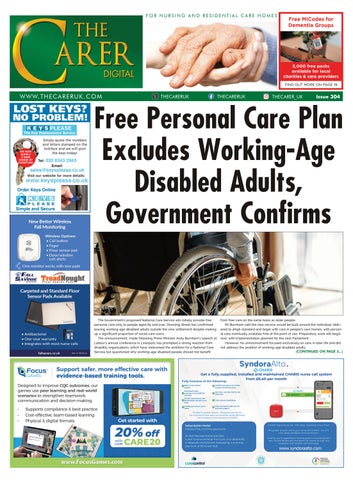
Free Personal Care Plan Excludes Working-Age Disabled Adults, Government Confirms
The Government’s proposed National Care Service will initially provide free personal care only to people aged 65 and over, Downing Street has confirmed, leaving working-age disabled adults outside the new settlement despite making up a significant proportion of social care users. The announcement, made following Prime Minister Andy Burnham’s speech at Labour’s annual conference in Liverpool, has prompted a strong reaction from disability organisations, which have welcomed the ambition for a National Care Service but questioned why working-age disabled people should not benefit
from free care on the same basis as older people. Mr Burnham said the new service would be built around the individual, delivered to ahigh standard and begin with care in people’s own homes, with personal care eventually available free at the point of use. Preparatory work will begin now, with implementation planned for the next Parliament. However, his announcement focused exclusively on care in later life and did not address the position of working-age disabled adults.
(CONTINUED ON PAGE 3...)
PAGE 2 | Issue 304 | THE CARER DIGITAL
EDITOR'S VIEWPOINT
Welcome to the latest edition of The Carer Digital! A SHORT COMMENT FROM THE CARER SHOW – AND A VERY BIG QUESTION FOR SOCIAL CARE It’s a bit of a short comment from me this week – Editor because I’m writing it from THE CARER SHOW at Birmingham’s NEC, where the UK’s premier and largest adult social care show has got off to a great start. We are on stand B68, so if you are planning to visit the show, please do stop by and say hello. It is always encouraging to see so many people from across our sector coming together, sharing ideas, looking at new products and services, and, importantly, talking about the future of care. And what a week to be talking about the future. The Government has announced plans for the creation of a National Care Service, with the aim of providing free personal care for older people based on need rather than ability to pay. The Government says the service will be introduced in phases, with Baroness Casey’s independent commission expected to make recommendations on how it should be delivered, with its report due in summer 2027. There is, in my view, one thing we should be absolutely clear about: reform is long overdue. The social care sector – and the public – have been calling for meaningful reform for decades. We have had commission after commission, review after review, consultation after consultation, while providers, care workers, families and the people receiving care have continued to deal with a system
Peter Adams
that is too often fragmented, under pressure and financially unsustainable. So the broad welcome from the sector to the announcement is understandable. Of course, it is not without its critics, and nor should it be. The big question is how will it be funded? The Government says the new service will be fully funded and introduced progressively, with the funding linked to changes to the State Pension Triple Lock and with implementation dependent upon workforce and provider capacity. But, as we all know in social care, the devil will be in the detail. And we should not dismiss the concerns already being raised as simply a “political reaction”. They deserve proper scrutiny. There is an important lesson to be learned from Scotland. Its proposed National Care Service was ultimately abandoned in its original form in January 2025, following years of development and growing concerns about cost, centralisation, governance and the practicalities of implementation. Almost £30 million had been spent developing the Scottish proposals, while projected costs had risen substantially and the timetable had slipped. Local government leaders withdrew their support, with COSLA raising concerns about excessive centralisation and the impact on local decision-making. Trade unions and other stakeholders also expressed concerns about the detail, funding and workforce implications. That does not mean England should not pursue reform. Quite the opposite. It means we need to get it right. The Government has rightly recognised that the existing system cannot continue indefinitely. But a
National Care Service cannot simply be a change of structure or a new badge on an old system. It has to be properly funded, properly staffed and properly integrated with the providers and local services that actually deliver care. And we need to be realistic about the scale of the challenge. Recent analysis cited by the House of Commons Library suggests that the additional cost of a universal and comprehensive social care system could reach around £18.5 billion a year by 2035/36, depending on the model adopted. That is an enormous sum of money – but so too is the cost of continuing with a system that places increasing pressure on families, councils, care providers, care workers and the NHS. There will undoubtedly be a great deal of debate over the next few years. There should be. But I hope that debate remains focused on what really matters: how do we create a social care system that is sustainable, properly funded and capable of delivering high-quality care, while giving people the dignity and security they deserve? The sector has waited long enough for reform. We now need to make sure that the reform promised is one that can actually work. And, from the NEC, it is clear that there is certainly no shortage of people in our sector willing to help make that happen. If you’re at THE CARER SHOW, come and see us on stand B68. We’d love to see you. See you at the show!I would also encourage our readers to sign up for our bi-weekly digital newsletter at www.thecareruk.com and follow us on social media for all the latest news. I can always be contacted at editor@thecareruk.com
PUBLISHED BY RBC Publishing Ltd 3 Carlton Mount 2 Cranborne Road Bournemouth Dorset BH2 5BR
TELEPHONE:
01202 552333 EMAIL:
sales@thecareruk.com WEBSITE:
www.thecareruk.com EDITOR Peter Adams editor@thecareruk.com
SALES DIRECTOR David Bartlett dave@thecareruk.com
PRODUCTION & DESIGN Matthew Noades Published by
The Carer is published by RBC Publishing Ltd, 3 Carlton Mount, 2 Cranborne Road, Bournemouth, Dorset BH2 5BR. Contributions are welcome for consideration, however, no responsibility will be accepted for loss or damage. Views expressed within this publication are not necessarily those of the publisher or the editorial team. Whilst every care is taken when compiling this publication to ensure accuracy, the publisher will assume no responsibility for any effects, errors or omissions therefrom. All rights reserved, reproduction is forbidden unless written permission is obtained. All material is assumed copyright free unless otherwise advised.
Manufactured in the UK
Freephone: 0800 917 7943 www.euroservice-uk.com sales@euroservice-uk.com
PROVIDING PRACTICAL AND STYLISH TROLLEYS TO SUIT YOUR NEEDS Watch your resident's eyes light up when the beautiful tea trolley arrives! Euroservice trolleys can also be used as a vending trolley or to sell personal care products to residents. How about a delicious snack/pastry trolley or even a drinks trolley for that afternoon tipple?
Your lovely trolley could do so much for you and your residents! Euroservice trolleys are an attractive and practical alternative to clinical aluminium trolleys given that antibacterial spray can be used freely to sanitise them.
Get in touch with our friendly, experienced sales team
Visit the website at
www.euroservice-uk.com to see the full range.
THE CARER DIGITAL | Issue 304 | PAGE 3
Free Personal Care Plan Excludes Working-Age Disabled Adults, Government Confirms (CONTINUED FROM FRONT COVER) Following questions from Disability News Service, Downing Street confirmed that the new settlement for older people would provide free personal care alongside a state pension that rises every year. Ministers said Baroness Casey’s independent social care commission is continuing to develop wider recommendations covering everyone who needs care, including working-age adults. Those recommendations, including proposals to address the charges faced by tens of thousands of working-age disabled people, are not expected until the commission publishes its final report in summer 2027.
‘A SERIOUS QUESTION OF FAIRNESS’ Svetlana Kotova, director of campaigns and justice at Inclusion London, said the organisation supported the principle of a person-centred service that was free at the point of use, but was “shocked” that working-age disabled people had been left out. Working-age disabled people account for around a third of social care users and can face significant charges for support, often deducted from their benefits. Fazilet Hadi, head of policy at Disability Rights UK, also welcomed the commitment to a National Care Service but questioned why the Government’s concerns about older people paying for care from their pensions were not matched by equivalent concern for disabled adults of working age. She also argued that the Government’s emphasis on personal care risked overlooking what disabled people want from social care. “Choice, control, independence and social connection” should be at the heart of reform, she argued, rather than a system focused simply on personal care.
ALL AGES Baroness Glenys Thornton, chair of the Social Care Institute for Excellence, said a National Care Service “must enable people of all ages, not just older people, to live with dignity, choice and control”. “Working-age adults account for around half of all local authority spending on adult social care; their needs, aspirations and rights must be at the heart of reform alongside those of older people,” she said.
ACCOMMODATION CHARGEABLE Under the Government’s proposals, free personal care would cover essential everyday activities such as eating, bathing and using the toilet. It would not, however, cover accommodation, food and other living
costs. Existing means-tested arrangements for “bed and board” would remain, meaning people receiving residential or nursing care could still face charges towards accommodation and associated costs. Councils would continue to disregard the value of a person’s home where a partner or dependent relative remains living there, while deferred payment agreements would remain available for eligible people who need to avoid selling their home during their lifetime to meet care costs. The Government estimates that around three in four people aged over 65 will require care and support during later life, with one in seven facing costs of more than £100,000 under the current system. It argues that the existing system is fundamentally broken, with people with similar care-needs potentially facing very different financial consequences depending on whether their needs are classified primarily as health or social care.
TRIPLE LOCK CHANGES The Government says the National Care Service will be fully funded rather than financed through additional borrowing. Funding will come partly from changing the state pension’s “triple lock”. The existing arrangement will remain in place throughout the current Parliament, but from April 2030 it will be adjusted so that pensions rise by 2.5% or inflation, whichever is higher, with an additional earnings link designed to ensure pensioners’ living standards remain broadly in line with the wider population. The Government estimates the change could reduce state pension spending by around£15 billion a year by the end of the 2030s, rising to approximately £50 billion a year-by 2050. It says the reforms will put the state pension on a sustainable footing while creating a credible financial pathway towards a National Care Service.
PHASED INTRODUCTION For care providers and operators, however, the precise implications of the proposed service remain to be determined. The National Care Service is expected to be introduced in phases, with its scope expanding as savings from the pension changes accrue and as workforce and provider capacity are developed. Baroness Casey’s commission will recommend how the system can be delivered, with-its work informed by public deliberation, cross-party discussions and a further “Big Conversation on Care”. The Government has stressed that the new service is intended to end years of “neglect” and provide a more sustainable settlement for
social care.
REFORM WELCOMED Social care organisations have broadly welcomed Prime Minister Andy Burnham’s plans for a National Care Service, while stressing that sustainable funding, workforce reform ,it highlighted that the needs of working-age adults must be central to any future system. Professor Martin Green OBE, Chief Executive of Care England, said social care reform had been postponed for decades, with consequences now being experienced by people receiving care, their families, providers and the NHS. He said the starting point for reform should be the delivery of highquality care, choice and positive outcomes, regardless of the operating model of the provider. Professor Green highlighted the contribution of independent providers, which he said deliver the majority of social care in England, employ more than one million people and provide support which helps people remain well, independent and out of hospital. Care England supports broader access to care, sustainable funding and improved outcomes, but Professor Green said reform should also encourage innovation, make effective use of public money and recognise existing expertise and capacity within the sector. He also highlighted the timetable for the proposed National Care Service, arguing that although Baroness Casey’s Commission will help determine the future shape of the system, work should begin immediately on areas including commissioning, workforce reform, regulation, NHS integration and the financial sustainability of care.
“TURNING POINT” Michelle Dyson CB, Chief Executive of Alzheimer’s Society, described the announcement as potentially a “historic turning point” for people affected by dementia. She said families had been placed under considerable pressure by inconsistent support and difficult decisions about caring for relatives, and argued that people living with dementia must be central to the development of the proposed service. According to Ms Dyson, this should include access to high-quality care when required, a skilled workforce with dementia expertise and improved support for unpaid carers. She said the success of the reforms would ultimately be measured by whether people living with dementia and their families received the care and support they needed.
PAGE 4 | Issue 304 | THE CARER DIGITAL
Sponsor Licence Enforcement - What Care Providers Need To Know
By Kate Hooper (Director) and Inderjit Kaur (Immigration Consultant) at global mobility and immigration lawyers Fragomen. (www.fragomen.com)
For many care providers, international recruitment has become essential to maintaining workforce capacity. Yet as reliance on overseas workers has increased, so too has Home Office scrutiny of sponsor licence compliance, with enforcement action capable of disrupting recruitment, affecting staffing levels and creating significant operational challenges. Understanding what can trigger enforcement action, how it may unfold and how providers should respond is therefore an important part of managing compliance and wider operational risk. What triggers sponsor licence enforcement? The days when sponsor licence enforcement was driven solely by compliance visits are long gone. The Home Office now adopts an increasingly intelligence-led and data-driven approach, using information from multiple sources to identify potential breaches and target enforcement activity, meaning providers may find themselves subject to scrutiny even where no formal complaint has been made. Common triggers include incorrect or missing right to work checks, payroll discrepancies between HMRC and Home Office records, and failures to notify relevant changes within the required timescales. Poor recording keeping, key personnel issues, compliance visits findings and questions over whether a sponsored role represents a genuine vacancy can also attract scrutiny. While a single administrative error may not always result in formal action, repeated, systemic or serious compliance failures are significantly more likely to attract Home Office scrutiny and enforcement measures.
WHAT DOES ENFORCEMENT ACTION LOOK LIKE? Once concerns have been identified, the Home Office has a range of enforcement measures available, with the outcome largely depending on the seriousness and extent of the non-compliance. In some cases, a sponsor may have its licence downgraded and be required to follow a time-limited action plan to address compliance concerns. More serious issues may result in a licence suspension. While suspended, a provider retains its sponsor licence but cannot sponsor new workers while the Home Office
conducts further investigations, creating immediate recruitment and operational challenges. Revocation, the most serious enforcement outcome, is generally reserved for significant, repeated or deliberate breaches of sponsor duties, and unlike a suspension, results in the immediate loss of an organisation's ability to sponsor workers. Existing sponsored workers will usually have their immigration permission curtailed and may be required to find a new sponsor, switch immigration category or leave the UK, while the organisation will typically be unable to apply for a new sponsor licence for at least 12 months. The impact of these sanctions can be substantial, particularly given the Home Office’s increasingly robust approach to enforcement, which saw 1,948 sponsor licences revoked between July 2024 and June 2025, more than double the number revoked in the previous 12-month period. For care providers, the implications can extend well beyond compliance, affecting the organisation's ability to meet its strategic and operational objectives.
HOW SHOULD CARE PROVIDERS RESPOND? Where a licence is suspended, providers will usually be given an opportunity to respond to the Home Office's concerns, often within 20 working days. The priority should be to conduct a thorough review of the allegations and provide a clear, evidence-based response supported by relevant documentation. Relevant records should be preserved immediately, with a senior individual identified to coordinate the response and gather evidence. Consideration should also be given to whether any corrective action is required and whether further disclosure to the Home Office may be appropriate. Where mistakes have occurred, it is generally better to acknowledge them, explain how they arose and demonstrate the steps taken to prevent a recurrence. Equally, if the organisation believes the Home Office has misunderstood the facts or incorrectly applied the sponsor guidance; this should also be addressed with supporting evidence. Given the potential consequences, many providers choose to seek specialist immigration advice at an early stage to help prepare a robust response and address any underlying compliance concerns.
CONSEQUENCES OF NOT RESPONDING Failing to respond within the stated deadline may mean that the Home Office makes its decision using the information readily available to it, without the benefit of the provider’s explanation or supporting evidence. An incomplete or unsupported response can be equally damaging, particularly where concerns remain unresolved. In these circumstances, the Home Office may continue a suspension, revoke the license or take further action. For care providers, the consequences can be significant, disrupting service delivery and creating reputational and operational risks. Organisations may also face a lengthy wait before they can return to overseas recruitment, while options available to challenge a revocation decision remain limited. Ultimately, sponsor licence enforcement is rarely triggered by a single issue but by concerns left unaddressed. As the Home Office continues to take a robust approach to compliance, a proactive approach remains the most effective way for care providers to mitigate risk, protect business continuity and avoid more serious enforcement issues, with early intervention often making the difference between resolving concerns and facing more serious consequences.
Welcome to Blue Rain - our activity store is built on over 14 years experience supplying products that bring joy, inspire motivation, and enrich the lives of those who need a little extra support, or simply want to have fun, whatever the weather.
Come find your next reason to smile.
Scan me
THE CARER DIGITAL | Issue 304 | PAGE 5
Sector Leaders Respond to National Care Service Plans Social care organisations have broadly welcomed Prime Minister Andy Burnham’s plans for a National Care Service, while stressing that sustainable funding, workforce reform and the needs of working-age adults must be central to any future system. The Prime Minister has announced plans for a new National Care Service which would provide free personal care to older people according to need rather than their ability to pay. The proposed service is intended to overhaul England’s social care system and provide greater financial security in later life. It would be introduced in stages during the next Parliament, with expansion dependent on available funding and care capacity. The announcement has prompted responses from leading organisations across the social care, dementia and ageing sectors, with widespread recognition of the need for fundamental reform alongside calls for clarity over funding, implementation and the future role of providers. Jim Kane, Chief Executive Officer at Community Integrated Care, welcomed the emphasis on a person-centred and universal service, describing the proposals as reflecting principles that many in the sector have advocated for some time. He said social care should be regarded as essential infrastructure rather than simply a safety net, highlighting its role in helping people remain independent, participate in their communities and avoid unnecessary hospital admissions. Mr Kane also called for a sustainable, long-term funding settlement, alongside fair pay, career progression and greater professional recognition for care workers. However, he stressed that the future system must reflect the full breadth of social care rather than concentrating solely on older people’s services. He said working-age adults with learning disabilities, autistic people and others requiring lifelong support must also be properly represented within any National Care Service. He added that reform should involve Government, the Casey Commission, sector organisations, people who draw on care and their families, while recognising the contribution of not-for-profit providers.
CARE ENGLAND CALLS FOR PRACTICAL PREPARATION Professor Martin Green OBE, Chief Executive of Care England, said social care reform had been postponed for decades, with consequences now being experienced by people receiving care, their families, providers and the NHS. He said the starting point for reform should be the delivery of highquality care, choice and positive outcomes, regardless of the operating model of the provider. Professor Green highlighted the contribution of independent providers, which he said deliver the majority of social care in England, employ more than one million people and provide support which helps people remain well, independent and out of hospital. Care England supports broader access to care, sustainable funding and improved outcomes, but Professor Green said reform should also
encourage innovation, make effective use of public money and recognise existing expertise and capacity within the sector. He also highlighted the timetable for the proposed National Care Service, arguing that although Baroness Casey’s Commission will help determine the future shape of the system, work should begin immediately on areas including commissioning, workforce reform, regulation, NHS integration and the financial sustainability of care.
DEMENTIA ORGANISATIONS WELCOME COMMITMENT TO REFORM Michelle Dyson CB, Chief Executive of Alzheimer’s Society, described the announcement as potentially a “historic turning point” for people affected by dementia. She said families had been placed under considerable pressure by inconsistent support and difficult decisions about caring for relatives, and argued that people living with dementia must be central to the development of the proposed service. According to Ms Dyson, this should include access to high-quality care when required, a skilled workforce with dementia expertise and improved support for unpaid carers. She said the success of the reforms would ultimately be measured by whether people living with dementia and their families received the care and support they needed. Dementia UK also called for changes to begin without delay. Andrew Pike, Deputy Director of Campaigns, Policy and Public Affairs at Dementia UK, said a more person-centred and high-quality approach to social care could improve the lives of millions of people affected by dementia in England. He highlighted the need for joined-up health and social care, with coordinated and proactive support extending from diagnosis through to end of life.
HEALTH FOUNDATION HIGHLIGHTS FUNDING CHALLENGE Dr Jennifer Dixon, Chief Executive of the Health Foundation, said the proposed reforms represented an opportunity to create a fairer and more generous system for older and disabled people, their families and carers. However, she stressed that significant questions remained about how reform would be funded and how costs would be shared. Dr Dixon said it was not yet clear what would be included within the State’s offer under a new National Care Service, but argued that additional public investment would be required if the Government was to create a more universal system. She also highlighted the pressures currently facing people who either go without the care they need, use their savings to fund care or rely heavily on unpaid support from family and friends. She called for sustained political leadership to turn the proposed vision into a functioning system, with cross-party support for reform.
NCF BACKS GREATER ROLE FOR NOT-FOR-PROFIT CARE Liz Jones, Deputy Chief Executive and Policy Director at the National Care Forum (NCF), welcomed the Prime Minister’s emphasis on social care as an essential public service and his recognition of the
contribution made by care workers. The NCF said it wanted not-for-profit care and support to have a central role within the proposed National Care Service and highlighted opportunities for the Government to support growth in the not-forprofit sector over the next decade. Ms Jones also pointed to the importance of the Casey Commission and the public consultation being undertaken through the “Big Conversation on Care” in helping determine how the future system should operate. She argued that the care sector could also contribute to the Government’s wider ambitions around employment and economic growth, particularly through opportunities for young people to develop careers in care and support.
“SIGNIFICANT MOMENT” Kehan Zhou, CEO, Person Centred Software said: “The commitment to creating a National Care Service is a significant moment for social care. But at PCS, we don’t think we should wait for a new national system to start fixing the problems already putting pressure on care services and the NHS. “Hospital discharge is one of the clearest examples. Too often, people move from hospital into care without all the information needed to support them properly. When health and social care work from different or incomplete information, an already difficult move becomes harder. That affects the person, their care team, and the NHS if that person ends up back in hospital. “Almost one in five emergency admissions among people aged 75 and over is a readmission within 30 days of leaving hospital. Readmissions overall have been rising for a decade.* Too many older people are going back into hospital soon after leaving it. We believe better information at the point of discharge could help prevent some of those readmissions. “We see every day what better use of information makes possible. Many care providers now use digital care records. Care teams record how someone is eating, sleeping and moving, and the medication they are taking. Used well, that information can help care teams spot when someone’s health may be starting to decline and act earlier. It can also help make sure care after discharge reflects what that person actually needs. “That is one of the opportunities a National Care Service presents. But we don’t need to wait for the new service to be in place to make progress. We can start improving how information moves between hospitals, local authorities and care providers now. That means bringing providers and technology partners like us into the conversation from the start. Then the foundations of a connected system can be built alongside the funding and workforce model. Getting the right information to the right people at the right time will improve hospital discharge, reduce avoidable readmissions and take pressure off the NHS today.”
PAGE 6 | Issue 304 | THE CARER DIGITAL
A Pension For Care Workers: What Operators Should Budget For Before The Detail Lands By Harvey Dhillon, Founder and CEO of Zmartly (https://zmartly.co.uk) A national Collective Defined Contribution (CDC) pension scheme for adult social care workers is being discussed as one answer to the sector's recruitment and retention problem. Before operators plan around it, they should separate what is law from what is still a proposal. At the time of writing, I can find no published scheme rules, contribution rates or start date for a care sector CDC scheme on gov.uk. The government's July 2026 response on fair pay agreements says the new negotiating body's remit will include "pay and terms and conditions", with the first agreement due from April 2028. It can also consider "additional benefits", but it makes no commitment on pensions, which appear only in what consultation respondents asked for. What does exist is the legal machinery that would make a sector scheme possible.
WHAT IS ALREADY LAW CDC schemes have been permitted in Great Britain since 2022, but only for single or connected employers. Regulations made in 2025 extended them to unconnected multiple employer schemes, with effect from 31 July 2026. That is the change that matters for care. It means one scheme could, in principle, take in thousands of separate providers, from a large group to a single home run by a family. The government's own description of CDC explains why it appeals. Contributions are fixed, and members share the investment and longevity risk between them. In its 2023 consultation response, the government said that "at a fixed cost to employers" members can have "an affordable regular income in retirement by sharing risk". The same document is clear that "members cannot rely on any guarantees". Benefits can be adjusted, and any adjustment applies to all members alike. For operators, that is the key distinction. A CDC scheme is not a final salary scheme. There is no funding deficit landing on your balance sheet if markets fall. Your funding cost is the contribution rate, and nothing beyond it. So the question to ask is not what pension a carer will receive. It is what percentage of pay the scheme will require from the employer.
THE FLOOR YOU ALREADY PAY Every provider already has auto-enrolment duties. A worker aged between 22 and State Pension age,
earning at least £10,000 a year and ordinarily working in the UK, must be automatically enrolled. In most schemes contributions are worked out on earnings between £6,240 and £50,270 a year. The legal minimum is 8 per cent of that band, of which the employer must pay at least 3 per cent. Take a full-time carer aged 22 or over on the National Living Wage of £12.71 an hour, working 37.5 hours a week. That is £24,784.50 a year, of which £18,544.50 falls in the qualifying band. The employer minimum is about £556 a year. Every additional percentage point a sector scheme asks of the employer adds about £185 a year for that worker. For a home with 60 staff on similar pay, each point is roughly £11,100 a year, before any change in the National Living Wage itself.
WHERE THE PRESSURE WILL REALLY FALL The cost is visible. The cash flow is not. Pension contributions leave the bank account every month. Local authority fee rates are usually set once a year and often paid in arrears. A provider whose fee uplift does not reflect a higher contribution rate will fund the gap from working capital, and many care businesses have very little of that to spare. There is also the administrative work. Changing scheme means new payroll mappings, new member communications and, possibly, two schemes running side by side during any transition. Staff whose hours move up and down will drift across the earnings thresholds, so payroll needs to handle eligibility carefully. A pension deduction that goes wrong is slow and awkward to put right, so it is worth getting the set-up right first time.
WHAT OPERATORS CAN DO NOW First, model it. Run your current payroll at the existing employer rate, then at one, two and three points higher, and see what each does to monthly cash, not just to the annual total. Second, take the numbers into fee discussions. If commissioners expect better pensions to improve retention, the pension cost needs to be visible in the fee rate, line by line. Third, check that your payroll software and pension provider can handle a change of scheme cleanly before you are asked to make one. Fourth, plan how you will explain it to staff. A better pension only helps retention if carers understand it. Because CDC pensions are not guaranteed, that explanation needs to be honest about the trade-off as well as the benefit. A national scheme could give care workers a better retirement than many small employers could arrange alone. Whether providers can afford it will depend less on the pension design than on whether the contribution rate is funded through the fees that pay for care.
CareTrust REIT Signs Deal with LNT Care to Buy 45 New Care Homes in £1.1bn Deal LNT Care Developments has announced a sale and leaseback agreement with US based CareTrust REIT, who have purchased the freehold interests of 45 operational and in-development care homes across England and Wales. LNT Care Development’s group operator, Crystal Care Collection will retain full responsibility for the management and delivery of care services, with existing leadership teams remaining in place. Lawrence Tomlinson, founder of LNT Care Developments said, “CareTrust REIT describes itself as ‘for operators, by operators’, and that is how we have always run. We were keen to carefully choose a partner whose vision and values align with our own. We are delighted to work together to meet the growing need in the UK for new, safe, well-run homes for residents and their families.” Kristian Horabin, Group Chief Executive Officer at LNT Care Developments, said: “This transaction represents a significant milestone for LNT Care Developments and Crystal Care Collection. It reflects the quali-
ty of our care home developments, the strength of our operator, and the dedication of our colleagues, who deliver exceptional care home environments. “The agreement allows LNT Care Developments to propel our long-term growth strategy, ongoing investment in people, and continued development of high-quality care homes, marking an exciting next chapter for the business.” Dave Sedgwick, CareTrust President and Chief Executive Officer, said “LNT Care Developments is more than just a developer or operator. They are a special organisation singularly positioned to serve the growing demand for affordable purpose-built care homes, which is why we want to work with them for the long run. “We’re grateful and thrilled to complete this initial transaction and, with aligned missions and values, we hope to support the LNT team further as they seek to develop hundreds more homes over the next decade and beyond.”
Beyond the Breaking Point: When Care Staff Are Asked to Do the Impossible By Stephanie Ryde I have worked in many roles across the care sector, and those varied experiences have given me a deep understanding of the challenges faced by care teams. Although each situation I encountered had its own details, the underlying issues were strikingly familiar — the same pressures, the same struggles, repeated across services and echoed in countless conversations with colleagues. Many of us were trying to deliver compassionate care in environments that continually asked us to operate beyond our limits, without the emotional or practical support needed to do so safely. I have seen first hand how poor funding, low resources, high turnover, and chronic understaffing create a cycle that is impossible to sustain. These pressures don’t reflect a lack of commitment within the workforce — far from it. They reflect systems that are stretched to breaking point. When staffing levels fall, everything feels the impact: safe staffing ratios, equipment maintenance, record keeping, communication, and access to specialist support. The result is a working culture where staff are expected to manage situations that contradict the very values our care system is built on — dignity, safety, and person centred practice. I have been placed alone with individuals exhibiting aggressive behaviours, sometimes as a new starter without the training or experience needed to manage such risks. I have been responsible for entire bays of patients with dementia through the night, unable to reach someone who had fallen because I was supporting another distressed individual. These situations were described as
“inevitable” due to staffing pressures, even though they were clearly avoidable in a properly resourced environment. In one role, I wasn’t even provided with individualised care plans to guide safe, person centred support. This wasn’t due to neglect — it was the result of overstretched staff, poor communication, and the difficulty of accessing behavioural specialists. It became clear to me that meaningful change requires a holistic approach: proper funding, better emotional and practical support for staff, and access to tools that genuinely reduce risk and prevent escalation. Without these, the system cannot uphold the values it claims to prioritise.
How the pobroll® Helps Address These Issues The challenges described above are exactly the kinds of situations where the pobroll® can make a meaningful difference. By providing gentle, sensory integrated containment, the pobroll® acts as the “third pair of hands” that staff so often lack. It helps prevent behavioural escalation, reduces the need for multiple staff during episodes of distress, and supports safer, calmer delivery of essential care — especially when staffing levels are stretched. In environments where turnover is high and training gaps are common, the pobroll® offers a practical, easy to use tool that protects both staff and residents, reduces incidents, and helps services uphold the dignity focused values they strive for, even under pressure. See the advert on the facing page for further information.
THE CARER DIGITAL | Issue 304 | PAGE 7
Autumn Budget Must Back England’s Counties as Social Care Spend Increases County and rural councils are facing a £7 billion-a-year increase in service costs by 2028/9 unless the Government takes action in next month’s Autumn Budget, with rising adult social care spending among the main drivers of the growing financial pressure. The warning comes from the County Councils Network (CCN), which says increasing numbers of people requiring adult social care, alongside rising costs of care provision, are placing significant pressure on local authority budgets. Adult social care, children’s services and special educational needs (SEND) home-to-school transport together account for the bulk of the £7 billion in additional costs expected to face county and rural unitary councils between 2025/26 and 2028/29. Those authorities are on course to be spending 37.1bn in total on all local services in 2028/29 up from £30bn this year. However, council leaders warn this could be the ‘tip of the iceberg’ if inflation ratchets upwards in the coming years, as predicted. Consequently, the CCN is calling for action to protect its members
from having to reduce services, apply for Exceptional Financial Support or even declare insolvency. This should include additional funds for local authorities to address the rising costs of services, as well as a recognition of the higher costs of delivering services in large rural areas. This could be achieved by re-instating ‘remoteness’ into how central government resource is distributed to councils. The CCN also argues that counties must be central to the government’s growth agenda. County areas are home to 48% of England’s businesses – from both small start ups to large advanced manufacturing hubs, yet continue to receive a smaller share of public spending for the likes of bus services, business support, and adult education. Currently, there are areas governed by 22 county and unitary councils, spanning 17m residents, do not have a devolution settlement. For those that want to pursue a deal without it being imposed on them, the government should ensure that agreements are in place by the end of2028. Cllr Steven Broadbent, Finance Spokesperson for the County
Councils Network, said: “Our Autumn Budget submission reveals that once again, county and rural unitary councils are under severe financial pressure, exacerbated by the Fair Funding Review which inexplicably distributed money away from counties. Worse still, if inflation rachets up in the coming 12 months, then our estimates on service costs could be just the tip of the iceberg. “We need increased support from government to maintain –and invest in – vital local services. But this isn’t simply a begging bowl plea. The budget is an opportunity for the Chancellor to match our ambitions with action. By investing in county services and infrastructure, we can help deliver the level of growth this country desperately needs alongside leading on reforms to public services to make them more efficient.” In addition, the network is urging ministers to fully fund the costs of adult social care reform and Fair Pay Agreements, establish a dedicated County Infrastructure Fund, and introduce a long-term strategy for rural bus services.
Karuna Manor Care Home Welcomes Ganpati Bappa Karuna Manor Care Home was filled with devotion, joy and spiritual warmth as residents, staff, families and members of the community came together to celebrate Ganesh Chaturthi and warmly welcome Ganpati Bappa into the home. The celebration marked the arrival of Lord Ganesha, the beloved deity associated with wisdom, prosperity and the removal of obstacles. For everyone at Karuna Manor, the occasion was not only a religious celebration but also a meaningful opportunity to come together as one family and create special memories with our residents. The celebration began with a Ganpati welcome and devotional prayers, as residents and staff joined together in prayer and sought the blessings of Ganpati Bappa for happiness, peace, good health and prosperity for everyone in the Karuna Manor family. For many residents, festivals such as Ganesh Chaturthi
bring back treasured memories of celebrating with family and loved ones. Bringing these traditions into the care home allows residents to continue enjoying the festivals that hold a special place in their hearts. Speaking about the celebration, the Karuna Manor team said: “Welcoming Ganpati Bappa into Karuna Manor was a truly special and emotional moment. Our home is not just a place where people receive care; it is a place where traditions, faith, memories and family continue to live. Seeing our residents come together to welcome Bappa with such happiness reminded us of the importance of creating a home where everyone feels connected and valued.” “At Karuna Manor, celebrating festivals and cultural occasions is an important part of supporting residents’ spiritual, emotional and social wellbeing. The team strives to create an environment where residents can continue to practise their faith, celebrate their traditions and share those traditions with the wider community.”
PAGE 8 | Issue 304 | THE CARER DIGITAL
World Mental Health Day: A Diagnosis Should Never Silence A Person’s Voice By Catherine Frost, Senior Associate (Chartered Legal Executive) in the Court of Protection team at Birketts LLP (www.birketts.co.uk) Each year, World Mental Health Day (October 10th) encourages us to think about how we can better support those experiencing mental health difficulties. Much of the conversation rightly focuses on access
to treatment, reducing stigma and improving awareness. However, there is another issue that deserves attention: ensuring that people continue to be heard. In my work within the Court of Protection, I regularly encounter situations where individuals are facing significant challenges relating to their mental health, cognition or decision-making. These cases often involve some of life’s most personal questions: where a person should live, what care they should receive, how relationships should be maintained and how important decisions about their future should be made. What strikes me time and again is the importance of recognising the individual behind the diagnosis. Society has become more open in discussing mental health, which is undoubtedly a positive development. Yet there can still be a tendency to define people by their condition rather than viewing them as individuals with their own hopes, wishes, preferences and values. A diagnosis may explain some of the challenges a person faces, but it does not tell us who they are. For many people living with mental health conditions, one of the greatest frustrations can be feeling that others have stopped listening. Family members, professionals and support networks are often motivated by a genuine desire to help, but good intentions can sometimes unintentionally overshadow the person’s own voice. The challenge lies in finding the right balance. Of course, there will be situations where individuals require support, safeguarding or assistance with decision-making. There are also circumstances where concerns about a person’s wellbeing are entirely justified. The answer, however, should never be to automatically exclude them from discussions about their own lives. Instead, we should be asking how we can better enable participation. Can information be presented differently? Is more time needed? Are there communication methods that would help someone express their views more effectively? Are we genuinely listening to what matters to them? These questions may seem simple, but they are fundamental to respecting a person’s dignity and independence.
H.W. PICKRELL NEW & USED ACCESSIBLE TRANSPORT AT AFFORDABLE PRICES • We specialise in the sale and purchase of quality used wheelchair accessible vehicles and ambulances. • They can be bought as seen or refurbished and sign-written to your own requirements. • Fully serviced, new mot & warranty • Engineers inspection supplied if required.
• Free delivery service available • All buses comply with new legislation • Lease hire and purchase available • Always large stock of accessible vehicles
Tel: 01268 521033 Mobile: 07860 894331 Email: sales@hwpickrell.co.uk Gardiners Lane North, Crays Hills, Billericay, Essex CM11 2XE All current stock available to view at www.hwpickrell.co.uk
Mental health difficulties can affect anyone at any stage of life. They do not discriminate by age, profession, background or circumstance. The experiences of those living with such conditions are rarely defined solely by symptoms. Like everyone else, they want to be listened to, understood and involved in decisions that affect them. This is particularly important because people often know what matters most to them, even during periods of significant difficulty. Whether it is maintaining contact with family, remaining in familiar surroundings, preserving treasured routines or retaining a sense of independence, these preferences can play a crucial role in a person’s wellbeing and quality of life. As a society, we are increasingly recognising the importance of person-centred care and support. Yet true person-centred practice is not simply about making decisions in someone’s best interests. It is about ensuring that their wishes, feelings and values remain central to the conversation. World Mental Health Day provides an opportunity to reflect on what meaningful inclusion really looks like. It is not enough to speak about people; we must speak with them. It is not enough to make assumptions; we must seek understanding. Most importantly, we must remember that experiencing mental health challenges does not diminish a person’s right to be heard. A diagnosis may shape part of someone’s journey, but it should never define their identity, determine their worth or silence their voice.
THE CARER DIGITAL | Issue 304 | PAGE 9
Government Announces National Collective Pension Scheme for Care Workers A new national collective pension scheme for adult social care and it is good to see the direction of travel. workers is to be introduced by the government, alongside plans for a “The question every provider will be asking this morning is who dedicated workforce strategy covering careers, training and skills pays. A fair pay agreement lands its costs on councils and development. providers, and neither has the headroom to absorb them. Unless Health and Social Care Secretary Yvette Cooper announced the the money follows the commitment, providers will be handed a measures during her keynote address at the 2026 Labour Party legal duty they cannot fund, and the people who lose out are the Conference today (September 30) , as the government set out further ones being cared for. proposals aimed at strengthening the social care workforce. “Career pathways matter, but they only work if pay moves with The announcement comes as ministers continue work towards the them. Today a care worker with five years’ experience earns about government’s longer-term ambition of establishing a National Care seven pence an hour more than someone who started last week, Service in England. down from thirty-three pence a decade ago. That is why people Ms Cooper said the government wanted to improve pay, employleave. ment conditions and career opportunities for people working in adult “A pension and a fair pay agreement are the right tools to fix it, social care, arguing that the workforce had historically been undervalprovided they are funded properly and reach every employer, not ued. just the ones already doing the right thing. Credit David Woolfall / UK Parliament via CC BY 3.0 The government has already committed to introducing the first “We have been promised reform of social care before, and delivnational fair pay agreement for adult social care, with negotiations covering pay, terms and conditions and ery is what has been missing. Get the funding right and this could be the moment the workforce is finally other employment matters. The agreement is backed by £500 million for the first settlement. valued. We stand ready to help the Government make it happen.” POLICY SOLUTIONS Addressing Labour delegates, Ms Cooper said the government would also produce a dedicated workProfessor Martin Green OBE, Chief Executive of Care England, said: “Care workers spend their whole workforce plan for social care. The plan is expected to address areas including career progression, training and the development of spe- ing lives planning, protecting and providing for other people’s futures. Today, government confirmed it will finally do the same for theirs, and Care England fully supports it. cialist skills, although no publication date was given. “Our analysis with COHIBL found that pension scheme members in this sector are around 20% more likely The announcement of a national collective pension scheme represents a further proposed change to to retire below the minimum living standard than workers in other industries, and that’s before counting employment arrangements within the sector. everyone who’s opted out altogether. That’s the picture a collective pension scheme can now start to fix, Ms Cooper said the scheme would be the first of its kind nationally for workers in the care sector, placing and fixing it means care can finally become the career people build a whole life on, not just a job they pensions alongside pay and employment conditions as part of the government’s wider workforce reform leave.” programme. STRUCTURED FRAMEWORK The Prime Minister said yesterday that he’s sorry his profession let ours down for so long, and that he The government has already introduced a national care workforce pathway, providing a structured frame- won’t leave the job without changing things for care workers. That’s exactly the kind of ambition this sector work for roles across adult social care. The pathway covers 18 role categories and is intended to provide needs, and Care England is ready to match it. We have done extensive research into the pressures facing clearer routes for workers to develop their skills and progress into more senior positions or, where appropri- this workforce, and we have credible, evidence-based policy solutions ready for government to act on, just ate, regulated professions such as nursing and social work. as it has today. We’re ready to build on that with government, starting now.” Natalie Grayson, GMB National Officer, said: “This is fantastic – and long overdue – news for our dedicated NATIONAL CARE SERVICE The pension announcement follows comments from Prime Minister Andy Burnham earlier in the week in care workers. which he reiterated the government’s commitment to creating a National Care Service in the next “These are the people who look after us, and our loved ones, in our hour of need – it’s only right they can Parliament. look forward to a safe, secure retirement. Under the proposals announced by Mr Burnham, a National Care Service would provide free personal “This pension pot, along with the Fair Pay Agreements, show this a Government that is finally working to care for older people according to need rather than ability to pay. The government says Baroness Casey’s address the poverty pay that has blighted the car sector for years.” ongoing review will help determine how and when the service should be developed. Melanie Weatherley MBE, Co-Chair of the Care Association Alliance and Chair of Lincolnshire Care The Prime Minister has previously said that reform of the social care workforce should be treated as an Association, said: “Care workers have been undervalued and underpaid for years, so a national pension immediate priority alongside the longer-term development of a National Care Service. scheme and a legally binding fair pay agreement are genuinely welcome. This is the workforce settlement the Care Association Alliance is calling for in its forthcoming policy paper, due to be launched imminently,
THE CARER DIGITAL | Issue 304 | PAGE 11
£80m Challenge for Faster, Better Dementia Diagnosis Launched Nine new technologies, including faster MRI brain scans and a remote cognitive assessment, are to be tested in the NHS as part of a government drive to diagnose dementia more quickly. The Dementia Challenge is backed by up to £80 million and funded by the UK government through UK Research and Innovation’s (UKRI) Research and Development Missions Accelerator Programme (R&D MAP). Its goal is for 92% of people to be diagnosed within 18 weeks of referral. Around 60% are currently diagnosed within that timeframe, and in many cases diagnosis takes more than a year.
• University of Bristol: introducing routine sleep apnoea screening, and improved access to treatment, for everyone referred to memory assessment services, to improve the accuracy of diagnoses. • Queen Mary University of London: supporting earlier detection and monitoring through a digital tool that assesses how the brain processes sound, using a standard home computer and headphones. • University of Cambridge: developing an AI-enabled clinical decision support tool that analyses routinely collected data, including medical records, blood tests and cognitive tests, to predict progression in people at risk of dementia. • University of Edinburgh and NHS Research Scotland: redesigning Scotland’s dementia diagnosis and treatment services to deliver faster, more consistent diagnosis, with “living labs” to test new biomarkers and treat-
FUNDING TIED TO RESULTS The nine projects have been selected for real-world testing in the NHS. Only those that prove they work will go on to receive further funding, so that money goes where it makes the biggest difference to patients. UKRI describes this as a “fail-fast” approach, a move away from its traditional model of awarding single grants for longer-term projects. Projects must reach milestones to keep their funding. The aim is to deliver results quickly and to get what works to patients sooner. Early diagnosis can reduce the likelihood of emergency hospital admissions and delay the need for greater care support, easing pressure on NHS services. It can also allow patients to start treatment sooner and make informed decisions about work, care, finances and family life.
WHY DEMENTIA UKRI says dementia is the first condition the R&D MAP’s Health Mission is focusing on. More people die as a consequence of dementia than of any other disease in the UK, accounting for almost one in eight deaths. In 2025, more than 72,000 people across the UK died from dementia, including Alzheimer’s disease. Dr Richard Oakley, Associate Director of Research and Innovation at Alzheimer’s Society, said that at any one time one in three people living with dementia in the UK do not have a diagnosis. This means they are missing out on treatment, support and the chance to take part in research.
THE NINE PROJECTS • University College London and UK Dementia Research Institute: reducing diagnostic MRI scan times from around 20 minutes to around seven, giving more patients access to scans, cutting costs and improving the patient experience. • University of Exeter: integrating a digital platform into the NHS that lets people monitor changes in their cognitive health and be seen at the right time. • UK Dementia Research Institute Care Research & Technology Centre, Imperial College London: developing Minder, a home-monitoring platform that uses unobtrusive sensors and linked artificial intelligence to support earlier intervention, personalised care and proactive management. • University of Oxford and Dementias Platform UK: bringing a panel of blood-based dementia biomarkers, validated in the Blood Biomarker Challenge-funded READ-OUT study, into routine NHS memory services to improve diagnostic accuracy. • Cognitron: using a 15-minute remote digital cognitive assessment to improve the speed, accuracy and accessibility of diagnosis.
ments. UKRI is delivering the challenge in partnership with industry, academia, the NHS, the Medicines and Healthcare products Regulatory Agency, the National Institute for Health and Care Excellence (NICE), the Health Innovation Network, the third sector and people with lived experience of dementia.
REACTION Science Minister Chris McDonald said: “Dementia is a desperately cruel condition, robbing sufferers of their memories and family of precious time with their loved ones.” He added that the government was backing projects that could spot the signs earlier, such as tests looking at how people process sounds and speech to identify changes in the brain. Minister of State for Health Karin Smyth said timely diagnosis helps people manage their symptoms and access support sooner, adding: “Dementia has been neglected for far too long.” Andy Hill, UKRI Health Mission Challenge Director, said better diagnostic and prognostic tools would help people living with dementia understand and manage their symptoms, get earlier access to treatment and plan for their futures, with benefits for families and carers too. Hilary Evans-Newton CBE, Chief Executive of Alzheimer’s Research UK and Chair of the Dame Barbara Windsor Dementia Goals Programme, said: “Too many families wait more than a year for a dementia diagnosis.” She noted that faster, accurate diagnosis is also essential because new medicines work best early in the disease. Dr Oakley said the challenge “could be a game changer”, but called on the government to match its ambition by introducing a national 18-week target from referral to diagnosis. Henry Simmons, Chief Executive of Alzheimer Scotland, welcomed Scotland’s role through the Edinburgh and NHS Research Scotland project. Andrew Walsh, Associate Director of NICE Advice, said the projects would be tested in the NHS in England and the devolved nations, and that NICE looked forward to helping them develop their evidence generation strategies. Thomas, from Dorset, who has personal experience of dementia and supported the challenge’s application process, said long waits for diagnosis take away valuable time to seek support, make medical choices and address legal matters.
PAGE 12 | Issue 304 | THE CARER DIGITAL
When Technology Slows Care, Everyone Feels It
By Al Kingsley MBE, Group CEO of NetSupport (www.netsupportsoftware.com)
I've lost count of the number of people who've told me a variation of the same story where a system has frozen at exactly the wrong moment, resulting in a job or task that should take five minutes taking forty-five instead. In most cases, it's rarely the big, dramatic outage that causes the most damage. Instead, it's the small occurrences, such as a slow login, the device that can’t easily find a connection, or the report that hangs at 90%, that when repeated often enough, they start to feel like the norm. From my more than 30 years’ experience as someone working within digital safeguarding and solutions for businesses, that's the area of digital care that nobody talks about enough. Whereas there's plenty of discussions about cybersecurity, CQC compliance, or the long-term strategy behind digital transformation, all of which understandably matters. However, for those who are actually doing the day-to-day work on the ground, none of it matters half as much to them as whether the system and everything works right now, when I need it to. When this happens in a care home environment, it can mean a resident's medication being given later than it should be, a carer unable to pull up notes for someone exactly when they need them, or a handover running late because a record couldn't be updated in time. On a busy shift, they're exactly the moments where 'the system's a bit slow today' turns into something that affects a real person.
HOW WE GOT HERE I always think it's worth reflecting on how quickly this shift and reliance on digital systems has happened. If you remember, around a decade ago, most care homes were still running on paper, with their care plans printed out and kept in ring binders, medication administration records needing to be signed for by hand, and physical rotas pinned to a staff room noticeboard. However, I’d argue that the move to going digital has in my opinion, been a positive one. For example, electronic care plans mean all the information is accessible and able to be produced instantly when it's needed rather than being locked away in a folder in someone's office. Medication management systems have meant that the transcription errors that paper records were repeatedly vulnerable to are now significantly reduced. Additionally, online rostering tools allow managers to see gaps and arrange cover before they become a crisis.
WHY CARE HOMES CAN'T JUST WAIT IT OUT Most workplaces can cope with the odd IT mishap, for example, someone who works in a typical office environment whose laptop has frozen can go away from their desk briefly, make a cup of tea and come back to it once the issue has been resolved. Whereas when working within a care home, you don't really get that luxury. Medication still needs to be given on time, a resident who's become confused or unwell still needs someone to be able to check their notes immediately, rather than in twenty minutes once the system reconnects. Care shouldn’t pause while technology catches up.
That's what makes this sector different, and why the standard system of ‘log a ticket and someone will look at it when they’re free’ isn’t sufficient here. If you think about it, a hospital or a bank builds out-ofhours cover into how it thinks about IT support as an absolute standard. Whereas the social care sector is still having to build in that same expectation, combined with a fraction of the budget and a far more stretched workforce.
of disruption to an entire shift, with the potential to delay a handover or even leaving a manager firefighting instead of managing.
HOW THE WORKAROUNDS CREEP IN
This is where remote access technology has changed what's possible here. Rather than waiting for someone to travel to a site, which, for a care home in a rural area or a group spread across several counties, it might be a case of hours rather than minutes, an IT team can connect into a device from wherever they are and start fixing the problem straightaway, often before the person who reported it has finished their tea break. Cloud-based tools let a support team reach a device securely from anywhere, without the delay of arranging a site visit and applications are available that provide the same function for organisations running things on their own infrastructure. Either way, the principle holds in when you cut out travel time, it results in cutting out most of the disruption. This matters even more for groups running several homes. One technical team that works remotely can support every site rather than being tied to one. They can diagnose a fault in the background while staff can carry on with their shift, completely unaware anything needed fixing at all. That's a genuinely different model of support compared to the old ‘wait for IT to turn up’ approach, and one I think the sector is still only partway through adopting.
When staff learn not to trust a system, they quietly stop relying on it, usually with the best of intentions. This might be something like a carer starting to jot their notes down on paper with the intention to log it properly later. It could also mean details get passed on through word of mouth in a handover instead of being typed up. It’s worth stressing that none of this is laziness. It's just people doing what they can to keep residents safe when they feel that the digital tools that are meant to help them are getting in the way. However, these workarounds often come with a cost. Waiting to type up a note may end up being forgotten about, or the wrong time being entered, or even missed entirely during a busy shift. Multiply that across one home with various shift patterns, or even across a group of homes, and what was originally a ‘minor’ tech issue has now turned into a real risk to record-keeping and, potentially, to care. There's then also a regulatory angle. Inspectors don't just want to know a care plan exists, they want to see it was updated at the right time, by the right person, and that the record reflects what actually happened on the ground. Any sort of workaround that delays or fragments that record is the kind of gap that shows up at inspection, and it's far more difficult to explain away after the fact than it would have been to prevent in the first place.
WHY WE SHOULDN’T OVERLOOK STAFF CONFIDENCE In addition to the official record-keeping and regulatory costs, there's also a human cost to consider, which I think gets underestimated. Care staff already carry heavy emotional and physical workloads. Add the burden of frequently ‘fighting with the system’ to that list, and people stop trusting the tools altogether. This then undoes years of investment in getting homes onto digital care planning in the first place. On top of that, new starters and agency staff are likely to get hit hardest since they don't have the benefit of already knowing a system's quirks and workarounds. A negative experience in their first few shifts having to work with unreliable kit can set a precedence for how someone feels about a home long after the technology itself gets fixed. This also matters from a recruitment and retention perspective too, in a sector where both are already struggling. Providers are needing to spend a vast portion of their budgets training staff to use digital systems confidently, and that investment only pays off if the systems are worth being confident in. When you get it right, though, technology becomes invisible in the best possible way. Staff can get on with looking after people without needing to give the software a second thought. That's the bar that you really need to aim for rather than having the most impressive or advanced system.
WHY THE FIX IS OFTEN ABOUT SPEED, NOT SOPHISTICATION This is where I'd gently push back on how a lot of care providers think about IT support within their team makeup. It's still viewed too often as the team that turns up after something's broken, with these sorts of instances being pigeon-holed the same as fixing the boiler. I'd argue that within a care home, IT support is part of the care team. For instance, a problem fixed in five minutes barely registers amongst staff, however, the same problem being left for three hours can cause a lot
SPEED CHANGES THE EQUATION. IT'S THE DIFFERENCE BETWEEN A BLIP NOBODY REMEMBERS BY LUNCHTIME AND AN INCIDENT THAT ENDS UP IN A DIFFICULT CONVERSATION BECAUSE A RECORD WASN'T UPDATED WHEN IT SHOULD HAVE BEEN.
WHAT THIS COMES DOWN TO Firstly, staff need to trust that the digital system will be there when they need it. Then managers need to trust that the records in front of them are accurate. And finally, providers need to know that the money they've spent on digital transformation is actually making care better, not adding friction to it. None of that comes from having the flashiest of systems - it comes from things working reliably, in conjunction with IT support being fast enough that staff never have to think twice about relying on the tools in front of them. As more of the sector's regulatory and communication burden moves online, GPs, pharmacists, local authorities and families now all expect digital updates as standard. That reliability is only going to matter more, not less. Fundamentally, once you get it right and technology stops being something care teams have to manage, these online digital systems start being something that quietly lets staff get on with the job that actually matters - looking after people.
A QUESTION WORTH ASKING If there's at least one practical takeaway that I can urge for providers to consider after reading this, it's to look past the sales pitch when choosing or reviewing digital systems, and ask yourselves a blunter question - when something goes wrong at 2am on a bank holiday, what actually happens next? Not in theory, but in practice. For example, who picks it up and how quickly, and can they fix it without someone driving to the site first? For a lot of homes, the honest answer is still likely to be ‘we're not entirely sure,’ which isn’t a criticism. It simply reflects the reality of IT infrastructure or in-house expertise other industries take for granted. That said, it's definitely worth care providers pressing their technology suppliers on, because the gap between ‘the system is good’ and ‘the system is properly supported’ is exactly where the disruption I've described tends to live. As already highlighted, the care homes that get the most value out of their digital investment aren't necessarily the ones with the newest
Don’t Miss the NACC Training & Development Forum 2026 Inspiration, innovation and leadership take centre stage at this year’s NACC Training & Development Forum and with the event now just one month away, there’s still time to secure your place. On 14 - 15 October 2026, the Hilton at St George’s Park, Burton-upon-Trent, will become the meeting place for care catering professionals from across the sector, with two packed days of expert insight, practical learning, innovation and networking. And it’s the programme that really sets this year’s Forum apart, designed to inspire, challenge and deliver practical ideas. From keynote presentations and interactive masterclasses to live cookery demonstrations, the 2026 programme has been carefully designed to give delegates ideas and inspiration they can take straight back into their organisations. A major highlight will be Michael Caulfield, Performance Psychologist, whose keynote promises to challenge delegates to think differently, embrace innovation and consider new approaches to leadership and positive change. Michael is joined by an outstanding speaker lineup, including Sachin Parmer, exploring AI and digital visibility; Sarah Restall, focusing on workplace wellbeing; Suzi Payton, sharing insights on neurodiversity; Toby Porter from Hospice UK, bringing insight and experience from the hospice sector; and the Seasons Care Dietitian Network from Canada. The lineup also features leading dietitians and care professionals exploring key topics including food allergy safety, blood sugar management, texture-modified meals, emerging technologies and much more. With such a diverse programme, there is something for every professional working to improve nutrition,
wellbeing, dining experiences and standards of care. The Forum isn't simply about listening to presentations. It is about connecting with colleagues, discovering new solutions, sharing experiences and gaining practical knowledge that can make a real difference. Alongside the expert programme, delegates can experience interactive masterclasses, live cookery demonstrations and valuable opportunities to meet and network with fellow care catering professionals and industry experts. And don’t forget the Supplier Exhibition. If you can't attend the full Forum, the NACC Supplier Exhibition on Thursday 15th October provides a fantastic FREE* opportunity for health and social care catering professionals. With the NACC Training & Development Forum 2026 now just one month away, now is the time to make sure you’re part of this must-attend event. Whether you join us for the full Forum or visit the Supplier Exhibition, you'll have the opportunity to discover new ideas, hear from leading voices, explore innovative solutions and leave inspired to raise standards across care catering. Find out more and register for the NACC Training & Development Forum 2026 at www.nacctraininganddevelopmentforum.co.uk *Exhibition-only registration provides access to the Supplier Exhibition and live cookery demonstrations only. It does not include entry to keynote presentations or interactive masterclasses, which are exclusive to full Forum delegates.
PAGE 14 | Issue 304 | THE CARER DIGITAL
Dorothy’s Determination to Dance Again After Stroke When Dorothy Lord suffered a stroke, it severely weakened her left side and affected her mobility; overnight, she could no longer walk unaided or indulge her lifelong passion for dance. But the 82-year-old is determined to get back on her feet and back on the dance floor. Dorothy’s goal is to regain her mobility, with her sights firmly set on dancing with little or no support at the annual Christmas party at Renaissance Care’s Jesmond Home, where she has lived since January 2025. In addition to conventional physiotherapy, Dorothy believes that danceSing, a unique programme combining dance and music to improve mobility, confidence and independence, is playing a huge role in her road to recovery. “I enjoy the music, it makes my physio sessions much more enjoyable,” says Dorothy. “It’s helping me to move more, to build strength and I feel good after doing the sessions.” Dorothy is just one of dozens of residents across Renaissance Care’s portfolio of homes who are using danceSing to move more, connect with others and enjoy the things they love. The partnership began in 2022 and offers an award-winning, evidence-informed suite of digital wellbeing resources via an online platform, with residents able to access movement, strength and mobility sessions, group sing-alongs, concerts, mindfulness and relaxation activities. Designed to be inclusive and dementia-friendly, danceSing makes it easy for people of different abilities and levels of mobility to take part. Sessions can be adapted for those who are chair-based, living with cognitive impairment or simply looking to become more active and engaged. For group song-alongs, lyrics are displayed in large, easy-to-read formats, and sessions can be streamed via tablet, television or danceSing’s unique On Air radio – a physical radio with its own station focused on music and movement that is relevant to the time of day. Upbeat music can encourage gentle movement and activity in the morning, while softer, familiar tunes help residents relax and wind down in the evening. Playlists are carefully curated using research from music therapy, neuroscience and gerontology to ensure songs are familiar, uplifting and inclusive. Renaissance Care’s wellbeing teams are also closely involved in tailoring content that reflects residents’ preferences, from 1940s Jazz and Tea Dances to 1970s Classics. Natalie Garry, founder and CEO of danceSing, says the power of music goes far beyond entertainment
and can be a powerful tool for supporting physical, emotional, cognitive and social wellbeing. Studies have shown that hearing well-loved music can trigger vivid memories, calm agitation, and reignite moments of recognition and connection that might otherwise seem lost. For individuals living with dementia, familiar music can provide comfort, stimulate memories and create opportunities for connection and participation, even when other forms of communication become more difficult. Evidence also suggests that regular engagement with music may have wider cognitive benefits in later life. A study published last year by researchers at Monash University in Australia suggested that older adults who consistently listened to music reduced their risk of developing dementia by nearly 40 percent. “Renaissance Care has been on the danceSing journey with us from the very beginning, and it has been wonderful to see the partnership evolve,” said Natalie. “We know that people are living longer, but what really matters to us is healthspan, helping people to live well, with confidence, independence and a sense of purpose for as long as possible.” Natalie explains that what makes the partnership particularly powerful is the combination of evidence and real-life impact. “When danceSing was first implemented across Renaissance Care, there was a 34% reduction in falls, which was a fantastic outcome. “But alongside the measurable results are the stories of people like Dorothy, who are gaining confidence, achieving personal goals, connecting with others and continuing to do more of the things that matter to them.” And for Dorothy, that goal is wonderfully simple: to dance again. Natalie recalls that Robert Kilgour, the CEO and founder of Renaissance Care, once said he initially thought danceSing was a ‘nice to have’, but came to realise it was a ‘must have’. “I think that really captures what we are trying to achieve,” she added. “Renaissance Care really embraces the philosophy of danceSing: that through joyful music and movement, strength and mobility, mindfulness, meditation and meaningful connection, we can support the whole person - physically, emotionally, cognitively and socially. “Ultimately, it’s about helping people like Dorothy to keep doing the things that make life meaningful and, hopefully, getting her back on that dance floor.”
Police “Arrest” Wolverhampton Care Home Resident in Playful Surprise A resident at a care home in Wolverhampton has had her lifelong wish fulfilled in the most unexpected way – with a surprise visit from local police officers. Patricia Brooks, a resident at Care UK’s Foxland Grange on Wergs Road, was given a thrill when the team arranged for her to be “arrested”. The former greengrocer had always lived a quiet life in her cottage, surrounded by a few animals: two goats named Geraldine and Josephine, along with chickens and dogs. Known for her lively sense of humour, the 86-year-old had often joked about what it would be like to sit in a police car – something she had never experienced before. After hearing about her wish, the team enlisted the help of Tettenhall Police. On the morning of Patricia’s big day, a group of officers from the Tettenhall Neighbourhood Team arrived at Foxland Grange in a restored 1996 West Midlands Police Range Rover to playfully “arrest” Patricia. Patricia gleefully put her hands together and smiled for the cameras as PCSO Helen Denyer performed the playful arrest with the theatrics of a seasoned law enforcement officer, before letting her sit in the car. Officers then discussed the various features of the vehicle used for real arrests, much to Patricia’s fascina-
tion. Patricia said: “You get to an age where you need a bit of drama in your life. I’ve never been arrested or sat in a police car, so the thrill of having the police come outside the care home gave me great joy.” Following her brief “arrest”, Patricia and fellow Foxland Grange residents had the opportunity to say hello to trained police dog, seven-month-old PD Obe. Residents and staff alike were delighted to see how much he had grown and developed since his first visit earlier this summer. Patricia added: “It was fantastic seeing the police dog. I love animals, and hearing and seeing how they trained the dog was brilliant. Thank you to the police force for making my wish come true.” Jazz Lalli, Customer Relations Manager at Foxland Grange, said: “We were thrilled to create such a memorable morning for Patricia by making her wish to be arrested come true! “When we learned of Patricia’s wish, we were delighted to help make it happen. Care UK’s Wishing Tree initiative is a wonderful way for residents to share their passions, no matter how big or small, and it’s hugely rewarding to be able to make these wishes a reality – even if it means a run-in with the local police! “I’d like to thank Tettenhall Police for being wonderful sports and helping to fulfil Patricia’s hilarious fantasy!”
How Blue Light Card Rewards Carers With Savings On Everyday Life Blue Light Card, the well-known rewards service for key workers across the UK, recognises care as vital frontline work. If you’ve already heard of Blue Light Card, you probably know it as the discount card used by your friends in the NHS to save on shopping and meals out. What you may not have heard? Carers across the UK are eligible for Blue Light Card membership too – including residential and home care workers, foster carers, social workers and retired care professionals. Blue Light Card recognises that care workers help to keep the country ticking. That’s why carers can sign up to join Blue Light Card’s community of 6 million frontline workers across the UK and get rewarded with perks that make life a little more affordable. In recognition of vital care workers, Blue Light Card offers discounts at over 15,000 top brands in store and online, helping carers save money and live more comfortably. One support worker and Blue Light Card member says that “you get praised for your hard work with Blue Light Card,” adding that “my job in general makes me so proud. When I use my discount, it’s like a ‘thank you’ for your service.” Members can save on everyday costs like grocery shopping and household bills, as well as bigger purchases including cars, technology, holidays and more. Blue Light Card’s brand partners include Sainsbury’s, JD Sports, Currys, Debenhams, Argos, Deliveroo, Jet2holidays, to name a few.
ets. Carers can also attend Member Days, where attractions like zoos and theme parks open their doors only to Blue Light Card members and offer discounted tickets and free parking. A care worker shared that “these days out are really important for those who spend a lot of their time caring for other people. It's a really good way to get a break, spend time with your family and have a good day enjoying yourself, instead of thinking about the work you do all the time.” Membership is just £4.99 for two years of discounts. Take it from a Blue Light Card member and care professional: “you’ll make your money back the first time you use it.”
HOW TO SIGN UP TO BLUE LIGHT CARD
One support worker recently saved £300 using Blue Light Card: “I purchased a fridge-freezer by following the Blue Light Card discount link. The item should have been £600, but I got it for £300 with free delivery. Blue Light Card makes a difference because my money goes that little bit further in a time when costs are increasing.” Beyond savings on shopping, Blue Light Card rewards members with exclusive VIP events and discounted cinema, theatre and concert tick-
Current and retired care workers in the UK are eligible to become Blue Light Card members. To sign up, visit www.bluelightcard.co.uk. You will need to provide evidence of your status as a carer during the sign-up process. Once your evidence has been reviewed, you’ll receive your Blue Light Card in the post and get access to your virtual card immediately via the app, ready to start saving.
THE CARER DIGITAL | Issue 304 | PAGE 15
National Care Service Vision Leaves the Care Home Market with “More Questions than Answers” The founder and executive chairman of LaingBuisson, William Laing, has outlined a number of potential implications for care home operators, residents and investors following Prime Minister Andy Burnham’s announcement of plans to establish a National Care Service (NCS). Mr Burnham announced at the Labour Party conference that a National Care Service would be established in the next Parliament, providing free personal care for older people based on need rather than ability to pay. The Government says the service would be introduced in phases as funding, workforce capacity and provider capacity are developed. The plans would be partly funded by changes to the State Pension Triple Lock from April 2030. The Government has said pensions would continue to rise annually by at least inflation or 2.5%, while a new mechanism would ensure they retain their value relative to average earnings. It estimates the changes could reduce state pension spending by £15 billion a year by the end of the 2030s. Baroness Casey’s independent Commission on adult social care is expected to make recommendations on how and when the National Care Service should be developed, with its report due in summer 2027. Against this backdrop, Mr Laing said the Government had established the broad vision for the NCS, but that significant details remained unresolved. He said the Government had yet to set out the precise structure of the service, including how care would be commissioned, funded and delivered, and suggested that its eventual design could depend on further public consultation and deliberation.
LOCAL AUTHORITIES COULD HAVE GREATER COMMISSIONING ROLE Focusing specifically on care homes, Mr Laing said one possible outcome would be for local authorities to become the principal agencies responsible for administering the National Care Service. He suggested that, under such a model, a substantially higher proportion of care home placements could be commissioned through local authorities than at present. Mr Laing also questioned how the existing arrangements for NHS Continuing Healthcare and NHS-funded nursing care would fit within a new national system, suggesting that these could potentially be incorporated into the wider National Care Service framework. These are among the issues that will require clarification as the Government develops its proposals. Under the current system, people receiving local authority-funded care may be required to contribute towards their care costs following a financial assessment. The Government’s announcement, however, states that the proposed NCS would provide free personal care and that the service would not erode people’s savings. Mr Laing argued that residents could nevertheless continue to face charges associated with accommodation and living costs, although the precise treatment of such costs remains to be determined. He also highlighted the question of whether people receiving care could continue to use their assets, including property, to meet such costs. The Government has not yet published detailed rules setting out how accommodation and other non-care costs would operate under the proposed NCS.
POTENTIAL CHANGES TO CARE HOME FUNDING AND CHOICE Another area highlighted by Mr Laing was the future of care home fees and resident choice.
He suggested that changes could eventually be made to the rules governing third-party top-up payments, potentially allowing people receiving publicly funded care to contribute additional amounts if they wanted to access homes offering higher levels of accommodation or amenities. Such arrangements, he said, could become particularly relevant if the NCS resulted in a greater proportion of care home placements being publicly commissioned. Mr Laing said the potential changes could have significant implications for the existing self-funded care home market, which has been an important source of income and investment within the sector. He suggested that, depending on how the final system was designed, some of the existing self-pay market could move towards local authority commissioning, supplemented by greater flexibility for individuals to make additional payments. However, he stressed that the eventual impact on care home operators and investors would depend on the detailed structure of the service and remained some way off.
HOMECARE PRESENTS DIFFERENT CHALLENGES Mr Laing also highlighted the potential implications of the proposed National Care Service for homecare. The Prime Minister has placed an emphasis on prevention and earlier intervention as part of his wider vision for social care. Burnham has argued that a reformed system should focus on preventing people from reaching crisis point and reduce pressure on the NHS. Mr Laing said achieving such a shift would represent a significant challenge, given the way local authority homecare has traditionally been commissioned. He pointed to the widespread use of short, scheduled care visits and argued that there had been relatively limited development of outcome-based commissioning models capable of supporting a greater emphasis on prevention. He also questioned whether financially constrained local authorities would have the resources and capacity required to implement such a transformation.
FUTURE ROLE OF INDEPENDENT CARE PROVIDERS The future role of independent-sector providers is another significant question raised by the proposed reforms. Mr Laing noted that the overwhelming majority of social care is currently delivered by independent providers, with the sector comprising both for-profit and not-for-profit organisations. He said there had been discussion about increasing the role of public provision within social care, but argued that a wholesale transfer of provision into public ownership would face substantial financial and practical obstacles. The Government has yet to set out whether the proposed National Care Service would involve significant changes to the ownership structure of social care provision. Instead, the Government’s initial announcement has focused on creating a national framework for free personal care, with the service to be developed in phases alongside investment in workforce and provider capacity.
PAGE 16 | Issue 304 | THE CARER DIGITAL
“A Life Spent Caring For Others Has Come Full Circle”: Richard’s Story Richard joined Dovecote Manor in December 2022 and has become a valued member of the home’s community. Richard’s daughter shares her family’s experience of working alongside the Dovecote Manor team, highlighting the positive impact that strong family involvement, collaboration, and person-centred care have had on Richard’s wellbeing. Her story demonstrates how meaningful partnerships between families and care teams can help enhance the quality of life for those living with dementia and complex care needs. “My father Richard has been a much-loved member of the Dovecote family for almost four years. Throughout his life, he has dedicated himself to caring for others, first as a doctor and GP, and now as a resident receiving care and support himself. “Family has always been at the heart of Richard’s life. He and his wife raised four children and enjoyed a busy family life, accompanied by three beloved cats! He was always smartly dressed and took great pride in his appearance. “Away from medicine, he had many interests. He enjoyed building steam and traction engines, woodwork, collecting clocks and reading. One of his most memorable projects was a miniature railway that he built in the family garden. He was also an enthusiastic reader and believed that “a room without books is like a house without windows.” “Richard was fortunate to enjoy many years of retirement with his wife. They spent their time gardening, visiting garden centres, enjoying holidays and weekend breaks, and having coffee at John Lewis. They were also very proud and amazing grandparents. “Following his wife’s death, Richard moved to Dovecote Manor. His wife had previously visited the home and felt reassured that he would be safe and well cared for.
“Over the past four years, his Alzheimer’s disease has progressed, and he now requires support with all aspects of his care. Despite speaking very little, he continues to enjoy company and appears to respond to conversations with staff and family. “As a family, we have provided a digital photo frame that shows photographs from his life. The images, which include family photographs, landscapes and memories from years gone by, provide opportunities for team members to talk with our father and help maintain those important connections with his past. “One of the more recent challenges has been managing contractures in Richard’s hands. This has been particularly poignant given that these hands once cared for so many patients during his long medical career. Following difficulties with hand care, we explored different approaches. After researching possible options and consulting specialists, Richard was considered suitable for Botox treatment to help relax the muscles in his hands. “This treatment took place in Oxford earlier this year, and the results have been encouraging. His fingers are now easier to gently open, making hand hygiene and nail care more comfortable for Richard and easier for those supporting him. The treatment will need to be repeated, but it is already contributing positively to Dad’s comfort and quality of life and there is even hope that one day, he might be able to use his thumb and forefinger to enjoy one of his favourite treats, a chocolate Twirl! “We would like to express our heartfelt thanks to everyone at Dovecote for the compassion, patience and dedication shown in caring for our father. “There is a particularly special connection in Richard’s story. Many years ago, he regularly visited elderly patients at the very site where Dovecote now stands. Today, he is receiving care in that same place. “A life spent caring for others has come full circle.”
The Orders of St John Care Trust Announces Dementia UK as Charity Partner of the Year The Orders of St John Care Trust (OSJCT) is delighted to announce Dementia UK as its Charity Partner of the Year, strengthening a shared commitment to supporting people living with dementia and those closest to them. The partnership will build on the strong dementia care already in place across OSJCT, while developing its relationship with Dementia UK, which supports its team of Admiral Nurses. Admiral Nurses provide specialist support to people living with dementia, their families and those around them. At OSJCT, they help residents, families and colleagues better understand dementia, navigate complex situations and access the right support when it is needed. There are currently 483 contracted Admiral Nurses working across the UK, with the majority supporting people living with dementia and their families in community and health settings. Specialist dementia nursing within social care, however, remains limited, with just 20 Admiral Nurses with a primary focus on supporting people living with dementia in care home settings. Five of these work at OSJCT, making the Trust one of only 11 care providers in the UK to have developed a dedicated Admiral Nurse team. Angie Williams, Lead Admiral Nurse at OSJCT, who was recently recognised by Dementia UK with a 20year long-service award, said: “Being an Admiral Nurse for 20 years is part of my identity now, and I have seen first-hand the difference that specialist dementia care can make to people. That’s why it’s so valuable that OSJCT is continuing to work with Dementia UK. The partnership gives us an opportunity to learn from one another and share expertise. Most importantly, it supports our shared aim of ensuring people living with dementia and their loved ones receive compassionate care that meets their individual needs.”
Williams and her team of Admiral Nurses have led the development of the Trust’s Dementia Care Framework, which brings together guidance, best practice and years of experience in a clear approach to supporting people living with dementia. It guides colleagues across the Trust in delivering a consistent, person-centred approach, recognising that every individual and every experience of dementia is different. This is supported by OSJCT’s Dementia Training Pathway, which helps colleagues across all roles develop their knowledge, skills and confidence, and its Wellbeing & Dementia Accreditation, which recognises good practice within its care homes. OSJCT’s Bemerton Lodge and Old Station House both achieved accreditation in 2025/26. Dr Hilda Hayo OBE, Chief Admiral Nurse and CEO at Dementia UK, said: “We are delighted to have been chosen as the Charity Partner of the Year for The Orders of St John Care Trust. This partnership will help us further strengthen our relationship for the benefit of residents and staff. OSJCT provides a high standard of care, creating a positive and welcoming environment for people living with dementia and their families. Admiral Nurses such as Angie have worked closely with OSJCT for many years providing specialist advice and support to both residents and staff when needed. I look forward to seeing our partnership continue to grow and make a difference in the lives of those affected by dementia.” The partnership has seen OSJCT presented Dementia UK with a £2,230 donation, following fundraising for the charity at the Trust’s Leadership Conference.
QCS Expands Care Sector Support Through Strategic Partnership with Weightmans Quality Compliance Systems (QCS) has announced a strategic partnership with leading law firm Weightmans, strengthening the support available to care providers as they navigate workforce challenges, new employment legislation and broader legal and regulatory change. QCS, an RLDatix company, is the UK’s leading provider of compliance, care management and learning for the care sector, supporting over 335,000 care providers and staff across more than 7,200 care locations. Weightmans has one of the largest specialist, full-service health and care sector legal practices in the country, with 200 sector-specialist lawyers acting for independent sector providers nationwide, as well as NHS providers and commissioners, local authorities, regulators and indemnifiers. Through the partnership, QCS and Weightmans will provide access to adult social care-specific guidance, practical resources, specialist legal knowledge and care sector insight, helping care leaders, HR professionals, and service providers navigate the full range of legal and regulatory challenges with confidence, consistency and evidencebased support. Nikki Walker, QCS CEO, commented: "As the adult social care sector continues to face legal, regulatory and practical challenges - including workforce pressures, changing employment legislation, evolving health and safety requirements and increasing regulatory scrutiny - managing people, compliance and operational risk has become more complex
than ever. At QCS, we're continually evolving our solutions to help providers meet these challenges and changes with confidence. “Our mission has always been to help organisations deliver safe, high-quality care through confidence, consistency and evidence-based best practice. By partnering with Weightmans, we're strengthening that commitment, combining trusted compliance support with specialist legal expertise to give care leaders the practical guidance they need to make informed decisions, reduce risk and support their teams effectively. “Together, we're creating an even stronger support network for care
providers as they adapt to an increasingly complex operating environment." Ben Troke, Partner in Weightmans’ healthcare team, commented: “There has never been a more challenging environment for health and care providers, dealing with workplace pressures, changing legislation and an evolving regulatory regime, in a very tight financial climate, and under greater scrutiny than ever. Our collaboration with QCS is a step change in equipping care providers to better respond to these challenges head-on. “Weightmans has a deep understanding of the health and social care sector, with a long-standing track record supporting regulated providers on the legal, regulatory, employment and commercial issues that affect care services every day, as well as dealing with acquisitions and disposals. Working alongside QCS, providers will now receive a full and enhanced provision of specialist legal and compliance support, when they need it the most.” The partnership strengthens QCS's role as a trusted compliance and operational partner to the care sector, providing organisations with the guidance, expertise, and support needed to manage challenges and focus on delivering outstanding care. The company’s own AI technology, Lyra, is the latest innovation in the QCS platform, providing users with instant answers to policy-related questions, pulling together trusted data from 100 QCS care experts. For more information, visit: https://www.qcs.co.uk/
PAGE 18 | Issue 304 | THE CARER DIGITAL
Proactive Pressure Care: Connecting Clinical Risk Assessment With Everyday Equipment By Venessa Hodgson, Managing Director at Complete Care Shop (www.completecareshop.co.uk) Preventing pressure ulcers in a care setting is a multidisciplinary responsibility. Clinical assessment determines what support a resident needs, but the resulting care plan depends on having suitable equipment available and using it correctly. Managing pressure care effectively in care homes requires aligning clinical management with procurement strategy. Bedding, seating, mattresses, and repositioning equipment must be tailored to each resident's specific needs, with regular evaluations as a patient's health evolves. Equipment does not replace clinical oversight, but properly specified equipment can help staff implement an individual plan while supporting residents’ comfort, dignity and independence.
TURNING ASSESSMENT INTO ACTION A pressure-ulcer risk assessment should consider several things, from skin condition to mobility, nutrition to weight; these findings can then translate into a practical plan covering what equipment is required, how it should be used and when its suitability will be reviewed. Where appropriate, decisions should involve specialists such as occupational therapists, physiotherapists, or nurses. If an assessment identifies reduced mobility, fragile skin and difficulty repositioning, the response might combine an appropriate mattress and seating cushion with heel protection, assisted repositioning, moving aids and a documented skin-monitoring schedule. The equipment
supports the care plan; it does not constitute the plan by itself.
BEDS AND MATTRESSES AS A COMPLETE SYSTEM A profiling bed has an adjustable platform with sections that can be raised or tilted. Subject to assessment, these functions can support changes of position, help redistribute pressure and allow residents to sit up for activities such as eating or socialising. Height adjustment can provide a more appropriate working level during personal care and repositioning, reducing bending and reaching for staff. The selected height must also support the resident’s assessed transfer, mobility and falls needs. Profiling beds also require mattresses designed to move with their adjustable platforms. Selection should reflect the resident’s assessed risk, mobility, weight, body shape, comfort and skin condition. No mattress removes the need for regular skin checks or an individual repositioning plan. The bed and mattress must also accommodate the resident’s height, weight and build, as those with higher body weights may require specialist bariatric equipment that addresses width, positioning and pressure redistribution.
CONTINUOUS SUPPORT ACROSS DAILY ACTIVITIES A resident’s risk profile follows them beyond the bed. Someone requiring pressure redistribution overnight may also need appropriate support when sitting in a lounge chair, using a wheelchair or travelling to an appointment. Pressure-redistributing cushions, including air-filled, contoured, and foam options, help to distribute weight effectively. However, air-filled designs must be properly inflated, positioned, and maintained according to manufacturer guidelines and, because introducing a cushion can alter seat height, posture, stability, and access to arm rests or foot rests, care teams must ensure it remains suitable for both the resident and their chair. Specialist cushions designed for coccyx discomfort should not automatically be treated as pressure-ulcer prevention products, as their
shape can alter posture and load distribution, so their suitability should be assessed against the intended clinical outcome. A patient's heels are particularly vulnerable because they carry weight over a small area. A heel pad using gel compartments may cradle and support the heels, helping to redistribute pressure. Heel protection should be selected as part of the wider care plan, with the resident’s skin and positioning checked regularly. Adjustable backrests can help some residents sit upright in bed, but changing the angle can affect posture and increase sliding or shear. They should therefore be used only where appropriate for the individual and the bed arrangement. Blanket cradles can keep bedding away from sensitive areas, but they do not redistribute pressure and should not be presented as a substitute for heel protection or repositioning.
PROCUREMENT BEYOND THE PRODUCT Effective pressure care depends on more than buying equipment. Providers need clear arrangements for assembly, staff training, cleaning, inspection, servicing and fault reporting. They should also confirm that replacement covers, components and technical support will remain available. Before equipment is introduced, care teams should ask: What has the resident’s assessment identified? Is the equipment compatible with other items in use? Do staff know how to position, check and clean it? How will its effectiveness be monitored? When will the resident’s needs be reassessed? Good pressure care begins with the individual, not the product. By connecting assessment, equipment selection and daily practice, care providers can support proactive prevention while making informed investments that benefit residents and staff. Complete Care Shop works with care providers to identify practical equipment options for a wide range of resident needs. To explore its pressure-care range or discuss requirements for your setting, visit www.completecareshop.co.uk
Barnsley Care Home Residents Take Nostalgic Journey Through Wartime Britain Memories of loved ones who served in the armed forces were vividly brought back to life for Barnsley care home residents during an emotional museum outing. North Yorkshire’s Eden Camp Modern History Museum prompted powerful memories for residents from Deangate Care Home, in Mapplewell, during their trip. While exploring the former prisoner-of-war camp, which now houses immersive Second World War exhibitions, many shared stories of loved ones who served during and after the conflict. Resident Norma Heaversedge, 97, was particularly moved as she discovered exhibits relating to her late husband Douglas, who served in the Royal Tank Regiment under Field Marshal Bernard Montgomery. She found a tank similar to those used during her husband’s service, known as the Matilda tank, and a display detailing his regiment’s role in the war. Norma shared how Douglas had experienced an attack on his tank during the war and was the sole survivor from a crew of five. Fellow resident Margaret Dymock, 90, became emotional when she came face-to-face with a Spitfire on display. She recalled her brother’s service in the RAF, flying Vickers Wellington bombers before later being posted to Italy. Barry Skirrow, 86, also enjoyed seeing the collection of vintage vehicles and motorcycles, when he spotted the same type of motorbike on which he learned to ride as a young man. The sounds of the 1940s proved equally popular, with residents Norma and Joan Giggal, 93, particularly enjoying the music. Norma even treated fellow visitors to her own rendition of some wartime favourites.
Brenda Pratt, 92, commented on the authenticity of the Blitz exhibition, saying it “smells like it did in the war” as she explored the recreated scenes. Resident Martin Bradley, 66, described the museum as “a fantastic place”, adding: “I have learnt so much. Thanks to my chaperone Anne, she was brilliant and knew everything.” Anne was one of several volunteers who supported the trip, having remained closely involved with the home since the death of her father Maurice, a military veteran and former resident. The group was also joined by former Mayor of Barnsley David Leech, a local veteran and regular attendee of the home’s Veterans Breakfast Club, who brought along his grandson Jack. The trip, which enabled 27 residents and companions to visit the award-winning museum, was made possible thanks to fundraising carried out earlier this year by activities coordinator Rachael Addy. In June, Rachael completed a trio of adrenaline-fuelled challenges, including an abseil, bungee jump and skywalk, to support the home’s residents’ fund. She said: “This trip was everything we hoped it would be and more. Seeing residents connect so personally with the exhibits and share memories of loved ones who served was incredibly special. “None of it would have been possible without the support we received during our fundraising efforts, and it was wonderful to see so many residents able to enjoy such a meaningful experience together.” Resident Norma added: “Thank you to everyone who made this possible. We are all so grateful that we could come out today. It’s a testament to all the hard work the staff put in for us. They really do care.”
A Little Reassurance, Born from Love WHY MICODE EXISTS
Building on our work with Dementia Jersey, where codes have been
When you care for someone you love, you want to know they can get help, even when you cannot be beside them. That feeling inspired MiCode. My sister Louise and I cared for our brother Tony and our mother Betty. We understood how much it mattered for people helping them to have the right information. As a Professor of Computer Science at Goldsmiths, University of London, I wanted to make that easier. MiCode carries your chosen medical information and emergency contacts through a QR code. One smartphone scan opens it; no app is needed.
made available to support families, we are offering local community organisations supporting people with dementia up to 50 free MiCodes each, including free lifetime subscriptions. This builds directly on our outreach efforts, offering real reassurance to families. It is our way of turning a family experience into a little reassurance for other families, without ongoing subscription costs for the people receiving these free codes.
GET IN TOUCH Local dementia support organisations can register their interest by
NATIONAL RECOGNITION AND THE AXA AWARD
Winning a runner-up award in the national AXA Startup Angel Competition 2026, run in partnership with The Standard, from hundreds of entries, made us incredibly proud. The national recognition places MiCode among a select group of businesses backed by major UK pub-
lishing and mentoring support, giving us a valuable platform to reach
emailing info@micode.uk, including their organisation's name, area
families who may never have heard of us. We want to turn that recog-
served, contact person, and the number of MiCodes requested (up to
nition into practical help.
50). Individuals and families can also purchase MiCodes through
SUPPORTING LOCAL COMMUNITIES AND DEMENTIA CARE
Amazon or at www.micode.uk.
PAGE 20 | Issue 304 | THE CARER DIGITAL
Care Staff Highlight How Visa Changes Will Have Damaging Effect on Sector UNISON General Secretary Andrea Egan heard first-hand the experiences of sponsored care workers when she visited MHA Willowcroft care home in Derby. She spoke to them about the challenges they have overcome to build lives and careers in the UK, and the uncertainty the proposed changes to the earned settlement scheme are now creating for them and their families. The home is run by Methodist Homes (MHA) and the charity has been campaigning alongside UNISON to highlight the potential impact on care workers and care providers if the Government proceeds with proposals to increase the qualifying period for people on a sponsored Health and Social Care Visa from five to 15 years. Both UNISON and MHA have been calling for the qualifying time for indefinite leave to remain to stay at five years to avoid destabilising the care workforce and putting increased pressure on the social care sector. In addition, both organisations are calling for a sector-wide visa scheme that would allow care workers to move more freely between employers, alongside a fully funded fair pay agreement for social care workers. Sam Monaghan, chief executive of MHA, one of the country’s largest charitable care providers, said: “We heard some incredibly powerful and moving stories from colleagues who have overcome significant challenges, built lives in their local communities and become hugely valued members of our teams. We were delighted to host Andrea so she could hear directly from them about what the proposed changes could mean for them and their families, and the very real uncertainty this is already creating. “As a provider we are also concerned. Our sponsored colleagues have made an enormous contribution to
MHA, ensuring that those who live in our homes are supported by carers they know and trust, who understand their needs, rather than agency workers who are less familiar and can change week on week. “After Covid-19, when a lot of European colleagues headed home after Brexit, and others left the sector exhausted by their experience of the pandemic, we, along with other providers, found ourselves in the midst of a workforce crisis. It is our fear that with the changes to visas for overseas care workers, we are walking into another predictable and preventable scenario of a similar magnitude and impact. “At the height of the workforce crisis, our costs in relation to agency staffing had risen by 37% to £30 million. Since then, we have recruited more than 700 sponsored colleagues to ensure consistency of care and manage our costs. “Today brought home that this debate is not simply about immigration policy or workforce numbers. It is about people who have put down roots, built careers and become part of their communities, but who are now facing significant uncertainty about their future.” UNISON General Secretary Andrea Egan said: “The stories shared by care workers at MHA Willowcroft were deeply moving. “International staff have overcome enormous challenges to build lives and careers in the UK. They’ve put down roots in their communities and make a real difference to the lives of the people in their care. “But now visa changes leave uncertainty over their futures and those of their families. “They were promised the chance to settle and build a future here when they came to this country. Staff deserve security and respect. The government must honour its pledge.”
Morrison Community Care Reaches Major Milestone Across £110m+ London Development Programme Morrison Community Care is marking a significant period of progress across its London development programme, with two of its three schemes now topped out and the third set to reach the milestone in two weeks. The developments in Enfield, Ewell and Epping have a combined sales value of more than £110 million and will deliver 296 new care beds, representing a significant investment in the provision of purpose-built care facilities across London. At Enfield, Morrison Community Care has topped out a new 95bed development, marking the completion of the main structural phase and another important step towards completion of the scheme. At Ewell, the company reached the same milestone last week. The 81-bed development is now progressing through the next stage of construction. The third London development, at Epping, is also progressing at pace. The 120-bed scheme is due to top out in two weeks, meaning all three developments will have reached this significant construction milestone within a matter of weeks. Together, the three schemes will deliver 296 new care beds and represent more than £110 million of sales value, underlining the scale of Morrison Community Care’s continued investment and development activity across London.
The progress reflects the hard work of the development, construction and professional teams involved across all three sites, as Morrison Community Care continues to deliver purpose-built care environments designed around the needs of residents and their families. Paul Sokhi, Managing Director of Morrison Community Care, said: “There is a clear and growing need for high-quality care home provision across London and throughout the UK. Increasing care capacity is vital to supporting residents and their families, while also helping to address the wider pressures on the NHS by providing appropriate care settings for people who no longer need to be in hospital but cannot return home. To have three London developments reaching the topping-out stage within such a short period is a significant milestone for Morrison Community Care. It demonstrates not only the scale of our current development programme, but also how far the business has come. Morrison Community Care has grown from its Scottish roots into a developer with a genuinely national footprint. We are now delivering developments across the UK, including in London and other regions, and our ambition is to continue expanding our contribution to the care sector by delivering high-quality, purpose-built facilities where they are most needed.”
Bridging the Gap Between Clinical Support and Home Comfort: Complete Care Shop Unveils Next-Generation Riser Recliner Range In today’s fast-evolving care landscape, providing equipment that delivers robust mobility support without compromising an individual’s dignity or giving a room a cold, institutional look remains a top priority for care providers, procurement teams, and occupational therapists alike. Addressing this exact challenge, Complete Care Shop, one of the UK’s most trusted suppliers of independent living aids, has launched a new collection of riser recliner chairs engineered to blend advanced ergonomic functionality with a warm, residential aesthetic. Designed to enhance independence in both residential care settings and domestic living spaces, the collection delivers versatile seating solutions tailored to varying physical requirements and room dimensions. Built with sturdy wood and metal framing, each chair supports a maximum user weight of 135kg (21 stone) and features durable, easyto-maintain upholstery in timeless neutral tones to seamlessly blend into any décor.
FOUR MODELS FOR ALL NEEDS The collection offers care teams flexible, customisable options based on patient assessments and operational budgets: Vitality Heathersage (four-motor precision): The flagship model in the range features four independent motors controlling the back rest, foot rest, head rest, and lumbar support separately. This micro-adjustment capability makes it an exceptional choice for individuals requiring precise postural alignment, neck support, and targeted pressure relief,
mechanism synchronises backrest and footrest movement for simple, single-button operation.
COMMERCIAL VALUE AND PRACTICALITY FOR CARE PROVIDERS
alongside a smooth riser function for safer standing transitions. Stride Everleigh (therapeutic heat & massage): Combining dual-motor adjustability with targeted relaxation, this model includes integrated heat and multi-zone massage across the back, lumbar region, thighs, and legs. Caregivers can select from five distinct massage modes, two intensity settings, and integrated timers (15, 30, and 60 minutes) to relieve stiffness and promote circulatory comfort. Freedom Fenton (dual-motor flexibility): Offering independent control of the back rest and foot rest, the Freedom Fenton delivers high positioning versatility and gentle standing assistance in a dependable, midtier package, featuring a comfortable 49cm-wide seat. Freedom Foxcombe (compact single-motor simplicity): At just 70cm wide, this model features a compact footprint specifically tailored for rooms that might be a bit more restricted on space. Its single-motor
Beyond resident comfort, the range directly addresses the financial and practical constraints facing modern care operators. By facilitating smoother sit-to-stand transfers, these chairs help reduce manual handling demands on staff while encouraging self-reliance among residents. With VAT-exempt prices starting from just £399.99, the range makes high-spec supportive seating accessible across varying procurement budgets. By combining clinical-level functionality, residential aesthetics and exceptional commercial value, Complete Care Shop continues to help care sector professionals create dignified and comfortable living environments. To help care organisations maximise budgets, Complete Care Shop offers its Professional Buyers Scheme, designed exclusively for care homes, supported living providers, and charities. The scheme rewards ongoing custom with automatic tiered discounts applied every time you order, providing meaningful savings across thousands of care products. For more information or to place an order, visit www.completecareshop.co.uk
PAGE 22 | Issue 304 | THE CARER DIGITAL
Council Fees Fall £2.36bn Short of Care Costs, Report Reveals A New Care England report reveals local authorities are underpaying for older people’s residential and nursing care by £2.36 billion a year, equivalent to an annual shortfall of more than £23,000 per nursing home bed, as providers are pushed to breaking point by unfunded government policy decisions and years of inadequate fee uplifts. Care England, the largest and most representative body for independent adult social care providers in England, has published Priced to Fail, an analysis of the growing funding crisis in adult social care. The report documents how the gap between what local authorities pay for residential and nursing care and what it genuinely costs to deliver has widened by 49% in cash terms since 2022/23, reaching £2.36 billion in 2025/26, its highest ever recorded level, with no mechanism currently in place to slow its further growth. By 2025/26, the average residential care placement carries an annual shortfall of more than £10,000, while the equivalent figure for nursing care exceeds £23,000. The nursing shortfall alone is roughly equivalent to the full annual salary of a care worker, leaving providers to make difficult decisions about where that gap is absorbed, whether through staffing, delayed investment and repairs, or reducing the number of publicly funded places they can sustainably provide. The report also documents a stark regional postcode lottery, with the weekly shortfall per nursing home resident ranging from £278 to £639 depending solely on where a person happens to live. Reacting to the findings, Professor Martin Green OBE, Chief Executive, Care England said: “There are around half a million people living in care homes in England right now. They are our parents, our grandparents, people who built this country and paid into it their whole working lives on the understanding that it would be there for them when they needed it most. “What this report shows is that the system we are asking them to rely on is being underfunded to the tune of £2.36 billion every single year, and that the gap is getting worse, not better. At some point, a government has to look at that figure and decide what it says about what we value as a society. We are at that point now, and the decision cannot wait any longer.” The report’s findings land just days after Prime Minister Andy Burnham used his Labour Party Conference speech to set out his ambition for a National Care Service built in the tradition of the NHS. The analysis in
this report shows that a sector absorbing a structural deficit of £2.36 billion, with provider viability under growing pressure and market capacity thinning in some regions, the infrastructure on which any NHS-style care system depends is being progressively defunded at precisely the moment ministers are asking it to do more. The sharpest single-year deterioration in the period reviewed occurred in 2025/26, driven in large part by the combined effect of the National Living Wage increase and changes to Employer National Insurance Contributions. The gap between what was needed and what was provided is directly reflected in the 27% widening of the funding gap recorded for that year. The report sets out seven recommendations spanning three areas where government action could begin to close the gap, addressing the level and structure of funding, the consistency of how care is commissioned and costed, and the rights of individuals when the system falls short of its statutory duties. Care England is clear that none of this requires the system to be rebuilt from scratch. It requires government to fund care adequately, commission it fairly, and be held accountable when it fails to do either. Baroness Casey’s Commission, whose final recommendations Prime Minister Andy Burnham has now brought forward a year to summer 2027, offers a genuine opportunity for long-term reform. But the work of building toward that point cannot wait for the report itself. These recommendations are the precondition for that reform to mean anything in practice. Professor Martin Green OBE, Chief Executive of Care England, concluded: “I have spent nearly forty years in and around adult social care, and I have never known a moment where the gap between what we ask of this sector and what we are prepared to pay for it has been this wide. I visit care homes where staff are doing extraordinary things for people who depend entirely on them, and I know that the financial reality those homes are operating in should not exist in a country with our resources. “We have a word for what happens when you keep asking more of a system while giving it less. It fails. And when social care fails, the consequences ripple outward through the NHS, through local authorities, through families and communities, and every single one of those consequences costs more than whatever was saved by not funding it properly in the first place.”
Care Home Residents’ History And Nature Session Inspires 134-Mile Charity Walk Residents at five Colten Care homes in Dorset, Hampshire, Wiltshire and West Sussex kept a close eye on a Companionship team leader’s 134-mile charity walking challenge. Natasha Dancy, team leader at Bourne View in Poole, was inspired to do the eight-day trek across three counties after a session with residents on local history and nature. Joined by husband Shane Sheenan, she decided to attempt a home-to-home walk starting in the east at Wellington Grange in Chichester. To ensure as many Colten Care residents as possible could feel involved, the couple called in to share stories of their trek at Abbotts Barton in Winchester, Braemar Lodge in Salisbury and Whitecliffe House in Blandford before their final leg to Bourne View. At each stop, residents and colleagues welcomed them, hearing about the people they met, receiving keepsakes gathered on route and learning facts about the towns, villages and landmarks along the way. In Winchester, Abbotts Barton resident Joyce Birchmore told the couple: “I am amazed at your stamina to walk so many miles, and all for charity, well done.” Caroline Ward, who also lives at the home, thanked them for keeping residents updated, adding: “I hope you manage to have a very long rest afterwards.” The couple’s challenge has raised more than £500 for Poole Men’s Shed, Bourne View residents’ charity of the year, and Whizz Kidz, a children’s wheelchair charity that is particularly meaningful to Natasha and her family. Natasha said: “I was inspired to complete the challenge by an activity I run for residents at Bourne View where we talk about the history and natural world of Dorset. Shane and I thought it would be fun to do
that on a wider scale, while also sharing it with other care homes and fundraising for two important charities in the process. “Whizz Kidz holds sentimental value for me personally. My sister lost her independence due to an illness when she was younger, and my family did their own fundraising event to help purchase an offroad wheelchair so she could still continue exploring as well. It means a lot to me to try and bring that kind of joy to other families going through similar situations.” As well as meeting the walkers when they called in, residents at all the homes were able to keep track of progress through daily photographs, videos and social posts. The journey was followed with particular interest back at Bourne View, where residents eagerly anticipated the couple’s arrival back. At a lunch to celebrate the achievement, John Broomfield told them: “Well done to you both, that was a good effort. I am surprised you're not more exhausted.” Fellow resident Irene Whyment agreed, adding: “You two should be proud of yourselves, that was a great achievement for such a good cause.” Reflecting on reaching the finish line, Natasha said: “We were so upset when we took that last step, knowing the adventure had come to an end. I loved taking this journey with the residents and staff of Colten Care. Everyone has been so supportive and wonderful.” Shane said: “Thank you to everyone who encouraged us to do this. We’ve never done anything like this before, so sharing it with the residents was something truly special.” Cara Duroe, Senior Leader of Companionship teams at multiple Colten Care homes including Bourne View, said: “This was a tremendous challenge for two amazing charities. I feel very proud to have Natasha on the Companionship team.”
OakNorth Provides £4.7m Loan to Strengthen Close Care Facilities at Lavender Fields Care Village OakNorth, the digital bank for entrepreneurs, by entrepreneurs, has provided a £4.7m loan to Spring House Farm Developments Ltd, to support the development of 19 new close care bungalows at Lavender Fields Care Village near Pocklington, East Yorkshire The homes will be purpose-built for people living with care needs due to age or incapacity, and will form the latest phase of Lavender Fields Care Village a 10-acre integrated retirement and care community created by Chris Mitchell. The village already comprises a 72-bed specialist care home, 29 close care bungalows delivered across two earlier phases, together with a café, fully licensed pub, hydrotherapy suite, hair and beauty salon, village shop and consulting rooms for visiting healthcare professionals, all to enable sustainable living catering for every need within the site. Dementia Forward, Yorkshire’s largest dementia charity, whom Chris has worked with for over 10 years, have also based their East Riding of Yorkshire HQ on site at Lavender Fields. Chris Mitchell has spent more than 30 years in the care sector and has developed Lavender Fields into one of the UK's most distinctive integrated retirement living and dementia care communities. Previous phases of the development sold well ahead of schedule, with strong demand continuing for the village's close care bungalows. The latest phase has already attracted significant early interest and will further expand the community's offering.
Chris Mitchell, Owner of Lavender Fields Care Village, commented on the transaction: "We're delighted to once again be working with OakNorth as we continue to grow Lavender Fields. The team has consistently demonstrated a deep understanding of both the real estate and healthcare sectors, which has been invaluable in supporting our vision. James Espley and the wider team have been particularly impressive - combining expertise with speed, clarity and transparency throughout the process. We've now partnered with OakNorth on several projects because they understand what we're building here and consistently deliver. This latest phase will allow us to meet growing demand for high-quality close care housing while continuing to enhance the wider Lavender Fields community. A ‘one stop shop’ from the onset of care right through to the final days. A forever home!" James Espley, Senior Director of Property Finance at OakNorth, added: “Chris has built something truly distinctive at Lavender Fields. Having supported multiple phases of the development over several years, we've seen first-hand the strength of demand for this integrated model of retirement living, close care and specialist dementia care. Earlier phases sold ahead of schedule and the wider village has continued to evolve into a genuine destination community. We're delighted to continue supporting Chris and the team as they deliver the next phase of a scheme that is helping meet growing demand for high-quality close care accommodation."
PAGE 24 | Issue 304 | THE CARER DIGITAL
North Wales Care Home Artist Gets Surprise Award from Opera Star Sir Bryn Terfel A pioneering North Wales artist has been honoured for three decades transforming lives through creativity in care homes. Sarah Edwards, consultant artist-in-residence at the Pendine Park care organisation, has received a special recognition award for outstanding service in the 2026 Wales Care Awards which celebrate excellence in social care. But it came as a huge surprise when opera superstar Sir Bryn Terfel presented her with the award during a special ceremony at the North Wales International Music Festival at St Asaph Cathedral. The presentation marked a remarkable 30-year career at Pendine Park in Wrexham where Sarah broke new ground using art and creative activities to promote health and wellbeing among car home residents. It was an appropriate venue for the presentation as the cathedral was adorned with artworks created by Pendine residents in a project specially designed to tie in with one of this year’s festival themes – the Circle of Life. A visibly moved Sarah, who lives in Wrexham, said she was overwhelmed by the honour which came as a complete surprise. She said: “I cannot thank everyone at the Wales Care Awards enough. I consider this not just recognition of my own work but it is a ringing endorsement of the therapeutic benefits of arts therapy within a care environment.” Fresh from having graduated from Cardiff University with a First class degree in illustration, she joined Pendine Park in 1995 as the first care home artist-in-residence in Wales. She has been a consistent standard bearer for good practice with her diverse skills fundamental to helping the Pendine group win numerous arts-related accolades, including the 2015 Business of the Year at the Arts and Business Cymru Awards. Pendine’s arts loving owners, Mario Kreft MBE and his wife, Gill, nominated her for the award because
they wanted to pay a lasting tribute to Sarah. Mr Kreft said her creativity and ability to think out of the box has been at the heart of much of the company’s success. She has played a key role in establishing strong relationships between Pendine Park and leading arts and musical organisations including the NWIMF, Llangollen International Musical Eisteddfod, Welsh National Opera, and Manchester’s world-renowned Halle Orchestra. She has also created opportunities for Wrexham schools and college students to visit Pendine Park’s regular crafts sessions and workshops where residents are encouraged to express themselves through art. He said: “Sarah came to be interviewed by myself and my grandfather, Fred, just as we were considering plans to introduce a daily programme of enrichment activities for our residents. But to be honest it was more like she was interviewing us. “From the outset she told us she had clear goals which she wanted to achieve and all for the benefit of improving the well-being of those in care. “But, more than that, she wanted to be sure that we would be prepared to back her immensely strong belief that art is for all. Thirty years on we are so glad that we did back her because the difference she has made to our organisation has been immeasurable. “With Sarah in the room we are always learning. Even after three decades she is still coming up with fresh and original ideas on how we can take the concept of arts in care further forward and we anticipate many more exciting projects to come.” Born and raised in Wrexham, Sarah said: “It has been an absolute joy working at Pendine Park and I will always be grateful to Mario and Gill for putting their faith in me. “I feel delighted and humbled to receive this award. It will be a constant reminder of the many happy
Nottinghamshire Care Homes To Open Their Doors for HC-One’s Care Homes Together Week HC-One care homes across Nottinghamshire are preparing to celebrate their residents, colleagues and local communities as part of Care Homes Together Week, taking place from the 12th to the 16th October 2026. Throughout the week, Silverwood Care Home, The Beeches Care Home and Berry Hill Park Care Home will be hosting events and activities designed to bring residents, families, colleagues, visitors and members of the wider community together. The week will provide an opportunity to showcase the vibrant communities within HC-One care homes, celebrate the achievements and individuality of residents and colleagues, and strengthen connections between the homes and the communities they are proud to be part of. Members of the local community are invited to join the celebrations at the participating care homes: Silverwood Care Home – Thursday 15th October, 10am–12pm The Beeches Care Home – Thursday 15th October, 2pm–4pm Berry Hill Park Care Home – Friday 16th October, 2pm–4pm Each home has developed its own programme of activities, reflecting the interests and individuality of its residents. Events throughout the week will include a range of seasonal celebrations, community activi-
ties, fundraising events and opportunities for residents to spend time with loved ones and members of their local community. Local professionals and partners, including social workers, Integrated Care Board (ICB) representatives and Local Authority colleagues, are also being invited to take part in the celebrations and spend time with the communities within the homes. Kay Fritchley, Area Director at HC-One, said: “Care Homes Together Week is a fantastic opportunity to celebrate the people who make our care homes such vibrant and welcoming communities. “Our teams have planned a wonderful programme of activities to bring residents, families, colleagues and people from the wider community together. We are looking forward to opening our doors, celebrating the achievements of our residents and strengthening the connections we have with our local communities.” The celebrations will take place across Nottinghamshire from Thursday 15th to Friday 16th October, with members of the local community encouraged to get involved and support their local care homes.
Building Confidence Through Compliance in the Care Homes Sector Trust is the foundation of every successful care home, and residents and their families place their confidence in providers to deliver not only high-quality care, but also transparency and professionalism throughout their experience. From initial enquiries and admissions through to ongoing care arrangements, every interaction shapes perceptions and helps build confidence in your service. Alongside delivering excellent care, providers must also ensure they are meeting a range of legal responsibilities designed to protect consumers and support informed decision making. Recent changes to consumer protection law have made this more important than ever.
UNDERSTANDING THE NEW CONSUMER LANDSCAPE The introduction of the Digital Markets, Competition and Consumers Act 2024 (DMCCA) marks one of the most significant developments in consumer protection legislation in recent years. While the legislation applies across many sectors, care homes need to pay particular attention to how the changes affect customer journeys, pricing information, advertising, contracts and communications with prospective residents and their families. Many of the requirements reflect principles that reputable providers already strive to follow. However, the new legislation strengthens expectations around transparency and fairness and introduces much stronger powers for enforcement authorities. Some of the key areas care home providers should be aware of
Prospective residents and their families should be able to understand the full cost of care before making a decision. The DMCCA introduces measures to tackle so-called "drip pricing", where additional mandatory charges only become apparent later in the purchasing process. Businesses are expected to provide clear information about unavoidable costs upfront, helping consumers make informed choices from the outset.
That's where the Business Companion’s FREE Care Homes Guide can help. This guide has been developed to provide straightforward, practical information specifically relevant to care home providers. Rather than navigating complex legal texts, businesses can access clear explanations and actionable guidance designed to support compliance in dayto-day operations. Whether you're reviewing resident contracts, updating pricing information, assessing marketing materials or considering how information is presented to prospective residents, the guide serves as an essential point of reference. Importantly, it helps providers understand not only what the law requires, but also how those requirements can be applied in a realworld care setting.
Authentic Reviews and Testimonials
A TRUSTED SOURCE OF GUIDANCE
Online reviews play an increasingly influential role when families are researching care options. The legislation prohibits fake reviews and misleading endorsements, reinforcing the need for businesses to ensure any testimonial or review content accurately reflects genuine customer experiences.
Business Companion supports businesses across a wide range of sectors with free, accessible and authoritative guidance on consumer protection and regulatory requirements. In addition to care home-specific resources, the platform provides information on topics such as consumer vulnerability, complaints handling, pricing practices, online sales, delivery charges and much more. All guidance is backed by the Chartered Trading Standards Institute and the Department for Business, Innovation, Science and Trade, and is regularly reviewed and updated by legal and regulatory experts. To find out more, visit: www.businesscompanion.info
include:
Greater Transparency Around Costs
Stronger Enforcement The Competition and Markets Authority (CMA) now has enhanced powers to take action against businesses that fail to comply with consumer protection requirements.
PRACTICAL SUPPORT FOR CARE HOME PROVIDERS
PAGE 26 | Issue 304 | THE CARER DIGITAL
Better Ratings Begin Before The Regulator Arrives By Kevin Groombridge – Chief Executive, Care Inspections UK (www.careinspections.co.uk) For a care provider, a regulatory rating is more than a judgement published online. It influences the confidence of people choosing care, families, commissioners, lenders, insurers and potential employees. A disappointing rating can damage a service's reputation and commercial performance, but it need not define its future. Improvement begins with knowing precisely where the service stands. That requires much more than a brief “mock inspection” or a checklist designed only around the most obvious regulatory questions. Care Inspections UK (CIUK) provides a comprehensive, independent assessment of the entire service, examining the factors that determine quality, compliance, safety and organisational resilience.
rarely exist in isolation. A training gap may affect practice; poor oversight may allow it to persist; incomplete records may then make it difficult to demonstrate good care. CIUK’s professional inspectors triangulate their findings from observation, interviews, records and other evidence. The resulting report does not simply identify what is wrong. It explains the evidence, the applicable requirement and the significance of each finding, while also recognising strengths and good practice.
ACTION PLAN AND SUPPORT Crucially, the report is followed by a detailed action plan. This converts findings into clear, prioritised steps, identifying what must be done to achieve compliance and strengthen performance. Providers are not left with a list of problems and no route forward. CIUK offers continuing support as actions are implemented, helping leaders address root causes, evidence-based improvements and embed changes that will withstand future scrutiny. Used proactively, the process also gives providers time to address weaknesses before the regulator visits,
PROFESSIONAL ACCREDITATION
reducing avoidable surprises and allowing improvement to be evidenced in everyday practice rather than in
CIUK is the UK’s only UKAS-accredited care service inspection body. Accreditation to ISO/IEC 17020 means that its competence, impartiality, methodology and consistency are independently assessed. This matters because providers need findings they can trust, based on verifiable evidence rather than opinion or reassur-
last-minute preparation.
ance.
This creates a disciplined improvement cycle: inspect, understand, act, verify and sustain. It enables boards, owners and managers to deploy resources where they will have the greatest effect, while giving staff clarity about expectations and accountability.
CIUK GUARANTEE CIUK guarantees that a service’s rating will improve when the complete process is followed and the
PROFESSIONAL INSPECTION Each inspection looks across the whole operation. Depending on the service, this includes governance and leadership, safeguarding, medicines, staffing, recruitment, training, care planning, consent, infection prevention and control, health and safety, premises, record keeping, quality assurance and the experience of people receiving care. Broader risk management and commercial issues are also considered, as weaknesses
agreed action plan is implemented. That confidence comes from experience: detailed inspection exposes the issues holding a service back, while structured support ensures they are properly corrected. A better rating should never be achieved through presentation alone. It must reflect safer systems, stronger leadership and demonstrably better care. CIUK helps providers deliver exactly that, turning independent inspection into measurable improvement and lasting assurance.
Rosetta Life Presents: Learn From Us
In an inspiring show from professional performers and emerging artists living with brain injury, the new disability dance theatre show from Rosetta Life highlights different ways of living – not only for those living with brain injury, but for everyone. With a story centred around a mother and son in the aftermath of life altering illness – one as a carer, and one building a new life for himself – the show advocates for independence after trauma and explores the role of unpaid carer. Alongside live performers professional singer Melanie Pappenheim, dancer Elvi Christiansen Head, and emerging artists and Brain Odysseys ambassadors Jen Chandler and James Heather, video projections from across the world will offer different perspectives on living, from the sensory world of sights, smells and sounds of the jungles of India, to the Australian dancer finding strength through the intensity of her passion and focussed anger. Composer Jules Maxwell provides the music to the show, with lyrics by participants living with brain injury. Following performances in Cumbria, Kent and Derry/Londonderry in Spring, the show continues its tour this Autumn to Gloucester, Reading and London, with an additional creative health education and training programme delivered in Devon. The London date will be presented in as part of a double bill with a new community performance from brain injury charity Headway London, a devised performance work with original music from Ivor Novello Award winning composer and sound designer Sarah Angliss. Turning 25 this year, Rosetta Life is a charity working across community and clinical settings in the NHS that supports people living with the effects of brain injury to lead independent creative lives. Their years of research has evidenced that agency, meaning, and increased mobility and communication are greatly improved through devised performance arts practices. The two Ambassadors in the show are long-term participants in the project: Jen Chandler has been with Rosetta Life for seven years, having joined the project 20 years after her brain injury at the age of 18; and former commercial pilot James Heather has been working with Rosetta Life since 2020. He has authored a book, Above Us Only Sky, and is public speaker about his experience of brain injury and recovery. An ambitious new model of disability dance theatre from Rosetta
Life, Learn from Us will engage with communities and health professionals in each of the eleven areas it travels to in England, Scotland and Northern Ireland. Taster sessions of their music, word and movement workshops will be available to the public and also in hospitals. In addition, local arts and health professionals will be invited to table discussions, and artists will be offered training at London dance venue The Place in December. Creative Director of Rosetta Life Lucinda Jarrett said, “This ambitious work of dance theatre tells the remarkable story of five people who are grateful for the perspective their brain injury has given them, and now want to offer the wider world a chance to see the world through their eyes. Telling the story of the complex relationship between those who are affected by a brain injury and those who care for them, Learn from Us tells the story of people who brave independent lives despite devastating head injuries. This touring theatre work is designed to seed arts and health practices across the country, and will demonstrate how arts and health practices can help us build supportive communities and find solutions for the critical, underfunded and oversubscribed health and social care crises we face.” Rosetta Life is an arts in health innovation charity, who this year celebrate their 25th anniversary of delivering evidence-based practice working with leading artists. They pioneer meaningful performances that are transformative to participants, audiences and society.
Each project is a social problem-solving incubator presenting scalable solutions. Their ongoing project Brain Odysseys (formerly Stroke Odysseys) has included performances: Hospital Passion Play, an opera performed by seventy performers including professional singers and a choir of twenty stroke survivors at the Victoria and Albert Museum; I Look For The Think, an online opera released during the pandemic, and touring music and dance show Stroke Odysseys. In January 2024, Rosetta Life projected an artwork Heart of Care onto public buildings. Alongside English National Ballet and Breathe Arts Health, they are one of three companies that make up SHAPER (Scaling-up Health Arts Programmes: Implementation and Effectiveness Research), the world’s largest ever study into the impact and scalability of arts interventions on physical and mental health. Headway London is a charity supporting people affected by brain injury. Working across 18 London boroughs they offer specialist support and services for over 950 survivors, family, friends and carers each year. They empower their community of brain injury survivors and their families to imagine new possibilities – ones filled with creativity, embracing diversity and backed by specialist support. Brain injury survivors experience a world which is accessible to them, and where their contributions are valued and celebrated.
LISTINGS INFORMATION 7 Oct - Livestream from Gloucester Guildhall* 23 Eastgate St, Gloucester GL1 1NS 2.30pm | Pay What You Can www.gloucesterguildhall.co.uk | 01452 503050 *Watching parties: Gloucester Hospital, Abbeymead Community Centre, Matson Housing Estate, more TBC
20 Oct - South Street Arts Reading
21 South Street, Reading RG1 4QU 7pm | £15 - £10 www.readingarts.com/southstreet | 0118 960 6060
1 Dec - The Source London, Source Studios (formerly Stratford Circus) Theatre Square, Stratford, London E15 1BX 7pm | £15 - 10 www.uel.ac.uk/the-source | 020 8223 3033
Supporting Care. Enabling Better Lives. At the heart of every Care Home are the people who call it home. The residents, their families and the dedicated teams who work every day to make life safe, comfortable, fulfilling and meaningful. While providing exceptional care is the priority, making that happen involves so much more behind the scenes. From maintaining medical equipment and everyday essentials to compliance, training, budgets and unexpected challenges, there’s a lot to manage, and every decision can have an impact on the people who matter most. That’s where Fairfield Care comes in. For over 30 years, we’ve partnered with Care Homes across the UK, providing the products, expertise, and support they need to deliver outstanding care, remain compliant, and help their residents enjoy the best life possible. We don’t see ourselves simply as a supplier. We see ourselves as an extension of your team. By taking the time to understand your home, your people and your priorities, we help you find practical ways to save time and money, simplify procurement and ensure your teams have the right products, training and support when they need them.
Our extensive range brings together everything from medical and nursing equipment, to nursing consumables, infection control, housekeeping, laundry, catering and furniture, helping you spend less time managing suppliers and more time focusing on your residents. Our dedicated account management and servicing teams provide ongoing support, from training and cost-saving audits to LOLER inspections, preventative maintenance, repairs, installations and emergency call-outs. Keeping equipment safe, compliant and working as it should means your team can keep doing what they do best: caring. Today, more than 850 Care Homes partner with Fairfield Care. Because every home, every team and every resident is different, we work with you to understand what matters most, and provide tailored support that helps your home and residents thrive. 01234 324530 sales@fairfieldcare.co.uk www.fairfieldcare.co.uk See the advert on page 9 for details.
PAGE 30 | Issue 304 | THE CARER DIGITAL
AI Adoption Gathers Pace Across Social Care But Providers Call For Greater Support Artificial intelligence (AI) is already being used across social care services, but providers need greater regulatory clarity, training and financial support to ensure the technology is introduced safely and in a way that remains focused on people receiving care, according to new research published by Care England. The research, AI has Dr Caroline Emmer De Albuquerque. arrived in social care serImage credit: University of Oxford vices but more needs to be done to support providers with adoption, examined the experiences of care leaders and the barriers they face when introducing AI into their services. The qualitative study, carried out by Dr Caroline Emmer De Albuquerque Green of the Institute for Ethics in AI at the University of Oxford, alongside representatives from Serene Care, the Digital Care Hub and Care England, involved a survey of 26 care leaders and interviews with a further 20. The researchers found that the majority of respondents were already using AI, with applications ranging from care planning and administration to medication management and AI-enabled falls prevention technology. Some providers, however, reported little or no current use of AI. According to the study, most respondents considered their organisations to be fully digitised, while the majority of those using AI said they were doing so on a daily basis. Examples of current applications included full-service management and recruitment, drafting care plans, analysing care notes, medication management and the use of AI-enabled sensors to help prevent falls. However, the research found that adoption is developing faster than the support and governance arrangements surrounding it.
CALLS FOR GREATER REGULATORY CLARITY The lack of clarity over AI governance was identified by respondents as the biggest challenge to successful adoption. Although many providers had introduced their own policies and internal governance arrangements, respondents said they did not feel sufficiently supported or empowered by regulators and commissioners. The Care Quality Commission (CQC) has recently set out its role in
ensuring that AI contributes to safe, person-centred and equitable care. However, the Care England research said providers remain uncertain about how the regulatory approach will operate in practice, including how inspectors will be trained and how decisions relating to AI will be made. The concerns come as the Government has also published new guidance on the use of AI in adult social care. The Department of Health and Social Care said AI technologies are already being used in areas including sensor-based monitoring, chatbots, facial recognition, data collection and analytics, care planning and administrative functions. Its guidance highlights the potential for AI to support both preventative and responsive care, while stressing the importance of safe and responsible implementation.
AI COULD CREATE ADDITIONAL ADMINISTRATIVE WORK While AI is intended in part to reduce workloads, the Care England research found that its introduction can also create new administrative responsibilities. Respondents said AI-generated outputs need to be checked for accuracy, bias, discrimination and completeness. Concerns were also raised about data privacy and the possibility of sensitive information being leaked. Some providers said these concerns had been a significant factor in limiting their adoption of AI. There were also concerns that excessive reliance on AI could undermine person-centred care, particularly if staff become overly dependent on automatically generated information or standardised digital options. The study found that some leaders were concerned that important information could be missed and that the “human touch” could be lost. It also suggested that the introduction of AI could increase the workload of managers, who may need to check staff outputs and provide additional training to ensure that technology is being used appropriately.
TRAINING AND COST REMAIN BARRIERS A further issue identified by the research was the lack of formal training. Most respondents said they had received no formal training on how to adopt AI and wanted greater access to training, as well as better technical support from technology providers. Time and cost were also identified as barriers, with providers saying they did not necessarily have the resources to explore, test and evaluate different AI products. Some respondents expressed concerns about expensive or unreli-
able products being marketed to care providers, while affordability was also highlighted as a factor influencing adoption. The research also raised concerns about the potential impact of AI on the care workforce and the commissioning of services. Some respondents feared that commissioners could seek to reduce costs by replacing elements of human care with technology, rather than using AI to support care professionals. Concerns were also raised about providers becoming locked into lengthy contracts with technology companies, potentially making it difficult to change suppliers or discontinue products that did not work effectively within a particular service.
HUMAN-CENTRED APPROACH URGED Care England said the future development of AI in social care must remain focused on outcomes for people receiving care and the staff delivering it. The research calls on the Casey Commission, which is examining the future of adult social care in England, to consider the power relationships between providers, commissioners, regulators and technology companies as AI becomes more widely adopted. It also calls for a more consistent, transparent and collaborative approach from commissioners and regulators. The researchers argue that providers need greater support to translate regulatory expectations into day-to-day practice, particularly given the individual needs of people receiving care and the practical pressures facing frontline services. They are also calling for funding for AI and digital training, alongside clearer guidance about which training meets regulatory expectations. The report concludes that if providers are expected to introduce AIenabled technologies, they must be given the resources and support necessary to train their staff appropriately. The study is intended as an initial assessment of the issue, with Care England stating that a more comprehensive report, incorporating the interviews undertaken with care leaders, is expected later this year. The findings come as the Government seeks to accelerate digital transformation across adult social care, with its new guidance covering AI alongside digital social care records, digital skills, digital leadership and the selection of technology suppliers. For care providers, the emerging picture is therefore not simply one of whether AI should be adopted, but how it can be introduced while maintaining professional judgement, safeguarding personal data and ensuring that technology supports rather than replaces the human relationships at the heart of care.
Bridlington Care Home to Offer Women-Only Care A Bridlington care home is to open a dedicated 24-bed community for women as the town’s ageing population increases demand for residential and dementia care. Red House Care Home, on St Anne’s Road, is preparing to open Bayle, which will provide residential, dementia, respite and end-oflife care exclusively for females. Women account for around 65% of people living with dementia, while East Riding is expected to see the number of residents aged 65 and over with the condition increase by almost 10,000 by 2040. Bayle is being developed for women who would prefer to live alongside other females. This is particularly important for some women living with dementia, who can feel more comfortable and settled in that environment. Residents will receive 24-hour personal support, medication management and care based on their health, personal history, routines and preferences. The community has 24 private bedrooms, many with en-suite facilities, as well as shared living areas and secure outdoor space.
Leah Davies, manager of Red House, said: “Choosing a care home is a major decision for the person moving in and for their family. The surroundings, the other residents and the way care is provided can all affect how comfortable someone feels. “Some women, particularly those living with dementia, may feel more at ease living alongside other women. Bayle will give women and families in Bridlington another choice, while providing the same individual care and round-the-clock support for which Red House is known. “We will spend time getting to know every resident, including the way she likes to spend her day, the things that matter to her and the level of help she needs. Our aim is to provide the right support without taking away the choices and routines that help someone remain independent.” Dedicated Activities Coordinators will provide individual and group activities based on residents’ interests and abilities, with a focus on maintaining social contact, confidence and day-to-day skills.
Hindhead Care Home Celebrates Culture and Heritage Residents at a care home in Hindhead, Surrey, have been enjoying new experiences from around the world from the comfort of their own armchairs. Staff members at RMBI Care Co. Home Shannon Court organised their very own Heritage Day to celebrate the rich diversity and culture of the people that live and work at the care home. Many staff members dressed in their traditional clothing, including African prints and saris and brought along their favourite recipes to give residents and colleagues a taste of their home countries. Amongst the tasty dishes were homemade shortbread biscuits and sherry trifle from the UK, Indian Biryani, South Asian dumplings (momo), fish cutlets from Sri Lanka and Zimbabwean beef stew. Some of the carers even took part in Punjabi dancing, filling the care home with music, joy and laughter.
The fun-filled event was inspired by Home Manager Matthew Bryans, who was born in South Africa, where Heritage Day is celebrated each year on 24 September. Matthew also felt it was a wonderful opportunity to celebrate the day within the Home, recognising and embracing the many different cultures and backgrounds of those who live and work there. Staff member Anjalee commented: “I really enjoyed seeing residents getting involved and trying foods from different countries. They also very much appreciated the traditional clothing that staff proudly wore.” Whilst resident Andrew said: I thought the whole event was brilliant, everything was fantastic. It was great to see the dancing and we all enjoyed it.”
THE CARER DIGITAL | Issue 304 | PAGE 31
PRODUCTS AND SERVICES CareZips Classic Adaptive Pants ®
CareZips® Classic are patented, easy dressing unisex adaptive pants designed for older and disabled people suffering with problems associated with continence, mobility, mental function and cognition. Suitable for persons living in care institutions, receiving care at home or living independently at home, CareZips® Classic enable people to dress themselves or with assistance from carers. CareZips® Classic feature patented 3-zipper system, which opens the front of the pants from the waist to the knees for quicker access during toileting, continence pads changes and personal hygiene. The forward positioning of the two side zippers lessens pressure on sensitive hip areas, helping to eliminate discomfort. The third zipper facilitates simple full frontal opening for faster more dignified diaper changes, catheter adjustments, personal cleansing and hygiene routines. CareZips® Classic have many benefits for the older and disabled users and their carers: • People dressing themselves enjoy the practical functionality and versatility of the CareZips® Classic, all day comfort and easy garment care.
• People dependent on assisted dressing appreciate quick easy dressing process with less stress, embarrassment and greater dignity offered by CareZips® Classic. • CareZips® Classic offer practical gains to the carers, helping them to provide better care, whilst reducing physical efforts and saving valuable time. CareZips® Classic are unisex, available in 6 sizes and 3 practical colours (i.e. black, charcoal and navy). Tapered fit at the ankles gives a tidy appearance. Made from breathable moisture-wicking 4-way stretchy crease-free and easy-care durable fabric, CareZips® Classic are comfortable, practical and conveniently functional. For more information, contact Win Health Medical Ltd - 01835 864866 www.win-health.com See the advert on page 3 for further information on Win Health’s product range.
Serve in Style with Euroservice Trolleys Watch your resident's eyes light up when the trolley arrives! Euroservice trolleys can also be used as a vending trolley or to sell personal care products to residents. How about a delicious snack/pastry trolley or even a drinks trolley for that afternoon tipple? Your lovely trolley could do so much for you and your residents! Visit the website at www.euroservice-uk.com to see the full range. See the advert on page 9 for further information.
Care Is Hard Enough. Activities Shouldn’t Be As the seasons change, so do our products.
Where fun knows no age or ability.
From autumn activities and seasonal crafts to games, sensory resources and
And when it comes to keeping everyone engaged this autumn... There's so mush-room for fun! 🍄
ready-to-go activity kits, our range is always changing to bring fresh ideas to care settings throughout the year. Whether you're planning activities for the weeks ahead or looking for something a
Explore our full activity range - www.bluerain.store where you will also find our informative blogs and contact form as friendly advice is always on hand.
little different, discover products for all ages and abilities at Blue Rain Activity Store.
See the advert on page 4.
External Compliance Audits – Are They Worth It? Working in social care is demanding. It is one of the most heavily regulated yet underfunded sectors, with providers expected to comply with regulations, meet Quality Statements, follow good practice guidance, respond to local authority monitoring, and operate under constant scrutiny. Regulation itself isn’t the problem — it protects people and improves standards. The challenge is capacity. Larger organisations may have in-house quality assurance teams, but smaller providers rarely have the time or budget to review compliance in depth. Many owners and managers tell us they feel overwhelmed and unsure how well their service is really performing, especially since the introduction of the Single Assessment Framework. For many, confidence in compliance is the number one concern — not because standards are poor, but because there simply isn’t time to step back and take a full, objective view. CAN AN EXTERNAL AUDIT HELP? In short, yes — when it’s done properly. A high-quality external audit provides: • A clear snapshot of current performance • Identification of good practice and priority risks
• Practical advice on how to improve • Evidence to support action plans and improvement journeys • Demonstration of good governance and continuous improvement — a key CQC focus • Reassurance for owners, directors, and managers HOW W&P CAN HELP W&P have supported health and social care providers for nearly 25 years, completing hundreds of audits across a wide range of services. This experience gives us deep insight into what regulators look for — and what genuinely improves outcomes. Our audits are supportive, non-judgmental, and practical. They typically include around six hours on-site, followed by a detailed report that links evidence to regulations and Quality Statements. Reports also include clear guidance, tips, and sources to help you respond confidently. Every audit is tailored to your needs — whether that’s safeguarding, medication management, or overall governance — ensuring it is truly fit for purpose. If you would like to know more, then please contact us on audits@wandptrainng.co.uk or call 01305 767104 for a no-obligation chat on how our audits can help you. See the advert on page 5.
Consort Unveils New Identity For Its Next Chapter In Electric Heating Electric heating manufacturer Consort Claudgen has adopted Consort as its master brand, introducing a new logo and visual identity effective 1 September 2026. The change reflects the name already used by customers and colleagues and creates a clearer, more consistent presence across the company’s communications and trade materials. The refreshed identity uses a warm red, retains the familiar heat-wave element and introduces the strapline, “Your trusted electric heating partner.” The Claudgen name remains part of Consort’s product brand portfolio.
Gareth Davies, Managing Director at Consort, said: “Customers already know us as Consort, so the new identity makes the brand clearer while reflecting the business we are today. What has not changed is our focus on dependable electric heating, practical support and long-term partnerships. The new look gives us a stronger platform for the next stage of the business.” www.consortepl.com | 01646 692172 | marketing@consortepl.com See the advert on page 8 for further information.
OXFORD UP - Supporting Safer, More Active Transfers with the Oxford Up The Oxford Up from Oxford Healthcare is an active manual stand aid designed to support assisted standing, seated transfers and rehabilitation. Developed for people who require some assistance to stand but are able to participate in the transfer, the Up encourages the individual to contribute to the movement process, helping to promote a more active approach to mobility and rehabilitation. With a safe working load of 200kg (31st), the Up is designed to provide a practical solution across a range of care environments. Its compact, portable design also makes it particularly convenient for care providers where equipment may need to be moved between rooms or stored when not in use. The Up can be quickly separated into three components without the need for specialist tools, making transportation and storage considerably easier. Once required, it can be reassembled in seconds and is ready for use. For carers, an oversized multi-point push handle provides improved control and manoeuvrability, while the integrated foot push pad enables the carer to generate for-
ward momentum when moving the individual. Adjustable leg opening allows the stand aid to be positioned more closely around furniture, helping facilitate better positioning during transfers. Patient comfort has also been considered throughout the design. Swing-away seat pads and adjustable knee support help provide a secure and comfortable position, while offering flexibility for different users and transfer requirements. Where additional seated support is required, the Oxford Deluxe Standing Sling with Clips is fully compatible with the Up and is available in three standard sizes - small, medium and large. Available to order now, the Oxford Up comes with a standard five-year warranty, providing added reassurance for care providers. For further information, contact Oxford Healthcare on 0344 811 1158, email info@oxfordhealthcare.co.uk or visit www.oxfordhealthcare.co.uk. See the advert on page 15.
PAGE 32 | Issue 304 | THE CARER DIGITAL
Supporting Care Through Change: What to Expect at Care Show Birmingham 2026 • Future of care • Workforce sustainability • Funding pressures • Compliance and regulation • Technology and digital transformation The conference also welcomes an impressive line-up of speakers, including Chris Badger, Chief Inspector of Adult Social Care and Integrated Care at CQC; Sarah McClinton, Chief Social Worker from the Department of Health and Social Care; Jeremy Richardson, CEO of Avery Healthcare; Raina Summerson, Group CEO of Agincare; Nitesh Somani, CEO of Kara Healthcare; Nye Brown, CEO of Hallmark Luxury Care Homes; Amrit Dhaliwal, CEO of Walfinch; and Baroness Glenys Thornton, Chair of the Social Care Institute of Excellence.
NEW FOR 2026 The social care sector continues to navigate funding pressures, workforce shortages, evolving regulation and rapid advances in technology. That's why bringing the sector together has never been more important. On 7–8 October 2026, Care Show Birmingham returns to the NEC Birmingham, bringing together the people, insights and innovations helping to support care through change. As the UK's leading event for the care community, Care Show Birmingham brings together practical learning, the latest innovations and thousands of care professionals. Whether you're an owner, director, registered manager or care professional, you'll leave with ideas, inspiration and valuable new connections.
PRACTICAL LEARNING FOR TODAY'S CARE LEADERS With more than 200 expert speakers delivering an extensive CPDaccredited conference programme, Care Show Birmingham focuses on providing practical advice. Through keynote presentations, panel discussions and solution-focused sessions, delegates will hear directly from sector leaders, regulators and providers tackling the biggest issues affecting care today. This year's programme centres around five key themes:
This year's event introduces several exciting new features designed specifically for senior leaders and business owners. The brand-new Owners' & Directors' Forum has been created exclusively for strategic decision-makers. Dedicated to the realities of running a care business, the theatre explores everything from occupancy and commissioning to investment, business growth, funding challenges and long-term sustainability. It offers high-level content tailored specifically to those responsible for leading care organisations through change. Alongside the forum, visitors can take advantage of the new Care Business Clinics. These informal drop-in sessions give care leaders the opportunity to speak directly with some of the sector's most experienced business experts, ask pressing questions and gain practical advice from professionals who have successfully built and grown care businesses themselves. When the exhibition closes on day one, the excitement continues with the return of Care Sector's Got Talent, hosted at the Care Show for the very first time. This much-loved evening event promises entertainment, networking and the chance to celebrate the incredible personalities that make the care sector so special.
DISCOVER THE LATEST INNOVATIONS Beyond the conference programme, visitors can explore more than 300 exhibitors showcasing the latest products, services and technologies supporting care providers. From digital care planning and AI-powered solutions to recruitment, compliance, facilities management and resident wellbeing, the exhibition provides a unique opportunity to compare suppliers, experience live demonstrations and speak directly with the organisations driving innovation across the sector.
BE PART OF THE CONVERSATION Care Show Birmingham brings together people from every corner of the sector because some of the best ideas don't come from presentations - they come from conversations. Whether that's with a speaker, another provider or an exhibitor, every discussion has the potential to spark something you can take back to your organisation. Join us at the NEC Birmingham on 7–8 October 2026 and be part of the conversations shaping the future of care. Register for your free pass today: https://forms.reg.buzz/care-show-birmingham-2026/carer
IVC Commercial Shows its Caring Side at the Care Show Birmingham Discover the affordable floors that show you care from IVC Commercial at the Care Show. IVC Commercial is exhibiting at the Care Show Birmingham, the UK’s leading event for the care community. It will use the show to demonstrate how its European-made sheet vinyl floors can support the well-being and independence of care residents while delivering excellent long-term value, durability and ease of maintenance. Jake Parks, national sales manager commercial, says, “As the UK’s leading event for the sector, the Care Show is a fantastic opportunity for us to spend time with specifiers and explain how our sheet vinyl floors can deliver the durability, safety and hygiene they need while also ensuring residents benefit from welcoming designs that help them to feel settled in their environment. We’re looking forward to meeting delegates and hearing from the sector on what they need from their choice of flooring.” Through ranges with a highly durable and long-lasting 0.70mm wear layer that delivers class 34 perfor-
mance, IVC Commercial’s floors can withstand intense use, including from wheeled traffic such as wheelchairs, mobility aids and care equipment. They are also finished with Hyperguard+, a permanent PUR coating that resists stains and scuffs and makes cleaning easier. Selected floors include Sanitec anti-bacterial protection to inhibit the growth of bacteria and mould and improve hygiene. Specialist slipresistant safety and acoustic specifications are also available. Across all its collections, IVC Commercial delivers a wide range of natural wood designs that offer a homely, welcoming feel for care settings. With LRV available for all its designs and different planks sizes, grain effects and colours; they can be used to aid navigation and help residents to understand their space, while also creating a ‘sense of home’. Helping residents to feel calmer, IVC Commercial floors support their wellbeing and independence. IVC Commercial, Stand M25, Care Show Birmingham, NEC, Birmingham, 7-8 October 2026 For further information, please visit www.ivc-commercial.com
JOIN US AND OUR OUR ADVERTISERS AT THE CARE SHOW BIRMINGHAM
The Carer's
Care Show Birmingham Showcase READ IT ONLINE TODAY! thecareruk.com/ recommends/ careshowshowcase
The Carer
Stand: B68
Access Group
Stand: H40
Aston Brooke Solicitors
Stand: F03
See advert on page 55
Complete Care Shop
Stand: B11
See advert on page 21
Courtney Thorne
Stand: K21
See advert on page 41
Digital Care Hub
Stand: B01
See advert on page 48
Eden Alternative
Stand: E60
See advert on page 50
Euroservice Trolley Manufacturers Stand: F62
See advert on page 2
Fairfield Care
Stand: L20
See advert on page 9
Gloveman Supplies
Stand: C32
See advert on page 39
Hetikal
Stand: F01
See advert on page 11
IVC Commercial
Stand: M25
See advert on page 32
Level FT
Stand: J09
Little Islands
Stand: C20
See advert on page 4
MEIKO UK
Stand: F60
See advert on page 39
Person Centred Software
Stand: G40
See advert on page 45
Planday
Stand: C45
QCS
Stand: F20
See advert on page 17
Syndora Alto Technology
Stand: F45
See advert on page 1
PAGE 34 | Issue 304 | THE CARER DIGITAL
CATERING FOR CARE Hard To Swallow: Meeting the Challenges of Dysphagia Neel Radia, National Chair of the National Association of Care Catering (NACC), explores the challenges facing care home chefs when catering for residents suffering from dysphagia, and the solutions. Chefs in care homes are required to display far more than basic cooking skills. They bring culinary creativity to tempt the most jaded of palates, nutritional expertise to support the health and wellbeing of residents and, importantly, specialist knowledge of texture modification to cater for those suffering from dysphagia. Dysphagia is the medical term for difficulty moving food or liquid safely from the mouth to the stomach; sufferers may have trouble with swallowing food or drinks, chewing, sucking, controlling saliva, taking medication or protecting the airway from choking. It is estimated that around 60% of care home residents suffer from some degree of dysphagia and, every year, dozens of care home residents die from choking. Dysphagia can occur at any age, brought on by conditions such as stroke, progressive neurological disorders including Parkinson’s disease or multiple sclerosis, head injury, head and neck cancer, respiratory disorders such as COPD, or people with oesophageal disorders like reflux or hiatus hernia, but it is predominantly seen in frail, elderly people, especially if they are unwell or palliative. In addition, those living with dementia are likely to be experiencing cognitive changes that can result in swallowing difficulties. The main problem caused by dysphagia is aspiration, when food, fluid, saliva or vomit enters the airway. The immediate risk is an airway obstruction requiring immediate choking first aid response, but other long term health risks include life-threatening chest infections (or pneumonia), malnutrition, dehydration, fatigue, delayed recovery from illness and skin problems. In addition, people with dysphagia have a high risk of UTIs, constipation, headaches, dry skin, confusion, renal problems and pressure ulcers. The psychological impact and reduced quality of life can also be considerable, with affected residents potentially suffering from social isolation at mealtimes, anxiety when faced with eating or drinking and depression. Safe dining with dignity is something that the NACC as an organisation is committed to normalising for all individuals in care, and
texture modified diets are a huge part of this objective. Thankfully the traditional solution of putting the components of a ‘normal’ meal in a blender with some water to create a plate of grey slop has been largely consigned to history by the introduction of the IDDSI (International Dysphagia Diet Standardisation Initiative) Framework and Level Descriptors in 2015. Today’s care chefs take great pride in producing dishes that closely resemble the non-modified version that other residents are being served, based on the eight IDDSI Levels (0-7), which between them cover all the requirements of those who are mildly, moderately or severely dysphagic. Before the introduction of IDDSI, confusion and miscommunication regarding diet textures and drink consistencies was likely to result in increased risk of illness or even death. After all, one person’s interpretation of ‘thick’ or ‘thin’ may be very different from the next person’s and what IDDSI does is to take away any confusion or subjective bias. Drinks are measured from Levels 0-4 while foods are measured from Levels 3-7 with common terminology to improve safety for all individuals with swallowing difficulties. A clinician (Speech and Language Therapist) will make recommendations for suitable IDDSI Levels for their patients, but it is then the responsibility of the catering team to make sure any food or drink given to that individual is compliant with the required Level. Fortunately the guesswork has been taken out of this by the IDDSI Testing Methods. These are intended to confirm the flow or textural characteristics of a particular product at the time of testing – which should be done under the intended serving conditions, especially in regard to temperature. The IDDSI Testing Methods have been designed around a 10ml syringe for liquids and, for foods, the use of common eating utensils that are easily accessible and available in most food preparation and dining environments. Testing methods for purées, soft, firm and solid foods include the Fork Drip Test, Spoon Tilt Test, Fork or Spoon Pressure Test, Chopstick Test and Finger Test. Whilst there are a number of commercially available pre-prepared texture modified ranges on the market, the IDDSI Framework and Testing Methods have made it possible for care home chefs to adapt their regular menu options to suit individual textural needs. But, with resident safety on the line, training is obviously vital in ensuring that all relevant staff are familiar with IDDSI and can competently prepare and test texture modified diets. April 2026 saw the launch of the Level 2 Award for Catering in Health and Social Care, developed with input from both the National Association of Care Catering (NACC) and the Hospital Caterers
Association (HCA). The Award is suitable for all catering staff in care homes, hospitals and other health and social care settings, and is the only Ofqual-regulated qualification that supports the IDDSI Framework and other special dietary needs. It is quality assured externally by the Confederation of Tourism and Hospitality (CTH) and is delivered through a hybrid model combining virtual learning, guided learning and a face-to-face practical day. The new Award is appropriate for everyone from a kitchen assistant involved in preparing special diets right through to a head chef who may have been working in the sector for some time but without any formal training in texture modification. The aim is that it will become standard for new recruits and form part of every induction, and also enable senior chefs to mentor and train their future staff to work in the correct way. Despite having such a vital role in supporting both physical and mental health among residents, chefs working in the care home sector still tend to be undervalued and under-recognised for the skills and professionalism they bring to the table. Yet their ability to give residents suffering from dysphagia a dignified, safe and pleasurable dining experience day in, day out is testament to those skills. To register interest for the Level 2 Award for Catering in Health and Social Care or to find out more information, visit www.nacctraining.co.uk
WARNING SIGNS Dysphagia must ultimately be diagnosed by a Speech and Language Therapist, but all members of the care home team should be alert to the warning signs: • Coughing or choking when eating or drinking • A marked change in breathing/colour when eating or drinking • Tearing or watery eyes • A wet or gurgly voice after swallowing • Frequent throat-clearing after swallowing • A weak cough or no reflexive cough on aspirating
Simply Food Solutions Strengthens Support For Healthcare Caterers With New ‘Small & Mighty’ Range As healthcare catering teams continue to balance nutritional requirements with growing operational pressures, specialists in healthcare dining, Simply Food Solutions, has expanded its offering with the launch of its new ‘Small & Mighty’ meals. Unlike traditional 380g portions, ‘Small & Mighty’ provides concentrated nutrition in a more manageable format that’s straightforward for healthcare caterers to prepare. Developed in line with British Dietetic Association (BDA) guidance, each 300g ‘Small & Mighty’ meal provides at least 20g of protein and 500kcal to support the nutritional needs of patients and residents with reduced appetites. Available under Simply Food Solutions’ new healthcare brand, Tastefull, the range consists of eight frozen Level 4 texture-modified meals: Beef Casserole, Cottage Pie, Fisherman’s Pie, Fish & Chips, Lamb & Mint Sauce, Chicken & Potato Pie, Macaroni Cheese and Sausage & Mash. The launch forms part of Tastefull’s wider strategy to enhance the specialist healthcare range, with
continued development of individual-plated and multi-portion meals, as well as training and operational guidance on menu management. Yaqoob Ishaq, Managing Director of Simply Food Solutions, said, “We’re delighted to have launched ‘Small & Mighty’. This is an important step forward because we know how important it is for healthcare caterers to provide meals that are safe and suitable, without compromising on texture and flavour. “‘Small & Mighty’ will support residents and patients who may find traditional portions difficult to finish, while also giving healthcare teams access to practical, dependable products that will suit a range of dietary preferences. “By making more of the right products available through Bidfood, we can support customers with greater choice while continuing to focus on quality, consistency and ease of preparation. This is only the beginning, and I’m excited for the next stage and the positive difference it will make for the healthcare industry.” To find out more, please visit: https://simplyfoodsolutions.co.uk/tastefull/
Dishwashing Advice for Care Homes What are the biggest challenges in care homes when it comes to dishwashing? Infection control and compliance. But they’re not the only challenges. Winterhalter’s team of warewashing experts has put together a comprehensive advice guide for care home dishwashing. From the five key considerations when specifying a dishwasher through handling chemicals safely to budgeting and running costs, it gives care homes and the companies that supply them the information they need to select the best warewashing solution, whatever the site’s requirements may be. Care Homes: advice on dishwashing is available right now to download from the dedicated Care Home section at tinyurl.com/carehomedishwashing. It shows how to help care home staff get dishwashing right, focusing on areas such as simple operations and training. It considers how to protect the most vulnerable
patients, for example by using features like Winterhalter’s Thermo option, which disinfects the ware being washed. Ergonomics, workflows, managing critical hygiene risks, specifying for care homes with limited space – the Guide has it covered. And for care homes on limited budgets, there’s information on finance options. “Care homes have very specific requirements from their warewashing systems,” says Paul Crowley, marketing development manager at Winterhalter UK. “This guide is designed to give users and specifiers the information they need to ensure they are operating as safely, efficiently and hygienically as possible.” The guide is available as a free downloads from the Winterhalter UK website. Anyone interested in advice for other particular sectors can contact info@winterhalter.co.uk. Winterhalter provides a total solution for dishwashing and glasswashing, from pre-sales advice to aftersales service, training and maintenance, with sustainability fitted as standard. Alongside its market-leading dish washers and glass washers, the company’s range includes utensil washers, advanced water treatment machines, and cleaning detergents and rinse aids. For further details, call Winterhalter on 01908 359000, visit www.winterhalter.com/uk-en/ or email info@winterhalter.co.uk.
PAGE 36 | Issue 304 | THE CARER DIGITAL
LAUNDRY SOLUTIONS
Keeping Care Home Laundry Running When a washing machine stops, a care home's laundry keeps arriving. Bedding, towels and residents' clothing still need attention, while staff face the challenge of keeping daily routines moving. Reliable laundry equipment and support deserve a place in every care home's operational planning, before a breakdown forces the issue. At PDS, we help care homes choose, install and maintain commercial laundry equipment that suits the way they work. We have supported care homes since 2007, bringing together equipment supply, installation and repair services. Our aim is to help you keep your laundry working so your team can concentrate on caring for residents. Choosing equipment starts with understanding your setting. Space, the volume of washing and the demands of everyday routines all influence what will work best. A larger machine is not automatically the right answer. Capacity needs to fit the workload, while controls and programmes need to make sense to the people using them each day. PDS supplies commercial washing machines, tumble dryers, stacked equipment and ironers, with options for different spaces and laundry demands. We work with manufacturers including Electrolux, Miele, Ipso, Primus, Girbau, Grandimpianti and Schulthess to name a few. This choice allows us to discuss suitable equipment with you and explain the options in the context of your home, rather than expecting one solution to fit every setting. Our support covers laundry consultations, project design and management, installation and spare parts. Whether you are replacing an ageing machine or planning a new laundry, discussing the whole project early
helps bring equipment choices and site requirements together. It also gives your team the opportunity to ask questions before making an investment. For managers who want to see equipment working before deciding, the PDS Customer Experience Centre offers a useful next step. Visitors can watch washing, drying and finishing demonstrations, try the controls and explore different programmes. Seeing a machine in operation makes a specification sheet easier to understand and gives everyday usability the attention it deserves. The centre also provides an opportunity to review cycle data and energy consumption. These conversations help you consider operating costs alongside the purchase price. You can discuss your laundry requirements, ask about suitable programmes and understand how the available options relate to your workload. Bring your questions about capacity, routines and equipment performance: the visit is designed to help you make an informed choice. Support continues after installation. Our in-house engineers provide nationwide support, including maintenance and repairs, to help keep your equipment performing. Having a laundry partner who understands your setting gives you someone to turn to when you need advice, replacement equipment or help with a fault. If your care home's laundry is becoming harder to manage, start a conversation with PDS. Tell us what is working, what is causing difficulty and what you would like to improve. Call 02476 880 880 to discuss your requirements or arrange a Customer Experience Centre demonstration. You can also visit www.pdssolutions.co.uk. Let us help you find a way forward for your laundry and the people who depend on it.
Lavamac Award-Winning Sustainable Laundry Equipment Lavamac has built a reputation as a trusted name in industrial and commercial laundry technology. Recognized across global markets for its commitment to durability, innovation, and operational efficiency, the company continues to deliver advanced laundry solutions tailored to the evolving demands of healthcare, commercial laundries, and institutional facilities. With a product philosophy centered on reliability and performance, Lavamac has become synonymous with high-quality engineering and longterm value. Innovation remains a defining characteristic of the Lavamac brand. The company continues to invest heavily in research, engineering, and modern control systems that improve ease of use and machine efficiency. Lavamac’s commitment to sustainability is equally impressive. Its machines are engineered to meet stringent environmental standards while supporting lower water and energy usage. Advanced airflow systems in the dryers and optimized water management technologies in the washers contribute to reduced utility costs and greener operations. This meant that Lavamac was award-
ed a bronze award in sustainability by the Groundworks Trust, affirming their commitment to the sustainability industry Lavamac's refurbishment programme in their specialist facility includes stripping down the machines, and giving them a check-over, to see which parts, if any, can be carried over the refurbishment. Lavamac will only carry over the highest-quality parts from the machine from pre to post refurbishment. The machine then undergoes an extensive refurbishment, with almost all the parts being replaced, with the refurbished machines being given specialist parts based on the model type. The company offers a complete service-oriented approach that includes laundry design consultation, project management, technical expertise, installation support, and after-sales service. Supported by experienced engineers and factory-trained technicians, Lavamac works closely with customers to develop customized laundry solutions that meet operational goals and space requirements. Call today on 0151 317 3127, email info@laundrytec.com or visit www.lavamac.eu
AWARD-WINNING SUSTAINABLE LAUNDRY EQUIPMENT • New or refurbished Laundry equipment • Award-winning sustainability drive • washers, Dryers and Roller Irons • PPMs, Callouts and Installations • Fast and friendly service • Over 80 5* Trustpilot reviews
0151 317 3127 info@laundrytec.com www.lavamac.eu
PAGE 38 | Issue 304 | THE CARER DIGITAL
LAUNDRY SOLUTIONS
Washing Machines For Care Homes Trusted by thousands of care homes across the UK, MAG Laundry Equipment is an award-winning supplier of commercial washing machines and tumble dryers. Reliable laundry machines that meet the highest hygiene standards are essential for care homes, hospices, nursing homes, hospitals, and other healthcare organisations. MAG provides support to the care sector for all makes, models, and brands of laundry machines. Whether you require free technical assistance, maintenance, repairs or installation, the professional team of experts at MAG will be happy to answer any questions. MAG’s product range includes commercial washing machines, tumble dryers, ironers, presses, and detergents, all supported by a nationwide network of accredited engineers. Built since 1922, their commercial laundry equipment has a 5-star reputation for being reliable, energy-efficient, and cost-effective. Care homes benefit
from complete peace of mind knowing their commercial laundry machines can be professionally supplied, installed, maintained, and repaired throughout England, Scotland, and Wales. Thermal disinfection comes as standard on MAG washing machines designed for care home and healthcare applications, helping businesses maintain the highest hygiene standards and regulations. For organisations seeking exceptional wash performance and effective stain removal, MAG Laundry Equipment also supplies high-quality commercial laundry detergents. To find out more about how MAG Laundry Equipment can support your care home, visit www.maglaundryequipment.co.uk/care or phone 01353 883025. See the advert on the back cover.
Hetikal - Over 20 Years Of Clothing Identification Expertise For more than 20 years, Hetikal has been developing identification solutions specifically for the healthcare and care sectors. Born from the need for a reliable way to identify clothing in demanding healthcare environments, Hetikal developed its own patented clothing labelling system, designed to provide permanent, professional identification across a wide range of garments and fabrics. Unlike conventional product-only solutions, Hetikal works directly with its customers, without distributors or third-party sales channels. This allows the company to provide not simply a product, but a complete service. Equipment is provided on loan, together with installation, training, ongoing technical support and maintenance, helping care homes and healthcare organisations use the system correctly and achieve consistent results throughout its lifetime. When correctly applied, Hetikal labels are designed to withstand
labelling and full-colour printing capabilities. These solutions can help larger care homes and groups introduce greater levels of garment organisation and traceability, including visual identification by unit, department or service. Visitors will be able to see the system in operation and discover repeated industrial laundering without fading, smudging or peeling. Their low application temperature also allows the system to be used across a wide variety of garments, including delicate fabrics, as well as shoes and slippers. Today, Hetikal is trusted by over 2,000 care homes across the UK and thousands more across Europe. At Care Show Birmingham 2026, Hetikal will showcase its patented clothing identification system, with particular emphasis on its colour
how a structured approach to clothing identification can make day-today laundry management simpler, more efficient and easier for care teams. HETIKAL UK 01932 226866 sales@hetikal.com - www.hetikal.com For further information see Hetikal on Stand F01 at The Care Show or see the advert on page 11.
HYGIENE & INFECTION CONTROL Could Your Care Home's Infection Control Strategy Do More Than A Pulp Macerator? PROTECTING RESIDENTS EVERY DAY Maintaining high standards of hygiene is a daily priority for care homes. With residents often more vulnerable to infection, the way care utensils are cleaned and disinfected plays an important role in protecting residents, staff and visitors, while supporting safe, dignified care.
IS IT TIME TO REVIEW YOUR CURRENT APPROACH? For many care homes, pulp macerators have been a familiar part of the sluice room for years. However, increasing pressure to improve infection prevention, reduce waste and control costs is encouraging providers to take a fresh look at alternative approaches. Modern bedpan washer disinfectors help care homes maintain high standards of hygiene, while reducing waste and supporting more efficient sluice room routines.
RELIABLE HYGIENE AT THE TOUCH OF A BUTTON MEIKO's TOPLINE bedpan washer disinfectors have been developed for demanding care environments, where reliable hygiene and ease of use are essential. Trusted in healthcare and care settings across the UK and Europe, TOPLINE machines provide consistent cleaning and disinfection at the touch of a button. Highly effective against bacteria, viruses and even C. difficile spores, TOPLINE helps provide reassurance that care utensils are being processed to consistently high standards. Built for long-term reliability, the machines are designed to support care teams day after day.
BETTER FOR THE ENVIRONMENT AND YOUR
BUDGET Reusable systems can help reduce the waste associated with disposable products, supporting sustainability goals while maintaining excellent hygiene standards. To make investment easier, MEIKO SMARTPAY offers all-inclusive packages including service and support, helping care homes access proven infection control technology without significant upfront capital expenditure. As care homes continue to balance resident safety, staff pressures and rising costs, many are taking a fresh look at how care utensils are cleaned and disinfected. For those considering an alternative to pulp macerators, washer disinfector technology offers a proven route to improved hygiene, sustainability and operational efficiency. See the advert on the facing page for further details or visit www.meiko.com
THE CARER DIGITAL | Issue 304 | PAGE 39
HYGIENE & INFECTION CONTROL Gloveman Supplies Ltd – Supporting the Care Sector Since 2003 For more than two decades, Gloveman Supplies Ltd has been helping care providers across the UK protect their staff, residents and service users with dependable healthcare, hygiene and infection-control products. Established in 2003, Gloveman has grown into a trusted UK supplier and manufacturer of its own GLOVEMAN® disposable glove range, including nitrile, vinyl, latex, synthetic and Vynite blended gloves. Alongside hand protection, the company supplies an extensive portfolio of everyday care essentials, including infection-control products, paper and polythene disposables, hygiene wipes, first aid, incontinence products, housekeeping supplies, PPE and toiletries. With care organisations facing continued pressure
to control costs while maintaining high standards of hygiene and protection, Gloveman focuses on delivering the combination that matters: quality, competitive pricing, reliable stock availability and dependable service. Customers can also benefit from Gloveman’s VIP Online Account, providing negotiated pricing, quick ordering, access to invoices and statements, order history, multiple-branch ordering and tiered purchasing approval. As the care community comes together at Care Show Birmingham 2026 at the NEC on 7–8 October, Gloveman continues its commitment to supporting care professionals nationwide. Gloveman Supplies Ltd – We care because you do. Visit www.gloveman.co.uk
Angloplas Dispensers Help Reduce the Risk of Cross Infection Angloplas are a UK manufacturer who specialise in producing dispensers for the health and hygiene industry. Although these are designed to keep the workplace tidy and uncluttered they are, more importantly, built knowing the control of healthcare-associated infections (HCAIs) are a priority for healthcare providers, and who are employing a combination of infection prevention and control strategies, including hand hygiene, cleaning, training and the adoption of new technologies, to tackle the problem. As a result, a wide range of infection control products and technologies are emerging on the market, including antimicrobial technology. Angloplas’ range of dispensers are produced in the world’s first proven Antimicrobial PVC with silver ion technology and which is exclusive to Angloplas. This helps reduce the risk of cross
infection by stopping the growth of bacteria and mould and works continuously for the lifetime of the product, reducing levels of bacteria such as MRSA, E Coli, Legionella, Salmonella and mould by up to 99.99%. For non-clinical environments Angloplas has recently launched its new Budget Range of products which are made to the same exacting standards as the antimicrobial protected ones but with lower price tags. You can order Angloplas products directly from its website at www.angloplas.co.uk
PAGE 40 | Issue 304 | THE CARER DIGITAL
NURSE CALL AND FALLS MONITORING From Analogue to Action: Rethinking Digital Nurse Call for Better Care By Stuart Barclay, healthcare technology specialist at Syndora Alto (https://syndoraalto.com) The analogue-to-digital transition in health and social care is not simply a technology refresh. It is a chance to rethink how help is requested, how staff respond, and how care is coordinated across a home. Too often, procurement still begins with a like-for-like mindset: replace the old panel, keep the old workflow, and hope for a better result. But digital nurse call should not be bought as a newer version of an old problem. It should be purchased as part of a wider care model that improves visibility, response, accountability, and resident experience.
START WITH THE OUTCOME
Before comparing systems, providers should define the problem they are trying to solve. Is the issue slow response times, poor escalation, noisy environments, duplicated paperwork, or a lack of oversight? The right solution should be judged against those outcomes, not against a checklist
cation tools, the result is less duplication and faster decision-making. When systems do not connect, staff are left repeating tasks, chasing information, and working around the technology rather than with it. For care providers, that means the question should not be, “What does this system do on its own?” The better question is, “How well does it fit into everything else we already use?”
BUY SUPPORT, NOT JUST HARDWARE Digital systems do not end at installation. They begin there. Any provider selecting a nurse call platform should think carefully about what happens after go-live: training, maintenance, updates, fault resolution, and ongoing optimisation. Care homes need suppliers who understand the realities of the sector, not just the technology. A strong supplier relationship should include responsive support, practical training, and a willingness to adapt as the home’s needs change. In digital care, support is not an extra service; it is part of the product.
CHOOSE FLEXIBILITY OVER LOCK-IN
of features. This matters because modern nurse call is no longer just about a resident pressing a button and a sounder going off. In better-designed systems, alerts can be routed directly to staff mobile devices, calls can be prioritised, and managers can see patterns in demand and response. That creates a more responsive and less fragmented way of working.
The biggest risk in this transition is buying something that cannot evolve. Care homes are operating in a fastchanging environment, and technology that cannot scale or adapt soon becomes a constraint rather than an asset. Future-ready systems should be designed to expand, integrate, and respond to changing needs without requiring a complete replacement every few years. That flexibility is especially important in a sector facing pressure to modernise ahead of the 2027 digital switchover.
A presentation is not a demonstration. A brochure cannot show how a system behaves during a busy morning shift, when several alerts happen at once and staff are moving across different parts of the home. That is why live testing in a real care environment is essential. Staff should be able to use the system, question it, and pressure-test it before any decision is made. If the workflow is clunky in practice, the promise of digital efficiency disappears very quickly.
A BETTER QUESTION TO ASK
TEST IT IN REAL LIFE
INTEGRATION IS THE REAL VALUE
One of the biggest mistakes in purchasing technology is treating integration as a nice-to-have. In reality, it is central to whether the system adds value. When nurse call works alongside care records, mobility devices, alarm management, and internal communi-
The analogue era encouraged a narrow question: does the system work? The digital era demands a better one: does the system help us deliver safer, smarter, more person-centred care? That shift in mindset changes everything. It moves procurement away from hardware replacement and towards care improvement. It encourages providers to look for visibility, integration, responsiveness, and longterm support rather than simply ticking a technical box. The homes that get this right will not just be compliant with the digital transition. They will be better equipped to use technology as part of everyday care, supporting staff and improving the experience of residents.
Alarm Radio Monitoring - Wireless Nurse Call & Staff Alarm Systems Alarm Radio Monitoring is the market leader in the design, manufacture and installation of bespoke, end-to-end, wireless alarm systems and solutions for the healthcare, leisure, custodial and education industries. We have been providing wireless alarm and nurse call systems for over 30 years. Supplying care homes and hospitals with an essential lifeline that supports the delivery of outstanding care. We believe in excellence which translates into: Advanced Technology Industry-leading wireless alarm technologies and software Bespoke Solutions We design systems to your needs rather than your team having to work around
the system Innovative Design Pushing boundaries with the reliability that comes from decades in the industry Flexible Finance Options Ensuring organisations of any size can provide safety for their staff and clients 24 Hours a Day, 365 Days a Year Service Your ARM service team is on hand, on the phone, on-site or return to base, whether you have a service contract or not For further information, see the advert below or visit www.arm.uk.com
Wireless Nurse Call & Staff Alarm Systems Data Analysis software provides a full audit trail of events The all-new call logging software from ARM enhances the functionality of your care call system dramatically. • It can help you track the quality of your service to your residents. • It can help you demonstrate compliance with your aims and best practices, both to relatives and to authorities. • It can help you find bottlenecks in service provision, track staffing requirements, and allow you to ensure staff are meeting expectations. • Most importantly, it provides assurance that you know and can demonstrate what is happening in your care home.
The wireless ARM Nurse Call system has been developed over 30 years with both the client and user in mind. It enables staff to efficiently answer calls, making the
management of resources more flexible and provides the functionality you would expect of any nurse call system.
Call messages can be sent direct to staff to speed up response times and can also be integrated to work with smart phones & messaging.
The system is quick and easy to install and works wirelessly, using radio communication between both the call points and the system infrastructure.
Phone: 01568 610016 | Email: sales@arm.uk.com | Website: www.arm.uk.com
THE CARER DIGITAL | Issue 304 | PAGE 41
NURSE CALL AND FALLS MONITORING
Courtney Thorne Leads the Way in Wireless Nurse Call Technology for UK Care Homes In today’s complex care environment, we understand that choosing the right technology is about far more than functionality alone. For care providers, reliability, sustainability, and supply chain resilience are critical factors—especially when it comes to nurse call systems that play such a vital role in resident safety and day-to-day operations. At Courtney Thorne, we are proud to champion the “Made in Britain” mark. For us, this is not simply about where our systems are manufactured; it reflects our commitment to quality, accountability, and supporting the UK care sector. By designing and building our nurse call systems here in Britain, we can ensure they are developed with a deep understanding of the real challenges faced by care homes, resulting in solutions that are practical, reliable, and easy to use. Manufacturing in the UK also allows us to maintain close control over our supply chain—something that has become increasingly important in recent years. Global disruptions have highlighted the risks of relying on complex, overseas supply networks. By keeping our production local, we are able to offer greater consistency, shorter lead times, and improved access to parts and upgrades. This means our customers can rely on continuity, even in uncertain times, with minimal risk of disruption to their services.
Sustainability is another area where we believe local manufacturing makes a meaningful difference. By reducing the need for long-distance transportation and focusing on robust, long-lasting system design, we help care providers lower their environmental impact. We are committed to creating solutions that not only meet today’s needs but are built to last—reducing waste and supporting more sustainable care environments over the long term. Of course, delivering high-quality technology is only part of the picture. We know that ongoing support is essential. That’s why our UK-based technical team is on hand to provide expert assistance, from installation and training through to maintenance and rapid response when it matters most. Our proximity allows us to respond quickly and effectively, giving our customers the confidence that support is always within reach. At Courtney Thorne, we believe that care homes deserve technology they can depend on—both now and in the future. By combining British manufacturing, sustainable practices, a resilient supply chain, and dedicated local support, we are proud to deliver nurse call systems that underpin safe, effective, and reliable care every day. For more information or to book a free demo, visit www.c-t.co.uk or contact info@c-t.co.uk.
Innovative Fall Prevention Solutions by Medpage: A Comprehensive Look Falls are a significant concern for vulnerable individuals, especially seniors and patients at risk. Medpage, a leader in assistive technology, offers a range of cutting-edge products designed to enhance safety and provide peace of mind for caregivers and families. Here’s an in-depth look at some of their standout solutions:
MPRCG1 (2023) BED LEAVING DETECTION ALARM WITH CAREGIVER RADIO PAGER The MPRCG1 is a comprehensive system tailored for fall prevention in domestic, commercial, and NHS care settings. This all-inclusive kit includes a bed pressure mat sensor, a BTX21-MP alarm sensor transmitter, and an MP-PAG31 radio pager. The system is designed to alert caregivers when a patient leaves their bed, reducing the risk of falls.
HDKMB2 HOSPITAL DISCHARGE KIT FOR FALLS RISK PATIENTS The HDKMB2 is a thoughtfully curated kit aimed at supporting patients transitioning from hospital to home care. It includes essential tools to mitigate fall risks and promote recovery. This kit is ideal for caregivers seeking a comprehensive solution to enhance patient safety during the critical post-discharge period.
CMEX-21 MULTI-PORT WIRELESS SENSOR INPUT EXPANDER FOR NURSE CALL CONNECTION The CMEX-21 is Medpage’s latest innovation, designed to integrate seamlessly with existing nurse call systems. This multi-port expander allows for the connection of multiple wireless sensors, enhancing the monitoring capabilities of healthcare facilities. Its versatility makes it a valuable addition to any care environment, ensuring timely responses to patient needs.
RON-WC2 WATERPROOF DISABLED PULL CORD ALARM TRANSMITTER WITH WIRELESS ALARM RECEIVER The RON-WC2 is a robust solution for disabled individuals requiring immediate assistance. This waterproof pull cord alarm is ideal for use in bathrooms and other high-risk areas. Paired with a wireless alarm receiver, it ensures that help is just a pull away. For more information, visit Medpage’s official website or contact their team to explore these products further. Safety starts with the right tools, and Medpage delivers just that. www.easylinkuk.co.uk or T: 01536 264 869 See the advert on page 2 for more information.
SEE US ON STAND K21 AT THE CARE SHOW
PAGE 42 | Issue 304 | THE CARER DIGITAL
NURSE CALL AND FALLS MONITORING Sector Challenges Inspire Technical Innovation and Solutions A commitment to continuous research and development, partnered with UK design and manufacturing, has made Intercall a global leading care technology brand. Established in 1986, Intercall nurse call systems can be found in residential care settings across the UK and in healthcare facilities around the world. Intercall has built a reputation as innovators in the care sector, developing nurse call, dementia care and staff duress systems in conjunction with healthcare professionals, through listening to their needs and understanding their challenges. Care Home managers are turning to technology to help support staff, improve resident safety, and enhance the operational efficiency of the Home. Intercall One and Touch nurse call systems can be programmed to individual home requirements. Calls and events are prioritised, with system colours and sounds specified to cause as little distress and alarm fatigue as possible, while the Intercall Connect App for Android mobile devices alert and keep staff updated on nurse call status, wherever they are within the building. The sector is seeing increasing numbers of residents requiring specialist dementia care. Intercall Safeguard for Dementia Care is being used to help care for patients with complex needs. Thermal imaging technology is used to monitor the patient environment. A ceiling mounted sensor encourages independence and privacy while alerting staff to wandering residents, especially at night, and automatically illuminating a light in the residents room to help reduce the risk of injury through falls. For daytime care, the Safeguard Portable Transmitter can be discreetly attached to furniture and fittings providing a simple wireless connection to assistive technology devices and the care home’s nurse call system, where it can be individually programmed to raise the appropriate alerts. Wearable call devices, in the form of either a comfortable wrist strap or neck pendant, can be personalised to provide invaluable independence for residents, giving peace of mind that help is immediately at
hand. Meanwhile, Managers are seeing the benefits of using Intercall Care Cards and Tokens, which can monitor staff response times, manage access to drug stores, log movement around the home and time spent in individual resident rooms, offering an extra level of security and reassurance for both families and Managers. Designed as accessories to the Intercall One and Intercall Touch nurse call systems, the Care Cards and Tokens are an invaluable tool in the day-to-day running of a care home. Likewise, the Intercall Insights App offers Managers access to detailed care data from wherever they are, powered by the secure Intercall Cloud. One of the more recently recognised sector challenges is the rise of violence against staff. The Intercall Guardian Staff Duress System includes a discreet, durable personal activation device that can be worn by all staff members requiring protection, which when activated generates a silent alert, summoning urgent assistance and reporting the precise alert location and caller identity to security staff or colleagues. Using infrared technology to accurately pinpoint a call, a signal is transmitted to wired receivers, providing the exact location and identity of the caller from the PAD’s own unique ID code. The PAD can be supported by Guardian system wall-mounted display units or integrated with the Intercall nurse call system. Intercall is committed to rigorously training and supporting distribution and installation partners, such as Safety Systems Distribution Ltd, who have specified and installed hundreds of Intercall nurse call systems. Safety Systems, in partnership with Intercall, will be exhibiting at the Care Show on the 7th- 8th October. They will be showcasing and demonstrating Intercall systems, including Intercall One, Intercall Touch and Guardian Staff Attack. Find them at Stand J11 at The Care Show Birmingham or visit www.intercall.com, +44 (0) 1403 713240 or email: sales@intercall.com
Fall Savers - Affordable Fall Monitoring Solutions Fall Savers®, are an experienced market leading healthcare provider of resident safety solutions for over 15 years.
FALL SAVERS ® WIRELESS MONITOR
Eliminate all cables with our new generation falls management solutions! Upgrade your falls programme with the latest technology from Fall Savers®. The NEW Fall Savers® Wireless eliminates the cord between the monitor and sensor pad. This results in less work for nursing staff, improved safety for patients and reduced wear and tear on sensor pads. Wireless advantages include the ability to use one monitor with two sensor pads simultaneously and support for many new wireless devices.
BENEFITS INCLUDE:
Safer for patients; less work for staff Bed and chair pads available One monitor works with two sensor pads Integrates with most nurse call systems A variety of options, including: Call button Pager Floor sensor mat Wireless door/window exit alerts
TREADNOUGHT ®FLOOR SENSOR PAD The TreadNought® Floor Sensor Pad is built to last with a durable
construction that far out lasts the competition. Our anti-bacterial floor sensor pad is compatible with most nurse call systems or can be used with a portable pager to sound an alert when a person steps on to the sensor pad. Caregivers typically place the sensor pad at the bedside, in a doorway or other locations to monitor persons at risk for falls or wandering. An optional anti-slip mesh reduces the potential for slippage on hard surface floors. FEATURES INCLUDE: Connects directly to most nurse call systems High Quality anti-bacterial Floor Sensor Pad Large Size Pad: Measures (L) 91cm x (H) 61cm Options (sold separately): Anti-slip mesh for hard surface floors See the advert on this page for further details or visit www.fallsavers.co.uk.
PAGE 44 | Issue 304 | THE CARER DIGITAL
NURSE CALL AND FALLS MONITORING Nursecall Shop Brings You Everything from Accessories & Falls Monitors to Complete DIY Systems From Falls Sensors to Wireless Crash Mats and pendants through to complete systems, Nursecall Shop has become a trusted supplier of quality products since its’ launch in 2016. It has become a valuable source of vital spares for most nurses call systems. For example, purchasing a jack socket nut can allow a call point to be repaired cheaply without the need to completely replace the whole unit. Anti-Ligature & Anti bacterial pull cords are a popular replacement for old nylon string. These can be easily changed by the user and provide a good wipe clean alternative. Assistive technology is used in almost every care home and forms a vital part of the care provided to residents. When connected to a Nurse Call system, it is the primary way staff are alerted to the needs of the resident. Nursecall Shop has a whole range of assistive technology that can connect to most nurse call systems and
is ready to order online. Wired and wireless bed and chair sensor packages are available. These help monitor a vulnerable resident trying to get out of bed or up off a chair and alert staff immediately. An urgent response can help prevent falls and injury to the resident. Ordering these through the online store is simple, choose the package, specify the nurse call system and checkout. It’s as easy as that. Visit NursecallShop.co.uk today Contact us on : Email : support@nursecallshop.co.uk Tel : 0330 321 1060
Growing Further and Staying Grounded Edison is growing fast and doing it our way. Our new Hampshire HQ on Reddan Road reflects a team and client base that continue to expand, with maintenance contracts spanning NHS Primary Care and Mental Health Trusts, Private Hospitals, Clinics, Care homes, and Specialist Education settings across the country. Alongside this, we have numerous installations underway. That growth is built on trust: trust from the NHS, from Private Healthcare providers, and from Care groups who rely on us for consistent, expert support. But scale isn't the only measure of progress. As our fleet grows, we're transitioning more work vehicles to hybrid and electric, and wherever possible, we choose to source local, including our partnership with Intercall, the market-leading NurseCall manufacturer based in neighbouring Sussex, for whom we're a main UK distributor. Since 1984, we've built our reputation on one core belief: NurseCall is not one-size-fitsall. Alongside Intercall, our engineers are trained across a wide range of manufacturer systems; we also hold international partnerships that extend our reach and expertise further still, giving healthcare providers seamless integration and support, however complex their setup. Bigger team. Bigger footprint. Smaller environmental impact. Talk to us about a tailored maintenance contract, including 24/7 engineer response and call-out.
THE CARER DIGITAL | Issue 304 | PAGE 45
TECHNOLOGY AND SOFTWARE Cyber Incident: Communication Checklists For Care Providers Support to communicate clearly during a cyber incident Digital Care Hub has launched new resources to help adult social care providers prepare their communications before a cyber incident happens. The resources include separate checklists for home care and residential care services, and are designed to sit alongside a provider’s Business Continuity Plan. When a cyber incident happens, people can feel under pressure very quickly. Systems may be down, information may be unclear and staff, families, commissioners and suppliers may all need updates at the same time. In that moment, it is easy for people to panic or say too much too soon, or forget about a key contact. The checklists give providers a simple structure to follow, helping them decide who needs to be contacted, what should be said and when the next update should follow. Daniel O’Shaughnessy, Head of Delivery at Digital Care Hub, said: “A cyber incident is not just a technical problem. It can affect care, staff confidence, family trust and the ability to keep services running. That is why communications planning is an important part of business continuity planning. Providers need to know who they will contact, what they will say, when they will update people and how they will reach them if normal systems are not working. Even basic things, like keeping contact details up to date, can make a real difference in a crisis.” The checklists cover the practical steps that are easy to overlook until they are
needed. They prompt providers to identify key roles, keep printed and offline copies of important contacts, agree back-up communication routes, prepare short holding statements and practise their response at least once a year. They also include prompts for the first few hours of an incident, stakeholder updates and post-incident review. For residential care services, the checklist also looks at the extra risks linked to digital systems, connected equipment and building-based technology, such as digital care records, electronic medication administration records, nurse call systems, falls sensors, Wi-Fi, phones and access control. Dr Jason R.C. Nurse, Reader in Cyber Security at the University of Kent, who worked with Digital Care Hub and care services to develop the checklists said: “Effective communication is essential to planning for and responding to cyber incidents, but it is often overlooked. This new checklist will help care organisations strengthen their cyber resilience and respond more effectively when incidents occur.” Good communication will not solve a cyber incident on its own, but it can make a difficult situation easier to manage. It helps staff understand what to do, reassures people who use care and their families, reduces the risk of rumours and supports safe, joined-up decision making. The new resources are available now on the Digital Care Hub website:
PCS to Introduce CarerOS at Care Show Birmingham As digitisation continues to make care more efficient, care providers now rely on a growing number of different systems: care planning, medication, staffing, HR, finances and more. It's common for a care home to work across multiple systems that don't talk to each other well. This has created a new source of effort and risk for care providers since the sector moved away from paper records. That is why Person Centred Software (PCS) is launching CarerOS: to close those gaps by integrating data and workflows across all PCS solutions, so nothing gets missed, care needs are surfaced, and carers can spend more time with residents. CarerOS gives care teams one to-do list of everything that is important that day. From ordering medication to creating care plans, care teams see a real-time feed of critical activities, and one click to navigate directly to action.
The launch follows PCS's acquisition of Camascope and the appointment of Kehan Zhou as Group CEO and reflects a wider shift in care technology away from single-purpose software toward integrated platforms. CarerOS is built on a powerful base: PCS record over 5 billion structured care observations annually, support more than 8,900 care locations and work with over 3,500 pharmacies nationwide. PCS will unveil its full vision for CarerOS, across web and app, for the first time at Care Show Birmingham on 7 and 8 October, giving the sector its clearest look yet at what a genuinely connected care home will look like. For further information see PCS at the Care SHow or visit www.personcentredsoftware.com
PAGE 46 | Issue 304 | THE CARER DIGITAL
TECHNOLOGY AND SOFTWARE The Changing Face of Telephony in the UK: A Survival Guide for Care Providers By Eric Toll, MD, 123Telecom Limited (www.123telecom.co.uk) Almost 10 years ago, Openreach announced a definitive shift: the UK telecoms industry would transition entirely to digital VoIP (Voice over Internet Protocol) telephony. This is not merely an upgrade; it is a total replacement of all traditional analogue and ISDN lines. With the official "switch-off" of traditional telephony planned for January 2027, every business in the UK— especially those in the care sector—must now treat digital transformation as an immediate operational priority. For care homes, this is not just about technology; it is about resilience, safety, and continuity.
daily investment to ensure your home remains connected. 3.Redundancy is Key: Avoid providers offering "dual FTTP" services, as they usually share the same fibre route back to the exchange. If that optic fails, both lines go down simultaneously. Instead, combine FTTP with a secondary technology, like a 4G/5G mobile SIM backup or StarLink satellite service. 4.Hardware Matters: Consider Resilience VoIP handsets with integral SIM cards. These devices can be switched to mobile data if the wired internet drops. Furthermore, install mini-UPS (Uninterruptible Power Supply) on all critical desk phones and Internet equipment to ensure your phones remain operational in the event of a power outage.
UNDERSTANDING VOIP: MORE THAN JUST INTERNET CALLS At its core, VoIP is simple: your voice is converted into digital data packets and sent across the internet to your provider, who then routes it to the receiver. It is efficient, cost-effective, and flexible. However, unlike traditional landlines that draw power from the exchange, VoIP relies entirely on your local internet connection. When you disconnect from the old copper network, you disconnect from the traditional safety net of "always-on" power. This is where resilience planning moves from an IT concern to a safeguarding necessity.
RESILIENCE PLANNING: SAFEGUARDING YOUR HOME Reliable communication is the heartbeat of a care home. If your internet fails, your phones should continue to work. When planning for this transition to VoIP, you must prepare for the unexpected: total loss of your main Internet connection, power outages and maybe even router or switch failures. 1. Prioritise Physical Stability: Avoid relying on Wi-Fi for your desk phones. Wi-Fi can introduce unnecessary problems and failure points. Use physical Ethernet cabling to connect handsets directly to your network. 2.The Gold Standard of Internet Connectivity: Ideally, you should secure a dedicated "Leased Line" with auto failover to Fibre-To-The-Premises (FTTP) backup. While Leased Lines are a premium service, consider the cost against the daily operational risk—it often amounts to a modest
they are reachable whether they are at the nurses' station, in the garden, or on the move. On-Premises systems can carry heavy upfront equipment and setup costs, ongoing support fees, and rigid licensing. Conversely, Cloud solutions operate on a simple "per-user" model, typically including unlimited calls, analytics, and CRM integration. Because the "system" lives in the cloud, it is inherently easier to update and maintain. Your telephony system should work wherever you have an internet connection, allowing you to manage communications across an entire care group from a single dashboard.
BUYER BEWARE: NAVIGATING THE MARKET As the 2027 deadline approaches, you may encounter aggressive sales tactics. Here are a few golden rules to protect your business: • Avoid Long Contracts: There is no industry justification for a five-year or seven-year contract. Two or three years is becoming the new standard. Be wary of providers using high-pressure tactics or offering "extra discounts" to sign immediately on the spot. • Clarify Ownership: Ensure the contract explicitly states who owns the equipment. Avoid lease contracts if possible; if the suåpplier stops trading, the lease company will still expect payment in full. Ideally, buy the equipment outright or arrange credit terms with a defined ownership outcome. • Look for All-In Packages: Avoid hidden management fees or extra costs for features like call recording or analytics, as many providers offer them included within a transparent, inclusive price. • Do Your Due Diligence: Always check the provider’s reputation on independent sites like Google Reviews and consult the Ofcom website to ensure you are dealing with a regulated, reputable entity.
CONCLUSION CLOUD VS. ON-PREMISES: THE GREAT SHIFT The last decade has seen a seismic movement away from traditional On-Premises PABX systems. With industry giants like Panasonic, Samsung, and NEC exiting the marketplace, these outdated systems are becoming increasingly unsupported and difficult to maintain. For the vast majority of care providers, Cloud Telephony is now regarded as the superior solution. It offers seamless integration across any number of locations—perfect for care groups managing several homes—and allows staff to use mobile Apps as extensions, ensuring
The transition to digital telephony is inevitable, but it does not have to be painful. By treating this transition as a strategic opportunity to build resilience and improve mobile working, care providers can ensure their homes are better connected and safer than ever before. Take the time to audit your infrastructure now, avoid long-term traps, and ensure that your care home remains the reliable, communicative environment your residents and their families depend on. Find a service provider who offers both phones and connectivity with an established reputation in the industry. See the advert on this page for further information
PLEASE MENTION THE CARER WHEN RESPONDING TO ADVERTISING
Digital Transformation in Care Homes What Being Truly Digitised Really Means By Scott Hooper-Jones, Chief Clinical Data, Care & Operations Officer (RMN), Roda BI. Roda BI is the Cognitive Care Intelligence Platform, developed by Delphi Care Solutions
Digital transformation in care homes is no longer simply about whether an organisation uses software. The bigger question is whether digital systems work together well enough to give care leaders a clear, timely and trustworthy view of what is happening across the service. Digitisation is having fully connected care. The sector has already made major progress in moving away from paper. The Department of Health and Social Care reported that adoption of digital social care records among registered care providers reached 80% by July 2025. But digital records are not the finish line. A provider can use electronic care plans, eMAR, rostering, finance, training and governance platforms and still spend hours reconciling reports, moving between logins and trying to work out which version of the data is current. More importantly, is the alignment of your digital strategy with the NHS 10-year digitisation plan. Where does your organisation currently fit with the "digital by default by 2028" commitment? The plan drives a shift "from hospital to community" and signals that care homes will move from isolated entities to primary hubs for clinical monitoring, embedded directly into "digital by default" NHS infrastructure. That makes digitisation a core strategic focus, not a back-office project.
WHAT DOES BEING TRULY DIGITISED MEAN? A truly digitised care organisation does more than replace paper. Its digital systems are connected enough for reliable information to flow where it is needed, supported by clear data standards, secure access, good governance and a workforce that can use technology confidently. Leaders can see timely information across care, workforce, quality, finance and operations, identify patterns and risks, and use that insight to make better decisions. The goal is not more software. It is a more connected operating model. Digitisation and digital transformation are not the same thing Digitising a process usually means converting something paperbased into a digital format — moving a paper care plan into a digital social care record, for example. Digital transformation goes further: it changes how information, systems, people and decisions work together across the whole organisation. This matters because many providers have digitised in stages — rostering first, perhaps, then eMAR, care planning or governance software. Each system solves a genuine problem, but separate systems can create a new form of fragmentation if information stays trapped inside them. Leaders may still need to export spreadsheets, reconcile figures manually, or wait for different teams to produce reports before seeing the full picture.
WHAT DOES A TRULY DIGITISED CARE HOME LOOK LIKE? There is no single technology stack every care home should buy — providers differ in service model, budget and digital maturity. The principle matters more than the product list: critical information should be accurate, accessible to the right people and capable of being brought together for meaningful oversight. Important digital information typically sits across: accounting and finance; HR, rostering and workforce management; care planning and records; governance, quality and compliance; eMAR; policies and procedures; safeguarding and incident management; training and competency records; asset management; and health and safety. Each platform generates valuable information in its own area — the problem is when leaders must understand those areas separately. This direction is reflected in national guidance: Digital working in adult social care: What Good Looks Like is built around services digitising, connecting and transforming, with seven success measures covering leadership, secure foundations, safe practice, workforce capability, empowering people, improving care and using data to understand populations.
INTEROPERABILITY IS BECOMING MORE IMPORTANT As of August 2026, the direction of travel is clear: digital care is not only about putting records online, but making information consistent and easier to exchange safely. The Adult Social Care Digital Social Care Record Minimum Operational Data Standard (MODS) was formally published in April 2025, and from 1 July 2026 assured digital social care record suppliers are required to comply with it. For providers choosing new technology, interoperability
should be treated as a strategic requirement, not a technical detail.
WHY CONNECTED CARE DATA MATTERS 1. Less manual administration and duplication. Every report rebuilt by hand, every spreadsheet reconciled and every repeated search adds friction. CQC guidance states that good-quality records underpin safe, effective, compassionate and high-quality care, and that digital systems can support more effective working and quality monitoring. The benefit depends on implementation and data quality, but the principle is simple: technology should reduce unnecessary work, not add another layer of it.
• Are the same metrics and definitions used consistently across services and systems? • Can information move between systems without repeated manual reentry? • Can managers see relevant operational, care, workforce, quality and financial information in time to act? • Can emerging patterns or risks be identified across more than one dataset or location? • Are access controls, data protection, cyber security and business continuity appropriate and understood?
2. Better visibility of safety and care quality. A single incident may not reveal a wider problem — but several similar incidents combined with staffing changes, overdue training or other indicators may tell a different story. Connected data makes those relationships easier to identify. It should support, not replace, professional judgement, direct observation and clinical review.
• Do staff have the digital skills and confidence needed for their roles?
3. Stronger governance and regulatory oversight. CQC Regulation 17 requires providers to have effective systems to assess, monitor and improve quality and safety, and to assess, monitor and mitigate risk. Digital systems don't create compliance by themselves, but better-connected information makes governance more timely, transparent and defensible.
• Could the organisation change a system without losing the ability to access, exchange or analyse important data?
4. A clearer view of operational and financial performance. Care quality, workforce performance and finances do not operate independently — occupancy, agency use, training, incidents, overtime and sickness can all influence one another. Business intelligence helps providers move from "what happened in this system?" to "what's happening across the organisation, and where should we look next?" — especially valuable for multisite providers comparing services consistently.
CHOOSING THE RIGHT DIGITAL PARTNERS Before adding another system, providers should ask: Is it cloudbased, reliable and able to scale? Can it integrate with existing systems via APIs or agreed data exchanges? Can data be exported, with clear ownership and portability? Does it support recognised interoperability standards? Are access controls and audit trails appropriate? What reporting and alerting capabilities does it offer, and how is alert fatigue avoided? What security, governance, training and support arrangements are in place? Can it adapt as the organisation grows? The strongest digital ecosystem isn't necessarily the one with the most products — it's the one where systems, data and people work together with the least unnecessary friction.
DIGITAL TRANSFORMATION IS A PEOPLE PROJECT Technology succeeds when people understand why it's being introduced, trust the information it produces, and have the confidence to use it. Successful transformation needs involvement from Registered Managers, care coordinators, supervisors, care teams, administration and senior leaders — and often finance, quality, HR, IT and governance teams too. Providers should identify digital champions, build digital skills into induction, involve frontline teams in implementation, and ensure technology improves real workflows rather than forcing staff to work around it.
FROM DISCONNECTED SYSTEMS TO CONNECTED CARE INTELLIGENCE A care planning platform manages care records; a rostering platform manages scheduling; an eMAR platform supports medicines administration. Business intelligence sits above these individual functions and helps leaders understand the combined picture — analysing performance across services, clarifying risk and underperformance, and supporting earlier, better-informed action. This doesn't require replacing every existing system with one enormous platform; often the more practical goal is making existing systems work together and creating a trusted layer of intelligence above them.
• Can leaders show how data has informed decisions and improvement? • Are people receiving care appropriately involved in decisions about the technology used in their care?
If several answers are no, the organisation may be digitised but still digitally fragmented — a useful starting point for a transformation plan.
FAQs What is digital transformation in a care home? Using technology, connected data and improved processes to change how the organisation works — going beyond digitising paper records to how information supports care, governance, workforce management and decision-making. Is using digital social care records enough? No. It's an important foundation, but providers may still have disconnected workforce, medicines, finance and governance systems. Full digitisation also requires interoperability, data quality, security, staff capability and using information to improve care and operations. What does interoperability mean in social care? Different digital systems exchanging information and using it consistently. Common data standards such as MODS are intended to improve consistency and support safer information sharing between systems and organisations. How can care home data analytics support management? By combining information from different sources, identifying trends, comparing services and focusing attention where investigation or action may be needed — supporting professional judgement and governance rather than replacing them.
THE NEXT STAGE OF DIGITAL CARE IS CONNECTED INTELLIGENCE The practical next step is to map the systems already in use, identify where information is duplicated or trapped, and define the decisions leaders need to make more quickly and confidently. Digital transformation should be built around those needs, rather than around buying more technology for its own sake. Roda BI, the Cognitive Care Intelligence Platform from Delphi Care Solutions, helps care organisations bring fragmented operational, workforce, care, governance and financial information into a clearer, unified view. Delphi Care Solutions is a specialist Care Consultancy supporting care homes across the UK with regulatory compliance, registrations, turnaround, recruitment, occupancy and growth. Find out more at delphi.care.
www.delphi.care
HOW TO TELL WHETHER YOUR CARE ORGANISATION IS TRULY DIGITISED A useful test is not how many systems you own, but how easily information becomes action. Ask: • Can senior leaders get a reliable organisation-wide view without waiting for several teams to prepare separate reports?
www.rodabi.ai
PAGE 48 | Issue 304 | THE CARER DIGITAL
TRAINING Beyond The Green Dashboard: Why Compliance Is Not The Same As Confidence A new joint initiative from myAko, Care Business Associate Training and Confident Competence asks care providers one simple question: your training matrix is green, but is your team actually ready? Every care provider knows the feeling. The training matrix is green, the compliance score reads 98%, and the audit folder is in good shape. On paper, everything looks fine. Then a real moment arrives: a fall, a safeguarding concern, a resident who suddenly deteriorates. In that moment, nobody is thinking about completion certificates. The only question that matters is whether the person in the room knows exactly what to do. That question sits at the heart of Built for Confidence, a new joint initiative from myAko, Care Business Associate Training (CBAT) and Confident Competence. The campaign message is refreshingly blunt: compliance tells you the training happened. Confidence tells you your people can do the job when it counts. The two are not the same thing, and the gap between them is where risk lives. None of this is an argument against compliance. Regulation matters, records matter, and a well-run training programme is the foundation of safe care. The point is that a tick in a box is the start of readiness, not the proof of it. Knowledge fades without practice. Skills wobble without
rehearsal. And a certificate from eight months ago says very little about how someone will perform under pressure this afternoon. Built for Confidence brings together three specialists to close that gap, each covering one part of the journey. Learning sits with myAko, the eLearning and learning management platform built specifically for UK health and social care, giving providers structured training and clear, real-time visibility of compliance across every service and role. Practice sits with CBAT, whose face-to-face training means skills are rehearsed hands-on with expert trainers, not just read about on a screen. Proof sits with Confident Competence, whose structured competency assessments turn training into recorded evidence that each member of staff can genuinely do what their role demands. Together they form what the partners call a Confidence Ecosystem: learn it, practise it, prove it, all connected. For registered managers and quality leads, the practical benefit is a straight answer to the question
every inspector eventually asks: how do you know? Not "our matrix is green", but "here is the training, here is the practice, and here is the assessed evidence of competence for this person, in this role, today". That is a very different conversation, and a far more comfortable one. The timing is no accident. Workforce pressures, high turnover and rising regulatory scrutiny have made genuine readiness harder to build and easier to lose. Providers are being asked to do more with less, and stretched teams need training that translates into calm, capable action rather than paperwork for its own sake. Confidence, the partners argue, is not a soft extra. It is the difference between a workforce that has been trained and a workforce that is ready. You can see the whole approach in action at Care Show Birmingham on 7 and 8 October 2026 at the NEC. Visit the Care Business Associates stand, C31, where the Built for Confidence team will be on hand to talk through the ecosystem, share the campaign film and show how learning, practice and proof fit together in one connected picture of workforce readiness. Come and ask the awkward questions. That is rather the point. Find out more at www.builtforconfidence.co.uk, or visit the partners directly at www.myako.online, cbassociatetraining.co.uk and www.confidentcompetence.co.uk
Don’t Let Cyber Criminals Catch Your Care Team Off Guard AI is making scams harder to spot
A member of staff receives an email that appears to come from a regular supplier. At first glance, everything looks familiar: the logo, the wording and the request to update payment details, reset a password or open a document before the end of the day. A few years ago, staff may have spotted warning signs such as poor spelling, odd formatting or a message that did not sound quite right. Now, AI tools can help criminals create convincing emails, fake documents and messages in seconds, making scams look more professional, personal and relevant to a care setting. A single click could affect care records, staff rotas, payroll, medication information, family communications or confidential resident data. With care homes now using more digital systems — from care records and eMAR to staff platforms, shared devices and video calls — there are more places where information needs to be protected.
TRAINING TURNS AWARENESS INTO ACTION
This is not a reason to panic. Care homes do not need to become cyber security experts overnight; often, the most effective protections are simple habits built into everyday routines. Training and regular updates help staff understand how to spot something suspicious, who to tell and what to do next. October is Cyber Security Awareness Month, making it a good moment to refresh knowledge and upskill your team. Short reminders in handovers, team meetings and supervision can help reinforce everyday habits: pausing before clicking, checking unexpected requests through a trusted contact route, using strong passwords and individual logins, and reporting concerns early.
FREE SUPPORT FOR CARE PROVIDERS Digital Care Hub offers free elearning and an interactive Cyber Game for adult social care staff on data protection and cyber security, with practical examples drawn from care settings. Providers can also
share NHS England’s Keep I.T. Confidential campaign materials to keep cyber safety visible throughout October and beyond. Providers looking for practical, judgement-free support can also contact Digital Care Hub about a free Digital Health Check. It can help identify what is working well, spot gaps early and provide clear recommendations to strengthen your approach. And keep an eye out: new training resources are coming soon to help staff learn on the job. Find out more: www.digitalcarehub.co.uk/cyber-security
PAGE 50 | Issue 304 | THE CARER DIGITAL
TRAINING Why Care Home Training Needs to Move Beyond Tick-Box Learning Care home staff today face increasingly complex responsibilities. Supporting residents with dementia, autism, frailty, safeguarding concerns, and communication difficulties requires far more than theoretical knowledge. Staff need confidence, judgement, teamwork, and the ability to respond compassionately in challenging situations. However, much care home training still relies heavily on passive e-learning and compliance-focused approaches. While online modules may meet mandatory requirements, they often do little to improve reflective practice, communication, or real-world decision-making. Care home managers are increasingly recognising the need for more engaging and practical approaches to workforce development. Gamification, game-based learning, and facilitated group activities offer an important opportunity to improve staff learning and engagement. Instead of simply completing quizzes or reading policies, staff work together through realistic scenarios, discussion exercises, and collaborative problem-solving activities. This encourages active participation and helps teams apply learning directly to everyday care situations. Research increasingly supports these methods. Studies examining simulation-based learning in nursing homes have shown improvements in staff confidence, communication skills, leadership, and reflective practice. Dementia care simulations, for example, have helped staff develop more person-centred approaches
and greater confidence in responding to distressed behaviours. These approaches also strengthen teamwork and workplace culture. Much mandatory training is completed individually, often in isolation. Group-based learning encourages discussion, peer learning, and shared reflection, helping teams develop more consistent approaches to care. This aligns closely with the growing emphasis from the Care Quality Commission on learning cultures, staff understanding, and continuous improvement. Importantly, game-based learning is not about replacing professional standards or mandatory training. It is about making learning more meaningful, memorable, and practical. As pressures on the care sector continue to grow, providers need training approaches that build confidence, communication, and real-world capability — not simply certificate completion. To explore practical, evidence-based training tools designed specifically for care teams, see the Focus Games advertisement on the front page of this issue, including a special reader discount offer for physical and digital team-learning resources that support communication, teamwork, decision-making, and improved CQC outcomes. See the advert on the front cover or visit www.FocusGames.com
Eden Alternative - It’s Time to Change the Way We Care 23 years, operating 4 Devon Nursing homes, has been pretty tough, as anyone in social care, knows, only too well. And if it was hard already, after 2024 budget, it's just got harder. Anyway, at heart, I am just customer of Eden Alternative, and it was a stroke of luck to come across this whilst on holiday in New Zealand in 2009. It started in USA in 1994 and now runs in 22 countries. The fact that I am now involved with this not-for-profit organisation (in the UK area) came about when one of the 2 main UK directors died suddenly just before Covid. But it's something I have run with for 11 years to help make 'vision' a reality, not a struggle. So, being both a customer and helping the admin seems quite natural. It is a modern philosophy of care, but moreover, it's a programme that is straight
forward, tried and tested for 30 years and really works. Its member care organisations generally become trainers for their own teams, and run it themselves. The programme is run in person over 2-3 days or online 1 hr a wk for 7 weeks. You choose. It addresses loneliness, helplessness and boredom and operates through 10 principles to underpin 7 critical domains of wellbeing. Moreover, it's effective, transformational and really works. As residents, and team members wellbeing, matter so much , it's a must, in my opinion. Geoffrey Cox Southernhealthcare.co.uk eden-alternative.co.uk
New Level 2 Award for Catering in Health and Social Care Launched by HCA and NACC After more than two years in development, the new Level 2 Award for Catering in Health and Social Care has welcomed its first cohort of 15 learners, who began their studies on 7 September 2026. Co-produced by the Hospital Caterers Association (HCA) and the National Association of Care Catering (NACC), the specialist Level 2 Award for Catering in Health and Social Care is the only Ofqual-accredited qualification that supports the International Dysphagia Diet Standardisation Initiative (IDDSI) framework and other special diets. It is externally quality-assured by the Confederation of Tourism and Hospitality (CTH) and sits within funding frameworks, helping to reduce the cost for many employers. The course combines online and face-to-face learning, workplace assessments and a one-day practical assessment. It is available to people working in catering roles as part of their career pathway in health and social care kitchens, including catering assistants, catering supervisors, cooks, chefs, assistant catering managers, food service assistants and housekeepers in hospitals, care homes, hospices, Meals on Wheels services and other health and social care settings. The qualification will help participants prepare safe, nutritious and appetising meals that meet a wide range of dietary requirements, including texture-modified diets, dysphagia needs, allergies, intolerances and specialist clinical diets. Learners will build the knowledge to plan balanced, compliant menus using national nutrition guidelines, while considering hydration, malnutrition, sustainability, seasonality and the diverse needs of different service-user groups. They will also develop an understanding of food standards, multidisciplinary working and best practice in health and social care settings, enabling them to provide high-quality din-
ing experiences that improve nutrition, safety and quality of care. The HCA and the NACC have worked collaboratively to create sector-specific content around nutrition and dietary needs for the bespoke qualification, which is delivered in two modules. Said NACC National Chairman Neel Radia: “I am delighted that this landmark qualification is now available to all catering personnel in our two sectors. The Level 2 Award has been designed by caterers, for caterers and is suitable for any level as a benchmark standard, be that as a core skills standard for all new inductions or a careerenhancing qualification for existing staff. “With health and social care facing ever-worsening challenges when it comes to recruitment and retention, food price inflation and squeezed budgets, demonstrating support through clear career progression pathways is more important than ever. As a regulated, quality-assured qualification the Level 2 Award will carry far more credibility than any existing unregulated training courses. Not only will it give successful candidates the confidence to safely deliver nutritional support to their service users, but it will also provide valuable recognition in their chosen career.” Nicola Strawther, National Chair of the HCA, said: “The launch of this qualification is an important milestone for healthcare catering. Our workforce has a vital role in supporting patient safety, recovery and wellbeing. Providing colleagues with access to recognised, high-quality development ensures they can build the specialist knowledge their roles require. “The HCA is proud to have worked with the NACC to create a practical qualification that will strengthen professional standards, support career progression and help catering teams provide safe, nutritious and inclusive food for everyone in their care.”
THE CARER DIGITAL | Issue 304 | PAGE 51
FINANCE AND PROFESSIONAL Nine In Ten Home Carers Report Workplace Injuries, Research Finds
Workplace injuries and near misses are widespread among self-employed home carers, according to new research which highlights ongoing uncertainty about insurance and legal liability. A survey of 250 UK carers working in family homes found: • 91% had experienced an injury or near miss during their career. • 48% had suffered a serious injury. • 54% had experienced a minor injury. • 92% had cared for a client who was injured or involved in an accident. • 47% said the client’s injury was serious. • Among carers who had experienced an incident, almost half (49%) said they had personally covered some of the associated costs, while 42% said they had relied on their own insurance. Despite the frequency of workplace incidents, many carers remain unclear about the insurance they need if something goes wrong. The research, commissioned by specialist insurance provider Surewise, found: • 37% said insurance was too complicated. • 28% were unsure what cover they needed. • 29% did not know where to obtain appropriate insurance. • 40% did not currently have public liability insurance, which can help protect carers if they are found legally liable for accidental injury to a client or damage to their property, helping to cover legal defence costs and compensation claims. The survey also highlights ongoing confusion
around legal liability. When asked who would be legally responsible if a client was injured because of the care they provided, carers were almost evenly divided: • 45% believed the carer would be responsible • 45% believed responsibility would lie with the household • 10% believed liability would be shared. The findings suggest uncertainty over liability may be contributing to confusion about insurance requirements, particularly for self-employed carers working directly for families rather than through an agency. Stuart Bensusan, director at Surewise, said: "Home care is physically demanding and accidents can be frequent – affecting both the carer and those they care for. “Despite everyday risks, many carers are still unsure what insurance they need or who would be legally responsible if something went wrong. "Understanding liability can be complicated – it’s important not to assume someone else's insurance will automatically protect you. Taking the time to understand your responsibilities and ensuring you have appropriate cover can help prevent significant financial and legal difficulties later on." Surewise is encouraging carers to review their insurance arrangements regularly, particularly if they are self-employed or their working arrangements change, to ensure they have cover that reflects the way they work. For more information, please visit: www.surewise.com
PLEASE MENTION THE CARER WHEN RESPONDING TO ADVERTISING
PAGE 52 | Issue 304 | THE CARER DIGITAL
LEGAL AND PROFESSIONAL
Immigration Changes and the Future of Care Recruitment: What Providers Need to Know
By Nicola Maynard, Partner and Head of Department at Reeds Solicitors
For much of the past four years, international recruitment has played a vital role in helping care providers address workforce shortages, maintain safe staffing levels and continue delivering highquality care. However, the immigration landscape has changed significantly. Government reforms to the Health and Care Worker visa route, together with wider proposals aimed at reducing net migration, mean employers across the sector must reassess their recruitment and workforce planning strategies. Recent changes include restrictions on dependants, increased compliance requirements for sponsors and the closure of overseas recruitment routes for care workers and senior care workers. These developments represent one of the most significant shifts in social care recruitment policy in recent years.
THE END OF OVERSEAS RECRUITMENT FOR CARE WORKERS The most significant change has been the closure of the overseas visa route for new care worker and senior care worker recruits. From July 2025, care providers have no longer been able to sponsor new overseas applicants for these roles through the previous Health and Care Worker visa arrangements. For many providers, particularly in areas where domestic recruitment remains challenging, this has caused understandable concern. The sector continues to face substantial workforce pressures. Demand for services is increasing, the population is ageing and providers operate in a highly competitive labour market. International recruitment became an important part of many organisations' workforce strategies because it offered a solution to vacancies that remained unfilled despite extensive local recruitment efforts. Whilst the Government's intention is to encourage domestic recruitment and reduce reliance on overseas labour, many within the sector question whether sufficient numbers of UK-based applicants will be available to meet continuing demand.
EXISTING SPONSORED WORKERS REMAIN PROTECTED
WHAT HAPPENS NEXT?
Employers who already sponsor overseas care workers should be aware that existing visa holders remain entitled, subject to immigration rules, to continue working, extend their visas and, in many cases, progress towards settlement in the UK. Transitional arrangements are expected to continue for several years for those already in the system. This means providers should not panic. Existing sponsored employees remain an invaluable part of the workforce. Organisations should focus on retention, support and compliance to help these workers continue their careers in the sector. Retaining experienced staff is likely to become increasingly important as opportunities to recruit replacements from overseas become more limited.
Further immigration reforms have been proposed, and providers should expect continued change. Policy discussions have focused on tighter eligibility requirements, enhanced English language standards and wider measures intended to reduce overall migration levels. Some changes have already been implemented, while others remain subject to legislative and policy development. Recruitment decisions, sponsorship arrangements and workforce strategies should therefore be considered within the context of a rapidly changing regulatory environment. What was standard practice only a few years ago may no longer be available today.
GREATER COMPLIANCE EXPECTATIONS Alongside restrictions on recruitment, employers have also faced increased scrutiny from the Home Office. Sponsor licence holders are expected to demonstrate robust recruitment practices, accurate record keeping and effective oversight of sponsored workers. Enforcement activity has increased, with some organisations facing licence suspensions or revocations where compliance concerns have arisen. For providers, sponsorship can no longer be viewed simply as a recruitment exercise. It must form part of a wider governance framework that includes effective HR systems, right to work checks, reporting procedures and ongoing monitoring. A sponsor licence remains a valuable asset, but it carries responsibilities that should not be underestimated.
THE IMPACT ON WORKFORCE PLANNING The practical reality is that providers may need to rethink workforce planning over the coming years. Organisations that previously relied heavily on overseas recruitment may find themselves placing greater emphasis on staff retention, apprenticeships, training programmes and local recruitment initiatives. Investment in existing staff is likely to become increasingly important. Competition for experienced care workers may also increase. Employers who can demonstrate a positive workplace culture, clear career progression and a commitment to employee wellbeing will often be best positioned to attract and retain talent. While immigration policy continues to evolve, workforce sustainability is likely to depend on long-term planning rather than short-term recruitment solutions.
SPECIALIST LEGAL SUPPORT FOR CARE PROVIDERS Navigating immigration law, sponsor licence compliance and workforce planning can be challenging, particularly when the rules continue to evolve. Our specialist team advises on all aspects of UK immigration law. We assist with sponsor licence applications, all types of visa applications and strategic workforce planning. Whether you are seeking to protect an existing sponsor licence, support valued overseas employees or understand how the latest immigration reforms affect your organisation, obtaining clear and proactive legal advice can make a significant difference. The care sector has demonstrated remarkable resilience through periods of unprecedented change. While the immigration landscape may look very different today, organisations that remain informed, compliant and forward-thinking will be best placed to meet the challenges ahead and continue delivering outstanding care to those who depend upon their services. Reeds Solicitors LLP is a leading national law firm with offices across England and Wales, providing specialist legal advice to individuals, businesses and organisations. The firm is recognised for its expertise across a wide range of practice areas, including Criminal Defence, Prison Law, Family Law, Immigration, Court of Protection, Mental Health and Regulatory Law. Reeds' dedicated Immigration Team combine technical expertise with a client-focused approach, Reeds is committed to delivering clear, practical advice tailored to each client's needs. For further information, visit www.reedssolicitors.co.uk or contact the team on 01865 592670
Why Care Providers Must Take A New Approach To Deprivation Of Liberty By Kella Bowers, a Partner and Head of Insurance at Forbes Solicitors (www.forbessolicitors.co.uk) A recent Supreme Court judgement changes the definition of deprivation of liberty, requiring health and social care staff to now take a multifactorial approach.
MOVING AWAY FROM THE ‘ACID TEST’ The Supreme Court has moved away from the ‘acid test’ as the single means of determining whether someone is confined and has their freedom taken away. The ‘acid test’ stated that a person is deprived of their liberty if they are under continuous supervision and control, and not free to leave. It originated from a Supreme Court ruling in 2014 (P v Cheshire West and Chester Council [2014] UKSC 19, known as Cheshire West 2014) and proceeded on the basis that, if someone lacks the mental capacity to consent to their care and living arrangements under the Mental Capacity Act 2005, they cannot give valid consent to their confinement. Practically, care professionals relied on the ‘acid test’ as a basis for applying Deprivation of Liberty Safeguards (DoLS), helping to ensure the removal of an individual’s freedom was lawful and compliant with Article 5 of the European Convention of Human Rights. Care providers had a legal benchmark for identifying potential deprivations of liberty and managing the risks of liability associated with unlawfully restricting a person’s freedom. This process has now changed after the Supreme Court ruled the Cheshire west 2014 judgement was incorrect.
A NEW MULTIFACTORIAL APPROACH
On 2 June 2026, the Supreme Court handed down a judgement in a case brought by the Attorney General of Northern Ireland, which changes how deprivation of liberty is assessed. Rather than focusing solely on whether a person is under continuous supervision and control, and not free to leave, deprivation of liberty must now consider multiple factors. The multifactorial approach is in effect and places greater emphasis on an individual’s particular circumstances, including giving significant weight to their wishes and feelings. This could prove complex for care providers, especially in cases where a person’s cognitive impairment affects their ability to express preferences or wholly understand their situation. Care professionals are best placed undertaking a detailed and formalised evaluation of proposed restrictions, considering their nature, purpose, duration, implementation and overall impact when determining whether a deprivation of liberty exists. When assessing a person’s wishes and feelings, care professionals will need to clearly show how they’ve considered any objections. In some instances, where a person lacks the legal mental capacity to consent to their care and residence under the Mental Health Act 2005, objections may take different forms. For example, a person may make attempts to leave care settings, or they may refuse care treatment. Similarly, an individual may appear discontented or distressed. Care professionals will need to show how a multifactorial assessment has accounted for objections, including alternative options of care and the relative normality of care provision. It may be the case that greater restrictions would be placed on an individual when receiving care in a different environment. An important aspect of the new multifactorial approach is that it acknowledges that not all restrictions associated with care will amount to a deprivation of liberty. For example, it’s unlikely to be considered a deprivation where a person’s liberty is constrained by their own illness, condition and impairment. In many senses, there’s now a greater acceptance that any form of restrictions will be imposed on a person against their will. With this in mind, it’s crucial that care professionals adopt a personalised approach to assessing each person’s circumstances to clearly determine that a deprivation of liberty supports care requirements and provision.
PAGE 54 | Issue 304 | THE CARER DIGITAL
LEGAL AND PROFESSIONAL Sponsor Licence Compliance: Would You Be Ready if UKVI Came Knocking? By Kashif Majeed, Director of Aston Brooke Solicitors (www.astonbrooke.co.uk) If your organisation sponsors care workers, you already know the responsibility that comes with it. What has changed recently is the level of Home Office scrutiny, and how quickly issues can escalate when your systems, records, and day-today practices don't stand up to examination. Recently published numbers tell the story better than we can. Between July 2025 and June 2026, the Home Office revoked 4,403 Skilled Worker sponsor licences and suspended a further 4,840. Revocations increased by 141% compared with the previous 12-month period, reaching their highest level since the current employer-sponsored system was introduced. So here is the question worth sitting with. If the Home Office examined your organisation tomorrow, could you not just demonstrate compliance, but actually evidence it? That distinction matters more than most sponsors realise. Believing you run a tight ship is not the same as being able to prove it on the spot.
COMPLIANCE IS AN ONGOING RESPONSIBILITY One of the recurring issues we see when working with care providers is an over-reliance on individual members of staff or manual processes. Maybe your HR manager knows every sponsored worker by name. Maybe payroll double-checks salaries every month. That is great, until that person is off sick, moves on, or simply forgets a deadline in a busy week.
During a UKVI audit, a care provider needs to demonstrate that appropriate processes are in place and that compliance does not depend on a single individual. A spreadsheet tracking visa expiry dates is a start, not a system. You need something that actively flags a deadline before it becomes a problem, not after. The same logic runs through every part of sponsorship compliance.
SMALL GAPS TURN INTO BIG PROBLEMS Most compliance failures we see do not start as an obvious breach. They start small. In our work with care providers, recurring risk areas we see include salary underpayments, unpaid overtime, failure to report changes through the Sponsor Management System (SMS) and inadequate record-keeping. Salary compliance could be one of the biggest areas of risk for sponsors at the moment. UKVI is increasingly cross-checking the hours recorded on a Certificate of Sponsorship against payroll and HMRC data, and where the figures do not align, questions are likely to follow. Sickness, unpaid leave and changing shift patterns can all affect that picture, so if a change triggers a reporting obligation, it is important to act on it promptly and keep clear evidence of what was reported and why. That means HR, payroll and operations need to communicate regularly, rather than only reviewing compliance periodically or when an issue arises.
COULD YOU EVIDENCE YOUR COMPLIANCE TODAY? Here is a useful exercise that every sponsor can do right now. If a UKVI inspector turned up right now, could you quickly produce the relevant right to work evidence? Show exactly how you track visa expiry dates? Prove you still hold historic contact details? Produce clean recruitment and employment records? Could you show that absence, sickness and annual leave are appropriately tracked? Could you demonstrate that your organisation understands which changes need to be reported through the SMS?
These are not hypothetical questions. They reflect the areas UKVI examines when assessing sponsor compliance, from preventing illegal working through to maintaining migrant contact details, record-keeping and recruitment practices. The goal should be to move from reactive to continuous compliance, so that being ready for a UKVI inspection becomes a natural part of how you operate day to day.
BUILDING COMPLIANCE INTO THE WAY YOU WORK Years of helping care providers through real Home Office inspections led us to build Cierra Secure, a Compliance Case Management System designed to do one job well: Help you track, manage and evidence sponsorship compliance in one place, instead of across five spreadsheets and someone's memory. It will not replace good governance, a well-trained team, or proper legal advice. Instead, it provides the infrastructure to help those things work together, reducing reliance on scattered spreadsheets, manual reminders and information held across different places. At a time when Home Office enforcement is at record levels, providers should be asking not simply whether they are compliant today, but whether they have a system capable of keeping them compliant tomorrow.
COME AND TALK TO US If you would like to discuss UKVI compliance, protecting your sponsor licence or how Cierra Secure could support your organisation, visit the Aston Brooke Solicitors team at Care Show Birmingham, 7–8 October 2026, Stand F03. We will also have an exclusive gift available while stocks last for visitors who follow Aston Brooke Solicitors on LinkedIn and show us proof at Stand F03. Bring your compliance questions or just come say hello and discover a more structured way to manage your sponsorship responsibilities. See the advert on the facing page for further information.
Care Home Finance from Global Business Finance Global assists clients throughout the U.K. who specialise in the healthcare sector to achieve their objectives of purchase, development and refinance. We have organised over £1.8bn for clients in the past 30 years, providing clients with competitively priced funding to refinance existing debt, ease cashflow and develop businesses further.
From helping clients make their first purchase through to allowing groups to grow significantly in size we assist at every stage of your business expansion. Every proposal is individual and deserves to be treated that way, so we hope you will allow us to be of assistance to you and call us to chat through your plans and requirements, I am sure we will be able to tailor a facility to your requirements. Call us on 01242 227172 or e-mail us at enquiries@globalbusinessfinance.net
Re-Thinking Recruitment In The Care Sector
By Sarah Goldie, HR consultant in the employment team at Birketts LLP (www.birketts.co.uk)
The care sector continues to face significant recruitment and retention challenges, with an overall workforce vacancy rate of 6.2% in adult social care in 2025/26 and turnover at 23.6% according to Skills for Care. With increased demand for care services, skills shortages and growing competition for talent, traditional recruitment methods based primarily on qualifications and employment history are often no longer sufficient. Forward-thinking employers are increasingly rethinking recruitment approaches, as well as strategies to retain high-quality staff, who will thrive in care environments.
VALUES-BASED RECRUITMENT Care providers often still prioritise people with previous care experience. Widening recruitment criteria to focus on transferable skills and values can unlock new talent pools. Values-based recruitment focuses on identifying candidates whose personal values align with those of the organisation, rather than relying solely on experience or formal qualifications. While technical skills can often be taught, qualities such as compassion, empathy, respect, integrity and commitment to supporting others are more intrinsic. For care providers, this approach can broaden the talent pool considerably and improve retention. Individuals from retail, hospitality, education or customer service backgrounds, for example, may possess the interpersonal skills and attitudes necessary to succeed in care roles, even if they have no previous sector experience. Employers can implement values-based recruitment by incorporating behavioural interview questions, situational judgement exercises and strengths-based assessments into their recruitment processes. Instead of only focusing on what a candidate has done, recruiters should explore how they approach challenges, support others and demonstrate resilience and kindness.
BUILDING INCLUSIVITY INTO RECRUITMENT STRATEGIES An inclusive recruitment strategy aims to remove unnecessary barriers and attract candidates from diverse backgrounds. This is particularly important in the care sector, where a diverse workforce can better
reflect and understand the communities it serves. Inclusive recruitment starts with job design and advertising. Job descriptions should focus on the skills and behaviours genuinely required for the role and avoid unnecessary criteria that may discourage capable applicants. Recruitment materials should use accessible language and clearly communicate the organisation's commitment to equality, diversity and inclusion. Employers should also review where vacancies are advertised. Relying solely on traditional recruitment channels may limit reach. Expanding advertising to community groups, local networks and specialist platforms can help attract a broader range of candidates. Workforces increasingly value flexibility, particularly where people have caring responsibilities outside of work. An employer’s ability to offer flexible working options, or self-rostering, will increase attractiveness. Importantly, inclusivity must extend beyond hiring. Individuals who feel respected, supported and able to bring their authentic selves to work are more likely to remain with the organisation and contribute positively to workplace culture. They are also more likely to be employer advocates, positively contributing to, and impacting, recruitment.
USING TECHNOLOGY TO REACH AND ENGAGE TALENT Technology is transforming recruitment across all sectors, including social care. Digital tools can help organisations attract candidates more effectively, streamline recruitment processes and improve candidate experience. Significantly, social media platforms, online job boards and targeted digital advertising enable employers to reach potential applicants who may not actively be searching for care sector roles. Applicant tracking systems can simplify administration and reduce delays in the recruitment process, while video interviewing can increase accessibility and flexibility for candidates. In a competitive market, such agile recruitment can make a difference. Technology can also support retention. Digital onboarding, e-learning platforms and employee engagement tools can help new recruits feel connected and supported from day one. However, technology should enhance rather than replace human interaction. The care sector remains fundamentally people-focused, and personal engagement remains essential throughout the recruitment journey.
CREATING A CULTURE OF TEAMWORK AND BELONGING Recruitment success does not end when an offer is accepted.
Organisations must create environments where employees feel valued and that they belong, connected through a shared sense of purpose. A culture of teamwork and belonging can be fostered through effective induction programmes, mentoring opportunities, communication and visible, compassionate leadership. Employees who feel appreciated and supported, working as part of a well led and collaborative team, are more likely to remain engaged and committed to providing highquality care. Recognition schemes, wellbeing initiatives and opportunities for career development can all contribute to stronger retention outcomes. In a competitive labour market, organisational culture is increasingly becoming a key differentiator. Showcasing employee stories on their own paths into the care sector and career development is a great way to boost engagement and support recruitment.
STRENGTHENING COMMUNITY CONNECTIONS AND ALTERNATIVE PATHWAYS An effective way to expand recruitment pipelines is through greater community engagement. Building relationships with local colleges, schools, universities and community hubs can raise awareness of careers in care and challenge outdated perceptions of the sector. Employers can offer careers talks, open days and work experience placements to introduce people to rewarding care careers. Partnerships with local job centres, faith groups, voluntary organisations and community networks can also help reach individuals who may not otherwise consider a role in care. Further, offering a range of structured pathways into the sector can make it more accessible and attractive, such as apprenticeships, work academy programmes, preemployment training partnerships with local colleges and returnships for people re-entering the workforce.
LOOKING AHEAD The future of recruitment in the care sector requires organisations to think differently. Values-based hiring, inclusive recruitment practices, effective use of technology and strong community partnerships underpinned by a breadth of entry-routes and career pathways can help employers attract dedicated individuals who are committed to delivering excellent care. Combined with a culture that promotes teamwork, belonging and supports wellbeing and development, these strategies offer a sustainable approach to building and retaining the workforce that the care sector needs today and for the future.