FOR NURSING AND RESIDENTIAL CARE HOMES
W W W. T H E C A R E R U K . C O M
WE NOW SUPPLY A WIDE RANGE OF FURNITURE
THECARERUK
THECARERUK
THECARER_UK
Issue 303
Ombudsman Urges Action as Care Complaints Rise 22%
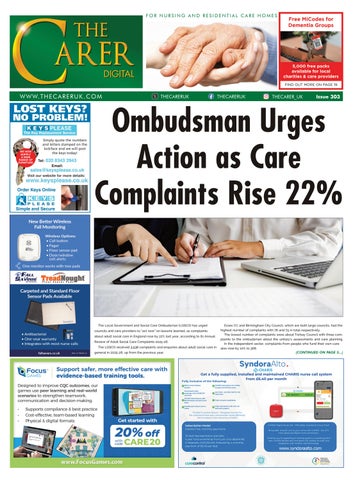
The Local Government and Social Care Ombudsman (LGSCO) has urged councils and care providers to “act now” on lessons learned, as complaints about adult social care in England rose by 22% last year, according to its Annual Review of Adult Social Care Complaints 2025-26. The LGSCO received 3,938 complaints and enquiries about adult social care in general in 2025-26, up from the previous year.
Essex CC and Birmingham City Council, which are both large councils, had the highest number of complaints with 76 and 75 in total respectively. The lowest number of complaints were about Torbay Council with three complaints to the ombudsman about the unitary’s assessments and care planning. In the independent sector, complaints from people who fund their own care also rose by 10% to 368.
(CONTINUED ON PAGE 3...)
PAGE 2 | Issue 303 | THE CARER DIGITAL
EDITOR'S VIEWPOINT
Welcome to the latest edition of The Carer Digital! REASONS FOR CAUTIOUS OPTIMISM At first glance, the headline that complaints about adult social care in England rose by 22 per cent last year is hardly the sort of news any care provider would want to see. The Local Government and Social Care Ombudsman received 3,938 complaints and enquiries about adult Editor social care during 2025/26, while 77 per cent of the 904 cases it investigated were upheld. But, as is so often the case with statistics, it is important to look beyond the headline. There are, in fact, some genuinely encouraging messages within the Ombudsman's latest figures. The high rate of compliance with Ombudsman recommendations has been maintained, with 99.8 per cent of cases completed to the Ombudsman's satisfaction. More encouraging still, around a third (33 per cent) of upheld complaints concerning private social care providers had already been suitably remedied by the organisation before the Ombudsman investigated – a 13 percentage-point increase on the previous year. It suggests that providers are increasingly recognising that a complaint should not necessarily be viewed simply as an accusation or an administrative burden, but as an opportunity to identify where something has gone wrong, put it right and, crucially, learn from it. Nobody working in care needs reminding that providers and their staff are operating in exceptionally challenging circumstances. They are caring for people with increasingly complex needs while dealing with workforce pressures, rising costs, funding constraints and an ever-changing regulatory environment. That does not diminish the importance of listening to residents and their families when things go wrong. Quite the opposite. The Ombudsman itself acknowledges that there are "welcome signs of improvement" in the way councils and care providers handle complaints. Its message is essentially that the lessons should be acted upon now rather than waiting for wider reforms to the care system.
Peter Adams
And perhaps that is the most important point. A good complaints procedure is not simply about defending an organisation when something goes wrong. It is about creating a culture where concerns can be raised, investigated properly, explained honestly and, where appropriate, remedied quickly. That is better for residents, better for families and ultimately better for providers. There is another piece of news this week which, taken alongside the Ombudsman's report, provides some grounds for cautious optimism about the wider direction of travel for the sector. Christie & Co's newly published Care Market Review 2026 paints a picture of a care market moving forward with growing confidence, supported by strong investor demand and improving operational performance. Its figures are striking. Some 69 per cent of providers surveyed reported occupancy levels of 90 per cent or above, underlining the continuing demand for care home places. Meanwhile, 52 per cent of operators surveyed said they were looking to acquire another care home over the next 12 months. Of course, we should not confuse a buoyant property and investment market with every care provider being financially comfortable. The same Christie & Co review points to continuing challenges, including workforce retention and local authority funding, while average local authority fee uplifts for 2026/27 are reported at between 4.3 per cent and 5.1 per cent across Great Britain. The care sector can acknowledge where it needs to improve while also recognising where genuine progress is being made. Complaints must be listened to and acted upon. Standards must continue to rise. Providers must continue to invest in their people, their homes and the quality of care they deliver. At the same time, we should not lose sight of the fact that there is strong and growing demand for care, that occupancy remains healthy, that investment appetite is substantial and that a significant proportion of operators are sufficiently confident about the future to be considering expansion. That is a very different picture from one of a sector simply in decline. I would also encourage our readers to sign up for our bi-weekly digital newsletter at www.thecareruk.com and follow us on social media for all the latest news. I can always be contacted at editor@thecareruk.com
PUBLISHED BY RBC Publishing Ltd 3 Carlton Mount 2 Cranborne Road Bournemouth Dorset BH2 5BR
TELEPHONE:
01202 552333 EMAIL:
sales@thecareruk.com WEBSITE:
www.thecareruk.com EDITOR Peter Adams editor@thecareruk.com
SALES DIRECTOR David Bartlett dave@thecareruk.com
PRODUCTION & DESIGN Matthew Noades Published by
The Carer is published by RBC Publishing Ltd, 3 Carlton Mount, 2 Cranborne Road, Bournemouth, Dorset BH2 5BR. Contributions are welcome for consideration, however, no responsibility will be accepted for loss or damage. Views expressed within this publication are not necessarily those of the publisher or the editorial team. Whilst every care is taken when compiling this publication to ensure accuracy, the publisher will assume no responsibility for any effects, errors or omissions therefrom. All rights reserved, reproduction is forbidden unless written permission is obtained. All material is assumed copyright free unless otherwise advised.
Manufactured in the UK
Freephone: 0800 917 7943 www.euroservice-uk.com sales@euroservice-uk.com
PROVIDING PRACTICAL AND STYLISH TROLLEYS TO SUIT YOUR NEEDS Watch your resident's eyes light up when the beautiful tea trolley arrives! Euroservice trolleys can also be used as a vending trolley or to sell personal care products to residents. How about a delicious snack/pastry trolley or even a drinks trolley for that afternoon tipple?
Your lovely trolley could do so much for you and your residents! Euroservice trolleys are an attractive and practical alternative to clinical aluminium trolleys given that antibacterial spray can be used freely to sanitise them.
Get in touch with our friendly, experienced sales team
Visit the website at
www.euroservice-uk.com to see the full range.
THE CARER DIGITAL | Issue 303 | PAGE 3
Ombudsman Urges Action as Care Complaints Rise 22% (CONTINUED FROM FRONT COVER) PUBLIC AWARENESS The Ombudsman said this reflects a welcome increase in public awareness of the right to complain, though it remains concerned that too few people who fund their own care come forward given the scale of privately arranged care across the country. Of the 904 cases investigated, 77% were upheld. The high rate of compliance with Ombudsman recommendations was maintained, with 99.8% of cases being completed to the Ombudsman’s satisfaction. Positively, around a third (33%) of upheld complaints about private social care providers had already been suitably remedied by the organisation before the Ombudsman investigated, a 13-percentage-point rise on the previous year.
WELCOME SIGN Amerdeep Clarke, Local Government and Social Care Ombudsman, said:"We are seeing welcome signs of improvement in how councils and care providers handle complaints, but there is still more to be done. My message to the sector is simple: use the learning in this report to improve services now, rather than waiting for wider changes to the care system that are currently under discussion. "Councils should ensure the care providers they commission have current policies in place that reflect best practice, including clear signposting to us as the final step in the complaints process. “And for care providers, dealing with complaints properly isn't just the right thing to do, it i fundamental to fostering excellent relations with your clients, families, and the wider communities in which you operate. Handling a complaint well protects your reputation, and where you have already investigated and appropriately remedied an issue, this can mean a full Ombudsman investigation isn't needed. "Behind every one of these numbers is a person, a family or a carer trying to get things back on track after something has gone wrong. Getting the fundamentals right: clear records, honest explanations and proper signposting to our service, protects everyone: the people who rely on care, and the organisations providing it."
RECURRING THEMES Care England said the figures underline the importance of using complaints not simply to identify fault, but to understand where care, commissioning and wider systems are breaking down. Working with the LGSCO, Care England has reviewed almost 450 published adult social care complaint decisions from June to August 2026. Its new article, “What complaints can teach us about better care and better commissioning”, looks at recurring themes including communication, care planning, record keeping, complaint handling, commissioning responsibility, funding sufficiency and the gap that can emerge between assessed need and what available funding can actually purchase. Professor Martin Green OBE, Chief Executive of Care England, said: “Complaints matter because behind
every one is a person or family trying to get something put right. The Ombudsman’s report shows why providers and commissioners must respond quickly, learn properly and make sure the same failures are not repeated. “But the wider lesson is that complaint data can also tell us where the system itself is under pressure. When funding no longer purchases the level of support that has been assessed as necessary, or responsibility is passed between organisations, that is no longer simply an administrative issue. It directly affects the person receiving care. “We want to work with the Ombudsman to make sure this intelligence is used constructively, helping providers improve, helping commissioners identify where arrangements are failing, and helping government understand when recurring local problems point to wider structural pressures.”
LEARNING ORGANISATION Care England’s article also highlights that good complaint handling should be seen as a sign of a learning organisation, not an admission of wholesale failure. The Ombudsman’s own review reports that organisations increasingly put matters right at an early stage, with 33% of upheld complaints about privately arranged care already having received a suitable remedy before the Ombudsman became involved, up 13 percentage points on the previous year.
SUSTAINED FUNDING Cllr Dr Wendy Taylor MBE, Chair of the LGA's Health and Wellbeing Committee, said: "This latest annual review of adult social care complaints underlines the ongoing pressure the sector is under. It is encouraging to see acknowledgement of the improvement councils and care providers are making already in the handling of complaints, as well as the difficult circumstances in which they’re operating. "Councils continue to work hard to try and ensure people who need it receive safe and high-quality care. Complaints systems form an important part of this process. We are working with councils across England to support this improvement, but reform of adult social care cannot come soon enough. "As we set out in our ‘Care Where We Live’ report, sustained and predictable funding and infrastructure will be essential for the future of adult social care, if councils are to successfully meet growing demand and deliver on their duties under the Care Act. “Success will require a new partnership between national government, local government and the public. It will ultimately be judged by whether people who draw on care and support are better able to remain connected to the people, places and passions that matter most in their lives.”
ONGOING PRESSURES Wendy Taylor (Lib Dem), chair of the Local Government Association’s health and wellbeing committee, said the rise in complaints “underlines the ongoing pressure the sector is under”. She added: “Councils continue to work hard to try and ensure people who need it receive safe and highquality care. Complaints systems form an important part of this process. We are working with councils across England to support this improvement, but reform of adult social care cannot come soon enough.”
PAGE 4 | Issue 303 | THE CARER DIGITAL
Another Decade of Broken Promises? Adult Social Care Cannot Wait Any Longer Why the next decade must be defined by delivery, not delay Exclusive article by Nadra Ahmed CBE DL, Executive Co-Chair, National Care Association (www.nationalcareassociation.org.uk) “Paying below the true cost of care does not save money. It moves the cost somewhere else.” Adult social care enables millions of people to live with dignity, promoting choice and independence within safe environments. It creates a cornerstone of support for families and communities and contributes significantly to our economy. Essentially it is an invaluable partner to the NHS. For too long, social care has been expected to deliver more, for people with healthcare and complex need with no recognition of its value or the skills of its workforce. The National Care Association's (NCA) latest report, Another Decade of Broken Promises, looks back at ten years of extraordinary change. It tells a reality of a resilient and innovative sector and the promises of reform which repeatedly failed to materialise or create change. The sector has lived through systematic changes like Brexit, a pandemic, workforce shortages, evolving and changing immigration policies, rising employment and operating costs, regulatory reform and increasing complexity of need, all statutory changes. Providers have adapted through each challenge because the people who depend on care cannot wait for the system to stabilise or catch up. It is crucial that resilience must never be mistaken for sustainability.
SOCIAL CARE HAS CHANGED The adult social care of today is very different from that of a decade ago. The good news is that people
are living longer, often with multiple and increasingly complex conditions. Providers and their highly skilled teams are taking on responsibilities that increasingly cross the traditional boundary between health and social care within insufficient resources. The sector has responded to the needs with providers investing in their workforce, embracing technology and innovation, adapted delivery models and developed new ways of supporting people to remain independent in their own homes and communities. They have done this without the investment needed to create sustainability. Commissioning practice is a clear example where fees do not reflect the true cost of delivering safe, highquality, person-centered care. Poor commissioning leaves providers with less investment capacity for their services and their workforce and makes recruitment and retention more challenging. The knock-on effect is that people wait longer for support, hospital discharge becomes more difficult and ultimately the pressure returns to the NHS, and the public purse pays more.
SOCIAL CARE AND THE NHS CANNOT BE VIEWED SEPARATELY For decades, social care has existed in the shadow of the NHS despite the fact that social care is a sector in its own right, and the backbone to the functioning of our wider health and care system. It creates pathways for recovery, prevents deterioration, supports independence and enables people to leave hospital safely to start their journey to recovery. If we are serious about reducing pressure on hospitals, prevention must become the key link in every policy. Investing earlier in care and support can help people remain independent for longer, reduce escalation of need and improve quality of life. Government and commissioners therefore need to look beyond the immediate price of a care package and recognise its value across the whole system. We must also recognise the extraordinary contribution of unpaid carers of all ages. Families across the country quietly hold together a system that would simply not function without them. They cannot continue to be treated as an inexhaustible and silent army.
ANOTHER COMMISSION CANNOT MEAN ANOTHER DELAY Successive governments have promised social care reform through a plethora of reviews, commissions, consultations, Green Papers and policy announcements and now we have the Casey Commission! We welcome its work, but its recommendations must become a catalyst for action, not another chapter in a history of good intentions followed by insufficient delivery.
Welcome to Blue Rain - our activity store is built on over 14 years experience supplying products that bring joy, inspire motivation, and enrich the lives of those who need a little extra support, or simply want to have fun, whatever the weather.
Come find your next reason to smile.
Scan me
THE CARER DIGITAL | Issue 303 | PAGE 5
Public Panel Launched on Social Care Reform Members of the public across England are being invited to play a direct role in shaping the future of adult social care, as Baroness Louise Casey’s Independent Commission on Adult Social Care launches its Public Panel on Care. The initiative forms part of the Commission’s wider Big Conversation on Care, and marks a significant step in efforts to build a lasting consensus on how the sector should be reformed. Since Monday 21 September, thousands of households across England have been receiving letters inviting residents aged 18 and over to register their interest in joining the Panel. Letters are being sent at random to addresses across the country, and anyone aged 18 or over living at an invited address is eligible to register. To ensure a broad spread of views, no more than one person will be selected from any single household. Around 125 people will ultimately be chosen to sit on the Panel, drawn from a wide range of backgrounds and communities to reflect the diversity of England as a whole. Chaired by Baroness Louise Casey of Blackstock, the Panel will bring together differing perspectives and experiences to examine the issues at the heart of adult social care reform. Participants will be asked to
weigh up difficult trade-offs and work collaboratively to find common ground on some of the most fundamental questions facing the sector: What is care? Who should receive it? And who should pay for it? Crucially, no prior experience or knowledge of adult social care is required to take part, with organisers keen to hear from as broad a cross-section of the public as possible. The Public Panel will convene in person over several weekends between November 2026 and April 2027, with sessions held in Birmingham and London, alongside additional shorter sessions held online. Anyone who receives an invitation letter is encouraged to register their interest by Sunday 11 October, using the details provided in their letter. The launch of the Public Panel represents a landmark opportunity for ordinary members of the public to have a genuine say in the future direction of adult social care – a sector that touches the lives of millions of families across the UK, including the many residents, families and staff connected to care homes throughout England.
Derbyshire Care Home Resident Recognised for Raising More Than £27,000 for Ashgate Hospice A resident at Dale Brook care home in Clay Cross has been honoured by Ashgate Hospice for her remarkable fundraising efforts over more than two decades, raising an incredible £27,808.85. Alva de Chiro, 89, was recently presented with a commemorative cheque by Ashgate Hospice as a special recognition of her dedication to supporting the organisation over the last 20 years. Alva’s fundraising journey began in 2001 and was inspired by her late husband, Biagio, who received care from Ashgate Hospice. By sharing personal stories about her life and recounting her husband’s experiences growing up in Italy, Alva captivated audiences at Women’s Institute meetings and community groups across the region. Rather than charging for her engaging talks, Alva encouraged donations to Ashgate Hospice, with every contribution passed directly to the charity. Leigh Allwood, Senior Community Relationship Fundraiser at Ashgate Hospice, said: “Alva’s stories and life experiences have brought joy and laughter to so
many people over the years. We wanted to reach out and thank her personally for her outstanding contribution and dedication to Ashgate Hospice through her amazing fundraising efforts.” The surprise presentation took place at Dale Brook, where staff and family members joined in celebrating Alva’s achievement and lasting contribution to the charity. Reflecting on the recognition, Alva said, “Throughout the years, I have really enjoyed going to fairs and communities to present my talks and raising money for Ashgate. “When my friend came up with the cheque, I was lost for words. Overwhelmed, in fact, and I appreciated the love and support that was given at the time. I have loved every second of it. “My advice to anyone who is thinking about raising money for charity is to go for it, embark on the path and do not look back. It’s the best feeling in the world and could make a huge difference.”
PAGE 6 | Issue 303 | THE CARER DIGITAL
New Visa Rules Give Exploited Care Workers Freedom To Leave Sponsors Migrant care workers formally recognised as victims of modern slavery will be able to leave abusive sponsors and work for another employer under new immigration rules designed to stop businesses “weaponising” the visa system. From 8 October, Skilled Worker visa holders who can prove exploitative working conditions will be able to have restrictions on their employment lifted for the remainder of their existing visa. At present, most Skilled Worker visa holders are tied to the employer sponsoring them and cannot leave and take another job without fresh sponsorship. The government says this dependency can leave vulnerable workers trapped with exploitative employers because leaving their job may also put their immigration status at risk. Under the change, qualifying workers will be allowed to work for any employer, become self-employed or undertake voluntary work. The Home Office said the reform is intended to prevent employers from “weaponising the sponsorship system” to exploit vulnerable workers and encourage victims to report abuse earlier. The issue has been particularly acute in social care following the rapid expansion of overseas recruitment after care workers were added to the Health and Care Worker route. Government figures show more than 470 sponsor licences in the care sector were revoked between July 2022 and December 2024 as part of a crackdown on abuse and exploitation. More than 39,000 workers had been associated with those sponsors since October 2020. The figure does not mean that all 39,000 workers were victims of exploitation. Indeed, the Public Accounts Committee warned last year that the Home Office itself did not know how many people on Skilled Worker visas had been referred as potential victims of modern slavery. However, separate research provides evidence of widespread problems among visa-sponsored care workers. A UNISON survey of 3,306 migrant care workers, all working in the
UK on Health and Care Worker visas, found that almost a quarter had paid money to an employer or recruitment intermediary before arriving in Britain in return for work. Some workers reported paying more than £20,000. The survey also found 18% had money deducted from their salaries for items including administration, uniforms, cars, training and accommodation. Yash Dubal, CEO of immigration law firm A Y & J Solicitors, said the rule change addressed one of the most difficult features of the sponsorship system for workers facing serious abuse. He said: “The problem with employer-sponsored visas is that an unscrupulous employer can hold enormous power over a worker. If your job, income and right to remain in the UK are all dependent on the same employer, walking away from exploitation is not straightforward. “For care workers in particular, we have seen cases where people have borrowed huge sums to come to the UK, only to find the job,
hours or conditions they were promised do not materialise. The threat of losing sponsorship can then be used to keep someone in a situation they would otherwise leave.” The government has already acknowledged widespread problems in the care sector. In its 2025 immigration white paper it described a “shameful and deeply damaging increase in abuse and exploitation”, including workers arriving heavily indebted or discovering that jobs they had been promised did not exist. Overseas recruitment of new care workers was subsequently closed in July 2025, although workers already in the UK can continue to extend their visas or move between eligible sponsored roles. Home Office figures published last month show how dramatically recruitment has since fallen. Just 344 Health and Care Worker visas were granted to main applicants in caring personal service occupations in the year to June 2026, down more than 99% from 107,772 at the December 2023 peak. Mr Dubal said the new protection was significant, but warned that it would not give every worker experiencing poor treatment an automatic right to leave their sponsor and work elsewhere. He said: “This is not a general escape route from sponsorship, and it is important that workers understand that distinction. “A person must have been referred into the National Referral Mechanism and received a positive Conclusive Grounds decision formally recognising them as a victim of modern slavery. Simply having a dispute with an employer, suffering poor working conditions or even alleging exploitation will not automatically trigger these new rights.” He added: “Sponsorship is not ownership. A sponsor licence gives an employer permission to recruit migrant workers; it does not give that employer additional rights over them. For reputable care providers, the practical message is to make sure recruitment practices, deductions, working hours and sponsorship arrangements can withstand scrutiny.”
Care Home Residents Thank Firefighters Who Kept Them Safe During Dramatic Fire Residents and staff at a Derbyshire care home welcomed local firefighters for a special thank-you after crews worked through the night to tackle a serious fire metres from the home. Kilburn Care Centre in Kilburn near Belper, part of Aurem Care, invited firefighters from Ripley Fire Station to the home after a blaze broke out at a neighbouring chapel. More than six fire engines and several police units attended the incident, which saw firefighters work through the night to bring the blaze under control and protect surrounding properties. With the fire in close proximity care home staff immediately put emergency procedures into action. Residents were moved away from the area of the home closest to the fire as part of a precautionary zone evacuation, while staff maintained regular communication with the fire service and prepared for a full evacuation should it become necessary. To show their appreciation to the emergency services, Kilburn invited firefighters to visit and laid on refreshments including hot sausage and bacon cobs, cakes, cookies and doughnuts, together with hot and cold drinks. Residents had the opportunity to personally thank them for keeping them safe, while the crews spent time chatting and sharing stories with them. For crew members unable to attend, Kilburn sent chocolates, biscuits and other refreshments back to the station, along with a thank-you card expressing the home’s appreciation.
Resident Yvonne Wilkes read the message of thanks to the firefighters during their visit. She said: “I was a little shaken that night, but the carers made me a cup of tea and sat with me until I was allowed to go back to bed. “They made me feel safe, and I’m so grateful for that. These firemen deserve the world for what they do. It’s been a fabulous afternoon spent with them.” Carrianne Fearn, deputy manager at Kilburn Care Centre, was on call on the night of the fire. She said: “It was the call we all dread, the kind of call that immediately creates fear and concern for both our residents and our staff. “The team at Kilburn was absolutely fabulous. They acted quickly and kept resident safety at the forefront of everything they did. “Our team was also incredibly well supported by the fire service throughout the incident, and their dedication and professionalism certainly did not go unnoticed. “We felt it was important to show our gratitude for the work they do every day to protect and support our community. “It was wonderful to welcome the firefighters back to Kilburn in much happier circumstances and to see our residents enjoying their company. What was a very worrying night has led to a lovely connection with the people who worked so hard to keep us safe.”
Beyond the Breaking Point: When Care Staff Are Asked to Do the Impossible By Stephanie Ryde I have worked in many roles across the care sector, and those varied experiences have given me a deep understanding of the challenges faced by care teams. Although each situation I encountered had its own details, the underlying issues were strikingly familiar — the same pressures, the same struggles, repeated across services and echoed in countless conversations with colleagues. Many of us were trying to deliver compassionate care in environments that continually asked us to operate beyond our limits, without the emotional or practical support needed to do so safely. I have seen first hand how poor funding, low resources, high turnover, and chronic understaffing create a cycle that is impossible to sustain. These pressures don’t reflect a lack of commitment within the workforce — far from it. They reflect systems that are stretched to breaking point. When staffing levels fall, everything feels the impact: safe staffing ratios, equipment maintenance, record keeping, communication, and access to specialist support. The result is a working culture where staff are expected to manage situations that contradict the very values our care system is built on — dignity, safety, and person centred practice. I have been placed alone with individuals exhibiting aggressive behaviours, sometimes as a new starter without the training or experience needed to manage such risks. I have been responsible for entire bays of patients with dementia through the night, unable to reach someone who had fallen because I was supporting another distressed individual. These situations were described as
“inevitable” due to staffing pressures, even though they were clearly avoidable in a properly resourced environment. In one role, I wasn’t even provided with individualised care plans to guide safe, person centred support. This wasn’t due to neglect — it was the result of overstretched staff, poor communication, and the difficulty of accessing behavioural specialists. It became clear to me that meaningful change requires a holistic approach: proper funding, better emotional and practical support for staff, and access to tools that genuinely reduce risk and prevent escalation. Without these, the system cannot uphold the values it claims to prioritise.
How the pobroll® Helps Address These Issues The challenges described above are exactly the kinds of situations where the pobroll® can make a meaningful difference. By providing gentle, sensory integrated containment, the pobroll® acts as the “third pair of hands” that staff so often lack. It helps prevent behavioural escalation, reduces the need for multiple staff during episodes of distress, and supports safer, calmer delivery of essential care — especially when staffing levels are stretched. In environments where turnover is high and training gaps are common, the pobroll® offers a practical, easy to use tool that protects both staff and residents, reduces incidents, and helps services uphold the dignity focused values they strive for, even under pressure. See the advert on the facing page for further information.
THE CARER DIGITAL | Issue 303 | PAGE 7
Care Providers Urged to Review Right-to-Work Processes Care providers are being urged to review how they hire workers and use contractors ahead of major changes to right-to-work rules coming into force on the 1st of October 2026. The changes will extend the existing illegal working rules beyond traditional employees and bring more working arrangements into scope. This can include people working under worker contracts, individual subcontractors and workers supplied through more complex contracting arrangements. Online platforms that connect workers or service providers with customers can also be affected. The changes can also push responsibility further up a supply chain. In some cases, businesses may face liability for people carrying out work further down a subcontracting chain, even where they have no direct contract with that individual. If a business is found liable for illegal working, civil penalties can reach £45,000 per worker for a first breach and £60,000 per worker for repeat breaches. Jasia Kazmi, employment lawyer at Witan Solicitors, said: “For a long time, right-to-work checks have been viewed as something for HR teams to deal with when somebody joins a business, but these changes make the issue much wider. “From October, businesses will need to think more carefully about who is actually carrying out work for them and how these people have been engaged. This is particularly important for businesses that regularly use contractors, agency workers or subcontractors. It will no longer always be enough to assume that another company further down the chain has dealt with the necessary checks. “Businesses should start by looking at the different ways they engage people. This means understanding who is employed directly, who works through another business and whether any of their suppliers are subcontracting work further.” Businesses affected by the extended rules will also need certain protections in place before work begins if they want to establish a statutory excuse against a civil penalty. For subcontracting arrangements, this includes written terms requiring suppliers to carry out the necessary right-to-work checks. Contracts must also deal with further subcontracting, allow compliance to be checked, provide options for action where illegal working is identified and require cooperation with Home
Office investigations. Jasia continued: “It’s crucial that businesses don’t wait until something goes wrong before putting the right checks and contracts in place. The required terms and processes need to be in place before the work starts. That’s why it’s wise for businesses to review their standard contracts now, particularly where they rely on subcontractors or suppliers to provide people to carry out work. “It’s also wise to make sure that any new supplier or subcontracting agreements entered into from the 1st of October contain those terms from the outset.” The latest Home Office guidance says these requirements apply to relevant contractual arrangements entered into on or after the 1st of October. Businesses will also need processes to make sure the person carrying out the work is the same person whose right-to-work was checked. Where workers are allowed to send somebody else to carry out the work in their place, checks will also need to be completed before that substitute starts working. Jasia said: “This is not just about adding another clause to a contract. Businesses need to be able to show that their processes work in practice. If somebody else is allowed to step in and carry out the work, the business needs a process for making sure that person has the right to work before they start. “Employers using digital services for right-to-work checks should also make sure their provider is specifically authorised to carry them out. After all, being approved for general identity checks will not necessarily be enough.” Jasia concluded: “With the changes only weeks away, businesses need to be proactive and start reviewing their arrangements now. “A sensible place to start is by identifying everyone who carries out work for the business and how they are engaged. From there, businesses can review supplier contracts, subcontracting arrangements, and rightto-work procedures to see where changes may be needed. “For businesses with larger or more complicated supply chains, this may involve a number of different teams. HR, procurement and those responsible for contracts all need to understand what is changing and where responsibility could arise.”
Care Home Residents Kept Busy with Summer Full of Outings Care home residents from the Chestnut Lodge Nursing Home in Yeovil have had a busy summer filled with day trips aimed at supporting their emotional wellbeing. Staff have assisted residents on shopping trips, outings to local coffee shops as well as a trip to a local tractor festival. One resident and his partner celebrated a special wedding anniversary with a visit to Montacute House National Trust Home, whilst the unofficial ‘Head Gardener’ at Chestnut Lodge enjoyed an outing to the local garden centre, so she could buy seeds to plant in the Chestnut Lodge garden. Day trips are a vital part of person-centred care, providing opportunities for social interaction, gentle physical activity and sensory engagement. Gary Shackle, Activities Manager at Chestnut Lodge, said: “Excursions are an integral part of the care we provide at Chestnut Lodge. Our residents have such a wide range of
passions, so we always do our best to engage them with those interests. “We recently took two of our residents, Patricia and Peter, to the Ninesprings Country Park. Patricia enjoys being in the countryside and it was her birthday the day before, so it was a lovely belated celebration for her. Peter has always kept himself fit so he was pleased to be able to take a walk around part of the park. “We all went for a coffee and then took a stroll to the ponds. Patricia was thrilled to see the ducks, moorhens and fish. When she was on her way back, she said it had been “the best walk ever” – we’re just so pleased she had such a great day.” Staff at Chestnut Lodge are now busy planning ahead for the autumn and winter season which will include a focus on Christmas-themed day trips.
PAGE 8 | Issue 303 | THE CARER DIGITAL
Extended Employment Tribunal Claim Limits: What It Means For Care's Shift Workers By Dave Lee, CEO, Planday (www.planday.com)
Sometimes it's obvious right away that something has gone wrong at work. It could be a dismissal, unpaid wages or a decision to cut your hours with a clear date attached. But in shift-based roles, trouble is more often a slow drip. Hours get a little shorter one week, a shift gets cancelled the next, and then a pattern emerges in who keeps getting the worst slots. It can take time to realise this has been happening. Until now, a worker wanting to challenge unfair treatment at work had three months from the incident to lodge an employment tribunal claim. Under the old three-month limit, many people ran out of time before they even realised there was a pattern. From 1 October, that window doubles to six months.
WHY CARE DOESN'T FIT THE OLD CLOCK Employment law tends to treat a dismissal or a single disciplinary decision as a dateable event. However, a rota rarely produces one. Reduced hours, shifts cancelled at short notice, and an uneven pattern in who gets the unsociable slots can build slowly, especially on zero-hour contracts. The Living Wage Foundation found that among UK workers on variable-hours or shift-based jobs, almost two thirds had less than a week's notice of their schedule. Around one in eight found out in under 24 hours. This uncertainty adds to the pressures facing a sector where frontline care worker turnover has been running at close to 30% a year. In care, last-minute rota changes can leave staff scrambling to arrange childcare or travel while residents and patients rely on them arriving rested, prepared and on time. The problem is, too often workers only recognise the cumulative effect once weeks or months have passed.
WHAT'S CHANGING The regulations extending Employment Tribunal time limits have completed their passage through Parliament and take effect from 1 October, moving most claims from three months to six. The
H.W. NEW & USED ACCESSIBLE TRANSPORT AT AFFORDABLE PRICES • We specialise in the sale and purchase of quality used wheelchair accessible vehicles and ambulances. • They can be bought as seen or refurbished and sign-written to your own requirements. • Fully serviced, new mot & warranty • Engineers inspection supplied if required.
• Free delivery service available • All buses comply with new legislation • Lease hire and purchase available • Always large stock of accessible vehicles
Tel: 01268 521033 Mobile: 07860 894331 Email: sales@hwpickrell.co.uk Gardiners Lane North, Crays Hills, Billericay, Essex CM11 2XE All current stock available to view at www.hwpickrell.co.uk
new window covers a broad range of workplace rights, including protections specific to part-time employees and zero-hours workers, both common contract types in care. The Acas early conciliation period, which pauses the clock while a dispute is being resolved, has also grown from six to twelve weeks, meaning issues can stay unresolved even longer before a claim is lodged. Someone now has considerably longer to notice unjust treatment and still have room left to act on it once they do. The tribunal extension sits alongside a second reform. The Employment Rights Act 2025 gives zero-hours and low-hours workers a right to guaranteed hours reflecting what they have consistently worked, plus reasonable notice of shifts and compensation for late cancellation. Where the tribunal change gives workers more time to challenge an existing problem, this reform tries to stop some of those problems arising in the first place. Together, the two treat unpredictable scheduling as a root cause that needs to be fixed.
GETTING THE ROTA RIGHT Ministers have been explicit that the change is meant to produce better-prepared claims and more disputes resolved before they reach a tribunal. What extra time buys, above all, is the chance for a slow-building problem to be properly understood by the person living through it and by the employer trying to explain what happened. A cancelled shift may be a one-off, but several unexplained changes to the same person’s hours look very different when viewed together. The practical response for care providers is to give staff as much notice as possible and explain any unavoidable rota changes. Keeping a record of those decisions gives managers a firmer basis for responding if a concern is raised months later, while giving care workers the predictability they need to plan their lives and deliver the consistent support residents rely on.
THE CARER DIGITAL | Issue 303 | PAGE 9
NIHR to Fund Major Partnerships to Tackle the Nation’s Biggest Health and Care Challenges The NIHR has launched the first round of Strategic Infrastructure Partnerships (SIPs) – a funding opportunity to tackle some of the most pressing health and care challenges facing the UK. A SIP is a new form of NIHR multi-year research funding which will create the evidence to answer strategic questions affecting the health and care system. These partnerships will bring together expertise, capabilities and resources from across NIHR infrastructure and the wider health and care system to deliver research at scale. SIPs will provide the research evidence to accelerate promising innovations through to patients and the public by bringing together expertise, capabilities and partnerships from across NIHR infrastructure and beyond. They will address challenges that no single organisation, discipline or infrastructure scheme could solve alone. What will be funded in the first round? This first round of SIP funding will support the ambitions of the 10Year Health Plan for England and the shift from hospital-based care towards more community-based models of support and treatment. Applications are invited in two priority areas: • Technologies that enable people to live well and independently at home • Reducing demand across urgent, emergency and primary care services Up to £45 million is available through this first funding round, with
applicants able to apply for up to £15 million per Strategic Infrastructure Partnership. Awards are expected to be between 3 and 5 years. By creating ambitious, multidisciplinary partnerships across England, SIPs will accelerate the translation of research into life-changing improvements for patients, communities and the health and care system. They will deliver change on a national scale, while also pinpointing common challenges faced by local communities across the country, tackling these collectively by bringing experts across research infrastructure together. Minister for Health Innovation, James Frith, said: “We cannot solve the biggest challenges facing our health and care system through any one organisation working alone. We will always be stronger when we bring together the expertise, ideas and experience that exist across our NHS, the research community, industry and local communities. “These new Strategic Infrastructure Partnerships will help us do exactly that – tackling challenges both locally and at a national scale, and turning the very best research and innovation projects into practical improvements for patients and communities across the country. “This is the 10-Year Health Plan in action: harnessing innovation and technology to help reduce pressure on urgent, emergency and primary
care, while ensuring that the health service is always there for everyone when they need it, and where they need it.” Professor Lucy Chappell, Chief Scientific Adviser to the Department of Health and Social Care and CEO of the NIHR, said: “As the NIHR celebrates 20 years, it is looking for bold ideas and ambitious teams to lead these new, transformational partnerships. Our research infrastructure is full of passionate experts, with boundless experience. We want them to unite, combining their strengths with industry, local government, charities and many other partners, to accelerate exciting innovations and research to deliver real, lasting impact for patients across the country, and to drive economic growth.” SIPs will be challenge-led, collaborative and impact-focused. They will support partnerships to generate evidence, drive implementation, remove barriers to adoption and help ensure that promising innovations reach the people and communities who need them most. They will create a more connected and responsive research ecosystem, bringing together expertise from across the translational pathway to deliver greater impact, faster. SIPs are not simply about funding excellent research. They are about creating partnerships capable of transforming how research is developed, evaluated, implemented and adopted.
RAF Veteran’s Wartime Show Visit is a Dream Come True 76 year old RAF veteran, Peter Heys, recently attended the Cosby Victory Show, where he watched wartime air show displays, battle reenactments, vintage military vehicles, and enjoyed 1940s themed entertainment. The annual event takes place across a 100-acre farm in early September to honour the legacy and history of the 1940s and World War II. Peter, a resident at RMBI Care Co. Home Devonshire Court, in Leicester, was a Squadron Leader in the RAF during 1960. As an Engineering Officer for 33 years, he was posted in Germany and also spent time in East Anglia. When Peter retired, he worked in a recruiting office in Dundee for 10 years, while working for the civil service. At the Victory Show, Peter was delighted to meet other veterans, and
they shared experiences of their time serving in the RAF. He mentioned the event brought back many memories and seeing all of the aircrafts, vehicles and people in uniform was a beautiful sight. Claire Barrett, Business Relationship Manager at Devonshire Court said: “Making Peter’s dream come true was incredibly special. The RAF has been such an important part of Peter’s life, and it means so much to him to keep those memories alive. “From his personalised fighter plane mural at Devonshire Court to attending community RAF events, we’re delighted to be able to support Peter in celebrating his time in this service, as well as making new memories,” she adds.
THE CARER DIGITAL | Issue 303 | PAGE 11
Campaigner Responds to Baroness Casey’s ‘Profiteering’ Claim A leading care provider, who invited the Prime Minister to visit his care home last month, has said calls to tackle profiteering in social care ‘must not be allowed to condemn an entire sector’ and ‘undermine the many responsible, independent providers delivering good care on very modest margins’. Mike Padgham, who owns and operates five care homes in North Yorkshire, is Executive Chairman of the St Cecilia’s Care Group and Honorary President of the Independent Care Group. He says the debate over social care reform must distinguish between excessive profits in parts of the market and the reality facing the majority of providers. Mike’s comments follow concerns raised by Baroness Louise Casey, Chair of the Independent Commission into Adult Social Care, about large, often overseas-owned organisations ‘profiteering out of human misery and human life.’ Earlier this month Baroness Casey used a wide-ranging interview to take aim at the extent of privatisation within adult social care, accusing some private providers of profiteering at the expense of disabled people and the taxpayer. Speaking to ITV News, she argued that handing large swathes of the sector over to profit-driven companies had been a mistake, and said she personally objected to firms making substantial profits from taxpayers, particularly from those with the highest care needs. Tracing the issue back to the 1980s, Casey pointed to a major shift in that decade when care provision was outsourced to the private sector without it being organised and managed, a move she believes was ultimately misguided. Mr Padgham said: “I understand and share Baroness Casey’s concerns where some large organisations are making excessive profits, moving public money out of the country or using their market position to hold commissioners to ransom. But we must be very careful not to portray an entire sector as profiteering. The majority of social care in this country is being delivered responsibly and compassionately by organisations whose owners and staff are deeply committed to the people they support. Many are small and medium-sized, family-run businesses operating on extremely tight margins. They are not making excessive profits. In many cases, they are fighting simply to remain viable. I would like to meet the Baroness to discuss this, as we have ideas to make things work better.” “Care-home fees can appear high when expressed as a weekly or annual figure, but they pay for a comprehensive, round-the-clock service. A care home operates 24 hours a day, seven days a week and 365 days a year. It must provide trained staff at all times, alongside accommodation, heating, lighting, meals, laundry, activities, equipment, maintenance, insurance, training, administration and extensive regulatory and safeguarding requirements. Staffing alone typically accounts for around 60% of a care home’s costs and can represent an even higher proportion in services supporting people with complex needs.” Mike is launching his video campaign on deadline day for the first phase of Baroness Casey’s ‘Big Conversation on Care’ – the governmentbacked consultation asking the public “When we are old or disabled, or have a serious illness, who should support us and how?” to raise awareness and encourage public debate.
In the first video, Mike responds to Ann, whose relative lives in a Norfolk care home, who asks why fees of £1,000 to £1,200 a week seem so high. He explains: “over two thirds of that goes straight out of the door on staff wages. The rest is reinvestment, energy and utilities. To be registered with the CQC you have to make a small profit, so profit shouldn’t be a dirty word – but it’s very tiny compared to the rest.” In another, Caroline asks whether it’s fair that dementia patients must pay for care that similar NHS-funded conditions wouldn’t require. Mike responds: “I don’t think it is fair. Dementia is treated as a ‘social need’ rather than a health need and that’s wrong. It should be provided on an NHS basis, not means tested – which is why I want the NHS and social care to come together under a National Care Service.” More than 350,000 votes have been submitted to the Big Conversation since it launched in July, but Mr Padgham says families shouldn’t have to wait for the Commission’s full recommendations – not due until summer 2027 – to get straight answers. “I am concerned that is very close to a potential general election and the recommendations may never be implemented. We have been here before,” he says. He goes on to say, “We all agree care workers deserve better pay, but we cannot call for higher wages while suggesting any increase in the cost of care is unjustified. For years, local authorities have failed to pay the true cost of care, leaving providers struggling with rising costs and creating an unfair market where self-funders pay more to compensate for inadequate public fees.” The campaign follows Mike’s open letter to the Prime Minister last month, inviting Andy Burnham to visit one of his care homes – an invitation Mike says has gone unanswered. Mike has also invited Health Secretary Yvette Cooper to visit, to test the government’s commitment to reform. Mr Padgham’s care home also featured in the 2021 BBC documentary Inside the Care Crisis, presented by Ed Balls. He says nothing has changed since, and no one from government has taken up his offer to visit. Mr Padgham, who has run care homes in North Yorkshire for 37 years, added: “This imbalance was not created by the ordinary family care
provider and it cannot be solved by blaming them. Quality is not guaranteed by whether an organisation is public, private or charitable – poor care and excellent care both exist across the sector.” He said “Wholesale nationalisation would be costly and destabilising given the country’s reliance on independent providers”, calling instead for “a fair, transparent and properly funded mixed economy of care, with effective oversight to prevent excessive returns while ensuring responsible providers can survive and invest.” “Morale across social care is already extremely low. Loose language that characterises the whole sector as profiteering risks driving away good providers and making recruitment even harder. It’s time for the difficult conversations we’ve been avoiding.” The eight videos will run across social media over the next few months. Mike says, “The public’s opportunity to take part in the current phase of the Big Conversation closes today. I urge everyone to take part before the deadline – any lasting settlement for social care must have the public’s understanding, involvement and support.” Mr Padgham, who is campaigning nationally for social care, following three decades of work in the sector, says his video campaign is not a complaint, but a constructive offer of help – and a direct contribution to the conversation Baroness Casey is asking the country to have. “This isn’t about one campaigner having a moan. It’s about the millions of people who need help right now and the people who care for them every day. We believe the Prime Minister will act if he says he will. We just want him and Yvette Cooper to see it for themselves.”
THE SCALE OF THE PROBLEM • Delayed discharges currently cost the taxpayer more than £2 billion a year, with 12,000 hospital beds occupied every day by patients who no longer need to be there, at a cost of £562 per bed per day (NHS England / Patient Safety Learning). • The UK is predicted to need an extra 139,000 care home beds over the next decade (Savills). • Self-funder care fees are rising by an average of 10%, while private operators now provide 87% of registered care home beds nationwide (Caring Britain Report). • Baroness Casey’s independent commission on social care reform is not due to report in full until summer 2027, more than two years after the last general election (Gov.uk). It comes as Unison warned the government’s immigration changes will deepen the staffing crisis in social care, publishing analysis, in August, of the latest industry employment figures showing the number of new international recruits hired into care jobs plunged from 105,000 in 2023/24 to 30,000 in 2025/26. The union has written to Home Secretary, Shabana Mahmood, highlighting the situation and urging her to drop plans that would make it harder for migrant care staff to settle in the UK for good. The union is demanding she reverses plans to make international health and care staff wait 15 years before they can settle in the UK, instead of the current five.
PAGE 12 | Issue 303 | THE CARER DIGITAL
Over Half of Operators Plan to Acquire Another Care Home in the Next Year, Report Reveals Business property adviser, Christie & Co, has launched its ‘Care Market Review 2026’ report, revealing a sector that is moving forward with growing confidence, supported by strong investor demand and improving operational performance. Activity remains robust across all asset types, with elderly care businesses continuing to attract significant interest from operators, institutional investors, and international REITs. Drawing on Christie & Co’s consultancy data on transactional and valuation activity, and insights from operators across England, Scotland and Wales, the report highlights key trends shaping the sector. It explores areas including investment activity, funding, land and development, local authority fee rates, and findings from an annual sentiment survey which highlight the key opportunities and challenges faced by operators. The report also features an exclusive interview with Vikas Gupta, Chief Investment Officer at Omega Healthcare Investors, Inc.
STRONG INVESTOR DEMAND Investor appetite for UK healthcare real estate remains impressive, with the sector recording more than £12 billion in transactions in 2025, a record year for the market. Overseas capital continues to play an important role, especially from the US, which has accounted for more than two-thirds of foreign investment into the sector over the past five years. As investment reaches record levels, management contract structures are becoming increasingly common. This change is creating new opportunities for operators to unlock capital, accelerate growth, and attract a growing number of domestic and international investors looking for exposure to the UK’s care market. An analysis of the deals brokered by Christie & Co further demonstrates the strength of buyer demand across the market, with an average of over five offers received per instruction, and deals achieving an average of 97 per cent of the asking price in the first half of 2026, ahead of 2025 levels. Small and medium-sized operators (those with between three and 19 homes) were the most active buyer group, accounting for 38 per cent of completed transactions, using a combination of cash resources, REIT, and senior debt funding. Another notable trend is the rise in first-time buyers, many of whom have significant sector experience and are now taking the next step into ownership. Compared with previous years, Christie & Co’s H1 2026 completion data highlights fewer deals involving larger homes of 40 beds or more, with more sales of smaller and mid-sized assets. This shift is driven by several factors, including a reduction in the level of non-core corporate divestments as operators continue to implement integration and asset management strategies following the major corporate transactions of 2025. However, when larger assets have been brought to market, buyer demand has remained extremely high, with a wide range of operators and investors competing for a limited supply of opportunities.
DEVELOPMENT CRITICAL FOR FUTURE DEMAND The report also highlights continued confidence in the land and development market, with demand for well-located opportunities remaining solid, particularly for sites with planning consent. Despite ongoing
planning and construction challenges, Christie & Co expects to transact around 1,200 consented and new-to-market care home beds by the end of 2026. As operators look to future-proof their businesses, ESG is also an increasingly important consideration. The report found that 43 per cent of operators now have an ESG strategy in place, up from 33 per cent in 2025, while two-thirds plan to develop or enhance their approach over the next 12 months. From improving energy efficiency and investing in renewable technologies to strengthening staff wellbeing and resident outcomes, sustainability is becoming an increasingly important driver of both investment and long-term business planning.
CONFIDENCE REMAINS STRONG Key findings from Christie & Co’s annual sentiment survey show growing stability across the care sector. Occupancy levels remain healthy, with 69 per cent of providers reporting occupancy rates of 90 per cent or above, highlighting continued demand for care home beds. Confidence across the sector also remains high, with more than half of operators (52 per cent) surveyed looking to acquire another care home in the next 12 months, reflecting improving trading conditions, sustained demand and a resilient outlook for the sector.
FEE GROWTH EASES Christie & Co’s analysis of local authority fee rates found that average fee uplifts for 2026/27 range from 4.3 per cent to 5.1 per cent across Great Britain. While these uplifts provide some support to providers, they are generally lower than those seen in recent years, placing renewed focus on the gap between fee growth and rising operating costs. This trend is reflected in Christie & Co’s annual sentiment survey, which found that the proportion of operators receiving local authority fee increases of more than 5 per cent fell from 31 per cent in 2025 to 22 per cent in 2026. As a result, many providers continue to rely on private fee growth and operational efficiencies to help maintain financial performance. Richard Lunn, Managing Director – Care at Christie & Co, comments, “The care sector has continued to show positive momentum over the past year. We’re seeing strong interest from buyers, investors, and lenders, alongside improving operational performance for many providers. There is a renewed sense of confidence across the market, with operators increasingly focused on growth, investment, and planning for a more sustainable and efficient future. However, there are still important issues to navigate, such as workforce retention and local authority funding, but the overall market picture remains resilient and ambitious.” To read the full ‘Care Market Review 2026’ report, visit: www.christie.com/sectors/care/market-review/
Elgin Care Home Opens New Café to Meet Residents’ Wishes A new café has opened inside an Elgin care home after residents said they would like more opportunities to enjoy a cuppa and catch up with friends and family. Spynie Care Home has created the welcoming new space, Kiltie Café, in response to feedback from residents, some of whom are not always able to get out to local cafés as often as they would like. It means they can now enjoy everything from a cup of tea and slice of cake to lunch or a speciality coffee with relatives and friends, without having to leave the home. Designed to have the relaxed and informal feel of a neighbourhood café, it has already become a popular meeting place for residents, families and colleagues. Visitors can sit and chat over refreshments, watch television together or simply spend time in a different environment within the home. Colleagues at Spynie are also encouraged to buy their coffees, cold drinks and snacks from the café, with all proceeds going towards activities and wellbeing initiatives for residents. Jamie Taylor, home manager at Spynie Care Home, said: “The idea really came from listening to our residents. Going out for a coffee or meeting somebody for lunch is something many of us take for granted,
but it isn’t always as easy for some of the people we support. “We wanted to bring that experience into Spynie and create somewhere that feels relaxed and sociable, where residents can meet their relatives and friends over a coffee and cake or enjoy lunch together. “It has been lovely to see how quickly people have embraced it. There is often somebody sitting having a chat, watching television or enjoying a coffee, and it has brought another real sense of community to the home. “The fact that the money raised is then reinvested into activities and wellbeing for residents makes it even more worthwhile.” Steve Massey, operations manager at Intobeige, which operates Spynie Care Home, said: “This is a relatively simple idea, but one that can make a real difference to everyday life for residents. “Spynie is their home and we want it to offer the same opportunities for socialising and spending time with friends and family that people would enjoy in the wider community. “The café has created another focal point within the home and the response from residents, relatives and colleagues has been fantastic. It is particularly pleasing that every purchase also helps to support more activities and experiences for the people who live at Spynie.”
Don’t Miss the NACC Training & Development Forum 2026 Inspiration, innovation and leadership take centre stage at this year’s NACC Training & Development Forum and with the event now just one month away, there’s still time to secure your place. On 14 - 15 October 2026, the Hilton at St George’s Park, Burton-upon-Trent, will become the meeting place for care catering professionals from across the sector, with two packed days of expert insight, practical learning, innovation and networking. And it’s the programme that really sets this year’s Forum apart, designed to inspire, challenge and deliver practical ideas. From keynote presentations and interactive masterclasses to live cookery demonstrations, the 2026 programme has been carefully designed to give delegates ideas and inspiration they can take straight back into their organisations. A major highlight will be Michael Caulfield, Performance Psychologist, whose keynote promises to challenge delegates to think differently, embrace innovation and consider new approaches to leadership and positive change. Michael is joined by an outstanding speaker lineup, including Sachin Parmer, exploring AI and digital visibility; Sarah Restall, focusing on workplace wellbeing; Suzi Payton, sharing insights on neurodiversity; Toby Porter from Hospice UK, bringing insight and experience from the hospice sector; and the Seasons Care Dietitian Network from Canada. The lineup also features leading dietitians and care professionals exploring key topics including food allergy safety, blood sugar management, texture-modified meals, emerging technologies and much more. With such a diverse programme, there is something for every professional working to improve nutrition,
wellbeing, dining experiences and standards of care. The Forum isn't simply about listening to presentations. It is about connecting with colleagues, discovering new solutions, sharing experiences and gaining practical knowledge that can make a real difference. Alongside the expert programme, delegates can experience interactive masterclasses, live cookery demonstrations and valuable opportunities to meet and network with fellow care catering professionals and industry experts. And don’t forget the Supplier Exhibition. If you can't attend the full Forum, the NACC Supplier Exhibition on Thursday 15th October provides a fantastic FREE* opportunity for health and social care catering professionals. With the NACC Training & Development Forum 2026 now just one month away, now is the time to make sure you’re part of this must-attend event. Whether you join us for the full Forum or visit the Supplier Exhibition, you'll have the opportunity to discover new ideas, hear from leading voices, explore innovative solutions and leave inspired to raise standards across care catering. Find out more and register for the NACC Training & Development Forum 2026 at www.nacctraininganddevelopmentforum.co.uk *Exhibition-only registration provides access to the Supplier Exhibition and live cookery demonstrations only. It does not include entry to keynote presentations or interactive masterclasses, which are exclusive to full Forum delegates.
PAGE 14 | Issue 303 | THE CARER DIGITAL
Newcastle Care Home Residents Share Their Words of Wisdom for Grandparents’ Day From kindness and laughter to living life to the full – and the warning that “everything can be fixed apart from a lasagna” – Newcastle care home residents and staff have shared their favourite pieces of life advice to mark Grandparents’ Day. Residents at Ashton Court care home, part of Solehawk, have drawn on decades of experience to reveal the words of wisdom they would like to pass on to younger generations ahead of Grandparents’ Day on Sunday, October 4. And while there was plenty of practical advice, one message came through particularly strongly: be kind, enjoy life and don’t forget to laugh along the way. Resident Lillian McNestrie summed up her philosophy simply: “Live life to the full.” Helen Checketts advised people to “keep a sense of humour and always be kind,” while Carole Bates said: “Enjoy your life and make happy memories.” Sylvia Fullen urged younger generations to “be positive, always tell the truth and make something of yourself,” while Kathleen Mowbray’s advice was: “Always look after yourself.” Barbara Bullas said: “Be nice and be kind,” and Barbara Summerill added: “Be happy, careful and always look after each other.” For Susan Wilson, looking after your health is key, while Carol Wallace said people should make sure everything is okay and, above all, “be happy.” Staff at Ashton Court were also asked what advice they would pass on to their own children, grandchildren and future generations. Rob McGurk said: “Never take things for granted. Things happen for a reason. Look after the people closest to you.” Linda Nigrelli advised: “Always be yourself, never be like anyone else. Be happy, be nice and disregard
the negative people you come across. Live, laugh and smile every day.” Ashton Court home manager Val McLoughlin’s message was: “You are beautiful inside and out. Never let anyone make you doubt it. If they do, stay away as they are not friends. Keep being you and dance like no one is watching, always!” Activities coordinator Nikki Foggin added: “Keep your mind open and try to learn something new every day. Always remember you are loved and never stop believing in yourself.” But perhaps the most unusual piece of advice came from Michelle Pentland, who offered a philosophy likely to raise a few smiles. She said: “Always be kind, but never let anyone put you down. Everything can be fixed apart from a lasagna.” The home brought together the words of wisdom as part of its celebrations for Grandparents’ Day, recognising the experience, humour and perspective that older generations can pass on. Val McLoughlin, Home Manager at Ashton Court, said: “We are privileged every day to spend time with people who have decades of life experience behind them, and there is an enormous amount we can learn from them. “What struck me when we asked everyone for their advice was how often it came back to kindness, happiness, looking after each other and making the most of life. They are simple messages, but perhaps they are things we sometimes lose sight of. “I couldn’t resist adding my own advice too. Grandparents’ Day is about celebrating older generations, but it’s also a great opportunity to listen to them – because they have an awful lot worth saying. “And I think Michelle may have given us the most important lesson of all. We’re just hoping there isn’t a particular lasagna incident behind it!”
Four Finalists for Hessle Care Home in Great British Care Awards A Hessle care home is celebrating a remarkable four finalist places in the Great British Care Awards, with recognition spanning dementia care, frontline leadership, management and the home’s entire care team. St Mary’s Riverside Care Home, on Wintersgill Place, which is operated by St Mary’s Care Homes, will be represented at the Yorkshire & Humber regional finals by Kathryn “Kizzy” Bateman, Sophie Moody and Home Manager Laura Barnsley, alongside the home’s wider care team. Kizzy is a finalist for The Dementia Carer Award, Sophie has been shortlisted for The Frontline Leaders Award and Laura is in the running for The Care Home Registered Manager Award, while the St Mary’s Riverside Care Home team is a finalist for The Care Team Award. Kizzy’s nomination highlighted her compassionate approach to supporting people living with dementia, including using music and singing to reassure residents during moments of distress. Sophie, who has worked as a Deputy Manager for more than 20 years, was recognised for her hands-on leadership and commitment to developing others. She has mentored Kizzy over several years, supporting her progression from Care Assistant to Senior Care Assistant and then Team Leader. Sophie has also recently been named a finalist in the Deputy Manager of the Year category at the National Care Awards, giving her two major awards finalist places this year. Laura’s nomination recognises more than 30 years working in social care and over 20 years as a Registered Manager. She commissioned St Mary’s Riverside Care Home and led the home to an Outstanding CQC rating at its first inspection. The fourth finalist place recognises the wider St Mary’s Riverside Care Home team and its commitment to supporting residents’ individual personalities, interests and choices. Laura Barnsley, Home Manager at St Mary’s Riverside Care Home, said:
“Four finalist places from one home is an incredible achievement and I couldn’t be prouder of everyone at St Mary’s Riverside Care Home. “What makes it particularly special is the breadth of the recognition. Kizzy represents the compassionate, individual dementia care our team strives to provide every day, Sophie’s recognition in two major awards is testament to the way she develops and encourages others, and our Care Team finalist place belongs to everyone who contributes to making St Mary’s Riverside Care Home the home it is. “I’m obviously delighted to be shortlisted myself, but as a manager there is nothing better than seeing the people around you receive recognition for what they do. We’ll be going to Leeds incredibly proud to represent St Mary’s Riverside Care Home together.” Kirsty Crozier, Managing Director of St Mary’s Care Homes, said: “To have four finalists from St Mary’s Riverside Care Home is an outstanding achievement and says a great deal about the culture Laura and her team have created. “Exceptional care depends on strong leadership, but it also depends on developing people, recognising their potential and giving them the confidence to make a difference. It is particularly fitting to see Kizzy, Sophie and Laura recognised alongside the wider care team. “It is also an exciting time for St Mary’s Care Homes in the area, with St Mary’s Chanterlands Lodge Care Home preparing to welcome its first residents in Hull later this year. As we continue to grow our services locally, it’s fantastic to see the people already delivering exceptional care receiving the recognition they deserve.” The finalists will attend the Great British Care Awards Yorkshire & Humber regional finals at the Royal Armouries in Leeds on Friday 6 November.
How Blue Light Card Rewards Carers With Savings On Everyday Life Blue Light Card, the well-known rewards service for key workers across the UK, recognises care as vital frontline work. If you’ve already heard of Blue Light Card, you probably know it as the discount card used by your friends in the NHS to save on shopping and meals out. What you may not have heard? Carers across the UK are eligible for Blue Light Card membership too – including residential and home care workers, foster carers, social workers and retired care professionals. Blue Light Card recognises that care workers help to keep the country ticking. That’s why carers can sign up to join Blue Light Card’s community of 6 million frontline workers across the UK and get rewarded with perks that make life a little more affordable. In recognition of vital care workers, Blue Light Card offers discounts at over 15,000 top brands in store and online, helping carers save money and live more comfortably. One support worker and Blue Light Card member says that “you get praised for your hard work with Blue Light Card,” adding that “my job in general makes me so proud. When I use my discount, it’s like a ‘thank you’ for your service.” Members can save on everyday costs like grocery shopping and household bills, as well as bigger purchases including cars, technology, holidays and more. Blue Light Card’s brand partners include Sainsbury’s, JD Sports, Currys, Debenhams, Argos, Deliveroo, Jet2holidays, to name a few.
ets. Carers can also attend Member Days, where attractions like zoos and theme parks open their doors only to Blue Light Card members and offer discounted tickets and free parking. A care worker shared that “these days out are really important for those who spend a lot of their time caring for other people. It's a really good way to get a break, spend time with your family and have a good day enjoying yourself, instead of thinking about the work you do all the time.” Membership is just £4.99 for two years of discounts. Take it from a Blue Light Card member and care professional: “you’ll make your money back the first time you use it.”
HOW TO SIGN UP TO BLUE LIGHT CARD
One support worker recently saved £300 using Blue Light Card: “I purchased a fridge-freezer by following the Blue Light Card discount link. The item should have been £600, but I got it for £300 with free delivery. Blue Light Card makes a difference because my money goes that little bit further in a time when costs are increasing.” Beyond savings on shopping, Blue Light Card rewards members with exclusive VIP events and discounted cinema, theatre and concert tick-
Current and retired care workers in the UK are eligible to become Blue Light Card members. To sign up, visit www.bluelightcard.co.uk. You will need to provide evidence of your status as a carer during the sign-up process. Once your evidence has been reviewed, you’ll receive your Blue Light Card in the post and get access to your virtual card immediately via the app, ready to start saving.
THE CARER DIGITAL | Issue 303 | PAGE 15
Caring Responsibilities Forcing Over 50s Out of Work Ill health, caring responsibilities and redundancy are cutting working lives short and putting retirement incomes at risk. Just over half of people in their 50s and early 60s who left their last job did so for involuntary reasons, according to new analysis from the International Longevity Centre UK (ILC). The ILC paper, Retirement transitions, warns that pensions policy still works on the basis that people can keep working and saving until State Pension Age. Yet many leave work years earlier, losing earnings and pension contributions and potentially using up savings intended for retirement. The paper, using the latest ONS survey data, part of ILC’s work with the Standard Life Centre for the Future of Retirement, finds that: • A quarter of 55–64-year-olds with private pensions they have not yet started taking have less than £30,000 in those pensions. And around one in five of this age group have no private pension wealth at all. • Women aged 55–64 with private pension wealth hold a median of £105,000 – estimated at nearly £90,000 below men’s. • Around 28% of 55–64-year-olds rent, leaving them with ongoing housing costs to meet in retirement. • The typical saver is first dipping into their defined contribution (DC) pension at 60 – years before State Pension Age. ILC is calling on the Pensions Commission to focus on the years between leaving work and receiving the State Pension as a core part of what’s missing from existing work and pensions policy. Someone’s consumption needs in retirement will look very different after considering health, employment, caring responsibilities and housing costs together. Ben Franklin, ILC Deputy Chief Executive, commented, “Pensions policy must confront the reality that
many do not have a full work history and then retire at State Pension Age before receiving their pension – state and private combined. Millions are instead leaving the labour market early, increasingly with defined contribution pension pots that are being accessed well before pensionable age. “Women are facing particularly acute challenges – first through time out to raise children, then through caring for a partner or relatives in later life. Lower earnings and lost contributions over their lifetime leave them with far less to retire on. “Pensions adequacy must focus on what people will need beyond basic replacement rates – taking on board the complexities of balancing work, care, ill health and increasingly renting. And decumulation pathways need to be flexible and adaptable enough to reflect the different realities people and households are facing on the verge of retirement.” Catherine Foot, Director of the Standard Life Centre for the Future of Retirement, said: “The assumption that people work steadily until state pension age before drawing on their retirement income is far from reality. The path to retirement is less straightforward today compared to previous generations, with people reaching later life in different work situations, financial positions and with different responsibilities. These are often shaped by factors beyond their control, such as ill health, caring responsibilities, redundancy and other life events, which can force people out of work earlier than planned and leave them with fewer years to earn and save. This can create significant income gaps. “As the Pensions Commission considers ways to improve retirement adequacy, we need to ensure the years before state pension age are not overlooked. Support should be targeted at those who fall out of employment early, and we need to help people continue working for as long as they want or need to where they are able.”
Harrowgate Community and Care Groups Host Community Tech Café Gracious Street Methodist Church, alongside its partners Right at Home Harrogate, Knaresborough Connectors and Thistle Hill Care Centre, recently welcomed members of the community to its recurring Tech Support Café, as part of the Digitally Connected Knaresborough initiative. The event welcomed seniors and members of the wider community who were able to drop in and receive friendly support and advice on a variety of technology-related topics. Visitors were invited to ask for help with everything from mobile phones, computers, tablets and iPads to smart speakers, apps, streaming services, accessing the internet and even questions about artificial intelligence. Guests could bring along their own devices or borrow one at the event, with questions at all levels welcomed. The Tech Support Café takes place from 1pm on the third Monday of each month, providing a relaxed and friendly environment where members of the community can build their confidence with technology while enjoying refreshments and sweet treats. Following its summer break in August, the café returned on Monday 21st September.
Pratheesh Thankachan, General Manager at Thistle Hill Care Centre said: “We look forward to taking part in what is a fabulous community event. We’re proud to be aligning ourselves with such incredible individuals making a difference in the community and to be able to support our senior community with any technology-related struggles they may be facing.” Veronica Manolache, Managing Director of Right at Home Harrogate, added: “At Right at Home Harrogate, we are wholeheartedly committed to ensuring the safety and wellbeing of individuals in our community, particularly within the comfort of their own homes. “That is why we are delighted to collaborate with other fantastic community supporters. From engaging activities to exploring innovative technology designed to make homes safer, we are excited to deliver an informative and interactive experience for all involved. “Together, as a community, we can empower people to feel secure and supported in their own homes. We look forward to welcoming everyone and continuing to champion safe and independent living for all.”
PAGE 16 | Issue 303 | THE CARER DIGITAL
New Brain Health Centre Marks a Step Change in Dementia Diagnosis and Prevention A UK-first brain health clinic that is set to transform how dementia is diagnosed, slowed down or prevented which launched on World Alzheimer’s Day, in Manchester. Designed as a scalable model that could be adopted nationwide, it represents a major step forward in reshaping the UK’s approach to brain health and dementia care. Around one million people are living with dementia in the UK, yet at any time, a third do not have a diagnosis. Dementia risk is shaped by a mix of health, lifestyle and environmental factors, but there are positive steps people can take to reduce their risk. The Manchester Brain Health Centre (MBHC) is a two-year pilot spearheaded by Alzheimer’s Society in partnership with Manchester University NHS Foundation Trust, Greater Manchester Mental Health NHS Foundation Trust, The University of Manchester and supported by NHS Greater Manchester. MBHC is a unique joined-up, single service bringing together psychiatrists, vascular specialists, clinical academics, and a multidisciplinary team to identify and support people at the earliest stages of memory loss. People will benefit from advanced diagnostic techniques such as MRI scans, lumbar punctures, heart health checks, and behavioural assessments, delivering an earlier and accurate diagnosis. This approach will also help identify underlying risk factors and inform the most effective treatment and support plan for individuals. People who meet the requirements for the MBHC will be identified through existing memory assessment services and referred directly. Those who take part in the pilot in central Manchester will also be given the chance, if they are eligible, to take part in research and clinical trials. Alzheimer’s Society Brain Health Advisers will work alongside NHS clinicians to offer personalised support, guidance and information to people with mild cognitive impairment (MCI), an early stage of memory and thinking changes, or dementia, as well as to anyone looking to improve their brain health through achievable lifestyle and health changes. Michelle Dyson CB, Alzheimer’s Society Chief Executive Officer, said: “Dementia is the UK’s biggest killer, but it is not an inevitable part of ageing. Nearly half (45%) of dementia cases worldwide could be prevented or delayed by addressing health and lifestyle factors, throughout our lives, like high blood pressure. “If we can identify people early enough, we can significantly improve their brain health and help put the brakes on dementia. The Manchester Brain Health Centre really is changing the game, and we are proud to be a partner. This model could be replicated in other regions, transforming the future for thousands of people at risk of dementia or in the early stages of memory loss.” Professor Adam Greenstein, Consultant Geriatrician at Manchester University NHS Foundation Trust, Clinical Scientist at University of Manchester and Alzheimer’s Society Ambassador, said: “The Manchester Brain Health Centre is a game-changing approach which brings together partners who believe that greater collaboration can help diagnose more people at an earlier stage and improve health
outcomes. We are combining clinical and research expertise to identify people earlier, address risk factors such as high blood pressure, and support patients to live better for longer. This is an innovative step towards a proactive approach to brain health, and we are creating a model which we believe could be adopted more widely. Through this pilot, we will be generating the evidence to support future service collaboration and development by clinical, research and academic teams across the country.” Dr Ross Dunne, Consultant Later Life Psychiatrist and Dementia Research Lead at Greater Manchester Mental Health NHS Foundation Trust, said: “The Manchester Brain Health Centre is crucial to advancing our understanding and treatment of the diseases that cause dementia. Right now, the system is not set up for people when memory and thinking problems first appear. That is exactly when early diagnosis and treatment could have the greatest impact. “We want the UK to be the best place in the world to get an early and accurate diagnosis. We can be a world leader in the research that will change the future of dementia. Together with our partners in Greater Manchester and Alzheimer’s Society, our aim is to develop a model for brain health clinics nationwide.” Dr Helen Beaumont’s husband, Clive, was diagnosed with Young Onset Dementia at the age of 46. He died five years after his diagnosis, aged 51. Speaking about the importance of an early and accurate diagnosis, Helen, 75, from Manchester said: “Looking back now, it is clear that the signs were there for a while. Clive first went to his GP when he was 40 because he was struggling with reading and writing, but we were reassured it was nothing serious. As his symptoms worsened, he lost his job and gradually became unable to do the things he had always done with ease. We spent years searching for answers without understanding what was happening. “When Clive was finally diagnosed with Young Onset Dementia, he was just 46. It took years to receive a diagnosis, and when we did, it was given to us over the phone from a consultant – after that we were largely left on our own. We had two young children and very little support. The diagnosis explained what had been happening, but it came far too late to spare our family years of uncertainty. “As both a carer and now a dementia researcher, I know first-hand how much difference an earlier and more accurate diagnosis can make. It can help people understand what is happening, access the right support sooner and, increasingly, open the door to treatments and research opportunities.3 “If a service like the Manchester Brain Health Centre had existed when Clive first began experiencing symptoms, it would have made an enormous difference to him and to our family. I hope it will mean future families have a very different experience from ours and more people affected by dementia can access the answers, support and opportunities they need at the earliest possible stage.” The Manchester Brain Health Centre’s pilot clinic is hosted at the National Institute for Health and Care Research (NIHR) Clinical Research Facility (CRF): Manchester at Manchester Royal Infirmary.
Lovett Care Brave The Skies For Children’s Charity Award-winning care home operator, Lovett Care, has selected Destination Florida as its chosen charity for the next six months. Committed to making more of a difference within its care homes across the UK, Lovett is also passionate about supporting worthy causes, picking Destination Florida due to the life changing trips the children’s charity organises and hosts every two years. To kick start the fundraising campaign, members of Lovett Care’s senior team took part in a skydive. The group initially signed up to jump from 11,000ft, however, on the day they decided to go the extra mile and jump from 15,000ft instead – the highest point you can skydive from in the UK. Katie Westwick, Head of Marketing at Lovett Care, says: “The skydive was terrifying! When you jump you free fall for 50 seconds which is scary and incredible in equal measure, then the parachute comes out and you can breathe a sigh of relief! It takes about seven minutes before you land back on land. It was such an amazing experience, one I am glad to have done and would definitely recommend.”
Lovett Care originally set a target of raising £5,000 before April 2027. The skydive alone raised over £8,500, completely surpassing the target. With more challenges and events planned in the coming months, the care home operator is now hoping to raise over £10,000 for Destination Florida. Katie concludes: “We are thrilled with the amount of money we have raised from the skydive. We had lots of people cheering us on, including Keith Crockett CEO, Cath Fairhurst Managing Director, Liam Bedson Finance Director and Helen Brown Head of HR, as well as Sophie Coventry, a volunteer medic from Destination Florida, which made it even more special. “With more fundraising activities planned at Head Office and within our 29 care homes, we hope to raise much more for Destination Florida.” Destination Florida organises a once-in-a-lifetime trip to Florida for approximately 75 children from across the North of the UK every two years, giving them the opportunity to make unforgettable memories, build confidence and enjoy experiences they may never otherwise have. The next trip is planned for September 2027.
QCS Expands Care Sector Support Through Strategic Partnership with Weightmans Quality Compliance Systems (QCS) has announced a strategic partnership with leading law firm Weightmans, strengthening the support available to care providers as they navigate workforce challenges, new employment legislation and broader legal and regulatory change. QCS, an RLDatix company, is the UK’s leading provider of compliance, care management and learning for the care sector, supporting over 335,000 care providers and staff across more than 7,200 care locations. Weightmans has one of the largest specialist, full-service health and care sector legal practices in the country, with 200 sector-specialist lawyers acting for independent sector providers nationwide, as well as NHS providers and commissioners, local authorities, regulators and indemnifiers. Through the partnership, QCS and Weightmans will provide access to adult social care-specific guidance, practical resources, specialist legal knowledge and care sector insight, helping care leaders, HR professionals, and service providers navigate the full range of legal and regulatory challenges with confidence, consistency and evidencebased support. Nikki Walker, QCS CEO, commented: "As the adult social care sector continues to face legal, regulatory and practical challenges - including workforce pressures, changing employment legislation, evolving health and safety requirements and increasing regulatory scrutiny - managing people, compliance and operational risk has become more complex
than ever. At QCS, we're continually evolving our solutions to help providers meet these challenges and changes with confidence. “Our mission has always been to help organisations deliver safe, high-quality care through confidence, consistency and evidence-based best practice. By partnering with Weightmans, we're strengthening that commitment, combining trusted compliance support with specialist legal expertise to give care leaders the practical guidance they need to make informed decisions, reduce risk and support their teams effectively. “Together, we're creating an even stronger support network for care
providers as they adapt to an increasingly complex operating environment." Ben Troke, Partner in Weightmans’ healthcare team, commented: “There has never been a more challenging environment for health and care providers, dealing with workplace pressures, changing legislation and an evolving regulatory regime, in a very tight financial climate, and under greater scrutiny than ever. Our collaboration with QCS is a step change in equipping care providers to better respond to these challenges head-on. “Weightmans has a deep understanding of the health and social care sector, with a long-standing track record supporting regulated providers on the legal, regulatory, employment and commercial issues that affect care services every day, as well as dealing with acquisitions and disposals. Working alongside QCS, providers will now receive a full and enhanced provision of specialist legal and compliance support, when they need it the most.” The partnership strengthens QCS's role as a trusted compliance and operational partner to the care sector, providing organisations with the guidance, expertise, and support needed to manage challenges and focus on delivering outstanding care. The company’s own AI technology, Lyra, is the latest innovation in the QCS platform, providing users with instant answers to policy-related questions, pulling together trusted data from 100 QCS care experts. For more information, visit: https://www.qcs.co.uk/
PAGE 18 | Issue 303 | THE CARER DIGITAL
Proactive Pressure Care: Connecting Clinical Risk Assessment With Everyday Equipment By Venessa Hodgson, Managing Director at Complete Care Shop (www.completecareshop.co.uk) Preventing pressure ulcers in a care setting is a multidisciplinary responsibility. Clinical assessment determines what support a resident needs, but the resulting care plan depends on having suitable equipment available and using it correctly. Managing pressure care effectively in care homes requires aligning clinical management with procurement strategy. Bedding, seating, mattresses, and repositioning equipment must be tailored to each resident's specific needs, with regular evaluations as a patient's health evolves. Equipment does not replace clinical oversight, but properly specified equipment can help staff implement an individual plan while supporting residents’ comfort, dignity and independence.
TURNING ASSESSMENT INTO ACTION A pressure-ulcer risk assessment should consider several things, from skin condition to mobility, nutrition to weight; these findings can then translate into a practical plan covering what equipment is required, how it should be used and when its suitability will be reviewed. Where appropriate, decisions should involve specialists such as occupational therapists, physiotherapists, or nurses. If an assessment identifies reduced mobility, fragile skin and difficulty repositioning, the response might combine an appropriate mattress and seating cushion with heel protection, assisted repositioning, moving aids and a documented skin-monitoring schedule. The equipment supports the care plan; it does not constitute the plan by itself.
BEDS AND MATTRESSES AS A COMPLETE SYSTEM A profiling bed has an adjustable platform with sections that can be raised or tilted. Subject to assessment, these functions can support changes of position, help redistribute pressure and allow residents to sit up for activities such as eating or socialising. Height adjustment can provide a more appropriate working level during personal care and repositioning, reducing bending and reaching for staff. The selected height must also support the resident’s assessed transfer, mobility and falls needs. Profiling beds also require mattresses designed to move with their adjustable platforms. Selection should reflect the resident’s assessed risk, mobility, weight, body shape, comfort and skin condition. No mattress removes the need for regular skin checks or an individual repositioning plan. The bed and mattress must also accommodate the resident’s height, weight and build, as those with higher body weights may require specialist bariatric equipment that addresses width, positioning and pressure redistribution.
CONTINUOUS SUPPORT ACROSS DAILY ACTIVITIES A resident’s risk profile follows them beyond the bed. Someone requiring pressure redistribution overnight may also need appropriate support when sitting in a lounge chair, using a wheelchair or travelling to an appointment. Pressure-redistributing cushions, including air-filled, contoured, and foam options, help to distribute weight effectively. However, air-filled designs must be properly inflated, positioned, and maintained according to manufacturer guidelines and, because introducing a cushion can alter seat height, posture, stability, and access to arm rests or foot rests, care teams must ensure it remains suitable for both the resident and their chair. Specialist cushions designed for coccyx discomfort should not automatically be treated as pressure-ulcer prevention products, as their shape can alter posture and load distribution, so their suitability should
be assessed against the intended clinical outcome. A patient's heels are particularly vulnerable because they carry weight over a small area. A heel pad using gel compartments may cradle and support the heels, helping to redistribute pressure. Heel protection should be selected as part of the wider care plan, with the resident’s skin and positioning checked regularly. Adjustable backrests can help some residents sit upright in bed, but changing the angle can affect posture and increase sliding or shear. They should therefore be used only where appropriate for the individual and the bed arrangement. Blanket cradles can keep bedding away from sensitive areas, but they do not redistribute pressure and should not be presented as a substitute for heel protection or repositioning.
PROCUREMENT BEYOND THE PRODUCT Effective pressure care depends on more than buying equipment. Providers need clear arrangements for assembly, staff training, cleaning, inspection, servicing and fault reporting. They should also confirm that replacement covers, components and technical support will remain available. Before equipment is introduced, care teams should ask: What has the resident’s assessment identified? Is the equipment compatible with other items in use? Do staff know how to position, check and clean it? How will its effectiveness be monitored? When will the resident’s needs be reassessed? Good pressure care begins with the individual, not the product. By connecting assessment, equipment selection and daily practice, care providers can support proactive prevention while making informed investments that benefit residents and staff. Complete Care Shop works with care providers to identify practical equipment options for a wide range of resident needs. To explore its pressure-care range or discuss requirements for your setting, visit www.completecareshop.co.uk
Senedd Politician Joins Dementia Care Home Sing-Song A Senedd member was moved to tears after joining residents at a North Wales dementia care home for a poignant sing-song. Gwynedd Maldwyn MS Siân Gwenllian became emotional during a visit to Pendine Park’s awarding-winning Bryn Seiont Newydd on the outskirts of Caernarfon. The Plaid Cymru politician sat with residents in the care home’s music room and sang along in the session led by musician-in-residence Nia Davies Williams. She wiped away a tear as David Edwards, a former police officer and member of the Brythoniaid Male Voice Choir, sang the traditional folk song, Ar Lan y Môr. Ms Gwenllian said: “It was an emotional experience to be part of their singing session. David was just as moved singing in his wonderful tenor voice and was clearly enjoying the participation, with the people around him joining in too. “It is clear that singing and music connect people, and that is vitally important. I know that art can achieve the same thing and Bryn Seiont Newydd has been doing this for years and I was very pleased to have that experience again.” Pendine Park founder Mario Kreft MBE welcomed Siân Gwenllian to Bryn Seiont Newydd and accompanied her to the music room. He said: “We were delighted she took the time to come and meet the residents and sing with them. This is all about how the arts can play a part in the care of people with dementia, that’s so important.” Mr Kreft outlined the work carried out by staff at Bryn Seiont Newydd for the residents. “She’s well aware of the importance of community support. Bryn Seiont Newydd is rooted in its community. It’s home to 107 residents, 34 of those in apartments, it has 254 staff and we believe we provide a very good service to our community.
“We underpin the NHS because many of these people otherwise would be in the NHS system. We are undoubtedly one of the leaders in the care sector in the area but there are others too and the importance of the independent care sector in North Wales is absolutely vital.” Ms Gwenllian, who has been a Member of the Senedd since 2016, representing the former the Arfon Constituency before the boundary shake-up, added: “The care sector is all-important, and we need to grow it by providing care — whether for people in their own homes or in specialist facilities like Bryn Seiont Newydd. “Both approaches go hand in hand when it comes to maintaining independence and preventing issues from escalating to the point where hospital treatment is required. “Having a specialist dementia care facility like Bryn Seiont Newydd is incredibly important for our communities in this part of North Wales.” Since Plaid Cymru took over as the ruling group in Cardiff Bay Siân Gwenllian has served as Cabinet Minister for Local Government, Housing and Planning. Bryn Seiont Newydd deputy manager Amy Rowlands added: “We were absolutely delighted to welcome Siân Gwenllian and are very grateful that she took the time to spend time with our residents and experience one of our singing sessions. “The arts are such an important part of life here. Music in particular is a golden thread that runs through daily life at Bryn Seiont Newydd, bringing people together, creating memories and giving everyone the opportunity to participate. “We see every day how a song can lift someone’s spirits, spark a memory or simply create a moment of joy and connection. That is why the arts are not an optional extra in dementia care – they are an important part of what we do.”
A Little Reassurance, Born from Love WHY MICODE EXISTS
Building on our work with Dementia Jersey, where codes have been
When you care for someone you love, you want to know they can get help, even when you cannot be beside them. That feeling inspired MiCode. My sister Louise and I cared for our brother Tony and our mother Betty. We understood how much it mattered for people helping them to have the right information. As a Professor of Computer Science at Goldsmiths, University of London, I wanted to make that easier. MiCode carries your chosen medical information and emergency contacts through a QR code. One smartphone scan opens it; no app is needed.
made available to support families, we are offering local community organisations supporting people with dementia up to 50 free MiCodes each, including free lifetime subscriptions. This builds directly on our outreach efforts, offering real reassurance to families. It is our way of turning a family experience into a little reassurance for other families, without ongoing subscription costs for the people receiving these free codes.
GET IN TOUCH Local dementia support organisations can register their interest by
NATIONAL RECOGNITION AND THE AXA AWARD
Winning a runner-up award in the national AXA Startup Angel Competition 2026, run in partnership with The Standard, from hundreds of entries, made us incredibly proud. The national recognition places MiCode among a select group of businesses backed by major UK pub-
lishing and mentoring support, giving us a valuable platform to reach
emailing info@micode.uk, including their organisation's name, area
families who may never have heard of us. We want to turn that recog-
served, contact person, and the number of MiCodes requested (up to
nition into practical help.
50). Individuals and families can also purchase MiCodes through
SUPPORTING LOCAL COMMUNITIES AND DEMENTIA CARE
Amazon or at www.micode.uk.
PAGE 20 | Issue 303 | THE CARER DIGITAL
Learning Disability and Autism Training “Has Much to Do” a Year After Oliver McGowan Code The Care Quality Commission (CQC) has said that progress on mandatory learning disability and autism training is uneven, one year after the publication of the Oliver McGowan Code of Practice. Some providers are showing innovation, but others are not meeting the requirement at all. The Code sets out how the regulator expects registered health and care providers to meet the training requirement. It also tells autistic people, people with a learning disability and their families what they can expect from the services that support them.
REGULATOR BUILDS CAPACITY In a review published on 14 September 2026, CQC said it has continued to equip its staff with the resources, skills and understanding needed to regulate the requirement effectively. It is also making sure its registration teams consider the issue when assessing applications from new providers, a step it said would support an “effective and consistent” approach at the start of a provider’s relationship with the regulator. CQC cannot endorse specific training programmes. It said, however, that the number of providers taking up the Oliver McGowan Mandatory Training offers a useful indication of wider engagement with the requirement. That data shows uptake varies across the country, and many larger organisations, NHS trusts and primary care providers still have significant work to do to ensure their staff are trained.
EXAMPLES OF GOOD PRACTICE The regulator highlighted a number of positive examples, including providers that have tailored training to the type of service they run. Some have added individualised chapters to staff programmes, offering more detailed dedicated sessions and key information about the specific people staff will support. In health services, CQC said providers have used the Code to develop bespoke training that meets the regulatory requirement and keeps people safe, while also reflecting the particular environments in which
care and treatment are delivered.
“ENDANGERS OUTCOMES AND WELLBEING” CQC was also clear that not all providers are seeking or delivering appropriate training, despite the requirement being a legal one. It said this puts at risk the outcomes and wellbeing of autistic people and people with a learning disability who use those services. The regulator pointed to the Learning from Lives and Deaths – people with a learning disability and autistic people (LeDeR) report, published in July 2026, to underline the stakes. Using 2024 data, the report found that among adults with a learning disability who had a LeDeR review, 39.0% of deaths were from causes classified as avoidable. The figure for the general adult population was 21.1%. That means around two in five reviewed deaths of adults with a learning disability were from avoidable causes, a proportion nearly double that seen in the general adult population. CQC said experiences and outcomes are better when autistic people and people with a learning disability receive care and treatment from a trained and skilled workforce, which it said underlines why the requirement for staff to be trained matters.
WHO IS AFFECTED? The requirement applies to all services delivering a CQC-regulated activity, which means residential and nursing care homes fall within its scope alongside NHS and independent health providers. Further detail on the regulator’s approach is available in its guidance, Training staff to support autistic people and people with a learning disability, on the CQC website at cqc.org.uk/guidance-providers/training-staff-support-autistic-people-and-people-learning-disability.
Wakefield Care Home Celebrates Veterans with Wartime Memories, Military Vehicles and Music Wartime memories, military vehicles and music from the 1930s and 1940s were all part of a special celebration at a Wakefield care home, as residents, veterans, families and members of the local community came together to mark its new Veteran Friendly Framework (VFF) Accreditation. Lofthouse Grange and Lodge Care Home hosted the celebration last weekend to recognise the military service and life stories of its residents, while officially marking its achievement of Veteran Friendly status. The Veteran Friendly Framework is a national initiative supporting care homes to better understand the experiences and needs of veterans, identify those who have served, and ensure their military backgrounds remain an important part of their care and identity. The event was attended by Councillor Brian Moorhouse, Mayor of Wakefield, who unveiled the home’s new Veteran Friendly Care Home plaque and congratulated the team on the accolade. Guests included local veterans and veterans from the Sheffield Para Regimental Association, who brought a fascinating collection of military memorabilia, including medals, historic First and Second World War vehicles and other military artefacts. For residents, the displays provided an opportunity to reminisce, share memories and talk about their own experiences of military life. Adding to the nostalgic atmosphere, the Daisy Belles performed much-loved songs from the 1930s, 1940s and beyond, with residents and guests enjoying the live entertainment. The home’s catering team also laid out a buffet, refreshments and snacks for everyone attending.
But at the heart of the celebration were the stories of the veterans and their families connected to Lofthouse Grange and Lodge. Evelyn, a resident at the home, served for four years with the Women’s Royal Naval Service (WRNS), following a strong family tradition of military service. Her eldest brother was just 17 when he lost his life aboard HMS Ajax during the Second World War. Another resident, Eric, served in the Army as a chef, preparing meals for around 600 men across two sittings every day. His story is a reminder that military service takes many forms, with countless roles behind the scenes helping to keep personnel supported and ready to serve. Moira, who also lives at the home, served as a Navy nurse and was among the first women to test the ‘Bends Simulator’, used to train divers during the Second World War. Her pioneering experience high-
lights the important contribution women made to the Armed Forces, as well as the skill and courage required in roles that are perhaps less well known today. The celebration also recognised resident Margaret and the distinguished military career of her husband, Colonel Alan Clive Roberts, whose work in military medicine, prosthetics and wound management made a lasting contribution to the field. Colonel Roberts rose to the rank of Colonel and received the Prince Philip Medal, MBE and OBE in recognition of his contribution. His story also provided an opportunity to recognise the families behind those who serve and the ways in which veterans can continue to make a difference long after their formal military careers have ended. Krzysztof Bialczyk, Home Manager at Lofthouse Grange and Lodge Care Home, said: ‘A heartfelt thank you to Donna and Carol, our Activities Coordinators, for your incredible hard work, dedication and care in making our VFF Accreditation celebration so special. ‘Finally, thank you to everyone who joined us and helped celebrate this special achievement. Seeing the smiles on our residents’ faces made the day truly memorable. It is an absolute honour to be able to celebrate our local veterans and everything they did for our generation.’ For Lofthouse Grange and Lodge, the accreditation is about more than a plaque on the wall. It is about recognising the lives residents have lived, the service they have given and the experiences that have helped shape who they are. The home will continue to provide person-centred care, ensuring every resident’s individual life story, experiences and needs are understood, respected and valued.
Bridging the Gap Between Clinical Support and Home Comfort: Complete Care Shop Unveils Next-Generation Riser Recliner Range In today’s fast-evolving care landscape, providing equipment that delivers robust mobility support without compromising an individual’s dignity or giving a room a cold, institutional look remains a top priority for care providers, procurement teams, and occupational therapists alike. Addressing this exact challenge, Complete Care Shop, one of the UK’s most trusted suppliers of independent living aids, has launched a new collection of riser recliner chairs engineered to blend advanced ergonomic functionality with a warm, residential aesthetic. Designed to enhance independence in both residential care settings and domestic living spaces, the collection delivers versatile seating solutions tailored to varying physical requirements and room dimensions. Built with sturdy wood and metal framing, each chair supports a maximum user weight of 135kg (21 stone) and features durable, easyto-maintain upholstery in timeless neutral tones to seamlessly blend into any décor.
FOUR MODELS FOR ALL NEEDS The collection offers care teams flexible, customisable options based on patient assessments and operational budgets: Vitality Heathersage (four-motor precision): The flagship model in the range features four independent motors controlling the back rest, foot rest, head rest, and lumbar support separately. This micro-adjustment capability makes it an exceptional choice for individuals requiring precise postural alignment, neck support, and targeted pressure relief,
mechanism synchronises backrest and footrest movement for simple, single-button operation.
COMMERCIAL VALUE AND PRACTICALITY FOR CARE PROVIDERS
alongside a smooth riser function for safer standing transitions. Stride Everleigh (therapeutic heat & massage): Combining dual-motor adjustability with targeted relaxation, this model includes integrated heat and multi-zone massage across the back, lumbar region, thighs, and legs. Caregivers can select from five distinct massage modes, two intensity settings, and integrated timers (15, 30, and 60 minutes) to relieve stiffness and promote circulatory comfort. Freedom Fenton (dual-motor flexibility): Offering independent control of the back rest and foot rest, the Freedom Fenton delivers high positioning versatility and gentle standing assistance in a dependable, midtier package, featuring a comfortable 49cm-wide seat. Freedom Foxcombe (compact single-motor simplicity): At just 70cm wide, this model features a compact footprint specifically tailored for rooms that might be a bit more restricted on space. Its single-motor
Beyond resident comfort, the range directly addresses the financial and practical constraints facing modern care operators. By facilitating smoother sit-to-stand transfers, these chairs help reduce manual handling demands on staff while encouraging self-reliance among residents. With VAT-exempt prices starting from just £399.99, the range makes high-spec supportive seating accessible across varying procurement budgets. By combining clinical-level functionality, residential aesthetics and exceptional commercial value, Complete Care Shop continues to help care sector professionals create dignified and comfortable living environments. To help care organisations maximise budgets, Complete Care Shop offers its Professional Buyers Scheme, designed exclusively for care homes, supported living providers, and charities. The scheme rewards ongoing custom with automatic tiered discounts applied every time you order, providing meaningful savings across thousands of care products. For more information or to place an order, visit www.completecareshop.co.uk
PAGE 22 | Issue 303 | THE CARER DIGITAL
Older People More at Risk to Extreme Temperature Changes Report Reveals Extremes of hot and cold weather were associated with an estimated 180,000 deaths in England and Wales between 1988 and 2025, according to newly published data analysed by the Centre for Ageing Better. Around 139,000 of the deaths were linked to the coldest weather and around 40,000 to the hottest, but the proportion associated with heat is rising. The figures confirm that people aged 65 and over are the most vulnerable to both extremes, reflecting the decline in the body’s ability to regulate temperature with age. Caitlin Rollison, the charity’s External Affairs Manager for Ageism and Inequality, said that vulnerability does not make such deaths inevitable.
HOUSING AND CARE SETTINGS Centre for Ageing Better research from 2024 found that 4.5 million people aged 50 and over in England who have a health condition aggravated by the cold are living in a home with one or more serious problems. Within that group, Black people, people from minoritised ethnic groups and people with a disability are more likely to be at risk. Heat is a growing concern as heatwaves become more frequent and severe with climate change. The Climate Change Committee has already called for air conditioning to be installed in hospitals and care homes within the next ten years, a recommendation of direct relevance to the care sector.
GAPS IN THE DATA The charity highlighted that the latest release provides no age breakdown within the 65+ group. Previous data suggests people aged 80 and over may be more vulnerable than those in their 60s and 70s, but the new figures do not allow this to be tested. It also noted that earlier global modelling of the impact of extreme heat applied heat limits for healthy young adults to all age groups, overlooking the greater vulnerability of older people. Ms Rollison said this reflected a failure to understand older people’s lives and risk, and warned that it could hinder policymakers’ ability to design effective policies for different age groups.
INEQUALITY AND RISK Earlier research indicates that risk is not evenly spread among older people. Health conditions, housing
quality, neighbourhood environment and deprivation all influence exposure and the ability to adapt. A study in the British Medical Journal found that people of Black or Asian ethnicity faced substantially higher heat risk than White people, and that those living in the two most deprived deciles of the Index of Multiple Deprivation had the highest risk of heat-related death. Separate analysis by Carbon Brief found that English neighbourhoods with the highest proportions of residents from minoritised ethnic backgrounds are 15 times more likely to face extreme heat than the least diverse areas. The charity said this reflects wider socioeconomic factors and systemic inequalities, including the greater likelihood that people from these backgrounds live in deprived areas.
AGEING AND CLIMATE POLICY The charity argued that the UK’s ageing population and the intensifying climate crisis present similar policy challenges, being long-standing developments that require a consistent, coordinated government response. Policies on housing and health will need to account for a changing climate, while climate adaptation programmes must take older people’s needs into account. Local case studies suggest older people may be less likely to use retrofit measures designed to keep homes cooler, and less likely to respond to flood warnings. The Centre for Ageing Better proposes a Commissioner for Older People and Ageing, who would act as an independent champion across government departments and work directly with marginalised and vulnerable groups. More extreme weather ahead The new data does not cover this summer’s heatwaves. UK Health Security Agency estimates suggest nearly 3,000 people died in May and June alone, almost double the total for the whole of summer 2025. The charity warned that next year’s expected “supersize” El Niño will almost certainly bring further extreme weather. Ms Rollison said planning for an ageing population in an increasingly extreme climate is becoming ever more urgent, and called on the government to put ageing at the top of the political agenda.
Care Home Video Conversations Soar 478% as Charity Tackles Loneliness A UK charity connecting care home residents with volunteers has recorded a 478% year-on-year increase in the amount of time spent on video calls, as it prepares to celebrate the growing impact of its companionship programme. Adopt a Grandparent, which matches older people living in care homes with volunteers based on shared interests and experiences, has also seen the number of video calls made increase by 394% compared with last year.3 The number of active pairings between residents and volunteers is also up 92%, reflecting continued demand for one-to-one companionship among older people living in care. Between January and August 2026, 109 care homes registered with the programme and 289 volunteers signed up, resulting in 568 video calls and 21,119 minutes of conversation. The figures come ahead of the first Adopt a Grandparent Charity Awards, taking place on Monday, 5th October, to coincide with Grandparents’ Day. The charity says the growth highlights an often-overlooked issue for older people in care, with loneliness and a lack of meaningful conversation still possible even when residents are surrounded by carers, other residents and visiting family members. Adopt a Grandparent provides an additional social connection, matching residents and volunteers according to factors including hobbies, interests, language, culture and life experience. David Annand, Head of Operations and Fundraising at Adopt a Grandparent, has experienced the pro-
gramme himself after becoming a volunteer and being matched with 86-yearold Michael, who lives at The Spinney Nursing Home in Skelmersdale. Despite having family who regularly stay in contact, Michael wanted somebody with whom he could share interests, including Liverpool FC, music and comedy, with his weekly conversations with David developing into a close friendship. Their connection has since led to Michael visiting Anfield Stadium and the Liverpool FC Museum after the Liverpool FC Foundation heard about his story, while the pair also appeared together at Care Shop’s Leadership Summit to speak about their friendship in front of 150 care sector delegates. David said: “There can sometimes be an assumption that because somebody lives in a care home, loneliness is no longer an issue, but companionship is incredibly personal. “Michael has a loving family and a care team supporting him, but sometimes he simply wants somebody who is happy to talk football with him. That is where our friendship started, and I now look forward to our conversations just as much as he does. “The 478% increase in conversation time is hugely encouraging because behind that figure are real friendships being formed between people who might otherwise never have met.” Adopt a Grandparent is free for care homes, residents and volunteers and is designed to complement the relationships and activities already available within care settings.
OakNorth Provides £4.7m Loan to Strengthen Close Care Facilities at Lavender Fields Care Village OakNorth, the digital bank for entrepreneurs, by entrepreneurs, has provided a £4.7m loan to Spring House Farm Developments Ltd, to support the development of 19 new close care bungalows at Lavender Fields Care Village near Pocklington, East Yorkshire The homes will be purpose-built for people living with care needs due to age or incapacity, and will form the latest phase of Lavender Fields Care Village a 10-acre integrated retirement and care community created by Chris Mitchell. The village already comprises a 72-bed specialist care home, 29 close care bungalows delivered across two earlier phases, together with a café, fully licensed pub, hydrotherapy suite, hair and beauty salon, village shop and consulting rooms for visiting healthcare professionals, all to enable sustainable living catering for every need within the site. Dementia Forward, Yorkshire’s largest dementia charity, whom Chris has worked with for over 10 years, have also based their East Riding of Yorkshire HQ on site at Lavender Fields. Chris Mitchell has spent more than 30 years in the care sector and has developed Lavender Fields into one of the UK's most distinctive integrated retirement living and dementia care communities. Previous phases of the development sold well ahead of schedule, with strong demand continuing for the village's close care bungalows. The latest phase has already attracted significant early interest and will further expand the community's offering.
Chris Mitchell, Owner of Lavender Fields Care Village, commented on the transaction: "We're delighted to once again be working with OakNorth as we continue to grow Lavender Fields. The team has consistently demonstrated a deep understanding of both the real estate and healthcare sectors, which has been invaluable in supporting our vision. James Espley and the wider team have been particularly impressive - combining expertise with speed, clarity and transparency throughout the process. We've now partnered with OakNorth on several projects because they understand what we're building here and consistently deliver. This latest phase will allow us to meet growing demand for high-quality close care housing while continuing to enhance the wider Lavender Fields community. A ‘one stop shop’ from the onset of care right through to the final days. A forever home!" James Espley, Senior Director of Property Finance at OakNorth, added: “Chris has built something truly distinctive at Lavender Fields. Having supported multiple phases of the development over several years, we've seen first-hand the strength of demand for this integrated model of retirement living, close care and specialist dementia care. Earlier phases sold ahead of schedule and the wider village has continued to evolve into a genuine destination community. We're delighted to continue supporting Chris and the team as they deliver the next phase of a scheme that is helping meet growing demand for high-quality close care accommodation."
PAGE 24 | Issue 303 | THE CARER DIGITAL
UK’s Leading End of Life Care Providers Celebrated at National GSF Awards The Gold Standards Framework (GSF) Awards brought together organisations from across the UK to celebrate excellence in end of life care, with around 400 delegates attending the GSF Annual Conference and Awards Ceremony on Tuesday 22 September 2026 at East Side Rooms in Birmingham. The annual event celebrates the achievements of organisations that have embedded high-quality end of life care across their services, while providing an opportunity to share best practice, inspire innovation and strengthen collaboration across health and social care. Recognising Outstanding Organisations GSF Hospital Ward/Team of the Year Ward C3/FMNU at Russells Hall Hospital in Dudley was awarded GSF Acute Hospital Ward of the Year in recognition of their great teamwork and their passion and commitment in developing the service, and Lismore Ward at Helston Community Hospital in Cornwall was awarded GSF Community Hospital Ward of the Year with the assessor and panel noting the excellent working relationships they have built with community teams in the area, sharing knowledge and support. In 2026, five hospital wards/teams achieved GSF accreditation for the first time, while a further 14 wards/teams were successfully reaccredited, demonstrating the continued commitment of hospital teams to improving end of life care.
GSF CARE HOME OF THE YEAR Silloth Nursing and Residential Care Home was named GSF Care Home of the Year, recognising their sustained commitment to the Gold Standards Framework over six consecutive reaccreditation cycles and continued development of innovative practice across workforce development, digital integration and community engagement. Our panel particularly noted Silloth’s workforce innovation, including supporting carers to qualify as nurses and progress into senior roles, introducing Learning Disability Nurses to broaden clinical expertise, and employing an inhouse trainer with established links to the local college. Eight other care homes were nominated for GSF Care Home of the Year Award in 2026. The award celebrates a care home that demonstrates exceptional commitment to personalised end of life care, ensuring residents' wishes, preferences and priorities remain at the heart of care, while supporting families and staff throughout the journey. This year, 43 care homes achieved GSF accreditation for the first time, with a further 59 care homes successfully reaccredited.
Hospice team, four domiciliay care agencies were accredited and eight domiciliary care agencies achieved reaccreditation, demonstrating the importance of a coordinated approach to end of life care across different settings.
CELEBRATING LONG-TERM COMMITMENT
Reaccreditation demonstrates that the principles and practices of the Gold Standards Framework have been sustained and embedded over time.
GSF PRIMARY CARE PRACTICE OF THE YEAR Chase Meadow Health Centre was awarded GSF Primary Care Practice of the Year, with our panel particularly impressed that they are identifying 97% of carers before highlighting a patient for the palliative care register. The assessor also noted that 100% of patients at Chase Meadow are offered an Advance Care Planning discussion. In 2026, one practice achieved accreditation, while a further four practices were reaccredited, demonstrating the growing commitment to embedding high-quality end of life care within a primary care setting.
GSF RETIREMENT VILLAGE OF THE YEAR Sunley Court was awarded GSF Retirement Village of the Year, with the assessor and panel noting that they ‘have created a place where all are able to talk openly about their future, they feel safe and are able to live well till they die.’ In 2026, seven Extra Care Retirement Villages were reaccredited.
IMPACT OF GSF ACROSS HEALTH AND SOCIAL CARE The 2026 awards demonstrate the breadth of organisations embedding the Gold Standards Framework across health and social care. Alongside care homes, hospitals, retirement villages and primary care, two hospice teams were accredited, including our first Welsh
A key feature of the GSF Quality Hallmark Awards is the recognition of organisations that continue to demonstrate excellence over many years. In 2026, 92 organisations achieved reaccreditation, demonstrating their ongoing commitment to embedding and sustaining high-quality end of life care. GSF accreditation lasts for three years, after which organisations must demonstrate that the framework remains embedded within their practice to achieve reaccreditation. Those achieving Platinum status have demonstrated particularly sustained commitment through repeated accreditation cycles. The achievements of this year's reaccredited organisations highlight that high-quality end of life care is not a one-off initiative, but something that can become an integral part of an organisation's culture and everyday practice.
WORDS FROM GSF Julie Armstrong-Wilson, Chief Operational Officer, said: “These achievements show the difference that can be made when end of life care becomes part of everyday practice. Across all health and social care settings, teams are becoming more confident identifying people earlier, understanding what matters to them and planning care around their wishes. “We are incredibly proud of all the organisations that have committed to embedding this approach and continuing to improve the experience of people and families at an important time in their lives.” GSF provides end of life care training and accreditation for frontline staff across health and social care. Its programmes support teams to develop the skills, confidence and systems needed to provide proactive, personalised and coordinated care for people approaching the end of life. The Gold Standards Framework is committed to ensuring that people receive the right care, in the right place, at the right time, according to what matters most to them. Everybody deserves Gold Standard end of life care. For more information on the Gold Standards Framework, visit www.goldstandardsframework.org.uk.
Hadrian Healthcare Secures Planning Permission for a New Residential Care Home
Care provider, Hadrian Healthcare, has now secured planning permission to build a new Residential Care Home in the picturesque market town of Penrith. The proposed new ‘five star’ Residential Care Home, situated on the site of the former Veterinary Hospital on Carleton Hill Road, will be sympathetically designed to create a Manor House-style Home, providing exceptional accommodation and care for the elderly population of Penrith and the surrounding area. The accommodation will provide spacious suites with bespoke furniture and private bathrooms, as well as beautifully appointed lounges, bistros and private dining. There will also be a beauty salon, café bar, cinema, ‘village shop’, extensive activities programme, and a fantastic concierge service for that little
extra help when it’s needed. In addition, their specialist ‘Chester’s accommodation, for those living with dementia and other memory impairments, has been specially designed to provide luxurious surroundings that are homely, safe and stimulating. This will also incorporate a lovely outdoor terrace overlooking the landscaped gardens and the beautiful surrounding vista of the Lakeland hills. Ian Watson, Chairman and Owner said “we are extremely excited to have secured what we consider to be a premier site for our luxury development. We look for sites that reflect what we offer – a unique level of luxury accommodation and care, within exceptional landscaped gardens and still close to local amenities and shops. We look forward to commencing work on site very soon and will keep everyone updated on our progress through our various social media platforms”.
Building Confidence Through Compliance in the Care Homes Sector Trust is the foundation of every successful care home, and residents and their families place their confidence in providers to deliver not only high-quality care, but also transparency and professionalism throughout their experience. From initial enquiries and admissions through to ongoing care arrangements, every interaction shapes perceptions and helps build confidence in your service. Alongside delivering excellent care, providers must also ensure they are meeting a range of legal responsibilities designed to protect consumers and support informed decision making. Recent changes to consumer protection law have made this more important than ever.
UNDERSTANDING THE NEW CONSUMER LANDSCAPE The introduction of the Digital Markets, Competition and Consumers Act 2024 (DMCCA) marks one of the most significant developments in consumer protection legislation in recent years. While the legislation applies across many sectors, care homes need to pay particular attention to how the changes affect customer journeys, pricing information, advertising, contracts and communications with prospective residents and their families. Many of the requirements reflect principles that reputable providers already strive to follow. However, the new legislation strengthens expectations around transparency and fairness and introduces much stronger powers for enforcement authorities. Some of the key areas care home providers should be aware of
Prospective residents and their families should be able to understand the full cost of care before making a decision. The DMCCA introduces measures to tackle so-called "drip pricing", where additional mandatory charges only become apparent later in the purchasing process. Businesses are expected to provide clear information about unavoidable costs upfront, helping consumers make informed choices from the outset.
That's where the Business Companion’s FREE Care Homes Guide can help. This guide has been developed to provide straightforward, practical information specifically relevant to care home providers. Rather than navigating complex legal texts, businesses can access clear explanations and actionable guidance designed to support compliance in dayto-day operations. Whether you're reviewing resident contracts, updating pricing information, assessing marketing materials or considering how information is presented to prospective residents, the guide serves as an essential point of reference. Importantly, it helps providers understand not only what the law requires, but also how those requirements can be applied in a realworld care setting.
Authentic Reviews and Testimonials
A TRUSTED SOURCE OF GUIDANCE
Online reviews play an increasingly influential role when families are researching care options. The legislation prohibits fake reviews and misleading endorsements, reinforcing the need for businesses to ensure any testimonial or review content accurately reflects genuine customer experiences.
Business Companion supports businesses across a wide range of sectors with free, accessible and authoritative guidance on consumer protection and regulatory requirements. In addition to care home-specific resources, the platform provides information on topics such as consumer vulnerability, complaints handling, pricing practices, online sales, delivery charges and much more. All guidance is backed by the Chartered Trading Standards Institute and the Department for Business, Innovation, Science and Trade, and is regularly reviewed and updated by legal and regulatory experts. To find out more, visit: www.businesscompanion.info
include:
Greater Transparency Around Costs
Stronger Enforcement The Competition and Markets Authority (CMA) now has enhanced powers to take action against businesses that fail to comply with consumer protection requirements.
PRACTICAL SUPPORT FOR CARE HOME PROVIDERS
PAGE 26 | Issue 303 | THE CARER DIGITAL
Better Ratings Begin Before The Regulator Arrives By Kevin Groombridge – Chief Executive, Care Inspections UK (www.careinspections.co.uk) For a care provider, a regulatory rating is more than a judgement published online. It influences the confidence of people choosing care, families, commissioners, lenders, insurers and potential employees. A disappointing rating can damage a service's reputation and commercial performance, but it need not define its future. Improvement begins with knowing precisely where the service stands. That requires much more than a brief “mock inspection” or a checklist designed only around the most obvious regulatory questions. Care Inspections UK (CIUK) provides a comprehensive, independent assessment of the entire service, examining the factors that determine quality, compliance, safety and organisational resilience.
rarely exist in isolation. A training gap may affect practice; poor oversight may allow it to persist; incomplete records may then make it difficult to demonstrate good care. CIUK’s professional inspectors triangulate their findings from observation, interviews, records and other evidence. The resulting report does not simply identify what is wrong. It explains the evidence, the applicable requirement and the significance of each finding, while also recognising strengths and good practice.
ACTION PLAN AND SUPPORT Crucially, the report is followed by a detailed action plan. This converts findings into clear, prioritised steps, identifying what must be done to achieve compliance and strengthen performance. Providers are not left with a list of problems and no route forward. CIUK offers continuing support as actions are implemented, helping leaders address root causes, evidence-based improvements and embed changes that will withstand future scrutiny. Used proactively, the process also gives providers time to address weaknesses before the regulator visits,
PROFESSIONAL ACCREDITATION
reducing avoidable surprises and allowing improvement to be evidenced in everyday practice rather than in
CIUK is the UK’s only UKAS-accredited care service inspection body. Accreditation to ISO/IEC 17020 means that its competence, impartiality, methodology and consistency are independently assessed. This matters because providers need findings they can trust, based on verifiable evidence rather than opinion or reassur-
last-minute preparation.
ance.
PROFESSIONAL INSPECTION Each inspection looks across the whole operation. Depending on the service, this includes governance and leadership, safeguarding, medicines, staffing, recruitment, training, care planning, consent, infection prevention and control, health and safety, premises, record keeping, quality assurance and the experience of people receiving care. Broader risk management and commercial issues are also considered, as weaknesses
This creates a disciplined improvement cycle: inspect, understand, act, verify and sustain. It enables boards, owners and managers to deploy resources where they will have the greatest effect, while giving staff clarity about expectations and accountability.
CIUK GUARANTEE CIUK guarantees that a service’s rating will improve when the complete process is followed and the agreed action plan is implemented. That confidence comes from experience: detailed inspection exposes the issues holding a service back, while structured support ensures they are properly corrected. A better rating should never be achieved through presentation alone. It must reflect safer systems, stronger leadership and demonstrably better care. CIUK helps providers deliver exactly that, turning independent inspection into measurable improvement and lasting assurance.
Catherine House Awarded Gold in Frome in Bloom Courtyard Competition Catherine House Care Home has received a Gold award after being named a joint winner of the Courtyard category in the 2026 Frome in Bloom competition. The home’s courtyard was judged in July after Frome in Bloom organisers spotted photographs of it on Catherine House’s Facebook page and thought it looked like a ‘happy place’. Thankfully, the plants were on their best behaviour when the judges arrived! The result was announced at a community ceremony at Selwood Academy, attended by representatives from schools, nurseries, shops and other organisations across Frome. The award reflects the work that goes into the courtyard throughout the year, particularly from Activities Coordinator Sharon Chard and the maintenance team. Between planting, watering and keeping everything tidy, they have put in plenty of hours, although who gets the credit when the rain lends a hand remains open to debate. Family members, as residents are fondly referred to, have also helped shape the courtyard. Regular trips out are part of life at Catherine House, and on one visit to Catley’s Garden Centre in Frome, family members chose plants for the shared space using their own gardening knowledge and preferences.
Family member Janet helped select different combinations and worked with another family member to settle on a palette of violet, green and white, while the group returned home with around 18 sunflower plants kindly given to them by the Catley’s team. The courtyard is part of everyday life at Catherine House. Family members use the space to sit outside, spend time with visitors and watch the garden change with the seasons, surrounded by plants they helped choose themselves. Sherin, Home Manager at Catherine House, said “We were so pleased to receive Gold and to be named joint winners, everyone has worked incredibly hard. The trophy now has pride of place in reception, so nobody is allowed to walk past it without taking a look!” Catherine House’s name has been engraved on the Award alongside those of previous winners. The trophy will remain at the home for one year before being returned for the next competition, but the team is hoping Catherine House’s name will appear on it for a second time. With Frome in Bloom celebrating its 50th anniversary next year, the team is already considering entering three more categories, clearly, inspired by this year’s success.
Supporting Care. Enabling Better Lives. At the heart of every Care Home are the people who call it home. The residents, their families and the dedicated teams who work every day to make life safe, comfortable, fulfilling and meaningful. While providing exceptional care is the priority, making that happen involves so much more behind the scenes. From maintaining medical equipment and everyday essentials to compliance, training, budgets and unexpected challenges, there’s a lot to manage, and every decision can have an impact on the people who matter most. That’s where Fairfield Care comes in. For over 30 years, we’ve partnered with Care Homes across the UK, providing the products, expertise, and support they need to deliver outstanding care, remain compliant, and help their residents enjoy the best life possible. We don’t see ourselves simply as a supplier. We see ourselves as an extension of your team. By taking the time to understand your home, your people and your priorities, we help you find practical ways to save time and money, simplify procurement and ensure your teams have the right products, training and support when they need them.
Our extensive range brings together everything from medical and nursing equipment, to nursing consumables, infection control, housekeeping, laundry, catering and furniture, helping you spend less time managing suppliers and more time focusing on your residents. Our dedicated account management and servicing teams provide ongoing support, from training and cost-saving audits to LOLER inspections, preventative maintenance, repairs, installations and emergency call-outs. Keeping equipment safe, compliant and working as it should means your team can keep doing what they do best: caring. Today, more than 850 Care Homes partner with Fairfield Care. Because every home, every team and every resident is different, we work with you to understand what matters most, and provide tailored support that helps your home and residents thrive. 01234 324530 sales@fairfieldcare.co.uk www.fairfieldcare.co.uk See the advert on page 9 for details.
Belong Villages Reaccredited for ‘Gold Standard’ End-of-Life Care Two of Belong’s pioneering care villages, Belong Warrington and Belong
especially in their final days. It noted how staff prioritise “comfort and
Newcastle-under-Lyme, have been awarded the Gold Standards Framework
dignity,” and always strive to ensure residents’ wishes are heard and
(GSF) Quality Hallmark Award for their exceptional standard of end-of-life
acted upon, supporting them and their families in their final moments
care, with both of the dementia specialist’s villages achieving the prestigious
and beyond.
Platinum rating.
Commenting on the reports, Rebecca Woodcock, chief operating
Both villages achieved a perfect score in their reaccreditation. Belong
officer at Belong, said “We are delighted that two of our villages have
Warrington was noted in the GSF report as having a “deeply embedded cul-
once again been recognised for their outstanding quality of end-of-life
ture of compassion and respect”, and it commended the quality of dementia
care, and congratulate our colleagues for their tremendous work in
care as being a “particular strength”.
building such a safe and caring community. This award indicates
In Belong Newcastle-under-Lyme’s report, staff were praised for the high level of compassion and support they provide for residents and their families,
Belong as an operator that can offer support and comfort to residents and families at what is often a difficult time in their lives.”
PAGE 30 | Issue 303 | THE CARER DIGITAL
“Super” Mario Kreft Steps Down From Frontline Roles Tributes have been pouring in after a “magnificent” social care champion announced he’s stepping down from two major frontline roles. After four decades in the sector, Mario Kreft MBE, owner of the pioneering Pendine Park care organisation which has nine homes in Wrexham and Caernarfon, has revealed he is retiring as chair and director of two other bodies he founded, Care Forum Wales and the Wales Care Awards. But he stressed he’s “not disappearing into the sunset” and pledged to focus his energies in future on championing the workforce and supporting smaller, independent and other communitybased care providers, particularly in North Wales. He’s also going to be busy in his day job after unveiling plans for a new £15 million 77-bed care home that’s going to provide muchneeded dementia care and create more than 200 new jobs in Wrexham. Mr Kreft’s contribution has been praised by figures across Welsh public life, including former Plaid Cymru president Dafydd Wigley. He said: “Mario Kreft has played a pioneering role in developing quality care in Wales and it is vital that the Welsh Government should build on the foundations which he has laid.” According to Julie Morgan, the former Welsh Government Deputy Minister with responsibility for social care, said Mr Kreft had been “magnificent” as chair of Care Forum Wales and she was in almost daily touch with him during the Covid pandemic. She said: “Mario did all in his power at such a crucial time to work with the Welsh Government to mitigate the effects of Covid on care home residents and staff. “He was a voice for the sector and was able to tell us with honesty the day to day experiences in the field. This was crucially important in a sector made up of many individual small care homes. He worked tirelessly to ensure their views were represented. “Mario’s standards are very high. He believes that care residents should not only benefit from excellent physical care but also have access to music and the arts in all its forms. “Mario has a breadth of vision that is rarely seen. I was proud to work with him and he has made his mark on Wales. “ It was a sentiment echoed by Gwenda Thomas, another former Deputy Minister, who said it had been a
pleasure to work with Mario when drawing up the Social Services and Well-being Act. She said: “Mario’s long standing commitment to compassionate care and to respect for and encouragement to staff has been truly remarkable. “I know that Mario will continue to be a respected voice in the sector.” As well as being instrumental in establishing Care Forum Wales in 1993, 10 years later Mr Kreft co-founded the Wales Care Awards which has honoured nearly 1,000 frontline social care heroes since then. He was also a key figure in the Five Nations group which represents social care providers from Wales, England, Scotland, Northern Ireland and Eire. Among his proudest achievements was receiving the MBE from the late Queen Elizabeth II at Buckingham Palace in 2010 in recognition of his contribution to social care in Wales. Five years later he was honoured in the enterprise category of the St David’s Awards and subsequently served on the Ministerial Advisory Board set up by Ken Skates to shape economic growth when he was Cabinet Secretary for Economy and Transport. Mr Kreft said his greatest source of pride had been the people working in social care and the recognition they deserved for the vital role they play. He also paid tribute to the collaboration between the sector and Welsh Government during the coronavirus pandemic, which meant Welsh providers received much more financial support than anywhere else in the UK. “I would like to thank past and present members of Care Forum Wales and the many other sector contributors with whom I have worked,” said Mr Kreft. “My professional life, and our sector, has been deeply enriched by their dedication and commitment to social care. “My greatest personal satisfaction has been in promoting and recognising our glorious social care workforce in Wales. “The pandemic years brought huge challenges, which were met with fortitude and genuine care and compassion.”
Chartwell House Helps Students Become Dementia Friends Chartwell House by Boutique Care Homes, in Broadstairs, Kent, welcomed 11 learners from CXK’s Explore Health and Social Care Programme for a Dementia Friends awareness session, giving them a first taste of what a career in care could look like. The learners are taking part in CXK’s four-week programme, based at Millmead Community Centre, for people considering a career in health and social care but unsure where to start. Admissions Manager Jaye Hurst led the session, guiding the group through how dementia can affect people differently and what that means in practice for the people living with it. By the end of the afternoon, all 11 learners had become Dementia Friends, part of the Alzheimer’s Society’s UK-wide programme to build public understanding of the condition. “It’s a real privilege to be able to run Dementia Friends sessions in East Kent, and this session with CXK was no exception,” said Jaye. “In addition to the Dementia Friends awareness session, the afternoon gave us an opportunity to share our knowledge and experience with people who are considering a career in health and social care. As an award-winning residential and dementia care provider, we have a wealth of experience that we can share, not only around dementia, but also what it truly means to work in care and make a difference to people’s lives. For me, these sessions are an opportunity to give the next generation of care professionals an honest insight into the sector, answer their questions and help them understand the rewarding career opportuni-
ties available to them. Seeing 11 learners become Dementia Friends was wonderful, and I hope they take that knowledge and enthusiasm forward with them as they begin their careers.” With the formal session complete, Jaye stayed on to answer the group’s questions about working in health and social care, offering practical advice on the sector and what the day-to-day reality of the job involves. The learners’ response was warm. Several described the session as “very fun and engaging” and “interesting and informative,” with one saying the visit had helped them understand dementia “in a different way.” Another learner, reflecting on the home itself, remarked on how well cared for the residents seemed and how beautiful the surroundings were. “The impact was still being felt the next day. CXK’s Engagement and Employability Assistant, Carolyn Sellman, followed up with the group and found the session had left a lasting impression. “The Dementia Friends talk was incredibly insightful; I had a chat with the group this morning and they definitely gained a great deal from it,” she said. “They appreciated the explanation of the bookshelves, memories, and feelings, saying that it helped them develop a better understanding of just how dementia can affect a person. Your session really has helped to deepen this groups’ understanding of dementia and some of the challenges with caring for people with it.”
Bidfood Celebrates Three Years Championing Food and Drink SMEs Through its Open Doors Programme Bidfood has marked the third anniversary of its Open Doors Programme, celebrating 33 innovative food and drink suppliers it has introduced into the wholesale market. With SMEs accounting for 98.8% of businesses in food and drink manufacturing[1], Open Doors has played a pivotal role in raising brand awareness, growing from a meaningful platform into a thriving community of entrepreneurial food and drink businesses. Created to support emerging food and drink suppliers as they navigate the challenges of scaling through foodservice, the Open Doors Programme provides SMEs with expert mentoring and industry insight, using a three-step development journey to ‘Nurture’, ‘Champion’ and ‘Accelerate’. From this, the brands have secured national distribution through Bidfood, providing customers with innovative products with sustainable credentials, as well as strong social value and authentic stories. Among the latest group of suppliers to join Open Doors is Half the Story, a social enterprise supporting people who have experienced homelessness or faced significant barriers to employment. Through its bakery, Half the Story creates delicious, purpose-led biscuits, while providing meaningful jobs, skills and opportunities. Also joining the latest group is KWERKY, a powdered plant-based milk that serves as an alternative to traditional liquid plant-based milk. KWERKY helps chefs and caterers reduce waste, save storage space and simplify catering for a wide range of dietary requirements. The business is also set to be featured within an
upcoming Channel 4 series later this year. Andrew Allen, Entrepreneur in Residence at Bidfood, said: “When we launched Open Doors three years ago, our ambition was simple: to remove the barriers that often prevent brilliant entrepreneurs from succeeding in foodservice. “What started as a question to Bidfood’s CEO, Andrew Selley, has progressed into 33 suppliers so far, each bringing something fresh and innovative to the table. These brands demonstrate why supporting SMEs is crucial for the future of our industry, and I’m excited to see where Open Doors will go.” Matt Parfitt, CEO of Half the Story, added: “This partnership has literally opened doors for Half the Story, giving us a platform and access to thousands of new customers. More delicious handmade biscuits sold means more new jobs created, and even more lives changed. So Bidfood is also opening doors into employment for people facing barriers to work.” Nikki Garg, Founder of KWERKY, also added: "Joining the Open Doors Programme has been transformative for KWERKY. It's allowed us to connect with chefs, customers and Bidfood teams across the country. “It’s helped turn KWERKY from an emerging challenger brand into a product being explored across sectors including healthcare, education and public sector catering. For me, it’s proof why programmes like this matter. Small brands don't necessarily need the door held open forever. Sometimes we just need someone to open it once and allow us to show what we can do." [1] Gov.uk – July 2026
THE CARER DIGITAL | Issue 303 | PAGE 31
PRODUCTS AND SERVICES CareZips Classic Adaptive Pants ®
CareZips® Classic are patented, easy dressing unisex adaptive pants designed for older and disabled people suffering with problems associated with continence, mobility, mental function and cognition. Suitable for persons living in care institutions, receiving care at home or living independently at home, CareZips® Classic enable people to dress themselves or with assistance from carers. CareZips® Classic feature patented 3-zipper system, which opens the front of the pants from the waist to the knees for quicker access during toileting, continence pads changes and personal hygiene. The forward positioning of the two side zippers lessens pressure on sensitive hip areas, helping to eliminate discomfort. The third zipper facilitates simple full frontal opening for faster more dignified diaper changes, catheter adjustments, personal cleansing and hygiene routines. CareZips® Classic have many benefits for the older and disabled users and their carers: • People dressing themselves enjoy the practical functionality and versatility of the CareZips® Classic, all day comfort and easy garment care.
• People dependent on assisted dressing appreciate quick easy dressing process with less stress, embarrassment and greater dignity offered by CareZips® Classic. • CareZips® Classic offer practical gains to the carers, helping them to provide better care, whilst reducing physical efforts and saving valuable time. CareZips® Classic are unisex, available in 6 sizes and 3 practical colours (i.e. black, charcoal and navy). Tapered fit at the ankles gives a tidy appearance. Made from breathable moisture-wicking 4-way stretchy crease-free and easy-care durable fabric, CareZips® Classic are comfortable, practical and conveniently functional. For more information, contact Win Health Medical Ltd - 01835 864866 www.win-health.com See the advert on page 3 for further information on Win Health’s product range.
Serve in Style with Euroservice Trolleys Watch your resident's eyes light up when the trolley arrives! Euroservice trolleys can also be used as a vending trolley or to sell personal care products to residents. How about a delicious snack/pastry trolley or even a drinks trolley for that afternoon tipple? Your lovely trolley could do so much for you and your residents! Visit the website at www.euroservice-uk.com to see the full range. See the advert on page 9 for further information.
Care Is Hard Enough. Activities Shouldn’t Be As the seasons change, so do our products.
Where fun knows no age or ability.
From autumn activities and seasonal crafts to games, sensory resources and
And when it comes to keeping everyone engaged this autumn... There's so mush-room for fun! 🍄
ready-to-go activity kits, our range is always changing to bring fresh ideas to care settings throughout the year. Whether you're planning activities for the weeks ahead or looking for something a
Explore our full activity range - www.bluerain.store where you will also find our informative blogs and contact form as friendly advice is always on hand.
little different, discover products for all ages and abilities at Blue Rain Activity Store.
See the advert on page 4.
External Compliance Audits – Are They Worth It? Working in social care is demanding. It is one of the most heavily regulated yet underfunded sectors, with providers expected to comply with regulations, meet Quality Statements, follow good practice guidance, respond to local authority monitoring, and operate under constant scrutiny. Regulation itself isn’t the problem — it protects people and improves standards. The challenge is capacity. Larger organisations may have in-house quality assurance teams, but smaller providers rarely have the time or budget to review compliance in depth. Many owners and managers tell us they feel overwhelmed and unsure how well their service is really performing, especially since the introduction of the Single Assessment Framework. For many, confidence in compliance is the number one concern — not because standards are poor, but because there simply isn’t time to step back and take a full, objective view. CAN AN EXTERNAL AUDIT HELP? In short, yes — when it’s done properly. A high-quality external audit provides: • A clear snapshot of current performance • Identification of good practice and priority risks
• Practical advice on how to improve • Evidence to support action plans and improvement journeys • Demonstration of good governance and continuous improvement — a key CQC focus • Reassurance for owners, directors, and managers HOW W&P CAN HELP W&P have supported health and social care providers for nearly 25 years, completing hundreds of audits across a wide range of services. This experience gives us deep insight into what regulators look for — and what genuinely improves outcomes. Our audits are supportive, non-judgmental, and practical. They typically include around six hours on-site, followed by a detailed report that links evidence to regulations and Quality Statements. Reports also include clear guidance, tips, and sources to help you respond confidently. Every audit is tailored to your needs — whether that’s safeguarding, medication management, or overall governance — ensuring it is truly fit for purpose. If you would like to know more, then please contact us on audits@wandptrainng.co.uk or call 01305 767104 for a no-obligation chat on how our audits can help you. See the advert on page 5.
Consort Unveils New Identity For Its Next Chapter In Electric Heating Electric heating manufacturer Consort Claudgen has adopted Consort as its master brand, introducing a new logo and visual identity effective 1 September 2026. The change reflects the name already used by customers and colleagues and creates a clearer, more consistent presence across the company’s communications and trade materials. The refreshed identity uses a warm red, retains the familiar heat-wave element and introduces the strapline, “Your trusted electric heating partner.” The Claudgen name remains part of Consort’s product brand portfolio.
Gareth Davies, Managing Director at Consort, said: “Customers already know us as Consort, so the new identity makes the brand clearer while reflecting the business we are today. What has not changed is our focus on dependable electric heating, practical support and long-term partnerships. The new look gives us a stronger platform for the next stage of the business.” www.consortepl.com | 01646 692172 | marketing@consortepl.com See the advert on page 8 for further information.
OXFORD UP - Supporting Safer, More Active Transfers with the Oxford Up The Oxford Up from Oxford Healthcare is an active manual stand aid designed to support assisted standing, seated transfers and rehabilitation. Developed for people who require some assistance to stand but are able to participate in the transfer, the Up encourages the individual to contribute to the movement process, helping to promote a more active approach to mobility and rehabilitation. With a safe working load of 200kg (31st), the Up is designed to provide a practical solution across a range of care environments. Its compact, portable design also makes it particularly convenient for care providers where equipment may need to be moved between rooms or stored when not in use. The Up can be quickly separated into three components without the need for specialist tools, making transportation and storage considerably easier. Once required, it can be reassembled in seconds and is ready for use. For carers, an oversized multi-point push handle provides improved control and manoeuvrability, while the integrated foot push pad enables the carer to generate for-
ward momentum when moving the individual. Adjustable leg opening allows the stand aid to be positioned more closely around furniture, helping facilitate better positioning during transfers. Patient comfort has also been considered throughout the design. Swing-away seat pads and adjustable knee support help provide a secure and comfortable position, while offering flexibility for different users and transfer requirements. Where additional seated support is required, the Oxford Deluxe Standing Sling with Clips is fully compatible with the Up and is available in three standard sizes - small, medium and large. Available to order now, the Oxford Up comes with a standard five-year warranty, providing added reassurance for care providers. For further information, contact Oxford Healthcare on 0344 811 1158, email info@oxfordhealthcare.co.uk or visit www.oxfordhealthcare.co.uk. See the advert on page 15.
PAGE 32 | Issue 303 | THE CARER DIGITAL
Supporting Care Through Change: What to Expect at Care Show Birmingham 2026 • Future of care • Workforce sustainability • Funding pressures • Compliance and regulation • Technology and digital transformation The conference also welcomes an impressive line-up of speakers, including Chris Badger, Chief Inspector of Adult Social Care and Integrated Care at CQC; Sarah McClinton, Chief Social Worker from the Department of Health and Social Care; Jeremy Richardson, CEO of Avery Healthcare; Raina Summerson, Group CEO of Agincare; Nitesh Somani, CEO of Kara Healthcare; Nye Brown, CEO of Hallmark Luxury Care Homes; Amrit Dhaliwal, CEO of Walfinch; and Baroness Glenys Thornton, Chair of the Social Care Institute of Excellence.
NEW FOR 2026 The social care sector continues to navigate funding pressures, workforce shortages, evolving regulation and rapid advances in technology. That's why bringing the sector together has never been more important. On 7–8 October 2026, Care Show Birmingham returns to the NEC Birmingham, bringing together the people, insights and innovations helping to support care through change. As the UK's leading event for the care community, Care Show Birmingham brings together practical learning, the latest innovations and thousands of care professionals. Whether you're an owner, director, registered manager or care professional, you'll leave with ideas, inspiration and valuable new connections.
PRACTICAL LEARNING FOR TODAY'S CARE LEADERS With more than 200 expert speakers delivering an extensive CPDaccredited conference programme, Care Show Birmingham focuses on providing practical advice. Through keynote presentations, panel discussions and solution-focused sessions, delegates will hear directly from sector leaders, regulators and providers tackling the biggest issues affecting care today. This year's programme centres around five key themes:
This year's event introduces several exciting new features designed specifically for senior leaders and business owners. The brand-new Owners' & Directors' Forum has been created exclusively for strategic decision-makers. Dedicated to the realities of running a care business, the theatre explores everything from occupancy and commissioning to investment, business growth, funding challenges and long-term sustainability. It offers high-level content tailored specifically to those responsible for leading care organisations through change. Alongside the forum, visitors can take advantage of the new Care Business Clinics. These informal drop-in sessions give care leaders the opportunity to speak directly with some of the sector's most experienced business experts, ask pressing questions and gain practical advice from professionals who have successfully built and grown care businesses themselves. When the exhibition closes on day one, the excitement continues with the return of Care Sector's Got Talent, hosted at the Care Show for the very first time. This much-loved evening event promises entertainment, networking and the chance to celebrate the incredible personalities that make the care sector so special.
DISCOVER THE LATEST INNOVATIONS Beyond the conference programme, visitors can explore more than 300 exhibitors showcasing the latest products, services and technologies supporting care providers. From digital care planning and AI-powered solutions to recruitment, compliance, facilities management and resident wellbeing, the exhibition provides a unique opportunity to compare suppliers, experience live demonstrations and speak directly with the organisations driving innovation across the sector.
BE PART OF THE CONVERSATION Care Show Birmingham brings together people from every corner of the sector because some of the best ideas don't come from presentations - they come from conversations. Whether that's with a speaker, another provider or an exhibitor, every discussion has the potential to spark something you can take back to your organisation. Join us at the NEC Birmingham on 7–8 October 2026 and be part of the conversations shaping the future of care. Register for your free pass today: https://forms.reg.buzz/care-show-birmingham-2026/carer
IVC Commercial Shows its Caring Side at the Care Show Birmingham Discover the affordable floors that show you care from IVC Commercial at the Care Show. IVC Commercial is exhibiting at the Care Show Birmingham, the UK’s leading event for the care community. It will use the show to demonstrate how its European-made sheet vinyl floors can support the well-being and independence of care residents while delivering excellent long-term value, durability and ease of maintenance. Jake Parks, national sales manager commercial, says, “As the UK’s leading event for the sector, the Care Show is a fantastic opportunity for us to spend time with specifiers and explain how our sheet vinyl floors can deliver the durability, safety and hygiene they need while also ensuring residents benefit from welcoming designs that help them to feel settled in their environment. We’re looking forward to meeting delegates and hearing from the sector on what they need from their choice of flooring.” Through ranges with a highly durable and long-lasting 0.70mm wear layer that delivers class 34 perfor-
mance, IVC Commercial’s floors can withstand intense use, including from wheeled traffic such as wheelchairs, mobility aids and care equipment. They are also finished with Hyperguard+, a permanent PUR coating that resists stains and scuffs and makes cleaning easier. Selected floors include Sanitec anti-bacterial protection to inhibit the growth of bacteria and mould and improve hygiene. Specialist slipresistant safety and acoustic specifications are also available. Across all its collections, IVC Commercial delivers a wide range of natural wood designs that offer a homely, welcoming feel for care settings. With LRV available for all its designs and different planks sizes, grain effects and colours; they can be used to aid navigation and help residents to understand their space, while also creating a ‘sense of home’. Helping residents to feel calmer, IVC Commercial floors support their wellbeing and independence. IVC Commercial, Stand M25, Care Show Birmingham, NEC, Birmingham, 7-8 October 2026 For further information, please visit www.ivc-commercial.com
JOIN US AND OUR OUR ADVERTISERS AT THE CARE SHOW BIRMINGHAM
The Carer's
Care Show Birmingham Showcase READ IT ONLINE TODAY! thecareruk.com/ recommends/ careshowshowcase
The Carer
Stand: B68
Access Group
Stand: H40
Aston Brooke Solicitors
Stand: F03
See advert on page 55
Complete Care Shop
Stand: B11
See advert on page 21
Courtney Thorne
Stand: K21
See advert on page 41
Digital Care Hub
Stand: B01
See advert on page 48
Eden Alternative
Stand: E60
See advert on page 50
Euroservice Trolley Manufacturers Stand: F62
See advert on page 2
Fairfield Care
Stand: L20
See advert on page 9
Gloveman Supplies
Stand: C32
See advert on page 39
Hetikal
Stand: F01
See advert on page 11
IVC Commercial
Stand: M25
See advert on page 32
Level FT
Stand: J09
Little Islands
Stand: C20
See advert on page 4
MEIKO UK
Stand: F60
See advert on page 39
Person Centred Software
Stand: G40
See advert on page 45
Planday
Stand: C45
QCS
Stand: F20
See advert on page 17
Syndora Alto Technology
Stand: F45
See advert on page 1
PAGE 34 | Issue 303 | THE CARER DIGITAL
CATERING FOR CARE Hard To Swallow: Meeting the Challenges of Dysphagia Neel Radia, National Chair of the National Association of Care Catering (NACC), explores the challenges facing care home chefs when catering for residents suffering from dysphagia, and the solutions. Chefs in care homes are required to display far more than basic cooking skills. They bring culinary creativity to tempt the most jaded of palates, nutritional expertise to support the health and wellbeing of residents and, importantly, specialist knowledge of texture modification to cater for those suffering from dysphagia. Dysphagia is the medical term for difficulty moving food or liquid safely from the mouth to the stomach; sufferers may have trouble with swallowing food or drinks, chewing, sucking, controlling saliva, taking medication or protecting the airway from choking. It is estimated that around 60% of care home residents suffer from some degree of dysphagia and, every year, dozens of care home residents die from choking. Dysphagia can occur at any age, brought on by conditions such as stroke, progressive neurological disorders including Parkinson’s disease or multiple sclerosis, head injury, head and neck cancer, respiratory disorders such as COPD, or people with oesophageal disorders like reflux or hiatus hernia, but it is predominantly seen in frail, elderly people, especially if they are unwell or palliative. In addition, those living with dementia are likely to be experiencing cognitive changes that can result in swallowing difficulties. The main problem caused by dysphagia is aspiration, when food, fluid, saliva or vomit enters the airway. The immediate risk is an airway obstruction requiring immediate choking first aid response, but other long term health risks include life-threatening chest infections (or pneumonia), malnutrition, dehydration, fatigue, delayed recovery from illness and skin problems. In addition, people with dysphagia have a high risk of UTIs, constipation, headaches, dry skin, confusion, renal problems and pressure ulcers. The psychological impact and reduced quality of life can also be considerable, with affected residents potentially suffering from social isolation at mealtimes, anxiety when faced with eating or drinking and depression. Safe dining with dignity is something that the NACC as an organisation is committed to normalising for all individuals in care, and
texture modified diets are a huge part of this objective. Thankfully the traditional solution of putting the components of a ‘normal’ meal in a blender with some water to create a plate of grey slop has been largely consigned to history by the introduction of the IDDSI (International Dysphagia Diet Standardisation Initiative) Framework and Level Descriptors in 2015. Today’s care chefs take great pride in producing dishes that closely resemble the non-modified version that other residents are being served, based on the eight IDDSI Levels (0-7), which between them cover all the requirements of those who are mildly, moderately or severely dysphagic. Before the introduction of IDDSI, confusion and miscommunication regarding diet textures and drink consistencies was likely to result in increased risk of illness or even death. After all, one person’s interpretation of ‘thick’ or ‘thin’ may be very different from the next person’s and what IDDSI does is to take away any confusion or subjective bias. Drinks are measured from Levels 0-4 while foods are measured from Levels 3-7 with common terminology to improve safety for all individuals with swallowing difficulties. A clinician (Speech and Language Therapist) will make recommendations for suitable IDDSI Levels for their patients, but it is then the responsibility of the catering team to make sure any food or drink given to that individual is compliant with the required Level. Fortunately the guesswork has been taken out of this by the IDDSI Testing Methods. These are intended to confirm the flow or textural characteristics of a particular product at the time of testing – which should be done under the intended serving conditions, especially in regard to temperature. The IDDSI Testing Methods have been designed around a 10ml syringe for liquids and, for foods, the use of common eating utensils that are easily accessible and available in most food preparation and dining environments. Testing methods for purées, soft, firm and solid foods include the Fork Drip Test, Spoon Tilt Test, Fork or Spoon Pressure Test, Chopstick Test and Finger Test. Whilst there are a number of commercially available pre-prepared texture modified ranges on the market, the IDDSI Framework and Testing Methods have made it possible for care home chefs to adapt their regular menu options to suit individual textural needs. But, with resident safety on the line, training is obviously vital in ensuring that all relevant staff are familiar with IDDSI and can competently prepare and test texture modified diets. April 2026 saw the launch of the Level 2 Award for Catering in Health and Social Care, developed with input from both the National Association of Care Catering (NACC) and the Hospital Caterers
Association (HCA). The Award is suitable for all catering staff in care homes, hospitals and other health and social care settings, and is the only Ofqual-regulated qualification that supports the IDDSI Framework and other special dietary needs. It is quality assured externally by the Confederation of Tourism and Hospitality (CTH) and is delivered through a hybrid model combining virtual learning, guided learning and a face-to-face practical day. The new Award is appropriate for everyone from a kitchen assistant involved in preparing special diets right through to a head chef who may have been working in the sector for some time but without any formal training in texture modification. The aim is that it will become standard for new recruits and form part of every induction, and also enable senior chefs to mentor and train their future staff to work in the correct way. Despite having such a vital role in supporting both physical and mental health among residents, chefs working in the care home sector still tend to be undervalued and under-recognised for the skills and professionalism they bring to the table. Yet their ability to give residents suffering from dysphagia a dignified, safe and pleasurable dining experience day in, day out is testament to those skills. To register interest for the Level 2 Award for Catering in Health and Social Care or to find out more information, visit www.nacctraining.co.uk
WARNING SIGNS Dysphagia must ultimately be diagnosed by a Speech and Language Therapist, but all members of the care home team should be alert to the warning signs: • Coughing or choking when eating or drinking • A marked change in breathing/colour when eating or drinking • Tearing or watery eyes • A wet or gurgly voice after swallowing • Frequent throat-clearing after swallowing • A weak cough or no reflexive cough on aspirating
Simply Food Solutions Strengthens Support For Healthcare Caterers With New ‘Small & Mighty’ Range As healthcare catering teams continue to balance nutritional requirements with growing operational pressures, specialists in healthcare dining, Simply Food Solutions, has expanded its offering with the launch of its new ‘Small & Mighty’ meals. Unlike traditional 380g portions, ‘Small & Mighty’ provides concentrated nutrition in a more manageable format that’s straightforward for healthcare caterers to prepare. Developed in line with British Dietetic Association (BDA) guidance, each 300g ‘Small & Mighty’ meal provides at least 20g of protein and 500kcal to support the nutritional needs of patients and residents with reduced appetites. Available under Simply Food Solutions’ new healthcare brand, Tastefull, the range consists of eight frozen Level 4 texture-modified meals: Beef Casserole, Cottage Pie, Fisherman’s Pie, Fish & Chips, Lamb & Mint Sauce, Chicken & Potato Pie, Macaroni Cheese and Sausage & Mash. The launch forms part of Tastefull’s wider strategy to enhance the specialist healthcare range, with
continued development of individual-plated and multi-portion meals, as well as training and operational guidance on menu management. Yaqoob Ishaq, Managing Director of Simply Food Solutions, said, “We’re delighted to have launched ‘Small & Mighty’. This is an important step forward because we know how important it is for healthcare caterers to provide meals that are safe and suitable, without compromising on texture and flavour. “‘Small & Mighty’ will support residents and patients who may find traditional portions difficult to finish, while also giving healthcare teams access to practical, dependable products that will suit a range of dietary preferences. “By making more of the right products available through Bidfood, we can support customers with greater choice while continuing to focus on quality, consistency and ease of preparation. This is only the beginning, and I’m excited for the next stage and the positive difference it will make for the healthcare industry.” To find out more, please visit: https://simplyfoodsolutions.co.uk/tastefull/
Dishwashing Advice for Care Homes What are the biggest challenges in care homes when it comes to dishwashing? Infection control and compliance. But they’re not the only challenges. Winterhalter’s team of warewashing experts has put together a comprehensive advice guide for care home dishwashing. From the five key considerations when specifying a dishwasher through handling chemicals safely to budgeting and running costs, it gives care homes and the companies that supply them the information they need to select the best warewashing solution, whatever the site’s requirements may be. Care Homes: advice on dishwashing is available right now to download from the dedicated Care Home section at tinyurl.com/carehomedishwashing. It shows how to help care home staff get dishwashing right, focusing on areas such as simple operations and training. It considers how to protect the most vulnerable
patients, for example by using features like Winterhalter’s Thermo option, which disinfects the ware being washed. Ergonomics, workflows, managing critical hygiene risks, specifying for care homes with limited space – the Guide has it covered. And for care homes on limited budgets, there’s information on finance options. “Care homes have very specific requirements from their warewashing systems,” says Paul Crowley, marketing development manager at Winterhalter UK. “This guide is designed to give users and specifiers the information they need to ensure they are operating as safely, efficiently and hygienically as possible.” The guide is available as a free downloads from the Winterhalter UK website. Anyone interested in advice for other particular sectors can contact info@winterhalter.co.uk. Winterhalter provides a total solution for dishwashing and glasswashing, from pre-sales advice to aftersales service, training and maintenance, with sustainability fitted as standard. Alongside its market-leading dish washers and glass washers, the company’s range includes utensil washers, advanced water treatment machines, and cleaning detergents and rinse aids. For further details, call Winterhalter on 01908 359000, visit www.winterhalter.com/uk-en/ or email info@winterhalter.co.uk.
PAGE 36 | Issue 303 | THE CARER DIGITAL
LAUNDRY SOLUTIONS
Keeping Care Home Laundry Running When a washing machine stops, a care home's laundry keeps arriving. Bedding, towels and residents' clothing still need attention, while staff face the challenge of keeping daily routines moving. Reliable laundry equipment and support deserve a place in every care home's operational planning, before a breakdown forces the issue. At PDS, we help care homes choose, install and maintain commercial laundry equipment that suits the way they work. We have supported care homes since 2007, bringing together equipment supply, installation and repair services. Our aim is to help you keep your laundry working so your team can concentrate on caring for residents. Choosing equipment starts with understanding your setting. Space, the volume of washing and the demands of everyday routines all influence what will work best. A larger machine is not automatically the right answer. Capacity needs to fit the workload, while controls and programmes need to make sense to the people using them each day. PDS supplies commercial washing machines, tumble dryers, stacked equipment and ironers, with options for different spaces and laundry demands. We work with manufacturers including Electrolux, Miele, Ipso, Primus, Girbau, Grandimpianti and Schulthess to name a few. This choice allows us to discuss suitable equipment with you and explain the options in the context of your home, rather than expecting one solution to fit every setting. Our support covers laundry consultations, project design and management, installation and spare parts. Whether you are replacing an ageing machine or planning a new laundry, discussing the whole project early
helps bring equipment choices and site requirements together. It also gives your team the opportunity to ask questions before making an investment. For managers who want to see equipment working before deciding, the PDS Customer Experience Centre offers a useful next step. Visitors can watch washing, drying and finishing demonstrations, try the controls and explore different programmes. Seeing a machine in operation makes a specification sheet easier to understand and gives everyday usability the attention it deserves. The centre also provides an opportunity to review cycle data and energy consumption. These conversations help you consider operating costs alongside the purchase price. You can discuss your laundry requirements, ask about suitable programmes and understand how the available options relate to your workload. Bring your questions about capacity, routines and equipment performance: the visit is designed to help you make an informed choice. Support continues after installation. Our in-house engineers provide nationwide support, including maintenance and repairs, to help keep your equipment performing. Having a laundry partner who understands your setting gives you someone to turn to when you need advice, replacement equipment or help with a fault. If your care home's laundry is becoming harder to manage, start a conversation with PDS. Tell us what is working, what is causing difficulty and what you would like to improve. Call 02476 880 880 to discuss your requirements or arrange a Customer Experience Centre demonstration. You can also visit www.pdssolutions.co.uk. Let us help you find a way forward for your laundry and the people who depend on it.
Lavamac Award-Winning Sustainable Laundry Equipment Lavamac has built a reputation as a trusted name in industrial and commercial laundry technology. Recognized across global markets for its commitment to durability, innovation, and operational efficiency, the company continues to deliver advanced laundry solutions tailored to the evolving demands of healthcare, commercial laundries, and institutional facilities. With a product philosophy centered on reliability and performance, Lavamac has become synonymous with high-quality engineering and longterm value. Innovation remains a defining characteristic of the Lavamac brand. The company continues to invest heavily in research, engineering, and modern control systems that improve ease of use and machine efficiency. Lavamac’s commitment to sustainability is equally impressive. Its machines are engineered to meet stringent environmental standards while supporting lower water and energy usage. Advanced airflow systems in the dryers and optimized water management technologies in the washers contribute to reduced utility costs and greener operations. This meant that Lavamac was award-
ed a bronze award in sustainability by the Groundworks Trust, affirming their commitment to the sustainability industry Lavamac's refurbishment programme in their specialist facility includes stripping down the machines, and giving them a check-over, to see which parts, if any, can be carried over the refurbishment. Lavamac will only carry over the highest-quality parts from the machine from pre to post refurbishment. The machine then undergoes an extensive refurbishment, with almost all the parts being replaced, with the refurbished machines being given specialist parts based on the model type. The company offers a complete service-oriented approach that includes laundry design consultation, project management, technical expertise, installation support, and after-sales service. Supported by experienced engineers and factory-trained technicians, Lavamac works closely with customers to develop customized laundry solutions that meet operational goals and space requirements. Call today on 0151 317 3127, email info@laundrytec.com or visit www.lavamac.eu
AWARD-WINNING SUSTAINABLE LAUNDRY EQUIPMENT • New or refurbished Laundry equipment • Award-winning sustainability drive • washers, Dryers and Roller Irons • PPMs, Callouts and Installations • Fast and friendly service • Over 80 5* Trustpilot reviews
0151 317 3127 info@laundrytec.com www.lavamac.eu
PAGE 38 | Issue 303 | THE CARER DIGITAL
LAUNDRY SOLUTIONS
Washing Machines For Care Homes Trusted by thousands of care homes across the UK, MAG Laundry Equipment is an award-winning supplier of commercial washing machines and tumble dryers. Reliable laundry machines that meet the highest hygiene standards are essential for care homes, hospices, nursing homes, hospitals, and other healthcare organisations. MAG provides support to the care sector for all makes, models, and brands of laundry machines. Whether you require free technical assistance, maintenance, repairs or installation, the professional team of experts at MAG will be happy to answer any questions. MAG’s product range includes commercial washing machines, tumble dryers, ironers, presses, and detergents, all supported by a nationwide network of accredited engineers. Built since 1922, their commercial laundry equipment has a 5-star reputation for being reliable, energy-efficient, and cost-effective. Care homes benefit
from complete peace of mind knowing their commercial laundry machines can be professionally supplied, installed, maintained, and repaired throughout England, Scotland, and Wales. Thermal disinfection comes as standard on MAG washing machines designed for care home and healthcare applications, helping businesses maintain the highest hygiene standards and regulations. For organisations seeking exceptional wash performance and effective stain removal, MAG Laundry Equipment also supplies high-quality commercial laundry detergents. To find out more about how MAG Laundry Equipment can support your care home, visit www.maglaundryequipment.co.uk/care or phone 01353 883025. See the advert on the back cover.
Hetikal - Over 20 Years Of Clothing Identification Expertise For more than 20 years, Hetikal has been developing identification solutions specifically for the healthcare and care sectors. Born from the need for a reliable way to identify clothing in demanding healthcare environments, Hetikal developed its own patented clothing labelling system, designed to provide permanent, professional identification across a wide range of garments and fabrics. Unlike conventional product-only solutions, Hetikal works directly with its customers, without distributors or third-party sales channels. This allows the company to provide not simply a product, but a complete service. Equipment is provided on loan, together with installation, training, ongoing technical support and maintenance, helping care homes and healthcare organisations use the system correctly and achieve consistent results throughout its lifetime. When correctly applied, Hetikal labels are designed to withstand
labelling and full-colour printing capabilities. These solutions can help larger care homes and groups introduce greater levels of garment organisation and traceability, including visual identification by unit, department or service. Visitors will be able to see the system in operation and discover repeated industrial laundering without fading, smudging or peeling. Their low application temperature also allows the system to be used across a wide variety of garments, including delicate fabrics, as well as shoes and slippers. Today, Hetikal is trusted by over 2,000 care homes across the UK and thousands more across Europe. At Care Show Birmingham 2026, Hetikal will showcase its patented clothing identification system, with particular emphasis on its colour
how a structured approach to clothing identification can make day-today laundry management simpler, more efficient and easier for care teams. HETIKAL UK 01932 226866 sales@hetikal.com - www.hetikal.com For further information see Hetikal on Stand F01 at The Care Show or see the advert on page 11.
HYGIENE & INFECTION CONTROL Could Your Care Home's Infection Control Strategy Do More Than A Pulp Macerator? PROTECTING RESIDENTS EVERY DAY Maintaining high standards of hygiene is a daily priority for care homes. With residents often more vulnerable to infection, the way care utensils are cleaned and disinfected plays an important role in protecting residents, staff and visitors, while supporting safe, dignified care.
IS IT TIME TO REVIEW YOUR CURRENT APPROACH? For many care homes, pulp macerators have been a familiar part of the sluice room for years. However, increasing pressure to improve infection prevention, reduce waste and control costs is encouraging providers to take a fresh look at alternative approaches. Modern bedpan washer disinfectors help care homes maintain high standards of hygiene, while reducing waste and supporting more efficient sluice room routines.
RELIABLE HYGIENE AT THE TOUCH OF A BUTTON MEIKO's TOPLINE bedpan washer disinfectors have been developed for demanding care environments, where reliable hygiene and ease of use are essential. Trusted in healthcare and care settings across the UK and Europe, TOPLINE machines provide consistent cleaning and disinfection at the touch of a button. Highly effective against bacteria, viruses and even C. difficile spores, TOPLINE helps provide reassurance that care utensils are being processed to consistently high standards. Built for long-term reliability, the machines are designed to support care teams day after day.
BETTER FOR THE ENVIRONMENT AND YOUR
BUDGET Reusable systems can help reduce the waste associated with disposable products, supporting sustainability goals while maintaining excellent hygiene standards. To make investment easier, MEIKO SMARTPAY offers all-inclusive packages including service and support, helping care homes access proven infection control technology without significant upfront capital expenditure. As care homes continue to balance resident safety, staff pressures and rising costs, many are taking a fresh look at how care utensils are cleaned and disinfected. For those considering an alternative to pulp macerators, washer disinfector technology offers a proven route to improved hygiene, sustainability and operational efficiency. See the advert on the facing page for further details or visit www.meiko.com
THE CARER DIGITAL | Issue 303 | PAGE 39
HYGIENE & INFECTION CONTROL Gloveman Supplies Ltd – Supporting the Care Sector Since 2003 For more than two decades, Gloveman Supplies Ltd has been helping care providers across the UK protect their staff, residents and service users with dependable healthcare, hygiene and infection-control products. Established in 2003, Gloveman has grown into a trusted UK supplier and manufacturer of its own GLOVEMAN® disposable glove range, including nitrile, vinyl, latex, synthetic and Vynite blended gloves. Alongside hand protection, the company supplies an extensive portfolio of everyday care essentials, including infection-control products, paper and polythene disposables, hygiene wipes, first aid, incontinence products, housekeeping supplies, PPE and toiletries. With care organisations facing continued pressure
to control costs while maintaining high standards of hygiene and protection, Gloveman focuses on delivering the combination that matters: quality, competitive pricing, reliable stock availability and dependable service. Customers can also benefit from Gloveman’s VIP Online Account, providing negotiated pricing, quick ordering, access to invoices and statements, order history, multiple-branch ordering and tiered purchasing approval. As the care community comes together at Care Show Birmingham 2026 at the NEC on 7–8 October, Gloveman continues its commitment to supporting care professionals nationwide. Gloveman Supplies Ltd – We care because you do. Visit www.gloveman.co.uk
Angloplas Dispensers Help Reduce the Risk of Cross Infection Angloplas are a UK manufacturer who specialise in producing dispensers for the health and hygiene industry. Although these are designed to keep the workplace tidy and uncluttered they are, more importantly, built knowing the control of healthcare-associated infections (HCAIs) are a priority for healthcare providers, and who are employing a combination of infection prevention and control strategies, including hand hygiene, cleaning, training and the adoption of new technologies, to tackle the problem. As a result, a wide range of infection control products and technologies are emerging on the market, including antimicrobial technology. Angloplas’ range of dispensers are produced in the world’s first proven Antimicrobial PVC with silver ion technology and which is exclusive to Angloplas. This helps reduce the risk of cross
infection by stopping the growth of bacteria and mould and works continuously for the lifetime of the product, reducing levels of bacteria such as MRSA, E Coli, Legionella, Salmonella and mould by up to 99.99%. For non-clinical environments Angloplas has recently launched its new Budget Range of products which are made to the same exacting standards as the antimicrobial protected ones but with lower price tags. You can order Angloplas products directly from its website at www.angloplas.co.uk
PAGE 40 | Issue 303 | THE CARER DIGITAL
NURSE CALL AND FALLS MONITORING From Analogue to Action: Rethinking Digital Nurse Call for Better Care By Stuart Barclay, healthcare technology specialist at Syndora Alto (https://syndoraalto.com) The analogue-to-digital transition in health and social care is not simply a technology refresh. It is a chance to rethink how help is requested, how staff respond, and how care is coordinated across a home. Too often, procurement still begins with a like-for-like mindset: replace the old panel, keep the old workflow, and hope for a better result. But digital nurse call should not be bought as a newer version of an old problem. It should be purchased as part of a wider care model that improves visibility, response, accountability, and resident experience.
START WITH THE OUTCOME
Before comparing systems, providers should define the problem they are trying to solve. Is the issue slow response times, poor escalation, noisy environments, duplicated paperwork, or a lack of oversight? The right solution should be judged against those outcomes, not against a checklist
cation tools, the result is less duplication and faster decision-making. When systems do not connect, staff are left repeating tasks, chasing information, and working around the technology rather than with it. For care providers, that means the question should not be, “What does this system do on its own?” The better question is, “How well does it fit into everything else we already use?”
BUY SUPPORT, NOT JUST HARDWARE Digital systems do not end at installation. They begin there. Any provider selecting a nurse call platform should think carefully about what happens after go-live: training, maintenance, updates, fault resolution, and ongoing optimisation. Care homes need suppliers who understand the realities of the sector, not just the technology. A strong supplier relationship should include responsive support, practical training, and a willingness to adapt as the home’s needs change. In digital care, support is not an extra service; it is part of the product.
CHOOSE FLEXIBILITY OVER LOCK-IN
of features. This matters because modern nurse call is no longer just about a resident pressing a button and a sounder going off. In better-designed systems, alerts can be routed directly to staff mobile devices, calls can be prioritised, and managers can see patterns in demand and response. That creates a more responsive and less fragmented way of working.
The biggest risk in this transition is buying something that cannot evolve. Care homes are operating in a fastchanging environment, and technology that cannot scale or adapt soon becomes a constraint rather than an asset. Future-ready systems should be designed to expand, integrate, and respond to changing needs without requiring a complete replacement every few years. That flexibility is especially important in a sector facing pressure to modernise ahead of the 2027 digital switchover.
A presentation is not a demonstration. A brochure cannot show how a system behaves during a busy morning shift, when several alerts happen at once and staff are moving across different parts of the home. That is why live testing in a real care environment is essential. Staff should be able to use the system, question it, and pressure-test it before any decision is made. If the workflow is clunky in practice, the promise of digital efficiency disappears very quickly.
A BETTER QUESTION TO ASK
TEST IT IN REAL LIFE
INTEGRATION IS THE REAL VALUE
One of the biggest mistakes in purchasing technology is treating integration as a nice-to-have. In reality, it is central to whether the system adds value. When nurse call works alongside care records, mobility devices, alarm management, and internal communi-
The analogue era encouraged a narrow question: does the system work? The digital era demands a better one: does the system help us deliver safer, smarter, more person-centred care? That shift in mindset changes everything. It moves procurement away from hardware replacement and towards care improvement. It encourages providers to look for visibility, integration, responsiveness, and longterm support rather than simply ticking a technical box. The homes that get this right will not just be compliant with the digital transition. They will be better equipped to use technology as part of everyday care, supporting staff and improving the experience of residents.
Alarm Radio Monitoring - Wireless Nurse Call & Staff Alarm Systems Alarm Radio Monitoring is the market leader in the design, manufacture and installation of bespoke, end-to-end, wireless alarm systems and solutions for the healthcare, leisure, custodial and education industries. We have been providing wireless alarm and nurse call systems for over 30 years. Supplying care homes and hospitals with an essential lifeline that supports the delivery of outstanding care. We believe in excellence which translates into: Advanced Technology Industry-leading wireless alarm technologies and software Bespoke Solutions We design systems to your needs rather than your team having to work around
the system Innovative Design Pushing boundaries with the reliability that comes from decades in the industry Flexible Finance Options Ensuring organisations of any size can provide safety for their staff and clients 24 Hours a Day, 365 Days a Year Service Your ARM service team is on hand, on the phone, on-site or return to base, whether you have a service contract or not For further information, see the advert below or visit www.arm.uk.com
Wireless Nurse Call & Staff Alarm Systems Data Analysis software provides a full audit trail of events The all-new call logging software from ARM enhances the functionality of your care call system dramatically. • It can help you track the quality of your service to your residents. • It can help you demonstrate compliance with your aims and best practices, both to relatives and to authorities. • It can help you find bottlenecks in service provision, track staffing requirements, and allow you to ensure staff are meeting expectations. • Most importantly, it provides assurance that you know and can demonstrate what is happening in your care home.
The wireless ARM Nurse Call system has been developed over 30 years with both the client and user in mind. It enables staff to efficiently answer calls, making the
management of resources more flexible and provides the functionality you would expect of any nurse call system.
Call messages can be sent direct to staff to speed up response times and can also be integrated to work with smart phones & messaging.
The system is quick and easy to install and works wirelessly, using radio communication between both the call points and the system infrastructure.
Phone: 01568 610016 | Email: sales@arm.uk.com | Website: www.arm.uk.com
THE CARER DIGITAL | Issue 303 | PAGE 41
NURSE CALL AND FALLS MONITORING
Courtney Thorne Leads the Way in Wireless Nurse Call Technology for UK Care Homes In today’s complex care environment, we understand that choosing the right technology is about far more than functionality alone. For care providers, reliability, sustainability, and supply chain resilience are critical factors—especially when it comes to nurse call systems that play such a vital role in resident safety and day-to-day operations. At Courtney Thorne, we are proud to champion the “Made in Britain” mark. For us, this is not simply about where our systems are manufactured; it reflects our commitment to quality, accountability, and supporting the UK care sector. By designing and building our nurse call systems here in Britain, we can ensure they are developed with a deep understanding of the real challenges faced by care homes, resulting in solutions that are practical, reliable, and easy to use. Manufacturing in the UK also allows us to maintain close control over our supply chain—something that has become increasingly important in recent years. Global disruptions have highlighted the risks of relying on complex, overseas supply networks. By keeping our production local, we are able to offer greater consistency, shorter lead times, and improved access to parts and upgrades. This means our customers can rely on continuity, even in uncertain times, with minimal risk of disruption to their services.
Sustainability is another area where we believe local manufacturing makes a meaningful difference. By reducing the need for long-distance transportation and focusing on robust, long-lasting system design, we help care providers lower their environmental impact. We are committed to creating solutions that not only meet today’s needs but are built to last—reducing waste and supporting more sustainable care environments over the long term. Of course, delivering high-quality technology is only part of the picture. We know that ongoing support is essential. That’s why our UK-based technical team is on hand to provide expert assistance, from installation and training through to maintenance and rapid response when it matters most. Our proximity allows us to respond quickly and effectively, giving our customers the confidence that support is always within reach. At Courtney Thorne, we believe that care homes deserve technology they can depend on—both now and in the future. By combining British manufacturing, sustainable practices, a resilient supply chain, and dedicated local support, we are proud to deliver nurse call systems that underpin safe, effective, and reliable care every day. For more information or to book a free demo, visit www.c-t.co.uk or contact info@c-t.co.uk.
Innovative Fall Prevention Solutions by Medpage: A Comprehensive Look Falls are a significant concern for vulnerable individuals, especially seniors and patients at risk. Medpage, a leader in assistive technology, offers a range of cutting-edge products designed to enhance safety and provide peace of mind for caregivers and families. Here’s an in-depth look at some of their standout solutions:
MPRCG1 (2023) BED LEAVING DETECTION ALARM WITH CAREGIVER RADIO PAGER The MPRCG1 is a comprehensive system tailored for fall prevention in domestic, commercial, and NHS care settings. This all-inclusive kit includes a bed pressure mat sensor, a BTX21-MP alarm sensor transmitter, and an MP-PAG31 radio pager. The system is designed to alert caregivers when a patient leaves their bed, reducing the risk of falls.
HDKMB2 HOSPITAL DISCHARGE KIT FOR FALLS RISK PATIENTS The HDKMB2 is a thoughtfully curated kit aimed at supporting patients transitioning from hospital to home care. It includes essential tools to mitigate fall risks and promote recovery. This kit is ideal for caregivers seeking a comprehensive solution to enhance patient safety during the critical post-discharge period.
CMEX-21 MULTI-PORT WIRELESS SENSOR INPUT EXPANDER FOR NURSE CALL CONNECTION The CMEX-21 is Medpage’s latest innovation, designed to integrate seamlessly with existing nurse call systems. This multi-port expander allows for the connection of multiple wireless sensors, enhancing the monitoring capabilities of healthcare facilities. Its versatility makes it a valuable addition to any care environment, ensuring timely responses to patient needs.
RON-WC2 WATERPROOF DISABLED PULL CORD ALARM TRANSMITTER WITH WIRELESS ALARM RECEIVER The RON-WC2 is a robust solution for disabled individuals requiring immediate assistance. This waterproof pull cord alarm is ideal for use in bathrooms and other high-risk areas. Paired with a wireless alarm receiver, it ensures that help is just a pull away. For more information, visit Medpage’s official website or contact their team to explore these products further. Safety starts with the right tools, and Medpage delivers just that. www.easylinkuk.co.uk or T: 01536 264 869 See the advert on page 2 for more information.
SEE US ON STAND K21 AT THE CARE SHOW
PAGE 42 | Issue 303 | THE CARER DIGITAL
NURSE CALL AND FALLS MONITORING Sector Challenges Inspire Technical Innovation and Solutions A commitment to continuous research and development, partnered with UK design and manufacturing, has made Intercall a global leading care technology brand. Established in 1986, Intercall nurse call systems can be found in residential care settings across the UK and in healthcare facilities around the world. Intercall has built a reputation as innovators in the care sector, developing nurse call, dementia care and staff duress systems in conjunction with healthcare professionals, through listening to their needs and understanding their challenges. Care Home managers are turning to technology to help support staff, improve resident safety, and enhance the operational efficiency of the Home. Intercall One and Touch nurse call systems can be programmed to individual home requirements. Calls and events are prioritised, with system colours and sounds specified to cause as little distress and alarm fatigue as possible, while the Intercall Connect App for Android mobile devices alert and keep staff updated on nurse call status, wherever they are within the building. The sector is seeing increasing numbers of residents requiring specialist dementia care. Intercall Safeguard for Dementia Care is being used to help care for patients with complex needs. Thermal imaging technology is used to monitor the patient environment. A ceiling mounted sensor encourages independence and privacy while alerting staff to wandering residents, especially at night, and automatically illuminating a light in the residents room to help reduce the risk of injury through falls. For daytime care, the Safeguard Portable Transmitter can be discreetly attached to furniture and fittings providing a simple wireless connection to assistive technology devices and the care home’s nurse call system, where it can be individually programmed to raise the appropriate alerts. Wearable call devices, in the form of either a comfortable wrist strap or neck pendant, can be personalised to provide invaluable independence for residents, giving peace of mind that help is immediately at
hand. Meanwhile, Managers are seeing the benefits of using Intercall Care Cards and Tokens, which can monitor staff response times, manage access to drug stores, log movement around the home and time spent in individual resident rooms, offering an extra level of security and reassurance for both families and Managers. Designed as accessories to the Intercall One and Intercall Touch nurse call systems, the Care Cards and Tokens are an invaluable tool in the day-to-day running of a care home. Likewise, the Intercall Insights App offers Managers access to detailed care data from wherever they are, powered by the secure Intercall Cloud. One of the more recently recognised sector challenges is the rise of violence against staff. The Intercall Guardian Staff Duress System includes a discreet, durable personal activation device that can be worn by all staff members requiring protection, which when activated generates a silent alert, summoning urgent assistance and reporting the precise alert location and caller identity to security staff or colleagues. Using infrared technology to accurately pinpoint a call, a signal is transmitted to wired receivers, providing the exact location and identity of the caller from the PAD’s own unique ID code. The PAD can be supported by Guardian system wall-mounted display units or integrated with the Intercall nurse call system. Intercall is committed to rigorously training and supporting distribution and installation partners, such as Safety Systems Distribution Ltd, who have specified and installed hundreds of Intercall nurse call systems. Safety Systems, in partnership with Intercall, will be exhibiting at the Care Show on the 7th- 8th October. They will be showcasing and demonstrating Intercall systems, including Intercall One, Intercall Touch and Guardian Staff Attack. Find them at Stand J11 at The Care Show Birmingham or visit www.intercall.com, +44 (0) 1403 713240 or email: sales@intercall.com
Fall Savers - Affordable Fall Monitoring Solutions Fall Savers®, are an experienced market leading healthcare provider of resident safety solutions for over 15 years.
FALL SAVERS ® WIRELESS MONITOR
Eliminate all cables with our new generation falls management solutions! Upgrade your falls programme with the latest technology from Fall Savers®. The NEW Fall Savers® Wireless eliminates the cord between the monitor and sensor pad. This results in less work for nursing staff, improved safety for patients and reduced wear and tear on sensor pads. Wireless advantages include the ability to use one monitor with two sensor pads simultaneously and support for many new wireless devices.
BENEFITS INCLUDE:
Safer for patients; less work for staff Bed and chair pads available One monitor works with two sensor pads Integrates with most nurse call systems A variety of options, including: Call button Pager Floor sensor mat Wireless door/window exit alerts
TREADNOUGHT ®FLOOR SENSOR PAD The TreadNought® Floor Sensor Pad is built to last with a durable
construction that far out lasts the competition. Our anti-bacterial floor sensor pad is compatible with most nurse call systems or can be used with a portable pager to sound an alert when a person steps on to the sensor pad. Caregivers typically place the sensor pad at the bedside, in a doorway or other locations to monitor persons at risk for falls or wandering. An optional anti-slip mesh reduces the potential for slippage on hard surface floors. FEATURES INCLUDE: Connects directly to most nurse call systems High Quality anti-bacterial Floor Sensor Pad Large Size Pad: Measures (L) 91cm x (H) 61cm Options (sold separately): Anti-slip mesh for hard surface floors See the advert on this page for further details or visit www.fallsavers.co.uk.
PAGE 44 | Issue 303 | THE CARER DIGITAL
NURSE CALL AND FALLS MONITORING Nursecall Shop Brings You Everything from Accessories & Falls Monitors to Complete DIY Systems From Falls Sensors to Wireless Crash Mats and pendants through to complete systems, Nursecall Shop has become a trusted supplier of quality products since its’ launch in 2016. It has become a valuable source of vital spares for most nurses call systems. For example, purchasing a jack socket nut can allow a call point to be repaired cheaply without the need to completely replace the whole unit. Anti-Ligature & Anti bacterial pull cords are a popular replacement for old nylon string. These can be easily changed by the user and provide a good wipe clean alternative. Assistive technology is used in almost every care home and forms a vital part of the care provided to residents. When connected to a Nurse Call system, it is the primary way staff are alerted to the needs of the resident. Nursecall Shop has a whole range of assistive technology that can connect to most nurse call systems and
is ready to order online. Wired and wireless bed and chair sensor packages are available. These help monitor a vulnerable resident trying to get out of bed or up off a chair and alert staff immediately. An urgent response can help prevent falls and injury to the resident. Ordering these through the online store is simple, choose the package, specify the nurse call system and checkout. It’s as easy as that. Visit NursecallShop.co.uk today Contact us on : Email : support@nursecallshop.co.uk Tel : 0330 321 1060
Growing Further and Staying Grounded Edison is growing fast and doing it our way. Our new Hampshire HQ on Reddan Road reflects a team and client base that continue to expand, with maintenance contracts spanning NHS Primary Care and Mental Health Trusts, Private Hospitals, Clinics, Care homes, and Specialist Education settings across the country. Alongside this, we have numerous installations underway. That growth is built on trust: trust from the NHS, from Private Healthcare providers, and from Care groups who rely on us for consistent, expert support. But scale isn't the only measure of progress. As our fleet grows, we're transitioning more work vehicles to hybrid and electric, and wherever possible, we choose to source local, including our partnership with Intercall, the market-leading NurseCall manufacturer based in neighbouring Sussex, for whom we're a main UK distributor. Since 1984, we've built our reputation on one core belief: NurseCall is not one-size-fitsall. Alongside Intercall, our engineers are trained across a wide range of manufacturer systems; we also hold international partnerships that extend our reach and expertise further still, giving healthcare providers seamless integration and support, however complex their setup. Bigger team. Bigger footprint. Smaller environmental impact. Talk to us about a tailored maintenance contract, including 24/7 engineer response and call-out.
THE CARER DIGITAL | Issue 303 | PAGE 45
TECHNOLOGY AND SOFTWARE Cyber Incident: Communication Checklists For Care Providers Support to communicate clearly during a cyber incident Digital Care Hub has launched new resources to help adult social care providers prepare their communications before a cyber incident happens. The resources include separate checklists for home care and residential care services, and are designed to sit alongside a provider’s Business Continuity Plan. When a cyber incident happens, people can feel under pressure very quickly. Systems may be down, information may be unclear and staff, families, commissioners and suppliers may all need updates at the same time. In that moment, it is easy for people to panic or say too much too soon, or forget about a key contact. The checklists give providers a simple structure to follow, helping them decide who needs to be contacted, what should be said and when the next update should follow. Daniel O’Shaughnessy, Head of Delivery at Digital Care Hub, said: “A cyber incident is not just a technical problem. It can affect care, staff confidence, family trust and the ability to keep services running. That is why communications planning is an important part of business continuity planning. Providers need to know who they will contact, what they will say, when they will update people and how they will reach them if normal systems are not working. Even basic things, like keeping contact details up to date, can make a real difference in a crisis.” The checklists cover the practical steps that are easy to overlook until they are
needed. They prompt providers to identify key roles, keep printed and offline copies of important contacts, agree back-up communication routes, prepare short holding statements and practise their response at least once a year. They also include prompts for the first few hours of an incident, stakeholder updates and post-incident review. For residential care services, the checklist also looks at the extra risks linked to digital systems, connected equipment and building-based technology, such as digital care records, electronic medication administration records, nurse call systems, falls sensors, Wi-Fi, phones and access control. Dr Jason R.C. Nurse, Reader in Cyber Security at the University of Kent, who worked with Digital Care Hub and care services to develop the checklists said: “Effective communication is essential to planning for and responding to cyber incidents, but it is often overlooked. This new checklist will help care organisations strengthen their cyber resilience and respond more effectively when incidents occur.” Good communication will not solve a cyber incident on its own, but it can make a difficult situation easier to manage. It helps staff understand what to do, reassures people who use care and their families, reduces the risk of rumours and supports safe, joined-up decision making. The new resources are available now on the Digital Care Hub website:
PCS to Introduce CarerOS at Care Show Birmingham As digitisation continues to make care more efficient, care providers now rely on a growing number of different systems: care planning, medication, staffing, HR, finances and more. It's common for a care home to work across multiple systems that don't talk to each other well. This has created a new source of effort and risk for care providers since the sector moved away from paper records. That is why Person Centred Software (PCS) is launching CarerOS: to close those gaps by integrating data and workflows across all PCS solutions, so nothing gets missed, care needs are surfaced, and carers can spend more time with residents. CarerOS gives care teams one to-do list of everything that is important that day. From ordering medication to creating care plans, care teams see a real-time feed of critical activities, and one click to navigate directly to action.
The launch follows PCS's acquisition of Camascope and the appointment of Kehan Zhou as Group CEO and reflects a wider shift in care technology away from single-purpose software toward integrated platforms. CarerOS is built on a powerful base: PCS record over 5 billion structured care observations annually, support more than 8,900 care locations and work with over 3,500 pharmacies nationwide. PCS will unveil its full vision for CarerOS, across web and app, for the first time at Care Show Birmingham on 7 and 8 October, giving the sector its clearest look yet at what a genuinely connected care home will look like. For further information see PCS at the Care SHow or visit www.personcentredsoftware.com
PAGE 46 | Issue 303 | THE CARER DIGITAL
TECHNOLOGY AND SOFTWARE The Changing Face of Telephony in the UK: A Survival Guide for Care Providers By Eric Toll, MD, 123Telecom Limited (www.123telecom.co.uk) Almost 10 years ago, Openreach announced a definitive shift: the UK telecoms industry would transition entirely to digital VoIP (Voice over Internet Protocol) telephony. This is not merely an upgrade; it is a total replacement of all traditional analogue and ISDN lines. With the official "switch-off" of traditional telephony planned for January 2027, every business in the UK— especially those in the care sector—must now treat digital transformation as an immediate operational priority. For care homes, this is not just about technology; it is about resilience, safety, and continuity.
daily investment to ensure your home remains connected. 3.Redundancy is Key: Avoid providers offering "dual FTTP" services, as they usually share the same fibre route back to the exchange. If that optic fails, both lines go down simultaneously. Instead, combine FTTP with a secondary technology, like a 4G/5G mobile SIM backup or StarLink satellite service. 4.Hardware Matters: Consider Resilience VoIP handsets with integral SIM cards. These devices can be switched to mobile data if the wired internet drops. Furthermore, install mini-UPS (Uninterruptible Power Supply) on all critical desk phones and Internet equipment to ensure your phones remain operational in the event of a power outage.
UNDERSTANDING VOIP: MORE THAN JUST INTERNET CALLS At its core, VoIP is simple: your voice is converted into digital data packets and sent across the internet to your provider, who then routes it to the receiver. It is efficient, cost-effective, and flexible. However, unlike traditional landlines that draw power from the exchange, VoIP relies entirely on your local internet connection. When you disconnect from the old copper network, you disconnect from the traditional safety net of "always-on" power. This is where resilience planning moves from an IT concern to a safeguarding necessity.
RESILIENCE PLANNING: SAFEGUARDING YOUR HOME Reliable communication is the heartbeat of a care home. If your internet fails, your phones should continue to work. When planning for this transition to VoIP, you must prepare for the unexpected: total loss of your main Internet connection, power outages and maybe even router or switch failures. 1. Prioritise Physical Stability: Avoid relying on Wi-Fi for your desk phones. Wi-Fi can introduce unnecessary problems and failure points. Use physical Ethernet cabling to connect handsets directly to your network. 2.The Gold Standard of Internet Connectivity: Ideally, you should secure a dedicated "Leased Line" with auto failover to Fibre-To-The-Premises (FTTP) backup. While Leased Lines are a premium service, consider the cost against the daily operational risk—it often amounts to a modest
they are reachable whether they are at the nurses' station, in the garden, or on the move. On-Premises systems can carry heavy upfront equipment and setup costs, ongoing support fees, and rigid licensing. Conversely, Cloud solutions operate on a simple "per-user" model, typically including unlimited calls, analytics, and CRM integration. Because the "system" lives in the cloud, it is inherently easier to update and maintain. Your telephony system should work wherever you have an internet connection, allowing you to manage communications across an entire care group from a single dashboard.
BUYER BEWARE: NAVIGATING THE MARKET As the 2027 deadline approaches, you may encounter aggressive sales tactics. Here are a few golden rules to protect your business: • Avoid Long Contracts: There is no industry justification for a five-year or seven-year contract. Two or three years is becoming the new standard. Be wary of providers using high-pressure tactics or offering "extra discounts" to sign immediately on the spot. • Clarify Ownership: Ensure the contract explicitly states who owns the equipment. Avoid lease contracts if possible; if the suåpplier stops trading, the lease company will still expect payment in full. Ideally, buy the equipment outright or arrange credit terms with a defined ownership outcome. • Look for All-In Packages: Avoid hidden management fees or extra costs for features like call recording or analytics, as many providers offer them included within a transparent, inclusive price. • Do Your Due Diligence: Always check the provider’s reputation on independent sites like Google Reviews and consult the Ofcom website to ensure you are dealing with a regulated, reputable entity.
CONCLUSION CLOUD VS. ON-PREMISES: THE GREAT SHIFT The last decade has seen a seismic movement away from traditional On-Premises PABX systems. With industry giants like Panasonic, Samsung, and NEC exiting the marketplace, these outdated systems are becoming increasingly unsupported and difficult to maintain. For the vast majority of care providers, Cloud Telephony is now regarded as the superior solution. It offers seamless integration across any number of locations—perfect for care groups managing several homes—and allows staff to use mobile Apps as extensions, ensuring
The transition to digital telephony is inevitable, but it does not have to be painful. By treating this transition as a strategic opportunity to build resilience and improve mobile working, care providers can ensure their homes are better connected and safer than ever before. Take the time to audit your infrastructure now, avoid long-term traps, and ensure that your care home remains the reliable, communicative environment your residents and their families depend on. Find a service provider who offers both phones and connectivity with an established reputation in the industry. See the advert on this page for further information
PLEASE MENTION THE CARER WHEN RESPONDING TO ADVERTISING
Digital Transformation in Care Homes What Being Truly Digitised Really Means By Scott Hooper-Jones, Chief Clinical Data, Care & Operations Officer (RMN), Roda BI. Roda BI is the Cognitive Care Intelligence Platform, developed by Delphi Care Solutions
Digital transformation in care homes is no longer simply about whether an organisation uses software. The bigger question is whether digital systems work together well enough to give care leaders a clear, timely and trustworthy view of what is happening across the service. Digitisation is having fully connected care. The sector has already made major progress in moving away from paper. The Department of Health and Social Care reported that adoption of digital social care records among registered care providers reached 80% by July 2025. But digital records are not the finish line. A provider can use electronic care plans, eMAR, rostering, finance, training and governance platforms and still spend hours reconciling reports, moving between logins and trying to work out which version of the data is current. More importantly, is the alignment of your digital strategy with the NHS 10-year digitisation plan. Where does your organisation currently fit with the "digital by default by 2028" commitment? The plan drives a shift "from hospital to community" and signals that care homes will move from isolated entities to primary hubs for clinical monitoring, embedded directly into "digital by default" NHS infrastructure. That makes digitisation a core strategic focus, not a back-office project.
WHAT DOES BEING TRULY DIGITISED MEAN? A truly digitised care organisation does more than replace paper. Its digital systems are connected enough for reliable information to flow where it is needed, supported by clear data standards, secure access, good governance and a workforce that can use technology confidently. Leaders can see timely information across care, workforce, quality, finance and operations, identify patterns and risks, and use that insight to make better decisions. The goal is not more software. It is a more connected operating model. Digitisation and digital transformation are not the same thing Digitising a process usually means converting something paperbased into a digital format — moving a paper care plan into a digital social care record, for example. Digital transformation goes further: it changes how information, systems, people and decisions work together across the whole organisation. This matters because many providers have digitised in stages — rostering first, perhaps, then eMAR, care planning or governance software. Each system solves a genuine problem, but separate systems can create a new form of fragmentation if information stays trapped inside them. Leaders may still need to export spreadsheets, reconcile figures manually, or wait for different teams to produce reports before seeing the full picture.
WHAT DOES A TRULY DIGITISED CARE HOME LOOK LIKE? There is no single technology stack every care home should buy — providers differ in service model, budget and digital maturity. The principle matters more than the product list: critical information should be accurate, accessible to the right people and capable of being brought together for meaningful oversight. Important digital information typically sits across: accounting and finance; HR, rostering and workforce management; care planning and records; governance, quality and compliance; eMAR; policies and procedures; safeguarding and incident management; training and competency records; asset management; and health and safety. Each platform generates valuable information in its own area — the problem is when leaders must understand those areas separately. This direction is reflected in national guidance: Digital working in adult social care: What Good Looks Like is built around services digitising, connecting and transforming, with seven success measures covering leadership, secure foundations, safe practice, workforce capability, empowering people, improving care and using data to understand populations.
INTEROPERABILITY IS BECOMING MORE IMPORTANT As of August 2026, the direction of travel is clear: digital care is not only about putting records online, but making information consistent and easier to exchange safely. The Adult Social Care Digital Social Care Record Minimum Operational Data Standard (MODS) was formally published in April 2025, and from 1 July 2026 assured digital social care record suppliers are required to comply with it. For providers choosing new technology, interoperability
should be treated as a strategic requirement, not a technical detail.
WHY CONNECTED CARE DATA MATTERS 1. Less manual administration and duplication. Every report rebuilt by hand, every spreadsheet reconciled and every repeated search adds friction. CQC guidance states that good-quality records underpin safe, effective, compassionate and high-quality care, and that digital systems can support more effective working and quality monitoring. The benefit depends on implementation and data quality, but the principle is simple: technology should reduce unnecessary work, not add another layer of it.
• Are the same metrics and definitions used consistently across services and systems? • Can information move between systems without repeated manual reentry? • Can managers see relevant operational, care, workforce, quality and financial information in time to act? • Can emerging patterns or risks be identified across more than one dataset or location? • Are access controls, data protection, cyber security and business continuity appropriate and understood?
2. Better visibility of safety and care quality. A single incident may not reveal a wider problem — but several similar incidents combined with staffing changes, overdue training or other indicators may tell a different story. Connected data makes those relationships easier to identify. It should support, not replace, professional judgement, direct observation and clinical review.
• Do staff have the digital skills and confidence needed for their roles?
3. Stronger governance and regulatory oversight. CQC Regulation 17 requires providers to have effective systems to assess, monitor and improve quality and safety, and to assess, monitor and mitigate risk. Digital systems don't create compliance by themselves, but better-connected information makes governance more timely, transparent and defensible.
• Could the organisation change a system without losing the ability to access, exchange or analyse important data?
4. A clearer view of operational and financial performance. Care quality, workforce performance and finances do not operate independently — occupancy, agency use, training, incidents, overtime and sickness can all influence one another. Business intelligence helps providers move from "what happened in this system?" to "what's happening across the organisation, and where should we look next?" — especially valuable for multisite providers comparing services consistently.
CHOOSING THE RIGHT DIGITAL PARTNERS Before adding another system, providers should ask: Is it cloudbased, reliable and able to scale? Can it integrate with existing systems via APIs or agreed data exchanges? Can data be exported, with clear ownership and portability? Does it support recognised interoperability standards? Are access controls and audit trails appropriate? What reporting and alerting capabilities does it offer, and how is alert fatigue avoided? What security, governance, training and support arrangements are in place? Can it adapt as the organisation grows? The strongest digital ecosystem isn't necessarily the one with the most products — it's the one where systems, data and people work together with the least unnecessary friction.
DIGITAL TRANSFORMATION IS A PEOPLE PROJECT Technology succeeds when people understand why it's being introduced, trust the information it produces, and have the confidence to use it. Successful transformation needs involvement from Registered Managers, care coordinators, supervisors, care teams, administration and senior leaders — and often finance, quality, HR, IT and governance teams too. Providers should identify digital champions, build digital skills into induction, involve frontline teams in implementation, and ensure technology improves real workflows rather than forcing staff to work around it.
FROM DISCONNECTED SYSTEMS TO CONNECTED CARE INTELLIGENCE A care planning platform manages care records; a rostering platform manages scheduling; an eMAR platform supports medicines administration. Business intelligence sits above these individual functions and helps leaders understand the combined picture — analysing performance across services, clarifying risk and underperformance, and supporting earlier, better-informed action. This doesn't require replacing every existing system with one enormous platform; often the more practical goal is making existing systems work together and creating a trusted layer of intelligence above them.
• Can leaders show how data has informed decisions and improvement? • Are people receiving care appropriately involved in decisions about the technology used in their care?
If several answers are no, the organisation may be digitised but still digitally fragmented — a useful starting point for a transformation plan.
FAQs What is digital transformation in a care home? Using technology, connected data and improved processes to change how the organisation works — going beyond digitising paper records to how information supports care, governance, workforce management and decision-making. Is using digital social care records enough? No. It's an important foundation, but providers may still have disconnected workforce, medicines, finance and governance systems. Full digitisation also requires interoperability, data quality, security, staff capability and using information to improve care and operations. What does interoperability mean in social care? Different digital systems exchanging information and using it consistently. Common data standards such as MODS are intended to improve consistency and support safer information sharing between systems and organisations. How can care home data analytics support management? By combining information from different sources, identifying trends, comparing services and focusing attention where investigation or action may be needed — supporting professional judgement and governance rather than replacing them.
THE NEXT STAGE OF DIGITAL CARE IS CONNECTED INTELLIGENCE The practical next step is to map the systems already in use, identify where information is duplicated or trapped, and define the decisions leaders need to make more quickly and confidently. Digital transformation should be built around those needs, rather than around buying more technology for its own sake. Roda BI, the Cognitive Care Intelligence Platform from Delphi Care Solutions, helps care organisations bring fragmented operational, workforce, care, governance and financial information into a clearer, unified view. Delphi Care Solutions is a specialist Care Consultancy supporting care homes across the UK with regulatory compliance, registrations, turnaround, recruitment, occupancy and growth. Find out more at delphi.care.
www.delphi.care
HOW TO TELL WHETHER YOUR CARE ORGANISATION IS TRULY DIGITISED A useful test is not how many systems you own, but how easily information becomes action. Ask: • Can senior leaders get a reliable organisation-wide view without waiting for several teams to prepare separate reports?
www.rodabi.ai
PAGE 48 | Issue 303 | THE CARER DIGITAL
TRAINING Beyond The Green Dashboard: Why Compliance Is Not The Same As Confidence A new joint initiative from myAko, Care Business Associate Training and Confident Competence asks care providers one simple question: your training matrix is green, but is your team actually ready? Every care provider knows the feeling. The training matrix is green, the compliance score reads 98%, and the audit folder is in good shape. On paper, everything looks fine. Then a real moment arrives: a fall, a safeguarding concern, a resident who suddenly deteriorates. In that moment, nobody is thinking about completion certificates. The only question that matters is whether the person in the room knows exactly what to do. That question sits at the heart of Built for Confidence, a new joint initiative from myAko, Care Business Associate Training (CBAT) and Confident Competence. The campaign message is refreshingly blunt: compliance tells you the training happened. Confidence tells you your people can do the job when it counts. The two are not the same thing, and the gap between them is where risk lives. None of this is an argument against compliance. Regulation matters, records matter, and a well-run training programme is the foundation of safe care. The point is that a tick in a box is the start of readiness, not the proof of it. Knowledge fades without practice. Skills wobble without
rehearsal. And a certificate from eight months ago says very little about how someone will perform under pressure this afternoon. Built for Confidence brings together three specialists to close that gap, each covering one part of the journey. Learning sits with myAko, the eLearning and learning management platform built specifically for UK health and social care, giving providers structured training and clear, real-time visibility of compliance across every service and role. Practice sits with CBAT, whose face-to-face training means skills are rehearsed hands-on with expert trainers, not just read about on a screen. Proof sits with Confident Competence, whose structured competency assessments turn training into recorded evidence that each member of staff can genuinely do what their role demands. Together they form what the partners call a Confidence Ecosystem: learn it, practise it, prove it, all connected. For registered managers and quality leads, the practical benefit is a straight answer to the question
every inspector eventually asks: how do you know? Not "our matrix is green", but "here is the training, here is the practice, and here is the assessed evidence of competence for this person, in this role, today". That is a very different conversation, and a far more comfortable one. The timing is no accident. Workforce pressures, high turnover and rising regulatory scrutiny have made genuine readiness harder to build and easier to lose. Providers are being asked to do more with less, and stretched teams need training that translates into calm, capable action rather than paperwork for its own sake. Confidence, the partners argue, is not a soft extra. It is the difference between a workforce that has been trained and a workforce that is ready. You can see the whole approach in action at Care Show Birmingham on 7 and 8 October 2026 at the NEC. Visit the Care Business Associates stand, C31, where the Built for Confidence team will be on hand to talk through the ecosystem, share the campaign film and show how learning, practice and proof fit together in one connected picture of workforce readiness. Come and ask the awkward questions. That is rather the point. Find out more at www.builtforconfidence.co.uk, or visit the partners directly at www.myako.online, cbassociatetraining.co.uk and www.confidentcompetence.co.uk
Don’t Let Cyber Criminals Catch Your Care Team Off Guard AI is making scams harder to spot
A member of staff receives an email that appears to come from a regular supplier. At first glance, everything looks familiar: the logo, the wording and the request to update payment details, reset a password or open a document before the end of the day. A few years ago, staff may have spotted warning signs such as poor spelling, odd formatting or a message that did not sound quite right. Now, AI tools can help criminals create convincing emails, fake documents and messages in seconds, making scams look more professional, personal and relevant to a care setting. A single click could affect care records, staff rotas, payroll, medication information, family communications or confidential resident data. With care homes now using more digital systems — from care records and eMAR to staff platforms, shared devices and video calls — there are more places where information needs to be protected.
TRAINING TURNS AWARENESS INTO ACTION
This is not a reason to panic. Care homes do not need to become cyber security experts overnight; often, the most effective protections are simple habits built into everyday routines. Training and regular updates help staff understand how to spot something suspicious, who to tell and what to do next. October is Cyber Security Awareness Month, making it a good moment to refresh knowledge and upskill your team. Short reminders in handovers, team meetings and supervision can help reinforce everyday habits: pausing before clicking, checking unexpected requests through a trusted contact route, using strong passwords and individual logins, and reporting concerns early.
FREE SUPPORT FOR CARE PROVIDERS Digital Care Hub offers free elearning and an interactive Cyber Game for adult social care staff on data protection and cyber security, with practical examples drawn from care settings. Providers can also
share NHS England’s Keep I.T. Confidential campaign materials to keep cyber safety visible throughout October and beyond. Providers looking for practical, judgement-free support can also contact Digital Care Hub about a free Digital Health Check. It can help identify what is working well, spot gaps early and provide clear recommendations to strengthen your approach. And keep an eye out: new training resources are coming soon to help staff learn on the job. Find out more: www.digitalcarehub.co.uk/cyber-security
PAGE 50 | Issue 303 | THE CARER DIGITAL
TRAINING Why Care Home Training Needs to Move Beyond Tick-Box Learning Care home staff today face increasingly complex responsibilities. Supporting residents with dementia, autism, frailty, safeguarding concerns, and communication difficulties requires far more than theoretical knowledge. Staff need confidence, judgement, teamwork, and the ability to respond compassionately in challenging situations. However, much care home training still relies heavily on passive e-learning and compliance-focused approaches. While online modules may meet mandatory requirements, they often do little to improve reflective practice, communication, or real-world decision-making. Care home managers are increasingly recognising the need for more engaging and practical approaches to workforce development. Gamification, game-based learning, and facilitated group activities offer an important opportunity to improve staff learning and engagement. Instead of simply completing quizzes or reading policies, staff work together through realistic scenarios, discussion exercises, and collaborative problem-solving activities. This encourages active participation and helps teams apply learning directly to everyday care situations. Research increasingly supports these methods. Studies examining simulation-based learning in nursing homes have shown improvements in staff confidence, communication skills, leadership, and reflective practice. Dementia care simulations, for example, have helped staff develop more person-centred approaches
and greater confidence in responding to distressed behaviours. These approaches also strengthen teamwork and workplace culture. Much mandatory training is completed individually, often in isolation. Group-based learning encourages discussion, peer learning, and shared reflection, helping teams develop more consistent approaches to care. This aligns closely with the growing emphasis from the Care Quality Commission on learning cultures, staff understanding, and continuous improvement. Importantly, game-based learning is not about replacing professional standards or mandatory training. It is about making learning more meaningful, memorable, and practical. As pressures on the care sector continue to grow, providers need training approaches that build confidence, communication, and real-world capability — not simply certificate completion. To explore practical, evidence-based training tools designed specifically for care teams, see the Focus Games advertisement on the front page of this issue, including a special reader discount offer for physical and digital team-learning resources that support communication, teamwork, decision-making, and improved CQC outcomes. See the advert on the front cover or visit www.FocusGames.com
Eden Alternative - It’s Time to Change the Way We Care 23 years, operating 4 Devon Nursing homes, has been pretty tough, as anyone in social care, knows, only too well. And if it was hard already, after 2024 budget, it's just got harder. Anyway, at heart, I am just customer of Eden Alternative, and it was a stroke of luck to come across this whilst on holiday in New Zealand in 2009. It started in USA in 1994 and now runs in 22 countries. The fact that I am now involved with this not-for-profit organisation (in the UK area) came about when one of the 2 main UK directors died suddenly just before Covid. But it's something I have run with for 11 years to help make 'vision' a reality, not a struggle. So, being both a customer and helping the admin seems quite natural. It is a modern philosophy of care, but moreover, it's a programme that is straight
forward, tried and tested for 30 years and really works. Its member care organisations generally become trainers for their own teams, and run it themselves. The programme is run in person over 2-3 days or online 1 hr a wk for 7 weeks. You choose. It addresses loneliness, helplessness and boredom and operates through 10 principles to underpin 7 critical domains of wellbeing. Moreover, it's effective, transformational and really works. As residents, and team members wellbeing, matter so much , it's a must, in my opinion. Geoffrey Cox Southernhealthcare.co.uk eden-alternative.co.uk
New Level 2 Award for Catering in Health and Social Care Launched by HCA and NACC After more than two years in development, the new Level 2 Award for Catering in Health and Social Care has welcomed its first cohort of 15 learners, who began their studies on 7 September 2026. Co-produced by the Hospital Caterers Association (HCA) and the National Association of Care Catering (NACC), the specialist Level 2 Award for Catering in Health and Social Care is the only Ofqual-accredited qualification that supports the International Dysphagia Diet Standardisation Initiative (IDDSI) framework and other special diets. It is externally quality-assured by the Confederation of Tourism and Hospitality (CTH) and sits within funding frameworks, helping to reduce the cost for many employers. The course combines online and face-to-face learning, workplace assessments and a one-day practical assessment. It is available to people working in catering roles as part of their career pathway in health and social care kitchens, including catering assistants, catering supervisors, cooks, chefs, assistant catering managers, food service assistants and housekeepers in hospitals, care homes, hospices, Meals on Wheels services and other health and social care settings. The qualification will help participants prepare safe, nutritious and appetising meals that meet a wide range of dietary requirements, including texture-modified diets, dysphagia needs, allergies, intolerances and specialist clinical diets. Learners will build the knowledge to plan balanced, compliant menus using national nutrition guidelines, while considering hydration, malnutrition, sustainability, seasonality and the diverse needs of different service-user groups. They will also develop an understanding of food standards, multidisciplinary working and best practice in health and social care settings, enabling them to provide high-quality din-
ing experiences that improve nutrition, safety and quality of care. The HCA and the NACC have worked collaboratively to create sector-specific content around nutrition and dietary needs for the bespoke qualification, which is delivered in two modules. Said NACC National Chairman Neel Radia: “I am delighted that this landmark qualification is now available to all catering personnel in our two sectors. The Level 2 Award has been designed by caterers, for caterers and is suitable for any level as a benchmark standard, be that as a core skills standard for all new inductions or a careerenhancing qualification for existing staff. “With health and social care facing ever-worsening challenges when it comes to recruitment and retention, food price inflation and squeezed budgets, demonstrating support through clear career progression pathways is more important than ever. As a regulated, quality-assured qualification the Level 2 Award will carry far more credibility than any existing unregulated training courses. Not only will it give successful candidates the confidence to safely deliver nutritional support to their service users, but it will also provide valuable recognition in their chosen career.” Nicola Strawther, National Chair of the HCA, said: “The launch of this qualification is an important milestone for healthcare catering. Our workforce has a vital role in supporting patient safety, recovery and wellbeing. Providing colleagues with access to recognised, high-quality development ensures they can build the specialist knowledge their roles require. “The HCA is proud to have worked with the NACC to create a practical qualification that will strengthen professional standards, support career progression and help catering teams provide safe, nutritious and inclusive food for everyone in their care.”
THE CARER DIGITAL | Issue 303 | PAGE 51
FINANCE AND PROFESSIONAL Nine In Ten Home Carers Report Workplace Injuries, Research Finds
Workplace injuries and near misses are widespread among self-employed home carers, according to new research which highlights ongoing uncertainty about insurance and legal liability. A survey of 250 UK carers working in family homes found: • 91% had experienced an injury or near miss during their career. • 48% had suffered a serious injury. • 54% had experienced a minor injury. • 92% had cared for a client who was injured or involved in an accident. • 47% said the client’s injury was serious. • Among carers who had experienced an incident, almost half (49%) said they had personally covered some of the associated costs, while 42% said they had relied on their own insurance. Despite the frequency of workplace incidents, many carers remain unclear about the insurance they need if something goes wrong. The research, commissioned by specialist insurance provider Surewise, found: • 37% said insurance was too complicated. • 28% were unsure what cover they needed. • 29% did not know where to obtain appropriate insurance. • 40% did not currently have public liability insurance, which can help protect carers if they are found legally liable for accidental injury to a client or damage to their property, helping to cover legal defence costs and compensation claims. The survey also highlights ongoing confusion
around legal liability. When asked who would be legally responsible if a client was injured because of the care they provided, carers were almost evenly divided: • 45% believed the carer would be responsible • 45% believed responsibility would lie with the household • 10% believed liability would be shared. The findings suggest uncertainty over liability may be contributing to confusion about insurance requirements, particularly for self-employed carers working directly for families rather than through an agency. Stuart Bensusan, director at Surewise, said: "Home care is physically demanding and accidents can be frequent – affecting both the carer and those they care for. “Despite everyday risks, many carers are still unsure what insurance they need or who would be legally responsible if something went wrong. "Understanding liability can be complicated – it’s important not to assume someone else's insurance will automatically protect you. Taking the time to understand your responsibilities and ensuring you have appropriate cover can help prevent significant financial and legal difficulties later on." Surewise is encouraging carers to review their insurance arrangements regularly, particularly if they are self-employed or their working arrangements change, to ensure they have cover that reflects the way they work. For more information, please visit: www.surewise.com
PLEASE MENTION THE CARER WHEN RESPONDING TO ADVERTISING
PAGE 52 | Issue 303 | THE CARER DIGITAL
LEGAL AND PROFESSIONAL
Immigration Changes and the Future of Care Recruitment: What Providers Need to Know
By Nicola Maynard, Partner and Head of Department at Reeds Solicitors
For much of the past four years, international recruitment has played a vital role in helping care providers address workforce shortages, maintain safe staffing levels and continue delivering highquality care. However, the immigration landscape has changed significantly. Government reforms to the Health and Care Worker visa route, together with wider proposals aimed at reducing net migration, mean employers across the sector must reassess their recruitment and workforce planning strategies. Recent changes include restrictions on dependants, increased compliance requirements for sponsors and the closure of overseas recruitment routes for care workers and senior care workers. These developments represent one of the most significant shifts in social care recruitment policy in recent years.
THE END OF OVERSEAS RECRUITMENT FOR CARE WORKERS The most significant change has been the closure of the overseas visa route for new care worker and senior care worker recruits. From July 2025, care providers have no longer been able to sponsor new overseas applicants for these roles through the previous Health and Care Worker visa arrangements. For many providers, particularly in areas where domestic recruitment remains challenging, this has caused understandable concern. The sector continues to face substantial workforce pressures. Demand for services is increasing, the population is ageing and providers operate in a highly competitive labour market. International recruitment became an important part of many organisations' workforce strategies because it offered a solution to vacancies that remained unfilled despite extensive local recruitment efforts. Whilst the Government's intention is to encourage domestic recruitment and reduce reliance on overseas labour, many within the sector question whether sufficient numbers of UK-based applicants will be available to meet continuing demand.
EXISTING SPONSORED WORKERS REMAIN PROTECTED
WHAT HAPPENS NEXT?
Employers who already sponsor overseas care workers should be aware that existing visa holders remain entitled, subject to immigration rules, to continue working, extend their visas and, in many cases, progress towards settlement in the UK. Transitional arrangements are expected to continue for several years for those already in the system. This means providers should not panic. Existing sponsored employees remain an invaluable part of the workforce. Organisations should focus on retention, support and compliance to help these workers continue their careers in the sector. Retaining experienced staff is likely to become increasingly important as opportunities to recruit replacements from overseas become more limited.
Further immigration reforms have been proposed, and providers should expect continued change. Policy discussions have focused on tighter eligibility requirements, enhanced English language standards and wider measures intended to reduce overall migration levels. Some changes have already been implemented, while others remain subject to legislative and policy development. Recruitment decisions, sponsorship arrangements and workforce strategies should therefore be considered within the context of a rapidly changing regulatory environment. What was standard practice only a few years ago may no longer be available today.
GREATER COMPLIANCE EXPECTATIONS Alongside restrictions on recruitment, employers have also faced increased scrutiny from the Home Office. Sponsor licence holders are expected to demonstrate robust recruitment practices, accurate record keeping and effective oversight of sponsored workers. Enforcement activity has increased, with some organisations facing licence suspensions or revocations where compliance concerns have arisen. For providers, sponsorship can no longer be viewed simply as a recruitment exercise. It must form part of a wider governance framework that includes effective HR systems, right to work checks, reporting procedures and ongoing monitoring. A sponsor licence remains a valuable asset, but it carries responsibilities that should not be underestimated.
THE IMPACT ON WORKFORCE PLANNING The practical reality is that providers may need to rethink workforce planning over the coming years. Organisations that previously relied heavily on overseas recruitment may find themselves placing greater emphasis on staff retention, apprenticeships, training programmes and local recruitment initiatives. Investment in existing staff is likely to become increasingly important. Competition for experienced care workers may also increase. Employers who can demonstrate a positive workplace culture, clear career progression and a commitment to employee wellbeing will often be best positioned to attract and retain talent. While immigration policy continues to evolve, workforce sustainability is likely to depend on long-term planning rather than short-term recruitment solutions.
SPECIALIST LEGAL SUPPORT FOR CARE PROVIDERS Navigating immigration law, sponsor licence compliance and workforce planning can be challenging, particularly when the rules continue to evolve. Our specialist team advises on all aspects of UK immigration law. We assist with sponsor licence applications, all types of visa applications and strategic workforce planning. Whether you are seeking to protect an existing sponsor licence, support valued overseas employees or understand how the latest immigration reforms affect your organisation, obtaining clear and proactive legal advice can make a significant difference. The care sector has demonstrated remarkable resilience through periods of unprecedented change. While the immigration landscape may look very different today, organisations that remain informed, compliant and forward-thinking will be best placed to meet the challenges ahead and continue delivering outstanding care to those who depend upon their services. Reeds Solicitors LLP is a leading national law firm with offices across England and Wales, providing specialist legal advice to individuals, businesses and organisations. The firm is recognised for its expertise across a wide range of practice areas, including Criminal Defence, Prison Law, Family Law, Immigration, Court of Protection, Mental Health and Regulatory Law. Reeds' dedicated Immigration Team combine technical expertise with a client-focused approach, Reeds is committed to delivering clear, practical advice tailored to each client's needs. For further information, visit www.reedssolicitors.co.uk or contact the team on 01865 592670
Why Care Providers Must Take A New Approach To Deprivation Of Liberty By Kella Bowers, a Partner and Head of Insurance at Forbes Solicitors (www.forbessolicitors.co.uk) A recent Supreme Court judgement changes the definition of deprivation of liberty, requiring health and social care staff to now take a multifactorial approach.
MOVING AWAY FROM THE ‘ACID TEST’ The Supreme Court has moved away from the ‘acid test’ as the single means of determining whether someone is confined and has their freedom taken away. The ‘acid test’ stated that a person is deprived of their liberty if they are under continuous supervision and control, and not free to leave. It originated from a Supreme Court ruling in 2014 (P v Cheshire West and Chester Council [2014] UKSC 19, known as Cheshire West 2014) and proceeded on the basis that, if someone lacks the mental capacity to consent to their care and living arrangements under the Mental Capacity Act 2005, they cannot give valid consent to their confinement. Practically, care professionals relied on the ‘acid test’ as a basis for applying Deprivation of Liberty Safeguards (DoLS), helping to ensure the removal of an individual’s freedom was lawful and compliant with Article 5 of the European Convention of Human Rights. Care providers had a legal benchmark for identifying potential deprivations of liberty and managing the risks of liability associated with unlawfully restricting a person’s freedom. This process has now changed after the Supreme Court ruled the Cheshire west 2014 judgement was incorrect.
A NEW MULTIFACTORIAL APPROACH
On 2 June 2026, the Supreme Court handed down a judgement in a case brought by the Attorney General of Northern Ireland, which changes how deprivation of liberty is assessed. Rather than focusing solely on whether a person is under continuous supervision and control, and not free to leave, deprivation of liberty must now consider multiple factors. The multifactorial approach is in effect and places greater emphasis on an individual’s particular circumstances, including giving significant weight to their wishes and feelings. This could prove complex for care providers, especially in cases where a person’s cognitive impairment affects their ability to express preferences or wholly understand their situation. Care professionals are best placed undertaking a detailed and formalised evaluation of proposed restrictions, considering their nature, purpose, duration, implementation and overall impact when determining whether a deprivation of liberty exists. When assessing a person’s wishes and feelings, care professionals will need to clearly show how they’ve considered any objections. In some instances, where a person lacks the legal mental capacity to consent to their care and residence under the Mental Health Act 2005, objections may take different forms. For example, a person may make attempts to leave care settings, or they may refuse care treatment. Similarly, an individual may appear discontented or distressed. Care professionals will need to show how a multifactorial assessment has accounted for objections, including alternative options of care and the relative normality of care provision. It may be the case that greater restrictions would be placed on an individual when receiving care in a different environment. An important aspect of the new multifactorial approach is that it acknowledges that not all restrictions associated with care will amount to a deprivation of liberty. For example, it’s unlikely to be considered a deprivation where a person’s liberty is constrained by their own illness, condition and impairment. In many senses, there’s now a greater acceptance that any form of restrictions will be imposed on a person against their will. With this in mind, it’s crucial that care professionals adopt a personalised approach to assessing each person’s circumstances to clearly determine that a deprivation of liberty supports care requirements and provision.
PAGE 54 | Issue 303 | THE CARER DIGITAL
LEGAL AND PROFESSIONAL Sponsor Licence Compliance: Would You Be Ready if UKVI Came Knocking? By Kashif Majeed, Director of Aston Brooke Solicitors (www.astonbrooke.co.uk) If your organisation sponsors care workers, you already know the responsibility that comes with it. What has changed recently is the level of Home Office scrutiny, and how quickly issues can escalate when your systems, records, and day-today practices don't stand up to examination. Recently published numbers tell the story better than we can. Between July 2025 and June 2026, the Home Office revoked 4,403 Skilled Worker sponsor licences and suspended a further 4,840. Revocations increased by 141% compared with the previous 12-month period, reaching their highest level since the current employer-sponsored system was introduced. So here is the question worth sitting with. If the Home Office examined your organisation tomorrow, could you not just demonstrate compliance, but actually evidence it? That distinction matters more than most sponsors realise. Believing you run a tight ship is not the same as being able to prove it on the spot.
COMPLIANCE IS AN ONGOING RESPONSIBILITY One of the recurring issues we see when working with care providers is an over-reliance on individual members of staff or manual processes. Maybe your HR manager knows every sponsored worker by name. Maybe payroll double-checks salaries every month. That is great, until that person is off sick, moves on, or simply forgets a deadline in a busy week.
During a UKVI audit, a care provider needs to demonstrate that appropriate processes are in place and that compliance does not depend on a single individual. A spreadsheet tracking visa expiry dates is a start, not a system. You need something that actively flags a deadline before it becomes a problem, not after. The same logic runs through every part of sponsorship compliance.
SMALL GAPS TURN INTO BIG PROBLEMS Most compliance failures we see do not start as an obvious breach. They start small. In our work with care providers, recurring risk areas we see include salary underpayments, unpaid overtime, failure to report changes through the Sponsor Management System (SMS) and inadequate record-keeping. Salary compliance could be one of the biggest areas of risk for sponsors at the moment. UKVI is increasingly cross-checking the hours recorded on a Certificate of Sponsorship against payroll and HMRC data, and where the figures do not align, questions are likely to follow. Sickness, unpaid leave and changing shift patterns can all affect that picture, so if a change triggers a reporting obligation, it is important to act on it promptly and keep clear evidence of what was reported and why. That means HR, payroll and operations need to communicate regularly, rather than only reviewing compliance periodically or when an issue arises.
COULD YOU EVIDENCE YOUR COMPLIANCE TODAY? Here is a useful exercise that every sponsor can do right now. If a UKVI inspector turned up right now, could you quickly produce the relevant right to work evidence? Show exactly how you track visa expiry dates? Prove you still hold historic contact details? Produce clean recruitment and employment records? Could you show that absence, sickness and annual leave are appropriately tracked? Could you demonstrate that your organisation understands which changes need to be reported through the SMS?
These are not hypothetical questions. They reflect the areas UKVI examines when assessing sponsor compliance, from preventing illegal working through to maintaining migrant contact details, record-keeping and recruitment practices. The goal should be to move from reactive to continuous compliance, so that being ready for a UKVI inspection becomes a natural part of how you operate day to day.
BUILDING COMPLIANCE INTO THE WAY YOU WORK Years of helping care providers through real Home Office inspections led us to build Cierra Secure, a Compliance Case Management System designed to do one job well: Help you track, manage and evidence sponsorship compliance in one place, instead of across five spreadsheets and someone's memory. It will not replace good governance, a well-trained team, or proper legal advice. Instead, it provides the infrastructure to help those things work together, reducing reliance on scattered spreadsheets, manual reminders and information held across different places. At a time when Home Office enforcement is at record levels, providers should be asking not simply whether they are compliant today, but whether they have a system capable of keeping them compliant tomorrow.
COME AND TALK TO US If you would like to discuss UKVI compliance, protecting your sponsor licence or how Cierra Secure could support your organisation, visit the Aston Brooke Solicitors team at Care Show Birmingham, 7–8 October 2026, Stand F03. We will also have an exclusive gift available while stocks last for visitors who follow Aston Brooke Solicitors on LinkedIn and show us proof at Stand F03. Bring your compliance questions or just come say hello and discover a more structured way to manage your sponsorship responsibilities. See the advert on the facing page for further information.
Care Home Finance from Global Business Finance Global assists clients throughout the U.K. who specialise in the healthcare sector to achieve their objectives of purchase, development and refinance. We have organised over £1.8bn for clients in the past 30 years, providing clients with competitively priced funding to refinance existing debt, ease cashflow and develop businesses further.
From helping clients make their first purchase through to allowing groups to grow significantly in size we assist at every stage of your business expansion. Every proposal is individual and deserves to be treated that way, so we hope you will allow us to be of assistance to you and call us to chat through your plans and requirements, I am sure we will be able to tailor a facility to your requirements. Call us on 01242 227172 or e-mail us at enquiries@globalbusinessfinance.net
Re-Thinking Recruitment In The Care Sector
By Sarah Goldie, HR consultant in the employment team at Birketts LLP (www.birketts.co.uk)
The care sector continues to face significant recruitment and retention challenges, with an overall workforce vacancy rate of 6.2% in adult social care in 2025/26 and turnover at 23.6% according to Skills for Care. With increased demand for care services, skills shortages and growing competition for talent, traditional recruitment methods based primarily on qualifications and employment history are often no longer sufficient. Forward-thinking employers are increasingly rethinking recruitment approaches, as well as strategies to retain high-quality staff, who will thrive in care environments.
VALUES-BASED RECRUITMENT Care providers often still prioritise people with previous care experience. Widening recruitment criteria to focus on transferable skills and values can unlock new talent pools. Values-based recruitment focuses on identifying candidates whose personal values align with those of the organisation, rather than relying solely on experience or formal qualifications. While technical skills can often be taught, qualities such as compassion, empathy, respect, integrity and commitment to supporting others are more intrinsic. For care providers, this approach can broaden the talent pool considerably and improve retention. Individuals from retail, hospitality, education or customer service backgrounds, for example, may possess the interpersonal skills and attitudes necessary to succeed in care roles, even if they have no previous sector experience. Employers can implement values-based recruitment by incorporating behavioural interview questions, situational judgement exercises and strengths-based assessments into their recruitment processes. Instead of only focusing on what a candidate has done, recruiters should explore how they approach challenges, support others and demonstrate resilience and kindness.
BUILDING INCLUSIVITY INTO RECRUITMENT STRATEGIES An inclusive recruitment strategy aims to remove unnecessary barriers and attract candidates from diverse backgrounds. This is particularly important in the care sector, where a diverse workforce can better
reflect and understand the communities it serves. Inclusive recruitment starts with job design and advertising. Job descriptions should focus on the skills and behaviours genuinely required for the role and avoid unnecessary criteria that may discourage capable applicants. Recruitment materials should use accessible language and clearly communicate the organisation's commitment to equality, diversity and inclusion. Employers should also review where vacancies are advertised. Relying solely on traditional recruitment channels may limit reach. Expanding advertising to community groups, local networks and specialist platforms can help attract a broader range of candidates. Workforces increasingly value flexibility, particularly where people have caring responsibilities outside of work. An employer’s ability to offer flexible working options, or self-rostering, will increase attractiveness. Importantly, inclusivity must extend beyond hiring. Individuals who feel respected, supported and able to bring their authentic selves to work are more likely to remain with the organisation and contribute positively to workplace culture. They are also more likely to be employer advocates, positively contributing to, and impacting, recruitment.
USING TECHNOLOGY TO REACH AND ENGAGE TALENT Technology is transforming recruitment across all sectors, including social care. Digital tools can help organisations attract candidates more effectively, streamline recruitment processes and improve candidate experience. Significantly, social media platforms, online job boards and targeted digital advertising enable employers to reach potential applicants who may not actively be searching for care sector roles. Applicant tracking systems can simplify administration and reduce delays in the recruitment process, while video interviewing can increase accessibility and flexibility for candidates. In a competitive market, such agile recruitment can make a difference. Technology can also support retention. Digital onboarding, e-learning platforms and employee engagement tools can help new recruits feel connected and supported from day one. However, technology should enhance rather than replace human interaction. The care sector remains fundamentally people-focused, and personal engagement remains essential throughout the recruitment journey.
CREATING A CULTURE OF TEAMWORK AND BELONGING Recruitment success does not end when an offer is accepted.
Organisations must create environments where employees feel valued and that they belong, connected through a shared sense of purpose. A culture of teamwork and belonging can be fostered through effective induction programmes, mentoring opportunities, communication and visible, compassionate leadership. Employees who feel appreciated and supported, working as part of a well led and collaborative team, are more likely to remain engaged and committed to providing highquality care. Recognition schemes, wellbeing initiatives and opportunities for career development can all contribute to stronger retention outcomes. In a competitive labour market, organisational culture is increasingly becoming a key differentiator. Showcasing employee stories on their own paths into the care sector and career development is a great way to boost engagement and support recruitment.
STRENGTHENING COMMUNITY CONNECTIONS AND ALTERNATIVE PATHWAYS An effective way to expand recruitment pipelines is through greater community engagement. Building relationships with local colleges, schools, universities and community hubs can raise awareness of careers in care and challenge outdated perceptions of the sector. Employers can offer careers talks, open days and work experience placements to introduce people to rewarding care careers. Partnerships with local job centres, faith groups, voluntary organisations and community networks can also help reach individuals who may not otherwise consider a role in care. Further, offering a range of structured pathways into the sector can make it more accessible and attractive, such as apprenticeships, work academy programmes, preemployment training partnerships with local colleges and returnships for people re-entering the workforce.
LOOKING AHEAD The future of recruitment in the care sector requires organisations to think differently. Values-based hiring, inclusive recruitment practices, effective use of technology and strong community partnerships underpinned by a breadth of entry-routes and career pathways can help employers attract dedicated individuals who are committed to delivering excellent care. Combined with a culture that promotes teamwork, belonging and supports wellbeing and development, these strategies offer a sustainable approach to building and retaining the workforce that the care sector needs today and for the future.