FOR NURSING AND RESIDENTIAL CARE HOMES
W W W. T H E C A R E R U K . C O M
WE NOW SUPPLY A WIDE RANGE OF FURNITURE
THECARERUK
THECARERUK
THECARER_UK
Issue 300
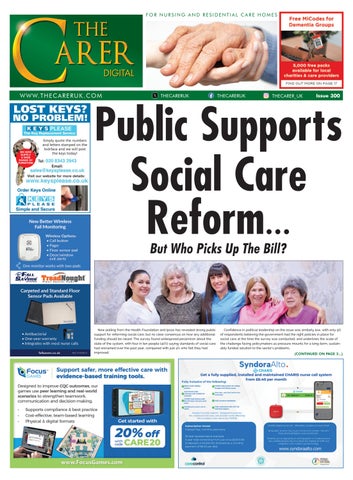
Public Supports Social Care Reform… But Who Picks Up The Bill?
New polling from the Health Foundation and Ipsos has revealed strong public support for reforming social care, but no clear consensus on how any additional funding should be raised. The survey found widespread pessimism about the state of the system, with four in ten people (40%) saying standards of social care had worsened over the past year, compared with just 4% who felt they had improved.
Confidence in political leadership on the issue was similarly low, with only 9% of respondents believing the government had the right policies in place for social care at the time the survey was conducted, and underlines the scale of the challenge facing policymakers as pressure mounts for a long-term, sustainably funded solution to the sector's problems.
(CONTINUED ON PAGE 3...)
PAGE 2 | ISSUE 300 | THE CARER DIGITAL
EDITOR'S VIEWPOINT
Welcome to the latest edition of The Carer Digital! REFORM, PROFIT, AND THE COST OF LOOKING AWAY It will surprise absolutely no-one in this sector that the public now backs social care reform. Indeed, the social care sector itself has been calling for Editor meaningful reform for years. Providers, carers, families and representative organisations have repeatedly warned that the current system is unsustainable and that, without fundamental change, the consequences will be felt not only by those receiving care but by the NHS, local authorities, families and taxpayers. At THE CARER, we have been longstanding supporters of Providers Unite, and I have personally attended both of their demonstrations – in London and Liverpool. Their message has been consistent: the sector needs urgent government action and sustainable funding before the system reaches breaking point. So, calls for reform are certainly nothing new. What's more troubling — though, again, not remotely surprising to anyone who has spent time in this sector — is the finding that there is "no clear consensus (with the public) on how any additional funding should be raised." The Local Government Association has it right: the British public's reluctance to face up to the cost of social care is a tangle of misconceptions, denial, and political weakness. Social care already swallows a vast share of council budgets and represents a catastrophic financial risk to individuals who wrongly assume, as almost 40% still do, that it's free at the point of use. And yet the country remains almost entirely unprepared for that reality. I wish Baroness Casey every success as she opens her Big Conversation. But the time for gently sounding out public opinion is over. The public needs to be told, plainly, that we will all have to dig deeper — and told why. I'll tread carefully here, because I know it's a minefield, but I want to say it anyway: the survey found that just 5% of the public think care providers should be private, for-profit companies. I see no reason whatsoever why a provider should not be entitled to make a
Peter Adams
PUBLISHED BY RBC Publishing Ltd
profit. There, I've said it! I sincerely hope Andy Burnham does not allow the question of provider owner-
3 Carlton Mount
ship to become the centrepiece of his reform agenda. Private providers put serious
2 Cranborne Road
capital on the line to build homes and develop services, and profit is a legitimate
Bournemouth
return on that risk. It's also worth remembering — as research into care systems
Dorset BH2 5BR
elsewhere makes clear — that many governments rely on the private sector precisely because the state doesn't have the capacity or infrastructure to run care ser-
TELEPHONE:
vices itself.
01202 552333
Any criticism of providers for turning a profit is to my mind unfair and unjustified and does nothing to fix the underlying funding gap; it just makes investment harder
EMAIL:
to attract at the moment we need more of it, not less.
sales@thecareruk.com
On a more encouraging note: more than 350,000 votes cast and over 6,000 proposals submitted since the Big Conversation launched on 29 July is a genuinely
WEBSITE:
heartening sign of public engagement.
www.thecareruk.com
If there was ever a moment for the public to properly grapple with the costs and trade-offs this sector lives with every day, this is it. I'd urge every reader, every
EDITOR
provider, every carer, to make sure their voice is part of that number.
Peter Adams
A second story caught my eye this week, and it deserves attention alongside the funding debate: new research from the Alzheimer's Society found that nearly half of people affected by dementia waited more than six months for a diagnosis after first seeking help — with real, damaging consequences for their jobs, their finances and their family life. This one is personal for me. My mother suffered an aggressive form of earlyonset Alzheimer's in her early sixties, and I remember all too well the wait, the heartache, and the disruption it caused our family. I hear the same story time and again from carers who stop to talk to me at trade events — the barriers they face are simply unacceptable.
editor@thecareruk.com
SALES DIRECTOR David Bartlett dave@thecareruk.com
PRODUCTION & DESIGN Matthew Noades
So I have no hesitation in fully endorsing the Alzheimer's Society's call for a nationally recognised standard: diagnosis, a care plan, and access to treatment
Published by
within 18 weeks of a GP referral, in line with every other major health condition. Dementia doesn't wait. Neither should we. I would also encourage our readers to sign up for our bi-weekly digital newsletter at www.thecareruk.com and follow us on social media for all the latest news. I can always be contacted at editor@thecareruk.com
The Carer is published by RBC Publishing Ltd, 3 Carlton Mount, 2 Cranborne Road, Bournemouth, Dorset BH2 5BR. Contributions are welcome for consideration, however, no responsibility will be accepted for loss or damage. Views expressed within this publication are not necessarily those of the publisher or the editorial team. Whilst every care is taken when compiling this publication to ensure accuracy, the publisher will assume no responsibility for any effects, errors or omissions therefrom. All rights reserved, reproduction is forbidden unless written permission is obtained. All material is assumed copyright free unless otherwise advised.
Manufactured in the UK
Freephone: 0800 917 7943 www.euroservice-uk.com sales@euroservice-uk.com
PROVIDING PRACTICAL AND STYLISH TROLLEYS TO SUIT YOUR NEEDS Watch your resident's eyes light up when the beautiful tea trolley arrives! Euroservice trolleys can also be used as a vending trolley or to sell personal care products to residents. How about a delicious snack/pastry trolley or even a drinks trolley for that afternoon tipple?
Your lovely trolley could do so much for you and your residents! Euroservice trolleys are an attractive and practical alternative to clinical aluminium trolleys given that antibacterial spray can be used freely to sanitise them.
Get in touch with our friendly, experienced sales team
Visit the website at
www.euroservice-uk.com to see the full range.
THE CARER DIGITAL | ISSUE 300 | PAGE 3
Public Supports Social Care Reform But Who Picks Up The Bill? (CONTINUED FROM FRONT COVER) As the Casey Commission begins its ’Big Conversation’ on the future of social care in England, the polling finds misconceptions about the current system. Fewer than half of the public in England (44%) correctly understand that social care is not generally free at the point of need, while 39% incorrectly believe that it is. A third (34%) mistakenly think the NHS provides most social care for older people. These findings reinforce Casey’s view that previous attempts at major reform have failed due to a lack of public understanding and consent.
STATE ROLE Our previous research has shown that an overwhelming majority of the public support a greater role for the state in funding social care, which remains a high priority for increased public spending, behind only the NHS and defence. But the new polling shows views are mixed on how to fund additional investment, underlining the political challenge facing Casey and Burnham as they seek to build the broad political consensus needed to deliver reform. An additional tax earmarked for social care and reducing spending on other public services are the two most popular options from those presented, each supported by 23% of the public. Other options attract lower levels of support, including increasing income tax (16%), inheritance tax (15%) and National Insurance contributions (14%). Around one in five people (18%) do not think the government should increase spending on social care. Views also differ by political affiliation. Support for a dedicated social care tax is higher among Labour voters (32%), but there is less support among those voting Green (18%) and Reform UK (20%), with Conservative voters (25%) aligned with the public overall. Conservative voters are more likely to favour reducing spending on other public services to fund social care (30%), with Green (22%) and Reform UK (26%) voters more aligned with the overall public view. Labour voters show less support for this option (13%).
SUBSIDISE PROFITS With Andy Burnham having raised concerns about taxpayers’ money being used to subsidise the profits of private providers, the survey also found that just 5% of the public think care providers should be private, forprofit companies. While there is a clear preference for social care to be provided by non-profit or stateowned organisations, 85% of care homes in England are currently run for profit, underlining the scale of change that would be needed to reverse this and the important role of the ‘Big Conversation’ in discussing trade-offs with the public. In contrast to social care, public perceptions of the NHS have continued to improve, with pessimism at its lowest level (34%) since our polling series began in 2021. However, confidence remains fragile and the public continues to prioritise improving A&E waiting times (36%) and easier access to GP appointments (35%) over improving waiting times for routine hospital treatment (28%), the government’s top priority under Sir Keir Starmer.
DEEPLY CONCERNED Lucinda Allen, Senior Policy Fellow at the Health Foundation, said, “Our findings suggest there is a significant gap between the social care system people want and the one that exists today. People remain deeply concerned about the quality of care, and many continue to misunderstand how the current system works. “With care mainly provided by for-profit companies, the fact that only 5% of the public think this is how
most care providers should be owned is striking. Attempting to reverse this would be expensive, time consuming and cause major upheaval in the sector, so needs to be carefully weighed against other priorities for improving care or alternatives like stronger regulation of providers. “With many people going without the care they need and strain on the system high, Andy Burnham rightly wants to move quickly with reforming social care. The Casey Commission’s Big Conversation provides an important opportunity to build public understanding of the current system and explore the trade-offs involved in reforming it. Meaningful social care reform will require state investment, but the cost of inaction for people who need care and their families is substantial, so the Prime Minister is right to put his political capital behind it.”
UNFINISHED BUSINESS The polling lands just as MPs return to Parliament after the summer break, and Age UK has used the moment to urge politicians of all parties to get behind the Casey Commission — describing the coming twelve months as "absolutely crucial" for the future of social care. The charity points out that Andy Burnham first proposed reforming social care back in 2009, when he was Secretary of State for Health. In the 17 years since, Age UK says, the country has seen a marked decline in social care support for older people, even as demand has surged from an ageing population and growing numbers of disabled people. Looking back further still, since New Labour came to power in 1997 there have been an estimated 25 social care commissions, select committee inquiries and white papers — meaning the Casey Commission is by Age UK's count the 26th attempt to grapple with the issue. Baroness Casey herself has acknowledged that none of that previous activity translated into sustained change, because the political backing needed to make it happen was never there.
STARK WARNING Age UK sets out the toll of that inaction starkly: • Since 2014/15, more than 7 million requests from older people to a council for social care have resulted in no services being provided. • Over the same period, almost 250,000 older people have died waiting for care that never arrived in time. • Since 2009, the population aged 65 and over has grown from 8.4 million to 11 million — a rise of 34%. One thing that hasn't kept pace with any of this said AgeUK is the means-test threshold: the amount of assets someone can hold and still qualify for state-funded social care has been frozen in real terms since 2009. Had it risen in line with inflation it would now stand at £37,293; instead it remains at £23,250, screening ever more people out of state help with the cost of care. Between 2017/18 and 2023/24 alone, 41,000 older people exhausted all their savings paying for care. The knock-on effect is being felt across the NHS too — in July 2026 an average of 14,000 patients remained in hospital despite being medically fit for discharge, compared with just 3,500 in August 2010. Caroline Abrahams, Charity Director at Age UK, said Burnham was right to identify the need for reform in 2009 — and is "even more right today," given how much worse the situation for older people has become in the years of inaction since. She said Age UK will be working with older people over the next twelve months to hold every MP in England to account for how they approach the prospect of reform, calling it a precious opportunity to "seal the deal" that must not be allowed to slip away again.
PAGE 4 | ISSUE 300 | THE CARER DIGITAL
Why Hearing Loss Should Be A Priority In Care Homes
Article supplied by Care England (www.careengland.org.uk)
There is a familiar picture in many care homes. A resident starts sitting further back from a group activity. At mealtimes they smile and nod, but contribute less. They ask staff to repeat themselves, then eventually stop asking. A hearing aid sits in a drawer because it whistles, the battery has gone flat, or nobody is quite sure how to clean it. None of these things looks dramatic on its own. Put together, they can quietly reduce a person’s ability to take part in daily life. That is why hearing loss deserves more attention. Care England and Engage’s 2025 white paper, Hearing Loss in Care Homes: a Call to Action, estimated that at least 80% of residents in care homes for older people are living with some degree of hearing loss. RNID’s latest population data also shows that almost 80% of people over 70 have hearing loss. For people in their 80’s this rises to 90%. This is an issue affecting the vast majority of residents. In most homes, it is part of everyday care.
HEARING LOSS IS OFTEN HIDDEN Hearing loss does not always present as someone saying “I cannot hear”. A person may become quieter, seem confused, appear not to follow instructions, avoid noisy rooms, turn the television up, or become frustrated when other people “mumble”. For people living with dementia, the picture can be even harder to interpret. A change in communication may be attributed to cognitive decline when hearing has also deteriorated, a hearing aid has stopped working, or earwax is causing a blockage. This matters because the response is different. If staff understand that hearing may be part of the problem, they can check the basics, look at whether communication needs have changed, involve audiology when needed and make small adjustments straight away. Those steps can help avoid long periods where someone is effectively cut off from the people around them.
HEARING AIDS ONLY HELP WHEN THEY ARE WORKING Hearing aids can make a major difference, but they are not “fit and forget”. They need regular cleaning and maintenance. Batteries need changing or devices need charging. Tubing, domes and wax filters can become blocked. Hearing aids can be put in incorrectly, lost or left unused because the resident finds them uncomfortable. RNID advises regular cleaning and servicing, and its guidance for care homes stresses the importance of staff checking that hearing aids are working and knowing when to seek audiology support.
and a working light can all make a difference without turning the home upside down.
THE CONSEQUENCES ARE WIDER THAN HEARING
The practical reality in care homes is that many residents cannot manage all of this independently. The Care England and Engage white paper cites research showing that only around one in five residents were thought able to manage their own hearing aids. More recent research with long-term care staff found that hearing support for residents with dementia was inconsistent, despite staff recognising that it was important.
WHAT THIS CAN LOOK LIKE IN PRACTICE A resident says their hearing aid is “useless” and stops wearing it. Before assuming the device is unsuitable, check whether it is switched on, charged, clean, inserted correctly and free from wax. If the problem persists, record it and contact the resident’s audiology service as soon as possible The environment can either help or make things harder A hearing aid cannot solve a noisy room. For many people with hearing loss, separating speech from background sound is one of the hardest parts of listening. Dining rooms, televisions, music, hard floors and several conversations happening at once can make even a familiar voice difficult to follow. RNID recommends reducing unnecessary background noise and using soft furnishings where possible to absorb sound. Good lighting matters too because many people use facial expressions and lip patterns to support what they hear. A quieter corner, a chair positioned so faces are visible, a television switched off when nobody is watching it
Unsupported hearing loss is associated with social isolation, poorer mental and physical wellbeing, falls and cognitive difficulties. The relationship with dementia needs careful wording. Hearing loss is recognised as a potentially modifiable risk factor, but it does not mean that hearing loss directly causes dementia in every case. RNID notes that the relationship may involve several shared factors and that research is still developing. What is much clearer is that hearing support can make communication easier, help people stay socially connected and reduce the effort involved in everyday conversation. Research in residential care has also found that social isolation is shaped by communication opportunities, not simply by the severity of someone’s hearing loss. In other words, the way staff organise the environment and interact with residents can make the difference between someone being included in conversation and quietly dropping out of it. There is emerging research linking hearing loss with cardiovascular outcomes as well, although this evidence is less settled. It is therefore better to see hearing support as part of a broader approach to maintaining communication, mental and physical wellbeing, independence and safety, rather than as a single intervention that prevents a specific condition.
STAFF NEED CONFIDENCE, NOT ANOTHER COMPLICATED PROCESS The problem is not a lack of care or goodwill. Staff often have to deal with hearing issues in the middle of a busy shift with little formal training. In one UK interview study, care staff described feeling that they were “just winging it” when supporting residents with dementia and hearing loss. The underlying message was not that staff were indifferent. It was that they wanted practical knowledge, clearer responsibilities and better links with audiology. That is the gap this campaign is trying to close. Good hearing support can be built into existing routines. It can sit within pre-admission assessment, care planning, daily checks, handovers, activities and environmental audits. Some homes may also choose to train Hearing Loss Champions who can help colleagues troubleshoot common problems and keep good practice visible.
Former Pilot, 94, Steps Back In Time By Reuniting With Vintage Plane BARBARA Cannon’s memories took flight at a recent visit to Old Warden Aerodrome when she had a special reunion with one of the planes she used to pilot. The intrepid flyer, who now lives at Cambridge Grove Care Home, in Fulbourn, was thrilled to see the 60-year-old Piper Cherokee 180C aeroplane during a visit to the airfield in Shuttleworth. Wellbeing Coach Andrea Murphy had heard that the plane, nicknamed ‘Dear old Whiskey X-ray’ due to its G-ASWX registration, was still flying and would be displayed as part of the historical aircraft collection. So, she arranged a trip to Shuttleworth and invited Barbara, 94, and her daughter Jane to visit and take a trip down memory lane together. Jane said: “It was amazing that Andrea had planned this outing to Shuttleworth with Mum in mind. It was a fabulous day with lots of lovely new memories made.” During her time as a pilot in the 1960s and 70s, Barbara regularly flew out of Stapleford and Hurn air-
ports on the Piper Cherokee. She still keeps a cherished photo of herself with Jane and her son Nigel posing with the plane from the 1960s. Tim, one of the members of the consortium who own the plane, was delighted to facilitate a reunion between Barbara and her former craft, parking the plane near the visitors’ centre so Barbara could go ‘airside’ during her visit. Andrea said: “Tim kindly helped us create a very special moment for Barbara, who was full of smiles when she saw the Piper Cherokee. “She said it was painted slightly differently but still instantly recognisable. It was magical to see her face light up and to help her and Jane create such a moving memory together. “The highlight of Barbara’s day is when planes fly overhead at Cambridge Grove, and she always looks to the sky. “Thanks to Tim and everyone at the Shuttleworth Collection for making this visit such a success.”
Dishwashing Advice for Care Homes What are the biggest challenges in care homes when it comes to dishwashing? Infection control and compliance. But they’re not the only challenges. Winterhalter’s team of warewashing experts has put together a comprehensive advice guide for care home dishwashing. From the five key considerations when specifying a dishwasher through handling chemicals safely to budgeting and running costs, it gives care homes and the companies that supply them the information they need to select the best warewashing solution, whatever the site’s requirements may be. Care Homes: advice on dishwashing is available right now to download from the dedicated Care Home section at tinyurl.com/carehomedishwashing. It shows how to help care home staff get dishwashing right, focusing on areas such as simple operations and training. It considers how to protect the most vulnerable patients, for example by using features like Winterhalter’s Thermo option, which disinfects the ware being washed. Ergonomics, workflows, managing critical hygiene risks, specifying for care homes with limited space – the Guide has it covered. And for care homes on limited budgets, there’s information on finance options.
“Care homes have very specific requirements from their warewashing systems,” says Paul Crowley, marketing development manager at Winterhalter UK. “This guide is designed to give users and specifiers the information they need to ensure they are operating as safely, efficiently and hygienically as possible.” The guide is available as a free downloads from the Winterhalter UK website. Anyone interested in advice for other particular sectors can contact info@winterhalter.co.uk. Winterhalter provides a total solution for dishwashing and glasswashing, from pre-sales advice to after-sales service, training and maintenance, with sustainability fitted as standard. Alongside its market-leading dish washers and glass washers, the company’s range includes utensil washers, advanced water treatment machines, and cleaning detergents and rinse aids. For further details, call Winterhalter on 01908 359000, visit www.winterhalter.com/uk-en/ or email info@winterhalter.co.uk.
THE CARER DIGITAL | ISSUE 300 | PAGE 5
Care Sector Urged To Act As 350,000 Votes Cast In Casey Commission’s Big Conversation On Care
Care providers and staff across the UK are being encouraged to get involved in the Casey Commission’s Big Conversation on Care, with organisers reporting that more than 350,000 votes and over 6,000 proposals have already been submitted since the initiative launched on 29 July. The Big Conversation, launched by the Independent Commission on Adult Social Care chaired by Baroness Casey, is inviting people across England to answer a central question: when we are old or disabled, or have a serious illness, who should support us and how? The online platform, delivered in partnership with Make.org, allows members of the public to submit their own proposals beginning “we should…”, as well as vote on ideas put forward by others by indicating whether they agree, disagree or are neutral. The Commission says this approach is helping to build a clearer picture of where there is common ground — and where opinions differ — on the future shape of adult social care. According to the Commission’s latest newsletter, published on 28 August, the online exercise forms just one strand of a wider engagement programme. This includes targeted work to hear from people who draw on care and support, unpaid carers, the social care workforce, and communities whose voices are not traditionally well represented in policy discussions. Findings from the online platform will also feed into the Public Panel on Care, a representative group drawn from across England that will meet over several months to examine the issues in greater depth, hear evidence and explore areas of consensus on reforming the system.
KEY DATES FOR THE SECTOR The Commission has set out a clear timetable for the first phase of the initiative:
• 9 September 2026 — deadline for submitting new proposals, after which the platform moves into a vote-only phase • 23 September 2026 — the first online phase of the Big Conversation closes The Commission says this will allow it to carry the evidence gathered into its first round of deliberation with the Public Panel on Care. The online platform is then expected to reopen in the new year, offering a further opportunity for public participation as the Commission’s work continues. Call for care organisations to help spread the word The Commission has thanked the organisations that have already helped promote the initiative through their networks, and is now appealing for wider support in reaching people who may not yet be aware of the consultation — a call that will resonate with care homes and nursing providers well placed to engage residents, families and staff. Care organisations wishing to support the campaign can request a communications pack — including materials suitable for newsletters, websites and social media — by emailing enquiries@caseycommission.co.uk.
CHAIR TO TAKE CAMPAIGN ON THE ROAD Baroness Casey is expected to spend the coming weeks travelling the country to promote the Big Conversation, alongside appearances on television and radio, as part of an effort to extend the debate on social care reform beyond Westminster and engage people who may never previously have considered the issue. The Commission has described the current online phase as the first of two rounds of major public engagement, with further opportunities to contribute expected once the Public Panel on Care has completed its initial deliberations. Care providers and staff wishing to take part, or to register for updates from the Commission, can do so via the Big Conversation on Care website at www.caseycommission.co.uk/bigconversation
Mill Court Resident Celebrates Incredible 100th Birthday Celebrations have been in full swing at Mill Court Care Home as one of its residents reaches her centenary in style. She was joined by staff, relatives, friends and other residents as she received a telegram from the King in recognition of her landmark birthday. A champagne reception was held at the home and guests enjoyed a special birthday cake made by the home’s chef. Th birthday girl said: I feel very lucky to have reached 100. I’ve had a wonderful life and my secret is to keep smiling and never take a good day for granted!
The special occasion was a wonderful opportunity for everyone at Mill Court Care Home to celebrate not only, a remarkable birthday, but also the memories and experiences of someone who has seen a century of change. Nicola Woods, General Manager of Barchester Mill Court added: “We’re delighted to be celebrating a truly remarkable woman as she reaches this amazing milestone. She is such a popular resident who always has an interesting tale to tell, and we look forward to hearing many more as she breaks into her next century.”
PAGE 6 | ISSUE 300 | THE CARER DIGITAL
The Eight Pieces Of Paper Behind Every New Starter By David Bevan, founder of HoursBack, AI workflow assessments (www.hoursback.co.uk) Ask a care home manager what slows hiring down and the answer is rarely the interview. It is everything that has to happen after somebody says yes, and before that person can be left alone with a resident. Some of that wait is unavoidable and entirely proper. Some of it is a filing problem wearing a compliance costume, and it is worth knowing which is which before deciding that a system will fix it.
ing through a pile at half past five. It is producing a list of questions, not answers. The third is the induction pack. The same documents, reissued for each starter with names and dates changed, is a template problem, and templates are exactly where this technology earns its keep quietly and without drama.
WHAT THE REGULATIONS ACTUALLY ASK FOR Schedule 3 of the Health and Social Care Act 2008 (Regulated Activities) Regulations 2014 sets out what a provider must hold for every person employed in a regulated activity. It is a longer list than most people carry in their heads. Proof of identity with a recent photograph. A criminal record certificate, with barring information where it applies. Evidence of conduct in any previous employment in health or social care, or with children or vulnerable adults. Verification of why any such previous employment ended. Documentary evidence of relevant qualifications. A full employment history, with a written explanation of any gaps in it. And information about physical and mental health relevant to the duties, once reasonable adjustments are taken into account. That is eight separate evidence trails for one new starter. In a sector where people move on more often than most, it is eight trails several times a year, chased by somebody who also has a home to run.
THE COST IS THE CHASING, NOT THE CHECKING Ask where the hours go inside that and the answer is consistent. Reading a certificate takes a minute. Getting hold of it does not. A reference request goes out and nothing comes back. A second goes out. Somebody rings the previous employer, who has restructured, and the person who would have known has left. An employment history arrives with a nine-month gap in 2023 and needs a conversation
WHERE IT HAS TO STOP, AND THE REASON IS ONE WORD
to explain. Meanwhile the start date has been agreed with a candidate who is being courted by two other homes, and every week of silence is a week they might take one of the other offers. None of that is difficult work. All of it is repetitive, and it is invisible in exactly the way that matters, because a chased reference leaves no record of having been chased.
WHAT A MACHINE GENUINELY SHORTENS Three jobs stand out, and they are all writing rather than deciding. The first is the correspondence itself. Reference requests, follow-ups and the polite third chase are near-identical every time, and drafting them at volume is the sort of work worth handing over. So is keeping the running tally of who has replied and who has not, which is usually the bit that falls apart on a busy week. The second is first-pass reading. Give a system an employment history and it will flag the gaps to ask about far faster than a person work-
Read Schedule 3 closely and one word does most of the work. The evidence of conduct must be satisfactory. The documentary evidence of qualifications must be satisfactory. The explanation of a gap in employment must be a satisfactory written explanation. Satisfactory is not a status a system can set. It is a judgement about a particular person doing a particular job in a particular home, and it is the judgement an inspector will ask about if something later goes wrong. A reference can arrive, be logged, and still not be satisfactory. Only somebody who understands the role can decide that, and only a registered person can carry the consequence of deciding it badly. So the honest division is this. Gathering the evidence is administration and can be handed over. Deciding whether the evidence is good enough is not administration at all, however much it looks like ticking a box on a screen.
THE PRACTICAL ORDER Start by counting, over a fortnight, how many times somebody chases a document that has already been requested. It is a dull exercise and it usually produces an uncomfortable number. Then hand over the drafting and the tracking, and leave every judgement exactly where the regulations put it. The recruitment will get faster. The decisions will not get easier, and they should not.
101 Year Old Care Home Resident Praises Edinburgh Fringe Initiative A 101-year-old Edinburgh resident has praised an initiative that brings Fringe performers into Scottish care homes. Delia Keir was 22 when she attended the very first Edinburgh International Festival way back in 1947. Now living at Renaissance Care’s Glencairn Home in the city’s Grange area, Delia was thrilled when performers dropped in last week as part of Fringe Care Fest, an annual initiative organised by the Edinburgh Interfaith Association (EIFA). Residents were treated to performances by Pitchblenders, a swing/jazz trio from Edinburgh and Hoop Babes, an awardwinning, high-energy female circus duo from Wollongong, Australia. “It was great, it was fun and I really enjoyed it,” said Delia. The Edinburgh International Festival was created after World War II to reunite and heal Europe through culture, but it had a strict, invitation-only programme. Refusing to be left out of the inaugural event in 1947, eight uninvited theatre groups staged their own shows on the “fringe” of the main event using alternative spaces such as church halls and pubs. The performances gave birth to the Edinburgh Festival Fringe.
“My first experience of the festival was way back in 1947, when I went with my boyfriend, David, and his family, a year before we got married,” said Delia. “One of the unauthorised performances we went to was a comedy show, it was great fun and a great start to the theatrical movement!” Delia said she hasn’t been able to attend the Fringe for many years, but in her younger years went regularly. “It was always a good atmosphere and it brought so many people from all over the world,” she added. Fringe Care Fest was created in August 2022 by Professor Joe Goldblatt, former chair and now ambassador of EIFA, after a close friend living with dementia was too frail to attend the festival in person. Starting with one home, the programme has expanded and this year included 21 care homes across Edinburgh, the Scottish Borders, East Lothian and Dunblane. “One of our care home residents told me that when she entered care she felt as if a door to her life closed,” said Professor Goldblatt. “However, the Fringe Care Fest opened the door again so that her life could go on!”
Statins Can Reduce Risk of Dementia By Up To 15%, Long-Term Study Reveals Early initiation of statins after diagnosis of type 2 diabetes was associated with a lower risk of dementia, according to a study presented at ESC Congress 2026 and published in The Lancet Regional Health – Europe. The burden of dementia is projected to rise with the ageing population. With no effective treatments, prevention is an urgent priority. According to the Lancet Commission, nearly half of cases of dementia could be theoretically prevented by eliminating 14 risk factors.[2] “Detecting and treating high levels of low-density lipoprotein cholesterol (LDL-C) from midlife is one such highlighted risk factor,” explained presenter, Doctor Tummas Ternhamar from Copenhagen University Hospital, Denmark. He noted that this could be particularly important in patients with type 2 diabetes since elevated LDL-C occurs frequently in these individuals and diabetes is a highlighted risk factor for cognitive decline and dementia. “We hypothesised that early initiation of LDL-C-lowering statins following type 2 diabetes diagnosis could be associated with a lower risk of dementia,” said Doctor Ternhamar. “And we tested this in a large nationwide study using analysis methods to emulate a randomised trial and reduce some of the bias associated with observational studies,” he noted. From Danish registers, 132,585 statin-naïve individuals were identified who developed type 2 diabetes from 2006 through to 2019, with follow-up until the end of 2021. Medical records were searched for diagnoses of all-cause dementia. A clone-censor-weight design was used to analyse dementia incidence in patients with no statin initiated within five years after diagnosis, in those with early statin initiation within one
year and in those with late statin initiation between one and five years after diagnosis. During a median follow-up of 7.1 years, 2.7% of patients developed dementia. Compared with no statin initiation, early statin treatment was associated with a 15% lower relative risk of dementia over 10 years. Late statin initiation was associated with a 10% lower relative risk of dementia over 10 years. The results were similar in women and men. Doctor Ternhamar concluded: “In individuals developing type 2 diabetes, statins were associated with a lower risk of dementia, most pronounced in those with early initiation. Statins seem to be underused in patients with type 2 diabetes, despite their protective effects against cardiovascular disease. Our findings suggest another potentially important reason to ensure that patients with type 2 diabetes and high LDL-C receive timely statin treatment.” Commenting on the findings, Professor Isabel Goncalves, Member of the ESC Communication Committee, said: “People with type 2 diabetes already have a higher risk of dementia and are advised to lower cholesterol to reduce their risk of heart attack and stroke. This study suggests that starting statins soon after a type 2 diabetes diagnosis may also be linked to a modest reduction in dementia risk, with greater benefit than delaying treatment. Because statins are widely available and inexpensive, the findings are potentially important. However, this was an observational study, so it cannot prove that statins prevent dementia. The results should therefore support further research and help inform discussions between patients and clinicians.”
THE CARER DIGITAL | ISSUE 300 | PAGE 7
15 Years of Frozen Thresholds Can Set Some Care Users Back £12,400, New Analysis Finds A social care support threshold freeze since 2010/11 means that some people must spend an additional £12,400 of their own money before qualifying for state support, according to new analysis from The King’s Fund. Unlike healthcare, social care is means tested and only people with assets and savings below £23,250 qualify for state-funded support when they need it. But this figure has been frozen since 2010/11 – if it had been uprated in line with inflation, it would have been over £35,600 in 2026/27, finds the analysis. The King’s Fund is calling for this ‘stealth tax’ to be addressed as part of the major reform of the social care system in England promised by the Prime Minister, Andy Burnham, who has brought forward Baroness Casey’s independent review by a year, to report in 2027. The King’s Fund says it demonstrates the need for reform to tackle the problems faced by around 220,000 ‘self-funders’ in England who must pay all their own social care costs, which can run into hundreds of thousands of pounds. As well as the ‘stealth tax’ The King’s Fund’s analysis found that ‘self-funders’ have been subject to further injustices created by the system. People who pay for their own care face much higher fees than those funded by the local authority. Social care providers often raise charges for self funders to make up for lower rates paid for care by councils. The Competition and Markets Authority in 2017 found a 41% difference between self-funder rates and local authority rates and there is nothing to suggest that this gap has been
addressed. This means self funders not only keep less of their savings but also see them disappear more quickly because they are charged significantly more than people receiving state support. An immediate option to improve the social care system available to the Prime Minister would be to revise this threshold and bring it in line with inflation, The King’s Fund said. In fact, it has urged Andy Burnham to go much further and press ahead with a fundamental overhaul of the social care system, one that addressed the fundamental issues of access, catastrophic cost, quality, workforce variation, market failures and integration. Simon Bottery, Senior Fellow for Social Care at The King’s Fund, said: ‘The 15-year freeze to the thresholds is just one symptom of an unfair social care system resulting from reform being put off for decades. Governments have talked about change and even legislated for it but have not had the courage to implement it. ‘We welcome the new Prime Minister’s aim to buck this decades long trend. His words and actions have shown a renewed drive from the centre to force reform through, something that had been sorely lacking, and has put this issue near the top of the political agenda. ‘Wholesale reform is now needed. Currently, the system leads to a loss of dignity and independence for those in need of care. It also creates stress and anxiety for loved ones supporting people in need and worries about catastrophic care costs, whilst piling pressure on an already creaking NHS.’
New Nursing Workforce Report Launched Scottish Care has launched its Nursing Workforce Survey 2026 Briefing Report at the Scottish Care Nursing Conference. The report provides insight into the current realities facing social care nursing across Scotland and highlights both the strengths of the workforce and the challenges affecting its future sustainability. The central message emerging from the report is clear: Social care nursing remains one of the sector’s greatest strengths. However, persistent recruitment difficulties, increasing complexity of care, workforce pressures and growing administrative demands continue to place significant strain on the sustainability of the nursing workforce. Drawing on responses from providers operating nursing services across Scotland, the report demonstrates the critical role social care nurses play in supporting people with increasingly complex needs, providing clinical leadership and helping services deliver high-quality care within communities. One of the strongest findings was the scale of change in care complexity. Almost all respondents
H.W. PICKRELL NEW & USED ACCESSIBLE TRANSPORT AT AFFORDABLE PRICES • We specialise in the sale and purchase of quality used wheelchair accessible vehicles and ambulances. • They can be bought as seen or refurbished and sign-written to your own requirements. • Fully serviced, new mot & warranty • Engineers inspection supplied if required.
• Free delivery service available • All buses comply with new legislation • Lease hire and purchase available • Always large stock of accessible vehicles
Tel: 01268 521033 Mobile: 07860 894331 Email: sales@hwpickrell.co.uk Gardiners Lane North, Crays Hills, Billericay, Essex CM11 2XE All current stock available to view at www.hwpickrell.co.uk
reported increasing acuity and complexity over the previous 12 months, reflecting wider changes across health and social care and increasing expectations on community-based services. Professor Donald Macaskill, Chief Executive of Scottish Care, said: “The findings highlight a workforce that remains deeply committed to the people it supports. Social care nurses continue to provide leadership, expertise and reassurance in some of the most complex care environments across Scotland. “Yet the report also shows that the pressures on that workforce are growing. Increasing complexity, workforce shortages, stress, administrative burden and recruitment difficulties are creating cumulative challenges that cannot be ignored. “As Scotland continues to pursue ambitions around prevention and care closer to home, it is essential that social care nursing is recognised as a key part of delivering those ambitions. Investment in community-based care must include investment in the nurses who make that care possible.”
PAGE 8 | ISSUE 300 | THE CARER DIGITAL
Pressure Injuries in Care Homes: When Good Care Comes Under Scrutiny By Scott Harding-Lister, Consultant Solicitor (www.hardinglisterlaw.com) Pressure injuries can cause devastating harm and expose care providers to complaints, safeguarding enquiries, regulatory scrutiny, reputational damage and civil claims. Scott Harding-Lister explains why the existence of a pressure ulcer is not itself proof of negligence, and what matters when care is later questioned. Pressure injuries are an uncomfortable subject for care providers. When a resident develops significant pressure damage, particularly a serious ulcer, there is often an immediate assumption that somebody must have done something wrong. That is not the legal test and, importantly, it is not always a fair reflection of the clinical reality. Care homes look after an increasingly frail population. Residents may have restricted mobility, dementia, poor nutritional intake, vascular disease, diabetes, incontinence or several significant illnesses at the same time. Some will be acutely unwell. Others may be approaching the end of life. In those circumstances, pressure damage can develop despite conscientious and appropriate care. That is not to suggest that every pressure injury is unavoidable. Some undoubtedly arise because aspects of care have fallen below the required standard. The difficulty, particularly when a complaint or claim is made months or even years later, is distinguishing an adverse clinical outcome from negligent care. I come to these cases from a somewhat unusual perspective. I have worked in care homes and understand first-hand the practical realities of looking after frail and vulnerable residents. As a solicitor, I have pursued pressure-injury claims on behalf of residents and their families, and I have also defended care providers facing allegations of negligent care. I have additionally acted as an expert witness in matters concerning pressure injury and negligence. Seeing these cases from different sides has reinforced one point above all others: they are rarely as straightforward as they first appear. For a family confronted with a serious wound, the immediate and understandable reaction may be that their relative has been neglected. For the provider, the clinical picture may look very different. Neither perspective should simply be dismissed. The task is to establish what actually happened.
CARE PROVIDERS ARE PARTICULARLY EXPOSED In my experience, pressure injuries present a particular risk to care providers because deterioration can occur over relatively short periods in a susceptible resident. Where somebody is immobile, poorly nourished, systemically unwell or otherwise highly vulnerable, omissions in necessary preventative care over a comparatively limited period can become clinically significant. A problem may therefore develop or deteriorate before senior management has fully appreciated its seriousness. The consequences can extend well beyond the wound itself. Pressure ulcers can be extremely painful, become infected, interfere with mobility and rehabilitation and, in serious cases, have devastating consequences for somebody who may already be very frail. There is also the effect on the family. Seeing a significant pressure wound on a parent, spouse or other relative can be deeply distressing. Families understandably want to know how it happened and whether it could have been prevented. The matter may then develop into a formal complaint, a safeguarding enquiry, regulatory scrutiny or civil litigation. There is another uncomfortable reality for providers: pressure injuries look bad. Fairly or unfairly, they have become something of a barometer of the perceived quality of care. If a vulnerable resident develops a serious pressure sore, people may immediately assume that the resident was left in one position for too long or that basic care was not provided. Sometimes that conclusion will be justified. Sometimes it will be wrong. The difficulty for the provider is that reputational damage can begin long before anybody has undertaken the detailed clinical and legal analysis necessary to distinguish between the two.
THE REPUTATIONAL CONSEQUENCES SHOULD NOT BE UNDERESTIMATED A pressure-injury case is not simply a potential damages claim. Care providers depend upon families having confidence in them, and few allegations undermine that confidence more quickly than the suggestion that a vulnerable resident developed severe pressure damage because basic care was neglected. The implications can extend beyond the individual resident. Safeguarding teams may become involved. Commissioners or local authorities may seek information. Regulators may ask questions. Management time can be consumed by investigations, meetings and complaints. Staff can find the process upsetting, particularly where they believe they provided good care but are faced with serious allegations made with the benefit of hindsight. There may also be a considerable financial cost. In addition to any damages and legal costs arising from a civil claim, the provider may incur expert fees, investigation costs and substantial management time. The wider commercial impact of damage to a home's reputation may be much harder to quantify. That is why these cases need to be taken seriously from the outset.
A PRESSURE INJURY IS AN OUTCOME, NOT A LEGAL CONCLUSION The starting point remains important: the existence of a pressure ulcer does not, by itself, establish negligence. A claimant alleging negligence must ordinarily establish that the care fell below the appropriate standard and that the breach caused or materially contributed to the injury for which compensation is sought. Those are separate questions. That distinction can be particularly important where the resident was already exceptionally vulnerable, where pressure damage was present on admission, where there was significant vascular compromise or systemic illness, or where deterioration occurred towards the end of life. Providers should avoid two equally unhelpful reactions. The first is to assume immediately that the development of a pressure ulcer means somebody within the home must have been negligent. The second is to become defensive and assume that, because the resident was frail, the
injury must have been unavoidable. Neither approach assists. The proper starting point is the evidence. What was the resident's clinical condition? What risks were known? What care was planned? Was it delivered? Did circumstances change? If so, did the care change with them? And if there was a failing, did it actually make a difference to the outcome?
RISK ASSESSMENT IS ONLY THE BEGINNING Most providers will be familiar with pressure-ulcer risk assessment tools. They have an important role, but there is a danger in treating completion of the form as the end of the exercise. It is not. A resident assessed at one level of risk on admission may be considerably more vulnerable a week or two later. They may stop eating, develop an infection, become bedbound, lose weight or experience a sudden deterioration in mobility. The important question is whether the care being provided moved with the resident. When a claim is investigated later, a risk score viewed in isolation may tell us relatively little. Records showing that staff recognised a change, reconsidered the care plan and took sensible action are far more persuasive. The converse is also true. A risk assessment identifying somebody as being at significant risk can become damaging evidence if the records do not demonstrate that anything meaningful followed from it.
REPOSITIONING RECORDS DESERVE PARTICULAR ATTENTION Repositioning charts feature heavily in pressure-injury litigation. Where a care plan requires regular repositioning, unexplained gaps will inevitably attract attention. That does not mean that every gap proves the resident was not moved. A gap in the documentation and a gap in the care are not necessarily the same thing. The difficulty is proving the distinction afterwards. A member of staff may know perfectly well at the time that a resident was repositioned but fail to complete the chart, complete it late or make an error. Several years later, when a claim has been intimated, that person may have no independent recollection of that particular shift. Everyone is then left with the contemporaneous records. There may also be legitimate reasons why a planned repositioning regime was not followed on a particular occasion. A resident with capacity may refuse. Movement may be painful or distressing. During end-of-life care, the balance between pressure prevention and comfort may properly change. Those circumstances do not necessarily amount to poor care, but the reason for the departure should be recorded. An unexplained blank on a chart creates a very different evidential picture from a contemporaneous entry explaining why the resident was not moved and what alternative steps were considered or taken.
EQUIPMENT CAN CREATE ITS OWN EVIDENTIAL PROBLEMS It is common in pressure-injury cases to see an entry stating that a pressure-relieving mattress, cushion or other equipment was 'ordered'. That may only be the beginning of the enquiry. When was it ordered? When was it delivered? Was the correct equipment supplied? Was it suitable for that particular resident? Was it correctly installed and used? If there was a delay, what interim precautions were taken? These may appear to be mundane operational questions during day-to-day care. In litigation, they can become extremely important. A provider is generally in a much stronger position where the records demonstrate not simply that somebody identified the need for equipment, but that the issue was followed through until it was resolved. What happened when the skin began to deteriorate? This is often one of the most important parts of the case. The appearance of early pressure damage does not necessarily mean that negligent care has already occurred. Once deterioration is identified, however, the provider's response becomes crucial. Was the resident reassessed? Was the wound properly described and monitored? Was appropriate clinical advice obtained? Were the GP, district nursing service or tissue-viability team involved where necessary? Were nutrition and hydration considered? Was the resident becoming less mobile or generally more unwell? Did the care plan actually change? Pressure damage should never be viewed completely in isolation from the person who has developed it. A frail resident who has developed an infection, stopped eating and become almost completely immobile presents a very different clinical picture from the person described in an admission assessment several months earlier. That sounds obvious. Unfortunately, the records do not always tell that evolving story particularly well.
PRESSURE INJURIES AND SAFEGUARDING Significant pressure damage may also raise safeguarding concerns. It is important to be precise about this. A pressure ulcer does not automatically mean that abuse or neglect has occurred, nor does every pressure injury require the same safeguarding response. The circumstances need to be considered. Where there is concern that pressure damage may have resulted from omissions in care, however, safeguarding issues may plainly arise. What began as a clinical incident can then become substantially more complicated. The resident's family may be involved. The local authority safeguarding team may seek information. Community healthcare professionals may have their own records and views. Commissioners and regulators may also become interested. The provider may simultaneously be dealing with an internal investigation, a complaint and the prospect of a civil claim. Those processes should not be confused with one another. A safeguarding enquiry is not a negligence trial. A regulatory concern does not automatically establish civil liability. Equally, the absence of a safeguarding finding does not necessarily determine the outcome of a subsequent negligence claim. Nevertheless, information recorded and decisions made during those early investigations may later become important evidence. Providers should therefore approach safeguarding investigations carefully and candidly while ensuring that the different clinical, regulatory and legal issues are properly understood.
RECORDS SHOULD BE ACCURATE, NOT IMMACULATE When a serious incident occurs, there can be an understandable temptation to tidy things up. That is almost always a mistake. Care records do not have to create an impression that everything went perfectly. Real care is not perfect. Residents refuse treatment. Equipment is delayed. People deteriorate unexpectedly. Staff have to make difficult judgement calls and plans sometimes have to change. An honest contemporaneous record showing that something difficult happened and explaining how staff responded can be extremely valuable.
What creates much greater difficulty is a document which appears to have been reconstructed after the event or which cannot be reconciled with other contemporaneous records. If a genuine late entry needs to be made, it should be clearly identifiable as such. The record should make clear when it was written and the information upon which it is based. An accurate record of an imperfect situation is usually far easier to defend than a perfect record which does not survive scrutiny.
A FAILING DOES NOT AUTOMATICALLY ESTABLISH THE CLAIM This is one of the most important distinctions in pressure-injury litigation. Suppose that a repositioning episode was missed. Even if that omission amounted to a breach of duty, there remains another question: did it cause or materially contribute to the pressure injury? The same analysis may apply to a delay in obtaining equipment, seeking specialist advice or updating a care plan. Sometimes the answer will be relatively clear. In other cases it will not. Where the resident was already exceptionally frail, had serious underlying illness, vascular compromise or was deteriorating generally, careful expert evidence may be required to determine what difference the alleged failing actually made. There can be a tendency, once an investigation identifies something which could have been done better, to move immediately from that finding to a conclusion that the provider is liable. Those are not the same proposition. A proper defence requires breach of duty and causation to be considered separately.
DO NOT ALLOW THE CASE TO RUN AWAY FROM YOU This is perhaps the most practical advice I can give a provider faced with a significant pressure-injury allegation. These cases can become complicated remarkably quickly. There may be hundreds or thousands of pages of care and medical records. Responsibility for different aspects of the resident's care may have been divided between the care home, district nurses, the GP, hospital clinicians and tissue-viability services. Allegations may concern repositioning, equipment, nutrition, wound assessment, documentation and escalation, all against the background of significant underlying disease. At the same time, the provider may be responding to the family, safeguarding enquiries, regulatory requirements and its insurer. It is easy for the sheer volume of criticism to overwhelm the central issues. Having worked in care homes myself, I understand the realities of delivering care on the ground. Having acted for claimants, I have seen cases in which apparently modest omissions in care have had serious consequences and understand how those omissions are scrutinised when a claim is pursued. I have also defended pressure-injury cases and understand the very different task of testing allegations against the records, the clinical evidence and the requirements of causation. My experience as an expert witness in pressure-injury and negligence matters has provided another perspective again. Taken together, those different roles have taught me the importance of identifying the true issues early. What was the resident's actual risk? What care was reasonably required? What care was delivered? When did deterioration occur? What happened next? Where does the evidence genuinely expose the provider, and where does it support the provider? Critically, did any alleged failing actually cause the injury for which compensation is being sought? Getting to those issues quickly can fundamentally change the way a case is managed. It may reveal that the provider has a strong defence. It may identify one discrete aspect of care which should sensibly be admitted while other allegations are resisted. It may demonstrate that independent expert evidence is required. Alternatively, it may show that an early commercial resolution is preferable to allowing management time, legal costs and expert fees to escalate. EARLY SPECIALIST ADVICE CAN PROTECT BOTH THE LEGAL AND REPUTATIONAL POSITION Pressure-injury litigation sits at an unusual intersection of clinical evidence, care records, safeguarding, regulation and conventional negligence principles. Dealing with one aspect without understanding the others can lead to poor decisions. A solicitor experienced in this field should be able to identify genuine weaknesses without becoming unnecessarily defensive, but should equally be prepared to challenge allegations which are not supported by the evidence. Early involvement also helps to preserve relevant records, identify other organisations whose evidence may be important, consider insurer notification and keep separate processes such as safeguarding, regulatory investigation and civil litigation in their proper context. Where something genuinely went wrong, early recognition may allow the provider to address the failing, deal appropriately with the family and resolve the legal issues without unnecessary escalation. Where an allegation is unsustainable, the provider should not feel forced into an admission simply because the presence of a pressure ulcer creates difficult optics. Care providers are entitled to defend themselves where the evidence justifies doing so.
GOOD CARE REMAINS THE BEST DEFENCE There is no document which will make badly managed pressure damage defensible. Equally, the development of a pressure ulcer should not automatically lead a provider to conclude that liability must be conceded. The strongest cases usually have a recognisable clinical story. The resident's risks were understood. A sensible plan was put in place. Staff followed it. When circumstances changed, somebody noticed. The care was reviewed. Where something did not go according to plan, the records explain why. That is what good care looks like in practice. It is also what makes a case considerably easier to defend if that care is questioned later. For any provider dealing with a significant pressure injury, my advice is straightforward: take it seriously, preserve the evidence and obtain specialist advice early. The sooner the clinical and legal issues are properly identified, the better the opportunity to address any genuine shortcomings, deal appropriately with the resident and their family, and protect the provider from allegations which the evidence does not support. The legal question remains relatively simple to state, even where the underlying clinical evidence is complicated: did the care fall below the appropriate standard and, if so, did that failing actually cause the injury complained of? Identifying the answer early is usually the best way to protect both the resident's interests and the provider's legal and reputational position.
THE CARER DIGITAL | ISSUE 300 | PAGE 9
NICE Evidence Review Highlights Gaps in Evidence Around Managing Aggressive Behaviour in Care Settings The National Institute for Health and Care Excellence (NICE) is undertaking a major update of its guidance on the prevention and management of aggressive behaviour in health and social care settings. The work is updating NICE guideline NG10, which covers the short-term management of violence and aggression in mental health, health and community settings. NICE said new evidence and stakeholder views had indicated that the existing recommendations required a full update. The latest evidence review considers the effectiveness of organisational-level interventions designed to reduce aggressive behaviour, alongside a number of other areas being examined as part of the guideline update. These include the effectiveness and safety of restrictive practices used for the short-term management of aggressive behaviour, the use of medication during acute episodes, recognising signs of physical health emergencies in people who are being restrained, and the experiences and potential benefits or harms associated with post-incident debriefing and formal reviews. The breadth of the review is particularly relevant to adult social care providers, where staff can be required to respond to behaviour that may present a risk to the individual, other residents or care workers. NICE’s work places emphasis on examining the available evidence rather than assuming that commonly used interventions are necessarily effective or without risk. The evidence reviews form part of an ongoing guideline development process, with NICE considering research evidence alongside the experience and expertise of its multidisciplinary guideline committee. Minutes from committee meetings show that the group includes professionals and people with relevant experience across health and social care, reflecting the importance of considering aggressive behaviour from both clinical and care perspectives.
FOCUS ON PREVENTION AND LEAST-RESTRICTIVE APPROACHES For care providers, one of the significant implications of the work is the focus on preventing aggressive behaviour wherever possible rather than relying solely on interventions once an incident has occurred. The NICE review programme examines organisational approaches as well as interventions used during an acute episode. This reflects the need to consider the wider circumstances in which aggressive behaviour can arise, including the environment, staffing arrangements, communication and the individual’s needs. Where restrictive interventions are considered necessary, NICE is separately examining their benefits, harms and safety. This is particularly important because restraint can carry physical and psychological risks, making appro-
priate assessment, monitoring and staff training critical components of safe practice. The evidence review examining physical health emergencies during restraint further underlines the need for staff to recognise potentially serious complications when restrictive interventions are used.
IMPORTANCE OF LEARNING AFTER INCIDENTS NICE is also examining what happens after an incident, including the potential role of post-incident debriefing and formal review. Such processes can provide an opportunity to understand what led to an episode of aggressive behaviour, consider whether the response was appropriate and identify measures that could reduce the likelihood of a similar incident occurring again. The evidence review specifically considers the benefits and harms of post-incident debriefing for people who have experienced restrictive interventions, alongside wider questions concerning post-incident review. For residential and nursing care providers, this underlines the importance of viewing incidents not simply as isolated events but as opportunities to examine care planning, communication, environmental factors and staff responses.
GUIDANCE UPDATE REMAINS IN PROGRESS NICE’s update is still in development, meaning the evidence reviews should not be interpreted as final recommendations for care providers. The organisation has stressed that recommendations are developed following consideration of the available evidence by the guideline committee. The updated guideline is expected to provide revised guidance on preventing and managing aggressive behaviour across relevant NHS and social care settings. For the care sector, the outcome will be closely watched as providers continue to balance the safety of residents and staff with the need to uphold dignity, autonomy and person-centred care. The latest NICE evidence reviews suggest that the evidence supporting different approaches is complex, with important questions remaining around which interventions are most effective, when restrictive practices may be justified, how risks can be minimised and how people should be supported following an incident. Until the updated recommendations are formally published, care providers should continue to follow existing applicable NICE guidance, legislation, safeguarding requirements and their own organisational policies and risk-management procedures.
Dream of Pulling a Pint Comes True For Care Home Resident A resident living at a Leamington Spa home had the opportunity to fulfil a lifelong dream of hers thanks to an initiative run by the owners of her care home. Pat Dyer lives at MHA Homewood and had always wanted to pull a pint with her own hands. Following a conversation with activity coordinator Jackie Tudor where she expressed her wish, Jackie then arranged for Pat and a fellow resident to visit The Fat Pug, on Guy’s Cliffe Road who were more than happy to facilitate. The Seize the Day initiative encourages residents to re-experience activities or events from the past or to do something they would like to do for the first time. Pat pulled a pint of cider, which she then had a sip of and was very happy with the end result, but said she preferred a glass of prosecco to the cider. Speaking after the visit Jackie said :” This all started when I had a conversation with Pat about pubs and she told me how she had always wanted to pull a pint with her own hands but had never gotten the chance to do so. “This stayed with me, and after speaking to Jamie at The Fat Pug, who was very helpful and accommodating, I arranged for the trip to happen.
Residents Celebrate World Photography Day
Residents and staff at the care home came together to celebrate World Photography Day with a very special whole-home activity. Everyone was invited to share photographs from their childhood and younger years, which were brought together on a display board in the lounge. The display created a wonderful collection of memories and provided plenty of opportunities for laughter and conversation. World Photography Day is an annual day of tribute to the art, craft, science and history of photography. An important and accessible art form, photography is brilliant for instantly capturing moments and memories. It is a beautiful way to tell a story, expess emotions and preserve the history taking place all around us. Residents had great fun trying to identify staff members and fellow residents from their younger days, with plenty of laughs and some very interest-
ing guesses along the way! Residents also brought along their favourite photographs and enjoyed sharing the stories and memories behind them. One particularly special moment came from Iris, who shared a photograph of herself as the Village Queen. It was a wonderful reminder of such a significant and cherished chapter of her life and gave everyone the opportunity to hear more about this special memory. Throughout the afternoon, many memories and stories came to life as residents and staff shared their photographs and experiences. The whole team joined in, making it a truly whole-home approach that brought everyone together, encouraged conversation, celebrated treasured memories and strengthened the team spirit. Shayla the Activities Co-ordinator at Kingswood Court commented: “It was lovely to see everyone getting involved in our World Photography Day celebration. Looking at everyone’s younger photographs gave us lots of laughs, especially when residents were trying to work out who was who! It was also really special to hear the stories behind everyone’s favourite photographs and to see how many wonderful memories came to life. Activities like this are a fantastic way of bringing residents and staff together, encouraging conversation and celebrating the unique experiences and memories that make everyone who they are.”
“There were four of us that went, me, Pat, another staff member and a resident. “We had a great time and spent a couple of hours at the pub, the weather was lovely, so we spent some time outside as well as inside. “Pat had a glass of prosecco, and after pulling a pint of cider which she had a sip of, she told us she preferred the prosecco “Pat was very excited, she had a huge smile on her face throughout the pint pulling process and really enjoyed herself. “She was chatting away with Jamie and gave him a huge hug after she had completed the pint “I want to thank Jamie for allowing Pat’s wish to come true and we were all very happy for her.”
PAGE 10 | ISSUE 300 | THE CARER DIGITAL
Nine In Ten Home Carers Report Workplace Injuries, Research Finds Workplace injuries and near misses are widespread among self-employed home carers, according to new research which highlights ongoing uncertainty about insurance and legal liability. A survey of 250 UK carers working in family homes found: • 91% had experienced an injury or near miss during their career. • 48% had suffered a serious injury. • 54% had experienced a minor injury. • 92% had cared for a client who was injured or involved in an accident. • 47% said the client’s injury was serious. • Among carers who had experienced an incident, almost half (49%) said they had personally covered some of the associated costs, while 42% said they had relied on their own insurance. Despite the frequency of workplace incidents, many carers remain unclear about the insurance they need if something goes wrong. The research, commissioned by specialist insurance provider Surewise, found: • 37% said insurance was too complicated. • 28% were unsure what cover they needed. • 29% did not know where to obtain appropriate insurance. • 40% did not currently have public liability insurance, which can help protect carers if they are found legally liable for accidental injury to a client or damage to their property, helping to cover legal defence costs and compensation claims. The survey also highlights ongoing confusion around legal liability. When asked who would be legally responsible if a client was injured because of the care they provided, carers were almost evenly divided: • 45% believed the carer would be responsible
• 45% believed responsibility would lie with the household • 10% believed liability would be shared. The findings suggest uncertainty over liability may be contributing to confusion about insurance requirements, particularly for self-employed carers working directly for families rather than through an agency. Stuart Bensusan, director at Surewise, said: "Home care is physically demanding and accidents can be frequent – affecting both the carer and those they care for. “Despite everyday risks, many carers are still unsure what insurance they need or who would be legally responsible if something went wrong. "Understanding liability can be complicated – it’s important not to assume someone else's insurance will automatically protect you. Taking the time to understand your responsibilities and ensuring you have appropriate cover can help prevent significant financial and legal difficulties later on." Surewise is encouraging carers to review their insurance arrangements regularly, particularly if they are self-employed or their working arrangements change, to ensure they have cover that reflects the way they work. For more information, please visit: www.surewise.com
Southport Care Home Celebrates Blooming Success With Gardening Competition Win A Southport care home is celebrating after residents and staff were crowned winners of a group-wide gardening competition following a summer of hard work. Parklands, part of Sandstone Care Group, took the top spot in the annual Sandstone Gardening Competition, which saw homes from across the group showcase their gardens and the work residents and colleagues have put into creating welcoming outdoor spaces. Led by Sarah Gashi and supported by the whole Parklands team, the garden has undergone a summer transformation, with residents playing an important role. The competition was designed to celebrate not only the finished gardens, but also the teamwork, creativity and involvement of residents that went into developing them. At Parklands, staff and residents worked together throughout the summer to transform the outdoor space, creating a garden that can be enjoyed by everyone.
Lucy Holl, managing director of Sandstone Care Group, said: “Congratulations to Sarah, the residents and the entire team at Parklands. The transformation they have achieved is fantastic and reflects an enormous amount of hard work throughout the summer. “What particularly impressed us was how much of a team effort this has been. Residents have been involved throughout, working alongside staff and helping to shape a garden that they can enjoy and take real pride in. “Our gardening competition is about much more than creating beautiful outdoor spaces. It encourages people to work together, spend time outdoors, share ideas and create something that has a lasting benefit for everyone living and working at our homes. “There was some brilliant work taking place across Sandstone, so Parklands should be extremely proud to have been named this year’s winner.”
TauRx Welcomes Summit with UK’s Top Patient Advocacy Groups Leading Scottish life sciences firm TauRx Therapeutics Management Ltd. has hailed the influence of patient advocacy groups on the Alzheimer’s disease community after bringing together top organisations from across the UK and beyond at a summit in London. The meeting, which outlined the impact TauRx’s potential oral treatment for Alzheimer’s disease could have, helped agree shared priorities for improving outcomes for those living with Alzheimer's, as well as patient access and the challenge of ensuring innovation reaches those who could benefit. The Aberdeen-based company is currently awaiting the outcome of a marketing authorisation application to the UK’s Medicines and Healthcare products Regulatory Agency (MHRA) in relation to its lead drug, an oral tablet which could target early Alzheimer’s disease. Senior figures from TauRx welcomed representatives from groups including Alzheimer Europe, Alzheimer Scotland and Alzheimer's Disease International to Scotland House in London to discuss the Alzheimer’s treatment landscape. Professor Claude Wischik, TauRx Co-Founder and Chairman, said: “We are grateful for everyone sharing their time to discuss this important topic. The opportunity to gather leading patient advocacy groups in one place is rare, and it is an excellent illustration of the dedication that exists in trying to solve the global healthcare crisis that is Alzheimer’s disease. “The conversation around our potential oral treatment was robust, as it should be, given the potential impact we believe it could have. Everyone present is working towards fulfilling the hope of slowing the decline of those impacted by Alzheimer’s.” The groups present at the event represent the interests of people affected by Alzheimer’s and other dementias and serve as key bridge between patients, caregivers, healthcare providers,
researchers, policymakers and industry. Dr Glenn Corr, TauRx’s Chief Operations Officer and Chief Business Officer, added: “Improving outcomes for people living with Alzheimer's will require collaboration across all sectors. This excellent meeting was a real opportunity for us to do just that, and we are committed to continuing to work with all stakeholders. “The importance of patient advocacy groups like those who joined us in London cannot be understated. For many people affected by dementia, these groups are the first place they turn to for guidance, and they do a wonderful and compassionate job assisting those who seek their help. “We are committed to facilitating ongoing dialogue across the Alzheimer's community to help shape a future where scientific progress can be translated into real-world patient benefit.” Peer-reviewed publications report that TauRx’s existing drug targeting the tau protein – a key hallmark of Alzheimer’s disease – halted progression of neurodegeneration, and that participants with Mild Cognitive Impairment (MCI) who received 16 mg/day experienced statistically significant cognitive improvement over 18 months. Participants also displayed no evidence of statistically significant cognitive or functional decline over a period of two years. Trials also confirmed the drug has a benign safety profile, with headache (1.5%) and diarrhoea (1.2%) reported as the most frequent adverse effects at the 16 mg/day dose. A decision on the company’s MHRA application is expected this year. For more information, visit www.taurx.com
THE CARER DIGITAL | ISSUE 300 | PAGE 11
Council Warns of £27m Budget Shortfall as Care Demand Outstrips Funding A south coast council has revealed it is forecasting a £27 milCllr Cox pointed out that demand and inflation were both lion shortfall in its budget for 2026-27, with rising numbers of climbing at a time when government funding to BCP children and adults requiring care support identified as the main Council is set to fall by £15 million in real terms by 2028-29, driver. a trend he described as unsustainable. The figures emerged in the latest quarterly finance update While acknowledging government commitments to from Bournemouth, Christchurch and Poole (BCP) Council, reform areas such as SEND and adult social care, Cllr Cox which points to growing pressure on adult and children’s social argued that councils could not afford to wait for those care services as local authorities across the country continue to changes to take effect, warning that residents needed grapple with squeezed central government funding. action now to avoid a decline in services. He said the The council said the projected deficit has been compounded authority had entered this period of pressure from a posiby pressures linked to the dedicated schools grant high needs tion of relative strength, thanks to careful financial planning block, an area of funding that supports children with special built up over recent years, including controlling spending, educational needs. This includes an annual interest charge of boosting income, delivering savings targets and cutting the roughly £10 million, adding further strain to already stretched cost of running services through greater efficiency. budgets. That financial discipline, he added, had allowed the counBCP Council said it was taking a range of steps to try to close cil to build up reserves that were now being drawn on to the gap, including tighter spending controls, careful managehelp meet rising need, though he stressed that reserves Image credit: Liberal Democrats ment of recruitment, and continued work through its internal were a last resort and could not be relied upon indefinitely. continuous improvement and innovation programme. Officers Cllr Cox described the situation as symptomatic of a are said to be examining short, medium and long-term savings options as part of the drive to bring finances wider national crisis rather than a problem unique to BCP, warning that councils across England risked being back into balance. unable to protect services for the most vulnerable without government intervention. He noted the authority Councillor Mike Cox CBE, the council’s Deputy Leader and Portfolio Holder for Finance, said councils had already identified £14 million in planned savings and efficiencies for 2026-27, but said efficiency meanationally were bearing the brunt of a funding settlement that had failed to keep pace with need. He said sures alone would not be enough to match the pace of rising demand. The council, he said, would continue funding for essential services, including care for children and adults, was falling behind both demand and to press government for urgent action. the rising cost of delivering it, and called on ministers to address the gap as a matter of urgency.
Seaside Treats All Round At Local Care Home Staff and residents at Barchester’s Boroughbridge Manor care home in Boroughbridge had a fantastic time celebrating seaside at home on Friday 21st August, surely one of the best days of the year! Head chef James whipped up a selection of different flavoured cakes and sweet treats for residents to try along with some waffle cones and candy floss! Everyone had a great time trying their seaside favourite snacks. The residents were entertained by the amazing mother and daughter duo the Cherry Tones. Everyone had an amazing time up singing and dancing with their loved ones and staff.
General Manager, Lynnette Sellers, said: “It wasn’t just the residents that were excited when we found out there was a seaside at home day, the eyes of all our staff lit up too! Everyone loves the seaside at home day and it’s even better when we can all get together and have a good time, with singing and dancing!” Jean, a resident at Boroughbridge Manor commented: “We’ve all had such a lovely day. It just doesn’t get any better than seaside at home day with the Cherry Tones and a cold glass of wine, it’s always been my favourite – you can’t beat eating hotdogs, waffles and ice cream either!”
PAGE 12 | ISSUE 300 | THE CARER DIGITAL
Meet Jamelia Gibbs, Care Assistant At Bath Home Who Considers Caring For Residents Like “Caring For Your Grandparents” Jamelia Gibbs has been working at MHA Stratton House for four years and joined when she was 18. Jamelia started her journey with the home as a domestic assistant but moved over to her current role as a care assistant soon after. This is her first role in care, but she is very familiar with the home as her mum also works there. We spoke with Jamelia about her career in care so far and what her plans are for the future as part of our 30 under 30 initiative which aims to celebrate and highlight at least 30 staff members across the organisation in a bid to promote the social care industry as a place of work for people aged 30 and below. MHA Stratton House offers residential care for 33 residents. Speaking on her role the 22-year-old said: “ I moved over from a domestic assistant to a care assistant as I wanted to learn more about the residents and there was a lot of support for me when I moved over. “Being a care assistant, you get to spend more time with the residents, having con-
versations with them and helping them throughout the day. “I see caring for the residents like caring for your grandparents and sometimes you can have days where things haven't gone your way, but overall, I feel very lucky to do what I do work. “My role includes getting residents ready for lunch, personal care, getting involved with activities and general housekeeping. “I really enjoy working at MHA Stratton House, it's like one big happy family and there is always someone on hand to support you if it's required. “Currently I am very happy with my role, but I am aware that the route of progression is available to you, and it may be something I consider in the future. “I am very happy with the work/life balance here at MHA Stratton House and I am very happy with the pay and benefits we receive. “Working for an organisation like MHA, you are always pushed to develop, and I think a lot of it depends on your own ambition.”
Oxford Home Benefits From Volunteer Day As International Tech Firm Employees Spend Time Renovating Garden Nineteen colleagues from AD Instruments came to MHA Brookfield An Oxford home had visitors from an international tech firm who spent the day renovating their garden. MHA Brookfield invited colleagues from AD Instruments who spent the day painting and renovating the garden with residents and staff. The home put on a spread as a way of saying thank you, with maintenance worker Mark making and prepping the food. MHA Brookfield provides nursing and nursing dementia care for 66 residents Victoria Davidson, activity coordinator said: “ We were approached by Mel Tiley who works as a senior philanthropy manager for MHA. “We had 19 colleagues from AD Instruments from various parts of the world including Germany and New Zealand. “We split the volunteers into two teams, some of the volunteers spent time painting the rolls of plastic sheets which we displayed like a canopy. “The other group cut our hedges, raised the beds and did some gen-
eral garden duties. “They had a great time talking to our residents and said they found it very relaxing. “Similarly, our residents loved having them come to visit and it really was a great day and one that we all really enjoyed.” Mel Tiley, senior philanthropy manager at MHA added: “I was approached by AD Instruments, to support them with their Closed for Good initiative. “This is where the organisation 'closes' and volunteers to support a charity to do good and make a difference. “AD Instruments is a global organisation and is based in Auckland, New Zealand, with UK headquarters in Abingdon, Oxfordshire. “With MHA Brookfield close by it seemed a good fit and after a few months liaising, we were able to support a fabulous day with volunteers spending the day gardening, painting and engaging with the residents. “It was a really moving day, so much so that a few of the volunteers are keen to help out again in the future.”
UKHSA Publishes New Guidance to Help Care Providers Understand and Manage Infection Risk The UK Health Security Agency (UKHSA) has published a new resource aimed at helping care home managers, providers and other adult social care stakeholders better understand the legal and public health framework surrounding infectious diseases in care settings. The guidance, published on 26 August 2026, sets out to promote a clear and consistent understanding of the legal and public health arrangements surrounding infectious diseases in adult social care settings for non-specialists, explaining key health protection terms and concepts to support the consistent application of existing guidance on specific infectious hazards. The resource is designed for anyone who needs to understand health protection in adult social care, including policymakers, providers, commissioners and other stakeholders, and is intended to complement, rather than replace, existing legal and regulatory requirements. A key section of the guidance addresses Regulation 9A of the Health and Social Care Act, which governs visiting during outbreaks. UKHSA guidance on supporting safer visiting in care homes outlines principles for the safe planning and management of visits during infectious disease outbreaks, reinforcing that visiting into and out of settings should be actively facilitated and recognised as a fundamental aspect of care, wellbeing and human rights. Providers are reminded that visiting restrictions should only be implemented where risks cannot be sufficiently mitigated, and any restrictions must be proportionate, risk-based and time-limited. The guidance draws an important distinction for care providers. A notifiable disease is reported based on a suspected illness in a person, whereas a notifiable organism is reported when a specific microorganism is confirmed through laboratory testing — medical practitioners report notifiable diseases, while laboratories report notifiable organisms. It notes that under the Health Protection (Notification) Regulations 2010, registered doctors must report cases of people who have, or are suspected of having, a notifiable disease to the Proper Officer of the rele-
vant local authority, who must then pass the information to UKHSA The guidance highlights how common asymptomatic carriage of infectious organisms is among care home residents. A 2023 review of multiple studies estimated that around one in five individuals living in care homes for older adults in the UK carried meticillin-resistant Staphylococcus aureus (MRSA). Separate research found that one in four individuals carried norovirus during outbreak situations in nursing homes. Because carriers and their care teams may be unaware of colonisation, the guidance stresses that all staff, in all care settings, must always follow standard infection control precautions. The guidance defines an outbreak as 2 or more linked cases of the same confirmed or suspected infection occurring around the same time and associated with the service or location, and advises that care home providers should inform relevant bodies — such as the local UKHSA health protection team, infection control team, local authority, commissioners or the CQC — of any outbreak or suspected outbreak to obtain support and advice. On the subject of antimicrobial resistance, the guidance is explicit that carriage of resistant organisms alone should not restrict a resident’s day-to-day life. There should not be restrictions on visiting a care setting or an individual leaving the setting because of known carriage of any multidrug-resistant organisms. The guidance also touches on food-borne illness, pointing providers toward the Food Standards Agency’s dedicated food safety management pack for residential care homes, and signposts further UKHSA guidance on scabies management, influenza-like illness outbreaks, and general infection prevention and control resources for the sector. The full guidance, including a glossary of key terms, is available on the GOV.UK website. Care providers with questions about the document can contact UKHSA’s Adult Social Care Team at ASCTeam@ukhsa.gov.uk.
THE CARER DIGITAL | ISSUE 300 | PAGE 13
‘Our Lives Are On Hold’: Dementia Diagnosis Delays Hit Carers’ Jobs, Finances And Family Life Research published by Alzheimer’s Society reveals that families affected by dementia are being forced to put their lives on hold by prolonged waits for a diagnosis. A survey of over 1,000 carers reveals nearly half of people (45%) waited more than six months for a dementia diagnosis after first seeking help, with devastating consequences for their work, finances and mental wellbeing. The charity is calling for a new nationally-recognised standard that would mean within 18 weeks of a GP referral, someone with dementia would receive an accurate diagnosis, together with a care plan and access to treatment (where appropriate). This ambition, or better, has already been met for all other major health conditions. The survey lays bare the toll diagnosis delays can take on families. Nearly half of carers (46%) said the wait had affected their work, while more than a third (35%) said it had made it harder to plan for the future. Three in ten reported sleepless nights or feeling as though life was on hold. Among working-age adults aged 35-44, over half (56%) reported an impact on work. Alongside the emotional strain, the survey highlights the growing financial pressures faced by families affected by dementia. More than a third (37%) said they had already used personal savings because of the financial impact of caring, while 36% had cut back on everyday spending. Similar proportions had reduced their working hours (34%) and spent less on their own health and wellbeing (33%). Yet the findings also underline the value of receiving a diagnosis. Nine in ten respondents (91%) caring for someone with a formal diagnosis said at least one aspect of life became easier afterwards, including understanding symptoms and behaviour, supporting the person living with dementia, accessing information or speaking to healthcare professionals. Michelle Dyson CB, CEO at Alzheimer’s Society, said: “It is always better to know. A dementia diagnosis can bring answers, understanding and access to the support, treatment and care that can make a real difference to people’s lives. But we know things can be so much better. “Too many families spend months, and sometimes years, waiting for answers while their dementia progresses. It is like trying to plan a journey without knowing where you are going or when you will arrive. Behind every delayed diagnosis is a family living with uncertainty and trying to prepare for the future without the support they need. “You would never accept someone being diagnosed with cancer and then left to work out the next steps
on their own. Yet that is still the reality for too many people affected by dementia. Dementia does not wait, and neither should diagnosis. “People living with dementia should receive an accurate diagnosis and, crucially, a care plan and access to appropriate treatment, within 18 weeks of referral. This would bring dementia in line with all other major health conditions and is not only achievable, it is the very least that people with dementia and their families deserve.” Michael Fethon’s dad, Jim, was diagnosed with Alzheimer’s disease in 2022 at the age of 69. The family waited 18 months from their initial appointment with a GP to be diagnosed. Michael (35) said: “We first noticed something wasn’t right with Dad in 2020, but we had to wait 18 months for an official diagnosis. The GP initially put his symptoms down to anxiety and then we were passed from one team to another. The long wait and uncertainty that came with it placed so much pressure on my family. It caused so much extra stress and anxiety in what was already a really difficult time. Our lives were on hold and centered around appointments which also affected my work. I eventually had to leave my job as I had taken so much time off to take my dad to appointments around the country. “When Dad was finally diagnosed with Alzheimer’s disease, the news was delivered very casually over the phone. There was no offer of support. No follow-ups. Nothing. Just a couple of leaflets in the post and then we were on our own. “I have family members who have had cancer and they had so much more support than we did for Dad’s dementia. Families deserve better and I don’t want to see anyone else go through what we did.” The survey found that even after receiving a diagnosis, many carers felt they needed more support. When asked what would have helped most after diagnosis, respondents most commonly identified more followup from healthcare professionals, better information about treatment options, help accessing local services and clearer guidance on next steps. The findings come as Alzheimer’s Society supporters and campaigners deliver an open letter to 10 Downing Street calling on Government to set a bold and ambitious plan for dementia, including faster access to diagnosis, treatment and support. Alzheimer’s Society is encouraging anyone concerned about memory and thinking problems to seek help as early as possible, so they can access the advice, support and care that can make a vital difference.
PAGE 14 | ISSUE 300 | THE CARER DIGITAL
How Blue Light Card Rewards Carers With Savings On Everyday Life Blue Light Card, the well-known rewards service for key workers across the UK, recognises care as vital frontline work. If you’ve already heard of Blue Light Card, you probably know it as the discount card used by your friends in the NHS to save on shopping and meals out. What you may not have heard? Carers across the UK are eligible for Blue Light Card membership too – including residential and home care workers, foster carers, social workers and retired care professionals. Blue Light Card recognises that care workers help to keep the country ticking. That’s why carers can sign up to join Blue Light Card’s community of 6 million frontline workers across the UK and get rewarded with perks that make life a little more affordable. In recognition of vital care workers, Blue Light Card offers discounts at over 15,000 top brands in store and online, helping carers save money and live more comfortably. One support worker and Blue Light Card member says that “you get praised for your hard work with Blue Light Card,” adding that “my job in general makes me so proud. When I use my discount, it’s like a ‘thank you’ for your service.” Members can save on everyday costs like grocery shopping and household bills, as well as bigger purchases including cars, technology, holidays and more. Blue Light Card’s brand partners include Sainsbury’s, JD Sports, Currys, Debenhams, Argos, Deliveroo, Jet2holidays, to name a few.
ets. Carers can also attend Member Days, where attractions like zoos and theme parks open their doors only to Blue Light Card members and offer discounted tickets and free parking. A care worker shared that “these days out are really important for those who spend a lot of their time caring for other people. It's a really good way to get a break, spend time with your family and have a good day enjoying yourself, instead of thinking about the work you do all the time.” Membership is just £4.99 for two years of discounts. Take it from a Blue Light Card member and care professional: “you’ll make your money back the first time you use it.”
HOW TO SIGN UP TO BLUE LIGHT CARD
One support worker recently saved £300 using Blue Light Card: “I purchased a fridge-freezer by following the Blue Light Card discount link. The item should have been £600, but I got it for £300 with free delivery. Blue Light Card makes a difference because my money goes that little bit further in a time when costs are increasing.” Beyond savings on shopping, Blue Light Card rewards members with exclusive VIP events and discounted cinema, theatre and concert tick-
Current and retired care workers in the UK are eligible to become Blue Light Card members. To sign up, visit www.bluelightcard.co.uk. You will need to provide evidence of your status as a carer during the sign-up process. Once your evidence has been reviewed, you’ll receive your Blue Light Card in the post and get access to your virtual card immediately via the app, ready to start saving.
All Looking Lovely in Care Home’s New Garden Residents Pam Clark and her husband Trevor had the honour of cutting the ribbon as the revamped garden at Colten Care’s Brook View nursing and residential care home in West Moors was officially opened. A celebratory event was staged on a beautiful summer’s day with residents sipping bubbly, enjoying strawberries and cream and listening to music. Brook View Home Manager Lauren Steele said: “It is lovely to see our new garden in use and being enjoyed by our residents and families throughout the summer. “The ribbon was cut and the garden was officially opened by our resident Pam alongside her husband Trevor. A wonderful time was had by all who attended the event.” Resident Iona Midlane said: “What a lovely afternoon it was, I
really had a great time in the new garden.” Andy Richards, Colten Care’s Landscape and Estates Manager, said: “The garden at Brook View was looking dated and was a very square and angular. “We wanted to soften the look and feel and create gentle curves which from above resemble the petals on a flower. “A key feature was also an invitation to go on a journey and a garden to explore. The paths meander through the space. “It’s the aim of the horticulture team to create beautiful outdoor rooms that allow our residents and visitors a place to reconnect with nature and a space to ‘just be’. “Core principles run through all our gardens; calm open spaces, circular walking routes, sensory experiences and planting that encourages biodiversity.”
End of Life Care: Guidance for Supporting Someone to Die Well By Hannah Kelly, Dom Care Specialist, QCS (www.qcs.co.uk) Supporting someone to die well is, for some of us working in the industry, a part of the work to which we must become well accustomed. Death is an expected, and at times, anticipated part of life. It is a sensitive topic and one that is not always easy to cope with. The experiences that people have with death are completely individual, and coping strategies will present differently for everyone. Someone who is aware that they are dying is likely to experience various emotions and sometimes worries about the process. As potential providers of support, there are ways that we can offer both physical and emotional support to the individual, their loved ones and our own staff. At QCS we have compiled some guidance to support someone to die well and to also support the staff providing their care or support during this time.
TRAIN STAFF IN END OF LIFE CARE Providing staff with specific end of life care training will give them the knowledge and confidence to care for someone well at the end of their life. Check out your local hospice as sometimes they offer courses on the topic. An in-person training session in this area is far more valuable than e-learning (where this is possible). Staff training goes beyond the classroom. Supporting staff by ensuring that they work alongside an experienced staff member in the area will build assurance and give them faith in their abilities.
• Sufficient pain relief • The correct number of staff and equipment for what is required • To ensure the person’s comfort and making sure they appear in a comfortable position • Regular turning to relieve areas of pressure • Signs that someone may no longer eat or drink • Oral care • Creating a soothing environment, soothing music, window ajar for example • Consider using calming scents; aromatherapy is known for its therapeutic qualities • The importance of collaborating effectively with other professionals to ensure well organised and efficient care and support • Some people may enjoy meditation and visualisation techniques
ADVANCE CARE PLANNING The importance of advance care planning, liaising, and coproducing with the service user and their family where desired to discuss these elements of care provision prior to the event are paramount.
Some aspects to be mindful of are: The individual may be reluctant to discuss an advance care plan; they may be experiencing overwhelming feelings relating to the situation that they need time to process. These could include feelings of: • Shock • Worry • Guilt • Disbelief • Anxiety • Any financial burden they could leave behind
Good training for staff in end of life care should cover:
There are many thoughts and emotions that could be circling inside.
• Having a gentle touch • Being respectful • Continuing to explain to the person what is happening even if you do not receive a verbal response
• If this is the case, respect their wishes – it does not have to be completed today • If appropriate, you can gently explain that without the advance care plan they may not receive the support or care in their preferred way
and perhaps if they feel they wish to, they could reschedule More people are opting to use a Death Doula (someone who supports people at the end of their life), particularly those who wish to die in their own home. Consider if this is an option that you could highlight to the individual and their family that you are supporting. Remember, advance care planning should include information that relates to what the person perceives as a good environment. Discuss music, aromatherapy, whether they like the feeling of breeze on their face. These are some of the elements that can contribute to a calm, relaxing space.
WORKING IN PARTNERSHIP Working as part of a multidisciplinary team is essential in providing high-quality, person-centred end of life care. Above all, the most central factor to consider is good communication and especially listening. The ability to listen patiently, considerately and without judgement to the individual being supported is key. Someone’s wishes, needs, and wants may completely change during the dying process and this is ok. Having a caring, supportive, respectful team listening to them is crucial to a positive dying experience. As a provider, by following this guidance, you will save both time and effort, as guidance for staff will be clear and easy to follow.
PAGE 16 | ISSUE 300 | THE CARER DIGITAL
MiCode Launches Free Dementia Programme for Overlooked Local Organisations The health-tech company, MiCode, is giving 5,000 free emergency information codes to small dementia charities, care providers, and community organisations across the UK. One hundred organisations will each receive 50 MiCodes to distribute to people living with dementia and their families, together with posters and leaflets explaining how the system works. The programme is deliberately focused on smaller, local organisations that are often overlooked. They know their communities, understand local needs and provide the everyday help that enables people to remain independent and connected. Professor James Ohene-Djan, founder of MiCode, said: “Small local organisations often do extraordinary work with very limited resources. They are frequently the first place families turn to, yet they can easily be missed when funding, new technology and national campaigns are distributed. “We want this programme to recognise their importance and give them something practical to offer directly to their communities.” The initiative builds on successful work with Dementia Jersey and trials involving NHS services, where accessible information proved valuable when people became confused, distressed or unwell.
WHAT IS MICODE? MiCode is a QR code carried on a keyring, wallet card, wristband, badge, pendant or sticker. It can be scanned using any ordinary smartphone, with no app to download and no special equipment required. When scanned, the code opens an information page containing details selected by the person, their family or carer. This can include emergency contacts, medical conditions, allergies, medication, communication preferences and advice about how best to offer reassurance. For someone living with dementia, the information might explain that they need more time to answer questions, become anxious in unfamiliar surroundings or respond well to a particular form of reassurance. It can also identify who should be contacted and help others understand the person’s needs.
“MiCode may reduce one fear,” Professor Ohene-Djan said: “that the person you care about will become lost, confused or unwell and nobody will know who they are, what they need or who should be called.”
WHY I CREATED MICODE
Information can be updated when circumstances change and displayed in different languages. “MiCode is not designed to replace professional care or human judgement,” Professor Ohene-Djan said. “It is simply a way of making the right information available at the right time.”
MORE THAN EMERGENCY INFORMATION Each free MiCode will also be pre-loaded with useful advice about living with dementia and supporting someone with the condition. This may include guidance for families and carers, communication advice and links to relevant sources of help. Participating organisations will be able to include details of their own services and other support available locally. MiCode can therefore act not only as an emergency information tool, but also as a gateway to ongoing support. A person or family scanning the code may be directed towards a local dementia café, carers’ group, advice service, helpline or community organisation. “People often do not know what support is available until they reach a crisis,” Professor Ohene-Djan said. “By including dementia advice and links to local services, MiCode can help people find support earlier.”
SUPPORTING FAMILIES AND CARERS Much of the knowledge needed to support a person living with dementia is held by those closest to them. But carers cannot always be present. MiCode allows some of that knowledge to travel with the person.
The idea for MiCode grew from Professor Ohene-Djan’s experience of supporting his brother Anthony, who lived with multiple sclerosis. “My brother was never simply an MS patient to me,” he said. “He was my brother, with his own personality, humour, frustrations and hopes. But there was always a quiet worry about what might happen if he became unwell when we were not there.” Professor Ohene-Djan’s own experience of cancer also shaped MiCode. “When you are well, a medication list or emergency contact number can feel like paperwork,” he said. “When you are ill, those details become part of your safety.”
APPLYING FOR A FREE PACK Dementia charities, local community groups and care providers can now get in touch to receive 50 free MiCodes pre-loaded with dementia information and advice. With 100 local groups being supported across the UK, we are giving away 5,000 free codes in total, complete with printed posters and leaflets. MiCode is particularly keen to hear from small and locally based organisations that are often overlooked by larger initiatives. To apply, visit www.micode.uk/dementia or email dementia@micode.uk “This programme is about helping people living with dementia remain safer, better understood and more connected to the support around them,” Professor Ohene-Djan said. “It is also about recognising the small local organisations that quietly hold communities together and making sure they are not left behind.”
Professor James Ohene-Djan is Professor of Computer Science at Goldsmiths, University of London, and founder of MiCode.
From One Client To 70 Staff: Welsh Home Care Service Eyes Expansion An innovative home care service launched with just one client three years ago now employs more than 70 staff - with plans to expand across North Wales. Meddyg Care’s growing Help at Home now provides more than 1,500 hours of care a week to 87 people in rural Gwynedd, helping many to remain in their own homes. According to managing director Kevin Edwards, the lead representative of social care champions Care Forum in North Wales, the rapid growth has also helped ease the pressure on the NHS Many of the clients they support, he said, could otherwise be stuck in hospital or need residential care. Key to the success of the new service had been the recruitment of a team of drivers who take carers to their appointments. They were hired because some of the carers can't drive while those who want to learn have found it difficult to get lessons and have had to wait up to a year for a test. From a standing start three years ago, the service now has more than 60 carers, a team of eight drivers, all led by manager Laura Haynes, while care co-ordinator Erica Clarina is the logistical lynchpin who links up the drivers' routes and rotas to the carers' shifts and the clients' needs. Kevin said the Help at Home initiative was a vital lifeline to vulnerable people living in some of
Gwynedd's most remote areas. The company, which has care homes in Porthmadog, Criccieth and Rhyl employing in excess of 275 staff, launched Help at Home after being approached by relatives of people who were still able to live in their own homes but needed extra support,” said Kevin. "We launched the service in March 2023 and it started with just one client, they had a couple of calls from our staff and a meals service. “From there, the service has grown quickly because the demand is there, it has become a lifeline to our service users, and it’s still growing. According to fellow director Nicola Rutherford, Help at Home eased pressure on family members who were having to look after their loved ones. She said: "We get a lot of positive feedback from the families about our service and they say it just allows them to be the daughter or son again, rather than the sole carer. "That is probably the biggest gift we give to the families." She said: "The drivers take three or four carers who don't drive to the far-flung areas though all weather, snow, hail, rain, flood, to ensure that vital service is provided. "We could not have grown the business to reach the furthest parts of Gwynedd such as Harlech or Tywyn without our drivers, it's as simple as that."
Carehome.co.uk Staff Do 10,000ft Skydive, Raising £3,250 for The Care Workers’ Charity Three members of the carehome.co.uk reviews team jumped out of a plane, raising £3,250 for The Care Workers’ Charity. Joanna Mason, Katie Doran and Jo Hatter took part in the charity’s ‘Soar for a Cause’ event at GoSkydive in Salisbury. The Care Workers’ Charity is the chosen charity of carehome.co.uk’s parent company, Tomorrows Guides, and provides financial and wellbeing support to current and former care workers across the UK. The idea for the challenge began when the team spotted the charity’s skydive event and joked about how much they would need to be paid to jump out of a plane. They managed to raise £3,250 through sponsorship, a bake sale and a staff raffle. For Joanna Mason, completing the challenge meant overcoming a major fear:“To say I was scared is an understatement – I was absolutely terrified! “Everyone who knows me said I wouldn’t do it, not in a million years! “As terrified as I was, it was one of the most incredible experiences I have ever had. The feeling of achievement and relief when we landed was off the scale.
“I still can’t believe I actually did it. It was truly unforgettable – although it definitely won’t be repeated!” Katie Doran said: “On the day, the nerves really got to me. I was unable to eat out of fear of being sick. “But when the parachute went up, all the fear and anxiety melted away and I was overwhelmed with emotion.” Jo Hatter managed to remain remarkably calm, she said: “Climbing to 10,000 feet, I still had no nerves – in fact, I felt very chilled out! “It doesn’t feel like you are falling 5,000 feet in 30 seconds at 125mph. It goes very quickly, then the parachute opens and it’s a slower descent to the landing. “I am definitely going to do another jump, but next time I’ll go to 15,000ft!” The team were supported by colleagues, friends and family, with staff donating prizes and buying tickets for the fundraising raffle alongside contributions to the team’s JustGiving page. Their £3,250 total will support The Care Workers’ Charity’s work helping care workers through financial hardship and providing mental health and wellbeing support.
PAGE 18 | ISSUE 300 | THE CARER DIGITAL
When Care Ratings Fall Behind Reality By Kevin Groombridge – Chief Executive, Care Inspections UK (www.careinspections.co.uk) A credible regulator must identify poor care quickly and recognise improvement promptly. When either function slows, the consequences extend beyond the regulatory process. They affect residents, families, staff, commissioners and the viability of care services. The Care Quality Commission has acknowledged operational difficulties following changes to its assessment approach, technology and structure. Its 2024/25 annual report records 3,825 published assessment reports, compared with 6,230 in 2023/24 and 10,356 in 2022/23. CQC attributed the reduction to technology problems, framework changes and restructuring. These figures matter because a published rating has practical force. Families use it when choosing a service. Commissioners consider it when making placements. Banks, investors, insurers and purchasers may rely on it when judging risk. Where a service has improved but has not been reassessed, the public record may no longer describe the care being delivered. For a care home carrying a Requires Improvement or Inadequate rating, delayed reassessment can be damaging. Enquiries may fall, admissions may reduce, and occupancy may decline. Local authorities and Integrated Care Boards may restrict placements or require additional assurance. The provider can remain under pressure after corrective work.
HIGH FIXED COSTS Care homes have high fixed costs, including buildings, leadership, core staffing, insurance and clinical oversight. These do not fall in direct proportion to occupancy. Reduced income may constrain investment in staff, premises and equipment, weakening the resources needed to sustain improvement. Staff can also be affected. Teams may have strengthened practice and completed a demanding improvement programme, yet the public
rating remains unchanged. This can damage morale, complicate recruitment and contribute to turnover. Managers may focus on historic failings rather than further development. Most importantly, delay can affect residents. Slow regulatory responsiveness creates risk in two directions. Services that remain poor may not receive timely scrutiny, while services that have genuinely improved may continue to experience restrictions and financial pressure. Neither outcome supports safe, stable and person-centred care. The answer is not to reduce regulatory expectations. Nor should independent assurance replace statutory regulation. CQC has unique legal powers, national oversight and responsibility for public ratings. However, the current difficulties show that quality assurance cannot depend entirely on periodic regulatory inspection. A stronger model begins with providers accepting direct responsibility for understanding and improving quality. This is not self-certification. It requires boards and senior leaders to maintain reliable evidence, listen to residents and staff, monitor outcomes, test systems and commission independent challenge where appropriate.
INTERNATIONAL PRACTICE International practice illustrates this approach. In the Netherlands, care providers measure outcomes against agreed quality standards, with specified information made publicly transparent. The emphasis is on continuously understanding quality, involving people who use services, and using evidence to improve care. Australia has similarly placed responsibility on providers and governing bodies. Its aged care quality framework expects leaders to monitor improvement using feedback, incident and complaint data, quality indicators and other performance information. Providers are expected to operate quality systems that support continuous improvement. These systems differ from the English context. Their central principle is nevertheless valuable. Regulation works best when it sits above a mature provider-led assurance system, rather than attempting to function as the provider’s quality department.
PROVIDER-LED ASSURANCE Provider-led assurance can improve care by identifying risks closer to the point of delivery. Trends in falls, medication errors, pressure damage, infections, safeguarding, weight loss, complaints, staff turnover and hospital admissions can be reviewed as they emerge. Resident and relative experience can be considered alongside operational and clinical evidence, allowing leaders to intervene before isolated concerns become established failures. This approach also enables continuous performance management. A regulatory inspection provides an important external judgement, but it remains a snapshot. Boards need a moving picture. They must know whether improvements are sustained, whether a service is becoming
an outlier and whether actions have achieved the intended result. There is also a direct relationship between quality assurance and commercial robustness. Reliable information supports better investment decisions, stronger workforce planning and earlier management of operational risk. It can provide credible assurance to commissioners, lenders and purchasers. Quality, reputation, occupancy and workforce stability are closely connected, so organisations that understand performance are generally more resilient. Independent inspection can strengthen this provider-led model, provided it is rigorous. A useful inspection should examine care practice, medicines, safeguarding, staffing, governance, safety, infection prevention, resident experience and measurable outcomes. Evidence should be triangulated across observation, documentation, interviews and data. Conclusions should be explainable and defensible.
ACCREDITATION MATTERS Accreditation matters. Inspection bodies accredited to ISO/IEC 17020 are independently assessed for competence, impartiality, consistency and the operation of their inspection processes. Accreditation does not confer statutory powers or permit an organisation to alter a CQC rating. It does provide external assurance absent from many unaccredited mock inspections. UKAS assesses and accredits organisations that provide inspection and other conformity assessment services. Mock inspections are inconsistent; their methods and depth vary considerably. Some amount to a brief rehearsal of likely regulatory questions and depend heavily on the judgement of one consultant. Where missed risk can lead to resident harm, placement restrictions, lost income or closure, providers need more than a prediction of how they might perform during a future visit. ISO 25557:2026, the international standard on care quality for older persons at home and in care facilities, reinforces this direction. It brings individual needs, participation, safety, service quality and organisational responsibility within a coherent framework applicable across different care settings and funding models. The future should combine effective statutory regulation with continuous provider governance, transparent quality data, commissioner oversight and competent independent inspection. Each has a role. Together, they can provide a more current and reliable picture of quality than any single mechanism can achieve on its own. The purpose of inspection is not simply to produce a rating. It is to protect people, identify risks, recognise opportunities for improvement and promote better care and care outcomes. When regulatory delays mean a rating no longer reflects reality, providers must demonstrate current performance with robust evidence. Residents deserve protection from poor care, but they also deserve stable, improving services whose progress can be recognised with confidence.
Warrington Care Home Turns Back the Clock for Show-Stopping 80s Summer Party Residents, relatives and colleagues at Green Park Care Home in Great Sankey, Warrington, turned back the clock earlier this month for an unforgettable 80s-themed summer party – and it was a celebration packed with music, dancing, and plenty of nostalgia. The home pulled out all the stops for its annual summer celebration, transforming its lounge into a vibrant 80s party venue complete with colourful decorations, a spectacular balloon arch and plenty of photo opportunities. Residents and visitors weren’t the only ones getting into the spirit of the decade. The care team arrived dressed as some of the era’s most recognisable icons – from Madonna and Cyndi Lauper to Prince, prompting plenty of laughter and compliments from residents and visiting families. But the real showstopper was the entertainment, with live singer Steven Bloor getting the crowd singing along to some of the biggest hits of the 1980s before a Michael Jackson impersonator took to the floor. The performance had residents dancing, clapping and singing along, while families joined in the celebrations and helped create a party atmosphere that lasted throughout the afternoon. Malcolm, a resident at the home, said: ‘I had a smashing time dancing this afternoon – it reminded me of my younger years going dancing. I’m already looking forward to the next party!’ Resident Pauline was full of praise for the care team’s efforts, saying: ‘I loved the outfits and can’t believe how amazing everyone looked.’ Families were also quick to praise the entertainment, with many commenting on how good singer Steven was. The choice of theme proved particularly popular among Green Park’s residents, with the care home
now welcoming several younger residents who have their own memories and connections to the decade’s music and culture. For the care team at Green Park, however, the party was about much more than dressing up and dancing. It was an opportunity to bring everyone together, celebrate shared memories and create new ones. Lisa, Activities coordinator at the home, said: ‘We wanted this to be a party that everyone could enjoy, and seeing the lounge full of residents, families and colleagues singing and dancing together was fantastic. We really went for it with the 80s theme this year – the decorations, costumes and entertainment – and the residents loved it. There was such a brilliant atmosphere, and it was wonderful to see everyone joining in. Days like this are what care home life is all about. It’s about having fun, sharing experiences and creating moments that residents and their families can treasure.’ With a packed dance floor, spectacular costumes and a Michael Jackson tribute to remember, Green Park Care Home certainly proved that when it comes to throwing a party, the 1980s are still very much alive and kicking. The Home provides expert dementia nursing care, short-term respite stays and specialist Reconnect dementia support, delivering compassionate, person-centred care in a warm, welcoming and inclusive environment. It is part of the Orchard Healthcare Group, which operates 23 care homes in the Midlands and the North of England.
FOR ALL THE LATEST CARE SECTOR NEWS VISIT WWW.THECARERUK.COM
PAGE 20 | ISSUE 300 | THE CARER DIGITAL
‘Stop Using Council Tax To Pay For Spiralling Social Care Costs’, Think Tank Says Removing social care costs from council budgets could create a path towards fairer property tax and a better funded social care system, think tank shows. In a report out today, the Social Market Foundation – a cross-party think tank – argues that social care costs should be taken out of English council budgets. Doing so would result in an average council tax cut of around £356 per household, with highest cuts in the South West (£413) and lowest in London (£243). Earlier this year, PM Andy Burnham said his government would look at options to pay for a reformed social care system. The new system is likely to need greater, shared funding, as currently those who need care in later life face losing all their assets above £14,250, which can include losing their home (for residential care). Despite the lack of generosity within the system, old age social care costs are a huge burden on local authorities, and only set to increase with Britain’s increasing ageing population. In 2024/25, roughly £9.2 billion is spent on adult social care for those over 65 – that’s around 22% of total council tax receipts for that year. Huge spending requirements on social care make it difficult for councils to fulfil their other functions – from filling potholes to litter picking – leaving the general public frustrated that they are paying council tax without receiving basic services, and raising questions on whether council tax is fit for purpose. Property valuations and council tax bands have also not been changed since 1991, leading to some absurd imbalances in people’s council tax liabilities. This creates a situation where Buckingham Palace’s annual council tax bill is less than a typical three-bedroom semi in Hartlepool. But changes to council tax, including moves to make it more progressive, have long been resisted, because it is set to produce stark winners and losers, with some households paying far more than they do at present. The report argues that removing social care costs from council tax opens up much needed political space to make these reforms possible. The SMF report shows that when social care costs are taken out of council budgets, it has an overall progressive effect. Local authorities with lower home values, and therefore weaker council tax revenues generally spend more on old age social care as a proportion of tax income. The most affluent areas generally
stand to save relatively little. 9 out of the bottom 10 local authorities that will save the least (less that £200 per household) are in London, and include the likes of Wandsworth, Westminster, Islington, Lambeth and Hackney. In contrast, East Lindsey (East Midlands), New Forest (South East), East Devon (South West), are among the top 10 highest savers, saving upwards of £500 per household. The report also looks at how removing social care from council tax bills would impact on different proposals to reform council tax. For example, creating a single continuous tax based on current property values (as proposed by the Resolution Foundation) results in an estimated 38% of properties losing out under the current system, but just 23% after social care is removed – making reforms much more politically viable. Alongside changes to council tax, a new national funding settlement for social care would allow the cost to be shared across the country more fairly with risk pooled more widely. Barney Dowling, Researcher at Social Market Foundation, said: “Everyday we see stories that remind us that the social contract is broken – people feel they are contributing far more to the state than they get out of it. We see story after story about the frustration of residents not getting basic services from their councils, overburdened local authorities, and struggles of those facing sky-high social care costs. These are not unconnected issues, and our report makes clear that taking social care costs out of council budgets could pave the way for ambitious and progressive reforms that go hand-in-hand, rather than tinkering at the margins of each system. Councils budgets should be responsible for resident services and local amenities, while the social care burden should be shared across the country more fairly and risk can be pooled more widely. Our research shows how to maximise the political feasibility of reform, by minimising the share of households that may have to pay substantially more.” Jané Mackenzie, Poverty Premium Lead at Trust for London, said: “Council tax hits those on the lowest incomes hardest, and at a time of surging living costs, it stretches those households thin. Bold, innovative ideas like those put forward in this research are exactly what’s needed if we’re serious about tackling poverty. We hope this report helps spark a conversation about how we fund local services, support people in later life, and build a fairer council tax system, without pushing people into poverty.”
Staff Bring a Little Piece of Zimbabwe to Care Resident Staff at Hilton Park surprised Archbold with a very special celebration of his Zimbabwean heritage — a beautiful moment filled with joy, laughter, warmth and a few happy tears. Activities Coordinator Jenny Szabo reached out to Archbold’s son to learn more about him, his background and the things he enjoys. She decorated his room with Zimbabwean flags and set up a projector to play some of his favourite Zimbabwean songs and dances. As the music started, Archbold became teary-eyed with happiness. He was so touched to see his culture being celebrated and to hear the familiar music from home.A colleague had also brought back traditional dresses from their holiday, which Jenny and Monika proudly wore during the celebration. To make the day even more special, Louis Lunga from our housekeeping team, who shares the same native dialect as Archbold, joined him for a lovely conversation in their home language. It was a very special moment of con-
nection and familiarity. Then came an even bigger surprise when staff started dancing. Archbold laughed and cried happy tears as he watched everyone celebrate with him. Jenny Szabo, Activities Coordinator, said: “Seeing Archbold’s smile made every bit of effort worthwhile. Moments like this remind us why we love what we do — bringing joy, connection and a little piece of home. Seeing how happy he was made me very emotional and incredibly proud.” Manager Geanina Tinca added: “It was truly touching to see Archbold so happy and emotional. His smile and laughter showed us just how much these moments of connection mean. Celebrating someone’s culture, memories and identity is such an important part of caring for the whole person. We were all very proud to be part of such a beautiful moment.”
Meet The Next Generation Of Brain Health Heroes Shaping The Future Of Dementia In The West Midlands A dementia project in the West Midlands is putting children at the heart of brain health education, equipping them to become dementia champions and positive advocates for their community. Millions of families across the UK are affected by dementia every year, but its impact stretches far beyond the person diagnosed. For children, seeing a loved one change can be confusing and difficult to understand. Brain Health Heroes, developed by community organisation Amba Care Solutions CIC and led by Dr Ruth Chauhan, has received £14,318 from the Dementia Trust Disruption Awards to develop a pioneering child friendly approach to brain health and dementia awareness, giving children the tools to understand dementia, talk about it openly and feel confident supporting the people around them. Principally aimed at children in Years 5 and 9, the project brings dementia to life in an age appropriate way through storytelling, games, music, art and interactive activities, helping children understand what happens in the brain while seeing the person beyond the diagnosis. St John Henry Newman Catholic School in Coventry has been an early supporter of Brain Health Heroes, facilitating regular visits to Mauricare Ashfield House Care Home. The visits have proved hugely impactful for both the children and their families, as well as the care home residents who are looking forward to sharing their experiences to ensure the programme is genuinely intergenerational and shaped by the people it aims to bring together. Rhys Davies, Community Engagement Coordinator for St John Henry Newman Catholic School, said: “To be involved in this project is a great opportunity for our pupils to learn more about dementia and learn skills of how to approach it. Dementia affects a number of people and for our pupils it could be family members so to learn about it at a young level and develop skills in how to approach it will only prepare our young people well for the future. “We also want pupils who show compassion and care for other people within their communities, by being
involved in this project pupils will develop these skills and become well rounded individuals who look out for others. This is a great opportunity for our school.” Dr Ruth Chauhan, said: “Brain Health Heroes has grown from a belief that we should never underestimate a child’s ability to understand and make a difference. “My own experience has shown me just how important honest and sensitive conversations can be. When I began experiencing memory difficulties myself, I talked to my nine year old grandson about why I sometimes repeated questions or forgot plans we had made. His response was: ‘Don’t worry Granny, we’ll work it out together as we go along.’ “That really stayed with me and showed me that when children are given the opportunity to understand, their response can be one of compassion rather than fear. “We are incredibly grateful to the Dementia Trust Disruption Awards which will allow us to develop creative resources and activities that can help children understand brain health and dementia in a way that is positive and engaging. The Dementia Trust Disruption Awards is an annual initiative that backs life changing projects offering a fresh approach to supporting those living with dementia. Dylan Harper, Chair at The Dementia Trust, said: “Brain Health Heroes is delivering exactly the sort of game changing work that we love to support at The Dementia Trust. Ruth and the team are challenging us all to think differently about where change can begin, and it makes perfect sense to give the next generation the best possible start when it comes to understanding dementia. “By helping children understand dementia from an early age, we have an opportunity to challenge misconceptions before they even take hold and give them the confidence to talk about dementia with their families and communities. The potential impact of that is huge.”
PAGE 22 | ISSUE 300 | THE CARER DIGITAL
HRT Linked to Lower Dementia Risk in Large UK Study Hormone replacement therapy (HRT) may reduce the risk of dementia, particularly for certain groups of women – according to a study from the University of East Anglia and the University of Exeter. Researchers followed more than 180,000 postmenopausal women in the UK for this, the largest study of its kind to date. They found that women who had used HRT had a 16 per cent lower risk of developing Alzheimer’s (the main form of dementia) compared with those who had never used it. The greatest reduction was seen in women who had undergone surgical menopause, with a 26 per cent lower risk of developing any type of dementia, compared with non users. The study also found that women who naturally had lower lifetime oestrogen exposure, due to starting their periods late or early menopause, seemed to benefit more from HRT – with a 16 per cent lower risk of any type of dementia. Prof Anne-Marie Minihane, from UEA’s Norwich Medical School and director of the Norwich Institute for Healthy Aging at UEA, led the study. She said: “Dementia affects millions of people worldwide, with women making up almost two thirds of Alzheimer’s disease cases, the main form of dementia. “As populations age, understanding how sex specific factors influence dementia risk is increasingly important. “In addition to living longer, the reason behind the higher female prevalence is thought to be related to the effects of menopause on brain metabolism and the impact of the main genetic risk factor APOE4 being greater in women. “We wanted to better understand how HRT could prevent dementia and to assess if particular groups of women may respond differently.” Researchers analysed health data from the UK Biobank, tracking 183,450 postmenopausal women over an average follow up period of 13.3 years. During that time, almost 4,000 cases of dementia were identified. The study examined whether using HRT for at least one year was associated with the risk of developing dementia, and whether that relationship varied depending on biological and genetic factors. The team also took into account other factors that could influence dementia risk and HRT use, such as age, socio-economic factors, other health issues and medication use.
Prof Minihane said: “We found that women who had used HRT were about 10 per cent less likely to develop dementia, and 16 percent less like to develop the Alzheimer’s disease form of dementia, than women who had never used it. “But the protective association between HRT and dementia was not the same for all women. “We found that HRT is especially beneficial for women who have gone through a surgical menopause, for example after having their ovaries removed. “In this group, those who used HRT were around 26 per cent less likely to develop dementia than women who didn’t use it. “We also found that women whose bodies naturally produced less oestrogen over their lives – because they started their periods late or hit menopause early – seemed to get more help from HRT. “Their risk of dementia was around 16 per cent lower with HRT.” Genetics also played a role. The associations between HRT use and dementia were stronger in women who carry the APOE4 gene variant – a known risk factor for Alzheimer’s disease. “This is really important because APOE4 carriers are typically considered at higher risk and have fewer established prevention options.” The age at which women started hormone therapy also appeared to influence outcomes. Those who began HRT between the ages of 46 and 56 experienced the greatest reduction in dementia risk. This supports the so called “critical window” hypothesis, which suggests that hormone therapy may be more beneficial when initiated closer to the menopausal transition, rather than later in life. The study did not find the same level of benefit when HRT was started outside this age range, reinforcing the importance of timing in hormone based interventions. “Our findings contribute to growing evidence that hormone therapy’s effects on brain health are complex and influenced by individual biological factors,” said Prof Minihane. “While HRT has long been prescribed primarily to relieve menopausal symptoms such as hot flushes and night sweats, this work suggests it may also play a role in long term cognitive health for some women.” This research builds on a previous study from UEA, which found that HRT use is associated with better memory, cognition and larger brain volumes in later life among women carrying the APOE4 ‘dementia gene’. The team say their latest results provide a foundation for more personalised approaches to HRT prescribing – taking into account menopause type, genetic risk, lifetime hormone exposure, and age at initiation.
Supporting Care Through Change: What to Expect at Care Show Birmingham 2026 The social care sector continues to navigate funding pressures, workforce shortages, evolving regulation and rapid advances in technology. That's why bringing the sector together has never been more important. On 7–8 October 2026, Care Show Birmingham returns to the NEC Birmingham, bringing together the people, insights and innovations helping to support care through change. As the UK's leading event for the care community, Care Show Birmingham brings together practical learning, the latest innovations and thousands of care professionals. Whether you're an owner, director, registered manager or care professional, you'll leave with ideas, inspiration and valuable new connections.
When the exhibition closes on day one, the excitement continues with the return of Care Sector's Got Talent, hosted at the Care Show for the very first time. This much-loved evening event promises entertainment, networking and the chance to celebrate the incredible personalities that make the care sector so special.
DISCOVER THE LATEST INNOVATIONS Beyond the conference programme, visitors can explore more than 300 exhibitors showcasing the latest products, services and technologies supporting care providers. From digital care planning and AI-powered solutions to recruitment, compliance, facilities management and resident wellbeing, the exhibition provides a unique opportunity to compare suppliers, experience live demonstrations and speak directly with the organisations driving innovation across the sector.
PRACTICAL LEARNING FOR TODAY'S CARE LEADERS With more than 200 expert speakers delivering an extensive CPDaccredited conference programme, Care Show Birmingham focuses on providing practical advice. Through keynote presentations, panel discussions and solution-focused sessions, delegates will hear directly from sector leaders, regulators and providers tackling the biggest issues affecting care today. This year's programme centres around five key themes: • Future of care • Workforce sustainability • Funding pressures • Compliance and regulation • Technology and digital transformation The conference also welcomes an impressive line-up of speakers,
BE PART OF THE CONVERSATION
including Chris Badger, Chief Inspector of Adult Social Care and Integrated Care at CQC; Sarah McClinton, Chief Social Worker from the Department of Health and Social Care; Jeremy Richardson, CEO of Avery Healthcare; Raina Summerson, Group CEO of Agincare; Nitesh Somani, CEO of Kara Healthcare; Nye Brown, CEO of Hallmark Luxury Care Homes; Amrit Dhaliwal, CEO of Walfinch; and Baroness Glenys Thornton, Chair of the Social Care Institute of Excellence.
NEW FOR 2026 This year's event introduces several exciting new features designed specifically for senior leaders and business owners. The brand-new Owners' & Directors' Forum has been created exclusively for strategic decision-makers. Dedicated to the realities of running a care business, the theatre explores everything from occupancy and commissioning to investment, business growth, funding challenges and long-term sustainability. It offers high-level content tailored specifically to those responsible for leading care organisations through change. Alongside the forum, visitors can take advantage of the new Care Business Clinics. These informal drop-in sessions give care leaders the opportunity to speak directly with some of the sector's most experienced business experts, ask pressing questions and gain practical advice from professionals who have successfully built and grown care businesses themselves.
Care Show Birmingham brings together people from every corner of the sector because some of the best ideas don't come from presentations - they come from conversations. Whether that's with a speaker, another provider or an exhibitor, every discussion has the potential to spark something you can take back to your organisation. Join us at the NEC Birmingham on 7–8 October 2026 and be part of the conversations shaping the future of care. Register for your free pass today: https://forms.reg.buzz/care-show-birmingham-2026/carer
PAGE 24 | ISSUE 300 | THE CARER DIGITAL
The Role of Colour and Finish in Creating Calmer Care Home Interiors By Kathryn Lloyd, Colour Specialist, Crown Paints (www.crownpaintsprofessional.com ) corridors, lounges and dining spaces can support a clearer sense of place. Carefully chosen contrast can make key destinations easier to recognise. This can be particularly valuable in dementia-friendly design, where residents may benefit from clear, consistent visual cues. Bedroom doors, bathroom entrances or dining room doorways can be picked out in a shade that contrasts with surrounding walls, helping residents identify the spaces they use most often. The key is to use colour with purpose: avoiding overly busy schemes but still providing familiar cues that support confidence and independence. Bedrooms need particular care. These are personal spaces, so palettes should feel restful rather than overly stimulating, especially when paired with familiar furnishings and good natural light.
SUPPORTING STAFF AND VISITORS TOO
Care home design is about more than how a space looks. Interiors need to feel familiar for residents, reassuring for families and practical for the staff using them every day. Colour plays a key role in setting that tone, helping spaces feel welcoming, homely and considered. In busy nursing and residential settings, the finish matters just as much. The right paint specification ensures carefully-chosen schemes can withstand daily use, regular cleaning and ongoing maintenance. Moving away from clinical spaces Care homes are working environments, but they are also people’s homes. A considered colour scheme can soften spaces that might otherwise feel clinical or institutional. Soft off-whites, gentle greens, muted blues and earthy shades can all bring a more domestic feel to bedrooms, lounges and communal dining areas. Crown Paints’ Victoria White, for example, offers a gentler alternative to stark white, and [insert warm, earthy shade] could add depth without making a space feel heavy. The aim is not to make every room look the same. A successful scheme should feel connected, with enough variation to give each area its own purpose and identity.
DESIGNING WITH RESIDENTS IN MIND In care environments, colour choices should be shaped around the people using the space. Light, contrast and familiarity all influence how a room feels and how easily residents can navigate it. Very bright whites can feel harsh, particularly under strong artificial lighting. Softer tinted whites and muted tones can still look clean and fresh but create a gentler backdrop for daily life. Colour can also help define different areas. A shift in tone between
A well-designed care home must work for everyone. Staff spend long shifts in these environments, and families or visitors may arrive feeling anxious or emotional. Reception areas, family rooms and quiet lounges can benefit from composed palettes that make the building feel approachable from the moment someone enters. Muted greens such as Crown Paints’ Glass Green can bring a grounded, restorative feel. A gentle yellow such as Narrative can create a more uplifting atmosphere in spaces that need a little warmth or energy. Staff areas should not be overlooked. A well-finished break area can provide a welcome contrast to busy operational spaces, using warmer shades or deeper accents to create a clearer sense of separation from high-traffic areas.
BALANCING APPEARANCE WITH PERFORMANCE In care homes, a successful scheme is not just about choosing the right colours. It is about choosing products that can keep those spaces looking good. Corridors, lounges, dining rooms and bedrooms all experience regular wear, from knocks and scuffs to frequent cleaning. Durable, washable finishes can help maintain a fresh appearance for longer and support the maintenance programme. Crown Trade Clean Extreme Scrubbable Matt is designed for demanding interiors where walls need to withstand repeated cleaning and retain a high-quality matt finish. It is well suited to busy communal areas where durability and appearance both matters. In bathrooms, ensuites, kitchens and laundry areas, moisture and humidity also need to be considered. Crown Trade Clean Extreme Mould Inhibiting Scrubbable Matt combines a durable, washable finish with mould-inhibiting properties, making it a practical option for these more challenging spaces. Woodwork and trim are just as important. Door frames, skirting
boards, handrails and other high-contact surfaces need a finish that can cope with everyday use. Crown Trade Fastflow Quick Dry Satin and Crown Trade Fastflow Quick Dry Gloss provide durable options for interior woodwork. Their quick-drying formulations can also help reduce disruption during refurbishment works. For areas where hygiene is a particular priority, such as treatment rooms or specialist spaces, Crown Trade Steracryl Anti-Bacterial Scrubbable Matt may also form part of the specification.
A CONSIDERED APPROACH The same principles apply across many care and healthcare environments: people respond better to spaces that feel human, considered and easy to spend time in. That does not mean making interiors overly decorative, but it does mean moving away from finishes and palettes that feel cold, clinical or impersonal. Crown Trade’s work with Cygnet Kenney House in Oldham, a mental health hospital for women, reflects this approach. Colour was used as part of the wider design to create a more therapeutic, welcoming and non-clinical environment. The specification also needed to meet the practical demands of a busy healthcare setting. For care homes, the lesson is clear. Colour, finish and durability should be considered together from the outset, so spaces not only look calmer and more inviting on day one but continue to feel well cared for over time. When chosen carefully, tested in the space and paired with the right Crown Trade product specification, colour can help shape how a care home feels, functions and performs – supporting residents, reassuring visitors and making everyday maintenance easier for staff. For more information about Crown Trade’s colour and specification support, visit: www.crownpaintsprofessional.com
Pioneering Heat Pump Installation Helps UK Hospice Cut Energy Costs by up to 40% and Carbon Emissions by 77% A large-scale renewable heating project at The Myton Hospices in Coventry is delivering significant benefits - and offering a replicable model for hospices across the UK. When The Myton Hospices began exploring ways to reduce their energy costs and carbon footprint, the scale of what needed to be achieved was immense. The result of that project is now being hailed as a UK first: a ten-unit air source heat pump cascade installation in an adult hospice setting, delivered by renewable heating specialists Go Geothermal in partnership with Neutral Hospice Network. The project, completed in October 2025 at The Myton Hospice's distinctive triangular building in Coventry, has already produced results that exceed expectations. Since implementation, gas consumption has been reduced by 86%, carbon savings against the previous system stand at 77%, and target cost savings of 40% have been recorded. For a charity that receives less than 20% of its funding from the NHS and must raise more than £12 million each year through voluntary income, those figures are impressive and inspire hope for the sector.
THE CHALLENGE Built in 2009 Coventry Myton Hospice presented a complex brief. With 190 rooms to heat and patients requiring uninterrupted comfort and tranquillity, any heating solution had to be robust, reliable and quiet in operation. At the same time, the organisation faced the financial pressures familiar to hospices nationwide: rising operational costs, increased demand for services and a funding model heavily dependent on charitable income. Ruth Freeman, CEO of The Myton Hospices, explains the stakes clearly: "The reduction in our energy costs so far has been incredible. As a
charity, with less than 20% of our funding coming from the NHS, we rely heavily on the support of our local community to ensure people can access our specialist end of life care when they need it most. It costs more than £15 million each year to provide our services free of charge to patients and their families, and over £12 million of that must be raised through voluntary income. We have a responsibility to make every pound count, and this project focuses on our long-term sustainability. At a time when many hospices are facing difficult decisions and having to reduce services and cut staff, this investment is helping us to protect patient care and ensure we can continue to be here for people living with life-limiting illnesses and their families now and in the future. We are incredibly proud to be the first hospice in the UK to implement this on such a scale."
THE TECHNOLOGY Neutral Hospice Network approached Go Geothermal in 2024 seeking expertise in large-scale renewable heating. Following detailed consultation and system design, the team specified ten CTC EcoAir 720m air source heat pumps operating in a cascade configuration: a system that intelligently distributes heating demand across multiple units, providing built-in redundancy, extended equipment lifespan and precise capacity matching to the building's requirements. The CTC EcoAir 720m units, part of CTC's powerful 700 series, were selected for their high output capacity, low noise operation and advanced inverter technology, which maintains high coefficients of performance even in larger installations. Swedish-engineered and purpose-designed for multi-unit configurations, they proved well suited to the demanding requirements of a healthcare environment. The installation, which also involved Hinckley Plumbing and Heating, Rob Berridge Heating Design Consultants and London Electrical, was completed with minimal disruption to hospice operations. The system now provides both heating and domestic hot water across the full 190-room building, maintaining average room temperatures of 23 degrees Celsius and delivering an average coefficient of performance of 4.86 against the 2022/23 baseline year.
SUPPORTING THE FUNDRAISING CASE Beyond the immediate operational savings, the project is also strengthening The Myton Hospices' position with trusts and grant funders. Across the sector, sustainability credentials are becoming an increasingly important factor in funding decisions, and the measurable performance data generated by the installation provides concrete evidence of responsible stewardship. Jason Levy, Director of Fundraising and Supporter Development, The Myton Hospices, adds further insights: "We are increasingly seeing trusts and grant funders prioritise organisations that can demonstrate a genuine commitment to sustainability. Projects like this not only reduce our carbon footprint and operating costs, but also show funders that we are taking a proactive approach to securing Myton's future. As a result, trusts and grant funders may be more inclined to support Myton, knowing their investment will be used responsibly and deliver long-term benefits for both the charity and the communities we serve. By becoming more sustainable and efficient, we can focus even more on providing the best possible care for our patients and their families who rely on us."
A MODEL FOR THE SECTOR Go Geothermal, which has been working across commercial and domestic renewable heating installations for two decades, believes The Myton Hospices project establishes a new benchmark for the sector. The combination of a pioneering cascade configuration, measurable performance outcomes and the particular context of a hospice charity makes this installation a compelling case study for any similar organisation weighing up the transition to low-carbon heating. Total energy consumption at the site has fallen by 50% compared to the 2022/23 baseline. As the system moves through its first full year of operation, ongoing performance monitoring will continue to build the evidence base for large-scale air source heat pump adoption in healthcare environments. For more information about large-scale heat pump installations, contact Go Geothermal on 01388 720228 or sales@gogeothermal.co.uk
THE CARER DIGITAL | ISSUE 300 | PAGE 25
ADHD and Autism Costs Running “Out Of Control” NHS Leaders Say NHS leaders say the costs of meeting soaring demand for ADHD and autism services in England are running out of control and have become unsustainable. They say the steep and relentless rise in demand since the pandemic is forcing some to close waiting lists and look at reining in other services they provide. The NHS Alliance, which speaks for organisations across the health and care system, says local health leaders are keenly aware of the deep frustration felt by families of children and adults who face very long delays, and are doing all they can to address them. However, they are caught between “a rock and a hard place”. Spending in some areas on ADHD and autism has risen by up to ten-fold over the course of a year. For example, one integrated care board (ICB) said its monthly spend had risen from £146,000 in 2024/25 to £1.5 million last year. Another reported an increased spend on adult ADHD services from £11 million in 2023/24 to a projected £51 million this financial year. The NHS Alliance says increased demand and a lack of NHS capacity has led to a big influx of new providers. This has been fuelled by patients’ Right to Choose which allows people seeking diagnosis for themselves or a child to opt for any qualified provider. One ICB told the NHS Alliance it now has 80 providers on its patch. Another said that two years ago it had received invoices from 12–14 providers, a figure which has now risen to 48. This increased capacity has helped to ease some delays for assessments, but – due to the lack of a national tariff – has resulted in huge variations in the prices paid for services, adding to already-severe cost pressures. One ICB told the NHS Alliance it was paying £300 to £3000 for similar services. The rapid expansion of new providers has also prompted concerns from ICBs about quality assurance and regulation, especially when large numbers of small, non-regulated providers enter the market that are able to deliver assessments but not ongoing care. Health teams from ICBs, mental health and community providers and primary care have been working to improve access to diagnosis and treatment of ADHD and autism. These include new approaches – some developed through collaboration between NHS organisations and independent sector providers – to test ways of assessing what people need and offering support while they wait. Many of these initiatives are making a real difference for patients, their families and communities, but local
health leaders are clear that a national solution is needed. They are worried that overspends due to unplanned activity could affect other important services. For example, one ICB has said it had to delay the roll-out of a Learning Disability Intensive Support Team. Financial pressures have also forced some ICBs to close waiting lists in order to manage existing demands, exacerbating the postcode lottery in access. The NHS Alliance is calling for: • A national mandatory price (or tariff) for ADHD and autism services that reflects the cost of service provision, delivering good value for money. It would also improve consistency and quality of services for patients. • A national service specification applied consistently across all NHS-funded providers. This would safeguard quality and tackle unwarranted variation. Rebecca Gray, director of the NHS Alliance’s mental health network, said: “Local health leaders are caught between a rock and a hard place. “They understand the anguish and frustration caused by long delays in the system as people wait for assessments, treatment and support. “But in working to meet rising demand they face soaring costs that are running out of control. “As commissioners they must balance their budgets. Unplanned overspends on ADHD and autism assessments and treatment can impact on other activities and disrupt long term planning. “The current situation is unsustainable and delivers a bad deal for patients and taxpayers. “We hope forthcoming national investigations including the Independent Review into mental health conditions, ADHD and autism will shine a light on what lies behind the recent surge in demand for assessments. “That so many people feel they will not get the support they or their child needs without an assessment reflects broader challenges across education, health and employment. “In the short term we need to be able to better manage and target the limited resources we have. “Better controls and consistency now will help ensure that those seeking support in the future do not lose out. “Taken together, a national tariff and service specification for ADHD and autism would remove the risk of chaos in the market, improve the quality and consistency of services for patients and ensure the NHS can use its resources more effectively.”
Care Home Celebrates Dedicated Staff Staff and residents at dementia specialist care home Camelot House and Lodge in Wellington have had a special celebration to acknowledge the dedication of the people who work there. Long-service awards were presented to 10 colleagues who have worked at the home for at least a decade, while group administration manager Ann Vaughan and group maintenance manager Barry Boulton received special awards for notching up 15 years and 16 years respectively. Manager Zillah Oakes said: “It is often said that an organisation is only as good as its people, but nowhere is this more true than in the care sector. “I am so proud of my committed and caring colleagues at Camelot House and Lodge, and this was a perfect opportunity to thank them for all their hard work. “Altogether 76 people received awards – and we handed out a few unexpected ones too, like the Keep Calm and Carry On Award, the Motivation on Tap Award and – just for a laugh – the Most Likely To Appear On Reality TV Award. “It was a lovely occasion, enjoyed by staff and residents alike, and was followed by a delicious buffet lunch. “We know how important it is to make sure our staff are aware how very much we appreciate the dedication they bring to work every day, and we try to communicate that on an ongoing basis, but this ceremo-
ny was a great opportunity to do so publicly and I think everyone really enjoyed themselves.” Staff recognised at the awards ceremony were: • Fifteen Years Service Awards: Ann Vaughan; Barry Boulton • Ten Years Service Awards: Alison Southcott; Anil George; Bincy John; Catalin Bulgaru; Debra Maunder; Ryju Puthenveettil; Samantha Paddon; Sarah Vile; Stephanie Hart; Vlad Toma • Three Years Service Awards: Alby Karerakkattil Paul; Amala Shaji Pullan; Bobin Sebastian Michael; Jessy Varghese; Lincy George; Michael Rowe; Samuel Abosah; Sonu Abraham; Tom Alex; Zillah Oakes • One Year Service Awards: Ahamed Basha Mohammed; Albin Sebastian; Alphy Philip; Amrutha Jacy; Anandu Jayakuma; Anil Anand; Anila Shaji; Bichu Tom Joseph; Debra Jacobs; Gina Marin; Hanna Jamsheed; Harsha Valappil Sukumaran; Jinto Vincent Porathur Kunkumath; Julian Edeki; Loveena Prakash; Manya Manoj; Mohammed Hassanpour; Osayuware Jennifer Ahunwan; Sreejith Millikunnel James • Special awards: Motivation on Tap Award – Anil George and Jinol John; Keep Calm and Carry on Award – Anil Koch Oommen and Mifla Mehaboob Cherlakodan; Helping Hand Award – Reshmy Nair and Jenies Karanirappil Sunny; Organisation Oracle Award – Bincy John and Vlad Toma; Most Likely To Appear On Reality TV Award – Marie Thorne and Csilla Barabas
Care Home Residents enjoy Farm Visit and Flight Simulator Experience While Raising over £500 for Charity Residents, families and members of the local community came together for a unique day of countryside charm and hands-on adventure at The Dower House Residential and nursing home in Winchester, raising more than £500 for the Hampshire & Isle of Wight Air Ambulance. The special event combined the best of nature and technology, with traditional British farm animals visiting the grounds thanks to local partner Mill Cottage Farm Experience, while guests also had the opportunity to take to the skies through the Hampshire & Isle of Wight Air Ambulance’s helicopter flight simulator. Set within the beautiful gardens of The Dower House, the event attracted multiple generations of families, bringing together residents, relatives, friends and local supporters for an afternoon of fun, laughter and fundraising. Christine Farmery, Activities Co-ordinator at The Dower House, said: “It’s lovely to organise events that bring every generation together. We had residents, their children and grandchildren spending quality time together, enjoying new experiences and creating wonderful memories. Seeing everyone smiling, laughing and sharing the day was truly special.” Residents particularly enjoyed meeting and interacting with the farm animals, while many embraced the chance to test their flying skills in the state-of-the-art helicopter simulator.
Resident Mrs Ottewill said: “It was a marvellous afternoon. Not only was it lovely to see old friends and family enjoying time together, but it was wonderful to know we were also raising money for such a worthwhile cause.” Among those taking on the virtual flying challenge was Head Gardener, Ben Weatherall, who proudly earned his “virtual flying badge”. He said: “I really enjoyed having a go on the helicopter flight simulator and even managed to fly over The Dower House to see our glorious grounds from above. The simulator was incredibly realistic, but the best part of the day was seeing how much everyone was enjoying themselves together in the gardens.” The event forms part of The Dower House’s ongoing commitment to providing meaningful, enriching experiences for residents while strengthening community connections and supporting local charities. Chris Golding, Chief Operating Officer at The Dower House, added: “At The Dower House, we believe that life should continue to be filled with new experiences, opportunities and moments of joy. This event brought together residents, families and the wider community in a way that perfectly reflects our values, and we are delighted to have raised such a fantastic amount for the Hampshire & Isle of Wight Air Ambulance.”
PRODUCTS AND SERVICES
Waste Management Specialist Appointed To Help Care Homes Save Thousands Of Pounds A Year Anenta, the leading independent healthcare waste management specialist, has appointed waste expert Jonathan Sandford as Business Development Manager dedicated to the care home sector. Brought on board to boost Anenta’s growing care home client base, Jonathan brings more than 35 years of waste industry experience – from running his own document shredding business to leading nationwide sales teams at a plc level. His appointment comes as Anenta accelerates its mission to help care homes eliminate unnecessary costs that can run into thousands of pounds a year. In his new role, Jonathan will oversee the management of Anenta’s existing waste contracts, ensuring that care home waste logistics, service delivery, and waste disposal performance levels are industry leading. He will also be responsible for delivering bespoke, affordable and professional end-to-end waste management solutions to the care and nursing home sector. Commenting on his new role, Jonathan said: “Our research shows that individual care homes are wasting up to £8,000 a year through poor waste management process and procurement. Across multiple sites, that adds up fast — and it's largely avoidable. “My role is to help care homes put a stop to that by changing poor waste disposal habits and practices, so that we can deliver a better service that saves them time and money. “I’ll be working with care homes to identify overbilling, reform waste disposal habits, deliver better staff training, and provide guidance on conducting complex pre-acceptance audits – all designed to take the
CareZips Classic Adaptive Pants ®
CareZips® Classic are patented, easy dressing unisex adaptive pants designed for older and disabled people suffering with problems associated with continence, mobility, mental function and cognition. Suitable for persons living in care institutions, receiving care at home or living independently at home, CareZips® Classic enable people to dress themselves or with assistance from carers. CareZips® Classic feature patented 3-zipper system, which opens the front of the pants from the waist to the knees for quicker access during toileting, continence pads changes and personal hygiene. The forward positioning of the two side zippers lessens pressure on sensitive hip areas, helping to eliminate discomfort. The third zipper facilitates simple full frontal opening for faster more dignified diaper changes, catheter adjustments, personal cleansing and hygiene routines. CareZips® Classic have many benefits for the older and disabled users and their carers: • People dressing themselves enjoy the practical functionality and versatility of the CareZips® Classic, all day comfort and easy garment care.
administrative burden off care home teams so they can focus on what matters: resident care.” Using Anenta's real-time smart technology, care homes, their waste collection providers, and other stakeholders are brought together onto a single, unified management platform that provides full transparency. This allows efficiencies to be identified, implemented and measured, delivering significant and meaningful cost savings year after year. Commenting on Jonathan’s appointment, Graham Flynn, Managing Director of Anenta, said: "Jonathan has the perfect combination of sector knowledge, commercial expertise, and an unwavering commitment to delivering added value to our customers. “Alongside his expertise in waste management, Jonathan is perfectly placed to help care homes streamline their processes saving time, hassle and money." As part of its service, Anenta offers care homes a free healthcare waste audit designed to identify areas for improvement that could save care home groups many thousands of pounds a year. These can be booked by calling 0330 122 2143. Anenta supports customers across more than 20,000 locations nationwide, including individual care homes and large care home groups. Over the past five years, the company has saved its clients more than £13 million through smarter, more efficient waste management. For more information about Anenta, visit www.anentawaste.com or call 030 122 2143. • People dependent on assisted dressing appreciate quick easy dressing process with less stress, embarrassment and greater dignity offered by CareZips® Classic. • CareZips® Classic offer practical gains to the carers, helping them to provide better care, whilst reducing physical efforts and saving valuable time. CareZips® Classic are unisex, available in 6 sizes and 3 practical colours (i.e. black, charcoal and navy). Tapered fit at the ankles gives a tidy appearance. Made from breathable moisture-wicking 4-way stretchy crease-free and easy-care durable fabric, CareZips® Classic are comfortable, practical and conveniently functional. For more information, contact Win Health Medical Ltd - 01835 864866 www.win-health.com See the advert on page 3 for further information on Win Health’s product range.
Serve in Style with Euroservice Trolleys Watch your resident's eyes light up when the trolley arrives! Euroservice trolleys can also be used as a vending trolley or to sell personal care products to residents. How about a delicious snack/pastry trolley or even a drinks trolley for that afternoon tipple? Your lovely trolley could do so much for you and your residents! Visit the website at www.euroservice-uk.com to see the full range. See the advert on page 9 for further information.
Dinan Way - Professional Laundry and Linen Support for Care Homes and Local Businesses Laundry and linen management are essential parts of running a professional care setting or hospitality business. From fresh bed linen and towels to uniforms and regular textile care, standards must be maintained every day. Dinan Way offers a dependable laundry and linen service designed to support organisations that need consistency, quality and a practical approach. Based in Exmouth, Dinan Way operates from a location that has been associated with laundry services for more than 20 years. This local background is matched by a service that continues to grow as more businesses look for reliable support with their laundry and linen needs. The company provides commercial laundry services, linen care, towel laundry, uniform washing, textile support and linen rental. Its linen rental service is particularly useful for care homes, nursing homes, guest accommodation, serviced apartments, hotels, restaurants, cafés, salons and gyms, helping them accessfresh, well-presented linen without the need to purchase, store or manage large quanti-
ties themselves. For nursing homes and care homes, reliable laundry support is especially important. Clean linen, fresh towels and well-maintained textiles help protect hygiene standards, support resident comfort and make day-to-day operations easier for staff. Dinan Way understands that these services are not just about presentation; they are part of the smooth running of a professional environment. Collection and return are also available, making the process straightforward for organisations with regular requirements. By taking care of linen and laundry needs, Dinan Way helps businesses save time, reduce pressure on staff and maintain the standards their customers, residents and clients expect. Although its main focus is commercial laundry and linen support, Dinan Way also assists private customers with household laundry, bedding, towels and everyday clothing. More information can be found at www.dinanway.com See the advert on page 9.
Angloplas Dispensers Help Reduce the Risk of Cross Infection Angloplas are a UK manufacturer who specialise in producing dispensers for the health and hygiene industry. Although these are designed to keep the workplace tidy and uncluttered they are, more importantly, built knowing the control of healthcare-associated infections (HCAIs) are a priority for healthcare providers, and who are employing a combination of infection prevention and control strategies, including hand hygiene, cleaning, training and the adoption of new technologies, to tackle the problem. As a result, a wide range of infection control products and technologies are emerging on the market, including antimicrobial technology. Angloplas’ range of dispensers are produced in the world’s first proven Antimicrobial PVC with silver ion technology and which is exclusive to Angloplas. This helps reduce the risk of cross infection by stopping the growth of bacteria and mould and works continuously for the lifetime of the product, reducing levels of bacteria such as MRSA, E Coli, Legionella, Salmonella and mould by up to 99.99%. For non-clinical environments Angloplas has recently launched its new Budget Range of products which are made to the same exacting standards as the antimicrobial protected ones but with lower price tags. You can order Angloplas products directly from its website at www.angloplas.co.uk See the advert on page 6.
THE CARER DIGITAL | ISSUE 300 | PAGE 27
HYDRATION AND NUTRITION
One Plate Fits All? Why Specialist Menus Are So Important In Care Settings By Abi Brumpton, Nutritionist at AVE (www.a-v-e.com) Each meal time in a residential care setting, the catering team have around 30 people who require food preparing, cooking and serving for them. With an average of three staff members to do all of this, and three meals needed every single day, the simplest solution would be to offer a set menu for everyone. But in reality, mealtimes are about so much more than putting something on a plate. Individualised diets are, in fact, so crucial to the health and wellbeing of those living in the setting that the additional time and effort should be factored in to ensure everyone has something to eat and drink which suits their exact requirements. There are many reasons why – but let’s look at five key considerations:
1. TEXTURE REQUIREMENTS A review of research into the prevalence of dysphagia among the care home population in 2024 found approximately 60% of residents had some degree of difficulty swallowing. The IDSSI framework sets out eight texture stages for food and drink, meaning careful consideration – in partnership with nutritionists and speech and language therapists – must be given to each person’s needs, with ongoing reviews given the likelihood of changes over time. People with a range of conditions from Parkinson’s to dementia, as well as those who have experienced a stroke, are most likely to be impacted; and the consequences if their food is not appropriately prepared can be severe: malnutrition, dehydration and weight loss can all occur if they are unable to ingest meals, while aspiration pneumonia (which has a mortality rate of up to 70%) can occur if food and drink enters the lungs.
2. ALLERGEN RISKS Around 6% of adults have a diagnosed food allergy, as reported by Anaphylaxis UK, with Imperial College London finding rates rose from a 0.4% prevalence to 1.1% in the decade between 2008 and 2018. This increase can be attributed to a number of factors, such as better diagnosis rates, as well as environmental factors, lifestyle and stress. With catering teams likely therefore to have at least one resident in their care with an allergy – not forgetting those who have intolerances to certain ingredients – it is essential to personalise meals. Not only should staff ensure menus are tailored to avoid allergens, but cross contamination is also an important consideration. This is especially true in the case of severe allergies where anaphylaxis can be triggered through a very small amount being ingested, or where symptoms also occur through touching the allergen.
3. CULTURAL SENSITIVITY While not everyone strictly follows the dietary requirements associated with their religion, there are a significant proportion of people within the UK for whom avoiding certain foods is an integral part of their culture. With 3.9 million people identifying as Muslim and one million as Hindu in the last Census, every care setting must take into consideration the religious rules that individuals follow – such as the halal diet of Muslims, who avoid pork and alcohol, and the avoidance of beef for Hindus, many of whom are vegetarians. Even where faith is not a factor, there are other cultural considerations to bear in mind: those from different ethnic backgrounds may have grown up eating specific diets, so offering meals they are familiar helps encourage residents to eat enough. Particularly for those with dementia, serving favourite foods can help support their wellbeing by evoking happy memories of mealtimes from their past.
4. VEGANS AND VEGETARIANS The number of people who follow vegan or vegetarian diets has skyrocketed in recent years, meaning care home staff must be more cognisant of offering plant-based and meat-free alternatives than ever. The Vegetarian Society estimates there are now 3 million UK residents who follow either a meat-free or animalproduct free diet. Others may choose to limit the amount of meat and animal produce they eat, meaning a selection of options should be available to cater for everyone’s preferences. With the market responding to the sharp rise in numbers, the variety of ingredients now on offer makes ensuring vegan and vegetarian diets are varied, appetising and high-quality easier than ever.
5. EMPOWERING CHOICE Particularly for care home residents who have previously lived independently, the move into a residential setting represents the stripping away of many of their choices. Becoming reliant on others around the clock and adapting to a new, unfamiliar routine can be unsettling –particularly for those with dementia, adding to the confusion they may feel about their surroundings and circumstances. So, empowering individuals to choose their meals where feasible, or at least offering them food and drink which replicates what they would have chosen for themselves, is vital in many ways. Eating familiar foods or following ‘normal’ routines can support that transition into care home living, and mealtimes can be promoted as a time for socialising, reminiscing, and positivity – all of which not only boosts wellbeing, but helps encourage people to eat what’s on their plates. Food heavily influences our health and wellbeing, meaning the link between individual meal plans and resident outcomes is undeniable in care settings. Offering familiar, culturally appropriate, allergen-free meals which align with the person’s preferences and health needs is truly a measure of a care home providing the very highest standards of support for its residents. It’s about seeing mealtimes as so much more than a simple ‘one plate fits all’ affair, instead as an opportunity to boost the quality of life for everyone in the setting.
A Tale From The Manor The beginnings of Tea From The Manor is a delightfully simple story. The proprietor, James Green was in the 3rd Royal Horse Artillery in the Army where he spent many years in active service. Spending time in Northern Ireland, Cyprus and Hong Kong. It was while in Hong Kong, stationed with the Ghurkhas, he learnt all about tea. A passion that has stayed with him for many years. James began Tea From The Manor in 2011 when, along with his daughter Charlotte, they took a few different flavoured teas to a farmer's market. Over a decade later we have grown as a company, bringing you the finest full leaf teas from the best tea gardens around the world. We provide loose leaf, tea bags and tea envelopes along with accessories such as tea presentation boxes and tea pots. We supply the finest restaurants, cafes, garden centres and care homes all across the UK. Recently Tea From The Manor was awarded the Best Initiative in Care Award at the 2025 Caring UK Awards for its development of tea specially created for people who have dysphagia.
Four different flavours have been produced to provide a wide range of flavours for residents with dysphagia. Green Tea and Mint, Red Berry, English Breakfast and Earl Grey are all on the menu, giving residents of care homes a diverse selection. With the herbal and fruit tea options being decaffeinated, this further adds to a varied choice for residents. Although making a drink which would be safe and nutritious for residents with dysphagia was vital, making sure that it tasted nice and would be a drink that could be enjoyed was of equal importance. With decades of experience in tasting and developing the finest teas, James was able to bring his knowledge and passion to the process. "I was particularly excited by this project in terms of finding flavours that would work well with the thickening agents used in drinks. We tried a lot of combinations to get every blend just right. Residents each have their own taste memory so we wanted to make sure we could represent as many of them as we could." We are a proud family run business that cares for our customers and our environment, all of our silky tea bags are biodegradable. We are Green by name and Green by nature. Call 01477 771 811 or visit www.teafromthemanor.co.uk for more information.
Serve in Style with Euroservice Trolleys Watch your residents' eyes light up when the trolley arrives! Whether it's a freshly brewed cup of tea, an afternoon treat or a favourite drink, an attractive service trolley can transform everyday refreshments into a memorable part of the day. Euroservice's British-made trolleys combine style with practicality, offering a durable alternative to traditional metal trolleys while being suitable for cleaning with antibacterial sprays. Beyond food and drink service, Euroservice trolleys provide care homes with a versatile solution that can enhance both resident wellbeing and operational efficiency. When not being used for meal or beverage service, they can be quickly repurposed as mobile vending stations offering toiletries and personal care products, or as snack and pastry trolleys for residents and visitors. Their elegant appearance helps create a
more welcoming, homely environment while supporting person-centred care through flexible, accessible service. With more than 40 years' experience manufacturing high-quality trolleys in the UK, Euroservice offers an extensive range for the care sector, including tea, drinks, dessert, chilled and clearing trolleys, alongside bespoke options tailored to individual care home requirements. Combining robust construction with attractive design, they are built to enhance daily service while complementing the surroundings of modern residential and nursing homes. Visit the website at www.euroservice-uk.com to see the full range. See the advert on page 9 for further information.
PAGE 28 | ISSUE 300 | THE CARER DIGITAL
NURSE CALL AND FALLS MONITORING From Analogue to Action: Rethinking Digital Nurse Call for Better Care By Stuart Barclay, healthcare technology specialist at Syndora Alto (https://syndoraalto.com) The analogue-to-digital transition in health and social care is not simply a technology refresh. It is a chance to rethink how help is requested, how staff respond, and how care is coordinated across a home. Too often, procurement still begins with a like-for-like mindset: replace the old panel, keep the old workflow, and hope for a better result. But digital nurse call should not be bought as a newer version of an old problem. It should be purchased as part of a wider care model that improves visibility, response, accountability, and resident experience.
START WITH THE OUTCOME Before comparing systems, providers should define the problem they are trying to solve. Is the issue slow response times, poor escalation, noisy environments, duplicated paperwork, or a lack of oversight? The right solution should be judged against those outcomes, not against a checklist of features. This matters because modern nurse call is no longer just about a resident pressing a button and a sounder going off. In better-designed systems, alerts can be routed directly to staff mobile devices, calls can be prioritised, and managers can see patterns in demand and response. That creates a more responsive and less fragmented way of working.
TEST IT IN REAL LIFE A presentation is not a demonstration. A brochure cannot show how a system behaves during a busy morning shift, when several alerts happen at once and staff are moving across different parts of the home. That is why live testing in a real care environment is essential. Staff should be able to use the system, question it, and pressure-test it before any decision is made. If the workflow is clunky in practice, the promise of digital efficiency disappears very quickly.
INTEGRATION IS THE REAL VALUE One of the biggest mistakes in purchasing technology is treating integration as a nice-to-have. In reality, it is central to whether the system adds value. When nurse call works alongside care records, mobility devices, alarm management, and internal communi-
cation tools, the result is less duplication and faster decision-making. When systems do not connect, staff are left repeating tasks, chasing information, and working around the technology rather than with it. For care providers, that means the question should not be, “What does this system do on its own?” The better question is, “How well does it fit into everything else we already use?”
BUY SUPPORT, NOT JUST HARDWARE Digital systems do not end at installation. They begin there. Any provider selecting a nurse call platform should think carefully about what happens after go-live: training, maintenance, updates, fault resolution, and ongoing optimisation. Care homes need suppliers who understand the realities of the sector, not just the technology. A strong supplier relationship should include responsive support, practical training, and a willingness to adapt as the home’s needs change. In digital care, support is not an extra service; it is part of the product.
CHOOSE FLEXIBILITY OVER LOCK-IN The biggest risk in this transition is buying something that cannot evolve. Care homes are operating in a fastchanging environment, and technology that cannot scale or adapt soon becomes a constraint rather than an asset. Future-ready systems should be designed to expand, integrate, and respond to changing needs without requiring a complete replacement every few years. That flexibility is especially important in a sector facing pressure to modernise ahead of the 2027 digital switchover.
A BETTER QUESTION TO ASK The analogue era encouraged a narrow question: does the system work? The digital era demands a better one: does the system help us deliver safer, smarter, more person-centred care? That shift in mindset changes everything. It moves procurement away from hardware replacement and towards care improvement. It encourages providers to look for visibility, integration, responsiveness, and longterm support rather than simply ticking a technical box. The homes that get this right will not just be compliant with the digital transition. They will be better equipped to use technology as part of everyday care, supporting staff and improving the experience of residents.
Fall Savers - Affordable Fall Monitoring Solutions Fall Savers®, are an experienced market leading healthcare provider of resident safety solutions for over 15 years.
FALL SAVERS ® WIRELESS MONITOR
Eliminate all cables with our new generation falls management solutions! Upgrade your falls programme with the latest technology from Fall Savers®. The NEW Fall Savers® Wireless eliminates the cord between the monitor and sensor pad. This results in less work for nursing staff, improved safety for patients and reduced wear and tear on sensor pads. Wireless advantages include the ability to use one monitor with two sensor pads simultaneously and support for many new wireless devices. BENEFITS INCLUDE:
Safer for patients; less work for staff Bed and chair pads available One monitor works with two sensor pads Integrates with most nurse call systems A variety of options, including: Call button Pager Floor sensor mat Wireless door/window exit alerts
TREADNOUGHT ®FLOOR SENSOR PAD The TreadNought® Floor Sensor Pad is built to last with a durable con-
struction that far out lasts the competition. Our anti-bacterial floor sensor pad is compatible with most nurse call systems or can be used with a portable pager to sound an alert when a person steps on to the sensor pad. Caregivers typically place the sensor pad at the bedside, in a doorway or other locations to monitor persons at risk for falls or wandering. An optional anti-slip mesh reduces the potential for slippage on hard surface floors. FEATURES INCLUDE: Connects directly to most nurse call systems High Quality anti-bacterial Floor Sensor Pad Large Size Pad: Measures (L) 91cm x (H) 61cm Options (sold separately): Anti-slip mesh for hard surface floors See the advert on this page for further details or visit www.fallsavers.co.uk.
THE CARER DIGITAL | ISSUE 300 | PAGE 29
NURSE CALL AND FALLS MONITORING
Courtney Thorne Leads the Way in Wireless Nurse Call Technology for UK Care Homes In today’s complex care environment, we understand that choosing the right technology is about far more than functionality alone. For care providers, reliability, sustainability, and supply chain resilience are critical factors—especially when it comes to nurse call systems that play such a vital role in resident safety and day-to-day operations. At Courtney Thorne, we are proud to champion the “Made in Britain” mark. For us, this is not simply about where our systems are manufactured; it reflects our commitment to quality, accountability, and supporting the UK care sector. By designing and building our nurse call systems here in Britain, we can ensure they are developed with a deep understanding of the real challenges faced by care homes, resulting in solutions that are practical, reliable, and easy to use. Manufacturing in the UK also allows us to maintain close control over our supply chain—something that has become increasingly important in recent years. Global disruptions have highlighted the risks of relying on complex, overseas supply networks. By keeping our production local, we are able to offer greater consistency, shorter lead times, and improved access to parts and upgrades. This means our customers can rely on continuity, even in uncertain times, with minimal risk of disruption to their services.
Sustainability is another area where we believe local manufacturing makes a meaningful difference. By reducing the need for long-distance transportation and focusing on robust, long-lasting system design, we help care providers lower their environmental impact. We are committed to creating solutions that not only meet today’s needs but are built to last—reducing waste and supporting more sustainable care environments over the long term. Of course, delivering high-quality technology is only part of the picture. We know that ongoing support is essential. That’s why our UK-based technical team is on hand to provide expert assistance, from installation and training through to maintenance and rapid response when it matters most. Our proximity allows us to respond quickly and effectively, giving our customers the confidence that support is always within reach. At Courtney Thorne, we believe that care homes deserve technology they can depend on—both now and in the future. By combining British manufacturing, sustainable practices, a resilient supply chain, and dedicated local support, we are proud to deliver nurse call systems that underpin safe, effective, and reliable care every day. For more information or to book a free demo, visit www.c-t.co.uk or contact info@c-t.co.uk.
Innovative Fall Prevention Solutions by Medpage: A Comprehensive Look Falls are a significant concern for vulnerable individuals, especially seniors and patients at risk. Medpage, a leader in assistive technology, offers a range of cutting-edge products designed to enhance safety and provide peace of mind for caregivers and families. Here’s an in-depth look at some of their standout solutions:
MPRCG1 (2023) BED LEAVING DETECTION ALARM WITH CAREGIVER RADIO PAGER The MPRCG1 is a comprehensive system tailored for fall prevention in domestic, commercial, and NHS care settings. This all-inclusive kit includes a bed pressure mat sensor, a BTX21-MP alarm sensor transmitter, and an MP-PAG31 radio pager. The system is designed to alert caregivers when a patient leaves their bed, reducing the risk of falls.
HDKMB2 HOSPITAL DISCHARGE KIT FOR FALLS RISK PATIENTS The HDKMB2 is a thoughtfully curated kit aimed at supporting patients transitioning from hospital to home care. It includes essential tools to mitigate fall risks and promote recovery. This kit is ideal for caregivers seeking a comprehensive solution to enhance patient safety during the critical post-discharge period.
CMEX-21 MULTI-PORT WIRELESS SENSOR INPUT EXPANDER FOR NURSE CALL CONNECTION The CMEX-21 is Medpage’s latest innovation, designed to integrate seamlessly with existing nurse call systems. This multi-port expander allows for the connection of multiple wireless sensors, enhancing the monitoring capabilities of healthcare facilities. Its versatility makes it a valuable addition to any care environment, ensuring timely responses to patient needs.
RON-WC2 WATERPROOF DISABLED PULL CORD ALARM TRANSMITTER WITH WIRELESS ALARM RECEIVER The RON-WC2 is a robust solution for disabled individuals requiring immediate assistance. This waterproof pull cord alarm is ideal for use in bathrooms and other high-risk areas. Paired with a wireless alarm receiver, it ensures that help is just a pull away. For more information, visit Medpage’s official website or contact their team to explore these products further. Safety starts with the right tools, and Medpage delivers just that. www.easylinkuk.co.uk or T: 01536 264 869 See the advert on page 2 for more information.
PAGE 30 | ISSUE 300 | THE CARER DIGITAL
TECHNOLOGY AND SOFTWARE
The Changing Face of Telephony in the UK: A Survival Guide for Care Providers
By Eric Toll, MD, 123Telecom Limited (www.123telecom.co.uk)
Almost 10 years ago, Openreach announced a definitive shift: the UK telecoms industry would transition entirely to digital VoIP (Voice over Internet Protocol) telephony. This is not merely an upgrade; it is a total replacement of all traditional analogue and ISDN lines. With the official "switch-off" of traditional telephony planned for January 2027, every business in the UK— especially those in the care sector—must now treat digital transformation as an immediate operational priority. For care homes, this is not just about technology; it is about resilience, safety, and continuity.
daily investment to ensure your home remains connected. 3.Redundancy is Key: Avoid providers offering "dual FTTP" services, as they usually share the same fibre route back to the exchange. If that optic fails, both lines go down simultaneously. Instead, combine FTTP with a secondary technology, like a 4G/5G mobile SIM backup or StarLink satellite service. 4.Hardware Matters: Consider Resilience VoIP handsets with integral SIM cards. These devices can be switched to mobile data if the wired internet drops. Furthermore, install mini-UPS (Uninterruptible Power Supply) on all critical desk phones and Internet equipment to ensure your phones remain operational in the event of a power outage.
UNDERSTANDING VOIP: MORE THAN JUST INTERNET CALLS At its core, VoIP is simple: your voice is converted into digital data packets and sent across the internet to your provider, who then routes it to the receiver. It is efficient, cost-effective, and flexible. However, unlike traditional landlines that draw power from the exchange, VoIP relies entirely on your local internet connection. When you disconnect from the old copper network, you disconnect from the traditional safety net of "always-on" power. This is where resilience planning moves from an IT concern to a safeguarding necessity.
RESILIENCE PLANNING: SAFEGUARDING YOUR HOME Reliable communication is the heartbeat of a care home. If your internet fails, your phones should continue to work. When planning for this transition to VoIP, you must prepare for the unexpected: total loss of your main Internet connection, power outages and maybe even router or switch failures. 1. Prioritise Physical Stability: Avoid relying on Wi-Fi for your desk phones. Wi-Fi can introduce unnecessary problems and failure points. Use physical Ethernet cabling to connect handsets directly to your network. 2.The Gold Standard of Internet Connectivity: Ideally, you should secure a dedicated "Leased Line" with auto failover to Fibre-To-The-Premises (FTTP) backup. While Leased Lines are a premium service, consider the cost against the daily operational risk—it often amounts to a modest
they are reachable whether they are at the nurses' station, in the garden, or on the move. On-Premises systems can carry heavy upfront equipment and setup costs, ongoing support fees, and rigid licensing. Conversely, Cloud solutions operate on a simple "per-user" model, typically including unlimited calls, analytics, and CRM integration. Because the "system" lives in the cloud, it is inherently easier to update and maintain. Your telephony system should work wherever you have an internet connection, allowing you to manage communications across an entire care group from a single dashboard.
BUYER BEWARE: NAVIGATING THE MARKET As the 2027 deadline approaches, you may encounter aggressive sales tactics. Here are a few golden rules to protect your business: • Avoid Long Contracts: There is no industry justification for a five-year or seven-year contract. Two or three years is becoming the new standard. Be wary of providers using high-pressure tactics or offering "extra discounts" to sign immediately on the spot. • Clarify Ownership: Ensure the contract explicitly states who owns the equipment. Avoid lease contracts if possible; if the suåpplier stops trading, the lease company will still expect payment in full. Ideally, buy the equipment outright or arrange credit terms with a defined ownership outcome. • Look for All-In Packages: Avoid hidden management fees or extra costs for features like call recording or analytics, as many providers offer them included within a transparent, inclusive price. • Do Your Due Diligence: Always check the provider’s reputation on independent sites like Google Reviews and consult the Ofcom website to ensure you are dealing with a regulated, reputable entity.
CONCLUSION CLOUD VS. ON-PREMISES: THE GREAT SHIFT The last decade has seen a seismic movement away from traditional On-Premises PABX systems. With industry giants like Panasonic, Samsung, and NEC exiting the marketplace, these outdated systems are becoming increasingly unsupported and difficult to maintain. For the vast majority of care providers, Cloud Telephony is now regarded as the superior solution. It offers seamless integration across any number of locations—perfect for care groups managing several homes—and allows staff to use mobile Apps as extensions, ensuring
The transition to digital telephony is inevitable, but it does not have to be painful. By treating this transition as a strategic opportunity to build resilience and improve mobile working, care providers can ensure their homes are better connected and safer than ever before. Take the time to audit your infrastructure now, avoid long-term traps, and ensure that your care home remains the reliable, communicative environment your residents and their families depend on. Find a service provider who offers both phones and connectivity with an established reputation in the industry. See the advert on page 11.
Smarter Workforce Management: Supporting Better Care Every Day Care providers across the UK and Ireland are facing increasing pressure. Rising costs, recruitment challenges, changing workforce expectations and growing compliance requirements all make it harder to deliver high quality care while maintaining efficient day to day operations. As these challenges continue, more organisations are investing in workforce management technology to reduce manual administration, improve workforce visibility and give managers the tools they need to make informed decisions. Today’s workforce management solutions do far more than record hours worked. They help care providers simplify scheduling, manage absence, support compliance and improve communication across the organisation, freeing up valuable time for managers to focus on their people and residents.
SMARTER SCHEDULING Creating and maintaining rotas is one of the most time consuming responsibilities for care managers. Balancing staffing levels, employee availability, skills and compliance while responding to last minute changes can quickly become a daily challenge. Modern workforce management systems simplify the process through intelligent scheduling, automated rostering and real time visibility of staffing levels. Employee self service also allows staff to view their schedules, request leave and swap shifts, reducing the administrative burden on managers while giving employees greater flexibility.
BETTER VISIBILITY OF YOUR WORKFORCE Managing absence is about more than filling shifts. Without clear insight into workforce trends, organisations often find themselves reacting to issues rather than preventing them.
With accurate workforce data and reporting, managers can monitor absence patterns, identify recurring issues and make better workforce planning decisions. This proactive approach helps reduce disruption, control costs and support continuity of care.
LESS ADMINISTRATION, MORE TIME FOR CARE Administrative tasks are an essential part of running a care organisation, but they shouldn’t take time away from supporting staff and residents. By bringing time and attendance, scheduling, leave management and workforce reporting together in one system, providers can reduce manual processes, improve payroll accuracy and maintain the records needed for compliance with confidence. The result is a more efficient operation where managers spend less time on paperwork and more time supporting their teams.
TECHNOLOGY THAT SUPPORTS PEOPLE Technology will never replace the people who deliver care. Its role is to remove unnecessary administration, provide better visibility and make everyday workforce management simpler. As the care sector continues to evolve, organisations need solutions that are flexible enough to adapt to changing demands while helping them maintain the highest standards of care. For more than 35 years, Softworks has worked with organisations across the UK and Ireland to simplify workforce management, improve operational efficiency and support better outcomes for employees, managers and the people they care for. To find out how Softworks can support your organisation, visit www.softworks.com, email hello@softworks.com or speak to our team on +44 (0)1527 888 060.
PAGE 32 | ISSUE 300 | THE CARER DIGITAL
TRAINING AND PROFESSIONAL
Cyber Security In Social Care: Progress Is Real, But So Is The Threat
By Daniel O’Shaughnessy, Head of Programme Delivery, Digital Care Hub (www.digitalcarehub.co.uk)
REAL PROGRESS, RISING RISK
WHY THE SUPPLY CHAIN MATTERS
There is a positive story to tell about cyber security in adult social care. Across England, more providers than ever are engaging with data protection and cyber resilience. By the 30 June 2026 deadline, almost 76.5% of CQC-registered adult social care services had an up-to-date Data Security and Protection Toolkit (DSPT) in place. That includes 22,429 services, with almost 14,500 publishing for at least three years in a row. At Digital Care Hub, we believe that record completion rate reflects genuine awareness and engagement. More providers are reviewing policies, training staff and improving systems. But the DSPT is a foundation, not a finish line. Cyber security depends on everyday habits: spotting suspicious emails, removing old accounts, installing updates, checking backups and reporting problems quickly.
Supply chain risk is particularly important in social care. Providers increasingly rely on digital care records, eMAR systems, rostering tools, finance platforms, NHSmail, shared care records and data sharing with NHS and local authority partners. These links support safer, faster and more joined-up care, but they also make providers part of a much larger digital network. You may not be the target, but you may still be the victim. If a supplier, shared system or partner organisation is compromised, your service may be disrupted. Providers need to know who they rely on, what access those organisations have, what data they hold and how quickly they would notify you if something went wrong.
INCIDENTS ARE CHANGING The threat is changing too. Not every cyber incident is a deliberate attack. Many begin with an ordinary mistake, such as information being sent to the wrong person, a weak password, a lost device or access left open after someone changes role. At the same time, criminal attacks are becoming more convincing. The UK Government’s Cyber Security Breaches Survey 2025/2026 found that 43% of UK businesses had experienced a cyber breach or attack in the previous 12 months, with phishing still the most common type. AI is accelerating the problem. Scam emails, fake invoices, cloned voices and impersonation attempts are becoming easier to produce and harder to spot. We recently warned care providers about a fake Home Office email designed to steal login details for the UK Visas and Immigration Sponsor Management System. It looked official, used urgent compliance language and directed providers to log in. In some cases, a provider’s certificates were assigned to workers in return for large payments. The consequences can be serious: disrupted care, exposed confidential information, financial loss, identity fraud and problems with staffing or sponsorship. A ransomware attack can also block access to care plans, medication records or rotas when staff need them most.
BUILD CYBER SECURITY INTO EVERYDAY CARE Good cyber security protects people’s privacy and dignity, supports safer care and reduces disruption. It also builds confidence with families, commissioners, regulators and NHS partners. The basics need to become routine. Keep the DSPT up to date. Train staff regularly. Use strong passwords and multi-factor authentication. Remove access when people leave. Update devices and software. Back up important information and test that it can be restored. Access to digital data must also be part of every business continuity plan. If care planning, medication records, rotas, payroll, email or the internet went down, how would you continue safely? Where are emergency contacts kept? How would staff access the information they need? Some risks are easy to overlook. Shared tablets, old accounts, personal devices, printer trays, paper files and supplier remote access can all create weaknesses. Managers do not need to become technical experts, but they do need to ask practical questions and make it easy for staff to report mistakes quickly.
FREE SUPPORT FOR PROVIDERS We are expanding our free support through Digital Health Checks, helping adult social care providers test whether their data protection and cyber security arrangements are working in practice. After a successful pilot in early 2026, the service is being rolled out across England through 32 local support organisations. The checks are practical and judgement-free, with clear recommendations to help providers improve. Record DSPT completion is a brilliant achievement, but the next step is turning those commitments into everyday practice. Cyber security is strongest when it becomes part of how care services work every day – protecting people, supporting staff and building trust. The sector should be proud of its progress. The next challenge is consistency: making sure safe habits are built into every service, every supplier relationship and every continuity plan. Visit www.digitalcarehub.co.uk/cybersecurity
Employment Law and Settling Disputes In The Care Sector
By Edward Pearce, Senior Associate at Markel Law LLP (https://uk.markel.com/law)
As a solicitor advising the care sector, I see every day the challenges employers have in managing their employment procedures. The main procedure which regulates conduct and performance is that related to disciplinary. The focus of any employer’s disciplinary procedure is to encourage improvement within a formal framework, but it can also be used to dismiss employees in serious cases. Often the same tricky themes relating to the disciplinary procedure can arise: 1. Finding suitable staff can be challenging so applying the procedure pragmatically can help retain staff. However, this approach risks inconsistency and the potential undermining of a zero-tolerance approach. For example, the same accusation might be levelled at two employees, but you choose to keep one (because they do a good job will be difficult to replace) and dismiss the other another. 2. Demonstrating good care practice may involve staff accountability for mistakes but it is often hard to evidence what has happened and demonstrate that accountability. For example, if staff work overnight or at weekends there may not be a manager or other relevant witness present to evidence what went wrong. Without witness evidence it is difficult to conduct a fair disciplinary procedure, but even in this situation the gravity of the mistake may still demand accountability. 3. A manager or carer who is good at the day-to-day aspects of their work won’t necessarily be able to manage a robust disciplinary procedure. This means the procedure may be followed without the rigour required to make it strong and reliable. 4. The care environment is continuous. It involves many complex procedures such as safeguarding, hoisting residents, managing medication, private care needs and food safety. In such a procedure-driven environ-
ment, failures can often occur leading to serious issues that need to be managed. 5. In an environment where employees have to work together for long shifts, personality clashes or inappropriate comments between colleagues are common.
IMPACT OF THE EMPLOYMENT RIGHTS BILL The introduction of the Employment Rights Bill will make these issues more challenging. In particular from January 2027, employees will only need six months continuous employment service to claim unfair dismissal rights. This means dismissing employees with six months to two years continuous employment service will become more complicated as there will need to be a fair reason for any dismissal and a procedure will need to be followed.
HOW EMPLOYMENT CONTRACTS INTERACT WITH THE DISCIPLINARY PROCEDURE If employees do not have a contract of employment, then common law duties will apply and regulate what happens. However, common law may make it harder for the employer because it doesn’t account for the complexities of the care sector. Specific contracts of employment and procedures adapted for care sector work are therefore important. If a disciplinary procedure sets out that abuse of a resident is a zero-tolerance dismissal offence, then it will be easier to be robust on this issue. Additional contractual clauses such as not being allowed a mobile phone on shift or not leaving the shift until the handover employee arrives can also be useful in enforcing certain behaviours. Contract restrictions for senior employees can stop them leaving and going to a nearby establishment and potentially taking staff with them.
THE IMPORTANCE OF INDUCTIONS, PROBATIONARY PERIODS AND TRAINING Having a well organised induction, probationary period and training is essential for meeting health and safety requirements and encouraging a constructive employment experience. If employees feel safe and positive about the terms of their engagement and duties, it helps to create a settled environment and retention. Giving staff training opportunities will provide extra skills. If the training is external and involves a fee, this can be reflected in an upfront training undertaking, such that they will need to pay back the cost of the training if they leave within, say, a 12-month period on the terms agreed. This encourages more skills and retention whilst reducing risk for the employer. These are some of the ingredients needed to create stable employers in a volatile sector.
THE CARER DIGITAL | ISSUE 300 | PAGE 33
TRAINING AND PROFESSIONAL Why Care Home Training Needs to Move Beyond Tick-Box Learning Care home staff today face increasingly complex responsibilities. Supporting residents with dementia, autism, frailty, safeguarding concerns, and communication difficulties requires far more than theoretical knowledge. Staff need confidence, judgement, teamwork, and the ability to respond compassionately in challenging situations. However, much care home training still relies heavily on passive e-learning and compliance-focused approaches. While online modules may meet mandatory requirements, they often do little to improve reflective practice, communication, or real-world decision-making. Care home managers are increasingly recognising the need for more engaging and practical approaches to workforce development. Gamification, game-based learning, and facilitated group activities offer an important opportunity to improve staff learning and engagement. Instead of simply completing quizzes or reading policies, staff work together through realistic scenarios, discussion exercises, and collaborative problem-solving activities. This encourages active participation and helps teams apply learning directly to everyday care situations. Research increasingly supports these methods. Studies examining simulation-based learning in nursing homes have shown improvements in staff confidence, communication skills, leadership, and reflective practice. Dementia care simulations, for example, have helped staff develop more person-centred approaches
and greater confidence in responding to distressed behaviours. These approaches also strengthen teamwork and workplace culture. Much mandatory training is completed individually, often in isolation. Group-based learning encourages discussion, peer learning, and shared reflection, helping teams develop more consistent approaches to care. This aligns closely with the growing emphasis from the Care Quality Commission on learning cultures, staff understanding, and continuous improvement. Importantly, game-based learning is not about replacing professional standards or mandatory training. It is about making learning more meaningful, memorable, and practical. As pressures on the care sector continue to grow, providers need training approaches that build confidence, communication, and real-world capability — not simply certificate completion. To explore practical, evidence-based training tools designed specifically for care teams, see the Focus Games advertisement on the front page of this issue, including a special reader discount offer for physical and digital team-learning resources that support communication, teamwork, decision-making, and improved CQC outcomes. See the advert on the front cover or visit www.FocusGames.com
Coproducing Digital Change: Start With People, Not Products Transforming your care home’s digital technology? Before you choose a system, listen to the people who will live with it every day: residents, families and care workers. Digital transformation can sound like it starts with a supplier demo, a new system or a cyber security policy. In reality, the most useful starting point is simpler: what are people trying to do, what gets in the way, and what would make life easier?
ASK BEFORE YOU BUY Before investing in a digital care record, monitoring technology or AI tool, ask what problem you are trying to solve. Are staff recording information twice? Are relatives unsure how updates are shared? Are residents worried about who can see their information? The people who live and work in your service know where systems feel helpful, confusing or intrusive. Care workers can spot what fits into a busy shift. Residents and families can explain what helps them feel informed and in control.
START WITH A BLANK PAGE Paula Sardinha, from the National Co-production Advisory Group, gave a simple starting point: “If you want to co-produce properly, then start with what is going to work for us, what is going to work for the individual. Start with that blank piece of paper.” That means asking people what they need before choosing the product, process or supplier. Amanda Jayne, from the Care Workers’ Charity, made the same point from a frontline perspective: “Bringing frontline workers into the procedure before they start having short systems and also not being afraid to say, this one isn’t for us.”
MAKE INVOLVEMENT PRACTICAL
Co-production does not have to start with a large project. Try: • setting up a small working group with residents, relatives and staff • asking people to describe the problem before discussing products • inviting residents or care workers onto supplier panels • testing ideas during handover, resident meetings or family updates • showing people how digital tech will be used. Jo-Anne Wilson, registered manager at Royal British Legion’s Galanos House, showed how residents can co-produce technology around their own interests. “A lot of our residents had lived abroad, they’d served abroad… and they started to think actually, the world is a much smaller place now. We’ve got all this technology. We can go and explore places.” Residents used iPads, Google Earth and cycling technology to revisit places they had lived, worked or served, including virtual trips to battlefields in France. They also researched ideas for meetings and are moving resident-led dining audits from paper to tablets, using larger text, smiley-face feedback and simple graphs. For care homes, the aim is better choices: fewer workarounds, clearer records, safer data practice, more confident staff and technology that genuinely supports care. Find out more about Digital Care in Focus: https://www.digitalcarehub.co.uk/digital-care-in-focus/coproduction-data-and-digital-tech/
PAGE 34 | ISSUE 300 | THE CARER DIGITAL
TRAINING AND PROFESSIONAL
Making A Difference Through Partnership, Not Provision The UK adult social care sector is facing a severe workforce development crisis driven by outdated, ‘transactional’ training models, a national sector specialist has warned. Speaking at the Care Management Show in Birmingham, Lesley O’Connor, Head of Strategic Development for Health and Social Care at training provider Realise, said that treating staff development as an administrative, box-ticking exercise is directly damaging staff retention and leaving workers unprepared for increasingly complex care demands. She said: “A lot of training is still transactional: standard programmes, short-term focus, and limited alignment to actual job roles. And despite completely different workforce demands, we’re still seeing exactly the same training delivered across residential care, domiciliary care, mental health services and community-based care.” Lesley revealed that a demographic cliff-edge is compounding the problem, with 50% of adult social care registered managers now aged 50 or older. With 31% to 32% of these leaders projected to retire within the next 10 to 15 years, she issued a stark warning that providers expose themselves to ‘massive succession risks’ unless standard, off-the-shelf training provision is abandoned in favour of deep, co-designed employer partnerships The major flaw in the current system, she pointed out, is the systemic failure to connect educational delivery with actual workplace performance. She said: “Training is still treated as a process, something that is merely delivered and evidenced. But if that training doesn’t change outcomes in the workplace, then it doesn’t add any real value. “Are we really developing the health and social care workforce of the future, or are we merely getting better at delivering training?” While the industry frequently attributes its operational stress to external market pressures, the internal
strategy requires immediate scrutiny. “We all recognise the pressures of hard to fill vacancies and staff retention, with the added factor of increasingly complex care needs,” Lesley added “But what we’re hearing from the employers we work with is that this isn’t just a recruitment crisis, it’s a workforce development crisis.” To break the cycle of high turnover, Realise - which works nationally supporting workforce development across the adult social care sector - advocates for a structural pivot away from generic ‘programme delivery’ towards deep operational collaboration. In practice, this means giving staff a visible, clear future which in turn can transform retention. “Because,” says Lesley, “when care workers see an explicit pathway for career progression, their likelihood of remaining with an employer increases dramatically.” The sector can no longer afford to rely on incremental changes. “If we continue to treat training as provision, we will continue to see the exact same challenges,” said Lesley. “But if we move to true partnership, where providers and employers work together to build workforces rather than just deliver programmes, we have an opportunity to significantly change the future approach to workforce. Not incrementally, but meaningfully.” The Care Management Show, held at the NEC, is the largest event for care management and senior leadership and featured more than 60 sector experts including CEOs, directors and managers across residential care, home care and complex. Realise is a leading national training provider in UK, delivering specialised workforce development, accredited diplomas and apprenticeships across the health and social care sectors. For more information, visit www.realisetraining.com
Westgate Healthcare Qualified to Deliver Specialist Dementia Dining Training Westgate Healthcare has strengthened its dementia care training programme after becoming one of only three UK care providers authorised to deliver Dining Immersive Experiential Training (DIET) in-house. The milestone follows the qualification of Westgate Healthcare’s Group Training Manager, Maria Fagen, as a facilitator for the DIET programme, developed by Training2Care. The training helps care teams better understand the challenges people living with dementia can experience during mealtimes, including changes in perception, sensory processing, coordination and cognition. Using specialist sensory equipment, colleagues are guided through a simulated dining experience to help them experience first-hand how eating and drinking can become confusing, frustrating or overwhelming for residents living with dementia. Westgate Healthcare has now embedded DIET training into its threeday induction programme, alongside the Virtual Dementia Experience, another immersive Training2Care programme completed by Maria earlier
this year. Maria said: “Delivering outstanding dementia care starts with understanding the person behind the diagnosis. By introducing this training into our programme, every colleague begins their journey with greater empathy, confidence and understanding. “I’m incredibly proud that Westgate Healthcare is one of only three organisations able to deliver this training internally, allowing us to continually develop our teams and ultimately improve the lives of our residents.” Maintaining good nutrition and hydration can be one of the greatest challenges for people living with dementia. Westgate Healthcare says the training is designed to help colleagues make meaningful changes to mealtime support, with the aim of improving residents’ nutritional intake, wellbeing and overall quality of care. Tel: 0208 953 7600 Email: info@westgatehc.co.uk Website: www.westgatehealthcare.co.uk
External Compliance Audits – Are They Worth It? Working in social care is demanding. It is one of the most heavily regulated yet underfunded sectors, with providers expected to comply with regulations, meet Quality Statements, follow good practice guidance, respond to local authority monitoring, and operate under constant scrutiny. Regulation itself isn’t the problem — it protects people and improves standards. The challenge is capacity. Larger organisations may have in-house quality assurance teams, but smaller providers rarely have the time or budget to review compliance in depth. Many owners and managers tell us they feel overwhelmed and unsure how well their service is really performing, especially since the introduction of the Single Assessment Framework. For many, confidence in compliance is the number one concern — not because standards are poor, but because there simply isn’t time to step back and take a full, objective view. CAN AN EXTERNAL AUDIT HELP? In short, yes — when it’s done properly. A high-quality external audit provides: • A clear snapshot of current performance • Identification of good practice and priority risks • Practical advice on how to improve
• Evidence to support action plans and improvement journeys • Demonstration of good governance and continuous improvement — a key CQC focus • Reassurance for owners, directors, and managers HOW W&P CAN HELP W&P have supported health and social care providers for nearly 25 years, completing hundreds of audits across a wide range of services. This experience gives us deep insight into what regulators look for — and what genuinely improves outcomes. Our audits are supportive, non-judgmental, and practical. They typically include around six hours on-site, followed by a detailed report that links evidence to regulations and Quality Statements. Reports also include clear guidance, tips, and sources to help you respond confidently. Every audit is tailored to your needs — whether that’s safeguarding, medication management, or overall governance — ensuring it is truly fit for purpose. If you would like to know more, then please contact us on audits@wandptrainng.co.uk or call 01305 767104 for a no-obligation chat on how our audits can help you. See the advert on page 5.
PAGE 36 | ISSUE 300 | THE CARER DIGITAL
TRAINING AND PROFESSIONAL
Advance Care Planning Advance Care Planning is a very simple process. However, the term Advance Care Planning itself can often be misunderstood. Recently, the phrase “What Matters to You?” has become more commonly used and is certainly the way we, at The Gold Standards Framework (GSF), encourage health and social care teams to open conversations about the future wishes and preferences of every individual they care for. Truly getting to the heart of what is most important to people helps us deliver the best care possible. This ensures that when people reach the end of their own journey, their experience reflects what was important to them, and as care professionals, we get to experience what we term to be “a good death”. For us, a good death is a good outcome. Starting the conversation and giving people the time and a safe space to explore what is important to them is the first step. For care staff, engaging in conversations about the future and the prospect of dying may seem a daunting undertaking. However, you may be surprised by the reception you receive. It is important to recognise that some people will not want to discuss the future or openly talk about death, and this must be respected. Advance Care Planning is a voluntary process that we cannot impose upon people. However, we do need to initiate these difficult conversations and document that this has been done. It is then essential that we continue to seek opportunities for engagement so that everyone involved in supporting the individual’s care journey is aware of their wishes and can work towards ensuring their needs, preferences, and priorities are met. As health needs change, people often become more receptive to Advance Care Planning discussions, and care staff should seize any opportunity to encourage individuals to participate in these significant conversations. There are others who will openly engage in the process and freely discuss their funeral plans, including their chosen funeral director, where important documents are kept, whether the funeral has been paid for in
advance, and whether they wish to be buried or cremated. The initial focus is often on care after death. The peace of mind that comes from knowing these arrangements have been made, and that they will not create a personal or financial burden for their family, enables many people to speak candidly about these aspects associated with their death. However, the actual dying phase often gets overlooked, and that is what is most important. In the final weeks, days, and hours of our lives, individuals need to consider what matters most to them. They may have a fear of dying or of being alone at the time of death, and simple reassurance from care staff can help alleviate these fears and concerns. Some people have complex family dynamics and wish to reconnect with relatives they have not spoken to for many years. Others may simply want to be read to from a favourite book, spend time outdoors, listen to treasured pieces of music, or have a beloved pet by their side to provide a sense of peace and comfort. Whatever the wishes of the individual, ensuring that these are documented in an Advance Care Plan helps make certain that their values, preferences, and priorities are understood and respected. This supports personalised, coordinated care and leads to better outcomes for the individual, their loved ones, and those providing their care.
SUPPORTING BETTER ADVANCE CARE PLANNING The Gold Standards Framework (GSF) offers a range of free Advance Care Planning resources to help health and social care providers build confidence in having meaningful conversations, support person-centred care, and improve the recording and sharing of people’s wishes and preferences. Explore the free resources and tools available to support your organisation and the people you care for: www.goldstandardsframework.org.uk/training-accreditation/free-resources-professionals/
Eden Alternative - It’s Time to Change the Way We Care 23 years, operating 4 Devon Nursing homes, has been pretty tough, as anyone in social care, knows, only too well. And if it was hard already, after 2024 budget, it's just got harder. Anyway, at heart, I am just customer of Eden Alternative, and it was a stroke of luck to come across this whilst on holiday in New Zealand in 2009. It started in USA in 1994 and now runs in 22 countries. The fact that I am now involved with this not-for-profit organisation (in the UK area) came about when one of the 2 main UK directors died suddenly just before Covid. But it's something I have run with for 11 years to help make 'vision' a reality, not a struggle. So, being both a customer and helping the admin seems quite natural. It is a modern philosophy of care, but moreover, it's a programme that is straight
forward, tried and tested for 30 years and really works. Its member care organisations generally become trainers for their own teams, and run it themselves. The programme is run in person over 2-3 days or online 1 hr a wk for 7 weeks. You choose. It addresses loneliness, helplessness and boredom and operates through 10 principles to underpin 7 critical domains of wellbeing. Moreover, it's effective, transformational and really works. As residents, and team members wellbeing, matter so much , it's a must, in my opinion. Geoffrey Cox Southernhealthcare.co.uk eden-alternative.co.uk
PLEASE MENTION THE CARER WHEN RESPONDING TO ADVERTISING
THE CARER DIGITAL | ISSUE 300 | PAGE 37
TRAINING AND PROFESSIONAL
How to Help Your Health and Care Business Grow in 2026
Health and care businesses are critical to support UK communities. They help provide a safe place for some of the most vulnerable people in society. But this safety relies heavily on the cash in the bank, as without this, there would be no way to provide this vital support.
WHAT STEPS SHOULD HEALTH AND CARE BUSINESSES TAKE TO ENSURE THEIR BUSINESS GROWTH? Health and care businesses face constant cash flow pressures, whether it’s staffing requirements, rising costs or complying with regulatory requirements, they all put pressure on the books. But don’t worry, there are practical methods you can manage these risks, while building a stronger, more resilient business. There are 5 key things you should identify and action to build a resilient health and care business: 1. Know where the growth will come from – look at your current operation and assess where investment or improvement will help increase profits 2.Strengthen cash flow before you need it – it’s a well-known fact that growth consumes cash, that’s why it’s important to have access to working capital or speedy funding so you can jump on these growth opportunities 3.Invest in areas that create competitive advantage – There are many ways to invest in a business, but the ones that make you stand out are where you should invest first 4.Build resilience into the business – the strongest businesses aren’t the ones with the highest growth, they’re the ones who can make it through tough economic climates 5.Make sure the funding supports the strategy – having a good strategy is key, but without the funding to support it, it’s useless
HOW CAN HEALTH AND CARE BUSINESSES IDENTIFY THE OPPORTUNITIES? The above information may be insightful to you, but without practical step-by-step advice , it’s hard to
take actionable steps to implement this into your business. That’s where Capify’s Health & Care Growth Blueprint 2026 comes in. It’s full of practical and actionable information and advice for small and medium health and care businesses across the UK. What’s even better is it’s completely free! All you need to do is pop in your email and a copy will be sent straight to your inbox. Download the Growth Blueprint.
HOW CAN HEALTH AND CARE BUSINESSES ACCESS THE FUNDING THEY NEED TO SUPPORT THEIR GROWTH? The most obvious and cost-effective way to access funding is by utilising the working capital you already have, but if you’re struggling with cash flow, this may no longer be possible. The next best thing is looking for a business loan, but who do you choose as the provider? This depends on your personal circumstances; things such as speed, credit score, trading history, and turnover can all affect which provider will be best for you. If you have an immediate need for cash, or your credit score is less than perfect, then the traditional banking route may not be for you. But don’t worry, alternative finance providers such as Capify are here to provide funding at the speed the growth demands. Since 2008, Capify has been supporting health and care businesses across the UK access the funding they need to grow. We understand the day-to-day pressures of running a business and know that a poor credit score does not mean you have a poor business. We are proud to have a human-led underwriting process, and we look at more than just the numbers to give you the funding that is best suited to your business needs. If you would like to see if you could unlock up to £3M in funding, all you need to do is take 30 seconds out of your day to complete Capify’s Eligibility Check at https://tinyurl.com/navpx9mu or see the advert on the back cover.
Care Home Finance from Global Business Finance Global assists clients throughout the U.K. who specialise in the healthcare sector to achieve their objectives of purchase, development and refinance. We have organised over £1.8bn for clients in the past 30 years, providing clients with competitively priced funding to refinance existing debt, ease cashflow and develop businesses further.
From helping clients make their first purchase through to allowing groups to grow significantly in size we assist at every stage of your business expansion. Every proposal is individual and deserves to be treated that way, so we hope you will allow us to be of assistance to you and call us to chat through your plans and requirements, I am sure we will be able to tailor a facility to your requirements. Call us on 01242 227172 or e-mail us at enquiries@globalbusinessfinance.net