FOR NURSING AND RESIDENTIAL CARE HOMES
W W W. T H E C A R E R U K . C O M
WE NOW SUPPLY A WIDE RANGE OF FURNITURE
THECARERUK
THECARERUK
THECARER_UK
Issue 299
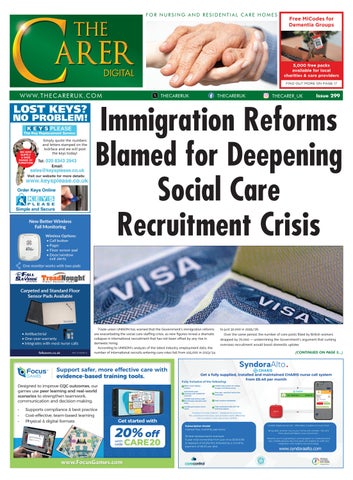
Immigration Reforms Blamed for Deepening Social Care Recruitment Crisis
Trade union UNISON has warned that the Government's immigration reforms are exacerbating the social care staffing crisis, as new figures reveal a dramatic collapse in international recruitment that has not been offset by any rise in domestic hiring. According to UNISON's analysis of the latest industry employment data, the number of international recruits entering care roles fell from 105,000 in 2023/24
to just 30,000 in 2025/26. Over the same period, the number of care posts filled by British workers dropped by 70,000 — undermining the Government's argument that curbing overseas recruitment would boost domestic uptake.
(CONTINUED ON PAGE 3...)
PAGE 2 | ISSUE 299 | THE CARER DIGITAL
EDITOR'S VIEWPOINT
Welcome to the latest edition of The Carer Digital! A POLICY CAUGHT BETWEEN TWO TRUTHS I'll admit it up front: this one is above my pay grade. But that's never stopped an editor from having an opinion, so here goes. Our lead story this issue lays out, in stark numbers, a debate that's been rumbling through the sector for quite some years now — and like most debates worth having, it depends rather a lot on which side of the fence you're sitEditor ting on. On one side, the Government's position is coherent enough on paper. Ministers argue the UK has spent too long patching over social care's staffing gaps with overseas recruitment instead of fixing the underlying problem: pay, progression and status. Close the visa routes, the thinking goes, invest in training, build proper career pathways, and a sustainable domestic workforce will follow. It's not an unreasonable ambition. Nobody in this sector would argue against better pay or clearer career ladders for care staff. On the other side sits UNISON's analysis. International recruits falling from 105,000 to just 30,000 in two years would be a manageable adjustment if domestic hiring had risen to fill the gap. It hasn't. British-national posts have fallen too — by 70,000 on UNISON's figures, or 40,000 in the last year alone according to Skills for Care's separate data. Whichever number you pick, the pattern is the same: the taps have been turned off before the alternative pipeline was built. And that, for me, is the nub of it. This isn't really a question of whether the destination is right — most people I speak to across the sector broadly agree with the direction of travel. It's a question of sequencing. The Health and Care Worker visa route for new applicants has already closed. But the domestic solutions meant to replace it — the Adult Social Care Negotiating Body, Fair Pay Agreements — aren't due to land until 2028. That's a gap of several years in which providers are expected to hold a sector together with 96,000 unfilled vacancies and no obvious source of new hands. Care England and the Homecare Association have both made the point, and it's the right one: you cannot train a domestic workforce "in a vacuum" without near-term funding to match near-term need.
Peter Adams
A phased withdrawal rather than a cliff-edge closure would have given providers, and the people they care for, room to adjust. Given that our new Prime Minister has shown real enthusiasm for devolving power to regional and local government, targeted, temporary visa exemptions for councils with vacancy rates well above the national average feels like an obvious, low-risk compromise — and one that's been suggested more than once already. Given the scale of the drop UNISON has highlighted, it deserves rather more than a polite nod. None of which is to dismiss the genuine concerns behind the original reforms. The old care worker visa route was exploited leading UNISON's call for sector-wide sponsorship, rather than single-employer tie-ins, is one I'd like to see taken seriously regardless of where you stand on numbers. As ever, we're putting out a call for expert comment on this one — so watch this space, as the saying goes. Something has to give between restricting overseas recruitment and actually building the domestic workforce to replace it, and I suspect the answer will need to be found somewhere in the messy middle rather than at either extreme. Regular readers may remember our recent coverage warning families not to wait for social care reform before making urgent care plans. The message that struck me most was a very simple one: preparation matters. I would draw your attention to an article on page 7 regarding advanced planning. I recently attended an Advanced Care Planning day and, as the name suggests, it was about planning ahead — not only for future care but, ultimately, for death as well. I heard some genuinely thought-provoking, and at times quite lamentable, examples of what can happen when individuals and families leave these conversations until a crisis occurs. The emotional consequences can be considerable; so too can the financial implications. It is not an easy subject to discuss, and perhaps that is precisely why so many people put it off. But whether we are talking about planning for the future or planning the workforce needed to provide care, the underlying message is remarkably similar: leaving difficult decisions until there is a crisis rarely makes the situation easier. We will be seeking expert comment on the social care workforce and immigration debate, and I hope to return to the subject of advance care planning in greater depth in the coming weeks. I would also encourage our readers to sign up for our bi-weekly digital newsletter at www.thecareruk.com and follow us on social media for all the latest news. I can always be contacted at editor@thecareruk.com
PUBLISHED BY RBC Publishing Ltd 3 Carlton Mount 2 Cranborne Road Bournemouth Dorset BH2 5BR
TELEPHONE:
01202 552333 EMAIL:
sales@thecareruk.com WEBSITE:
www.thecareruk.com EDITOR Peter Adams editor@thecareruk.com
SALES DIRECTOR David Bartlett dave@thecareruk.com
PRODUCTION & DESIGN Matthew Noades Published by
The Carer is published by RBC Publishing Ltd, 3 Carlton Mount, 2 Cranborne Road, Bournemouth, Dorset BH2 5BR. Contributions are welcome for consideration, however, no responsibility will be accepted for loss or damage. Views expressed within this publication are not necessarily those of the publisher or the editorial team. Whilst every care is taken when compiling this publication to ensure accuracy, the publisher will assume no responsibility for any effects, errors or omissions therefrom. All rights reserved, reproduction is forbidden unless written permission is obtained. All material is assumed copyright free unless otherwise advised.
Manufactured in the UK
Freephone: 0800 917 7943 www.euroservice-uk.com sales@euroservice-uk.com
PROVIDING PRACTICAL AND STYLISH TROLLEYS TO SUIT YOUR NEEDS Watch your resident's eyes light up when the beautiful tea trolley arrives! Euroservice trolleys can also be used as a vending trolley or to sell personal care products to residents. How about a delicious snack/pastry trolley or even a drinks trolley for that afternoon tipple?
Your lovely trolley could do so much for you and your residents! Euroservice trolleys are an attractive and practical alternative to clinical aluminium trolleys given that antibacterial spray can be used freely to sanitise them.
Get in touch with our friendly, experienced sales team
Visit the website at
www.euroservice-uk.com to see the full range.
THE CARER DIGITAL | ISSUE 299 | PAGE 3
Immigration Reforms Blamed for Deepening Social Care Recruitment Crisis
(CONTINUED FROM FRONT COVER)
never happen."
The previous Conservative government barred care workers from bringing dependants into the UK in March 2024, while Labour scrapped the dedicated care worker visa route altogether in July 2025, citing concerns over the exploitation of migrant workers arriving through the scheme. Abandon Proposals UNISON has written to Home Secretary Shabana Mahmood urging her to abandon proposals that would make it harder for migrant care staff to settle permanently in the UK. The union is specifically calling for the reversal of plans to extend the qualifying period for permanent settlement for international health and care staff from five years to fifteen. The union argues that tripling the wait would cause serious disruption to a sector already reliant on international workers, and that changing the rules retrospectively for staff who have already relocated to the UK is unjust. With 96,000 vacancies still unfilled across the sector, UNISON warns that further restrictions on overseas recruitment would leave more people without access to the care they need, adding further strain to an already stretched workforce. The union has also renewed its call for sector-wide visa sponsorship for international care staff, rather than the current system that ties workers to a single employer. UNISON says this arrangement leaves staff vulnerable to exploitation, with many reluctant to raise concerns about long hours, low pay or poor living conditions for fear that employers will withdraw sponsorship and force them to leave the country.
VACANCY RATE FALLS
UNFAIR In its letter to the Home Secretary, UNISON wrote: "Poor pay in social care is not evidence of the workers' low skill or contribution. It is the result of longstanding policy failure. The Prime Minister has acknowledged this and stated his ambition to increase the wages of care staff. “It would be deeply unfair and contradictory for immigration policy to treat care workers as low value simply because they're in a poorly-paid sector, while the government tries to improve the status, respect and reward for care work." UNISON general secretary Andrea Egan said: "If the government's serious about fixing social care, it should immediately scrap these cruel plans that will make it harder to recruit staff. Terrible pay and working conditions are creating shortages in the social care sector. These figures make that crystal clear. “A massive drop in overseas workers has not led to rising domestic recruitment or higher wages. Attempts to force existing staff out of the country are wrong by every measure. If the government doesn't drop these plans, the Prime Minister's hope of transforming the lives of millions through a national care service will
The union's warning comes as separate data published by Skills for Care, the national charity supporting England's adult social care workforce, shows the vacancy rate has fallen to its lowest level in a decade. The organisation's Size and Structure of the Adult Social Care Sector and Workforce in England report published in June found the workforce grew for a fourth consecutive year in 2025/26, with 22,000 more filled posts than the previous year — a 1.4% increase, though the slowest growth rate in four years. The vacancy rate fell to 6.2%, the lowest since 2015/16, equivalent to around 96,000 vacancies on any given day and a 10.5% reduction on the previous year. Despite this improvement, vacancy levels in adult social care remain roughly three times higher than the wider economy. The report also found that posts filled by British nationals fell by 40,000 over the past year, and by 130,000 since 2020/21. While the number of non-British workers in the sector has risen overall, the loss of a dedicated international recruitment visa route saw new international hires fall to 30,000 — the lowest figure in four years.
ADDITIONAL POSTS Looking further ahead, Skills for Care projects that the sector will need an additional 410,000 posts by 2040 to meet the needs of an ageing population. Oonagh Smyth, Chief Executive of Skills for Care, said: "It's encouraging to see vacancies fall to their lowest level in 10 years and the workforce continuing to grow. This reflects the hard work and commitment of employers across the sector to attract and retain staff in a challenging environment. "However, the longer-term picture remains difficult. Vacancy rates are still significantly higher than the wider economy, domestic workforce numbers are falling and there is no dedicated visa route for international recruitment — all of which highlight the scale of the challenge ahead. "We need a long-term, collective approach. Skills for Care is bringing partners together to develop a 10year plan to attract more people into adult social care and support them to build rewarding careers. This work is central to delivering the Workforce Strategy for Adult Social Care in England and ensuring the sector has the workforce it needs for the future."
MEND SOCIAL CARE Responding to the figures, a Government spokeswoman said: "The Prime Minister has set out his plan to start to mend our broken social care system based on a better deal with its workforce — with better progression, pay, training and job security at its heart. A consultation on elements of our earned settlement reforms has now closed, and we will set out our response in due course."
PAGE 4 | ISSUE 299 | THE CARER DIGITAL
You Don't Solve An Immigration Problem By Creating A Social Care Crisis
By Tony Stein, chief executive of HCMS (www.hcms.co.uk)
There is a fairly obvious question the Government needs to answer as it tightens the rules around overseas care workers: who exactly is going to look after people instead? Social care has around 96,000 vacancies, yet overseas recruitment is falling sharply and, crucially, the domestic workforce isn't riding to the rescue either. Analysis suggests overseas recruitment has fallen by around 75,000 in two years, alongside a fall of some 70,000 domestic workers. Those figures should set alarm bells ringing in Whitehall. I understand why the Government wants greater control over immigration, most people do. But we need to distinguish between illegal immigration and people who come to Britain legally, work hard, pay taxes and provide an essential service to some of the most vulnerable people in our society. Overseas care workers haven't arrived and taken jobs from a queue of British applicants waiting outside care homes, rather they have filled gaps that providers have struggled, sometimes desperately, to fill. Now we risk making Britain a much less attractive place for them to come. UNISON has warned that pro-
posals which could mean some care workers waiting up to 15 years for indefinite leave to remain will create greater insecurity and exacerbate the staffing crisis. That isn't just unfair to people who have built lives and careers here it is potentially self-defeating. Britain does not have a monopoly on care jobs because other countries need these workers too and if someone can build a more secure future for themselves and their family elsewhere, why wouldn't they? If they leave Britain, they don't stop being care workers, they simply take their skills somewhere else. Of course, the long-term answer must include recruiting and retaining more people from within the UK. To meet this objective, we need to make social care a career people actively want to choose, with better recognition, proper career pathways, training and improved terms and conditions. What we cannot do is pretend tens of thousands of domestic care workers are suddenly going to materialise because we have restricted overseas recruitment. There is another reason ministers should be concerned. When there aren't enough people to provide care in the community, people remain in hospital longer than necessary meaning beds aren't available for other patients, waiting lists suffer and pressure on the NHS increases. Saving on one side of the public-sector ledger can simply create a much bigger bill on another. I know that immigration is politically difficult, but social care is politically difficult as well. But difficult issues require practical solutions rather than policies which look good in isolation but collide with reality when they meet. We need controlled immigration but we also need enough people to care for an ageing population. Those two objectives are not incompatible.
Community Integrated Care Teams Up with Formula E for London E-Prix
Three motorsport superfans with learning disabilities have lived out their dream of getting up close to Formula E, after national social care charity Community Integrated Care launched a search to find its biggest racing fanatics. Darren Turner, from Portsmouth, and Ayaz Nisar and Aaron Jameson, from London, all have learning disabilities and are supported to live independently by the charity. The trio secured VIP places on Formula E’s Community Tour at the 2026 Hankook London E-Prix, bringing them into the heart of the Championship — with the chance to meet teams, drivers and stars, explore the cars and technology behind the sport, and enjoy exclusive access to one of the world’s most exciting motorsport events. Each was selected for the once-in-a-lifetime experience because of their deep passion for cars, motor racing, and Formula E, and because of the powerful impact the experience would have on their confidence, independence, and wellbeing. All three love watching motorsport on television and have been supported to explore their passion in the community, including visits to motoring museums, car exhibitions and events. Stepping into the world of Formula E was described as “a dream come true”. On the day, Darren, Ayaz and Aaron experienced what it is like to get behind the wheel of a Formula E car through special simulators, and discovered what happens pit-side, enjoying a behind-the-scenes look at elite electric racing. This experience was followed by the chance to attend the 2026 Hankook London E-Prix live from Excel London – with grandstand tickets, seated in the heart of the action. For Darren Turner, 29, the event marked an incredible personal milestone. Since joining Community Integrated Care this year, he is living independently for the first time and has been supported to explore new interests and opportunities. After a visit to a motor museum sparked a growing love of cars, Darren
has proudly brought that passion into his new home and now enjoys following motor events. He said: “I love really fast cars. I was so surprised and excited to go to London to see Formula E with Community Integrated Care. It was the best day.” John Hughes, Director of Partnerships and Communities at Community Integrated Care, said: “Community Integrated Care’s mission is to enable people to live their Best Life Possible, and this incredible experience with Formula E at the 2026 Hankook London E-Prix truly brought that to life.” “Darren, Aaron and Ayaz have all been supported to discover and follow their passions, goals and interests in life, especially their love of cars and racing. As a charity, we pride ourselves on developing partnerships and experiences that help people to enjoy their greatest dreams, build confidence and fulfil their
potential.” “Formula E’s commitment to delivering real inclusion, and creating such a special experience for Darren, Ayaz, Aaron and their guests, was truly inspiring. They created memories that will never be forgotten.” Julia Palle, VP, Sustainability at Formula E, said: “Formula E is fully committed to creating real social impact and ensuring that our sport is accessible to all. We were delighted to partner with Community Integrated Care as part of our wider global community engagement activities and support their work with people with learning disabilities.” “The Best Life Possible mission is incredibly powerful, and it was our privilege to help Darren, Aaron and Ayaz connect with a passion that means so much to them. Three inspiring individuals; their excitement in London as they experienced the magic of Formula E up close was hugely special. We thank them for joining us and their support teams for helping to make the day possible.”
Dishwashing Advice for Care Homes What are the biggest challenges in care homes when it comes to dishwashing? Infection control and compliance. But they’re not the only challenges. Winterhalter’s team of warewashing experts has put together a comprehensive advice guide for care home dishwashing. From the five key considerations when specifying a dishwasher through handling chemicals safely to budgeting and running costs, it gives care homes and the companies that supply them the information they need to select the best warewashing solution, whatever the site’s requirements may be. Care Homes: advice on dishwashing is available right now to download from the dedicated Care Home section at tinyurl.com/carehomedishwashing. It shows how to help care home staff get dishwashing right, focusing on areas such as simple operations and training. It considers how to protect the most vulnerable patients, for example by using features like Winterhalter’s Thermo option, which disinfects the ware being washed. Ergonomics, workflows, managing critical hygiene risks, specifying for care homes with limited space – the Guide has it covered. And for care homes on limited budgets, there’s information on finance options.
“Care homes have very specific requirements from their warewashing systems,” says Paul Crowley, marketing development manager at Winterhalter UK. “This guide is designed to give users and specifiers the information they need to ensure they are operating as safely, efficiently and hygienically as possible.” The guide is available as a free downloads from the Winterhalter UK website. Anyone interested in advice for other particular sectors can contact info@winterhalter.co.uk. Winterhalter provides a total solution for dishwashing and glasswashing, from pre-sales advice to after-sales service, training and maintenance, with sustainability fitted as standard. Alongside its market-leading dish washers and glass washers, the company’s range includes utensil washers, advanced water treatment machines, and cleaning detergents and rinse aids. For further details, call Winterhalter on 01908 359000, visit www.winterhalter.com/uk-en/ or email info@winterhalter.co.uk.
THE CARER DIGITAL | ISSUE 299 | PAGE 5
New Frailty Service Reduces Hospital Admissions for Care UK Residents By A Quarter A new Addenbrooke’s Hospital service providing specialist geriatric care directly in care homes has significantly reduced hospital admissions for Care UK residents. Research published in Age and Ageing shows the Enhanced Reviews in Care Homes (EnRICH) service has reduced admissions by just under a quarter and cut time spent in hospital by a third, saving around 1,300 inpatient bed days a year. EnRICH was developed by clinicians at Cambridge University Hospitals NHS Foundation Trust (CUH) to provide specialist support in the community for an ageing population with increasingly complex needs. Although care home residents represent just 1% of the population, they account for 8% of hospital admissions. Cambridge’s population has risen by 18% over the past decade—compared to 6% nationally— and is projected to grow by 60% by 2040. Across the East of England, over 75s are expected to be the fastest growing group.
care for some of our frailest patients, enabling them to access specialist support without leaving the familiar surroundings of their care home.”
IMPACT ON CARE UK RESIDENTS AND FAMILIES Heathlands House in Cambridge was one of the first Care UK homes to introduce EnRICH in October 2024. Clifford, a 96 year old resident living with dementia, heart failure, diabetes, COPD and a previous stroke, attended hospital three times in the year before EnRICH began. Since the service was introduced, his care has been managed entirely within Heathlands House with specialist input from hospital geriatricians. His daughter, Alice Craske, said: “It means my dad can stay in the comfort of his home while still getting specialist input and care. He is settled, stable and happy.” Alice’s mother, Pam, also lived at Heathlands House before she passed away in 2025. Alice described the continuity of care provided by the EnRICH team during her mother’s final hospital admission as “superb”.
SPECIALIST SUPPORT IN CARE UK HOMES
STRENGTHENING PARTNERSHIPS
EnRICH brings hospital geriatricians into care homes to work alongside GPs, community nurses, pharmacists and care home teams. The service provides regular assessments, rapid clinical support when residents become unwell, and continuity of care if admission to Addenbrooke’s is required. The evaluation reviewed 11 care homes in Cambridgeshire over more than 12 months. Analysis of over six thousand emergency department attendances showed a 23% reduction in admissions and a 32% reduction in length of stay, shortening average hospital stays by nearly three days. Dr Matthew Butler, consultant geriatrician at CUH, said: “This innovative service improves the quality of
The research found benefits began to emerge after three months as relationships between hospital and community teams strengthened. Razvan Stanbeca, manager of Heathlands House, said: “The specialist input from the EnRICH team has enhanced the care we provide. Our colleagues feel more confident and more empowered to provide even better care for residents.” Following its early success, EnRICH has expanded to 15 care homes with the highest frequency of hospital admissions in Cambridgeshire, funded by the NHS Central East ICB. The evaluation also highlighted annual savings of around 1,300 inpatient bed days, equivalent to approximately £700,000.
Karuna Manor Care Home Celebrates India’s Independence Day Karuna Manor Care Home in Harrow celebrated India’s Independence Day with a vibrant programme that brought residents, staff, families and guests together to celebrate India’s rich history, culture and heritage. The celebration was filled with colour, music and memories, with residents taking an active role in making the day special. One of the highlights was seeing residents dressed as Indian freedom fighters, bringing history to life and creating an opportunity for everyone to remember and honour the people who played an important role in India’s journey to independence. Residents also shared their personal stories, memories and experiences, creating a meaningful and nostalgic atmosphere. Their stories gave everyone an opportunity to reflect on India’s past and the changes they had witnessed throughout their lives. Adding to the celebrations, one of the residents delighted everyone with a beautiful
cultural dance performance. The performance was warmly received and demonstrated how residents continue to share their talents, traditions and cultural identity. The celebrations also included a special Independence Day cake-cutting ceremony, where residents and staff came together to mark the occasion. The cake-cutting created a joyful moment of togetherness and was enjoyed by everyone. Ravi Joshi, Business Development Manager at Karuna Manor Care Home, said: “It was wonderful to see our residents taking such an active part in our Independence Day celebrations. From dressing up as freedom fighters and sharing their memories to performing a cultural dance, everyone contributed to making the occasion very special. These celebrations are not just about marking an important day in history; they are also about giving our residents the opportunity to celebrate their heritage, share their stories and create happy memories together.”
PAGE 6 | ISSUE 299 | THE CARER DIGITAL
From Consultation To Co-Production: Why ‘Listening’ Is No Longer Enough In Social Care Editorial supplied by Exemplar Health Care (www.exemplarhc.com)
For years, adult social care has focused on listening to people. Surveys are completed, meetings are held, and feedback is gathered. But too often, decisions have already been made by the time those conversations happen. People are asked for their views on something that’s already been designed, rather than being involved in shaping it from the start. That approach is no longer enough. If social care is serious about delivering truly person-centred support, it needs to move beyond consultation and towards co-production - where people are not just heard, but share real influence over the decisions that affect their lives. This shift is already starting to happen. Exemplar Health Care’s ‘Service User Engagement Impact Report 2025/26’ shows how co-production can move from principle to everyday practice. Across the organisation, people living in Exemplar Health Care homes are influencing decisions that shape both daily life and wider services - from mealtime experiences and colleague recruitment to training, community initiatives, and organisational strategy. This is not a “nice to have”. It’s fundamental to improving outcomes, particularly for people living with complex needs.
and support others.
CONSULTATION WITHOUT INFLUENCE IS NOT PERSON-CENTRED CARE
CHALLENGING HOW THE SECTOR SEES PEOPLE WHO DRAW ON CARE
Across the sector, the language of co-production is widely used. Many organisations will say they engage people in decisions about their care. But there is a difference between engagement and influence. When people are only invited to give feedback at the end of a process, their role is limited. Their views may be noted, but they rarely shape the outcome in a meaningful way. For adults living with complex needs, this matters. Care is not a standardised service; it needs to reflect communication preferences, routines, personal goals, and the steps people are taking to rebuild confidence and independence. You cannot design that effectively without the people who rely on it. Co-production shifts the starting point. Instead of asking “what do you think of this?”, it asks “what should this look like?” - and builds services alongside the people who use them.
WHEN PEOPLE SHARE POWER, LIVES CHANGE At Exemplar Health Care, this approach has been embedded through a network of more than 70 Service User Ambassadors, supported by Regional Ambassadors and Service User Councils. Their role is not symbolic. They’re involved in shaping decisions across the organisation - from colleague recruitment and training programmes to daily experiences such as food and activities. Crucially, this is not limited to formal meetings. Co-production is part of everyday life in the homes, built through ongoing conversations and shared decision-making. For Adam Bourne, Regional Service User Ambassador at Greenside Court in Rotherham, the impact is clear: “Being a Service User Ambassador has given me a real voice. We’re not just consulted; we’re involved in shaping decisions and improving how things work. It’s helped me rebuild my confidence and feel like I’m making a difference, not just for myself, but for other people too.” This highlights a point that is often missed in discussions about co-production - its impact goes far beyond service improvement. It builds confidence, creates a sense of purpose, and helps people take on leadership roles
CO-PRODUCTION IMPROVES WHAT MATTERS MOST - THE EVERYDAY EXPERIENCE OF CARE One of the examples of this is the organisation’s work to improve mealtimes. Feedback from residents consistently showed that mealtimes were about far more than food. People spoke about choice, flexibility, routine, presentation, dignity, and the social experience of eating. Rather than treating this as an operational issue to be solved, colleagues worked alongside Service User Ambassadors to understand what mattered most and develop improvements together. Collaborative listening sessions involving ambassadors, home managers, catering teams, and senior leaders led to meaningful changes, based on lived experience, not assumptions. At Greenside Court, this partnership directly influenced improvements to food quality and choice. Reflecting on the changes, Adam said: “Claire came in, listened to what we had to say, attended service user meetings, and things changed almost immediately. The menus now look brilliant, the food is fantastic, and she always wants to improve things further.” The result is not just higher satisfaction, but a better daily experience, where mealtimes support independence, comfort, and social connection. Co-production also challenges a more fundamental issue within social care - how people who draw on care are perceived. Too often, individuals are defined by their needs. In practice, people bring knowledge, experience, and insight that can improve services, strengthen communities, and shape the future workforce. This is already happening. Regional Ambassadors recently led a full panel session at the external Nursing Live event, presenting to more than 120 delegates on the role of lived experience in shaping services. Ambassadors have also worked alongside Sheffield Hallam University, building the curriculum for nursing and social work students, including learning on communication, person-centred care, and what meaningful support looks like in practice. This is not engagement as a process - it’s people influencing systems, education, and culture.
THE REAL CHALLENGE: SHARING POWER, NOT JUST GATHERING FEEDBACK If co-production is to move from principle to practice, organisations need to go further than creating opportunities for feedback. They need to share power. That means: • working together at the earliest stages of decision-making • making sure ideas lead to visible action • creating accessible and flexible ways for people to contribute • recognising lived experience as expertise, not an optional perspective. It also means being honest about where current approaches fall short. Consultation alone does not deliver meaningful involvement. Without influence, it risks becoming a tick-box exercise.
THE FUTURE OF CARE WILL BE SHAPED TOGETHER - OR NOT AT ALL The next phase of social care reform will not be defined by new policies alone. It will be shaped by whether organisations are willing to rethink how decisions are made, and who’s involved in making them. The strongest case for co-production is not found in strategy documents, but in the experiences of people themselves. When people are trusted to shape their care, they do more than improve services. They build confidence, lead change, and strengthen the communities around them. The future of care will not be designed for people. It will be built with them - or it will fail to meet the expectations of the people it exists to support. Read Exemplar Health Care’s ‘Service User Engagement Impact Report 2025/26’ to see how co-production is being put into practice across its homes: https://brochures.exemplarhc.com/service-user-engagement-25-26/
National Award for Longstanding Coombe Hill Manor General Manager Sonya Fenwick has been recognised with the Chief Nurse Adult Social Care Gold Award for her outstanding contribution to adult social care, shortly before retiring from her role as General Manager of Signature at Coombe Hill Manor. The prestigious award recognises individuals who act as role models within the social care sector, achieve the highest standards in their area of practice, and who make a significant contribution to the quality of care received by people using care services, and their families. Sonya received the award personally from Professor Deborah Sturdy, the Chief Nurse for Adult Social Care, in recognition of her leadership, clinical expertise and longstanding commitment to improving the lives of older people. With a career spanning general nursing, mental health nursing, midwifery and community care, Sonya has dedicated decades to supporting people across a range of health and care settings. For the final decade of her career, she led Signature at Coombe Hill Manor, overseeing the delivery of high-quality care for its residents and supporting colleagues across the home. Under her leadership, Coombe Hill Manor achieved Gold Standards Framework Beacon Status in recognition of its excellence in end-of-life care. The Chief Nurse Award also recognised Sonya’s leadership through the Covid-19 pandemic, as well as her contribution to creating a supportive and compassionate environment for residents, colleagues and visitors at Coombe Hill Manor. Sonya has since retired, bringing to a close a long and distinguished career dedi-
cated to improving the lives of people in care. The award provides a fitting recognition of her contribution to adult social care and the legacy she leaves at Coombe Hill Manor. Speaking after receiving the award, Sonya said: “I am incredibly honoured and humbled to receive this award. Caring for others has been a privilege throughout my career and I have been fortunate to work alongside some truly remarkable colleagues, residents and families. “This recognition reflects the dedication of the entire team at Coombe Hill Manor, whose commitment to delivering exceptional care every day continues to inspire me.” Rob Martin, Chief Executive Officer of Signature Senior Lifestyle, said: “Everyone at Signature is incredibly proud of Sonya and this well-deserved recognition. Her career has been defined by making a difference and leaving things better than she found them through exceptional leadership, clinical expertise and a genuine passion for improving the lives of older people. “Under her leadership, Coombe Hill Manor became one of the most respected care homes in the country, achieving standards that many aspire to, but few consistently maintain. More importantly, she has touched the lives of countless residents, families and colleagues throughout her career. “As Sonya prepared for retirement, this award provided a wonderful opportunity to celebrate her remarkable contribution to social care and the legacy she leaves behind. She embodies everything that is best about our sector.”
THE CARER DIGITAL | ISSUE 299 | PAGE 7
Families Warned Not To Wait For Social Care Reform Before Making Urgent Care Plan Families are being warned not to wait for long-promised social care reform before planning later-life care, as fresh Government proposals restart the national debate on how support should be funded. Neil Gandecha, manager at Foxholes Care Home, said families are still being left to make urgent, expensive and emotionally difficult decisions after a fall, hospital discharge or sudden decline in a loved one’s health. The Government has announced renewed cross-party talks, an accelerated independent commission into adult social care and a wider national conversation on the future of care in England. But Neil says that people making decisions now need clearer guidance on assessments, care costs, funding routes and what to do before a crisis. The warning comes as pressure on adult social care continues to rise. The Care Quality Commission’s 2024/25 State of Care report said new requests for local authority-funded support were up 4% in 2023/24 compared with the previous year and 8% higher than in 2019/20. Skills for Care has also reported that more than half of unpaid carers were providing more hours of care than the previous year. Neil said: “Most families do not sit down and plan for care in calm conditions. They start thinking about it after something has happened, a fall, a hospital discharge, a phone call from a neighbour or a sudden change in someone’s health. “By that point, they are usually worried, short on time and trying to understand a system they have never had reason to look at before. That is an incredibly difficult position for any family to be in.
In England, local authorities carry out a needs assessment before deciding what support someone requires, followed by a financial assessment to work out whether the council will contribute towards the cost. Some families may also need to check whether NHS Continuing Healthcare or NHS-funded nursing care applies. He said: “The system is not designed to be easy to understand in a crisis, but that is exactly when most people are expected to understand it. “Families may be trying to work out whether a parent qualifies for local authority support, whether health needs should be assessed by the NHS, what happens if there is a property involved, and how quickly a decision needs to be made. At the same time, they are dealing with guilt, worry and often disagreement within the family. “One of the hardest things to explain is that moving into care is not a sign that a family has failed. In many cases, it is the point where a person needs more support than relatives can safely provide at home. Recognising that early can make the decision kinder, calmer and safer for everyone.” Care homes are also under growing pressure, with rising wages, recruitment costs, food bills, utilities and maintenance all affecting the cost of providing good care. He added: “Good care is not just about a safe room and enough people on shift. It is about continuity, routine, food, activities, relationships, dignity and the small details that make someone feel known. “Families should feel able to ask homes what they are paying for, how staff are supported, what happens when a resident’s needs change and how quality is maintained behind the scenes.”
Neil is urging families to start conversations about future care before they are forced into a rushed decision. He said there are five practical steps people can take early: 1. Ask the local council for a needs assessment as soon as care needs begin to change. 2.Arrange Lasting Power of Attorney early so someone trusted can help make financial or care-related decisions if the person later loses capacity. 3.Gather key financial information early, including income, savings, property details and existing care costs. 4.Talk openly about what matters most to the person who may need support, including where they would feel safest and what routines are important to them. 5.Visit care homes before a move becomes urgent and ask direct questions about daily routines, mealtimes, staffing, activities and what happens if someone’s needs increase. Neil said: “The best protection families have is time. If you understand the questions before a crisis, you are in a much stronger position to make decisions calmly and confidently. “Visit homes before you need one. Ask practical questions. Talk to your relative about what they would want. Look into the paperwork early. These conversations can feel uncomfortable, but they are far easier than trying to make every decision on the worst day of your year. “Care reform is often discussed at a national level, but for families it comes down to something much more immediate: finding the right support, understanding the costs and knowing their loved one will be cared for properly.”
WWII Veteran Celebrates 100th Birthday and 70th Wedding Anniversary at Solihull Care Home A couple have marked an extraordinary double milestone in the space of two days. Navy veteran Stan Field turned 100 on Monday 17 August, and the following day he celebrated his 70th wedding anniversary with wife Ivy. The couple marked their milestones at Royal Star & Garter in Solihull, where they have lived together since March this year. Stan was born in East London in 1926, and was called up to the Navy in 1944, during WWII. He trained as a radar mechanic and travelled the world before demobbing in 1948. He then trained as a teacher and moved to Birmingham for work. It was there that he met Ivy at a church in Yardley in 1950. Stan said: “As soon as I saw her, I thought ‘that’s the one for me’. It was love at first sight – and I’m sure it was God-guided.”
H.W. PICKRELL NEW & USED ACCESSIBLE TRANSPORT AT AFFORDABLE PRICES • We specialise in the sale and purchase of quality used wheelchair accessible vehicles and ambulances. • They can be bought as seen or refurbished and sign-written to your own requirements. • Fully serviced, new mot & warranty • Engineers inspection supplied if required.
• Free delivery service available • All buses comply with new legislation • Lease hire and purchase available • Always large stock of accessible vehicles
Tel: 01268 521033 Mobile: 07860 894331 Email: sales@hwpickrell.co.uk Gardiners Lane North, Crays Hills, Billericay, Essex CM11 2XE All current stock available to view at www.hwpickrell.co.uk
The couple didn’t marry until 1956, as they wanted to save up money before they wed. Stan went on to teach for over 30 years, becoming head teacher at Hawbush Middle School (now Hawbush Primary School). After raising their two daughters, Ivy, 97, taught shorthand and typing. Friends then gathered at the Home on Stan’s birthday, before staff put on a special meal for the couple on their anniversary. Looking back on the life they built, Stan said: “If I had my time over again, I wouldn’t change a thing.” The couple live just a few rooms apart at Royal Star & Garter, and Stan added: “It means a lot that we’re both here at this Home. We’ve had a very happy life together, and I’m dearly grateful that we’re still together at Royal Star & Garter.”
PAGE 8 | ISSUE 299 | THE CARER DIGITAL
Every Healthcare Professional Will Have Difficult Conversations. Are We Preparing Them? By Dr Ross Smith, Consultant in Paediatric Palliative Medicine at Martin House Children's Hospice, and Leeds Teaching Hospitals NHS Trust, Lead of the national CYPACP (Child and Young Person's Advance Care Plan)
Sometimes a conversation feels awful. We may upset or even anger patients and their families. A healthcare professional may leave the room feeling sad, uncomfortable or uncertain and replaying every word they said. That does not necessarily mean they have done a bad job. When the subject is a child's deterioration or possible death, distress is entirely normal, and often reflects that the message has in fact been understood. The purpose is not to remove every difficult emotion, but to communicate honestly and compassionately, helping families feel heard, held and prepared. Yet many healthcare professionals worry about these conversations. What if I say the wrong thing? What if I do not know the answer? Am I the right person to be having this discussion? Some will have learnt about 'breaking bad news' during their initial training, but it may be years before they need to draw on it. Others learn by observing more experienced colleagues. Even those of us who work in children's palliative care can find these discussions difficult. That is precisely why we need to prepare people for them.
THE COST OF AVOIDING THE CONVERSATION Professionals may hesitate, or even avoid these discussions entirely, because they fear upsetting a family or taking away hope. But evidence, including NICE guidance, shows that children, young people and their carers want to be fully informed and do not want professionals to avoid conversations about the future. They want professionals to understand their child, their thoughts, hopes and fears, the day-to-day demands of family life, and the importance of their values, culture and beliefs. Some families may want indepth discussions about different treatment options, end-of-life care, care after death, funeral planning and bereavement support. No one wants to think about their child being in pain or dying, but families do want experienced professionals to offer comfort, honesty and support. These conversations are not always as difficult as professionals imagine they will be. Families are often grateful that somebody has been willing to begin. Some families will not want to explore these issues in as much detail as others, and some may not feel ready to have the conversation at
that time. That should always be respected, but it is not a reason to avoid raising the subject altogether. Families often report feeling anxious beforehand but are relieved once the conversation has taken place. Readiness is usually understood through careful communication and observation after a discussion has begun, rather than by assuming in advance that a family does not want to talk. Otherwise, we risk denying them the opportunity to explore their feelings and concerns. We must remember that the benefits of these discussions far outweigh the professional discomfort involved in having them. Talking allows families and professionals to understand what everyone most hopes for and most fears, and to consider realistic, meaningful and achievable choices. The alternative may be making decisions for the first time during an emergency, when emotions are high and the professionals involved may not know the child. The choice is rarely between having a difficult conversation and avoiding difficulty altogether. It is often between talking carefully now and making far harder decisions later.
AN INVITATION TO TALK Advance care planning is a good example. An advance care plan is sometimes misunderstood as a form about resuscitation or a single decision made at the end of a child's life. In reality, it is a collaborative, dynamic process rather than a single event. It involves a series of honest conversations about the priorities and goals of care for a baby, child or young person with a life-threatening or life-shortening condition. It may cover treatment and emergencies, but also values, beliefs, hopes, goals and the social, educational and spiritual dimensions of care. Advance care plans are invitations to talk. The plan is primarily for the family's benefit, although it is extremely helpful for professionals too. It can act like having the clinician who knows the child best at the bedside, wherever that child happens to be. It helps those meeting the family in an emergency understand what matters, what may be helpful and what has already been discussed. It is also an opportunity, not a requirement. Care plans are individualised - not simply based on a diagnosis, but on what is right for that particular child. These discussions should not be left until a crisis. They may begin after diagnosis, following a change in the child's condition or when a palliative care team becomes involved. Occasionally, they might even take place during pregnancy, if a life-shortening condition is diagnosed before birth. Such planning may take place over several meetings, giving families time to think, ask questions and adjust as circumstances change. One parent described how reviewing the plan at home helped her and her daughter's father recognise that they had understood parts of it differently. They could then ask questions and gain clarity before facing an acute situation in which an immediate decision was needed. Advance care plans also prompt professionals to prepare families for what they might expect in different circumstances. This cannot prevent situations from being deeply distressing, but preparation can make them more bearable. The reverse is also true - when families are not
prepared for what may happen, their distress can be amplified.
COMMUNICATION IS A CLINICAL SKILL There is no perfect script for these conversations, but there are skills we can teach and practise. We need to prepare properly, find an appropriate space and consider who should be present. We should check what the family already understands and, depending on the situation, whether there are particular issues they would like to discuss. We often begin with open questions before moving towards more focused discussion. Both our verbal and non-verbal skills matter. Clear, short sentences and non-medical language are usually more helpful than jargon. It's also important to recognise the impact of tone, pace, posture and eye contact. Communication is not only about imparting information. Listening and observing matter just as much as speaking - often more so. We should not be afraid of silence. Families may need time to gather their thoughts, process information and form the questions they want to ask. Silence can feel uncomfortable to the professional, but filling it too quickly may interrupt a family's thinking. Reflection and acknowledgement show that we have listened and observed carefully. Saying, “I can see that was difficult to hear,” or, “I can see that was hard to say,” can create space for families to explain what they need. Finally, we should summarise what we have heard, check our understanding and ask whether we have missed anything. These are not optional interpersonal extras; they are central clinical skills.
CONFIDENCE, NOT PERFECTION Training cannot make these conversations easy, nor should that be its aim. It can, however, help professionals feel confident enough to begin them, to listen and to admit when they do not know. Simulation provides a safe environment in which people can practise introducing difficult subjects, respond to emotion and explore how an advance care plan applies in different situations. The debrief is often even more valuable than the scenario itself, creating space for shared learning and questions that professionals may never previously have had the chance to ask. Confidence does not come from memorising the perfect phrase or hoping the first conversation goes well. It grows through practice, reflection and honest discussion. We cannot train the sadness out of these conversations. But we can prepare healthcare professionals to enter them with honesty, humility and compassion. Families should not be left without important conversations because we were too afraid to begin them. On Tuesday 15 September, Martin House is hosting its inaugural conference dedicated to paediatric palliative care. For more information and ticket details, visit: https://www.eventbrite.co.uk/e/martin-housechildrens-hospice-conference-2026-inspiring-excellence-tickets1994228719784?aff=oddtdtcreator&keep_tld=true For further information about Martin House Children's Hospice and how to support it, visit: https://www.martinhouse.org.uk/
Brunelcare and University of Bristol Students Create Community Maps to Connect Residents With Local Opportunities Brunelcare has partnered with Bristol University Students to create new Community Maps designed to help Brunelcare tenants discover local services, activities and opportunities across their neighbourhoods. The Community Mapping Project took place during June 2026 as part of the Bristol Skills Accelerator programme, bringing together Brunelcare and three student interns from the University to explore the communities surrounding all of the Brunelcare housing and care sites. Over the course of a month, the student team carried out research, community mapping and stakeholder engagement, working closely with the charity’s Director of Customer Services. The resulting Community Maps bring together information about local services and amenities, transport links, green spaces, community groups and other local organisations. The project will also help Brunelcare identify opportunities to work more closely with community organisations and local partners, support customers to live indepen-
dently with choice, dignity and purpose, and develop a stronger understanding of the neighbourhoods surrounding its housing and care services. Michelle Richards, Director of Customer Services said: “Working with the Bristol Skills Accelerator programme gave us access to fresh thinking and valuable research that would have been difficult to undertake alongside our day-to-day responsibilities. The project has improved our understanding of the communities around our sites and will help us connect residents and tenants with local opportunities, services and support that can enhance their wellbeing and independence.” The project, that will be launched to tenants via site meetings, also highlights the value of collaboration between Brunelcare and local education partners. By bringing students’ research skills and fresh perspectives together with Brunelcare’s knowledge of its customers and communities, the project has created practical resources that can continue to be developed and used across its services.
THE CARER DIGITAL | ISSUE 299 | PAGE 9
Reform of Social Care in England is Possible – Three Countries Show How
As England’s social care funding crisis deepens, a new report from the International Longevity Centre UK (ILC) suggests the answers may lie overseas — pointing to reforms already delivering results in Australia, Japan and Germany. With social care at the centre of the government’s agenda and the Independent Commission on Adult Social Care, chaired by Baroness Louise Casey, due to report in 2027, there is a chance to fix a broken system that can force people to spend all their savings and sell their assets to pay for care, – and where unmet need continues to grow. Home truths – what Australia, Japan and Germany can teach us about social care reform draws on roundtables held in Summer 2026 with practitioners, policymakers, academics and other experts in all three countries. Key things to consider when designing reform options in England include: • Anticipate and plan for greater social care demand. Germany’s 2017 eligibility reform brought over 2.3 million more people into support within three years – a sign that current data can understate unmet need • Set co-payment charges in line with the cost of living. In Australia and Japan, high co-payments led some people to step back from formal care, so any charging system should be tested against the point at which people withdraw • Cash benefits can be a step forward but be clear-eyed about consequences. They increase choice and can compensate family carers, but Germany’s experience shows the need to guard against unregulated care and added pressure on families • Design reform with the workforce in mind. All three countries face a shortfall of care workers, so realistic pay and employment assumptions are important to incorporate in planning and design
• Bring accommodation costs into view. Germany’s 2022 supplement covers care costs but excludes hotel, food and accommodation charges, which has, in part, eroded the protection it was designed to give • Design for legibility as well as affordability. Complexity and long waiting lists can become covert rationing; published waiting times would help people know what they are entitled to and when it will arrive • Build on what people already recognise. Germany’s social insurance was accepted partly because it was familiar, and Japan’s earmarked premium succeeded where a consumer tax had failed because it was visibly tied to a future entitlement Molly Townsend, ILC’s Research and Policy Officer and report author, said: “Australia, Japan and Germany have done what England has debated for decades. None of their systems is perfect, but all three show that fundamental reform is achievable to reduce catastrophic costs and improve fairness without bringing the public finances to its knees.” “What these countries have in common is that reform answered something people already cared about – the pressure on family carers in Japan, a social insurance system Germans already understood, dignity for people in care in Australia. That is the feasibility test for England: a settlement has to speak to a substantive concern the public recognises, not just work as a funding formula.” The report was produced as part of ILC’s work with the Joseph Rowntree Foundation and the Nuffield Trust examining how the cost of care could be shared more fairly between individuals and the state. A PDF of Home truths: what Australia, Japan and Germany can teach us about social care reform is available here: https://ilcuk.org.uk/home-truths-what-australia-japan-and-germany-can-teach-us-about-social-care-reform/
Ethel Caterham Celebrates 117th Birthday at Surrey Care Home The world’s oldest living person, Ethel Caterham, has celebrated her 117th birthday surrounded by family and friends at her Surrey care home. Ms Caterham marked the milestone on Monday at Hallmark Lakeview Care Home in Lightwater, where she has lived in recent years. Her birthday comes as she continues to close in on the verified record for the longest human lifespan. Born in 1909, Ms Caterham has witnessed more than a century of extraordinary social and historical change, including two world wars, the sinking of the Titanic and the Russian Revolution. She is also believed to be the oldest person ever to have survived COVID-19 after contracting the virus in 2020, and is the last known living person born during the reign of King Edward VII. Her remarkable longevity attracted further national attention last year when King Charles visited her following her becoming the world’s oldest living person. During their meeting, Ms Caterham amused the King by recalling his popularity when she was younger, telling him: “All the girls were in love with you and wanted
Digital Care Hub Launches its First Photo Competition for Adult Social Care Digital Care Hub has launched its first photo competition, inviting people across adult social care to share images of digital care in action. Entries close at 5pm on Friday 4 September. Shortlisted photographs will be exhibited at Digital Care Summit London on 23 September, where the winners will be announced. The competition is looking for images that show how technology supports people drawing on care, carers, care workers and care providers. Michelle Corrigan, Chief Executive of Digital Care Hub, said: “Stories are at the heart of care. A powerful image can capture warmth, dignity, innovation and human connection in a way that words sometimes cannot. This competition is about giving people a creative way to show the brilliant work happening every day.” Who can enter Sponsored by digital care company, Nourish, the competition is open to people drawing on care, carers, care workers and care providers. Technology and digital suppliers cannot enter, but can encourage others to take part.
WHAT THE COMPETITION IS LOOKING FOR Entries could show technology supporting independence, safety, wellbeing, communication, staff confidence, new ways of working or safer use of data. Everyone identifiable in a photograph must have given informed consent, and entrants must submit a completed consent form.
Entries will be judged by Digital Care Hub, sponsor Nourish, and media partner Care Management Matters.
PRIZES AND EXHIBITION Shortlisted photographs will be exhibited at the Summit. Winners will receive: • First prize: a half-day professional photo shoot and a print of your entry. • Second prize: £150 in photography-related vouchers of your choice, and a print of your entry. • Third prize: £75 in photography-related vouchers of your choice, and a print of your entry. The exhibition will showcase creativity, compassion and innovation across adult social care.
HOW TO ENTER Entries must be submitted by 5pm on Friday 4 September. Full details are available at: Digital Care Photography Competition 2026.
to marry you.” Ms Caterham succeeded Brazilian-born nun Inah Canabarro Lucas as the world’s oldest living person in 2025. Despite reaching an age few people ever attain, she has remained active for much of her life. She continued driving until the age of 97 and enjoyed playing contract bridge well into her 100s. Longevity also appears to have run in her family. Her sister, Gladys, lived to the age of 104. Ms Caterham now has her sights on the record for the oldest person ever verified. That distinction remains with Frenchwoman Jeanne Calment, who died in 1997 at the age of 122 years and 164 days. Her 117th birthday marks another significant milestone in an extraordinary life spanning three centuries and offering a remarkable personal perspective on more than a century of history.
PAGE 10 | ISSUE 299 | THE CARER DIGITAL
Better Building Performance, Better Care By Kevin Lenton, Product Marketing Director, ABB Electrification (www.abb.com) Care homes face near-identical pressures to those faced by hospitals; especially when it comes to energy management. Rising utility costs, ageing infrastructure, increasingly complex resident needs, and ambitious sustainability targets don't sit comfortably together. But with the right approach, they don't have to be mutually exclusive, either. The number of people aged 65 to 79 is predicted to increase by nearly a third, to 10 million, over the next 40 years. In the same period, the number of people aged 80 and over will more than double to six million. This demographic shift will demand a significant step up in health and social care – and a rethink of how the built environment supports it.
DESIGNING AROUND RESIDENTS, NOT BUILDINGS Age-inclusive design principles recognise that the built environment itself plays a critical role in health and comfort of residents – more so than most, spaces for later living must be designed around the people who inhabit them. That same principle applies directly to how care homes manage energy. Temperature fluctuation can have serious consequences in care homes – cold exposure carries serious risk for people with cardiovascular conditions or limited mobility. Likewise, as heatwaves occur more frequently, the risk of overheating in summer months becomes harder to mitigate. Energy management is important in any building, but all the more so in care homes.
THE SCALE OF THE CHALLENGE Energy costs represent one of the largest operational overheads for care home providers – with staffing taking a close second place – and if utility can be lowered, this frees up more funds for direct care. However, there’s a delicate balance between energy efficiency and potentially dangerous corner cutting. Care homes depend on what energy enables: warmth, a safe and reliable environment, and consistent lighting, that staff and residents depend upon. Cost saving must be undertaken with careful consideration and care. Equally, care homes cannot ignore their environmental responsibilities. Healthcare broadly accounts for nearly 5% of global greenhouse gas emissions – and the care sector is a meaningful part of that figure. The care sector has high energy demands as they operate 24 hours a day, 365 days a year, requiring constant heating, ventilation, and air conditioning (HVAC), hot water, and medical equipment use to keep residents comfortable. So, the challenge is not simply cutting energy costs but managing energy intelligently – reducing consumption without ever undermining the quality of care.
WHAT CARE HOMES NEED FROM THEIR ENERGY SYSTEMS As for the energy consumed in a typical care / nursing home, 50–70% accounts for HVAC and 12% on hot water. Many outdated systems frequently operate HVAC on fixed-time schedules, heating or cooling regardless
of occupancy or outside temperatures. Modern building management systems (BMS) can independently adjust in real time, only when spaces are occupied, reducing energy use significantly without any perceptible change in comfort. Lighting is another area where modest investment generates meaningful returns. LED retrofits combined with occupancy sensors and daylight-responsive controls can cut energy consumption by up to 70% compared to incandescent with no compromise to the quality of the environment. Again, sensors can detect when a room is unoccupied and automatically switch off lights. Critically, these same sensors can support resident safety by alerting care teams if a room that should be in use appears unexpectedly quiet or empty. Another consideration is staffing. Care home teams are focused on providing care to residents, not managing a building system. Any approach that requires constant manual intervention or expertise will, in practice, be poorly optimised. Effective energy management in care homes needs to work intelligently in the background – which is exactly what well-designed smart energy systems do.
UNLOCKING THE FULL POTENTIAL OF SMART BUILDING SYSTEMS One of the most common barriers to effective energy management is the differences between systems: heating controls from one era, lighting systems from another, an alarm system that doesn’t communicates with, say, the lighting. Open communication protocols like KNX provide a standardised language across all smart building platforms, allowing previously disconnected systems to work in tandem in real time. When they do, it converts random data into something more consistent and insightful, that can help buildings to optimise their energy use by responding to real-time conditions. Things like occupancy, outdoor temperature, and Indoor Air Quality (IAQ). Constant diagnostics and real-time notifications mean it’s really easy to get a clear picture of how a building’s electrical, HVAC, and motion systems (like lifts and automated blinds) are performing. Smart energy management solutions also prevent simultaneous operation of heating and cooling systems, and automatically adjust when windows are open, ensuring systems are never working against each other. This kind of integrated intelligence is particularly valuable in care homes, where staff cannot be expected to manually oversee building performance alongside their primary responsibilities. Predictive maintenance represents another significant benefit. Smart platforms flag faults before they escalate into an actual problem, supporting not only energy efficiency but resident safety.
THE PATH TO SMARTER CARE ENVIRONMENTS The good news is, upgrading a buildings system doesn’t need to be a major implication. It can be introduced in phased approaches targeting specific systems one at a time. This allows care homes to improve energy efficiency while ensuring the wellbeing of residents' and their routines remain undisturbed throughout. Smart energy management can equal lower operating costs, improved comfort and safety for residents, reduced environmental impact, and futureproofed infrastructure if done right. The balance is achievable. It requires moving away from a reactive approach and towards an integrated, intelligent system designed with care homes' specific needs in mind. That is the same goal age-inclusive design principles set out to achieve: homes that adapt to the people in need living in them, not the other way around.
Summer Fair at Lytham St Annes Home Raises Over £750 A Lytham St Annes home managed to raise over £750 as more than 80 people attended their summer fair. MHA Starr Hills held their summer fair and managed to raise £777.40. The fair was really well attended, with a mixture of staff, residents, loved ones and members of the community. There was something for everyone with a range of stalls, games, refreshments and live entertainment. The funds raised will go towards the homes amenities fund, from which trips and activities will be arranged for residents. MHA Starr Hills offers residential care and support for up to 36 people. Emma Falkingham, activity coordinator said: “Our summer fair was a great event and one that was very successful. “Like always we had plenty of support from the community
and managed to raise a good amount of money. “It was a lovely day, everyone had a great time, and it was nice to see so many people. “The funds raised will go a long way in supporting us with activities, trips and events for our residents. “We received some lovely feedback from visitors, and when I put a post up on our Facebook page, the comments were very positive. “The stall holders were really pleased with the atmosphere of the home, which was really nice to hear, and we hope to see them again next year. “On behalf of the home, I want to thank everyone for their support and generosity, your kindness and support means the world to us.”
TauRx Welcomes Summit with UK’s Top Patient Advocacy Groups Leading Scottish life sciences firm TauRx Therapeutics Management Ltd. has hailed the influence of patient advocacy groups on the Alzheimer’s disease community after bringing together top organisations from across the UK and beyond at a summit in London. The meeting, which outlined the impact TauRx’s potential oral treatment for Alzheimer’s disease could have, helped agree shared priorities for improving outcomes for those living with Alzheimer's, as well as patient access and the challenge of ensuring innovation reaches those who could benefit. The Aberdeen-based company is currently awaiting the outcome of a marketing authorisation application to the UK’s Medicines and Healthcare products Regulatory Agency (MHRA) in relation to its lead drug, an oral tablet which could target early Alzheimer’s disease. Senior figures from TauRx welcomed representatives from groups including Alzheimer Europe, Alzheimer Scotland and Alzheimer's Disease International to Scotland House in London to discuss the Alzheimer’s treatment landscape. Professor Claude Wischik, TauRx Co-Founder and Chairman, said: “We are grateful for everyone sharing their time to discuss this important topic. The opportunity to gather leading patient advocacy groups in one place is rare, and it is an excellent illustration of the dedication that exists in trying to solve the global healthcare crisis that is Alzheimer’s disease. “The conversation around our potential oral treatment was robust, as it should be, given the potential impact we believe it could have. Everyone present is working towards fulfilling the hope of slowing the decline of those impacted by Alzheimer’s.” The groups present at the event represent the interests of people
affected by Alzheimer’s and other dementias and serve as key bridge between patients, caregivers, healthcare providers, researchers, policymakers and industry. Dr Glenn Corr, TauRx’s Chief Operations Officer and Chief Business Officer, added: “Improving outcomes for people living with Alzheimer's will require collaboration across all sectors. This excellent meeting was a real opportunity for us to do just that, and we are committed to continuing to work with all stakeholders. “The importance of patient advocacy groups like those who joined us in London cannot be understated. For many people affected by dementia, these groups are the first place they turn to for guidance, and they do a wonderful and compassionate job assisting those who seek their help. “We are committed to facilitating ongoing dialogue across the Alzheimer's community to help shape a future where scientific progress can be translated into real-world patient benefit.” Peer-reviewed publications report that TauRx’s existing drug targeting the tau protein – a key hallmark of Alzheimer’s disease – halted progression of neurodegeneration, and that participants with Mild Cognitive Impairment (MCI) who received 16 mg/day experienced statistically significant cognitive improvement over 18 months. Participants also displayed no evidence of statistically significant cognitive or functional decline over a period of two years. Trials also confirmed the drug has a benign safety profile, with headache (1.5%) and diarrhoea (1.2%) reported as the most frequent adverse effects at the 16 mg/day dose. A decision on the company’s MHRA application is expected this year. For more information, visit www.taurx.com
THE CARER DIGITAL | ISSUE 299 | PAGE 11
Quarter Of Over-40s Unable to Name a Single Dementia Risk Factor, New Research Finds Care providers are being urged to help raise public understanding of dementia risk factors, after new research from Alzheimer’s Society found that more than a quarter of adults aged over 40 cannot identify a single modifiable factor linked to the condition. Dementia remains the UK’s leading cause of death, affecting around one million people nationwide. Yet the charity’s latest survey suggests widespread public unfamiliarity with the lifestyle and health factors — such as high blood pressure and hearing loss — known to influence a person’s likelihood of developing the condition. According to the findings, 26% of over-40s could not name a single modifiable dementia risk factor, while only one in five (21%) were aware of the growing body of evidence suggesting that up to 45% of dementia cases may be linked to factors that can be prevented, treated or managed.
MIDLIFE IDENTIFIED AS A CRITICAL WINDOW Researchers say midlife — broadly defined as between the ages of 45 and 65 — represents one of the most important opportunities for individuals to protect their long-term brain health, particularly by addressing risk factors such as obesity and high cholesterol. However, the survey indicates many people may be missing this window. Fewer than a third (32%) of respondents recognised high blood pressure as a dementia risk factor, despite it being among the most significant modifiable influences identified by researchers. Awareness was lower still for high cholesterol (24%) and hearing loss (21%).
getting their hearing checked to managing their blood pressure,” she said, adding that improving public understanding of risk and preventative action presented “a meaningful opportunity to reduce the number of people affected by dementia in the future.”
THE 14 MODIFIABLE RISK FACTORS
that their hearing had worsened over the past five years, yet only a third (33%) had had their hearing tested in that time. Separately, almost one in five (18%) over-40s said they speak to someone outside their household no more than once a week — a pattern of social isolation that has itself been linked to increased dementia risk, and one that may resonate particularly with care providers supporting older or isolated residents in the community.
CHARITY CALLS FOR GREATER PUBLIC AWARENESS Michelle Dyson CB, Chief Executive of Alzheimer’s Society, said the findings showed that many people remain unaware of the steps they
UNADDRESSED RISK FACTORS AMONG OVER-40S
could take to help reduce their dementia risk.
The research also pointed to a number of potentially unmanaged risk factors within the population. Four in ten (40%) over-40s reported
steps today that could help protect their brain health tomorrow, from
“As a result, millions of people are missing the chance to take simple
The findings draw on the 2024 Lancet Commission on Dementia, part-funded by Alzheimer’s Society, which identified 14 modifiable risk factors associated with increased dementia likelihood: • High blood pressure • Hearing loss • High LDL (“bad”) cholesterol • Obesity • Smoking • Physical inactivity • Type 2 diabetes • Excessive alcohol consumption • Depression • Social isolation • Traumatic brain injury • Air pollution • Untreated vision loss • Limited education in early life While age remains the single biggest risk factor for dementia and there is currently no guaranteed means of prevention, the Commission’s evidence suggests that addressing these modifiable factors collectively could help prevent or delay almost half of all dementia cases.
Local Care Home Appoints New General Manager Staff at Barchester Healthcare’s Hugh Myddelton House care home, in Southgate have welcomed a new General Manager to head up the team. Mansukh Chander will oversee the day-to-day running of the 48-bed home and
conditions, multiple sclerosis, traumatic brain injuries, spinal cord injuries, Parkinson's disease, and individuals recovering from surgery. Hugh Myddelton House is one of over 200 care homes owned by Barchester
will be responsible for leading a team of 70 staff. Before taking up this position,
Healthcare that offers high quality care to its local communities. The home regularly
Mansukh worked as a professionally qualified physiotherapist with a Master's
holds events and activities for its residents and surrounding neighbours.
degree specialising in neurological conditions. She also gained valuable leader-
The new General Manager, Mansukh Chander said: “I am delighted to join the team
ship experience as Deputy Manager at one of Barchester's care homes. Alongside
here at Hugh Myddelton Care House and am enjoying meeting and getting to know our
her management expertise, Mansukh has extensive clinical experience in deliver-
residents. I’m looking forward to managing this home and continuing to provide high
ing evidence-based physiotherapy and rehabilitation for people with orthopaedic
quality care.”
PAGE 12 | ISSUE 299 | THE CARER DIGITAL
ICO Video Helps Care-Experienced People Understand Their Care Record Rights The Information Commissioner’s Office (ICO) has launched a new video – My right to better records – to help care-experienced people understand their rights when it comes to accessing personal care records. The three-minute explainer video, part of the Better Records Together campaign, sets out in clear and accessible language how anyone with care experience can make a right of access request, often called a Subject Access Request (SAR) – a legal right under UK data protection law – to ask for a copy of their personal information. It explains what a SAR is, how to make one and what to expect once a request is submitted. The ICO hopes social care professionals, and organisations supporting people with care experience, will use the video as a resource to support conversations with the care-experienced people they work with. The scale of the problem The video comes in response to research from the ICO which found that people trying to access their care records are being systematically let down. Nearly nine in ten (89%) of those who accessed their records were left with questions or concerns, over two thirds (71%) experienced poor communication from their local authority, and 69% said the process took longer than expected – with some waiting up to sixteen years. Jenny Brotchie, Principal, Scottish Affairs, said: “For too many care-experienced people, knowing that they have the right to access their records is just the beginning. Navigating the process can feel complex and overwhelming, particularly for those who may have had difficult experiences with the very institutions that hold their information. This video is about making sure that right can be realised – not just in law, but in practice. “Social workers and practitioners play a vital role in helping people understand and exercise these rights. We hope this video will be a useful resource to help inform conversations between professionals and care-
experienced individuals as they navigate the process, and that the social care community will share it widely through their casework and peer support networks.” Building on sector-wide commitment The video’s launch follows an ICO briefing held last month for over 50 social care leaders across the UK, in which local authorities and health and social care trusts were asked to publicly commit to improving how care records are created, handled and accessed by implementing the Better Records Together care records standards. Better Records Together, which launched in December, aims to drive sector-wide transformation in how care records are handled throughout their lifecycle — from creation through to access and disclosure. As part of the campaign, the ICO also ran a UK-wide supervision pilot running across 2025 and 2026, monitoring the performance of 19 organisations to drive improvements. Where necessary, the ICO will prioritise enforcement action against organisations with persistent delays in SAR responses and a lack of measures to reduce harm and address delays. Organisations can take steps to improve their performance and support people to access their story by implementing the Better Records Together care records standards. The regulator has already taken enforcement action across the UK, including reprimands issued to Glasgow City Council and City of Edinburgh Council in February 2025, an enforcement notice to Bristol City Council in September 2025 for child social care data delays, and an £18,000 fine to Scottish charity Birthlink in July 2025 for destroying approximately 4,800 personal records. Local authorities and social care providers that have not yet engaged with Better Records Together are encouraged to visit the campaign webpage to access free resources and find out how to pledge their support.
Decorated Ballroom Dancer Waltzes Into Her 100th Birthday at Nottinghamshire Care Home A former ballroom dancer who won multiple competitions alongside her late husband has waltzed into her 100th birthday at a Nottinghamshire care home, surrounded by family and friends. Kathleen Gray recently marked the milestone at Church Farm Care’s Church Farm at Cotgrave, where she was joined by her family, fellow residents, and staff for a special tea party. Born in Leicester, Kathleen lived in the city for most of her life before moving to Nottinghamshire ten years ago to be closer to her daughter and two grandsons. While not much is known about Kathleen’s decorated career as a ballroom dancer due to her now living with advanced dementia, her daughter understands it was a significant part of her mother’s life. She recalls it started out as a fun pastime for Kathleen and her
late husband Allan, but they quickly progressed into a successful competitive partnership, with the couple believed to have entered and won numerous ballroom competitions throughout the East Midlands in the 1940s and 50s. Lucy Atkinson, Co-founder and Director of Church Farm Care, said: “Reaching 100 is an incredible milestone, and it was lovely to celebrate Kathleen with the people closest to her. “Ballroom dancing was clearly an important part of Kathleen’s life, and hearing about the competitions she and Allan enjoyed together gives us another wonderful insight into her story. At Church Farm Care, getting to know the person behind the care is so important, so occasions like this give us a special opportunity to celebrate not just the milestone itself, but the life and memories that have shaped them.”
Clacton Volunteer Recognised for her Extraordinary Dedication to Residents Living with Dementia A volunteer whose dedication to residents at Edensor Care Centre in Clacton has made a profound difference to their lives, has been announced as a finalist for a prestigious BBC Make a Difference Volunteer Award. Carole Darby has been volunteering at Diagrama Foundation’s Edensor Care Centre since the loss of her husband, Colin, who was a much-loved resident at the home. Rather than stepping away from the Edensor community following his death, Carole chose to stay and give her time to other residents. Since then, she has become a very popular and familiar face at the care centre, volunteering almost every day without seeking recognition or reward. Edensor provides specialist dementia and nursing care, supporting residents to retain their independence and dignity for as long as possible through meaningful, person-centred care and activities. Carole plays an important role in helping residents make the most of every day. She assists at mealtimes, supports activities, accompanies residents on outings and, most importantly, provides companionship. Whether sitting quietly with someone, sharing a conversation or bringing laughter into the room, Carole has an instinctive ability to understand what people need and respond with warmth and kindness. Her presence has become a source of comfort and reassurance for residents, who greet her with joy and
have developed deep trust in her. She also provides valuable support to the care team and contributes to the warm, family atmosphere at Edensor. Carole's daughter, Helen, said: “Mum is blissfully unaware of the positive impact she has… she simply loves being part of the Edensor family.” Carole's nomination recognised the significant difference she makes to residents' lives, particularly at a time when every day matters. The nomination said: “In a setting where time is precious, Carole helps ensure that residents’ days are not just cared for but truly lived.” David McGuire, CEO of Diagrama Foundation, said: “We are absolutely delighted that Carole is one of the finalists for this award. She is an extraordinary example of the difference that one person can make simply by giving their time, kindness and companionship. “Carole has become such an important part of the Edensor family. Her commitment is remarkable, but what makes her particularly special is that she never seeks recognition. She volunteers because she genuinely cares about the residents and wants to make their days better. We are incredibly proud of Carole and hope she knows just how much she is valued by everyone at Edensor.” Carole is one of the finalists in the Volunteer category, with the winner to be announced at the BBC Make a Difference Awards ceremony on Sunday 6 September 2026 at Chelmsford Theatre. The awards will be hosted by BBC Radio Essex presenter Sonia Watson and Britain’s Got Talent finalist Sonny Green.
THE CARER DIGITAL | ISSUE 299 | PAGE 13
Alzheimer’s Research UK Unveils New £1.5m Programme Award to Drive Dementia Research Alzheimer’s Research UK has announced a new Programme Award as part of a major refresh of its research funding schemes, aimed at accelerating progress in dementia prevention, diagnosis and treatment. The charity said the changes have been developed in response to feedback from the dementia research community and reflect the increasingly complex nature of research into the condition. The revamped funding portfolio is intended to provide researchers with a clearer pathway from early-stage ideas and pilot studies through to largescale collaborative programmes. Alongside the new Programme Award, Alzheimer’s Research UK has refreshed its existing Pilot and Project Awards, with each scheme designed to support researchers at different stages of their work. The charity said the Programme Award is particularly intended for established, collaborative research teams seeking to undertake integrated programmes involving multiple workstreams. It is designed to provide the longer-term support and stability needed for research involving different disciplines, technologies and areas of expertise, while also helping to develop scientific leadership, infrastructure and research capacity. Dr Jacqui Hanley, Head of Research Funding at Alzheimer’s Research UK, said the charity had reviewed its funding schemes while considering how the dementia research landscape was evolving. She said researchers needed different forms of support at different stages of the research journey, while increasingly complex scientific questions often required collaboration between disciplines and institutions. The refreshed Pilot Award will focus on early-stage research, including testing new ideas, generating preliminary evidence and establishing new collaborations. The charity said the scheme would also continue to support the development of future research leaders by providing early-career scientists with opportunities to secure independent funding and develop experience leading research projects. Researchers from outside the traditional dementia research field are also being encouraged to apply, par-
ticularly where their specialist knowledge, technologies or methodologies could contribute to addressing important questions in dementia research. Meanwhile, the existing Project Award, previously known as the Major Project grant, has been renamed and refined. The award will provide up to £500,000 over four years for focused, hypothesis-driven research addressing clearly defined questions across areas including disease mechanisms, diagnosis, prevention and treatment. It will also support research capability through training and team development. Alzheimer’s Research UK said the three schemes collectively aim to strengthen collaboration and research capacity while enabling scientists to progress promising ideas towards larger-scale programmes. The charity believes the approach will help researchers tackle some of the most significant challenges facing dementia research, particularly where complex questions cannot be addressed through individual projects alone. Researchers interested in applying can access guidance covering eligibility, application timetables and assessment processes through Alzheimer’s Research UK’s grant schemes. The charity also advises prospective applicants to contact its Research team to discuss their ideas and identify the most appropriate funding opportunity. The funding changes come as the dementia research community continues to seek new approaches to prevention, earlier diagnosis and the development of effective treatments. For the residential and nursing care sector, advances in these areas could have significant long-term implications, given the prevalence of dementia among people receiving care and the continuing need for better understanding, diagnosis and treatment of the condition. Alzheimer’s Research UK said its refreshed funding portfolio was intended to ensure researchers could access appropriate support as their work develops – from initial concepts through to major collaborative programmes.
Yee-Haw! Elm Bank Care Home Embraces The Spirit Of The Wild West Residents at Elm Bank care home in Kettering, run by Barchester Healthcare, enjoyed a rootin’, tootin’ afternoon of music, laughter and friendship as they celebrated Cowboy Day in true Wild West style. The afternoon was full of excitement as residents and staff donned their cowboy hats and embraced the spirit of the Wild West for a very special afternoon of entertainment. Adding to occasion was the fantastic Steve Carmel, who entertained everyone with a brilliant selection of music that had the room buzzing from start to finish. From the very first song, residents were singing along, clapping their hands and tapping their feet. The whole afternoon was filled with laughter, smiles and wonderful moments of togetherness as residents enjoyed the music alongside staff and
friends. Tina, Activities Co-ordinator said, “The residents had a truly wonderful time, they were able to express themselves and simply enjoy the company of those around them. Steve really sparked a lot of enthusiasm, with familiar songs which encouraged residents to sing along and join in at their own pace.” General Manager, Larisa Bledea, said: “It is so wonderful to be able to celebrate Cowboy Day, it was a great afternoon of music, dance and so many wonderful memories were made. Days like these are so important in our home, they really create magical moments for our residents, friends and family.”
PAGE 14 | ISSUE 299 | THE CARER DIGITAL
NHS Hospital Patients Report Improvements In Communication and Involvement – But Challenges Remain The care that people experience as inpatients in NHS hospitals improved between 2024 and 2025, according to survey data published today. The 2025 Adult Inpatient Survey, coordinated by Picker on behalf of the Care Quality Commission (CQC), collected more than 58,000 and showed improvements in patients’ experiences of interactions with staff and involvement in decisions. However, challenges remain around discharge from hospital and access to support after leaving.
INTERACTIONS WITH STAFF Nearly eight in ten respondents (79%) said they ‘always’ had confidence and trust in the nurses treating them, up from 78% in 2024 but still lower than the 83% seen in 2020. The survey found a longer-term improvement in emotional support, with 62% saying they ‘always’ felt able to talk to staff about their worries and fears, up from 59% in 2021 and back to the level reported in 2020. Despite this improvement, many patients still did not consistently feel able to discuss their worries and fears with staff.
INVOLVEMENT IN CARE More than three-quarters of patients (77%) said doctors ‘always’ included them in conversations about their care, the highest result recorded in the past six years and up from 74% in 2020. A similarly high proportion (77%) said nurses ‘always’ included them in conversations about their care. More than a third of respondents (38%) said hospital staff involved them ‘a great deal’ in decisions about their care, the highest result recorded in the past six years and up from 37% in 2020. Despite this improvement, there is still room to strengthen involvement in care decisions.
Discharge and support at home The survey highlights ongoing challenges around discharge from hospital and care after patients return home. • Fewer than half of patients (48%) who felt it was necessary said their family members or carers were given the information they needed to help care for them at home • Only 47% said they ‘definitely’ got enough support from health or social care services to help them recover or manage their condition after leaving hospital • Differences in experience between groups • People living with frailty and those admitted as an emergency reported worse than average experiences across all areas analysed, including help from staff, involvement in decisions, discharge planning, and overall experience. Jenny King, Chief Research Officer at Picker, said: “It is encouraging to see continued improvements in several aspects of inpatient care, particularly around communication with staff and involving patients in discussions about their care. “At the same time, the results highlight persistent challenges around discharge and ongoing support at home. As the NHS looks to shift more care from hospitals into community settings, it will be vital to ensure that care is coordinated across services so that patients receive the support they need throughout their care journey. “As the NHS evolves, this survey provides an important way of understanding whether changes are translating into better experiences for patients.”
Dementia-Friendly Café Proves Hugely Popular in Barnsley A dementia friendly coffee morning to support those living with the condition is proving popular in Barnsley – with a full house at the last three events. “It’s Not Me, It’s The Alzheimer’s” was launched by Deangate Care Home, in Mapplewell, to provide a stigma-free environment for those with dementia and their families, friends and carers. Held once a month at The Old Ivy Shed, also in Mapplewell, the event provides an opportunity to socialise and share cakes and a hot drink among those going through the earlier stages of dementia. Rachael Addy, activities coordinator at Deangate Care Home, is the organiser of the event – a cause that became even more important following her own mum’s dementia diagnosis. She said: “There aren’t many places people can go that cater for the early stages of dementia. “We wanted to create something for the person living with dementia and for the person caring for them. It’s about building a safe community of people who understand what each other is going through. “Someone living with dementia can meet other people in a similar position, while those caring for them can make connections too. But we don’t just sit around talking about dementia. “It’s a stigma-free environment where people can enjoy each other’s company without judgement, while hopefully gaining more understanding along the way.”
The response to the event has surpassed expectations, reaching capacity for three consecutive months as word has spread through social media and personal recommendations. Jon Crossland, who runs The Old Ivy Shed with his partner Becky, said: “I love them coming in and we love seeing people happy. My grandma had dementia, so I understand the importance of getting out into the community. It’s great to be able to help break the stigma around dementia.” The latest event was attended by Diane Hinchcliffe, local services manager from the Alzheimer’s Society, who spotted a poster on Facebook and came along to show her support. Norma Heaversidge, 97, also visited the latest event. She said: “It was lovely. Even though I haven’t got Alzheimer’s, I feel like everyone can come along and take something away from it.” For Joan Giggal, 96, the opportunity to socialise is what makes the café special. She said: “It’s lovely getting out and meeting people. We can chat to our friends.” Barry Skirrow, 86 added: “It’s nice to be around like-minded people in a different setting. I spent all my life outside, so it’s great to get out and see the community.” The next “It’s Not Me, It’s The Alzheimer’s” event will take place at The Old Ivy Shed, Mapplewell, Barnsley, on Monday 21st September, from 10am to 11:30am.
End of Life Care: Guidance for Supporting Someone to Die Well By Hannah Kelly, Dom Care Specialist, QCS (www.qcs.co.uk) Supporting someone to die well is, for some of us working in the industry, a part of the work to which we must become well accustomed. Death is an expected, and at times, anticipated part of life. It is a sensitive topic and one that is not always easy to cope with. The experiences that people have with death are completely individual, and coping strategies will present differently for everyone. Someone who is aware that they are dying is likely to experience various emotions and sometimes worries about the process. As potential providers of support, there are ways that we can offer both physical and emotional support to the individual, their loved ones and our own staff. At QCS we have compiled some guidance to support someone to die well and to also support the staff providing their care or support during this time.
TRAIN STAFF IN END OF LIFE CARE Providing staff with specific end of life care training will give them the knowledge and confidence to care for someone well at the end of their life. Check out your local hospice as sometimes they offer courses on the topic. An in-person training session in this area is far more valuable than e-learning (where this is possible). Staff training goes beyond the classroom. Supporting staff by ensuring that they work alongside an experienced staff member in the area will build assurance and give them faith in their abilities.
• Sufficient pain relief • The correct number of staff and equipment for what is required • To ensure the person’s comfort and making sure they appear in a comfortable position • Regular turning to relieve areas of pressure • Signs that someone may no longer eat or drink • Oral care • Creating a soothing environment, soothing music, window ajar for example • Consider using calming scents; aromatherapy is known for its therapeutic qualities • The importance of collaborating effectively with other professionals to ensure well organised and efficient care and support • Some people may enjoy meditation and visualisation techniques
ADVANCE CARE PLANNING The importance of advance care planning, liaising, and coproducing with the service user and their family where desired to discuss these elements of care provision prior to the event are paramount.
Some aspects to be mindful of are: The individual may be reluctant to discuss an advance care plan; they may be experiencing overwhelming feelings relating to the situation that they need time to process. These could include feelings of: • Shock • Worry • Guilt • Disbelief • Anxiety • Any financial burden they could leave behind
Good training for staff in end of life care should cover:
There are many thoughts and emotions that could be circling inside.
• Having a gentle touch • Being respectful • Continuing to explain to the person what is happening even if you do not receive a verbal response
• If this is the case, respect their wishes – it does not have to be completed today • If appropriate, you can gently explain that without the advance care plan they may not receive the support or care in their preferred way
and perhaps if they feel they wish to, they could reschedule More people are opting to use a Death Doula (someone who supports people at the end of their life), particularly those who wish to die in their own home. Consider if this is an option that you could highlight to the individual and their family that you are supporting. Remember, advance care planning should include information that relates to what the person perceives as a good environment. Discuss music, aromatherapy, whether they like the feeling of breeze on their face. These are some of the elements that can contribute to a calm, relaxing space.
WORKING IN PARTNERSHIP Working as part of a multidisciplinary team is essential in providing high-quality, person-centred end of life care. Above all, the most central factor to consider is good communication and especially listening. The ability to listen patiently, considerately and without judgement to the individual being supported is key. Someone’s wishes, needs, and wants may completely change during the dying process and this is ok. Having a caring, supportive, respectful team listening to them is crucial to a positive dying experience. As a provider, by following this guidance, you will save both time and effort, as guidance for staff will be clear and easy to follow.
PAGE 16 | ISSUE 299 | THE CARER DIGITAL
MiCode Launches Free Dementia Programme for Overlooked Local Organisations The health-tech company, MiCode, is giving 5,000 free emergency information codes to small dementia charities, care providers, and community organisations across the UK. One hundred organisations will each receive 50 MiCodes to distribute to people living with dementia and their families, together with posters and leaflets explaining how the system works. The programme is deliberately focused on smaller, local organisations that are often overlooked. They know their communities, understand local needs and provide the everyday help that enables people to remain independent and connected. Professor James Ohene-Djan, founder of MiCode, said: “Small local organisations often do extraordinary work with very limited resources. They are frequently the first place families turn to, yet they can easily be missed when funding, new technology and national campaigns are distributed. “We want this programme to recognise their importance and give them something practical to offer directly to their communities.” The initiative builds on successful work with Dementia Jersey and trials involving NHS services, where accessible information proved valuable when people became confused, distressed or unwell.
WHAT IS MICODE? MiCode is a QR code carried on a keyring, wallet card, wristband, badge, pendant or sticker. It can be scanned using any ordinary smartphone, with no app to download and no special equipment required. When scanned, the code opens an information page containing details selected by the person, their family or carer. This can include emergency contacts, medical conditions, allergies, medication, communication preferences and advice about how best to offer reassurance. For someone living with dementia, the information might explain that they need more time to answer questions, become anxious in unfamiliar surroundings or respond well to a particular form of reassurance. It can also identify who should be contacted and help others understand the person’s needs.
“MiCode may reduce one fear,” Professor Ohene-Djan said: “that the person you care about will become lost, confused or unwell and nobody will know who they are, what they need or who should be called.”
WHY I CREATED MICODE
Information can be updated when circumstances change and displayed in different languages. “MiCode is not designed to replace professional care or human judgement,” Professor Ohene-Djan said. “It is simply a way of making the right information available at the right time.”
MORE THAN EMERGENCY INFORMATION Each free MiCode will also be pre-loaded with useful advice about living with dementia and supporting someone with the condition. This may include guidance for families and carers, communication advice and links to relevant sources of help. Participating organisations will be able to include details of their own services and other support available locally. MiCode can therefore act not only as an emergency information tool, but also as a gateway to ongoing support. A person or family scanning the code may be directed towards a local dementia café, carers’ group, advice service, helpline or community organisation. “People often do not know what support is available until they reach a crisis,” Professor Ohene-Djan said. “By including dementia advice and links to local services, MiCode can help people find support earlier.”
SUPPORTING FAMILIES AND CARERS Much of the knowledge needed to support a person living with dementia is held by those closest to them. But carers cannot always be present. MiCode allows some of that knowledge to travel with the person.
The idea for MiCode grew from Professor Ohene-Djan’s experience of supporting his brother Anthony, who lived with multiple sclerosis. “My brother was never simply an MS patient to me,” he said. “He was my brother, with his own personality, humour, frustrations and hopes. But there was always a quiet worry about what might happen if he became unwell when we were not there.” Professor Ohene-Djan’s own experience of cancer also shaped MiCode. “When you are well, a medication list or emergency contact number can feel like paperwork,” he said. “When you are ill, those details become part of your safety.”
APPLYING FOR A FREE PACK Dementia charities, local community groups and care providers can now get in touch to receive 50 free MiCodes pre-loaded with dementia information and advice. With 100 local groups being supported across the UK, we are giving away 5,000 free codes in total, complete with printed posters and leaflets. MiCode is particularly keen to hear from small and locally based organisations that are often overlooked by larger initiatives. To apply, visit www.micode.uk/dementia or email dementia@micode.uk “This programme is about helping people living with dementia remain safer, better understood and more connected to the support around them,” Professor Ohene-Djan said. “It is also about recognising the small local organisations that quietly hold communities together and making sure they are not left behind.”
Professor James Ohene-Djan is Professor of Computer Science at Goldsmiths, University of London, and founder of MiCode.
Aisle Be There: Uxbridge Care Home Hosts Touching Wedding Celebration Team members at an Uxbridge care home helped create an unforgettable day for one resident and his family. Residents and the team at Care UK’s Denham Manor care home, in Uxbridge, hosted a heartfelt wedding celebration for resident David Pitt and his granddaughter. Knowing her grandfather may not be able to able to attend her wedding next year, Cheri, his granddaughter, only had one wish: for him to walk her down the aisle. To make sure he could still share in such an important milestone, the home team set to organise an unofficial ceremony so he could still play a special role in his granddaughter’s big day. On the day, Denham Manor was decorated to emulate all the magic of a traditional wedding ceremony, with the lounge area transformed into a reception hall, with flowers scattered around and bridal songs playing. Dressed in white, the bride was proudly walked down the aisle by her grandfather in a touching moment. Following the ceremony, guests gathered in the garden for a joyful reception, complete with food and music. Cheri, David’s granddaughter, said: “I want to say a huge thank you to everyone who made this day so
special for Grandad, myself and Lee. We threw the idea at the team at Denham Manor, and they didn’t hesitate to set up this celebration for us. “To have Grandad walk me down the aisle was a dream come true. The team at Denham Lodge were amazing and we can’t thank them enough for helping us pull this together! It was a beautiful day spent with my beautiful family – and I appreciate every single person who turned up to celebrate with us, they all knew why we were doing this. “From the bottom of my heart, thank you.” Chris Ashton, Home Manager at Denham Manor, said; “When David’s family approached us with their wedding request, we knew we had to do everything we could to make it happen for them both. “Seeing him walk his granddaughter down the aisle was a truly emotional moment. Experiences like this are at the heart of what we do, creating meaningful moments and helping families make lasting memories together, whatever their circumstances. “It was such a privilege to be part of this incredibly special day. It was a beautiful day filled with love and this is something we know will stay with everyone who attended for a very long time.”
Three Decades of Care: Millfield Care Home Celebrates 30 Years in the Bolsover Community Millfield Care Home in Bolsover, Chesterfield, has marked 30 years at the heart of the community with a special summer event bringing residents, families, colleagues and friends together for an afternoon of music, dancing and memories, celebrating three decades of caring for local people, supporting families and creating a place where residents can feel at home. The gardens and communal areas were transformed for the occasion, with games, stalls, a tombola, homemade cakes, refreshments and live entertainment giving residents and their loved ones plenty to enjoy. Music was at the heart of the afternoon, with Alan Turner, who previously appeared on The X Factor and is a regular performer at Millfield, entertaining guests with a mix of much-loved favourites from The Beatles, John Denver, Cliff Richard and Motown. It wasn't long before residents, families and colleagues were singing along and dancing in the sunshine, while the Salvation Army Brass Band added to the atmosphere with a performance of their own. The event brought several generations of families together, with residents joined by their children, grandchildren and great-grandchildren for an afternoon spent together at the home. For Karen Radford, Manager at Millfield, seeing residents enjoying themselves alongside the people they love was the highlight of the day. She said: ‘It makes everything we do worthwhile to see our residents enjoying themselves. The support from the community was amazing. Thanks to my amazing care team for
helping our residents make happy memories.’ Resident Marion Retallic said: ‘It was a lovely day - I enjoyed sitting outside chatting with friends and staff, watching the entertainment. It was great.’ Resident Hilary Wright praised the event for being accessible to everyone, saying: ‘It was well planned and laid out. The stalls were all arranged for easy access for wheelchairs so I could have a go on everything. My daughter and grandson had a wonderful time too. I like the Salvation Army brass band, but the singer was very good too. Lovely time outside chatting and singing with everyone.’ For Ian Taylor, whose wife is a resident at Millfield, the highlight was spending time with his family. He said: ‘It was a well-organised day, the staff were great and our family, grandkids and great-grandkids had a great day.’ The anniversary was also a personal milestone for Elaine Lenthall, a domestic colleague who has worked at Millfield for all 30 years of its history. To recognise her dedication, the management team presented Elaine with a long-service award, gift voucher, flowers and a thank-you card signed by colleagues and residents. From generations of families singing together to a colleague celebrating 30 years of service, the day captured what Millfield is all about: caring for people, supporting families and creating moments that matter.
PAGE 18 | ISSUE 299 | THE CARER DIGITAL
When Care Ratings Fall Behind Reality By Kevin Groombridge – Chief Executive, Care Inspections UK (www.careinspections.co.uk) A credible regulator must identify poor care quickly and recognise improvement promptly. When either function slows, the consequences extend beyond the regulatory process. They affect residents, families, staff, commissioners and the viability of care services. The Care Quality Commission has acknowledged operational difficulties following changes to its assessment approach, technology and structure. Its 2024/25 annual report records 3,825 published assessment reports, compared with 6,230 in 2023/24 and 10,356 in 2022/23. CQC attributed the reduction to technology problems, framework changes and restructuring. These figures matter because a published rating has practical force. Families use it when choosing a service. Commissioners consider it when making placements. Banks, investors, insurers and purchasers may rely on it when judging risk. Where a service has improved but has not been reassessed, the public record may no longer describe the care being delivered. For a care home carrying a Requires Improvement or Inadequate rating, delayed reassessment can be damaging. Enquiries may fall, admissions may reduce, and occupancy may decline. Local authorities and Integrated Care Boards may restrict placements or require additional assurance. The provider can remain under pressure after corrective work.
HIGH FIXED COSTS Care homes have high fixed costs, including buildings, leadership, core staffing, insurance and clinical oversight. These do not fall in direct proportion to occupancy. Reduced income may constrain investment in staff, premises and equipment, weakening the resources needed to sustain improvement. Staff can also be affected. Teams may have strengthened practice and completed a demanding improvement programme, yet the public
rating remains unchanged. This can damage morale, complicate recruitment and contribute to turnover. Managers may focus on historic failings rather than further development. Most importantly, delay can affect residents. Slow regulatory responsiveness creates risk in two directions. Services that remain poor may not receive timely scrutiny, while services that have genuinely improved may continue to experience restrictions and financial pressure. Neither outcome supports safe, stable and person-centred care. The answer is not to reduce regulatory expectations. Nor should independent assurance replace statutory regulation. CQC has unique legal powers, national oversight and responsibility for public ratings. However, the current difficulties show that quality assurance cannot depend entirely on periodic regulatory inspection. A stronger model begins with providers accepting direct responsibility for understanding and improving quality. This is not self-certification. It requires boards and senior leaders to maintain reliable evidence, listen to residents and staff, monitor outcomes, test systems and commission independent challenge where appropriate.
INTERNATIONAL PRACTICE International practice illustrates this approach. In the Netherlands, care providers measure outcomes against agreed quality standards, with specified information made publicly transparent. The emphasis is on continuously understanding quality, involving people who use services, and using evidence to improve care. Australia has similarly placed responsibility on providers and governing bodies. Its aged care quality framework expects leaders to monitor improvement using feedback, incident and complaint data, quality indicators and other performance information. Providers are expected to operate quality systems that support continuous improvement. These systems differ from the English context. Their central principle is nevertheless valuable. Regulation works best when it sits above a mature provider-led assurance system, rather than attempting to function as the provider’s quality department.
PROVIDER-LED ASSURANCE Provider-led assurance can improve care by identifying risks closer to the point of delivery. Trends in falls, medication errors, pressure damage, infections, safeguarding, weight loss, complaints, staff turnover and hospital admissions can be reviewed as they emerge. Resident and relative experience can be considered alongside operational and clinical evidence, allowing leaders to intervene before isolated concerns become established failures. This approach also enables continuous performance management. A regulatory inspection provides an important external judgement, but it remains a snapshot. Boards need a moving picture. They must know whether improvements are sustained, whether a service is becoming
an outlier and whether actions have achieved the intended result. There is also a direct relationship between quality assurance and commercial robustness. Reliable information supports better investment decisions, stronger workforce planning and earlier management of operational risk. It can provide credible assurance to commissioners, lenders and purchasers. Quality, reputation, occupancy and workforce stability are closely connected, so organisations that understand performance are generally more resilient. Independent inspection can strengthen this provider-led model, provided it is rigorous. A useful inspection should examine care practice, medicines, safeguarding, staffing, governance, safety, infection prevention, resident experience and measurable outcomes. Evidence should be triangulated across observation, documentation, interviews and data. Conclusions should be explainable and defensible.
ACCREDITATION MATTERS Accreditation matters. Inspection bodies accredited to ISO/IEC 17020 are independently assessed for competence, impartiality, consistency and the operation of their inspection processes. Accreditation does not confer statutory powers or permit an organisation to alter a CQC rating. It does provide external assurance absent from many unaccredited mock inspections. UKAS assesses and accredits organisations that provide inspection and other conformity assessment services. Mock inspections are inconsistent; their methods and depth vary considerably. Some amount to a brief rehearsal of likely regulatory questions and depend heavily on the judgement of one consultant. Where missed risk can lead to resident harm, placement restrictions, lost income or closure, providers need more than a prediction of how they might perform during a future visit. ISO 25557:2026, the international standard on care quality for older persons at home and in care facilities, reinforces this direction. It brings individual needs, participation, safety, service quality and organisational responsibility within a coherent framework applicable across different care settings and funding models. The future should combine effective statutory regulation with continuous provider governance, transparent quality data, commissioner oversight and competent independent inspection. Each has a role. Together, they can provide a more current and reliable picture of quality than any single mechanism can achieve on its own. The purpose of inspection is not simply to produce a rating. It is to protect people, identify risks, recognise opportunities for improvement and promote better care and care outcomes. When regulatory delays mean a rating no longer reflects reality, providers must demonstrate current performance with robust evidence. Residents deserve protection from poor care, but they also deserve stable, improving services whose progress can be recognised with confidence.
Sanctuary Care Nurse Faith Receives National Nursing Accolade A proud nurse from a Sanctuary Care home in Colne is over the moon after receiving a prestigious national nursing accolade. Faith Adetula, who has been a nurse at Peel Gardens Residential and Nursing Home for five years, was delighted to receive the Chief Nurse for Adult Social Care Silver Award, for her achievements in professional evelopment. The award was presented at a celebratory event recently, with Chief Nurse for Adult Social Care, Deborah Sturdy personally congratulating Faith via a video call. Following the celebration Faith said: “It is really a great honour to feel seen and recognised in this way, and I am so grateful to Sanctuary Care for nominating me.” Earlier this year Faith became not-for-profit provider’s first registered nursing home nurse to become a Non Medical Prescriber, something which is truly pioneering in care home nursing. She successfully completed the Non Medical Prescribing programme, supported and funded by Sanctuary Care, following one of the organisation’s new development pathways, at the University of Central Lancashire. This achievement means she is now registered with the Nursing Midwifery Council as a non-medical prescriber, enabling her to independently prescribe medication for residents – a level of clinical autonomy rarely seen in social care settings and a significant advancement for the sector.
Reflecting on her journey, Faith added: “It is an honour to be part of a team that truly values professional growth and clinical excellence. This training and the support around it have shown me that care home nurses are not only capable of advanced practice, we are essential to the future of social care nursing. I’m proud to be part of this evolution, and proud to work at Peel Gardens, where nurses are encouraged to lead, learn, and make a lasting difference. “I am as well grateful to Sanctuary Care for the encouragement and investment in my development. This is just the beginning of the next stage in my clinical journey.” Sanctuary Care’s Director of Quality and Chief Nurse, Emily O’Hara said: “I am incredibly proud of Faith and delighted to see her receive this well-deserved recognition. We nominated her because she consistently demonstrates what outstanding nursing looks like in a care home setting. Faith is dedicated, compassionate and always looking for ways to develop - her achievement reflects both her commitment to professional development and her determination to push the boundaries of what is possible in social care nursing.” Not stopping there, next month Faith will start her MSc Advanced Practice Apprenticeship, fully funded by Sanctuary Care. On completion, she will be among Sanctuary Care’s first nurses progressing toward advanced clinical practice roles under this pathway.
Van Gogh Experience Inspires Care Home Group To Recreate Classics Art-loving residents at a Nottingham care home were so inspired by a trip to see an immersive Van Gogh exhibition that they picked up their paintbrushes to recreate his masterpieces. The group from Edwalton Manor Care Home enjoyed a trip out to the Motorpoint Arena Nottingham to see ‘Beyond Van Gogh’. Residents were enthralled by the immersive experience, which uses music, projections and set design to ‘breathe new life’ into beloved artworks including ‘The Starry Night', 'Sunflowers’ and ‘Café Terrace at Night’. So, when they arrived back at the care home, they picked up their paintbrushes to recreate the paintings, having seen them with fresh eyes. Resident Sheila Baker, aged 91, said: “It was so magical that I felt completely inspired and loved the chance to paint my own version of Van Gogh’s works. “What a clever way to show art and to take you inside the paintings. It was a sensory experience and unforgettable for me as someone who loves art. I have visited the Van Gogh Museum in Amsterdam on two occasions, making the magic of Van Gogh even more poignant.”
Meanwhile, fellow resident Tecwyn Jones, aged 100, said he hoped that people who don’t usually consider themselves art lovers could have their minds changed by an exhibition like this. Tecwyn said: “Few of us can boast about being drawn to famous works of art, but when viewed in motion on high walls, ceilings and floors as displayed by the “Beyond Van Gogh” immersive experience, it could change attitudes towards and enthusiasm for art and the works of the masters.” The trip was made possible thanks to support from Myley, who provided accessible transport so all the residents could get to the exhibition in comfort and safety. For Wellbeing and Lifestyle Coordinator Alice Kirkby, it was a fantastic opportunity for the team at Edwalton Manor to support residents to enjoy something new. Alice reflected: “It’s one of those experiences where words and pictures don’t do it justice. “The residents didn’t really know what to expect, but I am so happy they enjoyed it. Some of them even told their loved ones about it, and they went to see what it was all about.”
PAGE 20 | ISSUE 299 | THE CARER DIGITAL
Pause Zero-Hours Reforms Over Cost Risk, Warns NHS Employers NHS organisations in England could face unbudgeted costs of close to £1bn a year because of a government crackdown on zero hours contracts, according to analysis from NHS Employers (part of the NHS Alliance), NHS Employer are calling on the government to pause its plans due to the potential impact they would have on patient care and the additional cost to the NHS. The Labour party pledged to ban “exploitative” zero-hours contracts in its 2024 manifesto. Proposed changes, which are being consulted on following the Royal Assent of the Employment Rights Act, include requiring employers to: • Offer workers on zero-hours and low-hours contracts a right to have a guaranteed hours contract, which reflects the hours they regularly work over a 12-week reference period. • Give their workers on zero-hours and low-hours contracts the legal right to reasonable notice of their shifts and of any changes. • Compensate workers on zero-hours and low-hours contracts when shifts are cancelled, shortened or moved at short notice. While the vast majority of staff are employed in substantive or permanent roles in the NHS, some healthcare professionals choose to take up work across multiple employers by booking temporary work when they wish. NHS organisations use internal staff banks to fill shifts, including at very short notice, to respond to sickness absence, major incidents and other short-term workforce pressures. NHS Employers has told the government as part of its response to the consultation that while it supports action to end abusive employment practices, the NHS’s bank arrangements are fundamentally different because they provide genuine two-way flexibility for employers and staff, allowing workers to choose when and how they work while helping services maintain safe patient care around the clock. Around 85 per cent of NHS bank workers already hold a substantive NHS contract and choose to work additional shifts through the bank. Among those who do not hold a substantive contract, survey findings show that most wish to continue working through NHS banks, with 74 per cent reporting they are able to work the shifts and hours they want. NHS Employers is concerned that the proposed changes could generate significant administrative and operational burdens across the service at a time when NHS organisations are being asked to improve productivity, deliver efficiencies and when the NHS has already had to absorb sizeable unbudgeted costs elsewhere, such as following the recent rounds of industrial action. The exact operational, legal and financial impact on the NHS is unclear due to the lack of detail provided in the government’s consultation and the range of options presented. However, based on current proposals, NHS Employers estimates that implementation could require the equivalent of more than 800 additional administrative staff and around 610 whole-time equivalent managers across the NHS in England to undertake monitoring, workforce planning, payroll administration and compliance activity. Combined with changes to staff compensation arrangements and necessary upgrades to workforce and digital systems, NHS Employers estimates the proposals could create around £900 million in recurring annual costs. The organisation warns that the reforms could also reduce the availability of bank workers and undermine ongoing efforts to reduce spending on more expensive agency staff. As part of its consultation response, NHS Employers has proposed several measures to make the reforms more workable for health services, including exemptions for substantive NHS employees undertaking addi-
tional bank work, emergency staffing arrangements and other short-term workforce pressures. The body is calling on the government to pause the process ahead of further engagement with health and social care representative bodies. In addition, it is calling for a full impact assessment to be undertaken on cost, equality and productivity for the NHS. Ben Morrin, chief executive of NHS Employers (which is part of the membership body, the NHS Alliance), said: “We support the government’s ambition to tackle exploitative employment practices, improve income security for workers and end one-sided flexibility. These are important objectives that can improve people’s health, wellbeing and financial security. “However, the current proposals risk creating significant unintended consequences for the NHS. They could reduce the flexibility that many bank workers actively value, increase bureaucracy and generate substantial unbudgeted costs at a time when the NHS is focused on improving productivity and delivering better value for taxpayers. “The government’s current proposals do not adequately reflect the operational realities of delivering healthcare services 24 hours a day, seven days a week. Flexible staffing arrangements play a vital role in maintaining safe care, responding to fluctuating demand and reducing reliance on more expensive agency workers. “The NHS has worked hard to improve the experience of colleagues who choose to undertake temporary work and has successfully expanded the use of staff banks to support patient care. We are keen to work with government and trade unions to explore further improvements for bank staff. “Before introducing regulations that could impose substantial additional costs without clear benefits for NHS staff or patients, it is clear the government should pause implementation and undertake further engagement with health and social care employers.” Sir Ciarán Devane, chief executive of the NHS Alliance, said: “While this initiative by the government is for good reason, current proposals risk landing the NHS with another unfunded cost at a time when cuts have already had to be made to budgets. Patient care will be at genuine risk if fewer staff come forward to fill shifts and if more have to be diverted from other responsibilities to do the admin associated with these changes. “Health leaders absolutely support the ambition to end abusive employment practices, but these already have no place in the NHS. We cannot afford to take on more cost when the NHS is not the problem. As they stand, the proposal will only undermine ongoing efforts to recover waiting lists and improve services.” The government’s consultation, “Make Work Pay: ending one-sided flexibility – reforms of zero hours and similar contracts” closes on Tuesday (25 August). In its response to the consultation, NHS Employers has suggested ways to make the changes more workable for the NHS, which it would be keen to explore further with the government. These include introducing the option for individual workers taking on shifts via the NHS bank to opt-out of the right to guaranteed-hours offers where they wish to retain the flexibility of existing arrangements; removing from the scope any bank worker who already has a substantive contract with the NHS as they already benefit from contractual employment protections, in addition to administrative, clinical management and leadership roles; exempting bank work needed as a result of emergency response requirements, seasonal pressures, staff sickness absence, annual leave and other short term workforce pressures; and, removing the need for additional compensation payments for shifts cancelled in short notice period.
Nottinghamshire Nurse Marks 40 Years of Service with Prestigious Award Shortlisting A nurse at a Nottinghamshire care home has celebrated four decades of service this month with a shortlisting in a major county-wide care award. Janet Maiella joined Church Farm Care’s Church Farm at Cotgrave in August 1986 as a Registered Nurse, and 40 years later, she is still providing meaningful care to residents at the home, which has seen her recently shortlisted in the 2026 Proud to Care Awards for ‘Long Service Recognition’ – having made the final shortlist from more than 700 nominations. Janet qualified as a nurse in 1979 and, by 1986, had two young children. She joined Church Farm Care as it allowed her to continue nursing while raising her family. What began as a job quickly became much more, with residents coming to feel like the grandparents she had never had the opportunity to know. Over the past four decades, Janet has seen significant changes in the care sector and at Church Farm at Cotgrave, including the home growing from a converted farmhouse for just over 20 residents to one now supporting 46 people. She has also seen care move away from strict routines around waking, bedtimes and personal care towards a more person-centred approach, giving family members greater choice over how they spend their day. Training has also changed significantly. Where staff once learned largely ‘on the job’, teams now receive regular professional training in new approaches and techniques. Janet believes this has helped create a genuine home where family members are supported to live life in a way that feels right for them. Janet has cared for many people who have stayed with her over the years. One was a Polish woman whose family shared how she had been forced from her home as a child and walked from Poland into Russia. Before developing dementia, she wrote about her experiences in a book that her family later had published.
Another was a Second World War medic who would still check other residents’ pulses if he thought they were unwell. He sometimes experienced distressing wartime flashbacks, including memories of Auschwitz, and Janet would sit with him and listen until he felt calmer. For Janet, those moments capture what care is about – being present with someone and making sure they know they are not alone. Janet said: “It is difficult to believe that 40 years have passed since I first walked through the doors at Church Farm at Cotgrave. I have been fortunate to meet so many amazing people over the years and to work alongside colleagues who care deeply about what they do. It has been a privilege to play a part in the life of the home for so long. “Being shortlisted for a Proud to Care Award was completely unexpected. It is a lovely way to mark my 40th anniversary, and I am very grateful to everyone who nominated me.” The Proud to Care Awards recognise people working across Nottinghamshire’s adult social care sector, with the Long Service Recognition category celebrating individuals who have demonstrated sustained commitment to care. Lucy Atkinson, Co-founder and Director of Church Farm Care, said: “Four decades of service reflect an extraordinary level of commitment. Janet has witnessed many changes during her career while remaining dedicated to the people who live and work at Church Farm at Cotgrave. We are delighted to see her contribution recognised through an awards shortlisting and look forward to celebrating with her at the ceremony in October.” The awards ceremony will take place at Goosedale, near Hucknall, on Friday, 9th of October.
PAGE 22 | ISSUE 299 | THE CARER DIGITAL
NHS Urges Those Eligible to Book a Flu Jab Ahead of This Winter Season The NHS is urging millions of people to book their flu jab from today as the health service starts winter preparations earlier than ever. The national booking system is open so eligible people, in particular the elderly can pre-book their flu vaccinations when vaccinations start on 1 September. The NHS wants to do everything it can to ease winter demand after back-to-back heatwaves have seen staff treat record numbers this summer. A&E attendances hit a record 2.5 million attendances in July – and staff experienced the 3 busiest months ever recorded between May and July in emergency departments. Despite the record pressure, more patients were seen, treated or discharged within 4 hours than in June, with performance improving to 75.4%. Flu season usually peaks in December and January, so the NHS is starting vaccinations in autumn, to ensure those at risk are protected and fewer people are hospitalised. Flu can cause significant issues for children, pregnant women, older adults and people with some longterm health conditions, including hospitalisation and, in certain cases, severe respiratory failure or even death. Around 104,000 hospitalisations are estimated to have been avoided last year. Last winter, nearly 19 million people received their flu jab in England. The jab is given in injectable form in the vast majority of cases, and a nasal spray is provided for most children. Local NHS services will begin sending invites to the first cohort of people eligible next month via their GP practice, NHS app or letter. Eligible people will be able to get their flu vaccination from a variety of places in their local community, including their GP practices and participating high street pharmacies. Other cohorts will begin receiving the jab from 1 October. These include those aged 65 years and over, all adults in a clinical risk group, and adults in care homes, carers and people in close contact with the immuno-
compromised and frontline healthcare workers. This year’s cohort includes adults aged 75 years and over, residents in a care home for older adults, and individuals aged 6 months and over who are immunosuppressed. Chief Nursing Officer for England Duncan Burton, said: “The NHS is kicking off its preparations for winter earlier than ever, with millions of flu jab appointments for pregnant women and children available to book from today ahead of vaccinations starting next month. “The flu jab is one of our best defences against winter illness. It takes just a few minutes, but it can protect you for months, helping to prevent serious illness, avoid hospital admissions and keep the most vulnerable people safe. “I’d encourage everyone who is eligible to come forward as soon as they are invited. By getting your flu jab, you’re not only protecting yourself, but also your loved ones, your community and helping the NHS prepare for winter”. Secretary of State for Health and Social Care Yvette Cooper, said: “Vaccinations play a vital role in protecting those most at risk from flu and they are also crucial for relieving pressures on our NHS over the winter months. “Everyone who is eligible for a free vaccination will be notified through their phone or in the post, and the system for booking appointments is now open. “Together, we can save lives, support the most vulnerable, and ensure our NHS is there for everyone who needs it this winter”. Dr Julie Yates, UK Health Security Agency’s Deputy Director for Immunisation Programmes, said: “Whilst we’re still in summer, illnesses like flu and COVID-19 are probably the last thing on your mind, but the seasons will change quickly and with the national booking system now open, I’d urge everyone who is eligible to plan ahead and book their vaccinations as soon as possible. “Booking early means you’ll be vaccinated in good time, before these viruses start circulating widely, giving you the best possible protection through the autumn and winter months. I strongly encourage everyone eligible to take up the offer and get vaccinated”.
Supporting Care Through Change: What to Expect at Care Show Birmingham 2026 The social care sector continues to navigate funding pressures, workforce shortages, evolving regulation and rapid advances in technology. That's why bringing the sector together has never been more important. On 7–8 October 2026, Care Show Birmingham returns to the NEC Birmingham, bringing together the people, insights and innovations helping to support care through change. As the UK's leading event for the care community, Care Show Birmingham brings together practical learning, the latest innovations and thousands of care professionals. Whether you're an owner, director, registered manager or care professional, you'll leave with ideas, inspiration and valuable new connections.
When the exhibition closes on day one, the excitement continues with the return of Care Sector's Got Talent, hosted at the Care Show for the very first time. This much-loved evening event promises entertainment, networking and the chance to celebrate the incredible personalities that make the care sector so special.
DISCOVER THE LATEST INNOVATIONS Beyond the conference programme, visitors can explore more than 300 exhibitors showcasing the latest products, services and technologies supporting care providers. From digital care planning and AI-powered solutions to recruitment, compliance, facilities management and resident wellbeing, the exhibition provides a unique opportunity to compare suppliers, experience live demonstrations and speak directly with the organisations driving innovation across the sector.
PRACTICAL LEARNING FOR TODAY'S CARE LEADERS With more than 200 expert speakers delivering an extensive CPDaccredited conference programme, Care Show Birmingham focuses on providing practical advice. Through keynote presentations, panel discussions and solution-focused sessions, delegates will hear directly from sector leaders, regulators and providers tackling the biggest issues affecting care today. This year's programme centres around five key themes: • Future of care • Workforce sustainability • Funding pressures • Compliance and regulation • Technology and digital transformation The conference also welcomes an impressive line-up of speakers,
BE PART OF THE CONVERSATION
including Chris Badger, Chief Inspector of Adult Social Care and Integrated Care at CQC; Sarah McClinton, Chief Social Worker from the Department of Health and Social Care; Jeremy Richardson, CEO of Avery Healthcare; Raina Summerson, Group CEO of Agincare; Nitesh Somani, CEO of Kara Healthcare; Nye Brown, CEO of Hallmark Luxury Care Homes; Amrit Dhaliwal, CEO of Walfinch; and Baroness Glenys Thornton, Chair of the Social Care Institute of Excellence.
NEW FOR 2026 This year's event introduces several exciting new features designed specifically for senior leaders and business owners. The brand-new Owners' & Directors' Forum has been created exclusively for strategic decision-makers. Dedicated to the realities of running a care business, the theatre explores everything from occupancy and commissioning to investment, business growth, funding challenges and long-term sustainability. It offers high-level content tailored specifically to those responsible for leading care organisations through change. Alongside the forum, visitors can take advantage of the new Care Business Clinics. These informal drop-in sessions give care leaders the opportunity to speak directly with some of the sector's most experienced business experts, ask pressing questions and gain practical advice from professionals who have successfully built and grown care businesses themselves.
Care Show Birmingham brings together people from every corner of the sector because some of the best ideas don't come from presentations - they come from conversations. Whether that's with a speaker, another provider or an exhibitor, every discussion has the potential to spark something you can take back to your organisation. Join us at the NEC Birmingham on 7–8 October 2026 and be part of the conversations shaping the future of care. Register for your free pass today: https://forms.reg.buzz/care-show-birmingham-2026/carer
PAGE 24 | ISSUE 299 | THE CARER DIGITAL
The Role of Colour and Finish in Creating Calmer Care Home Interiors By Kathryn Lloyd, Colour Specialist, Crown Paints (www.crownpaintsprofessional.com ) corridors, lounges and dining spaces can support a clearer sense of place. Carefully chosen contrast can make key destinations easier to recognise. This can be particularly valuable in dementia-friendly design, where residents may benefit from clear, consistent visual cues. Bedroom doors, bathroom entrances or dining room doorways can be picked out in a shade that contrasts with surrounding walls, helping residents identify the spaces they use most often. The key is to use colour with purpose: avoiding overly busy schemes but still providing familiar cues that support confidence and independence. Bedrooms need particular care. These are personal spaces, so palettes should feel restful rather than overly stimulating, especially when paired with familiar furnishings and good natural light.
SUPPORTING STAFF AND VISITORS TOO
Care home design is about more than how a space looks. Interiors need to feel familiar for residents, reassuring for families and practical for the staff using them every day. Colour plays a key role in setting that tone, helping spaces feel welcoming, homely and considered. In busy nursing and residential settings, the finish matters just as much. The right paint specification ensures carefully-chosen schemes can withstand daily use, regular cleaning and ongoing maintenance. Moving away from clinical spaces Care homes are working environments, but they are also people’s homes. A considered colour scheme can soften spaces that might otherwise feel clinical or institutional. Soft off-whites, gentle greens, muted blues and earthy shades can all bring a more domestic feel to bedrooms, lounges and communal dining areas. Crown Paints’ Victoria White, for example, offers a gentler alternative to stark white, and [insert warm, earthy shade] could add depth without making a space feel heavy. The aim is not to make every room look the same. A successful scheme should feel connected, with enough variation to give each area its own purpose and identity.
DESIGNING WITH RESIDENTS IN MIND In care environments, colour choices should be shaped around the people using the space. Light, contrast and familiarity all influence how a room feels and how easily residents can navigate it. Very bright whites can feel harsh, particularly under strong artificial lighting. Softer tinted whites and muted tones can still look clean and fresh but create a gentler backdrop for daily life. Colour can also help define different areas. A shift in tone between
A well-designed care home must work for everyone. Staff spend long shifts in these environments, and families or visitors may arrive feeling anxious or emotional. Reception areas, family rooms and quiet lounges can benefit from composed palettes that make the building feel approachable from the moment someone enters. Muted greens such as Crown Paints’ Glass Green can bring a grounded, restorative feel. A gentle yellow such as Narrative can create a more uplifting atmosphere in spaces that need a little warmth or energy. Staff areas should not be overlooked. A well-finished break area can provide a welcome contrast to busy operational spaces, using warmer shades or deeper accents to create a clearer sense of separation from high-traffic areas.
BALANCING APPEARANCE WITH PERFORMANCE In care homes, a successful scheme is not just about choosing the right colours. It is about choosing products that can keep those spaces looking good. Corridors, lounges, dining rooms and bedrooms all experience regular wear, from knocks and scuffs to frequent cleaning. Durable, washable finishes can help maintain a fresh appearance for longer and support the maintenance programme. Crown Trade Clean Extreme Scrubbable Matt is designed for demanding interiors where walls need to withstand repeated cleaning and retain a high-quality matt finish. It is well suited to busy communal areas where durability and appearance both matters. In bathrooms, ensuites, kitchens and laundry areas, moisture and humidity also need to be considered. Crown Trade Clean Extreme Mould Inhibiting Scrubbable Matt combines a durable, washable finish with mould-inhibiting properties, making it a practical option for these more challenging spaces. Woodwork and trim are just as important. Door frames, skirting
boards, handrails and other high-contact surfaces need a finish that can cope with everyday use. Crown Trade Fastflow Quick Dry Satin and Crown Trade Fastflow Quick Dry Gloss provide durable options for interior woodwork. Their quick-drying formulations can also help reduce disruption during refurbishment works. For areas where hygiene is a particular priority, such as treatment rooms or specialist spaces, Crown Trade Steracryl Anti-Bacterial Scrubbable Matt may also form part of the specification.
A CONSIDERED APPROACH The same principles apply across many care and healthcare environments: people respond better to spaces that feel human, considered and easy to spend time in. That does not mean making interiors overly decorative, but it does mean moving away from finishes and palettes that feel cold, clinical or impersonal. Crown Trade’s work with Cygnet Kenney House in Oldham, a mental health hospital for women, reflects this approach. Colour was used as part of the wider design to create a more therapeutic, welcoming and non-clinical environment. The specification also needed to meet the practical demands of a busy healthcare setting. For care homes, the lesson is clear. Colour, finish and durability should be considered together from the outset, so spaces not only look calmer and more inviting on day one but continue to feel well cared for over time. When chosen carefully, tested in the space and paired with the right Crown Trade product specification, colour can help shape how a care home feels, functions and performs – supporting residents, reassuring visitors and making everyday maintenance easier for staff. For more information about Crown Trade’s colour and specification support, visit: www.crownpaintsprofessional.com
Pioneering Heat Pump Installation Helps UK Hospice Cut Energy Costs by up to 40% and Carbon Emissions by 77% A large-scale renewable heating project at The Myton Hospices in Coventry is delivering significant benefits - and offering a replicable model for hospices across the UK. When The Myton Hospices began exploring ways to reduce their energy costs and carbon footprint, the scale of what needed to be achieved was immense. The result of that project is now being hailed as a UK first: a ten-unit air source heat pump cascade installation in an adult hospice setting, delivered by renewable heating specialists Go Geothermal in partnership with Neutral Hospice Network. The project, completed in October 2025 at The Myton Hospice's distinctive triangular building in Coventry, has already produced results that exceed expectations. Since implementation, gas consumption has been reduced by 86%, carbon savings against the previous system stand at 77%, and target cost savings of 40% have been recorded. For a charity that receives less than 20% of its funding from the NHS and must raise more than £12 million each year through voluntary income, those figures are impressive and inspire hope for the sector.
THE CHALLENGE Built in 2009 Coventry Myton Hospice presented a complex brief. With 190 rooms to heat and patients requiring uninterrupted comfort and tranquillity, any heating solution had to be robust, reliable and quiet in operation. At the same time, the organisation faced the financial pressures familiar to hospices nationwide: rising operational costs, increased demand for services and a funding model heavily dependent on charitable income. Ruth Freeman, CEO of The Myton Hospices, explains the stakes clearly: "The reduction in our energy costs so far has been incredible. As a
charity, with less than 20% of our funding coming from the NHS, we rely heavily on the support of our local community to ensure people can access our specialist end of life care when they need it most. It costs more than £15 million each year to provide our services free of charge to patients and their families, and over £12 million of that must be raised through voluntary income. We have a responsibility to make every pound count, and this project focuses on our long-term sustainability. At a time when many hospices are facing difficult decisions and having to reduce services and cut staff, this investment is helping us to protect patient care and ensure we can continue to be here for people living with life-limiting illnesses and their families now and in the future. We are incredibly proud to be the first hospice in the UK to implement this on such a scale."
THE TECHNOLOGY Neutral Hospice Network approached Go Geothermal in 2024 seeking expertise in large-scale renewable heating. Following detailed consultation and system design, the team specified ten CTC EcoAir 720m air source heat pumps operating in a cascade configuration: a system that intelligently distributes heating demand across multiple units, providing built-in redundancy, extended equipment lifespan and precise capacity matching to the building's requirements. The CTC EcoAir 720m units, part of CTC's powerful 700 series, were selected for their high output capacity, low noise operation and advanced inverter technology, which maintains high coefficients of performance even in larger installations. Swedish-engineered and purpose-designed for multi-unit configurations, they proved well suited to the demanding requirements of a healthcare environment. The installation, which also involved Hinckley Plumbing and Heating, Rob Berridge Heating Design Consultants and London Electrical, was completed with minimal disruption to hospice operations. The system now provides both heating and domestic hot water across the full 190-room building, maintaining average room temperatures of 23 degrees Celsius and delivering an average coefficient of performance of 4.86 against the 2022/23 baseline year.
SUPPORTING THE FUNDRAISING CASE Beyond the immediate operational savings, the project is also strengthening The Myton Hospices' position with trusts and grant funders. Across the sector, sustainability credentials are becoming an increasingly important factor in funding decisions, and the measurable performance data generated by the installation provides concrete evidence of responsible stewardship. Jason Levy, Director of Fundraising and Supporter Development, The Myton Hospices, adds further insights: "We are increasingly seeing trusts and grant funders prioritise organisations that can demonstrate a genuine commitment to sustainability. Projects like this not only reduce our carbon footprint and operating costs, but also show funders that we are taking a proactive approach to securing Myton's future. As a result, trusts and grant funders may be more inclined to support Myton, knowing their investment will be used responsibly and deliver long-term benefits for both the charity and the communities we serve. By becoming more sustainable and efficient, we can focus even more on providing the best possible care for our patients and their families who rely on us."
A MODEL FOR THE SECTOR Go Geothermal, which has been working across commercial and domestic renewable heating installations for two decades, believes The Myton Hospices project establishes a new benchmark for the sector. The combination of a pioneering cascade configuration, measurable performance outcomes and the particular context of a hospice charity makes this installation a compelling case study for any similar organisation weighing up the transition to low-carbon heating. Total energy consumption at the site has fallen by 50% compared to the 2022/23 baseline. As the system moves through its first full year of operation, ongoing performance monitoring will continue to build the evidence base for large-scale air source heat pump adoption in healthcare environments. For more information about large-scale heat pump installations, contact Go Geothermal on 01388 720228 or sales@gogeothermal.co.uk
THE CARER DIGITAL | ISSUE 299 | PAGE 25
NHS 10-Year Plan ‘Risks Patient Harm At Unprecedented Scale’ NHS organisations in England are “systematically failing” to comply with legally required digital safety standards, potentially putting patients at risk as the health service accelerates its use of artificial intelligence and other digital technologies, researchers have warned. A study published in BMJ Innovations found that 70% of nearly 15,000 digital health technologies in use across NHS trusts and integrated care boards (ICBs) had no documented evidence of clinical safety assurance. The findings come as digital transformation forms a central part of the NHS 10 Year Health Plan for England, which aims to shift services “from bricks to clicks”. Under statutory requirements introduced through the Health and Social Care Act 2012, digital health technologies used in patient care are required to undergo formal clinical risk assessment. However, the researchers said compliance with these requirements is not routinely monitored or enforced. The study follows an earlier survey of 239 NHS trusts and ICBs, conducted through Freedom of Information requests. Of the 14,848 digital health technologies identified, just 17% were fully assured, while 70% had no documented safety assurance. The latest research examined why compliance was so poor, using a secondary analysis of free-text responses from the original survey alongside previously unpublished data on the capacity of Clinical Safety Officers (CSOs). CSOs are clinicians responsible for overseeing the clinical risk management of digital health technologies, including health IT systems used in patient care.
LIMITED CAPACITY FOR CLINICAL SAFETY The researchers found that, on average, each of the 211 organisations responding to the relevant part of the survey had the equivalent of one full-time CSO. However, the figures appeared to overstate the amount of capacity actually available for digital safety work. Of the 211 organisations, 163 (77%) provided information on hours worked. NHS trusts reported an average of 1.3 full-time equivalent CSO staff, compared with less than half a post on average — 0.4 FTE — among ICBs. Free-text responses indicated that CSO responsibilities were commonly undertaken alongside other substantive clinical or leadership roles. Twenty-two organisations were unable to quantify the amount of time spent implementing the relevant digital clinical safety standards. A further 11 said the CSO function formed part of a senior leadership role, including positions such as associate medical director, chief clinical information officer and chief nurse. The researchers said this created a significant capacity problem. “While embedding safety within senior clinical leadership may provide strategic visibility, it also means the individuals responsible for safety oversight are those with the least available time to undertake it,” they wrote. They warned this could reduce the effectiveness of safety oversight and limit the development of specialist experience.
FOUR KEY BARRIERS IDENTIFIED Analysis of the organisations’ responses identified four major, interconnected reasons for non-compliance: • Poor understanding of the digital clinical safety standards • Immature governance infrastructure and oversight • Ineffective assurance processes • Clinical Safety Officer responsibilities being treated as an additional duty rather than a dedicated professional role The researchers said these problems reinforced one another, creating a “vicious circle” in which weaknesses in knowledge, governance, processes and workforce capacity compounded each other. Lead researcher Dr Youssof Oskrochi, from the UCL Institute of Health Informatics, said the findings raised concerns about the NHS’s ability to safely deliver its planned digital transformation. “Digital tools now influence almost every part of a patient’s care, and the law requires the NHS to check they are safe before they are used,” he said. “Our previous study found that across the NHS in England over 70% of those tools had no record of ever having been safety checked. This study asked why. “We found four failures, each making the others worse: organisations didn’t know when the standards applied, didn’t know how to apply them, couldn’t fit them into their governance, and couldn’t resource the work. Together they form a vicious circle.” Dr Oskrochi said the scale of planned digital transformation made addressing the issue increasingly urgent.
“The 10-Year Health Plan makes digital transformation one of three foundational shifts for the NHS. Our findings suggest the safety architecture needed to support it does not exist,” he said. “Innovation and patient safety have to be pursued together, and at the moment only one of them is being planned for.”
CONCERNS OVER RAPID ADOPTION OF AI Co-author Dr Elliott Roy-Highley, from UCL’s Global Business School for Health, compared the current approach to digital technology with the safety checks applied to medicines. “You wouldn’t roll out a new medicine without checking it’s safe first. Yet that’s essentially what’s happening with much of the technology used for patient care in the NHS,” he said. He warned that some NHS organisations did not have a complete record of the digital technologies they were using, making it difficult to establish whether potential risks had been assessed. The researchers also raised concerns about the planned rapid adoption of AI and other complex technologies. Dr Roy-Highley said: “The NHS’s 10 Year Plan asks hospitals and GP surgeries to adopt AI and other complex technologies at speed. Without action, we risk scaling up patient harm at the same pace we scale up new technology.” The researchers called for independent checks by the Care Quality Commission (CQC), dedicated digital safety roles and systems to ensure that safety problems identified in one NHS organisation are shared with others using the same technology.
FOI RESPONSES HIGHLIGHT GOVERNANCE GAPS Thirty-seven organisations cited statutory exemptions when responding to the original Freedom of Information request. The most common reasons were the cost and time required to provide the information. Organisations also cited inaccessible data and the absence of a central register of digital technologies. The researchers said these responses pointed to “immature clinical safety governance processes”. They concluded that the current workforce model was “structurally incapable” of delivering the proactive and continuous risk management required by the relevant standards. The researchers warned that the challenges could become greater as healthcare provision moves further into community settings. They highlighted concerns around the expansion of digital technology in primary care, where organisations may have fewer resources and less access to specialist clinical safety expertise than NHS trusts and ICBs. They also said the commissioning of services from a wider range of providers could create accountability gaps if responsibility for digital patient safety is unclear.
CALLS FOR STRONGER REGULATION To improve compliance, the researchers recommended greater regulatory oversight, including a potential role for the CQC. They also called for digital safety compliance to be incorporated into the patient safety element of the NHS Oversight Framework, signalling that digital safety governance should form part of wider care quality requirements. Other recommendations included formalising the Clinical Safety Officer career pathway through a tiered, competency-based structure and establishing mechanisms for sharing best practice, common deployment hazards and lessons from clinical incidents. The researchers said this would bring the NHS closer to the approach taken in other safety-critical industries. However, they acknowledged limitations to the study. The analysis relied on free-text responses collected through the original survey rather than traditional qualitative methods such as semi-structured interviews, meaning the researchers had less opportunity to explore the context behind individual responses. The survey also excluded primary care and adult social care, meaning the extent of digital safety compliance in those sectors remains unknown.
‘A NEW DIGITAL SAFETY ARCHITECTURE’ NEEDED Despite these limitations, the researchers said their findings demonstrated systemic weaknesses in the NHS’s approach to digital clinical safety. They concluded that a new digital safety framework should be established before the Government pursues the full ambitions of its digital NHS programme. They called for a model combining centralised assessment with local risk management, a professionalised CSO workforce, stronger regulatory enforcement and the integration of digital safety into national quality frameworks. Without such changes, they warned, the digital transformation set out in the NHS 10 Year Health Plan could increase the scale and speed at which patient harm occurs.
Homes Go Head-to-Head in The Great Rotherwood Row-Off to Raise £160 for Charity Residents and team members at two Rotherwood care homes have gone head-to-head in a 10K rowing challenge, raising £160 for two local charities. Colwall Care Home in Herefordshire and Roden Hall in Shropshire took on The Great Rotherwood Row-Off on Monday 10th August, with teams at both homes taking turns on the rowing machine to complete 10 kilometres. The friendly challenge saw residents, team members, families and community members come together to cheer on the teams, with £160 raised in total for Colwall Community Church and Hope House & Tŷ Gobaith. At Colwall, resident Audrey got the challenge underway before Home Manager Shelley Hearn, Customer Administrator Jasmine Cutler and Lifestyle Coordinator Clare Lockley took their turns. Together, they completed the 10K in an impressive 57 minutes and 29 seconds, supporting Colwall Community Church. Audrey said: “It was fun, I could have done much more when I was younger.” Residents and members of Colwall Community Church were among those cheering the team on, while
Clare said it was “fantastic to have residents cheering us all on.” Over at Roden Hall, 10 team members joined the challenge, taking turns on the rowing machine as residents, families and visitors cheered them on. Resident Joyce made a donation to Hope House & Tŷ Gobaith and told the team how proud she was of everyone. Resident Pam said she would have loved to take part herself if she had been able to. The event brought the two homes together through a little friendly competition, while raising money for charities that are important to their local communities. Chelsie Walne, Home Manager at Roden Hall, said: “It was fantastic to see everyone get behind the Row-Off. There was a real sense of fun and friendly competition, and it was wonderful to see residents, team members, families and the wider community supporting both teams.” The challenge also gave residents the opportunity to take part in a shared activity, whether joining the rowing team themselves or cheering everyone on from the sidelines. Meaningful activities and community connections form an important part of life across Rotherwood’s homes.
PRODUCTS AND SERVICES
Waste Management Specialist Appointed To Help Care Homes Save Thousands Of Pounds A Year Anenta, the leading independent healthcare waste management specialist, has appointed waste expert Jonathan Sandford as Business Development Manager dedicated to the care home sector. Brought on board to boost Anenta’s growing care home client base, Jonathan brings more than 35 years of waste industry experience – from running his own document shredding business to leading nationwide sales teams at a plc level. His appointment comes as Anenta accelerates its mission to help care homes eliminate unnecessary costs that can run into thousands of pounds a year. In his new role, Jonathan will oversee the management of Anenta’s existing waste contracts, ensuring that care home waste logistics, service delivery, and waste disposal performance levels are industry leading. He will also be responsible for delivering bespoke, affordable and professional end-to-end waste management solutions to the care and nursing home sector. Commenting on his new role, Jonathan said: “Our research shows that individual care homes are wasting up to £8,000 a year through poor waste management process and procurement. Across multiple sites, that adds up fast — and it's largely avoidable. “My role is to help care homes put a stop to that by changing poor waste disposal habits and practices, so that we can deliver a better service that saves them time and money. “I’ll be working with care homes to identify overbilling, reform waste disposal habits, deliver better staff training, and provide guidance on conducting complex pre-acceptance audits – all designed to take the
CareZips Classic Adaptive Pants ®
CareZips® Classic are patented, easy dressing unisex adaptive pants designed for older and disabled people suffering with problems associated with continence, mobility, mental function and cognition. Suitable for persons living in care institutions, receiving care at home or living independently at home, CareZips® Classic enable people to dress themselves or with assistance from carers. CareZips® Classic feature patented 3-zipper system, which opens the front of the pants from the waist to the knees for quicker access during toileting, continence pads changes and personal hygiene. The forward positioning of the two side zippers lessens pressure on sensitive hip areas, helping to eliminate discomfort. The third zipper facilitates simple full frontal opening for faster more dignified diaper changes, catheter adjustments, personal cleansing and hygiene routines. CareZips® Classic have many benefits for the older and disabled users and their carers: • People dressing themselves enjoy the practical functionality and versatility of the CareZips® Classic, all day comfort and easy garment care.
administrative burden off care home teams so they can focus on what matters: resident care.” Using Anenta's real-time smart technology, care homes, their waste collection providers, and other stakeholders are brought together onto a single, unified management platform that provides full transparency. This allows efficiencies to be identified, implemented and measured, delivering significant and meaningful cost savings year after year. Commenting on Jonathan’s appointment, Graham Flynn, Managing Director of Anenta, said: "Jonathan has the perfect combination of sector knowledge, commercial expertise, and an unwavering commitment to delivering added value to our customers. “Alongside his expertise in waste management, Jonathan is perfectly placed to help care homes streamline their processes saving time, hassle and money." As part of its service, Anenta offers care homes a free healthcare waste audit designed to identify areas for improvement that could save care home groups many thousands of pounds a year. These can be booked by calling 0330 122 2143. Anenta supports customers across more than 20,000 locations nationwide, including individual care homes and large care home groups. Over the past five years, the company has saved its clients more than £13 million through smarter, more efficient waste management. For more information about Anenta, visit www.anentawaste.com or call 030 122 2143. • People dependent on assisted dressing appreciate quick easy dressing process with less stress, embarrassment and greater dignity offered by CareZips® Classic. • CareZips® Classic offer practical gains to the carers, helping them to provide better care, whilst reducing physical efforts and saving valuable time. CareZips® Classic are unisex, available in 6 sizes and 3 practical colours (i.e. black, charcoal and navy). Tapered fit at the ankles gives a tidy appearance. Made from breathable moisture-wicking 4-way stretchy crease-free and easy-care durable fabric, CareZips® Classic are comfortable, practical and conveniently functional. For more information, contact Win Health Medical Ltd - 01835 864866 www.win-health.com See the advert on page 3 for further information on Win Health’s product range.
Serve in Style with Euroservice Trolleys Watch your resident's eyes light up when the trolley arrives! Euroservice trolleys can also be used as a vending trolley or to sell personal care products to residents. How about a delicious snack/pastry trolley or even a drinks trolley for that afternoon tipple? Your lovely trolley could do so much for you and your residents! Visit the website at www.euroservice-uk.com to see the full range. See the advert on page 9 for further information.
Dinan Way - Professional Laundry and Linen Support for Care Homes and Local Businesses Laundry and linen management are essential parts of running a professional care setting or hospitality business. From fresh bed linen and towels to uniforms and regular textile care, standards must be maintained every day. Dinan Way offers a dependable laundry and linen service designed to support organisations that need consistency, quality and a practical approach. Based in Exmouth, Dinan Way operates from a location that has been associated with laundry services for more than 20 years. This local background is matched by a service that continues to grow as more businesses look for reliable support with their laundry and linen needs. The company provides commercial laundry services, linen care, towel laundry, uniform washing, textile support and linen rental. Its linen rental service is particularly useful for care homes, nursing homes, guest accommodation, serviced apartments, hotels, restaurants, cafés, salons and gyms, helping them accessfresh, well-presented linen without the need to purchase, store or manage large quanti-
ties themselves. For nursing homes and care homes, reliable laundry support is especially important. Clean linen, fresh towels and well-maintained textiles help protect hygiene standards, support resident comfort and make day-to-day operations easier for staff. Dinan Way understands that these services are not just about presentation; they are part of the smooth running of a professional environment. Collection and return are also available, making the process straightforward for organisations with regular requirements. By taking care of linen and laundry needs, Dinan Way helps businesses save time, reduce pressure on staff and maintain the standards their customers, residents and clients expect. Although its main focus is commercial laundry and linen support, Dinan Way also assists private customers with household laundry, bedding, towels and everyday clothing. More information can be found at www.dinanway.com See the advert on page 9.
Angloplas Dispensers Help Reduce the Risk of Cross Infection Angloplas are a UK manufacturer who specialise in producing dispensers for the health and hygiene industry. Although these are designed to keep the workplace tidy and uncluttered they are, more importantly, built knowing the control of healthcare-associated infections (HCAIs) are a priority for healthcare providers, and who are employing a combination of infection prevention and control strategies, including hand hygiene, cleaning, training and the adoption of new technologies, to tackle the problem. As a result, a wide range of infection control products and technologies are emerging on the market, including antimicrobial technology. Angloplas’ range of dispensers are produced in the world’s first proven Antimicrobial PVC with silver ion technology and which is exclusive to Angloplas. This helps reduce the risk of cross infection by stopping the growth of bacteria and mould and works continuously for the lifetime of the product, reducing levels of bacteria such as MRSA, E Coli, Legionella, Salmonella and mould by up to 99.99%. For non-clinical environments Angloplas has recently launched its new Budget Range of products which are made to the same exacting standards as the antimicrobial protected ones but with lower price tags. You can order Angloplas products directly from its website at www.angloplas.co.uk See the advert on page 6.
THE CARER DIGITAL | ISSUE 299 | PAGE 27
HYDRATION AND NUTRITION
One Plate Fits All? Why Specialist Menus Are So Important In Care Settings By Abi Brumpton, Nutritionist at AVE (www.a-v-e.com) Each meal time in a residential care setting, the catering team have around 30 people who require food preparing, cooking and serving for them. With an average of three staff members to do all of this, and three meals needed every single day, the simplest solution would be to offer a set menu for everyone. But in reality, mealtimes are about so much more than putting something on a plate. Individualised diets are, in fact, so crucial to the health and wellbeing of those living in the setting that the additional time and effort should be factored in to ensure everyone has something to eat and drink which suits their exact requirements. There are many reasons why – but let’s look at five key considerations:
1. TEXTURE REQUIREMENTS A review of research into the prevalence of dysphagia among the care home population in 2024 found approximately 60% of residents had some degree of difficulty swallowing. The IDSSI framework sets out eight texture stages for food and drink, meaning careful consideration – in partnership with nutritionists and speech and language therapists – must be given to each person’s needs, with ongoing reviews given the likelihood of changes over time. People with a range of conditions from Parkinson’s to dementia, as well as those who have experienced a stroke, are most likely to be impacted; and the consequences if their food is not appropriately prepared can be severe: malnutrition, dehydration and weight loss can all occur if they are unable to ingest meals, while aspiration pneumonia (which has a mortality rate of up to 70%) can occur if food and drink enters the lungs.
2. ALLERGEN RISKS Around 6% of adults have a diagnosed food allergy, as reported by Anaphylaxis UK, with Imperial College London finding rates rose from a 0.4% prevalence to 1.1% in the decade between 2008 and 2018. This increase can be attributed to a number of factors, such as better diagnosis rates, as well as environmental factors, lifestyle and stress. With catering teams likely therefore to have at least one resident in their care with an allergy – not forgetting those who have intolerances to certain ingredients – it is essential to personalise meals. Not only should staff ensure menus are tailored to avoid allergens, but cross contamination is also an important consideration. This is especially true in the case of severe allergies where anaphylaxis can be triggered through a very small amount being ingested, or where symptoms also occur through touching the allergen.
3. CULTURAL SENSITIVITY While not everyone strictly follows the dietary requirements associated with their religion, there are a significant proportion of people within the UK for whom avoiding certain foods is an integral part of their culture. With 3.9 million people identifying as Muslim and one million as Hindu in the last Census, every care setting must take into consideration the religious rules that individuals follow – such as the halal diet of Muslims, who avoid pork and alcohol, and the avoidance of beef for Hindus, many of whom are vegetarians. Even where faith is not a factor, there are other cultural considerations to bear in mind: those from different ethnic backgrounds may have grown up eating specific diets, so offering meals they are familiar helps encourage residents to eat enough. Particularly for those with dementia, serving favourite foods can help support their wellbeing by evoking happy memories of mealtimes from their past.
4. VEGANS AND VEGETARIANS The number of people who follow vegan or vegetarian diets has skyrocketed in recent years, meaning care home staff must be more cognisant of offering plant-based and meat-free alternatives than ever. The Vegetarian Society estimates there are now 3 million UK residents who follow either a meat-free or animalproduct free diet. Others may choose to limit the amount of meat and animal produce they eat, meaning a selection of options should be available to cater for everyone’s preferences. With the market responding to the sharp rise in numbers, the variety of ingredients now on offer makes ensuring vegan and vegetarian diets are varied, appetising and high-quality easier than ever.
5. EMPOWERING CHOICE Particularly for care home residents who have previously lived independently, the move into a residential setting represents the stripping away of many of their choices. Becoming reliant on others around the clock and adapting to a new, unfamiliar routine can be unsettling –particularly for those with dementia, adding to the confusion they may feel about their surroundings and circumstances. So, empowering individuals to choose their meals where feasible, or at least offering them food and drink which replicates what they would have chosen for themselves, is vital in many ways. Eating familiar foods or following ‘normal’ routines can support that transition into care home living, and mealtimes can be promoted as a time for socialising, reminiscing, and positivity – all of which not only boosts wellbeing, but helps encourage people to eat what’s on their plates. Food heavily influences our health and wellbeing, meaning the link between individual meal plans and resident outcomes is undeniable in care settings. Offering familiar, culturally appropriate, allergen-free meals which align with the person’s preferences and health needs is truly a measure of a care home providing the very highest standards of support for its residents. It’s about seeing mealtimes as so much more than a simple ‘one plate fits all’ affair, instead as an opportunity to boost the quality of life for everyone in the setting.
A Tale From The Manor The beginnings of Tea From The Manor is a delightfully simple story. The proprietor, James Green was in the 3rd Royal Horse Artillery in the Army where he spent many years in active service. Spending time in Northern Ireland, Cyprus and Hong Kong. It was while in Hong Kong, stationed with the Ghurkhas, he learnt all about tea. A passion that has stayed with him for many years. James began Tea From The Manor in 2011 when, along with his daughter Charlotte, they took a few different flavoured teas to a farmer's market. Over a decade later we have grown as a company, bringing you the finest full leaf teas from the best tea gardens around the world. We provide loose leaf, tea bags and tea envelopes along with accessories such as tea presentation boxes and tea pots. We supply the finest restaurants, cafes, garden centres and care homes all across the UK. Recently Tea From The Manor was awarded the Best Initiative in Care Award at the 2025 Caring UK Awards for its development of tea specially created for people who have dysphagia.
Four different flavours have been produced to provide a wide range of flavours for residents with dysphagia. Green Tea and Mint, Red Berry, English Breakfast and Earl Grey are all on the menu, giving residents of care homes a diverse selection. With the herbal and fruit tea options being decaffeinated, this further adds to a varied choice for residents. Although making a drink which would be safe and nutritious for residents with dysphagia was vital, making sure that it tasted nice and would be a drink that could be enjoyed was of equal importance. With decades of experience in tasting and developing the finest teas, James was able to bring his knowledge and passion to the process. "I was particularly excited by this project in terms of finding flavours that would work well with the thickening agents used in drinks. We tried a lot of combinations to get every blend just right. Residents each have their own taste memory so we wanted to make sure we could represent as many of them as we could." We are a proud family run business that cares for our customers and our environment, all of our silky tea bags are biodegradable. We are Green by name and Green by nature. Call 01477 771 811 or visit www.teafromthemanor.co.uk for more information.
Serve in Style with Euroservice Trolleys Watch your residents' eyes light up when the trolley arrives! Whether it's a freshly brewed cup of tea, an afternoon treat or a favourite drink, an attractive service trolley can transform everyday refreshments into a memorable part of the day. Euroservice's British-made trolleys combine style with practicality, offering a durable alternative to traditional metal trolleys while being suitable for cleaning with antibacterial sprays. Beyond food and drink service, Euroservice trolleys provide care homes with a versatile solution that can enhance both resident wellbeing and operational efficiency. When not being used for meal or beverage service, they can be quickly repurposed as mobile vending stations offering toiletries and personal care products, or as snack and pastry trolleys for residents and visitors. Their elegant appearance helps create a
more welcoming, homely environment while supporting person-centred care through flexible, accessible service. With more than 40 years' experience manufacturing high-quality trolleys in the UK, Euroservice offers an extensive range for the care sector, including tea, drinks, dessert, chilled and clearing trolleys, alongside bespoke options tailored to individual care home requirements. Combining robust construction with attractive design, they are built to enhance daily service while complementing the surroundings of modern residential and nursing homes. Visit the website at www.euroservice-uk.com to see the full range. See the advert on page 9 for further information.
PAGE 28 | ISSUE 299 | THE CARER DIGITAL
NURSE CALL AND FALLS MONITORING From Analogue to Action: Rethinking Digital Nurse Call for Better Care By Stuart Barclay, healthcare technology specialist at Syndora Alto (https://syndoraalto.com) The analogue-to-digital transition in health and social care is not simply a technology refresh. It is a chance to rethink how help is requested, how staff respond, and how care is coordinated across a home. Too often, procurement still begins with a like-for-like mindset: replace the old panel, keep the old workflow, and hope for a better result. But digital nurse call should not be bought as a newer version of an old problem. It should be purchased as part of a wider care model that improves visibility, response, accountability, and resident experience.
START WITH THE OUTCOME Before comparing systems, providers should define the problem they are trying to solve. Is the issue slow response times, poor escalation, noisy environments, duplicated paperwork, or a lack of oversight? The right solution should be judged against those outcomes, not against a checklist of features. This matters because modern nurse call is no longer just about a resident pressing a button and a sounder going off. In better-designed systems, alerts can be routed directly to staff mobile devices, calls can be prioritised, and managers can see patterns in demand and response. That creates a more responsive and less fragmented way of working.
TEST IT IN REAL LIFE A presentation is not a demonstration. A brochure cannot show how a system behaves during a busy morning shift, when several alerts happen at once and staff are moving across different parts of the home. That is why live testing in a real care environment is essential. Staff should be able to use the system, question it, and pressure-test it before any decision is made. If the workflow is clunky in practice, the promise of digital efficiency disappears very quickly.
INTEGRATION IS THE REAL VALUE One of the biggest mistakes in purchasing technology is treating integration as a nice-to-have. In reality, it is central to whether the system adds value. When nurse call works alongside care records, mobility devices, alarm management, and internal communi-
cation tools, the result is less duplication and faster decision-making. When systems do not connect, staff are left repeating tasks, chasing information, and working around the technology rather than with it. For care providers, that means the question should not be, “What does this system do on its own?” The better question is, “How well does it fit into everything else we already use?”
BUY SUPPORT, NOT JUST HARDWARE Digital systems do not end at installation. They begin there. Any provider selecting a nurse call platform should think carefully about what happens after go-live: training, maintenance, updates, fault resolution, and ongoing optimisation. Care homes need suppliers who understand the realities of the sector, not just the technology. A strong supplier relationship should include responsive support, practical training, and a willingness to adapt as the home’s needs change. In digital care, support is not an extra service; it is part of the product.
CHOOSE FLEXIBILITY OVER LOCK-IN The biggest risk in this transition is buying something that cannot evolve. Care homes are operating in a fastchanging environment, and technology that cannot scale or adapt soon becomes a constraint rather than an asset. Future-ready systems should be designed to expand, integrate, and respond to changing needs without requiring a complete replacement every few years. That flexibility is especially important in a sector facing pressure to modernise ahead of the 2027 digital switchover.
A BETTER QUESTION TO ASK The analogue era encouraged a narrow question: does the system work? The digital era demands a better one: does the system help us deliver safer, smarter, more person-centred care? That shift in mindset changes everything. It moves procurement away from hardware replacement and towards care improvement. It encourages providers to look for visibility, integration, responsiveness, and longterm support rather than simply ticking a technical box. The homes that get this right will not just be compliant with the digital transition. They will be better equipped to use technology as part of everyday care, supporting staff and improving the experience of residents.
Fall Savers - Affordable Fall Monitoring Solutions Fall Savers®, are an experienced market leading healthcare provider of resident safety solutions for over 15 years.
FALL SAVERS ® WIRELESS MONITOR
Eliminate all cables with our new generation falls management solutions! Upgrade your falls programme with the latest technology from Fall Savers®. The NEW Fall Savers® Wireless eliminates the cord between the monitor and sensor pad. This results in less work for nursing staff, improved safety for patients and reduced wear and tear on sensor pads. Wireless advantages include the ability to use one monitor with two sensor pads simultaneously and support for many new wireless devices. BENEFITS INCLUDE:
Safer for patients; less work for staff Bed and chair pads available One monitor works with two sensor pads Integrates with most nurse call systems A variety of options, including: Call button Pager Floor sensor mat Wireless door/window exit alerts
TREADNOUGHT ®FLOOR SENSOR PAD The TreadNought® Floor Sensor Pad is built to last with a durable con-
struction that far out lasts the competition. Our anti-bacterial floor sensor pad is compatible with most nurse call systems or can be used with a portable pager to sound an alert when a person steps on to the sensor pad. Caregivers typically place the sensor pad at the bedside, in a doorway or other locations to monitor persons at risk for falls or wandering. An optional anti-slip mesh reduces the potential for slippage on hard surface floors. FEATURES INCLUDE: Connects directly to most nurse call systems High Quality anti-bacterial Floor Sensor Pad Large Size Pad: Measures (L) 91cm x (H) 61cm Options (sold separately): Anti-slip mesh for hard surface floors See the advert on this page for further details or visit www.fallsavers.co.uk.
THE CARER DIGITAL | ISSUE 299 | PAGE 29
NURSE CALL AND FALLS MONITORING
Courtney Thorne Leads the Way in Wireless Nurse Call Technology for UK Care Homes In today’s complex care environment, we understand that choosing the right technology is about far more than functionality alone. For care providers, reliability, sustainability, and supply chain resilience are critical factors—especially when it comes to nurse call systems that play such a vital role in resident safety and day-to-day operations. At Courtney Thorne, we are proud to champion the “Made in Britain” mark. For us, this is not simply about where our systems are manufactured; it reflects our commitment to quality, accountability, and supporting the UK care sector. By designing and building our nurse call systems here in Britain, we can ensure they are developed with a deep understanding of the real challenges faced by care homes, resulting in solutions that are practical, reliable, and easy to use. Manufacturing in the UK also allows us to maintain close control over our supply chain—something that has become increasingly important in recent years. Global disruptions have highlighted the risks of relying on complex, overseas supply networks. By keeping our production local, we are able to offer greater consistency, shorter lead times, and improved access to parts and upgrades. This means our customers can rely on continuity, even in uncertain times, with minimal risk of disruption to their services.
Sustainability is another area where we believe local manufacturing makes a meaningful difference. By reducing the need for long-distance transportation and focusing on robust, long-lasting system design, we help care providers lower their environmental impact. We are committed to creating solutions that not only meet today’s needs but are built to last—reducing waste and supporting more sustainable care environments over the long term. Of course, delivering high-quality technology is only part of the picture. We know that ongoing support is essential. That’s why our UK-based technical team is on hand to provide expert assistance, from installation and training through to maintenance and rapid response when it matters most. Our proximity allows us to respond quickly and effectively, giving our customers the confidence that support is always within reach. At Courtney Thorne, we believe that care homes deserve technology they can depend on—both now and in the future. By combining British manufacturing, sustainable practices, a resilient supply chain, and dedicated local support, we are proud to deliver nurse call systems that underpin safe, effective, and reliable care every day. For more information or to book a free demo, visit www.c-t.co.uk or contact info@c-t.co.uk.
Innovative Fall Prevention Solutions by Medpage: A Comprehensive Look Falls are a significant concern for vulnerable individuals, especially seniors and patients at risk. Medpage, a leader in assistive technology, offers a range of cutting-edge products designed to enhance safety and provide peace of mind for caregivers and families. Here’s an in-depth look at some of their standout solutions:
MPRCG1 (2023) BED LEAVING DETECTION ALARM WITH CAREGIVER RADIO PAGER The MPRCG1 is a comprehensive system tailored for fall prevention in domestic, commercial, and NHS care settings. This all-inclusive kit includes a bed pressure mat sensor, a BTX21-MP alarm sensor transmitter, and an MP-PAG31 radio pager. The system is designed to alert caregivers when a patient leaves their bed, reducing the risk of falls.
HDKMB2 HOSPITAL DISCHARGE KIT FOR FALLS RISK PATIENTS The HDKMB2 is a thoughtfully curated kit aimed at supporting patients transitioning from hospital to home care. It includes essential tools to mitigate fall risks and promote recovery. This kit is ideal for caregivers seeking a comprehensive solution to enhance patient safety during the critical post-discharge period.
CMEX-21 MULTI-PORT WIRELESS SENSOR INPUT EXPANDER FOR NURSE CALL CONNECTION The CMEX-21 is Medpage’s latest innovation, designed to integrate seamlessly with existing nurse call systems. This multi-port expander allows for the connection of multiple wireless sensors, enhancing the monitoring capabilities of healthcare facilities. Its versatility makes it a valuable addition to any care environment, ensuring timely responses to patient needs.
RON-WC2 WATERPROOF DISABLED PULL CORD ALARM TRANSMITTER WITH WIRELESS ALARM RECEIVER The RON-WC2 is a robust solution for disabled individuals requiring immediate assistance. This waterproof pull cord alarm is ideal for use in bathrooms and other high-risk areas. Paired with a wireless alarm receiver, it ensures that help is just a pull away. For more information, visit Medpage’s official website or contact their team to explore these products further. Safety starts with the right tools, and Medpage delivers just that. www.easylinkuk.co.uk or T: 01536 264 869 See the advert on page 2 for more information.
PAGE 30 | ISSUE 299 | THE CARER DIGITAL
TECHNOLOGY AND SOFTWARE
The Changing Face of Telephony in the UK: A Survival Guide for Care Providers
By Eric Toll, MD, 123Telecom Limited (www.123telecom.co.uk)
Almost 10 years ago, Openreach announced a definitive shift: the UK telecoms industry would transition entirely to digital VoIP (Voice over Internet Protocol) telephony. This is not merely an upgrade; it is a total replacement of all traditional analogue and ISDN lines. With the official "switch-off" of traditional telephony planned for January 2027, every business in the UK— especially those in the care sector—must now treat digital transformation as an immediate operational priority. For care homes, this is not just about technology; it is about resilience, safety, and continuity.
daily investment to ensure your home remains connected. 3.Redundancy is Key: Avoid providers offering "dual FTTP" services, as they usually share the same fibre route back to the exchange. If that optic fails, both lines go down simultaneously. Instead, combine FTTP with a secondary technology, like a 4G/5G mobile SIM backup or StarLink satellite service. 4.Hardware Matters: Consider Resilience VoIP handsets with integral SIM cards. These devices can be switched to mobile data if the wired internet drops. Furthermore, install mini-UPS (Uninterruptible Power Supply) on all critical desk phones and Internet equipment to ensure your phones remain operational in the event of a power outage.
UNDERSTANDING VOIP: MORE THAN JUST INTERNET CALLS At its core, VoIP is simple: your voice is converted into digital data packets and sent across the internet to your provider, who then routes it to the receiver. It is efficient, cost-effective, and flexible. However, unlike traditional landlines that draw power from the exchange, VoIP relies entirely on your local internet connection. When you disconnect from the old copper network, you disconnect from the traditional safety net of "always-on" power. This is where resilience planning moves from an IT concern to a safeguarding necessity.
RESILIENCE PLANNING: SAFEGUARDING YOUR HOME Reliable communication is the heartbeat of a care home. If your internet fails, your phones should continue to work. When planning for this transition to VoIP, you must prepare for the unexpected: total loss of your main Internet connection, power outages and maybe even router or switch failures. 1. Prioritise Physical Stability: Avoid relying on Wi-Fi for your desk phones. Wi-Fi can introduce unnecessary problems and failure points. Use physical Ethernet cabling to connect handsets directly to your network. 2.The Gold Standard of Internet Connectivity: Ideally, you should secure a dedicated "Leased Line" with auto failover to Fibre-To-The-Premises (FTTP) backup. While Leased Lines are a premium service, consider the cost against the daily operational risk—it often amounts to a modest
they are reachable whether they are at the nurses' station, in the garden, or on the move. On-Premises systems can carry heavy upfront equipment and setup costs, ongoing support fees, and rigid licensing. Conversely, Cloud solutions operate on a simple "per-user" model, typically including unlimited calls, analytics, and CRM integration. Because the "system" lives in the cloud, it is inherently easier to update and maintain. Your telephony system should work wherever you have an internet connection, allowing you to manage communications across an entire care group from a single dashboard.
BUYER BEWARE: NAVIGATING THE MARKET As the 2027 deadline approaches, you may encounter aggressive sales tactics. Here are a few golden rules to protect your business: • Avoid Long Contracts: There is no industry justification for a five-year or seven-year contract. Two or three years is becoming the new standard. Be wary of providers using high-pressure tactics or offering "extra discounts" to sign immediately on the spot. • Clarify Ownership: Ensure the contract explicitly states who owns the equipment. Avoid lease contracts if possible; if the suåpplier stops trading, the lease company will still expect payment in full. Ideally, buy the equipment outright or arrange credit terms with a defined ownership outcome. • Look for All-In Packages: Avoid hidden management fees or extra costs for features like call recording or analytics, as many providers offer them included within a transparent, inclusive price. • Do Your Due Diligence: Always check the provider’s reputation on independent sites like Google Reviews and consult the Ofcom website to ensure you are dealing with a regulated, reputable entity.
CONCLUSION CLOUD VS. ON-PREMISES: THE GREAT SHIFT The last decade has seen a seismic movement away from traditional On-Premises PABX systems. With industry giants like Panasonic, Samsung, and NEC exiting the marketplace, these outdated systems are becoming increasingly unsupported and difficult to maintain. For the vast majority of care providers, Cloud Telephony is now regarded as the superior solution. It offers seamless integration across any number of locations—perfect for care groups managing several homes—and allows staff to use mobile Apps as extensions, ensuring
The transition to digital telephony is inevitable, but it does not have to be painful. By treating this transition as a strategic opportunity to build resilience and improve mobile working, care providers can ensure their homes are better connected and safer than ever before. Take the time to audit your infrastructure now, avoid long-term traps, and ensure that your care home remains the reliable, communicative environment your residents and their families depend on. Find a service provider who offers both phones and connectivity with an established reputation in the industry. See the advert on page 11.
Smarter Workforce Management: Supporting Better Care Every Day Care providers across the UK and Ireland are facing increasing pressure. Rising costs, recruitment challenges, changing workforce expectations and growing compliance requirements all make it harder to deliver high quality care while maintaining efficient day to day operations. As these challenges continue, more organisations are investing in workforce management technology to reduce manual administration, improve workforce visibility and give managers the tools they need to make informed decisions. Today’s workforce management solutions do far more than record hours worked. They help care providers simplify scheduling, manage absence, support compliance and improve communication across the organisation, freeing up valuable time for managers to focus on their people and residents.
SMARTER SCHEDULING Creating and maintaining rotas is one of the most time consuming responsibilities for care managers. Balancing staffing levels, employee availability, skills and compliance while responding to last minute changes can quickly become a daily challenge. Modern workforce management systems simplify the process through intelligent scheduling, automated rostering and real time visibility of staffing levels. Employee self service also allows staff to view their schedules, request leave and swap shifts, reducing the administrative burden on managers while giving employees greater flexibility.
BETTER VISIBILITY OF YOUR WORKFORCE Managing absence is about more than filling shifts. Without clear insight into workforce trends, organisations often find themselves reacting to issues rather than preventing them.
With accurate workforce data and reporting, managers can monitor absence patterns, identify recurring issues and make better workforce planning decisions. This proactive approach helps reduce disruption, control costs and support continuity of care.
LESS ADMINISTRATION, MORE TIME FOR CARE Administrative tasks are an essential part of running a care organisation, but they shouldn’t take time away from supporting staff and residents. By bringing time and attendance, scheduling, leave management and workforce reporting together in one system, providers can reduce manual processes, improve payroll accuracy and maintain the records needed for compliance with confidence. The result is a more efficient operation where managers spend less time on paperwork and more time supporting their teams.
TECHNOLOGY THAT SUPPORTS PEOPLE Technology will never replace the people who deliver care. Its role is to remove unnecessary administration, provide better visibility and make everyday workforce management simpler. As the care sector continues to evolve, organisations need solutions that are flexible enough to adapt to changing demands while helping them maintain the highest standards of care. For more than 35 years, Softworks has worked with organisations across the UK and Ireland to simplify workforce management, improve operational efficiency and support better outcomes for employees, managers and the people they care for. To find out how Softworks can support your organisation, visit www.softworks.com, email hello@softworks.com or speak to our team on +44 (0)1527 888 060.
PAGE 32 | ISSUE 299 | THE CARER DIGITAL
TRAINING AND PROFESSIONAL
Cyber Security In Social Care: Progress Is Real, But So Is The Threat
By Daniel O’Shaughnessy, Head of Programme Delivery, Digital Care Hub (www.digitalcarehub.co.uk)
REAL PROGRESS, RISING RISK
WHY THE SUPPLY CHAIN MATTERS
There is a positive story to tell about cyber security in adult social care. Across England, more providers than ever are engaging with data protection and cyber resilience. By the 30 June 2026 deadline, almost 76.5% of CQC-registered adult social care services had an up-to-date Data Security and Protection Toolkit (DSPT) in place. That includes 22,429 services, with almost 14,500 publishing for at least three years in a row. At Digital Care Hub, we believe that record completion rate reflects genuine awareness and engagement. More providers are reviewing policies, training staff and improving systems. But the DSPT is a foundation, not a finish line. Cyber security depends on everyday habits: spotting suspicious emails, removing old accounts, installing updates, checking backups and reporting problems quickly.
Supply chain risk is particularly important in social care. Providers increasingly rely on digital care records, eMAR systems, rostering tools, finance platforms, NHSmail, shared care records and data sharing with NHS and local authority partners. These links support safer, faster and more joined-up care, but they also make providers part of a much larger digital network. You may not be the target, but you may still be the victim. If a supplier, shared system or partner organisation is compromised, your service may be disrupted. Providers need to know who they rely on, what access those organisations have, what data they hold and how quickly they would notify you if something went wrong.
INCIDENTS ARE CHANGING The threat is changing too. Not every cyber incident is a deliberate attack. Many begin with an ordinary mistake, such as information being sent to the wrong person, a weak password, a lost device or access left open after someone changes role. At the same time, criminal attacks are becoming more convincing. The UK Government’s Cyber Security Breaches Survey 2025/2026 found that 43% of UK businesses had experienced a cyber breach or attack in the previous 12 months, with phishing still the most common type. AI is accelerating the problem. Scam emails, fake invoices, cloned voices and impersonation attempts are becoming easier to produce and harder to spot. We recently warned care providers about a fake Home Office email designed to steal login details for the UK Visas and Immigration Sponsor Management System. It looked official, used urgent compliance language and directed providers to log in. In some cases, a provider’s certificates were assigned to workers in return for large payments. The consequences can be serious: disrupted care, exposed confidential information, financial loss, identity fraud and problems with staffing or sponsorship. A ransomware attack can also block access to care plans, medication records or rotas when staff need them most.
BUILD CYBER SECURITY INTO EVERYDAY CARE Good cyber security protects people’s privacy and dignity, supports safer care and reduces disruption. It also builds confidence with families, commissioners, regulators and NHS partners. The basics need to become routine. Keep the DSPT up to date. Train staff regularly. Use strong passwords and multi-factor authentication. Remove access when people leave. Update devices and software. Back up important information and test that it can be restored. Access to digital data must also be part of every business continuity plan. If care planning, medication records, rotas, payroll, email or the internet went down, how would you continue safely? Where are emergency contacts kept? How would staff access the information they need? Some risks are easy to overlook. Shared tablets, old accounts, personal devices, printer trays, paper files and supplier remote access can all create weaknesses. Managers do not need to become technical experts, but they do need to ask practical questions and make it easy for staff to report mistakes quickly.
FREE SUPPORT FOR PROVIDERS We are expanding our free support through Digital Health Checks, helping adult social care providers test whether their data protection and cyber security arrangements are working in practice. After a successful pilot in early 2026, the service is being rolled out across England through 32 local support organisations. The checks are practical and judgement-free, with clear recommendations to help providers improve. Record DSPT completion is a brilliant achievement, but the next step is turning those commitments into everyday practice. Cyber security is strongest when it becomes part of how care services work every day – protecting people, supporting staff and building trust. The sector should be proud of its progress. The next challenge is consistency: making sure safe habits are built into every service, every supplier relationship and every continuity plan. Visit www.digitalcarehub.co.uk/cybersecurity
Employment Law and Settling Disputes In The Care Sector
By Edward Pearce, Senior Associate at Markel Law LLP (https://uk.markel.com/law)
As a solicitor advising the care sector, I see every day the challenges employers have in managing their employment procedures. The main procedure which regulates conduct and performance is that related to disciplinary. The focus of any employer’s disciplinary procedure is to encourage improvement within a formal framework, but it can also be used to dismiss employees in serious cases. Often the same tricky themes relating to the disciplinary procedure can arise: 1. Finding suitable staff can be challenging so applying the procedure pragmatically can help retain staff. However, this approach risks inconsistency and the potential undermining of a zero-tolerance approach. For example, the same accusation might be levelled at two employees, but you choose to keep one (because they do a good job will be difficult to replace) and dismiss the other another. 2. Demonstrating good care practice may involve staff accountability for mistakes but it is often hard to evidence what has happened and demonstrate that accountability. For example, if staff work overnight or at weekends there may not be a manager or other relevant witness present to evidence what went wrong. Without witness evidence it is difficult to conduct a fair disciplinary procedure, but even in this situation the gravity of the mistake may still demand accountability. 3. A manager or carer who is good at the day-to-day aspects of their work won’t necessarily be able to manage a robust disciplinary procedure. This means the procedure may be followed without the rigour required to make it strong and reliable. 4. The care environment is continuous. It involves many complex procedures such as safeguarding, hoisting residents, managing medication, private care needs and food safety. In such a procedure-driven environ-
ment, failures can often occur leading to serious issues that need to be managed. 5. In an environment where employees have to work together for long shifts, personality clashes or inappropriate comments between colleagues are common.
IMPACT OF THE EMPLOYMENT RIGHTS BILL The introduction of the Employment Rights Bill will make these issues more challenging. In particular from January 2027, employees will only need six months continuous employment service to claim unfair dismissal rights. This means dismissing employees with six months to two years continuous employment service will become more complicated as there will need to be a fair reason for any dismissal and a procedure will need to be followed.
HOW EMPLOYMENT CONTRACTS INTERACT WITH THE DISCIPLINARY PROCEDURE If employees do not have a contract of employment, then common law duties will apply and regulate what happens. However, common law may make it harder for the employer because it doesn’t account for the complexities of the care sector. Specific contracts of employment and procedures adapted for care sector work are therefore important. If a disciplinary procedure sets out that abuse of a resident is a zero-tolerance dismissal offence, then it will be easier to be robust on this issue. Additional contractual clauses such as not being allowed a mobile phone on shift or not leaving the shift until the handover employee arrives can also be useful in enforcing certain behaviours. Contract restrictions for senior employees can stop them leaving and going to a nearby establishment and potentially taking staff with them.
THE IMPORTANCE OF INDUCTIONS, PROBATIONARY PERIODS AND TRAINING Having a well organised induction, probationary period and training is essential for meeting health and safety requirements and encouraging a constructive employment experience. If employees feel safe and positive about the terms of their engagement and duties, it helps to create a settled environment and retention. Giving staff training opportunities will provide extra skills. If the training is external and involves a fee, this can be reflected in an upfront training undertaking, such that they will need to pay back the cost of the training if they leave within, say, a 12-month period on the terms agreed. This encourages more skills and retention whilst reducing risk for the employer. These are some of the ingredients needed to create stable employers in a volatile sector.
THE CARER DIGITAL | ISSUE 299 | PAGE 33
TRAINING AND PROFESSIONAL Why Care Home Training Needs to Move Beyond Tick-Box Learning Care home staff today face increasingly complex responsibilities. Supporting residents with dementia, autism, frailty, safeguarding concerns, and communication difficulties requires far more than theoretical knowledge. Staff need confidence, judgement, teamwork, and the ability to respond compassionately in challenging situations. However, much care home training still relies heavily on passive e-learning and compliance-focused approaches. While online modules may meet mandatory requirements, they often do little to improve reflective practice, communication, or real-world decision-making. Care home managers are increasingly recognising the need for more engaging and practical approaches to workforce development. Gamification, game-based learning, and facilitated group activities offer an important opportunity to improve staff learning and engagement. Instead of simply completing quizzes or reading policies, staff work together through realistic scenarios, discussion exercises, and collaborative problem-solving activities. This encourages active participation and helps teams apply learning directly to everyday care situations. Research increasingly supports these methods. Studies examining simulation-based learning in nursing homes have shown improvements in staff confidence, communication skills, leadership, and reflective practice. Dementia care simulations, for example, have helped staff develop more person-centred approaches
and greater confidence in responding to distressed behaviours. These approaches also strengthen teamwork and workplace culture. Much mandatory training is completed individually, often in isolation. Group-based learning encourages discussion, peer learning, and shared reflection, helping teams develop more consistent approaches to care. This aligns closely with the growing emphasis from the Care Quality Commission on learning cultures, staff understanding, and continuous improvement. Importantly, game-based learning is not about replacing professional standards or mandatory training. It is about making learning more meaningful, memorable, and practical. As pressures on the care sector continue to grow, providers need training approaches that build confidence, communication, and real-world capability — not simply certificate completion. To explore practical, evidence-based training tools designed specifically for care teams, see the Focus Games advertisement on the front page of this issue, including a special reader discount offer for physical and digital team-learning resources that support communication, teamwork, decision-making, and improved CQC outcomes. See the advert on the front cover or visit www.FocusGames.com
Coproducing Digital Change: Start With People, Not Products Transforming your care home’s digital technology? Before you choose a system, listen to the people who will live with it every day: residents, families and care workers. Digital transformation can sound like it starts with a supplier demo, a new system or a cyber security policy. In reality, the most useful starting point is simpler: what are people trying to do, what gets in the way, and what would make life easier?
ASK BEFORE YOU BUY Before investing in a digital care record, monitoring technology or AI tool, ask what problem you are trying to solve. Are staff recording information twice? Are relatives unsure how updates are shared? Are residents worried about who can see their information? The people who live and work in your service know where systems feel helpful, confusing or intrusive. Care workers can spot what fits into a busy shift. Residents and families can explain what helps them feel informed and in control.
START WITH A BLANK PAGE Paula Sardinha, from the National Co-production Advisory Group, gave a simple starting point: “If you want to co-produce properly, then start with what is going to work for us, what is going to work for the individual. Start with that blank piece of paper.” That means asking people what they need before choosing the product, process or supplier. Amanda Jayne, from the Care Workers’ Charity, made the same point from a frontline perspective: “Bringing frontline workers into the procedure before they start having short systems and also not being afraid to say, this one isn’t for us.”
MAKE INVOLVEMENT PRACTICAL
Co-production does not have to start with a large project. Try: • setting up a small working group with residents, relatives and staff • asking people to describe the problem before discussing products • inviting residents or care workers onto supplier panels • testing ideas during handover, resident meetings or family updates • showing people how digital tech will be used. Jo-Anne Wilson, registered manager at Royal British Legion’s Galanos House, showed how residents can co-produce technology around their own interests. “A lot of our residents had lived abroad, they’d served abroad… and they started to think actually, the world is a much smaller place now. We’ve got all this technology. We can go and explore places.” Residents used iPads, Google Earth and cycling technology to revisit places they had lived, worked or served, including virtual trips to battlefields in France. They also researched ideas for meetings and are moving resident-led dining audits from paper to tablets, using larger text, smiley-face feedback and simple graphs. For care homes, the aim is better choices: fewer workarounds, clearer records, safer data practice, more confident staff and technology that genuinely supports care. Find out more about Digital Care in Focus: https://www.digitalcarehub.co.uk/digital-care-in-focus/coproduction-data-and-digital-tech/
PAGE 34 | ISSUE 299 | THE CARER DIGITAL
TRAINING AND PROFESSIONAL
Making A Difference Through Partnership, Not Provision The UK adult social care sector is facing a severe workforce development crisis driven by outdated, ‘transactional’ training models, a national sector specialist has warned. Speaking at the Care Management Show in Birmingham, Lesley O’Connor, Head of Strategic Development for Health and Social Care at training provider Realise, said that treating staff development as an administrative, box-ticking exercise is directly damaging staff retention and leaving workers unprepared for increasingly complex care demands. She said: “A lot of training is still transactional: standard programmes, short-term focus, and limited alignment to actual job roles. And despite completely different workforce demands, we’re still seeing exactly the same training delivered across residential care, domiciliary care, mental health services and community-based care.” Lesley revealed that a demographic cliff-edge is compounding the problem, with 50% of adult social care registered managers now aged 50 or older. With 31% to 32% of these leaders projected to retire within the next 10 to 15 years, she issued a stark warning that providers expose themselves to ‘massive succession risks’ unless standard, off-the-shelf training provision is abandoned in favour of deep, co-designed employer partnerships The major flaw in the current system, she pointed out, is the systemic failure to connect educational delivery with actual workplace performance. She said: “Training is still treated as a process, something that is merely delivered and evidenced. But if that training doesn’t change outcomes in the workplace, then it doesn’t add any real value. “Are we really developing the health and social care workforce of the future, or are we merely getting better at delivering training?” While the industry frequently attributes its operational stress to external market pressures, the internal
strategy requires immediate scrutiny. “We all recognise the pressures of hard to fill vacancies and staff retention, with the added factor of increasingly complex care needs,” Lesley added “But what we’re hearing from the employers we work with is that this isn’t just a recruitment crisis, it’s a workforce development crisis.” To break the cycle of high turnover, Realise - which works nationally supporting workforce development across the adult social care sector - advocates for a structural pivot away from generic ‘programme delivery’ towards deep operational collaboration. In practice, this means giving staff a visible, clear future which in turn can transform retention. “Because,” says Lesley, “when care workers see an explicit pathway for career progression, their likelihood of remaining with an employer increases dramatically.” The sector can no longer afford to rely on incremental changes. “If we continue to treat training as provision, we will continue to see the exact same challenges,” said Lesley. “But if we move to true partnership, where providers and employers work together to build workforces rather than just deliver programmes, we have an opportunity to significantly change the future approach to workforce. Not incrementally, but meaningfully.” The Care Management Show, held at the NEC, is the largest event for care management and senior leadership and featured more than 60 sector experts including CEOs, directors and managers across residential care, home care and complex. Realise is a leading national training provider in UK, delivering specialised workforce development, accredited diplomas and apprenticeships across the health and social care sectors. For more information, visit www.realisetraining.com
Westgate Healthcare Qualified to Deliver Specialist Dementia Dining Training Westgate Healthcare has strengthened its dementia care training programme after becoming one of only three UK care providers authorised to deliver Dining Immersive Experiential Training (DIET) in-house. The milestone follows the qualification of Westgate Healthcare’s Group Training Manager, Maria Fagen, as a facilitator for the DIET programme, developed by Training2Care. The training helps care teams better understand the challenges people living with dementia can experience during mealtimes, including changes in perception, sensory processing, coordination and cognition. Using specialist sensory equipment, colleagues are guided through a simulated dining experience to help them experience first-hand how eating and drinking can become confusing, frustrating or overwhelming for residents living with dementia. Westgate Healthcare has now embedded DIET training into its threeday induction programme, alongside the Virtual Dementia Experience, another immersive Training2Care programme completed by Maria earlier
this year. Maria said: “Delivering outstanding dementia care starts with understanding the person behind the diagnosis. By introducing this training into our programme, every colleague begins their journey with greater empathy, confidence and understanding. “I’m incredibly proud that Westgate Healthcare is one of only three organisations able to deliver this training internally, allowing us to continually develop our teams and ultimately improve the lives of our residents.” Maintaining good nutrition and hydration can be one of the greatest challenges for people living with dementia. Westgate Healthcare says the training is designed to help colleagues make meaningful changes to mealtime support, with the aim of improving residents’ nutritional intake, wellbeing and overall quality of care. Tel: 0208 953 7600 Email: info@westgatehc.co.uk Website: www.westgatehealthcare.co.uk
External Compliance Audits – Are They Worth It? Working in social care is demanding. It is one of the most heavily regulated yet underfunded sectors, with providers expected to comply with regulations, meet Quality Statements, follow good practice guidance, respond to local authority monitoring, and operate under constant scrutiny. Regulation itself isn’t the problem — it protects people and improves standards. The challenge is capacity. Larger organisations may have in-house quality assurance teams, but smaller providers rarely have the time or budget to review compliance in depth. Many owners and managers tell us they feel overwhelmed and unsure how well their service is really performing, especially since the introduction of the Single Assessment Framework. For many, confidence in compliance is the number one concern — not because standards are poor, but because there simply isn’t time to step back and take a full, objective view. CAN AN EXTERNAL AUDIT HELP? In short, yes — when it’s done properly. A high-quality external audit provides: • A clear snapshot of current performance • Identification of good practice and priority risks • Practical advice on how to improve
• Evidence to support action plans and improvement journeys • Demonstration of good governance and continuous improvement — a key CQC focus • Reassurance for owners, directors, and managers HOW W&P CAN HELP W&P have supported health and social care providers for nearly 25 years, completing hundreds of audits across a wide range of services. This experience gives us deep insight into what regulators look for — and what genuinely improves outcomes. Our audits are supportive, non-judgmental, and practical. They typically include around six hours on-site, followed by a detailed report that links evidence to regulations and Quality Statements. Reports also include clear guidance, tips, and sources to help you respond confidently. Every audit is tailored to your needs — whether that’s safeguarding, medication management, or overall governance — ensuring it is truly fit for purpose. If you would like to know more, then please contact us on audits@wandptrainng.co.uk or call 01305 767104 for a no-obligation chat on how our audits can help you. See the advert on page 5.
PAGE 36 | ISSUE 299 | THE CARER DIGITAL
TRAINING AND PROFESSIONAL
Advance Care Planning Advance Care Planning is a very simple process. However, the term Advance Care Planning itself can often be misunderstood. Recently, the phrase “What Matters to You?” has become more commonly used and is certainly the way we, at The Gold Standards Framework (GSF), encourage health and social care teams to open conversations about the future wishes and preferences of every individual they care for. Truly getting to the heart of what is most important to people helps us deliver the best care possible. This ensures that when people reach the end of their own journey, their experience reflects what was important to them, and as care professionals, we get to experience what we term to be “a good death”. For us, a good death is a good outcome. Starting the conversation and giving people the time and a safe space to explore what is important to them is the first step. For care staff, engaging in conversations about the future and the prospect of dying may seem a daunting undertaking. However, you may be surprised by the reception you receive. It is important to recognise that some people will not want to discuss the future or openly talk about death, and this must be respected. Advance Care Planning is a voluntary process that we cannot impose upon people. However, we do need to initiate these difficult conversations and document that this has been done. It is then essential that we continue to seek opportunities for engagement so that everyone involved in supporting the individual’s care journey is aware of their wishes and can work towards ensuring their needs, preferences, and priorities are met. As health needs change, people often become more receptive to Advance Care Planning discussions, and care staff should seize any opportunity to encourage individuals to participate in these significant conversations. There are others who will openly engage in the process and freely discuss their funeral plans, including their chosen funeral director, where important documents are kept, whether the funeral has been paid for in
advance, and whether they wish to be buried or cremated. The initial focus is often on care after death. The peace of mind that comes from knowing these arrangements have been made, and that they will not create a personal or financial burden for their family, enables many people to speak candidly about these aspects associated with their death. However, the actual dying phase often gets overlooked, and that is what is most important. In the final weeks, days, and hours of our lives, individuals need to consider what matters most to them. They may have a fear of dying or of being alone at the time of death, and simple reassurance from care staff can help alleviate these fears and concerns. Some people have complex family dynamics and wish to reconnect with relatives they have not spoken to for many years. Others may simply want to be read to from a favourite book, spend time outdoors, listen to treasured pieces of music, or have a beloved pet by their side to provide a sense of peace and comfort. Whatever the wishes of the individual, ensuring that these are documented in an Advance Care Plan helps make certain that their values, preferences, and priorities are understood and respected. This supports personalised, coordinated care and leads to better outcomes for the individual, their loved ones, and those providing their care.
SUPPORTING BETTER ADVANCE CARE PLANNING The Gold Standards Framework (GSF) offers a range of free Advance Care Planning resources to help health and social care providers build confidence in having meaningful conversations, support person-centred care, and improve the recording and sharing of people’s wishes and preferences. Explore the free resources and tools available to support your organisation and the people you care for: www.goldstandardsframework.org.uk/training-accreditation/free-resources-professionals/
Eden Alternative - It’s Time to Change the Way We Care 23 years, operating 4 Devon Nursing homes, has been pretty tough, as anyone in social care, knows, only too well. And if it was hard already, after 2024 budget, it's just got harder. Anyway, at heart, I am just customer of Eden Alternative, and it was a stroke of luck to come across this whilst on holiday in New Zealand in 2009. It started in USA in 1994 and now runs in 22 countries. The fact that I am now involved with this not-for-profit organisation (in the UK area) came about when one of the 2 main UK directors died suddenly just before Covid. But it's something I have run with for 11 years to help make 'vision' a reality, not a struggle. So, being both a customer and helping the admin seems quite natural. It is a modern philosophy of care, but moreover, it's a programme that is straight
forward, tried and tested for 30 years and really works. Its member care organisations generally become trainers for their own teams, and run it themselves. The programme is run in person over 2-3 days or online 1 hr a wk for 7 weeks. You choose. It addresses loneliness, helplessness and boredom and operates through 10 principles to underpin 7 critical domains of wellbeing. Moreover, it's effective, transformational and really works. As residents, and team members wellbeing, matter so much , it's a must, in my opinion. Geoffrey Cox Southernhealthcare.co.uk eden-alternative.co.uk
PLEASE MENTION THE CARER WHEN RESPONDING TO ADVERTISING
THE CARER DIGITAL | ISSUE 299 | PAGE 37
TRAINING AND PROFESSIONAL
How to Help Your Health and Care Business Grow in 2026
Health and care businesses are critical to support UK communities. They help provide a safe place for some of the most vulnerable people in society. But this safety relies heavily on the cash in the bank, as without this, there would be no way to provide this vital support.
WHAT STEPS SHOULD HEALTH AND CARE BUSINESSES TAKE TO ENSURE THEIR BUSINESS GROWTH? Health and care businesses face constant cash flow pressures, whether it’s staffing requirements, rising costs or complying with regulatory requirements, they all put pressure on the books. But don’t worry, there are practical methods you can manage these risks, while building a stronger, more resilient business. There are 5 key things you should identify and action to build a resilient health and care business: 1. Know where the growth will come from – look at your current operation and assess where investment or improvement will help increase profits 2.Strengthen cash flow before you need it – it’s a well-known fact that growth consumes cash, that’s why it’s important to have access to working capital or speedy funding so you can jump on these growth opportunities 3.Invest in areas that create competitive advantage – There are many ways to invest in a business, but the ones that make you stand out are where you should invest first 4.Build resilience into the business – the strongest businesses aren’t the ones with the highest growth, they’re the ones who can make it through tough economic climates 5.Make sure the funding supports the strategy – having a good strategy is key, but without the funding to support it, it’s useless
HOW CAN HEALTH AND CARE BUSINESSES IDENTIFY THE OPPORTUNITIES? The above information may be insightful to you, but without practical step-by-step advice , it’s hard to
take actionable steps to implement this into your business. That’s where Capify’s Health & Care Growth Blueprint 2026 comes in. It’s full of practical and actionable information and advice for small and medium health and care businesses across the UK. What’s even better is it’s completely free! All you need to do is pop in your email and a copy will be sent straight to your inbox. Download the Growth Blueprint.
HOW CAN HEALTH AND CARE BUSINESSES ACCESS THE FUNDING THEY NEED TO SUPPORT THEIR GROWTH? The most obvious and cost-effective way to access funding is by utilising the working capital you already have, but if you’re struggling with cash flow, this may no longer be possible. The next best thing is looking for a business loan, but who do you choose as the provider? This depends on your personal circumstances; things such as speed, credit score, trading history, and turnover can all affect which provider will be best for you. If you have an immediate need for cash, or your credit score is less than perfect, then the traditional banking route may not be for you. But don’t worry, alternative finance providers such as Capify are here to provide funding at the speed the growth demands. Since 2008, Capify has been supporting health and care businesses across the UK access the funding they need to grow. We understand the day-to-day pressures of running a business and know that a poor credit score does not mean you have a poor business. We are proud to have a human-led underwriting process, and we look at more than just the numbers to give you the funding that is best suited to your business needs. If you would like to see if you could unlock up to £3M in funding, all you need to do is take 30 seconds out of your day to complete Capify’s Eligibility Check at https://tinyurl.com/navpx9mu or see the advert on the back cover.
Care Home Finance from Global Business Finance Global assists clients throughout the U.K. who specialise in the healthcare sector to achieve their objectives of purchase, development and refinance. We have organised over £1.8bn for clients in the past 30 years, providing clients with competitively priced funding to refinance existing debt, ease cashflow and develop businesses further.
From helping clients make their first purchase through to allowing groups to grow significantly in size we assist at every stage of your business expansion. Every proposal is individual and deserves to be treated that way, so we hope you will allow us to be of assistance to you and call us to chat through your plans and requirements, I am sure we will be able to tailor a facility to your requirements. Call us on 01242 227172 or e-mail us at enquiries@globalbusinessfinance.net