






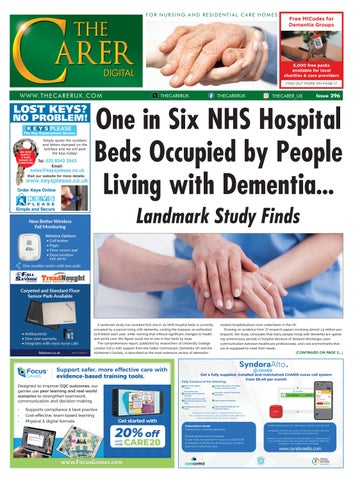

A landmark study has revealed that one in six NHS hospital beds is currently occupied by a person living with dementia, costing the taxpayer an estimated £2.8 billion each year, while warning that without significant changes to health and social care, this figure could rise to one in four beds by 2040. The comprehensive report, published by researchers at University College London (UCL) with support from the Geller Commission, Dementia UK and the Alzheimer's Society, is described as the most extensive review of dementia-
hospitalisations ever undertaken in the UK. Drawing on evidence from 77 research papers involving almost 1.5 million participants, the study concludes that many people living with dementia are spending unnecessary periods in hospital because of delayed discharges, poor communication between healthcare professionals, and care environments that are ill-equipped to meet their needs.
(CONTINUED ON PAGE 3...)

The latest research from University College London makes for deeply sobering reading.
One in every six hospital beds across the UK is now occupied by a person living with dementia, costing the NHS an estimated £2.8 billion a year. Even more concerning, that figure is projected to rise to one in four beds by 2040 unless fundamental changes are made to the way health and social care work together.
While the statistics are stark, those working in residential and nursing care will be forgiven for wondering what exactly is new.
For decades, successive governments of every political persuasion have wrestled with what has become one of the most politically intractable challenges facing the country.
Reports have been commissioned, white papers published, commissions established and countless promises made. Yet the fundamental problem remains stubbornly unresolved.
The UCL report merely quantifies what those on the frontline have witnessed for years.
Patients living with dementia are admitted to hospital 42% more often than their peers. Once there, they stay seven times longer. They are five times more likely to remain occupying hospital beds despite being medically fit for discharge because there is simply nowhere appropriate for them to go.
The reasons are painfully familiar.
Years of underinvestment in local authority social care budgets have left significant shortages of care home places in many areas, while community care services continue to struggle to recruit and retain sufficient numbers of trained care workers.
Discharge planning remains fragmented, with poor communication between hospitals, community teams and care providers often prolonging an already complex process.
Meanwhile, hospitals themselves are rarely the best environment for someone living with dementia.
Busy acute wards can increase confusion, anxiety and distress, accelerating both physical and cognitive decline. By the time many patients eventually leave hospital, they are often less independent than when they arrived, increasing the likelihood of emergency readmission.
It becomes an ever-turning circle of despair.
Every delayed discharge reduces hospital capacity. Every avoidable admission places further pressure on an NHS already struggling with rising demand. Every shortage of community support feeds directly back into overcrowded emergency departments and growing waiting lists.
The consequences are measured not only in financial terms—more than £12 million every day is spent on unnecessary hospital stays and delayed discharges—but in the quality of life of some of society's most vulnerable people.
Prime Minister Andy Burnham is far from the first national leader to acknowledge that social care requires urgent reform.
The challenge has defeated governments for well over a decade.
The Dilnot Commission, published in 2011, proposed introducing a lifetime cap on personal care costs alongside more generous means testing. The coalition government accepted its principles but concluded that the economic climate prevented implementation.
Theresa May attempted reform during the 2017 General Election with proposals centred around a £100,000 capital threshold. The policy was swiftly labelled the "dementia tax" by the opposition, becoming one of the defining issues of the campaign before ultimately being abandoned.
Now, with social care once again dominating headlines and featuring prominently across the national press this week, familiar questions are returning.
Who should pay?
Should social care continue to rely largely on individuals funding their own care until their assets are depleted?
Or should the taxpayer shoulder a greater share of the burden through a more comprehensive national settlement?
This is precisely why Baroness Casey's review may prove so important.
The debate cannot remain confined to Westminster or Whitehall. The public must understand the realities of demographic change, increasing life expectancy and the true cost of providing high-quality care. Most importantly, they deserve an honest conversation about how that care should be funded.
There are no easy answers, and any solution will inevitably involve difficult political choices.
But continuing to postpone those choices simply stores up even greater pressures for both the NHS and social care.
The latest dementia figures should not be viewed simply as another alarming set of statistics. They are a warning that the current system is reaching its limits.
Our care homes, community care providers and NHS staff continue to perform extraordinary work under immense pressure. They deserve more than another cycle of reports identifying problems they have understood for years.
What they need—and what the people they care for deserve—is a sustainable, properly funded social care system that allows individuals living with dementia to receive the right care, in the right place, at the right time.
Until that happens, hospital beds will continue to fill, delayed discharges will continue to rise, and the cycle will simply repeat itself.
On a lighter note — Afternoon Tea Week is fast approaching, and we'd love to hear how your home is marking the occasion. Do send us your photos and stories; nothing brightens these pages quite like a well-turned-out scone.
.I can always be contacted at editor@thecareruk.com





(CONTINUED FROM FRONT COVER)
Researchers estimate that delayed discharges alone cost the NHS £328 million annually, with people living with dementia found to be five times more likely than other patients to remain in hospital despite being medically fit for discharge.
FINANCIAL COSTS
The new report draws on evidence from 77 unique papers and 1.48 million participants to identify the human, social and financial costs of unnecessary hospitalisations:
• People with dementia have a 42% increased risk of admission to acute care, up to 35% increased risk of readmission and, once admitted, stay seven times longer their peers.
Delayed discharges and long stays see frontline workers struggling in environments unfit for long-term dementia care: 87% of hospital workers say caring for dementia is challenging due to poor resource.
• Families work 100+ hours unpaid a week, the equivalent of two and a half unpaid jobs, at great cost to their mental health and careers.
o “He was just in bed doing nothing. I ended up having to feed him and if we didn’t go, he wouldn’t get fed”, said one family member interviewed for the study.
Accounts gathered as part of the study describe patients not receiving adequate support with eating, personal care and toileting, despite being admitted to wards described as "dementia-friendly". Contributors reported that unfamiliar surroundings and limited personalised care often left patients distressed, disorientated and increasingly frail.
STAYS “AVOIDABLE”
Professor Andrew Sommerlad, from UCL Psychiatry and lead author of the report, said the findings demonstrate that many dementia-related hospital admissions and lengthy stays are avoidable.
He said: "Despite public and political perception, these dementiarelated failings in the UK health and care system are not intractable. The research clearly shows how important community-centric approaches are to reducing hospitalisations and minimising long stays, yet the NHS is not implementing them.
"With one in three people over 90 expected to have dementia, it has never been more important to redirect resources to evidence-based care and improve communication to ensure families, hospital staff and
carers are working as one joined-up team.”
EVIDENCE-BASED SOLUTIONS
The report challenges assumptions about some commonly used interventions, finding that measures such as general case management programmes and exercise initiatives, while beneficial in other aspects of dementia care, have not been shown to reduce hospital admissions. Instead, researchers recommend prioritising three evidence-based approaches:
• Making integrated multidisciplinary teams the standard model for dementia care, bringing together health and social care professionals to address patients' physical, cognitive and emotional needs.
Expanding the role of clinical pharmacists within hospital multidisciplinary teams, with the report suggesting this could generate savings of £38 for every £1 invested by reducing medication-related complications, readmissions and delayed discharges.
• Embedding advance care planning into routine dementia care, enabling individuals and families to make informed decisions before a crisis occurs. The report cites evidence that effective advance care planning can reduce hospital admissions by as much as 55%.
“BASIS FOR CHANGE”
Laurence Geller, Chairman of the Geller Commission, said the report provides the clearest evidence to date of the human and financial costs associated with dementia-related hospital care.
He commented: “For too long, the crisis facing people with dementia in our hospitals has been hiding in plain sight – acknowledged but never resolved, despite the millions of people across the country who have first-hand experiences of the inadequacies of current care provisions. I founded the Geller Commission and in turn, was pleased to support this important research, because I believe that what gets measured gets fixed.
“Until now, we have lacked a complete picture of the true human and financial cost of these failures. This report provides that evidence, and with it, the basis for change. Ignorance is no longer an excuse for inaction.”
Michelle Dyson, the chief executive of the Alzheimer's Society, said: "Too often, a trip to hospital is not just distressing, it can mark a signifi-
cant decline in a person's health, independence and quality of life.
"If we are serious about improving the lives of people living with dementia and reducing pressure across the system, health and social care must be addressed together."
Just last week Andy Burnham promised to end decades of government inaction by fixing adult social care in England - and did not rule out tax rises to help pay for it.
The prime minister said it was a "major dereliction of public duty" that successive governments had failed to address the crisis, adding there would be "difficult decisions" on funding but he was determined to "get it right."
His plans include a new national care service, with more pay and better training for care workers, and closer integration with the NHS.
Speaking to reporters he said he wanted to extract more from existing budgets to fund the reforms.
"I think we owe it to the public before we talk about tax rises, you first have to look the public in the eye and say 'Are we doing everything we can do from within what we've got?'"
Adding that fuller reforms "will require difficult decisions" and these "would be put before the country at the right time, and we will hopefully proceed with people's consent".
He also said in "an ideal world" he would not want anyone to have to sell their home to pay for care, describing it as a "really awful process".
JOINING NHS & SOCIAL CARE
A Department of Health and Social Care spokesman said: "Dementia is a cruel illness, and too many people living with the condition are left stranded in hospital when they would be better cared for in their community. We are working to turn this around, by joining up NHS and social care through integrated neighbourhood teams, and backing adult social care with a funding boost worth over £4.6bn so more people can get the care they need out of hospital.
"Last week, the Health and Social Care Secretary announced that we would appoint a dementia tsar later this year to help us drive forward work in this area, as recommended by Baroness Casey's Commission on adult social care, and the Prime Minister brought forward the timeframe for Baroness Casey's final report to summer 2027 so we can make rapid progress on the rest of the reform agenda."

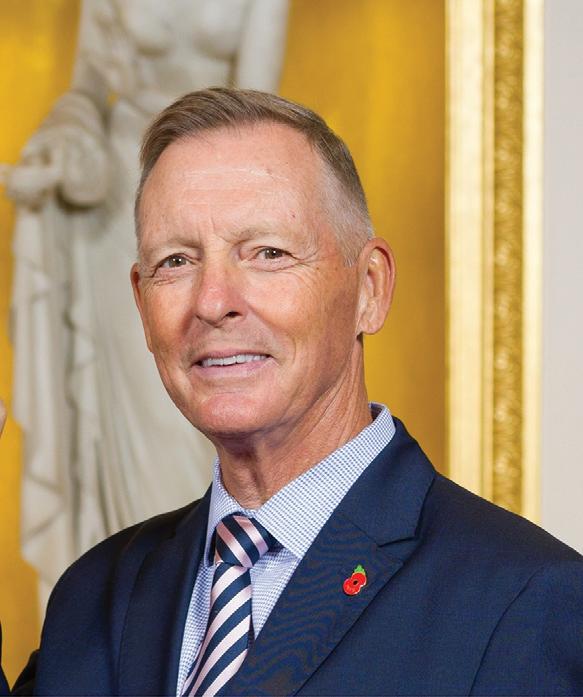
Andy Burnham says this time will be different.
He has promised to fast-track the Casey Commission’s review of adult social care and has spoken about creating a National Care Service that sits alongside the NHS, is “highly integrated”, “preventative in its character” and “person-centred”.
I sincerely hope he succeeds.
After almost four decades working in social care, nobody needs to persuade me that the system requires reform. I have watched families enter it at the worst moments of their lives—frightened, exhausted and unsure where to turn—only to find themselves battling assessments, rules and arguments about money.
I have seen good providers expected to deliver more while being paid less than it truly costs to provide safe, dignified and personalised care.
But the greatest failures are suffered by the people themselves.
I have taken calls from relatives in tears because their mother has been left alone in hospital in soiled clothing, while meals have been placed beside her and later removed untouched because nobody recognised that she could not eat, drink or use the toilet without reassurance and support.
Beyond hospitals, people receiving care at home have been left waiting for visits that arrived late or did not arrive at all. In residential and home care, shortages of familiar staff can turn support into a hurried list of tasks, leaving vulnerable people hungry, uncomfortable, frightened and unseen.
This is what the failure of personalised care looks like, which is why reform matters.
But social care has been promised reform for more than 30 years. We have had commissions, Green Papers, White Papers, legislation, consultations and repeated funding announcements. This history does not make those of us in social care resistant to change. It makes us cautious about promises.
MUCH OF WHAT BURNHAM PROMISES IS ALREADY SUPPOSED TO HAPPEN
Burnham wants social care to be “highly integrated” with the NHS, preventative and person-centred.
Yet health and social care are already expected to work together through Integrated Care Systems, the Better Care Fund and national hospital-discharge policies. Person-centred care is already a legal requirement under Regulation 9.
The aims are not new. What has failed is their delivery.
A hospital can say that someone is ready to leave, but that does not mean a suitable service is available to receive them. A social worker cannot buy a care package that does not exist, and a discharge coordinator cannot make an unsuitable placement suitable. A care service that is financially unviable cannot suddenly become sustainable while being paid the same inadequate fee.
The evidence is stark. In the ADASS Spring Survey 2025, 56% of responding council areas reported that providers had closed, ceased trading or handed back contracts during the previous six months, affecting more than 4,000 people.
A pathway cannot be seamless when the service at the end of it has closed.
PERSONALISED CARE REQUIRES PEOPLE
Person-centred care means knowing someone’s history, routines, relationships, fears and abilities. It may mean recognising that a person with dementia who refuses to get dressed is frightened, confused or in pain. That requires enough staff, continuity, training and workers who are not rushing from task to task.
If staffing levels allow only enough time to wash, dress, support eating and drinking and administer medication, the service may complete its basic duties, but it is only supporting the person to exist, not live. That is not personalised care. It is standardised, routine, task-oriented care wearing a personalised label. “Closer to NHS standards”
Burnham has spoken about moving the social-care workforce closer to NHS standards in pay, training, job security, employment benefits and career progression.
If that is what he means, there is a strong case for it. Care workers deserve employment conditions that reflect the skill, responsibility and emotional demands of their work.
But social care should not be treated as a lesser version of healthcare. It has its own knowledge, values and specialist skills, whether staff are supporting older people, adults with learning disabilities, people living with dementia or those with complex physical and mental health needs.
Good social care requires patience, judgement, emotional intelligence and the ability to build trusting relationships. Staff must understand the person beyond their diagnosis, recognise changes in behaviour or
By Kevin Hewlett MBE MSc, Executive Chairman, Hale
wellbeing and support choice while managing risk. Those qualities are not easily taught through a checklist, and not everyone is suited to the work.
The social-care workforce does not need to become more like the NHS workforce. It needs its own expertise to be recognised and properly rewarded, with investment that allows providers to offer pay, security, training, benefits and career opportunities comparable to those available to NHS healthcare support workers.
BETTER PAY—BUT PAID FOR BY WHOM?
Providers cannot improve wages, training and job security with money they have not received.
A council cannot say a provider’s fee is too high while government expects that same provider to pay more, train more, employ more staff and deliver genuinely personalised care.
When fees do not meet the true cost, vacancies remain unfilled, turnover rises and experienced workers leave. Continuity is lost, while private residents may be charged more to compensate for inadequate public fees—another uncomfortable reality.
If Burnham wants better employment conditions, care providers must receive substantially higher fees.
Simply changing the way social care is financed will achieve little if councils continue paying the same inadequate rates.
Government already acknowledges that provider fees, workforce capacity, retention and waiting times are directly connected. They are central measures within the existing Market Sustainability and Improvement Fund.
The problem is not that nobody understands the relationship. The problem is that providers have still not been given a clear commitment that council rates will rise sufficiently to fund the workforce Burnham says he wants.
Paying existing providers enough to survive is only part of the answer. The system also needs more capacity.
If government wants more home-care services, more care-home places and providers able to accept urgent admissions to free hospital beds, it must make delivering those services commercially viable.
Existing providers need enough margin to invest and expand. New organisations need confidence that council-funded care will not be purchased at a loss.
Profit should not be an embarrassing word. A reasonable return funds training, resilience and growth. Without it, providers will not expand.
Different areas will need different fees because wages, property costs, travelling distances and recruitment pressures vary. The issue is not whether every council pays the same rate, but whether each local rate reflects the real cost of quality care in that location.
In some areas, that may require increases of 15% or 20%. If that is the true price, government must say so honestly and fund it.
Without market confidence, small local providers will not establish new services, larger organisations will not expand, and existing providers will continue handing back contracts they cannot deliver sustainably.
Burnham may support a dedicated social-care levy or another means of raising additional revenue. That could provide more money, but collecting money differently is not reform.
Most of the outcomes he describes—integration, prevention, personalised care, timely discharge and workforce development—are already supposed to happen.
The underlying problem is that the system lacks the capacity and funding to deliver them consistently. ADASS has warned that council and adult social-care budgets are insufficient to meet all legal duties while also investing properly in prevention.
The decisive question is what happens to any new money.
Will councils be required to pay providers substantially more? Will rates cover better wages, training, staffing and urgent capacity? Will they encourage new services to enter the market and existing providers to expand?
Burnham has not yet made that commitment.
Without it, the same policies will remain, the same inadequate fees will continue, and the same failures will persist beneath a new funding label.
I want meaningful social care reform. But social care does not need another description of what good care should look like. We already know.
He has described the destination. Now he must explain what will genuinely change, how much more providers will receive and why this promise will succeed where so many others have failed.
Colleagues from Care UK’s Tor-Na-Dee in Aberdeen have raised over £2,000 for Alzheimer’s Scotland after completing an 18-mile walk, and all whilst dressed in kilts!
The seven team members were keen to take part in Kiltwalk’s Mighty Stride challenge, starting in Bellfield Park in Banchory and ending in Aberdeen, and they were especially passionate about raising money for Alzheimer’s Scotland.
“It’s something we all work with really closely,” Care Assistant Daniel Morrison said: “I work in the Dementia Unit at Tor-Na-Dee, and we get to know the residents so well, so if you’re fundraising for something like Alzheimer’s Scotland then you can see the impact you’re making every day.”
The group raised £1,140. Care UK then recognised their hard work by matching their funding and donating £1,000, lifting the group’s total to £2,140 and enabling the charity to provide advice, information and support to those who need it most.

Sue Jones-Wood, Home Manager at Tor-Na-Dee, said: “I am incredibly proud of the team for smashing the £1,000 target and raising an amazing sum for such a vital charity.
“Alzheimer’s Scotland is extremely close to everyone’s hearts here at Tor-Na-Dee. One in three people born in the UK today will be diagnosed with dementia in their lifetime*, which is why it’s important for us to
raise funds for such an important cause.
“I’d like to extend a huge thank you to those who took part, to everyone who donated and to Care UK for matching everyone’s fantastic donations.”
Now, the team are looking ahead and planning what they can do next to raise money again.
Tor-Na-Dee’s Lifestyle Lead, Kieasha Morrison, said: “You get to do something amazing, it’s a personal achievement, and you’re also raising funds for a good cause. It was challenging mentally and physically, but everyone would come together and we would power on through. All of us that did it this year are ready to sign up for next year!”
Daniel added: “I think it goes without saying that it was a huge relief to be done. I mean, we were walking for six hours! Everyone was definitely very tired, but I think that makes it feel like more of an accomplishment knowing that there was genuine mental and physical fatigue, and we still got it done together. One of the guys and I are now looking at jumping out of a plane!”
Both also agree that their fundraising has brought the team closer together.
Kieasha said: “It was just really nice to see people outside of work. This was an amazing way to get to know the team a bit better and do something special for charity. If you get the chance to do something like this, just do it.”
Baroness Casey of Blackstock has launched The Big Conversation on Care, the most ambitious public conversation in a generation, handing the public a direct role in shaping the future of adult social care in England.
Between now and April 2027, The Big Conversation will give people across England the opportunity to say what they want and expect from a future National Care Service, including on the tough questions on who it should support, what families should reasonably be expected to do, and how the country should pay for care in a fair and sustainable way
The launch follows warnings from Baroness Casey that the adult social care system is “broken”, and that previous attempts to reform social care have too often failed because they have tried to resolve fundamental questions without first building public understanding and consent.
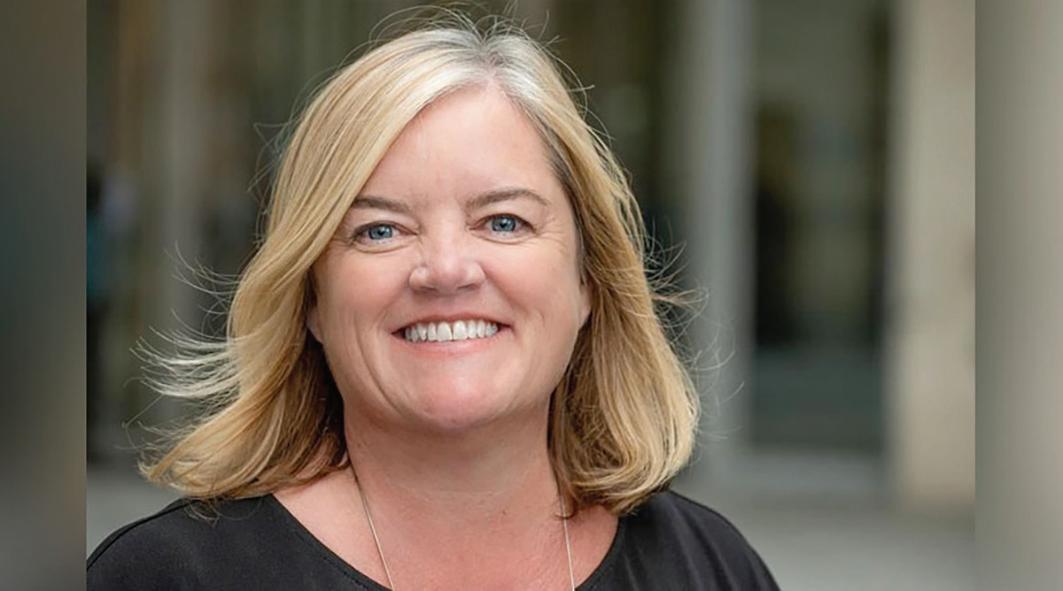
Baroness Casey of Blackstock said: “For too long, we have been stuck in the same cycle: crisis, promises of reform, another review, and then retreat, while the people who need care, and their families, bear the
brunt.
“Social care affects every family in this country: whether we need care ourselves, care for someone we love, work in care, or pay for it through our taxes.
“That’s why I am launching The Big Conversation on Care today. I want people across England to help us face the hard questions about how we can build a National Care Service. It is only by listening to the public that we can build the agreement needed for lasting reform.”
The Big Conversation will aim to engage with one million people across England. It is open to everyone through a new online platform which launched yesterday (July 29) at caseycommission.co.uk/bigconversation/, starting the conversation by asking people: when we are old or disabled, or have a serious illness, who should support us and how?
The Big Conversation will conclude by April 2027. Baroness Casey has agreed to provide the Independent Commission’s recommendations by summer 2027.
A care home resident’s lifelong love of horses has led to a dream day she’ll never forget, thanks to the kindness of a local horse owner who turned a simple visit into an unforgettable experience.
Jen, who lives at Green Lodge Care Home in Billingham, has loved horses throughout her life.
When Senior Carer Vicki Watson discovered how much the animals meant to her, she arranged for a horse to visit the home, giving Jen the chance to groom, stroke and reconnect with one of her greatest passions.
The visit led to an unexpected invitation when the horse’s owner asked Jen to be her special guest at the Durham County Show.
Accompanied by Activities Coordinator Claire, Jen enjoyed exclusive behind-the-scenes access to the livery yard before the show opened, where she reunited with the horse she had groomed and met many more horses and their owners. She spent the day watching competitions, chatting with exhibitors and soaking up the atmosphere at one of the region’s biggest agricultural events.
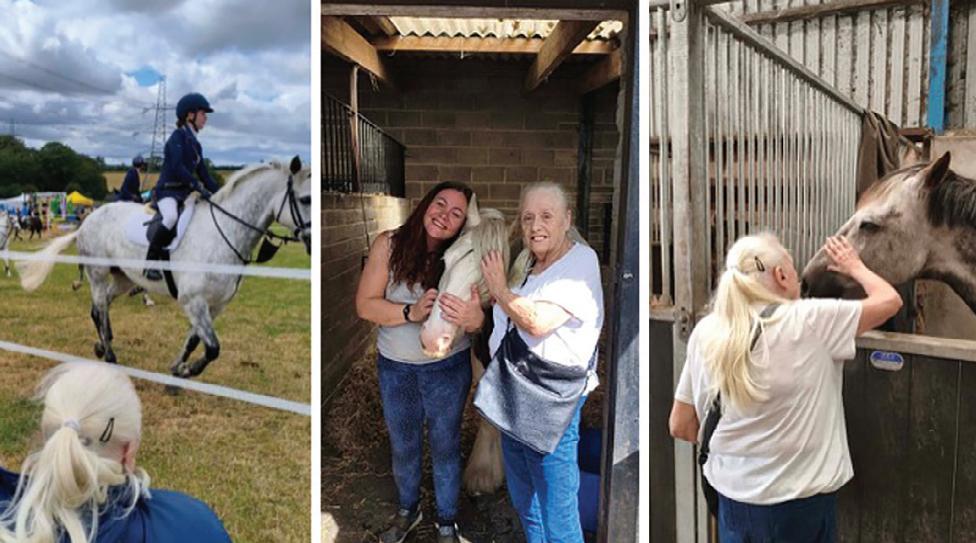
Alongside the equestrian events, Jen also explored the show’s many attractions, including local chari-
ties, farm animals and a husky rescue display.
Claire said: ‘Watching Jen’s face light up from the moment we arrived was incredibly special. Horses have always been such an important part of her life, so being able to reconnect with them in such a meaningful way was wonderful to see. Being welcomed behind the scenes, meeting so many kind people and spending time with the horses created memories we’ll all treasure. Experiences like this show just how important it is to celebrate each person’s interests and life story.’
Vicki added: ‘It all started with a conversation about Jen’s love of horses. We hoped bringing a horse to the home would make her smile, but we never imagined it would lead to such a generous invitation to the Durham County Show. We’re incredibly grateful to everyone who helped make Jen’s dream day possible.’
The visit is one of many personalised experiences organised by the team at Green Lodge Care Home, ensuring residents can continue enjoying the hobbies, interests and passions that have shaped their lives, creating meaningful moments and lasting memories along the way.


For those running a care business, a long day at work isn't necessarily followed by rest, so there is little opportunity to step back and process the day just gone.
While much has been written about the pressures facing the care sector, less attention has been given to what these pressures do to the people carrying them, often with limited support.
Fortunately, this is beginning to change. As announced at the beginning of July, the Care Quality Commission (CQC) is developing new training for its inspectors to help support and protect provider welfare. This is an essential development, given the pressure of CQC inspections has a detrimental impact on the mental health of care home managers – adding to the many stresses care business owners already face.
THE SCALE OF THE PROBLEM
This problem isn't unique to care. While many providers have become accustomed to operating under pressure, prolonged stress can affect decision-making, staff retention and organisational resilience.
Data collected through The Director's Helpline's Business
Health Check shows this is a pattern across UK business leadership more broadly. Our research found that 24% of directors say they are close to burnout, 31% say they lack the confidence to make key business decisions, and 52% report feeling like they are "going it alone" – without a genuine support network around them. These figures describe a leadership population that is quietly struggling rather than visibly failing. Burnout in a care business rarely announces itself with a single dramatic event. It builds gradually, through pressures that would cause no crisis on their own but often do combined.
Care business owners sit at the intersection of pressures rarely found together in one role: employers managing recruitment and retention, compliance leads preparing for CQC inspections, and financial decision-makers navigating tight margins and uncertain funding. Many have entered the sector because they care, in the fullest sense, about the people they support. A staffing gap or funding shortfall rarely registers as only a financial problem – it's often felt emotionally too.
Care ownership is also structurally different from running most other small or medium-sized businesses.
By Jonathan Cooper, Founder and Director of The Director's Helpline
A director of a manufacturing firm can, in a genuine emergency, close the factory doors for a day. A care home owner cannot close the home. This constant, unbroken duty of care is what sets the sector apart. Layered on top is a regulatory environment that rarely stands still. CQC inspection frameworks, local authority fee negotiations, staffing ratios and safeguarding requirements shift over time, and providers are expected to keep pace regardless of size or resources.
Left unaddressed, this strain doesn't stay contained to an owner's personal wellbeing – it becomes a business risk. Decisions are delayed, while difficult conversations are avoided and compliance tasks slip. Staff turnover rises when leadership capacity is stretched too thin to support a team properly.
None of this reflects a failing on the part of the owner. It's a predictable outcome of sustained pressure without an outlet – which is why protecting an owner's mental health should be treated as a governance issue, not solely a personal one.
There are ways that care business owners can help ease this cognitive load, through habits and processes that spread some of the responsibility around.
Build a genuine peer network with other people running care businesses who understand the specific pressures involved. Isolation is one of the clearest drivers of burnout.
Identify which decisions genuinely need owner-level judgement whether it’s strategic direction, key financial calls or safeguarding and free up capacity elsewhere.
Dedicate regular time to finances and compliance, before they become urgent.
Seek outside perspective before a decision is made under pressure.
Track your own wellbeing indicators – sleep, mood, energy – as well as the business's.
Establish stringent financial forecasting.
Seek help before something becomes a significant problem. Asking for support from an accountant, a peer, or a support service is a sign of good governance, not a personal shortcoming.
Running a successful care business requires leaders to protect their own mental wellbeing, as well as strong finances and regulatory compliance. This way they can keep making clear decisions and lead with confidence.
Close to a quarter of directors report they are near burnout, and over half feel they are going it alone. Neither is inevitable – both are addressable through peer support, clearer delegation, dedicated time for review, and a willingness to seek outside perspective before a crisis point is reached.
In a sector where quality care depends on strong leadership, protecting the wellbeing of those at the helm should be viewed as an operational necessity, not a personal luxury.
For the third year running, Barchester Healthcare staff and residents have come together to take part in an inclusive, companywide initiative to raise funds for Barchester’s Charitable Foundation. ‘Get Barchester Moving’ is a week where all of Barchester’s homes and hospitals across the country plus support offices log their ‘move minutes’ and get stuck into all kinds of different fund-raising activities to show their support for the Foundation.
The ‘move minutes’ that staff and residents register can be any kind of activity from armchair yoga to line dancing, a gentle stroll or a tai chi session. Everyone is invited to take part and this year Barchester residents, patients and colleagues logged a total of 665,999 move minutes or 462 days in one week alone! Barchester’s Charitable Foundation supports older people and other adults living with a disability or a mental health condition by helping them to connect or re-connect with others in their local communities. Get Moving Week 2026 raised £3,050 for the Foundation through staff and resident-led activities which included all kinds of different escapades such as a 24 hour 50 mile overnight hike across the South Downs calling at six different homes in Barchester’s South East Division by a group of intrepid
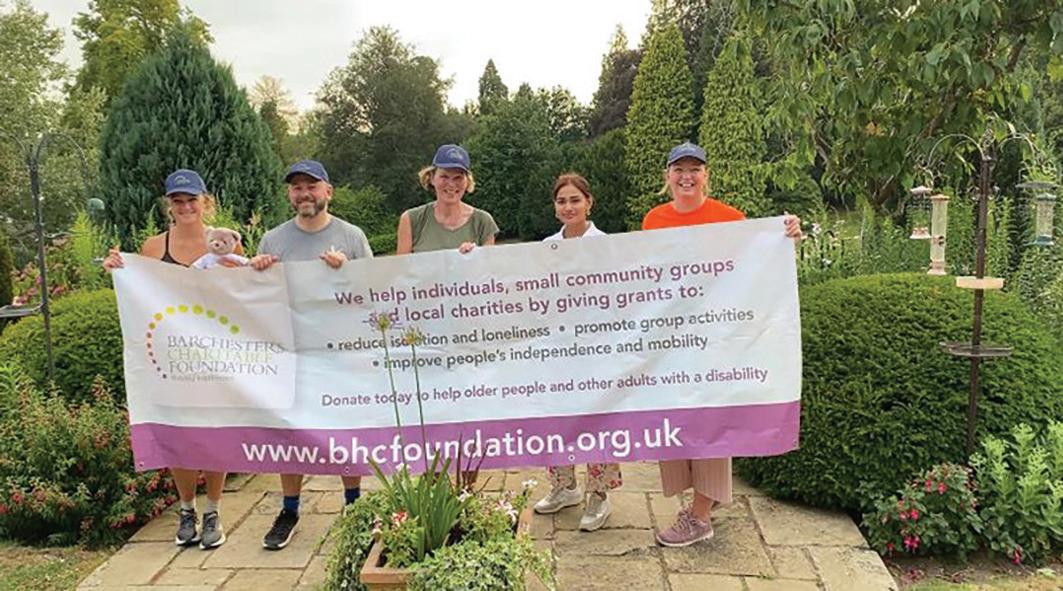
walkers.
Not to be outdone, Regional Director, Cosmin Lemnaru, decided to log his move minutes by facing his fear of heights to take on the Mürren Via Ferrata, a breath-taking 2.2km cliff edge trail. Clipped to a steel safety cable running along the Mürrenfluh cliff face, Cosmin navigated exposed rock ledges, vertical ladders and a wobbly suspension bridge, at one point standing roughly 600 metres above the floor of the Lauterbrunnen Valley with uninterrupted views across to the Eiger, Mönch and Jungfrau.
Chair of Barchester’s Charitable Foundation and Chief Commercial Officer, Simon McCall, commented: “Get Barchester Moving Week is a fantastic initiative which brings together our residents, patients and staff teams and gets everyone taking part which is what the Foundation is all about – helping people to participate in community activities and combating isolation. The fundraising element is the cherry on top but ultimately it is about wellbeing and connection. Every year the move minutes go up which shows that people are enjoying taking part, I’m incredibly grateful to everyone who gave up their time and who got involved.”
Residents from across the Sanders Senior Living and Runwood Homes groups celebrated the official opening of the inspiring No Art Without Heart exhibition, returning for the third year, with a special ribbon-cutting ceremony at The People’s Gallery in Southend.
The exhibition, which is open to the public until 28th August, showcases an extraordinary collection of artwork created by residents from care homes across Essex and the wider UK. Celebrating creativity, individuality and the power of meaningful engagement, the exhibition demonstrates that artistic expression has no age limit.
Residents travelled to the gallery to see their artwork professionally displayed, with two residents taking part in the official ribbon cutting to mark the exhibition’s opening. The event featured speeches from Kieun Kwon, Associate Director of Wellbeing and Dementia Services, Sarah Sanders, Business Development Director, Hilary Woodhead, Executive Director at NAPA, and Jude Sweeting from Dementia Community.
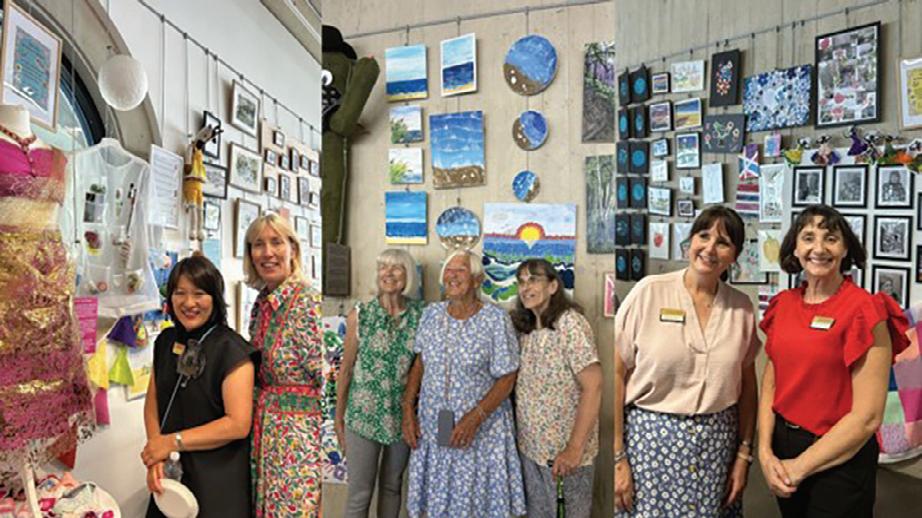
The exhibition has provided residents with far more than an opportunity to create artwork. Having a shared goal to work towards has given participants a renewed sense of purpose, achievement and pride, while the creative process has encouraged conversation, reminiscence and connection within each home.
This year’s collection includes an eclectic range of artistic styles and mediums, with many pieces reflecting collaborative projects between residents, families and local communities. Some artworks were created by families spanning four generations, while others were produced alongside local schoolchildren through
intergenerational initiatives. Other pieces emerged during lively group sessions, with some inspired by quieter moments of personal reflection.
Every participating home reported that the project sparked laughter, storytelling and meaningful conversations, reinforcing the important role creativity plays in supporting wellbeing and maintaining a strong sense of identity.
Residents were visibly moved as they explored the gallery, proudly pointing out their own creations to friends, family and fellow artists. Seeing their work displayed in a public gallery was a special moment and a fitting celebration of the talent, passion and individuality found throughout both care groups.
Speaking at the opening, Sarah Sanders said: “This art exhibition is a true celebration of humanity, connection, and pure, unfiltered expression, all driven by an inclusive, person-led ethos.
“Under the theme No Art Without Heart, it normalises creative freedom and showcases the vibrant, can-do spirit of every participant. It breaks past traditional boundaries, proving that life, stories and art continue dynamically far beyond the conventional concept of a care home.”
Hilary Woodhead, Executive Director at NAPA, highlighted the organisations’ shared commitment to championing creativity and meaningful engagement within care settings. She described the homes as “the gold standard”, adding, “This is an example of best practice.”
Responding to Prime Minister Andy Burnham’s speech last week outlining the Government’s plans to reform adult social care in England — including an invitation to Conservative leader Kemi Badenoch and Liberal Democrat leader Ed Davey for cross-party talks on delivering urgent reform — TUC General Secretary Paul Nowak said:
“This is an important step towards fixing our social care sector. The Prime Minister is right – the government’s progress in delivering the Fair Pay Agreement will be a vital building block in forming a National Care Service and bringing social care staff rightly in line with their NHS colleagues.
“Most families will need social care services at some point. But the system for funding care is not fit for purpose. It’s a postcode lottery which leaves too many without the quality care they need, and some saddled with enormous bills just to ensure their basic needs are met.
” At the same time care work has long been synonymous with low pay and insecure work, with care workers undervalued and underpaid for the vital work they do.
“That’s why the foundation to success of any reforms is improving pay and conditions for the workforce
through the Fair Pay Agreement – and improving progression routes through training.
“In years ahead, continued and increased funding will be essential to ensure the urgent workforce challenges can be meaningfully addressed.”
On proposed reforms to settlement routes that would prevent most care workers from being able to build a life in the UK, Paul added:
“The Prime Minister is right to acknowledge the huge contribution care staff from overseas make.
“They work around the clock to provide care for our loved ones and keep the sector running. But proposed settlement reforms will push many into severe hardship, making life more expensive and unwelcoming for migrant care workers. Many may choose to leave or be unable to stay – creating significant staffing gaps and service pressures. These plans must be scrapped.
“Building a strong domestic workforce through fair pay and career progression is the right long-term goal, but this shouldn’t be at the expense of overseas workers who keep our social care system afloat despite years of underinvestment.”
The cost of dependency-forming medicines prescribed in England has more than halved since 2016/17. New data published by the NHS Business Services Authority (NHSBSA) shows the cost fell by 57% between 2016/17 and 2025/26, from £756 million to £325 million. Dependency-forming medicines are prescribed medicines which can cause withdrawal.
The reduction in cost was mainly driven by:
• the total number of identified patients prescribed dependency-forming medicines decreasing by 14% in the last 10 years, from 8.1 million in 2016/17 to 7 million in 2025/26
• the total cost of gabapentinoids falling by 87% since 2016/17
• the total cost of opioid drugs falling by 32% since 2016/17
In 2025/26, 66 million items for dependency-forming medicines were prescribed to an estimated 7 million identified patients in England. Approximately 60% of identified patients who were prescribed a dependency-forming medicine were female.
Opioid drugs remain the most prescribed dependency-forming medicines in 2025/26, with 39 million items prescribed at a cost of


£256 million.
The data also shows that people in the most deprived areas of England were more likely to be prescribed dependency-forming medicines than those in the least deprived areas, with 59% more identified patients receiving prescriptions. This trend of higher prescribing in more deprived areas has remained consistent since 2016/17.
In March 2026, where patients were prescribed items from two different categories of dependency-forming medicines, the most common combination was opioids and antidepressants. This applied to approximately 650,000 patients, accounting for 53% of patients who received prescribing in two categories of dependency-forming medicines.
The NHSBSA’s dependency-forming medicines publication was developed in response to a government commissioned review into the dependence and withdrawal associated with some prescribed medicines.

• We specialise in the sale and purchase of quality used wheelchair accessible vehicles and ambulances.
• They can be bought as seen or refurbished and sign-written to your own requirements.
• Fully serviced, new mot & warranty
• Engineers inspection supplied if required.
• Free delivery service available
• All buses comply with new legislation
• Lease hire and purchase available
• Always


The care sector continues to face significant recruitment and retention challenges, with an overall workforce vacancy rate of 6.2% in adult social care in 2025/26 and turnover at 23.6% according to Skills for Care.
With increased demand for care services, skills shortages and growing competition for talent, traditional recruitment methods based primarily on qualifications and employment history are often no longer sufficient. Forward-thinking employers are increasingly re-thinking recruitment approaches, as well as strategies to retain high-quality staff, who will thrive in care environments.
Care providers often still prioritise people with previous care experience. Widening recruitment criteria to focus on transferable skills and values can unlock new talent pools.
Values-based recruitment focuses on identifying candidates whose personal values align with those of the organisation, rather than relying solely on experience or formal qualifications. While technical skills can often be taught, qualities such as compassion, empathy, respect, integrity and commitment to supporting others are more intrinsic.
For care providers, this approach can broaden the talent pool considerably and improve retention. Individuals from retail, hospitality, education or customer service backgrounds, for example, may possess the interpersonal skills and attitudes necessary to succeed in care roles, even if they have no previous sector experience.
Employers can implement values-based recruitment by incorporating behavioural interview questions, situational judgement exercises and strengths-based assessments into their recruitment processes. Instead of only focusing on what a candidate has done, recruiters should explore how they approach challenges, support others and demonstrate resilience and kindness.
BUILDING INCLUSIVITY INTO RECRUITMENT STRATEGIES
An inclusive recruitment strategy aims to remove unnecessary barriers and attract candidates from diverse backgrounds. This is particularly important in the care sector, where a diverse workforce can better reflect and understand the communities it serves.
Inclusive recruitment starts with job design and advertising. Job descriptions should focus on the skills and behaviours genuinely required for the role and avoid unnecessary criteria that may discourage capable applicants. Recruitment materials should use accessible language and clearly communicate the organisation's commitment to equality, diversity and inclusion.
Employers should also review where vacancies are advertised. Relying solely on traditional recruitment channels may limit reach. Expanding advertising to community groups, local networks and specialist platforms can help attract a broader range of candidates.
Workforces increasingly value flexibility, particularly where people have caring responsibilities outside of work. An employer’s ability to offer flexible working options, or self-rostering, will increase attractiveness.
Importantly, inclusivity must extend beyond hiring. Individuals who feel respected, supported and able to bring their authentic selves to work are more likely to remain with the organisation and contribute positively
By Sarah Goldie, HR
to workplace culture. They are also more likely to be employer advocates, positively contributing to, and impacting, recruitment.
Technology is transforming recruitment across all sectors, including social care. Digital tools can help organisations attract candidates more effectively, streamline recruitment processes and improve candidate experience.
Significantly, social media platforms, online job boards and targeted digital advertising enable employers to reach potential applicants who may not actively be searching for care sector roles. Applicant tracking systems can simplify administration and reduce delays in the recruitment process, while video interviewing can increase accessibility and flexibility for candidates. In a competitive market, such agile recruitment can make a difference.
Technology can also support retention. Digital onboarding, e-learning platforms and employee engagement tools can help new recruits feel connected and supported from day one. However, technology should enhance rather than replace human interaction. The care sector remains fundamentally people-focused, and personal engagement remains essential throughout the recruitment journey.
Recruitment success does not end when an offer is accepted. Organisations must create environments where employees feel valued and that they belong, connected through a shared sense of purpose.
A culture of teamwork and belonging can be fostered through effective induction programmes, mentoring opportunities, communication and visible, compassionate leadership. Employees who feel appreciated and supported, working as part of a well led and collaborative team, are more likely to remain engaged and committed to providing high-quality care.
Recognition schemes, wellbeing initiatives and opportunities for career development can all contribute to stronger retention outcomes. In a competitive labour market, organisational culture is increasingly becoming a key differentiator.
Showcasing employee stories on their own paths into the care sector and career development is a great way to boost engagement and support recruitment.
An effective way to expand recruitment pipelines is through greater community engagement. Building relationships with local colleges, schools, universities and community hubs can raise awareness of careers in care and challenge outdated perceptions of the sector.
Employers can offer careers talks, open days and work experience placements to introduce people to rewarding care careers. Partnerships with local job centres, faith groups, voluntary organisations and community networks can also help reach individuals who may not otherwise consider a role in care. Further, offering a range of structured pathways into the sector can make it more accessible and attractive, such as apprenticeships, work academy programmes, pre-employment training partnerships with local colleges and returnships for people re-entering the workforce.
The future of recruitment in the care sector requires organisations to think differently. Values-based hiring, inclusive recruitment practices, effective use of technology and strong community partnerships underpinned by a breadth of entry-routes and career pathways can help employers attract dedicated individuals who are committed to delivering excellent care. Combined with a culture that promotes teamwork, belonging and supports wellbeing and development, these strategies offer a sustainable approach to building and retaining the workforce that the care sector needs today and for the future.
Elderly and frail patients aged 81 and over are worst affected by the ongoing crisis in A&E, which often leaves those admitted to hospital waiting for a bed to become available in inappropriate places like corridors and cupboards. In 2025, 43% of over-80s faced an agonising wait of more than 12 hours between arrival in A&E and admission to a hospital ward, compared with 19% of those aged 21-30.
That’s according to new analysis by the Nuffield Trust, carried out as part of the QualityWatch programme with funding from the Health Foundation. It takes a detailed look at how very long waits for hospital beds became the norm, who is most affected, and whether new NHS definitions and data on ‘corridor care’ in A&E will make a difference.
Long waits for a hospital bed were a problem even beforestart of the pandemicin2020, butescalated rapidly during 2021 and 2022.Sincethen,waits to be admitted havepeakedeach winter.In February 2026, over 72,000 patients waited over 12 hours,representinga third of all admissions.What was considered unacceptable and alarming in December 2019 (41,104 cases waiting over 12 hours) is now much lower than the best performing months over the past five years.

The analysis shows that the older you are, the more likely you are to have a very long wait in A&E. Experts previously assumed that older adults spend longer in A&E because they are more likely to be admitted, but this new analysis makes clear that even when you look at patients of all ages who are admitted, older adults are still likely to wait longer than the rest.
The analysis also found that some health problems are much more likely to lead to long waits than others. The problems most associated with waits over 12 hours in 2025 were airway/breathing (191,193, equivalent to 36% of cases), gastrointestinal (161,905 or 27%), and neurological (159,897 or 36%).
NHS England has committed to tacklingone part ofthe A&E waiting problem–treatingpatients in temporaryareas–and hasnow definedfor the first timewhat corridor care is . The intention is that clarifying what ‘counts’ as corridor care,and then counting how much this is happening,gives greater clarity and transparency on the scale of the problem. New data shows that there were 72,955 cases of patients enduring corridor care in June, which is equivalent to roughly 5% of A&E attendances, and the number of cases
wasconsistentlyhighest at weekends.
While the Nuffield Trust researchers welcome the increased transparency around this problem, they doubt that this will have a significant impact on waiting times and the severe harm that long waits can lead to. There is also a risk that overemphasising ‘eliminating corridor care’ as a key target could encourage hospitals to act in a way that’s not best for patients – for example, delaying patients being handed over from ambulances to slow down the flow of patients into A&E corridors.
The authors warn that policies aimed at fixing long waits have focused too much on what goes on in A&E, but in reality, the issues driving long waits can also be found elsewhere at different stages of a patient’s journey through hospital. This includes the often low number of hospital beds on wards, and not enough care being available outside of hospitals. Some of the difficulties with discharging patients are inextricably linked to poor access to social care services, so improvements in A&E depend heavily on the new Prime Minister’s promise to reform the care system. More consistent investment in preventative social care could avoid some hospital admissions in the first place.
Nuffield Trust Deputy Director of Research, Sarah Scobie, said: “It’s absolutely shocking that two-fifths of the most elderly patients going into A&E are stuck waiting for over 12 hours, often in unsafe conditions, when they are already extremely unwell and vulnerable. Since the pandemic, stories like this have become so common, and we know that long A&E waits have caused thousands of avoidable deaths in recent years.
“Behind every case of corridor care counted in the new data is a person going through a frightening and traumatic experience. The fact that we even need a proper definition and data for corridor care in the NHS shows just how far A&E performance has spiralled out of control, with very long waits now the norm.
“But overly focusing on corridor care risks long waits being seen as just a problem for A&E departments. The evidence is clear that we need improvements in how patients flow through hospitals after A&E. Better access to health and social care services outside hospital – both before and after an admission is needed – is also needed to bring about a sustained reduction in long A&E waiting times.”
A major new analysis of verified care home reviews paints a positive picture of the UK’s care home sector, with nearly twothirds of homes listed on carehome.co.uk achieving an overall review score of 9.0 or above out of 10.
The report, published by carehome.co.uk analysed verified reviews submitted over the past five years to understand what matters most to residents and their families when choosing and living in a care home.
Overall, the findings show that 44% of care homes have an overall review score of 9.5 or above out of 10, while a further 20% score between 9.0 and 9.5, demonstrating the high regard in which many homes are held by the people who know them best.
The report also highlights the vital role staff play in shaping residents’ and families’ experiences. Staff consistently receive the highest ratings across all 12 review categories on carehome.co.uk, with residents and their loved ones awarding 56,222 five-star staff ratings between May 2025 and May 2026 alone – more than any other aspect of care.

At a time when adult social care continues to face significant workforce shortages and recruitment challenges, the findings recognise the extraordinary contribution care home staff make every day. Reviews consistently highlight their kindness, compassion, professionalism and dedication, with words such as “kind”, “friendly” and “helpful” appearing repeatedly in residents’ and families’ feedback.
While the report paints a positive picture overall, it also identifies areas where providers have opportunities to improve. Value for money consistently receives the lowest ratings across every fee band. With care home costs increasing by around 10% in the year to December 2025, and the average weekly cost of a residential care home now £1,298, the findings reflect the financial pressures many families face and their
expectation that fees should match the quality of care provided. Activities were the second lowest-rated category, followed by food and drink, highlighting the importance of everyday experiences that shape residents’ wellbeing and quality of life. The findings suggest these aspects of daily life represent important opportunities for providers to further enhance residents’ experiences.
The findings also reflect a wider shift across adult social care, with regulators placing greater emphasis on people’s experiences and outcomes when assessing quality. Verified reviews are therefore playing an increasingly important role in demonstrating what high-quality care looks like in practice.
Will Blackwell, CEO of Tomorrow’s Guides, which operates carehome.co.uk, said:
“Adult social care is often discussed in terms of the challenges it faces. However our review data tells another important story. Residents and their families are telling us that many care homes are delivering high-quality care and positive day-to-day experiences.
“It’s particularly encouraging that almost two-thirds of care homes achieve review scores of 9.0 or above. Behind those ratings are thousands of dedicated care professionals whose kindness, compassion and commitment make an enormous difference to people’s lives every day. Our findings show that staff are consistently at the heart of the best care home experiences.
“As adult social care enters one of its biggest periods of reform in a generation, verified reviews have never been more important. They help families make one of life’s biggest decisions, while giving providers valuable insight into what they are doing well and where they can improve.”
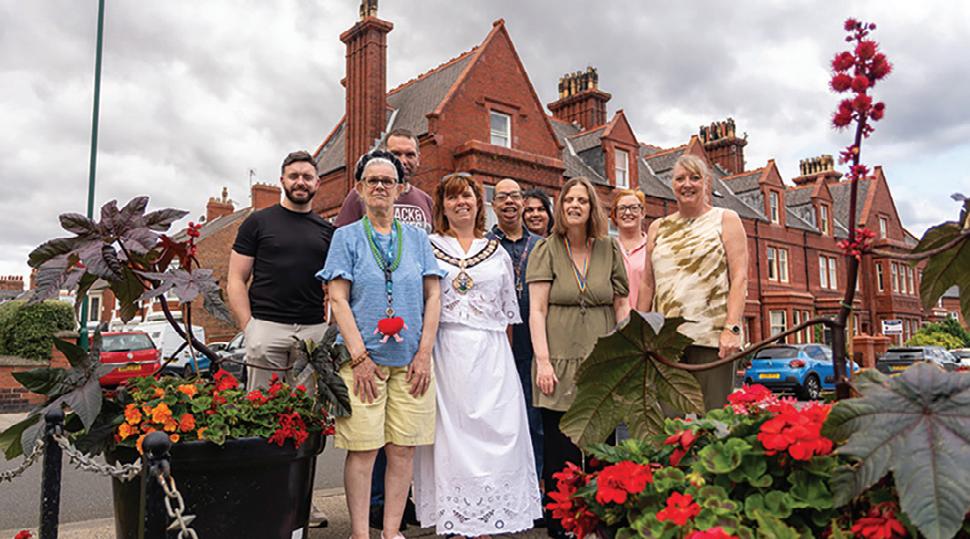
The Mayor of Redcar & Cleveland, Councillor Ceri Cawley, paid a special visit to Milewood’s Strathallen home in Saltburn, where she met the people who live there and the team supporting them.
Strathallen provides high-quality, person-centred support for adults with learning disabilities, helping each individual to develop greater independence, pursue their interests and enjoy fulfilling lives within their local community. The service became part of the Milewood family in 2025 and is home to up to nine people in a welcoming, homely environment just a short walk from Saltburn’s seafront.
During the visit, Councillor Cawley spent time chatting with residents and staff, learning more about daily life at Strathallen and the personalised support provided to help people achieve their goals. She was given a tour of the service and heard first-hand about the positive difference that dedicated, person-centred care makes to the lives of those who call Strathallen home.
Samantha Hunt, regional manager at Milewood, said: “It was a real pleasure to welcome the mayor to Strathallen. Visits like this are a fantastic opportunity to showcase the incredible work our colleagues do
every day and, most importantly, to celebrate the amazing people who live here.
“We are passionate about providing support that is tailored to each individual, enabling people to live as independently as possible, build confidence and enjoy active, meaningful lives within their community. We are grateful that the mayor took the time to see that for herself.” Mayor of Redcar & Cleveland Councillor Ceri Cawley said: “It was wonderful to visit Strathallen and meet both the residents and the staff. The warmth, kindness and genuine sense of community were immediately apparent. It was inspiring to see the person-centred approach in action and the commitment to ensuring every individual is supported to live a full and rewarding life. Thank you to everyone for making me so welcome.”
Martyn Heginbotham, chief executive of Milewood, added that the visit reflected the importance of recognising the vital role specialist support services play in helping people with learning disabilities thrive within their local communities.

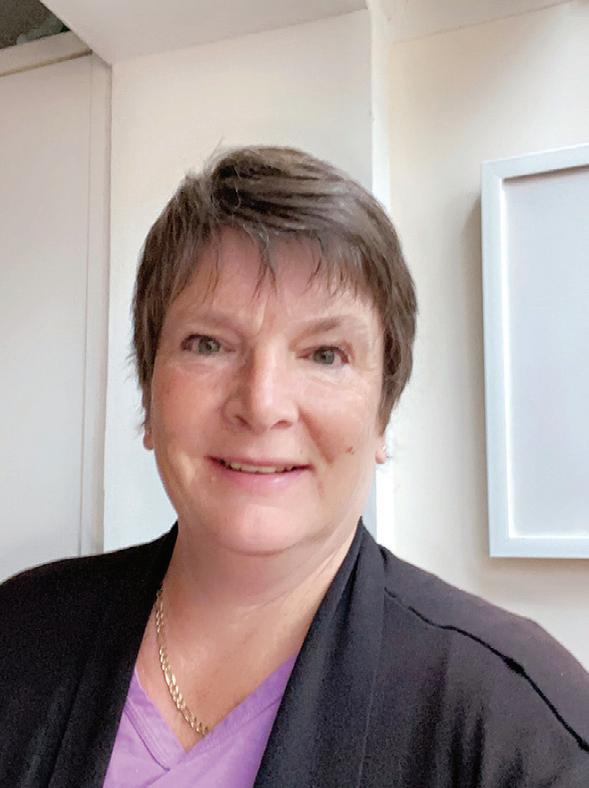
This year, Abbeyfield Wey Valley Society celebrates an incredible milestone, 40 years of supporting older people across Surrey and Berkshire. For Chief Executive Officer Sally Tidy, it's a celebration that's especially meaningful. Having spent 35 of those years with the charity, she's witnessed first-hand how care has transformed over the decades, while seeing one thing remain wonderfully unchanged: the importance of kindness, compassion and community.
Looking back to her first day as Manager of Wey Valley House in the early 1990s, Sally remembers immediately recognising that Abbeyfield was different.
"I had come from a very task-orientated environment where everything happened at a set time. The 'family' ethos was evident even then, and I was determined to help it grow even further."
It was a philosophy that would shape not only her career but also the way Abbeyfield Wey Valley Society has continued to evolve over the last three decades.
FROM INSTITUTIONS TO HOMES
When Sally first entered the care sector, care homes often carried a very different reputation from the welcoming communities many have become today.
"Back in the 90s, care homes carried a stigma. They were often thought of as institutions rather than homes. Over the years, that has gradually changed, and although families still face difficult emotional choices, care homes are now recognised as highly professional, specialised healthcare environments rather than the grim, institutional destinations of the past."
That shift has been driven by a much greater understanding of what quality care really means.
Today, Abbeyfield Wey Valley Society places each resident at the centre of everything it does. Rather than fitting people into routines, care is built around the individual, their preferences, interests, hobbies and the life they want to continue living.
"One of the biggest changes has been focusing on each individual resident – their needs, wants and aspirations. We actively instil a mindset in our staff that they are guests working inside the residents' home. Every individual has the right to make informed choices about how they want to live their life."
Whether it's choosing favourite meals, decorating their room with treasured possessions or taking part in activities they genuinely enjoy, the emphasis is on helping people feel truly at home.
THE PEOPLE WHO MAKE THE DIFFERENCE
Technology has advanced, regulations have changed, and care has become increasingly specialised. Yet, according to Sally, the most important ingredient has never changed.
"Whilst technology, regulation and buildings have evolved over my years at Abbeyfield Wey Valley, there has always been one vital constant – our amazing staff. Their capacity to care with such compassion never ceases to impress me. Twenty-four hours a day, 365 days a year, they put their heart and soul into making our residents' lives better."
She continues:
"Our Society's success isn't built on the bricks and mortar of our homes. It's because of our dedicated team, who bring that little bit of joy to the lives of our residents every single day."
It's this sense of community that has helped Abbeyfield Wey Valley Society grow over the years while staying true to its charitable roots.
MEMORIES THAT LAST A LIFETIME
Asking Sally to choose her favourite memory from 35 years in care, and she laughs.
"Picking just one moment from 35 years in care is almost impossible. There have been countless happy
memories, a fair few tears and more birthday cake than I care to admit!"
One story, however, has stayed with her throughout her career.
"I started in December, and one of my very first tasks was persuading Santa to add our homes to his annual route, something he'd somehow forgotten to do until then! Thankfully, he agreed, and ever since he's visited every year, bringing smiles, laughter and a little festive magic to our residents."
But it was another occasion that perfectly captured what care is really about.
"During my first year, on a beautiful sunny day, we decided on the spur of the moment to take everyone to the seaside. It had never been done before, so staff and volunteers all pitched in, and we headed off to Southsea in convoy. This was before we had our own minibus and long before Sat Nav, so it felt like organised chaos. Somehow we all arrived in exactly the right place."
The group spent the day enjoying fish and chips, strolling along the seafront and even paddling in the sea.
"The best part wasn't the sunshine or even the fish and chips. It was seeing the residents' faces light up as they shared memories of childhood holidays, donkey rides, penny arcades and family trips to the coast.
Listening to those stories was fascinating."
The outing became an annual tradition that continues to this day.
"Moments like this remind me that care isn't just about meeting people's needs. It's about making sure residents continue to live meaningful lives with experiences to look forward to, rather than feeling life is simply passing them by. Those are the moments that make this job so special."
One of Sally's proudest achievements has been leading Abbeyfield Wey Valley Society through a period of growth, while ensuring it has never lost its personality.
"My proudest achievement has been guiding our growth into a larger, more resilient organisation without ever losing our core identity. It would have been easy to become a cold, corporate organisation, but we've fiercely protected our friendly, non-institutional feel."
"Every one of our homes has its own unique character and ambience, yet the same compassionate ethos runs through them all."
Residents' expectations have naturally changed over the years, and Sally believes that's something to celebrate.
"Quite rightly, expectations have increased. Care is now designed around the choices, wants and needs of each individual resident rather than being task-orientated with set times for everything."
Life in Abbeyfield homes is about much more than care alone. Activities have become an integral part of daily life, evolving to reflect residents' interests and encouraging friendships and new experiences.
"Something is happening every day for those who want to take part. We tailor activities to the people living in each home. That said, some traditions never disappear – Bingo remains a firm favourite!"
Even the menus tell the story of changing times.
"We've moved away from the traditional 'meat and two veg' towards something much more like a culinary tour of the world, with Chinese, Indian and Pan-Asian dishes all making regular appearances. But we've never abandoned tradition entirely; there's always a familiar option available, and of course the Sunday roast still holds its rightful place at the heart of the week."
As Abbeyfield Wey Valley Society celebrates 40 years, Sally's reflections offer a reminder that while care continues to evolve, the values that matter most remain unchanged.
Homes may look different, technology may have advanced, and expectations may have grown, but creating places where older people feel valued, respected and part of a community is as important today as it was when Sally first walked through Abbeyfield's doors 35 years ago.
And if her stories are anything to go by, there's every chance Santa will still be making his annual visit for many years to come.
St Peter’s Hospice is celebrating a remarkable fundraising milestone as long-standing corporate supporter Jeff Way Group surpasses £250,000 raised in support of the Bristol-based charity. The achievement marks more than a decade of partnership between the two organisations, with Jeff Way Group having supported the Hospice through fundraising events, sponsorship and community initiatives since 2013 with the earliest donations coming in 2008.
Most recently, Jeff Way Group raised £10,000 through its annual charity golf day, adding to an impressive fundraising total built over the years and meaning the company is one of St Peter’s Hospice’s longest standing corporate fundraising partners.
The relationship between the business and the charity began when Jean Way, who founded the group with husband Jeff, lost her brother Steve who was cared for by the Hospice at the end of his life. In the years that followed, St Peter’s Hospice was there to support both Jeff and Jean during their own illnesses, providing specialist care and support when it was needed most.
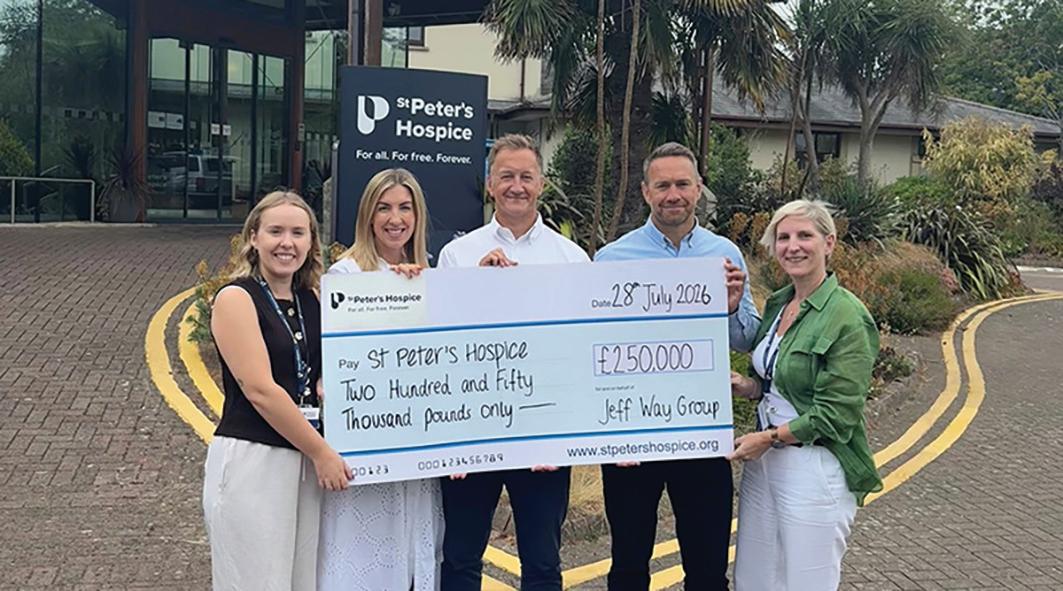
Today, Jeff and Jean’s legacy continues through their three children – Chris, Jennine and Neil – who all work within the business and have continued the family tradition of supporting the Hospice through fundraising, sponsorship and community engagement.
Chris Way said: “Supporting St Peter’s Hospice means a great deal to our family and to everyone at Jeff Way Group. The care and compassion that the Hospice showed to our parents, Jeff and Jean, and to our uncle Steve before them, is something we will never forget.
“Reaching £250,000 is an incredible milestone and one that has only been possible thanks to the generosity of our staff, customers, suppliers and everyone who has taken part in our fundraising activities over the years.”
As well as organising their own fundraising events the Jeff Way Group has also played a key role in some of the Hospice’s flagship fundraising events, including taking part in the Bristol to Paris cycle challenge in 2024, raising £60,000 for patient care. They also proudly sponsor the Tour de Bristol every year and have already signed up to support and participate in the Bristol to Amsterdam cycle challenge in 2027.
To recognise this extraordinary support, St Peter’s Hospice is honouring Jeff Way Group with a specially commissioned leaf on the Hospice’s Memory Tree commemorating founders Jeff and Jean Way.
Tracy Burns, Philanthropy and Partnerships Manager at St Peter’s Hospice, said: “The impact this kind of support has is indescribable. Jeff Way Group’s commitment to St Peter’s Hospice over the years has been truly exceptional and we are so grateful for every penny raised.
“Our corporate sponsors are invaluable to us and the difference their contributions make to our patients is not to be underestimated. It costs around £30,000 to run the Hospice every day and we only receive around 20% of our funding from the government.
“That’s why reaching a £250,000 milestone is an incredible achievement and reflects the generosity of everyone involved as well as the lasting legacy of Jeff and Jean Way.
“If your workplace is looking for a charity beneficiary please consider St Peter’s Hospice and help us continue providing care and support to patients and their loved ones.”
Every year, St Peter’s Hospice cares for thousands of patients and family members across Bristol, South Gloucestershire and North Somerset. As Bristol’s only adult hospice providing care both in patients’ homes and at its inpatient unit, the charity relies heavily on donations and fundraising to continue its work.
Rapid early assessment by the UK Health Security Agency (UKHSA) estimates there were 2,877 heat-associated deaths during 2 notable periods of hot weather in May and June 2026, almost double the figure reported annually for 2025.
An estimated 753 deaths were associated with the May heat episode between 24 and 27 May and a further 2,124 with the June heatwave between 21 and 28 June. While these figures remain interim, they are already approaching the annual record reported by UKHSA in 2022.
The June heatwave lasted for 8 days and triggered a red heat-health alert. This was only the second time the highest level of alert has been issued in England, reflecting the exceptional temperatures recorded. Both May and June also broke Met Office monthly temperature records for England with 31.5C recorded at Kew Gardens on 26 May and 37.7C recorded at Lingwood, Norfolk on 26 June.
These findings demonstrate the importance of the heat-health alerting system, delivered in partnership with the Met Office, which provides early warning when temperatures are likely to have significant impacts on health and wellbeing. Heatwaves occurring earlier in the season can have a greater impact due to people, communities and services having less time to adapt to the warmer conditions.
To support partners in preparing and responding to these events, UKHSA recently published the updated Adverse Weather and Health Plan for England for 2026 to 2027.
Based on the interim data, it is likely that 2026 could see the highest number of heat-associated deaths on record, surpassing the 2,985 recorded in 2022.
While the figures are indicative of the public health impact of the heatwaves, these numbers should be regarded as interim. UKHSA will publish finalised figures in the annual report in early 2027.
Dr Ross Thompson, Principal Environmental Public Health Scientist at UKHSA and author of the report,
said: “These figures highlight the significant danger that very hot weather can pose to people’s health. This is particularly true for those who are more vulnerable including older adults and people with underlying medical conditions.
“While the figures are interim, they suggest that, if we experience more periods of hot weather this summer, we could see the highest number of heat-associated deaths on record.
“As the climate becomes warmer, we can expect periods of hot weather to become longer, more frequent and more extreme. That’s why it’s vital that individuals, “communities and systems are prepared to deal with higher temperatures, and to ensure those most vulnerable to the heat are protected.”
Health and Social Care Secretary, Yvette Cooper, said: “The sweltering heat has had a serious impact this summer on people’s health and on our NHS.
“For many years, we have been used to winter pressures in our NHS and the need to support those who are vulnerable in the coldest weather. But now we are seeing the summer heat have an increasingly serious impact on the health of thousands of people, and on the pressures facing our NHS too.
“My thoughts are with all those who have lost loved ones as a result of the long and intense heatwaves in recent months. And my heartfelt thanks go to the NHS staff, care workers and emergency responders who have worked tirelessly through these exceptionally busy and challenging months to protect and care for people affected by the heat.
“As we move through the summer, it is so important for people to be able to look out for their health and help those who are more vulnerable to the hot conditions. Please don’t hesitate to seek help if you’re worried about your own wellbeing, or anyone else’s. A little care could make a lifesaving difference.”
A care home resident has returned to the Aberdeen ballroom where she first met her husband more than 75 years ago.
Jane McDonald, a resident at Weston View care home in Keith, revisited the city's famous Beach Ballroom after telling wellbeing coordinator Gill Ingram it held special memories of her late husband, Bill. Gill then contacted the team at the iconic venue, who were delighted to arrange a special visit.
Jane met Bill, who was originally from Nairn but working in Aberdeen at the time, at the city's famous Beach Ballroom in the late 1940s. The couple fell in love through their shared passion for dancing and married in March 1952.
During her visit, Jane enjoyed looking through historic photographs of the ballroom and reminiscing about the many happy times she and Bill
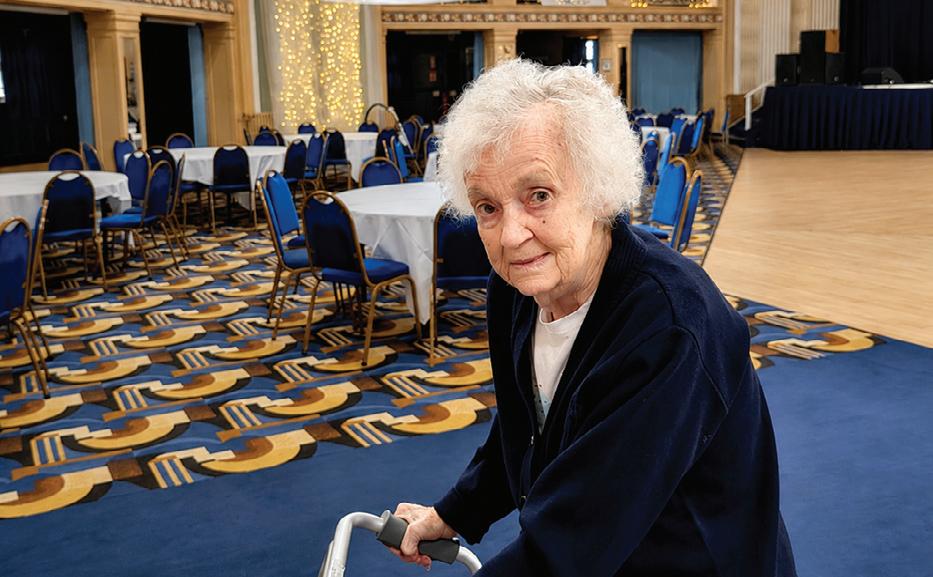
enjoyed there.
Jane said: “I was thrilled to visit the Ballroom and it brought back precious memories of my time dancing with Bill. I only wish I could dance like that these days.”
Gill added: "Jane told me how much the Beach Ballroom meant to her and how she would love to see it again. It was wonderful to be able to make that happen. I'd like to thank the wonderful team at the Beach Ballroom for giving Jane such a warm welcome and helping create such a memorable day. Seeing her relive those memories and talk about meeting Bill was incredibly special."
Jane's visit is one of a number of personal wishes being fulfilled by the home's wellbeing team, giving residents the chance to revisit places that have played an important part in their lives.

Alzheimer’s Research UK has published a new report urging the Government to set out a clear national strategy for dementia research, warning that without urgent reform to clinical trials and NHS adoption pathways, people living with dementia risk missing out on the next generation of treatments.
The report, Ready for the Cure: A blueprint for UK leadership in dementia research, was published on 30 July and sets out the charity’s assessment of what is needed to build on recent scientific progress and secure the UK’s position as a world leader in dementia research.
Almost one million people in the UK are currently living with dementia, a figure the charity expects to rise in the coming years. Dementia remains the leading cause of death in the UK, and the report notes that, for the first time, treatments capable of slowing the progression of Alzheimer’s disease have been licensed for use in the UK, although they are not yet available on the NHS — a gap with direct relevance for care providers supporting residents living with the condition.

The charity points to a decade of accelerating scientific advances, crediting increased investment, researcher dedication and closer collaboration between government, charities and industry — including through the government’s Dame Barbara Windsor Dementia Goals Programme, chaired by Alzheimer’s Research UK Chief Executive Hilary Evans-Newton CBE — with bringing dementia research to what it describes as a pivotal moment.
However, the report identifies three significant obstacles still preventing discoveries from reaching
patients quickly enough: a lack of joined-up national leadership on dementia; a clinical trials system not yet equipped for the next generation of dementia studies; and an NHS that faces real difficulty adopting new tests and treatments at pace. The charity also acknowledges that too many people continue to face lengthy waits for a diagnosis, and that research funding has not yet caught up with the scale of the challenge.
To address these gaps, the report calls on the Government to take three key actions:
• Set a clear national ambition for dementia research, bringing diagnosis, research, clinical trials and regulation together under a single, joined-up strategy.
• Build a “trial-ready” UK, so that people are identified, invited and matched to suitable dementia trials more quickly, regardless of where they live.
• Help the NHS test and adopt breakthroughs faster, through coordinated pilot sites that gather real-world evidence on how new tests and treatments perform in everyday care settings.
The charity argues these steps are ambitious but achievable, and would help attract investment, support innovation and ensure new treatments reach people as soon as possible.
Alzheimer’s Research UK stresses that delivering this vision will require sustained commitment from government, researchers, industry, charities and the public alike, with long-term investment from government seen as essential to maintaining momentum. The organisation has said it will continue to campaign for the changes set out in the report and to keep dementia high on the political agenda.
Residents, families and staff celebrate outstanding inspection with an ABBA-themed Summer Funday
Residents, families and staff at Rhoslan Residential Care Home in Rhos-on-Sea had every reason to become Dancing Queens this week as they celebrated an outstanding Care Inspectorate Wales (CIW) inspection with an afternoon of music, laughter and community spirit.
The home recently achieved three Excellent ratings for Wellbeing, Care & Support and Environment, with a Good rating for Leadership & Management. Inspectors also confirmed there were no areas for improvement, recognising the exceptional standards of care and support delivered by the Rhoslan team every day.
The fantastic inspection results were celebrated during the home's annual Summer Funday, where residents, relatives and staff came together to enjoy a live ABBA tribute act, charity raffle and the ever-popular 'Sponge the Staff' challenge.
Last Friday afternoon was filled with singing, dancing, drinking mocktails and plenty of smiles as families joined residents in celebrating both the summer and the home's latest achievement.

The timing couldn't have been more fitting. During the inspection, CIW praised Rhoslan for placing residents' wellbeing at the centre of everything it does, recognising its outstanding person-centred care,
meaningful activities programme, welcoming environment and the warm relationships shared between residents, families and staff. Inspectors also highlighted the home's commitment to promoting independence, dignity and quality of life, together with its continued investment in creating an attractive, homely environment.
James Bradford, Operations Director, Rosewood Healthcare Group: “Everyone at Rhoslan should be incredibly proud of this achievement. Receiving three Excellent ratings, together with no areas for improvement identified, is a reflection of the passion, commitment and compassion shown every single day by Kelly and her team.” The inspection recognises what residents and families already know – that Rhoslan is a place where people receive exceptional care while enjoying a fulfilling, active and happy life.
The CIW report highlighted the home's excellent focus on wellbeing, personalised care, meaningful activities, welcoming environment and positive culture, describing a service where residents are encouraged to maintain their independence, make choices and remain connected with their families and local community.
As ABBA classics such as Dancing Queen, Mamma Mia and Waterloo filled the room, residents, families and staff celebrated not only an excellent inspection, but the vibrant community that makes Rhoslan such a special place to call home.
Leading Scottish life sciences firm TauRx Therapeutics Management Ltd. has hailed the influence of patient advocacy groups on the Alzheimer’s disease community after bringing together top organisations from across the UK and beyond at a summit in London.
The meeting, which outlined the impact TauRx’s potential oral treatment for Alzheimer’s disease could have, helped agree shared priorities for improving outcomes for those living with Alzheimer's, as well as patient access and the challenge of ensuring innovation reaches those who could benefit.
The Aberdeen-based company is currently awaiting the outcome of a marketing authorisation application to the UK’s Medicines and Healthcare products Regulatory Agency (MHRA) in relation to its lead drug, an oral tablet which could target early Alzheimer’s disease.
Senior figures from TauRx welcomed representatives from groups including Alzheimer Europe, Alzheimer Scotland and Alzheimer's Disease International to Scotland House in London to discuss the Alzheimer’s treatment landscape.

Professor Claude Wischik, TauRx CoFounder and Chairman, said: “We are grateful for everyone sharing their time to discuss this important topic. The opportunity to gather leading patient advocacy groups in one place is rare, and it is an excellent illustration of the dedication that exists in trying to solve the global healthcare crisis that is Alzheimer’s disease.

affected by Alzheimer’s and other dementias and serve as key bridge between patients, caregivers, healthcare providers, researchers, policymakers and industry.
Dr Glenn Corr, TauRx’s Chief Operations Officer and Chief Business Officer, added:
“Improving outcomes for people living with Alzheimer's will require collaboration across all sectors. This excellent meeting was a real opportunity for us to do just that, and we are committed to continuing to work with all stakeholders.

“The importance of patient advocacy groups like those who joined us in London cannot be understated. For many people affected by dementia, these groups are the first place they turn to for guidance, and they do a wonderful and compassionate job assisting those who seek their help.
“We are committed to facilitating ongoing dialogue across the Alzheimer's community to help shape a future where scientific progress can be translated into real-world patient benefit.”
Peer-reviewed publications report that TauRx’s existing drug targeting the tau protein – a key hallmark of Alzheimer’s disease – halted progression of neurodegeneration, and that participants with Mild Cognitive Impairment (MCI) who received 16 mg/day experienced statistically significant cognitive improvement over 18 months.
“The conversation around our potential oral treatment was robust, as it should be, given the potential impact we believe it could have. Everyone present is working towards fulfilling the hope of slowing the decline of those impacted by Alzheimer’s.”
The groups present at the event represent the interests of people
Participants also displayed no evidence of statistically significant cognitive or functional decline over a period of two years. Trials also confirmed the drug has a benign safety profile, with headache (1.5%) and diarrhoea (1.2%) reported as the most frequent adverse effects at the 16 mg/day dose.
A decision on the company’s MHRA application is expected this year.
For more information, visit www.taurx.com
The Local Government and Social Care Ombudsman (LGSCO) is urging councils and care providers to ensure consistently high standards of end of life care, warning that failures during a person’s final days can have a lasting impact on bereaved families.
Highlighting that there is only one opportunity to provide compassionate, dignified care at the end of life, the Ombudsman says the quality of support delivered not only affects the individual who is dying but also shapes how loved ones experience and remember those final moments for years to come.
The report, No Second Chances: What Complaints Teach Us About End of Life Care, sets out the most common failures seen in the complaints it receives: poor communication with families, inadequate care plans, services not working together, insensitive handling of death notifications, difficulties around visiting, and unfair charges after death.

Real cases drawn from the ombudsman’s work illustrate the human cost of these failings – families not called in time to say goodbye, a daughter learning of her mother’s death before anyone offered condolences, and a woman who discovered her cousin had died over a year earlier, her grave unmarked and overgrown.
The report sets out what families have a right to expect: to be kept informed as a loved one’s condition changes; to be treated with warmth and honesty; to have the person they love cared for as an individual,
with their own wishes and preferences respected. And when the worst happens, to receive the news with the sensitivity and compassion it deserves.
These things do not require significant extra resources or investment. They simply need more compassion and a human touch. These are acts of basic humanity, and they shape how families grieve for years to come.
Amerdeep Clarke, Local Government and Social Care Ombudsman, said: “Most of us will face the death of someone we love. How that experience unfolds – whether we feel informed, included and treated with kindness, or left confused and shut out –becomes part of how we remember that person and how we grieve them. Those memories do not fade.
“We know that the people working in care homes and councils want to do their best for the people they look after. This report is for them. It is a practical guide to help them ask honestly: could every family we work with look back on this time with as much comfort as possible?
“The changes we are asking for do not require significant new investment. They require compassion, good planning, and a genuine commitment to treating every dying person as a human being with people who love them. There is only one chance to get this right. We want to help the sector take it.”
Residents and staff at RMBI Care Co. Home James Terry Court, in South Croydon, have recently come together for a vibrant celebration of Spanish culture. Everyone joined in to transform the Home into a lively fiesta filled with music, dance and tradition.
As part of James Terry Court’s international festivities programme, the Spanishthemed day has brought sunshine and smiles to all involved. The event featured traditional flamenco dancers and a live singer and guitarist, creating an authentic and joyful atmosphere that had residents clapping along and reminiscing.
A highlight of the day was the special visit from a Spanish donkey, which delighted residents and added a unique and memorable touch to the celebrations. Many residents enjoyed getting up close to the gentle animal, sparking conversation and laugh-
ter throughout the afternoon.
The event held particular significance for resident Mercedes, who is originally from Ferrol, in Northern Spain. She was thrilled to share her own culture with fellow residents and staff, taking great pride in the day’s activities. She says: “As a Spaniard, the party wasn’t just an event; it was a celebration of my heritage.”
Staff at James Terry Court were delighted to see such enthusiastic participation, with many noting how the event encouraged cultural exchange and brought the community even closer together. Diane Rumsby, Homer Manager at James Terry Court, says: “Throughout the day, residents embraced Spanish culture through music, conversation and shared experiences. This has reinforced the Home’s commitment to celebrating diversity and creating meaningful moments.”
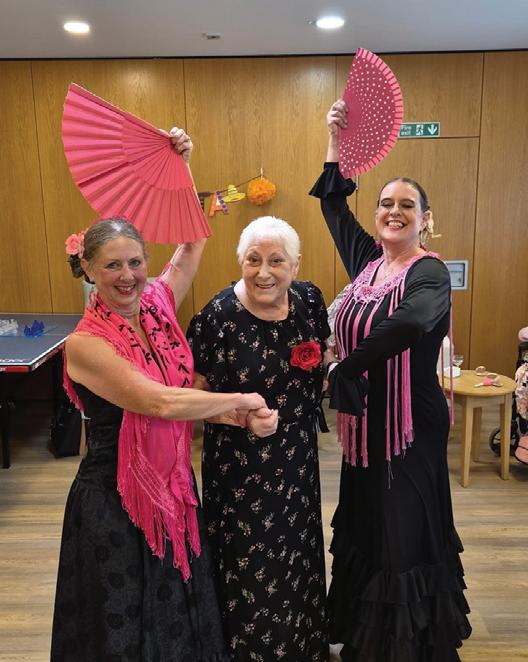
With International Youth Day taking place next month (12 August), care home group
Superior Care Midlands is celebrating the contribution of one young volunteer from Rowley Regis whose compassion, enthusiasm and strong sense of community spirit are making a meaningful difference to residents and staff across all of the group's care homes.
Twelve-year-old Ella has been helping at Superior Care Midlands' fundraising fetes for several years, after being introduced by family friend and manager Kim Young. Since then, she has become a familiar and much valued presence at fundraising events held across the group's homes, helping to raise money for residents' funds.

Having initially attended the fetes with her Nan Jean, who previously worked in care and knew the team well, Ella quickly took a shine to the warm and welcoming atmosphere and discovered how much she enjoyed helping others, meeting residents and playing an active role in events that bring families, staff and the wider community together.
Whether she is helping to run stalls, supporting fundraising activities, welcoming visitors or simply lending a hand wherever she is needed, Ella approaches every task with enthusiasm and takes great pride in knowing that her efforts are helping to create new experiences and opportunities for residents across Superior Care Midlands' homes.
Jean said: "Ella has always been the sort of person who will help anybody, and she never needs to be asked twice because she genuinely enjoys getting involved. She is naturally caring, loves coming along to the fetes and is always looking for another job, she can do to help the team."
That dedication was especially clear recently when Ella returned home from a school trip to Italy following a 30 hour journey and, despite the long trip, was already talking excitedly about helping at Court House Care Home's Summer Fete.
Ella's caring nature has been inspired by those closest to her, with Jean having worked in the care sector and her mum working in a hospital, giving her an early appreciation of the importance of supporting others, showing kindness and contributing to the communities around her.
Kim Young, Regional Director at Superior Care Midlands, said: "Intergenerational relationships are incredibly important because they give younger people the opportunity to learn from the life experiences of older generations, while residents benefit enormously from the energy, curiosity and companionship that young people bring into our homes.
"Ella is a wonderful example of how meaningful those connections can be, because she is not simply attending an event or helping for a few hours. She has become a valued part of our fundraising events across all of our homes, building relationships, developing confidence and learning skills that will stay with her throughout her life, while also showing our residents that younger members of the community value their company and want to spend time with them."
International Youth Day recognises the positive impact young people have on their communities, and Ella's continued commitment to supporting residents through fundraising and community events is a wonderful example of the difference young people can make. Through her kindness, enthusiasm and willingness to help others, she is helping to strengthen the bonds between generations while making a lasting contribution to life across Superior Care Midlands' homes.
Everyone at Superior Care Midlands is incredibly proud of Ella's continued support and hopes her story will encourage more young people to become involved in local community events, spend time with older generations and discover how even the smallest act of kindness can have a lasting and positive impact.

More than half of care workers have considered leaving the sector in the last year, according to a new report highlighting the growing pressures facing the social care workforce. Despite these challenges, most respondents remained positive about the profession, with more than half saying they would still recommend a career in care because of the opportunity to make a meaningful difference to people’s lives.
A survey of current and former care workers, conducted by specialist in social care qualifications NCFE, found that 53% of those currently working in the sector had thought about changing careers, with a quarter (25%) actively looking to do so. The research also explored career prospects, with almost half (45%) of respondents either disagreeing or being unsure that clear progression pathways exist.
Findings from Staying, leaving, or progressing? A snapshot of the social care workforce paints a picture of a workforce that remains committed to supporting vulnerable people but is increasingly challenged by issues around pay, working conditions, and limited career progression and professional development opportunities.

Michael Lemin, Head of Policy and Strategy at NCFE, said: “We hear a lot about the recruitment and retention challenges in the social care sector, but not enough from those on the frontline. That’s why we decided to directly explore how those working in a range of different roles are feeling when it comes to career progression opportunities, professional development, and whether they see a long-term future in care.
“While pay and working conditions continue to underpin much of the dissatisfaction within the sector, a significant number of care workers also pointed to a lack of career progression opportunities.
“The findings show there is work to be done to recruit and retain the numbers required to deliver social care to an increasingly ageing population. However, they also show a clear appetite for education and development. We now need to harness this desire to learn and create a system that makes entering employment easier, while providing the recognition care roles deserve.”
Recruitment and retention pressures remain high across the sector, with those considering leaving their roles citing poor pay, difficult working conditions, and limited opportunities for progression as the main reasons behind their decisions.
Among former care workers, respondents described pay as not reflective of the responsibilities and unsociable hours associated with care roles. Others highlighted burnout, mental health concerns, and a lack of respect for the profession as factors that contributed to their decision to leave.
Current workers echoed these concerns, reporting high workloads, staffing shortages, low morale, and feeling stretched by increasing demands.
One anonymous respondent said: “I’m actively looking for another position as staffing is bad. The staff morale is bad. Staff are blamed for everything. As carers, we get hit, thumped, kicked, spat at and get racially abused. For minimum wage.”
When asked what would help them progress in their careers, 81% selected regulated qualifications, making it the most commonly identified factor. Better pay and conditions were also ranked highly.
Despite these challenges, respondents described care work as a career that provides a strong sense of purpose, enables people to support those in need and offers opportunities to develop valuable personal and professional skills.
This is echoed by another anonymous respondent: “My proudest moment as a carer would be when I realised it isn’t just a job; you grow bonds and you’re a type of family to the clients. They depend on you, more than you will ever know, and not just physical dependency. Mental dependency, someone they look forward to talking to as you may be the only person they have anymore.”
The report concludes that the future of social care depends not only on attracting new talent into the sector, but also ensuring existing staff feel valued, supported and able to progress throughout their careers.
To read the full report visit: https://www.ncfe.org.uk/social-care-workforce-report/

Supporting someone to die well is, for some of us working in the industry, a part of the work to which we must become well accustomed. Death is an expected, and at times, anticipated part of life. It is a sensitive topic and one that is not always easy to cope with.
The experiences that people have with death are completely individual, and coping strategies will present differently for everyone. Someone who is aware that they are dying is likely to experience various emotions and sometimes worries about the process.
As potential providers of support, there are ways that we can offer both physical and emotional support to the individual, their loved ones and our own staff.
At QCS we have compiled some guidance to support someone to die well and to also support the staff providing their care or support during this time.
TRAIN STAFF IN END OF LIFE CARE
Providing staff with specific end of life care training will give them the knowledge and confidence to care for someone well at the end of their life. Check out your local hospice as sometimes they offer courses on the topic. An in-person training session in this area is far more valuable than e-learning (where this is possible).
Staff training goes beyond the classroom. Supporting staff by ensuring that they work alongside an experienced staff member in the area will build assurance and give them faith in their abilities.
Good training for staff in end of life care should cover:
• Having a gentle touch
• Being respectful
• Continuing to explain to the person what is happening even if you do not receive a verbal response
• Sufficient pain relief
• The correct number of staff and equipment for what is required
• To ensure the person’s comfort and making sure they appear in a comfortable position
• Regular turning to relieve areas of pressure
• Signs that someone may no longer eat or drink
• Oral care
• Creating a soothing environment, soothing music, window ajar for example
• Consider using calming scents; aromatherapy is known for its therapeutic qualities
• The importance of collaborating effectively with other professionals to ensure well organised and efficient care and support
• Some people may enjoy meditation and visualisation techniques
ADVANCE CARE PLANNING
The importance of advance care planning, liaising, and coproducing with the service user and their family where desired to discuss these elements of care provision prior to the event are paramount. Some aspects to be mindful of are:
The individual may be reluctant to discuss an advance care plan; they may be experiencing overwhelming feelings relating to the situation that they need time to process. These could include feelings of:
• Shock
• Worry
• Guilt
• Disbelief
• Anxiety
• Any financial burden they could leave behind There are many thoughts and emotions that could be circling inside.
• If this is the case, respect their wishes
– it does not have to be completed today
• If appropriate, you can gently explain that without the advance care plan they may not receive the support or care in their preferred way
and perhaps if they feel they wish to, they could reschedule
More people are opting to use a Death Doula (someone who supports people at the end of their life), particularly those who wish to die in their own home. Consider if this is an option that you could highlight to the individual and their family that you are supporting.
Remember, advance care planning should include information that relates to what the person perceives as a good environment. Discuss music, aromatherapy, whether they like the feeling of breeze on their face. These are some of the elements that can contribute to a calm, relaxing space.
Working as part of a multidisciplinary team is essential in providing high-quality, person-centred end of life care.
Above all, the most central factor to consider is good communication and especially listening. The ability to listen patiently, considerately and without judgement to the individual being supported is key. Someone’s wishes, needs, and wants may completely change during the dying process and this is ok. Having a caring, supportive, respectful team listening to them is crucial to a positive dying experience.
As a provider, by following this guidance, you will save both time and effort, as guidance for staff will be clear and easy to follow.

The health-tech company, MiCode, is giving 5,000 free emergency information codes to small dementia charities, care providers, and community organisations across the UK.
One hundred organisations will each receive 50 MiCodes to distribute to people living with dementia and their families, together with posters and leaflets explaining how the system works.
The programme is deliberately focused on smaller, local organisations that are often overlooked. They know their communities, understand local needs and provide the everyday help that enables people to remain independent and connected.
Professor James Ohene-Djan, founder of MiCode, said: “Small local organisations often do extraordinary work with very limited resources. They are frequently the first place families turn to, yet they can easily be missed when funding, new technology and national campaigns are distributed.
“We want this programme to recognise their importance and give them something practical to offer directly to their communities.”
The initiative builds on successful work with Dementia Jersey and trials involving NHS services, where accessible information proved valuable when people became confused, distressed or unwell.
WHAT IS MICODE?
MiCode is a QR code carried on a keyring, wallet card, wristband, badge, pendant or sticker. It can be scanned using any ordinary smartphone, with no app to download and no special equipment required.
When scanned, the code opens an information page containing details selected by the person, their family or carer. This can include emergency contacts, medical conditions, allergies, medication, communication preferences and advice about how best to offer reassurance.
For someone living with dementia, the information might explain that they need more time to answer questions, become anxious in unfamiliar surroundings or respond well to a particular form of reassurance. It can also identify who should be contacted and help others understand the person’s needs.

Information can be updated when circumstances change and displayed in different languages.
“MiCode is not designed to replace professional care or human judgement,” Professor Ohene-Djan said. “It is simply a way of making the right information available at the right time.” MORE THAN EMERGENCY INFORMATION
Each free MiCode will also be pre-loaded with useful advice about living with dementia and supporting someone with the condition. This may include guidance for families and carers, communication advice and links to relevant sources of help.
Participating organisations will be able to include details of their own services and other support available locally.
MiCode can therefore act not only as an emergency information tool, but also as a gateway to ongoing support. A person or family scanning the code may be directed towards a local dementia café, carers’ group, advice service, helpline or community organisation.
“People often do not know what support is available until they reach a crisis,” Professor Ohene-Djan said. “By including dementia advice and links to local services, MiCode can help people find support earlier.”
SUPPORTING FAMILIES AND CARERS
Much of the knowledge needed to support a person living with dementia is held by those closest to them.
But carers cannot always be present. MiCode allows some of that knowledge to travel with the person.
“MiCode may reduce one fear,” Professor Ohene-Djan said: “that the person you care about will become lost, confused or unwell and nobody will know who they are, what they need or who should be called.”
WHY I CREATED MICODE
The idea for MiCode grew from Professor Ohene-Djan’s experience of supporting his brother Anthony, who lived with multiple sclerosis.
“My brother was never simply an MS patient to me,” he said. “He was my brother, with his own personality, humour, frustrations and hopes. But there was always a quiet worry about what might happen if he became unwell when we were not there.”
Professor Ohene-Djan’s own experience of cancer also shaped MiCode.
“When you are well, a medication list or emergency contact number can feel like paperwork,” he said. “When you are ill, those details become part of your safety.”
APPLYING FOR A FREE PACK
Dementia charities, local community groups and care providers can now get in touch to receive 50 free MiCodes pre-loaded with dementia information and advice. With 100 local groups being supported across the UK, we are giving away 5,000 free codes in total, complete with printed posters and leaflets.
MiCode is particularly keen to hear from small and locally based organisations that are often overlooked by larger initiatives.
To apply, visit www.micode.uk/dementia or email dementia@micode.uk
“This programme is about helping people living with dementia remain safer, better understood and more connected to the support around them,” Professor Ohene-Djan said. “It is also about recognising the small local organisations that quietly hold communities together and making sure they are not left behind.”
Professor James Ohene-Djan is Professor of Computer Science at Goldsmiths, University of London, and founder of MiCode.
Chelsea Martin has been appointed as registered manager of High View in Truro, recognising her career progression from care support worker to service leader.
Chelsea’s appointment marks the latest step in a career journey spanning more than a decade in care and support services.
She began her career working in schools supporting children with a range of additional needs, building strong relationships with both pupils and their families. After taking time away from work to care for her son, who has autism and learning disabilities, Chelsea returned to the sector.
Having progressed from care support worker to positive behavioural support lead and deputy manager with another provider, she joined Salutem when High View became part of the organisation. Starting again as a care support worker to fit around family commitments, she steadily worked her way through the ranks to become registered manager.
Chelsea said: “I am incredibly proud to have been appointed manager at High View. My journey through Salutem reflects the investment the organisation makes in its people and the opportunities available to those who are passionate about delivering great care.
“What has always stood out to me about Salutem is that its values are genuinely lived every day. They are not just words, they shape how colleagues support the people we support and each other. Throughout my time here, I have been given opportunities to develop both professionally and personally, supported by an amazing team of colleagues, managers and leaders.
“I’m especially proud of everything High View has achieved over the past few years. It has been a privilege to be part of that journey, and I am excited to continue building on that success. One of my goals is to help other colleagues reach their full potential and progress in their careers, just as I have been supported to do.”
Exemplar Health Care has published its 2025–26 Service User Engagement Impact Report, which highlights how people living in its homes are working in partnership with colleagues to directly shape care provision, influence decisions, and improve everyday experiences across the organisation.
This approach ensures that care provided across Exemplar Health Care homes is responsive and respectful, making a real difference to the lives of the people it supports.
From redesigning mealtime experiences and improving welcome packs, to developing resident-led newsletters and introducing first aid training, people living in Exemplar Health Care’s homes have made changes that make everyday life better for all across the organisation. At the heart of this work is Exemplar Health Care’s growing network of 70 Service User Ambassadors, who represent the views of people living across the organisation’s homes, alongside six Regional Service User Ambassadors and three regional Service User Councils. Together, they help ensure lived experience directly influences how care is provided and how support develops across Exemplar Health Care’s homes. Over the past year, ambassadors have taken on a wide range of roles, including supporting colleague recruitment, improving shared spaces, contributing to communications, mentoring fellow residents and helping shape activities and dining experiences. Their ideas and input have also been directly fed back through discussions with senior leaders through regular Service User Council meetings, ensuring the voices of people living in Exemplar Health Care’s homes are reflected in organisational decisions.
Speaking about the value of this approach, Sarah, who is an Ambassador at Woolston House in Warrington, said:
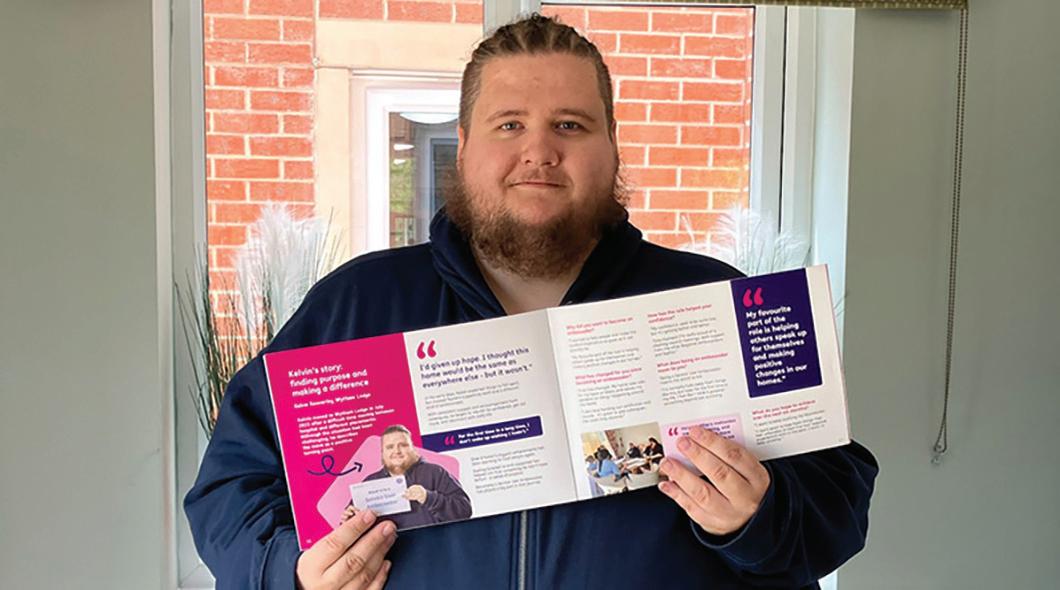
“I’m proud of being able to speak up for people, because there was no one there to do it for me when I first went into a care home. And being able to do that for them, I’m very proud.”
The report also evidences the positive impact Service User Ambassadors have had on everyday life at the homes. One area of focus was the mealtime experience, which is one of the most important parts of daily life in the home. Rather than making changes in isolation, Exemplar Health Care worked alongside Service User Councils to coproduce more personalised menus, with greater flexibility around dining and clearer food information. The evidence to date shows that locally developed changes have led to increased satisfaction scores and Exemplar Health Care is actively encouraging residents to share further feedback.
The report also highlights how people supported by Exemplar Health Care are empowered to actively get involved in activities that reflect
their interests and build their confidence and independence. Over the last year alone, Exemplar Health Care’s ambassadors were the first people with lived experience to ever lead a presentation at the Nursing Live conference, developed the resident-led Exemplar Express newsletter, and took part in first aid training designed around their needs.
Regional Service User Ambassador Kelvin Kennerley, who lives at Wytham Lodge, said:
“Being a Service User Ambassador means the world to me. I’d normally hide away from things like this, but now, for the first time in my life, I feel like I have a purpose.
“My favourite part of the role is helping others speak up for themselves and making positive changes in our homes.”
Sophia Feurtado, Service User Engagement Manager at Exemplar Health Care, said:
“The people living in our homes are the experts in their own lives, so it’s only right that they help shape the way we provide care.
“This report shows what can happen when we move beyond simply asking for feedback and genuinely work alongside people to co-produce improvements. Whether that’s influencing mealtimes, welcoming new residents, supporting colleague recruitment or representing the voices of others through our Service User Ambassador programme, people are helping shape everyday life in our homes.
“By working in partnership with the people we support and by creating meaningful opportunities for them to influence decisions, we’re building services that reflect their experiences, priorities and ambitions, while also helping them exercise greater choice and control over the support they receive.”
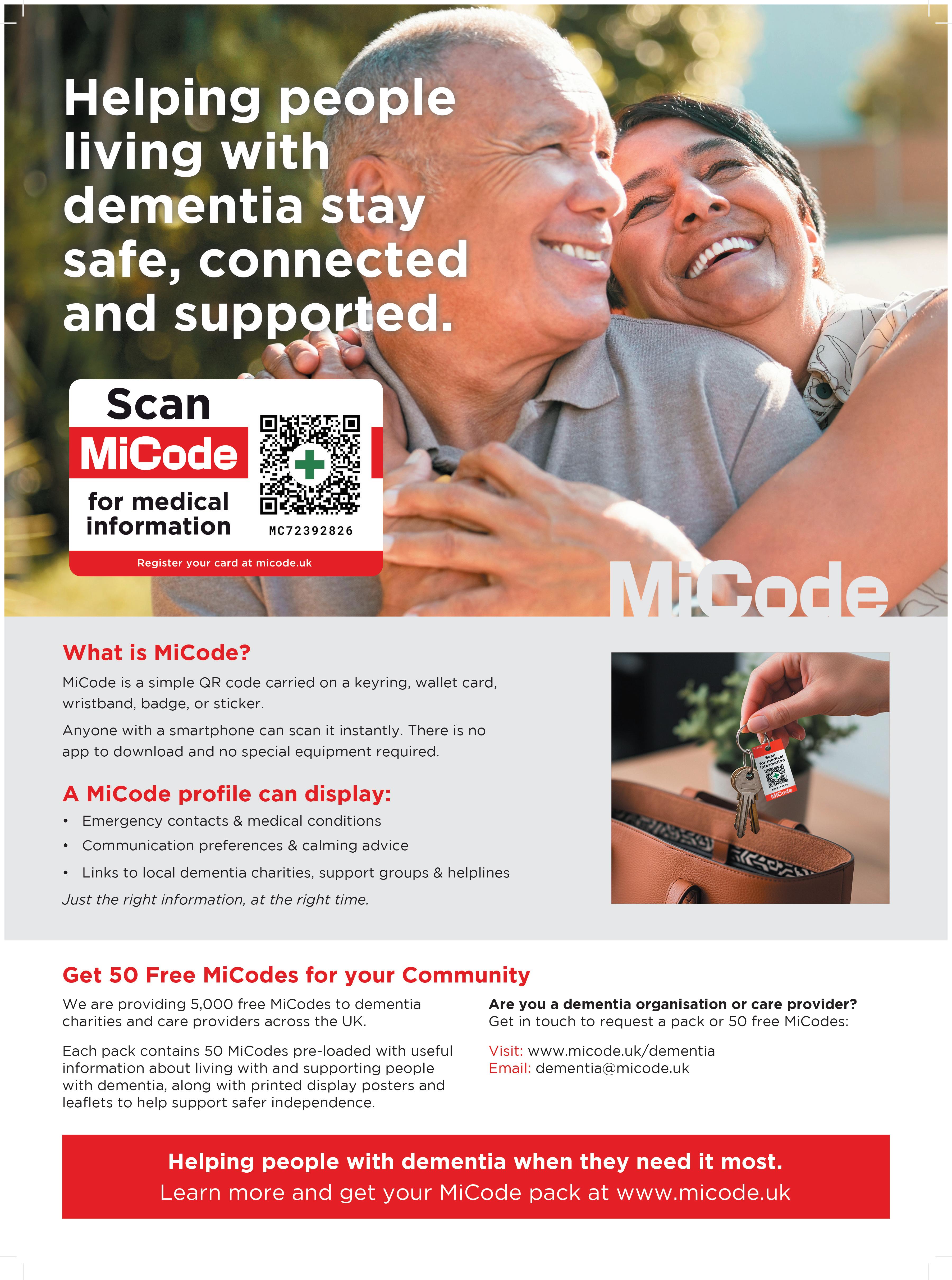
By Kevin Groombridge – Chief Executive, Care Inspections

A credible regulator must identify poor care quickly and recognise improvement promptly. When either function slows, the consequences extend beyond the regulatory process. They affect residents, families, staff, commissioners and the viability of care services.
The Care Quality Commission has acknowledged operational difficulties following changes to its assessment approach, technology and structure. Its 2024/25 annual report records 3,825 published assessment reports, compared with 6,230 in 2023/24 and 10,356 in 2022/23. CQC attributed the reduction to technology problems, framework changes and restructuring.
These figures matter because a published rating has practical force. Families use it when choosing a service. Commissioners consider it when making placements. Banks, investors, insurers and purchasers may rely on it when judging risk. Where a service has improved but has not been reassessed, the public record may no longer describe the care being delivered.
For a care home carrying a Requires Improvement or Inadequate rating, delayed reassessment can be damaging. Enquiries may fall, admissions may reduce, and occupancy may decline. Local authorities and Integrated Care Boards may restrict placements or require additional assurance. The provider can remain under pressure after corrective work.
Care homes have high fixed costs, including buildings, leadership, core staffing, insurance and clinical oversight. These do not fall in direct proportion to occupancy. Reduced income may constrain investment in staff, premises and equipment, weakening the resources needed to sustain improvement.
Staff can also be affected. Teams may have strengthened practice and completed a demanding improvement programme, yet the public
rating remains unchanged. This can damage morale, complicate recruitment and contribute to turnover. Managers may focus on historic failings rather than further development.
Most importantly, delay can affect residents. Slow regulatory responsiveness creates risk in two directions. Services that remain poor may not receive timely scrutiny, while services that have genuinely improved may continue to experience restrictions and financial pressure. Neither outcome supports safe, stable and person-centred care.
The answer is not to reduce regulatory expectations. Nor should independent assurance replace statutory regulation. CQC has unique legal powers, national oversight and responsibility for public ratings. However, the current difficulties show that quality assurance cannot depend entirely on periodic regulatory inspection.
A stronger model begins with providers accepting direct responsibility for understanding and improving quality. This is not self-certification. It requires boards and senior leaders to maintain reliable evidence, listen to residents and staff, monitor outcomes, test systems and commission independent challenge where appropriate.
International practice illustrates this approach. In the Netherlands, care providers measure outcomes against agreed quality standards, with specified information made publicly transparent. The emphasis is on continuously understanding quality, involving people who use services, and using evidence to improve care.
Australia has similarly placed responsibility on providers and governing bodies. Its aged care quality framework expects leaders to monitor improvement using feedback, incident and complaint data, quality indicators and other performance information. Providers are expected to operate quality systems that support continuous improvement.
These systems differ from the English context. Their central principle is nevertheless valuable. Regulation works best when it sits above a mature provider-led assurance system, rather than attempting to function as the provider’s quality department.
Provider-led assurance can improve care by identifying risks closer to the point of delivery. Trends in falls, medication errors, pressure damage, infections, safeguarding, weight loss, complaints, staff turnover and hospital admissions can be reviewed as they emerge. Resident and relative experience can be considered alongside operational and clinical evidence, allowing leaders to intervene before isolated concerns become established failures.
This approach also enables continuous performance management. A regulatory inspection provides an important external judgement, but it remains a snapshot. Boards need a moving picture. They must know whether improvements are sustained, whether a service is becoming
an outlier and whether actions have achieved the intended result. There is also a direct relationship between quality assurance and commercial robustness. Reliable information supports better investment decisions, stronger workforce planning and earlier management of operational risk. It can provide credible assurance to commissioners, lenders and purchasers. Quality, reputation, occupancy and workforce stability are closely connected, so organisations that understand performance are generally more resilient.
Independent inspection can strengthen this provider-led model, provided it is rigorous. A useful inspection should examine care practice, medicines, safeguarding, staffing, governance, safety, infection prevention, resident experience and measurable outcomes. Evidence should be triangulated across observation, documentation, interviews and data. Conclusions should be explainable and defensible.
Accreditation matters. Inspection bodies accredited to ISO/IEC 17020 are independently assessed for competence, impartiality, consistency and the operation of their inspection processes. Accreditation does not confer statutory powers or permit an organisation to alter a CQC rating. It does provide external assurance absent from many unaccredited mock inspections. UKAS assesses and accredits organisations that provide inspection and other conformity assessment services. Mock inspections are inconsistent; their methods and depth vary considerably. Some amount to a brief rehearsal of likely regulatory questions and depend heavily on the judgement of one consultant. Where missed risk can lead to resident harm, placement restrictions, lost income or closure, providers need more than a prediction of how they might perform during a future visit.
ISO 25557:2026, the international standard on care quality for older persons at home and in care facilities, reinforces this direction. It brings individual needs, participation, safety, service quality and organisational responsibility within a coherent framework applicable across different care settings and funding models.
The future should combine effective statutory regulation with continuous provider governance, transparent quality data, commissioner oversight and competent independent inspection. Each has a role. Together, they can provide a more current and reliable picture of quality than any single mechanism can achieve on its own.
The purpose of inspection is not simply to produce a rating. It is to protect people, identify risks, recognise opportunities for improvement and promote better care and care outcomes. When regulatory delays mean a rating no longer reflects reality, providers must demonstrate current performance with robust evidence. Residents deserve protection from poor care, but they also deserve stable, improving services whose progress can be recognised with confidence.
Cygnet Adarna House has officially opened a brand new Social Hub dedicated to the memory of a much-loved colleague whose vision and hard work helped bring the project to life.
The specialist rehabilitation service in Wibsey, Bradford, held a special memorial opening event to celebrate the new space and honour the contribution of maintenance colleague Malcolm Gray, who passed away earlier this year and who played a key role in helping to create the hub.
Cygnet Adarna House, on Beacon Road, is part of the Cygnet Health Care division and provides rehabilitation for up to nine men living with mental illness and autism spectrum disorder (ASD), supporting them to develop the skills and confidence needed to move towards more independent living in the community.
The Social Hub has been co-produced with service users to ensure it reflects what matters most to them. Working alongside Specialist Occupational Therapist Ella-Louise Taylor, residents shared their ideas and helped design a welcoming space that includes gaming facilities, a sensory area, exercise equipment and a cosy cinema-style area where they can relax and watch films together.
The project was also supported by Cygnet’s Co-production and Expert by Experience teams. The new hub is already proving popular with residents, who have been using it to socialise, play games together and enjoy shared activities.
One service user said: “It’s amazing, it feels really homely and comfortable.”
The Social Hub at Adarna House forms part of Cygnet’s award-winning Social Hubs programme, which transforms underused clinical spaces into welcoming, non-clinical environments where people can relax, socialise and take part in meaningful activities. Each hub is co-produced with service users, who work alongside staff and Experts by Experience to design a space that reflects their interests and preferences, helping to create a genuine sense of ownership.
The initiative was developed in response to feedback from service users who wanted more homely spaces away from the wards to unwind, connect with others and support their recovery.
Ella-Louise Taylor, Specialist Occupational Therapist at Cygnet Health Care, said: “From the very beginning it was important that this was a space designed by the people who use it. We spent time talking with our service users about what they wanted and what would help them feel comfortable, relaxed and connected with others, and every part of the Social Hub reflects those conversations.
“Seeing everyone enjoying the space together has been incredibly rewarding. Whether it’s gaming, exercising, watching a film or simply spending time with one another, the hub is already helping to bring people together.
“Opening it in Malcolm’s memory made the day even more meaningful. He played such an important role in making this project a reality and it felt only right to celebrate everything he contributed.”
Ella-Louise explained how the space has been designed for a neurodivergent population, with muted colours, black out blinds and simple wall art.
“The service users chose everything themselves so there wasn’t too much visual stimulus,” she said.
“We also added low lighting, coloured lights and speakers so there is an option to increase the visual and auditory input for those who need more to stay regulated.
“Having a bigger space for movement will also support sensory based regulation strategies.”
Matthew Ledger, Cygnet Hospital Manager at Cygnet Adarna House, said: “The Social Hub represents everything we want recovery at Adarna House to be about, which is providing opportunities for people to build confidence, develop relationships and enjoy meaningful activities in a welcoming environment. Spaces like this help create a real sense of community and belonging, giving the people we support somewhere they can truly relax, connect with others and feel at home.
“It was especially important to dedicate the space to Malcolm. He was a valued and much-loved member of our team whose dedication, kindness and hard work touched so many people. His efforts helped make this hub possible and it will stand as a lasting reminder of the difference he made to our service users and colleagues. We know it is a place he would have been incredibly proud of.”
The National Association of Care Catering (NACC) has announced the 12 finalists who will be competing for this year’s NACC Care Chef of the Year crown in October.
Three semi-finals took place on 21st, 22nd and 23rd July, with members from across the NACC regions competing in the South, Midlands and North of the country.
The close-fought regional semi-finals saw the contestants use their skills to create a delicious, attractively presented and nutritionally balanced two-course menu in 90 minutes. Their chosen main and dessert needed to be suitable for service users in a care setting, with the combined food cost for both courses coming in at no more than £4.50 per head based on three portions, reflecting the tight budgets care chefs often have to contend with. The menu also had to feature at least one product from headline sponsor Unilever Food Solutions’ sector-relevant catering range.
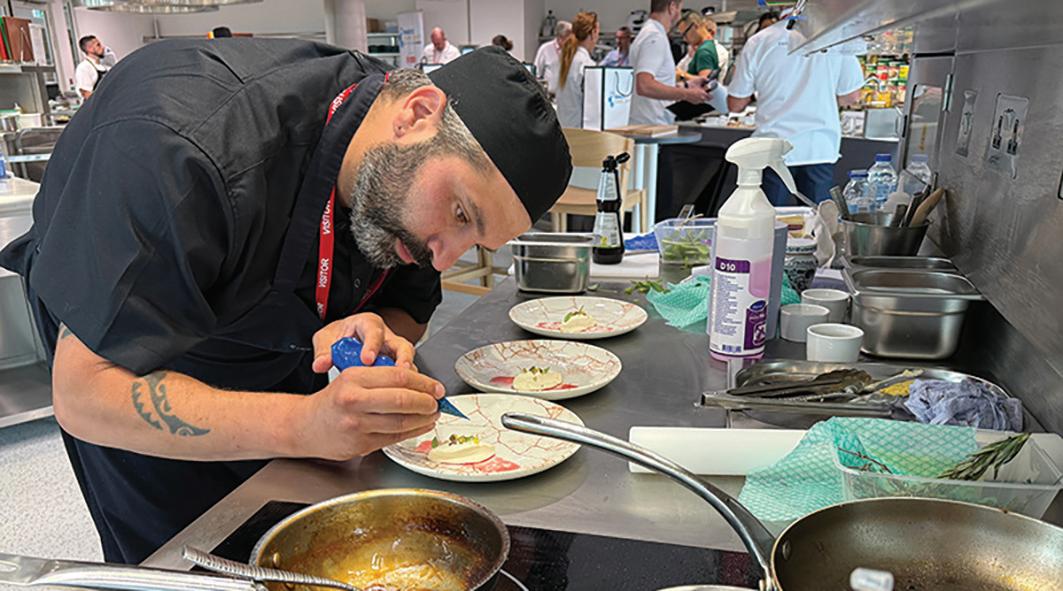
Head Judge Steve Munkley MBE, Vice President of the Craft Guild of Chefs, and his team of experienced judges were looking for clear nutritional understanding of the dishes being prepared, plus culinary flair through flavours, menu balance and visual appeal, as well as waste management and hygiene best practice.
The chefs who impressed the judges most will compete again at a grand final on 14th October at Loughborough College. They are:
• Nigel Cooke, Head Chef, Eastcote Park and Oakley Grange, Cinnamon Care Collection
• Matthew Dodge, Executive Chef, Loveday & Co
• Richard Glover, Group Catering Manager, Ashbouren Lodge Care Home, Milford Care
• Gareth Johns, Chef, Heathland House, Cinnamon Care Collection
• Majlinda Ndoj, Chef Manager, Birchstone Care, White Oaks (Compass Group UK & I)
• Darren Nelson, Head Chef, Trymview Hall, Care UK
• Max Neumann, Head Chef, PJ Care
• Tomasz Niedzwiecki, Chef Manager, Richmond Villages (part of Bupa)
• Giuseppe Priolo, Head Chef, Cinnamon Care Collection
• Graham Watson, Head Chef, Lauder Lodge, Care UK
• Tristan Welch, Executive Chef, KYN
• Steven Wright, Group Executive Chef, Caring Homes Head Chef Steve Munkley said: “We saw some phenomenal dishes in the semi-finals; I can tell you the standard was lifted to another level this year! Out of 12 excellent finalists, the winner will be whoever is on their game at the grand final.” Neel Radia, National Chair of the NACC, said: “Huge congratulations to our 2026 Care Chef of the Year finalists. This competition aims to raise the profile of care catering by demonstrating the high standards and wide skill set that chefs in the care sector display every day to deliver a fantastic meal experience for their service users. I’m delighted to say we have just witnessed the most amazing passion, flair and nutritional knowledge from all the chefs who took part in the semi-finals and I can’t wait to see our 12 talented and inspirational finalists pull out all the stops in October!”
Councillor Dr Angela McFarlane has celebrated the completion of Barchester Healthcare’s new luxury care home in Odiham, Whitewater Place, in front of invited guests from the local community. Pictured here cutting the ribbon left to right are: Regional Director, Jess Brolan, Chief Operating Officer, Natasha Lazovic, Councillor Dr Angela McFarlane, Senior General Manager, Louise Lambert and Chief Executive Officer, Dr Pete Calveley. Barchester’s CEO, Dr Pete Calveley, and Senior General Manager, Louise Lambert, hosted the event and invited guests to view the stunning new 58 bed care home, along with its beautiful landscaped gardens. The home has been designed with residents’ comfort in mind and the team at Whitewater Place will offer residential support, respite stays and dementia care, all delivered by a dedicated and passionate team of trained professionals. At Barchester, everything revolves around the residents. From the person-centred care, to the dining experience and hospitality which is tailored to residents’ tastes and preferences, and the programme of life enrichment activities which offer choice that supports resident well-being across mind, body and soul. Each resident is an individual, and so too is the care that Barchester provides, and resident choice plays a really big part in that.
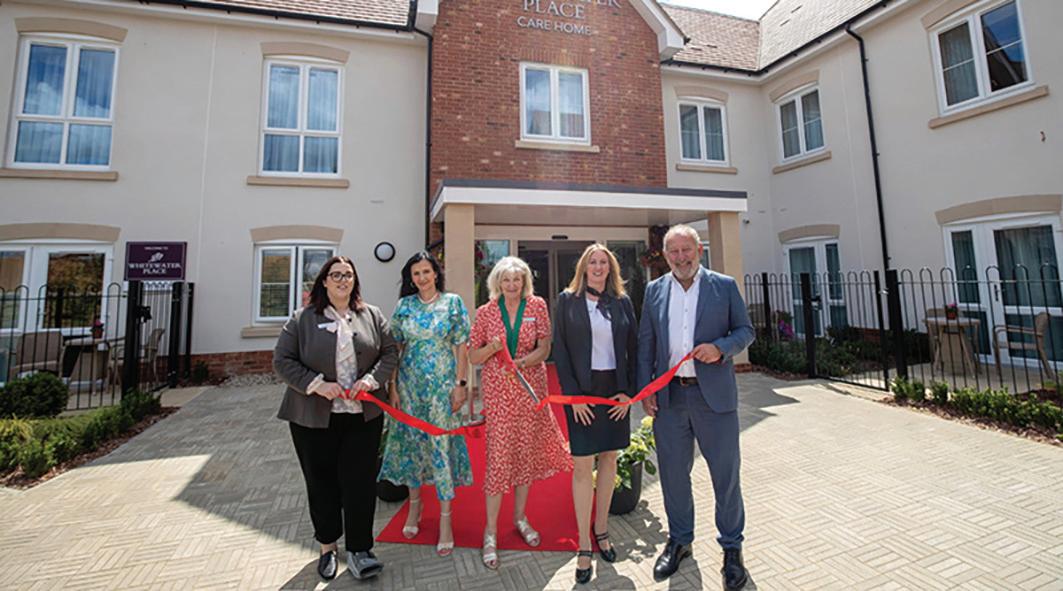
Senior General Manager, Louise Lambert, commented: “We are delighted our home is now completed, our residents are at the heart of everything we do at Whitewater Place, and we look forward to welcoming them and their families, and becoming an active part of the local community.
“We take pride in really getting to know each of our residents to provide tailored care and support, ensuring dignity and choice in every aspect of daily life.”
Councillor Dr Angela McFarlane, Chair of Odiham Parish Council said: “I was delighted to be invited to unveil a plaque and to formally cut the ribbon to mark the completion of the new Whitewater Place Care Home. It was a true honour to visit this wonderful new facility, which represents not just bricks and mortar, but a commitment to dignity, compassion, and community for our older residents.
“Whitewater Place will be a place where people are cared for with warmth, respect, and professionalism, and I am proud to see such an important investment in the wellbeing of our village. On behalf of myself and the parish, I wish Louise Lambert, the Senior General Manager, and the staff and residents, every happiness and success as this new chapter begins.
“I was truly touched by the passion of both the staff and the management team on the day, as well as the amazing thought and insight that have gone into creating such a wonderful residence.”
Barchester’s CEO, Dr Pete Calveley, added: “Whitewater Place is going to be a wonderful home, Louise and her team will offer personalised care for the people of Odiham and the surrounding area in this lovely setting. We’re thrilled to add Whitewater Place to our Barchester family of quality care homes and hospitals.”
OakNorth, the digital bank for entrepreneurs, by entrepreneurs, has provided a £4.7m loan to Spring House Farm Developments Ltd, to support the development of 19 new close care bungalows at Lavender Fields Care Village near Pocklington, East Yorkshire

The homes will be purpose-built for people living with care needs due to age or incapacity, and will form the latest phase of Lavender Fields Care Village a 10-acre integrated retirement and care community created by Chris Mitchell. The village already comprises a 72-bed specialist care home, 29 close care bungalows delivered across two earlier phases, together with a café, fully licensed pub, hydrotherapy suite, hair and beauty salon, village shop and consulting rooms for visiting healthcare professionals, all to enable sustainable living catering for every need within the site. Dementia Forward, Yorkshire’s largest dementia charity, whom Chris has worked with for over 10 years, have also based their East Riding of Yorkshire HQ on site at Lavender Fields.
Chris Mitchell has spent more than 30 years in the care sector and has developed Lavender Fields into one of the UK's most distinctive integrated retirement living and dementia care communities. Previous phases of the development sold well ahead of schedule, with strong demand continuing for the village's close care bungalows. The latest phase has already attracted significant early interest and will further expand the community's offering.
Chris Mitchell, Owner of Lavender Fields Care Village, commented on the transaction: "We're delighted to once again be working with OakNorth as we continue to grow Lavender Fields. The team has consistently demonstrated a deep understanding of both the real estate and healthcare sectors, which has been invaluable in supporting our vision. James Espley and the wider team have been particularly impressive - combining expertise with speed, clarity and transparency throughout the process. We've now partnered with OakNorth on several projects because they understand what we're building here and consistently deliver. This latest phase will allow us to meet growing demand for high-quality close care housing while continuing to enhance the wider Lavender Fields community. A ‘one stop shop’ from the onset of care right through to the final days. A forever home!"
James Espley, Senior Director of Property Finance at OakNorth, added: “Chris has built something truly distinctive at Lavender Fields. Having supported multiple phases of the development over several years, we've seen first-hand the strength of demand for this integrated model of retirement living, close care and specialist dementia care. Earlier phases sold ahead of schedule and the wider village has continued to evolve into a genuine destination community. We're delighted to continue supporting Chris and the team as they deliver the next phase of a scheme that is helping meet growing demand for high-quality close care accommodation."
Dorset’s catering talent got to sharpen their skills as Care South’s chefs led a hands-on masterclass celebrating fresh, seasonal produce.
Mark Wardman, Catering Operations Manager at Care South, and Patrick Fensterseifer, Executive Chef, led a workshop focusing on seasonal fruit with trainees from The CRUMBS Project in their fully-equipped training kitchen in Bournemouth.
Dishes prepared during the session, which were selected from Care South’s care home menus, included duck with blackberry sauce and dauphinoise potatoes, a summer fruit roulade, and berry cheesecake pots.
The CRUMBS Project empowers adults with disabilities, neurodivergences, or mental health conditions by providing hospitalitybased ‘training for independence’ that creates pathways to employment and inclusion.
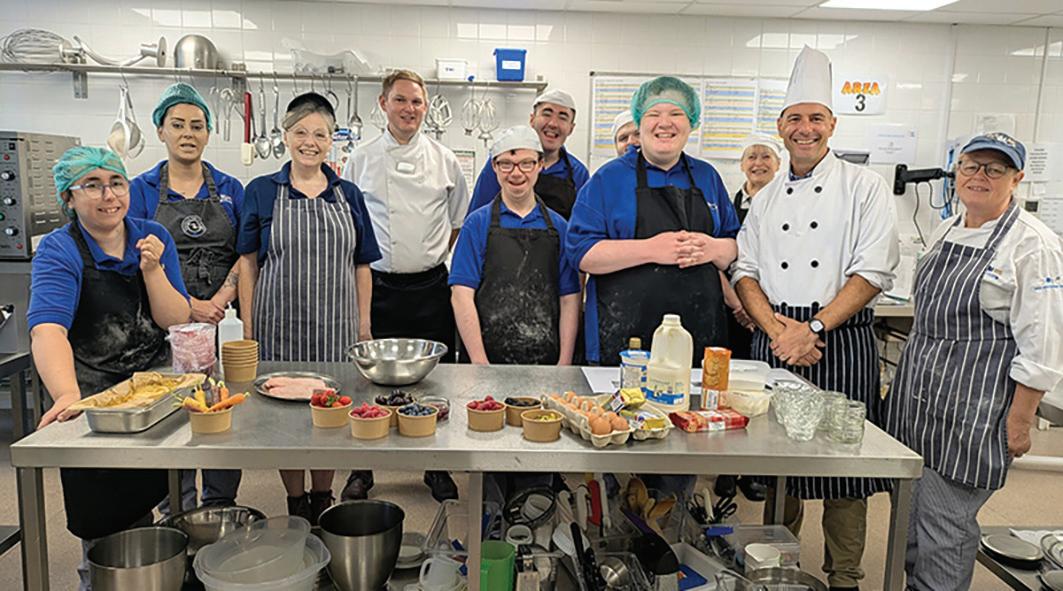
Lana, who is a trainee at The CRUMBS Project, said: “I particularly liked making the cheesecake pots. I liked the look of them and was pleased with the end result.” Luca, who is also training at the project, said: “I enjoyed helping to make the roulade, including rolling it out. I also helped to make the cheesecakes and thought the duck tasted really good.”
Mark and two other Care South chefs ran a bread-baking masterclass at The CRUMBS Project earlier this year with the aim of passing on their skills and knowledge to the next generation of chefs. Care South also employs some former trainees from The CRUMBS Project who support some of the Dorset-based homes in
a variety of different roles.
Lee Whalley, Head of Operations at The CRUMBS Project, said: “It was a pleasure to welcome Mark back into the kitchen, this time assisted by Patrick, to expand the experience our trainees have as they move towards the world of work. The kitchen was a hive of activity, with everyone getting involved and putting their new skills into practice. We’re incredibly grateful to Mark and Patrick for sharing their time, expertise and encouragement with our trainee chefs.”
Mark Wardman, Catering Operations Manager at Care South, said: “Seeing the enthusiasm and creativity of the trainees throughout the session was fantastic. The masterclass gave us a great opportunity to showcase how we use fresh, seasonal ingredients to create delicious, nutritious meals for our residents, while helping the trainees develop their practical skills and confidence in the kitchen. It’s rewarding to see their confidence grow, and we hope they will take those new-found skills into future training and employment.”
Last year, The CRUMBS Project received a donation of £2,915 from Care South’s Community Fund to purchase tablet computers for trainees and laptops for professional trainers to use to enhance their learning and progression into volunteering and employment. The Community Fund gives back to community groups, services and organisations which directly benefit Care South’s care home residents, care at home clients or staff.
Two Rotherham care homes have been recognised for their commitment to high standards of care after receiving certificates from Care Inspections UK (CIUK).
Moorgate Hollow and Moorgate Croft, which form part of Moorgate Care Village and are operated by Park Lane Healthcare, were presented with certificates following independent inspections conducted by CIUK, a UKAS-accredited inspection body specialising in adult social care.
The inspections considered the homes’ performance against applicable legislation and regulations, recognised standards, including BS 8606:2019, the British Standard for adult residential care, and established best practice.
The certificates provide independent recognition of the homes’ performance at the time of inspection and reflect their commitment to high-quality, person-centred care and continuous improvement.
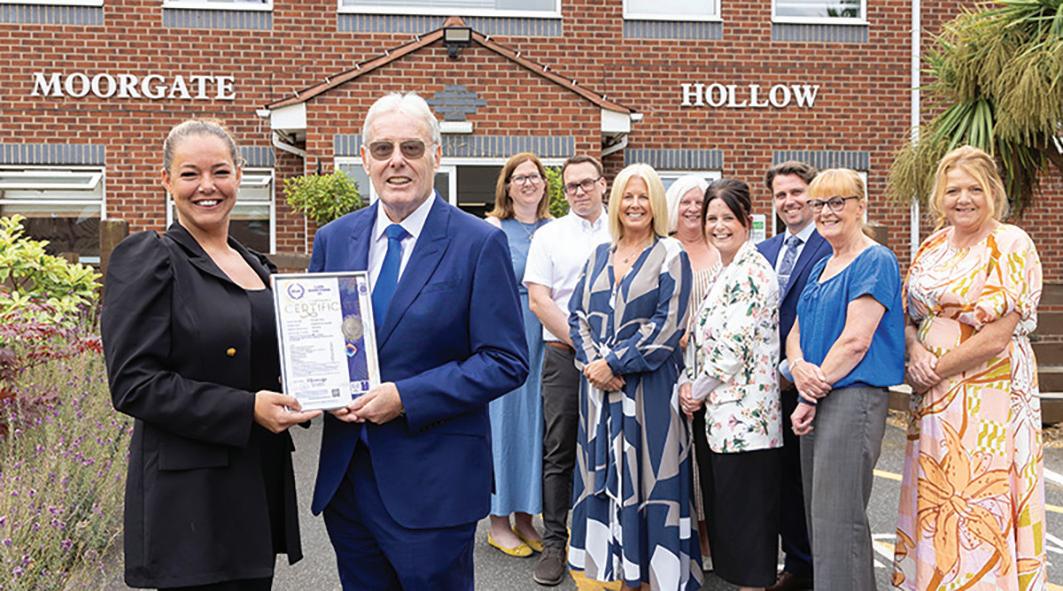
Chris Lane, chairman of Park Lane Healthcare, said: “We are delighted that both Moorgate Hollow and Moorgate Croft have received this independent recognition. It reflects the dedication, compassion and professionalism shown by our teams every day.
“Independent inspection by a UKAS-accredited inspection body provides reassurance for families that
the care we deliver has been assessed against applicable requirements and recognised standards, and we are proud of the outcome.”
Leigh-Ann Peace, registered manager at Moorgate Hollow, said: “Everyone here genuinely cares about the people who live with us, so receiving this recognition means a lot.
“It’s a testament to the whole team, who put so much into making the home a happy, caring place every single day.”
Kevin Groombridge, chief executive of Care Inspections UK, said: “Independent inspection by a UKAS-accredited inspection body provides valuable assurance for residents, families, professionals, regulators and commissioners. It demonstrates that a service has undergone a structured, evidence-based assessment against relevant legislation, regulations, recognised standards and best practice.
“The teams at Moorgate Hollow and Moorgate Croft were open and engaged throughout the inspection process, welcoming constructive feedback and demonstrating a clear commitment to continuous improvement.
“The outcomes achieved by both homes, including their performance against BS 8606:2019, reflect a positive culture, strong practice and a clear commitment to maintaining and improving quality.”
Coronation Street favourite David Neilson has revealed the surprising secret behind Roy Cropper’s famous beige anorak — he has a whole collection of them in different sizes to match the character’s mood.
David, who has played the much-loved Roy’s Rolls café owner for more than three decades, shared the wardrobe revelation during a special question-and-answer session with learning disabled adults who are members of learning disability charity Hft’s Luv2meetU social group.
The 77-year-old actor explained that, after Roy’s original anorak finally fell apart, he joined the soap’s wardrobe team on a shopping trip to find replacements.
He said: “The original anorak fell apart, so the wardrobe team and I went out and bought a load of them in different sizes.
“Depending on what mood Roy is in and whether he needs to look more droopy or not, that decides what size I wear. I’ve got enough of them to last me for the rest of my Coronation Street career.”
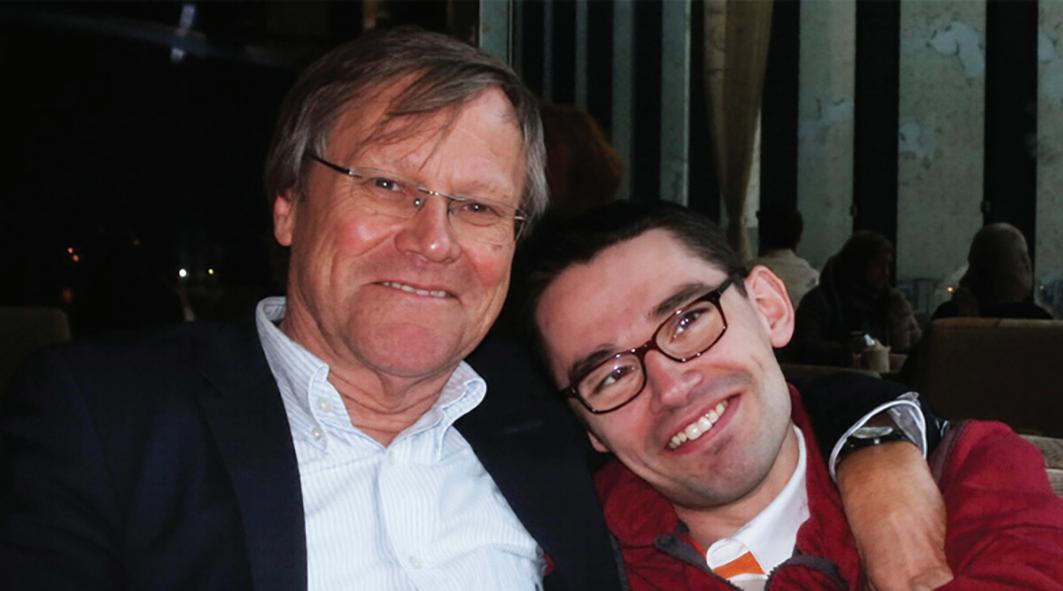
David was invited to meet the group by member and lifelong Corrie fan Jon, who knew the actor through his late brother Jimmy.
Jimmy and Jon lived in the same supported accommodation in Somerset. Although Jimmy sadly died eight years ago, David and Jon have remained in touch.
For Jon’s 30th birthday, David also invited him on a special tour of the Coronation Street set, where he visited Roy’s Rolls and even pulled a pint behind the bar of the legendary Rovers Return.
Jon, who has ambitions to become an actor himself, said: “I love Coronation Street, so this was the best birthday treat ever.”
During the online Q&A, members asked David about his favourite co-stars, forthcoming storylines and his life before joining the soap.
David told the group how he had worked as a gas fitter and plumber before training as an actor and initially joining Coronation Street for what was intended to be only a handful of episodes. He said: “I didn’t want to be a plumber, so I managed to get a place at drama school.
“I got the part of Roy because my friend had written a few episodes for Coronation Street and thought I’d be a good fit for the character.”
The event gave Luv2meetU members the opportunity to speak directly to one of the programme’s bestknown stars, share their own interests and ask the questions that mattered to them.
A new investigational medicine for dementia with Lewy bodies has been granted an Innovation Passport by the UK’s Innovative Licensing and Access Pathway (ILAP), offering a fresh source of hope for the tens of thousands of care home residents and families living with this challenging condition.
Dementia with Lewy bodies (DLB) is the second most common form of dementia after Alzheimer’s disease, affecting an estimated 100,000 people in the UK. It accounts for around three in every twenty dementia diagnoses and is known for its complex mix of symptoms, including fluctuating cognition, visual hallucinations, movement difficulties similar to Parkinson’s disease, and disrupted sleep.
For care staff, these symptoms can make DLB one of the most demanding forms of dementia to manage day to day, and treatment options for residents remain extremely limited.

The Innovation Passport, awarded following assessment by the ILAP Selection Panel, recognises the medicine’s potential to address this significant unmet need. It was granted alongside a separate award for a liver cancer treatment, underlining the breadth of conditions the pathway is designed to support.
The ILAP is a joint initiative bringing together the Medicines and Healthcare products Regulatory Agency (MHRA), NHS England, the National Institute for Health and Care Excellence (NICE), the Scottish Medicines
Consortium (SMC), the All Wales Therapeutics and Toxicology Centre (AWTTC), and the Department of Health Northern Ireland. Its aim is to give developers of genuinely innovative medicines earlier, more joined-up access to regulatory and NHS advice, helping promising treatments reach patients more quickly.
James Pound, MHRA Executive Director for Innovation and Compliance, said the latest awards demonstrated “the breadth and ambition” of the pathway, adding that the ultimate goal was “enabling earlier patient access to innovative new treatments.”
Sarah Knight, Senior Commercial Lead at NHS England, said the awards recognised “promising new medicines in development that have the potential to benefit people living with liver cancer and dementia, who have limited treatment options,” and that the programme was helping fast-track development so that treatments proven safe, effective and good value could reach patients sooner.
Applications for the next round of the ILAP opened on 4 August 2026 and remain open until 4 November 2026, with the MHRA continuing to encourage developers working across all therapeutic areas, including dementia, to come forward.
While it will be some time before any new treatment could become available to residents, care providers and dementia charities alike will welcome any sign of progress in tackling a condition that remains, for many families, one of the most difficult to live with.
A senior care assistant at a Shefford home recently marked 25 years’ service with the care provider.
Claire Course has been working at MHA Oak Manor since 2017 but joined MHA in 2001 starting her journey at MHA Trembaths, in Letchworth.
During her 25-year career Claire has worked a variety of roles across both homes including a domestic assistant and a kitchen assistant.
To mark her service, home manager at MHA Oak Manor, Cecilia Adamek arranged a presentation where Claire was given her certificate and other gifts, as well as a celebration cake which was enjoyed by all.
MHA Oak Manor provides residential and dementia care for 64 residents.
Speaking of her time with MHA Claire said: “ I started my journey with MHA when I started working at MHA Trembaths in 2001.
I had various roles such as a domestic assistant, kitchen assistant and then working as a senior care assistant on both days and nights.
“I joined MHA Oak Manor in 2017 when this home opened and here I have worked as a senior care assistant on both days and nights, but currently I am just working days.
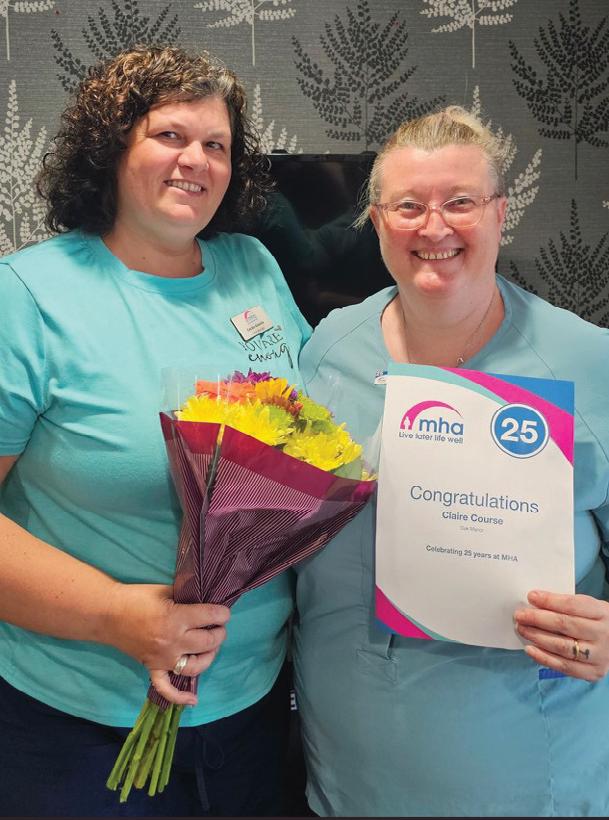
“It genuinely does not feel like I have been here for 25 years, and I definitely did not think I would be here that long when I started.
“I was aware that MHA does recognise staff members when they reach a landmark year of service, so I did have a feeling something would be arranged for me.
“One day before the celebrations I was made aware of what was going to happen, which I don't think Cecilia was happy with as the surprise had been ruined, but nevertheless I was very happy with what had been arranged for me.
“I really enjoyed the celebrations, and It was lovely to celebrate with my colleagues and the residents of MHA Oak Manor.
“I thoroughly enjoy working for MHA and in both of the homes I have worked in, MHA is a great organisation to work for and one where you are valued and really looked after.
“The standard of care we offer to residents and even their loved ones is something that keeps me going, and I feel very proud to be someone who works for MHA,
“If you want to better yourself, learn from experienced staff and make a difference in the lives of residents then this is the place for you.”
Residents enjoyed a morning of fun and teamwork at Broughton House Veteran Care Village’s sports day, held in partnership with the Salford City FC Foundation.
Veterans in their 90s were among those who took part in activities including seated balloon volleyball and football, cup pong, egg-and-spoon races and bat-and-ball games.
The sports day was the latest collaboration between Broughton House and the League Two club’s official charity, which recently changed its name from Foundation 92.
The foundation’s health and wellbeing team recently launched free twice-weekly fitness and activity sessions in the gym at the Salford care home to enhance residents’ wellbeing, strength and mobility.
Dale Hodgson, wellbeing and activities coordinator at Broughton House, said: “It was great to see our residents having so much fun at the sports day and getting involved.
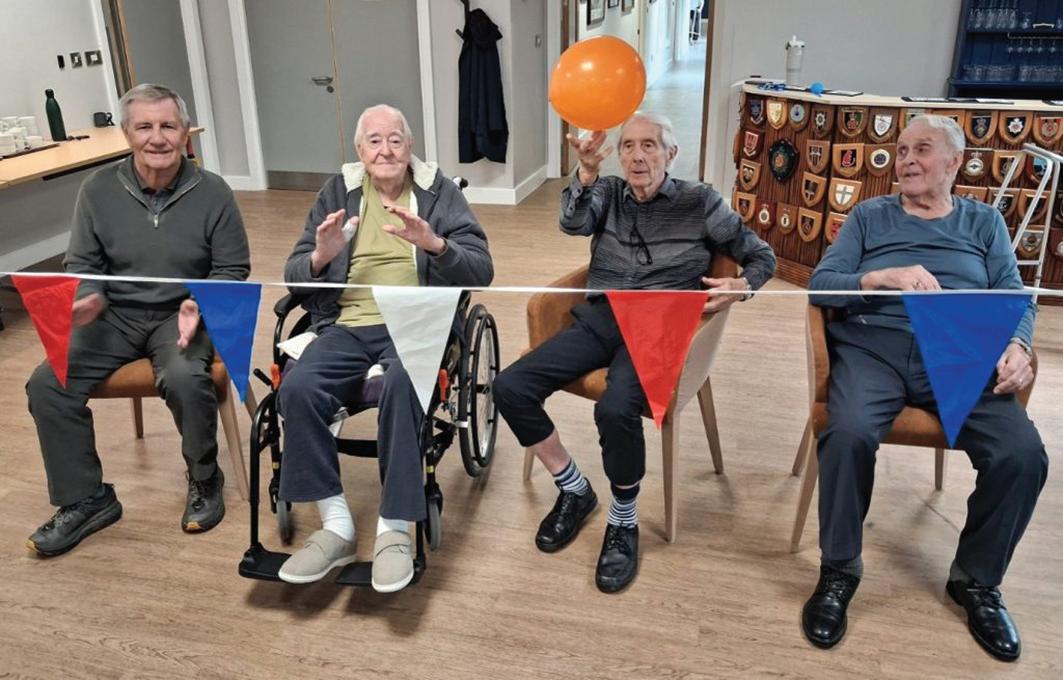
“We put a lot of thought into choosing the right activities, making sure they were challenging while also being accessible so everyone could take part.
“Partnering with Salford City FC Foundation has been fantastic. Our residents genuinely look forward to the regular gym sessions. We’re excited to work even more closely with the foundation’s team to provide plenty more positive experiences.”
Ruby Williams, the foundation’s health and wellbeing officer, said: “Hosting
House was something Dale and I discussed for a while, as we wanted to do something a little different for the residents.
“Salford City FC Foundation loves helping with these events and we work closely with care homes to ensure each activity is fun, safe and provides the right level of challenge for everyone. It would be great to make a Broughton House sports day a regular event.”
Broughton House residents also gave the event the thumbs-up. Retired Late Entry Major Mike Winstanley MBE, aged 78, who served with the Cheshire Regiment, said: “It was good. People could get involved in the activities because they weren’t too difficult. It was very enjoyable and worthwhile – some good exercise.”
Veronica Vesty, aged 88, said: “I enjoyed it, and what Broughton House and the foundation are doing as a whole is very good. They keep us occupied and moving, doing exercises. They’re doing wonders to keep us active and on the go.”
Dale added: “Our partnership with the Salford City FC Foundation gives our residents more opportunities to improve their strength and mobility.
“This has the added positive effect of improving their day-to-day lives and gives them confidence to move with greater independence.
“The sessions also enhance their wellbeing. They like to keep busy, and look forward to taking part each week.”
By Kathryn Lloyd, Colour Specialist, Crown Paints (www.crownpaintsprofessional.com
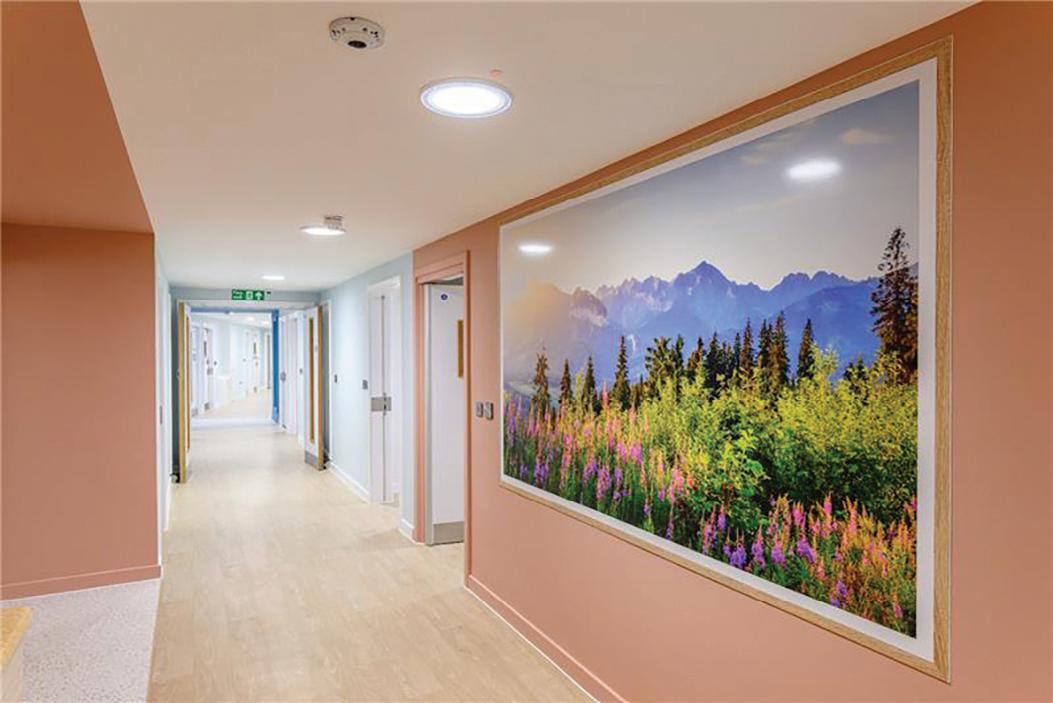
Care home design is about more than how a space looks. Interiors need to feel familiar for residents, reassuring for families and practical for the staff using them every day.
Colour plays a key role in setting that tone, helping spaces feel welcoming, homely and considered. In busy nursing and residential settings, the finish matters just as much. The right paint specification ensures carefully-chosen schemes can withstand daily use, regular cleaning and ongoing maintenance.
Moving away from clinical spaces
Care homes are working environments, but they are also people’s homes. A considered colour scheme can soften spaces that might otherwise feel clinical or institutional.
Soft off-whites, gentle greens, muted blues and earthy shades can all bring a more domestic feel to bedrooms, lounges and communal dining areas. Crown Paints’ Victoria White, for example, offers a gentler alternative to stark white, and [insert warm, earthy shade] could add depth without making a space feel heavy.
The aim is not to make every room look the same. A successful scheme should feel connected, with enough variation to give each area its own purpose and identity.
DESIGNING WITH RESIDENTS IN MIND
In care environments, colour choices should be shaped around the people using the space. Light, contrast and familiarity all influence how a room feels and how easily residents can navigate it.
Very bright whites can feel harsh, particularly under strong artificial lighting. Softer tinted whites and muted tones can still look clean and fresh but create a gentler backdrop for daily life.
Colour can also help define different areas. A shift in tone between
corridors, lounges and dining spaces can support a clearer sense of place. Carefully chosen contrast can make key destinations easier to recognise.
This can be particularly valuable in dementia-friendly design, where residents may benefit from clear, consistent visual cues. Bedroom doors, bathroom entrances or dining room doorways can be picked out in a shade that contrasts with surrounding walls, helping residents identify the spaces they use most often. The key is to use colour with purpose: avoiding overly busy schemes but still providing familiar cues that support confidence and independence.
Bedrooms need particular care. These are personal spaces, so palettes should feel restful rather than overly stimulating, especially when paired with familiar furnishings and good natural light.
SUPPORTING STAFF AND VISITORS TOO
A well-designed care home must work for everyone. Staff spend long shifts in these environments, and families or visitors may arrive feeling anxious or emotional.
Reception areas, family rooms and quiet lounges can benefit from composed palettes that make the building feel approachable from the moment someone enters. Muted greens such as Crown Paints’ Glass Green can bring a grounded, restorative feel. A gentle yellow such as Narrative can create a more uplifting atmosphere in spaces that need a little warmth or energy.
Staff areas should not be overlooked. A well-finished break area can provide a welcome contrast to busy operational spaces, using warmer shades or deeper accents to create a clearer sense of separation from high-traffic areas.
BALANCING APPEARANCE WITH PERFORMANCE
In care homes, a successful scheme is not just about choosing the right colours. It is about choosing products that can keep those spaces looking good.
Corridors, lounges, dining rooms and bedrooms all experience regular wear, from knocks and scuffs to frequent cleaning. Durable, washable finishes can help maintain a fresh appearance for longer and support the maintenance programme.
Crown Trade Clean Extreme Scrubbable Matt is designed for demanding interiors where walls need to withstand repeated cleaning and retain a high-quality matt finish. It is well suited to busy communal areas where durability and appearance both matters.
In bathrooms, ensuites, kitchens and laundry areas, moisture and humidity also need to be considered. Crown Trade Clean Extreme Mould Inhibiting Scrubbable Matt combines a durable, washable finish with mould-inhibiting properties, making it a practical option for these more challenging spaces.
Woodwork and trim are just as important. Door frames, skirting
boards, handrails and other high-contact surfaces need a finish that can cope with everyday use. Crown Trade Fastflow Quick Dry Satin and Crown Trade Fastflow Quick Dry Gloss provide durable options for interior woodwork. Their quick-drying formulations can also help reduce disruption during refurbishment works.
For areas where hygiene is a particular priority, such as treatment rooms or specialist spaces, Crown Trade Steracryl Anti-Bacterial Scrubbable Matt may also form part of the specification.
A CONSIDERED APPROACH
The same principles apply across many care and healthcare environments: people respond better to spaces that feel human, considered and easy to spend time in. That does not mean making interiors overly decorative, but it does mean moving away from finishes and palettes that feel cold, clinical or impersonal.
Crown Trade’s work with Cygnet Kenney House in Oldham, a mental health hospital for women, reflects this approach. Colour was used as part of the wider design to create a more therapeutic, welcoming and non-clinical environment. The specification also needed to meet the practical demands of a busy healthcare setting.
For care homes, the lesson is clear. Colour, finish and durability should be considered together from the outset, so spaces not only look calmer and more inviting on day one but continue to feel well cared for over time.
When chosen carefully, tested in the space and paired with the right Crown Trade product specification, colour can help shape how a care home feels, functions and performs – supporting residents, reassuring visitors and making everyday maintenance easier for staff.
For more information about Crown Trade’s colour and specification support, visit: www.crownpaintsprofessional.com


A large-scale renewable heating project at The Myton Hospices in Coventry is delivering significant benefits - and offering a replicable model for hospices across the UK.
When The Myton Hospices began exploring ways to reduce their energy costs and carbon footprint, the scale of what needed to be achieved was immense. The result of that project is now being hailed as a UK first: a ten-unit air source heat pump cascade installation in an adult hospice setting, delivered by renewable heating specialists Go Geothermal in partnership with Neutral Hospice Network.
The project, completed in October 2025 at The Myton Hospice's distinctive triangular building in Coventry, has already produced results that exceed expectations. Since implementation, gas consumption has been reduced by 86%, carbon savings against the previous system stand at 77%, and target cost savings of 40% have been recorded. For a charity that receives less than 20% of its funding from the NHS and must raise more than £12 million each year through voluntary income, those figures are impressive and inspire hope for the sector.
Built in 2009 Coventry Myton Hospice presented a complex brief. With 190 rooms to heat and patients requiring uninterrupted comfort and tranquillity, any heating solution had to be robust, reliable and quiet in operation. At the same time, the organisation faced the financial pressures familiar to hospices nationwide: rising operational costs, increased demand for services and a funding model heavily dependent on charitable income.
Ruth Freeman, CEO of The Myton Hospices, explains the stakes clearly:
"The reduction in our energy costs so far has been incredible. As a
charity, with less than 20% of our funding coming from the NHS, we rely heavily on the support of our local community to ensure people can access our specialist end of life care when they need it most. It costs more than £15 million each year to provide our services free of charge to patients and their families, and over £12 million of that must be raised through voluntary income. We have a responsibility to make every pound count, and this project focuses on our long-term sustainability. At a time when many hospices are facing difficult decisions and having to reduce services and cut staff, this investment is helping us to protect patient care and ensure we can continue to be here for people living with life-limiting illnesses and their families now and in the future. We are incredibly proud to be the first hospice in the UK to implement this on such a scale."

Beyond the immediate operational savings, the project is also strengthening The Myton Hospices' position with trusts and grant funders. Across the sector, sustainability credentials are becoming an increasingly important factor in funding decisions, and the measurable performance data generated by the installation provides concrete evidence of responsible stewardship.
Jason Levy, Director of Fundraising and Supporter Development, The Myton Hospices, adds further insights:
Neutral Hospice Network approached Go Geothermal in 2024 seeking expertise in large-scale renewable heating. Following detailed consultation and system design, the team specified ten CTC EcoAir 720m air source heat pumps operating in a cascade configuration: a system that intelligently distributes heating demand across multiple units, providing built-in redundancy, extended equipment lifespan and precise capacity matching to the building's requirements.
The CTC EcoAir 720m units, part of CTC's powerful 700 series, were selected for their high output capacity, low noise operation and advanced inverter technology, which maintains high coefficients of performance even in larger installations. Swedish-engineered and purpose-designed for multi-unit configurations, they proved well suited to the demanding requirements of a healthcare environment.
The installation, which also involved Hinckley Plumbing and Heating, Rob Berridge Heating Design Consultants and London Electrical, was completed with minimal disruption to hospice operations. The system now provides both heating and domestic hot water across the full 190-room building, maintaining average room temperatures of 23 degrees Celsius and delivering an average coefficient of performance of 4.86 against the 2022/23 baseline year.
"We are increasingly seeing trusts and grant funders prioritise organisations that can demonstrate a genuine commitment to sustainability. Projects like this not only reduce our carbon footprint and operating costs, but also show funders that we are taking a proactive approach to securing Myton's future. As a result, trusts and grant funders may be more inclined to support Myton, knowing their investment will be used responsibly and deliver long-term benefits for both the charity and the communities we serve. By becoming more sustainable and efficient, we can focus even more on providing the best possible care for our patients and their families who rely on us."
A MODEL FOR THE SECTOR
Go Geothermal, which has been working across commercial and domestic renewable heating installations for two decades, believes The Myton Hospices project establishes a new benchmark for the sector. The combination of a pioneering cascade configuration, measurable performance outcomes and the particular context of a hospice charity makes this installation a compelling case study for any similar organisation weighing up the transition to low-carbon heating. Total energy consumption at the site has fallen by 50% compared to the 2022/23 baseline. As the system moves through its first full year of operation, ongoing performance monitoring will continue to build the evidence base for large-scale air source heat pump adoption in healthcare environments.
For more information about large-scale heat pump installations, contact Go Geothermal on 01388 720228 or sales@gogeothermal.co.uk
Anenta, the leading independent healthcare waste management specialist, has appointed waste expert Jonathan Sandford as Business Development Manager dedicated to the care home sector.
Brought on board to boost Anenta’s growing care home client base, Jonathan brings more than 35 years of waste industry experience – from running his own document shredding business to leading nationwide sales teams at a plc level. His appointment comes as Anenta accelerates its mission to help care homes eliminate unnecessary costs that can run into thousands of pounds a year.
In his new role, Jonathan will oversee the management of Anenta’s existing waste contracts, ensuring that care home waste logistics, service delivery, and waste disposal performance levels are industry leading. He will also be responsible for delivering bespoke, affordable and professional end-to-end waste management solutions to the care and nursing home sector.
Commenting on his new role, Jonathan said: “Our research shows that individual care homes are wasting up to £8,000 a year through poor waste management process and procurement. Across multiple sites, that adds up fast — and it's largely avoidable.

“My role is to help care homes put a stop to that by changing poor waste disposal habits and practices, so that we can deliver a better service that saves them time and money.
“I’ll be working with care homes to identify overbilling, reform waste disposal habits, deliver better staff training, and provide guidance on conducting complex pre-acceptance audits – all designed to take the

CareZips® Classic are patented, easy dressing unisex adaptive pants designed for older and disabled people suffering with problems associated with continence, mobility, mental function and cognition. Suitable for persons living in care institutions, receiving care at home or living independently at home, CareZips® Classic enable people to dress themselves or with assistance from carers.
CareZips® Classic feature patented 3-zipper system, which opens the front of the pants from the waist to the knees for quicker access during toileting, continence pads changes and personal hygiene. The forward positioning of the two side zippers lessens pressure on sensitive hip areas, helping to eliminate discomfort. The third zipper facilitates simple full frontal opening for faster more dignified diaper changes, catheter adjustments, personal cleansing and hygiene routines.
CareZips® Classic have many benefits for the older and disabled users and their carers:
• People dressing themselves enjoy the practical functionality and versatility of the CareZips® Classic, all day comfort and easy garment care.
administrative burden off care home teams so they can focus on what matters: resident care.”
Using Anenta's real-time smart technology, care homes, their waste collection providers, and other stakeholders are brought together onto a single, unified management platform that provides full transparency. This allows efficiencies to be identified, implemented and measured, delivering significant and meaningful cost savings year after year.
Commenting on Jonathan’s appointment, Graham Flynn, Managing Director of Anenta, said: "Jonathan has the perfect combination of sector knowledge, commercial expertise, and an unwavering commitment to delivering added value to our customers.
“Alongside his expertise in waste management, Jonathan is perfectly placed to help care homes streamline their processes saving time, hassle and money."
As part of its service, Anenta offers care homes a free healthcare waste audit designed to identify areas for improvement that could save care home groups many thousands of pounds a year. These can be booked by calling 0330 122 2143.
Anenta supports customers across more than 20,000 locations nationwide, including individual care homes and large care home groups. Over the past five years, the company has saved its clients more than £13 million through smarter, more efficient waste management.
For more information about Anenta, visit www.anentawaste.com or call
• People dependent on assisted dressing appreciate quick easy dressing process with less stress, embarrassment and greater dignity offered by CareZips® Classic.
• CareZips® Classic offer practical gains to the carers, helping them to provide better care, whilst reducing physical efforts and saving valuable time.
CareZips® Classic are unisex, available in 6 sizes and 3 practical colours (i.e. black, charcoal and navy).
Tapered fit at the ankles gives a tidy appearance. Made from breathable moisture-wicking 4-way stretchy crease-free and easy-care durable fabric, CareZips® Classic are comfortable, practical and conveniently functional.
For more information, contact Win Health Medical Ltd - 01835 864866www.win-health.com
See the advert on page 3 for further information on Win Health’s product range.
Laundry and linen management are essential parts of running a professional care setting or hospitality business. From fresh bed linen and towels to uniforms and regular textile care, standards must be maintained every day. Dinan Way offers a dependable laundry and linen service designed to support organisations that need consistency, quality and a practical approach.
Based in Exmouth, Dinan Way operates from a location that has been associated with laundry services for more than 20 years. This local background is matched by a service that continues to grow as more businesses look for reliable support with their laundry and linen needs.
The company provides commercial laundry services, linen care, towel laundry, uniform washing, textile support and linen rental. Its linen rental service is particularly useful for care homes, nursing homes, guest accommodation, serviced apartments, hotels, restaurants, cafés, salons and gyms, helping them accessfresh, well-presented linen without the need to purchase, store or manage large quanti-
ties themselves.
For nursing homes and care homes, reliable laundry support is especially important. Clean linen, fresh towels and well-maintained textiles help protect hygiene standards, support resident comfort and make day-to-day operations easier for staff. Dinan Way understands that these services are not just about presentation; they are part of the smooth running of a professional environment.
Collection and return are also available, making the process straightforward for organisations with regular requirements. By taking care of linen and laundry needs, Dinan Way helps businesses save time, reduce pressure on staff and maintain the standards their customers, residents and clients expect.
Although its main focus is commercial laundry and linen support, Dinan Way also assists private customers with household laundry, bedding, towels and everyday clothing.
More information can be found at www.dinanway.com

Angloplas are a UK manufacturer who specialise in producing dispensers for the health and hygiene industry. Although these are designed to keep the workplace tidy and uncluttered they are, more importantly, built knowing the control of healthcare-associated infections (HCAIs) are a priority for healthcare providers, and who are employing a combination of infection prevention and control strategies, including hand hygiene, cleaning, training and the adoption of new technologies to tackle the problem. As a result, a wide range of infection control products and technologies are emerging on the market, including antimicrobial technology. Angloplas’ range of dispensers are produced in the world’s first proven Antimicrobial PVC with silver ion technology and which is exclusive to Angloplas. This helps reduce the risk of cross infection by stopping the growth of bacteria and mould and works continuously for the lifetime of the product, reducing levels of bacteria such as MRSA, E Coli, Legionella, Salmonella and mould by up to 99.99%.
For non-clinical environments Angloplas has recently launched its new Budget Range of products which are made to the same exacting standards as the antimicrobial protected ones but with lower price tags.
You can order Angloplas products directly from its website at www.angloplas.co.uk
See the advert on page 6.


From 10th to 16th August 2026, care homes up and down the country will once again be reaching for their finest china, plumping up their scones, and polishing their teapots in celebration of Afternoon Tea Week — one of the most delightfully British traditions in the residential and nursing care calendar.
For many, Afternoon Tea Week is simply an excuse for cucumber sandwiches and a slice of Victoria sponge. But for the care sector, it has become something far more meaningful: a week dedicated to connection, comfort, and the simple joys that make such a difference to the lives of residents.
A Tradition Steeped in History
Afternoon tea itself dates back to the 1840s, when Anna, the 7th Duchess of Bedford, is widely credited with popularising the custom. Feeling the pangs of hunger in the long gap between lunch and a fashionably late dinner, she began requesting a tray of tea, bread and but-

ter, and cake be brought to her room each afternoon. The idea soon caught on among her social circle, and before long, afternoon tea had become a cherished ritual of English high society — complete with dainty sandwiches, delicate pastries, and, of course, a proper pot of tea.
Afternoon Tea Week itself is a more recent invention, established to celebrate this enduring institution and encourage people across the country to enjoy the ritual together, whether at home, in tearooms, or in care settings. Over the years, it has become a firm favourite in the care sector calendar, with many homes marking the occasion with as much enthusiasm — if not more — than the tearooms of London and Bath. Why It Matters So Much in Care Settings
It is easy to underestimate the value of a cup of tea and a slice of cake. But within care homes, Afternoon Tea Week taps into something far deeper than nostalgia for a bygone era.
Celebration and joy. A beautifully laid table, fine china, and a spread of sandwiches and cakes transform an ordinary afternoon into an occasion. For residents, particularly those living with dementia, such sensory and visual cues can spark cherished memories and conversation, offering moments of genuine delight in the day-to-day rhythm of care home life.
Well-being. Food has long been recognised as more than mere sustenance — it is comfort, familiarity, and pleasure. A well-planned afternoon tea can lift spirits, provide something to look forward to, and offer residents a sense of normality and dignity that goes beyond clinical care.
Socialising. Loneliness and isolation remain among the most pressing concerns in elderly care, and events like Afternoon Tea Week provide a natural, low-pressure setting for residents, staff, and visiting families to come together. Sharing a table over tea encourages conversation, laughter, and connection — vital ingredients for emotional and mental well-being.
Hydration. Encouraging older adults to drink enough fluids can be a


genuine challenge, with dehydration a common and serious risk in later life. A tea party, with its focus on encouraging "just one more cup", offers a gentle and enjoyable way to support residents' hydration needs without it ever feeling like a chore or a health directive.
Value to the care sector. Beyond the individual benefits to residents, events such as this offer real value to care providers themselves. They provide an opportunity to showcase the quality of catering and activities on offer, to involve families and the wider community, and to demonstrate the person-centred approach that lies at the heart of good care. Many homes use the week to raise funds for charity, to welcome local schools and community groups, or simply to say thank you to the staff and volunteers who make such moments possible.
Care homes have long embraced Afternoon Tea Week with real creativity — vintage-themed tea parties, garden fetes, "bake-offs" between residents and staff, visits from local musicians, and even 1940s and 1950s dress-up days to accompany the sandwiches and scones. It is not uncommon to see homes go all out with bunting, live music, and themed menus that reflect the tastes and memories of their residents.
For staff, it is also a wonderful opportunity to slow down, sit with residents, and share in the occasion — a reminder that care is not just about tasks and routines, but about relationships, warmth, and shared humanity.
Here at THE CARER, we know just how much thought, love, and effort goes into these celebrations across the country, and we want to celebrate it with you. We are inviting care homes around the UK to share photographs and stories of their Afternoon Tea Week festivities — whether it's a grand garden party, a themed dress-up day, or simply a beautifully laid table shared between residents and staff. Whatever form your celebrations take, we would love to hear from you and share your stories with our readers, helping to showcase the wonderful work happening in care homes up and down the country.




By Abi Brumpton, Nutritionist at AVE (www.a-v-e.com)

Each meal time in a residential care setting, the catering team have around 30 people who require food preparing, cooking and serving for them. With an average of three staff members to do all of this, and three meals needed every single day, the simplest solution would be to offer a set menu for everyone.
But in reality, mealtimes are about so much more than putting something on a plate. Individualised diets are, in fact, so crucial to the health and wellbeing of those living in the setting that the additional time and effort should be factored in to ensure everyone has something to eat and drink which suits their exact requirements.
There are many reasons why – but let’s look at five key considerations:
1. TEXTURE REQUIREMENTS
A review of research into the prevalence of dysphagia among the care home population in 2024 found approximately 60% of residents had some degree of difficulty swallowing. The IDSSI framework sets out eight texture stages for food and drink, meaning careful consideration – in partnership with nutritionists and speech and language therapists –must be given to each person’s needs, with ongoing reviews given the likelihood of changes over time. People with a range of conditions from Parkinson’s to dementia, as well as those who have experienced a stroke, are most likely to be impacted; and the consequences if their food is not appropriately prepared can be severe: malnutrition, dehydration and weight loss can all occur if they are unable to ingest meals, while aspiration pneumonia (which has a mortality rate of up to 70%) can occur if food and drink enters the lungs.
2. ALLERGEN RISKS
Around 6% of adults have a diagnosed food allergy, as reported by Anaphylaxis UK, with Imperial College London finding rates rose from a 0.4% prevalence to 1.1% in the decade between 2008 and 2018. This increase can be attributed to a number of factors, such as better diagnosis rates, as well as environmental factors, lifestyle and stress.
With catering teams likely therefore to have at least one resident in their care with an allergy – not forgetting those who have intolerances to certain ingredients – it is essential to personalise meals. Not only should staff ensure menus are tailored to avoid allergens, but cross contamination is also an important consideration. This is especially true in the case of severe allergies where anaphylaxis can be triggered through a very small amount being ingested, or where symptoms also occur through touching the allergen.
3.
While not everyone strictly follows the dietary requirements associated with their religion, there are a significant proportion of people within the UK for whom avoiding certain foods is an integral part of their culture.
With 3.9 million people identifying as Muslim and one million as Hindu in the last Census, every care setting must take into consideration the religious rules that individuals follow – such as the halal diet of Muslims, who avoid pork and alcohol, and the avoidance of beef for Hindus, many of whom are vegetarians. Even where faith is not a factor, there are other cultural considerations to bear in mind: those from different ethnic backgrounds may have grown up eating specific diets, so offering meals they are familiar helps encourage residents to eat enough. Particularly for those with dementia, serving favourite foods can help support their wellbeing by evoking happy memories of mealtimes from their past.
4.
The number of people who follow vegan or vegetarian diets has skyrocketed in recent years, meaning care home staff must be more cognisant of offering plant-based and meat-free alternatives than ever. The Vegetarian Society estimates there are now 3 million UK residents who follow either a meat-free or animalproduct free diet.
Others may choose to limit the amount of meat and animal produce they eat, meaning a selection of options should be available to cater for everyone’s preferences. With the market responding to the sharp rise in numbers, the variety of ingredients now on offer makes ensuring vegan and vegetarian diets are varied, appetising and high-quality easier than ever.
Particularly for care home residents who have previously lived independently, the move into a residential setting represents the stripping away of many of their choices. Becoming reliant on others around the clock and adapting to a new, unfamiliar routine can be unsettling –particularly for those with dementia, adding to the confusion they may feel about their surroundings and circumstances.
So, empowering individuals to choose their meals where feasible, or at least offering them food and drink which replicates what they would have chosen for themselves, is vital in many ways. Eating familiar foods or following ‘normal’ routines can support that transition into care home living, and mealtimes can be promoted as a time for socialising, reminiscing, and positivity – all of which not only boosts wellbeing, but helps encourage people to eat what’s on their plates.
Food heavily influences our health and wellbeing, meaning the link between individual meal plans and resident outcomes is undeniable in care settings. Offering familiar, culturally appropriate, allergen-free meals which align with the person’s preferences and health needs is truly a measure of a care home providing the very highest standards of support for its residents. It’s about seeing mealtimes as so much more than a simple ‘one plate fits all’ affair, instead as an opportunity to boost the quality of life for everyone in the setting.

The beginnings of Tea From The Manor is a delightfully simple story. The proprietor, James Green was in the 3rd Royal Horse Artillery in the Army where he spent many years in active service.
Spending time in Northern Ireland, Cyprus and Hong Kong. It was while in Hong Kong, stationed with the Ghurkhas, he learnt all about tea. A passion that has stayed with him for many years.
James began Tea From The Manor in 2011 when, along with his daughter Charlotte, they took a few different flavoured teas to a farmer's market.
Over a decade later we have grown as a company, bringing you the finest full leaf teas from the best tea gardens around the world. We provide loose leaf, tea bags and tea envelopes along with accessories such as tea presentation boxes and tea pots.
We supply the finest restaurants, cafes, garden centres and care homes all across the UK.
Recently Tea From The Manor was awarded the Best Initiative in Care Award at the 2025 Caring UK Awards for its development of tea specially created for people who have dysphagia.
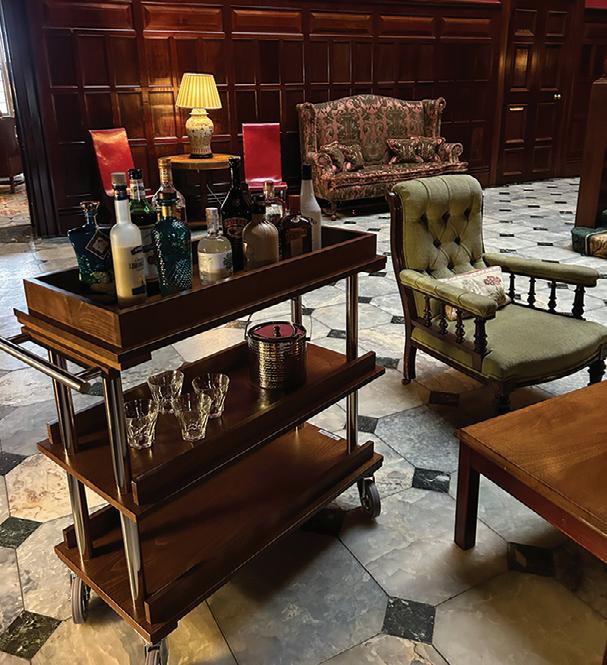
Four different flavours have been produced to provide a wide range of flavours for residents with dysphagia. Green Tea and Mint, Red Berry, English Breakfast and Earl Grey are all on the menu, giving residents of care homes a diverse selection. With the herbal and fruit tea options being decaffeinated, this further adds to a varied choice for residents.
Although making a drink which would be safe and nutritious for residents with dysphagia was vital, making sure that it tasted nice and would be a drink that could be enjoyed was of equal importance.
With decades of experience in tasting and developing the finest teas, James was able to bring his knowledge and passion to the process.
"I was particularly excited by this project in terms of finding flavours that would work well with the thickening agents used in drinks. We tried a lot of combinations to get every blend just right. Residents each have their own taste memory so we wanted to make sure we could represent as many of them as we could."
We are a proud family run business that cares for our customers and our environment, all of our silky tea bags are biodegradable. We are Green by name and Green by nature. Call 01477 771 811 or visit www.teafromthemanor.co.uk for more information.


The analogue-to-digital transition in health and social care is not simply a technology refresh. It is a chance to rethink how help is requested, how staff respond, and how care is coordinated across a home.
Too often, procurement still begins with a like-for-like mindset: replace the old panel, keep the old workflow, and hope for a better result. But digital nurse call should not be bought as a newer version of an old problem. It should be purchased as part of a wider care model that improves visibility, response, accountability, and resident experience.
Before comparing systems, providers should define the problem they are trying to solve. Is the issue slow response times, poor escalation, noisy environments, duplicated paperwork, or a lack of oversight? The right solution should be judged against those outcomes, not against a checklist of features.
This matters because modern nurse call is no longer just about a resident pressing a button and a sounder going off. In better-designed systems, alerts can be routed directly to staff mobile devices, calls can be prioritised, and managers can see patterns in demand and response. That creates a more responsive and less fragmented way of working.
A presentation is not a demonstration. A brochure cannot show how a system behaves during a busy morning shift, when several alerts happen at once and staff are moving across different parts of the home. That is why live testing in a real care environment is essential. Staff should be able to use the system, question it, and pressure-test it before any decision is made. If the workflow is clunky in practice, the promise of digital efficiency disappears very quickly.
One of the biggest mistakes in purchasing technology is treating integration as a nice-to-have. In reality, it is central to whether the system adds value.
When nurse call works alongside care records, mobility devices, alarm management, and internal communi-
By Stuart Barclay, healthcare technology specialist at Syndora Alto
cation tools, the result is less duplication and faster decision-making. When systems do not connect, staff are left repeating tasks, chasing information, and working around the technology rather than with it.
For care providers, that means the question should not be, “What does this system do on its own?” The better question is, “How well does it fit into everything else we already use?”
Digital systems do not end at installation. They begin there. Any provider selecting a nurse call platform should think carefully about what happens after go-live: training, maintenance, updates, fault resolution, and ongoing optimisation.
Care homes need suppliers who understand the realities of the sector, not just the technology. A strong supplier relationship should include responsive support, practical training, and a willingness to adapt as the home’s needs change. In digital care, support is not an extra service; it is part of the product.
The biggest risk in this transition is buying something that cannot evolve. Care homes are operating in a fastchanging environment, and technology that cannot scale or adapt soon becomes a constraint rather than an asset.
Future-ready systems should be designed to expand, integrate, and respond to changing needs without requiring a complete replacement every few years. That flexibility is especially important in a sector facing pressure to modernise ahead of the 2027 digital switchover.
The analogue era encouraged a narrow question: does the system work?
The digital era demands a better one: does the system help us deliver safer, smarter, more person-centred care?
That shift in mindset changes everything. It moves procurement away from hardware replacement and towards care improvement. It encourages providers to look for visibility, integration, responsiveness, and longterm support rather than simply ticking a technical box.
The homes that get this right will not just be compliant with the digital transition. They will be better equipped to use technology as part of everyday care, supporting staff and improving the experience of residents.
Fall Savers®, are an experienced market leading healthcare provider of resident safety solutions for over 15 years.
FALL SAVERS ® WIRELESS MONITOR
Eliminate all cables with our new generation falls management solutions!
Upgrade your falls programme with the latest technology from Fall Savers®. The NEW Fall Savers® Wireless eliminates the cord between the monitor and sensor pad. This results in less work for nursing staff, improved safety for patients and reduced wear and tear on sensor pads. Wireless advantages include the ability to use one monitor with two sensor pads simultaneously and support for many new wireless devices. BENEFITS INCLUDE:
Safer for patients; less work for staff
Bed and chair pads available
One monitor works with two sensor pads
Integrates with most nurse call systems
A variety of options, including: Call button
Pager
Floor sensor mat
Wireless door/window exit alerts
TREADNOUGHT ®FLOOR SENSOR PAD

The TreadNought® Floor Sensor Pad is built to last with a durable con-
struction that far out lasts the competition. Our anti-bacterial floor sensor pad is compatible with most nurse call systems or can be used with a portable pager to sound an alert when a person steps on to the sensor pad. Caregivers typically place the sensor pad at the bedside, in a doorway or other locations to monitor persons at risk for falls or wandering. An optional anti-slip mesh reduces the potential for slippage on hard surface floors.
FEATURES INCLUDE:
Connects directly to most nurse call systems
High Quality anti-bacterial Floor Sensor Pad
Large Size Pad: Measures (L) 91cm x (H) 61cm
Options (sold separately):
Anti-slip mesh for hard surface floors
See the advert on this page for further details or visit www.fallsavers.co.uk.

In today’s complex care environment, we understand that choosing the right technology is about far more than functionality alone. For care providers, reliability, sustainability, and supply chain resilience are critical factors—especially when it comes to nurse call systems that play such a vital role in resident safety and day-to-day operations.
At Courtney Thorne, we are proud to champion the “Made in Britain” mark. For us, this is not simply about where our systems are manufactured; it reflects our commitment to quality, accountability, and supporting the UK care sector. By designing and building our nurse call systems here in Britain, we can ensure they are developed with a deep understanding of the real challenges faced by care homes, resulting in solutions that are practical, reliable, and easy to use.
Manufacturing in the UK also allows us to maintain close control over our supply chain—something that has become increasingly important in recent years. Global disruptions have highlighted the risks of relying on complex, overseas supply networks. By keeping our production local, we are able to offer greater consistency, shorter lead times, and improved access to parts and upgrades. This means our customers can rely on continuity, even in uncertain times, with minimal risk of disruption to their services.
Sustainability is another area where we believe local manufacturing makes a meaningful difference. By reducing the need for long-distance transportation and focusing on robust, long-lasting system design, we help care providers lower their environmental impact. We are committed to creating solutions that not only meet today’s needs but are built to last—reducing waste and supporting more sustainable care environments over the long term.
Of course, delivering high-quality technology is only part of the picture. We know that ongoing support is essential. That’s why our UK-based technical team is on hand to provide expert assistance, from installation and training through to maintenance and rapid response when it matters most. Our proximity allows us to respond quickly and effectively, giving our customers the confidence that support is always within reach.
At Courtney Thorne, we believe that care homes deserve technology they can depend on—both now and in the future. By combining British manufacturing, sustainable practices, a resilient supply chain, and dedicated local support, we are proud to deliver nurse call systems that underpin safe, effective, and reliable care every day.
For more information or to book a free demo, visit www.c-t.co.uk or contact info@c-t.co.uk.
Falls are a significant concern for vulnerable individuals, especially seniors and patients at risk. Medpage, a leader in assistive technology, offers a range of cutting-edge products designed to enhance safety and provide peace of mind for caregivers and families. Here’s an in-depth look at some of their standout solutions: MPRCG1 (2023) BED LEAVING DETECTION ALARM WITH CAREGIVER RADIO PAGER
The MPRCG1 is a comprehensive system tailored for fall prevention in domestic, commercial, and NHS care settings. This all-inclusive kit includes a bed pressure mat sensor, a BTX21-MP alarm sensor transmitter, and an MP-PAG31 radio pager. The system is designed to alert caregivers when a patient leaves their bed, reducing the risk of falls. HDKMB2 HOSPITAL DISCHARGE KIT FOR FALLS RISK PATIENTS
The HDKMB2 is a thoughtfully curated kit aimed at supporting patients transitioning from hospital to home care. It includes essential tools to mitigate fall risks and promote recovery. This kit is ideal for caregivers seeking a comprehensive solution to enhance patient safety during the critical post-discharge period.
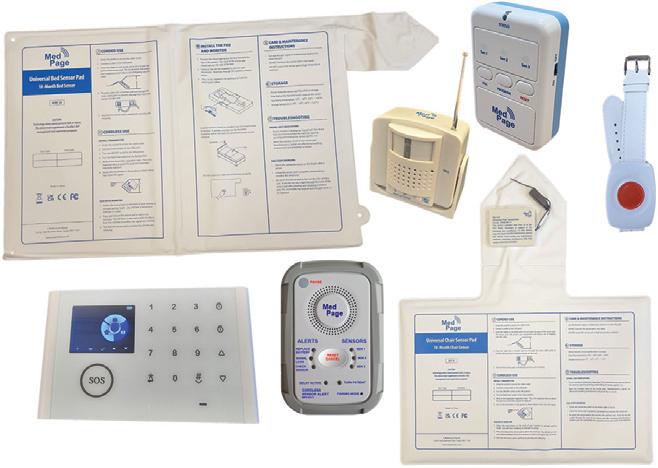
CMEX-21 MULTI-PORT WIRELESS SENSOR INPUT EXPANDER FOR NURSE CALL CONNECTION
The CMEX-21 is Medpage’s latest innovation, designed to integrate seamlessly with existing nurse call systems. This multi-port expander allows for the connection of multiple wireless sensors, enhancing the monitoring capabilities of healthcare facilities. Its versatility makes it a valuable addition to any care environment, ensuring timely responses to patient needs.
RON-WC2 WATERPROOF DISABLED PULL CORD ALARM TRANSMITTER WITH WIRELESS ALARM RECEIVER
The RON-WC2 is a robust solution for disabled individuals requiring immediate assistance. This waterproof pull cord alarm is ideal for use in bathrooms and other high-risk areas. Paired with a wireless alarm receiver, it ensures that help is just a pull away. For more information, visit Medpage’s official website or contact their team to explore these products further. Safety starts with the right tools, and Medpage delivers just that. www.easylinkuk.co.uk or T: 01536 264 869 See the advert on page 2 for more information.

Almost 10 years ago, Openreach announced a definitive shift: the UK telecoms industry would transition entirely to digital VoIP (Voice over Internet Protocol) telephony. This is not merely an upgrade; it is a total replacement of all traditional analogue and ISDN lines. With the official "switch-off" of traditional telephony planned for January 2027, every business in the UK— especially those in the care sector—must now treat digital transformation as an immediate operational priority.
For care homes, this is not just about technology; it is about resilience, safety, and continuity.
UNDERSTANDING VOIP:
At its core, VoIP is simple: your voice is converted into digital data packets and sent across the internet to your provider, who then routes it to the receiver. It is efficient, cost-effective, and flexible. However, unlike traditional landlines that draw power from the exchange, VoIP relies entirely on your local internet connection. When you disconnect from the old copper network, you disconnect from the traditional safety net of "always-on" power. This is where resilience planning moves from an IT concern to a safeguarding necessity.
RESILIENCE PLANNING:
Reliable communication is the heartbeat of a care home. If your internet fails, your phones should continue to work. When planning for this transition to VoIP, you must prepare for the unexpected: total loss of your main Internet connection, power outages and maybe even router or switch failures.
1. Prioritise Physical Stability: Avoid relying on Wi-Fi for your desk phones. Wi-Fi can introduce unnecessary problems and failure points. Use physical Ethernet cabling to connect handsets directly to your network.
2. The Gold Standard of Internet Connectivity: Ideally, you should secure a dedicated "Leased Line" with auto failover to Fibre-To-The-Premises (FTTP) backup. While Leased Lines are a premium service, consider the cost against the daily operational risk—it often amounts to a modest
daily investment to ensure your home remains connected.
3. Redundancy is Key: Avoid providers offering "dual FTTP" services, as they usually share the same fibre route back to the exchange. If that optic fails, both lines go down simultaneously. Instead, combine FTTP with a secondary technology, like a 4G/5G mobile SIM backup or StarLink satellite service.
4.Hardware Matters: Consider Resilience VoIP handsets with integral SIM cards. These devices can be switched to mobile data if the wired internet drops. Furthermore, install mini-UPS (Uninterruptible Power Supply) on all critical desk phones and Internet equipment to ensure your phones remain operational in the event of a power outage.

The last decade has seen a seismic movement away from traditional On-Premises PABX systems. With industry giants like Panasonic, Samsung, and NEC exiting the marketplace, these outdated systems are becoming increasingly unsupported and difficult to maintain. For the vast majority of care providers, Cloud Telephony is now regarded as the superior solution. It offers seamless integration across any number of locations—perfect for care groups managing several homes—and allows staff to use mobile Apps as extensions, ensuring
By Eric Toll, MD, 123Telecom
they are reachable whether they are at the nurses' station, in the garden, or on the move.
On-Premises systems can carry heavy upfront equipment and setup costs, ongoing support fees, and rigid licensing. Conversely, Cloud solutions operate on a simple "per-user" model, typically including unlimited calls, analytics, and CRM integration. Because the "system" lives in the cloud, it is inherently easier to update and maintain. Your telephony system should work wherever you have an internet connection, allowing you to manage communications across an entire care group from a single dashboard.
BUYER BEWARE: NAVIGATING THE MARKET
As the 2027 deadline approaches, you may encounter aggressive sales tactics. Here are a few golden rules to protect your business: Avoid Long Contracts: There is no industry justification for a five-year or seven-year contract. Two or three years is becoming the new standard. Be wary of providers using high-pressure tactics or offering "extra discounts" to sign immediately on the spot.
• Clarify Ownership: Ensure the contract explicitly states who owns the equipment. Avoid lease contracts if possible; if the suåpplier stops trading, the lease company will still expect payment in full. Ideally, buy the equipment outright or arrange credit terms with a defined ownership outcome.
Look for All-In Packages: Avoid hidden management fees or extra costs for features like call recording or analytics, as many providers offer them included within a transparent, inclusive price.
Care providers across the UK and Ireland are facing increasing pressure. Rising costs, recruitment challenges, changing workforce expectations and growing compliance requirements all make it harder to deliver high quality care while maintaining efficient day to day operations. As these challenges continue, more organisations are investing in workforce management technology to reduce manual administration, improve workforce visibility and give managers the tools they need to make informed decisions.
Today’s workforce management solutions do far more than record hours worked. They help care providers simplify scheduling, manage absence, support compliance and improve communication across the organisation, freeing up valuable time for managers to focus on their people and residents.
Creating and maintaining rotas is one of the most time consuming responsibilities for care managers. Balancing staffing levels, employee availability, skills and compliance while responding to last minute changes can quickly become a daily challenge.
Modern workforce management systems simplify the process through intelligent scheduling, automated rostering and real time visibility of staffing levels. Employee self service also allows staff to view their schedules, request leave and swap shifts, reducing the administrative burden on managers while giving employees greater flexibility.
Managing absence is about more than filling shifts. Without clear insight into workforce trends, organisations often find themselves reacting to issues rather than preventing them.
Do Your Due Diligence: Always check the provider’s reputation on independent sites like Google Reviews and consult the Ofcom website to ensure you are dealing with a regulated, reputable entity.
The transition to digital telephony is inevitable, but it does not have to be painful. By treating this transition as a strategic opportunity to build resilience and improve mobile working, care providers can ensure their homes are better connected and safer than ever before. Take the time to audit your infrastructure now, avoid long-term traps, and ensure that your care home remains the reliable, communicative environment your residents and their families depend on. Find a service provider who offers both phones and connectivity with an established reputation in the industry.
See the advert on page 11.
With accurate workforce data and reporting, managers can monitor absence patterns, identify recurring issues and make better workforce planning decisions. This proactive approach helps reduce disruption, control costs and support continuity of care.
Administrative tasks are an essential part of running a care organisation, but they shouldn’t take time away from supporting staff and residents. By bringing time and attendance, scheduling, leave management and workforce reporting together in one system, providers can reduce manual processes, improve payroll accuracy and maintain the records needed for compliance with confidence.
The result is a more efficient operation where managers spend less time on paperwork and more time supporting their teams.
TECHNOLOGY THAT SUPPORTS PEOPLE
Technology will never replace the people who deliver care. Its role is to remove unnecessary administration, provide better visibility and make everyday workforce management simpler.
As the care sector continues to evolve, organisations need solutions that are flexible enough to adapt to changing demands while helping them maintain the highest standards of care.
For more than 35 years, Softworks has worked with organisations across the UK and Ireland to simplify workforce management, improve operational efficiency and support better outcomes for employees, managers and the people they care for.
To find out how Softworks can support your organisation, visit www.softworks.com, email hello@softworks.com or speak to our team on +44 (0)1527 888 060.

There is a positive story to tell about cyber security in adult social care. Across England, more providers than ever are engaging with data protection and cyber resilience. By the 30 June 2026 deadline, almost 76.5% of CQC-registered adult social care services had an up-to-date Data Security and Protection Toolkit (DSPT) in place. That includes 22,429 services, with almost 14,500 publishing for at least three years in a row.
At Digital Care Hub, we believe that record completion rate reflects genuine awareness and engagement. More providers are reviewing policies, training staff and improving systems. But the DSPT is a foundation, not a finish line. Cyber security depends on everyday habits: spotting suspicious emails, removing old accounts, installing updates, checking backups and reporting problems quickly.
The threat is changing too. Not every cyber incident is a deliberate attack. Many begin with an ordinary mistake, such as information being sent to the wrong person, a weak password, a lost device or access left open after someone changes role.
At the same time, criminal attacks are becoming more convincing. The UK Government’s Cyber Security Breaches Survey 2025/2026 found that 43% of UK businesses had experienced a cyber breach or attack in the previous 12 months, with phishing still the most common type. AI is accelerating the problem. Scam emails, fake invoices, cloned voices and impersonation attempts are becoming easier to produce and harder to spot.
We recently warned care providers about a fake Home Office email designed to steal login details for the UK Visas and Immigration Sponsor Management System. It looked official, used urgent compliance language and directed providers to log in. In some cases, a provider’s certificates were assigned to workers in return for large payments.
The consequences can be serious: disrupted care, exposed confidential information, financial loss, identity fraud and problems with staffing or sponsorship. A ransomware attack can also block access to care plans, medication records or rotas when staff need them most.
By Daniel O’Shaughnessy, Head of Programme Delivery, Digital Care Hub
Supply chain risk is particularly important in social care. Providers increasingly rely on digital care records, eMAR systems, rostering tools, finance platforms, NHSmail, shared care records and data sharing with NHS and local authority partners. These links support safer, faster and more joined-up care, but they also make providers part of a much larger digital network.
You may not be the target, but you may still be the victim. If a supplier, shared system or partner organisation is compromised, your service may be disrupted. Providers need to know who they rely on, what access those organisations have, what data they hold and how quickly they would notify you if something went wrong.
BUILD CYBER SECURITY INTO
Good cyber security protects people’s privacy and dignity, supports safer care and reduces disruption. It also builds confidence with families, commissioners, regulators and NHS partners.
The basics need to become routine. Keep the DSPT up to date. Train staff regularly. Use strong passwords and multi-factor authentication. Remove access when people leave. Update devices and software. Back up important information and test that it can be restored.
Access to digital data must also be part of every business continuity plan. If care planning, medication records, rotas, payroll, email or the internet went down, how would you continue safely? Where are emergency contacts kept? How would staff access the information they need?
Some risks are easy to overlook. Shared tablets, old accounts, personal devices, printer trays, paper files and supplier remote access can all create weaknesses. Managers do not need to become technical experts, but they do need to ask practical questions and make it easy for staff to report mistakes quickly.
FREE SUPPORT FOR PROVIDERS
We are expanding our free support through Digital Health Checks, helping adult social care providers test whether their data protection and cyber security arrangements are working in practice. After a successful pilot in early 2026, the service is being rolled out across England through 32 local support organisations. The checks are practical and judgement-free, with clear recommendations to help providers improve.
Record DSPT completion is a brilliant achievement, but the next step is turning those commitments into everyday practice. Cyber security is strongest when it becomes part of how care services work every day –protecting people, supporting staff and building trust.
The sector should be proud of its progress. The next challenge is consistency: making sure safe habits are built into every service, every supplier relationship and every continuity plan.
Visit www.digitalcarehub.co.uk/cybersecurity
By Edward Pearce, Senior Associate at Markel Law LLP
(https://uk.markel.com/law)

As a solicitor advising the care sector, I see every day the challenges employers have in managing their employment procedures. The main procedure which regulates conduct and performance is that related to disciplinary. The focus of any employer’s disciplinary procedure is to encourage improvement within a formal framework, but it can also be used to dismiss employees in serious cases.
Often the same tricky themes relating to the disciplinary procedure can arise:
1. Finding suitable staff can be challenging so applying the procedure pragmatically can help retain staff. However, this approach risks inconsistency and the potential undermining of a zero-tolerance approach. For example, the same accusation might be levelled at two employees, but you choose to keep one (because they do a good job will be difficult to replace) and dismiss the other another.
2. Demonstrating good care practice may involve staff accountability for mistakes but it is often hard to evidence what has happened and demonstrate that accountability. For example, if staff work overnight or at weekends there may not be a manager or other relevant witness present to evidence what went wrong. Without witness evidence it is difficult to conduct a fair disciplinary procedure, but even in this situation the gravity of the mistake may still demand accountability.
3. A manager or carer who is good at the day-to-day aspects of their work won’t necessarily be able to manage a robust disciplinary procedure. This means the procedure may be followed without the rigour required to make it strong and reliable.
4. The care environment is continuous. It involves many complex procedures such as safeguarding, hoisting residents, managing medication, private care needs and food safety. In such a procedure-driven environ-
ment, failures can often occur leading to serious issues that need to be managed.
5. In an environment where employees have to work together for long shifts, personality clashes or inappropriate comments between colleagues are common.
The introduction of the Employment Rights Bill will make these issues more challenging. In particular from January 2027, employees will only need six months continuous employment service to claim unfair dismissal rights. This means dismissing employees with six months to two years continuous employment service will become more complicated as there will need to be a fair reason for any dismissal and a procedure will need to be followed.
HOW EMPLOYMENT CONTRACTS INTERACT WITH THE DISCIPLINARY PROCEDURE
If employees do not have a contract of employment, then common law duties will apply and regulate what happens. However, common law may make it harder for the employer because it doesn’t account for the complexities of the care sector.
Specific contracts of employment and procedures adapted for care sector work are therefore important. If a disciplinary procedure sets out that abuse of a resident is a zero-tolerance dismissal offence, then it will be easier to be robust on this issue. Additional contractual clauses such as not being allowed a mobile phone on shift or not leaving the shift until the handover employee arrives can also be useful in enforcing certain behaviours. Contract restrictions for senior employees can stop them leaving and going to a nearby establishment and potentially taking staff with them.
THE IMPORTANCE OF INDUCTIONS, PROBATIONARY PERIODS AND TRAINING
Having a well organised induction, probationary period and training is essential for meeting health and safety requirements and encouraging a constructive employment experience. If employees feel safe and positive about the terms of their engagement and duties, it helps to create a settled environment and retention.
Giving staff training opportunities will provide extra skills. If the training is external and involves a fee, this can be reflected in an upfront training undertaking, such that they will need to pay back the cost of the training if they leave within, say, a 12-month period on the terms agreed. This encourages more skills and retention whilst reducing risk for the employer.
These are some of the ingredients needed to create stable employers in a volatile sector.
Care home staff today face increasingly complex responsibilities. Supporting residents with dementia, autism, frailty, safeguarding concerns, and communication difficulties requires far more than theoretical knowledge. Staff need confidence, judgement, teamwork, and the ability to respond compassionately in challenging situations.
However, much care home training still relies heavily on passive e-learning and compliance-focused approaches. While online modules may meet mandatory requirements, they often do little to improve reflective practice, communication, or real-world decision-making. Care home managers are increasingly recognising the need for more engaging and practical approaches to workforce development.
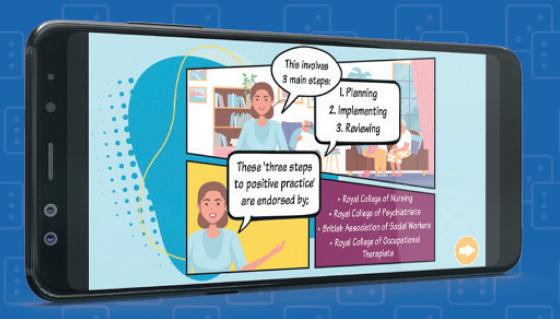
Gamification, game-based learning, and facilitated group activities offer an important opportunity to improve staff learning and engagement. Instead of simply completing quizzes or reading policies, staff work together through realistic scenarios, discussion exercises, and collaborative problem-solving activities. This encourages active participation and helps teams apply learning directly to everyday care situations.
Research increasingly supports these methods. Studies examining simulation-based learning in nursing homes have shown improvements in staff confidence, communication skills, leadership, and reflective practice. Dementia care simulations, for example, have helped staff develop more person-centred approaches
and greater confidence in responding to distressed behaviours.
These approaches also strengthen teamwork and workplace culture. Much mandatory training is completed individually, often in isolation. Group-based learning encourages discussion, peer learning, and shared reflection, helping teams develop more consistent approaches to care. This aligns closely with the growing emphasis from the Care Quality Commission on learning cultures, staff understanding, and continuous improvement.
Importantly, game-based learning is not about replacing professional standards or mandatory training. It is about making learning more meaningful, memorable, and practical.
As pressures on the care sector continue to grow, providers need training approaches that build confidence, communication, and real-world capability — not simply certificate completion.
To explore practical, evidence-based training tools designed specifically for care teams, see the Focus Games advertisement on the front page of this issue, including a special reader discount offer for physical and digital team-learning resources that support communication, teamwork, decision-making, and improved CQC outcomes.
See the advert on the front cover or visit www.FocusGames.com
Transforming your care home’s digital technology? Before you choose a system, listen to the people who will live with it every day: residents, families and care workers.
Digital transformation can sound like it starts with a supplier demo, a new system or a cyber security policy. In reality, the most useful starting point is simpler: what are people trying to do, what gets in the way, and what would make life easier?
ASK BEFORE YOU BUY
Before investing in a digital care record, monitoring technology or AI tool, ask what problem you are trying to solve. Are staff recording information twice? Are relatives unsure how updates are shared? Are residents worried about who can see their information?
The people who live and work in your service know where systems feel helpful, confusing or intrusive. Care workers can spot what fits into a busy shift. Residents and families can explain what helps them feel informed and in control.
START WITH A BLANK PAGE
Paula Sardinha, from the National Co-production Advisory Group, gave a simple starting point: “If you want to co-produce properly, then start with what is going to work for us, what is going to work for the individual. Start with that blank piece of paper.”
That means asking people what they need before choosing the product, process or supplier. Amanda Jayne, from the Care Workers’ Charity, made the same point from a frontline perspective: “Bringing frontline workers into the procedure before they start having short systems and also not being afraid to say, this one isn’t for us.”
MAKE INVOLVEMENT PRACTICAL
Co-production does not have to start with a large project. Try:
• setting up a small working group with residents, relatives and staff
asking people to describe the problem before discussing products
inviting residents or care workers onto supplier panels testing ideas during handover, resident meetings or family updates
• showing people how digital tech will be used.

Jo-Anne Wilson, registered manager at Royal British Legion’s Galanos House, showed how residents can co-produce technology around their own interests. “A lot of our residents had lived abroad, they’d served abroad… and they started to think actually, the world is a much smaller place now. We’ve got all this technology. We can go and explore places.”
Residents used iPads, Google Earth and cycling technology to revisit places they had lived, worked or served, including virtual trips to battlefields in France. They also researched ideas for meetings and are moving resident-led dining audits from paper to tablets, using larger text, smiley-face feedback and simple graphs.
For care homes, the aim is better choices: fewer workarounds, clearer records, safer data practice, more confident staff and technology that genuinely supports care.
Find out more about Digital Care in Focus: https://www.digitalcarehub.co.uk/digital-care-in-focus/coproduction-data-and-digital-tech/
The UK adult social care sector is facing a severe workforce development crisis driven by outdated, ‘transactional’ training models, a national sector specialist has warned.
Speaking at the Care Management Show in Birmingham, Lesley O’Connor, Head of Strategic Development for Health and Social Care at training provider Realise, said that treating staff development as an administrative, box-ticking exercise is directly damaging staff retention and leaving workers unprepared for increasingly complex care demands.
She said: “A lot of training is still transactional: standard programmes, short-term focus, and limited alignment to actual job roles. And despite completely different workforce demands, we’re still seeing exactly the same training delivered across residential care, domiciliary care, mental health services and community-based care.”
Lesley revealed that a demographic cliff-edge is compounding the problem, with 50% of adult social care registered managers now aged 50 or older.
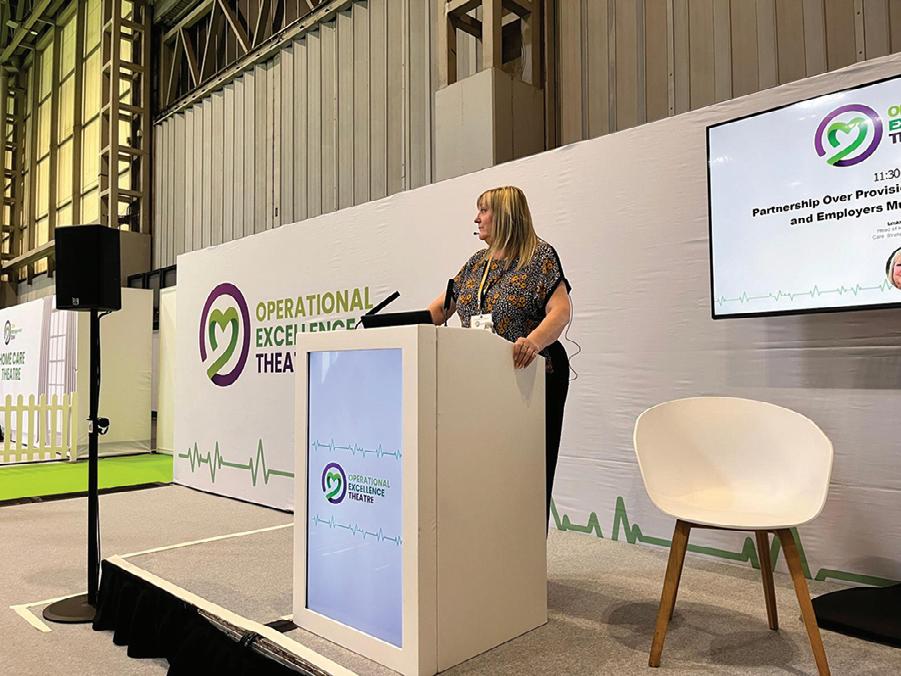
With 31% to 32% of these leaders projected to retire within the next 10 to 15 years, she issued a stark warning that providers expose themselves to ‘massive succession risks’ unless standard, off-the-shelf training provision is abandoned in favour of deep, co-designed employer partnerships
The major flaw in the current system, she pointed out, is the systemic failure to connect educational delivery with actual workplace performance.
She said: “Training is still treated as a process, something that is merely delivered and evidenced. But if that training doesn’t change outcomes in the workplace, then it doesn’t add any real value. “Are we really developing the health and social care workforce of the future, or are we merely getting better at delivering training?”
While the industry frequently attributes its operational stress to external market pressures, the internal
strategy requires immediate scrutiny.
“We all recognise the pressures of hard to fill vacancies and staff retention, with the added factor of increasingly complex care needs,” Lesley added
“But what we’re hearing from the employers we work with is that this isn’t just a recruitment crisis, it’s a workforce development crisis.”
To break the cycle of high turnover, Realise - which works nationally supporting workforce development across the adult social care sector - advocates for a structural pivot away from generic ‘programme delivery’ towards deep operational collaboration.
In practice, this means giving staff a visible, clear future which in turn can transform retention.
“Because,” says Lesley, “when care workers see an explicit pathway for career progression, their likelihood of remaining with an employer increases dramatically.”
The sector can no longer afford to rely on incremental changes.
“If we continue to treat training as provision, we will continue to see the exact same challenges,” said Lesley.
“But if we move to true partnership, where providers and employers work together to build workforces rather than just deliver programmes, we have an opportunity to significantly change the future approach to workforce. Not incrementally, but meaningfully.”
The Care Management Show, held at the NEC, is the largest event for care management and senior leadership and featured more than 60 sector experts including CEOs, directors and managers across residential care, home care and complex.
Realise is a leading national training provider in UK, delivering specialised workforce development, accredited diplomas and apprenticeships across the health and social care sectors.
For more information, visit www.realisetraining.com
Westgate Healthcare has strengthened its dementia care training programme after becoming one of only three UK care providers authorised to deliver Dining Immersive Experiential Training (DIET) in-house.
The milestone follows the qualification of Westgate Healthcare’s Group Training Manager, Maria Fagen, as a facilitator for the DIET programme, developed by Training2Care.
The training helps care teams better understand the challenges people living with dementia can experience during mealtimes, including changes in perception, sensory processing, coordination and cognition. Using specialist sensory equipment, colleagues are guided through a simulated dining experience to help them experience first-hand how eating and drinking can become confusing, frustrating or overwhelming for residents living with dementia.
Westgate Healthcare has now embedded DIET training into its threeday induction programme, alongside the Virtual Dementia Experience, another immersive Training2Care programme completed by Maria earlier
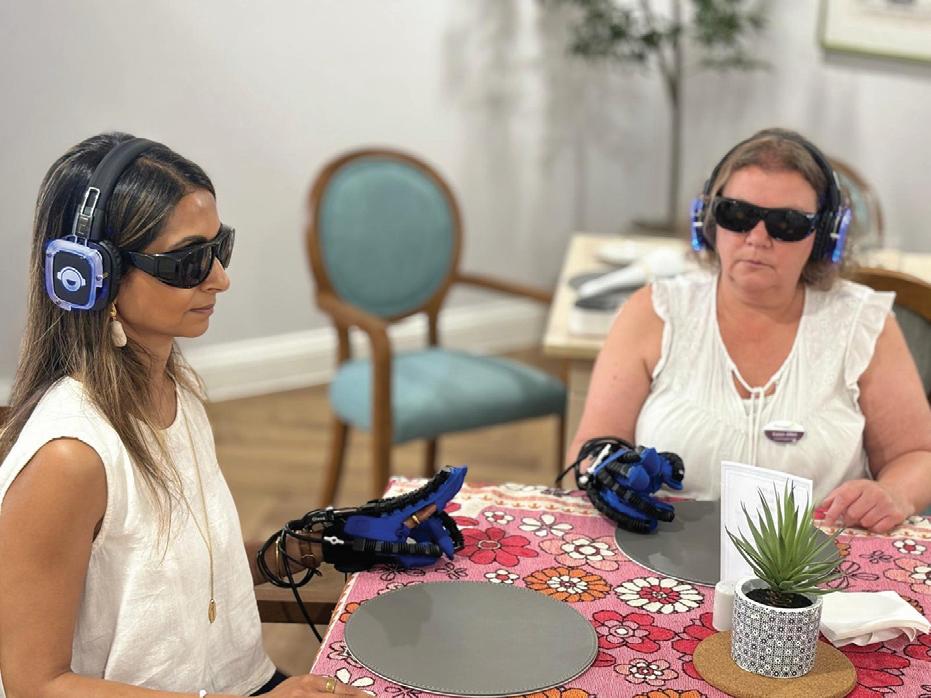
this year.
Maria said: “Delivering outstanding dementia care starts with understanding the person behind the diagnosis. By introducing this training into our programme, every colleague begins their journey with greater empathy, confidence and understanding.
“I’m incredibly proud that Westgate Healthcare is one of only three organisations able to deliver this training internally, allowing us to continually develop our teams and ultimately improve the lives of our residents.”
Maintaining good nutrition and hydration can be one of the greatest challenges for people living with dementia. Westgate Healthcare says the training is designed to help colleagues make meaningful changes to mealtime support, with the aim of improving residents’ nutritional intake, wellbeing and overall quality of care.
Tel: 0208 953 7600
Email: info@westgatehc.co.uk
Website: www.westgatehealthcare.co.uk
Working in social care is demanding. It is one of the most heavily regulated yet underfunded sectors, with providers expected to comply with regulations, meet Quality Statements, follow good practice guidance, respond to local authority monitoring, and operate under constant scrutiny. Regulation itself isn’t the problem — it protects people and improves standards. The challenge is capacity. Larger organisations may have in-house quality assurance teams, but smaller providers rarely have the time or budget to review compliance in depth. Many owners and managers tell us they feel overwhelmed and unsure how well their service is really performing, especially since the introduction of the Single Assessment Framework.
For many, confidence in compliance is the number one concern — not because standards are poor, but because there simply isn’t time to step back and take a full, objective view.
CAN AN EXTERNAL AUDIT HELP?
In short, yes — when it’s done properly. A high-quality external audit provides:
• A clear snapshot of current performance
• Identification of good practice and priority risks
• Practical advice on how to improve

• Evidence to support action plans and improvement journeys
• Demonstration of good governance and continuous improvement — a key CQC focus
• Reassurance for owners, directors, and managers
HOW W&P CAN HELP
W&P have supported health and social care providers for nearly 25 years, completing hundreds of audits across a wide range of services. This experience gives us deep insight into what regulators look for — and what genuinely improves outcomes.
Our audits are supportive, non-judgmental, and practical. They typically include around six hours on-site, followed by a detailed report that links evidence to regulations and Quality Statements. Reports also include clear guidance, tips, and sources to help you respond confidently.
Every audit is tailored to your needs — whether that’s safeguarding, medication management, or overall governance — ensuring it is truly fit for purpose.
Advance Care Planning is a very simple process. However, the term Advance Care Planning itself can often be misunderstood. Recently, the phrase “What Matters to You?” has become more commonly used and is certainly the way we, at The Gold Standards Framework (GSF), encourage health and social care teams to open conversations about the future wishes and preferences of every individual they care for.
Truly getting to the heart of what is most important to people helps us deliver the best care possible. This ensures that when people reach the end of their own journey, their experience reflects what was important to them, and as care professionals, we get to experience what we term to be “a good death”. For us, a good death is a good outcome.
Starting the conversation and giving people the time and a safe space to explore what is important to them is the first step. For care staff, engaging in conversations about the future and the prospect of dying may seem a daunting undertaking. However, you may be surprised by the reception you receive.
It is important to recognise that some people will not want to discuss the future or openly talk about death, and this must be respected. Advance Care Planning is a voluntary process that we cannot impose upon people. However, we do need to initiate these difficult conversations and document that this has been done. It is then essential that we continue to seek opportunities for engagement so that everyone involved in supporting the individual’s care journey is aware of their wishes and can work towards ensuring their needs, preferences, and priorities are met. As health needs change, people often become more receptive to Advance Care Planning discussions, and care staff should seize any opportunity to encourage individuals to participate in these significant conversations.
There are others who will openly engage in the process and freely discuss their funeral plans, including their chosen funeral director, where important documents are kept, whether the funeral has been paid for in
advance, and whether they wish to be buried or cremated. The initial focus is often on care after death. The peace of mind that comes from knowing these arrangements have been made, and that they will not create a personal or financial burden for their family, enables many people to speak candidly about these aspects associated with their death.
However, the actual dying phase often gets overlooked, and that is what is most important. In the final weeks, days, and hours of our lives, individuals need to consider what matters most to them. They may have a fear of dying or of being alone at the time of death, and simple reassurance from care staff can help alleviate these fears and concerns. Some people have complex family dynamics and wish to reconnect with relatives they have not spoken to for many years. Others may simply want to be read to from a favourite book, spend time outdoors, listen to treasured pieces of music, or have a beloved pet by their side to provide a sense of peace and comfort.
Whatever the wishes of the individual, ensuring that these are documented in an Advance Care Plan helps make certain that their values, preferences, and priorities are understood and respected. This supports personalised, coordinated care and leads to better outcomes for the individual, their loved ones, and those providing their care.
The Gold Standards Framework (GSF) offers a range of free Advance Care Planning resources to help health and social care providers build confidence in having meaningful conversations, support person-centred care, and improve the recording and sharing of people’s wishes and preferences. Explore the free resources and tools available to support your organisation and the people you care for:

www.goldstandardsframework.org.uk/training-accreditation/free-resources-professionals/

23 years, operating 4 Devon Nursing homes, has been pretty tough, as anyone in social care, knows, only too well. And if it was hard already, after 2024 budget, it's just got harder.
Anyway, at heart, I am just customer of Eden Alternative, and it was a stroke of luck to come across this whilst on holiday in New Zealand in 2009. It started in USA in 1994 and now runs in 22 countries.
The fact that I am now involved with this not-for-profit organisation (in the UK area) came about when one of the 2 main UK directors died suddenly just before Covid. But it's something I have run with for 11 years to help make 'vision' a reality, not a struggle. So, being both a customer and helping the admin seems quite natural.
It is a modern philosophy of care, but moreover, it's a programme that is straight
forward, tried and tested for 30 years and really works.
Its member care organisations generally become trainers for their own teams, and run it themselves.
The programme is run in person over 2-3 days or online 1 hr a wk for 7 weeks. You choose.
It addresses loneliness, helplessness and boredom and operates through 10 principles to underpin 7 critical domains of wellbeing.
Moreover, it's effective, transformational and really works. As residents, and team members wellbeing, matter so much , it's a must, in my opinion.
Geoffrey Cox Southernhealthcare.co.uk eden-alternative.co.uk
Health and care businesses are critical to support UK communities. They help provide a safe place for some of the most vulnerable people in society. But this safety relies heavily on the cash in the bank, as without this, there would be no way to provide this vital support.
WHAT STEPS SHOULD HEALTH AND CARE BUSINESSES TAKE TO ENSURE THEIR BUSINESS GROWTH?
Health and care businesses face constant cash flow pressures, whether it’s staffing requirements, rising costs or complying with regulatory requirements, they all put pressure on the books. But don’t worry, there are practical methods you can manage these risks, while building a stronger, more resilient business.
There are 5 key things you should identify and action to build a resilient health and care business:
1. Know where the growth will come from – look at your current operation and assess where investment or improvement will help increase profits
2. Strengthen cash flow before you need it – it’s a well-known fact that growth consumes cash, that’s why it’s important to have access to working capital or speedy funding so you can jump on these growth opportunities
3. Invest in areas that create competitive advantage – There are many ways to invest in a business, but the ones that make you stand out are where you should invest first
4.Build resilience into the business – the strongest businesses aren’t the ones with the highest growth, they’re the ones who can make it through tough economic climates
5. Make sure the funding supports the strategy – having a good strategy is key, but without the funding to support it, it’s useless
HOW CAN HEALTH AND CARE BUSINESSES IDENTIFY THE OPPORTUNITIES?
The above information may be insightful to you, but without practical step-by-step advice , it’s hard to
take actionable steps to implement this into your business. That’s where Capify’s Health & Care Growth Blueprint 2026 comes in. It’s full of practical and actionable information and advice for small and medium health and care businesses across the UK.
What’s even better is it’s completely free! All you need to do is pop in your email and a copy will be sent straight to your inbox. Download the Growth Blueprint.
HOW CAN HEALTH AND CARE BUSINESSES ACCESS THE FUNDING THEY NEED TO SUPPORT THEIR GROWTH?
The most obvious and cost-effective way to access funding is by utilising the working capital you already have, but if you’re struggling with cash flow, this may no longer be possible.
The next best thing is looking for a business loan, but who do you choose as the provider? This depends on your personal circumstances; things such as speed, credit score, trading history, and turnover can all affect which provider will be best for you. If you have an immediate need for cash, or your credit score is less than perfect, then the traditional banking route may not be for you. But don’t worry, alternative finance providers such as Capify are here to provide funding at the speed the growth demands.
Since 2008, Capify has been supporting health and care businesses across the UK access the funding they need to grow. We understand the day-to-day pressures of running a business and know that a poor credit score does not mean you have a poor business. We are proud to have a human-led underwriting process, and we look at more than just the numbers to give you the funding that is best suited to your business needs.
If you would like to see if you could unlock up to £3M in funding, all you need to do is take 30 seconds out of your day to complete Capify’s Eligibility Check at https://tinyurl.com/navpx9mu or see the advert on the back cover.

Global assists clients throughout the U.K. who specialise in the healthcare sector to achieve their objectives of purchase, development and refinance.
We have organised over £1.8bn for clients in the past 30 years, providing clients with competitively priced funding to refinance existing debt, ease cashflow and develop businesses further.

From helping clients make their first purchase through to allowing groups to grow significantly in size we assist at every stage of your business expansion. Every proposal is individual and deserves to be treated that way, so we hope you will allow us to be of assistance to you and call us to chat through your plans and requirements, I am sure we will be able to tailor a facility to your requirements. Call us on 01242 227172 or e-mail us at enquiries@globalbusinessfinance.net