FOR NURSING AND RESIDENTIAL CARE HOMES
W W W. T H E C A R E R U K . C O M
WE NOW SUPPLY A WIDE RANGE OF FURNITURE
THECARERUK
THECARERUK
THECARER_UK
Issue 280
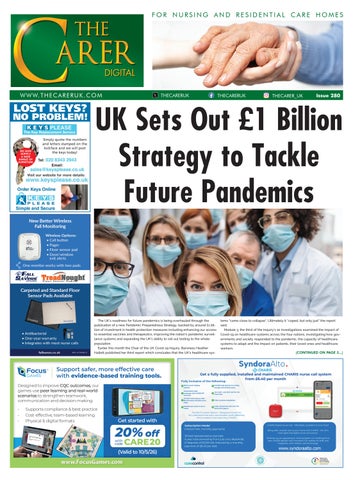
UK Sets Out £1 Billion Strategy to Tackle Future Pandemics
The UK’s readiness for future pandemics is being overhauled through the publication of a new Pandemic Preparedness Strategy, backed by around £1 billion of investment in health protection measures including enhancing our access to essential vaccines and therapeutics, improving the nation’s pandemic surveillance systems and expanding the UK’s ability to roll out testing to the whole population. Earlier this month the Chair of the UK Covid-19 Inquiry, Baroness Heather Hallett published her third report which concludes that the UK’s healthcare sys-
tems “came close to collapse”. Ultimately it “coped, but only just” the report said. Module 3, the third of the Inquiry’s 10 investigations examined the impact of Covid-19 on healthcare systems across the four nations, investigating how governments and society responded to the pandemic, the capacity of healthcare systems to adapt and the impact on patients, their loved ones and healthcare workers.
(CONTINUED ON PAGE 3...)
PAGE 2 | THE CARER DIGITAL | ISSUE 280
EDITOR'S VIEWPOINT
Welcome to the latest edition of The Carer Digital! A WONDERFUL TWO DAYS AT THE CARE & DEMENTIA EXPO, NEC BIRMINGHAM
ing of the complexity of challenges facing the sector. That, in itself, is encouraging. He was clear, though, that meaningful reform will require far more than good intentions. Action is needed across a broad range of interconnected areas: sustainable funding, workforce development, greater technology adoption, reformed commissioning processes, closer integration with the NHS, and stronger preventative measures — particularly through improvements in housing and planning. It is a comprehensive and daunting list, but it is the right list. In all, it was a very interesting session that left plenty of food for thought. A big thanks to all those who visited our stand at the Turning to our lead story this issue, the government has announced plans to set CARE & DEMENTIA Show last week! aside £1 billion for a pandemic preparedness strategy, with PPE stockpiles to be We are absolutely delighted to report that last week’s “continued to be replenished.” Show at Birmingham’s NEC was a tremendous success — On the face of it, this is welcome news — and it is news that I suspect will proand from where we were standing, quite literally one of voke a very particular and visceral reaction in those of us who lived through the the busiest we have seen in recent memory. catastrophic events of 2020. The halls had a real energy, purpose, and passion, and Let us not shy away from the truth. thrilled to say we had very busy stand throughout both The care sector was failed during the height of the pandemic. The shortage of days, and as always, the kindness and warmth shown to personal protective equipment was not merely an inconvenience — it placed care us by visitors, exhibitors, and friends of The Carer was so workers, residents, and their families in genuine peril. Lives were lost. Editor much appreciated. And alongside the desperate shortage of PPE came something arguably even The feedback we received is always welcome — it is more damning: the sheer, brazen mismanagement and fraud that surrounded the that connection with readers and the wider care commuprocurement process. nity, that makes events like these so special and so worthPublic money squandered. Contracts awarded with reckless disregard for due while. diligence. It remains one of the most shameful episodes in recent public adminisSocial Care: Still Near the Bottom of the Agenda? tration. Amid the bustle of the exhibition floor, I took the opportunity to sit in on what I often refer to a seminar I attended after the worst of the pandemic had passed, proved to be a thought-provoking and, at times, sobering seminar delivered by at which providers and frontline staff were invited to share their experiences. Damian Green — former Conservative minister and Chair of the Social Care It was harrowing. The stories of isolation, fear, inadequate protection, and heartFoundation. His message was frank: social care remains stubbornly, and disappointbreaking loss were a stark reminder of what happens when a sector is undervalued ingly, near the bottom of the political agenda. and underprepared. Those testimonies have stayed with me, and I suspect they It is a frustration that will resonate deeply with everyone working in, or connected always will. to, this sector. So yes, it is genuinely refreshing to see a preparedness plan being put in place. While health policy commands headlines and prime ministerial attention, social The announcement deserves acknowledgement. But acknowledgement must not care — the quiet, essential backbone of support for our most vulnerable citizens — slide into complacency. continues to be treated as something of an afterthought in political circles. That is, A billion pounds and a stockpile of PPE are necessary steps — they are not, on to put it bluntly, a national disgrace. their own, sufficient. The care sector must be at the very heart of any preparedness However, Mr Green was not entirely without hope. He expressed cautious optimism about the work currently being undertaken by the Casey Commission, noting framework, not an afterthought bolted on at the last moment. The events of 2020 must not be repeated. Ever. that its chair, Baroness Casey, appears to have a genuine and nuanced understandI can always be contacted at editor@thecareruk.com
Peter Adams
PUBLISHED BY RBC Publishing Ltd 3 Carlton Mount 2 Cranborne Road Bournemouth Dorset BH2 5BR
TELEPHONE:
01202 552333 EMAIL:
sales@thecareruk.com WEBSITE:
www.thecareruk.com EDITOR Peter Adams editor@thecareruk.com
SALES DIRECTOR David Bartlett dave@thecareruk.com
PRODUCTION & DESIGN Matthew Noades Published by
The Carer is published by RBC Publishing Ltd, 3 Carlton Mount, 2 Cranborne Road, Bournemouth, Dorset BH2 5BR. Contributions are welcome for consideration, however, no responsibility will be accepted for loss or damage. Views expressed within this publication are not necessarily those of the publisher or the editorial team. Whilst every care is taken when compiling this publication to ensure accuracy, the publisher will assume no responsibility for any effects, errors or omissions therefrom. All rights reserved, reproduction is forbidden unless written permission is obtained. All material is assumed copyright free unless otherwise advised.
Manufactured in the UK
Freephone: 0800 917 7943 www.euroservice-uk.com sales@euroservice-uk.com
PROVIDING PRACTICAL AND STYLISH TROLLEYS TO SUIT YOUR NEEDS Watch your resident's eyes light up when the beautiful tea trolley arrives! Euroservice trolleys can also be used as a vending trolley or to sell personal care products to residents. How about a delicious snack/pastry trolley or even a drinks trolley for that afternoon tipple?
Your lovely trolley could do so much for you and your residents! Euroservice trolleys are an attractive and practical alternative to clinical aluminium trolleys given that antibacterial spray can be used freely to sanitise them.
Get in touch with our friendly, experienced sales team
Visit the website at
www.euroservice-uk.com to see the full range.
THE CARER DIGITAL | ISSUE 280 | PAGE 3
UK Sets Out £1 Billion Strategy to Tackle Future Pandemics (CONTINUED FROM FRONT COVER)
responses are more effective, efficient and equitable, and we continue to play our part in developing our capabilities for diagnostics, surveillance, vaccine development and testing, to keep our country’s health
This new strategy published this week by the Department for Health and Social Care outlines concrete action already taken across government to embed lessons from Covid-19: • PPE stockpiles will continue to be replenished with a variety of products and sizes. • Departmental pandemic response plans will be reviewed to ensure government services and critical national infrastructure can be maintained effectively in a pandemic. • An ‘All Pandemic Hazards Bill’ will be drafted to ensure the government has legislative options ready to review and introduce as necessary in response to a range of pathogens. This will sit alongside a suite of prepared options for community protection measures to support swift decision-making and prioritisation to keep people safe. • UKHSA will build a new set of services to manage large scale testing, contact tracing and other scaled public health response measures’. • Chemicals and equipment stockpiles needed for testing will be built up further to protect against supply risks that could develop in the early stages of a pandemic. • Data requirements to support decision-making will be reviewed to ensure information needed in a pandemic response is available, transparent, and can be shared quickly between organisations and with the public.
10-YEAR PLAN The new strategy replaces a previous strategy for Pandemic Influenza published in 2011 and builds on wider reforms taking place through the 10 Year Health Plan. It has been directly informed by early findings from the largest ever pandemic exercise in UK history which took place in Autumn 2025. Exercise Pegasus saw every government department, the devolved governments, arms-length bodies, local resilience forums, and external stakeholders respond to the spread of a simulated pathogen over a number of weeks. This work sits alongside other action the government has already taken to build resilience in the vaccine supply chain since the last pandemic, including signing a ten year partnership with Moderna. The world leading pharmaceutical company has built a state of the art innovation and technology lab in Oxfordshire that is producing British-made vaccines to protect people across the country.
HARD LESSONS
secure.”
VULNERABLE GROUPS Publication of the strategy comes as the UK Government also publishes its response to the UK’s Covid-19 Inquiry Module 2 report, explaining how departments have strengthened decision-making processes, protections for vulnerable groups, and cooperation with devolved governments since the pandemic. This includes enhancements to the standards and selection process for SAGE, the government’s team of scientific advisors, and a top-to-bottom review of the UK’s crisis response framework. Further changes, which put vulnerable groups at the centre of emergency planning and provide devolved administrations with access to relevant emergency briefings, will enable a fairer, faster, and more coordinated crisis response across all four governments.
EVERY STORY MATTERS The UK Covid-19 Inquiry has also today (Wednesday 1 April 2026) announced its future plans for its archive of tens of thousands of people’s stories that have been shared via Every Story Matters, the largest public engagement exercise in UK inquiry history. These stories are a record of what life was like for people across the country throughout the pandemic, and in many cases whose lives were changed forever. Around 58,000 experiences shared with Every Story Matters have provided the Inquiry with valuable insights and will continue to support the Chair, Baroness Heather Hallett, to write her reports and make her recommendations. The most recent Inquiry report, Module 3 ‘Healthcare’ which concluded that the UK’s health systems came close to collapse during the pandemic, was published earlier this month. The next report, Module 4 ‘Vaccines and Therapeutics’, will be published later this month on Thursday 16 April. Long term, the stories submitted to Every Story Matters are due to be housed at The National Archives who will hold them in a “closed’ state for 100 years. So they can further inform research and public policy sooner, the Inquiry now intends to loan the entire archive to a trusted research environment at the UK Data Service – the UK’s largest collection of social
Minister of Health for Public Health and Prevention, Minister Sharon Hodgson said: This strategy represents a serious, long-term commitment to protecting the public from future health threats. We learnt hard lessons from Covid-19, and it is our responsibility to act on them. Informed by Exercise Pegasus — the largest pandemic exercise in UK history — this strategy strengthens our capabilities, allowing us to respond faster and more effectively when the next health threat emerges. The public deserves nothing less. Minister of State for Security, Dan Jarvis, said: It’s right we learn the lessons from the devastating impact Covid-19 had on our health service and society. Our new pandemic strategy marks a major improvement in the government’s preparedness for future pandemics. “Whether increasing the supply of British-made vaccines, or stockpiling PPE for key workers, we’re working with partners across the public and private sector to take action to keep the country safe.”
research data.
SHARED COMMITMENT
public Inquiry. I am delighted that the UK Data Service has recognised how important the pandemic experi-
Susan Hopkins, Chief Executive at the UK Health Security Agency, said: “The Covid-19 pandemic has taught us the vital importance of being prepared for future health threats and this strategy underlines a shared commitment across Government to continue building our resilience capabilities. “Our experience of responding to large-scale incidents and pandemics enables us to ensure that future
ences shared through Every Story Matters are. I trust that these stories will be of value to researchers fol-
The move means that accredited researchers, including from government and academia, can be granted restricted access in a secure and controlled virtual environment, for research purposes only. The Inquiry has chosen the UK Data Service – the UK’s largest collection of social research data – to hold these stories securely.
MAJOR MILESTONE Ben Connah, Secretary to the UK Covid-19 Inquiry said: “We want every story submitted to the Inquiry to have as much of an impact as possible. Working with the UK Data Service to share our archive means these stories - a real-life record of life during the pandemic - will continue to make a difference for future generations, even after the Inquiry’s recommendations have been implemented. “This is a major milestone for Every Story Matters - the largest listening exercise ever conducted by a UK
lowing the Inquiry’s closure. “I am grateful to everyone who has taken the time to contribute their story and participate in this historically significant work.
PAGE 4 | THE CARER DIGITAL | ISSUE 280
What Care Home Providers Need To Know About The Employment Rights Changes Coming Into Force In April 2026 By Neha Thethi, Head of Employment at Lime Solicitors (www.limesolicitors.co.uk) From April 2026, several important employment law changes will begin to take effect. For care home providers, these reforms will sit alongside an already highly regulated environment, where staffing decisions are closely linked to both compliance and the quality of care delivered. In my experience, when employment issues arise in care settings, they rarely exist in isolation. They often affect not just the individual employee, but the wider team and, ultimately, the people receiving care. For that reason, understanding these changes and preparing for them properly will be particularly important for providers.
KEY CHANGES COMING INTO FORCE
Several of the most immediate changes relate to pay. From 1st April 2026, the National Minimum Wage and National Living Wage will increase across all age groups. Statutory maternity, paternity and adoption pay will also increase. From 6th April 2026, a number of wider reforms will take effect. Paternity leave and unpaid parental leave will become day-one rights for eligible employees, removing previous service requirements. Statutory Sick Pay will also become more accessible, with the removal of the three-day waiting period and lower earnings limit. For care providers, these changes are likely to have a direct impact on workforce planning. Many services rely on a mix of permanent staff and agency workers, and unplanned absences or increased entitlement to leave can place additional pressure on already stretched rotas. There are also important changes to enforcement and risk. The maximum protective award for failing to meet collective redundancy consultation requirements will double from 90 to 180 days’ pay per affected employee. Sexual harassment will also be added to the types of issue that can give rise to a protected whistleblowing disclosure. Alongside this, a new Fair Work Agency will be established to oversee areas such as minimum wage compliance, sick pay and holiday pay. Extended bereavement leave reforms, includ-
ing pregnancy loss, are expected later, with further details due separately.
WHAT PROVIDERS NEED TO BE AWARE OF
All together, these reforms represent a shift towards stronger worker protections and increased accountability for employers. In care settings, where services must be delivered safely and consistently, even small changes in staffing can have wider implications. My approach is always to look at how these legal changes play out in practice. In this context, that means thinking about how new entitlements – such as earlier access to leave or sick pay – will affect day-to-day operations. Providers will need to ensure that decisions around absence, leave and staffing are handled consistently and in line with updated policies. In environments where teams are under pressure, the risk is often that decisions are made quickly without full consideration of the legal position.
RISKS OF NON-COMPLIANCE The risks of failing to adapt are significant. Employers who do not update their processes may face Employment Tribunal claims, as well as enforcement action from the Fair Work Agency. The increase in protective awards for redundancy consultation failures represents a substantial financial risk. In my experience, many disputes arise where individuals feel that concerns have not been properly heard or addressed. In regulated sectors such as care, that can also have wider implications for organisational oversight and reputation.
PRACTICAL STEPS TO PREPARE
With April approaching, care providers should take proactive steps to ensure they are ready. A review of pay and payroll systems is essential to ensure compliance with the new statutory rates. Given the prevalence of shift work and varying hours in the sector, accuracy in pay calculations will be particularly important. Employment contracts and HR policies should also be reviewed and updated to reflect the new legal framework, including changes to sick pay, family leave and whistleblowing protections. Policies should be clear and accessible, and staff should understand how they apply in practice. Furthermore, training for managers is key. Those responsible for managing rotas, responding to absences and dealing with workplace concerns need to be confident in applying the updated rules. Finally, clear communication with staff will be essential. Setting out what is changing and how it will be implemented can help reduce uncertainty and support a more consistent approach across teams.
LOOKING AHEAD
The April 2026 reforms will require care home providers to take a structured and consistent approach to employment practices. By preparing early, providers can reduce legal risk while maintaining stability within their teams – something that is essential for delivering safe and effective care.
H.W. PICKRELL NEW & USED ACCESSIBLE TRANSPORT AT AFFORDABLE PRICES • We specialise in the sale and purchase of quality used wheelchair accessible vehicles and ambulances. • They can be bought as seen or refurbished and sign-written to your own requirements. • Fully serviced, new mot & warranty • Engineers inspection supplied if required.
• Free delivery service available • All buses comply with new legislation • Lease hire and purchase available • Always large stock of accessible vehicles
Tel: 01268 521033 Mobile: 07860 894331 Email: sales@hwpickrell.co.uk Gardiners Lane North, Crays Hills, Billericay, Essex CM11 2XE All current stock available to view at www.hwpickrell.co.uk
THE CARER DIGITAL | ISSUE 280 | PAGE 5
CQC Unveils Draft Sector-Specific Assessment Frameworks in Major Regulatory Overhaul The Care Quality Commission (CQC) has published four draft sector-specific assessment frameworks as part of its most significant regulatory reform in recent years, replacing the existing single assessment framework and removing scoring from its methodology. Adult social care providers are invited to respond before 12 June 2026. The Commission has moved decisively to overhaul the way it inspects and rates health and social care services across England, publishing four draft sector-specific assessment frameworks in March 2026 following a period of public consultation that attracted widespread support from the sector. The new frameworks — one of which is dedicated specifically to adult social care — mark a significant departure from the regulator’s previous single assessment framework. The CQC said the move follows its Better Regulation, Better Care consultation, the response to which demonstrated overwhelming support for the proposal to introduce frameworks tailored to the distinct characteristics of each sector it regulates. The four draft frameworks cover the following areas of health and social care provision: • Adult social care • Mental health care • Primary care and community services • Hospitals (secondary and specialist care) The CQC’s five key questions — safe, effective, caring, responsive, and well-led — remain at the heart of its assessment methodology. However, the regulator has introduced two significant structural changes to the way assessments are structured and communicated. Key lines of enquiry will replace the current quality statements, framed as structured questions that describe precisely what the CQC will be looking for during assessments. In addition, rating characteristics will set out what outstanding, good, requires improvement, and inadequate care looks like within each individual sector. Critically for care home managers and providers, the CQC has confirmed it will remove numerical scoring from its assessment methodology altogether. Instead, rating judgements will be made directly at key question level, supported by the new rating characteristics — a change the regulator says will produce clearer, more transparent, and more consistent outcomes. The CQC said the rating characteristics were developed using direct input from service users, the public, and stakeholders gathered through a series of online and in-person engagement sessions. Participants were
asked what they believed good quality care looks like — responses that were then used to define the characteristics for each rating level across all four sector frameworks. The regulator expressed gratitude to all those who participated in its consultation process, whether online or through engagement events held around the country. The CQC is now actively seeking further feedback on the four draft frameworks from providers, colleagues, members of the public, and other stakeholders. Specifically, the regulator wants to know whether the draft content will: • Guide the CQC in carrying out assessments and making clearer, more transparent, and consistent quality judgements • Help providers understand what the CQC will be looking for, enabling them to improve the quality of care they deliver • Assist both the CQC and providers in identifying and addressing inequalities in care • Accurately reflect the full range of services and sectors regulated across health and adult social care Views on any areas requiring further development or improvement are also welcomed. Feedback can be submitted via the CQC’s online participation site, accessible through the consultation page at cqc.org.uk. The window for online responses and in-person engagement events closes on 12 June 2026. Following the close of the consultation period, the CQC has indicated it will review all feedback and further refine each of the four frameworks. The regulator has stated its intention to pilot and test the frameworks in practice during the summer of 2026, marking a significant step towards implementation. Whilst in-person engagement events have now taken place, care home providers wishing to stay informed of future events and consultation opportunities are encouraged to sign up to the CQC’s bulletins via its website. KEY FACTS AT A GLANCE • Four new sector-specific frameworks replace the single assessment framework • Numerical scoring is being removed from CQC assessment methodology • The five key questions (safe, effective, caring, responsive, well-led) are retained • A dedicated adult social care framework is included in the draft consultation • Feedback deadline: 12 June 2026 • Pilots planned for summer 2026 • Respond online: www.cqc.org.uk/about-us/how-we-involve-you/consultations/give-your-views-draftsector-specific-assessment-frameworks
PAGE 6 | THE CARER DIGITAL | ISSUE 280
The Real Cost Of Sponsor Licence Non-Compliance For Care Providers By Sunny Sandhu, Legal Operations Team Leader and Senior Immigration Associate, A Y & J Solicitors (www.ayjsolicitors.com) For years, overseas recruitment quietly propped up the UK’s care sector. In many care homes, international staff are not just part of the workforce, they are the workforce. But since the closure of the overseas care worker visa route in 2025, something fundamental has shifted. Sponsorship is no longer about bringing people in. It is about holding on to the people you already have. That makes compliance with sponsor licence duties more important and more consequential than ever before. At the same time, the Home Office has tightened its focus on the sector. Care is now treated as a high-risk industry for sponsorship compliance, which in practice means more inspections, more scrutiny and far less room for error. What used to be viewed as an administrative responsibility has evolved into something much broader, touching everything from HR systems to payroll and day-to-day operations. Perhaps the starkest reality is what happens when things go wrong. If a sponsor licence is revoked, it does not come with a long lead time or a gradual adjustment period. The impact is immediate. The provider loses the right to sponsor workers overnight, and the visas of existing sponsored staff are typically curtailed to 60 days. In practical terms, that means those workers must either secure a new sponsor very quickly or leave the UK. For a care provider, the consequences can be profound. Rotas that were already stretched begin to unravel. Staffing ratios come under pressure. Agency costs rise sharply as managers scramble to plug gaps. In some cases, services face difficult decisions about whether they can continue to operate safely. Even where a licence is suspended rather than revoked, the effects are still deeply felt. Recruitment is effectively frozen and existing staff may be unable to extend their visas, creating a slow but steady erosion
of capacity. What makes the situation particularly challenging is that breaches are not always the result of deliberate wrongdoing. Increasingly, they arise from everyday operational realities. Take payroll, for example. Salary thresholds must now be met consistently in every pay period. A simple error such as an underpayment that is corrected the following month can still trigger concern. The Home Office is making greater use of data, cross-checking PAYE information in a way that leaves very little margin for inconsistency. Or consider the nature of care work itself. In a busy home, staff often step outside strict job descriptions to support residents where needed. But if a worker’s day-to-day duties begin to drift too far from the role stated on their Certificate of Sponsorship, this can be interpreted as a compliance breach. There is also a growing expectation that providers actively demonstrate they are looking after the wellbeing of their sponsored staff. This includes ensuring workers understand their rights, from pay and holiday entitlement to working hours. Crucially, employers must be able to evidence that this information has been clearly provided and recorded. Alongside the operational risks sit the financial ones. Civil penalties for illegal working have increased significantly, with fines reaching up to £60,000 per worker in serious cases. Providers must also tread carefully when it comes to costs associated with sponsorship. Attempting to recover fees from workers, even indirectly, can itself lead to enforcement action. All of this is playing out against a backdrop where the option to recruit from overseas has largely disappeared. While limited in-country routes remain, the steady flow of new international staff has slowed to a trickle. The workers already sponsored by providers have, in effect, become a fixed and valuable resource. That changes the stakes entirely. Losing a sponsor licence today is not simply a regulatory issue or a temporary setback. It can mean losing access to a workforce that cannot easily be replaced, at a time when recruitment across the sector remains challenging.
Devonshire Dementia Care Home Celebrates Double Honour Staff at Devonshire Dementia Care Home & Day Centre have cause for celebration after a remarkable evening at the Royal Borough of Kingston Council offices on 10th March, where two of their own were honoured at the borough’s care awards — presented by the local Mayor. Yvette claimed first prize and Ashly earned second prize in what proved to be a deeply competitive field. What makes the recognition all the more meaningful is that nominees were selected by fellow care staff from across all care homes in the borough — a true peer-to-peer acknowledgement of excellence. From an outstanding 350 nomina-
tions received, Devonshire also took home the best team award, a remarkable testament to the collective spirit that defines the home’s approach to care. The awards reflect values that sit at the heart of Devonshire’s ethos. As their motto puts it: “Small changes in care make a huge difference to wellbeing.” Care Home Manager Smith paid tribute to both recipients: “Well done, Yvette and Ashly. I am so proud of you both! You are such wonderful assets to the team and I’m so glad to see you both thriving.”
®
How pobroll Is Transforming Bed Bathing for Dementia Patients Written by Pat O’Brien of pobroll
In April 2025, the Supporting the Provider Market (STPM) team in County Durham published a new report evaluating the use of pobroll® — a waterproof bed-bathing wrap designed to improve dignity, comfort, and ease during personal care. This evaluation was carried out across 10 care homes with high numbers of residents living with dementia. Each setting was given one or more pobroll® units and invited to share feedback through a structured survey. The findings reveal how even simple tools can make a significant difference in everyday care.
How was pobroll® used?
Most care homes used pobroll® daily or several times per week, showing it quickly became part of regular practice. Staff noted that one of the biggest challenges was not having enough units — all homes requested additional stock after the trial, highlighting a clear appetite for wider adoption.
What did care teams think?
Feedback from the care homes showed strong support for the tool: • Ease of use was rated highly, with an average score of 4.4 out of 5. Staff found pobroll® straightforward to incorporate
into care routines. • Training was rated slightly lower, at 3.8 out of 5, suggesting that while the wrap is easy to use, additional training resources could improve onboarding for new users. • Resident response was positive. Three in ten care homes reported improved mood or behaviour during bed bathing for dementia patients. • Key benefits included greater warmth, coverage, and dignity for residents, especially those who might find conventional methods distressing. Some teams also found it particularly useful for end-of-life care
Would they recommend pobroll® for bed bathing for dementia patients?
Absolutely. Homes rated their likelihood to recommend pobroll® at 4.3 out of 5, with
half of respondents giving it a full 5 out of 5. The overall feedback was clear: this is a valued, meaningful addition to personal care. Would they recommend pobroll® for bed bathing for dementia patients? The results of this trial reinforce what many professionals already believe — that small, thoughtful design changes can significantly improve care. For residents who are bedbound or living with dementia, personal care can often be a distressing experience. But with the right tools, it doesn’t have to be. The pobroll® isn’t a complex device. It’s a simple, dual-layered cotton towelling wrap. But its thoughtful design — offering full coverage, comfort, and support — makes a real difference where it matters most. If you’re part of a care home, hospice, or hospital and would like to explore how pobroll® could benefit your residents or service users, get in touch. We’re here to support compassionate, dignified care — one small change at a time. See the advert on the facing page for details, or visit www.pobroll.co.uk
THE CARER DIGITAL | ISSUE 280 | PAGE 7
Delays Leave Vulnerable People Without Safeguards, Wales DoLS Report Warns Persistent delays in the Deprivation of Liberty Safeguards (DoLS) system are leaving some of Wales’ most vulnerable individuals without legal protection, according to a new annual monitoring report published by Care Inspectorate Wales and Healthcare Inspectorate Wales. The report, covering 2024–2025, highlights mounting pressure across both local authorities and health boards, with rising application numbers and ongoing systemic challenges impacting the timely delivery of safeguards. DoLS, introduced under the Mental Capacity Act 2005, provide a legal framework to protect individuals who lack capacity and may be deprived of their liberty in care homes or hospitals. The safeguards were significantly expanded following the Cheshire West ruling, which widened the definition of deprivation of liberty. The report reveals a continued increase in demand for DoLS authorisations across Wales. Applications to local authorities rose by 10% (1,165), while health boards experienced a sharper 23% (1,739) increase over the same period. Encouragingly, the number of applications assessed has also increased. Local authorities completed 15% (862) more assessments, and health boards assessed 3,048 applications—an improvement on previous years. However, inspectors warn that this progress is being outpaced by demand. Despite increased activity, delays remain a critical concern. The report finds that many applications are not being assessed within statutory timeframes, leaving individuals potentially deprived of their liberty without lawful authorisation or access to safeguards. Inspectors caution that without urgent reform, these systemic delays will persist, continuing to deny peo-
ple their legal rights and protections. Particular concern is raised over urgent authorisations, many of which expire before full assessments can be completed. The report calls on some local authorities to review their procedures with managing authorities to ensure compliance and reduce risk. Local authorities are also struggling to manage the volume of requests for further authorisations, increasing the likelihood that individuals remain in restrictive care arrangements without proper oversight. The report stresses that all supervisory bodies must ensure assessments are completed within the required timescales set out in the Code of Practice, to safeguard individuals’ rights. There is also notable variation in the use of conditions attached to DoLS authorisations. Inspectors urge greater consistency, emphasising that conditions should be used proactively to improve outcomes, including reducing or removing restrictions wherever possible. On a more positive note, the majority of individuals subject to DoLS continue to receive appropriate support and representation, reflecting good practice across much of the system. However, significant concerns remain data quality. Ethnicity recording is described as inadequate, with 22% of local authority applications and 11% from health boards lacking this information. Inspectors warn that without robust data, it is impossible to determine whether certain groups are disproportionately affected. The findings add to ongoing calls for reform of the DoLS system, which has faced sustained criticism across the UK for being overstretched and outdated.
Dementia UK Launches British Sign Language Support Service Specialist dementia nursing charity, Dementia UK, has announced a new service to support people from the d/Deaf and hard of hearing community who are living with dementia. The new service is operated in partnership with Sign Solutions and offers free Virtual clinics with a British Sign Language (BSL) interpreter and specialist dementia Admiral Nurse. Appointments will take place on the first Tuesday of every month and can be booked online. The charity’s free Helpline will also have a BSL interpreter available. People from the d/Deaf and hard of hearing community often face significant barriers when accessing support for dementia. When information and communication is not accessible, people from this community are more likely to be excluded from essential conversations about their symptoms, their care, and their wellbeing. Dementia UK’s BSL service aims to combat these challenges. Admiral Nurse Jayne Crake will be leading the BSL pilot service. Jayne has over two decades of experience as a Registered Mental Health Nurse, supporting people living with dementia and the families who care for them.
Admiral Nurses are specialist dementia nurses who are continually supported and developed by Dementia UK, to provide life-changing advice and support to anyone affected by dementia, whenever it’s needed. They work on the free national Admiral Nurse Dementia Helpline, in face-to-face and virtual clinics, and in the community, in GP practices, hospitals, and care homes. One in two of us will be affected by dementia in our lifetime - either by caring for someone with the condition, developing it ourselves, or both. It can be exhausting and overwhelming, not only for the person with dementia, but also for the people caring for them, and their wider family and friends. Admiral Nurse, Jayne Crake, said: “The BSL service ensures that d/Deaf people and their families can receive specialist dementia support in a way that is fully accessible, culturally appropriate, and respectful of their identity. “I am incredibly proud to be leading a service that removes barriers to vital support and reflects everything I have stood for throughout my career: promoting dignity, inclusion, and equality and ensuring that every family affected by dementia can access the support they deserve.”
PAGE 8 | THE CARER DIGITAL | ISSUE 280
Employment Disputes in the Care Sector By Rebecca Hughes, Associate Solicitor, employment team, Birketts LLP (www.birketts.co.uk)
From my experience, the care sector continues to experience a high volume of employment disputes, including disciplinary and grievance matters, many of which result in employment tribunal claims. In practice, this reflects both the nature of the sector and the regulatory and operational pressures faced by care employers. Care organisations are, by their nature, peopleintensive workplaces, operating in environments that are often emotionally and physically demanding. Staff are frequently working under pressure, caring for vulnerable individuals, and dealing with challenging situations on a daily basis. These factors can increase the likelihood of workplace conflict, grievances and disciplinary issues arising. Birketts’ research confirms that care sector employers deal with higher levels of disciplinaries and grievances compared with many other sectors, which in turn increases exposure to employment tribunal claims. Our research found that care organisations reported handling substantial volumes of tribunal claims over a relatively short period,
demonstrating the sustained level of risk in the sector.
plinary concerns arise involving agency workers.
MISCONDUCT
HEALTH AND SAFETY AND EMPLOYEE WELLBEING
The regulated nature of the care sector is a further driver of disciplinary activity. Allegations relating to conduct, competence or safeguarding are often serious and can have profound consequences. In some cases, concerns about care standards or behaviour may engage wider regulatory obligations and, at their most serious, involve risks to service users’ safety. Care workers are placed in positions of trust, and employers are required to respond robustly to concerns. This can lead to a higher number of disciplinary investigations, suspensions and formal processes than might be seen in less regulated environments.
Employers also have statutory duties under the Health and Safety at Work etc. Act 1974 to safeguard both the physical and mental health of their workforce. In the care sector, where emotional strain and burnout are common (as well as physical injuries), this duty is particularly important. A failure to address workplace stress or wellbeing concerns can itself give rise to grievances or claims.
GRIEVANCE PROCEDURES
In practice, employers also see grievances frequently raised following performance management or disciplinary action. When employees feel under pressure or disagree with decisions taken, grievances can be used as a means of challenging management action. This can complicate and delay processes, increasing legal risk if not handled carefully. High staff turnover, which is common in the care sector, can make investigating grievances and defending tribunal claims even more challenging, particularly where key witnesses have left or records are incomplete.
AGENCY STAFF Many care providers rely heavily on agency staff, creating additional complexity. Issues may arise around responsibility for managing conduct, handling complaints, and the interaction between the care provider’s internal procedures and the agency’s own processes. These issues can become particularly sensitive where grievances or disci-
LOOKING AHEAD Changes introduced under the Employment Rights Act 2025 are likely to further increase dispute risk. Reforms such as expanded employment protections and changes to unfair dismissal rights are likely to result in more claims, particularly in sectors where employee relations issues already arise frequently. Birketts’ research highlights that care sector employers are already managing a significant volume of employment tribunal claims, and legislative change may exacerbate this position if employers are not well prepared. Given these challenges, care sector employers should consider: • Maintaining robust, consistent and fair disciplinary and grievance procedures • Ensuring care employees feel heard and supported during investigations • Investing in early resolution, including mediation where appropriate • Keeping clear records to support decisionmaking • Training managers to handle issues sensitively and consistently Resolving informal grievances early, where practicable, can help to significantly reduce the volume of formal grievances and limit the risk of future tribunal proceedings.
Dementia Adventure Expands Green Letter Days to Bring More Outdoor Adventures to Care Homes Charity Dementia Adventure has announced the return of its Green Letter Days programme for 2026 – a growing series of free, dementia-inclusive days out designed to help people living with dementia, their families, carers and care home residents enjoy safe, supported adventures together. Care homes can now book places for residents living with dementia, with SheffCare and Jewish Care among the providers already signing residents up. Care home staff or activity leads simply need to arrange travel to and from the venue. Building on the success of last year’s launch, this year’s calendar is bigger and more varied, with new activities such as cycling days and tennis sessions joining established favourites like golf, spectator and walking cricket, boat trips and garden tours. Every Green Letter Day is offered free of charge, so cost is not a barrier to taking part, but attendees are encouraged to donate to the charity if their circumstances allow. Green Letter Days are carefully curated experiences which take place in safe, welcoming spaces that are facilitated by Dementia Adventure staff and trained partners. Whether it is a gentle cycle, a relaxed game of tennis, a day on the green at a dementia-inclusive golf club, a walking cricket session at a major ground, a peaceful boat trip or a guided garden tour, each day focuses on simple pleasures. These include being outdoors, moving at your own pace, and sharing time together. Alix Popham, the former Welsh rugby star (94 caps, two World Cups) diagnosed with early onset dementia aged 40 in 2019, is supporting Dementia Adventure with their launch by attending the first Green Letter cycling day in Gloucester . Since his diagnosis, Alix has become a passionate advocate for gentle exercise to support brain health, regularly cycling for charity through his Head for Change foundation. He’ll meet Dementia Adventure beneficiaries enjoying their free cycle session and discuss how staying active has made a difference to him. Alix says: “After my diagnosis, staying active became a huge part of how I cope, both physically and mentally. Getting out for a cycle, being in nature, and sharing that time with other people makes a real
difference to my wellbeing. That’s why Green Letter Days matter so much. Dementia can shrink your world if you let it, but initiatives like this open it back up again, for people living with the condition and their families.” Fiona Petit, Chief Executive at Dementia Adventure, said: “We’re thrilled to bring Green Letter Days back with an even bigger mix of activities. For care homes, these days are a simple way to give residents living with dementia a change of scene, meaningful activity and time in nature, without staff having to design everything from scratch.” Green Letter Days are open to people living with dementia who are accompanied by a family member, friend, carer or care worker. Group sizes are kept small, activities are flexible and there is always time built in to sit, chat and simply enjoy the surroundings. Many days also include lunch or refreshments and opportunities to reminisce, watch live sport or explore the venue at a relaxed pace. Upcoming Green Letter Days in 2026 include: • Dementia-inclusive cycling days delivered by Goals Beyond Grass at venues including Gloucester Athletics Club (April 9 and June 4) and Forest of Dean Cycle Centre (May 6 and July 8) • Return to the Green golf days in partnership with Golf In Society at Rudding Park in Yorkshire (April 20 and June 8) and Sussex (April 23 and May 12). • Love-All tennis days across clubs in Radlett, Hertfordshire (April 28, May 5, 12, 19, 26 and June 2) • Walking cricket and reminiscence sessions at cricket grounds at Lords, Essex and Manchester. (Dates TBC) • Participatory indoor net cricket sessions at Colchester and Leyton (Dates TBC) • Dementia-inclusive boat trips with Wetwheels, including Portsmouth (June 17) and Whitby sailings (July 10) – and new for 2026 Loch Ness (Date and partner TBC) • Garden tours and allotment adventures at Another Place, Ullswater in the Lake District (June 17) and Chippenham Park, Cambridge (September 2) Full details of dates, locations and how to book can be found at: https://dementiaadventure.org/green-letter-days/
CleanEx: All Your Laundry Needs
with colleagues, hearing from laundry and cleaning experts, or finding the solution to issues at your own establishment. CleanEx is organised by exhibition experts MEG Events for our magazines Laundry & Cleaning Today and Housekeeping Today. Together they also oversee two major annual awards ceremonies for the industry – The LADAs (which reward excellence in the laundry and drycleaning industry) and The Triple HHH awards, which celebrate care home staff alongside hotel housekeeping teams. CleanEx 2026 at Ascot • Sunday 26 April, 9:30am – 5pm • Monday 27 April, 10am – 4pm Call MEG Events Ltd +44 (0)118 915 0505, Email megevents@laundryandcleaningtoday.co.uk Visit:
Care and nursing homes and specialist residential settings will find everything they need to make the most of their onsite laundries at the CleanEx 2026 exhibition on Monday, 26 and Sunday, 27 April. The popular and well-attended exhibition at Ascot Racecourse features the very latest washing machines, dryers, finishing equipment such as ironers, detergents and stain removers – and much more. CleanEx is not to be missed. Those attending will discover how time and money can be saved courtesy of the most energy-efficient equipment. The newest technological advances in both machinery and consumables include sustainability features which not only save on electricity and water but improve the wellbeing of staff by making work life easier, more effective and efficient. All will be on show at CleanEx, which also provides other unmissable chances, whether that’s catching up
THE CARER DIGITAL | ISSUE 280 | PAGE 9
Boost in Public Satisfaction with the NHS for the First Time Since Pandemic, But Only One in Four Satisfied Public satisfaction with how the NHS is run has increased for the first time since the Covid-19 pandemic, according to analysis from The King’s Fund and the Nuffield Trust. The think tanks analysed data from the British Social Attitudes (BSA) survey, which was carried out by the National Centre for Social Research (NatCen) between August and October 2025, and is known as the ‘gold standard’ measure of public attitudes in Britain. In 2019, 60% of respondents said that they were satisfied with the NHS and this figure had been spiralling downwards, reaching a record low of just one in five (21%) in 2024. The authors of today’s Public satisfaction with the NHS and social care in 2025 report say the ‘year-on-year’ falls in satisfaction seen since the pandemic ‘appear to have eased’, and while these results will be a ‘welcome relief’ for the government they do not offer a solid signal as to whether the bounce in NHS satisfaction marks a decisive turning point. The findings highlight that age and political affiliation continue to be a key driver of public perceptions of the NHS. For example, just a fifth (20%) of people under 35 said they were satisfied with the way the NHS is run compared to over a third (35%) of people 65 and over. Additionally, The King’s Fund and Nuffield Trust can reveal that in 2025 public dissatisfaction with the NHS saw its biggest fall in more than 25 years, with around half of respondents (51%) saying they were ‘very’ or ‘quite’ dissatisfied, marking a drop of 8 percentage points from 2024. Despite this, only half of respondents (50%) said they were satisfied with the quality of NHS care in 2025 and only 16% of respondents thought the standard of NHS care would improve in the next 5 years. The results show that access to services is still the major issue for
the public, and only around a fifth (22%) said they were satisfied with A&E services. When asked what the top three priorities for the NHS should be, nearly half (46%) of respondents selected both ‘making it easier to get a GP appointment’ and ‘improved A&E waiting times’ as their top priorities. As in previous years, a strong majority of respondents agreed that the founding principles of the NHS should ‘definitely’ or ‘probably’ apply : Nearly 9 in ten (89%) said that the NHS should be free of charge when you need to use it, around 8 in ten (81%) said that the NHS should primarily be funded through taxes and nearly three quarters (74%) said the NHS should be available to everyone. However, on the principle of whether the NHS should ‘definitely’ be available to everyone, the authors found there were stark differences by political support. While 68% of Labour supporters ‘definitely’ agreed, just 45% of Conservative supporters and 30% of Reform supporters ‘definitely’ agreed. Other findings from Public satisfaction with the NHS and social care in 2025 include: Two-thirds (66%) of respondents said that the government was spending ‘too little’ or ‘far too little’ on the NHS. Only 13% of respondents agreed that ‘the NHS spends the money it has efficiently’. When asked about government choices on tax and spending on the NHS, the public remains closely divided between raising taxes and spending more on the NHS (45%) and keeping taxation and spending at the same level (43%). Only 8% would choose to cut taxes and spend less on the NHS. As with previous years, social care satisfaction lags behind overall NHS satisfaction and just 14% of respondents said they were satisfied
with social care. 49% said they were ‘very or ‘quite dissatisfied’ with social care – a statistically significant decrease from 2024 of four percentage points. Dan Wellings, Senior Fellow, The King’s Fund said: ‘The rise in public satisfaction will be welcome relief for an NHS that has seen satisfaction plummet in recent years. But whether this marks the start of a genuine recovery or is just brief respite remains an open question. Much will depend on how quickly the government can improve access to care. ‘Frustration with waiting times remains deeply embedded, and many people still feel that access to NHS care is difficult – either it is too hard to get through the front door or they are in a queue that barely moves. The government’s NHS reform programme is ambitious, but the real test is delivery: will these changes translate into better access to services, and will the public feel the difference?’ Bea Taylor, Fellow, Nuffield Trust said: ‘It’s becoming more common for political figures to seriously mull over the possibility of changing the funding model of the NHS, but these survey results prove that there just isn’t public appetite for such a drastic change. Strong support for the principles that the NHS should be funded through taxation and free at the point of use has endured. However, we found a close association between belief that immigration is bad for the economy and doubting whether the NHS should be “available to everyone”. ‘The boost in satisfaction with the NHS has not been felt equally across age groups. A stark generational divide remains, with older people still most likely to be optimistic about the health service. The government and NHS leaders should pay particular attention to figuring out what could improve younger people’s perceptions of the service given this is now a longstanding trend.’
Elizabeth Finn Homes Appoints Head of Lifestyle Carolann joins Elizabeth Finn Homes with over 30 years of experience in the care sector, starting her career as an activity organiser before moving on to become a student nurse. Over the years her work has focused increasingly on lifestyle and hospitality, working to create meaningful strategies that enhance the day-to-day experience of residents living in a care home environment. Elizabeth Finn Homes owns and operates eight distinctive care homes rated Good or Outstanding by the CQC, Care Quality Commission. In her new role, Carolann will lead on further embedding a culture of excellence across all the homes, where exemplary care is not just outstanding levels of clinical
care but a holistic approach encompassing lifestyle, social interaction and wellbeing. She will further support Elizabeth Finn homes’ key values – bring love, welcome all, inspire more and act with purpose, making a real difference to the lives of residents and their families. Commenting on her appointment, Carolann said: “I feel incredibly proud to be part of an organisation that places such importance on the lived experience of residents, not just the care they receive. What drew me to Elizabeth Finn Homes was its clear commitment to quality and to creating homes where residents are truly valued as individuals.”
THE CARER DIGITAL | ISSUE 280 | PAGE 11
Streeting Sets Out NHS Recovery Progress and Social Care Commitments in UEL Speech Health and Social Care Secretary Wes Streeting has outlined progress on NHS recovery, alongside renewed commitments to social care reform and workforce support, in a major address delivered at the University of East London on 25 March. Speaking to an audience of health leaders, staff and students, the Health Secretary sought to counter what he described as a growing “cynicism” about the ability of public services to deliver meaningful change, positioning the NHS as a central pillar of collective action and national values. Streeting stated that the NHS is now “in a better state” than when the current government took office, pointing to a reduction in waiting lists by 374,000 patients, alongside improved A&E performance and ambulance response times. He also highlighted increased patient satisfaction with GP access, rising from around 60% to 77%, and improved staff retention levels compared with the past decade outside of the pandemic period. The government, he said, has exceeded several early workforce commitments, including the recruitment of 2,000 additional GPs against a target of 1,000 in the first year, and significant expansion of mental health staffing. In addition, more than 900,000 children and young people now have access to NHS-funded mental health support teams in schools. The Health Secretary reiterated that the government is investing an additional £26 billion into the NHS and £4.6 billion into social care by the end of the current Parliament. Measures include the introduction of the first fair pay agreement for care workers, backed by £500 million, and what he described as the largest expansion of Carer’s Allowance since the 1970s.
SOCIAL CARE AND WORKFORCE REFORM For the care sector, Streeting’s comments are likely to be of particular interest, with an emphasis on improving pay and conditions for care workers and strengthening financial support for unpaid carers. He also pointed to a modest improvement in public perceptions, cit-
ing recent survey data showing a reduction in dissatisfaction with social care. However, he acknowledged that significant challenges remain, particularly in ensuring consistent quality across the system and addressing longstanding workforce pressures.
TACKLING VARIATION AND UNDERPERFORMANCE A central theme of the speech was variation in performance across NHS providers. While some organisations are delivering strong outcomes, Streeting warned that this is masking “chronic underperformance” elsewhere. He announced a new “intensive recovery programme” targeting the worst-performing providers, with intervention measures including leadership support and, where necessary, structural reorganisation. The approach signals a more interventionist stance from government, with a clear message that persistent poor performance will no longer be tolerated.
INTEGRATION AND COMMUNITY-BASED CARE Reform plans also include a continued shift towards communitybased care, with the development of neighbourhood health centres intended to bring services closer to people’s homes and reduce hospi-
tal admissions. Streeting reiterated the government’s longer-term ambition to move care delivery: • from hospital to community • from analogue to digital • from sickness to prevention He confirmed that further integration between health and social care will be tested through new place-based models, alongside devolution pilots giving regional leaders greater influence over health outcomes. Technology and Patient Empowerment The speech also outlined a strong focus on digital transformation, including expanded use of the NHS App and the future role of artificial intelligence in diagnostics and administration. Streeting indicated that new initiatives will give patients greater control over their care, including the ability to influence provider payments based on service quality and to opt out of unnecessary follow-up appointments.
REALISM ON ONGOING PRESSURES Despite highlighting progress, Streeting acknowledged that the NHS is “still nowhere near good enough”, referencing continued instances of poor patient experience, including corridor care and long waits. He stressed that while improvements are being made, they are not yet consistently felt across the country, and restoring public confidence will depend on sustained delivery.
OUTLOOK The Health Secretary concluded by reaffirming the government’s commitment to long-term reform through its 10-Year Health Plan, arguing that a combination of investment, modernisation and system reform is beginning to deliver measurable results. For the care sector, the speech signals continued policy focus on workforce conditions, funding, and closer integration with health services—alongside an expectation of greater accountability and performance improvement across the system.
PAGE 12 | THE CARER DIGITAL | ISSUE 280
Paved With Good Intentions: Why Anne’s Law Risks Repeating The Mistakes It Was Meant To Fix By Jeff Charlton, authority on disaster recovery, mould and building-related illness, their causes and remediation, and environmental hazards.
Scotland’s proposed “Anne’s Law,” designed to guarantee care home residents the right to visitors, arises from one of the most painful legacies of the COVID-19 pandemic: elderly people dying alone, separated from family by blanket restrictions that often lasted far too long. No humane society should ignore that suffering. But good intentions do not guarantee good policy. In attempting to correct past excesses, we risk creating a new and potentially dangerous imbalance—one that may weaken care homes' ability to protect their most vulnerable residents when the next infectious threat emerges. Care homes are not private homes. They are high-risk communal environments housing people who are, by definition, frail, elderly, chronically ill, or immunocompromised. Infection introduced by a single individual can spread rapidly through shared air, staff movement, and common spaces. In such settings, risk is collective. One person’s exposure is everyone’s exposure. The current debate has been framed in terms of individual rights — the right of a resident to see loved ones. What is less discussed is the duty of care owed to all residents. Protecting one person’s autonomy cannot come at the expense of exposing others to avoidable harm. The real solution was never absolute bans or unrestricted access. It is a controlled visitation. Modern infection control provides a wide range of tools that allow
human contact while reducing risk. These include rapid testing before visits, designated isolation meeting rooms separate from living areas, barrier systems such as glass partitions, mandatory personal protective equipment, scheduled visits to prevent crowding, and enhanced ventilation or air purification. Some countries developed quarantine visitation suites during the pandemic, allowing residents to meet family in controlled zones without exposing the wider population. Technology such as high-efficiency filtration and ultraviolet air disinfection can further reduce airborne transmission when properly implemented. These measures are not perfect, but they acknowledge the uncomfortable reality that infection risk cannot be eliminated, only managed. What is troubling about a rights-driven legal framework is that it may shift decision-making from clinical judgment to legal challenge. Care home operators could find themselves under pressure from families asserting a statutory entitlement to visit, even during outbreaks or periods of uncertainty. Disputes, complaints, and potential court actions could divert already-stretched staff from care to defensive administration. Worse still, the law may unintentionally create a false sense that visitation is safe simply because it is permitted. Infectious diseases do not respond to legislation. They respond to biology, physics, and human behaviour. Another uncomfortable question is liability. Care providers owe a duty of care to every resident, not just to those demanding access. If a visitor introduces an infection that leads to illness or death among other residents, families may reasonably ask whether sufficient precautions were taken. In such cases, the legal defence could be difficult. Courts will consider not only the right to visitation but also whether foreseeable risks were effectively managed. This is not theoretical. During COVID-19, one of the most controversial policies across the UK was the discharge of hospital patients into care homes without adequate safeguards, effectively seeding outbreaks among the most vulnerable population. Many observers believe this decision, rather than visitor restrictions alone, played a significant role in the devastating mortality seen in care settings.
Yet instead of strengthening infection control systems, surge capacity, and oversight, policy now appears to constrain the very tools needed to respond quickly to future threats. Emerging diseases are defined by uncertainty. In the preliminary stages, transmission routes, severity, and effective countermeasures may be unknown. Waiting for consensus before acting can allow an exponential spread. The precautionary principle — act early when risk is uncertain — has long guided outbreak management for precisely this reason. None of this diminishes the harm caused by isolation. For residents with dementia or terminal illness, family contact is essential to wellbeing and dignity. The tragedy of COVID-era restrictions must never be repeated. But replacing one extreme with another does not constitute progress. The challenge is balance. Care homes need flexible, evidence-informed frameworks that allow rapid tightening of controls when risk is high and relaxation when conditions improve. They need infrastructure for safe visits, not simply legal mandates for access. They need clarity on thresholds, implementation resources, and protection from unreasonable demands that could endanger others. Policymakers must recognise that compassion for one resident cannot override safety for all. Public health decisions in communal settings are never purely individual. They are collective, complex, and often uncomfortable. Anna’s Law may succeed in preventing the isolation of the past — but only if it does not undermine preparedness for the future. Otherwise, we risk legislating by hindsight, addressing yesterday’s crisis while leaving tomorrow’s residents exposed. The unfortunate reality is that even in the 21st century, the historic knowledge of Miasma, the thought that bad air caused illness, is two thousand years old, yet today we look at legislation and drugs as the control and safety answer. The reality is that the mechanics of air and pressure differentials are ignored, and that is almost never designed into health and safety controls.
Stow Healthcare Expands Portfolio with Acquisition of Magnolia Park Care Home in Ramsey Stow Healthcare, recently listed in the Top 20 Care Home Awards for Mid-Size Groups 2026, has announced the acquisition of Magnolia Park Care Home, further strengthening its presence in the East of England, where the group already operates eight care homes, and reinforcing its commitment to delivering high-quality residential, nursing, and specialist care. Located in the market town of Ramsey, Cambridgeshire, Magnolia Park Care Home provides accommodation and support for adults requiring residential care, including those living with dementia and other physical disabilities. The acquisition enhances Stow Healthcare’s portfolio and reflects the organisation’s commitment to delivering high-quality, person-cen-
tred care across the region. The announcement follows the acquisition of Stow Healthcare by CGEN Care Group in 2025. The deal marked a significant milestone for the award-winning care provider, enabling the business to continue expanding while maintaining the strong reputation and brand it has built across East of England. Kay Cox, CEO at Stow Healthcare, said: “Magnolia Park Care Home is a fantastic addition to the Stow Healthcare family. We are delighted to welcome the residents, their families and the dedicated teams into our group. Our priority is to ensure continuity of care while investing in the home to support the highest standards of comfort, dignity and personalised care for every resident.”
A New Reality in Care: Our VR Journey Begins At Broomy Hill Nursing Home, innovation and compassion come together in the most inspiring way. Residents at the home are stepping into a whole new world with the introduction of virtual reality headsets. It is an exciting innovation with the power to create uplifting and meaningful moments for the residents under our care. Virtual reality is becoming an exciting innovation in care homes and at Broomy Hill Nursing Home it is making a meaningful impact. VR is more than just a tool; it allows residents to relive cherished memories and experience activities they may no longer be physically able to do. For residents with dementia or complex mental health needs, VR stimulates memories, sparks conversations, and provides relaxation through immersive experiences. Using headsets to create digital 3D environments, VR acts as a tool for cognitive stimulation, pain relief, and wellbeing, enabling individuals to safely revisit familiar places or explore new worlds. We were thrilled at the opportunity to be a part of the Recreo VR experience. It was something new for the residents and us. However, it is not only something new; it is a learning experience for the entire staff at the home. Our Wellbeing Lead, Lauren, is currently working on a list of available experiences that our residents can choose from to do something different each time they use the headset. This way, our residents will have something new to look forward to each time they use the headset, as new content is added every eight weeks.
One of the new experiences that our residents will enjoy in the near future is a seated safari, where they will have the opportunity to come face to face with a rhino from the comfort of their chair. Recently, our residents travelled through time to the 1950s, where they had a virtual visit to a traditional house, cinema, and a high street. In the house, our residents travelled from room to room, exploring the food pantry and admiring the decorations of the house. In the cinema, our residents explored the ticket office, the reel room, and the cinema itself. In the high street, our residents visited an electronics shop, a record shop, and a toy shop, enjoying the experience of each of these different stores. Many of our residents commented on how real the experience felt, almost like stepping into a memory. Some were actually looking at their hands to get used to the virtual world. As the shops, toys, and songs from the period were brought up, the experience naturally evolved into memories and stories. The dialogue was effortless as the resident's shared memories from their own lives to each other and staff. Virtual reality is more than just an activity at Broomy Hill. It is another meaningful way we promote wellbeing and engagement for our residents. By using Recreo VR, we encourage conversation and reflection, while continuing to look for ways to enhance quality of life within our home. For further information visit www.recreovr.co.uk
THE CARER DIGITAL | ISSUE 280 | PAGE 13
Adopt A Grandparent Shortlisted for UK Dementia Award Adopt A Grandparent has been shortlisted for the Intergenerational Award at the UK Dementia Awards 2026, recognising its work in bringing meaningful, one-to-one connection into the lives of people living with dementia. The UK-based charity partners with care homes across the country to complement the high-quality care already provided, creating consistent intergenerational relationships that offer something different: dedicated, personal connection. Through its safeguarded programme, residents are matched with volunteers for regular video calls, based on shared interests, language or life experience. These conversations sit alongside day-to-day care, providing a familiar voice, a trusted presence and a relationship that is entirely their own. In care homes, where teams work tirelessly to deliver compassionate, person-centred support, time for sustained one-to-one interaction can be limited. Adopt A Grandparent is designed to strengthen that environment, adding an additional layer of emotional connection that supports wellbeing in a different way. David Annand, Head of Operations and Fundraising at Adopt A Grandparent, said: “Care homes provide exceptional care. The teams we work with are dedicated, compassionate and
deeply committed to the people they support. What we do is build on that foundation. “We create space for relationships that are consistent, personal and entirely focused on the individual. For someone living with dementia, having the same person show up every week, just for them, can have a profound impact on how they feel, how they engage and how they experience their day. “This shortlisting is a recognition of the power of that connection. It shows that alongside great care, human relationships remain at the heart of what matters.” The impact is already being seen across the UK. Care homes report improved mood, increased confidence and greater participation among residents involved in the programme. In some cases, individuals who were previously withdrawn have begun recognising their volunteer, recalling conversations and engaging more actively in daily life. Now working with more than 400 care homes nationwide, Adopt A Grandparent continues to expand its reach, responding to growing demand for emotional connection within care settings. The winners of the UK Dementia Awards 2026 will be announced on 30th April.
Grimsby Nursing Home Celebrates Veteran Friendly Framework Accreditation with Mayor and Moving Tributes Residents, family members and colleagues were joined for the special celebration by the Mayor of North East Lincolnshire, Cllr. Goodwin, and her Consort, Mr Barry Goodwin. Also in attendance were Tracy Frisby (Lead Local Authority Officer for Armed Forces Covenant), WO1 William “Billy” Shepherd (Naval Regional Engagement Officer for Yorkshire & Humber) and Rick Anderson (Programme Lead for Older People, NHS Humber & North Yorkshire ICB). The afternoon began with a warm welcome from Activities Coordinator Mel Redgrift, who introduced the Mayor. In her address, the Mayor congratulated the team for their commitment to recognising residents’ service history and ensuring veterans’ experiences are meaningfully reflected in personalised care planning. She highlighted the importance of acknowledging the contribution veterans have made and ensuring they continue to feel respected, understood and valued within their community.
Celebrations continued with live entertainment from Miss Sarah Jane, a 1940s vocalist who previously sang for the RAF. Her lively performance brought energy, humour and nostalgia to the room, with residents singing along to wartime favourites and sharing fond memories. The event clearly struck a chord with resident Ted Hearn, who said: ‘I’m a veteran myself, and so is my son; he was a Paratrooper and served in the Falklands. This afternoon has made me emotional, not sad… just very, very proud.’ For Home Manager Anne Ruttle, the accreditation represents both a professional milestone and a personal one. As an ex-RAF wife and former Air Cadets member, she said: ‘Many of our residents have incredible stories of service that have shaped who they are. Achieving this accreditation means we are making a clear commitment to properly recognise service – not just in conversation, but in the way we plan and deliver care every single day. I’m extremely proud of our team for embracing this, and for the compassion and respect they show our veterans.’
PAGE 14 | THE CARER DIGITAL | ISSUE 280
How AI Is Redefining Autonomy In Residential Care
By David Ashton-Jones, Chief Executive of Homes Together (www.homestogether.co.uk)
Having quietly revolutionised the health and social care sector, AI looks set to emerge in 2026 as an everyday accessibility tool that people disabled people can directly benefit from. Intelligent agents are now moving from pilot projects and peripheral apps into the fabric of daily routines in residential settings. They’re no longer generic chatbots; they are “agentic” systems that can act autonomously, within strict safeguards, to complete multi step tasks on a person’s behalf or alongside them. AI is moving from “nice-to-have” to core operational infrastructure as the industry faces labour shortages and tightening financial constraints. Having tools that can handle repetitive coordination work helps free skilled staff to focus on the relational and clinical aspects of support that only humans can provide. Crucially, the measure of success is changing. The central question is shifting to “How can AI extend choice and autonomy responsibly for disabled adults?”
WHERE WE ARE WITH AI ADOPTION Although AI adoption in health and social care organisations remains relatively low, with research indicating that, as of last year, only 30% currently use AI, and 83% of those that do report positive outcomes, including reduced workloads, improved productivity and cost savings. Interestingly, 93% of healthcare professionals surveyed believe that patient care will be improved by AI. Clearly, many can see the big improvements on the horizon by incorporate the tech. In such a context, AI is helping to bridge the gap, allowing carers to focus on delivering compassionate, person-centred support.
WHAT’S NEW IN 2026 Advances in information and communication technologies, such as electronic health records, patient portals, telemedicine, remote monitoring and intuitive communication platforms, are giving care providers powerful tools to support individual wellbeing and streamline workloads.
It’s exciting to see where AI could go in the health and social care sector this year. We know tools are great for accessibility already with features like text-to-speech and auto-transcription, and we could see even cooler features expanded. It’s very important that we also make sure tools are safe and user-friendly. There have been multiple instances of safeguarding issues with AI chatbots, so it’s key we navigate these problems, so safety comes first.
AI’S REAL-WORLD IMPACT AI is playing a vital role in improving accessibility and inclusivity in care settings by promoting greater independence. It massively helps to improve communication and allows for quick, reliable access to information and services. Beyond efficiency, it can enable more personalised care, helping disability service providers better align support with each person’s goals and preferences which can result in more effective, responsive services. However, AI should never be the sole basis for decisions about care plans or services. These choices can profoundly affect people’s lives and have legal and regulatory implications, so human judgment and factchecking must always be part of the process. AI tools strongly support independent living, empowering individuals to thrive both professionally and personally by simplifying and streamlining tasks that once required significant assistance or posed major difficulties. This empowers them to be co-designers of technology, not passive recipients.
POTENTIAL AI HURDLES Care service providers must ensure that their digital platforms, websites, and communication channels are accessible and provide specific mandatory staff training. With many competing training demands, however, agencies often struggle to find time to integrate AI into their existing workflows. Moreover, AI tools aren’t perfect, and systems can sometimes make errors or reflect biases from non-representative data. Therefore, providers must carefully review AI outputs and recommendations to ensure accuracy, fairness, and compliance with local requirements. Looking forward Personalised care is about tailoring support to each person’s unique needs, and AI will enhance this by enabling more responsive care. Whether this is improving communication or reducing administrative burdens, it is set to be a gamechanger in support delivery. While challenges remain, the potential benefits provide hope. By embracing AI responsibly, care providers will be better equipped to provide exceptional care and support.
Birthday Joy Cheers Betty, 106, and Daphne, 100, at Winchester Care Home A Winchester care home staged landmark celebrations for two of its seven centenarians including one of the oldest people in the South. Betty Perry, 106, and fellow resident Daphne Hopewell, 100, who share the same birthday, were naturally the centre of attention at Colten Care’s Abbotts Barton as friends, family and care team members brought them good wishes. Among Betty’s presents from home staff was a pack of skincare cream, gifted as team members know she loves a little pampering and takes great care of her appearance. When she opened the box and saw the label, a smiling Betty told party guests: “I love this brand, it’s what keeps me looking so young, you know.” As well as cakes, bubbly and the singing of Happy Birthday, the party vibe included a surprise visit from the Mayor and Lady Mayoress of Winchester, Sudhakar and Vivian Achwal. And the Mayor, who had also visited recently as part of the Worthy Road home’s 25th anniversary, was happy to oblige when Betty asked for a kiss on the cheek. In her working life, Betty ran a hair and beauty salon in Andover for over 40 years with her husband. After they sold the business, they bought a cottage in Hursley near Winchester. Later, Betty lived in one of the cottages in the grounds of Abbotts Barton and moved to the home itself two years ago.
Daphne, a former teacher and volunteer guide at Winchester Cathedral, has lived at Abbotts Barton for three years since moving from a retirement housing complex. Her centenary celebrations included spending time with her four daughters, 15 grandchildren and 23 greatgrandchildren. Daphne told guests she was very touched by the personal visit of the Mayor. “Now I really do feel like royalty,” she said. Betty and Daphne are among seven centenarians at Abbotts Barton. The others are Chloe Tubbs, Marjorie Beaven, Russell McNeill, Ian Cave and Arthur Wilkinson. An eighth is due to arrive in April. Home Manager Dee Lovewell said: “It has been a pleasure and a privilege to help Betty, Daphne and their families and friends celebrate their birthdays.” When Betty was born 106 years ago in March 1920, horse-drawn carriages were still a common sight in the street along with gas lamps for lighting. Britain was dealing with the realities of peacetime after the trauma of the First World War while still recovering from the Spanish Flu pandemic. Dance halls, jazz clubs and seaside holidays were popular escapes and it would be another two years before the BBC was broadcasting radio into people’s homes.
Care South’s Community Fund Donates £1,000 to The Memory Box Foundation Residential and care home provider and registered charity, Care South, has donated £1,000 to The Memory Box Foundation. The Memory Box Foundation runs a monthly service to support people living with dementia, or mental health issues, by providing themed ‘Memory Boxes’ to care homes and libraries across Dorset and Hampshire. The box themes and contents are rotated each month and are filled with memorabilia and items to spark memories, encouraging conversation. The registered charity also runs other initiatives, including The Open Teapot, which is a monthly community-based reminiscence session, based in Hampshire. It is the latest beneficiary of Care South’s Community Fund, operated by the not-for-profit care provider, which gives back to community groups, services and organisations which directly benefit Care South’s care home residents, care at home clients, or staff. Kayte West, Founder of The Memory Box Foundation, said: “We are incredibly grateful to receive this generous donation which will enable us to support more people in the community, who may be at risk of feeling
lonely or socially isolated. We have delivered Memory Boxes to a number of Care South’s homes over the years and have seen first-hand the difference that they make to the wellbeing of their residents. It is lovely to see a smile appear on a resident’s face when an item sparks a happy memory for them, which can also add to the care home team’s understanding of a resident’s life history.” Care South’s Community Fund donation was presented to Kayte by Simon Bird, CEO of Care South, Tracy Walker, Home Manager at Wickmeads, and Charlotte Mitchell, Resident Activities & Lifestyle Lead. Simon Bird, CEO of Care South, said: “The Memory Box Foundation is a fantastic local cause, which provides a simple but powerful way to encourage conversation between residents, including those living with dementia, which can help them discover new shared interests. We are proud to support the Memory Box Foundation through our Care South Community Fund and look forward to hearing about the positive impact that our donation will have on the wider community.”
THE CARER DIGITAL | ISSUE 280 | PAGE 15
Community Mental Health Care is Struggling to Meet People’s Needs, CQC Survey Shows While experiences of mental health care are improving, many are still facing significant barriers to appropriate care, the Care Quality Commission’s (CQC) community mental health survey 2025 revealed today, Tuesday 31 March 2026. 12,319 people aged 16 and over were asked about their experiences of community mental health care. While the NHS is hoping to move more care into the community, the survey highlights how community mental health care is struggling to meet the needs of everyone currently accessing it. • 1 in 3 people (31%) are waiting 3 months or more for an appointment. • Half of respondents who contacted crisis services for children and young people (51%) didn’t get the help they needed. • More people are reporting being treated with care and compassion (67%, up from 65% in 2023 and 2024). People are having more positive experiences, with more people saying they were treated with respect and dignity, that they were supported to make decisions about their care and that they were listened to. More than half of people accessing mental health services for older people (54%) rated their experiences of community mental health care as 9 or 10 out of 10, an improvement on the previous two years. However, sections of society are having poorer experiences. People aged 16-35, disabled people and autistic people had worse experiences than average in being treated with care and compassion, getting the help they needed, feeling listened to, getting enough time to discuss their needs, and their overall experience. Mental ill-health doesn’t exist in isolation and may be shaped by many factors including housing, finances, employment, and physical health. Nevertheless, nearly 2 in 5 people (38%) reported receiving no support for their physical health, even though they would have liked this, and many people accessing children and
young people’s mental health services (62%) received no help or support in joining a group, an increase from 55% in 2023 and 2024. While family members are involved in many aspects of care, nearly half of people who contacted crisis care (45%) said their family received no support or information. This is despite family involvement being a key issue raised in patient safety reviews. While more people are feeling listened to and being given enough time to discuss their needs and treatment during appointments, action is needed to reduce the long waiting lists, the inconsistencies in care, and to address the wider issues contributing to a person’s mental health. Interim Chief Inspector of Mental Health for the Care Quality Commission, Chris Dzikiti said: “It’s heartening that people are reporting better experiences, with more positive interactions with staff. However, people are still facing barriers to appropriate care and community mental health care is struggling to support those in crisis. We are unfortunately far from the goal in the NHS 10-year plan of playing a preventive role. “A robust, consistent workforce is essential to ensure staff are not burnt-out and feel able to provide compassionate, personalised care. Demand for mental health support is increasing but concerningly the ratio of mental health nurses to patients is getting worse. “If staff have the capacity and time to support the whole person – understanding their financial, physical, and social, as well as mental health needs and can offer a joined-up approach to healthcare – we can prevent crises and help people live happier fuller lives. “At CQC, we have started a comprehensive review of adult community mental health services to better understand where quality of care, patient and public safety, and staff experience is not up to standard.”
MP Praises Old Malton Care Home A North Yorkshire MP has visited a recently opened care home in Old Malton, to praise the quality of its facilities and the dedication of its team. Kevin Hollinrake visited Manor Park care home, part of Sandstone Care Group, to meet residents and staff and learn more about the home’s approach to person-centred care. Manor Park, which opened its doors recently, provides residential dementia care in a luxury, purpose-built setting designed to promote comfort, independence and wellbeing. The home features modern en-suite bedrooms, spacious communal areas, and dementia-friendly landscaped gardens, alongside a varied activities programme tailored to residents’ interests. During his visit, Mr Hollinrake was given a tour of the home, spending time speaking with residents and colleagues about their experiences and the positive impact the service is having within the local community.
Welcome to Blue Rain - our activity store is built on over 14 years experience supplying products that bring joy, inspire motivation, and enrich the lives of those who need a little extra support, or simply want to have fun, whatever the weather.
Come find your next reason to smile.
Scan me
Laura Clegg, registered commissioning manager at Manor Park, said: “We were delighted to welcome Mr Hollinrake to Manor Park and to showcase the home and the fantastic work of our team. It was a great opportunity to highlight the importance of high-quality care provision within our community and demonstrate the positive difference a purpose-built environment can make to residents’ lives. “At Manor Park, our focus is always on delivering compassionate, personcentred care that enables people to live fulfilling and meaningful lives, and we are incredibly proud of what has been achieved here in a relatively short space of time.” Speaking at the home Mr Hollinrake said: “It’s fabulous, it’s like a five-star hotel. It’s a huge investment in the town and the locality, which is really important and that creates jobs and opportunities for local people.”
PAGE 16 | THE CARER DIGITAL | ISSUE 280
Digital Progress Is Real, But The Gap Between Providers Is Becoming Too Big To Ignore By Barry Price, Content Operations and Delivery Manager of QCS, an RLDatix Company (www.qcs.co.uk) The latest government survey on technology in adult social care gives us a mixed picture. On the one hand, the sector has made huge strides in digitisation over the past few years. On the other, the divide between large and small providers is now so clear that it risks slowing the whole system down. There is a lot to celebrate. There is also a lot to worry about. A sector that is moving forward, but not at the same pace The rise in Digital Social Care Records is impressive. In 2021, fewer than half of providers used them. By July 2025, that figure had reached 80 per cent. DSCRs are becoming the norm, and they are transforming how information is recorded and shared. Other tools are also becoming part of everyday practice. Digital rostering, eMAR, video calls, accounting software and HR systems are all widely used. These are the sorts of tools that reduce paperwork and free up staff time, which is something every provider needs. But the headline figures hide a serious imbalance. Large providers are adopting technology at a much faster rate than microproviders. The contrast is stark: • 88 per cent of large providers use DSCRs, compared with 57 per cent of microproviders • 40 per cent of microproviders use no care technology at all, compared with 11 per cent of large providers This is not a small gap. It is a structural divide that will not close on its own. Care delivery technology is growing, but unevenly Sensorbased monitoring is now the most common care delivery tech-
nology, used by 43 per cent of providers. These tools can make a real difference to safety and quality of life, especially in residential settings. But again, size matters. Personal alarms are used by nearly two thirds of large providers, but fewer than one in five microproviders. Health and wellbeing apps are one of the few technologies with consistent uptake across the sector, but more advanced tools like virtual reality and smartwatches remain niche. The pattern is clear. The more expensive or complex the technology, the more likely it is to be used by larger organisations. Connectivity is becoming a major pressure point Digital care relies on strong, reliable internet access. Yet a third of large residential providers say they do not have fullsite connectivity. That is a serious problem when so many digital tools depend on stable WiFi. Broadband needs are rising quickly. Today, around a quarter of providers need superfast or ultrafast broadband. In three years, the number needing gigabitspeed connections is expected to quadruple. Perhaps the most telling figure is that 44 per cent of providers are unsure what connectivity they will need in the future. That uncertainty alone is a barrier. There is also an equity issue. Most residential providers include WiFi in the care plan, but in domiciliary care, most people pay for their own. That creates a risk that access to digital care becomes dependent on personal finances. Funding is the biggest barrier by a long way The survey confirms what the sector has been saying for years. The main obstacle to adopting technology is cost. • 73 per cent cite setup costs • 70 per cent cite ongoing licence fees • 82 per cent want support with ongoing costs • 67 per cent need help with upfront investment These are not small numbers. They reflect a sector that is stretched
financially and cannot absorb additional costs without support. Other barriers add to the challenge. Staff training and turnover, cybersecurity costs, connectivity issues and reluctance from some service users all play a part. But none of these come close to the financial pressures providers face. A clear message for the years ahead The government wants every CQCregistered provider to be fully digitised by 2029. The progress so far shows that this is possible, but only if the smallest providers are supported properly. If microproviders continue to fall behind, the sector will end up with a twotier digital landscape. That would undermine the benefits of digitisation and risk widening inequalities in care. To avoid that, the sector needs: • Longterm funding for both setup and ongoing costs • Targeted support for microproviders • Clear guidance on future connectivity requirements • Investment in staff training and digital confidence • Practical reassurance about safety, data protection and the value of technology Digitisation should help everyone, not just those who can afford it. The survey shows how far the sector has come, but it also shows where the focus needs to be if the next stage of progress is going to be fair and sustainable. How QCS supports providers on this journey For providers trying to navigate this fastmoving landscape, QCS offers the practical support that makes digital change feel manageable rather than overwhelming. With uptodate guidance, easytouse tools and expert insight, QCS helps organisations of every size build confidence, strengthen compliance and make informed decisions about technology. Whether a provider is just starting out with digital records or looking to embed more advanced systems, QCS gives them the structure and reassurance they need to move forward with clarity.
One in Four Care Providers Still Operating Without Technology as Government Digitisation Drive Gains Momentum A landmark government survey published this month reveals significant strides in the digitisation of adult social care in England — but exposes a stubborn divide between large and small providers, with funding barriers cited as the single greatest obstacle to further progress. Source: Department of Health and Social Care | Published: 6 March 2026 | Survey conducted: February–March 2025
More than a quarter of care providers in England — 27 per cent — are still delivering services without any form of care technology, according to findings from the government's 2025 Adult Social Care Provider Technology Survey, published by the Department of Health and Social Care (DHSC) on 6 March 2026. The survey, conducted among 1,085 CQC-registered providers in February and March 2025, offers the most detailed snapshot yet of where the sector stands on its digital journey — and reveals how much ground remains to be covered before the government's ambition of fully digitising all providers by the end of this Parliament in 2029 can be achieved. For care home managers and operators, the findings carry particular relevance. Residential providers account for one third (33 per cent) of survey respondents, and the data points to notable differences in technology uptake between residential and domiciliary settings — as well as stark disparities between large and small organisations.
!"#
34$563789:6;$<3=$>;:$?@$A:?;@$ 3<:$436B$34$C?6:$@:CD<3A3EF
$%#
34$(G(H6:E8;@:6:9$563789:6;$<3=$>;:$?$ .8E8@?A$-3C8?A$(?6:$,:C369$I>5$463B$JKL$ 8<$MNMKO
$&#
;?F$@D:F$<::9$E6:?@:6$4><98<E$ ;>5536@$436$3<E38<E$@:CD<3A3EF$ C3;@;
DIGITAL RECORDS: A TRANSFORMATION UNDER WAY Perhaps the most striking headline from the survey is the near-doubling of Digital Social Care Record (DSCR) adoption since 2021. At the time of the survey in March 2025, 73 per cent of respondents were using a DSCR. By July 2025 — following continued support from the government's Digitising Social Care (DiSC) programme — that figure had risen further to 80 per cent of all CQC-registered providers, compared with just 41 per cent at the end of 2021. DSCRs replace paper-based care records with digital solutions, enabling more secure and efficient sharing of up-to-date care information and reducing the administrative burden on frontline staff. The government defines a 'fully digitised' provider as one using an assured DSCR that meets the 'standards met' threshold on the Data Security and Protection Toolkit (DSPT). Alongside DSCRs, digital rostering tools were the second most widely used business management technology, with 63 per cent of respondents making use of them. Electronic medicine administration records (e-MAR) and video conferencing were each used by 53 per cent of providers, followed closely by financial accounting software (52 per cent) and HR management tools (51 per cent).
SENSOR TECHNOLOGY LEADS ON THE CARE FLOOR When it comes to care delivery technology — tools used directly in providing support to residents and service users — monitoring equipment with sensors was the most widely adopted, used by 43 per cent of all respondents. This category encompasses technologies such as fall prevention sensors and acoustic monitoring equipment, which have increasingly become part of the toolkit in residential and nursing care environments. Video conferencing was used by 34 per cent of providers, while per-
sonal alarms were adopted by 35 per cent — though usage of alarms was notably higher among larger organisations, with 64 per cent of large providers deploying them compared with just 18 per cent of microproviders. Health and wellbeing apps were used by a quarter (25 per cent) of all respondents, and unusually, this was one of the few categories where uptake was broadly consistent across provider sizes. Audio assistants such as smart speakers were used by 14 per cent of respondents, while virtual reality (3 per cent) and smartwatches (6 per cent) remain relatively niche.
THE SIZE DIVIDE: MICRO-PROVIDERS LEFT BEHIND The survey lays bare a significant disparity in technology adoption between large and small care organisations that will concern policymakers and sector leaders. While only 11 per cent of large providers reported using no care technology at all, that figure rises to 40 per cent among micro-providers — those supporting ten people or fewer. The pattern repeats across almost every technology category. For DSCR adoption, 88 per cent of large providers were using a digital care record compared with 57 per cent of micro-providers. For digital rostering, the gap ran from 81 per cent (large) to 52 per cent (micro). And for financial accounting software, 90 per cent of large providers had adopted it, against just 34 per cent of micro-providers. For residential care providers — who made up 33 per cent of survey respondents — there was also a connectivity concern. Whilst 70 per cent of residential care respondents said they had the appropriate internet infrastructure to support devices connecting from all areas of their care home, the picture was less encouraging for larger residential providers: a third of large residential care operators reported they lacked the infrastructure to support connectivity across all locations within their homes.
FUNDING IS THE BIGGEST BARRIER — BY FAR The survey asked providers to identify barriers to further technology adoption over the next five years. The findings are unambiguous: cost dominates all other concerns. Set-up costs were cited by 73 per cent of respondents as a barrier, and ongoing licence costs by 70 per cent. When asked what support they would need to overcome these obstacles, 82 per cent called for funding support with ongoing costs and 67 per cent said they needed help with upfront investment. Staff training costs and high staff turnover ranked third as a barrier, cited by 52 per cent of respondents — a figure that reflects the well-documented workforce challenges the sector faces. The cost of cyber and data security was cited by 41 per cent, followed by concerns about internet connectivity (40 per cent) and reluctance from service users to use technology (39 per cent). Interestingly, staff reluctance to use technology was reported by 34 per cent of providers — a lower figure than service user reluctance — while concerns about technology replacing face-to-face care were cited by 30 per cent. These findings suggest that, while some cultural resistance remains, it is structural and financial barriers that most urgently need addressing. Workforce upskilling was identified as the third most needed form of support (58 per cent), followed by assurance that care technology is safe (44 per cent) and improved information about what technologies are available and their benefits (41 per cent each).
CONNECTIVITY: AN INFRASTRUCTURE CHALLENGE ON THE HORIZON The survey also examined providers' connectivity needs, with revealing results. At present, 26 per cent of respondents said they require
superfast broadband (30 Mbps), while 19 per cent said they need ultrafast (300 Mbps). Looking ahead three years, the picture shifts considerably: the proportion expecting to need ultrafast broadband rises to 26 per cent, and those anticipating a need for gigabit-speed connectivity (1 Gbps or faster) quadruples from 5 per cent to 18 per cent. A third of respondents (33 per cent) believed they would need faster connectivity than they currently have, while 44 per cent said they were simply unsure what they would need — highlighting a knowledge gap that government guidance and support programmes may need to address. For residential care providers, the question of who pays for wifi provision is settled in most cases: 77 per cent said wifi was included within the normal care plan. In domiciliary care, by contrast, 68 per cent of respondents said service users organised and paid for their own wifi — a finding that could have implications for equitable access to technology-enabled care for people supported at home.
GOVERNMENT SETS COURSE FOR FULL DIGITISATION BY 2029 The survey was conducted as part of the government's Digitising Social Care (DiSC) programme, a joint initiative between the Department of Health and Social Care and NHS England. The programme's goal is that every CQC-registered provider in England will be fully digitised by the end of the current Parliament — a target that the DSCR adoption data suggests is well within reach for most, though the challenge of bringing micro and small providers up to speed remains considerable. In January 2025, the government made formal commitments to join up health and care data and to set new national standards for care technologies. In September 2025, DHSC commissioned Softcat Plc to begin work on a Social Care Interoperability Platform — described as a digital 'bridge' allowing data to be shared between adult social care and NHS IT infrastructure, with an initial focus on provider data. The survey is expected to run annually, with findings informing both policy development and the sector's own understanding of where it stands in its digital transformation.
KEY FINDINGS AT A GLANCE • 27% of care providers use no care technology at all • 43% use monitoring equipment with sensors — the most common care technology • 73% of survey respondents use a Digital Social Care Record (DSCR) • DSCR adoption among all CQC-registered providers rose from 41% (2021) to 80% (July 2025) • 40% of micro-providers use no care technology; just 11% of large providers are in the same position • 82% say they need funding support for ongoing technology costs • 73% cite set-up costs as a barrier to further adoption • 33% of large residential providers lack full-site internet connectivity infrastructure • 1,085 CQC-registered providers participated in the survey (Feb– March 2025) Full findings: gov.uk — 'Technology use in adult social care: 2025 survey results' Source: Department of Health and Social Care, 'Findings from the 2025 Adult Social Care Provider Technology Survey', published 6 March 2026. Crown Copyright 2026. ontains public sector information licensed under the Open Government Licence v3.0.
PAGE 18 | THE CARER DIGITAL | ISSUE 280
Nearly Six In Ten Hospices Have Made Or Are Considering Frontline Cuts Nearly six in ten English hospices have made or are considering cuts to frontline services, according to new data from Hospice UK, as financial pressures across the sector continue to intensify. The findings come from Hospice UK’s financial benchmarking report for the quarter ending 31 December 2025, based on a survey of 107 hospices. They come as financial pressures across the sector continue to intensify and a new report finds that the Government must take urgent action to address the financial crisis facing England’s adult hospices. The Public Accounts Committee’s report into the financial sustainability of England’s adult hospices, concludes that ‘there is an urgent need for reform to address the financial challenges that the independent adult hospice sector faces’. The report also focuses on how the Modern Service Framework for palliative and end of life care, due to be published in Autumn, ‘is not good enough when so many hospices are announcing service cuts.’ Toby Porter, CEO of Hospice UK said: “Hospices are facing a genuine cliff edge as funding fails to keep pace with rapidly rising costs and growing demand. Today’s report by the Public Accounts Committee confirms what we have been saying for some time. The current way in which hospices are funded is not fit for purpose. It is patients who will pay the prices for this unfair model. “The Government’s plan for a Modern Service Framework to overhaul palliative and end of life care is welcome and the hospice sector will work with them at pace to deliver this. But with nearly six in ten English hospices having made or considering cuts to frontline services the truth is many can’t wait, they need support right now to avoid further reductions in their care. “We’ve already seen devastating cuts that have shrunk the care hospices can provide. Desperately needed hospice beds are shut as hospices can’t afford to staff them, and specialist community visits in people’s homes are decreasing when they should be going up. This all pushes more pressure back on to an already overloaded system. We must act now to prevent further cuts that affect the care people get at the end of their lives. “We’re calling on the government to take urgent action through Hospice UK’s four-point plan, which includes fully funding the specialist palliative care provided by hospices so they can continue delivering the vital care that patients and families rely on.”
Hospice UK previously revealed that 380 beds are out of use in English hospices, up by over 25% since the previous year. Hospices deliver the majority of their care in the community, but specialist community visits to people’s homes are also falling. Research from Marie Curie shows that nearly 1 in 3 people who need palliative care miss out on the support they need. Demand for palliative care is also expected to rise sharply, increasing by around 25% by 2048. The current funding model, which relies heavily on charitable fundraising to cover the cost of providing care, is becoming increasingly unsustainable and hospices are being forced to do less when they should be doing more. Government funding covers only around 40% of the care that hospices provide. Hospices are facing rapidly rising costs for staffing, energy and everyday essentials, while statutory funding has failed to keep pace. As a result, many hospices are having to rely even more on the generosity of their local communities to bridge the gap, which is something that hospice leaders warn is becoming increasingly difficult as their financial pressures worsen. At the same time, the ongoing debate around the potential Assisted Dying Bill has brought hospice funding into even sharper focus. Porter continues: “With assisted dying potentially on the horizon, we must make sure palliative and end of life care is available for everyone who needs it, and right now, end of life care is not where it needs to be. People are dying in corridors, people are dying without pain relief, and lack of funds means hospices are cutting back services when they should be expanding them. “High-quality palliative and end of life care must be available to everyone who needs it, and hospices must be properly funded, to be there for everyone who needs them. Right now, with many hospices cutting services, it’s a real worry that people might choose assisted dying because they can’t get the care they need.” Hospice UK is calling for full funding of the specialist palliative care delivered by hospices, as part of a four-point plan for fair hospice funding. The first step would be for Government to commit £112.5 million in recurring revenue funding from 2026-27 onwards, as the first step in fully funding the cost of specialist palliative care delivered by hospices, so they can provide their essential care free from financial worry.
Lewis Hamilton Helps Care Home Team Bid Fond Farewell To Manager Of 30 Years Willowbank care home – part of the BCG family – marked a heartfelt and historic moment this week as the team bid a fond farewell to long serving Home Manager, Jan Robertson, retiring after an extraordinary career spanning more than three decades in care. And as a huge Formula One enthusiast, the team brought along favourite, Lewis Hamilton, to make her day. To celebrate her retirement and honour the impact she has had on so many colleagues, residents and families throughout the years, Jan’s team organised a special gathering, including thoughtful gifts, some of her favourite tasty cream cakes. But the ‘icing’ had to be her very own, life-sized cardboard cut-out of Lewis Hamilton in attendance. Her team are unanimous in describing Jan as an inspiring leader, a steady mentor, and the motivating force that has shaped Willowbank for so many years. As BCG’s longest serving home manager, she has been instrumental to the home’s growth, development, and unwavering commitment to high quality care. Her leadership extended beyond Willowbank too. In 2010, Jan took on the role of Home Manager at the BCG’s Clement Park home in Dundee, bringing her trademark compassion to a new team. However, Willowbank remained close to her heart, and she returned in 2012 to resume her most cherished role. The home remains in the safest of hands as Jan leaves the home under the care-
ful watch of close colleague of many years, Karen Ball, who has been stepped up from Deputy to Home Manager. Jan Robertson said: "It was lovely to mark my time at the home with this lovely gathering of my team. I certainly didn’t expect Lewis Hamilton to be here! What a fun - and much-appreciated – memento to take away with me. I was touched to receive such thoughtful gifts and a few delicacies from our local bakery! "It’s hard to believe that I started as a Carer at Willowbank all those years back, and I’ve grown with the home ever since. I’ve been able to be a part of so many positive changes. It has been my life’s honour to work alongside so many remarkable people, and be a part of our residents’ lives – and their families’. I know the home will be in the very best of care in Karen’s hands." BCG’s Managing Director, Karen Johnson, said: “It’s fair to say this has been an emotional day for the team. As Jan steps into retirement, her legacy will continue to be felt throughout the home, in its culture, its standards, and in the many people she has guided, supported, and inspired along the way. “From everyone at Willowbank and across BCG: thank you, Jan, for your remarkable service, your leadership, and your heart. Enjoy your well earned retirement doing the things you love.”
Grand(E) Way To Help Address Barriers To Postural Care Addressing postural care should be a pre-requisite of occupational therapy yet is a postcode lottery, says RCOT(1). The problem is further complicated by lack of awareness among professionals, the breadth of issues posture management affects resulting in multiple disciplines being involved, and the diversity of equipment required to achieve round-the-clock support and correction and thus funding streams. AAT is aiming to simplify the process. Its Grande vacuum posture cushion delivers almost all sedentary and supine positioning support required day or night. So just one health professional need prescribe. Caregivers can precisely mould and fix the mattress-sized cushion to correctly support whether sitting or lying in the day or sleeping at night. Grande can be used as a mattress for resting, sleeping or physiotherapy, or folded to create a seat- stand-alone, on a chair, on a sofa. Its construction also means it is tactile and easily transmits sound waves, so it can double as a conductor for sensory stimulation. The technology Grande uses is based round the principles of a bean bag, giving the precise shaping inherent in the concept. The beans contour precisely to the required body shape. By
attaching a pump, the air between the beans is extracted, fixing that shape with the preferred degree of firmness. The shaping can be as detailed as required, providing correct stabilisation with minimal pressure and even allowing for pommels, wedges, hollows for feeding tubes. There is no need for restraint, even during dystonic episodes or hyperactivity. Frequent re-plumping/ positioning of conventional cushion-type posture systems becomes a thing of the past. To re-shape, simply allow air back into the Grande and mould as necessary, be it a simple adjustment for body position and comfort or a complete reconfiguration. “The role postural care plays in the health and wellbeing of disabled people and their carers is acknowledged, but the way our health service is structured, delivery is fragmented. Yet addressing it would have a huge impact not only on the people who need it, but on the demand for associated NHS services,” says Peter Wingrave, AAT Director. “If just one healthcare professional thinks outside the box and looks at something like Grande, that answers the specific issue they have for a client but simultaneously could answer other issues for that client, surely it must be considered?” More details about Grande and its role in 24-hour postural management can be found @ www.aatgb.com/grande/.
THE CARER DIGITAL | ISSUE 280 | PAGE 15
PAGE 20 | THE CARER DIGITAL | ISSUE 280
What Does It Feel Like To Deliver Care Today? Neemat Sadiq, CEO of Langdale Care Homes, reflects on the tension between compassion and compliance, and how technology can restore time to care. One of the greatest challenges in care today is not a lack of compassion. It is the constant tension between being present with people and being pulled into process. I know this not as a CEO, but as someone who began as a carer. I have walked those corridors. I have sat beside residents. I have felt the quiet conflict of wanting to give just a little more time, while knowing there is documentation waiting, charts to complete, records to update. That tension never really leaves you. When I founded Langdale Care Homes, I believed I would be creating more space for care. In many ways I did, but like many business owners, I also found myself pulled further away from the very thing I loved most. If you run a business, you will understand this. The work you once felt so connected to slowly becomes replaced with responsibility, compliance, and oversight. In care, that shift comes at a cost. For years, our teams were spending valuable time documenting care instead of delivering it. Not because they wanted to, but because they had to. Compliance demands it. Regulation requires it. And rightly so.
But somewhere along the way, the balance tipped too far. Care began to feel like it was being recorded more than it was being experienced. “Care began to feel like it was being recorded more than it was being experienced.” That never sat right with me. For over two decades, I have listened to carers, nurses, and managers. I have seen the fatigue that does not come from caring, but from the weight of administration that surrounds it. That kind of exhaustion does not serve our staff, and it certainly does not serve our residents. There had to be a better way. Empathika was born from that belief. Not as a system, but as a response. A response to the frustration of paperwork. A response to the risk of human error. A response to the quiet reality that too much time was being taken away from people. We wanted to create something that worked with carers, not against them. Something that allowed documentation to happen naturally, in real time, without breaking the flow of care. Today, with Empathika, information is recorded as care happens. Medication is managed more safely. Risks are identified earlier. And most importantly, our teams are given something incredibly valuable back. Time. And with time comes presence. With presence comes connection. And with connection comes better care. “Technology is not here to replace care. It is here to protect it.” But we must be clear about something. Technology is not here to replace care. It is here to protect it. This will always be a people first industry. No system can replace a reassuring voice, a held hand, or a moment of understanding. No app can comfort a family or respond to a resident calling out in the night. What technology can do is remove the noise.
It can take away the repetitive, the time consuming, the burdens that sit around care and quietly drain those delivering it. And when that happens, something shifts. We have seen it in our own homes. Staff are more present, more energised, and more connected to why they came into care in the first place. And when our teams feel better, our residents feel it too. For me as a provider, it has also transformed compliance. What once took hours now takes minutes. Information is no longer chased. It is already there. That sense of readiness brings calm, confidence, and clarity across the organisation. “This is not a loud transformation. It is a quiet revolution.” This is not a loud transformation. It is not disruptive in the way people often expect. It is a quiet revolution. One that restores balance. To those working in care, I would simply say this. If you are exploring technology, do it with intention. Not to monitor more. Not to control more. But to give back more. Give back time. Give back energy. Give back the ability to be fully present. Because at its heart, care has never been about systems. It has always been about people. And it always will be. Neemat Sadiq CEO, Langdale Care Homes Founder, Empathika www.empathika.com
Bishop’s Stortford Care Home Hosts Auction Of Resident Artwork In Partnership With Sworders Auctioneers Meadowbrook care home in Bishop’s Stortford hosted a on-site auction of some of the incredible artwork produced by its residents. Organised in partnership with Sworders Fine Art Auctioneers, the event showcased dozens of hand-crafted pieces including vibrant landscapes, nature-inspired scenes, semi-abstract compositions and wonderfully creative works of ‘folk’ and ‘community’ art as well. Each piece displayed at the auction represents the unique perspective and life story of the resident, many of whom had never even picked up a paintbrush before joining Meadowbrook. Through regular art sessions, residents learned techniques such as sponging, collage, and stencilling to produce rich, expressive works shaped by decades of lived experience. The event was a great success, with most of lots being purchased by local buyers. All proceeds from the event, totalling £732, will be donated to Grove Cottage Bishop’s Stortford (Mencap) and local dementia groups to support individuals and families across the community. Commenting on the event, Meadowbrook’s General Manager Michelle Humphreys said: “I’m so proud of the events team and our talented community artist, Debbie Miles, for bringing this event together. The work they’ve put into this project been extraordinary, as has the passion and dedication shown by the residents when composing this collection. Learning a new skill is never easy, but seeing them throw themselves wholeheartedly into art has been inspiring. We are also incredibly grateful to the local community for the love and support they've shown.” The initiative began as part of Meadowbrook’s wellbeing programme, with regular art sessions designed to help residents express their creativity and unique life experiences.
The final collection was a vibrant and accessible body of contemporary community art, drawing heavily on Impressionism, Expressionism, and decorative folk traditions. Many residents chose to depict the landscapes and natural beauty of Bishop’s Stortford in works such as The Bluebell Wood, Poppy Fields 2025, and Summer Holidays, while others leaned more into symbolic and decorative themes in works like The Meadow, Autumn Leaves, and Hearts within Herts. Happily, several of the paintings were even purchased by fellow residents, meaning they will remain a lasting feature on the corridors and bedroom walls of Meadowbrook for years to come. The full digital gallery of resident artworks can be seen here: Meadowbrook, Bishop's Stortford - Resident Art Auction, Digital Copies (26-03-26) Michelle Humphreys again: “What we’ve seen through this project is something quite extraordinary. Our residents have taken the opportunity to express themselves creatively and, in doing so, have produced pieces that are both beautiful and deeply personal. Their progress has been nothing short of remarkable – and I for one can’t wait to see what they produce next!” Such was the quality of the art on display that Meadowbrook is now in talks with a local gallery about hosting a dedicated exhibition later this year. In anticipation of this, many of the residents are already hard at work at their next collection of pieces. Building on this momentum, the home will also soon launch a monthly ‘sip and paint’ community event, inviting local people to come along and develop their artistic skills in a fun and relaxed environment.
Angloplas Dispensers Help Reduce the Risk of Cross Infection Angloplas are a UK manufacturer who specialise in producing dispensers for the health and hygiene industry. Although these are designed to keep the workplace tidy and uncluttered they are, more importantly, built knowing the control of healthcare-associated infections (HCAIs) are a priority for healthcare providers, and who are employing a combination of infection prevention and control strategies, including hand hygiene, cleaning, training and the adoption of new technologies, to tackle the problem. As a result, a wide range of infection control products and technologies are emerging on the market, including antimicrobial technology. Angloplas’ range of dispensers are produced in the world’s first proven Antimicrobial PVC with silver ion technology and which is exclusive to Angloplas. This helps reduce the risk of cross infection by stopping the growth of bacteria and mould and works continuously for the lifetime of the product, reducing levels of bacteria such as MRSA, E Coli, Legionella, Salmonella and mould by up to 99.99%. For non-clinical environments Angloplas has recently launched its new Budget Range of products which are made to the same exacting standards as the antimicrobial protected ones but with lower price tags. You can order Angloplas products directly from its website at www.angloplas.co.uk See the advert on page 6.
www.empathika.com
PAGE 22 | THE CARER DIGITAL | ISSUE 280
Welsh Hospices to Receive £4.3m Funding Boost Hospices across Wales will receive further funding support as landmark national commissioning guidance is agreed. The £4.3m support package from the Welsh Government will provide financial relief to children’s and adult hospices to help meet rising costs. The national commissioning guidance sets – for the first time – out a fairer and more consistent approach to commissioning hospice and palliative care services. These reforms set the direction for a streamlined national commissioning model from April 2027, which will address inequity and variation in access to hospice and palliative care across Wales. Around 35,000 people die in Wales each year, with up to 29,000 people having palliative care needs. Hospices can help people spend their final days with dignity, comfort and compassion within their communities. However, the sector faces ongoing financial challenges, alongside significant variation in access to services, with around a quarter of people in Wales currently lacking access to a hospice or equivalent specialist palliative care support. The one-off stabilisation grant will help hospices providing commissioned NHS care manage significant financial pressures, including rising energy costs, workforce shortages and increasing demand and complexity of care. It brings Welsh Government investment in hospices to more than £25m over this Senedd term. Cabinet Secretary for Health and Social Care, Jeremy Miles, said: “Hospices provide valued and trusted care to thousands of people and families at the most difficult time in their lives. They enable people to spend their final days with dignity, comfort and compassion, surrounded by those they love. “This grant will provide immediate support to help hospices continue their vital work. With the new commissioning guidance, we are laying the foundations for a fairer, more sustainable future for hospice care in
Wales; one where funding is more predictable, services are commissioned based on need, and every person has access to high-quality end of life care.” National Clinical Lead for Palliative and End-of-Life Care, Dr Idris Baker, said: “The new commissioning guidance is a major step forward, setting a clear and consistent approach to how hospice care is planned and funded across Wales. “Hospices are a vital part of the palliative and end-of-life care system, bringing specialist expertise, compassion and support to people, families and communities when it matters most. “This funding provides important stability for the sector now, while the guidance lays the foundations for a more sustainable and equitable future, helping ensure that access to high quality care is based on need, wherever people live. “Our focus now is on implementation and the next phase of work to strengthen equity across Wales, including developing a whole system approach to specialist palliative care commissioning. By building on this progress, we can reduce variation, improve access, and ensure services work seamlessly together to meet the needs of people and families across all settings.” Chief Executive Officer of City Hospice, Dr Liz Booyse, said: “This funding is welcome news for hospices across Wales. Like many in our sector, we have been navigating a challenging financial landscape. “This stabilisation grant will support City Hospice as we continue to provide specialist care to patients and families who need us most. “We also welcome the new commissioning guidance, and Welsh Government’s commitment to establishing a long term sustainable hospice sector in Wales, working in partnership with hospices, to ensure we can be there for our communities for years to come.”
Care Inspections UK: Professional, Independent, and Evidence-Led By Kevin Groombridge – Chief Executive, Care Inspections UK (www.careinspections.co.uk) Inspection, as commonly practised, is often episodic and judgement-led. CIUK’s process takes a different approach. By integrating detailed, evidence-based inspection with targeted action planning and sustained implementation support, it reframes inspection as a continuous improvement system rather than a periodic verdict. Supported by UKAS accreditation since 2016, the model is designed to produce findings that are not only credible but also operationally useful and capable of driving measurable change. Health and social care providers operate under sustained scrutiny, yet the relationship between inspection and meaningful improvement remains inconsistent. Compliance is assessed and ratings are published, but whether inspections reliably drive safer care, better outcomes, or stronger organisations is open to question.
THE RISK OF JUDGEMENT-LED INSPECTION Inspection systems in the UK remain heavily judgement-led. While professional judgement plays a role, over-reliance introduces variability, subjectivity, and inconsistent outcomes. Providers frequently encounter divergent findings for similar levels of performance. This reflects a structural issue in which conclusions are shaped by individual perspective rather than a consistently applied evidence base. The risk is twofold. First, organisations may be incorrectly assessed, undermining confidence in the system. Second, judgement-led inspection often fails to produce operationally useful insight. It describes performance but does not reliably explain causation or provide a clear route to improvement.
Inspection, in this form, risks becoming an exercise in classification rather than a tool for change.
Inspection is therefore treated as a diagnostic process, focused on causation and designed to produce actionable findings.
ARE REGULATORS EFFECTIVE INSPECTORS?
INTERNATIONAL PERSPECTIVES
Regulators perform an essential role in setting standards and enforcing compliance. However, there is a legitimate question about whether they are structurally well-positioned to serve as high-quality inspectors. Regulatory bodies are simultaneously rule-setters, assessors, and enforcers. This creates a model that can be reactive, episodic, and risk-averse, with inspection often focused on identifying failure rather than understanding system performance. In practice, this can lead to inspections that are: • Event-driven, triggered by concerns rather than embedded in continuous assurance • Compliance-focused, prioritising adherence over operational effectiveness • Inconsistent, due to reliance on individual judgement This is not a criticism of intent, but of structure. Regulation and inspection are related functions, but they are not the same discipline.
Other countries have adopted models that place greater emphasis on independent, provider-engaged assurance. In the Netherlands, inspection is complemented by strong provider accountability and transparency. In Australia, accreditation-based systems require providers to demonstrate ongoing compliance, supported by external verification. Similar approaches are evident in parts of Canada and the Nordic countries, where inspection is more clearly separated from enforcement. These models are not without challenge, but they demonstrate a consistent principle: inspection is most effective when it is independent, evidence-driven, and embedded in continuous improvement, rather than positioned solely as a regulatory checkpoint.
A MORE FORENSIC MODEL CIUK’s work is structured around three core components. First, a forensic, evidence-based inspection that examines not only compliance, but how care, governance, and operational systems function in practice. This is followed by a targeted action plan that translates findings into specific, prioritised interventions that address root causes rather than symptoms. Crucially, inspection is not treated as a standalone event. CIUK provides ongoing support, working alongside providers to implement changes, monitor progress, and stabilise performance over time. This model incorporates: • Systematic risk analysis - identifying latent risks before they manifest • Operational diagnostics - examining how care, staffing, and governance function in practice • Commercial impact awareness - recognising the link between quality and sustainability
FROM JUDGEMENT TO IMPROVEMENT A persistent weakness in inspection systems is the prioritisation of judgement over utility. Ratings may signal performance, but they rarely enable change. CIUK places greater emphasis on structured improvement pathways. Weaknesses are translated into specific actions, while strengths are used to stabilise and improve performance. This reframes inspection as a forward-looking mechanism for risk reduction and quality improvement, rather than a retrospective assessment.
A MORE USEFUL FORM OF ASSURANCE The sector does not lack inspection; it lacks inspection that is sufficiently consistent, evidence-led, and operationally useful to drive sustained improvement. CIUK’s approach, underpinned by UKAS accreditation since 2016, does not replace regulation, but it challenges the assumption that regulatory inspection alone is sufficient. If inspection is to have real value, it must move beyond periodic judgement and towards continuous, evidence-based assurance that organisations can act on with confidence.
Care Worker Marks Two Major Milestones At Steeton Nursing Home A West Yorkshire care worker has marked two major milestones in recent weeks after working at Currergate Nursing Home for 40 years, as well as celebrating her 70th birthday – and she insists she has no plans to retire yet. Gill Allen, who lives just a few minutes away from the wellknown and popular nursing home, which sits close to Keighley and Skipton opposite Airedale General Hospital in Steeton, started working at Currergate in 1986. Prior to that Gill was a childminder and had worked in a factory, but she had always admired Currergate’s grand and historic main building. Today the nursing home is owned and managed by Saltaire based Czajka Care Group. Gill explained: “I’ve always lived in the local area and regularly passed Currergate and always thought what a beautiful building it is. One day, I plucked up the courage to walk up the long driveway, I knocked on the door and asked if they had any job vacancies. I was given a trial and never looked back! “I took to the role like a duck to water and I get a huge amount of job satisfaction from working in a closeknit team and looking after the residents, making sure they’re happy and comfortable. They become friends, they tell you about their lives and you really get to know them, and they appreciate everything you do,
which makes it very enjoyable. “However, the downside is it’s heartbreaking when the time comes to say goodbye. This is something that both our team and other residents often find difficult and even after 40 years it’s still very hard when anyone passes away.” Gill continued: “Despite this, I wouldn’t change it for the world. My husband calls Currergate my second home and even though I’ve just celebrated my 70th birthday, I still work 28 hours a week and wouldn’t have it any other way. “I have two grown up children, 10 grandchildren and I’ll become a great grandma in March, but I like the routine that work gives me and I enjoy being busy, so I don’t have any plans to retire yet!” Konrad Czajka, managing director at Czajka Care Group, said: “Gill is a brilliant asset to Currergate Nursing Home and we’re very fortunate to have her in our team. For 40 years, Gill has shown what true dedication looks like. Her compassion, professionalism and unwavering commitment to our residents has touched countless lives and helped shape the heart of our home. We are incredibly proud and grateful for everything she has given to our residents, their families and our team.”
PAGE 24 | THE CARER DIGITAL | ISSUE 280
NICE Set to Review Evidence on Two Pioneering Alzheimer’s Drugs The UK’s medicines cost watchdog is to take a fresh look at two high-profile Alzheimer’s treatments after successful appeals from their manufacturers. National Institute for Health and Care Excellence (NICE) confirmed it will revisit its draft guidance on donanemab and lecanemab, both of which were approved for use in the UK in 2024 but have yet to be made available on the NHS. The drugs were previously rejected for routine NHS use after NICE concluded they did not represent value for money. Its initial assessment found that, while the treatments offered some clinical benefit, their cost was estimated to be several times higher than the threshold typically considered acceptable. The reassessment follows formal appeals lodged by manufacturers Eli Lilly and Eisai, who argued that key elements of the evaluation process required further scrutiny. Among the issues now set for reconsideration are the wider impact of Alzheimer’s on unpaid carers and updated evidence around the cost of delivering the treatments within the NHS. Both medicines are administered via infusion, and the companies raised concerns that data relating to these costs was provided too late in the process for full evaluation. Donanemab and lecanemab are part of a new generation of antibody-based therapies designed to target amyloid, a protein that accumulates in the brains of people with Alzheimer’s disease. By reducing this buildup, the drugs aim to slow the progression of cognitive decline rather than simply manage symptoms. Clinical evidence reviewed by NICE previously suggested the treatments could delay the worsening of early-stage Alzheimer’s by several months. However, the watchdog concluded that the overall benefit was limited when weighed against the projected cost to the health service. Helen Knight, director of medicines evaluation at Nice, said: “The independent appeal panel has ruled that
some elements the committee used to inform its decision-making in relation to the cost effectiveness of donanemab and lecanemab need further consideration. “So today we have announced we will give stakeholders an opportunity to provide more information for the committee to help it address the areas of continuing uncertainty highlighted by the appeal panel. “Throughout our assessment of donanemab and lecanemab we have done everything we possibly can to try and achieve a positive outcome, including providing an additional opportunity for evidence to be submitted. “Today’s decision underlines our commitment to continuing that process.” A revised recommendation timeline has not yet been confirmed, but the move signals that access to these treatments could still be reconsidered pending the outcome of the updated review. Michelle Dyson CB, Chief Executive Officer at Alzheimer’s Society, said: ‘We welcome NICE’s decision to look again at the case for lecanemab and donanemab, particularly at the significant impact of dementia on unpaid carers. We know that carers are too often pushed to breaking point and this needs to be properly recognised. “People living with dementia are desperate for new treatments that delay the progression of symptoms and help them stay independent for longer. ‘The science is moving fast and globally more people are starting to access these drugs, but the UK is falling behind. With over 30 Alzheimer’s disease drugs in late-stage clinical trials, there are likely to be more treatments submitted for approval soon. ‘The Government must be ambitious about preparing for new treatments in their upcoming dementia plan. Time is ticking and it’s important that people with dementia in the UK don’t miss out.’
Alice Court Care Home Welcomes Eastbourne Community for Circus Themed Grand Opening Alice Court Care Home in Eastbourne recently welcomed the local community for a circus themed open day. The atmosphere was filled with excitement as guests were greeted by stilt walkers and Matt the clown from Zaz Entertainment, setting the tone for a lively and memorable celebration. The day featured games, refreshments and live music from Lily Armstrong and Charlie Myers. Residents and guests were captivated by the Duo Millers and their impressive acrobatic performances, while magician Matt King left the crowd speechless with his astonishing tricks, including one that saw a guest’s wedding ring mysteriously reappear attached to his keys. The Mayor of Eastbourne, Councillor Margaret Bannister, officially opened Alice Court. She commented on the occasion, saying, “I am delighted to be here today. Alice Court is a lovely building, and it has been wonderful to look around the home. Alice Court is already a part of the Eastbourne community, and we look forward to seeing more and more residents move in.” Visitors had the opportunity to meet the team, speak with residents and their families and learn more about the personalised care, well-being and activities on offer. Team members were available throughout the day to answer questions and provide
personal tours, showcasing the home’s modern facilities and the thoughtful design that supports residents to live well every day. The event brought together local community groups, professionals, neighbours and residents from other Avery Healthcare communities, the Hawthorns Eastbourne and Eastbourne Gardens, for a day of celebration and connection. Michelle Love-Patel, General Manager, said, “Today is about bringing people together, opening our doors to share what we do and celebrate the special community we have here in Eastbourne. Alice Court is a place where our residents are cared for, respected and supported every day.” Jeremy Richardson, CEO of Avery Healthcare, shared his thoughts on the new care home, “When you build a home like this, it takes a huge amount of effort and a huge amount of commitment from a whole lot of people. But building it is just the very start, because running it and operating it is arguably significantly more difficult and we are very lucky to have a fabulous group of people here running this home. Like any good ship, you need a captain, and I would like to say a heartfelt thanks to Michelle for everything that she has done in getting the home to this place and I am sure that under her leadership the home will be truly fantastic going forward.”
Setting the Standard: Care Home Compliance Made Simple The law is changing for care homes, but understanding your obligations has never been easier Providing both comfort and dignity to those in your care is at the core of the Care homes profession, but when it comes to both residents and their families, one of the most important things you can offer is trust. Moving to a care home can be an emotional time for some and transparency and fairness are key in reassuring prospective residents and their families that they will be cared for with compassion and respect - This, and compliance with the law. Earlier this year we saw the introduction of the Digital Markets, Competition and Consumers Act 2024 (DMCCA) - a landmark piece of legislation that affects business and how they are required by law to safeguard their customer with fair trading practices. These changes may sound like legal jargon, but they directly impact how care homes operate, communicate, and contract with residents. Compliance can be complex and that’s why the Business Companion Care Homes Guidance is essential reading for anyone working in the Care Homes sector. Written by legal experts this free and easy-to-read guide will walk you through all the steps to ensure you are safeguarding your customers and operating within the law.
WHAT’S CHANGED UNDER THE DMCCA? The introduction of the DMCCA represents one of the biggest shifts in consumer law in over a decade. It replaces the old Consumer Protection from Unfair Trading Regulations and introduces stricter rules to protect consumers from misleading or unfair practices across almost
all sectors. For care homes, this means: • Clearer Pricing and Transparency: The Act bans “drip pricing” which is when unavoidable fees are hidden until late in the process. Care homes must now present the full cost of services upfront, including any mandatory charges. • Fake Reviews and Misleading Endorsements: The DMCCA prohibits the use of fabricated or manipulated reviews. With care homes increasingly relying on their online reputation, ensuring authenticity is now a legal obligation. • Stronger Enforcement Powers: The Competition and Markets Authority (CMA) can now impose fines of up to £300,000 - or 10% of global turnover - for breaches. Compliance isn’t optional; it’s critical. • and much more! These changes underline the importance of reviewing your policies, contracts, and marketing materials. The Care Homes Guidance on Business Companion provides practical steps to help you stay compliant and avoid costly mistakes.
KEEPING CONSUMER VULNERABILITY IN MIND Vulnerability can arise from a number of different situations and factors throughout a person’s life, such as age, health, bereavement, or financial stress. As someone working in the Care homes sector, you’re
dealing with vulnerable individuals on a daily basis and recognising these factors isn’t just good practice; it’s a legal and ethical responsibility. The Business Companion Consumer Vulnerability Guide offers checklists and practical advice to help you identify and support your residents who may be vulnerable when it comes to things like decision making and communication, ensuring your care home delivers not only compliance but compassion.
YOUR GO-TO RESOURCE FOR COMPLIANCE Business Companion is more than just a care home resource - it’s a comprehensive hub for businesses across a broad range of sectors. From selling online to handling complaints, delivery charges, and even net zero strategies, the platform covers hundreds of topics delivered to you through clear, easy-to-read guidance. Backed by the Chartered Trading Standards Institute and the Department for Business & Trade, Business Companion is free, authoritative, and regularly updated by legal experts.
ACT NOW The DMCCA is already in force, and enforcement powers are live. Don’t wait for a compliance issue to arise - visit Business Companion’s Care Homes Guidance today. Review your contracts, pricing structures, and communication strategies and explore the wider resources available to future-proof your business against legal pitfalls. In a sector built on trust, staying informed isn’t just smart - it’s essential. To find out more, visit: www.businesscompanion.info
PAGE 28 | THE CARER DIGITAL | ISSUE 280
Care Sector “Inspiration” Ann Retires After 45 Years Training Thousands And Earning Palace Honour Friends and colleagues have paid tribute to a care sector “inspiration” who trained thousands of people before retiring after four decades. Ann Serridge, 66, from New Brighton, near Mold, is stepping down after years leading the award-winning Pendine Park Academy in Wrexham. She spent 45 years in social care, rising from a young care worker to a senior assessor, shaping the next generation. Her dedication was recognised with a gold Wales Care Award in 2012 and an invitation to a Buckingham Palace garden party honouring her service when she was accompanied by her husband, William. After joining Pendine Park she ran training programmes at the care organisation’s Hillbury Road site and later moved to a specially built inhouse training academy at Wrexham Technology Park, which also houses Pendine’s admin team. It includes a virtual training centre featuring totally realistic recreations of a resident’s lounge, bedroom and dining area, as well as a pop-up pharmacy, pub, ice cream parlour and even a hair and beauty salon. It provides training for 300 care practitioners every year, not just for staff from Pendine Park but also for other social care organisations. Pendine Park owner Mario Kreft MBE said Ann’s legacy of mentoring people to deliver the highest standards of care will be appreciated for many years after she retires. He said: “I have known Ann for more than 30 years and always been hugely impressed by her sense of dedication. Her compassion and empathy for those in her care was apparent from the moment we met. I could not think of a better mentor for people coming into this sector. “Having started out as a young carer herself she knows firsthand that working in social care requires a huge array of skills, some of which cannot be simply learned about in a book, and some of which go largely unappreciated in the wider world. “Ann has knowledge, professional skills, experience and a natural ability to pass on to others all that she has learned over the years. She does this in an informed and encouraging way, and as a care organisation
we are lucky to have reaped the benefits of her teaching. “She has helped us train up our staff to the very highest standards, to consistently deliver the person-centred care which our residents and their families have an absolute right to expect. “We want to say a big thank you and wish her a world of happiness as she embarks on a new chapter of her life in retirement.” At a celebratory lunch to mark her retirement, friends and colleagues also praised her passion for delivering the highest standards of care and her commitment to the importance of ongoing training. According to Ann, she’s looking forward to taking some time off with her husband. She said: “I will definitely be doing some relaxing for a little while before I decide what comes next. “It will be nice to spend some more time with William and the family and maybe go on a few outings.” “In the meantime, I want to thank all the team who have supported me here at the academy and Pendine as a whole. I know I will be leaving the training programme in good hands. “If I have managed to teach them anything I hope it has been my own guiding ethos that everyone in the organisation can always benefit from training, whether at the start of their career or as ongoing career progression. From the youngest newcomer to the management ranks, the gardeners, the caterers or the cleaners, no matter what their job, training gives people confidence, keeps them updated on new practices and it helps them better engage with each other and with our residents, which is the most important benefit of all.” Colleague Ann Chapman, who manages Pendine Park’s Bodlondeb care home in Wrexham, said: “Ann is a dear friend, who has always being wholeheartedly committed. It has long been her goal to provide, not just generic training, but the right kind of training, suited to individual needs. “She is passionate about ongoing career development, best practice and ultimately improving the wellbeing of anyone in need of social care provision. “We cannot thank her enough for all she has done at Pendine Park and in the care sector as a whole.”
Care UK Colleagues Celebrated At Special Awards Evening The provider’s annual internal awards ceremony – Care UK Stars – saw more than 360 colleagues from across 18 regions come together as 23 awards were announced last week. Awards ranged from ‘Apprentice of the Year’ to ‘Region of the Year’, and ‘Most Improved Home’; with all awards showcasing the hard work of all nominees, and celebrating the stories of the winning regions, teams and individual colleagues. The full list of winners is as follows: · Administrator of the Year – Elena Lupu, Pear Tree Court (Waterlooville, Hampshire) · Apprentice of the Year – Aaron Henderson, Harcourt Gardens (Harrogate, Yorkshire) · Best Dementia Coach – Jason Duffin, Priors House (Royal Leamington Spa, Warwickshire) · Best Dining Experience – Metchley Manor (Birmingham, West Midlands) · Care Assistant of the Year – Raees Rafique, Cedrus House (Stowmarket, Suffolk) · Chef of the Year – Oliver Jackson, Long Stone Manor (Wilmslow, Cheshire) · Deputy Manager of the Year – Natasha Webster, Manor Lodge (Chelmsford, Essex) · Exceptional Customer Service – Jubilee House (Godalming, Surrey) · Exceptional Housekeeping – Invicta Court (Maidstone, Kent) · Great Dementia Care – Halecroft Grange (Altrincham, Greater Manchester) · Lifestyle Colleague of the Year – Amy Thornton, Invicta Court (Maidstone, Kent) · Local Reputation – Lonsdale Mews (Loughborough, Leicestershire) · Maintenance Person of the Year – Brian Thornton, Invicta Court (Maidstone, Kent) · Anything meant to be here? · Most Improved Home – Parsons Grange (Reading, Berkshire)
· Most Improved Region – Central London · Nurse of the Year – Jonsaba Ceesay, Bourley Grange (Church Crookham, Hampshire) · Outstanding Leadership – Nicole Anderson, Trymview Hall (Westbury-on-Tryn, Bristol) · Outstanding Leadership – Joleen Rayner, Grangewood (Houghton-le-Spring, Tyne and Wear) · Outstanding Leadership – Joel Ignacio, Ayton House (Angmering, West Sussex) · Region of the Year – North West · Sales and Marketing – Elizabeth Lodge (Enfield, Greater London) · Salesperson of the Year – Dawn Williams, Cranford Grange (Knutsford, Cheshire) · Team Leader of the Year – Lisa Rowan, Lonsdale Mews (Loughborough, Leicestershire) Some accolades, such as the ‘Most Improved Region’ award, used a range of internal and external performance data to identify significant improvements over the past 12 months. Other awards, including ‘Lifestyle Colleague of the Year’ and ‘Deputy Manager of the Year’ are decided through nominations in addition to performance based data. This year, there were over 5,500 nominations, making the shortlisting process even more of a challenge. From nominees to winners, colleagues from across the organisation are celebrating their achievements and reflecting on the past year of hard work after the event. Andrew Knight, Chief Executive Officer of Care UK, was in attendance and said of the event: “Care UK Stars is one of the highlights of our year – a moment when we pause, come together, and shine a light on the remarkable people who make Care UK what it is. Every day, across every home, our colleagues bring warmth, dedication and compassion to the lives of residents and their families. It’s a privilege to celebrate that commitment with them.”
Tackling Bed Bugs in Care Homes: Why Non-Toxic Solutions Are the Smart Choice Bed bugs are one of the most disruptive challenges a care home can face. For managers responsible for the comfort, dignity, and wellbeing of vulnerable residents, even a single confirmed case can trigger anxiety among families, disrupt daily routines, and place enormous pressure on staff. Yet with the right approach, bed bug management doesn't have to mean toxic chemicals, lengthy room closures, or upheaval for the people in your care. The Misconception Around Bed Bugs It's important to understand that bed bugs are not a hygiene issue — they are a management issue. These insects are indiscriminate, equally at home in a five-star hotel as a care facility. They travel in luggage, clothing, and belongings, and can be introduced by visitors, new residents, or staff without anyone realising. The question isn't whether your home could be affected; it's whether you have the right systems in place to detect and respond quickly if it is. The Power of Canine Detection Early detection is everything. Bed bugs are expert hiders, concealing themselves behind skirting boards, within wall cavities, and deep beneath floorboards — places a visual inspection simply cannot reach. This is where bed bug detection dogs prove invaluable. With a sense of smell far beyond any technology currently available, trained canines can identify individual live bed bugs at the earliest possible stage, before a minor issue becomes a full-scale infestation. Merlin Environmental's specialist canine detection teams work with care homes across the country, offering proactive screening programmes that allow managers to stay ahead of any potential problem. The non-
invasive nature of this approach is particularly important in a care setting — rooms can be assessed quickly and discreetly, with minimal disturbance to residents, preserving dignity and maintaining the calm environment your residents deserve. Effective Treatment Without Compromise When treatment is required, Merlin Environmental's heat treatment process offers a genuinely superior alternative to traditional chemical methods. By raising room temperatures to a lethal threshold, every bed bug — including eggs, which chemical treatments cannot penetrate — is eliminated in a single application. There are no pesticide residues, no chemical odours, and no risk to residents or staff. Critically for care home operations, rooms are available for use again the same day, once cooled. No lengthy preparation, no multiple follow-up visits, and no disruption to the routines that matter so much to your residents. A Proactive Partnership Merlin Environmental works with care homes as a trusted long-term partner, combining expertise, accreditation, and a genuine commitment to the safety of those in your care — because your residents deserve nothing less. To find out more about proactive bed bug screening and heat treatment for your care home, contact Merlin Environmental. 📧 office@merlinenvironmental.co.uk 🌐 www.merlinenvironmental.co.uk 📞 0800 037 7332
PAGE 30 | THE CARER DIGITAL | ISSUE 280
Basingstoke Care Provider Hartford Care Celebrates Team at Annual Awards Ceremony Hartford Care hosted its annual staff awards ceremony last week, to celebrate its valued and hardworking team members from its Basingstoke-based central support office and its care homes across England and Wales. The event, held at the Utilita Bowl in Southampton, had awards on offer in categories recognising and rewarding exceptional care, innovation and specialist areas of expertise including estates management, catering and resident activities. Residents, family members, visitors and team members across the company’s homes, as well as the team from central support, voted for their winners by filling in a nomination form. Once all votes were collected, the directors at central support had the tough job of choosing the winners from all the nominations and comments provided. Dozens of positive comments were received to support the nominees, including the Basingstoke-based Central Support team, with Learning and Development Administrator Mia Unadkat winning the Best Newcomer trophy. Gemma Melhuish, People and Cultures Director at Hartford Care, said: “Since joining the People and Culture team, Mia has quickly become an invaluable asset. In a short space of time, she has demonstrated exceptional dedication, initiative and a genuine drive to make a difference. Mia has played a key role in streamlining processes and improving efficiency and has been a constant source of support for Home Managers, always ready to guide and assist. Her positivity and willingness to help has made a lasting impact
across the organisation. Mia truly embodies the Hartford Care values. She is a standout newcomer and a very deserving recipient of this recognition.” The other award winners were: Ancillary Person of the Year – Lisa Russell, Island Court Carer of the Year – Martina Cozens, Bethel House Chef of the Year – Janis Mateo, Burnham Lodge Dedication to Care – Ireena Vuetibureta, West Cliff Hall Senior/Nurse of the Year – Effort Rumbie Mazvidza, The Elms Support Person of the Year – Fiona Benevento, Stokeleigh Employee of the Year – Dufie Mmieh, Hawkhurst House Caring for Each Other Award – Aneesh Nair, Inver House Creating Communities Award – Lucy Vaughan, Alton Place Celebrating Individuality Award – Dufie Mmieh, Hawkhurst House Hartford Care’s Central Support Team is based in Basingstoke, Hampshire. Established in 2003, its current care homes are in Bristol, Berkshire (Burnham and Maidenhead), Derbyshire (Chapel-en-le-Frith) Devon (Sidmouth), Dorset (Poole), Essex (Basildon), Greater Manchester (Rochdale), Kent (Ashford, Folkestone, Hawkhurst, Pembury and Ramsgate), Hampshire (Aldershot, Alton, Barton-on-Sea, Basingstoke, Four Marks, Hythe, Portsmouth, Southampton, Winchester and Woodlands), Isle of Wight (Bembridge, Ryde and Shanklin), North Wales (Gresford and Wrexham), Oxfordshire (Witney), South Yorkshire (Doncaster), West Midlands (Walsall and Wolverhampton) and Wiltshire (Downton and Swindon).
Care Homes Losing Up to £8,000 a Year Through Poor Waste Management Poor waste management practices are costing care homes thousands of pounds every year -and the problem is more widespread than many operators realise. Analysis by leading independent healthcare waste management company Anenta reveals that care homes are wasting an average of £8,000 annually as a direct result of inadequate waste segregation and management processes. The root cause is largely the same across the sector: waste is consistently being placed in the wrong channels, triggering unnecessarily high disposal costs. Detailed compositional audits undertaken both by Anenta, and separately by the Environment Agency (EA) have found that 70% of care home waste ends up in the wrong waste stream. The figures are particularly stark for clinical waste, where 90% is incorrectly categorised, and for offensive waste, where 35% is regularly contaminated with recyclable materials. The financial impact is significant. Low-risk items that should be disposed of as offensive waste — at a cost of £300–£500 per tonne — are routinely being discarded as infectious waste, which costs upwards of £800 per tonne. For a care home producing moderate volumes of waste, these avoidable costs quickly accumulate.
THE ROOT CAUSE: A TRAINING GAP Analysis of over 2,500 primary care Duty of Care audits by Anenta has revealed that 58% of healthcare professionals responsible for waste management are unfamiliar with the Healthcare Technical Memorandum — the key regulatory guidance governing healthcare waste, the latest iteration of which was published in March 2023. This knowledge gap has led to inadequate training, weak waste management policies, and ingrained bad habits that are proving costly. Without a clear understanding of what goes where, incorrect disposal becomes the norm rather than the exception. Graham Flynn, Director at Anenta, said: "On average, care homes are wasting £8,000 every year through poor waste management process and procurement. Changing waste disposal habits and practices prevents the unnecessary and expensive disposal of waste via inappropriate and environmentally damaging waste streams, such as incineration — instead ensuring that the majority of clinical waste is disposed of using either alternative treatments or energy-from-waste processes."
E-LEARNING: AN IMPORTANT PART OF THE SOLUTION A free e-learning module on healthcare waste - developed in association with Anenta by NHS England alongside IPC leads, Local Commissioners, and industry experts - is available through the Health Education England online portal and plays an important role in addressing these issues. The 30–45 minute module - available here - outlines what waste should go into which stream, explains correct segregation practices, and provides practical guidance to help staff build better habits from the ground up. Crucially, it is free to access — removing the cost barrier that might otherwise prevent smaller care homes from investing in staff training. Flynn added: "The adoption of the training and correct segregation is critical if the care home sector is to cut costs and achieve Net Zero targets. The course is accessible to all and includes a risk assessment that care homes can use to directly inform the way in which their waste is segregated.
COMPLIANCE RISKS ADDING FURTHER PRESSURE Beyond the direct financial costs, poor waste management also exposes care homes to compliance risks that can have serious operational consequences. Where waste contractors identify non-compliant waste streams, they are entitled to refuse collections entirely - a scenario that can put care services at significant risk of disruption. This risk is managed through the correct completion of a Pre-Acceptance Audit (PAA), which most care homes are required to undertake every five years, or annually where a site produces more than five tonnes of clinical waste per year. The e-learning module supports care homes in preparing for and completing their PAA — a practical benefit that sits alongside the direct cost savings that come with better segregation. Flynn said: "The training will play a big part in cutting costs by improving waste management among staff. Importantly, it will also help care homes with their PAA audit, without which their healthcare waste cannot be collected — potentially resulting in enforcement action by the Environment Agency." For more information about Anenta and its care home audit app — which enables care homes to conduct compulsory clinical waste pre-acceptance and duty of care audits in just 40 minutes, without the need for third-party on-site visits — visit www.anentawaste.com or call 033 0122 214.
Birthday Wish Comes True as Paul, 103, Revisits Historic Yacht Club A former sailor has celebrated his 103rd birthday at the historic south coast yacht club he was a member of for more than 60 years. Paul Cavanagh travelled to the Royal Lymington Yacht Club from his care home in the town, Colten Care’s Belmore Lodge. He was one of the club’s longest-standing members having joined in 1958, later serving on its general committee in the mid-1990s. The idea for a return trip to mark the yachting enthusiast’s birthday stemmed from comments he made to Belmore Lodge team members on a visit to the nearby Lymington RNLI lifeboat station in September last year. The occasion was the annual Emergency Services Day, also known as 999 Day, which features open days, visits and other activities to celebrate the work of ‘blue light’ services in communities across the country. Choosing to pay thanks to the RNLI, a party from Belmore Lodge, including Paul and fellow resident Louisa McIntyre, presented homemade treats and cards to lifeboat volunteers at the station. Knowing about his lifelong love of sailing, care companions took Paul for a look at the yachts and boats moored up nearby.
Companionship Team Leader Sharon Semple said: “When we asked him if he would like to go back to the yacht club at some point he said yes, and we agreed his birthday would be the perfect opportunity, so we set about arranging it.” The birthday visit featured a lunch of fish and chips and a nauticalthemed birthday cake, complete with lighthouse, specially baked by Belmore Lodge chefs. Paul was accompanied by Louisa who is also a former member of the club. Sharon added: “When we arrived the staff recognised Paul and a few people having their lunch came over to talk to both him and Louisa. “The cake was presented to Paul by the manager along with a lovely book published to celebrate the yacht club’s centenary. Paul received one and so did Louisa. It was a lovely lunch and visit.” Renowned as a base for yachting, dinghy sailing and motor boating, the club was officially founded in 1922, the year before Paul was born. It traces its origins back to being the Lymington River Sailing Club, which was established in 1914 but suspended during the First World War.
THE CARER DIGITAL | ISSUE 280 | PAGE 31
Families ‘Left Without Support Warns Dementia UK at Launch of New Report into Palliative and End of Life Care Nearly half (46%) of families say they were not told what to expect as a loved one living with dementia approached the end of their life, while 71% of current and former carers say they did not receive enough support. The findings are published in Dementia UK’s new report, A better death: fixing palliative and end of life care for dementia. The charity warns that many people with dementia are not receiving timely, coordinated palliative care despite dementia being the leading cause of death in the UK. The report was launched at a parliamentary event in Westminster hosted by Paulette Hamilton, chair of the APPG on Hospice and End of Life Care and Labour MP for Birmingham Erdington, where more than 80 MPs and parliamentary staff including Stephen Kinnock (Minister of State for Care and Labour MP for Aberafan Maesteg), Stuart Andrew (Shadow Secretary of State for Health and Social Care and Conservative MP for Daventry) and Helen Morgan (Liberal Democrat Spokesperson for Health and Social Care and MP for North Shropshire) met with Dementia UK’s specialist dementia nurses, known as Admiral Nurses. Attendees also spoke to people living with dementia and family carers to discuss how the health and care system can better support people living with dementia and their families as the condition progresses. Dementia UK is calling on governments across the UK to ensure dementia is recognised as a life-limiting condition and that specialist dementia expertise is embedded within palliative and end of life care services. The report draws on new quantitative and qualitative research, alongside insights from clinical experts and people with lived experience of dementia. It includes clear calls for action across three areas: • Earlier planning and support: Ensuring people with dementia receive meaningful advance care planning and guidance from the point of diagnosis
• Better care at the end of life: Improving workforce training so health and care professionals can better recognise and manage symptoms experienced by people with dementia, and ensuring families and carers can access education, respite and emotional support • Specialist support for every family: Expanding access to specialist dementia nurses, such as Admiral Nurses, to provide continuity of care for families. As well as integrated health and social care records to ensure continuity of care throughout the system Dementia UK is calling on governments across the UK to take urgent action and explicitly recognise dementia as a life-limiting condition and ensure specialist dementia expertise is embedded in new palliative and end of life care service frameworks. Without reform, the charity warns that increased pressure will be placed on health and social care services by the increasing population of people living with dementia in the UK. During the event MPs were able to discuss current system failures with Dementia UK’s Admiral Nurses. Attendees also heard how these failures impact people living with dementia first-hand from people living with dementia and people who have cared for someone living with dementia. Discussing the event, Dr Hilda Hayo said: “We’re grateful that so many MPs joined us for this important event. Every day, people across the UK face the emotional, physical and practical realities of dementia. Yet too often they are left to navigate this journey alone. With the Government developing new national frameworks for both dementia and palliative care, there is a real opportunity to ensure people with dementia receive the coordinated, compassionate care they need at the end of life.
Join us at The Care Forum Join us at the Care Forum – a unique event designed for senior professionals responsible for purchasing care home facilities, alongside providers of the latest innovative products and services within the healthcare sector. The event follows our award-winning format, offering the opportunity to meet 1-2-1 with suppliers through a personalised itinerary of meetings in a relaxed and intimate setting. 8th & 9th June 2026
Radisson Hotel & Conference Centre, London Heathrow
BUYERS TO THE INDUSTRY Attendance is entirely free for buyers. Your pass includes a personalised itinerary of relaxed 1-2-1 meetings with budget-saving suppliers who match your needs, access to insightful and educational seminar sessions led by industry thought leaders, valuable networking opportunities, breakfast, lunch and refreshments throughout,
overnight accommodation at the venue, and attendance at our gala dinner with entertainment. Confirmed speakers include Sultana Pasha, Quality & Compliance Director at KYN presenting “In My Experience: How to stay compliant with CQC” and Lauri SmithFounder & CEO at The Civility Gap presenting “Breaking silos between health, social care, community services”. Additional sessions will be announced soon. Buyers can register via our booking form at https://thecareforum.co.uk/delegates-booking-form/
SUPPLIERS The Forum connects you with healthcare professionals who have specifically requested to meet you and are actively seeking solutions. Benefits include a personalised meeting itinerary, access to senior decision makers, branding exposure, full catering, a pre-built meeting stand, overnight accommodation, and a gala dinner. The Forum offers an unparalleled opportunity to promote your solutions to engaged decision-makers reviewing their suppliers. For more information, please contact j.healy@forumevents.co.uk
New Report Urges Government Action on Escalating Safety, Hen Welfare and Reputational Risk from Imported Eggs A new report has revealed a dramatic surge in egg imports often produced to significantly lower food safety and hen welfare standards, creating what industry leaders warn is an urgent and escalating risk for UK consumers, retailers, manufacturers, and foodservice operators. The Shell Shocked report, which also highlights the lack of effective border control inspections to prevent inferior products from entering the UK, has prompted the British Egg Industry Council (BEIC) to urge the Government to take immediate action to stop these eggs flooding the British market. According to the report, UK egg imports have risen 60% since 2021, increasing from approximately 1 billion to 1.6 billion eggs per year. Ukraine has emerged as a major source of this growth, with exports to the UK rising 65.6% in 2025 alone. These products, most of which are produced in conventional battery cages, illegal here since 2012, are increasingly competing with British eggs produced under the world-leading British Lion Code of Practice. Shell Shocked also highlights how this surge has coincided with a series of egg-related food safety incidents across Europe. Recent examples include 123 confirmed illnesses in the UK in late 2025, traced to a single imported egg distributor (origin unconfirmed), banned antibiotic residues found in Ukrainian eggs entering European markets; ongoing Salmonella investigations in Sweden linked to Ukrainian imports; and more than 200 UK cases in 2024 associated with imported Polish eggs. Nick Allen, Chief Executive of the BEIC, said: “This report highlights the real and urgent risks that inferior imports pose for consumers and the wider food industry. “Any consumer would be appalled at what the Government is doing to undermine their safety. More than 90% of eggs produced in the UK are covered by the British Lion Code of Practice, one of the most compre-
hensive food safety schemes in the world. British farmers have invested hundreds of millions of pounds to meet these standards, including vaccination against Salmonella and not using conventional battery cages. “Allowing lowerstandard imports to undercut UK egg producers is not protectionism, it risks undermining consumer safety, public confidence in eggs and the resilience of our domestic food supply. “It is time for the Government to act in the interests of consumers and ensure that any eggs and egg products entering the UK meet our standards, starting with stronger controls at the border.” Food safety expert, Dr Lisa Ackerley, who reviewed import controls for the report, added: “Most consignments are not physically inspected, testing is risktriggered rather than systematic, and sampling frequencies are not publicly disclosed. As a result, contamination or residues may only be identified once illness occurs or overseas alerts are issued, meaning product may already be in kitchens, factories or on shelves. “It is also worth noting that British Lion eggs are Food Standards Agency approved for vulnerable groups to consume runny, while imports are not. That is a serious food safety risk for imports.” The Shell Shocked report calls on retailers, manufacturers, and foodservice operators to urgently review their sourcing policies for eggs and egg ingredients, strengthen traceability requirements, and ensure they are not inadvertently compromising consumer safety. It also calls on the Government to align import standards with UK food safety and hen welfare rules and introduce systematic testing and effective inspections at the border to ensure eggs entering the UK meet the same high standards required under the British Lion Code of Practice. To view the full report email info@britegg.co.uk, visit www.egginfo.co.uk or call 020 7052 8899.
PAGE 32 | THE CARER DIGITAL | ISSUE 280
CONTINENCE CARE
The Hidden Frontline: How Continence Care Became Social Care's Most Neglected Crisis Fourteen million people in the UK live with incontinence. For many in residential and nursing care, the consequences of inadequate support are severe — from infection and skin breakdown to isolation and loss of dignity. Yet as the Baroness Casey review gets under way, campaigners warn that continence care remains almost entirely absent from the national reform conversation. Walk into almost any residential or nursing care home in England and you will find dedicated staff managing one of the most intimate — and most underfunded — aspects of personal care. Continence support, once dismissed as an awkward administrative footnote, is increasingly being recognised for what it truly is: a barometer of the entire social care system's commitment to dignity. The scale of the challenge is significant. Incontinence affects an estimated 14 million people across the UK, cutting across age, disability and long-term illness. As the population ages, demand for continence support is projected to rise sharply — placing further strain on a sector that is, by almost every measure, already struggling to keep pace.
A CRISIS IN PLAIN SIGHT Earlier this year, a coalition of health and disability charities — led by the Spinal Injuries Association and supported by organisations including Bladder and Bowel UK, Dementia Carers Count, Disabled Living, The Neurological Alliance, Pain UK and Shine — wrote to Baroness Casey of Blackstock as she began her independent review of adult social care. Their message was stark. Joined by senior parliamentarians Dame Caroline Dinenage MP, Mohammad Yasin MP, Baroness Ritchie of Downpatrick and Baroness Grey-Thompson, the signatories argued that continence care remains one of the most neglected and taboo areas of adult social care — largely absent from national reform debates, despite its profound impact on health, independence and quality of life. They described it as a "hidden
frontline of indignity" and called on the review to place dignity at its heart, with explicit recognition that access to proper assessment, specialist support and appropriate products should be determined by individual need — not by postcode. "People should not have their independence determined by a postcode lottery. Too many are denied appropriate continence support because of arbitrary caps and under-resourced services." — Nik Hartley, Chief Executive, Spinal Injuries Association
RATIONING BY BUDGET, NOT BY NEED For care home managers and nursing staff, the consequences of inadequate continence support are depressingly familiar. Poor care in this area can cause urinary tract infections, serious skin breakdown and pressure damage, and profound emotional distress. Residents who lack reliable access to appropriate products may withdraw from communal activities, refuse visitors, or experience significant deterioration in their mental wellbeing. A June 2025 survey of 500 healthcare professionals found that substandard incontinence products were actively delaying hospital discharges and contributing to avoidable admissions — a finding with direct implications for care homes managing complex transitions between hospital and residential settings. An investigation by the i Paper further exposed the depth of the problem across NHS continuing care settings. Freedom of Information data revealed that more than half of the trusts questioned cap continence products at just three or four pads per day — regardless of individual clinical need. The investigation also found that nearly a third of trusts providing budget data had collectively overspent by more than £4 million, fuelling serious concern that financial pressure is driving rationing and leaving residents, families and care providers to absorb the shortfall themselves.
(CONTINUED ON FOLLOWING PAGE)
Levabo allDRY® Incontinence Underwear Comfort, Dignity and Confidence for Every Day Incontinence is common in care and nursing homes, but the impact on dignity, comfort and skin health is deeply personal. Levabo’s allDRY® range of reusable incontinence underwear is a Class I Medical device, designed to support residents and caregivers alike by combining discreet protection with a comfortable, everyday feel that looks like normal underwear, not a clinical product. allDRY® underwear provides reliable protection for men and women experiencing bladder leakage.
Who are Levabo? Levabo are a Danish medical device company specialising in innovative, user-friendly solutions for continence care and pressure ulcer prevention. Our focus is on practical products that support dignity, comfort and safety, while fitting seamlessly into the realities of care and nursing home practice.
Designed for dignity allDRY® aims to remove the stigma often associated with incontinence products. The underwear is soft, discreet and modern in appearance, helping residents feel more like themselves and less like patients. The garments combine advanced absorbent technology with breathable materials to help keep skin dry and comfortable throughout the day. For many people, that small shift can make a big difference to confidence, engagement in daily activities and overall wellbeing. Key benefits for residents: 3 Soft, underwear-like fit for everyday comfort 3 Breathable, skin-friendly materials 3 Secure 6-layer absorbency for protection and confidence 3 Discreet profile under clothing to support dignity 3 Natural odour control
Practical support for busy care teams Care and nursing home staff need products that are easy to use, reliable and support efficient routines. allDRY® has been developed
with frontline care in mind, from dressing and toileting to night-time protection and manual handling. Key benefits for staff and services: 3 Clear sizing and fit to simplify product selection 3 Easy to apply and remove, helping with time-pressured care routines 3 Reliable protection to support continence care plans and reduce unplanned linen changes 3 A versatile solution suitable for residents with different levels of dependency 3 Machine washable at 60 degrees Celsius 3 Tumble dry safe 3 Comfort and dignity focused
Supporting skin health and overall care Continence care is closely linked to skin integrity, comfort and quality of life. Prolonged exposure to urine and faeces can lead to incontinence-associated dermatitis (IAD), causing redness, pain, skin breakdown and an increased risk of infection. For residents, this can mean significant discomfort, distress and reduced mobility; for caregivers, it adds to workload, complexity of care and emotional strain when preventable skin damage occurs. When protection is effective, secure and comfortable, there is less risk of leakage, moisture-related skin damage and associated distress for residents and carers. allDRY® is designed to:
3 Help keep skin drier for longer, supporting good skin care practices 3 Complement pressure area care and repositioning routines 3 Integrate smoothly into existing continence and care pathways
A flexible range for your residents The allDRY® range offers options to suit different needs and levels of support, making it easier for homes to match the right product to the right person. This helps reduce waste, improve comfort and ensure residents receive care that feels truly individual. allDRY® is available in a range of briefs and boxers and different levels of absorbency. In addition to the underwear, there is an optional inlay which can be added to increase the absorbency by 50ml. This inlay is machine washable with the underwear. To find out more about allDRY® incontinence underwear, or any of the Levabo product portfolio that could support your residents and care teams, request samples or discuss how the range could support your home:
Email: bm@levabo.com Web: www.levabo.com
Levabo, supporting better days, every day, in UK care and nursing homes.
THE CARER DIGITAL | ISSUE 280 | PAGE 33
CONTINENCE CARE The Hidden Frontline: How Continence Care Became Social Care's Most Neglected Crisis (CONTINUED FROM PREVIOUS PAGE) THE FALSE ECONOMY OF CUTTING CORNERS For care home operators under sustained financial pressure, there is a familiar temptation to manage continence care costs by selecting lower-cost products. Evidence increasingly suggests this approach is counterproductive. An NHS pilot scheme examining procurement decisions in formal care settings found that opting for cheaper continence products created a false economy: more frequent product changes increased demands on staff time, raised laundry and linen costs, and contributed to higher rates of skinrelated complications. The pilot found that better-matched, higher-quality products significantly reduced leakage incidents, improved workflow efficiency for carers and ultimately lowered total care costs. It is a finding that should give pause to commissioners and care home owners alike: false savings in continence procurement can generate very real costs elsewhere in the care pathway.
THE IMPACT ON FAMILIES — AND ON STAFF Campaigners are also highlighting the ripple effects of inadequate continence provision on families. When formal care falls short, it is frequently relatives who step in — purchasing products out of their own pockets, making additional care visits, or taking on tasks that care home staff are unable to complete within existing resource constraints. This informal subsidy of an underfunded system rarely features in official cost assessments, but it is deeply felt by the thousands of families across the country navigating the care system. For frontline care staff, the challenge is equally acute. Inadequate products mean more frequent changes, greater exposure to manual handling risks, increased time pressure and — critically — reduced capacity to deliver the person-centred care that good residential and nursing homes aspire to provide. Continence care is never a background task; it sits at the heart of the relationship between carer and resident. "Continence care requires the recognition it deserves, which is long overdue. We need to drive evidencebased practice, putting the patient at the centre of their care." — Tracy Whitehouse, Service Manager and Adult Specialist Nurse, Bladder and Bowel UK
WHAT THE CASEY REVIEW MUST ADDRESS
The timing of the charities' intervention is significant. Baroness Casey's commission — commissioned by Prime Minister Keir Starmer and Health Secretary Wes Streeting — is expected to publish an initial report in 2026 setting out problems facing the sector and ideas for medium-term improvement, ahead of a final report in 2028. Critics, including Sir Andrew Dilnot who led a previous government review on care funding, have argued that waiting until 2028 for substantive recommendations is simply too long for people who need support now. The coalition of charities has set out clear asks for the commission: explicit recognition of continence care as a core component of dignity in adult social care; recommendations that ensure consistent access to specialist assessment and support; and a commitment that product provision be determined by individual clinical need rather than local budget pressures or geographic lottery. For care home providers, the message is both an external call to action and an internal prompt for reflection. Best practice in continence care is achievable — but it requires investment in training, in individualised assessment, and in product procurement that is driven by clinical outcome rather than unit cost. It also requires the sector to speak loudly and clearly to policymakers about the reality of what continence care involves and what it costs to get it right.
A MOMENT FOR CHANGE Adult social care reform has been promised, delayed and deferred across numerous governments and countless reviews. Baroness Casey herself has acknowledged that the system relies on what she has described as cobbled-together, underfunded services — with low-paid care workers bearing an outsized share of the burden, and a deep and damaging divide between health and social care persisting for decades. Those working in residential and nursing care know that continence care is not a peripheral issue. It is, in many ways, the most honest test of whether a care setting truly upholds dignity. Getting it right requires proper products, properly trained staff and properly resourced services. Getting it wrong — as too many people's experience attests — can strip away independence, confidence and quality of life with alarming speed. As Baroness Casey's commission begins to take evidence and build its case for reform, the care sector would do well to ensure that continence care — for so long a "hidden frontline" — is finally brought into the light.
Powerful on Protection, Soft on Skin Ontex Group a leading international developer and producer of personal care solutions, is launching a new adult incontinence range designed to deliver strong protection while caring for sensitive skin. The first products—Sensitive Pants, Sensitive Slip and Sensitive Form—will be introduced gradually to healthcare institutions across Europe. New European research by Ontex, involving more than 2,500 people living with incontinence, shows that dermatitis and skin irritation remain common and have a real impact on daily life. Nearly half of respondents reported irritation in the intimate area. Yet “around 80%
of caregivers are not trained to recognize dermatitis. Education and better product design are key to preventing complications,” says Dr. Maria Panourgia, Geriatrician at Milton Keynes University Hospital (UK). The Sensitive range was developed in direct response to these needs, combining trusted absorbency with dermatological care to help prevent irritation and support healthier skin. To strengthen caregiver knowledge, the range is supported by expert guidance on recognizing, preventing and managing incontinence related dermatitis—available through Ontex’s nurse advisor
network and the online Ontex Academy. Sensitive range: powerful protection that respects the skin Sensitive Pants offer: • Topsheet enriched to help prevent irritation • Hypoallergenic design for fragile skin • Odour control technology for lasting freshness and confidence For more information please about ID please visit: www.id-direct.com/ukb2c/en/index.html
PAGE 34 | THE CARER DIGITAL | ISSUE 280
CATERING FOR CARE
Why Dignity Is The Secret Ingredient In Dementia Care
By Lisa Jones, Catering Manager at Park View Care Home, Gloucestershire (www.parkviewgloucester.co.uk)
Imagine it is your 85th birthday. You are surrounded by family, the room is filled with song, and a cake is brought out. But because you live with dysphagia, a swallowing difficulty affecting individuals with moderate-to-severe dementia, your slice of cake arrives as a beige, featureless scoop of mush. At Park View in Gloucester, we believe that a diagnosis of dementia should never mean the end of the joy of eating. As we mark Nutrition and Hydration Week, it is time for the care sector to move beyond the blender. Providing nutrition and hydration is a clinical necessity, but providing dignity is a culinary one. My journey to the Park View kitchen wasn't a traditional path into care. I trained at Cheltenham Catering College and spent years in the high-pressure environments of pubs and restaurants across Wales, from Cardiff to Ross-on-Wye. Later, I spent 18 years at Unilever Foods as a Catering Manager, overseeing a 24/7 service for 1,500 staff, ranging from daily canteen service to high-end executive fine dining. When I joined Park View in 2016, we had only a handful of residents. Today, we support a community of 90 residents and their families, and over 100 staff. My background taught me that whether you are cooking for a corporate executive or a resident with advanced dementia, the standard of presentation should not waver. In care, we aren't just feeding people; we are using our skills in food safety and texture science to protect their quality of life. One of the greatest hurdles in dementia care is maintaining hydration. For someone with cognitive decline or reduced visual perception, a clear glass of water can appear "invisible" or confusing. Even orange squash can sometimes disappear into the background due to haze in a resident's vision. We treat hydration as a fun, social activity rather than a medical box to tick. We set up hydration stations
Temporary Catering Facilities from MK Mobile Kitchens Ltd specialises in the hire or sale of temporary catering facilities and foodservice equipment. Ideal for events or to provide temporary catering facilities during your kitchen refurbishment, our versatile units and equipment offer an efficient and economic solution to the caterers’ needs. Production Kitchens, Preparation Kitchens, Ware-washing Units, Dry Store Units, Cold Rooms and Restaurant Units are available as individual units in their own right or they can be linked together on site to form a complete complex. Alternatively, we can offer modular, open-plan facilities, usually for larger, longer-term hires. We offer a free design service, and project management from concept through to delivery and installation on site, plus full technical support throughout the hire period.
throughout the building, offering vibrant and unusual juices, cranberry, pineapple and grapefruit. The bright colours also make the drinks visually accessible. We also lean into "drinking foods." For residents who struggle to sit and drink a full glass, we serve melon and jelly drops, foods with exceptionally high water content that act as finger-food hydration. By offering variety, like milkshakes or fortified juices, we also tap into the fact that milk hydrates more effectively than water because it digests more slowly. It’s about meeting the resident where they are, whether that’s at a 10am mocktail hour or a 2pm "hydration moment." For the 20 or so residents at Park View who require bite-sized or modified diets, the presentation is where science meets art. The old-school approach to pureed food, indistinguishable scoops of brown and green, is a thing of the past. We use specialised moulds to ensure that pureed chicken and peas look exactly like the original dish. If we are serving pizza, hot dogs, or even a birthday cake, we puree and reshape them so the person can recognise what they are eating. I personally taste-test these foods daily. If a texture is too sticky or too firm, it isn't just a culinary failure; it’s a safety risk. When plating bite-sized meals, we use gravy to support swallowing and decorative swirls to maintain an attractive presentation. The goal is that a visitor walking into our dining room shouldn't be able to easily distinguish who is on a modified diet and who isn't. As motor skills decline, the frustration of struggling with a knife and fork can lead to residents skipping meals entirely. Finger foods can be a vital tool for independence. Because hands often provide more precise coordination than utensils and because they fall more easily into a resident’s narrowing peripheral vision, finger foods allow people to feed themselves. As a resident's internal dementia clock shifts, their nutritional needs don't stop at 5pm. We ensure that nutritious options, from healthy sandwiches to satsumas, are available 24 hours a day. Leading a team of 15 at Park View, I’ve seen how transformative a thoughtful dining experience can be. We have moved away from the idea that care home food is institutional. Nutrition and hydration are the foundations of health, but the joy of a meal is the foundation of a life well-lived. The standard specification of our smallest Production Kitchen unit includes a six burner oven range, salamander grill, twin basket fryer, upright fridge, hot cupboard, single bowl sink unit with integral hand wash basin, plus ample power points to plug in Microwaves, Food Processors, Toasters etc. Internal equipment can be interchanged and clients can effectively specify their preferred layout. We have many tried and tested design layouts and would be pleased to put forward our recommendations for your project. So if you’re planning a refurbishment or need to cater for an event then why not give us a call and we’ll be happy to provide advice and put forward a competitive proposal. For further information or to arrange a site visit, email: sales@mk-hire.co.uk or call us on 0345 812 0800, or visit our website: www.mk-hire.co.uk
Lakeland Dairies Launches New Report, The Care Kitchen Reset, Revealing Concerning Data on the Delivery of Nutrition in Care Homes A new report from leading dairy co-operative Lakeland Dairies, supported by Consultant Dietitian Rachael Masters (MSc, BSc), reveals the care sector at a tipping point, with nearly three quarters (74%) of operators concerned about their ability to meet residents’ nutrition and hydration needs over the next five years. Care kitchens are under growing pressure as residents’ needs grow more complex, resources stay tight, and smaller portions mean every mouthful must be nutrient-dense. The report, The Care Kitchen Reset: The Future of Care Catering, sets out a shift towards enriched cooking and stronger base ingredients that make everyday dishes work harder. It calls for care operators to protect quality nutrition under mounting pressure not by adding complexity, but by strengthening core ingredients from the outset to improve calorie and protein density without increasing portion size. It launches as part of Nutrition & Hydration Week (16–22 March), which shines a spotlight on the UK care home sector and the critical role food and drink play in supporting resident health and wellbeing.
CARE SECTOR UNDER MOUNTING NUTRITIONAL PRESSURE
The findings reveal rising clinical complexity is a key driver, with almost half (43%) reporting an increase in nutritional needs over the past five years. At the same time, 71% say rising ingredient costs are making it harder to maintain food quality despite 90% refusing to compromise on standards. For operators, the stakes are both clinical and commercial. Nine in ten resident respondents (90%) cite food as a key factor when choosing a care home, while 87% of residents say mealtimes are the most important part of their day. Dairy-based ingredients play a central role: over nine in ten operators say products such as cream and milk powder enhance food and drink experiences for residents with smaller appetites or specialist diets, while 88% believe they effectively support resident nutrition. This underlines the value of enriched cooking approaches that boost nutrition in the foods residents already enjoy, without relying on bigger portions.
INGREDIENT STRATEGY OFFERS PRACTICAL SOLUTION
Responding to these pressures, the report highlights that one of the most practical, operationally efficient levers is ingredient strategy. Rather than layering on additional processes, the report argues the solution lies not in short-term cost cutting alone but in strengthening menu foundations. By embedding fortified nutrition into everyday base ingredients, kitchens can improve calorie and protein density without increasing portion size, labour or waste – safeguarding the sector’s future. Rachael Masters, Consultant Dietitian and contributor to the report said: “With an ageing population driv-
ing increased demand for care home places, and residents presenting with more complex health and nutritional needs, care catering teams are being asked to deliver not just meals, but meaningful nutritional support in increasingly complex environments.” “The solution doesn’t lie in adding more processes, but in making smarter use of core ingredients to maximise nutritional value. By fortifying everyday dishes, kitchens can enhance protein, energy and key nutrients in ways that are practical, cost-aware and, most importantly, enjoyable for residents. Dairy-based ingredients offer a particularly effective and versatile way to achieve this.” “This report explores these growing pressures and highlights practical, nutrition-led approaches that support both care teams and residents – helping deliver better operational efficiency while improving health, wellbeing and dining satisfaction.” The research also highlights opportunities to refine delivery. While 90% of residents rate meals positively overall, 77% report struggling to finish meals due to taste or presentation challenges, and 38% say higher quality ingredients would improve their experience. This reinforces the case for ingredient optimisation over short-term cost cutting. Paul Jennings, Head of Food UK & International at Lakeland Dairies, adds: “Care operators are under pressure to do more with less – more nutrition, more quality and more resilience – while also meeting rising expectations from residents around mealtimes. This creates a real tension in care kitchens, where teams are balancing increasingly complex needs with limited time, staff and budgets. Ingredient strategy is a practical way forward. By using hard-working bases such as Millac Gold Double and Lakeland Dairies Skimmed Milk Powder, kitchens can build richness, consistency and added nutrition into everyday dishes without adding complexity. In a sector balancing tight budgets and staffing pressures, this timely report explores immediate solutions to support care kitchens.” The report draws on a survey of care operators, residents and their families, alongside insight from Consultant Dietitian Rachael Masters, founder of Focus on Undernutrition, which provides specialist special diet training to care homes. Lakeland Dairies is committed to supporting the sector through menu guidance, product innovation and training designed to help kitchens build resilience through stronger foundations and long-term supplier partnerships. The full report is available: https://eu1.hubs.ly/H0sP61V0
THE CARER DIGITAL | ISSUE 280 | PAGE 35
CATERING FOR CARE Harrison Carr - Accessible, User-Friendly Kitchens Harrison Carr is a national provider of commercial catering equipment, design, installation, and fabrication services and HVAC. Based in the Midlands, we support care homes, local authorities, charities, and specialist care providers with both day-to-day operational requirements and larger project-based developments. A key advantage of working with us is our independence. We are not tied to any single manufacturer, enabling us to source the most suitable, reliable, and cost-effective equipment for each care environment. This ensures solutions that prioritise safety, energy efficiency, long-term value, and consistent performance. Our team includes experienced designers, project managers, ventilation specialists, installation engineers, and in-house fabrication experts all working under one roof. This ensures we can deliver a genuine end-to-end service: from concept and planning through to supply, installation, and ongoing support.
CATERING EQUIPMENT SUPPLY & TRAINING • Access to all major catering equipment brands • Energy-efficient, sustainability-focused solutions compliant with care-sector standards • Fast delivery from our own on-site stock • Competitive pricing and comparison quotes to support budget decisions
FULL KITCHEN DESIGN & INSTALLATION
• Complete kitchen and servery redesigns • Workflow optimisation to support safe, efficient meal production • CAD layouts and 3D visuals • Compliance-led ventilation and extraction solutions
BESPOKE FABRICATION
• Custom counters, serveries, prep areas, and storage • Bespoke servery and hydration stations for care settings
REACTIVE & PLANNED SUPPORT
• 24/7 support with rapid turnaround for urgent equipment needs • Standby and loan equipment for emergencies • Assistance with refurbishments and operational upgrades
CAFÉ, SOCIAL & RESIDENT-FACING SPACES • Coffee areas for staff and visitors • Hydration and snack counters • Modular and mobile units suitable for multi-use care environments Our approach is always centred around understanding each site’s workflow, resident needs, staffing pressures, and long-term operational goals ensuring the solutions we deliver enhance quality of service, safety, and overall dining experience. Visit our website www.harrison-carr.co.uk contact by phone on 0116 602222 or email at office@harrison-carr.co.uk
PLEASE MENTION THE CARER WHEN RESPONDING TO ADVERTISING
PAGE 36 | THE CARER DIGITAL | ISSUE 280
CATERING FOR CARE Care Catering Under Pressure: Managing Food Inflation Without Compromising Quality Care providers are currently facing one of the most complex operating environments in recent memory. Rising labour costs, stricter compliance requirements, and ongoing food inflation are placing significant pressure on already stretched budgets across the care sector. Food costs remain a major concern. While inflation has eased slightly from recent peaks, food prices are still rising faster than general inflation. In February 2026, food inflation stood at 3.6%, with forecasts suggesting an average of 3.8% across the year. For care home operators managing tight margins, this means financial pressure will continue. Rather than a return to ‘normal’, the sector is entering a period of persistent underlying inflation where costs continue to rise gradually. Procurement specialists allmanhall are advising catering teams to budget for around 4% annual food inflation in the year ahead. Structural cost increases across the supply chain are also feeding into food pricing. Higher National Living Wage levels, increased National Insurance contributions, and new employment obligations are pushing up costs for producers, manufacturers, and distributors - many of which are now being passed through to care and healthcare settings. For care home groups already balancing staffing pressures and regulatory compliance, sustained food inflation adds another layer of financial strain. Catering teams must continue delivering nutritious, high-quality meals while managing special diets and strict nutritional standards. Adding further uncertainty to the outlook is the geopolitical situation in the Middle East. Global food supply
chains are closely linked to energy markets, meaning instability in oil-producing regions can quickly impact food costs. Recent tensions involving Iran, Israel, and the United States have already triggered volatility in global energy markets. Oil prices have exceeded $100 per barrel for the first time since the start of the Ukraine conflict, increasing fuel, transport, and logistics costs across the food supply chain. In this challenging environment, specialist procurement support is becoming increasingly important. This is where food procurement experts allmanhall are helping care organisations regain control of their catering costs. By combining collective buying power with deep market insight, allmanhall support care operators in managing food cost volatility while improving ingredient quality and strengthening supply chain resilience. Through detailed procurement reviews, benchmarking, and category insights, care groups gain greater visibility over spend and identify opportunities to protect budgets without compromising on quality. Beyond procurement, allmanhall’s award-winning support team works closely with care clients to strengthen compliance, support nutritional standards, and provide practical menu guidance aligned with resident wellbeing. At a time when care providers must balance cost control with quality and compliance, having the right procurement partner can make all the difference. www.allmanhall.co.uk
A New Approach to Nutrition Support in NHS Care Homes Disease-related malnutrition remains one of the most persistent challenges in UK residential and nursing care. It affects millions, increases vulnerability to illness, slows recovery, drives hospital admissions, and places strain on already stretched care teams. Yet despite the scale of the problem, the tools available to homes have not kept pace with the needs of increasingly complex residents. Hiquid Food, a Norwegian medical nutrition company, is entering the UK market with a clear mission: to make effective nutritional support simpler, more acceptable for residents, and easier for staff to deliver. Simple, seamless meal enrichment Many residents struggle to consume enough calories and protein, even with carefully prepared meals. Hiquid Food’s freeze-dried powders, made from organic whole foods, allow caregivers to enrich everyday dishes like porridge, soups, puddings, purees, and drinks. This discreet approach reduces refusals and preserves dignity, helping residents receive the nutrition they need through meals they already enjoy.
ORAL NUTRITIONAL SUPPLEMENTS WITH HIGH ACCEPTANCE
For individuals at greater nutritional risk, Hiquid Food offers compact, nutrient-dense oral nutritional supple-
ments designed for those with low appetite or increased medical demands. They are easy to consume, well tolerated, and provide balanced support in small volumes.
WHOLE FOOD GASTROSTOMY NUTRITION
For residents requiring enteral feeding, Hiquid Food’s whole-food gastrostomy products offer a gentle, reliable option created with a focus on tolerance, safety, and long-term stability. Better outcomes and operational efficiency Care providers face rising acuity and workforce pressure. Hiquid Food products reduce complexity through easy mixing, no additives, and no large volumes while supporting improved resident strength, immunity, and recovery. Better nutritional status means improved wellbeing and lower overall care costs. With long shelflife, low weight, and high versatility, the products are also environmentally responsible and easily integrated into a wide variety of meals. As Hiquid Food launches in the UK through Food Untethered, they look forward to working closely with care homes, clinicians, and NHS commissioners to strengthen nutritional care in a practical, resident-centred way. For more information: contact@fooduntethered.com or see the advert below.
PAGE 38 | THE CARER DIGITAL | ISSUE 280
NURSE CALL AND FALLS MONITORING Fall Savers - Affordable Fall Monitoring Solutions Fall Savers®, are an experienced market leading healthcare provider of resident safety solutions for over 15 years.
FALL SAVERS ® WIRELESS MONITOR
Eliminate all cables with our new generation falls management solutions! Upgrade your falls programme with the latest technology from Fall Savers®. The NEW Fall Savers® Wireless eliminates the cord between the monitor and sensor pad. This results in less work for nursing staff, improved safety for patients and reduced wear and tear on sensor pads. Wireless advantages include the ability to use one monitor with two sensor pads simultaneously and support for many new wireless devices. BENEFITS INCLUDE: Safer for patients; less work for staff Bed and chair pads available One monitor works with two sensor pads Integrates with most nurse call systems A variety of options, including: Call button Pager Floor sensor mat
Wireless door/window exit alerts
TREADNOUGHT ®FLOOR SENSOR PAD The TreadNought® Floor Sensor Pad is built to last with a durable construction that far out lasts the competition. Our anti-bacterial floor sensor pad is compatible with most nurse call systems or can be used with a portable pager to sound an alert when a person steps on to the sensor pad. Caregivers typically place the sensor pad at the bedside, in a doorway or other locations to monitor persons at risk for falls or wandering. An optional anti-slip mesh reduces the potential for slippage on hard surface floors. FEATURES INCLUDE: Connects directly to most nurse call systems High Quality anti-bacterial Floor Sensor Pad Large Size Pad: Measures (L) 91cm x (H) 61cm Options (sold separately): Anti-slip mesh for hard surface floors See the advert on this page for further details or visit www.fallsavers.co.uk.
Comprehensive Solutions for All NurseCall Systems Tailored Support for Your Unique Needs NurseCall is definitely not a 'one size fits all' solution. If, like many Care Groups and Hospitals-both NHS and private-you utilise various NurseCall systems, you might find managing multiple systems a challenge. Many of our clients have voiced concerns about the increased time & costs associated with juggling different points of contact and contractors.
STREAMLINING MAINTENANCE FOR GREATER EFFICIENCY
Since our inception in 1984, we've committed to providing expert support across multiple NurseCall systems. Our engineers are thoroughly trained to handle diverse systems, ensuring you receive swift and comprehensive service, no matter the manufacturer.
EXTENSIVE INVENTORY AND INTEGRATION SOLUTIONS
We stock an extensive range of products from leading manufacturers and offer adaptable solutions
that integrate seamlessly with your existing frameworks. This approach not only simplifies maintenance but also enhances operational efficiency.
YOUR PARTNER IN EFFECTIVE CARE
Your NurseCall system is vital, and we believe the challenges of maintaining it shouldn't hinder your operations. Our multi-manufacturer strategy streamlines complexities, benefiting both your team and the patients in your care. Choose us to ensure smooth operations and peace of mind. Let's enhance the way you connect care with technology. info@edisontelecom.co.uk www.edisontelecom.co.uk 01252 330220
THE CARER DIGITAL | ISSUE 280 | PAGE 39
NURSE CALL AND FALLS MONITORING Courtney Thorne Leads the Way in Wireless Nurse Call Technology for UK Care Homes Courtney Thorne, a long-standing innovator in healthcare communication systems, is setting new standards in the care home sector with its advanced wireless nurse call technology—designed to improve resident safety, enhance staff efficiency, and support a more responsive care environment. With over 30 years of experience serving the UK healthcare market, Courtney Thorne’s systems are now trusted by thousands of care homes nationwide. Unlike traditional hardwired solutions, their wireless nurse call systems offer non-invasive installation, scalability, and smart analytics—making them ideal for both new builds and retrofit projects. “At the heart of our technology is the belief that better communication leads to better care,” says Graham Vickrage, Managing Director at Courtney Thorne. “Our wireless systems not only reduce response times but also empower staff
with the tools they need to deliver safe, person-centred care.” Care providers are increasingly choosing wireless systems for their flexibility, reliability, and cost-effectiveness. With a full suite of accessories—including neck pendants, door monitors, fall detection, and bed sensors—Courtney Thorne systems can be tailored to meet the specific needs of each home and resident. In an industry where compliance, safety, and staff pressures are always front of mind, Courtney Thorne provides more than just products—they offer ongoing support, training, and a commitment to innovation that helps care homes futureproof their operations. For more information or to book a free demo, visit www.c-t.co.uk or contact info@c-t.co.uk.
SyndoraAlto Sets a New Standard for Connected Care Technology Care homes across the UK are transforming how they deliver care thanks to SyndoraAlto, the newly rebranded name behind CHARIS, the UK’s most advanced digital nurse call system. Fully supplied, installed, and maintained from just £6.40 per bed, per month, CHARIS delivers smarter, safer, and more connected care through real-time alerts, mobile integration, and intuitive smart displays that help staff respond faster when residents need them most. Every CHARIS system comes fully inclusive with 15” smart displays, help buttons, pull cords, guaranteed radio coverage, and 24/7 UK technical support, all backed by SyndoraAlto’s trusted installation and maintenance team.
For care providers not yet ready to replace their existing nurse call system, AltoEnhance offers the perfect first step into digital care. Available from just £129.00 per month, AltoEnhance seamlessly connects to your current nurse call system, bringing digital reporting, mobile alerts, and actionable insights without the need for a full system upgrade. “Technology should make care easier, not harder,” says Louis Johnson, Managing Director. “CHARIS and AltoEnhance connect people, information, and action empowering care teams to deliver truly person-centred care.” Meet the team & learn more at www.syndoraalto.com See the advert on the front cover for more information.
Innovative Fall Prevention Solutions by Medpage: A Comprehensive Look Falls are a significant concern for vulnerable individuals, especially seniors and patients at risk. Medpage, a leader in assistive technology, offers a range of cutting-edge products designed to enhance safety and provide peace of mind for caregivers and families. Here’s an in-depth look at some of their standout solutions:
MPRCG1 (2023) BED LEAVING DETECTION ALARM WITH CAREGIVER RADIO PAGER The MPRCG1 is a comprehensive system tailored for fall prevention in domestic, commercial, and NHS care settings. This all-inclusive kit includes a bed pressure mat sensor, a BTX21-MP alarm sensor transmitter, and an MP-PAG31 radio pager. The system is designed to alert caregivers when a patient leaves their bed, reducing the risk of falls.
HDKMB2 HOSPITAL DISCHARGE KIT FOR FALLS RISK PATIENTS The HDKMB2 is a thoughtfully curated kit aimed at supporting patients transitioning from hospital to home care. It includes essential tools to mitigate fall risks and promote recovery. This kit is ideal for caregivers seeking a comprehensive solution to enhance patient safety during the critical post-discharge period.
CMEX-21 MULTI-PORT WIRELESS SENSOR INPUT EXPANDER FOR NURSE CALL CONNECTION The CMEX-21 is Medpage’s latest innovation, designed to integrate seamlessly with existing nurse call systems. This multi-port expander allows for the connection of multiple wireless sensors, enhancing the monitoring capabilities of healthcare facilities. Its versatility makes it a valuable addition to any care environment, ensuring timely responses to patient needs.
RON-WC2 WATERPROOF DISABLED PULL CORD ALARM TRANSMITTER WITH WIRELESS ALARM RECEIVER The RON-WC2 is a robust solution for disabled individuals requiring immediate assistance. This waterproof pull cord alarm is ideal for use in bathrooms and other high-risk areas. Paired with a wireless alarm receiver, it ensures that help is just a pull away. For more information, visit Medpage’s official website or contact their team to explore these products further. Safety starts with the right tools, and Medpage delivers just that. www.easylinkuk.co.uk or T: 01536 264 869 See the advert on page 15 for more information.
PAGE 40 | THE CARER DIGITAL | ISSUE 280
TECHNOLOGY AND SOFTWARE
From Queue to IQ: Can Care Intelligence Prevent NHS Waiting Lists Before They Begin? As we welcome longer days and the promise of spring, it’s tempting to assume that pressures on the NHS will naturally ease - that warmer weather, seasonal reprieve and the slow thaw after winter will allow waiting lists to shrink and give A&E services the opportunity to breathe again. But the real challenge facing the NHS isn’t seasonal. It’s systemic. Every year, the health service finds itself managing queues: queues in A&E, queues for treatment, queues for beds. Much of the conversation quite rightly focuses on how to move people through the system faster improving discharge processes, increasing capacity or accelerating clinical decision-making. But there is also a crucial opportunity further upstream. If we want to relieve pressure on the NHS in a lasting way, we need to look beyond how the system manages queues and start asking how those queues form in the first place. And often, the earliest chances to prevent pressure on hospitals lie within social care itself.
BUILDING A SYSTEM OF FORESIGHT: THE TRANSFORMATIVE POWER OF CARE INTELLIGENCE
Too often, social care is on the back foot. Care homes and community services have historically recorded what happened rather than what might happen. Paper records, fragmented systems and siloed insight mean risks are spotted only after they materialise - a fall, an infection, a deterioration
By Ashleigh Dueker, Programme Director, Care Intelligence, Person Centred Software (www.personcentredsoftware.com) EASING NHS PRESSURE THROUGH PREVENTION
in hydration or mobility. For older people, these events don’t just reduce quality of life - they are among the leading causes of emergency hospital admissions. It doesn’t have to be this way. We are entering a new era in which intelligence - not just data - becomes the engine of care delivery. At Person Centred Software (PCS), our Connected Care ecosystem has long digitised core care workflows, from planning to medication management. Every one of these interactions feeds into a unified data layer. On its own, it’s a record. But when we harness that data into intelligence - especially predictive intelligence - it becomes forethought rather than hindsight. Spring relief won’t fix the NHS queue - intelligence will That’s the purpose of IQ, our care intelligence platform now available to care homes across the UK. With the largest structured social care dataset in the country, IQ doesn’t just show what has happened, it reveals what’s likely to happen next. This isn’t futuristic conjecture. IQ already enables anonymised benchmarking, so managers can see how their home compares with similar services on key indicators such as falls, hydration, wounds, happiness levels and more. This sector-wide perspective moves homes from isolated decision-making to shared learning, and from reactive fixes to strategic improvement. More importantly, the next stage of IQ is predictive: using patterns drawn from billions of data points to flag when risk is rising - often days or even weeks before an incident occurs. Whether it’s an unusual shift in weight, subtle changes in mobility or early markers of dehydration, predictive insight turns these signals into actionable alerts for care teams.
For the NHS, this approach matters. Predictive insight gives social care teams the tools to intervene early, reduce avoidable hospital admissions and also creates greater confidence in safe discharge pathways. Evidence from pilot work across the health and care landscape shows that digital technology does indeed reduce unplanned acute care usage and costs when used effectively. Integrated data and communication between care homes and NHS community services contribute to earlier detection of deterioration, better joint decision-making and fewer emergency department attendances. But this isn’t just about efficiency. It’s about dignity, safety and quality of life for older people and their families - the very outcomes at the heart of our healthcare and social care system.
A SEASONAL OPPORTUNITY - NOT A SEASONAL FIX Spring should be more than a symbolic break in demand. It should be a catalyst for lasting change: an opportunity to invest in the intelligence that supports both social care and the NHS. We cannot afford to wait until next winter to ask the same questions and confront the same problems. If we harness predictive insight now - to anticipate risk, prevent harm and reduce avoidable admissions - we not only ease seasonal pressures but transform the fabric of care delivery itself. In the end, the real queue isn’t a list of people in beds. It’s the queue of untapped intelligence waiting to unlock a safer, smarter and more humane approach to care - one that works for receivers of care, care teams and for the NHS alike.
One Provider, Connected Solutions: Simplifying Technology and Compliance in Care Homes Running a care home today means balancing highquality care with the smooth operation of a wide
range of essential systems. From laundry and dishwashing to television services, WiFi and connectivity,
these functions play a critical role in compliance as well as resident wellbeing. They also underpin the day-to-day experience of both residents and staff. In many homes, these systems are supplied and maintained by multiple providers. Whilst this is often the norm, it can create unnecessary complexity. When issues arise, dealing with different service teams, contracts and response times can slow resolution and increase pressure on staff. Forbes Professional works with care homes to simplify this. By delivering commercial laundry, dishwashing, IPTV, healthcare TV and networking infrastructure as a single, connected solution, providers benefit from one point of contact, streamlined servicing and clear accountability. This reduces operational friction and allows teams to focus on delivering care rather than managing suppliers. In any care environment, reliability is critical. Equipment must support strict hygiene and safety standards, with oversight from the Care Quality Commission and requirements such as WRAS. Professionally specified and maintained systems help ensure consistent infection control processes and minimise the risk of downtime. At the same time, expectations around technology continue to grow. Residents increasingly value the ability to stay connected, access information and
enjoy entertainment through modern TV systems, signage solutions and reliable WiFi. For staff, dependable infrastructure supports smoother day-to-day operations. Bringing these systems together creates a more stable, efficient environment. Instead of managing multiple suppliers, care homes can take a more integrated approach; improving performance, maintaining compliance and enhancing the overall experience. Forbes Professional provides a practical, joined-up solution for care homes looking to simplify operations without compromising on quality. Visit www.forbespro.co.uk or see the advert on page 11.
Hospitable Automation Hospitable Automation are providing robots to the everyday business. With over 25 years in IT and support, robotics is our next stage. Robotics is not about replacing people, cobotics is the new term where the units are used to assist staff with their daily tasks. Freeing up their time to focus on other jobs. Our floor cleaning robots can cover up to 2,500m2 in one hour. This frees up staff to concentrate on high traffic areas, touch points to be disinfected, bathrooms, tabletops. Utilising robotics increases staff efficiency, increases hygiene levels. We are not sales company, we build a partnership. From delivery of the robot, installation, staff training,
creating the automated tasks, providing go-live support. Then we carry out the support, engineer site visits, yearly onsite service and warranty. From £75 per week + VAT Our range includes heavy load robots that can carry up to 300Kg to multiple points. Our floor cleaning robots can sweep, mop, scrub and vacuum. They can also dock automatically, to empty the dirty water and refill with fresh water. Please contact us today for additional information, a free on site demo of the correct units. Paul Morrey - Director info@hospitableautomation.co.uk 0333 311 1900
PAGE 42 | THE CARER DIGITAL | ISSUE 280
TECHNOLOGY AND SOFTWARE
Cloda is the AI Assistant Supporting Care Teams In Delivering Safe, Compliant Care Care staff often need the right guidance immediately. Whether responding to a safeguarding concern, managing a medication issue, or dealing with a clinical incident, the ability to access the correct procedure quickly can be critical to both resident safety and staff confidence. Cloda is an AI assistant providing care staff with the answers they need from their organisation’s policies and procedures. Staff simply ask a question — for example, “There has been a safeguarding concern, what should I do?” — and Cloda immediately provides the relevant guidance from the organisation’s own approved policies. By making procedures accessible in seconds, Cloda helps ensure that policies are not simply documents stored on a system, but practical guidance that staff can use in real situations. This supports organisations in
embedding policies into everyday practice while strengthening compliance with Care Quality Commission (CQC) standards. CQC inspections increasingly focus not only on whether policies exist, but whether staff understand them and apply them consistently in practice. Providing staff with immediate access to the correct guidance helps reinforce safe decision-making and supports organisations in demonstrating that policies are actively used across the service. One of the most notable insights from Cloda deployments across social care services is the level of engagement from frontline staff. In many services, user adoption exceeds 80%, reflecting the fact that staff find the system simple and genuinely helpful in their day-to-day work. Cloda is like an additional team member, a reliable source of guidance that is always up to date, and available at the point of care. Soon, Cloda will expand into a fully AI-enhanced Quality Management System with functionality for training, incident management, risk management, internal audit and compliance insights. By bringing these functions together in one system — and enhancing them with AI — providers can streamline quality management processes while improving visibility across their services. The platform has been developed by HCI, an organisation with more
than 20 years’ experience supporting international health and social care providers with quality, governance and compliance solutions. Over the past two decades, HCI has worked with healthcare organisations across multiple jurisdictions to strengthen regulatory readiness and improve the management of quality and safety processes. This experience has shaped the design of Cloda and its wider quality management framework, ensuring that the technology supports the realities of frontline care while also providing the governance tools organisations need to maintain compliance. As care providers continue to face increasing regulatory expectations, workforce pressures and rising complexity in care delivery, digital tools that support both frontline staff and organisational governance are becoming increasingly important. By combining instant access to guidance for staff with AI-enhanced quality management tools for organisations, Cloda helps care providers embed policies into practice, strengthen CQC compliance and ultimately support safer, more consistent care. Cloda will be exhibiting at Care Show London — visit us at Stand H47 to see how Cloda works in practice. Learn more about Cloda at www.cloda.ai or contact info@cloda.ai.
Technology In Care Homes: Getting Consent Right And Keeping Care Human Technology is becoming a routine part of residential care. From sensors and monitoring systems to digital care records, these tools can support safer and more responsive care. At the same time, they raise questions about consent, privacy and how care is experienced by both residents and staff. These themes were reflected in recent discussions hosted by the Digital Care Hub, which explored how technology is being used in practice across the sector. Understanding and explaining technology One of the challenges raised was how well people understand the technology around them. In some cases, particularly for people living with dementia or cognitive impairment, this understanding may be limited.
As one frontline care worker described, a person drawing on care believed systems were there so others could “spy on him”. This highlights the importance of how technology is introduced and discussed. Understanding may change over time, and people’s responses are not always predictable. Consent, not duress Consent was a central theme. The discussions pointed to the importance of consent, not duress, particularly in a system under pressure. As one speaker highlighted: “Choice is meaningful only if a person can say no without losing their right to basic care.” This raises questions about how real choice is experienced in practice. Where options are limited, or technology becomes part of a default offer, consent may be more complex than it first appears. Impact on staff and culture The use of monitoring also has implications for staff. In residential settings, oversight is familiar, but increased monitoring can change how care workers experience their role.
Some described feeling observed or questioned on small aspects of their work, particularly where families can see detailed records. This can influence how care is recorded and how relationships develop between staff, families and residents. Supporting independence without replacing care Technology was also discussed as a way of supporting independence. In some situations, monitoring can reduce the need for constant supervision and allow people more flexibility. At the same time, there were concerns about how technology is used in a stretched system. One speaker highlighted the risk of pressure to “put more tech in to replace the shortage of carers”. Robots vs Carers Digital Care Hub’s next webinar is on Robots Vs Carers: are we really replacing care workers? 31 March 2026 Find out more at www.digitalcarehub.co.uk/digital-care-in-focus/ difficult-conversations-about-data-and-tech/
PAGE 44 | THE CARER DIGITAL | ISSUE 280
PRODUCTS AND SERVICES Care Is Hard Enough. Activities Shouldn’t Be Ready-to-use activity products designed to support meaningful engagement in everyday life. Everything you need to inspire connection, stimulation and wellbeing
CREATIVE & SENSORY ACTIVITIES Art, craft and sensory products designed to engage, calm and inspire.
COGNITIVE & REMINISCENCE Memory-based activities and conversation starters that encourage connection.
GAMES & GROUP ACTIVITIES
Inclusive games and group activities suitable for a wide range of abilities.
ONE-TO-ONE & MEANINGFUL ENGAGEMENT Personalised activity products that support wellbeing and individual needs. Thoughtfully selected to be accessible, inclusive and easy to use in busy care environments. Explore our full activity range - www.bluerain.store where you will also find our informative blogs and contact form as friendly advice is always on hand. See the advert on page 15.
CareZips Classic Adaptive Pants Serve in Style with Euroservice Trolleys ®
CareZips® Classic are patented, easy dressing unisex adaptive pants designed for older and disabled people suffering with problems associated with continence, mobility, mental function and cognition. Suitable for persons living in care institutions, receiving care at home or living independently at home, CareZips® Classic enable people to dress themselves or with assistance from carers. CareZips® Classic feature patented 3-zipper system, which opens the front of the pants from the waist to the knees for quicker access during toileting, continence pads changes and personal hygiene. The forward positioning of the two side zippers lessens pressure on sensitive hip areas, helping to eliminate discomfort. The third zipper facilitates simple full frontal opening for faster more dignified diaper changes, catheter adjustments, personal cleansing and hygiene routines. CareZips® Classic have many benefits for the older and disabled users and their carers: • People dressing themselves enjoy the practi-
cal functionality and versatility of the CareZips® Classic, all day comfort and easy garment care. • People dependent on assisted dressing appreciate quick easy dressing process with less stress, embarrassment and greater dignity offered by CareZips® Classic. • CareZips® Classic offer practical gains to the carers, helping them to provide better care, whilst reducing physical efforts and saving valuable time. CareZips® Classic are unisex, available in 6 sizes and 3 practical colours (i.e. black, charcoal and navy). Tapered fit at the ankles gives a tidy appearance. Made from breathable moisture-wicking 4-way stretchy crease-free and easy-care durable fabric, CareZips® Classic are comfortable, practical and conveniently functional. For more information, contact Win Health Medical Ltd - 01835 864866 www.win-health.com See the advert on page 3 for further information on Win Health’s product range.
Watch your resident's eyes light up when the trolley arrives! Euroservice trolleys can also be used as a vending trolley or to sell personal care products to residents. How about a delicious snack/pastry trolley or even a drinks trolley for that afternoon tipple? Your lovely trolley could do so much for you and your residents! Visit the website at www.euroservice-uk.com to see the full range. See the advert on page 9 for further information.
Maintenance Free Makes for Cost Effective Wall and Door Protection Prevent everyday wear and tear with Yeoman Shield’s extensive range of easy-clean, wall and door protection. Our attractive, maintenance free, hygienic products protect healthcare environments from costly impact damage, making repainting and repair a thing of the past. Blending with decors, and available in primary dementia-friendly colours, our designs can include signage, to promote the well-being of patients and
aid wayfinding. But we don’t stop at walls. Our Fire Door Services are specially designed to offer an extra layer of safety in care settings. From regular inspections and repairs to complete replacements, Yeoman Shield’s fire door services help you meet all relevant safety regulations, giving you peace of mind. For more information call 0113 279 5854 or visit www.yeomanshield.com. See the advert on page 10.
EDUCATION AND TRAINING EDGE Services - One of the Leading Providers of People Handling Training in the UK EDGE Services is one of the leading providers of people handling training in the UK today. EDGE will train you to deliver moving and handling, dementia care, and challenging behaviour courses to your colleagues, providing you with the resources, techniques, and skills to make a real difference to the health and safety of both your colleagues and your clients. Our courses: • People Handling and Risk Assessment Key Trainer's certificate (4 consecutive days, includes a written assignment) • Children Handling and Risk Assessment Key Trainer's certificate (4 consecutive days, includes a written assignment) • People Handling and Risk Assessment Key Trainer's certificate Refresher/Update (2 consecutive days) • Children Handling and Risk Assessment Key Trainer's certificate Refresher/Update (2 consecutive days) • Understanding and Managing Behaviour that Challenges Key Trainer's certificate (2 consecutive days) • Dementia Care Key Trainer's certificate (2 consecutive days) Our Key Trainer's certificate lasts for 2 years. Delegates are then given a 3-month grace period to renew their training though we don’t recommend they deliver any training during this interim period. EDGE understands that the continued success of the company is down to us consistently providing highquality training that is received well by those attending the event and by those procuring it. We are committed to ensuring this success continues. There’s a lot that makes EDGE different from your average training provider:
• Healthcare Professionals: All EDGE trainers are nurses, occupational therapists or physiotherapists with over ten years’ clinical experience. • Fully Accredited: All our’ People/Children Handling and Risk Assessment Key Trainer’s Certificate’ courses are accredited by RoSPA Qualifications to Level 4 or Advanced Level 4. They are recognised for providing continuous professional development by the CPD Certification Service. • Compliance with Professional Training Standards: All EDGE Manual Handling ‘Key Trainer’ events comply with the National Back Exchange Training Standards (2010); The All Wales NHS Manual Handling Training Passport and Information Scheme (2010); and The Scottish Manual Handling Passport Scheme (2014). • Invaluable Training Resources: All delegates are given a fully illustrated and comprehensive textbook; professionally printed and produced by EDGE. Plus, proposed documents to assist and support in onward training delivery. These include course agendas, hand-outs, Power-Point slides, filmed practical techniques and tips for staff training and assessing. • Online Resources Library and E-Learning: Our Manual Handling ‘Key Trainer’ training is supported by an extensive, informative online resources library offering use of an exclusive e-learning module plus additional training tips and tools to develop and enhance onward training. EDGE offers both public courses and in-house courses, the dates for which can be found on our website: https://edgeservices.co.uk Alternatively, call: 01904 677853 or e-mail: enquiries@edgeservices.co.uk to see how EDGE Services can help you.
Transforming Care Home Training with Serious Games Care homes today face increasing pressure to deliver high-quality, safe and effective care—while managing limited time, budgets and workforce capacity. Traditional training methods often struggle to engage staff or translate learning into everyday practice. Serious games are changing that. By combining evidence-based learning with interactive, scenario-driven gameplay, serious games enable staff to learn by doing. Teams work together to solve realistic challenges, strengthening communication, decision-making and confidence in a safe environment. This directly supports key CQC priorities across Safe, Effective and Well-led domains. Research shows that simulation and game-based learning improves knowledge retention, teamwork and patient safety outcomes (Aggarwal et al., 2010; Health Education England, 2016). Crucially, it also promotes peer learning and reflection—helping teams share experiences and embed best practice across the service. Focus Games has been at the forefront of this approach, offering a wide range of care home–focused
board games, card games and digital learning via the ZeST platform. Covering topics such as infection prevention, nutrition, safeguarding and communication, these resources are designed specifically for health and social care settings. ✔ Engage staff through interactive, team-based learning ✔ Reinforce real-world skills through practical scenarios ✔ Deliver cost-effective training at scale ✔ Support inspection readiness and continuous improvement Flexible and easy to facilitate, Focus Games’ resources can be used across induction, mandatory training and ongoing CPD, either face-to-face or digitally. At a time when care providers must do more with less, serious games offer a proven, practical and engaging solution—turning training into meaningful improvements in care delivery. Ready to get started? Take the first step with a 20% INTRODUCTORY DISCOUNT using code CARE20 and discover how gamebased learning can support your team and improve outcomes. www.FocusGames.com
PAGE 46 | THE CARER DIGITAL | ISSUE 280
EDUCATION AND TRAINING
External Compliance Audits – Are They Worth It? Working in social care is demanding. It is one of the most heavily regulated yet underfunded sectors, with providers expected to comply with regulations, meet Quality Statements, follow good practice guidance, respond to local authority monitoring, and operate under constant scrutiny. Regulation itself isn’t the problem — it protects people and improves standards. The challenge is capacity. Larger organisations may have in-house quality assurance teams, but smaller providers rarely have the time or budget to review compliance in depth. Many owners and managers tell us they feel overwhelmed and unsure how well their service is really performing, especially since the introduction of the Single Assessment Framework. For many, confidence in compliance is the number one concern — not because standards are poor, but because there simply isn’t time to step back and take a full, objective view.
CAN AN EXTERNAL AUDIT HELP? In short, yes — when it’s done properly. A high-quality external audit provides: • A clear snapshot of current performance • Identification of good practice and priority risks
• Practical advice on how to improve • Evidence to support action plans and improvement journeys • Demonstration of good governance and continuous improvement — a key CQC focus • Reassurance for owners, directors, and managers
HOW W&P CAN HELP W&P have supported health and social care providers for nearly 25 years, completing hundreds of audits across a wide range of services. This experience gives us deep insight into what regulators look for — and what genuinely improves outcomes. Our audits are supportive, non-judgmental, and practical. They typically include around six hours on-site, followed by a detailed report that links evidence to regulations and Quality Statements. Reports also include clear guidance, tips, and sources to help you respond confidently. Every audit is tailored to your needs — whether that’s safeguarding, medication management, or overall governance — ensuring it is truly fit for purpose. If you would like to know more, then please contact us on audits@wandptrainng.co.uk or call 01305 767104 for a no-obligation chat on how our audits can help you. See the advert on page 2 for details.
Realise Strengthens Healthcare Training Offering with Acquisition of Tidal Training Specialist healthcare training provider Tidal Training has been acquired by Realise Training Group in a deal that will strengthen both organisations and improve the services they offer to tens of thousands of learners. Fast-growing training provider Realise completed the purchase on Friday (March 13) for an undisclosed sum. The business will continue to trade as Tidal Training, and all employees and associate trainers will remain in place. Launched by Colin Frensham in 2012, Tidal Training has grown to become one of the largest healthcare training providers in the country, last year helping 18,000 learners develop new skills. The Cheltenham-based provider delivers medical and clinical, bespoke mental health, learning disabilities, health and social care, and childcare training - as well as regulated first aid training. Tidal Training has a broad client portfolio supporting NHS hospitals, local authorities, mental health providers, children’s services, schools, HM Prison Service, the Probation Service, social housing providers, private hospitals, addiction and rehabilitation establishments, and complex care providers. Founder Director, Colin Frensham, said: “I am excited and proud that Tidal is joining the Realise Training Group. By utilising Realise’s strong infrastructure and sharing opportunities, Tidal will be able to grow at a faster pace while continuing to deliver the excellent specialist training we are renowned for. “We have grown the Tidal business from a standing start to a highly trusted organisation with 162 courses and 18,000 learners a year. Tidal has been putting people before profit since 2012. We are more than a training provider, Tidal is our legacy to benefit and support others. “I'm delighted that Clare Seed, who became a director at Tidal in 2017, will remain in post as we expand the business together under the Realise Training Group.
Improve End of Life Care in your Care Home Transform care, empower your team, and achieve GSF Accreditation. Trusted, CQC-recognised training that truly makes a difference. Book Now for 2026
www.goldstandardsframework.org.uk 020 7789 3740
“This acquisition is the start of the next exciting chapter for everyone involved, for our learners, employees, trainers and suppliers, and it’s very much business as usual.” Tidal Training currently has 35 associate trainers and six head office-based staff, delivering more than 130 days of training each month. Part of the AQA Group since October last year, Realise also supports more than 18,000 learners a year across apprenticeships and adult skills programmes. Gregg Scott, CEO at Realise Training Group, said the purchase of Tidal Training was a strategic step in the business’ continued growth across multiple sectors. He said: “We are delighted to have completed this significant acquisition of a successful and highly respected training provider. Tidal will continue to operate as before, delivering excellent training across the country, but it will now have the additional support of the Realise Training Group and our strong infrastructure. “We are committed to providing first-class training in key sectors and this will help us further our expertise in the healthcare sector, while adding new courses to our portfolio. “Realise continues to go from strength to strength and we look forward to working with everyone at Tidal Training.” With more than 500 employees nationwide, Realise offers apprenticeships in sectors including early years, health and social care, business services and transport. The training provider also delivers adult skills programmes in West Yorkshire, Liverpool City Region and a host of other locations including West Midlands, Greater Manchester and Lincolnshire. Tidal Training was advised by Dow Schofield Watts Corporate Finance (Paul Herriott and Harry Martin) and WSP Solicitors (Peter Mardon). Realise Training Group was advised by Womble Bond Dickinson (James Cook and Alex Dolling) and Tax Advisory Partnership (Russ Cahill). For more information, visit www.realisetraining.com From left, Gregg Scott (CEO at Realise Training Group) and Colin Frensham (Founder Director at Tidal Training)
THE CARER DIGITAL | ISSUE 280 | PAGE 47
PROFESSIONAL SERVICES
What Your Risk Register Reveals About Your Care Business (And What It Is Missing) By Martin Lowthian, Risk, Quality and Regulatory Specialist, Access Health, Support and Care (www.theaccessgroup.com) Ask most care providers what their risk register is for, and the answer will be some version of the same thing: staying compliant, preparing for inspection, avoiding regulatory action. Those are all valid reasons. But if that is all your risk register is doing, you are leaving significant value on the table. Good risk management is not a defensive exercise. Done properly, it is one of the most powerful tools a care business has for sustainable growth. Providers who understand this are not just better protected, they are better positioned to win contracts, scale their services, and attract staff. Operational risk gets most of the attention. Safe recruitment, medication management, care delivery and safeguarding are all are critical areas, and they absolutely belong in your register. But there is another category that rarely gets the same rigour: opportunity risk. Consider how many providers miss a tender because their evidence is not in order. Enquiries that are not converted, clients who choose a competitor, care workers with specialist skills you cannot recruit because your onboarding process is not fit for purpose. Each of these is a risk with a measurable impact on your business. Your risk register should capture all of it. One of the most common patterns in care organisations is a business that has grown quickly but has not
grown its infrastructure at the same pace. Ask yourself: if you disappeared for two weeks, what would happen? If the answer involves significant disruption, that is a risk worth documenting and addressing now. Many providers manage their risk registers in spreadsheets, but as organisations grow, paper-based processes create real problems. Controls that were accurate six months ago are presented as current assurance. Actions that were never completed sit on the register without anyone being held to account. This is not risk management; it is risk documentation. Digital tools designed specifically for care governance, such as Access Care Compliance, allow providers to track risks, controls, and actions in one place, map them against regulatory frameworks, and evidence progress in real time. There is also a direct commercial argument. Insurers respond well to providers who can demonstrate a structured, evidenced risk management framework, and in my experience, it can reduce your premiums. Commissioners are increasingly sophisticated in evaluating tender responses. A provider who can point to documented controls and clear accountability stands out. Honest risk management requires a particular mindset. Approach your register as if you are looking for problems, not confirming that everything is fine. Providers who get the most value from their risk registers use them as a genuine growth tool, asking uncomfortable questions about where the gaps are. Risk management, done properly, is not an add-on. It is how well-run, high-quality care businesses grow and thrive. For more information about risk management or Access Care Compliance, please contact Martin at martin.lowthian@theaccessgroup.com
Eden Alternative - It’s Time to Change the Way We Care 23 years, operating 4 Devon Nursing homes, has been pretty tough, as anyone in social care, knows, only too well. And if it was hard already, after 2024 budget, it's just got harder. Anyway, at heart, I am just customer of Eden Alternative, and it was a stroke of luck to come across this whilst on holiday in New Zealand in 2009. It started in USA in 1994 and now runs in 22 countries.
The fact that I am now involved with this not-for-profit organisation (in the UK area) came about when one of the 2 main UK directors died suddenly just before Covid. But it's something I have run with for 11 years to help make 'vision' a reality, not a struggle. So, being both a customer and helping the admin seems quite natural. It is a modern philosophy of care, but moreover, it's a programme that is straight forward, tried and tested for 30 years and really works. Its member care organisations generally become trainers for their own teams, and run it themselves. The programme is run in person over 2-3 days or online 1 hr a wk
for 7 weeks. You choose. It addresses loneliness, helplessness and boredom and operates through 10 principles to underpin 7 critical domains of wellbeing. Moreover, it's effective, transformational and really works. As residents, and team members wellbeing, matter so much , it's a must, in my opinion. Geoffrey Cox Southernhealthcare.co.uk eden-alternative.co.uk
PAGE 48 | THE CARER DIGITAL | ISSUE 280
PROFESSIONAL SERVICES
Sponsor Licence Revocations In The Care Sector: What The Home Office’s Increased Scrutiny Means By Sara-Michelle Colvin, Senior Associate in the immigration team at Birketts LLP (www.birketts.co.uk)
greater accuracy. This desk based model is supported by enhanced analytical tools – including AI – which provide faster processing and more reliable detection of anomalies or patterns of non compliance.
A TOUGHER STANCE ON EVEN MINOR BREACHES The government has also adopted a far more uncompromising approach to compliance failings. Issues previously regarded as technical or low level – late sponsor notifications, incomplete HR files, inconsistent Right to Work checks, or weak absence management – can now lead to immediate suspension or even revocation. These stricter consequences sit alongside wider efforts to combat illegal working. Civil penalties now reach £45,000 for a first breach and £60,000 for subsequent breaches, and enforcement activity increased sharply in 2025 thanks to expanded capacity and automated systems.
HOW THE ENFORCEMENT PROCESS UNFOLDS The UK care sector is currently facing one of the toughest periods of immigration related enforcement it has ever experienced. Recent Home Office figures reveal the scale of the shift: from July 2024 to June 2025, 1,948 sponsor licences were revoked – more than double the 937 revoked the year before, and dramatically higher than the 261 and 247 revocations issued in 2021–22 and 2022–23. The Home Office continues to identify recurring weaknesses across parts of the sector, including: • underpayment of sponsored workers • mismatches between the job roles listed on Certificates of Sponsorship and the duties carried out • attempts to use sponsorship as a means of bypassing immigration controls • roles that do not constitute genuine vacancies • the increased vulnerability of migrant workers who are tied to their sponsoring employer. Given the sector’s reliance on overseas recruitment and long standing staffing challenges, adult social care remains a central focus for enforcement activity. A move toward digital, intelligence led monitoring As part of this intensified scrutiny, the Home Office has largely replaced onsite compliance visits with a more sophisticated, data driven approach. Increasing integration of HMRC/PAYE information, Sponsorship Management System activity and other government intelligence allows caseworkers to highlight concerns quickly and with
In recent months, many care providers have been contacted unexpectedly by the Home Office seeking additional information, typically regarding pay. This stems from increased data sharing between HMRC and the Home Office, which is surfacing discrepancies that may point to reporting failures.
REQUESTS FOR INFORMATION When the Home Office issues a Request for Information, sponsors usually have 10 working days to respond. The volume of evidence required can be substantial, often needing input from multiple departments. A long standing concern among organisations is the need to send sensitive employee information without encryption, as the Home Office’s current systems are limited to email attachments and do not support secure alternatives.
SUSPENSION AND REVOCATION Where the Home Office identifies breaches, it may take one of the following actions:
SUSPENSION • The licence may be suspended and the sponsor placed on an Action Plan. • A fee must be paid within 10 working days to accept the Action Plan. • The Action Plan can run for up to three months, during which the sponsor must demonstrate significant improvement to regain full compliance. • Failure to meet the required standard typically results in revocation.
REVOCATION
• In serious cases, the Home Office may bypass suspension and move directly to revocation – something officials have indicated is increasingly common. • Before revoking, the Home Office issues a notice of intention, giving the sponsor 20 working days to make representations. • Although the Home Office is expected to respond within a further 20 working days, delays are frequent. • In most cases, the outcome is ultimately revocation. If revocation occurs, sponsored employees may continue working for 60 days from the date of their cancellation letter (or until their visa expiry date, if earlier). During this period, they must find a new sponsor or switch to another immigration route to remain lawfully in the UK. Revocation takes effect immediately for the organisation: it loses the ability to sponsor workers or assign Certificates of Sponsorship and cannot apply for a new licence for at least 12 months, a period that can be extended where civil penalties or criminal matters are involved. Legal challenges within the sector have centred on arguments relating to: • risks to continuity of care for service users • the impact on a business’s ability to operate and the effect on its domestic workforce • the Home Office’s alleged failure to apply discretion or consider lesser sanctions.
STRENGTHENING COMPLIANCE IN A HIGH RISK ENVIRONMENT In this climate, it is vital for care sector sponsors to adopt a proactive and rigorous compliance strategy. The rise in licence revocations, coupled with more sophisticated data monitoring and severe penalties for even minor breaches, demonstrates the Home Office’s determination to drive structural reform. Organisations relying on sponsored workers must therefore ensure their HR systems, reporting procedures and governance arrangements are robust, transparent and consistently applied. Some groups are also exploring multi licence structures to spread risk across subsidiaries. Although revocation does not stop a business from trading, the operational disruption, staffing challenges and 12 month bar on reapplying can be highly damaging. Strong compliance is no longer a matter of good practice – it is essential for ensuring continuity of care, protecting vulnerable workers, and maintaining future access to skilled international labour.
Care Home Finance from Global Business Finance Global assists clients throughout the U.K. who specialise in the healthcare sector to achieve their objectives of purchase, development and refinance. We have organised over £1.8bn for clients in the past 30 years, providing clients with competitively priced funding to refinance existing debt, ease cashflow and develop businesses further. From helping clients make their first purchase through to allowing groups to grow significantly in size
we assist at every stage of your business expansion. Every proposal is individual and deserves to be treated that way, so we hope you will allow us to be of assistance to you and call us to chat through your plans and requirements, I am sure we will be able to tailor a facility to your requirements. Call us on 01242 227172 or e-mail us at enquiries@globalbusinessfinance.net
Lost Time and Costs Start with Your Rotas
By Becky Mundie, RotaCloud (https://rotacloud.com)
How much time do you spend on admin? How long are you locked away in your office to make the rota, only having to go back again and again for amends? How often have you realised you’re understaffed, resulting in overspending on agency staff? How frequently do payroll errors, messy audit trails, and chasing staff who missed a shift update occur? It’s constant, the stress of it all. It’s enough to carry the care of your service users on your shoulders without being overwhelmed every day by repetitive admin and errors. You never thought you’d be spending more time amending schedules, chasing for cover, and correcting issues than your actual job. But those inefficiencies — staff shortages, payroll errors, missed shift updates, and multiple spreadsheets you juggle — cost you money, time, staff retention, and, in some cases, compliance. It’s easy to suggest investing in budgeting tools or certain tech to help you understand spending before it happens and to automate certain processes. Budgets are tight in care, after all. But there are simple fixes to cut your operating costs without cutting back on care if you can’t yet turn to digital systems. Cutting costs doesn’t just mean spending less. It’s about making smarter decisions – reacting to and fixing the cause of the problem, not the effect. And it all starts with your rota.
There are ways to take better care of your rota, which will, in turn, improve efficiency and staff morale. One main way: putting your staff first. First, give your team more say in when they work by allowing them to submit their availability. Try making a rolling rota with a mix of most and least preferred shifts so everyone gets a fair share of them. It means far less admin for you when the rota repeats, far fewer last-minute amends, a more accurate payroll, an easier audit trail, and no more miscommunications on when everyone’s working. Second. Share rotas at least two weeks in advance. Doing so allows enough time to make amends and for everyone affected to be updated. Sticking to this process is more efficient, which means less admin – which means more time to focus on service users. Third. Put in a more seamless process for holiday requests. Whether a submitted form or limiting to one means of messaging, sticking to one process means fewer lost or forgotten requests and much less paperwork. Plus, allow staff to arrange shift swaps themselves, leaving managers to simply approve or deny. Again, less time on admin means more time for service users. All in all, your saviour is flexibility. Flexibility in rotas means less admin for managers, more efficient teams and safe staffing levels, happier staff (and higher retention rates), and, in return, happier service users – all saving costs in the process. After all, when you aren’t making last-minute changes or relying on agency staff to cover no-shows, you stick to the staffing levels and labour budgets you’ve forecast. So long, overspending, lost time, and inefficient processes. See the back cover of this issue for more information on Rotacloud.