FOR NURSING AND RESIDENTIAL CARE HOMES
W W W. T H E C A R E R U K . C O M
WE NOW SUPPLY A WIDE RANGE OF FURNITURE
THECARERUK
THECARERUK
THECARER_UK
Issue 278
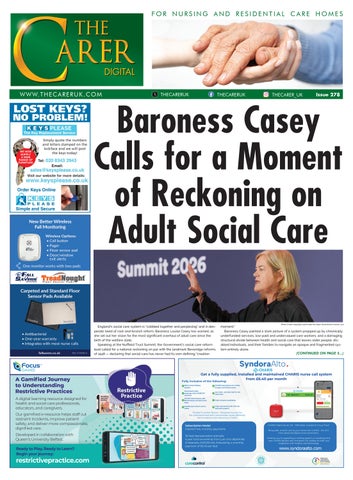
Baroness Casey Calls for a Moment of Reckoning on Adult Social Care England's social care system is "cobbled together and perplexing" and in desperate need of root-and-branch reform, Baroness Louise Casey has warned, as she set out her vision for the most significant overhaul of adult care since the birth of the welfare state. Speaking at the Nuffield Trust Summit, the Government's social care reform lead called for a national reckoning on par with the landmark Beveridge reforms of 1948 — declaring that social care has never had its own defining "creation
Photo Crown Copyright used under the Open Government Licence v3.0.
moment." Baroness Casey painted a stark picture of a system propped up by chronically underfunded services, low-paid and undervalued care workers, and a damaging structural divide between health and social care that leaves older people, disabled individuals, and their families to navigate an opaque and fragmented system entirely alone.
(CONTINUED ON PAGE 3...)
PAGE 2 | THE CARER DIGITAL | ISSUE 278
EDITOR'S VIEWPOINT
Welcome to the latest edition of The Carer Digital! THE SIXTH GIANT: A DAY OF RECKONING FOR SOCIAL CARE
Editor
Peter Adams
Baroness Casey's call for root-and-branch reform of England's social care system has been a long time coming. For those of us who have worked in, reported on, and advocated for this sector, her words this week were not a surprise — but they were, at last, a vindication. The phrase 'day of reckoning' is, I think, rather apt — and it is a day that sector operators, providers, and spokespersons have been warning about for a very long time. Those of us who read the trade press, attend the conferences, and listen to the people doing the hard daily work of care have heard this warning grow louder with each passing year. Now, with Baroness Casey's forthright remarks at the Nuffield Trust Summit, it appears the rest of the country may
finally be catching up. What struck me most in her speech was the reference to Beveridge and the landmark reforms of 1948. William Beveridge identified five giants standing in the way of a decent post-war Britain: Want, Disease, Ignorance, Squalor, and Idleness — the foundations from which sprang social insurance, the NHS, universal education, council housing, and the commitment to full employment. It was a moment of national purpose and clarity, a 'creation moment' as Baroness Casey called it, when the country decided what it owed its citizens and how it would pay. Social care, notably, was absent. And in fairness, it barely needed to be included. In 1948, life expectancy in Britain hovered around 66 years. People did not, in great numbers, survive long enough to require the kind of sustained, complex care support that is now so commonplace. Where support was needed — for the elderly, the frail, the infirm — it was largely absorbed by families, or in extremis by the NHS. I remember very well growing up in the 60’s and 70’s how common it was to have an elderly relative living with a family or living close by where everyone “popped in” to check on them. The notion of hundreds of thousands of people living into their eighties and nineties, many with dementia, multiple long-term conditions, and complex dependency needs, was simply not part of the national calculation. That world no longer exists. Baroness Casey is right to name social care as the 'sixth giant' — the great unmet challenge that Beveridge's generation could not have foreseen but that our own generation can no longer avoid. People are living much longer, often with multiple long-term conditions, and the country must now confront a fundamental question: what should a modern care system look like, and how should it be funded and supported in the years ahead?
It is not a new question. It has been asked, with varying degrees of urgency and sincerity, by Dilnot, by Wanless, by countless Select Committees and independent reviews. Reports have been written, recommendations made, and — with almost ritual predictability — shelved. But I sense, perhaps cautiously, that we are inching closer to an answer. The political temperature is rising. The demographic pressure is undeniable. The status quo is, as Baroness Casey put it plainly, no longer tenable. What is different now, and what Baroness Casey deserves credit for, is the bluntness of the conversation she is forcing. Because if we are serious about reform, we have to be honest — genuinely, uncomfortably honest — about what that reform will require. And that means talking frankly about money, and about who pays. "The public are going to have to accept their share of responsibility. That is a truth that politicians have long been afraid to utter." In the circles I move in — among family and friends, professional colleagues, there is a broad and growing consensus that the current funding model for social care is transferring a substantial and rising financial burden from the ageing baby boomer generation onto younger, working-age people. As the population ages, the number of people requiring care is rising sharply, while the tax base supporting that care is not growing at the same rate. The result is an intergenerational sustainability gap that is widening every year. The current system operates, in essence, as a pay-as-you-go arrangement: younger generations fund the care of the older generation, with the expectation of reciprocity in due course. But the rapidly rising cost of care — driven by demographics and the increasing complexity of need — makes this model progressively more unsustainable and, frankly, more unfair to those bearing the cost. The Resolution Foundation and the Health Foundation have both documented this trajectory with clarity. The numbers do not lie. This means that encouraging the public — winning their hearts and minds — to accept a proper, sustainable funding settlement for long-term social care will require something close to a political and cultural revolution. It will demand clear and honest communication about what care costs and why; it will require financial incentives that make saving for later-life care rational and rewarding; and it will demand a fundamental rebuilding of public trust in a system that too many people experience as opaque, inconsistent, and demeaning. None of this will be quick. None of it will be easy. But it is necessary, and it will require bold decision-making from politicians who have, for too long, treated social care as an electoral liability rather than a national duty. The public are going to have to accept their share of responsibility. That is a truth that politicians have long been afraid to utter. Baroness Casey appears rather less frightened of it, and good for her. I would encourage our readers to sign up for our bi-weekly digital newsletter at www.thecareruk.com and follow us on social media for all the latest news. I can always be contacted at editor@thecareruk.com
The Carer is published by RBC Publishing Ltd, 3 Carlton Mount, 2 Cranborne Road, Bournemouth, Dorset BH2 5BR. Contributions are welcome for consideration, however, no responsibility will be accepted for loss or damage. Views expressed within this publication are not necessarily those of the publisher or the editorial team. Whilst every care is taken when compiling this publication to ensure accuracy, the publisher will assume no responsibility for any effects, errors or omissions therefrom. All rights reserved, reproduction is forbidden unless written permission is obtained. All material is assumed copyright free unless otherwise advised.
PUBLISHED BY RBC Publishing Ltd 3 Carlton Mount 2 Cranborne Road Bournemouth Dorset BH2 5BR
TELEPHONE:
01202 552333 EMAIL:
sales@thecareruk.com WEBSITE:
www.thecareruk.com EDITOR Peter Adams editor@thecareruk.com
SALES DIRECTOR David Bartlett dave@thecareruk.com
PRODUCTION & DESIGN Matthew Noades Published by
THE CARER DIGITAL | ISSUE 278 | PAGE 3
Baroness Casey Calls for a Moment of Reckoning on Adult Social Care (CONTINUED FROM FRONT COVER) With accountability absent and ownership unclear, she made plain that the status quo is no longer tenable.
DIFFERENT AGE In her remarks at the Nuffield Trust Summit, Baroness Casey of Blackstock said: “Unlike the NHS or indeed the benefits system, social care has never had its own creation moment. No moment when the nation decided what it was for, what people should expect or who should pay, and how. “Instead, we inherited a system shaped for a very different age, held together with add-ons and work arounds, sticking plasters and glue. Without ever having the moment of reckoning we now need.” She stated that a national conversation would be needed to seek backing from the public who pay for health and social care through their taxes but might not even know what social care is. Baroness Casey also confirmed she has written to the Secretary of State for Health and Social Care asking the Government to take six immediate actions on dementia, motor neurone disease and adult safeguarding due to the urgency of the reform needed in these areas. This includes asking the Government to scale up dementia trials, appoint a new Dementia Tsar, set up a new National Safeguarding Board to protect vulnerable adults, and to introduce a new fast-track, social care passport for people diagnosed with motor neurone disease.
NATIONAL CONVERSATION Professor Martin Green OBE, Chief Executive of Care England, said: “Baroness Casey has helped bring social care into the national conversation in a way that is long overdue. “Too often, the debate about care takes place within the sector rather than with the public. This speech begins an important discussion about what people want from a care system and how we support independence, dignity and wellbeing as people live longer lives. “Social care is not simply an adjunct to the NHS. It is the foundation that allows people to live independently, recover after illness and avoid unnecessary hospital admissions. When care works well, it prevents crisis and supports people to live the lives they choose.” “We know that hospitals can sometimes become a rapid route to decline for frail older people,” Professor Martin Green said. “Social care plays a crucial role in helping people recover, maintain independence and, in many cases, avoid unnecessary hospitalisation in the first place.” “The challenge now is to ensure the political will exists to ensure that the magnitude of the change that is needed is delivered after countless unactioned reports and reviews; and to ensure the voices of people who draw on care, families, staff and providers help shape what comes next for social care in England.”
ACCOUNTABILITY Vic Rayner OBE, CEO of the National Care Forum commented: “We welcome the frank, honest and passionate speech delivered by
Baroness Casey today. Much of the learning and experiences she cited from the work of her team since January 2025 will resonate strongly with our members. “Baroness Casey has called time on decades of ‘arm’s length’ attitudes to social care by both national government and the NHS. Her calls for a national safeguarding board will force the heart of government to take accountability and action to improve and enhance care. We welcome the strength of sentiment behind her call for a laser focus on people living with dementia, addressing the long-held disparity between how ‘the system’ values the outcomes for people experiencing different life courses.” “Baroness Casey rightly highlighted the failures in the current construction of a social care ‘market’ and the very real commissioning challenges inherent in that falsely defined model. Not-for-profit care provision can, and should, play a much bigger role in the delivery of care. It should form the cornerstone of a National Care Service that sends a coherent and transparent message about how public money is being used. This must be central to an ambition for a truly joined up, well resourced, responsive and accessible care and support system where and when people need it. “We also want to be clear that, despite the many challenges that Baroness Casey rightly highlights as being present in the system, there are many providers delivering outstanding, high-quality care and support with an exceptional, professional workforce. We need to be highlighting this and pushing for these models, and the principles behind them, to be scaled up. “ “The next stages of how she works will be vital to understand, and there is a desperate urgency for ambition, vision and action. Not-forprofit care needs to be at the heart of that ambition, and we welcome the work that Baroness Casey and her team are doing to ensure this vital public service both meets the current needs of communities and is fit for the future.”
VOICES HEARD
Tanya Curry, Chief Executive of the Motor Neurone Disease Associationsaid: “We’re proud to have been involved in supporting the Casey Commission’s work, providing evidence, supporting statements and ensuring the voices and experiences of people with motor neurone disease have shaped the Commission’s thinking from the start. “We’re heartened to see Baroness Casey haslistenedand highlighted within her recommendations the need for a fast-track passport enabling people with MND to secure the care and support they need. A third of people diagnosed with MND die within 12 months, and too often care and support are delivered far too late. People with adiseaseas devastating as MND should never have to fight to access the services they need. “We’llbe keeping the pressure on Government to move fast and implement the Casey Commission’s recommendations for the sake of people with MND now and those who will be diagnosed in the future.”
NEW TREATMENTS Hilary Evans-Newton CBE, Chief Executive of Alzheimer’s Research UK, said: “Dementia is the UK’s leading cause of death—so why isn’t it a national priority?Every year we delayprioritising dementiacosts lives andcoststhe UK billions. “Alzheimer’s Research UK has been calling on the Government to prepare for new treatments for the last decade, anddespite new drugs licensed by the MHRA last year,ourhealth systemsremainwoefully underprepared. “The Government mustdeliver on its manifesto commitment to invest in trials and put Britain at the forefront of transforming treatment for dementia.We cannot keep asking families to wait while the science moves ahead.”
“MEANS BUSINESS” Caroline Abrahams, Charity Director at Age UK said: "This is arguably the first time that someone as senior, respected and independent as Baroness Casey has been prepared to tell the truth about the state of social care in our country, and the extent to which it does - or all too often doesn't - work constructively with the NHS to meet people's needs. She was also brutally honest about our national failure to face up to what it means to have an ageing population, something with which Age UK strongly agrees. "It shouldn't have needed Baroness Casey to have said these things today to jerk our policymakers out of their protracted slumber, but now that she has it sets the tone for the rest of her Commission's work. By saying what she did she is also laying down a challenge to Government and to all politicians who aspire to take power to get much more serious in their responses on social care. "It's clear that Baroness Casey and her team have listened carefully to what she has heard from both the users and givers of care, and that she 'means business' with the Commission she has been asked to lead. At Age UK we look forward to hearing more about the Commission's next steps and we will do everything we can to help."
TWO PHASES Since the Commission formally launched in April 2025, Baroness Casey and the Independent Commission have met with more than 400 people with lived experience of receiving or delivering care, visited councils, social care providers and NHS workers across the country. The Commission has also hosted evidence sessions with people working across adult social care including unpaid carers, frontline practitioners, providers, local authorities, NHS workers, and sector representative organisations. The Commission has also set up an online evidence portal where anyone can submit their insights, experiences and ideas for change directly to the team. The Commission will be undertaken in two phases with the first report to be published in 2026 and the final phase reporting back by 2028.
PAGE 4 | THE CARER DIGITAL | ISSUE 278
The New Productivity Test in Adult Social Care Isn’t Money - It’s Time By Chris Hornung, MD of Public Sector, Totalmobile (www.totalmobile.com) Adult social care has been under financial pressure for years. That part of the story is familiar. What’s becoming harder to ignore is that money is no longer the only constraint. Time is. Across councils and care providers, too much time is lost every day to avoidable friction. Schedules are still built manually. Travel is inefficient. Information is duplicated or missed altogether. Tasks move slowly from one part of the system to another. When time is wasted in adult social care, the effects are immediate. Visits are late or missed. Staff are stretched. People waiting to leave hospital stay longer than they should. This matters now because the wider system has little slack left. National policy is pushing for better planning and integration through mechanisms such as the Better Care Fund 2025– 26. That direction reflects a growing recognition that productivity in health and care will depend less on new funding and more on how existing capacity is organised and used.
WHERE TIME DISAPPEARS In many reablement and care-at-home services, the basic structure of work has barely changed. Care workers are assigned fixed runs, often built around habit rather than need. The same people, in the same order, on the same days. That approach brings familiarity and reassurance, and those things matter. But it also limits flexibility. When someone doesn’t need care on a particular day — because they’ve been admitted to hospital or have family support — gaps open up in schedules that are difficult to redeploy. The time exists, but the system can’t easily use it. This picture is echoed in recent findings from the Care Quality Commission, which has highlighted how fragmented planning, workforce pressure and limited operational visibility continue to drain time from frontline adult social care. From the outside, services can look stable. Inside, inefficiency quietly builds.
CONTINUITY WITHOUT RIGIDITY Improving productivity is often assumed to mean sacrificing continuity. In practice, the issue is rigidity, not relationships. Continuity doesn’t have to mean the same carer at every visit. Small, consistent teams can preserve familiarity while allowing work to be planned day by day. That flexibility makes it easier to respond to changing needs, cover gaps, and make better use of available time. When planning becomes more responsive, time is recovered without rushing visits or cutting care. The work simply fits better.
PRODUCTIVITY WITHOUT A STOPWATCH Frontline teams are understandably wary of productivity measures. Too often, they are associated with speed targets and pressure to rush. In many services, visits are still planned using broad defaults — half an hour, three-quarters of an hour —
regardless of what actually happens on the ground. Some visits finish early. Others regularly overrun. The result is wasted time in one place and pressure in another. A more realistic approach uses real data to match time to need. Some people need longer support. Others don’t. When planners can see patterns clearly, schedules improve. Care becomes more proportionate. Capacity increases without reducing quality. This isn’t about working faster. It’s about planning more accurately.
THE MANUAL BURDEN THAT SHOULDN’T EXIST Despite years of discussion about digital transformation, care workers still spend too much time on administration. Notes are written up after visits. Mileage is logged manually. Paper records are carried between homes and offices. That time is rarely visible, but it adds up. Frontline staff shouldn’t need to reconstruct visits at the end of the day or carry folders to understand someone’s history. Real-time recording and shared visibility aren’t about monitoring people. They are about removing unnecessary work and reducing risk. They also matter for families. When information is accessible and up to date, relatives don’t need to chase providers or rely on handwritten logs to understand what’s happening. Confidence improves on all sides.
WHY ONE HOUR MATTERS If a council could recover even one hour per care worker, per day, the effect would be significant. More reablement capacity means people can leave hospital sooner. Outcomes improve, particularly for older people whose independence can decline quickly in hospital settings. Pressure on wards eases. Delays caused by a lack of onward care reduce. Analysis from the Health Foundation supports this view, showing that timely reablement and effective care at home reduce hospital length of stay and improve outcomes across the wider system. Adult social care productivity is not separate from NHS performance. It underpins it. Supporting people at home is consistently more cost-effective than keeping them in hospital or moving them into long-term residential care. Yet investment decisions don’t always reflect that balance.
BRINGING PEOPLE WITH YOU Change fails when it feels imposed. Care workers don’t resist new tools because they dislike progress. They push back when change creates extra work, adds complexity, or pulls them away from care. When improvements remove duplication, reduce paperwork and make work safer and clearer, they gain support. Productivity improves not because people are pushed harder, but because obstacles are removed.
WHY TIME IS THE REAL TEST Funding will always be part of the adult social care debate. It matters. But the next phase of reform will be judged just as much on how well the system uses time. Time to plan properly. Time to adapt care as people recover. Time returned to frontline teams. That is the productivity test that really matters.
H.W. PICKRELL Welcome to Blue Rain - our activity store is built on over 14 years experience supplying products that bring joy, inspire motivation, and enrich the lives of those who need a little extra support, or simply want to have fun, whatever the weather.
Come find your next reason to smile.
NEW & USED ACCESSIBLE TRANSPORT AT AFFORDABLE PRICES • We specialise in the sale and purchase of quality used wheelchair accessible vehicles and ambulances. • They can be bought as seen or refurbished and sign-written to your own requirements. • Fully serviced, new mot & warranty • Engineers inspection supplied if required.
Scan me
• Free delivery service available • All buses comply with new legislation • Lease hire and purchase available • Always large stock of accessible vehicles
Tel: 01268 521033 Mobile: 07860 894331 Email: sales@hwpickrell.co.uk Gardiners Lane North, Crays Hills, Billericay, Essex CM11 2XE All current stock available to view at www.hwpickrell.co.uk
THE CARER DIGITAL | ISSUE 278 | PAGE 5
Social Care Support Workers Still Take Home £7,048 Less A Year Than NHS Counterparts, New Research Reveals The national social care charity, Community Integrated Care, has today published the fifth edition of its landmark Unfair To Care report, providing the most comprehensive annual analysis of the pay gap between frontline adult social care workers and their NHS counterparts. Published as Baroness Casey makes her first public comments from her review of adult social care in England - acknowledging the scale of the challenge ahead and the crucial role of the workforce - the report finds that, despite five years of sustained campaigning and a narrowing of the gap from 39% in 2021, a significant structural pay divide between social care and the NHS remains. Despite a 6.7% increase in the National Living Wage to £12.21 in 2025/26, support workers still take home £7,048 less per year than NHS Band 3 colleagues carrying out roles of equivalent scope and complexity - virtually unchanged from the £7,120 gap recorded last year. With providers facing a 9% rise in operating costs and full implementation of the Fair Pay Agreement on the horizon but still years away, the report warns that the sector cannot afford to stand still.
KEY FINDINGS
• 28.6% - the take-home pay gap between social care support workers and NHS Band 3 staff in 2025/26 • £7,048 - the annual pay rise a social care support worker would need to achieve take-home pay parity with an NHS Band 3 equivalent • 43.3% - the total reward gap when NHS pension and benefits entitlements are included, representing a £10,990 annual difference • 9% - the average rise in operating costs for care providers in 2025/26, driven by unfunded increases in Employer National Insurance and the National Living Wage • 7% - the overall adult social care vacancy rate, three times the UKwide rate of 2.3%6
ABOUT THE RESEARCH
At the core of Unfair To Care is an independent evaluation of social care support worker roles using the world-renowned Korn Ferry Hay Guide Chart-Profile Method. This rigorous, evidence-based framework assesses the physical, environmental and emotional demands of the role – and consistently finds that frontline adult social care support work is at least equivalent in job size to an NHS Band 3 role. Despite
this, the pay parity that equivalence should demand remains elusive. The report draws on the National Care Forum's pay benchmarking for the not-for-profit sector, which shows the average hourly rate for social care workers in England (excluding London) is £12.60, against a Band 3 NHS base pay midpoint equivalent to a £25,767 annual salary before NHS allowances, unsocial hours premiums and enhanced benefits are factored in. The report also applies its findings to the Government's planned Fair Pay Agreement, due to take effect in 2028/29 with £500 million of funding. The report’s modelling shows that this level of investment is expected to deliver an uplift of 68p per hour above the National Minimum Wage for direct care workers. Yet, even if that funding had been available in 2025/26 at current pay rates, social care support workers would still earn 29p per hour less than the NHS baseline - a 2.3% shortfall equating to £567 a year. On take-home pay, the picture is starker still: direct care workers would still be taking home £2.92 per hour less than their NHS equivalents - a 22% gap worth £5,710 a year. In other words, the gap would narrow, but the unfair pay differential would not be eliminated completely. The report also raises concerns that, if employer on-costs are absorbed within the 68p uplift, the amount reaching workers could fall to approximately 50p per hour, further limiting the agreement's impact. Community Integrated Care is calling on the Government to act now rather than wait for the Fair Pay Agreement to take effect. Its key recommendations include: Interim pay uplifts in 2026/27 and 2027/28 to narrow the gap and stabilise the workforce ahead of full implementation. • Full flow-through of funding from local councils to care providers, including employer on-costs such as National Insurance and pension contributions. • A clear method for determining fee levels that reflect the true cost of care. • Investment in recruitment, training and retention alongside any pay floor increase. • No backdating of additional pay unless the required funding is clearly identified and passed through in full and on time.
Teresa Exelby, Chief Corporate Services and People Officer at Community Integrated Care, commented: “Five years ago, the takehome pay gap between social care support workers and equivalent NHS roles stood at a stark 39%. Today, it stands at 28.6% - still a significant £7,048 a year. Whilst progress has been made, narrowing the gap is not the same as closing it. We’re now entering a moment of real possibility. The Government's commitment to a statutory Fair Pay Agreement, coupled with the work of the Casey Commission, creates a genuine opportunity to address structural inequality that has persisted for decades. Yet our modelling shows that even under the proposed financial envelope, a notable difference in take-home pay would remain. Social care is delivered by skilled professionals exercising judgement, accountability, and a deep compassion every day. If the changes now underway are funded properly and implemented with discipline, there is a real opportunity to strengthen workforce stability and build a more sustainable future. The direction is clearer than it has been for some time. The responsibility now is to ensure this moment leads to tangible change - and that fairness is delivered fully, not partially." Tauseef, a person supported by Community Integrated Care in Stockport, said: “It's good to see some recognition of how vital Support Workers are, and the difference they make in enabling people with support needs to live our lives and do the things we enjoy. But if I'm honest, we're still a long way from where we need to be." "Support Workers are still not being paid fairly, and too many are going without the proper support and training they deserve. People with lived experience like me are still not being listened to in the way we should be. Every person with a disability deserves truly great support - but right now, that's not the reality for enough of us. That's exactly why our Unfair To Care campaign matters so much, and why there is still so much more work to do." The report also highlights wider threats to the sector, including immigration policy changes expected to reduce international workers by up to 50,000 in a year, tax freezes estimated by Care England to strip £1.4 billion from care workers' take-home pay before the Fair Pay Agreement begins, and additional cost pressures arising from the Employment Rights Act 2025.
PAGE 6 | THE CARER DIGITAL | ISSUE 278
Whistleblowing In The Care Sector
By Chris Kisby, employment partner at Gateley Legal (https://gateleyplc.com/gateley-legal/)
The stakes in the care sector between doing the right thing and the wrong thing can, on occasion, be a matter of life and death, especially when it comes to those who are extremely vulnerable due to their condition or age. As such, whistleblowing within the sector can, when done properly and in the public interest, have a positive outcome for patients, their families, carers and employers.
WHAT IS WHISTLEBLOWING?
Put simply, whistleblowing is the action someone (typically an employee or ex-employee) takes to report wrongdoing in the workplace that falls under one of the types of failure, wrongdoing or mal-
practice listed in the Employment Rights Act 1996. The act of reporting any such wrongdoing to a prescribed person is known as making a ‘protected disclosure’.
HOW TO MAKE A PROTECTED DISCLOSURE?
As a starting point, any disclosure made needs to be a ‘qualifying’ disclosure, meaning that the individual making the disclosure has a ‘reasonable belief’ that the information they’re disclosing relates to one or more of the types of wrongdoing and that it’s in the public interest to make the disclosure. Relevant issues that may be found within the care sector could include: • Danger to the health and safety of an individual - whether that be a patient, member of staff, visitor, etc. - typically related to the quality of service provided or conditions • A criminal offence - for example, money or possessions being taken from vulnerable patients • Breach of a legal obligation – for example, a breach of a legal duty of care owed to a patient, or a breach of a legal obligation to staff • Miscarriage of justice, such as wrongful accusations made against a particular member of staff or a patient.
WHAT PROCESS SHOULD BE FOLLOWED TO ‘BLOW THE WHISTLE’?
An employee looking to make a protected disclosure should refer to their employers’ whistleblowing policy to see what steps need to be taken. Typically, a whistleblowing policy will confirm a specific point of contact with whom a disclosure can be made. This will usually be an HR representative, a compliance officer, or a line manager if there is no one in the aforementioned positions. If there is no whistleblowing policy, an employee looking to make a disclosure would be advised to speak to their HR team or line manager about how to proceed. However, if their HR team or line manager is the subject matter of the issue, employees should approach someone else in a senior position to ask for advice.
LEGAL PROTECTIONS
There are two levels of protection for whistleblowers under the Employment Rights Act 1996: The dismissal of an employee will be automatically unfair if the reason, or principal reason, for their dismissal is that they have made a protected disclosure. Workers are also protected from being subjected to any detriment on the ground that they have made a protected disclosure. Such detrimental treatment would include, for instance, the whistleblower experiencing bullying, demotion, or being excluded from
meetings, etc. There is no financial cap on compensation in whistleblowing claims and no requirement for a minimum period of service. However, if an employment tribunal believes that a disclosure was made in bad faith (ie, based on untruths or with the intention of causing malice), it could reduce any compensation award by up to 25%.
SUPPORT
Blowing the whistle can be a daunting and lonely process for those who make a disclosure. Where there is a ‘protected disclosure’, employers should assume that the disclosure is being made in good faith, and often for the benefit of the business. As such, they should look to support the employee. This could include, for example, offering them access to confidential and impartial counselling to help them through what can be a stressful and emotional experience of whistleblowing.
TOP TIPS FOR EMPLOYERS
• Have a good whistleblowing policy and ensure employees know about its existence. • Make sure a nominated whistleblowing officer/s are trained on what their role requires. • Treat all potential disclosures seriously and investigate as appropriate. • Make sure that lessons are taken from all disclosures to ensure things improve. • Do not seek to identify the whistleblower in cases where the disclosure is anonymous. • Do not exclude or alienate the whistleblower. • Do not assume the relationship between the business and the whistleblower is irreparable in cases where the disclosure causes conflict. Top tips for employees • Take time to read and digest the company whistleblowing policy. • Raise concerns at the earliest opportunity, in order to potentially limit the issue from becoming more serious. • Seek advice, whether that be from an internal whistleblowing officer or someone externally, before proceeding with the disclosure. • Be prepared to be challenged on your claims. • Do not rely on memory to recall events or previous meetings; it’s important to keep notes of dates, conversations and outcomes.
®
How pobroll Is Transforming Bed Bathing for Dementia Patients
Written by Pat O’Brien of pobroll
In April 2025, the Supporting the Provider Market (STPM) team in County Durham published a new report evaluating the use of pobroll® — a waterproof bed-bathing wrap designed to improve dignity, comfort, and ease during personal care. This evaluation was carried out across 10 care homes with high numbers of residents living with dementia. Each setting was given one or more pobroll® units and invited to share feedback through a structured survey. The findings reveal how even simple tools can make a significant difference in everyday care.
How was pobroll® used?
Most care homes used pobroll® daily or several times per week, showing it quickly became part of regular practice. Staff noted that one of the biggest challenges was not having enough units — all homes requested additional stock after the trial, highlighting a clear appetite for wider adoption.
What did care teams think?
Feedback from the care homes showed strong support for the tool: • Ease of use was rated highly, with an average score of 4.4 out of 5. Staff found pobroll® straightforward to incorporate into care routines. • Training was rated slightly lower, at 3.8 out of 5, suggesting that while the wrap is easy to use, additional training resources could improve onboarding for new users. • Resident response was positive. Three in ten care homes reported improved mood or behaviour dur-
ing bed bathing for dementia patients. • Key benefits included greater warmth, coverage, and dignity for residents, especially those who might find conventional methods distressing. Some teams also found it particularly useful for end-of-life care
Would they recommend pobroll® for bed bathing for dementia patients?
Absolutely. Homes rated their likelihood to recommend pobroll® at 4.3 out of 5, with half of respondents giving it a full 5 out of 5. The overall feedback was clear: this is a valued, meaningful addition to personal care. Would they recommend pobroll® for bed bathing for dementia patients? The results of this trial reinforce what many professionals already believe — that small, thoughtful design changes can significantly improve care. For residents who are bedbound or living with dementia, personal care can often be a distressing experience. But with the right tools, it doesn’t have to be. The pobroll® isn’t a complex device. It’s a simple, dual-layered cotton towelling wrap. But its thoughtful design — offering full coverage, comfort, and support — makes a real difference where it matters most. If you’re part of a care home, hospice, or hospital and would like to explore how pobroll® could benefit your residents or service users, get in touch. We’re here to support compassionate, dignified care — one small change at a time. See the advert on the facing page for details, or
THE CARER DIGITAL | ISSUE 278 | PAGE 7
Sector Dismay at Chancellor’s Spring Statement The UK adult social care sector has expressed significant dismay and disappointment following Chancellor Rachel Reeves’ Spring Statement on March 3, 2026, with leaders warning that the continued absence of dedicated support and funding risks undermining both the sector and the wider economy. Professor Martin Green OBE, Chief Executive of Care England, commented: “The Spring Statement offered little reassurance for adult social care providers. While it focused on the wider economic outlook, it did not address the mounting pressures facing the social care sector. “Economic stability is essential. But economic stability cannot be sustained without a stable adult social care system. Today’s Spring Statement focused heavily on the NHS and defence, yet social care was absent while cost and workforce pressures continue to mount, further increasing sector instability. “Social care is not a peripheral service. It enables people to work, supports families, prevents hospital admissions, and facilitates timely hospital discharge. When social care is fragile, the whole system feels the strain. While falling inflation and interest rates may ease some operational pressures, social care continues to face deep, structural challenges. “If the government wants growth in every community and place in England, and is serious about reducing hospital wait times, then social care must be recognised as a foundational public service and economic sector.” We cannot accept silence”: Lausa Biragi, founder of You & I Care, responds to the spring statement. Lausa Biragi founder of You & I Care, which operates in Essex, Surrey and Hertfordshire, said: “The care sector is in crisis and we require concrete plans immediately. The spring statement offered no solution, acknowledgement or pathway, at a time when we urgently need those in leadership positions to truly take initiative. The sector is currently on a cliff edge, yet we are met with silence and continued uncertainty. If the government fails to step forward with a credible and fully-funded plan, the risk of widespread collapse is very real.
“To save the care system, we must confront the reality of what happens if it ceases to function. The implications would be catastrophic. We would see thousands of people forced out of work to care for ageing parents, while professional carers would lose their livelihoods entirely. Furthermore, the NHS would inevitably buckle under the immense strain of avoidable hospital admissions. The consequences would ripple far beyond social care, creating a domino effect across the entire economy and society. “This is not a hypothetical scenario; it is where we are heading without urgent intervention. As a sector, we cannot and will not accept silence. The government must recognise the scale of this crisis and set out a robust, long-term plan to secure the future of social care now.” Dr Layla McCay, director of policy speaking for NHS Confederation and NHS Providers, said: “We agree wholeheartedly with the Chancellor’s priority to stabilise public finances. However, the financial context for the NHS has changed significantly since the government’s Autumn Budget. A higher than expected pay award for NHS staff, three rounds of resident doctors’ strikes, forthcoming increases to medicines spending and potential inflationary pressures from conflicts overseas will take their toll on an already stretched budget. “This raises very difficult questions about how services will meet rising demand while pursuing the government’s ambitions for long-term transformation. “NHS organisations are coming under severe financial pressure, with leaders warning of cuts to services and staffing levels. Already several integrated care boards expect to end this financial year in deficit despite major efficiency savings and productivity gains. The Office for Budget Responsibility specifically highlights the risk of further industrial action across the NHS as a ‘significant risk’ to departmental spending plans. “Recent improvements in elective and cancer care show what targeted investment can achieve. Growing financial pressures, without fresh government commitments, are putting this momentum at risk.”
Better Community Care Thanks To Nursing Funding Boost Care homes providing tailored nursing care to patients in the community will benefit from a funding rise of more than 5% to provide specialist care for some of the most vulnerable. This will help reduce the pressure on hospitals by preventing unnecessary admissions and supporting the discharge of individuals into social care settings to free up hospital beds. The uplift means the standard weekly rate per person provided for NHS-funded nursing care will increase from £254.06 to £267.68 from 1 April 2026, with funding paid by the NHS directly to care homes providing nursing care. The higher weekly rate will increase from £349.50 to £368.24. The increase in rates is backed by the funding made available for 2026 to 2027 at the latest Spending Review and comes alongside a
series of measures the government has taken to improve adult social care as it lays the foundation for a national care service. The government is committed to building a national care service based on high-quality care, choice and control. To deliver this the government is making an additional £4.6 billion in funding available to local authorities for 2028 to 2029 – compared to 2025 to 2026 – for adult social care by the end of this Parliament. This includes £500 million for the first ever fair pay agreement for care workers. In addition, the government has made available £723 million for the Disabled Facilities Grant for 2026 to 2027 and provided both the biggest uplift to the Carer’s Allowance threshold since the 1970s to support unpaid carers and the biggest increase to the minimum income guarantee in a decade, to support disabled adults with the cost of living.
PAGE 8 | THE CARER DIGITAL | ISSUE 278
Employment Rights Act 2025: How Care Homes Should Prepare Now By Bobby Ahmed, Employment Law Solicitor and the Managing Director at Neathouse Partners (https://neathousepartners.com) The Employment Rights Bill has become law as the Employment Rights Act 2025 (Royal Assent was granted on 18 December 2025). Not all of the new rules start straight away. Most changes are expected to come in through 2026 and 2027, with social care pay and terms reforms developing over a longer period, likely into 2028. For care homes, the biggest day to day effects will be on contracts and working patterns, rota planning and shift changes, sickness and Statutory Sick Pay handling, probation and early employment decisions, and how managers deal with flexible working requests and staff concerns.
• Sickness absence and Statutory Sick Pay guidance • Record keeping requirements, including working time, pay, and holiday records Best practice changes to build in: • Standard probation checkpoints and documented outcomes • Clear rules on when shifts can be moved or cancelled and who authorises changes • A consistent flexible working process with consultation notes and an alternatives section • A single source of truth for manager guidance to reduce local variation 2) Train managers on the new rules and the new risk points Most care home employment risk starts with line management inconsistency. Training should focus on practical behaviours and documentation, not legal theory.
WHAT IS CHANGING THAT MATTERS MOST FOR CARE HOMES
• Probation done properly: objectives, supervision notes, mid probation review, extension criteria, and final review • Early dismissal process: how to run a fair, evidence based process now that the unfair dismissal window is shorter and compensation exposure is higher • Flexible working: how to consult, assess impact on care delivery and staffing, consider alternatives, and write an outcome letter that is clear and defensible • Rota and shift management: notice expectations, cancellation rules, payment triggers, and audit trails • Sickness management: reporting, fit notes, reasonable adjustments, phased returns, and consistent application of Statutory Sick Pay changes • Handling concerns: responding to grievances, whistleblowing, and collective issues in a way that reduces escalation Make it measurable: • Simple manager checklists • Template letters and meeting notes • Spot checks on a sample of cases each month 3) Improve scheduling and workforce planning ahead of zero hours reforms This is where care homes can avoid cost spikes and conflict. Practical steps: • Analyse 12 weeks of rota and timesheet data to identify regular patterns among zero hours and bank staff • Identify where guaranteed hours offers are likely to be required and plan a conversion approach • Reduce short notice churn by strengthening cover planning: planned float hours, clear on call arrangements, tighter annual leave forecasting • Tighten governance on rota changes: who can authorise, how changes are logged, and how staff are notified • Review agency usage and consider where internal bank arrangements can provide stability at lower cost Good outcomes to aim for: • Fewer last-minute cancellations • More predictable rotas where patterns exist • Clearer expectations for staff who prefer ad hoc work 4) Strengthen communication with staff and unions The Act’s direction is towards stronger worker protections and more collective voice. Even where union membership is low, better communication reduces grievance volume and turnover. Best practice: • Publish a plain English timeline of changes and what they mean locally • Hold short briefings with managers first so messages are consistent • Share how rota fairness will be managed, including notice and cancellation handling • Set out a transparent approach to guaranteed hours offers so staff understand options and implications • Keep a simple, reliable channel for feedback and questions, with published answers to common themes • Where unions are recognised or active, plan structured engagement around rota changes, contract updates, and pay expectations linked to Fair Pay Agreement developments Tone matters: • Focus on predictability, fairness, and safe staffing rather than compliance language 5) Get inspection ready on employment compliance With more joined up enforcement, assume the organisation may need to evidence decisions quickly. Operational best practice: • Centralise key records: contracts, hours, pay, holiday, sickness, flexible working outcomes • Maintain audit trails for rota changes and cancellations • Keep training records for managers • Run periodic internal checks on a sample of cases: probation outcomes, sickness decisions, flexible working responses, and pay calculations
Unfair dismissal: qualifying period cut to 6 months, compensation cap removed The Act reduces the qualifying period for ordinary unfair dismissal from two years to six months (expected to take effect from 1 January 2027). It also removes the cap on compensatory awards for unfair dismissal (the cap was previously set at the lower of 52 weeks’ gross pay or £118,223). Note: the removal of the compensation cap was a late amendment introduced during the final stages of parliamentary passage, after the House of Lords initially resisted day one unfair dismissal rights. The government compromised on a six-month qualifying period and, as part of that compromise, unexpectedly removed the cap entirely. What this means in practice: • Decisions in the first year of employment need stronger documentation • Probation reviews and extensions need clearer structure and consistency • Early terminations that are informal or poorly evidenced become higher risk • Claim values may increase because uncapped compensation changes how cases are assessed Zero hours and variable hours: new rights around guaranteed hours, notice, and cancellations • The Act adds new safeguards to tackle insecure hours, including the right to be offered guaranteed hours that reflect the hours someone has been regularly working over a set reference period (these reforms are expected to take effect in 2027, subject to secondary legislation) • A right to reasonable notice of shifts • A right to payment when shifts are cancelled, curtailed, or moved at short notice A key operational point is that flexibility does not disappear. The direction is that workers who are regularly working a pattern should not be kept permanently on uncertain hours, while those who prefer ad hoc work can often remain on that basis.
FLEXIBLE WORKING: STRONGER PROCESS AND A REASONABLENESS TEST WHEN REJECTING REQUESTS Employees already have a day one right to request flexible working. The Act strengthens the handling process and moves employers toward a clearer consultation approach when a request cannot be accepted. A reasonableness test is expected to apply when rejecting requests, meaning managers will need to show they considered the request properly, explored alternatives, and can explain why a refusal is reasonable against legitimate business grounds (this amendment is expected to come into force in 2027). For care homes, the pressure point is shift based delivery and safe staffing levels, so a consistent, documented process matters as much as the outcome.
STATUTORY SICK PAY: WIDER ACCESS AND EARLIER PAYMENT Statutory Sick Pay is set to become more widely available by removing the lower earnings threshold and adjusting how entitlement is calculated (these changes take effect from 6 April 2026). The direction of travel is earlier access and broader coverage, which will be particularly relevant for part time and lower paid roles common in care settings. Specifically, the three-day waiting period will be abolished, making SSP payable from the first day of sickness absence. The lower earnings limit (currently £125 per week, rising to £129 from April 2026) will be removed, meaning all eligible employees will qualify. For lower earners, SSP will be paid at 80% of normal weekly earnings or the flat weekly rate (£123.25 from April 2026), whichever is lower. Practical impacts: • More staff will qualify • Managers will need clearer guidance on evidence, reporting, and return to work steps • Payroll and HR processes will need updates to avoid underpayment or inconsistent decisions
A FAIR WORK AGENCY: MORE ACTIVE ENFORCEMENT A new enforcement body is expected to bring together labour market enforcement activity (the Fair Work Agency will be established on 7 April 2026). Care homes should plan for a more inspection ready stance, with better record keeping and faster ability to evidence compliance on pay, hours, and related rights.
SOCIAL CARE: FAIR PAY AGREEMENT AND NEGOTIATING BODIES The Act creates a route to establish Social Care Negotiating Bodies and a Fair Pay Agreement approach for adult social care (covering England, Scotland and Wales). The intention is to agree minimum baseline pay, terms and conditions across the sector, with regulations and negotiations expected over the next couple of years and implementation of the first agreement expected later in the decade. The government plans to establish the Adult Social Care Negotiating Body through regulations in 2026, with the first round of negotiations taking place in 2027 and the first fair pay agreement coming into force in 2028–29. The government has allocated £500 million for councils to implement the first agreement. Care home operators should plan for: • Budget impacts from sector wide baselines • Greater expectation of consistency on terms across providers • Workforce retention opportunities if sector wide pay and conditions improve
TRAINING MODULES TO PRIORITISE:
KEY AREAS TO FOCUS ON IN THE NEXT 90 DAYS • Workforce mapping: permanent, part time, bank, zero hours, agency • Rota and hours analysis across the most recent 12 weeks to identify regular patterns • Update templates for probation, capability, flexible working, and sickness • Manager training rollout with checklists and templates • Shift change governance: notice rules, cancellation rules, authorisations, and record keeping • Staff communications plan explaining what changes are coming and how the home will handle them • Budget and workforce scenario planning for social care pay developments and potential sector wide baselines
A PRACTICAL VIEW OF BEST PRACTICE Care homes that handle this well usually do three things early: • They standardise manager decisions with templates and short, repeatable processes • They treat rota stability as part of staff retention and quality, not just scheduling • They communicate changes before rumours fill the gap, and they listen for operational friction points that managers can fix quickly
PREPARATION PRIORITIES FOR CARE HOMES
KEY IMPLEMENTATION DATES AT A GLANCE
1) Review and update policies and contracts Start with a structured audit and then update documents in a controlled way. Prioritise: • Zero hours, bank, and variable hours contracts • Rota rules, shift booking, and shift change controls • Probation, performance management, and capability procedures • Disciplinary and grievance procedures, with investigation templates • Flexible working policy and request handling steps
6 April 2026 – Statutory Sick Pay reforms (removal of waiting days and lower earnings limit); Fair Work Agency established (7 April 2026); whistleblowing protections for sexual harassment disclosures; paternity and unpaid parental leave become day one rights 2027 – Zero hours and low hours contract reforms (guaranteed hours, shift notice, cancellation payments); flexible working reasonableness test; unfair dismissal qualifying period reduced to six months (from 1 January 2027) with compensation cap removed 2028–29 – First Fair Pay Agreement for adult social care expected to come into force
THE CARER DIGITAL | ISSUE 278 | PAGE 9
Care Sector Faces Deepening Workforce Challenge As Visa Numbers Plummet The number of overseas workers arriving in Britain on health and social care visas has declined dramatically over the past two years government data reveals. Official statistics released by the Home Office reveal that only 13,286 health and care worker visas were granted to main applicants throughout 2025 — a fall of more than half compared with 27,047 the previous year, and a staggering 91 per cent below the 145,823 granted just two years earlier in 2023. The collapse in numbers extends to family members accompanying workers. Dependant visas connected to health and care roles stood at 35,444 last year, representing a 58 per cent reduction year-on-year and a drop of more than four-fifths from the 202,334 recorded in 2023. Of particular concern to care home operators is the sharp contraction in nursing professionals arriving from abroad. The figures show that visas issued to nursing professionals fell to just 1,777 in 2025, down 73 per cent from 6,494 the year before, and nearly 93 per cent below the 26,141 granted in 2022. The Home Office attributed part of this decline to the conclusion of a centrally managed international nurse recruitment scheme, alongside reduced demand for overseas staff. However, sector observers are warning that the timing could hardly be worse, given that an estimated 25,000 nursing posts remain unfilled across the NHS and wider care sector. The dramatic reduction in overseas recruitment reflects an accumulation of policy changes introduced by successive governments. The previous Conservative administration began tightening the rules in early 2024, initially restricting the ability of overseas students to bring family members to the UK before extending similar restrictions to care workers from March of that year. Salary thresholds for skilled worker visas were also raised from April 2024. The current Labour government has continued and accelerated this trajectory. In July 2025, ministers
brought in further reforms — most notably ending overseas recruitment for care workers altogether, and again raising the salary bar required for skilled worker visa applications. Skill level requirements were also increased, rendering more than 100 occupational categories ineligible for the skilled worker route. Across all work-related visa categories, 261,112 entry visas were issued in 2025 — a reduction of 29 per cent on the prior year’s figure of 368,139, and less than half the total recorded in 2023 (613,627). Skilled worker visas issued to main applicants fell 44 per cent to 32,511 last year, compared with 57,858 in 2024 and 65,426 in 2023. Dependants covered under these visas also decreased, from 57,154 in 2024 to 40,741 in 2025. Campaigners and workforce experts are urging ministers to reassess the human consequences of the current approach. Dr Dora-Olivia Vicol, chief executive of the Work Rights Centre, argued that the impact on public services deserves serious scrutiny. Speaking in response to the data, she said the steep reduction in skilled migrant professionals coming to work in UK hospitals, research institutions and schools raised serious questions about the true cost of a policy focused narrowly on reducing migration numbers. She stressed that no hospital could welcome such a dramatic fall in overseas nurses at a time when tens of thousands of nursing vacancies remained unfilled, and that the burden would inevitably fall on existing staff already working under significant pressure. Dr Vicol also raised concerns about the conditions facing those overseas workers who do still qualify to come to Britain, warning they face higher costs, longer pathways to settlement, and a heightened risk of labour exploitation when tied to a single employer through their visa conditions. She called on the Government to look beyond headline migration figures and to design an immigration framework genuinely responsive to the needs of workers, patients and public services.
RMBI Care Co. Achieves Disability Confident Committed Status RMBI Care Co. has been officially recognised as a Disability Confident Committed Employer (Level 1) under the UK Government’s Disability Confident scheme. Endorsed by the Department for Work and Pensions, the scheme supports employers to become more inclusive by providing the knowledge, skills and confidence to attract, recruit, retain and develop people living with a disability in the workplace. This accreditation marks an important step in RMBI Care Co.’s ongoing commitment to equity, diversity and inclusion across its services. The recognition provides access to practical tools, guidance and support to help the charity widen its recruitment pool and ensure people with dis-
abilities and those with health conditions have equitable opportunities to thrive within the organisation. It also demonstrates RMBI Care Co.’s commitment to retaining valuable skills and experience within its workforce. Emma Pryke, Recruitment Manager at RMBI Care Co., says: “Becoming a Disability Confident Committed Employer reflects our dedication to building inclusive workplaces where everyone feels valued and supported. “We recognise the importance of attracting and developing talent from the widest possible pool and ensuring colleagues living with a disability can fulfil their potential within our organisation. This milestone strengthens our commitment to inclusivity in everything we communicate and deliver.”
Manufactured in the UK
Freephone: 0800 917 7943 www.euroservice-uk.com sales@euroservice-uk.com
PROVIDING PRACTICAL AND STYLISH TROLLEYS TO SUIT YOUR NEEDS Watch your resident's eyes light up when the beautiful tea trolley arrives! Euroservice trolleys can also be used as a vending trolley or to sell personal care products to residents. How about a delicious snack/pastry trolley or even a drinks trolley for that afternoon tipple?
Your lovely trolley could do so much for you and your residents! Euroservice trolleys are an attractive and practical alternative to clinical aluminium trolleys given that antibacterial spray can be used freely to sanitise them.
Get in touch with our friendly, experienced sales team
Visit the website at
www.euroservice-uk.com to see the full range.
THE CARER DIGITAL | ISSUE 278 | PAGE 11
UK Elderly Care Market Forecast To Reach Capacity By 2033 The UK’s elderly care market is forecast to capacity by 2033 without a wave of new development, according to new analysis by global real estate advisor Knight Frank. Knight Frank’s Healthcare Development Opportunities Report 2026 shows that the net supply of UK care beds has grown by just 136 over the past year to 480,000, with a 24% year-on-year uptick in new home completions offset by supply leakage and the rising deregistration of older stock. Supply leakage is particularly acute in London. While the West Midlands recorded a net gain of almost 1,500 beds from 2017 to 2025, the capital saw a decline of c.2,000 beds over the same period. In total, Knight Frank’s analysis reveals that care home bed supply has expanded by just 2.4% over the past decade, starkly lagging the 16.2% growth in the UK’s over-65 population. Planning approvals granted for 2026 were also lower than those for 2025, signalling a narrowing development pipeline and a widening gap between planning consent and delivery. Together, these trends underscore the impending care supply crisis facing the UK and the critical need for accelerated development to meet the needs of a rapidly ageing population. Existing care home bed supply across the UK is also in urgent need of upgrading. 79% of homes are more than 20 years old, rendering many as functionally obsolete. 38% of homes have also been converted from other uses, meaning they are often not meeting modern expectations, particularly with respect to resident wellbeing and the provision of ensuite facilities. Quality concerns further underscore the challenge, with almost one in five (19%) UK care homes currently rated by the Care Quality Commission as “Requires Improvement” or “Inadequate”. This creates an opportunity for investors and operators to invest in modernising existing stock, as well as developing new, purpose-built beds to accommodate future demand. The Covid-19 pandemic highlighted the importance of high-quality elderly care provision, supporting demand for modern, wellbeing-centric stock. Additionally, ESG-focused capex unlocks opportunities for investors to secure meaningful valuation and income uplifts across existing care facilities. Site selection is crucial for investors and operators seeking to increase their exposure to the UK market. Knight Frank has created a Development Hotspots Index to identify UK regions with the strongest case for
future development, analysing counties across England, Wales and Scotland against a series of key metrics such as demographic projections, land values, supply pipeline and operational performance indicators. Knight Frank’s Index revealed South Glamorgan in Wales, Lothian in Scotland and Berkshire in England as the areas with the strongest care home development prospects in the UK. Bedfordshire, Wiltshire and Greater Manchester also scored highly. Julian Evans, Global Head of Healthcare at Knight Frank, commented: “The Covid-19 pandemic brought the UK care market into sharp focus, underscoring the critical need for an adequate supply of purpose-built beds capable of meeting the complex needs of a rapidly ageing population. Despite a record year for UK healthcare investment in 2025, Knight Frank’s analysis demonstrates that supply is failing to keep pace with demand. Without a significant acceleration in both investment and development to upgrade standing stock and deliver new beds in core markets, the UK is fast approaching a crisis in care provision, with domestic bed capacity projected to reach saturation by the end of the decade.” Ryan Richards, Healthcare Research Associate at Knight Frank, added: “The critical undersupply of UK care home beds represents both a national imperative to deliver new stock and a rare opportunity for investors and operators. Strong demographic tailwinds and favourable supply-demand fundamentals underpin an attractive long-term investment case across the sector. Our analysis identifies the UK regions where the case for new development potential is strongest, serving as a researchdriven guide for investors seeking to maximise income performance whilst also alleviating the risk of a national care crisis in the coming years.”
Fun and Games as Care Home Residents Welcome Local Pupils A group of Key Stage Two children from St Budeaux’s Marine Academy spent a fun hour playing games and chatting with their residents of neighbouring at Butterfly Lodge nursing home. The recent get-together was the latest in a series of regular visits by children from the school, with both parties keen to keep them happening as often as possible. Sarah McCaffrey, deputy manager of Butterfly Lodge, said: “For our residents, who are all living with dementia, it is an absolute joy to have this connection with young people. “Their faces light up when the children arrive, and there’s no hesitation on either side about getting to know each other and enjoying some hands-on activities together. “For this visit we placed a number of games around the residents’ lounge, such as jenga, giant dominoes, snakes and ladders and Connect 4. “These are evergreen favourites, enjoyed by young and old alike, and the residents and children couldn’t wait to get stuck in. There was a lot of laughing going on.
“We also put out some jigsaw puzzles, and books that our residents and visitors could enjoy together if they fancied a quieter activity. “And a throw-the-beanbag-at-the-cans game was available for those who wanted something a bit more active. “Basically there was something for everyone, and perhaps the most important aspect of the visit was the conversations that took place between our ladies and gents and their young friends. “We are very grateful to Mr Druce of Marine Academy for making this visit possible.” Senior assistant headteacher, Alex Druce, said: “There was a wonderful atmosphere and lots of smiles on faces: I felt this visit was even better than the last one. “Many thanks to the Butterfly Lodge team for putting out some friendly games and refreshments, as well as being supportive in facilitating activities. “And very well done to the children, who were such brilliant role-models, for spreading joy in our community.”
CQC Renews Commitment to Lived Experience as New Contracts Begin This Spring The Care Quality Commission (CQC) has confirmed that Choice Support will continue to deliver its Experts by Experience (ExE) programme, whilst the Voices for Health Equality Partnership — led by National Voices and supported by Innovation Unit and Collaborate CIC — will take on management of the Public Engagement Network (PEN). Both contracts are set to commence in April 2026 and will run for a period of three years. The announcements follow a formal procurement process and represent a significant reaffirmation of the regulator’s stated mission to place the lived experiences of service users at the centre of how care is assessed and monitored across England. The Experts by Experience programme draws on individuals who have current or recent personal experience of using — or caring for someone who uses — services regulated by the CQC. These individuals actively participate in inspections and other regulatory activities, providing a direct human perspective on the quality of care being delivered. The Public Engagement Network, meanwhile, brings together more than 200 equality-focused voluntary, community and social enterprise (VCSE) organisations from across England. Through this network, the CQC receives insights drawn from communities who are disproportionately affected by inequalities in access to and quality of health and social care. For providers of residential and nursing care, the continuation of these programmes carries practical implications. The CQC has made clear that information gathered through lived experience informs how it assesses services and how it monitors the rights of people detained under the Mental Health Act. Care home providers can therefore expect that the voices of residents and their families will remain an active component of inspection activity in the years ahead. The regulator has also indicated that the programmes support its statutory duty to involve people with
lived experience in its work — a duty that sits alongside the CQC’s wider ambitions around improvement and addressing health inequalities. Kim Arnold, National Lead at Choice Support said: “We’re proud to announce that we’ve been awarded the Care Quality Commission (CQC) Experts by Experience contract. This achievement reflects our continued commitment to amplifying the voices of people with lived experience and ensuring they play a central role in shaping high quality care. “We look forward to supporting CQC in strengthening insight, improving services, and driving meaningful change across health and social care.” Sarah Sweeney, Director of Evidence and Improvement at National Voices said: “When people talk about health inequalities, it can sometimes feel as though they are describing something abstract: a disparity in access or a statistic in a report. But when we engage communities who experience health inequalities, it feels much more personal: a loved one lost, a quiet indignity experienced, a fear that compassionate care will not be forthcoming. “At National Voices, we want to make sure these voices travel to the heart of the system, shaping how services are delivered, assessed and improved. We are optimistic about how this programme of work with CQC and the VCSE sector can turn insight into action, evidence into change and ensure care is truly safe, effective and compassionate for everyone.” “Chris Day, Director of Engagement at CQC said: “We know how invaluable it is to hear, and act on, the voices of people who use services. This work underlines our continued commitment to ensuring the lived experience of people impacts on all aspects of our regulatory activity, driving change for people who use services and directly addressing inequalities. I am delighted that we will be working with Choice Support and National Voices for the next three years to drive this work forward.”
PAGE 12 | THE CARER DIGITAL | ISSUE 278
One in Four Care Providers Still Operating Without Technology as Government Digitisation Drive Gains Momentum A landmark government survey published this month reveals significant strides in the digitisation of adult social care in England — but exposes a stubborn divide between large and small providers, with funding barriers cited as the single greatest obstacle to further progress. Source: Department of Health and Social Care | Published: 6 March 2026 | Survey conducted: February–March 2025
More than a quarter of care providers in England — 27 per cent — are still delivering services without any form of care technology, according to findings from the government's 2025 Adult Social Care Provider Technology Survey, published by the Department of Health and Social Care (DHSC) on 6 March 2026. The survey, conducted among 1,085 CQC-registered providers in February and March 2025, offers the most detailed snapshot yet of where the sector stands on its digital journey — and reveals how much ground remains to be covered before the government's ambition of fully digitising all providers by the end of this Parliament in 2029 can be achieved. For care home managers and operators, the findings carry particular relevance. Residential providers account for one third (33 per cent) of survey respondents, and the data points to notable differences in technology uptake between residential and domiciliary settings — as well as stark disparities between large and small organisations.
!"#
34$563789:6;$<3=$>;:$?@$A:?;@$ 3<:$436B$34$C?6:$@:CD<3A3EF
$%#
34$(G(H6:E8;@:6:9$563789:6;$<3=$>;:$?$ .8E8@?A$-3C8?A$(?6:$,:C369$I>5$463B$JKL$ 8<$MNMKO
$&#
;?F$@D:F$<::9$E6:?@:6$4><98<E$ ;>5536@$436$3<E38<E$@:CD<3A3EF$ C3;@;
DIGITAL RECORDS: A TRANSFORMATION UNDER WAY Perhaps the most striking headline from the survey is the near-doubling of Digital Social Care Record (DSCR) adoption since 2021. At the time of the survey in March 2025, 73 per cent of respondents were using a DSCR. By July 2025 — following continued support from the government's Digitising Social Care (DiSC) programme — that figure had risen further to 80 per cent of all CQC-registered providers, compared with just 41 per cent at the end of 2021. DSCRs replace paper-based care records with digital solutions, enabling more secure and efficient sharing of up-to-date care information and reducing the administrative burden on frontline staff. The government defines a 'fully digitised' provider as one using an assured DSCR that meets the 'standards met' threshold on the Data Security and Protection Toolkit (DSPT). Alongside DSCRs, digital rostering tools were the second most widely used business management technology, with 63 per cent of respondents making use of them. Electronic medicine administration records (e-MAR) and video conferencing were each used by 53 per cent of providers, followed closely by financial accounting software (52 per cent) and HR management tools (51 per cent).
SENSOR TECHNOLOGY LEADS ON THE CARE FLOOR When it comes to care delivery technology — tools used directly in providing support to residents and service users — monitoring equipment with sensors was the most widely adopted, used by 43 per cent of all respondents. This category encompasses technologies such as fall prevention sensors and acoustic monitoring equipment, which have increasingly become part of the toolkit in residential and nursing care environments.
Video conferencing was used by 34 per cent of providers, while personal alarms were adopted by 35 per cent — though usage of alarms was notably higher among larger organisations, with 64 per cent of large providers deploying them compared with just 18 per cent of micro-providers. Health and wellbeing apps were used by a quarter (25 per cent) of all respondents, and unusually, this was one of the few categories where uptake was broadly consistent across provider sizes. Audio assistants such as smart speakers were used by 14 per cent of respondents, while virtual reality (3 per cent) and smartwatches (6 per cent) remain relatively niche.
THE SIZE DIVIDE: MICRO-PROVIDERS LEFT BEHIND The survey lays bare a significant disparity in technology adoption between large and small care organisations that will concern policymakers and sector leaders. While only 11 per cent of large providers reported using no care technology at all, that figure rises to 40 per cent among micro-providers — those supporting ten people or fewer. The pattern repeats across almost every technology category. For DSCR adoption, 88 per cent of large providers were using a digital care record compared with 57 per cent of micro-providers. For digital rostering, the gap ran from 81 per cent (large) to 52 per cent (micro). And for financial accounting software, 90 per cent of large providers had adopted it, against just 34 per cent of micro-providers. For residential care providers — who made up 33 per cent of survey respondents — there was also a connectivity concern. Whilst 70 per cent of residential care respondents said they had the appropriate internet infrastructure to support devices connecting from all areas of their care home, the picture was less encouraging for larger residential providers: a third of large residential care operators reported they lacked the infrastructure to support connectivity across all locations within their homes.
FUNDING IS THE BIGGEST BARRIER — BY FAR The survey asked providers to identify barriers to further technology adoption over the next five years. The findings are unambiguous: cost dominates all other concerns. Set-up costs were cited by 73 per cent of respondents as a barrier, and ongoing licence costs by 70 per cent. When asked what support they would need to overcome these obstacles, 82 per cent called for funding support with ongoing costs and 67 per cent said they needed help with upfront investment. Staff training costs and high staff turnover ranked third as a barrier, cited by 52 per cent of respondents — a figure that reflects the welldocumented workforce challenges the sector faces. The cost of cyber and data security was cited by 41 per cent, followed by concerns about internet connectivity (40 per cent) and reluctance from service users to use technology (39 per cent). Interestingly, staff reluctance to use technology was reported by 34 per cent of providers — a lower figure than service user reluctance — while concerns about technology replacing face-to-face care were cited by 30 per cent. These findings suggest that, while some cultural resistance remains, it is structural and financial barriers that most urgently need addressing. Workforce upskilling was identified as the third most needed form of support (58 per cent), followed by assurance that care technology is safe (44 per cent) and improved information about what technologies are available and their benefits (41 per cent each).
CONNECTIVITY: AN INFRASTRUCTURE CHALLENGE ON THE HORIZON The survey also examined providers' connectivity needs, with reveal-
ing results. At present, 26 per cent of respondents said they require superfast broadband (30 Mbps), while 19 per cent said they need ultrafast (300 Mbps). Looking ahead three years, the picture shifts considerably: the proportion expecting to need ultrafast broadband rises to 26 per cent, and those anticipating a need for gigabit-speed connectivity (1 Gbps or faster) quadruples from 5 per cent to 18 per cent. A third of respondents (33 per cent) believed they would need faster connectivity than they currently have, while 44 per cent said they were simply unsure what they would need — highlighting a knowledge gap that government guidance and support programmes may need to address. For residential care providers, the question of who pays for wifi provision is settled in most cases: 77 per cent said wifi was included within the normal care plan. In domiciliary care, by contrast, 68 per cent of respondents said service users organised and paid for their own wifi — a finding that could have implications for equitable access to technology-enabled care for people supported at home.
GOVERNMENT SETS COURSE FOR FULL DIGITISATION BY 2029 The survey was conducted as part of the government's Digitising Social Care (DiSC) programme, a joint initiative between the Department of Health and Social Care and NHS England. The programme's goal is that every CQC-registered provider in England will be fully digitised by the end of the current Parliament — a target that the DSCR adoption data suggests is well within reach for most, though the challenge of bringing micro and small providers up to speed remains considerable. In January 2025, the government made formal commitments to join up health and care data and to set new national standards for care technologies. In September 2025, DHSC commissioned Softcat Plc to begin work on a Social Care Interoperability Platform — described as a digital 'bridge' allowing data to be shared between adult social care and NHS IT infrastructure, with an initial focus on provider data. The survey is expected to run annually, with findings informing both policy development and the sector's own understanding of where it stands in its digital transformation.
KEY FINDINGS AT A GLANCE • 27% of care providers use no care technology at all • 43% use monitoring equipment with sensors — the most common care technology • 73% of survey respondents use a Digital Social Care Record (DSCR) • DSCR adoption among all CQC-registered providers rose from 41% (2021) to 80% (July 2025) • 40% of micro-providers use no care technology; just 11% of large providers are in the same position • 82% say they need funding support for ongoing technology costs • 73% cite set-up costs as a barrier to further adoption • 33% of large residential providers lack full-site internet connectivity infrastructure • 1,085 CQC-registered providers participated in the survey (Feb– March 2025) Full findings: gov.uk — 'Technology use in adult social care: 2025 survey results' Source: Department of Health and Social Care, 'Findings from the 2025 Adult Social Care Provider Technology Survey', published 6 March 2026. Crown Copyright 2026. Contains public sector information licensed under the Open Government Licence v3.0.
Setting the Standard: Care Home Compliance Made Simple The law is changing for care homes, but understanding your obligations has never been easier Providing both comfort and dignity to those in your care is at the core of the Care homes profession, but when it comes to both residents and their families, one of the most important things you can offer is trust. Moving to a care home can be an emotional time for some and transparency and fairness are key in reassuring prospective residents and their families that they will be cared for with compassion and respect - This, and compliance with the law. Earlier this year we saw the introduction of the Digital Markets, Competition and Consumers Act 2024 (DMCCA) - a landmark piece of legislation that affects business and how they are required by law to safeguard their customer with fair trading practices. These changes may sound like legal jargon, but they directly impact how care homes operate, communicate, and contract with residents. Compliance can be complex and that’s why the Business Companion Care Homes Guidance is essential reading for anyone working in the Care Homes sector. Written by legal experts this free and easy-to-read guide will walk you through all the steps to ensure you are safeguarding your customers and operating within the law.
WHAT’S CHANGED UNDER THE DMCCA?
The introduction of the DMCCA represents one of the biggest shifts in consumer law in over a decade. It replaces the old Consumer Protection from Unfair Trading Regulations and introduces stricter rules to protect consumers from misleading or unfair practices across almost all sectors. For care homes, this means:
• Clearer Pricing and Transparency: The Act bans “drip pricing” which is when unavoidable fees are hidden until late in the process. Care homes must now present the full cost of services upfront, including any mandatory charges. • Fake Reviews and Misleading Endorsements: The DMCCA prohibits the use of fabricated or manipulated reviews. With care homes increasingly relying on their online reputation, ensuring authenticity is now a legal obligation. • Stronger Enforcement Powers: The Competition and Markets Authority (CMA) can now impose fines of up to £300,000 - or 10% of global turnover - for breaches. Compliance isn’t optional; it’s critical. • and much more! These changes underline the importance of reviewing your policies, contracts, and marketing materials. The Care Homes Guidance on Business Companion provides practical steps to help you stay compliant and avoid costly mistakes.
KEEPING CONSUMER VULNERABILITY IN MIND
Vulnerability can arise from a number of different situations and factors throughout a person’s life, such as age, health, bereavement, or financial stress. As someone working in the Care homes sector,
you’re dealing with vulnerable individuals on a daily basis and recognising these factors isn’t just good practice; it’s a legal and ethical responsibility. The Business Companion Consumer Vulnerability Guide offers checklists and practical advice to help you identify and support your residents who may be vulnerable when it comes to things like decision making and communication, ensuring your care home delivers not only compliance but compassion. Your Go-To Resource for Compliance Business Companion is more than just a care home resource - it’s a comprehensive hub for businesses across a broad range of sectors. From selling online to handling complaints, delivery charges, and even net zero strategies, the platform covers hundreds of topics delivered to you through clear, easy-to-read guidance. Backed by the Chartered Trading Standards Institute and the Department for Business & Trade, Business Companion is free, authoritative, and regularly updated by legal experts. Act Now The DMCCA is already in force, and enforcement powers are live. Don’t wait for a compliance issue to arise - visit Business Companion’s Care Homes Guidance today. Review your contracts, pricing structures, and communication strategies and explore the wider resources available to future-proof your business against legal pitfalls. In a sector built on trust, staying informed isn’t just smart - it’s essential. To find out more, visit: www.businesscompanion.info
PAGE 14 | THE CARER DIGITAL | ISSUE 278
How Technology and Data Can Help Social Care Providers Navigate Workforce and Financial Pressures By Barry Price, Content Operations and Delivery Manager of QCS, an RLDatix Company (www.qcs.co.uk) INTRODUCTION The Social Care sector remains stuck at a crossroads. Workforce shortages, regulatory uncertainty and rising financial pressures continue to provide unprecedented challenges for providers. According to Skills for Care, around 111,000 posts remain unfilled, representing an 7.0% vacancy rate, these figures are still high compared to other UK sectors. At the same time, providers face constrained fee rates, surging costs: utility bills and water rates have risen by up to 50%, alongside increases in the living wage and National Insurance contributions. Smaller operators are disproportionately affected, accelerating consolidation across the sector. In this environment, the question is clear: how can providers maintain quality services whilst navigating these pressures? The answer partly lies in connected technology, joined-up data and intelligent systems that support teams to work smarter, not harder.
WORKFORCE PRESSURES: A SECTOR UNDER STRAIN Recruitment and retention have become critical pain points. With vacancy rates at historic highs, care and support teams are stretched thin, leading to burnout, increased risk and contract hand backs. Traditional approaches, manual processes, fragmented systems, and siloed data only compound the problem. Staff waste valuable time searching for compliance information or duplicating tasks, time that could be spent delivering face to face support. Connected technology changes this dynamic. By integrating care management, compliance, and learning into one ecosystem, providers can streamline workflows and reduce administrative burden. Intelligent solutions like Lyra, our latest AI innovation, gives teams instant access to the information they need, whether it’s a compliance update, a care and support plan or a learning resource at the point of need. According to the Department of Health and Social Care an estimated 30 million administrative hours will be saved per year through this digital-first approach so carers can spend more time looking after those with care needs, giving back at least 20 minutes per care worker per shift.
FINANCIAL PRESSURES: DOING MORE WITH LESS The financial strain on providers is intensifying. Many local authorities are increasing fees paid to providers, but only by modest amounts (typically mid-single digit % increases), Rising utility costs, wage increases and NI contributions are squeezing margins, particularly for smaller operators. Many are forced to
consider consolidation or exit the market altogether. In this climate, efficiency isn’t optional, it’s essential. Connected systems deliver measurable cost savings by reducing duplication, minimising risk and improving resource allocation. For example: • Compliance automation reduces time spent on audits and inspections. • Integrated learning tools cut training costs while improving staff capability. • Real-time insights help managers make informed decisions, avoiding costly errors. Minister of State for Care, Stephen Kinnock, has said “A one-stop shop for a person’s care information securely available to carers - cuts paperwork, helps reduce errors and gives carers more time to care”. Our one system approach exemplifies this. By bringing care management, compliance, and learning data together in a single platform, powered by Lyra’s intelligence, providers can unlock efficiencies that directly impact the bottom line. Instead of juggling multiple logins and disconnected tools, teams have one secure login, one source of truth and one partner committed to raising the standard of care everywhere.
THE POWER OF CONNECTED CARE The future of health and social care is connected, intelligent and human. Technology isn’t replacing people, it’s empowering them. When data flows seamlessly across systems, providers gain clarity and control. Risks are reduced, compliance is strengthened and staff are freed to focus on delivering compassionate person centred care. AI technology like our own AI advisor Lyra, transforms how teams engage with content. Instead of searching through policies, they can simply ask questions and receive precise answers instantly. This not only saves time but builds confidence and capability, creating a more knowledgeable and resilient workforce. As Skills for Care highlights, investment in workforce development and digital tools is key to sustainability. Providers who adopt connected technology today will be better positioned to thrive tomorrow.
CONCLUSION: A CALL TO ACTION The challenges facing the social care sector are real and urgent. Regulatory uncertainty, Workforce shortages and financial pressures won’t disappear overnight. But by embracing connected technology, joined-up data, and intelligent systems, providers can navigate complexity, protect margins and deliver consistently better outcomes for those who use our services. At QCS, we believe in a better future. One where social care is connected, intelligent and human. With Lyra and our One System approach, we’re helping providers turn data into insights, insights into action and action into better outcomes for every person, every day. For more information see the advert on page 15.
Residents at Silvanna Court Kick Off New Sporting Programme with Southend Football Club Community Team Residents at Silvanna Court Care Home, part of the Runwood Homes Group, were full of excitement and energy as they welcomed members of Southend Football Club’s community team to launch a new 10-week sports programme designed to get older people moving and engaged. The programme, which began last Tuesday, sees young footballers from the club visiting the home weekly to lead fun and accessible sports activities for residents. The sessions aim to encourage gentle exercise, teamwork and social interaction, while bringing the excitement of football into the care home. Residents and staff gathered to greet the players as they arrived, before taking part in the first activity session together. The atmosphere throughout the morning was lively, with laughter, cheering and plenty of enthusiasm from everyone involved.
Residents were thrilled by the visit. Ivy shared how special it was to see the team arrive, saying it was “so lovely to have young professional footballers coming into the home, especially to do activities with us.” Reg, a keen football fan, was particularly delighted and “didn’t stop smiling” throughout the session as he joined in with the sporting activities. The initiative came about after the Southend Football Club community team approached Silvanna Court and other care homes across the region to take part in the programme. The goal is to promote both physical and mental wellbeing for older people through sport and social engagement. With nine more weeks to go, residents at Silvanna Court are already looking forward to the next visit and the opportunity to keep the sporting spirit alive in the home.
Huntingdon Care Home Staff Raise £4,000 for Unpaid Carers in Cambridge Half-Marathon Staff from The Chase care home in Huntingdon laced up their running shoes to take part in the 2026 Cambridge Half Marathon to raise funds for Caring Together Charity – which is dedicated to supporting unpaid carers across Cambridgeshire, Peterborough and Norfolk. The team, made up of colleagues from The Chase and senior leaders from the Connaught Care Collection, ran alongside members of Caring Together in a powerful show of solidarity for the thousands of unpaid carers who provide vital support to loved ones every day. In the lead-up to race day, The Chase also hosted a special fundraising auction evening, raising an impressive £1,945 for the cause. Combined with individual sponsorship raised by runners, the initiative has so far generated around £4,000 to support unpaid carers across the region. Laura Price, Senior Fundraising Manager at Caring Together Charity, reflected: “We are hugely grateful to this brilliant band of runners from Connaught Care and The Chase, who joined forces with our own staff, to raise a magnificent amount for Caring Together. They all trained hard and fundraised even harder for this epic event, and every mile they ran will make a real difference to the lives of unpaid carers in our community.”
Across Cambridgeshire, Peterborough and Norfolk alone there are over 150,000 unpaid carers; and likely many more who have not realised they fall into this category. Nationally, nearly three in five Brits are expected to become unpaid carers within the next decade, and yet 73% of people who are providing (or have provided) care remain unaware they count as a carer. Laura Price again: “According to our research, three in five people in the UK will become a carer at some point in their lifetime – whether it’s looking after family members long-term illnesses, or caring for a friend living with disabilities. Raising awareness has therefore never been more important, and we’re very proud our runners have used their energy and commitment to champion this cause.” Domonic Bird, the Connaught Care Collection’s Group Sales Development Manager who took part in the half-marathon, said: “Training for the Cambridge half-marathon has been one of the most challenging yet rewarding experiences in my life. I think every runner knows the pain of staring at your shoes and thinking about skipping a session, but for me knowing I was doing it for an important cause helped massively. Caring Together really is a brilliant charity and I’m so proud to be able to support their work”.
PAGE 16 | THE CARER DIGITAL | ISSUE 278
Celebrating a Leader of Care and Compassion on International Women’s Day As the world marked International Women’s Day, one local care home manager; Joanna Mosses at Claremont Parkway care home in Kettering was being celebrated for redefining what compassionate leadership truly looks like. Known for her dedication to both residents and staff, she has spent years building not just a workplace, but a community grounded in wellbeing, dignity, and holistic support. Working in the care sector demands resilience, empathy, and a deep understanding of the people being supported. For Joanna, this responsibility extends far beyond paperwork and daily routines. She has committed herself to ongoing learning, completing specialist courses designed to enhance the physical and emotional wellbeing of everyone in her care. Joanna’s journey began with training in massage therapy and reflexology, skills she now weaves into the daily life of the care home. Residents who once struggled with anxiety, chronic pain, or isolation now benefit from soothing therapies that promote relaxation and comfort. Staff, too, have felt the difference—regular wellbeing sessions have improved morale, reduced stress, and strengthened the sense of unity within the team. In an industry known for high demands, she has become an advocate for looking after the carers as much as the cared-for.
More recently, she has embarked on a new chapter: training as a menopause coach. With many women in the care workforce navigating menopause while juggling emotionally demanding roles, she recognised an unmet need. Her coaching journey is already transforming how staff feel supported, heard, and understood. Whether helping a colleague manage symptoms at work, educating the team about hormonal health, or simply creating a safe space for conversation, she uses her new knowledge in every corner of her role. Her approach is grounded in empathy, practicality, and empowerment—qualities that have positioned her as a champion for women’s health in the workplace. But her influence doesn’t stop at the staff room. She integrates her learning into resident care, recognising that older women in care settings often have complex experiences with menopause, hormonal changes, and long-term wellbeing needs that can go unspoken or overlooked. On this International Women’s Day, she stands as a shining example of what it means to lead with purpose. Her commitment to continual learning, personal growth, and holistic care has created an environment where residents feel valued, staff feel supported, and the entire home feels uplifted. Joanna’s work reminds us that investing in women’s health, emotional wellbeing, and professional development is not just an act of care—it’s an act of empowerment. In every massage therapy session, wellbeing workshop, or coaching conversation, she is shaping a more compassionate future for those around her. This International Women’s Day, we celebrate her journey - a testament to strength, learning, and the profound impact of a woman dedicated to lifting others up. Come and join the home for a complimentary taster session of Joanna’s reflexology and massage on 12th March 2026 from 10.00am till 2.00pm. All welcome, no appointment necessary. Claremont Parkway care home is run by Barchester Healthcare, one of the UK’s largest care providers, which is committed to delivering personalised care across its care homes and hospitals. Claremont Parkway provides residential care and nursing care for residents from respite care to long term stays.
Oakland Care’s Net Zero Care Home Officially Opens Oakland Care’s highly sustainable care home, Harpenden Springs in Harpenden, Hertfordshire, has officially opened in doors. The 75-bedroom net zero care home is the latest addition to the leading care home provider’s growing portfolio of care homes across the South East and London. It represents the carbon neutral businesses ‘greenest’ development to date, and one of the UK’s most environmentally friendly care homes, with its innovative and sustainable design. Harpenden Springs will be powered by 100% renewable electricity, with 125 solar panels generating power for the care home, whilst air source heat pumps will help heat the building via an under-floor heating system. It is Oakland Care’s first care home to be powered by renewable energy that does not connect to the gas infrastructure grid. It aims to be fully energy self-sufficient but will source any additional electricity which is required from green providers. The car park also includes 12 EV charging points, while a wildlife garden area aims to promote and support biodiversity. Meanwhile, the timber used in the building is Forest Stewardship Council (FSC) certified. Through these efforts the home is set to be certified ‘Excellent’ by BREEAM, a mark of approval by the world’s leading sustainability assessment method for buildings and organisations. The full care home team which is now on board will be led by General Manager, Luciana Dobos.
Joanne Balmer BEM, Chief Executive Officer of Oakland Care, said: “We’re delighted to announce the opening of Harpenden Springs. This represents a huge milestone for Oakland Care and is reflective of our industry-leading approach to sustainability. “As a business we are extremely proud of the position we are in as trailblazers in the sustainability space. Achieving our bold ambitions for Harpenden Springs has been no easy feat, but we are incredibly proud to have reached this point. This success has only been made possible because of the steadfast commitment of everybody across Oakland Care to our ‘green’ mission, and our partners who have supported us in delivering our latest care home. “Crucially, the opening of Harpenden Springs represents yet another expansion of our care offer across the South East and London, and we look forward to continuing to grow and support more people in more communities over the coming years.” Luciana Dobos, General Manager at Harpenden Springs, said: “We’re pleased to have officially opened our doors to Harpenden Springs. Over the last several months we have brought on board an excellent team who are all now eager to get started. This is an outstanding home for our residents, with a wide range of high-quality amenities and care support offerings that are all provided in a highly sustainable setting. We’re looking forward to building strong relationships with our residents, their families, and the wider community, in the years to come.”
Care Inspections UK: Professional, Independent, and Comprehensive By Kevin Groombridge • Chief Executive, Care Inspections UK (www.careinspections.co.uk) In today’s highly regulated health and social care environment, providers face the dual challenge of ensuring compliance while striving to deliver safe, high-quality, and commercially sustainable services. Care Inspections UK Limited (CiUK) has emerged as a trusted partner in this landscape, providing a professional and independent inspection service that goes beyond the standard requirements of the Care Quality Commission (CQC), The Care Inspectorate Wales (CIW) and the Care Inspectorate (Scotland), collectively “The Inspectorates” What sets CiUK apart is its status as a registered inspection body, operating with the highest levels of professionalism and governance. This official recognition imbues care providers with confidence that inspections are carried out with rigour, objectivity, and an unwavering focus on evidence. Every report is underpinned by validated, research-based methodology, ensuring the outcomes are credible, balanced, and practical.
BEYOND CQC/ CIW/ CI STANDARDS
While CQC/ CIW/ CI inspections focus on fundamental areas such as safety, effectiveness, responsiveness, and leadership, CiUK’s approach extends further. Each CiUK inspection covers all the domains CQC/ CIW/ CI would expect, but also incorporates additional layers of analysis essential for continuous improvement. This Includes: • Operational risk management involves identifying risks before they become incidents, reducing exposure for service users and providers. • Quality enhancement: Assessing opportunities to raise standards in care delivery, staff engagement, and governance. • Commercial sustainability: Offering insight into how operational practices influence financial performance, helping providers balance compliance with business viability. The result is an inspection report that is not only regulatory-ready but also a strategic tool for improvement.
A PROFESSIONAL AND INDEPENDENT EYE Professionalism is at the heart of CiUK’s ethos. Inspections are conducted by highly experienced professionals who bring frontline expertise from clinical, managerial, and governance roles in the care sector. This depth of knowledge allows CiUK to deliver meaningful feedback that resonates with staff at every level, from frontline carers to boardroom directors. Independence is equally vital. As an external registered inspection body, CiUK reassures providers that its findings are unbiased and transparent. In a sector where credibility matters, this impartiality is invaluable in preparing for CQC inspections and demonstrating accountability to commissioners, investors, and the wider community.
DRIVING IMPROVEMENT AND REDUCING RISK Care providers today operate in an environment of heightened scrutiny and rising expectations. CIUK’s inspections do more than highlight compliance gaps; they provide a clear roadmap for reducing risk, enhancing quality, and driving organisational improvement. By identifying weaknesses early, providers can take corrective action before issues escalate. At the same time, CiUK’s focus on strengths and opportunities supports a culture of positive development. This balanced approach ensures that inspection outcomes are constructive, not punitive, fostering continuous organisational improvement.
SUPPORTING COMMERCIAL PERFORMANCE One of the most overlooked aspects of care provision is its commercial dimension. Poor compliance and weak governance inevitably carry financial consequences, from reputational damage to contract loss. CiUK recognises this and integrates commercial insight into every inspection. CiUK helps providers achieve operational excellence and commercial resilience by aligning care quality with business performance.
THE CIUK DIFFERENCE Choosing Care Inspections UK Limited means selecting a partner committed to professionalism, independence, and comprehensive excellence. CiUK inspections do more than prepare organisations for regulatory visits—they empower providers to deliver safer, higher-quality care while protecting their reputation and commercial future. CiUK delivers evidence-based assurance and actionable insight for providers who want more than compliance.
PAGE 18 | THE CARER DIGITAL | ISSUE 278
When Safety Becomes the Quiet Strength Behind Care
By Sibtain Nandjy, Chief Medical Officer, Empathika (www.empathika.com)
THE WEIGHT CARE TEAMS CARRY, OFTEN SILENTLY There is a moment in every care professional’s life that stays with them. For me, it was a late evening on the unit, years ago, when a nurse quietly said, “I hope everything was done right today. Sometimes I fear what I do not see.” Her words were simple, but they held the unspoken truth of our sector. Care is built on love, but it stands on safety. And safety, in the real world, is fragile. It lives in the seconds we do not have, the pressures we do not voice, the documentation that steals time from the people we came to serve. Medication rounds, audits, handovers, stock checks, and incident reviews are essential but relentless. Behind every one of them is a carer trying to do the right thing, a senior hoping they have not missed a detail, and a manager carrying the weight of an entire home on their shoulders. For years, I watched this tension unfold. The intention was always pure, but the systems were not always kind. And that is where Empathika began. It was never just a technological project. It was a response to the tired eyes of the night nurse, the rushed signatures at the end of a shift, the quiet fear of missing a dose, and the pressure to be perfect in a world that gives little room for human error. As a pharmacist, my world has always been accuracy, governance, and risk. But as a human being raised in a family dedicated to care, my world has also been empathy, dignity, and service. Empathika is where those two worlds meet.
TURNING PRESSURE INTO CLARITY, AND FEAR INTO CONFIDENCE
Medication is one of the most sacred responsibilities in care. It is where mistakes can cause harm, where delays can cause distress, and where oversight can save lives. Yet traditional approaches relied on memory, paper trails, and hope. Empathika was created to take the weight off people’s shoulders, not add to it. She records every dose in real time. She alerts before errors happen. She tracks stock, expiry dates, and changes in treatment. She protects controlled drug processes with dual witnessing and biometric verification. She gives managers visibility before problems even surface. Above all, she protects carers from carrying fear into their work. She holds the details so they can hold the residents. One of the greatest challenges in care is not the work itself, but the constant interruption of it. A senior searching for stock. A carer chasing signatures. A manager preparing for an unannounced inspection. Empathika brings calm into the noise. Live dashboards show managers exactly where the home stands. Incidents, handovers, and reviews are captured without confusion. Compliance becomes a natural outcome of daily practice, not a monthly marathon. Families feel the difference because they see teams who are present, not pressured. People often ask what makes Empathika different from other systems. The answer is simple. She was not built from a boardroom. She was built from lived experience. Every feature has a why. Every process has a story. Every safeguard has a person behind it. And that is why she feels different. She listens. She steadies. She gives time back to the floor. The future of care will not depend on technology alone. It will depend on how well technology honours the people who use it. Empathika exists for that purpose. To make safety feel gentle. To make compliance feel natural. To make care feel like care again. Because at its core, Empathika is not equipment. She is a commitment. A promise that no carer will stand alone under the weight of responsibility, and no resident will be cared for in fear or uncertainty.
Care Home and Nursing Home Waste Management Specialist Wins International Healthcare Waste Management Award for Second Year Running Leading independent healthcare waste management specialist Anenta, which acts on behalf care homes and nursing homes throughout England, has been named UK Healthcare Waste Management Services Company of the Year for the second year running at the international Healthcare Business Review Europe Awards 2026. The back-to-back win reinforces Anenta’s position as the UK’s leading independent healthcare waste management company, recognising the continued impact of its technology-led approach, sector expertise and commitment to driving efficiency, compliance and cost control across healthcare estates. Anenta was selected following a rigorous evaluation by a panel of C-suite executives, industry experts, and the editorial board of Healthcare Business Review. Judges highlighted the continued evolution of Anenta’s proprietary Vector platform, alongside the company’s proven ability to deliver measurable financial and operational benefits for healthcare organisations.
SAVING CLIENTS MILLIONS
Highlights identified by the judges include Anenta’s work to save primary care clients over £13m in charges and the equivalent of £35m in efficiencies by cutting the amount of client staff time spent handling waste administration, auditing and dispute resolution. This has been made possible through Anenta’s use of its proprietary Vector technology, which analyses hundreds of thousands of data points each month to identify any instances of waste collection or disposal partner billing inaccuracies so that these can be addressed before payment. This rigorous yet collaborative approach, which identifies and addresses cases of overbilling, contract non-compliance or inefficiencies, was described by the judges as ‘setting a benchmark for best practice, valued by both healthcare providers and waste contractors for its focus on transparency, accuracy and continuous improvement.’ Alex D’Souza, Managing Editor of Healthcare Business Review Europe, commented on the award, saying: “Anenta continues to stand head and shoulders above other healthcare waste management service providers. Retaining this award reflects both Anenta’s consistency and outstanding leadership, as it continues to set itself apart through innovation, depth of sector knowledge and a clear focus on delivering tangi-
ble outcomes for healthcare organisations.” D’Souza added: “The 2026 award recognises Anenta’s continued leadership in supporting NHS Integrated Care Boards (ICBs), helping unify complex waste arrangements under a single service specification, with consistent contract terms and a common environmental model. This scalable approach is raising standards across the healthcare waste management landscape, setting the bar for efficiency and collaboration.” Graham Flynn, Managing Director of Anenta, commented: “This is a tremendous endorsement of our team, our technology and our approach. It is particularly meaningful because recognition comes from senior decision-makers who understand the operational and compliance pressures facing healthcare providers.” Graham added: “As we move through 2026, we look forward to making a significant difference to an increasing number of businesses in the healthcare sector, enhancing levels of efficiency, compliance and cost control for healthcare estates, private healthcare businesses, dentists and care homes. Our focus remains on being a trusted partner — helping organisations operate with confidence, while continuously raising standards of healthcare waste management across the sector.” Looking ahead, Anenta aims to build strong growth across its client base, with care homes and dental practices identified as key expansion areas. This reflects increasing regulatory scrutiny and risk in these environments, where correct segregation and management of clinical and healthcare waste is critical and time-consuming. Anenta currently acts on behalf of more than 9,000 GP practices and 9,000 pharmacies across England, handling in excess of 39,000 healthcare waste management queries each year. It supports NHS organisations, GP practices, pharmacies, laboratories, dental practices and care homes. Its services include the provision of remote duty of care, and pre-acceptance audits, supported by free, standardised e-learning programmes. This approach helps clients meet their compliance obligations while reducing risk, enabling healthcare organisations to focus frontline teams on patient and resident care rather than administrative burdens associated with waste management. For more information about Anenta, visit www.anentawaste.com or call 033 0122 2143.
The F Word- Step Up To Avoid It! A fall- the F word- is massively on the increase: among older people, up 57% last year!(1). More than 40,000 people are hospitalised each year because of a fall on stairs(2). Falls cost on many levels: ambulance call-outs, stays in hospital, admission into care, provision of home care. There is the psychological cost too: people become wary doing everyday activities. Yet, with prescription of appropriate equipment, many of those could be avoided. AAT’s S-Max Sella stairclimbing wheelchair is proven over 20 years to make traversing stairs safe for people with mobility issues/ a disability(3). Battery powered, Sella not only travels up and down stairs, but outside steps too. It removes the barrier(s) that prevents someone- young or old- being able to fully access their home environment. Unlike alternative solutions, it is completely mobile/portable. The Sella stairclimber requires no installation nor electric supply to function. It is not limited to the staircase, meaning it can be used to move its passenger anywhere in the property and beyond without them needing to transfer off it.
Sella has an impeccable safety record and is the stairclimbing choice for virtually every local authority in the UK. As a result, it has the unique capability to be re-prescribed (re-issued) multiple times, giving the council best value and use of equipment resources. The Nelson family demonstrates Sella’s value. They were prescribed one by their OT Fran Richardson after numerous “near misses” carrying their disabled son on the stairs. Fran commented,” “The stairclimber eliminates the risks associated with using the stairs for the family. Its versatility ensures it effectively addresses their current challenges and supports their long-term needs. The Sella cost less than half of the alternative options.” Full details of the Sella stairclimber, including video of it in action, and how to book a free no obligation assessment, can be found @ www.aatgb.com/s-maxsella/. (1) https://operabeds.com/blogs/knowledge-hub/falls-in-the-elderly-uk-65-injury-and-accident-statistics (2) https://www.rospa.com/campaigns-and-fundraising/current-campaigns/safer-stairs (3) Subject to there being someone competent on hand to operate the equipment
PAGE 20 | THE CARER DIGITAL | ISSUE 278
Councils Call for Spring Funding Boost to Break Cycle of “Managing Crisis” in Social Care Social care, along with schools should be at the front of the queue for any additional funding flowing to Wales following the UK Government’s Spring Statement, council leaders have said. Spending by the UK Government on education and young people with special education needs and disabilities in England is anticipated to result in as yet unconfirmed Barnett consequential funding for Wales. Councils warn that without sustained and fair funding, communities will continue to feel the impact through stretched services and less support for preventing issues before they escalate. Councils have reported a £69 million overspend in social care in-year, due to rising demand rising and cases becoming more complex with more than 81,000 people relying on ongoing care and support. Concerns have also been raised about the future of local economic investment. The UK Shared Prosperity Fund, which replaced EU funding, supported locally delivered projects to cre-
ate jobs and strengthen communities. Its successor, the Local Growth Fund, comes with a significantly reduced overall allocation. Councils say this could limit support for place-based programmes that help businesses grow and people into work. Councillor Anthony Hunt, WLGA Spokesperson for Finance, said: “The Spring Statement presents an opportunity. If additional funding comes to Wales, it must reach the frontline services that people rely on every day, particularly in education and young people with additional learning needs. “Councils are facing exceptional pressures across the board, but none so great as in social care and education. These are not optional services; they are lifelines for families and vulnerable residents. “We are offering the next Welsh Government a genuine partnership. The current Welsh Government listened to the concerns of local government in last year’s settlement. My hope is that they do the same here. “With fair, multi-year funding and a shared focus on prevention, councils can move beyond managing crisis to investing in resilience, growth and better outcomes for people across Wales.”
South East Group of Care Homes Sets Sail for 2026 Virtual Cruise with First Stop in France Residents and team members across Nellsar Care Homes have once again embarked on their much-loved annual virtual world cruise – promoting meaningful well-being through enriching themed activities, with this year’s voyage beginning in France. Following the continued success of previous armchair adventures, the 2026 virtual cruise will transport residents to three vibrant destinations over the coming months. From February to April, residents will journey through France, Jamaica and Australia. The cruise has already docked in France, with Jamaica next on the itinerary before the adventure concludes down under in the sunshine. With cuisine playing a central role in every Nellsar Care Home cruise, it was only fitting that the first stop celebrated a country renowned for its exquisite food. At Woodstock Residential Care Home, residents sampled classic French favourites including croissants, crêpes and quiches, alongside beautifully decorated cakes and sweet treats prepared by the Home’s talented Kitchen Team. Creativity was also in full flow, with residents crafting French flags using red and blue tissue paper, proudly displaying their handiwork throughout the Home for the remainder of their stay in France. Meanwhile, at Abbotsleigh Care Home, Valentine’s celebrations took on a Parisian twist. Residents created heart paintings, floral artwork and two striking Eiffel Tower designs – one painted and another carefully constructed using straws. A light-hearted French-themed trivia session added to the festivities, with prizes awarded to those who demonstrated their knowledge of France.
At Hengist Field Care Home, residents embraced French culture through themed games and reminiscence sessions, sharing treasured memories of holidays gone by. Conversations explored iconic landmarks such as the Eiffel Tower, the Moulin Rouge, the Arc de Triomphe, the Palace of Versailles and Notre-Dame Cathedral. The Kitchen Team prepared a specially curated menu featuring Coq au Vin or broccoli and stilton quiche, followed by crème caramel and profiteroles, bringing the flavours of France to life. Residents at Loose Valley Care Home enjoyed their own authentic dining experience at ‘Du Café de la Loose Valley’, a charming Frenchinspired bistro transformation complete with Parisian-style table settings. After sampling traditional French snacks and drinks, residents took part in a friendly cultural challenge centred on famous figures and well-known landmarks, sparking plenty of conversation and laughter. One resident shared: “I look forward to the cruise weeks so much – it feels like we’re properly going away together. The music, the food and all the decorations lift everyone’s mood and it gives us so much to chat and laugh about.” Viv Stead, Head of Recreation and Well-Being at Nellsar, said: “Our mini cruises are all about bringing people together through shared experiences that feel meaningful and joyful. Residents love the sense of adventure and the opportunity to explore different cultures through music, activities and food. It’s a wonderful way to lift spirits, spark reminiscence and support overall well-being across our Homes.” With Jamaica next on the horizon, promising vibrant music, bold flavours and tropical celebrations, before the cruise concludes under the Australian sun, residents are already looking forward to the next chapter of their 2026 voyage.
Comfort Is Not A Strategy
Why Social Care Needs To Get Braver About Technology, Data And Risk Technology decisions in adult social care are no longer confined to IT teams or procurement processes. They shape everyday experiences. They influence how people are supported, how staff work, and how services demonstrate that they are safe, effective and accountable. At the same time, the sector is under immense strain. Demand is rising. Workforces are stretched. Regulation is intensifying. Digital tools are increasingly positioned as part of the solution, expected to stabilise systems that are already under pressure. It is no surprise, then, that social care has leaned heavily on frameworks, standards and guidance to help make sense of risk, data and technology. These are important. But they are not enough on their own. When you step away from policy documents and listen to lived experience, a more complicated picture emerges. Families may experience monitoring tools as reassuring. People drawing on care can experience those same tools as intrusive, empowering, or something in between. Care leaders are often focused on accountability, liability and safety. All of these perspectives are valid, yet they rarely point in the same direction. The danger is not disagreement. It is pretending these tensions do not exist.
SAFETY, DIGNITY AND THE SPACE IN BETWEEN Safety often becomes the organising principle for digital decisions. Sensors, alerts and data sharing systems are introduced to reduce risk and provide reassurance in a system where staffing is limited and time is scarce. For some people, this technology creates freedom and confidence. For others, it feels like constant visibility. Even where consent is given, the emotional experience of being monitored is not always fully
explored. These decisions may be made in assessments and meetings, but their impact is felt in bedrooms and living rooms. Dignity and privacy are not technical concepts. They are personal, value-based, and deeply contextual. How often do we revisit these choices? How clear are we about what data is collected and why? What happens when one person’s sense of safety conflicts with another’s sense of dignity?
At the same time, when tools are designed and introduced well, they can reduce duplication, improve coordination and support better care. The difference is rarely the technology itself. It is whether people were involved in shaping it, and whether their expertise was respected. When systems fail, it is frontline staff who absorb the impact. They manage workarounds, late alerts and broken workflows. How organisations acknowledge that reality shapes trust far more than any digital strategy document.
CONSENT IS NOT A ONE-OFF MOMENT
Having honest conversations about technology in care is uncomfortable. It forces us to confront trade-offs rather than hiding behind process or policy. But discomfort is not failure. It is a signal that something important is being examined. Throughout March, Digital Care Hub is creating space for these difficult conversations, from privacy and consent to robotics and the future of care work. Because comfort is easy. But courage is what leads to better decisions. Technology is the topic, but dignity, safety and relationships are what’s truly at stake. Join the conversation at www.digitalcarehub.co.uk/digital-care-in-focus #DigitalCareInFocus #DifficultConversations
Consent in digital care is often treated as a single action. A form signed. A box ticked. A decision made. In reality, consent is fragile and changeable. Technologies are frequently introduced during moments of transition, or gradually become part of daily routines before anyone has time to reflect. What starts as a choice can quietly become the default. As systems grow more complex, understanding becomes harder too. Many people, including professionals, are still learning how data is stored, shared and analysed. That makes meaningful consent difficult to sustain over time. True consent requires revisiting, re-explaining and re-negotiating. It also requires making refusal possible, even when doing so feels uncomfortable or increases perceived risk.
WHO BENEFITS, AND WHO CARRIES THE COST? Technology is often discussed in terms of efficiency and innovation. For care workers, the experience can be mixed. New systems promise time savings, but sometimes introduce extra steps, new pressures and new forms of oversight.
CHOOSING COURAGE OVER COMFORT
PAGE 22 | THE CARER DIGITAL | ISSUE 278
Young Carers’ Futures At Risk As School Attainment Gap Widens The futures of hundreds of thousands of young carers are at risk, according to data that reveals how growing caring responsibilities are leading to a widening education attainment gap between young carers and their peers. This is why young carers across the UK are using Young Carers Action Day on March 11th to highlight not just the alarming impact of this attainment gap on their futures, but also the extra support they urgently need from politicians and education settings. At a series of events in Westminster, Holyrood, the Senedd and across the UK, young carers will call for a Young Carer Lead (a designated member of staff with responsibility for identifying young carers and getting them the support they need) in every school, college and university in the UK.
HEAVY CARING RESPONSIBILITIES FOR YOUNG CARERS There are estimated to be over one million young carers aged up to 18 in the UK, with many as young as 5 years old. Data from a recent Opinium survey by the charity, released for the first time today, shows the daunting caring responsibilities taken on by these young carers: • More than one in five (22%) regularly have to get up in the night to help the person they care for and a third have to help them get washed or dressed. • One in five (19%) give first aid, including 16% of those aged under 11, and have to speak to doctors and other professionals on behalf of those they look after. • Almost half of young carers (44%), including a third aged 11 or under, have responsibility for giving medicine while one in 10 (12%) help with the family bills and money – including 10% of those aged 11 or under. The same research found almost half (44%) of young carers spend as much as 3-4 hours a day on their caring role, severely restricting the time they have for homework. And over one third (36%) told the survey caring had left them tired or worn out at school.
IMPACT OF CARING RESPONSIBILITIES ON YOUNG CARERS’ EDUCATION AND ATTAINMENT These caring responsibilities have an alarming impact on young carers’ education and learning.
This was highlighted last autumn in official data from the Department for Education that showed: Fewer than half (46%) of young carers left secondary school with 5 GCSE passes including English and Maths. Young carers are 25% less likely than their peers without caring responsibilities to achieve this academic milestone. • Fewer than half of young carers (49%) left primary school this year with the expected standard of reading, writing and Maths. • Just half of young carers (51%) finished school with GCSE passes in English and Maths, compared with 65% for young people with no caring role. Andy McGowan, Policy and Practice Manager, at Carers Trust said: “The evidence is clear. Because of caring responsibilities at home, far too many young carers are missing out on learning opportunities available to their friends without a caring role. “Having a Young Carer Lead to look out for young carers, being aware of the challenges they face at home and helping them get the support they need is a relatively simple way for schools to make a massive difference for young carers. We have seen young carers’
opportunities transformed thanks to Young Carer Leads understanding a young carer’s individual circumstances at home and how to manage this alongside learning at school and homework and ensuring there is support available across the school. “This is why all education settings should have a lead for young carers. At Carers Trust we’re already working with hundreds of schools. And thanks to National Lottery players, Carers Trust has received almost £5 million from The National Lottery Community Fund. The funding will be used to work with local carer services to support young carers in 3,000 schools and colleges across England, Scotland and Wales.” On Young Carers Action Day, and beyond, Carers Trust is also calling for any statutory ban on mobile phones in schools to include exemptions, where appropriate, for young carers who need to be in contact with the person they care for at school, when required. Chris Vince MP is the Chair of the All Party Parliamentary Group (APPG) for Young Carers and Young Adult Carers. Looking forward to Young Carers Action Day and the APPG meeting in Westminster on that day for young carers to meet MPs and Peers, he said: “Being able to focus on lessons and take advantage of all the great opportunities school has to offer should be an option for every child. But far too many young carers are missing out on these opportunities because of the ever-increasing amount of care they need to provide at home for a family member or a lack of support in school. “I am delighted following my discussions with the Secretary of State for Education that the recent schools white paper specifically makes mention to Young Carers and the need for greater awareness of the challenges they face. As the Government continues to take forward plans to help ensure all young people can access education, employment or training, one really simple thing we can do right now is to require all schools and educational settings to have a Young Carer Lead. The effect this would have on supporting hundreds of thousands of young carers to take full advantage of learning and training opportunities would be transformational. And just as importantly, we’d be giving them the chance to develop the futures they deserve.”
Maritime Charity Celebrates 101-Year-Old Wren On International Women’s Day Maritime charity, The Royal Alfred Seafarers’ Society, marks International Women’s Day by celebrating the remarkable story of Anne Macleod-Carey, a centenarian resident and former Wren whose wartime service demonstrates the courage and determination women showed during the Second World War. Anne is now a resident at Belvedere House, Royal Alfred’s specialist care home in Banstead, Surrey, where she continues to inspire staff and fellow residents with her stories of wartime service. “At Belvedere House, I’m surrounded by people who understand the maritime life,” Anne says. “It’s wonderful to share stories and be part of this community.” Born in 1924, Anne was just 19 years old when, in 1943, she travelled from her home in Kingswood, Surrey, to Queen Anne’s Mansions in London, to enlist. She chose the Wrens for their distinctive blue uniform over the khaki of the ATS. Following rigorous training in Morse code, semaphore, and flag signals in Manchester, Anne was posted to Aberdeen as Ordinary Wren Stevenson. She served as a visual signaller at a port war signal station – a crucial role in coordinating naval operations and ensuring the safe passage of vessels during the Battle of the Atlantic. She cherished the strong female friendships she formed with the four Wrens she served alongside. Her inseparable friendship with her closest friend remained throughout their lives and they supported each other through wartime sadness and heartbreak. “We laughed our way through the most awful sadnesses somehow,” Anne reflects on her service. “Quite a lot of the time was terribly sad.”
Among her many experiences, one stands out as truly extraordinary. While stationed at Rosyth in Scotland, Anne became the only woman, and certainly the only Wren, ever invited aboard Hitler’s yacht after allied forces captured it. An American officer invited her to dinner aboard the vessel. “The captain said, ‘This is quite an occasion because you realise, you’re the first woman to come on Hitler’s yacht,’” Anne remembers. “He insisted I take a souvenir – half a dozen of Hitler’s wine glasses stamped with the keys of Hamburg” Anne’s story embodies how thousands of women broke barriers during the Second World War, took on roles previously closed to them, and proved their capabilities during the most challenging circumstances. Over 100,000 women served in the WRNS during the war, undertaking more than 200 different roles from codebreaking to engineering. The Royal Alfred Seafarers’ Society has supported seafarers and their loved ones since 1865 and regularly celebrates the remarkable histories of its residents, preserving their stories for future generations. The organisation provides specialist maritime-focused care while honouring the service and sacrifice of those who served at sea and in naval support roles “Anne’s determination, shown by her request for boarding school at seven and solo trip to London to enlist, embodies the spirit we honour on International Women’s Day,” said MA Rcds David Dominy, CEO at the Royal Alfred Seafarers’ Society. “Her service, and that of all the Wrens, played a vital role in the war effort, and we are honoured to share her remarkable story.”
Building Confidence, Skills and Quality in Adult Care t2 group empowers care professionals through apprenticeships that drive quality, consistency, and retention. Programmes: Our Care Apprenticeship programmes - for care professionals who deliver frontline support • Level 2 Health and Social Care Foundation • Level 2 Adult Care Worker • Level 3 Lead Adult Care Worker • Level 4 Lead Practitioner in Adult Care • Level 5 Leader in Adult Care Our Leadership and Management Apprenticeship programmes - for those leading teams or
aspiring to move into management roles • Level 3 Leadership and Management • Level 5 Leadership and Management For over 25 years, we’ve partnered with care providers across England to help their teams grow through apprenticeships Invest in your people. Improve your care quality. Scan the QR code to learn more.
PAGE 24 | THE CARER DIGITAL | ISSUE 278
Alzheimer’s Research UK Backs Baroness Casey’s Call For Greater Focus by the Government on Dementia Alzheimer’s Research UK has backed Baroness Casey’s calls for the Government to show leadership and prioritise dementia, including funding trials for treatments for dementia. Welcoming Baroness Casey’s comments, Hilary Evans-Newton, Chief Executive of Alzheimer’s Research UK, said: “Dementia is the UK’s leading cause of death—so why isn’t it a national priority? Every year we delay prioritising dementia costs lives and costs the UK billions.” “Alzheimer’s Research UK has been calling on the Government to prepare for new treatments for the last decade, and despite new drugs licensed by the MHRA last year, our health systems remain woefully underprepared.” Speaking at the Nuffield Trust’s Summit on 5 March, Baroness Casey described scaling up funding of investment in dementia trials as “small straight forward simple tasks”. She said she would be watching to see what the Government did in response to this call to action, along with her other demands: the creation of a Dementia Tsar and implementing a Modern Services Framework for Dementia and Frailty. With more than 130 Alzheimer’s drugs in clinical trials worldwide, it’s vital the NHS runs trials of new treatments now to understand how to deliver them in the future to eligible patients. That’s why we’re calling for Government backing for the research initiative ACCESS-AD as a way to trial new treatments for Alzheimer’s approved last year but not available on the NHS.
WHY WE’RE BACKING ACCESS-AD
ACCESS-AD is a Europe-wide study looking to ensure newly licensed treatments for early Alzheimer’s can be delivered to patients in clinics across the continent. In the UK, ACCESS AD will help the NHS prepare for new treatments by: • Piloting the real-world use of treatments that slow progression in Alzheimer’s. • Testing how to deliver more accurate diagnosis and identification of people eligible for treatment. • Exploring how new diagnostics, treatments and other interventions can be introduced sustainably into the NHS.
The trial will also be an opportunity for up to 100 people to be treated with the two licensed Alzheimer’s drugs lecanemab and donanemab, currently only available privately in the UK. In her speech, Baroness Casey reflected on how the UK had always led in medical research. But when it came to dementia, the UK was too pessimistic about the future and that had to change. We believe backing ACCESS-AD is a way to actively respond to that pessimism and show UK scientific leadership. Running such an important trial is likely to attract more investment in the life sciences and, in turn, support more clinical trials. Research is the only way we can understand more about dementia and we actively encourage people to join trials of new treatments. There is an economic reason too, to backing ACCESS-AD: dementia is an expensive disease for the individual and their family and for the state. Dementia cost the UK £42 billion in 2024; by 2040 if nothing changes, the cost will rise to £90 billion. Unpaid care given by the families and friends of people living with dementia accounts for half of these costs. As dementia progresses, the costs associated increase, especially those associated with social care. That’s why it is so important to trial treatments that have been shown to delay progression of early-stage Alzheimer’s and find out how we can extend the period where people are still able to live independent lives. Baroness Casey called for the creation of the role of Dementia Tsar, someone with national responsibility for driving forward the prevention, treatment and care of dementia. We support this plan. The Tsar should be accountable for fulfilling the Government’s manifesto commitment to put Britain at the forefront of transforming treatment for dementia. Currently, leadership for dementia at a national policy level is fragmented across different Government departments: health and social care, life sciences and the NHS. We support the creation of a role that would galvanise joined up action across national policy and the NHS. This is a model that was successful in transforming outcomes for cancer over the last 20 years. Given the scale of the challenge in dementia and the opportunity for change, now is the time to explore a similar model to drive progress for people with dementia.
Bracknell Care Home Fulfils Resident’s Burning Desire A resident at a care home in Bracknell has been left ‘stoked’ as his wish to reunite with his past fire crew was made a reality. When the team at Care UK’s Bickerton House, on Warfield Road, heard that 79-year-old resident David Hedger was keen to relive his workdays and meet up with his old firefighter team, they set to work. Team members arranged a special visit from former and current members of the Royal Berkshire Fire and Rescue Service’s White Watch – the crew in which Dave spent 30 years working. Dave’s family and two grandsons also joined him, and everyone gathered in the home’s pub to catch up and reconnect after all these years. He said: “I couldn’t believe it when I saw so many old faces turn up just to see me, I really miss those days when I was able to do more, and it was lovely to show my grandsons what I used to do and meet my friends” The crew even brought along two fire engines so Dave and his friends could enjoy an afternoon exploring the vehicles and reminiscing about their past careers. Seeing the new generation of frontline workers made them emotional as they thought back to their cherished and formative memories together. Dave, who climbed the ranks and earned the title of Sub-Officer thanks to his passion and commitment, was also surprised by an appearance from the station commander, who was one of his previous col-
leagues’ sons. He added: “It has really lifted my spirits since then, as some of my old friends are now visiting me, so I have gained so much more from that day. It brought us all back together. I would like to say a heartfelt thanks to the team at Bracknell and Ascot for bringing the fire engines and crew along, it meant so much! The special visit was part of Care UK’s Wishing Tree initiative, which encourages residents to put their dreams forward, allowing them to reconnect with a past career or try something completely new. From flying a plane to enjoying a fish and chip supper, no wish is too big or small for the team to try to grant. Michael Pallister, Home Manager at Bickerton House, said: “Dave is always sharing stories of his time as a firefighter so he loved seeing the fire engines and his old crew. Here at Bickerton House, we encourage activities that connect residents to their past and this is one example of how we do it. “Our Wishing Tree initiative is a wonderful way for residents to share their passions and ambitions, and it’s hugely rewarding to be able to make these a reality. We also know how beneficial nostalgic experiences can be. For many, they can provide a sense of purpose and improve wellbeing. “I’d like to extend a big thank you to the Royal Berkshire Fire and Rescue Service, as well as to the team here at Bickerton House – we all had a wonderful afternoon!”
Uniting the Care Community: Care & Dementia 2026 Care & Dementia is the UK’s leading event for transforming social care and improving the lives of people living with dementia. Building on the successful foundation of The Alzheimer’s & Dementia Show and UK Care Week, it creates an essential, dedicated platform for both care professionals and the public. Taking place on 25-26 March at the NEC in Birmingham, this event represents a powerful evolution in the sector. Combined with the incredible momentum of Naidex, it creates a vibrant environment where vital communities meet to explore best practices, support services, and innovative products.
Dementia devastates lives, innovation transforms them: Alzheimer’s Society Innovation Team (Alzheimer’s Society) and Dementia and Safeguarding Protecting Rights, Reducing Risks: Kirsty Dallison-Perry (Dementia UK). These are complemented by In Conversation: A Carer’s Perspective: Frances Lawrence (Dementia Carers Count) & Rosie Brooks (Dementia Carers Count) and a highly informative Learn about dementia from people living with dementia Q&A: Ronnie Dean, Beth Britton MBE & George Rook (Dementia campaigner).
Carefully curated CPD sessions bridge the gap between industry innovation and personal care. The full programme is now live, featuring expert voices designed to provide actionable insights for every attendee.
Alongside the conference sessions, the event features a range of interactive experiences designed to provide practical support. Professionals can earn up to 12 CPD points through the accredited programme while accessing tailored advice at the CQC Inspector Hub. New for 2026, visitors can access a complimentary, confidential consultation to explore available options for early dementia or mild cognitive impairment at the Re:Cognition Health Assessment Clinic. For families and caregivers, the event offers 1-to-1 Advice Clinics with Admiral Nurses from Dementia UK, the Dementia Interpreters Workshop, and immersive training experiences like the Virtual Dementia Tour and the Autism Reality Experience. Visitors can also explore the Innovation Hub to discover the latest technologies and solutions for social care and rehabilitation. Attendance is free. Ensure you are part of the UK’s most significant gathering for the care community. For more information and tickets visit www.naidex.co.uk/careanddementia See the advert on page 8 for further information.
A WORLD-CLASS SPEAKER PROGRAMME
CARE KEYNOTE THEATRE
A must-attend for those looking to stay ahead of industry trends. Featuring leading voices from the CQC, Alzheimer's Society, Dementia UK, National Care Forum, and Care England, these sessions explore policy changes, funding models, and the future of the care sector. Sessions include Where is Social Care on the Political Agenda? with Damien Green from the Social Care Foundation. This is followed by a collaborative discussion titled Building Knowledge of the Sector - One Mind at a Time, featuring Amrit Dhaliwal (Walfinch), Samantha Crawley (EQ Care Group), and Sam Monaghan (Chief Executive at Methodist Homes MHA).
DEMENTIA MATTERS THEATRE
This theatre provides practical support for both professionals and family carers. The programme features
INTERACTIVE FEATURES & PRACTICAL SUPPORT
PAGE 26 | THE CARER DIGITAL | ISSUE 278
CQC Publishes Research On Good Practice For Dementia Care The Quality Care Commission (CQC) has published a research report on good practice in health and social care services when caring for people living with a type of dementia. As part of its dementia strategy, the CQC commissioned the research, which was carried out by IFF Research in partnership with Leeds Beckett University. The report shows the findings of a review of good practice published by UK and worldwide universities and organisations in health and social care in supporting people with dementia. The review also included 3 discussion groups with experts, other regulators of health and social care, and people with lived experience of dementia or caring for someone with dementia. The report highlights areas of good practice that help ensure people have a good experience of care and show how this can be achieved. These include: • care plans should be made together with people with dementia and their carers and families, not for them • social interaction and structured, meaningful, and inclusive activities not only support wellbeing but also
reduce symptoms of dementia • opportunities to feel part of a community allowed people to continue exercising choice and control in their lives • supporting people to keep doing things that were important to them in smaller-scale, homelike settings helped maintain a strong sense of ‘home’ • where possible, respecting people’s preferences to be supported by someone who can speak their first language and relate culturally helps maintain trust, identity, and a sense of belonging. Alongside a CQC report last year on Health and social care support for people with dementia, the commission will use the findings from this research to develop its own dementia strategy, using conversations with people with lived experience, charities and support organisations, stakeholders with dementia expertise, and government - in line with the immediate recommendations on dementia made recently by the Casey Commission. This work will include producing guidance for providers on how to best care for people with dementia throughout health and social care, which we will start to co-produce from autumn 2026.
Holi Celebrations Bring Colour And Culture To Sevenoaks Care Home Bright colours and big smiles brought the Badgers Mount community together for a very special Holi festival celebration at a local care home. Residents at Nesbit House Care Home welcomed members of the local community into their home to host the religious festival, transforming the main garden courtyard into a vibrant sea of colour inspired by the traditional Hindu “Festival of Colours”. Nesbit House Homemaker Shelly Kataria, who is a Hindu, said: “Our Holi celebration at the care home was a truly memorable and heartwarming experience. “Celebrating with the residents allowed us to feel fully included and connected, and their openness and respect for our culture were genuinely overwhelming. “The joy, colours and shared moments created an atmosphere of togetherness that we will cherish for a long time.” The event celebrated the arrival of spring and symbolised renewal, hope and the triumph of good over evil - central themes of Holi observed by millions of Hindus around the world.
As part of the celebration, coloured powders created a spectacular scene, symbolising unity and equality, while music and traditional treats added to the festive atmosphere. Nesbit House resident Josephine Penfold, aged 87, said: “The event was a lovely opportunity to learn more about the tradition and why this means so much across the world. It was beautiful to see everyone smiling and sharing in it equally.” Shelly, who has worked at Nesbit House since 2022, added: “Being able to honour our cultural traditions alongside the team and residents reminds us of the importance of community, understanding, and inclusion. “It’s these moments that strengthen bonds and make our care homes feel even more like a family.” Nesbit House Wellbeing and Lifestyle Coach Iestyn Gadd helped plan the event alongside his colleague Shelly. He said: “This was our first big cultural event and our first. time doing Holi, Given the huge success of the Holi event, we will be looking to explore and do more cultural events.
Care Show London - Navigate the Future of Care with Confidence Care Show London 2026 running on 29-30 April at Excel London, will be opening its doors for the third consecutive year to the whole care community. Matthew Moore, Show Manager highlights what is on offer at Care Show London as well as key speakers and sessions to look out for.
• Ilona Tomza, Senior Head Chef, Porthaven Care Home (NACC Chef of the Year) • Michelle Corrigan, Programme Director, Digital Care Hub • Clare Jefferies, Business Director, Home Instead Wimbledon & Kingston • Giuseppe Di Martino, Learning Disability and Autism Commissioner, Slough Borough Council • Katy Hague, Chief of Staff, Crystal Care Homes • Lucy Campbell, CEO, Right at Home UK • Sarah Sabater, CEO, CareYourWay • Charles Taylor, Owner, Taylor & Taylor Care Group • Alyson Vale, Business & Operations Director, Abbotsford Care Ltd
KEY THEMES AND GOALS FOR CARE SHOW LONDON THIS YEAR
Care Show London is the meeting place for the social care community, united by a shared commitment to delivering the highest standards of care. The show provides a platform to learn best practice, explore innovative products and services, and develop practical skills to support day-to-day work. The focus this year is on helping you confidently navigate the future of care. Through expert-led sessions and sector insight, you’ll gain the clarity, support, and direction needed to prepare for what’s next, with key themes including workforce, regulation, policy, AI and technology, business sustainability, palliative care, and more.
CONFERENCE PROGRAMME
Care Show London conference programme covers key challenges within the sector, matching these with established care professionals who are able to provide solutions to these. With over 180 experts in the sector speaking at the show, we'll cover everything from strategic business support to specialised dementia care, to sustainability wins and so much more! With seven dedicated theatres hosting sessions across the two days and over 60 hours of world-class education, attending this event will provide you with the tools and solutions to improve the quality of care you provide.
Must see sessions:
• Keynote Theatre – CQC update: our journey, priorities, and what’s next for adult social care • People & Business Theatre - Winning self-funded clients through strategic marketing and sales • Technology Theatre - What's happening internationally? How social
TOP SUPPLIERS
care across the globe is using technology to improve outcomes • Catering, Hydration and Nutrition Theatre - Cognition-supporting Vitamin B12 needs our attention: how to incorporate more into meals with ease • IHSCM Leadership in Tough Times Theatre - How to build an effective team • Care Providers’ Voice Masterclasses - What will the care workforce look like in 2030? • The Outstanding Society Learning Lounge - Safe medicines management: complex medication and reporting Key speakers: • Chris Badger, Chief Inspector of Adult Social Care & Integrated Care, CQC • Isaac Samuels OBE, Co-Chair, NCAG & TLAP • Fran Vandelli, Dementia Lead, Bupa Care UK • Aneurin Brown, CEO, Hallmark Luxury Care Homes • Emma Jane Tinkler, Programme Manager, HC-One • Kevin Humphrys, CEO, Oakland Care Group
Alongside the dedicated conference programme, Care Show London hosts over 200 top suppliers from the sector, offering a wide range of products and solutions to help improve your business. From catering suppliers to software providers, you’re sure to find an exhibitor with what you’re looking for.
NETWORKING With so much happening at the show, don’t forget to make time to connect with sector peers. With over 3,750 care professionals expected at Care Show London, it’s a great opportunity to meet like-minded professionals who understand your challenges and desire to build strong relationships. Care Show London 2026 is your opportunity to confidently navigate the future of social care. With expert-led sessions, innovative suppliers, and thousands of professionals under one roof, the show provides the knowledge, connections, and tools you need to stay ahead and succeed in a changing landscape. Register now to join your community for two days of learning, networking and inspiration. Visit the Care Show London website or click visit https://forms.reg.buzz/care-show-london-2026/carer To view the conference programme, visit: https://www.careshowlondon.co.uk/thecarer26
PAGE 28 | THE CARER DIGITAL | ISSUE 278
Almost Half of Dementia Cases Could Be Prevented Through Lifestyle Changes Study Reveals Public Health Wales is highlighting the importance of brain health following a review of international evidence showing that up to 45 percent of dementia cases could be prevented. While dementia is often perceived as an inevitable part of ageing, growing evidence shows that lifestyle and environmental changes play a significant role in reducing risk. Dementia is a major and growing global health challenge. In 2019, an estimated 57 million people worldwide were living with the condition, a figure projected to rise to 153 million by 2050. It is currently the seventh leading cause of death globally and a major contributor to disability among older adults. The economic impact is also substantial, with global costs reaching 1.3 trillion dollars in 2019 and expected to more than double by 2030. These figures highlight the urgent need for prevention strategies that can reduce both the human and financial burden of dementia. Research suggests that up to 45 percent of dementia cases could be prevented by addressing 14 modifiable risk factors across the life course. These include physical inactivity, smoking, excessive alcohol consumption, untreated hearing and vision loss, social isolation, and conditions such as hypertension, diabetes, and obesity. This evidence challenges the long-held view that dementia is an unavoidable part of ageing and highlights the importance of early and sustained action to protect brain health. Dr Mariana Dyakova, Head of International Health and Well-being Economy Lead, Policy and International Health, Public Health Wales said: “The evidence is clear; dementia is not inevitable. By making changes to our lifestyle and environment, we can significantly reduce the risk. This is a call to action to prioritise brain health throughout life. Prevention is not only possible, it is powerful, and the benefits extend far beyond dementia to improve overall health and wellbeing. PHW is already working with partners to support this. ”
Minister for Mental Health and Wellbeing Sarah Murphy said: “I welcome this Public Health Wales report, which strengthens the case for early, sustained action to protect brain health. “We are committed to improving services and support for people with dementia and are consulting on a new Dementia Strategy for Wales. I would urge people to share their views and help shape the future of services and support.” The report highlights promising international approaches, including multidomain lifestyle programmes such as Finland’s FINGER trial. This pioneering twoyear intervention combined physical activity, healthy eating, cognitive training, and management of vascular risk factors, leading to significant improvements in cognitive performance among older adults at risk of dementia. The model is now being adapted globally through the WorldWide FINGERS network. Public Health Wales encourages individuals to take practical steps to reduce their risk. Staying physically active, eating a balanced diet, maintaining social connections, and managing health conditions such as high blood pressure, diabetes, and high cholesterol, all play a crucial role. Seeking treatment for hearing and vision loss, avoiding smoking, and limiting alcohol consumption can further reduce risk. These actions not only protect against dementia but also support overall health and wellbeing. The findings come from the latest International Health Insights report produced by Public Health Wales’ Policy and International Health Directorate. The report reviews global evidence on dementia prevention strategies and highlights examples from countries including Finland, Japan, South Korea, Uruguay, and the United Kingdom. It adopts a life-course approach, recognising that risk factors accumulate from early life and are shaped by wider social, economic and environmental conditions.
Derby Care Home Hosts Successful Open Event with TV’s Anthea Turner Bowesbury care home in Derby, operated by Crystal Care Collection, recently welcomed the local community to an open event with ambassador, television personality, author and wellbeing advocate Anthea Turner. The event brought together residents, families, and members of the Boulton Moor community for family-friendly fun and activities, raising £140 for Sight Support Derbyshire. Guests enjoyed a wide range of experiences throughout the home, including: • Suncatcher painting • Sunflower seed planting • Live entertainment and music • Games and indoor bowling • Chair exercises held in the cinema room • Face painting and balloon modelling
• Spring cocktails, mocktails and welcome drinks • Seasonal taster treats and a bake sale Speaking after the event, Anthea Turner said, “It was such a pleasure spending time at Bowesbury, getting to know the residents and caring team, and meeting the wonderful Boulton Moor community.“It was especially rewarding to help raise money for Sight Support Derbyshire through the bake sale – there were so many delicious treats on offer. Thank you to everyone who came along and made the day so special.” Denise Spencer, the General Manager at Bowesbury, added, “Our Open Day was about more than just showing people around, it was about giving back and getting to know our local community. “It was incredible to see how many people came to see us and to support Sight Support Derbyshire, and we can’t wait to welcome everyone back for our next event.”
Over £4,700 Raised for Royal Star & Garter at Birmingham International Tattoo The Birmingham International Tattoo – the largest indoor tattoo in Britain – has raised over £4,700 for veteran’s charity Royal Star & Garter. The military extravaganza took place at the bp pulse LIVE Arena on 14-15 February and was attended by veterans from the charity’s Homes in Solihull and, for the first time, High Wycombe. A team of volunteers helped raise a total of £4,727, which was collected through bucket collections, programme sales and contactless payments. The charity provides loving, compassionate care and support to veterans and their families, living with disability or dementia, through its Homes in Solihull, Surbiton, High Wycombe and Worthing. It also has services reaching into the community, including Lunch Clubs, Day Care and a national Telephone Friendship Service. Royal Star & Garter was helped by a team of volunteers including staff and relatives with personal connections to the Solihull Home, members from Co-op Funeralcare and members of the veteran local community. Royal Star & Garter has been one of the Tattoo’s chosen charities for nearly 20 years.
Residents from the charity’s Solihull Home are regular guests at the event, while this year saw veterans from its High Wycombe Home also attending. Caley Eldred is Director of Supporter Engagement at Royal Star & Garter. She said: “Being at the Birmingham International Tattoo is such a wonderful experience. We’re grateful for the on-going support we receive from organisers, and we’d like to thank our volunteers and the generous audience who helped make the weekend of fundraising a success.” Ian Collins, Birmingham International Tattoo Production Director, said: “It was a privilege to welcome residents from Royal Star & Garter in Solihull and High Wycombe to the recent Birmingham International Tattoo. As a community and fundraising event, the Tattoo plays an important role in supporting charities, including Royal Star & Garter, and we are immensely proud to stand alongside them once again this year, recognising both the military service of their residents and helping them raise funds for the vital support the charity continues to provide.”
Read All About It – Care Home Residents Celebrate World Book Bookshelves are bulging at Bayleaf Care Home in Huntingdon where book-worm residents were keen to get involved in World Book Day on March 5th. Staff and residents at Bayleaf Care Home were joined by pupils from nearby St Johns C of E Primary School for an afternoon of storytelling. The pupils sat with the residents and read some of their favourite stories before the residents took some time to read their favourite stories to the children. Bayleaf Care Home resident, Freda Smith said: “It was such a lovely afternoon reading with the children. I have always enjoyed books and love how they make your imagination run
wild. World Book Day is a fantastic opportunity for us all to spend the day with our noses in our favourite books but today was even more special because we got to share stories with the children.” Katie Wilkinson General Manager at the home, said: “It has been a brilliant day and we have all enjoyed swapping our stories with the amazing pupils from the school. Our residents love getting lost in a good book so they very much enjoyed reading excerpts from their favourite novels to the pupils and equally enjoyed listening to the stories form the children.”
THE CARER DIGITAL | ISSUE 278 | PAGE 29
Skills for Care Publishes Updated Framework To Support Great Leadership In Social Care Skills for Care has published its refreshed Leadership Qualities Framework (LQF), modelling what great leadership looks like in adult social care. The updated framework sets out the behaviours, skills, and mindsets that define great leadership across adult social care. Aligned with the Care Workforce Pathway, it shows what effective leadership looks like at every level, not just management. Included within the LQF is the new Management and Leadership Code for Health and Social Care, developed by NHS England with Skills for Care and sector partners. This new code sets out shared values that guide leaders in creating safe, supportive, and ethical care environments. The updated framework follows the ‘Leadership for a collaborative and inclusive future’ review (known as the Messenger review 2022), which focused on the best ways to strengthen leadership and management across health and adult social care in England. The LQF outlines five dimensions of leadership, describing what good leadership looks like from frontline care roles through to strategic management. These have been reviewed by partners across social care, and have a strengthened focus on co-production, equality and increasing digital confidence.
A practical self-assessment tool to help users identify strengths, pinpoint development needs, and plan their growth. The Framework is intended to be used by individuals to assess their own leadership performance; line managers to review their teams’ performance, and by organisations to support with staff recruitment, selection and development. Jayne McCabe, National Leadership and Management Lead, Skills for Care, says: This important refresher of the Leadership Qualities Framework is a really positive step forward for leadership development in adult social care. The Framework recognises the important role of leaders in social care and their impact on care quality. It provides a practical guide to the key qualities of effective leadership at all levels within the sector, aligned to the Care Workforce Pathway. It aims to help people see leadership as a characteristic that runs through the workforce, covering not just actions but behaviours. We’re excited to see how the framework and codes help to build understanding of the impact of great leadership across adult social care and what that looks like.
Published Author Peter Celebrated for World Book Day at Etheldred House Peter lives at Etheldred House Care Home in Histon and has been celebrated for his achievements as a published Author this World Book Day. During his younger years, Peter studied Modern Languages at Durham University. A degree which helped him to develop his verbal and written language skills and land him HR roles in the motor industry. Throughout his career, he worked at some of the biggest consumer brands in the sector at the time, which included Chrysler, Jaguar and Austin Rover. In 1985, Peter switched career paths to pursue a new challenge. He landed a role as the Group Training Director for Tesco – a role which gave him the opportunity to embed the wisdom he gained throughout his time in HR roles. During this role, Peter introduced a new concept called 360-degree feedback, which aimed to train managers and help them improve through assessment from various indi-
viduals in their workplace, from managers to directors, peers, and customers. This approach made a huge impact on the way that training was delivered, and over the course of the following few years, Peter led development work in this field. Using the experience he had gained, Peter wrote a book entitled 360Degree Feedback in 1997, which aimed to share this training method and the benefits of adopting it. Peter’s book was subsequently published and endorsed by the Chartered Institute of Personnel Development, recognising it as a credible and useful resource for people in the HR, management and development industries. This World Book Day, we celebrate Peter’s incredible achievements as a recognised author and a person who has shaped the way in which training is delivered to this day.
Cinnamon Care Homes Receive the First ‘Take Note Music in Care’ Bronze Awards from University of Roehampton Representatives from six Cinnamon Care Collection care homes were the first in the country to receive Take Note Music in Care bronze awards, in recognition of meeting a new standard created by the University of Roehampton relating to the power of music in dementia care. The awards are an extension of a collaborative and successful pilot project between the University of Roehampton and Cinnamon Care Collection called Take Note, which launched in 2024 focusing on the benefits of music for older adults in care settings, particularly those living with dementia. Professor Adam Ockelford and Senior Researcher Dr Fi Costa from the University of Roehampton led the study, created the awards, and presented them to the recipients at a wonderful awards ceremony at Eden Court care home in Battersea. Professor Adam Ockelford said, “Our Take Note research resulted in the creation of a set of resources that feature 100 music-based ideas for carers to use with older people and those living with dementia. Building on this, we established the Take Note Music in Care bronze, silver and gold awards to create a national Quality Standards scheme for dementia care providers, using the Take Note resources as a basis, in line with CQC best practice. We have launched these with Cinnamon Care Collection, a recognised centre of excellence in dementia care, and hope that other care providers will want to roll out these accreditations, enabling those living with dementia to reap the benefits of the power of music to awaken old skills, enable the learning of new ones, and rekindle memories.” To achieve the bronze award, care home providers had to provide evidence of implementing a number of
the Take Note ideas over a four-month period. This included enabling at least five residents to have playlists of favourite music that they can access, carers singing songs with at least five residents every day for fun and to help communication, and giving at least one resident the opportunity to learn or re-learn an instrument. Instilling sound queues was also considered an important part of the programme to help residents anticipate an activity, for example, sounding a small gong to indicate that it is time for lunch or shaking a tambourine when a group music session is about to start. Geoff Pride, Wellbeing & Lifestyle Manager, Cinnamon Care Collection said, “We are always trying to push boundaries in the use of music in our care homes to help to spark residents’ memories and encourage movement and mental stimulation. It has been a real honour to work in partnership with Professor Adam Ockelford and Dr Fi Costa from the University of Roehampton, and for Cinnamon Care Collection care homes to have been involved in the pilot programme for their national roll out. “The Take Note Music in Care bronze award has led to a huge amount of enjoyment and engagement for residents, team members, residents’ family members, and members of the local community. All six of our care homes who took part in the award passed with flying colours, impressing the judges (Professor Adam Ockelford and Dr Fi Costa) with their passion and commitment to the project and the many wonderful examples shown through video evidence of the power of music in relation to dementia care. We are now looking at rolling out the award to other care homes in our group.”
York’s New £6m Care Home’s Striking Design Is Unveiled The people of York can now see how a brand new and luxurious care home at Clifton Moor looks after its scaffolding was taken down and the development approaches completion. Known as Clifton Hall, the development is just off Shipton Road, next to York Sports Club, and is being built by Yorkshire and Lincolnshire construction company, Hobson & Porter, on behalf of Brough based Yorkare Homes. Work started early last year and when it completes this spring, the development will offer 60 splendid en-suite rooms across three floors and provide residential, respite and day care. One floor will also provide dementia care. Nicola Anderson, Brand and Interior Design Manager at Yorkare, said: “From the very beginning, there has been tremendous interest in Clifton Hall, and it’s easy to see why. The home has been thoughtfully designed to deliver exceptional care in beautiful surroundings, creating a warm, welcoming place where people can truly feel comfortable and supported.
“Every detail has been carefully considered to enhance residents’ wellbeing – from the spacious, elegantly designed rooms to the high-quality facilities and inviting communal spaces. Most importantly, it will be our dedicated and compassionate team who bring the home to life, providing outstanding, person-centred care and support each and every day. “Now that the scaffolding has come down, the local community can really appreciate the building’s character and the level of care and quality that sits behind its design. It’s a wonderful addition to the area, and we’re looking forward to an exciting final phase as we prepare to welcome our first residents. Richard Hunter, managing director from Hobson & Porter, said: “Clifton Hall is the ninth care home we’ve built for Yorkare and it looks fantastic. As a result of our significant experience working with Yorkare, as well as the strength of the whole development team and our supply chain, the project has progressed well and we’re very pleased to see the scaffolding coming down on time, which is always a pivotal moment."
PAGE 30 | THE CARER DIGITAL | ISSUE 278
PRODUCTS AND SERVICES Care Is Hard Enough. Activities Shouldn’t Be Ready-to-use activity products designed to support meaningful engagement in everyday life. Everything you need to inspire connection, stimulation and wellbeing
CREATIVE & SENSORY ACTIVITIES Art, craft and sensory products designed to engage, calm and inspire.
COGNITIVE & REMINISCENCE Memory-based activities and conversation starters that encourage connection.
GAMES & GROUP ACTIVITIES
Inclusive games and group activities suitable for a wide range of abilities.
ONE-TO-ONE & MEANINGFUL ENGAGEMENT Personalised activity products that support wellbeing and individual needs. Thoughtfully selected to be accessible, inclusive and easy to use in busy care environments. Explore our full activity range - www.bluerain.store where you will also find our informative blogs and contact form as friendly advice is always on hand. See thee advert on page 4.
Smart and Stylish: Consort’s PLSTiE Panel HipSaver Soft Hip Protectors Safe, Fan Heaters for Modern Care Environments
HipSaver Soft Hip Protectors protect the elderly and disabled people from fallrelated hip fractures. Designed to protect elderly people from fall related hip fractures, HipSavers are a leading brand of soft hip protectors. Used in the NHS since 2002, HipSaver Soft Hip Protectors are user friendly, affordable and cost-effective personal protective garments. Soft, comfortable, effective and compatible with incontinence protection, HipSaver Soft Hip Protectors are perfect for use in care homes and by elderly people living independently. HipSavers should be worn day and night for 24 hour protection and especially during physical and recreational activities, when accidental falls, slips and trips can lead to hip fractures. Available as comfortable underwear or long casual pants in several sizes for men and women, HipSavers feature soft protective airPads permanently sewn into the garments over the hip areas prone to injuries and fractures. HipSaver TailBone models have an
additional protective airPad over the coccyx on lower back for protection during swaying, accidental knocks, bumps and backward falling. Machine washable at high temperature and tumble drier friendly, HipSavers are practical, hygienic and durable. HipSaver Soft Hip Protectors - affordable protective garments for the elderly and disabled people! For more information, contact Win Health Medical Ltd - 01835 864866 - www.win-health.com See the advert on page 3 for further products.
Washing Machines for Care Homes MAG Laundry Equipment is a multiaward-winning supplier of commercial washing machines & tumble dryers that supports over 10,000 care homes across the UK. Clean laundry and bedding is critical for care homes, hospices, nursing homes, hospitals and other healthcare organisations. With a nationwide fleet of accredited engineers MAG Laundry Equipment has successfully assisted over ten thousand care homes with their products, services, information and support. MAG’s product range includes commercial washing machines, tumble dryers, ironers, presses and detergents. For 100 years, since 1922, MAG’s products have been developed and improved to become some of the most reliable, energy-efficient and
affordable machines on the market. Care homes have peace-of-mind that their laundry machines can quickly be maintained and repaired as MAG Laundry Equipment supply, install and service equipment across England, Scotland and Wales. If you are looking for high quality wash results that remove stubborn stains then speak with MAG for their recommendations. Complete thermal disinfection is a standard feature on their washing machines for nursing homes. To find out more about how MAG can support your care home telephone 01353 883025 or visit www.maglaundryequipment.co.uk. See the advert onthe back cover of this issue.
Repose Furniture Specialist Seating Solutions Repose Furniture is one of the UK’s leading manufacturers of bespoke seating solutions, with a reputation built on craftsmanship, innovation, and a strong commitment to improving the quality of life for its customers. Established in 1999 and based in the West Midlands, the company has grown from a small family business into a trusted supplier to both the domestic and healthcare markets. Every chair produced by Repose is handmade in the UK, with an emphasis on quality, durability, and comfort, ensuring that each product meets the specific needs of its user. Whether for home use or demanding healthcare environments, Repose combines skilled upholstery techniques with modern engineering to create chairs that provide postural support, pressure management, and ease of use. Their wide product portfolio includes rise and recline chairs, hospital and care home seating, bariatric solutions, and specialist products designed to address particular medical and lifestyle needs. An essential element of their offering is flexibility: customers can choose from a range of back styles, seat cushions, mechanisms, and fabrics, allowing each chair to be tailored to the individual. Interchangeable parts mean that a chair can adapt as a user’s requirements change, extending the product’s longevity and ensuring value for money. The healthcare sector is a particular area of expertise for Repose. They strive to design chairs that balance comfort with clinical functionality. Features such as tilt-in-space mechanisms, adjustable cushioning, and pressure relief options make their healthcare seating particularly suited to long-term use in hospitals, hospices, and
Consort’s PLSTiE range of Low Surface Temperature (LST) fan heaters offers a safe, efficient, and modern heating solution. They are designed for environments where safety and comfort are paramount. With a maximum surface temperature of 43°C, these heaters adhere to the NHS Estates Health Guidance Notes standards, making them suitable for use in hospitals, care homes, schools, and nurseries. The PLSTiE heaters are equipped with features such as intelligent fan control, open-window detection, and quiet operation, all of which contribute to
energy efficiency and comfort. Slim and splash-proof (IP24), they combine safety, performance, and flexible installation for various interiors. The PLSTiE WiFi models connect directly to the Consort Connect app, allowing remote control, scheduling, and energy monitoring. BIM downloads for the PLSTiE range are available on the Consort website and NBS Source for specification convenience. 01646 692172 | sales@consortepl.com | www.consortepl.com See the advert on page 6 for further information.
Grand(E) Way To Help Address Barriers To Postural Care Addressing postural care should be a pre-requisite of occupational therapy yet is a postcode lottery, says RCOT(1). The problem is further complicated by lack of awareness among professionals, the breadth of issues posture management affects resulting in multiple disciplines being involved, and the diversity of equipment required to achieve round-the-clock support and correction and thus funding streams. AAT is aiming to simplify the process. Its Grande vacuum posture cushion delivers almost all sedentary and supine positioning support required day or night. So just one health professional need prescribe. Caregivers can precisely mould and fix the mattresssized cushion to correctly support whether sitting or lying in the day or sleeping at night. Grande can be used as a mattress for resting, sleeping or physiotherapy, or folded to create a seat- stand-alone, on a chair, on a sofa. Its construction also means it is tactile and easily transmits sound waves, so it can double as a conductor for sensory stimulation. The technology Grande uses is based round the principles of a bean bag, giving the precise shaping inherent in the concept. The beans contour precisely to the required body shape. By attaching a pump, the air between the beans is extracted, fixing that shape with the preferred degree of firmness. The shaping can be as detailed as required, providing correct stabilisation with minimal pressure and even allowing for pommels, wedges, hollows for feeding tubes. There is no need for restraint, even during dystonic episodes or hyperactivity. Frequent re-plumping/ positioning of conventional
cushion-type posture systems becomes a thing of the past. To re-shape, simply allow air back into the Grande and mould as necessary, be it a simple adjustment for body position and comfort or a complete reconfiguration. “The role postural care plays in the health and wellbeing of disabled people and their carers is acknowledged, but the way our health service is structured, delivery is fragmented. Yet addressing it would have a huge impact not only on the people who need it, but on the demand for associated NHS services,” says Peter Wingrave, AAT Director. “If just one healthcare professional thinks outside the box and looks at something like Grande, that answers the specific issue they have for a client but simultaneously could answer other issues for that client, surely it must be considered?” More details about Grande and its role in 24-hour postural management can be found @ www.aatgb.com/grande/.
Serve in Style with Euroservice
Watch your resident's eyes light up when the trolley arrives! Euroservice trolleys can also be used as a vending trolley or to sell personal care products to residents. How about a delicious snack/pastry trolley or even a drinks trolley for that afternoon tipple? Your lovely trolley could do so much for you and your residents! Visit the website at www.euroservice-uk.com to see the full range. See the advert on page 9 for further information.
care homes. The company’s bariatric range demonstrates the same careful attention to detail, offering robust yet comfortable solutions for larger users. While customisation is the centre of the Repose offering, they also recognise the urgency often faced in healthcare settings. To address this, Repose have developed their Healthcare Express Chairs, designed to deliver high-quality healthcare seating at speed. The models in this range can be despatched within just five working days. The Multi Bari Express and bestselling Boston Express, for example, are available on this five-day lead time, offering care providers a rapid solution without sacrificing quality or functionality. For less specialist needs, some homecare models are even available on faster turnaround times, demonstrating Repose’s ability to balance responsiveness with craftsmanship. Repose’s reputation is further reinforced by its after-sales support, 5-year manufacturing warranty, and commitment to ethical and sustainable practices. With a UK-based factory, a dedicated distribution network, and close relationships with healthcare professionals, the company continues to be a trusted partner in multiple sectors throughout the country and beyond. In combining bespoke design with reliable express options, Repose Furniture stands out as a manufacturer that truly understands the diverse needs of its customers. For over 25 years, it has delivered not just chairs, but comfort, dignity and independence — values that remain at the core of everything it does. For further information, see the advert on page 25 or visit www.reposefurniture.co.uk
THE CARER DIGITAL | ISSUE 278 | PAGE 31
CATERING FOR CARE More Than A Meal: The Role of Catering in Care Homes By Charlotte McKay, Head Chef at St Quentin Care Homes (https://hmtstquentin.org) In a care home, catering can be the difference between mealtimes that are anticipated with pleasure and those that are simply endured. Care itself is rightly personalised, tailored to the needs and preferences of each resident. The same principle should apply to the food they eat. Residents and their families are entitled to expect meals which reflect dietary needs, medical conditions, and personal tastes. But delivering that level of personalisation at scale, within budget, is no small task. The Healthcare Management Trust acquired St Quentin Care Homes almost a year ago and has made significant improvements in care delivery, infrastructure, and leadership. Catering was a big area of focus and has brought tangible results: residents returning for second helpings, heartfelt thanks from families, and a noticeable reduction in food waste. These results haven’t happened by chance; they are the outcome of deliberate choices in how we source ingredients, design menus, and create the overall dining experience. The value of using fresh ingredients over pre-packaged or heavily pro-
cessed alternatives cannot be overstated. Fresh produce boosts nutritional quality, enhances flavour, and increases the likelihood that residents will eat and enjoy their meals. Variety is equally important. A repetitive or bland menu fails to tempt people to the dining room. Similarly, introducing a rotating weekly menu with diverse flavours and textures, including vegetarian and vegan options, will create something for everyone, which is especially important where care homes support residents of varying ages and cultural backgrounds. Style should never overtake substance, but presentation matters and plays a vital role in whether a meal is eaten. An unappealing plate can lead to food being left untouched, no matter how nutritious it is. Small touches make a big difference. Balancing colours on the plate, arranging food attractively, and serving it on crockery that complements the meal will encourage meals to be finished. Even something as simple as offering a platter of sandwiches with varied fillings, so residents first see vibrant colours rather than just bread, can boost appetite and engagement. Many care home residents are unable to visit restaurants, and for them, mealtimes are often the closest equivalent to dining out. Recreating elements of that experience can lift the mood and turn a necessary routine into a highlight of the day. Printed menus with clear, attractive typography help residents feel they have real choice and control. For some, reading a menu may even stir fond memories of past outings and family meals. This small detail rein-
forces the dignity and pleasure of the dining experience. Sharing food is a social occasion. In care homes, shared meals can foster community spirit, reduce loneliness, and spark conversation. Making mealtimes engaging and enjoyable benefits both emotional wellbeing and nutritional intake. This means paying attention to more than just the food. Lighting, music, table layout, and staff interaction all contribute to the atmosphere. A team that works seamlessly from kitchen to dining room by greeting residents warmly, knowing their preferences, and encouraging participation can transform mealtime into a joyful daily event. Great catering doesn’t happen in isolation. It relies on strong collaboration between chefs, care staff, activities teams, administrators, residents, and families. Open communication ensures dietary needs are met, allergies are avoided, and preferences are respected. When everyone takes shared responsibility, residents benefit from meals that are not only safe and nourishing, but also deeply satisfying. The catering team gains valuable insight from care staff who know residents well, while residents themselves feel heard and valued. Ultimately, catering in a care home is about far more than providing three meals a day. It’s about respecting individuality, supporting health, and creating moments of joy. When meals are thoughtfully planned, beautifully presented, and shared in a warm environment, they nourish the body and the mind.
Harrison Carr - Accessible, User-Friendly Kitchens Harrison Carr is a national provider of commercial catering equipment, design, installation, and fabrication services and HVAC. Based in the Midlands, we support care homes, local authorities, charities, and specialist care providers with both day-today operational requirements and larger project-based developments. A key advantage of working with us is our independence. We are not tied to any single manufacturer, enabling us to source the most suitable, reliable, and cost-effective equipment for each care environment. This ensures solutions that prioritise safety, energy efficiency, long-term value, and consistent performance. Our team includes experienced designers, project managers, ventilation specialists, installation engineers, and in-house fabrication experts
all working under one roof. This ensures we can deliver a genuine endto-end service: from concept and planning through to supply, installation, and ongoing support.
CATERING EQUIPMENT SUPPLY & TRAINING
• Access to all major catering equipment brands • Energy-efficient, sustainability-focused solutions compliant with caresector standards • Fast delivery from our own on-site stock • Competitive pricing and comparison quotes to support budget decisions
FULL KITCHEN DESIGN & INSTALLATION
• Complete kitchen and servery redesigns • Workflow optimisation to support safe, efficient meal production • CAD layouts and 3D visuals • Compliance-led ventilation and extraction solutions
BESPOKE FABRICATION
• Custom counters, serveries, prep areas, and storage • Bespoke servery and hydration stations for care settings
REACTIVE & PLANNED SUPPORT
• 24/7 support with rapid turnaround for urgent equipment needs • Standby and loan equipment for emergencies • Assistance with refurbishments and operational upgrades
CAFÉ, SOCIAL & RESIDENT-FACING SPACES
• Coffee areas for staff and visitors • Hydration and snack counters • Modular and mobile units suitable for multi-use care environments Our approach is always centred around understanding each site’s workflow, resident needs, staffing pressures, and long-term operational goals ensuring the solutions we deliver enhance quality of service, safety, and overall dining experience. Visit our website www.harrison-carr.co.uk contact by phone on 0116 602222 or email at office@harrison-carr.co.uk
PAGE 32 | THE CARER DIGITAL | ISSUE 278
CATERING FOR CARE
Speedwrap Pro: Efficiency, Safety, and Sustainability for Care Kitchens Sustainability and efficiency are top priorities for UK healthcare providers. With the government’s Net Zero 2050 target and NHS contracts requiring Carbon Reduction Plans that include Scope 3 emissions, kitchens must reduce food and plastic waste while controlling costs and protecting service users. It’s a challenging balancing act made much easier with the right tools. The Speedwrap Pro is the perfect example of a tool that delivers small, practical improvements that add up to major gains in productivity, safety, and sustainability. It uses a patented safety blade that only unsheathes once the lid is pressed, reducing accidental cuts and lost time injuries. BioCote® antimicrobial protection inhibits harmful microbes, simplifying hygiene routines. And its intuitive design enables staff of all abilities to work efficiently, reducing food waste and ensuring proper storage and wrapping practices. Hospitals like Stepping Hill in Stockport have already enjoyed all of these benefits, as well as the benefits of Ecocling - a PVC-free, recyclable film
exclusively compatible with Speedwrap Pro. It allows food waste and cling film to be separated for recycling; with food helping to power the national grid, and film being converted to refuse-derived fuel. Erica Bell from Stepping Hill says: “As a trust, we love that Ecocling is recycle-ready and works with our food waste recycling process. The dispensers and refill rolls are modern, easy to clean, and safer to use. They make a real difference to our day-to-day operations." Speedwrap Pro’s new refill rolls for cling film, foil, and parchment are plastic-free, replacing old adapters with cardboard cores. One catering service saved over 27,000 plastic adapters annually, cutting 178kg of plastic and enough CO2 to charge 1.2 million smartphones. For healthcare kitchens, Speedwrap Pro is more than a dispenser – it’s a vital tool that cuts waste, improves staff safety, and reduces costs, all while maintaining the quality and hygiene standards critical to patient care. Learn more at www.prowrap.co.uk or email sales@wrapex.co.uk
Temporary Catering Facilities from MK Mobile Kitchens Ltd specialises in the hire or sale of temporary catering facilities and foodservice equipment. Ideal for events or to provide temporary catering facilities during your kitchen refurbishment, our versatile units and equipment offer an efficient and economic solution to the caterers’ needs. Production Kitchens, Preparation Kitchens, Ware-washing Units, Dry Store Units, Cold Rooms and Restaurant Units are available as individual units in their own right or they can be linked together on site to form a complete complex. Alternatively, we can offer modular, open-plan facilities, usually for larger, longer-term hires. We offer a free design service, and project management from concept through to delivery and installation on site, plus full technical support throughout the hire period.
The standard specification of our smallest Production Kitchen unit includes a six burner oven range, salamander grill, twin basket fryer, upright fridge, hot cupboard, single bowl sink unit with integral hand wash basin, plus ample power points to plug in Microwaves, Food Processors, Toasters etc. Internal equipment can be interchanged and clients can effectively specify their preferred layout. We have many tried and tested design layouts and would be pleased to put forward our recommendations for your project. So if you’re planning a refurbishment or need to cater for an event then why not give us a call and we’ll be happy to provide advice and put forward a competitive proposal. For further information or to arrange a site visit, email: sales@mk-hire.co.uk or call us on 0345 812 0800, or visit our website: www.mk-hire.co.uk
THE CARER DIGITAL | ISSUE 278 | PAGE 33
CATERING FOR CARE
A New Approach to Nutrition Support in NHS Care Homes Disease-related malnutrition remains one of the most persistent challenges in UK residential and nursing care. It affects millions, increases vulnerability to illness, slows recovery, drives hospital admissions, and places strain on already stretched care teams. Yet despite the scale of the problem, the tools available to homes have not kept pace with the needs of increasingly complex residents. Hiquid Food, a Norwegian medical nutrition company, is entering the UK market with a clear mission: to make effective nutritional support simpler, more acceptable for residents, and easier for staff to deliver. Simple, seamless meal enrichment Many residents struggle to consume enough calories and protein, even with carefully prepared meals. Hiquid Food’s freeze-dried powders, made from organic whole foods, allow caregivers to enrich everyday dishes like porridge, soups, puddings, purees, and drinks. This discreet approach reduces refusals and preserves dignity, helping residents receive the nutrition they need through meals they already enjoy.
ORAL NUTRITIONAL SUPPLEMENTS WITH HIGH ACCEPTANCE
For individuals at greater nutritional risk, Hiquid Food offers compact, nutrient-dense oral nutritional supplements designed for those with low appetite or increased medical demands. They are easy to consume, well tolerated, and provide balanced support in small volumes.
WHOLE FOOD GASTROSTOMY NUTRITION
For residents requiring enteral feeding, Hiquid Food’s whole-food gastrostomy products offer a
gentle, reliable option created with a focus on tolerance, safety, and long-term stability. Better outcomes and operational efficiency Care providers face rising acuity and workforce pressure. Hiquid Food products reduce complexity through easy mixing, no additives, and no large volumes while supporting improved resident strength, immunity, and recovery. Better nutritional status means improved wellbeing and lower overall care costs. With long shelf-life, low weight, and high versatility, the products are also environmentally responsible and easily integrated into a wide variety of meals. As Hiquid Food launches in the UK through Food Untethered, they look forward to working closely with care homes, clinicians, and NHS commissioners to strengthen nutritional care in a practical, residentcentred way. For more information: contact@fooduntethered.com See the advert below for further information.
PLEASE MENTION THE CARER WHEN RESPONDING TO ADVERTISERS
PAGE 34 | THE CARER DIGITAL | ISSUE 278
CLEANING AND HYGIENE
Hygiene and Odour Control: Preserving Dignity Through Excellence in Care Effective hygiene and odour management forms the cornerstone of quality care in residential and nursing home settings. Beyond mere cleanliness, these practices directly impact resident dignity, health outcomes, and the overall therapeutic environment that supports recovery and wellbeing.
THE FOUNDATION OF DIGNIFIED CARE Personal hygiene represents far more than basic cleanliness—it embodies respect for the individual and recognition of their inherent worth. When residents feel clean and comfortable, their self-esteem improves, social interactions flourish, and psychological wellbeing strengthens. Conversely, poor hygiene practices can lead to social isolation, depression, and a profound loss of personal dignity.
HEALTH AND SAFETY IMPERATIVES Proper hygiene protocols serve as the first line of defence against healthcare-associated infections. In residential settings where vulnerable populations live in close proximity, maintaining rigorous standards becomes critical for preventing cross-contamination and protecting community health. Poor odour control often signals underlying health issues requiring immediate attention. Persistent odours may indicate skin breakdown, urinary tract infections, or inadequate wound care management. Staff trained to recognise these warning signs can intervene early, preventing minor concerns from escalating into serious medical complications. Regular hygiene assessments should form part of comprehensive care planning, with individualised approaches reflecting each resident's preferences, cultural background, and physical capabilities.
BEST PRACTICE FRAMEWORK Person-Centred Approach: Every hygiene intervention should begin with respectful communication. Explain procedures clearly, seek consent where possible, and honour personal preferences regarding timing, prod-
ucts, and assistance levels. This collaborative approach maintains autonomy whilst ensuring necessary care delivery. Environmental Management: Maintain optimal room ventilation, use appropriate air fresheners sparingly, and address sources of odour promptly rather than masking them. Regular deep cleaning schedules, combined with immediate response to accidents, create pleasant living environments for all residents. Product Selection: Choose gentle, pH-balanced cleansing products suitable for sensitive or compromised skin. Avoid harsh chemicals that may cause irritation or allergic reactions. Consider fragrance-free options for residents with respiratory sensitivities or cognitive conditions that may cause distress with strong scents. Staff Training and Support: Comprehensive training programmes should cover infection control principles, dignity preservation techniques, and proper use of personal protective equipment. Regular refresher sessions ensure consistent standards across all care teams.
DIGNITY-PRESERVING PROCEDURES Maintaining privacy during personal care represents a fundamental aspect of dignified treatment. Use privacy screens, ensure doors remain closed, and limit the number of staff present to those directly involved in care delivery. Explain each step of the process and pause if residents express discomfort or distress. Timing considerations prove equally important. Schedule hygiene activities around residents' natural rhythms and preferences where possible. Some individuals prefer morning care, whilst others feel more comfortable with evening routines. Flexibility demonstrates respect for individual choices and promotes cooperation. Cultural sensitivity requires ongoing attention. Some residents may have specific religious or cultural requirements regarding personal care practices. Understanding and accommodating these needs shows respect
for diversity and supports emotional wellbeing.
MANAGING CHALLENGING SITUATIONS When residents resist hygiene care, often due to cognitive impairment or past traumatic experiences, staff require specialised approaches. Gentle persistence, distraction techniques, and breaking tasks into smaller steps can reduce anxiety and promote acceptance. For residents with dementia, maintaining familiar routines and using consistent caregivers helps reduce confusion and resistance. Simple, clear instructions and positive reinforcement encourage participation and preserve remaining independence.
BUILDING SUSTAINABLE SYSTEMS Effective hygiene programmes require robust documentation, regular auditing, and continuous quality improvement processes. Track infection rates, resident satisfaction scores, and family feedback to identify areas for enhancement. Invest in appropriate equipment and supplies to support best practice implementation. This includes adequate changing facilities, proper lifting equipment, and sufficient staffing levels to avoid rushing through personal care tasks.
CONCLUSION Excellence in hygiene and odour control represents a fundamental expression of caring that extends far beyond basic cleanliness. When implemented thoughtfully, these practices preserve dignity, protect health, and create environments where residents can thrive with confidence and comfort. The investment in comprehensive hygiene programmes yields dividends in improved health outcomes, enhanced resident satisfaction, and strengthened family relationships. Most importantly, it affirms the value and worth of every individual in our care, supporting their right to live with dignity and respect throughout their residential care journey.
Expert Water Sampling Services Throughout The UK Chiltern Water & Environment was established in 1991 by Robert Hunt after gaining 25 years' experience as an operational and analytical scientist in the water supply industry. The company gained engineering and further management knowledge when David Hunt joined in 2012. Since then, other water industry professionals have added to the breadth of knowledge and experience within the company. We have always provided high-quality consultancy, testing and remedial services in a professional but personable manner. Our steady growth has reflected our clients' trust in our services. Our current clients include large housing associations, pharmaceutical companies and facilities management companies, as well as individual landlords and small busi-
nesses. We ensure all our customers receive the same level of care and attention to detail. Duty Holders of all commercial and public building premises are legally required to assess the risk from legionella to anyone using the water systems and put in place legionella control measures if required. The HSE has produced ACoP L8 and HSG274 as guidance for Duty Holders obligations. We have clients throughout the South East, London and the Midlands, and carry out water tests nationally and internationally. We currently provide regular water sampling and testing for over 500 sites. Tel: 01844 347678. Email: info@chilternwater.co.uk. Web: www.chilternwater.co.uk
Angloplas Dispensers Help Reduce the Risk of Cross Infection
With over 35 years of experience, CWE can help you provide safe water systems for your care home, including: • Water sampling • Legionella compliance and risk assessments • Asset inspection – tanks, calorifiers etc. • Remedial works • Swimming and spa pool testing
Tel: 01844 347678 Email: info@chilternwater.co.uk www.chilternwater.co.uk
Angloplas are a UK manufacturer who specialise in producing dispensers for the health and hygiene industry. Although these are designed to keep the workplace tidy and uncluttered they are, more importantly, built knowing the control of healthcare-associated infections (HCAIs) are a priority for healthcare providers, and who are employing a combination of infection prevention and control strategies, including hand hygiene, cleaning, training and the adoption of new technologies, to tackle the problem. As a result, a wide range of infection control products and technologies are emerging on the market, including antimicrobial technology. Angloplas’ range of dispensers are produced in the world’s first proven Antimicrobial PVC with silver ion technology and which is exclusive to Angloplas. This helps reduce the risk of cross infection by stopping the growth of bacteria and mould and works continuously for the lifetime of the product, reducing levels of bacteria such as MRSA, E Coli, Legionella, Salmonella and mould by up to 99.99%. For non-clinical environments Angloplas has recently launched its new Budget Range of products which are made to the same exacting standards as the antimicrobial protected ones but with lower price tags. You can order Angloplas products directly from its website at www.angloplas.co.uk
Trading ethically in the cleaning and hygiene sector: by Lorcan Meikitarian, Chair of the CHSA The world is
sector are likely to have it baked into their day-to-day
a commitment to ethical marketing. It has four ethical
changing,
operations. The challenge may come when examining
principles:
becoming more
their supply chains. In response we introduced a
complex and
preference for an ethical audit for all CHSA
1.
All statements and claims are truthful.
challenging. It’s
manufacturing members. For CHSA Accredited
2.
Supporting evidence, such as data sheets, reports
easy for business
Product, the manufacturer, whether based in the UK or
ethics to be a
overseas, must provide a copy of their most recent
casualty but at the
official ethical audit report. The report must meet the
CHSA, we argue they
CHSA’s minimum requirement, and encompass labour
have never been
standards, and health and safety. Compliance will be
more important.
compulsory by the end of 2027. It will be a requirement of membership for those who fall within the Scope.
Ethical businesses
and certificates is available on request to substantiate all product and service claims. 3.
All statements and claims are transparent. For example, it is clearly indicated if the claim applies to the product, the packaging or both.
4.
All statements and claims are meaningful. For example, the term eco-friendly must be defined in relation to all aspects of the product and
operate with integrity, fairness and respect for people,
We all need to tread lightly environmentally. In 2022
communities and the environment. Rooted in the
we developed our Roadmap to Sustainability. It
oganisation’s publicly stated core values, an ethical
provides members with a framework for moving to
We are in the process of getting every member to sign
approach provides a framework for decision-making
sustainable solutions. Key to making a substantive,
this commitment.
that brings with it reliability and accountability. These
long term change is a thorough assessment of the
businesses are transparent in their dealings. They do
corporate environmental impact. This requires a
Our Code of Practice underpins our entire ethical
not mislead, and they provide evidence that justifies
detailed understanding of carbon emissions at the
approach at the CHSA. Every member joining the CHSA
the claims they make. This approach also fosters
product and corporate level. Calculating these
makes a commitment to live by the Code; signing it is
integrity and fairness, which inspires confidence and
emissions is complex. To support members, we
a requirement of membership. At its heart is a
loyalty. It can also be a powerful motivator, attracting
delivered a webinar with a panel of experts able to
commitment made by every member to “maintain a
new talent and fostering commitment amongst the
provide guidance on overall approaches and the pros
high standard in the conduct of its business”.
existing workforce. Ultimately, it underpins long term
and cons of the different methodologies.
relationships, which in turn generate a better financial performance.
substantiated across the full lifecycle.
In more detail it requires every member to conduct An ethical business supplies what it sells, without
business dealings ‘in an open honest, fair and proper
cutting corners. Setting and maintaining standards is
manner’, to ‘ensure all public statements made by
The words are meaningless if not backed up with the
in our DNA. We set up our Accreditation Schemes to
and on behalf of the member are decent, honest and
right action. For us at the CHSA, putting the talk about
tackle the problem of businesses selling product short
truthful’, to ‘hold and provide evidence on request for
ethics into practice means five things:
or not fit for purpose. The Schemes have been
product and service claims’, and to ‘refrain from
incredibly successful. The logo for each Accreditation
making inaccurate, misleading or malicious
1.
adhering to national and international laws;
Scheme is a formally registered Trademark. It means
statements’. In essence it demands members trade
2.
respecting human rights;
every company displaying one must comply with the
ethically.
3.
treading lightly environmentally;
relevant standard and technical regulations. We audit
cutting no corners when it comes to giving the
accordingly and act wherever we find an infringement.
4.
customer what they believe they are paying for; 5.
Our goal at the CHSA is always to advocate an ethical approach. Over recent years we have introduced
and
The fifth and final strand of our approach to ethics in
many initiatives designed to bring this approach to life
and finally, being truthful, meaningful and
business is honesty in sales and marketing. Our
in very practical ways. This means our members’
transparent in all sales and marketing claims.
members do not play fast and loose with their sales
customers and suppliers can trust them to trade
and marketing messages and product claims, and
honestly and fairly.
Adhering to the law is a given. Respect for human
they want their suppliers and the wider industry to
rights may be more complex. UK businesses in our
know and understand this. This is why they introduced
www.chsa.co.uk
PAGE 36 | THE CARER DIGITAL | ISSUE 278
TECHNOLOGY AND NURSE CALL SyndoraAlto Sets a New Standard for Connected Care Technology Care homes across the UK are transforming how they deliver care thanks to
For care providers not yet ready to replace their existing nurse call system,
SyndoraAlto, the newly rebranded name behind CHARIS, the UK’s most advanced digi-
AltoEnhance offers the perfect first step into digital care.
tal nurse call system.
Available from just £129.00 per month, AltoEnhance seamlessly connects to your
Fully supplied, installed, and maintained from just £6.40 per bed, per month, CHARIS
current nurse call system, bringing digital reporting, mobile alerts, and actionable
delivers smarter, safer, and more connected care through real-time alerts, mobile inte-
insights without the need for a full system upgrade.
gration, and intuitive smart displays that help staff respond faster when residents need
“Technology should make care easier, not harder,” says Louis Johnson, Managing
them most.
Director. “CHARIS and AltoEnhance connect people, information, and action empower-
Every CHARIS system comes fully inclusive with 15” smart displays, help buttons, pull
ing care teams to deliver truly person-centred care.”
cords, guaranteed radio coverage, and 24/7 UK technical support, all backed by
Meet the team & learn more at www.syndoraalto.com See the advert on the front cover for more information.
SyndoraAlto’s trusted installation and maintenance team.
Alarm Radio Monitoring - Wireless Nurse Call & Staff Alarm Systems Alarm Radio Monitoring is the market leader in the design, manufacture and installation of bespoke, end-to-end, wireless alarm systems and solutions for the healthcare, leisure, custodial and education industries. We have been providing wireless alarm and nurse call systems for over 30 years. Supplying care homes and hospitals with an essential lifeline that supports the delivery of outstanding care. We believe in excellence which translates into: Advanced Technology Industry-leading wireless alarm technologies and software Bespoke Solutions We design systems to your needs rather than your team having to work around
the system Innovative Design Pushing boundaries with the reliability that comes from decades in the industry Flexible Finance Options Ensuring organisations of any size can provide safety for their staff and clients 24 Hours a Day, 365 Days a Year Service Your ARM service team is on hand, on the phone, on-site or return to base, whether you have a service contract or not For further information, see the advert below or visit www.arm.uk.com
Innovative Fall Prevention Solutions by Medpage: A Comprehensive Look Falls are a significant concern for vulnerable individuals, especially seniors and patients at risk. Medpage, a leader in assistive technology, offers a range of cuttingedge products designed to enhance safety and provide peace of mind for caregivers and families. Here’s an in-depth look at some of their standout solutions: MPRCG1 (2023) BED LEAVING DETECTION ALARM WITH CAREGIVER RADIO PAGER The MPRCG1 is a comprehensive system tailored for fall prevention in domestic, commercial, and NHS care settings. This all-inclusive kit includes a bed pressure mat sensor, a BTX21-MP alarm sensor transmitter, and an MP-PAG31 radio pager. The system is designed to alert caregivers when a patient leaves their bed, reducing the risk of falls. HDKMB2 HOSPITAL DISCHARGE KIT FOR FALLS RISK PATIENTS The HDKMB2 is a thoughtfully curated kit aimed at supporting patients transitioning from hospital to home care. It includes essential tools to mitigate fall risks and promote recovery. This kit is ideal for caregivers seeking a comprehensive solution to enhance patient safety during the critical post-discharge period.
CMEX-21 MULTI-PORT WIRELESS SENSOR INPUT EXPANDER FOR NURSE CALL CONNECTION The CMEX-21 is Medpage’s latest innovation, designed to integrate seamlessly with existing nurse call systems. This multi-port expander allows for the connection of multiple wireless sensors, enhancing the monitoring capabilities of healthcare facilities. Its versatility makes it a valuable addition to any care environment, ensuring timely responses to patient needs. RON-WC2 WATERPROOF DISABLED PULL CORD ALARM TRANSMITTER WITH WIRELESS ALARM RECEIVER The RON-WC2 is a robust solution for disabled individuals requiring immediate assistance. This waterproof pull cord alarm is ideal for use in bathrooms and other high-risk areas. Paired with a wireless alarm receiver, it ensures that help is just a pull away. For more information, visit Medpage’s official website or contact their team to explore these products further. Safety starts with the right tools, and Medpage delivers just that. www.easylinkuk.co.uk T: 01536 264 869
Wireless Nurse Call & Staff Alarm Systems Data Analysis software provides a full audit trail of events The all-new call logging software from ARM enhances the functionality of your care call system dramatically. • It can help you track the quality of your service to your residents. • It can help you demonstrate compliance with your aims and best practices, both to relatives and to authorities. • It can help you find bottlenecks in service provision, track staffing requirements, and allow you to ensure staff are meeting expectations. • Most importantly, it provides assurance that you know and can demonstrate what is happening in your care home.
The wireless ARM Nurse Call system has been developed over 30 years with both the client and user in mind. It enables staff to efficiently answer calls, making the
management of resources more flexible and provides the functionality you would expect of any nurse call system.
Call messages can be sent direct to staff to speed up response times and can also be integrated to work with smart phones & messaging.
The system is quick and easy to install and works wirelessly, using radio communication between both the call points and the system infrastructure.
Phone: 01568 610016 | Email: sales@arm.uk.com | Website: www.arm.uk.com
THE CARER DIGITAL | ISSUE 278 | PAGE 37
TECHNOLOGY AND NURSE CALL Courtney Thorne Leads the Way in Wireless Nurse Call Technology for UK Care Homes Courtney Thorne, a long-standing innovator in healthcare communication systems, is setting new standards in the care home sector with its advanced wireless nurse call technology—designed to improve resident safety, enhance staff efficiency, and support a more responsive care environment. With over 30 years of experience serving the UK healthcare market, Courtney Thorne’s systems are now trusted by thousands of care homes nationwide. Unlike traditional hardwired solutions, their wireless nurse call systems offer non-invasive installation, scalability, and smart analytics—making them ideal for both new builds and retrofit projects. “At the heart of our technology is the belief that better communication leads to better care,” says Graham Vickrage, Managing Director at Courtney Thorne. “Our wireless systems not only reduce response times but also empower staff with the tools they need to deliver safe, person-centred care.” Care providers are increasingly choosing wireless systems for their flexibility, reliability, and cost-effectiveness. With a full suite of accessories—including neck pendants, door monitors, fall detection, and
bed sensors—Courtney Thorne systems can be tailored to meet the specific needs of each home and resident. In an industry where compliance, safety, and staff pressures are always front of mind, Courtney Thorne provides more than just products—they offer ongoing support, training, and a commitment to innovation that helps care homes future-proof their operations. For more information or to book a free demo, visit www.c-t.co.uk or contact info@c-t.co.uk.
IT’S NOT OBSOLETE UNTIL THE OPERA LADY SINGS
EDISON TELECOM LTD (IN BUSINESS SINCE 1984)
have spares, enhancements and expertise for wired and wireless systems abandoned by the original manufacturer, whoever they are.
Edison Telecom - Specialist Solutions For Your Nurse Call Systems We here at Edison Telecom Ltd have been providing specialist solutions to your call system requirements tailor-made to each customers needs for over 25 years, says director Bob Johnson. Is your current Nurse Call “legacy”, obsolete, so full of software bugs or commercially not viable for your current supplier/maintainer to maintain?
NURSE CALL
We may have just the part and expertise that you are looking for to give your nurse call a further extension to life, adds Bob, “Edison will treat your nurse call with the same compassion that you give to those in your care. There will come a time when your equipment is beyond repair but Edison are experts in extending the life of obsolete systems.” www.edisontelecom.co.uk
Call us on 01252-330220 We can give most systems a new lease of life and maintain them into the future.
www.edisontelecom.co.uk PLEASE MENTION THE CARER WHEN RESPONDING TO ADVERTISERS
PAGE 38 | THE CARER | JAN/FEB 2026
TECHNOLOGY AND NURSE CALL From Survival To Stability: Why Financial Health Is Key To Social Care’s Future Fran Kirke, VP of Care at OneAdvanced, discusses how financial pressures continue to challenge social care providers. Every day, care organisations are working tirelessly to deliver essential support in the face of growing needs and rising costs. However, too many providers are stuck balancing tight budgets, having ‘just enough’ to stay afloat. The hard truth is, just enough isn’t enough—not for the providers, not for the employees, and certainly not for the clients who depend on them. Rising operational costs—from wages and the Fair Pay Agreement to energy bills—compound historic underfunding and financial pressures. And demand for care continues to increase, creating a widening gap that organisations are often forced to fill with limited resources. Providers then end up in survival mode, unable to invest in improving their services for today and the future.
ty support often comes with layers of red tape. Managing aged debt and resolving invoicing errors take a significant amount of time that few organisations can spare. Regulation and compliance require meticulous reporting, and the sheer volume of admin work to manage all these leaves teams stretched thin. At the same time, there’s an expectation for providers to keep doing more. But without the right tools and systems in place, these compounded financial struggles threaten to overwhelm this indispensable sector.
PAVING A SUSTAINABLE WAY FORWARD Social care providers aren’t just keeping their organisations alive; they’re safeguarding the wellbeing of countless individuals and families.
THE NEED TO RETHINK FINANCIAL STABILITY
Providers need to be able to prioritise long-term financial resilience. And
Care providers need to have healthy finances in social care, and that doesn’t come at odds with delivering compassionate care. A financially strong organisation has the breathing room to improve services, retain employees, and innovate to make a meaningful difference to the lives of people they support. And having this financial security means providers can actually plan for the future rather than constantly reacting to the present.
part of this means having the tools—including robust financial management softwaresimplify manual processes, optimise resources, and reduce inefficiencies. By championing financial sustainability, we’re creating conditions where employees can thrive, where clients receive the quality of care they deserve, and where the sector can confidently meet future challenges.
BENEATH THE SURFACE
Find out more at: www.oneadvanced.com/ai
Social care organisations face a web of financial intricacies. Local authori-
See the advert on the facing page.
Fall Savers - Affordable Fall Monitoring Solutions
Fall Savers®, are an experienced market leading healthcare provider of resident safety solutions for over 15 years.
Floor sensor mat Wireless door/window exit alerts
FALL SAVERS ® WIRELESS MONITOR
TREADNOUGHT ®FLOOR SENSOR PAD
Eliminate all cables with our new generation falls management solutions! Upgrade your falls programme with the latest technology from Fall Savers®. The NEW Fall Savers® Wireless eliminates the cord between the monitor and sensor pad. This results in less work for nursing staff, improved safety for patients and reduced wear and tear on sensor pads. Wireless advantages include the ability to use one monitor with two sensor pads simultaneously and support for many new wireless devices. BENEFITS INCLUDE: Safer for patients; less work for staff Bed and chair pads available One monitor works with two sensor pads Integrates with most nurse call systems A variety of options, including: Call button Pager
The TreadNought® Floor Sensor Pad is built to last with a durable construction that far out lasts the competition. Our anti-bacterial floor sensor pad is compatible with most nurse call systems or can be used with a portable pager to sound an alert when a person steps on to the sensor pad. Caregivers typically place the sensor pad at the bedside, in a doorway or other locations to monitor persons at risk for falls or wandering. An optional anti-slip mesh reduces the potential for slippage on hard surface floors. FEATURES INCLUDE: Connects directly to most nurse call systems High Quality anti-bacterial Floor Sensor Pad Large Size Pad: Measures (L) 91cm x (H) 61cm Options (sold separately): Anti-slip mesh for hard surface floors See the advert on this page for further details or visit www.fallsavers.co.uk.
PAGE 40 | THE CARER DIGITAL | ISSUE 278
TRAINING & PROFESSIONAL SERVICES
External Compliance Audits – Are They Worth It? Working in social care is demanding. It is one of the most heavily regulated yet underfunded sectors, with providers expected to comply with regulations, meet Quality Statements, follow good practice guidance, respond to local authority monitoring, and operate under constant scrutiny. Regulation itself isn’t the problem — it protects people and improves standards. The challenge is capacity. Larger organisations may have in-house quality assurance teams, but smaller providers rarely have the time or budget to review compliance in depth. Many owners and managers tell us they feel overwhelmed and unsure how well their service is really performing, especially since the introduction of the Single Assessment Framework. For many, confidence in compliance is the number one concern — not because standards are poor, but because there simply isn’t time to step back and take a full, objective view.
CAN AN EXTERNAL AUDIT HELP?
In short, yes — when it’s done properly. A high-quality external audit provides: • A clear snapshot of current performance • Identification of good practice and priority risks
• Practical advice on how to improve • Evidence to support action plans and improvement journeys • Demonstration of good governance and continuous improvement — a key CQC focus • Reassurance for owners, directors, and managers
HOW W&P CAN HELP
W&P have supported health and social care providers for nearly 25 years, completing hundreds of audits across a wide range of services. This experience gives us deep insight into what regulators look for — and what genuinely improves outcomes. Our audits are supportive, non-judgmental, and practical. They typically include around six hours on-site, followed by a detailed report that links evidence to regulations and Quality Statements. Reports also include clear guidance, tips, and sources to help you respond confidently. Every audit is tailored to your needs — whether that’s safeguarding, medication management, or overall governance — ensuring it is truly fit for purpose. If you would like to know more, then please contact us on audits@wandptrainng.co.uk or call 01305 767104 for a no-obligation chat on how our audits can help you. See the advert on page 2 for details.
Competency That Builds Confidence: Blended Learning Designed for Real Care Competency assessment might not be anyone’s favourite phrase, but in domiciliary, residential, and specialist care, it is the backbone of safe, highquality support. The challenge is making it genuinely useful, not just another hoop to jump through. Care staff need more than theory. They need time to learn, practise, and make mistakes in a safe environment before they are expected to apply new skills with real people. That is where a blended learning approach truly shines. High quality eLearning builds consistent knowledge. Virtual sessions keep teams connected and engaged. Face to face training gives carers the chance to try techniques, ask questions, and build confidence before working directly with residents and service users in their homes or care settings. But learning does not stop in the classroom. Competency assessments in real care environments provide the feedback carers need to know they are using best practice techniques, communicating well, and delivering safe, person-centred care. It is the
bridge between “I know it” and “I can do it.” This balance of learning plus real world assessment creates confident, capable staff who trust their own skills and feel supported rather than judged. Managers also get clear, reliable evidence for CQC and Skills for Care requirements without drowning in admin. At myAko, we have developed tools with our long term partners, that make this process simple and sustainable. Better learning, better practice, better competency. It is a straightforward formula that leads to stronger teams and better outcomes for residents and service users. Because when staff feel skilled, supported, and confident, the quality of care speaks for itself. Kevin Ashley Founder I CEO, myAko 👉 Book a demo: myako.online/care
THE CARER DIGITAL | ISSUE 278 | PAGE 41
TRAINING & PROFESSIONAL SERVICES Eden Alternative - It’s Time to Change the Way We Care "23 years, operating 4 Devon Nursing homes, has been pretty tough, as anyone in social care, knows, only too well. And if it was hard already, after 2024 budget, it's just got harder. Anyway, at heart, I am just customer of Eden Alternative, and it was a stroke of luck to come across this whilst on holiday in New Zealand in 2009. It started in USA in 1994 and now runs in 22 countries. The fact that I am now involved with this not-for-profit organisation (in the UK area) came about when one of the 2 main UK directors died suddenly just before Covid. But it's something I have run with for 11 years to help make 'vision' a reality, not a struggle. So, being both a customer and helping the admin seems quite natural. It is a modern philosophy of care, but moreover, it's a programme that is straight forward, tried and tested for 30 years and really works.
Its member care organisations generally become trainers for their own teams, and run it themselves. The programme is run in person over 2-3 days or online 1 hr a wk for 7 weeks. You choose. It addresses loneliness, helplessness and boredom and operates through 10 principles to underpin 7 critical domains of wellbeing. Moreover, it's effective, transformational and really works. As residents, and team members wellbeing, matter so much , it's a must, in my opinion. Geoffrey Cox Southernhealthcare.co.uk eden-alternative.co.uk"
Rethinking Restrictive Practices: Improving Care Through Education Restrictive practices such as physical restraint, bed rails, or lap belts remain one of the most challenging aspects of health and social care. Intended to keep patients safe, they can also cause harm, distress, and loss of dignity when used unnecessarily. Across the UK, the principle is clear: care must always use the least restrictive option. Legislation provides the framework, but culture and staff behaviour shape daily practice. Nurses, carers, and clinicians often make quick decisions balancing safety with autonomy. Without training, restrictive practices risk becoming routine. To change this, staff need better understanding of the human impact and confidence to use alternatives. That’s where Restrictive Practice makes a difference. Developed through codesign workshops with patients and carers, this gamified e-resource gives a voice to those most affected by restraint. Their lived experiences shaped the learning, helping staff see restraint
not as a neutral safety tool, but often as something frightening or disempowering. The results are powerful. Staff trained with the resource led Quality Improvement projects, achieving measurable reductions: - Bed rails dropped from 360 to 277 incidents - Bed bumpers from 303 to 227 - Lap belt use halved, from 46 to 22 These improvements represent safer, more compassionate care and reassurance for families. Restrictive practices may never disappear entirely, but they should be the exception, not the rule. With the right knowledge and tools, staff can choose safer alternatives and build a culture of dignity, compassion, and respect across UK care services. See our advert on the front cover or visit www. RestrictivePractice.com
Care Home Finance from Global Business Finance Global assists clients throughout the U.K. who specialise in the healthcare sector to achieve their objectives of purchase, development and refinance. We have organised over £1.8bn for clients in the past 30 years, providing clients with competitively priced funding to refinance existing debt, ease cashflow and develop businesses further. From helping clients make their first purchase through to allowing groups to grow significantly in size we
assist at every stage of your business expansion. Every proposal is individual and deserves to be treated that way, so we hope you will allow us to be of assistance to you and call us to chat through your plans and requirements, I am sure we will be able to tailor a facility to your requirements. Call us on 01242 227172 or e-mail us at enquiries@globalbusinessfinance.net