FOR NURSING AND RESIDENTIAL CARE HOMES
W W W. T H E C A R E R U K . C O M
THECARERUK
THECARERUK
THECARER_UK
Issue 253
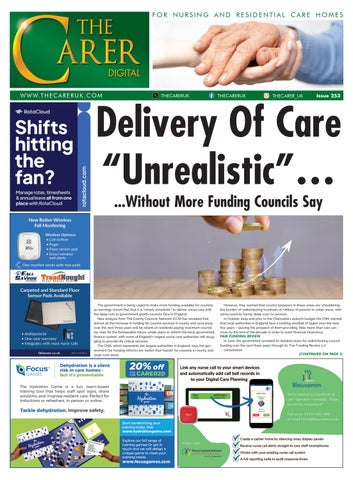
Delivery Of Care “Unrealistic”… ...Without More Funding Councils Say
The government is being urged to make more funding available for councils, as warnings mount that that it is “simply unrealistic” to deliver social care with the deep cuts to government grants councils face in England. New analysis from The County Councils Network (CCN) has revealed that almost all the increase in funding for council services in county and rural areas over the next three years will be reliant on residents paying maximum council tax rises for the foreseeable future, under plans to reform the local government finance system, with some of England’s largest social care authorities left struggling to provide life critical services. The CNN, which represents the largest authorities in England, says the government fair funding reforms are ‘better than feared’ for councils in county and large rural areas.
However, they warned that council taxpayers in these areas are ‘shouldering the burden’ of redistributing hundreds of millions of pounds to urban areas, with some councils facing ‘deep cuts’ to services. In October 2024 and prior to the Chancellors autumn budget the CNN warned that local authorities in England face a funding shortfall of £54bn over the next five years – leaving the prospect of them providing ‘little more’ than care services by the end of the decade in order to avert financial insolvency.
FAIR FUNDING REVIEW
In June, the government revealed its detailed plans for redistributing council funding over the next three years through its ‘Fair Funding Review 2.0’ consultation.
(CONTINUED ON PAGE 3)
PAGE 2 | THE CARER DIGITAL | ISSUE 253
EDITOR'S VIEWPOINT
Welcome to the latest edition of The Carer Digital!
PUBLISHED BY RBC Publishing Ltd 3 Carlton Mount 2 Cranborne Road Bournemouth Dorset BH2 5BR
THE FUNDING CRISIS WHEN WILL WE ACT? As I write this month's editorial, I'm struck by the stark contrast between the stories crossing my desk.
TELEPHONE:
On one hand, we've received a deluge of heartwarming accounts of summer fetes, fundraising triumphs, and staff
01202 552333
going above and beyond – stories that remind us why this sector is so special.
Editor
These tales of dedication and community spirit will feature
Peter Adams
prominently in next week's issue, celebrating the remarkable
EMAIL:
sales@thecareruk.com
people who make our industry what it is. Yet alongside these uplifting narratives sits a growing pile of
increasingly urgent reports about funding cuts and sector instability. The latest warning comes from the County Councils Network, revealing that England's largest social care authorities are bracing for deep cuts in government grants over the next three years. Council tax payers, they warn, will be left to foot the bill for forthcoming government reforms – a burden that feels increasingly unsustainable. This news follows January's stark warning from Hft and Care England in their Sector
and those needing care to bear the consequences of political indecision. The irony isn't lost on me that while we celebrate the sector's resilience and compassion in our pages, we simultaneously document its systematic underfunding. This isn't sustainable, nor is it fair to the dedicated professionals who deserve better than working in a system perpetually on the edge. Looking across the Channel, Germany's mandatory social care insurance system offers Contributors pay ring-fenced premiums for care costs, with additional services avail-
Pulse Check Report, which declared that the UK's adult social care sector is "teetering on the brink of collapse."
security that our current system sorely lacks. The proposal may have cost Theresa May
ment's own estimates suggest that one in seven adults aged 65 will face lifetime care costs exceeding £100,000 – a figure that should give us all pause. In May, we reported on the Health Foundation's analysis showing that adult social care in England needs an additional £3.4bn in real-terms annual funding by 2028-29 at the "bare minimum." To address unmet need, that figure rises to £6.4bn annually. Factor in the urgent need to tackle chronically low pay – a key driver of the recruitment and retention crisis plaguing our sector – and we're looking at £8.7bn in additional funding required. In my two decades editing THE CARER, I've witnessed countless reports, commissions, and proposals addressing social care funding. The Royal Commission of 1999 recommended personal care free at the point of use.
her parliamentary majority, but that doesn't make the underlying logic any less sound. The elephant in the room – as it has been for decades – is the fundamental question of how we fund social care for an ageing population. Every month of delay, every postponed decision, compounds the challenge. The warning signs couldn't be clearer, and the time for action couldn't be more urgent. Our sector's strength lies in its people – their compassion, dedication, and unwavering commitment to care. They deserve a funding system that matches their professionalism and recognises the vital service they provide. The question is: how much longer can we ask them to work miracles with inadequate resources? The stories of summer fetes and community spirit will always have a place in THE CARER because they represent the best of who we are. But unless we address the fund-
The Dilnot Committee's lifetime cap on care costs was accepted in legislation by the
ing crisis with the urgency it demands, we risk losing the very foundation that makes
Coalition Government but never implemented.
these stories possible.
Time and again, the can has been kicked down the road, leaving providers, families,
www.thecareruk.com EDITOR Peter Adams editor@thecareruk.com
one model worth serious consideration. able for those who choose to pay extra. It's not perfect, but it provides a foundation of
The language may seem dramatic, but the evidence continues to mount. The govern-
WEBSITE:
I can always be contacted at editor@thecareruk.com
The Carer is published by RBC Publishing Ltd, 3 Carlton Mount, 2 Cranborne Road, Bournemouth, Dorset BH2 5BR. Contributions are welcome for consideration, however, no responsibility will be accepted for loss or damage. Views expressed within this publication are not necessarily those of the publisher or the editorial team. Whilst every care is taken when compiling this publication to ensure accuracy, the publisher will assume no responsibility for any effects, errors or omissions therefrom. All rights reserved, reproduction is forbidden unless written permission is obtained. All material is assumed copyright free unless otherwise advised.
SALES DIRECTOR David Bartlett dave@thecareruk.com
PRODUCTION & DESIGN Matthew Noades PRODUCTION & WEB ADMIN Charlene Fox Published by
THE CARER DIGITAL | ISSUE 253 | PAGE 3
Delivery Of Care “Unrealistic” (CONTINUED FROM FRONT COVER) This included a set of new formulae to determine different councils’ funding needs and how much councils can raise in council tax. These permanent funding changes will be phased over three years, with ministers also expecting councils to raise council tax by 5% in each of the next three years to fund services through their ‘Core Spending Power’ (CSP) and support the transition of funding allocations. As a result of the proposed changes and the funding announced at the Spending Review, councils in county and rural areas could be overwhelmingly expected to meet yearly increases in the demand and costs of services through local taxation. • Some 22 county and rural unitary authorities will see grant funding increases totalling £845m. The analysis shows that even amongst those county authorities gaining from the reforms, they will be dependent on council tax rises to fund services. On average, these authorities will still derive 70% of their increase in CSP from council tax rises, with some as high as 99%. • However, some 16 authorities – including some in the midlands and the north – will see cuts in government funding totalling £470m. These authorities will see no increase in direct government funding, with all their increase in CSP derived from council tax rises. One third of council tax income raised in these areas over the three-year period is needed to offset cuts to funding and prevent them falling below a proposed 0% funding floor. • In total across the 38 county and unitary councils their grant funding will rise by just £374m, with 90% of the total increase in CSP for these councils coming through maximum 5% council tax rises. In contrast, almost 50% of metropolitan authorities’ new resources will come from additional grant funding, some £1.2bn over the next three years. • Overall, without council tax rises of 5% over the next three years, the analysis shows that 33 of the 38 county and rural unitary authorities would see a real-terms reduction in funding. Estimated new government grant will fund just 9% of the £4.4bn increase in costs of providing services in county and rural areas over the next three years, while the boost in government funding for metropolitan authorities will fund half of the total £2.4bn increase in estimated costs of providing services in these areas.
DISPROPORTIONATE BURDEN
CCN says it welcomes the proposals for a new ‘remoteness’ indictor and for a new formula for distributing funding for adult social care and home to school transport, which they say better recognise the needs of county and rural areas. The 38 rural and county authorities see their share ‘assessed needs’ – the estimated costs of providing services – increase from 34.9% in 2013/14 to 37.9% in 2026/27. However, despite some of the proposals being ‘better than feared’, CCN argues that the proposals place a disproportionate burden on council taxpayers in county and rural areas to fund local services and redistribute funding to urban areas. The analysis shows that £1.6bn in council tax income in county areas will effectively be redistributed across the country. This is because of a government decision to fully take account (“equalise”) of how much councils can raise in local tax to fund local services. The decision by ministers to move from the previous approach of equalising 85% to 100% of council tax receipts means 32 of the 38 county and rural authorities lose an additional £400m, overwhelming benefiting urban metropolitan boroughs. The network is calling for the government to revisit these proposals for full council tax equalisation, which the network says unfairly transfers previously raised local council tax to urban areas, while ‘weakening’ incentives for councils to build homes.
RISING COSTS
CCN also argues that insufficient resources were made available at the Spending Review to implement
changes of this scale and nature, with those worse impacted facing cuts in government funding which will result in reductions to services and could even threaten their financial sustainability. Those seeing modest funding increases will still face an extremely challenging funding outlook, they argue, with rising costs outstripping new funding. CCN says it is ‘simply unrealistic’ to expect some of England’s largest social care authorities to provide life critical services while receiving deep cuts in government grant over the next three years. To prevent this while ensuring those county authorities than gain from the reforms do not lose out, the network is calling on the government to provide significantly more government funding to ensure county and rural authorities do not witness unsustainable cuts to services and reduce the reliance on council tax to prop up these reforms.
WELCOME UPLIFT
Cllr Tim Oliver, Chairman of the County Councils Network, said: “Reforms to the way council funding is distributed are long overdue, and we welcome the government’s proposals for new formulae for distributing funding for adult social care and home to school transport. Alongside an adjustment for the costs of delivering services in rural areas, this means the funding reforms are better than many of our councils feared, with some seeing a welcome uplift in funding.” “However, some 16 county and rural councils across the length and breadth of the country will see reductions in grant funding, while the governments proposals place a disproportionate burden on council taxpayers in county areas to fund local services and redistribute funding to urban areas. Those facing cuts in government funding will inevitably have to reduce vital frontline services, while the reliance on council tax rises leaves even those with modest funding increases facing an extremely challenging funding outlook.” “There is still time for government to rethink this and reduce the pressure on county taxpayers. It is simply unrealistic to expect some of England’s largest social care authorities to provide life critical services while receiving deep cuts in government grant over the next three years. It is therefore vital the government makes more money available to further mitigate the impact of these reforms.” “Importantly, the government should also revisit its proposals for full council tax equalisation. While we recognise the need to take account of how much councils raise in local taxation, the government’s proposals to fully equalise unfairly redistribute hundreds of millions of local council tax to other areas, while weakening the incentive to build homes.”
PLAN FOR CHANGE
A Ministry for Housing, Communities and Local Government spokesperson said: “We do not recognise the (CCN) analysis. The current, outdated way in which local authorities are funded has left communities behind and damaged local services. “This must change and is why we are taking decisive action as part of our Plan for Change to reform the funding system so we can improve public services, while maintaining the previous government’s referendum threshold on council tax rises so taxpayers have the final say and are protected from excessive increases.”
ILL-THOUGHT OUT
Liberal Democrat local government spokeswoman Vikki Slade said the reforms could be severely detrimental to some areas. Ms Slade said: “Councils across the country are already teetering on the edge after years of Conservatives’ neglect of local funding and services – from bus services cuts in rural areas to the rising costs of social care. These ill-thought-out reforms only risk leaving parts of the country significantly worse off. “To truly help local authorities, the government should urgently look at supporting councils who receive
PAGE 4 | THE CARER DIGITAL | ISSUE 253
CQC Reform Must Put Response Before Perfection By Nythan Smith, Principal Associate at law firm Weightmans, examines how care providers can stay inspection ready as the CQC undergoes reform and the sector faces mounting pressures (https://www.weightmans.com) Care providers across the UK are under mounting pressure. Restrictions on overseas recruitment have tightened an already fragile workforce pipeline, the promised funding uplift will not arrive until 2028–29, and local authorities remain under severe financial pressure, with adult social care already consuming over 40% of local authority spending. Many councils facing these financial realities are closing or selling care homes to cope, leaving providers focused on simply keeping services running. In this environment, it’s no surprise that preparing for Care Quality Commission inspections often falls to the bottom of the priority list. With CQC reforms underway, strengthened by Government backing, inspection preparedness has never been more important.
A SHIFT TOWARDS CONTINUOUS ACCOUNTABILITY
As the regulator moves away from fixed inspection cycles towards a model based on continuous insight and real-time feedback, care homes may find inspectors arriving unannounced, with little or no prior warning. This places greater scrutiny on how providers respond when issues emerge. The bottom line is that these reforms will usher in significantly greater oversight, and with that, a clear expectation that care homes should demonstrate enhanced accountability between inspections.
RESPONSE OVER PERFECTION
Care is a complex environment where mistakes will happen. Medication errors, complaints, or an isolated interaction that falls short cannot be eliminated. What matters is the leadership response. Inspectors look closely at three things: how quickly a provider acts, whether the response is robust enough to prevent recurrence, and how effectively the message is communicated both internally and to regulators. Providers who treat each incident as the most important issue in that moment, rather than deflecting or delaying, are those who build credibility. Readiness is not about flawless records. It is about showing transparency, accountability and resilience when pressure comes.
THE INSPECTION REALITY
There is no one-size-fits all approach to inspection readiness. Anyone who claims otherwise is being
disingenuous. Larger providers often appear better equipped, with dedicated quality teams and the capacity to run mock inspections. Yet even with these advantages, issues are still missed. Smaller providers, with fewer resources, are often more exposed, but their intimate knowledge of their homes and services can be a strength in its own right. Every setting is different. What matters is not a promise of perfection, but the ability to demonstrate readiness through focus, clarity, and a willingness to confront issues head-on. The real differentiator is how a service responds when something goes wrong.
PRACTICAL ACTIONS
Inspection preparedness cannot be a last-minute scramble; it must be embedded in the daily life of a service. That means maintaining accurate and accessible records at all times, ensuring staff feel safe to raise concerns from the outset, and embedding quality improvement as a continuous discipline. Local authority support can help, but it is no substitute for leadership taking ownership. Responsibility for improvement cannot be outsourced. Clear, documented processes for complaints and incidents matter, but what matters more is being able to demonstrate that those processes are consistently followed in practice.
AVOIDING COMMON PITFALLS
Several recurring mistakes undermine otherwise strong services. Fewer inspections do not mean reduced scrutiny; concerns raised by data, complaints or external reports can trigger a visit at any time. Generic checklists, often divorced from the real context of a service, create false reassurance and risk exposing gaps. Withholding context is equally damaging. Giving inspectors the full picture early helps prevent premature conclusions. And in a climate where multiple regulators and authorities may request information simultaneously, providers must have evidence organised and accessible to avoid disruption.
READINESS IS STILL A PROVIDER’S RESPONSIBILITY
Policy constraints - such as the overseas workers ban – along with funding delays and workforce shortages, make inspection readiness more difficult. But they do not remove responsibility. Local authorities can support, but they cannot substitute for provider accountability. Readiness does not depend on perfect conditions. It depends on professionalism, transparency and resilience in the face of inevitable challenges. The situation may be tough, but providers who embed these qualities will be better placed to demonstrate credibility when the regulator calls. Ultimately, providers know their services better than anyone else. That knowledge, combined with transparent and accountable responses, is what will stand up under scrutiny.
Westwood’s Summer Fayre Raises a Fantastic £900 for Residents’ Fund Westwood Care Home, part of the Runwood Homes Group, held its much-loved Annual Summer Fayre which brought the whole community together. The event was held in the beautiful garden grounds of Westwood, featuring a variety of stalls, delicious refreshments, and a bustling café area filled with homemade cakes and treats. The atmosphere was vibrant and joyful throughout the day, with music, and community spirit filling the air. The home had an incredible turnout and overwhelming generosity of attendees, which helped raise £900 for the Residents’ Fund. This fund supports activities, outings, and extras that help residents live life to the fullest.
“Everyone who came to our Summer Fayre said how brilliant it was,” said Natasha, Lifestyle Coordinator at Westwood. “It means so much to see people come together and support what we do for our residents.” "It was amazing to see everyone come together as a community," added Chloe. “Days like this show the true spirit of Westwood.” Events like the Summer Fayre are a long-standing tradition at Westwood Care Home, playing a vital role in connecting residents with the community while raising essential funds. Natasha and Chloe would like to extend heartfelt thanks to everyone who supported the event and helped make it such a memorable day.
®
How pobroll Is Transforming Bed Bathing for Dementia Patients: Insights from 10 Care Homes
Written by Pat O’Brien of pobroll
In April 2025, the Supporting the Provider Market (STPM) team in County Durham published a new report evaluating the use of pobroll® — a waterproof bed-bathing wrap designed to improve dignity, comfort, and ease during personal care. This evaluation was carried out across 10 care homes with high numbers of residents living with dementia. Each setting was given one or more pobroll® units and invited to share feedback through a structured survey. The findings reveal how even simple tools can make a significant difference in everyday care.
How was pobroll® used?
Most care homes used pobroll® daily or several times per week, showing it quickly became part of regular practice. Staff noted that one of the biggest challenges was not having enough units — all homes requested additional stock after the trial, highlighting a clear appetite for wider adoption.
What did care teams think?
Feedback from the care homes showed strong support for the tool: • Ease of use was rated highly, with an average score of 4.4 out of 5. Staff found pobroll® straightforward to incorporate into care routines. • Training was rated slightly lower, at 3.8 out of 5, suggesting that while the wrap is easy to use, additional training resources could improve onboarding for new users. • Resident response was positive. Three in ten care homes reported improved mood or behaviour during bed
bathing for dementia patients. • Key benefits included greater warmth, coverage, and dignity for residents, especially those who might find conventional methods distressing. Some teams also found it particularly useful for end-of-life care
Would they recommend pobroll® for bed bathing for dementia patients?
Absolutely. Homes rated their likelihood to recommend pobroll® at 4.3 out of 5, with half of respondents giving it a full 5 out of 5. The overall feedback was clear: this is a valued, meaningful addition to personal care. Would they recommend pobroll® for bed bathing for dementia patients? The results of this trial reinforce what many professionals already believe — that small, thoughtful design changes can significantly improve care. For residents who are bedbound or living with dementia, personal care can often be a distressing experience. But with the right tools, it doesn’t have to be. The pobroll® isn’t a complex device. It’s a simple, dual-layered cotton towelling wrap. But its thoughtful design — offering full coverage, comfort, and support — makes a real difference where it matters most. If you’re part of a care home, hospice, or hospital and would like to explore how pobroll® could benefit your residents or service users, get in touch. We’re here to support compassionate, dignified care — one small change at a time. See the advert on the facing page for details, or visit www.pobroll.co.uk
THE CARER DIGITAL | ISSUE 253 | PAGE 5
Providers Unite To Protest At The Labour Conference In Liverpool Care providers across the UK are preparing to descend on Liverpool for a major demonstration during the Labour Party Conference on Monday, 29th September 2025, marking the second significant protest organised by Providers Unite this year. The “Backbone of Care Walk” will commence at 11:30am from Liverpool Cathedral’s Upper Parliament Street entrance, concluding at the Royal Albert Dock at 2:30pm. Organisers have ensured the route is fully accessible, being stepfree and wheelchair-friendly with designated rest points along the way. This follows February’s powerful demonstration outside the Houses of Parliament, which THE CARER editor Peter Adams attended alongside thousands of care sector representatives. That earlier protest featured impassioned speakers who delivered a damning assessment of the nation’s adult social care sector, making national headlines and demonstrating the collective strength of the sector’s voice. “The care sector is the backbone of our society but it is under crisis,” stated Providers Unite in their call to action. “We are calling on every care provider, worker and ally to come together and march for urgent reform of the UK’s care system.” The February Westminster demonstration saw thousands gather to demand change for social care, with participants “green carding” MPs to highlight the sector’s critical needs. The protest succeeded in capturing national media attention and put a spotlight on the urgent reforms required across the care system. Now, Providers Unite is mobilising the sector once again, this time targeting the Labour Party Conference
to ensure the new government cannot ignore the escalating care crisis. The organisation emphasises that they “will not stop until the care system gets the reform it desperately needs.” The Liverpool demonstration represents a strategic shift in the campaign, bringing the sector’s concerns directly to the governing party’s annual conference. With the care sector facing ongoing challenges including funding pressures, staffing shortages, and regulatory demands, providers are using this high-profile platform to demand urgent government intervention. Registration for the event is open through the Providers Unite website, with organisers encouraging participants to register exact numbers or best estimates to help build “the biggest wave possible.” The group has scheduled preparatory meetings including a members’ meeting on 2nd September and a rally briefing on 24th September. The timing of the protest coincides with heightened scrutiny of the adult social care sector’s sustainability and the government’s commitment to addressing long-standing systemic issues that have left many providers struggling to maintain quality services. As one of the UK’s largest employment sectors, adult social care supports hundreds of thousands of vulnerable individuals across residential and nursing homes, domiciliary care services, and supported living facilities. The sector’s representatives argue that without immediate government action on funding and reform, the crisis will only deepen, potentially compromising care for those who need it most.
Care Home Holds Alice In Wonderland Summer Fete Ashfields care home in Rackheath held its summer fete “Ashfields in Wonderland”. Residents and the local community enjoyed a fun packed event. There were live entertainments, a special “Ashfields in Wonderland” menu, activities
and even a visit from local Alpacas. Nita Pulmones General Manager said “it is so important that we plan events that are open to our local community. Our Residents love to have visitors to the home and enjoy the time they spend making new friends.”
PAGE 6 | THE CARER DIGITAL | ISSUE 253
The Hidden Struggle: Menopause and Its Impact on UK Carers By Sharon MacArthur at Miss Menopause (www.missmenopause.co.uk) Menopause is a natural biological transition yet its impact on working life, particularly in the UK’s caring profession, is often overlooked. With a workforce predominantly made up of women, many of whom are in their late 40s and 50s, the effects of menopause are deeply felt across the health and social care sectors.
A WORKFORCE AT RISK
In the UK, nearly four million women aged 45 to 55 are in paid employment. In the adult social care sector alone 82% are female, with many employees in the menopausal age range. Despite this, menopause often remains a taboo topic in many workplaces, leading to a lack of support and understanding and a ticking time bomb which seems to be often ignored. A recent government report revealed that over 3/4’s of women will experience menopause symptoms, with nearly a quarter describing them as severe. These symptoms range from hot flushes, insomnia to anxiety and brain fog can which can significantly affect job performance, confidence, and overall wellbeing. Many women I have worked with often believe they have early onset dementia. Imagine how terrifying that might be when you are caring for others and some days you can’t even remember your own name!
the job they’ve worked so hard to get. It’s crazy that organisations risk losing some incredible female employees because of a lack of understanding about something that 100% of them will go through. In adult social care, some organisations are beginning to respond. The Skills for Care guidance outlines practical steps for managers, including creating menopause policies, offering flexible working arrangements, and establishing support groups and training for all. These initiatives not only improve wellbeing but also help retain experienced staff in a sector already facing recruitment challenges. Cultural and social factors can influence how menopause is perceived and managed. Studies show that negative stereotypes about older women can exacerbate the psychological impact of menopause, leading to further isolation and stigma. This means education and training for everyone should be built into any future plans to ensure menopause becomes business as usual.
NOT JUST ABOUT POLICIES
Speaking of policies, you don’t need to reinvent the wheel, just repurpose what you already have. A beautiful policy won’t make the difference to your people, but a great conversation will. That’s why education for all is the key. I see a lot of businesses introducing mental health awareness training, yet the link is often not made between the menopause and the effects it can have on mental health. This is despite the fact that anxiety can be one of the most commonly reported menopause symptoms.
A CALL TO ACTION
The caring profession is built on empathy, compassion, and resilience qualities that must extend to its own workforce. Employers have a legal and moral duty to support staff through menopause, not only to comply with health and safety and equality legislation but to foster a culture of dignity and respect. As the population ages and the demand for care increases, supporting menopausal workers becomes not just beneficial but essential.
THE COST OF SILENCE
CONCLUSION
The consequences of ignoring menopause in the workplace are substantial. According to a 2025 review by the Department for Work and Pensions, menopause-related issues cost the UK economy approximately £191 million from absenteeism, and £22.4 million from presenteeism. Keeping and retaining staff is crucial in this sector. With an ageing workforce, becoming menopause aware is essential if you want to be an employer of choice. The review found that 44% of women said their ability to work had been affected, with 14% reducing their hours, 8% avoiding promotions, and 10% considering leaving their jobs altogether. Could you afford to lose 10% of your workforce? Women fear being seen as less competent, and many lose the belief completely that they can actually do
Menopause is a workplace issue that can no longer be ignored, especially in the UK’s caring professions. With the right policies, education, and support, employers can transform the experience of menopause making sure staff retention and wellbeing are at the heart of what they do.
MY MISSION
To make menopause business as usual for everyone in the workplace If you’d like to find out more, contact me at sharon@missmenopause.co.uk Sharon MacArthur founded Miss Menopause over 7 years ago in response to the lack of information about menopause in the workplace. Sharon has appeared on UK BBC Breakfast, ITN News, Channel 5 and Victoria Derbyshire and is a regular on UK BBC Radio taking about the subject of menopause.
Local Care Home Presents Cheque To Local Lad Ashfields care home in Rackheath recently presented Leon D’Souza with a cheque for £386 to help with essential alterations to his home. Leon lives with a rare condition Duchenne Muscular Dystrophy. Duchenne is a rare and fatal progressive muscle wasting condition for which there is currently no cure. The care home raised the monies at a number of events including a charity Quiz and Chips night, Ashfields Summer Fete and the homes monthly Dementia Café. Nita Pulomnes the General Manager at Ashfields, said: “We are always keen to show as much support as we can to our local community and the icing on the cake was when
Leon and his family took the time out to visit our team at Ashfields to accept our donation” For more information you can find Leon on Go Fund Me “Support Leon living with Duchenne Muscular Dystrophy” Ashfields is run by Barchester Healthcare, one of the UK’s largest care providers, which is committed to delivering high-quality care across its care homes and hospitals. Ashfields Care Home provides residential care, dementia care and respite care.
Biggest Isn’t Always Best – Especially in Continence Care In retail, bigger is often equated with better. But in continence care, size alone does not equal performance. What matters is fit, appropriateness, and clinical suitability. At Ontex, we believe continence care should be clinically sound, cost-conscious, and centred on the individual. We support care providers through practical training, formulary-aligned product design, and assessment-led solutions that preserve dignity and comfort. Addressing Common Misconceptions in Care Settings Here are some frequently encountered misconceptions about absorbent continence solutions:
1. "The bigger the resident, the bigger the pad."
This is a frequent misunderstanding. Correct sizing depends on accurate waist, hip, and thigh measurements. In many cases, a smaller, well-fitted solution provides better containment. Selection should also be based on the individual’s continence profile and type- not just physical stature.
2. "Belted products fit anyone if tightened enough."
Tightening at the waist does not guarantee security around the legs. A proper fit should allow a one-finger gap at the leg and a two-finger gap at the waist. Belted options are often higher-cost items and should be used only when clinically appropriate.
3. "Double padding keeps residents drier."
Layering pads undermines containment. Once fluid reaches the
waterproof backing of the upper pad, it is diverted laterally often leading to leaks, moisture-related skin compromise, and reactive containment changes that increase staff burden. A single, well-matched product is always the safer choice.
4. "Pull-ups are the best option for everyone."
Pull-on formats suit some profiles but may hinder others. They are not ideal for individuals with reduced dexterity or limited mobility. Two-piece systems offer greater flexibility and allow for the use of personal underwear—supporting comfort, autonomy, and dignity.
Why Assessment Is Essential
A thorough continence assessment rather than assumption-based product selection is key to improving outcomes, optimising cost, and protecting resident wellbeing.
Key Assessment Components:
- Measurements: Capture accurate waist, hip, and thigh data. Always refer to product-specific sizing guidance. - Bladder Diaries: Maintain a 3-day fluid intake and output record to determine actual absorbency needs. This often reveals a lighter option may suffice. Clinical and Operational Benefits: - Prevents unnecessary product usage - Reduces reactive containment changes - Minimises moisture-related skin issues and infection risk
- Improves comfort, dignity, and independence for residents Our guidance aligns with NHS England policy on absorbent containment: assessment-led provision, a maximum of four pads per 24 hours unless clinically justified, and prioritisation of adaptable two-piece systems wherever appropriate.
Broader Considerations - Infection Risk: Continuous use of containment products without regular reassessment can increase the likelihood of urinary tract infections. A structured, assessment-led approach helps mitigate this risk. - Skin Health: Selecting the right containment format supports skin preservation. Regular skin checks should accompany each pad change. - Cost and Resource Efficiency: Product selection tailored to individual need reduces waste, optimises staff time, and supports broader NHS resource stewardship. NHS formularies consistently prioritise flexible, fit-for-purpose solutions.
Final Thought In continence care, assumptions cost more than time they impact dignity, safety, and outcomes. Assessment-led, evidence-based selection reflects best practice and ensures the right solution, for the right person, at the right time. Want to support your team with continence product fit checks or product training delivered by our Nurse Advisors? Ontex provides practical resources and training, tailored to your care setting. Contact your local nurse advisor to arrange a session. For further information visit www.ontex.com, email shopuk@ontexglobal.com or call 01536 269744
THE CARER DIGITAL | ISSUE 253 | PAGE 7
NHS Supporting Record Numbers of People Living with Dementia A record half a million people have received a dementia diagnosis on the NHS, as the health service ramps up support for the country’s biggest killer. New NHS figures published this week show 506,549 people have received a dementia diagnosis, compared to 490,163 this time last year. NHS hospitals are using the latest technology to help keep people living with dementia safe in their homes, as the health service delivers on the 10 Year Health Plan by offering care close to home. Imperial College Healthcare NHS Trust has launched a new at-home monitoring service, called MinderCare, to spot signs of changes in health needs and potentially reduce unnecessary hospital admissions. The devices, which include sensors on bed mattresses, household appliances and doorways, mean clinical teams can track whether a patient is still managing their daily routine, responding well to medication and even signs of potential infection. Family members report the new devices have given them “peace of mind” when leaving their loved one alone and mean any signs of deterioration can be easily spotted and care plans tweaked. The service is underpinned by over a decade of research in partnership with the UK Dementia Research Institute at Imperial College London and supported by funding from the National Institute for Health and Care Research (NIHR) Imperial Biomedical Research Centre, which supports research which translates scientific discoveries into potential new technologies, treatments and tests that can have a real benefit for patients. Nationally, the NHS offers care plans or reviews and medication reviews with 330,460 people receiving the former and 114,447 the latter in the last year. England’s top dementia doctor encouraged people concerned that their loved ones may be at the early stages of the disease to get tested. A timely diagnosis for dementia is vital so more people get the support and care they need to live with the illness. Dr Jeremy Isaacs, national clinical director for dementia, NHS England, said: “Thanks to patients and families coming forward, and the hard work of NHS staff, we have a record more than half a million people diagnosed with dementia, many of whom are living in their own homes with support from family and friends. “MinderCare is a great example of the NHS trialling cutting-edge technology to help more people to live safely in their own homes. “As families gather this bank holiday weekend perhaps for the first time in months, it’s an opportunity to spot the signs of dementia. “There are lots of reasons why people might be forgetful or absent-minded but it could be the sign that something is wrong. “Issues that may not have been obvious previously such as forgetfulness, difficulty making plans, or wordfinding problems may be easier to spot when families or friends across the country get together for an extended period. “Getting a diagnosis of dementia is the first step in supporting people, with a wide range of NHS services able to help.
“If you have noticed that someone has symptoms, please encourage them to visit their GP for an assessment – the sooner someone is seen the quicker the NHS can help.” Kieran Winterburn, Head of National Influencing at Alzheimer’s Society, said: “A third of people living with dementia in England are undiagnosed. We understand that getting a dementia diagnosis can feel overwhelming, but we believe it’s better to know. An early and accurate diagnosis can unlock access to crucial care, support and treatment – helping people manage their symptoms and avoid reaching crisis point. “It’s promising to see more people receiving a dementia diagnosis, and we must keep up this momentum. The 10-Year Health Plan and the development of a new national framework on dementia are crucial opportunities to transform how dementia is diagnosed, managed and treated. “Alongside that, we also need to see continued bold, ambitious action and investment not just in innovative technology that supports people once diagnosed, but also in the tools and people needed to diagnose more people in the first place.
WE NOW SUPPLY A WIDE RANGE OF FURNITURE
PAGE 8 | THE CARER DIGITAL | ISSUE 253
‘Hope For All Ages’ Report Sets Out Ways To Leave The World A Better Place By 2050 United for All Ages is a ‘think-do’ tank founded in 2010 to create a ‘Britain for all ages’, tackling big social and economic issues such as loneliness, ageism, care, health, housing and learning has launched a manifesto calling calls leaders to swap short-termism and division for vision and togetherness with action globally, nationally and locally. Hope for All Ages’ outlines a vision for a better future which can be reached through intergenerational collaboration, fairness and strategic action. It highlights three key themes:
THE REPORT PROMOTES THREE KEY THEMES:
• Connection and Interdependence: Emphasising the importance of intergenerational interaction in homes, workplaces and communities to combat age segregation and foster shared concerns. • Fairness for All Generations: Advocating for addressing inequalities, rethinking wealth distribution, and creating policies that benefit all age groups. • Thinking Big: Calling for bold leadership and long-term strategies to tackle global challenges like climate change, housing and social cohesion.
THE HOPE FOR ALL AGES VISION FOR 2050 INCLUDES:
• Global Commitments: Collaboration for peace, sustainable development, and climate action. • Policies for All Ages: Tax reforms, intergenerational equity indexes, and universal care systems. • Fairness: Ending age-related inequalities, improving health literacy, and supporting children and older adults. • Places for All Ages: Building mixed-age communities, intergenerational housing and shared spaces. • Opportunities: Transforming education, valuing care, and fostering lifelong learning.
TO ACHIEVE THESE GOALS, THE REPORT PROPOSES STRATEGIC ACTIONS SUCH AS: • Promoting intergenerational living and interaction. • Addressing housing affordability and build inclusive communities.
• Reforming education to focus on creativity, empathy, and real-world impact. • Supporting universal care systems and lifelong learning. • Using technology to bridge generational divides and foster connection. The report highlights issues like age segregation where Britain is cited as one of the most age segregated countries in the world, and growing social isolation and economic inequality. Solutions include promoting mixed-age communities, affordable housing, intergenerational activities, and policies that prioritise fairness and connection. United for All Ages urges governments, organisations and individuals to adopt intergenerational strategies, embed fairness in policymaking, and foster hope for future generations. It emphasises the importance of imagining a better world to make it a reality. Stephen Burke, Director of United for All Ages, said: “Hope for All Ages offers a manifesto for change, with 50 ways to leave the world a better place by 2050. “We currently live in volatile times. Unpredictable, untrusting, uncertain. Young people face insecure futures as the first generation to be worse off than their parents. Many feel powerless, unable to influence or change their world. Without hope.” “It doesn’t have to be this way. United for All Ages has always been an optimistic social enterprise, bringing people of different ages together, mixing and sharing with common purpose, while tackling big social issues from ageism and loneliness to care, work, housing and learning.” “Having hope can change the way we approach the future. Sharing that hope across generations and for future generations will make us all stronger in our homes and our communities, our country and our world.” “We can build on the UN Declaration on Future Generations and the Well-being of Future Generations Act in Wales to work with political leaders at all levels to end age segregation and create a fairer, economically and socially just world.”
All Aboard! Horndean Care Home Resident Reconnects With Lifelong Passion A resident at a Horndean care home has rekindled her love for life below the waves with a surprise trip to a local museum. Rowena Kinsella, 99 and resident at Care UK’s Pear Tree Court on Portsmouth Road, has always had a passion for submarines and even married a submariner in her late husband, Richard Kinsella. Keen to revisit her passion, the care home team arranged a surprise trip to the Royal Navy Submarine Museum in Gosport, where Rowena enjoyed exploring the different models and reading about the crews and how they managed the boats. Eager to share her late husband’s own experience as a mariner, Rowena discussed with team members at the museum about Richard’s time fighting alongside US forces during the second world war. Commenting on her visit, Rowena said: “I really enjoy history, so I was in my element looking at the history of the submarines and how they used to run. It is interesting to have a look at life on the submarines and to see how the people on board had to live. The food rations and living quarters. I also enjoyed looking at all the submarines in and around the museum and getting to go inside some of them.” Rowena was joined by fellow residents Peter Ambrose, 81, and Peter Moonan, 72. Peter Ambrose, who
received an OBE for his service as a commander in the Royal Navy, enjoyed climbing aboard one of the largest submarines on the site, while Peter Moonan was surprised to find a photo of his own crew in the museum. He named all his past friends and remembered watching the photo being taken. The visit was part of Care UK’s Wishing Tree initiative, which encourages residents to put their ambitions forward, allowing them to reconnect with a past hobby or try something completely new. Aimee Sparks, Home Manager at Pear Tree Court, said: “It was fantastic to see residents reminisce about their own experiences with submarines and enjoy a great day out at the museum through a shared passion. “It’s incredibly important to us that they live independent and rewarding lives and have opportunities to reconnect with their past experiences and passions. “We would like to thank the team at the Royal Navy Submarine Museum for helping make Rowena’s wish come true – the residents haven’t stopped talking about it since we returned home!”
Care Home Development Begins At Apley Telford Work is underway on a new, state-of-the-art care home in Apley, Telford- the first project in the joint venture between Morrison Community Care Group and MBL (APLEY) Devco Limited. The 81 bedroom is the first step forward in the partnership’s ambition to transform underutilised sites into high-quality care environments that respond to the UK’s ageing population and the growing pressure on health and private care services. Apley is one of four sites currently under construction by the Morrison Community Care Group across England, with others progressing in Ewell, Enfield and Epping. Using Off Site Manufacturing techniques this will be Morrison Community Care’s fasted build to date. Each care home delivered through the partnership supports around 100 jobs across construction and operation, and each brings together a wide range of amenities to support residents, including private en-suite bedrooms, cinema rooms, a hair salon, champagne bar, and dining
rooms with meals prepared by professionally-trained chefs. Paul Sokhi, Managing Director of Morrison Community Care Group, added: “We are delighted to see Apley move forward. Working with MBL and our appointed design team – comprising Chapman Taylor , Design Me, Cowal Design, and CRGP – we’ve been able to create environments that offer safety, comfort and quality of life for residents, while also enabling regeneration and reinvestment in community assets.” Stuart Gray spokesman for MBL said: “We are delighted that our first Care Home project is in partnership with Morrison Community Care who continue to set a benchmark for the delivery of modern, energy-efficient care homes across the UK. We are particularly proud that these projects are created using the extent of our knowledge of Off- site manufacturing, ensuring quality and speed of delivery, while delivering much-valued community assets. “We look forward to working alongside the Apley community over the months ahead.”
THE CARER DIGITAL | ISSUE 253 | PAGE 9
Care Dorset Appoints New NonExecutive Director For Clinical Matters Adult social care company Care Dorset has appointed Dr Felix Davies as its new NonExecutive Director, to support the organisation in strengthening governance of clinical and therapeutic matters, it was announced today (Monday, August 18). Care Dorset is a local authority trading company of Dorset Council, meaning it is independent and able to act commercially, but wholly owned by the council. Dr Davies is a Registered Practitioner Psychologist, and began his NHS career as a clinical psychologist before becoming Director of Psychological Services in two NHS Trusts. Previous senior roles include Chief Operating Officer at a large UK adult social care company, Managing Director of Mental Health at the charity Turning Point, and CEO at POhWER, which provides advocacy to people in the health and social care system. Dr Davies said: “I really like the way Care Dorset talks about the social care challenges
– grasping nettles that need to be grasped. “We need to be thinking about Reablement and Extra Care, rather than just more care homes. I like that Care Dorset is open, assertive and innovative about reaching for these solutions. “Clinical matters are a key area to oversee. Social care is very dependent on the system in which it operates – the NHS, charities and private providers – and I have fostered partnership working in all of these settings.” Care Dorset employs almost 800 colleagues, offering care and support to around 900 people across 23 services, plus door-to-door outreach. Dr Davies added: “Meeting the challenges of an expanding and ageing population will need creativity – which I have already seen at Care Dorset, and I’m optimistic we can meet the challenges.”
“Patience And Give And Take” Say Resident Couple Who Celebrate 68th Wedding Anniversary A resident couple living at a Hastings home marked their 68th wedding anniversary and say the secret to a long marriage is patience and give and take. Pat and Reg Douglas both live at MHA Lauriston and celebrated their 68th wedding anniversary with an intimate party. The home arranged for Reg to receive his favourite chocolates and some flowers for Pat on their special day. The couple lived in Ifield before moving into MHA Lauriston in December 2024 and have two children Julia and Stuart. Reg worked as an engineer and specialist instrument worker whilst Pat worked in administration. Staff at the home decorated their room with banners and balloons and the kitchen team prepared a celebration cake for the two. MHA Lauriston provides residential, nursing and residential
dementia care for 60 residents Emma Lawlor, activity coordinator said: “We wanted to make sure we marked the wedding anniversary for the two as it is a big achievement. “Both of them don’t really like a fuss, so we made sure the celebrations were low key. “They had a wonderful day and were very appreciative of the work staff had done for them. “Their granddaughter and great grandchild came to visit them on the day which was really nice for them. “They are an adorable couple, when I asked them what their secret to a long and happy marriage was, they both replied you have to have patience and there needs to be some give and take.”
Manufactured in the UK
Freephone: 0800 917 7943 www.euroservice-uk.com sales@euroservice-uk.com
PROVIDING PRACTICAL AND STYLISH TROLLEYS TO SUIT YOUR NEEDS Watch your resident's eyes light up when the beautiful tea trolley arrives! Euroservice trolleys can also be used as a vending trolley or to sell personal care products to residents. How about a delicious snack/pastry trolley or even a drinks trolley for that afternoon tipple?
Your lovely trolley could do so much for you and your residents! Euroservice trolleys are an attractive and practical alternative to clinical aluminium trolleys given that antibacterial spray can be used freely to sanitise them.
Get in touch with our friendly, experienced sales team
Visit the website at
www.euroservice-uk.com to see the full range.
PAGE 10 | THE CARER DIGITAL | ISSUE 253
Gateshead Care Home Worker Sarah Johnson Shares Typical Day In The Life As A Care Home General Manager Running a care home is about far more than managing paperwork or staff rotas. It’s about leadership, compassion, quick decision-making, and, above all, presence. Being the manager Craigielea Care Home in Gateshead means each day begins before most people have started their first cup of tea and no two days are the same. My morning starts at 8 a.m. sharp, often earlier if the home has had a particularly busy night. The very first task is always a debrief with the night staff. Even though it is swift, it is a vital handover, even if there were no major incidents, the smallest change in a resident’s behaviour or sleep pattern can be important and I will review the night handover notes. We need to stay on top of everything. After this quick but thorough exchange, the day gets into full swing with a round of paperwork, catching up on reports from the night shift or, if it’s Monday, reviewing records from the weekend. Time is of the essence, but efficiency is key. Shortly after, it’s time for the daily meeting, a core routine that sets the tone for the entire day. All available staff gather to share updates on residents, discuss staffing issues, raise concerns, or flag anything that might impact the day ahead. Staff organization and communication underpin the smooth running of any care setting, and here at Craigielea it is no exception. Whether it’s welcoming new admissions, supporting staff through personal challenges, or implementing care plans, a large part of my day revolves around making sure the team is supported and fully informed of all goings on, however big or small. I really enjoy the daily meetings; it’s always a highlight of my day. I like to always have an overview of what’s going on and it’s always nice to get time with the staff. Another essential part of my day is speaking with families. Whether it's giving updates, discussing changes in care, or answering questions, a big chunk of time is spent on the phone or in person with loved ones. Tailored care planning is a critical area where attention to detail can change lives. Each resident has a personalised care plan that adapts to their evolving needs whether medical, emotional, or social and it’s not just about clinical needs, it’s about their routines, preferences, fears, and what makes residents happy. Even small details like knowing how someone takes their tea can make a huge difference to their quality of life.
As can just being there for loved ones and relatives during what can be a very turbulent time for a family. They need compassion and to know their loved one is safe and happy. By mid-morning, I do my walk-around of the home. This isn’t just a visual check to make sure everything is in its place, it’s a chance to talk with residents, staff, and occasionally visiting family members. It’s also my favourite part of the day because there is something so special about seeing everyone face-to-face. You get a real sense of the atmosphere and get an overarching view of everything that is going on which you can’t get from just sitting in the office. This kind of visibility and approachability is vital. I have an open-door policy meaning anyone, staff or resident, can pop in for a conversation at any time. Whether it’s a quick query about shift cover or a resident wanting to chat about their day, my office is always an open and it’s that openness that is crucial to how I work as a manager. Afternoons are usually a mix of administrative tasks updating care plans, managing rotas, responding to emails and more meetings. Whether it’s staff one-to-ones, multi-disciplinary reviews, or inspections, my calendar is rarely empty, and it definitely keeps me busy. The demands on care home managers are high, but the structure of the day helps keep everything on track. Organisation is everything. We need systems, yes, but it’s also about adaptability. If a resident has a fall, or a staff member calls in sick, priorities shift instantly, and you need to be able to balance it all efficiently. Teamwork is fundamental to managing those shifting priorities. At Craigielea, the team blends well, which I believe is the key to our successes as a home and our performance in external review. No matter what role someone plays, we all contribute to the same mission giving residents the best care and quality of life possible. And new starters are welcomed just the same. Everyone’s input matters and nobody is left out. Throughout the day, dignity and respect remain the highest importance, and we all work to ensure every interaction is compassionate and person-centred. There’s a lot of responsibility that comes with the job, there’s no doubt about that but when a resident recognises your face, or smiles when you say hello, it reminds you why we do what we do. You’re part of their home. As the day winds down, I can start planning for the evening shift updating handovers, checking logs, and making sure night staff are fully briefed. Even though my official hours might end at 4:30pm, the role doesn’t switch off. Being a Care Home Manager requires wearing many hats: leader, listener, planner, mediator, caregiver, and problem-solver. But more than anything, it’s about being there. Showing up, staying present, and keeping the care home running as a safe, warm, and welcoming place for residents and staff alike.
Care South’s Community Fund Donates £1,500 To Ringwood Men’s Shed Residential and care at home provider and registered charity, Care South, has donated £1,500 to Ringwood Men’s Shed. The charitable enterprise is the latest beneficiary of Care South’s Community Fund after being nominated by Emma Cotton, Home Manager of St Ives House care home based in Ringwood. The Care South Community Fund operated by the not-for-profit care provider gives back to community groups, services and organisations which directly benefit Care South’s care home residents, care at home clients or staff. Members of Ringwood Men’s Shed are currently fundraising towards materials to build a new home for their club, which is currently located in the former Scout Hut in Strides Lane. Once set up in their next location, members of the Men’s Shed will be supporting St Ives House residents with a number of initiatives aimed at enabling residents to socialise and get ‘hands on’ during creative handicraft activities. Care South’s Community Fund donation was presented to Gordon Maxwell and Jo Burkin from Ringwood Men’s Shed by Simon Bird, CEO of Care South, and Natalie Graham, Deputy Manager of St Ives House.
Gordon said: “We are so grateful to Care South’s Community fund for this generous donation which will make a real difference in helping us to create a new home for our Men’s Shed. Our members love working with the local community and we look forward to supporting St Ives House residents on many projects in the future, encouraging them to get together to socialise, get creative and share skills.” Since forming, Ringwood Men’s Shed has provided a meeting place for over 60 men and women, who have found friendship with like-minded people and a boost to their wellbeing. The group make, repair and recycle items using existing skills – or while learning new ones – using a range of tools, including working on a variety of projects for the community. Simon Bird, CEO of Care South, said: “The Ringwood Men’s Shed is a wonderful example of how local groups can bring people together, share skills, and make a positive difference in the community. We are delighted to support their efforts through our Community Fund and look forward to seeing the fantastic projects they will create with our St Ives House residents.”
Residents At Ilkley Home Can Go On Tour Of The UK From The Comfort Of A Seat Thanks To New Train Experience Residents at an Ilkley home can visit places such as Scotland and the North York Moors without leaving their home thanks to a new train experience. MHA Glen Rosa have installed the Jolly Journey Train Experience, a new initiative by Little Islands, who specialise in creating unique interactive environments. The train experience showcases journeys across the UK from the viewpoint of a passenger looking out of the window. The team from Little Islands installed and decorated a part of the home’s dementia unit and converted it into a train carriage with props such as suitcases, train times and journey information displays. MHA Glen Rosa provides residential and residential dementia care for 47 residents. Adam Carling, home manager said: “The Jolly Journey Train experience is a new initiative and one that is proving to be very popular here. “We have received some great feedback since the experience has been installed. “Our residents love it, you will often see a number of them sat in the carriage and watching a journey.
“The idea came to me from my area who forwarded it to me, and I decided to look into it. “I then contacted the team at Little Islands and the whole process took a couple of months from start to finish. “We are quite privileged here at MHA Glen Rosa, where thanks to the generosity of the local community we are able to provide services such as this for our residents. “We received a very generous donation via our Legacy Fund which enabled us to go for this experience. “The location of the experience is really good as it’s in a high footfall area, where both residents and their relatives can sit and enjoy it. “Alongside the Train Experience, we have also prepared a sensory garden thanks to funds we received. “I do think this is something other MHA homes can look into having, it’s something quite unique and I do feel other homes will see the benefits just like we have.” For more information on the Jolly Journey Train Experience, see the advert on the facing page.
THE CARER DIGITAL | ISSUE 253 | PAGE 11
Care Leaders Pen Open Letter To The First Minister Expressing Social Care Concerns More than 200 third sector health and social care leaders have signed an open letter to the First Minister calling for immediate steps to address the current crisis threatening the sector. The letter makes clear that without action now, the consequences of the crisis will be felt across society, from deepening inequalities to even greater pressure on the NHS and public services – with the people and families in Scotland already facing the greatest challenges paying the price.
LED BY THE HEALTH AND SOCIAL CARE ALLIANCE SCOTLAND (THE ALLIANCE) AND THE COALITION OF CARE AND SUPPORT PROVIDERS IN SCOTLAND (CCPS), AND SUPPORTED BY HUNDREDS OF ITS MEMBERS, THE LETTER MAKES FOUR KEY ASKS OF THE SCOTTISH GOVERNMENT:
• An immediate, substantial cash injection in the upcoming Spending Review, including full cost recovery for employer National Insurance increases • A medium-term fully-funded recovery plan for the sector, to address decades of underinvestment • Multi-year funding agreements adjusted for inflation, to ensure stability for organisations • A firm commitment to fully include the sector in planning and decision-making The Scottish Government’s recent announcement on reform sets out a commitment to change in the
health and social care sector based on the Christie principles, from the widely-supported review. These principles of empowerment, integration, prevention and efficiency provide a blueprint for what public services should be for and how they should be structured. While the third sector supports these commitments, the reality is that they cannot be delivered without urgent, targeted investment in the very organisations expected to implement the changes. Evidence from the ALLIANCE and CCPS lays bare the severity of the pressure currently facing the sector, and why the Scottish Government’s ambitions cannot be achieved without investment and stability: In a March 2024 survey by the ALLIANCE, nearly half (49%) of the member organisations that responded reported their financial position as “insecure”. A February 2025 poll this link will take you away from The Alliance website by CCPS found that 67% of not-for-profit providers are relying on financial reserves to stay afloat – and of these 91% say they will cease to be viable within four years if that trend continues. Recent data from SCVO this link will take you away from The Alliance website shows that 81% of voluntary organisations are facing financial pressures that threaten essential services – an increase of 10% from 2023.
Alpaca Adventure! Residents At Hitchin Care Home Are Visited By Local Alpacas Iris Court care home, in Hitchin, was full of animal mischief when a group of alpacas came to visit the home. Residents at Iris Court Care Home were pleasantly surprised to see their new furry friends roaming around their home as the Corn Hill Alpacas paid a visit. General Manager Babu Rangarajan said: “Our residents have really enjoyed their unusual visitors today. We knew that having the Alpacas here would be a bit of fun for all our residents, especially
as some find it difficult to go on many outings in our minibus. We are always looking for new activities for the residents and today we have seen the seen the enjoyment and the therapeutic influence animals can have on people.” Residents were very excited by the Alpacas with many quoting: “As a child I used to love all the animals on the nearby farm. Today was very enjoyable and it was wonderful that the animals were free to roam amongst us.”
PAGE 12 | THE CARER DIGITAL | ISSUE 253
Ageing With Dignity: Empowering Older Adults To Cross The Digital Divide By David Dominy, CEO at Royal Alfred Seafarers' Society (https://royalalfredseafarers.co.uk) Despite technology’s ability to connect and empower, millions across the globe still don’t gain from its benefits. This digital exclusion, the disparity between those with access to modern digital technologies and those without, prevents the latter from fully participating in modern society. In the UK, this digital divide is especially apparent among older people. Recent analysis for Age UK shows that 2.4 million people in this cohort do not use the internet at all or use it less than once a month. The problem is even more prominent in some groups, affecting over a third of older Black people and over a quarter of older Asian people. The Covid-19 pandemic has highlighted this disparity, as a host of everyday activities such as accessing services, maintaining social contact, shopping, leisure and even healthcare were forced online. For those lacking digital skills or internet access, simple tasks such as managing prescriptions, booking medical appointments, or connecting with loved ones became hugely challenging. The shift to ‘digital first’ in public and private services has created significant barriers for older people who feel uncomfortable or unfamiliar with technology. This digital exclusion can leave many unable to access essential NHS services like GP appointments, hospital treatments and even financial services.
PROMOTING DIGITAL INCLUSIVITY IN CARE SETTINGS
As digital technology becomes an increasingly prominent part of everyday life, care settings benefit from the thoughtful adoption of such tools. Many older adults have experienced considerable technological change throughout their lives and can quickly adapt to new systems when introduced in a supportive manner. The use of technology enriches the lives of care home residents in several ways. Virtual reality experiences allow them to immerse themselves in travel and entertainment. Online classes encourage the pursuit of hobbies and the development of new skills. Additionally, video game consoles can boost cognitive function and keep residents actively engaged. Out of 57 studies involving over 411,000 elderly people, almost 90% of the studies found that technology had a protective effect against age-related decline in thinking abilities.
However, digital inclusion isn’t limited to entertainment. Social media, video calling, and messaging apps help older adults maintain relationships and even rekindle old friendships. This is particularly valuable for those with limited mobility or who live far from loved ones. Access to online music, audiobooks, and other digital platforms also offers opportunities for personal enjoyment and connection. Interactive entertainment in care settings is more than just leisure; it supports residents’ mood, cognition and overall well-being. Research shows that older adults who regularly engage in stimulating activities and social interactions experience significantly slower cognitive decline. Clinical staff have also observed that digital tools can act as a gentle introduction for more hesitant individuals. Residents may begin with private activities before feeling confident enough to join group sessions. These shared digital experiences ignite social connections, promote collaboration and help residents feel more connected to life outside the home. At The Royal Alfred Seafarers’ Society’s Belvedere House nursing care home, we’ve learnt first-hand that technology serves both educational and recreational purposes. Digital quizzes and games allow residents to enjoy shared experiences while developing new skills. Activities can be customised to suit each resident’s abilities and interests, supporting both independent development and group participation. Digital connectivity is transformative, enabling residents to remain active within their communities, maintain ties with family and friends and enjoy a richer quality of life.
FROM INSTRUCTION TO INDEPENDENCE
For many older people, integrating technology such as computers and mobile phones into their daily lives can seem daunting, particularly when moving from simply following instructions to feeling confident enough to explore independently. Mastering basic skills like using a keyboard, mouse, or touchscreen requires time, patience and consistent practice. At Royal Alfred, we understand that the most effective learning happens step by step. Family members and trainers play a vital role by focusing on one skill at a time, tailoring activities to individual interests, and going over them regularly until they become familiar habits. One-off lessons are seldom sufficient; without ongoing support and encouragement, it’s easy to lose confidence and give up.
THE FUTURE OF DIGITAL INCLUSION
The future of digital inclusion for older people in the UK hinges on breaking down barriers to skills and confidence. The government’s recent £9.5 million investment in local charities and councils to support digital access has the potential to make a real difference - particularly if it focuses on tailored training, affordable internet, and age-friendly devices. Ensuring older adults are not left behind as technology evolves will keep them connected, enhance confidence and enable them to enjoy the many benefits of digital life.
Care Home Raises Vital Funds For Animal Charity A new care home hosted a pop-up Cat Café in aid of a local charity last week, raising money on International Cat Day. Langtree Care Home, part of the Millennium Care Group, which has five homes across Lancashire and Greater Manchester, hosted the purposedriven event that supported cats, the community and the home’s residents. Hosted in aid of Avid’s Angels Cat Rescue, a Bolton-based charity which supports cats in the North West, residents and people from the local area indulged in sweet treats, refreshments while getting to know some of the organisation’s cats. The event raised awareness and £100 for the charity, while several cats are being considered for adoption by attendees. The recently completed Langtree Care Home specialises in advanced nursing and dementia care and is part of the Standish Care Village. The Village comprises three homes catering for different needs, which deliver unrivalled continuity in the North West. Sabrina Myers, Lifestyle & Enrichment Coordinator at Langtree Care Home, said: “It was wonderful
hosting our first event at Langtree Care Home and even more special due to the good it created. Our residents really enjoyed it. One resident, Winnie, got so much from it with a smile plastered all over her face from start to finish!” Jenny Rimmer, Co-Founder & Trustee, at Avid’s Angels, said: “Avid’s Angels Cat Rescue was thrilled to attend the recent Pop-up Cat Café hosted by Langtree Care Home, in aid of our rescue work. The event brought together care home residents, their families, and our friendly feline companions for a heartwarming afternoon of tea, cake, and cat cuddles. “We believe strongly in the importance of enrichment activities for care home residents, and it was wonderful to witness the joy and connection the café brought – not just to the residents, but also to their visiting families. The smiles, laughter, and gentle moments of affection truly reflected the uplifting power of animal companionship. “We would be delighted to visit Langtree Care Home again in the future and continue building on the bond between our cats and the community. Avid’s Angels Cat Rescue currently has many adorable cats looking for loving forever homes. Details can be found on our website!”
Collaborative Rodeo Fun Day at Dunblane Care Service A Dunblane care service recently brought the Wild West to Scotland as the service hosted its annual summer fun day. Ranaich’s Rodeo, hosted at Ranaich House, was a cheerful event created by staff and service users who spent weeks planning the rodeo theme and cowboy costumes to ensure everything went to plan. Located on Leewood Road, Dunblane, Ranaich House is a specialist residential service for adults with learning disabilities and complex needs, including mental or physical health needs, part of Cygnet’s Social Care division. Individuals supported at the Cygnet Social Care service donned their cowboy-themed costumes in the garden, which was decorated as a Western saloon. A raffle and tombola added to the fun spirit with prizes donated from friends and families as well as local venues and small businesses. Everyone then put on their dancing shoes before taking a rest with some food and a visit from the ice cream van. Molly Totten, Activity Coordinator at Ranaich House, praised the great team effort from everyone at the Cygnet Social Care
service. She said: “It was certainly a fun day and the individuals we support at Ranaich House played a huge part in planning every detail of the day. We are really thankful to everyone that donated prizes to help our fun day come alive. “It was amazing to see the enjoyment and pride on our residents’ faces when they saw the result of their amazing efforts. A majority of the day was the product of their ideas and suggestions and it was them that made the day the success that it was. “Days like this really show the impact of building great relationships between teams and individuals supported at Cygnet Group. This co-production is so important as it brings our residents together, improves their team work and boosts their confidence in their own abilities. It’s a really positive culture we are very proud of.” Service Manager Jorden Gallagher said: “Molly worked really closely with all of the individuals we support and assisted them in planning the day exactly how they wanted it. Ranaich’s Rodeo was the true definition of person-centred care and co-production at its finest.”
THE CARER DIGITAL | ISSUE 253 | PAGE 13
Surrey Care Home Resident Celebrates Historic 116th Birthday as World’s Oldest Living Person A remarkable milestone has been reached at a Surrey care facility
In past interviews, she has emphasised taking life’s challenges and
as resident Ethel Caterham marks her 116th birthday, maintaining her
successes in equal measure, maintaining a philosophy of avoiding
status as the world’s oldest living person.
confrontation with others.
Ms Caterham, who resides at Hallmark Lakeview Luxury Care
Her personal motto appears to centre on selective listening whilst
Home, achieved the distinguished title of world’s oldest person earlier
maintaining personal autonomy.
this year when she was 115 years and 252 days old, according to veri-
Additionally, she advocates embracing opportunities as they arise,
fication by LongeviQuest, the international organisation that tracks
maintaining an optimistic outlook, and practising moderation in all
supercentenarians.
aspects of life. Born in Shipton Bellinger, Hampshire, Ms Caterham
The extraordinary centenarian was born on 21st August 1909, mak-
came from a large family as the second youngest of eight siblings.
ing her a living witness to more than a century of British history. Her
Longevity appears to run in the family – her older sister Gladys
remarkable lifespan encompasses the reigns of five monarchs, begin-
lived to the impressive age of 104 years and 78 days before passing
ning as a subject of King Edward VII. She has experienced the sinking
away in March 2002.
of the Titanic in 1912, the Russian Revolution of 1917, and survived
Notably, Ms Caterham holds the distinction of being the youngest
both World Wars.
person to achieve the title of world’s oldest woman in the past twelve
Last year, on reaching her 115th birthday, Ms Caterham received personal correspondence from His Majesty the King, acknowledging her achievement as a “truly remarkable milestone.” This royal recognition highlights the extraordinary nature of her longevity.
Representatives from Hallmark Lakeview Luxury Care Home have expressed their honour at caring for such a remarkable resident.
Ms Caterham assumed the world record following the passing of Brazilian nun Inah Canabarro Lucas. When initially informed of her new status, the modest supercentenarian reportedly expressed bewilderment at the attention, questioning why there was such excitement surrounding the achievement. The world’s oldest person has previously shared insights into her approach to life that may have contributed to her exceptional longevity.
years, highlighting the rarity of such extreme longevity.
A spokesperson described the milestone as an incredible achievement and testament to a life well-lived, praising Ms Caterham’s strength, spirit and wisdom as inspirational to all who know her. For her 116th birthday celebration, the care home has ensured a quiet, family-focused day that allows Ms Caterham to enjoy the occasion at her own comfortable pace. The facility has expressed gratitude for the numerous kind messages and widespread interest in their celebrated resident.
The Gold Standards Framework - A Special 50% Off Offer The Gold Standards Framework (GSF) Charity equips your team with the skills, confidence, and compassion to deliver person-centred care that truly makes a difference. For a limited time, the GSF Care Homes Training & Accreditation Programme is available at 50% off – now only £1,095 + VAT. This affordable, high-impact training is designed for your whole organisation (offer expires October 2025). GSF Accreditation is CQC-recognised, endorsed by leading care organisations, and more than 97% of accredited teams report better experiences for people and their families. For more information, visit: www.goldstandardsframework.org.uk / 020 7789 3740 Future-proof your care. Empower your workforce. See the advert below for more information.
PAGE 16 | THE CARER DIGITAL | ISSUE 253
A Day in the Life of the Spellman Express culminating in a stop at Hamilton’s by the river in Addingham. The gentle rocking of the bus and the stunning views provide a perfect start to the day. At 10.35 am, we arrive at High Mill. As we disembark and enjoy a peaceful stroll, it's wonderful to see our residents waving to dog walkers and greeting members of the public. This feeling of being a part of the local community is so important. We stop for a cuppa and a slice of cake at Hamilton’s, enjoying the fresh riverside air. The morning is a lovely mix of good company, delicious treats, and the simple pleasure of feeling connected to the world around us. By 11.30 am, everyone is back on the bus, full of smiles and chatter, and we return to Steeton Court just in time for lunch.
AN AFTERNOON OF COMMUNITY AND CAMARADERIE
Every Tuesday, Wednesday, Thursday, and Friday, the Spellman Express comes to life, ready to whisk residents from one of our four homes off on an adventure. Affectionately named by our residents, this minibus is more than just a vehicle; it’s a portal to the community, a catalyst for connection, and a source of countless smiles.
THE MORNING RUN
The day for the Spellman Express, and its dedicated driver, Phil, begins promptly at 9.30 am. After a thorough sweep and a maintenance check, the bus sets off to its designated home for the day. Today, it’s Steeton Court’s turn. Phil arrives at 10 am, heading inside to join the activity coordinators. Over a welcoming cuppa in the lounge, residents gather, their chatter and laughter filling the room as they anticipate the day’s outing. Soon, everyone is settled aboard the bus, and the Spellman Express sets off. Our destination for the morning is a scenic countryside drive,
While the minibus typically heads out for another outing in the afternoon—perhaps for a spot of shopping at Boundary Mill or sightseeing in Ilkley—today is different. This afternoon is dedicated to the Spellman Care Veterans Café, and it's being held at our beautiful sister home, Ghyll Royd Care Home. Once a month, veterans from our homes and the wider community come together for an afternoon of socialising, good food, and great camaraderie. At 1 pm, our residents board the Spellman Express once more, heading to Ghyll Royd. We make a couple of stops along the way to pick up friends from the other two homes. The journey becomes a reunion in itself as residents greet old friends and make new ones. The scent of home baking and coffee greets us as we arrive at 2 pm. The sounds of music draw us to Ghyll Royd's back garden, where the veterans' café is in full swing. The extensive lawns and tranquil setting amongst the trees make for a perfect afternoon. Our residents spot familiar faces from the Ilkley Armed Forces Breakfast Club, chat with young people from the local cadets, and even have the chance to meet the local MP. Head Chef Luke is on hand, serving slices of his freshly baked cake—a recipe provided by a former member of the army catering corps.
Conversation flows easily, with stories shared about military service and the joys of the veterans' café. We talk about past events, laughing as we remember the first event when a classic Rolls Royce visited and the time we met men in uniform from the Yorkshire Regiment and the Howarth Home Guard. It's a wonderful opportunity for our residents to feel seen and celebrated, to share their experiences, and to connect with others who understand their stories. At 3.30 pm, it’s time to say goodbye. The residents depart, but not before promising to see one another at the next veterans' café, which will be held at a different home next month. The afternoon is a reminder of the power of community and the importance of shared memories. The day ends at 4.30 pm, back at Steeton Court. As the residents head inside for dinner and a friendly game of dominoes, Phil hoses down the minibus, washing away the dirt of the day and preparing it for its next adventure. The Spellman Express has completed another successful journey, leaving behind a trail of happy memories and strengthened friendships.
Karuna Manor Care Home Celebrates Janmashtami with Joyful Festivities Karuna Manor Care Home was filled with colour, music, and devotion on 16th August as residents, relatives, and staff came together to celebrate the festival of Janmashtami, marking the birth of Lord Krishna. The home, renowned for blending outstanding care with cultural enrichment, hosted a day of vibrant activities, laughter, and community spirit. The highlight of the celebration was the much-anticipated Matki Fod (breaking of the clay pot), a traditional activity symbolising the playful childhood of Lord Krishna. Residents and team members enthusiastically joined in, with cheers and applause echoing through the home as the matki was successfully broken, showering blessings of joy and treats for everyone. Adding to the festive spirit, residents, families, and team members also participated in Raas Garba, the traditional Gujarati dance performed in honour of Lord Krishna. The rhythmic beats of the dhol and the sight of colourful attire brought an atmosphere of energy and happiness. Many residents expressed how the music and dance rekindled cher-
ished memories of past celebrations with their families. Speaking about the event, Ravi Joshi, Business Development Manager at Karuna Manor, said: “At Karuna Manor, we believe in nurturing not just the physical wellbeing of our residents but also their cultural and spiritual needs. Festivals like Janmashtami provide our residents with a sense of belonging and connection to their traditions. It was wonderful to see everyone, including relatives and staff, come together to create such a joyful celebration.” Relatives who attended were equally touched by the effort and inclusivity of the event. One family member shared: “Seeing my mother so happy while participating in the Matki Fod and watching her enjoy the Garba reminded me of the celebrations we used to have at home. The team here truly goes above and beyond to make residents feel connected to their roots.” Residents too shared their joy: “This was one of the most memorable Janmashtami celebrations I’ve had in years,” said one resident. “Dancing the Garba with my friends here brought back so many happy memories from my youth.”
“Joined Up” Social Care Recycling Collaboration Expediates “Life Saver” In Safe Home Access Social care collaboration and use of an “outside the box” approach to recycling of community equipment means daily life is now safe for teenager Rhianna Maness. The 17 year-old has complex disabilities, including seizures and being non-verbal. Her parents Melissa and Darren themselves have health issues. Getting Rhianna up and down stairs was becoming a risk, but the conventional solutionsa stairlift or through-floor lift- were not viable. Rhianna’s Occupational Therapist at Calderdale and Huddersfield NHS Trust found out about AAT’s Sella stairclimber, and reached out for assessment support. It worked! A Sella was available at Medequip’s stores for Kirklees’ Council, as were some of the accessories needed to ensure Rhianna was sat secure and properly supported as she needed. As a result, using the re-issue capability of the stairclimber, Rhianna’s carers can now transfer her up and down the stairs without risk to her or themselves. Should Rhianna have a seizure en route, the stairclimbing process can be safely paused for as long as required. “It’s been a real life saver,” says Melissa. “Rhianna’s face shows that she enjoys it, and it’s
made the world of difference to us all. “It was a bit scarey to start with at the top of the stairs, but AAT trained us fully in how to use the stairclimber safely. If Rhianna has a seizure, we just stop until it’s passed and we can resume.” Adds Gareth Brown of AAT, “Rhianna requires significant support to sit. We had most of the accessories she needed in stores @ Kirklees, so there was only need to purchase a couple of small additions. Her access to all levels of the family home has been made safe, including assessment, equipment and training, for around £1000- a fraction of the cost of other solutions, had they been viable.” AAT’s re-issue facility for stairclimbers is unique within the sector. It means that- where appropriate- necessary, reasonable and practical changes can be made to make stairs safe for someone with reduced mobility, for <£1000/ £650 pa(1). There are no structural alterations nor permanent restriction of the stairs for other members of the household. Full details can be found here: www.aatgb.com/taking-steps-to-reduce-adaptation-delay-for-650-recycle/
PAGE 18 | THE CARER DIGITAL | ISSUE 253
Mental Capacity Act Reform Stalled – Urgent Action Needed As System Unravels The Social Care Institute for Excellence (SCIE) has said that a failure to act on long-delayed reforms to the Mental Capacity Act is contributing to preventable deaths, unlawful detentions, and growing human rights concerns The Mental Capacity Act (MCA) is the legal foundation for decisions made on behalf of people who cannot decide for themselves, because of dementia, learning disability, brain injury or serious illness. It governs some of the most sensitive decisions in life: medical treatment, financial control, or the need for care. Crucially, the MCA also governs when and how someone can be lawfully deprived of their liberty, such as when they are confined to a hospital or care home for their own safety. These safeguards, known as Deprivation of Liberty Safeguards (DoLS), are embedded in the MCA. If DoLS aren’t working, the MCA isn’t working. The Government’s attempt to fix this, through the Mental Capacity (Amendment) Act 2019 and the introduction of Liberty Protection Safeguards (LPS), has stalled. Implementation was paused in 2020. Five years on, reform is frozen, yet demand is rising, and consequences are escalating.
SCIE’S NEW ANALYSIS OF CARE QUALITY COMMISSION (CQC) ASSESSMENTS OF LOCAL AUTHORITIES, AS OF AUGUST 2025, REVEALS THAT:
• 67% of local authorities inspected were found to require improvements to their DoLS arrangements • The most frequent issue raised in CQC inspections was failure to process deprivation of liberty requests lawfully or on time • Local authorities themselves cited staffing shortages and rising demand as key drivers of the backlog This is occurring against a backdrop of soaring requests, with over 332,000 DoLS applications made in 2023/24, a stark contrast to the original Government estimate of just 21,000 per year. In practice, only 19% of these are completed within the 21-day legal requirement, with significant numbers waiting between 12 and 18 months for completion. Kathryn Marsden OBE, Chief Executive of the Social Care Institute for Excellence (SCIE), said: “This new analysis paints a bleak picture; outdated guidance, overstretched councils, and legal uncertainty are resulting in unlawful detentions, avoidable deaths, and a system unable to meet demand. “Every day, people are being deprived of their liberty without legal authority, often because the system to
protect them is overwhelmed or misunderstood. This creates a profound risk of human rights breaches, particularly for people with learning disabilities, autism, dementia, or long-term mental health conditions.” Recent legislative progress highlights how urgently MCA reform is needed. The Mental Health Bill 2025 aims to stop adults with autism or a learning disability from being inappropriately detained under mental health law unless they also have a co-occurring mental illness. But many of these individuals will instead be placed under the DoLS system, a system already at breaking point. Without functioning MCA safeguards, these adults risk being transferred from one form of detention to another, without any legal protection or meaningful right of appeal. Similarly, the proposed Terminally Ill Adults (End of Life) Bill relies on an individual being able to demonstrate clear and settled capacity in deciding to end their life. However, the MCA provides no adequate framework for assessing capacity in such decisions. Without reform, the law may enable choices it is not equipped to regulate safely. Kathryn continues: “The concern is that while other parts of the legal and policy framework are being modernised, such as the Mental Health Bill and potential assisted dying legislation, they are being built on a foundation that is crumbling.” “The Mental Capacity Act is the bedrock of these reforms. If that foundation is not functioning, then nothing built on it will be stable.” “Reform cannot wait for the long legislative cycles of government. While the full implementation of LPS may still be some way off, urgent action is needed to stabilise and improve the current system. “With rising demand, mounting delays and legal ambiguity, continuing inaction will only deepen injustice and increase costs, both human and financial.”
SCIE IS CALLING FOR:
• Renewed Government commitment to the Mental Capacity (Amendment) Act, with a roadmap for review and implementation • Publication of updated Codes of Practice, which have not been revised since 2007, despite major legal developments • Investment in workforce training, supervision and post-qualification development so professionals can confidently and lawfully apply the MCA • Revisiting the core principles of the LPS model, enabling a more flexible, portable and person-centred approach to deprivation of liberty • Strengthening of CQC inspections, so that failures in applying the MCA itself (not just DoLS backlog) are monitored and addressed
Lights, Camera, Action At Bedwas Care Home Residents, families, and friends at HC-One Wales’s Parklands Care Home in Bedwas, Caerphilly, recently enjoyed a dazzling day of fashion, fun, and friendship as the home hosted its very own fashion show. The event was a resounding success, with the lounge buzzing with chatter, laughter, and lively discussions about style, colours, and the latest looks. It offered a wonderful glimpse into what a Saturday shopping trip might feel like, complete with all the hustle and bustle. The clothes were brought into the home by the Classic Clothing company. The stars of the show were the home’s very own models. Family members Karen Clash and Jan Riddiford took to the “catwalk” with confidence and glamour, while team member, Lewis Riddiford, proudly showcased the gents’ collection. Their enthusiasm and spirit made the afternoon truly unforgettable. Parklands was also delighted to welcome friends from HC-One Wales’s Church View
Care Home. The event wouldn’t have been the same without the support and participation of family members and the dedication of the team on the day. The show was met with such excitement that residents and families have already requested a Christmas fashion show, perfect for picking out gifts and getting into the festive spirit. Marie Evans, Senior Wellbeing Coordinator at HC-One Wales’s Parklands Care Home, said: “It was such a joy to see our residents, families, and friends come together for an afternoon full of laughter and fashion. Events like this bring so much happiness and create lasting memories for everyone involved. We’re already looking forward to planning our Christmas fashion show, it’s wonderful to see how much excitement and anticipation it has created.”
“Excellent” Devon Care Home Achieves ‘Butterfly Approach’ Dementia Model After 18-Month Transformation A family-run West Devon care home has joined the elite few UK social care settings to have adopted of the acclaimed ‘Butterfly Approach’ – establishing an exemplary dementia care culture where people can thrive. West View Care Home, in Bere Alston, recently completed the significant 18-month transformation to provide a more personcentred care model and elevate its “excellent” offering even further. Following rigorous monthly support with the team at the 28-bed home, along with those who live there, West View received accreditation in the prestigious Butterfly Approach from Meaningful Care Matters. The care and culture consultancy group specialise in focusing on the development of resilient, relationship-centred cultures of care shaped by the people living and working within them. The Butterfly Approach has a meticulous focus on creating a culture where people are ‘free to be me’. It values emotional intelligence and the core belief that everyone has a unique story that has meaning and matters. It also encourages care providers to put the focus back on the people they care for and their emotions, by engaging in the reality of people’s lived experience in the ‘here and now’. The transformation at West View included splitting the home into two separate living areas – Wren and Robin – where people with earlyonset dementia or without dementia live together and people who experience more complex needs or later stage dementia live together. This fundamental change to a small household approach has enabled holistic care to flourish, where emotions-based care is balanced with clinical care best practice. The home has also been decorated with vibrant colours and murals to bring warmth, with items of interest all around representing each individual and their life story – what Meaningful Care Matters calls the
‘stuff of life’, creating a family atmosphere. Diane Kehoe, Manager at West View Care Home, said: “As a secondgeneration family-run business, we always aspire to create a stimulating, engaging and enjoyable environment – and the Butterfly Approach has provided us with the platform to offer that around the clock. I was already familiar with the approach and saw the potential West View had in achieving it. The transformation was not easy, and we had a few challenges along the way, but the rewards upon completion have made it so worthwhile. “We believed in the whole process from the outset and the staff embraced it – showing so much patience and kindness. They treat the residents like family, enjoying life together with lots of laughter and fun. When you step into the home now you can really sense the buzz of the place, and the level of care is both phenomenal and heartwarm-
ing.” The overall findings from Meaningful Care Matters during a final audit last month identified the home as “excellent”, offering a highly engaged service that prioritises meaningful moments and where emotion-focused care is consistently seen, felt and heard in interactions with people. It also reported that individuality and self-expression are encouraged within the home, allowing people to freely be themselves. Peter Bewert, Managing Director of Meaningful Care Matters, said: “West View has transformed into a truly wonderful home. The team have clearly embraced the desire to change and have achieved amazing results, being guided and supported by Diane. They have also lifted their CQC rating from ‘Requires Improvement’ to ‘Good’ and are aiming over the course of the year to reach ‘Outstanding’. They have also been supported by the local service improvements team, who were so impressed at the transformation that they plan to use West View as a role model for other homes.” Peter continued: “The journey has been incredible. From what we would call a ‘traditional’ care home, West View has come alive and now has a genuine feeling of family, togetherness, love and purpose for the people living there.” The home aims to continue elevating its high standard of care, with ambitious plans to be acknowledged and approved by the National Dementia Care Accreditation Scheme. It also plans to achieve the ‘gold standard’ for end-of-life care by the Gold Standards Framework. For more information on West View Care Home, please visit https://westviewcarehome.co.uk/. For more information on Meaningful Care Matters and its cultural transformation models, visit https://meaningfulcarematters.com/.
THE CARER DIGITAL | ISSUE 253 | PAGE 19
Downing Successfully Exits Nine Elderly Care Homes In Sale And Leaseback Transaction Investment manager Downing has successfully exited nine purpose-built elderly residential care homes managed by long-term partner Care Concern Group (CCG), following a sale and leaseback transaction to a healthcare infrastructure investor. Downing’s funds have supported CCG over several years to acquire the group which comprised of four trading homes, three newly constructed homes purchased at turnkey, one closed home which was substantially refurbished and a home which was fully redeveloped Mark Gross, Partner and Head of Private Equity, Downing, said: “The transaction highlights how Downing is working with partners to
increase the provision of care beds in underserved markets while creating value for the wider community, management teams and our investors. The successful exit builds on our strong track record with Care Concern who continue to provide high-quality, premium care for elderly residents.” David Martin Smith, Managing Director, Care Concern Group said: “This exit is further evidence of our valuable partnership with Downing, who we have worked with over many years and who continue to support the growth and development of the wider group.”
Tap Room Offers Happy Landing For Parachute Regiment Veteran David, 94 A 94-year-old former Captain in the Parachute Regiment has enjoyed a beer in a Dorset tap room with links to his service career. David Froud visited the Parachute Tap Room in Sherborne on a minibus trip specially arranged by team members at his care home in the town, Colten Care’s Abbey View. The Tap Room is located on the site of a former silk mill that manufactured parachutes during World War II including those used in the D-Day landings. Accompanied by fellow Abbey View residents Roy Carne and Ken Worden, David was welcomed by Tap Room Manager Peter Jump and invited to sample a new ale, currently being launched, called The Paratrooper. The visitors were also shown a large framed photograph from 1945 capturing the interior of the 19th century mill building at the height of its wartime deployment.
David, who spent ten years as a Parachute Regiment Captain based in Cyprus, attributes one or two of his aches and pains at age 94 to his parachuting life. During his service career, he suffered a broken shoulder and several other injuries, yet smiling at his distant memories while on the Tap Room visit, he said: “Those were the best years of my life and I wouldn’t change them for anything.” Abbey View Companionship Team Leader Bev de Bruyn, who accompanied David, Roy and Ken on the trip, said: “We thank Peter and the Tap Room team for hosting us. The entire experience just seemed perfectly made for Captain David Froud!” Peter said: “It was a great pleasure and honour to host our visitors from Abbey View. It was extra special to learn that David has a personal connection with the Parachute Regiment.”
PAGE 20 | THE CARER DIGITAL | ISSUE 253
Preventing Falls In Older Adults At The Heart Of National Documents
Two policy briefing documents on reducing falls among older adults have been sent to decision makers ahead of Falls Prevention Awareness Week next month. The briefings give concise overviews of the Falls Management Exercise Programme (FaME) and Action Falls, offering practical guidance for policymakers planning care for older people. Led by the National Institute for Health and Care Research (NIHR) Applied Research Collaboration (ARC) Wessex and supported by the NIHR ARC East Midlands, both the documents offer advice on how to prevent older adults from falling – a personal and financial burden costing the NHS £2 billion annually. Health data shows that around one in three people aged 65 and over experience at least one fall each year – a figure that rises to one in two among those aged 80 and over. Falls are also the leading cause of emergency department visits for older adults, accounting for more than four million hospital bed days annually in England. FaME is a structured exercise programme that reduces falls by up to 54 per cent in older adults by improving their strength and balance. Research shows that FaME not only reduces falls but also boosts confidence and lessens the concern about falling. Professor Elizabeth Orton, from the University of Nottingham and the School of Medicine, said: “FaME has the power to transform lives by helping older people stay active, independent and confident. “Our evidence shows that with the right strength and balance exercises, we can significantly reduce the chance of a fall happening – preventing injuries, reducing hospital admissions and easing the strain on
health and social care services.” She added: “This policy briefing is a vital step in helping decision makers aware of the benefits of FaME and in ensuring therefore that FaME reaches every community that can benefit from it.” Action Falls is an evidence-based programme that has been shown to reduce falls by 43 per cent in care home residents, providing a structured approach for care staff to identify and manage fall risks effectively. Falls are a major health risk for care home residents, occurring three times more frequently than in the general population, leading to severe injuries and hospital admissions. Action Falls is already recommended as best practice by NHS England and based on the improvement in outcomes for older people, experts recommend that the programme should be used in all care homes in England to prevent the substantial harm associated with falls among residents. Dr Frances Allen, from the University of Nottingham and the School of Medicine, said: “Falls are not an inevitable part of ageing. “With the right approaches, we can prevent them and protect the health, independence and quality of life of older people.” She continued: “Action Falls gives care staff the tools and confidence to identify risks early and take practical steps that save lives and reduce pressure on the NHS.” Professor Kamlesh Khunti, Director of NIHR ARC East Midlands and the Real-World Evidence Unit and Professor of Primary Care Diabetes and Vascular Medicine at the University of Leicester, noted: “Preventing falls must be a national priority if we are to protect the health, dignity and independence of our ageing population. “These policy briefings provide clear, evidence-based solutions that can be implemented now to save lives, improve outcomes and deliver substantial savings for the NHS and social care.” He concluded: “The challenge is urgent, but with programmes like FaME and Action Falls, the solutions are already in our hands.” Falls Prevention Awareness Week 2025 will be observed from Monday, September 22 to Friday, September 26.
British Army Chief Praises Royal Star & Garter After Care Home Visit The head of the British Army has praised a charity which cares for veterans after visiting one of its Homes in High Wycombe. General Sir Roly Walker said he felt “comfort and gratitude” knowing the Armed Forces family was in good hands following his visit and tour of Royal Star & Garter in Hughenden Avenue on Tuesday 19 August. General Walker was met by Royal Star & Garter Chair Richard Williams, his predecessor Major General Tim Tyler, Chief Executive Andy Cole and High Wycombe Home Manager Reggie Ballos. They discussed the charity’s model of care and plans for the future. Sir Roly was told how new services, such as Day Care and Telephone Friendship, are helping tackle loneliness and isolation within the veteran community, and about plans to assist working-aged veterans who require care and support or are living with disabilities.
During his tour, Sir Roly saw the award-winning nursing and dementia care, along with the in-house Physiotherapy and Activities rooms. He later had tea with residents and Army veterans Ken, Mick and Michael. Afterwards he said: “While this is my first visit to a Royal Star & Garter Home, I was well aware of its reputation for providing outstanding care to our country’s veterans and their families. I was able to witness this firsthand, and came away from the Home with comfort and gratitude knowing that Royal Star & Garter will provide the very best care to our Armed Forces community, now and in the future. It’s truly inspirational.” Royal Star & Garter Chairman Richard Williams said: “It was a privilege to welcome Sir Roly into our High Wycombe Home and introduce him to our wonderful residents and show him the amazing work of our staff, who provide them the most brilliant, loving care. We’re delighted he enjoyed his visit and look forward to seeing him again in the future.”
New Inspection Service Launches To Counter Rising Costs Facing the Care Sector Care Inspections UK (CIUK), the UK’s only accredited inspection body for care homes, has launched a pay-as-you-go inspection service aimed at helping care homes improve quality, performance, risk management, and regulatory ratings in the face of the increasing costs affecting the social care sector. To ease cash flow during rising National Insurance and wage pressures, the subscription service offers care homes structured, evidence-based support to navigate compliance challenges effectively. To add to this support, CIUK is offering up to £100 per month off all new subscriptions for twelve months for sign-ups in May 2025. Designed to accommodate a range of operational needs and budgets, the three-tiered subscription model, Silver, Gold, and Platinum, offers varying levels of inspection frequency, expert guidance, and action plans tailored to each home’s requirements. Under the Silver plan, care homes receive an annual comprehensive inspection carried out by experienced, accredited professionals. The resulting detailed report includes a full breakdown of every aspect of the care home, along with easy click-through access to relevant standards, regulations, and best practices. An action plan is provided to cover any non-conformances, with ongoing review and support to
ensure continuous progress. Homes that meet the required thresholds will be awarded a certification, signifying excellence in care provision. Additional benefits include advisory support before and after inspections, access to exclusive online events and forums for networking and best practice sharing, and participation in CIUK-led publicity initiatives designed to highlight high standards of care. CIUK also guarantees that, by fully implementing all aspects of the action plan, homes will see improvements in their regulatory ratings (CQC, CI, CIW, RQIA), giving providers added assurance that their investment in quality improvement will yield tangible results. The Gold tier builds upon the Silver plan by offering additional regulatory and commissioning pre-inspection tools. This deeper level of service helps care providers prepare more effectively for formal inspections, giving them an edge in demonstrating compliance with industry standards. Gold members benefit from an in-depth assessment of their readiness for external regulatory visits, with tailored support that helps anticipate potential concerns and address them proactively. In addition to all the features of the Silver package, Gold subscribers receive a more comprehensive level of preparatory guidance, ensuring that homes meet and exceed industry expectations. The Platinum package is the most comprehensive offering, providing
two inspections per year to ensure that care homes maintain consistently high standards throughout the year. Alongside the core benefits found in the Gold and Silver plans, Platinum members gain access to detailed analysis of inspection trends, helping care homes identify recurring issues and implement long-term solutions for sustained compliance and excellence. Additional advisory support is extended to Platinum members, ensuring they have ongoing expert guidance in regulatory matters, risk management, and quality improvement. This elite tier is particularly beneficial for larger care providers or those undergoing transitions, such as ownership changes or expansion, who require higher scrutiny and support. Kevin Groombridge, chief executive at Care Inspections UK, said: “Our mission is to raise standards in the care sector by providing accessible, evidence-based support. This subscription model equips care homes with the tools to enhance compliance and deliver the highestquality care. With rising costs placing additional pressure on the sector, for only a couple hundred pounds a month, our service offers expert guidance and regular inspections to help providers navigate these challenges. By following our structured action plan, care homes can guarantee an improvement in their regulatory ratings, ensuring better outcomes for both residents and staff.” Visit www.careinspections.co.uk or see the advert on the facing page for details.
PAGE 22 | THE CARER DIGITAL | ISSUE 253
Smarter, Safer, Simpler. The Power of Integrated Care By Nikki Walker - CEO of QCS, an RLDatix Company (www.qcs.co.uk) The social care sector stands at a turning point. With rising demand, increasing regulatory scrutiny, and ongoing staffing pressures, providers are being asked to do more, with less. In this environment, the way forward isn’t just about working harder it’s about working smarter. One of the most transformative shifts on the horizon is the move towards truly integrated care systems: digital platforms that bring together compliance, care planning, risk management, training and quality monitoring in one unified place. More than just a convenience, this integration is fast becoming essential. Currently, many providers juggle multiple systems or rely on a mix of digital tools and paper-based processes. Information is scattered. Teams duplicate effort. Vital data goes unnoticed. The result? Frustration, inefficiency and risk. A connected system solves this by creating a single source of truth, where care delivery and compliance are not just stored, but actively linked. Changes in a policy can automatically update associated risk assessments. Notes in a care plan can prompt training needs. Audit trails are clear and accessible. For staff, it means less time on admin. For managers, better visibility. For individuals receiving care, more consistent, safer support.
Adding artificial intelligence (AI) into the mix elevates this even further. AI can help spot patterns in care records, prompt best practice actions and reduce the burden of documentation. Crucially, AI isn’t there to replace human decision-making it’s there to support it. By giving frontline teams real-time, intelligent guidance, it helps ensure nothing is missed and quality remains high. Of course, technology alone isn’t enough. These systems must be built on deep sector knowledge and shaped by those working in care. Platforms like QCS, for instance, combine expert-backed content with intelligent tools to provide not just data, but insight. It’s this fusion of trusted information and digital innovation that’s beginning to change how care is delivered. But a connected future is about more than software. It’s a cultural shift towards a care environment that is proactive rather than reactive, where data drives improvement, and where teams feel confident and supported. In a sector where every moment counts, integrated systems offer more than efficiency, they offer the chance to focus on what matters most: people. When technology works seamlessly in the background, it frees carers to do the deeply human work that technology can’t replicate. The future of care is not just digital. It’s intelligent. And most importantly, it’s integrated. To see how QCS are integrating care planning, rostering. audits, mock inspection, surveys, training, compliance, dementia care and more into one integrated system backed by AI technology, follow the link. www.qcs.co.uk/what-we-do/
All Aboard For Care Home Residents’ Nostalgic Train Ride A party of passengers from a Poole dementia care home enjoyed a scenic train ride on the town’s historic miniature railway. As the six-strong group from Colten Care’s The Aldbury travelled on the Poole Park Railway, they took in views of geese, ducks and pigeons along with families at play in the tranquil setting. It brought back memories especially for resident Valerie Sharp who was a frequent visitor to the park and nearby Poole Harbour in years gone by. Valerie said: “I really enjoyed seeing all the places I remember.” Fellow passenger Joyce Holden said: “We had fun on a beautiful day.” Also on the trip were residents Terry Pattison and Elizabeth Kay and Companionship team members
Sue Miles and Pauline Gauden. Sue, the team leader, said: “It was our residents’ wish to ride on the train and we were only too pleased to make it happen for everyone. “As well as enjoying the scenery and the experience, it was an opportunity for some to take a trip down memory lane.” After the train ride, The Aldbury party had a picnic by the harbour followed by an ice cream at a nearby café. Flavours chosen included blueberry, chocolate chip and rum and raisin. Operating since 1949, the wheelchair-accessible train runs for around 700 yards through the heart of Poole Park along a 260mm (10.25inch) gauge track. Since 2022 the railway has been run by BCP Council supervisory staff and a team of volunteers.
‘Music, Memories & Milestones: Dementia Friendly Folk Celebrates 3rd Year at Broadstairs Folk Week’s 60th Anniversary’ On Sunday 10th August, Chartwell House brought joy, laughter and a true sense of community to the Sarah Thorne Theatre with its 3rd Annual Dementia Friendly Folk, a much-loved highlight of Broadstairs Folk Week, which this year celebrated its landmark 60th anniversary. This award-winning event once again proved the magic that happens when music, dance, and inclusivity come together. Residents, families, local community members, and visitors from further afield all joined in, showing that the spirit of Folk Week really does reach everyone, regardless of age or ability. This year’s programme was lovingly designed to ensure everyone could take part. Gentle Ceilidh and The Woodurchins adapted their sets, slowing the tempo for dancers using wheelchairs or walking aids, while keeping the melodies lively and full of charm. Meanwhile, Caller Krista Bubble guided dancers through each step, a thoughtful approach especially valuable for those living with dementia, helping them follow along with ease and confidence. For Pauline, a resident at Chartwell House, the experience was filled with happy memories: “I really enjoyed it! I used to go to dances in my village, and the Dementia Friendly Folk brought back memories. I had dances with Tina in my wheelchair.” It was moments like Pauline’s that captured the spirit of the day; connection, joy, and the power of music to bridge intergeneration’s and abilities. Guests included members of a local dementia club, attending for the first time and quickly swept up in the atmosphere, alongside familiar faces returning for another year of music and movement. One family member summed up the date perfectly: “WOW. What a wonderful day. I can’t imagine how much work went into pulling that off, but you can feel the love and care that goes into every part of it. As Grandma said, ‘Absolutely positively lovely.’ Thank you for helping us make such special memories together.” This year, Chartwell House also joined forces with Thanet Dementia Action Alliance, with Judith Andrews representing the Alliance on the day, alongside several of their service users who embraced the festivities with joy. Their involvement further strengthened the event’s mission of inclusivity and community spirit, where new faces attending for the first time were quickly swept up in the atmosphere, alongside familiar faces returning for another year of music and movement. One resident’s son, Keith, summed up the feeling perfectly: “Great fun had by all! Mum certainly loved it. Next year, I’ll have the bells sewn on my socks!”
The celebration came with added reason to cheer as Chartwell House recently received National Honour at the Dementia Care Awards 2025 in recognition of its outstanding work in supporting residents living with dementia. The band shared in the applause, recognising the ongoing success and positive impact of Dementia Friendly Folk in the community. Importantly, Broadstairs Folk Week themselves shared how proud they are to be part of this remarkable initiative. Recognising that by joining forces with Chartwell House, they are helping to create something truly special for the greater good of the local community. Their support and facilitation have been key in making Dementia Friendly Folk not only possible, but a shining example of how cultural festivities can open their arms to everyone. Adding to the sense of a successful event, Chartwell House hosting the Dementia Friendly Folk recently received the National Honour at the Dementia Care Awards 2025 in recognition of its outstanding work in supporting residents living with dementia. Event organisers and the band joined in celebrating the award, acknowledging the ongoing success and positive impact of Dementia Friendly Folk on the community. Reflecting on the day, Jude Coveney, Admissions Manager at Chartwell House, said: “It was wonderful to see so many people dancing, smiling, and enjoying themselves. Our aim is always to create an inclusive space where everyone, whether young or old, living with dementia or not can join in and have a good time. The turnout this year was fantastic, and it’s so rewarding to know that we’ve made something truly inclusive. We hope it inspires other communities to host their own accessible dementia events.” The success of the collaboration was also warmly echoed by Kai Hoffman, Festival Director of Broadstairs Folk Week, who commented: “By creating a varied and representative programme that not only celebrates traditional folk arts but also brings joy, connection, and cultural enrichment to thousands of visitors each year. Your contribution ensures that the festival continues to thrive and remains accessible to all. We are proud to count Chartwell House among our valued supporters. We are also working to make the festival more sustainable, ensuring it continues to flourish responsibly for future generations.” Now in its third year, Dementia Friendly Folk has firmly established itself as a Folk Week favourite, proving that with the right care, creativity, and community spirit, music and dance can be enjoyed by absolutely everyone.
THE CARER DIGITAL | ISSUE 253 | PAGE 23
Sensory Room Helps Care Home Achieve Sector-Leading Grades A care home in Aberdeenshire is celebrating after achieving the highest possible rating from the Care Inspectorate. St Modan’s Care Home in Fraserburgh received an unannounced inspection from the Care Inspectorate - the regulatory body supporting quality care standards across Scotland – in July. The subsequent report from the visit rated the care home and its team as Grade 6 across the board – signifying an ‘excellent’ sector-leading performance for the setting and the support of people’s wellbeing. Staff were praised and identified as ‘real assets to the home’, while the new therapeutic sensory room was recognised as benefitting people's emotional and physical wellbeing. The industry-leading sensory room, which opened last year, has produced sensational outcomes for residents and their families, including improved relaxation and better family interactions for residents living with dementia or brain injuries. Activities in the room include colour and music therapy, using equipment such as colour-changing lighting, an infinity tunnel, and an interactive bubble tube. In the words of one resident, “It’s the most magical room, very relaxing and makes you feel miles away from the busy room. I enjoy having my music on and watching all the lights change colours.” As part of the report, it was noted that the time taken with researching and consulting prior to the creating of this room, contributed to its clear impact on people's health and wellbeing. This demonstrated that the team has ‘a focus and commitment that people's outcomes were the driving force behind change’. Qualitative results since the opening of the sensory room include a significant reduction in falls, reduced requirement for medication and fewer incidents that could result in harm. The report noted that the service's
drive to ensuring that people live well with dementia, had resulted in a resource that had ‘sector leading impact and outcomes’. Pamela Geddes, Care Home Manager at St Modans Care Home said: “We’re so proud to have achieved Grade 6 across the board at St Modans. It’s fantastic to break past the strong Grade 5s that we’ve achieved in the past and be recognised as an industry-leading service. The incredible feedback on the team is so very well deserved; each and every person here goes over and above every day to achieve positive outcomes for our residents. “We were also thrilled that our sensory room received recognition. All of us have seen for ourselves the calmness or joy or intergenerational connections that people experience from the light, sound, textures and movement in this amazing room.” Meallmore CEO, Cillian Hennessey added: “A huge congratulations to Pamela and the wonderful team at St Modans for achieving this recognition from the Care Inspectorate. It’s very well-deserved and showcases the outstanding group of people and spectacular resources we have there. “The state-of-the-art sensory room is an exciting example of how we go the extra mile on care at Meallmore. As the results illustrate, we have created a space with clear benefits for the clinical, emotional and social wellbeing of our residents and their families, which is a first in its area. Setting up this new approach to care involved a meticulous planning process for the St Modans team, from gaining buy-in from colleagues, residents and relatives, to producing personalised plans for anyone who uses the space. I’m especially proud of what their creativity and dedication have achieved in this important new model for our sector.”
Speyside Care Home Steps Up for Mikeysline Residents and staff at Speyside Care Home in Aberlour have begun a month-long challenge, walking and wheeling a ‘Mile for Mikeysline’ to shine a spotlight on mental health. The initiative is part of Parklands Care Homes’ partnership with Mikeysline, the Highland-based mental health and suicide prevention charity, which marks its 10th anniversary this year. Earlier this year, Parklands’ Moray teams selected Mikeysline as their chosen charity
partner. By taking part, residents and staff at Speyside Care Home hope to raise awareness of Mikeysline’s vital work and raise funds to support its services. Louise Gillies, manager of Speyside, said: “By walking and wheeling a Mile for Mikeysline, we hope to raise awareness of mental health and support a charity that provides a vital lifeline to people across the region. The message is simple but powerful: it’s ok not to be ok.”
H.W. PICKRELL NEW & USED ACCESSIBLE TRANSPORT AT AFFORDABLE PRICES • We specialise in the sale and purchase of quality used wheelchair accessible vehicles and ambulances. • They can be bought as seen or refurbished and sign-written to your own requirements. • Fully serviced, new mot & warranty • Engineers inspection supplied if required.
• Free delivery service available • All buses comply with new legislation • Lease hire and purchase available • Always large stock of accessible vehicles
Tel: 01268 521033 Mobile: 07860 894331 Email: sales@hwpickrell.co.uk Gardiners Lane North, Crays Hills, Billericay, Essex CM11 2XE All current stock available to view at www.hwpickrell.co.uk
PAGE 24 | THE CARER DIGITAL | ISSUE 253
OneAdvanced Completes Purchase Of In Practice Systems (INPS) OneAdvanced, the leader in AI-powered healthcare IT solutions supporting over 40 million UK patients annually, has completed the purchase of certain assets of INPS, relating to the Vision electronic patient record (EPR) system used by GP practices across the UK. This puts an end to six months of uncertainty for GPs using the Vision EPR software and provides an exceptionally strong partner for the future. This strategic move further enhances the delivery of OneAdvanced's next-generation healthcare platform and reinforces OneAdvanced's commitment to reimagining healthcare services through technology. Combining the Vision EPR solution with OneAdvanced's extensive healthcare portfolio, creates a powerful healthcare platform, aligned directly with the NHS's 10-year plan to create the world’s most digitally accessible healthcare service, as launched by Wes Streeting on 3 July 2025. OneAdvanced’s healthcare platform underpins the transformation to neighbourhood care, supporting local GP’s, pharmacies and local communities in support of improved patient experience. In providing secure, trusted, real-time patient insights across primary, community, secondary and social care settings, the OneAdvanced healthcare platform aids the NHS in its quest to enhance patient care services across the UK. The OneAdvanced platform paves the way for a unified, AI-driven national health system, and is fundamental to achieve the governments neighbourhood care ambitions. Ric Thompson, SVP of Health & Care at OneAdvanced, remarked confidently on this pivotal step for UK healthcare innovation: "We are pleased to add this mission critical solution used by hundreds of GP practices across the UK to our healthcare portfolio. We are on the brink of a generational leap in healthcare technology, by integrating Vision EPR expertise with OneAdvanced’s existing healthcare solutions, such as document management [Docman], secondary care electronic patient management [Adastra], online GP consultation [Patchs] and clinical triage and decision support [Odyssey], we deliver the backbone for a future defined by intelligenceled, highly personalised, and efficient healthcare delivery.” This announcement carries immediate benefits for GPs across the UK, especially in Scotland, where the
Vision platform is playing a vital role in NHS Scotland's national technology programme. Around 900 GP practices are undergoing a crucial transition from legacy EMIS technology to the Vision cloud-based EPR system, backed by this purchase. "GPs in Scotland can rest assured knowing this vital transition will be seamless, with no interruptions to clinical care," Thompson asserted. "Our existing relationship with NHS National Services Scotland will ensure the INPS Vision platform will not only be fulfilled, it will also be accelerated with innovative enhancements only OneAdvanced can deliver." Steven Flockhart, Director of Digital and Security, NHS National Services Scotland, said: "A stable and effective GP IT system is essential to supporting Primary Care across Scotland. We look forward to working closely with OneAdvanced on this next phase of service delivery." With over 35 years' experience in healthcare technology, OneAdvanced is bringing its deep industry expertise and modern AI-powered innovation together to tackle the complex challenges facing the NHS, unlocking the full potential of digitalisation for enhanced patient care. Integrating Vision into OneAdvanced’s existing Primary Care portfolio enhances their world-class national health platform, addressing the increasing demand for seamless, data-driven healthcare solutions. By leveraging AI, OneAdvanced’s healthcare platform empowers clinicians with actionable insights, reduces administrative burdens on NHS staff and ensures patients receive more consistent, proactive, and personalised care. No other provider in the UK has the capability to deliver such a platform. Thompson adds, "Adding Vision EPR to our existing Primary Care solutions, ensures OneAdvanced is directly connected to the NHS 10-year vision for improved patient outcomes through better neighbourhood care. Key to this is empowering GPs to proactively manage complex patient needs, with accurate and timely interventions, ultimately enhancing the patient experience whilst also reducing hospital admissions and waste." For more information about OneAdvanced, visit www.oneadvanced.com
From Heartfelt Conversations To Hard-Hitting Issues: Christine Jardine MP Visits Murrayfield House Care Home HC-One Scotland’s Murrayfield House Care Home in Edinburgh, was visited on Monday 18th August by MP for Edinburgh West, Christine Jardine. Residents and colleagues of the HC-One Scotland owned care home enjoyed meeting their MP and chatting to her about what life is like at Murrayfield House, an integral part of the local Edinburgh community. MP Christine Jardine was treated to a tour of the 96 bedded residential, nursing, and dementia care home, making stops at the home’s exciting facilities including the café, hair salon, nail bar, quiet room, sensory room, lounge, ensuite and premier bedrooms and gardens. Fiona Truesdale, Home Manager at HC-One Scotland’s Murrayfield House Care Home, commented: “Christine Jardine’s visit to Murrayfield House created a warm and engaging atmosphere, and our residents, their families, and colleagues appreciated the opportunity to discuss key issues
such as social care funding, community engagement, and support for older people. We were encouraged by her genuine interest and are grateful for the opportunity to share our experiences and perspectives as we work together towards meaningful change.” MP for Edinburgh West, Christine Jardine, said: “My visit to Murrayfield House Care Home was an absolute joy, the staff and residents were warm and welcoming, and I was especially delighted to meet Elizabeth Lindz, one of my constituents who at 101, is sharper than a tac on political affairs! “It also brought home to me the challenges the sector faces since the changes to National Insurance increased their staffing costs. “It is important to me to take time to discuss the most pressing issues with staff. We have to make sure that we press home to the government
Sunderland Care Home Celebrates Gardening Success with ‘Gardens of the World’ Creation as Part of HC-One’s National ‘Gardens in Bloom’ Competition Residents and colleagues at HC-One’s Falstone Court Care Home in Sunderland, Tyne and Wear, have been busy transforming their outdoor space into a vibrant “Gardens of the World” as part of this year’s HC-One Gardens in Bloom competition, an annual celebration of creativity, community spirit, and the wellbeing benefits of gardening. Throughout spring and summer, the team worked together to bring to life the late Hannah Randell’s vision for a global-themed garden inspired by the countries residents had visited or held fond memories of. Hannah, a much-loved colleague who worked as a Wellbeing Coordinator at Falstone Court Care Home, wanted to create a space that would spark conversations, evoke happy memories, and allow residents to share their travel stories. She consulted with the home’s gardener, Dave Newton, who encouraged her to sit down with residents and learn about the countries that meant the most to them. From those conversations, Hannah compiled a list of nations and their representative plants.
THE GARDEN NOW FEATURES:
• English flowers representing homegrown heritage • Acer trees from Japan • Dahlias from Mexico • Mediterranean herbs • Fragrant lavender from France • Bright tulips from Amsterdam Adding to the magic, a pair of seagulls made a nest in one of the flower beds at the end of May. The residents named the nesting bird Glenda, and on Care Home Open Day, her chick, named Sydney, hatched, much to everyone’s delight. Hannah kept residents and the local community updated through social media posts, sharing the progress of the egg and the joy it brought to the home. Tragically, Hannah passed away suddenly just a week after Sydney’s arrival. In her memory, Dave and the team committed to com-
pleting her “Gardens of the World” project exactly as she envisioned it, adding flags, lights, and features to help residents identify each plant and the country it represents. The garden has since become a cherished space for relaxation, conversation, and connection. Residents, families, and local volunteers have all played a role in its creation, from planting and painting to sharing cultural memories. The space also supports wildlife and biodiversity, with raised beds, wildflower patches, and eco-friendly practices such as composting and rainwater collection. Julie Merritt, Area Director at HC-One, said: “The ‘Gardens of the World’ is so much more than a competition entry, it’s a tribute to Hannah’s creativity, her love for our residents, and her belief in the power of shared experiences. Completing her vision brought us closer together and gave residents a space that sparks joy and conversation
every day. We’re incredibly proud of what we’ve achieved and of the lasting legacy Hannah has left in our garden.” Dave Newton, Gardener at HC-One’s Falstone Court Care Home, said: “When the team first approached me at the start of the year with their idea for a ‘Gardens of the World’, we worked together to select key countries that residents had visited and designed the space around those memories. Our original plan had a few unexpected challenges, not least the seagulls who took over one of the flower beds, so it was back to the drawing board. “After Hannah’s passing, it became even more important to me to get it right for her. I carefully chose the flowers, developed a new area, and made sure the garden would be something she’d be truly proud of.” The HC-One Gardens in Bloom competition welcomed entries from across the UK, with regional winners recognised for creativity, community engagement, and sustainable practices. As part of the judging process, HC-One selected five regional winners across England, Scotland, and Wales, with one overall winner crowned the overall winner. Regional finalists received a plaque and gardening hamper whilst the overall winner, judged and selected by James Tugendhat, Chief Executive Officer at HC-One, received a trophy, plaque, and gardening hamper plus a £300 gift voucher kindly sponsored and donated by Real Trade Supplies. For residents and colleagues at Falstone Court Care Home, the greatest reward is seeing their “Gardens of the World” flourish, a living celebration of community spirit, shared memories, and the enduring power of nature. This summer, Falstone Court Care Home is offering a special promotion for new residents. Those who move in before 31st August 2025 will receive £1,000 off their first month’s fees, making it the perfect time to experience life in a kind and caring care home community.
PAGE 26 | THE CARER DIGITAL | ISSUE 253
Care Home Chef Duo ‘Excited’ To Be Up For National Catering Award Two talented chefs at a south coast care home provider have made it to the national finals of a prestigious catering awards competition. Culinary colleagues Lorna Parsons and Jack Wood, who both work for Colten Care, have progressed from the regional cook-off stage to vie for the UK-wide title of Care Chef of the Year 2025. Organised by the National Association of Care Catering (NACC), the finals take place in Nottingham in October. The pair were in a field of ten chefs from the care sector in the south east heat, securing both of the region’s two finalists’ places. Lorna, who has just been promoted to Development Chef at Colten Care, said: “I had the best day at the regional heat but didn’t think I would get through to the final. It was pretty hardcore and you had to sit down with the judges and nutritionists to discuss every aspect of your entry. I want to thank Colten Care and in particular our directors Rick Otten and John Colwell, the Chief Operating Officer Elaine Farrer, and our line manager Richard Pearshouse for pushing the pair of us to go for this. I’ve also had a lot of advice about nutrition from my sister Annabell Bryer, who is a fellow Colten Care chef and has just completed a nutrition degree at Bournemouth University.” Lorna has worked for Colten Care since her teens, joining in 1998 as a part-time dishwasher and waitress. In 2002 she became the company’s first apprentice chef, training at The Bournemouth & Poole College. After qualifying, she became second chef at Belmore Lodge in Lymington and went on to lead the kitchen team at Amberwood House in Ferndown and later
Bourne View in Poole. In 2022, she achieved national recognition by being crowned Chef of the Year at the National Care Awards, a separate set of awards to the NACC’s competition. Jack joined Colten Care in 2022 with a background in fine dining having worked in restaurants with AA Rosettes and Michelin recommendations. He also did his initial catering training at The Bournemouth & Poole College. After a spell at Brook View care home in West Moors, he is now Chef at Colten Care’s Newstone House in Sturminster Newton. Jack said: “Colten Care has never competed at the NACC awards before. I’ve found it great fun and appreciate the opportunity to show what we can do as a sector. It was nice meeting and networking with chefs from different care companies in the south east heat and seeing their different approaches. Both Lorna and I were well received and we’re both very excited to be going forward to the finals.” Richard, Colten Care’s Head of Hospitality, an award-winning chef himself and line manager for both Lorna and Jack, said: “Having two of our chefs in the national final is a huge feather in the cap for Colten Care. It’s a massive achievement. Both Lorna and Jack are absolute true professionals who go above and beyond for residents. They always have residents at the forefront of what they do. We are so proud of them.” Richard added: “We share the same ethos as NACC in recognising that care home catering demands specialist skills and knowledge. As residents grow older, their dietary and dining needs change and become more complex. Chefs must address issues such as food intolerances, reduced appetites, dysphagia and dementia while continuing to enable positive and enjoyable mealtimes.”
Decorating Together: A Piece Of Cake For Chislehurst Care Home Residents Residents at RMBI Care Co. Home Prince George Duke of Kent Court, in Chislehurst, have recently teamed up with the local community to create tasty decorative bakes in Hextable. Armed with a variety of coloured icing and sprinkles, the residents decorated chocolate cupcakes with floral and star designs. The session brought back wonderful memories for some of the residents. Pat, who used to attend evening classes for cake decorating, said: “I had so much fun chatting with others while creating garden-themed cakes. I feel young again!”
Research has shown that older people can enjoy numerous benefits from participating in community events, including combating social isolation, improving physical and mental health, and to foster a sense of belonging. Diane, one of the Activities Coordinators at Prince George Duke of Kent Court, commented: “Our residents love cakes and socialising amongst the local community, so this event was perfect. As well as being lots of fun, the session aimed to encourage reminiscence amongst residents, which benefits both mental and physical health as we age.”
Roll Up! Roll Up! Wrexham Care Home Residents Enchanted By Circus Magic Care home residents in Wrexham were treated to a magical day of colour, music and circus antics at their summer fun day. The show stopping spectacle at Pendine Park’s five homes in Summerhill Road was a feast for the senses – complete with a life-size baby elephant float, clowns, strongmen, music and even a young musician dazzling the crowd. Led by the ever-enthusiastic maintenance man Paul Morris – aka the Ring Master – a parade weaved its way around the beautifully maintained grounds, drawing cheers, waves and beaming smiles from residents, families and staff alike. For those unable to step outside, the cavalcade made sure no-one missed out, with residents watching from windows as music from The Greatest Showman and a blast of bubbles filled the air. The colourful extravaganza also celebrated a major milestone – Pendine Park’s 40th anniversary – with similar events also being held at the organisation’s other care homes, Hillbury and Gwern Alyn in Wrexham and Bryn Seiont Newydd, in Caernarfon, at the same time. It was a particularly poignant theme as Pendine founder Mario Kreft MBE has a personal connection to the Big Top. His late father Franz was a professional bear and lion trainer who performed around the world. In 1953 the dashing young Slovenian arrived in Rhyl where he was contracted for the summer season to Prince Cox's Circus. He met and fell in love with a vivacious 17-year-old, Pamela Warburton, the daughter of Fred and Rene Warburton, who ran the former Pen-y-Don Hotel, on the promenade. The young couple toured the world and Mario was born in Durban, South Africa, and Christened in a circus tent by the Bishop of Durban. While his parents were working in the circus, Mario moved to North Wales to live with his beloved grandparents who retired to Trefnant, near Denbigh, where he grew up and attended school. In 1985 Mario and his wife Gill established Pendine Park with a vision
to provide enriching care inspired by their own family experiences – a mission that’s grown into a care group known for pioneering arts and music therapy. Artistic spirit was on full display during the gala, with consultant artist-in-residence Sarah Edwards leading residents in crafting decorations, including the standout wooden baby elephant float – cut out by the maintenance team and painted with residents’ help. “The residents were hands-on in bringing the magic to life,” said Sarah. “The whole day had a joyful, uplifting energy – it was unmissable.” Resident and local legend Steve “Speedy” Roberts brought extra charm, riding in a donkey-shaped float fashioned from his wheelchair. Speedy, who helps the maintenance team with regular tasks, was a crowd favourite. Maintenance team members George Woodward and Mark Jones dressed as a strongman and clown, respectively, adding to the carnival spirit alongside Paul Morris, who also happens to be a skilled chainsaw sculptor with more than 150 carvings displayed across the grounds.
“It’s a real privilege to do this for the residents,” said Paul. “To see their smiles – that’s what it’s all about.” Each care home embraced the circus theme in style: at Penybryn, soapy bubbles rained down; at Highfield, clown costumes and photo ops kept residents entertained; and at Cae Bryn, activities co-ordinator Denise Roth got fully into character in a rainbow wig and full face paint. Sarah Edwards praised everyone involved for making the summer gala such a fun-filled occasion. She said: “As ever our gardens and maintenance team have gone the extra mile to make sure we had a wonderfully uplifting parade in the build up to the party-fare and games activities which were then held in each of our homes. “In the run up to the day a number of our residents also helped me with the dazzling artwork which made up the baby elephant float. The wooden elephant was designed by me but cut out by the maintenance team. Then myself and some of the residents painted it during our regular arts sessions.” Carer Jerry Sevilla entertained residents with a hilarious clown dance while Astrid Elano, daughter of Bodlondeb deputy manager Arlene Elano, set up a table on which she performed magic tricks. Astrid, 13, laughed: “I taught myself using a kit. I’d love to be a magician. “It’s school holidays so it’s great that I can be here to help with the fun day. All the residents just love it.” Parties and discos were held at each of the homes during the sunny afternoon and special circus-themed menus were laid on by the Pendine Park catering team, including hot dogs, ice cream and, later in the day, a circus themed buffet tea. Belinda Roberts, whose daughter Coral Lister, is a Pendine resident, said: “It is such a fun, vibrant atmosphere, everyone has worked so hard to make it a great day. They have really done the residents and families proud.”
PAGE 28 | THE CARER DIGITAL | ISSUE 253
How Commercial Laundry Could Help During Future Pandemics The commercial laundry industry has enormous potential to help the UK’s response to any future public health crisis, is the message of the statement given by the Textile Services Association (TSA) to the UK government’s Covid 19 inquiry. Despite initial contact being made by the Government, the newly published statement also shows that there are important lessons to learn from how the industry was dismissed during the pandemic of 2020. The inquiry is a wide ranging examination of the UK’s response to the Covid 19 crisis and is, in part, attempting to identify areas of the response that could be improved during potential future crises. The TSA was requested to provide information on the potential for using reusable personal protective equipment (PPE), the ways the laundry industry helps maintain hygiene in healthcare environments, and how the government of the time failed to fully harness the capabilities of the industry at a critical point. The statement, which was presented by David Stevens, CEO of TSA, outlines the nature of the TSA’s work in supporting the laundry industry as well as the importance of commercial laundries to the UK’s economy and institutions like the NHS. It considered the situation before the pandemic, as well as how that relationship evolved as the crisis unfolded. The statement’s key message highlights the lack of a joined up, centralised approach to creating a specification for reusable surgical gowns and other PPE. If this had been in place it could have eliminated, or at minimum significantly reduced the need for disposable PPE products. Data showing the commercial benefits in 2021 demonstrated savings of £1.2 billion a year of reusable over single use gowns, which in real terms would be much higher due to the inflationary pressures being exerted
on the supply chains of single use products during 2020. Many commercial laundries already provide services to the NHS as well as private health, social care and other care based industries, and are set up to meet the high standards of hygiene these sectors require as well as meet demand. The commercial laundry industry currently processes and delivers up to 75 million pieces a week and at the peak of the pandemic, the demand for gowns would have been 3 million per week. While the Covid 19 pandemic was an unprecedented challenge to the UK, it did reveal potential improvements that could be made for infrastructure and support to ensure that the response to future events is smoother and more efficient, and the TSA’s statement clearly shows that opportunities were missed by the government at the time. “The commercial laundry sector is vital to the smooth running of the NHS and has been for many years,” says David. “We need to learn from the events of 2020, to ensure that the responses are lead by evidence and make full use of the capabilities of the UK’s commercial laundry sector,” “Our statement to the inquiry demonstrates that our industry has the capability to ensure that PPE can be reused, helping to create a more resilient system during times of crisis – and saving hundreds of millions pounds worth of public money, as well as reducing carbon emissions. We could be “pandemic ready" in a matter of weeks should the need arise again” The TSA alongside their members, are willing to drive the expansion of the existing reusable gown solution forward with the right support and commitment as it will not only assist the UK in being pandemic ready by solving supply issues for healthcare frontline workers on a long-term basis, but it will also deliver environmental and commercial benefits. The TSA statement was made as part of Module 5 of the inquiry, which related to issues surrounding procurement. It can be read in full on the inquiry’s website. The TSA is the trade association for the textile care services industry. The TSA represents commercial laundry and textile rental businesses. Membership ranges from family-run operations through to large, multi-national companies. Visit www.tsa-uk.org for more information.
Forbes Professional’s Complete Care for Laundry Equipment In care homes, where hygiene, safety, and reliability are paramount, it’s essential that laundry operations run seamlessly. Forbes Professional’s Complete Care solution is tailored to meet the specific demands of this environment, offering fully supported and cost-effective laundry systems. With Complete Care, care homes benefit from access to premium commercial laundry appliances without upfront capital expenditure. The allinclusive rental plan covers installation, routine servicing, maintenance, and repairs; enabling staff to focus on resident care rather than laundry appliance logistics. Unexpected breakdowns can severely disrupt operations, which is why Forbes provides nationwide, award-winning support with a same or next-day engineer response to minimise downtime. Preventative servicing is central to Forbes’ approach. Their offering includes routine maintenance, full certification, annual gas safety checks, and professional dryer duct cleaning - ensuring systems meet all legal and regulatory standards. Whether supporting existing machines or those rented through Forbes, this proactive strategy improves operational efficiency and reduces risk.
Under Regulation 35 of the Gas Safety Regulations 1998, annual gas inspections are mandatory. Forbes’ Gas Safe-registered engineers conduct these checks to ensure safe, legally compliant environments. Additionally, regular duct cleaning - often overlooked - is vital not only for performance but also for fire prevention. Forbes’ nationwide service mitigates these risks while optimising dryer efficiency. Whether you need new rental equipment, service and maintenance for existing appliances, or a full purchase, Forbes offers flexible procurement routes to suit different operational models and budgets. Their expert consultants work closely with care providers to design tailored solutions for each setting. With decades of experience in the care sector, Forbes Professional is a trusted partner to care homes across the UK; delivering dependable, fully supported laundry solutions that prioritise safety, compliance, and peace of mind. forbespro.co.uk | info@forbes-professional.co.uk | 0345 070 2335 See the advert on the facing page for more information.
PRODUCTS AND SERVICES C&S Seating Ltd C&S Seating Ltd have provided postural control equipment to residential homes, hospices, medical equipment services and NHS trust hospitals nationwide since 1991. With 9 different sizes of TRolls and Log Rolls, in a removable and machine washable Waterproof Titex or Soft Knit material. These rolls are used to control posture and position of the body in either supine or side lying. Our Knee & Leg support wedges are available in 2 sizes. C&S Seating Ltd is the sole manufacturer of the
Alternative Positioning Support – also available in two sizes, which has removable side cushions and middle pommel for when more control of the abducted lower limb is required. Our popular and vibrant range of Soft Knit covers in a choice of 5 colours, provide a softer alternative, ideal for the colder seasons and are designed to fit snug over our waterproof rolls for maximum protection and comfort. See the advert on page 13, contact us on 01424 853331 or visit www.cands-seating.co.uk to request or download a brochure, pricelist or order form, request an individualised quotation, speak to an advisor or to place an order.
Serve in Style with Euroservice
Watch your resident's eyes light up when the trolley arrives! Euroservice trolleys can also be used as a vending trolley or to sell personal care products to residents. How about a delicious snack/pastry trolley or even a drinks trolley for that afternoon tipple? Your lovely trolley could do so much for you and your residents! Visit the website at www.euroservice-uk.com to see the full range. Or see the advert on page 23.
Activities to Share HipSaver Soft Hip Protectors HipSaver Soft Hip Protectors protect the elderly and disabled people from fall-related hip fractures. Designed to protect elderly people from fall related hip fractures, HipSavers are a leading brand of soft hip protectors. Used in the NHS since 2002, HipSaver Soft Hip Protectors are user friendly, affordable and cost-effective personal protective garments. Soft, comfortable, effective and compatible with incontinence protection, HipSaver Soft Hip Protectors are perfect for use in care homes and by elderly people living independently. HipSavers should be worn day and night for 24 hour protection and especially during physical and recreational activities, when accidental falls, slips and trips can lead to hip fractures.
Available as comfortable underwear or long casual pants in several sizes for men and women, HipSavers feature soft protective airPads permanently sewn into the garments over the hip areas prone to injuries and fractures. HipSaver TailBone models have an additional protective airPad over the coccyx on lower back for protection during swaying, accidental knocks, bumps and backward falling. Machine washable at high temperature and tumble drier friendly, HipSavers are practical, hygienic and durable. HipSaver Soft Hip Protectors - affordable protective garments for the elderly and disabled people! For more information, contact Win Health Medical Ltd - 01835 864866 - www.win-health.com See the advert on page 3 for further products.
Since our founding in 2010, Activities to Share has been dedicated to enhancing the lives of those in care by providing thoughtfully designed activity products. Our mission is to support activity coordinators in delivering uplifting, engaging experiences that foster connection, joy, and well-being. We achieve this by listening closely to your feedback and evolving with your needs. Whether over the phone, via email, WhatsApp, or Live Chat on our website, our team is always ready to offer advice and help you find just the right products to bring your ideas to life. While we embrace the convenience of technology to expand our resources and share knowledge, we remain firm believers in the irreplaceable power of sensory engagement. That’s why we continue to
make our Reminiscence Kits and Sensory Bags with real, tactile items that stimulate the senses. Some experiences— like popping bubbles for the splash, breathing in a familiar scent, or piecing together a puzzle with others—simply can’t be replicated on a screen. These sensory moments are invaluable in encouraging storytelling, sparking memories, and fostering conversation. Our values remain rooted in this commitment to meaningful connection. We’re here to partner with you—the professionals on the front lines of care—to create a sense of structure, well-being, and fun for those who need it most. Are you longing for your activity diary to be full? Look no further www.activitiestoshare.co.uk are here for you! See the advert on page 9 or call 0117 966 6761
PAGE 30 | THE CARER DIGITAL | ISSUE 253
CATERING FOR CARE
More Than A Meal: The Role of Catering in Care Homes
By Charlotte McKay, Head Chef at St Quentin Care Homes (https://hmtstquentin.org)
In a care home, catering can be the difference between mealtimes that are anticipated with pleasure and those that are simply endured. Care itself is rightly personalised, tailored to the needs and preferences of each resident. The same principle should apply to the food they eat. Residents and their families are entitled to expect meals which reflect dietary needs, medical conditions, and personal tastes. But delivering that level of personalisation at scale, within budget, is no small task. The Healthcare Management Trust acquired St Quentin Care Homes almost a year ago and has made significant improvements in care delivery, infrastructure, and leadership. Catering was a big area of focus and has brought tangible results: residents returning for second helpings, heartfelt thanks from families, and a noticeable reduction in food waste. These results haven’t happened by chance; they are the outcome of deliberate choices in how we source ingredients, design menus, and create the overall dining experience.
is eaten. An unappealing plate can lead to food being left untouched, no matter how nutritious it is. Small touches make a big difference. Balancing colours on the plate, arranging food attractively, and serving it on crockery that complements the meal will encourage meals to be finished. Even something as simple as offering a platter of sandwiches with varied fillings, so residents first see vibrant colours rather than just bread, can boost appetite and engagement.
The value of using fresh ingredients over pre-packaged or heavily processed alternatives cannot be overstated. Fresh produce boosts nutritional quality, enhances flavour, and increases the likelihood that residents will eat and enjoy their meals. Variety is equally important. A repetitive or bland menu fails to tempt people to the dining room. Similarly, introducing a rotating weekly menu with diverse flavours and textures, including vegetarian and vegan options, will create something for everyone, which is especially important where care homes support residents of varying ages and cultural backgrounds.
Great catering doesn’t happen in isolation. It relies on strong collaboration between chefs, care staff, activities teams, administrators, residents, and families. Open communication ensures dietary needs are met, allergies are avoided, and preferences are respected. When everyone takes shared responsibility, residents benefit from meals that are not only safe and nourishing, but also deeply satisfying. The catering team gains valuable insight from care staff who know residents well, while residents themselves feel heard and valued. Ultimately, catering in a care home is about far more than providing three meals a day. It’s about respecting individuality, supporting health, and creating moments of joy. When meals are thoughtfully planned, beautifully presented, and shared in a warm environment, they nourish the body and the mind.
FRESH INGREDIENTS AND A VARIED MENU
PRESENTATION MATTERS
Style should never overtake substance, but presentation matters and plays a vital role in whether a meal
A DINING EXPERIENCE Many care home residents are unable to visit restaurants, and for them, mealtimes are often the closest equivalent to dining out. Recreating elements of that experience can lift the mood and turn a necessary routine into a highlight of the day. Printed menus with clear, attractive typography help residents feel they have real choice and control. For some, reading a menu may even stir fond memories of past outings and family meals. This small detail reinforces the dignity and pleasure of the dining experience.
A SOCIAL OCCASION Sharing food is a social occasion. In care homes, shared meals can foster community spirit, reduce loneliness, and spark conversation. Making mealtimes engaging and enjoyable benefits both emotional wellbeing and nutritional intake. This means paying attention to more than just the food. Lighting, music, table layout, and staff interaction all contribute to the atmosphere. A team that works seamlessly from kitchen to dining room by greeting residents warmly, knowing their preferences, and encouraging participation can transform mealtime into a joyful daily event.
COLLABORATION
FOR MORE NEWS AND ADVICE FROM SECTOR PROFESSIONALS, VISIT THE CARER WEBSITE AT WWW.THECARERUK.COM
Never Settle for Less in Care Catering In the care sector, food is more than just nutrition - it’s comfort, dignity, and a way of bringing joy to residents every day. That’s why chefs can’t afford to compromise. From flavour and safety to consistency and versatility, every ingredient has to deliver. When it comes to bouillon, Knorr Professional refuses to settle for anything less than the best and so do the chefs who use it. Knorr Professional Bouillon is the UK’s number one bouillon brand*, trusted in kitchens nationwide for its rich depth of flavour, outstanding versatility, and chef-trusted consistency. It’s made to work hard in every service, withno allergens to declare¹ options that give chefs peace of mind when catering for residents with diverse needs.
NEVER SETTLE FOR BLAND DISHES
As residents age, their sense of taste can diminish. That’s why flavour has to work harder in care - it’s not just about nutrition, it’s about enjoyment. Knorr Professional Paste Bouillon brings bold, balanced flavour that cuts through reduced senses, ensuring dishes remain satisfying and memorable. Whether it’s used as a base, rub, seasoning, glaze, or marinade, it delivers the same consistent, chefapproved results. From soups and stews to roasted vegetables and marinades, this is one product that performs across the menu - helping chefs adapt quickly without losing quality.
of cross-contamination and ensures every resident can enjoy the same great taste. For Knorr Professional Care Ambassador Preston Walker, that confidence is invaluable: “With ‘no allergens to declare’ options available across the range, Knorr Professional Paste Bouillon is easy to introduce into dishes that need to be suitable for varying needs and preferences,” says Preston. “It gives me peace of mind that I can create flavourpacked dishes for all residents, without excluding anyone due to allergens.”
NEVER SETTLE FOR INCONSISTENCY
Care kitchens can be high-pressure environments, where time is short and the need for consistency is constant. Knorr Professional Bouillon’s paste format makes it easy to store, measure, and use, ensuring the same flavour profile in every batch. Its consistent yield also helps with budget control - delivering premium quality without waste. Preston sums it up simply: “We use the Knorr Professional Bouillon paste range for one simple reason - it delivers. Quality, flavour, consistency, and the confidence of knowing exactly what you’re going to get, every time.”
NEVER SETTLE FOR SECOND BEST
Every plate in a care home matters. It’s an opportunity to provide comfort, joy, and nourishment - and that means every ingredient has to earn its place. With Knorr Professional Bouillon, chefs can be sure they’re serving the very best in flavour, safety, and reliability. Because when it comes to care catering, settling for less is never an option.
NEVER SETTLE FOR UNCERTAINTY
In care kitchens, allergen safety isn’t negotiable. Theno allergens to declareoptions in Knorr Professional Paste Bouillon make it simple to create inclusive dishes without sacrificing flavour. This helps reduce the risk
*UK Bouillon Paste Market Sales Value YTD (8th June 2025) - Circana. ¹This product does not contain allergenic ingredients which require declaration under EU regulation 1169/2001.
PAGE 32 | THE CARER DIGITAL | ISSUE 253
CATERING FOR CARE Dehydration in Care Homes: A Hidden But Preventable Threat How one simple training game is helping care homes improve outcomes for residents—and staff In care homes dehydration remains a quietly persistent danger. While often invisible on the surface, its effects can be devastating—both for older adults and for the staff who care for them. Despite being entirely preventable, dehydration continues to cause avoidable harm, hospital admissions, and even deaths among vulnerable care home residents. It can also impact staff wellbeing, concentration, and performance—making it a risk that affects the entire care environment. So why does dehydration still slip under the radar? And what practical steps can care homes take to tackle it head-on?
A QUIET EPIDEMIC IN CARE SETTINGS
Older adults are particularly vulnerable to dehydration for a range of reasons. As we age, our sense of thirst diminishes, and many residents have underlying conditions—such as dementia, stroke, or mobility impairments—that make it harder to ask for, reach, or consume drinks. Medications like diuretics or laxatives increase fluid loss, while difficulties swallowing (dysphagia) make drinking unpleasant or risky. A study published in Age and Ageing (El-Sharkawy et al., 2015) found that over a third of older adults admitted to hospital were already dehydrated on arrival, and two-thirds remained so 48 hours later. More recent studies confirm that this remains a pressing issue. For example, care home residents are still five times more likely than community-dwelling older adults to arrive at hospital with dehydration, particularly with dangerously elevated sodium levels—known as hypernatremia—which significantly increases the risk of in-hospital death. Despite public health campaigns and growing awareness, more recent reviews suggest the problem has not improved. As recently as 2022, a UKwide review of hydration practices in residential care estimated that around 20% of older adults remain clinically dehydrated at any given time. Some studies, depending on the criteria used, report prevalence rates as high as 34%. Put simply, dehydration in care homes hasn’t gone away. It remains a widespread, under-addressed issue that continues to harm some of the most vulnerable people in our society.
IT’S NOT JUST THE RESIDENTS
While most dehydration efforts focus (rightly) on residents, it's important to recognise that care home staff are also at risk. Working long shifts in hot, fast-paced environments, care staff often delay drinking water or miss breaks altogether. Some worry about not having time for toilet breaks. Others are simply too focused on their residents’ needs to think about their own. The effects of even mild dehydration on staff can include fatigue, headaches, poor concentration, irritability, and slower decision-making— none of which is ideal in a safety-critical setting. Dehydrated staff may not perform at their best, and over time this can impact both care quality and wellbeing. Supporting hydration in care homes, then, means supporting everyone—residents and staff alike.
A SIMPLE GAME, A BIG IMPACT
So how can care homes raise awareness of hydration risks, improve practice, and make learning more engaging? One increasingly popular approach is The Hydration Game, developed by Focus Games. Designed specifically for health and social care staff, the game takes the form of a fun, team-based learning session that helps players explore the causes, risks, and solutions related to dehydration in care settings. The Hydration Game prompts discussion, sparks reflection, and encourages staff to share their experiences and insights in a relaxed, collaborative way. Players take turns answering questions, tackling realistic scenarios, and discussing how they might handle various hydration-related situations— from supporting a resident who refuses drinks, to spotting early signs of dehydration, to thinking about their own hydration habits during shifts. The game typically lasts 45–60 minutes and is suitable for 2–12 players. It works well across all roles—care assistants, nurses, kitchen staff, cleaners, and even admin or maintenance teams—because everyone in a care home can play a part in hydration care. There’s also an online version (ZeST) for teams who work remotely or across multiple sites.
rounds, flavour and temperature choices, staff reminders, visual prompts, and team training. The Hydration Game fits perfectly into this approach, helping staff explore and embed hydration-friendly practices in a way that’s memorable and motivating.
IDEAS FOR USING THE HYDRATION GAME IN YOUR HOME
Care homes that adopt The Hydration Game often find that it quickly becomes a flexible, well-used tool across their organisation. Here are some creative and effective ways it can be used: As part of induction or refresher training, the game helps new staff understand hydration risks from day one—and makes mandatory learning more enjoyable. Many homes use it during Care Certificate sessions. During staff meetings or team huddles, a few game cards can be used to prompt a five-minute discussion. These quick conversations often uncover issues or ideas that otherwise go unspoken. To promote staff wellbeing, the game can also prompt teams to think about their own hydration habits. “When did you last drink water?” or “How do you remind yourself to hydrate?” are simple but important questions that encourage better self-care. Some care homes even use the game to identify “hydration champions”—staff members who demonstrate a real interest in promoting better hydration, and who can lead initiatives, monitor intake, or coach colleagues.
SHIFTING THE CULTURE
REAL-WORLD RESULTS
Ultimately, hydration in care homes is not just about checking drink charts or offering fluids at mealtimes. It’s about embedding a culture of attentiveness—where hydration is seen as an essential act of care, not an afterthought. Games like The Hydration Game make this easier by turning serious issues into opportunities for learning, connection, and shared responsibility. They give staff the space to speak, reflect, and come up with practical ideas that make sense in their setting. And when residents are better hydrated, they are safer, happier, more comfortable, and more independent. Staff are sharper, more resilient, and more engaged. Everyone benefits.
Beyond awareness and engagement, hydration-focused training can produce measurable results. A notable example comes from Torbay and South Devon NHS Trust, which in 2021–2022 supported a hydration project across 33 care homes. The results were striking: a 63% reduction in falls requiring hospitalisation, an 18.5% decrease in urinary tract infections (UTIs), and zero UTI-related hospital admissions during the project period. What made the difference? A blend of simple changes: structured drink
By making learning enjoyable and practical, The Hydration Game is helping care homes across the UK improve hydration outcomes and build stronger, more confident teams. Want to learn more or get started? See the advert on the front cover and use the code for a 20% discount. Visit www.hydrationgame.com for details and ordering options.
Simply Food Solutions At Simply Food Solutions, we believe that everyone deserves access to delicious meals tailored to their specific dietary requirements. Founded over 20 years ago, the company began with a vision to provide high-quality halal meals to hospital patients. Today, as part of the Bidfood family, Simply Food Solutions offers an extensive range of food solutions designed to meet the diverse needs of healthcare providers, care homes and individuals across the UK. Our Product Ranges
SIMPLY PUREE
Designed for individuals with swallowing difficulties (dysphagia), the Simply Puree range offers texture-modified meals compliant with IDDSI guidelines. From Level 3 (Liquidised) to Level 7 (Regular), our meals ensure safety without compromising on taste. Options include soups, main courses, desserts and snacks, all crafted to the highest safety standards. Additionally, the Simply Puree Junior line caters to paediatric needs, providing
FINAL THOUGHTS
meals that are both safe and appealing for children.
SIMPLY HEALTHCARE
Meeting the needs of patients with allergies, intolerances, or specific dietary requirements, the Simply Healthcare range includes gluten-free, allergen-aware and renal-suitable meals. Each dish is pre-plated and ready to serve, ensuring convenience and consistency in meal preparation. The range encompasses a variety of meat, fish and vegetarian options, all designed to support patient health and satisfaction.
SIMPLY WORLDFOODS
Reflecting the UK's rich cultural diversity, Simply Worldfoods offers a selection of cultural meals, including halal, kosher and AfroCaribbean meals. This range allows healthcare providers to offer patients a taste of home, enhancing mealtime experiences and promoting cultural inclusivity.The range also provide multiportion dishes that are ideal for staff or visitor feeding cafes. Explore our full range of products and discover how Simply Food Solutions can enhance your mealtime offerings, please visit https://simplyfoodsolutions.co.uk
Feeding Rune: How Real Food Helped Our Son Thrive - and Sparked a Movement Our son Rune is nearly six. He lives with a rare neuromuscular condition called Nemaline Myopathy, which affects his movement and strength. He needs round-theclock care, someone awake even through the night to manage his ventilator, medication, and medical equipment. But the biggest threat to Rune’s health hasn’t been his condition. It’s been what he was being fed.
calories are made of, how they digest, and how they make you feel. Think about how you eat. Smelling, tasting, chewing, it all signals your body to start digesting. Tube-fed individuals miss out on that entirely, which means their bodies have to work harder. And if all they’re being given is sweetened shakes or oil-heavy blends, it’s no wonder they struggle to thrive.
TRIAL, ERROR, AND TRANSFORMATION
FORMULA NEARLY BROKE HIM For the first few years of his life, Rune was in and out of hospital. He suffered from constant vomiting, painful tummy issues, repeated chest infections, and dangerous aspiration (when food or liquid enters the lungs). These episodes were terrifying, and they were all made worse by the “nutritionally complete” formula feeds he was given through his feeding tube. These formulas, the kind given to most tube-fed children and adults in the UK, are ultra-processed and heavy in dairy. For Rune, they made everything worse. He was deeply unwell, and we were told this was just part of his condition. But what if it wasn’t? Let’s be clear formula isn’t the enemy. For many people, it’s an absolute lifeline. It saves lives. It provides critical nutrition in a manageable, measurable, and medically supported way. This isn’t about demonising formula, it’s about recognising that one size doesn’t fit all. And for too long, that fact has been overlooked.
THE REAL FOOD REVELATION After one particularly rough hospital stay, we started researching alternatives, and that’s when we discovered the blended diet. In simple terms, it means blending real, cooked food so it can go through a feeding tube. It’s more common in places like the US, but at the time it was almost unheard of in the UK due to old guidelines and fears around safety. That’s changed in recent years. New evidence and updated NICE guidance now support the use of real food blends in medical care. Why? Because people do better. It's not just about calories, it’s about what those
We had a lot to learn. Creating tubefriendly meals isn’t just about chucking leftovers in a blender. It takes careful attention to texture, nutrition, timing, and safety. But with help from open-minded professionals and a lot of research, we began to build blends tailored for Rune’s needs. And the change was incredible. The vomiting stopped. The chest infections slowed. His bowels started to work more normally. He had more energy for therapy. And for the first time in a long while, Rune felt more like himself. This wasn’t just a lucky break. Study after study shows that real food can offer major benefits for tube-fed people, especially children, where most of the research has focused so far. But the logic applies to adults too. Imagine being used to eating normal food your whole life, only to be switched to synthetic-tasting formula with no smell, no flavour, no connection to the food you once loved. What does that do to your appetite? Your wellbeing? Your sense of self?
FOOD IS CONNECTION In our home, food isn’t just fuel. It’s comfort. It’s an experience. It’s care. When Rune first started tube feeding, his feeds were done in private, away from the dinner table. That’s what his school and carers had been taught, to keep it discreet, hidden. But we didn’t want Rune to feel ashamed about how he eats. He deserves variety, flavour, and choice just like everyone else. So we brought him into the heart of mealtimes.
Now, Rune shops with us. He picks out vegetables by smell and colour. He helps decide what goes into his blends. And incredibly, he’s even started tasting small amounts of purée by mouth, something we never imagined would be possible. He’ll always use his feeding button, but now he calls it his “powerup button.” He’s proud of it. And so are we.
FROM PERSONAL JOURNEY TO SHARED PURPOSE Rune’s journey changed how we think about food, not just as nutrition, but as comfort, culture, and connection. We began to see how many tube-fed people, like him, are offered only one option: formula. For many, it’s essential. But it shouldn’t be the only choice. Plenty of tube-fed people can still taste, smell, and even enjoy small amounts of food by mouth. So why shouldn’t they have access to real ingredients, varied flavours, and meals that reflect the same dignity as those who eat by mouth? Together with a close family friend, we’ve started a small company Food Untethered, not just to create meals, but to rethink what it means to eat when you're tube-fed. Our aim is to support those on liquid diets to live fully, with options that nourish both body and spirit. This all started with Rune, but it’s something so many others deserve too.
Sophia Johnston Co-founder of Food Untethered Parent carer for Rune Johnston www.fooduntethered.com contact@fooduntethered.com 07846690988
PAGE 34 | THE CARER DIGITAL | ISSUE 253
CATERING FOR CARE Eat Less, Eat Differently – Still Deserve the Best Just because you eat less, or eat differently, it doesn't mean you should settle for less. At Food Untethered, we believe that everyone – regardless of how they eat – deserves access to real, organic, and nourishing food. Whether you are tube-fed, or simply need liquid nutrition on the go, our meals are made with care, using nothing artificial and held to the highest of safety standards. We’ve launched our first three meals: a Coconut & Banana Smoothie, a Carrot & Coriander Soup, and a Mexican Bean Stew. Each is packed with whole ingredients, made for both taste and tolerance, and suitable for use orally or via a feeding tube. But this is just the beginning. Over the next year, we’re releasing a full range of meals that can be consumed hot or cold, snacks, smoothies, and drinks –
designed with real people, real needs, and real lives in mind. Our food is safe, shelf-stable, recyclable, and above all, human. It's not synthetic formula. It's not baby food. It’s real food, reimagined for different appetites. If you or someone you care for lives with dysphagia, is tube-fed, or simply needs an easier way to stay nourished, we’re here to help. Call us today – we’re a small team, and we love to talk. Whether you’re new to this or a seasoned pro, we’ll help you find something that works. You don’t need to compromise. You just need food that works for you. Food Untethered Real food. For every way of eating. www.fooduntethered.com
Temporary Catering Facilities from MK
PLEASE MENTION THE CARER WHEN RESPONDING TO ADVERTISERS
Mobile Kitchens Ltd specialises in the hire or sale of temporary catering facilities and foodservice equipment. Ideal for events or to provide temporary catering facilities during your kitchen refurbishment, our versatile units and equipment offer an efficient and economic solution to the caterers’ needs. Production Kitchens, Preparation Kitchens, Warewashing Units, Dry Store Units, Cold Rooms and Restaurant Units are available as individual units in their own right or they can be linked together on site to form a complete complex. Alternatively, we can offer modular, open-plan facilities, usually for larger, longer-term hires. We offer a free design service, and project management from concept through to delivery and installation on site, plus full technical support throughout the hire period.
For enteral and oral diets Sweet & Savoury options Calorie Dense – 1.2Kcal-1.7Kcal Tube-Friendly – 12Fr + Dysphagia - Assorted IDDSI levels Chef designed, Dietitian approved
ORGANIC BLENDED MEALS WWW.FOODUNTETHERED.COM
The standard specification of our smallest Production Kitchen unit includes a six burner oven range, salamander grill, twin basket fryer, upright fridge, hot cupboard, single bowl sink unit with integral hand wash basin, plus ample power points to plug in Microwaves, Food Processors, Toasters etc. Internal equipment can be interchanged and clients can effectively specify their preferred layout. We have many tried and tested design layouts and would be pleased to put forward our recommendations for your project. So if you’re planning a refurbishment or need to cater for an event then why not give us a call and we’ll be happy to provide advice and put forward a competitive proposal. For further information or to arrange a site visit, email: sales@mk-hire.co.uk or call us on 0345 812 0800, or visit our website: www.mk-hire.co.uk
THE CARER DIGITAL | ISSUE 253 | PAGE 35
HYGIENE & ODOUR CONTROL
A Fresh Take On Care Home Odour Management By Gill Ireson, Head Of Sales at cleaning manufacturer Robert Scott (www.robert-scott.co.uk) Strong odours in care homes don’t just offend the nose – they can significantly affect the mental and emotional wellbeing of residents. Gill Ireson from Robert Scott explores how businesses can win the battle with advanced hygiene technologies. Care homes should be places of comfort, dignity, and well-being for elderly residents. Yet unpleasant odours can quickly erode that sense of home, creating an environment that feels unwelcoming and unhygienic. Care home managers face a complex mix of challenges - ranging from incontinence and bodily fluids to poor ventilation, food waste, and certain medical treatments. All of these can contribute to persistent odour problems, especially in communal areas where residents spend most of their time. These lingering smells compromise air quality and can deeply affect residents’ emotional and mental well-being, often causing discomfort,
distress, and feelings of neglect. Visitors and staff, too, may interpret persistent odours as a sign of poor hygiene or substandard care, potentially harming the facility’s reputation. For cleaning professionals, maintaining high standards of hygiene in this environment is no easy task. Regular cleaning alone is often not enough. Tackling the root causes of unpleasant odours, while also preventing the spread of germs in enclosed, high-use areas, requires both consistency and innovation. Even spaces that appear clean can still suffer from foul smells caused by airborne bacteria, hidden contaminants, or poor drainage. To truly overcome these issues, care homes may need to go beyond traditional cleaning methods and adopt more advanced, targeted solutions. Ventilation and odour control technologies While regular cleaning routines play a vital role in hygiene, they often fall short when it comes to long-lasting odour control in care homes. Odours can build up quickly, and traditional methods rarely offer continuous protection. To effectively manage this challenge, facilities managers are increasingly turning to advanced, automated solutions. Precision fragrance systems provide consistent and controlled scent delivery, maintaining a fresh environment throughout the lifespan of each cartridge. These systems, based on fuel cell technology used in the pharmaceutical sector, ensure a steady and precise release of fragrance, making them a reliable, low-maintenance option for odour
management. The technology operates through a generator that delivers a measured dose of oxygen, compressing a fragrance-filled pouch. This releases scent onto a cellulose pad, which gradually disperses a pure, clean fragrance into the space - ensuring consistent freshness without manual intervention. In addition to scent systems, care homes are also adopting advanced air and surface purification technologies that neutralise odours and pathogens at their source. These environmentally friendly systems use UV light to treat airborne contaminants, combined with ozone disinfection and photoplasma generation to break down organic matter both in the air and on surfaces. Such innovations can reduce airborne micro-organisms by up to 70%, effectively targeting viruses like influenza, E. coli, Listeria, and Salmonella, as well as bacteria, fungi, and algae. By removing odours and contaminants directly at the source, without relying on harsh chemicals, these systems provide a powerful, eco-conscious solution for maintaining cleaner, fresher environments, especially in high-use areas like washrooms or canteens.
FEELING FRESH
Maintaining a fresh, welcoming environment has a lasting impact on the well-being of both residents and visitors in care homes. By integrating advanced odour control technologies, facilities can ensure a consistently pleasant and hygienic atmosphere - supporting emotional comfort, promoting dignity, and reinforcing a sense of home.
®
Smell Away Launches Dual-Action HEPA Filter to Improve Air Quality in Residential Care Homes Smell Away Ltd. has unveiled its latest innovation: a dual-action HEPA air purifier designed homes and residential care homes across the UK and Ireland. Combining advanced allergen filtration with trusted odour control, this new solution promotes cleaner, fresher indoor air – crucial for the health and comfort of vulnerable residents and staff alike As hay fever season intensifies and indoor air quality becomes a growing concern, the Smell Away® purifier addresses both allergen exposure and persistent odours in care environments. Its High-Efficiency Particulate Air (HEPA) filter captures 99.97% of airborne particles as small as 3 microns, effectively removing pollen, dust and mould spores. For elderly residents, especially those with respiratory conditions, this protection can ease symptoms and enhance wellbeing. Long praised for its odour-neutralising technology, Smell Away® now integrates its premium RC412 Australian activated carbon with a proprietary additive to tackle common
care home smells – from food and cleaning agents to incontinence and smoke – discreetly and efficiently. Designed for ease of use, the compact, quiet unit fits seamlessly into bedrooms, treatment rooms, and communal areas. It requires no installation, operates with low energy consumption, and offers a long filter life of up to two years. Free delivery is available across the UK and Ireland, with special rates for care homes purchasing multiple units. "Air quality has a direct impact on wellbeing," says Gareth Williams of Smell Away Ltd. "This filter isn’t just about cleaner air – it’s about creating a more dignified, comfortable environment for residents and staff." With growing attention on indoor air standards, Smell Away® provides a practical, cost-effective tool for care homes committed to delivering safer, more pleasant living spaces – one breath at a time. For further information see the advert below or visit www.smellaway.com/carer
PAGE 36 | THE CARER DIGITAL | ISSUE 253
HYGIENE & ODOUR CONTROL Oxy-Gen Powered® Air-Care Range Part of Velair Group Limited, established 2012. Enviro-Save supplies costeffective and environmentally friendly washroom solutions, as well as being the Master Distributor for the Oxy-Gen Powered® air-care range in the UK and Republic of Ireland. Oxy-Gen Powered® is the only technology that harnesses the power of pure oxygen to guarantee the delivery of fragrance into the air continuously, consistently and accurately for the entire duration of the cartridge life. This innovative system is based on fuel cell technology that is used in the pharmaceutical industry to deliver drugs to human beings and animals. Oxy-Gen Powered® technology is simple, reliable and cost-effective.
All Oxy-Gen Powered® fragrance cartridges contain Neutra-Lox, our proprietary odour eliminating ingredient that is extremely effective against the smell of urine, faeces, body odour, tobacco, pet malodour, kitchen odour, mould, mildew and more. Unlike other systems that only mask odours, Oxy-Gen Powered® cartridges eliminate odours and release fragrance effectively and continuously. Carbon footprint approved, and 100% recyclable cartridges; choose Oxy-Gen Powered® for cleaner air and a cleaner earth. With no added solvents, alcohols, CFCs, VOCs or propellants, our Oxy-Gen Powered® cartridges contain 100% pure fragrance oil and are a safe choice for any facility. See the advert on this page for further information.
Angloplas Dispensers Help Reduce the Risk of Cross Infection
Angloplas are a UK manufacturer who specialise in producing dispensers for the health and hygiene industry. Although these are designed to keep the workplace tidy and uncluttered they are, more importantly, built knowing the control of healthcare-associated infections (HCAIs) are a priority for healthcare providers, and who are employing a combination of infection prevention and control strategies, including hand hygiene, cleaning, training and the adoption of new technologies, to tackle the problem. As a result, a wide range of infection control products and technologies are emerging on the market, including antimicrobial technology. Angloplas’ range of dispensers are produced in the world’s first
proven Antimicrobial PVC with silver ion technology and which is exclusive to Angloplas. This helps reduce the risk of cross infection by stopping the growth of bacteria and mould and works continuously for the lifetime of the product, reducing levels of bacteria such as MRSA, E Coli, Legionella, Salmonella and mould by up to 99.99%. For non-clinical environments Angloplas has recently launched its new Budget Range of products which are made to the same exacting standards as the antimicrobial protected ones but with lower price tags. You can order Angloplas products directly from its website at www.angloplas.co.uk
THE CARER DIGITAL | ISSUE 253 | PAGE 37
NURSE CALL AND FALLS MONITORING Alarm Radio Monitoring - Wireless Nurse Call & Staff Alarm Systems Alarm Radio Monitoring is the market leader in the design, manufacture and installation of bespoke, endto-end, wireless alarm systems and solutions for the healthcare, leisure, custodial and education industries. We have been providing wireless alarm and nurse call systems for over 30 years. Supplying care homes and hospitals with an essential lifeline that supports the delivery of outstanding care. We believe in excellence which translates into: Advanced Technology Industry-leading wireless alarm technologies and software
Bespoke Solutions We design systems to your needs rather than your team having to work around the system Innovative Design Pushing boundaries with the reliability that comes from decades in the industry Flexible Finance Options Ensuring organisations of any size can provide safety for their staff and clients 24 Hours a Day, 365 Days a Year Service Your ARM service team is on hand, on the phone, on-site or return to base, whether you have a service contract or not For further information, see the advert below or visit www.arm.uk.com
Innovative Fall Prevention Solutions by Medpage Modern nurse call monitoring systems represent a transformative advancement in residential care, bridging the gap between resident independence and professional oversight. These sophisticated platforms extend far beyond traditional emergency buttons, offering comprehensive monitoring solutions that support dignity whilst ensuring safety and prompt response to care needs. The fundamental purpose of nurse call systems lies in empowering residents to maintain control over their care environment. When individuals can easily summon assistance, anxiety decreases and confidence increases, directly supporting psychological wellbeing and independence. This empowerment proves particularly vital for residents with mobility limitations or cognitive concerns who may otherwise feel vulnerable or isolated. Recent Care Quality Commission reports consistently highlight response times to resident calls as key indicators of care quality. Effective monitoring
systems provide objective data demonstrating compliance with regulatory requirements whilst supporting continuous quality improvement initiatives. Medpage’s commitment to innovation and quality is evident in their product range. Each solution is designed with the user’s safety and convenience in mind, making them a trusted choice for caregivers and healthcare providers alike. By investing in these advanced fall prevention tools, families and facilities can create safer environments for those at risk. Medpage continues to lead the way in providing practical, reliable solutions that make a real difference. For more information, visit Medpage’s official website or contact their team to explore these products further. Safety starts with the right tools, and Medpage delivers just that. www.easylinkuk.co.uk T: 01536 264 869 For more information, see later in this feature.
PLEASE MENTION THE CARER WHEN RESPONDING TO ADVERTISERS
Wireless Nurse Call & Staff Alarm Systems Data Analysis software provides a full audit trail of events The all-new call logging software from ARM enhances the functionality of your care call system dramatically. • It can help you track the quality of your service to your residents. • It can help you demonstrate compliance with your aims and best practices, both to relatives and to authorities. • It can help you find bottlenecks in service provision, track staffing requirements, and allow you to ensure staff are meeting expectations. • Most importantly, it provides assurance that you know and can demonstrate what is happening in your care home.
The wireless ARM Nurse Call system has been developed over 30 years with both the client and user in mind. It enables staff to efficiently answer calls, making the
management of resources more flexible and provides the functionality you would expect of any nurse call system.
Call messages can be sent direct to staff to speed up response times and can also be integrated to work with smart phones & messaging.
The system is quick and easy to install and works wirelessly, using radio communication between both the call points and the system infrastructure.
Phone: 01568 610016 | Email: sales@arm.uk.com | Website: www.arm.uk.com
PAGE 38 | THE CARER DIGITAL | ISSUE 253
NURSE CALL AND FALLS MONITORING
Fall Savers - Affordable Fall Monitoring Solutions Fall Savers®, are an experienced market leading healthcare provider of resident safety solutions for over 15 years.
Floor sensor mat Wireless door/window exit alerts
FALL SAVERS ® WIRELESS MONITOR
TREADNOUGHT ®FLOOR SENSOR PAD
Eliminate all cables with our new generation falls management solutions! Upgrade your falls programme with the latest technology from Fall Savers®. The NEW Fall Savers® Wireless eliminates the cord between the monitor and sensor pad. This results in less work for nursing staff, improved safety for patients and reduced wear and tear on sensor pads. Wireless advantages include the ability to use one monitor with two sensor pads simultaneously and support for many new wireless devices. BENEFITS INCLUDE: Safer for patients; less work for staff Bed and chair pads available One monitor works with two sensor pads Integrates with most nurse call systems A variety of options, including: Call button Pager
The TreadNought® Floor Sensor Pad is built to last with a durable construction that far out lasts the competition. Our anti-bacterial floor sensor pad is compatible with most nurse call systems or can be used with a portable pager to sound an alert when a person steps on to the sensor pad. Caregivers typically place the sensor pad at the bedside, in a doorway or other locations to monitor persons at risk for falls or wandering. An optional anti-slip mesh reduces the potential for slippage on hard surface floors. FEATURES INCLUDE: Connects directly to most nurse call systems High Quality anti-bacterial Floor Sensor Pad Large Size Pad: Measures (L) 91cm x (H) 61cm Options (sold separately): Anti-slip mesh for hard surface floors See the advert on this page for further details or visit www.fallsavers.co.uk.
Blaucomm Ltd - Telecommunications & Networks Blaucomm’s Nurse Call Messaging Service (NMS) is the market leading solution to remove the dependency on noisy nurse call panels and pagers, through its intelligent software, which delivers the alerts straight to the care staff who need them. Care homes are rapidly introducing smartphones for digital care planning and eMar - now, the same devices can be used to receive the nurse call alerts they need for the residents under their care. Furthermore, Blaucomm NMS is deeply linked into Person Centred Software MCM, so call bell data is linked straight to care plans. This unlocks a huge benefit to care homes to enhance the staff performance with how they accept and respond to residents, which ultimately promotes better response times and visibility for management to audit their performance. The best part is that Blaucomm NMS links into your existing nurse call system - we work with all major
brands such as Aidcall, ARM, Courtney Thorne, C-TEC, ENS, Intercall, Medicare, SAS and TeleAlarm. Care operators are constantly recognising Blaucomm NMS for its reliability and dependability to their care operations, which is why we’ve been chosen time and time again over other solutions. Head of IT Trudi Harrow at WCS Care had this to say about Blaucomm NMS: “We find Blaucomm is a genuinely fantastic company with a reliable product. "We would highly recommend this to anybody who wants to replace expensive pagers and silence those annoyingly loud nurse call screens!” To find out more about Blaucomm NMS, visit www.blaucomm.co.uk/healthcare See the advert on the front cover for more details.
PLEASE MENTION THE CARER WHEN RESPONDING TO ADVERTISERS
THE CARER DIGITAL | ISSUE 253 | PAGE 39
NURSE CALL AND FALLS MONITORING Innovative Fall Prevention Solutions by Medpage: A Comprehensive Look Falls are a significant concern for vulnerable individuals, especially seniors and patients at risk. Medpage, a leader in assistive technology, offers a range of cuttingedge products designed to enhance safety and provide peace of mind for caregivers and families. Here’s an in-depth look at some of their standout solutions: MPRCG1 (2023) BED LEAVING DETECTION ALARM WITH CAREGIVER RADIO PAGER The MPRCG1 is a comprehensive system tailored for fall prevention in domestic, commercial, and NHS care settings. This all-inclusive kit includes a bed pressure mat sensor, a BTX21-MP alarm sensor transmitter, and an MP-PAG31 radio pager. The system is designed to alert caregivers when a patient leaves their bed, reducing the risk of falls. Key features include: • Wireless Alerts: Notifications are sent to the caregiver’s pager via tone or vibration. • Customizable Alarm Delays: Options for instant, 15-minute, or 30-minute delays. • Durable Design: Antimicrobial and disinfectant-resistant materials ensure longevity. • Ease of Use: Minimal installation required, making it user-friendly and portable. HDKMB2 HOSPITAL DISCHARGE KIT FOR FALLS RISK PATIENTS The HDKMB2 is a thoughtfully curated kit aimed at supporting patients transitioning from hospital to home care. It includes essential tools to mitigate fall risks and promote recovery. This kit is ideal for caregivers seeking a comprehensive solution to enhance patient safety during the critical post-discharge period. CMEX-21 MULTI-PORT WIRELESS SENSOR INPUT EXPANDER FOR NURSE CALL CONNECTION The CMEX-21 is Medpage’s latest innovation, designed to integrate seamlessly with existing nurse call systems. This multi-port expander allows for the connection of multiple wireless sensors, enhancing the
monitoring capabilities of healthcare facilities. Its versatility makes it a valuable addition to any care environment, ensuring timely responses to patient needs. RON-WC2 WATERPROOF DISABLED PULL CORD ALARM TRANSMITTER WITH WIRELESS ALARM RECEIVER The RON-WC2 is a robust solution for disabled individuals requiring immediate assistance. This waterproof pull cord alarm is ideal for use in bathrooms and other high-risk areas. Paired with a wireless alarm receiver, it ensures that help is just a pull away. Features include: • Waterproof Design: Suitable for wet environments. • Wireless Connectivity: Reliable transmission to the alarm receiver. • Ease of Installation: Simple setup for quick deployment. WHY CHOOSE MEDPAGE? Medpage’s commitment to innovation and quality is evident in their product range. Each solution is designed with the user’s safety and convenience in mind, making them a trusted choice for caregivers and healthcare providers alike. By investing in these advanced fall prevention tools, families and facilities can create safer environments for those at risk. Medpage continues to lead the way in providing practical, reliable solutions that make a real difference. For more information, visit Medpage’s official website or contact their team to explore these products further. Safety starts with the right tools, and Medpage delivers just that. www.easylinkuk.co.uk T: 01536 264 869
Courtney Thorne Leads the Way in Wireless Nurse Call Technology for UK Care Homes Courtney Thorne, a long-standing innovator in healthcare communication systems, is setting new standards in the care home sector with its advanced wireless nurse call technology—designed to improve resident safety, enhance staff efficiency, and support a more responsive care environment. With over 30 years of experience serving the UK healthcare market, Courtney Thorne’s systems are now trusted by thousands of care homes nationwide. Unlike traditional hardwired solutions, their wireless nurse call systems offer non-invasive installation, scalability, and smart analytics—making them ideal for both new builds and retrofit projects. “At the heart of our technology is the belief that better communication leads to better care,” says Graham Vickrage, Managing Director at Courtney Thorne. “Our wireless systems not only reduce response times but also empower staff
with the tools they need to deliver safe, person-centred care.” Care providers are increasingly choosing wireless systems for their flexibility, reliability, and cost-effectiveness. With a full suite of accessories—including neck pendants, door monitors, fall detection, and bed sensors—Courtney Thorne systems can be tailored to meet the specific needs of each home and resident. In an industry where compliance, safety, and staff pressures are always front of mind, Courtney Thorne provides more than just products—they offer ongoing support, training, and a commitment to innovation that helps care homes futureproof their operations. For more information or to book a free demo, visit www.c-t.co.uk or contact info@c-t.co.uk.
PAGE 40 | THE CARER DIGITAL | ISSUE 253
TECHNOLOGY AND SOFTWARE Primera Healthcare’s Digital Leap with PASS by everyLIFE Adult social care is changing fast. Across England, providers are swapping paper and patched-together systems for complete digital records, in step with the government’s Digitising Social Care programme. Primera Healthcare, which supports people at home in Birmingham and London, has moved early and decisively. The team started 2025 by upgrading their older care system to Allin-one PASS, adding digital care planning, rostering and finance tools so that every part of the service now sits under a single platform. The switch felt less like a software update and more like turning on the lights. Travel times, staff skills and visit continuity now feed automatically into the rota, so late or missed calls are spotted and fixed before they become problems. Medication notes flow straight into electronic MAR charts, and live GPS data shows managers exactly where carers are, cutting the need
for frantic phone calls on busy shifts. Most striking of all is GP Connect. With one tap, authorised staff can see up-to-date diagnoses and prescriptions, saving time and keeping visits focused on the person rather than the paperwork. “The transition was seamless,” says Shaelene Dewar, Quality Assurance Auditor. “The journal view gives us a live window on the whole business, and the Data Creation Team at PASS built our new
The Benefits of AI in Social Care The social care sector has come a long way when it comes to digital transformation, and artificial intelligence (AI) is a big part of its future. While AI is still finding its place in many care settings, the impact it can have is huge. Here’s a closer look at why AI is set to make waves in social care:
1. BOOSTING EFFICIENCY AI can help handle those resource-draining tasks in seconds. Whether it’s crunching a mountain of data, summarising care notes, or suggesting next steps, it frees up your team to do what they do best. It can also improve communication, such as helping new team members quickly access policies or answer routine questions without waiting for assistance. By handling these background tasks, AI allows organisations to redirect resources to other core priorities.
2. ENSURING PERSON-CENTRED CARE AI can support your teams when providing persona-centred care by analysing data over time, so they can build tailored plans that align with each individual’s goals, preferences, and abilities. It can even predict future needs, flagging issues before they arise so your team can act proactively.
3. ENHANCED MONITORING Care organisations often operate round-the-clock, and AI can offer real-time monitoring to support this. For example, AI can highlight subtle behavioural changes, like someone sleeping poorly or becoming more withdrawn. These insights can alert your teams to potential concerns early, which means better, faster decisions can be made to support your clients. For organisations, this level of tracking ensures care quality stays high, without adding to the workload. It’s like having an extra layer of support that’s always on duty.
4. EMPOWERING TEAMS AI is here to help empower your care teams, not replace them. AI tools can provide instant recommendations or resources, which could help your newer employees confidently manage unexpected situations. Similarly, AI can assist with summarising care notes or giving quick access to up-to-date best practices, helping your teams provide the high-quality care they work so hard to deliver.
5. OPTIMISING COSTS One of the big wins of AI is its ability to do more with less. By automating tasks and making resource allocation more efficient, it
Celebrating 10 years of Innovation, Trust, and Quality everylifetechnologies.com/pass
EveryLIFE_Technologies_Print Ad_10 Years_The Carer_274x170mm.indd 1
AI in social care isn’t about replacing people with tech. It’s about giving your teams the time, insights, and tools they need to focus on the people they care for. That’s why OneAdvanced AI, the first UK hosted fully secure, private AI tool for businesses, was created. OneAdvanced AI can help care providers improve efficiency, deliver person-centred care, and empower teams, all while safeguarding your data. This marks a significant step towards a more innovative and sustainable future in social care. Find out more at: www.oneadvanced.com/ai See the advert on the back cover of this issue for further info.
I
ARE
FO
RVING SOC
THE FUTURE OF AI IN CARE
LC
PRO UD
L
SE
can help organisations manage tight budgets without compromising on care. AI can even help reduce staff turnover by easing workload pressures, which means savings on recruitment and training costs too. Plus, because AI solutions are scalable, it can adapt to your organisation's needs.
A
Y
forms in record time. GP Connect is brilliant. Reliable information in seconds, and the new charts help us spot patterns we never saw before.” Those changes have delivered quick, concrete gains. Oversight is tighter, risk is lower, and staff spend more minutes each day with the people they support. Everything is logged, time-stamped and ready for inspection, which reassures families and pleases regulators. As everyLIFE Technologies marks ten years of PASS, Primera’s experience shows what the next decade can look like when digital tools are placed at the heart of care. Good care can always get better, and better starts with digital. Ready to explore your own next step? Visit www.everylifetechnologies.com or call the everyLIFE team to see how PASS can help your service.
R 10 Y E A R S
hello@everylifetechnologies.com
Join us for the next 10 years! Let’s succeed together 14/10/2024 10:27
THE CARER DIGITAL | ISSUE 253 | PAGE 41
TECHNOLOGY AND SOFTWARE Online But Unsupported: How Care Providers Can Help People Stay Safe Online A new report from the Digital Care Hub, Online But Unsupported, highlights • Around 30% said they didn’t know how to set up two-factor authentication or the vital role care homes and other care providers play in supporting people update device security with learning disabilities to stay safe online. “We need to make online safety part of everyday conversations in care,” Digital access is now a routine part of life. People use the internet to keep in said Samantha Leonard, new Director of ARC England. “Staff need to be seen touch with family and friends, follow hobbies, do their shopping, and increase as the experts, but they do not need to feel confident talking about online their independence. But alongside the many benefits come real risks—and risks, noticing red flags, and knowing where to go for trusted support.” people need the right support to manage them. Anu Khurmi, CEO of Cyber Champions, added: “Cyber Champions is a notThe research, commissioned by Better Security, Better Care and delivered for-profit initiative encompassing organisations from the private, voluntary and by Cyber Champions, found that while many people with learning disabilities public sectors. Its goal is to make a difference to local communities and future feel confident using the internet, fewer feel confident about keeping themgenerations by promoting best practices in digital literacy, online safety and selves safe. cyber skills.” Key challenges identified include: The report calls for care providers to invest in regular, scenario-based train• Only 31% of people knew how to spot a fake email or scam ing for staff—moving beyond tick-box approaches. It recommends using role• Nearly 30% didn’t know how to change privacy settings on social media play and real-life stories to help people with learning disabilities understand Photo by Alexander Grey on Unsplash • Almost a quarter weren’t sure how to update device security online safety in simple, everyday terms. • Some people had been tricked into sharing inappropriate images, not realising the risks or consequences “We need to make online safety part of everyday conversations in care,” said Samantha Leonard, Co• Others struggled to tell the difference between online and real-life friends Director of Cyber Champions. “Staff don’t need to be tech experts, but they do need to feel confident talking Carers also raised concerns about online grooming, sexting, bullying via messaging apps, and people about online risks, noticing red flags, and knowing where to go for trusted support.” oversharing personal information. The report also encourages care organisations to build a culture where Care home staff, volunteers and family members are central to helping people manage these risks. But staff can share new threats, ask questions, and learn together. By doing so, the report found that carers often don’t get the practical training or support they need. care providers can help people with learning disabilities enjoy the digital • 89% of staff support people online at least once a month world safely and confidently. • 25% had received little or no training in digital safety Free resources and guidance are available at: • 69% said their training was annual but not tailored to real-life situations www.digitalcarehub.co.uk/OnlineButUnsupported
CQC Compliance: The Importance of Up-to-Date Policies and Procedures In today’s regulated care environment, having clear, current, and wellcommunicated health and social care policies is essential for delivering safe, compliant services. The Care Quality Commission (CQC) now places increasing emphasis on how policies are implemented and understood—especially during registration and inspections. Outdated or poorly communicated policies can significantly impact your CQC rating. Even if documentation is comprehensive, failure to ensure staff understand and follow procedures may lead to a “Requires Improvement” or even “Inadequate” rating under the ‘Effective’ domain. Well-maintained policies promote consistent standards across care teams and help safeguard services when incidents arise. In regulatory investigations, the first request is often to review relevant policies—making accuracy and accessibility key to reducing legal and compliance risks. However, keeping policies up to date is challenging. Constant changes in legislation, best practice guid-
ance, and case law mean that policies can quickly become obsolete. W&P has been a trusted provider of CQC-ready care policies and procedures for over 20 years. Our expert team monitors industry developments to ensure your policies remain fully compliant. Our Online Policy Portal simplifies policy management. With just a few clicks, providers can update content, distribute documents to staff, track confirmations, and monitor compliance via a real-time dashboard. You can even provide temporary read-only access to inspectors—demonstrating transparency and accountability instantly. Ensure your care service meets CQC expectations with fully up-to-date, easily accessible, and well-communicated policies. Email: info@wandptraining.co.uk Call: 01305 767104 See the advert on page 2 for details.
PAGE 42 | THE CARER DIGITAL | ISSUE 253
TECHNOLOGY AND SOFTWARE
Lost Time and Costs Start with Your Rotas
By Becky Mundie, RotaCloud (https://rotacloud.com)
How much time do you spend on admin? How long are you locked away in your office to make the rota, only having to go back again and again for amends? How often have you realised you’re understaffed, resulting in overspending on agency staff? How frequently do payroll errors, messy audit trails, and chasing staff who missed a shift update occur? It’s constant, the stress of it all. It’s enough to carry the care of your service users on your shoulders without being overwhelmed every day by repetitive admin and errors. You never thought you’d be spending more time amending schedules, chasing for cover, and correcting issues than your actual job. But those inefficiencies — staff shortages, payroll errors, missed shift updates, and multiple spreadsheets you juggle — cost you money, time, staff retention, and, in some cases, compliance. It’s easy to suggest investing in budgeting tools or certain tech to help you understand spending before it happens and to automate certain processes. Budgets are tight in care, after all. But there are simple fixes to cut your operating costs without cutting back on care if you can’t yet turn to digital systems. Cutting costs doesn’t just mean spending less. It’s about making smarter decisions – reacting to and fixing
the cause of the problem, not the effect. And it all starts with your rota. There are ways to take better care of your rota, which will, in turn, improve efficiency and staff morale. One main way: putting your staff first. First, give your team more say in when they work by allowing them to submit their availability. Try making a rolling rota with a mix of most and least preferred shifts so everyone gets a fair share of them. It means far less admin for you when the rota repeats, far fewer last-minute amends, a more accurate payroll, an easier audit trail, and no more miscommunications on when everyone’s working. Second. Share rotas at least two weeks in advance. Doing so allows enough time to make amends and for everyone affected to be updated. Sticking to this process is more efficient, which means less admin – which means more time to focus on service users. Third. Put in a more seamless process for holiday requests. Whether a submitted form or limiting to one means of messaging, sticking to one process means fewer lost or forgotten requests and much less paperwork. Plus, allow staff to arrange shift swaps themselves, leaving managers to simply approve or deny. Again, less time on admin means more time for service users. All in all, your saviour is flexibility. Flexibility in rotas means less admin for managers, more efficient teams and safe staffing levels, happier staff (and higher retention rates), and, in return, happier service users – all saving costs in the process. After all, when you aren’t making last-minute changes or relying on agency staff to cover no-shows, you stick to the staffing levels and labour budgets you’ve forecast. So long, overspending, lost time, and inefficient processes.
Care Audit Tool the Next Generation of Audit Software Technology is a key part of the CQC’s improvement agenda; especially when it comes to how care services record performance during inspections.
THE PROBLEM Many care providers want to move away from pen and paper-based audits and spreadsheets, but most software lacks the capability and flexibility to handle the complexity of the CQC requirements and ratings structure – leading to gaps in oversight and accountability.
THE SOLUTION Drawing on our experience providing CQC improvement support, we developed an easy-to-use care audit platform designed to help care providers stay on top of their compliance obligations with the user in mind and the CQC framework at its core. Our Enterprise Care Audit Tool enables care providers to improve oversight and respond to CQC requirements with confidence — delivering greater visibility, accountability, and control. Now, we’ve made that same expertise and capability more accessible. Our new cloud-based version is built on the same trusted foundation, giving providers of all sizes a faster, more flexible way to manage compliance with ease.
KEY FEATURES
• CQC-Aligned Dashboard - View audit outcomes and actions against CQC rating thresholds, with drill-down visibility for full organisational oversight. • 100+ Ready-to-Use Audits - Covering all core operational areas including Care, Health & Safety, Estates, Catering, HR, and more. • 2,000+ Question Library - Choose from a comprehensive library of questions, each aligned to statutory regulations and the CQC inspection framework. • Automated Action Management - Audit outcomes that require follow-up are automatically fed into the dashboard and actions portal for clear accountability and tracking. • Reporting - Access a suite of structured reports to support internal reviews and inspection readiness. • Engagement Surveys - Collect feedback from staff, service users, and relatives
STRESS LESS. TRACK MORE. BE READY. If you’re spending hours chasing paperwork or stressed about being prepared for any inspection any day - Care Audit Tool can help. Website: careaudittool.co.uk Email: info@careaudittool.co.uk Phone: 0333 577 0807
THE CARER DIGITAL | ISSUE 253 | PAGE 43
TECHNOLOGY AND SOFTWARE
Vision for Smarter, Stronger Care Learn with Purpose. Care with Confidence. Build for the Future QCS x Carebeans, the UK’s leading digital provider of compliance, care management and workforce solutions for the adult social care and support sector, announces the launch of QCS Learning Centre - a powerful new addition to their growing ecosystem of connected tools built to help providers deliver safer, smarter care. Developed in partnership with CareTutor, a trusted training expert with over 20 years’ experience in the care sector, QCS Learning Centre offers accessible, accredited and engaging video-based training designed specifically for frontline care teams. “We’re building the future of digital care,” says Nikki Walker, CEO at QCS. “The QCS platform is about more than just ticking boxes. We’re creating an intelligent, joined-up system where compliance, care management and training all work together – backed by rich data that powers our AI integrations, all driven by realworld care and support challenges, designed to give time back to providers when they need it most.”
people you care and support for. Luke Bond, Managing Director at CareTutor, adds “QCS Learning Centre is more than just another training tool. It’s the next step in supporting a stronger, more confident workforce - providing engaging and interactive, video-led courses designed and created by CareTutor specifically for the adult social care sector”. What QCS Learning Centre Delivers: • Accredited, video-led training developed by sector experts • Smart tracking and reporting to keep training up to date and inspection-ready • Designed for real-world care and support - simple to use and quick to deploy • Supports staff development, retention and quality improvement • Future integration roadmap with the full QCS x Carebeans system planned
BUILT FOR THE SECTOR. BACKED BY AI.
With AI-powered features running across QCS x Carebeans platforms – the rich data within the system enables intelligent audit tools to real-time alerts and automated policy updates - QCS Learning Centre is part of a long-term vision to reduce admin, raise care quality and give providers back the time they need to provide and evidence quality care and support.
A CONNECTED ECOSYSTEM – SMARTER TOGETHER
QCS Learning Centre is fully integrated into the wider QCS x Carebeans platform, which brings together care planning, rostering, audits, mock inspections, policies and training into one seamless digital experience. This connected approach means that care and support teams can respond faster, train smarter and make better decisions - all in one place. Whether you’re running a care home, a domiciliary service or supported living provision. Every part of the system works together to reduce admin, keep you inspection-ready and support better outcomes for the
READY TO SEE IT IN ACTION?
Explore the QCS Learning Centre today and see how it can support your service so you can be assured your team is skilled, confident, and able to provide higher-quality care and support. 👉 https://www.qcs.co.uk/qcs-learning-centre/
PROFESSIONAL AND FINANCE
Is Your Care Home Struggling Financially? Here Are The Options Available To You
By Eleanor Stephens, Senior Solicitor – Insolvency at law firm Harper James (www.harperjames.co.uk)
The UK care sector is under significant financial pressure with rising costs, workforce shortages, and longterm underfunding pushing many care providers towards breaking point. These challenges have only intensified following recent Budget announcements, with increases in the National Living Wage and National Insurance placing further pressure on already resource-stretched organisations. Recent findings from the Care Provider Alliance paint a stark picture. A survey of over 1,100 care providers revealed that 73% expect to refuse new care packages, 77% are drawing on reserves, 64% anticipate redundancies, and 22% are considering closing altogether. These figures represent more than just operational strain; they signal a threat to vulnerable adults who rely on essential care, families who depend on support, and dedicated staff who risk losing their livelihoods. Despite the severity of these challenges, care providers are not powerless. There are practical steps and strategies that can help navigate financial distress and build resilience for the future. In this article, Insolvency Solicitor Eleanor Stephens discusses how you can identify if there are cash flow issues in your business and the steps you can take as a care home provider.
HOW CAN CARE HOME OPERATORS RECOGNISE THE EARLY WARNING SIGNS OF FINANCIAL DISTRESS? Financial distress rarely arrives without warning, recognising the signs early allows care providers to take action before problems escalate. Common warning signs include difficulties managing cashflow, increasing reliance on short-term borrowing or reserves, and delays in paying suppliers, landlords or HMRC. Indirect indicators, such as rising staff turnover, difficulties recruiting, or pressures around meeting regulatory standards, can also point to underlying financial stress. Directors, no matter the sector, have a legal duty to act in the best interests of creditors once a business faces potential insolvency. Ignoring warning signs not only reduces the chance of recovery but also increases the risk of wrongful trading, which can lead to personal liability. What steps can care home providers take? Start with a detailed financial health check, this includes reviewing cashflow forecasts, profit margins, and liabilities. Identify immediate pressures and longer-term risks. This step is not just for the finance team, senior leadership, including operations and HR, should understand the business’s financial position to work together on solutions. Its imperative to ensure you maintain an accurate and up to date financial picture so all directors are aware of the realistic financial situation and
can make decisions based on up to date information. Engaging with key stakeholders early is an important step. Open conversations with lenders, landlords, suppliers, and local authority commissioners can create opportunities to renegotiate terms, extend payment deadlines, or secure additional support. Many stakeholders would rather help a business recover than see it fail. Cost structures should be reviewed carefully. Are there areas of spend that can be reduced without affecting care quality? Are contracts still fit for purpose, or could they be renegotiated? Are there opportunities to refinance or access new funding?
UNDERSTANDING YOUR BUSINESS’ RESTRUCTURING AND INSOLVENCY OPTIONS In the care sector, financial pressure can build gradually, rising operating costs, staffing shortages, and delayed local authority payments can impact cash flow. For many business owners, the word ‘insolvency’ can feel like a last resort, or something to be avoided at all costs. But in reality, insolvency and restructuring processes are there to help businesses, not punish them. If your care home is facing financial difficulties, understanding your options early can make all the difference. A legal process such as administration is designed to give viable businesses the breathing space they need to stabilise, restructure, and recover. Here are the most common routes and options:
COMPANY VOLUNTARY ARRANGEMENT (CVA) A CVA is a legally binding agreement between a company and its unsecured creditors, typically to repay debts over a fixed period, often at reduced amounts. The key advantage is that the business can continue trading while the CVA is in place. Directors stay in control, and staff, residents, and suppliers can experience minimal disruption. How it works: • The company proposes a repayment plan, usually spread over 3–5 years • Creditors vote on the proposal at least 75% (by value) must agree for it to proceed • Once approved, all unsecured creditors are bound by the terms • The business continues to operate under the supervision of an insolvency practitioner Why it works well in the care sector: • Preserves continuity of care and minimises disruption for residents • Retains jobs and protects staff morale • Can prevent reputational damage by avoiding formal insolvency proceedings like liquidation • Shows creditors that you’re taking proactive steps to meet obligations
ADMINISTRATION Administration is a formal insolvency process where control of the business passes to a licensed insolvency practitioner (the administrator). Their role is to act in the best interest of creditors and try to rescue
the business where possible. During administration, the company is protected by a legal “moratorium”, meaning creditors can’t take enforcement action without the administrator’s consent or court approval. What administration can achieve: • Restructure the business to cut costs or exit loss-making contracts • Sell the business as a going concern, preserving value and jobs • Deliver a better return to creditors than an immediate liquidation Why this matters for care homes: • Resident care can continue while the administrator explores rescue or sale • It creates space to secure investment, agree a pre-pack sale, or restructure leases and liabilities • Essential suppliers (e.g. food, utilities, medical services) are more likely to continue supply during a managed process
LIQUIDATION Liquidation is the process of closing down a company in a structured and lawful way. Assets are sold, creditors are repaid in order of priority, and the business is removed from the Companies House register. There are two main types: • Creditors’ Voluntary Liquidation (CVL): initiated by directors when the business is insolvent and can’t continue trading • Compulsory Liquidation: initiated by a creditor via court proceedings What happens in liquidation: • All trading ceases • A liquidator is appointed to sell assets, settle debts, and distribute any remaining funds • Employees are made redundant (with access to redundancy pay and other statutory entitlements) • Directors’ duties continue during the process and are reviewed by the liquidator When liquidation is appropriate: • The business has no realistic prospect of recovery • There are more liabilities than assets • Continuing to trade would risk further losses or wrongful trading by directors For care businesses, liquidation should be a last resort, but if recovery isn’t possible, it can allow directors to close the company in a way that meets legal obligations and limits personal risk.
SUMMARY Many care homes in the UK are under real financial pressure. Rising costs and cash flow issues are making it harder to keep things running smoothly. Acting early is key: review your finances, talk to lenders and suppliers, and seek professional advice. Options like CVAs and administration can help restructure and protect your business, while liquidation should only be a last resort. Throughout the process, maintain clear communication with residents, families, and staff prioritising their wellbeing.
PAGE 44 | THE CARER DIGITAL | ISSUE 253
PROFESSIONAL AND FINANCE New Immigration Rules A Huge Setback For The Social Care Sector As Overseas Care Worker Route Closes The Home Office has announced major reform of the Immigration Rules and the changes came into effect on 22 July 2025. New rules were laid in Parliament on the 1st July 2025, which see skills and salary thresholds rise to the previously set RQF level 6, overseas recruitment for care workers to end, and between 100 and 180 occupations no longer eligible under the skilled worker visa route. The new Immigration Rules came into force on 22 July 2025. There is no doubt that the UK’s social care system will suffer from the UK government tightened immigration rules. One of the major changes which will directly affect the social care sector is the Skilled Worker entry clearance applications for care workers (SOC code 6135) and senior care workers (SOC code 6136) being closed on 22 July 2025. The government’s position is that care providers can recruit from the regional care partnerships which have a significant pool of displaced care workers. Furthermore, the government believe that resident workers can be trained to carry out these roles. However, both of these approaches are flawed. The displaced workers pool will eventually diminish and there is no real plan to identify where the social scare sector will recruit for the carer and senior carer roles. Key Takeaways: What Steps Should Care Providers Take Now Providers holding a sponsor licence should carry out a full audit of their HR processes and the five areas of compliance under the sponsor guidance. Take advantage of the Aston Brooke Solicitors UKVI mock audit service. Please contact Mr Kashif Majeed and email km@astonbrooke.co.uk to book an appointment. In addition to the above, the following action must be undertaken as a matter of urgency:
Care Home Finance from Global Business Finance Global assists clients throughout the U.K. who specialise in the healthcare sector to achieve their objectives of purchase, development and refinance. We have organised over £1.8bn for clients in the past 30 years, providing clients with competitively priced funding to refinance existing debt, ease cashflow and develop businesses further. From helping clients make their first purchase through to allowing groups to grow significantly in size we assist at every stage of your business expansion.
Every proposal is individual and deserves to be treated that way, so we hope you will allow us to be of assistance to you and call us to chat through your plans and requirements, I am sure we will be able to tailor a facility to your requirements. Call us on 01242 227172 or e-mail us at enquiries@globalbusinessfinance.net
1.Sponsored Migrants Salary Audit As there are no transitional arrangements for the new salary thresholds, employers must review the salaries of all sponsored workers. If you are assigning CoSs on or after the 22 July 2025, you must meet the new salary thresholds to ensure compliance of the rules. 2.Compliance of the Skill Level Threshold Please ensure compliance of any roles filled which fall below RQF level 6 and that they also appear on the Temporary Shortage List and the Immigration Salary List. Please ensure that any roles sponsored under SOC code 6135 and 6136 are for existing staff who have been employed in the business for at least three months. There are more changes to come later this year which include: 1. Increasing the immigration skills charge 2.Increasing the English language requirements across the immigration system. For clear and comprehensive advice on the new rules, its implementation and how it affects your business, please contact Mr Kashif Majeed, Director at Aston Brooke Solicitors. Email: km@astonbrooke.co.uk
Eden Alternative - It’s Time to Change the Way We Care "23 years, operating 4 Devon Nursing homes, has been pretty tough, as anyone in social care, knows, only too well. And if it was hard already, after 2024 budget, it's just got harder. Anyway, at heart, I am just customer of Eden Alternative, and it was a stroke of luck to come across this whilst on holiday in New Zealand in 2009. It started in USA in 1994 and now runs in 22 countries. The fact that I am now involved with this not-forprofit organisation (in the UK area) came about when one of the 2 main UK directors died suddenly just before Covid. But it's something I have run with for 11 years to help make 'vision' a reality, not a struggle. So, being both a customer and helping the admin seems quite natural. It is a modern philosophy of care, but moreover,
it's a programme that is straight forward, tried and tested for 30 years and really works. Its member care organisations generally become trainers for their own teams, and run it themselves. The programme is run in person over 2-3 days or online 1 hr a wk for 7 weeks. You choose. It addresses loneliness, helplessness and boredom and operates through 10 principles to underpin 7 critical domains of wellbeing. Moreover, it's effective, transformational and really works. As residents, and team members wellbeing, matter so much , it's a must, in my opinion. Geoffrey Cox Southernhealthcare.co.uk eden-alternative.co.uk"