SINCE 1944
VOLUME 82 ISSUE 4
November 9, 2026
3 Community Cupboard sees increase in demand as food insecurity persists 4 Goodbye October, hello
Movember!
Student run since 1944
7 Beyond Competition: The
11
Leap into your future with 9 the JUMP Mentorship Program
12 can guide you as a WSB
Importance of Intramural Sports at Bishop’s
Music Chez Nous: Opera for everyone How Beyond the Bubble student
Sports:
Features:
1
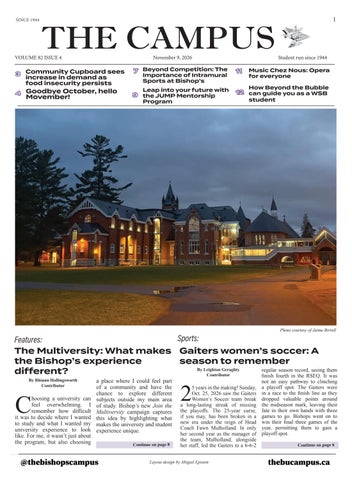
Photo courtesy of Jaime Birrell
The Multiversity: What makes Gaiters women’s soccer: A the Bishop’s experience season to remember By Leighton Geraghty regular season record, seeing them different? Contributor finish fourth in the RSEQ. It was By Rhiann Hollingsworth Contributor
C
hoosing a university can feel overwhelming. I remember how difficult it was to decide where I wanted to study and what I wanted my university experience to look like. For me, it wasn’t just about the program, but also choosing
a place where I could feel part of a community and have the chance to explore different subjects outside my main area of study. Bishop’s new Join the Multiversity campaign captures this idea by highlighting what makes the university and student experience unique.
@thebishopscampus
Continue on page 8
2
5 years in the making! Sunday, Oct. 25, 2026 saw the Gaiters Women’s Soccer team break a long-lasting streak of missing the playoffs. The 25-year curse, if you may, has been broken in a new era under the reign of Head Coach Fawn Mulholland. In only her second year as the manager of the team, Mulholland, alongside her staff, led the Gaiters to a 6-6-2
Layout design by Abigail Epstein
not an easy pathway to clinching a playoff spot. The Gaiters were in a race to the finish line as they dropped valuable points around the midseason mark, leaving their fate in their own hands with three games to go. Bishops went on to win their final three games of the year, permitting them to gain a playoff spot. Continue on page 6
thebucampus.ca
2
NEWS
THE CAMPUS NOVEMBER 9, 2026
Anthony Ouellet, News Editor » thecampus.news@gmail.com
20 people spoke for all: BUSRC attendance challenges reflected on this year’s AGM
B
By Anthony Ouellet News Editor
USRC narrowly avoided disaster at its last Annual General Meeting (AGM) on Oct. 26, as 20 students, the bare minimum needed to conduct such a meeting, were in attendance. This number is declining as the year passes, showing what could be understood as a disinterest from students in their union, something that the SRC’s leadership wants to address. The last AGM started with 20 students in attendance at The Gait, which is the minimum quorum needed according to the BUSRC’s bylaws. These bylaws were changed in 2025 to bring down the quorum for AGMs to 20 students; it was somewhere between 25 and 30 before that. In the years leading up to this change, attendance at AGMs dropped by some margin. Up to 39 students, and never less than 30, attended between 2020 and 2023, for instance. However, after registering 29 participants in 2024, the AGMs brought 21 participants in 2025. Thus, the bylaws on the quorum
were changed ‘’to address the difficulty’’, BUSRC’s president Grace Cordeiro told The Campus. Talking about attendance and interest problems in the SRC, Cordeiro was candid and straightforward about the issues. “For this year’s AGM, I walked into the Pod and called out to ask students who were free to come over. I can be shy and socially awkward sometimes, so that was definitely outside my comfort zone, and honestly, kind of cringe. Needing to do that speaks to the distance we need to close between students and the SRC. We need ongoing relationships where students know their representatives and understand what taking part can mean for them”, she said. The SRC’s president still did not want to directly assume that students do not care about their union. Still, similar reports on disinterest towards student democracy were made in other studentled outlets in the past year, such as La Pige at the Cégep de Jonquière and the Montréal Campus at the UQÀM. “What are we doing to support and advocate for ourselves as students? Because that is the function of a student
union and the SRC. As an organization, we need to make it easier for students to bring those concerns forward, take part in deciding what we do about them, and see what comes of that work. That requires an ongoing relationship with students throughout the year, and we’re looking at how we can strengthen that relationship“, Cordero said, noting that the SRC is in constant representation with the university on issues such as budget cuts, affordable housing, and international students. Solutions To strengthen this relationship between the SRC and its members, the students, Grace Cordeiro is open to revising the functioning of the union. “[...]Our current structure places elected directors primarily in governance and oversight, without enough opportunities to carry out student-led initiatives and maintain direct connections with different student communities. I have concerns about whether it responsibly manages our resources, both financially and in terms of the time and capacity students have to carry out their responsibilities“, she notes.
Other unions across the province have a different governing model, with elected student executives getting portfolios and representing a constituency. This model could be worth exploring, according to the SRC’s president. Moreover, the way assemblies are handled could also use a little revamping to ensure more people would join. “Some other associations have incorporated hybrid meetings, with Zoom or Teams, to allow for more attendance, and maybe we need to think about that as well. Are we meeting students where they are?“, Cordeiro asked.
Photo courtesy of Anthony Ouellet
Too successful or forgotten? Many menstrual product boxes empty on campus
T
By Charlotte Cochrane Contributor
he menstrual product boxes have consistently been empty in many of the bathrooms across campus since the beginning of the semester. The Menstrual Equity Project team has been inquiring with the Student Representative Council (SRC) and the custodial staff on campus to try and find an explanation and solution to this issue The empty menstrual product boxes may be a result of students taking more than one “emergency” product at a time (i.e. stocking up on their products), says Erin Mallory, executive director of the SRC, in an email statement. The custodial staff have been asked to keep a closer eye on these boxes and to ensure that they are filled more frequently. Having access to menstrual products can help students face a rapidly increasing cost of living, as some of them are struggling to keep up with rent, groceries and tuition.
The added stress of affording basic hygiene products like pads and tampons can take a toll on many students’ mental health. The goal of the Menstrual Equity Project Team, which supervises the boxes, is to promote accessible menstrual equity products on campus, to provide free single-use and reusable menstrual products across campus as well as to educate the community on menstrual equity, according to the BUSRC website. So, while many of the menstrual product boxes have been repeatedly found empty on campus, the team is working hard to keep the conversation alive, destigmatize menstruation and raise awareness of reusable menstruation products. Kassandre Brouillard, a fourthyear student and member of the Menstrual Equity Project team, said that using reusable menstruation products was life-changing. Some perks of using reusable products are that they are cost-effective, better for the environment and durable for up to ten years.
This means that a student who has access to a free reusable menstruation product (thanks to the Menstrual Equity Project team) will no longer have to worry about budgeting between groceries, rent and tampons. They will now have a decade-long solution to their menstrual hygiene, all while staying eco-friendly. Since 2023, the team has had reusable menstruation products for free in discreet locations (in addition to the free single-use products in bathrooms), and this year they are working to spread more awareness of the benefits of using reusable products. A new promotional campaign is in the works, and new discreet locations and menstruation products should be appearing on campus soon, and they will be returning to the Exam Care Package event in The Gait this December. Ultimately, the empty menstrual products are a real issue on campus, but the fact that they are being used is a good sign and means that the intended goal is being fulfilled:
students have access to free menstrual products at any time. Both Brouillard and Mallory are working to find solutions to this issue, including bringing this to the attention of the custodial staff, as well as potentially putting a QR code in the bathrooms to flag when a box is empty, so that staff can be notified and refill it. The Menstrual Equity Project team hopes to bring more awareness around reusable menstrual products on campus and see an increase in use of these products, as they are giving them away for free.
Photo courtesy of Anthony Ouellet
NEWS
SINCE 1944
3
Anthony Ouellet, News Editor » thecampus.news@gmail.com
Community Cupboard sees increase in demand as food insecurity persists
A
By Florence Robert Staff Writer
s the cost of living continues to rise, access to affordable groceries has become an increasing struggle for post-secondary students. Between having to pay for rent, tuition, groceries and other living expenses, students are often left choosing between basic needs and the heavy demands of university life. A February 2025 survey conducted by Équiterre, a non-profit environmental organization, found that 44 per cent of students across six Quebec colleges experienced some form of food insecurity. The high prices of groceries are not the only problem. Limited time between classes and work, lack of cooking equipment and stigmas surrounding financial insecurity all contribute to food insecurity. At Bishop’s, the Community Cupboard offers a resource for both
Bishop’s and Champlain students experiencing food insecurity, providing access to groceries, toiletries and other essential items. Students do not need to provide proof of financial need to order, and can place up to four orders a semester with up to 75 items each. Amaiya Freeman, a Team Lead and Coordinator of the Community Cupboard who has worked with the service for the past two years, has seen an increase in the use of both the Cupboard and the thrift store. Between 2023 and 2026, the Community Cupboard recorded 457 orders from 265 students. Freeman mentioned that more Champlain students have begun accessing it this year. “There is not only an increase in demand, but there is also an increase in awareness of this resource on campus that is contributing to these higher numbers,” Freeman said. The Community Cupboard shares the same space as the on-campus thrift
store, whose profits directly fund the Cupboard. The store also allows for the campus community to contribute, alongside donations of food and clothing. The discreet ordering system is important in addressing the stigma that can accompany food insecurity. Students experiencing financial difficulties can hesitate to access resources due to worries about judgment or the perception of others. To make an order, students simply fill out the online form to pick which items they need. Orders are prepared for pickup within 48 hours of ordering and can be collected at Norton 100 with a student ID. “Everyone needs to eat. We’re very approachable, so don’t be afraid to come to us if you need help. We are here for you through a simple process with no judgement,” she said. As food insecurity continues to affect post-secondary students across Quebec, campus initiatives like the
Community Cupboard demonstrate the importance of accessible resources in supporting students’ basic needs. Systems like these help address issues that would otherwise remain unanswered within university communities.
Photo courtesy of Florence Robert
Sherbrooke to enforce more regulations on parking in Lennoxville
D
By Anthony Ouellet News Editor
o you think there’s a lot of free parking around campus? The City of Sherbrooke certainly does, and it is going to reduce the number of available on-street parking spaces in Lennoxville even more. Sherbrooke is planning to uniformize parking restrictions on Queen St., Speid St., Church St. and Samuel-Gratham St. While both Queen St. and Speid St. offer free, unrestricted parking spaces in Lennoxville, Church St. and Samuel-Gratham St. have restrictions ranging from 60 to 120 minutes. In their effort to standardize these locations, parking would be limited to 120 minutes everywhere around downtown Lennoxville, with only a small patch being unregulated on Connolly St. The Sherbrooke City Council approved
T
this idea during its meeting on Oct. 6, meaning that the changes will take effect soon. Additionally, more surveillance on parking will be conducted in the borough, as it was noted that there has never been regular monitoring of parking spaces in downtown Lennoxville prior to this. This new regulation was in part created on account of Bishop’s and Champlain’s students, according to the City’s own documents. “The area is also influenced by its proximity to Bishop’s University and Champlain College. Some individuals from these institutions use on-street parking spaces for long periods, which reduces the availability of spaces for business clientele”, Sherbrooke’s projects agent, Étienne St-Jean, wrote. Speaking in front of other council
members, Lennoxville councillor Bertrand expressed his support for these regulations and stated that “people in Lennoxville were very happy” with these changes. In a poll conducted by the City in 2025, 48 per cent of the Lennoxville population considered that there was a shortage of parking spaces downtown and that many of these spaces were taken up by students. Impacts on students This, however, will affect students who live off-campus, as many rely on these spaces to come to school. Bishop’s University does not provide students with a free bus pass; no bike lane exists between Queen St. and the University, and a semester parking pass is $165. Street parking is thus seen as a reasonable alternative for many students who attend BU.
”It sucks. I guess I’m going to have to find new places to park, as if it was not hard enough already”, a first-year student who lives off-campus and who did not wish to be named, told The Campus. Some unrestricted street parking spots still exist around campus, as close as a ten-minute walk away, but the removal of these spaces will put more strain on students.
Photo courtesy of Anthony Ouellet
he Campus acknowledges that the land on which we operate is stolen land, the traditional territory of the Abenaki people. We live, learn, work, and play on this land, home to Indigenous peoples still living. Canada was founded through colonization, a system rooted in oppression and the abuse of power over others, continuing to affect First Nations, Inuit, and Métis communities today. As a student newspaper, The Campus has a responsibility to highlight truth. We are committed to prioritizing underrepresented voices in our community and proactively highlighting Indigenous peoples’ histories and ongoing realities, including their resilience and achievements. We recognize our work plays a role in shaping public perceptions, being able to call-out injustice but also call-in action. We emphasize that we must go beyond a land acknowledgement, which is only one step towards reconciliation. It is the stories in our paper – told with respect, accuracy, and integrity – and the respect and humility we show to the land and others that is more important than what is written in a land acknowledgement. Actionable steps to go beyond a land acknowledgement include educating ourselves and others, and supporting Indigenous traditions, movements, and businesses. —The Campus Team
4
OPINIONS
THE CAMPUS NOVEMBER 9, 2026
Reagan Russell, Opinions Editor » thecampus.opinions@gmail.com
The SCC is M.I.A.: A symptom of a bigger extracurricular issue at Bishop’s
A
By Reagan Russell Opinions Editor
s we approach the time of year when Take Back the Night takes to the streets of Lennoxville as a student-led protest against sexual violence, the Sexual Culture Committee has been confirmed inactive by the SRC. After eight years of Take Back the Night, the failure to transition executive teams has caused the unplanned hiatus of the SCC. With huge changes to the Sexual Violence Support Centre this year, including two new Sexual Violence Response Advisors, it is imperative to have at least one constant: a student-led, university-supported outlet and resource for students to refer to. It is wildly disappointing that the SCC is not active this year. With the recent news of the horrors committed at Cornell in the United States, it is important to uplift survivors, amplify their voices and take back the night, though I don’t see that happening this year at
Bishop’s. This is also particularly frustrating as last year’s committee secured funding to support new executive teams through paid honorariums. Clearly, that is not needed this year. That said, there were completed executive team applications last year that seemingly fell through the cracks. If that was you, I’d reach out to the SRC and see how this club can be reactivated. This also speaks to a larger issue at Bishop’s: clubs failing to pass the baton to new Executive Teams. Ask almost anyone in a leadership role for a campus club, and they will tell you that emails, transition documents and passwords are constantly going missing. “They didn’t sign us into our email, and it took me like three weeks to get an answer,” says a President of a student club. Unfortunately for Bishop’s, the SCC’s failure here is a failure for survivors. The extracurricular culture at Bishop’s also falls on the shoulders of a handful of people. Many club executives are executives for more
than one club as well, and most club members simply enjoy the benefits of the clubs without putting in any of the harder, behind-the-scenes work. This is unfortunate, as this is how groups like the SCC come to a premature end, student executives become burnt out from unpaid gigs, and then people last-minute apply for leadership roles to bulk up their CVs in their last months of university. A student executive of many clubs states how they are bordering on burnout as “everything is … happening at the same time and each of the clubs are asking for more and more and more”, leaving little room for personal time and academics. A dilution of the concentration of power could help with this, but people need to take on these roles for this to happen. Looking towards when Take Back the Night usually takes to College and Queen, consider what impact you have made on extracurricular groups you enjoy. Do you vote in their executive elections, participate in meetings to
make quorum or simply complain when their events aren’t quite what you imagined? Extracurriculars are what make your time in university special, and we lose a bit of our special Bishop’s culture when we lose clubs due to club politics and failed executive team successions.
Graphic courtesy of Gabrielle Lalonde
Goodbye October, hello Movember! By Charlotte Cochrane Contributor
Graphic courtesy of Gabrielle Lalonde
W
ith Halloween in the rearview mirror, Movember is officially upon us! Bishop’s University’s men’s rugby team is participating in this month-long event which raises funds for men’s health initiatives.
The Movember website states that they’ve raised over “$1.8 billion AUD in prevention-focused work across mental health and suicide prevention, prostate cancer and testicular cancer”, in the past 22 years, worldwide. Movember is the type of fundraiser that not only brings community and funds research, but also raises awareness regarding men’s health– something that is not nearly talked about enough. Men’s health at Bishop’s University should be something we all acknowledge and discuss more frequently, and Movember is an incredible way that the men’s rugby team is doing so. With rapidly increasing rates of loneliness in young people, men are particularly at risk and it is now more important than ever to have these types of resources and funding available (Bledsoe & Smith, 2025). The Bishop’s Men’s Rugby Team is participating for their fourth time, annually since 2022, says Graham Dunn, a member of the BU
men’s rugby Movember leadership team and third-year rugby player. When asked why the team is continuing this tradition, he explains that the continual motivation for the team’s participation in this annual fundraiser is to raise awareness and funds for men’s mental health and cancer prevention. Dunn also stated that the men’s rugby team will be posting weekly updates on their instagram page to track progress, as well as get votes on which player is growing the best Mo. “I want to show men that it is powerful to find support and speak up regarding their own mental health”, says third-year student and second-year rugby player, Andrew Min. By raising awareness on the many resources and support we have access to here on campus, we can destigmatize men’s mental health, and open the floor for discussion. The Guidance Counsellors office, upstairs in the Student Union Building (the SUB), is a great place to start if seeking mental health support. Additionally, the Sexual
Violence Support Centre (SVSC), is extremely helpful in supporting any students’ lived experiences, no matter what they’ve gone through or when that may have been. Based on my observation of this team’s initiative and the wider Movember community, this is an incredible initiative which is not only raising millions upon millions of dollars to fund men’s health initiatives, but it is also bringing awareness to these topics, and setting the stage for discussion between mates, friends, fathers, uncles, brothers and broader communities. Participating in and donating to this initiative is a great start to setting the stage for discussion and finding solutions, but I wonder, how can we bring this same thoughtfulness to our Bishop’s University Campus? Consider donating to or spreading awareness about Movember in your circles, or at the very least, start a discussion regarding men’s mental health with your friends!
SINCE 1944
OPINIONS
5
Reagan Russell, Opinions Editor » thecampus.opinions@gmail.com
Halloweekend: The perfect end to spooky season at BU By Saskia Yacoubi-Sluis Copy Editor
N
ow that everyone has had the opportunity to gather themselves and get back into the groove after Halloweekend, what better time to reflect on the three-day bash of events that kept all BU students booked and busy last weekend? Whether it was locking themselves in a study room at the library all day so that they could enjoy the evening festivities (I unfortunately DID have a midterm on the Monday after Halloweekend) or bringing friends in from out of town to amp up the celebrations, Bishops showed up for one of the biggest weekends of the year. And personally? I think this year’s Halloween may have been the best one yet. Before the weekend even kicked off, the BUSRC ensured that students were in the proper mindset to make the most of this time of year. Introducing Hallowfest to Bishop’s this year, the SRC combined weekend activities with weeknight events as well. On Tuesday, Oct. 27,
the Chill bar made its appearance at the Gait with a wine glass painting activity, featuring a Witch Elixir drink on the menu. On Thursday, the party began with a Boiler Room setup in the Gait and DJ Day-B making his grand debut. It was a sea of characters and animals and celebrities in the Gait…students most definitely showed up dressed to impress, setting the weekend off to a great note. While students celebrated in their various ways on Friday night–you may have caught a glimpse of me amongst the group of ten-plus minions running around Lennoxville that evening–Saturday kept the Gait festivities in swift motion. A long line was already in action when I showed up at the Gait around 10 p.m. alongside many other students, highlighting the night’s instant success. DJ Drew opened the night, with DJ Meeks returning to keep the party going afterwards. As crowds shuffled out to the lion towards the end of the evening, I most definitely took a moment to appreciate this final Halloweekend at a school that truly
does make the most of the occasion. And the best part about this year’s Halloweekend was that I didn’t spend my Saturday freezing to death on Reed. I remember spending many hours in both first and second year on our beloved party street, and while it was evidently fun to be with my friends, I’ve got to admit that the opportunity for cheap drinks, as well as conditions where I can wear whatever costume I desire without being concerned about how chilly I will be, is far more up my alley. And with so many students gathering at the Gait on both Thursday and Saturday, the general safety of the community was much more reinforced. This Halloweekend was truly one to remember; I mean, when else can you walk into a bar and see Michael Jackson dancing alongside Harry Potter? Olivia Whitfield, a fourth-year student at Bishop’s, expressed her appreciation for the weekend: “My friend from back home in Kingston came to visit for the weekend, and it was so much fun to show her what the Bishop’s student life is like, especially on
such a big weekend. We genuinely had a blast. She jokingly added, “I’m going to need a couple of days to recover from this one, though”. I may not be at Bishop’s next year, but I’m already looking forward to seeing if Bishop’s can one-up this year’s Halloween festivities. The challenge is on.
social connections and the sense of community that makes Bishop’s so unique. Beyond this, nights as a DJ at The Gait have allowed him to gain first-hand experience about what makes those nights special, and how disappointing it is to see this tradition fade. Lastly, he calls upon the students, as it is up to us to keep this important part of our culture alive. This goes beyond current students, as the Gait’s decline is so well known that it has even reached the ears of alumni. Former student and Gait bartender, Hannah Moore (Class of 2026), reminisces about her memories from The Gait. “No matter what kind of week you seemed to be having, we always knew we were going to have a good time”, she states. While reflecting on her bartending experience, she recalls how “it never felt like just a job; some of the friendships and memories I made while working there are ones I’ll keep with me
long after I graduated”. She further explains how The Gait is an essential part of Bishop’s identity, bringing students together beyond their program, year or social circle. She states, “I genuinely think the Gait is such a huge part of what makes Bishop’s, Bishop’s”. Ultimately, she believes that future students may miss out on these experiences, and losing Gait culture would be “losing a little piece of what makes Bishop’s so special”. Finally, as a graduating student myself, I’ve had many irreplaceable memories created on those Gait nights. It saddens me when I realize that the newest Bishop’s students are overlooking such an important part of Bishop’s culture. While it may not seem like it, time at Bishop’s moves at the speed of light, and before you know it, you will be walking across that graduation stage. Don’t pass up the opportunity to make unforgettable memories, #BringBackTheGait.
And now…time to lock in again!
Photo courtesy of Saskia Yacoubi-Sluis
Bring Back The Gait By Arianna Koutrias Contributor
W
hen I started at Bishop’s, there was only one weekly occurrence that never changed: spending our night at The Gait. I’m not sure how this routine became so embedded in our Bishop’s culture, but it’s something unique and special to the school we call home for a few years. From theme nights to specialty drinks, The Gait has become a place to look forward to on a Thursday night after a gruelling week of classes and studying. This year, there is an undeniable shift in The Gait’s popularity, as many students are no longer “gait-bound” on their nights out, specifically first-year students. I am unsure how this decline occurred; are first-year students just not going out anymore? While party life has been severely diminished at Bishop’s, the weekly Gait nights are something we never thought
would change. It was, and always has been, a place that unites our student community. It also raises questions about the memories the next generation of Bishop’s students is missing out on. Léa Gravino, a third-year management student, remarks that “The Gait has been such a big part of my Bishop’s experience, continuously bringing students together to create memories and enjoy university life”. She hopes more students, specifically firstyears, will have the opportunity to create those memories and help bring it back into student life. Third-year business student Spencer Fennell shares how the Gait has impacted his experience here at Bishop’s. “I remember in my first year, every Thursday and Saturday, The Gait had a line out the door; it was the place to be,” he stated. Fennell explains how going was never about maintaining a party lifestyle, but about the
6
SPORTS
THE CAMPUS NOVEMBER 9, 2026
Maxime Trottier, Sports Editor » thecampus.sports@gmail.com
Gaiters women’s soccer: A season to remember Continued from page 1
Over the course of the last five years, I have been fortunate enough to be able to follow the team as the playby-play and colour commentator of the home games. There have been numerous ups and downs; you could say that these years have been quite the roller coaster ride. The team has battled shifts in coaching staff, injuries, and, unfortunately, outside critics judging them based on their record. But no matter the challenge, this team has persevered, facing these challenges head-on and showing the “haters” who they really are. While interviewing backline cornerstone Taylor Mason, I asked how the team was able to bounce back after a hardfought season last year, finishing amongst the bottom of the RSEQ to
clinching a playoff spot less than a year later. She replied, “Coming into preseason, we had a collective goal of making the playoffs and changing the narrative surrounding our program. I think one of the biggest differences between this season and last was our team chemistry and our collective commitment to doing whatever it takes to be successful. We really bought into one another, embraced our roles and worked toward the same goal. There was a different level of accountability and belief within the group this year, and I think that ultimately translated into our results on the field.” Taylor has spent her past four years at Bishops, and she has been part of all of the ups and downs. During our conversation, I asked her a hard thought question: In the early years of your career, how have you
SPOSO is BACK!
O
By Arianna Koutrias Contributor
ver the past week, the Bishop’s Sports Studies Society (SPOSO) announced its team on Instagram, following last semester’s election. If you haven’t heard about them already, the Sports Studies Society is a student-run academic and social club that represents the sports studies students. Throughout the year, SPOSO organizes free events, hosts networking sessions and has begun collaborating with other clubs on campus. The club is focused on creating an environment where students can connect, share ideas and gain insight into the sports industry. For students interested in pursuing a career in sports, SPOSO helps build connections and gain industry knowledge throughout its events. They aim to bring together classroom learning and professional experience by
connecting students with professionals working in diverse areas of the sports industry. Through networking events and guest speakers, students can explore potential career paths, learn about industry experiences firsthand and ask questions! Whatever your interest is, whether it be sports business, athletic development or health and exercise, SPOSO provides opportunities to discover different career possibilities within the industry. These connections allow students to develop professional relationships and better understand what qualifications they may need to reach their career goals. This year, SPOSO has many exciting events planned, including its Speaker Series, sports tournaments and networking events. The Speaker Series, in collaboration with the Sports Studies Department, provides students with an opportunity to learn directly from professionals about their career journey, their challenges, and advice about
and the team been able to silence the outside critics? Mason, in good faith, answered, “I think for myself and for our team, we play our best when we’re having fun and not putting too much weight on outside opinions. Being a small purple school, we’ve definitely gotten our fair share of criticism over the years. But if anything, that has given us more motivation and made us hungrier to prove people wrong. At the end of the day, we try to focus on what we can control, which is how we show up for one another and how hard we’re willing to work toward our goals. As a team, we’ve learnt that the best way to change people’s perception isn’t by talking about it, but by showing it on the field.” This year not only saw a 25year curse broken. The 2026 season saw senior Teagan Handley handle
entering the industry. In previous years, SPOSO has had the opportunity to welcome speakers such as Ian Mendes (Vice President of Communications for the Ottawa Senators) and Mary James (Facilities Professional at TD Place and National-Level Lacrosse Coach). Another major event this year is the annual Congress of Sports Studies in April. In collaboration with the Sports Studies Department, the Congress brings together students, faculty and members of the sports community to explore research, exchange ideas and build connections. The club’s support helps in showcasing student learning beyond the classroom. Ultimately, SPOSO is more than just the events they organize. The club is centred around building a community where students feel represented, supported academically, socially and professionally. Whether you’re a firstyear student hoping to expand your network, a second-year wanting to
business, getting the nod as a first-team RSEQ All-Star. She finished as the leading scorer in the RSEQ, finishing the season with nine points on four goals and five assists. Handley, who has expressed her interest in continuing to play football at the professional level, was a key piece in the Gaiters’ success and rebuild over the past four years. The Gaiters will look to build on what they have accomplished this year in hopes of turning the program around and competing amongst the best in the RSEQ every year.
learn more from industry professionals or simply just wanting to meet others who share the same passion for sports, there are plenty of reasons to get involved. Make sure you don’t miss your opportunity to get involved; follow @ bu_sposo on Instagram to stay updated on upcoming events!
THE CAMPUS STAFF 2026-2027 EDITOR-IN-CHIEF
LAYOUT EDITOR
ECONOMICS AND BUSINESS EDITOR
THIS ISSUE’S CONTRIBUTORS:
thecampus.editor@gmail.com
thecampus.layout@gmail.com
thecampus.businesseditor@gmail.com
Arianna Koutrias Carly Wagschal Charlotte Cochrane Elsa Cunningham Grace Mackay Jean-Simon Rhéaume Leighton Geraghty Olivia Whitfield Rhiann Hollingsworth Shelly-Ann Canares Tallula Russell
Olivia Norby
Abigail Epstein
COPY EDITOR
GRAPHICS EDITORS
thecampus.copyeditor@gmail.com
graphicseditor.thecampus@gmail.com
Saskia Yacoubi-Sluis
ASSOCIATE EDITOR
Abigail Epstein
thecampus.associateeditor@gmail.com
DIRECTOR OF FINANCE Frederic Grenon
thecampus.business@gmail.com
Addison Walker
OPINIONS EDITOR
Gabrielle Lalonde & Latoya Simms
Reagan Russell
STAFF WRITERS
FEATURES EDITOR
Piper Howell, Megane Masson & Florence Robert
thecampus.opinions@gmail.com
Lauren Root
thecampus.features@gmail.com
NEWS EDITOR
SPORTS EDITOR
thecampus.news@gmail.com
thecampus.sports@gmail.com
Anthony Ouellet
Maxime Trottier
DIRECTOR OF MARKETING & COMMUNICATIONS
ARTS AND CULTURE EDITOR
@thebishopscampus Instagram
thecampus.artsculture@gmail.com
Roser Riera
Jillian French
SPORTS
SINCE 1944
7
Maxime Trottier, Sports Editor » thecampus.sports@gmail.com
BU football: A reflection on the season
E
By Maxime Trotter Sports Editor
very football team’s season sees its share of ups and downs. For some, the ups outnumber the downs. Unfortunately, the same could not be said for the 2026-27 iteration of Bishop’s Gaiters Football. At season’s end, their 1-7 record failed to qualify for an RSEQ playoff berth in their first season back in the conference. Records, however, don’t define teams, and they don’t convey every snap of the eight games the Gaiters played this year. Those eight games serve only as lessons about the new conference Bishop’s has joined, and the 1-7 record serves only as motivation to finish the job in the future. Going into the 202627 year, expectations for the Bishop’s Gaiters football team were unknown. They were coming off years of success in the AUS, including a 2024 championship, but ultimately it’s hard to place a team in a conference they haven’t played in years. I had the chance to speak with head coach Cherif Nicolas after the Gaiters’ final game of the year, and he shared the idea that expectations for the team did not necessarily exist. Upon reflection on the season, he said: “We’ve learned
Photo courtesy of Clara Neel
a lot about ourselves, and what it takes to play in this conference.” The way he saw it, each play of each game was a lesson. In my view, his perspective is the best one to adopt when entering a new conference with a new style of play. The team was taking everything as it came at them, and over the course of the year learned who their opponents were, what kind of personnel they run, and what it really takes to become a
playoff team in the RSEQ. Nicolas told me that the focus of the team has already shifted to next season. The team will be losing around a dozen players to graduation, and they’ve also learned this year that they have to become bigger, stronger and much more physical in order to compete in a conference of this stature. Thus, the attention of the coaching staff has shifted to filling the voids through recruitment
and development. “You can sum up (our interview) with that,” Nicolas said, “...we’ve got to get better as a team, we’ve got to get stronger as a team.” So there’s the story. The Gaiters aren’t where they need to be right now. To put it as bluntly as possible, they’re in the bottom right now, and in order to reach the top, they’ve got to get better. On the positive side, they’re going into next season with so many more tools and information than they had going into this year. This season has taught the Gaiters what an RSEQ playoff team is, and they now have a far better understanding of what to expect from each of their opponents. The point I’ve reiterated over the course of this year is that seasons like this are a process, and every snap, every first down and every touchdown paints a picture of what lies ahead. The Gaiters were effectively a David going into a Goliath-type of situation this season. Unarmed and inexperienced, they failed to make this season the fairy tale they hoped it would be. But worry not, Gaiter fans, through the lessons they’ve learned, the Gaiters may have gained the sling and stones they need to hit this Goliath right in the head!
Beyond Competition: The Importance of Intramural Sports at Bishop’s
A
By Piper Howell Staff Writer
t Bishop’s, the Gaiters varsity teams often receive most of the spotlight; however, many students participate in sports without the varsity jersey. Intramurals give students different opportunities to stay active, compete and make friends in a less competitive environment. Although it may be more recreational than varsity sports, the impact they have on students can prolong beyond the court or field. Whether it be through volleyball, basketball, soccer or ultimate frisbee, there is a space at Bishops to get involved. So, why should students join intramurals? They can foster an environment where individuals don’t need to
have excessive prior experience; they are played in a more relaxed setting that differs from varsity sports, and since many students played sports growing up prior to coming to Bishops, intramurals allow them to continue playing. For intramural basketball player Nora Gallagher, “Intramurals gives me something to look forward to during the week and has helped me create a community outside of my classes and schoolwork.” Intramurals can be a big part of your Bishop’s experience. For many students, the biggest takeaway is the friendships and community built through sports. When schoolwork becomes stressful, and exams start to pile up, it can be hard to take the time to step out of the library and away from your computer. Joining intramurals
gives you opportunities to meet students from different programs and social circles. Similar to varsity sports, intramurals can contribute to building community; however, they offer a different type of community in a less demanding and strict setting, allowing students to feel comfortable getting involved. It is important to recognize the overall impact intramurals have on student life beyond the social aspect. It gives students a break from assignments, breaks up the daily routine and gives people an activity to look forward to. University can so easily become centred around classes and assignments. Taking a step back from that focus reveals how much more there is to student life and how you can make your university experience memorable.
Although intramural sports don’t draw the same crowds as the Gaiters’ varsity teams, their value is measured differently. Giving students opportunities to play sports in a relaxed environment allows them to play rather than just watch, provides breaks from studying, which improves mental health and helps foster friendships and community that shape Bishops University experiences. Whether students join to compete, make friends or stay active, they can help contribute to the community on this small campus. Even though not every student at Bishop’s gets the chance to play under the Coulter field lights, intramurals give opportunities for students to still have a place in the game.
8
FEATURES
THE CAMPUS NOVEMBER 9, 2026
Lauren Root, Features Editor » thecampus.features@gmail.com
The Multiversity: What makes the Bishop’s experience different? Continued from page 1
Launched on Sept. 28, the campaign focuses on three pillars: multidisciplinary by design, multicultural by reality and multiple connections for life. Each pillar highlights a different part of the Bishop’s experience, from academics and campus life to the lasting connections students make along the way. The first pillar, multidisciplinary by design, highlights the opportunity to explore different subjects and bring together a variety of interests. Bishop’s encourages students to look beyond one area of study and discover how different fields can complement one another. As an arts administration student, this is one of the main reasons I chose Bishop’s. My program gives me the opportunity to explore the business side of arts and culture,
study business as its own subject and pursue my interest in history through my concentration. When I first chose my degree, I didn’t expect to bring together such different areas of study. However, having that flexibility has allowed me to discover new interests and get a better sense of what I would like to pursue after graduation. The second pillar, multicultural by reality, reflects the people who make up the Bishop’s community. Students come from different parts of Canada and around the world, bringing their own backgrounds to campus. One of my favourite parts of university has been meeting people from completely different academic programs and getting to know their interests. Some of my closest friends study subjects very different from my own, and I think that says a lot about the kind of community Bishops creates. Despite our different
backgrounds and interests, we all contribute to the same close-knit campus community. The third pillar, multiple connections for life, focuses on the relationships that extend beyond graduation. During my time at Bishop’s, I’ve noticed how alumni continue to show a strong connection to the university, carrying the Bishop’s spirit and pride with them following their time at the university. Through alumni chapters across Canada, graduates stay involved with Bishop’s and continue to meet through social events and networking opportunities. It shows that being part of Bishop’s doesn’t end when you leave campus. The connections made here can stay with you well beyond your university years. For me, the word Multiversity represents all these different
Photo courtesy of Bishop’s University
experiences coming together. It is about having the freedom to explore different academic interests, meeting people with different backgrounds and building relationships that last. Every student has their own path at Bishop’s, and having the freedom to explore different interests and opportunities is what makes the student experience here so unique.
What a Pacific climate campaign can teach us at Bishop’s By Jean-Simon Rhéaume Contributor
W
ith the temperatures nearing 20°C in Sherbrooke in November, it’s the kind of weather that makes you check the date. So, with the rising winter temperatures, it feels fitting that Bishop’s offered a screening of YUMI - The Whole World, which highlights the devastating effects climate change has on the world, especially in the Pacific. YUMI shows that the signs of a changing climate are harder to take in stride. In Vanuatu, heavy rain can topple papaya trees and damage the food families grow. Along Fiji’s coast, rising seas and erosion are washing away some communities, and forcing others to move inland. Directed by Felix Golenko, the documentary follows Romabeth Siri, Solomon Yeo and Vishal Prasad, three law students from the University of the South Pacific in Fiji. These students created the Pacific Islands Students Fighting Climate Change, where they push for the International Court of Justice to clarify what countries are legally required to do about climate change through an advisory opinion.
Photo courtesy of Lauren Root
The students in YUMI are challenging governments that won’t condemn climate change. Their legal campaign, and their goal of trying to get their resolution heard by the International Court of Justice, gives the broader climate movement a way to press for accountability alongside demands for faster emission cuts and support for affected communities. The Pacific Islands are the ones suffering the most from climate change, yet as the film points out, they create less than one per cent of global greenhouse gas emissions. Vanuatu’s experience helps
explain why those demands go together. When Cyclone Pam, a category five cyclone, struck in 2015, it caused the country to lose approximately 65 per cent of their GDP overnight. Rebuilding schools and roads takes resources that are also needed to prepare for future disasters, which are happening more often and at closer intervals. The students first needed support from Pacific governments. The government of Vanuatu then took the proposal to the United Nations, where the General Assembly adopted it without a vote on Mar. 29, 2023. After a nearly four-year-long
campaign, the students succeeded in their mission and were able to have their voices heard. A journey that started in the office of the Minister of Foreign Affairs for Vanuatu led a group of university students all the way to the UN headquarters in New York City. On Jul. 23, 2025, after the film’s release, the International Court of Justice issued its advisory opinion. The opinion is non-binding, but it clarifies existing duties under international law, including the duty to take measures to prevent significant harm to the climate system. The moral and legal pressure this advisory opinion carries is something the Pacific Islanders hope will influence the actions of countries around the world. The students who created the Pacific Islands Students Fighting Climate Change showed what commitment and hard work can accomplish. As the film states, they fought to bring the world’s biggest problem in front of the world’s biggest court, and they won. Their tenacity and fight are going to help people around the world. More than anything, they’ve proven what students are capable of doing.
FEATURES
SINCE 1944
9
Lauren Root, Features Editor » thecampus.features@gmail.com
Leap into your future with the JUMP Mentorship Program
T
By Lauren Root Features Editor
aking the next steps in life outside of Lennoxville can be daunting. Whether you’re moving to a new city or starting a new career, there are many unknowns outside of Bishop’s. Luckily, you don’t need to have all the answers, and many tools can help you adjust more easily. One of these tools is the JUMP Mentorship Program. JUMP is a postgraduate mentorship program for Bishop’s students and graduates who are ready to take the next steps into their careers. JUMP is currently offered in Toronto, Halifax, Montreal and Ottawa. JUMP is a platform where mentors can share their experiences with mentees, helping recent graduates hone their skills and maximize potential connections in the professional world. The goal of the JUMP program is to bridge the gap from student life to working life.
attend events where they can interact and meet other Bishop’s alumni. Sterling describes these events as “friendrasing” rather than “networking.” He believes that the term “networking” stresses students out and applies more pressure, whereas “friendraising” brings back the central purpose of the event: interacting with friends. As for the future of JUMP, they are hoping to include more Montreal members to help grow the network. The goal is to be able to pair alumni and recent graduates together who work in similar fields, but this equally poses a challenge. Photo courtesy of Sterling Mawhinney The JUMP program is hoping to JUMP began in 2009 with 12 to help serve students who don’t find more mentors who are able mentors and mentees, all of whom live in Montreal, Toronto, Ottawa or to take on mentees and help them were women. The program was Halifax. Sterling Mawhinney, who jump-start their careers. originally geared towards female helps run the JUMP program, says This program is available graduates to help them jumpstart the goal of a more virtual platform to both current students, recent their careers. In 2010, the program is to “help serve new young alumni alumni and those who are about expanded to include everyone who don’t necessarily live in the to graduate. If the JUMP program because the demand was so high. four centres.” seems interesting to you, and you’re The JUMP program is Presently, there are looking for resources to help you undergoing changes, with the hope approximately 100 members of the start your career after graduation, of offering a virtual platform as well, JUMP program. These members sign up for this mentorship program!
Mid-semester reset with BUO
A
By Grace Mackay Contributor
s we approach the middle of the semester, students are feeling the pressure of exams, papers, readings, assignments and so much more. You likely find yourself trapped in the library for hours on end, staring at screens and attempting to dwindle down the long lists of mid-semester tasks. As important as it is to apply yourself, expand your mind and focus on studies, it is necessary to find a healthy balance. But how do you find balance when all you can focus on is the laundry list of tasks to complete? The answer is simpler than we make it out to be. Give some time back to yourself and take a break. Sometimes, finding that balance means stepping away from your desk and getting outside. With Bishops being surrounded by such a lovely natural landscape, students have plenty of opportunities to do just this. An easy way for students to take advantage of the Bishop’s landscape is through the BU Outdoors club. BUO is a student-run club with the
intention of increasing participation in outdoor activities and making them inclusive for everyone. The club is run by co-leads Mia Kurz and Anya Mullen, as well as Jr. co-lead Norah Gallagher. Every semester, trip leads work to organize a range of different activities at all levels, including hikes, camping trips, indoor climbing and much more. These trips range from level one difficulty, being the easiest, to level five, being the most difficult. Everyone is welcome and encouraged to join in on any trips they feel suit them best. Outdoor recreation can feel intimidating, especially when experiencing new terrain. BUO’s range of difficulty helps to make participation more accessible, while trip leads work to ensure everyone feels comfortable and supported throughout the experience. Through this, BUO hopes to give more people access to the outdoors, especially at times when students may need it most. As hard as it may feel, high-stress times such as midterm season are exactly when you need to prioritize yourself. Managing your time in a
Photo courtesy of Grace Mackay
way that allows you to take care of your physical and mental well-being is essential. The negative effects of stress on health and wellbeing have been widely studied, and university students are particularly familiar with this type of pressure. Finding ways to step back from academic responsibilities is important. Because of this, BUO suggests taking some time for yourself and getting outdoors. Stepping back and slowing down is often the best prescription for stressful times. Over the next couple of months, BUO has numerous hikes and
activities planned to increase student involvement with the outdoors. As we approach winter, getting outside can feel challenging. To combat this, BUO will continue to run different activities to help encourage students to get outside. Whether you choose to join BUO activities or prefer to get outside on your own, remember that taking care of yourself is just as important as keeping up with academics. BUO wishes everyone a safe and healthy rest of the semester, and we hope to see you all outside!
10
ARTS & CULTURE
THE CAMPUS NOVEMBER 9, 2026
Jillian French, Arts & Culture Editor » thecampus.artsculture@gmail.com
Music Chez Nous: Opera for everyone
O
By Carly Wagschal Contributor
n Oct. 29, MezzoSoprano Caroline Gélinas performed in Bandeen Hall as part of the Music Chez Nous program, a concert series which facilitates musical performances at the University. The concert was free for students (as all Music Chez Nous concerts are) and cost thirty dollars for community members. Gélinas, who studied at the Montreal Conservatory of Music, is an acclaimed vocalist who, only a few days before the concert, placed third in the Johannes Brahms Society International Competition in Austria, also receiving a Special Prize for the best interpretation of a work by the composer Rainer Bischof. She was the only female artist and the only nonGermanaphobe to proceed to the finale. Gélinas performed repertoire by Brahms, Offenbach and Strauss, as well as a rendition of “Somewhere Over the Rainbow”, a Harold Arlen
Photo courtesy of Music Chez Nous
ballad written for The Wizard of Oz. Even though she sang mostly classical music, her performance was anything but stuffy. Wearing a black evening gown with dangly earrings, Gélinas engaged the audience with entrances and exits up and down the aisles, play-flirting with audience members during romantic songs, and a mid-concert costume change. There was laughter as Gélinas pretended to check her wristwatch
during a long-held note. Despite singing primarily in German, it was possible to understand much of her lyrics through her expressive body language and facial expressions. “She has a very good pronunciation of German,” said Zachary Fox, a first-year music student, who spent time living abroad in Germany. The reception of the students who attended appeared to be very positive.
“Her dress was absolutely gorgeous and her rendition of ‘Somewhere Over the Rainbow’ gave me full-body chills,” said an enthusiastic Tallula Russel, a fourth-year Religion, Society and Cultures student. “She’s a master of her craft.” This year marks a significant change for the Chez Nous series, as the concerts, established in 1983, are no longer mandatory for students enrolled in principal or elective instrument lessons. There were many complaints in the past about the policy, as students found it interfered with their work or social schedules. It remains to be seen how lifting the requirement will affect the concerts, which are already occurring less frequently than in previous years. It seems likely that students will be less likely to attend if the concerts are no longer mandatory. However, the Caroline Gélinas concert was an excellent opportunity to watch a talented musician perform for free, and certainly worth seeing.
Can Ganesha help you pass your midterms?
T
By Tallula Russell Contributor
he colour of the day at the Hindu Mission of Canada’s Montreal temple is a bright, almost neon orange. The Murti, icon statues of Hindu deities, are dressed in elaborate orange clothing with gold and green trim. The statues of the five gods are white, evoking marble or porcelain, with silver crowns and colourful leis alongside their regal orange regalia. They sit in a raised section of the main room of the temple, set behind gold bannisters to demarcate their place.
Photo courtesy of Zachary Saint Cyr
Dr. Michele Murray’s Hinduism class saw these sights, and more, on Sunday, Oct. 25, for a cultural field trip. The 12 students, of whom I am one, loaded onto a very fancy sports bus for the drive to Montreal to visit the oldest Hindu temple in Canada. Founded in 1980, the temple has been located at 995 Rue de Bellechasse for over 65 years. The moderately sized, multi-purpose building has been transformed by years of use and devoted decoration into a holy place of worship for Montreal Hindus. Paintings and depictions of Hindu deities like the elephant-headed Ganesha, god of the removal of obstacles, and the young and impish flute-playing Lord Krishna are on every wall of the main worship room. Incense wafts through the room, putting you in a specific place unlike most others you’ve been in. The speakers projecting the words of the Brahmin and the singing of practitioners are almost a little too
loud, likely set at a volume suited for the most elderly attendees. The wall facing the street, with many windows, is covered with orange and red curtains, and the ceiling is covered with a criss-crossing of faux flowers on fairy lights. Even the plain white walls are interesting to look at, with large indoor bricks that have been carved with different designs scattered about. The whole space has a devoted and planned feeling to it, with everything being carefully considered in its placement and use in the space. We arrived partway through their Sunday worship, called “puja” in Sanskrit, and stayed through to the communal lunch that’s offered afterwards. We then talked to the priests, Brahmin, and got to ask questions about Hindu practice. Dr Murray always brings her students to this temple for her Hinduism class and has been for over a decade. Cultural experiences like this are essential to the study of said cultures
because, as Dr. Murray describes it, “you can read accounts of these different traditions, watch video clips, we can talk about it, but [in] actually going and immersing ourselves in these rituals we move from an observational perspective to participatory, and nothing can replace that. It adds another dimension; it gives us insight into the people. It’s something that can’t be attained in any other way, I think.” Experiential learning opportunities like this make very different ways of life tangible and relatable in a way little else can. The visit to the temple has absolutely changed our understanding of Hinduism as a practiced thing, as student Jackson Vest says: “We had already studied puja before our visit, but nothing could have prepared us for the energy present in the room. We faced an essence that couldn’t be captured in words. Something too human to be written down. It had to be felt.”
ARTS & CULTURE
SINCE 1944
Jillian French, Arts & Culture Editor » thecampus.artsculture@gmail.com
Horoscope:
Poetry:
New moon in Scorpio
If a lighthouse was a candle
By Abigail Epstein Layout Editor
By Elsa Cunningham Contributor
T
he slate is set for an emotional tidal wave from Nov. 9. Try leaving a corner on your plate for the overflow.
If a lighthouse was a candle You keep the light on When the winter comes, and the sun is gone You burn, a candle, ever in my corner And I flock to you, a moth, desperate to be warmer You keep my brittle wings from burning Lampshade over the fire, your attention heart churning I run towards you like I’m coming home To your soft lit room, welcoming like sea foam
Aries: As the dark bleeds against your regular horizon, it may be tempting to start spontaneous fires. Before you go to burn, take a deep breath in. Stoke it slowly, your inner light. Taurus: You’ve picked a path and stuck it through – now the end is in sight. Try not to find a foreshadow…let things clarify as the moon fills in.
In the light of day You burn ever bright, still stay Lit in my corner A constant, keeping murmur The lighting in my smile Flickering through my chaos all the while You stay here until dawn I still can’t believe you keep the light on
Gemini: The new moon offers an opportunity for you to stop reading the word as such. Instead of looking so critically at high noon, listen to what resonates at the stroke of midnight. Cancer: If things keep piling up, take a reset in a bubble bath. You don’t need to clear your plate to drink from holy fountains. Leo: As you move towards the solstice, it gets harder to chase shadows. Rather than stepping into it, spotlight your attention. It’s been said that attention, selfless, is the highest form of love. Virgo: If your inner workings have been on a rolling steady, take a shift in gears. Without stopping the whole, see if you can focus on a new dimension a day. Try attuning registers. Libra: As one part of your life lifts, another one lowers. Your challenge for this phase is to stay levelled in the difference. Don’t worry about your brave face, as long as you set to work.
Collage:
Wake Up!
Scorpio: Your cave’s been plotted with blankets and candles, placed with good intention. Be mindful that hibernation should serve daybreak. Ready yourself for the new. Sagittarius: Backed into a corner just means you should remember who’s in yours. In your mind, replant your garden. Retrace how you got to where you are. Capricorn: Care to not feel powerless, even as changes seem to harden. A matter of perspective is usually not out of hand. Why not try on many different gloves? Aquarius: The dark side of the moon may seem like an affirmation. Notice the ways in which you’ve come into your own. Only you can read how your body’s kept the score. Pisces: The writing’s on the wall, under the bridge, and on the table. Abandon blank pages, in favour of a conversation. Reanimate a graveyard. For you to take with as many grains of salt as there are stars in the sky.
Collage courtesy of Olivia Whitfield
11
12
ECONOMICS & BUSINESS
THE CAMPUS NOVEMBER 9, 2026
Addison Walker, Economics & Business Editor » thecampus.businesseditor@gmail.com
Bishop’s and Queen’s launch new business master’s pathway By Addison Walker Economics & Business Editor
G
ood news for Bishop’s Business students as they now have three new master’s programs to consider. Bishop’s University has partnered with the Smith School of Business at Queen’s University to provide eligible Williams School of Business students with a faster pathway into post-grad study. This provides students with three different pathways into the International Business (Kingston), Management Analytics (Toronto), and Finance (Beijing) programs. Applicants can be nominated by Bishop’s in their final year of study. A nomination ensures that applicants won’t have to pay any fees and will be guaranteed an interview regarding the program and their future goals with a member of the Smith program team. You must still meet the requirements for your chosen degree, but you’ll receive
Graphic courtesy of Gabrielle Lalonde
$5,000 off your tuition. The Master of International Business is offered in Kingston and provides students with 12-, 16-, or 24-month options. Students will learn about the global economy and working across cultures. You can opt for a single or double degree and include an internship. The full-time Master of Management Analytics provides
students with 16 months of learning about using data to drive business decisions. Students also have the opportunity to complete an internship. This program is also open to students with a wider variety of academic backgrounds. The Master of Finance will take you to Beijing for one year. The program is delivered by Queen’s in partnership with Renmin University
of China. Students will earn their Queen’s degree while learning about financial theory, quantitative analysis and global markets. Students will look more specifically at the Chinese financial sector. All three programs start in September. This partnership comes after a strong relationship between the two institutions. “Bishop’s has a long history of students continuing their business studies at Queen’s, including David Williams, after whom our school is named,” said Margaret Shepherd, Dean of the Williams School of Business. You can attend an info session to learn more about your options. On Monday, Nov. 9, members of Smith will present the three degrees, explain how the pathway works and answer your questions. You will have to register through the Williams School of Business Linktree, found in the Instagram bio. You can also find out if you qualify for these particular programs on the Smith pathway page.
How Beyond the Bubble can guide you as a WSB student
“
By Shelly-Ann Canares Contributor
Build your network now.” If you’ve spent any time at Bishop’s, you’ve heard it from an alum or professor. Beyond the Bubble is one of the best places to start. Every November, the Bishop’s University Commerce Society (BUCS) organizes a networking event, Beyond the Bubble, where students take a day trip to Montreal and have the opportunity to speak with BU Alumni. As I continue my role as VP of Events for BUCS, I’m proud to continue collaborating with Stephen Lloyd (’89), Partner at Dentons Law Firm, where BUCS will be hosting the event. If you’re a WSB student reading this, then you know our role on campus is to enhance your undergraduate experience. We do this through organizing events that provide opportunities to students, help them make out-of-classroom connections, and get you out of your bubble – and that’s where Beyond the Bubble comes in.
The event starts with a speaker session featuring four Bishop alums. This year, we will be welcoming: Michael Thibault (’98), Diane Kierstead (‘93), Anthony Manouk (‘08), and Murielle Lortie (‘91), who will be sharing about their experience at Bishop’s as students, their life after graduating, their experience heading into the workforce and so many more insightful topics. The floor then opens up to students for a question period… but that’s not all. The big hit about Beyond the Bubble is the cocktail portion of the event. Everyone gets around two hours to network, make connections and make new friends. You’re not limited to the students at the event; you also have the opportunity to speak with many BU alums. Speakers always participate in this portion of the event, but other alums are also invited to our cocktail hour, where registrants receive hors d’oeuvres and drinks. In the past two years, about 15 alumni have attended this portion of the event. This year, we currently have 38 alumni signed up, with registrations remaining open
Photo courtesy of Annie White
for the next week. The abundance of alumni comes from our goal to scale Beyond the Bubble, where we want to increase student and alumni attendance. By the time the event ends, students hop on a bus back to Bishop’s and head to the Gait for a night out (some may say the bus ride is the perfect way to end the night). Beyond the Bubble is more than a networking event. It’s a place for
Bishop’s students to step out of their comfort zones and do something with the connections they make. Tahlia Vosinek, a second-year Management student, said, “Beyond the Bubble is the one event that made me stay at Bishop’s.” So, as a BU student graduating this year, get out of your bubble, make those connections and do something meaningful with them.