SINCE 1944
VOLUME 82 ISSUE 2
September 28, 2026
2 Harm reduction is a green flag 4
A tradition on the edge: The future of Homecoming
I
‘’Create a new on-campus tradition’’, “decenter alcohol and promote activity based events’’ and ‘’reimagine Homecoming promotion’’ : these are all recommendations that emerged from the external review by the public relations firm TACT of the events of Reed Street.
@thebishopscampus
10 From Scripts to Stage:
BU New Plays 2026 The business behind the Bishop’s University History 12 runway: What it takes to 9 Association: BUHA build Bishop’s Charity Fashion Show weeks to remember
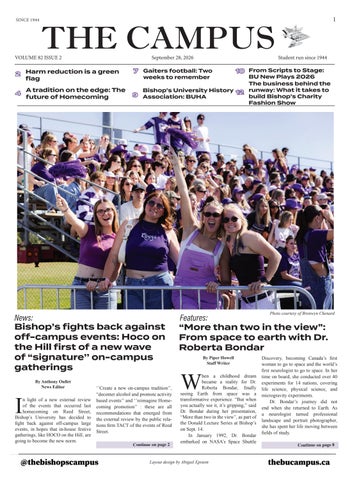
Bishop’s fights back against off-campus events: Hoco on the Hill first of a new wave of “signature’’ on-campus gatherings
n light of a new external review of the events that occurred last homecoming on Reed Street, Bishop’s University has decided to fight back against off-campus large events, in hopes that in-house festive gatherings, like HOCO on the Hill, are going to become the new norm.
Student run since 1944
7 Gaiters football: Two
News:
By Anthony Oullet News Editor
1
Continue on page 2
Features:
Photo courtesy of Bronwyn Chenard
“More than two in the view”: From space to earth with Dr. Roberta Bondar By Piper Howell Staff Writer
W
hen a childhood dream became a reality for Dr. Roberta Bondar, finally seeing Earth from space was a transformative experience. “But when you actually see it, it’s gripping,” said Dr. Bondar during her presentation, “More than two in the view”, as part of the Donald Lecture Series at Bishop’s on Sept. 14. In January 1992, Dr. Bondar embarked on NASA’s Space Shuttle
Layout design by Abigail Epstein
Discovery, becoming Canada’s first woman to go to space and the world’s first neurologist to go to space. In her time on board, she conducted over 40 experiments for 14 nations, covering life science, physical science, and microgravity experiments. Dr. Bondar’s journey did not end when she returned to Earth. As a neurologist turned professional landscape and portrait photographer, she has spent her life moving between fields of study. Continue on page 8
thebucampus.ca
2
NEWS
THE CAMPUS SEPTEMBER 28, 2026
Anthony Ouellet, News Editor » thecampus.news@gmail.com
Bishop’s fights back against off-campus events: Hoco on the Hill first of a new wave of “signature’’ on-campus gatherings Continued from page 1
Photo courtesy of Anthony Ouellet
The findings of this review were presented on Sept. 22 by Bishop’s University principal, Sébastien Lebel-Grenier, secretary general, Geneviève Gagné, and viceprincipal of Student Affairs and Equity, Diversity and Inclusion,
Danai Bélanger, in a meeting in front of about 20 staff members, to which The Campus had access. With these findings in hand, Bishop’s University is making a move against unregulated offcampus massive events, and Hoco on the Hill is the first step in that strategy. ‘’We want to redirect [students] away from, you know, places or events that may not necessarily be safe for them’’, Ms. Bélanger said in front of the crowd. When asked if they feared that students were going to move the party off-campus after these new on-site events ended, the viceprincipal indicated that these were designed to prevent such a thing from happening. ‘’The idea is to create a high-
intensity event on-site, so by the time it is 1:30 or 2 in the morning, the students have had a pretty packed day’’, she noted. She then emphasized that the goal of this strategy is not to prevent students from hosting off-campus activities, but to provide them with alternatives. According to the TACT report, these alternatives should be less alcohol-centred and aim to nurture a sense of belonging on the campus. Bishop’s is going to try to learn from this new formula and adapt it. However, ‘’this is something that worked elsewhere’’, the principal added. ‘’What this is meant to do is to maximize the chances that there is only positive that comes out of the weekend, he said, speaking on the
importance of safety and structure during events such as Homecoming. Police surveillance After what happened last year, it is expected that the Sherbrooke police department is going to step up its surveillance during Bishop’s big events, such as homecoming. A question was, for instance, raised for the principal regarding the use of police drones during this year’s homecoming. He responded that police do possess drones and that he expects that they would be used if any problems were to happen offcampus. The police department has not responded to our request for comment in a timely manner for the publication of this article.
Harm reduction is a green flag
B
By Florence Robert Staff Writer
ishop’s University has introduced a new harm reduction campaign aimed at helping students look out for one another and themselves on and off campus. Named the “We Owe Each Other Better” campaign, this initiative covers four major areas of student life: partying, consent and boundaries, sports betting and social inclusion. Each pillar has its own online guide with information on how to recognize potentially harmful behaviour, identify when something is wrong and know what to do next. Jennifer Coley-Gomez, Director of Student Experience and Engagement, explained that the campaign was created to give students information without taking away from their university experience. “The idea is never to take away the fun. It’s a coming-of-age time. We want to provide students with knowledge and information so that they can make good choices and make it a safe environment for everybody. Everybody belongs here,” she said. The campaign uses red and green flags to identify positive or troubling language. In the Party Smart guide, for example, “What is actually in this?” is presented as a green flag, while “One more drink before we go” is a red flag. The guide also
discusses warning signs of substance misuse and directs students towards various resources for support. Social inclusion was also highlighted as part of the university’s goal of fostering a welcoming environment for students from all backgrounds. The four pillars of the campaign were chosen based on recurring issues in other Canadian university campuses as well as based on values important to the Bishop’s community. Coley-Gomez explained that the university has recently seen an increase in sports betting, making it an important topic to address. She explained that students may not know when certain situations become dangerous or harmful, especially with consent and mixing substances. The campaign is intended to help students recognize these situations. From Awareness to Involvement The university is also looking for three student volunteers to join the Campus Harm Reduction Strategy Committee. While substance use is one of the main focuses of the strategy, the committee will take a broader look at issues like sexual and genderbased violence, discrimination and hazing. The committee will also review current university policies surrounding these topics and consider approaches taken by other universities as it develops Bishop’s
Graphic courtesy of Latoya Simms
strategy. The committee will also allow students to share different perspectives and help shape the university’s approach to harm reduction. For Coley-Gomez, education is one of the most important parts of the campaign. “If what this campaign does is spark curiosity and dialogue, that’s a win for me,” she said. However, education is not the only goal. The university hopes that it will encourage students to feel comfortable asking for help when they need it and become more familiar with the resources that are available to them. Creating a campus where students feel safe coming forward
for support is another important part of harm reduction. The campaign is also being incorporated into larger student events, such as Hoco On The Hill. Coley-Gomez described this as a “flagship event,” where she hopes students will be able to have a good time while also feeling safe, secure and welcome. As Bishop’s continues to develop the campaign throughout the year, the university hopes that “We Owe Each Other Better” gives students a starting point to better educate themselves on harm reduction and where to turn for support.
NEWS
SINCE 1944
3
Anthony Ouellet, News Editor » thecampus.news@gmail.com
Prepare for fewer course options in the coming years: Budget cuts are affecting the number of courses available at BU By Anthony Ouellet Funding formulas aside, one of the As the years go on and Bishop’s is certainly is not enough to cover the
E
News Editor
xternal budget pressure still causes headaches for Bishop’s University administration. Rethinking the course offer and program experience are the main ways Bishop’s can overcome an academic funding loss of about three million dollars. In the past few years, universities in Canada have begun struggling to deal with externally imposed compressions that forced them to engage in budget cuts. Provincial funding for universities has decreased across many provinces over the last decade, as shown by a report published last December by Universities Canada. According to Bishop’s University administration, not much effort is made by the Quebec government to cover the cost of inflation. ‘’When we renegotiated our collective agreement, as with pretty much everywhere else in the province, we negotiated a wage increase. The indexation [of provincial funding]
increase in wages, Dr. Kerry Hull, Bishop’s vice-principal of Academic and Research, told The Campus. Additionally, the government began this year cutting ‘’some of the special envelopes that we had for years’’, according to Dr. Hull. For instance, the special funding allocated to education programs was cut by ‘’about 60 per cent’’. This, however, isn’t news: Bishop’s is on ‘’year three’’ of its effort to deal with these cuts. The university needs to slash about five million dollars before 2029. Of that sum, three million dollars are “on the academic side, Dr. Hull says. Right now, the university is focusing on how it can reduce the number of courses available to save money, while continuing to provide students with superior quality education. This can bring more interdisciplinarity between departments. For example, ‘’the math department is delivering a course for psychology, and history is delivering a psychology course as well’’.
forced to continually reduce its course offerings, things are becoming more difficult. ‘’It’s definitely a challenge’’, Dr. Hull admits. In light of Bishop’s and many other universities’ struggles with financial demands, political pressure is mounting in Quebec. Students who walked on campus in the past few days were greeted by a giant pink poster in the Quad. This poster, an initiative from the Table des partenaires universitaires (TPU), reads ‘’Investing in universities is an investment for everyone in Quebec’’. The TPU, a coalition of unions, student councils and associations, notably fights for better and more predictable funding for universities in Quebec. It asks all political parties to publicize their plan to fund universities before election day, on Oct. 5, the organization explained in a press release. What students?
about
international
biggest financial hits for Bishop’s over recent years is the limitations imposed on the number of international students. In Quebec, for instance, Bill 74, which limited the number of international students permitted into the province, and many federal legislations had a negative impact on the financials of universities such as Bishop’s, as international students bring a lot of money to their reserves. ‘’We don’t know how much the decline will amount to by September, but for now there has been a drop of almost 50 per cent in the number of applications for admission from international students’’, principal Sébastien Lebel-Grenier told La Tribune in April 2025. While she didn’t have the most recent numbers, Dr. Hull said that the university saw the beginning of a rebound in international students in some programs, but ‘’it is still pretty challenging to recruit’’. The hit on Canada’s reputation, she said, is real and is going to take a long time to fix.
Raccoon rabies outbreak brings prevention measures to Sherbrooke
A
By Basile Imbert Contributor
raccoon rabies outbreak is expanding through the south of Quebec and has led to the Quebec government taking actions in order to protect its citizens, including in the Sherbrooke area. According to the numbers published by the Quebec government, 205 new cases have been identified since the beginning of 2026, among animals such as raccoons, skunks and cats. Of these cases, 44 are from Estrie. Last July, three people were bitten in Saint-Anicet, Montérégie, by one of the cats infected with raccoon rabies and had to receive preventative treatment. As microbiologist and infectious disease specialist Donald Vinh told Le Journal de Montréal at the time, “if we look at the context here, it is clear that rabies is not only back, but its rapid spread in the
T
South of Quebec and its recent transmission to a cat is alarming for humans”. While Bishop’s is located in an area impacted by this disease, no raccoon rabies cases have been reported in Sherbrooke. This is not to say that you should engage with cute animals on campus. The Ministère de l’Environnement, de la Lutte contre les changements climatiques, de la Faune et des Parcs stipulates that “it is prohibited to move or relocate live raccoons, striped skunks, gray and red foxes, as well as coyotes and their hybrids, within the territory of municipalities located around known raccoon rabies cases” like Sherbrooke and, by extension, Lennoxville. Authorities also started to distribute baits which contain vaccines destined to potentially infected animals. These are considered safe for humans. From Aug. 3 to Sept. 13, a manual distribution of vaccine baits took place in 114 municipalities in
Montérégie, Centre-du-Québec, Estrie, and parks of the Montréal area. During this first operation, more than 815,000 vaccine baits were distributed. A second wave of distribution, this time via plane, is currently taking place from the 19th to the 23rd. Approximately 440,000 vaccine baits are supposed to be distributed by plane while flying at low altitude above forests and edges of agricultural fields. These will target 62 municipalities in the same three regions, including 29 municipalities in Estrie, among which Sherbrooke is still present. Even though these measures are in place to protect inhabitants of Quebec, it is still possible that animals carrying the virus are not detected or vaccinated. It is therefore important to remain cautious and act appropriately in case of any suspicion of contact with the disease. A deadly disease
Rabies is a contagious and deadly disease. The virus responsible for the disease attacks the nervous system. It provokes multiple general symptoms which can appear up to 90 days after contact with the virus and within10 days before the arrival of neurological symptoms. As mentioned by the World Health Organization, the appearance of symptoms caused by rabies will be close to 100 per cent fatal. The last human case that had rabies symptoms in Quebec dates to October 2000, when a 10-year-old child lost his life after being bitten by a bat. A similar scenario happened in 2024 in Ontario, when an 11-year-old died of the disease. This was the last time a human died from rabies in Canada. These two children are two out of the 28 people that have died from rabies since 1924 in Canada according to the Canadian Veterinary Medical Association.
he Campus acknowledges that the land on which we operate is stolen land, the traditional territory of the Abenaki people. We live, learn, work, and play on this land, home to Indigenous peoples still living. Canada was founded through colonization, a system rooted in oppression and the abuse of power over others, continuing to affect First Nations, Inuit, and Métis communities today. As a student newspaper, The Campus has a responsibility to highlight truth. We are committed to prioritizing underrepresented voices in our community and proactively highlighting Indigenous peoples’ histories and ongoing realities, including their resilience and achievements. We recognize our work plays a role in shaping public perceptions, being able to call-out injustice but also call-in action. We emphasize that we must go beyond a land acknowledgement, which is only one step towards reconciliation. It is the stories in our paper – told with respect, accuracy, and integrity – and the respect and humility we show to the land and others that is more important than what is written in a land acknowledgement. Actionable steps to go beyond a land acknowledgement include educating ourselves and others, and supporting Indigenous traditions, movements, and businesses. —The Campus Team
4
OPINIONS
THE CAMPUS SEPTEMBER 28, 2026
Reagan Russell, Opinions Editor » thecampus.opinions@gmail.com
A tradition on the edge: The future of Homecoming
H
By Eric Wallace Contributor
omecoming has been a staple event in the Bishops Community. Students and Alumni have enjoyed the tradition for generations. It has always been more than bleeding purple. It brings the community together. Students, alumni and the wider Lennoxville community come together to celebrate what makes BU feel like home. However, we can’t overlook the incident at last year’s events on Reed Street, which casts a looming shadow over this year’s homecoming. Will it feel the same? Can we have the same amount of fun as in previous years? Can we preserve the spirit of Homecoming without repeating the mistakes that nearly cost us the tradition altogether? I believe we
can, but only if we as students start to acknowledge the culture that allows it to happen. I believe BU has gotten too big for its bubble. The homecoming tradition has now stretched outside of the small Lennoxville bubble. Our tradition and pride create a tourist attraction for outside students, friends and family, as well as for people in nearby communities. This is a double-edged sword situation. On one hand, Lennoxville has an increase in traffic, which is good for business. However, the tradition that entices people to visit is unregulated and, in some people’s eyes, chaotic. “I enjoy the tradition, but I think it creates a space for vandalism to take place”, said a third-year student. Homecoming will only feel the same if we decide it will. The
tradition was never built on chaos. It was built on connection. It was built on students who cared enough to show up, alumni who cared enough to return, and a community that cared enough to open its doors year after year. That spirit didn’t disappear in 2025, but it was overshadowed. If we ignore the culture that allowed things to escalate, we risk letting one night define an entire legacy. Preserving Homecoming doesn’t mean watering it down. It means maturing with it. It means recognizing that our bubble isn’t a bubble anymore, and acting like stewards of a tradition that now attracts far more than just Bishop’s students. We can celebrate loudly, proudly, and safely, but only if we reclaim the tone of the event from those who treat it like a spectacle
instead of a community gathering. Hoco on the Hill is the new event to our beloved tradition. I believe this could be the happy medium we need for the culture. Keeping students on campus where the gathering is regulated helps with the uncertainty. People will try to do their own thing, but now Homecoming is more spread between events, keeping the crowd in certain areas smaller and more easily managed. Fewer people in one spot will decrease the amount of unwanted activity in the crowd. The future of Homecoming depends on us choosing responsibility over recklessness, intention over impulse, and pride over performative chaos. If we do that, then yes, we can have fun, we can keep the tradition alive, and we can make sure Homecoming continues to feel like coming home.
The harsh reality of the O-Week Concert
E
By Reagan Russell Opinions Editor
very year, the SRC faces anticipated disappointment over the O-Week concert. However, rarely does anything change. While in recent years the stage has been upgraded and a new and improved stage is nice, if it only has artists we’ve never even heard of performing on it, how important is it really? The SRC budget for Orientation Week is not that big. It is dependent on the number of incoming students, among other factors, but it is nowhere near the amount of money that larger schools like Western or even Laval get. Love him or hate him, Sombr performed at Laval’s Welcome Concert this year, and we at least can recognize that name.
Unfortunately, there is not a huge difference between a performer that costs $10,000 or $20,000, but around $50,000, there starts to be more of a difference. However, this is a huge portion of the already small O-Week budget. Students on campus also have a general need to know the music played on campus. A cheaper, upand-coming artist isn’t the vibe for the Quad. Last year, Lu Kala brought in a bigger crowd of upper-year students, creating more of a fundraising concert event, like WinterFest for the SRC. Lu Kala at last year’s Orientation Week was a bigger, more well-known artist, but she isn’t even competing when compared to Western University’s concert this past year: The Chainsmokers. Even a quick Google
Photos courtesy of Yuki Fukamitsa
search values a private concert headlined by the Chainsmokers at a minimum of $500,000 per event. This is around five times the cost of all O-week activities combined, based on previous O-week budgets. The SRC cannot be expected to have such a well-known artist come out with the lack of funds. In support of the SRC’s choice this year, a student commented that “the concert is a big part of O-Week, but I think you can have an amazing time regardless of how big the artist is”, whereas other students reiterate that the event is held as the grand finale to the week and becomes “kind of a letdown.” As for ways to prioritize money from the budget to allocate to the Concert, the SRC would need to change the original Orientation Week set-up. In many ways, activities and events are standard from year to year with different branding tweaks to make the event more on theme. A student volunteer commented that “I feel we did all the same things as last year, and we had a crappier concert.” Could the SRC keep key events like the Scavenger Hunt, Field Day,
and serenading the Principal, and focus the rest of the budget on a better performer? Can alumni chip in funds? Or should the SRC stray from the live performance route, as students claim, “it would have been better if they just hired a DJ to play the original songs”, in comparison to the band that predominantly performed covers. As for planning O-Week and the concert, I have been there and done that. I don’t think there’s necessarily a right or wrong answer to this issue, but money only goes so far. Bishop’s O-Week is unique and different from many universities. Serenading the Principal is an iconic component of O-Week, and it is free. So are many club-sponsored, student-led events like line dancing workshops. Could O-Week be more sustainable with their money and encourage student connection in this way, and create more buzz for the Friday Concert? When students are saying how “the cover band felt like KidsBop”, things need to change. The SRC was contacted to comment on this issue and did not respond.
SINCE 1944
OPINIONS
5
Reagan Russell, Opinions Editor » thecampus.opinions@gmail.com
Women and sports advertisements
A
By Daphne Moore Contributor
s a female golfer and a studentathlete at Bishop’s University, I have noticed how differently women can be portrayed in sports advertising compared with how we actually experience sports. Lately, two ads have made that especially obvious: the Good Good and Callaway golf advertisement and the Novig sports gambling advertisement, featuring Sydney Sweeney. Both have started conversations about how women are represented in sports, and these conversations are important. Golf has been a huge part of my life since growing up in Texas. I played competitively throughout high school, spent years playing junior golf and now I continue to play at Bishop’s. Being a female golfer means that I know firsthand how much work goes into the sport. There are hours of practice, early mornings, bad rounds, good rounds, travelling, workouts and a lot of frustration. When I see women included in sports advertising, I want to see that side of sports represented too. The Good Good and Callaway
advertisement is a good example of where things can go wrong. The ad showed Good Good co-founder Garrett Clark pushing female golfer Alexis Miestowski to the ground as part of a joke about a golf club. The video was removed, both companies apologized and Callaway eventually ended its partnership with Good Good. Reuters reported that Callaway also committed $1 million to organizations working to prevent violence against women. Sydney Sweeney’s Novig advertisement created a different conversation. Female athletes criticized the campaign for focusing on sexuality instead of athletic ability. One of the strongest responses came from British sprinter Amy Hunt, who said, “Sydney Sweeney, this is what women in sport look like. Muscles, hard work, sweat, blood, tears.” Former U.S. gymnast Gracie Kramer also spoke out about the ad, saying that female athletes have been “oversexualized, reduced to our bodies and forced to fight to be taken seriously.” The Associated Press reported that several other female athletes made similar criticisms. I do not think that every
advertisement featuring a woman has to be serious or completely focused on competition. Women’s personalities, senses of humor and different styles should still be highlighted. The problem happens when being a female athlete seems secondary to being entertaining or attractive. There is a difference between showing confidence and reducing women in sports to objects of attention. At Bishop’s, I get to be around female athletes who understand this firsthand. We are students, teammates and competitors. We work hard because we love our sports and because we want to improve. I think advertisements should reflect that reality. They have the opportunity to show younger girls that being an athlete is about skill, confidence, teamwork and dedication. Sports advertising has a huge influence on what people think athletes look like and what they are supposed to be. As a female golfer, I would much rather see an ad that makes a young girl think, “I want to play golf,” than one that makes her question whether she belongs in the sport. That is why the Good Good and Callaway ad was so
Photo courtesy of Daphne Moore
disappointing to me. Instead of showing the skill, competition and personality that make golf enjoyable, the ad used a joke involving a female golfer being pushed to the ground. Ads like this can make it harder for young girls to see themselves as serious athletes. Golf already has a long history of being seen as a male-dominated sport, so the way women are represented matters.
Summer in paradise (Lennoxville edition)
I
By Leighton Geraghty Contributor
f you’re thinking about staying in Lenn throughout the summer, you totally should! I’ve spent the past two summers here in Lennoxville working at the Bishop’s Daycamp. From 8 a.m.- 4 p.m., our campus that is usually flooded by a stream of purple was taken over by children from ages four to 14. The day camp is a great place to connect with people who you may not cross paths with during the school year. A mix of education majors, varsity athletes and Lennoxville locals adopt a different persona and become role models and heroes for the next generation. Although work takes up most of the day, there is still plenty to do after work. The weight room is empty, allowing access to any machine at any moment. The struggles of not being able to access the cables you have during the school year are non-existent in the summer. One of the best parts about
the evenings in Lennoxville is the local businesses. A 6:08 tee time at Old Lenn followed by some time on the Lion patio is the recipe for a successful evening. Summer in Lennoxville looks a little like this: work, gym, golf, Lion, repeat. Summer months are some of the greatest times in town, but nothing beats the return of the students. Before school started, I left Lennoxville for a week. Driving back into town gave me goosebumps. A quiet yet scenic town turned back into the place we all love. The sound of running cars rolling through Queen Street, stopping at the lone light next to the Lion, was the true testament that the school season was back in effect. Campus turned back into its beautiful self, filled with purple, laughter and cheer. It once again became impossible to find a machine to use in the weight room. Although frustrating, a feeling of fullness returns. As you walk
through the Champlain College path, you can hear the whistles ringing from Coulter Field where the varsity athletes prepare for their weekend matchups. As Lennoxville continues to transition from the summer months to the fall season, local businesses are striving with the students back
in town. Wednesday wing nights at the Lion are back, alongside weekend farmer markets at Square Queen. The tee sheet at Old Lenn Golf Course is full from opening to close. Before you apply to return to a job back home, talk to your friends and consider a summer in Lenn.
Photos courtesy of Rachel Nasani
6
SPORTS
THE CAMPUS SEPTEMBER 28, 2026
Maxime Trottier, Sports Editor » thecampus.sports@gmail.com
Battling adversity
R
By Leighton Geraghty Contributor
ugby is a hooligan’s game played by gentlemen. Fifteen players, eight forwards, seven backs, one ball. Bishop’s rugby history goes back a long way, established in 1888 under early football rules. In 1976, the Men’s Rugby team came to light; a cornerstone of the RSEQ, seeing multiple athletes be promoted to playing professionally post-university. A lot is on the line when representing Bishops on the pitch. The history and brotherhood of the team is a main reason for many to return for their 5th year of eligibility at the school.
Unfortunately for the Gaiters, they have been battling adversity early in their RSEQ campaign. The injury bug has gotten the best of Bishop’s heading into the regular season. Many key players from the roster last year have been sidelined for the first two games of the regular season. The Gaiters have started their season off 0-2, losing to the University of Montreal and the Ottawa Gee-Gees. With only 6 games in an RSEQ regular season, the Gaiters will have to have a dominant second half of the year in order to crack the playoffs. Their eyes are set on ETS for a Friday Night Lights game on Coulter Field in front of a Homecoming crowd. Although ETS
has been known to be a powerhouse in the country, the Gaiters always have a fighting chance. Darting back to 2015, the Gaiters hold an edge of a record of 24-6 over ETS. The remaining games in their schedule include an away game at Concordia followed by two home games against Carleton and McGill. Bishops will have to battle adversity against the injury bug as they climb their way back into the rankings. When I spoke with Senior Forward Jeremy L’Heureux, he stated that “Being 0-2 does not define our team. We’re heavily focused on these next four games and are putting in the preparation and work needed to overcome this period of
forward Sandrine Chouinard, who was named on the USports all-rookie team last year. She will have the chance to establish herself in the top six of the lineup as she will try to build on her solid rookie season that saw her tally 16 points in 24 games. Another forward who will have the chance to solidify her role is second-year Rosalie Bouchard. She scored three power-play goals last year, which put her second on the team in that category, and she will try to build on that trend again this year as she gains experience. It will also be interesting to keep an eye on freshman Laurence Lafleur, who finished 4th in scoring at the collegiate level last season playing for ChamplainLennoxville. Hopefully she can have the same impact at the university level as the Gaiters will try to improve on the 2.33 goals per game they had last season, which placed them third in the conference. The same opportunity
exists amongst the goaltenders this year. With the transfer of Erika Gagnon, second-year Laurence Boivin will look to take over the starting role. Boivin won five of her eight starts last season and will look to do more of the same this season as she establishes herself as the new Gaiters number one goaltender. Behind her, freshman Jolianne Tremblay will provide depth as she starts her university career. Of course, the Gaiters will still be able to count on star veteran Gabrielle Santerre, who will try to continue her dominance in the RSEQ and lead the team to another championship. Last season, the Gaiters ranked 19th in goals per game, 22nd in goals against per game and 20th in power play efficiency, respectively, out of 35 teams at the national level. For the Gaiters to achieve their goal of returning to the National Championship, the development of
adversity”. L’Heureux is a cornerstone of this Gaiters squad. The senior forward came back into the lineup against Ottawa and put in significant minutes in the game. In order to bounce back, the Gaiters will have to embrace the contact and take the game into their own hands. Win the rucks, dominate the scrums and be smart with the ball. But if there is any team capable of bouncing back, it’s this one. The veteran presence mixed in with the speed and talent from the promoted 2’s players is something to watch out for. Keep an eye on the Gaiters as they start off their home stretch of the season.
Gaiters hockey season preview: A team full of potential
A
By Benjamin Lussier Contributor
fter a disappointing end to their last season by losing in the RSEQ playoff semi-finals, the Gaiters Women’s hockey team enters the 2026-2027 season with only one objective in mind: returning to the national championship tournament. The team will look different this season, as several players are leaving due to graduation or transfers. Though these losses are notable and important, they also mean that new opportunities are there for freshmen and sophomore players to find their space in the lineup. The Gaiters will have to find a way to get the most out of their particularly young lineup that only includes two seniors and one graduate student. With so much youth on the roster, several players will have the opportunity to take on bigger roles this season. Among them is second-year
the young players will also need to translate to stronger team play. Another necessary aspect of improvement for the Gaiters is discipline, as they were the sixth most penalized team in the country last season. With a young roster taking on bigger responsibilities, limiting mistakes, improving special teams and finding more consistency offensively and defensively will be key to achieving their objectives. Despite the young roster, the Gaiters have the potential to build on last season and take a step forward. With young players ready to take on bigger roles, and a new opponent in play with the Rouge et Or joining the RSEQ, the upcoming season should bring a new level of competition. If the Gaiters can turn their youth and potential into consistent team play, they could be in a strong position to make another push toward the national championship.
THE CAMPUS STAFF 2026-2027 EDITOR-IN-CHIEF
LAYOUT EDITOR
ECONOMICS AND BUSINESS EDITOR
THIS ISSUE’S CONTRIBUTORS:
thecampus.editor@gmail.com
thecampus.layout@gmail.com
thecampus.businesseditor@gmail.com
Basile Imbert Benjamin Lussier Daphne Moore Eric Wallace Jasmine Attwell Jon Degooyer Leighton Geraghty Marjorie Heroux Sarah Gairaud Zachary James Saint Cyr
Olivia Norby
Abigail Epstein
COPY EDITOR
GRAPHICS EDITORS
thecampus.copyeditor@gmail.com
graphicseditor.thecampus@gmail.com
Saskia Yacoubi-Sluis
ASSOCIATE EDITOR
Abigail Epstein
thecampus.associateeditor@gmail.com
DIRECTOR OF FINANCE Frederic Grenon
thecampus.business@gmail.com
Addison Walker
OPINIONS EDITOR
Gabrielle Lalonde & Latoya Simms
Reagan Russell
STAFF WRITERS
FEATURES EDITOR
Piper Howell, Megane Masson & Florence Robert
thecampus.opinions@gmail.com
Lauren Root
thecampus.features@gmail.com
NEWS EDITOR
SPORTS EDITOR
thecampus.news@gmail.com
thecampus.sports@gmail.com
Anthony Ouellet
Maxime Trottier
DIRECTOR OF MARKETING & COMMUNICATIONS
ARTS AND CULTURE EDITOR
@thebishopscampus Instagram
thecampus.artsculture@gmail.com
Roser Riera
Jillian French
SPORTS
SINCE 1944
7
Maxime Trottier, Sports Editor » thecampus.sports@gmail.com
Gaiters football: Two weeks to remember
C
By Maxime Trottier Sports Editor
oming off a disappointing result in Week 1, the Gaiters football team immediately turned the page in optimism, looking towards their next match against cross-town rival Sherbrooke. It would be the first time in close to a decade that Estrie’s two university football teams would have the chance to square off. Both teams started their year off with a 0-1 loss and were hungry to again find themselves in the win column, against the perfect opponent no less. Estrie’s finest hadn’t seen each other in eight years, and the rivalry didn’t skip a beat. The Gaiters team have had UdS circled on their calendar for months, and as it turned out, so did the fans. The buzz entering Coulter Field that Saturday was intoxicating; the gray pavement surrounding the field was masked by a sheet of purple storming in before kickoff. Not to be outdone, the Sherbrooke faithful made their way to Lennoxville in large
Photo courtesy of Chase Besner
numbers to see the latest iteration of the Bishop’s Sherbrooke rivalry. The Gaiters started first with the ball, and on the opening play of the game, quarterback Justin Quirion found Lionel Ostiguy on the sideline, who then made his way all the way down to Sherbrooke’s 20-yard line. The already frantic Coulter Field had gone into a frenzy. The excitement, however, was short-lived. The ensuing play saw a pass intercepted and returned one hundred yards to the Gaiters ‘ end zone. In the span of two minutes, Coulter Field had
transformed from a madhouse to a ghost town. The Gaiters, as they always do, continued to fight and maintained a close game going into the fourth quarter. With two and a half minutes remaining, they found themselves in a do-or-die third down in their own territory, down six points. Backup quarterback Mathieu Bellavance came in to replace Quirion, as he often does in such situations. To the surprise (and delight) of those in attendance, Bellavance did not dive for a first down, instead running the ball sixty yards to the end zone for a Gaiters touchdown. A UdS time miscommunication in the dying seconds sealed the victory for Bishop’s, proving after nine years that Estrie is purple after all. The post-game festivities were shortlived, as next on the Gaiters’ schedule was the most imposing of all foes USports has to offer: The Carabins of the University of Montreal. UdM has won two of the last three National Championships and has been ranked number one in Canada all
year long. They faced the Gaiters at the CEPSUM under Friday night lights. I had the occasion of attending the game, and everything from the pregame presentation to the scoreboard at the game’s end showed me why Montreal is still the team to beat in Canada. The Gaiters put up a valiant fight, one to be proud of, but the experience of the Carabins proved too much. Star quarterback Pepe Gonzales and his arsenal of receivers flowed effortlessly around the field, putting up 33 points to Bishop’s nine. It’s important to note that seasons like these are a process. When you’re the new kid in a big kid’s world, nothing is ever going to be easy. This is a common understanding in the Gaiters locker room. Still, the mission remains the same. Winning at Bishop’s has never been a hope; it’s an expectation. Five games remain in the regular season, and as the Gaiters become increasingly comfortable in the RSEQ, expect them to push forward to victory as they strive for the playoffs.
From student entrepreneur to sponsoring Bishop’s rugby: Jonathan Scott-Lewis builds business while giving back
W
By Olivia Norby Editor-in-Chief
hen Jonathan Scott-Lewis started his cleaning company, his goal was relatively simple: make enough money to pay his bills and stay in university. Four years later, the Bishop’s University student and rugby player is using that business to sponsor both the men’s and women’s rugby teams. Scott-Lewis started JJSVCS in 2022, when he was 22 years old, beginning with window and gutter cleaning. The business later expanded into residential cleaning after a suggestion from his mother and eventually into commercial cleaning after Scott-Lewis saw an opportunity in the market. The company now takes on a variety of jobs, including residential and commercial cleaning, move-in and move-out jobs, summer cleaning and larger specialty jobs. For Scott-Lewis, however, starting the company was never simply about becoming an entrepreneur. He was looking for a way to support himself while balancing university and rugby. “I thought about working at Maxi, to be honest,” Scott-Lewis said. “And I was like, you know what? No. I’m going to try to make something on my own.” His original goal was straightforward. If he could complete enough cleaning jobs each month, he could cover his expenses and continue funding his education.
“I’m really just self-funding my university,” he said. That financial independence became particularly important last year, when Scott-Lewis said he was struggling to afford university. “I wouldn’t like any other kid to be in the position I was in last year,” he said. Going into August, Scott-Lewis said he had only $300 to his name and was unsure how he would pay for school. “I was struggling a lot and I had, I literally had $300 to my name coming into August and I was wondering, how am I going to pay for school?” The situation became serious enough that Scott-Lewis questioned whether he would be able to remain at Bishop’s. “It came to a point where I even questioned if I’m going to be able to be in school,” he said. His financial situation also affected his ability to participate in rugby. “I even spoke to Tom and I told Tom, like, ‘Hey, I don’t think I’ll be able to play rugby,’” Scott-Lewis said. Scott-Lewis said Bishop’s rugby coach Tom Whyld supported him financially so that he could continue his season. That experience is part of what makes Scott-Lewis’s decision to sponsor Bishop’s rugby particularly meaningful. Supporting the rugby program was something he had considered since starting his company. “I always thought sponsoring the Bishop’s rugby team would be so cool,” he said.
When the rugby program began looking for sponsors, Scott-Lewis approached the team to ask what sponsorship would require. He ultimately decided to contribute $1,250. His sponsorship supports both the men’s and women’s rugby teams. For Scott-Lewis, being a sponsor is different from simply watching the team from the sidelines. He is also a player and an active member of the rugby community. “I have daily conversations with them and I understand them on more of a deeper level than other people, let’s say spectators that just watch the game,” he said. He said the current team’s commitment to the sport and its desire to win reminds him of Bishop’s teams from previous years. “I’m just really bought into how much they’re bought in in winning and the environment and playing,” he said. Scott-Lewis describes his sponsorship as a “full circle moment.” The same community he is now supporting has also played a role in his own university experience. His time as a rugby player has also influenced the way he approaches his business. After facing challenges with his playing time last season, Scott-Lewis said the experience forced him to develop patience and resilience. “It allowed me to become stronger mentally and it also allowed me to just keep going, always finding something in order to push me forward even though I wasn’t playing,” he said. “I thought it just taught me a lot of
Photo courtesy of Jonathan Scott-Lewis
patience and resilience.” Those lessons have become part of his approach to running JJSVCS while balancing school and rugby. But Scott-Lewis’s ambitions for the company extend beyond his own financial independence. He hopes JJSVCS can eventually become a source of employment for other students and athletes who need flexible work while pursuing their education. “It just means quite a bit to me that I’m not only able to sponsor the team, but to have a business and then with that business to be able to help out, not only just students, but other athletes that need work and that need jobs,” he said. For Scott-Lewis, JJSVCS began as a way to make university financially possible. Now, it has become a way to give back to the community that has been part of his university experience. “I just find it like a full circle moment, to be honest.”
8
FEATURES
THE CAMPUS SEPTEMBER 28, 2026
Lauren Root, Features Editor » thecampus.features@gmail.com
“More than two in the view”: From space to earth with Dr. Roberta Bondar Continued from page 1
Having graduated from the Royal Society of Canada’s Institute for Scientific Research in 1997, Dr. Bondar went on to pursue a career as a landscape and portrait photographer, capturing the beauty of Canada. Her work is strongly influenced by the horizon of the Earth and the edge of the planet. For Dr. Bondar, photography became another way to explore her questions with science. “People pigeonhole me into a scientist, and now they don’t know what to do with me,” she said. Dr. Bondar stressed the link between art and science; science can help people understand the laws of nature, but photography
can give them another way to see and experience it. By helping found the Roberta Bondar Foundation, Dr. Bondar fosters the connections between photography and science. The Foundation’s seminars, workshops, and The Bondar Challenge help people, especially younger generations, connect with the natural world. Much of Dr. Bondar’s recent work has highlighted birds and their migration patterns. During the lecture, she spoke about different species, specifically the whooping crane, lesser flamingo, Arctic tern, red knot, Sprague’s pipit and piping plover. Dr. Bondar’s Space for Birds
project focuses on how photography can help us better see nature and its wonders. The project’s second phase asks the simple question: why does avian migration seem invisible? For Dr. Bondar, photographing birds is not only about capturing beautiful images, but also about using another lens to watch the changes taking place in the world. While medicine, space, photography, and environmental conservation may seem different, Dr. Bondar’s lecture helped reveal how they are all interconnected by the key concept of perspective. Going to space helped Dr. Bondar see the planet in a new way, and her photography became a way to share that perspective with others.
And now, through the Roberta Bondar Foundation, Dr. Bondar is encouraging people to become more observant of a world that often moves too fast.
Photo courtesy of Juliette Hamel
Photo courtesy of Lauren Root
The much-anticipated release of the Last Installment of the Saint Akzena series! By Lauren Root Feautures Editor
Photo courtesy of Lauren Root
O
ctober will be an exciting time for all science fiction and horror lovers around Bishops! Not only is it Halloween, but the final installment of the Saint Akzena trilogy, Talion, will be available for purchase on October 6th! The first two books in the trilogy, Pandemonium and Lampades, are already available on Amazon for those who want to get an early jump
on reading the series. The Saint Akzena trilogy is written by François Fallon, a recent Bishop’s graduate. In fact, François credits a large portion of his success in writing the trilogy to Bishop’s. As an English Media/Film major, François was able to complete the book series he had long been thinking of. François’ inspiration for writing a trilogy is simple: “I wanted to finish what I started at age 13.” When asked about how his time at Bishop’s helped him write the trilogy, François says: “The environment of Bishop’s itself sets the stage.” In fact, much of the scenery around Bishop’s and Lennoxville inspired the setting of Saint Akzena. When reading the trilogy, many of the pictures included were taken around the Bishop’s campus. The trilogy itself is set in the Canadian wilderness, intentionally being vague about the location, so that Canadian readers could easily visualize the location through their own experiences with forests. François says, “If it wasn’t for the Bishop’s campus itself, then what’s within the books would be very different.”
The Saint Akzena trilogy has been a work in progress for a long time now. François first began writing this book at age 13 in October of 2008. At the time, François was bored with traditional horror stories. After reading Stephen King’s Salem’s Lot, which is a collection of stories, François was inspired to write his own collection of stories. So what is Saint Akzena? Well, besides the title of the series, it is also the name of the haunted, abandoned high school where the story takes place. “Akzena” is also the deity living below the school. The first book, Pandemonium, is set in the early 2000s and follows the main character, Steve, who arrives at the Saint Akzena school and is able to explore its history before successfully escaping. Together, Steve and the reader explore Saint Akzena and begin to understand its complicated history. The title Pandemonium comes from John Milton’s Paradise Lost, meaning “all demons.” The second book, Lampades, is set in the 19th century and follows main character Margaret as she discovers the interstellar witch coven of Saint Akzena.
The third book, Talion, took an additional amount of research. Since it’s a period piece, François says that he watched “Little House on the Prairie” to help better situate himself in the historical scene. Talion follows main character Orla through her journey at Saint Akzena and through her quest for vengeance against those who have done wrong to her. Talion is set in the 1860s. The creation of the Saint Akzena trilogy helped François connect with people from around the world. Dr. Shoshannah Bryn Jones Square was the first person to read the manuscript of Pandemonium, since she was the professor of the Gothic literature class. In addition, François has been able to work with visual artists from around the world, Natalia Depreina and Erinthul. The book series is published by Amazon Kindle Direct Publishing, which François says has been extremely helpful and upfront about the publishing process throughout this journey. Keep your eyes open for October 6, when you can order the final installment of the Saint Akzena trilogy, Talion.
FEATURES
SINCE 1944
9
Lauren Root, Features Editor » thecampus.features@gmail.com
Bishop’s University History Association: BUHA ooking for a leadership position? Have an interest in history and want to get involved? Look no further than the Bishop’s University History Association. While you probably Graphic courtesy of Bishop’s University History haven’t heard of it, that’s ok! This Association article is here to tell you all about matters. BUHA has two Directors of what BUHA is and what it does. Ironically enough, there isn’t Communications positions, one of much history about BUHA’s which is now open. The person who creation. Evidence found (from the will fill this position will mostly be logo) does show that it was created responsible for keeping the social “a long time ago,” but the rest media account active (Instagram), has been lost to time. As of today, as well as promoting the events and BUHA consists of 6 executive happenings of the association. The positions, 4 of which have already last executive position is the 1st been filled. The President (myself year Representative, which is also - Sarah) and the Vice-President open. This position must be filled work closely together to run the by a 1st-year History student. As wonderful association, while the 1st-year Representative, the person Secretary-Treasurer takes care of elected will act as a liaison between bureaucratic matters and money BUHA and the lower-year students,
ensuring that their interests and voices are heard within the organization. So what does it mean to be involved in BUHA? Well, during the Fall semester, BUHA tries to organize a study night during midterms for history classes. This allows collaboration between students who have previously taken the courses and those who are currently enrolled in it. Another goal is to organize a movie night this semester, so please let the BUHA team know if that is of interest to you! The big part of BUHA’s work happens during the Winter semester, when we put together the Historical Review. The Review is a collection of history-related essays written by students in the previous year. What kind of work really goes into creating the Review? Well, as executive members, the team collects essays from the previous
physically, I was forced to question what lower-impact exercises I could do. During the pandemic and fueled by likely the beginning of some disordered eating tendencies, I was locked away in my room silently attempting the Chloe Ting twoWeek Shred challenge on YouTube. Post-concussion and looking to become active again, I started more modern Pilates workouts again. Like so many wellness endeavours, Pilates has become so expensive. A workout that was born in internment camps using limited equipment has become the “it girl” workout. I am fortunate enough that my area back home has free weekly yoga and Pilates sessions in the park from spring to early fall. This is what made me realize that we could have a Pilates and Yoga club on campus for students. Recently, I began my Pilates Instructor Certificate course through a Pilates studio in my hometown. Completing this hybrid course requires me to teach sessions
to participants. While I could’ve found a paid role elsewhere, I thought to revive the now-defunct Mindfulness, Yoga and Meditation Club and start the Bishop’s Yoga and Pilates Club, providing free, student-led Pilates and yoga classes on campus. Pilates has helped me so much overall as someone trying to be active. My flexibility has improved, I’m able to lift heavier, and I can understand breathing more during my workouts. Instead of holding my breath when lifting, I’m actually able to move with my breath. Yoga and Pilates are lowerimpact workouts that couple well with other sports. You don’t need any equipment, despite what social media may show you. Bring a yoga mat, towel, or just yourself and come to move your body in a way that feels good and challenges you. If you’re looking for a way to meet new people, move your body in a low-impact yet still challenging way, or want to
L
By Sarah Gairaud Contributor
NAMASTE a while with the Bishop’s Yoga and Pilates Club By Reagan Russell Opinions Editor
Photo courtesy of Reagan Russell
I
n my first year at Bishop’s, I was on the women’s rugby team. Clearly a superstar of the season, I was concussed in my first and last varsity game and left the team at the end of the academic year due to health reasons. While recovering and feeling trapped in my own body, and unable to do much
academic year. Once they have enough, they divide the articles among members and begin the editing process to ensure highquality articles reach their audience. BUHA comes up with a visual theme, designs the whole thing, puts it together, and then prints it. The team then has a launch party where we proudly get to show off what we created! If any of this sounds appealing to you, please fill out the form in BUHA’s Instagram description (@bishopsbuha). If you have any questions, please do not hesitate to reach out to the team at buha@ bishops.ca, and they will gladly get back to you!
Student offer
TA K E A D VA N TA G E
improve your flexibility for other sports, please consider joining the Bishop’s Yoga and Pilates Club, which will hopefully be ratified soon on campus. We are hoping to have weekly sessions as well as bigger events open to the entire Lennoxville community. There are vacant Executive Team roles to be filled, so please refer to the Instagram account, @bu_yoga. pilates, for the most up-to-date details! Namaste!
10
ARTS & CULTURE
THE CAMPUS SEPTEMBER 28, 2026
Jillian French, Arts & Culture Editor » thecampus.artsculture@gmail.com
From Scripts to Stage: BU New Plays 2026 By Zachary James Saint Cyr Contributor
N
ew Plays is back at Bishop’s! This year, the festival ambitiously features a record nine studentwritten plays, the largest number since pre-COVID, as well as a Saturday Reading Series - all written, directed and organized by our talented students! The plays will be presented over two evenings of theatre from Oct. 1 to Oct. 4. As always, New Plays showcases Bishop’s student talent from beginning to end: students write and submit scripts (often from the Playwriting course), direct and stage-manage, and perform. Three students are coordinating the entire festival: Fiona Tremblay, Elizabeth Clarke and me. In the first week of the fall semester, the Bishop’s University drama department ran auditions and cast the plays, starting the process of transforming studentwritten scripts into full productions. This year’s festival includes plays spanning many genres, shifting from superhero absurdism and supernatural sci-fi to murder mystery and reflections on university life. Night A features
Photo courtesy of Fiona Tremblay-Snelgrove
four quick-hitting shows, ranging from Fiona Tremblay’s relationship drama If it’s Convenient and Adam Medland’s superhero farce Captain Thunder to Piper Howell’s sci-fi When A Door Closes and Rhain Piquette’s time-loop comedy Cranston’s Requiem. Night B features five more diverse pieces, presenting Juliette Trépanier’s whimsical Whimsy on the Grounds, Vallée’s campus drama Those Left Behind, Warner’s skit Dimprov, Dani Albarran’s mystery Boarding School Drama and Frankie JB’s
immersive Kaleidoscope. New to this year is the Saturday reading series, featuring an additional six plays. Student playwright Tallula Russel comments on this addition to the festival’s productions: “The reading series is a sort of radio-play done live thing, with several actors reading from scripts on music stands set on stage, with no lights or sound”. Her own play, Exodus 34:14, will be among the six read that night: “I am excited for people to experience it”. As a first-time participant
in New Plays, I took on the role of sound designer for Night A’s When A Door Closes. Working alongside lighting designer Fiona Tremblay, director Lianna Roque, and stage manager Romina Recalde, the experience has been a crash course in live timing and technical theatre. Coming from a background in corporate live sound work, managing audio and creating sound effects in a theatre setting has taught me how much weight rests on offstage precision and the use of sharp auditory cues to heighten suspense. Leading up to opening night, student directors and actors are building these shows from the ground up without past productions to reference. In addition to acting and directing, the festival teaches students practical hands-on experience running every technical element of live theatre, putting students in charge of calling cues, designing lighting rigs, and managing crews. The festival will be held from October 1st to Oct. 4, 2026, at Turner Theatre. Tickets are available through Lepointdevente. Come and support the arts!
Bishop’s student filmmakers at Knowlton film festival
T
By Jon DeGooyer Contributor
owards the bookend of the summer, Bishops collaborated with the Film Festival of Knowlton to bring in students to spend a week in the scenic town, to screen films, workshop with filmmakers, and to give a panel discussing their experiences. This experiment was the idea of the festival director, Julie Bardet, who wanted to reach out to a younger and enthusiastic audience and get them involved with the Knowlton and Quebec film subculture. Including myself, eight Bishop’s students attended the festival, a majority of whom are aspiring filmmakers themselves. On the afternoon of August 19th, the group drove to Knowlton, supervised by the chair of the film department, Gregory Brophy. We stayed in a beautiful country house, hosted by a friend from the festival. One of the students, Samiya BouzianeMerceron, said this about the shared living space: “It was a super fun experience! It was cool watching the movies together and being able to talk about them as a group and stuff.” There
Photo courtesy of Jon DeGooyer
you have it, folks! Of the feature films shown, the film Best Boy was a highlight, an absurdist and harrowing family drama by director Jesse Noah Klein. We got a chance to talk to Noah over coffee afterwards. He answered our questions and provided advice about working within the festival system, production costs, and getting your name out into the world as a filmmaker. We also had the opportunity to speak to German
director Wiebke von Carolsfeld on her daring survivalist-drama film Somebody’s Daughter. She spoke about her motivation to depict a morally grey yet strong female protagonist. The variety of films on display struck a cord with student filmmaker Kas MacDougal:“With such a wide breadth of film work on display, I felt honoured to be able to catch pieces ranging from cutting edge documentary features like Chouwa Lang’s ‘Replica’ to straight
from Sundance debut features like Walter Thompson’s ‘If I go, will they miss me?’ 10/10 would attend again!” The event ended with a screening of shorts, two of which were from Bishop’s filmmakers. Kas MacDougal’s experimental horror short, “Signals”, featured groundbreaking special effects, while Elizabeth Hebert’s film “Night Poet” explored the friendship of four students with a tragic twist. “I was quite shocked to learn that they had actually accepted it,” she commented. “To have it accepted into the KFF, where most projects are done by screenwriters and directors who have so much more knowledge in the field, was something else entirely.” The eight attending students also got the chance to speak on a panel about the shorts and the festival itself. That night, we reigned it in with karaoke before returning home. A particular highlight was Kas MacDougall and Dr. Brophy’s duet of David Bowie’s classic “Heroes”. Hopefully, Knowlton will continue this opportunity for a whole new batch of Bishop’s students to connect and experience filmmaking next year.
ARTS & CULTURE
SINCE 1944
11
Jillian French, Arts & Culture Editor » thecampus.artsculture@gmail.com
Horoscope: Mars enters Leo; Mercury enters Scorpio By Abigail Epstein Layout Editor
M
ars enters Leo on Sept. 27, sparking a shift in collective ambition. Expect action kindled out of creativity. Meanwhile, Scorpio welcomes Mercury to the shadow of the conversation, come Sept. 30. Aries: You may experience a boost in confidence when it comes to trying new things. Dust the peanut gallery off your shoulders. Your drum right now is a line, not a circle. Taurus: Bouts of intensity may be directed impulsively, fitting within esoteric frameworks. If something moves you, follow it through. You’re a conduit for the lessons of the Earth. Gemini: A certain diversity shouts at you in a textured version of life. Respond to what touches you in a version of cut and paste. Coherence can look a lot like a collage. Cancer: After a season of drama, have you molded to the mask? Find balance in dichotomies that satisfy your cocktail. Don’t be dissuaded by the answers of others. Leo: As you spin new thoughts on your finger, try to see things from all sides as they are. Loosen your imagination from memory, and let go of its hold on your standards. See then, how fast the present opens. Virgo: As inspiration feeds into your livelihood, remain just a little suspicious. What speaks to your whole won’t be everything. Pursue a project that carries your signature, and then let it eat from your hand. Libra: When compliments repeat themselves, do you feel things getting old? It’s not just you (happy birthday)! Tell another story. Your creative power is in recontextualization. Scorpio: If you’re feeling prophetic, turn on your fairy lights. The doom and gloom is coming, sure, but speak in silver linings. They’ll be all the brighter once the fall sets in. Sagittarius: Controversial opinion – get out your gavel and witch hat. A sparkling way forward is in fantastical conversation. Endeavour, never, to have the final word. Capricorn: The bitter greens begin to leaf, suiting many a smoothie or two. Prepare for hard pills to swallow, when you’re drafting up your ideals. Suspect secrets in the sugar. Aquarius: Devotion needs an artistic surface – don’t care too much for neat and tidy. Blend mediums with your tooth brush. What sings and smiles need not make sense. Pisces: What you’ve left to the shelf comes down with the wind, and may make an abstract pattern. Does the mess on the floor hazard you – and your enemies? Keep track of all the doors you close. For you to take with as many grains of salt as there are stars in the sky.
Gods, heroes, men, and pigs: Classics department brings reflections on Nolan’s The Odyssey to the Agora
O
By Marjorie Heroux Contributor
n Wednesday, Sept. 16, 2026, Dr. Jenn Cianca of the Classics Department presented a panel on Christopher Nolan’s Odyssey in the LLC Agora. Released in theatres on Jul. 17, 2026, Nolan’s Odyssey has been the subject of both high praise and bitter critiques. During her reflection, Cianca carefully observed this phenomenon, raising her concerns and her compliments, all while offering an accessible entry point for nonclassicists into the world of Gods and heroes of Ancient Greece. The Odyssey, an ancient Greek tale passed down through generations of oral histories and, allegedly, written down by Homer, is a tale of homecoming. It recalls the adventures of Greek hero Odysseus, as he attempts to return home after the Trojan War, only to find his home, Ithaca, full of suitors endeavouring to usurp his throne and his wife. Cianca addressed this concern throughout her lecture but also approached three major themes: Gods, heroes, men and pigs. “Gods,” she began, “are in themselves infinitely rich and profound.” It makes them extremely hard to render fantastically without it being cheesy, especially in movies. In the original Odyssey, Gods are a major element of the tale: they mingle in battle, intervene in dreams, protect their heroes, and generally are responsible for the overall chaos happening. Yet, as our lecturer reminds us, Nolan seems to be unsure how to portray the Olympians: Athena, played by Zendaya, is petite and mournful (which is scandalous considering that Athena is meant to be the goddess of strategy and war), Zeus is only mentioned by his law (xenia: the mutual friendship between a guest and their hosts), Poseidon is briefly cited without real proof of existence, and many of the other Gods are essentially absent… Dr. Cianca noted in that regard that it is as though Nolan does not know whether to present the Gods as existing or not. In another of her points about “Men”, she examined how the portrayal of women was cleansed of their rich essence: “where are the women?”. Mostly shown as sexless creatures, women’s roles in Nolan’s film are to be on standby or push the hero towards their rightful path. Calypso, explained Cianca, is portrayed as a sexy-mommy therapist, devoid of the richness she once had – reflecting the “relentless gray” of the movie and its portrayal of women. The “Pigs” aspect touched upon the body horror and revenge aspect of The Odys-
sey, showing a Circe darker than what she ever was before, and arguably “with more depth”. Cianca noted here that this ties in with Nolan’s obsession with darkness: there are monsters, but no Gods; the world is grey, empty of its whimsy – things are not allowed to be both beautiful and dangerous, and so on. Using Emily Wilson’s translation, Nolan adapted The Odyssey with startling modernity, cherry-picking elements of the original tale to adapt it for today’s audience. Nolan’s Odysseus is amnesiac, PTSD-ed, honourable (in our modern sense) and longing for Ithaca with passion; on the other hand, Homer’s Odysseus is more versatile: he is cunning, witty, cheating, egoistical, all the while yearning to be home. Nolan’s depiction of Odysseus is clearly more palatable to the American Hollywood audience: the character was meant to reflect what modern heroes are meant to be. Mackenzie Keating, classics student, commented on the presentation: “I liked how [Dr. Cianca] focused on the lack of strength in the women characters, considering how impactful and significant their roles were in the original script…I think it’s also important how Dr. Cianca highlighted how in the movie Odysseus was really aware and felt bad as a ‘conqueror’, but in the book he is proud of his accomplishments and his victories as a warrior: there is a clear discrepancy between the original text…and the film adaptation in terms of how he feels about his actions.” Dr. Cianca closed her presentation on this note: she does not share most classicists’ elitist perspectives on adaptations and praised the famed director for taking a shot at this classic: such adaptations, after all, are beneficial to humanities, and they raise greater awareness of our society and values.
Comic:
Comic courtesy of Mia Palkhivala
12
ECONOMICS & BUSINESS
THE CAMPUS SEPTEMBER 28, 2026
Addison Walker, Economics & Business Editor » thecampus.businesseditor@gmail.com
Could Canada become an associate member of the EU? By Addison Walker Business & Economics Editor
R
ecent discussion about Canada’s relationship with the European Union has raised interest in the potential benefits of a closer relationship. European Commission President Ursula von der Leyen has highlighted the possibility of Canada becoming an EU associate member. This proposal could be a major step, but it also raises important questions about the future of Canadian business, international trade, and our economic ties with Europe. On Sept. 16, 2026, European Commission President Ursula von der Leyen proposed making Canada the EU’s first associate member during her annual State of the European Union address. According to Reuters, the proposal would introduce a new type of partnership, allowing Canada to develop closer ties with Europe without becoming a full EU member. But what does associate
membership actually mean? According to the Associated Press, the specifics are unknown. Associate membership is not recognized under existing EU treaties, so the EU would need to negotiate details before any agreement could continue. The potential benefits, responsibilities, and economic implications of such a partnership remain unclear. The following day, Prime Minister Mark Carney addressed the European Parliament and welcomed the proposal for closer cooperation. However, as Euronews reported, he made it clear that Canada is not seeking full EU membership and stressed that the partnership’s substance matters more than its title. From a business perspective, recent discussions have emphasized strengthening cooperation in A.I., energy, manufacturing, defence, and critical minerals. A closer partnership may create opportunities for Canadian businesses to access European markets and reduce reliance on the United States. However, the proposal has received mixed reactions.
Building stronger ties with Europe could help Canada rely less on the United States for its economy. In a September survey by Abacus Data, about four out of five Canadians said they supported closer integration with the EU. However, that doesn’t mean they all back the specific idea of associate membership. Others are worried about what this kind of partnership could mean. Conservative Leader Pierre Poilievre asked if closer integration would make Canadian taxpayers pay into the EU budget or force Canadian businesses to follow European rules. But these requirements are not part of the current proposal. Some international experts have wondered how much real change the proposal would bring. Anand Sundar from the European Council on Foreign Relations says that without a clear legal definition, associate membership could become a symbolic gesture rather than a real partnership. The proposal has also drawn attention in Washington as U.S. President Donald Trump warned that
he may impose additional tariffs on Europe if he views the partnership as hostile to the United States. European officials emphasized that the proposal aims to strengthen cooperation, not target any country. For now, the proposal remains an idea rather than a finalized agreement. European leaders have expressed different views, and key details require further negotiation. Canada and the EU are expected to continue discussions at their upcoming summit in Montreal on October 29-30. Nevertheless, recent discussions underscore Canada’s commitment to strengthening international relationships and pursuing economic opportunities beyond its traditional trading partners.
Graphic courtesy of Gabrielle Lalonde
The business behind the runway: What it takes to build Bishop’s Charity Fashion Show By Jasmine Attwell Contributor
Photo courtesy of Bishop’s University Charity Fashion Show
B
UCFS is back! Mark your calendars: on Feb. 6, the most anticipated event of the school year returns to the stage. When one thinks of the charity fashion show, many picture the fabulous clothes, choreographed performances, an energetic audience, and, hopefully, a runway where nobody trips. On the other hand, the fashion show committee sees months of hard work, long to-
do lists, and a business strategy that must happen before anyone walks the runway. Behind the scenes, BUCFS operates like any organization with a financial purpose, except success is measured by the impact on Champions For Life (this year’s charity) instead of “traditional” profit. Although the purpose may be different, there are still budgets to manage, strategies to maintain, and teams to coordinate, but most importantly, money to raise for the cause. Ultimately, the BUCFS must operate under the premise that raising money costs money. Every BUCFS fundraiser requires an investment, meaning the committee has to decide whether the potential return justifies the cost. The team has to ask: How much will an event cost to put on? How much money can realistically be raised? Where can we reduce? And after everything is paid for, is the margin large enough to make the event worthwhile for the charity? Those questions are currently shaping one of BUCFS’s best-
known campus traditions: Rubber Ducky. With the golf tournament returning October third, the event requires more than getting students onto the course. Food, operations, prizes, raffles and other expenses all have to be weighed against the revenue the event can generate. The fundraising and sponsorship teams also play an important role in securing community donations. Having the capital to successfully execute Rubber Ducky and other fundraising events increases what we give back to Champions For Life. Fiscal responsibility means making good financial decisions, including knowing when not to spend. Case in point: last week’s Sip & Thrift. The Dancing with the Stars watch party and thrifting event generated a highly respectable return. The original plan included a painting component, but with materials such as paint and canvases, the committee would’ve had to take on additional costs. Claudia, Juliette, and Natascha (the lovely head coordinators) saw this as an opportunity. Noting that they needed as much student engagement
as possible and recognizing the potential return on investment, they decided to pivot and use the current buzz around Dancing with the Stars as the icing on the cake. Long story short, a typical dry business strategy was made shinier. The thrift portion itself also relied on another important resource: community support. Clothing donations provided inventory without the cost of purchasing it, allowing a larger slice of the revenue generated to contribute directly to fundraising. Overall, one of the most important resources making this possible is volunteer labour. Every member of the charity fashion show contributes something that would carry monetary value in a traditional business. This includes the committee volunteers who dedicate hours behind the scenes and the models who bring months of ideas to life. Up next, Rubber Ducky. Come for the golf and stay for the cause (or the prizes).