SINCE 1944
VOLUME 82 ISSUE 3
October 26, 2026
3 BU Snow prepares for another winter at Bishop’s
Student run since 1944
8 Gaiters rugby wraps up
season with hard-fought home finales
4 If you ever get the chance, 9 Bishop’s hosts provincial take that language class election debate
Features:
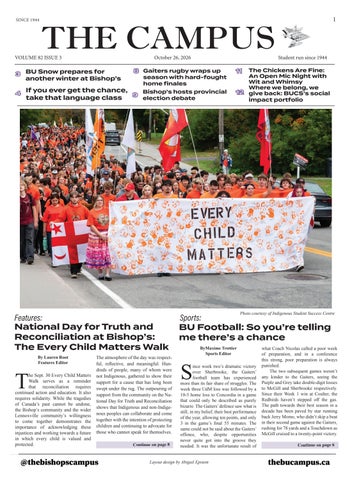
National Day for Truth and Reconciliation at Bishop’s: The Every Child Matters Walk By Lauren Root Features Editor
T
he Sept. 30 Every Child Matters Walk serves as a reminder that reconciliation requires continued action and education. It also requires solidarity. While the tragedies of Canada’s past cannot be undone, the Bishop’s community and the wider Lennoxville community’s willingness to come together demonstrates the importance of acknowledging these injustices and working towards a future in which every child is valued and protected.
The atmosphere of the day was respectful, reflective, and meaningful. Hundreds of people, many of whom were not Indigenous, gathered to show their support for a cause that has long been swept under the rug. The outpouring of support from the community on the National Day for Truth and Reconciliation shows that Indigenous and non-Indigenous peoples can collaborate and come together with the intention of protecting children and continuing to advocate for those who cannot speak for themselves.
@thebishopscampus
Continue on page 8
1
The Chickens Are Fine: An Open Mic Night with Wit and Whimsy Where we belong, we 12 give back: BUCS’s social impact portfolio
11
Sports:
Photo courtesy of Indigenous Student Success Centre
BU Football: So you’re telling me there’s a chance ByMaxime Trottier Sports Editor
S
ince week two’s dramatic victory over Sherbrooke, the Gaiters’ football team has experienced more than its fair share of struggles. The week three UdM loss was followed by a 10-5 home loss to Concordia in a game that could only be described as purely bizarre. The Gaiters’ defence saw what is still, in my belief, their best performance of the year, allowing ten points, and only 3 in the game’s final 55 minutes. The same could not be said about the Gaiters’ offence, who, despite opportunities never quite got into the groove they needed. It was the unfortunate result of
Layout design by Abigail Epstein
what Coach Nicolas called a poor week of preparation, and in a conference this strong, poor preparation is always punished. The two subsequent games weren’t any kinder to the Gaiters, seeing the Purple and Grey take double-digit losses to McGill and Sherbrooke respectively. Since their Week 1 win at Coulter, the Redbirds haven’t stepped off the gas. The path towards their best season in a decade has been paved by star running back Jerry Momo, who didn’t skip a beat in their second game against the Gaiters, rushing for 78 yards and a Touchdown as McGill cruised to a twenty-point victory. Continue on page 6
thebucampus.ca
2
NEWS
THE CAMPUS OCTOBER 26, 2026
Anthony Ouellet, News Editor » thecampus.news@gmail.com
The SRC projects a narrow surplus for The Gait after last year’s deficit
increase in expenses. Costs of goods sold are expected to increase from $75,482 to $80,000, while salaries ollowing a deficit of are budgeted to rise from $111,899 approximately $14,000, The to approximately $120,000 this year. The budget also forecasts Gait is projecting a $200 surplus for the current 2026-2027 $16,000 in amortization of tangible academic year, according to financial capital assets, compared with $9,076 documents from a recent Students’ in 2025-2026. Amortization accounts Representative Council (SRC) for the cost of assets over time, rather than representing an equivalent cash special board meeting. This year’s budget projects expense during the year. For example, an increase of nearly $34,000 in a $10,000 sound system that is revenue to $266,000 from the expected to last five years could be $232,194 generated in 2025-2026. recorded as a $2,000 amortization With expenses expected to reach expense each year, even if the venue $265,800, The Gait is projected to paid the full $10,000 upfront. Although the projected revenue finish this academic year just above is roughly 14.6 per cent higher break-even. Last year, The Gait recorded than last year’s actual revenue, the $245,848 in expenses with $232,194 gap between projected revenue in revenue, resulting in a net loss of and expenses leaves little room for approximately $13,654—the current unexpected costs. The figures raise questions budget forecasts a different outcome. The estimated revenue about how The Gait expects to improvement comes with a projected achieve the projected revenue and
F
By Piper Howell Staff Writer
manage expenses throughout the year. Although they plan to increase prices, it remains unknown if that will be enough to meet their financial target. The projected budget does not guarantee The Gait’s financial position, and many factors are included in that uncertainty. More specifically, if the revenue does fall short of expectations, or expenses do exceed the budget, the financial outcome will be affected. Since The Gait serves as a social space for Bishops, its financial performance is relevant to the wider campus community. Its ability to cover operating costs while maintaining its role on campus will be important as the SRC works towards the budget’s projected financial targets. Questions remain about what specifically is driving the projected increase in revenue, and whether the predictions account for changes in operating expenses. The Campus contacted the SRC Finance
Photo courtesy of Anthony Ouellet
Committee for comment on the projected budget but had not received a response by the time of writing. Without further clarification from the SRC, it remains unclear what specific changes will contribute to the projected improvement, or how the SRC will assess its financial targets. Despite efforts from previous years to get The Gait back on track, the SRC’s projected surplus raises questions of whether the 2026-2027 academic year will finally mark a turning point in its financial stability.
Transparency: A tool and a threat
H
By Quentin Smith Contributor
ow do you trust an institution? Do you listen to their speeches or watch their actions? Do you trust them at all? Over the past months, the BUSRC worked to create a committee to address this issue, one built on its dedication to transparency. In an honest conversation with President Grace Cordeiro, she expressed a strong position regarding the topic, stating that: “Transparency should be the default. We’ve seen at every level, though, that it’s not.” She specifically mentioned the chaos of the SAAQclic system, and the work of the independent journalist Isaac Peltz, who makes TikTok videos about the lack of access to information by request when it comes to politicians’ property holdings. Cordeiro also didn’t shy away from the SRC’s own failings, discussing the difficulties of the smaller organization, seeing as much of their own website’s information still needs to be updated. This has led to multiple proposals being brought
forward about more regular financial updates, but also the motion to create the Student Engagement and Transparency Ad Hoc Committee. “It’s just getting off the ground this semester, and I’m hopeful it will strengthen both our transparency and our relationship with students”, she said about the new committee. Corderio states that much of this is due to the new governance structure and bylaws adopted 2 years ago. While many Québec student unions have a VP of Finance, the BUSRC has taken the approach of having the Executive Director, a position not elected by students, present a budget to the board. Cordeiro wants to implement more frequent financial update reports and a clearer fee breakdown, as both
Photo courtesy of Anthony Ouellet
are currently not up to date. Is mass surveillance making us transparent? But how do organizations try to gain the same clarity on us? The concept of mass surveillance has become common knowledge. While some believe it can have benefits, many also believe it is a sign of potential danger. Québec’s provincial government has worked against the implementation of further information gathering for such purposes; for example, in 2021, they investigated Clearview AI, an AI platform that illegally gathered information by using social media, databases, and other online sources, which led to regulatory actions to further protect the privacy of Québec residents, but these protections have not stopped everything; one of the largest new trends in this field of surveillance is Automatic License Plate Readers, or as you may know them: Flock cameras. In her conversation with the Campus, not trying to make her position, the board’s president personally said this: “I will be
honest that I have concerns about technologies like this. Particularly around consent, privacy, data sovereignty, and accountability. Who holds the data, how long is it kept, who is it shared with, and whether the people affected ever have a say.” She went on to discuss how this has already been seen with consumer technology such as the many cases against Google, Apple, and even the Tim Hortons app. Cordeiro spoke further on what that means for technology as a whole, stating that: “...any institution adopting tools like these needs to have very thorough controls and policies in place, and transparency about what accountability measures they have to protect users, consumers, and anyone else the technology will engage with or impact. All of this is a clear warning sign for institutions such as Bishop’s and other universities to be careful; as the reward to share information on students becomes more tempting, the need for protections and transparency to be the default seems more important than ever.
NEWS
SINCE 1944
3
Anthony Ouellet, News Editor » thecampus.news@gmail.com
BU Snow prepares for another winter at Bishop’s
A
By Piper Howell Staff Writer
fter last year’s uncertainty surrounding Rail Jam, BU Snow is looking ahead to this year with a new executive team, new events, and another Rail Jam. The club is looking to build on last year’s support to continue fostering the BU Snow community. The future of Rail Jam at Bishop’s came into question last November, when the university dropped its support for the popular event. The announcement prompted a quick response from the BU Snow club and students who consider Rail Jam an integral part of the Bishop’s experience. The club put together a peaceful protest, in hopes of changing the administration’s decision. The upset became the topic of a March article on The Campus website, “History is Rhyming, Are
You Listening?”, which explored the proposed changes to Winterfest and the broader idea that students have a large influence in shaping university decisions and campus traditions. Despite initial uncertainty, Rail Jam did end up happening in February 2026. The event’s confirmation further solidified the expectation for student involvement in keeping important campus traditions alive. Rail Jam is confirmed to return this winter, giving students another opportunity to come together and foster community at Bishop’s. For BU Snow, this year marks an opportunity to build on last year’s momentum. With a new and bigger executive team, the club is looking to bring fresh energy to the campus community. According to BU Snow Marketing and Junior Co-Lead, Zara Khonsari, the response
from the Bishop’s students last November played an important role in demonstrating the event’s significance. “With the controversy surrounding Rail Jam, the amount of support from the BU community proved to the administration how important this event is to us, and the number of people who showed up last year has just led to this year being one of the most supported years for Rail Jam,” Khonsari said. Last year brought uncertainty to the future of one of Bishop’s favourite winter traditions. This year, the focus shifts to building on student support and bringing fresh events to campus life. The response to the potential cancellation showed how students are willing to speak up for the traditions they value, and how student participation helps shape campus traditions. Events like Rail Jam offer students a chance to connect through
shared interest and contribute to creating an atmosphere that makes Bishop’s campus life distinct and special.
Photo courtesy of BU Snow
Another reform on international students? This time, it could help BU
Q
By Anthony Ouellet News Editor
uébec has spoken: the province elected a minority government of the Parti Québécois (PQ), a sovereignist party which promised to add more regulation to international students who wish to study in a Québec university. This could prove beneficial to smaller universities, such as Bishop’s, according to an expert. In 2018, the then liberal provincial government deregulated tuition fees for most international students wishing to study in Québec. Previously, the government had set these fees and redistributed the funds amongst all universities, following an equalization-style model. Following the deregulation, universities could decide how each one of them charged international
T
students and pocket all of the profits, something that pitted universities in Québec against one another for the international students “market”, according to Samuel-Élie Lesage, an associate researcher at the Institut de recherche et d’informations socioéoconomiques. This deregulation, Lesage said, greatly benefited McGill University and, to a far lesser extent, Concordia University. “Because of these changes, McGill could increase the tuition for international students drastically, whilst remaining far more accessible than Harvard or Yale”, he adds. Smaller universities were disadvantaged in this model. The last CAQ government tried to cut what Lesage referred to as an “imbalance”. It implemented a hybrid model where the government gets to impose a basic tuition fee for international students, but universi-
ties can impose an unlimited fee of their own. However, the new leading party in Québec parliament, the PQ, wishes to “review the policy regulating the funding of universities regarding international students using the bases that were in place before 2018”, according to its electoral platform. “Are these changes going to bring more stable and foreseeable income for Bishop’s? Maybe. In a sense, I hope they do”, Lesage stated. As BU is already struggling with budget cuts in recent years, this potential rise in governmental funding may prove very useful. However, there’s a risk that some international students may pay more tuition than if there were still deregulation. More funds As universities still greatly
rely on tuition fees to stay afloat, many of them, supported by numerous groups and institutions, want to see the government give them more money annually. “I personally strongly agree that we should give more money to universities”, Lesage claimed. Earlier this year, The Campus revealed that Bishop’s University administration thinks that not much effort is made by the Quebec government to cover the cost of inflation in its funding of universities.
Photo courtesy of Anthony Ouellet
he Campus acknowledges that the land on which we operate is stolen land, the traditional territory of the Abenaki people. We live, learn, work, and play on this land, home to Indigenous peoples still living. Canada was founded through colonization, a system rooted in oppression and the abuse of power over others, continuing to affect First Nations, Inuit, and Métis communities today. As a student newspaper, The Campus has a responsibility to highlight truth. We are committed to prioritizing underrepresented voices in our community and proactively highlighting Indigenous peoples’ histories and ongoing realities, including their resilience and achievements. We recognize our work plays a role in shaping public perceptions, being able to call-out injustice but also call-in action. We emphasize that we must go beyond a land acknowledgement, which is only one step towards reconciliation. It is the stories in our paper – told with respect, accuracy, and integrity – and the respect and humility we show to the land and others that is more important than what is written in a land acknowledgement. Actionable steps to go beyond a land acknowledgement include educating ourselves and others, and supporting Indigenous traditions, movements, and businesses. —The Campus Team
4
OPINIONS
THE CAMPUS OCTOBER 26, 2026
Reagan Russell, Opinions Editor » thecampus.opinions@gmail.com
If you ever get the chance, take that language class
T
By Anya Mullen Contributor
he world functions thanks to many things we as humans have evolved to do. One of the most important things that makes this world keep turning is language. Think about it: we’ve grown up learning to speak and read, without giving it much of a conscious thought. But imagine if you couldn’t read your texts or any books at all. Even scrolling would lose all its fun if you couldn’t read. That being said, there are of course hundreds of languages in the world. When you fly across the world and don’t speak the language of the new country you’re in, you can feel powerless. When I landed in Spain to begin my exchange this semester, I was very glad that I knew enough Spanish to get myself where I needed to go and find out what I needed to find out. Learning a second language has been an incredible privilege for me and has opened up so many doors, and I think that everyone should take a language class at some point in their life. I enjoyed learning French so much growing up that I went on to study both Spanish and German at Bishop’s. I’m so glad that I decided on a Languages major, because it has opened my mind up to so many new things. I’ve learned a lot about the history
• • • • •
Photo courtesy of Anya Mullen
of various countries, and I’ve seen some pretty cool foreign language movies. But I’m not only talking about new cultural facts when I say that this major has opened my mind up to new things. It’s also a pretty damn good mental workout. Science corroborates this: learning new languages keeps your brain sharp. Sometimes when I’m in class listening to Spanish or German
being spoken, I can almost feel the cogs in my brain turning, and when something clicks, and I reflect on how far I’ve come since my first language courses, it’s immensely satisfying. A bit of research on the mental benefits of learning a second language revealed many things to me, and here’s a list naming a few: •
Can delay the onset of
dementia Develops neural pathways Improves working memory Strengthens the ability to focus Increases multitasking ability Can reduce both depression and social anxiety
Here’s the cherry on top of it all: I get to be in Spain this semester, taking courses that are fully in Spanish, and (mostly) understanding them! So not only has this major brought me so much valuable learning, it has brought me across an ocean to live in a new country. I’m experiencing a new place, meeting new people, and learning so much every single day. And being in Europe, I’m able to check out other cities and countries on the weekend and be in travel mode and school mode at the same time! It’s all because I decided in my first year to start learning another language. Because of all this, I say to anyone who will listen: if you get the chance, take a language course. Whether you make it a major or concentration as I have, or whether it’s a handful of electives throughout your degree, you won’t regret it. It can open up so many doors; doors in your brain to a new level of learning, as well as doors across the world to an exchange in an entirely new place.
I love Friendsgiving
T
By Lauren Root Features Editor
hanksgiving is one of the more controversial holidays in North America. It’s true; traditionally, it’s been a celebration built on the foundation of something not worth celebrating. The complicated and devastating nature of colonialism isn’t something that should be celebrated without acknowledging the harm that has been done. In the past years, though, I’ve noticed a shift in the meaning of Thanksgiving. It’s become more of a social gathering, rather than a celebration of settlers arriving in North America. This is where
Friendsgiving comes into play. As a student far from home attending Bishop’s, I’ve become increasingly thankful for my family away from home. In the past few years, it’s been difficult for me to go home for Thanksgiving. One of the hardest parts of being away from home is missing out on the family gatherings. Safe to say, it can bring on a major case of FOMO. Around this time is also when I realized how important it is to make my own traditions. One of the things I’ve started doing is hosting Friendsgiving. This simple act of having a fun dinner with all of my friends has become one of my highlights of the school year.
One of the many things that makes Bishop’s special is the fact that so many students are far from home. It really makes Bishop’s and Lennoxville as a whole feel like a community. Most people are living away from home for the first time and are trying to find their footing. Being able to create such meaningful bonds and friendships with people from places I’ve never heard of is something I love. And even better, having everyone gather together to celebrate being friends is so much fun! Part of growing up, I think, is creating your own traditions and values. Many of the people I’ve met don’t usually celebrate
Thanksgiving, and Friendsgiving is actually their first experience with the so-called “holiday.” Now, I know cooking a big turkey and a bunch of side dishes isn’t what everyone would consider to be Sunday fun, but the meaning isn’t in the complexity of the event. The best memories could involve pizza or any type of takeout, and just calling it Friendsgiving. The point is to share a good meal (whatever that may be) around the people who make you happy. That being said, I love Friendsgiving! Even though it involves planning and so many dishes, it’s always worth it to have an excuse to hang out with my favourite people in Lennoxville!
SINCE 1944
OPINIONS
5
Reagan Russell, Opinions Editor » thecampus.opinions@gmail.com
Bishop’s culture is community
W
By Josef Spence Contributor
hen walking around campus, I can’t help but run into people I know. Even beyond campus, though, it can be easy to encounter another person who is a member of the Bishop’s community, though possibly differing greatly from me in age, home, attitudes, and beliefs. Yet none of these differences between this individual and me in any way impede our ability to relate to one another and fondly remark on our education at Bishop’s University. Indeed, we both recognize it as far more than just an education — it is an experience created by interconnection and care. Almost every university and college claims to be the “home away from home” for their students — a place where people can truly be themselves and learn about the world in a sheltered environment. It would seem rather pretentious, and perhaps even conceited, for
me to claim that Bishop’s is a true anomaly among institutions of higher education that exceptionally achieves this claimed goal. But I am going to make that claim anyway, for I have heard of no other academic institution that is as true a home as BU. Bishop’s has a close-knit community, which is glaringly obvious to anyone who spends time here. This community is based on shared experiences — for BU students, often all partake in the same traditions and activities — and a real care for the community itself. Importantly, this monumental community of Bishop’s does not arise solely, or even primarily, from systemic structures within the university. Rather, the culture at Bishop’s is one that values people getting together and having a good time, which easily — and I might add, even naturally — results in people forming connections with others. Bishop’s small size certainly helps maintain this culture, but it is the individuals here who keep
the culture alive from year to year. Through our shared experiences, starting with challenges during O-Week and continuing through nights at the Gait, cheering at Gaiters games no matter the outcome, wings at the Lion, and the proud singing of our school song at graduation and throughout our time here, there is a common sense of community among BU students. We may have varied interests, but we can all speak to being a BU student — not just to being a student of a particular area of study or a member of a specific club. As thirdyear Sport Studies student Tristan Haddad observed, “It’s very easy to connect with a lot of students, despite different programs, different opinions, ... different hobbies...It’s a great community.” Though diverse individuals, we are one community at Bishop’s. And it is through the initiative of the individuals that the community can thrive as they connect throughout the year through parties, shared meals, clubs, and sports. These initiatives go farther
than simple events; however, they exist in the care that members of the BU community have for each other, in the carpooling around town and between the cities, the sharing of class resources, and the openness to engaging with anyone else in the community. In my mind, the most defining feature of Bishop’s is its culture of community. There may be some divisions, but they are not fractures or seclusions; students at BU exist in the singular community of Bishop’s. This is not an institutional community but one that is interpersonal: one concerned not primarily with status or reputation but with long-standing human shared experience. If we wish to continue seeing this community be strong, we must work for it personally. College days linger in our hearts only insofar as we are willing to bleed purple in spirit and action through welcoming attitudes and jovial festivities.
The scariest part of Halloween is planning for it
D
By Reagan Russell Opinions Editor
espite protests from my dad about how I’m “an adult and too old for Halloween”, I have always taken this holiday very seriously. However, planning for Halloween as a twenty-year-old is much more stressful than it was when I was nine. Halloweekend, requiring three separate, original, funny yet still fashionable and quirky costumes, is seemingly impossible. Add a student budget on top of this, and I’m just re-wearing costumes I wore in high school but maybe with a cuter top. When picking a costume, you do not want to match with half the people in the Gait. While not a unique costume by any means, accidentally matching with the entire men’s rugby team as a pirate was not my plan a few Halloweekends ago. Certain costumes, like pirates, firefighters and witches, are classics and easy to shop for, but very popular, and
force me to try to be more creative. However, the fine line between an original costume and something too niche for people to understand is one I am afraid to walk on. Nobody wants to have to explain their costume all night, or spend hours thrifting, scouring Amazon or borrowing from friends just to assemble a costume that people may understand. One Bishop’s student claims, “I think a lot of girls get judged for not having a creative costume”, but the reasons for having a “basic” one are pretty understandable. Women in particular have a hard time planning. Commercially available Halloween costumes from Amazon and Spirit Halloween are typically “Five Oh Cutie” or “Handcuff Hottie” for women’s police costumes for example. If that is less your thing, or you’re not prepared for a potentially chilly walk to the Lion, you are confined to your Pinterest board. Planning group costumes can be
even more of a nightmare. Trying to coordinate who is going to be which guy from “The Hangover”, especially when someone in the group hasn’t even seen the movie, makes for a difficult time. Someone may want to match on Thursday night, but the rest of the group may only be going out on Friday and Saturday. To make matters worse, if you are half of a costume and hanging out with other people during the weekend, you may just look like you didn’t even dress up or couldn’t get someone to match with you. When has a traditionally popular costume run its course and is no longer a cool costume? What if it snows on Halloween? What is a socially acceptable budget for planning Halloween costumes? One student claims, “there are many different themed nights at the Gait… there isn’t a financial constraint on having three costumes”, assuming you’re going full out for each Gait night. These are my concerns when
Graphic courtesy of Gabrielle Lalonde
planning for Halloween every year, and most years, I resort to a few tried and true staples. This year, I am trying to get myself out of my comfort zone a bit more. Yes, one of my costumes is fairly standard, but at least there’s a pun involved this time. Worst comes to worst, we’ll just pretend the pun wasn’t involved as I blend in with the other numerous witches this year.
6
SPORTS
THE CAMPUS OCTOBER 26, 2026
Maxime Trottier, Sports Editor » thecampus.sports@gmail.com
BU Football: So you’re telling me there’s a chance Continued from page 1
At the Mayor Cup at UdS, the hungry
Vert et Or finally found themselves in the win column, beating Bishop’s decisively, 29-14. This result had the Gaiters sitting at 1-5, tied three ways for last place in the everchallenging RSEQ. From my perspective, these losses are not reflective of a lack of effort, or even a lack of talent. The story of the season has been not being able to capitalize on the little idiosyncrasies that end up tilting the result of a football game. Football is a game of layers, and hiding behind the diving catches and the explosive 50-yard runs are penalties, red zone
mistakes, and missed snaps that the Gaiters are yet to find a way to overcome. The fact of the matter is, Bishop’s is playing an entirely different kind of football than they have been for the last eight years, and with that comes simple mistakes that can often only be repaired with time. So here we are at 1-5; what now? The good news is, the Gaiters aren’t alone in last place; Sherbrooke and Concordia are also fighting for the elusive last spot in the RSEQ playoffs. For Bishop’s, the mission is simple: Victories in their final two games of the year are the best shot they have at a playoff berth. As usual, the mountain they will need to climb is
extremely steep: They’ll have to get their revenge against the Concordia Stingers on the road, but not before facing the undefeated Laval Rouge et Or at home on Oct. 24. Since their victory against Montreal, Laval has been ranked number one in Canada and has effectively established themselves as the ultimate ‘Final Boss’ of U Sports football. Needless to say, these victories are going to be as challenging as they are necessary. But nothing in the RSEQ, or in football in general for that matter, is easy. Still, confidence remains in the Gaiters locker room, as they face their new biggest challenge head-on.
Photo courtesy of Clara Neel
Strong start to the season for the Gaiters
A
By Benjamin Lussier Contributor
fter a championshipwinning season in 20242025, the Gaiters faced a transitional year with a new head coach last season. The Gaiters women’s hockey team also lost two key players, Erika Gagnon and Élianne Michaud, to the new Université Laval Rouge et Or program, which created additional challenges for our hockey team heading into the 2026-2027 season. With a younger roster and several players expected to take on larger roles, the Gaiters will look to get better results than last year as they will try to re-establish themselves as national championship contenders. As it stands, the Gaiters are already
off to a good start this season with two convincing wins over the Concordia Stingers and the McGill Martlets. The Gaiters opened their season at home with a convincing 6-2 win against the Concordia Stingers which set the tone for the rest of the weekend. For the third consecutive season, Noémie Fontaine scored the first Gaiters’ goal of the season early in the first period. Just 35 seconds later, Justine Turcotte, assisted by Laurence Lafleur, followed suit to put the home team up by two early. The score remained unchanged until midway through the second period when Sophie Urquhart scored her first USports career goal for the Stingers. The Gaiters’ offence then exploded in
the third period, striking twice early to extend their lead to 4-1 before sealing the victory with two late empty-net goals. The third period also saw Laurence Lafleur record her first goal at the USports level, marking a significant achievement for the standout freshman. The Gaiters looked to secure the weekend sweep as they travelled to McGill’s McConnell arena, and they did it dominantly, leaving little chance to the Martlets in a 7-0 victory. Gabrielle Santerre led the way with her first goal of the season in the first period, and the Gaiters never looked back. Daphné Boutin added two goals, including the first power-play goal of the season to their first-period tally. After a scoreless second
period, Naomie Côté scored twice shorthanded in the third, further extending the Gaiters’ lead. Boutin finished the game with four points, while Jolianne Tremblay recorded a 23-save shutout in the first start of her U SPORTS career, capping off a commanding performance by the Gaiters. With two wins to kick off the season, the Gaiters have positioned themselves in first place in the RSEQ conference after the first weekend of activities. Their offensive production, combined with a shutout performance, gives them plenty to build on as they turn their attention to their first-ever matchup against the Laval Rouge et Or, who are still looking for their first win of the season, on Oct. 23.
THE CAMPUS STAFF 2026-2027 EDITOR-IN-CHIEF
LAYOUT EDITOR
ECONOMICS AND BUSINESS EDITOR
THIS ISSUE’S CONTRIBUTORS:
thecampus.editor@gmail.com
thecampus.layout@gmail.com
thecampus.businesseditor@gmail.com
Alanna Escoto Reyes Anya Mullen Benjamin Lussier Emma Jackson Felipe Iannacone Frankie Biegel Josef Spence Leighton Geraghty Metias Leharan Quentin Smith
Olivia Norby
Abigail Epstein
COPY EDITOR
GRAPHICS EDITORS
thecampus.copyeditor@gmail.com
graphicseditor.thecampus@gmail.com
Saskia Yacoubi-Sluis
ASSOCIATE EDITOR
Abigail Epstein
thecampus.associateeditor@gmail.com
DIRECTOR OF FINANCE Frederic Grenon
thecampus.business@gmail.com
Addison Walker
OPINIONS EDITOR
Gabrielle Lalonde & Latoya Simms
Reagan Russell
STAFF WRITERS
FEATURES EDITOR
Piper Howell, Megane Masson & Florence Robert
thecampus.opinions@gmail.com
Lauren Root
thecampus.features@gmail.com
NEWS EDITOR
SPORTS EDITOR
thecampus.news@gmail.com
thecampus.sports@gmail.com
Anthony Ouellet
Maxime Trottier
DIRECTOR OF MARKETING & COMMUNICATIONS
ARTS AND CULTURE EDITOR
@thebishopscampus Instagram
thecampus.artsculture@gmail.com
Roser Riera
Jillian French
SPORTS
SINCE 1944
7
Maxime Trottier, Sports Editor » thecampus.sports@gmail.com
Men’s club hockey perfect start to the season
A
By Leighton Geraghty Contributor
fter a heartbreaking end to the 25-26 season losing to Anna Maria College in the AAU finals, the Bishop’s Men’s Hockey team is back at it. With a feeling of unfinished business, the team took the ice in early September for their main camp. Nine Seniors graduated from last year’s team, allowing for multiple new faces to get a chance at joining the squad. Three intense days filled with skating, competition and sweat finalized this year’s team. The boys shifted their sights to the regular season, welcoming in the new players and getting straight to work. With less than a month of preparation, the Bishops Men’s Club Hockey team hosted the Concordia Stingers on Oct. 4. The annual whiteout game in the Jane and Eric Molson Arena saw over 300 people in the crowd. Family, friends and fellow Bishop’s
students all came together to support the team. From the opening puck drop, the game was controlled by BU, getting pucks in deep, laying the body and testing the opposing goalie early. BU struck first, scoring at the 11:33 mark in the first period. Frederic Grenon, the team’s captain, jumped on a loose puck off of a faceoff in the offensive zone and beat the opposing goalie five-hole. The crowd roared with joy as the team jumped into the glass celebrating in front of them. Momentum carried for the team as barely two minutes later rookie defenseman Anthony Ménard sprung Senior forward and assistant captain Cody Morton on a breakaway. Morton did what he does best and beat the goalie up high in a highlight-reel goal. What was even more electric was his celebration, yet again, in front of the home crowd. In the dying minutes of the first period, Concordia got on the board, narrowing the lead, making it a 2-1 game. The second period was all BU,
scoring two in the period and jumping to a 4-1 lead. The game started to become chippy as the referees tried to regain control of the game; most of the third period was commanded by special teams. Bishop’s did a great job at killing off the early penalties in the period, but Concordia got the better of them later in the period. The Stingers scored two late in the third on the power play to bring the game within one. Concordia brought a final push at the end of the game but were unsuccessful in tying it up as BU rookie and star netminder Benjamin Polhill recorded his first win for the team. In what was bound to be a heavy-duty matchup, Bishop’s came out on top 4-3. A historic moment for the Club Hockey team as they defeated an RSEQ opponent for the first time in the modern-day era. Captain Fred Grenon expressed, “It’s huge for us; obviously, we are super excited about that win. It’s a great step towards the direction we want to take the program. We want to keep building on this
win, and we’re looking forward to competing again in the RSEQ.” A couple of weeks later, Bishop’s headed down Highway Ten to face off against RMC. Coming off of reading week, the boys had a slow start, still managing to go into the locker room up 1-0 after the first period. A fiery speech from Head Coach Jordan Chabot brought some life to the bench as BU commanded the second period, scoring four and bringing their lead to 5-0. Midway through the third period, Matthew O’Grady set up Anderson Hapke, who potted the 6th goal of the game. Final score: 6-0 BU. The team has started the season off perfectly for yet another year. They now shift their focus to their next couple of games in preparation for a difficult month of November, playing almost every weekend. You can come and support the team on Nov. 14 as they are back on home ice against the Concordia Stingers.
Gaiters rugby wraps up season with hard-fought home finales
T
By Olivia Norby Editor-in-Chief
he Bishop’s University Gaiters rugby teams brought their seasons to a close this October with two tightly contested games at Coulter Field. The women’s team hosted the Carleton Ravens on Oct. 9 for Senior Night, while the men’s team welcomed the McGill Redbirds on Oct. 18 for Senior Day. Both games came down to the final moments, with the women falling 4540 and the men losing 40-33. The women’s team hosted the Carleton Ravens on Oct. 9 at 6 p.m. for Senior Night, marking the final home game of the season for the Gaiters and their graduating players. The matchup quickly developed into a high-scoring contest, with Bishop’s eventually falling 45-40. Olivia Norby (#11) opened the scoring for the Gaiters, followed by tries from Allison Skeggs (#13) and Jovanna Lan Baxter (#2). Norby added her second try of the game before Joelle Benoit (#20), and Marie-Pierre Gnassounou Akpah (#1) rounded out the Gaiters’ six tries. Stella Tutino (#15) converted five of the team’s tries, keeping Bishop’s within striking distance throughout the match. With the score still within reach late in the game, the Gaiters continued to pressure the Ravens. The match came to an end following a knock-on penalty by Carleton, sealing the 45-40 result in favour of the Ravens. Despite the loss, Senior Night provided an opportunity to recognize
Photo courtesy of Megan Forbes
the graduating players and celebrate their contributions to the program. Senior player Marie-Pierre Gnassounou Akpah reflected on her time with the Gaiters: “Looking back on this season and my time with the Gaiters, I’m most grateful for the people I’ve met along the way. Rugby has challenged me, helped me grow, and given me friendships and memories that I’ll carry with me long after graduation. While the season wasn’t without its challenges, I’m proud of the way our team continued to show up and compete. Being part of this program has been a meaningful chapter of my university experience, and I’m excited to see what the next generation of Gaiters will accomplish!” The men’s team closed out its season on Oct. 18, hosting the McGill Redbirds at Coulter Field for Senior Day at 3:15 p.m. Like the women’s game, the men’s matchup was decided by a narrow margin, with McGill taking the game 40-33. The Gaiters remained competitive throughout the afternoon, scoring five tries.
Photo courtesy of Maude Charlebois
In the first half, Gabin Armandie (#6), Alexander Bubyn (#12), Kai Hucal (#11) and Matisse Labrenz (#14) all crossed the try line. Michael McGuinness (#7) added the Gaiters’ final try in the second half. Mitchell Darby (#9) contributed four successful conversions as Bishop’s kept pace with the Redbirds. The game ultimately came down to the final play. McGill scored at the end of the match to secure the 40-33 victory, bringing the Gaiters’ season to a dramatic close. For the graduating players, the game marked their final appearance at Coulter Field in a Bishop’s jersey. Senior player Jeremy L’Heureux
reflected on a season defined by adversity, particularly injuries, while looking ahead to the future of the program. “This season wasn’t quite the way I hoped to finish my senior year. Despite our record, this team showed resilience through a season filled with adversity, particularly injuries. Our results don’t fully reflect who we are as a program or what we’re capable of, and it’s tough knowing we let games slip away that we could have won. Still, this team is in good hands, with many players stepping into key roles and ready to put in the work this offseason. The Gaiters’ future is bright, and I’m confident we’ll bounce back quickly. I’m proud to have been part of this program and grateful for the teammates, friendships, and memories I’ll carry with me long after my time here.” Although neither Gaiters team was able to finish its season with a victory, both final home games showcased the competitiveness of Bishop’s rugby. The women battled Carleton through a 40-point performance, while the men remained within one score of McGill until the final play. For the graduating players, the games marked the end of their time representing Bishop’s at Coulter Field. For the returning Gaiters, the offseason now provides an opportunity to build on the experience gained throughout the season and prepare for the next chapter of the program. As both teams move forward, the legacy of this year’s graduating players will remain part of the foundation for the next generation of Gaiters.
8
FEATURES
THE CAMPUS OCTOBER 26, 2026
Lauren Root, Features Editor » thecampus.features@gmail.com
National Day for Truth and Reconciliation at Bishop’s: The Every Child Matters Walk Continued from page 1
Sept. 30 marked the fifth National Day for Truth and Reconciliation in Canada. At Bishop’s University, hundreds gathered on Coulter Field for a gathering of reconciliation, followed by a walk through Lennoxville. The gathering on Coulter Field brought a culmination of a week of activities surrounding truth and reconciliation, with Indigenous learning and appreciation events happening around campus. Sept. 30 may be the National Day for Truth and Reconciliation, but at Bishop’s, reconciliation efforts happen year-round. This national day of recognition is significant because it highlights the genocide carried out against Indigenous communities in Canada, and shows Canada’s intention, as a country, to reconcile with the horrors of the past and present to move toward a unified future. The crowd on Coulter came from all different backgrounds and were of all different ages. Students from Bishop’s College School, Alexander Galt High School, Champlain College Lennoxville, University of Sherbrooke, Cégep of Sherbrooke, Cégep of Granby,
and Bishop’s University gathered alongside members of Lennoxville and the greater Sherbrooke community. The day began at 12:30 p.m. with a powerful land acknowledgment by Murray Johnston, a professor from the Liberal Arts department at Champlain College Lennoxville. His land acknowledgment included his family’s history and their deep ties to Indigenous lands and culture, showing how non-Indigenous peoples can stand in solidarity with the Indigenous community, working on settler accountability and responsible allyship. There were many personal testimonies and cultural teachings shared by Indigenous community members. Maya Cousineau Mollen, an Innu woman from Ekuanitshit, spoke about the harms being done against Indigenous peoples across Canada. Her speech shows that while Canada has begun the process of reconciliation, there is still a long way to go, and Indigenous peoples are still facing harms today. Julie-Ann Vollant-Whittemore, Innu from Maliotenam, Quebec, and a fourth-year Psychology student, gave a moving testimony of her experiences
and some of the systemic difficulties she has faced because of the oppression against Indigenous peoples and residential schools. Julie-Ann’s speech was hopeful too. She has overcome tragedy and difficulty to achieve her goals, to receive a university degree, and spoke about hoping to give back to her community. It was powerful to hear her life story and how she has overcome much adversity to be standing where she is today. Her courage and bravery shone through the words she spoke, surely inspiring young Indigenous children in the crowd. Notably, the orange shirts sold on campus feature a graphic art design. The Indigenous Student Success Center held a logo contest for the first time in which Indigenous students from Bishop’s and Champlain were encouraged to submit a drawing, and Julie-Ann’s design won. In her testimony, she referenced her art and how it’s a creative outlet for her, allowing her to express her feelings and fears, her emotions and dreams. The speeches given throughout the ceremony made it clear that every child matters, and every child in history has mattered. The children taken from their homes, many of whom never
returned, mattered. The children now, who continue to struggle with systemic issues, such as mental illness and addiction, as a direct result of residential schools, matter. The Office of Indigenous Initiatives unveiled a map of the W8banakiak, the people whose territory Bishop’s University is located on. Two of these maps were installed in the John H. Price Sports and Recreational Center. This is a significant step in creating visibility on campus and creating more spaces for learning and acknowledgment of the land we gather to learn, work, and play on. The community was fortunate to have someone who works for the ‘Office de la Langue Abenakis’, Lois Dana, a Penobscot member of Indian Island, come explain the map and its many meanings and significance to the W8banaki people. After the gathering and testimonies, the crowd in attendance walked together through Lennoxville, displaying banners and signs bearing the words ‘Every Child Matters’, and showing their unity with Indigenous peoples. Hundreds of people filled the streets of Lennoxville, wearing orange shirts and using their voices to continue to protect children and raise awareness.
Hoco on the Hill gives homecoming a new identity
H
By Felipe Iannacone Contributor
omecoming at Bishop’s looked a little different this year. Focusing on promoting a better campus environment, Bishop’s came up with a new activity to bring the student community together. Music, food, games, and a bonfire brought the Bishop’s community together during Hoco on the Hill, one of the newest additions to this year’s Homecoming celebrations. From the moment students arrived, this year’s atmosphere felt different. Hoco on the Hill transformed a familiar part of campus into a lively gathering space filled with DJs, food trucks, activities, and opportunities for students and alumni to connect and celebrate Homecoming together. Planning for Hoco on the Hill began in July, with organizers aiming to create an experience
Photo courtesy of BUSRC
that felt distinct to Bishop’s, while introducing something new to the Homecoming schedule. Throughout the evening, students moved between activities, enjoying a small carnival-style setup, food trucks, music, and social spaces designed to encourage people to stay and explore. The musical lineup featured Montreal-based DJ duo Banx & Ranx. Bishop’s alumni DJ Meeks and DJ K-Spinz were also present, creating a blend of outside talent and Gaiter representation that reflected the event’s emphasis on
community. One of the event’s most notable aspects was the mix of people in attendance. Current students, alumni, and members of the Bishop’s community shared the same space, reinforcing one of the central purposes of Homecoming: bringing generations of Gaiters together. The variety of activities helped create an energetic atmosphere throughout the evening. Whether visitors chose to listen to music, grab something to eat, take part in games, or simply spend time with friends, there was no shortage of ways to enjoy Homecoming. The evening concluded with the traditional bonfire, a highlight of Homecoming weekend. While many associate the bonfire with off-campus parties on Reed Street, this year’s celebration proved that the tradition could successfully take place on campus, while keeping the
spirit that has made it an important part of Homecoming for many years. More than anything, Hoco on the Hill showcased the sense of community that continues to define Bishop’s University. By combining long-standing traditions with new activities, the event added a fresh element to Homecoming while creating a space for students, alumni, and community members to come together and celebrate. Established as a new Homecoming tradition, Hoco on the Hill was designed not simply as a one-time gathering, but as an event intended to become a lasting part of the Homecoming experience. Based on the strong turnout and engagement throughout the evening, the event achieved its goal of bringing the community together and showed clear potential to become an event that is here to stay.
FEATURES
SINCE 1944
9
Lauren Root, Features Editor » thecampus.features@gmail.com
Queer Elders Sharing: Preserving queer history across generations
description, “Queer Elders Sharing is an educational and community event connecting students and community members with the lived experiences of queer elders.” This was Gay and Grey Montreal’s first event held at Bishop’s, but they are hoping for many more collaborations to come. Other resources from the Eastern Townships were also present at the meeting. Université de Sherbrooke’s 2SLGBTQI+ student club had a stand next to GGMTL. Gris Estrie and Iris Estrie, a non-profit organization in the Estrie region that supports the 2SLGBTQ+ community and public health, were also in attendance, calling to attendees and promoting Photo courtesy of Megane Masson their services. As M. Domingue states, “Events like QES really help n Oct. 8, Gay and Grey connect 2SLGBTQIA+ people and Montreal (GGMTL), allies from different walks of life; together with Bishop’s they are also great opportunities University, held a panel-type to raise awareness of the different Q&A at the Gait called Queer organizations and services that Elders Sharing. This collaboration cater to the community.” aimed to connect members of the The forum began with 2SLGBTQI+ community across sentimental clips of personal stories generations. According to their own from gay elders, highlighting the By Megane Masson Staff Writer
O
vast historical context faced by the 2SLGBTQI+ community in Montreal. A few historical facts tinted the background, such as the HIV/AIDS crisis of the 80s, which long vilified the queer community. Gay bars were long targeted during those times, leaving painful memories but also a legacy of resilience amongst the community. An attendee and Bishop alumnus brought up the idea of reopening a gay bar here in Sherbrooke. The suggestion raised an interesting question about the role of physical spaces in building queer community. Beyond providing a space to socialize, queer bars have historically offered opportunities for people to meet others like themselves, form relationships, and find a sense of belonging. In a smaller city like Sherbrooke, the desire for such a space also speaks to the importance of creating opportunities for queer people to connect locally, rather than having to look toward larger urban centres, such as Montreal. Events like these matter to the community because queer heritage
is not merely a chronicle of bygone days and remains an enduring legacy that individuals embody and actively refine. Think of it this way: history is not fixed. People write it; it’s still being written, and sometimes it’s even rewritten. Passing these stories on between generations is one way of ensuring that this history is not forgotten. For younger members of the community, hearing directly from those who lived through different periods of queer history offers a perspective that textbooks alone cannot provide. For older generations, sharing these experiences creates an opportunity to have their lives and struggles recognized. These conversations also remind attendees that, while much has changed, the work of building inclusive and supportive communities continues. Queer Elders Sharing offered more than a look into the past. By bringing together all generations and local organizations, it created an opportunity to reflect on where the community has been, what it needs today, and what it hopes to build for the future.
Bishop’s hosts provincial election debate
O
By Josef Spence Contributor
n Sept. 28, provincial politics came to BU’s campus for a provincial election debate between candidates for the local riding of SaintFrançois. The Bishop’s University Politics and International Studies Association (PISA), Bishop’s University Students’ Representative Council (SRC), and Champlain Students’ Association (CSA) co-organized this debate as an opportunity for students to engage with the political process and ensure the community had the opportunity to hear the perspectives of the candidates whom they directly vote for in English. Despite difficulties in engaging the candidates in the debate, this debate was highly attended by both students and members of the community, with around 75 people in total in attendance. The invitation to participate in the debate was extended to every candidate running in the riding of Saint-François. Only Québec
Liberal Party candidate Jacqueline Belleau and Québec Solidaire candidate Mia Fréchette attended the debate. Geneviève Hébert, the candidate for the Coalition Avenir Québec (CAQ), declined to attend the debate, and the candidate for the Parti Conservateur du Québec, Esteban Méndez-Hord, explained he would be unable to attend as he was focusing his efforts on other projects such as knocking on doors. The Parti Québecois candidate, Sylvie Tanguay, did not respond to the invitation. Last year, PISA organized a debate between the mayoral candidates in the Sherbrooke municipal election. PISA leveraged this experience in organizing this event, ensuring that candidates were contacted well in advance of the debate night. Besides communications with the candidates, PISA selected pertinent topics for the debate to cover, ranging from Quebec sovereignty to laïcité in education to healthcare. The Advocacy Positions Committee of the SRC, together with the CSA, promoted the
debate to their respective students. Students were given the opportunity to submit questions in advance to the Advocacy Positions Committee. These questions were reviewed for relevance and civility, though doubts were later raised by audience members who wish to remain unnamed about the appropriateness of some questions for local candidates. The Advocacy Positions Committee wrote additional questions to supplement those student questions deemed appropriate. Reagan Russell, a student in the School of Education and leader in a variety of clubs and student organizations, moderated the debate, timing the candidates’ responses and ensuring that the debate flowed smoothly. The candidates conducted themselves with the utmost professionalism — and even a degree of friendliness; Jacqueline commented that meeting and learning from Mia was one of the best parts of running in the election. Both candidates used their time efficiently and rebutted sparingly. Nevertheless, audience
Photo courtesy of Reagan Russell
questions at the end of the debate resulted in the debate ending twenty minutes later than anticipated. After the debate, PISA executives observed that it had been a stunning success with a higherthan-expected turnout and excellent answers from the candidates to the difficult questions posed to them. Indeed, it was a clear demonstration of how students can actively contribute to our democratic process.
10
ARTS & CULTURE
THE CAMPUS OCTOBER 26, 2026
Jillian French, Arts & Culture Editor » thecampus.artsculture@gmail.com
Béchard Hudon brings unseen ecosystems to light with Monologue de la Forêt
T
By Florence Robert Staff Writer
he Foreman Art Gallery is turning its attention to the natural world this fall with Monologue de la Forêt, a new exhibition by Béchard Hudon, the artistic duo of Catherine Béchard and Sabin Hudon. Curated by MarieHélène Leblanc, the exhibition runs from Sept. 25 to Dec. 5 and explores old-growth forests across the Estrie and Outaouais regions. Béchard and Hudon have worked together for over 25 years, creating works that examine the relationships between the visible and the invisible in natural ecosystems, specifically investigating the notions of microhabitats and the details of nature that lie beyond ordinary human perception. They are particularly interested in places where little human intervention has taken place,
making ancient forests a valuable habitat. In Monologue de la Forêt, Béchard Hudon draws attention to the ecosystems that exist within forests and trees themselves. Known as dendro-microhabitats, these are organic structures that provide resources for many different organisms. A tree that may appear dead to the human eye can support an entire network of life. These details are central to this exhibition and its exploration of forests. By focusing on features that audiences might otherwise overlook, Béchard Hudon encourages people to reconsider what they may be seeing when out in nature. The project bridges art with scientific research through a collaboration with the Institute of Temperate Forest Sciences (ISFORT), offering a multidisciplinary view of these environments. Using specialized sound sensors, the artists recorded the
internal movements of trees and the ground, transforming inaudible activity into an intimate listening experience. They also used a fullspectrum digital camera to capture details deep inside the forests. Bèchard Hudon’s work shifts between views of the larger forest and intricate details, capturing the ecosystem at different scales. The combination of art and technology allows audiences to gain a closer perspective of the natural world. By combining auditory, visual, and scientific observations, it offers a contemporary view of the complexity of old-growth forests. The exhibition is part of the Foreman Art Gallery’s annual program of contemporary art, which features four to five exhibitions by professional and mid-career artists throughout the year. The gallery also hosts workshops and lectures. Admission is free, allowing Bishop’s students and members of
the greater Sherbrooke community to view contemporary art right on campus. Monologue de la Forêt will remain in the Foreman Art Gallery from now until Dec. 5.
Photo courtesy of Jillian French
Dimprov: An Ode To Costume Design, Community, and The Candace Warner
F
By Frankie Biegel Contributor
rom Oct. 1-4, Turner Studio was filled with students, faculty, and locals alike to celebrate Bishop’s students’ theatrical performances. New Plays is an annual festival consisting of student-written, directed and performed plays. Oct. 2nd’s debut of Night B drew a large crowd, with members sitting shoulder to shoulder and some having to creep up on the wings of the stage to find seats. Featured at the soirée were Whimsy on the Grounds, Those Left Behind, Dimprov, Boarding School Drama and Kaleidoscope, all with remarkable performances from the hardworking students. The night was filled with laughter, gasps and the unifying admiration for theatre and performance art. Nestled in the crowd was writer and Bishop’s Costume Shop Manager, Candace Warner, alongside her daughters and nine-month-old grandson. Candace Warner’s skit Dimprov, directed by Fiona Tremblay, opens with two strung-
out Costume Shop employees, who aim to maintain order while being continually interrupted by students. The rotating door of questions, nonsensical emails, and wacky costumes builds on itself until the employees become engulfed by their own creations and descend into, as the director, Fiona Tremblay, describes it herself, “A costumed fever dream”. Through the chaos, Tremblay packs the performance with countless allusions to Bishop’s own theatrical history, cult classic films and Broadway musicals. However, beyond the campy and playful performance of over 20 cast members, her adaptation of Warner’s script aims to recognize the overlooked labour of costume designers who provide the unseen scaffolding for theatre. Over the course of her 50 years at Bishop’s, Candace Warner filled the stage with beautifully intricate, wild and humorous costumes for students. Working between directors, technicians and actors, she juggled the demands and expectations of countless
Photo courtesy of Zachary Saint Cyr
individuals at once, all the while making the shop a space of inclusion and fun for anyone popping in. In an interview, Warner highlights inclusion as one of the most important priorities to her while running the Costume Shop, “[The students] are busy, they’re on their own, and they’re running ragged… [in the shop] you could really let your hair down and talk about whatever you wanted to talk about. You knew it wasn’t going to go any further.” In a similar fashion, director Fiona Tremplay reflects on her experiences in the Costume Shop under Warner’s care, “you will have had the most enriching conversations… [the costume
designers] are the chattiest, most lovely bunch, and they will listen to you like their lives depend on it.” Despite the warmth of the Costume Shop and remarkable talent within, Warner’s dedication went largely unrecognized beyond the Bishop’s theatre niche. However, this narrative shifted once the curtain rose at the festival. On Oct. 2, a completely sold-out theatre roared as the marvel of Warner’s undeniable wit and hard work flooded the stage. In light of Candace Warner’s recent retirement, the final recognition of her contribution to Bishop’s was “very touching”, as remarked during her interview, and a “fantastic way to end [her] time” as the longstanding Costume Shop manager. As the lights come up and fantastically costumed actors take a bow, Candace Warner’s ninemonth-old grandson has just seen his very first theatrical performance, marking a final homage to his wonderfully witty grandmother. Thank you, Candace.
ARTS & CULTURE
SINCE 1944
11
Jillian French, Arts & Culture Editor » thecampus.artsculture@gmail.com
Horoscope: Mercury retrograde By Abigail Epstein Layout Editor
The Chickens Are Fine: An Open Mic Night with Wit and Whimsy By Alanna Escoto Reyes Contributor
T
rick or treat! Oct. 24 - Nov. 13 sees Mercury retrograde in Scorpio… boo!
Aries: You may feel suspended between the forward of your wishes and the backwards of the energetic moment. Don’t fight the current. You’re apt to find a mushroom for later. Taurus: If what you’ve been working on starts to lose luster, lie back and stare at the stars. What’s discrete can become apparent, if you just adjust your eyes. Pitch a perspective. Gemini: Wearing thin is a typical appreciation for truth’s flexibility. Double speak bites back twice. Your tougher skin than this needs tenderness. Consider tiger balm. Cancer: The things you’ve been sitting on might start to turn on you. Make room for some movement. Let your pillows talk. Leo: Is your intuitive authority tired? Lean on objective sources to recharge. A gamble is particularly risky if you’ve been on a winning streak.
Virgo: While you prepare for the worst, leave a space free for the better. A coin has currency from both its sides. Draw out plans in shades of grey Libra: You, of all, know that what goes around comes around. We’ve been through this before. Hold hands on either side of the temporal plane. Scorpio: Scatter pages of your diary into the wind, would you? Don’t hold tight to hearsay. Be the gossip with integrity. Sagittarius: If your heart’s set on a burning bridge, grab a torch and make for the river. Lead a game of leap frog. Invitations to strangers can find you sustainable hearths. Capricorn: Take advice lightly now; keep salt in your back pocket. You may feel inclined to listen closely. Keep your eyes open, when things sound too good to be true.
Photo courtesy of Jillian French
W
it and Whimsy has done it again, folks! Though the stage might look daunting for some, the poetry club has created a safe space for anybody who wants to share their work, bringing together poets scattered across different departments at Bishop’s. Wit and Whimsy co-leads, Jillian French and Samiya Bouziane Merceron, opened the doors to Bandeen Hall on October 22nd to host their first open-mic of the season. A night of music and verses, familiar and unfamiliar faces, as well as laughs and some stage-fright jitters was the perfect way to unwind during midterm season. Open mics have become a staple event of the poetry club on campus. With a mix of original pieces and general Tumblr favorites, the poems ranged from contemplations on autumn leaves, new
perspectives on the safety love offers, and hopeful arguments on why chickens should have plot armour. After the initial line up of club members went up, the mic was open for anybody who felt inspired to share. Audience member and alumna, Ann Oxford, said, “I think every time that I come to one of these, the open mic part at the end gets longer… which is really exciting to see.” The open nature of the event welcomes a new wave of students every year, fostering and building a community of poet enthusiasts. One of the highlights of the night, at least for me, was the reading of “What I Am Telling You, Jessica, Is That Those Chickens Are Fine” by K.T. Landon. While the current state of the world can make us feel bleak and disconnected, this poem offers a little hope in the form of chickens. It’s events like the open mic that bring that hope into real life by reviving the core of the human experience: sharing thoughts to open minds, creating community, meeting in a hall, and reading words that mean something to us. As poetry club member, Tallula Russel, commented, “I love how the open mic allows for people who aren’t in the club to share their work and in the community of poetry. We all get to grow our appreciation of the art form and our connections with each other through that love.” Poetry can turn the ordinary into something profound, chickens into symbols for hope, a random Tuesday into a community where you can be you. Don’t hesitate to stop by Morris House Tuesdays at 7pm and join the poetry club for a chat!
Comic:
Aquarius: You have a way with circular justification – keep these wheels inside your head. Think before passing judgment. Be careful not to undermine your own authority. Pisces: Write down thoughts in the morning, to ground yourself throughout the day. Every sun has something new for you. Make way for novel dreaming. For you to take with as many grains of salt as there are stars in the sky. Comic courtesy of Gabrielle Lalonde
12
ECONOMICS & BUSINESS
THE CAMPUS OCTOBER 26, 2026
Addison Walker, Economics & Business Editor » thecampus.businesseditor@gmail.com
BizTec 2026 Connects Bishop’s Students with Employers
O
By Metias Leharan Contributor
n Thursday, Oct. 1, business and computer science students attended the annual BizTec event in the Centennial Theatre lobby. With its warm, welcoming charm, the venue set the perfect scene for about ten companies and organizations to connect and chat with our students. Over five hours, more than a hundred energized students came to gain insights, hand over resumes, and, most importantly, build connections that could open doors for their futures. At the very heart of the event was Sandrine Hébert, who masterfully led the charge to bring forwardthinking employers directly to our doorstep. A standout example was the CIUSSS de l’Estrie, whose representatives were eager to connect with computer science students to collaborate on innovative projects demanding raw drive, boundless creativity, and fresh perspectives. These are precisely the qualities our
Photo courtesy of Sandrine Herbert
campus community has in endless supply, making the match between recruiters and students feel both natural and inspiring throughout the entire afternoon. Several returning companies, including Fidelity, MNP, Enterprise Mobility, and Intact Assurance, expressed immense enthusiasm about being back on campus. They were especially thrilled to meet a
fresh wave of new faces and engage with the incoming student talent. In today’s job market, sending out resumes on platforms like LinkedIn can feel tedious, and online networking often feels transactional or artificial. Nothing truly replaces meeting professionals in person and letting your natural charm shine, proving that you are far more than just a summary on a sheet of paper
with your name at the top. For first-year students, the biggest hurdle was undoubtedly taking that initial leap: walking up to their first booth, introducing themselves, and asking what opportunities were available. That is the true beauty of an event like BizTec, pushing students out of their comfort zones and giving them a space to show that they are defined by much more than just what is on their resumes. Hopefully, this joyous autumn gathering becomes a lasting tradition and continues to attract even more relevant companies in the years to come. Students are the true heart of this event, and the WSB’s ongoing efforts to create meaningful experiences outside the classroom make our university a genuinely special place. Student participation in activities like these is crucial, as it sends a clear signal that we actively respond to extracurricular events and are eager for more opportunities like BizTec.
Where we belong, we give back: BUCS’s social impact portfolio
S
By Emma Jackson Contributor
tudent leadership comes with a question we should ask more often: when a community gives us so much, what responsibility do we have to give something back? Since moving from Montreal to Lennoxville, I have come to appreciate how closely university life is woven into the community around us. Local businesses support our events, external partners invest in our development, and residents welcome students into a place they have called home far longer than we have. Over time, that welcome becomes a sense of belonging— and, for me, a reason to contribute. As president of the Bishop’s University Commerce Society, I see how much generosity makes our work possible. Our professional development opportunities and student events depend on people willing to share their resources, expertise, and time. I believe we have a responsibility to consider how those same relationships can help us serve others. That belief led to the creation of
BUCS’s Social Impact portfolio. Business students spend years learning how to negotiate, communicate, manage resources, and build networks. Those skills carry value wherever people need to organize around a common goal. Supporting a shelter, coordinating a donation drive, or connecting a charity with potential partners gives us a chance to apply our education while responding to needs beyond our campus. The portfolio began taking shape when I shared the idea with Clara Neel after my election. She spoke about her own passion for community involvement and asked how she could help. Inviting her to become our Social Impact Coordinator provided the initiative with someone dedicated to its development and communications, turning a shared conviction into a practical commitment. At this year’s BUCS golf tournament, that commitment took its first form. Participants contributed over $400 in combined monetary and goods donations for Moisson Estrie, including nonperishable food, menstrual products, shampoo, and conditioner. The
Chipettes earned recognition for the highest team contribution, while the generosity throughout the event demonstrated how easily giving could become part of something we already do together. One collection is a beginning. The more meaningful challenge is making service a consistent part of how BUCS operates. We plan to pursue initiatives supporting women’s shelters, local organizations helping children in need, and other causes our community holds dear. A Christmas angel tree is also being planned for the BUCS office, offering students a way to purchase requested gifts or goods and coordinate their drop-off. Details will follow through BUCS communications. These initiatives should grow through the ideas of our community. If you know an organization we could support or have a suggestion for how we can contribute, please email me. Students, staff, faculty, and residents bring perspectives that can help us recognize needs we might otherwise overlook. My interest in social justice and my volunteering experiences have shaped this work, but its future
Photo courtesy of Bronwyn Chenard
should extend well beyond my presidency. I hope successive BUCS executive teams recognize the possibilities within the partnerships, networks, and funds entrusted to them. Making room for altruism and philanthropy can enrich students’ personal growth alongside their professional development. As I prepare to graduate in June, I will carry gratitude for the platform that Bishop’s and the Williams School of Business have given me. Giving back to the school and community is one way to honour it. We have the skills, relationships, and opportunity to contribute; what we do with them will be part of what we leave behind.