The
BUzzette AN EXECUTIVE NEWSLETTER
Bicol University, Legazpi City Telefax No. (052) 480-0167 www.bicol-u.edu.ph
JANUARY 2018 | Vol. X Issue 1
issuu.com/thebuzzette_bicoluniversity
ISSN 2094-3991
facebook.com/BicolUniversity
PRESIDENT’S OUTBOX
very year, we are given a chance E to renew, re-direct, recharge, and regenerate – in all aspects of our hectic
lives. As we begin another period in the life of Bicol University, I urge the entire Bicol University community to renew your commitment to continuously move towards the attainment of our vision and direction. If the past year had made us take some unavoidable detours that temporarily sidelined us in pursuing our goals, take this year as a fresh chance to redirect your steps and ensure a firmer implementation of processes and procedures necessary to obtain our key result areas. The past year, with all the joyous holidays thrown in, had hopefully made us re-charge our mind, rested our soul, and perhaps, re-awakened our passion to re-generate our vision and continuously push for social transformation and development. For this is what we need the most in these trying times, amidst the eruption of Mount Mayon – the volcano that every Bicolano loves, and ironically, fears. I am one with the rest of the Bicolanos, especially those displaced who are now in the evacuation centers, and the Bicol University community in commiserating with your difficulty in these most stressful situation where our constant companion has been the rumbling of rocks, the sudden darkening of the sky, and the sustained ash fall that accompanies us as we do our daily commute. Being from the Third District, I know the feeling of uncertainty, and the additional work of shoveling accumulated thick ashes from your roof and doorstep. But we are resilient by nature. As we have endured every major calamity, I know that with God’s grace, we will endure and rise above and beyond this immediate inconvenience. As your President, I call on everyone in the Bicol University community to extend your help and resources to those who need it, in Bicol University and beyond our immediate borders. Keep safe and stay updated on all our advisories and announcement in this uncertain time.
News | P7
EMD prepares implementers for skills training program
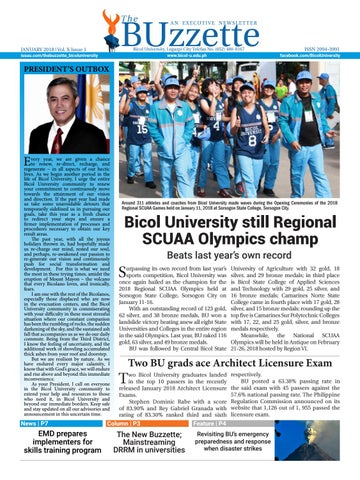
Around 311 athletes and coaches from Bicol University made waves during the Opening Ceremonies of the 2018 Regional SCUAA Games held on January 11, 2018 at Sorsogon State College, Sorsogon City.
Bicol University still Regional SCUAA Olympics champ Beats last year’s own record
S
urpassing its own record from last year’s sports competition, Bicol University was once again hailed as the champion for the 2018 Regional SCUAA Olympics held at Sorsogon State College, Sorsogon City on January 11-16. With an outstanding record of 123 gold, 62 silver, and 38 bronze medals, BU won a landslide victory beating anew all eight State Universities and Colleges in the entire region in the said Olympics. Last year, BU raked 116 gold, 63 silver, and 49 bronze medals. BU was followed by Central Bicol State
University of Agriculture with 32 gold, 18 silver, and 29 bronze medals; in third place is Bicol State College of Applied Sciences and Technology with 29 gold, 25 silver, and 16 bronze medals; Camarines Norte State College came in fourth place with 17 gold, 28 silver, and 15 bronze medals; rounding up the top five is Camarines Sur Polytechnic Colleges with 17, 22, and 25 gold, silver, and bronze medals respectively. Meanwhile, the National SCUAA Olympics will be held in Antique on February 21-26, 2018 hosted by Region VI.
Two BU grads ace Architect Licensure Exam
T
wo Bicol University graduates landed in the top 10 passers in the recently released January 2018 Architect Licensure Exams. Stephen Dominic Rabe with a score of 83.90% and Rey Gabriel Granada with rating of 83.30% ranked third and sixth
Column | P3
The New Buzzette; Mainstreaming DRRM in universities
respectively. BU posted a 63.38% passing rate in the said exam with 45 passers against the 57.6% national passing rate. The Philippine Regulation Commission announced on its website that 1,126 out of 1, 955 passed the licensure exam.
Feature | P4 Revisiting BU’s emergency preparedness and response when disaster strikes
2
EDITORIAL The BUzzette
EDITORIAL
Truth be Told T
hese days, becoming interactive is now the norm. The latest data from the Statistics Portal Statista as of January 2018 on the most famous social network sites worldwide ranked by number of active users revealed that 2.2 million people are using the social media Facebook, with YouTube a closer second with 1.5 users. With the influx of data and the exchange of information, the digital age emerges as the most influential in terms of its impact to policy and the shaping of ideas through the vital information that goes through the grapevine of social media networks and various search engines and websites. With this new norm, it is now increasingly hard to keep up with the influx of data and cutting-edge information. With this deluge of data and information, it becomes doubly difficult to distinguish fact from fiction, truth from lies. Becoming interactive brings with it the problem of disinformation, misinformation, and fake news. To better understand the distinct differences, we need to clearly distinguish one from the other. Merriam-Webster and Cambridge Dictionary makes a clear distinction. Disinformation is false information that is deliberately and often covertly spread, intended to mislead, especially propaganda issued by a government organization to a rival power or the media (as by the planting of rumors) in order to influence public opinion or obscure the truth. Misinformation is false or inaccurate information, especially that which is deliberately intended to deceive. Fake news is written and published
with the intent to mislead in order to damage an agency, entity, or person, and/or gain financially or politically, often using sensationalist, dishonest, or outright fabricated headlines to increase readership, online sharing, and Internet click revenue. In this day and age of a continuing digital and media technology revolution, becoming interactive requires the ability to discern from among disinformation, misinformation, and fake news. Read critically. React intelligently – with sound basis and logic. Think before you click. Pause before you post. Not every piece of information that is shared is worth sharing. Not every data that you “Like” in the social media is really worth liking. Just because it’s not on FB, doesn’t mean it didn’t happen. In social media and other platforms, as in life, what you
see (or read) is not often what you get. But we do have to “get the right knowledge, to the right people, at the right time,” without sacrificing the essence of information by resorting to disinformation, misinformation, or worse, fake news. As one academic community with a strong presence in the Bicol Region, Bicol University must take the lead in raising the bar of governance through advocating for well-informed clients and citizenry through proper knowledge management as practiced by every personnel, teaching and non-teaching. Armed with the power of education and propelled by our vision of “social transformation and development,” let us raise our voices for truth and transparency and uphold responsible communication. Let truth, be told.
The Buzzette is now on issuu
issuu.com/thebuzzette_bicoluniversity
Read our monthly issue online!
AN EXECUTIVE NEWSLETTER EDITORIAL BOARD
Editor-in-Chief Dr. Renelyn E. Bautista Associate Editor Gladys S. Serafica Circulation Manager Mary Ann M. See Writer/Layout Artist/Photojournalist Joshua P. Pacleta Contributors Mark Banay, Maxinne Raneses/CPRO, Yuan Placides, Ma. Cienna Jaucian/BUCE Editorial Consultants Dr. Helen M. Llenaresas & Dr. Reina O. Habalo Overall Consultant/Publisher Arnulfo M. Mascariñas, Ph.D.
A World-Class University Producing Leaders and Chan
3
OPINIONS The BUzzette
The New Buzzette
I
t has been a year since the Communication and Public Relations Office was incepted as part of the units under the Office of the President. It has been a year since I have been working for this office – a staff sitting on my corner of the BU world provided by my warm neighbors at the Office of Board Secretary. With our Office acting as the channel for bridging the entire University to our stakeholders and the rest of the world beyond the university borders, we feel the need to continuously push for relevant transformations to ensure sustainability as we forge new milestones in communication and public relations. Part of these coming changes, is the new face of The BUzzette – the Official Executive Newsletter of the Office of the President. I agree with the President when he said that news and stories abound across the BU community. Indeed, it does. But these might as well not have happened, if these waves of stories will not see its day in print. With this being considered, we have increased the number of pages of The BUzzette from four to eight pages. We are opening new sections in our publication to make new and better interactive connections. Having an Editorial Page and Opinion columns will
Vantage Point Gladys S. Serafica
M
ount Mayon is a site of contradiction: Admired for its perfect cone shape, it is a natural beauty. But with its capacity to wreak havoc on human societies, it is also feared for its deadly nature. And with Mayon restively spewing ash, rocks, mud and lava these past weeks, Albay has taken the center stage once again, in a spectacular display of readiness and resilience, amidst the threat of a devastating eruption. Albay is no stranger to natural hazards given its hostile geography. From earthquakes and volcanic eruptions to numerous typhoons each year, dealing with disasters has become a way of life for the Albayanos, so much so that it was even hailed by the United Nations Office for Disaster Risk Reduction (UNODRR)
ensure that The BUzzette will not simply be mistaken as worthy of a “praise release” alone. Having this section will allow for more significant take and insights into matters that really matter for, within, and beyond the University. We are reserving a space for guest columnists from various offices and units whom we can invite to write and express views and opinions that do not necessarily reflect those of
“
Changes, transitions, transformations…such is life; such is Bicol University.
“
the head of office or that of the University President. Our office, after all, is the communication and public relations arm of Bicol University – an institution known for having the best and brightest minds in the Bicol Region. It would be such a shame and waste if the only voice featured in one of the communication windows of our University, is directed to only a few, not for lack of talent or content to write, but for lack of page or space. So we are inviting you, to share with us your voice for Bicol University.
Editor’s Desk Renelyn E. Bautista Another innovation signifying the new “character” of The BUzzette is the inclusion of a centerfold which would feature stories on colleges, offices, and events that influence and shape Bicol University. For this January issue, we decided to feature our treasure – Mt. Mayon – and its impact into the lives of BU personnel as we looked side by side into the residential profiling via mapping of all its personnel to see how far our personnel are really affected by this ongoing eruption of our beloved volcano. Why? Simply because BU cares. Thanks to the HRMO Head and specially the staff who worked hard to provide our office with the necessary details, we now have the first residential mapping of Bicol University personnel. Finally, she is not “new” but my neighbor in the column below with a sound take on DRRM policies in the University, is finally, back! Prof. Gladys, welcome home. Changes, transitions, transformations…such is life; such is Bicol University.
Mainstreaming DRRM in Universities as one of the 29 model communities worldwide that are “exemplars in disaster risk management and reduction” (DRRM). By mainstreaming climate change adaptation (CCA) and DRRM
“
In this age where natural hazards abound, the education sector is called upon to respond to these challenges by embedding DRRM and CCA in its polices and agenda
“
within the policies and programs of the local government, Albay has shown the world how proactive and preemptive measures can save lives in times of disasters. As the premiere state university in the region, Bicol University is one with the Albayanos in supporting the local
nge Agents for Social Transformation and Development.
government’s agenda. Cognizant that education plays a crucial role in reducing the risk of disasters, BU has integrated CCA and DRRM into its education policies, plans and programs. In fact, BU has incorporated disaster preparedness and climate change awareness in its curriculum in its desire to build disaster-resilient communities. By harnessing a positive attitude among its clientele in the face of disasters, and equipping them with knowledge and survival skills, the university lives up to its mission to produce change agents for social transformation and development. In this age where natural hazards abound, the education sector is called upon to respond to these challenges by embedding DRRM and CCA in its polices and agenda. Failure to do so is a direct affront to its mandate to uplift the quality of life of its clientele through holistic education.
FEAT
The BU
Revisiting Bicol University’s emergency preparedness and response when disaster strikes By Prof. Renelyn Bautista Photo by Prof. Janette Ariola Infographics by Patrick Pablo
Bicol University Employees Geographical Distribution
T
he geographic uniqueness of Bicol University from the other State Universities and Colleges (SUCs) in the Bicol Region is best understood by the presence of the majestic volcano, Mt. Mayon. A sweeping view of Bicol University’s skyline is incomplete without the scenic backdrop of the seemingly peaceful volcano that dots the University’s landscape. Bicol University exists within the classic shadow of this volcano every Bicolano loves, and fears. A community with an active volcano, known world-wide for its perfect cone, revered for its majestic beauty, yet feared for its volcanic fury, should be prepared with mitigation and contingency measures to avoid and minimize the costs if and when disaster strikes. The need for such mitigation and contingency measures were emphasized when Mt. Mayon, the most active volcano, had a phreatic eruption on January 13, 2018, at 4:21 PM sending grayish steam and ash plume approximately 2500 meters high particularly in the Third District of the Province of Albay, across various towns and municipalities. A series of eruptions followed accompanied by thick ashes and the perennial crater glow that prompted the Philippine Institute of Volcanology and Seismology (PHILVOLCS) to raise Alert Level 4(hazardous eruption imminent). This prompted the Provincial Government of Albay to declare a state of calamity as the PHILVOCS continued to expand the danger zone from the identified six kilometers to nine km in radius. This move, stirred by Mayon’s eruption, left nearly 90,183 persons displaced
with 72,872 taking temporary shelter in 76 evacuation centers as of January 30 (DSWD data). Suspension of classes and re-shuffling of class schedules became the norm in the days and weeks that followed the intermittent volcanic eruptions. Bicol University was no exception. In fact, majority of the students and its personnel were also subjected to the same situation – the unavoidable ash fall, dark gray skies, class disruptions, the constant changing of schedules, and various issues that tend to crop up in times of crises and emergencies. The data that the Human Resource Management Office (HRMO) has provided which became the basis for a residential mapping of the Bicol University personnel speaks of the need to fully mainstream Disaster Risk Reduction and Management (DRRMM) principles as majority of its personnel are either residents of Second and Third Districts. The towns, cities, and municipalities in the Second and Third Districts are prone to flash floods resulting from heavy rains, and even lahar flows that are offshoots of the recent volcanic activity. Likewise, Bicol University also has personnel from the First District with some towns and municipalities prone to landslides. In fact, the typography of the Bicol Region has made it into a hotbed for both natural and manmade disasters and other hazards. The Bicol University personnel consists of teaching, non-teaching, and those with job order status. In the First District, there are 70 teaching staff, and 46 for both non-teaching and job order personnel. The total number of personnel in the First District is
162 spread across Tabaco (93), Bacacay (19), Malilipot (6), Malinao (15), Sto. Domingo (19), and Tiwi (10). The Second District has the most number of personnel with a total number of 830 spread across Legazpi (393), Camalig (59), Daraga (376), and two (2) personnel with job order status in Manito. The Third District came close in second rank with a total number of 279 dispersed along Ligao (29), Guinobatan (153), two (2) from Jovellar, six (6) from Libon, Oas (15), Polangui (74), and two (2) from Pioduran. The total number of all Bicol University personnel is 1, 271 with 562 teaching, 345 non-teaching, and 362 job order personnel. Add to these figures the 16,800 total student population (as of Second Semester 2017-2018). Looking at the enormity of people and property within the confines of Bicol University, this is indeed a tremendous responsibility. The Province of Albay bounded by the Pacific Ring of Fire and having the stratovolcano of Mayon standing at around 2,462 metres (8,077 ft.) under the jurisdiction of five municipalities of Daraga, Camalig, Guinobatan, Santo Domingo, Malilipot, and the three cities of Legazpi, Ligao, and Tabaco, is a clear indication of the vulnerability profile of Bicol University personnel, students, and their families who will always be prone to and affected by various hazards. The hazard and vulnerability profile of the Albay Province (City Profile, https://www.unisdr.org) speaks of five major areas reflective of the hazards and vulnerability. Foremost is the volcanic eruption that brings about pyroclastic flow, mudflow and lava flow; followed by typhoon causing floods, landslides,
A World-Class University Producing Leaders and Chang
TURE
Uzzette
mudflow, storm surge and with strong winds that can destroy 190,000 houses. Earthquake that may cause tsunami threatening about 300,000 population and major landslides caused by other weather hazards that may affect 116 barangays or about 40,173 household population are also considerations for hazards including fire due to thousands of houses owned by informal settlers. Set against this scenario of hazards and vulnerability, this underscores the necessity for Bicol University to institute measures to ensure the protection of life and property of its personnel particularly on mainstreaming protocols and practices on disaster risk reduction and emergency response into the intricate fabric of the academic life of the BU community. Republic Act 10121 or Philippine Disaster Risk Reduction and Management Act of 2010 provides for “the development of policies and plans and the implementation of actions and measures pertaining to all aspects of disaster risk reduction and management, including good governance, risk assessment and early warning, knowledge building and awareness raising, reducing underlying risk factors, and preparedness for effective response and early recovery.” The role of the Bicol University administration is definitely crucial in ensuring the safety of the lives and property of those that are part of its community. In response to this mandate, the Bicol University Emergency Preparedness and Response Manual was proposed and duly approved by the Board of Regents during its 93rd Regular Meeting on December 9, 2010.
The The role role of of the the Bicol Bicol University University administration administration is is definitely definitely crucial crucial in in ensuring ensuring the the safety safety of of the the lives lives and and property property of of those those that that are are part part of of its its community community Thus, Resolution No.066 Series of 2010 was passed which is a “resolution approving the Bicol University Emergency Preparedness and Response Manual and mandating its adaption in all campuses and units of the University.” Revisiting this manual is both timely and relevant at a time when the Province of Albay and with it, Bicol University, is in the throes of an emergency situation that calls for continuous, prompt, and clear actions. In its statement of purpose, the basic emergency procedures outlined are designed to enhance the protection of lives and property through effective use of University and campus resources. Among the considered emergencies with the possibility of actual occurrence in the campus premises are fire, earthquake, explosion, medical emergency, bomb threat, violent or criminal behavior, and civil disturbance or demonstration. The manual generally sums up the persons in-charge including the respective functions of both top and middle administration and management in “realistically responding to the problems likely to be encountered on campus during a major emergency or disaster.”
ge Agents for Social Transformation and Development.
In its generalities, the manual offers a wide flexibility and coverage of its emergency protocols and policies. But with the current situation and for purposes of continuous updating to ensure relevance and timeliness, revisiting this manual on emergency preparedness and response is a vital and concrete step in the inclusion of other significant details such as specific communications and media protocols, and mitigation response for additional natural disasters (e.g. volcanic eruptions, typhoons, gale and tsunami warnings, etc.) beyond what was already identified and given provisions. Although there are steps in place for adaption of risk reduction and management responses as practiced by the Provincial Government and Local Government Unit oar(LGU), it is at the greater interest and benefit of the Bicol University community that such be incorporated, documented, and customized to capture and suit the particular needs of the campuses in the University. By doing this, a holistic response to the safety and protection needs of its clients and personnel can be achieved because Bicol University cares for its family.
6
NEWS The BUzzette
Effective public speaking stressed on CBEM’s seminar
A
To foster camaraderie among aspiring medical students and awareness about its curriculum, facilities, faculty, and staff, the Bicol University College of Medicine spearheaded the first ever BUCM Open House last January 20, 2018.
College of Med holds first BUCM Open House
T
he BU College of Medicine conducted the first BUCM Open House with the theme: “MEDTAMORPHOSIS: Unraveling the 5-star Physician in You” on January 20, 2018 at BUCM. The Bicol University College of Medicine Open House 2018 originated from the two annual events – Medical Student for a Day (MSFAD) and BU Caravan. The one-day event aimed to be an avenue for aspiring medical students to be acquainted with the college’s faculty and staff, facilities and curriculum. It also sought the following: To serve as a platform in the familiarization of
the college and its MD-MPA Program; to provide specific familiarity to participants on the entire BUCM application and acceptance processes relevant to their pursuit of becoming one; to introduce to the aspirants the physical setup and facilities of the college through a scheduled, facilitated tour; to be acquainted with the faculty, staff, and different campus organizations of BUCM; and to simulate the attendees in different BUCM medical school routines thru the Medical Student for a Day (MSFAD) Program, such as small group discussions, didactics, laboratory demonstrations, and written and move examinations. Mark Banay/CPRO
High School department wins anew in Padunungan 2018; clinches silver spot
T
he Bicol University High School Department (BUHS) continued its winning streak after finishing as first runner-up in the Regional Padunungan (Battle of Intelects) held at Bicol University College of Science on January 5-6, 2018. The BUHS secured a runner-up placement in the said competition wtih seven wins in the individual contests and three wins in the group contests. The winners were coached by Ms. Agnes Reonal, Mr. Irwin Perea and Ms. Rutesa Adornado. The Bicol University, although hoping for a third time championship, lost to Sorsogon National High School, a first timer in Padunungan town. Meanwhile, the Bicol Regional Science High School took the overall third spot. The Padunungan 2018, hosted by the University of the Philippines - Ibalon
THE YOUNG MINDS from BUCE - High School Department once again proved that they are the force to reckon with in the Padunungan 2018 held at the BU College of Science, January 5-6. The BUHS pulled a runner-up placement in the said competition with 7 wins in the individual contests and 3 wins in the group events.
Organization, highlighted its campaign in the protection of Human Rights during the two-day activity, concluding yesterday at the Bicol University College of Science Auditorium. Yuan Placides/BUHS
iming to provide a better understanding of effective public speaking, the College of Business Economics and Management College Student Council (CBEM CSC) conducted a seminar dubbed “Student Speaker Program” on January 13, 2018 at the CBEM E-Hall, BU Daraga Campus. Whitney Campassi, US Peace Corps Volunteer, delivered her talk about confident speaker-ship while Aubrey Mae Atos, an entrepreneur and the owner of Tobilicious, which organizes events, shared her experiences and insights on delivering effective business presentations. “Through this seminar, the participants will acquire more knowledge about persuasive speaking and be able to make effective business presentations,” said Angelica Alpapara, CBEM CSC Representative and the event head of the seminar. Mark Banay/CPRO
Tabaco Campus students attend financial empowerment seminar
T
o strengthen their entrepreneurial mindset, 75 BS Entrepreneurship students from Bicol University Tabaco Campus attended a Financial Empowerment Seminar conducted by the Bangko Sentral ng Pilipinas – Legazpi City Branch last January 26, 2018 at BSP Legazpi City. In line with the BSP’s continuing drive to promote greater awareness and understanding of essential economic and financial issues to help the public acquire the knowledge and the skills needed to make well-informed economic and financial decisions, Ms. Sharon Moyano, Bank Officer II of the BSP Legazpi City Branch discussed the role and function of the BSP in the Philippine economy. Also, insights on Basic Money Management and Personal Finance were tackled and at the end of the seminar, the students were taught on how to distinguish counterfeit notes. The seminar was a valuable opportunity for the students to participate in a positive experience, which is not available in the classroom. Emmanuel Burcer/BUTC
A World-Class University Producing Leaders and Change
7
NEWS The BUzzette
Curriculum Quality Audit workshop held for TEI-COEs, SUCs
A
three-day Curriculum Quality Audit (CQA) workshop was held for State University and Colleges (SUCs) and Teacher Education Institutions (TEIs) on January 14-17, 2018 at the Orchid Garden Suites, Manila sponsored by the Australian-funded Basic Education Sector Transformation program and the Philippine National Research Center for Teacher Quality. The main goal is to assist partner TEIs across the country in revising their teacher education curricula in order to integrate the Philippine Professional Standards for Teachers and the recently mandated Policies, Standards and Guidelines for the new teacher education degree programs issued by CHED. Five of the 10 partner TEIs took part in the curriculum revision workshop; three of which, like BU, are identified as Centers of Excellence in teacher education. These were Cebu Normal University, Palawan State University and Pangasinan State University. The other participating SUC was Central Luzon State University. Dr. Lorna M. Miña, Dean of BUCE, together with faculty members Dr. Rosana Madrona, Prof. Ma. Cecilia Aguilar and Prof. Ma. Cienna Jaucian from the Management and Professional Teacher Education Department represented Bicol University as specialists in the CQA. The said workshop is the third and last in the series with the two previous workshops, attended by Dr. Miña and Dr. Madrona, focusing on capacitating TEIs on the CQA process. Ma. Cienna A. Jaucian/BUCE
www.bicol-u.edu.ph Read more news BicolUniversity TheBicolUniversity @BicolUofficial
Mr. Arwin Razo, Department of Social Welfare and Development FOV Assistant Regional Director for Operations, hands over the check amounting to P280-M to Bicol University President Arnulfo Mascariñas during the Inception Meeting and Trainers’ Training held last January18 2017 at Legazpi City. The said amount will be used for the implementation of agricultural and nonagricultural trainings in Bicol to be executed by the BU Extension Management Division.
Extension Management Division prepares implementers for Skills Training Program
T
o prepare for the upcoming Skills Training Program in 2018, the Bicol University Extension Management Division in partnership with the DSWD FOV, held an inception meeting and trainers’ training program for the program implementers last January 17-18, 2018 at Bicol Food Delights, Legazpi City. The BU-EMD in coordination with the DSWD FOV will be implementing agricultural and non-agricultural skills training program in the Bicol Region this 2018. The said meeting and training was conducted to let the participants gain knowledge and ideas on the implementation of the skills training program; facilitate
hindering factors and identify possible solutions or recommendation in the implementation of the program; and discuss and finalize the proposed guidelines in the implementation of the skills training program. It also aimed to acquire knowledge and ideas on the procurement and accounting rules and regulations for its efficient and effective implementation and come up with the Monthly Plan of Activities, WFP, Annual Procurement Plan and other required documents of the project’s implementation. One of the highlights of the two-day event was the transfer of funds from DSWD FOV to BU amounting to P280, 102, 173. 35. The Hytec Power Inc. headed by Engr. Eric Jude Soliman (rightmost corner) presents the “life-long learning” service dubbed Education 4.0 of his company to some heads of Bicol University including BU President Arnulfo M. Mascariñas. The HPI is a 100% Filipino-owned company which aims to be the trendsetter, market leader, and pioneer in providing absolute solutions to the industry and academe sectors,
Hytec Power Inc. presents ‘Education 4.0' to Bicol University
T
o address the learning needs for “Industry 4.0”, the Hytec Power Inc. made a courtesy call to the Bicol University Office of the President last January 3, 2017 and presented the “Education 4.0” in front of the top officials of the University. Industry 4.0 is characterized by cyberphysical systems where user-machine interface and machine-to-machine synchronicity and interactions are enabled by cyber-connectivity. Meanwhile, Education 4.0 is technology-based learning system that will ensure that the students and graduates are well-equipped to secure
e Agents for Social Transformation and Development.
productive employment in their chosen career paths for the new millennium. The new learning system is outcomes based and aligned with competency standards required by the industry. Education 4.0 is a flexible, and personalized learning delivery system available 24/7, anytime, anywhere, where learning can be self-paced. It involves evaluation, not just examination, promotes modularity and project-based learning in understanding practical applications. Teachers act as peers and mentors and thus, learning becomes student-centered.
EXECUTIVE UPDATES New Appropriations per Program for Calendar Year 2018 TOTAL NEW APPROPRIATIONS
PERSONNEL SERVICES GASS Support to Operations
5%
P14.383M
P48.074M
Operations Higher Educ. Program Advance Educ. Program Research Program Tech. Advisory & Ext’n. Program
P922, 107, 000
P91.625 M
P455.887M
17%
P159.093M
P428.621M P19.224M P4.876M
61%
P561.895M
17%
P153.045M
P3.166M
MOOE GASS Support to Operations
P27.753 M P8.804M
Operations Higher Educ. Program Advance Educ. Program Research Program Tech. Advisory & Ext’n. Program
Personnel Services MOOE
P116.488M P100.955M P4.638M
CAPITAL OUTLAY P70M
Support to Operations
P8.742M
P89.03M
Operations
P2.153M
Capital Outlays RLIP
P89.03M
Higher Educ. Program
Editor’s Note: This column is reserved for information dissemination on policies, directions, targets and other relevant data for general awareness of the BU community following the principle of transparency and accountability in good governance.
Priorities and Directions for Bicol University for CY 2018
Improving the Procurement Process and Budget Utilization
Filling Up of Vacant Items
Activation of the Re-structured BU Open University
Creation and Upgrading of NonTeaching Positions
Enhancing the Operation of RD&E Divisions and Centers for Improved Research Performance
Continuing Accreditation of Academic Programs
Maintaining ISO Accreditation
Physical facilities Improvement in Support of a Worldclass Education
Landscaping and Campus Beautification
Push for COE/COD for Selected Fields/ Disciplines
Improvement of Internet Connectivity
Waste Materials (both solid and liquid) Management
Piloting and Implementation of online Registration System and on-line Payment System
Continuing Review and Revision of Academic Programs
Centralization of Selected Frontline Services at the MP Building
Resolution of Land Ownership and Titling Issues