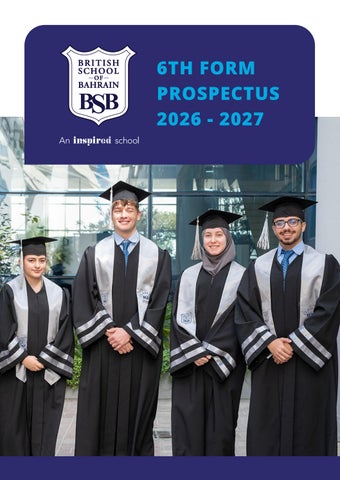
6TH FORM PROSPECTUS 2026 - 2027
THE BRITISH SCHOOL OF BAHRAIN Founded in 1995, The British School of Bahrain has grown into its purpose-built campus in Hamala, on the Western edge of the Kingdom of Bahrain. With over 90 nationalities represented in the student body, we are a truly international school focused on delivering an outstanding British curriculum. We are an accredited ‘British School Overseas’, verified by an outstanding inspection, as well as rated outstanding by the Bahrain Education and Training Quality Authority.
CONTENTS 1
Welcome
24
Humanities
2
Sixth Form at the BSB
29
Business & Economics
4
A Levels and BTECS
33
Technology
5
Desired grades
38
Arts
9
English
42
Sports
12
Mathematics
45
Extended Project Qualification
14
IAL Further Mathematics
47
Registration and examination fees
16
Sciences
50
Beyond BSB
20
Languages
WELCOME FROM MR KEN WINSTANLEY HEAD OF SENIORS It gives me great pleasure to offer you a glimpse into what an outstanding BSB education looks like. We are immensely proud of the Sixth Form experience we provide, which extends far beyond the academic subjects studied. Our commitment to a well-rounded, holistic education ensures that students develop not only academically, but also personally, through the cultivation of their interests, values, essential life skills and ability to collaborate effectively with others. We firmly believe that nurturing the whole child is fundamental to achieving academic excellence. BSB is proud to have consistently achieved some of the strongest academic results in the country. These achievements reflect the dedication and expertise of our exceptional staff, alongside our commitment to empowering students to become independent, confident and critical thinkers who thrive in an academically challenging environment. Through offering a diverse range of academic pathways to university, we ensure that each student can select the courses best suited to their individual strengths, aspirations and future ambitions. Our aim is to provide every student with the knowledge, skills and confidence to
progress successfully to their chosen university and future career. I look forward to welcoming you to our Sixth Form community and supporting both parents and students as they navigate the important decisions ahead. I am always happy to offer guidance and advice to help each student identify the pathway that will enable them to achieve their full potential and realise their ambitions. This guide provides a wealth of information to support students and families throughout the decision-making process. Combined with the guidance of our teachers, discussions at home and independent research into future opportunities, it will help students make informed choices about their next steps. Selecting Sixth Form subjects is an important decision that can have a significant influence on future university options and career opportunities. It is therefore essential that these choices are considered carefully, taking into account each student's interests, abilities, aspirations and long-term goals.
1
THE SIXTH FORM AT THE BSB TEACHING AND LEARNING
MONITORING PROGRESS
Independent learning is a crucial part of life in the 6th form and is the foundation for success. Students receive a number of independent study periods on their weekly timetable, depending on their chosen courses, for reflection, consolidation and further study. It is essential that this time is planned and focused, to enhance academic outcomes. Students have a range of areas to work in, designed for silent, independent work, group study, and also a space to take a short break before returning to their studies.
All students are provided with comprehensive feedback throughout their courses, including reflection time after assessments to learn from them and develop further. Parents are kept informed through the regular report cards, and are also invited to parent-teacher meetings at various points throughout an academic year. Parents are also welcome to contact the form tutor for any queries they may have regarding academic performance, university choices or any other topics they may wish to discuss.
In the classrooms, students will find teachers providing less direct instruction and more facilitation of exploration of topics, themes and ideas, through a variety of activities and experiments. Teachers are always available to provide support and guidance, and work closely with students to ensure personal progress.
6TH FORM STUDENTS WILL:
PASTORAL CARE The transition into 6th form is more than simply moving to a new year group. They are entering an environment where the emphasis is on their own motivation and determination to be successful. To help with that transition and future preparation, students are placed into form classes that provides a natural mentoring approach within the students to support each other. Furthermore, students are grouped based on their subject choices, interests and future aspirations, providing a constant source of like minded conversation and support, whilst sharing the burden of researching future pathways and choices. These groups are led by a form tutor who is also an expert in the specific area of interest, in order to guide and support discussions and pathways.
• Be welcomed into our supportive, vibrant community by
their peers, form tutor, 6th form leadership team and teachers.
• Pursue a personalised programme of study delivered by experienced, caring and responsive teachers.
• Choose from a wide variety of A Level and BTEC pathways, whilst having the opportunity to engage in a wide variety of extra curricular activities and enrichment programmes.
• Develop a range of skills essential for life in the 21st century, particularly time management, collaboration and leadership skills.
• Benefit from expert guidance to assist you with university choices and applications.
2
A LEVELS AND BTECS WHAT ARE A LEVEL COURSES? 2 year, subject based qualifications, with examinations as the main assessment method. Almost all are modular, with examinations spread over the two-year course. This enables students to stay informed of progress and reduce students’ reliance on memorisation techniques for revision. A small number of A Levels remain linear by necessity, with all examinations at the end of Upper 6th. Some subjects may have an element of coursework as part of the assessment. A Levels are the gold standard for global Universities, particularly for high performing students who achieve top grades at GCSE level. Typically, students perform very well in A Levels, especially if they have met the desired grade for the chosen subject. Annually, between 15-25% of all A Level qualifications are awarded at A*, and 40-50% are awarded to students at grade A*-A. This is no accident, as students are expertly guided by dedicated teachers who have high expectations and push students to above and beyond their comfort zone to achieve their very best.
WHAT ARE BTEC COURSES? Coursework based qualifications that require no examinations. Students complete a range of assignments, which are graded and accumulated throughout the course. International BTECs include a controlled assessment, which involves working in supervised conditions with access to preparatory work completed prior to the start of the assessment. BTECs are equivalent to one, two or even three A Levels. BTEC qualifications can be awarded at varying levels, differing by the amount of work completed, which is determined by the school at the start of the course. As the first school in Bahrain to offer BTEC qualifications, we are incredibly proud of the variety of pathways and flexibility of study that they enable us to offer. Typically, students with mid to low grade GCSEs are more successful in BTEC studies, due to the more practical nature of courses and the ability for teachers to support coursework completion more closely. Any student who chooses a BTEC course should be aiming to achieve distinction and distinction* grades, and should feel confident that they will achieve it.
check individual universities for their specific requirements. Some may ask for a particular type of BTEC, such as a diploma or extended diploma, so it is important for students to make sure their choices satisfy the entry criteria of their chosen universities.
BTEC Award
A Level Equivalent
BTEC Level 3 certificate
1 AS Level
BTEC Level 3 Subsidiary Diploma
1 A Level
BTEC Level 3 Diploma
2 A Levels
BTEC Level 3 Extended Diploma
3 A Levels
BTECs are graded slightly differently to A Levels, but hold equivalent value. BTEC Grade
A Level Grade
Distinction *
A*
Distinction
A
Merit
C
Pass
E
Historically, BSB students have performed exceptionally in BTEC studies, with over 80% of BTEC grades awarded at Distinction or distinction* since they were introduced in 2015. BTEC qualifications enable access to a growing number of global universities. Most UK universities accept BTEC qualifications, including many of the prestigious Russell Group. Additionally, universities across Europe, USA and Asia also accept BTEC qualifications, with students advised to
3
A LEVELS AND BTECS SO WHICH BLEND OF COURSES SHOULD I TAKE? • The answer to this question is very personal, but some general guidelines may help:
• Students should aim to choose subjects that interest them and where they have been successful.
• A Levels, BTECs or a combination of the two are all acceptable pathways.
• Students should discuss choices with a wide range of people,
including parents, teachers and the 6th form leadership team, but ultimately it should be their choice.
• Students should be realistic; the entry criteria for each subject is carefully created using a wealth of historical data, to ensure that every student can be successful. • If examinations are a concern or worry, consider choosing BTECs, to avoid that method of assessment.
• Taking four subjects is not a ‘must.’ Most students will graduate
APPLYING TO UNIVERSITIES The process begins almost immediately in Lower 6th. Students will spend the first term looking at various countries, institutions and courses, as they start to narrow down their choices. Students should pay particular attention to the Desired grades of different institutions around the world, and make sure they complete any additional requirements in a timely manner, such as SATs, IELTs or subject specific entrance examinations. The application process ends in October of Upper 6th, when students are expected to submit their applications. This allows them to focus all of their energy and effort throughout the Upper 6th on their academic performance, which remains the most important requirement for acceptance onto a university course. We encourage our students to complete work experience during the school holidays between GCSE and Lower 6th or between Lower and Upper 6th. This is especially important for those who are planning a medical degree. However, all universities like to see reference to work experience in the personal essay or statement, even if the student has changed career path. We often use information from employers to add to the reference we write for students. Work experience can also give the student a good insight into the work involved in their chosen career path.
with three A Levels or BTECs.
• If students have any doubts or confusion, they should talk to
the 6th form leadership team. They will be able to advise and guide students towards a pathway they will be happy with and successful in.
FACILITATING SUBJECTS Some A Levels are more frequently required by top universities for entry into their courses. They are known as ‘facilitating subjects’ because they are considered desirable by universities for the knowledge and skills they build. Subjects commonly referred to as facilitating include: biology, chemistry, English literature, geography, history, physics, mathematics, and Modern Foreign Languages.
4
GENERAL ENTRY REQUIREMENTS Students will need to achieve a minimum of 5 GCSEs, including English and Mathematics, graded at A*-C (9-4). If taking English as a second language, they should achieve at least a grade A/7. In addition, students should look at the desired grade for each subject as a benchmark for expectations. If students have not reached the desired grade, it is likely that an alternative pathway will be advised. Additionally, a strong work ethic and positive attitude towards studies will ensure fair consideration before course entry is finalised. This process ensures that students are placed on a pathway to ensure success in their studies.
A LEVEL COURSES SUBJECT
DESIRED GRADE
Arabic (modular)
Edexcel IAL (9FR0)
6 or above in Arabic First Language or A or above in Arabic Second Language
Art (linear)
Edexcel A Level (9FA0)
6 or above in Art, or acceptance of a submitted portfolio of work to show interest and potential in Art
Biology (modular)
Edexcel IAL (YBI11)
7 in Biology or 77 in combined Science. 7 in Mathematics is desirable
Business Studies (modular)
Cambridge IAL (9609)
6 in Business. 6 or above in English and Mathematics if GCSE Business has not been studied
Chemistry (modular)
Edexcel IAL (YCH11)
7 in Chemistry or 77 in Combined Science, plus 7 in Mathematics
Computer Science (modular)
Cambridge IAL (9618)
7 in Computer Science. 6 in Mathematics and Physics is desirable
Drama (linear)
Edexcel A Level (9DR0)
4 or above in English, plus an active interest in performing. GCSE Drama is desirable
Economics (linear)
Edexcel A Level (9EB0)
7 in Economics. 7 in English and Mathematics is desirable
English Language (modular)
Edexcel IAL (YEN01)
7 or above in English Language. Students will be considered if they have achieved 7 in English Literature
English Literature (modular)
Edexcel IAL (YET01)
7 or above in English Literature. Students will be considered if they have achieved 7 in English Language
French (modular)
Edexcel IAL (YFR01)
6 or above in French
Further Mathematics (modular)
Edexcel IAL (YFM01)
8 or above in Mathematics (students must also choose Mathematics as an option)
5
Geography (modular)
Cambridge IAL (9696)
6 or above in English and Math
History (modular)
Edexcel IAL (YHI01)
6 or above in history
Mathematics (modular)
Edexcel IAL (YMA01)
7 or above in Mathematics
Music (modular)
Cambridge IAL (9483)
6 or above in Music, plus performance standard of at least a Grade 6 in ABRSM or Trinity
Physics (modular)
Edexcel IAL (YPH11)
7 in Physics or 77 in Combined Science, plus 7 in Mathematics
Physical Education (linear)
Edexcel A Level (9PE0)
6 or above in Science subjects, plus play one sport at a competitive level. GCSE Physical Education is desirable
Psychology (modular)
Edexcel IAL (WPS01)
6 in Psychology. 6 or above in English and Mathematics if GCSE Psychology has not been studied
Spanish (modular)
Edexcel IAL (YSP01)
6 or above in Spanish
Extended Project Qualification
Edexcel AS Level (P301)
5 in English Language and a keen interest in a chosen area of study
BTEC SUBJECTS Business
Edexcel BTEC International Diploma / Extended Diploma
5 A*-C/9-4 (or equivalent) including English and Mathematics. Grade 4 in Business studies is desirable
Engineering
Edexcel BTEC International Diploma / Extended Diploma
5 A*-C/9-4 (or equivalent) including English and Mathematics. Grade 4 in Physics is desirable
IT
Edexcel BTEC International Subsidiary 5 A*-C/9-4 (or equivalent) including English and Mathematics. Diploma / Diploma
Artificial Intelligence
Edexcel BTEC International Subsidiary 5 A*-C/9-4 (or equivalent) including English and Mathematics. Diploma / Diploma
Sport
Edexcel BTEC International Subsidiary Diploma
5 A*-C/9-4 (or equivalent) including English and Mathematics, plus a keen interest in Sport
Travel and Tourism
Edexcel BTEC International Diploma / Extended Diploma
5 A*-C/9-4 (or equivalent) including English and mathematics. Grade 4 in a humanities subject is desirable
6
RECOMMENDED PATHWAYS GCSE Grades 8-9
4 A Levels
GCSE Grades 6-8
3 A Levels
GCSE Grades 5-7
A Level & BTEC combination
GCSE Grades 4-5
BTEC
*The only guarantee of a place on an A Level or BTEC course is to meet the entry criteria. The school will treat all applications on their individual merit and qualifications. A personalised discussion regarding choices and options will be held with all students following the release of GCSE results in late August. **For all A Level courses, additional fees are payable for entry to examinations, invoiced ahead of each examination series. BTEC courses are subject to a registration fee, payable at the start of the course. Regardless of pathway, the approximate fees are comparable.
7
SUBJECT INFORMATION
ENGLISH
IAL ENGLISH LANGUAGE WHAT WILL STUDENTS LEARN?
• • • • •
Exam Board Edexcel Syllabus code YEN01
EXAMINATION STRUCTURE
To develop and apply their understanding of the concepts and methods appropriate for the analysis and study of language To explore data and examples of language in use To engage creatively and critically with a varied programme for the study of English To develop their skills as producers and interpreters of language To independently investigate language in use.
The course is modular, with students sitting two modules in Year 12 (1 hour 45 minute examinations) and two modules in Year 13 (2 hour examinations).
HIGHER EDUCATION AND CAREER PATHS Possible degree options and future careers that are common for students studying English Language are Law, Politics, Media and Journalism
SKILLS AND UNDERSTANDING
• • • •
Develop and apply their understanding of the concepts and methods appropriate for the analysis and study of language Develop their skills as producers and interpreters of language Learn to work independently in the investigation of language Explore data and examples of language in use.
COMPONENT
1
2
3
4
Component name
Language: Context and Identity
Language in Transition
Crafting Language (writing)
Investigating Language
Assessment method
Written Examination
Written Examination
Written Examination
Written Examination
Weighting %
50% of IAS or 25% of IAL
50% of IAS or 25% of IAL
25% of IAL
25% of IAL
Duration of exam
1h 45m
1h 45m
2h
2h
Desired grades 7 or above in English Language. Students will be considered if they have achieved 7 in English Literature. Click here to view the course syllabus
10
IAL ENGLISH LITERATURE
Exam Board Edexcel Syllabus code XET01- YET01
WHAT WILL STUDENTS LEARN? Unit 1: Unit 2: Unit 3: Unit 4:
Students will build on the analytical skills developed at IGCSE English Language and Literature and will conduct more in depth studies of prose, poetry and drama. The examination texts are chosen by the department from a list provided by Edexcel.
SKILLS AND UNDERSTANDING
• • • •
Students will develop their communication skills (written and verbal) Students will learn how to work collaboratively and independently Students will learn a wide range of critical vocabulary and develop critical analysis skills. Students will develop their ability to write with increasing sophistication and precision.
HIGHER EDUCATION AND CAREER PATHS English Literature is an excellent qualification to gain. Its academic rigour is well-known (e.g. the UK’s group of top 20 universities - the Russell Group - has designated it as one of their preferred ‘facilitating subjects’). A good grade in this subject is therefore helpful for any degree in: Arts, Humanities, Languages, Law etc. We even sometimes see scientists taking this subject along with the likes of biology, chemistry, physics and mathematics. English graduates themselves go on to a wide range of highly-skilled careers where their analysis, precise thought and highly-developed communication skills are much sought-after.
EXAMINATION STRUCTURE This is a modular course, with unit examinations taken in January and June of Lower 6th, and January and June of Upper 6th.
COMPONENT
Post-2000 Poetry and Prose (sat in January of Lower 6th) Drama (sat in June of Lower 6th) Poetry and Prose (sat in January of Upper 6th) Shakespeare and Pre-1900s Poetry (sat in June of Upper 6th)
1
2
3
4
Component name
Drama
Prose
Poetry
Coursework
Assessment method
Exam
Exam
Exam
Coursework
Weighting %
30%
20%
30%
30%
Duration of exam
2 h 15 m
1 h 15 m
2 h 15 m
Desired grades 7 or above in English Literature. Students will be considered if they have achieved 7 in English Language Click here to view the course syllabus
11
MATHEMATICS
12
IAL MATHEMATICS
Exam Board Edexcel Syllabus code YMA01
WHAT WILL STUDENTS LEARN?
• • • • •
EXAMINATION STRUCTURE
Extend their range of mathematical skills and techniques and use them in more difficult, unstructured problems. Develop an understanding of coherence and progression in mathematics and of how different areas of mathematics can be connected. Recognise how a situation may be represented mathematically and understand the relationship between ‘real-world’ problems and standard and other mathematical models and how these can be refined and improved. Read and comprehend mathematical arguments and articles concerning applications of mathematics. Develop an awareness of the relevance of mathematics to other fields of study, to the world of work and to society in general.
Modular course with examinations in January and June. Students will be doing Pure Mathematics 1, 2, 3, 4, Decision 1 and Statistics 1.
HIGHER EDUCATION AND CAREER PATHS Mathematics opens doors to many respectable courses as it is a demanding and well recognised A level. However, in order for it to provide opportunities students are required to secure a good grade at the end of the course (usually A or above), particulary if students wish to study in top UK universities. Studying Mathematics can lead to many career paths including accountancy, teaching, actuary and banking. engineering, sciences, computing, economics or finance.
SKILLS AND UNDERSTANDING Students will need to be able to problem solve; there should be good exam technique; steps to working should be clear and methodical; students should be able to contextualise answers.
COMPONENT
1
2
3
4
5
6
Component name
Pure Mathematics 1
Assessment method
Exam
Pure Mathematics 2 Written Examination
Pure Mathematics 3 Written Examination
Pure Mathematics 4 Written Examination
Statistics 1
Decision 1
Written Examination
Written Examination
Weighting %
16 2/3 %
16 2/3 %
16 2/3 %
16 2/3 %
16 2/3 %
16 2/3 %
Duration of exam
1h 30 m
1h 30 m
1h 30 m
1h 30 m
1h 30 m
1h 30 m
Desired grades 7 or above in mathematics Click here to view the course syllabus
13
IAL FURTHER MATHEMATICS
IAL FURTHER MATHEMATICS
Exam Board Edexcel Syllabus code YFM01
WHAT WILL STUDENTS LEARN?
EXAMINATION STRUCTURE
Students will follow further mathematics alongside A Level mathematics, extending their knowledge and understanding of advanced topics and concepts.
The course is modular. There are exams in January and in June. Students will take exams in Further pure mathematics 1, 2 and 3, Mechanics 1, Mechanics 2 and Statistics 2.
SKILLS AND UNDERSTANDING
HIGHER EDUCATION AND CAREER PATHS
Students will need to be able to problem solve; there should be good exam technique; steps to working should be clear and methodical; students should be able to contextualise answers.
Studying Further Mathematics reinforces, extends and deepens topics studied in A level Mathematics. Studying Further Mathematics highlights able mathematicians and assists with studying at degree level. It is particularly useful when studying engineering, sciences, computing, economics or finance.
COMPONENT
1
2
3
4
5
6
Component name
Further Pure Mathematics 1
Further Pure Mathematics 2
Assessment method
Exam
Exam
Further Pure Mathematics 3 Written Examination
Mechanics 1
Mechanics 2
Mechanics 3 Statistics 2
Exam
Exam
Exam
Weighting %
16 2/3 %
16 2/3 %
16 2/3 %
16 2/3 %
16 2/3 %
16 2/3 %
Duration of exam
1h 30 m
1h 30 m
1h 30 m
1h 30 m
1h 30 m
1h 30 m
Desired grades 8 or above in mathematics (students must also choose Mathematics as an option) Click here to view the course syllabus
15
SCIENCES
IAL BIOLOGY
Exam Board International A level - Edexcel Syllabus code YBI11
WHAT WILL STUDENTS LEARN?
EXAMINATION STRUCTURE
Students will learn the major topics in biology, including biological molecules, diet, transport, health, cells, development, biodiversity, conservation, energy, the environment, microbiology, immunity, respiration, the internal environment, coordination and gene technology.
The course is modular. Students will sit three modules each in lower and upper 6th.
SKILLS AND UNDERSTANDING Students will learn to apply their knowledge and understanding to familiar and unfamiliar contexts; they will develop experimental skills, and a knowledge and understanding of experimental techniques, by carrying out a range of practical experiments and investigations; they will analyse and evaluate of scientific information to make judgments and reach conclusions.
HIGHER EDUCATION AND CAREER PATHS Biology is important for students considering careers in areas such as medicine, veterinary medicine, dentistry or forensic science. The skills developed in A Level Biology can be applied across a range of careers, including non-scientific professions such as law, finance or teaching. Biology is one of the facilitating subjects identified by the Russell Group of universities.
COMPONENT
1
2
3
4
5
6
Component name
Molecules, Diet, Transport & Health
Cells, Development, Biodiversity & Conservation
Practical Skills in Biology
Energy, Environment, Microbiology & Immunity
Assessment method
Written Examination
Written Examination
Written Examination
Written Examination
Written Examination
Written Examination
Weighting %
20%
20%
20%
20%
20%
10%
Duration of exam
1h 30 m
1h 30 m
1h 20 m
1h 45 m
1h 45 m
1h 20 m
Respiration, Internal Practical Skills Environment, in Biology II Coordination & Gene Technology
Desired grades 7 in biology or 77 in combined science. 7 in mathematics is desirable Click here to view the course syllabus
17
IAL CHEMISTRY
Exam Board International A level - Edexcel Syllabus code YCH11
WHAT WILL STUDENTS LEARN?
EXAMINATION STRUCTURE
Students will learn the major topics in chemistry, including molar calculations, structure and bonding, energetics, rates, equilibria, Group chemistry, transition metals and a range of organic chemistry; as well as associated experimental skills.
The course is modular. Students will sit three modules each in lower and upper 6th.
SKILLS AND UNDERSTANDING
Studying chemistry at A Level provides the necessary foundation for students wishing to move into scientific or medical based higher education courses. Often desired from top universities, the attainment of chemistry a level shows an excellent understanding of scientific content but also an aptituvde for other desirable skills, such as laboratory work and mathematical skills. Studying chemistry can lead into exciting career opportunities such as analytical chemistry, chemical engineering, healthcare science, forensic science, nanotechnology, pharmacology and toxicology. Chemistry is one of the facilitating subjects identified by the Russell Group of universities.
Students will develop their knowledge and understanding of chemistry by applying its concepts to a range of different problems, set in a variety of contexts; Students will develop laboratory based practical skills and a reliable understanding of experimental techniques associated with the subject; Students will enhance their evaluative and analytical chemistry skills by using experimental data to assess scientific questions and reach suitable conclusions.
COMPONENT
Component name
1
2
HIGHER EDUCATION AND CAREER PATHS
3
4
5
6
Unit 5 Unit 1 - Structure, Unit 2 Unit 4 - Rates, Unit 3 - Practical Transition Bonding & Energetics, Unit 6 - Practical Equilibria & Skills in Metals & Organic Introduction to Group Chemistry, Skills in Further Organic Chemistry I Nitrogen Organic Halogenoalkanes Chemistry II Chemistry Chemistry Chemistry & Alcohols
Assessment method
Written Examination
Written Examination
Written Examination
Written Examination
Written Examination
Written Examination
Weighting %
20%
20%
10%
20%
20%
10%
Duration of exam
1h 30 m
1h 30 m
1h 20 m
1h 45 m
1h 45 m
1h 20 m
Desired grades 7 in chemistry or 77 in combined science, plus 7 in mathematics Click here to view the course syllabus
18
IAL PHYSICS
Exam Board International A level - Edexcel Syllabus code YBI11
WHAT WILL STUDENTS LEARN?
EXAMINATION STRUCTURE
Mechanics & Further Mechanics, Materials, Waves, Electric Current, Nature of Light, Fluid Movement, Momentum , Circular Motion, Electric Fields, Magnetic Fields, Electromagnetism, Capacitors, Particles, Thermal Energy, Nuclear Decay, Simple Harmonic Motion, Astrophysics & Cosmology.
The course is modular. Students will sit three modules each in lower and upper 6th.
SKILLS AND UNDERSTANDING Develop knowledge and understanding of what it means to work scientifically; develop confidence in key scientific skills such as handling and controlling quantities and units and making estimates; learn about how the scientific community functions and how society as a whole uses scientific ideas; develop the ability to think critically about what they read; gain practice in communicating information and ideas in an appropriate scientific way; apply their knowledge and understanding to unfamiliar contexts; plan experiments and analyse and evaluate data.
HIGHER EDUCATION AND CAREER PATHS A level Physics provides a suitable foundation for specialist study at University in mathematics, physics, mechanical engineering, computer science, civil engineering, economics and business. The course provides an excellent basis for all sorts of many amazing career options including geophysicist, healthcare scientist, research scientist, laboratory technician, meteorologist, patent attorney, technical author, astrophysicist, nanotechnology and renewable energy. With Physics the opportunities are endless. Physics is one of the facilitating subjects identified by the Russell Group of universities.
COMPONENT
1
2
3
4
5
6
Component name
Unit 1 Mechanics & Materials
Unit 2 Waves & Electricity
Unit 3 Particles Skills in Physics 1
Mechanics Fields & Particles
Assessment method
Written Examination
Written Examination
Written Examination
Written Examination
Written Examination
Written Examination
Weighting %
20%
20%
10%
20%
20%
10%
Duration of exam
1h 30 m
1h 30 m
1h 20 m
1h 45 m
1h 45 m
1h 20 m
Unit 5 Thermodynamics, Unit 6 Radiation, Practical Skills Oscillations in Physics 2 & Cosmology
Desired grades 7 in physics or 77 in combined science, plus 7 in mathematics Click here to view the course syllabus
19
LANGUAGES
IAL ARABIC
Exam Board Edexcel Syllabus code 9FR0
WHAT WILL STUDENTS LEARN?
• • • •
Read and respond to a variety of Arabic-language written texts, including authentic sources, covering different contexts, registers, styles and genres. Adapt their written Arabic language appropriately for different situations and purposes. Use the Arabic language accurately to express facts and ideas, and to present explanations, opinions and information in writing. Understand and apply the grammatical system and a range of structures of the Arabic language as detailed in Arabic unit content: Grammar list.
SKILLS AND UNDERSTANDING
• •
An understanding of a wide variety of complex reading texts for different purposes. An understanding of standard written language on both unfamiliar and familiar topics normally encountered in personal, social, academic or vocational contexts. COMPONENT
•
An understanding of the nature of language in different cultural contexts in order to build up competence in written communication.
EXAMINATION STRUCTURE The course is modular. Students will sit 1 module in Lower 6th and they can continue their studies in Upper 6th by taking the full A Level.
HIGHER EDUCATION AND CAREER PATHS The skills necessary for further study or employment, either in Arabic-speaking countries or where Arabic is used as the main medium of communication for business and commerce. This qualification is designed primarily as a qualification for students who are studying Arabic in order to enhance their future educational or employment prospects.
1
2
Unit 1: Understanding and Written Response (XAA01) Section A: Reading, Section B: Grammar, Section C: Essay
Unit 2: Writing and Research (YAA01) Section A: Mathematics 2 Translation, Section B: Creative/ Discursive Essay, Section C: Research-based Essay
Assessment method
Written Examination
Written Examination
Weighting %
100 % of the total IAS / 50 % of the total IAL
100 % of the total IA2 / 50 % of the total IAL
Duration of exam
2 h 30 m
3h
Component name
Desired grades 6 or above in Arabic first language or A or above in Arabic second language Click here to view the course syllabus
21
IAL FRENCH
Exam Board Edexcel Syllabus code YFR01
WHAT WILL STUDENTS LEARN? countries. This course is designed to give students the opportunity to acquire valuable transferable study skills such as autonomy, resourcefulness, creativity, critical thinking and linguistic, cultural and cognitive flexibility, helping to prepare students for higher education and enhance their employability profile.
This qualification consists of four externally assessed units. The International Advanced Level consists of the two IAS units (Units 1 and 2) plus two IA2 units (Units 3 and 4). Students wishing to take the International Advanced Level must, therefore, complete all four units. Students will learn to recognise and use the French language in a variety of contexts and in relation to a prescribed range of general topic areas as follows:
• • • • • • •
EXAMINATION STRUCTURE The structure of these qualifications allows teachers to construct a course of study that can be taught and assessed as distinct modules of teaching and learning with related units of assessment taken at appropriate stages during the course.
Youth matters Lifestyle, health and fitness Environment and travel Education and employment Technology in the Spanish-speaking world Society in the Spanish-speaking world Ethics in the Spanish-speaking world.
HIGHER EDUCATION AND CAREER PATHS Technology, globalisation and ease of international travel are bringing more of the world within our reach. Studying languages can give you that competitive edge. Knowledge of a foreign language can lead to exciting career opportunities that those without an extra language have little chance of accessing.
SKILLS AND UNDERSTANDING Languages should appeal to all students and this course should inspire them to develop not only advanced level practical knowledge of the language but also an appreciation of the literature, films and culture of the target language
COMPONENT
1
2
3
4
Component name
Spoken expression and response
Understanding and written response
Understanding and spoken response
Research, understanding and written response
Assessment method
Oral Examination
Listening, Reading, Grammar and Writing Examination
Oral Examination
Listening, Reading, Grammar and Writing Examination
Weighting %
30% of the total IAS 15% of the total IAL
70% of the total IAS 35% of the total IAL
30% of the total IA2 15% of the total IAL
70% of the total IA2 35% of the total IAL
Duration of exam
8 – 10 m
2 h 30 m
11-13 m
2 h 30 m
Desired grades 7 or above in French Click here to view the course syllabus
22
IAL SPANISH
Exam Board Edexcel Syllabus code YSP01
WHAT WILL STUDENTS LEARN? valuable transferable study skills such as autonomy, resourcefulness, creativity, critical thinking and linguistic, cultural and cognitive flexibility, helping to prepare students for higher education and enhance their employability profile.
Pearson Edexcel International Advanced Level in Spanish . This qualification consists of four externally assessed units. The International Advanced Level consists of the two IAS units (Units 1 and 2) plus two IA2 units (Units 3 and 4). Students wishing to take the International Advanced Level must, therefore, complete all four units. Students will learn to recognise and use the Spanish language in a variety of contexts and in relation to a prescribed range of general topic areas as follows:
• • • • • • •
EXAMINATION STRUCTURE 2 year linear course with exams in the final year. Students must complete their speaking assessment in April and all other assessments in May/June in any single year. All assessments are externally marked.
Youth matters Lifestyle, health and fitness Environment and travel Education and employment Technology in the Spanish-speaking world Society in the Spanish-speaking world Ethics in the Spanish-speaking world.
HIGHER EDUCATION AND CAREER PATHS The question should be Why not study a language? Technology, globalisation and ease of international travel are bringing more of the world within our reach. Studying languages can give you that competitive edge. Knowledge of a foreign language can lead to exciting career opportunities that those without an extra language have little chance of accessing.
SKILLS AND UNDERSTANDING Languages should appeal to all students and this course should inspire them to develop not only advanced level practical knowledge of the language but also an appreciation of the literature, films and culture of the target language countries. This course is designed to give students the opportunity to acquire.
COMPONENT
1
2
3
4
Component name
Spoken expression and response
Understanding and written response
Understanding and spoken response
Research, understanding and written response
Assessment method
Oral Examination
Listening, Reading, Grammar and Writing Examination
Oral Examination
Listening, Reading, Grammar and Writing Examination
Weighting %
30% of the total IAS 15% of the total IAL
70% of the total IAS 35% of the total IAL
30% of the total IA2 15% of the total IAL
70% of the total IA2 35% of the total IAL
Duration of exam
8 – 10 m
2 h 30 m
11-13 m
2 h 30 m
Desired grades 6 or above in Spanish Click here to view the course syllabus
23
HUMANITIES
IAL GEOGRAPHY
Exam Board Cambridge Syllabus code 9696
WHAT WILL STUDENTS LEARN? The A Level course builds on aspects of the iGCSE course. Students will develop an understanding of:
EXAMINATION STRUCTURE
• • •
HIGHER EDUCATION AND CAREER PATHS
The course is modular with AS taken by all in year 12 with the option to continue in year 13 to A2.
The principal processes operating within physical geography and human geography. The causes and effects of change on natural and human environments. An awareness of the usefulness of geographical analysis to understand and solve contemporary human and environmental problems.
Jobs which involve people or the environment, for example engineering or medicine, would be highly benefitted by A Level Geography. Geography is a facilitating subject for entrance to universities because it is a cross curricula subject that keeps options open with it encompassing both the arts (writing skills/ report writing) and sciences/maths (data interpretation). As a traditional A level qualification it is highly regarded as an entry requirement for all university courses. Students of A Level Geography go on to study a wide variety of subjects at university and enter a wide variety of careers.
SKILLS AND UNDERSTANDING Students will develop their problem solving skills, learning to analyse a variety of source material and present their ideas in a clear and logical fashion. They will also be able to link theoretical concepts and processes to real-world examples. The use of up to date and relevant case studies is an important feature in Geography. Students develop their wider understanding of recent storms and tectonic events in the news, current world situations like flooding in Pakistan and the energy crisis in Europe. COMPONENT
1
2
3
4
Component name
AS Paper 1: Core Physical Geography
AS Paper 2: Core Human Geography
A2 Paper 3: Advanced Physical Geography
A2 Paper 4 : Advanced Human Geography
Assessment method
Exam
Exam
Exam
Coursework
Weighting %
25%
25%
25%
25%
Duration of exam
1h 30m
1h 30m
1h 30m
1h 30m
Desired grades 6 or above in English and Math Click here to view the course syllabus
25
A LEVEL HISTORY
Exam Board Edexcel Syllabus code IAL (YHI01)
WHAT WILL STUDENTS LEARN? History students will organise and communicate their historical knowledge and understanding in different ways, arguing a case and reaching substantiated judgements.
A Level history focuses on a variety of modern contexts ranging from the late 19th Century to close to present day. Students will acquire an understanding of different identities within society and an appreciation of aspects such as social, cultural, religious and ethnic diversity, and make links and draw comparisons within and across different periods and aspects of the past. Speak to the history team about topics of study in this course.
EXAMINATION STRUCTURE The course is examined at the end of Y12 and the end of Y13. The Y12 (AS) and 13 (A Level) have equal weighting.
HIGHER EDUCATION AND CAREER PATHS
SKILLS AND UNDERSTANDING
Students with A Level History are desired by top universities as it is not only a facilitating subject (one with transferable skills that will help higher level studies), but a demanding academic subject in its own right. Degree courses and careers in the areas of law, journalism, politics, education and business are common.
A Level History students develop their essay writing skill to a university level. Our students learn how to build an argument considering a wide variety of factors which have influence over an event or period of time, identifying the most significant and analysing its effect are key historical skills. Students will use historical and modern sources to infer meaning by weighing up the effect of the nature, origin, and purpose of the source.
COMPONENT
1
2
3
4
Component name
Depth study with interpretations
Breadth study with source evaluation
Thematic study with source evaluation
International study with historical interpretations
Assessment method
Exam
Exam
Exam
Exam
Weighting %
25%
25%
25%
25%
Duration of exam
2 hours
2 hours
2 hours
2 hours
Desired grades 6 or above in history Click here to view the course syllabus
26
IAL PSYCHOLOGY
Exam Board Edexcel Syllabus code IAL (WPS01)
WHAT WILL STUDENTS LEARN? Lower 6th students will study two units for the Advanced Subsidiary (AS) qualification; unit one is social and cognitive psychology and unit two, biological psychology with learning and development.
associated with the subject; understand how society makes decisions about scientific issues and how the sciences contribute to the success of the economy and society.
Upper 6th students will study a further two units for the international A level qualification, unit 3 consists of Applications in Psychology and unit 4 clinical Psychology and Psychological problems.
A level psychology provides a suitable foundation for specialist study of Psychology at University, as well as other academic areas such as Biomedical sciences, counselling, and Business. The scientific aspects of the Psychology course, including the application of a reasoned approach, problem solving and manipulation of data, provide useful tools for careers in healthcare, law enforcement, finance, IT and research. The most popular career paths include Clinical Psychology, Psychiatry, and Further Education. Furthermore, the knowledge of human behavior and motivation, ability to critically analyze a problem, formulate a considered response, create an argument and generate new ideas lend themselves well to careers in the creative industries, the legal sector, government administration and education.
SKILLS AND UNDERSTANDING
• • •
Develop essential knowledge and understanding of different areas of the subject and how they relate to each other. Develop and demonstrate a deep appreciation of the skills, knowledge and understanding of scientific methods; develop competence and confidence in a variety of practical, mathematical and problem-solving skills. Develop their interest in and enthusiasm for the subject, including developing an interest in further study and careers COMPONENT
1
2
3
4
Component name
Social and Cognitive Psychology
Biological, learning and development
Applications in Psychology
Clinical psychology and psychological skills
Assessment method
Written exam
Written exam
Written exam
Written exam
Weighting %
40%AS - 20%IAL
60%AS - 30%IAL
20%IAL
30%IAL
Duration of exam
1 h 30 m
2h
1 h 30 m
2h
Desired grades 6 or above in mathematics and English. GCSE psychology is desirable Click here to view the course syllabus
27
BTEC TRAVEL AND TOURISM WHAT WILL STUDENTS LEARN? Students will explore the dynamic and global travel and tourism industry, including customer service, destination management, marketing, and business operations. The course blends theory with practical, real-world application through case studies and project-based learning.
•
SKILLS AND UNDERSTANDING
•
• • • • • •
•
Strong communication and customer service techniques Understanding of global travel trends and destinations Business and marketing principles in a tourism context Planning and managing events and tourism experiences Research, analysis, and report-writing skills Teamwork, organisation, and time management
This qualification supports progression to university courses such as International Tourism Management, Hospitality and Hotel Management, Aviation Operations, Events Management, and Business with Tourism. BTEC qualifications are widely accepted by universities in the UK, Europe, Canada, Australia, and across the Middle East. Students may go on to careers in airline operations, cabin crew, airport services, international hotel management, luxury travel, tour operations, cruise management, event planning, and tourism marketing. Opportunities also exist in government tourism boards, sustainable tourism, and entrepreneurship within the travel and hospitality sectors.
EXAMINATION STRUCTURE 100% internal assessment through assignments and practical tasks. Some units are mandatory Pearson-set tasks, where the assignment brief is given by Pearson but marked internally.
COMPONENT
Component name
1
The Travel and Tourism Industry
Throughout the two years, students build a portfolio of evidence demonstrating their application of knowledge, skills, and industry understanding. Assessments include a variety of formats: written reports, case studies, presentations, role-plays, marketing plans, and practical tasks. Each unit is graded on a Pass / Merit / Distinction / Distinction basis.
HIGHER EDUCATION AND CAREER PATHS
Students also develop valuable transferable skills such as problem-solving, critical thinking, and adaptability that are essential across a wide range of industries.
• •
Exam Board Edexcel Syllabus code BTEC International Diploma
With the continued expansion of tourism and hospitality industries across the Middle East, particularly in cities like Bahrain, Dubai, Abu Dhabi, and Riyadh, students are well-positioned for both regional and global careers.
2
Worldwide Travel and Tourism Destination
3,4,5
Theatre-making and performing Coursework
7,8,14,16 Marketing Travel and Tourism to Domestic & international customers. Customer Service in Travel and Tourism Travel and tourism Enterprises.
Assessment method
Set assignment
Set assignment
Internal assessment
Internal assessment
Weighting %
12.5%
16.7%
12.5%
8.3-12.5%
Duration of exam
90 GLH
120 GLH
90 GLH Each
60 GLH each
Desired grades 5 A*-C/9-4 (or equivalent) including English and mathematics. Grade 4 in a humanities subject is desirable Click here to view the course syllabus
28
BUSINESS & ECONOMICS
IAL BUSINESS
Exam Board Cambridge Syllabus code 9609
WHAT WILL STUDENTS LEARN?
HIGHER EDUCATION AND CAREER PATHS
Students will study a variety of topics including: marketing, human resources, finance, production and the business environment.
Possible university and career choices include management, marketing, HR, finance, accounting, banking, retailing, and government. In fact, Business is one of the most versatile subjects as the vast majority of graduates end up working in businesses.
SKILLS AND UNDERSTANDING
• • • • •
Understand and appreciate the nature and scope of business and the role it plays in society. Develop critical understanding of organisations, the markets they serve and the process of adding value. Enhance a variety of skills including problem-solving, decision- making and communication. Explore political, economic, social, technological, legal, environmental and ethical issues associated with business activity. Evaluate business behaviour from the perspective of a range of stakeholders.
Topics students will study are: Business Environment Human Resources Marketing Operations Management Finance and accounting
• • • • •
Students in year 13 will enhance their study in these topics by developing their knowledge through:
• • • • •
EXAMINATION STRUCTURE The course is modular. Students will sit two exams in Year 12 and two exams in Year 13.
Business strategy Human Resources strategies Marketing analysis strategies Operational strategies Financial strategies
COMPONENT
1
2
3
4
Component name
Business Concepts 1
Business Concepts 2
Business Decision Making
Business Strategy
Assessment method
Written Examination
Written Examination
Written Examination
Written Examination
Weighting %
20%
30%
30%
20%
Duration of exam
1h 15 m
1h 30 m
1h 45 m
1h 15 m
Desired grades 7 or above in English and 6 or above in mathematics. GCSE business is desirable Click here to view the course syllabus
30
BTEC BUSINESS
Exam Board Edexcelt Syllabus code BTEC Level 3 International Diploma 500/6747/3 (1200 TQT)
WHAT WILL STUDENTS LEARN?
HOW WILL I BE ASSESSED?
The diploma programme will consist of 9 units in total:
Students are assessed using a variety of styles to help them develop a broad range of transferable skills; Students are given opportunities to:
Lower 6th Unit 1: Exploring business Unit 2: Research and plan a marketing campaign Unit 3: Business finance Unit 4: Managing an event Upper 6th Unit 7: Business decision making Unit 19: Pitching a new business Unit 20:Business ethics Unit 21: Training and development Unit 2: Market research
SKILLS AND UNDERSTANDING Students will develop key business skills in research, analysis and entrepreneurial management. The course will engage in scenarios based on real world assignments focused on the current business environment. To enhance their experience further, students will hold business events in the school community.
• • • • •
Write up the findings of their own research Use case studies to explore complex or unfamiliar situations Carry out projects for which they have choice over the direction and outcomes Demonstrate practical and technical skills using appropriate presentations and role plays.
All units are internally assessed and moderated by a UK external examiner. A summative unit grade can be awarded at pass, merit or distinction.
HIGHER EDUCATION AND CAREER PATHS The BTEC Business Diploma with one other award allows student to gain access to several business related degrees in many Universities across the UK, Europe and beyond.
Desired grades 5 A*-C/9-4 (or equivalent) including English and mathematics. Grade 4 in business studies is desirable Click here to view the course syllabus
31
A LEVEL ECONOMICS WHAT WILL STUDENTS LEARN? Students are introduced to Economics through building knowledge of core microeconomic and macroeconomic concepts, and by investigating economic theory through real-world businesses and the environments in which they operate; Breadth and depth of knowledge and understanding with applications to more complex concepts and models are developed in the second year of study. Students will need to apply their knowledge and understanding to both familiar and unfamiliar contexts in the assessment and demonstrate an awareness of current economic events and policies.
SKILLS AND UNDERSTANDING
• • •
Demonstrate knowledge of concepts and theories and their effects on economic agents. Analysis of current economic and political events and their potential ramifications. Use policy instruments to reach justified solutions to current economic issues.
COMPONENT
Exam Board Edexcel Syllabus code 9EB0
• •
Recommend methods of improving the success of firms in context. Develop literacy skills to delivery university-level essays which effectively discuss economic issues.
EXAMINATION STRUCTURE The course is linear, meaning that all examinations will take place at the end of Year 13. There is no option to sit an AS exam meaning that students must complete the 2-year course to obtain a qualification.
HIGHER EDUCATION AND CAREER PATHS This course lends itself well to further study in economics, business, politics, journalism and law. Additionally, the skills developed which focus on the understanding and analysis of both quantitative and qualitative data make economics an excellent choice regardless of career path.
1
2
3
Component name
Paper 1 Markets and how they work
Paper 2 Competing in the global economy
Paper 3 The economic environment and business
Assessment method
Written Examination
Written Examination
Written Examination
Weighting %
35 %
35 %
30%
Duration of exam
2h
2h
2h
Desired grades 7 in economics. 7 in English and mathematics is desirable Click here to view the course syllabus
32
TECHNOLOGY
IAL COMPUTER SCIENCE
Exam Board Cambridge Syllabus code 9618
WHAT WILL STUDENTS LEARN?
• • • • •
EXAMINATION STRUCTURE
Develop computational thinking ideas and skills. Develop an understanding of the main principles of solving problems using computers. Develop an understanding that every computer system is made up of subsystems, which in turn consist of further subsystems. Develop an understanding of the component parts of computer systems and how they interrelate, including software, data, hardware, communications and people. Acquire the skills necessary to apply this understanding to develop computer-based solutions to problems.
The course is modular. Students will sit two exams each in Years 12 and 13.
HIGHER EDUCATION AND CAREER PATHS The analytical and problem solving skills developed through computer science make students highly employable both in and out of technology- related careers. Computer science may lead to a job such as a software engineer, computer engineer or information systems professional. A level computer science is acceptable as entry qualifications for the vast majority of college and university courses in just about any subject.
SKILLS AND UNDERSTANDING
• • •
Students will develop their problem solving skills and ability to break down complex tasks. Students will become familiar with programming in particular with Python. Students will also build an understanding of computer architecture and boolean logic.
COMPONENT
1
2
3
4
Component name
Paper 1 Theory Fundamentals
Paper 2 Fundamental Problem-solving and Programming Skills
Paper 3 Advanced Theory
Paper 4 Practical
Assessment method
Written Examination
Written Examination
Written tExamination
Written Examination
Weighting %
25%
25%
25%
25%
Duration of exam
1h 30 m
2h
1h 30 m
2 h 30 m
Desired grades 7 in computer science. 6 or above in mathematics and physics is desirable Click here to view the course syllabus
34
BTEC INFORMATION TECHNOLOGY WHAT WILL STUDENTS LEARN?
• •
Exam Board Pearson Syllabus code BTEC International L3
SKILLS AND UNDERSTANDING
BTEC IT Subsidiary-Diploma, equivalent to 1 A Level, students taking the subsidiary route will complete 180 Guided Learning Hours (GLH) each year. Diploma, equivalent to 2 A Levels, students will complete 360 GLH per year. Students will learn different skills and concepts in each unit outlined below.
Students are assessed using a variety of styles to help them develop a broad range of transferable skills; Students are given opportunities to: Unit 1
Information Technology System communication skills using IT facilities.
Unit 2
Creating Systems to Manage Information Understanding about handling and managing data using Access database.
Developing
Unit 3
Using Social Media in Business.
Unit 6
Website Development - The principles behind how to design an effective website for a business need.
Unit 7
Mobile Apps Developments - Learn and develop skills in Mobile Apps application.
Unit 9
IT Project management - Understand about IT project lifecycle and management of IT project
You will learn a mixture of business, technical, interpersonal and project skills needed in modern IT and telecommunications roles; Students will develop various image editing software skills; Students will also learn about different topics such as what a computer system is, project planning and communication and employability skills for IT.
EXAMINATION STRUCTURE The course is assessed via 100% coursework and there are no external examinations. Coursework portfolios can be in the form of research projects, case studies, written reports or presentations.
HIGHER EDUCATION AND CAREER PATHS Due to the advancements in technology, ICT is essential in many careerpathways. After completing the BTEC IT course, you will have earned a valuable qualification that can lead on to university courses based around IT or Computer Studies. Alternatively, you could move into employment within the IT industry.
In addition, three more units to be selected by the lead course teacher.
Desired grades 5 A*-C/9-4 (or equivalent) including English and mathematics. Click here to view the course syllabus
35
BTEC ARTIFICIAL INTELLIGENCE WHAT WILL STUDENTS LEARN? BTEC-IT International Level 3 enable a learner-centred approach to education, with a flexible, unit-based structure and knowledge applied to project-based assessments. BTECs focus on the holistic development of the practical, interpersonal and thinking skills required to be successful in employment and higher education. The qualification focusses on developing knowledge, understanding and practical skills relevant to the Artificial Intelligence sector as applied to the modern world. Key features include hands-on research tasks, planning work, and reflective practice. Assessments are varied and designed to test both technical proficiency and critical thinking. There are two options: BTEC IT Extended Certificate, Equivalent in size to One International A Level. Three mandatory units that include a Pearson Set Assignment. Followed by three option units
• •
BTEC IT Diploma, Equivalent in size to Two International A Levels. Students must complete 7 mandatory units and 5 optional units.
Students will learn different skills and concepts in each unit outlined below: Unit 1
Introduction to Artificial Intelligence
Unit 2
Fundamentals of Machine
Unit 3
Data Analysis and Interpretation
Exam Board Pearson Syllabus code BTEC International L3
Other units to be selected by the Lead Teacher such as Ethics in AI, Natural Language Processing (NLP), Robotics and AI and AI in Business. All units will be assessed internally and Verified by Pearson Moderator.
SKILLS AND UNDERSTANDING You will learn a mixture of Data Analysis, Programming technics, interpersonal and project skills needed in modern IT and telecommunications roles; Students will develop various software skills also learn about different topics such as what a computer system, AI project planning and communication.
HIGHER EDUCATION AND CAREER PATHS BTEC International Level 3 in Artificial intelligent qualification is designed to support learners who wish to study AI, Computer Science or Information Technology as a two years, full-time study programme. It supports progression to higher education, lead on to university courses based around AI, IT or Computer Studies if taken as part of a programme of study that includes other appropriate BTEC International Level 3 qualifications or International A Levels. Alternatively, it is an opportunity for employment within the IT industry.
Unit 4 Programming for AI
Desired grades 5 A*-C/9-4 (or equivalent) including English and mathematics. Click here to view the course syllabus
36
BTEC ENGINEERING WHAT WILL STUDENTS LEARN? There are two options, BTEC Engineering Qulification (Two Years Programme Course):
•
Exam Board Pearson Syllabus code BTEC International L3 In addition to four more optional units which will be selected by the course leader including work experience.
SKILLS AND UNDERSTANDING
Pearson BTEC International Level 3 Diploma in Engineering, 720 GLH Equivalent in size to two International (A) Levels. 720 GLH of units of which 360 GLH are mandatory (240 GLH are assessed through Pearson Set Assignments) and 360 GLH selected from the given optional unit lists. Mandatory content (42%). Extended-Diploma, equivalent to 3 A Levels, students will complete 1080 GLH in two years. As in Diploma above but there will be extra units related to high technologies, gaming, robotics and computer network.
and problem-solving skills – using • Cognitive critical thinking, approaching non-routine
A two-year, full time course for learners to gain relevant skills and knowledge from studying a range of content focused on engineering disciplines, for example electrical machines or maintenance of mechanical systems. Designed to be the substantive part of a 16–19 study programme for learners who want a strong core of sector study and a focus on engineering.
The course is assessed via majority coursework with 3 controlled assessment and there are no external examinations. Coursework portfolios can be in the form of research projects, case studies, written reports or presentation.
•
Unit 1
Mechanical Principles, Mandatory, Pearson Set Assignment.
Unit 2
Delivery of Engineering Processes Safely as a Team, Internal Assignments.
Unit 3
Product Design and Manufacture in Engineering, Mandatory, Pearson Set Assignment.
Unit 10 Computer Aided Design in Engineering, Internal Assignments.
• •
problems, applying expert and creative solutions, using systems and technology. Interpersonal skills – communicating, working collaboratively, negotiating and influencing, self-presentation. Intrapersonal skills – self-management, adaptability and resilience, self-monitoring and development.
EXAMINATION STRUCTURE
HIGHER EDUCATION AND CAREER PATHS These qualifications also support those following an apprenticeship in engineering who are looking to work and progress in the engineering sector as an engineering technician or as an engineering operative. After completing this qualification, learners can progress directly to technician roles, These qualifications are recognised by higher education providers as contributing to meeting admission requirements for many relevant courses in a variety of areas of the engineering sector, for example: BEng (Hons) in Engineering. Learners should always check the Desired grades for degree programmes with specific higher education providers.
Unit 57 Electrical and Electronic Principles, Mandatory, Pearson Set Assignment. Unit 4
Applied Commercial and Quality Principles in Engineering, Internal Assignments.
Unit 6
Microcontroller Systems, Mandatory, Pearson Set Assignment.
Unit 28 Dynamic mechanical principles in practice. Unit 45 Additive manufacturing process
Desired grades 5 A*-C/9-4 (or equivalent) including English and mathematics. Grade 4 in physics is desirable Click here to view the course syllabus
37
ARTS
A LEVEL ART
Exam Board Edexcel Syllabus code 9FA0
WHAT WILL STUDENTS LEARN?
EXAMINATION STRUCTURE
Students will learn how to create an individual portfolio of work influenced by the work of others. Students will base their work around the four main learning objectives, Contextual Studies, development and experimenting, recording observations and final outcomes. Students will be learning to review and refine work as it progresses in order to reach a personal and meaningful response that realises intentions and makes connections between visual elements.
The course is an excellent foundation for the study of Art, Design or related courses at university. Opportunities for careers in Art and Design are not limited to Fine or Commercial artistry, but graphic design, illustration, animation,web design, and architecture.
HIGHER EDUCATION AND CAREER PATHS The course is linear, meaning that all examinations will take place at the end of Year 13.
SKILLS AND UNDERSTANDING Generate a range of ideas by researching primary and contextual sources, be able to record practical and written observations, develop ideas through reviewing and refining work, and develop experimental skills through appropriate selections of media and processes.
COMPONENT
1
2
Assessment method
Coursework
Exam
Weighting %
60%
40%
Duration of exam
2 h 30 m
15 Hours
Desired grades 6 or above in art, or acceptance of a submitted portfolio of work to show interest and potential in art. Click here to view the course syllabus
39
A LEVEL DRAMA
Exam Board Edexcel Syllabus code 9DRO
WHAT WILL STUDENTS LEARN?
• •
EXAMINATION STRUCTURE
To recognise and understand the interrelationship between performer, designer and director. The ability to understand how performance texts can be interpreted and performed.
Linear end of year exam - coursework completed during the two years and portfolio submission.
HIGHER EDUCATION AND CAREER PATHS A Level qualification allows students to study further at College or University and follow career paths in the following careers; technician, lighting board operator, set designer, set construction, sound board operator, property master, front of house manager, marketing, directing, acting, choreography, acting and teaching.
SKILLS AND UNDERSTANDING Knowledge and understanding;Candidates demonstrate their context, and of theatre-making traditions and theatre practice;Devising of theatre for group performance;Performing;Candidates demonstrate acting skills in performing a range of text-based materials;Analysing and evaluating;Candidates demonstrate the ability to analyse and reflect on their own performance practiceand devising processes; candidates evaluate their own work and that of playwrights, performers or theatre-makers. COMPONENT
1
2
3
4
Component name
Written Exam
Theatre-making and performing Coursework
Theatre-making and performing Coursework
Theatre in context
Assessment method
Candidates answer two questions: One question from Section A and one question from Section B.
Devising Candidates work in a group to prepare and perform an extract from a published play of their own choice.
Devising Candidates individually create a programme of thematically linked materials and perform it.
Open-book exam Externally assessed.
Performing Internally assessed and externally moderated.
Performing Internally assessed & externally moderated.
Weighting %
20%
25%
30%
Duration of exam
2h
Coursework: Candidates explore performance texts, a theatre genre, a theatre practitioner’s work or a performance style. Externally assessed
25%
Desired grades 4 or above in English, plus an active interest in performing. GCSE drama is desirable Click here to view the course syllabus
40
A LEVEL MUSIC
Exam Board Cambridge Syllabus code 9483
WHAT WILL STUDENTS LEARN?
HIGHER EDUCATION AND CAREER PATHS
This qualification will support students in forming personal and meaningful relationships with music through the development of musical knowledge, understanding and skills, including performing, composing and appraising. Students will be encouraged to engage critically and creatively with a wide range of music and musical contexts, develop an understanding of the place of music in different cultures and contexts, and reflect on how music is used in the expression of personal and collective identities.
A Level Music is a highly regarded subject by universities globally. Used alongside with other creative subjects, but more often to demonstrate another side to a student in tandem with Maths, Sciences and other subjects of analysis. As faculties of further study often look to bolster their musical departments, and research often shows innate cognate ability in Musicians, Music has become a prized A Level when students apply for non-musical courses in higher study.
SKILLS AND UNDERSTANDING Evaluate and understand the different key elements used in music; develop knowledge and understanding of compositional techniques; develop performance and recital skills; gain an understanding of the different genres of music from different musical periods.
EXAMINATION STRUCTURE
Additionally, Music is of course inherently useful for Arts and Media courses. Careers within the Arts of Music Production, Performing Artists, Events and Festival Management, Sound Engineering, Artist Representation, Touring Coordination, Video Production, and many other careers in the wider industry are all possible following this. As the industry grows within the region and around the world, this specialism and extended skillset is very much in demand, and regularly leads to fruitful long term success.
Externally Moderated Coursework: Live performance & composition portfolio. Written Examination: Listening Exam COMPONENT
1
2
3
Component name
Performing
Compositon
Appraising
Assessment method
Externally Moderated Coursework Externally Moderated Coursework
Written Examination
Weighting %
30 %
30 %
40 %
Duration of exam
8 minutes
Composition briefs are released in the September of Year 2
1h 30 m
Desired grades 4 or above in English, plus an active interest in performing. GCSE drama is desirable Click here to view the course syllabus
41
SPORTS
A LEVEL PHYSICAL EDUCATION
Exam Board Edexcel Syllabus code 9PE0
WHAT WILL STUDENTS LEARN? Students will look at sport from a range of perspectives, including scientific, psychological and social principles of physical education as well as practical performance. Performance can be assessed as either a player or coach. Students will also have the opportunity to undertake an in depth analysis of their own performance, from a physiological perspective and also a tactical or techincal perspective.
and evaluate to improve performance; refine their ability to perform effectively in physical activityand sport.
EXAMINATION STRUCTURE This is a two year, linear course, with examinations at the end of Upper 6th. There are two coursework units to be completed in Upper 6th; practical performance and performance analysis.
SKILLS AND UNDERSTANDING
HIGHER EDUCATION AND CAREER PATHS
Develop theoretical knowledge of the factors that underpin physical activity and sport and use this knowledge to improve performance; understand how physiological and psychological states affect performance; understand the role of technology in physical activity and sport; develop their ability to analyse
COMPONENT
University courses linked to sport, such as sports science, sports management or physiotherapy are very popular. Careers in sports technology, coaching, teaching, leisure and tourism, physiology, performance analysis are to name a few exciting opportunities in the world of sport.
1
2
3
4
Component name
Scientific Principles of Physical Education (9PE01)
Psychological & Sociological Principles in Physical Education (9PE02)
Business Decision Making
Business Strategy
Assessment method
Examination
Examination
Examination
Examinationt
Weighting %
40%
30%
15%
15%
Duration of exam
2 h 30 m
2h
Desired grades 6 or above in science subjects, plus play one sport at a competitive level. GCSE physical education is desirable. Click here to view the course syllabus
43
BTEC SPORT
Exam Board Edexcel Syllabus code BTEC Level 3 Subsidiary Diploma in Sport (CZXJ2)
WHAT WILL STUDENTS LEARN?
HOW WILL I BE ASSESSED?
Students will look at sport from a range of perspectives, including scientific, psychological and social principles of physical education as well as practical performance. Performance can be assessed as either a player or coach. Students will also have the opportunity to undertake an in depth analysis of their own performance, from a physiological perspective and also a tactical or techincal perspective.
Students are given opportunities to: Write up the findings of their own research Use case studies to explore complex or unfamiliar situations Carry out projects for which they have choice over the direction and outcomes Demonstrate practical and technical skills using appropriate presentations and role plays.
Unit 1 Unit 28 Unit 30 Unit 32 Unit 33 Unit 35 Unit 37
Health, well-being and sport Fitness Testing Organising Events in Sport and Physical Activities Sports Performance Analysis Rules, Regulations and Officating in Sport Practical Sports Performance The Liverpool Coach – Employability Skills
SKILLS AND UNDERSTANDING
Information processing: This course prepares you for a career either in professional sport or the general world of work where you will need to condense information into an understandable way for audience members. Practical applicaton: You will use a variety of methods to investigate each area of study such as completing practical analysis, video analysis, presentations and scouting reports. Statistical Analysis: You will interpret performance data to investigate the strengths and weaknesses of professional sports persons and teams.
• • • •
All units are internally assessed and moderated by a UK external examiner. A summative unit grade can be awarded at pass, merit or distinction.
HIGHER EDUCATION AND CAREER PATHS Sports Science degree which can lead onto working in a professional sporting environment such as a performance analyst, coach or sports scientists. If students do use this course to study sport at University, they are able to apply their skills during work experience opportunities with professional sports teams. Universities can place students with professional teams such as Liverpool (football), Newcastle United(football), Everton (football) and London Wasps (rugby) etc. Students do not always go on to have careers in professional sport, using the skills and techniques gained during the course to study and have careers in finance, marketing, business, construction and industry.
Desired grades 5 A*-C/9-4 (or equivalent) including English and mathematics, plus a keen interest in sport Click here to view the course syllabus
44
EXTENDED PROJECT QUALIFICATION
EXTENDED PROJECT QUALIFICATION WHAT WILL STUDENTS LEARN? The Pearson Edexcel Level 3 Extended Project allows learners to study a topic area which extends their learning in their area of study, as a standalone qualification. Learners select one of the four units, which may be completed over one or two years. They should select a project topic which expands their learning in their field of study, in a related area, or that is relevant to their own personal interests. Learners will be assessed on their ability to plan, manage, complete and review their project and are assessed by a tutor-assessor from within the centre and externally moderated by Pearson.
SKILLS AND UNDERSTANDING
• • • • •
Develop and improve their own learning and performance as critical, reflective and independent learners. Develop and apply decision making and, where appropriate, problem solving skills . Extend their planning, research, critical thinking, analysis, synthesis, evaluation and presentation skills. Where appropriate, develop as e-confident learners and apply relevant technologies in their studies.
• • • •
Exam Board Edexcel Syllabus code P301
and apply relevant technologies in their studies Develop and apply skills, creatively demonstrating initiative and enterprise. Transfer skills developed as part of their project to other areas of study Use their learning experiences to support their personal aspirations for further education and/or career development.
HIGHER EDUCATION AND CAREER PATHS The extended project qualification provides students with an opportunity to undertake real research as well as develop their academic writing skills, which are highly desirable for Universities when reviewing applications. Whilst not directly related to a career, it provides students with an advantage in their University application for all fields of study, particularly the focus subject of the project.
Where appropriate, develop as e-confident learners
HOW WILL I BE ASSESSED COMPONENT
1
2
AO1 - Manage Identify, design, plan and carry out a project, applying a range of skills, strategies and methods to achieve objectives.
9
17%
AO2 - Use resources Research, critically select, organise and use information, and select and use a range of resources. Analyse data, apply relevantly and demonstrate understanding of any links, connections and complexities of the topic.
12
22%
AO3 - Develop and realise Select and use a range of skills, including, where appropriate, new technologies and problem solving, take decisions critically and achieve planned outcomes.
24
44%
9
17%
54
100%
AO4 - Review Evaluate all aspects of the extended project, including outcomes in relation to stated objectives and own learning in relation to performance. Select and use a range of communication skills and media to present evidenced outcomes and conclusions in appropriate format. Total
46
REGISTRATION AND EXAMINATION FEES
47
REGISTRATION AND EXAMINATION FEES Please note that examination fees are reviewed annually and cost changes from the awarding bodies may lead to changes in our fees for the following academic year. All changes will be communicated to parents during the first term of the Academic Year. COMPONENT
International A Level (6 papers)
International A Level (4 papers)
COST PER ENTRY (BD)
WHEN TO PAY
EXPECTED TOTAL (BD)
Mathematics, Further Mathematics, Biology, Chemistry, Physics
45
Unit 1: December Y12 Units 2&3: April Y12 Unit 4: December Y13 Units 5&6: April Y13
270
International AS Level (1/2 papers) Arabic (modular), Business Studies (modular), Computer Science (modular), English Literature (modular), French (modular), Geography (modular), History (linear), Music (modular), Psychology (modular), Spanish (modular)
100
April Y12
100
Arabic (modular), Business Studies (modular), Computer Science (modular), English Literature (modular), French (modular), Geography (modular), History (linear), Music (modular), Psychology (modular), Spanish (modular)
100
April Y12 April Y13
200
SUBJECTS
Linear A Level
Art, Drama, Economics, PE
200
April Y13
200
Extended Project Qualification
Personal investigation
80
April Y12
80
International BTEC Certificate / Subsidiary Diploma (1 AS / A Level)
Sport, IT
150
November Y12
150
International BTEC Diploma (2 A Levels)
IT, Business, Engineering
300
November Y12
300
International BTEC Extended Diploma (3 A Levels)
Applied Science, Engineering
400
November Y12
400
*Most students will complete a 3 A Level pathway or equivalent. Some may follow a 4 A Level programme or equivalent. **Summer of Year 12 & 13 examination series is accompanied with an administration fee of 50bd, charged once in a calendar year.
48
REGISTRATION AND EXAMINATION FEES ADDITIONAL COSTS - YEARS 10-13 ADDITIONAL FEES
BHD
ADDITIONAL FEES
BHD
Admin fee (charged once per year)
50
Very late entry IAL (6 paper)
150 per paper
Late entry GCSE
130 per subject
Very late entry tIAS (2 paper)
300 per subject
Late entry IAL (6 unit)
90 per paper
Very late entry IAL (4 paper)
300 per subject
Late entry IAS (2 unit)
200 per subject
Very late entry linear A Level
350 per subject
Late entry IAL (4 unit)
200 per subject
Request to access exam script (all awarding bodies)
10bd per paper
Late entry linear A Level
280 per subject
Remark (refunded if grade changes)
45 per /unit
Very late entry GCSE
195 per subject
BSB also offers opportunities for students to sit additional examinations, usually GCSEs, in their native language. These entries are dependent on the student finding a suitable supervisor for the speaking component, who must be fluent in the language and familiar with the specification. Any costs associated with this are parental responsibility, to be arranged directly with the selected supervisor.
49
INTRODUCTION An innovative multi-faceted enrichment programme which aims to develop the skills and interests of all students throughout the Senior School, in order to ensure that they are successful when they enter their chosen university and careers. A British School of Bahrain education is more than just the learning that occurs within its stimulating lessons. At the School’s heart is the development of a love of learning and the skills that make BSB students successful, not just at school, but when they graduate and begin their chosen career paths. Beyond BSB is part of this enriching provision and offers opportunities for every student to develop. An essential part of the school’s ethos is embedding a passion for study and independent enquiry, which are vital to permit all students to develop beyond the confines of the curriculum. These principles have shaped the Beyond BSB programme.
BEYOND BSB THE INSPIRED PROJECT
BSB CONNECT
The Inspired project begins in Key Stage 3 with all students encouraged to further develop their personal skills in researching, investigating and analysing the answers to questions that matter to them. Initially, students are encouraged to work in small groups to complete a mini-research project which can be presented through any medium including artefact, essay or even experimentation. Part of the project is for students to choose how to highlight their research investigation in a manner which they deem to be most appropriate. As students progress through the school, their Inspired projects grow in scope and magnitude, culminating in a significant piece of independent research and academic writing in Lower 6th.
BSB Connect is an advantageous opportunity for students in Years 10 to Upper 6th to build upon their personal skills and personal profile as a foundation for the future. Within this five module series, they will create a professional online profile, develop a personal curriculum vitae and understand the processes and methods for building their professional image for application to Universities, Graduate programmes, Summer schools, work experience and knowledge of how to continue to adapt and build this into the next stage of their education.
WE AIM TO
• • •
Prepare all students with the skills required for university. Create opportunities to celebrate academic excellence within BSB and reward our students for their academic achievements. Allow in-depth study in a particular topic, or field, which will differentiate a candidate from their peers in their university application.
WE AIM TO
• • •
Ensure that BSB students graduate with a LinkedIn profile and polished curriculum vitae. Raise awareness of social media activity and its impact on their future careers. Develop students’ confidence and success in interview scenarios.
BEYOND BSB LECTURE SERIES
BEYOND BSB SCHOLARS PROGRAMME
An enriching, regular university-level lecture programme, delivered live to an audience of students from Years 10 to Upper 6th. Students take part in a variety of academic talks about exciting and engaging topics. The diversity of these seminars reflects the talents of the BSB staff and the School’s partners from industry, with lectures such as astronomy, engineering, decision making, physiology and politics.
A guided enrichment programme designed for students who wish to pursue a University application to the world’s elite Universities, such as Oxbridge in the UK or Ivy League in the USA. Specific programmes take place in Years 10, 11 and Lower 6th, to gradually build students’ interest, knowledge and academic skills to produce a competitive application. This is an invitation only programme for BSB’s most outstanding academic performers.
WE AIM TO
WE AIM TO
• • •
Further enhance BSB’s ethos of developing a love of learning in each child. Ignite curiosity and interest in topics beyond the confines of the examination specifications. Allow enthusiastic and passionate teachers to show their love of a subject.
• • • •
Ensure that BSB students graduate with a LinkedIn profile and polished curriculum vitae. Raise awareness of social media activity and its impact on their future careers. Develop students’ confidence and success in interview scenarios.
52
BEYOND BSB STUDENT LEADERSHIP
BSB MINI MBA
Students are provided with a variety of leadership opportunities throughout their time in the 6th form, in order to develop their confidence and skills as a future leader.
A fifteen-week voluntary course for passionate and committed Upper 6th students who aspire to a career in Business or Business Management. This course will comprise of mini modules, led by various experts from the school and industry, designed to develop a comprehensive set of business related skills in preparation for their career.
Student led extra curricular activities - to plan and deliver a passion to younger students. Student led subject forums - to connect with like-minded students to discuss, debate and research a range of topics related to the subject of interest. Student led committees - a range of groups to collate students’ opinions and wishes, to work with the school leadership team to enhance the overall student experience.
WE AIM TO
• • •
Develop a broad range of business skills, such as communication. Nurture students analytical and critical thinking skills. Develop leadership styles and understanding.
WE AIM TO
• • •
To develop critical leadership skills, such as collaboration, decision making and delegation. To work in partnership with our local community. To form early network connections which will enable their future career.
INTERNATIONAL RELATIONS & GLOBAL BUSINESS ETIQUETTE A series of standalone seminars, for Years 10 to Upper 6th, about the culture and etiquette of doing business in different countries around the world. In collaboration with various school partners and Embassies, Each short seminar is designed to provide a glimpse into how business is done in other countries, to give students an understanding of being globally connected.
WE AIM TO
• • •
Develop cultural awareness within students. Nurture empathy and self awareness Further enhance students’ understanding of cultural etiquette and sensitivity.
SUBJECT SPECIFIC ENRICHMENT A series of subject specific support sessions designed to develop students' knowledge and understanding further, expanding beyond the curriculum and towards University study. Students will benefit from specific guidance to enhance their academic performance, as well as prepare for competitive applications to top universities around the world.
WE AIM TO
• • •
Enhance subject knowledge and understanding. Develop critical thinking and application of knowledge. Prepare students for various Desired grades of Universities, such as entrance examinations.
53
OPENING DOORS TO THE WORLD
UK
Bahrain & Middle East
RCSI Bahrain University of Aberdeen Heriot-Watt University Northumbria University, Newcastle Lancaster University
British University of Bahrain
Bahrain Polytechnic
Newcastle University
Royal University for Women American University of Bahrain
Durham University
University of Salford University of Manchester Loughborough University University College of Dublin University of Warwick Aston University University of Bristol Swansea University University of Exeter University of Bath University of Winchester University of Southampton
University of Bahrain
University of York University of Leeds University of Nottingham University of East Anglia UEA Loughborough University University of Westminster, London University of the Arts London UCL (University College London) Queen Mary University of London Middlesex University City, University of London University of Kent University of Sussex University of Reading University of Portsmouth
Pilot School, Egypt
USA & Canada
University of British Columbia
UC Berkley, California
Europe
Ottawa University Concordia University
University of Warloo
Bishop’s University
University of Toronto Ryerson University University of Binghampton
UC Davis, California
McGill University
Cornell University
University College Dublin University of Amsterdam
Erasmus University Rotterdam University
University College Utrecht
Loyola Marymount University
Purdue University
University of Arizona
Royal College of Surgeons in Ireland
Technical University of Munich University of Paris
University of Indiana
University of Southern Calif ornia
American University of Sharjah, UAE
Stenden, Qatar
New York University Pennsylvania State University Embry Riddle Aeronautics University
Humanitas University
Catholic University of the Sacred Heart
Rome University of Fine Arts
University of Florida
Queen Mary University
+973 17610920
admissions@thebsbh.com
thebsbh
www.britishschoolbahrain.com
britishschoolbahrain
britishschoolbahrain