Welcome to edition 26. I hope you all enjoyed your Easter Break. I unfortunately put my back out, and all my plans went out the window. I ended up watching a show about AI.
Artificial intelligence is transforming the world at a pace we can hardly keep up with—making it harder to tell what’s real and what’s not. The digital landscape is rife with uncertainty. At times, it feels like the world I once knew is slipping away, replaced by something unfamiliar. Yet, this disruption reminds us to focus on what grounds us: real human connection.
Yet, amid all this change, I found comfort in a simple, tangible truth over Easter: after injuring my back, my family and friends stepped in to help me. Their kindness and support reminded me that, no matter how much technology evolves, the most meaningful things remain rooted in real human connection.
The Bribie Hospital staff were amazing and showed so much warmth and empathy during my recent visit for treatment.
It’s these relationships—family, friendships, and community—that form the foundation of a meaningful life. While technology rapidly evolves, our connections remain steadfast, anchoring us to what is real and matters most. Let’s cherish the simple acts of kindness and togetherness that technology cannot replace.
As we navigate this changing world, I urge us all to remember and nurture the connections that make us human. In the end, it is not the technology that defines us, but the compassion, support, and love we show one another. Let’s commit to fostering these connections every day, choosing kindness and community as our guiding principles.
Until next time, Take care, Stay safe,
CONTRIBUTORS
Anne Matthews
Al Finegan
Barry Clark
Elaine Lutton
Joie Scheinpflug
John Traill
Kathy Vincent
YOUNG TERRY MP
Federal Member
Longman Gets Things
Done!
for
Maria Christina
Peter Schinkel
Peter Dallimore
Philip Arlidge
Robyn- B.I.
Boat Charters
Sue Wighton
Tracey Blinco
R3 Roofing
Paul Popham
Ivory T - fabric & wallpaper
Yawk Yawk
Disclaimer for Contributions to The Bribie Islander Magazine
The views and opinions expressed in contributions to The Bribie Islander Magazine are those of the individual authors and do not necessarily reflect the official policy or position of the magazine or its editorial team. Contributions are welcome, but the magazine reserves the right to edit, modify, or reject submissions that do not align with our publishing standards or guidelines.
By submitting your work, you acknowledge that you have the necessary rights to share the content and grant The Bribie Islander Magazine permission to reproduce it in print and online formats. The Bribie Islander Magazine is not responsible for any copyright infringement that may arise from the publication of submitted materials.
We encourage respectful and constructive dialogue, and contributions that violate community guidelines or promote hate speech, discrimination, or illegal activities will not be accepted. Thank you for your understanding and support in maintaining a positive and inclusive community publication.
What can you do every day to reduce those stubborn dark circles under your eyes?
No matter how much sleep you get, dark circles can linger under your eyes—fatigue is only one piece of the puzzle.
Both men and women face this
common concern, often starting in adulthood and fuelled by a variety of causes.
Before you reach for a quick fix, it’s worth uncovering what’s really behind
the discolouration. Often, those circles are simply shadows cast by puffy eyelids or under-eye bags— brought on by allergies, sinus issues, salty foods, alcohol, or anything else that leads to water retention.
RADIAL & FOCUSED SHOCKWAVE THERAPY
Clinically proven* to help these conditions
• Heel pain (plantar fasciitis and Achilles tendinopathy)
• Tennis and golfers elbow
• Patella tendinopathy
• Frozen shoulder
HIGH POWERED LASER IDEAL FOR RECENT INJURIES < 6 WEEKS
• Rotator cuff tendinopathy +/- calcification
• Hip bursitis and tendinopathy
• Shin splints; Heel spurs
• Lower back & Knee arthritis
Even how you sleep or exercise can play a role. In other cases, excess pigmentation is to blame—sometimes inherited, sometimes worsened by sun exposure. If your circles look bluish and fade when pressed, thin skin may be letting blood vessels show through.
Aging and frequent eye rubbing can make matters worse.
Even bone structure can play a part: hollow areas under the eyes cast deeper shadows, making circles stand out.
While dermatologists have hightech solutions like lasers and fillers, these are costly and not without risk. Fortunately, there are practical steps you can take every day.
• Prioritise enough sleep and regular exercise. Try not to sleep on your side or stomach—these positions can encourage fluid to pool under your eyes.
Sleeping on your back with an extra pillow may help keep fluid moving downward rather than collecting under your eyes.
• Take an over-the-counter antihistamine for allergies. It can
reduce puffiness and itching, so you won’t rub your eyes.
• Cutting back on smoking and alcohol will protect your skin and help you rest more deeply—alcohol can make your body retain extra water.
• Don’t forget to apply sunscreen right up to your lower lashes every day— large sunglasses double as protection and style.
• A daily eye cream may help with circles or puffiness. Brands tout caffeine for shrinking bags, vitamin C for fading pigment, and vitamin K for strengthening capillaries.
• Topical retinoids—even nonprescription formulas—can boost collagen and plump up the skin. Pair them with a rich eye cream to counteract irritation.
• Some experts suspect a lack of vitamins may worsen circles, so a daily multivitamin could help. Because anaemia is another culprit, load up on iron-rich foods like beans and dark leafy greens.
• For instant relief from puffiness, chill two metal spoons in the fridge. Once
cold, gently place them—or cucumber slices, if you prefer—over your closed eyes for a few minutes.
Aim to cover the under-eye area, then remove to reveal less swelling.
• To help drain fluid, soak cotton pads in witch hazel (a natural astringent) and rest them on closed eyes for about 10 minutes.
While they work, try a gentle massage from the inner corners of your eyes outward.
• Want to try tea bags? Soak two in warm water, let them cool, then place one on each eye for 10 to 15 minutes—the caffeine may shrink blood vessels and reduce circles.
And if all else fails, reach for concealer: formulas with lightreflecting particles brighten and plump the area, but remember to apply below puffy bags—not over them—to avoid drawing attention.
Even with the best habits, you’ll sometimes wake up looking tired. That’s when these quick fixes come in handy—and if they work, make them part of your daily ritual.
Just personalised care, advanced testing, and frames you’ll actually love wearing. We’re proudly independent and locally owned, so you’ll never feel like a number.
If you’re blaming the lighting, stretching your arm to read a text, or avoiding night driving - it might be time
Bribie Doctors Surfside
museum.
Shopping assistance as needed, for groceries, clothes, gifts etc.
Clients with special needs
Airport, bus, rail departures and pick ups
We offer you independence and assurance, so please call Pauline’s Daisy Mobile - 0498 760 438
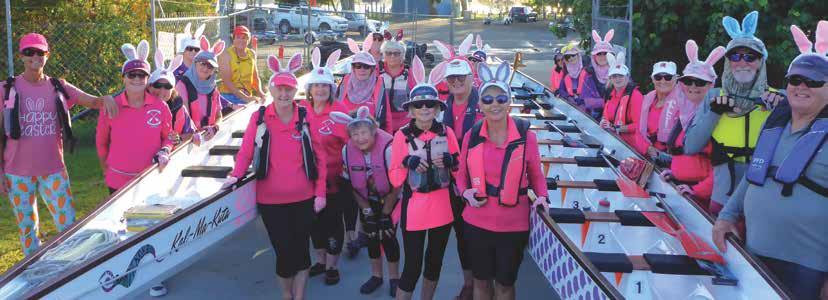
Celebrating 18 Years of the Bribie Pink Dragons: Honouring Strength, Spirit, and Community
Bribie Pink Dragons are an inspirational group of paddlers, the original breast cancer survivors on the island, who are celebrating their 18th birthday this year. Today, we are proud to acknowledge two of our members: Judy Finegan and Joie Scheinpflug.
Judy, fondly known as ‘Fin’, was recently honoured as one of Pumicestone’s Inspirational Women by our local member, Ariana Doolan. In her early days, Fin represented Queensland in Royal Life Saving and, alongside her beloved husband Al, supported and empowered many local girls in PNG, the Solomon Islands, and Fiji.
She later managed outback TAFEs in the Northern Territories, adopted her daughter, raised three sons, and became the senior NCO in Brisbane’s Ninth Battalion.
Fin is our Chief Sweep, coach, and Team Coordinator for the Pink Dragons (also known as Pinkaboutit with the emphasis on the last syllable). She is the glue that holds our team together, and we are very proud of her.
Joie is the proud recipient of our Spirit of Bribie trophy for 2026, in recognition of her incredible dedication and support for our club.
As our registrar, she is often the first friendly face new members meet.
Joie keeps the paperwork flowing smoothly and ensures that no birthday is missed or dues forgotten.
She is a tireless fundraiser—most Bribie businesses know her passion for our cause.
Her organisation of annual raffles and our hugely successful garage sale, with her devoted husband's support, energises us all.
Joie has represented us internationally, paddling in Ireland with the Plurabelles, visiting Tasmania, and soon heading to France for the International Breast Cancer regatta.
A constant supporter, Joie’s regular columns in the Bribie Islander are always a highlight. We couldn’t think of a more deserving recipient for the Spirit of Bribie award.
If you, or anyone you know, has been touched by breast cancer, we are here for you. We are not a sports team, though we love dragon boating. We are not competitive, though we paddle our hardest at many regattas.
We have already won our ongoing fight and are all winners in the boat.
Please contact bribiepinkdragons@gmail.com Call us at 0499 990 352 to find out how dragon boating can be part of your journey. Marie/ Charlie, President. Bribie Pink Dragons (Pinkaboutit)
Local lifestyles & products
Laundering service for sheets & bulky items
* Sheets, bedspreads, doonas, covers, blankets, more
• Free pick up & delivery for Bribie and surrounds
* All items professionally washed, sun dried & ironed
* Bed stripping & remaking available
• Full linen rental service available
• GIFT VOUCHERS AVAILABLE Call Sandy on 0409 385 611 gregorysandy@yahoo.com.au
BANKSIA FRUIT
BANSIA FRUIT & JUICE BARN
Here at banksia fruit and juice barn we thrive on excellence and are alway here to assist in anything our customers need from customising ingredients in our fruit salads, garden salad, or any of our range of diffenerent veggie packs that we make instore. Along with hand picking your online or phone orders so everything is fresh and delicious. Come and support your local fruit shop today. See you all soon.
Scan QR Code for website: banksiafruitjuicebarn.com.au
MIN $30 for FREE delivery and we deliver Mon - Fri to all of Bribie, Sandstone Point, Sandstone Lakes, Godwin Beach, Ningi and Bribie Pines Estate.
Rico’s Deli
In Rico’s deli we have a big range of all different Italian foods , and desserts, Asian foods, with some gluten free options cold meats, whole salami, pitted olives, flavoured olives, a range of all different oils, sauces, dressings, assorted Kenilworth cheeses along Camembert, Brie, Mozzarella and Parmesan. We also stock all different flavoured heat and eat meals for a quick lunch on the go or easy dinner. We also do deli platters and mixed deli and fruit platters (made to order).
We are taking Christmas orders now so come in store or shop online today.
All our juices are made from 100% pure fruit and veggie from within the store. You can choose from our menu or you can create your own flavour milkshakes also available.
Beauty,&hairfashion
• School Uniform Alterations
• Fast and professional service
• Local to Bribie
• 45 years experience
• Very reasonable rates
• Same day service with 12 hours’ notice
“Look Good, Feel Legendary”
Your go-to destination for modern barbering on Bribie Island. Specialising in precision cuts, fades and beard work in a relaxed, no fuss space.
Receptionist Katherine (left) and Acupuncturists Jessica (centre) and Wendy (right).
Acupuncture for Achilles Tendonitis
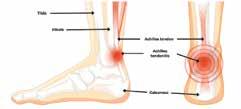
Achilles tendonitis is a common condition that causes pain, stiffness, and inflammation at the back of the ankle and heel. It often develops gradually and can affect active individuals, people who stand for long periods, or anyone with tight calf muscles or poor foot mechanics. Recovery can be slow, and many people find that rest, medication, or exercise alone does not fully resolve their symptoms.
Acupuncture helps reduce pain, improve calf muscle function, and support healing of the Achilles tendon. Modern research and clinical experience show that acupuncture can play a helpful role in musculoskeletal injuries such as tendonitis.
What Is Achilles Tendonitis
The Achilles tendon is the thick, strong band of tissue that connects the calf muscles to the heel bone. It allows you to walk, run, climb stairs, and push off the ground when moving. Achilles tendonitis occurs when this tendon becomes irritated or damaged due to repeated stress or overload. Over time, small micro-tears develop in the tendon, leading to pain and inflammation.
Common symptoms include:
• Pain at the back of the heel or ankle
• Morning stiffness in the calf or tendon
• Tenderness when touching the tendon
• Swelling or tightness
• Pain during walking, running, or standing
• Reduced ankle mobility
One of the most important contributors to Achilles tendonitis is tension and dysfunction in the calf muscles. The muscles join together to form the Achilles tendon and attach to the heel bone. When the calf muscles become tight, overworked, or weak, they place excessive strain on the tendon.
Tight calf muscles increase tension on the Achilles tendon, especially during walking and running. This can lead to:
• Increased pulling on the tendon
• Reduced ankle flexibility
• Higher risk of micro-tears
• Ongoing inflammation
Many people with Achilles tendonitis have reduced ankle dorsiflexion (the ability to move the foot upward), which increases strain on the tendon with every step. Research in sports medicine shows that limited calf flexibility and increased calf muscle stiffness are major risk factors for Achilles tendinopathy. The calf muscles act as shock absorbers when you walk or run. If they are weak or fatigued, more stress is transferred directly to the Achilles tendon. When the calf muscles are not functioning
properly, the tendon is forced to take on more load, which slows healing and increases pain.
Tight calf muscles often develop trigger points (tight knots in the muscle). These trigger points reduce circulation and create constant tension on the Achilles tendon. This can cause:
• Persistent tightness
• Reduced blood flow
• Ongoing tendon irritation
• Slow recovery
Addressing the calf muscles is therefore a key part of treating Achilles tendonitis. This is where acupuncture can be particularly helpful.
What Is Acupuncture?
Acupuncture involves inserting very fine, sterile needles into specific points on the body to stimulate healing and reduce pain. It has been used for thousands of years in Traditional Chinese Medicine and is now widely used in modern healthcare for musculoskeletal injuries and pain conditions.
Acupuncture is commonly used for:
• Tendon injuries
• Muscle tightness
• Sports injuries
• Chronic pain
• Back and neck pain
• Joint and ligament problems
Acupuncture focuses on improving circulation, reducing inflammation, and restoring normal muscle and nerve function.
How Acupuncture Works for Achilles Tendonitis
Acupuncture helps Achilles tendonitis through several biological and neurological mechanisms.
1. Relaxes Tight Calf Muscles.
Acupuncture needles stimulate the calf muscles and surrounding nerves, helping them relax and release tension. This reduces the constant pulling force on the Achilles tendon. As the calf muscles relax:
• Tendon strain decreases
• Movement improves
• Pain reduces
• Healing becomes easier
Many patients notice that their calf feels looser and more flexible after treatment.
2. Improves Blood Flow to the Tendon. Tendons heal slowly because they have limited blood supply. Acupuncture increases circulation to both the calf muscles and the Achilles tendon, helping deliver oxygen and nutrients needed for repair. Research suggests acupuncture can improve local blood flow and tissue oxygenation, supporting healing in tendon injuries.
This improved circulation helps:
• Reduce inflammation
• Remove waste products
• Support tissue repair
• Speed recovery
3. Reduces Pain and Inflammation.
Acupuncture stimulates the nervous system and triggers the release of natural painrelieving chemicals such as endorphins and serotonin. These chemicals help:
• Reduce pain signals
• Calm inflammation
• Relax muscles
• Improve comfort
This allows patients to move more comfortably and participate in rehabilitation exercises.
4. Supports Muscle and Tendon Healing. Acupuncture not only reduces pain but also supports the healing process by improving muscle coordination and reducing stress on the tendon. Treatment often focuses on:
• Calf muscles
• Achilles tendon area
• Ankle mobility
• Supporting muscles in the leg and foot
This holistic approach addresses the underlying cause of tendon strain rather than only treating symptoms.
Research
Clinical research supports acupuncture for tendon and musculoskeletal pain. Research also suggests acupuncture improves blood flow and oxygenation in injured tendons, which may support tissue repair and recovery. Large evidence reviews of acupuncture for musculoskeletal pain have found consistent benefits in pain reduction and functional improvement across many conditions, including tendon injuries.
What to Expect
An acupuncture session for Achilles tendonitis typically includes:
• Physical assessment
• Gentle needle placement in the calf and ankle
• Needles left in place for 20–30 minutes
Most people find treatment relaxing and experience gradual improvement over a series of sessions.
Since tight or weak calf muscles increase strain on the Achilles tendon and slow healing. Addressing both the tendon and the muscles is essential for recovery.
Acupuncture supports this process by:
• Relaxing muscles
• Improving circulation
• Reducing pain and inflammation
• Supporting tendon healing
• Working alongside exercise
For people looking for a natural, evidenceinformed approach to Achilles tendonitis, acupuncture can be a valuable part of a comprehensive treatment plan that supports both the calf muscles and the Achilles tendon.
If you’d like to make a booking or if you’d like to discuss whether acupuncture and Chinese medicine is right for you, please contact us - Jessica, Wendy, and Katherine - via our website www.bribieacupuncture.com.au or call 0423 160 228. You can also find us on Facebook and Instagram @bribieacupuncture. HICAPS is available onsite. Pensioner discounts available.
Bribie Acupuncture
4/29 Benabrow Avenue, Bellara (behind the James Moore law office)
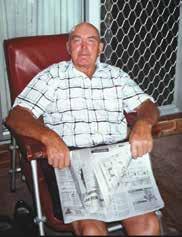
"Celebrating the Life of Greg Paul"
Greg Paul passed away peacefully on March 27, 2026, at the age of 89. He leaves behind his cherished wife and best friend of 62 years, Pat.
Greg was a proud father to their five sons – Alan, Phil, Geoff, Matt, and Robbie – in whom he instilled his strong work ethic and fierce love for family. He loved each of his daughters-in-law—partners to Alan, Phil, Geoff, Matt, and Robbie—as his own.
Greg was an adoring grandfather to his many grandchildren and great-grandchildren, maintaining strong bonds with each of them.
He was also a beloved brother, uncle, and friend.
Greg was an incredibly hard worker who built his own business and took pride in providing for his family.
He was also a great sportsman, pursuing hockey and cricket before finding his true passion in golf.
As a life member of the Bribie Island Golf Club and longtime captain of the successful Glass House Mountains Senior Pennants team, Greg made significant contributions to the club and its community across several decades.
He had a huge presence in every room and the lives of all those who knew him. He will be greatly missed.
A Cup of Tea: The Simple Ritual for BetTer Sleep
Thesedays, getting a good night’s sleep can feel like a rare treat. There’s plenty of advice out there, from turning off screens to using blackout curtains, but sometimes the simplest habits are the most comforting.
One of these is having a warm cup of tea before bed. This tradition has been around for ages and still works wonders. Herbal teas like chamomile, lavender, and valerian root are known for helping people relax. Unlike black or green tea, these blends don’t have caffeine and instead have natural ingredients that help you unwind.
For example, chamomile contains apigenin, an antioxidant that connects with certain brain receptors to make you feel sleepy and help with insomnia.
Tea isn’t just about what’s in the cup. Making and drinking tea can help you slow down and be more mindful, letting your brain know it’s time to relax. Holding a warm cup, breathing in the gentle scent, and taking slow sips all help calm both your mind and body.
This simple routine can make it easier to leave the stress of the day behind and get ready for a good night’s sleep. In a world that often prizes late-night productivity, it’s easy to stay up working or checking your phone.
But choosing some quiet time before bed can truly improve your nights. Tonight, commit to making yourself a cup of tea instead of scrolling or answering emails. Take this simple step for yourself, and experience how this calming ritual can help you sleep better and wake up restored.
International Women's Day
Ihopeyou found a moment to celebrate International Women’s Day. It’s a day to recognise the achievements of women and reflect on the opportunities we must continue to create as we strive toward a more equal future.
While progress has been made, there is still a long way to go. Equality doesn’t happen overnight—it takes ongoing commitment from our whole community.
The awareness raised on this day should continue well beyond today.
Over my lifetime, I’ve seen meaningful change. I can now go to women’s sporting games and see the talent, dedication, and passion on display. It’s something worth celebrating.
I salute the women in the past who kept chipping away at the hierarchy and smashing those glass ceilings so future generations could have more opportunities.
Women in trades are also a strong and growing part of our workforce.
I encourage young women to consider giving a trade a go and to strive for the career they truly want.
It takes courage to follow your dreams, but every step forward helps create more opportunities for those who follow. At the grassroots level, we’re also seeing real progress in our own community. The local Warrigals NRL club having a female
team shows how equality is growing in community sport.
I congratulate the club for supporting and encouraging this—change often starts at the grassroots level.
Paralympic sport also offers many opportunities for female athletes.
Right now, the 2026 Winter Paralympics are underway (6–15 March 2026), featuring more than 600 para-athletes competing in sports like alpine skiing, biathlon, snowboard, and wheelchair curling.
This is covered on television. Seeing the Matildas currently playing the AFC Asian Cup on home turf is another fantastic achievement for women’s sport in Australia.
It’s inspiring for young girls watching and dreaming of their own future in the game.
Get out there and support these teams whenever you can!
Amongst our greater community, there are so many sporting opportunities to support women.
Softball, for example, is played at Downey Park and at the Australian level. We have many women striving to achieve, and it’s important to commend their efforts and continue providing pathways for growth. Having women paid at elite sport levels would be a fantastic step forward.
Recently, our Australian softball team played against America in the Moreton Bay region, showing the talent and dedication women bring to sport.
Supporting and funding women in these sporting roles is a goal our community should continue to champion. I played at elite levels, and it takes grit and determination!
So, to the next generation: have the courage to do what you’re dreaming of and keep achieving. You’ve got this!
International Women’s Day, celebrated each year on March 8, recognises the social, economic, cultural, and political achievements of women while also calling for continued progress toward gender equality.
Let’s keep the momentum going—not just today, but every day.
Yours in Health and Wellness, Tracey Blinco
• Human Rights Advocate /Law
• NDIS Psychosocial Recovery Coach
• Writer for the Bribie Magazine
• Member BIEPA
• Bribie Region Disability Group
• NDIS Support Coordinator
• Support Professional
• Health Coach
Ode to the Pinky Toe A Balancing Act:
Your little toe does more than just look adorable in sandals—it’s your foot’s secret sidekick. Sure, it seems like your pinky toe is just there for looks, but one run-in with a coffee table and you’ll discover it’s a tiny chaos agent. A stubbed pinky toe can turn an ordinary day into an awkward hop-a-thon.
This little piggy is part of a complicated crew—each foot packs 30 joints, 28 bones, and 100+ tendons and ligaments. No wonder a stubbed toe hurts so much!
Technically, you could live without your pinky toe, but why make life harder? It’s the backup dancer that keeps you grooving—helping balance, push off, and avoid wipeouts! Lose it, and even walking feels like a new dance routine.
Your foot’s balance 'tripod' (heel, pinky toe knuckle, and big toe knuckle) keeps you from toppling. Take out one leg, and suddenly things like skipping, running, or even cannonballing into a pool get a lot trickier.
Shoes can be a pinky toe’s nemesis—especially pointy ones (seriously, who are they designed for?). All that rubbing can lead to bursitis, corns, or even hammertoe. Ouch!
And the drama continues—corns, those tiny toe
tormentors, can make every step feel like you’re walking on gravel. Suspect a fracture? Don’t play hero: get to a podiatrist and skip the future arthritis. If your pinky is battered, start with basic first aid and treat it to some TLC. For deeper damage, podiatrists may buddy-tape it to its neighbour for support—a classic case of toe teamwork.
If you part ways with your pinky toe, you’ll probably adapt, but it’s okay to miss your tiny sidekick—after all, you’ve been together since day one. Counsellors and special insoles can help you adjust.
So, here’s to the pinky toe: small but mighty, a true team player, and proof that even the littlest parts of us have a big role to play. Next time you slip on your shoes or take a step, give your pinky a little nod of appreciation—it’s working hard to keep you on your toes!
PODIATRY SERVICE
HoW To SaVe MoNeY eVeRY WeeK
Saving money every week is the foundation of financial health. It helps you manage expenses, reduce stress, and prevents unpleasant surprises. Weekly saving builds habits that last, fitting naturally into everyday household spending.
Why Weekly Saving Works Better Than Monthly Saving
Weekly saving works because it aligns with our natural spending patterns— groceries, fuel, and household needs. Tracking weekly helps you catch problems before they spiral, while monthly tracking can hide overspending until it’s too late.
SeT A CleAr WeeKlY SaVING TarGeT
Start by setting a clear, realistic weekly savings target. Divide your income into weekly portions, even if the amount is small at first. The key is consistency—small steps become big results over time.
AUTomaTe YouR WeeKlY SaVINGS
Automate your savings to remove hesitation and temptation. Schedule a weekly transfer to your savings accounts as soon as you get paid. When saving is automatic, you’re less likely to spend what you intend to save.
A weekly plan keeps you organised and intentional. List what you need for groceries, transport, and household goods—plus a buffer for surprises. Written plans help you avoid impulse buys and keep spending purposeful.
GrOCerIeS for THe WeeK
Groceries often swallow a big part of the budget. Plan meals ahead and check your pantry before shopping. Stick to your list to cut food costs and reduce waste. Check prices before you buy. Track costs at your usual
stores and switch brands if quality is similar. Price awareness makes you a smarter shopper.
preVeNT foOD WaSTe
Wasting food is wasting money. Store food properly and use older items first. Plan meals around what’s about to expire and protect your food budget.
CoOK More MeaLS At HoMe
Cooking at home is always cheaper than eating out. Batch-cook and use leftovers for lunches and future meals. Freezing extra portions prevents waste and stretches your weekly budget.
uSe A WeeKlY CaSH LIMIt
Set a weekly cash limit for snacks, home items, and personal needs. When it’s gone, spending stops—no exceptions. This simple rule keeps your budget in check.
ReDuCe WeeKlY utiLITY CoSTS
Your daily habits affect utility bills. Turn off lights, unplug devices, and fix leaks immediately. These small actions lower costs and help your budget week after week.
AVOID SpONtaNeOuS pUrCHaSeS
Restock household items on a schedule, buying only what you need. Planning ahead prevents last-minute, expensive buys. Impulse buys wreck budgets.
Wait two days before buying anything non-essential. Most urges fade, and you’ll save more by buying only what you really need.
Small subscriptions quietly drain your money. Review them every week and cancel what you don’t use. Even dropping one or two can add up over time.
SeT oNe No SpeND DaY eaCH WeeK
Choose one day each week to spend nothing. Stay home, use what you have, and reset your habits.
Use discounts intentionally. Only buy discounted items if they’re already on your list—don’t be lured by sales that don’t fit your plan.
INVolVe YouR HouSeholD IN SaVING
Saving is easier when everyone works together. Share your goals and reasons with your household— teamwork brings results.
Combine errands to cut extra trips. Walk short distances when possible. These small changes save money each week.
Any extra money—cashback, refunds, or side jobs—should go straight into savings. Treat these as bonus progress toward your goals.
uSe SIMple WeeKlY ToOLS
You don’t need fancy tools. A simple notebook or free app works. What matters is that your tracking system is clear and easy to use.
Some weeks will cost more than planned. Adjust for the next week. Over time, even small weekly savings add up, building your confidence and control. The best money systems focus on weekly habits for daily life.
Review your week honestly. Notice what worked, what didn’t, and adjust without guilt. Progress is about awareness, not perfection.
Great Uses for Tooth paste Besides Brushing Your Teeth
Think toothpaste is just for your morning and nightly brush? Think again!
This humble tube in your bathroom cabinet is a secret superhero, packing a punch far beyond pearly whites.
Get ready to be amazed by the unexpected—and sometimes downright quirky—ways toothpaste can come to the rescue all around your home.
Centuries ago, ancient Egyptians were brushing with gritty powders made from crushed eggshells, and the Romans?
Well, they thought a splash of urine made for a great mouthwash.
Thankfully, toothpaste has come a long way since then, saving us from some very questionable dental routines and giving us brighter smiles in the process.
But here’s where things get fun: toothpaste isn’t just a dental dynamo. It’s a jack-of-all-trades, waiting to show off its skills outside the bathroom.
Grab that classic white paste (skip the fancy gels and trendy charcoal for this) and check out these delightfully surprising ways it can save the day.
Eliminate Coffee and Water Stains
We all know coffee stains are the enemy of a dazzling smile, but did you know they’re also the sworn nemesis of your favourite table?
Don’t panic when disaster strikes mid-sip—grab that trusty tube of toothpaste!
Squeeze a dab onto a clean rag and gently rub it into the stain. Watch your
spill vanish like magic!
If it’s putting up a fight, enlist a softbristled toothbrush and go to town.
(Pro tip: If you’re working on wood, test a hidden spot first, unless you want a surprise “distressed” look!)
Make the Shower Sparkle
Is your shower looking more like a swamp than a spa?
Toothpaste to the rescue!
Dab some onto a washcloth, then scrub away stubborn soap scum and hard water residue.
Refresh Hair Care Tools
Curling irons and straighteners get gunked up faster than you can say “bad hair day.”
For a quick fix, let toothpaste work its magic! (Just make sure the tool is unplugged and cool—safety first!)
Rub a dab of toothpaste on with a soft cloth, wipe clean, and admire those gleaming, product-free gadgets.
Your hair will thank you.
Use as a De-stinker
If your hands still smell like the onion you chopped an hour ago, or your lunch container reeks of yesterday’s leftovers, it’s time for a toothpaste intervention!
With baking soda as its secret weapon, a little scrub here and there banishes stubborn odours.
Rinse, sniff, and celebrate your fresh new start.
Patch Holes
Who knew toothpaste could
moonlight as a handyman?
When you’re out of spackle and faced with a pesky nail hole, just dab a little toothpaste right in. Got a tiny hole?
Break out the toothpick for precision application. Smooth it over, let it dry, and you’re ready to paint.
Your walls—and your wallet—will never know the difference.
Brighten White Shoes
White sneakers: so cool, so quick to get grubby. Before you banish them to the back of the closet, try this toothpaste trick!
Dab a little baking-soda toothpaste onto a toothbrush, then scrub those stains in circles.
Let it sit, wipe it away, and watch your shoes bounce back to their out-of-thebox brightness.
Buff Out Scratches in Car Paint
Did the car get a scratch?
No need to empty your wallet at the auto shop just yet!
Try a dab of toothpaste: clean the area, rub it into the scratch, let it sit, then wipe it away.
It’s not a miracle cure, but sometimes your car’s shine comes back.
One last tip: forget what you’ve heard about toothpaste and jewellery.
It’s way too harsh for your favourite bling! Stick to a gentle soak in soapy water.
BIGGEST BUSINESS ON BRIBIE
Of the 163 classes there are 20 different Art Classes, 22 Dance groups, 21 Health and Fitness classes, 28 various musical instruments and 16 classes playing a wide range of table games. There are so many other different classes for every possible interest.
They are all well known for the many other great things they also do in the community.
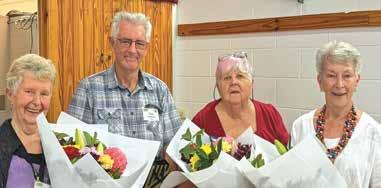
Over many years volunteers have contributed to the great success of U3A as the biggest business on Bribie, and these 4 Life members will be added to 9 others on the Honour Board.
Enrolment for all Term 2 classes closes on April 7 and the Term runs from 20 April to 26 June.
There are vacancies in many current and new classes, and a full list of classes, days and times can be found on Web Site www.bribie.org.au where you can also enroll.
The President paid tribute and thanked all members of the Committee, who were all reelected, and the hundreds of volunteer Tutors, Receptionists, Function and Event managers and the many other tasks that are so effectively carried out by willing volunteers.
Four people with exceptional service to U3A over many years were recognized with LIFE MEMBERSHIP. The recipients (Photo L to R) were Margaret Spooner (Vice President) Greg Sibthorpe (Past President) Nancy Jack
Dear Pumicestone...
As we celebrate Easter and welcome the arrival of April, I am delighted to share some of the incredible young talent showcased in our recent Easter colouring competition, as well as highlight several exciting events happening across our community.
To close out March, we continued our much-loved annual tradition of inviting local schools to participate in our Easter colouring-in competition.
This year, we received an overwhelming number of entries, each one bursting with creativity and effort.
Our talented young artists certainly didn’t make the judging process easy, and I want to thank every student who took the time to participate. Your enthusiasm and imagination are truly inspiring, and it was a joy to see such vibrant contributions from across the electorate.
It was also wonderful to celebrate Easter at the Toorbul Community District Association Easter Markets. The event saw an incredible turnout, and I was proud to be part of such a strong display of community spirit. It was a fantastic opportunity to catch up with residents and friends, and to enjoy the welcoming atmosphere that makes our region so special. I must admit, the bacon and egg sandwich was a definite highlight as well!
On 27 March, the Crisafulli Government marked one month of Operation Forge, a Queensland Police initiative targeting youth crime, including break-ins and car theft. The results so far demonstrate a significant effort by law enforcement, with more than 1,300 individuals charged with a total of 2,972 offences across Queensland. In the Moreton District alone, 100 people have been charged with 297 offences. These figures reflect a strong commitment to improving community safety and addressing key concerns raised by residents.
As we move into April, there are several exciting events to look forward to. Most notably, the Pumicestone Business Excellence
Awards. With nominations closing on 17 April, this is a wonderful opportunity to recognise and celebrate the hardworking local businesses that contribute so much to our community. I encourage everyone to take a moment to nominate a deserving business via my website. There are numerous categories to choose from, including Best Employee, Young Entrepreneur, and Tourism & Attractions, just to name a few.
I am looking forward to another busy and rewarding month in the electorate and hope to see many of you at upcoming events.
As always, I am here to represent you. If there is anything I can assist you with, please don’t hesitate to contact my office on (07) 3474 2100 or via email at pumicestone@parliament. qld.gov.au.
Authorised by Ariana Doolan MP, 1/43 Benabrow Avenue, Bellara, 4507
A DAY IN THE LIFE OF MELSA BRIBIE
AtMELSA Bribie, two days stand out: every Tuesday is Maintenance Day, devoted to park and equipment upkeep, and the third Sunday of each month is Public Run Day, when we welcome the public for train rides and community events.
Let’s begin by explaining what makes these two days special.
Model Engineers and Live Steamers Assoc (MELSA) were formed in 1984 by six avid model engineers fascinated by steam, who were granted a lease on land at 74 Toorbul Street, Bongaree.
It started with a small circular track, which now borders the Picnic Area and has been extended to a 1-kilometre track through natural bushland. Apart from laying the railway track, they also built their own steam locomotives and passenger wagons.
Today, the Assoc has 25 members who conduct Public Run Days each month, plus Birthday Runs for children as requested. Members have diverse backgrounds—including sales, farming, hospitality, trades, and teaching—but none have prior railway experience. The eight-person Maintenance Crew developed their locomotive skills on the job.
MELSA owns two electric locomotives, one coal-fired steam locomotive and eight passenger carriages. Several members own electric- and steam-powered locomotives that support the Association’s locomotives on Run Days.
We have three tracks, all interconnected by points or turn-outs. The original track is circular, approximately. 80 metres in diameter with both 5” and 7 ¼” gauge tracks. It now surrounds a fenced picnic area with tables and benches under large shade trees.
Families and friends enjoy picnics on Run Days and often hold birthday parties, including 2 hours of train rides, for small children, not-so-small children and Mums and Dads. The track was extended south-westerly in an oval shape, including a bridge across the creek. In the early 2000s, the track was extended southerly, running beside the creek for approximately. 150 metres providing a Main Track circuit of 1 kilometre. The large trees through which the track runs are a constant source of animal sightings and leaves that require
attention every week. A Council Arborist told us that the trees on our lease produce 5 tonnes of leaf matter per acre per year; we have 5 acres!
The track is marked off into 9 sections for ease of reporting track problems to the Maintenance Crew.
MELSA is a strong supporter of the local community, frequently holding charity Run Days for a range of charities, such as Kids from the Bush with Bribie Island Rotary and BIKES, Bribie Island Kids Education Support, where we host a Christmas Party for approximately 190 disadvantaged local children in association with St Vincent De Paul and Bribie Island Bowls Club.
We have 3 Club locomotives, 2 electric and 1 steam, with a 7 ¼” Jumbuck on order from DNC with delivery expected in April 2026.
Malcolm Moore 7 ¼’ gauge. 24 volt. Copy of the loco used by Australian & American Forces in Nth Qld and the Islands for hauling munitions and associated equipment. The original loco was diesel-powered. Later used in Nth Qld sugar mills. Let’s begin with Maintenance Day, one of the two distinct event days at MELSA. This day is focused entirely on upkeep and preparation for the month’s main public event.
Every Tuesday, up to 8 retired members gather at MELSA Park to undertake numerous maintenance tasks. The day starts around 7.30 am and finishes around 1.30 pm. During the intervening hours, we enjoy the camaraderie of our small group of like-minded people undertaking tasks to either repair or service rolling stock, maintain the Park or improve safety.
The Crew make a positive difference to the park, the tracks, the locomotives, the rolling stock, and the infrastructure, which enhances visitors' enjoyment at the Public Run Days. None of the crew has all the skills and knowledge to handle every task, but working as a team, we haven't encountered a task or problem we couldn’t overcome.
Tasks can include painting, mowing, cleaning, or repairing carriages and locomotives, repairing broken water pipes, rebuilding rusted tracks, servicing mechanical equipment, machining new axles and bearing housings, in fact, the list is endless.
All members are encouraged to learn to operate locomotives so they can be competent train operators on our Public Run Days and Birthday Runs. The second event day, Public Run Day, is held on the third Sunday of every month and is the culmination of our monthlong preparation during Maintenance Days. The day starts around 7.00 – 7.30am, with members and the occasional volunteer setting up the Park for safe running.
This includes putting out the Safety signs, preparing the locomotives and carriages, setting up the hospitality equipment, preparing the Station for ticket sales, and allocating steam and electric train tracks within the Station. Topping up the water tanks and coal bunkers on the steam trains, plus periodic oiling of the running gear, can hold up the electric trains, so we allocate separate tracks for the different locos. This also reduces the possibility of an incident occurring when working around the steam trains.
The final task before passengers arrive is to inspect the track for defects. By the time we have everything ready for passengers, we generally have just enough time for that calming cuppa, and before we know it, the passengers are lining up to purchase tickets.
While all this is happening, the steam train drivers are starting fires under the boilers to raise steam, oiling the running gear, making final safety checks on all steam fittings, and ensuring the brakes are operating.The Station Master is loading passengers, steam loco whistles are blowing, along with the electric horns; action is happening.
Our new kitchen is preparing hot food, and queues are forming for tickets, food, and drinks, while the noise from trains leaving and arriving is drowned out by excited children all talking at once about going through the tunnel, seeing the kangaroos, and hearing the whistles.
As the day winds down, by 1.30 – 2.00 pm, the last passenger is on their way home. This signals the start of clean-up: we shunt the carriages back to their tunnels, clean the electric and steam locomotives in preparation for storage until Tuesday, and return equipment we brought out 6 or 7 hours earlier to the storage areas.
To complete the cycle, our last task is to discuss what went well, what needs improvement, and what requires attention in our Maintenance Book for the following Tuesday. We probably suffer from the problem common to small not-for-profit organisations, especially those that require engineering expertise, machines, and tooling to maintain equipment.
Members get older and retire, and skills are lost. Members with lathes, mills, oxy-acetylene equipment, and the ability to use it, plus knowledge and experience in troubleshooting and problem-solving, are a dying breed.
We can’t claim to do all this work on our own, as we couldn’t survive without our sponsors, Busy Fingers, Bribie Islander Magazine, Bribie Island RSL, BIBC, Bribie Signs and the Community Plant Nursery, who do much of the heavy lifting, but there are some tasks that even our sponsors can’t help us with. That’s where the Community comes in.
Our problem is a lack of new members. We don’t need fitters and machinists, boilermakers, or retired rail workers (although they would come in handy); we just need people from all walks of life who are interested in and supportive of the local community.
We need more hands-on deck, help with the countless maintenance tasks on Maintenance Days and help in the preparation and running of Run Days, such as loading and unloading passengers, serving yummy food to visitors, operating locomotives, and eventually putting the locos, carriages and equipment to bed in preparation for Tuesday and planned maintenance.
If you think being part of MELSA Bribie Inc. could be for you, drop in any Tuesday to chat with members of the Maintenance Crew, or make yourself known to any member wearing a black MELSA shirt on the third Sunday of any month.
Neverfail is a 7 1/4” 24-volt loco, which, as its name implies, never stops pulling passengers.
5” gauge replica of the ANZAC Britannica 4-6-2
7 ¼” Busy Fingers Express
STEAKOUT PIZZERIA
For delicious pizza, pasta, contorni salads and more, all crafted with love, come and enjoy our waterfront pizzeria. With live music every Sunday and the beautiful Pumicestone Passage right beside you, we offer you a taste you’ll love For deliveries or bookings, please visit us at www.steakoutpizzeria.au
9/11 Spinnaker Drive, Sandstone Point - 07 5360 1094
LUNCH Thu to Sun 11:30 - 2:30
DINNER Tue to Sun 4:30 - 8:30
SCOOPYS
Located by the jetty on beautiful Bribie Island, Scoopy’s Family Cafe is all about the family vibes, great food and coffee, fantastic service and all the ice cream you can eat!
Enjoy our friendly hospitality with barista-made coffee, amazing burgers, and a tempting array of ice cream choices to impress the pickiest connoisseurs.
Our massive range of cakes and famous fish and chips make it well worth the hour’s drive north of Brisbane.
Shop 2/2 Toorbul Street, Bongaree 07 3410 1791
THE DECK RESTAURANT
With its spacious, relaxed ambiance, The Deck Restaurant offers casual dining indoors or alfresco on the deck overlooking the golf course, lake and lush gardens. Enjoy modern cuisine with locally sourced ingredients, open 7 days a week for breakfast and lunch, and dinner on Friday and Saturdays. Perfect for any occasion! Pacific Harbour Golf & Country Club, 141-159 Avon Avenue, Banksia Beach 07 3410 4024
Scan The QR Code To Book Now!
Experience classics you’ll love and the new favourites you'll crave!
NOW OPEN SUNDAY 8AM - 11AM
DINNER: 5PM - 8PM OPEN 7 DAYS
LUNCH: 12PM - 2PM
The Bribie Project is a collaborative initiative led by headspace Bribie, Pumicestone Indigenous Education & Employment Council Inc, Youth Advocacy Centre, Bribie Island Neighbourhood Centre, Imagine Music, and Bribie Library.
This collective was established to empower and uplift young people across Bribie Island by offering a diverse range of free activities, programs, and community events.
Through these efforts, the Bribie Project aims to foster connection, creativity, and wellbeing among local youth, providing them with opportunities to learn, grow, and thrive in a supportive environment.
Lil Arvo 2026 is an exciting, free music event designed especially for young people aged 12 to 25.
The event will showcase dynamic live performances from talented local musicians, creating an energetic and welcoming atmosphere.
Attendees can enjoy a unique silent disco experience— grab a pair of headphones and dance to your own beat— or hop on the Smoothie Bikes, where you can blend a delicious, healthy smoothie just by pedalling.
The Bribie Project team will be present throughout the day, offering support, information, and interactive activities to help everyone feel included and engaged.
In celebration of Youth Week 2026, we are shining a welldeserved spotlight on the incredible young people who make our community vibrant and unique.
Join us for an unforgettable day filled with music, fun activities, and inspiring moments.
Whether you are looking to connect with friends, discover new talents, or simply enjoy the positive atmosphere, there is something for everyone at Lil Arvo 2026.
Bubble & Squeak
This is a favourite in our house and was when I was growing up. You can use whatever leftover veggies you have, even rice and pasta can be added.
Ingredients
• leftover cooked potato or sweet potato
• leftover cooked vegetables
• 1 – 2 eggs, beaten
• grated cheese to taste (optional)
• salt and pepper to taste
• a little flour (optional)
Instructions
1. Mash your potatoes to your desired consistency if not already mashed. It's ok to leave them a bit lumpy and bumpy.
2. Combine mashed potato, leftover cooked vegetables, egg, cheese and salt and pepper to taste. Mix well to combine.
3. Heat a frying pan to medium heat and add a little oil or butter to the pan. Dollop spoonfuls of mixture into the frypan and cook until golden on both sides.
4. Serve warm with a fried egg, as a side to sausages, or by themselves with a dollop of relish, chutney or tomato sauce on top.
Old Fashioned Tuna Bake
Ingredients
• 250g–375g short pasta (macaroni, spirals, or fusilli), cooked and drained
• 2 x 425g cans tuna in oil or Springwater, drained and flaked
• 1 cup frozen peas and corn mix
• 1 onion, finely diced (optional)
• 50g butter
• 1/4 cup (40g) plain flour
• 2.5 - 3 cups (625ml - 750ml) milk
• 1 cup grated tasty cheese (plus extra for topping)
• 1 tsp Dijon mustard (optional, for zing)
• Breadcrumbs (panko or fresh) and parmesan for topping
Method
1. Preheat and Prep: Preheat oven to 180°C or 190°C (fanforced). Grease a 2-litre ovenproof dish.
2. Make White Sauce: Melt butter in a medium saucepan over medium heat. Add onion (if using) and cook until soft. Add flour and cook for 1 minute while stirring. Gradually whisk in milk, cooking until the sauce boils and thickens.
3. Create Mornay Sauce: Remove from heat and stir in the grated tasty cheese until melted. Season with salt, pepper, and Dijon mustard.
4. Combine: Combine the pasta, tuna, and vegetables in the saucepan with the sauce, stirring until coated.
5. Bake: Pour into the baking dish, top with extra cheese and breadcrumbs. Bake for 20-25 minutes until the top is golden and bubbling.
EHow to Stick to Your Grocery Budget
ver watched your grocery bill climb higher and higher, even though your trolley looks the same every week? You're not alone. But the good news is, with a few clever habits, you can take charge of your spending and make every dollar count.
Set a Clear Weekly or Monthly Limit
Pick a budget that matches your income and household size. Divide your monthly amount into weekly budgets to keep spending manageable. A clear spending limit guides your decisions each trip.
Plan Meals Before You Shop
Meal planning is your secret weapon against waste and impulse buys. Pick meals for the next five to seven days, then check what's already lurking in your fridge and pantry. Build your plan around those ingredients. Keep it simple—use overlapping ingredients, so nothing goes to waste. For example, that one bag of veggies could star in a stir fry, a soup, and a side dish. You'll save money, time, and avoid the dreaded midweek dash to the shops.
Create a Focused Shopping List
Using a shopping list increases focus and efficiency while shopping. Write only what you need for planned meals and essentials and avoid adding items you want in the moment. Organise your list by categories— produce, dairy, grains, and protein—to shop faster and avoid distractions. People who use lists usually spend less each trip.
Avoid Shopping When Hungry or Rushed
Shopping while hungry often leads to poor choices, so eat before you go. Rushed trips also cause more impulse buys. Try to shop when you have enough time, so you can compare prices and skip extras. This habit can noticeably cut your spending.
Compare Prices by Unit, Not Package
Check the unit price labels on the shelves to see the cost per 100 grams, per kilogram, or per litre. Larger packages often cost less
per unit, but not always. Use your judgment instead of just picking the biggest package. Buying in bulk is most helpful for staples you use often, like rice, oil, and meat.
Use Store Brands
Store brands are your wallet’s best mate. They nearly always cost less than the big-name brands and, in most cases, taste just as good. Give them a go for basics like flour, sugar, canned goods, and frozen veggies—you might never go back to the fancy labels again. Simple packaging also helps keep prices down. Fancy designs do not make food healthier or tastier. Nutrients are derived from ingredients, not labels.
Shop Seasonal and Local Produce
Seasonal produce not only tastes better, but it’s also usually a bargain. Snap up locally grown, in-season fruit and veggies— prices drop when farms are harvesting. When fresh is pricey, frozen produce is a top choice. It keeps its nutrients, lasts ages, and means less food ends up in the bin. Healthy food does not need to be expensive. Focus on whole foods, seasonal produce, and home cooking.
Limit Processed and Convenience Foods
Packaged foods increase grocery costs. Preparing your own meals helps you spend less and control portions.
Use Cash Back, Coupons, and Store Apps Wisely
Digital coupons and store apps can help if you use them as part of a plan. Only use them for things you already buy and avoid buying something just because it is on sale. Many store apps show weekly deals and loyalty prices. Check them before building your list. Shop at just one or two stores to minimise temptation and learn their deals.
Buy Protein Smartly
A substantial amount of money is spent on proteins. Opt for inexpensive sources like eggs, beans, lentils, and frozen chicken. Use meat as a side or in smaller
portions. This helps your meals go further without sacrificing satisfaction.
Reduce Food Waste at Home
Throwing out food is like tossing cash straight in the bin. Store food properly, label leftovers with dates, and make a habit of having a 'leftover night' each week. Use up older items before opening new ones and freeze anything you won't eat soon. These small habits add up to big savings over time.
Set Rules for Snacks
Set spending limits on snacks and drinks, which can add up quickly. Choose water, homemade snacks, or bulk purchases when possible. Plan your snacks and keep them simple. This helps avoid daily extras that can increase your weekly spending.
Review Your Budget Every Month
Review your budget monthly and adjust as your grocery needs or prices change. If you overspend one week, spend less the next. Flexibility helps you stay consistent without feeling frustrated.
Teach the Whole Household
Succeeding with your budget is easier when everyone helps. Share your goals with your family and involve them in meal planning. This also helps reduce waste and encourages healthy habits as everyone learns together.
Build up a stock of basics
Like rice, pasta, beans, and seasonings when prices are low. This gives you more meal options, even during tight weeks. A well-stocked pantry means fewer emergency trips to the store, which can be more expensive.
Remember: Focus on planning, stick to your list, compare unit prices, opt for store brands, buy seasonal produce, limit extras, and review your budget monthly. These steps help you control spending and make grocery budgeting easier.
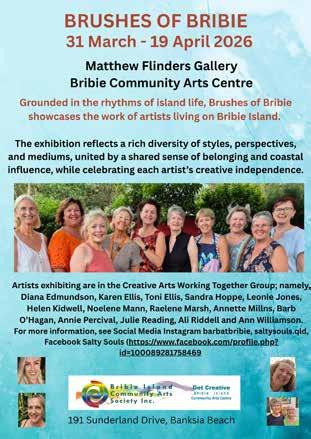
Bribie Arts Centre BRUSHES OF BRIBIE
ART EXHIBITION MARCH 31 - APRIL 19
Astriking collection of works by 14 talented Bribie artists awaits when their exhibition opens in the Matthew Flinders Gallery at Bribie Community Arts Centre on March 31.
Their styles, topics and delivery are as varied as are these interesting women, but the common denominator is the skill and love they bring to their works.
From landscapes to still life, figures, sea and land creatures, flora and pottery, this show will enchant you. Come meet the artists in the Gallery during Brushes with Bribie which runs until April 19.
And at 10am Sunday April 12 in the Gallery, you’ll have the added treat of a FREE concert by popular local musicians Blue Water Trio (at left) playing a combination of flute, clarinet, piano and harp in a variety of genres: jazz, classical, old classics, pop, movie and television themes.
WHAT YOU CAN LEARN AT bribie arts CENTRE IN APRIL
Mixed Media Workshop with Yvette FRIDAY APRIL 10th 2026
9.30am – 3.30pm
A Patchwork of Tradition and Innovation Quilting in Australia:
Quilting
began as a practical craft but has grown into a lively art form that shows off Australia’s unique spirit and diversity. Since the first European settlers arrived, quilting has helped people stay warm and express their creativity.
Today, quilting is still going strong, bringing together history, community, and new ideas all over the country.
Australia’s quilting history is as colourful as the land itself. According to the National Gallery of Victoria, quilts made by Australian women from the colonial era onward reflect the stories of their lives, with quilting becoming an important social activity that connects communities in both cities and rural areas and allows skills to be shared across generations.
The well-known “Wagga” quilts, made from wool and simple materials during
tough times, show how resourceful Australian quilters can be.
In recent decades, quilting in Australia has blended longstanding traditions with new creative influences.
According to Wikipedia, today’s quilters are also inspired by Indigenous Australian art, which is made by Aboriginal Australians and Torres Strait Islanders, as well as the country’s diverse landscapes and cultures. Bright colours, creative patterns, and new techniques now appear in shows and competitions, giving Australian quilters a reputation for originality around the world.
Quilting in Australia is about more than just making quilts; it’s also about connecting with others. Quilting bees and guilds give people a place to belong and work together, whether
they’re making charity quilts for those in need or just sharing tips and support.
Thanks to online groups, quilters from all over the country can now connect, from Perth to Cairns and everywhere in between.
Like many traditional crafts, quilting has its challenges. Busy modern lives make it hard to find time for such a detailed process, and younger people often prefer faster, digital hobbies.
Still, more people are becoming interested in handmade and ecofriendly arts, which gives hope that quilting will keep attracting new people.
Quilting in Australia remains a living tradition. It brings together personal creativity and community spirit, warming people and connecting hearts all over the country.
BRIBIE ISLAND NATIONAL SERVICE ASSOCIATION INC
The Bribie Island National Service Association Inc. was established in 2025 to relieve mental health issues and isolation experienced by past and present members of the Australian Defence Forces (ADF) and encourage their transition to civilian life.
On behalf of the Bribie Island National Service Association Inc., we wish to extend an invitation to join us to commemorate
ANZAC Day Saturday 25th April 2026
The service will commence at 5.45am at the remembrance memorial in Bluey and Jean Piva Park, Woorim. Wreaths can be laid.
LET’S GO TRAVEL
UPDATE FOR MARCH :
Our last meeting was held on 15th March and was hosted by Maryanne. I was away in NZ at the time. A small group attended and had lovely discussions about past trips. A couple of new faces joined us, which is fantastic to see.
Expressions of Interest for the Cosmos Best of British Isles trip are still open. The trip is scheduled for 15 August 2027.
During this trip, attendees can see the Edinburgh Military Tattoo in Scotland.
I am also going on the 15-day Switzerland-Italy panoramic trains, alpine vistas, and lakeside tour in April 2027 with My Cruises. If anyone is interested in that trip, an information sheet will be available at the next meeting.
Looking forward to seeing you all on 19th April at the Bribie RSL Social, or, hopefully, in the Auditorium at 3pm.
Note: We are NOT Travel agents, Coordinators, or Insurance Representatives. We just love travelling and helping people travel. We will not be booking anything for you.
Please feel free to call me anytime with your questions or speak to me at our next meeting. I am always happy to assist you with travel advice and information.
Roslyn Sanderson JP Qual 0401078187
Marriage Mystery - SOLVED!
This evening, I noticed my husband was acting strange.
We’d made dinner plans at our favourite restaurant.
All day, I’d been shopping with my gal pals, and I thought maybe he was upset that I was running twenty minutes late - but when I arrived, he didn’t mention it at all.
The conversation felt awkward. I suggested we leave and go somewhere a little quieter so he could share what he was thinking.
Bless him, he agreed - but when we got there, he still didn’t open up.
I pleaded with him to tell me what was wrong. He said, “Nothing.”
I asked, “Honey, is it my fault?”
He replied, “No, honey, it’s nothing. Don’t worry about it.”
On the way home, I told him how much I loved him. He smiled slightly but just kept driving.
At home, he sat in silence and watched TV. I was devastated. I felt like I’d lost him. He seemed so very far away.
Eventually, I went to bed, heart heavy and broken. About fifteen minutes later, he came to bed and fell asleep immediately.
I lay there crying, convinced his thoughts were with another woman.
My world had stopped turning. Then I went into his office and read his diary. It said:
“A two-foot putt! Who the hell misses a twofoot putt?!”
ON BRIBIE
MONDAY EUCHRE
Bribie Bowls Club 12.00pm
Contact Annette on 0414622490 TRIVA
Bribie Island Hotel 6.30pm
Bribie Island R.S.L 7.00pm
TUESDAY
BINGO
Bribie Island R.S.L 10.00am POKER
Bribie Island Hotel 6.30pm
WEDNESDAY
MUSIC BINGO
Bribie Island Hotel 6.30pm
Bribie Island R.S.L 7.00pm RAFFLES
Solander Lakes Bowls Club - 6.30pm (tickets on sale from 5:30pm)
THURSDAY BINGO
Bribie Island R.S.L 7.30pm RAFFLES
Bribie Island R.S.L Fishing Club 4.30pm
Every Thursday at the RSL prizes are Meat Vouchers from Avondale Meats and Seafood Vouchers from Saviges.
FRIDAY
MEAT TRAY RAFFLES
Bribie Island Bowls Club 4.30pm
Bribie Island Golf Club 5.30
Blue Pacific Hotel (from) 3.00pm
Solander Lakes Bowls Club - 6.30pm (tickets on sale from 5:30pm)
Enjoy playing 500 Cards?
Join a like-minded group who meet on Monday afternoons at the RSL Anzac Room from 1-4pm. $5 which includes raffle prize.
Please arrive 10mins before play starts at 1pm
Further information please ring Carole 0438 713 663
Beachmere District Community
The B.D.M.S. Community Markets are held at the Men's Shed 53 Rogers Street Beachmere, every 1st Saturday of the month 7.30am - 12pm
Bribie Island BIDCA Markets
The Bribie Island BICA Markets are held at Brennan Park, Bongaree, the 3rd Sunday of each month from 6am -12pm
Bribie Rotary Markets
The Rotary Markets are held at Brennan Park, Bongaree on the second Sunday of each month from 6.30am – 12 noon
Queensland Cancer Council
The Cancer Council Markets are held at Brennan Park, Bongaree on the first Sunday of each month from 7am to 12 noon.
LUNCH MARKETS - Sylvan Beach (Farmers Market)
First Saturday of each month from 8am to 1pm held in the park opposite the Bribie Island Hotel. Funds raised to E.P.C.S, Ass, 0417629957
The Bribie Island Lions Market
2nd Sat of the month at Tintookie Park Woorim 7am - 1pm.
Bribie Woodcrafters & Bribie Island Gem Club
Open day, Demonstrations & Sales - last Sunday of each month
8am to 12noon Held at Bribie Art Centre 191 Sunderland Dr, Banksia Beach
Mystic Journey Markets change of location
Saturday November 15th ~ 9am ~ 2pm Saturday December 6th ~ 9am ~ 2 pm Saturday December 20th ~ 9am ~ 2m 4pm ~ 8pm
There is also an outdoor market to run alongside indoor market called This ‘n’ That
How War Came to Australia
Part two
By early 1942, as WW2 was raging across Europe, North Africa and Asia, Australia was no longer watching from a safe distance. Singapore had fallen in February.
This great British fortress, which we had been told would protect us, collapsed in days. Thousands of Australian troops were marched into captivity. The shock ran through the nation. If Singapore could fall, what was left to defend us?
On 19th February 1942, Japanese aircraft bombed Darwin. More than 240 people were killed. For the first time ever, mainland Australia had been attacked. It was not a distant war anymore. It was our war and we were relying on 250,000 hastily recruited militia troops to defend us.
Although mostly led by capable AIF officers and NCOs, the raw militia troops were poorly armed and inadequately trained to meet battle-toughened Japanese troops on equal terms.
Our Navy and Airforce had been handed over to the British in 1940, and were now scattered from the Indian to the Atlantic Oceans, and North Africa. Had Curtin not resisted Churchill, it is likely that Australia's two AIF Divisions would have been swallowed up in the Burma disaster. But at least they were now on their way home.
Our government had decided to minimise the publicising of the attack on Darwin and many of the other disasters from the Japanese advances through the Dutch East Indies (Indonesia) into PNG (Papua New Guinea). This only added to the apprehension of the Australian public.
Rumours swept the country. In Brisbane, people whispered about the so-called “Brisbane Line”, the idea that the north would be abandoned and defence would be concentrated in the south-east.
Whether fact or fiction, that rumour alone
caused deep concern to the population. Families dug slit trenches in backyards. Concrete air raid shelters suddenly popped up in city centres. Air-raid wardens drilled neighbourhoods. Windows were taped, and street lights dimmed.
We had become a country living in fear. On 22nd February 1942, US President Roosevelt had reluctantly ordered General Douglas MacArthur to abandon his hard-pressed army in the Philippines and assume the office of Supreme Commander, South West Pacific Area (SWPA) with headquarters in Australia.
But Roosevelt and many others believed that General MacArthur had personally compromised the defence of the Philippines through serious errors of military judgment. MacArthur ordered his starving and desperate troops to fight on to the end, giving them false hopes of survival with a cruel lie that substantial military relief would soon arrive from the US.
MacArthur surrounded himself with servile staff officers who were aware of this dangerous weakness yet indulged it.
In March 1942, the first American troops arrived in Australia, followed soon after by General MacArthur. On 3rd April 1942, MacArthur received a directive from Washington to include senior Australian military officers on his staff. He defied the order by keeping his American staff officers. It was the officers who had escaped with him from the Philippines and shared his responsibility for that debacle. Within weeks, American troops began pouring into Brisbane, Sydney, and Melbourne. At their peak, nearly one million American servicemen would pass through Australia during the war. For a country of just seven million people, the impact was immense. Brisbane became the site of the Allied headquarters.
American accents filled Queen Street, while Jeeps were seen everywhere. Chocolate and nylons, a sudden luxury,
By Al Finegan
appeared in shops. There were dances, friendships, romances, and occasionally, tensions. "Overpaid, oversexed, and over here" became a common catchphrase used by Australians to describe American GIs, generated by their resentment of their higher pay and romantic successes.
Despite the need for social adjustments there was also something far more serious. The Americans brought aircraft, ships, logistics, and industrial power. Australia became a vast staging ground for the Pacific counter-offensive. Airfields were carved into northern Queensland. Ports were expanded. Factories turned out munitions. Women started working in heavy industry in unprecedented numbers. Suddenly all had changed. We were no longer simply defending ourselves; we were preparing to strike back.
In early 1942, the Japanese high command believed the capture of Port Moresby was essential. From there, long-range bombers could strike northern Australia with greater ease. Supply lines between the US and Australia could be severed. The continent would be isolated, perhaps not invaded immediately, but isolated strategically. It was planned to take Port Moresby by amphibious assault.
A Japanese invasion fleet was assembled and ordered to sail south through the Coral Sea, land troops on the Southern PNG coast, and seize the harbour. Once established, the Japanese perimeter would stretch in an arc from Burma through the Dutch East Indies, across New Guinea and into the Solomons. Australia would sit exposed beneath it.
Unbeknownst to the Japanese, American codebreakers had begun to crack the Japanese naval communications. It revealed that a major operation was underway. In early May 1942, an Allied naval force built around the American aircraft carriers Lexington and Yorktown, along with Australian cruisers and
destroyers moved into the Coral Sea to intercept the Japanese fleet.
Between 4th and 8th May 1942, the Battle of the Coral Sea became the first naval engagement in history fought entirely by carrier-based aircraft. Ships launched planes against ships they could not see beyond the horizon. Japanese aircraft struck first, sinking the American carrier USS Lexington and damaging USS Yorktown. It was a heavy loss.
Yet the Japanese also suffered serious losses. The light carrier Shoho was sunk. The fleet carrier Shokaku was heavily damaged, and air losses were significant. Most importantly, the Japanese invasion convoy bound for Port Moresby turned back. For the first time in the Pacific War, a major Japanese advance had been halted. Tactically, it was a mixed result, strategically, it was decisive. The sea route to Port Moresby had been closed. But the Japanese still wanted Port Moresby.
Denied a landing by sea, Japanese planners turned to the map. North of Port Moresby lay the Owen Stanley Range - a spine of mountains rising steeply from the jungle, cut by narrow tracks used by missionaries, traders and patrol officers. One of these tracks ran between the northern village of Buna and the southern approaches to Port Moresby. On paper, it appeared possible.
In July 1942, Japanese troops landed on the northern coast of Papua at Buna and Gona. They began advancing south across the Owen Stanley Range toward Port Moresby. Between these troops and Australia stood a thin, desperate line of young, barely trained Australian militia troops. The Kokoda Track was a ribbon of mud climbing through some of the harshest terrain on earth, thick jungle, mountains wrapped in mist, and rain that never seemed to end.
Meanwhile, in August 1942 at Milne Bay on the eastern tip of New Guinea, Australian forces handed the Japanese their first clear land defeat of the war. Japanese troops landed, expecting an easy capture of the airfields. Instead, they met determined Australian infantry and
RAAF support. Fighting raged in mud and monsoonal rain, but the Australians held firm. When the Japanese withdrew, it marked a psychological turning point. The myth of Japanese invincibility Evacuating Australian wounded from Kokoda had been broken. It was the first defeat of the Japanese on land.
Back on the Kokoda Track, our Militia troops were engaged in close combat with battle-hardened Japanese troops. Outnumbered 5 to 1, they slowed the Japanese advance across the Owen Stanley Range with fierce fighting at Isurava, Brigade Hill, and Ioribaiwa. They fought while sick with malaria and dysentery. They fought on rations reduced to handfuls of rice. They carried their wounded on stretchers cut from saplings. And beside them marched the Papuan carriers - the “Fuzzy Wuzzy Angels”whose quiet courage saved countless lives.
By September 1942, they had stalled the Japanese advance within sight of Port Moresby. MacArthur's failure to send the seasoned AIF troops to PNG at the earliest opportunity was incomprehensible and unforgiveable. It was only then that MacArthur appeared to have appreciated the danger to which his neglect had exposed Australia. He issued orders to rush the seasoned AIF soldiers of the 7th Division to reinforce the exhausted militia troops. With the arrival of the battlehardened AIF troops, the Australians gradually, then rapidly, pushed the Japanese back until they were where they started, the north coast of PNG.
From 1943 onward, the war in PNG then became a grinding battle. It was a campaign fought largely in jungles and along the steaming coastlines of Buna, Gona, Lae, Salamaua, Finschhafen. These names are not as widely known as El Alamein or Normandy, yet for Australian soldiers they were places of extraordinary courage and endurance. Back home, rationing tightened but morale strengthened. The fear of invasion gradually eased. The enemy was now retreating.
21 sailors. Air raids continued on northern towns – Darwin, Broome, Townsville, even as far south as Exmouth, WA. Blackouts became routine. Petrol was rationed. Families made do with less. The war reshaped daily life. Women started working in factories, on farms, and in military services in unprecedented numbers. The Australian Women’s Army Service, the WAAAF, and the WRANS expanded rapidly. Children collected scrap metal. Housewives queued with ration coupons. Australia had completely mobilised.
By 1945, the outcome was no longer in doubt, though the cost remained high. In May, Germany surrendered. There were some celebrations, but for Australians the war was not yet finished. The Pacific conflict raged on. Then, in August 1945, came news that stunned the world. The US had dropped atomic bombs on Hiroshima and Nagasaki. Within days, Japan announced its intention to surrender.
On 15th August 1945, Australians poured into the streets. Church bells rang. Flags appeared from nowhere. In cities and country towns alike, strangers embraced. After six long years, it was over. The formal surrender took place aboard USS Missouri in Tokyo Bay on 2 September 1945. Australian representatives stood among the Allied delegates, their presence a quiet acknowledgement of the nation’s sacrifice.
More than 39,000 Australians had died in the war. Thousands more returned wounded - in body or mind. Prisoners of War came home slowly, many emaciated, some broken by years of brutal captivity along the Burma-Thailand Railway, or in camps across Asia. They found a changed Australia. The war had accelerated industrial growth. It had strengthened ties with the US and weakened the old dependence on Britain. Politically, socially, strategically - our nation emerged more confident, more independent.
in 1951, we signed the ANZUS (Australia, New Zealand and US) alliance. Britain was ignored. Immigration programs expanded, reshaping the population. Manufacturing grew. Suburbs spread dramatically. It was this wartime generation that fought and endured the war that built the Australia of the 1950s and 1960s.
When we look back now, it is easy to see WW2 as a series of great global engagements - armies, fleets, conferences, declarations. But for the Australians at the time, it was deeply personal. It was the fear in February 1942 that enemy troops might land on our beaches. It was the sight of American convoys rumbling through Brisbane streets. It was young men climbing the Kokoda Track in boots that rotted in the mud. It was women welding in factories late into the night. It was telegrams delivered to quiet suburban doors. And finally, it was the sound of cheering crowds in August 1945, a relief so overwhelming that many wept openly.
In six short years, Australia had descended into abject fear and risen to the joy of victory. But it did prove one old adage that our Politicians should heed. It is the wise words of Sun Tzu, “If you want peace, prepare for war”.
Kuttabul, killing
All photos in this article were taken by my father Corporal Laurence Finegan who served as a RAAF photographer during the PNG campaign.
The Australian mainland had not escaped untouched. Japanese submarines shelled Sydney’s eastern suburbs. In May 1942, midget submarines had penetrated Sydney Harbour, sinking HMAS
Evacuating Australian wounded from Kokoda
VISITING BRIBIE 100 YEARS AGO
Barry Clark - Bribie Island Historical Society
TheNEWSPAPER ARTICLES FROM THE 1920’s
Bribie Island Historical Society was established in 2008, and over the last18 years we have created a huge Database of Photos, Newspapers, Maps, Letters, Books, Films and Interviews in a searchable Database.
Society volunteers have digitised many old newspapers and microfiche records. This article has extracts of four articles from the 1920’s, when the resident population of Bribie was less than 100.
THE CHARMS OF BRIBIE ISLAND
The Daily Mail- 29 March 1924.
The delightful quaintness, the wild beauty of her bush, and the charm of her long, white-sanded beach, I have taken her unto my affection for all time. Numbers of folk of all shades and colours added variety to the scene whilst the vendors of the fine fish, vegetables, fruit, meat, etc., plied their trade.
Behind us lay the thick, fragrant treed bush, and the long road in course of construction, leading to the main beach three miles from the wharf.
A road which will give access to the finest beach in Australia, facing Cape Moreton, and which for surfing and pleasurable facilities is unexcelled.
A slow, plodding team of bullocks ploughed through the heavy, broken tracks, bearing the materials for the road making, adding their quota of picturesque interest to the scene.
There is an atmosphere of peace and quiet for those seeking tranquillity. May she come into her heritage.
BRIBIE SPELL- HEALTH and HAPPINESS
The Brisbane Courier -23 November 1926
A pretty settlement which has grown up near the wharf where the steamers from Brisbane berth, is generally called Bribie, but its real name is Bongaree. On the ocean beach several houses have been built which are the property of the Government.
They were formerly at Beerburrum Settlement, but when the soldiers were moved elsewhere the cottages were dismantled and the timber in some of them was brought to the island. This village on the beach is called Woorim. It is a picturesque spot, and one feels that he could be happy here for an indefinite period.
The community feels that the time has arrived for it to direct its own affairs. There is dissatisfaction that it has not even a representative in the Caboolture Council and that it has no knowledge of how civic affairs stand.
The residents believe that the money raised in rates
on property on the island should be spent on improvements there.
ATTRACTIONS FOR HOLIDAY MAKERS
The Brisbane Courier - 30 October 1929, The first thing I noticed on landing was a newly erected building at the end of the jetty, which has been built by the Tug Company for use as a fish and oyster shop.
Facing the Esplanade were some good boarding houses, several new residences and weekend cottages, while the Amateur Fishermen's Association had excellent accommodation for its members.
Returning along the sea front, we passed the kiosk and dining rooms, the property of the Tug Company, where good fish and oyster lunches were obtainable. Facing the beach stood the 12 huts built by the Tug Company for letting purposes.
On the right were two splendid new tennis courts and an inviting bowling green. Beyond the Bowling Green was the pavilion erected for the use of visitors as a dance hall and general place of amusement.
Retracing my steps we passed Arthur Bestmann's general store where necessities for campers, visitors, and residents could be obtained.
A fine building also had been erected for Church of England services at a cost I was informed, of more than 1000 Pounds.
The next items of interest were the Novelty Gardens to see many handsome and some grotesque figures, grown and formed out of cypress pines.
A run to the outer Surfing beach, three miles distant, was made by motor bus where Surf bathers enjoy themselves
to the full, and at holiday times, members of life-saving clubs were always on the lookout.
PROSPEROUS SETTLEMENT
Brisbane Courier 21 June 1930.
The first settlement of Bribie Island may be traced to the earliest days of Brisbane, when Bribie Passage, the narrow stretch of water between the island and the mainland, had become notable as one of the best fishing grounds of Moreton Bay.
For many years Bribie has been popular with campers, and particularly with amateur fishermen. Visitors to Bribie know that it is one of the few seaside resorts where fish can be purchased in all seasons, fresh and cheap.
There is the cosy little township of Bongaree with a number of permanent settlers, stores, a newsagency, two churches , a State School with 25 children, a hall, a sports club, half-a-dozen boarding-houses, many cottages, and a row of small huts along the Passage popularly known as
"The Twelve Apostles," a bowling green, and tennis courts. Bill Shirley runs a fleet of five motor buses from the settlements to the Main Beach and has carried as many as 2000 passengers in a day. He also runs pleasant trips along the beaches and claims that the trips are the cheapest motor trips in the world.
No account of Bribie would be complete without reference to the energy and enterprise of the Brisbane Tug and Steamship Co., Ltd. responsible for most of the progress on the island.
The company maintains two popular steamers which run from Brisbane to Bribie and is one of the most pleasant and cheapest in the Commonwealth.
The future of Bribie appears to be rosy, and it will not be long before it will be one of the most prosperous settlements within easy reach of the metropolis.
MORE BRIBIE HISTORY
Historical Society meetings are on the second Wednesday of each month at 6;30pm at the RSL Club and visitors are always welcome.
See more stories & photos of Bribie history on Web site Bribiehistoricalsociety.org.au and Blog http://bribieislandhistory.blogspot.com or contact us on bribiehistoricalsociety@gmail.com
SPORTS PAGES
BRIBIE ISLAND BOWLS CLUB
Scrounger Results Monday 16 March 2026
1st: K Henry
2nd: T Whalley
3rd: W Manson
4th : T Marr
Self-Select Triples Results
Tuesday 17 March 2026
Winners: B Castle, M O’Neill, A Mann
Runners up: N Smith, G Hutchinson, P Conn
Winning Draw: G Olsen, F Grimsey, D Davis
Winning Draw: W Baker, J Warwick, S Horn
Winning Draw: F Crockett, BJ Adams, D Heath
Encouragement: J Irvine, R Corrick, D Somerville
Self-Select Pairs Results
Wednesday AM 18 March 2026
Winners: A Riseham, D Riseham
Runners up: S Hancox, N Gray
Winning draw: P Baringhaus, S Barringhaus
Encouragement: E Thain, M Cole
Self-Select Pairs Results
Wednesday PM 18 March 2026
Winners: J Hosie, S Cook
Runners up: W Kelly, G Olsen
Winning draw: T Phillips, T Deiben
Winning draw: B Swensen, G Hartley
Winning draw: D Deidben, C Fowler
Encouragement: M O’Neill, S O’Neill, T Bishop
Random Triples Results
Thursday 19 March 2026
Winners: W Manson, S Muller, M Hogan
Runners up: W Gunders, M Brown, J Dunn
Winning draw: R Bickerton, M Wright, J De-Ruyter
Winning draw: D Riseham, A Riseham, S Soens
Brekkie Bowls Results
Thursday 19 March 2026
Winners: L Tweddle, G McEniery, M Thompson
Runners up: L Williams, M Garfield, B Garfield
Winning draw: L Beaven, F Grimsey, J Coleman
Winning draw: S Chandler, G Charters, J Cullen
Self-Select Pairs Results
Friday AM 20 March 2026
Lowest winning score: S Hancox, D Hancox
Runners up: I McLaren, E Stacey
Winning draw: T Comacchio, L Comacchio
Winning draw: G Jackson, J Falvey
Encouragement: D Birt, B Birt
Self-Select Pairs Results
Friday PM 20 March 2026
Winners: K Laverty, J Oliver
Runners up: L Burns, W Simmonds
Winning draw: W Hoelscher, M Prewett
Winning draw: G Denkel, R Avern
Winning draw: M Thompson,
C Wilkie
Encouragement: N Kelly, G Olsen
Random Fours Results
Saturday 21 March 2026
Winners: L Beaven, J Jones, K Langford, T Phillips
Runners up: S Lonsdale, I Smith, J Buckmaster, A Campbell
Lucky draw: G Frew, M Aubin, W Follett, M Brown
Lucky draw: W Manson, J
Lonsdale, J Brown, T Pinzger
Lucky draw: L Williams, K Brown, P Bennett, J DeRuyter
Scrounger Results Monday
23 March 2026
1st: W Gunders
2nd: P Bennett
3rd: M Walton
Self-Select Pairs Results
Wednesday AM 25 March 2026
Winners: K Muller, D Gibon
Runners up: S Lobo, BJ Adams, K Piva
Winning draw: D Hancox, R Zayl
Encouragement: W Hoelscher, E Lucas
Self-Select Pairs Results
Wednesday PM 25 March 2026
Winners: J Oliver, P Gray
Runners up: D Hancox, J
Perry
Winning draw: C Perkins, K
Perkins
Winning draw: W Kelly, J Dieben
Winning draw: G Gunter, J Prowler
Encouragement: M Prewett, M Durham
Random Triples Results
Thursday 26 March 2026
Winners: J Lonsdale, L Hackwood, M Cole
Runners up: C Christianson, K Muller, C Draper
Winning draw: G Riley, K Norton, R Brinton
Winning draw: P Cook, B Hamer, M Adams
Self-Select Pairs Results
Friday AM 27 March 2026
Winner: J Dann, C Dann
Runners up: D Hancox, S Hancox
Winning draw: R Reilly, D Hancock
Encouragement: L Tait, B Stuart
Self-Select Pairs Results
Friday PM 27 March 2026
Winners: G Reily, J Hattie
Runners up: B Sellars, R Dixon
Winning draw: D Riseham, T Turnbull
Winning draw: K Laverty, J Oliver
Winning draw: D Hancox, B Kinnear
Encouragement: D Dodd, M Cullinan
Random Fours Results
Saturday 28 March 2026
Winners: L Williams, K Muller, D Davis, J De Ruyter
Runners up: L Rowden, K
Brown, E Thean, M Brown
Lucky draw: A Wells G Low B Castle
SOLANDER LAKE BOWLS RESULTS
Tuesday 17 March 2026Club Select Triples: Winners: Ann Mehmet, Jan Van Arnhem, Wayne Mitchell 2nd: Kerry Filmer, Nerelle Andersen, Stuart Ager 3rd: Sheila Jeffrey, Deb Jackson, Ross Luscombe
Wednesday 18 March 2026Self Select Pairs: Winners: Stan Hillen, Rob Horsfall 2nd: Steve Ross, Peter Hodgson
3rd: Vernon Dean, Mike Dance
Thursday 19 March 2026Self Select Triples: Winners: Julie Watson, Anne Ager, Stuart Ager
2nd: Brad Storey, Andy Ives, Steve Jameson 3rd: Ian Jackson, Wayne Shackell, Daryl Wilkins
Friday 20 March 2026 - Self
Select Pairs: Pool A Winners: Marieke Moore, Neil Feazey
Who is Steve Jones? Steve started playing Association Croquet in Cheltenham, UK, in 1957. He moved to Wellington in 1982, and in 1989, he became the first New Zealander to win the Sonoma-Cutrer World Cup, ranking 12th in the world.
In early 2000, he moved to Queensland, becoming Senior Vice President of the Australian Croquet Association and the Australian team's head coach. He became a leading light in the croquet world and has played at Bribie!
This is a very important tournament with players from Bundaberg, Burleigh Heads, Windsor, Steven’s, Southport, Eildon, Coolangatta, Melany, and last but not least, Bribie.
The 10 players who make up the State team played in this event, which was the team's last before heading to Perth to represent Queensland in the Eire Cup. The games are 2 1/4 hours long, very different from the social games of golf and croquet, and the weather was not very kind!! But they played on; there has to be a winner.
The final was very exciting, and either of the two finalists could have won. It was a catand-mouse game. ‘Snooker on grass!’
In the end, the finalists were Shane Davis and Dave Luxmoore, with Shane taking first place. Phew! What a long day for all who attended, not just the players, but everyone who helped in any way. A big thank you to all, especially Gwen Connolly.
02 Apr DIV 1 Julie with Annie
02 Apr DIV 2 Judy with Annie
26 Mar Tanya Stina Mary Ann
CRYPTIC
Crosswords - QUICK & CRYPTIC
Across
1 Silver, e.g. (8,5)
CRYPTIC SOLUTION
Down
1 Tons to do in diplomacy (4)
8 ‘Dost thou think, because thou art virtuous, there shall be no more cakes and ___?’ (3)
9 Looking good on the box (9)
10 Ti (8)
11 Last Nato alphabet letter (4)
13 Soup dish (6)
14 Uncle in Henry V (6)
16 Gangster’s gal (4)
1 Braid (5)
2 Voter list (9,4)
3 Work with dodgy ticket salesman, or choose not to? (3,3)
3 Meant (8)
7 Leaders in Romania insist no dogs bark (4)
4 Diacritical sign over some German letters (6)
5 Chumps (4)
8 Hard to get Conservative in panic (6)
6 That’s not easy for you to say! (6,7)
10 Be angry with Dawn, and have a penny-drop moment (3,3,5)
17 Square cloth covering head / neck (8)
20 Amends – Ian McEwan novel (9)
21 Number of humps on a Bactrian camel (3)
22 Unwise (3-10)
1 Tons to do in diplomacy (4)
3 Work with dodgy ticket salesman, or choose not to? (3,3)
Across
7 Leaders in Romania insist no dogs bark (4)
1 Tons to do in diplomacy (4)
8 Hard to get Conservative in panic (6)
10 Be angry with Dawn, and have a penny-drop moment (3,3,5)
3 Work with dodgy ticket salesman, or choose not to? (3,3)
7 Solution of film-forming substances in a volatile solvent (7)
12 Did – did in (8)
12 Mother’s taking conceptual branch of science (11)
13 Kettledrums (7)
14 All the fluid is deadly (6)
15 Ones using needle and thread (6)
16 Glen melted lead (4)
18 Oslo’s on one (5)
17 Equine protecting a husky (6)
18 Initially, Joe Exotic sold tigers as a joke (4)
19 Twenty Thousand Leagues Under the Sea captain (4)
5 Row over abhorrent response, primarily (3)
6 Republican pierces nipple for special occasion (5)
TODAY’S TRICKS Clues begin or end with a definition of the answer.
Down
9 Chase the wild cats (8)
11 Scowl from stern expert (7)
12 Originally, mixed up large containers holding material to put on garden (5)
1 Starts to teach every Royal Marine
Swear words (5)
13 Dispatched to collect Penny, exhausted (5)
7 Leaders in Romania insist no dogs bark (4)
12 Mother’s taking conceptual branch of science (11)
The rest is one of these: Anagram Anagram of answer and hint that there’s an anagram
2 Knight, in secret, to change religion (7)
4 I clear up rocks? Strange (8)
15 Ate terrible meal (3)
8 Hard to get Conservative in panic (6)
14 All the fluid is deadly (6)
16 Glen melted lead (4)
10 Be angry with Dawn, and have a penny-drop moment (3,3,5)
5 Row over abhorrent response, primarily (3)
6 Republican pierces nipple for special occasion (5)
9 Chase the wild cats (8)
‘Senator arranged crime (7)’ gives TREASON Charade Combination of synonyms/abbrevs ‘Qualify to get drink for ID (8)’ gives PASSPORT (pass + port)
Acrostic First letters of answer
17 Equine protecting a husky (6)
12 Mother’s taking conceptual branch of science (11)
18 Initially, Joe Exotic sold tigers as a joke (4)
14 All the fluid is deadly (6)
16 Glen melted lead (4)
17 Equine protecting a husky (6)
1 Starts to teach every Royal Marine swear words (5)
2 Knight, in secret, to change religion (7)
18 Initially, Joe Exotic sold tigers as a joke (4)
4 I clear up rocks? Strange (8)
SOLUTIONS
11 Scowl from stern expert (7)
12 Originally, mixed up large containers holding material to put on garden (5)
‘Initially get a good joke (3)’ gives GAG
13 Dispatched to collect Penny, exhausted (5)
15 Ate terrible meal (3)
Insertion One thing inside another makes answer ‘In favour of republican entering Post Office (3)’ gives PRO
QUICK SOLUTION
SPOT THE 10 DIFFERENCES
Sudoku
Pawsome Pet Pages w w
Pumpkin
Fluffy Sprinkles
Bruno
Buddha Freddie
Pumpkin
Signs Your Home Has a Pest Problem You Shouldn’t Ignore
Pest
problems rarely begin obviously. Most infestations start subtly, with small, easy-to-miss signs. Spotting these early lets you act quickly—often with natural methods—before the problem becomes costly or disruptive.
Early Signs of Pest Problems You Shouldn’t Miss
Early pest issues are subtle. Instead of seeing pests, you may notice minor changes: faint scratching at night, more flies near windows, pets focused on one spot, or musty odours in a cabinet after cleaning. Unusual, musty, oily, or ammonia-like smells not related to food or moisture are often missed.
If you see a few ants after rain, hidden pests might be present. Many dismiss this as seasonal but catching it early can mean a quick fix rather than a major infestation. Watch for patterns. One incident may be random, but recurring signs in the same spot or at the same time usually aren’t accidental. This is an early hint of pest problems.
Common Signs of Pest Infestation Indoors
Pests indoors leave evidence, not themselves. You may see droppings in drawers, cabinets, or along baseboards. If the droppings return after cleaning, pests are present. Grease marks or smudges along walls and baseboards also reveal that rodents use the same paths repeatedly.
You may see shredded paper, insulation, or fabric for nests; tiny holes or chew marks in packaging; or fine debris beneath wall gaps. Even small things—like ants appearing daily or insects by the same window or door—often indicate a regular pest trail, not just random visitors.
Clustering matters. Pest signs grouped under sinks, behind appliances, or by outside walls are key spots to check for nests or entry points.
Pests hide in hard-to-reach places and leave subtle clues rather than obvious signs. Scratching, tapping, or light movement inside walls, HVAC spaces, or ductwork— especially at night—are classic rodent signs. In attics or basements, look for flattened or tunnelled insulation, scattered debris, droppings along beams, or small dark stains on insulation, wood, drywall, or beams.
These often indicate pests from repeated contact or urine. In basements, check edges and corners where rodents and insect’s travel. Infrequent inspections can let infestations persist for months.
Structural Pest Infestation Signs
Structural damage follows persistent pest activity and is seen in changed materials: wood that sounds hollow, soft baseboards, sagging floors, sticking doors or windows, bubbling paint without leaks, or sawdust or sand by walls or trim.
or ductwork before problems appear. Electrical flickers, drafts, or insulation gaps may signal pests affecting your home’s function.
Signs You May Have a Pest Problem
Key takeaways: Watch for subtle exterior signs, such as small holes, disturbed mulch, narrow grass paths, and grease marks. Stay alert for bird feeders spilling seed, standing water, overgrown plants touching the house, bird nests in vents, and clogged gutters. These suggest an infestation may follow, though they don’t cause pests on their own.
When Early Signs of Pest Problems Get Worse
A pest problem grows serious when pests find steady shelter, food, and breeding sites. If early signs show in many areas, recur daily, or affect walls and ceilings, the infestation is growing.
Another warning is pest multiplication. Many breeds breed quickly, so a small issue can grow fast. Daytime sightings are a red flag; most pests are nocturnal, so seeing them during the day indicates the need for pest control.
If pest signs persist for over two or three weeks, even after cleaning or repairs, the problem is likely established, not a one-time event. Pests harm your home and health. Droppings, urine, shed skin, and nesting materials release particles that worsen allergies and asthma. These often go unnoticed until health issues start.
Rodents and cockroaches can spread bacteria on countertops and pantry food, and pest moisture can cause mould. The first warning is often breathing problems or strong, lasting odours, not seeing pests.
Clear Signs You Need Pest Control
If you see pests during the day, notice repeated damage after traps or sprays, or find evidence in hard-to-reach places, you need pest control.
DIY methods rarely access nests or entry points. Signs returning, spreading to new rooms, affecting walls or ceilings, or involving strong smells or structural damage mean it’s time for professionals.
Persistent droppings, repeated signs, and widespread activity all mean DIY fixes won’t work.
BRIBIE ISLAND
BRIBIE ISLAND
Help Seniors Stay Independent and Safe How Smart ChangesHome
For seniors who want to stay in their homes, and for their adult children helping them, the home itself can become the biggest challenge to independent living. Stairs that used to be easy, narrow doorways, slippery floors, and dim hallways can make daily life harder as mobility changes.
These issues not only increase the risk of falls, but also affect confidence, privacy, and the ability to live independently. Addressing these safety concerns can help make everyday life feel more secure.
Quick Summary: Smart Home Safety Upgrades
• Start with a home assessment to spot risks and set priorities for aging in place.
• Focus on bathroom upgrades like grab bars, safer showers, and non-slip surfaces.
• Improve kitchen access with easier storage, better lighting, and reachable appliances.
• Reduce fall risks with safer flooring, clearer pathways, and wider entries and doorways.
• Add smart home features like voice control, alerts, and monitoring to boost independence and safety.
Understanding Aging in Place and Upgrade Costs
Aging in place means making changes to a home so older adults can live there safely and independently for as long as possible. This usually involves improving accessibility in high-risk areas like bathrooms and kitchens, and having a
clear idea of the costs involved.
This is important because the right upgrades can help prevent injuries and make daily life easier; while also helping you avoid unexpected costs. Knowing what is usually needed lets you focus on the most important safety improvements now and plan for others later.
For example, many falls happen on wet floors, so adding grab bars and better lighting are often the first changes people make. Even small updates in the kitchen, like using lever handles, can make tasks easier and reduce discomfort.
Once you understand the basics, you can figure out what you need, compare prices and funding options, and hire contractors with more accurate bids.
Build an Aging-in-Place Upgrade Plan That Fits Budget
Once you have a clear goal, follow these steps to turn your ideas into a plan with a set budget that you can put into action. This process helps both beginners and professionals learn how to assess needs, estimate costs, compare funding, and choose vendors, so decisions are based on solid information.
Step 1: Assess needs room by room
Begin by looking at the areas with the highest risk, like the entryway, bathroom, kitchen, and stairs. Notice what
makes things difficult, such as reaching, stepping over thresholds, poor lighting, or balance problems. Use these observations to decide what changes are needed.
Step 2: Prioritise modifications by safety and frequency
Pick upgrades that lower risks right away and help with daily independence and save less urgent improvements for later. If mobility devices are needed, check important measurements early, like making sure ramps are 36 inches wide, so your plan is practical as well as good-looking.
Step 3: Get realistic cost estimates with a clear scope
Make a simple list for each area that includes materials, labour, and any electrical or plumbing work, then ask for detailed quotes. Ask contractors to show which items are essential and which are optional, so you can keep the project focused on safety.
Step 4: Hire qualified contractors with bid rules
Get at least two or three bids that all use the same details for the work, timeline, and payment plan, so you can compare them fairly. Choose local contractors if they know the codes better and can offer better support and always get warranty terms in writing.
Finish-Strong Checklist for Safer Aging in Place
• Document room-by-room risks and the daily tasks they disrupt
• Specify smart devices by purpose, trigger, and caregiver notification rules.
• Confirm measurements for clearances, reach ranges, and threshold heights.
• Verify whether permits apply to the home’s structure.
• Compare bids using identical scope, materials, timeline, and payment milestones.
• Verify that contractors are insured and compliant.
• Track install dates, test results, and final handoff training for each device
As you check off these steps, you’ll feel more in control of the project.
Start One Smart Home Upgrade to Age in Place Confidently
Wanting to stay in your own home can bring up real concerns about falls, daily routines, and the cost of making the right changes. The best approach is to plan ahead, focus on safety, and make home updates that fit your current needs.
When you adapt your home well, it’s easier to stay independent, enjoy the benefits of aging in place, and feel more comfortable and confident. A safer home helps protect your independence. Pick one important change to start this week, use the checklist to plan and schedule it, and follow through. Making these changes builds stability and health for the future.
Chyzana Harrison
Real Estate Agent
Your Local Real Estate Exper t
LOCALS
SUPPORTING LOCALS
CLIENT REVIEW
Chyzana is with out any doubt the most knowledge and professional real estate agent I have ever had the pleasure to sell with. Her Personality can do attitude was evident f rom day one. Chyzana relates with prospective buyers as soon as they arrive at the door and relaxes the atmosphere instantly Chyzana is an energetic agent who registered over 30 prospective buyers through the house in no time at all. Chyzana is professional and more than capable I can’t thank her enough
Seller of house in Toorbul, QLD
What Walking on 40 Years of Roofs Has Taught Me
Rodney Rock reflects on four decades working above the homes of South-East Queensland.
Rodney Rock has spent much of his life standing atop houses. For more than 40 years, he has worked in the roofing trade. Known as one of the most experienced Bribie Island and Moreton Bay roofing specialists, he has worked on thousands of roofs across South-East Queensland.
Roofs appear fairly ordinary from the street below—simply tiles or metal sheets that quietly protect the home beneath. But after decades of walking across rooftops, Rodney Rock says you begin to notice things most people never see.
“When you walk on roofs for forty years, you start to understand how they behave,” Rodney Rock says. “Every roof tells a story.”
Roof Problems Rarely Start Overnight
One of the biggest lessons Rodney Rock has learned during his career is that roofing problems usually develop slowly. By the time homeowners see a leak inside the house, the issue may have been forming for years.
“A small crack in a tile, a rusted valley tray—which is a metal channel that directs water off the roof—or deteriorating ridge capping, which seals the joint at the top of the roof, can allow moisture in over time,” Rodney Rock explains.
Eventually, the problem reveals itself as a ceiling stain, damp insulation or a leak during heavy rain. “That’s why early inspections can make such a difference,” he says. Small problems are often far easier to repair before they develop into major roofing issues.
Not All Roofing Products Are the Same
Over the decades, Rodney Rock has seen a wide range of roofing products come and go. Materials from different eras, Rodney says, perform very differently over the years.
“Some roofing products last extremely well, while others have proven more problematic,” Rodney Rock says. Roof pitch also plays a major role in how well a roofing system performs. Certain roof tiles are designed for specific roof angles, known as pitch.
Installing the wrong product on the wrong pitch, which means the angle of the roof, can lead to problems later.
Understanding the type of materials used on a roof — and when they were manufactured — often provides important clues about its long-term performance.
The Parts of the Roof Homeowners Never See
Many homeowners think of a roof simply as the tiles or metal sheets visible from the street. Yet a roofing system involves far more than what is visible from the ground. Under a tiled roof, for example, there is usually a secondary waterproof barrier—often called underlayment or sarking—that protects the roof space from wind-driven rain.
Today, this barrier is commonly a modern waterproof membrane, such as Bradford CSR RoofTile Plus. In earlier decades, it was typically a paper-based material known as sarking, which acted as a layer beneath roof tiles to provide weather protection.
“Most homeowners never see this layer,” Rodney Rock says, “but it plays an important role in protecting the house.”
Metal roofing follows the same principle.
From the outside, a metal roof may appear to be in excellent condition, but corrosion often begins in hard-to-see areas.
“In many cases, rust starts underneath the overlaps where the sheets join together,” Rodney Rock explains. “From the ground, the roof can still look perfectly fine, but underneath those overlaps, the metal can already be deteriorating.”
A roof that looks sound to the homeowner or to the naked eye may actually be much further in its ageing process than expected. Proper inspection of these hidden areas is often necessary to understand the true condition of a metal roof.
Coastal Roofs Face Extra Challenges
Living on Bribie Island means homes are exposed to a unique coastal environment. Salt carried by sea air can accelerate corrosion of metal roofing components. In addition, strong winds and storms can add extra stress to roofs.
“Roofs near the ocean simply work harder,” Rodney Rock explains. Depending on location, a roof's lifespan can change dramatically. “A metal roof might last fifteen years right on the beachfront facing the surf,” he says. “But the same roof further inland could last many decades longer.”
Material selection becomes particularly important for homes in seaside areas. For example, concrete roof tiles are resistant to corrosion (rust), making them suitable for coastal environments if installed correctly. Concrete roof tiles, for example, are naturally corrosion-resistant and can perform extremely well in coastal environments when installed correctly.
Experience Still Matters
Over the years, the roofing industry has become increasingly specialised. Different trades now focus on gutters, metal roofing, roof tiling or other individual components. While this system works well on new homes, Rodney Rock says older houses often require someone who understands the entire roofing system.
“Everything on a roof works together,” he explains. “When you’ve spent forty years walking across roofs, you develop a feel for how the whole system behaves.”
Every Roof Has a Story
During his career, Rodney Rock has worked on thousands of roofs across South-East Queensland and trained many apprentices, who have built successful roofing careers. But after four decades in the trade, one lesson stands out above the rest.
“Roofs protect everything underneath them,” Rodney Rock says. “And sometimes the key to solving a roofing problem is simply understanding what that roof is trying to tell you.”
If you would like a professional roof assessment, give Rodney Rock a call today on 0427 830 313. Rodney Rock, owner of R3 Roofing, specialises in inspections, repairs, restorations and replacements throughout Moreton Bay. Based on Bribie Island, he has over forty years of experience across South-East Queensland.
R3 Roofing Pty Ltd Director/Owner
Rodney Rock 0427 830 313
Unitywater strengthens water supply for Bribie community
Next week Unitywater is starting works along Bribie Island Road, Caboolture, to upgrade the primary water pipeline that delivers fresh, clean drinking water to homes and businesses on Bribie Island and surrounding communities.
The works will see 300 metres of pipeline installed along a section of Bribie Island Road, which is being installed to improve the water network’s overall reliability.
Unitywater Executive Manager Sustainable Infrastructure Solutions, Mike Basterfield, said the upgrade will reduce reactive and operational issues and increase the capacity of the pipe to deliver long-term benefits for residents.
“These works will ensure Unitywater can meet the needs of the growing community in this area, supplying clean, safe water to keep current and future Moreton Bay residents healthy and hydrated,” Mr Basterfield said.
“During this period of works, drivers will experience changed traffic conditions including potential short delays due to lane closures so our crews can access the pipeline and safely manage use of heavy equipment,” he said.
“We advise drivers to observe signage, drive to conditions and follow directions of traffic controllers, and thank the community for their patience and understanding while our crews complete this essential work.”
Mr Basterfield said these works were expected to be completed mid-2026 as part of the utility’s $2 billion investment over the next five years to deliver critical water and wastewater infrastructure.
More about these works: https://communityhub. unitywater.com/bribie-island-road-water-main-upgrade
Why You Need Professional Lighting Installation Services
Lighting can define an area's look and function. Whether it's a home, office, mall, or outdoor space, the right lighting transforms the environment.
Many overlook professional installation and do it themselves instead.
Professional lighting installation offers greater safety, efficiency, and costeffectiveness than DIY methods.
Professionals ensure proper installation, optimal fixture placement, and the implementation of energy-
efficient solutions that enhance both aesthetics and functionality.
Safety and Prevention of Electrical Hazards
Safety is a key reason to hire lighting professionals.
Handling electricity without expertise and tools is dangerous.
Expert installers work safely. They know how to handle voltage, wires, and circuits. This reduces accidents and keeps your property safe. Safety matters most when working with electricity.
Adequate Placement and Design Knowledge
Lighting involves both technical skill and design sense. Placement of lights sets a room's mood, productivity, and appeal. Designers know how to place fixtures to maximise aesthetic and function.
For example:
• Lighting in a bedroom should be warm and cozy.
• Office lighting should be bright and white to improve concentration and productivity.
• Accent lighting highlights decorations and architectural designs.
Professional installers consider room size, ceiling height, wall colour, and furniture layout before installing lights.
Energy Efficiency and Cost Savings
Energy efficiency is important when choosing lighting. Professionals help you select solutions like LED and smart lighting, which use less electricity and last longer.
Though lighting installation services may seem like an added expense, they actually save money by reducing electricity use and maintenance costs. Experts make sure solutions are properly wired, preventing energy waste.
Access to Modern Technology and Smart Lighting
Lighting technology is advancing quickly. Smart systems let you control lighting from your smartphone or voice assistant. Technicians stay current on the latest technologies.
They can install:
• Motion sensor lighting
• Dimmer and remote controls
• Automated lighting schedules
• Smart home integration
These technologies make lighting more convenient, secure, and efficient.
Only qualified professionals should install smart lighting systems.
Saves Time and Effort
Lighting installation may look simple, but it's complex: wiring, drilling, measuring, and troubleshooting require skill.
Professionals complete the work faster and more accurately. You avoid wasting time on tutorials and trial-and-error. Let professionals handle the job.
Increases Property Value
Good lighting can significantly enhance your property's value.
Buyers and tenants are attracted to well-lit, energy-efficient spaces that highlight architectural details and boost curb appeal.
Outdoor lighting also boosts your property's value. Well-installed pathways, landscapes, and security lighting increase beauty and function. Professional installation ensures these features work as intended.
Long-Term Reliability and Warranty Benefits
Another benefit of hiring professionals is long-term reliability. They use quality
materials and methods, reducing the need for repairs or replacements, and most services include guarantees.
If issues arise after installation, you get support at no extra cost—unlike most DIY projects, which lack warranties.
Compliance with Local Electrical Codes
All regions have electrical installation codes. Lighting companies follow these rules to ensure compliance. This is crucial for commercial properties to avoid legal issues.
Ignoring codes can cause problems during property inspection or resale. Professional lighting installation is an investment in safety, efficiency, and value.
The benefits—design, technology, property value—are clear. Good lighting boosts comfort, productivity, and looks, while lowering risks and costs.
For any lighting project, relying on professionals ensures precise, efficient, and compliant installation.
This provides peace of mind, optimal performance, and lasting value for your property.
The Secret Life of Kitchen Scraps:
Let’s face it: most of us aren’t running out to the yard to lovingly tend a steaming compost pile every morning.
But what if you could transform your kitchen garbage into plant superfood—without pitchforks, worms, or even a backyard?
Compost, known among gardeners as "black gold," is one of nature’s greatest life hacks.
It doesn’t just make your tomatoes happy; every banana peel you save is a tiny rebellion against food waste and a secret weapon in the fight against climate change.
And here’s the best part: you don’t need a farm or fancy setup to get started. With a little creativity (and maybe some leftover breakfast), you can boost your soil and your eco-ego—all from your own kitchen.
Step away from the $300 compost tumbler infomercials and the worm farms. If you want to give your plants a five-star meal but don’t have the time, space, or, let’s be honest, the patience, keep reading.
These three everyday kitchen scraps are about to become your garden’s new BFFs—no special equipment or green thumb required.
Banana Peel
Banana peels: not just a classic slapstick hazard, but a hidden treasure for your garden.
These potassium-packed peels are like performance enhancers for your flowers and fruiting plants. Instead of adding them to your trash can, bury a peel near your rose bush’s roots or lay one
on top of the soil. Nature will handle the rest—and your blooms will practically throw you a parade.
Worried
about curious neighbourhood cats sniffing around?
No problem—just blend the banana peel with a quart of water and pour this smoothie right onto your plant’s roots.
Coffee Grounds
Coffee: the elixir of life for you and, it turns out, for your plants. Those used grounds you normally toss?
They’re loaded with nitrogen, calcium, copper, and potassium—a barista-worthy brew for your houseplants and garden beds. Who knew your morning ritual could help your monstera thrive? A quick heads-up: not every plant wants to swim in espresso. Coffee grounds work best for acid-loving greenery or gardens with alkaline soil.
Start slow—think a tablespoon for pots, a cup for big garden beds—and let the grounds dry out first to keep mould at bay. Your plants will let you know if they want seconds.
For instant results, make a “coffee tea” by mixing used grounds with water and pouring it around your plants. Prefer a slowrelease snack?
Just sprinkle the grounds before you water and let the nutrients seep in over time. Your fiscus will be buzzing with gratitude.
Eggshells
If your plants are practically family (and let’s be honest, they’re much quieter), why not let them in on your breakfast routine?
Save those empty eggshells—each one is nearly pure calcium, and your tomatoes or houseplants will thank you. Give your eggshells a quick rinse and let them dry.
Crush them into a fine powder with a bag or blender, then sprinkle this DIY calcium boost around your plants. The soil will handle the rest—no chemistry degree required.
Can you use vegetable peels as fertiliser?
Absolutely! Those carrot tops, broccoli stalks, citrus rinds, and potato peel you almost tossed are actually garden gold, packed with vitamins A and C.
Just dig a little hole, bury the scraps, and cover them up—your plants get a superfood snack, and your rubbish can stays lighter. It’s composting, minus the mess and commitment.
So, whether you’re a dirt-under-the-nails gardener or just someone who occasionally remembers to water the fern, you can transform kitchen scraps into botanical magic.
Banana peels, coffee grounds, eggshells, and veggie bits aren’t just trash—they’re secret ingredients in the recipe for a lusher, greener world.
Who knew your morning coffee and breakfast scramble could help save the planet, one potted plant at a time?
Composting isn’t an all-or-nothing endeavour; it’s a tiny rebellion against waste and a victory for your urban jungle.
Grab those leftovers, give your plants a treat, and watch your thumb turn a little bit greener. The world—and your windowsill—will thank you.
moretonbay.qld.gov.au/recycling
Ivory T - fabric & wallpaper Creative Interiors with
Everyoneenjoys refreshing their home from time to time. However, decorating often takes a back seat when other expenses come up, and the budget is tight. Fortunately, there are simple and affordable ways to redecorate without breaking the bank.
You can refresh your home's interior affordably by updating hardware, painting, wallpapering, rearranging furniture, and using textiles for a stylish look.
You can breathe new life into items you already own through upcycling or tackle simple DIY projects. Today, there are countless clever ways to decorate your home on a budget, allowing you to create a fresh look without spending much money.
Low Cost and Styling Ideas
Swap out old cabinet handles, drawer pulls, and doorknobs for modern options like brushed brass, matte black, or stainless steel to quickly give your space a sleek, updated look. Kitchens can have a new splashback or painted cabinets for a dramatic effect.
Applying new paint is an affordable way to make a big impact. Refresh walls, cabinets, or dated furniture with a fresh coat of paint. Wallpaper can also be a bold update on a budget. Especially if you DIY.
Opt for large-scale artwork or prints to establish a distinct focal point in the space. Alternatives include framing wallpaper, Artwork from thrift shops, or photographic prints. Hanging mirrors across from windows lets sunlight bounce throughout the room, creating the impression of a
Interior Upgrades on a Budget
bigger, better-lit space. A tidy, minimalist room gives off a more luxurious vibe. Place trays on coffee tables for style and showcase plants or distinctive thrifted pieces to add character to the space without cluttering.
Brighten up rooms by incorporating cushions, rugs, and throws. Use textured materials. Linens, silks, and velvets can add a touch of elegance to any space. Regrouting bathroom tiles will make them look like new. A new mirror will give you a fresh upgrade, as will a new showerhead or tap fixtures.
Top places to buy cheap interior homewares
Thrift Shops are great for inexpensive furniture items and smaller décor items. Marketplace for great finds, new and second-hand items like furniture, DIY materials, i.e., tiles, paint, etc.
Key advantages of a budget-friendly interior upgrade include better visual appeal and practicality, enabling you to incorporate current trends, increase property value, enhance comfort and atmosphere, and find affordable ways to personalise your space.
Incorporating DIY techniques, upcycling, and recycling contributes to both a personalised interior environment and sustainable, environmentally conscious practices within the home.
Riding the Crest: Celebrating the Legends of Surfing
SIt’sa culture, a philosophy, and for many people, a way of life. Over the years, legends have come from the changing lineups, shaping not only the waves but also the heart of surfing itself.
Their skills, style, and passion have inspired generations, turning simple roots into a worldwide movement and building a strong bond between people and the ocean.
Duke Kahanamoku, known as the “Father of Modern Surfing,” was the sport’s first real ambassador. His smooth style on the waves and welcoming spirit brought surfing to the world, making a Hawaiian tradition into something people everywhere wanted to try.
Duke’s legacy lives on, not just in surfing competitions, but in the welcoming attitude he promoted: the idea that the ocean is for everyone. Tom Blake and George Downing came next.
Their curiosity and skill led to new surfboard designs and better techniques. Thanks to their work, surfers could try new things and go further on the waves.
In the 1960s and 1970s, stars like Margo Oberg, Gerry Lopez, and Mark Richards made surfing even more popular.
Their rides at famous spots like Pipeline and Sunset Beach became legendary stories.
Today, surfers like Kelly Slater, Lisa Andersen, and Laird Hamilton have
breaking wins, Andersen’s leadership for women, and Hamilton’s daring bigwave rides have all pushed the sport forward and inspired many people.
Their stories show what can be achieved through hard work, creativity, and a constant drive for the next big wave.
These legends, along with many unknown surfers in local spots around the world, show us that surfing is about more than just being athletic.
It’s about finding balance with nature, with others, and with yourself.
As we remember the people who have shaped surfing, we also celebrate the spirit that will inspire future surfers to keep moving forward, one wave at a time.
• Sunny Garcia: Hailing from Hawaii, Sunny Garcia was known for his powerful style and fearless approach to the heaviest waves on the North Shore.
A six-time Triple Crown winner and 2000 World Champion, his story is one of perseverance and raw passion for the sport.
• Tom Carroll: The first surfer to win back-to-back ASP World Titles (1983, 1984), the Australian powerhouse is celebrated for his revolutionary bottom turns and commitment at Pipeline, where he became a two-time Pipe Masters champion.
• Luke Egan: Renowned for his smooth style and technical mastery, Egan was a consistent top contender
1990s and early 2000s. His approach combined power with elegance, inspiring a generation of Australian surfers.
Other notable legends include:
• Andy Irons: A three-time World Champion from Kauai, Irons was famous for his intense competitive drive, radical manoeuvres, and storied rivalry with Kelly Slater. His legacy continues to inspire surfers worldwide.
• Mark Occhilupo (“Occy”): With his explosive backhand and largerthan-life personality, Occy captured the 1999 World Title after one of the greatest comebacks in surfing history.
• Layne Beachley: The seven-time World Champion from Australia dominated women's surfing with unmatched consistency, athleticism, and advocacy for the sport.
• Mick Fanning: Known for his speed, precision, and resilience, Fanning clinched three World Titles and became a symbol of grace under pressure, especially following his highprofile shark encounter in 2015.
• Carissa Moore: A multiple-time World Champion, Moore combines powerful carving turns with progressive aerials, leading the charge for the next era of women’s surfing.
These legends, among many others, have shaped surfing into the dynamic, global sport it is today—each contributing a unique style, spirit, and story to its ongoing legacy.
"Dramatic Skies and Fierce Competition:
Bribie Island Sailing Club Race Report."
TheBribie Island Sailing Club’s fleet gathered for their scheduled race on Sunday, 22 March, under a weather forecast that promised variety—and it delivered. Early in the day, blue skies and gentle breezes set an optimistic tone as crews prepared their boats at the Bellara starting line.
Spirits were high as the sailors plotted their course for the journey up and down Pumicestone Passage between Bellara and Toorbul.
However, the tranquil conditions didn’t last. By mid-race, darkening clouds swept in, bringing sudden squalls and driving rain. The dramatic shift challenged even the most experienced sailors. Despite the tricky conditions, all boats managed to complete the course safely, except for Biscuit, skippered by Peter Quinn.
Biscuit endured a tense moment with a near capsize when a gust caught her off guard, but after recovering, she was forced to retire due to partial flooding in the hull. The crew handled the situation calmly, ensuring everyone’s safety as they made their way back to shore.
Wet Stuff, a nimble Weta multihull skippered by John Smith, was the first boat to cross the finish line, displaying impressive speed and boat-handling skills in challenging conditions.
Despite taking line honours, Wet Stuff’s performance on handicap placed her fourth overall—a reminder of the competitive nature of the fleet and the variability introduced by the handicap system.
Tokoloshe, sailed skillfully by veteran skipper Mike Brown, clinched another win on handicap, demonstrating strong consistency even as the boat’s onboard load increases with each outing.
Tokoloshe’s future victories may become harder to secure, but her crew remains determined. Blu Tac, under the guidance of her sharp-eyed crew and with photographer Clare Thomson both calling tactics and capturing dramatic shots of the fleet, sailed a steady race to claim second place.
Clare’s dual role was crucial—not only did her strategic decisions help Blu Tac maintain position, but her photography documented the excitement and intensity of the day for all to share.
fishing brag
All these fish are all caught local in the Pumicestone Passage by Locky Hunt. The Barra was 102cm, Jack was 57cm and the cod just keep getting bigger!
COWAN COWAN ASSIST
Tuesday 17th March 2026 – 1530hrs Radio
Operator Wayne Beeton received a call from a 6.4m Stejcraft with 2 persons on board experiencing fuel pump issues at Cowan Cowan requiring a tow to Sandstone Point Marina. Wayne activated the Callout Crew: - Senior Coxswain Ian Grimes, Senior Crew, and Crew Mark Vickerman who departed the base at 1600hrs. Arriving at the stricken vessel at 1646hrs they had it under tow at 1655hrs and back at Sandstone Point Marina at 1756hrs. Bribie 1 refuelled and returned to base at 1822hrs.
SUNSET
DRINKS - Friday 20th March
56 Active Members, partners and guests attended the “Build your Burger” night. With a fare of steak patties, fried onions, fried eggs, cheese, tomato, pineapple, beetroot, pickles with a range of sauces all on a
Sandstone Point Bakery bun. Dessert of course was the waffle cone/or cup of Neapolitan Ice-cream with a range of toppings.
The Door Prize was won by Gwen McNamara, a voucher to the new café/restaurant at Banksia Beach “Café 63”. The usual raffles were held with an Easter theme!
Special guests were Cr Brooke Savige with husband Michael and daughter McKenzie. Unit Commander Gary Voss welcomed all and proudly announced the new vessel replacing Bribie 1 has arrived, he announced that there will be a function on 25th March 2026 to look over both the new Radio Room and the New Vessel BR11.
ASSIST FROM BULWER
Saturday 21st March 2026 – 0904hrs
Radio
Operator Uldis Baltars received a call from a 6.7m Half Cabin with 2 persons on board and broken down ½ km offshore 5 km North of Bulwer. The White Saturday Crew departed in Bribie 1 around 0930hrs skippered by Senior Coxswain Allan Tranter and crewed by Coxswain Doug Lythgo, Competent Crew Gary Howell, and Crew David Dodsworth.
Arriving at the stricken vessel at 1021hrs, attached the tow and headed for Sandstone Point Marina.
At 1117hrs the tow was completed and Bribie 1 headed back to base.
On the beach within the marina, Coxswain Doug Lythgo hauling on the tow rope to beach the assisted vessel, with Senior Coxswain Allan Tranter observing from the stern of Bribie 1 and Competent Crew Gary Howell at the helm.
PARKING SANDSTONE PT HOTEL
Sandstone Point Hotel on Saturday 21 March for the 40th Anniversary Tour. Jimmy Barnes, ICEHOUSE, Ian Moss, Kate Ceberano & John Rooney. As usual Marine Rescue Bribie’s Supporters association provided the parking coordination and collection of parking fees
Thanks to Tim Amourous and his Parking Team :- Pauline Amourous, John Burdinat, Kevin Fraser, Sharyn Giles, Danielle Hastie, Gary Lynskey, Ian MacDonald,
Crew Mark Vickerman aboard Bribie 1 with the towed vessel in the background.
Bribie 1 puts the vessel on the beach – thanks to Mark Young hauling on the tow rope.
Social Committee ladies: - Cheryl Robinson, Kelly Langworthy, Sheryl Traill & Gail Tranter.
Special Guest Cr Brooke Savige was given a tour of the new Radio Room by Unit Asset Coordinator & Deputy Radio Officer John O’Hagan.
Beth & Ian MacDonald with Andrew Wilmot & Jen Herbert enjoy the balcony
Approaching the leeds to the marina.
Peter McNamara, Ross Perry, Mike Phillips, Wayne Schultz, Lucinda Sinclair, Andrew Veary and Doug Wilson. Also, thanks to Kelly Langworthy & her Payment Team of:Linda Burdinat, Barb & Paul Gillmore, Cheryl Robinson, & Sheryl Traill. The weather was kind and none of the predicted rain that was forecast. – Thank you all for your valuable help & Peter McNamara for the photos.
Parking Team Leader Tim Amourous gives his initial briefing – in the open now, as we lost the tree in November’s storm!
RENOVATIONS & NEW BOAT REVEAL
Wednesday 25th March – a Celebration for the opening of the renovations to the Radio Room & Balcony and a look over the new boat with nibbles and drinks. The long-awaited opening of our extensions and the new vessel “reveal" have finally materialised. Financed by 10 years of community fundraising by the VMR Bribie volunteers, the building renovations and new boat were all part of the plan before we began transitioning to MRQ Bribie Island. Both the new vessel and the building extensions were designed and managed by our VMR Bribie team, with some outstanding results. We are told the new vessel is to become a benchmark for future MRQ vessels! While our rescue operations have transitioned to MRQ, the Marine Rescue Bribie Supporters Association will continue to work and fundraise to support both our volunteers and boating community. We are most grateful for the wonderful long-term support we have received from our community, and in particular Busy Fingers Fundraisers and the Sandstone Point Hotel, who have both contributed enormously to the success of the new boat and the building extensions.
UNIT COMMANDER GARY’S MESSAGE:
Let’s Talk About Weather!
We all know how good Moreton Bay can look early in the morning –glassy, calm, and inviting. You would be surprised how many times we go out to assist people who headed off in those conditions, only to get caught out later in the day. Many times they say “it was beautiful when we left”.
In Moreton Bay, the weather you leave in is often not the weather you come home in. A light morning can quickly turn into a 15–20 knot south easterly by lunchtime. That creates a short, sharp chop across the Bay, particularly in the shallower areas. Add an outgoing tide and things can get uncomfortable very quickly.
Storms are another big one. Especially in the warmer months, they can build fast over the mainland and push across the Bay with strong winds, poor visibility and rough seas. They are often worse than people expect and can catch you a long way from home.
So what can you do?
Before you go, don’t just glance at the forecast – actually think about it. What will the conditions be like when you are heading back? If the wind is forecast to increase during the day, plan accordingly or reconsider the trip.
While you are out there, keep an eye on things. Watch the sky, feel the wind building, and don’t be afraid to pull the pin early. There is no shame in turning around – we would much rather see that than come looking for you later.
Also think about where you are operating. Some parts of the Bay offer protection in certain conditions, others don’t. Local knowledge makes a big difference. So remember – check the forecast, think about the trend, and make a good decision before you leave. Stay safe on the water.
MARCH ASSISTS
THU 19/03 1211PM – 7m Yacht 0POB tasked by MSQ to pump out vessel.
FRI 20/03 1608PM – 7.5m Cruiser 2POB with motor issues near Sandstone Point required a tow to Scarborough Harbour.
SAT 21/03 0904AM – 6.7m Half Cabin 2POB broken down North of Bulwer, required a tow to Sandstone Point Marina.
SAT 21/03 1448PM – 2 x Jet Skis 2POB, 1 holed and sunk other will not start, required a tow to Bellara boat ramp.
SAT 21/03 1730PM – 2m Tender 1POB out of fuel in Elimbah Creek, required a tow to Bellara boat ramp.
SUN 22/03 1017AM – 4.6m Runabout 4POB out of fuel Near Long Island, required a tow to Sandstone point Marina.
TUE 24/03 1014AM – MOP reports person on vessel near Banksia Beach ramp calling for help – investigate.
FRI 27/03 1331PM - Tasked by QAS to transport 2 Paramedics to medevac a patient with abdominal pain from Tangalooma to their waiting ambulance at MRQ Bribie Base.
SAT 28/03 1416PM – 5.5m Half Cabin 2 POB broken down at Ningi Creek required a tow to Pacific Harbour.
SUN 29/03 0555AM - Tasked by QAS to transport 2 Paramedics to medevac a patient with head injury & blood loss on Houseboat off Sylvan Beach to their waiting ambulance at MRQ Bribie Base.
SUN 29/03 1257PM – 8m Runabout 4POB required a tow from 250m South of Toorbul boat ramp back to Toorbul boat ramp.
MON 30/03 0706AM – 3m Tender to 15m Trawler missing, looking for it in Tinny 2POB which has broken down near Turners Camp, require a tow to Turners Camp.
YTD RADIO ROOM STATISTICS
“BUT importantly – Always remember if you are heading out on the water LOG ON with your local MRQ. VMR or Coast Guard, it’s a free service for everyone, so why wouldn't you! It just may save your life!”
Judith Jones, Gwen McNamara, and our URC Ross Jones are shown over the new vessel by Senior Coxswain Liz Radajewski.
letters totheeditor
Dear Editor,
I read Arana Doolans “Dear Pumicestone” piece in The Bribie Islander (Issue 259) about a program offering up to $5,000 to help women return to the workforce. It’s great to see support being highlighted, especially here on Bribie and the wider Pumicestone area where so many locals are trying to get back into stable work.
But it really raised a bigger question for me about fairness. Is there any equivalent support for men in our region who are also trying to re enter the workforce?
We have plenty of men here on Bribie who’ve stepped out of work for reasons like caring for family, health issues, redundancy, or the collapse of local industries. Their challenges are just as real, yet they rarely seem to be acknowledged.
To be blunt, it often feels like policymakers assume men don’t need help, won’t ask for help, or that no one will speak up on their behalf. That assumption doesn’t match the reality in communities like ours, where both men and women struggle to get back on their feet.
So, I’m genuinely trying to understand: is the funding you mentioned women only by design, or is there truly no comparable assistance for men at all? If you have any insight into why the support is targeted this way, I’d really appreciate it.
Sincerely,
Rodney Hansen
Dear Editor,
Thank you, Rodney Hansen, for your feedback. Like you, I am simply exercising free speech and that comes with risk.
I’m sorry you saw no value in the critique, but others might have. That’s how these forums work.
I have previously identified that I’m a swing voter of over 20 years, it’s no secret, and like you, vote for the party I believe is best to lead the country.
And you’re probably right about my last vote. Does it really matter? P Robinson
Dear Editor,
Too late if we ‘find’ acid soils
The proposed development at Coochin Creek raises a serious red flag that shouldn’t be ignored.
The Sunshine Coast Council’s planning maps identify, in the Coochin Creek and Pumicestone Passage areas, the acid sulphate soil (ASS) layer as land at or below 5m and land above 5m and below 20m.
When these soils are dug up, drained or exposed to air (e.g. for canals, tourism developments, agriculture or dredging) a cascade of serious environmental and economic problems result.
Disturbing acid sulphate soils in this area doesn’t just create a short-term issue - it can permanently degrade water quality, fisheries and internationally significant habitat in the Pumicestone Passage system.
The acids oxidise and sulphuric acid is produced. This then mobilises toxic metals such as aluminium, iron and heavy metals. Once activated, ASS can continue leaching acid for years or decades, be very expensive or impossible to fully remediate and just a small disturbance can trigger ongoing catchment-wide effects.
The proponent’s approach to ASS appears to rely on managing them “if they are found” during construction. But anyone familiar with coastal systems knows that’s too late. These soils become dangerous when exposed to air.
And what happens at Coochin Creek doesn’t stay there. It flows directly into the Pumicestone Passage - a vital waterway for wildlife, fishing and tourism.
This isn’t a minor technical issue. It goes to the heart of whether we take a precautionary approach to protecting one of our region’s most important natural assets. “If found” is not a safeguard. It’s a gamble - and it’s the Passage that will pay the price.
Lyn Rushby
Letter to the Editor,
I am writing to express deep concern about the unintended and increasingly harmful consequences of the Albanese government’s aged care reforms introduced late last year. While these reforms were promoted as a landmark achievement that would ensure no older Australian was worse off, the reality emerging across the sector tells a very different story.
Since the rollout, industry groups, peak bodies, and frontline workers have warned that the system has become harder—not easier—to navigate. Instead of improving care, the reforms have created layers of red tape that are pulling nurses and providers away from the very people they are meant to support. When nurses are spending more time completing paperwork than caring for residents, something has gone seriously wrong.
Equally troubling is the growing reliance on algorithm based assessments to determine care needs. As several MPs have highlighted, these automated tools are reportedly producing care packages that fall well below what doctors have recommended. When a computer program can override clinical judgment, transparency and common sense are lost. Families deserve to know that human oversight—not automated decision making—is guiding decisions about their loved ones’ wellbeing. Perhaps the most distressing issue is the human cost of delays. Reports that nearly 5,000 older Australians died last year while waiting for essential services should alarm every one of us. Out of 130,000 people currently waiting for care, only 129 have been classified as “urgent.” These numbers point to a system that is failing those who need help the most.
Meanwhile, providers are facing rising administrative costs, not because of improved services, but because of increased compliance demands. This means less funding and less time for direct care—exactly the opposite of what the reforms promised. To move forward, many aged care advocates have called for practical changes: restoring human oversight to care assessments, reducing unnecessary paperwork, improving transparency around how care packages are determined, and ensuring funding flows to direct care rather than administration. Most importantly, timely access to services must be prioritised so older Australians are not left waiting for the support they urgently need. Members of Parliament from across the political spectrum have called for urgent action. Their message is consistent: the system is not working as intended, and older Australians are being left behind. It is time for the government to acknowledge these concerns, reduce unnecessary bureaucracy, restore human oversight, and ensure that timely, compassionate care remains at the heart of our aged care system. Older Australians deserve dignity, not delays.
Sincerely,
Rodney Hansen
Neighbourhood Watch
SHREDDING DAY
Your local Neighbourhood Watch will again be running a shredding day, on a Saturday in late August, to enable all residents to dispose of paperbased material that they may not wish to put in their recycling bin.
Such items as past tax records, personal correspondence, Christmas and birthday cards, property purchases, legal matters, love letters –indeed, all stuff, the contents of which you would not wish to become common knowledge!
Much of this type of material could be used to steal your identity – and that becomes serious. Shred-X has again partnered with us to offer this service as part of their community assistance program.
Whilst the date has yet to be finalised, start putting your personal stuff away, so it is ready for August. And all for the cost of a gold coin donation which will enable us to continue to fund a community advice newsletter.
Charter Hall will provide a venue at Bribie Central, in the parking area near the service station. We take any quantity. No need to remove paper clips or staples, but do remove bulldog clips, plastic folders and take material out of lever arch files. We will also take x-rays and photographs.
All material is disposed of in a secure way, it is processed at their recycling facility in Ormeau and the paper is remade into computer paper. Silver oxide is recovered from the x-rays.
IT’S NEVER TOO EARLY
This guide, from Project Paradigm and supported by The Australian Centre to Combat Child Exploitation, focusses on giving parents and carers, and particularly expectant parents, a resource to help them start conversations with family, friends, care providers and other adults, about child sexual abuse prevention.
ThinkUKnow is Australia’s only national law enforcement led online child safety program that delivers community presentations and online learning resources with a focus on preventing online child sexual exploitation.
Go to their website – there is plenty of information to help all parents. It is important that those with responsibility for children understand what young people see, say and do online in order to know how to take action to prevent online challenges.
There is also information about using caution when posting family photos on sites such as Facebook, especially when those photos include children.
The Daniel Morcombe Foundation Adolescent Hub has a set of informed resources designed to help young people aged 13–15 recognise online harm, respond safely and get support.
It includes two videos “Sextortion: Break the Silence” and “The ‘F’ Word: Fake”, and practical guidance for young people, parents, carers and educators to respond to serious online harms, including sextortion and AI generated image abuse.
MAY MEETING
This will be held on Tuesday, 19th May in the ANZAC Room of the RSL, from 9.30am.
Our guest speaker will be from HQ Plantations, the group which has the pines on Bribie and is currently harvesting the first tranche. Come along and also hear a report from our local Police officers on crime levels on the island.
NEIGHBOURHOOD WATCH
The community and the police working together for safer communities.
MORE INFORMATION ON NHW: Ring Peter on 0408 841 306.