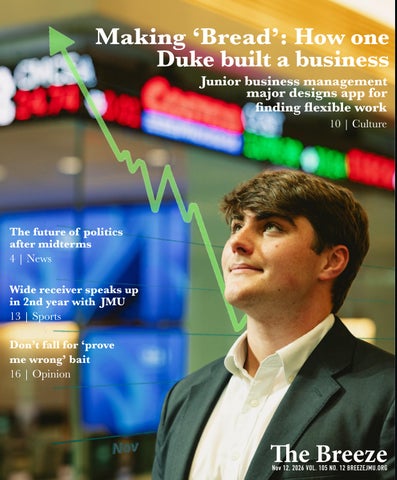
Making ‘Bread’: How one Duke built a business Junior business management major designs app for finding flexible work 10 | Culture
The future of politics after midterms 4 | News Wide receiver speaks up in 2nd year with JMU 13 | Sports Don’t fall for ‘prove me wrong’ bait 16 | Opinion
The Breeze Nov 12, 2026 VOL. 105 NO. 12 BREEZEJMU.ORG
Thursday, breezejmu.org Thursday,September November 17, 12, 2026 2026 || breezejmu.org Thursday, October 22, 2026 | breezejmu.org
Vol. 2 105, No. 5 Vol. 105, No. 9
Vol. 105, No. 1223 19
Banking Fit For Dukes!
CommonWealth One is James Madison University’s trusted, full-service financial institution. We’re conveniently located on campus and offer everything you might need financially as a student. What we don’t have? Excessive and unnecessary fees.
Lorem
Our Student Accounts Come With: 4.00% Cash Back with Kasasa Eats® Checking — Feed your stomach and your wallet.1
2.00% APY* with Kasasa Saver® — Make your money work harder.1
Duke Dog Debit Card with access to 80,000 free ATMs — Swipe with pride.
Duke Dog Credit Card with no annual fee and a low, variable rate — Build credit wisely.2
Online and Mobile Banking — Access to your money 24/7.
On-Campus Branch and ATMs — Convenience is steps away, no car required.
Open an account today at cofcu.org/Dukes-Banking!
Student Success Center (Main Floor) The Union (Next to Post Office) Monday-Friday: 9:00 a.m. - 5:00 p.m.
@jmucommonwealthone
Annual Percentage Yeld (APY). 1When you qualify. Membership eligibility required. Ask a representative or visit cofcu.org/Dukes-Banking for complete details. 2Credit subject to approval. Federally Insured by NCUA. Equal Opportunity Lender. Kasasa Eats® and Kasasa Saver® are trademarks of Kasasa, Ltd., registered in the U.S.A.
*
v04.25.25
Vol. 105, No. 12
Breeze Editorial Staff
EDITOR-IN-CHIEF Hannah Kennedy
ONLINE MANAGING EDITOR Emma Notarnicola
PRINT MANAGING EDITOR Preston Comer
thebreezeweb@gmail.com
breezepress@gmail.com
NEWS EDITORS Charlie Bodenstein & Emma Brown
SPORTS EDITORS Madi Perini & Libby Mercer
CULTURE EDITORS Bella Arist & Audrey Fletcher
breezenews@gmail.com
breezesports@gmail.com
thebreezeculture@gmail.com
COPY EDITORS Kayla Katounas & Luke Faircloth
AUDIENCE EDITORS Isabel Lewis & Brandon Portillo Aponte
breezeeditor@gmail.com
breezecopy@gmail.com
thebreezesocials@gmail.com
“E-Pro” by Beck
Stephen Lunde
ART DIRECTOR Kirah Villanueva
CREATIVE DIRECTOR
OPINION EDITOR Katie Mae Yetter
AD DESIGNERS
breezephotography@gmail.com
breezeopinion@gmail.com
Lee Hummel | Kenny Warlick
DUKES DUKES EAT EAT
his own experiences struggling to find part-time work to provide flexible job opportunities through the app.
Subscribe to our newsletter:
EXECUTIVE DIRECTOR
PHOTO EDITORS Caden Burch & Landon Shackelford
Weaver founded digital marketplace app COVER PHOTOS: LANDON SHACKELFORD / THE BREEZE ‘Bread.’ Weaver took inspiration from PHONE: (540) 568-6127 FAX: (540) 568-7889
jmubreezetv@gmail.com
Advertising Staff
Heidi Ellison
Junior business management major Colby
1598 S. Main St. Harrisonburg, VA 22801
TV NEWS DIRECTOR Lauren Keller
thebreezeartdirector@gmail.co
ON THE COVER COVER BY: KIRAH VILLANUEVA
3
Thursday, November 12, 2026 | breezejmu.org
DOMINO’S DOMINO’S
Apply to join our team:
“All My Love” by Noah Kahan “Rainbow Connection” by Kermit
Corrections If you have any corrections, please contact the section editors via their designated email or the editor-in-chief at breezeeditor@gmail.com.
ENTIRE ONLINE ORDER AT MENU PRICE
COUPON CODE 1126
BE WHERE THE STUDENTS ARE Online. On Campus. On Point.
ADVERTISE WITH THE BREEZE thebreezeads@gmail.com
NEWS
4
EDITORS Charlie Bodenstein & Emma Brown
EMAIL breezenews@gmail.com
‘The least bad option’ Democrats still won’t get much done after midterm elections, JMU expert says
By CHARLIE BODENSTEIN The Breeze
In the 2026 midterm elections, the blue wave swept the nation, with Democrats retaking control of both the House of Representatives and the Senate in what many are calling a rebuff of President Donald Trump’s administration. Democrats have won a 255-168 majority in the House and a 54-44 majority in the Senate, according to the Associated Press as of Nov. 11. This is partly due to the seven Senate seats that Democrats flipped in states such as Texas, South Carolina and Kansas. As of Nov. 11, the Associated Press has not called the Senate election in Alaska. Democrats also flipped governorships in Texas, Nevada, Ohio, Iowa and Georgia, giving the party the majority of governorships. But in the aftermath of these midterm victories, questions still remain about how the country will change now that Democrats control Congress. To answer these questions, The Breeze sat down with JMU political science professor and elections expert Martin Cohen. Here’s what he had to say about the elections:
Democrats still seen as ‘least bad option’
Cohen said Democrats were so successful in the midterm elections because of the “country’s dissatisfaction with the Republican Party” during Trump’s second term. Even though Trump wasn’t on the ballot, many voters made their decisions with the president in mind, Cohen said, calling the election a “rebuke” of his administration and his policies. “Trump has made the Republican Party really indistinguishable from himself,” Cohen said. “The party is personified by Donald Trump.” The opposition party to the president has gained House seats in 18 of the last 20 midterm elections from 1946-2022, with an average of 26 seats per year, according to Al Jazeera. Cohen described the midterm election as a pendulum swing between Democrats and Republicans, and whether Democrats will maintain power in the 2028 elections and beyond still unknown. “The American public doesn’t have patience for these parties when they get into power,” he said. “The parties also don’t necessarily try very hard to expand their coalitions past what will get them elected and reelected back into power.”
If Democrats win the presidency in 2028, Cohen said, the first two years will be an important test on whether the party will “get things done” and improve its relationship with the American public. Currently, he added, Democrats are seen as the “least bad option, and nothing more than that.” With the 2028 presidential election around two years away, speculation has begun over the Republican and Democratic nominees. Names such as Georgia Sen. Jon Ossoff (D), New York Rep. Alexandria Ocasio-Cortez (D) and Vice President JD Vance (R) are currently considered some of the frontrunners for the nominations. Cohen said Democrats are still operating as “challengers to the status quo” despite their midterm victories. He added that Democrats will have to answer for the state of the country over the next two years, even though Republicans control the presidency. “The American public is very fickle,” Cohen said. “Democrats might have to share some of the blame.” One thing to note with the Democratic victories, Cohen said, is that if Trump appoints new members to his Cabinet, they will now have to be confirmed by a Democrat-controlled Senate, which could affect who Trump chooses. However, Trump hasn’t lost his veto power. He still holds the power to veto any “progressive” legislation from the new Congress that lands on his desk, Cohen said. Because of this, Cohen questioned how much can realistically get passed for the rest of Trump’s term. “A lot will change, not a lot will get done,” Cohen said. Cohen said Democratic control of Congress is “really important” because of its power to confirm political appointees, pass new legislation, issue subpoenas and even impeach some of Trump’s Cabinet. Cohen said that Defense Secretary Pete Hegseth is potentially being used as a “scapegoat” for the Republicans’ losses in the midterms due to the unpopularity of the Iran War, which was started by the Trump administration in February. The House shelved an effort to impeach Hegseth on Nov. 10 after Republican Rep. Thomas Massie introduced articles of impeachment against the Pentagon chief, accusing Hegseth of high crimes and misdemeanors. However, Cohen added that besides impeachments, Democrats may focus on Congressional investigations and hearings to guarantee the American public realizes
the potential corruption within the Trump administration. “They may be able to continue to have success in fighting against a Republican Party led by Donald Trump that has really pushed the boundaries further than anyone could ever have imagined,” Cohen said.
Virginia midterms
The midterms in Virginia saw incumbent Democratic Sen. Mark Warner retain his seat along with Democrats Shannon Taylor and Elaine Luria defeating incumbent Republicans in the 1st and 2nd Congressional Districts, respectively. Virginians also voted to pass three proposed state constitutional
amendments regarding reproductive care access, same-sex marriage and restoration of felons’ voting rights. In the 6th Congressional District, where Harrisonburg and JMU are situated, incumbent Republican Ben Cline defeated challenger and Democrat Beth Macy. In VA-06, Macy won 44.5% of the vote, giving Cline his closest race ever against a challenger. Cline has held the seat since 2019 and often aligns himself with Trump despite not receiving his endorsement during the election cycle. Despite Macy’s loss, Cohen said she still cut Cline’s margin of victory in half compared to past elections. But, he said this election cycle was the best chance for Cline to be defeated due to low Republican voter turnout. However, Cohen said Cline will be harder to beat next time around due to the 2028 presidential election bringing a higher voter turnout. In the 5th Congressional District, which has been a historically Republican seat, Democrat Tom Perriello narrowly lost to Republican John McGuire two days after the Associated Press said the race was too close to call on election night. Cohen said that if Perriello were to run again, he would have a solid chance at winning. “The Democratic wave was in Virginia, it just didn’t get to the point where it could flip more than the marginal seats,” Cohen said. As newly elected senators, representatives and governors settle into their positions, political experts like Cohen will be watching closely to see the extent of the impact this past election will have on the United States’ future. Cohen said he’s specifically interested to see whether the Democrats’ victories can be attributed to a national reproach against Trump and the GOP or toward the effor ts of individual candidates.
Landon Shackelford / The Breeze
CONTACT Charlie Bodenstein at breezenews@ gmail.com. For more coverage of JMU and Harrisonburg news, follow the news desk on X @TheBreezeJMU and on Instagram @BreezeJMU.
NEWS
5
Thursday, November 12, 2026 | breezejmu.org
Residents, Dukes demand City Council pass collective bargaining ordinance By LIBBY MERCER The Breeze Harrisonburg Department of Public Transportation (HDPT) drivers gathered in City Hall on Tuesday night, asking the Harrisonburg City Council to pass a collective bargaining ordinance (CBO) to negotiate wages and working conditions during its scheduled meeting. Collective bargaining is the negotiation process between the city and a labor union that works to establish workers’ rights. HDPT transit driver and chair of Amalgamated Transit Union Local 1220’s Harrisonburg branch Austin Moody said the goal of the CBO is to allow the transit workers to negotiate living conditions. Currently, it is illegal in Harrisonburg for public workers to engage in collective bargaining, due to a veto from Virginia Gov. Abigail Spanberger on a House bill to establish public sector collective bargaining. Moody said they hope to change that. “We’ve been excited, rallying our coworkers to get behind what we feel is a good cause to improve our working conditions in a city where the wage required to live in it and afford groceries keeps rising and rising,” Moody said. A majority of HDPT bus operators have signed union authorization cards with the Amalgamated Transit Union Local 1220, and Moody said they are looking to bargain under Virginia Code sections 40.1 and 57.2 for the order. “We aren’t asking you to invent anything new when it comes to a bargaining ordinance,” Moody said during public comment. “We’re asking you to follow a model that already works an hour away in the city of Charlottesville, as well as every other major public transportation system in the entire state.” Charlottesville’s union ordinance was passed in 2022, taking effect the following year. The group has taken the Charlottesville ordinance and tailored it to suit Harrisonburg’s civil code, Moody said. He added that the Charlottesville ordinance is a “starting point” from a city that has tested it and is comparable to Harrisonburg. After Moody spoke, JMU students and local residents who rallied in support took a stand to voice their opinions.
“Partner with them, trust them to have the best interests of their positions and the citizens of this city at heart,” Harrisonburg resident Andrew Thompson said. The JMU Student Labor Alliance posted on its official Instagram, urging students to “demand [City Council] pass an ordinance granting public workers the right to bargain over pay and working conditions,” the Nov. 6 post read. “Student organizations are particularly really important in supporting things like this because without the bus drivers, we won’t be able to get around on campus,” JMU graduate student Jade Oh said in a Breeze interview. JMU student and transit bus driver Levi Riffey said during public comment that 63 JMU students signed a petition to the Harrisonburg City Council and Municipal Administration to stand with the public sector workers in their efforts to unionize and achieve collective bargaining. Harrisonburg resident and social worker Rachel Sullivan noted how turnover causes disruptions, something she’s seen when her kids’ bus drivers don’t know the new routes. “I don’t blame the workers,” Sullivan said. “This is the system that we’re all up against … if we, as a city, can come together and help continue to support any of our workers, all of our workers, all of our vulnerable populations, we all succeed.” • • • *
Other matters at the meeting
The three council members approved a request to amend a zoning ordinance to change the definition of “shopping center.” Councilmembers Monica Robinson and Laura Dent didn’t attend the meeting. Kelly Schaffer of Foundations for Families presented findings on how to improve access to childcare in Harrisonburg. With a remaining $9,387.62 of American Rescue Plan Act (ARPA) funding, the council has reallocated those funds to help the ongoing repaving of Northeast neighborhood.
CONTACT Libby Mercer at breezesports@gmail.com. For more coverage of JMU and Harrisonburg news, follow the news desk on X @TheBreezeJMU and on Instagram @BreezeJMU.
Harrisonburg residents and students demanded collective bargaining at Tuesday’s City Council meeting.
Vice Mayor Dany Fleming at the meeting. Landon Shackelford / The Breeze
6
Thursday, November 12, 2026 | breezejmu.org
Vol. 105, No. 12
Student Gov. allocates $6,000 in funds, creates new position By JACK FRIEDMAN The Breeze
The Student Government Association (SGA) approved $6,000 in contingency funds for Club Cross Country/Track and Field, and College Mentors for Kids. The SGA also voted to create a new position for a student representative to the Basic Needs Advisory Board during its weekly Tuesday meeting.
SGA allocates $6,000 in funds
SGA allocates $6,000 in funds to JMU Club Cross Country/Track and Field and College Mentors for Kids. Caden Burch / The Breeze
SGA first heard from JMU Club Cross Country Track and Field, when requested $3,000 for new hurdles, club president and junior finance major Henry Gemerek said. Gemerek added that the club provides an inclusive space for runners of all levels to improve, build friendships and promote mental and physical wellness. Gemerek and treasurer junior engineering major Carson Redmong said the lack of hurdles make hosting meets a struggle.They added that the hurdles will allow the club to expand to include more members. “We’re shooing away almost 30 people every single year because we don’t have equipment,” Gemerek said. The request was approved uninamously. College Mentors for Kids then requested $3,000 for transportation costs for second through fourth-grade students in its afterschool program, senior computer information systems major and club vice president Will Hart said.
College Mentors for Kids provides a free after-school program, pairing elementary schoolers with college students as mentors, Hart said. The club is a part of a larger, nationwide organization. It aims to positively impacts children’s futures and inspire growth, Hart said. Hart said the club’s biggest expense is transportation, adding that it spends over $12,000 on buses to take the students between their schools and JMU. The club has no dues, so it relies heavily on fundraising. SGA unanimously approved the request.
SGA creates new position
The SGA ended its meeting by unanimously voting to create a new position, the SGA representative to the Basic Needs Advisory Board. This position allows SGA to better collaborate with the Basic Needs Advisory Board, an organization made up of faculty, students, and staff who advocate for resources and policy changes to support students who are struggling financially, according to JMU, helping them better understand the broader student body. CONTACT Jack Friedman at friedmjh@ dukes.jmu.edu. For more coverage of JMU and Harrisonburg news, follow the news desk on X @TheBreezeJMU and on Instagram @BreezeJMU.
Vol. 105, No. 12
7
Thursday, November 12, 2026 | breezejmu.org
Hannah Kennedy / The Breeze
Years into its housing crisis, the city struggles to break ground By HANNAH KENNEDY The Breeze Editor’s note: Housing statistics accurate as of October 2026, per Harrisonburg Director of Community Development Adam Fletcher The City of Harrisonburg has been facing a housing crisis for at least six years; but since then, only six of the 45 cityapproved housing projects have been built. According to the city-commissioned 2021 Comprehensive Housing Assessment and Market Study, Harrisonburg is facing shortages and economic “mismatches” for renters, homeowners and those with supportive care needs.
What the housing crisis looks like in Harrisonburg
The Harrisonburg City Council discovered a growing demand for government-subsidized housing and low-cost rentals in 2020, a national trend that impacted Harrisonburg, Vice Mayor Dany Fleming said. To evaluate the area’s residential needs, the City Council commissioned the Housing Assessment, outlining a series of steps to address the crisis. The first step: hire a housing coordinator to implement these strategies. “When everyone has housing that they can afford, that is safe, they can be better members of the community,” Housing Coordinator Liz Webb, who assumed her role in 2022, said. Low-income and disabled individuals have an immediate need for housing due to a lack of homes and a “housing mismatch,” according to the study. This “mismatch” refers to higher-income individuals renting below what they can afford, decreasing the availability of affordable properties. The city’s vacancy rate has stayed relatively stable since 2022 at only 2% to 3.5% of units, Webb said. She added that anything below 5% indicates a tight housing and rental market. “What’s affordable isn’t necessarily available,” Webb said. “Building in the city has slowed down over the last decade or so … some of that’s land pricing, some of that’s zoning … some of that is just market fluctuations and interest rates.”
Webb said economic strain since the COVID-19 pandemic is a large factor in slower building rates. She added that increased interest rates, material costs and labor shortages have had a significant impact on development in the city. “We have a serious need for people with the lowest income to have access to safe and affordable housing,” Webb said. “That’s a big gap, and it’s a critical gap.” Webb added that the broadest need is for homeownership opportunities for families with a range of income, and though less critical, is just as important. “It’s like laundry where, if you get behind, it’s even harder to catch up,” Webb said.
Housing approval process
Adam Fletcher, Harrisonburg director of community development, has been tracking non-student housing developments approved for use by City Council since 2021. Though the approval process for these projects is complicated, Fletcher said, it follows a similar outline. It first depends on whether the land is owned “by-right” or needs a special-use permit. With by-right, the landowner does not need to ask the city for additional permission, as the land is zoned for that purpose. The city’s Land Use Guide serves as a plan for building and by-right zoning within the city, based on its Housing Assessment. When the landowner wants to build outside of their zoning restrictions, they need a use-approval from the city. They then have two options: apply for a special-use permit from the city, or try to rezone the property. The Planning Commission, after hearing the request, makes a recommendation to City Council, which then hears from the public and votes on the proposal. From there, Fletcher said, it’s up to the developer to move forward with the project. Only 153 of 3,986 use-approved (not-by-right) homes have been completed in Harrisonburg since 2021. The rest are still in one of the following phases: Fire Review (ensuring fire safety, accessibility and water compliance), Engineered Comprehensive Site Plan, Notice of Site Plan Acceptance (project meets the design criteria but has not
fulfilled all obligations to begin construction), No Activity, or Under Construction.
Room for improvement
Local land use and zoning lawyer Todd Rhea estimates the city is still facing a 2,000-home shortage. Rhea regularly works with national and local developers to build in Harrisonburg, facilitating communication with City Council. Rhea attributed the bulk of this issue to the city’s Land Use Guide, comparing it to Rockingham County’s Comprehensive Plan. Rhea applauded Rockingham’s increased housing, which he said draws in and sustains businesses, leading to economic growth. “There’s so many holes in the city housing market at every level and at every type … this is a pervasive shortage,” Rhea said. Rockingham rezoned its land for clear purposes and guidelines for compact development, Rhea said, reducing a lot of uncertainty for developers. “That’s the power of how policy works in land use,” Rhea said. “Predictability drives process.” However, Rhea said, Harrisonburg city officials are asking for more detailed plans before approving rezoning or special-use permits, despite the ongoing housing crisis. Hiring lawyers, commissioning local impact studies and now delivering detailed plans before securing rezoning could cost a developer around $250,000 before even seeing City Council, Rhea said. This is a risk smaller developers can’t take. Beyond this, Rhea said there’s typically a threeyear window between rezoning and breaking ground, which both slows down and discourages building. His recommendation to the city? Remove some of this red tape to incentivize developers. “If you’re pro housing, be pro housing,” Rhea said, “let it be built.” CONTACT Hannah Kennedy at breezeeditor@gmail. com. For more coverage of JMU and Harrisonburg news, follow the news desk on X @TheBreezeJMU and on Instagram @BreezeJMU.
8
Thursday, November 12, 2026 | breezejmu.org
Vol. 105, No. 12
CULTURE
Thursday, November 12, 2026 | breezejmu.org
09
CULTURE EDITORS Bella Arist & Audrey Fletcher
10
EMAIL thebreezeculture@gmail.com
‘The one-stop shop for a job’ Junior builds app to facilitate part-time job opportunities
By BELLA ARIST The Breeze “People are so much more capable than they think they are,” founder of the digital marketplace Bread and JMU student Colby Weaver said. “I didn’t think I could build a company and create all this, but I ended up doing it.” For Weaver, a junior business management major with a concentration in entrepreneurship, that mindset turned a personal frustration into a growing business. Weaver founded Bread to connect people looking for flexible work with homeowners who need help with everyday tasks. What began as an idea during fall break last November has blossomed into a business Weaver built himself, from coding the platform to marketing its launch. Weaver’s own experience trying to find work inspired the app. While home for fall break, he said he struggled to get money from the part-time construction job he worked over the summer because of scheduling conflicts. Looking for a way to make money quickly, he realized traditional jobs didn’t always offer the flexibility he wanted. Weaver said he wanted a system that would allow people to find jobs independently, set their own schedules and earn money on their own terms. “I was my own customer at that point,” Weaver said. “So I really just had the idea of, ‘what could I do to bring these jobs to a system with more freedom.’” This idea eventually became Bread. The platform helps workers to find opportunities for tasks such as cleaning, moving, yardwork and other household projects. Homeowners can also connect with people in their communities to get those jobs done. Bread is designed to give workers more control over the services they offer, their schedules and their rates, Weaver said. Features like payment protection and background checks create a more “reliable experience” for both sides of the marketplace, he added. “My motivation, day in and day out, hasn’t been the return or the revenue side of it,” Weaver said. “This is a problem that I dealt with for way too long, and I want to solve this for the next kind of people coming in.” Weaver said he began developing Bread on March 31, 2026, and officially launched the platform on the App Store on July 1 of the same year after being denied by the App Review Guidelines nine times. Without a team of developers, Weaver said he taught himself how to code and promote the platform. He added that he relied on YouTube videos, research and conversations with other entrepreneurs to learn the skills needed to get Bread off the ground. Weaver said that within its first few weeks, Bread gained around 2,000 users nationwide. Outside of Bread, Weaver manages a full college schedule. He is also the vice president of JMU’s Club Lacrosse team and in the Iota Delta chapter of Sigma Nu, a social fraternity at JMU. His fraternity and lacrosse team gave him feedback from day one about his company, and he said his community has been supportive through the whole process. Being a student entrepreneur also means recognizing the opportunities available through JMU. He said students should look “beyond their coursework and take advantage of the professors, connections and resources the university provides.” “People have no idea how useful this school is, beyond the degree,” Weaver said. In the fall of his freshman year, Weaver took BUS 160. “After my group finished our project, I went up to [JMU marketing] Professor Fadi [Majzoub] and asked, ‘Is starting a business really this easy? Is this really all you need?’ He said, ‘Well, of course.’ That was a huge perspective shift for me,” Weaver said. He also connected with his COB 204 professor for guidance with coding the app. “Professors are human too, and you can learn so much more from them than just asking them to curve your grade … there is so much more behind them than teaching,” Weaver said.
Programs like Bluestone Seed Fund, Fallon Challenge and the Gilliam Center for Entrepreneurship are open to JMU students with an idea, all of which Weaver said he took advantage of. For other students looking at entrepreneurship, Weaver’s advice is to see their potential and never let uncertainty stop them from pursuing an idea. In the future, Weaver hopes Bread will become a “recognizable platform for people seeking independent work.” His goal is to expand the marketplace and create a space where anyone can find opportunities to work on their own terms. “I see Bread in five years as the one-stop shop for a job,” Weaver said. “If anybody needs to work for anything on their own regard, Bread is where you go for it.” Although building a company while attending college has its challenges, Weaver said his motivation continues to come from the issues that inspired the business in the first place. “I’ve dealt with this problem my entire life,” Weaver said. “I would do anything to solve it.” Weaver grew up with a strong support system within his family that pushed him to always go after what he wants. During his sophomore year of high school, Weaver’s father passed away. “It showed me how a kid that had everything going for him can have it taken away overnight … I had to find myself again,” Weaver said. He said his family taught him not to worry about the finish line, but instead to work hard every day and trust the process. “My dad always told me, ‘If you want something, you’ve got to go out and get it.’ Nobody’s going to hand it to you, and everything is earned, not given,’” Weaver said. CONTACT Bella Arist at thebreezeculture@gmail.com. For more on the culture, arts and lifestyle of the JMU and Harrisonburg communities, follow the culture desk on X @TheBreezeJMU and Instagram @BreezeJMU.
Colby Weaver developed Bread, which launched July 1. Landon Shackelford / The Breeze
Weaver is the vice president of Club Lacrosse and is involved with Sigma Nu. Natalie DeLise / The Breeze
11
Thursday, November 12, 2026 | breezejmu.org
CULTURE
Student barber cuts Clavicular’s hair on livestream By EDISON VRANIAN The Breeze
Freshman business management major Daniel Robbins has a unique aspiration: to cut celebrities’ hair. His account cutbydan_ on Instagram currently has 2,682 followers, with his most popular video has over 1 million views. Robbins recently had the opportunity to give a haircut to streamer and TikToker Clavicular, whose real name is Braden Eric Peters. He is known for making “looksmaxxing” content, which aims to teach men how to perfect their looks, according to Cosmopolitan. On Oct. 6, Robbins flew out to Los Angeles, California and cut his hair in the mansion Clavicular rented out. Five days later on Oct. 11, Robbins posted about cutting Clavicular’s hair on his Instagram account with the caption “Light trim for @clavicular.” The post has received 2,758 likes, as of Nov. 11.
“It was not on my 2026 bingo card,” Robbins said. Robbins said he connected with Clavicular after texting one of his assistant managers. Robbins said some of his friends saw Clavicular’s livestream of him getting the haircut before Robbins made the Oct. 11 post. Robbins said cutting Clavicular’s hair felt like a “house call on steroids.” Peters is currently facing felony rape and drug allegations from a 2025 livestream incident in Massachusetts and has pled not guilty to all charges according to an October, 2026 article from NPR. “Despite his controversiality, he’s a pretty nice guy,” Robbins said. “His team was pretty cool. They’re all really nice; they treated me really well.” Robbins’ friend and client, freshman information technology major Elnatan Asefa, found out Robbins was cutting Clavicular’s hair via social media. “I didn’t even know until he posted on his social media, ‘I’m going to cut up [Clavicular’s hair] as content and stuff,’ and I swiped up,” Asefa said.
“I was like, ‘there’s no way.’ I thought it was a pretty cool opportunity for him, especially because he’s trying to grow his business and brand.” While Robbins has now done work for a well-known client, he said his journey as a barber began when his parents took him to a local barber that he didn’t like. “[My parents] forced me to go to a really bad barber shop from middle school to high school, and so I really disliked it,” Robbins said. “I started cutting my own hair, and then it went from there.” From cutting his own hair and practicing his skills on his twin brother, his practice turned into three years of experience. Asefa and Robbins are both from Northern Virginia. Read more online at breezejmu.org CONTACT Edison Vranian at vraniawe@dukes.jmu.edu. For more on the culture, arts and lifestyle of the JMU and Harrisonburg communities, follow the culture desk on X @TheBreezeJMU and Instagram @BreezeJMU.
The mountains are calling and students are answering
His aspirations are to continue cutting celebrities’ hair.
Robbins’ profile is popular among JMU students. Photos courtesy of Daniel Robbins
By SOPHIA ABOUSAMRA contributing writer
“When we did Three Ridges, we were prepared for whatever it was going to take, but we did it in reverse, starting from the steep side, and we were like, ‘God, this is awful. Why would we ever do that?’” Frary said. Despite the challenging terrain, Frary said the peacefulness of the outdoors is what keeps him coming back. “I love being out there and experiencing nature, because at least in my opinion, we as an age group need to spend more time doing things outdoors,” Frary said. “Everyone needs to get out just a little bit more.” Sophomore business management major Maddie Lorey said she always makes time for hiking, typically going about twice a month with her friends. “I love the convenience of the hikes,” Lorey said. “That was actually a big part of why I actually chose JMU, because of the proximity to the mountains.” However, reaching the mountains isn’t always easy. For Lorey, finding ways to get outdoors during her freshman year required a little more planning. “I think if hiking is accessible, then JMU students should take advantage of the nearby trails,” Lorey said. “But at least my freshman year, it was hard because I didn’t have a car, and of course, there are clubs and UREC provides spots, but it’s not always accessible.” While transportation can make it difficult for some students to explore the surrounding area, Lorey said she wants more students to know that hiking isn’t always a huge expense.
Amid many assignments piling up and the countless hours of screen time that comes with completing them, for many JMU students, it’s important to get outside and touch grass. For junior public relations major Cameron Frary, hiking is a way to escape campus life. Frary said he typically hits the trails once a month with his roommates or friends, taking
advantage of the mountains being just a short drive from JMU. One of his favorite experiences, he added, was a two-day backpacking trip through Three Ridges Loop, located about 45 minutes from JMU. “It was incredible but definitely hard,” Frary said. The roughly 14-mile loop takes hikers across three mountain ridges, but Frary said he and his roommates quickly learned that tackling the trail came with its challenges.
The Shenandoah Valley offers plenty of opportunities to take in the scenery. Landon Shackelford / The Breeze
“There are pretty accessible hikes that you don’t need to pay to get to,” Lorey said. For students who do have the opportunity to get out and explore, Frary said a big misconception around hiking is that it takes an entire day and plenty of preparation. “You could go on a 20-minute hike in the mountains that is easy, flat, and it’s not going to make you super tired,” Frary said. “You can go out for 20 minutes and still see these incredible things that we don’t get to see around here.” For students who have never hiked before or feel intimidated by the idea of hitting the trails, Frary and Lorey both encouraged them to give it a chance. “I think everyone should get out there at least once,” Frary said. “It’s extremely convenient for students to be able to go into the Shenandoah Mountains just a short drive from JMU.” Whether it’s a challenging backpacking trip with friends or a quick walk through the mountains, students don’t have to travel far to find a change of scenery. With the Shenandoah Valley so close by, sometimes the best way to take a break from campus is to leave it behind for a little while. After all, there’s more to life than what’s happening on a screen. CONTACT Sophia Abousamra at abousasl@ dukes.jmu.edu. For more on the culture, arts and lifestyle of the JMU and Harrisonburg communities, follow the culture desk on X @TheBreezeJMU and Instagram @ BreezeJMU.
CULTURE
Thursday, November 12, 2026 | breezejmu.org
Why filmgoers are choosing franchises over original movies By JACK MCGUINNESS The Breeze Not that long ago, the decision to see a film in theaters was much simpler. A new movie comes out, it looks good and you buy a ticket. It was that easy. Today, audiences are a little more selective about where they spend their money, and the movies getting people into theaters aren’t necessarily originals. Sequels, remakes and reboots have become some of Hollywood’s biggest box-office attractions. Whether it’s the newest “Hunger Games” or a reboot of a childhood classic, now most audiences can go into the theater with some idea of what to expect. Original films, however, have had a harder time convincing people to take a chance on something unfamiliar. Senior communications major Amman Bisrat said that the familiarity of an established franchise can make it more appealing than something completely new. “I just know what I’m going to get,” Bisrat said. That preference reflects a larger challenge for original films: convincing audiences to spend money on a story they have never experienced before. For senior English major Camille DiPatri, the decision often comes down to whether a movie is worth the price of admission. “As somebody who isn’t making money right now, [the cost] definitely does influence my decision to see [it],” DiPatri said. She said she typically goes to the theater once or twice a month, often with family or friends from JMU’s film-watching and filmmaking clubs. If a movie doesn’t interest her, she’s comfortable waiting. “If I don’t have anybody who wants to see it with me, I’ll just wait until it’s on a free streaming service,” DiPatri said. With streaming services increasing the accessibility for watching movies at home, spending money on something unfamiliar becomes harder to justify. For Luke Schwartz, a senior information technology major and avid Letterboxd user — a website where users can log and review the movies they’ve seen — the decision to see a movie is a little different. He’s said he’s seen roughly 35 films in theaters this year alone, but even he recognizes the appeal of established franchises. Before the COVID-19 pandemic, Schwartz said he tended to watch sequels, particularly Marvel movies. Since then, he’s made an effort to branch out. Now, he said his moviegoing experience is roughly split between original films and established franchises. “I’m kind of picky on franchises,” Schwartz said, explaining how he’s much more likely to see another “Godzilla” movie because he’s a lifelong fan of the character.
He added that sometimes, his interest in a movie comes down to hearing people talk about it. “I would say really it’s just buzz,” Schwartz said. He pointed to Letterboxd, online discussions and word of mouth from friends as major influences on his moviegoing decisions. In fact, Schwartz said that is a major advantage original films have over sequels. “The nice part about a non-sequel is that I don’t have to do homework,” Schwartz said. Some major franchises have become increasingly complicated, where watching one installment might necessitate catching up on several others just to understand what’s happening. For audiences who aren’t fully invested, that’s a huge commitment. Conversely, DiPatri said recognizable actors and characters can make her more interested in seeing a movie, adding that nostalgia also plays a role. “When I see a sequel coming out of a movie that was iconic 20 years ago, it definitely is exciting,” DiPatri said. “Just because I’m like, ‘Oh, that was like a childhood classic for me, and they’re making a new one.’” Still, excitement doesn’t necessarily mean confidence. DiPatri said occasionally she’s skeptical about whether another sequel is actually necessary, or if it will live up to the original. From a business perspective, studios have an obvious reason to keep making sequels: an established property already has an audience, whereas an original film is essentially starting from scratch. Schwartz said he understands that reasoning, even if he isn’t thrilled about it. “I think Hollywood is relying on sequels,” Schwartz said. He added that he wishes studios would take more chances on original stories. Supporting those films is one of the reasons he goes to theaters in the first place. “Part of the reason I also go to the movie theater is because I do want to support original films,” Schwartz said. There’s ultimately no single reason audiences have become more selective about original films. Ticket prices, streaming services and franchise familiarity all play a part in it. When a moviegoer has to choose between spending $15 on something potentially unfamiliar or another installment in a series they already love, it’s not difficult to understand why Hollywood keeps going back to the same old well. The question is whether audiences will eventually get tired of drinking from it. CONTACT Jack McGuinness at mcguinjr@ dukes.jmu.edu. For more on the culture, arts and lifestyle of the JMU and Harrisonburg communities, follow the culture desk on X @ TheBreezeJMU and Instagram @BreezeJMU.
Regal Cinemas is a hub for moviegoers in Harrisonburg. Caden Burch / The Breeze
12
SPORTS
EDITORS Madi Perini & Libby Mercer
13
EMAIL breezesports@gmail.com
Caden Burch / The Breeze
‘He has a high care factor’ Wisloski cements his role as a leader on offense By LIBBY MERCER The Breeze
Wisloski has tallied two receiving touchdowns and 29 receptions for 385 yards across 10 games. Breeze file photo
During spring practice, fourth-year wide receiver Braeden Wisloski asked position coach RJ Fleming “how can I be a better leader?” “I feel like I took a major step in my leadership role [this season],” Wisloski said. “I was never really a leader type of guy, but coming back and seeing how young our room is, I was like, someone’s got [to make a] change.” Fleming said Wisloski has “bought into” his role as a leader. “He’s very aware that we need him to be at his best as far as leadership, in order for the room to really trend,” Fleming said. As someone who started his career as a special teams returner at Maryland in 2023, Wisloski isn’t a stranger to taking on some of the “dirty work.” “Normally good things happen for those people on the back end,” Fleming said. “You’re seeing [Wisloski] be a beneficiary of that because he’s kind of put everybody else before himself.” As a key piece of JMU’s offense, Wisloski has had 35 receptions for 743 total yards in two seasons. This season, with offensive coordinator Cam Aiken’s scheme, Wisloski has tallied two receiving touchdowns and 29 receptions for 385 yards across 10 games. “I think I fit in very well with the scheme of things and what [Aiken] does with the ball,” Wisloski said. “Just everything about the offense.” Last year, Wisloski carved out a role in the offense as one of the team’s top contested catchers. He hauled in four contested touchdowns in 2025, and by his account, he “Mossed” the defender on each one — a term referring to outleaping a defender to make a catch, popularized by Hall of Fame receiver Randy Moss. This season, “Mossing” defenders hasn’t quite been his role. Wisloski said it’s been more of a “get the ball in space” type of player. Fleming said he thinks there will be moments when they will go back to “old-school Wis[loski] things.” “Got full conviction in that guy that he’ll be open at the right time at the right spot, and I know he’ll make the play,” Fleming said. “He’s still got so much more on the plate that he can go and get.” Aiken said Wisloski could probably play every position on the field.
“[He’s] a guy that is incredibly smart,” Aiken said. “[He] understands what we’re trying to do conceptually offensively.” At Maryland, Wisloski ranked third in the Big Ten for kickoff returns and earned a weekly conference award in 2023. Now, with second-year wide receiver Michael Scott as the main kickoff returner for the team, Wisloski primarily serves as a blocker on special teams. “Wis[loski] is back there in the mud with that guy and kind of rolling up his sleeves and blocking linebackers and defensive ends who are screaming downhill and have one job and one thing on their mind,” Fleming said. “He’s making sure he protects Michael Scott.” Scott and Wisloski have a special bond, Wisloski said. “They really love and enjoy being around each other,” Fleming said. “They truly have a brotherhood that’s pretty rare. I think it’s contagious for the rest of the room.” The entire wide receiver room has a similar bond. Wisloski said the room “plays for each other.” “We’re always happy for someone [else],” Wisloski said. “Corey [Scott] had a great game last week. We were all super happy for him. There’s no one that’s mad about that … that’s a really good thing about our room is we all love each other, and we all want everyone to do great.” Wisloski is someone with a “high care” factor, Fleming said. “He really cares about his teammates,” Fleming said. “He cares about winning. He cares about this program.” As someone who took the 2025 trip to the College Football Playoff with JMU, Wisloski keeps the younger guys at bay by focusing on one week at a time. “Every day [it’s] taking that step forward with worry about today, and not really think about the next game or what’s next for us,” Wisloski said. “Just having that mentality of keeping your head down and grinding every single day is what I really tell them.” CONTACT Libby Mercer at breezesports@gmail.com. For
more football coverage, follow the sports desk on X and Instagram @TheBreezeSports.
14
Thursday, November 12, 2026 | breezejmu.org
Vol. 105, No. 12
DJ Kelly makes quiet but impactful start as a Duke By MADI PERINI The Breeze
Second-year cornerback DJ Kelly has recorded 23 total tackles and four interceptions in 10 games. Caden Burch / The Breeze
In a typically loud program like JMU, other players lead best with their voices. But for second-year cornerback DJ Kelly, the loudest thing about him is his work ethic, cornerbacks coach Kyle Barnes said. Entering the portal after one season at Toledo, Kelly had almost no film aside from high school. He recorded just 10 total tackles and one sack. During the short portal recruitment period, JMU’s coaching staff had to rely on new-hire wide receivers coach RJ Fleming, who coached at Toledo and knew Kelly’s raw potential. “We trusted [Fleming]’s assessment,” head coach Billy Napier said. “We brought him in, we were impressed with the kid … [he’s a] really impressive young man.” Since getting to Harrisonburg, Kelly has become a regular starter in the secondary. Through 10 games, he has 23 total tackles and four interceptions, with two coming against Marshall. For Barnes, Kelly’s quick development shocked him. “It’s actually been surprising, for somebody as inexperienced as he was and as young as he is to take on a leadership role as early as he has … that’s not something you see all the time,” Barnes said. Kelly’s demeanor might seem counterintuitive, but his impact builds quietly both on and off the field. “He’s kind of a quiet guy — he doesn’t talk too much,” Barnes said. “When you spend time with him, you see his work ethic, you see how much he cares, and it’s an infectious personality. Once he recognized that people were gravitating to him, he realized the responsibility he had to take his leadership to another level.” JMU has adopted the phrase “race for knowledge,” pushing everyone in the program to be constantly learning. Kelly
displays the mantra daily by seeking feedback from the Dukes’ wide receiver room, Barnes said. “Being that hungry to get better ... it shows,” Barnes said. “Now your teammates are saying, ‘this guy is serious about his craft,’ and at the end of the day, it shows in his play on Saturday.” Kelly attributes his growth to his tight alignment with Barnes and the defensive staff, who do whatever it takes for the unit to be successful. “Coach Barnes is a great guy,” Kelly said. “He’s a young coach, so we have a great relationship. He relates to us as players and just pours a lot into our preparation. He’s here late, he’s here early and we’re right there with him.” Beyond his game-day performance, Kelly’s transition to JMU has been carried by what he does off the field. Weekly Bible studies, team dinners and church services help connect a totally new roster and, in turn, create a culture where players hold each other accountable, Kelly said. “If you don’t stand for anything, you’ll fall for everything,” Kelly said. “Just having that firm foundation and brothers to hold you accountable ... we know we’re playing for something bigger.” With just two regular season games remaining, Kelly’s focus is beyond himself — it’s on what this team still can accomplish. “I’m not worried about the individual stuff because that will come with doing your job and trusting your teammates,” Kelly said. “I definitely want to win [the Sun Belt]. That would be a big step forward for the program and for everyone on this team.” “I’m not worried about the individual stuff because that will come with doing your job and trusting your teammates,” Kelly said. “I definitely want to win [the Sun Belt] as a team. That would be a big step forward for the program and for everyone on this team. CONTACT Madi Perini at breezesports@gmail.com. For more football coverage, follow the sports desk on X and Instagram @TheBreezeSports.
Preview | JMU competes in its final regular season road matchup at UConn By MADI PERINI The Breeze
Following a dominant 54-23 bounce-back win over Southern Miss, JMU football (8-2, 5-2 Sun Belt) hits the road for its final regular-season road matchup against UConn (4-5). The Huskies present a balanced attack anchored by junior dual-threat quarterback Kalieb Osborne. Despite the Dukes’ 21 road wins since entering the FBS, UConn’s well-coached roster will present a challenge for JMU. “Coach [Jason] Candle’s teams are always very, very well coached,” head coach Billy Napier said. “This is going to require a lot of detail and discipline in terms of how we prepare this week and get ready for a really good football team.” Against Southern Miss, JMU’s defensive unit was dominant, holding the Golden Eagles to an average of 2.4 yards per carry. As the Dukes navigate the final game of an 11-week stretch without a bye, UConn’s offense will require high energy from the Dukes’ defense. “We have to be able to stay on top in an [offensive] line that works well together,” defensive coordinator Robert Bala said. “We’re going to have our hands full as we prepare all the way Saturday.” On the other side of the ball, the Dukes have been relying heavily on third-year quarterback JC Evans, who went 19-for-26 passing for 251 yards and a touchdown, as well as recording three rushing touchdowns. Fourth-year
quarterback Camden Coleman came in late, throwing 4-for-4 and a touchdown. With the changes at quarterback, Napier affirmed his confidence in the unit. “[I’m] really pleased with the kind of depth we have and how everybody’s done in that position.” A constant strength for JMU throughout the season is its special teams unit. Seventh-year kicker Morgan Suarez, who notched a career-high 18 points against Southern Miss, takes pride in the importance of the unit and how it will continue to flourish in the final games of the season. “The game will come down to 10 plays that could have changed the game,” Suarez said. “Maybe five of those are special teams.” Third-year linebacker JT Hooten, who recorded three sacks and eight tackles in Week 10, emphasized the challenges the Huskies present. “They’re a great opponent,” Hooten said. “So it’ll be a little bit of a challenge for us going into UConn to go up there and play.” JMU will kick off against UConn in East Hartford at noon on Saturday on CBS Sports Network. CONTACT Madi Perini at breezesports@gmail.com. For more football coverage, follow the sports desk on X and Instagram @TheBreezeSports.
Third-year quarterback JC Evans went 19-for-26 passing against Southern Miss. Caden Burch / The Breeze
OPINION
Thursday, November 12, 2026 | breezejmu.org
15
OPINION EDITOR Katie Mae Yetter
16
EMAIL breezeopinion@gmail.com
Is this mic on? The rise of debate-style events on campus
Want to praise someone or get something off your chest? Darts & Pats is the place to do it. Submit your own at breezejmu.org.
A “slow-down-please” dart to everyone in the parking decks. From someone who is tired of almost being sideswiped.
A “slay-king” pat to bald people. From someone who likes to see their reflection.
A “you’ve-got-to-bekidding-me” dart to class registration. From someone who didn’t get any of their classes.
A “happy-to-be-here” pat to my new job. From someone who is résumé-maxxing.
Editorial Policies
The Breeze 1598 S. Main Street Harrisonburg, VA 22801
On Oct. 14, JMU’s chapter of Turning Point USA (TPUSA) hosted an open mic event in Warner Commons featuring Lydia Taylor Davis, an anti-abor tion activist. The KATHERINE GAGLIANO event allowed Breeze Columnist students to “debate” the speaker on topics including abortion and women’s equality. Open mic events have surged in popularity on college campuses across the country. Popularized by the late conservative activist Charlie Kirk and his organization, TPUSA, these events are designed to let students voice their opinions and debate someone who may not share their views. Organizers say they promote freedom of speech, but the line between freedom of speech and hate speech often becomes blurred. The events often take place on a college campus in the open with the goal of students spectating and participating. The event intends to combat the idea that college campuses are hostile to conservative views, offering students who hold traditional values a place to belong. But most of these shared values impose an infringement on LGBTQ+ expression, women’s rights, immigration, and minority groups rather than simply debate policy. The chosen speakers at these events sometimes use aggressive debate styles, mocking a person’s looks or beliefs instead of answering the argument. According to an article by Logically Fallacious, this is also known as an abusive ad hominem. In their eyes, these debates are less about reasoning and more of a contest of rhetoric. Speakers rely on logical fallacies and false equivalencies against college students who may be arguing from personal ideals and morals. The speakers also work with a team that focuses on a limited set of issues, so they are prepared for most questions that may be thrown their way. These unethical debate tactics result in what is called a “gotcha” moment, which can be later shared through social media, rallying support for the speaker’s position. The speakers are prepared to debate students who can’t spend hours researching topics and rebuttals all while the debate is structured to automatically favor the speaker over the students passing by. For example, there is a burden shift, and the speaker’s overall message of “prove me wrong” automatically puts pressure on the student to change the speaker’s already concrete opinions. The additional absence of a moderator and fact-checking allows the speaker to abuse The Breeze welcomes and encourages readers to voice their opinions through letters and guest columns.
Kirah Villanueva / The Breeze
dramatized remarks and cherry-pick statistics to help them win the argument. Although the speaker controls the direction of the debate, the crowd may do more lasting damage. These events attract a large crowd of students who agree heavily with the speaker, showing up in clothing that supports their views. Cheering and applause from the audience signal that mockery and ridicule is a winning move. A large crowd can make the challenger feel outnumbered and affect their willingness to speak. Yes, standing in front of the mic to debate is completely optional, but voicing your opinion and concern should not come at the cost of laughter and mockery. Cheering at the harsh remarks by the speaker also normalizes that this type of speech is OK in conversation. Students may borrow the speaker’s tone and lines to use in class, dorms and social gatherings. Repeated exposure to these harsh statements can move students to accept that scrutinizing others’ opinions is the only correct way to handle opposing political perspectives. Neither the U.S. government nor any other authority has established a concrete, legally binding definition of hate speech, making these events feel acceptable. Most speech that people consider hateful is still legally protected, which can make mockery and hurtful comments toward out-groups, or people whose views differ from the majority, easier to excuse. However, mockery and hate speech toward specific groups only promotes political polarization and steers politically
anxious spectators away from properly educating themselves about politics. Free expression belongs to everyone, and this article is my own use of it. But hateful speech that promotes groupthink can escalate into more extreme views, and eventually into violence against individuals. Although I do not personally agree with every speaker invited, it is critical for college campuses to welcome speakers who represent various political perspectives. It is important for students to formulate their own political opinions without the fear of scrutiny and ostracization from others. Speaker events on campus should educate, not generate hate or push destructive ideologies onto students whose votes will help shape future elections. Political differences should not be exploited through harmful debate tactics to be clipped and published online. The strength of a democracy depends on citizens forming their own opinions along with understanding the perspectives of others. Freedom of speech is worth protecting, and its weight is carried through ethics, not volume.
The Breeze reserves the right to edit submissions for length, grammar and if material is libelous, factually inaccurate or unclear. The Breeze assumes the rights to any published work. Opinions expressed in this page, with the exception of editorials, are not necessarily those of The Breeze or its staff.
Letters and guest columns should be submitted in print or via e-mail and must include name, phone number, major/year if author is a current student (or year of graduation), professional title (if applicable) and place of residence if author is not a JMU student.
CONTACT Katherine Gagliano at gagliaks@dukes.jmu.edu. For more editorials regarding the JMU and Harrisonburg communities, follow the opinion desk on X @TheBreezeJMU and on Instagram @BreezeJMU.
Vol. 105, No. 12
17
Thursday, November 12, 2026 | breezejmu.org
AI is resurrecting the free software revolution Accord i ng to Pew Research Center, half of adults in the United States say the increased use of artificial i ntel l igence (AI) in daily life makes MAX NEZAIRE contributing columnist them feel more concerned than excited. The prevailing sentiment is that AI is a net negative, and there are good reasons for that. Whether it be the theft of art and creativity, the loss of jobs or the increasing tide of formulatic essays being turned in to Canvas; the more we see of it, the easier it becomes to be apathetic or even nihilistic about the consequences of AI and the changes it’s driving in the world. But it’s also true that AI has had an unprecedented effect in democratizing previously timeconsuming and complex processes. The true power of AI isn’t in the automation of human productivity but in enabling the democratization of creative tools and media. In the past month, advancements in large language model (LLM) assisted reverse engineering have shown some of the good AI can do. Despite the unprecedented impacts it will have, this development is a reason to be hopeful about AI. Rather than attempting to give a lecture on computer science, this is best understood through an example of a realworld execution with ArtCraft, an ambitious software project created by veteran software engineer Brandon Thomas. ArtCraft is a free, open-source alternative directly challenging Adobe’s Creative Cloud suite. According to PetaPixel, Thomas used Anthropic’s Claude Opus 5.5 model to build full native Rust implementations that replicate seven of Creative Cloud’s apps, including Photoshop, Lightroom and Premiere Pro. The alternative apps are designed to be as accessible as possible to users already accustomed to Adobe’s product lineup. These reimplementations were built using a process that can be likened to a chef tasting a dish and figuring out the recipe from scratch, without ever seeing the restaurant’s cookbook. In technical terms, ArtCraft labels these recreations open-source, clean-room, native Rust implementations. According to Engadget, the process involves the AI examining the inputs and graphical outputs of a target software, such as how Photoshop manipulates a pixel layer, then derives the underlying mathematical logic from scratch and generates clean code. It then tests the code against the software features it’s trying to recreate and automatically refines until the replica software matches the original app with some level of parity. The entire process, which used to require mountains of corporate capital and thousands of manhours can now be achieved in weeks. The newly emerging trend of software liberation isn’t isolated to creative desktop tools like ArtCraft. A parallel, even more disruptive trend is unfolding across the video game and consumer hardware industry. AI is cracking open formerly impenetrable closed ecosystems that protected corporate proprietary tech and software from public access. Historically, console hacking and video game decompilation — reconstructing readable source code from compiled, encrypted files — demanded years of
painstaking, manual reverse engineering. Teams of volunteers and hobbyists often spent decades reverse engineering a single title or identifying a tiny flaw in console software. But because decompilation is a repetitive and iterative process, its automation saves incredible amounts of time and effort. In the past months, dozens of classic games were decompiled into webbrowser ports almost overnight; you now can, if you were so inclined, play “Halo” on your laptop during lecture. This breakthrough is having even bigger ramifications in the hardware space. According to Mashable, Sony’s PlayStation 5 is a tightly locked, proprietary appliance that has been cracked wide open by the recent flood of AI-assisted jailbreaking tools. Through projects PS5SX2 (bringing backward compatibility for PS2 discs that Sony abandoned), Windows/PC emulation and community-made ports of open-source drivers, modders have transformed the console into what tech site TweakTown called the “gaming equivalent of the Infinity Gauntlet,” becoming so open and versatile that users are running local AI models directly on the PS5’s GPU — completely detached from any corporate cloud. The corporate giants have given a mixed response to this shake-up in the tech space. Sony has reacted with legal cease-and-desist notices and aggressive software updates to fight back against what it sees as misuse of its technology. According to Mashable, competitor Microsoft has taken the approach of embracing the moment. Following the surge of AI-decompiled ports, Xbox CEO Asha Sharma announced the launch of Xbox Labs — a new division tasked with exploring AI-driven decompilation, porting and reverse engineering. Rather than attempting to suppress the user-driven AI decompilation through litigation, Sharma conceded that there’s opportunity in the technology, writing on X that Xbox plans to “build in the open, learn from what people do, and measure success by whether more people are playing and creating.” The barrier to study, decompile and adapt software is drastically lower now; AI has transferred the power over hardware away from the boardrooms and into the hands of consumers. This sudden collapse of proprietary gatekeeping is the unexpected full-circle triumph of a philosophy that was born about 40 years ago at Massachusetts Institute of Technology. Former MIT programmer and visiting scientist Richard Stallman launched the GNU Project and the Free Software Foundation in 1983 and 1985, respectively, to challenge the corporate feudalism emerging around computing technology. In “What is Free Software?,” the GNU Project’s official webpage defining free software, Stallman writes that “Free software is a matter of liberty, not price. To understand the concept, you should think of ‘free’ as in ‘free speech,’ not as in ‘free beer.’” Also known as Libre Software, it is software that is free in the democratic sense, not in the monetary sense of the word “free.” This philosophy is a moral belief in free software that respects user autonomy as a response to the reality where non-free software can act as an instrument of tyrannical power. The Free Software philosophy relies on the four essential freedoms that define “free software”: Freedom 0, the freedom to run the program as you wish and for any purpose; Freedom 1, the freedom to study the program, how it works and change it to do your computing as you wish — which fundamentally requires unhindered
access to the source code; Freedom 2, the freedom to redistribute copies to help your neighbors; and Freedom 3, the freedom to distribute copies of your modified versions to give the entire community the benefit of your changes. According to thinkinsights, Software-asa-Service (SaaS) is a dominant strategy of monetization and is how Adobe’s Creative Cloud operates its business model, directly denying these freedoms. By withholding source code and locking access behind monthly subscriptions, these proprietary software merchants prohibit users from ever exercising Freedom 1 or Freedom 3. Adobe would prefer that artists don’t own their brushes, or photographers their darkrooms — its business model relies on forever-renters. It wants people whose access to creativity is limited within licence. Similarly, modern gaming consoles are an evolution of what Stallman calls “tivoization” — computing hardware designed to refuse modification. However, now that individual users are climbing the gates into these walled gardens and proving that the digital tools we use every day can be unshackled from corporate ownership, is this actually a good thing? Are these developments truly a step toward the freedoms Stallman’s project describes? Read more online at breezejmu.org CONTACT Max Nezaire at hz2xcz@ dukes.jmu.edu For more editorials regarding the JMU and Harrisonburg communities, follow the opinion desk on X @TheBreezeJMU and on Instagram @BreezeJMU.
Erin Jablonski / The Breeze
Vol. 105, No. 12
Thursday, November 12, 2026 | breezejmu.org
18
FOR RELEASE NOVEMBER 9, 2026
Los Angeles Times Daily Crossword Puzzle Edited by Patti Varol
DOWN 1 Smurf with a white beard and red hat
October 30th, 2026
11/9/26
By Robin Stears
2 Noisy commotions 3 Baseball officials 4 “I can’t handle the truth!” 5 “__ ideas?” 6 “Don’t wait or you’ll miss out!” 7 Fish often grilled for tacos, informally 8 Ridge on a guitar fingerboard 9 Rx writers 10 Japanese massage technique whose name means “finger pressure” 11 Heart rate 12 “You beat me” 13 Starchy roots used in poi 18 Continental currency 19 Like crazy 24 Sporty car roof 25 Spanish hand 26 Dry, as champagne 27 Actress Chaplin 28 Febreze target 29 Bay Area NFLer 30 Decompose 34 Hay bundle
Saturday’s Puzzle Solved
stumpe
find the answers online
d?
ACROSS 1 “Forever Your Girl” singer Abdul 6 Radio band toggle 10 Rotating roasting rod 14 Online moderator, briefly 15 King, queen, or jack 16 Hawaiian dance 17 *Spinach eater who’s smitten with Olive Oyl 20 Office helper: Abbr. 21 Self-storage rental 22 Looped rope at a 31-Across 23 Other, in Spanish 25 Short choral compositions 26 *“I Don’t Like Mondays” new wave band 31 Official state sport of Montana, Wyoming, South Dakota, and Texas 32 Lithium-__ battery 33 Lyft rival 37 Mattel game with colorful cards 38 “The __ of the Opera” 42 St. crosser 43 Skater Lipinski 45 Have bills to pay 46 Lubricated 48 *“Mighty Morphin” heroes of 1990s television 52 College grounds 55 Auth. unknown 56 Opera solos 57 Failed to float 59 Slender woodwind 63 Has a thrilling opening, or what the answer to each starred clue does 66 Heavy book 67 Slowly grow dim 68 Student of Socrates 69 Garden dirt 70 Pundit piece 71 Mexican bucks
www.breezejmu.org/ site/crossword_ answers/
©2026 Tribune Content Agency, LLC
35 Penultimate word in many fairy tales 36 Maroon, crimson, ruby, and the like 39 “__ it going?” 40 Astonishment 41 Stereo alternative 44 Clothes 47 Dishonorable 49 Depose 50 __ and raved 51 Egyptian cross with a top loop
11/9/26
52 Acting ensembles 53 Threepio pal 54 “The Golden Girls” city 57 Trade 58 Office helper 60 Sheep sounds 61 “I’m __ your tricks!” 62 Inner selves 64 Bay Area hub, for short 65 iPad download
Vol. 105, No. 12
Thursday, November 12, 2026 | breezejmu.
19
Vol. 105, No. 12
Thursday, November 12, 2026 | breezejmu.org
20