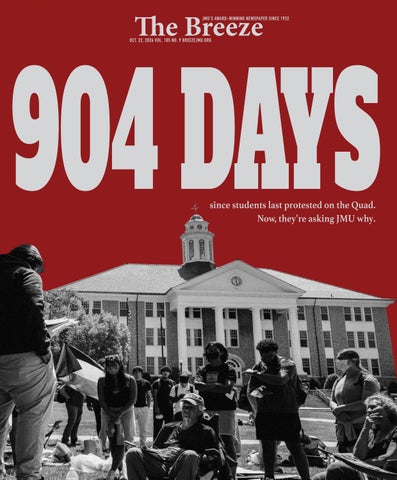
904 DAYS The Breeze
JMU’S AWARD-WINNING NEWSPAPER SINCE 1922
OCT. 22, 2026 VOL. 105 NO. 9 BREEZEJMU.ORG
since students last protested on the Quad. Now, they’re asking JMU why.
2
Thursday, October 22, 2026 | breezejmu.org
Vol. 105, No. 9
DON’T SPEND ELECTION DAY WAITING IN LINE
Register to Vote Before October 23 Planning to vote in Harrisonburg for the General Election on November 3rd ? Register or update your voter registration by October 23rd to avoid waiting in a Same Day Registration line on Election Day. Main campus residence address: 800 S Main Street, residence hall name, JMU Box #--Harrisonburg, VA 22807
Have a Virginia Drivers License? Use this QR code to Register today!
Grace Street apartments residence address: 42 W. Grace Street, Harrisonburg, VA 22807. Mailing address: 800 S. Main Street, JMU Box # G--Harrisonburg, VA 22807.
Have questions? email: registrar@harrisonburgva.gov phone: 540-432-7707 JMU 2026 Election Guide: tinyurl.com/mperc5zt
Vol. 105, No. 9
3
Thursday, October 22, 2026 | breezejmu.org
Breeze Editorial Staff
EDITOR-IN-CHIEF Hannah Kennedy
ONLINE MANAGING EDITOR Emma Notarnicola
PRINT MANAGING EDITOR Preston Comer
thebreezeweb@gmail.com
breezepress@gmail.com
NEWS EDITORS Charlie Bodenstein & Emma Brown
SPORTS EDITORS Madi Perini & Libby Mercer
CULTURE EDITORS Bella Arist & Audrey Fletcher
breezenews@gmail.com
breezesports@gmail.com
thebreezeculture@gmail.com
COPY EDITORS Kayla Katounas & Luke Faircloth
AUDIENCE EDITORS Isabel Lewis & Brandon Portillo Aponte
breezeeditor@gmail.com
thebreezesocials@gmail.com
breezecopy@gmail.com
TV NEWS DIRECTOR Lauren Keller jmubreezetv@gmail.com
Advertising Staff EXECUTIVE DIRECTOR Stephen Lunde
ART DIRECTOR Kirah Villanueva
CREATIVE DIRECTOR
thebreezeartdirector@gmail.co
Heidi Ellison
PHOTO EDITORS Caden Burch & Landon Shackelford
OPINION EDITOR Katie Mae Yetter
AD DESIGNERS
breezephotography@gmail.com
breezeopinion@gmail.com
Lee Hummel | Kenny Warlick
ON THE COVER COVER BY: KIRAH VILLANUEVA
COVER PHOTO: LANDON SHACKELFORD / THE BREEZE
1598 S. Main St. Harrisonburg, VA 22801
PHONE: (540) 568-6127 FAX: (540) 568-7889
Subscribe to our newsletter:
After over two years, students have started conversations about revisiting Policy 1121, which restricts demonstrations on the Quad, only allowing for universitysponsored events.
Apply to join our team:
Corrections CORRECTION: A photo caption incorrectly identified Lydia Taylor Davis’ stance on abortion. She is an anti-abortion activist. CORRECTION (10/19/26 8:48 p.m): A previous version of the story “1 student, 1 school, 1 global stage: Grad student represents Nigeria, JMU at UN” misquoted Olaniyan and misnamed the conference he attended. The article has since been updated. CORRECTION (10/19/26 8:50 p.m): A previous version of the story “What do you lose when online? JMU students vs. a Pulitzer-nominated author” misgendered A.J. Gines. The article has since been updated. CORRECTION (10/15/26 10:00 a.m): A previous version of the story “JMU Athletics make move into American Conference” and “‘It’s a perfect fit’: How JMU football fares against American Conference opponents” used an incorrect abbreviation. The article has since been updated for accuracy.
Find out why 10,000
follow us @breezejmu
The Breeze is a nationally recognized multimedia organization with a century long legacy of award-winning journalism. On Campus. Online. On Point. Multimedia platforms with tremendous reach to the JMU community offering award-winning innovative marketing solutions
NEWS
4
EDITORS Charlie Bodenstein & Emma Brown
EMAIL breezenews@gmail.com
‘The Quad has been ... dead’
JMU administration revisits Quad restrictions over 2 years later By CHARLIE BODENSTEIN & EMMA NOTARNICOLA The Breeze Conversations surrounding Policy 1121, also known as the Quad policy — the restriction on public expression in university-controlled spaces with specific limitations for the Quad — have publicly surfaced for the first time in the nearly two years since it was enacted.
Student leaders push to revisit policy
On Sept. 29, a group of students met with Vice President for Student Affairs Tim Miller and Associate Vice President for Student Development and Community Building Dirron Allen to discuss the policy and the future of free speech on campus, Student Government Association (SGA) Speaker Caroline Spurling said. The students were: Spurling, Student Representative to the Board of Visitors Gram Sher, and representatives from JMU College Democrats and JMU’s chapter of Turning Point USA (TPUSA). Senior public administration major Olivia Smith represented JMU College Democrats, while sophomore business administration major Emma Rexrode represented TPUSA. “We just wanted to make sure that we had a full-round discussion of the people on campus,” Smith said. “It’s not just a Democratic issue. It’s not just a Republican issue. It’s an everybody issue.” This conversation is especially important now, Smith said, as the nation celebrates Freedom of Speech Week and with JMU’s recent “F” grade in freedom of speech from the Foundation for Individual Rights and Expression (FIRE). She said she was “really disappointed” with JMU’s current ranking, adding that she felt this was the perfect time to create change.
Breeze file photo
For increased visibility on the issue, Sher created a survey available to all students to evaluate their thoughts on the Quad policy. The survey will remain open until next Friday. As of Oct. 19, with 68 responses, 57.4% of respondents said they hadn’t heard of the policy; however, after learning abot it, 79.4% indicated they’d like to see a change. “We’re trying to get more people to view our survey and fill it out,” Smith said. “Then we’re going to send it over to Tim Miller and Dirron [Allen] to show them that students do care about this policy.” Smith said throughout the conversation she was against the policy because she believes in promoting free speech and expression, adding that she thinks the Quad is a collaborative space where people can come together and clubs can table. “Ever since we have had this policy, since my first year, the Quad has been completely dead,” Smith said. “No one’s on it.” Both Smith and Rexrode came together to support changing the Quad policy to allow for free speech and demonstrations. “Even though Emma [Rexrode] and I don’t agree with a lot politically, we both were talking about the fact that we want each other’s organizations to be able to express their freedom of speech,” Smith said. “I want them to be able to have events on campus just as much as they want us to have events on campus.” Smith added that a lot of the discussion also focused on allowing for tabling in the space,
opening it up for more clubs to have opportunities to hold events. Miller and Allen brought up alternative spaces on campus where Dukes can freely protest, such as Festival Lawn, Smith said. However, she said she told them this location doesn’t see as much foot traffic or has limited space compared to the Quad. “The Quad … is the heart of JMU, and [for] a lot of people, it’s the part of JMU that makes JMU so special,” Smith said. “The Quad is a great area to hang out with your friends, throw a Frisbee around, see some cute dogs and also just get to connect with one another.” The conversation, Smith said, covered why the policy was initially created, then went into some of the reservations JMU had before moving forward. Miller said the policy exists to “protect the integrity of the Quad,” at the JMU Jane Doe Project event on Oct. 19. “There’s history and tradition on the Quad, and the academic buildings are pretty close to it,” Miller said. “So we want to really limit how many things can disrupt that.” Miller added that opening up the Quad to non-university-sponsored events could disrupt students’ ability to study and enjoy the Quad. Administration raised potential issues with resource allocation, adding that protests or events on the Quad would need more personnel, limiting the availability of staff across the rest of campus. Another hesitation the administration had, Smith added, was the risk
of external figures coming to the Quad and potentially endangering students. “Their main concerns were about the external figures and not the students themselves,” Smith said. “Which is really frustrating just because students do want to protest or they do want to engage on campus.” The administration was open to discussing the changes to the policy throughout the conversation, Smith said, adding that the next steps are demonstrating that it matters to the student body. “It’s not something that matters to every student, but that’s, I think, a given with any topic of conversation,” Spurling said. “I think it matters to enough students, and if it matters to one student, it’s enough to matter.”
How the Quad policy works
Policy 1121 first underwent changes in early August 2024, restricting events, protests and demonstrations on JMU-controlled areas, and setting specific regulations for the Quad. Non-controlled spaces include: “streets, lawns, green spaces, walkways, public parking lots,” according to the policy. Both affiliated and nonaffiliated individuals are allowed to use these spaces so long as they act in accordance with university code. Though, some JMU-controlled spaces are available for reservation through Student Life and UREC, the policy states that, due to its historical nature, the Quad is reserved only for university-sponsored events. This also restricts permanent and temporary structures, including tables on the Quad, with exceptions for university events. Upon announcing the policy, the university opened it up to feedback until Sept. 9, 2024, culminating in major changes to the Wilson Hall lighting policy, oncampus distribution of literature and mask identification mandates.
NEWS
5
Thursday, October 22, 2026 | breezejmu.org
Pro-Palestine demonstrators on the Quad in 2024. Landon Shackelford / The Breeze
Miller said revisions for policies like these happened often to guarantee policies stay up to date. He added that when the administration was looking at Policy 1121, the changes fell in line with other conversations throughout the state. “Now we’re looking at it again sooner than when the normal would be. But I think in today’s day and age, certain policies we’re going to look at all the time. If someone has a question, we’ll sit down and talk to them,” Miller said. “The thing I like about [JMU] is that there’s not a ‘that’s a policy, get over it.’ It’s a policy, let’s talk about it.”
The last demonstration on the Quad
Prior to these changes, the Quad was used for various events including protests, demonstrations, vigils and more, sometimes featuring Wilson Hall lit up in colors. The last demonstration held on the Quad was in May 2024, when JMU’s Young Democratic Socialists of America (YDSA) and Friendly City for Palestine (FC4P) gathered on the Quad. The groups came together to demand that JMU denounce Israel’s actions in the Israel-Palestine conflict after the university released a public statement condemning the attacks on Israel. The demonstrators also offered educational pamphlets and speeches on the conflict. This protest fell in line with universities across the United States that had individual protests and encampments. Many Virginia universities also had demonstrations regarding the Israel-Palestine conflict, namely Virginia Commonwealth University and Virginia Tech. Then, in late May, The Breeze published an article about how Miller denied JMU’s Muslim Student Association’s (MSA) request to hold a vigil on the Quad. The event would have featured Wilson Hall lit up with the Palestinian flag colors in remembrance of the lives lost after the Oct. 7 attack, while advocating for peace. This request followed JMU Jewish organizations’ — Hillel, Chabad and Alpha Epsilon Pi — vigil for Israel held on the Quad earlier that year, for which Wilson Hall was lit in Israeli flag colors. Miller said the restriction resulted from ESPN College GameDay’s — on Oct. 28, 2024 — anticipated use of the Quad the same week the event was requested. The vigil was moved to Festival Lawn. By the following semester, universities across the country developed new restrictions regarding public expression, going as far as to ban encampments and create limitations on acceptable timeframes and locations of protests, according to an August 2024 NBC article.
Virginia was no exception; across the Commonwealth, universities developed a multitude of policies and rules restricting expression, according to an August 2024 Axios article. The University of Virginia’s policy focused on setting restrictions on “the time, place and manner in which expressive activities like public speaking, handing out literature, protests and demonstrations may occur,” an August 2024 UVA website release read. VCU’s policy restricted The Compass — the school’s central area — for events and only allowed reserved, approved tabling in a designated area, according to The Commonwealth Times. This policy only lasted one year, according to the Axios article. After its implementation, The Young America’s Foundation (YAF) Never Forget Project that honored the victims of the 9/11 terrorist attacks with the annual placement of American flags on the Quad was the first event affected by the policy, according to a September 2024 article by The Breeze. YAF was asked to move the project to Festival Lawn, while JMU Valor placed its own flags on the Quad.
“Protesting [on the Quad] has a different feeling, there’s more ... passion and love for JMU.” Recent campus demonstrations
Following this, in February 2026, Miller suggested the student organizers of JMU’s anti-ICE protest move their protest from the Quad to the Burruss Hall fountain. Protest organizer and sophomore political science and philosophy major Madeline Barbee Doerfler said that though Miller was accommodating and protesting close by worked out, the Quad is still an important space. “[The Quad]’s like the heart and soul of JMU,” she said. “Protesting there has a different feeling, there’s more ... passion and love for JMU.” She added that limiting the Quad can discourage students from organizing, complicating the process.
“Because [the Quad] is such a public space that JMU is known for, the student population is more likely to want to organize there,” Barbee Doerfler said. “By restricting access to that, is limiting students’ right to free speech.” On Monday, Oct. 19, the JMU Jane Doe Project held an event on Festival Lawn protesting the alleged gang rape at Cornell University and demanding that universities, including JMU, do more to protect students from sexual violence. This event, though originally scheduled for the Quad, was moved to Festival Lawn after multiple JMU faculty members directed the organizers to reconsider its location. Senior nursing major and event organizer Sarah Chernesky said they were aware of the policy and were planning to ignore it until JMU contacted them. Although the policy has restricted access to the Quad, student organizations and clubs have still hosted various events including controversial speakers, vigils and protests across campus.
President Schmidt & Gov. Spanberger weigh in on Quad policy
These conversations come at a pivotal time of change, Spurling said, with the inauguration of University President Jim Schmidt, as well as the Madison Promise, which has an emphasis on promoting civic engagement on campus. Schmidt did not work at JMU when the Quad policy was put into place but said he could see why the university implemented the policy. Schmidt acknowledged the Quad is a “special place for students,” but said he understands those who feel the Quad should be open to everyone. “As I heard about [the Quad policy], they just wanted this area to be that little sanctuary that people could come to and not have to worry about protestors or other things that are going on,” Schmidt said. Schmidt said in an interview Tuesday evening at Halftime on the Quad that he hadn’t heard any conversations going on between students and JMU administration about revisiting the policy, but he added that he’s always open to meeting with students. “I’m interested to hear what their thoughts are, what they think they’d like to see, and then we’d balance it with the other interests of the institution,” Schmidt said. Read more online at breezejmu.org CONTACT Charlie Bodenstein at breezenews@gmail.com & Emma Notarnicola at thebreezeweb@gmail.com. For more coverage of JMU and Harrisonburg news, follow the news desk on X @TheBreezeJMU and on Instagram @BreezeJMU.
Thursday, October 22, 2026 | breezejmu.org
6
Vol. 105, No. 9
‘We decided to turn that rage into something that catalyzes change’
JMU Jane Doe Project looks to hold universities accountable following Cornell case By CHARLIE BODENSTEIN & JAMYA RIBBON The Breeze Roughly 40 students gathered on Festival Lawn on Monday evening to offer their support for survivors of sexual assault, prompted by the alleged gang-rape incident at Cornell University, and demand that JMU establish an independent agency to review sexual misconduct cases on campus. The JMU Jane Doe Project, which organized the event, was formed in light of a Cornell University student filing a lawsuit alleging that seven members of Cornell’s Chi Phi fraternity drugged and gang-raped her at a fraternity house while the university failed to protect her or punish the alleged offenders. “We decided to turn that rage into something that catalyzes change,” senior psychology major and event organizer Sarah Chernesky said. The student organizers read anonymous submissions from students who had experienced sexual assault in their lifetimes. Some students in the crowd also walked up to the mic and shared Project organizers and participants meet on Festival Lawn. their stories. Landon Shackelford / The Breeze “People will read the Jane Doe signs and say they support the cause, but rarely do they know how many Jane Does they talk to every day — how many friends, family members, peers, people all carry that name,” one submission read. The event offered students the chance to write postcards with words of encouragement. Those were later sent to the Collins Center “Rarely do they know how in Rockingham County, a sexual assault advocacy organization in Harrisonburg, and Jane Doe’s legal representation at Cornell. The many Jane Does they talk event also offered pins and information packets. “The best way to really support this project is to contact the to every day.” people representing you and share your thoughts,” freshman nursing major and event organizer Scout Smith said. - Anonymous submission Lizzy Ashford, senior psychology major and president of Students Against Sexual Violence (SASV), said the club is collaborating with
the JMU Jane Doe Project alongside the Victim Advocacy Office to support those affected by the Cornell incident. “It’s hard, especially because — no matter what kind of violence it is — it’s personal to you,” Ashford said. “And if it’s in the media, it can feel like it’s being kind of thrown in your face 24/7.” As SASV president, Ashford “realized that [she] had to take action” and reached out to both past and present SASV members to check on them. She stressed the importance of survivors practicing self-care techniques, especially when it comes to potentially triggering cases becoming national news. “You don’t have to stay up to date with every single thing, because it can be a lot,” Ashford said. “It’s more important for you to put yourself first before you try to take on all of this kind of other stuff.”
Moving from the Quad to Festival Lawn
The event was originally going to be held on the Quad, but after a conversation with JMU Student Affairs and Victim Advocacy Services, the event was moved to Festival Lawn. University Policy 1121: Public Expression on Campus states that only university-sponsored events may occur on the Quad. This means that unapproved protests, demonstrations, speeches, tablings and other events may only take place on the Quad if JMU approves them. This policy was changed in August 2024 to restrict which events could be held on the Quad following months of protest demonstrations. Read more online at breezejmu.org CONTACT Charlie Bodenstein at breezenews@gmail.com & JaMya Ribbon at ribbonjm@dukes.jmu.edu. For more coverage of JMU and Harrisonburg news, follow the news desk on X @TheBreezeJMU and on Instagram @BreezeJMU.
Vol. 105, No. 9
Thursday, October 22, 2026 | breezejmu.org
7
JMU works toward higher research classification in 2028 By JACK FRIEDMAN The Breeze
At a Sept. 18 Board of Visitors (BoV) meeting, University President Jim Schmidt and JMU officials detailed plans to gain a designation as a Research 1 (R1) public research university, reinforcing Schmidt’s plan to grow JMU on the national level.
What is an R1 designation?
R1 and R2 schools are designations given by the Carnegie Classification of Institutions for Higher Education. For a school to be given an R1 designation, it must spend over $50 million in research expenditures and award at least 70 research doctorates annually, according to Carnegie Classification. Currently, JMU is spending $34 million on research expenditures and has awarded 47 research doctorates, according to Vice President of Research, Economic Development and Innovation (REDI) Anthony Tongen. Tongen explained how the new system of classification had changed. “This past classification was the first time they changed to using hard lines,” Tongen said. “For the new system Carnegie has in place, our numbers are trending toward going over that R1 category.” The classification process runs over a three-year cycle, with the most recent
reclassification being in late 2025. JMU became an R2 school in 2022, and now looks to gain an R1 designation in the 2028 window.
Why does JMU want the R1 designation?
“If you look at the top schools in the nation, they are R1s,” Tongen said. JMU is looking to join UVA, Virginia Tech, ODU, VCU, GMU and William & Mary as R1 schools in the Commonwealth. Becoming an R1 will make JMU more attractive to faculty and applicants as well, Schmidt said. “As we grow into a modern public research university, we can attract talented students, faculty and staff without losing the studentcentered experience that has always set us apart,” Schmidt said. The potential to attract faculty and staff is one of the reasons JMU is pushing for R1 status, according to Schmidt and Tongen. “People make choices about where they’re going to spend their careers, and R1 could be a determining factor in someone going to a place,” Tongen added. In addition to attracting faculty, Tongen said: “There are corporations that probably look at JMU differently than even some of our other institutions in the Commonwealth because of [our R2 designation].” Tongen said that most students will not be directly impacted by this change, and the
benefits may be more subtle. However, Tongen and Schmidt both emphasized the positive side of this change, including the increase in opportunities JMU will have. Both recognized the concerns, as JMU is a university well known for its undergraduate research and student experience. However, Schmidt said, “We will not build this infrastructure at the cost of undergraduate teaching or our signature undergraduate research. Instead, we will reinforce it.”
Maintaining the JMU experience
Both Schmidt and Tongen said they know how important the JMU undergraduate experience is at JMU, and that they strive to protect that experience. Since R1 schools prioritize research, less time is spent on teaching and more on research. R1 schools also tend to be less undergraduate focused. Read more online at breezejmu.org CONTACT Jack Friedman at friedmjh@dukes.jmu.edu. For more coverage of JMU and Harrisonburg news, follow the news desk on X @ University President Jim Schmidt wants to make TheBreezeJMU and on Instagram JMU an R1 university. @BreezeJMU. Landon Shackelford / The Breeze
8
Thursday, October 22, 2026 | breezejmu.org
Vol. 105, No. 9
CULTURE EDITORS Bella Arist & Audrey Fletcher
9
EMAIL thebreezeculture@gmail.com
Student launches networking site Pipeline shows Dukes a new way to connect with alumni
By BELLA ARIST The Breeze A JMU student has launched Pipeline, a networking website that helps students connect with alumni and explore career opportunities. The service was made public on Aug. 28, 2026. Cameron Lynch, a junior double major in finance and economics, created Pipeline to help students build professional relationships, find mentors and learn more about their future careers. Pipeline allows student organizations to keep track of their alumni contacts and connect current members with people who can offer career advice and guidance. The platform currently has 15 student organizations, including nine founding partners, and plans to expand across the JMU community. “Pipeline is a relationship system where students keep track of the people they meet and follow up until a door opens, and student organizations keep a living alumni network that doesn’t reset every spring,” Lynch said. The main difference between Handshake and Pipeline is networking rather than just applying to postings. “Everyone says you need to be networking, but no one really teaches you how to do that,” Lynch said. Pipeline is currently available at JMU, Christopher Newport University and George Mason University, with plans to reach more colleges in the future. It’s not sold to universities yet, so students use Pipeline for free. “As years go on, Pipeline is going to grow into something much bigger, and hopefully something most college students use,” Lynch said. Students can create an account and join organizations they are involved in, like a business fraternity or the investment club. Alumni can create profiles and choose how they want to help students, whether through a coffee chat, a resume review or a quick question. Students can then reach out based on what each alum is comfortable offering. The alumni are found on an excel sheet from organizations they were part of at JMU. Current students are then able to access this information and connect with alumni through Pipeline. Users can search for alumni by industry, city and graduation year. Pipeline also includes an artificial intelligence coach that gives students advice based on their career goals. However, Lynch said the goal is not to replace real conversations with technology. Instead, he wants Pipeline to “help students take the next step” toward building real connections, whether that means making a phone call, setting up a meeting or grabbing coffee with an alum. Lynch built this independently from a class. The idea came out of his own experience recruiting as a finance student “at a school where you have to network your way in.”
‘We always
say Dukes hold doors, but someone still has to knock.’ Cameron Lynch Creator of Pipline
Cameron Lynch created Pipeline to to help students learn more about their future careers. Photos by Landon Shackelford / The Breeze
“I truly think that networking is the future. I think that it was important before, but now it’s even more important with AI,” Lynch said. Rather than encouraging students to send out as many job applications as possible, Pipeline focuses on building relationships that can lead to opportunities over time, Lynch said. Jeff Hulett, a professor in JMU’s College of Business and a partner in Pipeline, has worked with Lynch since the idea stage in January 2026. He has helped guide Lynch through Founder’s Copilot, a program that he said supports promising entrepreneurs. Hulett said AI is changing how students apply for jobs and how employers review applicants by using AI to write resumes and complete applications. “Students use AI to write resumes and submit applications, while employers rely on automated systems to screen
applicants,” Hulett said. “When there are so many ‘AI Perfect’ resumes, that makes everyone ‘AI Average.’” He said this practice removes people from the hiring process. “It’s like my bot’s talking to your bot, but the humans aren’t talking anymore,” Hulett said. Hulett feels students should start networking before they begin applying for jobs. He said building connections early gives them more time to learn from alumni, explore different career paths and limit AI use. “Don’t focus on volume [of applications]; focus on quality and authenticity — authenticity of the relationship,” Hulett said. For senior economics and political science major Imaan Ghuman, the vice president of alumni relations for professional business fraternity Alpha Kappa Psi (AKPsi), Pipeline offers an easier way to organize alumni information and keep those connections available for future members. Ghuman currently manages an Excel spreadsheet with around 350 alumni contacts, jobs, locations, majors and involvement in the fraternity. After connecting with Lynch over the summer, Ghuman saw Pipeline as a way to make the information easier to manage and help future members benefit from the fraternity’s alumni network. She also said Pipeline feels “more approachable” than Handshake, which can be overwhelming because so many people use it. Roughly 70 AKPsi members have created Pipeline accounts, and Ghuman said the response has been positive. She also shared that one junior member secured an internship through connections made on the platform. Lynch hopes Pipeline will make networking feel less intimidating and encourage students to start conversations with alumni. He said many alumni are willing to help students, but students have to take the first step. “These alumni want to help us; they truly do want to help,” Lynch said. “But the thing is, you have to take initiative — we always say Dukes hold doors, but someone still has to knock .” CONTACT Bella Arist at thebreezeculture@gmail.com. For more on the culture, arts and lifestyle of the JMU and Harrisonburg communities, follow the culture desk on X @TheBreezeJMU and Instagram @BreezeJMU.
CULTURE
10
Thursday, October 22, 2026 | breezejmu.org
The rise of modern line dancing By ASHLEY RAYBURN contributing writer There are few things Beyoncé, Shaboozey, Pitbull and Sabrina Carpenter’s music have in common. Despite most falling into vastly different genres, each is responsible for creating music that the world has deemed danceable — specifically in the style of line dancing. Originating from 17th-century folk and immigrant traditions, modern line dancing gained popularity in the 1990s and early 2000s with mainstream songs including “Macarena” by Los del Río and “Cupid Shuffle” by Cupid. These songs are paired with simple 16- and 32-count dances on repeated throughout the song. Since 2024, a new wave of line dancing popularity has taken over the internet and become a beloved hobby for many people, including college students. The JMU Line Dancing Club (LDC) was established in 2024 and is now a popular club on campus with over 100 members. Senior English and writing, rhetoric and technical communication major Alexis Locke has been the president of LDC since spring 2026. Locke first discovered line dancing through her mom, who urged her to try it out. Once she became a student at JMU, Locke joined LDC, where she grew her love for the style of dance. “I’m not a good dancer, so I liked that there were choreographies and steps that you could learn and that it’s usually pretty simple,” Locke said. “You learn it, and it just repeats a bunch of times … it was easy for me to pick up.” Since becoming president of LDC, Locke has held general-body club meetings every month, lessons on Wednesdays and Sundays, and events in local community bars or breweries. “I think [the outings] are one of our members’ favorite things, just because you actually get to be in the community and it’s a really good way to figure out what dances you want to learn,” Locke said. “When you’re
REEL IT IN Movie review| ‘You Can See Everything’ By RYAN TIBBS
The Breeze on your own or online, it seems like there are so many [options], but when you get to see them in person and see people doing them, that’s how I find most of the dances I want to learn.” LDC Secretary Ashlyn Ferraro, a sophomore theatre and media arts and design major, has always had an interest in dance. Ferraro joined LDC her freshman year and appreciates how uniquely relaxed it is. “I think the silliness of it [is what I like], not having to worry about all of the technique … you can just have fun and kind of let go and just be silly and be with your friends,” Ferraro said. As an executive club member, Ferraro said she appreciates the ability to teach some of the weekly dance lessons, showcasing her knowledge of different dance styles. A fellow line dance lover, junior English and philosophy major Dillon Sweeney is the treasurer for LDC. Sweeney joined LDC his freshman year after encouragement from a friend and has not looked back since.
“I liked [line dancing] because you do it with people you know,” Sweeney said. “You’re all kind of doing the same thing, but you can also do different stuff if you want. It’s just nice to have a community; it’s not just you.” Sophomore engineering major and LDC member Chloe Alperin first discovered line dancing through Student Org Night her freshman year. Prior to signing up for the club, she had never heard of the style of dance. “There’s a lot of different people that make up Line Dancing Club. There’s [people from] different years, different backgrounds. We have a lot of guys that do it too, which is pretty cool, and everyone’s super nice. They are all amazing people,” Alperin said. Read more online at breezejmu.org CONTACT Ashley Rayburn at q8qx7l@ dukes.jmu.edu. For more on the culture, arts and lifestyle of the JMU and Harrisonburg communities, follow the culture desk on X @TheBreezeJMU and on Instagram @BreezeJMU.
Warning: This review contains minor spoilers “You Can See Everything” is a new A24 documentary about Elizabeth Holmes, the founder of Theranos, and it’s the most interesting film of the year so far. It premiered as a secret project at the Telluride Film Festival back in early September. Even before the nationwide release, it generated a lot of buzz, with early predictions saying it could make history at the Oscars for being the first documentary nominated for Best Picture. With Oscar-level hype despite the film’s accelerated timeline — hitting theaters just six weeks after the project was announced — expectations have become sky-high for viewers. Before even seeing the movie, audiences will likely have a few questions. Why was this film kept a secret for so long? Why are outlets like IndieWire discussing a documentary’s chances at acting awards? Why is Holmes’ X account talking about the documentary when the director, Nathan Fielder, says she and her husband, Billy Evans, haven’t even seen it? Fortunately, watching the documentary answers these questions, but it also provides new ones: Who’s in control of the documentary? Who’s lying? Who’s telling the truth? Director Lance Oppenheim already made a big impact in theaters just a few weeks ago with his film “Primetime.” While that film maintains the dreamy cinematography and highly saturated colors common in his previous work, “You Can See Everything” switches it up with a more grounded look. The look of the film keeps the windows overexposed in Holmes’ rented beach house with soft deep blues and browns before the second half switches tones to feel more like a noir or thriller, with shadows and harsh lighting. The score, composed by Ari Balouzian, maintains a haunting atmosphere with beautiful strings and piano, bringing the audience into the world of the documentary. Fielder, the second director of the film, normally comes across as a heightened comedic version of himself in his previous nonfiction work. However, in this film, he’s toned down, serious, and unafraid to question Holmes and Evans. Read more online at breezejmu.org CONTACT Ryan Tibbs at TibbsRA@dukes.jmu. edu. For more on the culture, arts and lifestyle of the JMU and Harrisonburg communities, follow the culture desk on X @TheBreezeJMU and on Instagram @BreezeJMU.
The JMU Line Dancing Club was established in 2024. Photos by Landon Shackelford / The Breeze
11
Thursday, October 22, 2026 | breezejmu.org
All about the newest villains in Hollywood By JACK MCGUINNESS contributing writer The cinematic villain is looking a little different in the modern age. The days of cartoonish bad guys who simply exude evil are gone. Even famously cartoonish villains, like the Joker, have been made more grounded and realistic in recent depictions. The truth is that today’s audience craves an antagonist with a deeper meaning than just “he was born evil!” They want characters who have a method to their madness, ones who are more realistic and seem like they could be real people. So, why not use real people? That must have been a thought that popped into writers’ heads in recent years, because this year there are four theatrical releases portraying tech industry giants as villains: two films and two documentaries. “The Social Reckoning,” a loose follow-up to David Fincher’s “The Social Network” (2010), follows Mark Zuckerberg navigating the Facebook files leak in 2021. Writer and director Aaron Sorkin also wrote “The Social Network” and won an Academy Award for it. He says that Zuckerberg isn’t a villain in this movie. “In dramatist terms, he’s not a villain. He’s an antihero. A villain has bad intentions. They want the money, they want revenge, that kind of thing. An antihero’s intentions are good: ‘I want to connect everybody in the world.’ But the way an antihero goes about doing it, the decisions they ultimately make are bad,” Sorkin told the Hollywood Reporter. So, safe to say that the tech billionaire isn’t exactly shown in the best light, despite not being a traditional villain. Also hitting theaters in mid-October, “Musk” is a documentary about Elon Musk, an almost four-hour film receiving brilliant reviews. In a chilling Variety review, Owen Gleiberman wrote, “The film says that what should scare us about him is how he coddles his own interests by passing them off as the world’s.” Another documentary coming out this month, “You Can See Everything,” is centered on disgraced Theranos founder Elizabeth Holmes and doesn’t cast her as a traditional villain. Instead, directors Lance Oppenheim and Nathan Fielder capture her as complicated and slightly unsettling, suggesting that she’s the villain of her own story, although she maintains her innocence. Finally, “Artificial,” starring Andrew Garfield as OpenAI CEO Sam Altman, hits theaters this Christmas. The film chronicles the rise of OpenAI as it prepares to release ChatGPT, as well as the firing and subsequent rehiring of Altman at the company. The film was originally paid for by Amazon, but was later dropped in June after Amazon invested $50 billion into OpenAI. Production and distribution company Neon scooped up the rights to the film for $40 million. When asked by Variety about what he learned playing Altman, Garfield said, “I felt a little mistrusting of the technology. It feels like the people who are encouraging us to use the technology don’t exactly know its capacity themselves.” In it’s review of the film, Variety also said that Garfield had a “Norman Bates-inspired turn.” When you think about real-world people who would make for good big-screen villains, whether in a dramatic or documentary format, tech moguls make perfect sense; mostly because a lot of the time they don’t feel like real people. We hear these names all the time in the news, but they seem so far above us because they are some of the most powerful people in the world. People like Zuckerberg and Musk feel so hard to connect with and relate to.
Sometimes, a villain becomes memorable when the audience feels a connection to them; something that makes them second-guess their own feelings and intentions. It becomes frightening when you ask yourself, “Is it wrong that I sympathize with why they’ve broken bad?” On the other side of that coin, a good villain could be someone audiences just can’t relate to. Enter the four people covered in these films. One trillionaire and three extremely controversial billionaires (well, not Holmes anymore; she lost everything following investigations into Theranos, so make that two billionaires) who mold so much of our daily lives in ways we sometimes don’t even realize. It’s such a shockingly simple formula for a film villain, it’s surprising it took so long for writers to exploit it. They don’t need to find narrative ways to make you hate the villain, because you’re probably going into the film already disliking them, or at least not being their biggest fan. In the case of “You Can See Everything,” this allows them to not have to portray Holmes in an extraordinarily dark light. The majority of people who know her story dislike her, so why make a film just doubling down on that hate? Make it so that the viewer feels an emotion other than disgust. How these films perform at the box office in the coming months could determine if there will be a further upward trajectory in this kind of storytelling and character development. Read more online at breezejmu.org
CONTACT Jack McGuinness at mcguinjr@ dukes.jmu.edu. For more on the culture, arts and lifestyle of the JMU and Harrisonburg communities, follow the culture desk on X @TheBreezeJMU and on Instagram @ BreezeJMU.
Kirah Villanueva / The Breeze
CULTURE
SPORTS
Thursday, October 22, 2026 | breezejmu.org
�� � '.:::: his weeks
.
• . < : ·. ·.
:::·> The Breeze lili:1•ji3 {t\\/:::: . ffiiiilll�j��3 •. ·• · .. . . .·.. .... . -. . ... . . .... . . . . . . .. . . .. . .. . . .. . . . . . . .. . .. ,. . ..- ··. .
. .
. ..
.
- -
. . .... ..· . • :
.. . . . . . . . . . . �. .. .. .. . . .. .. . '
.. .
.
• • • ••.I
: •• t
'
.
. . . . ...
. .
.
.. ·. . .. . . .
. . ... . . . . . . . .
Michael Scott· JMU Foot.,alt
�•l�IDa
•.
.
.
.
.
. . ...
.
.
.. .. .
.
. .. .
. .. .
. ,,
••
•.
:<:/.�?jj • . . . •_ �-:_-�· .:->·� ;�;�:;�s;�;� .. .
•
•
• •. • . • •
•
4
Check out this weeks Re�t{:\J/:\fl�
-
need more dough? need more dough?
JOIN OUR TEAM Flexible schedules Set your own hours Daily pay 50% team member discount $200 referral bonus ALSO HIRING A SOCIAL MEDIA INTERN! Email your resume to dominosbecca@gmail.com Yes, it’s a paid position!
DUKES EAT DUKES EAT
12
SPORTS EDITORS Madi Perini & Libby Mercer
13
EMAIL breezesports@gmail.com
Caden Burch / The Breeze
Breeze file photo
Breeze file photo
Dukes don’t stop fighting JMU remembers young Duke John Paul Macri
By LIBBY MERCER The Breeze
Diagnosed with a rare brain tumor at 8 years old, John Paul Macri would tell his nurses and doctors, “Dukes don’t stop fighting,” so neither would he. He kept on fighting until his passing on Oct. 4. “That mentality of ‘he’s going to take on whatever he has to take on if it means that he gets to live in this world with us,” John Paul’s mother, Katie Macri, said. “Even though that wasn’t the outcome that he got, I think for the rest of us, it’s a no-brainer that we are going to pick up where John Paul left off.” Katie said John Paul never complained, and whenever the family told him they wished to trade places with him, his response was always the same: no way. “He had a maturity that was far beyond his years, and he was just a firm believer that God was going to take care of him,” Katie said. “It was very inspiring to see.” The type of tumor John Paul had, diffuse intrinsic pontine glioma (DIPG), does not have a cure yet. In Katie’s Tough2gether Foundation page, it says, “We will continue to push for answers until a cure is found. We want every family who comes after us to one day be told, ‘your child has cancer... but we have a plan.’” Since his passing, JMU has rallied around the Macri family, with the football team honoring him during its Oct. 17 Homecoming matchup. Last Saturday, Team John Paul pins were available at the gates, the team wore shirts with the same slogan before the game and stickers on their helmets, and there was a moment of silence in his honor. “I felt his presence there stronger than I ever have since he’s been gone,” Katie said. Head coach Billy Napier said the team played with an extra man against Georgia State during the game, noting John Paul’s impact on the entire team. “I know [his death] affected our entire organization from top to bottom,” Napier said. “I can’t help but think when we kicked that thing off, and the clouds went away. It’s blue skies, and it was a great day for the Dukes to play football. I know my man was up there having the best of times.” John Paul developed a relationship with the JMU football team shortly after his diagnosis in 2025, when former head coach Bob Chesney was in charge of the Dukes. Katie, a JMU alum herself, said her friend Amy Miller posted on the JMU Nation Facebook group asking for
prayers for John Paul, which is where the football team came in. Katie said the team reached out with videos of encouragement and sent him a jersey. The Macris then went to JMU’s spring game in 2025. The team designed a play specifically for John Paul to run a touchdown in true JMU fashion, with streamers and all. “As he was running, all of the defensive players were just falling over left to right as he would run by. When he ran into the end zone, all the guys were there,” Katie said. “They were throwing streamers, they lifted him up on their shoulders [and] the marching band played. It was just a very iconic, memorable moment for us.” The spring game was the start of the Macris’ continued relationship with the team. John Paul would come to practices and games and celebrate with the team in the locker room after the game — which is one of fifth-year punter Patrick Rea’s favorite memories with him. “In the middle of the biggest guys that you can probably imagine, and he’s in there with the fist up, just motivating us more than anyone else could,” Rea said. “That was so special.” Despite a head coaching change from Chesney to Napier, Katie said Napier and his staff “didn’t skip a beat,” and saw John Paul as a part of their team. Third-year safety KJ Flowe first met John Paul at the spring game during his freshman year. Flowe appeared on the JMU Sound Off podcast with John Paul in January 2026. At the end of the episode, John Paul told Flowe, “You guys are my best friends,” which is something Flowe said he’ll never forget. “I feel like we lost a teammate, not just a friend,” Flowe said. “He was truly a part of this team. He inspires us to keep going every day, especially me. I want to do everything for him now.” John Paul also had a close relationship with former JMU quarterback Blake Kendall. Katie described Kendall as a “big brother” to John Paul. “He and Blake had a really special relationship where they would FaceTime,” Katie said. “Blake would call or text every week for the last 18 months … if John Paul was ever having a tough time, he and Blake would talk.” Rea and his family also have a similar story relating to DIPG. Rea’s little sister Pippa died of DIPG when she was 11 years old. For his final season of college football, Rea is donating $100 for every punt downed inside the 20-yard line to the Robert
Connor Dawes Foundation (RCD) — a place that supported and helped Rea’s family. The foundation is based in Australia and is committed to brain cancer research in the area and the United States. “[Pippa’s death is] something that has motivated me through life to obviously try and live life to the fullest and honor her in any way that I can,” Rea said. “The stage of life that I’m in right now is football, and that is a way that I want to honor her and to grow closer to John Paul and his family.” Katie said Rea understands their situation on a level no one else can, which is very helpful. Katie also has a 12-year-old son, Luke, who is the same age as Rea was when Pippa passed. Rea has offered to be there for Luke if he ever needs a buddy, Katie said. “Seeing how Pat [Rea] has grown into this young man who still carries Pippa with him gives me a lot of hope for my own son, Luke, and how he will carry John Paul’s story with him,” Katie said. “Just because a sibling is gone does not mean that we don’t still carry them every day, and that we don’t still continue their legacy and keep that alive.” Fourth-year quarterback Camden Coleman joined Rea’s efforts with RCD on Oct. 9, in honor of John Paul. He has pledged to donate $100 for every passing touchdown thrown or rushing touchdown scored. Coleman said he felt the decision to join “on his heart.” “I just felt called to support in that way,” Coleman said. “Knowing there’s kids all over the world who are just like Pippa, just like John Paul, and such lights to the world, and doing anything we can for them.” So far, Rea has raised over $7,000. As the season continues, John Paul is the team’s “why,” Rea said. “It’s the most meaningful ‘why’ that this team can have,” Rea said. “I think the big goal of ours, and something that I’m sure John Paul and his family would have wanted, is to just ensure that we keep his name remembered and we keep his legacy going.” CONTACT Libby Mercer at breezesports@gmail.com. For
more football coverage, follow the sports desk on X and Instagram @TheBreezeSports.
14
Vol. 105, No. 9
Thursday, October 22, 2026 | breezejmu.org
A financial breakdown of JMU Athletics’ move to the American By LIBBY MERCER The Breeze
With a conference switch from the Sun Belt to the American, announced on Oct. 12, JMU Athletics will pay a reported $5 million exit fee to the Sun Belt and a $23 million entrance fee to the American. Beyond that, JMU will get more revenue share and Name, Image and Likeness (NIL) deals. Here’s a breakdown of all the financial aspects that come with this move:
Plan for exit and entrance fees
To cover both fees, JMU will be aided by “private funding from generous supporters,” according to a statement from JMU Athletics. “Individuals are going to pay that exit fee, believing in the direction that we’re going and where we’re trying to go,” Athletic Director Matt Roan said. There will be no student fees involved with the move, Roan said. “I think you could put this in big bold letters: there will be no tuition, no fees, no institutional subsidy of any sort will pay those liabilities,” Roan said. The Sun Belt has been in discussions to raise its exit fees since at least the spring, which is a
reason JMU made the move now, Roan said. “Over the last several weeks, when it became apparent that in this fall meeting, these were going to be discussed, that ultimately is what was the tipping point when we made this move,” Roan said. Yahoo Sports reported that the exit fees will increase to a range of $8-18 million, which is determined by the notified date of departure. If JMU were to join the conference next season rather than July 1, 2028 — the latest date of entry in JMU’s proposal — it would be possible for the donors to get the exit fee paid, Roan said. “I think that will be something that we’ll address as opportunities like that present themselves,” Roan said.
Contract negotiations
JMU football head coach Billy Napier’s contract addresses conference alignment. It says that in the event conference realignment happens during his five-year term, the university and coach will engage in “good-faith review and negotiation to increase Coach’s then-current total annual compensation structure, staff salary pools (assistants & support staff), operating budget, and NIL Amount to be commensurate with peer institutions within the new conference.”
Roan said it’s a constant dialogue with Napier to make sure they are retaining the people they want to retain. “I have a very positive working relationship with his agents, his representation, and so we benchmark a lot of things on our own,” Roan said. “There’s just data sharing that exists really organically, naturally, that will make sure that they know that we continue to invest in the program, and I think that signals to him that this is the best place to coach college football.” Napier’s base salary is $500,000 but adds guaranteed compensation of media rights, retention and fundraising bonuses that puts his yearly total at $1,050,000 annually. Napier also receives “successful performative incentives,” including conference championship wins or appearances, among other accolades. According to data from USA Today Sports, football coaches in the American earn between $900,000 and $2,500,000 per year, in total. Read more online at breezejmu.org. Libby Mercer at breezesports@gmail.com. For more football coverage, follow the sports desk on X and Instagram @ TheBreezeSports. CONTACT
Kirah Villanueva / The Breeze
Preview | JMU football gets ready for hostile environment at App State By LIBBY MERCER The Breeze
JMU is 4-16 against App State all-time. Caden Burch / The Breeze
Facing rival App State on Thursday, JMU third-year safety KJ Flowe said there’s a “number one rule” for the contest: don’t lose to the Mountaineers. “We know what it takes,” Flowe said. “We all got to be on the same page and everything. I told the guys it’s just like the most important game because it’s the next game.” App State leads 14-6 in the all-time series since 1980, and is 8-3 at home. Head coach Billy Napier called Kidd Brewer Stadium one of the hardest places to play in the Sun Belt. “I think if you’re a player, you embrace these opportunities,” Napier said. “These are the ones you sign up for.” Being a Thursday-night game, the Dukes have a shortened five-day prep window. Coming off a Friday-night matchup at Coastal, the Mountaineers have an extra day of preparation. Napier is taking inspiration from NFL teams, specifically the Seattle Seahawks, to help prepare for these matchups, he said. “These NFL teams get put in this situation, and a lot of what we’re doing reflects what we’ve learned from those teams,” Napier said. “I would say that we built the plan, and we’re right in the middle of executing the plan.” Fourth-year edge Kei’Trone Simpson said the coaching staff has made preparation easy for the team. “Our week of preparation has to be overall the most detailed we’ve ever been,” Simpson said. “I feel like with our coaches, we’ve made it easier for everyone to pick up and treat it like a regular game.” Napier said in App State head coach Dowell Loggains’ second year, they have made a “ton of progress.” “They’ve improved on defense,” Napier said. “I do think offensively they have creativity. They’ve got weapons.”
The Mountaineers’ starting quarterback, fourth-year Malachi Singleton, suffered an ankle injury in its 10-3 loss to ODU on Oct. 10. Listed as a game-time decision last week against Coastal, he played the first half, adding 151 total yards. However, he took a hit before halftime and didn’t play the rest of the game. Third-year Henry Hasselbeck tallied 112 yards with 75% pass completion in Singleton’s absence. Napier said Hasselbeck has “gotten better each week and played well against Coastal.” “I think Hasselbeck, his personal opportunity to play has improved,” Napier said. “You can see that every week. He’s athletic, and they do a good job utilizing his legs.” Singleton is listed as questionable on the injury report for this week’s matchup. Defensive coordinator Robert Bala said that based on this information, the defense will need to prepare for both. No matter who is at quarterback, Napier said, “there’s a good surrounding cast” on App State’s offense. “[Loggains] does a really good job of getting their guys in the right spot to be successful,” Bala said. JMU is en route to a three-in-a-row Thursday night game stretch, all on national broadcasts, facing Troy and Southern Miss after this week. The Dukes’ matchup with the Mountaineers will be shown on ESPNU at 7 p.m. Napier said the league “teed it up” for JMU to be in the spotlight. “It does present an opportunity, especially given the competition we’re competing in,” Napier said. “It certainly affects the vision that we have for our team and the goals that we have.” CONTACT Libby Mercer at breezesports@gmail.com. For
more football coverage, follow the sports desk on X and Instagram @TheBreezeSports.
OPINION
Thursday, October 22, 2026 | breezejmu.org
15
OPINION EDITOR Katie Mae Yetter
16
EMAIL breezeopinion@gmail.com
Is JMU’s Career Fair actually fair? Want to praise someone or get something off your chest? Darts & Pats is the place to do it. Submit your own at breezejmu.org.
A “dude-help” dart to my grades. From someone who needs to go to the Learning Centers.
A “passenger-princess” pat to my friends with cars. From someone with a broken-down car.
A “go-away” dart to my October illness. From someone who wants to get rid of their weeklong headache.
A “delicious” pat to coffee. From someone who needs a caffeine boost.
Editorial Policies
The Breeze 1598 S. Main Street Harrisonburg, VA 22801
If you went to JMU’s Career and Internship Fair this semester, did you feel let down? Paper resumes ignored for online applications? A w k w a r d conversations with employers SUMMER SOLIS telling you they contributing columnist aren’t interested in your skills? If so, that was also the sentiment from a lot of people I’ve talked to. On the other hand, I always seem to hear about a few lucky students securing internships or even fulltime jobs from career fairs. With this in mind, I wanted to reflect on my own experience to understand why the traditional career fair seems to fail for some yet succeed for others. I went to the Career and Internship Fair on Sept. 30. With my resume in hand and matching suit, I was excited to see what it had to offer; a far cry from the nervous freshman I once was. I had already applied to job postings from a few of the companies present. I came with a friend of mine for moral support. I even had a bit of hope that I could network enough to find out about paid internship opportunities. Was I disappointed? Yes. Although I expected rejection, the frequency of employers who immediately told me they weren’t hiring for my skills was a lot higher than last year. I also noticed there was a large disparity in what employers were hiring for: Out of the 147 companies that signed up for the Career and Internship Fair, only 24 companies indicated they were hiring for research and science (my academic focus). The majority were focused on finance and marketing, with a total of 88 employers hiring students who followed that career path. While walking in circles within the Atlantic Union Bank Center, I also noticed that the arts and humanities were underrepresented. The most common organizations that signaled interest in these students were often either police departments or consulting and salesbased companies. Although these employers deserve a space at the Career and Internship Fair, I also know that these jobs may worry less about what you studied and more about your bachelor’s degree. So why does JMU’s Career and Internship Fair seem to snub some students and not others? Some of this can be explained by how specific majors are overshadowed by those in the business and health science disciplines, which make up roughly 55% of the total student base at JMU. It also may be due to the fact that the Career and Internship Fair may not be the best place to look for most students (including me). JMU hosts some career fairs specialized toward certain schools (including the Hart School’s and CISE’s Career and Internship Fairs) and even events for specific majors, with a nurse recruitment day, “Meet the Firms” for accounting, and an education recruitment day. Even smaller
events where alumni come back to speak with current undergraduates can be more useful for networking than a career fair, as I’ve personally experienced. While I didn’t land any life-changing opportunities, I did get some insights from employers at the Career and Internship Fair. A majority of the employers I had conversations with were representatives of smaller companies in the Shenandoah Valley and reliably hired from JMU. One representative told me his company’s facility was only 30 minutes away, while another employer (a sports & recreation management alumnus at JMU) was employed at a tech company where over 1/3 of the employees were JMU graduates. I also saw organizations that employed people from any program type (did anyone see how long the Waffle House line was?), which led to interesting conversations. One employee even told me that his organization had employed a mechanical engineer for a teaching job in Japan. The range of experiences from employers made me think about how, once we enter the career fair, we get static categories presented to us on a map. This map and the categories assigned to it may seem helpful, but in reality they can actually limit which opportunities we are presented with. If I hadn’t gone totalkto companies that didn’t label themselves with my career of interest, I would have probably
The Breeze welcomes and encourages readers to voice their opinions through letters and guest columns.
The Breeze reserves the right to edit submissions for length, grammar and if material is libelous, factually inaccurate or unclear. The Breeze assumes the rights to any published work. Opinions expressed in this page, with the exception of editorials, are not necessarily those of The Breeze or its staff.
left feeling like it was all for nothing. Instead, I had some interesting conversations and got to connect with alumni who gave me advice about my career path, some whom I never would have thought to connect with. In our cynical age, where artificial intelligence bots can launch autonomous cyberattacks and colleges are projected to lose 500,000 college applicants by 2041, our choice to go to college may become an increasingly risky decision. Looking ahead after graduation, the average student debt in Virginia amounts to $40,287, so we even have to deal with debt while trying to find our future careers.However, I still believe that higher education can and should lead to better opportunities and career prospects. The Madison Promise Guarantees, with its large goals in mind, at least covers the class of 2027. However, maybe we have to start looking at places other than career fairs for our next opportunities. Who knows — it may be just a conversation away. CONTACT Summer Solis at solissn@dukes. jmu.edu. For more editorials regarding the JMU and Harrisonburg communities, follow the opinion desk on X @TheBreezeJMU and on Instagram @BreezeJMU.
The Career Fair has many opportunities catered towards the College of Business. Breeze File Photo
Letters and guest columns should be submitted in print or via e-mail and must include name, phone number, major/year if author is a current student (or year of graduation), professional title (if applicable) and place of residence if author is not a JMU student.
Vol. 105, No. 9
Thursday, October 22, 2026 | breezejmu.org
17
Psychologist Paul Slovic has spent decades studying how people respond to mass suffering, and he’s explained that the scale of recent tragedies is too big for us to feel. The brain turns the alarm off so it can keep functioning. That is biology, which we can’t control — but leaving that alarm off is a decision. JMU has already made it through that decision once. In May 2024, about 50 students gathered on the Quad to protest the war in Gaza, planning to come back every day. Students had been organizing in Harrisonburg for months before that, pushing Harrisonburg City Council for a ceasefire resolution, and the determination coming from these students was there. More than two years later, Gaza barely comes up on campus, or anywhere in Harrisonburg for that matter. But why could that be? The violence didn’t stop. If anything, it has gotten drastically worse. On Sept. 16, 2025, a United Nations Commission of Inquiry concluded that Israel had committed genocide in Gaza. Israel rejected the finding and accused the commission of bias and antisemitism, and referred to it as “scandalous.” Either way, a U.N. body formally found a country responsible for genocide, and on most feeds — mine included — the story lasted about a week, a month at most. The release of the Epstein files is when this stops being a personal problem and becomes a political one. The release named people in politics, finance, academia and royalty, at the highest level of society. A handful resigned, and overseas, police opened investigations. In the United States, the release hasn’t produced a new round of criminal charges, and the news cycle moved on, or didn’t even cover the worst of it all. But that’s the cost: Powerful people don’t need public outrage to just stop. They just need it to fade, and they’ve learned it always does, every time. Every scandal or violent event in America that burns out without consequences teaches the next person in power that waiting it out works, and at some point, no matter what is revealed to us, no one will do anything. Public numbness to these kinds of things is what makes that kind of impunity possible. Reposting a video to your story doesn’t fix any of this. A lot of people will discuss how no one’s talking about it, but
that’s as far as it goes. Political scientists call the range of ideas a society treats as acceptable the Overton window. Everything within the window, and what is outside it, is put to varying degrees: from not very normal or abnormal, to radical, to unthinkable. But in our modern day, that window isn’t fixed. It shifts over time. And one of the ways it shifts is through repeated exposure to the extreme, the unthinkable. Not because it will be accepted by the masses, but because it makes the less extreme things seem more acceptable. And in the process of being repeatedly exposed to the unthinkable, the unthinkable itself becomes familiar, too. Forces like desensitization push the U.S. toward a place where something like the Epstein files overwhelms people rather than mobilizing them. Another force that causes this feeling of overwhelm is the war on the mind. This generation is living in an age of shorter attention spans, whether people like to admit it or not. Every event, no matter the significance, is put in this constant fastmoving feed where it has to compete for attention. There was a time in the U.S. when it was genuinely shocking that a sitting president would blatantly lie on camera. That’s not really the case anymore. It’s almost like the assumed baseline is that the president is lying, and that has just become normalized. This has happened alongside other assaults on the truth. We are at a point where no one is even trying to pretend that ethics laws apply to them. No one seems concerned about being held accountable for anything, and corruption that would have once been an unprecedented scandal gets swept aside in the daily torrent of atrocities being committed around the globe by the worldly powers today. Read more online at breezejmu.org
We know everything and do nothing Three million pages, 2,000 videos and 180,000 images. That’s what the Justice Department released to the public on Jan. 30 from the Epstein files. Within a month or two, most people stopped talking about them. Most people can’t say they didn’t know or didn’t see the vile videos circulating online talking about them. The files were public and COLE JOHNSON searchable, and every platform contributing columnist covered them. This generation has more access to the truth than any in history, and so much of it has been turned into content. People will watch, repost, make jokes and then just move on. We know everything and do nothing, and the people who count on that are winning. I’m not exempt from this either. Recently, a video I watched from the first weeks of the war on Gaza came back up on my feed, one I’d barely made it through the first time. After rewatching, my first reaction was that it didn’t seem as bad as I remembered. But nothing about the footage had changed. I had. That reaction bothered me more than the video ever did. The things that used to stop me cold just started blending into everything else on my feed, and by the time I noticed, it was hard to say Erin Jablonski / The Breeze when it started.
CONTACT Cole Johnson at svbpvl@dukes.jmu.edu. For more editorials regarding the JMU and Harrisonburg communities, follow the opinion desk on X @ TheBreezeJMU and on Instagram @BreezeJMU.
2026 FALL HARNESS RACING September 19 - November 1 • Shenandoah Downs • Woodstock, VA
Harness the Mountain Magic this Fall
• Racing Saturday and Sunday afternoons from 1:00-4:30 pm • Wagering on all the races! • Access FREE program pages & tip sheets at shenandoahdowns.com • Located at the Shenandoah County Fairgrounds (I-81, Exit 283)
MARK YOUR CALENDARS:
Breeze
Sat. Oct. 3 Sat. Oct. 10 Sun. Oct. 11 Sat. Oct. 17 Sat. Oct. 24 Sat. Oct. 31
Shen. Chamber Autumnfest Celebration Pigskin & Ponies Day Wiener Dog Derby! Shen. Downs Baseball Cap Giveaway Pink Power Breast Cancer Awareness Day Trunk or Treat Halloween Celebration
1 HOT DOGS $ 2 CANNED BEER $
EVERY SUNDAY
EVERY SUNDAY - Free “Own a Horse for Day” Contest
SHENANDOAHDOWNS.COM
FREE PARKING - FREE ADMISSION - FAMILY FRIENDLY
Vol. 105, No. 9
Thursday, October 22, 2026 | breezejmu.org
18
FOR RELEASE OCTOBER 19, 2026
Los Angeles Times Daily Crossword Puzzle Edited by Patti Varol
October 30th, 2026
10/19/26
By Jackson Musker
DOWN 1 List of chapters at the front of a book: Abbr. 2 Chapter in history 3 Alphabet starter 4 Actress and philanthropist who has co-produced films with Tom Hanks 5 Most calm 6 Greek fable writer 7 Water filter brand 8 Sinus MD 9 Likely to tip over 10 Over again 11 Exhaustion 12 Insect’s feeler 13 “You Got It” singer Orbison 19 Pink, as cheeks 21 Psychedelics study subj. 23 Public health agcy. 24 __ Speedwagon 25 “Knives Out” actress de Armas 26 Nursery beds 28 Amer. currency 31 North American quintet depicted on the Michigan quarter 33 Grassy mound 34 Gridiron figs.
Saturday’s Puzzle Solved
stumpe
find the answers online
d?
ACROSS 1 Weeper’s output 6 Aid and __: help on a heist 10 Miles away 14 Planetary path 15 Puzzle cube creator Rubik 16 Tiny, in tech 17 Long-lived desert plants 18 Enjoy a prime position 20 Ration out 22 “America’s Got Talent” judge Mandel 23 Cramped areas under some houses 27 African antelope 29 Turned down 30 Sci-fi blasters 32 Grill briquettes 33 Ukraine’s capital 35 Be a bookworm 36 Ben E. King hit that begins “When the night has come / And the land is dark” 39 Danish shoe company 42 Soft throw 43 Solemn promises 47 Ivy League school in Ithaca, New York 49 Extremists 50 Classic Pontiac muscle car 51 Biopic about Johnny Cash and June Carter 54 Many a middle schooler 56 Actress Tyler who voices Lana Kane on “Archer” 57 Slow-but-steady progress, or the progression found at the starts of 18-, 23-, 36-, and 51-Across 59 Swedish stores with flatpack furniture 63 Petri dish gelatin 64 Stratford’s river 65 Release 66 “A __ formality” 67 Colorful amphibian 68 Future JDs’ exams
www.breezejmu.org/ site/crossword_ answers/
©2026 Tribune Content Agency, LLC
37 Many a fan of the Hawks and the Dream 38 Bump that indicates a lawn infestation 39 Heartbeat check, for short 40 Humble home 41 Prying tool 44 Uni- + bi45 Chewie’s co-pilot 46 NNW reversal
10/19/26
48 Meadow moms 49 Syllables of uncertainty 52 Punch sound 53 Naysayer’s quaint contraction 55 Charlotte Brontë’s “Jane __” 57 Punch sound 58 Night before 60 Due-in hr. 61 Writer’s rep 62 Distress letters
Thursday, September 17, 2026 | breezejmu.org Thursday, October 22, 2026 | breezejmu.org
Vol. 105, No. 5 Vol. 105, No. 9
23 19
Banking Fit For Dukes!
CommonWealth One is James Madison University’s trusted, full-service financial institution. We’re conveniently located on campus and offer everything you might need financially as a student. What we don’t have? Excessive and unnecessary fees.
Lorem
Our Student Accounts Come With: 4.00% Cash Back with Kasasa Eats® Checking — Feed your stomach and your wallet.1
2.00% APY* with Kasasa Saver® — Make your money work harder.1
Duke Dog Debit Card with access to 80,000 free ATMs — Swipe with pride.
Duke Dog Credit Card with no annual fee and a low, variable rate — Build credit wisely.2
Online and Mobile Banking — Access to your money 24/7.
On-Campus Branch and ATMs — Convenience is steps away, no car required.
Open an account today at cofcu.org/Dukes-Banking!
Student Success Center (Main Floor) The Union (Next to Post Office) Monday-Friday: 9:00 a.m. - 5:00 p.m.
@jmucommonwealthone
Annual Percentage Yeld (APY). 1When you qualify. Membership eligibility required. Ask a representative or visit cofcu.org/Dukes-Banking for complete details. 2Credit subject to approval. Federally Insured by NCUA. Equal Opportunity Lender. Kasasa Eats® and Kasasa Saver® are trademarks of Kasasa, Ltd., registered in the U.S.A.
*
v04.25.25
Vol. 105, No. 9
Thursday, October 22, 2026 | breezejmu.org
20